
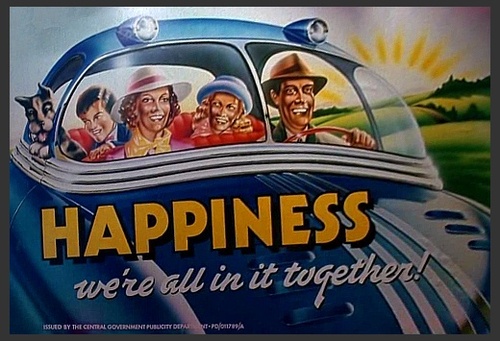
There is an extremely anti-democratic design becoming increasingly evident in policies being formulated by the Coalition, which is aimed at protecting the interests of the very wealthy; at stifling debate, challenges and opposition; permitting political and corporate corruption whilst obscuring it; restricting access to justice for victims of government and corporate corruption and oppression; removing accountability and transparency. There is a detachment of policies from wider public needs and interests. Instead, policies are all about instructing us how to behave.
It’s only a matter of time before the new behavioural economics and so-called science of nudging decision-making is applied to influencing the population’s voting behaviour as well.
Free-will, determinism and bounded rationality in decision-making: implications for democracy
One of our fundamental freedoms, as human beings, is that of decision-making regarding our own lives and experiences. To be responsible for our own thoughts, reflections, intentions and actions is generally felt to be an essential part of what it means to be human.
Of course there are social and legal constraints on some intentions and actions, especially those that may result in harming others, and quite rightly so.
There are other constraints which limit choices, too, insofar that choices are context-bound. We don’t act in an infinite space of opportunities, alternatives, time, information, nor do we have limitless cognitive abilities, for example.
In other words, there are always some limitations on what we can choose to do, and we are further limited because our rationality is bounded. Most people accept this with few problems, because we are still left ultimately with the liberty to operate within those outlined parameters, some of which may be extended to a degree – rationality, for example. But our thoughts, reflections, decisions and actions are our own, held within the realm of our own individual, unique experiences.
However, the government have employed a group of behavioural economists and “decision-making psychologists” who claim to have found a “practical” and (somehow) “objective way” from the (impossible) perspective of an “outside observer” – in this case, the government – to define our best interests and to prompt us to act in ways that conform to their views. Without our consent.
But democracy is based on a process of dialogue between the public and government, ensuring that the public are represented: that governments are responsive, shaping policies that address identified social needs. However, Coalition policies are no longer about reflecting citizen’s needs: they are all about telling us how to be.
The ideas of libertarian paternalism were popularised around five years ago by the legal theorist Cass Sunstein and the behavioral economist Richard Thaler, in their bestselling book Nudge. Sunstein and Thaler argue that policymakers can preserve an individual’s liberty whilst still nudging a person towards choices that are supposedly in their best interests.
But who nudges the nudgers? Who decides what is in our “best interests”?
That would be the government, of course. Thaler, who studied the psychology of decision-making, drawing on the exploitation of “cognitive bias” and techniques of persuasion that have until now been used only by the advertising industry, claims that we are fundamentally irrational. But according to Professor Thaler, we would “all invest in the stock market if we were rational.” That’s a rather unique and remarkably narrow definition.
I wonder if he bothered asking everyone about that. I imagine that if he gets his way, university entrance criteria will change forever. Mind you, so will ideas about human diversity. There seems to be a lot of emphasis on social conformity, directed from the Conservative Cabinet office.
Nudge has become a prop for neoliberal hegemony and New Right Conservative ideology. It’s become a technocratic fix – pseudo-psychology that doubles up as “common sense”, aimed at maintaining the socioeconomic order.
Another phrase the authors introduced was “choice architecture”, a concept implying that the State can be the architect that arranges personal choice in way that nudges consumers in the right direction. It seems that even policies have been commodified. Poor people get bargain basement “incentives” to work harder by having their income reduced, while millionaires get the deluxe model incentives, entailing massive tax cuts and exemptions, all handed out from public funds.
The “right” direction is towards a small State, with nothing but behavioural “incentives” to justify forcing citizens who have needs to be “responsible” and “self-sufficient,” achieving this presumably by paying taxes and then pulling themselves up strictly by their own invisible bootstraps. It’s the government’s new nothing for something culture, specifically for those who fall on hard times.
The pseudo-psychological framework
Behavioural Economics is actually founded in part on crude operant conditioning: it marks the return of a psychopolitical theory that arose in the mid-20th century, which was linked to behaviourism. Advocates of this perspective generalised that all human behaviour may be explained and described by a very simple reductive process: that of Stimulus–Response. There is no need, according to behaviourists, to inquire into human thoughts, feelings, beliefs or values, because we simply respond to external stimuli, and change our automatic responses accordingly, like automatons or rats in a laboratory.
In the Coalition agreement, there is mention of “finding intelligent ways to encourage people to make better choices for themselves. David Halpern, an apparently adaptable, very pro-business behavioural economist, also plays a role in David Cameron’s Big Society project. In 2010, the entire Cabinet were impressed with Nudge, and it quickly became required reading for ministers and civil servants.
The Guardian casually reported that Nick Clegg said he believed the new Behavioural Insights Team could “change the way citizens think.” What is particularly shocking is that the comment elicited no shock whatsoever. (The very idea of a group of right-wing authoritarians that recognise human worth only in terms of money, covertly influencing my behaviour, and that of everyone else, quite frankly appalls me.)
Formally instituted by Cameron in September 2010, the Behavioural Insights Team, which is a part of the Cabinet Office, is made up of people such as David Halpern, who co-authored the Cabinet Office report: Mindspace: Influencing Behaviour Through Public Policy, which comes complete with a cover illustration of the human brain, with an accompanying psychobabble of decontextualised words such as “incentives”, “habit’, “priming” and “ego.” It’s a lot of inane managementspeak. However, the ideas behind the corporate jargon are providing a framework of experimental and often controversial policy-making on an unsuspecting public.
The report addresses the needs of policy-makers. Not the public. The behaviourist educational function made patronisingly explicit through the Nudge Unit is now operating on many levels, including through policy programmes, forms of “expertise”, and through the State’s influence on the mass media, other cultural systems and at a subliminal level: it’s embedded in the very language that is being used in political narratives.
Tory ideology is extended under the misleading label of libertarian paternalism, which is all about shaping our behaviour, by offering “choice architecture”, that reduces public choices to “Choice.” At the heart of every Coalition welfare policy is a behaviour modification attempt, promoted by the influential Nudge Unit and founded on the discredited, pseudoscientific behaviourism, which is basically just about making people do what you want them to do, using a system of punishments and reinforcements. Once you see it, you can’t unsee it.
At the same time, as well as shaping behaviour, the psychopolitical messages being disseminated are all-pervasive, entirely ideological and not remotely rational: they reflect and are shaping an anti-welfarism that sits with Conservative agendas for welfare “reform”, austerity, the “efficient”small State (minarchism) and also legitimizes them. (I’ve written at length elsewhere about the fact that austerity isn’t an economic necessity, but rather, it’s a Tory ideological preference.)
The Conservatives are traditional, they are creatures of habit, rather than being responsive and rational. Coalition narratives, amplified via the media, have framed our reality, stifled alternatives, and justified Tory policies that extend psychological coercion, including through workfare; benefit sanctions; in stigmatizing the behaviour and experiences of poor citizens, and they endorse the loss of autonomy for citizens who were disempowered to begin with.
Nudge theory has made Tory ideology seem credible, and the Behavioural Insights Team have condoned, justified and supported punitive, authoritarian policies, with bogus claims about “objectivity” and by using inane, meaningless acronyms to spell out a pseudoscientific neuroliberalism and to peddle made-up nonsense founded on the whopping, extensive cognitive biases of paternalist libertarians. Most of the nudge unit is comprised of behavioural economists, who are basically peddling the kind of techniques of persuasion that were usually reserved for the dubious end of the advertising industry. This is not “social psychology”, nor is it in any way related to any legitimate social science discipline. However, the creep of behaviourism into nudge based “interventions” is cause for considerable concern.
This government’s policies have contravened the human rights of women, children and disabled people, to date. Nudge is hardly in our “best interests,” then.
The Coalition aren’t engaging with us democratically, they are simply nudging us into compliance with how they think the UK ought to be. We need to ask, in a democracy, where do behavioural economists, policymakers and Tories gain the moral authority to manipulate people’s behaviour? Governments ought to be about supporting people in realising their aspirations, not about changing those aspirations so that they correspond to the worldview of the “choice architects.”
Nudge application: irrationality and ideological justification
Here’s a recent example of choice architecture being “rearranged.” Iain Duncan Smith said recently that limiting child benefit to the first two children in a family is well worth considering and could save a significant amount of money. The idea is being examined by the Conservatives, despite previously being vetoed by Downing Street because of fears that it could alienate parents. Asked about the idea on the BBC’s Sunday Politics programme, Duncan Smith said:
“I think it’s well worth looking at,” he said. “It’s something if we decide to do it we’ll announce out. But it does save significant money and also it helps behavioural change.”
Firstly, this is a clear indication of the Tories’ underpinning eugenicist designs – exercising control over the reproduction of the poor, albeit by stealth. It also reflects the underpinning belief that poverty somehow arises because of faulty individual choices, (as opposed to faulty political decision-making and ideologically driven socioeconomic policies), that those choices are non-rational, stereotypical, and that reducing cost to the State involves making people change their faulty, stereotypical behaviours.
Secondly, the very casual use of the phrase behavioural change is an indication of just how influential the Behavioural Insights Team (Cameron’s pet project, the Nudge Unit) has become in Tory policy-making and justification narratives. The new “behavioural theories” are all-pervasive.
On the Institute for Government website, the section called MINDSPACE Behavioural Economics mentions “behaviour change theory” and “influencing behaviour through public policy.” A lot. But surely, in democracies, public policies are supposed to reflect and serve identified public needs, rather than being about the public meeting specific policy outcomes and government needs.
And how many of us have consented to allow this government to experiment on us via policy with what is, after all, simply a set of pet theories? And that’s what nudge theory applications via policy amounts to.
Again, the Nudge Unit simply reflects a pseudoscientific platform for extension of the government’s ideological reach, reflecting and legitimizing Tory dogmas, such as minarchism (small state, reduced or no public services and support). It’s aim is to persuade the public, using an old and discredited theory – behaviourism – that austerity, cuts to welfare and a massive reduction and mass privatisation of our remaining public services are the only option we have.
From the Mindspace site: “New insights from science and behaviour change could lead to significantly improved outcomes, and at a lower cost, than the way many conventional policy tools are used.”
The welfare “reforms” were hailed by the Conservatives as a system of help and incentives – to “nudge” people into changing their behaviour so that they try harder to find work – but they are in fact eroding people’s motivation. In other words, the reforms have deincentivised and hindered people looking for employment, achieving the very opposite to the intent claimed by the Conservative-led Coalition.
But given that the “reforms” are extremely punitive – cutting people’s lifeline benefits at a time when the cost of living is rocketing, unemployment and underemployment is high, jobs are insecure, wages are at an all time low, and at the time of the reforms bill being drafted and passed through parliament (it was very opposed by many, including the House of Lords – but it was forced through into law only because Cameron invoked “financial privilege”), we were in a deep recession – it’s inconceivable that the Coalition didn’t realise that the “reforms” would push people into utter desperation.
How can anyone claim that forcing people to struggle to meet basic survival needs “incentivises” or helps people into finding almost non-existent work that actually pays sufficiently to meet the cost of living? It’s impossible for people to be motivated to do anything but survive when they can’t meet their most fundamental needs. (See Maslow’s Hierarchy of Needs.)
Sanctions are used – involving the complete removal of lifeline benefits for periods of up to 3 years – when jobseekers “don’t try hard enough” to find work. However, the existence of sanction targets in job centres indicates clearly that sanctions are being used by the government simply to remove people’s benefits and reduce the numbers of people registered as unemployed.
Gathered evidence shows that the sanctions are rarely connected to the actual behaviours of people who are looking for work. People are being punished for simply being poor, vulnerable and claiming benefits. The recent Just about Surviving report, for example, describes a culture of fear, especially among those with serious disability or illness, who were unable to work and so felt powerless to escape or offset the financial losses causes by welfare cuts.
Disabled people are also sanctioned, despite being deemed unfit for work by Doctors and by Atos. The report says: The sheer scale and speed of the cuts to State support left interviewees with “almost no flexibility to live with any comfort”. It meant some of those interviewed were: “Barely surviving.”
Most people who were interviewed told researchers they both wanted to work and saw benefit in working. The report calls on ministers to provide more help in getting people into work, and criticises the “lack of compassion” in the implementation of the reforms.
It is probable that the Department for Work and Pensions will dismiss the findings of the report as “anecdotal,” drawing attention to the small size and geographical reach of the research and suggest that it is not a representative analysis. But the researchers quite rightly point out: “In the absence of an official cumulative impact assessment, this report makes a crucial contribution to our understanding of the impacts of the Coalition’s welfare reforms”.
I believe there are very good reasons to employ qualitative methodology, not least, to counter the Tory preference for the quantitative, where human experience is excluded, lives are reduced in worth by referring to accounts of them as merely “anecdotal”, social groups are marginalised, dehumanised and re-defined as Others, and the Tory statistical justificationisms – a dressed-up, dogmatic pseudopositivism – end up earning them yet another toothless rebuke from Andrew Dilnot.
I’ve said elsewhere that the Tories certainly have a problem confronting human needs as well as observing and upholding concomitant human rights. It’s almost as if they assume there is an ideal, unidimensional, default-type citizen that has no needs at all. Conservatives seem to think that a person who is responsible is part of an ideally invisible, non-demanding, compliant public, who simply get on quietly with working hard for Tory corporate sponsors to make rich people profits, whilst accepting insultingly low pay and poor working conditions. If you can’t or won’t do that, then you will be nudged into compliance.
And back into the 19th century. This is not only oppression at a political level – for example, material inequality has grown because of Conservative-led policies that punish the poor and reward the wealthy – people are also being repressed existentially: emotionally, psychologically and cognitively, to ensure conformity to the prevailing elite’s idea of (Social Darwinist) norms and values.
That’s why the bankers and financial institutions that caused the global recession through behaving “irrationally” aren’t included in Cameron’s nudge social conditioning experiment. It’s largely aimed at the poor, curiously enough. Though apparently, the Conservatives believe that the wealthy are incentivised differently from the rest of us: they need rewards of even more money, tax breaks and large bonuses, rather than financial punishments to ensure they are “responsible citizens.”
The Conservatives and a largely complicit media, convey the message that poor people suffer from some sort of character flaw – a poverty of aspiration, a deviance from the decent, hard-working norm. That’s untrue, of course: poor people simply suffer from material poverty which steals motivation and aspiration from any and every person that is reduced to struggling for basic survival.
However, the Conservatives have decided that in addition to bearing the burden of your poverty, you now have to work at improving your behaviour.
Mind the Mindspace:
A summary of the main influences outlined in the MINDSPACE acronym framework

All of these basic ideas are being utilised to prop up Conservative ideology, to shape Conservative policies and to justify them; to deploy justification narratives through the mass media, in schools and throughout all of our social institutions.
For example, incentives being linked to the mental “shortcut” of strongly avoiding losses (a “cognitive bias” called loss aversion) shows us precisely where the Tories imported their justification narrative for the welfare cuts and benefit sanctions from. What the government calls incentivising people, by using systematic punishments, translates from Orwellian Doublespeak to “state coercion” in plain language.
“We act in ways that make us feel better about ourselves” – norms, committments, affect, ego – “behavioural insights” are manipulations of a neoliberal, paternalist ideological grammar, contributing to Tory rhetoric, lexical semantics and media justification narratives that send both subliminal and less subtle, overt messages about how poor and disabled people ought to behave. And it establishs a “default setting” regarding how the public ought to behave towards poor and disabled people.
The night-watchman who looks the other way from those who need looking out for
This is political micro-management and control, and has nothing to do with alleviating poverty. Nor can this ever be defined as being our “best interests.” There’s an identifiable psychocratic approach embedded in Conservative policies aimed at the poorest. Whilst on the one hand, the Tories ascribe deleterious intrinsic motives to rational behaviours that simply express unmet needs, such as claiming benefit when out of work, and pathologise these by deploying a narrative with subtextual personality disorder labels, such as scrounger, skiver and the resurrected Nazi catch-all category for deemed miscreants: “workshy,” the Tories are not at all interested in your motivations, attitudes, thoughts, hopes and dreams. They are interested only in how your expectations and behaviour fits in with their intent to reduce the State to that of night-watchman proportions – one that is only watching out for the privileged and propertied class.
Poor people are not culpable, regarding their predicament. No-one would choose to be poor. They don’t formulate the policies that create rising inequality and poverty: the Tories do. Conservatives are very good at laying out the price of everything, they even go to the trouble of sending out a grossly inaccurate statement to try to persuade the public that their taxes are paying for a projected, shameful, disproportionately costly and wasteful welfare system supporting free riders – a “bad investment” for a mythological, discrete class of taxpayers that needs to be dismantled by a thousand more Tory cuts, but they never once reflect the value and worth of anyone who has been or is going to be destroyed in the wake of their dystopic, Social Darwinist, ideologically driven meddling and propaganda peddling.
And they also fail to mention that although Conservatives are claiming they don’t agree with state interventions, they do an awful lot of those anyway, just to ensure that virtually all of our public wealth is privatised, whilst the debt, risks and pain of this is carried by those people who are the very least able to bear the burden, and actually, the least expensive to society.
The Tory market place harbours no democracy, or sentiment for rights to temper our responsibilities, unless you are rich: everyone else has to content themselves with only responsibilities, the weight of which are inversely proportional to your wealth, of course.
The link between nudge and totalitarianism
As a psychology student, I remember wondering why few psychologists had commented on the political ramifications of B.F. Skinner and behaviourism. After all, he was clearly a totalitarian thinker, and behaviour modification techniques are the delight of authoritarians.
To recap, behaviourism is basically the theory that human and animal behaviour can be explained in terms of conditioning, without appeal to consciousness, character, traits, personality, internal states, intentions, purpose, thoughts or feelings, and that psychological disorders and “undesirable” behaviours are best treated by using a system of reinforcement and punishment to alter behaviour “patterns.”
Skinner and the behaviourists casually removed the person from people. There’s no-one in the “driving seat.” We are being remotely controlled.
Behaviourism was discredited and labelled “pseudoscience” many decades ago, (very memorably by Noam Chomsky, amongst others). Most psychologists and cognitive scientists don’t accept that myriad, complex human behaviours are determined by and reducible to nothing more than an empty stimulus/response relationship; our deeds and words merely a soulless, heartless and mindless cause and effect circuit.
How can behaviourists claim objectivity when they are active participants within the (intersubjective) social environment, sharing the same context that allegedly shapes everyone else’s behaviour? And how does behaviourism itself miraculously transcend the deterministic confines of stimulus-response? If all behaviours are determined, then so are psychological theories.
The Behavioural Insights Team are charlatans that are propping up the policies of an authoritarian government. Hannah Arendt wrote extensively about totalitarian regimes, in particular Nazism and Stalinism. She says that Hitler and Stalin sought to eliminate all restraints upon the power of the State and furthermore, they sought to dominate every aspect of everyone’s life. This domination tends to happen in stages – incrementally.
In Skinner’s best-selling book Beyond Freedom and Dignity, 1971, he argued that freedom and dignity are illusions that hinder the science of behaviour modification, which he claimed could create a better-organised and happier society, where no-one is autonomous, because we have no autonomy. (See also Walden Two: 1948: Skinner’s “Utopian” antidemocratic novel).
There is, of course, no doubt that behaviour can be controlled, for example, by threat of violence, actual violence or a pattern of deprivation and reward. Freedom and dignity are values that are intrinsic to human rights. And all tyrants and bullies are behaviourists.
The insidiousness of “libertarian paternalism” is not only due to a slippery slope from the implicit “non-coercive nudge” to explicitly coercive limits on individual autonomy and liberty.
There is also a problem with the very term, as an example of Orwellian language-use, “libertarian paternalism” renders difficult the ability to conceive of a principled distinction between policy that respects individual autonomy and policy that violates it. But there is a distinction, and the ability to defend our liberty depends on ensuring it is maintained.
Democracy involves governments that shape themselves in response to what people need and want, it’s not about people who reshape their lifestyles in response to what the government wants. Democracy is meant to involve the formulation of a government that reflects and meets public needs.
Under the nudge tyranny, that is turned totally on its head: instead the government is devising more and more ways to put pressure on us to change. We elect governments to represent us, not to manipulate us covertly.
Nudge is actually about bypassing rationality, reason, political accountability and transparency – democratic process, critical debate. The government is substituting those with manipulation, coercion, and an all-pervasive social operant conditioning experiment. The irony is that there is no scope offered with nudging for engaging with rational processes and stimulating critical thinking, in fact nudge bypasses rational and deliberative processes and therefore presents no opportunities whatsoever for people to learn and develop new cognitive skills.
The Nudge Unit has been part-privatised, protected from public scrutiny. It is no longer subject to the Freedom of Information Act. It can sue for libel.
Another application of “behavioural insights”: How to demonise and demoralise jobseekers in one meaningless test. Psychometric tests always tell us more about the designers than about the people who fill them in. And at best, they can only ever indicate that a person is capable of completing a psychometric test. The whole approach of “working” on jobseekers’ “self-esteem” is complete nonsense. It assumes that unemployment is an individual failing that may be fixed at a personal level, rather than a problem of arithmetic where there are fewer jobs than the number of people who want them.
Related
DEFINING FEATURES OF FASCISM AND AUTHORITARIANISM





 Politics and Insights