
 This past four years or so, I’ve watched the media distort the truth, often removing it from a meaningful context and twisting it out of recognisable shape. Or very often avoiding it altogether. I’ve watched minor parties claiming to be on the Left do the same, too, and I won’t ever forgive them for that. Nonetheless we have done our best to share truths and information and to decode rhetoric and re-translate lies.
One thing I can do is analyse social policy, I’ve a perceptive and predictive eye for how policies will affect us – the implications and probable consequences – well before they are implemented. The last four years will bear that out. It’s not just because I studied it, it’s also because I see underpinning ideology, too. I recognise that policy is comprised of a set of scripted motives and intentions on the part of any government and instructions to society on how to organise itself, how to behave and how our individual degree of freedoms are defined, extended or restricted. Policies also send out instructions regarding how social groups are perceived and treated.
Policies may express and extend tolerance and reflect a valuing of diversity, or, as the case is now, they may also prescribe social prejudice and serve to institutionalize discrimination.
Ideology reflects how a government believes society is (and what it isn’t,) and also prescribes how it SHOULD be. The Tories have been imposing their own narrow, nightmarish vision upon us for the past five years.
Today it struck me again just how we have had to decode so very much misinformation. For example, someone asked me about the headline lie that the Labour Party intend to “scrap benefits for young people.” Of course it’s not true. Or rather, it’s a carefully selected, out of context, partial truth.
Miliband is REPLACING jobseekers allowance with another allowance for young people. He thinks that conditional benefits are inappropriate for young people, as to be entitled to jobseekers allowance requires having to be available for work and actively looking for work, so it excludes the very possibility of further education and learning experiences. But young people need the freedom and support to gain from learning. That’s why Ed Miliband will replace out of work benefits for those aged 18-21 with a youth allowance of the same value – currently around £57 a week. This isn’t the controversial issue that was presented by the mainstream media and other parties at all: it’s actually a very well thought out, cost efficient and positive policy.
So young people don’t have to be available for work, but they do have to use their freedom to be learning or training. This detail matters a lot and was excluded from most accounts of the policy. Miliband had a good idea, it won’t cost any more than we currently pay young people, but it means we are investing in young people’s potential and their futures.
This is just one example of how truths are being distorted and not just by the media, but also by the likes of the SNP, the Green Party, TUSC and many of the other increasingly authoritarian groups competing for votes from the Left. Yet when you think about how they have lied to you on fundamental issues, (and they really have) would you REALLY trust them with your vote? Would you REALLY have faith that these parties will suddenly become honest and develop some integrity if they ever got any power? They won’t. Not one bit.
More recently, there was an intentional distortion of the parliamentary debate on the Infrastructure Bill and fracking, with the Green Party in particular being very critical of Labour’s fracking amendments, which involve regulations that were, after all, succesful: they were accepted by the Tories. Labour proposals considerably tighten environmental regulations. In the UK, drilling for shale gas is still at an exploratory stage, though the Conservatives had planned on fast-tracking the fracking process. The regulations will halt exploratory drilling going ahead in the UK for at least a year. Meanwhile, the Environmental Audit Committee continue with its inquiry, gathering the strong, credible evidence we need if there is to be a justifiable, democratic and fully accountable ban on fracking.
A ban would never have been successful at this stage, and Labour knew this. The other thing NONE of the of aggressive, electioneering “critics” consider, apparently, is that had the proposed moratorium actually scraped a successful yes vote, and that was unlikely, the Tories would most certainly NOT have abided by that outcome, leaving them free without amendments and thus no regulation at all, to go ahead and fast-track fracking. Labour got them to agree on considerable restrictions, which will tie the Tories’ hands at least until well after the election. That is a success.
Anyone with concerns regarding fracking and the legislation ought to be big and authentic enough to take their issues directly to the TORIES, they are the ones that introduced this Bill, after all, not Labour. Yet all we have seen is moralising accounts from rival left parties about how Labour should have done things. Labour have made a difference. Only the grandstanding, electioneering parties would and did turn a success into an opportunity for unreasonable criticism. And they do this every single time the Labour Party achieve or present something positive.
Evidence is much more important than rhetoric and gesture politics. Reasoned and evidenced debate, however, seems to have been sidelined by those who, rather than engaging in genuine politics, prefer gesturing and politicking, no matter what that costs us.
Another claim made recently by the Green Party, again, amongst others, is that “Labour voted to keep austerity”. That is such a blatant lie, because the vote, clearly stated on the Hansard record (13 Jan 2015: Column 738, Charter for Budget Responsibility), was pertaining strictly to the motion: “That the Charter for Budget Responsibility: Autumn Statement 2014 update, which was laid before this House on 15 December 2014, be approved.”
The charter sets out that the Office of Budget Responsibility (OBR) will continue to monitor our fiscal rules. As we know, the OBR has written extremely critical economic forecasts and analysis of austerity and the Tory spending cuts, clearly expressing the risks that the Chancellor is running and the scale of the damage his strategy will inflict on what remains of our public services. It’s worth noting that whilst Ed Balls challenged Osborne, there was a curious silence from the SNP and the Green Party. It was Ed Balls that challenged Osborne’s outrageous claims regarding “halving the deficit”- such a blatant lie, upon which even the exceedingly Conservative Spectator spluttered contempt. Or any of the other lies, some of which have already earned the Conservatives official rebukes from the Office for National Statistics. (See “bankruptcy lie” for example, on the hyperlinked article)
Furthermore, it’s about time that some MP’s, including Caroline Lucas, amongst others, recognised that there is a fundamental difference between the meaning of the word budget and the word austerity. Conflating the two for the purpose of politicking is unprincipled and dishonest.
It’s also worth noting from the same debate on the Hansard record:
13 Jan 2015 : Column 746
Caroline Lucas: Does the Chancellor agree with me that with the feeble and inconsistent opposition coming from the Labour Front Bench, there is a very good reason for seeing the SNP, the Greens and Plaid as the real opposition on this issue because we are clear and consistent about the fact that austerity is not working?
Mr Osborne: That shows why we want the hon. Lady’s party in the TV debates.
Yes, I just bet they do, to collaborate with the Tories in attacking and undermining the Labour Party, not the Coalition, who are, after all, the ones responsible for introducing austerity measures. I don’t imagine for a moment that Osborne values further challenges to his outrageous claims of efficacy regarding austerity measures. What is very evident when you read through this debate, is that Ed Balls and a couple of other Labour MPs presented the ONLY challenges to Osborne on this matter, just to reiterate.
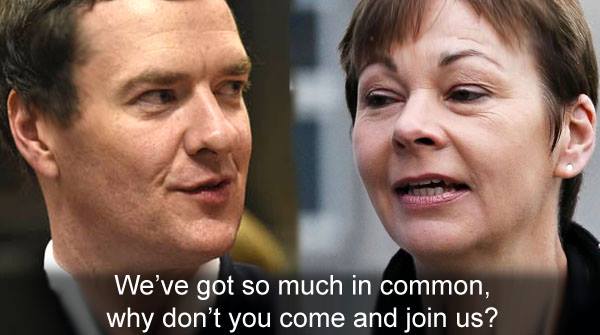 There’s a clear gap between professed principles and their application amongst the parties that claim to be “real socialists”. How can it be principled or moral (or “socialist” for that matter) to collaborate with the Tories in attempting to damage, smear and discredit the only viable option of removing the Tories from Office in May? Bearing in mind that many people are suffering profoundly, some have died as a consequence of Conservative-led policies, we can see what the Green Party’s priorities actually are, here. They don’t include the best interests of citizens and consideration of their well-being, that’s for sure.
There is a big difference between being moral and being moralistic. Being moral means that we know what is right and wrong, what is fair and what is unfair, and so on. Being moral means we take responsibility for ourselves. We extend our morality to others, it shapes how we relate to them, our esteem of others and respect. It tends to frame democratic relationships
Being moralistic means we impose on others our own definitions. We tell others what is right and wrong, we define those things for them. Being moral is also about being authentic, being moralistic is often inauthentic and hypocritical. It’s more about control and overburdening others with responsibility, whilst restricting their choices, than genuine morality. Moralising shapes how we interact with others too, forming power imbalances and inequalities.
We can use this dichotomy to explore political parties and democracy. The Tories often talk about morality, they are a moralistic party that impose what they think is right on everyone else. We know how that has worked out this past five years and it’s got nothing to do with right and wrong, nor is it even remotely related to fairness or social justice. Tory moralising is about control and subjugation of the poorest, liberation and freedom of the wealthiest. That’s what the Tories are all about.They don’t possess any moral core themselves, which is evident in the sleaze and corruption that they tend to leave in their wake.
Labour are moral. This is evident in policies which are coherent, embedding human rights and equality principles. There’s an integrity evident in their social policies, because they reflect core values that Labour have always held, regardless of who has been party leader. They impose a legal framework of moral codes that establish decent, civilised conduct. Labour’s policies accommodate democracy, equality, diversity and meet a broad array of social needs. In debate, the Labour party are generally rational and reasoned, rather than emotive and judgemental. They favour a learning approach – which is progressive – it’s about development, rather than imposing dogma on the population.
It’s evident that the Green Party are moralisers too. They criticise Labour, often imposing their view of what Labour should do. Meanwhile, the Tories are destroying the country and people’s lives. Even a cursory glance at the Green manifesto indicates plainly that it is a set of policies from idealising moralists, rather than a meaningful democratic representation of the whole population and a balanced reflection of their varied needs.
For example, the universal basic income that the Green Party propose – will it be paid to millionaires as well as the poorest? How would that address inequality – an issue which the Green Party claims to be concerned with? How will it contribute to a so-called steady-state, zero growth economy?
How does banning page three, but legalising prostitution and the sex industry, which is also about economically exploited women being economically exploited, reflect any joined-up thinking? Inconsistency and incoherence.
It’s more dogma.
Think very carefully about what you are voting for. Look for the facts and truth to inform that decision, because in such bleak times, it’s easy to cling to a populist, superficial, dressed-up promise of better things than the Tories offer, but easy fixes don’t exist. Look for coherence, depth and consistency in the narratives being proffered. And look for evidence. You will see that once you look below the surface of false claims, false promises and electioneering, there’s a big difference between moral policies (they tend to be democratic) and moralising ones (they tend to be authoritarian).
 Many thanks to Robert Livingstone for his outstanding pictures.

 Politics and Insights