Tag: poverty

Poor people are rubbish at being poor, says Iain Duncan Smith and Conservative Baroness Jenkin of Kennington

526544_532055030197363_2137237288_n

It’s truly remarkable that whenever we have a Conservative government, we suddenly witness media coverage of an unprecedented rise in the numbers of poor people who suddenly seem to develop a considerable range of baffling personal ineptitudes and immediately dysfunctional lives.

We see a proliferation of  “skivers” and “scroungers”, an uprising of “fecklessness”, a whole sneaky “culture of entitlement”, “drug addicts”, a riot of general all-round bad sorts, and apparently, the numbers of poor people who suddenly can’t cook a nutritious meal has climbed dramatically, too. We are told that starvation is not because of a lack of money and access to food, but rather, it’s because people don’t know how to budget and cook, that’s according to the Conservative Baroness Jenkin of Kennington.

She recommends that poor people stop avoiding porridge, since it only costs 4 pence a bowl.

1390648_548165358586330_1740107407_n
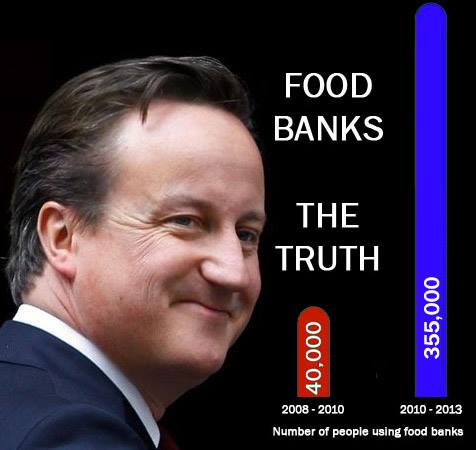
The alarming rise in numbers of adults who have suddenly forgotten how to cook and eat porridge since David Cameron took Office, up to last year.

The very fact that people suddenly and worryingly forget these crucial life-skills under every single Conservative government, but most particularly under this one, provides a darn good reason to vote them out on May 7th, 2015, I should say.

Iain Duncan Smith added: “People are going to food banks because they get divorced, ill or addicted to drugs,  it is “ridiculous” to blame the Government.

It is really rather ridiculous to assume that that every single reason that someone is going to a food bank is down to what the Department for Work and Pensions does.

The report itself today and other reports are also clear and they show there are often people with very dysfunctional lives, people who have been caught in drug addiction, family breakdown, people who have gone into serious illness that aren’t claiming benefits and come into difficulty.”

1002589_521987671204099_896277269_n (1)

Gosh, such a massive rise in “dysfunctional lives”, divorce, family breakdown, serious illness and drug addiction, and all since 2010 – even more reasons to vote them out. This Government has clearly created a tide of social problems, as very few people were incompetently hungry and desperately silly enough to need food banks under the last government. In fact I didn’t even know they existed back then. But that’s the “Big Society” for you. What a bright idea to replace welfare with charity. It’s just like the good old Victorian days. Hurrah!

I mean it’s not as if wealthy people ever suffer from messy divorce, serious illness, family breakdown and drug addiction. That must be why we never see them at food banks.

These people simply need to stop being seriously ill, divorced and all of that, that’s what I say.

A lot of people who specialise in studying poverty have said the welfare “reforms” are behind the rise in food bank use, as well as rising benefit sanctions, low pay and ever-rising living costs. But Iain Duncan Smith seems to know what he’s doing, especially when it comes to talking about “fairness”. Or statistics, for that matter.  You never hear about people starving who don’t have a messed-up life, after all. The man has solved that cause and effect dilemma conveniently and to his discredit, very cheaply. Bravo. We should give him a break, as the poor, inadequate vicious bully defensive man can’t even afford to buy his own underwear.

It’s just a coincidence that the Tory austerity measures have been targeted at the poorest, after all. Nothing to do with those draconian, punitive fair and much-needed cuts to people’s lifeline benefits.

Meanwhile, I’m delighted to see the rise in tax-avoiding, sanctimonious kindly wealthy people preaching Victorian values of thrift, self-help and morality, but only to the poor, of course. We really must learn to manage how to not have the basic requirements for survival better, after all. We’re just going about being paupers all wrong. We all know that increasing absolute poverty is an indulgent lifestyle choice. Who wouldn’t jump at the chance to have such an easy time of it, languishing in all of that deprivation, a shorter life and constant cold and hunger? Not to mention such a special social status. It’s so important to know one’s place.

Yes. Poor people are just so incompetent at being impoverished. How utterly selfish. We really ought to make much better use of our absolute poverty. Perhaps we should learn how to announce a flounce from the country, like many of the tight-fisted, selfish, personality disordered,  socially irresponsible hard done by millionaires do, at the prospect of social policy not going quite their way. Some of them were very cross indeed about the very idea of contributing to our economy, and who can blame them. After all, it matters not that poor people starve, as the most important and useful thing for this country is the accumulation of more wealth by an already very wealthy minority. The destruction of our country’s economy, public services, welfare and so many lives is a sacrifice the wealthy are more than happy to pay.

Good thing that David Cameron has obliged their generosity. Phew. The alternative just wouldn’t bear thinking about for those poor millionaires, who are, after all, victims of terrible discrimination, and inequality. Someone has to be, apparently. It’s in the Tory social order rule book. Still, at least we are all better off than Iain Duncan Smith. Most of us are still capable of managing coherence, as money can’t buy that. So we can be cheap and cheerful.

But the rich have obviously forgotten the virtues of porridge and thrift, too.

Perhaps the poor could run budgeting classes for poor, needy millionaires. It seems not many people know that porridge provides the way out of grinding, long-term material deprivation and helps to prevent terrible social problems. Better safe than sorry, I say.

And David Cameron says rich people need looking after. They must be very vulnerable and fragile. I’m sure it will make the mansion tax more palatable, too, for the tax dodging unbearably tortured souls that may have to dip their hands in their vast vaults and pay their way for once endure it. They didn’t mind the bedroom tax, though, despite it being a breach of human rights, and they even managed to stay calm and silent at the destitution and deaths it has caused: they didn’t complain once, bless them. So perhaps they’ll cope with the mansion tax after all.

There’s no porridge on the House of Lord’s menu, either. I feel so sorry for them:

Embedded image permalink

See what I mean? An example of Baroness Jenkin’s “budgeting skills”, which are subsidised by UK tax-payers. The House of Lords’ 760 peers benefit from an £84 discount on their food every week. The generous cut is more than the weekly Jobseeker’s Allowance, which is just £71. And the subsidy comes on top of the £300-a-day “subsistence” given to peers for each day they attend the Lords, to cover food and accommodation. How do they endure it?

And thinking about it, isn’t it odd that whenever we see the curiously abrupt forgetfulness and sudden ineptitude on the rise amongst the poorest members of the public and their increasingly chaotic, difficult lives, it coincides every time with a significant increase in poverty, inequality, politically manufactured unemployment, a significant rise in the cost of living, poor working conditions and lower wages, and welfare “reforms”.

And a bunch of selfservatives in Office. There’s a correlation there somewhere, isn’t there?

Primary referral causes in 2013-14

Latest foodbank figures top 900,000: life has got worse not better for the poorest in 2013/14, and this is just the tip of the iceberg – The Trussell Trust.

Executive Summary of Emergency Use Only Report.

The just about surviving report


1459165_266124213538634_1461740450_n
Thanks to Robert Livingstone for his excellent memes

The BBC expose a chasm between what the Coalition plan to do and what they want to disclose

1379986_541109785958554_2049940708_n

“Traditions are not killed by facts” – George Orwell.

The Conservatives are creatures of habit rather than reason. Traditional. That is the why their policies are so stifling and anti-progressive for the majority of us. It’s why Tory policies don’t meet public needs.

There’s always an air of doom and gloom when we have a Tory government, and a largely subdued, depressed, repressed nation, carrying vague and fearful intuitions that something truly catastrophic is just around the corner.

I can remember the anxiety and creeping preternatural fear amongst young people in the eighties, and our transcendent defiance, which we carried like the banners at a Rock Against Racism march, back in the Thatcher era. We always witness the social proliferation of fascist ideals with a Tory government, too. It stems from the finger-pointing divide and rule mantra: it’s them not us, them not us. But history refutes as much as it verifies, and we learned that it’s been the Tories all along.

With a Conservative government, we are always fighting something. Poverty, social injustice: we fight for political recognition of our fundamental rights, which the Tories always circumvent. We fight despair and material hardship, caused by the rising cost of living, low wages, high unemployment and recession that is characteristic of every Tory government.

I think people often mistranslate what that something is. Because Tory rhetoric is all about othering: dividing, atomising of society into bite-sized manageable pieces by amplifying a narrative of sneaking suspicion and hate thy neighbour via the media.

The Tories are and always have been psychocrats. They insidiously intrude into people’s everyday thoughts and try to micro-manage and police them. They use Orwellian-styled rhetoric crowded with words like “market forces”, “meritocracy” “autonomy”, “incentivisation”, “democracy”, “efficient, small state”, and even “freedom”, whilst all the time they are actually extending a brutal, bullying, extremely manipulative, all-pervasive authoritarianism.

The Conservative starting point is control of the media and information. All Conservatives do this, and historically, regardless of which country they govern. (As well as following the hyperlinks (in blue) to British and Canadian media takeovers, also, see the Australian media Tory takeover via Murdoch, from last year: The political empire of the News Corp chairman.)

As we saw earlier this year when the Tories launched an attack on Oxfam, any implied or frank criticism of Conservative policies or discussion of their very often terrible social consequences is stifled, amidst the ludicrous accusations of “politically biased.”

When did concern for poverty and the welfare of citizens become the sole concern of “the left wing”? I think that casually spiteful and dismissive admission of indifference tells us all we need to know about the current government’s priorities. And no amount of right-wing propaganda will hide the fact that poverty and inequality rise under every Tory government. And how is it possible to discuss poverty meaningfully without reference to the policies that cause it? That isn’t “bias”: it’s truthful. Tory policies indicate consistently that when it comes to spending our money, the Tories are very generous towards the wealthy, and worse than parsimonious regarding the rest of us.

Then there are the Tory pre-election promises, all broken and deleted from the internet. And valid criticism of their spinner of Tory yarns and opposition smears, also deleted. This is not a democratic government that values political accountability, nor is it one that is prepared to bear any scrutiny at all.

The Conservatives are attempting to intimidate the BBC (again) into silence regarding its candid commentary regarding the autumn statement made by Osborne, exposing the vast scale of cuts to come for the British public. I’m pleased to see the BBC hitting back, for once, with a robust defence, declaring that: “We’re satisfied our coverage has been fair and balanced and we’ll continue to ask ministers the questions our audience want answered.”

It was BBC assistant political editor Norman Smith’s description of the Office for Budget Responsibility (OBR) response to the autumn statement document as “the book of the doom” and his suggestion that the UK was heading “back to the land of Road to Wigan Pier” that provoked Osborne’s outrage.

But whilst journalists are hardly unknown for hyperbole, Smith certainly can be cleared of this charge. Because many agree that the figures contained in the OBR blue book are truly remarkable and worry-provoking. Many of us have concluded the same, from the OBR and Institute of Fiscal Studies (IFS) to an army of quietly reflective bloggers, who have collectively anticipated this purely ideological outcome for some time.

The BBC are absolutely right to point out to the public that there will be severe social repercussions as a consequence of the scale of cuts that Osborne is planning, especially given that sixty percent of the cuts are yet to come.

The judgements of the OBR, which Osborne set up, and IFS, were at least as damning as the BBC’s, but it’s worth noting that the Chancellor doesn’t publicly attack either report. Because he can’t.

Instead the Conservatives have accused the BBC of “bias” and “systematic exaggeration,”  David Cameron and George Osborne launched an unprecedented attack on the coverage of the Autumn Statement. However, the Conservatives have been openly policing the media for a while. (See: Tories to closely monitor BBC for left wing bias ahead of party conference season and: Once you hear the jackboots, it’s too late.)

Senior Tory MP Andrew Bridgen suggested there was a risk that unless the BBC was “scrupulously fair” in its reporting, it may “drive voters into the arms of Labour”, adding the threat “and may even find its future funding arrangements affected.”

A blatant threat.

On Thursday, Bridgen wrote to Rona Fairhead, the BBC Trust’s chairperson, to complain “about a pattern of systematic exaggeration in the BBC’s reporting of the Autumn Statement”. It’s not his first complaint about alleged bias, either: he whined when the TUC’s senior economist Duncan Weldon became Newsnight’s new economics correspondent earlier this year.

Mr Bridgen said he wanted “to seek assurances that in the remaining six months until the general election your coverage will demonstrate the impartiality and balance that the public, and indeed the BBC charter, demand”.

He added: “Over the last four years the entire nation has pulled together to achieve something many said could not be done: we are now the fastest growing advanced economy in the developed world. The sacrifices and hard work of the British people are ill-served by pessimistic reporting which obscures our economic success with the language of fear and doom.”

I don’t think this is about “impartiality” or what best serves the British people. This is about the Conservatives not getting their own way, so they resort to bullying and  attempts to discredit people who have simply told the truth.

The Chancellor responded angrily to the references to Orwell’s The Road to Wigan Pier in the Today report on BBC Radio 4. He said: “I would have thought the BBC would have learned from the last four years that its totally hyperbolic coverage of spending cuts has not been matched by what has actually happened. I had all that when I was interviewed four years ago and has the world fallen in? No it has not.”

Well, that all depends George. For many people, the only genuine growth we’ve seen is in poverty, inequality, destitution, hunger, suffering and referrals to foodbanks. And deaths. So yes, for growing numbers, their’ world has fallen in.

A BBC spokesman said the BBC was satisfied that the Today programme’s coverage had been “fair and balanced and we gave the Chancellor plenty of opportunity to respond on the programme.”

And the comments were justified because the Office for Budget Responsibility had itself said that nominal government consumption will fall to its lowest level since 1938, the BBC said.

Both the OBR and IFS said in their responses to the autumn statement that Britain has not seen public spending reduced to this level as a proportion of GDP since the grim days of the 1930s.

The public sector spending cuts over the next five years set out in the autumn statement may force a “fundamental re-imagining of the state,” the Institute for Fiscal Studies said in their report.

The warning from the IFS – Britain’s public spending analysts – came only hours after Osborne had angrily rounded on the BBC, accusing its reporters of “totally hyperbolic” reporting about his spending plans and “conjuring up bogus images of the 1930s depression”.

The IFS confirmed that the scale of cuts to departmental budgets and local government would reduce the role of the state to a point where it would have “changed beyond recognition.” The government’s spending watchdog, the Office for Budget Responsibility (OBR), also said yesterday that Osborne’s statement indicated that with the cuts set out in Treasury assumptions, we would see the state reduced to its smallest size relative to GDP for 80 years – since the 1930s.

It was about this era, the Great Depression, against which Orwell set The Road to Wigan Pier, in his account of the bleak living conditions, social injustices, suffering and misery of the working class in the Northwest of England. Norman Smith made an apt comparison.

Scenes from the Jarrow Crusade, 1936, Marchers from Jarrow in the North East of England, walk to London where they will hand in a petition to the House of Commons in a plead for more work as the depression and starvation of the 1930's hits hard

Scenes from the Jarrow Hunger March, 1936, Marchers from Jarrow in the North East of England, walked to London where they handed a petition to the House of Commons in a plead for more work as the depression and starvation of the 1930’s hit hard

Osborne admitted to John Humphrys two hours later, that “difficult” decisions on welfare would include freezing working age benefits for two years and lowering the welfare cap on spending from £26,000 for a family each year on benefits to a maximum of £23,000. But he maintained his glib assurances that the outlook was not as grim as Smith and Humphrys were claiming.

With the cost of living rising sharply year after year, and with the catastrophic consequences of the first wave of welfare “reforms” now clearly evident, it is difficult to envisage how the outlook for the poorest can be deemed anything other than enduringly, grindingly bleak.

If any evidence was needed that the Conservatives fear the political consequences of the cuts to come, the assault on the BBC’s coverage of the autumn statement has certainly provided it. The Conservative responses are strictly about discrediting the BBC as a means of pre-election damage-limitation, and not about the accuracy or “bias” of the reporting, because Osborne had not anticipated that the real consequences of his budget plans would be shared with the public. Most people don’t, after all, read the OBR or IFS forecasts and reports. As it is, Osborne had set out to mislead the public, and was well and truly exposed.

The IFS director, Paul Johnson, said: “The chancellor is right to point out that it has proved possible to implement substantial cuts over this parliament. One cannot just look at the scale of implied cuts going forward and say they are unachievable. But it is surely incumbent upon anyone set on taking the size of the state to its smallest in many generations to tell us what that means.

It’s also worth bearing in mind that Clegg has claimed co-authorship of the budget statement. Clegg’s absence from parliament for the third Wednesday in a row suggests he is farcically trying to distance himself from David Cameron and Osborne in the run-up to the election.

However, he attempted to take credit for the central policies of the statement, including the stamp duty overhaul unveiled by Osborne, when questioned on his LBC 97.3 radio show by Ed Balls, the shadow chancellor.

“Everything in that autumn statement is there because we’ve agreed it and I fully support it,” Clegg said.

The BBC exposed the chasm between what the Tory-led Coalition plan and what they are prepared to disclose and discuss publicly. That’s because of a chasm that exists between Tory ideology and a genuine economic problem-solving approach to policy: Osborne’s autumn budget statement was entirely about political gesturing, designed to divert attention from the sheer extent of social and economic damage  wreaked by five years of strictly ideologically-prompted policy.

This is a Chancellor who rested all of his credibility on paying down the debt and has borrowed more than every Labour government combined.

It must be abundantly clear that the Tory aim of much bigger and destructive cuts after 2015 is not about deficit reduction, but the destruction of the public sector, our services and social safety nets, the undoing of a century of our the hard-won achievements of civil rights movements, and all in favour of greedy, elevated, unbridled market forces.

Conservatism is centred around the preservation of traditional social hierarchy and inequality. Tories see this, erroneously, as an essential element for expanding economic opportunity. But never equal opportunity.

Conservatives think that civilised society requires imposed order, control and clearly defined classes, with each person aware of their rigidly defined “place” in the social order. Conservatism is a gate-keeping exercise geared towards economic discrimination and preventing social mobility for the vast majority.

It is these core beliefs that fuel Osborne’s stubborn adherence to austerity policies, even though it is by now patently obvious that austerity isn’t working for the economy, and for majority of the public. It never will.

942124_214298768721179_2140233912_nThanks to Robert Livingstone for the memes.

Related

Osborne’s Autumn statement reflects the Tory ambition to reduce State provision to rubble

Ed Balls: response to the Autumn Statement

It’s the Tories that want something for nothing: the democratic contract and government responsibility

430847_149933881824335_1645102229_n (1)
The Conservative defense of increasing economic inequality, the lionisation of Randian, Libertarian, selfish individualism and the proliferation of ideological justification narratives regarding the dismantling of the “Big (Welfare) State”, where the latter, in Orwellian fashion, is now being indicted for many of the very social and economic ills that the free market era has actually delivered has surely worn threadbare by now. 

It’s abundantly clear that it’s the Tories and the very wealthy that want something for nothing. Cameron’s mantra is “social responsibility, not state control equals Big Society.” Cameron, in his Hugo Young lecture (2009), claimed that the “Big Society demands mass engagement: a broad culture of responsibility, mutuality and obligation”.

But this isn’t about a transfer of political power or decision-making from government to the public: it’s a transfer of responsibility and duty only.

In true Orwellian spirit, Cameron went on to say: “The recent growth of the state has promoted not social solidarity, but selfishness and individualism.”  Only a conservative would claim poverty and social cohesion as their concern and passion, and then attack  the mechanism that until now has been used to alleviate them  – publicly funded state spending.

Democracy (based on the partnership between political and economic enfranchisement) happens when the concept of property encompasses access to “social goods” such as healthcare, education and public infrastructure as a right of citizenship. The idea of political representation becomes consolidated when access to such social goods is guaranteed by a legal process, as well as a political process.

The electoral franchise in countries which adopted a Lockean liberal constitutional  system, such as  Britain, had a property qualification attached to it. Universal suffrage coincided with a wider public access to social goods, giving rise to a new type of social contract: by giving up a portion of their property by way of taxation, the propertied class ensured the survival of capitalism, and the working class escaped the worst ravages of capitalism.

Access to social goods was a means of widening and legitimising the scope of democratic political representation.

However, whilst removing all of our public services, provisions, destroying our post-war settlement, the key features of which were accepted in principle by the main political parties at the time, namely: a mixed economy, a free public sector healthcare and education, a guaranteed (though minimal) state pension and social welfare provision, the government is removing social goods, nullifying the established social contract between state and individual, and is expecting that we each fend for ourselves.

I don’t remember any consent amongst the public to accept diminished living standards in return for Cameron’s proposal of national fiscal security (which he has consistently and spectacularly failed to deliver) and the maintenance of the “market-state”. Nor was there consent for authority, inequality and hierarchy, or an acceptance of being less than we can be and having less than we can have.

Our welfare provision (and I include our National Health Service, here), paid for by us, IS OUR MEANS OF BEING RESPONSIBLE AS A SOCIETY AND INDIVIDUALLY: it is a means of securing provision for ourselves if or when we need it. Our welfare provision is, and has been since its inception, each citizens’ responsibility, because we pay for it. It doesn’t belong to the government.

The consensus that the welfare state was the best basis for a healthy society was first rejected by Thatcher, who notoriously denied the very existence of society, and unashamedly espoused greed as the  “best social driver.”  Cameron, building on Thatcher’s previous groundwork, has effectively delivered an economic enclosure act, claiming OUR collective, public funds, turning that money into the private property right of the rich, in the same way the land enclosure act robbed the public of their commonly shared land, and enabled rich landowners use of their control of state processes to appropriate public land for their private benefit.

Yet despite this blatant theft: the massive transference of public funds to a few private accounts, the demands being made by the state on citizens have never been greater. All the Tories talk about are OUR obligations and individual responsibilities, whilst they claim they have NO responsibility for citizen well-being. But we have paid for state services and continue to do so via the tax and national insurance system.

In 2013 the Government spent approximately £93.5billion of our money on the private sector. This is half the £187bn government usually spends on goods and services each year. Recent growth in outsourcing of government services to private providers has been widely criticised for a lack of transparency, poor management of money and, in particular, excessive remuneration of top executives and pay inequality between employees. Extreme pay inequality and a succession of scandals in the largest government suppliers suggests that, in its present form, government outsourcing is a very poor use of tax payers’ money and not fit for purpose. This is verified by the Equality Trust’s research report: Subsidising Unfairness

It’s only the very wealthy that gain (enormously) from austerity, and they  manage to avoid  any socially responsible contribution by using government endorsed accounting systems and dodges to avoid paying taxes wherever possible. The estimated amount of taxes unpaid, thanks to evasion, avoidance, error and criminality, soared to £34 billion, according to HM Revenue and Customs. This equates to £1 in every £15 owed in taxes not being collected last year.

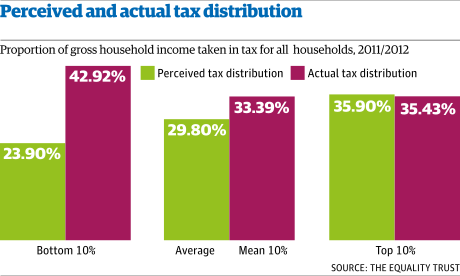
Furthermore, it is the poorest 10 percent of households that pay eight percent more of their income in all taxes than the richest – 43 percent compared to 35 percent, outlined in a report from the Equality Trust. The poorest pay more than four times as much of their income, in Cameron’s poll tax-styled council tax system, than the wealthiest top 10 precent.

The government’s “hardworking taxpayer” myth which is at the heart of the Tory ideologically driven austerity narrative, and divert, divide and poison strategy, creates an artificial dichotomy between benefit claimants and taxpayers. Cameron’s diversionary rhetoric has got nothing to do with responsibility and fairness: it’s simply about justifying policies that privilege a wealthy elite at the expense of the poor.

 Such us and them dichotomies  can be linked to the distinctions made between the “deserving” and  “undeserving” poor, going back over a hundred years or more, to the cruel and punitive Poor Law Reform Act. The Tories have purposefully created scapegoats: adversarial identities that are politically constructed according to notions of difference which simultaneously encourages a public comparison to, and rejection of, Others. This Othering narrative portrays benefit recipients as the enemy in a battle against fairness and responsibility.

And the public have bought into it, the Equality Trust thinktank highlights a gulf between perceptions of the tax system and its reality. A poll, conducted with Ipsos Mori, found that nearly seven in ten people believe that households in the highest 10% income group pay more of their income in tax than those in the lowest 10%.

Wealth concentration damages economies. It focuses activity within finance and other services geared towards only towards serving the super rich.Maintaining inequality requires penalising and further impoverishing the poor.

Reducing  wealth inequalities will require the introduction of wealth taxes, like the inheritance tax  we introduced a century ago. Reducing inequality requires a high top rate of income tax. This reduces income inequality not only by raising revenue, but by deterring the profit-driven greedy from asking for more money. When there is a tax rate of 60 percent on incomes above £200,000 a year, it makes little sense to pay employees much more than that.

But the wealthy tend to get so indignant when policy proposals from the opposition indicate that they will be required to actually contribute something to a society that they have taken so much more than others from. There’s been an outraged outcry, for example, regarding Labour’s Mansion tax proposals. These ignoble, self-serving Randians are happy to sit back and allow the poorest and most vulnerable to suffer and starve, whilst being subjected to the unfair, punitive bedroom tax, which contravened human rights: the poorest are bearing the terrible burden of austerity cuts whilst the wealthy continue to profit massively. Presumably, Cameron exempted the very rich from responsibility, duty and contributing  to society in any meaningful way.

Of course this is about restricting political engagement, the Conservatives have always sought to reduce it to a basic partnership between corporate interests and professional politicians. Cameron’s Conservatism rests on the unwitting rejection  of the social democratic consensus by the population which, paradoxically, need what they reject. Public consent is being manipulated to accommodate the idea that democracy is a relationship between rulers and governed, rather than it being about an elected government that reflects, represents and serves public needs. The population are being incrementally subordinated to a political system which is not conducive to the betterment of their lives, well-being or material conditions –  the Tories are imposing an imbalanced social contract comprised of citizen duties with no citizen rights; the acceptance of ever-lower living standards and increasing state authoritarianism.

The Conservative scapegoating narratives, which have blamed Labour, the poor and the unemployed for a recession caused by the private finance sector, and not the “big state” as claimed, have permitted the Coalition to pursue an ideological, destructive and grossly unfair economic strategy, which has generated only a bogus and isolated recovery largely based on government-fuelled asset bubbles in real estate and private finance, with stagnant productivity, plummeting wages, millions of people in precarious jobs, inflated living costs and utterly savage welfare cuts.

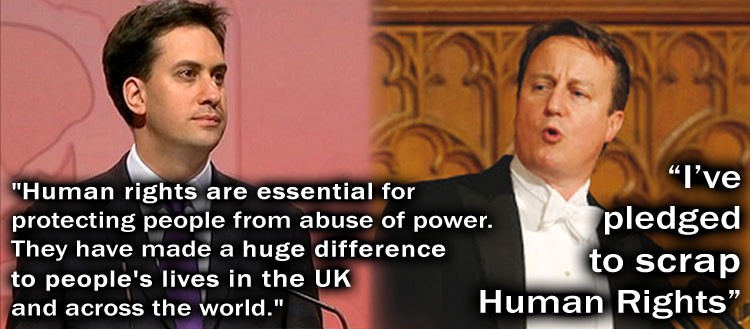
One obligation that all democratic states have, surely, is that of protecting citizens rights and freedoms. Those are most certainly being steadily diminished, and Cameron has been quite candid about scrapping our Human Rights Act, and withdrawing from the ECHR in the future.

See what I mean? It’s all take take take…

Danny Dorling says: “Gross economic inequality is as vile as racism, misogyny and hatred of the disabled; as damaging in effect; and as dependent on a small group of supporters who believe that just a few should have more and more and more, because they’re “worth it”.”

I believe that growing social inequality generates a political necessity for prejudices: they are entrenched vis-à-vis Social Darwinism in Tory ideology, fueled and perpetuated through justification narratives and amplified via the media.

I’ve said many times previously that never in this country have those who fight for democracy and social justice carried a greater burden or faced the possibility of bigger losses of human rights, human freedoms, human dignity and human welfare than they do right now.

14533697838_dffcc736f2_o (1)

 Many thanks to Robert Livingstone for his brilliant art work

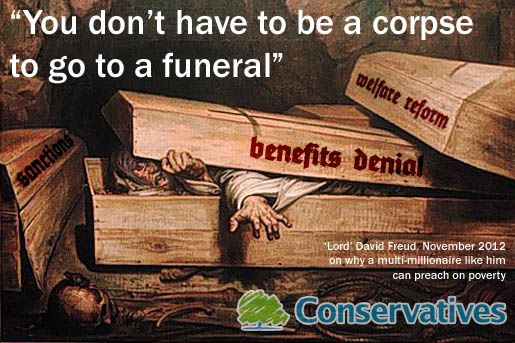
David Freud was made to apologise for being a true Tory in public

1459165_266124213538634_1461740450_n

Lord Freud, a Conservative Welfare Reform Minister, has admitted comments he made that some disabled people are  not worth” the full national minimum wage”  were “offensive”, after they were disclosed by Ed Miliband during Prime Minister’s Questions yesterday afternoon. The Labour leader has called on the Tory peer to resign. Cameron called for a full apology from Freud.

He has since apologised after slipping up and suggesting that disabled people are “not worth” the national minimum wage and some could only be paid “£2 an hour.” Cameron says the comments made by Lord Freud at the Tory conference do not represent the views of government. However, his austerity measures and the welfare “reforms” tell us a very different story.

Cameron betrayed his anger at being challenged when he once again alluded to his severely disabled late son, Ivan, and his late father, as he told Miliband that he would take no lectures on disabled people.

This is not the first time that the prime minister has used his son in anger, as a tactic designed to cause others emotional discomfort, deflect criticism and to avoid answering difficult questions regarding this government’s harsh and punitive policies towards disabled people.

The Labour leader quoted Freud, saying: “You make a really good point about the disabled. There is a group where actually, as you say, they’re not worth the full wage.”

Amidst cries of “outrage” and “shame” from the Labour benches, Mr Miliband said: “To be clear about what the Welfare Reform Minister said, it’s very serious. He didn’t just say disabled people weren’t worth the minimum wage, he went further and he said he was looking at whether there is something we can do, if someone wants to work for £2 an hour.”

He added: “Surely someone holding those views can’t possibly stay in your Government?”

Cameron said: “Those are not the views of the government, they are not the views of anyone in the government. The minimum wage is paid to everybody, disabled people included.”

Clearly very angry, the prime minister added: “Let me tell you: I don’t need lectures from anyone about looking after disabled people. So I don’t want to hear any more of that. We pay the minimum wage, we are reforming disability benefits, we want to help disabled people in our country, we want to help more of them into work. And instead of casting aspersions why doesn’t he get back to talking about the economy.”  

Once again, note the rhetorical diversionary tactics that Cameron used.

Miliband responded: “I suggest, if he wants to protect the rights of disabled people, he reads very carefully what his welfare minister has said because they are not the words of someone who ought to be in charge of policy related to disabled people.

“In the dog days of this government the Conservative party is going back to its worst instincts – unfunded tax cuts, hitting the poorest hardest, now undermining the minimum wage. The nasty party is back.”

In the Guardian said: We are in the climate of the Work Programme  and  employment and support allowance travesties, in jobseeker’s allowance sanctions and personal independent payment delays.

Coerced, free labour and a shrinking, ever conditional benefit system. Freud has not spoken out of turn, but encapsulated Conservative attitudes to both disabled people and workers: pay them as little as possible and they will be grateful for it.

The Tories are not content with forcing disabled people into work. They want to pay them a pittance when they get there. I suppose we can thank Freud. The government has been producing enough measures that infers disabled people are slightly less than human. He’s finally said it out loud.”

I couldn’t agree more. Freud’s comments are simply a reflection of a wider implicit and fundamental Social Darwinism underpinning Tory ideology, and even Tim Montgomerie, who founded the Conservative­Home site has conceded that: “Conservative rhetoric often borders on social Darwinism…and has lost a sense of social justice.”

Of course the problem with such an ideological foundation is that it directly contradicts the basic principles that modern, western democracy was founded on, it is incompatible with our Human Rights Act, which enshrines the principle that we are each of equal worth. And our Equality Act, introduced by Labour to ensure that people are not discriminated against on the grounds of their disability, gender, age and a variety of other protected characteristics.

Sam Bowman, research director of the Adam Smith Institute, has said that Freud was “shamefully mistreated” by Labour leader Ed Miliband.

The Adam Smith Institute – a think tank that promotes Conservative “libertarian and free market ideas”, minarchism and claims it is:“known for its pioneering work on privatization, deregulation, and tax reform, and for its advocacy of internal markets in healthcare and education, working with policy-makers”  – has, perhaps unsurprisingly, defended Lord Freud’s disgraceful comments regarding striving disabled workers.

Mr Bowman said: “His (Freud’s) point was that the market value of some people’s wages is below the minimum wage. This is often true of the severely disabled and can have appalling consequences for their self-esteem and quality of life.”

He added: “To point out that someone’s market value is less than minimum wage has nothing to do with their moral value as human beings.”

I beg to differ. We have a government that claims meritocratic principles define those who are worthy and deserving of wealth.We have a government that generates socially divisive narratives founded on ideological dichotomies like strivers and skivers. We have a government that systematically disregards the human rights of disabled people. Their very policies define the moral value they attribute to the poor, disabled people and the wealthy, respectively. This defence is based on a false distinction, because the Tories conflate market value and moral value explicitly, their policies are evidence of that.

The think tank president, Madsen Pirie,  once said: “We propose things which people regard as being on the edge of lunacy. The next thing you know, they’re on the edge of policy.”  

This group of neoconservatives brought you the fundamentals of Thatcher’s poll tax, the Adam Smith Institute was also the ideological driving force behind the sales of council house stock. If you need any further convincing of their Tory credentials, then their proposals that the National Health Service should establish an internal market with hospitals buying the use of facilities from other districts and from the private sector ought to be sufficient.

The Institute has always been a fierce critic of the NHS, it thinks that the government should only regulate healthcare and that healthcare should be privately funded and privately provided by private sector companies. The Adam Smith Institute said: Congratulations to the new Health Secretary Andrew Lansley, for what could be the biggest revolution in the UK’s state-run National Health Service for 60 years. 

Also recommended by this group of privatisation vultures was an internal market system for UK schools that would have (reduced) state funds to follow students to independently run academic institutions. This approach to school funding is now Coalition policy. Following the Institute’s call for the use of private businesses by local governments, many council-run local services, such as waste collection and cleaning, were contracted out. Additionally, local governments are now required to solicit competitive bids for local services.

And it was this group of Hayek-worshipping, pro-exploitation neofeudalists, who don’t declare their funding sources, that called for a radical shake-up of welfare policy, which would make work requirements absolutely central to the benefits system. These proposals subsequently became Tory policy.

And who could forget their peddling of unfettered free markets and trade as an objection to fair trade?

In the UK and elsewhere, such Conservative neoliberal ideas have drastically changed how states operate. By heavily promoting market-based economies that highly value competition and efficiency, such neoliberalist economies have moved countries to retrogressively adopting Social Darwinist philosophies to prop up free market “logic”. 

Bourdieu (1999) contends that neoliberalism as a form of national governance has become a doxa, or an unquestioned and simply accepted world-view.(See also Manufacturing consensus: the end of history and the partisan man.)

Harvey (2005) is not surprised that the ideas of capitalism have been infused into political, social, and cultural institutions at state-level. By placing a mathematical quality on social life, the neoconservatives have encouraged a formerly autonomous state to regress into penal state that values production, competition, and profit above all else, and social issues and consequences are increasingly disregarded.

Tories view their brand of economics as a social science that is capable of explaining all human behaviours, since all social agency is thought to be directed by a rationale of individualistic and selfish goals. And the focus on the individual means that ideas related to concepts such as “the public good” and realities such as “the community” are now being discarded as unnecessary components of a welfare state.

Unsurprisingly, then, high unemployment, gross inequality, and increasingly absolute poverty are increasingly blamed on individuals rather than on structural/economic constraints.

Tory economic policy is designed to benefit only a very small class of people. Such a world-view also makes it easier to justify the thought that some people are deserving of much more than others because, after all, it is a common refrain that we are all responsible for our own destinies. (See the just-world fallacy.)

Freud’s comment was not a momentary lapse, nor was it unrepresentative of Tory views more generally. He is the contemptuous architect of the grossly punitive Tory Bedroom Tax that disproportionately affects households of disabled people. The Tories endorsed Freud’s discriminatory policy proposal, and savagely ridiculed the UN rapporteur, Raquel Rolnik, when she pointed out, very professionally and reasonably, that the policy contravened human rights.

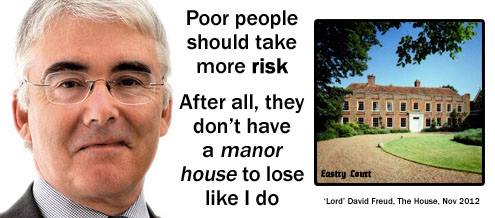
He is the same government minister that rejected suggestions that austerity policies have led to an increase in food bank use – making the jaw-droppingly astonishing suggestion that food bank charities are somehow to blame. This former investment banker and peer told the Lords that the increase in the usage of food banks was “supply led”.

He said: “If you put more food banks in, that is the supply. Clearly, food from the food banks is a free good and by definition with a free good there’s almost infinite demand.”

Poverty reduced to individual neoliberal motivational formulae. Yet it is the government that are responsible for policies that create and sustain inequality and poverty.

In the wake of the longer wait for unemployment benefits introduced by George Osborne, a massive increase in the use of cruel benefit sanctions, the introduction of the mandatory review, during which benefits are not payable to disabled people, Freud also rejected suggestions by leading food bank operators that delays in benefit payments drove demand for emergency food aid.

Such brutal, dehumanising and inequitable treatment of our most vulnerable citizens cannot be regarded as an exceptional incident: the Tories have formulated policies that have at their very core the not so very subliminal message that we are worthless and undeserving of support, basic honesty and decency.

Social Darwinism, with its brutalising indifference to human suffering, has been resurrected from nineteenth century and it fits so well with the current political spirit of neoliberalism. As social bonds are replaced by narcissistic, unadulterated materialism, public concerns are now understood and experienced as utterly private miseries, except when offered up to us on the Jerry Springer Show or Benefit Street as spectacle.

The Tories conflate autonomy (the ability to act according to our own internalised beliefs and values) with independence (not being reliant on or influenced by others). Tories like Freud have poisoned the very idea that we are a social species, connected by mutual interdependencies that require a degree of good will, kindliness and willingness to operate beyond our own exclusive, strangle hold of self-interest.

The time has come to ask ourselves what possible benefit to society such a government actually is – what use is an authoritarian, punitive state that is more concerned with punishing, policing and reducing citizens than with nurturing, supporting and investing in them?

224079_411432638926270_715135125_n

Tory Values Explained In One Easy Chart

The New New Poor Law

547145_195460507271672_1145852710_n

A society with inequalities is and always has been the rational product of Conservative Governments. History shows this to be true. Tory ideology is built upon a very traditional and somewhat feudal vision of a “grand scheme of things”, a “natural order”, which is extremely hierarchical.

The New Poor Law of 1834 was based on the “principle of less eligibility,” which stipulated that the condition of the “able-bodied pauper” on relief be less “eligible” – that is, less desirable, less favourable – than the condition of the very poorest independent labourer. “Less-eligibility” meant not only that “the pauper” receive less by way of relief than the labourer did from his wages but also that he receive it in such a way (in the workhouse) that made pauperism (being in absolute poverty) less respectable than work – to stigmatise it. Thus the labourer would be discouraged from lapsing into a state of “dependency” on poor relief and the pauper would be “encouraged” to work.

The Poor Law “made work pay”, in other words.

The Poor Law Commission report, presented in March 1834, was largely the work of two of the Commissioners, Nassau Senior and Edwin Chadwick. The report took the outline that poverty was essentially caused by the indigence of the character and morality of individuals rather than arising because of inequality and the prevailing political, economic and social conditions. The general view that informed the New Poor Law was that: “Paupers claim relief regardless of his merits: large families get most, which encourages improvident marriages; women claim relief for bastards, which encourages immorality; labourers have no incentive to work; employers keep wages artificially low as workers are subsidised from the poor rate.”

I am sure that the commissioners have descendants that now write for the Daily Mail.

The Victorian era has made a deep impact upon Tory thinking, which had always tended towards nostalgia and tradition. Margaret Thatcher said that during the 1800s, “not only did our country become great internationally, also so much advance was made in this country … As our people prospered so they used their independence and initiative to prosper others, not compulsion by the state”.

There she makes an inference to the twin peaks of callous laissez-faire and the mythical and largely implied  “trickle down” effect. Yet history taught us only too well that both ideas were inextricably linked with an unforgivable and catastrophic increase in destitution, poverty and suffering for so many, for the purpose of extending profit for a few.

Writing in the 1840s, Engels observed that Manchester was a source of immense profit for a few capitalists. Yet none of this significantly improved the lives of those who created this wealth. Engels documents the medical and scientific reports that show how human life was stunted and deformed by the repetitive, back breaking work in The Condition Of The Working Class In England. Constantly in his text, we find Engels raging at those responsible for the wretched lives of the workers. He observed the horror of death by starvation, mass alienation, gross exploitation and unbearable, unremitting, grinding poverty.

The great Victorian empire was built while the completely unconscientious, harsh and punitive attitude of the Government further impoverished and caused distress to a great many. It was a Government that created poverty and also made it somehow dishonourable to be poor. While Britain became great, much of the population lived in squalid, disease-ridden and overcrowded slums, and endured the most appalling living conditions. Many poor families lived crammed in single-room accommodations without sanitation and proper ventilation. That’s unless they were unlucky enough to become absolutely destitute and face the horrors of the workhouse. It was a country of startling contrasts. New building and affluent development went hand in hand with so many people living in the worst conditions imaginable.

Michael Gove has written: For some of us Victorian costume dramas are not merely agreeable ways to while away Sunday evening but enactments of our inner fantasies … I don’t think there has been a better time in our history”  in “Alas, I was born far too late for my inner era”.

A better time for what, precisely? Child labour, desperation? Prostitution? Low life expectancy, disease, illiteracy, workhouses? Or was it the deferential protestant work ethic reserved only for the poor, the pre-destiny of the aristocracy, and “the rich man in his castle, the poor man at his gate”?

In a speech to the Confederarion of British Industry, (CBI) George Osborne argued that both parties in the Coalition had revitalised themselves by revisiting their 19th-century roots. He should have stayed there.

When Liberal Democrat David Laws gave his first speech to the Commons as the secretary to the Treasury, Tory MP Edward Leigh said: “I welcome the return to the Treasury of stern, unbending Gladstonian Liberalism”, and  Laws recognised the comparison to the Liberal prime minister, and said: “I hope that this is not only Gladstonian Liberalism, but liberalism tinged with the social liberalism about which my party is so passionate”.

The Coalition may certainly be described as “stern and unbending”, if one is feeling mild and generous. I usually prefer to describe them as “retro-authoritarian”.

We know that the 19th-century Conservative party would have lost the election had it not been rescued by Benjamin Disraeli, a “one-nation” Tory who won working-class votes only because he recognised the need and demand for essential social reform. Laissez-faire, competitive individualism and social Darwinism gave way to an interventionist, collectivist and more redistributive, egalitarian Keynesian paradigm.

There’s something that this Government have completely missed: the welfare state arose precisely because of the social problems and dire living conditions created in the 17th, 18th, 19th and early 20th centuryies The 19th century also saw the beginnings of the Labour Party. By pushing against the oppressions of the Conservative Victorian period, and by demanding reform, they built the welfare state and the public services that the current Government is now so intent on dismantling.

The UK Government’s welfare “reform” programme represents the greatest changes to welfare since its inception. These changes will impact on the poorest and the most vulnerable people in our society. It will further alienate already marginalised social groups. In particular, women rely on state support to a greater extent than men and will be disproportionately and adversely affected by benefit cuts. Disabled people even more so.

Former Conservative leader Iain Duncan Smith (who didn’t manage to lead his party to an election due to losing a motion of no confidence) is largely responsible for this blitzkreig of apparent moral rigour, a right wing permutation of “social justice” rhetoric and harsh Victorian orthodoxy. Work is being conflated with social justice and social mobility. However, people in work are also queuing at food banks because they can’t meet their basic needs. Reducing welfare simply creates a reserve army of labour that also serves to drive the value of wages down. It creates a downward spiral of living standrads for everyone.

The Government asserts that its welfare “reform” strategy is aimed at breaking the cycle of “worklessness” and dependency on the welfare system in the UK’s poorest families. Poor Law rhetoric. There’s no such thing as “worklessness”, it’s simply a blame apportioning word, made up by the Tories to hide the fact that they have destroyed the employment market, as they always do. It’s happened under every Tory government. At least Thatcher’s administration were honest about it. Her government admitted that they were prepared to tolerate high levels of unemployment in order to bring inflation down. Instead the UK ended up with high unemployment, low wages AND high inflation. The end result was recession.

The “reforms” (cuts) consist of 39 individual changes to welfare payments, eligibility, sanctions and timescales for payment and are intended to save the exchequer around £18 billion. How remarkable that the Department for Work and Pensions claim that such cuts to welfare spending will reduce poverty. I have never yet heard of a single case of someone who is poor actually benefitting from someone else reducing an amount from what little money they have. You can’t punish people out of poverty by making them more poor. That idea is simply absurd and cruel.

There’s nothing quite so diabolical as the shock of the abysmally expected: the brisk and brazen Tory lie, grotesquely untrue. Such reckless and Orwellian rhetoric permeates Government placations for the “reforms”.

The “reforms” were hammered through despite widespread protest, and when the House of Lords said “no“, the Tories deployed a rarely used and ancient parliamentary device, claimed “financial privilege” asserting that only the Commons had the right to make decisions on bills that have large financial implications. Determined to get their own way, despite the fact no-one welcomed their policy, the Tories took the rare jackbooted, authoritarian step to direct peers they have no constitutional right to challenge the Commons’ decisions further. Under these circumstances, what could possibly go right?

That marked the start of a very antidemocratic slippery slope.

The punitive approach to poverty didn’t work during the last century, it unfortnately simply stripped disadvanted citizens of their dignity and diverted people, for a while, from recognising the real cause of poverty. It isn’t about individual inadequacies: poor people do not cause poverty, but rather, Conservative Governments do via their hierarchical worldview, ideological incentives, policies and economic decision-making.

Conservative by name and retrogressive by nature.

This was taken from a larger piece of work: welfare reforms and the language of flowers: the Tory gender agenda

Related posts:

Largest study of UK poverty shows full-time work is no safeguard against deprivation

The link between Trade Unionism and equality

Follow the Money: Tory Ideology is all about handouts to the wealthy that are funded by the poor

The Poverty of Responsibility and the Politics of Blame

548467_541268255942707_974267629_n
Many thanks to Robert Livingstone

welfare reforms and the language of flowers: the Tory gender agenda

994596_517805604955639_608589568_n

In all places, then, and in all seasons,
Flowers expand their light and soul-like wings,
Teaching us, by most persuasive reasons,
How akin they are to human things.” – Henry Wadsworth Longfellow’s Flowers from Voices Of the Night

Ring-a-ring-a-roses,
A pocket full of posies;
Ashes! Ashes!
We all fall down – Traditional

Part one

The axis of marginalisation

George Bernard Shaw immortalised the Victorian East End flower girls in Eliza Doolittle, in his play “Pygmalion.” The play is a sharp lampoon of the rigid British class system of the day and must also be read as a commentary on women’s striving for independence. The play was subsequently adapted numerous times, most notably as the highly romanticised musical “My Fair Lady” (and the film, starring Audrey Hepburn). But there was a historical reality behind Shaw’s fiction that was far less glamorous, he edited out genuine representation of so many miserable lives filled with a constant, dehumanising, gnawing ache of absolute poverty and oppression.

Assumptions about women’s roles have historically shaped public policy. And they still do. Historically the Victorian era was a time of many contradictions, such as the widespread cultivation of an outward appearance of dignity, a strict social code of conduct and prudish sexual restraint together, with the prevalence of social phenomena such as prostitution and child labour. Hardly surprising that an affluence of social movements arose from attempts to improve the prevailing harsh living conditions for so many under a rigid class system.

The Victorian era was founded on optimistic Modernist notions of progress, but it ought to serve as a historical lesson in the social evils of Elitism, the Victoran Era saw great expansion of wealth and  power that was  not shared or “trickled down” in the slightest. But it seems we never learn. Victorian Britain was a land of laissez-faire capitalism and self-reliance. Government regulation was minimal and welfare was left mostly to charity.

At the same time that explicit erotica was beginning to appear in newspapers, emotions and sexual feelings were expressed by means of cryptological communications through the use or arrangement of flowers. “Talking bouquets” called “nosegays” or “tussie-mussies” were used to send coded messages to the recipient, allowing the sender to express feelings that could not be spoken out loud in Victorian society.

The language of flowers was used by women to speak for women at a time when women often were discouraged from speaking for themselves in society. In the UK, (and the US) the language of flowers was a popular phenomenon and was traditionally associated with Victorian womanhood ideals for women to be pious, pure, domestic, and submissive to their husbands.

When a woman married, she had no independent legal status. She had no right to any money (earned or inherited), she could not make a will or buy property, she had no claim to her children, she had to move with her husband wherever he went. If her husband died, he could name the mother as the guardian, but he did not have to do so.

During Victoria’s reign, Britain was also ruled by an aristocratic elite that excluded democrats, radicals, and workers. The Government was not fully representative, since in 1832, only 20 percent of the population could fulfil the property qualifications to vote.

The Victorian era is almost synonymous with the ideology of “great men” – “outstanding” male individuals, whose features and life stories fill the National Portrait Gallery (founded 1856) and the patriarchal Dictionary of National Biography (launched 1882) while their exploits were hymned in key texts like Thomas Carlyle’s Heroes and Hero Worship (1841) and Samuel Smiles’s Self-Help (1859).

Throughout the era, “masculine” values of action, courage and endeavour supported military campaigns and commercial expansion. Women were allotted a subsidiary role, with patience and self-sacrifice the prime feminine virtues, and central to their domestic roles. Motherhood was idealised, alongside virginal innocence, but women were subject to pervasive denigration.

Towards the end of the century, strident misogyny was still strong in both popular fiction and academic writing – but as loudly as female inferiority was declared immutable, women everywhere began to demonstrating otherwise, challenging the axis of patriarchy, and the architects of their marginalisation.

Patterns of patriarchal authority were reinforced by social philosophers like Auguste Comte, Arthur Schopenhauer, Herbert Spencer, Pierre-Joseph Proudhon and John Ruskin, this developed into a mid-century doctrine of “separate spheres” –  men were figured as competitors in the amoral, economic realm while women were positioned as either decorative trophies or spiritual guardians of men’s immortal souls.

From the 1860s, social construction of the the Darwinian theory of “survival of the fittest” (a phrase coined by sociologist, Herbert Spencer, not Darwin) added a pseudo-scientific dimension which placed men higher on the evolutionary ladder. This theory of evolutionary ethics is an attempt to derive morality from “biological laws”, and is based on the general doctrine of evolution connected to Darwin.  Malthus’ Essay on Population (1766-1834) was another significant influence on Victorian attitudes.

The mid-century was notable for its moral panic over prostitution, which developed – despite a “permissive” interval in the 1860s – into demands for male chastity outside marriage. At the end of the era, a socially shocking topic was that of the virginal bride (and her innocent offspring) infected with syphilis by a sexually experienced husband. But during the Victorian era, the concept of pater familias, meaning the husband as head of the household and moral leader of his family, was firmly entrenched in British culture.

It was women that were perceived as unclean and this perception was worsened through the First Contagious Diseases Prevention Act in 1864. Women suspected of being unclean were subjected to an involuntary genital examination. Refusal was punishable by imprisonment; diagnosis with an illness was punishable by involuntary confinement to hospital until perceived as cured.

The disease prevention law was only ever applied to women, which became the primary rallying point for activists who argued that the law was both ineffective and inherently unfair to women. The examinations were inexpertly performed by male police, women could be suspected based on little or no evidence, and the exams were painful and humiliating. After two extensions of the law in 1866 and 1869 the unjust acts were finally repealed in 1886.

Bringing together political and personal demands for equality, the slogan: “Votes for Women, Chastity for Men” was coined. Feminist ideas spread among the educated female middle classes,  and the women’s suffrage movement gained momentum in the last years of the Victorian Era.

In addition to losing money and material goods to their husbands, Victorian wives became property to their husbands, giving them rights over their bodies and what their bodies produced; children, sex and domestic labour. Marriage abrogates a women’s right to consent to sexual intercourse with her husband, giving him ownership. Their mutual matrimonial consent therefore became a contract of surrendered autonomy for women.

While husbands quite often participated in affairs with other women, wives endured infidelity as they had no rights to divorce on these grounds and their divorce was considered to be a social taboo. Even following divorce, a husband had complete legal control over any income earned by his wife; women were not allowed to open banking accounts.

The context for such oppression was set around a century and a half ago, a few years before Queen Victoria ascended the throne, a Royal Commission of Parliament proposed a major reform of the Poor Law. The bastardy clauses of the New Poor Law of 1834 outlined that “women bear financial responsibilities for out-of-wedlock pregnancies.” In 1834 women were made legally and financially supportive of their illegitimate children.

It was a Conservative and Liberal project – largely influenced by Thomas Robert Malthus and disseminated by the 1834 Poor Law Report from His Majesty’s Commissioners for Inquiring into the Administration and Practical Operation of the Poor Laws and such novelists as Harriet Martineau – asserting that poverty arose from overpopulation and that women more so than men were responsible for determining demographic growth. (Yes, really).

Single mothers and their out-of-wedlock children represented the worst violators of independence and individualism, and the centuries-old welfare provisions offered them among the worst obstacles to a free market.

Radical critics perceived in the bastardy clauses a challenge to traditional notions of protecting society’s weak and of allowing the working class the “right” to receive parish and charitable aid. Furthermore, critics recognised that the sexual double standard inherent in the new clauses revealed the ideology of Liberalism: the Liberal system magnified rather than minimised the advantages enjoyed by society’s enfranchised and the disadvantages experienced by society’s weakest members.

The Commissions report, presented in March 1834, was largely the work of two of the Commissioners, Nassau Senior and Edwin Chadwick. The report took the outline that poverty was essentially caused by the indigence of individuals rather than economic and social conditions. Paupers claimed relief regardless of his merits: large families got most, which encouraged improvident marriages; women claimed relief for bastards, which encouraged immorality; labourers had no incentive to work; employers kept wages artificially low as workers were subsidised from the poor rate. (Aha, the Daily Mail and déjà vu)

The New Poor Law of 1834 was based on the “principle of less eligibility,” which stipulated that the condition of the “able-bodied pauper” on relief  be less “eligible” – that is, less desirable, less favourable – than the condition of the independent labourer. “Less-eligibility” meant not only that the pauper receive less by way of relief than the labourer did from his wages but also that he receive it in such a way (in the workhouse, for example) as to make pauperism less respectable than work – to stigmatise it. Thus the labourer would be discouraged from lapsing into a state of “dependency” and the pauper would be encouraged to work.

The Poor Law “made work pay”, in other words.

Did I hear a collective, weary sigh, heavily laden with a strong sense of déjà vu? The parallels to be drawn here are no coincidence.

540695_532291630173703_1425159679_n (1)

Part two

The Tory motto: the more things change, the more they stay the same

The Victorian era has made a deep impact upon Tory thinking, which had always tended towards nostalgia and tradition. Margaret Thatcher said that during the 1800s:

Not only did our country become great internationally, also so much advance was made in this country … As our people prospered so they used their independence and initiative to prosper others, not compulsion by the state.

There she makes an inference to the twin peaks of callous laissez-faire and the mythical “trickle down” effect. Yet history taught us only too well that both ideas were inextricably linked with an unforgivable and catastrophic increase in destitution, poverty and suffering for so many, for the purpose of extending profit for a few.

Writing in the 1840s, Engels observed that Manchester was a source of immense profit for a few capitalists. Yet none of this significantly improved the lives of those who created this wealth. Engels documents the medical and scientific reports that show how human life was stunted and deformed by the repetitive, back breaking work in The Condition Of The Working Class In England. Constantly in his text, we find Engels raging at those responsible for the wretched lives of the workers. He observed the horror of death by starvation, mass alienation, gross exploitation and unbearable, unremitting poverty.

The great Victorian empire was built whilst the completely unconscientious, harsh and punitive attitude of the Government further impoverished and caused so much distress to a great many. It was a Government that created poverty and also made it dishonourable to be poor.

Whilst Britain became great, much of the population lived in squalid, disease-ridden and overcrowded slums, and endured the most appalling living conditions. Many poor families lived crammed in single-room accommodations without sanitation and proper ventilation.

That’s unless they were unlucky enough to become absolutely destitute and face the horrors of the workhouse. It was a country of startling contrasts. New building and affluent development went hand in hand with so many people living in the worst conditions imaginable.

Michael Gove has written:

For some of us Victorian costume dramas are not merely agreeable ways to while away Sunday evening but enactments of our inner fantasies … I don’t think there has been a better time in our history”  in “Alas, I was born far too late for my inner era.

A better time for what, precisely? Child labour, desperation? Prostitution? Low life expectancy, disease, illiteracy, workhouses? Or was it the deferential protestant work ethic reserved only for the poor, the pre-destiny of the aristocracy, and “the rich man in his castle, the poor man at his gate”?

In a speech to the CBI, George Osborne argued that both parties in the coalition had revitalised themselves by revisiting their 19th-century roots. When Liberal Democrat David Laws gave his first speech to the Commons as the secretary to the Treasury, Tory MP Edward Leigh said: “I welcome the return to the Treasury of stern, unbending Gladstonian Liberalism”, and  Laws recognised the comparison to the Liberal prime minister,and said:

I hope that this is not only Gladstonian Liberalism, but liberalism tinged with the social liberalism about which my party is so passionate.

The Coalition may certainly be described as “stern and unbending,” if one is feeling mild and generous.

I usually prefer to describe them as “authoritarian”.

We know that the 19th-century Conservative party would have lost the election had it not been rescued by Benjamin Disraeli, a “one nation” Tory who won working-class votes only because he recognised the need and demand for essential social reform. Laissez-faire, competitive individualism and social Darwinism gave way to an interventionist, collectivist and more egalitarian paradigm. And there’s something that this Government have completely missed: the welfare state arose precisely because of the social problems and dire living conditions created in the 19th century.

The 19th century also saw the beginnings of the Labour Party. By pushing against the oppression of the conservative Victorian period, and by demanding reform, they built the welfare state and the public services that the current Government is now so intent on dismantling.

During the Victorian era, oppression of women was embedded deeply in psychic, political and cultural processes. It’s quite easy to see how some feminists came to attribute the characteristics of violence and hierarchical authoritarianism to men.

However, whatever claims we make as truths of our biological “natures”, the is/ought distinction highlights our (degree of) autonomy and emphasises our moral responsibilities and choices regarding social organisation, also. In this respect, debating the fundamentals of sex-based attributes and gender stereotypes is futile, because we have ethical and social obligations that transcend bickering about “biological facts.” The traditional binary opposition between “equality”and “difference” is a damaging one, especially in assessing the debate in terms of social rights and needs.

The welfare reforms present a particular challenge to the financial security and autonomy of women. The “reforms” have been strongly influenced by (a particular form of) economic modelling, and do not take into account the lived experiences or the impact of the cuts on those targeted. Conservative ideology also informs the reforms and the Government uses out-of-date model of households and concern about “dependency” on state, not within families.

The form of modelling depopulates social policy, dehumanises people, and indicates that the Tory policy-makers see the public as objects of their policies, and not as human subjects. We therefore need to ask whose needs the “reforms” are fulfilling.

Our welfare system has brought the UK a high degree of social and income equality. Economists, it seems, disagree on the effect that inequality has on economic growth, however. Some argue that it promotes growth, others insist that it’s a barrier, but very tellingly, most would like to live in a country with a high degree of income equality as one of the main indicators for a high score on the human-development index.

In developed Liberal democracies, the state plays a key role in the protection and promotion of the economic and social well-being of its citizens. It is based on the principles of equality of opportunity, equitable distribution of wealth, and public responsibility for those unable to avail themselves of the minimal provisions for an acceptable quality of life.

The welfare state is funded through redistributionist taxation. Such taxation usually includes a larger income tax for people with higher incomes, called a progressive tax. This helps to reduce the income gap between the rich and poor.

The UK Government’s welfare “reform” programme represents the greatest change to benefits biggest changes to welfare since its inception. These changes will impact the most vulnerable in our society. In particular, women rely on state support to a greater extent than men and will be disproportionately affected by benefit cuts.

Former Conservative leader Iain Duncan Smith (who didn’t manage to lead his party to an election due to losing a motion of no confidence) is largely responsible for this blitzkreig of apparent moral rigour, a right wing permutation of “social justice” rhetoric and harsh Victorian orthodoxy.

The Government asserts that its welfare “reform” strategy is aimed at breaking the cycle of “worklessness” and dependency on the welfare system in the UK’s poorest families. Poor Law rhetoric. There’s no such thing as “worklessness,” it’s simply a blame apportioning word, made up by the Tories to hide the fact that they have destroyed the employment market, as they always do.

The strategy fails to explicitly acknowledge the link between women’s poverty and child poverty, it fails to provide the supports needed in terms of flexible childcare and flexible working that women with children need in order to work, and it sets the “blame” for poverty squarely at the feet of the UK’s most disadvantaged families, stigmatising them further and pushing them deeper into poverty as an ideologically-driven means of “freeing” them from poverty.

The “reforms” (cuts) consist of 39 individual changes to welfare payments, eligibility, sanctions and timescales for payment and are intended to save the exchequer around £18 billion. How remarkable that the Department of Work and Pensions claim that such cuts to welfare spending will “reduce poverty.

There’s nothing quite so diabolical as the shock of the abysmally expected: the brisk and brazen Tory lie, so grotesquely untrue. Such reckless rhetoric permeates Government placations for the “reforms”. The “reforms” were hammered through despite widespread protest, and when the House of Lords said “no“, the Tories deployed a rarely used  and ancient parliamentary device, claimed “financial privilege” asserting that only the Commons had the right to make decisions on bills that have large financial implications.

Determined to get their own way, despite the fact no-one welcomed their policy, the Tories took the rare jackbooted, authoritarian step to direct peers they have no constitutional right to challenge the Commons’ decisions further. Under these circumstances, what could possibly go right?

Recently the Government effectively abolished the Child Support Agency. Very quietly. With immediate effect it is replaced, in part, by the Child Maintenance Service (CMS). This will cover new arrangements for separated and divorced families where two or more ­children are involved – and will ultimately cover all separated families.

Closure of around one million existing cases starts next year. At which point, if families want to join the new CMS, they need to reapply, start from scratch and pay an initial £20 fee.

The most controversial measure is the introduction of charging for use of the service, which is being held back until 2014. Parents will be encouraged to bypass the CMS altogether and make their own arrangements.

The Government’s own analysis shows that one in 11 – 100,000 – families will drop out of the system entirely and stop getting maintenance for their children rather than go through the stress of ­reapplying.

Gingerbread, an organisation that campaigns for lone parent families have already pointed out that in such tough financial times, any missed payments could have a serious impact on children.

Whilst the Government claim that “encouraging parents to agree terms” regarding supporting children is a positive move, it doesn’t take a genius to work out that if such negotiations came with ease, then couples with children wouldn’t separate in the first place, surely.

There is already provision in the law for encouraging divorcing  parents to reach an “agreement of terms”. There will usually be a family court adviser from the Children and Family Court Advisory and Support Service (Cafcass) to support with parents via mediation, including reaching agreements about child maintenance.

And what of those relationships that have been abusive – where one partner has fled domestic violence, for example?

According to Home Office figures, 1.2 million women reported that they experienced domestic abuse last year in the UK, including half a million victims of sexual assault.

Traumatised women who have just left violent partners, and whose children are distressed, have little respite from the Government imposed obligation to attend “work-focussed interviews” as a condition of getting money to live on. When claimants miss Jobcentre appointments and “work-focussed interviews”, they are sanctioned and lose their benefit, and the Housing Benefit which pays for a refuge place stops too.

Citizens Advice has reported a substantial increase in the number of people telling advisers they are victims. Their figures reveal that 13,500 people – 80% of them women – reported domestic violence to Citizens Advice last year.

There were 3,300 reported incidents between October and December 2012, an 11% increase on the same period the previous year. More than 30% of women have suffered domestic violence.

Convictions for domestic violence rose to 74% of prosecutions in the year leading up to  to March – not far behind the average for other violent crime and up from 60% in 2005-6. At the same time the rape conviction rate was 63.2%, up from 62.5% last year. Ten years ago rape conviction rates were not recorded by the CPS.There is a hidden epidemic of abuse undermining decades of progress in the women’s liberation movement.

Obtaining legal assistance for cases of domestic violence is now much more difficult that it was last year. The legal aid budget is being cut by £350 million a year. With 57% of recipients of legal aid being women, thousands will find themselves without the means to get representation. It has been estimated that 54% of women suffering from domestic violence would not qualify for legal aid. That is unacceptable.

The Everywoman Safe Everywhere Commission, chaired by former Labour MP Vera Baird, says:

Just as there is now overwhelming evidence that women have borne the brunt of the economic recession so too it is clear the services designed to keep them safe are now under threat too.

The Commission found services offering help and ­counselling to abused wives and girlfriends have had their funding cut by 31% since May 2010. As a result women’s refuges are facing closure or having to cut services. There is also a real fear that cuts to housing benefit mean many will not be able to claim help towards staying in a refuge. 

Research by Shelter and Cambridge University suggests that the reforms will in fact cost more in terms of the extra strain on local authorities, such as homeless accommodation services, and the National Health Service.

Income Support, Child Benefit and Child Tax Credit for lone parents will be reduced and lone parents will now face new sanctions if they do not find work promptly. They will only receive Income Support if their children are less than 5 years old. Lone parents whose children are older than 5 will have to apply for Job Seekers Allowance and find work regardless of local childcare opportunities.

Such difficult barriers to navigate ordinarily, but for someone enduring the trauma of abuse and fear, it is even more unacceptable to impose such punitive measureson such avery vulnerable social group.

Victims of domestic violence must now show medical evidence before they can qualify for legal aid in family cases. Women and children living with domestic violence may have to visit more than 13 different agencies to get the help they need. For some women the energy and resilience required to persevere and navigate complex services are understandably lacking.

Added problems are that many women are very afraid that their children may be taken into care, that they will be judged as poor parents; bad mothers. And they are right to be afraid.

I have heard professionals talk about women “choosing” to let a violent man back into the family home and expressing their opinion that her relationship with the violent man is obviously more important to her than her relationship with her children.

Yet their reality can be so very extreme and difficult to comprehend because of the utter desperation that these circumstances create – women have absolutely no choice when they have a knife at their throat, or the real and believable threat that the house will be set on fire and the children killed if she doesn’t allow her partner back in.

The risk of letting a violent partner back into the family home, even though this will mean facing daily violence and abuse and the possibility of your children being taken into care is less of a risk than not letting a violent partner back into the home. And we hear, almost on a weekly basis that “distraught” fathers/ husbands have killed or attempted to kill their partners and/or children.

Women also know from painful and bitter experience that the police, the courts, the women’s refuge, social services, the probation service cannot protect her or her children from a man who is determined, obsessive and relentless. Women who are killed by their partners or former partners almost always tell someone “he is going to kill me.” And how has that become normal, within our society?

Our response to domestic abuse, as professionals, as a society and as individual human beings is difficult to understand. We react strongly to reports of war crimes, of torture and institutional abuse and yet we tolerate the long term, unrelenting abuse of women and children in their own homes and blame and punish women when they cannot protect themselves or their children. And the Tory-led welfare processes further narrow the options for women and children experiencing domestic violence.

Refuges for women are reporting that their very existence is under threat from drastic changes to the UK’s welfare system. Without these vital services, more women will be at continued risk of abuse – or worse.

The housing benefit on which refuges depend is the lifeblood of the national network of services that keep women and children safe. But this vital source of income is now at risk. Many of refuges do not meet the official definition of “supported exempt accommodation,” which means that a lot of the women needing support will fall foul of the benefit cap rolled out in July.

This will be particularly damaging for women who pay two rents – one for the refuge they are living in temporarily, and the other for the home they have fled.

Women who move on from refuges and resettle in areas of high rent may also be plunged into debt as a result of the cap. Those who accumulate rent arrears may face eviction and be left with an impossible dilemma either to sleep rough or return to their violent partner.

The new universal credit scheme presents further problems for lone parents. Under this system, all benefit payments will go directly to one member of a couple. In cases of domestic violence, this could give perpetrators command of household income, further enabling them to control and isolate their partners.

One of the most devastating impacts of welfare reform has been the abolition of community care grants and crisis loans. These are two of the most crucial resources for women and children trying to rebuild their lives following abuse. For women moving to new, safe homes, these benefits enabled them to buy items such as beds and refrigerators. The local schemes that have been set up to replace them are underfunded and poorly managed, often providing food bank vouchers instead of cash.

One woman recently supported didn’t even have enough money to buy beds for her two small children. Another woman was delighted to secure a new home in a safe area, but was refused funding for furniture by her local scheme. When a refuge worker applied to children’s services on her behalf, their response was to offer to take her children into care. Is this really the kind of empowerment we must expect for victims of domestic violence who are struggling to forge new lives?

Local authorities are under enormous pressure to limit spending, and their response has been to prioritise funding for residents with a “local connection.” This move is deeply concerning, since women fleeing domestic violence frequently move great distances in search of safety.

One resident recently secured new housing in a different local authority from the refuge she had been staying in, but was refused funding assistance because she had did not qualify as a local resident.

The sum total of consequences of these new welfare processes is bleak. They are narrowing options for women and children experiencing domestic violence and threatening the survival of vital services like refuges.

Local and central Government must ensure that victims of domestic violence do not fall through the gaps in these reforms. Local authorities must train their staff in the complex dynamics and risks of abuse, so that every woman who needs support to rebuild her life is given professional, sensitive consideration, not subjected to a box-ticking exercise. Central government must ensure that refuges are included in the definition of supported exempt accommodation. This will help to protect funding for the network of safe houses that keep women and children safe across the country.

Domestic violence is a national problem. It is a problem that kills an average of two women every week. It is increasing, and we must not risk the reforms inflating this horrific statistic even further.

Gingerbread, the charity representing single parents, has campaigned against the “disproportionate” effects of the benefit cap on single parents who are not working. Families with a single parent make up three-quarters of those losing money in trials of the coalition’s £500-a-week benefit cap, new Government figures show.

Pilot schemes in four London areas discovered that 74% of people affected by the cap in its first few months were lone parents living with their children.

The effect on single parents in these areas has been found to be bigger than the national picture predicted in the Department for Work and Pensions’ impact assessment. It’s unfair that lone parents and their children should bear the brunt of the Government’s failure to address the underlying cause of housing benefit rises: the shortage of affordable housing and the greed of private landlords.

Fiona Weir, Gingerbread’s chief executive, said:

Thousands of young children from single-parent families will face deeper poverty, or the upheaval of having to move away from their family networks and communities as a result of this poorly conceived benefit cap.”

The Government has denied that its cap is aimed at forcing lone parents with young children to go back to work of course. Mark Hoban argued that the scheme is simply “designed to strengthen work incentives and create ‘fairness’ between those in work and those out of it”.

So Hoban and the Tories think that “fairness” is to impoverish lone parents and their children. The punitive approach to poverty didn’t work during the last century, it simply stripped the unfortunate of their dignity, and diverted people, for a while, from recognising the real cause of poverty. It isn’t about individual inadequacies: the poor do not cause poverty, but rather, Governments do via their policy and economic decision-making. Owen Jones recently claimed that “the political right is the inevitable, rational product of an unequal society”.

I disagree. Unequal society is and always has been the rational product of Conservative Governments. History shows this to be true. Tory ideology is built upon a very traditional feudal vision of a “grand scheme of things,” which is extremely and sharply hierarchical.

There are currently only 146 female MPs, out of a total 650 members of parliament. The Tories have only 48 female MPs and 256 male ones. To say that women are under-represented in parliament would be a gross understatement.

In an article titled “Gender Inequality and Gender Differences in Authoritarianism” by Mark J. Brandt and P.J. Henry, it is recognised that there is a direct correlation between the rates of gender inequality and the levels of authoritarian ideas in the male and female populations.

It was found that in countries with less gender equality where individualism was encouraged and men occupied the dominant societal roles, women were more likely to support traits such as obedience which would allow them to survive in an authoritarian environment, and less likely to encourage ideas such as independence and imagination.

In countries with higher levels of gender equality, men held more authoritarian views. It is believed that this occurs due to the stigma attached to individuals who question the cultural norms set by the dominant individuals and establishments in an authoritarian society, as a way to prevent the psychological stress caused by the active ostracising of the stigmatised individuals.

The private sphere is the part of our social life in which individuals enjoy a degree of authority, unhampered by interventions from Governmental or other institutions. Examples of the private sphere are our family, relationships and our home.

There has been an increasing intrusion by Government into the private domain, (the bedroom tax is a good example of this, since it affects our family sleeping arrangements and significantly reduces the choice of home we are permitted to live in) whilst at the same time, our participation in the public domain of  work, business, politics and ideas is being repressed, and we are once again being contained in the private domestic sphere.

The enforcement of the public/private divide was a significant feature of the Victorian Era, too. This divide reflects gendered spaces of men and women. The mantra of second wave feminism, “the personal is political,” signifies the first attempt to break down the gendered division between the private sphere attributed to women and the public sphere and freedoms of men.

In the course of history, women’s voices have been silenced in the public arena. We must therefore contest majoritarian conceptions of the public sphere, once again, that underpin traditional notions of gendered spaces, whilst we also vindicate a robust private sphere that protects minorities from quasi-majoritarian political assault.

For some of us Victorian costume dramas are not merely agreeable ways to while away Sunday evening but enactments of our inner fantasies … I don’t think there has been a better time in our history” – Michael Gove

God preserve us from the rigidly conservative and traditional inner fantasies that have spilled over into the policies of these lunatics, who have no regard, clearly, for human dignity, human rights and the equality of esteem and worth of all citizens.

Once again we see the most vulnerable bear the brunt of the ideologically-driven austerity measures. Welcome back to Victorian patriarchy. This Government refuse to listen, even worse, they go to great lengths to silence us, and they have not been reasonable.

But calm down dears, perhaps Cameron would be more responsive to a nice posy.
1st jan 2009


Equality impact assessments: the current legal position in UK

Government must show due regard, when developing new policies/processes, to their impact on race, disability and gender; Equality Act 2010 (April 2011) adds new categories

  •  Processes should be in place to help ensure that :

– strategies/policies/services are free from discrimination;
– departments comply with equalities legislation;
– due regard is given to equality in decision making etc.; +
– opportunities for promoting equality are identified

  •  Equality Impact Assessments: show impact on protected

– groups (including women) of proposed policy changes, to
– ensure that policies do what is intended and for everybody.

Coalition budget faces legal challenge from Fawcett Society over claims women will bear brunt of cuts

The Fawcett Society’s immediate response to the Chancellor’s 2013 Budget Statement

Government strategy – Preparing for the future, tackling the past -Child Maintenance – Arrears and Compliance Strategy 2012 – 2017

TUC Briefing: The Gender Impact of the Cuts

For help and advice about the  CSA changes: gingerbread.org.uk .

If you are experiencing domestic violence, the free 24-hour National Domestic Violence Freephone Helpline is: 0808 2000 247

Advice on domestic violence and Legal Aid eligibility – Rights of Women

Women’s Aid – The Survivor’s Handbook

Darren Hill: U.K Welfare Reform and the Youth Contract.

547145_195460507271672_1145852710_n
Thanks to Robert Livingstone for his superb art work

Poverty and Patrimony – the Evil Legacy of the Tories.

547145_195460507271672_1145852710_n

If we look back through history, we see that in any period of time when persecution and punishment of the poor, and destruction of the integral bonds of our society reflects the dominant paradigm, that paradigm is scripted by harsh, shrill ideologues and economic liberals. The Poor Law of 1834 is a very good historical example. That also was also about “making work pay”, by ensuring, through the principle of less eligibility, that those without a job were far more miserable and had much less than the lowest paid worker.

Owen Jones recently claimed that: “The political right is the inevitable, rational product of an unequal society”. I disagree. Unequal society is and always has been the rational product of Conservative Governments.

If Toryism is simply about rationalising from the relative isolation of a privileged background, and a belief that “hard work” means prosperity – those old mythological meritocratic principles – then how is it so that unemployment and poverty grows and extends under EVERY Tory Government? And why would such rationalisation include persecution and punishment of the poorest and most vulnerable members of society? And such WILFUL denial of their suffering, and even death, because of Tory policies?

And since when did the aristocracy work hard for their own wealth? Self-reliance, from a Tory perspective is only for those who have no money. Making work payis one of the biggest and most malicious lies the current Tory-led Government have told, to justify raiding our tax-funded welfare provision and using it to provide handouts to the very wealthy – £107, 000 EACH PER YEAR in the form of a tax cut for millionaires. The Conservatives claim that it is “unfair” that people on benefits are “better off” than those in workBut the benefit cuts are having a dire impact on workers as well. Wages have decreased in value and are now at an all time low, while the cost of living has risen steeply. Making work pay for whom?

That calculated lie isn’t a product of “rationalisation” from Tory upbringing and background: we are not simply products of our life experiences, because we have intentionality and a degree of free will to shape those experiences and relate to others. It is therefore wilful greed, theft and deliberately inflicted punishment on the most vulnerable. It is the destruction of a once civilised society that represented ideals which were from the very best of us as a species – altruism, mutual aid, cooperation, compassion and empathy.

Human rights enshrined these ideals and human qualities. Our welfare, social support programs  and National Health Service embedded these ideals. Sixty years of human social evolution and progress is being unraveled wilfuly and deliberately by the Tories. If that isn’t evil, then I don’t know what is.

Poverty is not simply about being on a low income and going without – it is also to do with being denied health, justice, education, adequate housing and social activities, as well as basic autonomy, self-esteem and a sense of identity.

It is about being marginalised and excluded from society. It’s also about stigmatisation and minoritization. This part of the process is blatantly deliberate and wilful. It is undertaken by the wealthy and politically powerful. To justify the calculated impoverishment of others for the gain of a few. It’s what David Harveydescribes  as a process of accumulation by dispossession: predatory policies are used to centralise wealth and power in the hands of a few by dispossessing the public of their wealth and assets.  

I wonder how we should characterise the socioeconomic period we have seen ushered in by the Tory-led Coalition? It’s one that will certainly change the life course and character of more than one generation. It will leave an indelible imprint on so very many. It has already plunged many communities into a despair not seen for many decades, and my fear is that ultimately it is likely to warp our politics, culture and the character of our society for many years to come. It is change propelled by loss for the majority of people. It isn’t simply a material loss, it’s so much worse.

Shocking Key findings from the Poverty and Social Exclusion Project, in The Impoverishment of the UK report, reveals that:

• Over 30 million people (almost half the population) are suffering some degree of financial insecurity.
• Almost 18 million people cannot afford adequate housing conditions.
• Roughly 14 million cannot afford one or more essential household goods.
• Almost 12 million people are too poor to engage in common social activities considered necessary by the majority of the population.
• About 5.5 million adults go without essential clothing.
• Around 4 million children and adults are not properly fed by today’s standards.
• Almost 4 million children go without at least two of the things they need.
• Around 2.5 million children live in homes that are damp.
• Around 1.5 million children live in households that cannot afford to heat their home.

For me, the grim figures and statistics understate the magnitude of the real crisis, though they do provide us with some quantitative proof of the catastrophic loss, and the wilful destruction of our civilised public services and civilising social support mechanisms. But it’s the qualitative changes that I am considering, too. I think that the collective psyche has changed as a result the new political authoritarianism that goes hand in hand with neoliberal policies, incremental impoverishment and micro-management of the population, ethical relativism and moral impoverishment, political scandal and lies, distortions of language and contortions of rationale, and a subversion of democracy that we are going through. Sorry, being subjected to

And we’re different as a result.Yet somehow we have let all of this this happen. The term bystander apathy refers to the phenomenon in which the greater the number of people present, the less likely people are to help a person in distress. When an emergency situation occurs, observers are more likely to take action if there are few or no other witnesses.

There are two major factors that contribute to the bystander effect. First, the presence of other people creates a diffusion of responsibility. Because there are other observers, individuals do not feel as much pressure to take action, since the responsibility to take action is thought to be shared among all of those present. So who will step forward?

The second reason is we seem to have the need to behave in socially normative, “acceptable” ways. When other observers fail to react, individuals often take this as a signal that a response is not needed or not appropriate.

But who defines “socially normative”? The media? Our parents? Social institutions? Isn’t that ultimately down to us?  Don’t we have a capacity for making choices, don’t we have a degree of free will and intentionality, each of us?  So who will take some responsibility?

I don’t believe in the simplistic “economic entropy” model that we have been provided with as a means of explanation for the draconian social policies we are currently witnessing. The Coalition continue to deny that alternatives to austerity are viable. But we know that austerity is damaging our economy, and it is simply a front for an enormous wealth transfer from the taxpayer to private interests, and the very wealthy. The case for austerity is not even convincing: it hasn’t worked. It has not reduced borrowing. The Government borrowing is likely to come out at £120bn this year, exactly where it’s been for the previous two years. The Coalition has borrowed more in three years than the previous Government borrowed in thirteen.

Surveys and lab experiments show that, for better or worse, Schadenfreude is a powerful psychological force: at any fixed level of income, people are somehow happier when the income of others is reduced. However, that Schadenfreude becomes more apparent generally in those with the greatest power and wealth. This is a fundamental quality that the Tory-led Coalition have both fueled and drawn on to justify their crass redistribution of our public wealth to private bank accounts. Whilst they repress our most positive human qualities: caring, cooperation and altruism. Well…they try.

But it’s a terrible fact that whilst those who don’t experience empathy, such as psychopaths, can’t generally learn to, those who can may be switched off. Dehumanising language and dehumanising metaphors, narratives that emphasise prejudice and construct the other and political outgrouping can all serve to de-empathise the general public. As Wittgenstein once said, the limits of my language are the limits of my world. 

Social qualities are so rarely acknowledged by Tories because the implications counter the dominant narrative of meritocracy, competition, free markets, hierarchies, outgroups and legitimated authority figures. The view exemplified by Ayn Rand, that any kind of altruism is actually bad is found at the core of Conservative ideology, and manifests in their social Darwinist policies. She argued that thinking about the needs of others is an enemy of freedom, strength and self-expression. Whose freedom, strength and self-expression does Rands’ recommendations of competitive individualism and individual selfishness suppress? Oh yes, the most vulnerable and poor. Hello America.

The real catastrophe is that we have collectively allowed the associations between people, society and politics to become unravelled. We are truly alienated from decision-making about how our society is, and should be. But we opted out. We let go of our responsibility to each other. Research shows that some 70% of the public supports the welfare cuts. That includes many labour party supporters.

Tory rhetoric has succeeded in creating and justifying monetary apartheid. But this is the reality of the situation: poverty is now more acutely absolute, and becoming more widespread because of an enormous wealth transfer from the taxpayer to private interests, and a bogus ideological austerity programme, presented as a fait accompli. But how do you sell such a thing to civil society? How are the Tory-led Government getting away with such blatant theft and lies?

The battle is being won by the calculated use of techniques of persuasion. Disability hate crime is up by 25% after the Government’s attacks on disabled people needing to claim benefits. The government insinuated that they are all committing benefit fraud, that these are people pretending to be ill to avoid work. Negative day-to-day reporting, with political endorsement and open support from malevolent individuals such as Mark Hoban and Iain Duncan Smith, constantly portrays people with a disability and those facing unemployment as a burden or drain on society.

This method of constructing “Otherness” by the politically powerful colluding in dominant social narrative, commonly via the mainstream media, is a recognised method of social exclusion, minorization and marginalisation. Constructing “Other” social identities involves highlighting difference, rather than acknowledging our common, shared human qualities, characteristics and needs, and typically involves the demonisation and dehumanisation of specific groups, which further justifies political attempts to “civilise” and exploit these “inferior” others. It is a method of propaganda that is commonly employed by authoritarian Governments to justify atrocities such as ethnic cleansing.

A recent TUC study in the UK revealed people’s perceptions about the scale of the welfare bill and welfare fraud were entirely unrelated to the reality. This method of crass negative labelling, demonisation and scapegoating clearly works, as attempts to justify the dismantling of our social security and support for the vulnerable. That is an outrage.

The same type of dehumanising rhetoric that the Nazis used to justify the Holocaust, ultimately. And for those itching to cry 

This deliberately misleading rhetoric concerning those who have to seek support from the welfare state, such as the contrived contrast between “strivers” and “shirkers”, underpinned by the anachronistic, discredited notions of “deserving” and “undeserving” –  and other similar, not so subliminal betrayals spilt into legislative cruelty, of an underlying brand of authoritarian and elitist egoism –  is undermining that trust and, with it, one of the key foundations of our society. We have welfare to protect the poorest; those with least power, to ensure that no-one has to live in absolute poverty. Well, at least we did.

Now we have a Government that regards public funding for our welfare provision as their very own reward pot, disposable income for the already wealthy. Whilst the poorest people in our society have seen their only safety net (self funded via taxes) snatched away by this vicious, misanthropic brood of schadenfreuders. 

310024_618087491552293_1852914423_n

Quantitative Data on Poverty from the Joseph Rowntree Foundation.

The minimum cost of living has soared by a quarter- 25% –  since the start of the economic downturn, according to a report for the Joseph Rowntree Foundation, which details the true inflationary pressures facing low income households. The research finds families are facing an “unprecedented erosion of household living standards” thanks to rapid inflation and flat-lining wages.

Cuts to benefits and tax credits have exacerbated the problem over the past 12 months, according to the report. Now we are seeing the hard evidence that the Coalition’s “reforms” are pushing employed people in low paid work and unemployed people into absolute poverty, as our welfare system is no longer meeting basic living needs, and Government policy has distorted the original purpose of our social security, using rhetoric about costs to “the tax payer”, whilst carefully excluding the fact from their monologue that most benefit recipients are also tax payers.

A terrible and frightening consideration is that this report doesn’t include the latest round of benefit cuts – the very worst of them to date – that were implemented in April of this year. The report was produced prior to then, covering the period up to April, but doesn’t include it.

A quarter of households in the UK already fell short of the income required to reach an adequate standard of living – for them a 25% increase in costs intensifies the everyday struggle to make ends meet. The  price of food and goods we need for an acceptable living standard has risen far faster than average inflation. This has combined with low pay increases to create a widening gap between income and needs.

The freeze in child benefit, the decision to uprate tax credits by just 1% and the increase in the cost of essentials faster than inflation mean that a working couples with children an  working lone parents will lose out, making a mockery of the Coalition’s claim of ” making work pay”.

Over the past five years:

• Childcare costs have risen over twice as fast as inflation at 37%.
• Rent in social housing has gone up by 26%.
• Food costs have increased by 24%.
• Energy costs are 39% more.
• Public transport is up by 30%.

Since 2010, wages have been rising more slowly than prices, and over the past 12 months, incomes have been further eroded by cuts to benefits and tax credits. Ministers argue that the raising of the personal tax allowance to £10, 000 for low income households will help, however, the report says its effect is cancelled out by cuts and rising living costs.

I would add that for many who are low paid, and the increasing numbers of part-time workers, this political gesturing is meaningless. The policy only benefits those who earn enough to pay tax. Most of this group are affected by the benefit cuts – many have to claim housing benefit and council tax benefit, and they are therefore likely to be affected by the bedroom tax and the poll tax-styled reductions to benefits under the Localism Bill, to compound matters.

It has to be said  that the greatest percentage change in net income from the personal tax free allowance of £10,000 is seen by those on the upper end of the income scale – not, as is often claimed, low earners. This does explain the policy. Increasing the personal allowance serves to increase the gap between the those on the lowest incomes and those on  middle range incomes, resulting in low income households falling further into poverty.

At the low paid end of salaried work there are a cohort of workers trapped in a cycle of very poorly paid, low – skilled work, zero hour contracts, with few, if any, employee rights. They tend to work for a few months here and there, in work is often seasonal. There is no opportunity for saving money or hope of better employment prospects. This group of workers tend to live hand to mouth from one pay day to the next, so have no opportunity to build a reserve when the contract ends, there is nothing in reserve.

The net result is that it is increasingly very difficult for low-to-middle income families to balance the weekly budget. There is now a widening gulf between public expectations of a minimum decent living standard and their ability to earn enough to meet it. I would add that the gap between  low and middle income families is widening, and will continue to do so because of the impact of policies that have recently been implemented.

Welfare support is one of the hallmarks of a civilised society. All developed countries have such support for the vulnerable, and the less developed ones are striving to establish their own. Welfare states depend on a fair collection and redistribution of resources, which in turn rests upon the maintenance of trust between different sections of society and across generations. In the UK, the poorest people not only pay taxes, they also pay the highest taxes.

Statisticians hold two basic definitions of poverty – relative poverty is a measure which looks at those well below the median average of income (60% of income) – who are excluded from participating in what society generally regards as normal activities. This kind of poverty is relative to the rest of society, and is the type that we have seen and measured since the welfare state came into being.

Absolute poverty refers to a level of poverty beyond the ability to afford the essentials which we need simply to live and survive. People in absolute poverty cannot afford some of the basic requirements that are essential for survival. It is horrifying that this is now the fastest growing type of poverty in Britain, according to research bodies such as the Institute for Fiscal Studies (IFS) and Joseph Rowntree Foundation.  When the IFS produced its report on growing child poverty, David Cameron’s callous, calculated  and unflinching reaction was to question the figures, rather than accept the consequences of his Government policies.

And it IS calculated and deliberate legislative spite. The Government’s own impact assessment has demonstrated that the 1% uprating in the Welfare Benefits Up-rating Act will have a disproportionate effect on the poorest. Families with children will be particularly hard hit, pushing a further 200,000 children into poverty. In addition, those with low to middle earnings and single-earner households will be caught by the 1% limit on tax credit rates. These new cuts come on top of the cumulative impact of previous tax, benefit and public expenditure cuts which have already meant the equivalent to a loss of around 38% of net income for the poorest tenth of households and only 5% for the richest tenth.

According to a TUC report, average wages have dropped by 7.5 per cent since the Coalition came into office. This has a direct impact on child poverty statistics, which the government has conveniently ignored in its latest, Iain Duncan Smith-endorsed, child poverty figures.

Child poverty is calculated in relation to median incomes – the average income earned by people in the UK. If incomes drop, so does the number of children deemed to be in poverty, even though – in fact – more families are struggling to make ends meet with less money to do so.

This is why the Department for Work and Pensions has been able to sound an announcement that child poverty in “workless” families (which translates from Tory propaganda-speak to “victims of the Government- induced recession”) has dropped, even though we can all see that this is nonsense. As average incomes drop, the amount received by  families not in work – taken as an average of what’s left – appears to rise, even though, as we know, the increase is not even keeping up with inflation any more.

Liam Byrne said: “The IFS report shows that the price of ministers’ failure on child poverty isn’t just a million more children growing up poor – it’s a gigantic £35 billion bill for the tax payer. It’s not just a moral failure, but an economic disaster.

“Ministers should be doing everything they can for struggling families but instead they are slashing working families’ tax credits whilst handing a massive tax cut to the richest people in the country. That tells you all you need to know about this Government’s priorities.”

“Not only is there a cost attached to rising levels of child poverty but the trend is illegal. Left unabated child poverty will reach 24% in 2020, compared with the goal of 10% written in law.”

Iain Duncan Smith, the welfare and pensions secretary, has publicly questioned whether poverty targets are useful – arguing that “feckless” parents only spend money on themselves. The spirits of Samuel Smiles, Thomas Malthus and David Ricardo, they of the workhouse mentality, speak clearly through Iain Duncan Smith from across the centuries.

And of course the Department for Work and Pensions ludicrously continue to blame the previous Administration. We know, however, that the research here shows starkly that poverty has risen under this Government, and we are now seeing cases of childhood malnutrition, such as scurvy. The breakfast clubs established under the previous Labour Government, as a part of the Extending Schools program and Every Child Matters Bill often provided crucial meals, particularly  for children who relied on school provision  – in fact, for one in four of all UK children, school dinners are their only source of hot food. Malnutrition is rising and schools see children coming in hungry.

The previous Government recognised the importance of adequate nutrition and saw  the link between low educational attainment, behavioural difficulties and hunger in school. The breakfast club provision also helped parents on low incomes in other ways, for example, the free childcare that these wrap-around services provided is essential to support them to keep on working.

There are further issues worth a mention from Osborne’s Comprehensive Spending Review, that are not in the report. They are worth a mention not least because they tell you all you need to know about the Coalition. They speak volumes about Tory-led intention, malice and despicable aims. They expose the lie once again that the Tories “support” the most vulnerable citizens.

I’m very concerned about Osborne’s plans to set a cap on benefits spending. This cap will include disability benefits, but exclude spending on the state pension. Disabled people have already faced over £9 billion of cuts to benefits they rely on, with at least 600,000 fewer expected to qualify for the new Personal Independence Payment, which is replacing disability living allowance, and over 400,000 facing cuts to their housing benefit through the bedroom tax. Disabled people of working age have borne the brunt of cuts, and the Government is once again targeting those who can least afford to lose out.

By including “Disability Benefits” in the cap, the Government have signalled clearly that they fully intend severing any remaining link between social security and need. We are hurtling toward a system that is about eradicating the cost of any social need. But taxation hasn’t stopped, however, public services and provisions are shrinking.

Barely a month now passes without one of David Cameron’s ministers being rebuked for some act of statistical chicanery (or, indeed, the Prime Minister himself). And it’s not just the number crunchers at the UK Statistics Authority who are concerned. An alliance of 11 churches, including the Methodist Church, the Quakers and the Church of Scotland, has written to Cameron demanding “an apology on behalf of the Government for misrepresenting the poor.”

Many people have ended their lives. Many people have died because of the sustained attack from our Government on them both psychologically and materially, via what ought to be unacceptable, untenable and  socially unconscionable policies. People are going without food. People are becoming homeless. There are people now living in caves around Stockport The UK is the world’s six largest economy, yet 1 in 5 of the UK population live below the official poverty line, this means that they experience life as a daily struggle for survival.

And this is because of the changes this Government is making. And we are allowing them to do so. Unless we can form a coalition with other social groups in our society, we are unlikely to influence or  produce enduring, positive political change.

The author of the Joseph Rountree Doundation report, Donald Hirsch, says the cumulative effect is historically significant:

From this April, for the first time since the 1930s, benefits are being cut in real terms by not being linked to inflation. This combined with falling real wages means that the next election is likely to be the first since 1931 when living standards are lower than at the last one.” 

For most of us. The millionaires, however, are celebrating a rise in their already lofty standard of living. That’s not mentioned in the JRF report, so I thought I would mention it. Just so you know where our money is going, why poverty is rising and where the real ‘culture of entitlement’ label belongs: with the rich.

Further reading: 

Chris Mould, a former NHS chief executive, now the director of food bank charity the Trussell Trust, is scathing about how the state can coldly impose benefit penalties on vulnerable individuals while “knowing that no one will actually die of starvation because someone else – the voluntary sector – is looking after them”. In some ways, Trussell may be regarded as embodying the government’s “big society”, by Cameron, but Mould himself is a member of the Labour party – A question of responsibility 

Food poverty ‘puts UK’s international human rights obligations in danger

“A DWP spokesperson said: “Our welfare reforms will improve the lives of some of the poorest families in our communities, with the universal credit simplifying the complex myriad of benefits and making 3 million people better off.”

That comment left me dumbfounded. How can welfare CUTS  (not “reforms”) improve the lives of some of the poorest families?  Once again we see the enormous chasm between Government rhetoric and stark, terrible reality. The conservatives’ idea of “helping” people who are struggling is to take money from them,to  punish and stigmatise and to deny and negate the subsequent devastating experiences of their poor victims. Tory gaslighting.

It is grossly irresponsible and hateful that journalists and politicians collude in this manner to create a climate that engenders hatred, hostility and abuse towards people for whom life is already so difficult. This would be true at any time, but especially at a time of such uncertainty, when people are fearful of the future and looking for others to blame for their misfortune.

Many people have ended their lives. Many people have died because of the deliberate, sustained attack from our Government on them both psychologically and materially, via what ought to be unacceptable, untenable and  socially unconscionable policies. People are going without food. People are becoming homeless.

And this is because of the changes this Government is making. And we are allowing them to do so. Unless we can form a coalition with other social groups in our society, we are unlikely to influence or produce enduring, positive political change.

Iain Duncan Smith’s most shocking statistical lie yet: Child poverty 
The demonisation of the disabled is a chilling sign of the times
Constructing the Other
Holocaust and Genocide Studies: Visualising Otherness
Why tackling poverty is crucial in achieving a truly tolerant society
According to the Tories, economic terrorism is the new humanism.The Conservative-led government IS evil, Owen Jones – even if its supporters aren’t
Quantitative Data on Poverty from the Joseph Rowntree Foundation.

1072080_217693798381676_1187116338_o
Thanks to Robert Livingstone for his brilliant memes


Follow the Money: Tory ideology is all about handouts to the wealthy that are funded by the poor

310024_618087491552293_1852914423_n

Here is yet another great Tory lie exposed – “Making work pay”. This Government have raided our tax-funded welfare provision and used it to provide handouts to the very wealthy – £107, 000 EACH PER YEAR in the form of a tax cut for millionaires. The Conservatives claim that it is “unfair” that people on benefits are “better off” than those in work. But the benefit cuts are having a dire impact on workers as well.

People in work, especially those who are paid low wages, often claim benefits. Housing benefit, tax credit and council tax benefit are examples of benefits that are paid to people with jobs. Indeed the number of working people claiming housing benefit has risen by 86 percent in three years, which debunks another Tory myth that benefits are payable only to the “feckless” unemployed.

By portraying housing benefit as a payment for “the shirkers”, not “the strivers”, Cameron and Osborne aim to convince the public that their draconian, unprecedented welfare “reforms” are justified. 60 percent of people visiting food banks last year were in work. But unemployment benefits are just 13 percent of the national average earnings. What Cameron’s Government have done is created extreme hardship for many of those in work, and further severe hardship for those who are unemployed.

“Making work pay” is a big lie that has benefited no-one but the very wealthy, and the reduction in both the value and the amount of welfare support for unemployed individuals has come at a time when we are witnessing steady reductions in worker’s rightsand worryingly, the Tory-led Government is stepping up its attack on employment health and safety regulations. And the unions.

Last week, on the 25th April 2013, the Enterprise and Regulatory Reform Bill was granted royal assent, bringing into law the Government’s widely unpopular proposals to scrap employers’ 114-year-old liability for their staff’s health and safety in the workplace. This steady erosion of our fundamental and hard-earned rights in the workplace is linked to the steady erosion of the basic human rights of the poorest citizens. The Government have liberated wealthy private companies of any moral or legal responsibilities, so that they can simply generate vast profits by exploiting workers who have increasingly fewer means of redress.

There is also a growing reserve army of labour that may be exploited via the workfare schemes. This will mean that unscrupulous, greedy, profit-driven employers will increasingly replace paid workers with unpaid ones that are forced to work for their benefits or face losing them. This is a politically enforced programme of reducing the population’s expectations regarding choice, opportunities, rights, and quality of life.

A recent proposal from our “caring Conservatives” is that new in-work claimants should be required to attend an initial interview at a Job Centre “where a conditionality regime should be set up to ensure the individual is doing all they can to increase their hours and earnings”.

Claimants “should then be forced to attend a quarterly meeting to be reminded of their “responsibility” to try to increase their earnings”, with sanctions applied for failing to attend. This may well be the next stage of the welfare “reforms”, incorporating a punitive approach to those in work on low hours or low pay, as well as those unfortunate enough to be out of work.

There is absolutely no evidence, sense or logic behind the Tory claim that cutting welfare will “make work pay”. Well, unless we are referring to the greedy employers that will benefit and profit from the welfare “reforms” and reduction in worker’s pay level and rights. This is about gross exploitation and profiteering at any cost to human lives.

“Making work pay” is an entirely ideologically-driven, dogmatic, absurd and reductionist Conservative superficial soundbite. There is certainly an essence of all that is Tory in the word “peremptory”. There is also many a Tory donor in private business that wants to see more profit and a more abject workforce.

The real “culture of entitlement” is not to be found among poor citizens, those who are unemployed, sick and disabled citzens, as this Government would have you believe. As a matter of fact, most amongst this politically demarcated social group have paid tax and paid for the provision that they ought to be able to rely on when they/we have need of it, it’s ours, after all. The real culture of entitlement emanates from the very wealthy, and is well-fed and sustained by an aristocratic and authoritarian Government.

Every time we have periods of high unemployment, growing inequalities, substantial increases in poverty, and loss of protective rights, there is a Conservative administration behind this wilful destruction of people’s lives, and the unravelling of many years of essential social progress and civilised development that spans more than one century in ontogeny and maturation.

The Conservatives lied about our “generous welfare”. It wasn’t and it certainly isn’t now. Coming at the same time that severe cuts to tax credits and benefits are set to make an estimated 11.5 million households poorer, the Chancellor was accused by Britain’s largest union, Unite, of conducting class war on the poor while giving handouts to the rich.

The following cuts came into force in April 2013:

  • 1 April – Housing benefit cut, including the introduction of the ‘bedroom tax’
  • 1 April – Council tax benefit cut
  • 1 April – Legal Aid savagely cut
  • 6 April – Tax credit and child benefit cut
  • 7 April – Maternity and paternity pay cut
  • 8 April – 1% cap on the rise of in working-age benefits (for the next three years)
  • 8 April – Disability living allowance replaced by personal independence payment (PIP)
  • 15 April – Cap on the total amount of benefit working-age people can receive

    922829_509977429064049_604527973_n

In addition, wages have not risen in real terms since 2003 and there are further fears that the Government is trying to pressurise the Low Pay Commission into cutting the national minimum wage from its present £6.19 per hour. At a time when the cost of living has risen so steeply, the Government has also increased VAT.

Commenting, general secretary Len McCluskey of Unite said: “Millionaires will be raising a glass of champagne to George Osborne this weekend as he slashes the incomes of people struggling to get by to give handouts to the rich.”

“But ordinary people – taxpayers – will be furious that George Osborne has chosen to give away £1 billion to the super-rich while their fuel and food costs rise and wages are falling”.

“His party knows no shame. They are trying to claim that their tax cuts benefit ordinary people but this is another lie – the truth is that while those earning over £1 million per year will be an average £100,000 better off, low income families will be around £900 worse off.”

“This is not the way to recover our failing economy.  Creating real jobs and paying decent wages, including a one pound increase on the minimum wage, will bring down the benefits bill and get people spending again.”

“Instead of getting on with the job he ought to be doing, like sorting out the problems he has caused to our economy, Osborne prefers to encourage hatred and demonise the poor, both in and out of work, in an ideological attack on our welfare state.”

Ed Miliband said: “David Cameron and George Osborne believe the only way to persuade millionaires to work harder is to give them more money.

But they also seem to believe that the only way to make you (ordinary people) work harder is to take money away.”

Bravo Ed, a very well spotted contradiction regarding Cameron’s claims about how “incentives” work. Apparently, the rich are a different kind of human from the majority of human beings.

Here are some of the Tory “incentives” for the wealthy:

  • Rising wealth – 50 richest people from this region increased their wealth by £3.46 billion last year to a record £28.5 billion.
  • Falling taxes – top rate of tax cut from 50% to 45% for those earning over £150,000 a year. This is 1% of the population who earn 13% of the income.
  • No mansion tax and caps on council tax mean that the highest value properties are taxed proportionately less than average houses.
  • Benefited most from Quantitative Easing (QE) – the Bank of England say that as 50% of households have little or no financial assets, almost all the financial benefit of QE was for the wealthiest 50% of households, with the wealthiest 10% taking the lions share
  • Tax free living – extremely wealthy individuals can access tax avoidance schemes which contribute to the £25bn of tax which is avoided every year, as profits are shifted offshore to join the estimated £13 trillion of assets siphoned off from our economy.

It’s plain to see that Cameron rewards his wealthy friends, and has a clear elitist agenda, while he funds his friends and sponsors by stealing money from the taxpayer, by stripping welfare provision and public services down to bare bones.

A simple truth is that poverty happens because some people are very, very rich. That happens ultimately because of Government policies that create, sustain and extend inequalities. The very wealthy are becoming wealthier, the poorest are becoming poorer. This is a consequence of  “vulture capitalism”, designed by the opportunism and greed of a few, it is instituted, facilitated and directed by the Tory-led  Coalition.  

Welfare provision was paid for by the public, via tax and NI contributions. It is not a “handout.” It is not the Governments money to cut. That is our provision, paid for by us to support us if and when we need it. It’s the same with the National Health Service. Public services and provisions do not and never did belong to the Government to sell off, to make a profit from, and to strip bare as they have done

Low wages and low benefit levels, rising unemployment and a high cost of living are major causes of poverty. (“worklessness” is a made-up word to imply that the consequences of Government policies are somehow the fault of the victims of this traditional Tory harshness. It’s a psychological and linguistic attack on the poorest, disabled people and the most vulnerable citizens – blaming the unemployed for unemployment, and the poor for poverty.)

Those are a direct consequence of Coalition policies. The Coalition take money from those who need it most to give away to those who need it least. That causes poverty, and cannot fail to create growing inequality. The Coalition are creating more poverty via the class-contingent consequences of policies.

It’s time to debunk the great myth of meritocracy. Wealth has got nothing whatsoever to do with “striving” and hard work. If it were so simple, then most of the poor would be billionaires by now. 

This week it was reported that one school liaison officer told how a parent came to her pleading for help because her children were suffering from SCURVY – a potentially fatal condition caused by a severe Vitamin C deficiency. It’s an illness linked with malnutrition and poverty, and has seldom been seen in this Country for most of this century, due to improvements in medical knowledge, and the development of adequate welfare provision – that had eliminated absolute poverty in Britain. Until now. It’s increasing again.

We now have pre-Victorian Health and Safety laws in the workplace. We have Victorian malnutrition and illnesses such as scurvy and rickets. Malnutrition has resurfaced because of the re-appearance of absolute poverty – something that was eradicated because of our effective, essential welfare program, until now. We have a punitive Poor Law approach to “supporting” the poorest instead of welfare provision. These ideas and subsequent harsh and punitive policies were a dark part of our history, and now they have been resurrected by the Tories to be a part of our future. It’s social regression.

We have recession and austerity, entirely manufactured, based on ideology and not because of any economic necessity. Austerity does not include and affect the very privileged. Indeed they have benefited immensely from the politically engineered economic situation.  We have a society that has been lulled into forgetting equality, decency and fairness. We have a lying authoritarian Government that created a crisis for many to make profiteering opportunities for a few.

The New Poor Law of 1834 was based on the “principle of less eligibility,” which stipulated that the condition of the “able-bodied pauper” on relief be less “eligible” – that is, less desirable, less favourable – than the condition of the independent labourer. “Less-eligibility” meant not only that the pauper receive less by way of relief than the labourer did from his wages but also that he receive it in such a way (in the workhouse, for example) as to make pauperism less respectable than work – to stigmatise it. Thus the labourer would be discouraged from lapsing into a state of “dependency” and the pauper would be encouraged to work.

The Poor Law “made work pay”, in other words.

The clocks stopped the moment that the Tories took Office. Now their policies mean that we are losing a decade a day.

544840_330826693653532_892366209_n

208082_397796890289845_858870070_n (1)

 Pictures courtesy of Robert Livingstone

Further reading:

Conservatism in a nutshell

Families £900 Per Year Worse Off After Benefit And Tax Changes, Says Labour’s Ed Balls

Labour exposes Osborne’s tax cut for bankers

A catalogue of failure and broken promises-Catherine Mckinnell MP’s verdict on George Osborne’s autumn statement

The poverty of responsibility and the politics of blame 

“We are raising more money for the rich” – an analysis 


I  don’t make any money from my work. But you can help if you like by making a donation to help me continue to research and write free, informative, insightful and independent articles, and to provide support to others. The smallest amount is much appreciated – thank you.

DonatenowButton

The Poverty of Responsibility and the Politics of Blame

574552_411798808889653_918253014_n

Government consultation on measuring child poverty. So, what’s that about?

The Government are currently developing “better measures of child poverty” to provide a “more accurate reflection of the reality of child poverty.” According to the Tory-led Coalition, poverty isn’t caused by a lack of income. The Coalition have conducted a perfunctory consultation that did little more than provide a Conservative ideological framework to catch carefully calculated, subliminally-shaped public responses.

This supremacist framework was pre-fabricated by the strange déjà vu musings of Charles Murray, the American sociologist that exhumed social Darwinism and gave the bones of it originally to Bush and Thatcher to re-cast. Murray’s culture of poverty theory popularised notions that poverty is caused by an individual’s personal deficits; that the poor have earned their position in society; the poor deserve to be poor because this is a reflection of their lack of qualities, poor character, low intelligence and level of abilities generally. 

Of course, this perspective also assumes that the opposite is true: wealthy and “successful” people are so because they are more talented, motivated and less lazy, and are thus more deserving. Just like the widely discredited social Darwinism of the Victorian era, proposed by the likes of Conservative sociologist Herbert Spencer, (who originally coined the phrase “survival of the fittest,” and not Darwin, as is widely held) these resurrected ideas have a considerable degree of popularity in upper-class and elite Conservative circles, where such perspectives provide a justification for extensive privilege and greed. In addition, poor communities are seen as ‘socialising environments’ where values such as fatalism are transmitted from generation to “workshy” generation.

Perhaps that’s why Thatcher destroyed so many communities: in a bid to drive her own demon out. It was invoked by a traditional Tory ritual of blame. Political responsibility was sacrificed, and that’s also become a traditional Tory ritual.

According to traditionalist right wing sociologists Kingsley Davis and Wilbert Moore, not only is poverty a reflection of one’s lack of talents, but inequality is necessary and functional for society. Some positions are socially more important (or functional) than others. Such important positions usually require deferred gratification – sacrifices – to be attained: surgeons need long years of education and dedication to finally practice their crafts. Therefore, it is legitimate that those who make such sacrifices be rewarded with money, power and prestige. Such rewards are offered to motivate the best and brightest to aim for such positions. The poor are poor because they are less intelligent, talented, driven, innovative, motivated, self-restrained and hard working, according to the right-wing pseudomeritocratic narrative. 

Of course we know from psychological studies that the “brightest and best” are often driven by greed, ruthlessness, hunger for power and status: narcissism and psychopathic ambitions, and that the genuinely brightest and best are very often less well financially rewarded for more virtuous and intelligent behaviours.

The salary/pay differences between nurses and footballers is a good example that highlights the myth of meritocracy. We reward good eye and foot coordination skills in footballers and prize them far more highly as a society than we do caring, medical knowledge and health and healing skills in nurses.

How we organise socially (which is shaped considerably within a dominant paradigm of competitive individualism, and a Conservative neoliberal economic framework) and how we endorse and reward behaviours as a society is also a big factor in the distribution of competitive, (as opposed to cooperative) greedy, narcissistic, (as opposed to empathic, collectivist) psychopathic traits in those holding the most financially rewarding positions of power.

Blame-the-victim theories of poverty assume that all individuals think alike independently of their social context and circumstances. They ignore the actual resilience and ingenuity that people in absolute poverty mobilise in order to simply survive. And these theories also ignore the tremendous social obstacles that block people’s path to prosperity, such as war or political and ethnic repression. They ignore, in particular, the crucially significant role that Government decision-making and policy plays in shaping inequalities, and the distribution of wealth.

An overview of the underhanded, not the underclass.

In the consultation, material deprivation was mentioned almost in passing. Iain Duncan Smith memorably said recently that poverty isn’t caused by a lack of money. Oh really? Hmmm…  I suppose if you are stranded on a desert island, then it isn’t, but that’s not applicable here as a line of reasoning, Iain. Although I have seen many impoverished souls amongst the rich, I have yet to see a materially deprived wealthy person. Gosh, I’m surprised you didn’t know that the elite do tend to accomplish avoiding vagabondage and pauperism with aplomb, Iain.

Other “causes” of poverty outlined in the document include “worklessness,” unmanageable debt, poor housing, parental skill level, family stability,  and quality education, substance abuse and addiction … and it’s sounding like a Charles Murray Bell Curve mantra to me. Tory ritualistic chanting again.

Eugenics in a ball gown.

This Tory and almost quaint positivist notion of “cause and effect” – personal and socio-cultural inadequacies cause social inequality and poverty – is teleological (functionalist): poor housing, unmanageable debt, family instability and lack of access to quality education are all outcomes of poverty, not causes. I know this to be true, having worked with families that were experiencing difficulties caused by periods of deprivation and poverty, and I have to report that those sorts of misfortunes happened to people regardless of their social background. (Although I must add that none of the upper class or elite, to my knowledge, have ever required intensive support from social services.)

Yet these ideas have become tacitly accepted socially, politicised vigorously and relentlessly, and given pseudo-credibility in the largely right-wing agendarised media. Inequality in Britain today is now so stark, yet there is remarkably little public concern or anger about poverty. (But plenty of anger about the “feckless” poor.) Indeed, compassion and concern for the poorest in society has declined substantially due to the sustained and increasing prevalence of the view that poverty is largely caused by laziness and is the fault of the individual, and that is also simply a shruggable, unavoidable fact of life. Poverty is caused by the poor. It’s not a generous or an expansive view of human nature, from the Tory ontological camp.

Moreover, much of the British public believes that there are sufficient opportunities to succeed for those who try hard enough, and also that it is the middle class which actually struggles the most, economically. These assumptions are highly Conservative, ideologically, with political implications that limit public support for egalitarianism and extensive wealth redistribution from rich to poor, and stifle empathy and understanding for the victims of poverty. There is also, of course, the fact that many don’t want to think about the issue at all, because it causes discomfort and unease: making poverty visible reminds people on some subliminal level, no matter how much they blame the victim, that poverty could nonetheless happen to anyone. The saying goes that most of us are just a couple of pay cheques away from destitution. To many, this is tacit knowledge, but such misfortune will never happen to them.

Competition is threaded throughout the Conservative neoliberal ideological framework, and the Tories have always been inclined to see society as having a hierarchical organisation and structure. Competitive individualism is an all-pervasive social contagion, and has led to those who have the least feeling that they are competing the most for rapidly disappearing resources. This is why the media propaganda campaigns of the Government have seen success, because the Government, via the media, has tapped into this contagion and constructed convenient scapegoats.

Sick and disabled people have been negatively labelled and stigmatised by the media, and it’s no coincidence that hate crimes directed at this social group have significantly increased. We see the poor who work hating the poor unemployed, we see the poor unemployed hating poor immigrants, and we see people who are poor and ill saying that they deserve more support than others that are also poor and ill.

Yet instead of maintaining divisions, the casualities of this Government’s policies would do better to organise, cooperate and mutually support each other. There’s a few socialist principles to counter the isolating poverty trance that many of us are in danger of succumbing to. We can’t afford to be dazed. “Divide and conquer” as a propaganda strategy has certainly been effective, and whilst the authoritarian diversionary (middle) finger is being pointed in blame at the poor and the vulnerable, the real villains are stealing all of our money, and stripping away our publicly funded services and support programs, and enjoying huge tax cuts and handouts as they go. Poverty and wealth do tend to grow together. It’s no coincidence.

I do not agree with the idea that “worklessness” is the cause of child poverty, or many of the other “causes” proposed in the consultation document. We are in an economic recession, and I do believe the Government has a duty to protect the most vulnerable of its citizens, rather than blaming them for the consequences of Government policies. What has happened instead is Coalition policies have contributed enormously to creating more poverty and are set to continue to do so, at a rapid pace, especially once the rest of the cuts via the Localism Bill, Bedroom Tax and Benefit Cap are implemented from April. Coalition policies have of course generated more money for the wealthy, with the very wealthiest gaining around £107, 000 each per year, for example, whilst austerity targets the poorest disproportionately. That is the cause of poverty: utilising social and economic policies to bring about a hugely unequal, grossly unfair and unmerited redistribution of wealth.

In a time of economic recession, jobs are lost, unemployment rates are rising, (despite what we are being told by Cameron – how can we possibly have the best employment rates since the 1960’s, when we are in the middle of the worst global recession we have seen for many decades?) and businesses are increasingly facing bankruptcy, it is therefore hardly fair to penalise the unemployed. Yet taking money from those who have the least via the “reforms,” sanctions and work fare is the Government’s response to the rising unemployment, and to sickness and disability, too. We know that work fare results in even more job losses, because we know that businesses are inclined to get rid of paid workers and replace them with free labour, which comes funded from the tax payer, and so further increases company profits.

We know that private companies are driven by the profit motive, and that they ride roughshod over human needs. They employ the cheapest (and therefore least qualified and professional) workforce that they can. They provide the cheapest materials, economise and make “efficiency savings” in services they provide.

Add to that the matter of Government targets to “incentivise” businesses through further financial reward – with the political aim of reducing State support for the poorest and most vulnerable – and we have the most corrupt and inhumane profiting from human misery, with private companies such as Atos being encouraged explicitly (contractually and via policies) to inflict misery, and being financially rewarded for inflicting that misery, suffering, sometimes death, and of course, increasing financial hardship and poverty. Companies like Atos and A4E reflect the very worst aspects of “vulture capitalism”. It is the asset-stripping of our public services, selling them off and exploiting people for profit, no matter what the cost is to those people.

Sanctions of up to 3 years – stopping a person’s basic means of survival (benefit covers the cost of food and fuel, with housing benefit covering the other basic survival need – shelter) means that those who cannot find work will quite likely die. That’s a fact. Evidence of this biological fact is well articulated by Abraham Maslow  (see Maslow’s Hierarchy.)  Maslow’s proposition also illuminates clearly why poor people cannot be “incentivised” or “helped” through sanctions and  punishment, or motivated by these methods to find none existent jobs when they are struggling to survive.
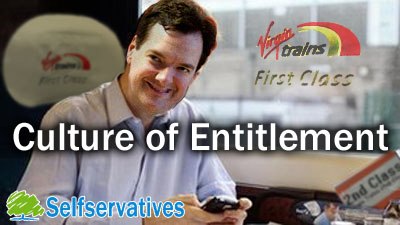
When people are struggling to meet their most basic needs, they cannot summon the effort to do anything else. The Government expect us to believe that punishing poor people will somehow cure them of their poverty, although many people who are not claiming a benefit won’t know about the punishment regime in place for the unemployed poor, since the use of words by the Government like “helping” people into work (that isn’t real) is such a big detour from truth, and it makes a completely menacing, sneering mockery of the real meaning of that word.  Ah, those “caring” Conservatives are at it again …

We really need to ask ourselves what kind of Government would steal money from the poorest citizens through “reforming” the system of welfare provision, when we are in recession. Then ask again why there is a desire to redefine poverty in a way that excludes the obvious reason for it: a lack of money. One cannot help but wonder why the Coalition think that poor people need money taken from them to “incentivise” them, but very wealthy people need money giving to them, to “incentivise” them. Where did the money come from that rewarded so well those who do not need it ? Oh yes, I can see now….

A simple truth is that poverty happens because some people are very, very rich. That happens ultimately because of Government policies that create, sustain and extend inequalities. The very wealthy are becoming wealthier, the poor are becoming poorer. This is a consequence of  “vulture capitalism” – at the core of Tory ideology – designed by the opportunism and greed of a few, it is instituted, facilitated and directed by the Tory-led Coalition.  

Welfare provision was paid for by the public, via tax and NI contributions. It is not a “handout.” It is not the Government’s money to cut. That is our provision, paid for by us to support us if and when we need it. It’s the same with the National Health Service. These public services and provisions do not and never did belong to the Government to sell off, make profit from, and strip bare as they have done.

Low wages and low benefit levels, rising unemployment and a high cost of living are major causes of poverty. “Worklessness” is a made up word to imply that the consequences of Government policies are somehow the fault of the victims of traditional Tory prejudices.

It’s a psychological and linguistic attack on the vulnerable – blaming the unemployed for unemployment, and the poor for poverty. Those are a consequence of Coalition policies. The Coalition take money from those who need it most to give away to those who need it least. That causes poverty. The Coalition are creating poverty via the consequences of policies. Occasionally they do admit it, or more likely, slip up with a truth. (It was Steve Webb in this case, in addition to the opposition.)

Bearing in mind we are in a recession, I believe that the way the most vulnerable have been treated is unforgivable, and inhumane, and it also breaches several basic human rights. Poverty is caused by economic policies driven by political prejudice and ideology. Poverty is generated through structural – socio-economic – conditions that some Governments impose on a population. I would therefore like to see acknowledgement of this in the Tory-led  measurement of poverty. It’s time the Coalition took some responsibility for the appalling and miserable conditions and human suffering that they are deliberately imposing on the Citizens that they are meant to serve

Given the Coalition’s significant contribution to the continuing rise in childhood poverty, it’s worth noting their abject failure to meet their obligations to make provision for children at risk from the effects of poverty, because they prefer instead to make provision for those who need it the very least: the already very wealthy.

Signatories (such as the UK, since 1991) of the United Nations Convention on the Rights of the Child (the most rapidly and widely ratified international human rights treaty in history), are legally obliged to protect children from the adverse effects of economic policies.

The Coalition’s austerity measures, which target the poorest citizens for the greatest proportion of cuts, must surely breach this Convention.

Article 3: (Best interests of the child.) The best interests of children must be the primary concern in making decisions that may affect them. All adults should do what is best for children. When adults make decisions, they should think about how their decisions will affect children. This particularly applies to BUDGET, POLICY AND LAW MAKERS.

That would be the Government.

 The Convention Rights of Children


382035_141704259313964_676863845_n

Pictures courtesy of Robert Livingstone.


I don’t make any money from my work. But you can support Politics and Insights and contribute by making a donation which will help me continue to research and write informative, insightful and independent articles, and to provide support to others. The smallest amount is much appreciated, and helps to keep my articles free and accessible to all – thank you.

DonatenowButton