Tag: #propaganda

The erosion of democracy and the repression of mainstream media in the UK

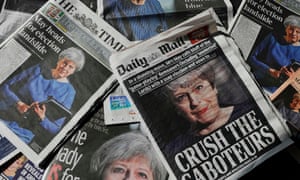
Daily Mail crush the saboteurs
In George Orwell’s Nineteen Eighty-Four, Winston Smith invents the heroic historical figure Comrade Ogilvy, who had “no aim in life except the defeat of the Eurasian enemy and the hunting-down of spies, saboteurs, thought-criminals, and traitors generally”. Theresa May’s world, too, seems to have shrunk to one in which the greatest enemies are the enemies within and democracy must be democratically eliminated for the good of the people.” Steven Poole.

The Daily Mail headline calling those who oppose the government “saboteurs” is the kind of oppressive tactic and despotic language that is commonly used in totalitarian regimes and by dictators. It’s not the kind of media headline expected in liberal democracies, where opposition to the status quo is necessary for the best interests of the country and essential for any meaningful democratic exchange.

Dr. Lawrence Britt examined the fascist regimes of Hitler (Germany), Mussolini (Italy), Franco (Spain), Suharto (Indonesia) and several Latin American regimes. Britt found 14 defining characteristics common to each, and it is becoming increasingly difficult to overlook some of the parallels with the increasingly authoritarian characteristics of our own right wing government here in the UK. Fascism is an authoritarian and nationalistic right wing system of government and social organisation, though not all authoritarian governments are fascist. However, the two terms are quite often used interchangeably. 

Controlled mass media is one example of a key defining feature of authoritarianism, with “news” being directly controlled and manipulated by the government, by regulation, or via sympathetic media spokespeople and executives. Censorship is very common. There is often an identifiable obsession with “National Security” – along with fear being used as a “motivational tool” by the government on the public, and also, as a justification for greater degrees of censorship.

The United Nations’ 1948 Universal Declaration of Human Rights states: “Everyone has the right to freedom of opinion and expression; this right includes freedom to hold opinions without interference, and impart information and ideas through any media regardless of frontiers”. However, unlike the United States, Britain has no constitutional guarantee of press freedom

The right to freedom of expression is fundamental to a functioning democracy – information and ideas help to inform political debate and are essential to public accountability and transparency in government.

Just to clarify, I don’t, however, condone any incitements of hatred. This is not the same thing as free speech. In fact hate speech is designed to close discussion down by intimidating and silencing targeted social groups. In the Uk, several statutes criminalize hate speech against several categories of persons. The statutes forbid communication which is hateful, threatening, or abusive, and which targets a person on account of disability, ethnic or national origin, nationality (including citizenship), race, religion, sexual orientation, or skin colour. 

Yet just last year, the European Commission against Racism and Intolerance (ECRI) criticised the  right wing Daily Mail and the Sun for “offensive, discriminatory and provocative terminology”.

The ECRI report said hate speech was a serious problem, including against Roma, gypsies and travellers, as well as “unscrupulous press reporting” targeting the LGBT community. 

The report also concluded that some reporting on immigration, terrorism and the refugee crisis was “contributing to creating an atmosphere of hostility and rejection”.

It cited Katie Hopkins’ infamous column in The Sun, where she likened refugees to “cockroaches” and sparked a blistering response from the UN High Commissioner for Human Rights, and the same newspaper’s debunked claim over “1 in 5 Brit Muslims’ sympathy for jihadis”. It seems that the tabloids have confused their frequent incitements to hatred, their many contributions to growing social prejudice and hate speech with free speech.

We have witnessed the political right and the tabloids using rhetoric that has increasingly transformed a global economic crisis into an apparently ethno-political one, and this also extends to include the general scapegoating and vilification of other groups and communities that have historically been the victims of prejudice and social exclusion: the poorest citizens, unemployed and disabled people. These far-right rhetorical flourishes define and portray the putative “outsider” as an economic threat. This is then used to justify active political discrimination and exclusion of the constitutive Other. 

Only some people have the right to freely express themselves, apparently.

Freedom of expression is a universal human right. It is not the prerogative of the politician. Nor is it the privilege of the journalist. In their day-to-day work, journalists are simply exercising every citizen’s right to free speech.

This includes the right to communicate and to express oneself in any medium, including through words, pictures, images and actions (including through public protest and demonstrations).

However, the UK government is more generally failing to live up to its human rights obligations. Social groups with protected characteristics, such as disabled people and asylum seekers, have fared very badly over the past few years. The tabloids have preempted draconian Conservative policies which target those social groups with extensive stigmatising and scapegoating campaigns. This is another indication of the Conservative’s radical authoritarian turn. 

The News Media Association (NMA) say: “Threats to press freedom include attempts to strip back journalistic exemptions under the EU and UK data protection legislation, efforts to water down Freedom of Information legislation which the NMA is campaigning against, new court reporting restrictions, a review of the D-Notice Committee, strengthening police powers to obtain journalistic material, the use of RIPA powers to uncover journalists’ sources, and the continuing campaign to introduce jail sentences for breaches of the Data Protection Act.

Journalists in the UK are also subject to a wide range of legal restrictions which inhibit freedom of expression. These include the libel laws, official secrets and anti-terrorism legislation, the law of contempt and other legal restrictions on court reporting, the law of confidence and development of privacy actions, intellectual property laws, legislation regulating public order, trespass, harassment, anti-discrimination and obscenity.

There is some special provision for journalism and other literary and artistic activities, chiefly intended as protection against prior restraint, in the data protection and human rights legislation. There are some additional, judicial safeguards requiring court orders or judicial consent before the police can gain access to journalistic material or instigate surveillance in certain circumstances, but, in practice, the law provides limited protection to journalistic material and sources.”

The new proposed Espionage Act and a data disclosure law.

The UK government are proposing to change the four Official Secrets Acts, which date back to 1911. They want them scrapped and replaced with a “modernised” Espionage Act and a data disclosure law.

However, the Conservatives have been accused of “criminalising public interest journalism” as it plans to increase the number of years for the “leaking of state secrets” from 2 years to 14, in the first “overhaul” of the Official Secrets Act for over 100 years.

Under the proposals, which were published in February, officials who leak “sensitive information” about the British economy that damages national security could also be jailed. Currently, official secrets legislation is limited to breaches which jeopardise security, intelligence defence, confidential information and international relations.

The government released the proposals citing the “new reality” of the 21st-century internet and national security dangers as justification for a more “robust” system of prosecution.

The recommendations centre around the Official Secrets Act (1989) which governs how public servants in government and the military must keep government information secret and out of publication.

Journalists and civil liberties groups have warned that the threshold for the increased sentence has been lowered and that journalists and whistleblowers acting in the public interest will be effectively gagged. 

In the new government recommendations, the threshold for being prosecuted for revealing state secrets will be changed from “having caused definite damage” to the likelihood of causing damage to national interests. The Law Commission also stated that a defendant should be prevented from making a defence that they believed they were working in the public interest. 

Michelle Stanistreet, general secretary of the National Union of Journalists, said: “The ramifications of these recommendations are huge for journalists and freedom of the press. Journalists face being criminalised for simply doing their job and the public’s right to know will be severely curtailed by these proposals. The union will respond robustly to the Law Commission’s consultation on changes to the Official Secrets Act.

“The National Union of Journalists is also concerned that the Digital Economy Bill, now in Parliament, threatens to undermine journalists sharing information in the public interest.” 

“This union is deeply concerned at yet another attempt by the UK government to curtail the media. The Investigatory Powers Act has put journalists’ sources at risk now that a large number of authorities have the power to intercept reporter’s’ emails, mobile phone and computer records.

“We have plenty of evidence that some police forces routinely used the Regulation of Investigatory Powers Act to get their hands on journalists’ records without their knowledge. The NUJ is also concerned that the Digital Economy Bill, now in Parliament, threatens to undermine journalists sharing information in the public interest.”

The consultation on the UK Government’s new proposals closed earlier this month. Organisations such as Amnesty have submitted their statements and expressed their opposition. 

Campaigners say the bill would make any investigation of government culpability harder and lower the amount of accountability in the civil service, military and government.

From the consultation document: “Chapter 6 – Freedom of Expression Enshrined in Article 10 of the European Convention on Human Rights, freedom of expression is a fundamental right. We consider whether compliance with Article 10 requires the introduction of a statutory public interest defence for those who make unauthorised disclosure. Our conclusion is that Article 10 does not require the introduction of a statutory public interest defence. Our view accords with that the House of Lord in R v Shayler.” 

Once you hear the jackboots…

Three years ago, I wrote an article  – Once you hear the jackboots, it’s too late – which discussed the unannounced visit by government national security agents to smash computer hard drives at the Guardian newspaper offices, though it hit the news unsurprisingly quietly, when Edward Snowden exposed a gross abuse of power and revealed mass surveillance programmes by American and British secret policing agencies (NSA and GCHQ) last year. (More detailed information here).

David Miranda, partner of Glenn Greenwald, Guardian interviewer of the whistleblower Edward Snowden, was held for nine hours at Heathrow Airport and questioned under the Terrorism Act. Officials confiscated electronics equipment including his mobile phone, laptop, camera, memory sticks, DVDs and games consoles. This was a profound attack on press freedoms and the news gathering process, and as Greenwald said: “To detain my partner for a full nine hours while denying him a lawyer, and then seize large amounts of his possessions, is clearly intended to send a message of intimidation.”

My article also outlined another extraordinary and vicious attack on The Guardian, instigated by the Department for Work and Pensions (DWP) communications chief and senior government spin doctor, Richard Caseby, who called for the newspaper to be “blackballed” and prevented from joining the new press regulatory body, because “day after day it gets its facts wrong.” Remarkably, “ineptitude or ideology” were to blame for what he deemed “mistakes” in the paper’s coverage of the DWP’s cuts to benefits. He called for the broadsheet to be kept out of the new Independent Press Standards Organisation (IPSO), set up after the Leveson Inquiry into media standards. 

As a former journalist at the establishment-directed Sun and The Sunday Times, Caseby certainly has an axe to grind against the paper that revealed how those right wing papers’ stablemate, the News Of The World, had hacked the voicemail of murdered teenager Millie Dowler, sparking the phone hacking scandal that forced Rupert Murdoch to close the tabloid down.

In connection with Murdoch’s testimony to the Leveson Inquiry “into the ethics of the British press,” editor of Newsweek International, Tunku Varadarajan, referred to him as “the man whose name is synonymous with unethical newspapers.”

Not a shred of concern was raised about any of this or Murdoch’s nasty and corrupt myth production industry, and right wing scapegoating empire, coming from our government, a point worth reflecting on for a moment. Miliband said the phone-hacking was not just a media scandal, but it was a symbol of what was wrong with British politics.

He called for cross-party agreement on new media ownership laws that would cut Murdoch’s current market share, arguing that he has “too much power over British public life.He said: “If you want to minimise the abuses of power, then that kind of concentration of power is frankly quite dangerous.”  I completely agree.

Those that criticise the unscrupulous right wing status quo, on the other hand, are being increasingly filtered out from the media, or censored. Yet journalists are regarded as “democracy’s watchdogs” and the protection of their sources is the “cornerstone of freedom of the press.” And freedom of the press is a cornerstone of democracy. Although enshrined in such terms by the European Court of Human Rights, these democratic safeguarding principles are being attacked in an increasingly open manner all over the world, including in the democratic countries that first proclaimed them.

The erosion of democracy and the Press Freedom Index

Related image

Reporters Without Borders (RSF) are a collective of journalists who study freedom of the press at a comparative and international level. RSF publish an annual Press Freedom Index (PFI), which provides a ranking for every country, calculated to indicate how much governments restrict the media. The UK has been consistently in low position (the higher the score, the lower the ranking) for the last five years, this year it dropped lower still, highlighting an increasing intrusion of the government on and restriction of the freedom of the press.

This won’t surprise many, especially given the numerous public announcements in the press by the likes of Iain Duncan Smith over the last few years regarding the government’s “monitoring” of the BBC and other media for “left wing bias”. We have a media with a very heavy weighted right wing bias, yet any criticism of government policy reduces our government to shrieking hysterically that the communists have been infiltrating the establishment. It’s a curious fact that authoritarians project their rigidity, insecurities and micro-controlling tendencies onto everyone else.

I’m sure Chris Patten, Rhona Fairhead and Sir David Cecil Clementi, successive government appointed chairpersons of the BBC Trustto act as the ultimate decision makers regarding the BBC’s strategic direction, are just the kind of people who are not tied to political ideologies and corporate interests. After all, everyone knows what a veritable hotbed of communism Chris Patten secretly nurtured. (Sorry, my tongue appears to be momentarily stuck to my cheek).

That the UK government felt the need to announce even more surveillance of the BBC indicates a creeping and considerable degree of authoritarianism, and worryingly, it demonstrates how supremely unconcerned and utterly without shame they are in building a public bonfire to burn what remains of media impartiality in the UK. 

The current RSF report says that the decline in respect for media freedom in democracies is not new. It was already noticeable in previous Indexes. But what is striking in this year’s Index is the growing scale and the nature of the violations seen.

The erosion of democracy and subsequent muting of the media isn’t a problem peculiar to the UK, it’s happening on a global scale. The RSF report says:

“Most of the movement in the World Press Freedom Index unveiled today by Reporters Without Borders is indicative of a climate of fear and tension combined with increasing control over newsrooms by governments and private-sector interests.”

“Journalism worthy of the name must be defended against the increase in propaganda and media content that is made to order or sponsored by vested interests.”

The Index is based on an evaluation of media freedom that measures pluralism, media independence, the quality of the legal framework and the safety of journalists in 180 countries. It is compiled by means of a survey questionnaire in 20 languages that is completed by experts all over the world. This qualitative analysis is combined with quantitative data on abuses and acts of violence against journalists during the period evaluated.

The report says: “The election of the 45th president of the United States set off a witchhunt against journalists. Donald Trump’s repeated diatribes against the Fourth Estate and its representatives – accusing them of being “among the most dishonest human beings on earth” and of deliberately spreading “fake news” – compromise a long US tradition of defending freedom of expression. The hate speech used by the new boss in the White House and his accusations of lying also helped to disinhibit attacks on the media almost everywhere in the world, including in democratic countries.”

Framing and tilting the media: asking the million dollar questions

Robert Mercier is the plutocrat and right wing US computer scientist and media “strategist” at the heart of a US-based multimillion-dollar propaganda network, who expresses an “unwavering commitment to neutralising left wing bias in the news, media and popular culture”. He funded the setting up of Breitbart and has close links to Steve Bannon, Donald Trump and Nigel Farage. See: Robert Mercer: the big data billionaire waging war on mainstream media.

It is a very troubling development, give the US had a global reputation for promoting a strong free press, protected by the First Amendment. This said, it’s certainly not a recent development that political leaders of western so-called democratic countries have intervened directly in an attempt to modify and direct media reporting. The US is ranked at 43 in the 2017 World Press Freedom Index. 

RSF now ranks the UK 40th in the index; a fall from 38th place in 2016. The Nordic countries have the most favourable PFI ranking, with Norway being at the top, followed by Sweden, Finland, and Denmark. It’s an indictment of both UK and US claims to democracy and freedom of the media that three former Soviet countries: Estonia, Latvia, and Lithuania rank more highly. The British press were also outranked by Uruguay, Costa Rica, Jamaica, Namibia, Samoa, Trinidad and Tobago.

RSF’s report says: “Media freedom has never been so threatened and RSF’s “global indicator” has never been so high (3872). This measure of the overall level of media freedom constraints and violations worldwide has risen 14% in the span of five years. In the past year, nearly two thirds (62.2%) of the countries measured have registered a deterioration in their situation, while the number of countries where the media freedom situation was “good” or “fairly good” fell by 2.3%.”

“It was also in late 2016 that the United Kingdom (down 2 places at 40th) adopted a new law extending the surveillance powers of the British intelligence agencies. Dubbed the “Snoopers’ Charter,” the Investigatory Powers Act put the UK in the unenviable position of having adopted “the most extreme surveillance legislation in UK history”, with a law that lacks sufficient protection mechanisms for journalists and their sources. Even more alarming, in early 2017, the Law Commission put forward a proposal for a new ‘Espionage Act’ that would allow the courts to imprison journalists and others for up to 14 years for obtaining leaked information.”

It goes on to say: “The past year also saw a continuation in the trend for media ownership to become concentrated in ever fewer hands, which is exacerbating the media’s dependence on political and economic power holders.”

“A heavy-handed approach towards the press – often in the name of national security – has resulted in the UK slipping down the [PFI]. Parliament adopted the most extreme surveillance legislation in UK history, the Investigatory Powers Act… posing a serious threat to investigative journalism. Even more alarming, the Law Commission’s proposal for a new ‘Espionage Act’ would make it easy to classify journalists as ‘spies’ and jail them for up to 14 years for simply obtaining leaked information.”

The extensive report also warns that:

“Journalism worthy of the name must be defended against the increase in propaganda and media content that is made to order or sponsored by vested interests.”

“It is unfortunately clear that many of the world’s leaders are developing a form of paranoia about legitimate journalism.” (RSF secretary-general Christophe Deloire).

“The climate of fear results in a growing aversion to debate and pluralism, a clampdown on the media by ever more authoritarian and oppressive governments, and reporting in the privately owned media that is increasingly shaped by personal interests. Journalism worthy of the name must be defended against the increase in propaganda and media content that is made to order or sponsored by vested interests. Guaranteeing the public’s right to independent and reliable news and information is essential if humankind’s problems, both local and global, are to be solved.”

The press freedom map below is a visual overview of the situation in each country in the Index. The darker the colour, the worse the PFI ranking. 

The mass media are often referred to as the fourth branch of government because of the power they wield and the oversight function they exercise. However, democracy requires the active participation of citizens. Ideally, the media should encourage citizens to engage in the business of governance by informing, educating and mobilising the public.

The notion of the media as a watchdog, as a guardian of public interest, and as a conduit between governors and the governed was once deeply ingrained. The reality, however, is that the media in democracies are failing to live up to this ideal. They are hobbled by stringent and often repressive laws, monopolistic ownership, and too often, the threat of brute force. State controls are not the only constraints. Balanced and impartial reporting is difficult to sustain in a context of neoliberalism because of competitive media markets that put a premium on the superficial and sensational.

Moreover, the media are manipulated and used as proxies in the battle between political groups, in the process sowing divisiveness rather than consensus, hate speech instead of sober debate, and suspicion rather than social trust. The media significantly contribute to public cynicism and democratic decay.

Noam Chomsky has written extensively about the role of the free market media in reinforcing dominant ideology and maintaining the unequal distribution and balance of power. In Manufacturing Consent, Chomsky and Herman explore the media’s role in establishing the apparence of a political and economic orthodoxy (neoliberalism) and extending a seemingly normative compliance with state policies, while also marginalising antithetical or alternative perspectives, dismissing them as heresy. In the US and UK, most left wing commentors have a very diminished media platform from which to present their perspectives and policy proposals.

This “free-market” version of censorship is more subtle and difficult to identify, challenge and undermine than the equivalent propaganda system which was present in Nazi Germany or the Soviet Union. 

As Chomsky argues, the mainstream press is corporate owned and so reflects corporate priorities and interests. While acknowledging that some journalists are dedicated and well-intentioned, he says that the choice of topics and issues featured in the mass media, the unquestioned premises on which that “coverage” rests, and the range of opinions that are expressed are all constrained to reinforce the state’s dominant ideology.

Image result for media bias uk

Last year, research by YouGov found that the British media is the most right wing in Europe. Readers also ranked the British press as the most biased in all of the seven countries surveyed.
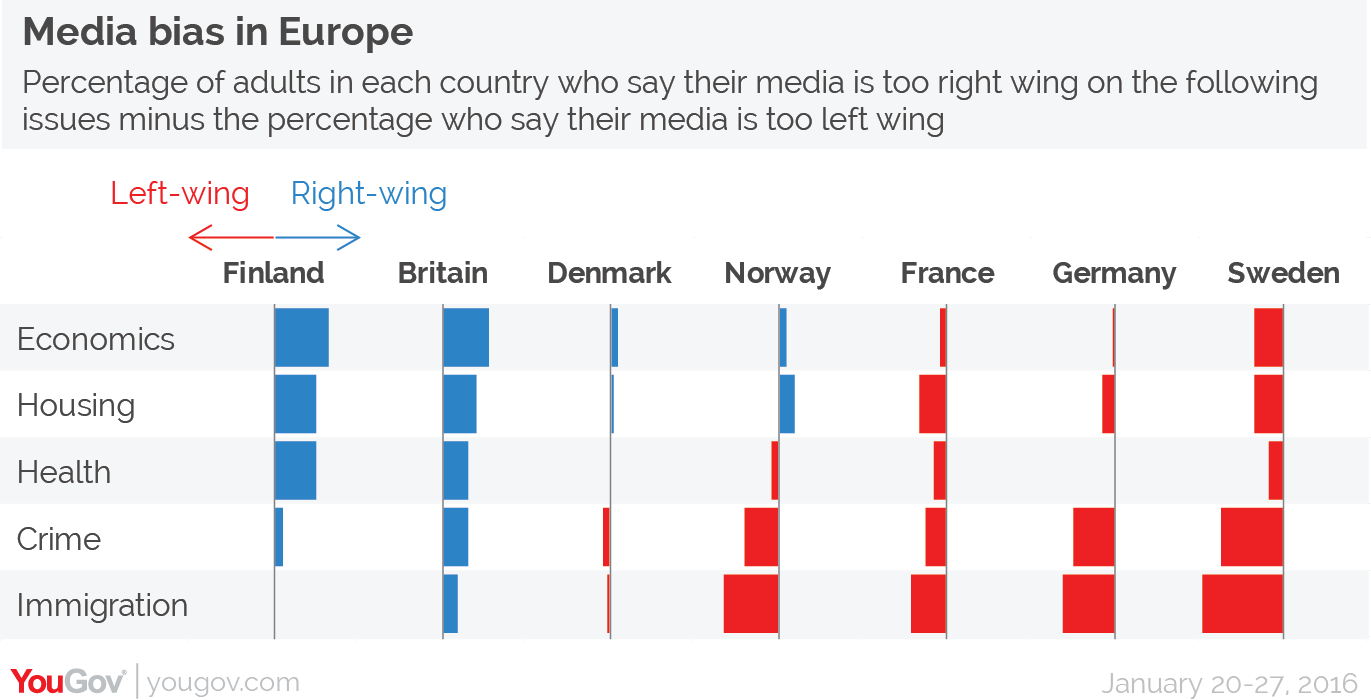
On average British people are more likely than any other country to see the media as skewed towards the right (26% compared to 23% for Finland and 19% for France). Britain’s media is viewed as having a right wing bias, most of all on the subject of economics (net 15 points to the right).

The media have recently portrayed Jeremy Corbyn as both a pacifist and as someone with a paradoxical tendency to “love terrorists”, but then logic and accuracy have never been apparent in most media attacks of the left. (See the Zinoviev letter, for a historic example). 

You know the world is in big trouble when diplomacy and negotiation skills are considered a “threat” to security. It seems that the establishment prefer bombing civilians to get other governments to comply with their wishes. I know which is probably going to contribute to keeping peace the most, and it isn’t “humanitarian” bombing. 

The “poor relations” between nuclear powers has contributed to an atmosphere that “lends itself to the onset of crisis,” according to a very worrying report by the UN Institute for Disarmament Research. The report goes on to say: “The rise in cyber warfare and hacking has left the technical vulnerabilities of nuclear weapons systems exposed to risk from states and terrorist groups.

Nuclear deterrence works—up until the time it will prove not to work. The risk is inherent and, when luck runs out, the results will be catastrophic.

The report went on to say: “The more arms produced, particularly in countries with unstable societies, the more potential exists for terrorist acquisition and use of nuclear weapons.”

The UN report comes as Donald Trump of the US and Vladmir Putin of Russia have both indicated support for expanding their country’s nuclear weapon arsenals. 

Deterrence is at the “greatest risk of breaking down” in North Korea and between India and Pakistan over the disputed territory of Kashmir.

The report also stated an expressed concern over tensions between the West and Russia, which have grown since the annexation of Crimea in 2014. President Putin has maintained Russia would use nuclear weapons if it felt sufficiently threatened.

You know, I think diplomatic skill is a far better quality to look for in a leader, speaking from the perspective of a civilian, in these troubled times. 

istock-456613403.jpg

In most newspapers, including even The Daily Mirror and The Independent, Labour voices that are unreasonably anti-Corbyn outweigh those that are pro-Corbyn. Corbyn’s voice is often absent in the narratives and reporting on him, and when it is present it is often presented in a highly distorted way. 

We all want and need a strong and a critical media, a watchdog of the powers that be, but maybe we do not need an “attack dog” who kills off anyone who dares challenge the status quo and dares to suggest we need a different kind of politics.

 

Related image

Ed Miliband eating a bacon butty on Channel four’s The Last Leg

The coming of epistemological totalitarianism in the UK

Epistemology relates to the theory of knowledge, especially with regard to its methods, validity, and scope, and the distinction between justified belief and opinion. In the UK, our “knowledge” is being framed by the right wing media. The media doesn’t exactly tell us how to think, but it does tell us what to think about, by a selective agenda of topics and the framing of public debate.

The UK establishment news media are highly centralised and dominated by elites who serve and maintain the status quo and who detest democracy.

Image result for media bias examples uk corbyn terrorism

In 2015, I wroteOne particularly successful way of neutralising opposition to an ideology is to ensure that only those ideas that are consistent with that ideology saturate the media and are presented as orthodoxy, to “naturalise” them. The Conservative election campaigns are a thoroughly dispiriting and ruthless masterclass in media control.

Communication in the media is geared towards establishing a dominant paradigm and maintaining an illusion of a consensus. This ultimately serves to reduce democratic choices. Such tactics are nothing less than a political micro-management of your beliefs and are ultimately aimed at nudging your voting decisions and maintaining a profoundly unbalanced, pathological status quo.

Presenting an alternative narrative is difficult because the Tories have not only framed all of the issues to be given public priority – they set and stage-manage the media agenda – they have also almost completely dominated the narrative; they construct and manage the political lexicon and now treat words associated with the left, such as welfare, trade unionism, collective bargaining, like semantic landmines, generating explosions of right wing scorn, derision and ridicule. This form of linguistic totalitarianism discredits any opposition before it even arises.

Words like cooperation, inclusion, mutual aid, reciprocity, equality, nationalisation, redistribution – collective values – are simply dismissed as mere anachronisms that need to be stricken from public conversation and exiled from our collective consciousness, whilst all the time enforcing their own bland language of an anti-democratic political doxa. The political manufacturing of a culture of anti-intellectualism extends this aim, too.”

The London School of Economics (LSE) media and communications department undertook a research project, aiming at contributing to the ongoing public debate regarding the role of mainstream media and of journalists in a media-saturated democracy. In Journalistic Representations of Jeremy Corbyn in the British Press: From “Watchdog” to “Attackdog”, the research team say:

“We set out to recognise and acknowledge the legitimate role of the press to critique and challenge the powers that be, which is often encapsulated by the metaphor of the watchdog. Our systematic content analysis of a representative sample of newspaper articles published in 8 national newspapers between 1 September and 1 November 2015, however, shows that the press reacted in a highly transgressive manner to the new leader of the opposition, hence our reference to the attackdog metaphor.

Our analysis shows that Corbyn was thoroughly delegitimised as a political actor from the moment he became a prominent candidate and even more so after he was elected as party leader, with a strong mandate. This process of delegitimisation occurred in several ways: 1) through lack of or distortion of voice; 2) through ridicule, scorn and personal attacks; and 3) through association, mainly with terrorism.

All this raises, in our view, a number of pressing ethical questions regarding the role of the media in a democracy. Certainly, democracies need their media to challenge power and offer robust debate, but when this transgresses into an antagonism that undermines legitimate political voices that dare to contest the current status quo, then it is not democracy that is served.”

Image result for corbyn terrorism

See Cameron ridiculed for hypocrisy and quoting Corbyn out of context.

According to the Independent Press Standards Organization (IPSO), newspapers are obliged to “make a clear distinction between comment, conjecture and fact and this has not been applied to media discussion of Jeremy Corbyn, by and large.

You can download the full LSE report here.

Also worth a read: How many of Jeremy Corbyn’s policies do you actually disagree with?

More recently, I explored the role of intentionally deceitful political language and rhetoric in another article  which highlights the role that the media play in shaping our public life. Media manipulation involves a series of related techniques in which partisans create images or arguments that favour their own particular interests. Such tactics may include the use of logical fallacies, psychological manipulations, deception, linguistic, rhetorical and propaganda techniques, and often involve the suppression of information or alternative perspectives by simply crowding them out. 

Discrediting and minimisation are often used in persuading other people or social groups to stop listening to certain perspectives and arguments, or by simply diverting public attention elsewhere. An example of diversion is the recent widespread scapegoating of refugees and people who need social security, such as disabled people or those who have lost their jobs, in a bid to maintain the hegemony of neoliberalism and its values at a time when its failings were brought into sharp focus during and following the global crisis – also exposing failings in the behaviours and practices of the government and the vulture capitalist financier class.

Neoliberalism always gravitates towards increasing inequality, extending and deepening poverty. Fear mongering is sometimes used with a diversion or misdirection propaganda technique to mask this, and may be pervasive. Sometimes politicians and media commentators suddenly take a debate in a weird and irrational but predictable direction to avoid democratic accountability.

The process often begins with a marginalised group being singled out and held to blame for the socioeconomic problems created by the system of socioeconomic organisation itself. Using the construction of folk devils (welfare “skivers” , “workshy” “something for nothing culture”, “culture of entitlement” or “dependency” for example), the political class and media generate moral panic and outrage, which serves to de-empathise the public and to justify the dehumanisation of politically created outgroups, and draconian policies.

Campaigners against social injustice are labeled “extremist” and politicians on the left who stand up against prejudice and discrimination are labeled “saboteurs”, “weak”, “anti-British” and extensively ridiculed and smeared. Every single Labour leader, with the exception of Blair, has had this treatment from the mainstream media.

During the coalition and Conservative governments, the tabloids have chosen and framed most of the debates that have dominated domestic politics in the UK, ensuring that immigration, welfare, law and order, the role of the state, and Britain’s relationship with Europe have all been discussed in increasingly right wing terms, while almost ironically, the government have colonised progressive rhetoric to cover their intentions. It also serves to further discredit the narrative of the left.

However, there is therefore a growing chasm between Conservative discourse, and policy intentions and outcomes. There isn’t a bridge between rhetoric and reality.

The Conservatives commonly use a nudge technique called “social norming” – a Behavioural Insights Team variant of the bandwaggon propaganda technique – particularly for General Election campaigning. It’s about manipulating a false sense of consensus, and normalising Conservative ideology. It’s also about prompting behavioural change, and as such, this method is a blatant attempt to influence the voting behaviours of the public, by suggesting that many others have already “joined” the Conservative “cause” and are happier or better off for doing so. The technique uses societal pressures to play on several basic emotional elements of human nature.

Oh, and then there is the basic technique of telling lies, of course.

Social norming is an appeal to emotional needs to fit in and belong, and also, to be on the side that wins. It has a kind of self fulfilling prophecy element to it, too. It’s used in advertising – words like “everyone” and “most people” or “many” are used a lot to sell brands and imply a popularity of certain products that usually isn’t real.

Political slogans like “a country that works for everyone” and the previous “all in it together” are examples of poor attempts at social norming. It’s aimed at shifting our normative framework to accommodate the status quo, too, regardless of how the accounts don’t tally with reality. Once you see it, you can’t unsee it.

With this in mind, we need to think about how the conventional political polls are run, who runs them and for what and whose purpose.

I wouldn’t dream of telling you who to vote for in the coming General Election. However, I will ask that you please very carefully consider what you vote for. 

Independent media organisations like Novara Media, Evolve Politics, Media Diversified, Media Lens, CommonSpace, The Canary, Bella Caledonia, Real Media, The Dorset Eye, Welfare Weekly, Scisco Media, Ekklesia, STRIKE! magazine, The Bristol Cable, Now Then, the Manchester Mule, and many others are taking the fight to the establishment. The new independent media have freedom from institutional dependencies, and in particular, from the influence of government and corporate interests.

Independent media includes any form of autonomous media project that is free from institutional dependencies.

We are not constrained by the interests of society’s major power-brokers.

The independent media collectively reflect a model that is democratic, prefigurative, often collaborative and that has a mutually supportive approach to public interest and conscience-based, as opposed to market-based, media.

We are a collection of diligent witnesses writing a collective, qualitative social testimony, marking and evidencing an era of especially historic political upheavals on a global scale.

The Canary says that independent media “have been ably assisted by an array of skilled and committed bloggers like Vox Political, Another Angry Voice, Pride’s Purge and Politics and Insights (Kitty S Jones) to name but a few.” (Takes a small bow). I would add THE SKWAWKBOX to the list, too.

Related

Don’t buy the lie. To oppose the government is not sabotage –  video by Paul Mason

The bias in our mainstream media makes a lot more sense when you see who owns and runs it – Kerry-Anne Mendoza

We need to talk about the mainstream media and the election. Because a disaster is looming – Steve Topple

BBC’s Stephen Sackur accuses Tories of spreading propaganda about Jeremy Corbyn, and of being unaccountable and undemocratic

Inverted totalitarianism and neoliberism 

Dishonest ways of being dishonest: an exploration of Conservative euphemisms

Once you hear the jackboots, it’s too late

Through the looking glass darkly: the Conservatives are colonising progressive rhetoric

Hypernormalisation – Adam Curtis

Politics and Insights condemns George Osborne’s appointment to the Evening Standard in joint independent media statement


My work is unfunded and I don’t make any money from it. But you can support Politics and Insights and contribute by making a donation which will help me continue to research and write informative, insightful and independent articles, and to provide support to others.

DonatenowButton

I’ve just told the Conservative director of campaigning to jog on

17992309_1302068139828559_7295604745407481410_n

I have just been given an award for Discretionary Housing Payment (DHP). Not sure how much I will get towards my rent as the award notice doesn’t make much sense, but I got it after sending in my medical evidence recently. 

It means I get to keep a roof over my head for a bit longer, anyway. It’s very, very difficult to get an award of DHP now, as it has been made highly conditional, partly because councils are so strapped for cash due to Conservative cuts, partly because Conservative policies, such as the bedroom tax and other “reforms”, have increased the need considerably for this support.

My own council informed me that already there are very little funds left for DHP. I applied because since becoming too ill to work, my income has dwindled to the point where I’m now short by more than £100 per month to pay for my rent, council tax, food and fuel. I don’t have a spare room, but I have to pay council tax currently because my son is taking a couple of months out from university to care for me, following a severe bout of pneumonia and sepsis, which almost cost me my life. My son is therefore classed as a “non dependent”. Despite the fact he has no income out of term time, he is still expected to contribute to the rent. I am currently so poor because of draconian Conservative policies. 

So imagine my surprise and disgust when I got an email today from the Conservative campaign director, asking me to donate £30 to the Tory election campaign. You couldn’t make it up. 

Note the nudges used in their grubby mail opening: “We’ve had a great response…” which is an approach that the Behavioural Insights Team at the heart of the cabinet office call “social norming“. It was designed by the advertising industry and is increasingly being used in polcy and political rhetoric to create a false consensus effect. Social norming is increasingly being used in policies aimed at behavioural change. That the government is using such an approach from their Nudge Unit to influence voting behaviour is deplorable.

This kind of nudge is based on the bandwaggon propaganda technique. It’s an improper appeal to emotion, used for the purpose of swaying the opinions of an audience.  This technique involves encouraging people to think or act in some way simply because other people are doing so, or so it is implied. It’s an appeal to “join the winning side” because pretty much everyone apparently endorses it, after all. 

Plus there is an urge for us to “all stand together”, remarkably, from a government that has intentionally caused massive social division in order to manipulate the populations’ perceptions and behaviours towards politically scapegoated others, (unemployed and disabled people, refugees and asylum seekers, for example) to divert attention from the fact that Conservative policies are causing massive inequality as their policies reward the wealthy and punish the poorest citizens, their policies are aimed at dismantling the social gains of our post war settlement, and creating scapegoats and the growth of social prejudice as a diversionary tactic to protect those responsible for our ruined economy – the financier class and the government.

Image result for bandwagon propaganda

I’m wondering just how many people needing social security would be donating half their weekly income to these sadistic jokers after years of their extremely punitive “reforms”?

I’m guessing none.

Quite properly so.

Here is a copy of the email, with my considered response:

From: Darren Mott – Chief Agent and Director of Campaigning
Sent: 24 April 2017 12:39
To: suejones
Subject: Re: We need to stand together Susan 

Dear Susan,

We have had a great response from supporters across the country joining our 2017 Fighting Fund supporters list.

It has been exciting to see such support for our plan for a stronger Britain through Brexit and beyond.

I will be speaking to our campaign team at midday tomorrow to set spending priorities in this crucial phase of the campaign to strengthen the Prime Minister’s negotiating hand in Europe. Donate now to help.

The stakes couldn’t be higher, Susan, we need you. Elections are always hard fought. Only Theresa May and the Conservatives can ensure we have strong leadership, certainty and stability through Brexit and beyond.

If you haven’t already, please donate £30 today and join our 2017 Fighting Fund supporters list.

Thank you,

Darren

Darren Mott
Chief Agent and Director of Campaigning

PS: Donate by midday to make sure you are on our supporters list for this key phase of the campaign.

From: Conservative Campaign Headquarters
Subject: We Stand Together 

Tory

Dear Susan,           

This is urgent.

In 6 weeks’ time there will be a general election. Your donation is vital. It is vital to bolster an election campaign that aims to strengthen Theresa May’s and the UK’s negotiating position on Brexit.

Your donation will help defeat Jeremy Corbyn, and our Lib Dem and SNP opponents, who together are planning to disrupt our Brexit negotiations, raise taxes, increase borrowing and waste.

Will you be one of our General Election 2017 Fighting Fund supporters, and will you help us get on with the job of making life in the United Kingdom even better, Susan?            

Donate today:

£20 gets us 100 campaign posters

£35 delivers 500 leaflets to target voters

£50 helps us call 1000 target voters

£100 delivers 3000 letters to target voters

£500 delivers 3000 freepost surveys to target voters

We are finalising our election plans now, Susan. Will you donate to our campaign and become a Fighting Fund supporter today?

Thanks for your support,     

Conservative Campaign Headquarters
                 

  Promoted by Alan Mabbutt on behalf of the Conservative Party, both at 4 Matthew Parker Street, London, SW1H 9HQ


My measured response:

Bootstraps

Susan Jones
05:56

RE: We need to stand together Susan

To: Darren Mott – Chief Agent and Director of Campaigning

After this government’s policies have systematically robbed me of an adequate income, I am afraid I haven’t even enough money to meet my basic needs, let alone donate to a party that has nothing but disdain for those of us who become too ill to work. I have worked most of my life and contributed tax and National Insurance, only to see you dismantle the social gains of our publicly funded post-war settlement and hand out my money to millionaires and rogue multinationals.

You’re right, the stakes have never been higher. That’s why I will be campaigning as hard as I possibly can for a Labour government, which will acknowledge and reflect public needs in their policies. That’s rather more democratic than a government that imposes their own needs on the population to meet their ideological and draconian policy outcomes.

So jog on.

It’s time to put the Tories out of our misery

 Sent from Mail for Windows 10

Related

The Conservative’s negative campaign strategy: “share the lies and win a prize”


I don’t make any money from my work and I am not funded. I am disabled because of illness and struggle to get by. But you can help me continue to research and write informative, insightful and independent articles, and to provide support to others, by making a donation. The smallest amount is much appreciated – thank you.

DonatenowButton

Dishonest ways of being dishonest: an exploration of Conservative euphemisms

imgres

Conservatives are especially conservative with the truth: the media are the message

In 2004, George Lakoff, professor of linguistics at Berkeley, wrote Don’t Think of an Elephant! Lakoff’s central point was that how issues are framed – which points of view the media and other political agenda setters defined as important and acceptable, and the language used to do so – largely shapes how voters think about them. 

Media manipulation involves a series of related techniques in which partisans create images or arguments that favour their own particular interests. Such tactics may include the use of logical fallacies, psychological manipulations, deception, linguistic, rhetorical and propaganda techniques, and often involve the suppression of information or alternative perspectives by simply crowding them out.  

Discrediting and minimisation are often used in persuading other people or social groups to stop listening to certain perspectives and arguments, or by simply diverting public attention elsewhere. An example of diversion is the recent widespread scapegoating of refugees and people who need social security, such as disabled people or those who have lost their jobs, in a bid to maintain the hegemony of neoliberalism and its values at a time when its failings were brought into sharp focus during and following the global crisis – also exposing failings in the behaviours and practices of the government and the vulture capitalist financier class.

Neoliberalism always gravitates towards increasing inequality, extending and deepening poverty. Fear mongering is sometimes used with a diversion or misdirection propaganda technique to mask this, and may be pervasive. Sometimes politicians and media commentators suddenly take a debate in a weird and irrational but predictable direction to avoid democratic accountability.

The process often begins with a marginalised group being singled out and held to blame for the socioeconomic problems created by the system of socioeconomic organisation itself. Using the construction of folk devils (welfare “skivers” , “workshy” “something for nothing culture”, “culture of entitlement” or “dependency” for example), the political class and media generate moral panic and outrage, which serves to de-empathise the public and to justify the dehumanisation of politically created outgroups.

Stigma, prejudice and discrimination follow, all of which serves to subvert responsibility for the harmful consequences and distress experienced by the targeted group. In the UK, people needing welfare support, and particularly disabled people, have been stigmatised and then targeted with discriminatory policies which have placed a disproportionate burden of austerity – cuts to lifeline support and services – on that social group. The policies have also contravened disabled people’s human rights.

Meanwhile, the vulture capitalist financier class are still being rewarded, profiting from often reckless, economic and socially damaging behaviours. Of course it’s business as usual for this group, regardless of the pressing need for behavioural change and an increased responsibility-taking mindset among them. After all, it is this group that have caused most damage to our economy, and on a global scale.

The media and the government conflate neoliberal authoritarian behaviours, and policies that cause distress and harm to marginalised social groups, with “power and strength”, and any opposition to this with “weakness”.

Campaigners against social injustice are labeled “extremist” and politicians on the left who stand up against prejudice and discrimination are labeled “weak”, “anti-British” and extensively ridiculed and smeared. Every single Labour leader, with the exception of Blair, has had this treatment from the mainstream media.

During the coalition and Conservative governments, the tabloids have chosen and framed most of the debates that have dominated domestic politics in the UK, ensuring that immigration, welfare, law and order, the role of the state, and Britain’s relationship with Europe have all been discussed in increasingly right wing terms, while almost ironically, the government have colonised progressive rhetoric to cover their intentions.

There is therefore a growing chasm between Conservative discourse, and policy intentions and outcomes. There isn’t a bridge between rhetoric and reality. 

The Conservatives have plundered from left wing narrative purely to broaden their superficial appeal and to neutralise opposition to controversial and contentious policy. The legislative context in which such language is being used is completely at odds with how it is being described by purposefully stolen terms and phrases which are being applied most deceitfully.

The negative associations because of Conservative policies have eclipsed the original meanings of the imported language. I always flinch when a Conservative minister says that the government is intending to “support” disabled people into work, or that they want to make welfare “fair” and they support “social justice”,  for example. These words are used in a context of coercive and punitive policy measures.

It’s very disorienting and disarming to see the language of social justice, democracy, inclusion and equality being used to justify and describe policies which extend social injustice, authoritarianism, exclusion and inequality. It’s also much more difficult to challenge actions that are disguised by a tactic of extensive euphemising, that draws on glittering generalities and the narrative of the opposition (the left generally).

Only a Conservative minister would claim that taking money from the lifeline support of sick and disabled people is somehow “fair,” or about “helping”, “supporting” or insultingly, “incentivising” people who have already been deemed unfit for work by their doctors and the state via the work capability assessment, to work.

The Tories all too frequently employ such semantic shifts and euphemism – linguistic strategies – as an integral part of a wider range of techniques of neutralisation that are used, for example, to provide linguistic relief from conscience and to suspend moral constraint – to silence both “inner protest” and public objections – to the political violation of social and moral norms and human rights; to justify acts that cause harm to others while also denying there is any subsequent harm being inflicted by austerity policies; to deny the targeted population’s accounts and experiences of political acts of harm, and to neutralise any remorse felt by themselves and other witnesses.

Media discourse has often preempted a fresh round of Conservative austerity cuts, resulting in the identification, scapegoating and marginalisation of social groups in advance of targeted, discriminatory policies. Media discourse is being used as a vehicle for the government to push their ideological agenda forward without meeting legitimate criticism, opposition and public scrutiny and without due regard for essential democratic processes and safeguards. The mainstream media will not challenge or undermine the wider state-corporate nexus of which it is a fundamental part.

Noam Chomsky has written extensively about the role of the free market media in reinforcing dominant ideology and maintaining the unequal distribution and balance of power. In Manufacturing Consent, Chomsky and Herman explore the media’s role in establishing the apparence of a political and economic orthodoxy (neoliberalism) and extending a seemingly normative compliance with state policies, while also marginalising antithetical or alternative perspectives, dismissing them as heresy. In the US and UK, most left wing commentors have a very diminished media platform from which to present their perspectives and policy proposals.

This “free-market” version of censorship is more subtle and difficult to identify, challenge and undermine than the equivalent propaganda system which was present in Nazi Germany or the Soviet Union. 

As Chomsky argues, the mainstream press is corporate owned and so reflects corporate priorities and interests. While acknowledging that some journalists are dedicated and well-intentioned, he says that the choice of topics and issues featured in the mass media, the unquestioned premises on which that “coverage” rests, and the range of opinions that are expressed are all constrained to reinforce the state’s dominant ideology.

How to tell lies dishonestly

Propaganda, PR, spin, manipulation, and techniques of neutralisation (a kind of doublespeak aimed at “switching off” your inner conscience, remorse and morality, and that of witnesses, so you can do things normally considered unacceptable, immoral or plain evil), are indirect or convoluted ways of telling lies. These techniques are very sneaky, often providing “get outs”. As such, the tactics are dishonest ways of being dishonest. While often providing a cover or superficial style of “truth”, the underlying content is always a big lie.

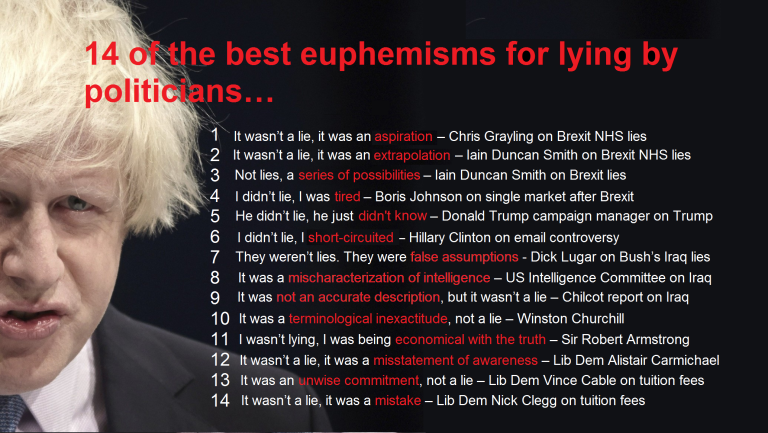
Not “a series of possibilities” or a “terminological inexactitude,” or “a series of misunderstandings” or “an unwise commitment”, but a lie. 

Even the labels “fake news”, “post rationalism” and “post truth” are euphemisms. We live in an age of great political deceit and lies, and an ineffectual, trivial lexicon to describe it.

That’s intentional, manipulative whopping whopper political lies.

The Conservatives have developed a notorious lexicon of euphemisms, especially designed to divert challenges and debate, to hide their aims and intentions and to reduce opposition, in order to manufacture an illusion of consensus, consistent with old school diversionary and bandwaggon propaganda methods.

Winston Churchill came up with the crafty phrase “terminological inexactitude,” which means being conservative with the truth (see what I did there), or to be more direct, it means telling lies. There are indirect ways of lying – less honest ways of being intentionally dishonest, if you will.

Euphemisms are often a form of doublespeak; they are words used to hide, distort or “neutralise” reality.  Euphemisms put political intentions, actions and their consequences in a better light, in much the same way that the mafia employs language to minimise the consequences of their actions. No-one is ever murdered by the mafia, to hear them talk, instead they are simply “given their medicine” , “clipped” or “wacked”, for example. However you say it, people still end up dead, unfortunately. The mafia say that disposing of the bodies of their murder victims is “spring cleaning”.

A credibility assessment of Tory narrating and editing: the sin in the spin exposed

1. “Reforms” = The stealthy privatisation of public wealth. Conservative “reforms” entail cuts to social provisions and public services – paid for by everyone – which support the poorest citizens when they experience hardship. The money is then re-allocated to the wealthiest citizens via generous tax cuts and lower business tax  rates which effectively privatises wealth and profit, while making any risks and costs a social burden.

2. “Targeting those in greatest need” = savage and increasing cuts to social security provision, and in particular, to disabled people’s lifeline support. No-one actually qualifies for support, any more. However, a handful may get a favorable outcome when assessors flip a coin to decide which of the very ill people they meet and put through the mill are lucky enough to meet their target of permitting around six successful claims per year. From 2017, the target will reduce again to three. By 2020, no-one will “need” disability benefits and support, as we will all be cured by work fare and CBT.

Ultimately, this entails a constant moving goalpost of eligibility to publicly funded support. The government reduces the numbers of those previously entitled to welfare by constant, changing and unstated political redefinition of “need”, while implying to the public that welfare and those who need it are dispensable.

3. “Making work pay” = dismantling social security by stealth and driving down wages, ensuring that private companies profit.

4. “National living wage” = small and pitiful increase in minimum wage that does not offset welfare cuts (Universal Credit, benefit cap, reduced eligibility criteria for disability benefits) and other losses, such as job insecurity, poor working conditions, zero hour contracts.

5. “Supporting/helping people into work” = extremely punitive measures of behavioural conditionality and financial sanctions that hinder people in finding appropriate work, aimed at cutting social security spending and presenting lifeline benefits as dispensable to the public, whilst coercing people to behave in ways that benefit the state and that do not benefit those citizens being manipulated and coerced to fulfil the aims of the policy makers.

2, 3, 4 and 5 also undermine collective bargaining, since people are being coerced to take any work available, rather than suitable, secure work with acceptable pay and working conditions. This puts a downward pressure on wages.

6.  “Worklessness” = a made up word that disguises job precarity, unemployment and underemployment, because of government, economic and labour market failure, followed by political scapegoating and widespread, brutal cultural bullying of the poorest citizens.

7. “Extremists”= peaceful campaigners who object to social injustice, anyone else who doesn’t support the neoliberal status quo, authoritarianism, inequality, growing poverty and human rights abuses.

8. “Hard working strivers” = compliant and exploited citizens whose consumerism and systematic oppression keeps Tory donor big businesses in profit. As an imposed ideal, the work ethic also props up injustices like work fare, political scapegoating and prejudice directed at people who lose their jobs and need social security.

9. “Democracy” = authoritarianism, so that means it’s whatever the Tories say it is.

It entails policies which engineer a set of changes with huge distributional consequences: tax credit and benefit cuts will mean low-income working families with children will become significantly worse off, while wealthier families stand to gain a lot as a result of increases in the personal allowance and higher rate tax threshold, for example. 

Recent analysis by the Resolution Foundation shows four fifths of the gains from income tax cuts go to the most affluent half of households, while the poorest third of households will shoulder two-thirds of the government’s benefit cuts. This is an extraordinary indictment on a government that claims to have “fairness” and “social justice” at its heart.

10. “Progressive”= extremely regressive, almost feudal.

11. “Behavioural change”= to separate citizens from the prospects of material progress and to condition them to accept both the status quo and the short straw of neoliberal ” market forces”, cunningly disguised as invisible bootstraps.

12. “Policy” = a method of siphoning money from the poorest citizens and public services into corporate and millionaires’ bank accounts, while punishing the poorest citizens as they are robbed, by telling all and sundry it’s their own fault that they are poor. Usually involves an element of character divination and quack “cures” for “faulty” people. Often justified by an implied “trickle down” of wealth.

Neoliberal policies require a political framework of authoritarianism as they don’t benefit most people, and strip our public assets. A lot of neoliberalism is about governments kidding people that neoliberalism doesn’t cause massive inequalities, poverty, and the removal of publicly funded social support mechanisms.

While the state shrinks radically in terms of what it provides for ordinary people to meet their needs, it paradoxically develops a massive and increasingly bureaucratic order to deceive ordinary people and to impose an authoritarian rule and control citizen perceptions and behaviours, allowing the government to keep on imposing ruthless scorched earth neoliberal policies so that a few very, very wealthy folk can get even wealthier whilst everyone else becomes increasingly miserable and struggles in meeting their basic survival needs.

13.  “Supply side economics” = founded on the mythical “trickle down” and the side-splittingly comedic idea that reducing taxes for the wealthiest will increase Treasury revenue. Usually, it’s hiked VAT and another raid on disabled people’s lifeline support that does that.

The economist John Kenneth Galbraith wrote, “Mr. David Stockman has said that supply-side economics was merely a cover for the trickle-down approach to economic policy – what an older and less elegant generation called the horse-and-sparrow theory: If you feed the horse enough oats, some will pass through to the road for the sparrows.” This basically means the majority of the population are fed a pile of horsesh*t.

14. “Free market”= economic Darwinism, the triumph of rogue multinationals and predatory capitalism, which brings about the commodification of every single basic human need so a few corporations can make sustained, massive profits, while everyone else is dispossessed by the government. 

15. “Big society” = oppressive bureaucratic state that is enforcing the systematic dismantling of the social gains we made with our post-war settlement. It also means privatisation and cutting public services down to Victorian size, but excluding the gin houses. So, in a nutshell, no support but lots of authoritarian surveilance, control and punishment from the government, who continue to spend the public’s taxes on funding tax cuts to millionaires, reducing corporate tax, letting big companies off from their obligations, bailing out banks that cause global recessions and subsidising those hard done by big businesses. 

16. “Work experience” = free labour, exploitation opportunities and big profits for the government’s corporate sponsors. Also part of a wider plan to dismantle welfare and to undermine trade unions and collective bargaining.

17. “The law” = whatever the Tories say it is. If they don’t like it, they simply ignore or re-write it.

18. “Cutting the deficit” = it means to probably more than double it, but it’s also a smokescreen for a strong neoliberal programme of austerity and redistributing public wealth into a few private bank accounts, mostly offshore.

19. “Fair” = whatever the Tories say it is. Usually, Conservative “fairness” entails taking money from the poorest citizens, raiding public funds and handing it out to very wealthy people and providing rogue companies with contracts to help them do so.

Ethically bankrupt companies such as Atos, G4S and Maximus also generally cost the public billions more than they promise to save.

20. “Social justice” = rather like Augusto Pinochet’s bureaucratic authoritarianism: huge and growing social inequality, absolute poverty and harsh financial penalties for many people, such as those who are economically inactive because they are too ill to work, and those who have exploitative employers paying them a pittance. Sanctions and welfare conditionality are held to be “fair” and about Conservative “social justice”.

Low taxes for stingy and disproportionately resentful millionaires, who have gained the most from society but don’t feel like giving anything back, is also considered by the Conservatives as “social justice”. Poor and disabled people experiencing harm, distress and dying because of the Conservative austerity cuts is also included in this definition, as are aggressive government denials of “causal links” between blatantly draconian policies and any human suffering whatsoever. Apparently punitive policy that imposes starvation and destitution on the poorest people is in their best interest.

21. “Causal relationship/cause and effect” = whatever the Tories say it is. Anything that challenges Conservative discourse is generally dismissed as “anecdotal”. However the government make up statistics to “empirically support” their own anecdotal narrative and dogma.

22. “Small state”= massively bureaucratic administration aimed at incredibly intrusive and controlling state interventions in the intimate areas of our lives, such as decision-making, attitudes, beliefs and behaviours. These technocratic interventions inevitably reduce the autonomy and remove the liberties of the poorest citizens, whilst those in positions of power, making the decisions, are not held accountable for the consequences of their abysmal, callous and usually very greedy choices.

The Behavioural Insights Team, at the heart of the Cabinet, are contributing to formulating policies to save the government money and to make a lot of profit from that. Their aim is to distract the public and “change the behaviours” of mostly poor citizens, providing both a prop and justification for failing neoliberal policies which result in widespread poverty, precarity and massive social inequalities. Welfare conditionality and sanctions, for example, are forms of punitive behavioural “correction” for the assumed character deficits and “faulty” psychology of people who are not wealthy. It seems the government think with impeccable logic that people can be punished out of being poor, by making them more poor in order to stop them being poor.

Meanwhile those who damaged the economy are left to continue making hefty profits from economy-damaging behaviours, because the government decided to make poor people pay for those “mistakes” via austerity measures instead. The behaviour change agenda sends out the message that it is individuals who somehow “choose” to be poor (yes, really), rather than poverty being an inevitable feature of an economic system that is weighted towards rewarding wealthy citizens while increasingly dispossessing the majority of ordinary citizens.

23. “We are all in it together” = it’s everyone for themselves, unless you are poor. The wealthy get socialism and special handshakes, the poor get laissez faire, the work ethic via operant conditioning, Samuel Smiles’ Victorian moralising bibles: Thrift and Self help, and a liberal dose of Malthusian miserablism.

24. “British values” = extremely divided society with a high level of social prejudice, inequality, absolute poverty and human rights abuses.

Used to redefine working class interests by the establishment, designed as a pressure cooker type of diversionary release for oppressed blue-collar workers, by offering them one “opportunity” to democratically register their alienation, anger and fear because of deteriorating social conditions and political disenfranchisement, via the populist Brexit campaign, while maintaining neoliberal hegemony and ensuring an ever-downward pressure on labour conditions, wages and collective bargaining.

25. “Integrated healthcare” = a combination of savage cuts, homeopathy, cognitive behavioural therapy, “pulling yourself together” and being told that “work is a health outcome” a lot. It’s failure precedes and contributes to justifying privatisation.

26. “Truthfully” = I want you to think I am being honest, but I am not. It’s a delivery style rather than being about actual truth content.

27. “Objectively”= the status quo; ideologically driven, more dogma to follow. Anti-intellectualism.

28. “Safe in our hands” = we fully intend to privatise all public services to make profit for big business and ourselves.

29. “Work is a health outcome” = the creation of an opportunity for big business to exploit sick and disabled people by politically coercing them into low paid, insecure work via punitive policies (euphemistically called “welfare conditionality”), and to build a desperate reserve army of labour, thus driving wages down further whilst simultaneously dismantling the welfare state and the NHS.

30. “Transparency” = corruption and authoritarianism.

euphemisms
Picture courtesy of Tom Pride.


I don’t make any money from my work and I am not funded. I am disabled because of illness and struggle to get by. But you can help me continue to research and write informative, insightful and independent articles, and to provide support to others, by making a donation. The smallest amount is much appreciated – thank you.

DonatenowButton

Secret DWP documents prove they silenced the media from running stories they didn’t approve of – Evolve Politics

Following a 13 month battle, the Department for Work and Pensions (DWP) have finally been forced to release secret documents illustrating the tactics they use to control and manipulate the media.

The documents reveal that the DWP monitors and analyses both mainstream and social media to reduce and manage negative coverage.

And even more worryingly, the documents show the DWP have managed to kill hundreds of stories by making sure that they are not reported on.

Almost every month since March 2014 the DWP communications team has produced “Media Evaluation Reports” detailing the ways and methods that the DWP controls negative stories about them in the media.

The DWP refused to release the reports since the Disability News Service (DNS) originally requested them in September 2015 stating they were “commercially sensitive”. 

Finally after a struggle that took over a year, and a complaint by the DNS to the Information Commissioner’s Office (ICO) the documents have finally been released.

The reports show that on a nearly monthly basis from March 2014 to September 2015 the DWP “spiked” (persuaded journalists not to run) a total of 385 stories.

The highest month for spiked stories was June 2015 when the department managed to successfully kill a massive 46 negative stories.

spiked-june-2014

The second highest was March 2014 when the DWP terminated 44 stories.

spiked-march

In August 2015 the DWP “proactively briefed” the media about long-awaited statistics which showed the amount of ESA claimants who had died after being found fit for work, and successfully spiked coverage in a range of news outlets.

crisis-coms-esa

The reports confirm that the DWP considers the right-wing press to be supportive of them, and highlights cases where they have used them to “set the record straight” and further government policy.

dm-pensionsexpress-mothers

The reports show that the DWP closely monitors media output, and compiles a “sentiment of articles” chart every month to make sure that they receive positive coverage.

sentiments-of-articles
The reports give valuable insight into a department that is unhealthily focused on the press coverage they receive.

The fact that they have managed to kill so many stories that they don’t approve of raises serious questions as to how the department is exercising its influence over the free press.

The role of journalism is to bring people the truth behind the DWP’s rhetoric, not to act as the chief mouthpiece for it.

Link : Evolve Politics.

Dead cat conditioning, attention deficit and the social order

blog56_johnnicola_sadface


Last week I wrote about hundreds of people dying of malnutrition in the UK over this past twelve months alone, as a consequence of government policies. I wrote about how our universities are no longer permitting free speech and critical thinking, and how dissenting academics have taken to blogging, using pseudonyms and writing anonymous letters because of the repressive political developments in the UK.  I am now about to write another piece on how our Human Rights Act is to be scrapped and replaced by a Conservative Bill of Frights.

The Labour party needs to be collectively opposing the government and addressing these pressing, socially calamitous issues, raising public awareness regarding the profound damage that this authoritarian government are inflicting on our society and drafting remedial policy outlines which extend social justice and equality. 

In the Labour Party Forum – a Facebook group for party members – I was told that my post about the implications of the Government Higher Education white paper, along with an analysis of the illogic of neoliberalism and its consequences is “irrelevant” to the Labour party.

There is a problem with that. 

If the Labour party is to reach out and persuade the electorate that they have an alternative which is better than the current government, they will need to recognise and to fully understand issues that are affecting the wider public. In the Labour Party forum, every single post (except mine) is about about the leadership debate. But being engaged with what is culturally popular isn’t always in our best interests.

The comments from members are dripping with bad feeling, oozing impotent anger and bleeding bitterness. The party infighting is clearly visible on every thread, the hostility is palpable, and all of this in a group that was once united in fighting the real enemy of ordinary people: the Tories. The old, easy camaraderie among members has seeped away.  Cooperation has plummeted sickeningly down the chasms of division. Fallen socialist values, lying broken. Many who claim they are fighting for a “socialist party” seem to have forgotten to practice what they preach. 

I do understand the anger that many feel in the face of a neoliberal, right wing establishment openly demonstrating a hegemonic stranglehold via the media, with endless streams of poisonous propaganda. We witness overt claims, subtexts and a level of perpetual subliminal messaging about who is fit to lead our country and who isn’t. The attacks on Corbyn in particular highlight just how the powers that be in the UK  have ensured that alternatives to the status quo never become established as a part of our mainstream conceptual and linguistic universe. The media write them out. There is a war going on, for sure. But this is nothing new.

The roots of our current crisis of democracy and class warfare go back a long way, and many of these have been embedded deeply in the changes to Britain’s sociopolitical economy since the Thatcher era. Neoliberalism is a doxa, it didn’t come into being as a means of social and economic organisation because it works: it became mainstreamed “common sense” because the establishment won. 

I gave an interview last year to Phil, who is a very public sociologist on the All That Is Solid site, outlining my own position on developments within the Labour party. Since then, I have written just two articles about party ideology, values and the leadership issues. I do write regularly about ideology, propaganda and the techniques of persuasion that are used by the establishment and media to maintain the status quo. This is an issue that extends well beyond the arising claustrophobic parochialism of Labour party disunity, leadership battles and current disarray. 

The media is the message

Social control is maintained in part by the use of a strategy of distraction, which is designed to divert public attention from important issues and changes determined by the political and economic elites, using a technique of flooding continuous diversions and insignificant information. Distraction strategy is also used to prevent public interest in essential knowledge that is then used to exercise control, whilst ensuring those being controlled are also completely disarmed.  The media maintain public attention, and divert it away from real social and economic problems. The public become an audience captivated by matters of no real importance. I’m probably loosely paraphrasing Noam Chomsky, here. 

From within the Westminster playpen, originating from the likes of Conservative babysitter, Lynton Crosby, the dead cat strategy is basically deployed as a major distraction tactic, usually entailing insulting diversion from a government’s political controversies and failings. So when, for example, the government are investigated by the United Nations for contravening basic human rights, they will scream that the opposition leader is somehow a threat to our national security. 

Everyone will gasp, clutch their brand of indignation and moral panic, and bang on about that for the rest of the week. The fact that democracy is gone for a burton, or human rights are being sidestepped and people are dying because of austerity policies is buried under a pile of furry corpses piling up on the allegoric political table, whilst commentators across the land discuss Jeremy Corbyn’s tweed jacket and beard. 

Then there is the age-old strategy of dīvide et īmpera. Every person on the left of the political spectrum knows what “divide and rule” means. It refers to a strategy that breaks up existing power structures, undermines democracy, and especially prevents smaller power groups from organising, collaborating, cooperating and forming alliances, by creating rivalries, fostering discord, distrust and enmity among the groups. Hello.

Thing is, despite these strategies being common knowledge, this hasn’t stopped many Labour party supporters using the disgracefully unreliable and establishment-collaborative media to present their own personal preferences. The Labour Pary Forum is filled with trivial articles about Owen Smith, this, Jeremy Corbyn, that and Tom Watson, the other, the comment threads full of screaming  indignation and neatly blinkered participants.

Socialist politics is supposed to be conscientious, and rather more about the social, not the personal.

This week, we see  the Independent, the Spectator, the Mirror, the Huffington Post, Politics Home, the London Economic, Channel four, amongst many others, report an audience booing the mention of a perceived political rival at a rally comprised of his opponent’s supporters. I’m all for freedom of speech, but for crying out loud, why and how is this by now mind-numbing tittle tattle considered to be NEWS? And even more importantly, why do social media campaigners think it is?

Don’t look away now

banksy-elephant-in-room1


Only a matter of weeks ago, a Labour MP was murdered by a far right fanatic, because of her political work, and because we are a distracted society that permits a right wing authoritarian othering and outgrouping demagoguery.

But now there are no ripples on the pond.

How can so many people seemingly forget such a horror? It’s almost as if this outrageous, politically motivated murder was a normal event, expected and accepted. Why are we allowing an ideology-driven and opportunistic establishment to divide our society into hierarchies of human worth and value? There’s an underpinning message in policies and political rhetoric that some lives are worth more than others; it’s has crept in unchecked, almost unnoticed, and we have allowed that to happen because we look the other way. In fact many of us seem quite determined to look the other way.

It’s not only migrants that are being politically and socially outgrouped. Disabled people are experiencing an unprecedented increase in hate crime and people are dying of malnutrition in the 5th wealthiest nation of the world. People are dying because of a government’s policies here in the UK. Prejudices are flourishing, violence growing. This is the kind of society we have become. Yet many people are still not paying attention. We are being conditioned not to look and not to see.

Whilst so many people are so happily distracted and so easily diverted by the most trivial details, our democracy is being quietly dismantled, the social gains of our post-war settlement have been almost erased from history, our human rights are being sidelined and re-written to shift the balance of obligation and responsibility from the state to the individual. Such profoundly damaging developments with such dire and toxic implications for our country ought to be recognised and challenged. Citizens are dying prematurely because of class contingent Conservative policies in a post-welfare, low waged Britain.

Those of us who reject austerity and neoliberalism are not “Trot entryists” , “revolutionaries” , “militants” or “extremists”. We are simply people who see beyond prejudiced ideologies and doxas. We recognise neoliberalism only works for 1% of the population. Furthermore, I am certain that in a world where people paid attention, instead of being distracted by mainstreamed, dominant narratives and  the mind-numbingly mediocre, homogenenised X factor culture, almost everyone else would recognise this, too.

I support Corbyn. Not because I invest in a superficial cult of personality type of politics. Not because I see a Corbyn-led Labour party as an end in itself. I have always maintained that a Labour government would simply mark a viable starting point  – the means – for a concerted campaign for social justice and equality.

I support Corbyn because I object to the destruction of people’s lives and the dismantling of protective civilised and civilising social structures because of a neoliberal and social Darwinist politics that invariably creates, through class contingent policies, inequality and social injustice – a few winners and many losers, the latter are then blamed by the state for the faults that are actually intrinsic to the system and extended by the state. I believe that in democracies, governments are elected to meet public needs, we don’t elect them to manipulate public perceptions and nudge us into meeting political and narrow, economic needs. I also believe that progress won’t happen unless we actively participate in democratic processes and work to extend them. Democracy (rather like intelligence) isn’t something we have: it’s something we must DO.

 The current infighting will kill the Labour movement. Vote for Corbyn, (or don’t), but there’s no need for the endless and insular justifications of your voting choice. Let’s keep some perspective and deal with what we NEED to – the  much bigger picture –  instead of impotently bickering among ourselves about a single issue. Socialism is surely all about a vision of the kind of society that is just and fair for the majority; it’s not about personal preferences and narrowly individualist perspectives.

Right now, the establishment have got us exactly where they want us. Their corporate media mouthpieces have made sure of that. The infighting, meanwhile, is destroying the Labour movement from within. 

But we can resist dead cats, Conservative bouncing bomb propaganda and such blatant techniques of persuasion… really, we can do so much better than this.

We won’t do so if we ignore the wider social realities and policy impacts being shaped by an authoritarian government.

sociologyexchangecouk-shared-resource-5-728It’s time to fight back


CONTRIBUTE TO POLITICS AND INSIGHTS

I don’t make any money from my work. But you can contribute by making a donation and help me continue to research and write informative, insightful and independent articles, and to provide support to others. The smallest amount is much appreciated – thank you.


Granfalloonery, scapegoating, social dominance theory and Conservatism

images

Anyone who has read Kurt Vonnegut’s Cat’s Cradle will know what a granfalloon is. The University of Chicago awarded Vonnegut a Master’s in anthropology for what was essentially a work of satire, irony, black humor and parody. The term has since been adopted by market researchers and social scientists.

A granfalloon is a group of people who affect a proud and shared identity or some cohesive purpose, but whose mutual association is actually meaningless – associations and societies based on a shared but ultimately fabricated premise. Yet members often feel very superior in some way to others.

Granfalloons are powerful propaganda devices because they are easy to create and, once established, the granfalloon then defines social reality, establishes a normative order, by demarcating and maintaining social identities. Granfalloons also play to our strong normative tendencies towards sociability, grouping and a fundamental need for a sense of belonging, based on perceived shared characteristics. They tend not to like deviations from the norm. Or at least from what they perceive as the norm.  

However, group identities constructed around labels such as “strivers”, “tax payers” and “hard working families” are non inclusive, too. These are created politically to justify economic exclusion and outgrouping, and to manage public perceptions. Exclusive language and dominant, prejudiced narrative is an effective means of social control since it can be used to frame the interpretation of events. The group categories are designed to create or redefine moral norms and also, to stigmatise, to define deviance and to create scapegoats.

One of the purposes of the construction of granfalloons is to create categories of outsiders, as much as it is to create a false sense of privilege amongst ingroup members.

The granfalloon technique is used in advertising, in political rhetoric and by pseudoscientists, cults and other dubious groups, as a technique of persuasion in which individuals are encouraged to identify with a particular granfalloon or social group. The pressure to identify with a group is meant as a method of securing the individual’s loyalty and commitment through adoption of the group’s symbols, slogans, language, norms, rituals, actions, goals and beliefs. We like to conform and we like to “belong” and that is manipulated endlessly by granfallooners everywhere.

It’s ultimately very socially divisive. 

Think of UKIP’s extensive granfalloonery; the shrinking island of logic; an ever-decreasing ingroup of supremicists, and you get the gist. The only people who properly “belong” in UKIP  are older, “hard done by” white labourers, predominantly but not quite exclusively males, who don’t like anyone else’s social groups. Everyone else is “privileged” in some way, and that’s a bad thing to be, apparently. Scapegoating can often cause oppressed groups to attack other oppressed groups. Even when injustices are committed against a minority group by a majority ingroup, minorities sometimes lash out against a different minority group in lieu of confronting the more powerful majority.

Sometimes the oppressed can be very oppressive too.

Then there is the “all in it together” granfalloonery of Conservatism, where social groups are targeted by the ever-electioneering, purposeful and powerful elite to vote for policies that serve absolutely no-one but the elite, and cause real harm to other group members of society. All that “hate thy neighbour stuff”, you know: it’s the sick and disabled people, the unemployed people, the ethnic minorities, the working poor, the junior doctors, the unions, the Labour Party, Harold Wilson, Ed Miliband, Jeremy Corbyn, the “extremist” critics and academics. How very dare they.

But the biggest miscreants of all are in office, for crying out loud. “They’re behind you!” came the pantomime call from a usually passive, disengaged audience. We all know the score, yet here we are as an entire society of sub-grouped granfalloons, following all the divisive finger-pointing and scapegoating like dizzy, distracted cats running around in circles chasing unravelling strings.

tumblr_m81dzafFA21qcekj1o1_500

The Conservatives are creatures of habit rather than reason. Traditional. That is why their policies are so anti-progressive, and stifling for the majority of us. It’s also why Tory policies don’t meet public needs. 

I’ve observed before that there’s always an air of doom and gloom when we have a Tory government, and a largely subdued, depressed, repressed nation, carrying vague and fearful intuitions that something truly catastrophic is just around the corner.

I’ve said more than once before that we always witness the social proliferation of fascist ideals with a Tory government, too. It stems from the finger-pointing divide and rule mantra: it’s them not us, them not us. But history refutes as much as it verifies, and we learned that it’s been the Tories all along.

With a Conservative government, we are always fighting something. Poverty, social injustice: we are forced to compete and fight for political recognition of our fundamental rights, which the Tories always circumvent. We fight despair and material hardship, caused by the rising cost of living, low wages, high unemployment or more recently, underemployment, and recession that is characteristic of every Tory government.

I think people often mistranslate what that something is. Because Tory rhetoric is all about othering: dividing, atomising of society into bite-sized manageable pieces by amplifying a narrative of sneaking suspicion and hate thy neighbour via the media. Scapegoating serves as a mechanism of psychological dumping and emotional relief in acts of misplaced aggression towards oppressed outgroups for oppressed ingroups. The social order is maintained this way.

In social psychology, the granfalloon concept stems from research by the British social psychologist Henri Tajfel, in particular, from social identity theory. The significance of ingroup and outgroup categorization was identified using a method that has come to be known as the minimal group paradigm. In his research, Tajfel found that strangers would form groups on the basis of completely inconsequential criteria, such as liking certain paintings, fictions, pseudoscientific dogmas or Elvis.

In one study, Tajfel’s experimental subjects were asked to watch a coin toss. They were then designated to a particular group based on whether the coin landed on heads or tails. The subjects placed in groups based on such meaningless associations between them have consistently been found to “act as if those sharing the meaningless labels were kin or close friends.” Research demonstrates that people are differentially influenced by ingroup members. That is, under conditions where group categorisation is psychologically salient, people will shift their beliefs in line with ingroup social norms.

Outgrouping leads to the homogeneity effect. This is a process where the perception of members of an outgroup as being homogenous arises (“all the same”), while members of one’s ingroup are perceived as being individual and diverse. This is especially likely to occur on the basis of prejudiced, stereotyped negative characteristics. Of course ingroup members can be perceived as being similar to one another in regards to loosely identified positive characteristics. This effect is called ingroup homogeneity.

Authoritarian governments often utilise granfalloonery, maintaining social order by the creation of social allegiances through various means of outgrouping and ingrouping, socialisation and indoctrination. This is also used to justify prejudice, discrimination and socioeconomic inequality.

Being sociable is a positive human quality. But perhaps being duped by trivia and artificially constructed categories, intentionally stigmatised identities and politically constructed social taxonomies is also a human tendency. It seems so.

Granfalloonery is used as a propaganda technique. It is an improper appeal to emotion, which purposefully bypasses the rational thought-processes of populations. It used for the purpose of changing the opinions of a targeted audience or population. The closely related Bandwagon technique involves encouraging people to think or act in some way simply because other people are doing so.

Some people much prefer wide social inequalities. Social dominance orientation (SDO) is conceptualised as a measure of individual differences in levels of group-based discrimination; that is, it is a measure of a person’s preference for status-ranking and hierarchy within society and domination over what are perceived as lower-status outgroups. It is a predisposition toward anti-egalitarianism within and between social groups. High scores of SDO predict stereotyping, discrimination and prejudice. SDO correlates with forms of right-wing authoritarianism. Hello Mrs May.

The concept of SDO as a measurable individual difference arose from social dominance theory. Individuals who score high in SDO desire to maintain and, in many cases, increase the differences between social statuses of different groups, as well as individual group members. Typically, they are controlling, manipulative, competitive, aggressive, dominating, tough, and relatively unempathic, uncaring power-seekers. People scoring high in SDO also prefer hierarchical group orientations. Often, people who score high in SDO have strongly held beliefs in ‘meritocracy’, hierarchical societies and forms of social Darwinism.

See also:

Groupthink

False-consensus effect

How to sell a pseudoscience – Anthony R. Pratkanis

Don’t believe everything you think: cognitive dissonance

3822587_600x600


I don’t make any money from my work. But you can support Politics and Insights and contribute by making a donation which will help me continue to research and write informative, insightful and independent articles, and to provide support to others. The smallest amount is much appreciated, and helps to keep my articles free and accessible to all – thank you.

DonatenowButton

Tories and equality? Don’t make me laugh

gret deceitThe government have claimed to be “committed to supporting the most vulnerable” and ensuring “everyone contributes to reducing the deficit, and where those with the most contribute the most.”

Cameron claimed that he intends to devote much of his time in office to “an all-out assault on poverty”, in his speech to the Conservative Party conferencehe also said he wanted to tackle “deep social problems” and “boost social mobility” and remarkably, to “finish the fight for real equality.” 

I can’t help wondering with trepidation what “real equality” actually means to the government.

So, do the Tories walk the talk? Let’s have a look at their track record. Let’s judge prudently, by deeds not words.

Here’s a list of Conservative-led policies from their last term in office:-

The following cuts, amongst others, came into force in April 2013, affecting the poorest citizens:

  • 1 April – Housing benefit cut, including the introduction of the ‘bedroom tax’
  • 1 April – Council tax benefit cut
  • 1 April – Legal Aid savagely cut
  • 6 April – Tax credit and child benefit cut
  • 7 April – Maternity and paternity pay cut
  • 8 April – 1% cap on the rise of in working-age benefits (for the next three years)
  • 8 April – Disability living allowance replaced by personal independence payment (PIP)
  • 15 April – Cap on the total amount of benefit working-age people can receive 
  • Independent Living Fund for disabled people – scrapped
  • Access To Work grant for disabled people – cut

Here are some of the Tory “incentives” for the wealthy:

  • Rising wealth – 50 richest people from this region increased their wealth by £3.46 billion last year to a record £28.5 billion.
  • Falling taxes – top rate of tax cut from 50% to 45% for those earning over £150,000 a year. This is 1% of the population who earn 13% of the income. The wealthiest had a tax cut of £170,000 each per year.
  • No mansion tax and caps on council tax mean that the highest value properties are taxed proportionately less than average houses. Meanwhile, those previously exempt from council tax claiming social security now have to pay due to reductions in their benefit.
  • Benefitted most from Quantitative Easing (QE) – the Bank of England say that as 50% of households have little or no financial assets, almost all the financial benefit of QE was for the wealthiest 50% of households, with the wealthiest 10% taking the lions share
  • Tax free living – extremely wealthy individuals can access tax avoidance schemes which contribute to the £25bn of tax which is avoided every year, as profits are shifted offshore to join the estimated £13 trillion of assets siphoned off from our economy.

As a consequence of the highly discriminatory and blatantly class-contingent Tory policies, inequality in the UK has risen to the highest level amongst all EU countries, and tops even the US – the fatherland of neoliberalism.

Rampant socio-economic inequality apparently is the new Tory “real equality”.

The rise in the need for food banks in the UK, amongst both the working and non-working poor over the past five years and the return of absolute poverty, not seen since before the advent of the welfare state in this country, makes a mockery of government claims that it supports the most vulnerable. 

Income tax receipts to the Treasury have fallen because those able to pay the most are being steadily exempted from responsibility, and wages for many of poorer citizens have fallen, whilst the cost of living has risen significantly over the past five years.

The ideologically motivated transfer of funds from the poorest half of the country to the more affluent has not contributed to deficit reduction. It doesn’t take a genius to work out that the cumulative impact of Tory tax and welfare changes, from out-of-work and in-work benefits to council tax support, to the cut in the top rate of income tax and an increase in tax-free personal allowances, has been extremely regressive and detrimental to the poorest citizens.

The revenue gains from the tax changes and benefit cuts were offset by the cost of tax reductions, particularly the increase in the income tax personal allowance, benefitting the wealthiest.

The Treasury response to this is to single out the poorest yet again for more cuts to “balance the books” – which basically translates as the Conservative “small state” fetish, and deep dislike of the gains we made from the post-war settlement. Yet for a government that claims a non-interventionist stance, it sure does make a lot of interventions. Always on behalf of the privileged class, with policies benefitting only the wealthy minority.

How can Conservatives believe that poor people are motivated to work harder by taking money from them, yet also apparently believe that wealthy people are motivated by giving them more money?

Conservatives regard unemployment and disability as some kind of personal deficit on the part of those who are, in reality, simply casualties of bad political decision-making and subsequent policy-shaped socio-economic circumstances.

The Tory answer to policy-imposed structural constraints is to blame the individual and impose punitive measures to bring about “behavioural change.”

Hang on, don’t we elect governments to meet public needs, not to “change behaviours” of citizens to suit government needs?

This is not about “free markets”, “human nature” or the Tory’s new pet “behavioural science.” It’s policy-making founded entirely on traditional Tory prejudices.

Thanks to The Centre for Welfare Reform for the graphic

Related

There is no such thing as a ‘one nation’ Tory: they always create two nations

Conservatism in a nutshell

Tory dogma and hypocrisy: the “big state”, bureaucracy, austerity and “freedom”

Controversial GCHQ Unit Engaged in Domestic Law Enforcement, Online Propaganda, Psychology Research – Glenn Greenwald and Andrew Fishman

Introduction

A visit by Government national security agents on Saturday 20 July 2013 to smash up computers at The Guardian newspaper office in London hit the news surprisingly quietly, when Edward Snowden exposed a gross abuse of power and revealed mass surveillance programmes by American and British secret policing agencies (NSA and GCHQ) last year. (More detailed information here).

David Miranda, partner of Glenn Greenwald, the Guardian interviewer of the whistleblower Edward Snowden, was held for 9 hours at Heathrow Airport and questioned under the Terrorism Act. Officials confiscated electronics equipment including his mobile phone, laptop, camera, memory sticks, DVDs and games consoles.

This was a profound attack on press freedoms and the news gathering process, and Greenwald said:

“To detain my partner for a full nine hours while denying him a lawyer, and then seize large amounts of his possessions, is clearly intended to send a message of intimidation.”

Absolutely. Since when was investigative journalism a crime?

Since it flies in the face of an increasingly authoritarian and psychocratic government that exercises rigid control over public access to information, and manipulates public perceptions and behaviours.

Sure, it sounds like the basis of a conspiracy theory doesn’t it?

But it’s not.

___

The following article was originally posted on The Intercept site by Glenn Greenwald and Andrew FishmanReproduced here with thanks.


The spy unit responsible for some of the United Kingdom’s most controversial tactics of surveillance, online propaganda and deceit focuses extensively on traditional law enforcement and domestic activities — even though officials typically justify its activities by emphasizing foreign intelligence and counterterrorism operations.

Documents published today by The Intercept demonstrate how the Joint Threat Research Intelligence Group (JTRIG), a unit of the signals intelligence agency Government Communications Headquarters (GCHQ), is involved in efforts against political groups it considers “extremist,” Islamist activity in schools, the drug trade, online fraud and financial scams.

Though its existence was secret until last year, JTRIG quickly developed a distinctive profile in the public understanding, after documents from NSA whistleblower Edward Snowden revealed that the unit had engaged in “dirty tricks” like deploying sexual “honey traps” designed to discredit targets, launching denial-of-service attacks to shut down Internet chat rooms, pushing veiled propaganda onto social networks and generally warping discourse online.

Early official claims attempted to create the impression that JTRIG’s activities focused on international targets in places like Iran, Afghanistan and Argentina. The closest the group seemed to get to home was in its targeting of transnational “hacktivist” group Anonymous.

While some of the unit’s activities are focused on the claimed areas, JTRIG also appears to be intimately involved in traditional law enforcement areas and U.K.-specific activity, as previously unpublished documents demonstrate. An August 2009 JTRIG memo entitled “Operational Highlights” boasts of “GCHQ’s first serious crime effects operation” against a website that was identifying police informants and members of a witness protection program. Another operation investigated an Internet forum allegedly “used to facilitate and execute online fraud.” The document also describes GCHQ advice provided “to assist the UK negotiating team on climate change.”

Particularly revealing is a fascinating 42-page document from 2011 detailing JTRIG’s activities. It provides the most comprehensive and sweeping insight to date into the scope of this unit’s extreme methods. Entitled “Behavioral Science Support for JTRIG’s Effects and Online HUMINT [Human Intelligence] Operations,” it describes the types of targets on which the unit focuses, the psychological and behavioral research it commissions and exploits, and its future organizational aspirations. It is authored by a psychologist, Mandeep K. Dhami.

Among other things, the document lays out the tactics the agency uses to manipulate public opinion, its scientific and psychological research into how human thinking and behavior can be influenced, and the broad range of targets that are traditionally the province of law enforcement rather than intelligence agencies.

JTRIG’s domestic and law enforcement operations are made clear. The report states that the controversial unit “currently collaborates with other agencies” including the Metropolitan police, Security Service (MI5), Serious Organised Crime Agency (SOCA), Border Agency, Revenue and Customs (HMRC), and National Public Order and Intelligence Unit (NPOIU). The document highlights that key JTRIG objectives include “providing intelligence for judicial outcomes”; monitoring “domestic extremist groups such as the English Defence League by conducting online HUMINT”; “denying, deterring or dissuading” criminals and “hacktivists”; and “deterring, disrupting or degrading online consumerism of stolen data or child porn.”

It touts the fact that the unit “may cover all areas of the globe.” Specifically, “operations are currently targeted at” numerous countries and regions including Argentina, Eastern Europe and the U.K.

JTRIG’s domestic operations fit into a larger pattern of U.K.- focused and traditional law enforcement activities within GCHQ.

Many GCHQ documents describing the “missions” of the “customers” for which it works make clear that the agency has a wide mandate far beyond national security, including providing help on intelligence to the Bank of England, to the Department for Children, Schools and Families on reporting of “radicalization,” to various departments on agriculture and whaling activities, to government financial divisions to enable good investment decisions, to police agencies to track suspected “boiler room fraud,” and to law enforcement agencies to improve “civil and family justice.”

Previous reporting on the spy agency established its focus on what it regards as political radicalism. Beyond JTRIG’s targeting of Anonymous, other parts of GCHQ targeted political activists deemed to be “radical,” even monitoring the visits of people to the WikiLeaks website. GCHQ also stated in one internal memo that it studied and hacked popular software programs to “enable police operations” and gave two examples of cracking decryption software on behalf of the National Technical Assistance Centre, one “a high profile police case” and the other a child abuse investigation.

The JTRIG unit of GCHQ is so notable because of its extensive use of propaganda methods and other online tactics of deceit and manipulation. The 2011 report on the organization’s operations, published today, summarizes just some of those tactics:

Throughout this report, JTRIG’s heavy reliance on its use of behavioral science research (such as psychology) is emphasized as critical to its operations. That includes detailed discussions of how to foster “obedience” and “conformity”:


In response to inquiries, GCHQ refused to provide on-the-record responses beyond its boilerplate claim that all its activities are lawful.

———

Documents published with this article:

The Conservative’s negative campaign strategy: “share the lies and win a prize”

lie
The Office of National Statistics (ONS) said that David Cameron has presided over an economy with the weakest productivity record of any government since the second world war, and revealed that output per worker fell again in the final three months of 2014.

In a separate blow to the credibility of the government, two-thirds of leading UK economists said they believed George Osborne’s austerity strategy had been damaging for the economy.

The Centre for Macroeconomics polled 50 leading economists, (as opposed to Tory donors and “business leaders” with an agenda) asking them whether they agreed that the government’s deficit-reduction strategy had a positive impact on growth and employment. One third disagreed and a further third strongly disagreed.

Furthermore, 77% feel that the outcome of the general election will have serious (“non-trivial”) consequences for the economy, and are clearly not in favour of the Conservatives’ “long-term economic plan.”

The Tories seem to think we have forgotten that they lost the Moody’s Investors Service triple A grade, despite Osborne’s pledges to keep it secure. Moody’s credit ratings represent a rank-ordering of creditworthiness, or expected loss.

The Fitch credit rating was also downgraded due to increased borrowing by the Tories, who have borrowed more in 4 years than Labour did in 13. In fact this Tory administration have borrowed more than every single Labour government ever, combined. This hardly reflects economic competence on the part of the Conservatives, and that applies even if we accept the Conservative’s limited terms of economic competence, too.

Every single Tory government since and including Thatcher’s administration have caused extremely damaging and avoidable economic recessions. Labour did not cause the global crash, and the last Labour government sheltered us very well from the fall out of the banking crisis, without imposing austerity on the poorest citizens. Labour borrowed less in thirteen years than the Tories have in four years. We were in economic recovery by 2010. Labour have an excellent economic track record.

However, despite this, over on the Conservative campaign site, the focus is on the economy. Or more precisely, on how Labour “wrecked” or “will wreck” the economy. Yet Osborne was rebuked by the Office for Budget Responsibility (OBR) for making outrageous claims that Labour left the country “close to bankruptcy.” The economy was officially recovered and growing following the global crash, by the last quarter of 2009, so the Tories and Clegg are lying when they claim they “inherited a mess.” Furthermore, within months of the Coalition taking office, we were back in recession.

It’s remarkable that despite George Osborne’s solid five-year track record of failure, the Tories still mechanically repeat the “always cleaning up Labour’s mess” lie, as if increasing the national debt by 11% of GDP in 13 years, mitigated by a global recession, caused by bankers, as Labour did, is somehow significantly worse than George Osborne’s unmitigated record of increasing the national debt by 26% in just 5 years. Osborne has ironically demonstrated that it is possible to dramatically cut spending and massively increase debt. Austerity doesn’t work as a means of reducing debt, but works exceptionally well as a smokescreen for an ideologically-driven reduction of the state.

There are no positive messages on offer from the Conservatives to potential voters of an aspirational nature on their site, instead, all we see are desperate “warnings” about a Labour government, which border on hysteria, and some have veered from labels such as “Trotskyism” to scenes from 28 Days Later.

The entire Conservative campaign lacks warmth, honesty and any sense of social responsibility. It’s nothing to do with engaging democratically with the electorate, rather, it’s all about manipulating people using fear-mongering and despicable lies. Don’t believe me? Take a look at their track record.

It’s strikingly apparent that the Tories have typified the “playground bully” approach to campaigning, fully intent on spreading lies to discredit the opposition any way they can, whilst avoiding open debate and scrutiny at all costs. Because the Conservatives have no genuine and positive policies to offer most of the electorate.

An example from the Tory “Share the Facts” site:

The truth: Cameron’s ‘warning’ on Labour’s £3,000 ‘tax rise’ was shot down within hours by the respected think tank, the Institute for Fiscal Study (IFS). Despite being debunked, this lie is still up on the Tory site.

This Tory lie carries an opportunity to earn 50 points towards a prize if you share it. Further points are awarded if the post is subsequently shared, too. So not only are the Tories bribing people to share lies, they are encouraging people to persuade others to share the lies.

How it works:

Share the Facts is a great way to play your part in the most important election campaign for a generation. By sharing videos, graphics and blog posts with friends, you can help get the message out about everything we’re doing to secure a better future – and how Labour would put it all at risk.

Every week, Share the Facts users help our content reach over 3 million people – and if you sign up too, the number will be even greater. You’ll get points for every post you share – with rewards for those doing most to support the campaign.

EARNING POINTS

You’ll be awarded points for 3 things:

  1. Sharing a post – you immediately receive the number of points shown on the post
  2. When your friends click the post you’ve shared – 10 extra points
  3. When your friends react to your post (i.e. like, share or retweet) – 10 extra points

The Conservatives have already been accused of trying to “buy the General Election” by quietly raising the legal spending limit by £6.2 million to £32.7m amidst concern from the Electoral Commission over undue influence. The party has reportedly amassed a war chest of more than £70 million.

Last year it emerged that the Tories have spent thousands of pounds on advertising to encourage Facebook users to “like” Cameron’s page.

One motive for offering rewards to share lies and buying Facebook “likes” is to create an illusion of consensus. People sharing posts and adding “likes,” will lend to a false impression that the Tories are credible, making legitimate claims and that people agree with them.

Bribery is defined as an act of giving money or gifts that alters the behaviour of the recipient. In operant conditioning, which the Tories use a lot in policy-making aimed at “changing behaviours,” positive reinforcement is based on the idea that behaviours followed by a reward tend to be repeated.

This is an element of a discredited psychological theory known as behaviourism, which is linked with totalitarian thinking. The Tories are using behaviourist techniques via policies on an unconsenting population.

However, the methods used in welfare policies, for example, are not about positive reinforcement. Punishment , not reward is being used on the poorest citizens instead to “change behaviours” or incentivise people to work. Benefit sanctions, which were made an integral part of benefit conditionality in the Tories’ welfare “reforms,” are one example. If you think this is far-fetched, then you can always read up a little about the extensive, baleful influence of the government’s Behavioural Insights Team (Nudge Unit) on the framing and justification of Tory policy.

The Tory “share the facts” tactic also draws on well-known propaganda techniques. The first is called Bandwagon –  this is an “inevitable-victory” appeal that attempts to persuade the target audience to join in and take the course of action that “everyone else is taking.” The second technique is called Join the crowd, which reinforces people’s natural desire to be on the “winning side.” This technique is used to convince the audience that a programme is an expression of an irresistible mass movement and that it is in their best interest to join.

This is not just a deceptive government: it’s a very dangerously anti-democratic one. If they gain office again, the Tories will repeal our Human Rights Act and say they will withdraw from the European Convention.

Human rights are the bedrock of our democracy.

The Tories will destroy what remains of our welfare provision, National Health Service and other public services. This is the truth.

Research has shown that Conservatism is the enclave for those with socially destructive dark triad personality traits (Machiavellianism, Narcissismand Psychopathy). Tories share the same regressive social Darwinist ideology, so they will always formulate the same policies that divide society into steep hierarchies of wealth and privilege, resulting in massive inequalities, suffering and poverty, lies, corruption and indifference to the majority of the publics’ needs.

These are basic truths that the Tories are trying to divert your attention from, by lying and by attempting to bribe people into complicity in sharing those lies.

Voting is deeply emotional for many people. But for me, the Conservative’s negative campaigning reinforces the negative emotions I feel about the Tories, not the Labour Party. It highlights the Conservatives as the nasty party, trying to manipulate the electorate rather than presenting authentic reasons why they should be retained in government. The negative campaigning says much more about the Tories than it does about those they attack.

But the fact that the Tories do attack so viciously and persistently indicates very clearly that they see the Labour party as a significant threat to their increasingly hierarchical status quo.

scroll2

Related

Some of the promises the Tories are trying to delete from the internet.

Cameron’s pre-election contract: a catalogue of lies.

Cam weakness

Pictures courtesy of Robert Livingstone 


CONTRIBUTE TO POLITICS AND INSIGHTS

I don’t make any money from my work. But you can support me by making a donation and help me continue to research and write informative, insightful and independent articles, and to provide support to others. The smallest amount is much appreciated – thank you.

It’s time to end the lie that Labour and Tories are ‘the same’ on austerity – Sunny Hundal & Sue Jones

1044468_500666173336249_1718830491_n
It is a claim so ubiquitous that most people repeat it without even having to explain it:

‘there’s hardly any difference between the main political parties’.

It’s a claim the Greens, SNP and UKIP now repeat endlessly without being challenged. It is also a claim exposed as complete falsehood last week.

For all the Chancellor’s giveaways and triumphant rhetoric during the Budget, the most significant change was a capitulation to Labour’s charge that the Tories were cutting spending to 1930s levels. In fact the difference between Labour and Tories – especially on economic matters – is the biggest it has been in over a generation. To claim otherwise is to be ignorant of the facts.

Let’s go over the numbers first. In December last year, Osborne said he would slash government spending until it reached 35.2% of GDP, a level last reached during the 1930s.

Rather than accept the cuts, Labour attacked his plans as “extreme and ideological” and said they would not match Osborne’s race to the bottom.

The difference between Labour and Tory plans on spending is colossal. To cut spending to 35.2%, the IFS said Osborne would have to cut departmental spending by £55bn from 2015 to 2020, over £20bn more than what has been slashed over the last five years. Key government departments would have to cut spending by over 50%, after already being cut to the bone. It would render many of them useless.

Labour plans are significantly different but lost in technical detail, which has allowed many on the left to wrongly claim they are the same. Firstly, they have committed to raising taxes to cut the UK’s £90 billion yearly budget deficit (i.e. the 50p rate, Mansion tax, bankers’ bonus tax, a higher bank levy), while Osborne has pledged to focus on spending cuts rather than tax rises.
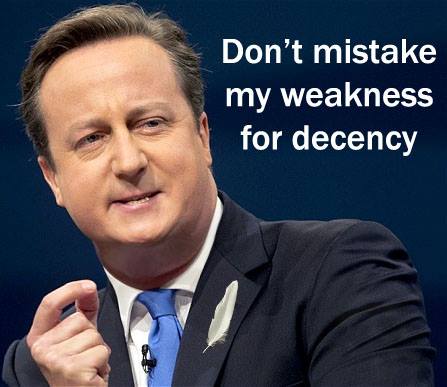
More importantly, the Tories plan an overall budget surplus by 2018-19, while Labour has only committed to a current budget surplus in the next parliament. This sounds like a boring technical detail – and in many ways it is – but the practical difference is vast.

It means that while Coalition had planned over £55 Billion in spending cuts, Labour had pledged only to plug potentially a £4 Billion gap – which could even come from tax rises. A difference of Labour and Tory plans of more than £50 Billion is not to be sniffed at (in comparison the entire Scottish Budget of 2014 was £35 Billion).

To claim that Labour and Tory ‘austerity’ is the same, as some on the left have done, isn’t just ludicrous but a bare-faced lie. It illustrates a huge distortion of the facts. Of course, the Greens and SNP have an interest in saying that Labour and Tories are the same, but that doesn’t make it true.

Last week was significant because Osborne was forced into a u-turn on the biggest issue of the past five years. Of course, the press played this down. He retreated, somewhat slightly, from extreme austerity: pledging to cut spending to 36% of GDP rather than 35.2%. This mostly came from the OBR’s projection that spending on debt interest in 2019-20 will be £9bn less than it expected earlier.

But Osborne’s sleight-of-hand had bigger meaning for Labour: now it means they don’t have to make any cuts over the next parliament, as the IFS pointed out. The difference between the two parties is now even more stark.

To the naysayers who still maintain that Labour and Tories are ‘the same’, a bit more explanation is required. Last year Osborne said he would publish a ‘Budget Responsibility Charter’ and test whether Labour would vote for it. It put Labour in a lose-lose position: they would be painted as ‘profligate’ if they didn’t sign up, and painted as signing up to Tory austerity by the left if they did. Neither was true, since signing up was consistent with Labour’s initial plans. Labour decided to avoid Osborne’s trap and he didn’t bother publishing the Charter. It changed nothing.

Furthermore, the claim that Labour has signed up to Tory austerity until 2016 is untrue. As a matter of technicality, Labour cannot reverse plans already put in place for that fiscal year after being elected.

This has always been a somewhat technical debate, obfuscated by many who have an axe to grind. For political and economic reasons, Labour could never be like Syriza, so it has always been ridiculous to hope it could. Plus, it’s easy for the Greens and SNP to make wild claims about rejecting austerity without spelling out how a massive increase in spending required would be funded.

I suspect that most people who have already decided that Labour and Tories are the same won’t ever be convinced. Labour’s plans won’t catch the world on fire, but to claim they are the same as Tory austerity plans is a lie that has finally been laid to rest.

With big thanks to Labourlist author Sunny Hundal.

1796655_294409220710133_3373329_n
Recently, the SNP, Greens, TUSC and other parties on the so-called  left have made the claim that: “Labour voted for austerity.” This is such a blatant lie. The vote, clearly stated on the Hansard record (see 13 Jan 2015: Column 738, Charter for Budget Responsibility), was pertaining strictly to the motion: “That the Charter for Budget Responsibility: Autumn Statement 2014 update, which was laid before this House on 15 December 2014, be approved.”  That isn’t about austerity at all.

The charter sets out that the Office of Budget Responsibility (OBR) will continue to monitor our fiscal rules. As we know, the OBR has written extremely critical economic forecasts and analysis of austerity and the Tory spending cuts, clearly expressing the risks that the Chancellor is running and the scale of the damage his strategy will inflict on what remains of our public services.

Furthermore, austerity and fiscal figures are not mentioned at all in the Charter.

It’s worth noting that whilst Ed Balls challenged Osborne, there was a curious silence from the SNP and the Green Party. It was Ed Balls that challenged Osborne’s outrageous claims regarding “halving the deficit”- such a blatant lie, upon which even the exceedingly Conservative Spectator spluttered contempt. Or any of the other lies, some of which have already earned the Conservatives official rebukes from the Office for National Statistics (ONS). (See “bankruptcy lie” for example, on the hyperlinked article)

Furthermore, it’s about time that some MP’s, including Caroline Lucas, amongst others, recognised that there is a fundamental difference between the meaning of the word budget and the word austerity. Conflating the two for the purpose of politicking is unprincipled and dishonest.

It’s also worth noting from the same debate on the Hansard record:

13 Jan 2015 : Column 746

Caroline Lucas: Does the Chancellor agree with me that with the feeble and inconsistent opposition coming from the Labour Front Bench, there is a very good reason for seeing the SNP, the Greens and Plaid as the real opposition on this issue because we are clear and consistent about the fact that austerity is not working?

Mr Osborne: That shows why we want the hon. Lady’s party in the TV debates.

Yes, I just bet they do, to collaborate with the Tories in attacking and undermining the Labour Party, not the Coalition, who are, after all, the ones responsible for introducing austerity measures. I don’t imagine for a moment that Osborne values further challenges to his outrageous claims of efficacy regarding austerity measures.

What is very evident when you read through this debate, is that Ed Balls and a couple of other Labour MPs presented the ONLY challenges to Osborne on this matter, just to reiterate this important point.

10940505_767712909964906_6225427822143651262_n
It’s also worth bearing in mind that Ed Miliband established the International ANTI-austerity Alliance. Back in 2012, Miliband said: “There is a grip of centre-right leadership on Europe which has said there’s only one way forward and that’s austerity, and you’ve got to have a decisive move away from that.(See also: Labour leader Ed Miliband’s anti-austerity alliance will fight for the European dream.)

And why would Miliband be attending ANTI-austerity protests if he supported austerity?

Labour leader Ed Miliband speaks on stage at Hyde Park, during the TUC organised protest against austerity measures in London

Labour leader Ed Miliband speaks on stage to over 150,000 at Hyde Park, during the TUC organised protest against austerity measures in London.

It’s interesting to see the Chicago Tribune’s article: Ed Balls, UK’s anti-austerity finance chief in waiting.  Balls dismissed Osborne as a “downgraded chancellor” after Britain lost its triple-A credit rating.

One of his main charges has been that the government is unfairly spreading the economic pain it deems necessary to fix the economy. Austerity cuts are the burden of the poorest citizens.

Balls says that a decision to cut the top tax rate amounts to an unjustified “tax cut for millionaires”, whilst his party has been scathing of the Conservative “reform” of the welfare system.

A point echoed many times by Ed Miliband, too. Accusing the government of making lower or no income groups pay for the recovery while shielding the rich is a claim which strikes a chord with some voters who view Cameron and his government – many of whom were educated at the same top fee-paying school – as out of touch.

Caroline Lucas was born in Malvern to Conservative parents and attended Malvern Girls’ College (which became Malvern St James in 2006), a fee-paying private school. Ed Miliband, on the other hand, went to a comprehensive school.

Polls also show that many voters approve of the government’s drive to rein in welfare costs and the government has demanded that Labour spell out what they would do to fix the economy. They have, but with understandable caution.

Labour’s careful, costed and evidence-based policies include: a Bankers’ Bonus Tax; a Mansion Tax; repeal of the Bedroom Tax; a reversal of the Pension Tax relief that the Tories gifted to millionaires; a reversal of the Tory Tax cut for Hedge Funds; freezing gas and electricity bills for every home a the UK for at least 20 months; the big energy firms will be split up and governed by a new tougher regulator to end overcharging; banning exploitative zero hour contracts; introduction of a living wage (already introduced by some Labour councils); a reversal of the £107,000 tax break that the Tories have given to the millionaires; reintroduction of the 50p tax; scrapping George Osborne’s “Shares for Rights” scheme that has opened up a tax loophole of £1 billion; ensuring Water Companies place the poorest households on a Social Tariff that makes it easier for them to pay their Water Bills; breaking up the banks and separating retail banking from investment banking; introduction of measures to prevent corporate tax avoidance, scrapping the Profit Tax Cut (Corporation Tax) that George Osborne has already announced for 2015 and many more.

These are not austerity measures. They are strongly redistributive policies.

It’s difficult enough opposing the manipulative, lying authoritarian Conservative-led government, without having to constantly counter lies and smears from fringe parties claiming to be on the Left, while propping up the Right simply to gain votes and undermine the only feasible opposition to the Tories, currently.

Shame on them.

Sue Jones

Related

Labour’s fiscal targets mean cuts could end next year – Labourlist

Labour’s fiscal responsibility and caution isn’t austerity, so stop doing Lynton Crosby’s job for him.

The ultimate aim of the “allthesame” lie is division and disempowerment of the Left.

Narxism

Electioneering and grandstanding: how to tell the difference between a moral political party and a moralistic one.

403898_365377090198492_976131366_n
Pictures courtesy of Robert Livingstone