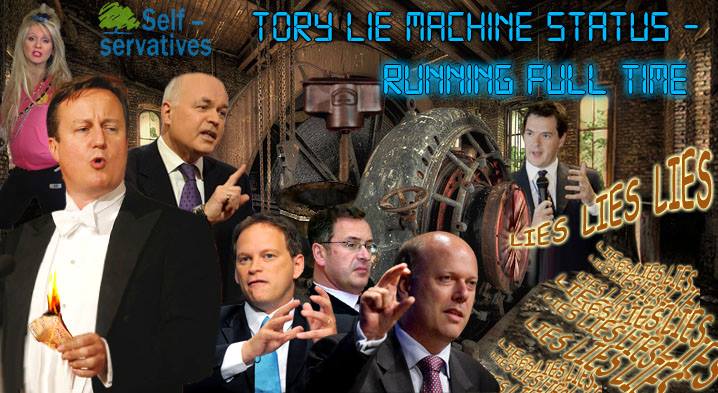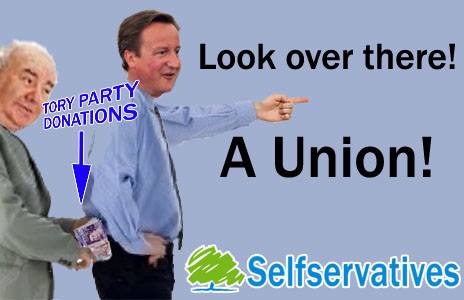
Tag: #propaganda

Narxism


10534673_673759979360200_9173930462113592426_n

Socialism is not just about what you believe or what you say, it’s about how you see, treat and relate to OTHERS.

Socialism has never been about division and exclusion, yet there are some that have rigid ideas about who and what can properly be labelled “socialist.”

I call this elitist perspective “narxism,” as protagonists, drawn from several scattered, disparate camps, tend to be perpetually disgruntled, often aggressive and they don’t half nark a lot. Narxists tend to have a highly selective, limited and unsophisticated grasp of what Marxism entails. They tend to use nasty personal insults and call you a “class traitor” in discussions, which is a tactic aimed at closing down debate.

Included under this rubric are some of the neomilitants, Trotskyists, nationalists, some of the more nihilistic anarchist revolutionaries, some of the Greens and the “none of the above” group. (NOTA, who advocate voting for no-one in order to register “protest” but end up helping the Tories back into office.)

vote
Robert Livingstone compiled a list of some of the various fringe parties, each claiming left-wing status: Behold, the united Left.

Oh, and there’s The People’s Front of Judea.  Image result for small wink emoticon copy and paste

We certainly don’t need any more new parties of the Left: what we do need is people that are willing to get behind Labour, to contribute and to take some responsibility by having a positive input – to engage in democratic dialogue with the Party – rather than expecting some silent and spontaneous process of political osmosis to happen.

A Labour government would be only a starting point for us to build a strong movement, not an end to our effort. They are certainly not the best we can do, but they are currently the most viable challenge to the Conservatives that we have, and their policies would make things easier for many people currently struggling under the authoritarians. Not ideal, but an improvement on what we have now. For the moment, we only have an available route comprised of small steps.

Meanwhile, we can contribute to setting a policy agenda and shaping priorities. Democracy doesn’t just happen to us: it is an ongoing process that requires our responsibility-taking and active participation.

There are some people amongst the various fragmentary fringe groups that state plainly they would rather see another Tory government than see the Labour Party in Office, some believe that this will “speed up the revolution”, others think that another Tory term will push Labour far left, sufficiently enough to fulfil their own personal wish list of limited, undemocratic, identity politics; reflecting undemocratic, cherry-picked ideals and an aggressive, highly circumscribed kind of socialist perfection.

Over the last five years, we’ve seen the public view shift rightwards though the Overton window. Many welcomed the welfare “reforms”, for example. If the Tories get back in office again this year, it will be almost impossible to get them out by 2020. There’s already a big gap opened up between electoralism and ideological integrity. Meanwhile, the Right only push further rightwards. That process will continue to factionalise the Left. It will continue to polarise the moderates and the socialists. It will ultimately fragment the Labour movement.

Narxists don’t like to be inclusive, they tend to see socialism as some kind of exclusive, highly idealised, olden-days “working class” club with a membership of people that use a distinctive and adapted language, incorporating heavily utilised and negative terms such “blue labour,” “red tories,” “new labour,” “tory lites,” and they also have a penchant for endless unforgiving discussion of both Clause 4 and “Tony Blair” (Blair blah blah…). Sure some things should change, but we need to take responsibility for making that change, instead of simply bleating about all that’s wrong.

Narxists tend to spread a lot of propaganda and outright lies, which they often parade as “criticism.” Narxists can become very aggressive and personal when their continually repeated soundbites are effectively challenged with solid evidence. That gets us nowhere fast. And it’s not very genuinely socialist either.

There is an identifiable strand of classist anti-intellectualism amongst the narxists, too: an inverted elitism. It’s something of an irony to hear that Labour are “no longer the party of the working class”, when you consider that Marx, who is quoted quite often by such ideological purists, wasn’t remotely “working class”, nor was Engels, for that matter. Or Kropotkin and Bakunin, whose family owned 500 serfs. Most academic neo-marxist theorists were terribly middle-class, too, you know.

1796655_294409220710133_3373329_n
Narxists claim to be “real socialists.” Yet in their insistence on orthodoxy and their quest for a kind of socialist supremacy, the claim to being “principled” does not generally extend to those foundational socialist values of collectivism, cooperation, organisation and unity. Instead we see a mandatory ideological purism, monocratic perfectionism and bellicose individualism rather than collectivism, that simply divides the Left into competitive factions, which serve only to dilute and disempower us, ultimately.

Narxists seem to have no awareness that the world is populated by others, and it really has moved on. Nor do they seem to pay heed to the more pressing circumstances we currently face. Sick and disabled people are being persecuted by our current Tory-led Government, and many have died as a consequence of this Government’s welfare “reforms.” Many are suffering distress and hardship, and that must stop.

For the record, I hate party politics. My own political inclinations lie somewhere along an anarcho-socialist axis. However, I’m a realist, for the moment the only viable means we have of improving social conditions is to vote, whilst organising, awareness-raising, agitating and promoting progressive ideas for positive change.

Who we choose to vote for has profound implications for everyone else, too. This is the most important general election of our lifetime: the outcome will have historic ramfications. It will affect generations to come. If we allow the Tories another unforgiving (and unforgivable) five years, our once progressive and civilised society will be reduced to a neo-feudalist hinterland, where market forces maintain serfdom and increase pauperisation for the majority and the government of aristocrats select who lives and dies.

Remarkably, narxists prefer to endlessly criticise Tony Blair, who left the building some years back, rather than address and oppose the atrocities of the current government. We have an authoritarian government that are unravelling the very fabric of our once civilised society, dismantling democratic process, abusing human rights and destroying lives. People really are suffering and dying because of Tory policies. The typified, dogmatic response from Narxists everywhere? “Yeah, yeah, but I won’t vote for Labour, because that Tony Blair was a tory lite….” or “Yeah, but they’re all the same…” Ad nauseam.

Oh but they are not the same at all.

And the Labour Party has moved on since Blair.

The only viable means currently available to us of preventing another five years of Tory dystopic vision being realised and the destruction of all that reflects the very best of our society – the blueprint of which is our post-war settlement – is a collective act: a Labour vote. The electoral system is the way that it is – we don’t have proportional representation – nonetheless, we have to use what we have intelligently , strategically and conscientiously. For now. Small steps.

I didn’t like Tony Blair either. I am strongly opposed to neoliberalism more generally, and felt he betrayed the working-class by advocating an economic system that invariably creates social hierarchies of wealth. Some of his social policies were okay. But this isn’t about dogma: it’s about doing the very best we can, acknowledging our circumstances. There is so very much at stake. The Tories want to completely destroy our NHS, public services and support provisions. They want to repeal our Human Rights Act and withdraw from the European Convention. Many of us won’t survive another Tory term. Unfortunately, I don’t see a revolution on the horizon. I do see a very fragmented, disillusioned, apathetic, disengaged and indifferent population.

We need to be responsive to our current situation – in the here and now, and clinging to tired and past-their-usefulness doctrines isn’t going to achieve that. The world has moved on, we have to adapt, respond and move with it.

Let’s try for some genuine solidarity, let’s unite in our common aims, let’s recognise our basic similarities as fellow humans with the same fundamental basic needs, and fight the real enemy, instead of bickering about what socialism is or ought to be about, and what our only current hope – the Labour party – ought to adopt as its brand and mantle. We don’t have a choice, we have to be strategic and tactical at the present. It sucks, but that’s how it is.

Socialism isn’t about what we think and say: it’s about what we DO. Collectively, and for each other.

I’m not a Blairite, but I’m no “Narxist” either. Socialism isn’t about ideological purity, it isn’t about what you think or say, or even what you want: it’s what you DO. It’s about how you relate to others and how you view community and society. It’s about solidarity, cooperation, mutual aid and all of those other values that we should practice instead of just preaching. It’s not ever about competitiveness and exclusivity.

The hardline “real socialists” have damaged our movement every bit as much as “blue labour” have, in their advocacy of factionism.

Without cooperation, solidarity and unity, the Labour movement will die. That must not happen.

In solidarity.

Upwards and onwards.

Related

Osborne’s Autumn statement reflects the Tory ambition to reduce State provision to rubble

Human rights are the bedrock of democracy, which the Tories have imperiled.

47 more good reasons to vote Labour

The moment Ed Miliband said he’ll bring socialism back to Downing Street

Ed Miliband’s policy pledges at a glance

Electioneering and grandstanding: how to tell the difference between a moral political party and a moralistic one.

You’d have to be Green to believe the Green Party: two more lies exposed.

 10635953_696483917087806_7307164383030383606_nMany thanks to Robert Livingstone for his brilliant memes

You’d have to be Green to believe the Green Party: two more lies exposed.

PANews+BT_N0321471377269205233A_I1“David Cameron and George Osborne believe the only way to persuade millionaires to work harder is to give them more money. But they also seem to believe that the only way to make you (ordinary people) work harder is to take money away.” Ed Miliband. Source: Hansard, 12 December, 2012

The Tories have trashed the economy, damaged the very structure of our society and destroyed people’s lives. We have seen the return of absolute poverty, malnutrition and illnesses not seen since Victorian times. People have died as a consequence of Tory policies. What do the Green Party do? Lie about the Labour Party.

The Green Party are not opposing Tory austerity: they are opposing what is currently the only credible alternative instead. They prefer to undermine those that ARE challenging the Coalition regarding policies that are having devastating consequences on the poorest and most vulnerable citizens. That’s very telling. I fully support some Green policies, and wish that the Left generally would work in a much more collaborative way. Really that’s the only way of effectively challenging the current neoliberal conservative dominant paradigm.

Given an opportunity to engage in genuine political conversation and to cooperate in opposing the Tory-led draconian policies, those parties claiming to be “further left” than Labour have instead behaved exactly like the Tories. They chose to undermine Labour. These are parties that prioritise grandstanding and electioneering above the needs of the public. That has entailed lying and smearing campaigns. Yet we all share many of the same aims and objectives, values and principles. The infighting simply weakens a broader and more important progressive Movement.

Here are two examples of lies that are currently being circulated on Facebook and elsewhere by the Green Party and the Scottish National Party (SNP), amongst others:

Lie number 1: “Rachel Reeves said she would be tougher on welfare.”

Rachel Reeves has NEVER said she will be “tougher on welfare.” Those saying that she did are lying. She issued a statement shortly after being misquoted. It was Natalie Bennett who perpetuated that misquote too, originally from the Observer. (See Bennett’s article: Rachel Reeves is clear: Labour would set the struggling against the poorest.)

What Rachel actually said was she would be “tougher on the CAUSES of high welfare spending – such as low wages, unemployment, high private sector rents, private company contracts and outsourcing – especially that of Iain Duncan Smith: his vanity projects have cost us millions because contracted private companies have failed to deliver services, the policies are ill-conceived, creating higher costs, ultimately, rather than making any savings as the Tories claimed – the bedroom tax being an example.

The fact that Rachel Reeves was misquoted was clarified to Caroline Lucas too, so the Green Party have no excuse for shamefully lying about the Labour Party’s policy intentions.

In the middle of crucial debate about the Work Capability Assessment and the plight of disabled people because of Coalition policies, initiated by the WOW campaign, Lucas lost all of my respect when she chose political point scoring instead of constructive debate and said this:

Caroline Lucas (Brighton, Pavilion, Green); I was disappointed that Rachel Reeves, on taking up her post as shadow Secretary of State for Work and Pensions, used the opportunity of her first interview to say that she would be tougher than the Tories on people on benefits.

Kate Green (Shadow Minister (Work and Pensions); Stretford and Urmston, Labour); My hon. Friend the Member for Leeds West did not say that. She said that she would be tougher on welfare spending, not on people on benefits.

Sheila Gilmore (Edinburgh East, Labour); Does the hon. Lady agree that there are some forms of welfare spending that we should bring down? In my view, one of those is the excessive amount that is paid to private landlords through housing benefit. I am certainly in favour of reducing that form of welfare spending. Is she not?

Caroline Lucas (Brighton, Pavilion, Green); I am very much in favour of that if the hon. Lady wants to put it under the heading of welfare spending... Source: Hansard which is the parliamentary record. (See: 27 Feb 2014 : Column 457  at 1.29 pm, on the 2nd page.)

Nonetheless the Green Party has continued to misquote Reeves, to my disgust, using negative campaigning and smear tactics akin to the Tories to promote their own party. It’s time that some people distinguished between welfare spending and benefits, to conflate the two purely for political gain is deplorable, dishonest and not in the best interests of the electorate.

Lie number 2: “Labour voted for austerity.”

This is such a blatant lie. The vote, clearly stated on the Hansard record (see 13 Jan 2015: Column 738, Charter for Budget Responsibility), was pertaining strictly to the motion: “That the Charter for Budget Responsibility : Autumn Statement 2014 update, which was laid before this House on 15 December 2014, be approved.”  That isn’t about austerity.

The charter sets out that the Office of Budget Responsibility (OBR) will continue to monitor our fiscal rules. As we know, the  OBR has written extremely critical economic forecasts and analysis of austerity and the Tory spending cuts, clearly expressing the risks that the Chancellor is running and the scale of the damage his strategy will inflict on what remains of our public services.

It’s worth noting that whilst Ed Balls challenged Osborne, there was a curious silence from the  SNP and the Green Party. It was Ed Balls that challenged Osborne’s outrageous claims regarding “halving the deficit”- such a blatant lie, upon which even the exceedingly Conservative Spectator spluttered contempt. Or any of the other lies, some of which have already earned the Conservatives official rebukes from the Office for National Statistics. (See “bankruptcy lie” for example, on the hyperlinked article)

Furthermore, it’s about time that some MP’s, including Caroline Lucas, amongst others, recognised that there is a fundamental difference between the meaning of the word budget and the word austerity. Conflating the two for the purpose of politicking is unprincipled and dishonest.

It’s also worth noting from the same debate on the Hansard record:

13 Jan 2015 : Column 746

Caroline Lucas: Does the Chancellor agree with me that with the feeble and inconsistent opposition coming from the Labour Front Bench, there is a very good reason for seeing the SNP, the Greens and Plaid as the real opposition on this issue because we are clear and consistent about the fact that austerity is not working?

Mr Osborne: That shows why we want the hon. Lady’s party in the TV debates.

Yes, I just bet they do, to collaborate with the Tories in attacking and undermining the Labour Party, not the Coalition, who are, after all, the ones responsible for introducing austerity measures. I don’t imagine for a moment that Osborne values further challenges to his outrageous claims of efficacy regarding austerity measures. What is very evident when you read through this debate, is that Ed Balls and a couple of other Labour MPs presented the ONLY challenges to Osborne on this matter, just to reiterate this important point.

10940505_767712909964906_6225427822143651262_n

It’s also worth bearing in mind that Ed Miliband established the International ANTI-austerity Alliance. Back in 2012, Miliband said: “There is a grip of centre-right leadership on Europe which has said there’s only one way forward and that’s austerity, and you’ve got to have a decisive move away from that.(See also: Labour leader Ed Miliband’s anti-austerity alliance will fight for the European dream.)

And why would Miliband be attending ANTI-austerity protests if he supported austerity?

Labour leader Ed Miliband speaks on stage at Hyde Park, during the TUC organised protest against austerity measures in London

 Labour leader Ed Miliband speaks on stage to over 150,000 at Hyde Park, during the TUC organised protest against austerity measures in London

It’s interesting to see the Chicago Tribune’s article: Ed Balls, UK’s anti-austerity finance chief in waiting.  Balls dismissed Osborne as a “downgraded chancellor”after Britain lost its triple-A credit rating.One of his main charges has been that the government is unfairly spreading the economic pain it deems necessary to fix the economy. Austerity cuts are the burden of the poorest.

Balls says that a decision to cut the top tax rate amounts to an unjustified “tax cut for millionaires”, whilst his party has been scathing of reform of the welfare system. A point echoed many times by Ed Miliband, too. Accusing the government of making lower or no income groups pay for the recovery while shielding the rich is a claim which strikes a chord with some voters who view Cameron and his government – many of whom were educated at the same top fee-paying school – as out of touch.

Caroline Lucas was born in Malvern to Conservative parents and attended Malvern Girls’ College (which became Malvern St James in 2006), a fee-paying private school. Ed Miliband, on the other hand, went to a comprehensive school. Polls also show that many voters approve of the government’s drive to rein in welfare costs and the government has demanded Labour spell out what it would do to fix the economy. They have, but with understandable caution.

Labour’s careful, costed and evidence-based policies include: a Bankers’ Bonus Tax; a Mansion Tax; repeal of the Bedroom Tax; a reversal of the Pension Tax relief that the Tories gifted to millionaires; a reversal of the Tory Tax cut for Hedge Funds; freezing gas and electricity bills for every home a the UK for at least 20 months; the big energy firms will be split up and governed by a new tougher regulator to end overcharging; banning exploitative zero hour contracts; introduction of a living wage (already introduced by some Labour councils); a reversal of the £107,000 tax break that the Tories have given to the millionaires; reintroduction of the 50p tax; scrapping George Osborne’s “Shares for Rights” scheme that has opened up a tax loophole of £1 billion; ensuring Water Companies place the poorest households on a Social Tariff that makes it easier for them to pay their Water Bills; breaking up the banks and separating retail banking from investment banking; introduction of measures to prevent corporate tax avoidance, scrapping the Profit Tax Cut (Corporation Tax) that George Osborne has already announced for 2015 and many more.

These are not austerity measures. They are strongly redistributive policies.

It’s difficult enough opposing the manipulative, lying authoritarian Conservative-led government, without having to constantly counter lies and smears from parties claiming to be on the left, too. Shame on the Green Party and the SNP.

As I have said elsewhere, there’s a clear gap between professed principles and their application amongst the parties that claim to be “real socialists”.  How can it be principled or moral (or “socialist” for that matter) to collaborate with the Tories in attempting to damage, smear and discredit the only viable option of removing the Tories from Office in May? Bearing in mind that many people are suffering profoundly, some have died as a consequence of Conservative-led policies, we can see what the Green Party’s priorities actually are, here.

They don’t include the best interests of citizens and consideration of their well-being, that’s for sure.

403898_365377090198492_976131366_nThanks to Robert Livingstone for his excellent memes.

Public perceptions of party positions on the political spectrum: Labour’s leftward shift under Ed Miliband, the Conservatives’ rightward swing since 2010.

Good to see the public generally don’t swallow the “allthesame” myth.

The ultimate aim of the “allthesame” lie is division and disempowerment of the Left.

1796655_294409220710133_3373329_n

The speech-writer for David Cameron in the run-up to the 2010 general election, Ian Birrellseems to have finger in every lie on behalf of the Tories. He’s the contributing editor of The Mail on Sunday, whilst writing columns regularly in several other papers. He’s been published in The Guardian, The Wall Street Journal, The Economist, The Daily Mail, The Financial Times, The Times, The Observer, The London Evening Standard, The Sun, The Daily Telegraph, The Sunday Telegraph, The Independent, The Independent on Sunday, Prospect, New Statesman and The Spectator.

On the 2nd January, Birrell cobbled together a somewhat strange and hugely speculative article in the Guardianclaiming that “a Tory-Labour unity coalition may be the only way forward after 7 May” and the two parties have more in common with each other than with the insurgents. A national government would prevent a constitutional crisis.”

There are no quotes or citations, just an unsubstantiated comment: “But most people in Westminster privately predict a hung parliament.”

As I said, entirely speculative, seemingly without an aim.

Birrell also claims there was “a brief flicker of unity” between the parties during the Scottish referendum. That’s a neat side-stepping of the fundamental fact that Labour, like most socialists, have always been internationalists, which has absolutely nothing to do with the Tories’ position on Scottish independence at all, and everything to do with Labour’s core values. It’s also a claim frequently made by the Scottish Nationalists –  Labour “sided with the Tories.” Anyone would think that the Scottish National Party want to undermine support for the Labour Party in Scotland…

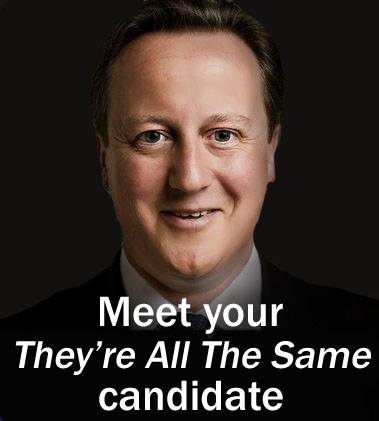
There is of course a subtext to Birrell’s article. It is a piece of propaganda. The subtext is “the mainstream political parties are all the same.”

The “allthesame” myth came straight from Tory HQ. The BBC’s Tory correspondent Nick Robinson admitted live on air that Cameron’s best chance of winning the next election is if people believe politicians are “all the same.” That is very clearly not the case. I think this is a major ploy aimed at propagandarising an exclusively class-based identity politics, to target and fragment the “working class left.”

It purposefully excludes other social groups and also sets them against each other, for example, working class unemployed people attacking migrants – it really is divisive, anti-democratic, and quite deliberately flies in the face of Labour’s equality and diversity principles. That’s the problem with identity politics: it tends to enhance a further sense of social segregation, fragmentation and it isn’t remotely inclusive.

Of course it also enhances the tropes “outoftouch” and  “allthesame.” It’s a clever strategy, because it attacks Labour’s equality and inclusive principles – the very reason why the Labour movement happened in the first place – and places restriction on who ought to be included.

Think of that divisive strategy 1) in terms of equality; 2) in terms of appealing to the electorate; 3) in terms of policy. Note how it imposes limits and is reductive.

It also demoralises and confuses people.

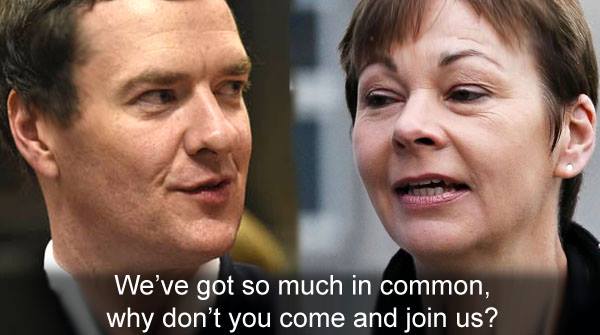
The Tories set this strategy up in the media, UKIP have extended it further and the minority rival parties, including the Green Party and the Scottish National Party have utilised the same rhetoric tool: all of these parties frequently use the term “liblabcon”for example. That’s a sort of cognitive shortcut to what has been tacitly accepted, apparently, as a “common sense” view that partisanship amongst the mainstream parties is dead. I’ve written at length about this process of “normalisation” –  how social conservatism and neoliberalism have been absorbed culturally, and how this serves to naturalise the dominance of the Right and stifle the rationale for critical debate here – Manufacturing consensus: the end of history and the partisan man.

Be prepared for much more of this propaganda tactic: the Right are engaged in an all out war.

Firstly they know that Ed Miliband has edited their script, abandoning the free-market fundamentalist consensus established by Thatcherism in favour of social democracy.

Secondly, the right-wing media barons who set the terms of what is deemed politically palatable in Britain have never forgiven Ed Miliband for his endorsement of Leveson, which they believe is an unacceptable threat to their power.

Thirdly, they know Labour under Ed Miliband may well actually win the 2015 election.

It doesn’t take much effort to work out that the two main parties in competition have nothing in common at all. They debate oppositionally in parliament. Cameron attacks Miliband at every opportunity and on a very personal level, quite often. It’s plain, if you listen to the parliamentary debates, that neither man can stand what the other represents.

And how would the Tories and Labour reconcile their fundamental differences regarding human rights, the European Convention On Human Rights (ECHR) and the European Union? How about the bedroom tax? The National Health Service? Taxation? The welfare reforms? Equality? These are issues on which the two rival parties will never be able reach a consensus.

10635953_696483917087806_7307164383030383606_n

It’s quite difficult to assert that there are significant differences between the parties, because of the constant repetition of the “allthesame” lie. It has become almost like a comforting, lulling mantra and a shortcut from cognitive dissonance. People often get quite angry when confronted with evidence that challenges this soundbite. But policies provide very good evidence, they are scripted from ideologies and are statements of a party’s intentions.

Ed Miliband has been cautious in making policy promises and has said that he won’t pledge anything that he may not be able to deliver. Here are Labour’s key policies to date, each has been costed and evidenced.

The thing about policies that have been passed into law is that they can be verified on the Parliamentary website and elsewhere. How many of you reading this think that Blair was a “Thatcherite”? I’m not a Blairite. I do like Miliband, who is a very different leader than Blair was. Miliband denounced New Labour in 2010. His stance on Syria in 2013 draws a clean line under the Blair approach. Yet Blair is still being used as a stick to hit the Labour Party with.

The claims made in lying articles in the media and the often inaccurate and distorted claims of fringe party supporters are based on a propaganda technique called transfer and association, which is a method of projecting negative (or positive) qualities of a person, entity, object, or value (an individual, group, organisation) to another in order to discredit it (or sometimes, to make the second more acceptable, this tactic is used in advertising a lot.)

It evokes an emotional response, which stimulates the target to identify with recognised authorities. But that stick is hitting a closed door now. Newsflash: Blair hasn’t been party leader for some years.

I worked on compiling a list of New Labour’s policies, and despite Blair’s faults, there really were some outstanding achievements, such as the Equality Act, the Human Rights Act, various animal welfare laws, Every Child Matters and the Good Friday Agreement. I have listed New Labour’s achievements with a comparable list of the Coalition’s “memorable” moments, too. If you hated Blair, and see him as some sort of high priest of neoliberalism, it’s probably even more important that you read this. I promise it will help you to understand cognitive dissonance, at the very least, and perhaps to appreciate the importance of evidence and critical thinking: Political parties – there are very BIG differences in their policies.

And this, for some balance and perspective: Thatcher, Mad Cow Disease and her other failings, the Blair detour and déjà entendu, Mr Cameron.

The “allthesame” lie is a way of neutralising opposition to dominant ideas. It’s a way of disguising partisanship and of manipulating and reducing democratic choices. It’s nothing less than a political micro-management of your beliefs and decision-making.

It also reduces public expectation of opposition and in doing so it establishes diktats: it’s a way of mandating acceptance of ideology, policies or laws by presenting them as if they are the only viable alternative. And those that refuse to accept the diktats are enticed by the marginal parties who offer much, safe in the knowledge that they won’t have to rationalise, evidence, cost or deliver those promises. This also plays a part in diluting viable opposition, because the smaller parties tend to employ the same strategy to gain credibility and support – negative campaigning and repeated lies and soundbites.

Lynton Crosby, who has declared that his role is to destroy the Labour Party, rather than promote the Conservatives, based on any notion of merit, is also all about such a targeted “divide and rule” strategy. This is a right wing tactic of cultivating and manipulating apostasy amongst support for the opposition. It’s a very evident ploy in the media, too, with articles about Labour screaming headlines that don’t match content, and the Sun, Mail and Telegraph in particular blatantly lying about Labour’s policy intentions regularly.

Propaganda isn’t always obvious, and that’s how it works. We need to be very mindful of this.

Ultimately, the only party that will gain from any of this negative campaigning approach and divisive propaganda is the Tories. And that is who we should be collectively opposing.

The Tories launched their election campaign a couple of days ago, and already, it’s obvious that the entire campaign is founded on attempting to undermine Labour’s  credibility by telling lies about their economic management – The Tory election strategy is more of the same: Tories being conservative with the truth.

Contrast the Conservative with the truth approach I’ve discussed here with Miliband’s consistently genuine approach to politics – Ed Miliband: Labour election campaign will be one of hope, not falsehood.  

Whatever party you support and regardless of whether or not we agree on the issues I raise, my key aim, whenever I write, is to inspire a sense of responsibility and some critical thinking. That helps to reliably inform our decision-making.

I won’t apologise to my critics for being a Labour Party supporter, but I will always provide evidence and analysis to support and justify my own views and I will always be happy to engage in dialogue, provided that it’s a respectful and polite exchange. No party is above criticism, quite rightly so, as politics has to be an accountable, reflective and responsive process. That’s what democracy is about.

There is, however, a big difference between genuine criticism, on the one hand and propaganda and lies on the other, which are being masqueraded as “criticism.” If debate isn’t established on a genuine, critical exploration of evidence and establishing truths, then it’s not debate: it’s simply indoctrination.

Related

Don’t believe everything you think: it’s almost election time.

From  Psycho-Linguistics to the Politics of Psychopathy. Part 1: Propaganda

Ed Miliband is the biggest threat to the status quo we’ve seen for decades.

Once you hear the jackboots, it’s too late.

The moment Ed Miliband said he’ll bring socialism back to Downing Street.

Ed Miliband’s policy pledges at a glance

Miliband is an excellent leader, and here’s why.

Cameron’s Nudge that knocked democracy down: mind the Mindspace.

403898_365377090198492_976131366_nThanks to Robert Livingstone for the excellent memes.

The Tory election strategy is more of the same: Tories being conservative with the truth

1235473_537097386359794_65317730_n (1)

The following email is fromBack to messagesthe Conservative Campaign HQ, it’s packed with the most jaw-droppingly blatant lies and it marks the launch of their election campaign:

Your friends need to see this:

Conservative Campaign HQ (bulletin@mail.conservatives.com)
02/01/2015

Newsletters

To: Susan Jones

Our plan is working – and we need to stay on the road to a stronger economy. Please share our poster today and let everyone know:

 Let’s stay on the road to a stronger economy

When the Conservatives came into office in 2010, Britain was on the brink of bankruptcy. People were losing their jobs and families were worried about the future.

So we took difficult decisions to get our economy back on track.

Five years later, thanks to the measures we’ve taken and the hard work of the British people, the deficit has been halved, new businesses are opening up across the country, and there are a record number of people in work, with the security of a pay packet.

We need to stay on the road to a stronger economy – and your friends need to know about the important choice facing Britain in this election year.

Britain has come a long way in five years. We can’t go back to Labour’s way of more borrowing, more debt and higher taxes. Instead, let’s stay on the road that has brought us this far – the road that is securing a better future for everyone in our country.

Please share our poster today and let your friends know the important choice facing Britain this year.

Thank you,

Conservative Campaign HQ

Promoted by Alan Mabbutt on behalf of the Conservative Party, both at 4 Matthew Parker Street, London, SW1H 9HQ

Here is my response

Lie number 1. “When we came into office in 2010, Britain was on the brink of bankruptcy.”

The Office for Budget Responsibility (OBR) head rebuked Osborne for lying: Robert Chote said that the UK was never at risk of bankruptcy. Yet despite this public rebuke for lying, the Tories continue to peddle the same lie. Having established the OBR to act as a check on the government, the Chancellor and the Conservative Party might want to listen to its head and finally concede that there was no basis for his claim in 2010.

For the full list of official rebukes for Tory lies, please see here

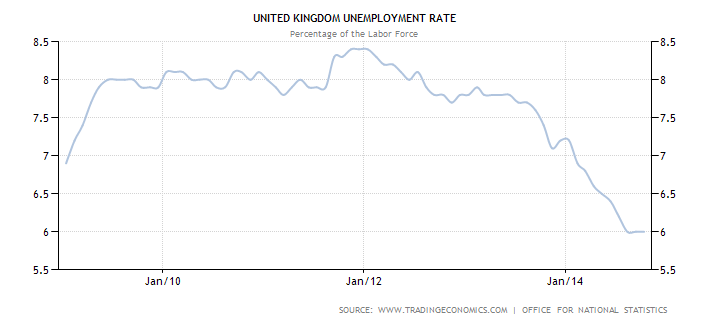
Lie number 2. “People were losing their jobs and families were worried about the future.”

united-kingdom-unemployment

1381256_10151703147396305_1638953570_n (1)Note that after an increase in people losing their jobs under the Tory-led Coalition since 2010, the apparent decrease in job losses in the first graph coincides with the introduction of the new benefit sanction regime in 2012.

We know that the Conservatives measure unemployment by using a conveniently heavily biased system called “off-flow” that includes all of the numbers of people thrown off Jobseekers’ Allowance through sanctions. Indeed, it emerged during an ongoing inquiry instigated by the parliamentary Work and Pensions Select Committee, through research conducted by Professor David Stuckler, that more than 500,000 Job Seekers Allowance (JSA) claimants have disappeared from unemployment statistics, without finding work, since the sanctions regime was substantially extended in October, 2012.

And let’s not forget that sanctions are a draconian and target-driven removal of lifeline benefits – the amount of money that the state previously deemed necessary for meeting basic needs, and as such, cannot possibly be justified when all they may ever achieve is forcing people to focus on basic survival rather than on gaining employment. The Work and Pensions Select Committee have accused the Conservatives of using benefit sanctions to massage unemployment figures.

Other problems with off-flow and the far-fetched claims of the Conservative Party are highlighted in: A letter of complaint to Andrew Dilnot regarding Coalition lies about employment statistics.

The Treasury saw a drop in revenue of 25 billion pounds from income tax, which doesn’t tally with the account of rising employment and this certainly refutes the claim that was made about wages rising last year by this Government, too.

As for “families were worried for the future”, the impact of this government’s austerity measures has had a significantly negative impact on women and children, and particularly lone parents. The setting up of the Welfare State enshrined a commitment to state support for those unable to support themselves.

This government is dismantling that commitment. In the process they are destroying many of our basic rights: to universal free healthcare; protection from domestic violence and abuse; decent, affordable housing; pension and employment rights; education and training; and access to the legal system. Some facts:

  •  More than 70% of the revenue raised from direct tax and benefit
    changes will come from female taxpayers. (Parliamentary research 2011).
  •  92% of single parents are women. Although they are amongst
    the poorest in our society, they face not only the brunt of the cuts
    with the slashing of their benefits, but government and media
    demonisation as “benefit scroungers”.
  •  Women’s unemployment is rising sharply, largely owing to
    public sector cutbacks. Black and minority ethnic women are
    particularly hard hit.
  •  Poverty levels not seen since the 1930’s Depression, are
    returning, as is childhood malnutrition.
  • 1 out of 6 charities fear they will have to close in 2013 due to lack of funds.(From the Charities Aid Foundation report 2012).See also: Austerity measures disproportionately affecting women should be consigned to the bonfires of history from November 2014

Lie number 3. “So we took difficult decisions to get our economy back on track.”

Thanks to the Labour government’s excellent management of the consequences of the global crash caused by the banks and financial insitutions,  we were out of recession by 2010. So the Tory austerity measures, which targeted the poorest people, were completely unjustifiable. Osborne used the “bankrupcy lie” to legitimise an entirely ideological Tory-led programme of “shrinking the state“, cutting social support for those who need it and slashing public services. However, whilst the poorest paid dearly, this government handed out £107, 000 each per year to millionaires in the form of a “tax break”.

“This government will not cut [the] deficit in a way that hurts those we most need to help, that divides the country, or that undermines the spirit and ethos of our public services.”  Keynote speech by David Cameron, at the launch of The Conservative party’s manifesto in Milton Keynes, June 7th 2010.

That was another lie.

The economy is NOT “back on track” at all, despite the savage and punitive cuts imposed on the most vulnerable citizens.

 Lie number 4. “The deficit has been halved.”

Cameron has been rebuked twice for lying about “paying down the debt” already. The national debt is still rising. It currently stands at more than twice its level than when the Coalition took office.  Osborne is responsible for more debt than every Labour chancellor in history combined. Even the staunchly Tory Spectator commented that it’s: “… a depressing point: the Tory leadership is prepared to use dishonesty as a weapon in this election campaign.”

Fraser Nelson also refutes that the deficit has been halved – see: Which Tory MPs will repeat the porkie about ‘halving’ the deficit?

For a government whose raison d’etre is deficit reduction, the Coalition really isn’t very good at all.

Lie number 5. “New businesses are opening up across the country.”

150102businesses

 Thanks to Mike Sivier for the infographic

Lie number 6. “Our plan is working” / “..the road that is securing a better future for everyone in our country.”

Current human rights abuses of women, children and disabled people cannot possibly be regarded as “securing a better future for everyone.” The Tories have also pledged to repeal our human rights act and to withdraw from the European Commission on Human Rights. A government that cannot respect human rights and recognise the equal worth of citizens is certainly not interested in securing a better future for everyone at all. Nor can the slashing of public services, the National Health Service, welfare and other social protections be in anyway about securing a better future for all of us, or even “most” of us.

How is increasing hunger and malnutrition in our “best interests” as a so-called civilised society. This is the 5th wealthiest nation in the world. Shame on this government.

Lie number 7. The first Tory election campaign picture is not a photograph of a British road, as Osborne claimed:  The Road to Weimar image shows Tories can’t be trusted to tell the truth. – Mike Sivier.

Let’s not forget the Tory  2010 pre-election promises, broken and deleted from record on the internet. And valid criticism of their spinner of Tory yarns and opposition smears, also deleted. This is not a democratic government that values political accountability, nor is it one that is prepared to bear any scrutiny at all.

And the word “Tories” is clearly an abbreviation of “tall stories”

(more…)

The BBC expose a chasm between what the Coalition plan to do and what they want to disclose

1379986_541109785958554_2049940708_n

“Traditions are not killed by facts” – George Orwell.

The Conservatives are creatures of habit rather than reason. Traditional. That is the why their policies are so stifling and anti-progressive for the majority of us. It’s why Tory policies don’t meet public needs.

There’s always an air of doom and gloom when we have a Tory government, and a largely subdued, depressed, repressed nation, carrying vague and fearful intuitions that something truly catastrophic is just around the corner.

I can remember the anxiety and creeping preternatural fear amongst young people in the eighties, and our transcendent defiance, which we carried like the banners at a Rock Against Racism march, back in the Thatcher era. We always witness the social proliferation of fascist ideals with a Tory government, too. It stems from the finger-pointing divide and rule mantra: it’s them not us, them not us. But history refutes as much as it verifies, and we learned that it’s been the Tories all along.

With a Conservative government, we are always fighting something. Poverty, social injustice: we fight for political recognition of our fundamental rights, which the Tories always circumvent. We fight despair and material hardship, caused by the rising cost of living, low wages, high unemployment and recession that is characteristic of every Tory government.

I think people often mistranslate what that something is. Because Tory rhetoric is all about othering: dividing, atomising of society into bite-sized manageable pieces by amplifying a narrative of sneaking suspicion and hate thy neighbour via the media.

The Tories are and always have been psychocrats. They insidiously intrude into people’s everyday thoughts and try to micro-manage and police them. They use Orwellian-styled rhetoric crowded with words like “market forces”, “meritocracy” “autonomy”, “incentivisation”, “democracy”, “efficient, small state”, and even “freedom”, whilst all the time they are actually extending a brutal, bullying, extremely manipulative, all-pervasive authoritarianism.

The Conservative starting point is control of the media and information. All Conservatives do this, and historically, regardless of which country they govern. (As well as following the hyperlinks (in blue) to British and Canadian media takeovers, also, see the Australian media Tory takeover via Murdoch, from last year: The political empire of the News Corp chairman.)

As we saw earlier this year when the Tories launched an attack on Oxfam, any implied or frank criticism of Conservative policies or discussion of their very often terrible social consequences is stifled, amidst the ludicrous accusations of “politically biased.”

When did concern for poverty and the welfare of citizens become the sole concern of “the left wing”? I think that casually spiteful and dismissive admission of indifference tells us all we need to know about the current government’s priorities. And no amount of right-wing propaganda will hide the fact that poverty and inequality rise under every Tory government. And how is it possible to discuss poverty meaningfully without reference to the policies that cause it? That isn’t “bias”: it’s truthful. Tory policies indicate consistently that when it comes to spending our money, the Tories are very generous towards the wealthy, and worse than parsimonious regarding the rest of us.

Then there are the Tory pre-election promises, all broken and deleted from the internet. And valid criticism of their spinner of Tory yarns and opposition smears, also deleted. This is not a democratic government that values political accountability, nor is it one that is prepared to bear any scrutiny at all.

The Conservatives are attempting to intimidate the BBC (again) into silence regarding its candid commentary regarding the autumn statement made by Osborne, exposing the vast scale of cuts to come for the British public. I’m pleased to see the BBC hitting back, for once, with a robust defence, declaring that: “We’re satisfied our coverage has been fair and balanced and we’ll continue to ask ministers the questions our audience want answered.”

It was BBC assistant political editor Norman Smith’s description of the Office for Budget Responsibility (OBR) response to the autumn statement document as “the book of the doom” and his suggestion that the UK was heading “back to the land of Road to Wigan Pier” that provoked Osborne’s outrage.

But whilst journalists are hardly unknown for hyperbole, Smith certainly can be cleared of this charge. Because many agree that the figures contained in the OBR blue book are truly remarkable and worry-provoking. Many of us have concluded the same, from the OBR and Institute of Fiscal Studies (IFS) to an army of quietly reflective bloggers, who have collectively anticipated this purely ideological outcome for some time.

The BBC are absolutely right to point out to the public that there will be severe social repercussions as a consequence of the scale of cuts that Osborne is planning, especially given that sixty percent of the cuts are yet to come.

The judgements of the OBR, which Osborne set up, and IFS, were at least as damning as the BBC’s, but it’s worth noting that the Chancellor doesn’t publicly attack either report. Because he can’t.

Instead the Conservatives have accused the BBC of “bias” and “systematic exaggeration,”  David Cameron and George Osborne launched an unprecedented attack on the coverage of the Autumn Statement. However, the Conservatives have been openly policing the media for a while. (See: Tories to closely monitor BBC for left wing bias ahead of party conference season and: Once you hear the jackboots, it’s too late.)

Senior Tory MP Andrew Bridgen suggested there was a risk that unless the BBC was “scrupulously fair” in its reporting, it may “drive voters into the arms of Labour”, adding the threat “and may even find its future funding arrangements affected.”

A blatant threat.

On Thursday, Bridgen wrote to Rona Fairhead, the BBC Trust’s chairperson, to complain “about a pattern of systematic exaggeration in the BBC’s reporting of the Autumn Statement”. It’s not his first complaint about alleged bias, either: he whined when the TUC’s senior economist Duncan Weldon became Newsnight’s new economics correspondent earlier this year.

Mr Bridgen said he wanted “to seek assurances that in the remaining six months until the general election your coverage will demonstrate the impartiality and balance that the public, and indeed the BBC charter, demand”.

He added: “Over the last four years the entire nation has pulled together to achieve something many said could not be done: we are now the fastest growing advanced economy in the developed world. The sacrifices and hard work of the British people are ill-served by pessimistic reporting which obscures our economic success with the language of fear and doom.”

I don’t think this is about “impartiality” or what best serves the British people. This is about the Conservatives not getting their own way, so they resort to bullying and  attempts to discredit people who have simply told the truth.

The Chancellor responded angrily to the references to Orwell’s The Road to Wigan Pier in the Today report on BBC Radio 4. He said: “I would have thought the BBC would have learned from the last four years that its totally hyperbolic coverage of spending cuts has not been matched by what has actually happened. I had all that when I was interviewed four years ago and has the world fallen in? No it has not.”

Well, that all depends George. For many people, the only genuine growth we’ve seen is in poverty, inequality, destitution, hunger, suffering and referrals to foodbanks. And deaths. So yes, for growing numbers, their’ world has fallen in.

A BBC spokesman said the BBC was satisfied that the Today programme’s coverage had been “fair and balanced and we gave the Chancellor plenty of opportunity to respond on the programme.”

And the comments were justified because the Office for Budget Responsibility had itself said that nominal government consumption will fall to its lowest level since 1938, the BBC said.

Both the OBR and IFS said in their responses to the autumn statement that Britain has not seen public spending reduced to this level as a proportion of GDP since the grim days of the 1930s.

The public sector spending cuts over the next five years set out in the autumn statement may force a “fundamental re-imagining of the state,” the Institute for Fiscal Studies said in their report.

The warning from the IFS – Britain’s public spending analysts – came only hours after Osborne had angrily rounded on the BBC, accusing its reporters of “totally hyperbolic” reporting about his spending plans and “conjuring up bogus images of the 1930s depression”.

The IFS confirmed that the scale of cuts to departmental budgets and local government would reduce the role of the state to a point where it would have “changed beyond recognition.” The government’s spending watchdog, the Office for Budget Responsibility (OBR), also said yesterday that Osborne’s statement indicated that with the cuts set out in Treasury assumptions, we would see the state reduced to its smallest size relative to GDP for 80 years – since the 1930s.

It was about this era, the Great Depression, against which Orwell set The Road to Wigan Pier, in his account of the bleak living conditions, social injustices, suffering and misery of the working class in the Northwest of England. Norman Smith made an apt comparison.

Scenes from the Jarrow Crusade, 1936, Marchers from Jarrow in the North East of England, walk to London where they will hand in a petition to the House of Commons in a plead for more work as the depression and starvation of the 1930's hits hard

Scenes from the Jarrow Hunger March, 1936, Marchers from Jarrow in the North East of England, walked to London where they handed a petition to the House of Commons in a plead for more work as the depression and starvation of the 1930’s hit hard

Osborne admitted to John Humphrys two hours later, that “difficult” decisions on welfare would include freezing working age benefits for two years and lowering the welfare cap on spending from £26,000 for a family each year on benefits to a maximum of £23,000. But he maintained his glib assurances that the outlook was not as grim as Smith and Humphrys were claiming.

With the cost of living rising sharply year after year, and with the catastrophic consequences of the first wave of welfare “reforms” now clearly evident, it is difficult to envisage how the outlook for the poorest can be deemed anything other than enduringly, grindingly bleak.

If any evidence was needed that the Conservatives fear the political consequences of the cuts to come, the assault on the BBC’s coverage of the autumn statement has certainly provided it. The Conservative responses are strictly about discrediting the BBC as a means of pre-election damage-limitation, and not about the accuracy or “bias” of the reporting, because Osborne had not anticipated that the real consequences of his budget plans would be shared with the public. Most people don’t, after all, read the OBR or IFS forecasts and reports. As it is, Osborne had set out to mislead the public, and was well and truly exposed.

The IFS director, Paul Johnson, said: “The chancellor is right to point out that it has proved possible to implement substantial cuts over this parliament. One cannot just look at the scale of implied cuts going forward and say they are unachievable. But it is surely incumbent upon anyone set on taking the size of the state to its smallest in many generations to tell us what that means.

It’s also worth bearing in mind that Clegg has claimed co-authorship of the budget statement. Clegg’s absence from parliament for the third Wednesday in a row suggests he is farcically trying to distance himself from David Cameron and Osborne in the run-up to the election.

However, he attempted to take credit for the central policies of the statement, including the stamp duty overhaul unveiled by Osborne, when questioned on his LBC 97.3 radio show by Ed Balls, the shadow chancellor.

“Everything in that autumn statement is there because we’ve agreed it and I fully support it,” Clegg said.

The BBC exposed the chasm between what the Tory-led Coalition plan and what they are prepared to disclose and discuss publicly. That’s because of a chasm that exists between Tory ideology and a genuine economic problem-solving approach to policy: Osborne’s autumn budget statement was entirely about political gesturing, designed to divert attention from the sheer extent of social and economic damage  wreaked by five years of strictly ideologically-prompted policy.

This is a Chancellor who rested all of his credibility on paying down the debt and has borrowed more than every Labour government combined.

It must be abundantly clear that the Tory aim of much bigger and destructive cuts after 2015 is not about deficit reduction, but the destruction of the public sector, our services and social safety nets, the undoing of a century of our the hard-won achievements of civil rights movements, and all in favour of greedy, elevated, unbridled market forces.

Conservatism is centred around the preservation of traditional social hierarchy and inequality. Tories see this, erroneously, as an essential element for expanding economic opportunity. But never equal opportunity.

Conservatives think that civilised society requires imposed order, control and clearly defined classes, with each person aware of their rigidly defined “place” in the social order. Conservatism is a gate-keeping exercise geared towards economic discrimination and preventing social mobility for the vast majority.

It is these core beliefs that fuel Osborne’s stubborn adherence to austerity policies, even though it is by now patently obvious that austerity isn’t working for the economy, and for majority of the public. It never will.

942124_214298768721179_2140233912_nThanks to Robert Livingstone for the memes.

Related

Osborne’s Autumn statement reflects the Tory ambition to reduce State provision to rubble

Ed Balls: response to the Autumn Statement

Cameron’s pre-election contract: a catalogue of lies

69499_402101786526022_367197910_n (1)

I felt that this post was very worth preserving from Conservativehome, since it is a signed contract between the Conservatives and UK citizens, the insincerity of which is very evident four years on from when it was written. I took the liberty of converting the PDF into JPEG digital images, to preserve an exact copy of the contract, just in case the Tories decide to delete the original – well they do have form, after all. (See: Some of the promises the Tories are trying to delete from the internet  and  Lynton Crosby’s staff deleted valid criticism from Wikipedia, for example.)                              

So this is our contract with you. I want you to read it and – if we win the election – use it to hold us to account. If we don’t deliver our side of the bargain, vote us out in five years’ time.”

Signed D. Cameron
May 2010.

a-contract-with-the-voters-1 (1)a-contract-with-the-voters-2
Gordon Brown’s “economic  incompetence” in the face of a global crisis caused mostly by US bankers, steered us out of recession by 2010, with no need for austerity measures. Furthermore, the Tories have borrowed more in just 3 years than Labour did in 13 and have not invested that money in public services. In fact the only people to have benefited from any investment at all this past 4 years are a few private companies that donate to the Conservative Party and a handful of millionaires.

Oh, and surely “incompetent” would include losing the Fitch and Moody triple A credit ratings, after promising to keep them … oh yes, that was Osborne, wasn’t it.

I could go on and address all of the other lies, but I know readers can see the enormous gap between the Tory pledges and the reality of four years of Conservative-led Government.

You cannot trust the Tories with the economy, or anything else for that matter. A glance at the pre-election empty promises and their bare-faced lies demonstrates this very well.

Vote them out, May 7th, 2015.

And vote Labour.

What Labour achieved, lest we forget

Key Labour policies

More Tory lies, with official rebukes

Conservatism in a nutshell

Image result for Theresa May poor wages
It’s not enough to challenge Tory ideology. We also have to dismantle the Orwellian semantic thrifts and shifts. We have to defeat the Tory propaganda machine that lies, persuades and lulls people with meaningless populist slogans, empty glittering generalities and glib catch-phrases.

You’ve heard those slogans – “less government”, “personal responsibility”, “hard-working families”, “making work pay” and lots of nationalist flag waving. These are shorthand messages to the public that are thrifty with the truth, codifications for an entire world-view. But it’s ever such a shabby, ruthless, isolating and paltry one.

1209102_539900659412800_1664499134_n

The clue is in the name: the word “Tory” derives from the Middle Irish word tóraidhe, which means outlaw, robber or brigand, from the Irish word tóir, meaning “pursuit”, since outlaws were “pursued men”. It was originally used to refer to an Irish outlaw and later applied to Confederates or Royalists in arms. The term was originally one of abuse.

The Tories live by plundering. They steal your taxes, your public services, your state provision and your labour in order to raise more money for the rich. They have reneged on our post war democratic settlement. Legal aid, human rights, social housing, the NHS, lifeline welfare support – the essential components of any functioning democracy – are being viciously and systematically dismantled by the Tories. 

It’s a dystopic world of corporate fiefdom. I heard a very smart person from the States once sum up the Tories neatly with the phrase “cheap-labour conservatism”. How very apt. It fits so well. It makes sense of such a lot.

Basically, the larger the labour supply, the cheaper it is. The more desperately you need a job, the less you tend to demand for your wages to be fair, and the more power those big business Tory buddies have over you. This is what the Tories actually mean by “making work pay” – it’s either rationed out peanuts or starvation. But for big business, your work pays them handsomely in fat profits.

The Tories engineer this same socioeconomic situation every time they are in office. Think back to the Thatcher era, she did it, Major did it – it’s a manufactured recession and a large reserve army of cheap labour every time. ALWAYS the same with the Tories. Because it suits their “business friendly” agenda.

That’s another Tory slogan that means corporate greed, profit before people and Tory donations – see the Beecroft Report, for example, written by a British “venture capitalist” that has donated more than £500,000 to the Conservative Party. The overdogs write policies to make sure that we remain the underdogs. Fat profits are all that matter to the vulture capitalists. 

Beecroft is currently Chairman of Dawn Capital. The release in May 2012, of the long awaited Beecroft Report in the UK caused considerable controversy because it recommended that the government should “cut red tape” in order to make the hiring and firing of employees easier and cheaper.

The report claimed this would help to ‘boost’ the economy although no evidence for this was provided. It’s hard to imagine how increasing job insecurity would encourage workers to spend their money. It does, however, help boost profits for venture  vulture capitalists, and the government-commissioned report strips workers of their rights.

As the TUC said at the time, the ideas have taken the UK back towards Victorian era working conditions and standards. Conservatives don’t like social spending or welfare – our safety net. The safety net we funded. That’s because when you’re unemployed and desperate, companies can pay you whatever they feel like – which is inevitably next to nothing, so their profits can grow. 

You see, the Tories want you in a position to work for next to nothing or starve, so their business buddies can focus on feeding their profits, which is their only priority.

Cheap-labour conservatives don’t like the minimum wage, or other improvements in wages and working conditions. These policies undo all of their efforts to keep you desperate. They don’t like European Union labour laws and directives either, for the same reason.

Cheap-labour conservatives don’t like unions, because when we unite, organise and collectively bargain, wages go up and living standards rise. Working conditions improve. That’s why workers unionise. Seems workers don’t like being desperate.

10553308_680322242037307_1558281906340939819_n

But businesses don’t like to pay out money. They like to hoard it. Cheap-labour conservatives constantly bray about “morality”, “virtue”, “respect for authority”, “hard work”, “responsibility” and other such vaguely defined values. This is only so that they can blame you for being desperate due to your own “immorality”, “lack of values”, “lack of character” , “idleness” and “poor life-choices”  when you are poor, within a system designed to generate a few ‘winners’ and a lot more ‘losers’. It’s not a level playing field that hosts the great neoliberal ‘competition’.

Those inane soundbites have been used to dismantle another worker’s protection: the welfare state.

They have also been deployed so that the Tories can justify their “business friendly” workfare schemes to further exploit the reserve army of labour and keep us desperate, unpaid and in our place.

1235473_537097386359794_65317730_n (1)

Cheap-labour conservatives encourage racism, misogyny, homophobia and other forms of bigotry. That’s because bigotry among wage earners distracts them, and keeps them from recognising their common interests as wage earners. Divide and rule was invented by cheap labour-conservatives. To keep labour cheap.

An ugly truth is that cheap-labour conservatives don’t like working people. They don’t like working class opportunities and prosperity, and the reason for this is very simple. Lords have a harder time kicking us around when we aren’t desperate, hungry and in fear of destitution.

Once we understand this about the cheap-labour conservatives, the real motivation for their policies makes perfect sense. Cheap-labour conservatives, the neo-feudalist fools, believe in social hierarchy and limited privilege, so the only prosperity they want to permit is limited to them and their elite class.

They want to see absolutely nothing that benefits us whatsoever. And even better if we fight amongst ourselves for scraps. Divide and rule. The Tory mantra “making work pay” is an argument for RAISING WAGES, not cutting benefits, talk about the rationally illiterate …. But then cheap-labour conservatives hope that those affected will take comfort in the fact that if your wages are not enough to meet the cost of living, at least those without a job are much worse off.

The Tory “race to the bottom” is hidden in plain view, and after five years of austerity, Osborne is forced to concede that the new welfare cuts leave £9bn of the deficit reductions promised by the Chancellor unaccounted for. The cuts are PURELY ideological. Tories: dangerous with the economy, dangerous for society.

1965037_301820166635705_1502392114_n (1)

“Less government” is another defining right-wing slogan. It’s also all about cheap labour. Referenced by the slogan is the whole conservative set of assumptions about the nature of the “free market” and government’s role in that market. However, we pay for government. We pay for protective state services. It is not the government’s money to hand out to millionaires, it is ours. 

The slogan “less government” permitted the conservatives’ cunning transformation of a crisis caused by banks into a crisis of public spending. It was a huge triumph of Tory dogma over the facts. And of course, our public services are being sold off to private companies. A few people are quietly making megabucks while the rest of us are told to “live within our means.”

And anyone would think, to hear the Tories talk, that the “free-market” isn’t rigged to benefit the wealthy. There’s no such thing as an “invisible hand”, unless you count the iron fist of the authoritarian state, getting on with getting their own way. The bedroom tax, welfare cuts, public service cuts, cutting inheritance tax and handing out tax breaks to the wealthy are, after all, examples of state interventions, and not “market forces”, which the Tories always use as a front to suck the life out of entire communities and to keep people desperate.

The whole “public sector/private sector” distinction is an invention of the cheap-labour conservatives. They say that the “private sector” exists outside and independently of the “public sector”. The public sector, according to cheap-labour ideology, can only “interfere” with the “private sector”, and that such “interference” is “inefficient”, “costly” and “unprincipled”.

Using this ideology, the cheap-labour ideologue paints him/her self as a defender of “freedom” against “big government tyranny,” while all the time, the conservatives are extending an extreme, oppressive authoritarianism.They have to because no ordinary person who knows what they’re up to actually wants their policies. And in fact, the whole idea that the “private sector” is independent of the public sector is totally bogus, because “the market” is created by public laws, public institutions and public infrastructure. 

But the cheap-labour conservative isn’t really interested in “freedom”. What they want is the privatised tyranny of industrial and financial serfdom, the main characteristic of which is – you guessed it – cheap labour.

1395990_559940054075527_258446375_n

Pictures courtesy of Robert Livingstone 


I don’t make any money from my work. But you can contribute by making a donation and help me continue to research and write informative, insightful and independent articles, and to provide support to others. The smallest amount is much appreciated – thank you.

DonatenowButton

The disgruntled beast

10437171_327099100774478_1052932761_n

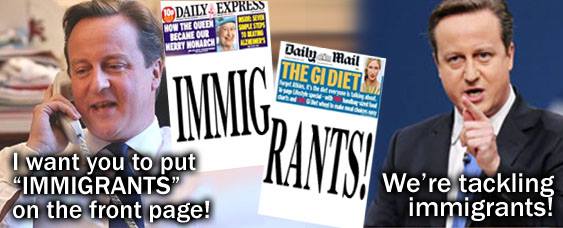
Miliband doesn’t pander to populism, and upholds the inclusion, equality and diversity principles that are embedded in policies which Labour pioneered. He aims to address and curtail exploitative employers, which of course is a real problem, rather than migrants, who are being exploited in the same way that “nationals” are. We have workfare, analogous to slavery and counterproductive in decreasing unemployment, which is universally exploitative, and absolutely nothing to do with the poor migrants, and everything to do with profit-driven greed, and a government that has encouraged that greed to thrive and flourish at such catastrophic expense to others.

Miliband knows that Britain is not divided by race and culture, it’s divided by wealth inequalities fuelled by the Tory-led Coalition’s austerity policies. Blaming the unemployed, the sick and disabled and immigrants for the failings of the government has fuelled misperceptions that drive support for the far-right. People complain they can’t get council houses, and the only really honest question an honest politician ought to ask is: “Why aren’t there more council houses?”

And when there are large numbers of people receiving unemployment benefit or tax credits, then the only honest question to ask is: “Why is the economy failing to provide enough jobs, or pay adequate wages?”

Miliband’s emphasis on equality is bothering the Tories, because their entire ideology is founded on Social Darwinism: to the Tories, inequalities are an inevitability, because of their emphasis on competition between individuals for resources in the “free market.” Miliband’s social democracy program provides an alternative that challenges the established right-wing neoliberal consensus.

The media and the government have stigmatised vulnerable social groups as a justification of cruel and punitive policies aimed at those least able to fight back, as an explanation of the failings of this government to be fair and honour a degree of legislation to reflect public needs – the public they are meant to serve.

As a society that once promised equality and democracy, we now preside over massive inequalities of wealth: that’s a breeding ground for racism and other vicious resentments.

It’s awoken the disgruntled beast within people, the one that feeds on anger, demoralisation, fear, resentment and uncertainty.

And wherever antipathy and a degree of enmity exist, the far-right have always tried to perpetuate, exploit and increase rancour. The fascism of the 20s and 30s gained prominence because it played on wider public fears, manipulating them, and deflecting attention, as ever, from those who are truly to blame for dire social conditions: the ever-greedy elite. There’s a well-established link between political extremism, economic hardship and recession and social cleavages, with the far-right “anti-system” parties deceitfully winning the support of those who would never previously have thought of themselves as extremists.

Such extremism and rancour feeds the disgruntled beast. The political right have always sought to divide sections of the poor and middle class and set them to fight one against the other; to have us see enemies in our midst which do not exist, so that we see economic policies – the Tory-rigged “free market” competition – as the solution rather than the cause of our problems.

And here we are again. A Tory government, another rigged recession, and the politics of fear, despair and micro-managed discontent.

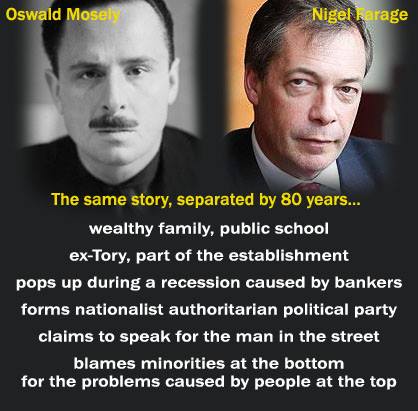
Fascism plays a specific role for the ruling class: it is a weapon against civil unrest during social crises caused by recession. It redirects public anger from the government to scapegoats. To build such a movement, fascists have to delve into the “lower classes” using a mixture of crude economic radicalism and racism. Oswald Mosley also started out as a Tory and he was a rich aristocrat. His tactic was “street politics”, rather like Farage’s appeal to woo “ordinary people.” Mosley cut himself adrift from the mainstream ruling class when in early 1934, he launched a campaign for street supremacy in key working class areas.

Farage is comparable with Mosely: he also tried to entice the working class, and those blue collar defectors who don’t feel solidarity with anyone except their “own kind” need to ask themselves how a fascist party would better reflect their interests, because fascists aren’t just fascists when it comes to your preferred target group – in this case migrants – fascists are fascists, full stop. And most migrants are working class, too.

Fascists are not known for being big on unions and worker’s rights either, Hitler smashed the unions, Mosely fought them too. But fascists do like to use the oppressed to oppress others.

Mosely was defeated by working class solidarity – Jews, communists, socialists, the labour movement, and the middle classes, who all stood side by side in Scotland, Newcastle, in the Valleys, Yorkshire, at Olympia and on Cable Street. Unity and regard for the rights and well-being of others was their greatest strength.

That community spirit and solidarity is precisely what we need to find again. The disgruntled beast is divisive, and it feeds on demoralisation, alienation, feelings of isolation and a lack of regard for others.

Identity politics and the faultlines of division

Lynton Crosby, who has declared that his role is to destroy the Labour Party, rather than promote the Conservatives, based on any notion of merit, is all about such a targeted “divide and rule” strategy. This is a right wing tactic of cultivating and manipulating apostasy amongst support for the opposition. It’s a very evident ploy in the media, too, with articles about Labour screaming headlines that don’t match content, and the Sun and Telegraph blatantly lying about Labour’s policy intentions regularly.

One major ploy has been to attempt to rally the disgruntled working classes behind the flag of identity politics – aimed exclusively at the most disgruntled, very purposefully excluding other social groups. It also sets them against each other, for example, the working class unemployed attacking migrants – it really is divisive, anti-democratic, and flies in the face of labour’s equality and diversity principles. It also enhances the political myth of convenience – the “out of touch/allthesame MPs”, some of those stoked-up disgruntled blue collar workers have defected to UKIP.

There’s an immediate danger that if the far-right succeed in colonising the anti-mainstream vote, as they are aiming to, and developing party loyalty, it will block the development of an independent working class politics capable of defending our conditions and challenging the status quo.

UKIP (and the Tories) first and foremost are traditionalists and defenders of property, with the socially paranoid ideology of the hard right. A dominant theme is a conspiratorial view of the EU as a sort of “socialist plot”, with the Eurocrats encouraging mass immigration, stifling small businesses with legislation and fuelling the welfare state. And working class cultural imperialism – some blue collar workers and working class supporters have disgruntled beasts that respond to the populist, “anti-establishment”, Islamophobic agenda. The wealthier middle class supporters who were traditionally Conservative want to force the Tories further to the right.

Thanks to the persistent propaganda work of the government and the media, the tendency is to see the far-right’s behaviour as merely the justified reaction to the provocation of socially stigmatised groups – the sick and disabled, the unemployed, Muslims and immigrants. This is the climate in which UKIP and its allies thrive. As a result, there is an urgent need to shift toward a wider cultural and political offensive against prejudice more generally. Again. The only party concerning itself with that, as ever, is Labour.

UKIP supporters manifestly don’t care about prejudice directed at others. At the very least they are not repelled by racism, sexism, disablism and homophobia, they seem unsentimental about the types of alliances they find themselves in. Yet working class UKIP supporters are cutting off their own noses to spite their faces, as UKIP are Thatcherites: neoliberal white trash. Fascists don’t support the working class –  they never have and never will. No matter how much they say otherwise.

I’ve talked about UKIP, here, but they are not the only party drawing on the propaganda of the right. I have seen Left Unity, the Greens, the SNP, and a range of so-called socialist groups utilise right-wing myths about the Labour Party, too. This means we end up repeatedly fighting to clarify truths amongst ourselves instead of simply fighting the injustices and lies of the Tories.

It also struck me that we have a raft of writers loosely writing about the Labour Party that don’t seem to promote achievements and positive policies, which is at the very least as important as the negatively weighted “critical” analyses of the last Labour government, for balance and for providing a framework for those perpetually disconsolate readers that tend to feed their pet disgruntled beasts from buzz phrases and glittering generalities for the perpetually unhappy orthodoxy obsessed narxists – like “working class disenfranchisement”, “New Labour”, “Progress”, “Blairite”, “weakened unions”, “blue labour” and so forth. Many narxists have a peculiar elitist and very  non-inclusive obsession with what socialism ought to be.

Ticked boxes and pressed disgruntle buttons.

It was mostly the disgruntled blue collar workers that found UKIP’s inverted elitism – anti-intellectualism, anti-middle-classism and a few other prejudices more appealing, and defected, in a false conscious moment of supreme nose-cutting and spited faces. I don’t see anything to be gained in fueling their discontent, propping up populism, and its irrational response – a nod in the direction of fascism from people claiming they are excluded from mainstream politics – so they defected to a party that is founded on the rhetoric of exclusion.

There are contradictions between UKIP’s ultra-Tory policies and the instincts and interests of its working class supporters. So, not quite “breaking the mould of British politics” then.  UKIP demagogically and disingenuously attack Labour for abandoning white workers, but they also focus on attacking David Cameron for not being Conservative enough.

Farage implies he has some sort of superior social knowledge and wisdom compared with the rest of the mainstream political class, and that he understands “ordinary people”, but he speaks fluently in the language of anti-progression, the fact that anyone at all is listening is indicative of an internalisation of the national right wing prejudice toward a profound anti-intellectualism.

And of course anti-intellectualism is to be expected from the Conservatives, who have historically used the repression of critical thinking as a way of deflecting scrutiny, and as a means of ensuring a compliant, non-questioning workforce to exploit. From the working class, however, it’s just the politics of resentment, and another disgruntled face of bigotry. So much for class consciousness. And solidarity.

It’s worth remembering that Marx and Engels were hardly working class, and they most certainly were intellectuals. Left wing UKIP supporters have no fig leaf to hide behind.

It’s one thing to be opposed to traditional elites, but to show support for a party so vehement in its hostility to democracy, trade unionism, socialism, human rights, our NHS and the welfare state because someone speaks with a pint and a ciggie in their hands, indicates the need for some responsible critical thinking, paying attention to details, less resentment, superficiality and disgruntled grunting.

Fascism always presents itself as your friend, it extends a cozening arm of camaraderie around your shoulder with a sly smile, a malicious grin with far too many teeth.

It’s a disgruntled beast that loves disgruntled beasts, but this public school boy and ex-Tory with offshore tax havens isn’t one of the lads from the shop floor. Farage didn’t take any lessons from the school of hard knocks, that’s for sure.

But many of us have membership in more than one oppressed group, surely its possible at least to recognise in principle the validity of other struggles against oppression, it’s important to recognise that these struggles are not in a zero-sum relationship with one another. They are complementary and cumulative. I believe the collectively oppressed are natural allies in a larger fight for justice, and create a whole greater than the sum of its parts, and this kind of intersectionality and solidarity undermines the ruling-class’s “divide and conquer.”

I think the divisions are what happens when you just feed the disgruntled beast.

That’s the problem with identity politics: it tends to enhance a further sense of social segregation, and it isn’t remotely inclusive. Of course it also enhances the myth of  “out of touch/ allthesame” politics. It’s a clever strategy, because it attacks Labour’s equality and inclusive principles – the very reason why the Labour movement happened in the first place – and places restriction on who ought to be “included”. Think of that divisive strategy  1) in terms of equality. 2) in terms of appealing to the electorate 3) in terms of policy. Note how it imposes limits and is reductive.

The Tories set this strategy up in the media, UKIP have extended it further and the minority rival parties, including the Green Party have also utilised the same rhetoric tool. Yet we KNOW right wing parties have NO interest in the working class. And those amongst the working class that have.

The Tories do not offer up public critical analysis of themselves. Indeed the anti-Labour bias on display by the Murdoch-owned news empire has never been more apparent. That’s not just because of ideology, it’s because Miliband stood up to Murdoch. But Tories don’t collectively and painfully self-scrutinise or soul search, and certainly not in public sight: they self promote. They speak with unfaltering conviction, and from that platform they control public debate and that’s despite their continuing assault on public interests.

So, where is our fully informed pro-labour spokesperson in the media? Where are the articles that inform people – the ones about what Labour do, rather than what they ought to do? Because the implicit message over and over from undoubtedly well-meaning left-leaning writers is that Labour constantly get it wrong and need advice on how to get it right, whilst their policies are not being publicly promoted, analysed, and their progress and achievements remain hidden from view. What gets attention is myth reduced to populist pseudo-critical soundbites.

The media and the message

That means, potentially, many people don’t know enough on balance to make informed choices. Disgruntled defectors often take the medium to be the message, unfortunately, and with no balance, no genuine pros and cons, just a perpetual party wish list, that reads as a list of deficits, many are fueling an often misinformed, unreasonable, hungry disgruntled beast. You present the policies from source that fill the cited alleged deficits, and dear lord, people actually get angry and abusive.

A few months ago, a well-known left wing commentator wrote a “critical” article about Labour that was based on inferences drawn from a very suspiciously muffled recording of Jon Crudass, which was a couple of minutes long, and which ended, somewhat dubiously, in mid-sentence. The recording was very well-utilised by the right wing, too.

At the time, having heard it, I challenged the writer concerned regarding the references to that very dodgy recording, and the inferences he had drawn from it, which echoed those of the Tories. I was ludicrously and condescendingly told I was being “anti-democratic”, in my “blind and uncritical” support for the Labour Party. From where I’m stood, it certainly isn’t me that is being anti-democratic, here.

It seems to be almost trendy to try and undermine Labour’s credibility and completely regardless of the accuracy of any “criticism” used. Since when was it anti-democratic to want to tell the truth, supported with facts? Why is it that people have such objections to a person being supportive of the Labour Party, anyway? That doesn’t make me undemocratic, “blind” or “uncritical” at all. I’m discerning, and the truth actually matters to me, in all of its detail. I put a lot of work in researching to ensure that I’m well-informed. And why is any of this a reason for people to direct condescending and disgusting abuse and nastiness? Yet somehow, this behaviour has become normalised and acceptable.

One response I’ve seen frequently is: “oh, but people are disillusioned with Labour”. Yeah? Well stop writing inaccurate commentaries that create disillusionment and alienation, then. Perhaps it’s time people learned to research facts for themselves, anyway, rather than allowing their apathy and disgruntledment to be fed by willing, earning authors or propaganda merchants and Tory/SNP/UKIP/Green shills and trolls on Facebook.

The Tory press operation had handed the Daily Telegraph and the BBC the transcript of that same recording of Jon Cruddas, who was approached in the foyer at the Fabian summer conference at the Royal College of Surgeons in London.

A note from the Conservatives accompanying the transcript made clear that the recording had been made by researchers posing as students, according to the account on the BBC website.

The Labour Party is considering referring the transcript of the remarks to the Press Complaints Commission, and the former standards watchdog Sir Alistair Graham has accused the Tories of entrapment. It was a dirty trick. Why on earth would someone on the left take advantage of such chicanery pulled by the Tories? 

No party is above criticism, and quite rightly so. But the criticism needs to be balanced, fair, accurate and based on informed analysis and fact. And not on any old bullshit that’s masqueraded as “criticism.” Or on secretly recorded partial conversations. If debates are not open and honest, and if criticism of parties and their policies are not based on facts, that isn’t actually debate you’re engaged in: it’s a propaganda campaign.

Surely by now we all know the media lies and excludes anything important; that it’s under authoritarian Tory control? That Iain Duncan Smith “monitors” the BBC for “left wing bias”, that the Guardian’s occasional forays into truth are stifled by jackbooted officials marching into their office and smashing hard drives? Does anyone REALLY imagine that such a government spokesmedia will do any justice to reporting about the positive intentions and actions of its opposition? It won’t. Not one bit.

Yet I see people running around hysterically clutching at cherry-picked, distorted media spun soundbites, as if the media is somehow suddenly credible when it talks of the opposition, and when you actually read what was said and proposed at the unspun initial source, it bears no resemblance at all to the media tale of the unexpected. If you trouble yourself to investigate these things, the crap being published and broadcast doesn’t stand up to scrutiny. But it does feed the disgruntled beast.

And when the media resort to personal smears – like they did last year about Ralph Miliband – you KNOW they are worried about being defeated. And behold their disgruntled beast.

It’s a crucial time when we need to make sure we know the difference between truth and propaganda, fact from fiction. It’s up to us to discern – please. We are each responsible for what happens next. It mustn’t be 5 more years of the same neo-feudalist rulers.

The nitty gritty

The Right are engaged in an all out war. The disgruntled Right know that Miliband has edited their script, abandoning the free-market fundamentalist consensus established by Thatcherism in favour of social democracy.

The right-wing media barons who set the terms of what is deemed politically palatable in Britain have never forgiven Ed Miliband for his endorsement of Leveson, which they believe is an unacceptable threat to their power.

And they know Labour under Ed Miliband will probably win the 2015 election.

This is a war, and the Tories think that chucking an avalanche of lies at the opposition is enough. It isn’t. Where are their positive, supportive, life-enhancing policies for the citizens of the UK? The Tories have NOTHING but increasing poverty and pain to offer most of us, and no amount of smearing Labour and telling lies will hide that fact. And they will do all they can to make sure Labour don’t get space in the media to tell you about their own positive social democracy program, based on tackling the inequality and poverty that Tories always create.

We simply can’t tolerate another 5 years of the terrible consequences of New Right Conservatism.

Some on the left also need reminding that there is far more at stake than tiresome debating about what “real” socialism entails. I can tell you categorically that socialism isn’t about feeding your own pet disgruntled beast at the expense of concern and care for comrades who are suffering, living in absolute poverty and dying, because of the policies of this authoritarian regime. We need to address the current crisis, the sociopolitical dysfunction, and escape Cameron’s vision of a feudal dytopia before we can even begin to design our utopia, based on orthodoxy or otherwise.

The outcome of the general election, and the future of this country, and the well-being of is our citizens is what is important, please let’s not lose sight of that.

Because when you feed only the disgruntled beasts, you just end up with beasts.

14301012075_2454438e62_o (1)

Thanks to Robert Livingtone for the excellent memes

Defining features of Fascism and Authoritarianism

999622_566748676727998_1599547969_n

Max Weber’s principle of Verstehen is a fundamentally critical approach in all social sciences, including politics, and we can see the consequences of its absence in the cold, pseudo-positivist approach of the Coalition in the UK. Their policies clearly demonstrate that they lack the capacity to understand, or meaningfully “walk a mile in the shoes of another”. The Coalition treat the population of the UK as objects of their policies and not as equal, subjective human beings. Policies are designed by the government, for the government, and reflect nothing of public interests.  Whenever the government are challenged and confronted with evidence from citizens that their policies are causing harm, they simply deny the accounts and experiences of those raising legitimate concerns.

The Conservatives do not serve us or meet our needs, they think that we, the public, are here to serve political needs and to fulfil politically defined economic outcomes. Citizens are seen as a means to government ends. We are ‘economic units’. In fact we are being increasingly nudged to align our behaviours with narrow, politically defined neoliberal outcomes.

My own starting point is that regardless of any claim towards the merits of value-freedom in any discussion about society, we cannot abdicate moral responsibility, cannot justify moral indifference. We see values and principles enshrined in a positive approach, exemplified in our laws, human rights and democratic process. We are also seeing an erosion of this tendency towards a globalisation of values, and inclusion of a recognition and account of the full range of human experiences in policy making. Indeed recently in the UK, public policy has become an instrument of stigmatisation, social exclusion and increasing minoritization. 

As a society, we have allowed the state to redefine our collective, universal, relatively egalitarian and civilising support structures, such as social housing, legal aid, welfare and broader public services as being somehow problematic. Those who need support are stigmatised, scapegoated, outgrouped and othered. The government tells us that welfare and other public services present “moral hazards”, and that they “disincentivise” citizens to be self sufficient. Yet the social gains of our post-war settlement were made to include everyone, should they fall on difficult times. We each pay into the provision, after all.

These provisions are civilising and civilised socioeconomic mechanisms that ensure each citizen’s life has equal dignity and worth; that no-one dies prematurely because of absolute poverty or because they have no access to justice, medical care and housing. 

Our post-war settlement was the closest that we ever came to a genuine democracy, here in the UK. It arose because of the political consensus, partly founded on a necessity of the state to meet the social needs of the newly franchised working class. 

However, we are now being reduced in terms of human worth: dehumanised to become little more than economically productive actors. We have a government that tends to describe protected vulnerable social groups in terms of costs to the State, regardless of their contributions to society, and responsibility is attributed to these social groups via political scapegoating in the media and state rhetoric, while those decision-makers actually responsible for the state of the economy have been exempted, legally and morally, and are hidden behind complex and highly diversionary ‘strategic communication’ campaigns and techniques of neutralisation (elaborate strategies of denial and rebuff).

Techniques of neutralisation are a series of methods by which those who commit illegitimate acts temporarily neutralise certain values within themselves which would normally prohibit them from carrying out such acts, such as morality, obligation to abide by the law, and so on. In simpler terms, these are psychological methods for people to turn off “inner protests” when they do, or are about to do something they themselves perceive as wrong. Some people don’t have such inner protests – psychopaths, for example – but they employ techniques of neutralisation to manipulate and switch off those conscience protests of others.

Language use can reflect attempts at minimising the impact of such wrongful acts. The Mafia don’t ever commit “murder”, for example, instead they “take someone out”, “whack them” or “give someone their medicine”. But the victim ends up dead, no matter what people choose to call it. Examining discourses and underpinning ideologies is useful as a predictive tool, as it provides very important clues to often hidden political attitudes and intentions – clues to social conditions and unfolding events. Linguistic habits are frequently important symptoms of underlying feelings and attitudes.

We know that benefits, for example, are calculated to meet basic living requirements only, such as food, fuel and shelter needs. To take away that basic support is devastating for those people having to struggle for basic survival. The Labour Party recently managed to secure concessions that ensured that the right of appeal for those sanctioned is maintained.

Iain Duncan Smith wanted to remove that right. But appeals take months to happen, and meanwhile people are left suffering  enormously, living in absolute poverty, as a result of having no money to meet their most fundamental survival needs. 

Sanctions are not “help” for jobseekers. Sanctions are state punishment and a form of persecution. It doesn’t matter how hard you look for work when you are one of 2,500,000 unemployed people and there are only 400,000 jobs available. If we want to help people into work we need to create decent pay and secure jobs, rather than punishing individuals for being out of work during the worst recession for over 100 years.

Work is no longer a guaranteed route out of poverty, as wages have stagnated and remain lower than they were before the global recession. More than half of the people queuing at food banks are in work. Reducing welfare has also lowered wages, as people who are desperate are forced to take any form of employment with poor conditions and wages. 

In a similar way, the Tories attempt to to distort meanings, to minimise the impact of what they are doing. For example, when they habitually use  the word “reform”, what they are referring to is an act that entails “removal of income”, “cuts”, and  punitive “incentives”, “help” and “support”: Tory-speak “help” means to “punish and take from”. Targets for such punishment and cuts are translated as Tory “statistical norms” or “not targets but aspirations” and “robust expectations of performance”. As I said earlier, these are techniques of neutralisation. Or Newspeak, if you prefer.

The “help” and “incentivisation” that the Tory-led Coalition have provided for jobseekers in the recession, at a time when quality jobs are scarce, secure and stable full-time work is also scarce, are entirely class contingent and punitive. Decent jobs that pay enough to get by on are like …well…Tory statistics; conjured from the aether, a very cheap trick – an illusion. We know that unemployment and underemployment are rising. 

Sartre once said that oppressors oppress themselves as well as those they oppress. Freedom and autonomy are also reciprocal, and it’s only when we truly recognise our own liberty that we may necessarily acknowledge that of others. Conservatism has always been associated with a capacity to inhibit and control, and never liberate. We need to take responsibility for the Government that we have. In fact we must.

Fascism evolves over a period of time. No-one ever woke up one morning to find it had suddenly happened overnight. It’s an ongoing process just as Nazism was. Identifying traits is therefore useful. Fascism and totalitarianism advance by almost inscrutable degrees. 

If you really think it could never happen here, you haven’t been paying attention this past few years to the undemocratic law repeals and quiet edits – especially laws that protect citizens from state abuse – the muzzling of the trade unions, a hatred of left and socialist perspectives, the corporocratic dominance and rampant cronyism, the human rights abuses, the media control and othering narratives, the current of anti-intellectualism and other serious blows to our democracy.

Dr. Lawrence Britt examined the fascist regimes of Hitler (Germany), Mussolini (Italy), Franco (Spain), Suharto (Indonesia) and several Latin American regimes. Britt found 14 defining characteristics common to each, and it is difficult to overlook some of the parallels with the characteristics of the increasingly authoritarian government here in the UK:

1. Powerful and continuing Nationalism – fascist regimes tend to make constant use of patriotic mottos, slogans, soundbites, symbols, songs, and other paraphernalia. Flags are seen everywhere, as are flag symbols on clothing and in public displays.

2. Disdain for any recognition of Human Rights – politically justified by stirring up fear of “enemies” and the need for “security”, the people in fascist regimes are persuaded that human rights can be ignored in certain cases because of “need.” The public tend to become apathetic, or look the other way, some even approve of persecution, torture, summary executions, assassinations, long incarcerations of prisoners, often without charge and so forth. But the whole point of human rights is that they are universal.

3. Identification of enemies and scapegoats used as a unifying cause – the public are rallied into a unifying patriotic frenzy over the need to eliminate a perceived common threat or foe: social groups; racial, ethnic or religious minorities; liberals; communists; socialists, terrorists international organisations and so forth.

4. Supremacy of the Military – even when there are widespread domestic problems, the military is given a disproportionate amount of government funding, and the domestic agenda is neglected. Soldiers and military service are glamorised.

5. Rampant sexism – The governments of fascist nations tend to be almost exclusively male-dominated. Under fascist regimes, traditional gender roles are made more rigid. Divorce, abortion and homosexuality are suppressed and the state is represented as the ultimate guardian of the family institution. Policies emphasise traditional and rigid roles. The government become the ‘parent’, because they “know what’s best for you”. Families that don’t conform are pathologised. 

6. Controlled mass media – the media is directly controlled by the government, but in other cases, the media is indirectly controlled by government regulation, or by ensuring strategically placed sympathetic media spokespeople and executives. Censorship is very common.

7. Obsession with “National Security” and protecting “borders”- fear is used as a motivational tool by the government over the masses.

8. Historically, religion and Government are intertwined – governments in fascist nations tend to use the most common religion of the nation as a tool to manipulate public opinion. Religious rhetoric and terminology is common from government leaders, even when the major tenets of the religion are diametrically opposed to the government’s policies or actions. But technocratic rule – referencing ‘science’ may also be used to appeal to the public and garner a veneer of  credibility.

9. Corporate Power is protected – The industrial and business aristocracy of a fascist nation often are the ones who put the government leaders into power, creating a mutually beneficial business/government relationship and power elite.

10. Labour power is suppressed – because the organising power of labour is the only real threat to a fascist government, labour unions are either eliminated entirely, or are severely suppressed.

11. Disdain for intellectuals and the Arts – fascist nations tend to promote and tolerate open hostility to higher education, and academia. It is not uncommon for professors and other academics to be censored or even arrested. Free expression in the arts and letters is openly attacked.

12. Obsession with Crime and Punishment – under fascist regimes, the police are given almost limitless power to enforce laws. The people are often willing to overlook police abuses and even forego civil liberties in the name of patriotism. There is often a national police force with virtually unlimited power in fascist nations.

13. Rampant cronyism and corruption – fascist regimes almost always are governed by groups of friends and associates who appoint each other to government positions and use governmental power and authority to protect their friends from accountability. It is not uncommon in fascist regimes for national resources and even treasures to be appropriated or even outright stolen by government leaders.

14. Fraudulent elections – sometimes elections in fascist nations are a complete sham. Other times, elections are manipulated by smears, the strategic misuse of psychology and propaganda campaigns, and even assassination of opposition candidates has been used, use of legislation to control voting numbers or political district boundaries, and of course, strategic communications together with targeted manipulation of the media. Fascist nations also typically use their judiciaries to manipulate or control elections, historically.

All fascist governments are authoritarian, but not all authoritarian governments are fascists. Fascism tends to arise with forms of ultra-nationalism. Authoritarianism is anti-democratic. Totalitarianism is the most intrusive; a ‘totalising’ form of authoritarianism, involving the attempted change, control and regulation of citizens’ perceptions, beliefs, emotions, behaviours, accounts and experiences. (See “nudge”, the Cambridge Analytica scandal, and the “Integrity Initiative” scandal, for example)

Authoritarian legitimacy is often based on emotional appeal, especially the identification of the regime as a “necessary evil” to combat easily recognisable societal problems, such as economic crises, with “tough choice”.

Authoritarian regimes commonly emerge in times of political, economic, or social instability, and because of this, especially during the initial period of authoritarian rule, such governments may have broad public support. Many won’t immediately recognise authoritarianism, especially in formerly liberal and democratic countries.

In the UK, there has been an incremental process of un-democratising, permeated by a wide variety of deliberative and disassembling practices which have added to the problem of recognising it for what it is.

Authoritarians typically prefer and encourage a population to be apathetic about politics, with no desire to participate in the political process. Authoritarian governments often work via propaganda techniques to cultivate such public attitudes, by fostering a sense of a deep divide between social groups, society and the state, they tend to generate prejudice between social groups, and repress expressions of dissent, using media control, law amendments or by quietly editing existing laws.

There is a process of gradual habituation of the public to being governed by shock and surprise; to receiving decisions and policies deliberated and passed in secret; to being persuaded that the justification for such deeds was based on real evidence that the government parades in the form of propaganda. It happens incrementally. Many don’t notice the calculated step-by-step changes, but those that do are often overwhelmed with the sheer volume of them.

Authoritarians view the rights of the individual, (including those considered to be human rights by the international community), as subject to the needs of the government. Of course in democracies, governments are elected to represent and serve the needs of the population.

Again, the whole point of human rights, as a protection for citizens, is that they apply universally. They are premised on a view that each human life has equal worth.

Democracy is not only about elections. It is also about distributive and social justice. The quality of the democratic process, including transparent and accountable government and equality before the law, is critical. Façade democracy occurs when liberalisation measures are kept under tight rein by elites who fail to generate political inclusion. See Corporate power has turned Britain into a corrupt state  and also Huge gap between rich and poor in Britain is the same as Nigeria and worse than Ethiopia, UN report reveals.

Some of the listed criteria are evident now. I predict that other criteria will gain clarity over the next couple of years.

“One doesn’t see exactly where or how to move. Believe me, this is true. Each act, each occasion, is worse than the last, but only a little worse. You wait for the next and the next. You wait for the one great shocking occasion, thinking that others, when such a shock comes, will join with you in resisting somehow. You don’t want to act, or even to talk, alone; you don’t want to “go out of your way to make trouble.” Why not? – Well, you are not in the habit of doing it. And it is not just fear, fear of standing alone, that restrains you; it is also genuine uncertainty.

“Uncertainty is a very important factor, and, instead of decreasing as time goes on, it grows. Outside, in the streets, in the general community, “everyone is happy. One hears no protest, and certainly sees none. You know, in France or Italy there will be slogans against the government painted on walls and fences; in Germany, outside the great cities, perhaps, there is not even this.

In the university community, in your own community, you speak privately to your colleagues, some of whom certainly feel as you do; but what do they say? They say, “It’s not so bad” or “You’re seeing things” or “You’re an alarmist.” (Or “scaremonger”)

“And you are an alarmist”. You are saying that this must lead to this, and you can’t prove it. These are the beginnings, yes; but how do you know for sure when you don’t know the end, and how do you know, or even surmise, the end?

On the one hand, your enemies, the law, the regime, the Party, intimidate you. On the other, your colleagues pooh-pooh you as pessimistic or even neurotic. You are left with your close friends, who are, naturally, people who have always thought as you have.” –  Milton Mayer, They Thought They Were Free.

Citizens feel increasingly powerless to shape the political institutions that are meant to reflect their interests. Politicians must relearn how to speak to disenfranchised citizens in an inclusive, meaningful way, to show that dysfunctional democracies can be mended.

Directing collective fear, frustration and cultivating hatred during times of economic turbulence at politically constructed scapegoats – including society’s protected groups which are historically most vulnerable to political abuse – has never been a constructive and positive way forward.

As Gordon Allport highlighted, political othering leads to increasing prejudice, exclusion, social division, discrimination, hatred and if this process is left to unfold, it escalates to hate crime, violence and ultimately, to genocide.

Othering and outgrouping are politically weaponised and strategic inhumanities designed to misdirect and convince populations suffering the consequences of intentionally targeted austerity, deteriorating standards of living and economic instability – all of  which arose because of the actions of a ruling financial class – that the “real enemy is “out there”, that there is an “us” that must be protected from “them.”

In the UK, democracy more generally is very clearly being deliberately and steadily eroded. And worse, much of the public has disengaged from participatory democratic processes.

It’s time to be very worried.
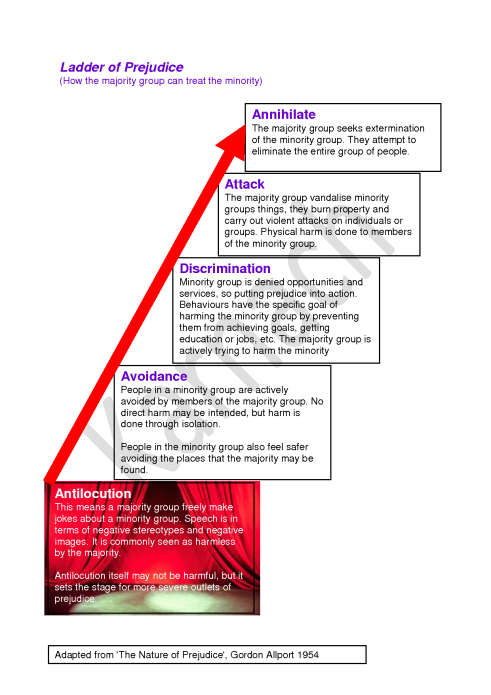
Allport's ladder

Further reading

“We must keep alert, so that the sense of these words will not be forgotten again. Ur-Fascism is still around us, sometimes in plainclothes. It would be so much easier, for us, if there appeared on the world scene somebody saying, “I want to reopen Auschwitz, I want the Black Shirts to parade again in the Italian squares.” Life is not that simple. Ur-Fascism can come back under the most innocent of disguises. Our duty is to uncover it and to point our finger at any of its new instances—every day, in every part of the world. Franklin Roosevelt’s words of November 4, 1938, are worth recalling: “I venture the challenging statement that if American democracy ceases to move forward as a living force, seeking day and night by peaceful means to better the lot of our citizens, fascism will grow in strength in our land.” Freedom and liberation are an unending task.” Umberto Eco, in Ur-Fascism


Politics and Insight’s independent, measured, authoritative reporting has never been so vital, or in the public interest. These are turbulent, decade-defining times. Whatever lies ahead for us all, I will be with you – investigating, disentangling, analysing and scrutinising, as I have done for the last 9 years. 

More people, like you, are reading and supporting independent, investigative and in particular, public interest journalism, than ever before.

I don’t make any money from my research and writing, and want to ensure my work remains accessible to all.

I have engaged with the most critical issues of our time – the often devastating impact of almost a decade of Conservative policies, widespread inequality to the influence of big tech on our lives. At a time when factual information is a necessity, I believe that each of us, around the world, deserves access to accurate reporting with integrity and the norms of democracy at its heart. 

My editorial independence means I set my own agenda and present my own research and analyisis.  My work is absolutely free from commercial and political interference and not influenced one iota by billionaire media barons.  I have worked hard to give a voice to those less heard, I have explored where others turn away, and always rigorously challenge those in power.

This morning I came across this on Twitter:

John Mann@LordJohnMann

I can this morning announce that as government advisor on antisemitism that I will be instigating an investigation this January into the role of the Canary and other websites in the growth of antisemitism in the United Kingdom. https://twitter.com/supergutman/status/1205296902301990912 

Marlon Solomon@supergutman

Who’d have guessed that Mendoza – one of the people most responsible for toxifying the British left with racially charged conspiracy theories about Jews – would blame a Jew before anyone else.

Whoever takes control of Labour, from whatever faction, please fuck these people off.

View image on Twitter
3,147 people are talking about this

Independent journalists are now facing a threat from an authoritarian government, who have successfully managed to distort our mainstream media.

I did expect this promise of a purge on left leaning sites if Boris Johnson was returned to office, but not quite so soon after the event. It’s a case of vote Tory on Thursday, get fascism by Saturday. 

John Mann isn’t by a long stretch the only so-called moderate ex-Labour neoliberal  extremist whipping up McCarthyist hysteria and hate. But he has been strategically placed for a while by the Conservatives to destroy independent sites like mine. He’s a particularly nasty individual.

My first step to fight back in the coming year is to join the National Union of Journalists (NUJ). It is an essential protection, now.

It’s not cheap, especially for someone like me, as I’ve no income from my work. I pay WordPress to keep adverts off my site, too. But I am one of those people who often has to make daily choices about whether to eat or keep warm. I am disabled because of an illness called lupus. Like many others in similar circumstances, I am now living in fear for our future under a government that has already systematically and gravely violated the human rights of disabled people, which has resulted in fear, suffering, harm and all too often, premature death.

I hope you will consider supporting me today, or whenever you can. As independent writers, we will all need your support to keep delivering quality research and journalism that’s open and independent.

Every reader contribution, however big or small, is so valuable and helps keep me going. 

DonatenowButton

Nihilism isn’t cool, trendy or the path to Nirvana: it’s a lazy abstention from all that matters.

1209102_539900659412800_1664499134_n

nihilismˈ noun 1. the rejection of all political, religious and moral principles, often in the belief that life is meaningless. “Insistence that man is a futile being”. synonyms: negativity, cynicism, pessimism; rejection, repudiation, renunciation, denial, abnegation; disbelief, non-belief, unbelief, scepticism, lack of conviction, absence of moral values, agnosticism, atheism, non-theism.
NO PRINCIPLES.

The road to nowhere, dissolution. In short, it’s the absence of belief in anything meaningful, positive, celebratory or decent. No acknowledgement of our remarkable potential as human beings. No faith in anything – it’s grubby, and leaves you groundless, rootless, unprincipled and in a no-place, with no escape.

Russell Brand is a “trendy” nihilist. However, this is not simply another article about Brand, but rather, I want to use this as an opportunity for discussing critical thinking. Brand is as good a case as any to use to explore this and propaganda techniques.

My friend, Charles Britton, commented on an article I wrote about the Russell Brand interview with Jeremy Paxman, and it’s a brilliant comment, because it shows a step-by-step process of critical thinking and analysis that exposes something that many seem to have have missed: an absence. A void. Brand used a lot of words that say nothing at all. Here is the comment:

“When I saw the argument between Russell Brand and Paxman, there were things he said that were clever, and which I liked and there seemed to be a real passion. Apart from the not voting, I thought, I couldn’t agree with that. And apart from the revolution idea because a) they are bloody, b) you don’t know who’ll you’ll end up with in charge (you may even lose the vote), and c) we do have the vote. If there were enough of a groundswell of anger about how we are being treated to spark a revolution, then it would show in how people voted (and how we campaigned). We’d vote out the bastards without needing a revolution! 

(I’m fairly certain that if people can’t be bothered voting, they won’t be bringing on a full-blown revolution any time soon either. Anyone out there got one booked? Please do pencil me in.)

“I still liked some other things he said. Apart from the implication that the parties are all the same. That’s the kind of thing you hear from most of the ”cutting-edge” (aggressive and politically ignorant) stand-ups on TV panel shows and celebs guesting on Question Time. Sadly, this blanket cynicism tends to win-over the politically illiterate of the crowd. Eventually I realised that there wasn’t really anything much in his statements apart from a certain  confident, [apparently] eloquent style. I’m left confused by this, wondering why his Newsnight interview was so “sensational”!


I have also pondered why Brand has such undeserved attention at the moment, and why some seem to think he had something to say, I clearly missed something, so I studied his interview with Paxman carefully. One thing that really struck me is that Brand completely failed to recognise and acknowledge that life wasn’t the same under the last government.

We didn’t have austerity, there were not thousands of sick and disabled people dying, and there was no substantial increase of absolute poverty and wealth inequalities under the Labour government, because of their policies, but these things are happening now.

Labour created human rights and equality policies, and the Tories are steadily unravelling those. Only the wealthy, and indifferent nihilists can afford imperviousness regarding the fundamental contrasts of Labour and Conservative governments. Brand’s self-serving claim that “they are all the same” only echoes what many of the most demigogic, disruptive, aggressive and very divisive individuals, have been using to misinform anyone who will listen. Brand is a multimillionaire who is likely invested in maintaining the status quo. A look at the differences in policies shows clearly that there are fundamental differences between the Conservatives and Labour. (For example, see here: Political Parties – NOT all as bad as each other).

So why would Brand or anyone else, for that matter, offer such a defeatist and dangerous idea up – that voting is futile – especially when the consequence is likely to be further divisions amongst those on the left, whilst the right-wing supporters, who ALWAYS vote, will simply ensure we have another Tory government in office in 2015?

How will that help the situation Brand outlined and criticised? And why is it ever okay to advocate no action? How about encouraging people to take some responsibility for how things are, and to work together to change things for the better?

I’ve written elsewhere about Brand’s narcissism and a fundamental lack of concern for others. As empathy, emotional sustenance and support, solidarity, loyalty, and a sense of belonging all become relics of a fast receding past due to the policies of the Tory-led Government, which act upon citizens as if they were objects, rather than serving them, as human subjects, the mass victims of anomic trauma put up as primitive, last resort narcissistic defences.

These, in turn, only exacerbate the very traumatic conditions, social dislocations, and experiences that necessitated their deployment in the first place. But our ability to organise, self-assemble, and act in co-operation and unison is in jeopardy, as is our future as a society, yet Brand advocated no action.

But some people promote themselves, making a lot of money from “criticising” the status quo, and Brand isn’t alone in being privately invested in how things are whilst publicly claiming otherwise.

Brand used recognisble propaganda techniques in his interview with Paxman, that signpost people to a variety of typified meanings, without actually meaningfully exploring any of them, using superficial Buzzwords (and phrases,) and Glittering Generalities.

The narrative isn’t coherent and meaningful, has no real depth, but what Brand does very well is implies – “signposts” you – via common stock phrases, creating the impression he understands and sees the world as you do. He creates a faux sense of rapport by doing so. But if you look elsewhere, the clues about Brand are there, in his books, articles and other interviews. It soon becomes clear that he does not connect with people, he doesn’t seem to relate. He generally seems to see others as a means to his own ends, and tends to exploit them. Those that have a joke at the expense of others have little empathy, and tend to be unsurprisingly exploitative and cruel.

That’s all Brand does, and even in the interview with Paxman, when he was asked something he couldn’t answer, he resorted to talking the piss out of Paxman.

It’s worth bearing in mind that when someone speaks or writes, they are trying to convince you of something. Ask yourself what it is that they want you to believe, then analyse their basic proposition carefully. Examine what they are saying, look for consistency, coherence, reasoning and logic, and look for the evidence to support the proposition.

Analyse what he actually said – there is NO proposition there at all, he used a lot of words to say nothing – it really is a cul-de-sac. Buzzwords and phrases are a propaganda technique to shape people’s perception, and persuade them that you “know” about their lives, situation and that you have insight.

Management jargon is an example – the familiarity of the words and phrases lulls you and fools you into feeling some important recognition has been made.

Here are some of the buzzwords and phrases Brand used to get your attention, gain your credibility, admiration, create a false sense of rapport; people, power, hierarchical, paradigm, serves a few people, humanity, alternate, alternate political systems, destroy the planet, economic disparity, needs of the people, treachery, deceit, political class, disenfranchised, disillusioned, despondent, underclass, represented, social conditions, undeserved underclass, impact, but that’s all just semantics really, political or corporate elites, serve the population, currently, public dissatisfaction.

We have all used these words and phrases, but we have put them together in structured and meaningful comments, with an aim. Brand didn’t do that.

Glittering Generalities is a propaganda technique, arises very often in politics and political propaganda. Glittering generalities are words that have different positive meaning for individual subjects, but are linked to highly valued concepts.

When these words are used, they demand approval without thinking, simply because such an important concept is involved. Brand made use of these Glittering Generalities; socialist, egalitarian, massive redistribution of wealth, heavy taxation of corporations, massive responsibility for energy companies, environment, profit is a filthy word, global utopian system, genuine option (amongst several others).

The whole dialogue is a propaganda vehicle that aims to deliver one message: there’s no point voting. Go back to sleep. There are identifiable dark fifth column ideologies of nihilism and conspiracy theories which have steadily gained popularity among some of the far-left here in the UK. Que sera sera. Idealism often morphs into cynicism.

These  ideologies reflect anti-values of defeatism, hopelessness, rejection of democracy, and organised government. What a deadly sedative – a very poisonous narcotic for a nation that desperately needs to rekindle respect for human rights, equality, and shared societal values of co-operation, compassion, hope, mutual support and community.

Nihilism is so dangerous because it is a glib, superficial and reactionary response that fundamentally attacks the very worth of humanity itself – because it’s based on the view that nothing really matters, everything is meaningless, nothing and no-one has any real worth, value or meaning.

Nihilism is a spiralling vortex of wretched and miserable relativism. It leaves people groundless and rootless. Que sera sera.

But we have a responsibility to take an interest in our lives, and the plight of others, regardless of our view of “human nature”.

The is /ought distinction highlights that there’s a fundamental difference between descriptive and prescriptive statements. As conscious beings with at least a degree of free-will, we can hoist our selves out of apathy by learning from consequences, by our empathy and concern for others, by our good will and by our conscious intent.

We are not cultural dupes – determined by social structure, or by our biology, sure, we are influenced by these, and a little constrained by them, but we are also capable of transcending these constraints – we are so much greater than that, or at least we have the potential to be so.

Conservatives don’t value such human potential: they tend formulate policy to squash it, curtail it, they stand against the tide of social evolution. Regressive ideology, authoritarian principles.

There is a tangible link with nihilism, and the egocentricity of psychopathy. First of all, psychopaths may be regarded as moral nihilists. Secondly, psychopaths like an apathetic, disengaged and anomic society, where citizens lack conviction, and there’s an absence or erosion of moral values.

Psychopaths regard the rest of us as being defective, and seek relentlessly to remake the world in their own image, to proselytize their viewpoint and  to “teach” their “defective” empathic fellows to think like them. Unfortunately, they can. People can become psychopathic, they can numb down their sensitivity to others. But a psychopath can never learn to think like an empathic person.

People with a normal capacity for empathy can turn off that capacity and think like psychopaths. Language is a powerful thing, and normal human beings respond to linguistic cues to switch to “psychopathy mode”.

The ancient Greeks and the Founders of our country understood the devastating destructiveness of the language of stigmatising, demonising and othering, particularly to democracies. They called the charismatic psychopaths who excelled at its practice “demagogues.” More recently, neuroscience has provided evidence that such demonising, dehumanising and hate radically alters the way the human brain processes information, making subjects immune to reason, increasingly intolerant, and very easily manipulated.

Divide and conquer is the age old defence of elites. Diversion. I am sure there is a link between nihilism, psychopathy and Conservative ideology. Extensive research has found significant correlations between key antisocial personality traits and  Conservative views. Specifically, the research claims to find elements of narcissism, psychopathy and Machiavellianism in Conservative subjects.

The Tory mantra: “there is no such thing as Society” leaks a significant clue about principle elements of core Conservative beliefs. The Conservative ideological justification for the destruction of the social unit, promotion of competitive individualism and “survival of the fittest” principles, the shrinking of the State and deliberately manipulated destruction of public belief in government overall is psychopathic.

It’s all about isolating people, breaking up networks and destroying co-operation and community. And of course such unifying and community-building ideas are the very foundations of socialist values and principles.

By focusing on competitive individualism as the primary method of improving the economy and society, Conservatism is an inherently misanthropic ideology; as all motives are seen through pure self-interest, cynicism in human nature becomes the norm. If people exist to simply get what they can for themselves, the motivation for sociability and co-operation decreases.

We become insular, fragmented and isolated. The characteristic of the psychopathic value system is its somewhat Manichean world view  – idealised me versus demonised him, idealised us  versus demonised them, reflecting the echo-other world view of the pathological narcissist or psychopath. The Tories deliberately create anxiety about others, divide social groups, reduce social cohesion, and create folk devils to bear the brunt of the blame for consequences of Tory policies.

It’s by no coincidence at all that those folk devils also bear the brunt of inhumane Tory policies, too. The Labour government didn’t get everything right for everyone, but Labour have never persecuted social groups like the Tories have, or wilfully destroyed state support for the most vulnerable citizens.

If we don’t vote, then that leaves the Tory supporters, who will simply vote the Tory authoritarians back into Office, and guess what? That doesn’t affect Brand at all. Well, except for the standard £107, 000 that all millionaires get under this Government, each, per year, in the form of a tax break.

We can politically engage, campaign, lobby politicians, and take some responsibility, rather than shrugging, disengaging, and ensuring that nothing will change. Authoritarian governments require a passive, disengaged public to emerge and to maintain their power. We have a duty to challenge and to push back – to demand positive changes and shape a society that supports those that cannot support themselves, that’s the mark of a civilised society. We simply have to fight our way back to decency.

We have to reclaim the progress we once made in an evolved human rights orientated culture. The Tories have undone many decades of hard work and struggle to establish those rights. We have to act, and we must vote. Vote Labour.

scroll2
This is also worth reading: “They are not all the same.” ‘They’re all the same’ is what reactionaries love to hear. It leaves the status quo serenely untroubled, it cedes the floor to the easy answers of Ukip and the Daily Mail. No, if you want to be a nuisance to the people whom you most detest in public life, vote. And vote Labour.”  Robert Webb

– http://www.newstatesman.com/politics/2013/10/robert-webb-re-joins-labour-protest-russell-brand

226786_150917841725939_960158327_n

Thanks to Robert Livingstone for his brilliant artwork