
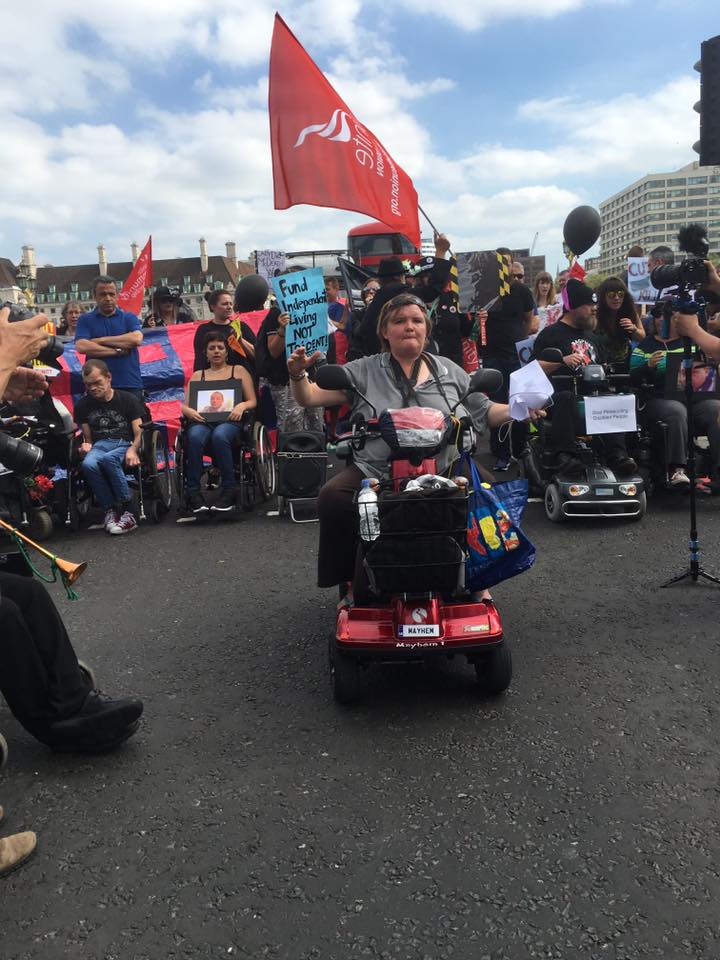
Cuts Kill, No More Benefit Deaths protest, Westminster Road block, 7 September 2016: part of Disabled People Against the Cuts’ Rights Not Games week of action.
Photo courtesy of Paula Peters, DPAC.
John Pring from Disability News Service reports:
“A disabled woman has told how her local council is threatening to spend several days watching her every move as she eats, showers and uses the toilet, in order to check if planned cuts to her care package will meet her needs.
The woman, Jane*, a survivor of serious sexual, physical and emotional abuse, and a former Independent Living Fund (ILF) recipient, spoke about the council’s “violation” at a parliamentary campaign meeting this week.
The meeting was held to launch Inclusion London’s report on the impact of last year’s ILF closure, as part of the Rights Not Games week of action organised by Disabled People Against Cuts (DPAC)**.
The report, One Year On: Evaluating The Impact Of The Closure Of The Independent Living Fund, includes information from all 33 London local authorities, and concludes that there has been a “dramatic postcode lottery” in the support provided to former ILF recipients since the fund closed.”
*Not her real name
**DPAC has set up a legal fund to help former ILF recipients like Jane challenge cuts to their support packages.
I recommend that you read the full article: Council wants to watch abuse survivor shower and toilet to check post-ILF needs.
The council have suggested that Jane may survive on microwave meals – which she has said would damage her health and be unaffordable – and that she can use incontinence pads for up to 12 hours a day, instead of being helped to use the toilet.
Over the summer, council officials told Jane that once the cuts to her care package were in place (from 12 hours of support a day to 38 hours a week), they wanted to send a “team of people” to observe (for up to two weeks) the impact of the reduction in care on how she manages to use the toilet, take a shower, gets in and out of her wheelchair and her bed, and feeds herself.
This will require an intrusion on a very intimate level, into aspects of her life where privacy is something that most people would take for granted. For disabled people, the public/private divide no longer exists. The details of our most intimate circumstances have become public property. Jane is not only horrified at this dehumanising move to cut costs, and about the fact that her physical needs, citizen rights and dignity are being so casually disregarded; she also has concerns regarding the potentially very damaging psychological effects of such an intrusion from the state, who have the sole aim of callously cutting her essential support.
The Independent Living Fund (ILF) was set up in 1988 to fund support for disabled people with high support needs in the United Kingdom, enabling them to live in the community independently, rather than move into residential care.
The ILF was designed to combat social exclusion on the grounds of disability. The money is generally used to enable disabled people to live in their own homes and to pay for care, and in particular, to employ personal care assistants. Many of the beneficiaries would have otherwise had to move to residential care homes.
In December 2010 the Government announced the closure of the Fund to new applicants, and in December 2012, following a consultation on the future of the Fund, it was announced that the Fund would be closed permanently from April 2015. The Government claimed that Local Authorities could meet the same outcomes as the ILF and proposed transfer for existing ILF recipients to their Local Authorities.
The Government initially decided to close the fund by March 2015 but this was delayed until June 2015 after five disabled people challenged the Government’s decision in the High Court.
In a very significant decision on 6 November 2013 following the Judicial Review, which highlighted the effects of the Equality Act 2010 on public authorities and their decision-making, the Court of Appeal found that the Department of Work and Pensions’ (DWP) decision to close the ILF was not lawful, overturning the High Courts’ decision of April 2013. The Government had indicated that it would not be appealing this judgement and the ILF would remain intact for the time being.
The Court of Appeal unanimously quashed the decision to close the fund and devolve the money, on the basis that the minister had not specifically considered duties under the Equality Act, such as the need to promote equality of opportunity for disabled people and, in particular, the need to encourage their participation in public life. The court emphasised that these considerations were not optional in times of austerity.
On March 6, 2014, the Government made the authoritarian announcement that it would go ahead with the closure of the ILF fund on 30th June 2015, saying that a new equalities analysis had been carried out by the DWP. The government has shown a complete disregard for disabled people and the Court of Appeal decision.
Highlighting that government had failed to comply with the equality duty had been a rare victory, entirely due to disabled people fighting back. The government responded to this by simply ignoring the court ruling.
The ILF provided additional income to nearly 19,000 disabled people who have high level support needs. The government devolved the responsibility to already cash-strapped local authorities in England, which meant that it would cease to be ring-fenced and would be subject to constraints and cuts within a local authority budget in June 2015. The funding was not ring-fenced. Because of budget cuts, local authorities have had limited capacity to support individuals unless their needs are very severe and so the ILF had previously served to supplement this provision. Local Authorities are already struggling to fund statutory provision and services, as it is.
Local Authorities had already said that they will not be able to offer the current level of financial support provided by ILF, potentially forcing many disabled people to move out of their homes and into residential care homes.
The Inclusion report aims at gathering evidence of the impact of the closure of the ILF with a focus on the situation in London. It brings together statistical analysis from Freedom Of Information (FOI) requests sent to all 33 London boroughs with findings from a survey sent out to London Deaf and Disabled People’s Organisations (DDPOs) as well as qualitative evidence provided by former ILF recipients concerning their experiences of transfer to Local Authority (LA) support.
Comparison of evidence gathered through comparison of the Freedom Of Information (FOI) responses, Deaf and Disabled People’s Organisations (DDPO) survey, and examples of lived experience submitted by former ILF recipients has led to a number of themes emerging:
- Post-code lottery for former ILF recipients across Local Authorities.
- The detrimental impacts of the ILF closure on former ILF recipients, ranging from distress and anxiety to removal of essential daily support. 9 One Year On: evaluating the impact of the closure of the Independent Living Fund
- The lack of consistent practice across different Local Authorities regarding referrals for CHC funding.
- Limitations of the mainstream care and support system and failings in the implementation of the Care Act.
- The value of the model of support provided by the Independent Living Fund.
- The importance of Deaf and Disabled People’s Organisations for making Deaf and Disabled people aware of and supported to exercise their rights.
There is an urgent need for a radical rethink of how Disabled people are supported to live independently. Disabled people who use independent living support must be at the forefront of developing ideas and with adequate resources for meaningful engagement.
This also needs to happen quickly, before the memories of what effective independent living support looks like and how much Disabled people can contribute when our support needs are met fade into the distance.
You can read the full report here: One year on: Evaluating the impact of the closure of the Independent Living Fund
—
Related
ILF closure cuts report produces instant results from Labour and Greens
Two-way mirrors, hidden observers: welcome to the Department for Work and Pensions laboratory

 Politics and Insights