

Update
Another Russian exile, Nikolai Glushkov, who was close friends with the late oligarch Boris Berezovsky has been found dead, aged 68, in his London home.
Counter terrorism officers are leading the inquiry into his death. They have said that there was no evidence to link it to events in Salisbury, though it has been treated as ‘suspicious’. So far this year, deaths registered for men aged 65-74 in England and Wales have averaged 1,179 a week (according to the Office for National Statistics data).
Amber Rudd, the home secretary, decided to announce an inquiry into allegations of Kremlin links to 14 other deaths in Britain in the past two decades.
The prime minister was said to be confident last night that she had succeeded in rallying key European and US allies before a meeting of the National Security Council to be followed by a statement to the Commons this afternoon.
One very worrying comment in the Times caught my eye: “On Monday the prime minister cleared the way in a statement to MPs for a cyberattack on Russia as she challenged President Putin to explain how a ‘Russian’ toxin came to be used on British soil.” However, Robert Hannigan, the former director of GCHQ, warned against a cyber-offensive because of the likelihood of escalation.
“Starting a cyberconflict is not in anyone’s interests,” he said. “We need to be sure that anything we do is consistent with our values.”
That the prime minister felt such a blatant act of aggression and provocation was appropriate at all is VERY concerning, given the fact that she has refused to share the evidence that her allegations are based on with Russia, and has refused to permit Russia to contribute to an inquiry.
Earlier this year, defence think tank Chatham House warned that US, British and other nuclear weapons systems are increasingly vulnerable to cyber attacks. The threat has received scant attention so far from those involved in nuclear military planning and the procurement of weapons.
It blames this partly on failure to keep up with fast-moving technological advances, lack of skilled staff and the slowness of institutional change.
“Nuclear weapons systems were developed before the advancement of computer technology and little consideration was given to potential cyber vulnerabilities. As a result, current nuclear strategy often overlooks the widespread use of digital technology in nuclear systems,” the authors of the study said.
Nuclear weapons systems are vulnerable and at risk from hostile states, criminal groups and terrorist organisations exploiting cyber vulnerabities. The report goes on to say:
“At times of heightened tension, cyber attacks on nuclear weapons systems could cause an escalation, which results in their use.
“Inadvertent nuclear launches could stem from an unwitting reliance on false information and data. Moreover, a system that is compromised cannot be trusted in decision-making.”
“At best, cyber insecurity in nuclear weapons systems is likely to undermine trust and confidence in military capabilities and in the nuclear weapons infrastructure.
“At worst, cyber attacks could lead to deliberate misinformation and the inadvertent launch of nuclear weapons.
“In times of crisis, loss of confidence in nuclear weapons capabilities would factor into decision-making and could undermine beliefs in nuclear deterrence – particularly in extending nuclear deterrence to allied countries.”
The report, titled Cybersecurity of Nuclear Weapons Systems: Threats, Vulnerabilities and Consequences, said the issue required “urgent attention” from the governments of nuclear-armed states and those that could be affected by the use of nuclear weapons.
Chatham House also urged governments to be open about their discussions, adding: “After all, it is the public that will pay the ultimate price for complacency regarding cyber security of nuclear weapons systems.”
Counter terrorism policing statement
The UK’s head of counter-terrorism policing has issued a statement regarding the nerve agent attack in Salisbury. Neil Basu, speaking at Scotland Yard, said:
“We are exploring all investigative avenues. This includes extensive CCTV footage from across the city and over 380 exhibits so far.
In particularly I’m appealing for anyone who saw Sergei and Yulia Skripal in Sergei’s car which is a red BMW with a registration plate: HD09 WAO, in the Salisbury area between approximately 1pm and 1.45pm on Sunday 4 March.
The police are going to continue to see a great deal of police activity in and around city, including potentially more cordons being erected. But please don’t be alarmed. It is necessary as part of this major investigation. In truth it may last many weeks.
It is a painstaking operation to identify anyone of interest and eliminate them or include them, but at this stage we are not declaring person of interest or a suspect at this time.”
No mention of ‘the Russians’, then.
Novichok nerve agents
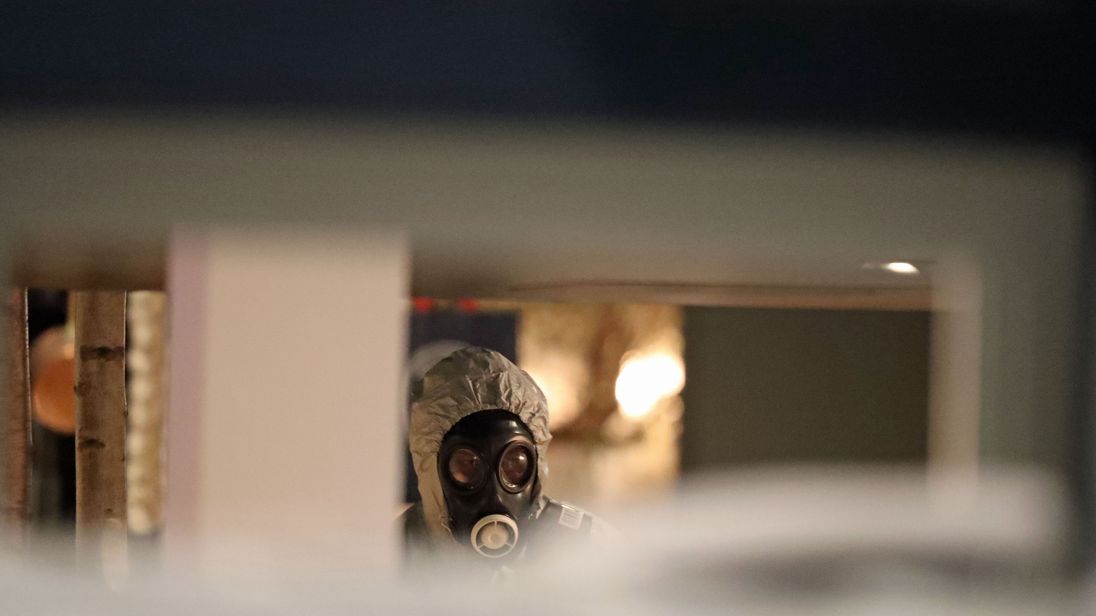
It was certainly a nerve agent that was used in the attack on the Skripals. The raw materials to make such chemical weapons are inexpensive and generally not difficult to obtain.
Novichok nerve agents – also known as the “N-series” – were secretly developed by the former Soviet Union beginning in the 1970s. They followed the “G-series” of nerve agents made by Germany in the 1930s and the “V-series” made by the UK in the 1950s. Novichok means “newbie” in Russian. There are no previous reports of the Novichok nerve agents being used in battle or assassinations. However, Andrei Zheleznyakov, a Russian scientist involved in their development, reportedly died not long after being exposed to a small amount that leaked out of a rubber tube in the laboratory.
The scant details that we know about these agents are largely based on reports from Russian chemist Vil Mirzayanov, who exposed the Russian chemical weapon development programme in 1991. However, he never gave any formulae or protocols for synthesis of this deadly class of chemical agents that he referred to.
Nerve agents are made from two precursor chemicals that are mixed together just before use. These precursors could be made at pesticide or fertiliser manufacturers without arousing any suspicion at all, as this class of chemical weapon is made with organophosphates as a key component. Some insecticides, including carbamates organophosphates such as dichlorvos, malathion and parathion, are nerve agents. At high enough doses, acute toxicity and death can occur through the same mechanism as other nerve agents.
As binary chemical weapons are those which contain the toxic agent in its inactive state in the form of chemical precursors, which are significantly less toxic than the agent itself. Using precursors improves the safety of storing, transporting, and disposing of the weapon. Commonly, when used, the barrier between the two precursors is removed. These compounds then react to form the intended toxic agent.
The Russians created two main types of Novichok nerve agent – A-230 and A-232. We know these are chemicals that also contain carbon and phosphorus like the G-series nerve agents – which includes sarin, tabun, soman, and cyclosarin, and the V-series – which includes VX, VR, VE, VG and VM. However, their exact structures have allegedly remained a mystery in the West.
As stated, A-232 (also called Novichok-5) is an organophosphate, like many pesticides. Phosphates are not listed among the controlled chemicals on the Chemical Weapons Convention lists. The Novichok class of agents were reportedly developed in an attempt to circumvent the Chemical Weapons Treaty (chemical weapons are banned on the basis of chemical structure and therefore a new chemical agent is not subject to past treaties). Novichoks have reportedly been engineered to be undetectable by standard detection equipment and to defeat even standard chemical protective gear, it has been said.
According to Mirzayanov, both the Novichoks are binary agents, meaning they are made from two precursor chemicals that are mixed together just before use He also said that many of the less potent derivatives were reported in the open literature as new organophosphate insecticides, so that the secret chemical weapons programme could be disguised as legitimate pesticide research. Mirzayanov confirmed that Novichoks all feature an organophosphorus core.
Nerve agents are a class of organic chemicals that disrupt the mechanisms by which nerves transfer messages to organs. The disruption is caused by the blocking of acetylcholinesterase, an enzyme that catalyses the breakdown of acetylcholine, a neurotransmitter. Nerve agents attack the nervous system, muscles are prevented from relaxing, so they spasm are effectively paralysed. This includes the heart and the muscles used for breathing. Because of this, the first symptoms usually appear within seconds of exposure and death can occur via asphyxiation or cardiac arrest in a few minutes.
Initial symptoms may be excessive sweating, a runny nose, tightness in the chest, and constriction of the pupils. Soon after, the victim will have difficulty breathing and will experience nausea, involuntary, excessive salivation and fluid accumulation and sometimes, blistering, in the lungs – often producing frothing at the mouth – burning, watering and sometimes blistering eyes, gastrointestinal pain and vomiting. This phase is followed by initially myoclonic jerks (muscle jerks) followed by status epilepticus – type epileptic seizure. The effects of nerve agents are long-lasting and increase with continued exposure. Survivors of nerve agent poisoning almost invariably suffer chronic neurological damage and related psychiatric effects.
Atropine and related anticholinergic drugs act as antidotes to nerve agent poisoning because they block acetylcholine receptors, but of course, they are poisonous in their own right. Pralidoxime chloride, also known as 2-PAM chloride, is less toxic but it works more slowly than other antidotes.
No standard test exists for Novichoks. It’s possible to detect exposure to nerve agents more generally by checking blood samples to monitor any significant decrease of activity of an enzyme called acetylcholinesterase. However, UK intelligence agencies must have knowledge of the exact Novichok structures, otherwise they would not have been able to detect a match, as claimed.
It is generally considered impossible to cure people who are exposed to it. Novichok is reported to be 5–8 times more lethal than VX nerve agent and effects are very rapid, usually within 30 seconds to 2 minutes. How it was deployed in the attack on the Skripals remains unclear.
At the moment, there is no evidence that Russia was not respecting the treaty that has come to the attention of the OPCW (Organization for the Prohibition of Chemical Weapons). Russia has previously destroyed quite a large amount of its chemical weapons stock – more than 400,000 tons.
Russia’s foreign minister, Sergei Lavrov, said during a televised press conference earlier that Russia was not responsible for the poisoning and demanded that Britain seek to mediate the case under the chemical weapons convention.
He said: “We have already made our statement on this case. Russia is ready to cooperate in accordance with the convention to ban chemical weapons if the United Kingdom will deign to fulfil its obligations according to the same convention.”
Lavrov also remarked that under the convention, Russia would have 10 days to reply to an official accusation by the UK over the use of a banned substance within its borders.
Russia summoned the UK’s ambassador to Moscow to protest against accusations that it ordered last week’s nerve agent attack in Salisbury and to warn that any British sanctions against Russia would be answered in kind.
The prime minister said in parliament on Monday that the UK would consider punitive measures if Russia did not meet a (rather unreasonable) deadline of the end of Tuesday to explain itself. Possibilities include revoking the broadcast licence of the Russian state-funded broadcaster RT, expulsions of diplomats, or greater scrutiny of Russian investments in the UK.
The Russian foreign ministry said: “Any threats to adopt ‘sanctions’ toward the Russian Federation would not remain without a response.”
Among other measures, Moscow is ready to ban all British media outlets if London revokes the state-funded Russia Today’s right to broadcast in Britain, a spokeswoman for the Russian foreign ministry said on national television on Tuesday evening.
“Not a single British media outlet will work in our country if they close Russia Today,” Maria Zakharova said.
A foreign ministry statement said it had summoned Laurie Bristow, the British ambassador, to also declare that Russia would not comply with Theresa May’s demand that it explain its role until the Russian government had been given samples of the nerve agent that left the Skripals critically ill.
“Without this, any statements by London are senseless,” the ministry said in the statement given to journalists.
Meanwhile, May is preparing to chair a meeting of the national security council after the midnight deadline she set Moscow passed.
The prime minister is said to be preparing to set out a range of reprisals against the Russian state, including calls for fresh sanctions, visa bans and crackdowns on Russian money in the UK. She is expected to set out plans to build a coalition of international support – from the European Union, NATO and even the United Nations. However, given Brexit, Europe’s response is quite likely to be limited when it comes to practical support and retaliation.
Until Tuesday evening, Donald Trump had remained silent over the Kremlin’s “probable role”. However, he has since told Theresa May in a phone call earlier today that his support is conditional on the facts supporting her case. Downing Street said Trump had agreed that “the Russian government must provide unambiguous answers as to how this nerve agent came to be used”.
The problem with the ultimatum is that there is a possibility the nerve agent did not come from Russia.
Only one senior member of Trump’s administration had acknowledged that Russia may be responsible: Rex Tillerson. On Tuesday, however, Trump fired Tillerson as secretary of state, possibly underlining that May is likely to receive little or no help from the US. Not that Trump’s brand of ‘diplomacy’ would be of any value to us, things are fraught enough without any further bragging about big red buttons.
The Russian Embassy have said that “Britain must comply with the Chemical Weapons Convention which stipulates joint investigation into the incident, for which Moscow is ready.”
That seems fair, but the UK government have refused to permit such a joint investigation so far.
The Russian Embassy said Moscow will only respond once it is given access to samples of the nerve agent used to poison the Skripals. Again, the UK government has refused. There will have to be a degree of negotiation to escape the current impasse, otherwise the situation will simply escalate into one of increasing hostilities, provocation, retaliation, retaliation and more retaliation. This is the signposted, short and deadly road to war.
Is the UK government playing provocation roulette with Russia?
The complete breakdown of diplomatic relationships has already led, it is reported, to a warning issued from Russia that the UK should not threaten a nuclear power last night, as tensions mounted ahead of an announcement today of measures against the Kremlin.
Russian Foreign Ministry spokeswoman, Maria Zakharova, was quoted as saying “one should not threaten a nuclear armed country.”

Maria Zakharova
There are many things that world leaders should not do or say. History is littered with the destruction and devastation of precious, ordinary human lives caused by the disregard and lack of conscience of those in positions of power. But that doesn’t ever seem to stop them, and always, it seems, to our utter surprise and horror.
There has been a dangerous escalation in both rhetoric regarding nuclear weapons and military strategy recently. For example, Vladimir Putin’s state of the union address earlier this month, showed a mock-up missile seemingly heading for the coast of Florida. Last year the British government disclosed that under certain (undefined) circumstances, nuclear strikes would be considered, even if our nation wasn’t under direct nuclear threat.
Donald Trump has pledged to “spend freely” on upgrading the American nuclear arsenal. Last month, a review of nuclear “posture” set out plans to develop new “low-yield” nuclear weapons and for the first time consider nuclear strikes in response to non-nuclear threats – such as a devastating cyber attack. Russia has long possessed smaller nuclear weapons, with a military doctrine that conceives of their tactical use to counter conventional threats.
However we are witnessing a departure from a deterrence policy towards first strike posturing at a global level that could significantly lower the threshold for nuclear war.
Nuclear weapons protect no-one. They reflect an era of leaders who regard the lives of others as somehow expendable, including their own citizens. This disregard for the lives of others by those in positions of power and privilege shapes so much human suffering, it reflects everything that is wrong in the world.
“Cutting edge nuclear deterrence”, according to Trump’s most recent posture statement, apparently requires “tailored strategies” and “flexible capabilities.” These are not new concepts. They sound reasonable enough. Until we see that the flip side of deterrence is detonation. Tailored strategies and flexible capabilities require assigning nuclear weapons to “targets.” You can reason that most targets will probably be military bases or ports and so on. At first. However, even one nuclear detonation will release radioactive material that will inevitably travel to densely populated areas, unconstrained.
The logic and cohesion of nuclear posture reviews break down when we shift from the declaration part to the operational level of nuclear deterrence. What are the humanitarian consequences of targeting plans for nuclear weapons? And how is escalation to be controlled once the nuclear threshold is crossed? See?
Because nuclear orthodoxy cannot withstand public scrutiny, especially on the fundamental questions of humanitarian consequences and escalation control, citizens in nuclear states seek refuge underneath the warm, comfort blanket statements of deterrence. Our personal comfort depends on presuming that deterrence is somehow robust and safe.
However it is fragile.
Recently I have written about the elements of human error, such as misinterpretation of mundane events such as solar flares, moon rises, intelligence miscalculation, and near accidents – the close calls we have somehow managed to survive so far. These events demonstrate what a fine margin of error there is and just how fragile the boundary actually is between deterrence and the sudden blinding, instant, searing heat followed by an utterly devastating blast and a mushroom cloud composed in part from the dust of corpses and crushed buildings,
It should be unthinkable for any person in a position of power to make such a horrific threat. Not so long ago, it would have been, in the age of ‘nuclear deterrence.’ But now we have the leaders of superpower states casually hint at first strikes, mentioning their nuclear buttons and arsenals whenever they feel like blowing off steam.
In the event of a nuclear exchange, the UK government will be cowering in underground fallout shelters, as no doubt will Trump and the Russian officials. If that wasn’t so, I think perhaps they may hesitate before posturing so aggressively and potentially, catastrophically, while bargaining and bullying with lives of respective populations.
Update
I did some further research following on from this observation I made: “No standard test exists for Novichoks. It’s possible to detect exposure to nerve agents more generally by checking blood samples to monitor any significant decrease of activity of an enzyme called acetylcholinesterase. However, UK intelligence agencies must have knowledge of the exact Novichok structures, otherwise they would not have been able to detect a match, as claimed.
I came across Craig Murray’s latest article on novichok, which also makes similar and some addition observations.
In summary, he says:
1) Porton Down has acknowledged in publications it has never seen any Russian “novichoks”. The UK government has absolutely no “fingerprint” information that can safely attribute this substance to Russia.
2) Until now, neither Porton Down nor the world’s experts at the Organisation for the Prevention of Chemical Weapons (OPCW) were convinced “Novichoks” even exist.
3) The UK is refusing to provide a sample to the OPCW.
4) “Novichoks” were specifically designed to be able to be manufactured from common ingredients on any scientific bench. The Americans dismantled and studied the facility that allegedly developed them. It is completely untrue only the Russians could make them, if anybody can.
5) The “Novichok” programme was in Uzbekistan not in Russia. Its legacy was inherited by the Americans during their alliance with Karimov, not by the Russians.
You can read Craig’s full article here.
Related
From the age of nuclear ‘deterrence’ to an era of first-strike posturing – a creeping escalation
I don’t make any money from my work. But you can help by making a donation to help me continue to research and write informative, insightful and independent articles, and to provide support to others. The smallest amount is much appreciated – thank you.


 Politics and Insights