Tag: # Tories

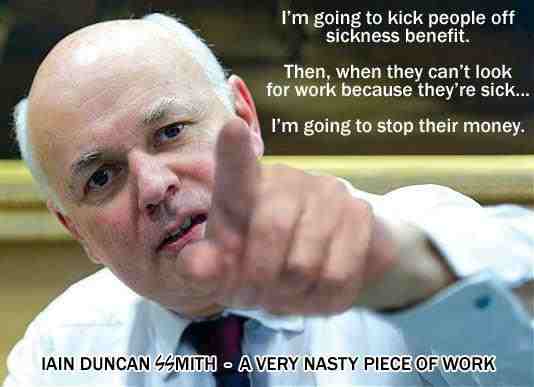
Cuts to employment support allowance are being “considered” by ministers

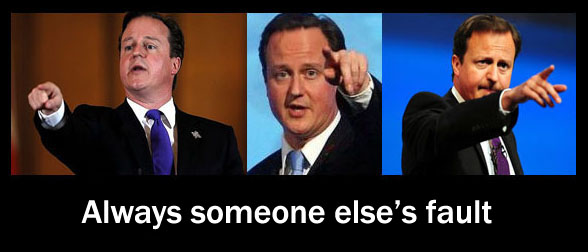
37079_433060243430176_1848475368_n
Tory ministers are considering drastically cutting the main Employment and Support Allowance sickness (ESA) benefit, internal documents seen by the BBC suggest.

New claimants, judged to be capable of work with appropriate support, could be given just 50p more per week than people on job seekers allowance.

Current recipients get almost £30 per week more. This is to meet additional costs that arise because of a person’s disability.

The Department for Work and Pensions said the ESA proposals were “not government policy.”

The documents reveal that the government has also been forced to hire extra staff to clear the backlog on the benefit.

Some 100 healthcare professionals are being hired to carry out fitness-for-work tests. The staff, who will be employed through the Pertemps agency, will help to reduce a backlog of more than 600,000 cases.

They will be in addition to any extra staff brought in when a new contractor is announced shortly to replace ATOS. The American firm, Maximus, has been awarded the contract. Controversies and scandals have been unearthed by UK researchers since Maximus was handed the lucrative contract in July to deliver the government’s new health and work service in England and Wales.

Leaked documents over the summer showed that ministers considered ESA – formerly known as incapacity benefit – to be “one of the largest fiscal risks currently facing the government”.

They also revealed “concerns” about claimants moving off jobseekers allowance onto ESA.

Giving consideration to cutting the differential paid to ESA recipients in the Work Related Activity Group (WRAG) – individuals who have to prepare for employment – is a reflection of that concern. However these are people that have been declared unfit for work by their doctor. They currently receive £28.75 more per week but the documents show plans are being discussed to cut that to just 50p more than jobseekers allowance. People receiving JSA, who are aged 25 or over, currently get £72.40 per week.

However, disabled people do have have additional needs and higher living costs, which is why ESA was set at a higher amount than JSA. Furthermore, because ESA is paid to people who can’t work, that means they are potentially reliant on benefit to meet their living costs indefinitely, and certainly longer term than those claiming JSA. ESA wasn’t designed to be such a temporary means of support as JSA was.

Employment and Support Allowance is paid to approximately two million people. Claimants have to undergo an extremely controversial Work Capability Assessment (WCA) to determine whether they are eligible and at what level.

Many people have been wrongly assessed as fit for work, and have been forced to appeal in order to receive the benefit that they are entitled to, and the high success rate of appeals in itself indicates that the WCA is deeply flawed. People have died within weeks of being told they are fit for work, also indicating that this assessment process is heavily weighted towards ensuring that sick and disabled people lose their lifeline benefit.

Labour MP, Dame Anne Begg, who chairs the Commons Work and Pensions Select Committee, said she would support overhauling the delivery of ESA but: “did not envisage any reduction in the value of the benefit.”

She added: “That’s not reform, that is just saving money. I hope that is not something the government is going to come forward with.”

Of course the Conservatives have used the word “reform” as a euphemism for severe cuts since 2010.

If we look at how the Coalition austerity cuts have been targeted, we see that:

  • People in poverty are targeted 5 times more than most citizens
  • Disabled people are targeted 9 times more than most citizens
  • Disabled people needing social care are targeted 19 times more than most citizens.

It’s the Tories that want something for nothing: the democratic contract and government responsibility

430847_149933881824335_1645102229_n (1)
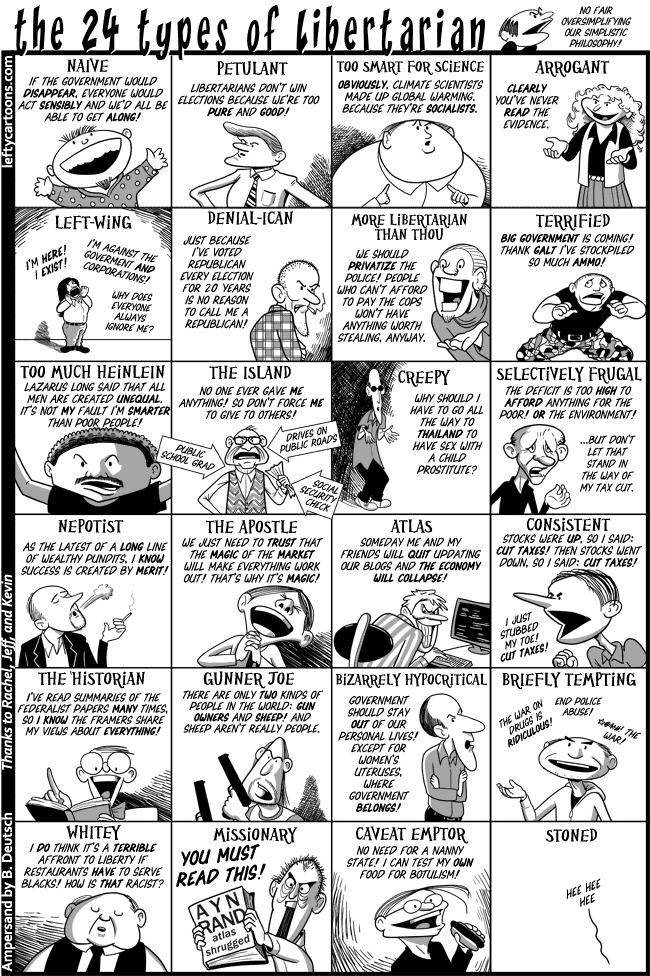
The Conservative defense of increasing economic inequality, the lionisation of Randian, Libertarian, selfish individualism and the proliferation of ideological justification narratives regarding the dismantling of the “Big (Welfare) State”, where the latter, in Orwellian fashion, is now being indicted for many of the very social and economic ills that the free market era has actually delivered has surely worn threadbare by now. 

It’s abundantly clear that it’s the Tories and the very wealthy that want something for nothing. Cameron’s mantra is “social responsibility, not state control equals Big Society.” Cameron, in his Hugo Young lecture (2009), claimed that the “Big Society demands mass engagement: a broad culture of responsibility, mutuality and obligation”.

But this isn’t about a transfer of political power or decision-making from government to the public: it’s a transfer of responsibility and duty only.

In true Orwellian spirit, Cameron went on to say: “The recent growth of the state has promoted not social solidarity, but selfishness and individualism.”  Only a conservative would claim poverty and social cohesion as their concern and passion, and then attack  the mechanism that until now has been used to alleviate them  – publicly funded state spending.

Democracy (based on the partnership between political and economic enfranchisement) happens when the concept of property encompasses access to “social goods” such as healthcare, education and public infrastructure as a right of citizenship. The idea of political representation becomes consolidated when access to such social goods is guaranteed by a legal process, as well as a political process.

The electoral franchise in countries which adopted a Lockean liberal constitutional  system, such as  Britain, had a property qualification attached to it. Universal suffrage coincided with a wider public access to social goods, giving rise to a new type of social contract: by giving up a portion of their property by way of taxation, the propertied class ensured the survival of capitalism, and the working class escaped the worst ravages of capitalism.

Access to social goods was a means of widening and legitimising the scope of democratic political representation.

However, whilst removing all of our public services, provisions, destroying our post-war settlement, the key features of which were accepted in principle by the main political parties at the time, namely: a mixed economy, a free public sector healthcare and education, a guaranteed (though minimal) state pension and social welfare provision, the government is removing social goods, nullifying the established social contract between state and individual, and is expecting that we each fend for ourselves.

I don’t remember any consent amongst the public to accept diminished living standards in return for Cameron’s proposal of national fiscal security (which he has consistently and spectacularly failed to deliver) and the maintenance of the “market-state”. Nor was there consent for authority, inequality and hierarchy, or an acceptance of being less than we can be and having less than we can have.

Our welfare provision (and I include our National Health Service, here), paid for by us, IS OUR MEANS OF BEING RESPONSIBLE AS A SOCIETY AND INDIVIDUALLY: it is a means of securing provision for ourselves if or when we need it. Our welfare provision is, and has been since its inception, each citizens’ responsibility, because we pay for it. It doesn’t belong to the government.

The consensus that the welfare state was the best basis for a healthy society was first rejected by Thatcher, who notoriously denied the very existence of society, and unashamedly espoused greed as the  “best social driver.”  Cameron, building on Thatcher’s previous groundwork, has effectively delivered an economic enclosure act, claiming OUR collective, public funds, turning that money into the private property right of the rich, in the same way the land enclosure act robbed the public of their commonly shared land, and enabled rich landowners use of their control of state processes to appropriate public land for their private benefit.

Yet despite this blatant theft: the massive transference of public funds to a few private accounts, the demands being made by the state on citizens have never been greater. All the Tories talk about are OUR obligations and individual responsibilities, whilst they claim they have NO responsibility for citizen well-being. But we have paid for state services and continue to do so via the tax and national insurance system.

In 2013 the Government spent approximately £93.5billion of our money on the private sector. This is half the £187bn government usually spends on goods and services each year. Recent growth in outsourcing of government services to private providers has been widely criticised for a lack of transparency, poor management of money and, in particular, excessive remuneration of top executives and pay inequality between employees. Extreme pay inequality and a succession of scandals in the largest government suppliers suggests that, in its present form, government outsourcing is a very poor use of tax payers’ money and not fit for purpose. This is verified by the Equality Trust’s research report: Subsidising Unfairness

It’s only the very wealthy that gain (enormously) from austerity, and they  manage to avoid  any socially responsible contribution by using government endorsed accounting systems and dodges to avoid paying taxes wherever possible. The estimated amount of taxes unpaid, thanks to evasion, avoidance, error and criminality, soared to £34 billion, according to HM Revenue and Customs. This equates to £1 in every £15 owed in taxes not being collected last year.

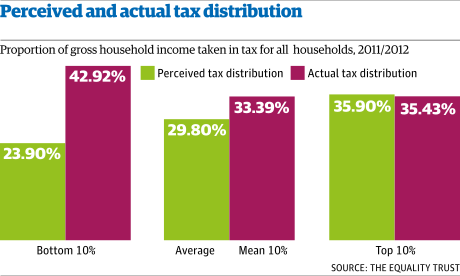
Furthermore, it is the poorest 10 percent of households that pay eight percent more of their income in all taxes than the richest – 43 percent compared to 35 percent, outlined in a report from the Equality Trust. The poorest pay more than four times as much of their income, in Cameron’s poll tax-styled council tax system, than the wealthiest top 10 precent.

The government’s “hardworking taxpayer” myth which is at the heart of the Tory ideologically driven austerity narrative, and divert, divide and poison strategy, creates an artificial dichotomy between benefit claimants and taxpayers. Cameron’s diversionary rhetoric has got nothing to do with responsibility and fairness: it’s simply about justifying policies that privilege a wealthy elite at the expense of the poor.

 Such us and them dichotomies  can be linked to the distinctions made between the “deserving” and  “undeserving” poor, going back over a hundred years or more, to the cruel and punitive Poor Law Reform Act. The Tories have purposefully created scapegoats: adversarial identities that are politically constructed according to notions of difference which simultaneously encourages a public comparison to, and rejection of, Others. This Othering narrative portrays benefit recipients as the enemy in a battle against fairness and responsibility.

And the public have bought into it, the Equality Trust thinktank highlights a gulf between perceptions of the tax system and its reality. A poll, conducted with Ipsos Mori, found that nearly seven in ten people believe that households in the highest 10% income group pay more of their income in tax than those in the lowest 10%.

Wealth concentration damages economies. It focuses activity within finance and other services geared towards only towards serving the super rich.Maintaining inequality requires penalising and further impoverishing the poor.

Reducing  wealth inequalities will require the introduction of wealth taxes, like the inheritance tax  we introduced a century ago. Reducing inequality requires a high top rate of income tax. This reduces income inequality not only by raising revenue, but by deterring the profit-driven greedy from asking for more money. When there is a tax rate of 60 percent on incomes above £200,000 a year, it makes little sense to pay employees much more than that.

But the wealthy tend to get so indignant when policy proposals from the opposition indicate that they will be required to actually contribute something to a society that they have taken so much more than others from. There’s been an outraged outcry, for example, regarding Labour’s Mansion tax proposals. These ignoble, self-serving Randians are happy to sit back and allow the poorest and most vulnerable to suffer and starve, whilst being subjected to the unfair, punitive bedroom tax, which contravened human rights: the poorest are bearing the terrible burden of austerity cuts whilst the wealthy continue to profit massively. Presumably, Cameron exempted the very rich from responsibility, duty and contributing  to society in any meaningful way.

Of course this is about restricting political engagement, the Conservatives have always sought to reduce it to a basic partnership between corporate interests and professional politicians. Cameron’s Conservatism rests on the unwitting rejection  of the social democratic consensus by the population which, paradoxically, need what they reject. Public consent is being manipulated to accommodate the idea that democracy is a relationship between rulers and governed, rather than it being about an elected government that reflects, represents and serves public needs. The population are being incrementally subordinated to a political system which is not conducive to the betterment of their lives, well-being or material conditions –  the Tories are imposing an imbalanced social contract comprised of citizen duties with no citizen rights; the acceptance of ever-lower living standards and increasing state authoritarianism.

The Conservative scapegoating narratives, which have blamed Labour, the poor and the unemployed for a recession caused by the private finance sector, and not the “big state” as claimed, have permitted the Coalition to pursue an ideological, destructive and grossly unfair economic strategy, which has generated only a bogus and isolated recovery largely based on government-fuelled asset bubbles in real estate and private finance, with stagnant productivity, plummeting wages, millions of people in precarious jobs, inflated living costs and utterly savage welfare cuts.

One obligation that all democratic states have, surely, is that of protecting citizens rights and freedoms. Those are most certainly being steadily diminished, and Cameron has been quite candid about scrapping our Human Rights Act, and withdrawing from the ECHR in the future.

See what I mean? It’s all take take take…

Danny Dorling says: “Gross economic inequality is as vile as racism, misogyny and hatred of the disabled; as damaging in effect; and as dependent on a small group of supporters who believe that just a few should have more and more and more, because they’re “worth it”.”

I believe that growing social inequality generates a political necessity for prejudices: they are entrenched vis-à-vis Social Darwinism in Tory ideology, fueled and perpetuated through justification narratives and amplified via the media.

I’ve said many times previously that never in this country have those who fight for democracy and social justice carried a greater burden or faced the possibility of bigger losses of human rights, human freedoms, human dignity and human welfare than they do right now.

14533697838_dffcc736f2_o (1)

 Many thanks to Robert Livingstone for his brilliant art work

Miliband: hope, humanism, joined-up thinking and integrity.


1044468_500666173336249_1718830491_n


One of Miliband’s virtues is that he re-humanises politics. For him, people’s individual experiences matter, and he always cites many examples throughout his speeches. He includes qualitative accounts from real people. It’s a particularly contrasting quality to Cameron’s unempathic, dehumanising, quantitative and negative labelling approach.

To the Tories, we are all reducible to their often cited, fake statistics. The numbers tell us what the Tories want us to “know”, and not what actually is. And we know that the Tories have never been big on free speech – see the Gagging Act, for example. They like to exclude “inconvenient” voices of truth from the grand, overarching Tory narrative. Miliband listens to accounts of people’s realities, and accommodates those accounts. Cameron imposes both accounts and realities upon us.

Hardly surprising, therefore, that the right-wing bitcherati press have taken the piss once again and tried to make Miliband’s approach to the paramount importance of everyday people look small. Littlejohn in particular is being his pernicious, old, fascist self. How anyone that writes for the Mail for a living has the cheek to criticise anyone at all is beyond me. But it shows that the right are determined to portray any strengths that Ed Miliband has as a weakness. Propaganda at its worst. But its so blatant, superficial and unsophisticated, at least.

I have criticised Tory ontology and methodology previously, using social science as a frame of reference. Politics is a social science, and not a “stand-alone” one: it draws on the disciplines of psychology and sociology, too. As a critical interpretivist, I believe that social reality is not “out there” waiting to be discovered: we are constructing and reconstructing it meaningfully. However, politically, there’s been a marked shift away from understanding the lived experiences of real people in context: a systematic dehumanisation. The Tories have depopulated social policy. This is a characteristic of authoritarianism, and other hallmarks include stigmatisation of social groups, moral disengagement, moral exclusion, impunity, and a societal “bystander apathy”, as I’ve discussed elsewhere.

In the social sciences, there was a big shift away from Cameron’s approach to “understanding the social world” from the 70s onwards. Mostly we realised that  counting people’s responses doesn’t give us any clue about meanings and intentions, it can only turn up statistics. And these are open to reductionist and determinist interpretations and inferences from the persons gathering them, as we know.

Qualitative researchers aim to gather an in-depth understanding of human behaviour and intention – the reasons that govern such behaviour. The qualitative method investigates the why and how of our decision making, rather than just what. And we get to interpret our own reality and experiences. We are each experts in our realm of experiences, and Miliband understands this. He invites our expertise, Cameron stifles it.

The social researcher and the politician do not stand apart from or outside of the intersubjectively constructed universe they wish to describe/measure: there is no “objective” vantage point, because we all participate personally within it.

Clifford Geertz, an anthropologist said: Man is an animal suspended in webs of significance he himself has spun, I take culture to be those webs, and the analysis of it to be therefore not an experimental science in search of law but an interpretive one in search of meaning.

And in Thick Description, which compared the “thin” descriptions of measurements with the “thick”, densely layered description of context and meaning that qualitative research can provide in any given situation, he said : “The difference between a twitch and a wink is vast.  From a purely physiological perspective, a wink is the contraction of the muscles of a single eye that cause the eyelid to close.  So, of course, is a twitch.  And so is a slow-motion, exaggerated parody of a wink; a fast motion parody of a twitch; and any number of parodies of parodies of twitches and winks that a group boys sitting in the back row might engage in to amuse one another on a spring afternoon”.

And any measure of the interactions that include and are driven by these twitches and winks is bound to measure the wrong things and fail to measure the right ones.

No-one but the Tories would try to argue that poverty is an intentional act of the poor, that food banks are a symptom of rising greed rather than need. I have never known a government to be so blatantly insouciant with the measurable social phenomena it causes via its policies. Or with its own credibility, for that matter.

In contrast to quantitative research, qualitative research involves the collection and analysis of information that focuses on the meanings attached to people’s actions and behaviours, often referred to as the lived experience.It defines us as active participants in the world, instead of merely reducing us to statistics and preferences.  It makes priority of our perceptions and experiences and the way we make sense of our lives.

First-hand experiences matter. And quite properly so. It puts us, the people, in the driving seat, we construct our own meanings, rather than having authoritarians like Cameron imposing meanings, definitions, convenient labels and Tory ideology upon us. Quantitative methods tend to hammer the world into a presupposed state  – as Einstein once said: the theory tells you what you may observe. How very Cameron. All quantitative studies can yield are conventionalised expressions of the experience of the author, or the one commissioning the research.

Quantitative, positivist paradigms share commensurable assumptions but are largely incommensurable with critical, constructivist, and participatory paradigms.. In other words, they don’t accommodate any critical  approaches or analysis, nor are they inclusive. How very Cameron.

Furthermore, quantitative methodology in the social sciences depends upon faith in the “verification principle”. Which is itself unverifiable…

How very  cul-de-sac, and how very Cameron.

Quantitative methodology objectifies us, whereas the qualitative method draws on a humanist, hermeneutic/phenomenological approach: understanding moves from the outer manifestations of human action and productivity (the superficial) to the exploration of their inner meanings and references. Numbers cannot convey human experiences: it is thought, language and our expression that converts experience into meaning.

Humanist thinkers within the discipline of psychology, such as Ronald D Laing, drew on a qualitative  approach, and in his earliest works, he starts from the experience of the individual ego, in “The Divided Self” (1961) and moves towards existential phenomenology , and in his later work, such as “The Politics Of Experience And The Bird Of Paradise“(1967), he manages to integrate these perspectives within a Marxist framework.

Laing, along with others who led the anti-psychiatry movement in the late 50’s and early 60’s, such as Erving Goffman and Thomas Szasz, had a profound and hugely significant impact within the field of psychology, which had been dominated by associationism, behaviourism, psychometrics and eugenics and of course, psychoanalysis.

At a time when theorists from social sciences maintained that their perspectives were premised on scientific (usually positivistic) principles, Laing offered a humanist critique of these approaches, which he said trivialised psychology and dehumanised its subjects. Laing shifted the emphasis from an experimental approach, and a searching for “facts” and “predictability” regarding human behaviours to dialogue, intersubjectively constructed and reconstructed meanings and human experience. Laing and others challenged established categories of behaviour deemed pathological or abnormal, by meaningful explorations of individual accounts of their experience of being.

Laing in particular gave a rational voice to those individuals who had experienced exploitation within family relationships, which he studied extensively, discovering sets of interactions that often involved complex tactical games, relationship knots and strategies, with family members making alliances with some and creating enmity with other members. Within the nexus of the family there is an unremitting demand for constant strategic interpersonal interaction based on mutual reciprocal concern and attention. Individuals are therefore vulnerable to existential harm. They are emotionally imprisoned via the nexus, internalising other family members, and the interaction patterns.

Laing believed that some families acted like gangsters, offering each other protection against each other’s violence. Some governments do, too.  He also believed that the internalisation of family interaction patterns becomes our world – and it restricts the development of the self, with individuals carrying the emotional blueprint of their family for the rest of their life, which may inhibit any real autonomy or self awareness. This blueprint may manifest as expression through behaviours that are clinically identified and diagnosed as schizophrenia. Laing and others exposed the negative labelling processes, and ritualised humiliation directed towards those experiencing self-fragmentation because of the internalisation of negative family interaction patterns. For Laing, madness is simply a perfectly rational adjustment to an insane world. Of course that world exists within a political framework.

In sociology, phenomenology was expressed in the work of Alfred Schutz (1899 – 1959) who studied the ways in which people directly experience everyday life, and imbue their activities with meanings. In contrast to the predominant structural and somewhat deterministic perspectives within the discipline, Schultz moved away from the tendency of subordinating everything within disaffecting, abstruse and overarching ideologies or grand narratives, and he emphasised a multiplicity of new and often spontaneously co-authored ideologies lived out day-by-day and based on common sense and intersubjectively constructed values.

Schultz expressed a vitalism that engendered an organic way of thinking, with characteristics such as intuitive insight as a way of perceiving things from within, and placed emphasis on understanding as a holistic grasp of the widely varied, often complex and subtle elements of situations, and on experience as something that is lived through in common with others.

Schultz says that we draw on a common stock of knowledge – “typifications” and common sense which orientates us, helps us navigate socially, and achieve a reciprocity of perspective with others. Socialisation processes mediate and normalise this common stock of knowledge.

Phenomenological Sociology went hand in hand with a preference for a qualitative methodology that emphasised authentic everyday accounts of social reality, with agency and meaning being the focus. Quantitative methodology, on the other hand, had primarily focused on measurement, notions of the predictability of behaviours due to these being determined by social structure for example, as was the case with many advocates of Functionalism, such as Social Darwinist Herbert Spencer, and a socially detached and “objective” researcher.

Such a researcher was evidently armed with the belief that he/she possessed the somewhat unique ability to stand outside of human experience and values, unlike the subjects of enquiry, and would thus gather “social facts” and then interpret them from this independently existing standpoint. For example, a sociologist studying drug use amongst young people may gather statistics and hand out closed questionnaires with short directive and directed yes/no type questions. From the information gathered, the researcher may conclude that anomie and alienation lead to drug use, because, for example, many young drug users singled out for study live in deprived inner city areas.

Most young drug users, however, would not use terms like anomie to explain or give meaningful accounts of their drug use. This imposed conceptual framework of the researcher demonstrates very well how detachment and objectivity is not possible, in sociological enquiry. Indeed, some have extended this criticism to scientific enquiry. We each operate within idioms of belief, and Michael Polanyi has proposed that Western Science is such a self-sustaining idiom. (“Personal Knowledge”, 1958). He compares science with Azande Witchcraft, (Evans-Pritchard’s anthropological study: “Witchcraft, Oracles and Magic Among the Azande”), noting that each conceptual framework is “segregated’ by a logical gap” (they are incommensurable), but from within each idiom, beliefs tended to be circulatory, self-confirming and self-sustaining.

This is true of all ideologies. We can make inferences from sociological research, for example, but every sociologist knows about the Hawthorne effect: that the very fact that people know they are being observed changes their behaviour and distorts the result.

Polanyi had become acutely aware of the extent to which worldviews penetrate into language, and that he had sensed that this may have important ramifications for relations between frameworks of belief. As the basis of his argument, Polanyi gives a precis of his epistemology in “Science, Faith And Society” (1946) and “Scientific Beliefs” (1951). Polanyi considers that discovery, verification and falsification of propositions in science do not obey “any definite rule” but proceed with the aid of “certain maxims” which defy both precise formulation and rigorous evaluation. The maxims are “premisses or beliefs … embodied in … the tradition of science”.

Sustained by this tradition, science is governed by the coherent opinion of its practitioners, who employ the “idiom of science” in which its interpretative framework, Polanyi concludes, is an entrenched tangled and negotiated reciprocity of perspective, and all founded on the the belief of scientists that science is true: a personal conviction which they cannot factually justify. And again, how can we verify the principle at the heart of scientific methodology: verificationism itself, for example?

It is also possible to identify imported scientific metaphors operating at the heart of social science. For example, the shift from “structure” to “events” in physics is reflected in a similar shift in theoretical focus in sociology. There was a marked shift in structural and deterministic accounts of human behaviour and a move to study small scale interactions, social events, context bound interactions and situations, which can be linked with phenomenology. Behaviour was relativised by a multiplicity of contexts, which meant that more descriptive methodologies were employed.

A phenomenologist would ask open-ended questions, preferring interviews and the use of dialogue. Responses would be directed as little as possible, ensuring that the account given is a true and meaningful reflection of the direct experience of the person/social agent. This kind of research also reflects immediacy – the here and nowness of the social world, that has a full potential yet to be explored, rather than the positivist emphasis on a narrowing predictability and replicating results to try and determine their’ “accuracy.” It is also democratic and founded on notions of equality.

The person/agent has the centre stage and is the author of the research. Furthermore, phenomenologists have pointed out that sociologists are also embedded in everyday life and cannot therefore escape the shared norms, values and meanings of the life world they inhabit. Phenomenologists value valid accounts, rather than social “facts”, as it is not possible to be “objective” when one occupies a completely intersubjective realm of enquiry.

Miliband, of course, recognises this, he values authenticity, inclusion, equality, democracy and spontaneity over and above ideology. Cameron is completely driven by ideology. and the ghastly assumptions that Tory dogma entails.

Social existence is not one dimensional; it is complex, ambiguous, poorly defined, deceptive, fragmented, emotional and often unpredictable. It is animated by a plurality of perspectives. It is often based on what we take for granted – tacit knowledge – that which is self-evident that informs our intellectual constructions. A phenomenological approach can uncover those taken for granted underpinning assumptions – quintessentially cultural phenomena, in that these assumptions are what societies are built upon.

Miliband understands this. He acknowledges that human experiences are complex, multidimensional, inter and intrasubjective, and multipersonal, many layered events, where both “verifiable statement” and valid existential account each have an important place in our endlessly creative narratives, and of the endless possibilities of our being in a social universe of expansive potential. Cameron only reduces that potential. And he really has, in just four years.

In a sense, we’ve all been doing such qualitative research our whole life, and therefore have very much to contribute to a pluralist, socially democratic society. Miliband knows this, Cameron freely chooses not to. Cameron is an epistemological and ontological fascist: he predefines what we “know”, and what is “acceptable” as “knowledge”, and he predefines social reality, excluding its’ members accounts.

Max Weber’s principle of Verstehen  is a critical approach in all social sciences, and we can see the consequences of its absence in the cold, pseudo-positivist approach of the Coalition in the UK. Their policies clearly demonstrate that they lack the capacity to understand, or meaningfully “walk a mile in the shoes of another”. The Coalition treat the population of the UK as objects and not human subjects of their policies.

My own starting point is that regardless of any claim to value-freedom in political science, we cannot abdicate moral responsibility, and cannot justify moral indifference. We see this positive approach exemplified in our laws, human rights and democratic process. We are also seeing an erosion of this tendency to a globalisation of values, and inclusion of a recognition and account of the full range of human experiences in policy making. Indeed Tory policy has become an instrument of social exclusion and increasing minoritization.

We are being reduced to little more than economic statements here in the UK. We have a Government that tends to describe vulnerable social groups in terms of costs to the State, and responsibility is attributed to these social groups via media and State rhetoric, whilst those decision-makers actually responsible for the state of the economy have been exempted, legally and morally, and are hidden behind complex and diversionary scapegoating propaganda campaigns.

Sartre once said that oppressors oppress themselves as well as those they oppress. Freedom and autonomy are also reciprocal, and it’s only when we truly recognise our own liberty that we may necessarily acknowledge that of others. Conservatism has always been associated with a capacity to inhibit and control, and never liberate. We need to take responsibility for the Government that we have. In fact we must.

Miliband is offering us social democracy. The accusations of political “cross-dressing” from the fringes of the left are utter nonsense, hence the persistent right-wing media smear campaign. Miliband is offering us inclusivity, he speaks with an obvious decency and passion, and has consistently presented us with a  comprehensive and coherent narrative, if only we will listen.

Socialism for a Sceptical Age, by Ralph Miliband was about the continued relevance of socialism in a post-communist world. Ed Miliband has said that the final few sentences of this book are his favourites of all his father’s work:

In all the countries there are people in numbers large and small who are moved by the vision of a new social order in which democracy, egalitarianism and co-operation – the essential values of socialism – would be the prevailing values of social organization. It is in the growth of their numbers and in the success of their struggles that lies the best hope for mankind.”  

“Socialism is not a rigid economic doctrine, but ‘a set of values’ It is ‘a tale that never ends’. Indeed, the strange fact is that  while there’s capitalism, there’ll be socialism, because there is always a response to injustice.” Ed  Miliband. (Source)

He’s right.

14533697838_dffcc736f2_o (1)

Thanks to Robert Livingstone for his brilliant pictorial truths

The Conservatives’ slippery slope and Allport’s scale of prejudice

Gordon Allport studied the psychological and social processes that create a society’s progression from prejudice and discrimination to genocide. In his research of how the Holocaust happened, he describes sociopolitical and socio-psychological processes that foster increasing social prejudice and discrimination and he demonstrated how the unthinkable becomes acceptable: it happens incrementally. It happens because of a steady, nudged erosion of our moral and rational boundaries, and propaganda-driven changes in our attitudes towards others, all of which advances culturally, by almost inscrutable degrees. 

The process always begins with political scapegoating of a social group and with ideologies that identify that group as an enemy or a social burden in some way.  It begins with dehumanizing language.

By using dehumanizing language, we negatively shape the way we view some groups of people. We may begin to view them as “less-than” or “subhuman”. When we view someone as less than us, it creates a social, cultural, moral, psychological and emotional separation, which makes it easier to permit or commit violence against them. Every human being has inherent dignity by virtue of our shared humanity and the rational nature that comes with it. No matter our age, innocence, gender, size, race, nationality, or ability, we are all equally human; our language and actions should reflect that fact.

Unless we actively challenge dehumanizing rhetoric, it will continue to permeate our society and lead to acts of violence.  Dehumanizing rhetoric used to oppress groups of human beings in the past is still being used against marginalized groups of today.

bad-words-poster-smaller.png
                                                                                         Examples of dehumanizing language

A history of devaluation of the group that becomes the target, authoritarian culture, and the passivity of internal and external witnesses (bystanders) all contribute to the probability that violence against that group will develop, and ultimately, if the process is allowed to continue evolving, genocide.

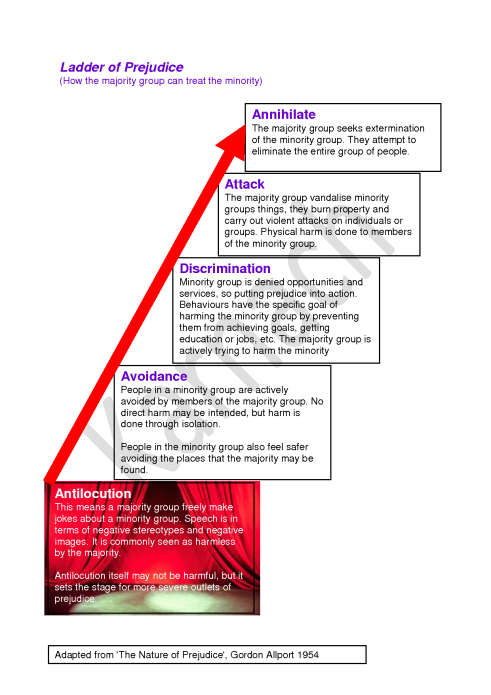
Economic recession, uncertainty and authoritarian or totalitarian political systems contribute to shaping the social conditions that seem to trigger Allport’s escalating scale of prejudice. In his book, The Nature of Prejudice, Gordon W. Allport uses the metaphor of a ladder to describe how “little acts,” which often go unnoticed, can lead to serious and deadly individual and collective behaviors.  This framework describes, in ascending order, five “rungs” of intolerance and injustice: speech, avoidance, discrimination, physical attack, extermination.

Allport's ladder

The Conservatives are authoritarians, they manufactured an economic recession, as did the previous Conservative administrations. Though the sheer pace and blatancy of Cameron’s austerity programme  – a front for the theft and redistribution of public wealth to Tory-supporting private bank accounts – is unprecedented, even for Conservatives.

And prejudice towards vulnerable minority groups is almost a cardinal Conservative trait. The media is being used by the right-wing as an outlet for blatant political propaganda, and much of it is manifested as a pathological persuasion to hate others. This process of outgrouping and othering has historically been used by tyrants to target, oppress, persecute and murder some social groups.

599849_369461329790068_1640090166_n

The Conservative party has said that they are “controlling immigration” by clamping down on benefits tourism and health tourism – so that we only welcome those who want to “work hard and contribute to our society”, cutting net immigration from outside the EU to levels not seen since the late 1990s – to “ease pressure on the schools and hospitals that all hardworking people rely on”, and introducing a new citizen test with “British values at its heart”.  Such policies pander to public nationalism and normalise political fascism.

David Cameron is asking for our views on immigration. I didn’t bother responding to the highly selective, deliberately poorly designed, directed and loaded survey.

As someone who has designed sociological and psychological surveys, I know that rule number one for conducting genuine research is that we do not use loaded or leading questions. And I can’t abide the distraction and diversionary tactics – “finger pointing” politics at its very worst: scapegoating and bullying towards politically exploited minority groups, those least able to speak up for themselves.

We know that it is Tory polices that have damaged our Country, and not migrants, or ill and disabled people, or the poorest citizens. So I sent the following qualitative response to David Cameron:

“I’ve always felt the Tories don’t belong here, they have stolen all of our money, jobs, best houses, they’re scrounging off the hard-working taxpayer, and are draining our publicly funded public services – the welfare state, social security; legal aid, social housing, and they are bleeding the NHS dry. We can’t afford Conservatives, they contribute absolutely nothing to society, and cost ordinary people pretty much everything. They are also known criminals and terrorists, so they should be immediately deported back to the feudal era, where they  belong and never allowed back to civilised, democratic society again”.

Well, it is said that in satire, irony is militant. I pointed back and found the truth.

We are obliged to critique, in every  way we can, the constant subliminal drip of Tory bullying, imperialist white supremacist, social Darwinist, patriarchal political culture, because it is normalised by political narrative, a complicit mass media, and rendered opaque, presented tacitly as unproblematic “common sense”. 

It isn’t common sense. It’s nasty, manipulative authoritarian right-wing prejudice, scapegoating and diversion. For those of you who welcome the political permission to exercise your own racism, it’s worth bearing in mind that prejudice tends to “multi-task”.

Once a social group is targeted for outgrouping and discrimination, others quickly follow, as Pastor Martin Niemöller famously observed very well, in his famous statement about the cowardice of German intellectuals following the Nazis’ rise to power and the subsequent purging of their chosen targets, group after group.


  Related 

When the oppressed are oppressive too

UK becomes the first country to face a UN inquiry into disability rights violations

Techniques of neutralisation – a framework of prejudice

UKIP: Parochialism, Prejudice and Patriotic Ultranationalism.

999622_566748676727998_1599547969_n (1)
Art work courtesy of Robert Livingstone


I don’t make any money from my work. But you can support Politics and Insights and contribute by making a donation which will help me continue to research and write informative, insightful and independent articles, and to provide support to others going through ESA an PIP assessments and appeals. The smallest amount is much appreciated, and helps to keep my articles free and accessible to all – thank you. 

DonatenowButton

top 100 blogs

The disgruntled beast

10437171_327099100774478_1052932761_n

Miliband doesn’t pander to populism, and upholds the inclusion, equality and diversity principles that are embedded in policies which Labour pioneered. He aims to address and curtail exploitative employers, which of course is a real problem, rather than migrants, who are being exploited in the same way that “nationals” are. We have workfare, analogous to slavery and counterproductive in decreasing unemployment, which is universally exploitative, and absolutely nothing to do with the poor migrants, and everything to do with profit-driven greed, and a government that has encouraged that greed to thrive and flourish at such catastrophic expense to others.

Miliband knows that Britain is not divided by race and culture, it’s divided by wealth inequalities fuelled by the Tory-led Coalition’s austerity policies. Blaming the unemployed, the sick and disabled and immigrants for the failings of the government has fuelled misperceptions that drive support for the far-right. People complain they can’t get council houses, and the only really honest question an honest politician ought to ask is: “Why aren’t there more council houses?”

And when there are large numbers of people receiving unemployment benefit or tax credits, then the only honest question to ask is: “Why is the economy failing to provide enough jobs, or pay adequate wages?”

Miliband’s emphasis on equality is bothering the Tories, because their entire ideology is founded on Social Darwinism: to the Tories, inequalities are an inevitability, because of their emphasis on competition between individuals for resources in the “free market.” Miliband’s social democracy program provides an alternative that challenges the established right-wing neoliberal consensus.

The media and the government have stigmatised vulnerable social groups as a justification of cruel and punitive policies aimed at those least able to fight back, as an explanation of the failings of this government to be fair and honour a degree of legislation to reflect public needs – the public they are meant to serve.

As a society that once promised equality and democracy, we now preside over massive inequalities of wealth: that’s a breeding ground for racism and other vicious resentments.

It’s awoken the disgruntled beast within people, the one that feeds on anger, demoralisation, fear, resentment and uncertainty.

And wherever antipathy and a degree of enmity exist, the far-right have always tried to perpetuate, exploit and increase rancour. The fascism of the 20s and 30s gained prominence because it played on wider public fears, manipulating them, and deflecting attention, as ever, from those who are truly to blame for dire social conditions: the ever-greedy elite. There’s a well-established link between political extremism, economic hardship and recession and social cleavages, with the far-right “anti-system” parties deceitfully winning the support of those who would never previously have thought of themselves as extremists.

Such extremism and rancour feeds the disgruntled beast. The political right have always sought to divide sections of the poor and middle class and set them to fight one against the other; to have us see enemies in our midst which do not exist, so that we see economic policies – the Tory-rigged “free market” competition – as the solution rather than the cause of our problems.

And here we are again. A Tory government, another rigged recession, and the politics of fear, despair and micro-managed discontent.

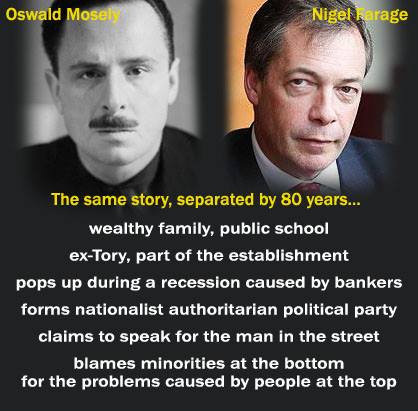
Fascism plays a specific role for the ruling class: it is a weapon against civil unrest during social crises caused by recession. It redirects public anger from the government to scapegoats. To build such a movement, fascists have to delve into the “lower classes” using a mixture of crude economic radicalism and racism. Oswald Mosley also started out as a Tory and he was a rich aristocrat. His tactic was “street politics”, rather like Farage’s appeal to woo “ordinary people.” Mosley cut himself adrift from the mainstream ruling class when in early 1934, he launched a campaign for street supremacy in key working class areas.

Farage is comparable with Mosely: he also tried to entice the working class, and those blue collar defectors who don’t feel solidarity with anyone except their “own kind” need to ask themselves how a fascist party would better reflect their interests, because fascists aren’t just fascists when it comes to your preferred target group – in this case migrants – fascists are fascists, full stop. And most migrants are working class, too.

Fascists are not known for being big on unions and worker’s rights either, Hitler smashed the unions, Mosely fought them too. But fascists do like to use the oppressed to oppress others.

Mosely was defeated by working class solidarity – Jews, communists, socialists, the labour movement, and the middle classes, who all stood side by side in Scotland, Newcastle, in the Valleys, Yorkshire, at Olympia and on Cable Street. Unity and regard for the rights and well-being of others was their greatest strength.

That community spirit and solidarity is precisely what we need to find again. The disgruntled beast is divisive, and it feeds on demoralisation, alienation, feelings of isolation and a lack of regard for others.

Identity politics and the faultlines of division

Lynton Crosby, who has declared that his role is to destroy the Labour Party, rather than promote the Conservatives, based on any notion of merit, is all about such a targeted “divide and rule” strategy. This is a right wing tactic of cultivating and manipulating apostasy amongst support for the opposition. It’s a very evident ploy in the media, too, with articles about Labour screaming headlines that don’t match content, and the Sun and Telegraph blatantly lying about Labour’s policy intentions regularly.

One major ploy has been to attempt to rally the disgruntled working classes behind the flag of identity politics – aimed exclusively at the most disgruntled, very purposefully excluding other social groups. It also sets them against each other, for example, the working class unemployed attacking migrants – it really is divisive, anti-democratic, and flies in the face of labour’s equality and diversity principles. It also enhances the political myth of convenience – the “out of touch/allthesame MPs”, some of those stoked-up disgruntled blue collar workers have defected to UKIP.

There’s an immediate danger that if the far-right succeed in colonising the anti-mainstream vote, as they are aiming to, and developing party loyalty, it will block the development of an independent working class politics capable of defending our conditions and challenging the status quo.

UKIP (and the Tories) first and foremost are traditionalists and defenders of property, with the socially paranoid ideology of the hard right. A dominant theme is a conspiratorial view of the EU as a sort of “socialist plot”, with the Eurocrats encouraging mass immigration, stifling small businesses with legislation and fuelling the welfare state. And working class cultural imperialism – some blue collar workers and working class supporters have disgruntled beasts that respond to the populist, “anti-establishment”, Islamophobic agenda. The wealthier middle class supporters who were traditionally Conservative want to force the Tories further to the right.

Thanks to the persistent propaganda work of the government and the media, the tendency is to see the far-right’s behaviour as merely the justified reaction to the provocation of socially stigmatised groups – the sick and disabled, the unemployed, Muslims and immigrants. This is the climate in which UKIP and its allies thrive. As a result, there is an urgent need to shift toward a wider cultural and political offensive against prejudice more generally. Again. The only party concerning itself with that, as ever, is Labour.

UKIP supporters manifestly don’t care about prejudice directed at others. At the very least they are not repelled by racism, sexism, disablism and homophobia, they seem unsentimental about the types of alliances they find themselves in. Yet working class UKIP supporters are cutting off their own noses to spite their faces, as UKIP are Thatcherites: neoliberal white trash. Fascists don’t support the working class –  they never have and never will. No matter how much they say otherwise.

I’ve talked about UKIP, here, but they are not the only party drawing on the propaganda of the right. I have seen Left Unity, the Greens, the SNP, and a range of so-called socialist groups utilise right-wing myths about the Labour Party, too. This means we end up repeatedly fighting to clarify truths amongst ourselves instead of simply fighting the injustices and lies of the Tories.

It also struck me that we have a raft of writers loosely writing about the Labour Party that don’t seem to promote achievements and positive policies, which is at the very least as important as the negatively weighted “critical” analyses of the last Labour government, for balance and for providing a framework for those perpetually disconsolate readers that tend to feed their pet disgruntled beasts from buzz phrases and glittering generalities for the perpetually unhappy orthodoxy obsessed narxists – like “working class disenfranchisement”, “New Labour”, “Progress”, “Blairite”, “weakened unions”, “blue labour” and so forth. Many narxists have a peculiar elitist and very  non-inclusive obsession with what socialism ought to be.

Ticked boxes and pressed disgruntle buttons.

It was mostly the disgruntled blue collar workers that found UKIP’s inverted elitism – anti-intellectualism, anti-middle-classism and a few other prejudices more appealing, and defected, in a false conscious moment of supreme nose-cutting and spited faces. I don’t see anything to be gained in fueling their discontent, propping up populism, and its irrational response – a nod in the direction of fascism from people claiming they are excluded from mainstream politics – so they defected to a party that is founded on the rhetoric of exclusion.

There are contradictions between UKIP’s ultra-Tory policies and the instincts and interests of its working class supporters. So, not quite “breaking the mould of British politics” then.  UKIP demagogically and disingenuously attack Labour for abandoning white workers, but they also focus on attacking David Cameron for not being Conservative enough.

Farage implies he has some sort of superior social knowledge and wisdom compared with the rest of the mainstream political class, and that he understands “ordinary people”, but he speaks fluently in the language of anti-progression, the fact that anyone at all is listening is indicative of an internalisation of the national right wing prejudice toward a profound anti-intellectualism.

And of course anti-intellectualism is to be expected from the Conservatives, who have historically used the repression of critical thinking as a way of deflecting scrutiny, and as a means of ensuring a compliant, non-questioning workforce to exploit. From the working class, however, it’s just the politics of resentment, and another disgruntled face of bigotry. So much for class consciousness. And solidarity.

It’s worth remembering that Marx and Engels were hardly working class, and they most certainly were intellectuals. Left wing UKIP supporters have no fig leaf to hide behind.

It’s one thing to be opposed to traditional elites, but to show support for a party so vehement in its hostility to democracy, trade unionism, socialism, human rights, our NHS and the welfare state because someone speaks with a pint and a ciggie in their hands, indicates the need for some responsible critical thinking, paying attention to details, less resentment, superficiality and disgruntled grunting.

Fascism always presents itself as your friend, it extends a cozening arm of camaraderie around your shoulder with a sly smile, a malicious grin with far too many teeth.

It’s a disgruntled beast that loves disgruntled beasts, but this public school boy and ex-Tory with offshore tax havens isn’t one of the lads from the shop floor. Farage didn’t take any lessons from the school of hard knocks, that’s for sure.

But many of us have membership in more than one oppressed group, surely its possible at least to recognise in principle the validity of other struggles against oppression, it’s important to recognise that these struggles are not in a zero-sum relationship with one another. They are complementary and cumulative. I believe the collectively oppressed are natural allies in a larger fight for justice, and create a whole greater than the sum of its parts, and this kind of intersectionality and solidarity undermines the ruling-class’s “divide and conquer.”

I think the divisions are what happens when you just feed the disgruntled beast.

That’s the problem with identity politics: it tends to enhance a further sense of social segregation, and it isn’t remotely inclusive. Of course it also enhances the myth of  “out of touch/ allthesame” politics. It’s a clever strategy, because it attacks Labour’s equality and inclusive principles – the very reason why the Labour movement happened in the first place – and places restriction on who ought to be “included”. Think of that divisive strategy  1) in terms of equality. 2) in terms of appealing to the electorate 3) in terms of policy. Note how it imposes limits and is reductive.

The Tories set this strategy up in the media, UKIP have extended it further and the minority rival parties, including the Green Party have also utilised the same rhetoric tool. Yet we KNOW right wing parties have NO interest in the working class. And those amongst the working class that have.

The Tories do not offer up public critical analysis of themselves. Indeed the anti-Labour bias on display by the Murdoch-owned news empire has never been more apparent. That’s not just because of ideology, it’s because Miliband stood up to Murdoch. But Tories don’t collectively and painfully self-scrutinise or soul search, and certainly not in public sight: they self promote. They speak with unfaltering conviction, and from that platform they control public debate and that’s despite their continuing assault on public interests.

So, where is our fully informed pro-labour spokesperson in the media? Where are the articles that inform people – the ones about what Labour do, rather than what they ought to do? Because the implicit message over and over from undoubtedly well-meaning left-leaning writers is that Labour constantly get it wrong and need advice on how to get it right, whilst their policies are not being publicly promoted, analysed, and their progress and achievements remain hidden from view. What gets attention is myth reduced to populist pseudo-critical soundbites.

The media and the message

That means, potentially, many people don’t know enough on balance to make informed choices. Disgruntled defectors often take the medium to be the message, unfortunately, and with no balance, no genuine pros and cons, just a perpetual party wish list, that reads as a list of deficits, many are fueling an often misinformed, unreasonable, hungry disgruntled beast. You present the policies from source that fill the cited alleged deficits, and dear lord, people actually get angry and abusive.

A few months ago, a well-known left wing commentator wrote a “critical” article about Labour that was based on inferences drawn from a very suspiciously muffled recording of Jon Crudass, which was a couple of minutes long, and which ended, somewhat dubiously, in mid-sentence. The recording was very well-utilised by the right wing, too.

At the time, having heard it, I challenged the writer concerned regarding the references to that very dodgy recording, and the inferences he had drawn from it, which echoed those of the Tories. I was ludicrously and condescendingly told I was being “anti-democratic”, in my “blind and uncritical” support for the Labour Party. From where I’m stood, it certainly isn’t me that is being anti-democratic, here.

It seems to be almost trendy to try and undermine Labour’s credibility and completely regardless of the accuracy of any “criticism” used. Since when was it anti-democratic to want to tell the truth, supported with facts? Why is it that people have such objections to a person being supportive of the Labour Party, anyway? That doesn’t make me undemocratic, “blind” or “uncritical” at all. I’m discerning, and the truth actually matters to me, in all of its detail. I put a lot of work in researching to ensure that I’m well-informed. And why is any of this a reason for people to direct condescending and disgusting abuse and nastiness? Yet somehow, this behaviour has become normalised and acceptable.

One response I’ve seen frequently is: “oh, but people are disillusioned with Labour”. Yeah? Well stop writing inaccurate commentaries that create disillusionment and alienation, then. Perhaps it’s time people learned to research facts for themselves, anyway, rather than allowing their apathy and disgruntledment to be fed by willing, earning authors or propaganda merchants and Tory/SNP/UKIP/Green shills and trolls on Facebook.

The Tory press operation had handed the Daily Telegraph and the BBC the transcript of that same recording of Jon Cruddas, who was approached in the foyer at the Fabian summer conference at the Royal College of Surgeons in London.

A note from the Conservatives accompanying the transcript made clear that the recording had been made by researchers posing as students, according to the account on the BBC website.

The Labour Party is considering referring the transcript of the remarks to the Press Complaints Commission, and the former standards watchdog Sir Alistair Graham has accused the Tories of entrapment. It was a dirty trick. Why on earth would someone on the left take advantage of such chicanery pulled by the Tories? 

No party is above criticism, and quite rightly so. But the criticism needs to be balanced, fair, accurate and based on informed analysis and fact. And not on any old bullshit that’s masqueraded as “criticism.” Or on secretly recorded partial conversations. If debates are not open and honest, and if criticism of parties and their policies are not based on facts, that isn’t actually debate you’re engaged in: it’s a propaganda campaign.

Surely by now we all know the media lies and excludes anything important; that it’s under authoritarian Tory control? That Iain Duncan Smith “monitors” the BBC for “left wing bias”, that the Guardian’s occasional forays into truth are stifled by jackbooted officials marching into their office and smashing hard drives? Does anyone REALLY imagine that such a government spokesmedia will do any justice to reporting about the positive intentions and actions of its opposition? It won’t. Not one bit.

Yet I see people running around hysterically clutching at cherry-picked, distorted media spun soundbites, as if the media is somehow suddenly credible when it talks of the opposition, and when you actually read what was said and proposed at the unspun initial source, it bears no resemblance at all to the media tale of the unexpected. If you trouble yourself to investigate these things, the crap being published and broadcast doesn’t stand up to scrutiny. But it does feed the disgruntled beast.

And when the media resort to personal smears – like they did last year about Ralph Miliband – you KNOW they are worried about being defeated. And behold their disgruntled beast.

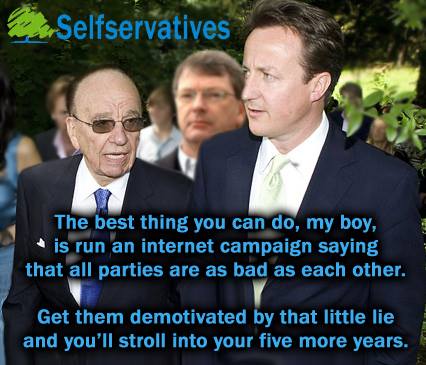
It’s a crucial time when we need to make sure we know the difference between truth and propaganda, fact from fiction. It’s up to us to discern – please. We are each responsible for what happens next. It mustn’t be 5 more years of the same neo-feudalist rulers.

The nitty gritty

The Right are engaged in an all out war. The disgruntled Right know that Miliband has edited their script, abandoning the free-market fundamentalist consensus established by Thatcherism in favour of social democracy.

The right-wing media barons who set the terms of what is deemed politically palatable in Britain have never forgiven Ed Miliband for his endorsement of Leveson, which they believe is an unacceptable threat to their power.

And they know Labour under Ed Miliband will probably win the 2015 election.

This is a war, and the Tories think that chucking an avalanche of lies at the opposition is enough. It isn’t. Where are their positive, supportive, life-enhancing policies for the citizens of the UK? The Tories have NOTHING but increasing poverty and pain to offer most of us, and no amount of smearing Labour and telling lies will hide that fact. And they will do all they can to make sure Labour don’t get space in the media to tell you about their own positive social democracy program, based on tackling the inequality and poverty that Tories always create.

We simply can’t tolerate another 5 years of the terrible consequences of New Right Conservatism.

Some on the left also need reminding that there is far more at stake than tiresome debating about what “real” socialism entails. I can tell you categorically that socialism isn’t about feeding your own pet disgruntled beast at the expense of concern and care for comrades who are suffering, living in absolute poverty and dying, because of the policies of this authoritarian regime. We need to address the current crisis, the sociopolitical dysfunction, and escape Cameron’s vision of a feudal dytopia before we can even begin to design our utopia, based on orthodoxy or otherwise.

The outcome of the general election, and the future of this country, and the well-being of is our citizens is what is important, please let’s not lose sight of that.

Because when you feed only the disgruntled beasts, you just end up with beasts.

14301012075_2454438e62_o (1)

Thanks to Robert Livingtone for the excellent memes

Follow the Money: Tory ideology is all about handouts to the wealthy that are funded by the poor

310024_618087491552293_1852914423_n

Here is yet another great Tory lie exposed – “Making work pay”. This Government have raided our tax-funded welfare provision and used it to provide handouts to the very wealthy – £107, 000 EACH PER YEAR in the form of a tax cut for millionaires. The Conservatives claim that it is “unfair” that people on benefits are “better off” than those in work. But the benefit cuts are having a dire impact on workers as well.

People in work, especially those who are paid low wages, often claim benefits. Housing benefit, tax credit and council tax benefit are examples of benefits that are paid to people with jobs. Indeed the number of working people claiming housing benefit has risen by 86 percent in three years, which debunks another Tory myth that benefits are payable only to the “feckless” unemployed.

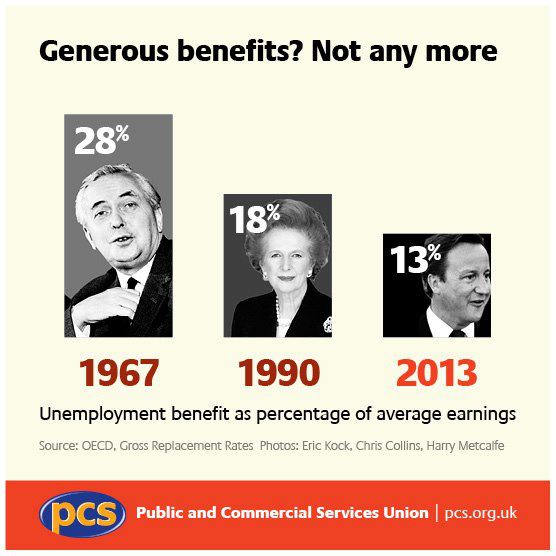
By portraying housing benefit as a payment for “the shirkers”, not “the strivers”, Cameron and Osborne aim to convince the public that their draconian, unprecedented welfare “reforms” are justified. 60 percent of people visiting food banks last year were in work. But unemployment benefits are just 13 percent of the national average earnings. What Cameron’s Government have done is created extreme hardship for many of those in work, and further severe hardship for those who are unemployed.

“Making work pay” is a big lie that has benefited no-one but the very wealthy, and the reduction in both the value and the amount of welfare support for unemployed individuals has come at a time when we are witnessing steady reductions in worker’s rightsand worryingly, the Tory-led Government is stepping up its attack on employment health and safety regulations. And the unions.

Last week, on the 25th April 2013, the Enterprise and Regulatory Reform Bill was granted royal assent, bringing into law the Government’s widely unpopular proposals to scrap employers’ 114-year-old liability for their staff’s health and safety in the workplace. This steady erosion of our fundamental and hard-earned rights in the workplace is linked to the steady erosion of the basic human rights of the poorest citizens. The Government have liberated wealthy private companies of any moral or legal responsibilities, so that they can simply generate vast profits by exploiting workers who have increasingly fewer means of redress.

There is also a growing reserve army of labour that may be exploited via the workfare schemes. This will mean that unscrupulous, greedy, profit-driven employers will increasingly replace paid workers with unpaid ones that are forced to work for their benefits or face losing them. This is a politically enforced programme of reducing the population’s expectations regarding choice, opportunities, rights, and quality of life.

A recent proposal from our “caring Conservatives” is that new in-work claimants should be required to attend an initial interview at a Job Centre “where a conditionality regime should be set up to ensure the individual is doing all they can to increase their hours and earnings”.

Claimants “should then be forced to attend a quarterly meeting to be reminded of their “responsibility” to try to increase their earnings”, with sanctions applied for failing to attend. This may well be the next stage of the welfare “reforms”, incorporating a punitive approach to those in work on low hours or low pay, as well as those unfortunate enough to be out of work.

There is absolutely no evidence, sense or logic behind the Tory claim that cutting welfare will “make work pay”. Well, unless we are referring to the greedy employers that will benefit and profit from the welfare “reforms” and reduction in worker’s pay level and rights. This is about gross exploitation and profiteering at any cost to human lives.

“Making work pay” is an entirely ideologically-driven, dogmatic, absurd and reductionist Conservative superficial soundbite. There is certainly an essence of all that is Tory in the word “peremptory”. There is also many a Tory donor in private business that wants to see more profit and a more abject workforce.

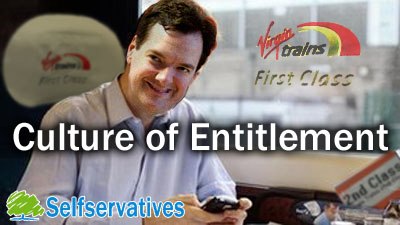
The real “culture of entitlement” is not to be found among poor citizens, those who are unemployed, sick and disabled citzens, as this Government would have you believe. As a matter of fact, most amongst this politically demarcated social group have paid tax and paid for the provision that they ought to be able to rely on when they/we have need of it, it’s ours, after all. The real culture of entitlement emanates from the very wealthy, and is well-fed and sustained by an aristocratic and authoritarian Government.

Every time we have periods of high unemployment, growing inequalities, substantial increases in poverty, and loss of protective rights, there is a Conservative administration behind this wilful destruction of people’s lives, and the unravelling of many years of essential social progress and civilised development that spans more than one century in ontogeny and maturation.

The Conservatives lied about our “generous welfare”. It wasn’t and it certainly isn’t now. Coming at the same time that severe cuts to tax credits and benefits are set to make an estimated 11.5 million households poorer, the Chancellor was accused by Britain’s largest union, Unite, of conducting class war on the poor while giving handouts to the rich.

The following cuts came into force in April 2013:

  • 1 April – Housing benefit cut, including the introduction of the ‘bedroom tax’
  • 1 April – Council tax benefit cut
  • 1 April – Legal Aid savagely cut
  • 6 April – Tax credit and child benefit cut
  • 7 April – Maternity and paternity pay cut
  • 8 April – 1% cap on the rise of in working-age benefits (for the next three years)
  • 8 April – Disability living allowance replaced by personal independence payment (PIP)
  • 15 April – Cap on the total amount of benefit working-age people can receive

    922829_509977429064049_604527973_n

In addition, wages have not risen in real terms since 2003 and there are further fears that the Government is trying to pressurise the Low Pay Commission into cutting the national minimum wage from its present £6.19 per hour. At a time when the cost of living has risen so steeply, the Government has also increased VAT.

Commenting, general secretary Len McCluskey of Unite said: “Millionaires will be raising a glass of champagne to George Osborne this weekend as he slashes the incomes of people struggling to get by to give handouts to the rich.”

“But ordinary people – taxpayers – will be furious that George Osborne has chosen to give away £1 billion to the super-rich while their fuel and food costs rise and wages are falling”.

“His party knows no shame. They are trying to claim that their tax cuts benefit ordinary people but this is another lie – the truth is that while those earning over £1 million per year will be an average £100,000 better off, low income families will be around £900 worse off.”

“This is not the way to recover our failing economy.  Creating real jobs and paying decent wages, including a one pound increase on the minimum wage, will bring down the benefits bill and get people spending again.”

“Instead of getting on with the job he ought to be doing, like sorting out the problems he has caused to our economy, Osborne prefers to encourage hatred and demonise the poor, both in and out of work, in an ideological attack on our welfare state.”

Ed Miliband said: “David Cameron and George Osborne believe the only way to persuade millionaires to work harder is to give them more money.

But they also seem to believe that the only way to make you (ordinary people) work harder is to take money away.”

Bravo Ed, a very well spotted contradiction regarding Cameron’s claims about how “incentives” work. Apparently, the rich are a different kind of human from the majority of human beings.

Here are some of the Tory “incentives” for the wealthy:

  • Rising wealth – 50 richest people from this region increased their wealth by £3.46 billion last year to a record £28.5 billion.
  • Falling taxes – top rate of tax cut from 50% to 45% for those earning over £150,000 a year. This is 1% of the population who earn 13% of the income.
  • No mansion tax and caps on council tax mean that the highest value properties are taxed proportionately less than average houses.
  • Benefited most from Quantitative Easing (QE) – the Bank of England say that as 50% of households have little or no financial assets, almost all the financial benefit of QE was for the wealthiest 50% of households, with the wealthiest 10% taking the lions share
  • Tax free living – extremely wealthy individuals can access tax avoidance schemes which contribute to the £25bn of tax which is avoided every year, as profits are shifted offshore to join the estimated £13 trillion of assets siphoned off from our economy.

It’s plain to see that Cameron rewards his wealthy friends, and has a clear elitist agenda, while he funds his friends and sponsors by stealing money from the taxpayer, by stripping welfare provision and public services down to bare bones.

A simple truth is that poverty happens because some people are very, very rich. That happens ultimately because of Government policies that create, sustain and extend inequalities. The very wealthy are becoming wealthier, the poorest are becoming poorer. This is a consequence of  “vulture capitalism”, designed by the opportunism and greed of a few, it is instituted, facilitated and directed by the Tory-led  Coalition.  

Welfare provision was paid for by the public, via tax and NI contributions. It is not a “handout.” It is not the Governments money to cut. That is our provision, paid for by us to support us if and when we need it. It’s the same with the National Health Service. Public services and provisions do not and never did belong to the Government to sell off, to make a profit from, and to strip bare as they have done

Low wages and low benefit levels, rising unemployment and a high cost of living are major causes of poverty. (“worklessness” is a made-up word to imply that the consequences of Government policies are somehow the fault of the victims of this traditional Tory harshness. It’s a psychological and linguistic attack on the poorest, disabled people and the most vulnerable citizens – blaming the unemployed for unemployment, and the poor for poverty.)

Those are a direct consequence of Coalition policies. The Coalition take money from those who need it most to give away to those who need it least. That causes poverty, and cannot fail to create growing inequality. The Coalition are creating more poverty via the class-contingent consequences of policies.

It’s time to debunk the great myth of meritocracy. Wealth has got nothing whatsoever to do with “striving” and hard work. If it were so simple, then most of the poor would be billionaires by now. 

This week it was reported that one school liaison officer told how a parent came to her pleading for help because her children were suffering from SCURVY – a potentially fatal condition caused by a severe Vitamin C deficiency. It’s an illness linked with malnutrition and poverty, and has seldom been seen in this Country for most of this century, due to improvements in medical knowledge, and the development of adequate welfare provision – that had eliminated absolute poverty in Britain. Until now. It’s increasing again.

We now have pre-Victorian Health and Safety laws in the workplace. We have Victorian malnutrition and illnesses such as scurvy and rickets. Malnutrition has resurfaced because of the re-appearance of absolute poverty – something that was eradicated because of our effective, essential welfare program, until now. We have a punitive Poor Law approach to “supporting” the poorest instead of welfare provision. These ideas and subsequent harsh and punitive policies were a dark part of our history, and now they have been resurrected by the Tories to be a part of our future. It’s social regression.

We have recession and austerity, entirely manufactured, based on ideology and not because of any economic necessity. Austerity does not include and affect the very privileged. Indeed they have benefited immensely from the politically engineered economic situation.  We have a society that has been lulled into forgetting equality, decency and fairness. We have a lying authoritarian Government that created a crisis for many to make profiteering opportunities for a few.

The New Poor Law of 1834 was based on the “principle of less eligibility,” which stipulated that the condition of the “able-bodied pauper” on relief be less “eligible” – that is, less desirable, less favourable – than the condition of the independent labourer. “Less-eligibility” meant not only that the pauper receive less by way of relief than the labourer did from his wages but also that he receive it in such a way (in the workhouse, for example) as to make pauperism less respectable than work – to stigmatise it. Thus the labourer would be discouraged from lapsing into a state of “dependency” and the pauper would be encouraged to work.

The Poor Law “made work pay”, in other words.

The clocks stopped the moment that the Tories took Office. Now their policies mean that we are losing a decade a day.

544840_330826693653532_892366209_n

208082_397796890289845_858870070_n (1)

 Pictures courtesy of Robert Livingstone

Further reading:

Conservatism in a nutshell

Families £900 Per Year Worse Off After Benefit And Tax Changes, Says Labour’s Ed Balls

Labour exposes Osborne’s tax cut for bankers

A catalogue of failure and broken promises-Catherine Mckinnell MP’s verdict on George Osborne’s autumn statement

The poverty of responsibility and the politics of blame 

“We are raising more money for the rich” – an analysis 


I  don’t make any money from my work. But you can help if you like by making a donation to help me continue to research and write free, informative, insightful and independent articles, and to provide support to others. The smallest amount is much appreciated – thank you.

DonatenowButton

Every child used to matter: a summary of “Remembering when Every Child Mattered”


The Coalition: from all that mattered to the secretive dismantling of State support

Michael Gove certainly put the “Tory” in “peremptory”. When he took office in Sanctuary Buildings, it was as the secretary of state for education, not children. He gave Every Child Matters (ECM) a swift name change, and a radical shift in focus, the very day after the Coalition came into office. Authoritarians plan well in advance, it seems, and set their designs in motion very swiftly. The new Government placed a ban on the phrase “Every Child Matters” as part of a widespread change in terminology within Whitehall departments. Effectively, the ECM policy was scrapped.

Details of the changes are revealed in an internal Department for Education (DfE) memo, split into two columns for words used before 11th May and those which should be replaced. The phrase “Every Child Matters” was immediately replaced with the phrase “helping children achieve more”. Achievement was only one of the original five ECM outcomes, and the other four have now been dropped. Family intervention projects – another ECM policy development, have been disbanded, and that phrase is also banned from use within Gove’s despotic and linguistically pauperised Department.

One of the first things Gove did was to rename the original and expansive Department for Children, Schools and Families (DCSF) as a considerably reduced Department for Education (DfE). The Every Child Matters webpages are still linked to this site, but with the warning (a Tory- led Government health warning…) that:

“A new UK Government took office on 11 May. As a result, the content on this site may not reflect current Government policy.

All statutory guidance and legislation published on this site continues to reflect the current legal position unless otherwise indicated.”

Gove also recommended that Contactpoint is scrapped, with a focus on a “signposting system” (usually a direct referral) focusing on “genuinely vulnerable children”. This ridiculous statement implies that some children have been somehow fraudulently obtaining child protection and welfare services and support. And that professionals are not capable of recognising “genuinely vulnerable” from not vulnerable. What this attempted “targeting services” rhetoric translates as is “we are going to cut funding”.

The original Department’s rainbow motif, complete with brightly coloured cartoon children – derisively referred to as “munchkins” by Conservative advisers – was ditched in favour of stark, austere, dark Conservative blue lettering. The Coalition have quietly pushed a shift from the Labour recognition of children’s potential, promoting their well-being and safety to a flat uni-dimensional standards linked achievement.

Schools no longer have a statutory duty to promote children’s spiritual, social and emotional well-being, and the Labour idea of a self- aware and responsible Citizenship based element to education was also removed from the curriculum. (Though the Conservatives have changed the definition and terms of “responsible citizenship” since, it’s now used as a form of state coercion to justify withdrawal of tax funded support provision). Ofsted no longer grade schools on this: Tory ministers seem to regard the ECM initiative’s goals as distractions from schools’ core purpose. No longer do children need to “enjoy and achieve” – just achieve. Local cutbacks are making it harder for schools to bring in specialised support. Once again. Same old Tories. Same old essential support provision being stripped away.

What was a “Children’s Plan” under the Labour Government is now a “free market education plan” marking Goves shift from free schools to “for profit” schools. This, of course, is certain to cause institutional confusion, with each school having individual freedom, self publicity and marketing responsibility and with no universal statutory protection policy in place. The whole-child approach has been abandoned in favour of a narrow focus on educational standards.

Michael Gove described the “Every Child Matters agenda” as “meddlesome”, but what he really meant is that this Government are not prepared to fund the health, safety, protection and well-being of every child that needs support. Labour ministers wanted to do more than just protect children, they wanted to “ensure that every child has the chance to fulfil their potential”. This Government are not interested in the welfare or the potential of our children.

It’s common sense that if you are really focused on improving attainment and helping children to achieve educationally, as Gove is claiming, that attainment is inextricably linked to their overall well-being. The dismantling of ECM has some very far reaching and negative consequences, for child protection and welfare, equal opportunities, acknowledging diversity, family support, respite care, education provision (especially for those pupils that don’t have mainstream needs) are but a few that come to mind.

Every Child Matters was a Labour policy, which was joined up thinking at its very best. The policy is the best in terms of child protection and welfare that we have ever seen. In addition to a robust and crucially effective and preventative approach to child protection (overdue since the beginning of social care, as previously the emphasis had simply been on “crisis intervention”), Labour’s ambition is to improve these outcomes for all children and to narrow the gap in outcomes between those who do well and those who do not.

In January 2001, the health secretary, Alan Milburn, ordered a statutory public inquiry into Victoria Climbie’s horrific death, which was headed by former chief inspector of social services, Lord Herbert Laming. The Labour Government drove a moral impetus, in addition to implementing Lord Laming’s recommendations within a coherent and comprehensive policy framework, legislating to address the significant gaps in child welfare provision, more broadly.

Child protection became EVERYONE’S responsibility and concern. Compassion, equality, holism, and the cooperative principle lay behind   the far-reaching Labour reforms that followed. Every Child Matters is the overarching title for the significant, positive, comprehensive flagship policy, which required all public sector organisations working with children to come together to prevent any more tragedies.

Enshrined at the heart of Every Child Matters was the Paramountcy Principle: this states that the welfare of children is at all times paramount and overrides all other considerations. This reflects a “whole child” approach to welfare and protection, as well as a holistic inter-agency approach to achieving that.

Using the Common Assessment Framework (CAF),  professionals could identify the additional, complex and unique individual needs of the child. CAFs  facilitated the identifying of needs, and the allocation of a lead professional to co-ordinate the provision that was developed quite often by co-opting appropriate agencies and professionals, and by drawing together those professionals already involved in provision for the child/young person, who then worked together co-operatively, as a specialist “team around the child”.

The CAF also facilitated goal-orientated practice and positive outcome-based, tailored provision. The work was planned monitored and evaluated throughout the process. Indeed monitoring and evaluation were built into the process, and CAF paperwork and the database prompted continual scrutiny and accountability throughout.

This was an outstanding comprehensive, coherent, robust child protection and welfare policy, formulated to prevent any more tragedies like the horrific abuse, torture and death of Victoria Climbie. Clearly, Gove doesn’t have the same priorities as the rest of us. The progress that ECM reflects in social work theory and practice, and other professions that involve work with children, was phenomenal. Now that progress has been undone by a Tory-led Government, whose primary concerns include how to make money from selling off our childrens’ school playing fields, and “for profit” schools, with the dismantling of Childrens’ Services, it is very clear that the current Government have no intention whatsoever of protecting our children and ensuring their well-being.

With the very challenging cuts that local authorities face, many have had to severely reduce their children’s social care budget by up to a fifth – forcing them to focus purely on their statutory responsibilities, and barely, at times. Labour’s development of the effective, comprehensive and crucial preventative support services has been totally demolished by the Coalition. Apparently, Gove thinks that children and young people’s safety and well-being is optional.

68 per cent of our front line children’s services have had cuts to their budgets in 2011 alone. Bearing in mind these are also providing statutory services and also considering that many local authorities are pessimistic about the future of these services, and with most charities previously funded to undertake ECM outcome based work –  work with families in which children are struggling at school because of problems at home including poverty, adult mental health problems, domestic violence, substance abuse truancy  and poor housing – being also fearful for the future of the most vulnerable members of society. In some areas, support for vulnerable children of school age has just been cut from the budget completely. And as we know, the worst of the cuts is yet to come.

When the full extent of the welfare reforms is realised next year – the benefit cap, the bedroom tax, and the poll tax style council tax via the Localism Bill, which are still yet to come, the numbers of children and young people facing substantially increased deprivation and poverty will rise steeply, with problems such as increased risk of neglect, risk of emotional and physical abuse – the resilience of parents is more likely to be affected by poverty, (the NSPPC (2008) Inform study recognises this link) mental health problems, lack of educational attainment and fewer life chances (further compounded by other punitive Coalition policies, that have significantly reduced equal opportunities) amongst other significant complex, interconnected problems becoming much more commonplace.

Poor and vulnerable children will need extensive support from both statutory frontline services and range of other support services that are no longer in place. The impact of Coalition cuts on the lives of so many vulnerable children and adults, together with the dismantling of essential welfare, support and protection services, will be catastrophic, and very likely, an irreversible horror that we – as a so called civilised society – will have to face.

“Each child’s story is worthy of telling. There should not be a sliding scale of death. The weight of it is crushing.” – Anderson Cooper

The original full length article is here