Tag: United Nations

Our social security has been redesigned. It’s now a welfare deterrent

PIP

Hunger and desperation used quite ruthlessly by a “health care professional” to controversially justify refusing a disability support claim. Access to food banks can only happen if you are referred by a professional, such as a doctor or social worker. Furthermore, you can generally have a maximum of only 3 referrals per year. The ESA and PIP eassessment guidance says that a person must be able to walk the distance specified “reliably, consistently, safely and in a timely manner.”
universal-credit.jpg
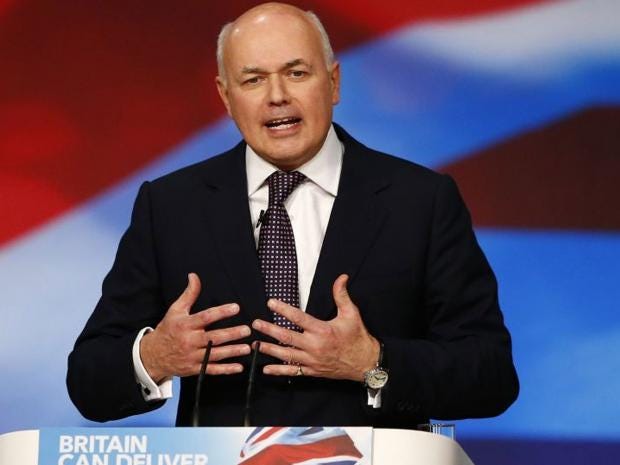
Iain Duncan-Smith struggled financially once, but then he got off his backside and was given a Tudor mansion by his father-in-law, the fifth Baron Cottesloe, which proves rewards come to those prepared to make an effort.  Reuters.

“Universal Credit doesn’t go far enough – work won’t pay until people are running naked through stinging nettles to get their benefits.

As Universal Credit develops, it can encourage other skills, so if your electricity has been cut off, you have to screw your application form into a ball and dribble it through a line of cones before kicking it into a bucket. That way you can soon come off benefits and earn £5m a year as a winger for Manchester City.” Mark Steel, writing for the Independent

The Conservative notion of “deserving” and “undeserving” poor is a false dichotomy. No-one deserves to be poor

“Deserving” is a politically divergent word if there ever was one. The Conservatives have used it to apparently wage an all out class war, using austerity as a smokescreen. They certainly don’t take the side of the proverbial underdog. In fact the more need you have, the less this government considers you “deserving” of support and sympathy.

Policies aimed at people with what are politically regarded as “additional needs” are largely about ensuring your compliance, conformity and commitment to “behavioural change”, on the assumption that people somehow erroneously “choose” to need financial support. Claiming any form of state support has come to entail a deeply hostile and extremely challenging process that is causing psychological distress and often, physical harm, to our most vulnerable citizens. There are plently of examples of cases where this has happened documented on this site alone.

Such a disciplinarian mindset is now embedded in social security policy, rhetoric and administration. But we’ve been here before, back in 1832, when the Poor Law Amendment Act was aimed at categorising and managing “deserving” and “undeserving” poor. Those considered “deserving” were unfortunately placed in workhouses and punished by a loss of citizens freedoms and rights, in order to “deter” people from being poor. (See also The New New Poor Law, 2013.)

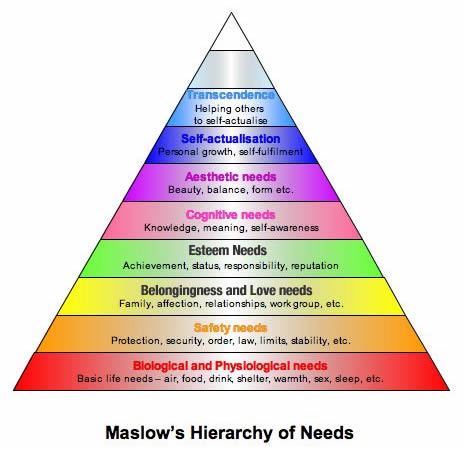
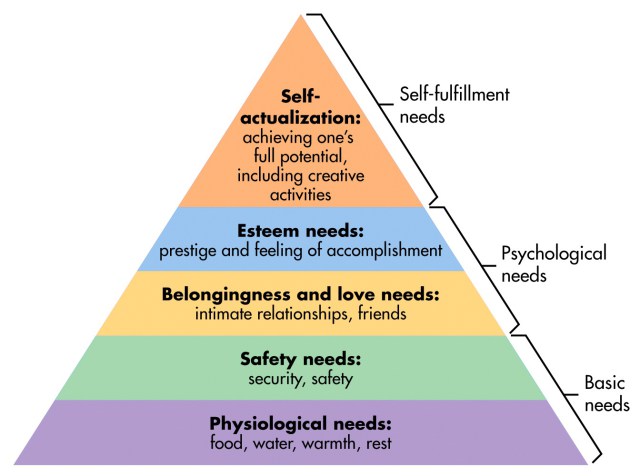
I’ve yet to come across a single case of someone being punished out of their poverty. Someone ought to send every government minister a copy of Maslow’s hierarchy of human needs, and remind them all that our post-war social security was originally designed and calculated to ensure people could meet the costs of basic survival needs, such as for food, fuel and shelter.

It was recognised back then that people struggling with basic survival requirements were highly unlikely to fulfil other higher level psychosocial potential, such as looking for work. If we want people to find work, we must first ensure they have the necessary resources to do so. And that the work available will make a real difference to their standard of living. 

Poor people don’t create poverty, state decision-making does. The economy and labor market conditions do. The punitive approach to poverty didn’t work in the 1800s and 1900s, and it isn’t working and can’t possibly be made to work now. It’s an ideological dead horse. It died because of the brutal and unrelentless use of too much political brutality, the heavy hand of the state offering all stick and no carrots for poor people.

Being poor is itself punishing enough. Now the poor are being punished for being punished with poverty.  No-one chooses to be poor, our overarching socioeconomic organisation is founded on the very principles of competition. Neoliberalism invariably means there will be a few “winners” (1%) and a lot of “losers” (99%). It’s embedded in the very nature of such a competitive system that emphasises individualism, rather than collectivism, to create increasing inequality and poverty. 

It’s worth considering that people on low pay, or with part-time hours in work are also being sanctioned, if they claim “top up” benefits to supplement their exploitative rate of pay or poor and unstable work conditions. This fact is hardly a good advertisment for the government’s claim of “making work pay”, unless of course we refer back to the poor law reform “deterrence” of 1834. Apparently, making welfare sufficiently punitive to deter people from claiming it is how we make work pay, not by raising wages in line with the cost of living. Silly me. I mistook a propaganda soundbite at face value. It seems old ideolologies die hard, with a vengeance.

Apparently it’s an individual’s fault for not “progressing in work”. Nothing to do with increasingly precarious employment situations, executive decision-making, or a deregulated labor market, of course. 

In-work benefits have effectively subsidised employers’ wage costs. Yet low paid workers are being punished by the government for this state of affairs.

It’s not so long ago that we had a strong trade union movement that used collective bargaining as a method of improving wages and working conditions. But the free market ideologues don’t like trade unions, or welfare provision. They like a neat, tidy and very small, limited interventionist state. Or so they claim.

The paradox, of course, is that in order to reduce supportive provisions, and dismantle the welfare state in order to fulfil the terms and conditions of neoliberalism, the government has to implement strategies that ensure citizen compliance. Many of those strategies are increasingly authoritarian, rather than “non interventionist”, in nature.

It’s not the welfare state, but the state of welfare that is the pressing problem

Private companies have become more firmly embedded in the core concerns of all departments of government in designing and delivering on public and social policies, and policies have become increasingly detached from public need, and more directed at meeting private interests, largely involving making huge and private profits. The Conservatives don’t seem to consider that rogue private businesses like G4S, Atos, Maximus, A4E, and so on, are extensions of the state, fulfilling what are, after all, state-determined functions.

Of course this creates an imbalance between the role of the welfare state in aiding private capital and its role in maintaining and supporting labor, and fulfilling the basic needs of citizens. Corporate welfare underpins neoliberal economies, and it costs the public far more than reduced public provisions promises to save.

In January 2016, the National Audit Office (NAO) published its evaluation of the DWP’s health and disability assessment contracts. It said the cost of each Work Capability Assessment (WCA) had risen from £115 under Atos to £190 under Maximus. The report also states that only half of all the doctors and nurses hired by Maximus – the US outsourcing company brought in by the Department for Work and Pensions (DWP) to carry out the assessments – had even completed their training.

The NAO report summarised:

5.5
Million assessments completed in five years up to March 2015

65%
Estimated increase in cost per Employment and Support Allowance (ESA) assessment based on published information after transfer of the service in 2015 (from £115 to £190)


84%
Estimated increase in healthcare professionals across contracts from 2,200 in May 2015 to 4,050 November 2016

£1.6 billion
Estimated cost of contracted-out health and disability assessments over three years, 2015 to 2018

£0.4 billion
Latest expected reduction in annual disability benefit spending

13%
Proportion of ESA and Personal Independence Payment (PIP) targets met for assessment report quality meeting contractual standard (September 2014 to August 2015).

Before 2010, cuts to disability support were unthinkable. Now the Treasury regards our provision as their pocket money for tax cuts for the very wealthy

This summary reflects staggering economic incompetence, a flagrant, politically motivated waste of tax payers money and even worse, the higher spending has not created a competent or ethical assessment framework, nor is it improving the lives of sick and disabled people. Some people are dying after being wrongly assessed as “fit for work” and having their lifeline benefits brutally withdrawn. Maximus is certainly not helping the government to serve even the most basic needs of sick and disabled people.

However, Maximus, and other private companies involved in the delivery of welfare programmes are serving the needs of a “small state” doctrinaire neoliberal government, and making a massive profit in doing so. It would cost much less to simply pay people the support they were once simply entitled to. However, the Conservatives are systematically dismantling the UK’s social security system, not because there is an empirically justifiable reason or economic need to do so, but because the government has purely ideological, anticollectivist prescriptions. 

As well as the heavy cost of each assessment to the public purse, there is also the considerable cost of many tribunals, because of the many “wrong decisions”on the part of the Department for Work and Pensions. That’s despite the fact that the government introduced another layer of bureacracy in the form of “mandatory review” in order to deter appeals. People going through mandatory review for a decision to stop their ESA cannot claim ESA again until after mandatory review (if you need to appeal, you can claim ESA once you have the review decision), and so are forced to either try and claim Universal Credit, going 6 weeks at least without any support, or to wait out the Review outcome, which has no set time limit, but usually takes at least 6 weeks for the decision about the original decision. Which is usually the same decision as the original decision, due to outrageous targets that were revealed in the department’s response to a Freedom of Information request, that stated staff conducting mandatory reconsideration reviews were held to a “key performance indicator” that said “80 per cent of the original decisions are to be upheld”.

This is a government that claims social security is “unsustainable” and a “burden” on the public purse, yet has no problem with an extraordinary profligacy with public funds and dispossessing tax payers when it comes to implementing “cost-cutting” and draconian welfare “reforms.” Conservative anti-welfare dogma and traditional prejudices are costing the UK billions of pounds. 

The Tories are all about ideology and not facts. As two authors astutely noted recently, the government seems to be driven by an idea that creating the conditions of purgatory for those they consider “undeserving” will somehow cleanse, redeem and purify people into not being so sinfully poor.  So it’s not actually “welfare” any more, but rather, it’s a “correctional” institution, for coercing citizens into conformity, compliance and a class contingent meekness, with a liberal dash of the protestant work ethic in with the catholic inquisition flavoured ingredients in the mix. Yes, the nasty authoritarian Conservatives really do think like this.

Disability support is virtually impossible to access for many people that doctors consider severely disabled, and involves a measured and ritualised humiliation. The assessments are solely designed to look for “discrepancies” in people’s accounts of how their illness/disability impacts on your day to day living. In other words, it is aimed at looking for reasons, no matter how flimsy, to ensure that welfare support for disabled and ill people is pretty much unobtainable.

Those questions you are asked by the (inappropriately named) Health Care Professional (HCP) that seem like innocent conversation, such as “Do you watch TV? Do you like the Soaps?” translate onto a report that says “Can sit unaided for at least half an hour”. “Do you have a pet?”becomes “Can bend to feed cat/dog.” “Do you use the internet at all?” becomes “No evidence of focus or cognitive difficulties, adequate hand dexterity.”

If you wear any jewellry, that may be noted and used as evidence that you have dexterity in your hands, even if you have severe arthritis and can’t fasten your buttons or a zip,  you won’t be asked if you ever remove your locket/ring/earrings. It will be assumed that you do. It’s a kind of opportunism of neglect and assumption used by HCPs to justify refusing some elements of PIP, or all of your claim. Or it’s the difference between being placed in the ESA Support Group, being placed in the WRAG on the lower award, or simply being refused an award altogether, and told you are “fit for work”. 

If you are unfortunate enough to need a referral to a food bank, and you actually manage to get to the appointment,  because you are desperate, that may also be used as evidence that you can walk further than 200 or 500 metres, even if you can’t, and managed to get a lift there and back.

Challenging such ridiculous assumptions wears you down. It creates distress when someone acting as a gatekeeper to the support you need dismisses your medical reports and account with such disdain, just stopping short of calling you a liar. Challenging the reasons provided for the DWP refusing you a PIP or ESA award is tedious, very stressful and time consuming and tiring. I’m sure that if you manage to do so successfully, even the fact that you managed to collate evidence, ask you doctor for supportive evidence and so forth may be used as evidence that you can function too well to warrant any support. If you demonstrate any ingenuity in coping with your condition, you’ve basically had it.

Once upon a time, support for disabled people was designed to help us remain independent, and to enable us to participate in society. PIP is non means-tested and people can claim it (allegedly) whilst in work.

However, I worked for social services until I became too ill to work. I loved my job, and my salary was very good, too. It was a terribly dehumanising experience to have to face the fact I was no longer well enough and fit for my post. 7 years later, at my PIP assessment, it was decided that my previous job “proved” that I don’t currently have “any cognitive problems.”

That’s despite the assessor acknowledging  in the report I now even need an aid to remember to take my treatments and medications, and that during the appointment, I had to be reminded several times what I’d been asked, as I kept forgetting what I was supposed to be answering. I have systemic lupus erythematosus (SLE), and cognitive dysfunction is very commonly experienced  symptom of this illness

People have even been refused PIP at appeal because they “spend too much time on Facebook.” Too much for what, exactly? Last time I checked, there were no laws in place that meant sick and disabled citizens were prohibited from using social media. Since when did it become acceptable for government officials to endorse and promote the social exclusion of disabled people online? 

But apparently, contradictions and paradoxes are allowed if you happen to be the assessing HCP. The report said that I was “thin” abut “adequately nourished”. She didn’t check my vitamin and mineral levels at all. Nor did she ask me about what I ate and how often. She just said that the aids I have were “adequate” (a perch stool, easy to use tin opener and specially designed easy to use cutlery, which are not especially designed for disabled people, but are easier for me to use because of the handle design and the steak knives instead of standard ones.)

What’s the point of welfare “support” if so few people are able to access it, despite their obvious need?

The United Nations (UN) inquiry into the allegations many of us made regarding the systematic abuse of the human rights of disabled people in the UK has exposed the multiple injustices of targeted cuts and the disproportionate burden of austerity heaped on sick and disabled people, their carers and their families, evidencing and detailing the effects of a range of policy measures affecting them that have been introduced since 2010. These include the bedroom tax and cuts to disability benefits, funds to support independence and social care.

The report concludes that the overall effect of what is now an essentially punitive welfare regime, which has been based almost entirely on unevidenced political claims and assumptions, has had an extremely detrimental and regressive effect on the rights of disabled people, to live independently, to meet their basic needs, to seek and stay in work,  and to be able to live an ordinary life as citizens.

The UN report documented multiple violations of disabled people’s rights, including the way that they are politically portrayed as being lazy and a “burden on taxpayers”, the harm to health caused by unfair assessments, the cuts to legal aid and curtailed access to justice, the imposition of the bedroom tax and the ending of the Independent Living Fund.

I wrote a lengthy article about the unsurprising but nonetheless disquieting report findings and recommendations, as I read throughit at the time, here.

The government have of course indignantly refused to accept the findings of the UN, or accept the accounts of individuals and campaigners like me, disability groups and charities, and other organisations. That’s because the government prefer to cling relentlessly to free market dogma and their traditional prejudices rather than face empirical evidence, facts and truths.

The days of genuine support, to ensure disabled people can maintain dignity and independence, and to be socially, economically, politically and culturally included, are gone. PIP and ESA focus exclusively on what you can’t do: on “functionality”. If you walk your dog or take a holiday, this is taken to somehow indicate that you are not ill or disabled enough to need support. In fact the media turns you into some kind of nasty folk devil and state parasite for trying to live as normal life as possible. If the government and media had their way, we would be trapped indoors in abject misery, or institutionalised.

How dare we try to live an ordinary life.

The government have formulated draconian policies aimed particularly at disabled people. And unemployed people, low paid people, and young people. And migrants. And old people who, like many disabled people, have paid in contributions towards a welfare system, should they need it, but now they also have to work until they drop.

Hey, and you thought governments are elected to meet public needs and spend our money wisely? No, apparently we’re here to serve government needs, to behave exactly as the Conservatives think we should. 

Welfare as a deterrent to… well, welfare.


Image result for poverty welfare punishment

And social security has been redesigned to punish those citizens who have the misfortune to find themselves in poverty.


I don’t make any money from my work. But you can support Politics and Insights and contribute by making a donation which will help me continue to research and write informative, insightful and independent articles, and to provide support to others. The smallest amount is much appreciated, and helps to keep my articles free and accessible to all – thank you. 

DonatenowButton

top 100 blogs

Vote Labour to uphold the rights of disabled people – our letter to the Guardian

Image result for Human rights are universal

The following letter was published in the Guardian today, written and signed by a group of academics, professionals, campaigners and grassroots activists who work together cooperatively.

We collaborate to fulfil our mutual aims of achieving a progressive, civilised, just and safe society for all. We hope to do this by ensuring that the society we are a part of is democratic and fully inclusive: we want a civilised society that observes and meets its human rights obligations on behalf of all social groups. This isn’t happening currently. (See: UN’s highly critical report confirms UK government has systematically violated the human rights of disabled people).

As an independent researcher, writer, campaigner, and as a disabled person, I am very proud to be included among them. 

westminster-20121020-00081

Many disabled people see Labour’s policies as a lifeline, say the 30 signatories to this letter. 

For chronically ill and disabled people, recent years have been a disaster. The UN recently found “reliable evidence that the threshold of grave or systematic violations of the rights of persons with disabilities has been met” (Report, 8 November 2016).

We have been forced through a work capability assessment that the government’s own expert adviser described as “inhumane”, and which in 2015 was found to be associated with an additional 599 suicides.

Many needing help are now forced through another persecutory assessment – the personal independence payment – designed to reduce the numbers qualifying for help by half a million.

Social care has been so savagely cut that some young disabled must wear incontinence pads for lack of toileting assistance. People can’t take any more of this.

Many disabled people are not party-political, but see Labour’s policies for disabled people as a lifeline – envisioning a society where people are treated as human beings deserving of respect, equality and a decent life. Please, don’t endorse recent human-rights abuses; endorse the human rights of disabled people by registering, and by voting Labour on 8 June.

Paul Atkinson Jungian psychotherapist
Stef Benstead Spartacus Network
Peter Beresford Co-chair, Shaping Our Lives
Gary Bourlet Founder, People First Movement in England
Dr Emma Bridger Research fellow in psychology
Professor Woody Caan Journal of Public Mental Health
Dr Kelly Camilleri Registered clinical psychologist
Merry Cross
Dr David Drew Labour Parliamentary candidate for Stroud
Nick Duffell Psychohistorian
Dr Simon Duffy Centre for Welfare Reform
Dr Dina Glouberman Skyros Holistic Holidays
Catherine Hale Chronic Illness Inclusion Project
AC Howard DWPexamination.org – For The UK’s Disabled Community
Chris Johnstone General practitioner
Sue Jones Psychologists Against Austerity, researcher and writer, campaigner
Jayne Linney Disability activist
Alec McFadden TUC Salford
Helen McGauley Trainee clinical psychologist, Lancaster University
Beatrice Millar Person-centred counsellor/psychotherapist
Rev Paul Nicolson Taxpayers Against Poverty
Gavin Robinson Alliance for Counselling and Psychotherapy
Professor Andrew Samuels University of Essex
Nicola Saunders Psychotherapist
Martyn Sibley Disability blogger
Mike Sivier Vox Political
Professor Ernesto Spinelli
Mo Stewart Independent researcher, disability studies
Gail Ward
Dr Jay Watts Queen Mary, University of London
Dr Claudia GillbergSenior Research Associate in Education; Fellow at Centre for Welfare Reform and Disability Rights Activist

Dr Richard House Alliance for Counselling and Psychotherapy


Join the debate – email guardian.letters@theguardian.com

Read more Guardian letters – click here to visit gu.com/letters


I don’t make any money from my work. I am disabled because of illness and have a very limited income. The budget didn’t do me any favours at all.

But you can help by making a donation to help me continue to research and write informative, insightful and independent articles, and to provide support to others. The smallest amount is much appreciated – thank you.

DonatenowButton

EHRC report highlights unacceptable political discrimination against disabled people


Untitled

Discrimination on the grounds of disability was made illegal 20 years ago when Parliament passed the Disability Discrimination Act 1995. Further legislative progress was made with the Human Rights Act (2008) and the Equality Act (2010). So discrimination can’t happen now. Right?

Wrong.

Disabled people are not being treated as being equal with other citizens and continue to be denied the respect, dignity, opportunities, an acceptable standard of living and other acceptable outcomes that non-disabled people take for granted.

The government claim that the economy has recovered from the effects of the global recession, but that recovery is not one that is shared equally to include everyone. If the economy is doing as well as the government claims, why are disabled people still facing austerity cuts to their lifeline support, while wealthy citizens are handed out substantial tax cuts? 

In one of the wealthiest countries in the world, targeting disabled people, who are much more likely to be living in poverty than other citizens, is absolutely inexcusable. However, the neoliberal right justify their rigid small state, pro-privatisation, deregulation, mythological meritocracy, low tax, high VAT and antiwelfare ideology with folklore economics. “Paying down the debt” has become an almost farcical bare-faced and parroted Conservative lie. 

proper-blond

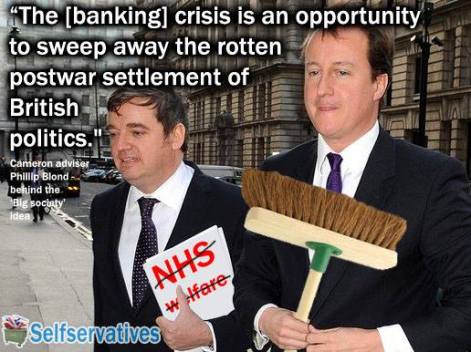
The neoliberal small state “big society”.

The Equality and Human Rights Commission report is the most comprehensive analysis on how (or if) the rights of disabled people are observed and protected in Great Britain. The most recent report says that changes to benefit rules have had a particularly disproportionate, cumulative impact on disabled people’s right to live independently.

According to the report, titled Disability report: Being disabled in Britainwhich was published on Monday, the proportion of disabled people with no qualifications was nearly three times that of non-disabled people. (See also: Disabled students fear for their future as independence payments cut).

Fewer than half of disabled adults are in employment (47.6%), compared with almost 80% of non-disabled adults – and the gap between these groups has widened since 2010-11.

Food poverty has affected 18.4% of disabled people aged 16-64, compared with 7.5% of non-disabled people.

David Isaac, Chair of the Commission, commenting on the damning new state of the nation report into life for disabled people, said: “Whilst at face value we have travelled far, in reality disabled people are being left behind in society, their life chances remain very poor, and public attitudes have changed very little.

“This evidence can no longer be ignored. Now is the time for a new national focus on the rights of the thirteen million disabled people who live in Britain. They must have the same rights, opportunities and respect as other citizens.

“We must put the rights of disabled people at the heart of our society. We cannot, and must not, allow the next twenty years to be a repeat of the past.”

The research, which covers six key areas of life, finds that disabled people in Britain are experiencing disadvantages in all of them, and sets out vital areas for urgent improvement.

This includes: a lack of equal opportunities in education and employment; barriers to access to transport, health services and housing; the persistent and widening disability pay gap; deteriorating access to justice; and welfare “reforms” (cuts) significantly affecting the already low living standards of disabled people.

The Commission has also highlighted these issues to the United Nations, for their forthcoming examination of how the UK measures up to the international standards on the rights of disabled people (the Convention on the Rights of People with Disabilities – CRPD).

The United Nations (UN) has already determined that the UK government has systematically violated the rights of disabled people. The highly critical report, which was published in Geneva last December also concluded that the rights of disabled people to live independently, to work, and achieve an adequate standard of living have been detrimentally affected by the Conservative’s austerity programme.

The range of measures aimed at reducing public spending since 2010, including extremely controversial changes such as the bedroom tax, and cuts to disability benefits and social care budgets have disproportionately and adversely affected disabled people.

The UN’s 22-page report condemned the radical and largely unmonitored welfare cuts and benefit caps, and social care cuts introduced as a major part of the Conservative’s austerity programme – the government claimed these cuts would make the welfare system “fairer and reduce benefit fraud.” The UN found no evidence of benefit fraud or fairness.

However, the government have simply dismissed the UN’s fully evidenced report, which included the first-hand accounts of many of those disabled people affected by Conservative austerity, disability campaigners, researchers and advocacy organisations.

The Equality and Human Rights Commission report reveals:

  • In England, the proportion of children with Special Educational Needs achieving at least  5 A*-C GCSEs is three times lower than for non-disabled children (20.0% and 64.2% respectively). Disabled children are also significantly more likely to be permanently or temporarily excluded.
  • The qualification gap between disabled and non-disabled people has narrowed, but the proportion of disabled people with no qualifications was nearly three times that of non-disabled people, and the proportion of disabled people with a degree remained lower. 
  • More disabled people than non-disabled are living in poverty or are materially deprived. 
  • Social security “reforms” have had a particularly disproportionate, cumulative impact on the rights to independent living and an adequate standard of living for disabled people. Families in the UK with a disabled member are more likely to live in relative poverty than non-disabled families.
  • Across the UK, 18.4% of disabled people aged 16-64 were considered to be in food poverty compared with 7.5% of non-disabled people. Disabled people over the age of 65 were twice as likely as non-disabled people in the same age group to be in food poverty.
  • Disabled people continue to face problems in finding adequate housing, due to a shortage in accessible housing across Britain, and in Scotland the amount of wheelchair-adapted local authority housing for physically disabled people has decreased. Disabled people in Britain were also less likely to own their own home. 
  • Accessing healthcare services is problematic for disabled people, and they’re less likely to report positive experiences. Considerable shortcomings remain in all three countries in the provision of mental health services, where disabled adults are more likely to report poor mental health and wellbeing than non-disabled adults.
  • There is an urgent need for prisons to monitor and report on prisoner mental health. Prisoners are more likely to have mental health conditions compared with the general population, and 70% of prisoners who died from self-inflicted means between 2012 and 2014 had an identified mental health condition. 
  • Detentions in health and social care settings under the Mental Health Act 1983 are continuing to increase in England and Wales. The number of detentions in hospitals increased from 46,600 in 2009 to 2010 to 63,622 in 2016. 
  • Changes to legal aid in England and Wales have negatively affected disabled people’s access to justice. Across GB, there has been a 54% drop in employment tribunal claims on grounds of disability discrimination following the introduction of fees in July 2013. 
  • More disabled and non-disabled people overall are in work in Britain in 2015/16 compared to 2010/11. Despite this, less than half of disabled adults are in employment (47.6%), compared with almost 80% of non-disabled adults, and the gap between these groups has widened since 2010/11. However this is not the case across all impairment types, and for those with mental health conditions and those with physical disabilities the gap between them and non-disabled people has narrowed. 
  • The disability pay gap in Britain also continues to widen. Disabled young people (aged 16-24) and disabled women had the lowest median hourly earnings of all.

David Isaac continued: “This report should be used as a call to arms. We cannot ignore that disabled people are being left behind and that some people – in particular those with mental health conditions and learning disabilities – experience even greater barriers.

“We must have a concerted effort to deliver the changes that are desperately needed. Vital improvements are necessary to the law and policies, and services must meet the needs of disabled people.

“Britain must be a fair and inclusive society in which everyone has equal opportunities to thrive and succeed.”

The report calls on the UK, Scottish and Welsh governments to place a new national focus on disability equality, so that the rights of disabled people are fully realised and to deliver improvements in their experience and outcomes.

These include reducing the education and employment gaps for disabled people; ensuring that essential services such as housing, health and transport meet the needs of disabled people; and improve existing laws and policies to better protect and promote the rights of disabled people.

The Commission’s recent submission to the UN Committee on the Rights of Persons with Disabilities, produced jointly with the other equality and human rights commissions across the UK, also highlights the need to do more to protect the human rights of disabled people.

It contains 75 recommendations to the UK and devolved governments on how they can improve the rights disabled people enjoy across areas such as housing, transport, social care and employment. The main public examination of the UK by the UN Committee will take place in August 2017, and the Commission will work with the other UK equality and human rights commissions and disabled people and their organisations to help make the recommendations a reality.

Further to this activity, the Equality and Human Rights Commission is engaged in a range of ongoing work aimed improving the lives of disabled people, including legally enforcing the Equality Act, improving access to public services, housing and transport, analysing the impact of welfare reforms, and influencing new legislation.

In light of the cuts to Employment and Support Allowance (work-related activity group) and the recent re-writing of PIP regulations to save money for the Treasury from disabled people’s support, while at the same time the government chose to hand out tax cuts to millionaires, it is inevitable that the situation for disabled people will only get worse.

These additional cuts have happened since the UN published the report about the systematic violations of disabled people’s human rights, to which the government have responded with utter contempt.

Human rights, inclusion and equality are the bedrock of a democratic society. We know from experience over the last six years that we can not depend on this government to observe any of these prerequisite obligations. 

Andrew McDonald, Chair of disability charity, Scope, said: “It is shameful that in 2017 disabled people continue to face such high levels of inequality: at home, at school and at work. And Scope research shows too many continue to face prejudice day-in-day out. 

“But government action has been incoherent. While there have been some positive commitments, the impact of recent reductions and restrictions to benefits and inaction on social care threaten to make life harder for many disabled people. 

“We hope this report serves as a wake-up call. Urgent action is needed. If the government is serious about shaping a society that works for everyone, the Prime Minister should act now to set out a cross-departmental strategy to tackle the injustices disabled people face.”

Liz Sayce, Chief Executive of Disability Rights UK, said: “This new report makes sombre and disappointing reading, and highlights the unfairness disabled people continue to face, day in and day out.

“As a society, we say we want progress towards disabled people taking a full part in society; but instead we appear to be going backwards.  We need concrete plans from government, with outcomes measured regularly, to ensure we get back on track. We welcome the Equality and Human Rights Commission report and are keen to work with them and others to tackle discrimination.” 

Robert Meadowcroft, Chief Executive of Muscular Dystrophy UK, said: “Much of today’s report puts hard numbers on what we hear every day from people with muscle-wasting conditions about the extreme difficulties in finding a job, a safe place to live and accessing the opportunities many of us take for granted. 

“The government has to respond positively and urgently to the severity of today’s findings, not least in calling a halt to the damaging aspects of benefits reforms, but they are not the only people responsible for making society accessible to all. 

“Employers can be more proactive about making their workplaces and their recruitment policies more open to disabled people. Local councillors can increase their accessible housing targets. And we can collectively check our own attitudes to make sure that the Equality and Human Rights Commission has better news to report in 20 years’ time. This alarming report is a wake-up call that needs to be heard.” 

Let’s not pussyfoot around the deliberate socioeconomic exclusion of disabled people. It’s absolutely unacceptable that in a very wealthy so-called democratic state, disabled people still face so many disadvantages as a direct consequence of discriminatory government policies, across so many different areas of their lives compared to non-disabled people.  

The Conservative’s policies since 2012 that have doggedly aimed at cutting disabled people’s support have been preempted by an outgrouping rhetoric and an all-pervasive political scapegoating media campaign designed, to stir up resentment and desensitise the public to the consequences of policies which discriminate against disabled people. Such actions are a damning indictment of the political intention behind those policies. 

We now have a social security system that is the stuff of dystopian novels about totalitarian bureaucracy. Rather than providing support, welfare has been redesigned by the Conservatives to focus on compliance with unreasonable “behavioural” conditionality (which assumes that poverty is a “lifestyle choice, as opposed to the inevitable consequence of neoliberalism and policies which serve to engineer growing social inequality) and extremely punitive sanctions, rather than supporting people back into appropriate work. 

Stopping or threatening to stop someone’s lifeline support when they are too unwell to work is unforgivably cruel, inappropriate and completely ineffective at helping anyone into employment.

In fact, we know that sanctions will make it almost impossible for someone to find employment. Withdrawing lifefline support as a punishment is likely to create desperation and absolute poverty. The impact of poverty is greater, and often devastating on those people who are ill and disabled. If people cannot meet their basic living needs, they cannot possibly meet higher level psychosocial ones. 

maslows_hierarchy_of_needs-4

Sanctions cause unacceptable harm to people who are disabled and ill, and sometimes, sanctions kill people

It is not acceptable that a government in the UK continues to formulate regressive and punitive policies aimed at cutting support for disabled people, which create vulnerability, loss of independence and dignity, distress, psychological and physical damage, and is putting people’s lives at risk.

It is shameful and it needs to be halted.

PAY-Protesters-with-posters-outside-the-Dept-of-Work-Pensions


I don’t make any money from my work and I am not funded. I am disabled because of illness and struggle to get by. But you can help me continue to research and write informative, insightful and independent articles, and to provide support to others, by making a donation. The smallest amount is much appreciated – thank you.

DonatenowButton

Disabled people are once again confronting the spectre of social isolation – Jane Campbell


Superficially the UK leads the world on disability rights, but colossal cuts are undermining the progress made over the last few decades
 
Lady Jane Campbell at her home in Surbiton, Surrey
Lady Jane Campbell served on the House of Lords select committee reviewing the impact of the Equality Act. Photograph: Martin Godwin for the Guardian

On Monday, disabled representatives from disability organisations across England, Scotland and Wales presented reports to the UN Committee on the Rights of Persons with Disabilities in Geneva. It is now eight years since the UK ratified the UNCRPD with cross-party support and this is the committee’s first full examination of the UK’s performance.

So how are we doing? The government is fond of claiming that the UK is a “world leader” on disability rights. Superficially, this claim remains fairly accurate. We have the most comprehensive and proactive equality law anywhere in the world; social care legislation and practice that embodies the principle of choice and control; a social security system that claims to recognise the extra costs of disability; and law and regulations to advance accessibility.

It is important to remind ourselves of what disabled people have achieved over the past 30-40 years of disability rights activism, as we have charted our journey from objects of care and charity to becoming active, contributing citizens. But any assessment of progress cannot be confined solely to what we now have, or where we were in the past. And judging by the UK’s direction of travel, the government’s claim of world leadership quickly unravels: we are seeing big cuts to services and watering down of rights and opportunities of disabled people. 

Last year, I served on the House of Lords select committee, reviewing the impact of the Equality Act on disabled people. We found that this government’s deregulatory zeal and spending cuts significantly undermined the intended effect of the act. Employment tribunal fees, legal aid cuts and loss of advice services have put the act’s protection beyond the reach of most disabled people. And colossal cuts to the Equality and Human Rights Commission’s budget have left the act under-promoted and unenforced.

The UK’s mental health and mental capacity laws fail to comply with the CRPD, which stipulates that disability cannot be grounds for denying people equal recognition before the law or for depriving people of their liberty. Yet in England, there has been a 10% rise in detention each year for the past two years. More than half of these cases related to people with dementia, and a significant minority to adults with learning disabilities. The sanctioned use of restraint, seclusion and anti-psychotic medication remains commonplace on mental health and learning disabilty wards, violating people’s rights to physical and mental integrity and to live free from torture, inhuman or degrading treatment.

NHS benchmarking data revealed that there were 9,600 uses of restraint during August 2015 in mental health wards in England, while the Learning Disability Census 2015 found that one-third of patients with a learning disability were subject to the use of restraint in 2015-16.

Unexpected deaths of mental health in-patients, or those cared for at home in England, are up by 21% yet, unlike deaths in police, prison or immigration detention, there is no system of independent investigation. Since 2011, hospitals in England have investigated just 222 out of 1,638 deaths of patients with learning disabilities. Among deaths they classed as unexpected, hospitals inquired into just over a third.

The Care Act fails to ensure disabled people’s right to independent living, and swingeing cuts in health, social care and benefits are eroding the availability of support and people’s right to exercise choice and control. Disabled people are confronting the spectre of re-institutionalisation as councils and clinical commissioning groups limit the amount they spend on individual packages of support

The UN disability rights committee has already reported on the negative impact of the UK’s measures to cut social security spending. Yet further disability benefit cuts continue to be implemented and the extension of punitive sanctions to those hitherto assessed as unable to work is being proposed on the back of declining investment in employment support.

“Nothing about us without us” is the international motto of the disability rights movement, but there is little evidence of disabled people being involved in policy development. The last 10 years have seen the proportion of public appointees with a self-declared disability halve in number, while helpful measures to support more disabled people into politics, such as the Access to Elected Office Fund, have been suspended in England.

Advancing the rights of disabled people requires good leadership to establish coherence and coordination in Whitehall, and in devolved and local government. The Office for Disability Issues was set up for this very task, but has become a shadow of its former self. But in Wales and Scotland, things are more positive, with the convention firmly embedded in policy and strategy. 

If the UK wants to maintain the mantle of world leader on disability rights, it must see the forthcoming examination as an opportunity to listen and take stock. If it fails to do so, current and future generations of disabled people face the slow, inexorable slide back towards social death once again.

aaeaaqaaaaaaaad4aaaajdk1ytqwzdyxltjinwytngjhmc05njdlltmyzmu4mty4owi5za

The still face paradigm, the just world fallacy, inequality and the decline of empathy

r-wilkinson-spirit-level-lecture-november-2010-10-638

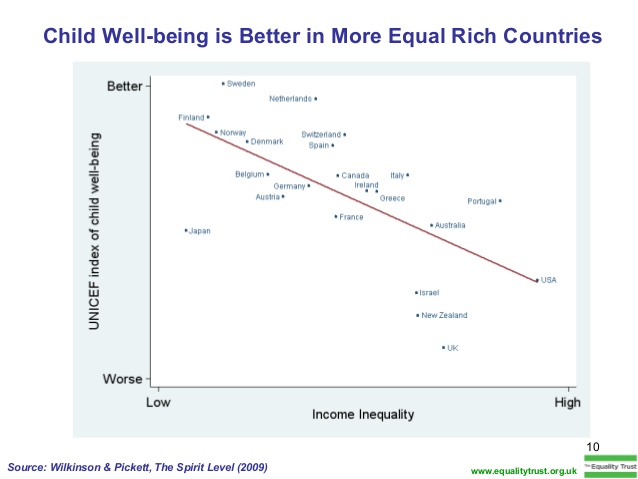
UNICEF’s reports have consistently put the UK at the bottom of the child well-being league table. See also: UNICEF criticises UK’s failure to tackle child inequality as gap grows.

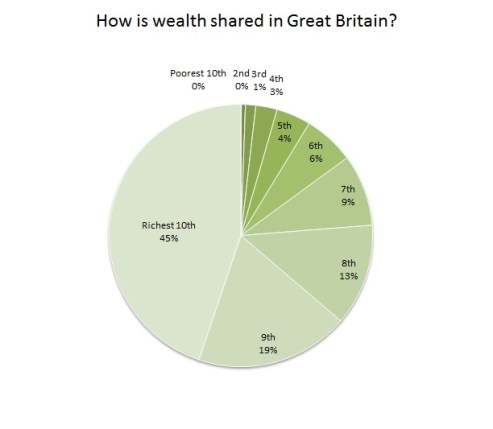
pie-wealthSource: The Equality Trust 

The still face paradigm and inequality

Before Christmas I read an excellent and insightful article by Michael Bader called The Decline of Empathy and the Appeal of Right-Wing Politics, which was about Edward Tronick’s Still Face experiment in part. Tronick is an American developmental psychologist at the University of Massachusetts, Boston. His studies illuminate the importance of trusting relationships and consistent human responses in children’s development and learning.

Tronick’s experimental design was very simple: mothers were asked to play as they usually would with their six-month-old infants. The mothers were then instructed to suddenly blank their face: to make their facial expression flat and neutral – completely “still”  – and to do so for three minutes, regardless of her baby’s activity.  Mothers were then told to resume normal play. The design came to be called the “still face paradigm.

The study demonstrated that when the connection between an infant and caregiver is broken, the infant tries to re-engage the caregiver, and then, if there is no response, the infant withdraws – first physically and then emotionally. Recent studies have found that four-month-old infants, when re-exposed to the “Still Face” two weeks after the first time, show rapid physiological changes that were not present when they were exposed to it the first time.

Tronick said: “It speaks to the incredible emotional capacities [of] the infant — to pick up on the fact that the mother’s not reacting emotionally the way she normally does. The baby has not only this ability to process what’s [happening], but [also] the capacity to respond in a really appropriate way — that is, they try to get the mother’s attention, and then when they fail, they give up, with a sense of their own helplessness. They may be angry and then they become sad.”

Tronick also emphasised the impact of parenting practices embedded in the sociocultural and ecological environment of the infant.

Bader’s inspiring article draws on Tronick’s experimental findings, which he then applies to citizen’s life experiences in the US, in the face of dehumanising encounters with bureacracy, increasingly depopulated policies and a profoundly alienating sociopolitical system. He goes on to discuss how “the pain of the “still face” in American society is present all around us.”

He says: “People feel it while waiting for hours on the phone for technical support, or dealing with endless menus while on hold with the phone or cable company, or waiting to get through to their own personal physician. They feel it in schools with large class sizes and rote teaching aimed only at helping students pass tests.  

They feel it when crumbling infrastructure makes commuting to work an endless claustrophobic nightmare.  And, too often, they feel it when interacting with government agencies that hold sway over important areas of their lives, such as social services […] and city planning departments, or a Department of Motor Vehicles.  Like Tronick’s babies, citizens who look to corporations and government for help, for a feeling of being recognized and important, are too often on a fool’s errand, seeking recognition and a reciprocity that is largely absent. 

This problem is greatly exaggerated by the profoundly corrosive effects of social and economic inequality. Under condition of inequality, the vulnerability of those seeking empathy is dramatically ramped up, leading to various forms of physical and psychological breakdowns. In a classic epidemiological study [The Spirit Level] by Richard Wilkinson and Kate Pickett, researchers found a strong correlation between the degree of inequality in a country (or a state, for that matter) and such problems as rates of imprisonment, violence, teenage pregnancies, obesity rates, mental health problems such as anxiety, depression, and addiction, lower literacy scores, and a wide range of poor health outcomes, including reduced life expectancy. 

Wilkinson and Pickett’s key finding is that it is the inequality itself, and not the overall wealth of a society that is the key factor in creating these various pathologies.  Poorer places with more equality do better than wealthy ones marked by gross inequality.

Inequality makes people feel insecure, preoccupied with their relative status and standing, and vulnerable to the judgment of others, and it creates a greater degree of social distance between people that deprives them of opportunities for intimate and healing experiences of recognition and empathy.”

The still face of the neoliberal state

It’s impossible to fail to recognise the parallels with citizen’s experiences here in Britain. We have ideological and socioeconomic commonality with the US, especially as both the UK and US are neoliberal states. Neoliberalism is an ongoing, totalising ideological and political-economic project of a resurgent political right that gained ascendancy in the US under Ronald Reagan and in the UK under Margaret Thatcher in the 1980s.   

Bader says: “As a metaphor for adult life in contemporary society, the “still face” paradigm—the helplessness intrinsic to it and the breakdown of empathy that lies at its foundation—aptly describes the experience of many people as they interact with the most important institutions in their lives, including government.

And, as with Tronick’s babies and their mothers, when our social milieu is indifferent to our needs and inattentive to our suffering, widespread damage is done to our psyches, causing distress, anger, and hopelessness.  Such inattention and neglect lead to anxiety about our status and value, and a breakdown of trust in others.”

1percent700

I agree that the growing inequalities we are witnessing in western neoliberal “democracies” create profound psychological trauma and ontological insecurity. Humans are fundamentally social beings. We thrive best when we have a social rationale which tends towards the promotion of cooperative and collective creativity. This was perhaps expressed best in our civilised, progressive institutions and civilising practices, facilitated by the social gains and economic organisation that arose from the post-war democratic settlement.  

Those gains are now being systematically dismantled. Our culture has been saturated with conceptual schema that demand we remain committed to an socioeconomic Darwinism, a kind of economic enclosure: a neoliberal competitive individualist obsession with our private, inner experiences, the pursuit of economic self-interest, and ultimately, this embellishes our separability from other human beings. It alienates us. 

Neoliberalism scripts social interactions that are founded on indifference to others, tending to be dehumanising, adversarial and hierarchical in nature, rather than social and cooperative. Neoliberalism is the antithesis of the responsive, animated human face; of collectivism, mutual support, universalism, cooperation and democracy. Neoliberalism has transformed our former liberal democracy into an authoritarian “still faced” state that values production, competition and profit above all else; including citizens’ lives, experiences, freedoms, well-being, democratic inclusion and social conditions that support all of this.  

Citizens are seen and are being politically redefined in isolation from the broader political, economic, sociocultural and reciprocal contexts that invariably influence and shape individual experiences, meanings, motivations, behaviours and attitudes, causing a problematic duality between context and cognition. This also places responsibility on citizens for circumstances which lie outside of their control, such as the socioeconomic consequences of political decision-making, whilst at the same time, the state is steadily abdicating responsibility for the basic welfare of ordinary citizens. 

Geographer David Harvey describes neoliberalism as a process of accumulation by dispossession: predatory policies are used to centralise wealth and power in the hands of a few by dispossessing the public of their wealth and assets.  

Neoliberals see the state as a means to reshape social institutions and social relationships based on the model of a competitive market place. This requires a highly invasive power and mechanisms of persuasion, manifested in an authoritarian turn. Public interests are conflated with narrow economic outcomes. Public behaviours are ‘nudged’ – citizens are being politically micromanaged. Social groups that don’t conform to ideologically defined outcomes are stigmatised and outgrouped.  

Stigma is a political and cultural attack on people’s identities. It’s used to discredit, and as justification for excluding some groups from economic and political consideration, refusing them full democratic citizenship. 

Stigma is being used politically to justify the systematic withdrawal of support and public services for the poorest – the casualties of a system founded on competition for allegedly scarce wealth and resources. Competition inevitably means there are winners and losers. Stigma is profoundly oppressive. It is used as a propaganda mechanism to draw the public into collaboration with the state, to justify punitive and discriminatory policies and to align citizen “interests” with rigid neoliberal outcomes. Inclusion, human rights, equality and democracy are not compatible with neoliberalism. 

Othering and outgrouping have become common political practices, and are now culturally embedded. 

This serves to desensitise the public to the circumstances of marginalised social groups. Outgroups serve to de-empathise society and dehumanise stigmatised others

This political and cultural process legitimises neoliberal “small state” policies, such as the systematic withdrawal of state support for those adversely affected by neoliberalism, and it also justifies inequality. By stigmatising the poorest citizens, a “default setting” is established regarding how the public ought to perceive and behave towards politically demarcated outgroups. That default setting is indifference to the plight of others. 

Authors of The Spirit Level, Richard Wilkinson and Kate Pickett, say “The truth is that human beings have deep-seated psychological responses to inequality and social hierarchy. The tendency to equate outward wealth with inner worth means that inequality colours our social perceptions. It invokes feelings of superiority and inferiority, dominance and subordination – which affect the way we relate to and treat each other.”

Neoliberalism and the myth of meritocracy

How does inequality and social injustice become acceptable? And why do we, as a society, permit the political construction of scapegoats and outgroups? 

Neoliberalism is premised on the assumption that the market place can somehow replace the state as the ultimate arbiter of cultural logic and value. Relationships between people are mediated by the depersonalising market place.

It is fundamentally Hobbesian in character, neoliberalism privatises citizen’s experiences, who are valued for their economic productivity and are therefore only responsible for themselves.

Bader says: “The failure of our institutions to empathize with the plight of the middle and working classes, to recognize their sacrifice and reward their hard work is traumatic. It is the same type of trauma that children experience when their caretakers are preoccupied or rejecting. The trauma erodes trust. It overwhelms systems that people have developed to deal with stress and creates psychological suffering and illness.” 

He goes on to tell us how our social brains seek a collective experience – of “we” rather than “I” – and often do so by creating a fantasy of an “us” versus “them” that we can devalue and fight.

Tribalism draws on our need for sociability and interconnectedness but it can also be used to pervert it. Rejected by government, employers and wider society, some citizens then go on to reject and demean others. It’s a coping strategy: they are trying to cope with the pain, powerlessness, and lack of empathy that they experience in their social lives. This serves to further divide citizens, undermining social solidarity further, and isolating vulnerable groups. The government and right wing press have ruthlessly exploited the social divisions and scapegoats they have meticulously crafted to uphold a dogma that is absolutely incompatible with democracy, human rights, human needs and any notion of equality.

We must recognise the play of hidden ideologies and the influence of dog whistle and wedge issue politicking. This is a state tactic which manipulates our fundamental human need for a sense of belonging. It’s about the creation of scapegoats and diversion from the real problem: neoliberalism, authoritarianism and the inequality and increasing precarity that this extends and perpetuates. Hierarchical thinking is embedded in neoliberal and authoritarian ideologies. 

Neoliberalism also extends a myth that citizens are autonomous and free to make choices. However, this ignores the well-researched reality that those without resources have few or no choices. 

Neoliberalism is an ideology that manufactures consent to inequalities by offering the myth of meritocracy: the false promise that everyone will eventually benefit by working hard to earn merit, status and wealth. However, it isn’t logically possible for equal opportunities to exist in a highly unequal society. 

This myth undermines the principles of social and economic rights and discredits solidarity, collective responsibility and contravenes our human need for belonging. Success, according to the meritocrats, is shaped by your IQ and individual talents, hard work and personal effort. Yet at least a third of those touting this myth are millionaires who simply inherited their wealth.   

The ideology of meritocracy conceals the fact that class privileges are institutionalised, and are reinforced through the education system, for example. The UNICEF report, Fairness for Children, emphasised the importance of a strong welfare system in reducing inequality – and carried a strong suggestion that the UK Government should reconsider its cuts to benefits. In June last year, following its investigation, the United Nations committee on the rights of the child called on ministers to act regarding austerity, the benefit cap and tax credit cuts, which are undermining children’s rights to an adequate standard of living. The government were also urged to do more to ensure children’s rights to adequate health, housing and education are met, too. 

The government, however, have claimed that welfare cuts reduce poverty by “incentivising” people to work. Meanwhile, over half of those families queuing at food banks are in work, and nearly two thirds of children in poverty live in working families. “Making work pay” is nothing more than a Conservative euphemism for the incremental dismantling of the welfare state, which they intend to continue, regardless of the social consequences. 

Neoliberalism is sustained by ideologues employed by governments, in think tanks, PR companies and as individual consultants, that invent technical justifications for small state neoliberal policies on the grounds of: “efficiencies”, savings, democracy, economic growth, and more recently “fairness” and “social justice.” The latter two especially are founded on the myth of meritocracy, in this context. 

In any competitive system, there are invariably a few “winners” and many more “losers”.  The system itself creates the conditions which mean that many people “lose”. It has nothing to do with the IQ, character or qualities of those people. Competition is adversarial – it’s defined as a situation in which two or more people or groups are fighting to get something which not everyone can have

The Nudge Unit is one example of a technocratic think tank that promotes the myth of meritocracy, which is embedded in the Cabinet Office. The neoliberal Reform think tank and the Adam Smith Institution are others. There is a raft of contemporary academics who are also fueling ideological justifications of neoliberal policies – the likes of Adam Perkins, Richard Layard, Mansel Aylward and Simon Wessley, for example, each in their respective academic fields have each presented “studies” that endorse “small state” antiwelfarism and enforce notions of personal responsibility and competitive individualism. Public interests are steadily being aligned with economic outcomes, driven by private interests. 

Status and rewards in society do not go “naturally” to those who are best “performers” or those who “earn” their privilege: the hierarchy of wealth and power is being purposefully shaped by the state.

Stigma and the just world fallacy

Sociologist Imogen Tyler at Lancaster University, says “[…] the centrality of stigma in producing economic and social inequalities has been obscured ‘because bodies of research pertaining to specific stigmatized statuses have generally developed in separate domains’ (Hatzenbuehler, 2013). In short, stigma is widely accepted to be a major factor in determining life chances, yet research on stigma is fragmented across academic disciplines.”

Tyler’s ongoing work – The Stigma Doctrine, is focused on policy design and implementation, ‘The Stigma Doctrine’ aims to develop a new theoretical account of the ways in which neoliberal modes of government operate not only by capitalizing upon ‘shocks’ but through the production and mediation of stigma.” 

Her explicit focus is on “stigmatization as a central dimension of neoliberal state-crafting.” The project is focussing in particular on welfare “reform”, the neoliberal de/recomposition of class, poverty, work and dis/abilities.

At a basic level, stigma is seen as a mark of disgrace associated with particular circumstances, qualities, or persons. However, it has a fundamental normative dimension, which is culturally and historically specific. 

We tend to make assumptions about people, based on what their circumstances or characteristics are. Central to these assumptions lies a basic moral dichotomy founded on the binary notions of “deserving” and “undeserving”. 

Everyone has heard “what goes around comes around” before, or maybe you’ve seen a person “get what was coming to them” and thought, “that’s karma for you.” These are all shades of the just world fallacy. But in reality, we don’t always “reap what we sow.”

In social psychology, the just world hypothesis is the tendency to attribute consequences to – or expect consequences as the result of – a universal force that restores moral balance. This belief generally implies the existence of destiny, cosmic justice, or divine providence. 

It is very common in fiction for the villains to lose and the virtuous folk to win. It is a reflection of how we would like to see the world – just and fair. In psychology the tendency to believe that this is how the real world actually works is a known cognitive error: the just world is a fallacy. 

Many people have a strong desire or need to believe that the world is an orderly, predictable, and fair place, where people simply get what they deserve. Such a belief plays an important role in our lives – in order to plan our lives or achieve our goals we need to assume that our actions will have predictable consequences. 

Moreover, when we encounter evidence suggesting that the world is not just, we either act to restore justice by helping victims or we persuade ourselves that no injustice has occurred.  We comfort ourselves with the idea that the person without a job is simply lazy, the homeless person is irresponsible, and the ill person made the “wrong” lifestyle choices. These attitudes are continually reinforced in the ubiquitous fairy tales, fables, popular fiction, comics, TV, the mainstream media, current political rhetoric and other morality tales of our culture, including the great myth of meritocracy, embedded in neoliberal narrative, in which “good” is always rewarded and “evil” punished. Only it isn’t.

Deep down, we all would probably like to believe hard work and virtue will lead to success, and laziness, evil and manipulation will lead to ruin, quite often we simply edit the world to match those expectations. 

The normalisation of socioeconomic hierarchy: a nod to Milgram

Social psychologist, Melvin Lerner documents people’s eagerness to convince themselves that beneficiaries deserve their benefits and victims their suffering. In a 1965 study, Lerner reported that subjects who were told that a fellow student had won a cash prize in a lottery tended to believe that the student worked harder than another student who lost the lottery. Lerner observed that when one of two men was chosen at random to receive a reward for a task, that somehow caused him to be more favourably evaluated by observers, even when the observers had been informed that the recipient of the reward was chosen at random. (Lerner, M. J., & Miller, D. T. (1978). Just world research and the attribution process: Looking back and ahead. Psychological Bulletin, 85(5), 1030–1051).

Existing social psychological theories, including cognitive dissonance, do not fully explain these phenomena. In another study a year later, Lerner and a colleague recorded a simulated “learning” experiment in which it appeared that the “participants” were subjected to electric shocks. Lerner found that subjects who observed the videotapes tended to form much lower opinions of these “victimised” participants when there was no possibility of the victim finding relief from the ordeal, or when the victim took on the role of “martyr” by voluntarily remaining in the experiment despite the apparent unpleasantness of the experience.

Lerner concluded that “the sight of an innocent person suffering without possibility of reward or compensation motivated people to devalue the attractiveness of the victim in order to bring about a more appropriate fit between her fate and her character.”

If the belief in a just world simply resulted in humans feeling more comfortable with the universe, its uncertainties and our own precarity, it would not be a matter of great concern for human rights activists, ethicists or social scientists. But Lerner’s just world hypothesis, if correct, has significant social implications. The belief in a just world may well seriously undermine a commitment to social justice.

So, the just world fallacy is founded on a massive misconception: that we always get what we “deserve”. We like to think that people who are not doing well in their lives must have done something to deserve it. Yet we also know that the beneficiaries of good fortune often do nothing to earn it, and people doing harmful deeds often get away with their actions without consequences.

Lerner’s research extended, to some extent, on Stanley Milgram‘s research on social conformity and obedience. Lerner was curious as to how regimes that cause cruelty and suffering manage to maintain popular support, and how people come to accept social norms and laws that produce misery and suffering.

Lerner’s direction of inquiry was influenced by his frequent witnessing of the tendency of observers to blame victims for their suffering, particularly during his clinical training as a psychologist, when he observed treatment of mentally ill persons by the health care practitioners with whom he worked. Though he knew them to be basically kind, educated people, they often blamed patients for the patients’ own suffering. Lerner also describes his surprise at hearing his students derogate disadvantaged people, believing that poor people somehow caused their own poverty, whilst being seemingly oblivious to the social, political and economic (structural) forces that contribute significantly to poverty. 

Zick Rubin of Harvard University and Letitia Anne Peplau of the UCLA conducted surveys to examine the characteristics of people with strong beliefs in a just world. They found that people who have a strong tendency to believe in a just world also tend to be more religious, more authoritarian, more Conservative, more likely to admire political leaders and existing social institutions, and more likely to have negative attitudes and and hold prejudices toward underprivileged groups. To a lesser but nonetheless significant degree, the believers in a just world tend to “feel less of a need to engage in activities to change society or to alleviate plight of social victims.”

It’s ironic that the belief in a just world may take the place of a genuine commitment to justice. For some people, it is simply easier to assume that forces beyond their control mete out justice. When that occurs, the result may be the abdication of personal responsibility, acquiescence in the face of suffering and misfortune, and indifference towards injustice

In the murky waters of real life, evil people often prosper whilst harming others, and quite often never face justice and retribution.

Social reality isn’t founded on some intrinsic and fair principle or quality of the universe. Social justice is something that we must construct and re-construct our selves. In the same way, democracy isn’t something we “have”, it is something we must do.

As a society, we make our own “karma”. We participate in, shape and distribute social justice. That affects those around us. We do need to think about what kind of world we live in, how we ought to live and how that affects our families, friends, neighbours and strangers. A measure of civilisation may be observed in how we behave towards those people we don’t know.

In our society, over the past 6 years, some (previously protected) social groups have become politically defined strangers and economic exiles. If you think that’s okay, it’s worth bearing in mind that sooner or later, someone you know well, perhaps one of your loved ones, will be affected by this ongoing process.

When one group are targeted with injustice and inequality, it affects everyone, and other groups soon follow. Historically, we learned that tyrants don’t stick with targeting and persecuting the group you don’t like. You don’t get a choice ultimately. Prejudice tends to multitask very well, and tyrants remain tyrants no matter who you are.

Wilkinson and Pickett’s research on the harmful effects of economic inequality is a challenge for us to ensure that redistribution is the main focus of our political programme. Their research very clearly shows us that if we work towards greater equality, we can ameliorate a wide range of human suffering. Because neoliberal ideology ultimately disconnects us from each other, we really must work hard to seek common ground with the people on the other side of what American sociologist, Arlie Hochschild, calls the “empathy wall” to reach out, communicate to them that “we not only feel their pain, but we share it, and that, in the end, we are all in this together.”

Hochschild’s work has often described the various ways in which we each  becomes a “shock absorber” of larger social, economic and political forces.  She explores the “deep story” of American citizens – a metaphorical expression of the emotions they live by. She recognised that the people she studied may not vote in favour of their economic self-interest, but they often voted for what they felt was their emotional self-interest as members of a group which feels marginalised, scorned and betrayed by the establishment. This sense of betrayal was utilised by the right, who readily draw on and manipulate the role of emotion in politics.

How much more of the current political-economic just world narrative will people permit to remain largely unchallenged before we all say “enough”?

In democracies, Government’s are elected to represent and serve the needs of the population. Democracy is not only about elections. It is also about distributive and social justice. The quality of the democratic process, including transparent and accountable Government and equality before the law, is crucial to social organisation, yet it seems the moment we become distracted, less attentive and permit inequality to fundamentally divide our society, the essential details and defining features of democracy seem to melt into air. 

Government policies are expressed political intentions regarding how our society is organised and governed. They have calculated social and economic aims and consequences. In democratic societies, all citizen’s accounts of the impacts of policies ought to matter.

However, in the UK, the way that policies are justified is being increasingly detached from their aims and consequences, partly because democratic processes and basic human rights are being disassembled or side-stepped, and partly because the government employs the widespread use of linguistic strategies and techniques of persuasion to intentionally divert us from their aims and the consequences of their ideologically (rather than rationally) driven policies. Furthermore, policies have become increasingly depopulated; detached from public interests and needs.

Democracy is not something we have: it’s something we have to DO.

My hope for 2017 is that enough of us will recognise that democratic participation is essential, and that injustice directed against one is injustice ultimately directed against all. 

569ca48248b8d566d6e61bd65571e0ad

All the best for the new year. 

In solidarity.

Related  

The Decline of Empathy and the Appeal of Right-Wing Politics – Michael Bader

Who Believes in a Just World? –  Zick Rubin and Letitia Anne Peplau 

The Stigma Project – Imogen Tyler

The Spirit Level authors: why society is more unequal than ever – Richard Wilkinson and Kate Pickett

The importance of citizen’s qualitative accounts in democratic inclusion and political participation


I don’t make any money from my work. But you can make a donation if you wish and help me continue to research and write informative, insightful and independent articles, and to provide support to others. The smallest amount is much appreciated – thank you.

DonatenowButton

A few thoughts on the implications of the United Nations report

maslow-5
There is an important link between human needs and human rights that the Conservatives have dismally and persistently failed to recognise

The United Nations (UN) inquiry into the allegations many of us made regarding the systematic abuse of the human rights of disabled people in the UK has exposed the multiple injustices of targeted cuts and the disproportionate burden of austerity heaped on sick and disabled people, their carers and their families, evidencing and detailing the effects of a range of policy measures affecting them that have been introduced since 2010. These include the bedroom tax and cuts to disability benefits, funds to support independence and social care.

The report concludes that the overall effect of what is now an essentially punitive welfare regime, which has been based almost entirely on unevidenced political claims and assumptions, has had an extremely detrimental and regressive effect on the rights of disabled people, to live independently, to meet their basic needs, to seek and stay in work,  and to be able to live an ordinary life as citizens.

The UN report documented multiple violations of disabled people’s rights, including the way that they are politically portrayed as being lazy and a “burden on taxpayers”, the harm to health caused by unfair assessments, the cuts to legal aid and curtailed access to justice, the imposition of the bedroom tax and the ending of the Independent Living Fund.

I wrote a lengthy article about the unsurprising but nonetheless disquieting report findings and recommendations as I read it, here.

Predictably, the government responded to the damning contents of the report by denying a “causal link” between their policies and the evidenced accounts of the consequences being presented to them. Yet the government have never monitored the cumulative impact of their policies and successive cuts on disabled people, and they told the UN rapporteurs that it was “not possible or practical” to carry out an impact assessment on how reforms would affect disabled people. The UN disagreed, and stated that with the evidence and data already available, the government could have done this. 

The UN have called on the government to carry out a cumulative impact assessment. The government have refused to comply with any of the recommendations the UN has made. However, that means they cannot legitimately claim that there is “no causal link demonstrated” regarding the austerity measures and psychological distress, severe hardship, deteriorating health and death, as they have persistently refused to investigate the associations that academics, charities, disabled people’s organisations, individual campaigners and opposition MPs have consistently demonstrated. Denial isn’t empirical evidence or any kind of proof that your claims are valid. Nor does withholding evidence of correlation disprove causality.

It was also noted that the government failed to listen to the concerns of disabled people it had claimed to involve in policy making processes. Disabled people and their representative organisations “were not meaningfully taken into account in the decision-making and had little or no influence on policy decisions.”

The implication is that disabled people have not been democratically included. The government have persisted in treating us as objects of policies, rather than seeing us as democratic subjects and citizens. 

Also of note: “The [individual] impact assessments conducted by the State party prior to the implementation of several measures of its welfare reform expressly foresaw an adverse impact on persons with disabilities.”

The State party has not conducted a comprehensive human rights-based cumulative impact assessment even though reliable sources have indicated it is feasible.”

The UN stated that the Department for Work and Pensions (DWP) failed to properly investigate people’s deaths after their social security payments were stopped. t was noted that the government had made no “attempts at objective, thorough, open and impartial investigation(s)” to look at the alleged 90 deaths a month, despite being aware that there was widespread public concern about this.

Among other concerns, the committee said the UK government had used rhetoric to stigmatise disabled people, negatively influencing public perceptions. The report says that disabled people “have been… negatively portrayed as being dependent or making a living out of benefits; committing fraud as benefit claimants; being lazy and putting a burden on taxpayers, who are paying ‘money for nothing’. Persons with disabilities continue to experience increasing hostility, aggressive behaviour and sometimes attacks to their personal integrity.”

The committee said it found no evidence to support any of these ideas, especially the idea that disabled claimants were committing benefit fraud.

The committee were very critical of the legal aid cuts, which have created a significant barrier for people challenging benefits decisions and holding the government accountable:

“Evidence indicates that legal aid to challenge administrative decisions ending or curtailing their benefits before first-tier tribunals has been restricted. Legal aid for cases before those tribunals has also been curtailed. Similarly, access to review by an independent and impartial tribunal has been restricted by the introduction of mandatory reconsideration procedures before the same administrative entity that has ruled on benefits.”

I was pleased to see the United Nations report highlight a fundamental prejudice that informed the very basis of the “functional capacity approach” of the Work Capability Assessment (WCA), as well as commenting on the major flaws of the assessment process itself. The WCA is based on the assumption that a health condition or disability should not automatically be regarded as a “barrier” to work and that work itself can have health benefits. However these assumptions have been controversial from the outset.

The WCA places focus entirely on how we as individuals experience our illness and impairments. As such, this approach does not permit us to place our experiences of disadvantage in the context of how organisations, institutions, policy-makers and wider society interact with us. Despite the government claiming that they take a social model approach, eligibility for benefits and services is still being determined by assessment of how much our own bodies are affected by illness and impairment rather than the disabling social, cultural and political barriers that we experience.

The report said: Work Capability Assessments do not take into account the “support persons with disabilities need to perform a job or the complex nature of some impairments and conditions.” 

The inquiry also found that welfare assessors displayed a “lack of awareness and limited knowledge of disability rights and specific needs”, and disabled people experienced distress, “anxiety and psychological strain” as a result of this flawed process, and the financial insecurity that it generates.

“The committee observes that measures have caused financial hardship to persons with disabilities resulting in arrears, debts, evictions and cuts to essentials such as housing and food,” the report said.

The Government’s own research, published in June this year, revealed that one of the cornerstones of their austerity campaign – that cutting social security means recipients will be more likely to find work – is fundamentally flawed. 

Researchers found that cutting unemployed peoples’ benefits had the opposite effect to what is being claimed – something that many of us have also previously argued. The study, carried out by Oxford city council and the Department for Work and Pensions, found unemployed people become less likely to get a job when benefits are cut. Instead of looking for work, they are forced to devote their energies to surviving day-to-day. For every £1 in benefits cut per week, a person’s chance of getting a job drops by 2 per cent.

The government can no longer justify its narrative about benefit cuts, claiming that they are  “incentives” to “support” people into work.

Beyond the rhetoric – the hidden agenda

There is a wider agenda driving the welfare “reforms” and it is important to consider the hidden ideological dimension and the language references and signposts to that, as well as the superficial narratives and semantic shifts being deployed as a PR exercise, techniques of neutralisation and gaslighting to obscure political intentions and the consequences of policies.

The UN report effectively exposed the justification narratives presented by the government for their welfare “reforms” as unfounded and unsupported by empirical evidence. This report is just the beginning, it arms us with an invaluable weapon with which to continue our campaigning, and shape future challenges and debate to government policies and social injustice.  

The Conservatives have an ideological commitment to a “small state” and this is fueled by privatisation and an ever-expanding neoliberal competitive “market place.” The market place, private profit opportunities and neoliberal outcomes have been conflated with citizen’s interests and needs.

The welfare “reforms” have presented the opportunity to promote and deliver private income protection provision via profit making companies operating in free markets. Insurance companies and right-wing think tanks have been attempting to steer governments in this direction for many years. 

For example, Matthew Oakley, a senior researcher at the Social Market Foundation, and government advisor, recently published a report entitled Closing the gap: creating a framework for tackling the disability employment gap in the UK, in which he suggests considering a “role that a form of privately run social insurance could play in both increasing benefit generosity and improving the support that individuals get to manage their conditions and move back to work.

Oakley also proposes abolishing the ESA Support Group. To meet extra living costs because of disability, Oakley says that existing spending on PIP and the Support Group element of ESA should be brought together to finance a new extra costs benefit. Eligibility for this benefit should be determined on the basis of need, with an assessment replacing the WCA and PIP assessment. The Conservative definition of “the basis of need” seems to be an ever-shrinking category.

May’s new director of policy, John Godfrey, is a keen advocate of what in his last job, at financial services giant Legal and General, he called “Beveridge 2.0”: using technology to introduce new forms of “social insurance”.

Godfrey told a campaigning group, the Financial Inclusion Commission, last year that the systems used to deliver “auto-enrolment”, the scheme that ensures all low-income workers have a pension, could also be used to help the public insure themselves against “unexpected events”.

“There is a clear lesson from auto-enrolment that if you have a plumbing network or an infrastructure that works, that auto-enrolment infrastructure could be used for other things which would encourage financial inclusion: things like, for example, life cover, income protection and effective and very genuine personal contributory benefits for things like unemployment and sickness,” he said. “They can be delivered at good value if there is mass participation through either soft compulsion or good behavioural economics.”

Note the context shift in use of the term “inclusion”, which was originally deemed a democratic right, now it’s being discussed narrowly in terms of individual responsibility.

A report published by the Adam Smith Institute as far back as 1995 – The Fortune Account – also sets out proposals to replace “state welfare” with an insurance system “operated by financial institutions within the private sector”.

Mo Stewart has spent eight years researching the influence of the US insurance giant Unum over successive UK governments, and how it led to the introduction of the “totally bogus” work capability assessment (WCA), which she says was designed to make it harder for sick and disabled people to claim out-of-work disability benefits.Stewart’s book, Cash Not Care: The Planned Demolition Of The UK Welfare State, was published in September. She states that the assessment was modeled on methods used by the controversial company Unum to deny protection to sick and disabled people in the US who had taken out income protection policies.

She goes on to say that the WCA was “designed to remove as many as possible from access to [employment and support allowance]on route to the demolition of the welfare state”, with out-of-work disability benefits to be replaced by insurance policies provided by private companies like Unum.

Stewart warns us that the UK is now close to adopting a US-style model.  

The implications of the inquiry findings for Conservative welfare policies 

The government has announced further welfare measures which will affect disabled people including a four year freeze for most working-age benefits, reductions in the Benefit Cap, changes to tax credits and to Universal Credit, and abolishing the “Work-Related Activity Component” for new ESA claims from 2017.

As noted in the UN report: “The State party continues its policy of reducing social benefits of persons with disabilities as reflected in the Welfare Reform and Work Act 2016.” 

Article 28 of the Convention on the rights of persons with disabilities (CRPD) says: Adequate standard of living and social protection – This article affirms the rights of persons with disabilities to an adequate standard of living for themselves and their family, and to social protection without discrimination on the basis of disability. This right includes access to assistance from the state with disability-related expenses for persons with disabilities and their families.

The report reiterated something that many of us have noted and discussed in detail previously: that there is no evidence of a causal relationship between a reduction in social security and an increase in employment amongst disabled and sick people. Nor does welfare “dependency” “disincentivise” people seeking employment more generally. It was pointed out in UN report that these views are not evidenced. The two assumptions are embedded in justifications of Conservative welfare policies, and are prejudices that have been around since the Thatcher administration.

Bearing in mind these are key assumptions underpinning current policies and the proposals set out in the recent work, health and disability green paper –  for example, the recent decision to reduce the money paid to people who have been assessed as being unfit to work but able to undertake work related activity (those people in the Employment and Support Allowance work related activity group (WRAG)) is based on the same assumption- the Department for Work and Pensions have claimed  – that it will “remove the financial incentives that would otherwise discourage claimants from taking steps back to work”.

Particularly important in the current context and given the government’s recent work, health and disability green paper, the UN report says that: “Given the barriers that still prevent the full participation of persons with disabilities in the labour market and mean higher unemployment rates for them, income-maintenance social security schemes are particularly important for persons with disabilities. Such schemes allow them to maintain their autonomy and freedom of control and choice of their living arrangements and day-to-day activities. Without an adequate level of social protection, persons with disabilities run the risk of being isolated, segregated from the community and/or institutionalized. 

States parties should find an adequate balance between providing an adequate level of income security for persons with disabilities through social security schemes and supporting their labour inclusion. The two sets of measures should be seen as complementary rather than contradictory.

Measures aimed at facilitating the inclusion in the labour market of beneficiaries of social security should include transitional arrangements to ensure income protection while they reach a certain threshold and sustainability in their wages. They should become eligible again without delay if they lose their jobs.” 

Although many of us have been discussing these issues for a few years, the inquiry has consolidated a lot of valuable evidence and provided a concise rebuttal of government justification narratives for cuts in support for disabled people, which we really needed to be presented to the government formally, from an independent, official and international witness.

Though the government have tended to dismiss much evidence to date of the harm that their policies are causing, such as that which has been presented through case studies by shadow ministers, as “anecdotal”, it is rather more difficult to dismiss and ignore the substantial evidence presented as a result of rigorous international scrutiny.

The government response was founded on denials, more misdirectional rhetoric and techniques of neutralisation, defensive arrogance, authoritarian scorn and contrived outrage, rather than being about stepping up to democratic accountability, reasoned discussion and rationality. No sign of civilised conscience and decent concern regarding the impact of the prejudice and discrimination that is being intentionally and systematically embedded in Conservative policies, aimed at disabled people, at all. 

The government’s response to the UN report bears little resemblance to the lived experiences of disabled people, despite claims to the contrary. The government has justified systematic cuts to disabled people’s social security by claiming such cuts “incentivise” people to find work. The cuts are a form of punishment (apparently for our own “good”) designed to bring about “behaviour change” and this approach is founded on the wrongly perceived attitudes of disabled people, who this government consistently describes as being “parked on benefits” with the “misperception that they can’t work”. 

This does nothing at all to address the barriers disabled people face in finding and staying in work, nor does it address the acknowledged prejudiced attitudes of employers and Conservative ministers. It’s not long ago that Conservative welfare minister David Freud expressed the view that disabled people should work for less than the minimum wage. He wasn’t the only one, either. Philip Davies expressed the same view, claiming that disabled people “are the most disadvantaged by the national minimum wage,” so they should be “permitted” to work for less in order to “compete” in the labor market. Davies described criticism of his remarks that disabled people could work for less than minimum wage as “leftwing hysteria”.

It seems that Conservatives believe that the only way of “helping” disabled people in any way is by simply taking money from them. 

In their response to the UN report, the government say: “The United Kingdom is proud of its record in supporting disabled people to lead more independent lives and participate more fully in society. More than 20 years ago the UK legislated to protect disabled people’s rights. It now spends around £50 bn a year on benefits to support disabled people and people with health conditions, which is over £6 bn more than in 2010. That is around 5% of GDP, or over 6% of government spending. The UK spends more on disabled people and people with health conditions than the OECD average, and countries such as Germany, France and the USA.”

That’s definitely Conservatives being… conservative with the truth again.

The Institute of Fiscal Studies (IFS) report on spending on benefits for disabled people says the actual spend is £36,063 bn but this is partly in benefits that are not counted as working age disability benefits: War Pensions, Attendance Allowance for over 65s, Statutory Sick pay, Carer’s Allowance, Industrial Injuries Benefits and the ILF which the government has closed)

The total of those benefits not paid to working age disabled people is £7,908bn

That makes the actual spend on all working age benefits for disabled people £28,155 billion

The IFS report says: “The spending on DLA/PIP is only half what it was in 1995-96. Spending across Great Britain on disability benefits in 2014–15 was £13.5 billion. At 0.8% of national income this is half the level of disability benefit spending when it was at its peak in 1995–96.

The overall number of individuals receiving disability benefits has fallen slightly since the mid-1990s. But this is in the presence of underlying demographic change that would have tended to push UP the numbers receiving considerably – both overall population growth and the baby boomer generation reaching older working ages.”

It’s not clear if the spending figures include the massive costs of private companies that are contracted by the state, ironically, to cut welfare spending. 

The National Audit Office (NAO) report earlier this year scrutinised public spending for parliament, and is independent of government. The report indicates how public services are being appropriated for purely private benefit.

The audit report in January concluded that the Department for Work and Pension’s spending on contracts for disability benefit assessments is expected to double in 2016/17 compared with 2014/15. The government’s flagship welfare-cut scheme will be actually spending more money on the assessments conducted by private companies than it is saving in reductions to the benefits bill.

From the report:

£1.6 billion
Estimated cost of contracted-out health and disability assessments over three years, 2015 to 2018

£0.4 billion
Latest expected reduction in annual disability benefit spending.

This summary reflects staggering economic incompetence, a flagrant, politically motivated waste of tax payer’s money and even worse, the higher spending has not created a competent or ethical assessment framework, nor is it improving the lives of sick and disabled people. Private companies like Maximus are paid millions from our welfare budget, yet they are certainly not “helping the government” to serve even the most basic needs of sick and disabled people.

I will be challenging the government’s response to the UN report fully in due course. It would be good to see some collaborative effort from disabled campaigners and activists in addressing the government as comprehensively as possible. If anyone is interest in working together on this, just contact me here via the comment section.

The UN committee will meet to discuss the government’s comments and determine a response in Geneva, in March 2017. 

Meanwhile it’s crucial that we use the body of evidence collated by the UN and the conclusions drawn in the report effectively. For example, our responses to the consultation on the work, health and disability green paper must address the underpinning propositions and delve beneath the superficial rhetoric and glittering generalities, rather than permitting the DWP’s weighted and somewhat leading questions to shape the outcome of the consultation.

We must use the UN findings constructively to continue to challenge existing policies, and any which arise in the future to violate the human rights of disabled persons. 

We need to continue to coherently and collectively challenge the government’s assumptions on which their proposals for work, health and disability policy are based, none of which are not supported by a shred of solid empirical evidence.


I don’t make any money from my work. But you can help by making a donation to enable me continue to research and write informative, insightful and independent articles, and to continue to provide support to others. The smallest amount is much appreciated – thank you.

DonatenowButton cards

UN’s highly critical report confirms UK government has systematically violated the human rights of disabled people

2014-02-17-BurdenoftheCuts-thumb

The United Nations (UN) have published a report following investigation into the allegations of “grave and systematic” abuses of the human rights of disabled people in the UK. Campaigners and disabled people’s groups contacted the UN, making formal complaint about violations of disabled people’s rights and raising serious concerns about the consequences of the welfare reforms for disabled people, in 2012, which triggered the inquiry under article 6 of the Optional Protocol to the Convention on the Rights of Persons with Disabilities (CRPD). Many of us also made further submissions, supporting the inquiry with evidence. The report has been welcomed by disability campaigners, with many saying the findings come as no surprise.

The report said “The Committee is impressed by the amount of data collected by stakeholders who contributed to the inquiry.”

The highly critical report was published in Geneva yesterday afternoon. It concludes that the rights of disabled people to live independently, to work, and achieve an adequate standard of living have been detrimentally affected by austerity measures. The range of measures aimed at reducing public spending since 2010, including controversial changes such as the bedroom tax, and cuts to disability benefits and social care budgets have disproportionately and adversely affected disabled people.

The UN report of the findings of contraventions by the UK government to the rights of disabled people, which said much of what many of us have been writing and campaigning about for the past four years –  since the controversial 2012 Welfare “Reform” Act and the targeted austerity programme – said nothing that many of us didn’t already know. But reading it personally was a surprisingly powerful emotional experience, despite the measured and emotionally-neutral language used throughout the report.

Whilst I am relieved most of our concerns, research, analysis and experiences were confirmed on one level, and that the government were exposed for their withholding of evidence, and of sometimes manufacturing it; of excluding disabled people from any consultation regarding the cuts to their support, I am nonetheless still shocked that we live in a country  with a society that has permitted a government to treat sick and disabled people with such contempt, excluding us from full democratic citizenship and denying us basic human rights.

Members of the UN committee of 18 independent experts visited Britain in October 2015 and the report was based on more than 200 interviews and some 3,000 pages of documentary evidence.

The 22-page report condemned the radical and largely unmonitored welfare cuts and benefit caps, and social care cuts introduced as a major part of the Conservative’s austerity programme – the government claimed these cuts would make the welfare system “fairer and reduce benefit fraud.” The UN found no evidence of benefit fraud or fairness.

As anticipated, the UK government has rejected the UN report, saying in a formal response that its findings presented an “inaccurate picture” of life for disabled people in the UK:  “While the government continues to improve and build on the support available to disabled people, it stands by and is proud of its record.”

The government went on to say: “As a strong parliamentary democracy, where the voices and opinions of disabled people are represented and listened to, the UK is a place where disabled people’s rights are respected, promoted and upheld.”

As a person who is disabled because of illness, and someone who has supported many other disabled people going through assessments, mandatory reviews and tribunals, I can say that our collective experiences indicate that we are NOT represented, nor have we been listened to. Our rights have clearly not been respected, promoted and upheld. The government have treated disabled people with contempt, we have not been included in the economy, we have experienced political and social prejudice and discrimination, we have not been extended equal opportunities, nor have we been permitted full citizenship and recognition of our human rights.

The government feel it’s acceptable to lie about the fact that they have failed to recognise our human rights, outrageously claiming that disabled people are “supported.” I have never heard of “support” that entails the systematic removal of people’s lifeline income, which was originally calculated to meet only basic needs.

The response is telling. The government did not produce evidence to substantiate their claims and denials, and there wasn’t a shred of concern for disabled people or remorse expressed about the distress and harm that the Conservative’s targeted austerity cuts have caused; there was just a refusal to be accountable and transparent, more denial and more gaslighting.

In their lengthy rebuttal, the Conservatives claimed that the UN inquiry was “too narrow in scope” and that the UK government did not plan to follow-up on the recommendations any further.

The inquiry findings

The conclusion of UN inquiry: “The Committee considers that there is reliable evidence that the threshold of grave or systematic violations of the rights of persons with disabilities has been met in the State party.

The facts submitted by the source were disputed by the State party. The Committee engaged in a verification exercise in which the facts that appeared to be controversial were cross-checked with data collected from a variety of sources, including parliamentary inquiries, reports of the independent monitoring body of the Convention, official statistics, reports and data originating from other government departments or units, entity governments, research institutes, service providers, academic centres, independent experts, former government officers, grass-roots non-governmental organizations, organizations of persons with disabilities and individuals.

In some cases, some State party’s statements were not supported by evidence collected by the investigation. In others, the State party indicated that no data were available. The findings below are based on a comprehensive analysis of data provided by various sources.

The Committee observes that various pieces of legislation related to recent welfare policies do not fully enforce the international human rights framework related to social protection and independent living. In connection thereto, it was observed that in the field of social protection, persons with disabilities have not been properly considered as right-holders and entitled to benefits with regard to their right to social protection.

Similarly, while the Care Act 2014 reflects the principles of well-being of persons with disabilities and underlines the objective of personalization of support packages, it fails to properly acknowledge the elements of autonomy and control and choice, which are intrinsic to the right to independent living as referred to in article 19 of the Convention.”

That conclusion is based on the following findings of systematic violations of the convention:

(a) The State party has implemented a policy aimed at reforming its welfare system and the reforms have been justified in the context of austerity measures to achieve fiscal and budgetary policy consolidation;

(b) The assumptions made under the policy include that: taxpayers need to be treated with fairness; large numbers of persons with disabilities have been relying and dependent on social benefits; persons are better off in work than on benefits; the dependency of persons with disabilities on benefits is in itself a disincentive to move them into employment; the number of persons with disabilities relying on social benefits were to be decreased; and tightening sanctions and conditionality of social benefits is a legitimate tool for incentivizing their moving into employment;

(c) The impact assessments conducted by the State party prior to the implementation of several measures of its welfare reform expressly foresaw an adverse impact on persons with disabilities;

(d) Several measures have disproportionally and adversely affected the rights of persons with disabilities;

(e) Measures resulting in reduction of support provided to meet the extra cost of disability, denial of reasonable accommodation in assessment procedures and realization of the right to employment have had a discriminatory effect on persons with disabilities;

(f) The core elements of the rights to independent living and being included in the community, an adequate standard of living and social protection and their right to employment have been affected: persons with disabilities affected by policy changes have had their freedom of choice and control over their daily activities restricted, the extra cost of disability has been set aside and income protection has been curtailed as a result of benefit cuts, while the expected policy goal of achieving decent and stable employment is far from being attained;

(g) There is evidence that a large number of persons with disabilities have been affected (e.g. 13,900 persons with disabilities have lost their Motability schemes and therefore their adapted cars, upon implementation of Personal Independence Payment up to February 2016; 492,180 had been placed in the Employment and Support Allowance work-related activity group by end of 2015; 41,792 Employment and Support Allowance work-related activity group sanctions were handed out up to March 2014);

(h) Evidence gathered nationally by the Parliament, the independent monitoring framework, universities and research institutes and centres and independent experts, has documented adverse and disproportionate effects of measures on persons with disabilities;

(i) The State party has not conducted a comprehensive human rights-based cumulative impact assessment even though reliable sources have indicated it is feasible;

(j) The State party continues its policy of reducing social benefits of persons with disabilities as reflected in the Welfare Reform and Work Act 2016.

Comments from the report

“Evidence indicates that legal aid to challenge administrative decisions ending or curtailing their benefits before first-tier tribunals has been restricted. Legal aid for cases before those tribunals has also been curtailed. Similarly, access to review by an independent and impartial tribunal has been restricted by the introduction of mandatory reconsideration procedures before the same administrative entity that has ruled on benefits.”

Further observation: “The availability of support [for disabled people] is established on the basis of what is considered to be an affordable service in the market, rather than on the specific needs of the person concerned.”  Austerity measures were introduced and targeted disproportionately at disabled people at the same time that UK millionaires were awarded a tax cut of £107, 000 each per year. What is considered “an affordable service” is entirely founded on ideologically driven political decision making and has no basis on economic necessity.

Critical comment about Conservative propaganda and scapegoating: “The roll out of those policies included the issuing of statements by high-ranking officers that the reform was aimed at making the welfare system fairer to taxpayers and more balanced and transparent and reducing benefit fraud. Persons with disabilities have been regularly portrayed negatively as being dependent or making a living out of benefits, committing fraud as benefit claimants, being lazy and putting a burden on taxpayers, who are paying “money for nothing”.

Although the State party produced evidence of formal efforts and public awareness campaigns to improve the image of persons with disabilities, the inquiry collected evidence that persons with disabilities continue to experience increasing hostility, aggressive behaviour and sometimes attacks to their personal integrity. The inquiry also found no substantiation of the alleged benefit fraud by persons with disabilities.”

Importantly: “Public sector equality duty obliges State authorities to carry out impact assessments when they plan to introduce measures, including legislative measures, to ensure that groups with protected characteristics, among them persons with disabilities, are properly consulted and any adverse impact on them is properly justified.

The State party submitted evidence that it has complied with domestic legal duties for all the intended changes to the welfare system. The inquiry collected evidence that a major piece of legislation of the welfare reform, the Welfare Reform Act 2012, was not thoroughly compliant with those requirements. Similarly, a court of law found that the decision to close the Independent Living Fund was not in compliance with domestic equality duty, which compelled the authorities of the State party to carry out another equality assessment.

The inquiry also collected evidence that the views of persons with disabilities and their representative organizations who had participated in consultations launched by the State party, were not meaningfully taken into account in the decision-making and had little or no influence on policy decisions. “

Particularly important in the current context and government work, health and disability green paper, the UN says that: “Given the barriers that still prevent the full participation of persons with disabilities in the labour market and mean higher unemployment rates for them, income-maintenance social security schemes are particularly important for persons with disabilities. Such schemes allow them to maintain their autonomy and freedom of control and choice of their living arrangements and day-to-day activities. Without an adequate level of social protection, persons with disabilities run the risk of being isolated, segregated from the community and/or institutionalized. 

States parties should find an adequate balance between providing an adequate level of income security for persons with disabilities through social security schemes and supporting their labour inclusion. The two sets of measures should be seen as complementary rather than contradictory. Measures aimed at facilitating the inclusion in the labour market of beneficiaries of social security should include transitional arrangements to ensure income protection while they reach a certain threshold and sustainability in their wages. They should become eligible again without delay if they lose their jobs.”

One of the recommendations is that the state party: “Take appropriate measures to combat any negative and discriminatory stereotypes or prejudice against persons with disabilities in public and the media, including that dependency on benefits is in itself a disincentive of employment; implement broad mass media campaigns, in consultation with organizations representing persons with disabilities, particularly those affected by the welfare reform, to promote them as full rights holders, in accordance with the Convention; and adopt measures to address complaints of harassment and hate crime by persons with disabilities, promptly investigate those allegations, hold the perpetrators accountable and provide fair and appropriate compensation to victims.”

“[…] including that dependency on benefits is in itself a disincentive of employment.”  This also has implications for the recent green paper, which discusses at length “incentives” for addressing disabled people in the ESA support group being “parked” on benefits and “mistakenly perceiving” that they are too ill to work. The findings of the inquiry expose most of the Conservative’s underpinning assumptions in the green paper, and in all their “interventions” aimed at disabled people, as utter tosh. (I will be including quotes from the UN report in my consultation responses to the work, health and disability green paper.) 

Most of the cuts to social security have been justified by that particular myth, and so has the increased, harsh welfare conditionality, the extremely punitive sanctions and exploitative workfare schemes, the endless pseudopsychological state “therapy” aimed at “behaviour change”, attitude modification, nudging and coercion, condescending character assassinations, and of course it’s worth considering the lucrative contracts handed to profiteering private providers ironically costing us billions, whilst being contracted to take money from poor people to save the “tax payer” money. 

Further comment:“Evidence indicates several flaws in the processes related to the Employment and Support Allowance. In particular, the Committee notes that, despite several adjustments made to the Work Capability Assessment, the assessment has continued to be focused on a functional evaluation of skills and capabilities, and puts aside personal circumstances and needs, and barriers faced by persons with disabilities to return to employment, particularly those of persons with intellectual and/or psychosocial disabilities. In the initial period covered by the present report, evidence indicates a significant percentage of assessments were overturned by tribunals.”

“The situation of persons with disabilities deemed “fit to work” is not monitored as such. Those who have re-entered the system by claiming the Job Seeker’s Allowance to support them until they find work face stringent levels of conditions and sanctions, which do not take into account the specific barriers they face. The Committee was informed that, in some cases, sanctions had led to financial hardship for persons with disabilities, and particularly persons with intellectual and/or psychosocial disabilities. 

The State party initially stated that it did not monitor deaths that occurred after assessments. Evidence gathered during the inquiry indicated that, in 2012 and 2015, such information was released by the Department of Work and Pension following freedom of information requests. Additionally, information originated from official sources indicated that 33 deaths of claimants who died after being assessed were being examined. The State party claims that there is no causal link. The Committee is not aware of any attempts at objective, thorough, open and impartial investigation regarding those deaths by an independent body.”

Recommendations

The Committee recommends that the State party:

      (a)          Conduct a cumulative impact assessment of the measures adopted since 2010, referred to in the present report, on the rights to independent living and to be included in the community, social protection and employment of persons with disabilities. The State party should ensure that such assessment is rights-based and meaningfully involves persons with disabilities and their representative organizations;

      (b)          Ensure that any intended measure of the welfare reform is rights-based, upholds the human rights model of disability and does not disproportionately and/or adversely affect the rights of persons with disabilities to independent living, an adequate standard of living and employment. To prevent adverse consequences, the States party should carry out human rights-based cumulative impact assessments of the whole range of intended measures that would have an impact on the rights of persons with disabilities;

      (c)          Ensure that: any intended legislation and/or policy measure respects the core elements of the rights analysed in the present report; persons with disabilities retain their autonomy, choice and control over their place of residence and with whom they live; they receive appropriate and individualized support, including through personal assistance, and have access to community-based services on an equal basis with others; they have access to security social schemes that ensure income protection, including in relation to the extra cost of disability, that is compatible with an adequate standard of living and ensure their full inclusion and participation in society; and they have access and are supported in gaining employment in the open labour market on an equal basis with others;

      (d)          Ensure that public budgets take into account the rights of persons with disabilities, that sufficient budget allocations are made available to cover extra costs associated with living with a disability and that appropriate mitigation measures, with appropriate budget allocations, are in place for persons with disabilities affected by austerity measures;

      (e)          Introduce all adjustments necessary to make all information, communications, administrative and legal procedures in relation to social security entitlements, independent living schemes and employment/unemployment-related support services fully accessible to all persons with disabilities;

      (f)           Ensure access to justice, by providing appropriate legal advice and support, including through reasonable and procedural accommodation for persons with disabilities seeking redress and reparation for the alleged violation of their rights, as covered in the present report;

      (g)          Actively consult and engage with persons with disabilities through their representative organizations and give due consideration to their views in the design, implementation, monitoring and evaluation of any legislation, policy or programme action related to the rights addressed in the present report;

      (h)          Take appropriate measures to combat any negative and discriminatory stereotypes or prejudice against persons with disabilities in public and the media, including that dependency on benefits is in itself a disincentive of employment; implement broad mass media campaigns, in consultation with organizations representing persons with disabilities, particularly those affected by the welfare reform, to promote them as full rights holders, in accordance with the Convention; and adopt measures to address complaints of harassment and hate crime by persons with disabilities, promptly investigate those allegations, hold the perpetrators accountable and provide fair and appropriate compensation to victims;

      (i)           Ensure that, in the implementation of legislation, policies and programmes, special attention is paid to persons with disabilities living with a low income or in poverty and persons with disabilities at higher risk of exclusion, such as persons with intellectual, psychosocial or multiple disabilities and women, children and older persons with disabilities. Those measures should be put in place within contributive and non-contributive regimes;

      (j)           Set up a mechanism and a system of human rights-based indicators to permanently monitor the impact of the different policies and programmes relating to the access and enjoyment by persons with disabilities of the right to social protection and an adequate standard of living, the right to live independently and be included in the community and the right to work, in close consultation with persons with disabilities and their representative organizations in all regions and countries that constitute the State party;

      (k)          Respond to the present report within the time limit prescribed under the Optional Protocol, widely disseminate the Committee’s findings and recommendations and provide appropriate follow-up to the recommendations of the present report, including during the consideration of the State party’s initial report before the Committee.

164204381

Inquiry reports

1. Report of the Inquiry Concerning the United Kingdom of Great Britain and Northern Ireland carried out by the Committee under article 6 of the Optional Protocol to the Convention

2. Observations of the Government of the United Kingdom of Great Britain and Northern Ireland on the report of the Inquiry carried out by the Committee under article 6 of the Optional Protocol to the Convention


I don’t make any money from my work. But you can help by making a donation to enable me continue to research and write informative, insightful and independent articles, and to continue to provide support to others. The smallest amount is much appreciated – thank you.

DonatenowButton cards

Report on the UK Government’s failing human rights record submitted to UN

humanrights-01.jpg

coalition of 175 civil society organisations has raised grave concern about the impact of the government’s welfare “reforms” and living standards in the UK, hate crimes, mental health, deteriorating prison conditions, stop and search powers and the Conservative’s plans to repeal the Human Rights Act, among other issues. The organisations include Age UK, Just Fair, Inclusion (London and Scotland), the TUC, Unicef UK, Rights Watch, The Law Centres Network, Mind, the Mental Health Foundation and Stonewall. 

The coalition contributed to a report which calls on the United Nations (UN) to recognise the evidence from the wide range of civil society groups and to ensure the UK Government, and the devolved administrations, are accountable for taking appropriate action and measures to redress many raised human rights concerns. The report authors caution that a high proportion of the 132 recommendations from the last United Nations hearings in 2012 have not been implemented.

The British Institute of Human Rights (BIHR) announced the launch of the Joint Civil Society Report, on the 22 September. It was submitted to the United Nations in Geneva last Thursday as part of the Universal Periodic Review of the UK. 

The report was produced as part of Human Rights Check UK project, which has been assessing human rights changes since the UK was last reviewed by the UN in 2012. BIHR have engaged with over 175 organisations across England, Scotland and Wales through both a call for evidence and by hosting a series of events across Great Britain. These groups range from local community advocacy groups to large national organisations, working on issues such as health, age related issues, children’s issues, justice, education, welfare and many others.

Many of the issues and concerns raised in this report of 84 pages have been under-reported in the mainstream media.

The human rights framework in the UK is being eroded

A key theme throughout the evidence received are serious concerns regarding the proposed repeal of the Human Rights Act. Civil society organisations were worried that a new Bill of Rights would offer weaker human rights protections, particularly impacting the most vulnerable members of society.

The report says repeal of the act would be a “denigration of international human rights law.” It also says in the submission: “The UK’s retrogressive debates are already negatively influencing other countries. There is increasing concern that the UK’s political rhetoric will, if not checked, threaten the coherence and credibility of the post-second world war human rights settlement.”

The report also says: The rhetoric in national media and among senior officials often repeatedly misrepresents and misreports judicial cases, “blaming” human rights laws for situations/decisions which are about other laws or are only partially about human rights (often centring on groups considered “unpopular” or “undeserving”). When the Human Rights Act has positively supported people, this is rarely discussed.

It is vital that the UK Government guarantees it will build upon the Human Rights Act, rather than amending or repealing it via a new bill of rights. Refusal to give such a guarantee should be recognised as an indication that there is a significant risk of the human rights framework in the UK being eroded.”

These are all concerns that I have raised myself over the last two years, along with many other campaigners.

Other key issues raised were related to growing poverty and inequality across the UK as a result of welfare “reforms” and austerity measures. The report reflects the damaging impact that Conservative policies are having on a number of human rights issues, including access to justice, children and women’s rights and the right to an adequate standard of living. These are problems and themes which many of us have been campaigning and writing about for the last four or five years.

Social security no longer alleviates poverty and homelessness

Many concerns were raised about the impact of the welfare cuts, growing poverty and an inadequate standard of living in the UK. The report said that recent policy and legislative changes have seen a regression in standards of living and the welfare system’s ability to tackle poverty, homelessness and unemployment. Many organisations reported that this is having a negative impact on marginalised social groups, among which are some of our most vulnerable citizens. 

For example, the abolition of disability premiums may result in 100,000 disabled children losing up to £28 a week. Changes to personal allowances will leave single parents with severe disability needs with £73 less a week. There was recognition of the discriminatory impact of the bedroom tax on disabled adults and children, carers, domestic violence victims, separated parents and others.

The benefit cap disproportionately impacts on single parents, children and BME groups. The Supreme Court ruled that the cap violates the United Nations Convention on the Rights of the Child  (UNCRC) but did not overturn the policy. The UK Government has further reduced the cap to £20,000 per annum for households outside of London and £23,000 for those within Greater London through the Welfare Reform Work Act 2016, affecting 92,000 more households.

The report also said that benefit sanctions have significantly increased and that evidence strongly suggests links to rising destitution and food bank use. Many people have received sanctions in “error”. The authors pointed out that there is no empirical evidence that sanctioning is in any way effective in “getting people back to work”. 

It was also noted that the government claim to have introduced a National Living Wage in 2016, to increase minimum wage to over £9 per hour by 2020. This does not apply to those under 25. Rates are not set in accordance with recommendations from the Living Wage Foundation.

Further concerns raised are freezes to working-age benefits for four years from April 2017, the removal of the Child Tax Credit entitlement for third or subsequent children born after 6 April,  repeal of the Child Poverty Act 2010. Although the Government will publish child poverty data, there are no longer statutory targets or a duty to report.

The report authors also acknowledged that there been an unprecedented rise in the use of food banks, and several submissions directly related this to welfare cuts and austerity measures. One million people were provided with 3 days of emergency food in 2015/16. 

It was noted that the Parliamentary committee recently (2015) assessed the impact of the Equality Act 2010 on disability discrimination, concluding it was unsatisfactory. Particular issues raised in evidence submissions include: the significant and disproportionate impact of welfare cuts on disabled people, e.g. Work Capability Assessments have seen many disabled people incorrectly assessed as fit for work; concerns about the portrayal of disabled people as “benefit scroungers”, perpetuated by some sections of the media and political leaders, and new tribunal fees being a disincentive to bringing discrimination cases forward. 

There was also widespread concern expressed that cuts to legal aid have impacted on the most disadvantaged groups in society, deterring potentially successful legal cases and challenges, and removing sources of advice and support. There is a disproportionate impact on women, children, BME communities, disabled people and people living in poverty.

Among the recommendations made:-

The UK government should:

  •  Monitor and review the impact of welfare reforms on living standards, increased poverty and food insecurity, and work to break the link between welfare support and poverty
  •  Pause and review its sanctioning policy, ensuring no person is pushed in to destitution
  •  Abolish the spare room subsidy since it causes destitution and has not served its purpose
  •  Reconsider changes to child poverty policy and ensure no child is living  in poverty
  •  Create a living wage that accurately reflects the cost of living within the UK

Among other human rights failings, the report highlights the fact that race is the most commonly recorded motivation (82%) for hate crimes in England and Wales and that the Brexit vote coincided with a surge in such offences. It links reports on the government’s policy of creating a “hostile environment” for migrants with discrimination against those from minority communities. It’s true that political and media rhetoric about migration is loaded with dehumanising metaphors.

Mental health service funding cuts and government policies are having negative impacts on vulnerable people

Evidence submitted highlighted a number of serious issues, including:

  • The underfunding of mental health services, resulting in just 25% of people receiving help.
  • In England, funding for mental health trusts has dropped in real terms by 8.25% since 2010.
  • Shortfalls in services have resulted in the police responding to people in crisis. In 2014-15, in England and Wales, the police picked up 23,128 people in mental health crisis and 4,537 were taken to a police cell because there was no other safe place available (although this is down from the previous year).
  •  Patients being placed in units far away from their home and support networks as a result of closing in-patient units. In 2015-16, 5,411 patients were sent ‘out of area’.
  •  The disparity across the UK in accessing talking therapies. In 2014-15, 33% of people in England waited longer than 28 days to start treatment following referral and 7% longer than 90 days. In Wales, data shows 57% of people waited over three months for an assessment and their first session.
  •  Concern that legal protections for people with mental capacity issues are not sufficient, including that the Mental Capacity Act and the Deprivation of Liberty Safeguards in England and Wales are no longer fit for purpose (the Law Commission is reviewing both) and that the Adults with Incapacity Act in Scotland is not compatible with human rights standards.

Trade Unions and charities have been systematically disempowered

Serious concern was expressed that recent legislation has introduced unjustified, disproportionate and discriminatory restrictions on trade unions activities. The Trade Union Act 2016 sets statutory thresholds and substantial new legal hurdles which unions must overcome to take lawful industrial action in defence of their jobs, livelihoods, wages and working conditions.

The “Lobbying Act” has created additional layers of regulation for charities and Trade Unions, already subject to rules on political activities. The Lobbying Act’s chilling effect has been reported across jurisdictions. Research found 63% of charity respondents said the Act will make it harder to achieve their charitable objectives.

The recent Hodgson Review concluded that the Act did not strike the right balance. The UK Government has yet to respond to the report’s recommendations.  CSOs are also critical of UK Government proposals to introduce an “anti-advocacy clause”, restricting organisations that receive public money from lobbying Government.

There are concerns about flawed research underpinning the proposal and its impact on civil society organisations (CSOs) being able to amplify community voices with the State. This has implications for democracy.

The Trade Union Act 2016 sets statutory thresholds and substantial new legal hurdles which unions must overcome to take lawful industrial action in defence of their jobs, livelihoods and working conditions.

There is widespread concern about the impact of the UK referendum to leave the European Union on human rights. Whilst the Human Rights Act is separate from the EU, a number of other rights-based standards emanate from the EU, including equality and employment law standards. 

Stephen Bowen, the chief executive of BIHR, said: “The UK government needs to listen, not just to the United Nations but to the voices of the huge range of organisations closer to home that have shared their serious concern. They are troubled the government is taking the UK towards further isolationism and disregarding the United Nations, worsening the situation with welfare and legal aid cuts, and wanting to scrap the Human Rights Act, weakening its accountability for our rights at home as well as internationally.”

The report was launched on 22 September at Westminster, with contributions from Sir Nicolas Bratza (Chair of BIHR, and former president of the European Court of Human Rights), David Isaac CBE (Chair of the Equality and Human Rights Commission), the Rt Hon. Harriet Harman QC MP (Chair of the Joint Committee of Human Rights) and BIHR deputy director, Sanchita Hosali.

Harriet Harman, welcomed the report for its breadth and depth, and said she would be raising the issues explained with the Justice Secretary, Liz Truss, when she appears at the JCHR next month. Harriet spoke about how the UK level government debates on human rights were leading to a corrosion of rights domestically, and undermining the core principle of universalism. 

She spoke of how the UK needs to recognise and celebrate, not disparage, international accountability, whether that be at the UN or the European Court of Human Rights. Yet the contrast between what the UK Government says domestically versus what is said at the UN can be like “hearing two different administrations.”

Director, Stephen Bowen, conveyed whole-hearted thanks to the 175+ organisations that have helped shape BIHR’s report, to root it in the very real and pressing issues many people in the UK face in ensuring their universal human rights are respected, protected and fulfilled. The breadth and depth of organisations involved is a testament to how significant human rights are in the UK.


images


I don’t make any money from my work. But you can contribute by making a donation and help me continue to research and write informative, insightful and independent articles, and to provide support to others. The smallest amount is much appreciated – thank you.

DonatenowButton cards

The Tory British Bill of Rights: ‘be the short change you want to see’

Cngs9EjXEAAmYy7

The politics of regression

The UK has passed a lot of posts over the last five years. We are now a post-European, post-welfare, post-consensus, post-progressive, post-rational, post-democratic, post-first world, post-liberal, post-inclusive, post-diverse, post-equality, post-freedom, post-rights, post-protest, post-truth society. We managed all of this by travelling backwards as a society, not forwards.

The clocks stopped when the Conservatives took office in 2010. Now we are losing a decade a day.

This week, the government have confirmed they still plan to repeal the Human Rights Act and replace it with a so-called British Bill of Rights. This will break the formal link between the European Court of Human Rights and British law. Any judgement from Europe would be treated as “advisory” only, rather than legally binding, and would need to be “approved” by parliament. Such a Bill would definitely short change UK citizens in terms of balancing responsibilities, obligations and rights. It would profoundly disempower citizens because it will shift the balance of democracy, placing power almost entirely in the hands of the state.

The citizen rights protected by Labour’s flagship Human Rights Act are quite basic. They include the right to life, liberty and the right to a fair trial; protection from torture and ill-treatment; freedom of speech, thought, religion, conscience and assembly; the right to free elections; the right to fair access to the country’s education system; the right NOT to be given the death penalty; the right to marry and an overarching right not to be discriminated against.

Over their time in office, the Tories have systematically contravened the Human Rights of disabled people, women and children. It’s clear that we have a government that regards the rights of most of the population as a mere bureaucratic inconvenience, to be simply brushed aside. In October 2014, I was one of the very first independent writers to report the United Nations’ inquiry into the government’s gross breaches of the rights of disabled people. Writers and researchers like me and organised groups such as Disabled People Against the Cuts (DPAC) have been submitting evidence regarding the dehumanising impacts of the Conservative welfare “reforms” to the UN since 2012.

Theresa May has previously expressed strong support for controversial constitutional change. She stated in 2014, that she would like to see the UK withdraw from the European Convention on Human Rights, echoing David Cameron.

In a speech earlier this year, she said: “This is Great Britain, the country of Magna Carta, parliamentary democracy and the fairest courts in the world.

And we can protect human rights ourselves in a way that doesn’t jeopardise national security or bind the hands of parliament.

A true British bill of rights, decided by parliament and amended by parliament, would protect not only the rights set out in the convention, but could include traditional British rights not protected by the European Convention on Human Rights (ECHR) such as the right to trial by jury.”

However, May’s comment about the need for a Bill of rights that doesn’t “bind the hands of parliament” is worrying, since human rights were designed originally to protect citizens from despotic states and authoritarian governments like this one.

Her comment that the ECHR does not provide for the right to trial by jury is also misleading. Article 6 of the European Convention on Human Rights is a provision  which protects the right to a fair trial and access to justice. In criminal law cases and cases to determine civil rights, it protects the right to a public hearing before an independent and impartial tribunal within reasonable time, the presumption of innocence, and other basic rights for those charged in a criminal case (such as adequate time and facilities to prepare their defence, access to legal representation, the right to examine witnesses against them or have them examined, the right to the free assistance of an interpreter).

The Effective Criminal Defence in Europe report identified that the UK already needs to address issues regarding inadequate disclosure to suspects during investigation stage and that a more effective judicial oversight of bail and arrest are needed. Cuts to legal aid are also problematic in terms of ensuring the right of equal access to justice. Chris Grayling has already tried to take legal aid from the poorest citizens, in a move that is so clearly contrary to the very principle of equality under the law. He turned legal aid into an instrument of discrimination. He has also tried to dismantle another vital legal protection  – judicial review – which has been used to stop him abusing political power on several occasions. I don’t think this is a government that has indicated so far that it has the needs and wellbeing of citizens as a main priority.

Liz Truss, the justice secretary, dismissed reports that that the Government was abandoning the policy, which was included in the Conservative manifesto in 2015, to avoid a conflict with the Scottish Government 

She told BBC Radio 4’s Today programme on Monday morning: “We are committed to that. That is a manifesto commitment. 

I’m looking very closely at the details but we have a manifesto commitment to deliver that.”

However, last year, Amnesty UK commissioned a poll that indicated the British public are not particularly willing to see any change to existing Human Rights legislation, with only one in 10 people in the UK (11%) believing that scrapping the Human Rights Act should be a government priority.

Kate Allen, Amnesty International (UK) director, said:

“The British people clearly want the Government to get on with their proper business of the day-to-day running of the country, and abandon these destructive plans.

“It’s quite right that it shouldn’t be up to governments to pick and choose which rights we are entitled to and select who they deem worthy of them. It took ordinary people a very long time to claim these rights and we mustn’t let politicians take them away with the stroke of a pen.

“It’s great to have it confirmed that British people think that rights and protections must apply to everyone equally in order to work at all.”

David Cameron pledged to explore ways to leave the ECHR in the wake of the departure of his most senior legal advisor, Dominic Grieve. 

Ken Clarke said: “It is unthinkable for Britain to leave the European Convention on Human Rights,” he was also a departing cabinet minister. Cameron is believed to have wanted rid of the Attorney General Grieve because he was supportive of Britain’s continued ECHR membership.

Labour dubbed the cabinet reshuffle “the massacre of the moderates”, pointing to the departure of pro-Europe and “one nation” Tories such as David Willetts, Nick Hurd and Oliver Heald.

It’s long been the case that the Tories and the right wing press have deliberately blurred the boundaries between the European Union and the European Council of Human Rights, which are of course completely different organisations. This was a misdirection ploy.

However it is the case that the member states of the EU agreed that no state would be admitted to membership of the EU unless it accepted the fundamental principles of the European Convention on Human Rights and agreed to declare itself bound by it. I also think that conservatives, who regard both institutions as “interfering”, do see the Union and the Council as the same in terms of both being international frameworks requiring the British government to have a degree of democratic accountability at an international level.

In his parting interview, Clarke, who has held office in every Conservative government since 1972 and is also the party’s most prominent Europhile, said the debate was “absurd”.

“I personally think it’s unthinkable we should leave the European Convention on Human Rights; it was drafted by British lawyers after the Second World War in order to protect the values for which we fought the War for.” He’s right, of course.

The years immediately after the second world war marked a turning point in the history of human rights, as the world reeled in horror at the rise of fascism and the Nazi concentration camps, there came an important realisation that although fundamental rights should be respected as a matter of course, without formal protection, human rights concepts are of little use and consolation to those facing persecution.

So in response to the atrocities committed during the war, the international community sought to define the rights and freedoms necessary to secure the dignity and worth of each individual. In 1948 the newly formed United Nations adopted the Universal Declaration of Human Rights (UDHR), one of the most important agreements in world history.

Shortly afterwards another newly formed international body, the Council of Europe, set about giving effect to the UDHR in a European context. The resulting European Convention on Human Rights was signed in 1950 and ratified by the United Kingdom, one of the first countries to do so, in 1951. At the time there were only ten members of the Council of Europe. Now 47 member countries subscribe to the European Convention, and in 1998 the Human Rights Act was passed by the Labour Party in order to “give further effect” to the European Convention in British law.

Previously, along with the Liberal Democrats, Grieve was able to thwart attempts to reform the ECHR, and opposed pulling out altogether. The plan to reform it is being led by the Justice Secretary Chris Grayling but Grieve has pledged to continue to fight for Britain’s membership from the backbenchers. Though Clegg had agreed to a British Bill of Rights, he was strongly opposed to withdrawing from the ECHR.

Grieve understood that ECHR is about the fundamental rights of the citizen and ought to be cherished in the same way as the Magna Carta and Habeas Corpus are. But as we know, this is not a typical view amongst Conservatives, who frequently cite the same examples of “foreign criminals” being allowed to stay in the country as evidence it is “not working”.

The prime minister’s spokesman said that the sacking of Grieve had not led to a change in government’s policy. However he pledged action if the Conservatives are elected next year without the Liberal Democrats: “If you are asking me about party manifestos, the prime minister has previously said that he wants to look at all the ways that we can ensure we are able to deport those who have committed criminal offences.”

Grieve said he would defend human rights legislation from the back benches to “contribute to rationality and discourse”.

“If we send out a sign that human rights don’t matter, that is likely to be picked up in other countries which are also signatory states such as Russia.”

humanrights

The marked loss of transparency and democratic accountability

In the original Conservative proposals to scrap our existing human rights framework, and replace it with their own, one sentence from the misleadingly titled document  –Protecting Human Rights in the UK, (found on page 6 ) – is particularly chilling: “There will be a threshold below which Convention rights will not be engaged.”

Basically this means that human rights will no longer be absolute or universally applied – they will be subject to stipulations and caveats. And discrimination. The government will establish a threshold below which Convention rights will not be engaged, allowing UK courts to strike out what are deemed trivial cases.

The Tories’ motivation for changing our human rights is to allow reinterpretations to work around the new legislation when they deem it necessary. The internationally agreed rights that the Tories have always seen as being open to interpretation will become much more parochial and open to subjective challenge.

Many people have said that the Conservatives won’t escape accountability if they repeal the Human Rights Act and replace it with something less comprehensive, because we are still signatories to a number of broader international treaties on human rights. 

However, last year I wrote about how the government has quietly edited the ministerial code, which was updated on October 15  without any announcement at all. The code sets out the standard of conduct expected of ministers. The latest version of the code is missing a key element regarding complicity with international law. 

The previous code, issued in 2010, said there was an “overarching duty on ministers to comply with the law including international law and treaty obligations and to uphold the administration of justice and to protect the integrity of public life”.

The new version of the code has been edited to say only that there is an“overarching duty on ministers to comply with the law and to protect the integrity of public life”.

Conservative party policy document had revealed that the ministerial code will be rewritten in the context of the UK withdrawing from the European convention on human rights. In order to help achieve these aims the document says:

“We will amend the ministerial code to remove any ambiguity in the current rules about the duty of ministers to follow the will of Parliament in the UK.”

Yasmine Ahmed, director of Rights Watch, an organisation which works to hold the government to account, said:

“This amendment to the ministerial code is deeply concerning. It shows a marked shift in the attitude and commitment of the UK government towards its international legal obligations.”

Any precedent that allows a government room for manoeuvre around basic and fundamental human rights is incredibly dangerous. Especially such an authoritarian government.

Implications for democracy

Democracy is one of the universal core values and principles of the United Nations. Respect for human rights and fundamental freedoms and the principle of holding periodic and genuine elections by universal suffrage are essential elements of democracy. These values are embodied in the Universal Declaration of Human Rights and further developed in the International Covenant on Civil and Political Rights which enshrines a host of political rights and civil liberties underpinning meaningful democracies.

The Rule of Law and Democracy Unit stands as the Office of the High Commissioner for Human Rights (OHCHR) focal point for democracy activities. The Unit works to develop concepts and operational strategies to enhance democracy and provide guidance and support to democratic institutions through technical cooperation activities and partnership with the relevant parts of the UN, notably the UN Democracy Fund, the Department of Political Affairs and the newly established UN Working Group on Democracy. Legal and expert advice are provided as required to OHCHR field operations on relevant issues such as respect for participatory rights in the context of free and fair elections, draft legislation on national referenda and training activities.

The strong link between democracy and human rights is captured in article 21(3) of the Universal Declaration of Human Rights, which states:

“The will of the people shall be the basis of the authority of government; this will shall be expressed in periodic and genuine elections which shall be by universal and equal suffrage and shall be held by secret vote or by equivalent free voting procedures.” 

The link is further developed in the Covenant on Civil and Political Rights which enshrines a host of political rights and civil liberties underpinning meaningful democracies. The rights enshrined in the International Covenant on Economic, Social and Cultural Rights and subsequent human rights instruments covering group rights (e.g. indigenous peoples, minorities, people with disabilities) are equally essential for democracy as they ensure inclusivity for all groups, including equality and equity in respect of access to civil and political rights.

More recently, in March 2012, the Human Rights Council adopted a resolution titled “Human rights, democracy and the rule of law,” which reaffirmed that democracy, development and respect for all human rights and fundamental freedoms were interdependent and mutually reinforcing.

The Council called upon States to make continuous efforts to strengthen the rule of law and promote democracy through a wide range of measures. It also requested the OHCHR, in consultation with states, national human rights institutions, civil society, relevant inter-governmental bodies and international organizations, to draft a study on challenges, lessons learned and best practices in securing democracy and the rule of law from a human rights perspective.

Human rights, democracy and the rule of law are core values of the European Union, too. Embedded in its founding treaty, they were reinforced when the EU adopted the Charter of Fundamental Rights in 2000, and strengthened still further when the Charter became legally binding with the entry into force of the Lisbon Treaty in 2009.

A legally binding human rights framework must be applied universally, and implemented without the “interpretation” and interference from individual governments. Furthermore, the State must fund the means of contract enforcement and free and fair trial legal costs, for those who cannot afford it. If the State fails to fulfil this contingent function, then citizens simply cease to be free.

936319_485819054820961_1954794757_n


I wrote another in-depth analysis of the implications of a British Bill of Rights earlier this year, which includes some of the constitutional implications – The British Bill Of Frights: We Need To Ask What Could Possibly Go Right?


I don’t make any money from my work. But you can contribute by making a donation and help me continue to research and write informative, insightful and independent articles, and to provide support to others. The smallest amount is much appreciated – thank you.

DonatenowButton cards


Prologue to the Chilcot Report


“The children of Iraq have names.
Their names are not collateral damage.”

David Krieger, peace wager, founder and president of The Nuclear Age Peace Foundation.

“I saw things that I won’t forget for as long as I live… When you hear people shouting the words ‘gas’ or ‘chemicals’ — and you hear those shouts spreading among the people — that is when terror begins to take hold, especially among the children and the women. Your loved ones, your friends, you see them walking and then falling like leaves to the ground. It is a situation that cannot be described — birds began falling from their nests; then other animals, then humans. It was total annihilation. Whoever was able to walk out of the town, left on foot. Whoever had a car, left by car. But whoever had too many children to carry on their shoulders, they stayed in the town and succumbed to the gas.”

Kherwan. From: Halabja: Survivors talk about horror of attack, continuing ordeal.

“It was life frozen. Life had stopped, like watching a film and suddenly it hangs on one frame. It was a new kind of death to me. (…) The aftermath was worse. Victims were still being brought in. Some villagers came to our chopper. They had 15 or 16 beautiful children, begging us to take them to hospital. So all the press sat there and we were each handed a child to carry. As we took off, fluid came out of my little girl’s mouth and she died in my arms.”

Photo journalist Kaveh Golestan, describing the Halabja Massacre, a chemical weapon attack on Kurdish people that took place on March 16, 1988, which was part of the Iraqi Al-Anfal Genocide Campaign.

All lives are equally precious. 

Many good writers have added their own footnotes to the Chilcot report. However, there is a broader context to the war in Iraq, which has been edited from the mainstream narrative. There doesn’t seem to be anyone writing about that context. In fact that’s been purged from the conversation. I don’t like to see issues reduced to political opportunism and party politics, but that has happened, too. 

“Lamp post or bonfire for Mr Blair.” Gosh, we get to choose.

But the mainstream column of truth has more than one hole in it. 

Don’t get me wrong, there’s a temporary solace, a curious savage satisfaction and a kind of sublimation value to be had in simply hating Blair. I’ve done it. But it’s rather like trying to put an ocean onto a teaspoon in the long run. Besides, whilst I know emotions are a fundamental part of being human, and as such are important, I also value rational discourse, too. There’s so much more to be said on this, regarding the historic political expedience of successive western governments, which has had catastrophic humanitarian consequences beyond the Iraq invasion. That must not be excluded from mainstream conversation. The UK government also played a part in arming a brutal dictator with chemical weapons, which resulted in atrocities and genocide.

For the record, I protested against the Iraq war. I didn’t like Tony Blair because he betrayed the working-class, he was an advocate of neoliberalism. I didn’t like his anti-terrorism laws or his anti-social behaviour legislation, which were repressive and symptomatic of a horrible “lowest common denominator” type of populism creeping into public policy. But I nonetheless valued some of his social policy programme, most of which the current government are so busy trying to repeal. That’s a clear indication that at least most of his social policies were not ideologically Conservative, even if his economic approach was, albeit a diluted version.

The Equality Act, the Human Rights Act, the Worker’s Rights and Union laws, the Every Child Matters Policy (repealed the day after the Tories took office in 2010 by Michael Gove), animal welfare legislation and the Gender Recognition Act, repeal of Section 28, were all examples of very good public policies. Saying that does not make me  a “Blairite.” It simply makes me someone who looks critically at policy with a balanced and evidence-based approach. Everyone knows what Blair did wrong, few are prepared to recognise nowadays what he actually got right.

All of this said, as an ideological experiment, New Labour’s dabble with neoliberalism has had profoundly damaging consequences for the Labour Movement, and the Left more generally. It resulted in widespread disillusionment, a sense of working-class disenfranchisement and alienation, factionism, infighting and disunity. But much of this, curiously, only became clearly evident from 2010 onwards, when a much harsher neoliberal government gained Office, imposing a strict and devastating austerity programme and an unprecedented authoritarianism on the UK. 

So, the man who worked with Mo Mowlem, sitting down with Gerry Adams and Martin McGuinness to broker peace with the Good Friday Agreement, is now regarded only as a “warmonger.”

Meanwhile I’m utterly bewildered, watching on as Jeremy Corbyn, a staunchly anti-neoliberal leader and the thoroughly decent bloke that I voted for, is being hung by the Bolsheviks, on orders from the Mensheviks. No-one is ever good enough to lead the Labour Party, apparently. It beggars belief and shows a fairly widespread lack of joined-up thinking. At the very least, it shows how rubbish the Left are at organisation, strategic thinking and tactical voting, from grassroots level upwards. We really need to learn. Because a class-war waging authoritarian government imposing such an unforgiving ideological brand of Conservative neoliberalism and desolating austerity can never be better than a Labour government, be it under the leadership of Ed Miliband or Jeremy Corbyn.

I digress. 

Some history

In 2003, most of the Ulster Unionists and Conservatives voted to send British troops into military action in Iraq, the Conservative votes carried the motion that authorised the Iraq conflict, since 140 Labour MPs rebelled against their party’s whip. Robin Cook resigned and there was a memorable backbench rebellion. Jeremy Corbyn paid tribute to Cook yesterday in parliament, and said that he had: “said in a few hundred words what has been confirmed by this [Chilcot] report in more than two million.” All of the Liberal Democrats voted against military action, too. Let’s not forget the then Liberal Democrat leader, Charles Kennedy, who was also an implacable opponent of the Iraq war, despicably demonised by the mainstream media. He’s officially vindicated by the Chilcot Report, like Cook and others. The Tory whip, John Randall, also resigned over his party’s stance on Iraq. Throughout the conflict, Blair remained the strongest supporter of the United States plan to invade Iraq, though originally seeking a UN Mandate. 

Parliament gave Blair the go-ahead for the Iraq war. It highlights a big problem with democracy: we didn’t vote for that. In the end, despite a total of seven resignations from the government, and three from the Tory shadow cabinet, the Iraq war happened. Let’s not lose sight of the fact that Iain Duncan Smith had led Conservative MPs in demanding a rush to war from 2002, too. 

Before the invasion, the (then) UK Attorney General Lord Goldsmith, advised Blair that the war would be in breach of international law for six reasons, ranging from the lack of a second United Nations resolution to UN inspector Hans Blix’s continuing search for weapons of mass destruction (WMDs). Ten days later on 7 March 2003, as UK troops were massing in Kuwait, Lord Goldsmith changed his mind, saying:

“I remain of the opinion that the safest legal course would be to secure the adoption of a further resolution to authorise the use of force … Nevertheless, having regard to the information on the negotiating history which I have been given and to the arguments of the US Administration which I heard in Washington, I accept that a reasonable case can be made that resolution 1441 is capable in principle of reviving the authorisation in 678 without a further resolution.”

He concluded his revised analysis, saying that “regime change cannot be the objective of military action.”

From John Major’s Commons Statement on the first Gulf War – 17th January 1991: Mr. Bob Cryer (Bradford, South) In view of the precipitate abandonment of sanctions and the onslaught of this bloody conflict, will the Government learn some lessons? For example, the arms and ammunition used against our service men will have been sold to Iraq by western nations. Indeed, components for the manufacture of arms have been sold from this nation. Will the Government make serious efforts to develop an arms embargo to curtail the wretched trade in arms throughout the rest of the world and make sure that the opportunity for conflicts such as this is limited? Or do the Government intend to put profit before peace?

It emerged that during the first Gulf War, “friendly fire” killed more British troops than the Iraqis did – of 16 British soldiers who died, nine were killed by Americans. Of 148 Americans who died, 35 were killed by friendly fire. Iraqi deaths were estimated at 50,000, with 100,000 wounded.

Some more history: when our friend Saddam was gassing Kurdish people.

Iraq invaded Iran in 1980 with the support of the Arab states, the UK, United States, and Europe. Many viewed Iraq as “an agent of the civilized world.” So they said. The blatant disregard of international law and violations of international borders were completely ignored,  Iraq received economic and military support from its allies, who turned a blind eye to Saddam Hussein’s use of chemical warfare against the Kurds and the Iranians, and to Iraq’s efforts to develop a nuclear programme. The United States provided diplomatic and military aid, financial aid and also supplied Iraq with “satellite photos showing Iranian deployments.

The US had opened full diplomatic relations with Iraq, the country was removed from the US list of State Sponsors of Terrorism. Former United States Assistant Secretary of Defense Noel Koch later stated: “No one had any doubts about [the Iraqis’] continued involvement in terrorism… The real reason was to help them succeed in the war against Iran, because the West, Russia and China feared the potential expansion of revolutionary Iran’s influence in the region.” 

The biological weapons programme

During the early 1980s, five German firms supplied equipment to manufacture botulin toxin and mycotoxin to Iraq. Strains of “dual-use ” biological agents and material from France also helped advance Iraq’s biological warfare programme. From the United States, in addition to exporting the advanced computers, some of which were used to develop Iraq’s nuclear programme, American Type Culture Collection – a non-profit organisation, and the Centers for Disease Control sold or sent biological samples to Iraq up until 1989, which Iraq claimed to need for medical research.

These materials included botulism, anthrax and West Nile virus, camel pox, rotavirus, Brucella melitensis, and Clostridium perfringens (gas gangrene). Some of these were used for vaccine development, whilst others were used in Iraq’s bioweapons research programme. Details of the bioweapon programme surfaced only in the wake of the Gulf War (1990–91)

During UN inspections in 1998, it was evident that Hussein had overseen prisoners tied to stakes and bombarded with anthrax and chemical weapons for experimental purposes. These experiments began in the 1980s during the Iran–Iraq War, after initial experiments had been carried out on sheep and camels. Dozens of prisoners are believed to have died in terrible agony during the programme. According to an article in the London Sunday Times:

“In one incident, Iranian prisoners of war are said to have been tied up and killed by bacteria from a shell detonated nearby. Others were exposed to an aerosol of anthrax sprayed into a chamber while doctors watched behind a glass screen. Two British-trained scientists have been identified as leading figures in the programme …”

The deployment of chemical weapons

On 16 March 1988, the Kurdish town of Halabja was attacked with chemical weapons, using a mix of mustard gas and nerve agents, 5,000 civilians were massacred, 10,000 more were maimed, disfigured or seriously debilitated. Thousands more died from the after effects of the attack. The massacre was part of the Al-Anfal Campaign – a genocide programme designed to reassert central control of the mostly Kurdish population of rural northern Iraq and defeat the Kurdish peshmerga rebel forces. Hussein’s goals were to systematically terrorize and exterminate the Kurdish population in northern Iraq, to silence Hussein’s critics, and to test the effectiveness of his chemical and biological weapons.

Hussein launched chemical attacks against 40 Kurdish villages and on thousands of innocent civilians in 1987-88. The United States now maintains that Saddam ordered the attack to terrorize the Kurdish population in northern Iraq, but Hussein’s regime claimed at the time that Iran was responsible for the attacks. Apparently, the US supported this account of events, changing the story several years later. The Al-Anfal genocide campaign also targeted Assyrians, Turkoman people, Shabaks and Yazidis people and Mandeans, many villages belonging to these ethnic groups were also completely destroyed. Human Rights Watch estimates that between 50,000 and 100,000 people were killed. Some Kurdish sources put the number higher, estimating that some 182,000 Kurds were killed in total.

Iraqi Kurds have been especially critical of the UK, given its support and arms shipments to Saddam Hussein during the 1980s. The extent to which Margaret Thatcher’s government was responsible for arming Iraq was revealed in 2011, when secret government files from 1981 were made public. The documents show Thatcher’s approval of large military contracts with Iraq and indicate her turning a blind eye to ongoing private sales of allegedly “non-lethal” military equipment. According to the documents, she sought to “exploit Iraq’s potentialities as a promising market for the sale of defence equipment.”  So the “free-markets” of the West aren’t morally discerning at all. Nor are those promoting them. Whilst the world turned a blind eye, many thousands died as a direct consequence. 

John Major’s government faced an ongoing inquiry into how ministers such as Alan Clark had encouraged businesses to supply arms to Iraq during the Iran-Iraq War of the 1980s, in breach of the official UN arms embargo, and how senior ministers had, on legal advice, attempted to withhold evidence of this official connivance when directors of Matrix Churchill were put on trial for breaking the embargo. It’s funny, the things we forget when someone else is drawing all the fire. Despite the interview with John Pilger, and the Scott Inquiry.

The Iraq Arms scandal period coincided roughly with the 8 years of war between Iraq and Iran, when Margaret Thatcher was the UK Prime Minister. The revelations prompted the Scott Inquiry, set up in 1992 after the collapse of the Matrix Churchill trial, which reported in 1996. Four directors of Matrix Churchill, a British machine tools manufacturer in Coventry, were put on trial for supplying “equipment and knowledge” to Iraq, but in 1992 the trial collapsed when it became clear that the company had been advised by senior government ministers and officials on how best to circumvent its own arms embargo. Much of both the report itself and the Inquiry’s evidence remain classified.

Sir Richard Scott’s three-year inquiry led him to conclude that the government had secretly “eased” UN and its own guidelines on arms sales to Saddam Hussein’s regime.

The British Cabinet had set up a secret sub-committee to oversee the project, with both the Home Office (MI5) and MI6 ordered to support the illegal exports. Michael Heseltine, Willie Whitelaw, Francis Pym, Geoffrey Howe and the then PM Thatcher gave the project government approval. During the 1992 Matrix Churchill trial, ex-Minister Alan Clark said “The interests of the West were best served by Iran and Iraq fighting each other, and the longer the better.”

It is inconceivable that Major, as Foreign Secretary in 1989, could have been unaware of the Matrix Churchill export to Iraq. The affair caused a major scandal which contributed to growing dissatisfaction with the then Conservative government of John Major and somewhat ironically contributed to the victory of Tony Blair’s New Labour at the 1997 general election.

By the end of the 1980s, Baghdad had acquired a massive arsenal – enabling it to fight against Iran and launch offensive operations such as Al-Anfal. 

In 1990, a case of nuclear triggers bound for Iraq were seized at Heathrow Airport. The British government also financed a chlorine factory that was intended to be used for manufacturing mustard gas. A chemical plant which the United States said was a key component in Iraq’s chemical warfare arsenal was secretly built by Britain in 1985. Documents show British ministers knew at the time that the £14m plant, called Falluja 2, was likely to be used for mustard and nerve gas production. 

Paul Channon, then trade minister, concealed the existence of the chlorine plant contract from the US administration, which was quite properly pressing for controls on such types of exports. He also instructed the export credit guarantee department (ECGD) to keep details of the deal secret from the public.

The papers show that Mr Channon rejected a “strong plea” from a Foreign Office minister, Richard Luce, that the deal would ruin Britain’s image in the world if news got out: “I consider it essential everything possible be done to oppose the proposed sale and to deny the company concerned ECGD cover”.

The Ministry of Defence also warned that it could be used to make chemical weapons. But Mr Channon, in support of Mrs Thatcher’s policy of supporting the dictator, said: “A ban would do our other trade prospects in Iraq no good.”

Saddam Hussein was internationally condemned for his use of chemical weapons during the 1980s against Iranian and Kurdish civilians during and after the Iran–Iraq War. In the 1980s, he pursued an extensive biological weapons programme and a nuclear weapons programme, though as far as we know, no nuclear bombs were built.

However, the United States and the UK blocked condemnation of Iraq’s known chemical weapons attacks at the UN Security Council. No resolution was passed during the war that specifically criticised Iraq’s use of chemical weapons, despite the wishes of the majority to condemn this use. On March 21, 1986 the United Nations Security Council recognized that “chemical weapons on many occasions have been used by Iraqi forces against Iranian forces.” This statement was opposed by the United States, the sole country to vote against it in the Security Council (the UK abstained). The UN confirmed that Iraq was using chemical weapons against Iranian troops after dispatching a team of specialists to the area in 1984, and again in 1986 and 1987, to verify the claims of the use.

By 2002, according to reports from the previous UN inspection agency, UNSCOM, Iraq produced 600 metric tons of chemical agents, including mustard gas, VX and sarin, and nearly 25,000 rockets and 15,000 artillery shells, with chemical agents, that remained unaccounted for. UN weapons inspectors, the United States, France, United Kingdom, Germany and other countries thought that this declaration failed to account for all of Iraq’s chemical and biological agents. Many of these countries had supplied the Iraqi regime with the technology to make the weapons in the 1980s during the Iran–Iraq War. However, there was no evidence of Iraq having built any nuclear weapons.

Oil on troubled slaughter

Declassified UK government documents indicate that the Iraq war was also about oil. At the time that the UK invaded, Iraq had nearly a tenth of the world’s oil reserves – and government documents clearly state that oil was a consideration before the war. In May 2003, a Foreign Office strategy paper highlighted  government motives which related to Iraq’s oil resources:

“The future shape of the Iraqi industry will affect oil markets, and the functioning of Opec, in both of which we have a vital interest.”

and:

“… an oil sector open and attractive to foreign investment, with appropriate arrangements for the exploitation of new fields.”

Bush administration officials quite openly considered proposals that the United States tap Iraq’s oil to help pay for a military occupation. Such a move, however, fueled existing suspicion of US motives in Iraq. Officially, the White House agreed that oil revenue would play an important role during an occupation period, but only for the benefit of Iraqis, according to a National Security Council spokesman. 

But there were strong advocates inside the administration, including in the White House, for appropriating the oil funds as “spoils of war,” according to a source who has been briefed by participants in the talks. “There are people in the White House who take the position that it’s all the spoils of war,” said the source, who asked not to be named. “We (the United States) take all the oil money until there is a new democratic government.” The source said the Justice Department had doubts about the legality of such a move.

Days after the US invasion, the (then) Deputy Defense Secretary Paul Wolfowitz told a congressional panel that Iraqi oil revenues would help pay for reconstructing the country, ie a cost of the war. “The oil revenue of that country could bring between 50 and 100 billion dollars over the course of the next two or three years. We’re dealing with a country that could really finance its own reconstruction, and relatively soon,” he said.

One month before the war, the White House press secretary at the time, Ari Fleischer, said Iraq “is a rather wealthy country … And so there are a variety of means that Iraq has to be able to shoulder much of the burden for their own reconstruction.”

Britain co-sponsored a resolution in the Security Council which gave the US and UK control over Iraq’s oil revenues. Far from “all oil revenues” being used for the Iraqi people, Resolution 1483 continued to make deductions from Iraq’s oil earnings to pay compensation for the invasion of Kuwait in 1990.

David Whyte and Greg Muttitt have pointed out that:Buried in deep in volume 9 of the 2.6 million-word report, Chilcot refers to government documents that explicitly state the oil objective, and outlining how Britain pursued that objective throughout the occupation. But he does not consider this evidence in his analysis or conclusions. Oil considerations do not even appear in the report’s 150-page summary.

To many people around the world, it was obvious that oil was a central issue, as Iraq itself had nearly a tenth of the world’s oil reserves, and together with its neighbouring countries nearly two thirds. There was a clear public interest in understanding how that affected UK decisions. Chilcot failed to explore it.

Section 10.3 of the report, in volume 9, records that senior government officials met secretly with BP and Shell on at several occasions (denied at the time) to discuss their commercial interests in obtaining contracts. Chilcot did not release the minutes, but we had obtained them under the Freedom of Information Act: they are posted here. In unusually expressive terms for a civil service write-up, one of the meeting’s minutes began, “Iraq is the big oil prospect. BP are desperate to get in there” (emphasis in original).

That same section 10.3 refers to numerous documents revealing the UK’s evolving actions to shape the structure of the Iraqi oil industry, throughout the occupation until 2009. The government did so in close coordination with BP and Shell. This full story was told in Fuel on the Fire: Oil and Politics in Occupied Iraq.

Despite US and UK denial that oil was a war aim, American troops were detailed to secure oil facilities as they fought their way to Baghdad in 2003. And while former defence secretary Donald Rumsfeld shrugged off the orgy of looting after the fall of Saddam’s statue in Baghdad, the Oil Ministry – alone of all the seats of power in the Iraqi capital – was under American guard.

Chilcot does include references to several pre-war documents that identify a British objective to use Iraqi oil to boost Britain’s own energy supplies. For example, a February 2002 Cabinet Office paper stated that the UK’s Iraq policy falls “within our objectives of preserving peace and stability in the Gulf and ensuring energy security”. But the Foreign Office strategy paper in May 2003, which Chilcot omitted, was even more explicit.

Chilcot also acknowledges that the British government was angling to ensure British oil firms could exploit the UK’s involvement in the war. Chilcot’s documentation confirms, for example, that the US and UK worked together to privatise Iraqi oil production and guarantee a takeover from foreign companies.

“By 2010 we will need [a further] 50 million barrels a day. The Middle East, with two-thirds of the oil and the lowest cost, is still where the prize lies”

Dick Cheney; US Vice-President, 1999

Operation Avarice

In 2005, the CIA collaborated with the Army Intelligence Corps, contacting an unnamed Iraqi individual who had possession and knowledge of all the legacy chemical WMD stockpiles and munitions in Iraq. The Operation was classified, most of the armed forces knew nothing about it. Chemical specialists and ordnance disposal units were assigned to the task of destroying and disposing of the recovered WMDs. It’s unknown who the individual is, or how the weapons had come into his/herpossession. Nonetheless, the person cooperated with US intelligence and sold all of the chemical WMDs to the units heading Operation Avarice. As a result, the CIA and army intelligence acquired over 400 rockets, missiles, and other chemical weapons in varying states of operational viability.

At one point, 150 separate rockets containing chemical agents were traded. Chemical experts then destroyed the weapons. Some of the weapons analysed had a concentration of nerve agents much higher than military intelligence had expected Iraq held the capabilities to develop, with the highest “agent purity of up to 25 percent for recovered unitary sarin weapons”, which was considered highly lethal.

The mission resulted in the largest recovery of chemical weapons during the Iraq war. It was confirmed that these weapons were remnants of the Iraqi weapons programme first developed during the Iran-Iraq war and also confirmed that the Hussein government had failed to dismantle and dispose WMDs in its possession. The collaboration between US military intelligence and the unnamed Iraqi proprietor resulted in minimal attacks on US military and coalition personnel or Iraqi citizenry from WMDs on a scale seen during the Iran-Iraq war, although small-scale attacks still occurred. Operation Avarice did succeed, however, in keeping the weapons off the black market.

Conclusions

The West, including the UK, had supplied Iraq with the components for manufacturing weapons of mass destruction. Prior to Blair taking office, there was the Scott Inquiry and a wake of revelations and scandals from the Thatcher administration regarding the supply of components for the assembly of WMDs (biological and chemical weapons are also classified as WMDs). Had that not been the case, there may well have been a little more clarity about Iraq’s arsenal and capabilities in 2003. Either way, I would never endorse the war. However, it is still worth considering that the UK-funded Falluja 2 featured in Colin Powell’s dossier of reasons why the world should go to war against Iraq, which was presented to the UN security council. 

Spy satellite pictures of Falluja 2, identifying it as a chemical weapons site, were previously published by the CIA, and a report by Britain’s joint intelligence committee, published with Tony Blair’s imprimatur, also focused on Falluja 2 as a rebuilt plant “formerly associated with the chemical warfare programme.” Blair also knew that we (the UK, along with the US and other countries) had sold Iraq the components for building WMDs previously, under the Thatcher/Reagan administrations. 

UN weapons inspectors toured the Falluja 2 plant in 2002 and Hans Blix, the chief inspector, reported to the security council that the chemical equipment there might have to be destroyed.

Thatcher’s government covertly supplied Iraq with armsfrom spare tank parts, terrain-following radar and Hawk fighter jets to military air and naval bases, all sold from the UK to Saddam Hussein’s despotic regime. 

“Contracts worth over £150m have been concluded [with Iraq] in the last six months including one for £34m (for armoured recovery vehicles through Jordan)” wrote Thomas Trenchard, a junior minister, in a secret letter to Mrs Thatcher in March 1981.

The letter also says that a meeting with Saddam Hussein “represent a significant step forward in establishing a working relationship with Iraq which … should produce both political and major commercial benefits”.

Mrs Thatcher wrote by hand at the top of the letter that she was “very pleased” by the progress being made.

Throughout her premiership Mrs Thatcher took a key role in securing deals for British defence companies, calling her efforts “battling for Britain”. Partly thanks to “free marketeering” efforts, the UK climbed from being the fifth to the second-largest supplier of military equipment over the decade. The terrible escalating logic of neoliberalism just sweeps humane, ethical and rational considerations triumphantly out of its way as it advances.

On record is the mercenary and duplicitous Thatcher’s greatest defence coup over the decade, which was the Al-Yamamah contract with Saudi Arabia in 1985 and 1988, one of the largest arms deals in history worth about £40bn to British Aerospace and other British companies. The push to sell arms in Iraq, encouraged by the privatisation of British Aerospace in 1981, in the end caused serious embarrassment when, in 1990, Iraq invaded Kuwait. Britain then found itself at war with the country they had been selling weapons to just a few months earlier. Such are the risks of unregulated “market forces”, and unfettered free-trade.

As mentioned, another consequence was the Scott Report, published in 1996, which gave a very damming assessment of the Conservative government’s role in selling arms to the Middle East through the 1980s. The released report also shows that some in the government were concerned about Mrs Thatcher’s “aggressive arms sales policy.”

Monstrous free-marketeering. 

One prime ministerial brief in January 1981 warned that “if we expose ourselves to serious accusations of breach of neutrality obligation [in Iraq] or deviousness our efforts could backfire”.

Iraq’s invasion of Kuwait almost certainly never would have happened without the US and the UK’s support for Iraq during the eighties. And even once it had happened, it could have been reversed without war.

Blair’s actions in initiating an unwarranted, unwanted and unforgivable war are the very tip of a very big shitberg, most of which is submerged in the murky waters of public amnesia, selective focus and party political opportunism. The war prior to that was even more unforgivable. If Blair lied or misled parliament, it can’t ever, nonetheless, touch the utterly monstrous Machiavellianism and psychopathy of his political predecessors. That doesn’t excuse what Blair did, but it would be disingenuous to disregard the broader context and history of successive government’s iniquity that led to the Iraq wars. The UK’s previous involvement in selling arms to a despot has had horrific consequences, most of which are being obscured simply because of a media and public unwillingness to recognise them. 

Most of the many thousands of Kurds that were massacred by Saddam Hussein were women and children. The UK is partly responsible for the Al-Anfal genocide. Not because of Blair’s actions, but because of Thatcher’s.

The first Gulf War probably would never have happened had Saddam Hussein not been armed by the West. It would have been very difficult to justify had Hussein not invaded Kuwait. On the balance of probabilities, nor would the second war, though oil was a significant motivating factor for the Iraq invasion, it would have been much more difficult to justify without reference to Hussein’s previous use of WMDs , which the West had provided illegally in the 80s. That permitted speculation and suspicion that some of those weapons still existed after the Gulf War to be used as a justification. 

We can’t make complete sense of events and learn anything of value if we only take a partial and ahistoric view, because the meaningful context in which events are situated matters a lot, too. Our collective short-sightedness has had terrible and ongoing consequences. 

Kurdish civilians and children matter just as much as Iraqi civilians and children. It would be without heart, hypocritical, compassionless, incoherent and unconscientious of us not to acknowledge that. 

Related

The Secret Casualties of Iraq’s Abandoned Chemical Weapons

Margaret Thatcher and Iraq

How £1bn was lost when Thatcher propped up Saddam

CIA Report: Prewar Movement of WMD Material Out of Iraq

CIA: Biological Warfare. Annex B (2004)

Excerpts from “The Death Lobby. How the West Armed Iraq”

Britain’s dirty secret

Iraqi bio-scientist breaks silence

The real motive for the Iraq war is buried under the 2.6 million words of the Chilcot report


644560_471416252927908_1178436986_n

I don’t make any money from my work. But you can support Politics and Insights and contribute by making a donation which will help me continue to research and write informative, insightful and independent articles, and to provide support to others. The smallest amount is much appreciated, and helps to keep my articles free and accessible to all – thank you.

DonatenowButton
cards