

The United States blocked the adoption of a UN Security Council statement that called for an “independent and transparent investigation” into Israel’s killing of Palestinian protestors on the Gaza border.
The statement, drafted by Kuwait ahead of a meeting on Tuesday, expressed “outrage and sorrow” at the deaths of at least 58 people during demonstrations over the opening of the US embassy in Jerusalem.
It also demanded all countries comply with a decades-old Security Council resolution calling on them not to station diplomatic missions in the contested holy city.
“The Security Council expresses its outrage and sorrow at the killing of Palestinian civilians exercising their right to peaceful protest,” the draft text reads.
“The Security Council calls for an independent and transparent investigation into these actions to ensure accountability.”
The statement also called on “all sides to exercise restraint with a view to averting further escalation and establishing calm”.
Most UN member states say the status of Jerusalem – a sacred city to Jews, Muslims and Christians – should be determined in a final peace settlement and that the relocation of the US embassy has prejudiced any such deal. France, one of the council’s five permanent members, has condemned “the violence of Israeli armed forces against demonstrators” and said president Emmanuel Macron would speak to Israeli prime minister Benjamin Netanyahu on Tuesday.
On Monday, 10 of the council’s 15 members wrote to UN secretary-general to express profound concern” that a 2016 resolution demanding an end to Israeli settlement building on land that Palestinians want for an independent state was not being implemented. UN Middle East envoy Nickolay Mladenov reported last year that Israel was continuing to flout the demand for an end to settlements, which is prohibited by international law.
Back in January, Trump threatened in a tweet to cut millions in funding support contributions in order to force Palestinian National Authority President Mahmoud Abbas into coming to the negotiating table to hash out a peace deal with Israel.
In cutting the aid package, the administration appeared to be in line with Trump’s tweet in which he wrote that Palestinians were receiving “hundreds of millions of dollars” but gave the US “no appreciation or respect.”
Donald J. Trump
✔@realDonaldTrump
It’s not only Pakistan that we pay billions of dollars to for nothing, but also many other countries, and others. As an example, we pay the Palestinians HUNDRED OF MILLIONS OF DOLLARS a year and get no appreciation or respect. They don’t even want to negotiate a long overdue…

Donald J. Trump
✔@realDonaldTrump
…peace treaty with Israel. We have taken Jerusalem, the toughest part of the negotiation, off the table, but Israel, for that, would have had to pay more. But with the Palestinians no longer willing to talk peace, why should we make any of these massive future payments to them?
One of the sticking points in the peace process has been the control of Jerusalem. Trump broke with 70 years of diplomatic procedure and announced the US would recognise the holy city as the capital of Israel.
US Ambassador to the UN, Nikki Haley, had originally advocated for cutting off funds going to UNRWA completely, echoing her sentiments that the world body had an “anti-Israel bias.”
She was talked down after Defence Secretary James Mattis and Secretary of State Rex Tillerson indicated that if the relief agency’s efforts are severely hampered it could cause further unrest in Jordan, an ally which hosts several million Palestinian refugees.

Nikki Haley walked out of an emergency Security Council meeting yesterday when the Palestinian envoy began to speak, just hours after she praised Israel for acting with “restraint” in handling the protests in Gaza. The meeting was held to discuss the violence in Gaza. Haley told the Security Council that Hamas, with the help of Iran, was to blame for the violence and pointed to “Molotov cocktails being flown into Israel via kites.”
Israeli forces dropped drones with tear gas and shot at Palestinian protesters in Gaza on Monday, Trump’s son-in-law and senior adviser Jared Kushner called the protesters “part of the problem and not part of the solution.” Kushner’s family has longtime ties to Israeli Prime Minister Benjamin Netanyahu, and previously failed to disclose that he once led a group that funded West Bank settlements, which are illegal under international law.
Hours after Kushner’s speech, White House Deputy Press Secretary Raj Shah also claimed that the Palestinian deaths on Monday were “an unfortunate propaganda attempt” by Hamas.
The United States unveiled its new embassy in Jerusalem on Monday, the same day as Israel’s independence day, after having moved its location from Tel Aviv. The move has been roundly condemned by Palestinian leadership and other world leaders, as East Jerusalem — under Israeli occupation since 1967 — has been recognised as the capital of a future Palestinian state by the international community.
But the protests in Gaza were about more than the embassy. Many of those involved were participating in the “March of Return” protests, which began on March 30, and involved tens of thousands of Palestinians marching to the Gaza border fence to demand the right to return to family homes lost in 1948.
Riots in the region had already broken out in the wake of Trump’s “recognition of Jerusalem” and cutting off all aid is likely to have have escalated protests and violence.
UK policy should reflect the asymmetry of the two parties (occupier and occupied), the importance of international law and human rights treaties as a reference point, and accountability for violations of that body of law and of those treaties.
The British Government must suspend the granting of arms export licenses to the Israeli military, produce, and formulate tougher rules for charities regarding support for settlements, building on the recent Charity Commission warning.
The UK should condition bilateral ties with the Israeli government, including in relation to trade arrangements, in respect for international law and human rights.
British Palestinian scholar-activist Yara Hawari wrote “The past is not in the past. Britain continues to be complicit in the suffering of the Palestinians through its diplomatic and trade relations with Israel”.
Ending that complicity would be the best form of apology.
Israel claims that its troops were “defending its border” and accused Hamas militants of using the protests as a cover for attacks. It said 40,000 Palestinians had taken part in “violent riots” along the border and that some had tried to breach security fences. However, no Jewish people were killed. It’s not clear what danger Israel faced from unarmed protestors, nor is it explained why the response from the military was so absolutely disproportionate.
The unarmed Palestinian people who were atrociously murdered
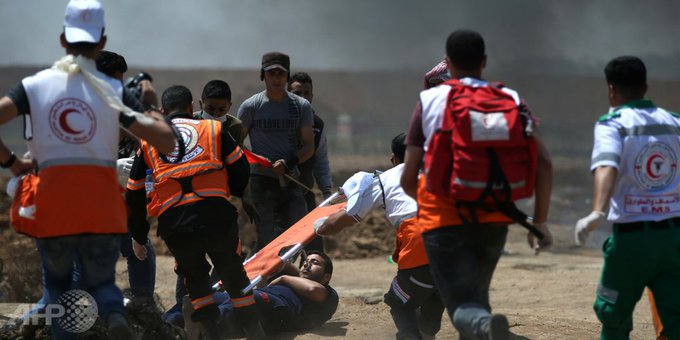
Medics and journalists were among the injured in what the Palestinian Authority condemned as a “massacre”. The Israeli military, however, claim they were defending the state borders.
The following was published on Tuesday, May 15, 2018, by Middle East Eye.
The Gaza Ministry of Health has released the names of 58 unarmed Palestinians killed. They were protesting for their freedom and dignity.

From left: Ahmed Alrantisi, Laila Anwar Al-Ghandoor, Ahmed Altetr, Alaa Alkhatib Ezz el-din Alsamaak, Motassem Abu Louley (Photo: Screengrab)
Editor’s note: Middle East Eye has live coverage of protests in Palestine and Israel here.
Sixty-one people were either killed or died of wounds inflicted by Israeli forces in the Gaza Strip on Monday and Tuesday as thousands of Palestinians demonstrated across the occupied territory to mark the 70th anniversary of the Nakba.
The youngest victim was just 8 months old. Laila Anwar Al-Ghandoor’s family told media that the baby’s mother had left the child at home to join the demonstrations. When the infant began crying her uncle took her towards the protest area in order to locate his sister.
Reports on Palestinian social media said Laila had been in a tent away from the security fence when a tear gas canister was dropped by a drone.
Fresh protests are expected. Tensions are running high as many families bury their dead.
On Tuesday afternoon, the Gaza Ministry of Health released the names of 58 Palestinians killed:
1. Laila Anwar Al-Ghandoor, 8 months old
2. Ezz el-din Musa Mohamed Alsamaak, 14 years old
3. Wisaal Fadl Ezzat Alsheikh Khalil, 15 years old
4. Ahmed Adel Musa Alshaer, 16 years old
5. Saeed Mohamed Abu Alkheir, 16 years old
6. Ibrahim Ahmed Alzarqa, 18 years old
7. Eman Ali Sadiq Alsheikh, 19 years old
8. Zayid Mohamed Hasan Omar, 19 years old
9. Motassem Fawzy Abu Louley, 20 years old
10. Anas Hamdan Salim Qadeeh, 21 years old
11. Mohamed Abd Alsalam Harz, 21 years old
 From left: Fadi Abu Salah, Motaz Al-Nunu, Jihad Mohammed Othman Mousa, Mousa Jabr Abdulsalam Abu Hasnayn, Ezz Eldeen Nahid Aloyutey, Anas Hamdan Salim Qadeeh
12. Yehia Ismail Rajab Aldaqoor, 22 years old
13. Mustafa Mohamed Samir Mahmoud Almasry, 22 years old
14. Ezz Eldeen Nahid Aloyutey, 23 years old
15. Mahmoud Mustafa Ahmed Assaf, 23 years old
16. Ahmed Fayez Harb Shahadah, 23 years old
17. Ahmed Awad Allah, 24 years old
18. Khalil Ismail Khalil Mansor, 25 years old
19. Mohamed Ashraf Abu Sitta, 26 years old
20. Bilal Ahmed Abu Diqah, 26 years old
21. Ahmed Majed Qaasim Ata Allah, 27 years old

From left: Mahmoud Wael Mahmoud Jundeyah, Ibrahim Ahmed Alzarqa, Musab Yousef Abu Leilah, Jihad Mufid Al-Farra, Saeed Mohamed Abu Alkheir, Mohamed Hasan Mustafa Alabadilah (screengrab)
22. Mahmoud Rabah Abu Maamar, 28 years old
23. Musab Yousef Abu Leilah, 28 years old
24. Ahmed Fawzy Altetr, 28 years old
25. Mohamed Abdelrahman Meqdad, 28 years old
26. Obaidah Salim Farhan, 30 years old
27. Jihad Mufid Al-Farra, 30 years old
28. Fadi Hassan Abu Salah, 30 years old
29. Motaz Bassam Kamil Al-Nunu, 31 years old
30. Mohammed Riyad Abdulrahman Alamudi, 31 years old
31. Jihad Mohammed Othman Mousa, 31 years old
32. Shahir Mahmoud Mohammed Almadhoon, 32 years old
33. Mousa Jabr Abdulsalam Abu Hasnayn, 35 years old

From left: Shahir Mahmoud Mohammed Almadhoon, Khalil Ismail Khalil Mansor, Mahmoud Saber Hamad Abu Taeemah, Mohamed Ashraf Abu Sitta, Mustafa Mohamed Samir Mahmoud Almasry, Obaidah Salim Farhan (screengrab)
34. Mohammed Mahmoud Abdulmoti Abdal’al, 39 years old
35. Ahmed Mohammed Ibrahim Hamdan, 27 years old
36. Ismail Khalil Ramadhan Aldaahuk, 30 years old
37. Ahmed Mahmoud Mohammed Alrantisi, 27 years old
38. Alaa Alnoor Ahmed Alkhatib, 28 years old
39. Mahmoud Yahya Abdawahab Hussain, 24 years old
40. Ahmed Abdullah Aladini, 30 years old
41. Saadi Said Fahmi Abu Salah, 16 years old
42. Ahmed Zahir Hamid Alshawa, 24 years old
43. Mohammed Hani Hosni Alnajjar, 33 years old
44. Fadl Mohamed Ata Habshy, 34 years old
45. Mokhtar Kaamil Salim Abu Khamash, 23 years old
46. Mahmoud Wael Mahmoud Jundeyah, 21 years old
47. Abdulrahman Sami Abu Mattar, 18 years old
48. Ahmed Salim Alyaan Aljarf, 26 years old

From left: Mohammed Hani Hosni Alnajjar, Yehia Ismail Rajab Aldaqoor, Mohammed Riyad Abdulrahman Alamudi, Ahmed Adel Musa Alshaer, Fadl Mohamed Ata Habshy, Ismail Khalil Ramadhan Aldaahuk (screengrab)
49. Mahmoud Sulayman Ibrahim Aql, 32 years old
50. Mohamed Hasan Mustafa Alabadilah, 25 years old
51. Kamil Jihad Kamil Mihna, 19 years old
52. Mahmoud Saber Hamad Abu Taeemah, 23 years old
53. Ali Mohamed Ahmed Khafajah, 21 years old
54. Abdelsalam Yousef Abdelwahab, 39 years old
55. Mohamed Samir Duwedar, 27 years old
56. Talal Adel Ibrahim Mattar, 16 years old
57. Omar Jomaa Abu Ful, 30 years old
58. Nasser Ahmed Mahmoud Ghrab, 51 years old
59 – 61: Unidentified
The UN tweeted this response:
UN Human Rights
✔@UNHumanRights

https://www.youtube.com/watch?v=UzOpUMAmRkU
Related
UN spokesman cries on camera over Gaza school attack
The UK government must stop selling arms to Israel and end its own complicity in human rights abuses
I don’t make any money from my work. You can make a donation to help me continue to research and write free, informative, insightful and independent articles, and to provide support to others. The smallest amount is much appreciated – thank you.


 Politics and Insights