

The Department for Work and Pensions has submitted a document about the Randomised Control Trial (RCT) they are currently conducting regarding in-work “progression.” The submission was made to the Work and Pensions Committee in January, as the Committee have conducted an inquiry into in-work conditionality. The document specifies that: “This document is for internal use only and should not be shared with external partners or claimants.”
So please share widely.
The Department for Work and Pensions claim that the Trial is about “testing whether conditionality and the use of financial sanctions are effective for people that need to claim benefits in low paid work.” The document focuses on methods of enforcing the “cultural and behavioural change” of people claiming both in-work and out-of-work social security, and evaluation of the Trial will be the responsibility of the Labour Market Trials Unit. (LMTU). Evaluation will “measure the impact of the Trial’s 3 group approaches, but understand more about claimant attitudes to progression over time and how the Trial has influenced behaviour changes.”
Worryingly, claimant participation in the Trial is mandatory. There is clearly no appropriate procedure to obtain and record clearly informed consent from research participants. Furthermore, the Trial is founded on a coercive psychopolitical approach to labour market constraints, and is clearly expressed as a psychological intervention, explicitly aimed at “behavioural change” and this raises some serious concerns about research ethics and codes of conduct. It’s also very worrying that this intervention is to be delivered by non-qualified work coaches.
The British Psychological Society (BPS) have issued a code of ethics in psychology that provides guidelines for the conduct of research. Some of the more important and pertinent ethical considerations are as follows:
Informed Consent.
Participants must be given the following information relating to:
• A statement that participation is voluntary and that refusal to participate will not result in any consequences or any loss of benefits that the person is otherwise entitled to receive.
• Purpose of the research.
• Procedures involved in the research.
• All foreseeable risks and discomforts to the participant (if there are any). These include not only physical injury but also possible psychological.
• Subjects’ right to confidentiality and the right to withdraw from the study at any time without any consequences.
Protection of Participants
Researchers must ensure that those taking part in research will not be caused distress. They must be protected from physical and mental harm. This means you must not embarrass, frighten, offend or harm participants.
Normally, the risk of harm must be no greater than in ordinary life, i.e. participants should not be exposed to risks greater than or additional to those encountered in their normal lifestyles. Withdrawing lifeline support that is calculated to meet the costs of only minimum requirements for basic survival – food, fuel and shelter – as a punishment for non-compliance WILL INVARIABLY cause distress, harm and loss of dignity for the subjects that are coerced into participating in this Trial. Participants should be able to leave a study at any time if they feel uncomfortable.
The Economic and Social Research Council has recently issued a new research ethics framework, and the website has lots of useful guidance that is also worth referring to.
In the UK, the Behavioural Insight Team is testing paternalist ideas for conducting public policy by running experiments in which many thousands of participants receive various “treatments” at random. Whilst medical researchers generally observe strict ethical codes of practice, in place to protect subjects, the new behavioural economists are much less transparent in conducting behavioural research interventions.
Consent to a therapy or a research protocol must possess three features in order to be valid. It should be voluntarily expressed, it should be the expression of a competent subject, and the subject should be adequately informed. It’s highly unlikely that people subjected to the extended use and broadened application of welfare sanctions gave their informed consent to participate in experiments designed to test the theory of “loss aversion,” for example.
Unfortunately there is nothing to prevent a government from deliberately exploiting a research framework as a way to test out highly unethical and ideologically-driven policies. It is not appropriate to apply a biomedical model of prescribed policy “treatments” to people experiencing politically and structurally generated social problems, such as unemployment, inequality and poverty, for example.
Some background
I wrote last year about the Work and Pensions Committee’s in-work progression in Universal Credit inquiry. The Department for Work and Pensions (DWP) intends to establish an “in-work service”, designed to encourage individual Universal Credit claimants on very low earnings to increase their income. Benefit payments may be stopped if claimants fail to take action as required by the DWP. The DWP is conducting a range of pilots to test different approaches but there is very little detail about these. The new regime might eventually apply to around one million people.
We really must challenge the Conservative’s use of words such as “encourage” and “support” and generally deceptive language use in the context of what are, after all, extremely punitive, coercive policies.
I wrote a statement at the time regarding my own submission to the inquiry, prompted by Frank Field’s spectacularly misguided and conservative statement. Here are a few of the issues and concerns I raised:
Field refered to the Conservative “welfare dependency” myth, yet there has never been any empirical evidence to support the claims of the existence of a “culture of dependency” and that’s despite the dogged research conducted by Keith Joseph some years ago, when he made similar claims.
In fact, a recent international study of social safety nets from The Massachusetts Institute of Technology (MIT) and Harvard economists categorically refutes the Conservative “scrounger” stereotype and dependency rhetoric. Abhijit Banerjee, Rema Hanna, Gabriel Kreindler, and Benjamin Olken re-analyzed data from seven randomized experiments evaluating cash programs in poor countries and found “no systematic evidence that cash transfer programmes discourage work.”
The phrase “welfare dependency” diverts us from political discrimation via policies, increasing inequality, and it serves to disperse public sympathies towards the poorest citizens, normalising prejudice and resetting social norm defaults that then permit the state to target protected social groups for further punitive and “cost-cutting” interventions to “incentivise” them towards “behavioural change.”
Furthermore, Welfare-to-Work programmes do not “help” people to find jobs, because they don’t address exploitative employers, structural problems, such as access to opportunity and resources and labour market constraints. Work programmes are not just a failure here in the UK, but also in other countries, where the programmes have run extensively over at least 15 years, such as Australia.
Welfare-to-work programes are intimately connected with the sanctioning regime, aimed at punishing people claiming welfare support. Work programme providers are sanctioning twice as many people as they are signposting into employment (David Etherington, Anne Daguerre, 2015), emphasising the distorted priorities of “welfare to work” services, and indicating a significant gap between claimant obligations and employment outcomes.
The Conservatives have always constructed discourses and shaped institutions which isolate some social groups from health, social and political resources, with justification narratives based on a process of class-contingent characterisations and the ascribed responsiblisation of social problems such as poverty, using quack psychology and pseudoscience. However, it is socioeconomic conditions which lead to deprivation of opportunities, and that outcome is undoubtedly a direct consequence of inadequate and discriminatory political decision-making and policy.
It’s worth bearing in mind that many people in work are still living in poverty and reliant on in-work benefits, which undermines the Libertarian Paternalist/Conservative case for increasing benefit conditionality somewhat, although those in low-paid work are still likely to be less poor than those reliant on out-of-work benefits. The Conservative “making work pay” slogan is a cryptographic reference to the punitive paternalist 1834 Poor Law principle of less eligibility.
The government’s Universal Credit legislation has enshrined the principle that working people in receipt of in-work benefits may face benefits sanctions if they are deemed not to be trying hard enough to find higher-paid work. It’s not as if the Conservatives have ever valued legitimate collective wage bargaining. In fact their legislative track record consistently demonstrates that they hate it, prioritising the authority of the state above all else.
There are profoundly conflicting differences in the interests of employers and employees. The former are generally strongly motivated to purposely keep wages as low as possible so they can generate profit and pay dividends to shareholders and the latter need their pay and working conditions to be such that they have a reasonable standard of living.
Workplace disagreements about wages and conditions are now typically resolved neither by collective bargaining nor litigation but are left to management prerogative. This is because Conservative aspirations are clear. Much of the government’s discussion of legislation is preceded with consideration of the value and benefit for business and the labour market. They want cheap labour and low cost workers, unable to withdraw their labour, unprotected by either trade unions or employment rights and threatened with destitution via benefit sanction cuts if they refuse to accept low paid, low standard work. Similarly, desperation and the “deterrent” effect of the 1834 Poor Law amendment served to drive down wages.
In the Conservative’s view, trade unions distort the free labour market which runs counter to New Right and neoliberal dogma. Since 2010, the decline in UK wage levels has been amongst the very worst in Europe. The fall in earnings under the Coalition is the biggest in any parliament since 1880, according to analysis by the House of Commons Library, and at a time when the cost of living has spiralled upwards.
In-work conditionality enforces a lie and locates blame within individuals for structural problems – political, economic and social – created by those who hold power. Despite being a party that claims to support “hard-working families,” the Conservatives have nonetheless made several attempts to undermine the income security of a significant proportion of that group of citizens recently. Their proposed tax credit cuts, designed to creep through parliament in the form of secondary legislation, which tends to exempt it from meaningful debate and amendment in the Commons, was halted only because the House of Lords have been paying attention to the game.
The government intends to continue formulating policies which will punish sick and disabled people, unemployed people, the poorest paid, and part-time workers. Meanwhile, the collective bargaining traditionally afforded us by trade unions has been systematically undermined by successive Conservative governments, showing clearly how the social risks of the labour market are being personalised and redefined as being solely the economic responsibility of individuals rather than the government and profit-driven big business employers.
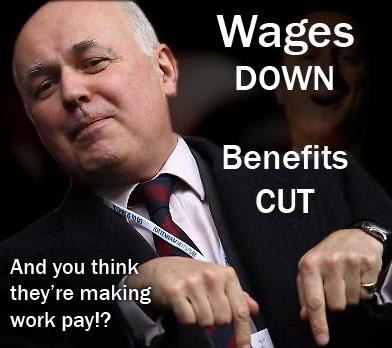
Images courtesy of Robert Livingstone
Related
Written evidence from the Department for Work and Pensions (IWP0044) – In-work Progression (IWP) – developing a core in work service IWP Supporting Information for Coaches. Randomised Control Trial (RCT)
Nudging conformity and benefit sanctions
G4S are employing Cognitive Behavioural Therapists to deliver “get to work therapy”
The importance of citizen’s qualitative accounts in democratic inclusion and political participation
Sanctions can’t possibly “incentivise” people to work. Here’s why
Universal credit. The devil’s tool – The Poor Side Of Life
—
My work is unfunded and I don’t make any money from it. But you can support Politics and Insights and contribute by making a donation which will help me continue to research and write informative, insightful and independent articles, and to provide support to others.


 Politics and Insights