Tag: welfare

This unsnookered isle

1395990_559940054075527_258446375_nWriting in the New York Times, Paul Krugman said Britain’s performance since 2010, after the global financial crisis struck, has been “startlingly bad,” with a tentative recovery that began in 2009, which was stalled in the last quarter of 2010. In his article entitled This Snookered Isle, Krugman provides an indictment of the Coalition’s claims and their methods of managing the UK economy. Mr Krugman echoes many leading economists in Britain.

Krugman says: “Unfortunately, economic discourse in Britain is dominated by a misleading fixation on budget deficits. Worse, this bogus narrative has infected supposedly objective reporting; media organizations routinely present as fact propositions that are contentious if not just plain wrong.”

Simon Wren-Lewis of Oxford University has dubbed this narrative “mediamacro.” As his coinage suggests, this is what you hear all the time on TV and read in British newspapers, presented not as the view of one side of the political debate, but as simple fact.

Yet none of it is true.

Krugman goes on to ask: “Was the Labour government that ruled Britain before the crisis profligate? [As so often claimed by the Conservatives.] Nobody thought so at the time.”

In 2007, government debt as a percentage of G.D.P. was close to its lowest level in a century (and well below the level in the United States), while the budget deficit was quite small. The only way to make those numbers look bad is to claim that the British economy in 2007 was operating far above capacity, inflating tax receipts. But if that had been true, Britain should have been experiencing high inflation, which it wasn’t.

What about growth? When the current British government came to power in 2010, it imposed harsh austerity — and the British economy, which had been recovering from the 2008 global slump, soon began slumping again. In response, Prime Minister David Cameron’s government backed off, putting plans for further austerity on hold (but without admitting that it was doing any such thing). And growth resumed.” (See also: The Return of Expansionary Austerity.)

He adds: “If this counts as a policy success, why not try repeatedly hitting yourself in the face for a few minutes? After all, it will feel great when you stop.

Given all this, you might wonder how mediamacro gained such a hold on British discourse. Don’t blame economists. As Mr. Wren-Lewis points out, very few British academics (as opposed to economists employed by the financial industry) accept the proposition that austerity has been vindicated. This media orthodoxy has become entrenched despite, not because of, what serious economists had to say.”

Cameron has misled the public by making Government debt analogous with personal debt. It isn’t. If a person misses a mortgage payment, for example, they may risk damaging their credit rating, and possibly even losing their home. So if we owe money, we need to find a way to pay it back as soon as possible. But government debt does not need to be paid back overnight – in fact, it’s widely recognised to be potentially damaging to do so.

In an economy, one person’s spending is another person’s income. So when the government cuts spending, it reduces people’s income, leading to less business, more unemployment, and a vicious spiral of slowing down the economy.

Osborne’s austerity measures have achieved nothing, except deepening poverty, widening economic inequality, and suffering for the poorest and most vulnerable communities – and Osborne announced in his Autumn statement that we face at least four more years of it, should the Tories gain office again.

Austerity is not an economic necessity, nor is it temporary measure to balance the books, but rather, it reflects the Conservative’s long-standing ideological commitment to dismantle the gains and achievements of the post war settlement: public services, the welfare state and the National Health Service. This is where most of the cuts have been aimed.

With a shortfall in tax receipts set to increase the size of the deficit by at least £25 billion during the next parliament, the Office for Budget Responsibility have said the only way Osborne could balance the books would be through shrinking the state to a level not seen since before the Second World War: “Total public spending is now projected to fall to 35.2 percent of GDP by 2019-20, taking it below the previous post-war lows reached in 1957-8 and 1999-2000 to what would probably be its lowest level in 80 years”. Robert Chote.

Despite facing a global recession, the Labour Government invested in our public services, and borrowed substantially less in thirteen years than the Coalition have in just five years. UK citizens were sheltered very well from the worst consequences of the global bank-induced crash.

Gordon Brown got it right in his championing of the G20 fiscal stimulus, agreed at the London summit of early April 2010, which was a continuation of his policies that had served to steer the UK economy out of the consequences of a global recession, and to protect citizens from those consequences.

Osborne’s policy of imposing austerity and budget cuts on an economy that was actually recovering was a catastrophic error. The austerity cuts propelled the economy backwards and into depression; and, far from using public spending as a countervailing force against the cutbacks in private sector investment, the Coalition’s budget cuts served to aggravate the crisis. Many people are suffering terribly as a consequence, many have been reduced to a struggle for basic survival.

The Conservatives have been engaged in a significant transfer of income from the least well-off half of the population to the more affluent in the past five years. Those with the lowest incomes have been hit hardest by austerity. Deliberately so.

It’s inconceivable that Coalition policies were formulated for anything other than profiting the wealthy at the expense of the poorest.

The following cuts came into force in April 2013:

  • 1 April – Housing benefit cut, including the introduction of the bedroom tax
  • 1 April – Council tax benefit cut
  • 1 April – Legal Aid savagely cut
  • 6 April – Tax credit and child benefit cut
  • 7 April – Maternity and paternity pay cut
  • 8 April – 1% cap on the rise of in working-age benefits (for the next three years)
  • 8 April – Disability living allowance replaced by personal independence payment (PIP)
  • 15 April – Cap on the total amount of benefit working-age people can receive.

Here are some of the Tory “incentives” and consquences for the wealthy:

In November last year, my proposition was also verified in a study of the cumulative impact of tax and welfare changes, from in-work benefits to council tax support, to the cut in the top rate of income tax and an increase in tax-free personal allowances, the report concluded that Coalition policy has been regressive across the income spectrum.

Its authors, Paola De Agostini and Professor Holly Sutherland at the university of Essex, and Professor John Hills at the LSE, wrote: “Whether we have all been ‘in it together’, making equivalent sacrifices through the period of austerity, is a central question in understanding the record of the coalition government … It is clear that the changes did not lead to uniform changes in people’s incomes. The reforms had the effect of making an income transfer from the poorer half of households (and some of the very richest) to most of the richer half, with no net effect on the public finances.

“In effect, the reductions in benefits and tax credits financed the cuts in taxes. Some groups were clear losers on average – including lone-parent families, large families, children, and middle-aged people (at the age when many are parents).”

Last year, the scale of Britain’s growing inequality was revealed by a report from the leading charity, Oxfam, showing that the country’s five richest families now own more wealth than the poorest 20% of the population.

Oxfam urged the chancellor to use the 2014 spring budget to make an assault on tax avoidance and introduce a living wage, in a report highlighting how a handful of the super-rich, headed by the Duke of Westminster, have more money and financial assets than 12.6 million Britons put together.

In the report,  A Tale of Two Britains, Oxfam said the poorest 20% in the UK had wealth totalling £28.1bn – an average of £2,230 each. The latest rich list from Forbes magazine showed that the five top UK entries – the family of the Duke of Westminster, David and Simon Reuben, the Hinduja brothers, the Cadogan family, and Sports Direct retail boss Mike Ashley – between them had property, savings and other assets worth £28.2bn.

And:

Increasing inequality is a sign of economic failure rather than success. It’s far from inevitable – a result of political choices that can be reversed.

The Labour Party have announced this week that tackling tax avoidance and evasion is a priority, and they plan to push emergency laws through parliament designed to impose far higher fines and close  tax loopholes. This move alone will raise more than £7.5bn a year in revenue for the Treasury. It’s a measure that sends out a clear message: the poorest people should not have to pay more to compensate for tax abuses by the rich.

Also announced this week was Labour’s intention to abolish archaic rules that allow wealthy “non-domiciles”, who live in the UK but claim to be domiciled overseas, to avoid paying tax in this country on what they earn outside of Britain.

Labour’s careful, costed and evidence-based policies also include: a Bankers’ Bonus Tax; a Mansion Tax; repeal of the Bedroom Tax; a reversal of the Pension Tax relief that the Tories gifted to millionaires; a reversal of the Tory Tax cut for Hedge Funds; freezing gas and electricity bills for every home a the UK for at least 20 months; the big energy firms will be split up and governed by a new tougher regulator to end overcharging; banning exploitative zero hour contracts; introduction of a living wage (already introduced by some Labour councils); a reversal of the £107,000 tax break that the Tories have given to the millionaires; reintroduction of the 50p tax; scrapping George Osborne’s “Shares for Rights” scheme that has opened up a tax loophole of £1 billion; ensuring Water Companies place the poorest households on a Social Tariff that makes it easier for them to pay their Water Bills; breaking up the banks and separating retail banking from investment banking; introduction of measures to prevent corporate tax avoidance, scrapping the Profit Tax Cut (Corporation Tax) that George Osborne has already announced for 2015 and many more.

These are not austerity measures. They are much needed, strongly redistributive policies.

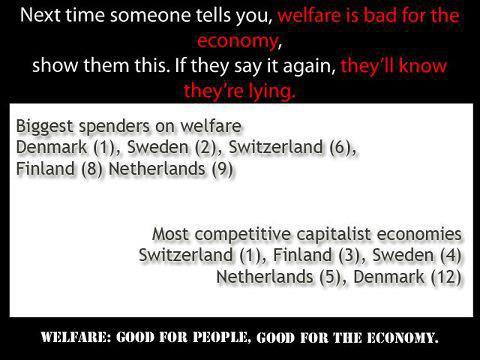
The Organisation for Economic Co-operation and Development (OECD) has recently found what most of us already knew: that income inequality actually stifles economic growth in some of the world’s wealthiest countries, whilst the redistribution of wealth via taxes and benefits encourages growth.

Will the super-rich leave the UK, bag, baggage and all, as the right-wing scaremongers bleat, if we have a fair government that expects tax contributions from the cosseted rich? I seriously doubt it. They could start an exodus to New York I suppose, a city with a currently heavier tax regime, yet curiously not short of thousands of super-rich residents.

Ask yourself this: what are these tax-evading, hoarding and loudly complaining people actually contributing to our society? As far as I can see, they are supported by enormous state handouts, at everyone elses’ expense. They are propped up in their greed for ever-increasing profits,

Tax avoidance is costing us at least £70bn each year.

The most costly benefit payments in the UK are Tax Credits, Housing Benefit and Child Benefit, totalling £56.4bn a year.  These are not out of work benefits.  Some 65% of the total spent on working age benefits, is paid to people in work, whose wages are below subsistence levels.

Add to that the corporate tax benefits, such as the value of the cheap credit made available to banks and other business, the insurance schemes run by the government to protect exporters, the marketing for British business laid on by Vince Cable’s ministry, the public procurement from the private sector … a recent study conducted by Kevin Farnsworth, a senior lecturer in social policy at the University of York, concludes that direct corporate welfare costs British taxpayers just short of £85bn a year.

The Tory’s justification for allowing exploitative tax avoiders to have all of their own way is the mythological “trickle down effect.” Or “voodoo economics” to Keynsians. It was also known as the “horse and sparrow theory” a couple of centuries back. The idea being that if you feed a horse plenty of oats, the sparrows in it’s wake will also be fed .

And we are most certainly being fed horsesh*t.

It’s time to put an end to corporate welfare, and state handouts to the wealthy. We can do that by voting for a Labour government.

And if some thieving, hoarding, greedy misers threaten to leave the UK, why, I think I’ll offer to help them pack.

rich keep millonsBig thanks to Robert Livingstone for his excellent memes.

Everyone matters: it’s time to vote for our lives – vote Labour

430847_149933881824335_1645102229_n (1)I published an article earlier this month from Debbie Abrahams and added a short piece by myself: Anyone worried about protecting the welfare state should concentrate on kicking out the Tories.

Benefits and Work published a very good article this week: Vote for your life – “dramatic”, “life-changing” cuts are coming, I have  reproduced the most salient parts of it here for those who don’t have access to their site. I’ve also added a few links with information.

“Dramatic” and “life-changing” benefits cuts will be imposed if the Tories are running the country after 7 May, Iain Duncan Smith has warned.

They could include taxing DLA, PIP and AA, axeing contribution-based ESA and JSA, cutting the work-related activity component of ESA to 50p, cutting carers allowance numbers by 40%, and making people pay the first 10% of their housing benefit.

For many, these will be life-threatening cuts, rather than life-changing ones.

But claimants are in a position to prevent them happening.

And it won’t take a miracle.

In fact, just an additional 5% turnout by working age claimants could have a dramatic and life-changing effect on Iain Duncan Smith and his plans instead.

But a higher turnout won’t happen by itself.  Many of the major charities and disability organisations have been scared into silence by the Lobbying Act. And the media has little interest in benefits cuts, other than to applaud them as a good thing.

So it looks like it’s up to ordinary claimants to make sure as many other claimants as possible understand the threat they are facing.

Dramatic cuts
Iain Duncan Smith told Andrew Marr last week he didn’t become a minister to make “cheese-paring” cuts. Instead he has ‘dramatic’ and ‘life-changing’ plans for claimants.

And the tool for those dramatic changes is £12 billion of cuts to benefits in the space of just two years.

So far, we only know where £2 billion of the cuts will come from – a freeze on working age benefits. But the Conservatives are refusing to say where the other savings will be made.

Hit list
A document leaked to the BBC, however, set out some of the cuts the Conservative party are considering, including:

  • Taxing DLA, PIP and AA.
  • Abolishing contribution based ESA and JSA entirely, so that only claimants who pass a means test can claim these benefits.
  • Cutting the number of people getting carer’s allowance by 40%.
  • Limiting child benefit to the first two children.

There are other proposed cuts too, including replacing industrial injuries benefits with an insurance policy for employers, regional benefit caps and changes to council tax.

Not enough cuts
But all of this will still not be enough.

According to the Institute for Fiscal Studies (IFS):

“If all of these were implemented, the total saving would be likely to fall well short of the missing £10 billion per year that the Conservatives intend to find by 2017–18”

So, what else might be in the firing line?

Housing benefit and ESA cuts
We know that pensioners benefits are protected. And JSA costs such a tiny amount compared to other benefits that further cuts there would make little difference.

Cuts to housing benefit are one possibility that the IFS have highlighted, however, as this makes up a large and growing proportion of the benefits bill.

The IFS have estimated that making everyone pay the first 10% of their housing benefit would save £2.5 billion over two years.

Another extremely strong contender is to cut the work-related activity component (WRAC) of ESA to just 50 pence.

We know that the Conservatives are keen to slash the WRAC, because they’ve considered doing it before.

Cutting the WRAC wouldn’t save huge amounts, probably less than £1 billion a year.

But combined with cuts to housing benefit and all the other cuts listed above, it would probably be enough.

What you can do
Is this all nothing more than unnecessarily distressing speculation? After all, we don’t know what cuts will be made until – and unless – the Tories are elected.

But by then it will be too late. As Andrew Marr said in his interview with Iain Duncan Smith, if the Conservatives won’t tell us which benefits will be cut, sick and disabled claimants will have to expect the worst:

“What I’m saying to you is if I was on welfare, if I was on disability benefit and I was told that you were taking £12 billion out of the budget, I would really need to know before I voted was I going to be hit. Or if I didn’t know that, I’d have to be assume that I was going to be hit.”

Iain Duncan Smith, Osborne and Cameron have all now said no details of the cuts will be given before the election. So there’s no time to lose.

Clearly, the most important thing is to make sure you are registered to vote and then actually vote for a candidate who can keep the Tories out, if that’s possible, in your constituency.

But there’s more.

Above all, alert other claimants and carers to the dramatic threat they face – because many people still have no idea how huge £12 billion in cuts in two years really is.

And then try to persuade them that voting isn’t a waste of time. Because it is no longer true that all the parties are the same.

Here at Benefits and Work we have no trust for either of the major parties. But Labour, regardless of your political preferences, don’t drool at the thought of cutting welfare in the way that the Tories do.

And the £7 billion savings Labour say they plan to make are very much smaller than the Conservative cuts. Even if every single pound Labour saved was from cutting benefits, instead of from other measures such as raising taxes from the wealthy, it would still amount to just over half the benefits cuts the Tories have guaranteed.

[To clarify, Labour have stated they will not be cutting benefits, but they will address the overall costs to the welfare budget, tackling high private sector rent, repealing the bedroom tax, reducing costs such as private contracts within the Depatment of Work and Pensions, for example. See: We can reduce the Welfare Budget by billions: simply get rid of Iain Duncan Smith. Kitty]

You can make a difference
And don’t imagine that your voice can’t make a difference.

Bar chart:  Tory Majority 333, claimant count 6840 Lancaster Fleetwood

This is a very close election so far.

There will be many seats where the winner’s majority is in the low hundreds, some where it will be less than a hundred. Even a 5% additional turnout by working age claimants – amounting to perhaps 400 voters in many constituencies – could make the difference between Labour and the Conservatives being the largest party.

If you can convince a handful of people to vote and to talk to other claimants, you could genuinely help to change the course of this election.

Remember, you’re not trying to persuade hard-faced, right wing tabloid readers that cutting benefits is wrong. That undoubtedly would be a waste of time.

You’re talking to people who already know how painful the Coalition benefits cuts have been – because they’ve been hit by them.

You just have to persuade them that it’s not time to despair.

It’s time to fight back.

It’s time to vote for your life.

Related

Rising ESA sanctions: punishing the vulnerable for being vulnerable

As predicted, Mandatory Review has effectively destroyed independent Tribunals

Government under fire for massaging unemployment figures via benefit sanctions from Commons Select Committee

Osborne’s razor, smoke and mirrors

Osborne’s Autumn statement reflects the Tory ambition to reduce State provision to rubble

Follow the Money: Tory Ideology is all about handouts to the wealthy that are funded by the poor

Thanks to Robert Livingstone for the excellent memes.

A crib sheet of responses to the crib sheet of lies about the Labour Party: Part two

1796655_294409220710133_3373329_n
I decided to consolidate the frequently encountered lies about Labour Party policies and construct a crib sheet of responses founded on facts and evidence for anyone to use in challenging propaganda, nonsense and misinformation. Or to simply enlighten.

Here are some of the most frequently used lies that are paraded as “criticisms” of Labour, by a variety of fringe parties, the greens and the Scottish Nationalists, all claiming to be “left.” Ultimately, the only beneficiaries will be the Conservatives, left largely unchallenged by the narxist parties. The only party actually opposing the Tories is Labour.

In part one, I addressed the “allthesame” lie, the Iraq war and Labour’s position on austerity.

In part two, I aim to address Labour’s position on the TTIP, welfare, fracking and the renewal of Trident:

  • Labour support the Transatlantic Trade and Investment Partnership trade deal (TTIP).”

Whilst the Labour Party recognise that greater transatlantic trade and investment could be beneficial for Britain, they have always opposed the inclusion of the Investor State Dispute Settlement (ISDS) in the agreement.

The ISDS contradicts principles of democratic accountability and would potentially allow one government to bind another for decades to come. Unlike the great majority of other treaties, investment treaties have very long minimum lifespans ranging up to 30 years.

Much debate has arisen concerning the impact of the controversial ISDS on the capacity of governments to implement reforms and legislative and policy programs related to public health, environmental protection, labour and human rights. (See – Labour MPs speak out against the TTIP and investigation opens into the impacts on environmental protections.)

In Britain, privatisation was primarily driven by Tory ideological motives, to “roll back the frontiers of the State.” The ISDS would stifle moves by a future democratically elected government to put the deregulation and privatisation process into reverse and bring our public services – including our NHS, railways, water, energy and other utilities – back into public ownership.

Where the ISDS has been forced into other trade agreements, it has allowed big global corporations, already with too much power, to sue Governments in front of secretive arbitration panels composed of corporate lawyers, which bypass our domestic courts and override the decisions of parliaments and interests of citizens.

The Labour Party understand that no matter how economically beneficial the TTIP may be, potentially, such very serious threats posed by the ISDS clause to public services, civil rights, citizen well-being and democracy are untenable.

This is why in January, Labour MEPs called on the European Commission to remove the ISDS clause from the EU-US trade deal. It will now be opposed by the Progressive Alliance of Socialists and Democrats (S&D) group, which Labour MEPs are a part of. On 4 March, the S&D group in the European Parliament decided to oppose the ISDS in an almost unanimous vote.

The proposal was supported by 78 votes to five against. The adopted position was drafted by Labour MEP David Martin, who is the group co-ordinator on trade issues. (See – Labour MEPs secure support to reject the ISDS clause in the TTIP.)

The most controversial element of the TTIP has been taken off the negotiating table, thanks to Labour.

  • “Labour will be tougher on welfare than the Tories.”

Rachel Reeves has NEVER said that she will be “tougher on welfare.” She issued a statement shortly after being misquoted. Natalie Bennett perpetuated that misquote, too, originally from the Observer. (See Bennett’s article: Rachel Reeves is clear: Labour would set the struggling against the poorest.)

What Rachel Reeves actually said was she would be “tougher on the CAUSES of high welfare spending”  – such as low wages, unemployment, high private sector rents, lack of adequate housing, private company contracts and outsourcing – especially that instigated by Iain Duncan Smith: his vanity projects have cost us millions because contracted private companies have failed to deliver services, the policies are ill-conceived, creating higher costs, ultimately, rather than making any savings as the Tories claimed – the bedroom tax being an example, which Labour have pledged to scrap.

In simple terms, Labour strongly contest the causes of high spending on social security, seeing structural problems such as high unemployment, shortages of housing and poor policies as the underlying reasons, for example, whereas Tories simply blame individuals.

Labour has not committed to match the £12bn of further cuts to the welfare bill promised by George Osborne. Reeves said Labour aimed to cut welfare spending by increasing the minimum wage to £8 an hour, and increasing youth employment. She said: “Labour believes in strong safety net, work for those who can and support for those who can’t.”

“The big savings to be had are by tackling the root causes of the benefits bill,” she said. “If every young person who can work is working and if people are paid a wage that they can afford to live on, so they don’t have to draw down on housing benefit and tax credit, then that’s going to save a lot more money than all the talk in the world about ‘shirkers and scroungers’.”

The fact that Rachel Reeves was misquoted was clarified to Caroline Lucas in Parliament, so the Green Party have no excuse for shamefully lying about the Labour Party’s policy intentions.

In the middle of crucial debate about the Work Capability Assessment and the plight of disabled people because of Coalition policies, initiated by the WOW campaign, Lucas lost all of my respect when she chose political point scoring instead of constructive debate and said this:

Caroline Lucas (Brighton, Pavilion, Green); I was disappointed that Rachel Reeves, on taking up her post as shadow Secretary of State for Work and Pensions, used the opportunity of her first interview to say that she would be tougher than the Tories on people on benefits.

Kate Green (Shadow Minister (Work and Pensions); Stretford and Urmston, Labour); My hon. Friend the Member for Leeds West did not say that. She said that she would be tougher on welfare spending, not on people on benefits.

Sheila Gilmore (Edinburgh East, Labour); Does the hon. Lady agree that there are some forms of welfare spending that we should bring down? In my view, one of those is the excessive amount that is paid to private landlords through housing benefit. I am certainly in favour of reducing that form of welfare spending. Is she not?

Caroline Lucas (Brighton, Pavilion, Green); I am very much in favour of that if the hon. Lady wants to put it under the heading of welfare spending... Source: Hansard – which is the parliamentary record. (See: 27 Feb 2014 : Column 457  at 1.29 pm, on the 2nd page.)

Nonetheless many have continued to misquote Reeves, using negative campaigning and smear tactics akin to the Tories to promote their own party. It’s time that some people distinguished between welfare spending and benefits, to conflate the two purely for political gain is deplorable, dishonest and not in the best interests of the electorate. (Also, see – We can reduce the Welfare Budget by billions: simply get rid of Iain Duncan Smith.)

Another lie about Labour’s intentions is that they intend to “scrap benefits for young people.” Of course this not true.

Ed Miliband has made it clear that he is REPLACING jobseekers allowance with another allowance for young people. He thinks that conditional benefits are inappropriate for young people, as to be entitled to jobseekers allowance requires having to be available for work and actively looking for work, so it excludes the very possibility of further education and learning experiences. But young people need the freedom and support to gain from learning.

That’s why Ed Miliband will replace out of work benefits for those aged 18-21 with a youth allowance of the same value. This isn’t the controversial issue that was presented by the mainstream media and other parties at all: it’s actually a very well thought out, cost efficient and positive policy.

So young people won’t have to be available for work, but they do have to use their freedom to be learning or training. This detail matters a lot and was excluded from most accounts of the policy. The new “youth allowance” is set at £57 – the same as Job Seekers Allowance for under 25s – provided they undertake vocational training of AS level or equivalent. Miliband had a good idea, it won’t cost any more than we currently pay young people, but it means we are investing in young people’s potential and their futures. (See – Template for costing policies of opposition parties: Training support for young people.)

  • “Labour support fracking.”

Labour have always had concerns about the safety of fracking and have demanded that robust regulations are put in place before any exploratory drilling takes place.

In Government, the Labour Party led the way on an international level as the first nation to put climate change at the heart of the G8 and to call a United Nations Security Council meeting on climate change.

On 16 October 2008, Ed Miliband, then the Secretary of State for Energy and Climate Change, announced the world’s first Climate Change Act. It is worth remembering this historical legislative context: it has considerable bearing on why Labour opposes the current government’s almost fanatical faith in shale gas.

Labour’s position on fracking is that the development of shale gas cannot and must not come at the expense of meeting our legally binding obligation to avoid dangerous climate change, nor can fracking be given any nod of approval at all without scrupulous environmental safeguards in place. Any future Labour policy on fracking, either way, would be formulated with due care, after drawing on research and the meticulous gathering of evidence of all potential environmental risks.

Over the last three years, Labour has worked with organisations including the RSPB, Friends of the Earth and the Local Government Association, drawing on work by Royal Academy of Engineering and other bodies to produce a list of vital conditions to reform the regulatory regime for shale gas. The conditions include independent inspection of well integrity, mandatory monitoring for fugitive emissions and a presumption against development in protected areas such as National Parks.

They represent a comprehensive approach, based on scientific evidence, to bring a rigour and coherence to the UK’s regulatory framework.

Labour recently successfully forced through these conditions as a series of legislative amendments to constrain government plans to “fast-track” fracking. George Osborne, the chancellor, was demanding “rapid progress” from cabinet ministers, including delivering the “asks” of fracking company Cuadrilla.

A moratorium, as proposed by the Green Party, would never have been successful at this stage, and Labour knew that. Had the moratorium actually gathered a successful yes vote, the Tories would most certainly not have abided by that, leaving them free without constraint to go ahead with their plans to fast-track the industry.

Labour succeeded in binding them to agree on considerable restrictions, which will tie the Tories’ hands until well after the election, as well as excluding almost half of the Country’s potential shale gas sites from being potential drilling sites.

Such a wide-ranging ban is a significant blow to the UK’s fracking industry, which David Cameron and George Osborne have enthusiastically backed. The future of fracking now looks to be in the balance. Many analysts say the outlook for fracking is bleak.

The Guardian goes on to say: “An independent analysis by Greenpeace also found that 45 per cent of the 931 blocks being licensed for fracking in England were at least 50 per cent covered by protected areas, which it said was likely to make them unattractive to fracking companies.

“Just three per cent of the blocks have no protected areas at all, Greenpeace found.”

Louise Hutchins at Greenpeace UK added: “The shale industry’s seemingly irresistible advance is now looking more and more resistible every day, unless ministers can explain why fracking is too risky for the South Downs but perfectly safe in the Lancashire countryside, the next obvious step is to ban this controversial technique from the whole of the UK.” (See: Legislative amendments from the Labour Party effectively constrain Tory plans to fast-track the fracking industry.)

  • “Labour support the renewal of Trident.”

Labour has historically close ties with the Campaign for Nuclear Disarmament (CND). In March 2007 the CND organised a rally in Parliament Square to coincide with the Commons motion to renew the Trident weapons system. The rally was attended by over 1,000 people. It was addressed by Labour MPs Jon Trickett, Emily Thornberry, John McDonnell, Michael Meacher, Diane Abbott and Jeremy Corbyn.

In the House of Commons, 161 MPs (88 of them Labour) voted against the renewal of Trident and the Government motion was carried only with the heavy support of Conservatives.

High profile members of Labour CND include Jeremy Corbyn MP, former MP Alice Mahon and Walter Wolfgang. Former Prime Minister Tony Blair and former Foreign Secretary Jack Straw were once members as young MPs.

Labour had announced their intentions of unilateral disarmament at their 1982 Conference and Kinnock subsequently retreated from that policy of outright unilateral nuclear disarmament because it was that which had lost Labour the previous two General Elections. Public support for the CND fell after the end of the Cold war. It had not succeeded in converting the British public to unilateralism and even after the collapse of the Soviet Union, British nuclear weapons still have majority support.

Unilateral disarmament has always been opposed by a majority of the British public, with the level of support for unilateralism remaining steady at around one in four of the population

A bitter dispute broke out after Kinnock sought to clarify policy by pledging to retain Trident indefinitely until the successful negotiation of an international agreement to eliminate all nuclear weapons. The public opinion on Trident was that we should keep it until there is a multilateral agreement reached.

However, Labour’s prospective parliamentary candidates in the 2015 election are speaking out about their opposition to Trident. There has been quite a marked swing towards unilateralism within the Party once more.

The views of Labour candidates are being published on the CND website as part of an ongoing survey, with 75% expressing opposition to Trident replacement to date. (See: Labour PPCs say Scrap Trident.

Even if Labour were to make only small gains, the unilateralist cause will be much stronger than in this parliament. (See: New Statesman – Exclusive: 75% of Labour PPCs oppose Trident renewal.)

14301012075_2454438e62_o (1)
Thanks to Robert Livingstone for the excellent memes.

You’d have to be Green to believe the Green Party: two more lies exposed.

PANews+BT_N0321471377269205233A_I1“David Cameron and George Osborne believe the only way to persuade millionaires to work harder is to give them more money. But they also seem to believe that the only way to make you (ordinary people) work harder is to take money away.” Ed Miliband. Source: Hansard, 12 December, 2012

The Tories have trashed the economy, damaged the very structure of our society and destroyed people’s lives. We have seen the return of absolute poverty, malnutrition and illnesses not seen since Victorian times. People have died as a consequence of Tory policies. What do the Green Party do? Lie about the Labour Party.

The Green Party are not opposing Tory austerity: they are opposing what is currently the only credible alternative instead. They prefer to undermine those that ARE challenging the Coalition regarding policies that are having devastating consequences on the poorest and most vulnerable citizens. That’s very telling. I fully support some Green policies, and wish that the Left generally would work in a much more collaborative way. Really that’s the only way of effectively challenging the current neoliberal conservative dominant paradigm.

Given an opportunity to engage in genuine political conversation and to cooperate in opposing the Tory-led draconian policies, those parties claiming to be “further left” than Labour have instead behaved exactly like the Tories. They chose to undermine Labour. These are parties that prioritise grandstanding and electioneering above the needs of the public. That has entailed lying and smearing campaigns. Yet we all share many of the same aims and objectives, values and principles. The infighting simply weakens a broader and more important progressive Movement.

Here are two examples of lies that are currently being circulated on Facebook and elsewhere by the Green Party and the Scottish National Party (SNP), amongst others:

Lie number 1: “Rachel Reeves said she would be tougher on welfare.”

Rachel Reeves has NEVER said she will be “tougher on welfare.” Those saying that she did are lying. She issued a statement shortly after being misquoted. It was Natalie Bennett who perpetuated that misquote too, originally from the Observer. (See Bennett’s article: Rachel Reeves is clear: Labour would set the struggling against the poorest.)

What Rachel actually said was she would be “tougher on the CAUSES of high welfare spending – such as low wages, unemployment, high private sector rents, private company contracts and outsourcing – especially that of Iain Duncan Smith: his vanity projects have cost us millions because contracted private companies have failed to deliver services, the policies are ill-conceived, creating higher costs, ultimately, rather than making any savings as the Tories claimed – the bedroom tax being an example.

The fact that Rachel Reeves was misquoted was clarified to Caroline Lucas too, so the Green Party have no excuse for shamefully lying about the Labour Party’s policy intentions.

In the middle of crucial debate about the Work Capability Assessment and the plight of disabled people because of Coalition policies, initiated by the WOW campaign, Lucas lost all of my respect when she chose political point scoring instead of constructive debate and said this:

Caroline Lucas (Brighton, Pavilion, Green); I was disappointed that Rachel Reeves, on taking up her post as shadow Secretary of State for Work and Pensions, used the opportunity of her first interview to say that she would be tougher than the Tories on people on benefits.

Kate Green (Shadow Minister (Work and Pensions); Stretford and Urmston, Labour); My hon. Friend the Member for Leeds West did not say that. She said that she would be tougher on welfare spending, not on people on benefits.

Sheila Gilmore (Edinburgh East, Labour); Does the hon. Lady agree that there are some forms of welfare spending that we should bring down? In my view, one of those is the excessive amount that is paid to private landlords through housing benefit. I am certainly in favour of reducing that form of welfare spending. Is she not?

Caroline Lucas (Brighton, Pavilion, Green); I am very much in favour of that if the hon. Lady wants to put it under the heading of welfare spending... Source: Hansard which is the parliamentary record. (See: 27 Feb 2014 : Column 457  at 1.29 pm, on the 2nd page.)

Nonetheless the Green Party has continued to misquote Reeves, to my disgust, using negative campaigning and smear tactics akin to the Tories to promote their own party. It’s time that some people distinguished between welfare spending and benefits, to conflate the two purely for political gain is deplorable, dishonest and not in the best interests of the electorate.

Lie number 2: “Labour voted for austerity.”

This is such a blatant lie. The vote, clearly stated on the Hansard record (see 13 Jan 2015: Column 738, Charter for Budget Responsibility), was pertaining strictly to the motion: “That the Charter for Budget Responsibility : Autumn Statement 2014 update, which was laid before this House on 15 December 2014, be approved.”  That isn’t about austerity.

The charter sets out that the Office of Budget Responsibility (OBR) will continue to monitor our fiscal rules. As we know, the  OBR has written extremely critical economic forecasts and analysis of austerity and the Tory spending cuts, clearly expressing the risks that the Chancellor is running and the scale of the damage his strategy will inflict on what remains of our public services.

It’s worth noting that whilst Ed Balls challenged Osborne, there was a curious silence from the  SNP and the Green Party. It was Ed Balls that challenged Osborne’s outrageous claims regarding “halving the deficit”- such a blatant lie, upon which even the exceedingly Conservative Spectator spluttered contempt. Or any of the other lies, some of which have already earned the Conservatives official rebukes from the Office for National Statistics. (See “bankruptcy lie” for example, on the hyperlinked article)

Furthermore, it’s about time that some MP’s, including Caroline Lucas, amongst others, recognised that there is a fundamental difference between the meaning of the word budget and the word austerity. Conflating the two for the purpose of politicking is unprincipled and dishonest.

It’s also worth noting from the same debate on the Hansard record:

13 Jan 2015 : Column 746

Caroline Lucas: Does the Chancellor agree with me that with the feeble and inconsistent opposition coming from the Labour Front Bench, there is a very good reason for seeing the SNP, the Greens and Plaid as the real opposition on this issue because we are clear and consistent about the fact that austerity is not working?

Mr Osborne: That shows why we want the hon. Lady’s party in the TV debates.

Yes, I just bet they do, to collaborate with the Tories in attacking and undermining the Labour Party, not the Coalition, who are, after all, the ones responsible for introducing austerity measures. I don’t imagine for a moment that Osborne values further challenges to his outrageous claims of efficacy regarding austerity measures. What is very evident when you read through this debate, is that Ed Balls and a couple of other Labour MPs presented the ONLY challenges to Osborne on this matter, just to reiterate this important point.

10940505_767712909964906_6225427822143651262_n

It’s also worth bearing in mind that Ed Miliband established the International ANTI-austerity Alliance. Back in 2012, Miliband said: “There is a grip of centre-right leadership on Europe which has said there’s only one way forward and that’s austerity, and you’ve got to have a decisive move away from that.(See also: Labour leader Ed Miliband’s anti-austerity alliance will fight for the European dream.)

And why would Miliband be attending ANTI-austerity protests if he supported austerity?

Labour leader Ed Miliband speaks on stage at Hyde Park, during the TUC organised protest against austerity measures in London

 Labour leader Ed Miliband speaks on stage to over 150,000 at Hyde Park, during the TUC organised protest against austerity measures in London

It’s interesting to see the Chicago Tribune’s article: Ed Balls, UK’s anti-austerity finance chief in waiting.  Balls dismissed Osborne as a “downgraded chancellor”after Britain lost its triple-A credit rating.One of his main charges has been that the government is unfairly spreading the economic pain it deems necessary to fix the economy. Austerity cuts are the burden of the poorest.

Balls says that a decision to cut the top tax rate amounts to an unjustified “tax cut for millionaires”, whilst his party has been scathing of reform of the welfare system. A point echoed many times by Ed Miliband, too. Accusing the government of making lower or no income groups pay for the recovery while shielding the rich is a claim which strikes a chord with some voters who view Cameron and his government – many of whom were educated at the same top fee-paying school – as out of touch.

Caroline Lucas was born in Malvern to Conservative parents and attended Malvern Girls’ College (which became Malvern St James in 2006), a fee-paying private school. Ed Miliband, on the other hand, went to a comprehensive school. Polls also show that many voters approve of the government’s drive to rein in welfare costs and the government has demanded Labour spell out what it would do to fix the economy. They have, but with understandable caution.

Labour’s careful, costed and evidence-based policies include: a Bankers’ Bonus Tax; a Mansion Tax; repeal of the Bedroom Tax; a reversal of the Pension Tax relief that the Tories gifted to millionaires; a reversal of the Tory Tax cut for Hedge Funds; freezing gas and electricity bills for every home a the UK for at least 20 months; the big energy firms will be split up and governed by a new tougher regulator to end overcharging; banning exploitative zero hour contracts; introduction of a living wage (already introduced by some Labour councils); a reversal of the £107,000 tax break that the Tories have given to the millionaires; reintroduction of the 50p tax; scrapping George Osborne’s “Shares for Rights” scheme that has opened up a tax loophole of £1 billion; ensuring Water Companies place the poorest households on a Social Tariff that makes it easier for them to pay their Water Bills; breaking up the banks and separating retail banking from investment banking; introduction of measures to prevent corporate tax avoidance, scrapping the Profit Tax Cut (Corporation Tax) that George Osborne has already announced for 2015 and many more.

These are not austerity measures. They are strongly redistributive policies.

It’s difficult enough opposing the manipulative, lying authoritarian Conservative-led government, without having to constantly counter lies and smears from parties claiming to be on the left, too. Shame on the Green Party and the SNP.

As I have said elsewhere, there’s a clear gap between professed principles and their application amongst the parties that claim to be “real socialists”.  How can it be principled or moral (or “socialist” for that matter) to collaborate with the Tories in attempting to damage, smear and discredit the only viable option of removing the Tories from Office in May? Bearing in mind that many people are suffering profoundly, some have died as a consequence of Conservative-led policies, we can see what the Green Party’s priorities actually are, here.

They don’t include the best interests of citizens and consideration of their well-being, that’s for sure.

403898_365377090198492_976131366_nThanks to Robert Livingstone for his excellent memes.

Public perceptions of party positions on the political spectrum: Labour’s leftward shift under Ed Miliband, the Conservatives’ rightward swing since 2010.

Good to see the public generally don’t swallow the “allthesame” myth.

The Conservatives’ slippery slope and Allport’s scale of prejudice

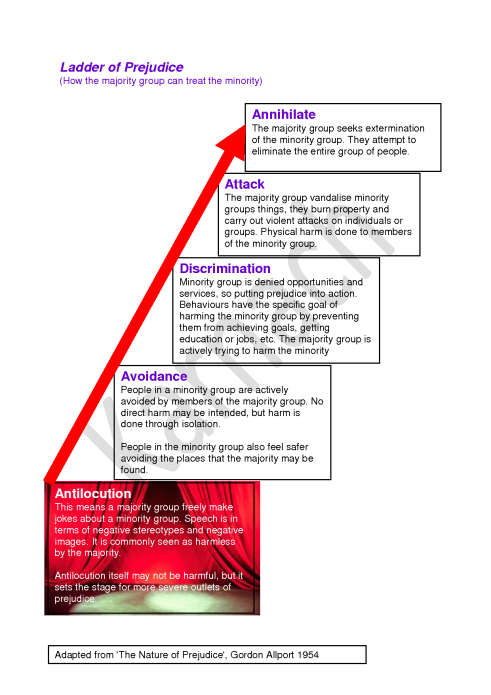
Gordon Allport studied the psychological and social processes that create a society’s progression from prejudice and discrimination to genocide. In his research of how the Holocaust happened, he describes sociopolitical and socio-psychological processes that foster increasing social prejudice and discrimination and he demonstrated how the unthinkable becomes acceptable: it happens incrementally. It happens because of a steady, nudged erosion of our moral and rational boundaries, and propaganda-driven changes in our attitudes towards others, all of which advances culturally, by almost inscrutable degrees. 

The process always begins with political scapegoating of a social group and with ideologies that identify that group as an enemy or a social burden in some way.  It begins with dehumanizing language.

By using dehumanizing language, we negatively shape the way we view some groups of people. We may begin to view them as “less-than” or “subhuman”. When we view someone as less than us, it creates a social, cultural, moral, psychological and emotional separation, which makes it easier to permit or commit violence against them. Every human being has inherent dignity by virtue of our shared humanity and the rational nature that comes with it. No matter our age, innocence, gender, size, race, nationality, or ability, we are all equally human; our language and actions should reflect that fact.

Unless we actively challenge dehumanizing rhetoric, it will continue to permeate our society and lead to acts of violence.  Dehumanizing rhetoric used to oppress groups of human beings in the past is still being used against marginalized groups of today.

bad-words-poster-smaller.png
                                                                                         Examples of dehumanizing language

A history of devaluation of the group that becomes the target, authoritarian culture, and the passivity of internal and external witnesses (bystanders) all contribute to the probability that violence against that group will develop, and ultimately, if the process is allowed to continue evolving, genocide.

Economic recession, uncertainty and authoritarian or totalitarian political systems contribute to shaping the social conditions that seem to trigger Allport’s escalating scale of prejudice. In his book, The Nature of Prejudice, Gordon W. Allport uses the metaphor of a ladder to describe how “little acts,” which often go unnoticed, can lead to serious and deadly individual and collective behaviors.  This framework describes, in ascending order, five “rungs” of intolerance and injustice: speech, avoidance, discrimination, physical attack, extermination.

Allport's ladder

The Conservatives are authoritarians, they manufactured an economic recession, as did the previous Conservative administrations. Though the sheer pace and blatancy of Cameron’s austerity programme  – a front for the theft and redistribution of public wealth to Tory-supporting private bank accounts – is unprecedented, even for Conservatives.

And prejudice towards vulnerable minority groups is almost a cardinal Conservative trait. The media is being used by the right-wing as an outlet for blatant political propaganda, and much of it is manifested as a pathological persuasion to hate others. This process of outgrouping and othering has historically been used by tyrants to target, oppress, persecute and murder some social groups.

599849_369461329790068_1640090166_n

The Conservative party has said that they are “controlling immigration” by clamping down on benefits tourism and health tourism – so that we only welcome those who want to “work hard and contribute to our society”, cutting net immigration from outside the EU to levels not seen since the late 1990s – to “ease pressure on the schools and hospitals that all hardworking people rely on”, and introducing a new citizen test with “British values at its heart”.  Such policies pander to public nationalism and normalise political fascism.

David Cameron is asking for our views on immigration. I didn’t bother responding to the highly selective, deliberately poorly designed, directed and loaded survey.

As someone who has designed sociological and psychological surveys, I know that rule number one for conducting genuine research is that we do not use loaded or leading questions. And I can’t abide the distraction and diversionary tactics – “finger pointing” politics at its very worst: scapegoating and bullying towards politically exploited minority groups, those least able to speak up for themselves.

We know that it is Tory polices that have damaged our Country, and not migrants, or ill and disabled people, or the poorest citizens. So I sent the following qualitative response to David Cameron:

“I’ve always felt the Tories don’t belong here, they have stolen all of our money, jobs, best houses, they’re scrounging off the hard-working taxpayer, and are draining our publicly funded public services – the welfare state, social security; legal aid, social housing, and they are bleeding the NHS dry. We can’t afford Conservatives, they contribute absolutely nothing to society, and cost ordinary people pretty much everything. They are also known criminals and terrorists, so they should be immediately deported back to the feudal era, where they  belong and never allowed back to civilised, democratic society again”.

Well, it is said that in satire, irony is militant. I pointed back and found the truth.

We are obliged to critique, in every  way we can, the constant subliminal drip of Tory bullying, imperialist white supremacist, social Darwinist, patriarchal political culture, because it is normalised by political narrative, a complicit mass media, and rendered opaque, presented tacitly as unproblematic “common sense”. 

It isn’t common sense. It’s nasty, manipulative authoritarian right-wing prejudice, scapegoating and diversion. For those of you who welcome the political permission to exercise your own racism, it’s worth bearing in mind that prejudice tends to “multi-task”.

Once a social group is targeted for outgrouping and discrimination, others quickly follow, as Pastor Martin Niemöller famously observed very well, in his famous statement about the cowardice of German intellectuals following the Nazis’ rise to power and the subsequent purging of their chosen targets, group after group.


  Related 

When the oppressed are oppressive too

UK becomes the first country to face a UN inquiry into disability rights violations

Techniques of neutralisation – a framework of prejudice

UKIP: Parochialism, Prejudice and Patriotic Ultranationalism.

999622_566748676727998_1599547969_n (1)
Art work courtesy of Robert Livingstone


I don’t make any money from my work. But you can support Politics and Insights and contribute by making a donation which will help me continue to research and write informative, insightful and independent articles, and to provide support to others going through ESA an PIP assessments and appeals. The smallest amount is much appreciated, and helps to keep my articles free and accessible to all – thank you. 

DonatenowButton

top 100 blogs

welfare reforms and the language of flowers: the Tory gender agenda

994596_517805604955639_608589568_n

In all places, then, and in all seasons,
Flowers expand their light and soul-like wings,
Teaching us, by most persuasive reasons,
How akin they are to human things.” – Henry Wadsworth Longfellow’s Flowers from Voices Of the Night

Ring-a-ring-a-roses,
A pocket full of posies;
Ashes! Ashes!
We all fall down – Traditional

Part one

The axis of marginalisation

George Bernard Shaw immortalised the Victorian East End flower girls in Eliza Doolittle, in his play “Pygmalion.” The play is a sharp lampoon of the rigid British class system of the day and must also be read as a commentary on women’s striving for independence. The play was subsequently adapted numerous times, most notably as the highly romanticised musical “My Fair Lady” (and the film, starring Audrey Hepburn). But there was a historical reality behind Shaw’s fiction that was far less glamorous, he edited out genuine representation of so many miserable lives filled with a constant, dehumanising, gnawing ache of absolute poverty and oppression.

Assumptions about women’s roles have historically shaped public policy. And they still do. Historically the Victorian era was a time of many contradictions, such as the widespread cultivation of an outward appearance of dignity, a strict social code of conduct and prudish sexual restraint together, with the prevalence of social phenomena such as prostitution and child labour. Hardly surprising that an affluence of social movements arose from attempts to improve the prevailing harsh living conditions for so many under a rigid class system.

The Victorian era was founded on optimistic Modernist notions of progress, but it ought to serve as a historical lesson in the social evils of Elitism, the Victoran Era saw great expansion of wealth and  power that was  not shared or “trickled down” in the slightest. But it seems we never learn. Victorian Britain was a land of laissez-faire capitalism and self-reliance. Government regulation was minimal and welfare was left mostly to charity.

At the same time that explicit erotica was beginning to appear in newspapers, emotions and sexual feelings were expressed by means of cryptological communications through the use or arrangement of flowers. “Talking bouquets” called “nosegays” or “tussie-mussies” were used to send coded messages to the recipient, allowing the sender to express feelings that could not be spoken out loud in Victorian society.

The language of flowers was used by women to speak for women at a time when women often were discouraged from speaking for themselves in society. In the UK, (and the US) the language of flowers was a popular phenomenon and was traditionally associated with Victorian womanhood ideals for women to be pious, pure, domestic, and submissive to their husbands.

When a woman married, she had no independent legal status. She had no right to any money (earned or inherited), she could not make a will or buy property, she had no claim to her children, she had to move with her husband wherever he went. If her husband died, he could name the mother as the guardian, but he did not have to do so.

During Victoria’s reign, Britain was also ruled by an aristocratic elite that excluded democrats, radicals, and workers. The Government was not fully representative, since in 1832, only 20 percent of the population could fulfil the property qualifications to vote.

The Victorian era is almost synonymous with the ideology of “great men” – “outstanding” male individuals, whose features and life stories fill the National Portrait Gallery (founded 1856) and the patriarchal Dictionary of National Biography (launched 1882) while their exploits were hymned in key texts like Thomas Carlyle’s Heroes and Hero Worship (1841) and Samuel Smiles’s Self-Help (1859).

Throughout the era, “masculine” values of action, courage and endeavour supported military campaigns and commercial expansion. Women were allotted a subsidiary role, with patience and self-sacrifice the prime feminine virtues, and central to their domestic roles. Motherhood was idealised, alongside virginal innocence, but women were subject to pervasive denigration.

Towards the end of the century, strident misogyny was still strong in both popular fiction and academic writing – but as loudly as female inferiority was declared immutable, women everywhere began to demonstrating otherwise, challenging the axis of patriarchy, and the architects of their marginalisation.

Patterns of patriarchal authority were reinforced by social philosophers like Auguste Comte, Arthur Schopenhauer, Herbert Spencer, Pierre-Joseph Proudhon and John Ruskin, this developed into a mid-century doctrine of “separate spheres” –  men were figured as competitors in the amoral, economic realm while women were positioned as either decorative trophies or spiritual guardians of men’s immortal souls.

From the 1860s, social construction of the the Darwinian theory of “survival of the fittest” (a phrase coined by sociologist, Herbert Spencer, not Darwin) added a pseudo-scientific dimension which placed men higher on the evolutionary ladder. This theory of evolutionary ethics is an attempt to derive morality from “biological laws”, and is based on the general doctrine of evolution connected to Darwin.  Malthus’ Essay on Population (1766-1834) was another significant influence on Victorian attitudes.

The mid-century was notable for its moral panic over prostitution, which developed – despite a “permissive” interval in the 1860s – into demands for male chastity outside marriage. At the end of the era, a socially shocking topic was that of the virginal bride (and her innocent offspring) infected with syphilis by a sexually experienced husband. But during the Victorian era, the concept of pater familias, meaning the husband as head of the household and moral leader of his family, was firmly entrenched in British culture.

It was women that were perceived as unclean and this perception was worsened through the First Contagious Diseases Prevention Act in 1864. Women suspected of being unclean were subjected to an involuntary genital examination. Refusal was punishable by imprisonment; diagnosis with an illness was punishable by involuntary confinement to hospital until perceived as cured.

The disease prevention law was only ever applied to women, which became the primary rallying point for activists who argued that the law was both ineffective and inherently unfair to women. The examinations were inexpertly performed by male police, women could be suspected based on little or no evidence, and the exams were painful and humiliating. After two extensions of the law in 1866 and 1869 the unjust acts were finally repealed in 1886.

Bringing together political and personal demands for equality, the slogan: “Votes for Women, Chastity for Men” was coined. Feminist ideas spread among the educated female middle classes,  and the women’s suffrage movement gained momentum in the last years of the Victorian Era.

In addition to losing money and material goods to their husbands, Victorian wives became property to their husbands, giving them rights over their bodies and what their bodies produced; children, sex and domestic labour. Marriage abrogates a women’s right to consent to sexual intercourse with her husband, giving him ownership. Their mutual matrimonial consent therefore became a contract of surrendered autonomy for women.

While husbands quite often participated in affairs with other women, wives endured infidelity as they had no rights to divorce on these grounds and their divorce was considered to be a social taboo. Even following divorce, a husband had complete legal control over any income earned by his wife; women were not allowed to open banking accounts.

The context for such oppression was set around a century and a half ago, a few years before Queen Victoria ascended the throne, a Royal Commission of Parliament proposed a major reform of the Poor Law. The bastardy clauses of the New Poor Law of 1834 outlined that “women bear financial responsibilities for out-of-wedlock pregnancies.” In 1834 women were made legally and financially supportive of their illegitimate children.

It was a Conservative and Liberal project – largely influenced by Thomas Robert Malthus and disseminated by the 1834 Poor Law Report from His Majesty’s Commissioners for Inquiring into the Administration and Practical Operation of the Poor Laws and such novelists as Harriet Martineau – asserting that poverty arose from overpopulation and that women more so than men were responsible for determining demographic growth. (Yes, really).

Single mothers and their out-of-wedlock children represented the worst violators of independence and individualism, and the centuries-old welfare provisions offered them among the worst obstacles to a free market.

Radical critics perceived in the bastardy clauses a challenge to traditional notions of protecting society’s weak and of allowing the working class the “right” to receive parish and charitable aid. Furthermore, critics recognised that the sexual double standard inherent in the new clauses revealed the ideology of Liberalism: the Liberal system magnified rather than minimised the advantages enjoyed by society’s enfranchised and the disadvantages experienced by society’s weakest members.

The Commissions report, presented in March 1834, was largely the work of two of the Commissioners, Nassau Senior and Edwin Chadwick. The report took the outline that poverty was essentially caused by the indigence of individuals rather than economic and social conditions. Paupers claimed relief regardless of his merits: large families got most, which encouraged improvident marriages; women claimed relief for bastards, which encouraged immorality; labourers had no incentive to work; employers kept wages artificially low as workers were subsidised from the poor rate. (Aha, the Daily Mail and déjà vu)

The New Poor Law of 1834 was based on the “principle of less eligibility,” which stipulated that the condition of the “able-bodied pauper” on relief  be less “eligible” – that is, less desirable, less favourable – than the condition of the independent labourer. “Less-eligibility” meant not only that the pauper receive less by way of relief than the labourer did from his wages but also that he receive it in such a way (in the workhouse, for example) as to make pauperism less respectable than work – to stigmatise it. Thus the labourer would be discouraged from lapsing into a state of “dependency” and the pauper would be encouraged to work.

The Poor Law “made work pay”, in other words.

Did I hear a collective, weary sigh, heavily laden with a strong sense of déjà vu? The parallels to be drawn here are no coincidence.

540695_532291630173703_1425159679_n (1)

Part two

The Tory motto: the more things change, the more they stay the same

The Victorian era has made a deep impact upon Tory thinking, which had always tended towards nostalgia and tradition. Margaret Thatcher said that during the 1800s:

Not only did our country become great internationally, also so much advance was made in this country … As our people prospered so they used their independence and initiative to prosper others, not compulsion by the state.

There she makes an inference to the twin peaks of callous laissez-faire and the mythical “trickle down” effect. Yet history taught us only too well that both ideas were inextricably linked with an unforgivable and catastrophic increase in destitution, poverty and suffering for so many, for the purpose of extending profit for a few.

Writing in the 1840s, Engels observed that Manchester was a source of immense profit for a few capitalists. Yet none of this significantly improved the lives of those who created this wealth. Engels documents the medical and scientific reports that show how human life was stunted and deformed by the repetitive, back breaking work in The Condition Of The Working Class In England. Constantly in his text, we find Engels raging at those responsible for the wretched lives of the workers. He observed the horror of death by starvation, mass alienation, gross exploitation and unbearable, unremitting poverty.

The great Victorian empire was built whilst the completely unconscientious, harsh and punitive attitude of the Government further impoverished and caused so much distress to a great many. It was a Government that created poverty and also made it dishonourable to be poor.

Whilst Britain became great, much of the population lived in squalid, disease-ridden and overcrowded slums, and endured the most appalling living conditions. Many poor families lived crammed in single-room accommodations without sanitation and proper ventilation.

That’s unless they were unlucky enough to become absolutely destitute and face the horrors of the workhouse. It was a country of startling contrasts. New building and affluent development went hand in hand with so many people living in the worst conditions imaginable.

Michael Gove has written:

For some of us Victorian costume dramas are not merely agreeable ways to while away Sunday evening but enactments of our inner fantasies … I don’t think there has been a better time in our history”  in “Alas, I was born far too late for my inner era.

A better time for what, precisely? Child labour, desperation? Prostitution? Low life expectancy, disease, illiteracy, workhouses? Or was it the deferential protestant work ethic reserved only for the poor, the pre-destiny of the aristocracy, and “the rich man in his castle, the poor man at his gate”?

In a speech to the CBI, George Osborne argued that both parties in the coalition had revitalised themselves by revisiting their 19th-century roots. When Liberal Democrat David Laws gave his first speech to the Commons as the secretary to the Treasury, Tory MP Edward Leigh said: “I welcome the return to the Treasury of stern, unbending Gladstonian Liberalism”, and  Laws recognised the comparison to the Liberal prime minister,and said:

I hope that this is not only Gladstonian Liberalism, but liberalism tinged with the social liberalism about which my party is so passionate.

The Coalition may certainly be described as “stern and unbending,” if one is feeling mild and generous.

I usually prefer to describe them as “authoritarian”.

We know that the 19th-century Conservative party would have lost the election had it not been rescued by Benjamin Disraeli, a “one nation” Tory who won working-class votes only because he recognised the need and demand for essential social reform. Laissez-faire, competitive individualism and social Darwinism gave way to an interventionist, collectivist and more egalitarian paradigm. And there’s something that this Government have completely missed: the welfare state arose precisely because of the social problems and dire living conditions created in the 19th century.

The 19th century also saw the beginnings of the Labour Party. By pushing against the oppression of the conservative Victorian period, and by demanding reform, they built the welfare state and the public services that the current Government is now so intent on dismantling.

During the Victorian era, oppression of women was embedded deeply in psychic, political and cultural processes. It’s quite easy to see how some feminists came to attribute the characteristics of violence and hierarchical authoritarianism to men.

However, whatever claims we make as truths of our biological “natures”, the is/ought distinction highlights our (degree of) autonomy and emphasises our moral responsibilities and choices regarding social organisation, also. In this respect, debating the fundamentals of sex-based attributes and gender stereotypes is futile, because we have ethical and social obligations that transcend bickering about “biological facts.” The traditional binary opposition between “equality”and “difference” is a damaging one, especially in assessing the debate in terms of social rights and needs.

The welfare reforms present a particular challenge to the financial security and autonomy of women. The “reforms” have been strongly influenced by (a particular form of) economic modelling, and do not take into account the lived experiences or the impact of the cuts on those targeted. Conservative ideology also informs the reforms and the Government uses out-of-date model of households and concern about “dependency” on state, not within families.

The form of modelling depopulates social policy, dehumanises people, and indicates that the Tory policy-makers see the public as objects of their policies, and not as human subjects. We therefore need to ask whose needs the “reforms” are fulfilling.

Our welfare system has brought the UK a high degree of social and income equality. Economists, it seems, disagree on the effect that inequality has on economic growth, however. Some argue that it promotes growth, others insist that it’s a barrier, but very tellingly, most would like to live in a country with a high degree of income equality as one of the main indicators for a high score on the human-development index.

In developed Liberal democracies, the state plays a key role in the protection and promotion of the economic and social well-being of its citizens. It is based on the principles of equality of opportunity, equitable distribution of wealth, and public responsibility for those unable to avail themselves of the minimal provisions for an acceptable quality of life.

The welfare state is funded through redistributionist taxation. Such taxation usually includes a larger income tax for people with higher incomes, called a progressive tax. This helps to reduce the income gap between the rich and poor.

The UK Government’s welfare “reform” programme represents the greatest change to benefits biggest changes to welfare since its inception. These changes will impact the most vulnerable in our society. In particular, women rely on state support to a greater extent than men and will be disproportionately affected by benefit cuts.

Former Conservative leader Iain Duncan Smith (who didn’t manage to lead his party to an election due to losing a motion of no confidence) is largely responsible for this blitzkreig of apparent moral rigour, a right wing permutation of “social justice” rhetoric and harsh Victorian orthodoxy.

The Government asserts that its welfare “reform” strategy is aimed at breaking the cycle of “worklessness” and dependency on the welfare system in the UK’s poorest families. Poor Law rhetoric. There’s no such thing as “worklessness,” it’s simply a blame apportioning word, made up by the Tories to hide the fact that they have destroyed the employment market, as they always do.

The strategy fails to explicitly acknowledge the link between women’s poverty and child poverty, it fails to provide the supports needed in terms of flexible childcare and flexible working that women with children need in order to work, and it sets the “blame” for poverty squarely at the feet of the UK’s most disadvantaged families, stigmatising them further and pushing them deeper into poverty as an ideologically-driven means of “freeing” them from poverty.

The “reforms” (cuts) consist of 39 individual changes to welfare payments, eligibility, sanctions and timescales for payment and are intended to save the exchequer around £18 billion. How remarkable that the Department of Work and Pensions claim that such cuts to welfare spending will “reduce poverty.

There’s nothing quite so diabolical as the shock of the abysmally expected: the brisk and brazen Tory lie, so grotesquely untrue. Such reckless rhetoric permeates Government placations for the “reforms”. The “reforms” were hammered through despite widespread protest, and when the House of Lords said “no“, the Tories deployed a rarely used  and ancient parliamentary device, claimed “financial privilege” asserting that only the Commons had the right to make decisions on bills that have large financial implications.

Determined to get their own way, despite the fact no-one welcomed their policy, the Tories took the rare jackbooted, authoritarian step to direct peers they have no constitutional right to challenge the Commons’ decisions further. Under these circumstances, what could possibly go right?

Recently the Government effectively abolished the Child Support Agency. Very quietly. With immediate effect it is replaced, in part, by the Child Maintenance Service (CMS). This will cover new arrangements for separated and divorced families where two or more ­children are involved – and will ultimately cover all separated families.

Closure of around one million existing cases starts next year. At which point, if families want to join the new CMS, they need to reapply, start from scratch and pay an initial £20 fee.

The most controversial measure is the introduction of charging for use of the service, which is being held back until 2014. Parents will be encouraged to bypass the CMS altogether and make their own arrangements.

The Government’s own analysis shows that one in 11 – 100,000 – families will drop out of the system entirely and stop getting maintenance for their children rather than go through the stress of ­reapplying.

Gingerbread, an organisation that campaigns for lone parent families have already pointed out that in such tough financial times, any missed payments could have a serious impact on children.

Whilst the Government claim that “encouraging parents to agree terms” regarding supporting children is a positive move, it doesn’t take a genius to work out that if such negotiations came with ease, then couples with children wouldn’t separate in the first place, surely.

There is already provision in the law for encouraging divorcing  parents to reach an “agreement of terms”. There will usually be a family court adviser from the Children and Family Court Advisory and Support Service (Cafcass) to support with parents via mediation, including reaching agreements about child maintenance.

And what of those relationships that have been abusive – where one partner has fled domestic violence, for example?

According to Home Office figures, 1.2 million women reported that they experienced domestic abuse last year in the UK, including half a million victims of sexual assault.

Traumatised women who have just left violent partners, and whose children are distressed, have little respite from the Government imposed obligation to attend “work-focussed interviews” as a condition of getting money to live on. When claimants miss Jobcentre appointments and “work-focussed interviews”, they are sanctioned and lose their benefit, and the Housing Benefit which pays for a refuge place stops too.

Citizens Advice has reported a substantial increase in the number of people telling advisers they are victims. Their figures reveal that 13,500 people – 80% of them women – reported domestic violence to Citizens Advice last year.

There were 3,300 reported incidents between October and December 2012, an 11% increase on the same period the previous year. More than 30% of women have suffered domestic violence.

Convictions for domestic violence rose to 74% of prosecutions in the year leading up to  to March – not far behind the average for other violent crime and up from 60% in 2005-6. At the same time the rape conviction rate was 63.2%, up from 62.5% last year. Ten years ago rape conviction rates were not recorded by the CPS.There is a hidden epidemic of abuse undermining decades of progress in the women’s liberation movement.

Obtaining legal assistance for cases of domestic violence is now much more difficult that it was last year. The legal aid budget is being cut by £350 million a year. With 57% of recipients of legal aid being women, thousands will find themselves without the means to get representation. It has been estimated that 54% of women suffering from domestic violence would not qualify for legal aid. That is unacceptable.

The Everywoman Safe Everywhere Commission, chaired by former Labour MP Vera Baird, says:

Just as there is now overwhelming evidence that women have borne the brunt of the economic recession so too it is clear the services designed to keep them safe are now under threat too.

The Commission found services offering help and ­counselling to abused wives and girlfriends have had their funding cut by 31% since May 2010. As a result women’s refuges are facing closure or having to cut services. There is also a real fear that cuts to housing benefit mean many will not be able to claim help towards staying in a refuge. 

Research by Shelter and Cambridge University suggests that the reforms will in fact cost more in terms of the extra strain on local authorities, such as homeless accommodation services, and the National Health Service.

Income Support, Child Benefit and Child Tax Credit for lone parents will be reduced and lone parents will now face new sanctions if they do not find work promptly. They will only receive Income Support if their children are less than 5 years old. Lone parents whose children are older than 5 will have to apply for Job Seekers Allowance and find work regardless of local childcare opportunities.

Such difficult barriers to navigate ordinarily, but for someone enduring the trauma of abuse and fear, it is even more unacceptable to impose such punitive measureson such avery vulnerable social group.

Victims of domestic violence must now show medical evidence before they can qualify for legal aid in family cases. Women and children living with domestic violence may have to visit more than 13 different agencies to get the help they need. For some women the energy and resilience required to persevere and navigate complex services are understandably lacking.

Added problems are that many women are very afraid that their children may be taken into care, that they will be judged as poor parents; bad mothers. And they are right to be afraid.

I have heard professionals talk about women “choosing” to let a violent man back into the family home and expressing their opinion that her relationship with the violent man is obviously more important to her than her relationship with her children.

Yet their reality can be so very extreme and difficult to comprehend because of the utter desperation that these circumstances create – women have absolutely no choice when they have a knife at their throat, or the real and believable threat that the house will be set on fire and the children killed if she doesn’t allow her partner back in.

The risk of letting a violent partner back into the family home, even though this will mean facing daily violence and abuse and the possibility of your children being taken into care is less of a risk than not letting a violent partner back into the home. And we hear, almost on a weekly basis that “distraught” fathers/ husbands have killed or attempted to kill their partners and/or children.

Women also know from painful and bitter experience that the police, the courts, the women’s refuge, social services, the probation service cannot protect her or her children from a man who is determined, obsessive and relentless. Women who are killed by their partners or former partners almost always tell someone “he is going to kill me.” And how has that become normal, within our society?

Our response to domestic abuse, as professionals, as a society and as individual human beings is difficult to understand. We react strongly to reports of war crimes, of torture and institutional abuse and yet we tolerate the long term, unrelenting abuse of women and children in their own homes and blame and punish women when they cannot protect themselves or their children. And the Tory-led welfare processes further narrow the options for women and children experiencing domestic violence.

Refuges for women are reporting that their very existence is under threat from drastic changes to the UK’s welfare system. Without these vital services, more women will be at continued risk of abuse – or worse.

The housing benefit on which refuges depend is the lifeblood of the national network of services that keep women and children safe. But this vital source of income is now at risk. Many of refuges do not meet the official definition of “supported exempt accommodation,” which means that a lot of the women needing support will fall foul of the benefit cap rolled out in July.

This will be particularly damaging for women who pay two rents – one for the refuge they are living in temporarily, and the other for the home they have fled.

Women who move on from refuges and resettle in areas of high rent may also be plunged into debt as a result of the cap. Those who accumulate rent arrears may face eviction and be left with an impossible dilemma either to sleep rough or return to their violent partner.

The new universal credit scheme presents further problems for lone parents. Under this system, all benefit payments will go directly to one member of a couple. In cases of domestic violence, this could give perpetrators command of household income, further enabling them to control and isolate their partners.

One of the most devastating impacts of welfare reform has been the abolition of community care grants and crisis loans. These are two of the most crucial resources for women and children trying to rebuild their lives following abuse. For women moving to new, safe homes, these benefits enabled them to buy items such as beds and refrigerators. The local schemes that have been set up to replace them are underfunded and poorly managed, often providing food bank vouchers instead of cash.

One woman recently supported didn’t even have enough money to buy beds for her two small children. Another woman was delighted to secure a new home in a safe area, but was refused funding for furniture by her local scheme. When a refuge worker applied to children’s services on her behalf, their response was to offer to take her children into care. Is this really the kind of empowerment we must expect for victims of domestic violence who are struggling to forge new lives?

Local authorities are under enormous pressure to limit spending, and their response has been to prioritise funding for residents with a “local connection.” This move is deeply concerning, since women fleeing domestic violence frequently move great distances in search of safety.

One resident recently secured new housing in a different local authority from the refuge she had been staying in, but was refused funding assistance because she had did not qualify as a local resident.

The sum total of consequences of these new welfare processes is bleak. They are narrowing options for women and children experiencing domestic violence and threatening the survival of vital services like refuges.

Local and central Government must ensure that victims of domestic violence do not fall through the gaps in these reforms. Local authorities must train their staff in the complex dynamics and risks of abuse, so that every woman who needs support to rebuild her life is given professional, sensitive consideration, not subjected to a box-ticking exercise. Central government must ensure that refuges are included in the definition of supported exempt accommodation. This will help to protect funding for the network of safe houses that keep women and children safe across the country.

Domestic violence is a national problem. It is a problem that kills an average of two women every week. It is increasing, and we must not risk the reforms inflating this horrific statistic even further.

Gingerbread, the charity representing single parents, has campaigned against the “disproportionate” effects of the benefit cap on single parents who are not working. Families with a single parent make up three-quarters of those losing money in trials of the coalition’s £500-a-week benefit cap, new Government figures show.

Pilot schemes in four London areas discovered that 74% of people affected by the cap in its first few months were lone parents living with their children.

The effect on single parents in these areas has been found to be bigger than the national picture predicted in the Department for Work and Pensions’ impact assessment. It’s unfair that lone parents and their children should bear the brunt of the Government’s failure to address the underlying cause of housing benefit rises: the shortage of affordable housing and the greed of private landlords.

Fiona Weir, Gingerbread’s chief executive, said:

Thousands of young children from single-parent families will face deeper poverty, or the upheaval of having to move away from their family networks and communities as a result of this poorly conceived benefit cap.”

The Government has denied that its cap is aimed at forcing lone parents with young children to go back to work of course. Mark Hoban argued that the scheme is simply “designed to strengthen work incentives and create ‘fairness’ between those in work and those out of it”.

So Hoban and the Tories think that “fairness” is to impoverish lone parents and their children. The punitive approach to poverty didn’t work during the last century, it simply stripped the unfortunate of their dignity, and diverted people, for a while, from recognising the real cause of poverty. It isn’t about individual inadequacies: the poor do not cause poverty, but rather, Governments do via their policy and economic decision-making. Owen Jones recently claimed that “the political right is the inevitable, rational product of an unequal society”.

I disagree. Unequal society is and always has been the rational product of Conservative Governments. History shows this to be true. Tory ideology is built upon a very traditional feudal vision of a “grand scheme of things,” which is extremely and sharply hierarchical.

There are currently only 146 female MPs, out of a total 650 members of parliament. The Tories have only 48 female MPs and 256 male ones. To say that women are under-represented in parliament would be a gross understatement.

In an article titled “Gender Inequality and Gender Differences in Authoritarianism” by Mark J. Brandt and P.J. Henry, it is recognised that there is a direct correlation between the rates of gender inequality and the levels of authoritarian ideas in the male and female populations.

It was found that in countries with less gender equality where individualism was encouraged and men occupied the dominant societal roles, women were more likely to support traits such as obedience which would allow them to survive in an authoritarian environment, and less likely to encourage ideas such as independence and imagination.

In countries with higher levels of gender equality, men held more authoritarian views. It is believed that this occurs due to the stigma attached to individuals who question the cultural norms set by the dominant individuals and establishments in an authoritarian society, as a way to prevent the psychological stress caused by the active ostracising of the stigmatised individuals.

The private sphere is the part of our social life in which individuals enjoy a degree of authority, unhampered by interventions from Governmental or other institutions. Examples of the private sphere are our family, relationships and our home.

There has been an increasing intrusion by Government into the private domain, (the bedroom tax is a good example of this, since it affects our family sleeping arrangements and significantly reduces the choice of home we are permitted to live in) whilst at the same time, our participation in the public domain of  work, business, politics and ideas is being repressed, and we are once again being contained in the private domestic sphere.

The enforcement of the public/private divide was a significant feature of the Victorian Era, too. This divide reflects gendered spaces of men and women. The mantra of second wave feminism, “the personal is political,” signifies the first attempt to break down the gendered division between the private sphere attributed to women and the public sphere and freedoms of men.

In the course of history, women’s voices have been silenced in the public arena. We must therefore contest majoritarian conceptions of the public sphere, once again, that underpin traditional notions of gendered spaces, whilst we also vindicate a robust private sphere that protects minorities from quasi-majoritarian political assault.

For some of us Victorian costume dramas are not merely agreeable ways to while away Sunday evening but enactments of our inner fantasies … I don’t think there has been a better time in our history” – Michael Gove

God preserve us from the rigidly conservative and traditional inner fantasies that have spilled over into the policies of these lunatics, who have no regard, clearly, for human dignity, human rights and the equality of esteem and worth of all citizens.

Once again we see the most vulnerable bear the brunt of the ideologically-driven austerity measures. Welcome back to Victorian patriarchy. This Government refuse to listen, even worse, they go to great lengths to silence us, and they have not been reasonable.

But calm down dears, perhaps Cameron would be more responsive to a nice posy.
1st jan 2009


Equality impact assessments: the current legal position in UK

Government must show due regard, when developing new policies/processes, to their impact on race, disability and gender; Equality Act 2010 (April 2011) adds new categories

  •  Processes should be in place to help ensure that :

– strategies/policies/services are free from discrimination;
– departments comply with equalities legislation;
– due regard is given to equality in decision making etc.; +
– opportunities for promoting equality are identified

  •  Equality Impact Assessments: show impact on protected

– groups (including women) of proposed policy changes, to
– ensure that policies do what is intended and for everybody.

Coalition budget faces legal challenge from Fawcett Society over claims women will bear brunt of cuts

The Fawcett Society’s immediate response to the Chancellor’s 2013 Budget Statement

Government strategy – Preparing for the future, tackling the past -Child Maintenance – Arrears and Compliance Strategy 2012 – 2017

TUC Briefing: The Gender Impact of the Cuts

For help and advice about the  CSA changes: gingerbread.org.uk .

If you are experiencing domestic violence, the free 24-hour National Domestic Violence Freephone Helpline is: 0808 2000 247

Advice on domestic violence and Legal Aid eligibility – Rights of Women

Women’s Aid – The Survivor’s Handbook

Darren Hill: U.K Welfare Reform and the Youth Contract.

547145_195460507271672_1145852710_n
Thanks to Robert Livingstone for his superb art work

Follow the Money: Tory ideology is all about handouts to the wealthy that are funded by the poor

310024_618087491552293_1852914423_n

Here is yet another great Tory lie exposed – “Making work pay”. This Government have raided our tax-funded welfare provision and used it to provide handouts to the very wealthy – £107, 000 EACH PER YEAR in the form of a tax cut for millionaires. The Conservatives claim that it is “unfair” that people on benefits are “better off” than those in work. But the benefit cuts are having a dire impact on workers as well.

People in work, especially those who are paid low wages, often claim benefits. Housing benefit, tax credit and council tax benefit are examples of benefits that are paid to people with jobs. Indeed the number of working people claiming housing benefit has risen by 86 percent in three years, which debunks another Tory myth that benefits are payable only to the “feckless” unemployed.

By portraying housing benefit as a payment for “the shirkers”, not “the strivers”, Cameron and Osborne aim to convince the public that their draconian, unprecedented welfare “reforms” are justified. 60 percent of people visiting food banks last year were in work. But unemployment benefits are just 13 percent of the national average earnings. What Cameron’s Government have done is created extreme hardship for many of those in work, and further severe hardship for those who are unemployed.

“Making work pay” is a big lie that has benefited no-one but the very wealthy, and the reduction in both the value and the amount of welfare support for unemployed individuals has come at a time when we are witnessing steady reductions in worker’s rightsand worryingly, the Tory-led Government is stepping up its attack on employment health and safety regulations. And the unions.

Last week, on the 25th April 2013, the Enterprise and Regulatory Reform Bill was granted royal assent, bringing into law the Government’s widely unpopular proposals to scrap employers’ 114-year-old liability for their staff’s health and safety in the workplace. This steady erosion of our fundamental and hard-earned rights in the workplace is linked to the steady erosion of the basic human rights of the poorest citizens. The Government have liberated wealthy private companies of any moral or legal responsibilities, so that they can simply generate vast profits by exploiting workers who have increasingly fewer means of redress.

There is also a growing reserve army of labour that may be exploited via the workfare schemes. This will mean that unscrupulous, greedy, profit-driven employers will increasingly replace paid workers with unpaid ones that are forced to work for their benefits or face losing them. This is a politically enforced programme of reducing the population’s expectations regarding choice, opportunities, rights, and quality of life.

A recent proposal from our “caring Conservatives” is that new in-work claimants should be required to attend an initial interview at a Job Centre “where a conditionality regime should be set up to ensure the individual is doing all they can to increase their hours and earnings”.

Claimants “should then be forced to attend a quarterly meeting to be reminded of their “responsibility” to try to increase their earnings”, with sanctions applied for failing to attend. This may well be the next stage of the welfare “reforms”, incorporating a punitive approach to those in work on low hours or low pay, as well as those unfortunate enough to be out of work.

There is absolutely no evidence, sense or logic behind the Tory claim that cutting welfare will “make work pay”. Well, unless we are referring to the greedy employers that will benefit and profit from the welfare “reforms” and reduction in worker’s pay level and rights. This is about gross exploitation and profiteering at any cost to human lives.

“Making work pay” is an entirely ideologically-driven, dogmatic, absurd and reductionist Conservative superficial soundbite. There is certainly an essence of all that is Tory in the word “peremptory”. There is also many a Tory donor in private business that wants to see more profit and a more abject workforce.

The real “culture of entitlement” is not to be found among poor citizens, those who are unemployed, sick and disabled citzens, as this Government would have you believe. As a matter of fact, most amongst this politically demarcated social group have paid tax and paid for the provision that they ought to be able to rely on when they/we have need of it, it’s ours, after all. The real culture of entitlement emanates from the very wealthy, and is well-fed and sustained by an aristocratic and authoritarian Government.

Every time we have periods of high unemployment, growing inequalities, substantial increases in poverty, and loss of protective rights, there is a Conservative administration behind this wilful destruction of people’s lives, and the unravelling of many years of essential social progress and civilised development that spans more than one century in ontogeny and maturation.

The Conservatives lied about our “generous welfare”. It wasn’t and it certainly isn’t now. Coming at the same time that severe cuts to tax credits and benefits are set to make an estimated 11.5 million households poorer, the Chancellor was accused by Britain’s largest union, Unite, of conducting class war on the poor while giving handouts to the rich.

The following cuts came into force in April 2013:

  • 1 April – Housing benefit cut, including the introduction of the ‘bedroom tax’
  • 1 April – Council tax benefit cut
  • 1 April – Legal Aid savagely cut
  • 6 April – Tax credit and child benefit cut
  • 7 April – Maternity and paternity pay cut
  • 8 April – 1% cap on the rise of in working-age benefits (for the next three years)
  • 8 April – Disability living allowance replaced by personal independence payment (PIP)
  • 15 April – Cap on the total amount of benefit working-age people can receive

    922829_509977429064049_604527973_n

In addition, wages have not risen in real terms since 2003 and there are further fears that the Government is trying to pressurise the Low Pay Commission into cutting the national minimum wage from its present £6.19 per hour. At a time when the cost of living has risen so steeply, the Government has also increased VAT.

Commenting, general secretary Len McCluskey of Unite said: “Millionaires will be raising a glass of champagne to George Osborne this weekend as he slashes the incomes of people struggling to get by to give handouts to the rich.”

“But ordinary people – taxpayers – will be furious that George Osborne has chosen to give away £1 billion to the super-rich while their fuel and food costs rise and wages are falling”.

“His party knows no shame. They are trying to claim that their tax cuts benefit ordinary people but this is another lie – the truth is that while those earning over £1 million per year will be an average £100,000 better off, low income families will be around £900 worse off.”

“This is not the way to recover our failing economy.  Creating real jobs and paying decent wages, including a one pound increase on the minimum wage, will bring down the benefits bill and get people spending again.”

“Instead of getting on with the job he ought to be doing, like sorting out the problems he has caused to our economy, Osborne prefers to encourage hatred and demonise the poor, both in and out of work, in an ideological attack on our welfare state.”

Ed Miliband said: “David Cameron and George Osborne believe the only way to persuade millionaires to work harder is to give them more money.

But they also seem to believe that the only way to make you (ordinary people) work harder is to take money away.”

Bravo Ed, a very well spotted contradiction regarding Cameron’s claims about how “incentives” work. Apparently, the rich are a different kind of human from the majority of human beings.

Here are some of the Tory “incentives” for the wealthy:

  • Rising wealth – 50 richest people from this region increased their wealth by £3.46 billion last year to a record £28.5 billion.
  • Falling taxes – top rate of tax cut from 50% to 45% for those earning over £150,000 a year. This is 1% of the population who earn 13% of the income.
  • No mansion tax and caps on council tax mean that the highest value properties are taxed proportionately less than average houses.
  • Benefited most from Quantitative Easing (QE) – the Bank of England say that as 50% of households have little or no financial assets, almost all the financial benefit of QE was for the wealthiest 50% of households, with the wealthiest 10% taking the lions share
  • Tax free living – extremely wealthy individuals can access tax avoidance schemes which contribute to the £25bn of tax which is avoided every year, as profits are shifted offshore to join the estimated £13 trillion of assets siphoned off from our economy.

It’s plain to see that Cameron rewards his wealthy friends, and has a clear elitist agenda, while he funds his friends and sponsors by stealing money from the taxpayer, by stripping welfare provision and public services down to bare bones.

A simple truth is that poverty happens because some people are very, very rich. That happens ultimately because of Government policies that create, sustain and extend inequalities. The very wealthy are becoming wealthier, the poorest are becoming poorer. This is a consequence of  “vulture capitalism”, designed by the opportunism and greed of a few, it is instituted, facilitated and directed by the Tory-led  Coalition.  

Welfare provision was paid for by the public, via tax and NI contributions. It is not a “handout.” It is not the Governments money to cut. That is our provision, paid for by us to support us if and when we need it. It’s the same with the National Health Service. Public services and provisions do not and never did belong to the Government to sell off, to make a profit from, and to strip bare as they have done

Low wages and low benefit levels, rising unemployment and a high cost of living are major causes of poverty. (“worklessness” is a made-up word to imply that the consequences of Government policies are somehow the fault of the victims of this traditional Tory harshness. It’s a psychological and linguistic attack on the poorest, disabled people and the most vulnerable citizens – blaming the unemployed for unemployment, and the poor for poverty.)

Those are a direct consequence of Coalition policies. The Coalition take money from those who need it most to give away to those who need it least. That causes poverty, and cannot fail to create growing inequality. The Coalition are creating more poverty via the class-contingent consequences of policies.

It’s time to debunk the great myth of meritocracy. Wealth has got nothing whatsoever to do with “striving” and hard work. If it were so simple, then most of the poor would be billionaires by now. 

This week it was reported that one school liaison officer told how a parent came to her pleading for help because her children were suffering from SCURVY – a potentially fatal condition caused by a severe Vitamin C deficiency. It’s an illness linked with malnutrition and poverty, and has seldom been seen in this Country for most of this century, due to improvements in medical knowledge, and the development of adequate welfare provision – that had eliminated absolute poverty in Britain. Until now. It’s increasing again.

We now have pre-Victorian Health and Safety laws in the workplace. We have Victorian malnutrition and illnesses such as scurvy and rickets. Malnutrition has resurfaced because of the re-appearance of absolute poverty – something that was eradicated because of our effective, essential welfare program, until now. We have a punitive Poor Law approach to “supporting” the poorest instead of welfare provision. These ideas and subsequent harsh and punitive policies were a dark part of our history, and now they have been resurrected by the Tories to be a part of our future. It’s social regression.

We have recession and austerity, entirely manufactured, based on ideology and not because of any economic necessity. Austerity does not include and affect the very privileged. Indeed they have benefited immensely from the politically engineered economic situation.  We have a society that has been lulled into forgetting equality, decency and fairness. We have a lying authoritarian Government that created a crisis for many to make profiteering opportunities for a few.

The New Poor Law of 1834 was based on the “principle of less eligibility,” which stipulated that the condition of the “able-bodied pauper” on relief be less “eligible” – that is, less desirable, less favourable – than the condition of the independent labourer. “Less-eligibility” meant not only that the pauper receive less by way of relief than the labourer did from his wages but also that he receive it in such a way (in the workhouse, for example) as to make pauperism less respectable than work – to stigmatise it. Thus the labourer would be discouraged from lapsing into a state of “dependency” and the pauper would be encouraged to work.

The Poor Law “made work pay”, in other words.

The clocks stopped the moment that the Tories took Office. Now their policies mean that we are losing a decade a day.

544840_330826693653532_892366209_n

208082_397796890289845_858870070_n (1)

 Pictures courtesy of Robert Livingstone

Further reading:

Conservatism in a nutshell

Families £900 Per Year Worse Off After Benefit And Tax Changes, Says Labour’s Ed Balls

Labour exposes Osborne’s tax cut for bankers

A catalogue of failure and broken promises-Catherine Mckinnell MP’s verdict on George Osborne’s autumn statement

The poverty of responsibility and the politics of blame 

“We are raising more money for the rich” – an analysis 


I  don’t make any money from my work. But you can help if you like by making a donation to help me continue to research and write free, informative, insightful and independent articles, and to provide support to others. The smallest amount is much appreciated – thank you.

DonatenowButton