Today the Speaker of the House of Commons, John Bercow, was forced to intervene in debate and issue reprimands because of the deplorable behaviour of hectoring and abusive Conservative MPs, who persistently heckled and shouted over Labour’s Angela Rayner’s questions and responses.
Corbyn promised to scrap university tuition fees. And he will
The Labour party gained a huge swell of student support when they made a manifesto pledge to scrap tuition fees, which increased to £9,000-a-year under the coalition government in 2012.
However, many recent graduates complained that the pledge was “unfair”, leaving them as a “collateral damage generation” when it comes to tuition fees. Corbyn sympathised with the group, and hinted he may try to find a way of ameliorating or wiping tuition fees debt for thousands of graduates if he was elected on June 8.
The problem is that if Labour’s tuition fee policy were to be implemented from 2018, students who began three-year degrees between 2012 and 2015 will be the only ones left with £27,000 worth of tuition fee debt.
Speaking to the NME, Corbyn acknowledged that: “Yes, there is a block of those that currently have a massive debt, and I’m looking at ways that we could reduce that, ameliorate that, lengthen the period of paying it off, or some other means of reducing that debt burden.”
However, Corbyn admitted at the time that he’s not sure how he would fund such a scheme – in 2013 alone, almost 496,000 people started full-time undergraduate courses in the UK.
He said: “I don’t have the simple answer for it yet – I don’t think anybody would expect me to, because this election was called unexpectedly; we had two weeks to prepare all this – but I’m very well aware of that problem.”
“And I don’t see why those that had the historical misfortune to be at university during the £9,000 period should be burdened excessively compared to those that went before or those that come after. I will deal with it. ”
The Labour party have pledged to scrap tuition fees in their manifesto. That pledge will be honoured in the event of a Labour government. Although there is no pledge to cancel out the debt of those who have already graduated, Corbyn did commit to at least exploring ways of helping graduates to ameliorate their massive debt burden.
The Conservatives have claimed that the Labour party have “broken a promise” to reimburse students who have already graduated. However, that promise was never made. Nor is it in the Labour manifesto. What the shadow Chancellor, John McDonnell, and other MPs have said is that finding the money to do this would be difficult, but nonetheless they will at least try to do so. I think that is refreshingly fair and honest.
That didn’t stop Conservative MP Amanda Milling MP saying: “Yet another member of Jeremy Corbyn’s top team backtracks on Labour’s promise on student debt – betraying many of the young people who voted for them.”
She may want to consider that sentence more carefully. The real betrayal was the tripling of student tuition fees, brought in under the Tory-led Coalition. If she considers the acknowledgement of difficulties in reimbursing graduates “a betrayal”, then surely she must also concede that the act of raising of tuition fees and inflicting such massive debts on young people as a result constituted the betrayal in the first place.
The pledge to scrap tuition fees IS in Labour’s manifesto, and that pledge will be honoured.
The Tories frequently like to take quotes out of context in order to smear the opposition, and mislead the public. That’s because they cannot win debates with honest, legitimate and rational argument.
The following excerpt is taken from an NME interview with Jeremy Corbyn on the issue of student debt:
Speaking to HuffPost UK in May, a Labour Party spokesperson said: “We think that it is deeply unfair that a generation has been saddled with huge debts since the Tory-Lib Dem Coalition trebled fees in 2012, and will look for ways to ameliorate this debt burden in future.”
In May, Corbyn also said he would look at ways to reduce the tuition fee debt of former students, adding : “‘We’ve not got a policy or proposal on it. There wasn’t time between the announcement of the election and the publication of the manifesto but I do understand that point and I’m entirely sympathetic to it.”
Despite claiming that there is “no magic money tree” when it comes to ensuring that people aren’t individually saddled with the nation’s huge debt, Damian Green has since said that cutting university bills needs a “national debate” in response to Labour winning over youth voters with their manifesto promise to scrap tuition fees. This is a move is all about the Tories winning elections and clinging onto power, rather than about a genuine interest in student debt and wellbeing. If you want a vote from students, then include them in your policy and economic decision-making, rather than marginalising them year in year out.
Many Tory MPs are angry about the fact that despite their high profile, media amplified, deplorable and persistent personalised smear campaign, Labour received a higher number of votes than they had expected, based on a democratically inclusive manifesto and costed policies.
Disabled people also welcomed the disabled people’s manifesto from Labour, which was also economically inclusive, after five years of Conservative policy that has systematically marginalised us, causing distress and harm, as well as contravening our human rights. That the Conservatives regard this democratic and economic inclusion of the social outgroups they themselves have created as “bribery” speaks volumes about their own nasty authoritarian mindset.
Shadow education secretary Angela Rayner has said: “If they [the Conservatives] want a debate on fees they could start by allowing one in the Commons on their latest fee hike, along with a vote.”
Rayner, the Shadow Education Secretary, made the application for a debate in the Commons after a previous one scheduled for 19 April – the day after Theresa May called the general election – was cancelled.
MPs had been due to debate a decision made last year to raise university fees to £9,250 from £9,000 per year from 2017 and then with inflation in subsequent years.
Rayner went on: “Oddly, Mr Speaker, they have been determined not to grant the House a vote since that election,” adding that her party had raised the issue on multiple occasions and had received a letter from Andrea Leadsom, the Commons leader, saying there were no plans to schedule these debates in Government time.
“Both universities and thousands of students across the country are now uncertain about the rate of tuition fees that can be charged,” Ms Rayner added. ”With neither Government nor opposition time being provided, we have no choice but to use Standing Order 24.
“So, Mr Speaker, 109 days since it was first promised by ministers, I ask leave of the House for an emergency debate on their plans to raise tuition fees.”
Approving the application, John Bercow, the Speaker, said the emergency debate will now take place following the Prime Minister’s Questions on Wednesday (today) – the penultimate day of Government before the summer parliamentary recess.
The Conservatives have, despite having absolutely no policies that would benefit students, attempted to use the right wing media’s limp and dishonest”pledge breaking” accusations as a blatant attempt to try to discourage students from voting Labour. Additionally, 38 Tory MPs have labelled student voters as “frauds”, claiming that they voted twice, when the electoral commission has found no hard evidence of these claims, just hearsay from the Conservatives. This is an utterly deplorable, dishonest and authoritarian way of conducting what should be democratic political debate.
Today’s debate
Tory MPs behaved disgracefully, hectoring and refusing to listen and talking over opposition responses pretty much all the way through the debate. They were given a slap down for failing to listen to shadow education secretary Angela Rayner and shouting over her during the emergency debate on tuition fees. The debate was called because the Conservatives used a statutory instrument to push their policy on tuition fees. Statutory instruments are usually reserved for uncontroversial policies, but increasingly, the Conservatives have used them to push through controversial legislation which enables them to pass legislation and amendments without proper parliamentary scrutiny and debate.
The significant increase in the use of statutory instruments by the Conservatives to pass unpopular policies, which bypasses proper democratic scrutiny and signals their authoritarianism loud and clear
Statutory Instruments are the principal form in which delegatedlegislation is made, and are intended to be used for simple, non-controversial measures, in contrast to more complex items of primary legislation (known as Bills.) The opposition has frequently complained that the Government uses Statutory Instruments to pass complex and controversial legislation which should have been subject to full Parliamentary scrutiny. Universal credit, the legal aid and tax credit cuts are clear examples of the misuse of secondary legislation, each with far-reaching and detrimental socioeconomic consequences for many people.
More Tory hectoring and bullying tactics – another hallmark of authoritarianism
Speaker John Bercow was forced to intervene after Conservative MPs repeatedly interrupted the Labour politician, who eventually said she would refuse to take any more interventions.
Bercow said: “It is normal manners and parliamentary etiquette that a member is given the chance to respond to an intervention before being hollered at to take another.
“It’s not a laughing matter. I am telling you what the situation is, and you can accept it whether you like it or not. Behave.” Bercow also reprimanded the Conservative minister he addressed for smirking at him.
Throughout the debate, Tory ministers behaved deplorably, heckled, sneered and spoke over the opposition’s questions and responses and repeatedly tried to claim that scrapping “all student debt” was a Labour policy, attempting to divert the debate.
Again, the policy that was stated clearly in the Labour party’s manifesto is the scrapping of tuition fees. The intention to look further at the wider impact of graduate debt was stated in an interview with NME. Yet Tory MPs repeatedly misquoted the NME interview claiming it was a “policy”.
Meanwhile, Labour ARE looking at feasible ways of ameliorating student debt.
Absolutely disgraceful conduct and claims from Tory ministers, which are being intentionally used as a crib sheet propaganda tactic to mislead the public and divert democratic debate.
I don’t make any money from my work and I am not funded. I am disabled because of illness and struggle to get by. But you can help me continue to research and write informative, insightful and independent articles, and to provide support to others, by making a donation. The smallest amount is much appreciated – thank you.
Matt Beeching is a member of a political party you may have heard of, and one quite a lot of us voted for in the 2017 general election.
Nothing unusual about that; except he’s something of a rarity: he’s a member of a political party that fields no candidates in either local or national elections, because Mr Beeching lives in Northern Ireland (originally from Eastleigh, Southampton UK); And he’s a member of a party with one of the biggest affiliations in Europe – the Labour party.
And because of what he sees as terrible wrongs, he says he’s making a stand.
Matt Beeching is presently on hunger protest. He served as a secretary of Upper Bann Labour branch.
Labour agreed a pact not to field candidates against the Social Democratic and Labour Party (SDLP)* in the six counties, and it’s this that’s at the heart of Matt’s decision, he says.
Heposted a statement to Facebookon Monday the 17th atmidday declaring his intentions, citing both the status of abortion in Northern Ireland (it’s illegal, a stance backed by the DUP, Sinn Fein, and the SDLP), and the inability of the Northern Ireland Executive to discharge its duties in something approaching a fair and democratic manner.
“The SDLP is no longer a party of the working class,” Beeching told me on the phone earlier from his Portadown home.
“They have no interest in the trade union movement. Labour do care about the working classes, and about unionising workers, but without funding or resources we can’t effectively help people.”
Matt’s Facebook statement goes on to say: “I firmly believe that there is a large cross section of voters in Northern Ireland that are grossly under-represented that truly desire a different approach to the standard orange and green politics.
I am not angry, I am not upset, I am calm and reserved. Therefore, I am prepared to take this action to its ultimate end, however I am hopeful and trustful that the powers that be, that can meet these demands and do not allow this to get to that point. The ball is in their court.”
Beeching, a resident in Northern Ireland for seventeen years, clearly cares about what is happening to the people of the province, but feels that being on the periphery of politics is “meaningless”.
He says: “The Labour party has 3,000 members in Northern Ireland, which is amazing, but without influence we’re not taken seriously. There’s people here who need us and it’s wrong.”
Matt says he feels he has no choice, and that this is a cause “worth dying for”, it says in his Facebook statement.
His hunger protest demands are as follows:
• Labour UK to allow Labour Party Northern Ireland members to stand candidates for elections at all levels of government in Northern Ireland including Local, Regional Assembly and General Elections; • Labour Party UK to give Labour Party Northern Ireland full regional status and all support, funding and representatives on NEC as per Welsh and Scottish Labour;
• Labour UK to furnish Labour Party in Northern Ireland members full parity in benefits and support as with the other regions; • Sinn Fein Northern Ireland and The Democratic Unionist Party to come to an agreement and form the Northern Ireland Executive and to start Northern Ireland Assembly parliament as quickly as possible, and to start representing the people that elected them.
He says: “Yes, there’s a review underway at the moment, thanks to the surge in support for Labour in the province, but there’s no timetable, no clear process, no criteria.”
For Beeching, the Labour-shaped hole is proving to be a real issue. And so he says he feels forced to take extreme measures.
“From midnight tonight (17th July 2017) I will refuse to eat any food solids, of any kind, until such time as the… demands have been met in full,” his Facebook statement reads.
“This is not a decision I have taken lightly, but feel passionately that it is the only course of action left to take.”
I asked Beeching about the Labour response. He said: “They are aware of it. And yes they’re worried, but this was my decision; I didn’t seek permission from the executive. I am a committed Labour activist and Corbyn supporter. I wish no harm to him or Labour or what the party represents.”
Beeching says: ”People are suffering harshly from Tory austerity… people are suffering now, as we speak but it’s going unchallenged and I don’t think the SDLP are effective in doing that because they only appeal to middle-class nationalists.”
So again, I cannot and will not support, vote for or join a nationalist party. I feel this is unfair and wholly undemocratic. This is something I feel very strongly about.”
In a Facebook live broadcast today, Beeching said: “We are told to support and vote for the SDLP but the system is null and void…
If we are to bring about change in the United Kingdom, we should also recognise the failings in Northern Ireland that affect people and especially to those who vote Labour, and want to vote Labour, but cannot do so.
“Labour’s National Executive Committee is currently undergoing a consultation process on the issue of putting up candidates and it is right that it runs its full course,” adds Matt.
This is indeed a very difficult situation. It is hoped that representatives from the Labour Party will speak with Beeching in the hope of bringing his hunger protest to an early and satisfactory conclusion.
* The SDLP; Irish: Páirtí Sóisialta Daonlathach an Lucht Oibre) is a social-democratic and Irish nationalistpolitical party in Northern Ireland. The SDLP currently has 12 MLAs in the Northern Ireland Assembly; but lost its three remaining Parliamentary seats in the 2017 general election.
Minority groups are demonised and denigrated as a matter of routine and tradition – at what point does our feigning ignorance of this process turn into complicity with it? The problems we face as a society are not caused by immigration, but by socioeconomic inequality, with widespread, growing poverty, exclusion and youth unemployment faced by working class people of all ethnic backgrounds. Pointing the finger at immigrants is an attempt to mask how current government policy is actually exacerbating inequality.
The rise in targeted abuse of MPs of all stripes
It’s quite remarkable that Conservative MP, Simon Hart, claims: “Abuse of candidates and activists is “driving people away from politics,” and it’s also entirely predictable that he almost exclusively blames left wing campaigners. However, we do need to tread carefully when using labels such as “bullying” and “abuse”. We need to be careful not to allow politicians to lump reasonable opposition, challenges, legitimate democratic dialogue and action into the same category as examples of abuse.
This is a government, after all, that has sneeringly labelled those reasonably calling for an end to austerity, adequate funding for our public services and adequate social security protection for disabled people as “unrepentant Marxists”, “Trots”, “the Hard Left”, “the Loony Left”, and who ran almost all of their election campaign as a strategic, pointed, deeply personal smear attack on Corbyn and some of the shadow cabinet.
The Conservatives ran an election campaign that was almost entirely about character assassinations and smearing the opposition, rather than offered policies. It was also about telling the electorate who they must and must not vote for. They seem to have forgotten that it is the public who decide who is “fit” to run the country, not the increasingly authoritarian incumbent government. We live in a democracy, after all, not a one-party state.
Hart told HuffPost UK that “silence” from Jeremy Corbyn and the Labour grassroots campaign organisation Momentum had meant the intimidation of candidates had increased. Labour immediately responded, expressing “deep dismay and concern at the vitriolic personal attacks” carried out and financed by the Conservative Party.
Aspokesperson for Momentum dismissed Hart’s criticism as a “ludicrous smear”. I’m inclined to agree. Many of the right wing tabloids have predictably tried to blame Jeremy Corbyn entirely for political attacks.
Yet the same tabloids have printed horrifically dishonest, abusive articles about Corbyn, and historically, against the Labour Party more generally.
One of the great political scandals of the 20th century. Shortly before the 1924 general election, a letter purporting to be from Grigory Zinoviev at the Comintern in Moscow to the Communist Party of Great Britain appeared in the Daily Mail, along with “concerns” about a proletariat revolution. The Conservative landslide victory four days later was in part attributed to the fake letter, which is now known to have been a forgery.
Corbyn has previously revealed that the abuse thrown at him over the course of the Labour leadership campaign has been “deeply hurtful” to his family and close friends. Yet he has consistently said: “We’re not responding in any way; we don’t do that kind of [abusive] politics.”
Hart, the MP for Carmarthen West and South Pembrokeshire, said the “general thuggishness” of the election campaign was “deterring” people from getting involved politics.
I agree. Right wing thuggishness is writ large in screaming headlines, smear campaigns and slanderous columns. The Conservative approach to election campaigns has normalised abuse. The nasty party probably think that positive role modelling involves the fashioning of voodoo dolls of the opposition out of plasticine to stick their malicious and vindictive pins into.
It becomes obvious with a little scrutiny who is actually doing the attacking on a very personal level. Debate and political criticism are one thing: personal commentaries, character assassinations, attacks, threats, bullying, abuse and harassment are another. I have seen that quite often, abusive tactics include manipulating people’s perceptions and diverting attention to portray themselves as the injured party, with their target being portrayed as the villain.
The danger of portraying democratic opposition as “abuse”
The Conservatives seem to be outraged at the very idea of political opposition, to the extent that the Conservatives’ rhetoric and practices are now bordering on political totalitarianism.
The Conservatives have a habit of stifling legitimate criticism, personalising public issues and frequently labelling the opposition’s concerns with negative terms such as “scaremongering” , “grandstanding”and “crying wolf” in what ought to be democratic debate.
This kind of discrediting and dismissive language, and unwillingness to engage in a genuine dialogue, sidestepping accountability and transparency, sends a wider message out to the public. Cameron’s “one nation” politics has extended more of a one party state message, creating an illusion of a national consensus bandwaggon that does not exist.
In a letter to Conservative party chairman, Sir Patrick McLoughlin, Labour’s Ian Lavery and voter engagement spokesman Cat Smith wrote: “The Conservatives ran a negative, nasty campaign, propagating personal attacks, smears and untruths, particularly aimed at one of the most prominent women MPs, and indeed the first black woman MP, Diane Abbott.
“Such attacks on politicians, the consequent intimidating and abusive language and threats of violence towards them online, deter many people from entering politics. Parties and politicians have a responsibility to set an example, by treating others with dignity and respect, including those with whom we strongly disagree. The Conservative Party has instead promoted personal attacks as a core component of its national campaign.
“Abuse against candidates on social media is completely unacceptable. The Conservative Party perpetrated this on an industrial scale by spending millions of pounds to post highly personalised and nasty attack adverts on voters’ Facebook timelines without their permission.”
They say that the Labour party “fought a positive, hopeful campaign” and insisted that all its MPs ran campaigns based on its policies rather than personal attacks.
All of this is certainly verified by the televised debates and media coverage of the election campaigns.
On Monday, Theresa May asked whether Jeremy Corbyn was “doing enough in response to complaints of intimidation” and said she was “surprised at any party leader who’s not willing to condemn that”. Yet Corbyn has publicly condemned personal abuse many times.
May has ordered a review of the law after saying she had been shocked at the number of colleagues who had talked to her about intimidation and harassment during the campaign. It’s notable and telling, however, that the mainstream media’s role in the general election campaigns won’t be included in the remit of this inquiry.
I deeply suspect that this inquiry will be about the hijacking of abuse from the right: it won’t be about an intention to genuinely deal with cross-party cases of abuse to eliminate it, but it will be about an ambition to weaponise abuse, using it as a political prop to attack the left and silence criticism.
By emphasising online abuse only, and ignoring the elephant in the room – the hateful right wing media and the Conservatives’ own abusive approach to public debate – the Conservatives are attempting to paint the entire left as being defined by viciousness and hatred, intolerant of opposition, threatening even, according to this narrative – and that of course will be used to justify why they must be kept from power.
That’s absolute hypocrisy, indicating clearly that the Conservatives see the mainstream media as an asset, rather than as a source of aggressive and divisive right wing ideological narratives.
It may also be used to justify more repressive reform to social media. May has already pledged tocreate new internet that would be controlled and regulated by government. I can’t help wondering if that will entail a “management” of “left wing bias”. Who can forget Iain Duncan Smith’s despotic and hysterical “monitoring” of the BBC for any “bias”.
As I write, every single right wing broadsheet has a deeply misleading published article portraying the left as being entirely responsible for abuse of (all) MPs. Yet the report was about abuse directed at BOTH Conservatives and Labour MPs.
The Conservative Party have cheer-led the personal abuse people on the left receive. The Tories made a strategic decision to discredit, smear and delegitimise the official opposition, portraying Labour’s left supporters as “extremists”, “dangerous”, and “terrorist sympathisers”. Such an attack tactic has some very chilling and profoundly anti-democratic implications, because it leaves the left exposed as a dangerous internal enemy, which legitimises radical right wingers’ belief that the left needs to be “eliminated”.
The “abuse” accusation is one of many techniques used by the right to police the boundaries of “acceptable” political thought.
The right and the dangers of dog whistle politics
It is worth remembering that it was a Labour MP, Jo Cox, who was murdered by a far right terrorist. This has been linked to the rhetoric employed by hardcore right wing Brexit campaign. Others, including myself, have linked it with a growth in wider social prejudice, and the social divisions which have been politically fostered, motivated and manipulated by the Conservatives. Lynton Crosby’s dog whistle racism and negative campaigning strategies have been a key feature of elections over recent years and have normalised below the radar “coded” racist messaging, with the inbuilt “safeguard” of plausible deniability.
Dog whistling is designed to trigger previously indoctrinated prejudice, bigotry and hatred without being recognised by outsiders as hateful speech in prejudiced communities. The legitimising of sentiment which has previously been considered inappropriate is one of Crosby’s trademarks, and this approach has steadily pushed at public moral boundaries, making hate speech and hate crime much more likely.
Of course intolerant speech is that which creates categories of outgrouped others, and this process of othering hasn’t been confined to ethnic minorities. The Conservatives have also stigmatised disabled people, social security claimants more generally, trade unions, public sector workers, among others and have systematically demonised and personally discredited critics, opposition (including charities and academics), and especially, those on the left.
The government has consistently sent out a broader message, in the form of a series of coded emotive appeals and sometimes, quite explicitly stated, that the left has/will take your taxes and give it to “undeserving” minorities. Those “minorities” are disabled people, people in low paid work, people who have lost their job, as well as asyum seekers and migrants.
As opposed to undeserving millionaires and rogue multinationals.
The Conservatives have normalised bullying and intimidation to silence dissent
Conservative MP Anna Soubry has spoken out at the Conservatives’ “bully boy tactics” employed against Mark Carney by some of her Tory colleagues. Carney camein for attacks from senior Brexiteers like Michael Gove and William Hague, while other pro-Leave campaigners have called on him to be sacked as governor of the Bank of England. In the run-up to the EU referendum, Tories accused Carney of “interfering” in the campaign by his simple and evidenced warning about the economic effects of a vote to leave.
Speaking to Sky News, former business minister Soubry said: “This is what I mean about almost bully boy tactics, this idea that you just slag people off and then you go to some of our newspapers and they join in this very unpleasant campaign which means people like Mark Carney don’t have any defence, they can’t really come out and fight their corner as they should do.
“He shouldn’t be attacked in the way that he was. He’s done a great job. He was universally recognised as being a real coup for our Bank of England, for our country. I’m just sad that he seems to be going early, but I’m delighted he’s staying.
“We all seem to have almost taken leave of our senses in this country.”
The language mirrored that used in an article for LabourList from Rebecca Long-Bailey, then the Shadow Chief Secretary to the Treasury.
She wrote at the time: “That a committed public servant like Dr Carney has been the subject of briefings, on and off the record, questioning his fitness for the role – when he himself has no opportunity to respond – is an indictment of the toxic atmosphere now brewing inside the Conservative party.
Denigrating reasonable criticism and monstering campaigns for social justice
Work and Pensions Secretary Damian Green criticised “irresponsible scaremongering” by Labour and insisted the Tories “will always look after the most vulnerable”, following legitimate concerns raised by the opposition about the impact of the proposed dementia tax and cuts to winter fuel payments for the elderly. The United Nations inquiry into the Conservatives’ grave and systematic abuse of disabled people’s human rights certainly doesn’t support Green’s claims. He said: “At the heart of this report lies an outdated view of disability which is patronising and offensive. We strongly refute its findings.”
However, it is the government that hold a deeplypatronising, outdated and discriminatory view of disability, and they are the ones dismissing the concerns raised over and over by disabled people who pushed to instigate and evidence the inquiry in the first place, because the government have disgracefully and systematically marginalised us, and consistently refused to listen to our grave concerns about theharms, distressandpremature deathsthat Conservative welfare policies are increasingly correlated with.
Hart says: “I wrote to every MP at the beginning of last week to say would they like to come up with examples of where this has been happening and the only examples I’ve had are of attacks by the left on the right. If there are others, I haven’t heard of them.”
“I know a lot of Labour MPs have been subject to quite nasty abuse over a number of years now. It’s not exclusively left-wing attacking right-wing, or left-wing attacking center, but there is certainly more evidence of that than there is the contrary.”
Perhaps Hart doesn’t read the tabloids. Or listen to the malicious comments of his colleagues made frequently during election campaigns.
Try as I might, I just simply can’t imagine Jeremy Corbyn calling Boris Johnson a “mutton-headed old mugwump”, or a “benign herbivore”. Nor can I imagine him dismissing United Nations rapporteurs as “loopy Brazilian lefties” or “partisan marxists”.
The Conservatives don’t take independent criticism of the adverse effects of their draconian policies very well. However, the UK is a signatory to the International Covenant on Economic, Social and Cultural Rights, which means that Ms Rolnik’s independent findings should carry weight within the British justice system and prompt the government to abandon this most inhumane of policies. Rather than approach this public issue with impartiality, government ministers decided instead to launch a disgraceful personal attack on Raquel Rolnik.
I condemn personal attacks and abuse on MPs of any political stripe. However, it seems to me that the Conservatives are launching a gaslighting campaign, with the sole intention of diverting attention from their own appalling track record on systematic abuse and bullying, and to attempt to further discredit the left.
What about the abuse directed by right wingers on social media? Some have claimed that Corbyn supporters are a “cult”, painting a picture of Corbyn’s supporters as “blind” followers of a strange doctrine. It links us with some of the worst instances in political history and develops a narrative that positions Corbyn and his supporters as “dangerous”. It is a poisonous term that should be deployed with caution. But sadly, that hasn’t stopped Corbyn’s opponents.
This tweet has now been deleted. It’s from Financial Times’ political columnist Janan Ganesh, who seems to have realised his is a difficult narrative to push, as the likes of Stephen Hawkings, Noam Chomsky and much of the academic world explicitly endorse Corbyn’s project.
TheTelegraphhas patronisingly declared that young people who voted Labour are “deluded about Jeremy Corbyn, and about much else besides”. With the likes of Tory MP, Andrew Bridgen complaining: “The BBC will do everything they can to get their hero Jeremy Corbyn into Downing Street. Now with things like this year’s Glastonbury, it’s becoming ever more blatant.
“They are at the stage where if the BBC give it one more push, we will end up with a Marxist in No 10.”
“Marxist” is used as a term of abuse here. Yet in this context, a marxist is simply someone who wants to adequately fund public services, raise our standard of living and introduce a progressive tax system – something that the Conservatives have deemed “reckless” and only possible with the help of a magic money tree. Mind you, that same magic money tree has been supporting the millionaires in handouts for the past few years.
At the same time that George Osborne told us that we needed to make cuts, rolling out his austerity programme that targeted the poorest citizens, he awarded millionaires £107, 000 each per year in the form of a handout tax cut.
You have to worry at this particularly authoritarian comment, too: “If the BBC feel Labour are potentially close to power, any semblance of impartiality can be disregarded because with the Left, the ends always justify the means.”
The BBC’s coverage of the event does not indicate “bias”, it’s simply coverage of an event. In a healthy democracy, that should never even be an issue. It’s not the BBC that decides voter’s intentions. It is the voters. It is the nation that decides what is in the “national interest” not the Conservatives.
Labour’s pledge to make university education free was claimed to be “the £11 billion bribe”,according to the Daily Mail. Unlike, for instance, the £350 million “save the NHS” lie plastered on Boris Johnson’s Brexit campaign bus. Or the Liberal Democrats’ giant cardboard cutout promise that tuition fees would absolutely never in a million years go up to 9K per year. Nope. Honest…
Since when was an inclusive manifesto considered “bribery”? Have we travelled so far down the road of Conservative authoritarianism, which has normalised the politics of stigma and exclusion, that reaching out and democratically engaging with politically betrayed, marginalised social groups to acknowledge and reflect their needs is considered so baffling and alien?
The language use that has been used to describe people exercising a democratic right to protest peacefully against government policies, variously described as “mobs”, a “rabble” and “thugs”. As a disabled activist I have been called an “extremist” by the Conservatives and their supporters.
In 2015, a campaign group working to protect the NHS criticised Employment Minister Priti Patel, after she allegedly described members that gathered at her office – some of whom were elderly and others were disabled – as a “thuggish gang”.
Members of the People’s NHS gathered outside Patel’s constituency HQ in Witham, Essex, to urge her to protect the NHS against the Transatlantic Trade and Investment Partnerships which they fear will lead to the health service being privatised. A photo of the protest shows around a dozen peaceful demonstrators holding a banner reading “fight for our NHS” and protecting themselves from the rain with umbrellas.
Patel responded to the demonstration by writing to Unite union boss Len McCluskey, who she wrongly believed was heading the campaign. The letter read, according to The Sunday Mirror, that the woman who works at the Witham Conservative Association office “felt harassed, frightened and intimated” by “a thuggish gang of People’s NHS campaigners”. Patel went on to accuse the group of “intimidation and harassment”.
However, someone in a position of power using such derogatory labels to discredit, smear and pathologise people raising legitimate criticism is intimidation, harassment and bullying. We live in a democracy, and the right to protest is a manifestation of the right to freedom of assembly, the right to freedom of association, and the right to freedom ofspeech. Whether the authoritarian Conservatives like it or not. From the historical UK Labour movement, civil rights protesters such as Rosa Parksin 1950s America, to the 60,000 participants in Gandhi’s Salt march, people throughout history have chosen to resist injustice because, as Rosa herself said, they’re “tired of giving in”. In contemporary Britain, disabled people are fighting a battle of life and death proportions. People are dying as a consequence of draconian policies. No-one is listening, so we protest.
The Conservatives fear civil unrest, yet every Tory government prompts protest because of their grossly injust, punitive policies. Protest is what happens when governments refuse to listen. It’s what happens when policies are non-inclusive and nasty. It’s what happens when ideologies are manifested, causing people distress and harm.
Simon Hart has complained that almost half his election campaign boards were defaced, stolen or damaged, adding that he and other MPs received abuse on social media “on an almost daily basis”.
“These are things that have significant financial consequences and it’s driving people away from politics, even on the fringes, at a time when actually it’s never been more important that they’re part of politics,” he said.
The importance of practicing what you preach, and keeping your own house in order
However, Hart seems to have forgotten all about the details of his own election campaign, and some of the issues arising because of his election boards being placed without permission on private property. In fact one of the Tory MP’s own campaigners attacked a local resident, slamming his van door on the man, and hurting his arm, before driving at him – in a row over Hart’s election boards.
John Kilcoyne, a Conservative campaigner for Hart, infuriated local Adam Morres, after he put up signs promoting Hart in a field near the local’s home in Manorbier, Wales, back in May. Morres took them down and billed the local Conservative party for rent and damages – but then caught Kilcoyne putting them back up a day later.
The video appears to show the volunteer smacking the villager in the arm with his van door – before repeatedly DRIVING his van at him along a rural road. The police arrived moments later and are now investigating the incident.
Morres said: “Normally, I would choose who to vote for based on their policies, but in this instance I will be choosing based on the party I think has employees who aren’t going to attack me.”
The furore began on Sunday, May 7, when Morres was out for a walk with his ex-partner in the fields that she rents for her horses. They spotted two blue signs supporting incumbent MP Simon Hart nailed to a fence post inside the field. Morres says that he phoned the Electoral Commission who he said told him they could be removed, so he took them down the next day.
He invoiced Camarthen West and South Pembrokeshire Conservatives £50 for rent and damages.
“The damages are in case out neighbours thought the signs meant we were Conservative voters,” he added sarcastically.
He claims John Kilcoyne – named as the seconder on Mr Hart’s 2015 election nomination document, came to both his home and his partner’s house. Kilcoyne claimed he had permission of the land owner to put the signs up, and left. Moments later spotted him back next to his ex’s field getting new “Simon Hart” signs out of his van and the two men rowed.
The video appears to show the pair arguing before the volunteer sharply pulls his van door onto Morres’ arm before mocking him, saying: “Watch out, watch out.” He denied his actions. With a smirk.
Morres phoned the police and when he stood in front of the van to record the licence plate, claims Kilcoyne repeatedly drove at him.
The footage on the video – taken moments before police arrived – appears to show the car inching towards him as he moves away across the road before driving off.
Astonishingly, Morres woke up the next day to find the signs had been reinstated.
“The police have told us not to touch them in case they get damaged and Simon Hartclaims criminal damage,” he said.
Dyfed-Powys Police said: “The force received a report of an assault without injury at approximately 9.40am on Tuesday, May 9.
“The incident took place at Wheelers Way, Manorbier. The investigation is ongoing.”
The Welsh Conservative Party and Simon Hart refused to comment. Kilcoyne, from Pembroke Dock, Pembrokeshire, said: “Have you spoken to Mr Hart?
“I’m in the same position as Mr Hart. There is a police officer dealing with it. I have nothing at all to add.”
Meanwhile, Wales Office minister Guto Bebb said he had also been a victim of online intimidation, and has surprisingly accused serving police officers of being among those who have abused him.
Ah yes, the sensitive Guto Bebb, who dismissed Dylan Barlow’s Asperger’s syndromeas a “sob story” in a series of emails after his constituent raised questions on foreign matters.
The MP for Aberconwy, North Wales, wrote: “If you have mental health issues then you should possibly refrain from commenting in the public domain since it might create problems for you.”
I’m disabled because of illness. I am a campaigner that supports Labour’s policies. I have had a lot of abuse, ranging from name-calling such as “leftard” , “trot”, “loony leftist”, “scrounger” , “lazy” to organised hate and smear campaigns, malicious communications that have used my social media account details and my photograph, resulting in death threats, rape threats, threats to my family and a threat from Combat 18. I involved the police at the time. I have also received very offensive comments calling for disabled people to be shot.
Conservative rhetoric, policy practices and in particular, their anti-welfare campaign which has been amplified by the media, has systematically dehumanised and scapegoated disabled people and migrants, and has contributed significantly to my experiences of abuse these last few years.
Divisive rhetoric, such as Cameron’s “scroungers and strivers” dichotomy, and traditional, embedded Conservative prejudices (based on class, ableism, economic productivity, ethnicity and gender) have added to the problems of social division, encouraging and legitimising hate speech and hate crime.
The unedifying sight of Conservative ministers’ sneering contempt and laughter when they hear accounts of people suffering hardships and harm because of their policies in parliament isn’t a rare event. The persistent denial of a “causal link” between policy, hardship and distress, and refusal to investigate an established correlation between policy and hardship – all of this sends out a negative message to the wider public.
The message is that hate speech, bullying and abuse of marginalised social groups is permitted, and by gaslighting – negating or attempting to invalidate those group’s common experiences of harm and distress – the Conservatives have othered, isolated and dehumanised them.
A major contributing factor to the increase in bullying is the collective behaviours of the current government, which has perpetuated, permitted and endorsed prejudices against marginalised social groups, such as disabled and unemployed people, with a complicit media amplifying these prejudices. Their policies embed a punitive approach towards the poorest social groups. This in turn means that those administering the policies, such as staff at the Department for work and pensions and job centres, for example, are also bound by punitive, authoritarian behaviours directed at a targeted group.
People affected by those behaviours are then encouraged to blame other marginalised groups – migrants and asylum seekers,people who are “not really” disabled, and others politically deemed “undeserving”. This creates a hierarchy of needs, when the reality is simply that people have different but equally pressing needs for basic support. Everyone, after all, needs food, fuel and shelter. Without being able to fulfil those basic needs, we cannot fulfil higher level psychosocial needs.
As authority figures and role models, the government’s behaviour establishes a framework of acceptability. Parliamentary debates are conducted with a clear basis of one-upmanship and aggression rather than being founded on rational exchange and mutual respect. Indeed, the prime minister sneers at rationality and does not engage in a democratic dialogue, instead she employs the tactics of a bully: denial, scapegoating, vilification, attempts at discrediting, smearing and character assassinations. This in turn gives wider society permission and approval to do the same.
At prime minister’s questions, Cameron found it hard to rein in his Flashman reflex. His answers were frequently ever more sneering and personal, determined to characterise his political rival as weak and useless. It was not pleasant to watch the jabbing finger and the reddened face, especially when the Tory backbenchers behind him join in with bullying jeers.
Scapegoating has a wide range of focus: from “approved” enemies of very large groups of people down to the scapegoating of individuals by other individuals. The scapegoaters’ target always experiences a terrible sense of being personally edited and re-written, with the inadequacies of the bully inserted into public accounts of their character, isolation, ostracism, exclusion and sometimes, expulsion and elimination. The sense of isolation is often heightened by other people’s reluctance to become involved in challenging bullies, usually because of a bystander’s own discomfort and fear of reprisal.
Another tactic commonly used by Conservatives is projection – a defense mechanism used to displace responsibility of one’s negative behaviour and traits by attributing them to someone else. It ultimately acts as a diversion that avoids ownership and accountability. Simon Hart’s emphasis on “left wing bullying” is an attempt to steer us away from his own party’s entrenched prejudices, draconian policies, bullying practices and the hectoring approach to dialogue and debate.
The Conservatives have played the “blameshifting game” on many occasions over the past seven years. The objectives of the game of course are that it simplistically dichotomises issues, turning debate into often diversionary, personalised, simplistic arguments of reductive one upmanship: for the Conservatives, it’s about winning and getting your own way, while others lose and are also blamed for everything that’s wrong with them. Ad hominem arguments have been normalised by Conservatives.
It’s time for the government to consider the impact of negative role modelling – Conservatives regularly use abusive language when challenged. Politicians have a responsibility to set an example, by treating others with dignity and respect, including those with whom they may strongly disagree. However, the Conservatives seem to regard opposition and challenges as an irritating inconvenience rather than as an essential feature of a functioning democracy.
The Conservative Party has promoted personal attacks as a core component of its national election campaigns, and has used stigma as a justification for extremely punitive policies that target marginalised groups.
Bullying and abuse within the Conservative party
Let’s not forget poor Elliott Johnson: the young Conservative who was destroyed bythe party he loved, and subsequently took his own life in 2015, aged just 21, as a result of blackmail and persistent bullying. Earlier this year, the Conservative party were accused of withholding evidence from police about the death of the young party activist who said he was systematically bullied. Others have since come forward – a further 13 alleged victims of Mark Clarke came forward, the so-called “Tatler Tory,” over a 20-month period, and allegations included six accusations of “sexually inappropriate behaviour”.
Clarke, who was appointed by the party to run its RoadTrip2015 election campaign, came under heavy scrutiny after Elliott Johnson, a young Tory activist, took his own life in September 2015 and named Clarke as his tormentor in a suicide note.
Then there was the Tory MP who“faked” a death threat, accused of threatening to sack a member of staff if she took four weeks off work sick – as advised by her doctor.
Telford MP Lucy Allan was accused of launching a “vicious” verbal attack on a female staff member who phoned in sick. Allan accused the alleged bullying victim Arianne Plumbly of having an “alcohol problem,” dismissing her claims to be ill as “pathetic”. In a recording of the telephone call handed to theEvening Standard, Allan is heard telling the alleged bullying target Arianne Plumbly: “I’m not paying you for that then; it’s ridiculous” and told her she had “pissed around on my life”.
The Nasty Party and dehumanising language
Rosemary Carroll, a Conservative councillor, shared a post about a man asking for benefits for his pet dog, making very offensive racist comparisons.
She was Mayor of Pendle until last month but was suspended from her party after the post appeared on her account, pending an inquiry.
The post
Only last week, a Tory Brexiteer described the UK leaving the EU without a deal as a “real n****r in the woodpile” at a meeting of eurosceptics in Central London.
Anne Marie Morris, MP for Newton Abbot since 2010, made the astonishing remark while discussing what financial services deal the UK could strike with Brussels after 2019.
The phrase she used is from the nineteenth Century, and refers to slavery. It is thought the phrase arose in reference to instances of the concealment of fugitive slaves in their flight north under piles of firewood.
The origin of the phrase is from the practice of transporting pulpwood on special railroad cars. In the era of slavery, the pulpwood cars were built with an outer frame with the wood being stacked inside in rows and stacks. Given the nature of the cars, it was possible to smuggle persons in the pile itself, giving rise to the phrase.
In July 2008, the leader of the British Conservative Party, David Cameron, was urged to sack Conservative peer Lord Dixon-Smith, who said in the House of Lords that concerns about government housing legislation were “the n***er in the woodpile”. Dixon-Smith said the phrase had “slipped out without my thinking”, and that “It was common parlance when I was younger”.
Despite using the racist term, none of Morris’s fellow panelists, including Tory MPs Bill Cash and John Redwood, reacted at the time.
Racism isn’t the only traditional Conservative prejudice. Who could forget David Freud’s offensive comments, made when he was a Conservative Welfare Reform Minister, that some disabled people are “not worth the full national minimum wage”and that some “could only be paid £2 an hour.” Cameron claimed the disgraceful comments made by Lord Freud at the Tory conference do not represent the views of government.
Freud’s comments are simply a reflection of a wider implicit and fundamentalSocial Darwinism underpinning Tory ideology, and even Tim Montgomerie, who founded the ConservativeHome site has conceded that: “Conservative rhetoric often borders on social Darwinism […] and has lost a sense of social justice.”
David Freud was made to apologise for simply being a Tory in public. The Conservatives have systematically blamed poor people for their poverty rather than acknowledge that poverty arises as a consequence of political decision-making and policies that financially penalise the poorest while handing out rewards to the wealthiest.
Conservative policies are not only entirely ideologically-driven, they reflect traditional Tory prejudices. We have a government that uses words like workshy to describe marginalised social groups. This is a government that is intentionally scapegoating poor people, unemployed people, disabled people, asylum seekers and migrants. If that isn’t bullying and abuse, I don’t know what is.
Let’s not forget Boris Johnson’s grossly racist comments describing black people as “piccaninnies” with “watermelon smiles” in the Telegraph in 2002. He only apologised when he first ran for London mayor in 2008.
And Cabinet minister Oliver Letwin also escaped disciplinary action after it was revealed that he had said black people have “bad moral attitudes” when he was a top adviser to Thatcher. He actually said that any government schemes to help black people would be wasted in “the disco and drugs trade.”
In August, 201, Dover Conservative councillor Bob Frost describes rioters as “jungle bunnies.” He lost his teaching job but the Tories suspended him for just two months. In 2014, he referred to the prospective Middle Eastern buyers of Dover port as “sons of camel drivers.” No action was taken.
In January 2013, Enfield Conservative councillor Chris Joannides compared Muslim children to black bin bags in a Facebook post. In April 2014, Barnet councillor Tom Davey complained online about “benefit claimingscum”, and said that it might be easier to find a job if he were “a black female wheelchair-bound amputee who is sexually attracted to other women.” He was not disciplined by the party.
These are NOT “slips”, it’s patently clear that the Tories believe these comments are acceptable, just as long as they aren’t made in public. We need only look at the discriminatory nature of policies such as the legal aid bill, the wider welfare “reforms”, the cuts aimed at disabled people s support and services – which were unthinkable before 2010 – and to research the consequences of austerity for the most vulnerable citizens, those with the “least broad shoulders” and the least to lose – to understand that these comments reflect accurately how Conservatives actually think.
That any of this is considered acceptable behaviour by a government – who serve as public role models – is an indication of just how far our society has regressed in terms of human rights and our democratic ideals of equality and diversity. This is a government that has purposefully seeded and permitted social prejudice in order to gain support and power.
The Tory creation of socioeconomic scapegoats, involving vicious stigmatisation of vulnerable and protected social groups, particularly endorsed by the mainstream media, is simply a means of de-empathising the population, manipulating public perceptions and securing public acceptance of the increasingly punitive and repressive basis of the Tories’ crass neoliberal welfare “reforms”, and the steady stripping away of essential state support and provision, for the public, which the public have paid for via taxes and national insurance.
At the same time that austerity was imposed on the poorest citizens, the millionaires were awarded a £107,000 each per year tax cut. It seems only some of us have to “live within our means”.
The political construction of social problems also marks an era of increasing state control of citizens with behaviour modification techniques, (under the guise of paternalistic libertarianism and behavioural economic theories), all of which are a part of the process of restricting access rights to welfare provision. Discriminatory political practices and rhetoric send out a message to the public, and that permits wider prejudice, hate speech, hate crime and discrimination.
The mainstream media has been complicit in the process of constructing deviant welfare stereotypes, folk devils and in engaging prejudice and generating moral outrage from the public.
The growing inequalities we are witnessing in western neoliberal “democracies” create profound psychological trauma, hermetic material andontologicalinsecurity. Humans are fundamentally social beings. We thrive best when we have a social rationale which tends towards the promotion of cooperative and collective creativity. This was perhaps expressed best in our civilised, progressive institutions and civilising practices, facilitated by the social gains and economic organisation that arose from the post-war settlement.
Those gains are now being systematically dismantled. Our culture has been saturated with conceptual schema that demand we remain committed to a socioeconomic Darwinism, a kind of economic enclosure: a neoliberal competitive individualist obsession with our private, inner experiences, the pursuit of economic self-interest, and ultimately, this embellishes our separability from other human beings. It alienates us.
Neoliberalism scripts social interactions that are founded on indifference to others, tending to be dehumanising,adversarialand hierarchical in nature, rather than social and cooperative. Neoliberalism is the antithesis of the responsive, animated human face; of collectivism, mutual support, universalism, cooperation and democracy. Neoliberalism has transformed our former liberal democracy into an authoritarian “still faced” state that values production, competition and profit above all else; including citizens’ lives, experiences, freedoms, wellbeing, democratic inclusion and social conditions that support all of this.
Neoliberal socioeconomic organisation has perpetuated hierarchies of human worth, and pitched social groups against one another in a fight for resources.
I condemn all abuse, be it from the left or right of the political spectrum.
However, it’s time the government took some lessons in the ethical use of power and influence, democratic inclusion and accountability.
I don’t make any money from my work and I am not funded. I am disabled because of illness and struggle to get by. But you can help me continue to research and write informative, insightful and independent articles, and to provide support to others, by making a donation. The smallest amount is much appreciated – thank you.
The Deal between the Democratic Unionist Party and the Conservative and Unionist Party can be criticised for a lot of reasons. The accusation that it is a bribe is roughly denied by the Conservative and Unionist Party. The claim that it should trigger payments to Scotland under the Barnett Formula are dismissed because this is additionalmoney and not expenditure for issues for which the devolved administrations, as distinct from Westminster, are responsible. The Barnett Formula dismissal and the denial of bribery combine to suggest that the Conservative and Unionist Party have made a fundamental error of negotiation.
Big Data is all about bringing together large data sets from multiple sources, combining them, using statistical argument and data processing power to draw conclusions. It is as much about exploring the data as deciding what to do. The Conservative and Unionist Party and the Democratic Unionist Party – the CUP and DUP – insistence that this is legitimately extramoney that is additional spending can be examined through the ideas of Big Data. The existence of Electoral Law makes understanding the money correct incredibly important for the CUP and DUP and Democracy. The money needs to be additionalto whatever would have been spent had the DUP not been part of the Government but also it needs to be money that is extra across the whole budget in order to fall outside of the Barnett Formula.
The Barnett Formula is a principle for calculation and a formula. Expenditure on issues for which the devolved administrations, as distinct from Central Government, are responsible is governed by the Barnett Formula’s principle. Any change in England will automatically lead to a proportionate matching change for the devolved governments in Wales, Scotland and Northern Ireland. The principal issue is control. If Central Government directs and controls the expenditure then the expenditure falls out of the Barnett Formulaprinciple but if the expenditure is controlled by the devolved administration then it falls inside the principle.
The first claim being made by the CUP and DUP Government is that the money is not covered by the principlewhich means that the expenditure is controlled by Central Government and is therefore exempt from being matched by payouts to other administrations. In essence the DUP must do as instructed with the expenditure.
This requires a particular interpretation of the actual Formula part of the Barnett Formula.
There are four parts to the Formula:
F: the amount of extra funding in Scotland, Wales or Northern Ireland P:the population proportion compared to England E: the additional funding given to England C: the extent to which relevant English departmental programme is comparable with services carried out by the Devolved administration
F = PEC (1)
Once you know PEC it becomes possible to work outF. Which seems pedantic to say but it highlights how people understand mathematics. It also highlights how the CUP and DUP are seeking to reinterpret the Barnett Formula for their own purposes. The essential attempt at reinterpretation is to suggest that this additional moneywhich would mean that the extent to which relevant English Departmental programmes can be compared ceases to have meaning. In essence the Barnett Formula is avoided by suggesting there is something exceptional about Northern Ireland and so the Barnett Formula can be ignored.
The Barnett Formula was a 1979 innovation to help negotiate in Cabinet between Departments in the lead up to devolution of powers and, according to the House of Commons Library, has no legal standing or democratic justification. The danger for the Barnett Formula is that it is uniquely sensitive to negotiating positions: once you know PEC you can work out F.
If the Government of the day gives £X to England or Scotland or Northern Ireland or Wales then it is possible to infer how much additional money the other three places might legitimately expect. The CUP and DUP have insisted that the money falls outside of the Barnett Formula and so those expectations can be driven by one thing and one thing only: the per capitaamount. The extent to which relevant English departmental programme is comparable with services carried out by the Devolved administration is irrelevant to additional money outside of the Barnett Formula and so the expectation amount depends upon the strength of the bargaining position. It is a real example of a municipal market at work where each identifiable region negotiates with Central Government for additional money. For the CUP and DUP, committed to free market economics this is an obvious development that fits with their stated ideological stance.
What is clear from the CUP and DUP agreement is that the outcome is based upon negotiation not formulation. It is an outcome that can be applied across constituencies. By understanding the claim that the CUP and DUP make – that this is not a bribe or corrupt practice within either the letter or spirit of Electoral Law – the amounts given to the ten DUP Constituencies forms the basis for calculating what every single Constituency should seek to negotiate to achieve. This is money that is outside the Barnett Formula and so can only be calculated on the basis of a per capita basis. In other words, the Government only avoids the accusation of corruption by accepting an adaptation of the Barnett Formula.
The Government is, effectively maintaining that funding is not corrupt. Which suggests that all Constituencies – or at least those constituencies that argue for it – should receive a proportional funding allotment. In short, the CUP and DUP formula is a per capitaallotment. Using the same principle as the Poll Tax, the CUP and DUP have devised a Poll Credit – a kind of reverse Poll Tax. In the same way that the Poll Tax was a tax levied on every adult, without reference to income or resources, the Poll Credit is a benefit disbursed outside of reference to equitable principles. What can be understood from the Benefit disbursement is that the Government consider an additional amountof financial support should be given to People who demonstrate those qualities that are admired by the CUP and DUP. In short it is a Tamworth Manifesto Formula.
The Tamworth Manifesto defined what it is to be a Tory. It is a document central to the ideology of the Tories for almost two centuries. It sets the Tories against “a perpetual vortex of agitation” and proposes “reform to survive” as being the central principle of Tory Ideology. That principle of “reforming to survive” has replaced the principle of the Barnett Formula with a Tamworth Principle. It is a principle that relies on expenditure only when necessary for the survival of the Tory Government. In short: it puts a price on Tory power and it is the price that the Tories would seek to pay in any negotiations.
The CUP and DUP will claim that the people of the United Kingdom will benefit from the Tamworth Formula. The benefit – the Poll Credit – comes about from knowing what the price the Tories are willing to pay for support in Parliament. We know it amounts to about £1.5Bn between ten DUP Members of Parliament. To be more precise, their constituencies. The Poll Credit would be the amount per capita – per head – the Tories are willing to pay for support. Using the Tamworth Formula with the known figures of £1.5Bn distributed to the DUP Constituencies as follows:
Infrastructure £750m Roads £150m Broadband £150m Health Service £200m Health Service Deficit £50m Mental Health £50m Community Deprivation £100m Education £50m Total £1.5Bn
This equates to a Poll Credit per person of £3,985 based on the Electoral Populations of the DUP seats. The detail for the spending of that £3,985 is as follows:
Infrastructure £1,992 Roads £399 Broadband £399 Health Service £531 Health Service Deficit £133 Mental Health £133 Community Deprivation £266 Education £133 Total £3,985
Which comes from applying the Tamworth Manifesto principles. The DUP and CUP avoid the accusation that there is a bribe being offered or accepted. A bribe would be absurd: no Parliamentary Party would ever consider offering or accepting anything so corrupt. Particularly not when Public Money was involved. This Poll Credit is in addition to any planned spending – to avoid being regulated by theBarnett Formula.
In short, the Tamworth Manifestoprinciples give a quantifiable and reasonable demand for each and every Member of Parliament to begin negotiations for additional spending in their Constituency. Not only does the additional expenditure in non-DUP Constituencies demonstrate that this is not a bribe, it also demonstrates that, for purposes of reforming to survivethe Tory Party must entertain, seriously, negotiations with Members of Parliament for specific amounts of funding to be spent in their constituency. Within the constraints of the spending allocations defined by the DUP and CUP Confidence and Supply arrangement, Members of Parliament would be reasonable in seeking £3,985 per Voter in their Constituency.
Disbursing £3,985 per voter, in additional spending, would be the sign that the Conservative Party has taken seriously the Localism Act 2011 and the Cities and Local Government Devolution Act 2016. Going against the spirit of these Laws – that the Conservative Party sought, and put in place, during a Coalition and then again during a Majority Government – would be a rejection of the core principle of the Tory Party as put forward by the Tamworth Manifesto. In short, the Government has unwittingly announced the starting price for the ending of Austerity.
It is a long price list. The total value is£138,157,375,788 or about£138.2Bn. The figure is not exact as there are roundings of values and the total includes the money already given to the DUP. It amounts to about £69Bn of additional spending. That is over and above the expected budget. Because, anything else would be a bribe. The full list of Poll Credit amounts, listed by Constituency is several pages of figures. But it is instructive. Ranging from Na h-Eileanan An Iar, the cheapest, at £53,239,298through to Bristol West, the most expensive at £386,699,750. This is not some reflection of the politics of each MP but of the Poll Credit principle that arises from the abolition of the Barnet Formula principle. Indeed, some MPs with the highest price include Theresa May at £298,924,238 or Leo Docherty in Aldershot at £208,339,956 or even Phillipa Parry at £94,070,366.
The difficulty with these sort of notes is that it is difficult to show all 651 price tags without the text becoming tedious. Adding a formula into any kind of document, according to anecdotal evidence, cuts the audience by half. Turning it into an infographic obscures a lot of information.
Sometimes detail is necessary. For example, if the money were distributed by Party then the picture would be something like this:
Conservative £71Bn Democratic Unionist Party £2Bn Green £0.25Bn Independent £0.1Bn Labour £55Bn Liberal Democrat £2.2Bn Plaid Cymru £0.5Bn Scottish National Party £5.5Bn Sinn Fein £1.3Bn
It is an inexact set of figures. Approximations of where bidding should begin. But this is the kind of political marketplace the Tories have created in order to pretend they are not being propped up with a bribe.
—
Picture: Item from the “Installation Works from The Chapman Family Collection 2002” (Jake and Dinos Chapman).
A Conservative councillor has been suspended for her sneering racism and despicable prejudice regarding welfare claimants. Some media outlets have described the comments as a “joke”. It wasn’t.
Rosemary Carroll, a Conservative councillor, shared a post about a man asking for benefits for his pet dog, making offensive rascist comparisons.
She was Mayor of Pendle until last month but was suspended from her party after the post appeared on her account this week.
The local Conservative branch posted a statement about the “inappropriate post” on Facebook after the allegations came to light.
Councillor Joe Cooney, leader of the Conservatives on Pendle Council, said Councillor Rosemary Carroll was suspended pending an investigation.
The comments, which have now been deleted, compared an Asian person claiming social security support to a dog.
Speaking before the suspension was confirmed, Carroll said she had meant to delete the post but ended up publishing it “by mistake”.
Philip Mousdale, Pendle Council’s corporate director, said he received two formal complaints about the post at the time.
He said the complaints against the councillor, who represents Earby Ward, allege she had breached the council’s code of conduct.
“As monitoring officer for the council I’m looking into the complaints,” Mousdale added.
Cooney said: “We will not tolerate racism of any form. Rosemary Carroll has been suspended from the Conservative Group on Pendle Borough Council and the Conservative Party with immediate effect, pending a full investigation in due course.”
Carroll claims she planned to post an apology for her bigotry.
However, this is not an isolated incident, and the Conservatives continue to show utter contempt for both people of colour as well as people who need welfare support, as this extremely offensive post from one of their Councillors shows.
Damage limitation
The obscene and extremely offensive original post
This isn’t a one-off, it’s how many Tories actually think
When it comes to displays of prejudice, the Conservatives have a long history. It’s no coincidence that the far right flourishes under every Tory government, from Thatcher in particular, to present day.
Racism isn’t the only traditional Conservative prejudice. Who could forget David Freud’s offensive comments, made when he was a Conservative Welfare Reform Minister, that some disabled people are “not worth the full national minimum wage”and that some “could only be paid £2 an hour.” Cameron claimed the disgraceful comments made by Lord Freud at the Tory conference do not represent the views of government.
Freud’s comments are simply a reflection of a wider implicit and fundamental Social Darwinism underpinning Tory ideology, and even Tim Montgomerie, who founded the ConservativeHome site has conceded that: “Conservative rhetoric often borders on social Darwinism […] and has lost a sense of social justice.”
David Freud was made to apologise for simply being a Tory in public.
Social Darwinism, with its brutal and uncivilising indifference to human suffering, has been resurrected from the nineteenth century and it fits so well with the current political spirit of neoliberalism. As social bonds are replaced by narcissistic, unadulterated materialism, public concerns are now understood and experienced as utterly private miseries, except when offered up to us on the Jerry Springer Show or Benefit Street as spectacle.
Conservative policies are entirely ideologically-driven. We have a government that uses words like workshy to describe vulnerable social groups. This is a government that is intentionally scapegoating poor, unemployed, disabled people, asylum seekers and migrants.
Let’s not forget Boris Johnson’s grossly racist comments describing black people as “piccaninnies” with “watermelon smiles” in the Telegraph in 2002. He only apologised when he first ran for London mayor in 2008.
And Cabinet minister Oliver Letwin also escaped disciplinary action after it was revealed that he had said black people have “bad moral attitudes”when he was a top adviser to Thatcher. He actually said that any government schemes to help black people would be wasted in “the disco and drugs trade.”
In August, 201, Dover Conservative councillor Bob Frost describes rioters as “jungle bunnies.” He lost his teaching job but the Tories suspended him for just two months. In 2014, he referred to the prospective Middle Eastern buyers of Dover port as “sons of camel drivers.” No action was taken.
In January 2013, Enfield Conservative councillor Chris Joannides compared Muslim children to black bin bags in a Facebook post. InApril 2014, Barnet councillor Tom Davey complained online about “benefit claiming scum”,and said that it might be easier to find a job if he were “a black female wheelchair-bound amputee who is sexually attracted to other women.” He was not disciplined by the party.
These are NOT “slips”, it’s patently clear that the Tories believe these beliefs and comments are acceptable, just as long as they aren’t made in public. We need only look at the discriminatory nature of policies such as the legal aid bill, the wider welfare “reforms”, the cuts aimed at disabled peoples support and services – which were unthinkable before 2010 – and to research the consequences of austerity for the most vulnerable citizens, those with the “least broad shoulders” and the least to lose – to understand that these comments reflect accurately how Conservatives actually think.
The fact that dog whistle politics – political messaging employing coded language that appears to mean one thing to the general population but has an additional, different or more specific resonance for a targeted and prejudiced subgroup, maintaining plausible deniability by avoiding overtly racist language – has been normalised by the likes of Lynton Crosby, and is intrinsic to Conservative campaigns, indicates clearly that the Conservatives want to appeal to racist groups.
Crosby created a campaign for the Conservatives with the slogan “Are you thinking what we’re thinking?”: a series of posters, billboards, TV commercials and direct mail pieces with messages like “It’s not racist to impose limits on immigration” and “how would you feel if a bloke on early release attacked your daughter?” which focused on “hot-button issues” like dirty and over-stretched hospitals, “landgrabs” by “gypsies” and restraints on police behaviour.
In the 2016 London Mayoral Election, Conservative candidate Zac Goldsmith ran a dog whistle campaign against Labour’s Sadiq Khan, playing on Khan’s Muslim faith by suggesting he would target Hindus and Sikhs with a “jewellery tax” and attempting to link him to extremists.
That this is considered acceptable behaviour by a government – who serve as public role models – is an indication of just how far our society has regressed in terms of human rights and our democratic ideals of equality and diversity. This is a government that has purposefully seeded and permitted social prejudice in order to gain support and power.
This is a government that is creating and manipulating public prejudice to justifymassive socio-economic inequalitiesand theirown policiesthat are creating a steeply hierarchical society based on social Darwinist survival of the wealthiest neoliberal “small state” ideology.
The dispossession of the majority to ensure the relentless acculation of wealth for an elitist and greedy minority.
The Tory creation of socioeconomic scapegoats, involving vicious stigmatisation of vulnerable and protected social groups, particularly endorsed by the mainstream media, is simply a means of de-empathising the population, manipulating public perceptions and securing public acceptance of the increasingly punitive and repressive basis of the Tories’ crass neoliberal welfare “reforms”, and the steady stripping away of essential state support and provision, for the public, which the public have paid for via taxes and national insurance.
At the same time that austerity was imposed on the poorest citizens, the millionaires were awarded a £107,000 each per year tax cut. It seems only some of us have to “live within our means”.
The political construction of social problems also marks an era of increasing state control of citizens with behaviour modification techniques, (under the guise of paternalistic libertarianism and behavioural economic theories), all of which are a part of the process of restricting access rights to welfare provision. Discriminatory political practices and rhetoric send out a message to the public, and that permits wider prejudice, hate speech, hate crime and discrimination.
The mainstream media has been complicit in the process of constructing deviant welfare stereotypes and in engaging prejudice and generating moral outrage from the public:
“If working people ever get to discover where their tax money really ends up, at a time when they find it tough enough to feed their own families, let alone those of workshy scroungers, then that’ll be the end of the line for our welfare state gravy train.”James Delingpole 2014.
Delingpole was a close friend of Cameron’s at university. Apparently, they would get stoned and listen to Supertramp regularly, whilst hatching their profoundly antisocial and anti-democratic obscenities. Their plot sickens.
Poverty cannot be explained away by reference to simple individualist narratives of the workshy scrounger as the likes of Delingpole claim, no matter how much he would like to apply such simplistic, blunt, stigmatising, dehumanizing labelsthat originated from the Nazis (seearbeitssheu.)
Poverty arises because of the consequence of political decisions, and structural conditions.
Climbing Allport’s ladder
Gordon Allport studied the psychological and social processes that create a society’s progression from prejudice and discrimination to genocide. In his research of how the Holocaust happened, he describes sociopolitical processes that foster increasing social prejudice and discrimination and he demonstrates how the unthinkable becomes tenable: it happens incrementally, because of a steady erosion of our moral and rational boundaries, and propaganda-driven changes in our attitudes towards politically defined others, that advances culturally, by almost inscrutable degrees.
The process always begins with political scapegoating of a social group and with ideologies that identify that group as the Other: a common“enemy” or a social “burden” in some way. A history of devaluation of the group that becomes the target, authoritarian culture, and the passivity of internal and external witnesses (bystanders) all contribute to the probability that violence against that group will develop, and ultimately, if the process is allowed to continue evolving, extermination of the group being targeted.
Economic recession, uncertainty and political systems on the authoritarian -> totalitarian spectrum contribute to shaping the social conditions that seem to trigger Allport’s escalating scale of prejudice.
In the UK, the media is certainly being used by the right-wing as an outlet for blatant political propaganda, and much of it is manifested as a pathological persuasion to hate others. The Conservatives clearly have strong authoritarian tendencies, as I have been pointing out since 2012, when the welfare “reform” act was pushed through parliament with unholy haste, with the excuse of “economic privilege”, despite the widespread opposition to that bill. The authoritarianism of the Tories is most evident in their anti-democratic approach to policy, human rights, equality, social inclusion and processes of government accountability.
Vulnerable groups are those which our established principles of social justice demand we intervene to help, support and protect. However, the Conservative’s rhetoric is aimed at a deliberate identification of citizens as having inferior behaviour.
The poorest citizens are presented as a problem group because of their individual faulty characteristics, and this is intentionally diverting attention from wider socioeconomic and political causes of vulnerability. Individual subjects experiencing hardships have been placed beyond state protection and are now the objects of policies that embody punitive and crude behaviourism, and pathologising, coercive elements of social control.
After seven years of Conservative governments, our most vulnerable citizens are no longer regarded as human subjects, they have become objects of the state, whichis acting upon them, not for or on behalf of them.
This has turned our democracy completely on its head.
It quite often isn’t until someone Carroll, Freud or Mellins push our boundaries of decency a little too far. Then we suddenly see it, and wonder how such prejudiced and discriminatory comments could be deemed acceptable and how anyone could possibly think they would get away with such blatantly offensive rhetoric without being challenged. It’s because they have got away with less blatantly offensive comments previously: it’s just that they pushed more gently and so it wasn’t obvious, we simply didn’t see.
During a debate in the House of Lords, Freud described the changing number of disabled people likely to receive the employment and support allowance as a“bulge of, effectively, stock”. After an outraged response, this was actually transcribed by Hansard as “stopped”, rendering the sentence meaningless. He is not the only person in the Department for Work and Pensions who uses this term. The website describes disabled peopleentering the government’s work programme for between three and six months as “3/6Mth stock”.
The linguistic downgrading of human life requires dehumanising metaphors: a dehumanising socio-political system using a dehumanising language, and it is becoming familiar and pervasive: it has seeped almost unnoticed into our lives.
As Allport’s scale of prejudice indicates, hate speech and incitement to genocide start from often subliminal expressions of prejudice and subtle dehumanisation, which escalate. Germany didn’t wake up one morning to find Hitler had arranged the murder of millions of people. It happened, as many knew it would, and was happening whilst they knew about it. And many opposed it, too. It still happened.
The dignity and equal worth of every human being is the axiom of international human rights. International law condemns statements which deny the equality of all human beings.
As a so-called civilised and wealthy society, so should we. It’s time we said goodbye to austerity, the right-wing politics of inequality and prejudice.
This is a government that thinks that PEOPLE are a disposable commodity – “collateral damage” of a failing neoliberal mode of organisation. People dying as a result of austerity cuts are passed off by Tory ministers as “anecdotal evidence.” The government claim there is no “provable causality” between their policies and premature deaths. Yet there is a well-established correlation, that requires further investigation, which the government has so far refused to undertake. But it is very clear that Conservative policies are driven by traditional Tory prejudices.
It really is time to say not one day more.
And never, ever again.
Update
A Tory Brexiteer has described the UK leaving the EU without a deal as a “real n****r in the woodpile” at a meeting of eurosceptics in Central London.
Anne Marie Morris, MP for Newton Abbot since 2010, made the astonishing remark while discussing what financial services deal the UK could strike with Brussels after 2019.
The phrase she used is from the nineteenth Century, and refers to slavery. It is thought the phrase arose in reference to instances of the concealment of fugitive slaves in their flight north under piles of firewood.
The origin of the phrase is from the practice of transporting pulpwood on special railroad cars. In the era of slavery, the pulpwood cars were built with an outer frame with the wood being stacked inside in rows and stacks. Given the nature of the cars, it was possible to smuggle persons in the pile itself, giving rise to the phrase.
In July 2008, the leader of the British Conservative Party, David Cameron, was urged to sack Conservative peer Lord Dixon-Smith, who said in the House of Lords that concerns about government housing legislation were “the n***er in the woodpile”. Dixon-Smith said the phrase had “slipped out without my thinking”, and that “It was common parlance when I was younger”
Despite using the racist term, none of Morris’s fellow panelists, including Tory MPs Bill Cash and John Redwood, reacted at the time.
After saying just 7% of financial services in the UK would be affected by Brexit, Morris said: “Now I’m sure there will be many people who’ll challenge that, but my response and my request is look at the detail, it isn’t all doom and gloom.
“Now we get to the real n****r in the woodpile which is in two years what happens if there is no deal?”
Morris said: “The comment was totally unintentional. I apologise unreservedly for any offence caused.”
She has been suspended.
However, such supremicist, hierarchical thinking and language is entrenched in Conservative rhetoric and practices. This is far from an isolated case of an offensive, racist, prejudiced speech act.
I don’t make any money from my work and I am not funded. I am disabled because of illness and struggle to get by. But you can help me continue to research and write informative, insightful and independent articles, and to provide support to others, by making a donation. The smallest amount is much appreciated – thank you.


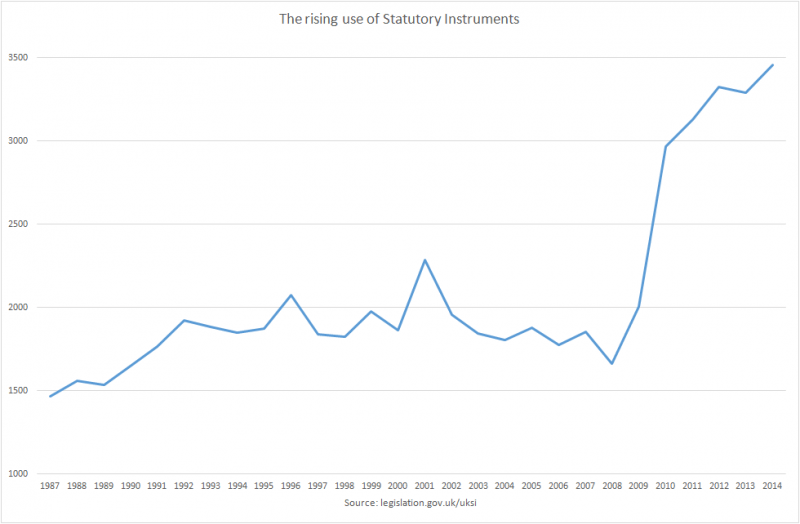


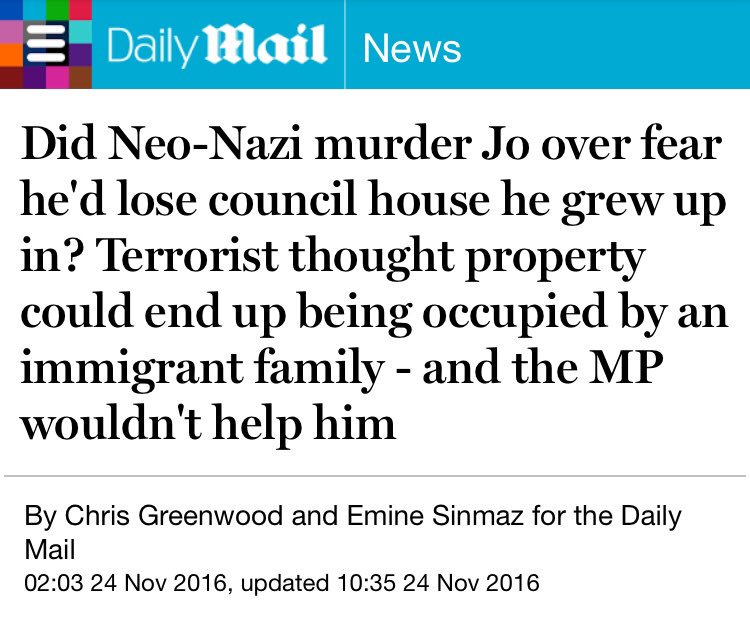

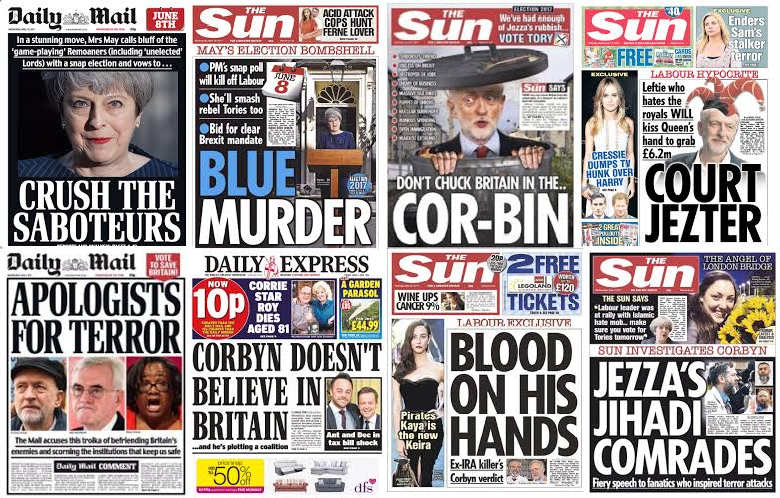

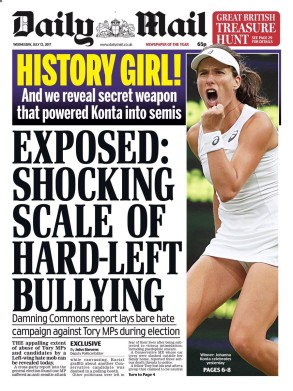


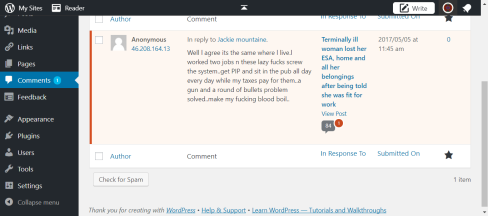


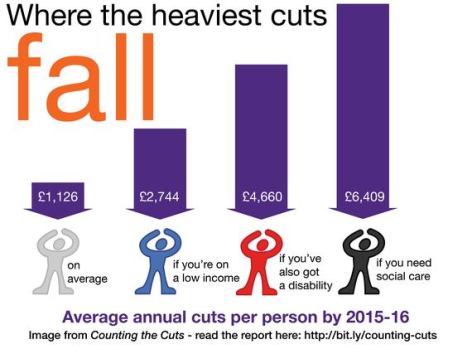
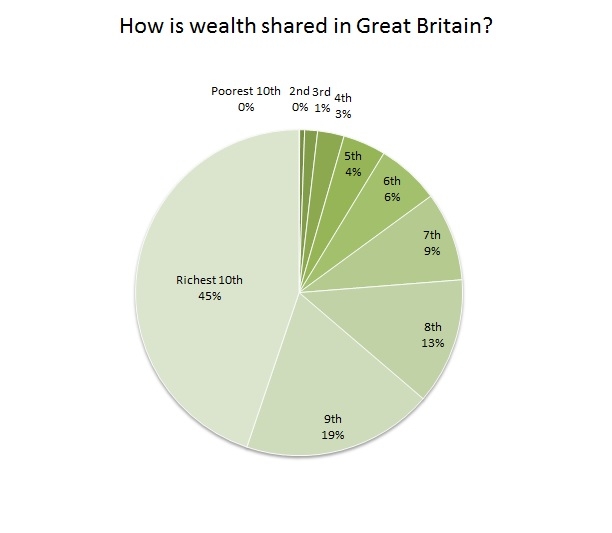



 It’s time we said goodbye to austerity, the right-wing politics of inequality and prejudice.

 Politics and Insights