Month: March 2018

The BBC’s disgraceful attempt at a McCarthyist-style shaping of public perceptions and flouting impartiality rule

jc newsnight krem.jpg

Many of us have criticised the BBC over the past 7 years of bias, and of reflecting broadly establishment opinion. However, the broadcasting corporation has persistently defended itself against legitimate charges of ideological favouritism, claiming a reputation for fair coverage.  Given the BBC’s reach, and the trust placed in it, any biases could potentially have a much more significant impact on altering public understanding of an issue than biases arising on other media platforms. 

A key reason why BBC bias is important is that, unlike its broadcast competitors and newspapers, the BBC is guaranteed its funds through a compulsory licence fee. Consumers are not able to punish the institution financially for perceived coverage bias. This puts it in a highly privileged position, one in which TV viewers are made to pay for the content, irrespective of their views on it.

In addition, the method through which the BBC is funded means that the organisation itself has a vested interest in the political process. It uses a chunk of its guaranteed revenues to lobby for the maintenance of the licence fee. If a government had a manifesto commitment to radically slash or abolish the BBC licence fee, the BBC’s coverage of that issue could be vitally important in framing that debate. This is not a mere theoretical point –  in 2015, Andrew Marr interviewed BBC Director General, Lord (Tony) Hall on just this issue.  

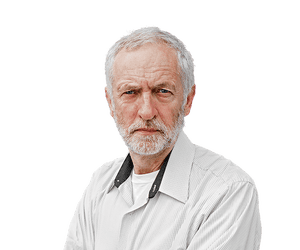
On Thursday night, the BBC’s Newsnight programme featured a large backdrop showing Jeremy Corbyn apparently standing outside of the Kremlin wearing a Russian-styled hat. Of course the photograph of the opposition leader was superimposed over the background. Jeremy Corbyn’s face had also been treated to a rather blatant red makeover by the BBC.

This is a blatant attempt at shaping public perception and disgraceful breach of the BBC’s impartiality obligations.  This was also most certainly a deviation in coverage from objective truth. It was a reference to the frequent, false and libelous accusations of Jeremy Corbyn being a  “Commie spy” and so on. Rather than highlighting the fact that these are false allegations, the BBC chose to highlight them using a picture that had been doctored to create a backdrop, giving viewers the impression that the lies and hysterical, long standing right wing smears are facts. 

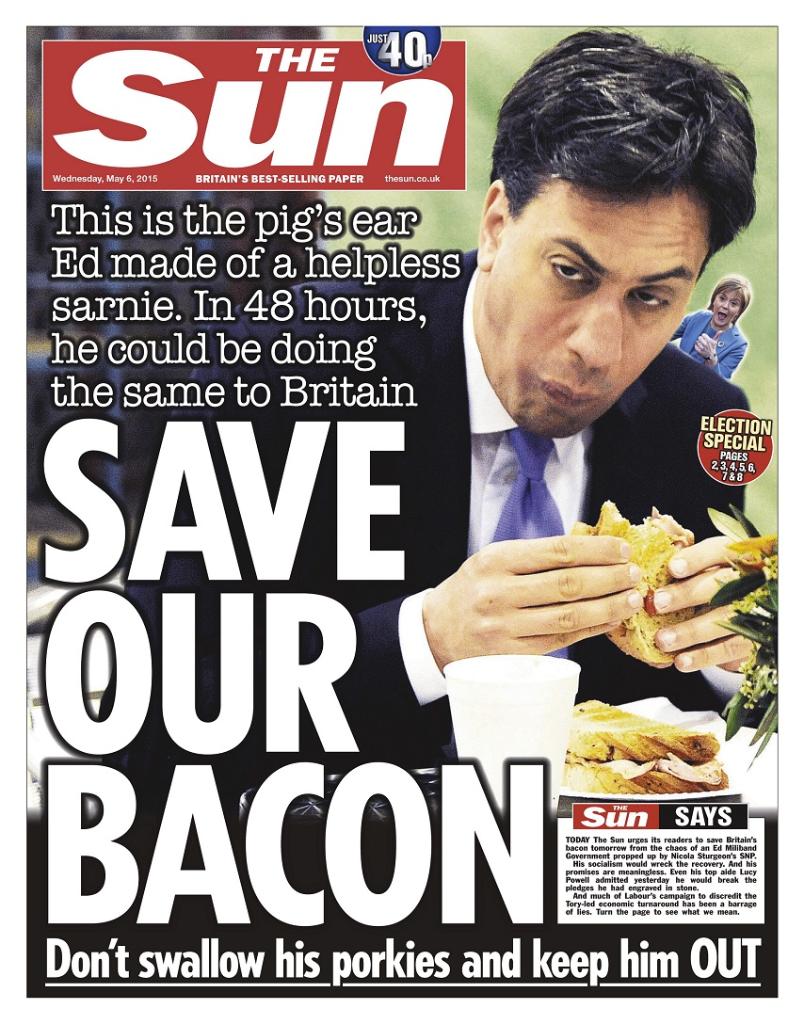
The BBC set is the kind of nasty tactic that we ordinarily expect from the right wing rags. Like the photograph of the previous Labour Party leader, Ed Miliband, eating a bacon sandwich, which became the source of sustained commentary in 2014 and 2015. Taken for the Evening Standard while Miliband was campaigning for local elections in May 2014, it was purposely shared to make him look awkward, error prone or incapable of performing simple tasks, as if eating  is somehow related to political performance. The photo was used in a deeply mocking front page of The Sun on the day before the 2015 general election.

Media bias in the UK

Last year, the Conservatives were accused of “criminalising public interest journalism” as it plans to increase the number of years for the “leaking of state secrets” from 2 years to 14, in the first “overhaul” of the Official Secrets Act for over 100 years.

Under the proposals, which were published last February, officials who leak “sensitive information” about the British economy that damages national security could also be jailed. Currently, official secrets legislation is limited to breaches which jeopardise security, intelligence defence, confidential information and international relations.

The government released the proposals citing the “new reality” of the 21st-century internet and national security dangers as justification for a more “robust” system of prosecution.

The recommendations centre around the Official Secrets Act (1989) which governs how public servants in government and the military must keep government information secret and out of publication.

Journalists and civil liberties groups warned that the threshold for the increased sentence has been lowered and that journalists and whistleblowers acting in the public interest will be effectively gagged. (See The erosion of democracy and the repression of mainstream media in the UK. ) 

However, the Conservatives’ direction of travel regarding media freedoms was clear well before last year. As far back as 2012, the government were ‘monitoring’ the BBC in particular for ‘left wing bias’. The government’s fury at what they call the liberal, left-wing leaning of the state broadcaster was laid bare after Iain Duncan Smith accused the BBC’s economics editor, Stephanie Flanders, of ‘peeing all over British business’. (See also Once you hear the jackboots, it’s too late ). 

Let’s not forget government officials smashing up hard drives containing the Snowden leaks at the Guardian office, too, and the intimidation involving the detention of Glenn Greenwald’s partner under the ‘terrorism’ act. As part of the global surveillance disclosure, the first of Snowden’s documents were published on June 5, 2013, in The Guardian in an article by Greenwald.

Journalists are regarded as “democracy’s watchdogs” and the protection of their sources is the “cornerstone of freedom of the press.” And freedom of the press is a cornerstone of democracy. Although enshrined in such terms by the European Court of Human Rights, these democratic safeguarding principles are being attacked in an increasingly open manner all over the world, including in the democratic countries that first proclaimed them. 

Reporters Without Borders (RSF) are a collective of journalists who study freedom of the press at a comparative and international level. The UK has been consistently in low position (the higher the score, the lower the ranking) for the last five years, last year it dropped lower still, highlighting an increasing intrusion of the government on and restriction of the freedom of the press. RSF ranks the UK 40th in the index; a fall from 38th place in 2016. 

We have a media with a very heavy weighted right wing bias, yet any criticism of government policy reduces our government to shrieking hysterically that the communists have been infiltrating the establishment. It’s a curious fact that authoritarians project their rigidity, insecurities and micro-controlling tendencies onto everyone else.

Types of bias

One source of media bias is a failure to include a perspective, viewpoint or information within a news story that might be objectively regarded as being important. This is important because exclusion of a particular viewpoint or opinion on a subject might be expected to shift the ‘Overton Window’, defining what it is politically acceptable to say. This can happen in such a way that a viewpoint becomes entirely eliminated or marginalised from political discourse. Within academic media theory, there is a line of reasoning that media influence on audiences is not immediate but occurs more through a continual process of repeated arguments – the ‘steady drip’ effect. 

A second potential source of bias is ‘bias by selection’. This might entail particular issues or viewpoints being more frequently covered, or certain guests or organisations being more likely to be selected. There are several others, for some of which the BBC has regularly been criticised. 

Herman and Chomsky (1988) proposed a propaganda model hypothesising systematic biases of media from structural economic causes. Their proposition is that media ownership by corporations, (and in other media, funding from advertising), the use of official sources, efforts to discredit independent media (“flak”), and “anti-communist ideology as the filters that bias news in favour of corporate and partisan political interests.

Politically biased messages may be conveyed via visual cues from the sets as a kind of underhanded reference-dependent framing.  A frame defines the packaging of an element of rhetoric in such a way as to encourage certain interpretations and to discourage others. It entails the selection of some aspects of a perceived reality and makes them more salient in a communicating text, in such a way as to promote a particular problem definition, causal interpretation, moral evaluation and so on. 

On Friday’s night’s programme, author Owen Jones quite properly took Newsnight’s Evan Davis to task about the “disgraceful framing” of the narrative around the nerve-agent poisoning of Sergei Skripal. Davis actually had the brazen cheek to laugh about Jones’s observations, and to deny them.

As other independent journalists have reported, Jones also referred to the observation of sharp-eyed Twitter user @duckspeech that Newsnight had not merely added Corbyn’s image to the backdrop – but had also photoshopped his hat to make it more closely resemble a Russian hat. This was of course referencing the long running and debunked “Russian stooge” and “appeasement” narrative of the Conservatives, which started with the fake Zinoviev letter, when the very first Labour government was in power.

The government have reduced politics to crude ad hominem attacks, aggressive posturing, overly simplistic sound bites and negative, divisive and emotive appeals. The media have reflected a corresponding lack of sophistication in their delivery of ‘news’.

The details and rationality matters 

Corbyn condemned the nerve agent attack on the Skripals in no uncertain terms. However, he responded rationally and stressed that any response to Russia must be based on clear evidence. Of course the right wing rags ran a smear campaign, despicably calling Corbyn a “Kremlin stooge”, and some of  the Labour party’s centrists started sniping.

Yet Corbyn has been rational and reasonable. He said: “The attack in Salisbury was an appalling act of violence. Nerve agents are abominable if used in any war. It is utterly reckless to use them in a civilian environment.

Our response as a country must be guided by the rule of law, support for international agreements and respect for human rights .Our response must be decisive, proportionate and based on clear evidence.” ​He is absolutely right. Meanwhile, the Conservatives have responded with a politics of petulance, with defence minister Gavin Williamson disgracefully saying that Russia should “go away and shut up” when asked how the Kremlin should respond to the expulsion of 23 of its diplomats.

Corbyn was derided when presented a series of simple and reasonable questions to the prime minister, asking what steps the government has taken to collect evidence for its claims, he was loudly heckled by puerile, braying McCarthist members of the House of Commons.

He said: “If the government believe that it is still a possibility that Russia negligently lost control of a military-grade nerve agent, what action is being taken through the OPCW with our allies? I welcome the fact that the police are working with the Organisation for the Prohibition of Chemical Weapons (OPCW). Has the prime minister taken the necessary steps under the chemical weapons convention to make a formal request for evidence from the Russian government under Article IX(2)?

“How has she responded to the Russian government’s request for a sample of the agent used in the Salisbury attack to run their own tests? Has high-resolution trace analysis been run on a sample of the nerve agent, and has that revealed any evidence as to the location of its production or the identity of its perpetrators?”

Perhaps Corbyn’s carping neoliberal opponents inside the Labour party should remember why party membership has significantly grown since Corbyn became the elected leader (twice) and precisely why the party’s popularity surged during last year’s snap election.

One particularly cowardly backbencher, wishing to remain anonymous, shamefully told the Guardian: “Putin’s constant and shameful apologist might just as well stand aside and let the Russian ambassador write the speeches and brief the media himself.” Despicable.

Yet on Wednesday Benjamin Griveaux, a spokesperson for the French government, said it was too early to decide on retaliatory measures against Russia, as its involvement was yet to be proven. Griveaux said France was waiting for “definitive conclusions,” and evidence that the “facts were completely true,” before taking a position. 

 As Walter Lipman once noted, the news media are a primary source of those “pictures in our heads” about the larger world of public affairs, a world that for most citizens is “out of reach, out of sight, out of mind.”  What people know about the world is largely based on what the media decide to show them. More specifically, the result of this mediated view of the world is that the priorities of the media strongly influence the priorities of the public. Elements prominent on the media agenda become prominent in the public mind.

Given the reduction in sophistication and rationality in government rhetoric, media news and current affairs presentation, (and reduction in democratic accountability, for that matter) we don’t currently have a climate that particularly encourages citizens to think critically and for themselves.

Read Jeremy Corbyn’s  article in the Guardian: The Salisbury attack was appalling. But we must avoid a drift to conflict


I don’t make any money from my work. But you can support Politics and Insights and contribute by making a donation which will help me continue to research and write informative, insightful and independent articles, and to provide support to others. The smallest amount is much appreciated, and helps to keep my articles free and accessible to all – thank you. 

DonatenowButton

Statement by Permanent Representative of the Russian Federation, Ambassador Alexander Shulgin, to the OPCW concerning the Salisbury attack

Following on from my earlier article, below is the statement made yesterday – March 13 – by Ambassador Alexander Shulgin to the Organisation for the Prohibition of Chemical Weapons at the Hague. I agree that the UK government need to abandon the “the language of ultimatums and threats and return to the legal framework of the chemical convention, which makes it possible to resolve this kind of situation.” 

This request seems the most reasonable solution to the current diplomatic freeze and the safest regarding what has now become a tactical impasse – which makes an escalation of hostilities more likely. 

Mutual cooperation from both member states on this matter with an independent, international arbitrator, while operating within a framework of our international norms and laws, would open up possibilities to prevent this conflict from escalating further, which could ultimately end with potentially catastrophic consequences all round. 

Statement by Permanent Representative of the Russian Federation to the OPCW, Ambassador Alexander Shulgin, at the 87th session of the OPCW Executive Council on the chemical incident in Salisbury, The Hague, March 13, 2018.

Mr Chairperson,

In connection with the vicious attacks launched by British officials in London, as well as the statement by the head of the British delegation to the OPCW with regard to Russia concerning the suspicious story of two persons poisoned with a toxic agent in Salisbury, we would like to state the following.

The British authorities’ unfounded accusations of Russia’s alleged involvement in using poisonous agents on their territory are absolutely unacceptable. Our British colleagues should recall that Russia and the United Kingdom are members of the OPCW which is one of the most successful and effective disarmament and non-proliferation mechanisms. We call upon them to abandon the language of ultimatums and threats and return to the legal framework of the chemical convention, which makes it possible to resolve this kind of situation.

If London does have serious reasons to suspect Russia of violating the CWC – and the statement read by distinguished Ambassador Peter Wilson indicates directly that this is so – we suggest that Britain immediately avail itself of the procedures provided for by paragraph 2 of Article 9 of the CWC. They make it possible, on a bilateral basis, to officially contact us for clarifications regarding any issues that raise doubts or concerns.

We would also like to emphasise that such clarifications under the Convention are provided to the requesting member state as soon as possible, but in any case no later than 10 days following receipt of the request. As such, the ultimatum’s demand that information be provided immediately, by the end of today, is absolutely unacceptable.

Our British colleagues should save their propaganda fervour and slogans for their unenlightened domestic audience, where perhaps they will have some effect. Here, within the walls of a specialised international organisation, such as the OPCW, one must use facts and nothing but the facts. Stop fomenting hysteria, go ahead and officially formalise your request to begin consultations with us in order to clarify the situation.

A fair warning, we will require material evidence of the alleged Russian trace in this high-profile case. Britain’s allegations that they have everything, and their world-famous scientists have irrefutable data, but they will not give us anything, will not be taken into account. For us, this will mean that London has nothing substantial to show, and all its loud accusations are nothing but fiction and another instance of the dirty information war being waged on Russia.

Sooner or later, they will have to be held accountable for their lies.

In addition, in this particular case, it would be legitimate for the British side to seek assistance from the OPCW Technical Secretariat in conducting an independent laboratory analysis of the available samples that allegedly show traces of nerve agents in Salisbury.

Thank you, Mr Chairperson.

We ask you to circulate this statement as an official document of the 87th session of the OPCW’s Executive Council and post it on the Organisation’s external server.

You can read the original statement document here.


Update

In the Commons today, Jeremy Corbyn says a “robust dialogue” is  needed with Russia to protect national security. He also stressed the need to gather evidence and abide by international law, underlining the essential role of the Organisation for the Prohibition of Chemical Weapons (OPCW), based in The Hague. This rational and responsible  approach is one that the public expects from a leader.

He said: “If the government believes that it is still a possibility that Russia negligently lost control of a military-grade nerve agent, what action is being taken through the OPCW with our allies?”

Corbyn then asked: “How has she responded to the Russian government’s request for a sample of the agent used in the Salisbury attack, to run its own tests?”

He added: “Has high-resolution trace analysis been run on a sample of the nerve agent and has that revealed any evidence as to the location of its production or the identity of its perpetrators?

“And can the Prime Minister update the House on what conversations, if any, she has had with the Russian Government?”

May attacked Corbyn, saying the Russians had “already been given the chance to explain where the nerve agent had come from” and that the government had sought “consensus.” We don’t want consensus, we want reliable evidence, truth and proportionality in responses.  

Corbyn also said: “It is is moments such as these that Governments realise how vital strong diplomacy and political pressure are for our security and national interest.” He is absolutely right.

Aiming criticism at the ranting, diplomatic disaster that is Boris Johnson, who was, as ever, visibly outraged and angered by Corbyn’s comment, the opposition leader said: “I couldn’t understand a word of what the Foreign Secretary just said, Mr Speaker, but his behaviour demeans his office.”

One MP claimed, somewhat irrationally, that Corbyn’s cautious, rational and measured response is “appeasement”.

However, Corbyn is absolutely right to ensure the UK response is fair, based on sound evidence and follows international norms and protocols.


I don’t make any money from my work. But you can help by making a donation to help me continue to research and write informative, insightful and independent articles, and to provide support to others. The smallest amount is much appreciated – thank you.

DonatenowButton

From a nerve agent attack to a nuclear threat in 3 days – the very worrying collapse of international diplomacy

Image result for skripal poisoning

Update

Another Russian exile, Nikolai Glushkov, who was close friends with the late oligarch Boris Berezovsky has been found dead, aged 68, in his London home.

Counter terrorism officers are leading the inquiry into his death. They have said  that there was no evidence to link it to events in Salisbury, though it has been treated as ‘suspicious’. So far this year, deaths registered for men aged 65-74 in England and Wales have averaged 1,179 a week (according to the Office for National Statistics data).

Amber Rudd, the home secretary, decided to announce an inquiry into allegations of Kremlin links to 14 other deaths in Britain in the past two decades. 

The prime minister was said to be confident last night that she had succeeded in rallying key European and US allies before a meeting of the National Security Council to be followed by a statement to the Commons this afternoon. 

One very worrying comment in the Times caught my eye: “On Monday the prime minister cleared the way in a statement to MPs for a cyberattack on Russia as she challenged President Putin to explain how a ‘Russian’ toxin came to be used on British soil.” However, Robert Hannigan, the former director of GCHQ, warned against a cyber-offensive because of the likelihood of escalation.

“Starting a cyberconflict is not in anyone’s interests,” he said. “We need to be sure that anything we do is consistent with our values.”  

That the prime minister felt such a blatant act of aggression and provocation was appropriate at all is VERY concerning, given the fact that she has refused to share the evidence that her allegations are based on with Russia, and has refused to permit Russia to contribute to an inquiry. 

Earlier this year, defence think tank Chatham House warned that US, British and other nuclear weapons systems are increasingly vulnerable to cyber attacks. The threat has received scant attention so far from those involved in nuclear military planning and the procurement of weapons.

It blames this partly on failure to keep up with fast-moving  technological advances, lack of skilled staff and the slowness of institutional change.

“Nuclear weapons systems were developed before the advancement of computer technology and little consideration was given to potential cyber vulnerabilities. As a result, current nuclear strategy often overlooks the widespread use of digital technology in nuclear systems,” the authors of the study said.

Nuclear weapons systems are vulnerable and at risk from hostile states, criminal groups and terrorist organisations exploiting cyber vulnerabities. The report goes on to say:

At times of heightened tension, cyber attacks on nuclear weapons systems could cause an escalation, which results in their use.

“Inadvertent nuclear launches could stem from an unwitting reliance on false information and data. Moreover, a system that is compromised cannot be trusted in decision-making.”

At best, cyber insecurity in nuclear weapons systems is likely to undermine trust and confidence in military capabilities and in the nuclear weapons infrastructure.

“At worst, cyber attacks could lead to deliberate misinformation and the inadvertent launch of nuclear weapons.

“In times of crisis, loss of confidence in nuclear weapons capabilities would factor into decision-making and could undermine beliefs in nuclear deterrence – particularly in extending nuclear deterrence to allied countries.”

The report, titled Cybersecurity of Nuclear Weapons Systems: Threats, Vulnerabilities and Consequences, said the issue required “urgent attention” from the governments of nuclear-armed states and those that could be affected by the use of nuclear weapons.

Chatham House also urged governments to be open about their discussions, adding: “After all, it is the public that will pay the ultimate price for complacency regarding cyber security of nuclear weapons systems.”

Counter terrorism policing statement

The UK’s head of counter-terrorism policing has issued a statement regarding the nerve agent attack in Salisbury. Neil Basu, speaking at Scotland Yard, said:

“We are exploring all investigative avenues. This includes extensive CCTV footage from across the city and over 380 exhibits so far.

In particularly I’m appealing for anyone who saw Sergei and Yulia Skripal in Sergei’s car which is a red BMW with a registration plate: HD09 WAO, in the Salisbury area between approximately 1pm and 1.45pm on Sunday 4 March.

The police are going to continue to see a great deal of police activity in and around city, including potentially more cordons being erected. But please don’t be alarmed. It is necessary as part of this major investigation. In truth it may last many weeks.

It is a painstaking operation to identify anyone of interest and eliminate them or include them, but at this stage we are not declaring person of interest or a suspect at this time.”

No mention of ‘the Russians’, then.

Novichok nerve agents 

Image result for skripal poisoning

It was certainly a nerve agent that was used in the attack on the Skripals. The raw materials to make such chemical weapons are inexpensive and generally not difficult to obtain. 

Novichok nerve agents – also known as the “N-series” – were secretly developed by the former Soviet Union beginning in the 1970s. They followed the “G-series” of nerve agents made by Germany in the 1930s and the “V-series” made by the UK in the 1950s. Novichok means “newbie” in Russian. There are no previous reports of the Novichok nerve agents being used in battle or assassinations. However, Andrei Zheleznyakov, a Russian scientist involved in their development, reportedly died not long after being exposed to a small amount that leaked out of a rubber tube in the laboratory.  

The scant details that we know about these agents are largely based on reports from Russian chemist Vil Mirzayanov, who exposed the Russian chemical weapon development programme in 1991. However, he never gave any formulae or protocols for synthesis of this deadly class of chemical agents that he referred to. 

Nerve agents are made from two precursor chemicals that are mixed together just before use. These precursors could be made at pesticide or fertiliser manufacturers without arousing any suspicion at all, as this class of chemical weapon is made with organophosphates as a key component. Some insecticides, including carbamates organophosphates such as dichlorvos, malathion and parathion, are nerve agents. At high enough doses, acute toxicity and death can occur through the same mechanism as other nerve agents. 

As binary chemical weapons are those which contain the toxic agent in its inactive state in the form of chemical precursors, which are significantly less toxic than the agent itself. Using precursors improves the safety of storing, transporting, and disposing of the weapon. Commonly, when used, the barrier between the two precursors is removed. These compounds then react to form the intended toxic agent. 

The Russians created two main types of Novichok nerve agent – A-230 and A-232.  We know these are chemicals that also contain carbon and phosphorus like the G-series nerve agents – which includes sarin, tabun, soman, and cyclosarin, and the V-series – which includes VX, VR, VE, VG and VM. However, their exact structures have allegedly remained a mystery in the West. 

As stated, A-232 (also called Novichok-5) is an organophosphate, like many pesticides. Phosphates are not listed among the controlled chemicals on the Chemical Weapons Convention lists. The Novichok class of agents were reportedly developed in an attempt to circumvent the Chemical Weapons Treaty (chemical weapons are banned on the basis of chemical structure and therefore a new chemical agent is not subject to past treaties). Novichoks have reportedly been engineered to be undetectable by standard detection equipment and to defeat even standard chemical protective gear, it has been said.

According to Mirzayanov, both the Novichoks are binary agents, meaning they are made from two precursor chemicals that are mixed together just before use  He also said that many of the less potent derivatives were reported in the open literature as new organophosphate insecticides, so that the secret chemical weapons programme could be disguised as legitimate pesticide research. Mirzayanov confirmed that Novichoks all feature an organophosphorus core.

Nerve agents are a class of organic chemicals that disrupt the mechanisms by which nerves transfer messages to organs. The disruption is caused by the blocking of acetylcholinesterase, an enzyme that catalyses the breakdown of acetylcholine, a neurotransmitterNerve agents attack the nervous system, muscles are prevented from relaxing, so they spasm are effectively paralysed. This includes the heart and the muscles used for breathing. Because of this, the first symptoms usually appear within seconds of exposure and death can occur via asphyxiation or cardiac arrest in a few minutes. 

Initial symptoms may be excessive sweating, a runny nose, tightness in the chest, and constriction of the pupils. Soon after, the victim will have difficulty breathing and will experience nausea, involuntary, excessive salivation and fluid accumulation and sometimes, blistering, in the lungs – often producing frothing at the mouth – burning, watering and sometimes blistering eyes, gastrointestinal pain and vomiting. This phase is followed by initially myoclonic jerks (muscle jerks) followed by status epilepticus – type epileptic seizure. The effects of nerve agents are long-lasting and increase with continued exposure. Survivors of nerve agent poisoning almost invariably suffer chronic neurological damage and related psychiatric effects. 

Atropine and related anticholinergic drugs act as antidotes to nerve agent poisoning because they block acetylcholine receptors, but of course, they are poisonous in their own right. Pralidoxime chloride, also known as 2-PAM chloride, is less toxic but it works more slowly than other antidotes.

No standard test exists for Novichoks. It’s possible to detect exposure to nerve agents more generally by checking blood samples to monitor any significant decrease of activity of an enzyme called acetylcholinesterase. However, UK intelligence agencies must have knowledge of the exact Novichok structures, otherwise they would not have been able to detect a match, as claimed. 

It is generally considered impossible to cure people who are exposed to it. Novichok is reported to be 5–8 times more lethal than VX nerve agent and effects are very rapid, usually within 30 seconds to 2 minutes. How it was deployed in the attack on the Skripals remains unclear.

At the moment, there is no evidence that Russia was not respecting the treaty that has come to the attention of the OPCW (Organization for the Prohibition of Chemical Weapons). Russia has previously destroyed quite a large amount of its chemical weapons stock – more than 400,000 tons. 

Russia’s foreign minister, Sergei Lavrov, said during a televised press conference earlier that Russia was not responsible for the poisoning and demanded that Britain seek to mediate the case under the chemical weapons convention. 

He said: “We have already made our statement on this case. Russia is ready to cooperate in accordance with the convention to ban chemical weapons if the United Kingdom will deign to fulfil its obligations according to the same convention.”

Lavrov also remarked that under the convention, Russia would have 10 days to reply to an official accusation by the UK over the use of a banned substance within its borders.

Russia summoned the UK’s ambassador to Moscow to protest against accusations that it ordered last week’s nerve agent attack in Salisbury and to warn that any British sanctions against Russia would be answered in kind. 

The prime minister said in parliament on Monday that the UK would consider punitive measures if Russia did not meet a (rather unreasonable) deadline of the end of Tuesday to explain itself. Possibilities include revoking the broadcast licence of the Russian state-funded broadcaster RT, expulsions of diplomats, or greater scrutiny of Russian investments in the UK.

The Russian foreign ministry said: “Any threats to adopt ‘sanctions’ toward the Russian Federation would not remain without a response.”

Among other measures, Moscow is ready to ban all British media outlets if London revokes the state-funded Russia Today’s right to broadcast in Britain, a spokeswoman for the Russian foreign ministry said on national television on Tuesday evening.

Not a single British media outlet will work in our country if they close Russia Today,” Maria Zakharova said. 

A foreign ministry statement said it had summoned Laurie Bristow, the British ambassador, to also declare that Russia would not comply with Theresa May’s demand that it explain its role until the Russian government had been given samples of the nerve agent that left the Skripals critically ill.

“Without this, any statements by London are senseless,” the ministry said in the statement given to journalists.

Meanwhile, May is preparing to chair a meeting of the national security council after the midnight deadline she set Moscow passed.

The prime minister is said to be preparing to set out a range of reprisals against the Russian state, including calls for fresh sanctions, visa bans and crackdowns on Russian money in the UK. She is expected to set out plans to build a coalition of international support – from the European Union, NATO and even the United Nations. However, given Brexit, Europe’s response is quite likely to be limited when it comes to practical support and retaliation.

Until Tuesday evening, Donald Trump had remained silent over the Kremlin’s “probable role”. However, he has since told Theresa May in a phone call earlier today that his support is conditional on the facts supporting her case. Downing Street said Trump had agreed that “the Russian government must provide unambiguous answers as to how this nerve agent came to be used”.

The problem with the ultimatum is that there is a possibility the nerve agent did not come from Russia. 

Only one senior member of Trump’s administration had acknowledged that Russia may be responsible: Rex Tillerson. On Tuesday, however, Trump fired Tillerson as secretary of state, possibly underlining that May is likely to receive little or no help from the US. Not that Trump’s brand of ‘diplomacy’ would be of any value to us, things are fraught enough without any further bragging about big red buttons.

The Russian Embassy have said that “Britain must comply with the Chemical Weapons Convention which stipulates joint investigation into the incident, for which Moscow is ready.”

That seems fair, but the UK government have refused to permit such a joint investigation so far.

The Russian Embassy said Moscow will only respond once it is given access to samples of the nerve agent used to poison the Skripals. Again, the UK government has refused. There will have to be a degree of negotiation to escape the current impasse, otherwise the situation will simply escalate into one of increasing hostilities, provocation, retaliation, retaliation and more retaliation. This is the signposted, short and deadly road to war. 

Is the UK government playing provocation roulette with Russia?

The complete breakdown of diplomatic relationships has already led, it is reported, to a warning issued from Russia that the UK should not threaten a nuclear power last night, as tensions mounted ahead of an announcement today of measures against the Kremlin.

Russian Foreign Ministry spokeswoman, Maria Zakharova, was quoted as saying “one should not threaten a nuclear armed country.” 

Russia Slams UK PM’s ’Circus in Parliament’ on Skripal Poisoning Case

Maria Zakharova

There are many things that world leaders should not do or say. History is littered with the destruction and devastation of precious, ordinary human lives caused by the disregard and lack of conscience of those in positions of power. But that doesn’t ever seem to stop them, and always, it seems, to our utter surprise and horror.

There has been a dangerous escalation in both rhetoric regarding nuclear weapons and military strategy recently. For example, Vladimir Putin’s state of the union address earlier this month, showed a mock-up missile seemingly heading for the coast of Florida. Last year the British government disclosed that under certain (undefined) circumstances, nuclear strikes would be considered, even if our nation wasn’t under direct nuclear threat.  

Donald Trump has pledged to “spend freely” on upgrading the American nuclear arsenal. Last month, a review of nuclear “posture” set out plans to develop new “low-yield” nuclear weapons and for the first time consider nuclear strikes in response to non-nuclear threats – such as a devastating cyber attack. Russia has long possessed smaller nuclear weapons, with a military doctrine that conceives of their tactical use to counter conventional threats.

However we are witnessing a departure from a deterrence policy towards first strike posturing at a global level that could significantly lower the threshold for nuclear war.

Nuclear weapons protect no-one. They reflect an era of leaders who regard the lives of others as somehow expendable, including their own citizens. This disregard for the lives of others by those in positions of power and privilege shapes so much human suffering, it reflects everything that is wrong in the world.

“Cutting edge nuclear deterrence”, according to Trump’s most recent posture statement, apparently requires “tailored strategies” and “flexible capabilities.” These are not new concepts. They sound reasonable enough. Until we see that the flip side of deterrence is detonation. Tailored strategies and flexible capabilities require assigning nuclear weapons to “targets.” You can reason that most targets will probably be military  bases or ports and so on. At first. However, even one nuclear detonation will release radioactive material that will inevitably travel to densely populated areas, unconstrained.

The logic and cohesion of nuclear posture reviews break down when we shift from the declaration part to the operational level of nuclear deterrence. What are the humanitarian consequences of targeting plans for nuclear weapons? And how is escalation to be controlled once the nuclear threshold is crossed? See?

Because nuclear orthodoxy cannot withstand public scrutiny, especially on the fundamental questions of humanitarian consequences and escalation control, citizens in nuclear states seek refuge underneath the warm, comfort blanket statements of deterrence. Our personal comfort depends on presuming that deterrence is somehow robust and safe.

However it is fragile.

Recently I have written about the elements of human error, such as misinterpretation of mundane events such as solar flares, moon rises, intelligence miscalculation, and near accidents – the close calls we have somehow managed to survive so far. These events demonstrate what a fine margin of error there is and just how fragile the boundary actually is between deterrence and the sudden blinding, instant, searing heat followed by an utterly devastating blast and a mushroom cloud composed in part from the dust of corpses and crushed buildings,

It should be unthinkable for any person in a position of power to make such a horrific threat. Not so long ago, it would have been, in the age of ‘nuclear deterrence.’ But now we have the leaders of superpower states casually hint at first strikes, mentioning their nuclear buttons and arsenals whenever they feel like blowing off steam. 

In the event of a nuclear exchange, the UK government will be cowering in underground fallout shelters, as no doubt will Trump and the Russian officials. If that wasn’t so, I think perhaps they may hesitate before posturing so aggressively and potentially, catastrophically, while bargaining and bullying with lives of respective populations.

Update

I did some further research following on from this observation I made: “No standard test exists for Novichoks. It’s possible to detect exposure to nerve agents more generally by checking blood samples to monitor any significant decrease of activity of an enzyme called acetylcholinesterase. However, UK intelligence agencies must have knowledge of the exact Novichok structures, otherwise they would not have been able to detect a match, as claimed. 

I came across Craig Murray’s latest article on novichok, which also makes similar and some addition observations.

In summary, he says:

1) Porton Down has acknowledged in publications it has never seen any Russian “novichoks”. The UK government has absolutely no “fingerprint” information that can safely attribute this substance to Russia.
2) Until now, neither Porton Down nor the world’s experts at the Organisation for the Prevention of Chemical Weapons (OPCW) were convinced “Novichoks” even exist.
3) The UK is refusing to provide a sample to the OPCW.
4) “Novichoks” were specifically designed to be able to be manufactured from common ingredients on any scientific bench. The Americans dismantled and studied the facility that allegedly developed them. It is completely untrue only the Russians could make them, if anybody can.
5) The “Novichok” programme was in Uzbekistan not in Russia. Its legacy was inherited by the Americans during their alliance with Karimov, not by the Russians.

You can read Craig’s full article here.

Related

PM says ‘highly likely’ Russia is responsible for nerve agent attack, without any conclusive evidence

From the age of nuclear ‘deterrence’ to an era of first-strike posturing – a creeping escalation


I don’t make any money from my work.  But you can help by making a donation to help me continue to research and write informative, insightful and independent articles, and to provide support to others. The smallest amount is much appreciated – thank you.

DonatenowButton


PM says ‘highly likely’ Russia is responsible for nerve agent attack, without any conclusive evidence

The prime minister says that it has been concluded that Sergei Skripal and his daughter Yulia were poisoned by “military-grade nerve agent of a type developed by Russia.”

May revealed that experts at Britain’s Porton Down defence laboratory, coincidently very close to where the attack happened, have confirmed the Salisbury poisoning involved “highly-specialised” and “military grade” Novichok, first developed by the Soviet Union in the 1970s. 

Updating the Commons earlier today, the prime minister explained that as a result of the nerve agent being found to be military grade Novichok, it is “highly likely that Russia was responsible” for the act against ex-double agent Sergei Skripal and his daughter, which also left Wiltshire Police Detective Sergeant Nick Bailey in a serious condition and parts of the medieval cathedral city closed off.

She also says the Russia was likely to be responsible for the attack because of Russia’s “history of involvement in state-sponsored attacks of this kind.” 

However, the Kremlin has denied involvement, while the Russian embassy accused Britain of playing a “very dangerous game” and warned of “serious long-term consequences.”  

Moscow responded, saying Theresa May’s words were “another political information campaign based on a provocation”, and has branded the prime minister’s suggestion that Moscow was “probably” behind the Salisbury poisonings as a “circus show”.

The spokesperson from Moscow also added, cryptically: “Before making up new fairy tales, let the British disclose how the Litvinenko case ended.” 

Russian dissident Alexander Litvinenko was poisoned with radioactive polonium-210 in London in 2006. It seems that Russia is pointing an accusation back at the UK. 

A former Kremlin adviser, Alexander Nekrasoff, has said that the nerve agent is “possessed by about 16 countries in their laboratories”.

“Why do I know this?” he added. “Because that’s how the antidote is developed.”

Andrei Lugovoi, one of the two men accused of assassinating Alexander Litvinenko with radioactive polonium in 2006, said Britain’s response to events was suspiciously quick. Evidence, he said, that London was operating according to its own script.

Any chemist or physicist will tell you that as a minimum you need some kind of serious expertise on a serious expert level to determine whether or not a country is responsible,” he told the Interfax news agency.

“When such statements are made in the course of a few days, this speaks only of irresponsibility and the fact that they haven’t set out to discover the truth.”

Novichok agents may feasibly be created in pesticide and agricultural fertilizer manufacturing plants, as they have an organophosphate core, as do other nerve agents. So far the government have offered no firm evidence of Russia’s involvement. 

May has said the decision to blame Russia is based on “Russia’s record of conducting state-sponsored assassinations and our assessment that Russia views some defectors as legitimate targets for assassinations”.Yet already the government are talking about ‘robust responses’, which is very worrying. 

The Washington Post reports: “Former special services agent Mikhail Lyubimov was quoted in Komsomolskaya Pravda, one of Russia’s most popular newspapers, as suggesting Skripal wouldn’t have been worth the trouble of a hit.

Skripal was sent to the West in a swap; that means he’s absolutely uninteresting to us. He’s a small-fry,’ Lyubimov said.”

Skripal was jailed for 13 years by Russia in 2006. In July 2010, he was one of four prisoners released by Moscow in exchange for 10 Russian spies arrested by the FBI as part of a swap. He was later flown to the UK.

On Sunday, Dimtry Kiselev, one of Russia’s most powerful media figures, spoke during his Sunday news programme on state-owned TV channel Rossiya-1, in Moscow. Kiselev suggested a possible connection between the poisonings in Salisbury, which British officials said resulted from exposure to an unspecified nerve agent, and international  upcoming World Cup football tournament. 

Kiselev suggested the poisoning could be a “special operation” aimed at justifying a boycott of the tournament. I don’t think that is likely, however.

Skripal wasn’t much use to Britain as an exposed ex-spy, but “as someone who’s been poisoned, who is ill, he’s very useful,” Kiselev said. 

The programme included an on-the-ground report from Britain. The reporter noted that Salisbury, the town where Skripal was lived and fell sick, is about a 20-minute drive from the Porton Down laboratories where Britain developed chemical and bacteriological agents.

“But in the British press and special services, there is no suspicion” [of any British involvement], said another reporter, Alexander Khabarov.

So Russia has been given an ultimatum. May goes on to say that if Russia does not give a “credible response”, the government will conclude that the attack involved “unlawful use of force by the Russian state against the United Kingdom”. 

May also said the UK must stand ready to take much more “extensive measures”, and these would be set out in the Commons on Wednesday should there be no adequate explanation from Russia.

The prime minister will then return to the Commons to outline retaliatory proposals, should there be no adequate explanation.

Here are the key passages from Theresa May’s statement today:

Mr Speaker, this morning I chaired a meeting of the National Security Council in which we considered the information so far available.

As is normal, the Council was updated on the assessment and intelligence picture, as well as the state of the investigation.

It is now clear that Mr Skripal and his daughter were poisoned with a military-grade nerve agent of a type developed by Russia.

This is part of a group of nerve agents known as ‘Novichok’.

Based on the positive identification of this chemical agent by world-leading experts at the Defence Science and Technology Laboratory at Porton Down; our knowledge that Russia has previously produced this agent and would still be capable of doing so; Russia’s record of conducting state-sponsored assassinations; and our assessment that Russia views some defectors as legitimate targets for assassinations; the Government has concluded that it is highly likely that Russia was responsible for the act against Sergei and Yulia Skripal.

Mr Speaker, there are therefore only two plausible explanations for what happened in Salisbury on the 4 March.

Either this was a direct act by the Russian State against our country.

Or the Russian government lost control of this potentially catastrophically damaging nerve agent and allowed it to get into the hands of others.

This afternoon my Rt Hon Friend the Foreign Secretary has summoned the Russian Ambassador to the Foreign and Commonwealth Office and asked him to explain which of these two possibilities it is – and therefore to account for how this Russian-produced nerve agent could have been deployed in Salisbury against Mr Skripal and his daughter.

My Rt Hon Friend has stated to the Ambassador that the Russian Federation must immediately provide full and complete disclosure of the Novichok programme to the Organisation for the Prohibition of Chemical Weapons.

And he has requested the Russian Government’s response by the end of tomorrow.

Mr Speaker, this action has happened against a backdrop of a well-established pattern of Russian State aggression.

Russia’s illegal annexation of Crimea was the first time since the Second World War that one sovereign nation has forcibly taken territory from another in Europe.

Russia has fomented conflict in the Donbas, repeatedly violated the national airspace of several European countries, and mounted a sustained campaign of cyber espionage and disruption. This has included meddling in elections, and hacking the Danish Ministry of Defence and the Bundestag, among many others.

During his recent State of the Union address, President Putin showed video graphics of missile launches, flight trajectories and explosions, including the modelling of attacks on the United States with a series of warheads impacting in Florida.

While the extra-judicial killing of terrorists and dissidents outside Russia were given legal sanction by the Russian Parliament in 2006.

And of course Russia used radiological substances in its barbaric assault on Mr Litvenenko. We saw promises to assist the investigation then, but they resulted in denial and obfuscation – and the stifling of due process and the rule of law …

Mr Speaker, on Wednesday we will consider in detail the response from the Russian State.

Should there be no credible response, we will conclude that this action amounts to an unlawful use of force by the Russian State against the United Kingdom.

And I will come back to this House and set out the full range of measures that we will take in response.

Mr Speaker, this attempted murder using a weapons-grade nerve agent in a British town was not just a crime against the Skripals.It was an indiscriminate and reckless act against the United Kingdom, putting the lives of innocent civilians at risk.

And we will not tolerate such a brazen attempt to murder innocent civilians on our soil.

In his response to May’s statement,  Jeremy Corbyn condemned the Salisbury attack, and he included criticism of the Tories for taking money from Russian donors. .

The government could impose unilateral sanctions on Russian individuals and businesses. However, it is unlikely to get support from European partners for tougher EU-wide sanctions. Brexit makes those kinds of negotiations much more difficult, and some EU countries are already trying to soften their approach to Moscow.

The government could also make it more difficult for Russians generally to get visas to the UK. However, this is unlikely as such restrictions might also hit Russian dissidents whom the UK welcomes and wealthy businessmen whose laundered cash the UK tolerates to support London’s property market. Few analysts believe targeting rich Russians with tougher asset-stripping orders would make much difference. They would simply take their money elsewhere. 

The government could pass a British version of the 2012 US Magnitsky act, which punishes Russians involved in corruption and human rights violations with asset freezes and travel bans. It is named after a Russian lawyer who died in custody after revealing alleged fraud by state officials. Opposition MPs have been pushing for a Magnitsky amendment to be added to the Sanctions and Anti-Money Laundering Bill now going through Parliament. 

Other options include the expulsion of Russian diplomats from the UK, as happened after the poisoning of former Russian Federal Security Service operative Litvinenko in 2006. 

There has also been discussion of taking Russian broadcasters such as RT (formerly Russia Today) off the air , and broadcasting regulator Ofcom has said it will “consider the implications for RT’s broadcast licences” after May speaks on Wednesday.  

The UK has already internationalised the matter by asking Russia to provide a “full and complete disclosure” of the Novichok nerve agent programme to an international agency, the Organisation for the Prohibition of Chemical Weapons.

By framing the poisoning as a possible “unlawful use of force” by Russia against the UK,  May has also prompted questions as to whether this could be a matter for NATO, the military alliance of 29 countries. The alliance’s policy of collective defence – under Article 5 – states that an attack on any one ally is seen as an attack on all. It was invoked for the first and only time by the United States after the 9/11 attacks in New York.

Lord Ricketts, a former UK national security adviser, told the BBC that such an “unlawful act” warranted the involvement of NATO.

Any action “will be much more effective if there can be a broader, Nato-EU solidarity behind us”, he said. So far, Downing Street has played down suggestions that this is an Article 5 matter, though.

However, the magnitude of the response that may be announced on Wednesday will depend on the scale of international co-operation that the government can secure, 

The risk with any of the options  considered is the scale of any Russian retaliation, of course.

Before the basic facts of the case have been established, both sides have indulged in an early confrontational exchange. Let’s hope and pray that a diplomatic solution can be reached, rather than any further potentially catastrophic escalation.


Related

From the age of nuclear ‘deterrence’ to an era of first-strike posturing – a creeping escalation


I don’t make any money from my work. I’m a disabled person with lupus, and I’m stuggling to get by. But you can help by making a donation and enable me to continue to research and write informative, insightful and independent articles, and to provide support to others going through disability benefit assessment processes and appeals. The smallest amount is much appreciated – thank you.

DonatenowButton

From the age of nuclear ‘deterrence’ to an era of first-strike posturing – a creeping escalation

Image result for pictures of nuclear detonations

“There is nothing worth having that can be obtained by nuclear war – nothing material or ideological – no tradition that it can defend. It is utterly self-defeating.” George Wald.

North Korean leader Kim Jong-un and President Donald Trump are to meet in person by May, it has been announced, which is an extraordinary overture after months of mutual hostility. News of the meeting was delivered by South Korean officials after talks with Trump at the White House. They passed a verbal message from chairman Kim, saying the North Korean leader was “committed to denuclearisation”. 

Though Trump hailed this as “great progress”, he said the current sanctions would remain in place. China has welcomed the development, saying the Korean peninsula issue was “heading in the right direction” and calling for “political courage”.

However, correspondents say the North had halted missile and nuclear tests during previous talks, only to resume them when it lost patience or felt it was not getting what it demanded.

The latest announcement came days after the South Korean delegation met chairman Kim in Pyongyang. 

In a statement sent to the Washington PostNorth Korea’s UN ambassador said the “courageous decision” of chairman Kim would help secure “peace and stability in the Korean Peninsula and the East Asia region”.

There is no indication yet of where the Trump-Kim talks might take place, but the Korean border’s demilitarised zone (DMZ) and Beijing are seen as likely options.

US Secretary of State Rex Tillerson said it would take “some weeks” to arrange the talks and admitted the US had been “surprised” at Kim Jong-un’s “forward-leaning” stance.

Former officials say that the US administration has spent a lot of time preparing sanctions and contingency planning for military action, but little or no time planning a negotiating strategy for use if Pyongyang entered serious talks.

The last remaining US diplomat with experience of talking to the North Koreans, Joseph Yun, left his post on Friday, and the US currently has no ambassador in Seoul, since the White House withdrew the nomination of another experienced diplomat, Victor Cha. Furthermore, no replacement nominees have been announced.

Yun and Cha were advocates of diplomatic engagement with North Korea and were viewed with suspicion by the White House, where senior officials have argued for a military solution to the challenge posed by Pyongyang’s nuclear and missile programme.

Cha’s nomination was withdrawn because he criticised a plan to carry out a “bloody nose” punitive strike against North Korean weapons sites. Stephen Miller, a hardline Trump adviser who has previously been associated with domestic policy, is reported to have ordered the withdrawal of Cha’s nomination. Today Professor Cha warned that “this dramatic act of diplomacy … may also take us closer to war. Failed negotiations at the summit level leave all parties with no other recourse for diplomacy.” 

The South Korean delegation returned from a visit to Pyongyang on Tuesday saying that the North Korean regime was ready to discuss the dismantling of its nuclear weapons programmes with the US, in return for guarantees of its security. Pyongyang is said to have offered to suspend nuclear and missile tests while talks were under way.

These are precisely the conditions that the Trump administration had demanded before starting talks with the North Koreans – but the response so far has been non-committal.

We’re going to see. They seem to be acting positively but we’re going to see,” Trump said on Tuesday. “Hopefully it will go the proper way. The proper way is the way that everybody knows and everybody wants. But we are prepared to go either way.” He added.

The announcement is a significant milestone, potentially, and a Trump-Kim summit would certainly make the history books, but it’s far from clear that North Korea has actually committed to what South Korea has assured the United States it has committed to, or that Washington is ready for a productive diplomatic process with Pyongyang.

As the only nation on Earth to have used nuclear weapons in warfare, the United States bears a heavy responsibility to exercise proper stewardship of nuclear weapons and to lead in working with other nations to reduce global nuclear dangers. Let’s hope and pray that somehow, Trump measures up to the role.

Both the South Korea and White House statements can be read in full here.

The UN Disarmament Research Report last year

“What is the only provocation that could bring about the use of nuclear weapons? Nuclear weapons. What is the priority target for nuclear weapons? Nuclear weapons. What is the only established defense against nuclear weapons? Nuclear weapons. How do we prevent the use of nuclear weapons? By threatening the use of nuclear weapons. And we can’t get rid of nuclear weapons, because of nuclear weapons. The intransigence, it seems, is a function of the weapons themselves.”  Martin Amis, Introduction: Thinkability” in Einstein’s Monsters.

In April 2017, the United Nations (UN) published a major report which highlights the massive risk of both an accidental and the deliberate use of the world’s most catastrophic weapons. The “poor relations” between nuclear powers has contributed to an atmosphere that “lends itself to the onset of crisis,” the report by the UN Institute for Disarmament Research says.

The report says: “The rise in cyber warfare and hacking has left the technical vulnerabilities of deadly nuclear weapons systems exposed to risk from states and terrorist groups.” 

The authors went on: “Nuclear deterrence works – up until the time it will prove not to work. The risk is inherent and, when luck runs out, the results will be catastrophic.”

“The more arms produced, particularly in countries with unstable societies, the more potential exists for terrorist acquisition and use of nuclear weapons.”

The authors added that denuclearisation would require “visionary leadership”, but added this was “sadly rare” as many powerful states have “increasingly turn inward”. Nationalism has certainly grown on a global scale over recent years.

The report goes on to say that new technology and spending on nuclear weapons had “enhanced” the risk of a detonation. However, it acknowledged the secrecy surrounding the programmes made it difficult to accurately assess their true scope. 

Increased reliance on technology has also introduced new problems. In the past, accidental nuclear detonations have been averted by human decisions. Replacing military officers with computers could therefore rule out a potential safety check on the weapons, and open the possibility of hacking a nuclear weapon. 

The report also referenced the January 2017 decision of the Bulletin of the Atomic Scientists Science to move the Doomsday Clock to two and a half minutes to midnight because of fears of a nuclear event – the most risky position it has been at since 1953.

Midnight represents Armageddon.

However, in January, a panel of scientists and policy experts moved the Doomsday Clock a further 30 seconds closer to midnight, citing President Trump’s rhetoric on nuclear weapons, environmental deterioration due to climate change and a lack of trust in political institutions more generally as the main reasons. 

The clock now stands at two minutes to midnight.


“We are very concerned with the unpredictability of the United States and how it’s thinking of its nuclear weapons,”
 said Rachel Bronson, the president and CEO of the Bulletin of Atomic Scientists, who created the clock. 

Bronson elaborated that nuclear issues took center stage this year for members of the Bulletin group, which was founded by researchers who helped build the first nuclear weapons during the Manhattan Project. At the top of their worries are advancements in North Korea’s nuclear weapons program as well as “huge [nuclear] investments being made by China, Russia, Pakistan and India in particular.”
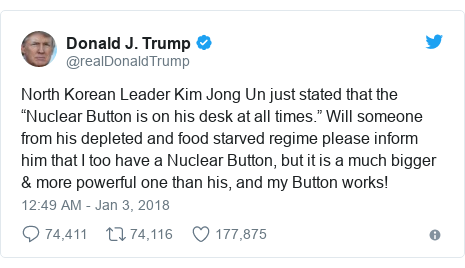
Twitter post by @realDonaldTrump: North Korean Leader Kim Jong Un just stated that the “Nuclear Button is on his desk at all times.” Will someone from his depleted and food starved regime please inform him that I too have a Nuclear Button, but it is a much bigger & more powerful one than his, and my Button works!

Trump’s singularly aggressive ego-parading, paranoiac and unpredictable approach to conducting foreign policy – and particularly to countering North Korea’s nuclear program – has moved many to express concerns about the potential implications of such vulgar posturing and crude lack of diplomacy.  Last autumn, for example, a congressional foreign-affairs committee held the first hearing in 41 years on presidential power over nuclear weapons.

“Donald Trump can launch nuclear codes just as easily as he can use his Twitter account,” observed Democrat Ed Markey, who has introduced legislation to prevent the president from authorising the first nuclear strike in a conflict without a congressional declaration of war. “No one human being should ever have that power.” Let alone one who lacks the necessary sophistication and outward-looking ethical disposition to carry that responsibility. 

Beatrice Fihn, a campaigner to eliminate the world’s nuclear weapons, said something similar shortly before accepting last year’s Nobel Peace Prize.  She said “If you’re uncomfortable with nuclear weapons under Donald Trump, you’re probably uncomfortable with nuclear weapons, because it means you recognize that [deterrence] won’t always hold up and things can go wrong. Once you start thinking ‘this person is appropriate for this weapon but not that person,’ then maybe it’s the weapon that’s the problem.”

Democracy depends on the responsible use of political and military power, with leaders held accountable to the majority of citizens. If a democratic nation is forced to use state-sanctioned violence to defend itself, its leaders must stay within publicly recognised moral and legal limits. There is a moral burden of possessing nuclear weapons, and the enormous responsibility that accompanies stewardship of such devastating weapons, as well as the technologies and nuclear materials that go into them. Sovereignty should be reframed to emphasise state responsibility and accountability to citizens and the international community rather than state prerogatives. 

Near misses over the decades

“It’s a near miracle that nuclear war has so far been avoided.”  Noam Chomsky

Despite a reduction in global nuclear tensions after the end of the Cold War, estimated nuclear warhead stockpiles total roughly 15,000 worldwide, with the United States and Russia holding 90% of the total.

Exact details on many nuclear close calls are difficult to access, the analysis of particular cases has highlighted the importance of a variety of factors in preventing ‘accidents’. At an international level, this includes the importance of context and outside mediation; at the national level, effectiveness in government communications, and involvement of key decision-makers, and, at the individual level, the decisive role of individuals in following logic, intuition and prudent decision-making, often in violation of protocol. Which gives us some cause for concern regarding the existing protocols in place.

In 1956, during the Suez canal crisis, the perceived nuclear threat was due to a coincidental combination of events, including a wedge of swans flying over Turkey, a fighter escort for the Syrian president returning from Moscow, a British bomber brought down by mechanical issues, and scheduled exercises of the Soviet fleet.

In 1960, radar equipment in Thule, Greenland mistakenly interpreted a moonrise over Norway as a large-scale Soviet missile launch. In 1961, Staff at the Strategic Air Command Headquarters (SAC HQ) simultaneously lost contact with the North American Aerospace Defense Command (NORAD) and multiple Ballistic Missile Early Warning System sites. It was later found that the failure of a single relay station in Colorado was the sole cause of the communications problems, which had initially been interpreted as an attack.

In 1962, at the height of the Cuban Missile Crisis, the Soviet patrol submarine B-59 almost launched a nuclear-tipped torpedo while under harassment by American naval forces. 

On the same day, a US U-2 spy plane was shot down over Cuba, and another U-2 flown by United States Air Force, Captain Charles Maultsby, strayed 300 miles (480 km) into Soviet airspace. Despite orders to avoid Soviet airspace by at least 100 miles (160 km), a navigational error took the U-2 over the Chukotka Peninsula, causing Soviet interceptors to scramble and pursue the aircraft. American interceptors armed with GAR-11 Falcon nuclear air-to-air missiles (each with a 0.25 kiloton yield) were then scrambled to escort the U-2 into friendly airspace. Individual pilots were capable of arming and launching their missiles. 

In 1965, there was a massive power outage in the northeastern United States. Several nuclear bomb detectors – used to distinguish between regular power outages and power outages caused by a nuclear blast – near major US cities malfunctioned due to circuit errors, creating the illusion of a nuclear attack. 

A powerful solar flare in 1967, interfered with multiple NORAD radars over the Northern Hemisphere. This interference was initially interpreted as intentional jamming of the radars by the Soviets, thus an act of war. A nuclear bomber counter-strike was nearly launched by the US.

In the 1970s there was another NORAD computer error, that entailed notification of 2,200 incoming Soviet missiles. It was found that a training scenario was inadvertently loaded into an operational computer.

There were several more near-misses in 1970s and 80s, and in 1995, Russian President Boris Yeltsin became the first world leader to activate a nuclear briefcase after Russian radar systems detected the launch of a Norwegian research rocket being used to study the Northern Lights.

As recent as 2010, commanders at a US Air Force base in Wyoming lost most forms of command, control, and security monitoring over 50 nuclear ICBMs for approximately 45 minutes. The missiles were taken offline after a suspected hardware problem caused multiple errors with control computers. Although military officials maintain that the missiles remained under control and were not susceptible to outside attempts to gain control, former Air Force launch officer Bruce G. Blair expressed concerns that missiles in this status could be vulnerable to launch attempts by hackers or compromised missile crews

Just last year, we learned of the death of a little-known but important figure in the history of the Cold War. His name was Stanislav Petrov, and he is sometimes referred to as “the man who saved the world.”

In 1983, Petrov was a Soviet military officer on duty at a nuclear early warning center when his computers detected a barrage of incoming American nuclear missiles. He said, “I had all the data to suggest it was true”. He added, “If I had sent my report up the chain of command, nobody would have said a word against it.”

He went on, “All I had to do was to reach for the phone to raise the direct line to our top commanders, but I couldn’t move. I felt like I was sitting on a frying pan.” Petrov had a hunch that the computer had made an error, and fortunately his intuition was right about a false alarm.

Instead of notifying his commanders to prepare an immediate nuclear counterattack, he  called army headquarters and reported a system malfunction.

This episode alone illustrates just how high the risk factor is with nuclear weapons, especially when decisions to use them are entrusted or could be entrusted to sometimes unreliable technologies or fallible human judgement. Perhaps those countries who want nuclear arms must ask themselves: Am I prepared to deal with this type of scenario in my own country?

Authoritarianism and the politics of posturing in the UK

“Gambling rules doesn’t work in nuclear war – everyone become loser.” Amit Ray, Peace on the Earth A Nuclear Weapons Free World.

In April 2017 the then defence secretary Michael Fallon confirmed that the UK would use nuclear weapons in a “pre-emptive initial strike” in “the most extreme circumstances.” He did not specify precisely what those circumstances may be. Nor did he say which country may be the UK’s likeliest target. 

In an extraordinary act of aggressive posturing, he added that a first strike may be launched even if Britain itself was not under threat of nuclear attack. He said that national security need not be under threat to warrant a “pre-emptive” nuclear launch. 

Asked in what circumstances the Conservatives would launch a first strike, Fallon replied: “They are better not specified or described, which would only give comfort to our enemies and make the deterrent less credible.”

Fallon clearly doesn’t understand the principle of “deterrence”, then. That is frankly terrifying. You would hope that a government responsible for the safety of citizens would only ever launch a nuclear attack as a very last resort, once all other options, such as diplomacy and negotiation, had been completely exhausted. How discomforting that Fallon sees the UK public as disposable – collateral damage. 

Why on earth would anyone trust a defence secretary who makes such an irrational comment – “even if Britain itself was not under threat of nuclear attack. He said that national security “need not be under threat to warrant a “pre-emptive” nuclear launch”. It sounds very much like the Conservatives have a specific target in mind, to me. I don’t think the changed nuclear posture – and without an open review – has come about incidentally or on a whim.

That statement doesn’t bode well for democratic accountability, nor is it particularly reassuring that the Conservatives have no central plan to prioritise the safety and protection citizen’s lives and the planet. That is surely the key strategic value of having a nuclear deterrent – that all parties in a potential conflict would be reluctant to launch a first strike because of the catastrophic consequences of a probable retaliation.

Fallon continued: “The whole point about the deterrent is that you have got to leave uncertainty in the mind of anyone who might be thinking of using weapons against this country.”

No you don’t. The point of nuclear deterrence is that it deters first strikes because a second strike is assumed. No world leader wants to initiate a sequence of terrible global events that would inevitably escalate, ultimately bringing home their own country’s destruction in the form of retaliation.

Fallon also insisted that critics of Trident – including senior military figures who have ridiculed the idea that it is an effective deterrent – were “absolutely wrong”, as if simply telling people that they are wrong means that they somehow must be. 

A report – British military attitudes to nuclear weapons and disarmament – by the Nuclear Information Service (NIS) and the Nuclear Education Trust – is a ground-breaking study into military thinking on nuclear weapons. It is rather startling to find that the military establishment is far from unanimous on the issue of Trident replacement. 

Some participants in the study, commenting on the exorbitant cost of Trident replacement, stated that “no circumstances justify the large amounts of money required by [Trident] and this money would be better spent elsewhere.” The problem is that a majority of the wider public generally support having of a nuclear deterrent.  

Many participants in the NIS survey were also unclear about many aspects of the UK’s nuclear weapons, including their costs, purpose and credibility. Many in the military think Trident is a “political” tool and little more and many would rather see the money spent on equipment which could actually be used: especially at a time when the forces have been faced with spending cuts. 

The Labour party manifesto states a clear commitment to renewing Trident under a Labour government. However, controversy in the media – directed by misleading comments from the Conservatives – has unbelievably problematised Corbyn’s perfectly reasonable caution in committing to launching a pre-emptive nuclear attack.

Personally I would much rather the prime minister put effort into finding rational and diplomatic solutions to protect the UK citizenry, rather than dancing in an unholy, manic glee at the very prospect of our assured nuclear annihilation.  

The debate, being cheer led from the right, has descended into a macabre and somewhat irrational political point-scoring exercise, using a strategy of tension in an attempt to portray the opposition leader as “weak”. This is a dangerous and absurd tactic that the Conservatives use at every single election, regardless of who is the leader of the opposition. Usually, though, they don’t show a grotesque display of eagerness to bring about Armageddon to demonstrate a “strong and stable” leadership. 

Deterrence and Mutually Assured Destruction: what that actually means

We’re capable of such beautiful dreams, and such horrible nightmares.” Carl Sagan

Mutually assured destruction (MAD) is a military doctrine and national security policy in which a full-scale use of nuclear weapons by two or more opposing sides would cause the complete annihilation of both the attacker and the defender. MAD is based on the strategy of deterrence, which holds that the threat of using catastrophic weapons against an enemy prevents the enemy’s use of those same weapons. The strategy is a form of Nash equilibrium (games theory), in which, once armed, neither side has any incentive to initiate a conflict or to disarm.

The deterrence strategy further rests on assumption that neither side will dare to launch a first strike because the other side would launch on warning (also called fail-deadly) or with surviving forces (a second strike), resulting in unacceptably catastrophic losses for both parties. The strategic MAD payoff is therefore an ongoing expectation of a tense global stability and peace. 

The major flaw in a first strike approach is that it encourages the opponent to perform a massive counterforce first strike. If both sides of a conflict adopt the same stance of massive response, it may result in unlimited and globally devastating escalation (a “nuclear spasm”), each believing that the other will back down after the first round of retaliation. This said, both problems are not unique to massive retaliation, but to nuclear deterrence as a whole. 

It is for these reasons that many countries have adopted a minimum credible deterrent/second strike policy. Previously we had a policy of using nuclear weapons only as a defence. 

Many of those arguing both for and against no-first-use misunderstand it: The policy reflects the power to set the rules of war, rather than some wayward pacifist ideal to end all war. Countries that issue no-first-use pledges boast strong conventional militaries. These states want to encourage a model of war where their army meets the enemy on a conventional battlefield with clearly defined rules – the kind of war, in other words, that they usually win. Nuclear weapons upend this model, because they help weaker actors of the world, such as North Korea and Pakistan, produce extraordinary destruction, level the playing field, and cast victory into doubt.

Therefore, a no-first-use pledge could potentially reinforce a powerful state’s strategic advantage by discouraging other countries from developing nuclear arsenals, and by dissuading nuclear-armed countries from pushing the button. This would happen with the assurance that a state would not fire first – thereby keeping war safely bound and safely winnable, on the powerful state’s terms.

In an article published in the Atlantic last year, titled Refusing to Nuke First. Why rejecting nuclear preemption reflects strength, not weakness, Dominic Tierney says:

“Countries that contemplate or introduce a no-first-use policy are almost always strong states that enjoy a conventional-weapons edge. Since its first nuclear test in 1964, China has repeatedly declared that it “undertakes not to be the first to use nuclear weapons at any time or under any circumstances.” It’s no coincidence that China is the most powerful East Asian country, and would hold the advantage in any conventional war with South Korea, Vietnam, Japan, or Taiwan (assuming, of course, that the United States stayed out). The spread of nuclear weapons in East Asia would diminish China’s strategic advantage; therefore, Beijing seeks to prevent this outcome with a no-first-use policy.

India announced in 1999 that it “will not be the first to initiate a nuclear strike, but will respond with punitive retaliation should deterrence fail.” In 2003, India qualified its no-first-use pledge by stating, “in the event of a major attack against India, or Indian forces anywhere, by biological or chemical weapons, India will retain the option of retaliating with nuclear weapons.” Again, it’s no coincidence that India is very likely to prevail over Pakistan in a future conventional war. India has a history of winning previous contests, and currently spends about $50 billion per year on defense compared to Pakistan’s $9.5 billion. New Delhi can safely issue a no-first-use pledge in the hope of keeping the strategic terrain favorable.

In  2016, General James E. Cartwright, former head of the US Strategic Command, and Bruce G. Blair, former Minuteman launch officer, co-authored an op-ed in The New York Times in favor of a U.S. no-first-use policy. They showed, explicitly, how power undergirds the proposed doctrine. “Our nonnuclear strength, including economic and diplomatic power, our alliances, our conventional and cyber weaponry and our technological advantages, constitute a global military juggernaut unmatched in history. The United States simply does not need nuclear weapons to defend its own and its allies’ vital interests, as long as our adversaries refrain from their use.”

If a country is willing to use nuclear weapons, it’s also willing to break a promise.

By contrast, weak states don’t even think about a no-first-use policy. Indeed, threatening to push the button early in a conflict is the basis of their deterrent plan. During the Cold War, when the Soviet Union had conventional superiority in Europe, the United States and its NATO allies intended to escalate to nuclear war if the Red Army launched an invasion. Similarly, today, Pakistan explicitly threatens to retaliate with nuclear weapons if it is ever attacked – even through a conventional invasion.

Viewed through a strategic – and perhaps more cynical – lens, the no-first-use doctrine also has a huge credibility problem. For the US pledge to truly matter, a president who otherwise favors a nuclear first strike would have to decide not to press the button because of this policy. But in an extreme national crisis – one involving, say, North Korean nuclear missiles – a president is unlikely to feel bound by America’s former assurance. After all, if a country is willing to use nuclear weapons, it’s also willing to break a promise.

Champions and critics of no-first-use often cast it as a principled policy and a revolutionary step, for good or for ill. But the idealistic symbolism of no-first-use betrays an underlying reality. Disavowing a first strike is a luxury afforded to the strong, and they play this card in the hope of strategic benefit. If Obama made a dramatic announcement of no-first-use, it would probably have less impact than people think because other countries wouldn’t follow suit, especially if they’re weak. And, in any case, the promise may be meaningless because no one can predict a president’s calculus when staring down a nuclear holocaust.

No-first-use is the policy of Goliath, not Gandhi.”

Former US Secretary of Defense William Perry said: “During my period as Secretary of Defense, I never confronted a situation, or could even imagine a situation, in which I would recommend that the President make a first strike with nuclear weapons  – understanding that such an action, whatever the provocation, would likely bring about the end of civilization.”

Perry’s life’s work, most of it highly classified, was nuclear weapons. He played a supporting role in the Cuban Missile Crisis, during which he went back to his Washington hotel room each night, fearing he had only hours left to live. He later founded his own successful defense firm, helped revolutionize the US way of high-tech war, and honed his diplomatic skills seeking common ground on security issues with the Soviets and Chinese. 

Nuclear bombs are an area of expertise for Perry, who had assumed they would be largely obsolete by now, seven decades after Hiroshima and Nagasaki, a quarter of a century after the fall of the Soviet Union. Instead, once again they have become a contemporary nightmare, and an emphatically ascendant one. A Russian president has recently make bellicose boasts about his arsenal. An American president free-associates on Twitter about starting a new nuclear arms race. Decades of cooperation between the two nations on arms control is nearly at a standstill. And, unlike the original Cold War, this time there is a world of busy fanatics excited by the prospect of a planet with more bombs – people who have already demonstrated the desire to slaughter many thousands of people in an instant. 

Perry is now a senior fellow at Stanford University’s Center for International Security and Cooperation. He serves as director of the Preventive Defense Project. He is an expert in US foreign policy, national security and arms control. In 2013 he founded the William J Perry Project (http://www.wjperryproject.org), a non-profit effort to educate the public on the current dangers of nuclear weapons.

Disarmament has fallen far from the top of the policy priority list. The largest upcoming generation, the millennials, were raised in a time when the problem felt largely solved, and it’s easy for them to imagine it’s still quietly fading into history.  

Since the end of the Cold War, we no longer think about the threat of a nuclear holocaust every day. It’s not embedded in our public psyche. During the Cold War the United States relied on deterrence rather than prevention as the central principle of its security strategy. However, Trump’s recent posturing indicates a far more aggressive stance, implying a shift from a defensive to a rather more offensive approach, making him an extremely unpredictable custodian of the substantial US nuclear arsenal.

The problem is that the threat of a nuclear event and escalation is no longer retreating. Perry said in an interview in his Stanford office: “Today, the danger of some sort of nuclear catastrophe is greater than it was during the Cold War, and most people are blissfully unaware of this danger.”

A report published during the UK’s General Election period sought to reframe the nuclear debate within the UK. The report comes from the British American Security Information Council (BASIC) and the United Nations Association (UNA-UK).

Up until now, the debate has been dominated by the decision about whether to invest in a renewal of the Trident system, linked to political judgements about the responsibilities of governments to maintain strong defence capabilities. As a result, wider questions about how best to tackle global nuclear dangers have been neglected.

This matters, particularly as the crisis with North Korea unfolds, but also as relations with Russia deteriorate and states frustrated with a lack of progress on disarmament begin negotiating a treaty to ban nuclear weapons without any nuclear armed states in the room. Commitment to the bargain at the heart of the nuclear non‑proliferation regime, always a little shaky as interpretations of its priorities have been contested, could easily fray, with drastic risks to global security.

This issue sits within broader questions about the UK’s role in the world. As we move through a period of growing instability, the need for effective international mechanisms to promote security is greater than at any other time since the UN was founded. Their success depends on states’ willingness to work together. The increasingly fractious geopolitical environment, however, is impeding progress and putting further pressure on our post-war international system, already overstretched by the convergence of multiple crises.

As a permanent member of the UN Security Council, a nuclear weapon state and one of the largest aid donors, the UK is an important player on the world stage. The international system has delivered prosperity and security for the UK as a whole. Its breakdown could have serious – and, in the context of nuclear weapons, existential – consequences for the country. Unfortunately, the UK has not been immune to the growing reluctance by states to invest in the continuing health of this system. 

Over the past decade, voices calling for a narrower outlook have grown louder in this country, as in many the world over. But the line between national and global interests is disappearing. British foreign policy must embrace this reality and prioritise strengthening collective efforts to create a more peaceful world.

The need for nuclear disarmament through multilateral diplomacy is greater now than it has been at any stage since the end of the Cold War. Trust and confidence in the existing nuclear non-proliferation regime is fraying, tensions are high, goals are misaligned, and dialogue is irregular. 

In Meaningful Multilateralism, BASIC and UNA–UK offer 30 multilateral disarmament proposals for the incoming UK Government after the General Election on June 8, themed according to three types of leadership the UK has previously shown in disarmament:

• Diplomatic leadership

• Technical leadership

• Leadership by example

The Conservatives don’t fulfil any of these criteria because of their strong authoritarian tendencies, and they certainly haven’t demonstrated a preference for diplomacy or leadership by example in particular.

Whatever one’s position on Trident, there are meaningful steps that can be taken in multilateral disarmament, and the next UK Government should actively take a leadership role.

The current growing global instability is a turn of events that has William Perry, former US defense Secretary, obsessed with one question: Why isn’t everyone as terrified as he is?

Why indeed.

There is a crisis in the Nuclear Non-Proliferation Treaty, with its vision unraveling due to different views on disarmament. If the deterrence principle were to break down, the potential global humanitarian impact would be truly apocalyptic. The strategic offence doctrine of Mutually Assured Destruction means just that. In such an exchange, there can’t possibly be a winner.

It wouldn’t be a simple act of genocide. A nuclear exchange may well culminate in omnicide – a small word that means the totalising enormity of the end of everything for everyone. Even a restrained tactical exchange would most probably have catastrophic bioecological and wider global impacts, and a devastating breakdown of civilisation. 

Everyone agrees that the risk of nuclear war is bad; if all else were equal, we would rather not have this risk. But all else is not equal. The probability of nuclear war is not zero. Nuclear deterrence can fail. It is a fallacy to presume that just because no nuclear war has occurred since the post-World War II advent of nuclear deterrence, therefore it will never happen. The historical record contains several near-misses in which nuclear war was narrowly avoided due in no small part to luck.  

The argument that nuclear deterrence makes the world a safer place is not particularly persuasive.

First strike posturing is considerably less so.


My work is unfunded and I don’t make any money from it. But you can support Politics and Insights and contribute by making a donation which will help me continue to research and write informative, insightful and independent articles, and to provide support to others.

DonatenowButton

Sometimes satire is appropriate. Calling it ‘fake news’ isn’t

My last article was a lampoon of a real vigilante group that was established to hunt out ‘fake’ beggars and homeless people, taking photos of them to use on posters that name and shame them. The group have already ‘outed’ one genuinely homeless person, and have drawn much criticism from the police, charities and councils for their ill-conceived aims and methods. 

The characters I portrayed have made up names like ‘Mr Vinnie Dicktive’ and so on. The reference to phrenology and character divination is also a sideswipe at the government, as is the reference to ‘no causal link between ‘the homeless and homelessness’, but it also serves to highlight the bigotry, hypocrisy and downright irrationality of the vigilante group.

Image result for satire disgust at homelessness

Some people have expressed concern that my satire may be mistaken for ‘fake news’. However, I expect that most people can recognise a parody of a group and distinguish it from ‘fake news’. I occasionally write satire because sometimes, the best thing to do when confronted with those who are nasty, irrational, prejudiced and ridiculous is to ridicule them. I’m certainly not going to apologise for that.

My friend, Hubert Huzzah, has this to say about satire and ‘fake news’:

1) Fake News is bought, paid for and advances against the interests of the people it is aimed at.

2) Satire is created by [and for] the people who Fake News is aimed at. 

For those who don’t know me, my occasional bouts of satire fall into the latter category.

However, what really angers and upsets me about some of the responses to the latest article is this. The article I wrote just previously to the satirical piece was absolutely heartbreaking. It was so harrowing to write that I wept while I wrote it. The article was about two ill and vulnerable homeless citizens who died in sub-zero temperatures last week. Ben had been discharged from hospital, forced to return to a tent as his only shelter from the elements, after being treated for pneumonia. Rob had throat cancer, and was sleeping behind the shutters of an Argos store.

People expressed their ‘shock and surprise’ that these two poor and ill homeless citizens hadn’t survived Siberian weather conditions. I felt that those comments reflected a general public numbness and detachment to the terrible circumstances of homeless people, which horrified, appalled and disgusted me. And also made me very angry.

There is something really horrifically wrong with a so-called civilised, democratic society in a very wealthy country that abandons sick and disabled people, leaving them with no effective shelter or money on the streets in sub-zero temperatures. And there must be something missing from people who then express ‘shock’ and ‘surprise’ that their fellow citizens have died in those conditions.

I was accused of having ‘bad taste’, by one person. I pointed out that I am not part of the vigilante group going around harassing and photographing homeless people and making posters that claim they are somehow faking their homelessness. This group says that they will not invade the privacy of other citizens, by ensuring they aren’t captured on any of the photos, indicating clearly that they think homeless people have less right to respect and privacy than others. The point of my satirical article was to highlight the ‘bad taste’ , spite and prejudice of the ‘Killing with Kindness’ campaign. If it made you feel uncomfortable, well good, it was intended to.

Remarkably, my satirical piece has drawn more attention, response and anger than the previous very serious article about real people, in very real and unforgiving circumstances within the context of inhumane political and public indifference to the plight of our poor fellow citizens in this country.

Related image

Related

Please don’t just walk on by, we are better than this

From the abstract to the concrete: urban design as a mechanism of behaviour change and social exclusion

Two very vulnerable homeless men left to die in sub-zero temperatures

People are faking their homelessness and poverty for money, says petty urban bourgeousie


I’m disabled through an illness called lupus. I don’t make any money from my work. However, I do what I can, when I can, and in my own way. You can support Politics and Insights and contribute by making a donation which will help me continue to research and write informative, insightful and independent articles, and to provide support to others. The smallest amount is much appreciated, and helps to keep my articles free and accessible to all – thank you. 

DonatenowButton

People are faking their homelessness and poverty for money, says petty urban bourgeousie

A group of privileged vigilantes have called for councils across the nation to see off homeless people in order to protect the Tory-voting urban bourgeoisie from offense. Armed with posh Nikon cameras, a book on phrenology and a crystal ball, they have taken to the streets to try and catch out the millionaires who are scamming the public by dressing up in pauper rags and begging. 

“Some of these homeless people are rubbish at living in houses and are being incompetently hungry in full view of everyone,” says Mr Harris Mint.

“But we know a large number of them are Marxists and some are millionaires. Some of them are faking malnutrition and thinness. There are some even faking disabilities. Whatever next. They should go and take their fake pauperism with them.

Mr Vinnie Dicktive, the group gossip and lead curtain twitcher, said Everyone here knows these people are really trying to make everyone else miserable. One man went to great lengths to get a stay in hospital after conning the paramedics into saying he had pneumonia, but we know he was faking it, and we took photos of the fake resuscitation. They even conned us by sticking a drip into his arm. He must have paid them.

“The hospital said the fake tramp was in intensive care, but we know he sneaked into the canteen for some soup, really. We know the paramedics and hospital staff are Momentum supporters, so we took their photos and told them we would cross-reference them to deter them. We also got a good shot of the security guards who escorted us off the premises. Name and shame them, that’s what I say.” 

Another member of the vigilante group, Miss Dos Gowon, said: “One thing these people don’t like is being photographed or filmed, so we’ve gone and done that. These anarchy- commie woke Marxist types, languishing in doorways and lolling brazenly on park benches are a real menace to one’s view. They’re driving property prices down by pretending to be hoboes. 

“We have identified who is genuine with the relevant charities and their names and if they are homeless or not. We’ve ask them their names, we then translate them into runic symbols then use the crystal ball and a phrenology book. Everyone knows these charities are scaremongers and that homeless people can’t be causally linked with homelessness.

“Five of the paupers we photographed have told us they won’t go begging anymore if we don’t put their wanted photo up around town. Or give out their names, which are Getty Stoffed, Doo Won, Lemmie Bee, Goa Way and his brother, Noah Way. Most of them sound like nasty foreigners. 

Mr Lemmie Attem, the group strategist and phrenologist said “Not a single one of them sang the national anthem or denounced terrorism while they dossed around town. And they all have commie beards. And they’re Marxists. I know because I felt their bumps.

“Of the 17 hoboes we photographed, only two were genuine street homeless. Our sophisticated scientific character divination methods worked a treat. Not a single one could prove that they didn’t have a house or some money and clean clothes stashed somewhere.” 

Many great philosophers have come unstuck trying to prove the existence of nothing, however.

“See, we said they weren’t real homeless people. I could tell straight away by the shape of their heads. These philosophers are all Corbyn supporters and are just playing smart because they just want to make the government look bad as can be,” said Mr Noah Hoomaniti, the charismatic leader, rune writer of the group and lifelong Conservative supporter.

Newest member of the character and lifestyle divination vigilante group, Mr Lou Smorals said “The solution is to send homeless people to live in landfills. That way, they can sort through the rubbish for decent cardboard boxes, no-one has to see them and people get to feel charitable every time they throw food away. It’s the most humanitarian thing to do all round.”  

I asked the group what they thought genuinely homeless people would do when the ‘beast from the east’ struck. 

“Well, we will have to barricade ourselves in”, said Mr Willie Eckerslike, the group’s chief phrenologist and clairvoyant.

“I personally voted leave, and I’m annoyed we still have to put up with these foreigners coming over here. And foreign weather. It’s bad enough dealing with the fake homeless criminals without worrying about migrant sex offenders.”


Related

‘Nasty’ campaign to out fake beggars will ‘not be welcome’ in Liverpool


I don’t make any money from my work.  But you can help by making a donation and enable me to continue to research and write free, informative, insightful and independent articles, and to provide support to others going through disability benefit assessment processes and appeals. The smallest amount is much appreciated – thank you.

DonatenowButton

Two very vulnerable homeless men left to die in sub-zero temperatures

Related image

A homeless man died tragically, earlier this week while sleeping rough in freezing temperatures in Nottinghamshire. He was known as Ben to locals, and had been sleeping in a tent near Saint Swithun’s Church in Retford. He was found in the early hours of Tuesday morning, as freezing temperatures swept across the county due to the ‘Beast from the East’ storm.

Police confirmed that they were made aware of a ‘sudden death’ near to the church by the ambulance services at 8.40am on Tuesday (February 27).

One local resident in the area, Kenny Roach, said he knew Ben well and had previously helped him out with money and food. 

“He contacted me last week just before he came out of hospital – he had pneumonia,” he said.

Two local scout leaders, Hazel and Kenny Newstead said they both knew Ben well.

“We’re so shocked and saddened by this. He seemed to be a lovely, friendly chap,” said Hazel.

He was living in a tent between a wall and the old church hall off Churchgate near our scout hut.

“He told us he was 53 and used to be a brickie – he even offered to re-do the brickwork on our building.

“We used to chat to Ben over the wall. He was happy here and didn’t want to go to a shelter in Worksop.”

Hazel said she and her husband had come across Ben a week or so ago, but understood that he was originally from the south and moved between Retford, Gainsborough and Worksop. His girlfriend had died tragically before he became homeless.

“He had a tent, sleeping bags and quilts, and we gave him tinned food because he said he had something to cook with. He used to hang his sleeping bags between the trees to air them,” Hazel said.

Roach added “He had had his stuff pinched so I arranged to meet up with him to give him some camping gear, money and food.

“He didn’t want something for nothing.

“Ben was quite comfortable where he was and didn’t want to go to Worksop. All he needed was a break. This is so sad.”

Worksop is just over 12 miles from Retford.

Roach said that Ben would search bins for items to sell in the town and would buy food with any proceeds he received. Roach had also offered him work with an upcoming project.

He was a grafter,” Roach said. “But he just needed somebody to give him a break. He couldn’t get a job because he didn’t have a home, he couldn’t get a home because he didn’t have a job, and he couldn’t get benefits because he didn’t have a home. It’s a vicious, vicious circle. People need to cut them some slack.” 

Councillor Simon Greaves, leader of Bassetlaw District Council, said :

We were all saddened to learn about this tragedy and had put provisions in place in an attempt to prevent something like this occurring.

“The Council has been providing a Severe Weather Night Shelter every night since Saturday, February 24 where anyone in Bassetlaw who is homeless can get out of the cold and into a warm and safe environment for the night.

“Severe Weather Night Shelters are set up when the outside temperature is set to drop below zero degrees centigrade for three consecutive nights.

Outreach Workers from Framework, the Council, the Police and a number of other agencies are in regular contact with people who are sleeping rough and have made them aware of the shelter.

“While the shelter is based at Crown Place Community Centre in Worksop, free transport has been offered to people known to be homeless, regardless of where they are currently living. Some people have taken up this offer and have used the shelter. Regrettably other individuals have made a personal choice to decline this offer.

“We are aware of between 15 and 20 people known to be sleeping in Worksop and around five people in the Retford area who are known to be homeless. We will be keeping the shelter open until at least Sunday night, and possibly longer, depending on the weather. Up until Wednesday evening the Shelter has been used by a total of 11 people since it opened last weekend.

“In terms of long-term provision for Homelessness, the council continues to work with the individuals concerned and the relevant agencies to place people in the most appropriate accommodation as well as work to prevent people becoming homeless in the first place.”

A file will now be put together to hand to the coroner.

It’s not clear if anyone had approached Ben regarding shelter provision, bearing in mind that he has been in hospital with pneumonia little over a week before he died. 

Hazel Newstead said “He had only been here for about a week. He said he had come out of hospital on 14 February, where he’d been treated for pneumonia. Before that I think he had been in another church sleeping in the door way.”

She added: “I can’t help wondering whether I could have done more personally – I’m disabled and limited physically, but the guilt is there, as there didn’t seem to be anywhere else for him to go.

“He was bothering nobody where he was. Probably hardly anyone knew he was there.”

Bassetlaw District Council opened a severe weather night shelter over the weekend but residents of Retford said it was 10 miles outside the town, which means some rough sleepers were unwilling to go there.

Following Ben’s death, local residents have set up their own homeless shelter to provide more accessible beds, as some homeless people in the area didn’t want to go to Worksop.

I spoke to a former worker from Framework – the local homeless service provider – who had worked in the area for seven years. She said “ Funding has been cut by more than 70% for Framework’s services in Nottinghamshire. Prior to 2010, there was a countywide street outreach team, Winter Night Shelters opened from December to the middle of March, plus various services offering longer term hostel and move on accommodation and tenancy support once people were in their own homes. We predicted that people would die as a result of those services closing. I’m heartbroken and full of rage that it’s happened.”

It’s difficult to believe that a person who had pneumonia was discharged from hospital into below freezing weather conditions with no shelter but a tent and sleeping bag. Surprisingly, some local people say they were shocked that the poor man had died.

Another man homeless man was found dead behind the shutters of an empty shop following one of the coldest nights of the year. Police and paramedics were called to the former Argos building in Chelmsford. The man was know locally as ‘Rob O’Conner’ had been living behind the shutters, he was found dead at the scene.

Aaron Smith, 27, who has been homeless for a year, said he found Rob’s body.

I was his only friend. We bed down together under the shutters,” he said.

“I was all he had. He was ill and had throat cancer.

“The bad weather didn’t help at all and it is picking us off one by one.

“When I found him he had one thin sleeping bag on.

Everyone has him wrong.

“He was a lovely bloke but because he couldn’t speak properly people had him wrong. He had throat cancer

“He was a good and loyal friend.”

Following the news of the death, a sign placed next to the Halifax bank was left in tribute to the man.

A tribute to Rob, a homeless man who was suffering from throat cancer, found dead in Chelmsford (Image: Essex Live/BPM Media)

Brian McGovern, Who runs the Rucksack Project, said: “This is something that the council were warned about.

“I did approach the council when we had a cold spell about opening up fire stations for them to sleep in.” Rob Saggs, executive director of the homeless charity CHESS said: “It’s devastating to hear that somebody has died on our streets in Chelmsford.

“I’m just devastated and quite shocked. What’s really sad about it is that we have been running a winter project that somebody like this could have been accessing, where it’s warm and comfy. It’s horrendous.”

A spokesperson for Chelmsford City Council said: “CHESS have confirmed that the winter project has extended their service until the end of March. They have just 10 bed  spaces at a local Church which rough sleepers can access each night. Sanctus is open for rough to get hot food and drink throughout the day.”  

Shortly after Rob’s death, tributes came in for the man described as a “good and loyal friend”. 

Rob’s death comes after one of the coldest nights of the year when the temperature in the Essex city dipped to a low of -1.7C at 4am.

It’s reported that his death is not being treated as suspicious. It should, however, be treated as an absolutely shameful national disgrace. Rob had throat cancer and was sleeping rough. Behind the shutters of an Argos shop. No-one would choose to live and die like this. 

Ben was discharged from hospital following treatment for pneumonia just over a week before he died, to sleep in a tent.

There is something very wrong with a society that leaves ill people without adequate shelter in sub-zero temperatures. People are apparently so shocked that this is happening right under their noses. 

However, it’s far too late to be shocked after the event of someone’s death.

We seem to have become a nation that is blind to the suffering of some of our most vulnerable citizens, to the point where we somehow think they have some sort of immunity to exposure and sub-zero temperatures. Until it kills them. 

Over the last seven years we have witnessed the return of absolute poverty in the UK because of Conservative welfare policies, austerity, low wages and insecure work. Absolute poverty is when people can’t afford to meet one or more of their basic survival needs as they don’t have an adequate income to eat, keep warm or afford shelter.

Welfare was originally calculated to meet people’s basic needs and to ensure that citizens did not have to live in absolute poverty. We were a society that believed that everyone has a right to life. However, since the Conservative government’s welfare ‘reforms’, the amount of support people have does not alleviate hardship nor does it adequately ensure that people can meet their basic survival needs. Furthermore, the punitive welfare sanction regime often leaves people without any income at all.

In one of the wealthiest nations in the world, people are dying because they have no home and because there is not an adequate safety net in place to help them when they so desperately need it.

I wept while writing this.


You can help a homeless person by contacting Streetlink. (Click) When a rough sleeper is reported via the Streetlink app, or by phone – telephone number 0300-500 0914.

The details  you provide are sent to the local authority concerned, so they can help connect the person to local services and support. You will also receive an update on what action was taken so you’ll know if the situation was resolved. StreetLink aims to offer the public a means to act when they see someone sleeping rough, and is the first step someone can take to ensure rough sleepers are connected to the local services and support available to them.

Don’t walk on by. We are better than this

Image result for homelessness in the snow uk


Related

Please don’t walk on by. We are better than this


I don’t make any money from my work, and as a disabled person, I have a limited income. But you can help by making a donation and enable me to continue to research and write informative, insightful and independent articles, and to provide support to others going through disability benefit assessment processes and appeals. The smallest amount is much appreciated – thank you.

I do have a roof over my head, however. If you know of someone who is homeless, I’d prefer that you help them first and foremost

DonatenowButton

Disability Income Guarantee abolished under Universal Credit rules – a sly and cruel cut

social justice man

Many of us have said previously that the government’s ‘flagship’ policy, Universal Credit (UC), is about implementing further cuts to welfare support by stealth. However, the loss of income to disabled people through hidden cuts has been under-reported. 

Despite the systematic cuts to support that was originally calculated to provide sufficient support to meet the costs of citizens’ basic living needs, UC is on course to deliver only marginal taxpayer savings despite driving through the huge cuts in benefit payments to many claimants, according to the Office for Budget Responsibility (OBR), last month.

Related image

Disabled people who qualified for the support component of income-related Employment and Support Allowance and (ESA) are also eligible for a disability premium. This is also called the Disability Income Guarantee. However, as a result of the abolition of both the severe disability premium (SDP) and enhanced disability premium (EDP) under UC rules, according to the disability charity, Scope, the cut to the disability income guarantee will see disabled people lose as much as £395 a month

The UC system has made an estimated £11bn in savings, mainly through Treasury cuts to the original set level of universal credit rates – most notably through reductions to work allowances, which will save around £3bn, and the removal of £2bn in disability premium payments – but UC planning and delivery has also incurred £8.5bn in expenses.

Legal challenge

A terminally ill man is challenging the government regarding their catastrophic universal credit (UC) policy. Known only as ‘TP,’ a 52-year-old ex-City worker – who has non-Hodgkin lymphoma and a condition called Castleman disease which affects the lymph nodes – is launching a landmark challenge at the high court after becoming worse off under the new benefit system. The outcome of the legal challenge could have widespread implications for an estimated 230,000 disabled people who will be hit by the removal of disability premiums under UC rules.

TP discovered his illness is terminal in 2016 and he moved to London to receive treatment, but as it was an area where UC had already been rolled out in the capital, his lifeline support was cut by £178 a month.

The government has previously claimed that disabled people will be protected by ‘top-up payments’ as they transfer to UC but such payments are not planned to be implemented until July 2019. Transitional Protection will only be available to people who are moved over to Universal Credit from ‘legacy’ benefits (even though nothing has happened which makes them need to start a new benefit claim). The government calls this process ‘managed migration’. There will not be any managed migration until the Universal Credit full digital service is available in all areas – July 2019 or possibly later. No further details, as yet, have been published by the government regarding transitional protection. 

The Department for Work and Pensions have claimed UC means that support is “focused on those who need it most”, but a government removing SDP and EDP, which is support designed to help severely disabled people who live without a carer – is pulling a basic safety net from citizens with the greatest needs.

This cut will also affect disabled lone parents who may rely on their benefits to pay for support to shop, cook and wash, for example. The cut may mean that they will be forced to rely on their own children as carers.

This exceptionally cruel cut will affect a social group that have already been hit the hardest by austerity. It’s difficult to imagine that these further targeted withdrawals of support are not deliberate.

facade welfare
Furthermore, councils hit by government funding cuts are increasingly charging disabled people for social care – and those who need to claim SDP don’t have a family carer, and so often have a greater need for council social care support. Scope found earlier this year that disabled people have to pay on average an extra £570 a month for the costs of disability for anything from specialist equipment and treatments excluded from charge exemptions on prescription, to taxis and a special diet, with one in five paying more than £1,000 extra per month. 

As Frances Ryan says Since its rollout, UC has become synonymous with hardship, often heaped on the most disadvantaged families: from an increase in food bank use and rent arrears, to now one million children set to miss out on free school meals because of UC’s new earnings threshold. But the threat to disabled and chronically ill people has up until now gone largely under the radar.

“Yet severely disabled people will collectively lose £2bn in disability premium payments (a fraction of what the government is spending on UC’s delayed rollout). Or to put it another way, a mother with multiple sclerosis won’t be able to afford to put the heating on or pay for a carer to help her wash.”

Universal Credit doesn’t meet the aims stated by government and lacks a political consensus of support

Last October, the Resolution Foundation said that a spree of Treasury-driven welfare cuts since 2015 has left UC unable to meet its original aims of ‘strengthening work incentives’ and supporting the incomes of low-income families.

The Foundation warned that the current fragile political consensus in support of universal credit risks breaking down unless ministers refinance the reform and fix multiple design and implementation problems.

At the time, Conservative MP Wendy Morton, David Gauke and other Conservatives responded by claiming that Universal Credit ‘helps’ people into work and  criticised opposition MPs for ‘scaremongering.’ However, the new benefit has pushed people into debt and rent arrears, with some forced to rely on food banks to survive. It’s difficult to see precisely how a social security benefit that creates those extremely challenging circumstances could possibly help people into work. 

The leader of the House of Commons, Andrea Leadsom, was accused by senior Conservatives MPs of “paving the way for tyranny”, after the government whipped its MPs to abstain on a Labour motion on universal credit. Labour’s motion  passed unanimously despite the concerns of several Conservative rebels, but some Tory MPs were infuriated at being urged by their own party to ignore it.

Leadsom faced criticism from some Conservative MPs because she said the government was not bound by the reasonable resolution, which called for the rollout of the controversial welfare changes to be paused.