Author: Kitty S Jones

I’m a political activist with a strong interest in human rights. I’m also a strongly principled socialist. Much of my campaign work is in support of people with disability. I am also disabled: I have an autoimmune illness called lupus, with a sometimes life-threatening complication – a bleeding disorder called thrombocytopenia. Sometimes I long to go back to being the person I was before 2010. The Coalition claimed that the last government left a “mess”, but I remember being very well-sheltered from the consequences of the global banking crisis by the last government – enough to flourish and be myself. Now many of us are finding that our potential as human beings is being damaged and stifled because we are essentially focused on a struggle to survive, at a time of austerity cuts and welfare “reforms”. Maslow was right about basic needs and motivation: it’s impossible to achieve and fulfil our potential if we cannot meet our most fundamental survival needs adequately. What kind of government inflicts a framework of punishment via its policies on disadvantaged citizens? This is a government that tells us with a straight face that taking income from poor people will "incentivise" and "help" them into work. I have yet to hear of a case when a poor person was relieved of their poverty by being made even more poor. The Tories like hierarchical ranking in terms status and human worth. They like to decide who is “deserving” and “undeserving” of political consideration and inclusion. They like to impose an artificial framework of previously debunked Social Darwinism: a Tory rhetoric of division, where some people matter more than others. How do we, as conscientious campaigners, help the wider public see that there are no divisions based on some moral measurement, or character-type: there are simply people struggling and suffering in poverty, who are being dehumanised by a callous, vindictive Tory government that believes, and always has, that the only token of our human worth is wealth? Governments and all parties on the right have a terrible tradition of scapegoating those least able to fight back, blaming the powerless for all of the shortcomings of right-wing policies. The media have been complicit in this process, making “others” responsible for the consequences of Tory-led policies, yet these cruelly dehumanised social groups are the targeted casualties of those policies. I set up, and administrate support groups for ill and disabled people, those going through the disability benefits process, and provide support for many people being adversely affected by the terrible, cruel and distressing consequences of the Governments’ draconian “reforms”. In such bleak times, we tend to find that the only thing we really have of value is each other. It’s always worth remembering that none of us are alone. I don’t write because I enjoy it: most of the topics I post are depressing to research, and there’s an element of constantly having to face and reflect the relentless worst of current socio-political events. Nor do I get paid for articles and I’m not remotely famous. I’m an ordinary, struggling disabled person. But I am accurate, insightful and reflective, I can research and I can analyse. I write because I feel I must. To reflect what is happening, and to try and raise public awareness of the impact of Tory policies, especially on the most vulnerable and poorest citizens. Because we need this to change. All of us, regardless of whether or not you are currently affected by cuts, because the persecution and harm currently being inflicted on others taints us all as a society. I feel that the mainstream media has become increasingly unreliable over the past five years, reflecting a triumph for the dominant narrative of ultra social conservatism and neoliberalism. We certainly need to challenge this and re-frame the presented debates, too. The media tend to set the agenda and establish priorities, which often divert us from much more pressing social issues. Independent bloggers have a role as witnesses; recording events and experiences, gathering evidence, insights and truths that are accessible to as many people and organisations as possible. We have an undemocratic media and a government that reflect the interests of a minority – the wealthy and powerful 1%. We must constantly challenge that. Authoritarian Governments arise and flourish when a population disengages from political processes, and becomes passive, conformist and alienated from fundamental decision-making. I’m not a writer that aims for being popular or one that seeks agreement from an audience. But I do hope that my work finds resonance with people reading it. I’ve been labelled “controversial” on more than one occasion, and a “scaremonger.” But regardless of agreement, if any of my work inspires critical thinking, and invites reasoned debate, well, that’s good enough for me. “To remain silent and indifferent is the greatest sin of all” – Elie Wiesel I write to raise awareness, share information and to inspire and promote positive change where I can. I’ve never been able to be indifferent. We need to unite in the face of a government that is purposefully sowing seeds of division. Every human life has equal worth. We all deserve dignity and democratic inclusion. If we want to see positive social change, we also have to be the change we want to see. That means treating each other with equal respect and moving out of the Tory framework of ranks, counts and social taxonomy. We have to rebuild solidarity in the face of deliberate political attempts to undermine it. Divide and rule was always a Tory strategy. We need to fight back. This is an authoritarian government that is hell-bent on destroying all of the gains of our post-war settlement: dismantling the institutions, public services, civil rights and eroding the democratic norms that made the UK a developed, civilised and civilising country. Like many others, I do what I can, when I can, and in my own way. This blog is one way of reaching people. Please help me to reach more by sharing posts. Thanks. Kitty, 2012

Free speech, safe spaces and hypocrisy

I completely agree with this post

paulbernal64's avatarPaul Bernal's Blog

The unedifying ‘scuffle’ at Jacob Rees-Mogg’s appearance at the University of the West of England has provoked a great deal of reaction – some of it distinctly over-the-top. Precisely what happened, who started the fight and why, remains a little unclear – and is not the topic of this post. It is Theresa May’s reaction, to suggest a new law to protect MPs against intimidation, that is more interesting for those of us who are interested in freedom of speech – not only in its practice but its purpose.

The need for a new law is at best contentious – there is already plenty of law to deal with threats and intimidation, public order law, law to protect against harassment and much more – and it is entirely possible that nothing will materialise from Theresa May’s pronouncement other than a few headlines in the Daily Mail. The reasons behind the…

View original post 682 more words

The Tories’ digital surveillance regime is ruled unlawful

Image result for surveillance UK

In June 2013, Edward Snowden – a former contractor at the US National Security Agency – blew the whistle on the huge scale of Government spying on every one of us.

He revealed that GCHQ, the UK’s eavesdropping agency, was intercepting and processing billions of communications every day and sharing the information with the US. This included recordings of our phone calls, the content of our private messages, entries on social media sites and our internet histories. This level of intrusion has no place in a democratic society, where we all have the right to protest, speak freely and to a fair trial – and our free press holds the Government to account. If those in power can watch our every move, those rights are seriously undermined.

Snowden had hoped that by exposing this unlawful and undemocratic mass surveillance, the resulting public outcry would stop it.

But the UK Government responded not just by legalising those extremely intrusive, eye-wateringly authoritarian powers – but by expanding them.

However, the British Government’s spying legislation is unlawful, the Court of Appeal has ruled. Judges say that the Snooper’s charter lacks adequate safeguards around accessing personal data. The decision follows similar findings from the European Court of Justice and the High Court in London. 

Labour MP, Tom Watson, had challenged the legality of the Data Retention and Investigatory Powers Act 2014 (DRIPA) after it was introduced by Theresa May when she was Home Secretary.

Liberty, the human rights campaign group which represented Watson in the case, said the ruling meant significant parts of the Investigatory Powers Act 2016 – known as the snooper’s charter – are effectively unlawful and must be urgently changed. The legal challenge was also crowdfunded by almost 2,000 people.

The court of appeal ruling on Tuesday 30 January said that the powers in the Data Retention and Investigatory Powers Act 2014, (DRIPA) which paved the way for the snooper’s charter legislation, did not restrict the accessing of confidential personal phone and web browsing records to investigations of serious crime, and allowed police and other public bodies to authorise their own access without adequate oversight.

The court said DRIPA was “inconsistent with EU law” because of this lack of safeguards, including the absence of “prior review by a court or independent administrative authority”.

Responding to the ruling, Watson said: “This legislation was flawed from the start. It was rushed through parliament just before recess without proper parliamentary scrutiny.

“The government must now bring forward changes to the Investigatory Powers Act to ensure that hundreds of thousands of people, many of whom are innocent victims or witnesses to crime, are protected by a system of independent approval for access to communications data. I’m proud to have played my part in safeguarding citizens’ fundamental rights.”

Martha Spurrier, the director of Liberty, said: “Yet again a UK court has ruled the government’s extreme mass surveillance regime unlawful. This judgement tells ministers in crystal clear terms that they are breaching the public’s human rights.”

She said that no politician was above the law. “When will the government stop bartering with judges and start drawing up a surveillance law that upholds our democratic freedoms?”

When the law expired at the end of 2016 it was replaced with The Investigatory Powers Act 2016 (IPA), which continued to give the Government most of the same surveillance powers it had under DRIPA.

While a separate legal challenge to the IPA will be heard at the end of February – it has been referred to the European court of justice – the recent judgement has already established that many of its provisions are unlawful and must be changed.

DRIPA allowed the government to force Internet Service Providers to collect and retain people’s phone records and log their internet activity.

It also permitted a wide range of public bodies to grant themselves access to this information without proper independent oversight, and in many cases where there was no suspicion that a serious crime had occurred. Local Councils have been caught using data retention legislation – introduced to fight terrorism – to crack down on issues such as dog fouling and littering.

Then there have been the cases of companies, including insurance and financial firms, that have illicitly acquired confidential personal details of victims. An insurance firm and two senior figures were handed record data breach fines for illegally obtaining  private banking records in January this year. The two private dectectives hired to break the law were also fined heavily. Illegal trading in personal information for profit has become a growing problem.

It’s therefore very good news that, as all access requests are not subject to a prior review by an independent body or court, the legislation is in breach of human rights law, the Court of Appeal has ruled.

Previous rulings

The High Court ruled against the government in 2015, finding that DRIPA was incompatible with Articles 7 and 8 of the Human Rights Convention because the data collection was indiscriminate rather than targeted, and it was too easy for organisations to gain access to it without proper scrutiny. Article 7 says that there can be no punishment without law, and 8 provides a right to respect for one’s private and family life, home and correspondence.

The government then appealed this decision and the Court of Appeal referred the case to the European Court of Justice for clarification. In its ruling, it agreed with the High Court ruling in London, and ordered the government to introduce greater safeguards to protect citizens’ privacy. The matter then went back to the Court of Appeal in the UK which made its ruling on January 30.

Watson launched his legal challenge in 2014 in partnership with David Davis, who withdrew from the challenge when he entered the government as Brexit secretary in 2016.

The European court of justice ruled in December 2016 that the “general and indiscriminate retention” of confidential personal communications data was unlawful without safeguards, including independent judicial authorisation.

The recent decision by the Court of Appeal means that the government will almost certainly have to amend the Investigatory Power Act to protect our human rights.

However, security minister Ben Wallace responded to the ruling with this:

“Communications data is used in the vast majority of serious and organised crime prosecutions and has been used in every major security service counter-terrorism investigation over the last decade. It is often the only way to identify paedophiles involved in online child abuse as it can be used to find where and when these horrendous crimes have taken place.”

He went on to say that the judgment related to legislation which was no longer in force and did not change the way in which law enforcement agencies could detect and disrupt crimes.

He added: “We had already announced that we would be amending the Investigatory Powers Act to address the two areas in which the court of appeal has found against the previous data retention regime. We welcome the fact that the court of appeal ruling does not undermine the regime and we will continue to defend these vital powers, which Parliament agreed were necessary in 2016, in ongoing litigation.”

Online data has already been subjected to manipulation and political abuse, and the age of big data is still in its infancy. When a Government can combine a high level of monitoring with nudging techniques and technologies – tools designed to subtly to change people’s cognitions, responses, opinions and behaviours  – they have the tools to develop a system that will tend towards a totalitarian-level of control.

In combination with advances in cognitive science, psychological profiling, cognitive linguistics and neuroscience, this data could very easily become a powerful tool for changing the electoral decisions we make. We’ve already seen that money exercises illegitimate power over political systems, making a mockery of democracy – how campaign finance gives billionaires and corporations a huge political advantage over ordinary citizens; the dark money network (a web of lobby groups, funded by billionaires, that disguise themselves as thinktanks); astroturf campaigning (employing people to masquerade as grassroots movements); and ‘botswarming’, a technological variant of bandwaggon propaganda, using fake online accounts to give the impression that large numbers of people support a political position.

All of this currently threatens our democracy and political freedom. Yet the Electoral Commission in the UK have failed to control these abuses, or even, in most cases, to actually acknowledge them. 

We have recently seen integrated voter management platforms, the shift from mass-messaging to personalised micro-targeting, based on psychological profiling and the  employment of personal data from commercial data brokerage firms, the analysis of social media, and increasingly intrusive ways to influence political behaviour. (See More allegations of Tory election fraud, now we need to talk about democracy.)

The right to privacy and democratic autonomy are intimately connected.

Related

Social media is being used to stage manage our democracy using nudge-based strategies

How Covert Agents Infiltrate the Internet to Manipulate, Deceive, and Destroy Reputations – Glenn Greenwald

Controversial GCHQ Unit Engaged in Domestic Law Enforcement, Online Propaganda, Psychology Research – Glenn Greenwald and Andrew Fishman


I don’t make any money from my work. But you can support Politics and Insights and contribute by making a donation which will help me continue to research and write informative, insightful and independent articles, and to provide support to others. The smallest amount is much appreciated, and helps to keep my articles free and accessible to all – thank you. 

DonatenowButton


Neoliberalism and corruption: hidden in plain sight

804-cover-1200

BHS was subject to “systematic plunder” by former owners and corporate raiders, Sir Philip Green, Dominic Chappell and their respective “hangers-on”, according to MPs. This led to the collapse of a company that once employed 11,000 people. There was little evidence found to support the reputation for retail business acumen for which Green was rewarded with a knighthood. 

Green had “systematically extracted hundreds of millions of pounds from BHS, paying very little tax and fantastically enriching himself and his family, leaving the company and its pension fund weakened to the point of the inevitable collapse of both.”

Green was found to hold prime responsibility for the pensions black hole after years of refusing to provide sufficient funding, despite pleas from the fund’s independent trustees.

A damning report  published in 2016, after weeks of evidence from former executives and advisers, says the “tragedy” of BHS was the “unacceptable face of capitalism” and raises questions about how the governance of private companies and their pension funds should be regulated. 

Ahead of a joint Business and Work and Pensions Select Committee meeting, Green called the inquiry “biased”, and stated that he “therefore required [its chair, Frank Field] to resign”. Field pointed out that the size of the pensions deficit is a fact, not a matter of opinion, and that Parliament and not Green decides who chairs Committees. 

Referring to the conduct of Green, Angela Eagle, the shadow business secretary, said: “In this situation it appears this owner extracted hundreds of millions of pounds from the business and walked away to his favourite tax haven, leaving the Pension Protection Scheme to pick up the bill.” 

The wider business culture illustrated by BHS’s collapse – ruinous loans from multinational financiers, the bullying of suppliers, complacency and quiescence from highly paid company directors such as Lord Grabiner – has gone largely unaddressed.

The wider framework of corruption

Earlier this month, faced with amendments in the House of Lords to its post-Brexit anti-money laundering Bill, the UK government continued to block and delay vital reforms to address the UK’s role in global corruption and money laundering. 

Another amendment, also backed by Lords, would require the Overseas Territories – which include some of the most notorious UK’s tax havens – to publicly reveal the true owners of the companies registered there. Revealing these true, beneficial owners, would tackle the secrecy that currently shelters and enables the criminal and corrupt.

The UK has already introduced a register of the beneficial owners of UK companies, and in December last year all EU countries agreed to do so too. This amendment would bring the Overseas Territories with financial centres, places like the British Virgin Islands and Cayman Islands, into line with the UK and the rest of the EU.

Rather than backing the amendment, which would bring these tax havens up to what David Cameron once described as the “gold standard”, the government yet again sought to block proposals to combat the UK tax haven’s central role in global corruption and money laundering.

Corruption is “the abuse of entrusted power for private gain.” Many people assume that corruption is something that happens mostly in developing democracies. 

McMafia is multi-million pound series by the BBC, based on the book of the same name by Misha Glenny, who is an Advisor to Global Witness. The show focuses on corruption as the common thread linking the corporate and the criminal.

It explores how lawyers, politicians and the intelligence agencies join forces with money launderers and international crime rings to move funds around the world from London.  Although the content is fictionalised and not based on any particular individual from real life, the themes it draws on are very real. The corrupt activities it seeks to expose is happening –  in the UK, as well as right across the world – and it is destroying the lives of millions of people.

For those of you who don’t believe that the UK has a problem with corruption, ask yourself this: Would there still be commercial banking sector in this country if it weren’t for corruption? Remember the high-profile scandals: Libor rigging, insider trading, mis-sold pensions, endowment mortgage fraud, the payment protection insurance scams, and so on. Then ask yourself whether conning and squeezing the public is simply an aberration or is it in fact an established and embedded business model. 

Where are the senior figures whose established practices, high risk-taking behaviours contributed significantly to triggering the global financial crisis – none of them have been held criminally liable or disqualified for reckless practices. There were no laws in place to regulate and restrain them. Cameron nonetheless continued with the ‘bonfire of red tape’, seeing regulation as a hindrance to “getting things done”. I wonder what sort of “things” he had in mind when he decided that public consultations, judicial review and impact assessments were yet more obstacles for “getting things done”. 

The UK’s unreformed political funding system permits the very rich to buy the success of political parties, and also, there’s the revolving door that permits vulture capitalists like Adrian Beecroft and corporate executives to draft the laws and re-write policies that affect their profits. There are politicians with vested interests in privatisation, some who find additional “outside” work that compromises their role as representatives of the public and presents conflicts with democracy.

Then there are the small matters of the Panama and Paradise Papers. The praetorian and mercenary outsourced delivery of the NHS, welfare, children and prison services by vulture capitalist private contractors, some of whom also administer controversial government policy, while shielding the government from scrutiny for the consequences.

There’s the phone-hacking scandal and the media bribing the police, there’s the price-fixing by energy companies, the Libor rigging scandal, and many other such cases.

Barclays Bank, JP Morgan, Swiss bank UBS, Royal Bank of Scotland and Deutsche Bank have all been fined by financial regulators for rigging practices, which are seen as market manipulation and corrosive to trust in the financial markets. 

Corruption has in fact become an everyday part of British national life, it is systemic within leading institutions.

A former Conservative minister ran HSBC while it was engaged in systematic tax evasion, money laundering for drugs gangs and the provision of services to Bangladeshi and Saudi banks linked to the financing of terrorists. However, rather than prosecuting the bank, the head of the UK’s tax office went to work for it when he retired.

We tend to see corruption as isolated incidents of pathology, rather than an endemic disease of the model of socioeconomic organisation.

Neoliberalism: the institutionalisation of self interest and normalisation of private gains at public expense

Neoliberalism is the ‘doctrine that market exchange is an ethic in itself, capable of acting as a guide for all human action’. (David Harvey, 2005.) A key set of ideas that fuelled the New Right’s neoliberal project are those of public choice theory. Various versions of public choice theory portray the whole idea of public service as itself corrupt. Public choice economists each make the same assumption – that although people acting in the political marketplace have some concern for others, their main motive, whether they are voters, politicians, lobbyists, or bureaucrats, is self-interest. 

A public sector that aims to serve the general public interest and not serve the private interests of individuals is problematic for neoliberal theorists, and among them are the radical libertarian right, who strongly support private property rights and defend market distribution of natural resources and private property. 

James Buchanan, (see: James McGill Buchanan. The man who served the plutocrats, wrecked countries and brought victory to the radical right ), one of the key theorists of public choice economics, discusses this issue specifically:

“There’s certainly no measurable concept that’s meaningful that could be called the public interest, because how do you weigh different interest of different groups and what they can get out of it? The public interest as a politician thinks it does not mean it exists. It’s what he thinks is good for the country. And if he’d come out say that that’s one thing, but behind this hypocrisy of calling something the public interest as if it exists. (See: The Trap (1/3): Fuck You Buddy! by Adam Curtis).

Within the neoliberal idiom, there is a fundamental inability to consider collective public interests. Buchanan says: 

“We’re safer if we have politicians who are a bit self-interested and greedy than if we have these [collectivist] zealots. The greatest danger of course is the zealot who thinks that he knows best or she knows best for the rest of us. As opposed to being for sale, so to speak.”

So the theory of public choice runs like this: bureaucrats are inevitably self-interested, but if they deviate towards an ideology of “public service” they are not self-interested enough. Public choice theory attempts to discredit all conceptions of the public or general interest and a central strategy seems to be the introduction of mechanisms promoting institutional corruption.

Furthermore, there is no direct political reward for fighting powerful interest groups in order to confer benefits on a public that may not be aware of the benefits or of who conferred them. The incentives for good political management in the public interest are therefore seen as weak. 

In contrast, interest groups are organised by people with very strong gains to be made from government action. They provide politicians with donations, campaign funds and campaigners. In return they receive the attention of politicians and very often gain support for their policy goals.

So because legislators have the power to tax and to extract resources in other coercive ways, and because it is assumed that voters monitor their behavior poorly, legislators behave in ways that are costly to citizens. More recently, there has been a growing public awareness, however, that ordinary citizens are paying a pro-rata share of a variety of catastrophically inefficient projects –  the political justification for austerity, for example, is one consequence of a deregulated finance sector and subsequent reckless behaviours of various self-interested actors – that clearly do not benefit more than a small proportion of the population. 

Public choice economics has shaped the neoliberal reforms to the civil service and public institutions, resulting in the slippery sloped internal market in the NHS, the dismantling of the welfare state and outsourcing of many other state functions, student fees in higher education, and the deregulation, bonfire-of-the-red-tape approach of the pro-market regulatory agencies of many other areas of public life, including the financial sector.

Sociologist David Miller, in Neoliberalism, Politics and Institutional Corruption: Against the ‘Institutional Malaise Hypothesis, says: The process of opening the machinery of government to private interests required the influx of new ideas and practical ways of putting them into practice. As a result the neoliberal period saw the rise of a whole range of new policy intermediaries including management consultants, lobbyists, public relations advisers and think tanks. All work mainly for corporate interests, all have had material impacts on neoliberal reform, and all have as part of the same process expanded massively as a result.

Lobbying and PR are omnipresent policy intermediaries. The PR industry grew, initially on the back of privatisation contracts. Lobbying and PR firms and their principals (mostly corporate actors) aim to dominate civil society, science, the media, politics and policy.

“[…] In the United Kingdom, the lobbying industry has – despite recurring controversy about its activities – been largely protected by government, which has refused to adequately require transparency from lobbyists and other influence peddlers.”

Right wing libertarians have a profound dislike of welfare states, they don’t like to pay tax and generally loathe public services, prioritising private property rights above all else. Individual liberty and personal responsibility are their mantras.

However, they do like the idea of enforced hierarchical power structures. David Cameron identified himself as a libertarian paternalist, implying a change in direction for his party. He also claimed the brand of red toryism, though this interpretation of ‘compassionate Conservatism’ was a rhetoric style only, rather than a change in policy direction. That has remained staunchly neoliberal. 

Noam Chomsky has criticised neoliberal ideology as being akin to “corporate fascism” because all methods of public control are removed from the economy, leaving it solely in the hands of authoritarian corporations.

Chomsky has also argued that the more radical forms of right-libertarianism are entirely theorectical and could never function in reality due to business’ reliance on government infrastructures and subsidies. Yet many right-libertarians claim big business is “a great victim of the state”, and with a straight face. 

Neoliberalism can be seen as a system of reforms that directly enables corruption and the unbridled pursuit of private rather that public interests. Neoliberalism also hides corruption in plain view, by the use of divisive narratives that justify greed, wealth and privilege on the one hand, and inequality, growing povertyon the other. This is based on flimsy and simplistic notions of meritocracy –  incongruent notions of “deserving” and “undeserving” lie at the heart of these narratives, along with prescribed, discrete, class-differentiated systems of “incentives” embedded in policies that ensure wealthy people are rewarded and poor people are punished have become normalised.

In David Milner’s words “corruption was deliberately introduced to serve particular (class) interests.”

Last year, The EU announced an investigation into a British government scheme that provides a loophole to help multinational companies pay less tax. The inquiry centres on a change to the UK’s “controlled foreign company” rules announced by the then chancellor, George Osborne, in 2011. The new rules were described by one expert at the time as a huge change, which meant companies could assume they were exempt from the anti-avoidance rules unless specifically caught

The rule change, which came into effect in 2013, means a multinational company resident in the UK can lower its tax bill by shifting some taxable income to an offshore corporation, known as a “controlled foreign company”. CFCs are offshore subsidiaries that multinationals use to move capital around their global operations.

Although CFCs are not illegal, the European commission believes that the UK breaks EU competition rules, by giving an unfair advantage to multinationals, compared with British companies without foreign subsidiaries. HMRC revealed last year that multinationals avoided paying £5.8bn in taxes in 2016, some 50% more than government forecasts. This figure, which was reported by the Financial Times, does not include treasury losses from changes to the CFC rules that are now being investigated by the European commission.

Hidden in plain sight

Recent research has uncovered around 85,000 properties across the UK that are “secretly owned” by companies incorporated in UK tax havens, including more than 10,000 alone in the London Borough of Westminster.

Campaigners are calling for a property register aimed at lifting the shroud of secrecy, to be put in place sooner than the date the Government has earmarked for its implementation, which isn’t until 2021.

Transparency International is a civil society organisation leading the fight against political corruption. In November last year, they published a report – Hiding in Plain Sight. It outlines Transparency International UK’s analysis of 52 cases of global corruption – amounting to £80 billion – and found hundreds of UK registered shell companies at the heart of these scandals. At the same time the UK’s system to prevent this abuse is failing.

The recent research found 766 companies registered in the UK that have been directly involved in laundering stolen money out of at least 13 countries. These companies are used as ‘layers’ to hide money that would otherwise appear suspicious, and have the added advantage of providing a respectability uniquely associated with being registered in the UK.

Transparency UK’s evidence has indicated that this is no accident. The UK is home to a network of Trust and Companies Service Providers (TCSP’s) that operate much like Appleby and Mossack Fonseca – companies at the heart of the Paradise and Panama Papers – who create these companies on behalf of their clients.

TCSPs register these companies to UK addresses, which are often nothing more than mailboxes. This has created ‘company factories’, where thousands of companies can be registered to unoccupied buildings with little to suggest any meaningful business occurs. We found half of the 766 questionable companies we identified were registered to only 8 separate addresses – in one instance a run-down building, next to a bank on Potters Bar High Street.

The recent Manafort indictment in the US also revealed that one of the companies alleged by the FBI to have been used to launder money was registered to a house in North London.

Duncan Hames, Director of Policy Transparency International UK, said:

“As fingers point to jurisdictions like Panama and Bermuda, it shames the UK that companies are being set up under our noses, with the sole purpose of laundering illicit wealth; money very often stolen from some of the poorest populations in the world, starving them of vital resources.”

“The UK is home to industrious company factories from which unscrupulous individuals provide the corrupt with the means to hide their ill-gotten gains. The UK should recognise it has its own Applebys and Mossack Fonsecas here on our doorstep.”

Weak Defences

With the UK as a destination of choice for those seeking to hide illicit wealth, the UK’s own defence mechanisms have proven to be woefully inadequate. Just six staff in Companies House are charged with policing 4 million companies, TCSPs have a poor track record of identifying and reporting money laundering with only 77 of the 400,000 suspicious activity reports filed last year coming from this sector.

Meanwhile TCSP’s can set up companies in the UK even if they are not registered or based here. This means they avoid being subject to UK regulation, and instead are bound by local laws, which are often unenforced or so weak as to be ineffective.

Duncan Hames said:

“Since the Panama Papers the UK has made some progress in targeting corrupt money but in a complicated and global system it’s often the case that as one area of weakness is addressed, more are discovered by those intent on channelling dirty money. Approaching Brexit it’s essential that the UK sends a clear signal that it won’t be a laundromat for corrupt individuals from around the world. It could start by ensuring it properly resources those who are meant to be our first line of defence, such as Companies House.”

Key Stats:

  •  766 UK companies involved in 52 corruption and money laundering cases worth up to £80 billion
    • Those 766 companies could have cost a total of just £15,000 to set up
    • One quarter of these are still active today
    • Half of these registered to just 8 different addresses
  • Just 6 staff in Companies House police the integrity of some 4 million UK companies
  • TCSP’s filed just 77 of the 400,000 suspicious activity reports last year, which are designed to flag possible money laundering.

Key recommendations:

  • Prohibit non-UK registered agents from setting up companies to avoid TCSPs with no presence here, circumventing UK anti-money laundering checks
  • Use financial incentives to encourage UK companies to hold a UK bank account, discouraging the use of offshore bank accounts
  • Provide Companies House with sufficient resources to identify suspicious activity
  • UK Government should seek to apply a “failure to prevent” approach to money-laundering, meaning TCSP’s are held more accountable for forming companies that are used to launder money
  • Overhaul the UK’s anti-money laundering system.

Existing legislation

The main legislation governing bribery and corruption in the UK is Labour’s Bribery Act, 2010. 

Initially scheduled to come into force in April 2010, this was changed to 1 July 2011, having been delayed twice following objections from, among others, the Confederation of British Industry. The Act repeals all previous statutory and common law provisions in relation to bribery, instead replacing them with the crimes of bribery, being bribed, the bribery of foreign public officials, and the failure of a commercial organisation to prevent bribery on its behalf.

The penalties for committing a crime under the Act are a maximum of 10 years’ imprisonment, along with an unlimited fine, and the potential for the confiscation of property under the Proceeds of Crime Act 2002, as well as the disqualification of directors under the Company Directors Disqualification Act 1986.

The Act has a near-universal jurisdiction, allowing for the prosecution of an individual or company with links to the United Kingdom, regardless of where the crime occurred. It was originally described as “the toughest anti-corruption legislation in the world” , however, some have raised concerns that the Act’s provisions may criminalise behaviour that is acceptable in the global market, and puts British business at a competitive disadvantage. 

Guidance on the Bribery Act, released by the Ministry of Justice, included wording that could exclude some foreign companies listed in London from prosecution. Foreign companies that have subsidiaries in the UK could also escape the Act’s power.

One of the key aspects of the Bribery Act was its ability to catch both UK and foreign companies engaging in bribery anywhere in the world. The condition for the act to apply to foreign companies was that they had a business presence in the UK. Through the guidance on the Act the Ministry of Justice created what many see as a loophole that could insulate some foreign companies from prosecution.

In April 2016, the UK government published its action plan on anti-money laundering and counter-terrorist finance, setting out steps to address such risks and resulting in the commissioning of the Criminal Finances Act 2017 (the “Act”), which received royal assent on 27 April 2017. The Act came into force on 30 September 2017.

However, despite it being widely anticipated that a new offence would be created – of corporate failure to prevent economic crime (which would have incorporated the failure to prevent fraud, money laundering and false accounting) – disappointingly, the Act has not included this offence. It does, however, include two new corporate criminal offences for the failure to prevent the facilitation of tax evasion, whether in the UK (Section 45) or abroad (Section 46). 

The Deferred Prosecution Agreement waters down the Bribery Act

In 2015, a landmark decision – the first Deferred Prosecution Agreement (DPA) was approved at the Royal Courts of Justice, by Lord Justice Leveson. The DPA was introduced as a means of alternative disposal following a criminal investigation into a corporate organisation back in February 2014, under the Crime and Courts Act 2013. It is only available to the Directors of the Crown Prosecution Service (CPS) and the Serious Fraud Office (SFO).

Under a DPA, proceedings are automatically suspended following charge, on the agreement that negotiated terms (which must be approved by the court) will be performed by the company. If the conditions are not complied with, then prosecution proceedings may be commenced. In order to enter a DPA the prosecutor must be satisfied that both the evidential test and the public interest test, as set out in the SFO DPA Code of Practice has been met.

The SFO reported that the DPA approved related to an SFO prosecution against Standard Bank Plc in relation to the alleged bribery of Tanzanian Government Members.  Standard Bank Plc were indicted under section 7 of the Bribery Act 2010, for alleged failures to prevent bribery. Money talks and criminals walk.

As part of the DPA, Standard Bank paid US$25.2 million in financial orders and US$7 million in compensation to the Government of Tanzania. The bank also agreed to pay the SFO’s reasonable costs of £330,000 in relation to the investigation and subsequent resolution of the DPA. The bank’s fines were reduced by a third, because it brought the matter to regulators, and the agreement requires the continued cooperation of Standard Bank Plc with the SFO.  They will be subject to an independent review of its existing anti-bribery and corruption controls, policies and procedures regarding compliance with the Bribery Act 2010 and other applicable anti-corruption laws.

David Green, the SFO director, said: This landmark DPA will serve as a template for future agreements. The SFO contends that this was not a private plea “deal” or “bargain” between the prosecutor and the defendant company. The agreement offers a way in which a company can account for its alleged criminality to a criminal court.  It has no effect until a judge confirms in open court that the DPA is in the interests of justice and that its terms are fair, reasonable and proportionate. DPA’s are intended only to be used in exceptional circumstances and allow investigators and prosecutors to focus resources on those cases where a prosecution is required.” 

In 2016, ‘XYZ Ltd‘ became the SFO’s second DPA , which was concluded with the unnamed SME (Small and medium-sized enterprises), referred to only as XYZ Ltd due to ongoing proceedings. The company agreed to pay a total of £6.5m, including a financial penalty of £350,000 and disgorgement of profits of £6.2m of which a significant proportion was paid by the company’s US parent. 

The Rolls Royce DPA, was something of a surprising landmark in the SFO’s approach to dealing with the most serious bribery cases. The judge himself commented that the appropriateness of a DPA in a case of such “egregious criminality over decades” and involving vast sums in corrupt payments could be seen as surprising, begging the question as to whether there was any future for criminal prosecutions for bribery.

Other commentators accused the SFO of a failure of courage in offering a DPA instead of taking the case to trial.  Sir Brian Leveson QC, the president of the Queen’s bench division of the high court, said the case raised questions about whether it would ever be in the public interest to prosecute a company as big as Rolls-Royce.

My reaction when first considering these papers was that if Rolls-Royce were not to be prosecuted in the context of such egregious criminality over decades, involving countries around the world, making truly vast corrupt payments and, consequentially, even greater profits, then it was difficult to see when any company would be prosecuted,” he wrote in his judgment.

The DPAs seem to be “the new normal” for bribery cases, but the SFO claim this is so only where the company demonstrates an exemplary response to rooting out ‘the problem’ and assisting the SFO in its investigation, which the judge in the Rolls Royce case acknowledged had been the case. (See UK Anti-Bribery Newsletter –
Spring 2017 from Travers Smith).

In the case of Rolls-Royce, Robert Barrington, the executive director of Transparency International, said the SFO had presented “a poor case” for the DPA, saying: “This gives the impression that Rolls-Royce is too big to prosecute.”

He added: “There was talk about pensioners and employees, but no mention of the victims of corruption. The poor case could have been offset by details about the prosecution of individuals, but there was nothing about that. If these are not the circumstances for a prosecution, then what are?”

It seems that now, even the law is also open to market forces. People and organisations that have clearly broken the law can simply pay to sanitise their corruption and launder their reputation.

In the UK market economy, everything is for sale, with the wealthiest citizens finding considerable discounts on moral obligations and behavioural ethicality. It’s become very easy to lose track of why some things simply shouldn’t be. The Conservative’s privatisation programme has proved to be a theme park for economic crime and party profit; firms and politicians collude to ensure we have the ‘best’ system that money can buy. 

We hear a lot from the right about how the market place extends liberty, but there is little discussion about the fundamental imbalance built into the system that has systematically disempowered many others who can’t afford to pay for their liberty. Or their legal fees and penalties. The market place is not neutral. It’s a place that where class discimination is rampant, traditional power relations are fortified and morally constrained behaviour is only ascribed to and required from the poorest citizens. All of this has profound implications for democracy. 

The wake of scandals to date, in which large corporations, politicians, and bureaucrats engage in criminal activity in order to profit personally, facilitate mergers and block competition; in which officials accept private payments to facilitate private interests, and for public services rendered, demonstrates only too well the extent to which corruption is driven by the very economic and political reforms that are claimed to decrease it.


Related

Conservatives for hire: cashing in on Brexit

The Link Between Money And Corruption Is More Insidious Than We Thought

HIDING IN PLAIN SIGHT: HOW UK COMPANIES ARE USED TO LAUNDER CORRUPT WEALTH

The Paradise Papers, austerity and the privatisation of wealth, human rights and democracy 


I don’t make any money from my work. I am disabled because of illness and have a very limited income. But you can help by making a donation to help me continue to research and write informative, insightful and independent articles, and to provide support to others. The smallest amount is much appreciated – thank you.

DonatenowButton

Conservatives for hire: cashing in on Brexit

Lord Lansley, Peter Lilley and Andrew Mitchell

Andrew Lansley, Peter Lilley and Andrew Mitchell

Three former Conservative Cabinet ministers have been secretly filmed and exposed trying to sell information on Britain’s exit from the European Union. The former cabinet ministers have denied any wrongdoing despite being caught on camera offering to receive money in exchange for advising a fictitious Chinese company. 

Andrew Lansley, Peter Lilley, and Andrew Mitchell were caught trying to profit from providing “intelligence” on Brexit negotiations to a Chinese companyaccording to a joint investigation by the Sunday Times and Channel 4’s Dispatches.

The Sunday Times was tipped off by sources within Whitehall that Brexit had triggered a “lobbying frenzy,” as businesses are eager to get information about the negotiations. Undercover reporters then invited a number of former ministers to interviews for a job on the advisory board of ‘Tianfen’, a fake Chinese company.

Lansley, who served as health secretary when David Cameron was prime minister, was filmed being offered tens of thousands of pounds for information and “intelligence” on Brexit. He also said the deal could be kept secret from authorities if he was employed through his wife’s PR company, Low Europe, to avoid scrutiny.

He said: “If you have a contract with Low then basically I come with Low. So if you had a contract separately with me it would have to appear separately on the transparency register as a contract with you. But if it’s with Low then its covered by the Low contract.” 

Low says it’s core strategy “is to attract business primarily from clients who have pan-national projects in Europe, Africa and the Middle East.” Lansley is employed by the company, which has recently moved from the UK to Brussels.

On their site, Low say of Lansley: “He has extensive experience of managing reputational issues by communicating through the media; a wide knowledge of how the media works; and a large network of media contacts at the most senior levels.” However, he was clearly complacent regarding the risk of exposure via investigative journalists. 

Peter Lilley, who was the Tory party’s deputy leader between 1998 and 1999, also expressed interest in approaching key ministers for Tianfen. He told the undercover reporters that he sits on two advisory groups with influence over the Brexit process.

The Conservative MP Andrew Mitchell, who was the international development secretary in Cameron’s government, was willing to give paid advice to the company for £6,000 a day and said he would work up to 10 weeks a year. The Times reported he already gets paid nearly £75,000 for his job as an MP. “My constituents don’t mind what I’m paid,” he said while being filmed.

Lansley said he was already making €5,000 a day (around £4384) by giving Brexit advice to his pharmaceutical clients. He spoke about his connections at the top of government, such as Prime Minister Theresa May and Liam Fox, Secretary of State for International Trade.

However, he appeared to draw the line at lobbying the Government directly, saying conversations had to “follow the rules”. However,  he did offer introductions to senior Brexit figures.

Lansley said in a statement that he always kept his outside interests separate to his Lord’s duties. 

Lilley revealed his “good relationships” with Liam Fox and David Davis, and said he was happy to have chats with them on behalf of Tianfen. Last week, he denied being asked or agreeing to have private conversations with any ministers on behalf of Tianfen, and any suggestion the company would get insider information was “wholly misplaced.”

Mitchell said he could advise the owner of the company on Brexit, by drawing on his business experience and inner knowledge of government. He said last week that all of his outside interests were fully declared on the Commons register.

In total, the Times has discovered that more than 20 politicians are making money out of Brexit.

The Channel 4 documentary was initially pulled from transmission last week amid a string of complaints from the three men, prompting an emergency review involving Channel 4’s chief executive, Alex Mahon, and the director of television, Ian Katz.

Lilley accused Channel 4 of a “tawdry attempt at entrapment” and insisted he had done nothing wrong. Mitchell said he was “totally innocent” and suggested that he had launched his own investigation and alerted MI5 after suspecting the approach was fake.

The final decision to delay transmission, by Channel 4 and the Sunday Times, had been taken because of warnings about the potential impact of airing the programme on the health of Lansley, who is currently being treated for cancer.

However, by this time, the former ministers had also briefed their version of events to  the Mail on Sunday last week. That front page account outlined how the three former ministers were asked to come to the Mayfair property and were greeted by a woman named Fei Liu, who claimed she represented “Chinese millionaires.”

Sir Alistair Graham, former chair of the committee on standards in public life, said the behaviour displayed in the footage was unacceptable. “To take advantage of this difficult time and confusion to make extra money doesn’t demonstrate a great deal of concern for the public interest,” he said.

The first of the Nolan principles of public life is that “holders of public office should act solely in terms of the public interest” and the second is that “holders of public office must avoid placing themselves under any obligation to people or organisations that might try inappropriately to influence them in their work. They should not act or take decisions in order to gain financial or other material benefits for themselves, their family, or their friends. They must declare and resolve any interests and relationships.”

Lansley has said: “I made it clear in these meetings, which took place while I was undergoing cancer treatment, that I would apply the terms of the House of Lords code in any business relationship; and that this would be written into any contract that I entered into.

“No privileged access, insider information, lobbying activity, parliamentary advice or services were offered,” he claimed.

The code of conduct for MPs clearly states that “information which members receive in confidence in the course of their parliamentary duties should be used only in connection with those duties. Such information must never be used for the purpose of financial gain”.

However, Lilley insists that he was not referring to any confidential information – and does not possess any. “That I am a member of groups with experts who express views on Brexit was relevant only to show that I am engaging in the many ways that Brexit can benefit Britain,” he told Channel 4.

He insisted: “I have not undertaken any venture which would involve me breaking the codes of conduct referenced nor the Nolan principles. I repeatedly made it crystal clear I would not use confidential information. I possess no such information. If I did I wouldn’t make it available to anyone.”

A Channel 4 spokesman said: This investigation raises important questions about transparency and accountability in public life. We are continuing to work on the film [Politicians for hire: cashing in on Brexit], which will be broadcast soon.”

Meanwhile, outraged Peter Lilley has referred Channel 4 to Ofcom, making a lengthy complaint about the planned Dispatches documentary, which you can read here.


Related 

A reminder of the established standards and ethics of Public Office, as the UK Coalition have exempted themselves


I don’t make any money from my work. But you can support Politics and Insights and contribute by making a donation which will help me continue to research and write informative, insightful and independent articles, and to provide support to others. The smallest amount is much appreciated, and helps to keep my articles free and accessible to all – thank you. 

DonatenowButton

Call for evidence: Laura Pidcock secures debate on PIP and wants to hear about people’s experiences

No automatic alt text available.


Laura Pidcock, Labour MP for North West Durham, says: “I’m delighted to say that I’ve been able to secure a Westminster Hall debate on Personal Independence Payments (PIP) next Wednesday, the 31st of January. As the debate will be focusing on claimant experience, it would be really useful if those people who have been through PIP could share their experiences of the process, either on here [Facebookor by emailing laura.pidcock.mp@parliament.uk”. 

It’s very important to raise both political and public awareness of the consequences of  government policies and the harmful and distressing impact these are having on so many of us. The government have denied a ‘causal link’ between their policies and the correlated distressing experiences of disabled citizens. This is a good opportunity for us to present the government with the empirical evidence of that link. 


Related


I don’t make any money from my work. But you can support Politics and Insights and contribute by making a donation which will help me continue to research and write informative, insightful and independent articles, and to provide support to others. The smallest amount is much appreciated, and helps to keep my articles free and accessible to all – thank you. 
DonatenowButton

Government criticised for lack of diversity, lack of transparency and poor fiscal management

Image result for scrutiny of government

The Institute For Government (IFG) published their annual Whitehall Monitor Report on Thursday, presenting an insight and analysis of the size, shape and performance of government and the civil service.

In the opening paragraph, the IFG say: “The Prime Minister Theresa May lost her parliamentary majority in a snap general election. Revelations about ministers’ inappropriate conduct resulted in three Cabinet resignations. Preparations for Brexit have been disrupted by the snap election, by turnover in personnel and by difficulties in parliamentary management. The Government faces challenges in key public services, notably hospitals, prisons and adult social care.

It was noted in the report that preparations for Brexit have been disrupted by “difficulties in parliamentary management”. The Government has introduced only five of the nine new bills it says are needed for Brexit, and a third of the Government’s major projects worth over £1bn are at risk of not being delivered on time and on budget.

This Whitehall Monitor annual report – which is the fifth – summarises:

  • The political situation following the early election constrained the Prime Minister’s political authority and created challenges for the Government’s legislative programme and management of public services, major projects and Brexit.
  • The civil service is growing, in terms of size, but should be more diverse.
  • Government is less open than it was after 2010, and is not using data as effectively as it should.

I’ve used the summary to shape my analysis.

Fiscal management

The forecasts for tax revenues have been downgraded, the Government also forgoes billions of pounds through tax expenditures that are not subject to rigorous value-for-money assessments.

Since 2010, the value of liabilities on the government’s balance sheet has grown more quickly than the value of assets, increasing net liabilities. Furthermore, “revenue is not likely to overtake spending, in the foreseeable future”. 

Despite the promises from George Osborne of a budget surplus by 2020, and his fiscal straitjacket – the imposed, rigid programme of spending cuts and austerity for the majority of citizens, and tax cuts to the wealthiest ones. 

In real terms, revenues from taxes have grown 7% since 2010/11. This is largely the result of:

  • VAT receipts increasing by 22% (partly due to the standard VAT rate increasing from 17.5% to 20% in 2011)
  • National Insurance contributions increasing by 11%
  • Some increases in income tax collected following a stabilisation following the global crash

Council tax is also included in Treasury revenue, and that will have risen, since many low paid or out of work people now pay a contribution, whereas previously, they were exempt. Despite the increases in VAT, revenue from the sale of goods and services has fallen 34% since 2010/11. 

For the 2017 Autumn Budget, the Office for Budget Responsibility (OBR) downgraded its forecasts for productivity growth. This, in turn, has resulted in the outlook for Government revenue being revised downwards.

Tax expenditures cost £135bn per year. Tax expenditures are tax discounts or exemptions that “further the policy aims of government”. The total sum of all forgone revenue from tax expenditures across income tax, National Insurance contributions, VAT, corporation tax, excise duties, capital gains tax and inheritance tax was £135bn in 2015/16. This is equal to a quarter of the total central government tax revenue in that year, and is larger than the total budgets of all but two departments (Department for Work and Pensions and Department of Health).

For capital gains tax, the cost of tax expenditures was more than four times the amount of revenue collected

This certainly provides a strong indication of the government’s policy and budget priorities, making a mockery of trite sloganised claims of “a country that works for everyone”. Some social groups clearly raise rather more hidden political costs than others, but it is only disadvantaged and marginalised groups that tend to be negatively ideologically portrayed as a “burden” on the state by Conservatives and the media. 

In the 2017 Autumn Budget, the Chancellor announced new stamp duty reliefs for first time buyers purchasing properties worth under £500,000. Due to the policy being specifically targeted at first time buyers, this policy resembles a tax expenditure, and in 2018/19 (its first full year) is expected to cost £560m.

Furthermore, the National Audit Office has reported that the Treasury does not monitor tax expenditures and assess the value for money they offer with the same rigour as it does general expenditure. The Institute for Government, along with the Chartered Institute of Taxation and the Institute for Fiscal Studies, has called for the tax reliefs that most closely resemble spending measures to be treated as spending for accountability and scrutiny purposes.

Net government liabilities are now over £2 trillion. The Whitehall Monitor report says: “The Government’s net liability has implications for future generations of taxpayers, who will bear the costs of meeting these obligations, but the long-term nature of such obligations can make discussions around the government balance sheet seem more remote than the immediate choices about how much departments should spend each year.

“Nonetheless, policy choices have important implications for the Government’s liabilities – for example, the decisions taken by the Coalition Government to increase the state pension age, and to set a triple lock that guarantees annual increases of at least 2.5% in the state pension, are likely to have contrasting effects on the size of the state pension liability.”

The report goes on to say: “But the Government has made commitments to voters on public services, productivity, social mobility and major projects. If it fails to meet their expectations, it risks further undermining confidence in government.”

The government is still not transparent about its spending plans. The report says that “Better data is needed to understand the benefits – and risks – of outsourced public services”. 

“Wider government contracting includes back-office outsourcing by departments and the purchase of goods they use in the delivery of public services (e.g. paper, energy), as well as privately run public services. In 2015/16, £192bn was spent by government on goods and services, of which £70bn was spent by local government, £65bn by the NHS and £9bn by public corporations, with central government departments and other public bodies accounting for the remaining £49bn. 

“While some contract data is published, the Institute for Government and Spend Network have previously highlighted gaps in transparency – including on contractual terms, performance and the supply chains of third-party service providers.

“The Information Commissioner has said that the public should have the same right to know about public services whether the service is provided directly by government or by an outsourced provider”. [My emphasis]

The IFG also say in their report: “In 2016, the Public Accounts Committee concluded that the outsourcing of health disability assessments at DWP had resulted in claimants ‘not receiving an acceptable level of service from contractors’, while costs per assessment had increased significantly. [My emphasis. Some 10% of the budget for the Department for Work and Pensions goes to private contractors.]

“Similarly, in 2013 MoJ [Ministry of Justice] found that it had been overbilled in relation to contracts worth £722m.”

There have been numerous high-profile failings in government outsourcing. The recent collapse of Carillion highlights many of the longstanding and existing issues, and should encourage a political focus on solving them.

The report continues: “There is no centrally collected data outlining the scope, cost and quality of contracted public services across government. Nonetheless, we know that Whitehall departments account for only a portion of outsourced service delivery, which can also happen further downstream after departments have provided funds to public bodies (for example, the purchasing of services from GPs by the NHS) or local authorities.”

The next section of the report outlines the 2016–17 parliamentary session, in which 24 government bills were passed – fewer than in any session under the 2010–15 Coalition Government. In part, this reflects the curtailed session, which ended with the dissolution of Parliament on 3 May ahead of the election in early June. The report goes on to say that 1,097 pages of legislation – 38% of all pages passed in the session – were dealt with at speed, raising questions about the adequacy of the scrutiny these bills received.

There were also concerns raised about the scope of the powers the government has sought regarding the EU Withdrawal Bill, which has proven controversial. In particular, the inclusion of so-called ‘Henry VIII’ powers, allowing the Government to amend or repeal existing primary legislation without the scrutiny normally afforded to bills. This has quite properly provoked concern among parliamentarians.

Curiously, the report says that the use of statutory instruments (SIs) – previously used only to pass non-controversial policies and amendments – has dropped. However, this flies in the face of existing evidence, which is sourced from the government’s own site. If there has been a drop since 2014, it certainly contradicts the trend set since 2010. Furthermore, the Government has been criticised for using SIs to pass controversial policies, such as welfare cuts.

It seems that IFG counted the number of SIs by parliamentary session (the parliamentary year which tends to run from Spring to Spring) rather than by calendar year.

Scrutiny of SIs is rather less intensive than scrutiny of primary legislation. They are subject to two main procedures, neither of which allows Parliament to make any amendments:

  • negative procedure, in which an SI is laid before Parliament and incorporated into law unless either House objects within 40 days
  • affirmative procedure, in which both Houses must approve a draft SI when it is laid before them.

It’s also worth reading: Conservative Government accused of ‘waging war’ on Parliament by forcing through key law changes without debate.

The lack of progress on inclusion and diversity

The IFG says there has been “little recent progress” in numbers of senior civil servants with disabilities or ethnic minority backgrounds, while the percentage of women  also decreases proportionally with ascending Whitehall pay scales. .

They report: “The civil service needs to fulfil the promise of its diversity and inclusion strategy, especially in improving the representation of ethnic minority and disabled staff at senior levels.”  

Of those appointed to the highest departmental rank of permanent secretary in 2017, “as many were men with the surname Rycroft as were women – two in each case”. The report notes also “there has never been a female cabinet secretary for the UK”.

Despite the much-trumpeted launch of the Disability Confident employment scheme, aimed at “helping to positively change attitudes, behaviours and cultures,” and “making the most of the talents that disabled people can bring to the workplace”, sadly there is no evidence that the Government intends role-modeling positive behaviours or putting into practice what it preaches.

The representation of disabled civil servants at senior level has improved only very slightly: 5.3%, up from 4.7% in 2016. Across the UK population as a whole, according to the Office for National Statistics (ONS), 21% of people are estimated to have a disability (some 18% of the working-age population). 

Lack of openness, transparency and accountability

In the UK, the idea that government should be open to public scrutiny and policies congruent with public opinion is central to our notion of democracy. Government openness and transparency also tends to be linked with citizen inclusion, democratic participation and a higher degree of collaboration between citizens and government on public policy decisions. It also ensures that corruption and the misuse of political  t power for other purposes, such as forms repression of political opponents is less likely.

Information and data deficits are more likely to lead to political corruption and a reduction in democratic accountability.

The IFG report says that in 2016–17, more ministerial correspondence was answered in time, which were thanks to more generous targets, while fewer parliamentary questions were answered on time and information was withheld in response to more Freedom of Information requests.

Parliament has other mechanisms to hold government to account, including urgent questions (which have most tellingly increased significantly in recent years) or select committee inquiries (which have also increased in number, with the election delaying government responses). The Government has established a track record of withholding details of planned legislation from the opposition. (See for example: PIP and the Tory Monologue).

According to Democracy Audit UK  an independent research organisation, established as a not-for-profit company, and based at the Public Policy Group in the LSE’s Government Department – the lack of transparency has been fuelled by the coalition period, and now, the Conservative’s’ narrow majority,  as the amount of secondary legislation is growing, and primary legislation is drafted in ways that increasingly leave its consequences obscure, to be filled in later via statutory instruments or regulation. Commons scrutiny of such “delegated legislation” is subsequently reduced, and likely to be very weak and ineffective.

Meanwhile, departments’ publication of mandated data releases, including spending over £25,000, organograms and ministerial hospitality, is patchy. Departments also proactively publish on GOV.UK, though supply and demand differs by department

The IFG says that many departments are not publishing their data as frequently as they should and this, coupled with the difficulty of measuring government performance, suggests that the government is becoming less transparent and accountable.

A rise in the numbers of Freedom of Information requests that are being refused

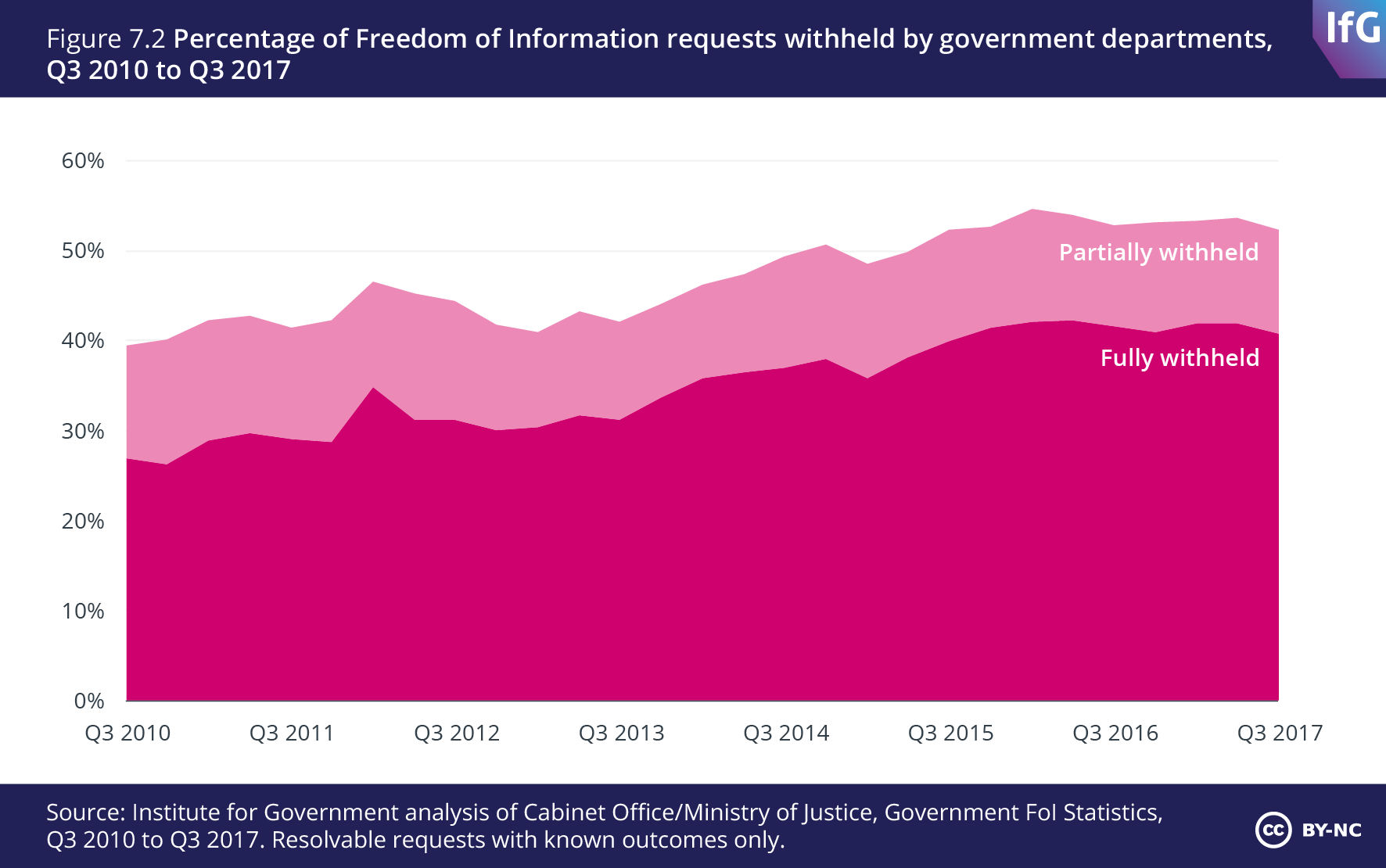
Since 2010, government departments have become rather less open in response to Freedom of Information (FoI) requests. In 2010, 39% of requests were fully or partially withheld; this had increased to 52% by 2017. 

Departments are able to refuse requests on a number of grounds: if the request falls under one of the 23 exemptions in the Freedom of Information Act 2000 (such as national security or personal information) or those in the Environmental Information Regulations; if it breaches the limit for the cost involved in responding (£600 for central departments and Parliament); if the request is repeated; or if the request is ‘vexatious’ (meaning it is likely ‘to cause a disproportionate or unjustifiable level of distress, disruption or irritation’). 

Of the 2,342 requests withheld in full in 2017, 50% were held to be due to FoI Act exemptions, 47% to cost, 2% to repetition and 1% to vexatiousness.

Of course exemptions may also be used as “good reasons” – excuses – to withhold inconveniently controversial information that is likely to bring valid criticism and cause scandal.

Mike Sivier‘s request for information about how many people have died after going through the Work Capability Assessment, which had resulted in a decision that they were fit for work, was originally refused. The figures were only released after the Information Commission overruled a Government decision to block the statistics being made public, through Mike’s Freedom of Information request.

After the request, the Information Commissioner’s Office (ICO), an independent authority set up to uphold public information rights, agreed that there was no reason not to publish the figures, despite the Department for Work and Pensions variously claiming the request was “vexatious”, and that it “could impose a burden in terms of time and resources, distracting the DWP from its main functions”.

However, clearly the real reason for the original refusal of this request is that the information was highly controversial and contradicted political claims regarding the completely unacceptable level of harm that has been caused to citizens by the damaging impact of the Conservative’s draconian welfare policies. 

The ICO said: “Given the passage of time and level of interest in the information, it is difficult to understand how the DWP could reasonably withhold the requested information.”

More recently, the Department for Work and Pensions (DWP) has continued to try to block John Slater’s FoI request which is likely to expose the widespread failings of two of its Personal Independent Payment (PIP) disability assessment contractors, initially claiming that it did not hold the information he had requested, before arguing that releasing the monthly reports would prejudice the “commercial interests” of Atos and Capita.

The DWP later told the Information Commissioner’s Office (ICO) that releasing the information “will give rise to items being taken out of context… [and] will be misinterpreted in ways that could lead to reputational damage to both the Department and the PIP Providers”, and would “prejudice the efficient conduct of public affairs” by DWP.

It also warned the ICO that the information could be “maliciously misinterpreted to feed the narrative that the Department imposes ‘targets’ for the outcomes of assessments”.

However, that comment alone indicates the highly controversial nature of the information being withheld, and thus also betrays the real motive. Information is being restricted to stifle legitimate criticism of Government policy and to hide from public view the empirical evidence of its consequences.

The ICO has nonetheless ordered the release of the information requested. A DWP spokeswoman said: “We have received the ICO judgement and we are currently considering our position.” 

If the DWP disagree with the decision and wish to appeal, it must lodge an appeal with the First Tier Tribunal (Information Rights) within 28 calendar days. The requester also has a right of appeal.

The ICO say: Failure to comply with a decision notice is contempt of court, punishable by a fine.

It’s also worth noting that the DWP are obliged to inform any contractors of how the Freedom of Information Act may affect them, making it clear that no guarantee of complete confidentiality of information may be made and that, as a public body, it must consider for release any information it holds if it is requested. 

The Department for Exiting the European Union (DExEU) overtakes the DWP to become the most opaque department. This is one example of a wider lack of transparency around Brexit and reflects the wider reluctance of the Government to share assessments of the anticipated impact of Brexit on different parts of the UK economy. Publication of spending and organisational data remains patchy, suggesting departments are not using the data themselves. 

The Scotland Office, Wales Office and Department for Transport tend to grant more requests in full, and in a timely manner. Among the more opaque are several departments regularly granting fewer than 30% of requests, particularly since 2015, including the Cabinet Office, Foreign and Commonwealth Office (FCO), the Treasury, HM Revenue and Customs (HMRC) and Minstry of Justice (MoJ).

None of the departments created in July 2016 – DExEU, DIT and BEIS – has ever granted even half of its total requests in full. In the three-quarters leading up to Q3 2017, DExEU was the least likely of all departments to comply with FoI requests, respectively answering 18%, 10% and 15% in full. It also refused a higher percentage because they were considered “vexatious” than any other department in 2017; 14% of requests.

The IFG report says “DExEU’s lack of transparency here, and its tardy responses to other requests for information (though not on FoI, where it is the sixth most responsive department), are consistent with its wider reluctance to release information, including the Government’s assessments of the anticipated impact of Brexit on different parts of the UK economy.”

Chart percentage of Freedom of Information requests withheld by government departments

You can read the full IFG Whitehall Monitor Report here


I don’t make any money from my work. But you can support Politics and Insights and contribute by making a donation which will help me continue to research and write informative, insightful and independent articles, and to provide support to others. The smallest amount is much appreciated, and helps to keep my articles free and accessible to all – thank you. 

DonatenowButton

top 100 blogs


The neoliberal ideologues lost their fig leaf and so now turn to shoot the messengers

Yet another remarkable Conservative-led backlash against Oxfam’s annual report on global inequality ahead of the opening of the World Economic Forum in Davos was started almost as soon as the charity issued the press release.  The report says that just 42 people hold as much wealth as the 3.7 billion who make up the poorest half of the world’s population. Inequality has widened over last year, with some 82% of the entire world’s money going to just 1% of the population. 

The report says it is “unacceptable and unsustainable” for a tiny minority to accumulate so much wealth while hundreds of millions of people struggled on poverty pay. It called on world leaders to turn rhetoric about inequality into policies to tackle tax evasion and boost the pay of workers. 

Mark Goldring, Oxfam GB chief executive, said: “The concentration of extreme wealth at the top is not a sign of a thriving economy, but a symptom of a system that is failing the millions of hardworking people on poverty wages who make our clothes and grow our food.”

Oxfam has made changes to its wealth calculations as a result of new data from the bank Credit Suisse. Under the revised figures, 42 people hold as much wealth as the 3.7 billion people who make up the poorer half of the world’s population, compared with 61 people last year and 380 in 2009. At the time of last year’s reportOxfam said that eight billionaires held the same wealth as half of the world’s population.

The wealth of billionaires had risen by 13% a year on average in the decade from 2006 to 2015, with the increase of $762bn (the equivalent of £550bn) in 2017  – enough to end extreme poverty seven times over.

The charity also said nine out of ten of the world’s 2,043 dollar billionaires were men.

Goldring went on to say: “For work to be a genuine route out of poverty we need to ensure that ordinary workers receive a living wage and can insist on decent conditions, and that women are not discriminated against. If that means less for the already wealthy then that is a price that we – and they – should be willing to pay.”

An Oxfam survey of 70,000 people in 10 countries, including the UK, showed widespread public support for action to tackle inequality. Nearly two-thirds of people – 72% in the UK – said they want the government to urgently address the income gap between rich and poor in their country.  

The New Right and neoliberals subsequently have advocated policies that aided the accumulation of profits and wealth in fewer hands with the argument that it would promote investment, thereby creating more jobs and more prosperity for all. As neoliberal policies were implemented around the world inequalities in wealth and income increased, there were health inequalities and poverty increased, contradicting neoliberal theories that by increasing the wealth at the top, everyone would become more affluent. Public funds were simply funnelled away into private hands. (See: the Paradise Papers, for example, and A few words about trickle down economics).

Furthermore, it’s become increasingly apparent that neoliberalism, as a totalising free-market ideology, is fundamentally incompatible with democracy and human rights frameworks.

The socioeconomic changes pushed through by the New Right in the US and the UK in the 80s removed constraints on bankers, made finance more important at the expense of manufacturing and reduced the power of unions, making it difficult for employees to secure as big a share of the national economic wealth as they had in previous decades.

The flipside of rising corporate profits and higher rewards for the top 1% of earners was stagnating wages for ordinary citizens against a backdrop of rapidly rising living costs, and of course, a subsequent higher propensity to get into debt.

Let’s not forget that the main factors behind the global economic crisis were ill-conceived and ideologically motivated fiscal and monetary policies, which were aided and abetted by inadequate regulation and a variety of other neoliberal policy ‘mistakes’. We subesequently learned that squeezing the oligarchs – those whose behaviours were responsible for the Great Recession – is seldom the strategy of choice among free market governments. Instead, they look to the less powerful – ordinary citizens – to carry the consequences and burdens of the greed and reckless risk-taking of the financiers. Government’s can’t stay tough on erstwhile cronies, after all.

The oligarchs use their influence to prevent precisely the sorts of reforms that are needed. Responsibility and blame for the recession and the failure of neoliberalism has been re-written: it’s because of the ‘culture of entitlement’, it’s because of the opposition’s previous ‘spendthrift’ policies; ‘it’s because of poor people’s sub-optimal, faulty behaviours’ and ‘cognitive biases’; it’s because of ‘scrounging’ welfare claimants; it’s down to disabled people who are ‘parked’ on welfare; it’s because of immigration which drains our resources: it’s down to ‘inefficient’ public services; it’s because of the ‘bloated’ state. It’s because of anything but what it actually was because of. 

The pre-bust rising delinquencies in US subprime mortgages have all but been forgiven and forgotten. The political solution to catastrophically failing neoliberalism has simply been the application of more aggressive neoliberal policies.

Of course, in a society that celebrates the idea of self interest, greed and accumulating money, it’s easy to infer that the interests of the financial sector are the same as the interests of the country. 

Meanwhile, in the UK, when people were asked what a typical British chief executive earned in comparison with an unskilled worker, people guessed 33 times as much. When asked what the ideal ratio should be, they said 7:1. Oxfam said that FTSE 100 bosses earned on average 120 times more than the average employee.

Goldring said it was time to rethink a global economy in which there was excessive corporate influence on policymaking, erosion of workers’ rights and a relentless drive to minimise costs in order to maximise returns to investors. He is absolutely right. In the wake of the Paradise Papers, the catastrophic collapse of Carillion, which further exposes the neoliberal privatisation ‘efficiency’ myths, the wake of scandals from the likes of G4S, Atos and Maximus,  and Virgin Care. (See also: Doctors bribed with 70-90k salaries to join Maximus and “endorse a political agenda regardless of how it affects patients.). 

Payments to private finance companies where Carillion have a stake, 2017-18 to 2048-49

It’s unsurprising that the neoliberal ideologues are out in force, outraged as their hegemony is crumbling and their fig leaf has been removed. Astroturfing aggressively in an attempt to stigmatise knowledge that is an empirically inconvenience to neoliberal ideologues. The culprits are easily identified because they use the same crib sheet, with comments that are identical almost word for word.

The effects of inequality are not confined to the poor. A growing body of research shows that inequality damages the economy and the social fabric of the whole of society.

The International Monetary Fund (IMF) said last year: “Research at the IMF and elsewhere makes it clear that persistent lack of inclusion—defined as broadly shared benefits and opportunities for economic growth—can fray social cohesion and undermine the sustainability of growth itself.” And development experts point out that inequality compromises poverty reduction.

The IMF also say “While some inequality is inevitable in a market-based economic system, excessive inequality can erode social cohesion, lead to political polarization, and ultimately, lower economic growth.” In the Fiscal Monitor, the IMF discussed how fiscal policies can help achieve redistributive objectives.

The Institute for Economic Affairs (IEA), a think tank insisting since the 1950s that free market have an important role in solving economic and social problems, have spearheaded what can best be described as an aggressive right wing and neoliberal astroturfing campaign on Twitter. It’s because they know neoliberal dogma has run out of road. Manic privatisation, small state extremism, austerity and a profit over human need philosophy have shoved and abandoned us in an economic cul-de-sac.

The IEA are braying in response to Oxfam’s modest call for a fairer, progressive tax system and a more inclusive form of capitalism : “Yet again Oxfam gets it wrong on inequality and poverty, “ says Mark Littlewood, for example, who defends the neoliberal go-to trickle down approach, arguing for growing the overall size of the pie instead of quibbling about how it is sliced. He also says: “Higher minimum wages would also likely lead to disappearing jobs, harming the very people Oxfam intend to help.”

trickle-down-theory-the-less-than-elegant-metaphor-that-if-one-11938559

The origins of trickle-down theory: poor people are expected to live on a diet of horse sh*t.

Yet the growth of low paid and insecure employment under neoliberalism has placed an increasing burden on our rapidly shrinking public services and in particular, such exploitative thinking, which places profit over the needs and rights of workers, has placed a drain on our welfare system, with the highest proportion of costs – most benefits – being paid to people in low paid work.

Littlewood fails to make the link between inequality and growing poverty. You’d think that if this approach worked, we would have seen evidence of it over the years since the Thatcher era. Instead, we have witnessed growing inequality and the return of absolute poverty – which is when people cannot meet the costs to fulfil their basic survival needs, such as for fuel, food and shelter. 

The worlds’ wealth and power is increasingly concentrated in fewer and fewer hands, undermining democracy in the process. On the IEA site, Kate Andrews also tries to completely separate inequality from poverty, but fails miserably in her justification of inequality of the grounds of meritocratic dogma. She intentionally overlooks the dynamics of the triangular relationship between distribution, poverty and economic growth. Poverty can be reduced through increases in income, through changes in the distribution of income, or through a combination of both. 

Accumulation by dispossession –  the consequences of privatisation and commodification of public assets, transferring property and wealth from public to private ownership – has been among the most widely criticised and disputed aspects of neoliberalism. It was originally observed and outlined by David Harvey, who says that neoliberal policies in many western nations, from the 1970s to the present day, has resulted in an accumulation and centralisation of wealth and power in the hands of a few by dispossessing the public of their wealth, public services, resources, power and land.

This process of accumulation by dispossession intimately ties growing inequality with increasing poverty, especially in an age of neoliberal austerity, a programme which has targeted the poorest citizens disproportionately.

Increasing the income of poor citizens contributes to the expansion of the economy. Andrews also intentionally disregards the fact that almost everyone pays National Insurance and tax, and that poor people tend to pay proportionally more of their income in tax than very wealthy citizens. That’s if wealthy citizens choose to pay any tax  at all – it’s become increasingly optional, politically, to tax the rich. It’s become increasingly apparent over the last decade that the real economic free-riders are the very wealthy and privileged, not the poorest citizens. Poverty and inequality isn’t ordained by the laws of either economics or physics. It’s the result of hegemonic decision-making, and rigidly institutionalised class advantage and disadvantage.  

This is why big players such as the World Bank, United Nations, World Economic Forum, OECD and IMF have gone about setting twin goals and outlining recommendations that policy needs to simultaneously tackle poverty and inequality in rich as well as poor countries.

I’m just wondering if the Twitter trolls and astroturfers have yet ridiculously accused these institutions and organisations of being ‘Corbynites’ , ‘Marxists’ and of joining or supporting Momentum, as they did Oxfam.

oxfam

The condition that people who champion social justice and object to inequality and poverty must be poor and oppressed, otherwise their proposition must be invalid is a peculiarly right wing one, based on a form of faulty narcissistic reasoning. 

By attempting to shift the debate away from the policy changes that have caused inequality, neoliberals are simply trying to legitimate it without the merit of open and rational scrutiny.

One of the primary characteristics of this type of reasoning is an exaggerated sense of entitlement and resentfulness and outrage of other peoples’. These protagonists are the ultimate meritocrats, just as long as they can define who ‘deserves’ what and who does not. Despite the steadfast ethical values such neoliberal champions loudly profess, they are moral relativists in that what they adamantly deem immoral for others is somehow acceptable for themselves. Furthermore, they are also overly sensitive to any perceived slight, challenge or criticism, regardless of how legitimate it may be. Market competition is one thing, pluralism and a healthy competition of ideas is apparently quite another. 

It’s very telling that any call for a degree of social justice and for protecting the poorest citizens against the worst ravages of capitalism is now dismissed by the right wing free market ideologues as ‘radical’. It betrays their utter indifference to the plight of the inevitable and innocent casualties of the catastrophically failing neoliberal experiment, imposed, regardless of the consequences, from the 1980s to date.

It isn’t possible to discuss growing global poverty without reference to its root causes and that invariably involves some reference to government priorities and policies. In a democracy, scrutiny of the impact of political decision-making and policies on citizens ought to be seen as a fundamental priority, rather than being simply increasingly indolently dismissed by authoritarians as ‘radical’ and ‘marxist’. 

Bootstraps


I don’t make any money from my work. But you can support Politics and Insights and contribute by making a donation which will help me continue to research and write informative, insightful and independent articles, and to provide support to others. The smallest amount is much appreciated, and helps to keep my articles free and accessible to all – thank you. 

DonatenowButton

top 100 blogs

European fundamental rights charter to be excluded in the EU withdrawal Bill, including protection from eugenic policy

EUHR
The result of the EU referendum on the UK’s membership of the European Union, and forthcoming withdrawal, carries some obvious and very worrying implications for the protection of citizens rights and freedoms in the UK. Historically the UK Conservative government has strongly opposed much of Europe’s social rights agenda.

So it’s very concerning that the House of Commons has voted down a Labour amendment to ensure that our basic human rights are protected after Brexit, as set out in the European Union Charter.

The EU Withdrawal Bill, which is currently in its report stage in the House of Commons, will transfer some existing European Union law into UK law when Britain leaves the EU in March 2019. A Labour amendment, tabled in the name of Jeremy Corbyn, sought to retain the Fundamental Rights provisions in the Charter but it has been voted down in the Commons by 321 votes to 297.

The Conservatives have 316 seats and form a minority government after signing a confidence and supply” agreement with the Democratic Unionist Party (DUP). However this indicates that some 57 other MPs (besides Labour’s 245), voted for Labour’s amendment. (You can see all of the proposed amendments in full here and read the full debate on the Hansard record here.)

Government ministers claim that the protections enshrined in the Charter either already exist in British law or else will be ‘incorporated through other EU directives.’

The bill states: “The Charter of Fundamental Rights is not part of domestic law on or after exit day.”

However, one of Theresa May’s new ministers has claimed the UK’s plan to drop the EU charter of fundamental rights after Brexit would help avoid an ‘extra layer’ of human rights, which contradicts the government’s previous assurance that no protections would be lost.

Rather worryingly, Suella Fernandes, who was promoted to the Brexit department last week, warned in November that transposing the ‘flabby’ charter into British law would give UK citizens additional protections on issues such as “biomedicine, eugenics, personal data and collective bargaining.”

However, the very fact that anyone at all in government objects to retaining these fundamental rights and protections indicates that we very clearly need them.

In an article co-written for the Telegraph with John Penrose, MP for Weston-Super-Mare, Fernandes said the government was right not to copy the charter into the EU withdrawal bill because otherwise “lawyers will love the extra layers of rights and the fees that they bring, and it’s also a core part of the Brussels project too”.

She also says: “We’re about to face another wall of amendments trying to insert the EU’s Charter of Fundamental Rights into UK law after we leave the EU. Human rights law has become complicated. Britain should be proud that we’re a founder member of the European Convention of Human Rights, drafted after the horrors of the Second World War.”

It’s very strange then, that after the trite discussion regarding the atrocities of the Second World War, she fails to acknowledge the need for “flabby” EU protections, which include a fundamental safeguard to ensure the terrible, ultimate and catastrophic consequences of eugenic thinking and policies never happen again. 

It’s worth keeping in mind that the Conservatives have already introduced one eugenic policy, by stealth, under the linguistic guise of ‘incentivising behavioural change’. (See also: UN to question the Conservatives about the two-child restriction on tax credits). 

Fernandes’ comments directly undermine the government’s claims that it was only refusing to accept the EU charter of fundamental rights because the document was already covered by British law. 

It is not. 

The Equality and Human Rights Commission (EHRC), Amnesty International, Liberty, the Fawcett Society and National Aids Trust, among others, have warned that the bill, which is returned to the House of Commons today (16 January), “will not protect people’s rights in the UK as the government promised”. They say: “This is in large part because the bill removes the EU charter of fundamental rights from our law.” 

The leading civil rights organisations spell out profound concerns that a raft of rights will be jettisoned with no adequate replacement once the bill becomes law and the UK leaves the EU.

They say, in a letter published in the Observer, that a ‘human rights deficit’ will be created by the government’s EU withdrawal bill, leaving many different groups in society without adequate protection.

David Isaac, the chair of the EHRC, the UK’s own independent human rights watchdog, said: “The government has promised there will be no rowing back on people’s rights after Brexit. If we lose the charter protections, that promise will be broken. It will cause legal confusion and there will be gaps in the law.

“While securing trade deals is vital for our economy, equality and human rights are also essential. They must also be the focus for the type of country we want to be after Brexit. Current protections must not be jeopardised.”

According to the signatories to the letter, “The charter protects rights important to all of us: including rights to dignity, protection of personal data and health; and protections for workers, women, children, and older people, LGBTI and disabled people.”

The government maintains that the charter will cease to be part of UK law when Britain leaves the EU but insists that rights will not be weakened following Brexit. However, the signatories claim that independent legal advice shows this to be wrong. They say:

“Losing it creates a human rights hole because the charter provides some rights and judicial remedies that have no clear equivalents in UK law.” 

“Furthermore, by keeping the wide and complex body of EU law while throwing away the charter, which is the code to unlock it, the government risks creating confusion, jamming itself in a mountain of legal cases.”

According to the EHRC, rights that would be lost, and which do not have direct equivalents in other UK human rights law, include a freestanding right to non-discrimination, protection of a child’s best interests and the right to human dignity, as well as bioethic protections, including from eugenics and preserving the right to democratic, collective bargaining.

Trevor Tayleur, an associate professor at the University of Law, explained that the charter, although narrower in focus than the Human Rights Act, offers a more robust defence of fundamental rights.

He says: “At present, the main means of protecting human rights in the UK is the Human Rights Act 1998.” (HRA)

“This incorporates the bulk of the rights and freedoms enshrined in the European convention on human rights into UK law and thereby enables individuals to enforce their convention rights in the UK courts. However, there is a significant limitation to the protection afforded by the HRA because it does not override acts of parliament.

“In contrast, the protection afforded by the EU charter of fundamental rights is much stronger because where there is a conflict between basic rights contained in the charter and an act of the Westminster parliament, the charter will prevail over the act.”

The government previously managed to head off a rebellion on the EU Rights Charter issue by Conservative MPs, led by the former attorney general Dominic Grieve, by promising a “right-by-right analysis” of how UK law already covers the same ground as the charter on areas such as children, the environment, data and consumer rights. However, Labour and legal experts said the document showed only how UK law fell short in providing the same protections as the EU charter of fundamental rights.

Labour’s Kier Starmer said: “The document they released fails to provide any assurance that essential rights will be protected once we leave the EU. On the contrary, it takes rights from the charter and scatters them to their original sources: the polar opposite of effective human rights protection.

“We need a cast-iron guarantee in law that the rights contained in the charter will be given the same legal protection as those currently contained in the Human Rights Act.

“This is not a party political issue. It is about the type of nation we want to be. Britain should be a proud advocate of human rights. That’s why I would urge all MPs to back Labour’s amendment to the withdrawal bill when it is debated.”

During debates on the EU Withdrawal Bill, Dominic Grieve said that failing to incorporate the Charter into UK law after Brexit would send out “a really strange message” about the Conservative’s approach to human rights, and has urged peers to consider the issue when the bill passes to the House of Lords.

Many of us have long thought the Conservative’s message is actually very loud and clear, despite being couched in the Orwellian terms and glib, empty assurances of despots in waiting, a government of tyrants just biding their time.

Grieve went on to say: “I listen very carefully to what the Prime Minister says about modernising the Conservative Party, about giving it a broad appeal to younger people, about trying to ensure that we reflect current norms and standards in our country and give effect to them in the sorts of policies we develop.

And yet … it does seem to me that in simply batting this issue away and saying don’t worry, it’s all going to be perfectly alright, without even coming up with a plan for the future about possibly adding a bill of rights clause or rights clauses to the Human Rights Act, we’re sending out a really very strange message about our attitude on this side of the House to matters which I believe many people in this country now see as being rights of a fundamental character, particularly on issues like LGBT and things of that sort.”

Some lawyers are also very concerned that the government’s refusal to incorporate the charter into UK law will weaken human rights protections. Schona Jolly QC, a human rights and equalities lawyer, said the government’s analysis “fails to tackle the legal reality that abandoning the charter indeed does remove rights that UK citizens currently enjoy and adds to the complexity, confusion and uncertainty surrounding the basis to protect and enforce substantive rights post-Brexit.

“Take, for example, the freestanding right to equality contained within article 21 of the charter. There is no equivalent in domestic law. The Equality Act does not have constitutional status. A constitutional right would underpin all statutory equality rights to provide a strongly focused standard against which state action can be judged, as well as providing a solid interpretative basis by which our domestic common law can be developed.

“The government’s analysis doesn’t begin to deal with this acute loss of one of the most foundational rights in our democracy after we leave the EU. So too in respect of other rights.

“If the government is truly committed to non-regression of rights, it must commit itself in statute. Its weak legal analysis, conducted as an act of self-justification after having already taken the decision to drop the charter, falls demonstrably and critically short in plugging the post-Brexit rights gap.”

The government has a very poor record on observing and upholding the human rights of disabled people, children and women. It’s also a government that has cultivated an extremely divided, unequal, increasingly parochial and nationalist society, which is organised on the establishment of hierarchies of perceived human worth. Diversity has been politically and culturally devalued. Once again, historically marginalised social groups are experiencing a growth in prejudice and discrimination.

This has provided fertile social conditions where it is deemed acceptable that eugenics has crept back into public discourse, though we sometimes fail to recognise the basic arguments of eugenics when they reappear, as few advocates claim the term to describe their beliefs nowadays.

Ignoring the civil rights of some groups and individuals becomes terrifyingly easy in the face of those holding positions of power determined to radically organise society how they choose to, and backed by a group of ‘experts’. Any policy that aims at restricting some citizen’s choices, autonomy and freedoms, and changing the behaviours of some social groups, based on an idea that the groups are in some way ‘defective’ (characteristically – physically, cognitively, psychologically, or behaviourally) is eugenic.

Behavioural economics, for example, is founded on the idea that governments and behavoural economists know what is best for individuals and society, while arguing that poor citizens who need welfare support are cognitively incompetent and ‘deviant’.

For example:

“Thus, behavioral economics can reinvigorate [Conservative] arguments about the perverse effects of the welfare state in two distinct ways. For starters, we need behavioral economics to make this critique coherent. Once they have been explicitly placed on a behavioral foundation, claims about the perverse effects of various programs become harder to ignore or dismiss. More importantly, there are good empirical reasons to think that behavioral economics better describes the poor than it does the rest of the population. Behavioral economics is therefore exceptionally relevant to poverty policy.”  From: Behavioral Economics and Perverse Effects of the Welfare State, Scott Beaulier and Bryan Caplan, 2007.

I’ll be writing a more in depth analysis on this topic in the near future, which builds on some of my previous work, such as The connection between Universal Credit, ordeals and experiments in electrocuting laboratory rats, critical discussions of behavioural economics and the political misuse of psychology and ‘science’ more generally. 

To conclude here, however, we have a government that has aggressively denied that its policies have violated human rights, despite irrefutable empirical evidence presented by the United Nations and other organisations that have held independent inquiries and published their findings. This is a government that has demonstrated nothing but contempt for human rights and democracy more generally, and have more than once proposed to scrap the UK’s Human Rights Act

Given that we have a regressive, authoritarian government in office with a shameful track record of human rights violations already, following Brexit, what could possibly go right?

Related:

Disabled people’s human rights in further jeopardy because of Brexit

A strong case for the Human Rights Act 

The government has failed to protect the human rights of children

Human rights are the bedrock of democracy, which the Tories have imperiled

UK Government still in breach of the human rights convention on gender discrimination

EU leaders say UK can reverse Brexit decision if it wants to


I don’t make any money from my work. But you can support Politics and Insights and contribute by making a donation which will help me continue to research and write informative, insightful and independent articles, and to provide support to others. The smallest amount is much appreciated, and helps to keep my articles free and accessible to all – thank you. 

DonatenowButton

top 100 blogs

Cognitive Therapy for the Unemployed: G4S Crooks to Deliver ‘Service’ in Surrey, Sussex and Kent.

I broke this story in 2016: G4S are employing Cognitive Behavioural Therapists to deliver “get to work therapy”.

The following excerpts are from Ipswich Unemployed Action:

Image result for cognitive therapy for unemployed protests

“We are saving the taxpayer £120 million a year in benefit savings.” Sean Williams – Welfare to Work, Managing Director, G4S.

“Carillon’s collapse, which involved the farce of having fire-engines on standby today in Oxfordshire in case the company could not deliver school meals for one of their many outsourced contracts, has not stopped the government from continuing their policy of giving large sums of money to private companies to deliver ‘services’.

The problems of Universal Credit have tended to obscure other aspects of the government’s welfare policy.

One of the most outrageous sides is this, which we have previously posted on.

It is part of the Work and Health Programme, rolling out this year.

Service Providers for the Work and Health programme

It will be run by five service providers across six regions in England and Wales. The successful providers were:

  • Shaw Trust (Central England and Home Counties)
  • Reed in Partnership (North East)
  • Ingeus (North West)
  • Pluss (Southern)
  • Remploy (Wales)

In 2015 the Guardian published this letter signed by more than 400 psychologists, counsellors and academics signed an open letter  protesting against chancellor George Osborne’s plans, laid out in the latest budget, to embed psychological therapy in a coercive back-to-work agenda. (I wrote about this in 2015, here: Psychologists Against Austerity: mental health experts issue a rallying call against coalition policies.)

The linkage of social security benefits to the receipt of “state therapy”, as announced in the chancellor’s latest budget, this is totally unacceptable. “Get to work therapy” is manifestly not therapy at all. With the ominous news that Maximus (the US company replacing Atos to do work capability assessments) will also be managing the new national Fit for Work programme, it is time for the field’s key professional organisations to wake up to these malign developments, and unequivocally denounce such so-called “therapy” as damaging and professionally unethical.

More generally, the wider reality of a society thrown completely off balance by the emotional toxicity of neoliberal thinking is affecting Britain in profound ways, the distressing effects of which are often most visible in the therapist’s consulting room. This letter sounds the starting-bell for a broadly based campaign of organisations and professionals against the damage that neoliberalism is doing to the nation’s mental health. For now, we call on all the parties in this election – and particularly Labour – to make it clear that they will urgently review such anti-therapeutic practices, and appropriately refashion their much-trumpeted commitment to mental health if and when they enter government.

To remind us of this Kitty S jones wrote last year:

A major concern that many of us have raised is regarding consent to participation, as, if benefit conditionality is attached to what ought to be a voluntary engagement, that undermines the fundamental principles of the right to physical and mental care. Such an approach would reduce psychologists to simply acting as agents of state control, enforcing compliance and conformity. That is not therapy: it’s psychopolitics and policy-making founded on a blunt behaviourism, which is pro-status quo, imbued with Conservative values and prejudices. It’s an approach that does nothing whatsoever to improve public life or meet people’s needs.


Kitty noted that: 

The highly controversial security company G4S are currently advertising for Cognitive Behavioural Therapists to deliver “return-to-work” advise in Surrey, Sussex and Kent.

This is yet another lucrative opportunity for private companies to radically reduce essential provision for those that really need support, nonetheless, costing the public purse far more to administer than such an arrangement could possibly save, despite the government’s dogged determination to rip every single penny from sick and disabled people and drive them into low paid, insecure jobs.


Yes, G4S is a player in the delivery of the “new Work and Health Programme 2017 – 2020/21. Commissioned by the Department for Work and Pensions, the programme is intended to assist people who are long term unemployed or who have disabilities and health conditions into work.”

You can read the rest of the post in full here.

Other related posts:

Workfare coercion in the UK: an assault on persons with disabilities and their human rights Anne-Laure Donskoy

The power of positive thinking is really political gaslighting

The new Work and Health Programme: government plan social experiments to “nudge” sick and disabled people into work

Rogue company Unum’s profiteering hand in the government’s work, health and disability green paper

Nudging conformity and benefit sanctions: a state experiment in behaviour modification

The connection between Universal Credit, ordeals and experiments in electrocuting laboratory rats

IAPT is value-laden, non-prefigurative, non-dialogic, antidemocratic and reflects a political agenda

G4S are employing Cognitive Behavioural Therapists to deliver “get to work therapy”

Andrew Coates's avatarIpswich Unemployed Action.

Image result for cognitive therapy for unemployed protests“We are saving the taxpayer £120 million a year in benefit savings.” Sean Williams – Welfare to Work, Managing Director, G4S.

Carillon’s collapse, which involved the farce of having fire-engines on standby today in Oxfordshire in case the company could not deliver school meals for one of their many outsourced contracts, has not stopped the government from continuing their policy of giving large sums of money to private companies to deliver ‘services’.

 The problems of Universal Credit have tended to obscure other aspects of the government’s welfare policy.

One of the most outrageous sides  is this, which we have previously posted on.

It is part of the Work and Health Programme, rolling out this year.

The key service providers are:

Service Providers

It will be run by five service providers across six regions in England and Wales. The successful providers were:

  • Shaw Trust (Central England and Home Counties)
  • Reed…

View original post 1,558 more words