Author: Kitty S Jones

I’m a political activist with a strong interest in human rights. I’m also a strongly principled socialist. Much of my campaign work is in support of people with disability. I am also disabled: I have an autoimmune illness called lupus, with a sometimes life-threatening complication – a bleeding disorder called thrombocytopenia. Sometimes I long to go back to being the person I was before 2010. The Coalition claimed that the last government left a “mess”, but I remember being very well-sheltered from the consequences of the global banking crisis by the last government – enough to flourish and be myself. Now many of us are finding that our potential as human beings is being damaged and stifled because we are essentially focused on a struggle to survive, at a time of austerity cuts and welfare “reforms”. Maslow was right about basic needs and motivation: it’s impossible to achieve and fulfil our potential if we cannot meet our most fundamental survival needs adequately. What kind of government inflicts a framework of punishment via its policies on disadvantaged citizens? This is a government that tells us with a straight face that taking income from poor people will "incentivise" and "help" them into work. I have yet to hear of a case when a poor person was relieved of their poverty by being made even more poor. The Tories like hierarchical ranking in terms status and human worth. They like to decide who is “deserving” and “undeserving” of political consideration and inclusion. They like to impose an artificial framework of previously debunked Social Darwinism: a Tory rhetoric of division, where some people matter more than others. How do we, as conscientious campaigners, help the wider public see that there are no divisions based on some moral measurement, or character-type: there are simply people struggling and suffering in poverty, who are being dehumanised by a callous, vindictive Tory government that believes, and always has, that the only token of our human worth is wealth? Governments and all parties on the right have a terrible tradition of scapegoating those least able to fight back, blaming the powerless for all of the shortcomings of right-wing policies. The media have been complicit in this process, making “others” responsible for the consequences of Tory-led policies, yet these cruelly dehumanised social groups are the targeted casualties of those policies. I set up, and administrate support groups for ill and disabled people, those going through the disability benefits process, and provide support for many people being adversely affected by the terrible, cruel and distressing consequences of the Governments’ draconian “reforms”. In such bleak times, we tend to find that the only thing we really have of value is each other. It’s always worth remembering that none of us are alone. I don’t write because I enjoy it: most of the topics I post are depressing to research, and there’s an element of constantly having to face and reflect the relentless worst of current socio-political events. Nor do I get paid for articles and I’m not remotely famous. I’m an ordinary, struggling disabled person. But I am accurate, insightful and reflective, I can research and I can analyse. I write because I feel I must. To reflect what is happening, and to try and raise public awareness of the impact of Tory policies, especially on the most vulnerable and poorest citizens. Because we need this to change. All of us, regardless of whether or not you are currently affected by cuts, because the persecution and harm currently being inflicted on others taints us all as a society. I feel that the mainstream media has become increasingly unreliable over the past five years, reflecting a triumph for the dominant narrative of ultra social conservatism and neoliberalism. We certainly need to challenge this and re-frame the presented debates, too. The media tend to set the agenda and establish priorities, which often divert us from much more pressing social issues. Independent bloggers have a role as witnesses; recording events and experiences, gathering evidence, insights and truths that are accessible to as many people and organisations as possible. We have an undemocratic media and a government that reflect the interests of a minority – the wealthy and powerful 1%. We must constantly challenge that. Authoritarian Governments arise and flourish when a population disengages from political processes, and becomes passive, conformist and alienated from fundamental decision-making. I’m not a writer that aims for being popular or one that seeks agreement from an audience. But I do hope that my work finds resonance with people reading it. I’ve been labelled “controversial” on more than one occasion, and a “scaremonger.” But regardless of agreement, if any of my work inspires critical thinking, and invites reasoned debate, well, that’s good enough for me. “To remain silent and indifferent is the greatest sin of all” – Elie Wiesel I write to raise awareness, share information and to inspire and promote positive change where I can. I’ve never been able to be indifferent. We need to unite in the face of a government that is purposefully sowing seeds of division. Every human life has equal worth. We all deserve dignity and democratic inclusion. If we want to see positive social change, we also have to be the change we want to see. That means treating each other with equal respect and moving out of the Tory framework of ranks, counts and social taxonomy. We have to rebuild solidarity in the face of deliberate political attempts to undermine it. Divide and rule was always a Tory strategy. We need to fight back. This is an authoritarian government that is hell-bent on destroying all of the gains of our post-war settlement: dismantling the institutions, public services, civil rights and eroding the democratic norms that made the UK a developed, civilised and civilising country. Like many others, I do what I can, when I can, and in my own way. This blog is one way of reaching people. Please help me to reach more by sharing posts. Thanks. Kitty, 2012

Austerity is “economic murder” says Cambridge researcher

anti-austerity-march

A research report, published in the British Medical Journal (BMJ) Open – the Effects of health and social care spending constraints on mortality in England: a time trend analysis, concludes that austerity cuts are correlated with an increase in mortality rates, confirming what many of us have proposed for some time. The research revealed that there were 45,000 more deaths in the first four years of Tory-led “efficiency savings” than would have been expected if funding had stayed at pre-election levels.

The new study strongly suggests that austerity policies will have caused 120,000 deaths by 2020. 

The joint research was conducted by Oxford, Cambridge and University College London, and it makes clear links between cuts in government health and social care spending and higher mortality rates in England. 

Cambridge University’s Professor Lawrence King, who contributed to the study, said: “Austerity does not promote growth or reduce deficits – it is bad economics. It is also a public health disaster. It is not an exaggeration to call it economic murder.”

The authors point to cuts in public spending and the drop in the number of nurses since 2010, all of which has contributed to place over-60s and care home residents most at risk of premature death.  

Between 2001 and 2010 the number of nurses rose on average 1.61% a year. From 2010 to 2014, under the Conservatives, the rise was just 0.07% – 20 times lower than the previous decade.

The Royal College of Nursing chief, Janet Davies, said: “All parts of the NHS and social care system do not have enough nurses and vulnerable and older individuals pay the highest price.”

2015 saw the largest annual spike in mortality rates in England in almost 50 years. These changes in mortality rates are associated with an indicator of poor functioning of health and social care, for which funding has been cut despite rising demands since 2010.

Earlier this year, another research report concluded that an unprecedented rise in mortality in England and Wales, where 30,000 excess deaths occurred in 2015, is likely to be linked to cuts to the NHS and social care, according to research which drew an angry response from the government, who deny the established link.

The highly charged claim was made by researchers from the London School of Hygiene and Tropical Medicine, Oxford University and Blackburn with Darwen council, who said that the increase in mortality took place against a backdrop of “severe cuts” to the NHS and social care, compromising their performance.

The government – which will casually spend hundreds of thousands of pounds of public funds to fight Freedom of Information requests regarding mortality data – claim we cannot afford to support sick and disabled people, unless we “target” those “most in need” because otherwise, our publicly funded social security is “unsustainable.”

It’s become very clear that the cost cutting system imposed by the Conservatives does not “target” many of those most in need, and that government policies are causing harm, distress, hunger, destitution, an increase in suicide and premature deaths, yet discussing the deaths of its citizens in a democratic, transparent and accountable way is something that the government have consistently refused to do.

Instead, public funds and energy are invested in denying a “causal link” between the austerity programme, punitive policies and increasing hunger, destitution and desperation, and apparently, no prioriy at all is given to monitoring policy impacts or concern: the government refuse to ask why these premature deaths and suicides have occurred (and continue to occur) in one of the wealthiest nations. 

It would be reasonable to assume that, even if a government vigorously denied responsibility for more than 120,000 excess deaths, (with a proportion of the mortalities including those assessed as “fit for work” by the state), they would at least have the decency to ask basic questions as to where the responsibility lay, and how this has happened.

Of course, in denying a “causal link” between their policies and a substantial increase in mortality, and levelling the charge that research findings and campaigners’ qualitative accounts are merely “anecdotal evidence” that fail to  provide “empirical evidence” of a “causal link”, the government doesn’t seem to recognise that its’ own claims are completely unevidenced, and there is no “causal link whatsoever between their evident indolence, politically contrived and expedient narrative and the facts.

This isn’t simply a matter of a government being undemocratic and unaccountable. It’s much more serious than that. It’s a matter of the state either casually playing roulette with the very lives of its own people. Or worse.

Perhaps it’s a matter of a state intentionally and systematically killing its citizens with austerity policies that target marginalised social groups.

It’s not as if previous Conservative government policies have been benign. Margaret Thatcher’s neoliberal policies have also been condemned for causing “unjust premature death” in the UK. Public health experts from Durham University have denounced the impact of Margaret Thatcher’s policies on the health and wellbeing of the British public in research which examines social inequality in the 1980s.

The study, which looked at over 70 existing research papers, concludes that as a result of unnecessary unemployment, welfare cuts and damaging housing policies, the former prime minister’s legacy includes the unnecessary and unjust premature death of many British citizens, together with a substantial and continuing burden of suffering and loss of well-being.

This research shows that there was a massive increase in income inequality under Baroness Thatcher – the richest 0.01 per cent of society had 28 times the mean national average income in 1978 but 70 times the average in 1990, and UK poverty rates went up from 6.7 per cent in 1975 to 12 per cent in 1985.

The report goes on to say that Thatcher’s governments wilfully engineered an economic catastrophe across large parts of Britain by dismantling traditional industries such as coal and steel in order to undermine the power of working class organisations, say the researchers. They suggest this ultimately fed through into growing regional disparities in health standards and life expectancy, as well as greatly increased inequalities between the richest and poorest in society.

Her critique of UK social democracy during the 1970s and her adoption of key neoliberal strategies, such as financial deregulation, trade liberalization, and the privatization of public goods and services, were popularly labeled “Thatcherism.” Thatcher’s policies were associated with substantial increases in socioeconomic and health inequalities: these issues were actively marginalized and ignored by her governments. In addition, her public sector reforms applied business principles to the welfare state and prepared the National Health Service for subsequent privatization.

The current government have simply continued and extended Thatcher’s neoliberal programme, without any consideration of, or reference to, the body of empirical research that demonstrates the terrible social costs of  neoliberalism, as a result of  the social and economic inequalities it creates.

Meanwhile, a Department of Health spokesman has said of the latest study: “This study cannot be used to draw any firm conclusions about the cause of excess deaths.”

However, as I’ve already pointed out, any government statement of denial regarding empirical research cannot be used to draw any firm conclusions about the cause of excess deaths.

It may only be used to draw firm conclusions that the government has no intention of investigating the link between a significant increase in mortality rates and their own policies, or of changing those policies to meet public needs and to ensure that citizens’ fundamental and equal right to life is upheld.


I don’t make any money from my work. But you can support Politics and Insights and contribute by making a donation which will help me continue to research and write informative, insightful and independent articles, and to provide support to others. The smallest amount is much appreciated, and helps to keep my articles free and accessible to all – thank you. 

DonatenowButton

top 100 blogs


Please let the Conservatives know that the Grenfell tragedy must not be trivialised and ignored

Yesterday I had the following email from Jeremy Corbyn:

Sue, we’ve just found out that the Tories in Kensington have been asking residents how important the Grenfell tragedy is on a scale of 0-10.

It is insulting and insensitive.

Preventing another fire like Grenfell couldn’t be more important. And Theresa May has the power to do it — she could use next Wednesday’s budget to set aside money to fit social housing with sprinklers that would save lives. Let’s make sure she hears our message.

Please sign this and tell the Tories why Grenfell must not be ignored.

Sign this and help us make sure that residents of high rise social housing can sleep safely with the knowledge that they are being listened to.

Jeremy Corbyn
Leader of the Labour Party


It’s like they need instructions for being human.” Kay Bailey

I agree, the Conservatives’ survey is crass and insensitive, it trivialises the Grenfell tragedy, putting it at the same level of priority as refuse collection and local parking facilities, which is insulting and callous. Asking people to place such an avoidable and tragic event on a scale of priority, from one to ten, is both brutal and shows a complete lack of responsibility and remorse on the part of the government. 

I have signed both petitions. 

Will you?


Related

Grenfell, inequality and the Conservatives’ bonfire of red tape

Grenfell is a horrific consequence of a Conservative ‘leaner and more efficient state’

Dangerous electrical faults were historically ignored at Glenfell Tower


A defence of “political correctness”

Related image

The left believe that in order to address prejudice and discrimination, it’s important to address the language we use as a society, changing it to reflect an increasingly diverse society, where everyone feels at safe, included and one in which citizens attempt to avoid giving needless offence to one another.

By ensuring terms that reflect prejudice are not part of our everyday language habits, it is hoped that as a society, we can cultivate and extend tolerance and basic principles of courtesy, equality and decency to our fellow human beings, reflecting a healthy pluralism. 

However, the right see a conspiracy in “political correctness”. The phrase is used by Conservatives and the far right in a derogatory way that implies hidden and powerful forces determined to suppress inconvenient truths by the policing of language and thought. For the right, political correctness is an hegemonic, stifling and Stalinist-styled orthodoxy, that pressures us into a fashionable conformity. The right see political correctness as a means of closing down debate, not that they particularly favour candour more generally. Just the sort of “speaking one’s mind” that involves directing stigma at historically marginalised groups.

Apparently, open, civil discourse need not be civil, prefigurative and inclusive. Or open, for that matter. 

The fact that Western civilization has been inherently unfair to ethnic minorities, women, disabled people, poor people and homosexuals has always been at the centre of politically correct thinking. Historically and internationally, support for affirmative action grew to achieve goals such as bridging inequalities in employment and pay, increasing access to education, promoting diversity, and redressing historical wrongs, harms, or hindrances. Affirmative action is intended to promote the opportunities of defined minority groups within a society to give them equal access to that of the majority population, and to address disadvantage.

In the UK, affirmative action is illegal, we have a history of “positive action”, which is more about focusing on ensuring equal opportunity and, for example, targeted advertising campaigns to encourage ethnic minority candidates to join the police force.

Any discrimination, quotas or favouritism due to sex, race and ethnicity among other “protected characteristics” is generally illegal for any reason in education, employment, during commercial transactions, in a private club or association, and while using public services.

The Equality Act 2010 (established by the Labour government, amended, reduced and implemented by the Conservative-led coalition) established the principles of equality and their implementation in the UK.

Specific exemptions include:

Part of the Northern Ireland Peace Process, the Good Friday Agreement and the resulting Patten report required the Police Service of Northern Ireland to recruit 50% of numbers from the Catholic community and 50% from the Protestant and other communities, in order to reduce any possible bias towards Protestants. This was later referred to as the “50:50” measure. (See also Independent Commission on Policing for Northern Ireland.)

It’s fair that all social groups are able to participate in all provided opportunities including educational, employment, promotional and training opportunities, surely. The right claim to cherish the notion of a meritocracy, after all. A genuine meritocracy would alienate no-one.

Political correctness arose to help compensate for past discrimination, persecution or exploitation by the ruling class of a culture, and to address existing discrimination, which ultimately strengthens social cohesion – something else that traditional Conservatives claimed to cherish. Political correctness is about universal human rights. It’s about inclusion and democracy. 

Instead, however, political correctness is seen by many on the right as a some kind of dictatorship of virtue. The left are often ridiculously accused of “virtue signalling” and being “do-gooders” by the right. I’ve often wondered what the ideal alternative to a “do-gooder” would be, for those making this simultaneously slapstick and surreal accusation.

The right abandon the principles of political science, democracy, civil debate, diplomacy and inclusion and simply assail the characters of their critics. They get personal. They can’t seem to disagree without being disagreeable. They prefer to simply “crush the saboteurs”, rather than engage in rational dialogue. But without dialogue and the basic principles and mechanisms of exchange, we don’t have a healthy, pluralist democracy. Instead, we have a group of people imposing their narrow worldview, language, thoughts and personal prejudices upon a population. Using political narratives that focus on outgrouping already marginalised citizens according to their economic status – which is in turn created by a process of outgrouping – is not “telling it like it is”. It’s telling us how it is going to be.

It’s not just that the right resent political correctness for what they see as a mechanism for suppressing their own traditional prejudices. They use carefully calibrated undemocratic language to argue against the very idea of a carefully calibrated language that came about to simply extend principles of fairness, equality and democratic inclusion. Ultimately, political correctness is about democracy and a fair model of socioeconomic organisation.

The right don’t like political correctness because they don’t like the very idea that all human lives have equal worth. They prefer hierarchical ranking and hierarchical socioeconomic organisation. That’s what the Conservative notion of “competition” means. It’s not real competition of course, because without a degree of “political correctness”, there is no level playing field to compete from.

Some social groups simply don’t have access to opportunities to “compete” fairly for even a basic share of wealth and power. “Telling it like it is”, and “speaking your mind” is actually rather more about stating which social groups are allowed to participate as citizens in a society, and which groups aren’t. 

A homo… what?

Politics reduced to homophily is also a politics without a shred of democracy. By interacting only with others who are like themselves, anything that government ministers experience as a result of their position, influence and power simply gets reinforced. It comes to typify “people like us” and demarcates “people like them”. It’s the basis of a political othering process.

Homophily – which is basically a tendency to associate only with those like yourself –  also shapes the “old-boys network” and the revolving door of power between politicians and corporate entities: a politics in which a handful of people who went to the same public school or university use their positions of  power and influence to mutually benefit each other. It’s a movement of personnel between roles as legislators and the industries potentially affected by legislation and regulation. The result is that legislation and deregulation happens which benefits only those included in the revolving door interaction. That’s not a large proportion of the population at all. 

I think this is what Conservatives mean when they say we live in a “meritocracy”. This is clearly not compatible with democracy.

Nudging privilege and kicking the poor

Then of course there are the academics who support Conservative neoliberalism, such as the “libertarian paternalists”, for example, who have found their way into the very heart of the Conservatives’ political decision-making process regarding policy. Nudge is comprised of a very lucrative set of theories that have the added value of simply propping up the status quo. Nudge is mostly aimed at “improving the decisions” of poor people, who, it is claimed, are poor because of their “faulty” cognitive processes and behaviours.

The behavioural economists at the heart of the technocratic Nudge Unit, which is at the very heart of the cabinet office, claim they are “scientific”, as they use a scientific methodology – randomised control trials – to “verify” their various hypotheses. However, by isolating and exploring what they perceive as basic causal relationships in experimental circumstances, they effectively screen out context and other potential variables – such as the structural and historical causes of poverty, brought about by political decision-making, for example – and so such “experiments” effectively screen their own ideological commitments from view. The hypotheses being tested are without context and history, they are superficial and highlight all of the flaws of old school positivism very well.

Furthermore, libertarian paternalism reduces society in all of its complexity to a basic system of “incentives” and responses. The government frequently dismiss citizens’ accounts and qualitative experiences as “anecdotal”, and claim that any criticism of Conservative policies isn’t valid because individual cases don’t establish a “causal link” between policies and the citizens’ stated consequences of policies.

An example of this is the many cases of harm and high number of deaths that have been raised which correlate with the Conservative welfare “reforms” and austerity. However, policies are designed to have consequences. The government simply isn’t interested in monitoring those, evidently.

Nor is it interested in the empirical evidence that citizens have provided. The representation of social reality produced by positivism was always inherently and artificially Conservative, maintaining the status quo. At the very least, Conservatives would do well to consider that correlation often implies causality, even though it isn’t quite the same thing. As such, established correlation invites further inquiry, not point-blank political denials.

The welfare “reforms” are strongly correlated with an increase in premature deaths and suicides. A democratic government would be concerned with those consequences and would be open to at least exploring the possibility that those consequences are causally linked with their draconian policies. 

If you are one of those people who think political correctness is a detriment to politically vibrant debates, you have it all back to front: People who use politically correct language aren’t trying to stifle insensitive speech, or moify freedom of expression. They’re simply trying to out-compete that speech in a free and open exchange. Those who oppose political correctness – with its very emphasis being on the ability to include and articulate varied and opposing viewpoints – are the ones who are trying to close debate down.

It’s not a coincidence that many people who despise political correctness are also strongly anti-intellectual, too.

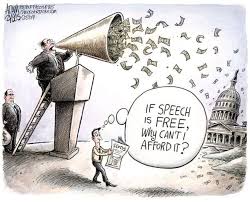
When “freedom of speech” is just an excuse for narratives of hate

Related image

The right quite often seem to use the freedom of speech plea to justify their prejudice. They say they have a right to express their thoughts. But speech is an intentional ACT. Hate speech is intended to do harm – it’s used purposefully to intimidate and exclude vulnerable groups. Hate speech does not “democratise” speech, it tends to monopolise it. Nor is it based on reason, critical thinking or open to debate. Prejudice is a crass parody of opinion and free speech. Bigots are conformists – they tend not to have independent thought. Instead they have prejudice and groupthink.

Being inequitable, petty or prejudiced isn’t “telling it like it is” – a claim which has become a common tactic for the right, and particularly UKIP – it’s just being inequitable, petty or prejudiced. Some things are not worth saying. Really. We may well have an equal right to express an opinion, but not all opinions are of equal worth. And UKIP do frequently dally with hate speech. Hate speech generally is any speech that attacks a person or group on the basis of their characteristics, for example, because of their race, religion, gender, disability, or sexual orientation. 

In law, hate speech is any speech, gesture or conduct, writing, or display which is forbidden because it may incite violence or prejudicial action against or by a protected individual or group, or because it disparages or intimidates a protected individual or group. Critics have argued that the term “hate speech” is a contemporary example of Newspeak, used to silence critics of social policies that have been poorly implemented in order to appear politically correct. 

However, the term “political correctness” was adopted by US Conservatives as a pejorative for all manner of attempts to promote multiculturalism and identity politics, particularly, attempts to introduce new terms that sought to leave behind discriminatory baggage attached to older ones, and conversely, to try to make older ones taboo.

It’s important not to lose sight of the fact that “political correctness” arose originally from attempts at making language more culturally inclusive. Critics of political correctness show a curious blindness when it comes to examples of Conservative correctness. Most often, the case is entirely ignored or censorship of the left is justified as a positive virtue. Perhaps the key argument supporting this form of linguistic and conceptual inclusion is that we still need it, unfortunately. We live in a country ruled by a right-wing logocracy, creating pseudo-reality by prejudicial narratives and words. We are witnessing that narrative being embedded in extremely oppressive policies and in justifications for such oppressive policies.

The negative impacts of hate speech cannot be mitigated by the responses of third-party observers, as hate speech aims at two goals. Firstly, it is an attempt to tell bigots that they are not alone. It validates and reinforces prejudice. It extends a “permission” for social prejudice, discrimination and hatred.

The second purpose of hate speech is to intimidate a targeted minority, leading them to question whether their dignity and social status is secure. Furthermore, hate speech is a gateway to harassment and violence. (See Allport’s scale of prejudice, which shows clearly how the Nazis used “freedom of speech” to incite social prejudice, discrimination, hatred and then to incite and justify genocide.)

Image result for allports ladder of prejudice

As Gordon Allport’s scale of social prejudice indicates, hate speech and incitement to genocide start from often subtle expressions of prejudice. The dignity, worth and equality of every individual is the axiom of international human rights. International law condemns statements which deny the equality of all human beings.

Article 20(2) of the International Covenant on Civil and Political Rights (the ICCPR) requires states to prohibit hate speech. Hate speech is prohibited by international and national laws, not because it is offensive, but rather, because it amounts to the intentional degradation and repression of groups that have been historically oppressed.

The most effective way to diffuse prejudice is an early preventative approach via dialogue: education and debate. Our schools, media and public figures have a vital part to play in positive role-modelling, in challenging bigotry, encouraging social solidarity, respect for diversity and in helping to promote understanding and empathy with others.

Hate speech categories are NOT about “disagreement” or even offence. Hate speech doesn’t invite debate. It’s about using speech to intentionally oppress others. It escalates when permitted, into harassment and violence. We learned this from history, and formulated human rights as a consequence. The far right in particular would have us unlearn the lessons of the Holocaust so that people can say “I’m not being  racist, but…” or “It’s not wrong to say immigrants should be sent home…” and so on.

The UK was once proudly multicultural, pluralist, democratic, rich and diverse, it was one that had learned from history and evolved. It was founded on genuine progress and civil rights movements, reflecting the past battles of historically oppressed groups fought and won – which gave us hard-earned freedoms to be who we are without fear. 

Now, we have a government that has ushered in a post-civil-rights era. One that is fine with radically reducing our social security so that it no longer provides support that is sufficient to meet basic survival needs, just so that exploited and poorly paid workers can feel a little better about being so poorly paid and exploited. It’s a government that is comfortable with displacing responsibility for the hardships that many are suffering because of the failure of neoliberal policy, by blaming multiculturalism and political correctness.

Of course it’s not the intentional slashing of public services, welfare, healthcare, legal aid, accessible social housing, lowered taxes for the wealthy, union busting, privatisation and outsourcing that are the causes of our problems. It is those foreign “others”. Nothing to do with political priorities, decision-making and ideology. Of course not. 

Recently, in response to anger regarding the recent Paradise Papers leak, Tory MP Justine Greening said on BBC’s Question Time that tax avoidance isn’t “illegal”. She also claimed we have a “culture” of tax avoidance, and said “it isn’t just wealthy people who don’t pay their taxes.”  

However, it’s not illegal to claim social security, either, but ordinary people going through difficult circumstances have been vilified and politically persecuted whilst very wealthy tax avoiders are free to enjoy their culture of entitlement. The government have themselves loudly promoted the ideal of a “low tax, low welfare society”, to fit in with their rigid neoliberal ideological framework.

It’s worth watching this particular Question Time (below), because it highlights the huge discrepancies between Conservative rhetoric (and their use of statistics) and the reality that ordinary citizens actually experience. Aditya Chakrabortty raised the issue of Conservatives’ policies sending disabled people to their deaths, and a Conservative representative shouted out from the audience that this is “rubbish” and “disgusting”, closing down the debate before it had even started. As someone who researches and writes extensively about the impact of public policies, I can say categorically that Chakrabortty is right. I write about those people who have been sent to their deaths because of Conservative policies. There are many such catastrophic cases discussed on this site alone.

BBC Question Time from Croydon – 9th of November 2017

“Paying down the deficit” is the sole responsibility of the poorest, evidently. Those of us who need the public services and protections that we have already paid into have seen our standard of living plummet into conditions of absolute poverty over the past 7 years, while the minority of wealthy people enjoy a politically endorsed accumulation of even more wealth and hoard it offshore, leaving a black hole in the economy, and at our substantial expense. No amount of political narrating can render this “fair” or even remotely democratic. 

With its overseas territories, the UK dominates the map of tax havens. Britain is one of the world’s largest tax havens. Within the European Union (EU), the British government has  been slowing down the EU’s fight against tax avoidance and money laundering for the last few years. 

Related image

It’s a government that is all about lowering living standards, and crucially, our expectations, and our regard of each other. So much mean-spirited resentment has been kindled and perpetuated by the Conservatives, amongst the oppressed, aimed at the oppressed. It’s nothing more than diversion tactic to maintain the status quo. It’s an old trick: the powerful encourage the much less powerful to vent their rage and fear against those who may have been their allies, and to delude themselves into thinking that they have been liberated. It costs the powerful nothing; but it pays frightful dividends. 

All forms of prejudice – racism, sexism, ablism, ageism and so on – are both fundamental expressions and the cause of an unequal distribution of power and  wealth. The UK has regressed this past 7 years, with discrimination becoming normalised again via Conservative policies. 

The prejudice comes from the top down. It’s institutionalised via policies, political rhetoric, behaviours and is amplified by the media. And negative role modelling from those in positions of power. Just take a look at the collective behaviours of the current government. It speaks volumes about their traditional prejudices and attitudes, and it also imposes a narrow frame of reference for attitudes and behaviours towards others on the nation.

Furthermore, the tactic of scapegoating is used to justify discrimination, responsibility and political accountability. Scapegoating a process where a group is made to bear the blame for the actions of others and to suffer in their place. Scapegoats become the objects of irrational hostility, and the process of scapegoating fosters deep divisions within a society. 

The real tyranny was never political correctness. We are not “taking” anything back, we are witnessing the shaping a frightening future. Such divide and rule politicking is a deadly strategy calculated to circumvent political correctness, and reflects the Conservatives’ strongly authoritarian impulses. It sets in place a social race to the bottom, and ultimately, leaves us with only the rungs of Allport’s ladder of social prejudice within our reach to climb.  


I don’t make any money from my work. But you can support Politics and Insights and contribute by making a donation which will help me continue to research and write informative, insightful and independent articles, and to provide support to others. The smallest amount is much appreciated, and helps to keep my articles free and accessible to all – thank you. 

DonatenowButton

top 100 blogs


Mother of four found dead as she couldn’t afford to keep warm after her benefits were cut

Image result for benefit cuts

Tory cuts costs lives

A 38-year-old mother, Elaine Morrall died alone and cold while wearing a coat and a scarf indoors because she could not afford to pay for heating and had switched it off until her children got home from school. Elaine’s family said that her benefits were stopped because she was too ill to attend a universal credit interview.

Elaine was vulnerable, as she suffered from an eating disorder and mental health problems. Her mother, Linda, said that she had no income but was expected to be able to pay full rent. Elaine was told that being in intensive care was not sufficient reason for failing to attend a universal credit interview. She was sanctioned.

A fundraising campaign has been launched to raise money for her devastated four children. And Elaine’s mum has sent a scathing and “brokenhearted” letter to her local councillor in Halton.

In an open letter on Facebook, she wrote: “How many people have got to die before this government realises they are killing vulnerable people?”

Linda said: “My daughter lived in Boston Ave. She died on the afternoon of 2 November, 2017 at home on her own. She was 38 years. 

“In the cold with her coat & scarf on. Because she wouldn’t put her heating on until her kids came home from school. Why?? Because she couldn’t afford it.

“Because she was severely depressed. Suffered from eating disorder and many other problems for many years.

“Mainly due to authoritarians of one form or another. I can give you details. […] was in  out of hospital in recent months in intensive care.”

“But was deemed not ill enough for ESA [Employment and Support allowance]. Had her benefits stopped numerous times, which in turn stopped her housing benefit.

“No income but expected to be able to pay full rent. Was told being in intensive care was not sufficient reason for failing to attend a universal credit interview.

“I went to the job centre to inform them that she couldn’t attend. But benefits [her]stopped again.

“Uncaring housing taking her to court. She’s due to go to court on Monday. Is being dead now enough reason? Is that what’s had to happen to prove she was ill?

“How many people have got to die before this government realises they are killing vulnerable people??

“What are you and your fellow councillors going to do to protect your constituents?”

Halton MP Derek Twigg , who is now working with the family, said: “It is a very tragic case and I am providing assistance to my constituent.”

A Department for Work and Pensions spokesman said: “Our thoughts are with Ms Morrall’s family at this difficult time.

“We understand that people can’t always attend appointments, which is why we will re-arrange alternative times.

“Assessment decisions are made with consideration of all the information provided, including supporting evidence from a GP or medical specialist.

“Anyone who disagrees with a decision can appeal.”

Under the devastatingly tragic circumstances, the statement from the Department for Work and Pensions’ is not only excrciatingly jarring and insensitive, it’s an unforgivable exercise in excuses and denial, it also constitutes the most appalling political gaslighting technique, of monumental Orwellian proportions

If there was any truth in that statement at all, then Elaine simply would not be dead.

To add further insult to the families’ grief, Jonathan Horsfall, Halton Housing Trust debt recovery manager, said: “We always follow strict procedures around arrears.”

“We strive to find solutions with our customers and have intensive support workers who enable us to do so where possible.

“Our support services are on offer to those who we know are in arrears, and are always reached out to for support.

“If customers are concerned about arrears we always encourage anyone to get in touch with us as early as possible in the arrears process so we can do all we can to help.”

Such statements are only plausible if they are taken completely out of the catastrophic circumstances they attempt to address. These superficial, bureaucratic and utterly meaningless statements issued from warm tidy little offices from cold officials are denials that are pre-formulated responses ultimately from an authoritarian government that has absolutely no intention whatsoever of changing its draconian welfare policies, no matter how many more vulnerable citizens die as a consequence.

Elaine Morrall, who died alone and in the cold at home, too poor to put the heating on in the world’s 6th most wealthiest nation. Government officials claim they offer “support” to vulnerable people such as Elaine, yet clearly, they dismally failed to support Elaine at all.


I don’t make any money from my work. I am disabled because of illness and have a very limited income. But you can help by making a donation to help me continue to research and write informative, insightful and independent articles, and to provide support to others. The smallest amount is much appreciated – thank you.

DonatenowButton

Government denies censuring Priti Patel regarding secret Israeli meeting, now she’s resigned

Theresa May faces increasing pressure to strip two more cabinet ministers of their posts following separate conroversies involving Priti Patel and Boris Johnson.

Patel jumped before she was pushed, and offered her resignation yesterday. In her resignation letter, Patel said her “actions fell below the high standards that are expected.”

Senior Conservatives said both ministers had committed sackable offences which have materially damaged the UK’s interests and those of its citizens.

The controversy around Patel’s unofficial trip to Israel grew, as it emerged she may have omitted to tell May she discussed funnelling UK aid cash to the country’s army despite Downing Street asking for full details of her visit.

Foreign Secretary Boris Johnson faced pressure in the House of Commons, were he denied he made undiplomatic comments that were clearly recorded in Parliament and which led to the Iranian judiciary threatening to double a British woman’s prison sentence unfairly. The 38-year-old British woman was arrested and jailed in Iran, accused of spreading propaganda, with a central part of her defence being that she had never worked teaching journalists in the country, but was merely there on holiday.

But when Johnson mistakenly told MPs in a public hearing that she had been “teaching journalists”, Ms Zaghari-Ratcliffe was hauled in front of an Iranian court and threatened with another five years in prison – on top of her existing five-year sentence. 

These ministerial gaffes come less than a week after the Prime Minister was forced to push Michael Fallon out of her Cabinet, following allegations about sexually inappropriate behaviour. And then there are the emerging allegations regarding Damian Green and Mark Garnier, who both face Cabinet Office investigations over inappropriate conduct, too.

According to the government, Priti Patel, the International development secretary, failed to inform the Prime Minister about the meetings she had in Israel, including discussions of plans to send funds to the Israeli army, to support “humanitarian operations” in the Golan Heights. Amid the recent Conservative diplomatic omnishambles, Patel was already facing demands she should quit the post after failing to come clean with Theresa May over 12 other meetings she has held with senior Israeli figures, including prime minister Benjamin Netanyahu.

Sources from the Department for International Development (DfID) confirmed on Tuesday night that Patel held further meetings in September with Israeli government officials without adhering to proper procedures. It emerged that Patel had two further meetings in September without government officials. She met the Israeli public security minister Gilad Erdan in Westminster and Israeli foreign ministry official Yuval Rotem in New York.

She was also rebuked by No 10 after giving the false impression in an interview with the Guardian that foreign secretary Boris Johnson and the Foreign Office knew about the meetings.  

At 13 out of a total of 14 meetings with Israeli officials over August and September, she was accompanied by Lord Polak, a lobbyist and a leading member of Conservative Friends of Israel.

No 10 on Tuesday said Patel had not informed the prime minister about the “aid to Israel” discussions at a crunch meeting on Monday which was supposed to draw a line under the controversy. 

The Foreign Office advised that because Britain did not officially recognise Israel’s annexation of the area, (it’s been an area of longstanding geopolitical dispute) it would be hard for the Department for International Development to work there.

Speaking in the Commons, Foreign Office minister Alistair Burt defended Patel’s “perfectly legitimate” right to raise the matter – saying it was within the context of providing medical help for Syrian refugees who could not get assistance in their own country. 

Labour’s Kate Osamor said it was a “black and white case” of the ministerial code being broken, and called for Patel’s resignation.

Writing to the prime minister, Labour’s deputy leader Tom Watson said he understood  Patel had met UK officials during the holiday.

“I have been informed that while she was in Israel, Ms Patel met officials from the British consulate general Jerusalem, but that the fact of this meeting has not been made public,” he wrote.

“If this were the case, then it would surely be impossible to sustain the claim that the Foreign and Commonwealth Office was not aware of Ms Patel’s presence in Israel.”

He added: “The existence of such a meeting or meetings would call into question the official account of Ms Patel’s behaviour, and the purpose of her visit.”

In a her disjointed statement on the government site, Patel says: “On Friday 3rd November, the Secretary of State was quoted in the Guardian newspaper as follows:

“Boris knew about the visit. The point is that the Foreign Office did know about this, Boris knew about [the trip].”

This quote may have given the impression that the Secretary of State had informed the Foreign Secretary about the visit in advance. The Secretary of State would like to take this opportunity to clarify that this was not the case. The Foreign Secretary did become aware of the visit, but not in advance of it.

“The stuff that is out there is it, as far as I am concerned. I went on holiday and met with people and organisations. As far as I am concerned, the Foreign Office have known about this. It is not about who else I met, I have friends out there.” 

And: “The Secretary of State regrets the lack of precision in the wording she used in these statements, and is taking this opportunity to clarify the position.”

The comments looked like a pretty terrible attempt to gloss over what were apparently  out and out lies. On the face of it.

But perhaps the lies are not entirely Patel’s. 

She then goes on to disclose the meetings in her statement. The official story is that Theresa May learned about the proposals from reports in the media, and Downing Street sources “confirmed” this.

However, Stephen Pollard at the Jewish Chronicle says that he understands Patel was told by Number 10 not to include the extra meetings so as not to embarrass the Foreign and Commonwealth Office. In an interesting development, information emerged from two different sources, that Patel did disclose the meeting with Mr Rotem but was told by Number 10 not to include it as it would embarrass the Foreign and Commonwealth Office. In addition, the article goes on to say that although Patel’s meeting with Israeli Prime Minister Benjamin Netanyahu was not authorised in advance, the British government was made aware of it within hours. 

The Jewish Chronicle says: “On 22 August – the same day as Ms Patel spoke to Mr Netanyahu – Middle East minister Alistair Burt and David Quarrey, the British Ambassador to Israel, met Michael Oren, Deputy Minister at the Israeli Prime Minister’s Office. According to the notes of the meeting, Mr Oren referred to Patel having had a successful meeting with Mr Netanyahu earlier. 

It is understood that this information was then conveyed to Number 10.

In addition, Prime Minister Theresa May spoke to Patel in advance of the UN General Assembly and they discussed the Development Secretary’s meeting with Mr Netanyahu, as well as the details of Ms Patel’s plan for UK aid to be shared with the Israelis. Mrs May agreed that the idea was sensible but needed sign off from the FCO.”

Of course Downing Street deny telling International Development Secretary Patel to withhold the information. A spokesman for May accepted Number 10 knew about a meeting between Patel and Yuval Rotem, but said the minister’s department did not put it in a list disclosing 12 meetings that took place on her summer holiday “because it occurred several months later.” 

The Number 10 spokesman said Patel did disclose the September 18 meeting when she met and was censured by Theresa May on Monday.

He explained that the reason the meeting did not appear on the list of disclosed appointments was because the Department for International Development had confined the list to those that took place on her summer holiday to Israel.

Several reports have claimed Number 10  instructed Patel not to publicise the Rotem meeting, because it would be too embarrassing for Boris Johnson and the Foreign Office.

It was thought the emergence of the Rotem meeting in New York would give the prime minister further reason to sack Patel, who was expected to lose her job yesterday.

However, she resigned. She was ordered back from an official trip in Africa by the PM and summoned to Downing Street over the row, yesterday. 

In her resignation letter, Patel said: “While my actions were meant with the best of intentions, my actions also fell below the standards of transparency and openness that I have promoted and advocated.

“I offer a fulsome apology to you and to the government for what has happened and offer my resignation.”

In her reply, the prime minister said: ‘‘As you know the UK and Israel are close allies, and it is right that we should work closely together. But that must be done formally, and through official channels.

”That is why, when we met on Monday I was glad to accept your apology and welcomed your clarification about your trip to Israel over the summer.

“Now that further details have come to light it is right you have decided to resign.”

The question is what did the Foreign Office already know of Priti Patel’s visit to Israel?


I don’t make any money from my work. But you can support Politics and Insights and contribute by making a donation which will help me continue to research and write informative, insightful and independent articles, and to provide support to others. The smallest amount is much appreciated, and helps to keep my articles free and accessible to all – thank you. 

DonatenowButton

Please don’t just walk on by, we are better than this

Related image

It’s absolutely freezing here in the North East. There’s a sparkling, thick layer of frost outside of my window every morning and the road gritters are out around the village every night. In some parts of the county, temperatures as low as minus 7 have been reported.

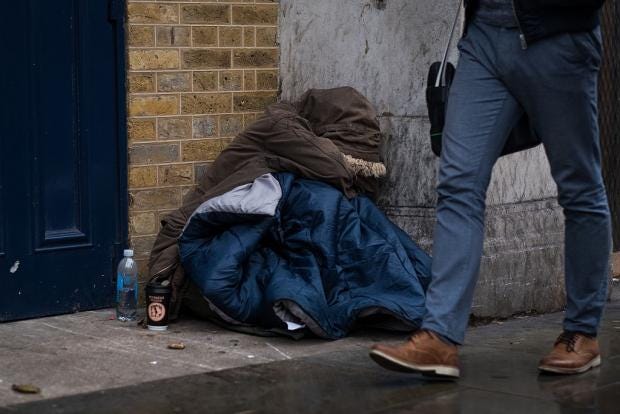
It’s an awful and distressing thought that there are homeless people who will be fighting to survive hypothermia and worse at this time of year. But it’s far more awful and distressing for those who are facing homelessness. This dangerous, freezing weather kills people who are exposed outdoors very quickly, especially at night when shops and public buildings are closed and locked up. In 2017, in one of the wealthiest nations, the number of people who are homeless is increasing, and as a society, we’ve permitted that to happen.

Image result for homelessness in the snow uk

Research underlines the particular difficulties many councils will face finding accommodation for young people and families over the next two to three years. This is because of the severity of local authority budget cuts. There are serious concerns for single young people because of rising unemployment, benefit cuts and spiralling rents.

Two thirds of local authorities told us they expect it to be “much more difficult” to help 18-21 year olds access housing in the next few years. These concerns will be amplified by planned removal of entitlement to support with housing costs for many people in this age group. 

Once again this year’s Homelessness Monitor warns about ongoing welfare reforms with the discrepancy between Local Housing Allowance and rents highlighted as a significant barrier to council attempts to house homeless applicants.

An ongoing upward trend in officially estimated rough sleeper numbers remained evident in 2016, with the national total up by 132 per cent since 2010. The welfare cuts introduced in this decade, and those planned for introduction in the coming years, will
cumulatively reduce the incomes of poor households in and out of work by some £25 billion a year by 2020/21.

This is in a context where existing welfare cuts, economic trends, and higher housing costs associated with the growth of private renting have already increased poverty amongst members of working families to record levels.

Related image

Then there are the recently publicised failings of Universal Credit, which was designed to reduce welfare spending, rather than to improve support for people who need it. 

And it’s going to get worse. The welfare “reforms” announced in the summer 2015 Budget and Autumn Statement will have particularly marked consequences both for families with more than two children, and for young single people.

These groups will either potentially be entirely excluded from support with their housing costs (if 18-21 and not subject to an exemption), or subject to Shared Accommodation Rate limits on eligible rents in the social as well as the private rented sector. Consequently, these are the groups that local authorities report greatest difficulty in rehousing.

More than 300,000 people in Britain – equivalent to one in every 200 – are officially recorded as homeless or living in inadequate homes, according to figures released by the charity Shelter. Using official government data and freedom of information returns from local authorities, it estimates that 307,000 people are sleeping rough, or accommodated in temporary housing, bed and breakfast rooms, or hostels – an increase of 13,000 over the past year.  However, Shelter say that this is likely to be an underestimation

Polly Neate, chief executive of Shelter, said: “It’s shocking to think that today, more than 300,000 people in Britain are waking up homeless. Some will have spent the night shivering on a cold pavement, others crammed into a dingy hostel room with their children. And what is worse, many are simply unaccounted for.

“On a daily basis, we speak to hundreds of people and families who are desperately trying to escape the devastating trap of homelessness. A trap that is tightening thanks to decades of failure to build enough affordable homes and the impact of welfare cuts.”

Although public perceptions of homelessness are dominated by rough sleeping, Shelter points out that the single leading cause of recorded homelessness is the ending of a private tenancy, accounting for three in every 10 cases, and often triggered by a combination of soaring rents and housing benefit cuts.

A National Audit Office (NAO) inquiry in September criticised the government for failing to get a grip on homelessness, despite recorded numbers of homeless people rising every year since 2010. The NAO said local housing allowance cuts helped fuel the crisis, which cost us around £1bn a year.  

One in five young people in the UK have sofa-surfed in the past year and almost half of them have done so for more than a month. In a country that is among the wealthiest in the world, how can this be possible?

Related image

report by the London Assembly housing committee on hidden homelessness is a timely reminder of an issue that goes unseen by most of the public and by many local and national politicians. 

However, as a so-called civilised society, we mustn’t look the other way. In cold weather, the plight of people who have no shelter is especially harsh, and many passersby may struggle to know what to do. But here are small things we can each do to make a difference, and reduce the dangers of freezing weather for homeless citizens. For example:

  • We could stop, smile and buy someone a warm drink, or provide some warm food.
  • We could set up places were people can take their old coats and blankets, socks, hats, gloves, scarves – and then distribute those to people sleeping rough. Or even set up a point in each town so that homeless people know where to go for warm clothes that have been donated.
  • We can also contact Streetlink. (Click) When a rough sleeper is reported via the Streetlink app, or by phone – telephone number 0300-500 0914. The details  you provide are sent to the local authority concerned, so they can help connect the person to local services and support. You will also receive an update on what action was taken so you’ll know if the situation was resolved. StreetLink aims to offer the public a means to act when they see someone sleeping rough, and is the first step someone can take to ensure rough sleepers are connected to the local services and support available to them.

Image result for homelessness in the snow uk

The thing is, we must do something. We must not become desensitised to the fact that so many people are struggling to survive. Shelter is one of our most fundamental survival needs, and it’s shameful that people in the UK cannot meet their most basic needs. It’s not enough to simply spare a thought. That doesn’t save lives, unless we act on those thoughts.

Related image

Please don’t just walk on by.


I’m disabled through an illness called lupus. I don’t make any money from my work. However, I do what I can, when I can, and in my own way. You can support Politics and Insights and contribute by making a donation which will help me continue to research and write informative, insightful and independent articles, and to provide support to others. The smallest amount is much appreciated, and helps to keep my articles free and accessible to all – thank you. 

DonatenowButton

The Paradise Papers, austerity and the privatisation of wealth, human rights and democracy

351-burden-cuts-by-population

Outdated Conservative ideology has long framed the social safety net as an obstacle to national prosperity, the government claims that welfare somehow depresses economic growth and job creation. Indeed, Conservative efforts to dismantle the welfare state have been a constant in UK national politics. However, the truth is that as income inequality increases, the potential for economic growth is constrained. Seven years of austerity aimed at the poorest citizens have provided empirical evidence that does not verify the government’s claims.

The Conservatives also claim that welfare creates “perverse incentives” and “moral hazards” – it produces negative “unintended consequences,” as people who are eligible for support don’t have a job. Welfare is therefore reduced to ensure that people are not comfortable in claiming financial support, in order to “make work pay”. The problem with that, however, is that many people who work are also struggling to make ends meet. Work doesn’t pay because a miserly state provides perverse incentives for unscrupulous profit-driven employers to pay miserly wages that are well below average living costs. There has also been a marked loss of job security, too, over the last seven years.

All of this reflects a troubling reality of the labour market – that without government regulations and collective bargaining – the government have a history of legislating to undermine trade unions and traditionally loathe collective bargaining – employers are able to use “competition” to reduce wages. This state of affairs is clearly attributable to political decisions. It can be traced back over decades of policies favouring businesses at the expense of established employee rights. 

In the free market, all that matters is how many people are capable of doing your job. Competition matters, at least on paper. It doesn’t matter what qualities and skills you have. Workers are not paid according to their skills, they’re paid according to what they can negotiate with their employers. The more people there are in the labour market, the less bargaining power they have. The steady reduction of the support offered by the welfare state creates desperation, and also significantly reduces peoples’ choices regarding employment. It creates a race to the bottom, where wages are depressed and stagnating, and “efficiency” rules, along with the profit motive.

Furthermore, some employers are discriminatory, and pay workers different wages on the grounds of disability, age, race, or gender.

Changing policies to include a progressive tax structure would enhance economic growth and see a structural lowering in the unemployment, underemployment and low pay rates, with the other very valuable benefit of being ethical, fair, decent and compassionate. There are several excellent macro-economic reasons for substantially raising wages AND raising welfare. Notably, it could boost consumption, reduce inequality as well enhance economic growth.

In 2014, the Organisation for Economic Co-operation and Development (OECD) published a report that stated income inequality actually stifles economic growth in some of the world’s wealthiest countries, whilst the redistribution of wealth via progressive taxation and benefits encourages growth.

The report from the OECD, a global think tank, shows basically that what creates and reverses growth is the exact opposite of what the current neoliberal government are telling us. It highlights that the Conservative austerity programme is purely ideologically driven, and not about effectively managing the economy at all. However, many of us already knew this was so. The Conservatives have managed to narrate neoliberal ideology effectively, it became naturalised, and established as an “intuitive” and common sense kind of justification system for crass inequality, (accumulation by the wealthy through the dispossession of the poor) while its very design was to fragment the truth and disjoint rationality. This is precisely how dominant ideologies operate. 

Austerity was never about what works for the economy. Austerity is simply a front for policies that are entirely founded on ideology, which is all about “handouts” to the wealthy that are funded by the poor

If we provide support for those on low incomes, there will inevitably be higher aggregate spending, more jobs and a stronger economy. And if the income distribution continues to include those on low incomes, rather than the current redistribution to the wealthiest, there will be a lift in the growth potential of the economy. Unemployment would be structurally lower and there would be a self-supporting cycle of stronger economic activity as a result.

The Paradise Papers and the privatised magic money tree

Tax havens are one of the key engines of the rise in global inequality. I started writing this article just as the Paradise Papers leak hit the media, following information that was garnered by the German newspaper Süddeutsche Zeitung – which also received the Panama Papers last year – and shared by the International Consortium of Investigative Journalists with partners including the Guardian, the BBC and the New York Times.

Conservatives argue that economic inequality is essential to a healthy economy to generate the financial incentives for individuals to remain in further and higher education, to work hard and to invest their savings in productive enterprises, all of which will result in faster economic growth and rising average living standards. Wealthy people create jobs, and so the poorest citizens will benefit indirectly from economic inequality as some of the benefits of faster economic growth “trickle down” to them. The Conservatives claim that wealthy people are essential to the economy because they “create jobs” and more wealth. 

However, regardless of the plausibility of the debate about competition, meritocracy,  equality of opportunity, rather than equality of outcome – and the debate around wealth redistribution, the world’s super-wealthy have taken advantage of lax tax rules to siphon off at trillions of pounds, from their home countries’ economies and hoard it abroad – and the offshore drain involves a sum larger than the entire American economy. The sheer scale of hidden assets held by the super-wealthy also strongly suggests that standard measures of inequality, which tend to rely on surveys of household income or wealth in individual countries, radically underestimate the true level of inequality – the gap between rich and poor. 

Wealth doesn’t “trickle down”: it’s hidden away offshore. It’s hoarded. If you are remotely concerned about fairness and inequalities of wealth and power, you really must be concerned about the very existence of tax havens, and the significant impact this has on national economies. The Conservatives prize the idea of private property, and that impacts on their decision-making. Rather than address the issue that would have had a larger positive impact on our economy – tax avoidance and hoarding – they chose instead to impose austerity on the poorest citizens in the UK, they made “difficult choices” to dismantle the welfare state and raid our public funds, damaging our services and eroding our post war social safeguards. Wealth doesn’t “trickle down”, it trickles away offshore. Furthermore, it’s not feasible that the government was unaware of this. They have chosen to focus on supply side labor policies, and blaming the poorest for the big hole in the economy, some of which followed the banking crisis. They have chosen to regard our public services as “unsustainable” to prop up the immoral financial habits of a wealthy and powerful elite.

At the centre of the Paradise leak is Appleby, a law firm with outposts in Bermuda, the Cayman Islands, the British Virgin Islands, the Isle of Man, Jersey and Guernsey. The project has been called the Paradise Papers. It reveals (courtesy of the Guardian):
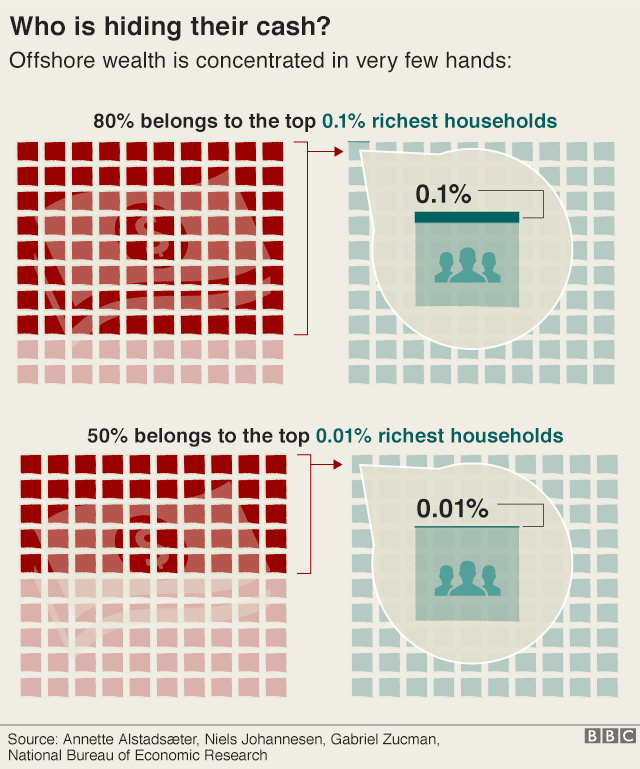
Graphic showing who is hiding their cash

The disclosures will certainly put pressure on world leaders, including Trump and the prime minister, Theresa May, who have both paid lip service to the idea of curbing aggressive tax avoidance schemes. 

The publication of this investigation, for which more than 380 journalists have spent a year combing through data that stretches back 70 years, comes at a time of growing global income inequality.

In the UK, the ideologically driven austerity programme has also contributed significantly to the redistribution of public funds from the poorest citizens to the wealthiest. I’ve said this before, but I’m going to say it again: 

Government policies are expressed political intentions regarding how our society is organised and governed. They have calculated social and economic aims and consequences. In democratic societies, citizen’s accounts of the impacts of policies ought to matter. But for the past seven years, the government have been completely disengaged with the public, and have failed to listen to accounts of the detrimental impacts of their public policies on marginalised social groups.

In the UK, the way that policies are justified is being increasingly detached from their aims and consequences, partly because democratic processes and basic human rights are being disassembled or side-stepped, and partly because the government employs the widespread use of linguistic strategies and techniques of persuasion to intentionally divert us from their aims and the consequences of their ideologically (rather than rationally) driven policies. Furthermore, policies have become increasingly detached from public interests and needs.

The justification offered by the government for its draconian policies aimed at society’s most marginalised (and protected) social groups is that welfare and other supportive public services are “unsustainable”. The government claims that “difficult decisions” have to be made, which invariably entail cuts to essential services and provisions, because we don’t have enough money.

In truth, the government simply has other plans for the money available, and prioritises the desires of the very wealthy, at the expense of meeting the needs of the poor. 

Other justifications reflect the behaviourist turn, which perpetuates the “culture of poverty” myth and embeds behaviourist theories regarding the presumed attitudes and “cognitive incompetence” of the poorest citizens in policies, which extend a disciplinarian and “correctional” element. However, such narratives and policies indicate a government of evidence-free fanatics. In policy, everything is something you decide to do, and there is nothing that you have to do. There are always alternative choices to consider regarding how our economy is managed.

Few things demonstrate the Conservatives’ wake of glib lies than their record on welfare spending – an area in which they have overseen a culture of waste. Just look at disability benefits. We’re told repeatedly that spending on “welfare” for disabled people is “out of control”, yet earlier this year it emerged that the Department for Work and Pensions has gone nearly £200m over budget, in paying two private companies from the public purse to run the personal independence payments (PIP) assessment system.

Then there is the Work Capability Assessment scandal. The National Audit Office (NAO) scrutinises public spending for Parliament and is independent of government. In their audit report last year, the NAO concluded that the Department for Work and Pension’s spending on contracts for disability benefit assessments is expected to double in 2016/17 compared with 2014/15. The government’s flagship welfare-cut scheme will be actually spending more money on the assessments themselves than it is saving in reductions to the benefits bill. It would be cheaper, and of course much more ethical to simply pay people what they were previously entitled to, based on their own doctors’ professional judgement.

The NAO report reflects staggering economic incompetence, a flagrant, politically motivated waste of tax payers money and even worse, the higher spending has not created a competent or ethical assessment framework, nor is it improving the lives of sick and disabled people. People are dying after being wrongly assessed as “fit for work” and having their lifeline benefits brutally withdrawn. Maximus is certainly not helping the government to serve even the most basic needs of sick and disabled people.

However, Maximus is serving the needs of a “small state” doctrinaire neoliberal government. The Conservatives are systematically dismantling the UK’s social security system, not because there is an empirically justifiable reason or economic need to do so, but because the government has purely ideological, anticollectivist prescriptions, and other plans for our public funds.

The Conservatives have now spent at least £700m in taxpayers’ money on these contracts with multinationals alone, despite the fact that the process they use is so flawed that one charity reported that as many as four out of five rejections for PIP that were appealed against were overturned. That indicates, at the very least, the use of a severely flawed assessment process. PIP assessments are purposefully designed to ensure that people are less likely to be found eligible for the support in meeting the additional costs of being disabled. Then there is the massive cost of tribunals to add to the cost of administrating the “cuts”. 

Meanwhile, multinational companies are shifting a growing share of profits offshore – €600bn in the last year alone – the leading economist Gabriel Zucman will reveal in a study to be published later this week. That money leaves a hole in our economy, which is refilled at the expense of those with the very least to contribute to paying off the “national debt” – another Conservative obsession and justification for their austerity programme. 

The human costs of a “business friendly” neoliberal economy

The government have long claimed that they are “helping” sick and disabled people into work. This “support” entails putting disabled people through systematic ordeals, and constantly moving ever-shrinking goalposts – the claimed objective of which is “targeting” resources to “those most in need”.

The Conservatives use glib, patronising, ridiculous and baffling phrases in their rhetoric, guidelines and policy papers, saying things like they don’t want disabled people to “fall out of employment”, for example. Yet PIP, which is a non means tested payment, quite often supports people in employment, as did the now abolished Independent Living Fund. But PIP is very difficult to qualify for. At my own assessment, my previous post (which ended seven years ago, with social services) was actually used as “evidence” that I don’t have significant cognitive difficulties. However I was forced to give up that post when I became too ill to work. PIP certainly doesn’t seem to be about supporting disabled people in maintaining independence, despite its title.

If it were, then we wouldn’t be witnessing so many losing their award as they are transferred from Disability Living Allowance, or seeing it reduced. Many disabled people are losing their mobility award and consequently, their motability vehicles, which inevitably means that some in this group won’t be able to continue working.

The government has targeted disabled people in order to cut their support and to make savings by reducing the availability of lifeline support that was once accessible to those of us unlucky enough to be disabled, to become ill or have an accident, leaving us unable to earn an income. You know, those provisions that our national insurance pays for.

There is no reason whatsoever to presume that disabled people are “frauds”. The ordeals that have been introduced into the welfare system to deter fraud are not justifiable, since prior to the “reforms”, welfare fraud stood at just 0.7%/. Some of that tiny percentage was actually down to bureaucratic error, too, as administrative errors are included in the statistic. 

The claim that the ordeals incorporated into the system are to “protect the public purse” from fraud is utter rubbish. The ordeals deter most people from claiming, unless they absolutely have no choice. I’ve put off claiming PIP since 2012, when I was advised to by my doctor. Who wants to suffer the utter loss of dignity and punishment that the system meters out unless they really REALLY have to.

Some perspective:
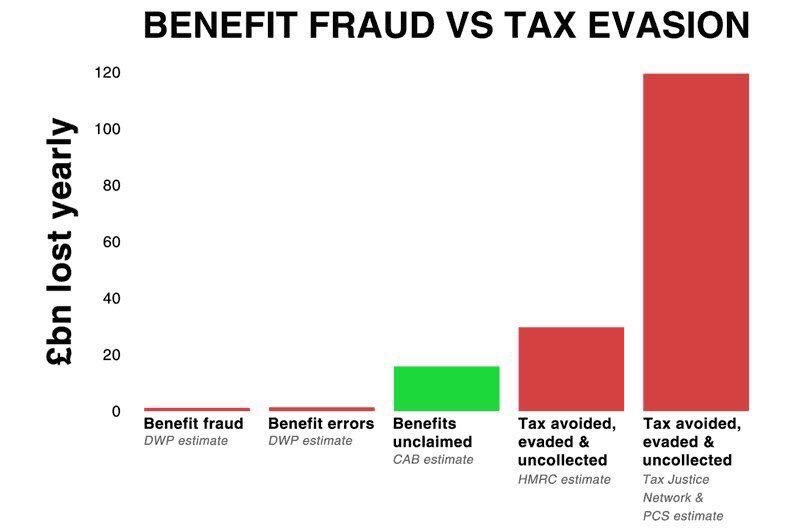
People don’t “fall” out of their jobs: they become too ill to work or they lose their jobs because they are disabled. Every person facing an assessment is in that position because both they and their doctor have concluded that they are unfit for work – too unwell or unable. But the government refuses to accept first hand accounts and the professional opinion of professionals.

The government isn’t “helping” disabled people; it is making it as difficult as possible for people to claim support. The Conservatives are actually trying to coerce sick and disabled people who cannot work to work. Let’s have it straight. Because the whole process is so difficult, and because you are assessed and reassessed constantly, often having to go through mandatory review then appeal, which takes months and months on end, people with chronic illnesses especially experience worsening health because of the terrible stress and strain they are placed under by the state, and are therefore even LESS likely to “move closer” to employment.

In looking to make savings on disability benefits, the government is inflicting unacceptable harm and damage on disabled people. The system damages people’s health, wellbeing and more generally, their lives, because they have to struggle endlessly for a little basic support that most civilised societies would deem essential and  unproblematic.

All of this is because of the insulting assumption the Conservatives make that people who have illnesses or are disabled for other reasons are using their circumstances to wriggle out of their obligations to work, and of course, to fulfil their duty towards national production and the economy. Unfortunately, disability and medical conditions often restrain people from full participation in society, whether they like that or not. Cutting support will simply make inclusion and participation even less likely. 

How assessments are weighted towards the miserly state

The government has justified cuts to welfare more generally by making claims about the characters, attitudes and cognitive capacities of people claiming social security more generally. However, regardless of the front of blame-mongering rhetoric, both ESA and PIP were never intended to be easily accessible support mechanisms for disabled people. The very design of the assessments indicates this.

The Work Capability Assessment is a “norm-referenced” system, not a criterion-referenced system. These terms refer to different ways in which the evidence gathered from an assessment process is used. Criteria-referenced systems are considered to be objective and consider each case individually and on its own terms. Norm-referencing is designed to compare and rank assessments in relation to one another, rather than in relation to objective criteria. Norm-reference assessments score better or worse against a hypothetical standard,  which is determined by comparing scores against the overall performance results of a statistically selected group (a cohort). 

All of which is a sophisticated way of saying that there are in-built targets. To receive ESA, someone must score the required number of points and fall within the proportion of people the system will actually permit.  In practice, this means there is a finite number of people who can be awarded benefit, and that’s regardless of the number of people who actually meet the eligibility criteria. A serious limitation of norm-reference assessments is that the reference group – the cohort – may not represent the current population of those being assessed. Norm-referencing does not ensure that an  assessment is valid, either (i.e. that it measures the construct it is intended to measure). There is nothing to stop a government from using a very biased sample of the population, when they select a cohort.

In 2007, Conservative MP Timothy Boswell warned (9 Jan 2007 : Column 169): “I can imagine circumstances […] in which a future minister […] might wish to say: ‘We will introduce a norm. We are not going to have, by definition, more than 1.5 million people on employment and support allowance,’ and the tests will, in effect, be geared to deliver that result.”

The reassessment of everyone claiming Incapacity Benefit and all disabled people claiming Income Support became a major Conservative crusade that was, we were told, to save billions of pounds a year from the welfare budget, in the Conservative age of austerity. 

Similarly PIP assessments were developed to fit with a pre-conceived idea of how many people ought to qualify for support. The assessment is designed to allocate as few points as possible, by ignoring the real barriers people face in their daily living and assessing a person’s ability to “function” by using the most trivial  and non comparable descriptors.  Esther McVey disclosed in 2012 that she anticipated 300,000 disabled people would have their disability support cut or ended during the change over from Disability Living Allowance (DLA) to PIP. That statement came before a single assessment had taken place. If that isn’t a declaration of the real intention behind the introduction of PIP, and that the assessment itself is pretty arbitrary, then I don’t know what is. It does strongly suggest the assessments are not being conducted fairly and “objectively”. 

In 2012, a GP posed as a trainee Atos assessor and recorded undercover video footage that was later broadcast by Channel 4’s investigative current affairs programme Dispatches. In the film, trainers warned the NHS doctor that if, on average, he were to recommend more than one claimant per day for the Support Group (out of the eight he would be expected to see each day) he would be subject to an increased level of management scrutiny through a mechanism known as “targeted audit”. The undercover doctor was told:

“If it’s more than I think 12% or 13%, you will be fed back ‘your rate is too high’.”

An assessor under “targeted audit” would have all of their reports scrutinised before they were sent to the Department for Work and Pensions (DWP) and would no longer be allowed to recommend any claimants for the Support Group without asking for permission first. When the doctor asked an experienced assessor where these rules had come from, she replied: “The DWP”.

Both the DWP and Atos categorically denied ever having had any target for getting claimants off sickness benefits. However, both eventually admitted that Support Group “norms” were being used nationwide, though they both denied that the purpose of “targeted audit” was to limit the number of claimants placed in the Support Group.

Atos said that the audit process triggered by the breach of a “norm” was intended to ensure consistency across the firm’s UK team: if the assessor’s reports met the DWP’s expectations, the healthcare professional would not be asked to change their recommendations.

The decision-making process for awards certainly do not command public confidence, they depend on assessments of “functional impact” that are far from a precise science. In fact it isn’t “science” at all. There is a continuing widespread misperception that PIP is a medical test rather than an assessment of functional capacity, not helped by the fact that assessors are refered to as “Health Professionals”, and Atos claims to be a “medical Service”, while Maximus claims it conducts a “health assessment” rather than a work capability assessment. 

Last November, a United Nations (UN) committee published a scathing report on the consequences of the austerity policies pursued by the UK government in welfare and social care, which it described as “grave and systematic violations” of the rights of people with disabilities. Many of us have raised our concerns and fears with the UK government about the harsh impacts of austerity on disabled people, following the publication of the welfare “reform” bill in 2012, but we were ignored. 

The members of the House of Lords, opposition ministers, the Work and Pensions committee, disabled people’s organisations, charities and support groups and many individuals all tried to engage the government, but to no avail. We were excluded from any democratic dialogue, with accusations of “scaremongering”, and then silenced with false statistics and dishonest claims from Conservative ministers, who presented to us nothing but their own prejudice and contempt. 

We meticulously presented cases to ministers that demonstrated the hardship, harm, distress, loss of independence and dignity, and sometimes, the deaths, that correlate with the reforms and cuts. However, the first hand accounts of our experiences of Conservative policies, as disabled people, were loudly dismissed as “anecdotal evidence”. Over and over we were told by ministers that there was no “proven causal link” established between the policies and the frightening events that we were experiencing and reporting. The fact that the government refused to listen to us and were so uncompromising added another dimension and depth to the fears we experienced.

Many of us raised felt we had no choice but to raise our concerns and fears with the United Nations using the Optional Protocol to the Convention on the Rights of Persons with Disabilities – a side-agreement to the Convention which allows its parties to recognise the competence of the Committee on the Rights of Persons with Disabilities to consider complaints from individuals. Many of us have been documenting and submitting evidence to the UN since 2012. There followed an inquiry, more evidence was gathered. The government dismissed the UN report as “patronising and offensive”. However, given that the government is well aware that disabled people and disability organisations were responsible for the complaints that initiated the inquiry, the  patronising and offensive bluster and attitude is descending from Whitehall. 

A recent report from the UN expressed grave concern regarding care and treatment policies, which were described as insufficient to the extent of being “inconsistent with the right to life of persons with disabilities as equal and contributing members of society”.

Labour’s Debbie Abrahams, the shadow work and pensions secretary said “The UN committee has found that this Tory government is still failing sick and disabled people. Their damning report highlights what many disabled people already know to be true: that they are being forced to bear the brunt of failed Tory austerity policies.”

Before 2010, the very idea of cutting disability support was unthinkable. The Conservative behaviourist turn is a cruel front for inexcusably squeezing a few pounds more from disabled peopleso that wealthy people can avoid paying tax.

Thatcher’s government was fond of perpetuating the “culture of poverty” myth, but the current government has taken that to a new low, and has implemented costly big state policies which aim at “recifying” behaviours considered “not in our best interests”. The only beneficiaries are the private companies and multinationals who make a profit from administering the punitive cuts. The cuts which are costing more to implement than they can possibly save, in a “business friendly” political climate. One where the government tells us that we need to “incentivise” wealthy people to create jobs and contribute to the economy by giving them more money, while poor people are “incentivised” by not having enough money to meet their basic survival needs. Accumulation by the wealthy by dispossession of the poorest.

Welfare has incorporated a Conservative moral crusade aimed at coercing conformity and compliance to draconian state-determined conditions.

Meanwhile, some very wealthy people are making massive profits from the governments’ austerity programme, particularly the welfare “reforms”. 

Conservatism is synonymous with social and economic inequality – with handouts for the rich and subsequently, much less money for the poor. 

In the UK, democracy, human rights, independence, wellbeing, security, freedom and wealth have been privatised. Only 1% of the population can afford them these days, and they tend to bank offshore.  

paradise-papers-logo-icij-759 (1)


I don’t make any money from my work. But you can support Politics and Insights and contribute by making a donation which will help me continue to research and write informative, insightful and independent articles, and to provide support to others. The smallest amount is much appreciated, and helps to keep my articles free and accessible to all – thank you. 

DonatenowButton

Osborne finally admits he lied and that Labour did not cause the recession

Image result for a big labour boy did it osborne

In the weeks after he took office, George Osborne justified his austerity programme by claiming that Britain was on “the brink of bankruptcy”. He told the Conservative conference in October 2010: “The good news is that we are in government after 13 years of a disastrous Labour administration that brought our country to the brink of bankrutcy.” 

The Conservatives have constantly tried to portray the Labour party as less than competent with the economy, and more recently the government made facetious jibes about “magic money trees” being required to fund Labour’s promising anti-austerity manifesto, which backfired. In fact the Conservatives have even claimed, rather ludicrously, that the opposition is “dangerous”. 

However, back in 2012, Robert Chote, head of the Office for Budget Responsibility (OBR) formally rebuked Osborne for his intentionally misleading “misinformation” and dismissed with scorn the “danger of insolvency” myth that has been endlessly perpetuated by the Conservatives.

It’s worth remembering that the Conservatives’ historic record with the economy isn’t a good one. Margaret Thatcher presided over a deep recession because of her authoritarian introduction of neoliberal policies, regardless of the social costs. Her only solution to an increasingly damaged economy was more neoliberalism. John Major also presided over a recession, and who could forget “Black Wednesday“. 

The global recession of 2007/8 would have happened regardless of which political party was in office in the UK. Osborne had also committed to matching Labour’s spending plans, but he later criticised them.

The financial crash process was started by the neoliberal Thatcher/Reagan administrations with the deregulation of the finance sector. We were out of recession in the UK by the last quarter of 2009. By 2011, the Conservatives fiscal policy of austerity put us back in recession. 

It’s good to see Osborne finally concede that there was no basis for his ridiculous claims in 2010, in a recent interview with Andrew Neil, for The Spectator‘s Coffee House Shots (12 October).

It follows that there was absolutely no justification for the Conservatives’ incredibly harsh and damaging neoliberal austerity programme.

You can listen to the full interview with George Osborne and Andrew Neil by clicking here.


I don’t make any money from my work. But you can support Politics and Insights and contribute by making a donation which will help me continue to research and write informative, insightful and independent articles, and to provide support to others. The smallest amount is much appreciated, and helps to keep my articles free and accessible to all – thank you. 

DonatenowButton

Choice Architecture of a Democratic Politics – Hubert Huzzah


A lot has been written in recent years about the value of Behavioural Economics in nudging the Electorate to do make good choices. A lot less has been achieved in the area of nudging politicians. Politicians are pivotal in society and nudging them will have far greater impact on society than piecemeal and dissipated nudging of Citizens. Indeed the nudging of politicians is not only the most rational and efficient way to achieve positive outcomes for society but also ensure that both politicians and Electorate are of one mind when it comes to being “all in it together”.

The Choice Architecture of Parliament has, for centuries, favoured unaccountable and poor decision-making in isolation from the actual needs and wants of the Electorate. Indeed, women only acquired the right to vote in 1918, voting only became one person one vote in 1948 and the franchise has only been extended to 18 year olds since 1969, in the United Kingdom. Democratic participation has never been the primary aim of Parliament, for reasons that can be understood through a consideration of Behavioural Economics: Parliament is about the allocation and distribution of Power.

Reducing the tyranny of choice.

The sheer number of choices available to politicians is a tyranny.

From expenses for underpants to abstaining from critical votes, the sheer amount of time and energy devoted to Politicians’ choices diminishes political utility. The Electorate can become the Choice Architects of Parliament by democratically limiting alternatives and providing decision support tools.

Traditionally, Parliament has excluded the Electorate from many Parliamentary processes. Indeed with around thirty-five million eligible voters, Parliament can only function by being efficient. The true scale of the tyranny of choice can be expressed, mathematically, and this gives the Choice Architects of Parliament powerful tools to determine how efficient Politicians are being. The exclusion of the Electorate from some Parliamentary processes and admission into others can end the moral hazard and confirmation biases inherent in a closed decision-making group.

Queueing theory has its origins in research by Agner Krarup Erlang when he created models to describe the Copenhagen telephone exchange and has provided such important results as the Queueing Rule Of Thumb, which can be used to determine how many Politicians are required and if a Politician is efficiently making choices. This reduction of the tyranny of choices only begins the radical reform of Parliament by transforming Politicians into fit for purpose Decision Makers whose optimisation of resources for the Electorate is a Public Good. Identifying which Politicians are failing the Electorate in aggregate becomes a simple task of a well designed Randomised Control Trial.

Defaults

A large body of research has shown that, paribus ceteris, Politician are people and choose options that are presented as a default.

The Choice Architects of Parliament will create the defaults of deselection and prosecution for Politicians cause harm to the Electorate. The Precautionary Principle, applied to Legislators will ensure the best choices are available to Parliament at all times.

Historically, the defaults presented to Politicians have been those defaults prepared by Think Tanks, Lobbyists, Consultants and the Civil Service. While there is nothing undemocratic about seeking the advice of Experts, the pool of expertise has diminished in recent years until it has, largely, become an unnecessary barrier to efficiency and a source of largesse for rewarding anchoring biases and bandwagon effects. Fundamentally the Choice Architects of Parliament will minimise the framing effect of these expert consultations which can result in failure by default as the direct outcome of the Dunning-Kruger Effect discovered in a range of notionally independent Think Tanks, Lobbyists and Consultants.

In contrast to genuinely principle based policies, Politicians have come to rely on the self-assembly policies, for which consultations provides defaults and instructions, in the same way that people value furniture that they have assembled themselves. Research has shown that people value a book shelf more if they assemble it themselves than if it is already assembled. The Political Pareidolia of Consultation Defaults will be ended by the Choice Architects of Parliament by evidence based defaults for Politicians.

A simple and enduring evidence based default for Politicians is to be recalled from office should they choose a default purely because it is a default. In evidence based policy, default policies can be randomised in order to ensure that Politicians are not simply choosing the first option on the list. Research at the Department of Work and Pensions has demonstrated that Claimants understand and appreciate the value of sanctions in making good choices and there is no evidence that Politicians are not the same as Claimants. The Sanction Regime will be the Primary Default for Politicians in Policy Formation and no secret will be made of that; because, then, Politicians can make the right and informed choice and, importantly, feed back those choices to Think Tanks, Lobbyists, Consultants and the Civil Service with appropriate behaviours.

Choice over time

Choices where outcomes manifest in the future are influenced by several biases.

Politicians tend to be myopic, preferring present opinion poll or ideological outcomes at the expense of future concrete outcomes for the Electorate. This leads over exploitation of present day resources at the expense of the future. Political projections about the future tend to be inaccurate with uncertainty promoting overestimation of the likelihood of positive outcomes for vanity projects.

The Choice Architects of Parliament have several ways to structure choice architecture to compensate for or reduce these ideological and opinion poll biases. Where Politicians have an uncertain future, they are motivated to overestimate the likelihood of salient or desirable outcomes and the resulting poor choices cascade outwards into the Electorate with consequences that are, generally, unforseen by the Politician. By making all Political Choices by a politician contribute to the future wellbeing of the Politician, Policy will be driven to improve.

The default Sanction Regime is only functionally effective if the Sanctions escalate over time. The current Sanction Regime for Politicians consists of not being elected at the next General Election. There are rare occasions when a Politician resigns inducing a by-election. This is not a Sanction in the same way as a General Election as it is controlled by the Politician. Similarly, being Suspended from the House is a Sanction under the control of the Speaker.

Partitioning options and attributes

The ways in which options and attributes are grouped influence the choices that are made. 

Option partitioning requires division of a budget into categories. The attributes of a category are clumped or divided according to Government Department and Ideology. Politicians have a tendency to claim resources are scarce and allocated equally across categories. By itemising ideologically acceptable attributes and aggregating ideologically undesirable attributes, Politicians managed consumption by managing the number of attributes into types of categorizations.

The Choice Architects of Parliament will undertake a root and branch review of ideological choices and manage Political expectations by recalling Politicians where their ideological categories do not match those of the Electorate. The choice tools available to Politicians will cease to be limited to those provided by Lobbyists and Think Tanks.

Indeed each Individual Lobbyist and Think Tank will cease to be treated as an attribute of Political Life in Parliament and become a Category within the Register of Members’ Interests. Similarly, each Elector will become a Category for each “Elected Representative”. This will ensure that Politicians allocate the scare resources of their time equally across Electorate and Special Interests. The consumption of Lobbying can, therefore, be managed by the Choice Architects of Parliament.

Avoiding attribute overload

Politicians would optimally consider all of a Policy’s attributes when deciding between options. Cognitive constraints, result in weighing attributes in the same way as choices. As a result, The Choice Architects of Parliament will choose to limit the number of attributes of a policy, weighing the cognitive effort required to consider multiple attributes against the value of improved Governance. In order to ensuring cognitive attribute overload does not occur, the number of Politicians will be increased by reducing the size of Constituencies. Thus Politicians will be both more accountable and less prone to attribute overload.

This presents challenges if Politicians ideologically commit to different attributes to the Electorate and so the Choice Architects of Parliament provide tools for sorting, informing and recalling Politicians. The principal means of avoiding attribute overload will become the Political Capability Assessment. Rather than belabouring the difficulties of partitioning attributes and categories, Politicians will be periodically assessed for their suitability by Political Activity Practitioners selected from the General Electorate.

Translating attributes

The presentation of information about attributes reduces the cognitive effort associated with representation and so reduces the failure of Politicians to do as the Electorate instructs. The Choice Architects of Parliament will accomplished this by increasing evaluability and comparability of attributes. The Choice Architects of Parliament will convert commonly used metrics into metrics Politicians are assumed to care about. Such as “Expenses per Majority” and “Lobbyists per Day”. Non-linear metrics will be transformed into linear metrics and evaluative labels will be added to numerical metrics, explicitly calculating consequences such as “Swing to deselection” and “probability of prison”.

The Choice Architects of Parliament

For too long, Politicians have avoided the reality of their situation. In particular, the finances of Parliamentary Politicians has been allowed to drift along making poor choices with poor consequences for Constituents.With the advent of Behavioural Economics it has become clear that something must be done to curb the poor choices of politicians.

Imagine how much easier it would be for a Minister to refrain from sending an aide out to purchase sex aids if all purchases of goods or services by all Politicians were restricted to the use of a Parliamentary Credit Card. By having a Parliamentary Credit Card updating a database in real time, Politicians can make good purchasing decisions and demonstrate their accountability in real time. The Independent Parliamentary Standards Authority would transform from being a bureaucratic nightmare into being a modern and efficient Politicians’ Financial Services Organisation.

Paperwork would be eliminated as transactions would automatically register and enter the public domain through the Independent Parliamentary Standards Authority Website. The Independent Parliamentary Standards Authority showing approval or rejection of expense items giving feedback to the Electorate in real time. Rejected items could be annotated quickly to ensure Politicians understand the consequences of their choices.

Politicians have always been accused of using the ambiguity of Parliamentary and Constituency Homes as a source of income. The difficulty of maintaining two dwellings is a common one that can result in suboptimal resource allocation. The resulting problem of spare rooms has been solved for a range of Benefits Claimants by adjusting the level of support available. The same principle, applied to Politicians, has a simple and elegant solution which helps them to avoid attribute overload – both in their own accommodation and in policy formation.

By housing Politicians in the Tower Blocks in and around the precincts of Parliament, the suboptimal resource allocation of resources to accommodation vanishes and Politicians are motivated to ensure the highest standards for accommodation within the constraints provided by the Tenant Management Organisation. By ensuring the Tenant Management Organisation is responsible for providing Tower Block Housing within Local Authority constraints, Politicians can both choose to relieve themselves of poor choices about maintenance and provide a pathfinder for excellence in housing choices over time.

While expenses and housing are major concerns, the single most important behaviour Politicians engage in is voting in Parliament. Poor voting decisions have serious, long-term outcomes that adversely affect the Electorate. Politicians who have expectations that decisions made in the first year of office will not have an effect in the fifth year of office experience no loss aversion. By following the Precautionary Principle, Politician who make poor voting decisions would have their term of office shortened thus bringing the date of their next election forwards. Sufficient poor voting decisions would trigger an early General Election. This ensures Party Whips are given the opportunity to avoid loss though an early election with motivation to ensure Politicians make good decisions at all stages of a Parliament.

The danger of applying a time tariff to voting decisions is that Politicians will attempt to game the system with poor decisions. In order to ensure Politicians are as motivated as their Party to make good decisions, Randomised Control Trials will be run against each and every vote in Parliament. Politicians are randomly matched against a representative sample of voters from their Constituency and their actual vote. Politicians who are so selected will be obliged to discuss their decision-making during a Political Capability Assessment.

In order to ensure that the Political Capability Assessment is fair and realistic, the Political Activity Practitioners will be selected from the General Electorate and Expertise will be excluded in order to ensure avoidance of The Political Pareidolia of Consultation Defaults. In line with the practices of the Work Capability Assessment process, there will be a rejection rate for all assessments. The rejection rate will be evidenced based on the number of people who voted against the Politician at the last election. The ordeal of appealing against the Political Capability Assessment will focus Politicians on making better decisions and becomes a necessary part of political life.

The Choice Architects of Parliament are in their early days and have little, if any, concrete proposals developed to the state of implementation. Randomised Control Trials have a role to play in the selection and election of Politicians prior to any Parliament. Not only are Politicians going to be more efficient and effective at making decisions they will be making better decisions. The kind of decisions that they can be responsible for. Because they will be held to be responsible and that means there will be consequences for all they do.

 Independent Standards Authority MP costs. Interactive map.

Article by Hubert Huzzah.

 Picture: George Grosz and John Heartfield: “Jederman sein eigner Fussball”, 1919.


Electoral Commission sued in High Court over EU Referendum

Jolyon Maugham's avatarWaiting for Godot

What follows is the text of a Press Release issued last night.

***

The Good Law Project has initiated proceedings in the High Court to establish whether the Electoral Commission failed in its duty to uphold UK election law during the EU Referendum. The Good Law Project is asking the Court to find that the Electoral Commission was wrong to clear overspending by the official Vote Leave campaign.

The case concerns a donation of £625,000 apparently made by Vote Leave to one of its “outreach groups” in the days before the Referendum vote. If that donation was included in Vote Leave’s spending return, Vote Leave would have overspent by almost 10% and would have committed a criminal offence.

If the action succeeds the Electoral Commission will be forced to reopen its investigation. And it is very likely that either a public or private prosecution of Vote Leave will…

View original post 146 more words