Author: Kitty S Jones

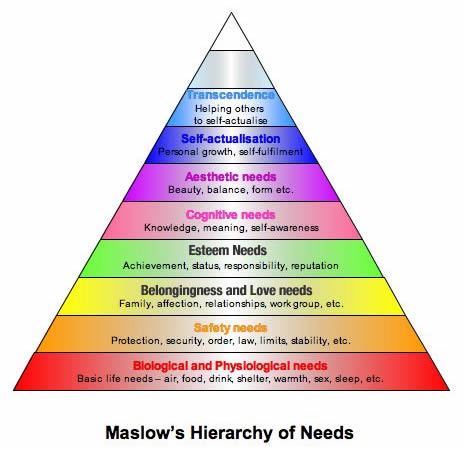
I’m a political activist with a strong interest in human rights. I’m also a strongly principled socialist. Much of my campaign work is in support of people with disability. I am also disabled: I have an autoimmune illness called lupus, with a sometimes life-threatening complication – a bleeding disorder called thrombocytopenia. Sometimes I long to go back to being the person I was before 2010. The Coalition claimed that the last government left a “mess”, but I remember being very well-sheltered from the consequences of the global banking crisis by the last government – enough to flourish and be myself. Now many of us are finding that our potential as human beings is being damaged and stifled because we are essentially focused on a struggle to survive, at a time of austerity cuts and welfare “reforms”. Maslow was right about basic needs and motivation: it’s impossible to achieve and fulfil our potential if we cannot meet our most fundamental survival needs adequately. What kind of government inflicts a framework of punishment via its policies on disadvantaged citizens? This is a government that tells us with a straight face that taking income from poor people will "incentivise" and "help" them into work. I have yet to hear of a case when a poor person was relieved of their poverty by being made even more poor. The Tories like hierarchical ranking in terms status and human worth. They like to decide who is “deserving” and “undeserving” of political consideration and inclusion. They like to impose an artificial framework of previously debunked Social Darwinism: a Tory rhetoric of division, where some people matter more than others. How do we, as conscientious campaigners, help the wider public see that there are no divisions based on some moral measurement, or character-type: there are simply people struggling and suffering in poverty, who are being dehumanised by a callous, vindictive Tory government that believes, and always has, that the only token of our human worth is wealth? Governments and all parties on the right have a terrible tradition of scapegoating those least able to fight back, blaming the powerless for all of the shortcomings of right-wing policies. The media have been complicit in this process, making “others” responsible for the consequences of Tory-led policies, yet these cruelly dehumanised social groups are the targeted casualties of those policies. I set up, and administrate support groups for ill and disabled people, those going through the disability benefits process, and provide support for many people being adversely affected by the terrible, cruel and distressing consequences of the Governments’ draconian “reforms”. In such bleak times, we tend to find that the only thing we really have of value is each other. It’s always worth remembering that none of us are alone. I don’t write because I enjoy it: most of the topics I post are depressing to research, and there’s an element of constantly having to face and reflect the relentless worst of current socio-political events. Nor do I get paid for articles and I’m not remotely famous. I’m an ordinary, struggling disabled person. But I am accurate, insightful and reflective, I can research and I can analyse. I write because I feel I must. To reflect what is happening, and to try and raise public awareness of the impact of Tory policies, especially on the most vulnerable and poorest citizens. Because we need this to change. All of us, regardless of whether or not you are currently affected by cuts, because the persecution and harm currently being inflicted on others taints us all as a society. I feel that the mainstream media has become increasingly unreliable over the past five years, reflecting a triumph for the dominant narrative of ultra social conservatism and neoliberalism. We certainly need to challenge this and re-frame the presented debates, too. The media tend to set the agenda and establish priorities, which often divert us from much more pressing social issues. Independent bloggers have a role as witnesses; recording events and experiences, gathering evidence, insights and truths that are accessible to as many people and organisations as possible. We have an undemocratic media and a government that reflect the interests of a minority – the wealthy and powerful 1%. We must constantly challenge that. Authoritarian Governments arise and flourish when a population disengages from political processes, and becomes passive, conformist and alienated from fundamental decision-making. I’m not a writer that aims for being popular or one that seeks agreement from an audience. But I do hope that my work finds resonance with people reading it. I’ve been labelled “controversial” on more than one occasion, and a “scaremonger.” But regardless of agreement, if any of my work inspires critical thinking, and invites reasoned debate, well, that’s good enough for me. “To remain silent and indifferent is the greatest sin of all” – Elie Wiesel I write to raise awareness, share information and to inspire and promote positive change where I can. I’ve never been able to be indifferent. We need to unite in the face of a government that is purposefully sowing seeds of division. Every human life has equal worth. We all deserve dignity and democratic inclusion. If we want to see positive social change, we also have to be the change we want to see. That means treating each other with equal respect and moving out of the Tory framework of ranks, counts and social taxonomy. We have to rebuild solidarity in the face of deliberate political attempts to undermine it. Divide and rule was always a Tory strategy. We need to fight back. This is an authoritarian government that is hell-bent on destroying all of the gains of our post-war settlement: dismantling the institutions, public services, civil rights and eroding the democratic norms that made the UK a developed, civilised and civilising country. Like many others, I do what I can, when I can, and in my own way. This blog is one way of reaching people. Please help me to reach more by sharing posts. Thanks. Kitty, 2012

The biggest threat to our national security and safety is authoritarian Conservative posturing and their arms deals with despotic states

The recent terrorist attack resulting in the cold-blooded murder of innocent men, women and children has been turned into an inappropriate strategy for the Conservatives to extend partisan politics. Every one of the lives lost is a horrible tragedy. The consequences of the loss for each family will be difficult and painful to bear as it is.

Now really isn’t the time for political posturing and opportunistic electioneering. 
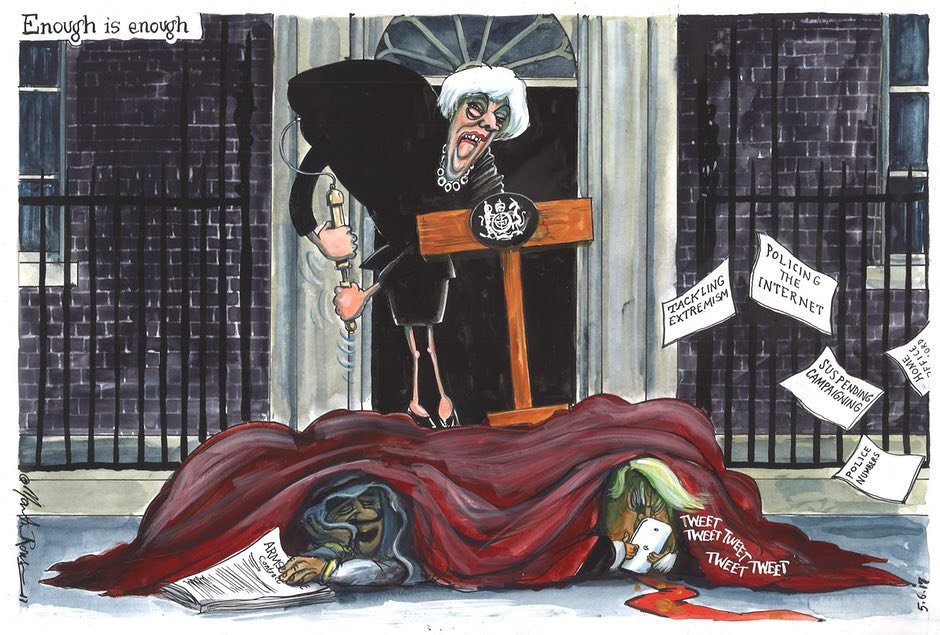
4872
Illustration: Martin Rowson

Theresa May, who has already pledged that the Conservatives will regulate and control the internet, was much more aggressive in her tone than previously. The London Bridge attack had its roots in Islamic extremism, she said: “We cannot allow this ideology the safe space it needs to breed. Yet that is precisely what the internet, and the big companies that provide internet-based services, provide.”

I don’t recall the IRA depending on the internet. Or mobile phones for that matter. There were no “safe space” online social networks to “radicalise” would-be IRA members, but those terror attacks happened, nonetheless. They ended when we negotiated lasting peace in 1998 through the Good Friday Agreement.

It’s been said many times that terrorists hate our democracy and want to destroy it. However, surely a police state is not the answer. The answer to illiberalism isn’t more illiberalism.

A governing system is illiberal when, despite the fact that elections take place, citizens are cut off from knowledge about the activities of those who exercise real power because of a lack of civil liberties.  Theresa May is the most illiberal prime minister in living memory.

A government that polices the internet as a response to terror attacks doesn’t bode well for democracy, either, though I do like a “strong and stable” internet connection as much as the next person. 

She continued: “We need to work with allied democratic governments to reach international agreements that regulate cyberspace to prevent the spread of extremism and terrorism planning.”

This government are adept at blaming others for their own failure to meet their basic responsibilities towards citizens. What we see time and again is aggressive authoritarian posturing and diversion strategies in the place of genuine and rational problem solving. 

How about ensuring we have a government that puts our safety first; one that that is not secretly helping countries that support jihadi groups. Theresa May has mentioned working with “allied democratic governments”. But it’s really the undemocratic ones – Saudi Arabia, for example – that would be a good place to start.

The problem of our government’s significant contribution to global instability
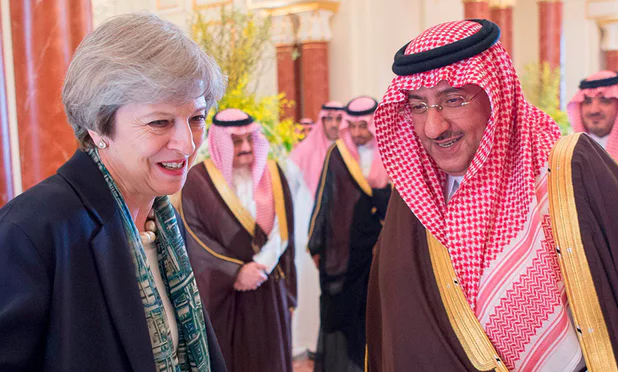
May and terrorism

Theresa May, welcomed in Riyadh by Saudi Arabian crown prince Muhammad bin Nayef.

The Conservatives have a long history of selling arms and weapon components to unstable nations and repressive regimes. Information about the Thatcher government’s duplicitous record in selling arms to Iraq emerged in the mammoth Scott inquiry of 1996. The judge found that although Conservative ministers had restricted major “sharp” arms sales to President Saddam Hussein, they had also connived at ways round Britain’s supposed neutrality. As the 1992-93 Scott Inquiry into arms-to-Iraq uncovered, until the time Saddam invaded Kuwait in August 1990, Baghdad had been a profitable recipient of UK arms for over a decade.

From 1980 to 1990 under Thatcher’s Cabinet, the United Kingdom provided £3.5 billion in trade credits to Iraq. This support continued on either side of Saddam’s ordering the poison gassing of Iranian conscript troops in 1983-84, and of his own people in Halabja, Kurdistan, in 1988, killing 5,000 innocent civilians. Thatcher sold the components of chemical weapons to Hussein.

Trade export credits to Iraq rose from £175 million in 1987 (before Halabja) to £340 million after Halabja, according to a press release from the then Department for Trade and Industry. Five months after the Halabja massacre, Thatcher’s foreign secretary, Sir Geoffrey (now Lord) Howe, noted in a report to Thatcher that with the August 1988 Iran-Iraq peace deal agreed, “opportunities for sales of defense equipment to Iran and Iraq will be considerable.” 

The UK government is still secretly selling arms to Saudi Arabia and other countries under an opaque type of export licence. The military and defence industry is a major player in the UK economy, worth around £7.7bn a year. 

But many of the countries buying British arms are run by governments with dubious human rights records, even though the destinations of such exports are supposed to meet human rights standards.  

There are also serious questions to be asked about the role of Saudi Arabia in fuelling terrorism and extremism in the region. There is no question that domestic solutions to terrorism are needed, but these are not aided in any way by arming human rights abusing regimes like Saudi Arabia. UK arms export law is very clear. It says that licences for military equipment should not be granted if there is a “clear risk” that it “might” be used in serious violation of international humanitarian law. By any reasonable interpretation these criteria should surely prohibit all arms sales to Saudi Arabia that could be used in Yemen. 

Saudi Arabia has been widely condemned for its role in the Yemeni conflict, where its airstrikes have been responsible for large numbers of civilian deaths.

Thousands have died in the Yemen campaign, with the Saudis accused of targeting civilians. Four-fifths of the population is in need of aid, and famine is gripping the country. But despite this, and protests from human rights groups and the United Nations, the UK has continued to arm the Saudi regime, licensing about £3.3bn of weapons to the kingdom since the bombing of Yemen began in March 2015.

More than £3bn of British-made weaponry was licensed for export last year to 21 of the Foreign Office’s 30 “human rights priority countries” – those identified by the government as being where “the worst, or greatest number of, human rights violations take place”, or “where we judge that the UK can make a real difference”. Listed countries that last year bought British arms and military equipment include: 

Saudi Arabia, which has been accused of perpetrating war crimes in Yemen.

Bahrain, which used troops to quell protests following the Arab spring.

Burundi, which is being investigated by the UN for human rights violations.

■ The Maldives, which in 2015 jailed its former president, Mohamed Nasheed, for 13 years following what critics said was a politically motivated show trial.

Sources: The Guardian.

In 2014 the UK licensed just £170m of arms to 18 of the 27 countries then on the “priority countries” list. The massive increase in sales was largely attributable to sales of weapons to Saudi Arabia. The largest export licence granted was for £1.7bn of fighter jets, agreed in May 2015. In July 2015 the UK approved the export of £990m of air-to-air missiles. In September, it approved the sale of £62m of bombs to the country. All three sales took place after the bombing of Yemen began in March 2015, prompting concerns that civilian buildings have been targeted, and widespread human rights violations taking place.

In 2015 the UK also approved licences of £84m of military equipment to Egypt, despite concerns about the country’s direction since the July 2013 coup that ousted its elected president, Mohamed Morsi. Figures show that in July 2015, a month after the UK refused export licences for the sale to Egypt of components for machine guns and training small arms ammunition, it approved the sale of sniper rifles, ammunition, pistols, body armour and assault rifles.

This is a clear case of the government saying one thing and doing another, and exposes the blatant doublespeak and hypocrisy that lies at the heart of UK foreign policy,” said Andrew Smith of the Campaign Against Arms Trade (CAAT), which compiled the export sales figures. 

“These arms sales are going to countries that even the Foreign Office accepts are run by some of the most brutal and oppressive regimes in the world,” he said. “The humanitarian situation in many of these countries is only getting worse, and yet the arms sales are increasing. They aren’t just providing military support for human rights abusers; they are sending a strong political support too.”

Last year, Peter Oborne wrote: “Jeremy Corbyn cannot be faulted for calling a debate on Yemen. For the past 18 months, Britain has been complicit with mass murder as our Saudi allies have bombarded Yemen from the air, slaughtering thousands of innocent people as well as helping fuel a humanitarian calamity.

Corbyn clearly felt that it was his duty as leader of a responsible and moral opposition to challenge this policy.”

Corbyn has said today: “The “difficult conversations” suggested by the Prime Minister in her Downing Street speech this morning should start with Saudi Arabia and other Gulf states that have funded and fuelled extremist ideology”.

“Our priority must be public safety and I will take whatever action is necessary and effective to protect the security of our people and our country,” Corbyn told his audience. 

“That includes full authority for the police to use whatever force is necessary to protect and save life as they did last night, as they did in Westminster in March.

“You cannot protect the public on the cheap. The police and security services must get the resources they need, not 20,000 police cuts.

“Theresa May was warned by the Police Federation but she accused them of ‘crying wolf’.”

“It is no good Theresa May suppressing a report into the foreign funding of extremist groups. We have to get serious about cutting off the funding to these terror networks, including Isis, here and in the Middle East.”

The inquiry that Corbyn refers to – an investigation into the foreign funding of extremist Islamist groups – may never be published, the Home Office has admitted. It is thought to focus on Saudi Arabia, which the UK recently approved £3.5bn worth of arms export licences to. 

Tom Brake, the Liberal Democrat foreign affairs spokesman, has written a letter to the Prime Minister pressing her on when the report will be published and what steps she proposes to take to address “one of the root causes of violent extremism in the UK”.

He goes on to say: “You will agree with me that the protection of our country, of the British people, is the most important job of any government. Certainly, more important than potential trade deals with questionable regimes, which appear to be the only explanation for your reticence.

“When will this report be finished and published? And what steps do you propose to take to address one of the root causes of violent extremism in the UK?”

Brake and others have accused May of adopting a “short-sighted approach” to the funding of violent Islamist groups in the UK and urged that those who fund them should be called out publicly. 

Despite claimed actions by the Saudi government to counter ISIS, the country’s religious establishment follows the same ideology as the terrorist group: wahhabism. Hillary Clinton’s US State Department memo, dated 17 August 2014, stated: “We need to use our diplomatic and more traditional intelligence assets to bring pressure on the governments of Qatar and Saudi Arabia, which are providing clandestine financial and logistic support to Isis and other radical Sunni groups in the region.”

This comes after Home Secretary Amber Rudd suggested during a leadership debate, that UK arms sales to Saudi Arabia are “good for industry.” 

Jeremy Corbyn is absolutely right to identify British foreign policy as a proximate cause of – not a justification for – terrorist threats (Guardian report, 26 May). Six weeks ago, the PM led a trade mission to Saudi Arabia. Under fire from Labour, she denied the UK had been selling its principles for the sake of trade deals for the post-Brexit era. Saudi Arabia is primarily important for selling us oil, and spending billions on buying arms. 

Yet many experts, including professionals in our intelligence and security services, have pointed to the connections between wars our government has supported or fought in other countries and terrorism here at home.

Corbyn has pointed out: “That assessment in no way reduces the guilt of those who attack our children. Those terrorists will forever be reviled and held to account for their actions. But an informed understanding of the causes of terrorism is an essential part of an effective response that will protect the security of our people that fights rather than fuels terrorism.”

The UK, the second-largest arms exporter in the world, approved licences for the sale of £7.7bn of arms last year, but its licensing export regime is under acute scrutiny amid fears British weaponry is being routinely used in Yemen. Last week a British-made cluster bomb, dating from the 1980s, was found to have been dropped on a village in Yemen, even though the use and supply of such weapons is banned under international law.

The Government has recently approved £3.5bn worth of arms export licences to Saudi Arabia and a stream of British ministers have visited the kingdom to solicit trade, despite its ongoing involvement in the bombing campaign in Yemen.

On 5 October 2014, retired General Jonathan Shaw told the Daily Telegraph that Qatar and Saudi Arabia were “primarily responsible for the rise of the extremist Islam that inspires Isil terrorists,” emphasising “This is a timebomb funded by Saudi and Qatari money and that must stop.” 

Foreign policy clearly plays some role in the recent horrific terror events in the UK. Consider the testimony of Jomana Abedi, the sister of the Manchester murderer, who said of her brother: “He saw the explosives America drops on children in Syria, and he wanted revenge,” before adding, rather chillingly: “Whether he got that is between him and God.”

There is also the posthumous video released by Mohammad Sidique Khan, key organiser of the 7/7 bombers, in which he cast himself as an “avenger” for the 2003 invasion of Iraq. And recall too the warnings of Britain’s security services, who feared the Iraq war would lead to increased radicalisation.

British foreign policy, including the involvement of troops in Iraq and Afghanistan, has exacerbated the risk of terrorist attacks by destabilising the Middle East and fuelling suspicion of the west.

In a speech at the Chatham House thinktank in May, Corbyn suggested a Labour government would seek to rely on a “triple commitment” to defence, development and diplomacy, to protect Britain’s interests, rather than a “bomb first, talk later” mentality. He has definitely stuck to is guns, as it were. He presents a genuinely in-depth, rational problem solving approach to protecting UK citizens.

Following the terror attack on Manchester, the Conservatives have seized on the electioneering opportunity to try and paint Labour as somehow “soft on terrorism.” 

But in addition to using diplomacy to address the problem of terrorism and its root causes, Labour pledge to put 20,000 more police officers on the streets. Corbyn said: Labour will reverse the cuts to our emergency services and police. Once again in Manchester, they have proved to be the best of us. Austerity has to stop at the A&E ward and at the police station door. We cannot be protected and cared for on the cheap.”

It is Corbyn who is prepared to look at the bigger and deeper picture regarding the causes of terrorism in the UK. The Conservatives prefer to suppress information regarding government contributions to those causes. The suppressed report is expected to reveal links between Saudi Arabia and extremist groups in the UK.  It was commissioned by the last coalition government in 2015 and due to be published last year but has never been emerged. Critics of the government believe it has been suppressed due to the UK government’s ongoing trade relationships with the country. 

Controlling the internet is a logical extension of May’s authoritarian Snooper’s Charter, which won’t stop terror attacks on the UK. Instead it will simply introduce huge restrictions on what people can post, share and publish online.

Government figures compiled by Campaign Against Arms Trade (CAAT) show the UK has licenced over £4.1 billion of arms to the Middle East since the last election in May 2015, and that two thirds of UK arms exports go to the Middle East.

The government’s arms deals include £15million in sales over the past five years to Libya, large parts of which are already controlled by the ISIS. 

Saudi is the hotbed of Islamist terror groups across the world. Yet on the televised leader’s debate, Amber Rudd defended Theresa May’s murderous Saudi allies who export an extremism which threatens our national security. She said that it was “good for industry”, a response that has appalled every other political party leader.

Arming the oil rich Islamist regimes may well be a lucrative political business but it really doesn’t matter to the Conservatives how many innocent civilians the Saudis massacre in Yemen using British weapons. Or the potential implications for innocent civilians in the UK.

The conditions created by the West’s war-sanctions-war policy in Iraq since 1991, left the country utterly broken, and a fertile breeding ground for extremism. In 2014, John Pilger wrote: “like Pol Pot and the Khmer Rouge, ISIS are the mutations of a western state terror dispensed by a venal imperial elite undeterred by the consequences of actions taken at great remove in distance and culture.”

The Conservatives have remained supremely unconcerned that the ISIS terrorists being bombed in Syria and Iraq by UK forces are filled with Saudi fighters and funded by Saudi cash. After all, selling weapons to both sides of a conflict has got to be more profitable than just selling weapons to one.

Theresa May has indicated that she in favour of the UK joining the US military action against Bashar al-Assad if she wins next month’s election. Boris Johnson, the Foreign Secretary, has previously indicated that the British Government could bypass the Commons and join Donald Trump’s military campaign in war-ravaged Syria if asked by the US administration. Speaking last month, Johnson said it would be “very difficult to say no” if the US asked the UK to join its efforts against Bashar al-Assad’s dictatorial regime in response to another chemical attack. He said “How exactly we were able to implement that would be for the Government, the Prime Minister.” 

Whitehall has a deep, long-standing special relationship with the extremist Saudis: it is arming them, backing them, apologising for them, and supporting their regional policies. At the same time, the Saudis have been helping to create the monster that now threatens the British public. So, too, have the policies of the British government also contributed.

May’s reluctance to disapprove of Trump’s increasingly rash decisions, such as his departure from the Paris Agreement, indicates quite clearly that she is not at all the “strong and stable” leader that she claims to be.

A group of British volunteers fighting Isis in Syria have called on the UK to vote for Jeremy Corbyn.

Members of the Kurdish People’s Protection Units (YPG) and its International Freedom Battalion backed the Labour leader’s controversial comments on foreign policy following the Manchester attack.

In a statement sent to the Independent (indy100) they said:

“Only Jeremy Corbyn knows the way to stop Isis – through a foreign policy that cuts off their funding and supplies at the source.

Only he has been outspoken in his condemnation of the oppression of Kurds in the Middle East at this crucial time, with the Kurdish-led Syrian Democratic Forces about to defeat Isis in their capital of Raqqa.

The longer Theresa May is Prime Minister, the less safe everybody is, both here in Syria and back home in the UK.

They accused May of allowing jihadis, including the Manchester bomber, Salman Abedi, to travel between the UK and Libya during the country’s civil war, as well as selling arms to countries that support Islamist rebels in Syria.

“Along with her toffee-nosed millionaire colleagues in the Conservative Party, she has brought nothing but instability to this region,” their statement read.

Nuclear terrorism is also now a growing threat. In March 2016, it was reported that a senior Belgian nuclear official was being monitored by ISIS suspects linked to the November 2015 Paris attacks leading Belgium authorities to suspect that ISIS was planning on abducting the official to obtain nuclear materials for a “dirty bomb”.

In April 2016, EU and NATO security chiefs warned that ISIS are plotting to carry out nuclear attacks on the UK and Europe. It is also feared that Islamic State of Iraq and the Levant (Isil) have obtained a stockpile of former Iraqi short range missiles such as surface to air rockets. There is a “justified concern” that Islamist fanatics in Syria and Iraq are trying to obtain the means of mass destruction such as biological, chemical and radiological weapons.

The risk of nuclear attack is exacerbated by aggressive first strike posturing

zlqPorb

In April, the United Nations (UN) published a major report which highlights the massive risk of both an accidental and the deliberate use of the world’s most catastrophic weapons. The “poor relations” between nuclear powers has contributed to an atmosphere that “lends itself to the onset of crisis,”  the report by the UN Institute for Disarmament Research says.

The report said: “The rise in cyber warfare and hacking has left the technical vulnerabilities of deadly nuclear weapons systems exposed to risk from states and terrorist groups.” 

It went on: “Nuclear deterrence works – up until the time it will prove not to work. The risk is inherent and, when luck runs out, the results will be catastrophic.”

“The more arms produced, particularly in countries with unstable societies, the more potential exists for terrorist acquisition and use of nuclear weapons.”

The report added that denuclearisation would require “visionary leadership”, but added this was “sadly rare” as many powerful states have “increasingly turn inward”. Nationalism has certainly grown on a global scale over recent years.

The report goes on to say that new technology and spending on nuclear weapons had “enhanced” the risk of a detonation. However, it acknowledged the secrecy surrounding the programmes made it difficult to accurately assess their true scope. 

Increased reliance on technology has also introduced new problems. In the past, accidental nuclear detonations have been averted by human decisions. Replacing military officers with computers could therefore rule out a potential safety check on the weapons, and open the possibility of hacking a nuclear weapon. 

The report also referenced the January 2017 decision of the Bulletin of the Atomic Scientists Science to move the Doomsday Clock to two and a half minutes to midnight because of fears of a nuclear event – the most risky position it has been at since 1953.

The politics of megalomania

In April 2017 Defence Secretary Michael Fallon confirmed that the UK would use nuclear weapons in a “pre-emptive initial strike” in “the most extreme circumstances.” He doesn’t specify precisely what those circumstances may be. Nor does he say which country may be the UK’s likeliest target.

In an extraordinary act of aggressive posturing, he added that a first strike may be launched even if Britain itself was not under threat of nuclear attack. He said that national security need not be under threat to warrant a “pre-emptive” nuclear launch. 

Asked in what circumstances the Conservatives would launch a first strike, Fallon replied: “They are better not specified or described, which would only give comfort to our enemies and make the deterrent less credible.”

He clearly doesn’t understand the principle of “deterrence”, then. That is pretty scary. You would hope that a government responsible for the safety of citizens would only ever launch a nuclear attack as a very last resort, once all other options, such as diplomacy and negotiation, had been completely exhausted. How discomforting that Fallon sees the UK public as disposable – collateral damage. Why on earth would anyone trust a defence secretary who makes such an irrational comment – “even if Britain itself was not under threat of nuclear attack. He said that national security “need not be under threat to warrant a “pre-emptive” nuclear launch”. It sounds very much like the Conservatives have a specific target in mind, to me. I don’t think the changed nuclear posture – and without an open review – has come about incidentally or on a whim.

That statement doesn’t bode well for democratic accountability, nor is it particularly reassuring that the Conservatives plan to prioritise the safety and protection citizens’ lives and the planet. That is surely the key strategic value of having a nuclear deterrent – that all parties in a potential conflict would be reluctant to launch a first strike because of the catastrophic consequences of a probable retaliation.

Fallon continued: “The whole point about the deterrent is that you have got to leave uncertainty in the mind of anyone who might be thinking of using weapons against this country.”

No you don’t. The point of deterrence is that nuclear weapons deter a first strike because of an assumed retaliatory second strike.

Fallon also insisted that critics of Trident – including senior military figures who have ridiculed the idea that it is an effective deterrent – were “absolutely wrong”.

A report – British military attitudes to nuclear weapons and disarmament – by the Nuclear Information Service (NIS) and the Nuclear Education Trust – is a ground-breaking study into military thinking on nuclear weapons. And it is rather startling to find that the military establishment is far from unanimous on the issue of Trident replacement. Some participants in the study, commenting on the exorbitant cost of Trident replacement, stated that “no circumstances justify the large amounts of money required by [Trident] and this money would be better spent elsewhere.”  The problem is that a majority of the wider public generally support having of a nuclear deterrent.  

Many participants in the NIS survey were also unclear about many aspects of the UK’s nuclear weapons, including their costs, purpose and credibility. Many in the military think Trident is a “political” tool and little more and many would rather see the money spent on equipment which could actually be used: especially at a time when the forces have been faced with spending cuts. 

The Labour party manifesto states a clear commitment to renewing Trident under a Labour government. However, controversy in the media – directed by misleading comments from the Conservatives – has unbelievably problematised Corbyn’s perfectly reasonable caution in committing to launching a pre-emptive nuclear attack.

Personally I would much rather the prime minister put effort into finding rational diplomatic solutions to protect the UK citizenry, rather than dancing in an unholy, manic glee at the very prospect of our assured nuclear annihilation.  

The debate, being cheer-led from the right, has descended into a macabre and somewhat irrational political point-scoring exercise, using a strategy of tension in an attempt at portraying the opposition leader as “weak”. This is a tactic that the Conservatives use at every single election, regardless of who is the leader of the opposition. Usually, though, they don’t show a grotesque display of eagerness to bring about Armageddon to demonstrate a “strong and stable” leadership. 

Deterrence and Mutually Assured Destruction: what that actually means

Mutually assured destruction (MAD) is a military doctrine and national security policy in which a full-scale use of nuclear weapons by two or more opposing sides would cause the complete annihilation of both the attacker and the defender. MAD is based on the strategy of deterrence, which holds that the threat of using catastrophic weapons against an enemy prevents the enemy’s use of those same weapons. The strategy is a form of Nash equilibrium (games theory), in which, once armed, neither side has any incentive to initiate a conflict or to disarm.

The deterrence strategy further rests on assumption that neither side will dare to launch a first strike because the other side would launch on warning (also called fail-deadly) or with surviving forces (a second strike), resulting in unacceptably catastrophic losses for both parties. The strategic MAD payoff is therefore an ongoing expectation of a tense global stability and peace. 

The major flaw in a first strike approach is that it encourages the opponent to perform a massive counterforce first strike. If both sides of a conflict adopt the same stance of massive response, it may result in unlimited and globally devastating escalation (a “nuclear spasm”), each believing that the other will back down after the first round of retaliation. This said, both problems are not unique to massive retaliation, but to nuclear deterrence as a whole. 

It is for these reasons that many countries have adopted a minimum credible deterrent/second strike policy. Previously we had a policy of using nuclear weapons only as a defence. 

Many of those arguing both for and against no-first-use misunderstand it: The policy reflects the power to set the rules of war, rather than some wayward pacifist ideal to end all war. Countries that issue no-first-use pledges boast strong conventional militaries. These states want to encourage a model of war where their army meets the enemy on a conventional battlefield with clearly defined rules – the kind of war, in other words, that they usually win. Nuclear weapons upend this model, because they help weaker actors, the North Koreas and Pakistans of the world, produce extraordinary destruction, level the playing field, and cast victory into doubt.

Therefore, a no-first-use pledge could potentially reinforce a powerful state’s strategic advantage by discouraging other countries from developing nuclear arsenals, and by dissuading nuclear-armed countries from pushing the button. This would happen with the assurance that a state would not fire first – thereby keeping war safely bound and safely winnable, on the powerful state’s terms.

In an article published in the Atlantic last year, titled Refusing to Nuke First. Why rejecting nuclear preemption reflects strength, not weakness, Dominic Tierney says:

“Countries that contemplate or introduce a no-first-use policy are almost always strong states that enjoy a conventional-weapons edge. Since its first nuclear test in 1964, China has repeatedly declared that it “undertakes not to be the first to use nuclear weapons at any time or under any circumstances.” It’s no coincidence that China is the most powerful East Asian country, and would hold the advantage in any conventional war with South Korea, Vietnam, Japan, or Taiwan (assuming, of course, that the United States stayed out). The spread of nuclear weapons in East Asia would diminish China’s strategic advantage; therefore, Beijing seeks to prevent this outcome with a no-first-use policy.

India announced in 1999 that it “will not be the first to initiate a nuclear strike, but will respond with punitive retaliation should deterrence fail.” In 2003, India qualified its no-first-use pledge by stating, “in the event of a major attack against India, or Indian forces anywhere, by biological or chemical weapons, India will retain the option of retaliating with nuclear weapons.” Again, it’s no coincidence that India is very likely to prevail over Pakistan in a future conventional war. India has a history of winning previous contests, and currently spends about $50 billion per year on defense compared to Pakistan’s $9.5 billion. New Delhi can safely issue a no-first-use pledge in the hope of keeping the strategic terrain favorable.

In  2016, General James E. Cartwright, former head of the US Strategic Command, and Bruce G. Blair, former Minuteman launch officer, co-authored an op-ed in The New York Times in favor of a U.S. no-first-use policy. They showed, explicitly, how power undergirds the proposed doctrine. “Our nonnuclear strength, including economic and diplomatic power, our alliances, our conventional and cyber weaponry and our technological advantages, constitute a global military juggernaut unmatched in history. The United States simply does not need nuclear weapons to defend its own and its allies’ vital interests, as long as our adversaries refrain from their use.”

If a country is willing to use nuclear weapons, it’s also willing to break a promise.

By contrast, weak states don’t even think about a no-first-use policy. Indeed, threatening to push the button early in a conflict is the basis of their deterrent plan. During the Cold War, when the Soviet Union had conventional superiority in Europe, the United States and its NATO allies intended to escalate to nuclear war if the Red Army launched an invasion. Similarly, today, Pakistan explicitly threatens to retaliate with nuclear weapons if it is ever attacked – even through a conventional invasion.

Viewed through a strategic – and perhaps more cynical – lens, the no-first-use doctrine also has a huge credibility problem. For the US pledge to truly matter, a president who otherwise favors a nuclear first strike would have to decide not to press the button because of this policy. But in an extreme national crisis – one involving, say, North Korean nuclear missiles – a president is unlikely to feel bound by America’s former assurance. After all, if a country is willing to use nuclear weapons, it’s also willing to break a promise.

Champions and critics of no-first-use often cast it as a principled policy and a revolutionary step, for good or for ill. But the idealistic symbolism of no-first-use betrays an underlying reality. Disavowing a first strike is a luxury afforded to the strong, and they play this card in the hope of strategic benefit. If Obama made a dramatic announcement of no-first-use, it would probably have less impact than people think because other countries wouldn’t follow suit, especially if they’re weak. And, in any case, the promise may be meaningless because no one can predict a president’s calculus when staring down a nuclear holocaust.

No-first-use is the policy of Goliath, not Gandhi.”

Former US Secretary of Defense William Perry said: “During my period as Secretary of Defense, I never confronted a situation, or could even imagine a situation, in which I would recommend that the President make a first strike with nuclear weapons  – understanding that such an action, whatever the provocation, would likely bring about the end of civilization.”

Perry’s life’s work, most of it highly classified, was nuclear weapons. He played a supporting role in the Cuban Missile Crisis, during which he went back to his Washington hotel room each night, fearing he had only hours left to live. He later founded his own successful defense firm, helped revolutionize the US way of high-tech war, and honed his diplomatic skills seeking common ground on security issues with the Soviets and Chinese. 

Nuclear bombs are an area of expertise for Perry, who had assumed they would be largely obsolete by now, seven decades after Hiroshima and Nagasaki, a quarter of a century after the fall of the Soviet Union. Instead, once again they have become a contemporary nightmare, and an emphatically ascendant one. A Russian president has recently make bellicose boasts about his arsenal. An American president free-associates on Twitter about starting a new nuclear arms race. Decades of cooperation between the two nations on arms control is nearly at a standstill. And, unlike the original Cold War, this time there is a world of busy fanatics excited by the prospect of a planet with more bombs – people who have already demonstrated the desire to slaughter many thousands of people in an instant. 

Perry is now a senior fellow at Stanford University’s Center for International Security and Cooperation. He serves as director of the Preventive Defense Project. He is an expert in US foreign policy, national security and arms control. In 2013 he founded the William J Perry Project (http://www.wjperryproject.org/), a non-profit effort to educate the public on the current dangers of nuclear weapons.

Disarmament has fallen far from the top of the policy priority list. The largest upcoming generation, the millennials, were raised in a time when the problem felt largely solved, and it’s easy for them to imagine it’s still quietly fading into history.  

Since the end of the Cold War, we no longer think about the threat of a nuclear holocaust every day. It’s not embedded in our public psyche. During the Cold War the United States relied on deterrence rather than prevention as the central principle of its security strategy. However, Trump’s recent posturing indicates a far more aggressive stance, implying a shift from a defensive to a rather more offensive approach, making him an extremely unpredictable custodian of the substantial US nuclear arsenal.

The problem is that the threat of a nuclear event and escalation is no longer retreating. Perry said in an interview in his Stanford office: “Today, the danger of some sort of nuclear catastrophe is greater than it was during the Cold War, and most people are blissfully unaware of this danger.”

A report published today, during the UK’s General Election period, seeks to reframe the nuclear debate within the UK. The report comes from the British American Security Information Council (BASIC) and the United Nations Association (UNA-UK).

Up until now, the debate has been dominated by the decision about whether to invest in a renewal of the Trident system, linked to political judgements about the responsibilities of governments to maintain strong defence capabilities. As a result, wider questions about how best to tackle global nuclear dangers have been neglected.

This matters, particularly as the crisis with North Korea unfolds, but also as relations with Russia deteriorate and states frustrated with a lack of progress on disarmament begin negotiating a treaty to ban nuclear weapons without any nuclear armed states in the room. Commitment to the bargain at the heart of the nuclear non‑proliferation regime, always a little shaky as interpretations of its priorities have been contested, could easily fray, with drastic risks to global security.

This issue sits within broader questions about the UK’s role in the world. As we move through a period of growing instability, the need for effective international mechanisms to promote security is greater than at any other time since the UN was founded. Their success depends on states’ willingness to work together. The increasingly fractious geopolitical environment, however, is impeding progress and putting further pressure on our post-war international system, already overstretched by the convergence of multiple crises.

As a permanent member of the UN Security Council, a nuclear weapon state and one of the largest aid donors, the UK is an important player on the world stage. The international system has delivered prosperity and security for the UK as a whole. Its breakdown could have serious – and, in the context of nuclear weapons, existential – consequences for the country. Unfortunately, the UK has not been immune to the growing reluctance by states to invest in the continuing health of this system. 

Over the past decade, voices calling for a narrower outlook have grown louder in this country, as in many the world over. But the line between national and global interests is disappearing. British foreign policy must embrace this reality and prioritise strengthening collective efforts to create a more peaceful world.

The need for nuclear disarmament through multilateral diplomacy is greater now than it has been at any stage since the end of the Cold War. Trust and confidence in the existing nuclear non-proliferation regime is fraying, tensions are high, goals are misaligned, and dialogue is irregular. 

In Meaningful MultilateralismBASIC and UNA–UK offer 30 multilateral disarmament proposals for the incoming UK Government after the General Election on June 8, themed according to three types of leadership the UK has previously shown in disarmament:

Diplomatic leadership

• Technical leadership

• Leadership by example

The Conservatives don’t fulfil any of these criteria because of their strong authoritarian tendencies, and they certainly haven’t demonstrated a preference for diplomacy or leadership by example in particular.

Whatever one’s position on Trident, there are meaningful steps that can be taken in multilateral disarmament, and the next UK Government should actively take a leadership role.

The current growing global instability is a turn of events that has William Perry, former US defense Secretary, obsessed with one question: Why isn’t everyone as terrified as he is?

Why indeed.

There is a crisis in the Nuclear Non-Proliferation Treaty, with its vision unraveling due to different views on disarmament. If the deterrence principle were to break down, the potential global humanitarian impact would be truly apocalyptic. The strategic offence doctrine of Mutually Assured Destruction means just that. In such an exchange, there can’t possibly be a winner. It wouldn’t be a simple act of genocide. A nuclear exchange may well culminate in omnicide – a small word that means the totalising enormity of the end of everything for everyone. Even a restrained tactical exchange would most probably have catastrophic bioecological and wider global impacts, and a devastating breakdown of civilisation. 

Everyone agrees that the risk of nuclear war is bad; if all else were equal, we would rather not have this risk. But all else is not equal. The probability of nuclear war is not zero. Nuclear deterrence can fail. It is a fallacy to presume that just because no nuclear war has occurred since the post-World War II advent of nuclear deterrence, therefore it will never happen. The historical record contains several near-misses in which nuclear war was narrowly avoided due in no small part to luck.  

The argument that nuclear deterrence makes the world a safer place is not particularly persuasive.

First strike posturing is considerably less so.


My work is unfunded and I don’t make any money from it. But you can support Politics and Insights and contribute by making a donation which will help me continue to research and write informative, insightful and independent articles, and to provide support to others.

DonatenowButton

Conservative dark ads on Facebook and the media commentaries grossly misrepresent Corbyn’s views on ‘national security’ issues

Pg-26-sinking-reu

                The real – Right wing authoritarian meets Pinochet

image-20150206-28612-128izlw

The fake – Déjà vu: the Tories seem to imply that every Labour leader has “links” with the IRA and need a “coalition of chaos” to succeed. 

There is a picture of Corbyn circulating in both the mainstream media and on social media that was taken in 1995 with Gerry Adams, of Sinn Fein, in an attempt to try and link Corbyn with the IRA, albeit indirectly. The picture was actually taken after the Downing Street Declaration (an agreement between the UK and Ireland that the Northern Irish people had the right to self determination) which led to the first IRA ceasefire.

Corbyn contributed to the debate by pushing the IRA to abandon the bombings and sit down to negotiate since the 1980s. Margaret Thatcher held secret meetings with the IRA with the very same objective. By 1995, the Conservative Prime Minister John Major had taken the first hugely important steps towards peace in Northern Ireland. Blair built on that with the Good Friday Agreement, which led to lasting peace.

Corbyn has publicly denounced ALL acts of terrorism. Several times.

 Image result for Corbyn's links with IRA
You never hear of the Tories being “concerned” about Prince Charles’s links with the IRA, do you.

Image result for Theresa May meets Gerry Adams
Or Donald Trump’s

Image result for Theresa May meets Gerry Adams
and curiously, Boris Johnson’s (what a complete hypocrit).

DBV_9kHW0AE-2T6

The Conservatives win general elections by using a combination of lying, smearing the opposition, misquoting the opposition and micro-targeted psychological manipulation that largely entails fearmongering and more lies.  Furthermore, much of this approach is being embedded in “dark ads” on social media, which target individuals, and are tailored according to the psychological profile of the recipient, to manipulate their perceptions. The profiling is based on “big data”, collected from a variety of sources, including social media platforms. The role of big data and social data and the micro-targeting of voters to influence voting decisions and election outcomes cannot be ignored.

The Information Commissioner’s Office (ICO), a public body in charge of data protection in Britain, began a formal investigation into the use of data analytics for political purposes last month. In a statement, an ICO spokesperson said:

“These tools have a significant potential impact on individuals’ privacy,” adding that public awareness about how personal data was being collected online was generally low.

“It is important that there is greater and genuine transparency about the use of such techniques.”

Facebook itself has declined to comment on its advertising sales strategy for the British election.

In 2015, I wrote an article about Cameron being subjected to much ridicule after he misquoted the leader of the opposition, Jeremy Corbyn, by taking his comments out of context, during the Prime minster’s Conservative party conference speech. This led to thousands of people sharing a video of Cameron himself describing Osama bin Laden’s death as “a tragedy.” 

Corbyn’s original comments had come from an interview with Iranian news channel, The Agenda. During the interview, Jeremy Corbyn, who was actually introduced as an “outspoken rebel in the Labour party’s ranks”, said:

“There was no attempt whatsoever that I can see to arrest him, to put him on trial, to go through that process.

This was an assassination attempt, and is yet another tragedy, upon a tragedy, upon a tragedy.

The World Trade Center was a tragedy, the attack on Afghanistan was a tragedy, the war in Iraq was a tragedy. Tens of thousands of people have died. Torture has come back on to the world stage, been canonised virtually into law by Guantanamo and Bagram.”

However the malicious Cameron made no show of an attempt at quoting Corbyn correctly and instead used the old quote out of context, to mislead people, claiming he felt Corbyn somehow constituted a “threat to national security.” This is a long running theme in Conservative propaganda.

BBC’s Steven Sackur has previously said that as soon as Corbyn was elected as Labour party leader, the Conservatives “issued propaganda” suggesting that Corbyn is a “threat” to national security. He also pointed directly to the government’s fundamental lack of accountability, transparency and democracy in the unprecedented move to refuse to share military and intelligence information in 2015, which is conventionally shared with the leader of the opposition.

“National security” is a theme that has run through the Conservatives campaigns and media commentary since. It works because it generates fear. It’s the political use of psychological manipulation at its very worst, as it presents an “enemy” for the public to vote against, rather than something inspiring to vote for. 

The Conservative party always emphasise and distort issues of national defense and magnify our perception of threat, whether of foreign aggressors, immigrants, terrorists, or “invading” ideologies like Socialism (see the Zinoviev letter, for example). They reduce and present the world as a frightening place, and justify authoritarian policies to remedy the perceived threats. This is then used to portray the party as “strong”, and any opposition as “weak”. 

The Conservatives, with the cooperation of much of the media, are using this strategy of tension, designed intentionally to create public alarm, to divide, manipulate, and control public opinion using fear, propaganda, disinformation, intensive psychological operations and false flags in order to achieve their strategic aims – to portray the left as a “threat” to the wellbeing of society – and it reverberates around the media, to be used as part of an arsenal of pro-establishment, anti-progressive propaganda to discredit Corbyn. That is before he even has an opportunity to put the record straight. Yet even a glance through the Labour manifesto shows that this “threat” patently untrue.

The Labour party has again accused the Conservatives of creating “fake news” after a Tory attack video that went viral was edited to show Jeremy Corbyn refusing to condemn the IRA, when in fact the Labour leader said: “I condemn all the bombing by the loyalists and the IRA.”

The 85-second montage of Corbyn’s quotes has been circulating online for the last week and has been viewed 5.3m times, three times more than any other political campaign video. The Conservatives are also paying Facebook to insert it into people’s news feeds. It is subtitled: “On June 9th, this man could be Prime Minister. We can’t let that happen.”

Actually, we can and must. The frightful and unthinkable alternative is an extreme authoritarian right wing government with clear fascistic tendencies. 

Another Facebook advert that was paid for by the Conservatives claims Corbyn wants to abolish Britain’s armed forces. This is false. The Labour manifesto pledges to spend 2% of GDP on defence and states: “We will ensure that our armed forces are properly equipped and resourced to respond to wide-ranging security challenges.”

A spokesperson for the Labour Party said: “The Conservatives are running a hateful campaign based on smears, innuendo and fake news.

“They do so because they have nothing to offer the British people and their super-rich donors fear Labour’s plan to transform Britain for the many not the few.”

For balance, the Guardian asked Conservative HQ if they wanted to highlight false claims in any Labour party advertisments, but it declined. 

The media don’t help people sift facts from fiction either. Home Secretary Amber Rudd has claimed several times that she is “worried” about Labour’s ability to deal with terror threats. She based her claim on Corbyn’s “voting record”, saying: 

“I am shocked that Jeremy Corbyn, just in 2011, boasted that he had opposed every piece of anti-terror legislation in his 30 years in office.”

Much to Rudd’s discomfort, Corbyn has replied:

“Can I just remind you that in 2005 Theresa May voted against the anti-terror legislation at that time. She voted against it, as did David Davis, as did a number of people that are now in your cabinet, because they felt that the legislation was giving too much executive power.”  Jeremy Corbyn, Labour leader, BBC Election Debate.

I looked at the voting records to fact check this. Corbyn is right, of course. Here is what I found:

On 28 Feb 2005: Theresa May voted no on the Prevention of Terrorism Bill — Third Reading 

On 9 Mar 2005: Theresa May voted no on Prevention of Terrorism Bill — Rejection of New Lords’ Amendment — Sunset Clause

On 9 Mar 2005: Theresa May voted no on Prevention of Terrorism Bill — Rejection of Lords’ Amendment — Human Rights Obligations

On 10 Mar 2005: Theresa May voted no on Prevention of Terrorism Bill — Insisted Amendment — on Human Rights Obligations 

Source: Theyworkforyou.  

Broadening my search, I also found:

Terrorism Act 2000 – legislation introduced by the Labour government which gave a broad definition of terrorism for the first time. The Act also gave the police the power to detain terrorist suspects for up to seven days and created a list of proscribed terrorist organisations.

May: Absent from the final vote (there was no Second Reading)

Counter-terrorism Act 2008

This legislation gave powers to the police to question terrorist suspects after they had been charged. It also tried to extend detention without charge to 42 days, but the Labour government abandoned this after being defeated in the House of Lords.

May: Absent from the vote

Character assassination

Character assassination is a deliberate and sustained process that destroys the credibility and reputation of a person, institution, or social group. The method involves a mix of open and covert methods, such as raising false accusations, planting and fostering rumours, and manipulating information. It may also involve exaggeration, misleading half-truthsto present an untrue picture of the targeted person. It is a form of defamation and typifies the Conservative overuse of ad hominem argument in debate.

The Labour leader’s rising popularity, particularly since his recent televised appearances, has led to the Conservatives stepping up their heavy targeting of Corbyn with nine out of 10 of their adverts attacking him, according to an analysis of 889 Facebook ads placed by the three main parties into the feeds of more than 8,000 voters. The data has been gathered by the Who Targets Me project and analysed by the Bureau of Investigative Journalism.

One ad is subtitled: “A leader who supports our armed forces or one who wants to abolish them? The choice is clear: Corbyn and your security is too big a risk.”

By contrast, the Labour party hardly Theresa May in its social media campaign with only 9% of the 136 different ads seen so far by Who Targets Me referring to the prime minister.

The adverts that Labour is promoting hardest are related to policy, but the majority are urging people to get out and vote. The next most common topics addressed in paid for ads by the party are the NHS and tuition fees. The Conservatives are focusing most on smearing Corbyn, Brexit, the economy and security while the Liberal Democrats are using Facebook ads to talk about Brexit and dementia but also to seek donations.

The fact that the Conservatives feel safe enough to reduce politics to little more than smear and fear campaigning, and accusing anyone opposing them as subverting “the people’s will” indicates just how dangerously authoritarian they are.

It’s not as if the Conservatives have demonstrated any such democratic accountability and actually care about what the wider public think, until the run-up to an election day. Nor do they listen to what we have to say. A plurality of perspectives and healthy debate are the foundation of democracy, yet the Conservatives don’t want that. 

Image result for saboteurs daily mail
Elections are supposed to provide choices: the opportunity for voters to have a say on the big issues. There is no shortage of serious questions facing Britain in 2017 – not just what type of relationship we want with the European Union after we leave, but on a much wider range of important economic and social challenges, after seven years of an unsuccessful “long term plan” of austerity cuts. 

It’s time to ensure that your voting decision is based on real policy choices, a responsible decision that prioritises both societies’ and your own best interests, rather than on a fleeting emotional response from empty style-over-content marketing strategies, and superficial glittering generalities captured in a meaningess Tory slogan or meme. The Tories don’t do dialogue or democracy: they simply shout over their opponents and critics very loudly to stifle healthy debate. They also pay a lot of money to ensure that they saturate social media with toxic smear campaigns and lies.

Don’t let the Tories buy the election again.


vote_labour_red


I don’t make any money from my work. But you can support Politics and Insights and contribute by making a donation which will help me continue to research and write informative, insightful and independent articles, and to provide support to others. The smallest amount is much appreciated, and helps to keep my articles free and accessible to all – thank you.

DonatenowButton


Alleged Conservative Twitter account claims poor people are ‘dangerous’ and food bank users spend their money on drugs and alcohol

Tories on poor

A Twitter account claiming to be the Lincolnshire Conservatives has been suspended after complaints were made about some of its tweets which said poor people were “dangerous” and food bank users had “no cooking skills”.

The tweets were posted overnight on June 2  and originate from an account claiming to be to be the official Twitter account for Lincolnshire Conservatives, with a location tag in Grantham. 

Several offensive tweets were posted, including ridiculous with claims that Labour leader Jeremy Corbyn was “impotent” and “disappoints his wife,” suggesting that he would similarly disappoint voters.

The poster boasted about tweeting from Grantham, the birthplace of Margaret Thatcher, and professing to have “never been more confident” about winning the election.

Tweets from the account also said: “The vast majority of people who use food banks have poor budgeting skills and no cooking skills.

“They usually resort to a life crime and then blame the government for their deplorable lifestyle. Corbyn supports those rogues.”

The account also tweeted that “poor people are not “vulnerable”, they are dangerous due to the fact that they are addicted to drugs and have NOTHING to lose.

It’s certainly true that Conservative ministers and peers such as Iain Duncan Smith and Baroness Jenkin of Kennington, have tended to conflate poverty with poor budgeting and cooking skills. Many Tories have implied poverty arises because of “faulty behaviours” and “lifestyle choices” rather than being a consequence of political choices and policies that extend inequality, and an inevitable feature of our “competitive” economic organisation.

This scapegoating approach has been used by the Conservatives to attempt to justify the extremely punitive “behaviour change” policies and austerity programme directed almost exclusively at the poorest citizens. 

Both Iain Duncan Smith and David Cameron have previously implied that poverty arises because of “worklessness”, obesity, alcoholism and substance misuse. There is no evidence to support this claim. In fact the available evidence strongly suggests that individuals are more likely to drink regularly and above recommended limits during the week if s/he is a high-income earning managerial/professional worker. 

The tweets, from a fake account or otherwise, certainly capture something of the Conservative mindset, and reflect their traditional prejudices.

Richard Davies, Conservative county councillor for Grantham, North West, told Lincolnshire Reporter: “It’s a fake account.

“We’ve reported it to Twitter for impersonating us and they’ve taken it down.

“Our account is @LincsTories.”

It’s unusual for Conservatives to call themselves “Tories” because of the derogatory connotations of the word – “Tory” derives from the Irish word tóraidhe; modern Irish tóraí; modern Scottish Gaelic Tòraidh: outlaw, robber or brigand, from the Irish word tóir, meaning “pursuit”, since outlaws were “pursued men”. The term was originally a term of abuse, and remains a pejorative.


See also: Conservatives, Cruelty and the Collective Unconscious


I don’t make any money from my work. But you can support Politics and Insights and contribute by making a donation which will help me continue to research and write informative, insightful and independent articles, and to provide support to others. The smallest amount is much appreciated, and helps to keep my articles free and accessible to all – thank you.

DonatenowButton


A comparison of Labour and Conservative manifestos – CLASS

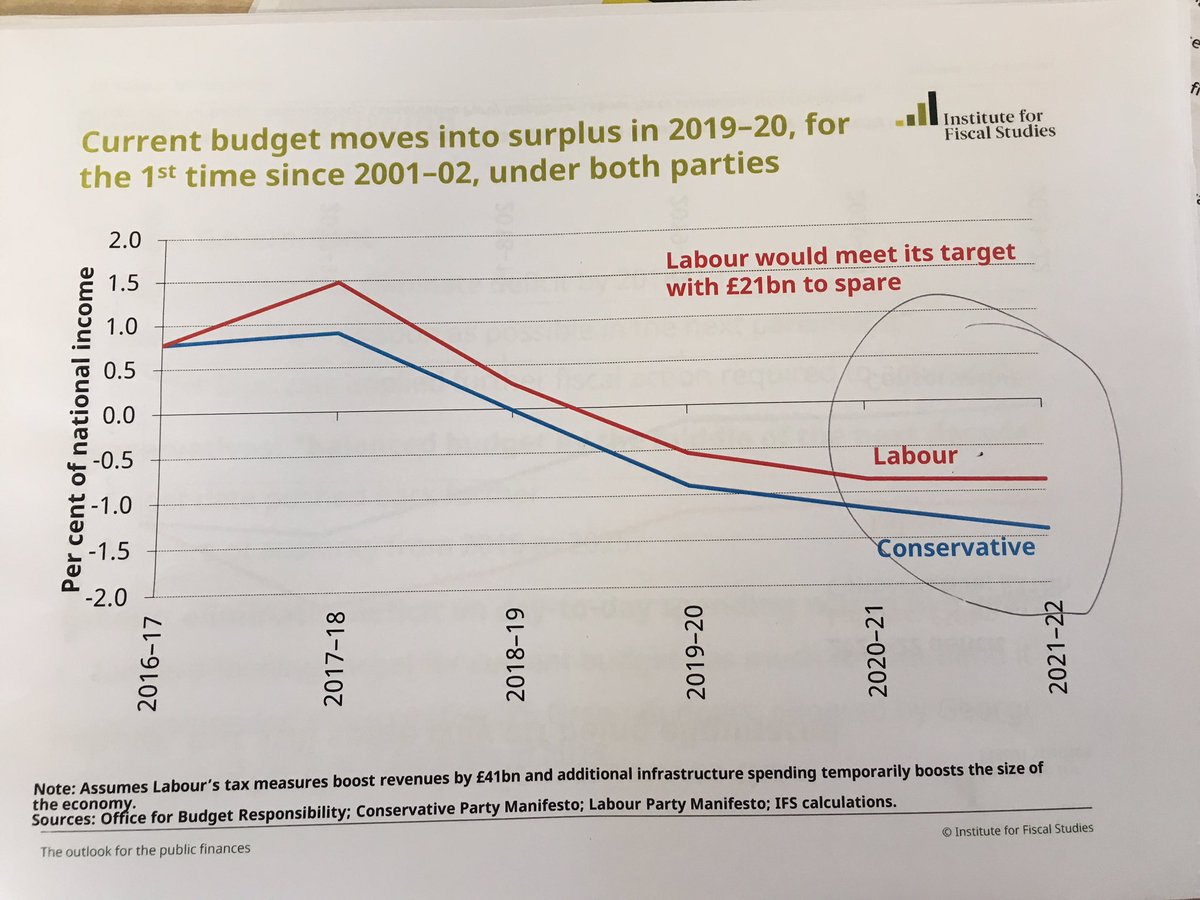
The Institute For Fiscal Studies (IFS) analysis of the Conservative and Labour manifesto proposals, which shows that both parties will run a surplus by 2019/20 , with Labour having £21 Billion spare. 

The Centre for Labour and Social Studies (CLASS) is a thinktank established in 2012 to act as a centre for left debate and discussion. Originating in the labour movement, CLASS works with a broad coalition of supporters, academics and experts to develop and advance alternative policies. 

CLASS produces briefings, policy papers and think pieces to influence policy development, which spans a field. Projects already underway address issues of growth and the economy, work and pay, housing and equality, security and aspiration, democracy and welfare, amongst many others.

CLASS have produced a comprehensive briefing which  breaks down and compares Labour and Conservative manifesto proposals across policy areas including public services, tax, education, employment and Brexit.

Here is a summary. I recommend you read the full report here.

Brexit

Labour has pledged to focus on jobs and living standards as the first priorities in Brexit negotiations:

 Labour states that leaving the EU with no deal would be the worst possible outcome, and reject it as a possibility.

 Labour has accepted the end of freedom of movement, meaning that the UK will have to leave the single market.

 Labour wants to maintain as many benefits of the single market and customs union as possible.

 Labour will scrap the Conservatives’ Great Repeal Bill, replacing it with an EU Rights and Protections Bill that will protect working rights, consumer rights, equality law and environmental protections.

The Conservatives have made Brexit a central theme in their manifesto, stating that it is the biggest challenge the UK will face in most of our lifetimes.

 The Conservative manifesto maintains that no deal would be better than a bad deal.

 The Conservatives have pledged to scrap freedom of movement as a red line in Brexit negotiations. This means that the UK will leave the single market, which is made clear in the manifesto.

 The Conservative manifesto pledges a deep and special relationship with the EU, but there are no specific details. 

Conclusion: Both Labour and the Conservatives have pledged to accept the referendum result, and both parties voted to trigger Article 50 and start the formal process of leaving the EU.

However, their priorities in Brexit negotiations are different. The Conservatives’ acceptance that no deal is a possibility for Brexit would have huge implications for the UK economy. We welcome Labour’s statement that leaving with no Brexit deal should not be an option.

Immigration

The Labour party has stated that freedom of movement will end post-Brexit, but have not pledged to reduce immigration.

 Labour would guarantee the rights of EU migrants in the UK immediately.

 Labour will not set an arbitrary target on immigration levels to the UK.

 Labour will reintroduce the Migrant Impact Fund, to ensure that increased migration in certain areas does not place a strain on public services. The Conservative party have pledged to end freedom of movement and reduce migration, claiming that when immigration is too high it is difficult to build a cohesive society.

 The Conservatives will not guarantee the rights of EU citizens before Brexit negotiations start.

 Despite missing their immigration targets repeatedly while in government, the Conservatives have again pledged to reduce immigration to the tens of thousands -including students.

Conclusion: Both parties are committing to ending freedom of movement post-Brexit. This could have serious consequences for the UK – 10% of our doctors and 4% of our nurses are from elsewhere in the EU.

It is also concerning to see that students will be included in Conservative immigration numbers. However, while the Conservatives continue to suggest that immigration must be limited, Labour have stated that immigration targets are unhelpful. This is a positive step forward in our national conversation about migration.

Tax and redistribution

Labour pledges to make the taxation system fairer through a combination of increasing existing taxes on the top 5%, new taxes, and tighter rules on existing taxes to crack down on evasion and avoidance. This aims to raise £48.6bn in revenue. Key proposals are as follows:

 Lowering the 45p additional rate threshold to £80k (Top 5%) and reintroducing the 50p rate on earnings above £123k. Raising £6.4bn.

 Excessive Pay Levy: paid by employers directly on salaries over £330k. Raising £1.3bn.1

 Increase corporation tax to 26% in 2020–21 (2011 levels) with a lower rate for companies with annual profits below £300k. Raising £19.4bn.

 Introduce a Robin Hood Tax – a tax of about 0.05% on financial transactions. Raising £26bn.

 A clamp down on tax avoidance. Raising £6.5bn. A £3.9bn allowance has been made for behavioural changes and uncertainty.

The Conservatives have emphasised a low tax economy with a new deal for ordinary people (see our employment section). As could be expected with a low tax focus, their plans are more modest than Labour’s:

 Increase the personal allowance to £12,500 and the higher rate of tax to £50,000 by 2020.

 Cut corporation tax to 17% by 2020.

 Conduct re-evaluations more frequently to prevent large changes.

 Stop tax avoidance and evasion.

Conclusion: Tax is one of the biggest dividing lines between the parties. We welcome Labour’s plan for increased taxes on the rich and bold measures to tackle inequality. We are concerned that the Conservatives plan for a low tax economy would simply mean high earners and corporations gain, while low and middle income earners would see their wages eaten away by inflation.

Investment

Labour announced a £250bn fund for investment in infrastructure – transport, energy systems, telecommunications – scientific research, and housing (to be raised by borrowing). Funds will be targeted at:

 Extending HS2 into Scotland.

 Building Crossrail for the North.

 Investment in new, state-of-the-art low-carbon gas and renewable electricity production.

 Universal superfast broadband by 2022.

 3% of GDP on research and development.

 A goal of 60% of jobs created through investment to be high skilled.

The Conservatives have also proposed an industrial strategy with major investment in infrastructure, skills and research and development. They plan to continue the existing £170bn infrastructure investment plan over the next parliament. A part of this funding will come from borrowing and part is already allocated in the budget.

They aim to:

 Meet OECD average of 2.4% of GDP on research and development.

 Launch a £23bn National Productivity Investment Fund.

Conclusion: Both parties have pledged to invest in infrastructure and skills. Labour’s measures are more ambitious in outlook and funding, and are more clearly costed. CLASS believes that this big and bold idea brings the investment the UK so vitally needs.

Environment

 The Labour party used their manifesto to link the environment to sustainable agricultural industries and flood defences. Their main policies are:

 An end to fracking.

 Championing sustainable farming, food and fishing by investing in and promoting skills, technology, market access and innovation.

 Introduce a new Clean Air Act to deal with illegal levels of air pollution.  Halt the privatisation of public forests.

The Conservative party talked about the environment in the context of business, with relatively little on environmental protections by themselves, arguing for:

 More fracking, hailing the technique as a “revolution”.

 Devise a new “agri-environment system”.

 Produce a 25 year Environment Plan.

 A pledge to be the first generation to leave the environment in a better state than they inherited it.

Conclusion: There are clear dividing lines on the environment, most noticeably regarding fracking, with the Labour party firmly opposed to the industry, and the Conservatives proudly supportive.

There is also the matter of Labour’s greater emphasis on environmental protection and clean air, and lack of Tory attention to these issues. Given this divide, we do not see how a Conservative government would be the one to leave the environment in a better state.

NHS and social care

The Labour party has focused on additional funding for the NHS and social care, stating that cuts to NHS and social care budgets by previous Conservative governments have led those services to crisis point.

 Labour has committed to £30bn in extra NHS funding over the next parliament.

 Labour has committed £8bn for social care over the next parliament.

 Labour pledges to guarantee access to NHS treatment within 18 weeks, and that patients will be seen in A&E within 4 hours. The Conservative party manifesto has pledged to increase NHS spending, while proposing new rules for social care costs.

 Conservatives will increase NHS spending by at least £8bn over the next parliament.

 The Conservatives propose ensuring that anyone who needs social care will be able to keep £100,000 of assets.

 People will be able to defer payment on social care until after their death, enabling them to keep their house.

Four days after the Conservative manifesto launch, Theresa May announced that there will be a cap on the amount an individual will pay towards their care, despite the manifesto mentioning no cap and specifying only that no one would be left with less than £100,000 in assets after paying care costs. There has been speculation that a narrowing poll lead led to this announcement, which the Conservatives refuse to describe as a change.

Conclusion: We welcome commitments to properly fund the NHS, but Conservative commitments do not equal the missing funding identified by many campaigners, and their figure is less than a third of Labour’s commitment.

The Conservative social care proposals are also flawed, as people would be likely to pass on their assets to their children to avoid charges. While four in five councils can’t cope with the demand for elderly social care, Labour’s proposals for a big funding boost would be the better option for social care.

Education

The Labour party has pledged to create a National Education Service to reform our education system.

 Labour will reverse cuts to school funding.

 Labour will increase Sure Start funding.

 Labour will create a National Education Service for cradle to grave education, free at the point of use.

 Labour will reduce class sizes to less than 30 for all five, six and seven year olds.

 Labour has pledged to scrap tuition fees and reintroduce maintenance grants.

 Labour has pledged to restore the Education maintenance Allowance (EMA).

 Labour will provide free Further Education, including English lessons. The Conservative party has made pledges to increase school funding and make sure that more children attend good schools.

 The Conservatives have pledged that no school will have their budget cut as a result of the new funding formula.

 The Conservatives will build 100 new free schools a year.

 Conservatives will lift restriction on creating grammar schools.

 Conservatives will open a specialist maths school in every major English city.

 Conservatives will stop universal free school lunches for primary age children, replacing them with free universal breakfasts. The savings will be used for £4bn in schools funding over the next parliament.

Conclusion: Labour’s commitment to reversing school cuts should be welcomed – 99% of schools will have per pupil funding cut by 2020 under current government policy.1 The creation of a national education service for lifelong learning is another welcome proposal, enabling people to retrain in a fast changing jobs market.

However, we were disappointed to see another commitment to new grammar schools from the Conservatives, with a pledge to lift restrictions on the creation of new selective schools. As we have highlighted before, there is no evidence that shows grammar schools increase social mobility – it actually shows the opposite.

Welfare system

The Conservative party state that they have no plans for further radical welfare system reform in the next parliament. The Conservatives will therefore continue to roll out universal credit.

The Labour party has pledged to reform the controversial Universal Credit program. Labour has also pledged to:

 Scrap the bedroom tax.

 Scrap punitive benefit sanctions. 

 Scrap the Work Capability Assessment.

 Scrap cuts to bereavement support.

 Restore housing benefit for under 21s.

Conclusion: After several years of cuts to benefits, and numerous examples of suffering caused by those cuts, it is disappointing to see no changes to the welfare system proposed by the Conservatives. However, we should welcome commitments by Labour to scrap some of the worst features of recent welfare reforms.

Working rights and employment  

Labour released a 20-point plan to increase workers’ rights and provide better security at work. The most important are as follows:

 Give all workers equal rights from day one, whether part-time or temporary.  Ban zero hours contracts.

 Legislate to ensure that recruitment of labour from abroad does not undercut workers at home.

 Repeal the Trade Union Act and roll out sectoral collective bargaining.

 Maximum pay ratios of 20:1 in the public sector and in companies bidding for public contracts.

 Raise the Minimum Wage to the level of the Living Wage (expected to be at least £10 per hour by 2020) – for all workers aged 18 or over.

 End the Public Sector Pay Cap.

 Action on bogus self-employment so the law assumes a worker is an employee unless the employer can prove otherwise.

 Double paid paternity leave to four weeks and increase paternity pay.

The Conservatives have taken a different focus on workers’ rights. Their promises are certainly less ambitious, but there are some positive commitments:

 A statutory right to a year’s unpaid leave to care for a relative.

 EU workers’ rights protected.

 Protection from the gig economy.

 Improve worker representation on boards – watered down from previous commitments to have workers on boards.

 A right to training.

However, the Conservatives have weakened their National Living Wage commitment to meet 60% of the median wage by 2020. With rising inflation, this is likely to cause increased poverty among low earners.

Conclusion: Although this is one of the Conservative party’s more worker friendly manifestos, Labour’s finger is definitely more on the pulse when it comes to workers’ rights. Labour’s manifesto has a real potential to tackle the deep inequality that the UK suffers from.

Inequalities

Labour has pledged a range of measures to reduce equality for several groups. Some of these include:

 Labour will assess future policy for its impact on women.

 Bring offences against LGBT people in line with hate crimes based on race and faith.

 Labour will introduce a requirement for equal pay audits on large employers to tackle the pay gap faced by BME workers.

 Labour would classify British Sign Language as a recognised language.

The Conservative party had a particular focus on disability discrimination.

 A one year national insurance holiday for companies who employ a person with a disability.

 The Conservatives will continue plans to tackle hate crimes against a person based on their sexual orientation, gender identity, disability and religion.

 The Conservatives will review access for disabled people and pledge to work with service providers to reduce any extra costs faced by people with disabilities. 

Conclusion: Labour have proposed concrete policies to help improve equalities in the UK. Although the Conservatives have clearly stated a commitment to people with disabilities, this is in the context of cuts to benefits under a Conservative government which have had a disproportionate impact on people with disabilities.

Housing

The Labour Party has an ambitious goal of council house building and a raft of protections for renters:

 Build 100,000 council and housing association dwellings for every year of the next parliament.

 Build more affordable housing.

 Make three year tenancies the norm.

 Abolish the bedroom tax.

 Inflation capped rent increases, and a ban on letting agent fees.

 New minimum standards introduced for the private rental sector.  Reinstate housing benefit for 18-21 year olds.

 A plan to end rough sleeping within the next Parliament, with 4,000 additional homes for people with a history of rough sleeping.

The Conservative Party is also making bold pledges on house building:

 A promise to deliver on their 2015 manifesto commitment to build a million homes by 2020, and a pledge to built another 500,000 homes by 2022.

 A new generation of fixed-term council housing linked to a new Right to Buy.

 Free up more land for new homes.

 Give housing associations more flexibility to increase their stock.

 Give councils more power to intervene when developers don’t act on planning permissions.

 Look at increasing protections for renters

Conclusion: We are happy to see commitments from both parties to building large numbers of houses, though this does reflect how bad the crisis has become.

We call on both parties to commit to building 200,000 social houses to meet demand. We applaud the multiple new protections for renters from Labour, and are concerned with the lack of firm policy commitments from the Tories.

Pensions

Labour plans bring both strong protections for pensions and a potentially radical shift in pensions policy. Proposals include:

 Keeping the triple lock on pensions, so the state pension rises by 2.5%, inflation, or earnings growth.

 Commission a new review of the pension age, to develop a flexible retirement policy reflecting people’s contributions, the variations in life expectancy and the varying health effects of work.

 The Winter Fuel Allowance and free bus passes will be guaranteed as universal benefits.

 Protect pensions of UK citizens living overseas.

The Conservative proposals broke with the political consensus on pensions and the elderly (See the social care section for more detail on that particular policy). Their commits on pensions are:

 Means testing the winter fuel allowance (potentially affecting 9m pensioners).

 Change to a double lock on pensions, so they go up in line with earnings or inflation, whichever is higher (removing the third 2.5% lock).

 Measures to protect private pensions by increasing punishment for mismanaging schemes.  

Conclusion: We are happy to see commitments from both parties to building large numbers of houses, though this does reflect how bad the crisis has become. We call on both parties to commit to building 200,000 social houses to meet demand.

We applaud the multiple new protections for renters from Labour, and are concerned with the lack of firm policy commitments from the Tories. 

Public services and nationalisation

The Labour party has pledged to prioritise public service over private profit, and stated that prices have risen and services have suffered in privatised industries.

 Renationalise railways by bringing them back into public ownership as franchises expire.

 Renationalise Royal Mail.

 Establish publically owned regional water companies.

The Conservative party have pledged to take action on rip-off bills.

 Pledge to freeze energy bills, a policy that was also in the 2015 Labour manifesto.

 Pledge an independent review into energy costs.

 Pledge the largest investment in railways since the Victorian era and extra capacity to tackle overcrowding.

Conclusion: Labour have made it clear that privatisation of public services, all natural monopolies, has not worked. We should welcome the commitment to nationalise industries to make them accountable to the public who use them, and with the aim of reducing prices.

The Conservatives have made no pledges on nationalisation, but have promised rail investment. It is unlikely that investment alone could tackle the issues facing our railways. 


Related

What Labour achieved

Image result for manifesto 2017


I don’t make any money from my work. I am disabled because of illness and have a very limited income. But you can help by making a donation to help me continue to research and write informative, insightful and independent articles, and to provide support to others. The smallest amount is much appreciated – thank you.

DonatenowButton


David Dimbleby says Jeremy Corbyn is treated unfairly by a biased right wing press

Image result for Biased media UK

David Dimbleby has confirmed what many of us already knew – that Jeremy Corbyn has been treated unfairly and misrepresented by the media.

Dimbleby will be interviewing both Jeremy Corbyn and Theresa May for a Question Time special on Thursday. Dimbleby said that most British newspapers show a right wing bias and complained of their “lazy pessimism”.

He said: “I don’t think anyone could say that Corbyn has had a fair deal at the hands of the press, in a way that the Labour party did when it was more to the centre, but then we generally have a rightwing press.”

He also suggested the Labour leader has more support among the public than he does among the parliamentary Labour party.

He went on to say: “My own prediction is that, contrary to the scepticism and lazy pessimism of the newspapers and the British media, it’s going to be a really fascinating night, and it will drive home some messages about our political system and the political appeal of different parties that no amount of polling or reading the papers will tell us.”

Just four months ago, the BBC Trust found a BBC political editor inaccurately reported Jeremy Corbyn’s views about shoot-to-kill policies in the aftermath of the terror attacks in Paris. 

The broadcaster’s regulator concluded that Laura Kuenssbergs report for the News at Six in November 2015 breached the broadcaster’s impartiality and accuracy guidelines, in a ruling that triggered an angry response from the corporation’s director of news. 

The News at Six item included a clip of Jeremy Corbyn saying: “I am not happy with a shoot-to-kill policy in general. I think that is quite dangerous and I think can often be counterproductive.”

Kuenssberg had presented the clip as Corbyn’s response to a question put to him on whether he would be “happy for British officers to pull the trigger in the event of a Paris-style attack”, but the Trust concluded that Corbyn had been speaking in a different context.

The Labour leader had acually been responding to a question about whether he would be happy to order police or military “to shoot to kill” on Britain’s streets – and not specifically regarding a Paris-style terrorist attack in the UK. 

The Trust agreed with the complainant that the news report misrepresented the Labour leader’s views on the use of lethal force and that it had wrongly suggested he was against the additional security measures which the item had said the government was proposing. The Trust also found that the inaccuracy was “compounded” when Kuenssberg went on to claim that Corbyn’s message “couldn’t be more different” to that of the prime minister, who was about to publish anti-terrorism proposals. 

The Trust agreed with the complainant, pointing out that accuracy in any one programme rather than the entire output was particularly important when dealing “with a critical question at a time of extreme national concern”.

The news item was edited to mislead the public. It’s a curious thing that the Conservatives have frequently used the very same tactic of deliberately misquoting Corbyn to misrepresent his views in their election campaign. It’s time there were tighter laws on this kind of nasty manipulation of pubic perceptions and opinion. 

It was agreed that: “According to this high standard [of accuracy], the report had not been duly accurate in how it framed the extract it used from Mr Corbyn’s interview.”

Inaccurate portrayals like this have become normalised by the media and the government.

However, it isn’t just the way that responses are mispresented that is problematic. The framing of issues is also heavily biased, reflecting the permitted success of the Conservatives and a predominantly right wing press to shape the entire news agenda. What we hear and read is a long way from impartiality and accuracy. 

BBC’s Steven Sackur has said that as soon as Corbyn was elected, the Conservatives “issued propaganda” suggesting that Corbyn is a “threat” to national security. He also pointed directly to the government’s fundamental lack of accountability, transparency and democracy in the unprecedented move to refuse to share military and intelligence information in 2015, which is conventionally shared with the leader of the opposition.

“National security” is a theme that has run through the Conservatives campaigns and media commentary since. It works because it generates fear. It’s the political use of psychological manipulation at its very worst, as it presents an “enemy” for the public to vote against, rather than something inspiring to vote for. 

The Conservative party always emphasise and distort issues of national defense and magnifies our perception of threat, whether of foreign aggressors, immigrants, terrorists, or “invading” ideologies like Socialism (see the Zinoviev letter, for example). They reduce and present the world as a frightening place, and justify authoritarian policies to remedy the perceived threats. This is then used to portray the party as “strong”, and any opposition as “weak”. 

The Conservatives, with the cooperation of most of the media, are using this strategy of tension, designed intentionally to create public alarm – to portray the left as a “threat” to the wellbeing of society – and it reverberates around the media, to be used as part of an arsenal of pro-establishment, anti-progressive propaganda to discredit Corbyn. That is before he even has an opportunity to put the record straight. Yet even a glance through the Labour manifesto shows that this “threat” patently untrue.

The media does not engage the public, instead there is a pre-determined, biased and right wing agenda being imposed and then presented as a consensus. The media is   contributing significantly to public cynicism and alienation and sowing divisiveness. We are witnessing the erosion of the media’s role of watchdog, as a guardian of public interest, and as a conduit between the governing and the governed. We are witnessing the mainstreaming of democratic decay.


Related

Election coverage alert 30 May: Distorted debates, vacuous interviewing techniques and more fake news in the Telegraph – 

The erosion of democracy and the repression of mainstream media in the UK


I don’t make any money from my work. I am disabled because of illness and have a very limited income. But you can help by making a donation to help me continue to research and write informative, insightful and independent articles, and to provide support to others. The smallest amount is much appreciated – thank you.

DonatenowButton


Osborne criticises the government’s manifesto, while charities are silenced by ‘gagging act’

539627_450600381676162_486601053_n (2)

George Osborne, the architect of many an omnishambolic budget, has called the Conservative manifesto “the most disastrous in recent history” in a suprisingly critical editorial

The London Evening Standard derided the Tories’ campaign attempt to launch a “personality cult” around the prime minister. Osborne attacked Theresa May’s handling of Brexit as marred by “high-handed British arrogance”.  He said the campaign had “meandered from an abortive attempt to launch a personality cult around May to the self-inflicted wound of the most disastrous manifesto in recent history”.

He has already mocked May’s net migration target as “economically illiterate” and branded Brexit a “historic mistake” since becoming the London paper’s editor.

The editorial then mockingly suggested the current conversation among Downing Street aides would likely be along the lines of: “Honey, I shrunk the poll lead.”

The Evening Standard has also criticised the government’s manifesto meltdown over the  highly unpopular “dementia tax”, saying: “Just four days after the Conservative manifesto proposals on social care were announced, Theresa May has performed an astonishing U-turn, and bowed in the face of a major Tory revolt over plans to increase the amount that elderly homeowners and savers will pay towards their care in old age. 

There will now be a cap on the total care costs that any one individual faces. The details are still sketchy but it is not encouraging that the original proposals were so badly thought through.” 

In another article titled U-turn on social care is neither strong nor stable”, it says: “Current Tory leaders should have been ready to defend their approach. Instead we had a weekend of wobbles that presumably prompted today’s U-turn. The Pensions Secretary Damian Green was unable to answer basic questions in a TV interview about who will lose their fuel payments, and how much extra money will go into social care.

“Either the Government is prepared to remove these payments from millions of pensioners who are not in poverty, and don’t receive pension credit, and spend their substantial savings on social care; or they chicken out, target the tiny percentage of pensioners who are on higher tax rates, save paltry sums and accept the whole manoeuvre is a gimmick. Certainly, if the savings are to pay for a new care cap, then many pensioners will lose their winter fuel payment. This isn’t for consultation after an election — it’s an issue of honesty before an election.”

With the Tories’ poll lead diminishing, Liberal Democrat leader Tim Farron has warned that the proposed “dementia tax” would become May’s version of the poll tax which led to Margaret Thatcher’s downfall.

Whilst Osborne is free to speak his mind, it’s an irony that many charities have complained they have been silenced from criticising the Conservative social care plans despite the fact they will be hugely damaging to elderly and disabled people across the country.

One chief executive of a major charity in the social care sector has told the Guardian that they felt “muzzled” by the Transparency of Lobbying, non-Party Campaigning, and Trade Union Administration Bill – a controversial legislation introduced in 2014  which heavily restricts organisations from intervening on policy during an election period.

The charity said May’s decision to means test winter fuel allowance would “inadvertently” result in some of the poorest pensioners in the country losing the support, adding that “will literally cost lives”.

The charity also claimed that the so-called “dementia tax” on social care in the home would stop people who need support from seeking it.

“We are ready to speak out at one minute past midnight on 9 June,” the charity leader added, but stressed they were too afraid to do so now.

Sir Stephen Bubb, who runs the Charity Futures thinktank but previously led Acevo, an umbrella organisation for voluntary organisations, said it was notable how quiet his sector had been about the policy.

He went on to say: “The social care proposals strike at the heart of what charities do but they should be up in arms about them but it hasn’t happened. It is two problems: there is the problem of the so-called “gagging act”, but also the general climate of hostility towards charities means there is a lot of self censorship.” 

“Charities that once would have spoken out are keeping quiet and doing a disservice to their beneficiaries. They need to get a bit of a grip.” 

He cited the example of the Prime Minister hitting out at the British Red Cross after its chief executive claimed his organisation was responding to a “humanitarian crisis” in hospitals and ambulance services.

May accused the organisation of making comments that were “irresponsible and overblown”.

It’s not the only time the Conservatives have tried to gag charities for highlighting the dire impacts of Tory policies. In 2014, MPs reported Oxfam to the Charity Watchdog for campaigning against poverty. I guess the Joseph Rowntree Foundation had better watch it, too. What next, will they be reporting the NSPCC for campaigning for children’s welfare?

'Lifting the lid on austerity Britain reveals a perfect storm - and it's forcing more and more people into poverty' tweeted Oxfam
Lifting the lid on austerity Britain reveals a perfect storm – and it’s forcing more and more people into poverty.

The Oxfam campaign that sent the Conservatives into an indignant rage and to the charity watchdog to complain was an appeal to ALL political parties to address growing poverty. Oxfam cited some of the causes of growing poverty in the UK, identified through research (above).

Tory MP Priti Patel must have felt that the Conservatives are exempt from this appeal, due to being the architects of the policies that have led to a growth in poverty and inequality, when she said: “With this Tweet they have shown their true colours and are now nothing more than a mouthpiece for left wing propaganda.”

I’m wondering when concern for poverty and the welfare of citizens become the sole concern of “the left wing”. That comment alone speaks volumes about the attitudes and prejudices of the Conservatives.

Bubb said: “That was a warning shot. So many charity leaders do feel that if they do speak out there will be some form of comeback on them. The Charity Commission has been notably absent in defending charity rights to campaign – the climate has been hostile to the charity voice.” 

There is some fear that charities face a permanent “chilling effect” after the Electoral Commission said they must declare any work that could be deemed political over the past 12 months to ensure they are not in breach of the Lobbying Act. 

Another senior figure also said charities were too afraid to speak out on the social care proposals. “We are all scared of the lobbying act and thus most of us are not saying much during the election. There was the same problem in the EU referendum – if you criticise the government then you are being “political”.

During the referendum a row broke out after the Charity Commission
issued guidelines that some charities interpreted as preventing them from making pro-EU arguments. 

Head of the organisation, William Shawcross, dismissed the charge by Margaret Hodge MP that his Euroscepticism was to blame for the issuing of the advice from the commission on when charities could intervene on the issue.

Steve Reed, shadow minister for civil society, said the Labour party would scrap the lobbying act because it had “effectively gagged” charities.

Man who had two heart attacks was forced to work resulting in another heart attack

Emily and Michael Bispham (Photo: cascadenews.co.uk)

A 44 year old man suffered his third heart attack after being refused disability benefits and being forced to work. Michael Bispham, who had already suffered two heart attacks, collapsed with a third on the day he started work as a delivery driver, just three hours into his shift.

He had been awarded zero points at his Work Capability Assessment (WCA), and was told he was not eligible to claim sickness benefit and must look for work.  

Michael was told he was found “fit for work” by the Department for Work and Pensions (DWP), despite 11 letters from consultants and other doctors that clearly stated he wasn’t.

Yet he received confirmation that he had won his Employment and Support Allowance tribunal – reversing the DWP decision – as he lay in hospital following his heart attack in work. 

Michael had been fitted with a cardiac defibrillator – a device that delivers electric shocks as a treatment for life-threatening cardiac dysrhythmias – before he started work on February 13.

As a delivery driver, Michael was forced into an unacceptable situation of risk, both to himself and to others, potentially, through no fault of his own. 

Anyone who has seen the film I, Daniel Blake will probably recognise parallels. It’s a work of art that really does imitate real life.

In February, the employer relationship manager at Jobcentre Plus in Tyne & Wear and Northumberland, who is based at the branch featured in the film I, Daniel Blake, said: “I, Daniel Blake is a representation … I hope people don’t think the film is a documentary, because it’s a story that doesn’t represent the reality we work in.”

“My team and I try to treat people as individuals, and we care about the work we do,” he told the Guardian. “There will be times when we get it wrong, but I don’t believe we are ever as wrong as how we are portrayed in this film.

“I remember talking about the film in the canteen. We were concerned about how it might affect our relationship with the people we were trying to help find work. How would they react to it?”

Ken Loach, however, defended the authenticity and realism of the film’s content. “I challenge anyone to find a single word in that film that isn’t true,” he said.

I, Daniel Blake tells the story of a joiner who has had a heart attack, and is no longer able to work. However, he becomes caught up in the nightmare bureacracy of the welfare state, is passed as “fit for work” at his Work Capability Assessment, and is told he has to look for work. He suffers a second attack just before his tribunal, as a consequence of the sustained psychological distress and strain he experiences because of the punitive Conservative welfare “reforms”. 

Damian Green, the work and pensions secretary, said the film was “monstrously unfair” – though he added he had not seen it. 

Michael’s wife, Emily, would disagree.

Emily has spoken out about the distress of helping Michael to recover, while having to fight the “horrendous and unfair” benefits system she says is designed to make “honest people feel worthless”.

She says: “My husband scored zero points when he was assessed for employment support allowance.

“He’d already had two heart attacks. That should have been it.

“We knew he was too poorly, we submitted 11 letters about his condition from consultants and the hospital, but they declared him fit to work.

“It nearly killed him. I’m so angry about it.

“Just when we needed help and support, we had to navigate the system with pages of forms.

“They stopped any money because he was no longer able to job seek and we were told to start from the beginning and apply again for the ESA he’d been turned down for in the first place.

“We had nothing for three weeks at what was the worst time of our lives. It was so difficult.”

Emily was forced to stop work herself last year after being diagnosed with Crohn’s disease. She is hoping to return to work as soon as she is well enough, though Crohn’s disease is a chronic illness.

She said: “We were just normal people with jobs. We’ve got a mortgage. This could happen to anyone. But the way you are treated by the government is appalling.

“Basically, it’s a case of guilty until proven innocent at these assessments. You are there to prove you’re not making it up.

A DWP spokesperson, giving what has become a standardised and somewhat meaningless response, said: The decision on whether someone is well enough to work is taken following a thorough assessment, including all available evidence from the claimant’s GP or medical specialist.

 “Anyone who disagrees with the outcome of their assessment can appeal.” 

However, recently a Freedom of Information (FoI) request showed that controversial targets exist within the DWP that prompt decision makers carrying out mandatory reconsiderations of DWP decisions to favour their original decision, regardless of the evidence submitted and the quality and appropriateness of the original decision. Appeals cannot go ahead until the mandatory reconsideration has been carried out.

The FoI response says:

The key measures which are used by the Department for Work and Pensions to monitor Mandatory Reconsideration (MR) Performance are: 
 
a) 90% to be cleared within target. 
         
b) 80% of the original decisions are to be upheld. 
 
The performance measures for April 2016 – March 2017 are: 
 
% MR Cleared within target = 70.2% 
 
% MR Original Decision Upheld = 87.5% 

This means that DWP “reconsiderations” are not objective, as they are likely to be favourable towards the original DWP decision.


I don’t make any money from my work. But you can support Politics and Insights and contribute by making a donation which will help me continue to research and write informative, insightful and independent articles, and to provide support to others. The smallest amount is much appreciated, and helps to keep my articles free and accessible to all – thank you.

DonatenowButton

What I don’t understand about Conservatism

Image result for conservatism uk

I don’t understand Conservatism or the lack of rationale of its supporters.

As an ideology, it lacks coherence and scope. Conservative policies lack an empirical evidence base.

It doesn’t take very much critical scrutiny to understand that it is purely ideology (as opposed to socioeconomic needs) and traditional class-based prejudices and moralising that drive Tory legislation. Conservative rhetoric seems so random and inconsistent to me. We have an extremely regressive and authoritarian government with something of a feudal vision, that clearly has no problem with disregarding and contravening the human rights of some social groups – especially those groups that are deemed “protected”.

The Conservatives have no problem dismantling the progressive social gains of our post-war settlement (for example, legal aid, social housing, the NHS, the welfare state). The same government wants to bring back the ancient and barbaric ritual of fox hunting, yet it has the cheek to claim its opposition will “take us back to the seventies”.  Mind you, they say that about every Labour leader at every general election.

I was recently chatting with a political social psychologist about my lack of understanding about the Conservative’s profoundly antisocial and antidemocatic worldview. He told me that Conservatives have a very different moral worldview to those on the left, based on authority and discipline, (which is why they always tend towards a punitive authoritarianism in power) that lacks the notion of human dignity. As such, they are likely to experience a lower “disgust” response to human rights abuses.

There is a continuing debate on whether cognitive or emotional mechanisms underlie moral judgments, or whether emotional mechanisms actually shape cognitive ones. Recent studies have illustrated that emotions – particularly disgust – play a prominent role in moral reasoning. It seems to have a particularly strong influence on our judgments in the social andpolitical domains, too. We can feel disgust for immoral actions, for people, or for entire social groups. 

Presenting some social groups as “disgusting” by the creation of stereotypes and the use of stigmatising rhetoric can also be used intentionally to create social divisions by manipulating social prejudices. Others find the political act of dehumanising others disgusting. 

Social stigma messages bear certain recognisable attributes: they provide cues to categorize and distinguish people, and to demarcated groups as a discrete social entity; they imply a responsibility and blame for receiving placement within this demarcated outgroup and an associated “moral peril”, and this distinguished group is then associated to physical, social and economic peril.

Stigma messages evoke a variety of emotions – fear, anger and disgust – that motivate people to adopt relevant or related social attitudes. Stigma attitudes encourage the sharing of stigma messages with others in a network, which may, subsequently, bond ingroup members whilst further alienating the outgroup.

Image result for disability stigmatising messages in the newspapers

Media portrayals of disabled people that preempted public sympathy for those most affected by the punitive Conservative welfare “reforms” – a Conservative euphemism for disproportionately targeted and devastating austerity cuts. Political rhetoric framed the cuts in terms of “incentives” to “encourage” sick and disabled people into work, implying that they are simply “workshy” rather than unable to work, and making out that they are an economic burden on “the tax payer”.

2014-02-17-BurdenoftheCuts-thumb

My own observations are that Conservatives are rather more moralising than moral. They create folk devils, and use the media to generate public disgust and disdain to fuel moral panics and maintain  social outgroups. You can always predict where the next round of austerity cuts will be targeted by the group that is being demonised in the media, and by the othering rhetoric of ministers – usually it’s a variation on the “scrounger/striver” dichotomy and the “burden on the tax payer” narrative. 

The Conservatives also reconstruct the world hierarchically – Conservative policies quite clearly generate and sustain inequality. I don’t understand why anyone would think that some lives are more important and worth more than others, but Conservatives really do.

Conservatives also have a strong need to keep a tight control of the world around them, they seem to fear change and make sense of social reality via taxonomies, categories and counts. As a defense mechanism, it’s really rather anally retentive.

They think that inequality is the “natural order” of things, based on notions of “deserving” and “undeserving”, so inevitably, they think some people’s lives are worth less than others. They don’t seperate wealth, power and status from rights, unfortunately, and miss the whole point of universal human rights frameworks. For the New Right neoliberals, the only rights that matter are property rights and the liberty to compete for resources and wealth. However, human rights are all about holding the wealthy and powerful to account, to prevent abuses of power.

Surely any government that has such a blatant disregard for the rights of some citizens is a serious cause for concern in a wealthy, so-called first world democracy. Democracy by its very nature is, after all, supposed to be inclusive.

You can discern a lot about people by looking at their attitude and behaviour towards animals, because that indicates how they will regard and treat people with little power. Killing animals for “sport” is something I find loathsome and abhorrent. I don’t understand why anyone would or could be so cruel.

The Dark Triad

Inflicting acts of intentional animal torture and cruelty is quite often associated with antisocial personality disorders. In particular, it is associated with a triad of specific characteristics of personality – Machiavellianism, narcissism, and psychopathy (the malevolent Dark Triad). A 2013 study carried out by Dr. Phillip Kavanagh and his colleagues examined the relationship between the three Dark Triad personality traits and attitudes towards animal abuse and self-reported acts of animal cruelty. The study found that the psychopathy trait especially was related to intentionally hurting or torturing animals, and was also a composite measure of all three Dark Triad traits.

So how does animal cruelty link with how a person regards and treats other people?

I’m not going to argue here that all Conservatives are psychopaths. However, I am going to explore values, behaviours, traits, attitudes and worldviews using a framework of psychology.

So, what makes a Conservative a Conservative?

Some researchers have linked personality traits with political ideology. For example, Robert (Bob) Altemeyer’s right wing authoritarianism (RWA) construct emphasises submission, obedience, conventionalism, and aggression as a result of social learning (Altemeyer, 1998), conformist personality, and danger-themed worldviews. 

An additional authoritarian variable, social dominance orientation (SDO; Pratto, Sidanius, Stallworth, & Malle, 1994), found endorsement of intergroup hierarchies and inequalities resulting from a “tough-minded personality” that prefers inequality among social groups, lacks empathy and holds competitive, individualist worldviews (Duckitt, 2005). 

Social Dominance Orientation (SDO) is negatively correlated with empathy, tolerance, communality, and altruism. As I said, Consevatives tend to be quite antisocial.

Some people much prefer wide social inequalities. SDO is conceptualised as a measure of individual differences in levels of group-based discrimination; that is, it is a measure of a person’s preference for status-ranking and hierarchy within society and domination over what are perceived as lower-status outgroups. And animals, whose lives are seen as unimportant and disposable.

See Mass contempt for cruel, unscientific badger culling ignored and:


So Conservatives tend to show a predisposition toward anti-egalitarianism within and between social groups. High scores of SDO predict stereotyping, discrimination and prejudice. SDO also correlates with forms of right wing authoritarianism.

These characteristics and differences may be framed in a theory of basic human values.  

Emotional disgust plays an important role in our ethical outlook more generally. We find certain types of unethical actions disgusting, and this operates to keep us from engaging in them and makes us express disapproval of them. But according to research, psychopaths have extremely high thresholds for disgust. Of course, psychopaths fail to recognise even the most universal social obligations and norms.

Much of the way people make sense of the world is through emotion. It informs our “gut” decisions, it forges and sustains our connections to people and places, our sense of belonging and purpose. It is almost impossible to imagine life without feelings – until you come across a psychopath.

However, psychopaths often cover up their emotional coldness and moral deficit with an above average level of ever-ready charisma and engaging charm. That’s how psychopaths gain power over others and manipulate them ruthlessly, as a means to their own ends. They have a glib and superficial, but usually plausible and cunning charm that obscures their lack of empathy, principles and remorse.  

Psychopaths don’t tend to be socially awkward. They are often of better-than-average intelligence. They do not express true remorse, genuine emotion or a desire to change. Though they are often experts at telling people what they want to hear. 

Social dominance orientation is a personality trait which predicts social and political attitudes, and is a widely used social psychological scale. SDO as a measurable individual difference arose from social dominance theory. Individuals who score high in SDO desire to maintain and, in many cases, increase the differences between social statuses of different groups, as well as individual group members. Typically, they are controlling, manipulative, competitive, aggressive, dominating, tough, and unempathic, uncaring power-seekers.

People scoring high in SDO also prefer strongly hierarchical group orientations. Often, people who score high in SDO have strongly held beliefs in forms of social Darwinism. It has also been found that men are generally higher than women in SDO measures.

Studies have found that SDO has a strong positive relationship with authoritarian, sexist and racist beliefs. With right wing authoritarianism (RWA), it contributes to different forms of prejudice; SDO correlates to higher prejudice against socioeconomically disadvantaged groups, RWA correlates to higher prejudice against threatening groups, while both are associated with increases in prejudice for “dissident” groups. 

SDO is linked with callous affect (which is to be found on the psychopathy sub-scale) – the “polar opposite” of empathy. Research also strongly suggests that those scoring high on SDO proactively avoid scenarios that could prompt them to be more empathetic or tender-minded. This avoidance also decreases concern for the welfare of others.  

SDO also has a direct effect on generalized prejudice, as lack of empathy makes one unable to put oneself in another other person’s shoes, which is also a predictor of prejudice and antidemocratic views. Extensive research has provided evidence that a high social dominance orientation is strongly correlated with Conservative political views, and opposition to policy programmes and policies that aim to promote equality. SDO is also positively and significantly correlated with Dark Triad variables. 

Narcissism, Machiavellianism, and psychopathy correlated with immigrant threat perceptions and increased prejudice. 

I have a theory that while psychopaths simply lack the capacity for empathy, and can’t learn it, empaths can become desensitised, and unlearn concern for the welfare of others – they can be switched off. Research also suggests this is true. Democratic societies tend to be lower in SDO measures. That’s genuinely democratic societies, which requires the inclusion of all social groups, not just politically defined ingroups. 

Political interventions can shift compassionate left wing people temporarily to the political right. And notably, none of them seem to have anything substantive to do with policy, or with the widely understood political and ideological differences between the left and right. 

Here is a list of five things that can switch off left wing liberals, courtesy of Chris Mooney, an American science and political journalist: 

Distraction. Several studies have shown that “cognitive load” – in other words, requiring people to do something that consumes most or all of their attention, like listening to a piece of music and noting how many tones come before each change in pitch – produces a conservative political shift.

In one study, for instance, left wing and conservative subjects were asked whether government health care should be extended to a hypothetical group of AIDS victims who were responsible for their own fates (they’d contracted the disease while knowing the risks, and having unprotected sex anyway).  

Those on the left of the political spectrum, who were not under load – not distracted – wanted to help such people, despite the fact that they were personally responsible for their plight. But  the left wingers under load were much more like conservatives, appearing to reason using the just world fallacy: that this group of AIDS victims had “gotten what they deserved”. (Cognitive load did not appear to change the view of conservatives in the study.) 

Drunkenness. Alcohol intoxication is not unlike cognitive load, in that it cuts down the capacity for in-depth, nuanced thinking, and privileges economical, quick responses. Sure enough, in a recent study of 85 bar patrons, blood alcohol content was related to increased political conservatism for left wingers and conservatives alike. 

The drinkers still knew whether they were left leaning or conservative, of course. But when asked how much they agreed with a variety of statements of political principles – like, “Production and trade should be free of government interference”—higher blood alcohol content was associated with giving more conservative answers.

Time Pressure. In another study reported in the same paper, participants were asked how much they endorsed a variety of politically tinged words, like “authority” and “civil rights.” In one study condition, they had to see the term and respond to it in about 1.5 seconds; in the other condition, they had 4 seconds to do so. This made a political difference: subjects under time pressure were more likely to endorse conservative terms. 

Cleanliness/Purity. In another fascinating study, subjects who were asked political questions near a hand sanitizer, or asked to use a hand wipe before responding, also showed a rightward shift. In this case, political conservatism was being tied not to distraction, but rather, to disgust sensitivity – an emotional response to preserve bodily purity. 

Fear. After 9/11, public support for President George W. Bush also immediately swelled. In fact, a study showed that Bush’s approval ratings increased whenever terror alert levels were issued by the Department of Homeland Security. Meanwhile, the phenomenon of “liberal hawks” who wanted to attack Iraq was much remarked upon. Why is that? 

The answer seems to involve the amygdala, a region of the emotional brain that conditions our life-preserving responses to danger. Its activity seems to have political implications: When we’re deeply afraid, tough and decisive leaders are more appealing to us. So are militaristic and absolute responses, like going to war and the death penalty; things like civil liberties, meanwhile, matter less to us. 

It is unlikely that all of the phenomena discussed above involve the same cognitive mechanism. For instance, disgust sensitivity is probably operating through a different part of the brain than fear sensitivity. Still, priming people to feel either fear or disgust in this context (the need for “cleanliness”) seems to favor political conservatism, and of course, may be manipulated in favour of politically conservative candidates. 

What all of this suggests in conclusion: Maybe we’ve been thinking about political ideology in very much the wrong way. It seems to be at least partly rooted in things deeper and more primal than the policy issues of the day, and how we individually reason that we ought to handle them. And this can be very easily manipulated. 

Moreover, it is striking that the research literature does not, at least at present, contain such a plethora of ways to bring about a temporary left wing shift – to make conservatives move left. Instead, what these cases seem to reveal are some inherent conservative political advantages, especially at times of deep fear, uncertainty, and stress. (And we’ve seen some of those recently.)

Aristotle famously wrote that “man is by nature a political animal.” Perhaps it’s about time that we pay more attention to what the word “nature” here really means. 

However, the more that a society encourages citizens to cooperate and feel concern for the welfare of others, the lower the SDO is in that culture. High levels of national income and empowerment of women are also associated with low national SDO, whereas more traditional societies with lower income, patriarchal organisation and more closed institutional systems are associated with a higher SDO.  

As neoliberals, the Conservatives see the state as a means to reshape social institutions and social relationships hierarchically, based on a model of a competitive market place. This requires a highly invasive power and mechanisms of persuasion, manifested in an authoritarian turn. Public interests are conflated with narrow economic outcomes. Public behaviours are politically micromanaged and modified. Social groups that don’t conform to ideologically defined economic outcomes and politically defined norms are stigmatised and outgrouped. 

Othering and outgrouping have become common political practices, it seems. 

Rhetoric that draws on dehumanising language may be used to desensitise citizens to the welfare of others, as previously discussed. The media is sometimes used to amplify demogogues – leaders who gain popularity by exploiting prejudice and ignorance among the public, by appealing directly to the emotions of the crowd and shutting down reasoned debate and decorum. Demagogues quite often overturn established customs of political conduct and democracy, and have no empathy for those outgroups that they direct the public’s manipulated prejudices towards. 

The rise of the of the Conservative demagogue and the return of political incorrectness 

As a political idiom, Conservatism seems unlikely to spawn demagogues. However, the rise of the neoliberal New Right marked a radical break with tradition for the Conservatives. 

Demagogues often advocate immediate, forceful action to address a “national crisis” (corresponding with a danger-themed worldview) while accusing moderate and thoughtful opponents of “weakness” or “disloyalty”. Or even “economic incompetence”. Demagogues are skilled at turning power deriving from popular support into a force that undermines the very freedoms and rule of law that democracies are made to protect. 

The most fundamental technique of all demagogues is scapegoating: blaming an ingroup’s problems on an outgroup, usually of a different socioeconomic class, ethnicity or religion. For example, the Conservatives exploited a global economic crisis to begin dismantling the welfare state, unforgivably stigmatising and outgrouping disabled people and others claiming lifeline social security, and targeting them with an extremely disproportionate and punitive burden of austerity cuts, using the media to amplify their construction of folk devils to stir up public moral panic

People who need welfare support were portrayed as “scroungers” and “frauds” (regardless of the fact that this is largely untrue) to desensitise the public regarding the often devastating impacts of the subsequent draconian policy programme. 

Demagogues have often encouraged their supporters to violently intimidate opponents, both to solidify loyalty among their supporters and to discourage or physically prevent people from speaking out or voting against them.

Image result for crush the saboteursMost demagogues make a show of appearing to be down-to-Earth, ordinary citizens just like the people whose votes they seek.

theresa-may-cornwall-1

methodetimesprodwebbin6587d5c8-899e-11e6-aa51-f33df6df2868

images

                      Who are they trying to kid?

hqdefault

Ideologies that promote or maintain group inequality are the tools that legitimise discrimination. To work, ideologies appear as self-apparent truths, while those that promote them appeal to emotions and prejudice. The use of slogans as a vehicle for emotive messaging is also common among demagogues. 

Like “Taking our country back” , “Are you thinking what we’re thinking” and other political straplines that indicate clearly that the “Big Society” isn’t so big on equality and diversity. However, as history ought to have taught us, nationalist demagogues don’t simply target the group that you may dislike. They move on to other social groups – usually scapegoating those with the least power to divert you from the damage that those with the most power are inflicting on our society.  

Even “Strong and stable leadership”, trotted out over and over, amidst the fourth wave of feminist activism, is coming from a party that is notoriously resistant to structural change through positive discrimination schemes. There is lots of evidence that self declared “strong leaders” (rather than democratic ones) are usually not, and can cause a lot of damage, politically and in the workplace.

“Strong leadership” most often entails the promotion of a compelling vision by such leaders of a totalistic nature; individual consideration, expressed in a “recruitment system” designed to activate a process analogous to conversion; and the promotion of a culture characterized by conformity and the penalising of dissent. This is a feature of neoliberalism rarely discussed: it’s incompatible with democracy and human rights. 

Pinochet promised “strong leadership and economic stability”, following his coup d’état and subsequent neoliberal experiment, aided and abetted by the Chicago boys. Both Pinochet’s Chile and Hitler’s Germany highlight the dangers of self proclaimed “strong leaders” with a liking for positivism, technocratic “solutions” and a disregard for democracy and human rights. Neoliberalism requires an authoritarian government to impose it, as it invariably leads to the repression of the majority of people, and the “economic freedom” of a small, privileged group.

Image result for Pinochet strong and stable

Demagogues often seem to be incoherent and glib, but it is because they tailor their public messaging to meet the perceptions and attitudes of a variety of groups, aiming at as wide an audience as possible, hoping to appeal to everyone.

However, those peddling right wing “populist” think narratives generally commit intellectual malpractice, as the foundation of their superficial anti-elitism is founded on yet more social oppression, hierarchies, supremicist reasoning, prejudice and constructed categories of social scapegoats. It’s little more than a flimsy sales pitch for more elitism. And welfare chauvinism.  

Many demagogues also focus on the exploitation of national “crises” to push through controversial policies while citizens are too emotionally and physically distracted by disasters, upheavals or wars to mount an effective resistance. Neoliberalism is the ultimate form of such “disaster capitalism”. 

I don’t level the terms “authoritarian”, “demagogue” and “populist” arbitrarily against politicians I don’t like: these are categories that have been academically established following vigorous research, quite independently of my own views. 

Right wing demagogues tend to present a tax paying, beleaguered white middle class of economic “producers,” encouraging them to see themselves as being inexorably squeezed by parasitic groups above and below.

The rage is whipped up and directed upwards against a caricature of the conspiratorial “faceless bureaucrats,” “banksters” and “plutocrats” – rather than challenging an unfair economic system run on behalf of the privileged and powerful wealthy and corporate interests. The attacks and oppression generated by such populist white rage, however, is most painfully felt by those that are scapegoated with perceived lower socioeconomic status and historically. this has always been immigrants, refugees, and other traditionally marginalized groups, such as disabled people, lone parents and those out of work. 

Meanwhile the media is used as a political tool to erect fact proof screens around fundamental truths.

To divert opposition to this process, we have a manufactured and confusing era of “fake news” and “post truth” that suits state agendas. We have extensive state surveilance, and “behaviour change” programmes, which include the online presence of covert astroturfers and psychological operations teams attempting to infiltrate, manipulate, warp and control online discourse and public perception, and in doing so, are compromising the integrity of the internet itself.

The Conservative’s behaviour change agenda is also embedded in public policies that target in particular those who are the casualties of government economic policies, to imply blame in order to stigmatise and punish people, while systematically withdrawing our social security support and public services, and withdrawing the means of redress and remedy – legal aid has gone. Yet the Conservatives know that without equal access to justice, ordinary people simply cease to be free.

The rise of right wing political populists threatens democracy worldwide, says a new report from Human Rights Watch (HRW) released earlier this month. 

Trump and other populist leaders work from a similar propaganda crib sheet that supports bigotry, prejudice and discrimination; scapegoats immigrants and refugees for economic problems; encourages people to give up their rights in favour of authoritarian rule as a defense against perceived “outside threats”; and foments division between demographics, the report states.

HRW executive director Kenneth Roth says: “The rise of populism poses a profound threat to human rights. Trump and various politicians in Europe seek power through appeals to racism, xenophobia, misogyny, and nativism. They all claim that the public accepts violations of human rights as supposedly necessary to secure jobs, avoid cultural change, or prevent terrorist attacks. In fact, disregard for human rights offers the likeliest route to tyranny.”

Roth cited Trump’s campaign promises to curtail women’s and minority rights, deport millions of immigrants, use torture against detainees, and crack down on freedom of the press, as examples of “the politics of intolerance.”

Roth goes on to say: “We forget at our peril the demagogues of the past: the fascists, communists, and their ilk who claimed privileged insight into the majority’s interest but ended up crushing the individual. When populists treat rights as obstacles to their vision of the majority will, it is only a matter of time before they turn on those who disagree with their agenda.”

He also noted parallel campaigns in Europe that used xenophobia and nationalism to encourage people to vote away their rights, with Brexit being one of the most prominent outcomes.

He’s right. This kind of nationalist and anti-European rhetoric endangers not only economic prosperity, but also democracy. 

Political incorrectness is still incorrect

Back in 2000, Hugo Young wrote an article in the Guardian entitled Enoch Powell was expelled for this kind of demagoguery. Quoting William Hague, he says: “Labour has made this country a soft touch for the organised asylum racketeers who are flooding the country with bogus asylum seekers.” 

“That translates: asylum is ipso facto a racket, aliens are taking over Britain, every one of them is a fraudster until proved otherwise. All that’s missing is the Tiber flowing with blood.

“For we’ve been here before. The only difference between Enoch Powell’s philippic in 1968 against the migrant masses whose numbers were destroying the British nation, and Mr Hague’s demagogic caricature of asylum in 2000, is that whereas Powell was expelled from the shadow cabinet for saying what he said, today’s shadow cabinet has made his political strategy their own.

“Ann Widdecombe, Hague’s blustering ally in this matter, finds it perfectly respectable to list each of the mild pro-immigrant measures Labour has taken since 1997 as part of her anti-asylum indictment, without ever referring to the causes of the increased demand. As far as the Tory party is concerned, the Kosovo war never happened and Balkan, let alone Somali or Rwandan or Nigerian or Colombian, tragedies do not exist – though Rhodesia looks like being an exception.

“A screen of respectability sometimes covers Mr Hague’s own words. There are references to the need to protect “genuine” asylum-seekers from the rest. But here is authentic bogusness, the genuine bogus article, addressed to a party which in its present incarnation shows no interest in asylum-seekers of any kind, the genuine any more than the deceiving.

“Any such refinement would complicate the political message, now delivered into the local elections, that the Tories alone can be relied on to take a harsh line against the flooding influx of racketeering aliens.”

It’s possible to identify an emergent right wing populist theme right here. And an overall strategy for creating scapegoats. I can’t help but wonder how many of those ordinary people who felt that Powell’s infamous “Rivers of Blood” speech “spoke to them” would feel the same resonance with what he wrote about hospital waiting lists in his book Medicine and Politics:

“It might (!) be thought macabre to observe that if people are on a waiting list long enough, they will die—usually from some cause other than that for which they joined the queue. Short of dying, however, they frequently get bored or better, and vanish.”

Nobody really knows if Powell has ever tried to make a joke, but if he has that passage was not it. It was written, with much more in the same heartless vein, by a man who was once Minister of Health. 

During a meeting with parents of babies that had been born with severe deformities caused by the morning sickness drug thalidomide, he was remarkably unsympathetic to the victims, refusing to meet any with affected babies. He simply said that “anyone who took so much as an aspirin put himself at risk.”

Powell had an unrepentant contempt for popular opinion, despite his apparent rapport with supporters of “ethnic nationalism” and a dark void where his empathy should have been. The Thatcher era Conservatives, fueled the rise far right groups such as the National Front. Cameron’s government fueled the rise of UKIP. It suits their purpose in creating social division and diversion. As for Powell, well he was simply an unrepentant, ruthlessly ambitious capitalist politician.

Powell also refused to launch a public inquiry into the Thalidomide scandal, resisted calls to issue a warning against any left-over thalidomide pills that might remain in people’s medicine cabinets (as US President John F. Kennedy had done), and said “I hope you’re not going to sue the Government…. No one can sue the Government.”

Since Powell, there has always been an easily identifiable racial minority for the Tories to blame for all working class problems and frustrations usually created by the Conservatives.

Many of the socially liberal democratic gains made in the form of our post-war sttlement for the UK citizenry are being dismantled by the Conservatives, and they show no shame in using a “them and us” rhetoric to achieve it. That is, each time they have created a convenient “them” to point to. 

And that’s the thing about fascism and demagoguery. It grows. Fascists don’t just target and punish social groups that you may not like. They add to their repertoire all the time. First it may be “foreigners”, next it may be disabled people and those without jobs, then the elderly.

A fascist is a fascist, regardless of who you are and how safe from prejudice you think you may be. The truth is that no-one who is an ordinary citizen is safe. Prejudice multitasks. The growth of social prejudice, originating from nationalism, has historically led some societies to commit the most terrible and inhumane acts.

164204381

In light of this discussion, I don’t understand Conservatism one bit. I can’t understand why it has persisted. The Conservatives, from Thatcher onwards, have remained disciples of the anec­dotal dictator who thought that the way to eradicate pov­erty in Chile was to kill poor people by slow starvation, and “disappear” his many opponents.

I don’t understand ordinary people who support the Conservatives, because their “long term economic plan” has to be enforced by an authoritarian government. It will entail an incremental closing down of trade union activity, the loss of even basic citizens rights, the prohibition of all political activities and all forms of free expression, including on the internet, which the Conservatives intend to regulate and control.

It will entail the constant division and reduction of our society into further “us and them” categories. It will require the use of cultivated widespread public fear and anxiety as a constant diversion to the growing inequalities, human rights abuses and mass poverty that the government intend to inflict on the UK via the neoliberal policy programme.

I don’t understand how anyone can fail to see that state oppression – repression for the majorities and “economic freedom” for a minority of privileged groups – are two sides of the same Conservative coin drawn from a neoliberal currency. I don’t understand why people cannot see this unfolding now.

I don’t understand why the penny hasn’t yet dropped.


I don’t make any money from my work. But you can support Politics and Insights and contribute by making a donation which will help me continue to research and write informative, insightful and independent articles, and to provide support to others. The smallest amount is much appreciated, and helps to keep my articles free and accessible to all – thank you.

DonatenowButton

A brief and blunt discussion about ‘economic competence’ before the general election

Image result for people power

The question asked shouldn’t ever have been how will Labour fund their costed manifesto. We have permitted this expedient Conservative diversion for long enough. It should have been exposed for what it is when George Osborne was rebuked for lying about Labour’s administration and economic management, and David Cameron was rebuked twice for claiming that his government were “paying down the debt“. They have done no such thing, however, and despite a substantial number of official rebukes for telling lies, the Conservatives have remained blatantly conservative with the truth

The real question that matters is this: where is the public’s money that citizens, their parents and grandparents have paid into the Treasury all these years? Why is there nothing to show for it over the past seven years? Why are increasing numbers of citizens of every age experiencing hardship and distress

This is a despicable way for a government to treat people who have contributed to this country’s fortune and development.

Why are older people being robbed of their lifelong national insurance contribution and tax investment and now being told they must fund their own care?  Why are older people being forced to work longer before they may retire? New government “calculations” suggest a “hard Brexit” – with migration being dramatically reduced – could push up the age of retirement and force people to work into their mid-70s. It has created further uncertainty regarding the future of state pensions.

At the same time, there has been an unprecedented rise in the mortality rate, according to Office for National Statistics (ONS) data. For the past few decades, there has been a very strong improvement in life expectancy in the UK, both at birth but also for older people 

But that trend has slowed down since 2011, and is now reversing. According to the actuarial company, Mercer, winter deaths of people aged 65 and over has increased by 11 per cent over the last two years. Yet the Conservatives are planning to cut winter fuel payements to “target those most in need”.

There’s that Tory phrase again, which reflects a euphemising tendency of a government that does not care for the welfare of UK citizens, and signals the intent to strip away every single civilised public support mechanism and provision that has grown from the social gains of our post-war settlement. The social gains PAID FOR BY THE PUBLIC FOR THE PUBLIC. 

What kind of government does not care that citizens are dying prematurely because of their policies? Or that cases of malnutrition in the UK are rising?

Why are d
isabled people being left without adequate living standards, dignity, independence and sometimes, being left to die, because we have a government that can’t even observe their basic human rights? The only rights that matter to the Conservatives are the property “rights” of the wealthy and the right of millionaires to accummulate more money by dispossessing everyone else.

The “Economic Enclosure Acts” would be a more fitting name for the Conservative “reforms” and austerity programme.

Where has the money gone that was taken from those people targeted with punitive policies and a deeply patronising “behaviour change” agenda that simply reflects a government’s traditional class prejudices, all in the name of “economic growth” and the ideologically driven Conservative austerity programme, the burden of which fell on our poorest and most vulnerable citizens?

What kind of government financially punishes disabled and elderly people simply for being disabled and old? It’s the Conservatives that need to change their behaviours. Perhaps someone should inform the economic Darwinists in government that we moved on from dehumanising eugenic policies after the terrible consequences of them in Nazi Germany. 

What is the point of a government in an “economically stable”and wealthy first world country that does not ensure a basic standard of living and health for the majority of citizens, and fails to fulfil basic human rights obligations?

This is a government that has failed to protect the human rights of our children.

Why are our children going hungry, fed by food banks and by concerned school teachers when their parents are in work or have worked? Why are young people under 25, disabled people and people in social housing not considered worthy of having a secure home of their own? 

Why are those in low paid or part time, insecure work being punished by the government with in-work sanctions, for the sins of exploitative, increasingly unregulated employers and rubbish government supply-led labour market policies that clearly don’t work?

We have permitted a government to relinquish its responsibilities and obligations towards some members of the public. Why doesn’t the social and economic welfare of these social groups matter to the government? Are we not citizens in a so-called first world democracy?

Where is the investment in our public services? Why are rogue multinationals making billions from the public on the pretext of “saving money”? If that’s “economic competence” then I’m Jerry Cornelius, one of the greatest fictional and darkly hilarious anti-hero nihilists of all time. 

What have the Conservatives done wth OUR money, our NHS and our public services? And why on earth would we continue letting them “disappear” our money, adding to the now massive national deficit? The Conservatives have borrowed more money this past seven years than every single Labour government combined throughout history. There is NOTHING to show for it, except for a few rogue multinationals like Atos, Maximus and G4S making huge and private profit and a few millionaires hoarding our wealth and demanding more.

The UK now has the highest level of  socioeconomic inequality in Europe.

THIS is what Cameron meant when he said he would “tackle” the “culture of entitlement”. He meant that ordinary people would no longer be treated as democratic citizens with rights. He meant that our society should regress to a time when there was no legal aid, social housing, welfare state and no National Health Service. Despicably, the Conservatives have deliberately stigmatised groups of citizens in order to get away with dismantling our social safeguards, caliming that they are a “burden” to “tax payers”. As the older generation about to be hit with pension cuts and the “dementia tax” will tell you, ordinary people are ALL tax payers. 

The authoritarians need to go.

The NHS and welfare state are essential for the lives, health and wellbeing of our fellow citizens as well as ourselves. Without being able to meet basic needs, people are unable to meet higher level psychosocial ones, such education and work. Ancel Keys once said “Starved people cannot be taught democracy.” Abraham Maslow would certainly agree with that. He said  “Man lives by bread alone when there is no bread.” When people are hungry, food becomes their only priority and motivation.

Any effective measure of a government’s economic competence must surely include an evaluation of the proportion of a population that are able to meet their basic living requirements. 

maslows_hierarchy_of_needs-4
If you value our public services, including those providing emergency care such as the NHS, the the fire service, police, social care, mental health services, social security and pensions and education, all of which have been savagely cut these past 7 years, then you need to know that they are NOT safe in Conservative hands. Nor are our human rights. A genuinely strong and stable economy ought to include everyone. 

The Labour Party has made a comittment in their manifesto to ensure that our public services are safe, funded and there for everyone who needs them. They will also preserve our human rights act. Human rights are there to ensure the wealthy and powerful are accountable to the rest of us, and to ensure governments don’t abuse and exclude social groups, such as disabled people, elderly people and children. Like access to justice – and legal aid has also almost gone at the hands of the Conservatives – human rights are the bedrock of democratic societies.

If you value the civilised and civilising features of our society, then you must vote on 8 June to preserve them. If you don’t have need of them yourself, consider that your parents, children and friends may do in the future. Let’s halt the socially regressive destruction of our public services.

Let’s make sure that everyone is included in our society, and ensure that we live in a democracy.

Let’s make June the end of May. 

Let’s take our country forward again.

 Image result for Vote Labour


I don’t make any money from my work. I am disabled because of illness and have a very limited income. 

But you can help by making a donation to help me continue to research and write informative, insightful and independent articles, and to provide support to others. The smallest amount is much appreciated – thank you.
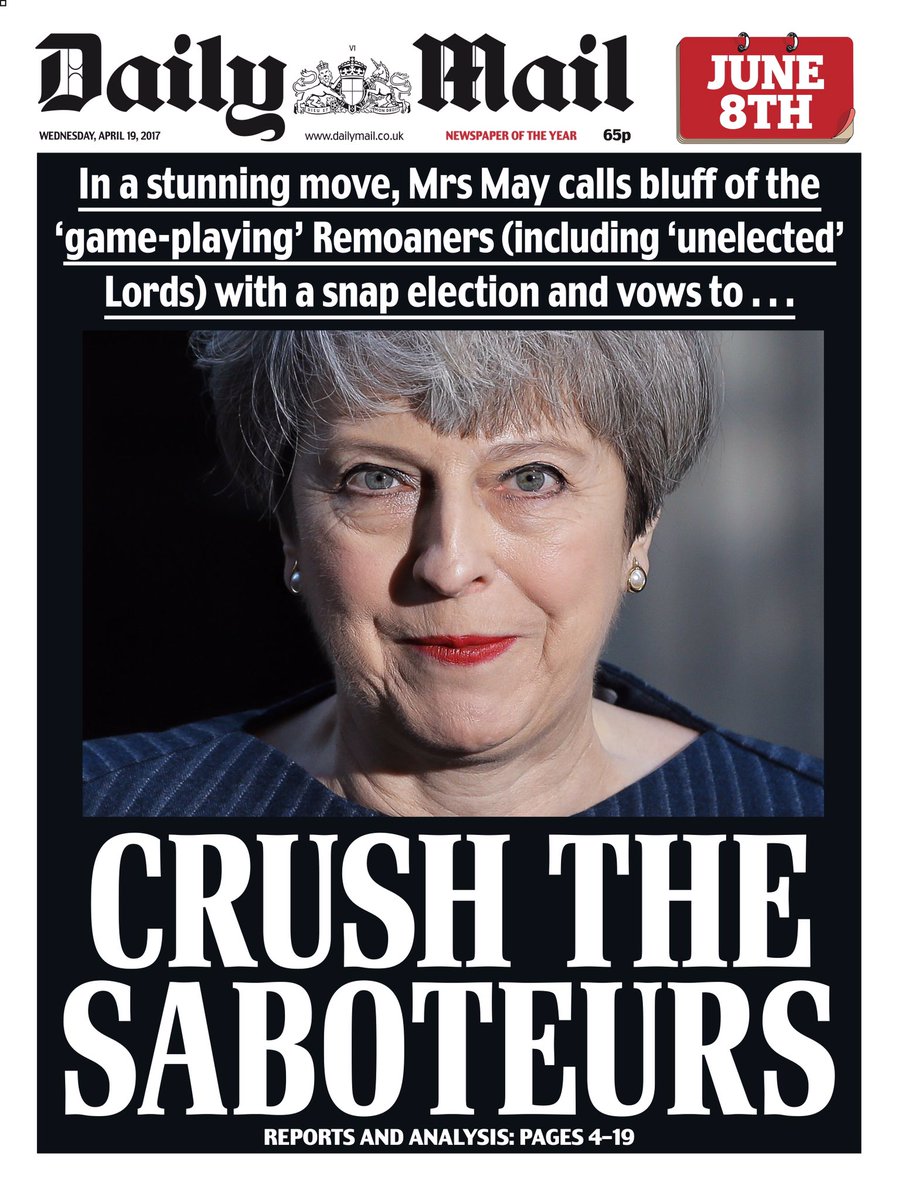
DonatenowButton

A few personal thoughts following the devastating terrorist attack in Manchester


Like many others, I am shocked and horrified at the events in Manchester last night. I cannot begin to imagine the pain and suffering of those people at the Arena who were witnesses or directly affected by such an unthinkable, utterly senseless and despicable act of terrorism – one that resulted in the terrible and senseless murder of at least 22 people, while injuring at least 120 others, many of whom were children and young people – and my thoughts are very much with the victims and their families at this incredibly painful and difficult time.

I’m suspending my own political campaigning, as a mark of respect for those we have lost, for those still coming to terms with this brutal and tragic event, and because it’s a time of bewilderment, shock and anguish for our nation. Terrorism is calculated to generate a much wider degree of national hurt and international anxiety in the longer term, in addition to the immediate horror of those targeted victims that it so brutally and despicably claims.

It was in the most horrific and atrocious circumstances that the people of Greater Manchester showed the world how much humanity and generosity they have – how much they care for each other. Many were prepared to go out of their way to help those in need. Bless those many who have helped out, offering food and water, warm drinks, offering lifts, putting people up. That reflects the kindness, good will, spirit and solidarity of Manchester. And I’ve heard some tremendously heartening stories of doctors and nurses going into work to support and police officers, ambulance workers giving up their days off, turning up to help those in need. 

Among those rushing to help was a brave homeless man – Chris Parker – who has spoken of the moment when a woman died in his arms after he rushed inside Manchester Arena to help the victims of the terrorist attack. He was in the foyer at the time of the attack and was knocked to the floor with the force of the explosion, despite this, he ran inside the building to help the victims.

As  said of the strong community spirit in Manchester: Together we stand strong in these difficult times.” 

It’s a time of national unity, solidarity, and of hugging your own family a little closer than usual – a time of drawing together in defiance of the hurt and confusion inflicted on us by those who would damage our society.

Burnham, the newly elected mayor of Greater Manchester, spoke very well following the catastrophic event – as did local commentator Mohammed Shafiq, who was very mindful of the need for a Muslim voice of condemnation of terrorism.

Poet Tony Walsh added his voice in tribute to the spirit of Mancunians and the history of the city:

Watch Tony Walsh’s passionate recital of his powerful poem for Manchester – “This is The Place” – at the vigil held in Manchester this evening.

Yet in the face of pleas for unity, there inevitably comes the opportunist politicking, those willing to search for scapegoats, which makes social unity so much harder to achieve. Those toxic voices that are known for their divisive rhetoric have already used these terrible events and the tragedies of others to stir up emotions and extend a socially corrosive brand of nationalism – the public peddling of indecency to their own pecuniary or political advantage. We need to take the media megaphone from those who use it to inflame social tensions, ethnic nationalism and drive rage-led ideologies.

Hugh Muir says in the Guardian: “There is all-pervasive incivility in this angry age of illiberalism and social media – that, as democrats, we have to stomach. There are those who would attack us with bombs and knives. We expect nothing from them but nihilism and brutality. But a society undermined from within at a time of crisis needs champions unequivocally prepared to protect it. We elect and employ such people. It is their job, and they should leave no doubt that they will do it.”

The article – The rule of law applies to everyone. Even hate peddlers like Katie Hopkins  is well worth a read. He’s talking a lot of sense at a time when a senseless and despicable act has led to widespread uncomprehending horror and national uncertainty. 

We mustn’t let this catastrophic event lead to further catastrophic social divisions, by allowing established right wing demagogues to stir up and direct national anger and hatred. We must not permit such people to use other people’s grief as an opportunity to further their own political agenda.

, writing for the Intercept, voices a perspective I also share: “Then there is Tommy Robinson, former leader of the far-right English Defence League (think of a British Richard Spencer but, again, with a lesser intellect and a long history of criminality and violence). Robinson arrived in Manchester on Tuesday to accuse British Muslim residents of that city of being “enemy combatants.” They want to “kill you, maim you and destroy you,” he told his YouTube audience of fellow far-right bigots.

You can almost hear them cheering in Raqqa. ISIS wants to drive a wedge between Muslim communities and wider Western society; it wants to pit Muslims against non-Muslims. Nor is this a secret: The group’s leaders have admitted as much in their own publications. More than two years ago, in February 2015, the ISIS online magazine, Dabiq, made clear that one of the main goals of the group’s brutal attacks in the West was to destroy the gray zone — of peaceful co-existence between Muslims and non-Muslims — and provoke a backlash. “The Muslims in the West will quickly find themselves between one of two choices, they either apostatize and adopt the [infidel] religion … or they … [emigrate] to the Islamic State and thereby escape persecution from the crusader governments and citizens.”

This ISIS grand plan has always required the (perhaps unwitting) support of the group’s useful idiots in the West, the Islamophobes, whose harsh rhetoric and actions help drive marginalized and alienated Muslims into the wide open arms of the jihadists.”

Robinson’s bigotry isn’t confined to Muslims. He also likes to direct abuse at people if they are remotely politically left leaning. Especially women. I’ve had first hand experience of his apparently indefatigable inclination to incite hatred and subsequent schadenfreude, as apparently, I’m a “leftist”.  It’s all our fault, he claims. He also likes to give out people’s personal and social media account details on a very widely shared and malicious meme that invites the far right in its entirety to say what they think of a so-called quote (that wasn’t). Of course these “thoughts” included death threats, rape threats, threats from Combat 18, and threats directed at my children. For someone who objects such a lot about his own “free speech” being “restricted”, he sure puts considerable effort into trying to shut other people up with low-life threats and intimidation. He also likes to get others to do his dirtiest work. 

Mehdi goes on to say: “As my colleague Murtaza Hussain has observed, it is “perverse and counterproductive to lump [the West’s Muslims] together with ISIS and blame them for the group’s actions.” To do so is to “grant the Islamic State a propaganda coup, implicitly endorsing the group’s narrative of Muslims and Westerners collectively at war with one another.”  (See the full article – Reactions to Manchester Bombing Show How Anti-Muslim Bigots Are “Useful Idiots” for ISIS.)

A little of what I know about Manchester

I’m from Greater Manchester, though in the olden days of my childhood, my hometown – Bolton – was situated in Lancashire. Manchester is a city I have spent a lot of time in: it’s a city I love. Manchester is just 10 or 15 minutes away from Bolton on the train.

I used to work in the district of Chorlton. I spent my teen years going to concerts and gigs around the city. I saw many bands and performers in Manchester over the years, from Jon Otway and John Cooper Clarke to Pink Floyd, Alice Cooper, Hawkwind, PIL, Elvis Costello, A Certain Ratio and so many others. My own band – Oh no, it’s them again – played gigs around the city, once supporting the Salford Jets at the Gallery.

Over recent years, I have taken colleagues down to Manchester just for a night out. We stayed at the local Premier Inn. I was back in Manchester last October, speaking at a psychology conference in Ardwick Green (north). Afterwards I visited and stayed with my son in my home town, Bolton. It’s always been a unique, warm and wonderful city, people are always very friendly and helpful there. 

I’m horrified and shocked at the events of last night, and feel so very sorry for those who were there, the terrible and heartwrenching loss of life, the injured young people and adults. My thoughts are with those families, and my heart goes out to them. 
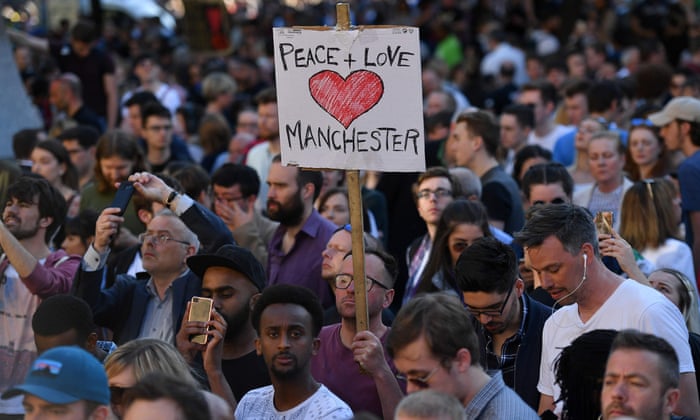
How you can help 

I used to work for Victim Support in the early 1990s.  This excellent organisation are providing immediate emotional and practical local support to victims and witnesses of the Manchester attack. You can contact Victim Support’s national support line on 0808 168 9111 or, if you live in Greater Manchester, call 0161 200 1950.

Greater Manchester police have issued a new casualty bureau emergency number for people trying to trace loved ones from last night’s attack: 0800 096 0095.

Greater Manchester Police are also appealing for any images or footage from last night that you believe can assist them. Please upload these to ukpoliceimageappeal.co.uk or ukpoliceimageappeal.com.

Many people have sent messages of support and comfort; the community spirit in the city region has shone through at this very sad time. If sharing information, please be sure to only share trusted information and follow @gmpolice on Twitter and Facebook for reliable updates and information.

A relief fund has been organised by Manchester City Council and the British Red Cross, you can donate here: https://www.justgiving.com/campaigns/charity/redcross/manchesteremergencyfund

Peterloo Massacre.png
Painting showing the Peterloo Massacre – part of the history of Manchester – by Richard Carlile. The politically directed massacre, which happened at a public protest highlighting the poor socioeconomic conditions for many at the time, and was part of the fight for universal suffrage, which led directly to the foundation of The Manchester Guardian (now The Guardian).

Image result for pray for manchester images