Author: Kitty S Jones

I’m a political activist with a strong interest in human rights. I’m also a strongly principled socialist. Much of my campaign work is in support of people with disability. I am also disabled: I have an autoimmune illness called lupus, with a sometimes life-threatening complication – a bleeding disorder called thrombocytopenia. Sometimes I long to go back to being the person I was before 2010. The Coalition claimed that the last government left a “mess”, but I remember being very well-sheltered from the consequences of the global banking crisis by the last government – enough to flourish and be myself. Now many of us are finding that our potential as human beings is being damaged and stifled because we are essentially focused on a struggle to survive, at a time of austerity cuts and welfare “reforms”. Maslow was right about basic needs and motivation: it’s impossible to achieve and fulfil our potential if we cannot meet our most fundamental survival needs adequately. What kind of government inflicts a framework of punishment via its policies on disadvantaged citizens? This is a government that tells us with a straight face that taking income from poor people will "incentivise" and "help" them into work. I have yet to hear of a case when a poor person was relieved of their poverty by being made even more poor. The Tories like hierarchical ranking in terms status and human worth. They like to decide who is “deserving” and “undeserving” of political consideration and inclusion. They like to impose an artificial framework of previously debunked Social Darwinism: a Tory rhetoric of division, where some people matter more than others. How do we, as conscientious campaigners, help the wider public see that there are no divisions based on some moral measurement, or character-type: there are simply people struggling and suffering in poverty, who are being dehumanised by a callous, vindictive Tory government that believes, and always has, that the only token of our human worth is wealth? Governments and all parties on the right have a terrible tradition of scapegoating those least able to fight back, blaming the powerless for all of the shortcomings of right-wing policies. The media have been complicit in this process, making “others” responsible for the consequences of Tory-led policies, yet these cruelly dehumanised social groups are the targeted casualties of those policies. I set up, and administrate support groups for ill and disabled people, those going through the disability benefits process, and provide support for many people being adversely affected by the terrible, cruel and distressing consequences of the Governments’ draconian “reforms”. In such bleak times, we tend to find that the only thing we really have of value is each other. It’s always worth remembering that none of us are alone. I don’t write because I enjoy it: most of the topics I post are depressing to research, and there’s an element of constantly having to face and reflect the relentless worst of current socio-political events. Nor do I get paid for articles and I’m not remotely famous. I’m an ordinary, struggling disabled person. But I am accurate, insightful and reflective, I can research and I can analyse. I write because I feel I must. To reflect what is happening, and to try and raise public awareness of the impact of Tory policies, especially on the most vulnerable and poorest citizens. Because we need this to change. All of us, regardless of whether or not you are currently affected by cuts, because the persecution and harm currently being inflicted on others taints us all as a society. I feel that the mainstream media has become increasingly unreliable over the past five years, reflecting a triumph for the dominant narrative of ultra social conservatism and neoliberalism. We certainly need to challenge this and re-frame the presented debates, too. The media tend to set the agenda and establish priorities, which often divert us from much more pressing social issues. Independent bloggers have a role as witnesses; recording events and experiences, gathering evidence, insights and truths that are accessible to as many people and organisations as possible. We have an undemocratic media and a government that reflect the interests of a minority – the wealthy and powerful 1%. We must constantly challenge that. Authoritarian Governments arise and flourish when a population disengages from political processes, and becomes passive, conformist and alienated from fundamental decision-making. I’m not a writer that aims for being popular or one that seeks agreement from an audience. But I do hope that my work finds resonance with people reading it. I’ve been labelled “controversial” on more than one occasion, and a “scaremonger.” But regardless of agreement, if any of my work inspires critical thinking, and invites reasoned debate, well, that’s good enough for me. “To remain silent and indifferent is the greatest sin of all” – Elie Wiesel I write to raise awareness, share information and to inspire and promote positive change where I can. I’ve never been able to be indifferent. We need to unite in the face of a government that is purposefully sowing seeds of division. Every human life has equal worth. We all deserve dignity and democratic inclusion. If we want to see positive social change, we also have to be the change we want to see. That means treating each other with equal respect and moving out of the Tory framework of ranks, counts and social taxonomy. We have to rebuild solidarity in the face of deliberate political attempts to undermine it. Divide and rule was always a Tory strategy. We need to fight back. This is an authoritarian government that is hell-bent on destroying all of the gains of our post-war settlement: dismantling the institutions, public services, civil rights and eroding the democratic norms that made the UK a developed, civilised and civilising country. Like many others, I do what I can, when I can, and in my own way. This blog is one way of reaching people. Please help me to reach more by sharing posts. Thanks. Kitty, 2012

A bad job is worse for your mental health than unemployment, say UK’s top psychologists

PAA-550x369

Last month, the following letter was sent to the Independent, titled The DWP must see that a bad job is worse for your mental health than unemployment:

“We, the UK’s leading bodies representing psychologists, psychotherapists, psychoanalysts, and counsellors, call on the Government to immediately suspend the benefits sanctions system. It fails to get people back to work and damages their mental health.

Findings from the National Audit Office (NAO) show limited evidence that the sanctions system actually works, or is cost effective.

But, even more worrying, we see evidence from NHS Health Scotland, the Centre for Welfare Conditionality hosted by the University of York, and others, which links sanctions to destitution, disempowerment, and increased rates of mental health problems. This is also emphasised in the recent Public Accounts Committee report, which states that the unexplained variations in the use of benefits sanctions are unacceptable and must be addressed.

Vulnerable people with multiple and complex needs, in particular, are disproportionately affected by the increased use of sanctions.

Therefore, we call on the Government to suspend the benefits sanctions regime and undertake an independent review of its impact on people’s mental health and wellbeing.

But suspending the sanctions system alone is not enough. We believe the Government also has to change its focus from making unemployment less attractive, to making employment more attractive – which means a wholesale review of the back to work system.

We want to see a range of policy changes to promote mental health and wellbeing. These include increased mental health awareness training for Jobcentre staff – and reform of the work capability assessment (WCA), which may be psychologically damaging, and lacks clear evidence of reliability or effectiveness.

We urge the Government to rethink the Jobcentre’s role from not only increasing employment, but also ensuring the quality of that employment, given that bad jobs can be more damaging to mental health than unemployment.

This should be backed up with the development of statutory support for creating psychologically healthy workplaces.

These policies would begin to take us towards a welfare and employment system that promotes mental health and wellbeing, rather than one that undermines and damages it.

Professor Peter Kinderman, President, British Psychological Society (BPS)

Martin Pollecoff, Chair, UK Council for Psychotherapy (UKCP)

Dr Andrew Reeves, Chair, British Association for Counselling and Psychotherapy (BACP)

Helen Morgan, Chair, British Psychoanalytic Council (BPC)

Steve Flatt, Trustee, British Association of Behavioural and Cognitive Psychotherapies (BABCP)”

“Making work pay” for whom?

pie wealth

It’s a draconian, crude behaviourist and armchair technocratic government that would claim to “make work pay” by decreasing social security support for the poorest members of society, rather than raising wages to meet the rising costs of living. This approach was justified by claims that poor people became “dependent” on benefits because the welfare state provides “perverse incentives” for people seeking employment. However, there is no empirical evidence of these claims. Keith Joseph, a leading New Right advocate of the welfare dependency theories, set out to try and establish evidence dependency during the Thatcher era, and failed. Both Thatcher and Joseph wanted to extend Victorian bourgeois values of thrift, self-reliance and charity among all classes.

Such an approach has benefitted no-one but wealthy employers motivated by a profit incentive, as people who are out of work or claiming disability related benefits have become increasingly desperate. These imposed conditions have created a reserve army of labour, which has subsequently served to devalue labour, and drive wages down. We now witness high levels of in-work poverty, too. The Victorian Poor Law principle of less eligibility had the same consequences, and also “made work pay.” It’s shameful that in 2017, the government still believe that it is somehow effective and appropriate to punish people into not being poor. Especially when the government’s own policies are constructing inequality and poverty.

Last week I wrote about the Samaritans report: Dying from inequality: socioeconomic disadvantage and suicidal behaviour, which strongly links socioeconomic disadvantage and inequality with psychological distress and suicidal behaviours. The report reiterates that countries with higher levels of per capita spending on active labour market programmes, and which have more generous unemployment benefits, experience lower recession-related rises in suicides.

Research has consistently found that in countries with a generous social safety net, poor employment (low pay, poor conditions, job insecurity short-term contracts), rather than unemployment, has the biggest detrimental impact on mental health. This is particularly true of neoliberal states with minimal and means tested welfare regimes. It seems health and wellbeing are contingent on the degree to which individuals, or families, can uphold a socially acceptable standard of living independently of market participation, and on the kind of social stratification  (socioeconomic hierarchies indicating levels of inequality) is fostered by social policies.

Furthermore, despite the government’s rhetoric on welfare “dependency”, and the alleged need for removing the “perverse incentives” from the social security system by imposing a harsh conditionality framework and a compliance regime – using punitive sanctions – and work capability assessments designed to preclude eligibility to disability benefits, research shows that generous social security regimes make people more likely to want to work, not less.

The government’s welfare “reforms” have already invited scathing international criticism because they have disproportionately targeted cuts at those with the least income. Furthermore, the government have systematically violated the human rights of those with mental and physical disabilities. In a highly critical UN report last year, following a lengthy inquiry, it says: “States parties should find an adequate balance between providing an adequate level of income security for persons with disabilities through social security schemes and supporting their labour inclusion. The two sets of measures should be seen as complementary rather than contradictory.”

However, the UK government have continued to conflate social justice and inclusion with punitive policies and cuts, aimed at coercing disabled people towards narrow employment outcomes that preferably bypass any form of genuine support and the social security system completely. 

See – UN’s highly critical report confirms UK government has systematically violated the human rights of disabled people.

430835_148211001996623_1337599952_n (1)

Kitty.


I don’t make any money from my work. I am disabled because of illness and have a very limited income. The budget didn’t do me any favours at all.

But you can help by making a donation to help me continue to research and write informative, insightful and independent articles, and to provide support to others. The smallest amount is much appreciated – thank you.

DonatenowButton cards


A brief view of the budget

budget-hammond-commons-6

He’s not very bright our chancellor, is he? Self-employed people face an increase in their National Insurance (NI) contributions as the Chancellor says he wants to “tackle the unfair burden on people in employment”. Presumably he means self employed people are not in employment. Yet they certainly aren’t included in unemployment figures, either. Last time I checked, employment means “the state of having paid work.”

That’s yet another broken manifesto pledge.

Gutto Bebb, Conservative Welsh minister, hit out at the proposals and called on the Government to “apologise.” Iain Duncan Smith added his voice to calls for a rethink of proposed changes to the National Insurance contributions after Hammond suggested that Brexit is responsible for the Government’s tax raid – conveniently mentioning Brexit for the first time regarding his budget. But he later denied that self-employed workers were paying the price for Brexit. Hard to keep up with what passes as the Conservative brand of reasoning and justification. It certainly makes me feel dizzy and nauseous, that’s for sure.

Hammond could have simply reduced the rate of NI that employees pay instead. He’s a bit of a wally. We did have a period of economic growth last year, second to only Germany, apparently. Good old Tories, eh?  Hurrah!

But I wonder who will benefit from that, assuming it’s really a growth in the economy? It won’t be disabled people claiming Personal Independence Payment (PIP) with severe psychological distress who can’t leave the house, that’s for sure. Or those suffering epilepsy, both types of diabetes and blackouts who need support with managing their treatments and monitoring their health conditions.

17191393_10154323613132014_6367986618227533020_n

A period of Orwellian growth. The economy is currently being propped up by increasing personal debt.  

All of these conditions in fact: Diabetes mellitus (category unknown), Diabetes mellitus Type 1 (insulin dependent), Diabetes mellitus Type 2 (non-insulin dependent), Diabetic neuropathy, Diabetic retinopathy, Disturbances of consciousness – Nonepileptic – Other / type not known, Drop attacks, Generalised seizures (with status epilepticus in last 12 months), Generalised seizures, (without status epilepticus in last 12 months), Narcolepsy, Non epileptic Attack disorder (pseudoseizures), Partial seizures (with status epilepticus in last 12 months), Partial seizures (without status epilepticus in last 12 months), Seizures – unclassified Dizziness – cause not specified, Stokes Adams attacks (cardiovascular syncope), Syncope – Other / type not known.

And these:  Mood disorders – Other / type not known, Psychotic disorders – Other / type not known, Schizophrenia, Schizoaffective disorder, Phobia – Social Panic disorder, Learning disability – Other / type not known, Generalized anxiety disorder, Agoraphobia, Alcohol misuse, Anxiety and depressive disorders – mixed Anxiety disorders – Other / type not known, Autism, Bipolar affective disorder (Hypomania / Mania), Cognitive disorder due to stroke, Cognitive disorders – Other / type not known, Dementia, Depressive disorder, Drug misuse, Stress reaction disorders – Other / type not known, Post-traumatic stress disorder (PTSD), Phobia – Specific Personality disorder, Obsessive compulsive disorder (OCD).

What kind of government cuts support for those needing help to manage medication, monitor a health condition, or both?

What kind of government cuts mobility support for people who can’t leave the house alone?

It seems that most people who are actually ill won’t be eligible for PIP. I wonder which people the government have in mind when they say “those in greatest need”?

Oh, it’s the millionaires again. Phew! Silly me.

From the Equality Trust:

pie wealth

The poorest people lose out from the budget yet again, of course. The distribution of wealth won’t change, with many households in the lowest deciles being worse off. The graph above does not show the full extent of the difference between the richest and the rest of society. This is because the top 1% have incomes substantially higher than the rest of those in the top 10%. In 2012, the top 1% had an average income of £253,927 and the top 0.1% had an average income of £919,882.

If you earn a few hundred thousand, you are set to do rather well yet again from another Tory budget. It’s remarkable how those need it least always get the financial “incentive” isn’t it?  Carrots for the fat cats.  It’s the delux model of “incentives”.

Meanwhile those who need it most pay for those who need it least. Poor people get the budget premium “incentive”, which includes standing on the naughty step, and thinking about what you have not done.

The Tories like wielding a stout stick and giving out a good thrashing for those who dare to fall ill. 

And just to clarify, social justice, equality and inclusion are NOT the same thing as work. They should exist independently of someone’s employment status. Otherwise, “inclusion” takes an Orwellian turn to the far right. We know from history that work doesn’t really set us free. People “enjoying the security and dignity of work” does not entail ensuring those who can’t work or who lost their job are utterly insecure, hungry or destitute. 

The government’s “pledge” to increase adult social care funding is being paid for by increases in council tax, some of which will be paid by those previously exempted from council tax because they are sick, disabled or unemployed. Social security was originally calculated to meet only the cost of fuel and food on the assumption that people needing support would be exempt from rent and council tax. That no longer is the case.

The rises due to come into force from April will not be sufficient to avoid strapped for cash councils having to make deep cuts to essential services, including road repair, parks, children’s centres, leisure centres and libraries. All of this in a time of “economic growth”. It looks like austerity is to be a permanent feature of Conservative neoliberal policy-making.

For many families who are just about managing, the withdrawal of state support for those who are in low paid work is hardly an incentive to “make work pay”. Of course Hammond has ignored the scandal of in-work poverty. This is one of the other austerity measures that he has chosen to keep. Introducing sanctions for those claiming social security because their employers don’t pay them enough to live on is simply a big bully’s stick, which would be better aimed at exploitative and miserly big business employers. Fancy punishing people because profit driven businesses pay as little as possible. 

It’s all the same peevish and spiteful mentality as “making work pay.” Instead of ensuring workers get a decent rate of pay, like you’d think from the Tory claim, the truly nasty party cut benefits and decided to impose punishing conditions on people who need state support indiscriminately, regardless of the reason, instead.

That’s pure upper class prejudice and malice.

And greed. 

banksy-elephant-in-room1
Meet Brexit, by the way, he’s the big elephant in the room, Mr Hammond


I don’t make any money from my work. I am disabled because of illness  and have a very limited income. The budget didn’t do me any favours at all.

But you can help by making a donation to help me continue to research and write informative, insightful and independent articles, and to provide support to others. The smallest amount is much appreciated – thank you.

DonatenowButton cards

IAPT is value-laden, non-prefigurative, non-dialogic, antidemocratic and reflects a political agenda

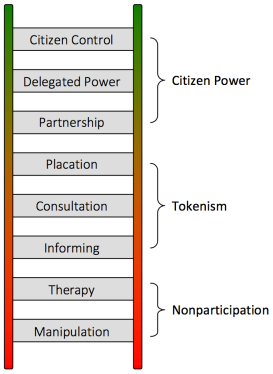
arnstein-ladder-citizenship-participation

Arnstein’s ladder of citizen participation and inclusion. It represents the redistribution of power that enables marginalised citizens, presently excluded from the political and economic processes, to be purposefully included in the future.

The government’s Work and Health Programme, due to be rolled out this autumn, involves a plan to integrate health and employment services, aligning the outcome frameworks of health services, Improving Access to Psychological Therapies (IAPT), Jobcentre Plus and the Work Programme.

But the government’s aim to prompt public services and commissioned providers to “speak with one voice” is founded on traditional Conservative prejudices about people who need support. This proposed multi-agency approach is reductive, rather than being about formulating expansive, coherent, comprehensive and importantly, responsive mental health provision.

What’s on offer is psychopolitics, not therapy. It’s about (re)defining the experience and reality of a marginalised social group to justify dismantling public services (especially welfare). In linking receipt of welfare with health services and state therapy, with the single politically intended outcome of employment, the government is purposefully conflating citizens’ widely varied needs with economic outcomes and diktats, which will isolate people from traditionally non-partisan networks of unconditional support, such as the health service, social services, community services and mental health services.

Services “speaking with one voice” will invariably make accessing support conditional, and further isolate marginalised social groups. It will damage trust between people needing support and professionals who are meant to deliver essential public services, rather than simply extending government dogma, prejudices and discrimination. And meeting ideologically designed targets.

As neoliberals, the Conservatives see the state as a means to reshape social institutions and social relationships hierarchically, based on a model of a competitive market place. This requires a highly invasive power and mechanisms of persuasion, manifested in an authoritarian turn. Public interests are conflated with narrow economic outcomes. Public behaviours are politically micromanaged and modified. Social groups that don’t conform to ideologically defined economic outcomes and politically defined norms are stigmatised and outgrouped. 

Othering and outgrouping have become common political practices, it seems.

The Work and Health Programme is a welfare-to-work programme for people with disabilities, mental health problems and for long-term unemployed people, due to be rolled out in the autumn. In the recent Work, Health and Disability green paper, the government mentioned new mandatory “health and work conversations” in which work coaches will use “specially designed techniques” to “help” those people in the ESA Support Group – those assessed by their own doctors and the state as being unlikely to work in the near future – “identify their health and work goals, draw out their strengths, make realistic plans, and build resilience and motivation.” 

Apparently these “conversations” were “co-designed” by the Behavioural Insights Team.

Democracy is based on a process of dialogue between the public and government, ensuring that the public are represented: that governments are responsive, shaping policies that address identified social needs.

However, policies increasingly reflect a behaviourist turn. They are no longer about reflecting citizens’ needs: they are increasingly about telling some citizens how to be. This has some profound implications for democracy.

Neoliberal policies increasingly extend behaviour modification techniques that aim to quantifiably change the perceptions and behaviours of citizens, aligning them with narrow neoliberal outcomes through rewards or “consequences.” Rewards, such as tax cuts, are aimed at the wealthiest, whereas the most vulnerable citizens who are the poorest are simply presented with imposed cuts to their lifeline support as an “incentive” to not be poor. Taking money from the poorest is apparently “for their own good”.   

Defining human agency and rationality in terms of economic outcomes is extremely problematic. And dehumanising. Despite the alleged value-neutrality of behavioural economic theory and CBT, both have become invariably biased towards the status quo rather than progressive change and social justice.

Behavoural economics theory has permited policy-makers to indulge ideological impulses whilst presenting them as “objective science.” From a libertarian paternalist perspective, the problems of neoliberalism don’t lie in the market, or in growing inequality and poverty: neoliberalism isn’t flawed, nor are governments – we are. Governments and behavioural economists don’t make mistakes – only citizens do. No-one is nudging the nudgers. It’s assumed that their decision-making is infallible and they have no whopping cognitive biases of their own. 

“There’s no reason to think that markets always drive people to what’s good for them.” Richard Thaler.

There’s no reason whatsoever to think that markets are good for people at all. Let’s not confuse economics with psychology, or competitive individualism and economic Darwinism with collectivism and mutual aid. Behavioural economics may offer us titbit theories explaining individual consumer’s decision making, but it’s been rather unreliable in explaining socioeconomic and political contexts and complex systems such as financial crises, and of course behavioual economists don’t feel the same pressing need to explore the decision making and “cognitive bias” of the handful of people who cause those.

It wasn’t those with mental health problems currently claiming social security. They do much less damage to the economy, in fact IAPT means vulture capitalist private companies like G4S and trusts like Southern Care can turn a profit offering “support”. 

The current emphasis on quantitative methodology and standardisation has led to an overwhelming focus on measurement in IAPT settings. Mental health services are now dominated by IAPT, which focuses exclusively on “evidence-based” and short-term interventions for clients with particular diagnoses – mostly anxiety disorders and depression. Most workers in IAPT services offer CBT, often by minimally trained psychological wellbeing practitioners offering “low-intensity” interventions over few sessions.

Verificationism and standardisation leads to a focus on measurement in IAPT settings. CBT mutes the causes of distress, which do not reside “within” the individual: they are intersubjectively constructed, with cultural, socioeconomic and political dimensions. Furthermore, there is little room left for authentic dialogue – qualitative accounts of client’s experiences are not accommodated. In this context, CBT is authoritarian, rather than being prefigurative and genuinely dialogic.

Under the government’s plans, therapists from the IAPT programme are to support jobcentre staff to assess and treat claimants, who may be referred to online cognitive behavioural therapy (CBT) courses. 

We must question the ethics of linking receipt of welfare with “state therapy,” which, upon closer scrutiny, is not therapy at all. Linked to such a narrow outcome – getting a job – it amounts to little more than a blunt behaviour modification programme. The fact that the Conservatives have planned to make receipt of benefits contingent on participation in “treatment” also worryingly takes away the fundamental right of consent.

CBT facilitates the identification of “negative thinking patterns” and associated “problematic behaviours” and “challenges” them. This approach is at first glance a problem-solving approach, however, it’s of course premised on the assumption that interpreting situations “negatively” is a bad thing, and that thinking positively about bad events is beneficial.

The onus is on the individual to adapt by perceiving their circumstances in a stoical and purely “rational” way. 

So we need to ask what are the circumstances that we expect people to accept stoically. Socioeconomic inequality? Precarity? Absolute poverty? Sanctions? Work fare? Being forced to accept very poorly paid work, abysmal working conditions and no security? The loss of social support, public services and essential safety nets? Starvation and destitution?  

It’s all very well challenging people’s thoughts but for whom is CBT being used. For what purpose? It seems to me that this is about coercing those people on the wrong side of draconian government policy to accommodate that; to mute negative responses to negative situations. CBT in this context is not based on a genuinely liberational approach, nor is it based on democratic dialogue. It’s about modifying and controlling behaviour, particularly when it’s aimed at such narrow, politically defined and specific economic outcomes, which extend and perpetuate inequality. In this context, CBT becomes state “therapy” used only as an ideological prop for neoliberalism.

CBT tends to generate oversimplifications of the causes human distress. It’s not about helping people make better choices, it’s about coercing people to make the choices that policymakers want them to make. Those “choices” are based on enforced conformity to the ideological commitments of policymakers.

It’s assumed that the causes of unemployment are personal and attitudinal rather than sociopolitical or because of health barriers, and that particular assumption authorises intrusive state interventions that encode a Conservative moral framework, which places responsibility on the individual, who is characterised as “faulty” in some way. The deeply flawed political/economic system that entrenches inequality isn’t challenged at all: its victims are discredited and stigmatised instead.

Yet historically (and empirically), it has been widely accepted that poverty significantly increases the risk of mental health problems and can be both a causal factor and a consequence of mental ill health. Mental health is shaped by the wide-ranging characteristics and circumstances (including inequalities) of the social, economic and physical environments in which people live. Successfully supporting the mental health and wellbeing of people living in poverty, and reducing the number of people with mental health problems experiencing poverty, requires engagement with this complexity.

There is also widely held assumption that working is good for mental health, and that being in employment indicates mental wellbeing. It’s well-established that poverty is strongly linked with a higher likelihood of being diagnosed with a mental illness. That does not mean working is therefore somehow “good” for mental health. Encouraging people to work should entail genuine support, it shouldn’t entail taking away their lifeline income as punishment “incentive” if they can’t work.

An adequate level of social security to meet people’s basic survival needs is not mutually exclusive from encouraging people to find a suitable job.

It’s worth noting that research indicates in countries with an adequate social safety net, poor employment (low pay, short-term contracts), rather than “worklessness”, has the biggest detrimental impact on mental health. 

CBT does not address the socioeconomic and political context. It permits society to look the other way, whilst the government continue to present mental illness as an individual weakness or vulnerability, and a consequence of “worklessness” rather than a fairly predictable result of living a distressing, stigmatised, excluded existence and material deprivation in an increasingly unequal society.

Inequality and poverty arise because of ideology and policy-formulated socioeconomic circumstances, but the government have transformed established explanations into a project of constructing behavioural and cognitive problems as “medical diagnoses” for politically created socioeconomic problems. Austerity targets the poorest disproportionately for cuts to income and essential services, it’s one ideologically-driven political decision taken amongst alternative, effective and more humane choices.

Both nudge and CBT are being used to prop up austerity and reflect neoliberal managementspeak at its very worst. Neoliberal policies are causing profound damage, harm and distress to those they were never actually designed to “help”. Let’s not permit techniques of neutralisation: the use of rhetoric to obscure the real intention behind policies. It’s nothing less than political gaslighting.

The government’s profound antiwelfarist rhetoric indicates that there’s no genuine intention to support those people with mental health problems and others in need, despite their semantic thrifts and diversions.

Policies are expressed political intentions regarding how our society is organised and governed. They have calculated social and economic aims and consequences. In democratic societies, all citizen’s accounts of the impacts of policies ought to matter. 

However, in the UK, the way that policies are justified is being increasingly detached from their aims and consequences, partly because democratic processes and basic human rights are being disassembled or side-stepped, partly because the government employs the widespread use of linguistic strategies and techniques of persuasion to intentionally divert us from the aims and consequences of their ideologically driven and increasingly dehumanising policies. Furthermore, policies have become increasingly detached from public interests and needs. 

For people with mental health problems, policies are being formulated to act upon them as if they are objects, rather than autonomous human subjects. Such a dehumanising approach has contributed significantly to a wider process of social outgrouping, increasing stigmatisation and ultimately, to further socioeconomic and mental health inequalities.

It’s the government that need to change their behaviour.

It’s us that need to make a stand against hegemonic neoliberal discourse and injustice.

cp5w8ifxgaauf-u

This article was written for a zine to mark the protest at the 10th annual New Savoy conference on 15 March in London #newsavoy2017. You can read the zine, with other people’s excellent contributions, here.

Also, see: New Savoy Protest against psycho-compulsion of MH claimants – 15th March 2017.

You can read about the background to the Mental Wealth Alliance and the New Savoy demo and lobby here.

You can watch the video here from Let Me Look TV: Protest at the 10th Annual New Savoy Conference 15 March 2017.

Please share.

Related

The power of positive thinking is really political gaslighting

The importance of citizen’s qualitative accounts in democratic inclusion and political participation

A critique of the ‘Origins of Happiness’ study

A critique of Conservative notions of social research

Research finds damaging mental health discrimination ‘built into’ Work Capability Assessment. Again.

The Conservative approach to social research – that way madness lies


I don’t make any money from my work. I am disabled because of illness and have a very limited income. The budget didn’t do me any favours at all.

But you can help by making a donation to help me continue to research and write informative, insightful and independent articles, and to provide support to others. The smallest amount is much appreciated – thank you.

DonatenowButton cards

Dying from inequality: socioeconomic disadvantage and suicidal behaviour – report from Samaritans

cn_fairchange_comp1

As Samaritans release a report ahead of Wednesday’s Budget linking inequality with a higher risk of suicide, the charity is calling on the government, businesses, industry and sector leaders to be aware of the risks of suicide and to direct support to those with unstable employment, insecure housing, low income or in areas of socioeconomic deprivation.

The report, Dying from Inequality, produced in conjunction with leading researchers and academics, is far-reaching and highlights clear areas of risk to communities and individuals, including the closure and downsizing of businesses, those in manual, low-skilled employment, those facing unmanageable debt and those with poor housing conditions.

In today’s press release, Samaritans’ CEO Ruth Sutherland says, “Suicide is an inequality issue that we have known about for some time, this report says that’s not right, it’s not fair and it’s got to change. Most importantly this report sets out, for the first time, what needs to happen to save lives. Addressing inequality would remove the barriers to help and support where they are needed most and reduce the need for that support in the first place. Government, public services, employers, service providers, communities, family and friends all have a role in making sure help is relevant and accessible when it matters most.

“Everyone can feel overwhelmed at times in their life. People at risk of suicide may have employers, or they may seek help at job centres, or go to their GP. They may come into contact with national and local government agencies, perhaps on a daily basis. So, in the light of this report we are asking key people and organisations from across society, for example those working in housing, in businesses, medical staff, job centre managers, to all take action to make sure their service, their organisation, their community is doing all it can to promote mental health and prevent the tragedy of suicide. 

Samaritans has already started addressing the inequalities driving people to suicide, by making its helpline number free to call, by calling on Government for more frontline staff to be trained in suicide prevention in England and by campaigning for local authorities to have effective suicide prevention plans in place. Now, in response to the findings of this report, the next steps will involve instigating working groups, in different sectors, bringing together businesses and charities who can influence in the areas highlighted, in order to tackle this issue in a collaborative, systematic and effective way to ensure that fewer people die by suicide.”

Sutherland continues: “Each suicide statistic is a person. The employee on a zero hour’s contract is somebody’s parent or child. A person at risk of losing their home may be a sibling or a friend. And each one of them will leave others devastated, and potentially more disadvantaged too, if they take their own life. This is a call for us as individuals to care more and for organisations that can make a difference, to do so.”

She went on to say: “Living in poverty shouldn’t mean losing your life. Going through difficult times like losing your job or being in debt shouldn’t mean not wanting to live. But that is what’s happening in the UK and Ireland today. Suicide is killing the most disadvantaged and vulnerable people, devastating families and communities.”

Some key points from the report summary:

There is no single reason why people take their own lives. Suicide is a complex and multi-faceted behaviour, resulting from a wide range of psychological, social, economic and cultural risk factors which interact and increase an individual’s level of risk.

Socioeconomic disadvantage is a key risk factor for suicidal behaviour.

Socioeconomic disadvantage or living in an area of socioeconomic deprivation increases the risk of suicidal behaviour.

The research evidence was considered at three levels: societal, community and individual: 

Societal: political, economic and social policies related to, for example, economic change, employment, social support and the labour market; stigmatised attitudes towards people on the basis of their socioeconomic standing or their suicidal behaviour.

Community: the local economic, social, cultural and physical environment, including, for example, geographical location, job opportunities, service availability and accessibility, and home ownership.

Individual: demographic characteristics, such as gender and age; socioeconomic position, including occupational social class and type of employment; mental health; and health-related behaviours.

Suicide risk increases during periods of economic recession, particularly when recessions are associated with a steep rise in unemployment, and this risk remains high when crises end, especially for individuals whose economic circumstances do not improve. Countries with higher levels of per capita spending on active labour market programmes, and which have more generous unemployment benefits, experience lower recession-related rises in suicides.

During the most recent recession (2008-09), there was a 0.54% increase in suicides for every 1% increase in indebtedness across 20 EU countries, including the UK and Ireland. Social and employment protection for the most vulnerable in society, and labour market programmes to help unemployed people find work, can reduce suicidal behaviour by reducing both the real and perceived risks of job insecurity and by increasing protective factors, such as social contact. In order to be effective, however, programmes must be meaningful to participants and felt to be non-stigmatising.

There is a strong association between area-level deprivation and suicidal behaviour: as area-level deprivation increases, so does suicidal behaviour. Suicide rates are two to three times higher in the most deprived neighbourhoods compared to the most affluent.

Admissions to hospital following self-harm are two times higher in the most deprived neighbourhoods compared to the most affluent. Multiple and large employer closures resulting in unemployment can increase stress in a local community, break down social connections and increase feelings of hopelessness and depression, all of which are recognised risk factors for suicidal behaviour.  

While the economic situation and policy approaches vary across the nations in which Samaritans operates, the link between socioeconomic disadvantage and increased risk of suicide is evident in all these nations. It is therefore essential that we understand why this link exists. We all need to address this inequality issue which is resulting in the tragic loss of lives.

Features of socioeconomic disadvantage include low income, unmanageable debt, poor housing conditions, lack of educational qualifications, unemployment and living in a socioeconomically deprived area. Individual Individuals experiencing socioeconomic disadvantage and adverse experiences, such as unemployment and unmanageable debt, are at increased risk of suicidal behaviour, particularly during periods of economic recession.

The risk of suicidal behaviour is increased among those experiencing job insecurity and downsizing or those engaged in non-traditional work situations, such as part-time, irregular and short-term contracts with various employers. The experience of being declared bankrupt, losing one’s home or not being able to repay debts to family and friends is not only stressful but can also feel humiliating. This can lead to an increased risk of suicidal behaviour.

The risk of suicidal behaviour increases when an individual faces negative life events, such as adversity, relationship breakdown, social isolation, or experiences stigma, emotional distress or poor mental health.

Socioeconomically disadvantaged individuals are more likely to experience ongoing stress and negative life events, thus increasing their risk of suicidal behaviour. In the UK, socioeconomically disadvantaged individuals are less likely to seek help for mental health problems than the more affluent, and are less likely to be referred to specialist mental health services following self-harm by GPs located in deprived areas.

Different welfare states have been shown to have different effects on social and health inequalities. High quality public service provision leads to a more cohesive society than policies based on means-testing which may generate social divisions. Given the link between inequalities and suicidal behaviour, labour market policy design can help improve wellbeing and reduce the risk of suicide.

Employment

Evidence on the association between working conditions, debt and suicide suggests that increased, involuntary part-time work, job insecurity and workplace downsizing are important risk factors for suicidal behaviour. It is not only unemployed people who are at increased risk. Employees who keep their jobs during a workplace downsizing may experience job insecurity and negative relationships with their peers, as well as stress from an increased workload. People who are self-employed can also be affected if demand for their business decreases. 

Unemployment benefits

Generous unemployment benefits and other types of social protection can reduce the risk of suicidal behaviour. Suicide rates tend to increase in countries which implement significant budget cuts, which was evident during the 2008-09 recession in some EU countries (Karanikolos et al., 2013). Unemployment benefits compensate for some of the income loss experienced from involuntary unemployment. Depending on the level of benefits, they should help ease financial worries that may lead to suicidal behaviour. However, means-tested benefits may actually contribute to suicidal behaviour, if recipients feel stigmatised, leading to feelings of shame, worthlessness, a loss of status, and a deterioration of mental health.

Employment protection

Strong employment protection should reduce real and perceived risks around job insecurity and unemployment, resulting in a positive impact on mental health. In contrast, weak employment protection is likely to increase real and perceived insecurity, and could lead to precarious forms of employment, such as temporary or zero-hours contracts, with adverse effects on mental health.

Inexperienced workers with low skills are particularly vulnerable in such contexts, since they are most likely to be on contracts which are less well protected and more precarious. The risk of mental health problems is increased among those engaged in non-traditional work situations, such as part-time, irregular and short-term contracts with various employers, especially where there is little or no choice, as well as for those experiencing job insecurity and downsizing. Suicidal behaviour can be reduced amongst the most vulnerable in society through social and employment protection and labour market programmes. This will reduce the real and perceived risks of job insecurity and reduce stigma of unemployment.

Recommendations:

Individuals, communities and wider society can all play a part in reducing the risk of suicidal behaviour. Governments need to take a lead by placing a stronger emphasis on suicide prevention as an inequality issue.

National suicide prevention strategies need to target efforts towards the most vulnerable people and places, in order to reduce geographical inequalities in suicide. Effective cross-governmental approaches are required, with mental health services improved and protected.

Suicide prevention needs to be a government priority in welfare, education, housing and employment policies. Workplaces should have in place a suicide prevention plan, and provide better psychological support to all employees, especially those experiencing job insecurity or those affected by downsizing.

Poverty and debt need to be destigmatised so that individuals feel valued and able to access support without fear of being judged. Every local area should have a suicide prevention plan in place. This should include the development and maintenance of services that provide support to individuals experiencing socioeconomic disadvantage.

Staff and volunteers in services accessed by socioeconomically disadvantaged individuals or groups should receive specialist training in recognising, understanding and responding to individuals who are in distress and may be suicidal (even if they do not say they are feeling suicidal). People bereaved or affected by suicidal behaviour, and therefore at higher risk of suicide themselves, should be offered tailored psychological, practical and financial support particularly in disadvantaged communities.

It is well understood that adverse individual or family circumstances, such as relationship breakdown, unemployment or debt, can result in a higher risk of suicidal behaviour (Gunnell & Chang 2016). What is less well known is the potential impact of the place where people live (neighbourhood, city, region) on the likelihood of suicidal behaviour.

The public health evidence is clear: as area-level deprivation increases, so does suicidal behaviour. For both men and women, those living in the most deprived neighbourhoods are more likely to engage in suicidal behaviour; and every increase in area-level affluence results in a reduction in the risk of suicidal behaviour.

The health of people in a neighbourhood, town, region or country is the product of the demographic, behavioural, socioeconomic and other characteristics of the people who live there. Compositional factors that are likely to increase the risk of suicidal behaviour in areas of socioeconomic deprivation include (O’Reilly et al., 2008; Lorant et al., 2005): experiencing multiple negative life events, such as poor health, unemployment, poor living conditions feeling powerless, stigmatised, disrespected, social disconnectedness, such as social isolation, poor social support other features of social exclusion, such as poverty, and poor educational attainment.

People living in the most deprived areas are more likely to engage in suicidal behaviour. Suicide rates are two to three times higher in the most deprived neighbourhoods compared to the most affluent, and rates of hospitalised self-harm are also twice as high. Neighbourhoods that are the most deprived have worse health than those that are less deprived and this association follows a gradient: for each increase in deprivation, there is a decrease in health. Additional support for those living in deprived areas is needed to reduce geographical inequalities in health and the risk of suicidal behaviour.

Experiences of childhood adversity, negative life events, and the cumulative effects of stress are associated with feelings of entrapment and hopelessness and increase the risk of suicidal behaviour, especially among those who are socioeconomically disadvantaged.

Stressful life events and childhood adversity

Exposure to negative life events, particularly those involving loss, such as bereavement or a relationship breakdown, heightens the risk of suicidal behaviour. Socioeconomically disadvantaged individuals are more likely to experience such negative life events, and therefore more likely to engage in suicidal behaviour. Experiencing childhood adversity increases the likelihood that individuals will become socioeconomically disadvantaged in later life.

For example, unemployment is more likely among those who have adverse childhood experiences, particularly men who have experienced childhood sexual abuse. Stress response and allostatic load Ongoing exposure to stress and adversity may gradually reduce an individual’s biological stress regulation resources, leading to a cumulative physiological toll known as “allostatic load” (Seeman et al., 2010).

Socioeconomic disadvantage itself is a stressor linked to increased allostatic load, but it may also influence allostatic load indirectly by increasing the likelihood of individuals experiencing childhood adversity and other stressful life events. Increased allostatic load brought about by the chronic and acute stresses associated with socioeconomic disadvantage may contribute to suicidal behaviour.

Socioeconomic disadvantage, from a psychological perspective, makes a major contribution to the occurrence of suicidal behaviour.


You can read the full summary report here

The full version of the report will be available on 10th March


I don’t make any money from my work. I am disabled because of illness and have a very limited income. But you can help by making a donation to help me continue to research and write informative, insightful and independent articles, and to provide support to others. The smallest amount is much appreciated – thank you. 

DonatenowButton cards

Young woman who committed suicide was called ‘a f****** waste of space’ by mental health worker

agp_mdm_170217hannah_015jpg

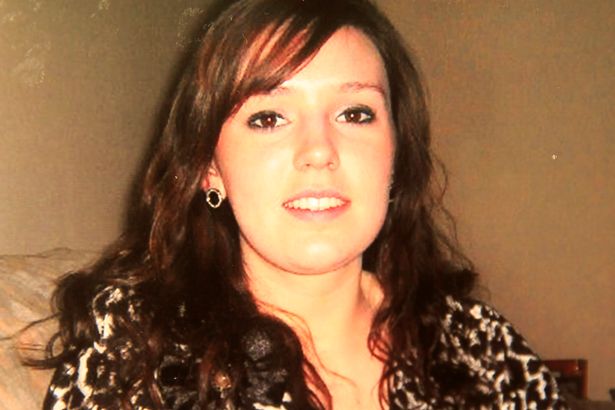
Suicidal Hannah Groves did not get the support and care she needed

The  Mirror reports: “In the UK the number of ­women taking their own lives has grown steadily since 2011. Mental health issues make up 23 per cent of those with health problems making contact with the NHS. But mental health provision has received only 13 per cent of the overall funding. Since 2011 the number of beds for mental health patients has fallen by 8 per cent.”

Last year female suicides hit a ten year high.  In 2015 – 2016, only 55% of mental health trusts reported increases to budgets since 2012, when “parity of esteem” with physical health was promised by the government.

Last year, a leaked report by a government taskforce painted a bleak picture of England’s mental health services, revealing that the number of people killing themselves was soaring, three-quarters of those with psychiatric conditions were not being helped, and sick children were being sent “almost anywhere in the country” for treatment. Suicide in England is now rising “following many years of decline”, with 4,477 suicides in an average year. There has also been a 10% increase in the number of people sectioned under the Mental Health Act over the past year, suggesting their needs are not being met early enough. In some parts of the country, more than 10% of children seeking help are having appointments with specialists cancelled as a result of staff shortages.

Commenting on the situation last year, Labour’s mental health spokesperson, Luciana Berger, said the figures are a “wake-up call” for ministers.

“Ministers talk about making mental health a priority, but in reality they have presided over service cuts, staff shortages and widespread poor-quality care, with devastating consequences,” she said.

“It is particularly worrying that women’s suicide rates in England are now the highest they have been for a decade. Ministers must identify the reasons behind this drastic increase and take the urgent action needed to tackle it.”

Hannah Groves is one victim of a growing mental health crisis among women, as female suicide rates hit a ten-year high last yearHannah’s desperate mother begged for help in vain more than 100 times over nine days before her daughter killed herself.

Mandy Park’s distraught pleas were not only ignored by a Southern Health Trust mental health worker, they were ridiculed. Hannah was labelled an “attention seeker” and a “f***ing waste of space”.

Hours later Hannah was found dead at home, aged just 20. Hannah had made numerous suicide attempts in the nine days before her death yet was repeatedly ­denied admission to hospital.

Last year, the privatised Southern Health NHS Trust – which runs a series of mental health services across the county and is headquartered in Tatchbury Mount, Calmore – was condemned by the Care Quality Commission after failing to protect patients and investigate the deaths of hundreds of people in its care, following a scathing independent report. The Trust has been the subject of independent government reviews since it was revealed it failed to investigate the unexpected deaths of hundreds of its patients between 2011 and 2015. See also: Southern Health NHS Trust, a Drowning and a Call for Better Care Everywhere and Embattled NHS trust boss quits role but will keep salary and benefits in new job and Southern Health criticised for putting ‘patients at risk’.

Hannah was a straight-A student studying French at university, and she had no mental health ­problems until October 2012. Mandy believes she suffered a sudden onset of psychosis, but this was not diagnosed because she was not ­properly assessed.

On the night she got ill, Mandy gave Hannah a lift to her boyfriend’s and later had a ­panicked call from him.She picked up her daughter but on the trip home Hanna ­repeatedly tried to jump from the ­moving car. She also attempted to run into oncoming traffic.

Mandy said: “She was such a sweet, gentle person. But it was like she was possessed.

“Her voice had changed and she was speaking in a monotone.

“She didn’t smoke but she would pace the floor, chain-smoking and ­staring into space. I was terrified of my own girl. She kept saying she felt numb.”

Mandy took Hannah to A&E where the medical staff referred her to the Trust’s mental health crisis team. However, staff from the trust assessed Hannah and decided she did not meet the ­criteria for a bed in Antelope House, in her home town Southampton.

Over the next week she ­repeatedly attempted suicide. Mandy took her to ­hospital, to her GP and even to an out of area mental heath facility, desperately trying to get help.

Police and paramedics regularly attended the family home and she begged mental health workers to intervene, in vain.

Mandy said: “One time she had a scarf round her neck and I had to hold her down. I spent hours on the phone to the mental health team but they would sigh as soon as I told them who I was.

Hannah even got hold of the phone herself and was repeatedly telling them she was going to kill herself but they did nothing.”

Three days before her death, Hannah was taken to A&E once more, but was sent home again by the mental health Trust.

Mandy said: “Hannah fell on the floor in a heap. It was heartbretking. She knew she needed help.”

The evening before Hannah’s death, on October 22, 2012, her boyfriend brought her orange roses and she wrote the words “I’m still alive” on a chalkboard.  Mandy ­recalled she was so hopeful, she said: “I thought I was getting her back.”

The next day Mandy had to call the police after Hannah threatened to kill her family. She was arrested under the Mental Health Act.

Again, staff at Antelope House refused to admit her after a social worker told the police detention officer she was a “f***ing waste of space” an “attention seeker”.

Just hours later, Mandy found her daughter’s body. She had left her home for a matter of minutes to call the crisis team, begging for help once again.

Mandy painfully remembers “At the hospital I stood there while they did CPR. Then they said there was nothing more they could do. I fell on the floor, screaming the place down.”

The grieving mother decided to call medical ­negligence solicitor, Nick Fairweather, to fight for justice in her daughter’s memory.

Mandy was heartbroken and ­physically sick when she heard the comments about Hannah, who was a constant danger to herself.

Mandy said: “It beggars belief that ­anyone could treat another human that way.

“Hannah changed overnight from a happy young ­woman to a ­totally different person. She was my world.

“I love and miss her. She had so much to live for and to give. If she’d got the right treatment she’d still be here.”

Last month Mandy, a former ­support worker for deaf children, was awarded £260,000 in an ­out-of-court medical negligence settlement from Southern Health Trust.

The Trust admitted that Mandy had been a “secondary victim” of its ­failings after she developed post-traumatic stress ­disorder and spent six weeks in a ­specialist mental health facility. She has also ­contemplated ­suicide, but felt she could not leave her son Patrick, 21, without a mum.

Mandy said: “Finding Hannah’s body was the worst moment of my life. I have flashbacks every day. It’s like a film on a constant loop.

“The effects of these ­failings have been catastrophic. I’m ­terrified it will happen to someone else’s child.”

The Health Care Professions Council ruled the insults about Hannah were “undoubtedly spoken” but failed to prove the case against a named social ­worker.

Coroner Keith Wiseman ­delivered a narrative verdict at her inquest and ruled the Trust had “not adequately identified” the risks to Hannah.

Mandy said: “Everyone says I did ­everything I could but there are times when the guilt kicks in. I wonder if I should’ve just handcuffed us both to Antelope House.

“It’s 2017 but our attitude to mental health beggars belief – especially from those supposedly trained in this field.”

 She added: “A lot of people do judge, and say, ‘Snap out of it.’ But no one would ever tell you to snap out of it if you had cancer. Something has to change.” 

Julie Dawes, interim chief ­executive of Southern Health said: “I apologise again on behalf of the trust for letting Miss Groves down in 2012 and I send my condolences to her family.”


If you feel suicidal, need support and someone to speak to, Samaritans operates a 24-hour service available every day of the year. Call 116 123 or email jo@samaritans.org 


I don’t make any money from my work. I am disabled because of illness and have a very limited income. But you can help by making a donation to help me continue to research and write informative, insightful and independent articles, and to provide support to others. The smallest amount is much appreciated – thank you. 

DonatenowButton cards

Protest at the 10th annual New Savoy conference – Mental Wealth Alliance


image-04-02-2017-at-15-15

        Map of venue here 

Find out more about the Mental Wealth Alliance and the background to this New Savoy action here

Source: the free psychotherapy network

“As the links between mental health and DWP benefits policies have developed (see this Government catalogue of Work and Health reports between 2005 and 2014 – https://www.gov.uk/government/collections/health-work-and-wellbeing-evidence-and-research ) so has the link between Psy Professional bodies and the DWP.

New Savoy has welcomed this marriage of workfare and IAPT/psychological well-being support. See their statement on welfare reform here – http://www.newsavoypartnership.org/joint-pledge-on-welfare.htm 

For several years New Savoy invited DWP and DoH ministers to open their conferences (e.g. Lord Freud and Norman Lamb).

The Kitty Jones blog is very informative on the developing use of psychological coercion within the workfare system (e.g. https://kittysjones.wordpress.com/2015/10/28/the-government-plan-to-nudge-sick-and-disabled-people-into-work/) as is the Friedli and Stearn paper – http://mh.bmj.com/content/41/1/40.full

It was in the spring of 2015, when Osborne’s budget proposed co-locating IAPT workers in Jobcentres, that a number of Alliance and PCSR therapists contacted MH activist groups like the Mental Health Resistance Network and DPAC to see if we could work together to oppose the use of psychological therapy to get people off benefits and back to work.

The issue for us, of course, was the abuse of therapeutic ethics and practice through its application to support the goals and culture of DWP workfare – a policy direction based on political ideology, not clinical need.

We see a shared cause between MH claimants on the receiving end of these policies and the unethical and demeaning working conditions of practitioners/workers providing the services. On the latter, see for example – https://www.theguardian.com/healthcare-network/2016/feb/17/were-not-surprised-half-our-psychologist-colleagues-are-depressed

The Mental Wealth Alliance (formerly MW Foundation) was born out of subsequent meetings between MH activists, professionals and welfare campaigners. It is an umbrella for 18 organisations concerned with MH, therapy and welfare:

Mental Health Resistance Network; Disabled People Against Cuts; Recovery in the Bin; Boycott Workfare; The Survivors Trust; Alliance for Counselling and Psychotherapy; College of Psychoanalysts; Psychotherapists and Counsellors for Social Responsibility; Psychologists Against Austerity; Free Psychotherapy Network; Psychotherapists and Counsellors Union; Critical Mental Health Nurses’ Network; Social Work Action Network (Mental Health Charter); National Unemployed Workers Combine; Merseyside County Association of Trades Union Councils; Scottish Unemployed Workers’ Network; National Health Action Party; Making Waves

In April 2015 the Alliance for Counselling and Psychotherapy organised a Guardian letter signed by over 400 psy professionals on the consequences for people’s mental health of the Governments austerity cuts, and in particular the plans to expand the use of therapists to ‘encourage’ MH benefits claimants into work – https://freepsychotherapynetwork.com/mwa-response-to-the-psy-professional-bodies-statement-on-benefit-sanctions-and-mental-health-301116/

https://www.theguardian.com/society/2015/apr/17/austerity-and-a-malign-benefits-regime-are-profoundly-damaging-mental-health

At the same time, the MWA began an exchange of letters with the five main psy professional organisations, expressing  our outrage at their support for and participation in DWP workfare programmes. The latest contribution from MWA to this exchange is the response to their statement on sanctions which can be found here – https://freepsychotherapynetwork.com/mwa-response-to-the-psy-professional-bodies-statement-on-benefit-sanctions-and-mental-health-301116/.    

The earlier exchanges can be found here – https://allianceblogs.wordpress.com/2016/04/28/mwf_letters_2/ 

The only organisation that has responded to our request to meet and talk about the issues is BABCP who we met in November last year, shortly before the recent statement on sanctions.

Members of the MWA have campaigned together against the co-location of IAPT, psychological support services in Jobcentres in June 2015 – https://www.theguardian.com/society/2015/jun/26/mental-health-protest-clinic-jobcentre-streatham 

The locating of DWP work counsellors in GP practices in March 2016 – http://islingtonnow.co.uk/2016/03/07/putting-job-advisers-in-doctors-surgeries-will-harm-patients-say-protesters/

New Savoy partnership July 2016 – http://dpac.uk.net/2016/06/protest-against-work-cure-therapy-5th-july-london/ and video here –  https://www.youtube.com/watch?v=VBbXK1Ac7W0 

Here is the double sided leaflet we gave out to attendees of the conference. Very relevant to the March protest – https://freepsychotherapynetwork.files.wordpress.com/2016/07/notinournamenothingaboutus-final.pdf

Associates of MWA helped organise a lobby at the BPS annual conference this January – https://freepsychotherapynetwork.com/united-against-welfare-cuts-against-reform-report-from-the-lobby-of-the-british-psychological-society-conference-18th-january-2017/

We have held two major conferences – in Bermondsey and Liverpool – on welfare reform and psycho-compulsion. Reports here – https://allianceblogs.wordpress.com/2016/04/15/welfare-coercion-conference-report-part-1/  and here – http://socialworkfuture.org/campaigns-events/529-mh-and-welfare-reform-conference-report

We have participated in the Free Psychotherapy Network’s conference and the Psychologists and the Benefits System conference in Manchester – http://www.walkthetalk2015.org/news/psychologists-and-benefits-system.”

My contribution to the latter is here – https://kittysjones.wordpress.com/2016/10/11/welfare-conditional-citizenship-and-the-neuroliberal-state-conference-presentation/

Read more here – Some background to the MWA and the New Savoy demo and lobby Wednesday 15th March 2017


Surviving sepsis: awareness raising and a case study

medical_writing

I caught ‘flu mid-January. In the grand scheme of things, that in itself isn’t such a big deal. Thousands of people get ‘flu every year. Ordinarily, I get the ‘flu shot, but last year I somehow didn’t get around to it.

I have two sons at university who come home out of term times, and they were with me over Christmas, New Year and until their new term started mid January. On reflection, it was pretty stupid of me to neglect my ‘flu injection as students tend to come into contact with a lot of bugs, of course “Fresher’s ‘Flu” is usually almost a compulsory student experience.

I won’t ever miss my jab again, that’s for sure.

I had a pneumonia shot a couple of years back, which protects me from the most common type of pneumonia – caused by streptococcus pneumoniae – for ten years. Unfortunately, there are several different types of bacterial pneumonia, caused by various organisms.

I am considered as having a susceptibility to pneumonia, partly because I have atopic asthma. This said, once I discovered what causes my asthma flare ups – an allergy to a pet rabbit that put me in hospital a couple of times, some pollens, aerosols, fumes from bleach, among other things – it became much less of a problem. It tends to flare up nowadays only when I get a viral infection, such as a cold or ‘flu. 

I also have systemic lupus (SLE), which is an autoimmune illness. It means my immune system tends to attack the connective tissue and blood cells in my body. No-one understands yet why SLE starts to inflame and damage healthy cells, tissue and organs. This illness potentially affects the skin, bones, joints, tendons and ligaments, the nervous system, and all of the major organs, such as kidneys, heart, lungs, brain and so on. It often damages blood cells, too. I produce autoantibodies that attack my platelets (autoimmune thrombocytopenia), which means that sometimes my blood doesn’t clot very well. And there are sometimes other blood cell abnormalities which means my immune system doesn’t do the job it’s meant to properly – fighting infection. 

I had pneumonia for the first time back in 2009. I caught a cold at work, and ended up with a chest infection and severe chest pain on one side when I breathed in. I’d been unwell with a lupus flare back then, too, but I hadn’t had a diagnosis at the time, and so didn’t know what the sudden increase in joint, tendon and nerve pain, violent headaches, cognitive problems, rashes, profound fatigue, repeated infections I wouldn’t normally get and generally feeling unwell was.   

An x-ray at A&E showed pneumonia in my right lung, in the wall of the lower lobe, and some inflamation of the pleural membrane – that’s why it hurt to breathe in. It was a very small area that was affected (though I felt pretty horrid). I was sent home with two lots of antibiotics, pain relief and a course of steroids. My GP prescribed a third course of antibiotics a week later.  I recovered from the worst of the symptoms after a couple of weeks, though I was a little weak for a while afterwards, and was still having night sweats six weeks later. But that may well have been because of the lupus.

From ‘flu to septic shock in four days

When my son started with ‘flu symptoms, I was already rather under the weather. I’d been ill for a little while with an SLE flare and I remember hoping I didn’t come down with it myself, as it would probably wipe the floor with me.

It did.

It was very nasty strain of ‘flu – not that any kind of ‘flu is particularly pleasant, of course. My youngest son started with symptoms soon after, and he was very ill, with a high, shuddering fever, vomiting, diarrhoea and severe joint pain. Both boys had very nasty coughs and very sore throats. I started with symptoms a week later, despite our best efforts to try and avoid that. 

I couldn’t eat anything, and only managed to sip water. Anything else made me throw up. My fever soon turned into the teeth chattering, violently juddering kind (called “rigors”), like my younger son had when he first became symptomatic. I took Paracetamol to try and get the fever down, and Ibuprofen for the phenomenal joint and muscle pain and very nasty sore throat, but the medication didn’t seem to help. I stayed in bed pretty much most of the time, drifting in and out of sleep. My sons, who by then were over the worst of their symptoms, kept bringing me small amounts of food to try and entice me. I was sick if I ate anything, and couldn’t even keep a cup of tea down. Everything tasted so alien. I managed to sip water, and that’s all.

On the third day, my sons complained that their coughs were still hacking and very dry. I noticed that mine wasn’t. It was a severe cough, but very productive, and I wondered then if I had a chest infection. I was coughing up copious amounts of yucky stuff. By this time I was very weak, disorientated and just wanted to sleep. Looking back, I ought to have realised I was very ill, but  A type ‘flu makes you feel very unwell, and it’s not so easy to recognise any deterioration when you are already so poorly, pretty much bedridden and sleeping most of the time. Both my sons were very lethargic, and still complaining of symptoms, but they were both up and about a bit by the fourth day of their illness.

I slept most of the fourth day, but that evening, I woke with a raging thirst. I went downstairs to get another jug of water to drink. I managed to get to the living room and was shocked at how completely breathless I was, I had to sit down. Even at rest, sitting there, I couldn’t get my breath at all.  My son told me I looked terrible and he noticed my lips were blue and my face was ashen. I couldn’t speak properly. I just wanted to go to sleep, and my immediate and almost overwhelming urge was to simply crawl back to the comfort and warmth of my bed. It would have been very easy to have put the severe respiratory symptoms down to ‘flu. But I also had a strange and persistent sense of impending doom. Had I gone back to bed to sleep, my pulmonary specialist later told me I probably wouldn’t have woken again.

This is precisely why I felt a need to write about my experience and to hopefully raise awareness about how easily serious and life-threatening conditions like pneumonia and sepsis can arise without you recognising them, especially when you are already so unwell. I almost rationalised myself back into bed to escape the awful wretched severity of my symptoms. However, that peculiar and pressing sense of doom didn’t ease off, and it was that which kept me from crawling back upstairs and going back to sleep. 

My son rang 999 and an ambulance arrived. It’s a good job he did. I can remember thinking, ludicrously, that I really wasn’t well enough to face any paramedics. I just wanted to go to sleep. My mind didn’t feel like my own, my thinking felt oddly flat and somehow muffled and it was a tremendous effort. My new found friend, Mr Gut felt Looming Catastrophe, nagged me, however, quietly setting off a distant panic alarm, informing me that something was very wrong. The word “pneumonia” suddenly crept into my thoughts. I can remember thinking that I definitely wasn’t “alright” – it crossed my mind more than once that I probably wouldn’t actually survive whatever it was that was wrong. They didn’t feel like my own thoughts at all. Yet I was curiously calm and detached through all of this. It was like I was taking time out from myself, and somehow observing from somewhere else.

By the time the ambulance crew arrived, my blood pressure was dropping – 80 over 40 – and I had tachycardia (an abnormally rapid heartbeat) – which is possibly why I had the weird sense of impending doom. My temperature was still over the 39 degrees mark, despite my regular doses of Paracetamol. The paramedic also told me there were no oxygen exchange noises coming from my lower lungs. I was given a thumb prick blood sugar test and that was abnormally high – mine is usually quite low. Plus I hadn’t eaten anything over four days. I was asked when I last passed urine. I realised I hadn’t passed any for more than 24 hours. The paramedic said that was a sign my kidneys were failing. 

I was given a gram of paracetamol, and in the ambulance the paramedic put a cannula in the back of my hand and I was hooked up to IV fluids to manage the low blood pressure / septic shock. I was also given an antibiotic and oxygen support, as the oxygen level in my blood was very, very low. 

At the hospital, I was seen immediately by the first of several doctors that night. There were crackles and rales heard in both lungs. My blood pressure had dropped to 70/40 despite my being given rescusitative intravenous fluids in the ambulance. I was solemnly shown each test result by each doctor as they were recorded on my file. One doctor remarked it was incredible I’d remained conscious with such low blood pressure. I think my sons being there with me helped keep me in the here and now. 

I had a blood test that measured something called C-reactive protein (CRP), which is a substance in the blood that is produced by the liver, and it is used to measure levels of inflammation in the body. It’s used often to test for autoimmune illness flares, too.

A CRP level of more than 10 milligrams per litre (10mg/L) indicates clinically significant inflammation. However, when someone has pneumonia, it is usually very high – often over 50, and sometimes between 100-200. A high CRP is generally linked with infection severity, and a CRP of 200 + is fairly common in sepsis. A CRP above 300 is associated with a poorer prognosis. Mine was 396. 

CRP tests are very clever science and extremely useful. It’s not possible to make a diagnosis from the test result alone, but used in conjunction with other tests, CRP results can support a diagnosis. And the CRP level may also be used to judge how effective treatments are. The CRP “resolves” – comes down quite quickly, often before a patient starts to feel better – when their treatment, such as antibiotics, is successful. Two days into the IV antibiotic treatment, my CRP was 193.

I had already seen that it had been written on my notes “sepsis very likely” by the paramedics. The chest x-ray showed a consolidation in the right lung, mid zone, some haze and infiltrate also on the lower left; opacification in both lungs. Consolidation is often seen with acute infectious pneumonia in the middle to late stages. It shows up as white, opaque patches on an x-ray. 

I was diagnosed with bilateral “Community Acquired Pneumonia” (CAP).  I had many other biochemical tests, such as blood clotting assessments, a white cell count, measurements of serum lactate, procalcitonin and something called alkaline phosphatase, all of which collectively indicated a severe infection and a severe systemic inflammatory response syndrome (SIRS). My potassium and other salts were very low, my blood proteins were abnormal.

My usually low blood sugar was rising, despite my not having eaten for four days. I had to have an arterial blood gas test, which I always dread – I have had those a few times before during severe asthma attacks – but for once it was remarkably painless. Perhaps because I felt so generally awful, maybe experiencing pain is relative. This test measures the acidity and the levels of oxygen and carbon dioxide in the blood from an artery (usually in the wrist just under the thumb). It is used to check how well your lungs are able to move oxygen into your blood and remove carbon dioxide from your blood.

My heart was also monitored with an electrocardiogram machine. 

The causative infectious agent in my lungs was found to be Staphylococcus aureus, but luckily, I tested negative for the methicillin-resistant strain (MRSA). I had a throat swab that later confirmed I had type A H3N2 influenza, which is known to be a severe strain.

I was admitted to hospital, prescribed IV administered antibiotics – Piperacillin, Tazobactam, Co-amoxiclav,  vasopressors and then slow intravenous infusions of methylene blue because my dangerously low blood pressure (‘shock’) was ‘refractive’ – nothing was working to bring my blood pressure up, and some of my organs had started to fail.  Vasopressors are used to address septic shock, they contract (tighten) blood vessels and raise blood pressure. They’re used to treat severely low blood pressure (‘shock’) in people who are critically ill. I didn’t respond to standard vasopressors, so a ‘slow infusion’ of methylene blue was administered – in refractive septic shock, it’s considered a ‘drug of last resort’ .

Low blood pressure damages organs, deprivation of oxygen results in sequential organ failure, and if left untreated, it causes death. Very luckily I did respond to the methylene blue in the end. By that time, I wasn’t conscious. 

When the IV treatment was concluded, I continued to take oral antibiotics for a few weeks, and steroids, which were eventually tapered off.

I saw a rheumatologist while I was in the Acute Medicine department, among several other doctors. I remember she was very blunt and told me I was “seriously ill”. The SLE was considered a “comorbid” condition, which made things more complex because comorbidities can lead to further complications. It was also important to consider differential diagnoses, as lupus can cause lung injury, too. It can lead to pneumonitis and other problems.

The leading cause of premature death in people with SLE is sepsis. It is thought that the substantial immune response dysfunction among patients with SLE increases the risk of sepsis. The standardized mortality rate due to infection was found to be at least five times higher in SLE patients than in the general population, according to research. But doctors and investigators often conflated infection and sepsis. It’s often the case that the cause of death is recorded as the infection itself, rather than the abnormal immune response to it. That means that the mortality rate from sepsis is very likely to be considerably higher than we estimate. 

In my case, the recent history of influenza, blood tests and x-rays pointed to infectious pneumonia as the cause of sepsis, but it was thought that the SLE flare was why I had got so ill with the ‘flu and pneumonia in the first place. One of the treatments for my SLE had previously been methotrexate – a chemotherapy which known to lower people’s immunity – and that, in addition to the illness, potentially also placed me at increased risk of serious infections and sepsis.

I was put in a room off the ICU on my own – because I had ‘flu – a sensible infection control measure – where I was given around the clock care. The first couple of days in hospital are very hazy, I had a lot more tests to monitor how my body was coping. I slept a lot and I also had hallucinations. I think it may have been because of one of the antibiotic treatments causing side effects, but I was also very ill, so it’s difficult to say for sure. I can remember feeling that everything was somehow very “thin” and fragile  – none of my thoughts seem to have any familiarity, reliability, purpose, substance or meaning. I had some very strange and vivid dreams, too. I lost all sense of time and felt like I wasn’t really “there”. I remember trying to hang onto my life- experiences, details and thoughts of my loved ones. All of those things which make me who I am. But I struggled. I wasn’t myself, that’s for sure. 

My oxygen mask slipped off a few times when I slept, and my blood oxygen levels fell as a result – that can cause confusion and changes in mental status, too. I couldn’t use the usual nasal cannula and tube type of oxygen delivery, which is a bit more secure, because my nose was very sore due to blistering, so I had to use a mask. Lupus often causes painful blistering in the nose and mouth, and I had been unwell with lupus for weeks before I got the ‘flu.  

I was given continuous oxygen support. Once the IV treatments were completed, I felt a bit better. I even managed a small amount to eat by the fourth day. Everything I tried to eat tasted and smelled of burnt bourbon biscuits, for some inexplicable reason. My sense of taste had definitely taken a turn for the weird. And the IV antibiotics really upset my stomach.

I had to take a liquid potassium medication every day, as my blood tests showed I had very low potassium. It was absolutely foul-tasting stuff, so I tried to take it with food. It wasn’t easy.

I had anticoagulants injected into my stomach every day for a while, as sepsis can cause blood clotting and subsequent loss of limb and organ damage. But I also have an autoimmune bleeding disorder – thrombocytopenia, so that had to be carefully monitored, too.

After five days I was moved to the respiratory ward. The throat swab results had been chased up the day before, and as I had tested positive for type A H3N2 influenza, I was put in a room that was separate from the main ward again, as an infection control measure. I was also started on a course of Tamiflu, which was rather late in the day for me in terms of managing symptoms and complications, but it was a sensible infection control measure in a hospital, and especially on a respiratory ward. 

I’ve made a note for future reference: Tamiflu can be prescribed by your GP if you are considered at risk of pneumonia and you come into contact with someone who has ‘flu. 

Once I came home from hospital, I had to be supported by family. I continued to take two lots of antibiotics (Co-amoxiclav and Clarithromycin) and steroids (Prednisolone) for a few of weeks. I finished the course of Tamiflu and my GP was asked to check my ‘flu symptoms had gone. I also have to use my steroid inhaler much more to manage my asthma.

I have had follow up appointments with a pulmonary consultant and my rheumatologist. I had a lung scan last week to see if the opacification on my lungs has cleared. My consultant is concerned that there’s a possibility I may have pulmonary fibrosis – it is sometimes a complication of autoimmune diseases like lupus and it’s also a known side-effect of a treatment I have had – Methotrexate – unfortunately. I’ve had some lung function tests this week, and have some further tests next week. My lung specialist told me that it’s likely to take months  rather than weeks to physically recover fully from my pneumonia and sepsis.

The consultant also carried out some blood tests.  I was found to have a Complement C4 deficiency, which sometimes happens because of SLE, which means my immune system is compromised. People may be born with a Complement deficiency, too. If the deficiency affects C4, they will invariably develop SLE. The Complement System is a key part of both the innate and adaptive immunity. I had previously tested with low levels of C3, which is often an indiction of SLE, too.

The standard of medical care and support I have received from the paramedics, A&E staff, Acute Medicine doctors, ward staff, and my consultants has been outstanding. The hospital staff were redirecting some patients to another regional hospital because they were so busy on the night I was admitted, and had said they were only seeing people with very serious medical conditions – such as a stroke or heart attack – and those needing very urgent care. Yet I was seen by a doctor immediately when we arrived at the A&E. Very prompt recognition and treatment of my condition by the paramedics and A&E doctors undoubtedly saved my life. 

Recognising sepsis

Sepsis is a life-threatening illness caused by your body’s response to an infection. Your immune system protects you from many illnesses and infections, but it’s also possible for it to overreact, launching a disproportionately aggressive response to an infection and causing inflammation and damage to your body. This can happen to people who are healthy, and who don’t have comorbidities, too.

The first signs and symptoms of sepsis are often subtle and can be mistaken for those of other serious conditions, and the symptoms may also rapidly advance, as they did in my case.

So, my sepsis developed when the chemicals  (‘cytokines’) that my immune system released into my bloodstream to fight the lung infection caused overwhelming inflammation throughout my entire body instead, which leads to low blood pressure – ‘shock’ – and subsequent sequential organ failure.

Sepsis can very quickly lead to septic shock, which is end stage sepsis. Septic shock is when blood pressure drops to dangerously low levels, depriving major organs of oxygen, causing injury. If septic shock isn’t managed, people generally die from organ injury.

Survival rates of people who develop septic shock (sometimes called the “cytokine storm” – an overly aggressive immune response to serious infection) are estimated to be between 30-50 percent.

Though my blood pressure had dropped a lot, and the ‘shock’ was refractive, it was eventually stabilised with ‘slow’ infusions of the experimental vasopressor, methylene blue, as none of the others had worked. Methylene blue must be administered intravenously very slowly over a period of several minutes to prevent local high concentration of the compound from causing tissue damage. It can produce methaemoglobinaemia, a rare condition where oxygen cannot bind with red blood cells, leading to hypoxia and death.

I was very, very lucky.

Sepsis (sometimes called septicemia) is always a medical emergency.

Vulnerability to sepsis is becoming more widespread. This is thought to be for a number of reasons:

  • More opportunities for infections to become complicated – more people are having invasive procedures and organ transplants, and more of us are taking immunosuppressive drugs and chemotherapies
  • Rising antibiotic resistance – microbes are becoming immune to drugs that would otherwise control infections

People more likely to get sepsis include:

  • Those with underlying lung disease, such as COPD and asthma
  • Those with illnesses that affect their immune response, such as HIV, leukaemia, chronic illness such as diabetes, lupus, some other connective tissue diseases
  • Those taking immunosuppressant therapies, such as people who have had organ transplants, those with autoimmune illnesses, those with cancer having chemotherapy, or those on long-term steroid treatment 
  • Those who have had their spleen removed

Other predictors of higher severe sepsis incidence rates have included socioeconomic status (those in poverty and destitution are at greater risk), and urbanicity.

Any infection can trigger sepsis, but the following types of infections are more likely to cause sepsis:

  • Pneumonia
  • Meningitis
  • Abdominal infection – including gastroenteritis
  • Kidney/ urinary tract infection
  • Appendicitis
  • Infection of the gallbladder
  • Some cases of ‘flu

 Symptoms of sepsis include:

  • Fever above 101ºF or a temperature below 96.8ºF (above 38.3º Celsius or below 36º C)
  • Heart rate higher than 90 beats per minute (tachycardia)
  • Fast, shallow breathing – rate higher than 20 breaths per minute (tachypnea)
  • Infection.

Other possible symptoms may be:

  • Dizziness or feelings of faintness
  • Confusion or a drop in alertness, or any other unusual change in mental state, including a feeling of doom or a real fear of death
  • Slurred speech
  • Diarrhoea, nausea, or vomiting
  • Severe muscle pain and extreme general discomfort
  • Difficulty breathing – shortness of breath
  • Low urine output (not needing to urinate for a whole day, for example)
  • Skin that is cold, clammy, and pale, blue, discolored or mottled
  • Skin that is cool and pale at the extremities, signaling poor blood supply (poor perfusion)
  • Loss of consciousness

It’s very important to seek immediate medical attention if you have more than one or two those symptoms, though loss of consciousness and severe breathing difficulty always need urgent medical attention.

The earlier you seek treatment, the greater your chances of survival.

Sepsis medical criteria

There are two tools or sets of criteria that doctors use to determine the severity of your condition. One is the systemic inflammatory response syndrome (SIRS). SIRS is defined when you meet two or more of the following criteria:

  • Fever of more than 38°C (100.4°F) or less than 36°C (96.8°F), often with chills and shivering
  • Heart rate of more than 90 beats per minute (tachycardia)
  • Respiratory rate of more than 20 breaths per minute or arterial carbon dioxide tension (PaCO 2) of less than 32 mm Hg
  • Abnormal white blood cell count

Another tool is the “quick sequential organ failure assessment” (qSOFA). It uses the results of three criteria:

  • Low blood pressure
  • High respiratory rate (greater than 22 breaths per minute)
  • Glasgow coma scale score of less than 15. (This scale is used to determine your level of consciousness.)

A positive qSOFA is determined if two or more of the above measurements are abnormal. Some doctors prefer using qSOFA because unlike the SIRS criteria, qSOFA does not require laboratory tests and so may be used to make a prompt assessment. This means it can also be used by paramedics – as it was in my case. The results of either or both of these assessments will help your doctor determine care promptly.

Tests, diagnosis and treatment of sepsis

The first step that doctors and paramedics take in diagnosing sepsis is to observe the symptoms. Sepsis is a major challenge to diagnose, and in Intensive Care Units it’s one of the leading causes of death. It is also a leading cause of people being readmitted to hospital. Sepsis arises unpredictably and can progress very rapidly.

When doctors observe the typical signs and symptoms of sepsis, they will also consider the patient’s medical history and be alerted to possible sepsis if there has been a recent infection, a surgical or catheter procedure, or if the patient is particularly vulnerable to infection – because of compromised immunity, for example.

Biochemical tests include blood cultures, white blood cell count and C-reactive protein (CRP), procalcitonin and lactase, alkaline phosphatase, platelet count and other blood clotting tests, electrolyte measurement (levels of salts such as potassium and sodium), glucose measurement, protein, creatinine and urea measurements, amongst several others. 

The main treatment for sepsis and septic shock is antibiotics, as most cases are caused by a bacterial infection, though viral and fungal agents less commonly may also cause sepsis. If you have severe sepsis and septic shock, antibiotics will be given directly into a vein (intravenously). Ideally, antibiotic treatment should start within an hour of diagnosis to reduce the risk of serious complications or death. Intravenous antibiotics are usually replaced by tablets after two to four days (though sometimes longer). You may have to take them for 7 to 10 days or longer, and often for a while after you leave hospital, depending on the severity of your condition.

Doctors may have to make a quick “best guess” at the type of infection and, therefore, the type of antibiotics needed, because speed in treating the infection is of the greatest importance; waiting for laboratory sample tests would hold up a potentially lifesaving intervention. Treatment may be adjusted once the causative microbe has been identified.

Antibiotics alone may be sufficient at a very early stage of sepsis, but treatment needs to be given very promptly.

For later stages of sepsis and septic shock, emergency hospital treatment will be needed (often in the intensive care unit); additional to the IV antibiotics, it may include:

  • Intravenous fluids (especially during the first 24 to 48 hours after admission, if you have severe sepsis or septic shock.
  • Vasopressors (to raise blood pressure)
  • Central lines
  • Anticoagulants (to prevent blood clots)
  • Other means of organ support as necessary, such as oxygen therapy, mechanical ventilation or dialysis

Severe sepsis is associated with a drop in blood pressure. Low blood pressure reduces the amount of oxygen and nutrients going to the body’s organs. This drop causes damage to the body’s major organs.

Septic shock advances when adequate blood pressure cannot be restored despite treatment with IV fluids. Septic shock may progress very quickly to multiple organ failure and death.

Symptoms of septic shock include:

  • Fever, which may be followed by a drop in body temperature to below normal
  • Warm, flushed skin
  • Chills
  • Rapid, pounding heartbeat
  • Rapid breathing or trouble breathing
  • Confusion
  • Reduced alertness
  • Irregular blood pressure
  • Reduced urination
  • Rash – some people develop a reddish discolouration or small dark red dots over the body
  • Severe bleeding – “disseminated intravascular coagulation”

Complications from septic shock may cause symptoms of:

  • Kidney failure
  • Lung failure
  • Heart failure
  • Blood clots
  • Death

Prompt medical attention, diagnosis and treatment are key to surviving sepsis.
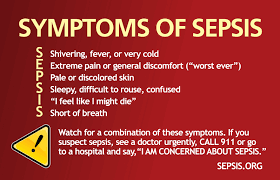
imgres

Further information

Post-sepsis syndrome

Not everyone experiences problems after being critically ill and the length and severity of the sepsis and the fitness of the individual prior to their illness has a marked impact on how quickly they recover. Post-sepsis syndrome is a condition that affects up to 50% of sepsis survivors.

Some problems that may arise can be physical and/or psychological. 

Physical:

  • Lethargy / excessive tiredness
  • Poor mobility / muscle weakness
  • Breathlessness / chest pains
  • Swollen limbs (excessive fluid in the tissues)
  • Joint pains
  • Insomnia (due to pain / breathlessness)
  • Hair loss
  • Dry / flaking skin and nails
  • Taste changes
  • Poor appetite
  • Changes in vision
  • Changes in sensation in limbs
  • Repeated infections (a small percentage of sepsis survivors suffer recurring infections during their rehabilitation.) 

Psychological and emotional:

  • Anxiety / fear of sepsis recurring
  • Depression
  • Flashbacks
  • Nightmares
  • Insomnia (due to stress or anxiety)
  • PTSD (Post Traumatic Stress Disorder)
  • Poor concentration
  • Short term memory loss

And in older people: “…60 percent of hospitalizations for severe sepsis were associated with worsened cognitive and physical function among surviving older adults. The odds of acquiring moderate to severe cognitive impairment were 3.3 times higher following an episode of sepsis than for other hospitalizations.”

Don’t suffer in silence. If you experience any of these problems during your recovery, see your GP and ask for support.

Related:

Recovery from Sepsis

Post-sepsis syndrome 

Sepsis and Autoimmune Diseases


I don’t make any money from my work. I am disabled because of illness and have a very limited income. But you can help by making a donation to help me continue to research and write informative, insightful and independent articles, and to provide support to others. The smallest amount is much appreciated – thank you. 

DonatenowButton cards

Heartless PIP Cuts Latest, ESA WRAG Cut Regulations Published – Benefits and Work

tories-19

I got the following email from Benefits and Work:

Dear Sue,

Even by this government’s standards it’s a shockingly cruel move.

Last month a tribunal of judges ruled that claimants with mental health conditions such as severe anxiety have a right to claim even the higher rate of PIP for help with going outdoors.

It was a decision that put an end to years of the DWP deliberately misinterpreting the law. It meant that many thousands of people with serious mental health conditions finally had a chance to gain a little bit more independence.

So the government acted with remarkable speed.

Bypassing the social security advisory committee, who are supposed to get the chance to comment on all changes to social security law, they published a statutory instrument that will reverse the judges’ decision.

In an effort to justify overturning the judges’ ruling, Tory policy supremo George Freeman mocked as “bizarre” the idea that claimants with mental health conditions should be eligible for PIP. Instead, he said, PIP should only be for “the really disabled people who need it.”

The changes will apply to all claims made from 16 March, 2017.

Just a few days ago we had the following feedback by email.

“Just wanted to say thank you so much for your amazing site! I have used your advice over the years for my son’s DLA applications with great success, have now had his PIP awarded for enhanced care, and after mandatory reconsideration, got the award for mobility as well (thanks to your advice about the tribunal rulings on this for people with a mental health issue).”

Unless attempts by the Lib Dems and Labour to overturn the statutory instrument are successful, and that seems a very long shot, we won’t be seeing many more emails like that.

ESA CUTS REGULATIONS FINALLY PUBLISHED
The DWP have finally published regulations removing the work-related activity component of employment and support allowance (ESA) for new claims.

New ESA claimants in the work-related activity group who are aged 25 or over will receive only £73.10 a week. They will not receive the additional £29.05 component that current claimants receive.

Similar regulations apply to universal credit claimants who have limited capability for work.

Claimants who made a claim for ESA before 3 April, or who are deemed to have made a claim before that date, as well as claimants who are still waiting to be transferred from incapacity benefits to ESA, will not be affected.

Claimants who qualify for the support group are not affected by the changes.

TRIBUNAL CHANGES
Sir Ernest Ryder, the Senior President of Tribunals, has confirmed that benefits claimants will be the Guinea pigs for changes to appeal tribunals due to begin in September 2017. From that date social security tribunals will move more and more online.

You can look forward to attempting to upload your personal data to the cloud, getting emails from tribunal clerks or judges which hopefully won’t disappear into your spam folder and to having a hearing – if you get one at all – via Skype or telephone.

We’ll keep you informed, and our appeals guides updated, as we learn more.

HAVE YOU BEEN ASKED TO JOIN THE DWP’S CLAIMANT PANEL?
DWP minister Penny Mordaunt told the Commons last week, in relation to PIP and ESA, that:

“One thing I have done to ensure that we get more timely information about where things are going wrong and where standards are not being maintained is to establish a claimant user rep panel, which will go live in the next few weeks. It will be rolled out on a very large scale across the country.”

We’re very keen to hear from anyone who has been invited to join this, until now, completely unknown body. Please contact us if you have.

HOME MEDICALS SURVEY
Many thanks to everyone who took part in our survey on PIP and ESA home medicals. We had almost 2,000 responses. There were a lot more additional comments than we had expected, so we’re making sure we go through them all before we publish our findings, which we plan to do in a fortnight.

Good luck,

Steve Donnison

Related

Two EDMs have been tabled to stop Tory cuts to disability support, with cross-party endorsement

Tory MP says PIP should only go to ‘really disabled’ people, not those with anxiety ‘taking pills at home’

Government subverts judicial process and abandons promise on mental health ‘parity of esteem’ to strip people of PIP entitlement

Lords table motion to kill new Tory restrictions on PIP


I don’t make any money from my work. I am disabled because of illness and have a very limited income. But you can help by making a donation to help me continue to research and write informative, insightful and independent articles, and to provide support to others. The smallest amount is much appreciated – thank you. 

DonatenowButton cards

Two EDMs have been tabled to stop Tory cuts to disability support, with cross-party endorsement

aaeaaqaaaaaaaad4aaaajdk1ytqwzdyxltjinwytngjhmc05njdlltmyzmu4mty4owi5za

I reported last week that the Liberal Democrats were planning an Early Day Motion (EDM) to halt the government’s authoritarian Personal Independence Payment (PIP) regulations. The new regulations are designed by the government to disregard the rulings of two upper tribunals regarding the scope of eligibility criteria for disabled people claiming PIP. However, upper tribunals are part of a body of administrative law that governs the activities of the administrative agencies of government. It is designed to independently review the decisions of governments, and as such, it provides protection and promotion of fundamental rights and freedoms for citizens.

The Upper Tribunal is a superior court of record, giving it equivalent status to the High Court and it can both set precedents and can enforce its decisions (and those of the First-tier Tribunal) without the need to ask the High Court or the Court of Session to intervene. It is also the first (and only) tribunal to have the power of judicial review. (The Conservatives have a historical dislike of judicial review. See for example: The real “constitutional crisis” is Chris Grayling’s despotic tendencies and his undermining of the Rule of Law.)

The first EDM has already gained excellent cross-party support. It’s primary sponsor is Tim Farron. Signatories include Jeremy Corbyn, Debbie Abrahams and a number of other Labour Party MPs, Caroline Lucas (Green Party), Jonathan Edwards (Plaid Cymru) and Scottish National Party MPs.  

It says: “That an humble Address be presented to Her Majesty, praying that the Social Security (Personal Independence Payment) (Amendment) Regulations 2017 (S.I., 2017, No. 194), dated 22 February 2017, a copy of which was laid before this House on 23 February, be annulled.”

From 1 April 2017, further cuts to Employment and Support Allowance (ESA) are to be introduced, again via statutory instrument (which are usually reserved for non-controversial policy amendments only). The new regulations mean that claimants who are placed in the Work-Related Activity Group (WRAG) will lose around £30 a week, receiving the same rate of payment as those claiming Jobseeker’s Allowance and the equivalent in Universal Credit.

Another EDM was tabled by the Labour Party, with the primary sponsor being Jeremy Corbyn, which says: “That an humble Address be presented to Her Majesty, praying that the Employment and Support Allowance and Universal Credit (Miscellaneous Amendments and Transitional and Savings Provisions) Regulations (S.I., 2017, No. 204), dated 23 February 2017, a copy of which was laid before this House on 27 February, be annulled.”

Disabled people have already carried a disproportionately large burden of austerity cuts.


2014-02-17-BurdenoftheCuts-thumb


The cuts to disability support have been widely opposed, yet the government apparently pays little heed to the need for democratic accountability. 

You can support disabled people who are being targeted by ever-increasingly punitive Conservative policies that are having an extremely damaging impacon us by emailing your MP and asking them to sign both EDMs. (Contact details here).


Related

A black day for disabled people – disability benefit cuts enforced by government despite widespread opposition

House of Lords debate: ESA – Monday 07 March 2016 (From 3.06pm)

MP attacks cuts hitting disabled people – Debbie Abrahams

Leading the debate against the Welfare Reform and Work Bill – 3rd reading – Debbie Abrahams

My speech at the Changes to Funding of Support for Disabled People Westminster Hall Debate – Debbie Abrahams

Man leaves coroner letter as he fears Work Capability Assessment will kill him

The government need to learn about the link between correlation and causality. Denial of culpability is not good enough.

The new Work and Health Programme: government plan social experiments to “nudge” sick and disabled people into work

Stephen Crabb’s obscurantist approach to cuts in disabled people’s support

A Critique of Conservative notions of “Social Research”

The DWP mortality statistics: facts, values and Conservative concept control


I don’t make any money from my work and I have limited income due to illness. But you make a donation and help me continue to research and write free, informative, insightful and independent articles, and to provide support to others. The smallest amount is much appreciated – thank you.

DonatenowButton cards


Terminally ill woman lost her ESA, home and all her belongings after being told she was fit for work


fireshot-capture-6-crowdfunding-to-hel_-https___www-justgiving-com_crowdfunding_tiffany-williams

Claire Hardwicke

Claire Hardwicke has stage four thyroid cancer. This means that it has spread to other parts of her body, and sadly, Claire was told that her cancer is terminal. She also has chronic osteoarthritis. Despite taking 80mg of morphine a day to cope, she still experiences considerable pain.

Additionally, Claire already had a life-threatening, acute allergy to latex. This means that she has to carry an EpiPen at all times, which is an epinephrine (adrenaline) injection to treat life-threatening anaphylaxis. Developing a severe allergy to latex unfortunately meant that Claire could no longer continue working as a mental health nurse. 

Claire first became ill 9 years ago with uterine/ovarian cancer, but it was the allergy that made her unemployable and ended her career as a mental-health nurse, her partner, Alan King, told me

Claire’s first bout of cancer was treated and she made a recovery, which lasted only 7 years. Sadly, the diagnosis of her more recent thyroid cancer and metastases wasn’t diagnosed until it was incurable. The tumours had spread throughout her thyroid gland, neck, lymph system and adrenal glands.   

All Claire can hope for now is palliative care, which is alleviatory only, as a cure isn’t possible. 

Unbelievably, Claire was assessed as “fit for work” by the Department for Work and Pensions (DWP) last year. Her Employment and Support Allowance was stopped. All of her financial support ended. This was despite being told by the Capita assessor (for Personal Independence Payments) that the report to the DWP would state that Claire was in need of more support, not less. 

Overnight the couple lost every bit of financial support they had previously been entitled to, so Alan decided to use what little financial resources he had left to help Claire to fulfill some of  her”Bucket List.”

The couple were forced to say goodbye to their rented bungalow and 99% of their possessions because their housing benefit was stopped. They had no income, as Claire’s Disability Living Allowance (DLA) and Employment Support Allowance (ESA) was stopped, and the Carer’s Allowance also ended.

Claire explained to me that when she lost her lifeline support, the wait for appeal hearings was over 18 months. The couple couldn’t afford to wait that long, as they had no income. They also didn’t know if Claire would survive the wait.

Claire and Alan went to visit family members around the UK before setting off, in October 2016, on a Mediterranean cruise for a month, which Alan paid for, using his credit cards. They already owed a lot of money on their credit cards, but with no income at all, the couple were facing destitution.  The incredible distress the couple suffered took its toll on Claire’s already poor health, too.   

On the return journey, both of them realised that coming all the way back to the UK – where they were homeless, with no income, and they no longer even qualified for free prescriptions – would be pointless. So the couple left the cruise when they got to Portugal, where it’s significantly warmer than the UK (and therefore less painful for Claire) – and they’ve been there ever since, living in a very basic, rented room.

Alan told me: “Claire’s cancer hasn’t claimed her life as quickly as we both had imagined, (which is good), but with medications, food and board, we’re now out of funds and out of options unless we can somehow fundraise for some subsistence.”

The couple have paid money in advance for their single room in Portugal, which covers rent until 14th March, after which time they will have absolutely nowhere to go.

Claire says: “There are new trial therapies for extreme cases of thyroid cancer like mine.

 I wish I had a pot of gold to pay for the experimental cancer therapy.
I don’t want to die, but choices and chances aren’t given to the poor people. We need a miracle, a winning lotto ticket. There should be equal opportunities for all patients.”

The treatment would possibly extend Claire’s life and improve the quality of the time she has left. She says: “I could have a chance of a longer, fuller life…. but I don’t have that option open to me….”

Tiffany Williams, a friend of Claire’s in the UK, has set up a crowdfunding page on JustGiving to raise £800 to help pay for her treatment. So far, 53% of the sum has been raised. 

It’s such a modest amount for a treatment that will make a huge difference to Claire and Alan, who have lost their home and everything else they had in the UK. Now they are at risk of losing their room in Portugal, too. 

You can make a donation at:  https://www.justgiving.com/crowdfunding/tiffany-williams

Update

Claire informs me that the gofundme collection has now closed. But for those wishing to help in some way, there is a beautiful painting of Claire by Jason Pearce, which is up for auction with funds going to her medical fees.  

She says many thanks. 

Jason Pearce is an administrator for a very popular political group, and like me, he was originally contacted and asked if a member (Alan) could post a gofundme page to raise money for treatment costs to the group, as his wife, Claire, is seriously ill. Jason agreed, and offered to help. As Jason is an artist, it was suggested that he could paint a portrait of Claire and it could then be auctioned online to help raise some more money towards Claire’s ongoing treatment.

This is Jason’s lovely painting of Claire.

17358823_10211339136927882_1860474519176663615_o

“Claire”

20″ x 16″ Mixed media on canvas.


My work is unfunded and I don’t make any money from it. I am disabled because of illness and struggle to get by. But you can support Politics and Insights and contribute by making a donation which will help me continue to research and write informative, insightful and independent articles, and to provide support to others.  DonatenowButton