Author: Kitty S Jones

I’m a political activist with a strong interest in human rights. I’m also a strongly principled socialist. Much of my campaign work is in support of people with disability. I am also disabled: I have an autoimmune illness called lupus, with a sometimes life-threatening complication – a bleeding disorder called thrombocytopenia. Sometimes I long to go back to being the person I was before 2010. The Coalition claimed that the last government left a “mess”, but I remember being very well-sheltered from the consequences of the global banking crisis by the last government – enough to flourish and be myself. Now many of us are finding that our potential as human beings is being damaged and stifled because we are essentially focused on a struggle to survive, at a time of austerity cuts and welfare “reforms”. Maslow was right about basic needs and motivation: it’s impossible to achieve and fulfil our potential if we cannot meet our most fundamental survival needs adequately. What kind of government inflicts a framework of punishment via its policies on disadvantaged citizens? This is a government that tells us with a straight face that taking income from poor people will "incentivise" and "help" them into work. I have yet to hear of a case when a poor person was relieved of their poverty by being made even more poor. The Tories like hierarchical ranking in terms status and human worth. They like to decide who is “deserving” and “undeserving” of political consideration and inclusion. They like to impose an artificial framework of previously debunked Social Darwinism: a Tory rhetoric of division, where some people matter more than others. How do we, as conscientious campaigners, help the wider public see that there are no divisions based on some moral measurement, or character-type: there are simply people struggling and suffering in poverty, who are being dehumanised by a callous, vindictive Tory government that believes, and always has, that the only token of our human worth is wealth? Governments and all parties on the right have a terrible tradition of scapegoating those least able to fight back, blaming the powerless for all of the shortcomings of right-wing policies. The media have been complicit in this process, making “others” responsible for the consequences of Tory-led policies, yet these cruelly dehumanised social groups are the targeted casualties of those policies. I set up, and administrate support groups for ill and disabled people, those going through the disability benefits process, and provide support for many people being adversely affected by the terrible, cruel and distressing consequences of the Governments’ draconian “reforms”. In such bleak times, we tend to find that the only thing we really have of value is each other. It’s always worth remembering that none of us are alone. I don’t write because I enjoy it: most of the topics I post are depressing to research, and there’s an element of constantly having to face and reflect the relentless worst of current socio-political events. Nor do I get paid for articles and I’m not remotely famous. I’m an ordinary, struggling disabled person. But I am accurate, insightful and reflective, I can research and I can analyse. I write because I feel I must. To reflect what is happening, and to try and raise public awareness of the impact of Tory policies, especially on the most vulnerable and poorest citizens. Because we need this to change. All of us, regardless of whether or not you are currently affected by cuts, because the persecution and harm currently being inflicted on others taints us all as a society. I feel that the mainstream media has become increasingly unreliable over the past five years, reflecting a triumph for the dominant narrative of ultra social conservatism and neoliberalism. We certainly need to challenge this and re-frame the presented debates, too. The media tend to set the agenda and establish priorities, which often divert us from much more pressing social issues. Independent bloggers have a role as witnesses; recording events and experiences, gathering evidence, insights and truths that are accessible to as many people and organisations as possible. We have an undemocratic media and a government that reflect the interests of a minority – the wealthy and powerful 1%. We must constantly challenge that. Authoritarian Governments arise and flourish when a population disengages from political processes, and becomes passive, conformist and alienated from fundamental decision-making. I’m not a writer that aims for being popular or one that seeks agreement from an audience. But I do hope that my work finds resonance with people reading it. I’ve been labelled “controversial” on more than one occasion, and a “scaremonger.” But regardless of agreement, if any of my work inspires critical thinking, and invites reasoned debate, well, that’s good enough for me. “To remain silent and indifferent is the greatest sin of all” – Elie Wiesel I write to raise awareness, share information and to inspire and promote positive change where I can. I’ve never been able to be indifferent. We need to unite in the face of a government that is purposefully sowing seeds of division. Every human life has equal worth. We all deserve dignity and democratic inclusion. If we want to see positive social change, we also have to be the change we want to see. That means treating each other with equal respect and moving out of the Tory framework of ranks, counts and social taxonomy. We have to rebuild solidarity in the face of deliberate political attempts to undermine it. Divide and rule was always a Tory strategy. We need to fight back. This is an authoritarian government that is hell-bent on destroying all of the gains of our post-war settlement: dismantling the institutions, public services, civil rights and eroding the democratic norms that made the UK a developed, civilised and civilising country. Like many others, I do what I can, when I can, and in my own way. This blog is one way of reaching people. Please help me to reach more by sharing posts. Thanks. Kitty, 2012

The DWP call handlers’ strike, structural violence and the Milgram experiment framework

DWP-Department-for-work-and-pensions-500x320 (1)

Universal Credit call handlers working at centres in Wolverhampton and Walsall have overwhelmingly voted in favour of strike action, accusing the Department for Work and Pensions (DWP) of treating them with “utter contempt”.

A ballot of PCS members working for the DWP on it’s highly controversial programme was announced earlier this month, warning of “severe under investment, staff shortages and ironically, criticism from claimants on how they are treated”. They also want full contracts for fixed-term workers, and an end to “management by statistics.”

Speaking ahead of the vote, PCS General Secretary Mark Serwotka challenged assumptions by government ministers that “Universal Credit is working well for workers and claimants”, instead arguing that “the opposite is in fact the case”.

He said that is was clear the DWP “want to run this service into the ground”, but the DWP insisted its “top priority remains assessing and making payments to customers”.

PCS and its members are calling on the DWP to hire 5,000 new staff, full contracts for fixed-term workers, and a reduction in the number of calls from Universal Credit claimants each case manager is required to handle.

Commenting on the result of the ballot, Serwotka said: “The message from our members is clear – changes need to be made otherwise they will walkout for two consecutive days.

This will mean that approximately 274 call handlers who work at the two offices will walk out for 48 hours starting on 11 March, after 90% of those balloted by the Public and Commercial Services (PCS) union backed industrial action.

Serwotka added: “The union has tried to negotiate for months but to no avail. Ministers have stuck their heads in the sand and our members are now sending them a very loud wakeup call.

“PCS members have not taken the decision to strike lightly but the fact is industrial relations have broken down because ministers seem intent on running this service into the ground while treating staff with utter contempt.”

Margaret Greenwood MP, Labour’s Shadow Work and Pensions Secretary, said: “It is shocking that staff working in DWP offices are feeling so stressed through overwork that they are going on strike and calling for the government to recruit more staff.

“Not only is the government’s flagship social security policy Universal Credit failing claimants, the government is also failing the DWP staff who work so hard.

“Labour will deliver a social security system that treats those in need and the people who are employed to support them with respect.”

A DWP spokesperson said: “This result is disappointing, we greatly value the work that our colleagues do and our top priority remains assessing and making payments to customers.

“We are comfortable with current staffing levels and will monitor and reallocate resource where necessary.

“Contingencies are underway to ensure the smooth running of our services to minimise any impact.

“We urge PCS to seek to resolve this through further dialogue.”

Serwotka said: “The union has tried to negotiate for months but to no avail.

“Ministers have stuck their heads in the sand and our members are now sending them a very loud wakeup call.

“PCS members have not taken the decision to strike lightly.

“But the fact is industrial relations have broken down because ministers seem intent on running this service into the ground while treating staff with utter contempt.”

Four years ago, 1,300 Universal Credit staff staged a 48-hour walkout in protest of the “oppressive” workplace culture.

DWP workers complained of staff shortages, poor training and at least £40m ‘squandered’ on IT that wasn’t used.

However, there was no complaint made about the intentionally cruel policies being implemented by the DWP, which troubles me a lot.

Some thoughts: government policy, structural violence and the Milgram experiment framework 

Milgram 1


One of the most famous and controversial studies of obedience in psychology was carried out by Stanley Milgram in 1963, he was a psychologist at Yale University. He conducted an experiment which explored the conflict between obedience to authority and personal conscience. Milgram examined justifications for acts of genocide offered by those accused at the World War II, Nuremberg War Criminal trials. Their defence was often based on “obedience” – that they were just following orders from their superiors.

The experimental procedure was that the participant was paired with another person and they drew lots to find out who would be the ‘learner’ and who would be the ‘teacher.’  However, the draw was fixed so that the participant was always the ‘teacher’, and the ‘learner’ was one of Milgram’s confederates (and actor pretending to be a real participant).

The ‘learner’ (a confederate called Mr. Wallace) was taken into a room and had electrodes attached to his arms, and the ‘teacher’ and researcher (there was also an “experimenter” dressed in a grey lab coat, played by an actor – not Milgram) went into a room next door that contained an electric shock generator and a row of switches marked from 15 volts (Slight Shock) to 375 volts (Danger: Severe Shock) to 450 volts (XXX). 

Milgram was interested in researching how far people would go in obeying an instruction if it involved harming another person, and how easily ordinary people could be influenced into committing atrocities. 

Two rooms in the Yale Interaction Laboratory were used – one for the ‘learner’ (with an electric chair) and another for the ‘teacher’ and experimenter with an electric shock generator. The ‘learner’ (Mr. Wallace) was strapped to a chair with electrodes. After he has learned a list of word pairs, the ‘teacher’ then tested him by naming a word and asking the ‘learner’ to recall its partner/pair from a list of four possible choices. For the purpose of the experiment, Mr Wallace gave the wrong answers deliberately.

The punitive shocks were administered at an increasing voltage each time the ‘learner’ made a mistake. There were 30 switches on the shock generator (pictured above) marked from 15 volts (slight shock) to 450 (danger – severe shock). 

Milgram wanted to know whether people would administer what they believed to be fatal shocks to another person under the pressure of an authority figure.

Some of the teachers protested as the authority figure gave the orders to continue — which began with “please continue” or “please go on” and increased in severity to “you have no other choice, you must go on.” 

Other subjects were detached and methodical, not protesting even as the learner screamed from the other room, ostensibly from the extremely painful shocks.

65% (two-thirds) of participants (‘teachers’) continued to the highest level of 450 volts. All the participants continued to 300 volts.

Mr Wallace was a convincing actor who shrieked in pain and begged for the shocks to stop. All of participants believed the shocks they administered were real. 

They weren’t.

Participants in the experiment were also told that researchers know a good deal about how positive reinforcement improves learning, but they know very little about how punishment improves learning. This was the ‘front’ for the purpose of the study.

Milgram’s pessimistic conclusion was that ordinary people are likely to follow orders given by an authority figure, even to the extent of killing an innocent human being.  Obedience to authority is ingrained in us all from the way we are brought up.

People tend to obey orders from other people if they believe their authority is morally right and/or legally based. This response to legitimate authority is learned in a variety of situations, for example in the family, school, and workplace.

The government’s welfare policies place emphasis on citizen ‘learning’, compliance and obedience to authority. The Conservatives’ distorted and prejudiced views about social security claimants have resulted in technocratic attitude and ‘behavioural change’ programmes – a pseudoscientific behaviourist approach – which is embedded in extremely punitive and oppressive policy and DWP practices.  The government’s coercive and behaviourist methods of achieving their aim has resulted in a class related and particularly vindictive form of structural violence. 

The politically orchestrated hierarchical organisation and institutionalisation of structural violence has recently reminded me of the Milgram experiment. 

Structural violence

structural violence

The government’s antiwelfarist ideology has resulted in structural violence being institutionalised, administrated and imposed on targeted groups of society, namely the poorest citizens. From the top down, this culture of inflicting harm on certain groups has become routinised and normalised. It’s hidden in plain view. 

However, the key difference between the experiment and current punitive practices within the DWP – such as sanctions – is that the harm inflicted in the former was not real. The punishments inflicted by the DWP are very real and are having catastrophic consequences on some groups of citizens, ranging from hunger and fuel poverty to destitution, rough sleeping and even death. 

In a few years it has become acceptable to threaten people who are already on the breadline with the removal of their lifeline support, leaving them without the means to meet their most basic survival needs – food fuel and shelter.  

According to Norwegian sociologist, Johan Galtung, structural violence is an “avoidable impairment of fundamental human needs”. As it is avoidable, structural violence is a high cause of premature death and unnecessary disability. Because structural violence affects people differently in various social structures or groups, it is very closely linked with inequality, social injustice and oppression.

A major contributing factor to the increase the ‘culture of workplace oppression’ is the collective behaviours of the current government, which has perpetuated, permitted and endorsed prejudices against marginalised social groups, such as disabled and unemployed citizens, with a complicit media amplifying these prejudices.

Because the Conservatives’ policies embed such a deeply punitive approach towards the poorest social groups, this in turn means that those administering the policies, such as staff at the DWP and job centres, for example, are also bound by punitive, authoritarian behaviours directed at the targeted group.

As authority figures and role models, their behaviours establish a normative framework of acceptability. Parliamentary debates are conducted by the Conservatives with a clear basis of one-upmanship, lies and aggression, rather than being founded on rational exchange. Indeed, ministers frequently sneer at rationality and do not engage in a democratic dialogue, instead they employ the tactics of a bully: denial, gaslighting, scapegoating, vilification, attempts at discrediting, smearing and character assassinations.

This in turn pushes moral and normative boundaries and gives wider society permission and approval to behave the same.

Studies of power, and obedience to authority provide an interesting paradigm in psychology, sociology, social psychology, political science, and obviously within organisational behaviours.

Scapegoating groups of citizens has a wide range of focus: from ‘approved’ enemies of very large groups of people (such as the mythologically discrete group known vaguely as the  ‘tax payer’) down to the scapegoating of individuals by other individuals.

The scapegoater’s target always experiences a terrible sense of their personal accounts of experiences being edited and re-written, with the inadequacies of the perpetrator often inserted into public accounts of their character (projection), resulting in isolation, ostracism, exclusion and sometimes, expulsion and elimination. The sense of isolation is often heightened by other people’s reluctance to become involved in challenging bullies, usually because of a bystander’s own discomfort and fear of reprisal.

Many of the participants in Milgram’s experiment said they acted as they did, not because they were committed to the experimenter or to science, but because they trusted the experimenter not to let them inflict serious harm.

The call handlers who voted to go on strike complain of “severe under investment, staff shortages and criticism from claimants on how they are treated”. They also mention a culture of oppression. Perhaps they believe they are administering harmless policies, and that their own stresses are simply down to severe under-staffing, “management by numbers”, mismanagement of IT projects and ‘complaints’ from claimants. But the call handlers are not those who are being targeted with political ‘contempt’. 

I was shocked that the DWP call handlers complained of “criticism from claimants on how they are treated”, rather than criticising how claimants are being actually being treated. 

Authority bias is the tendency to obey the orders of authority figures, even when you strongly believe that there is something wrong with those orders. During the Milgram experiment, participants could indicate at any point that they wished to stop. Most didn’t. 

At any point during the experiment, participants could indicate that they wish to stop. Any time this happened, the experimenter would tell the subject the following things, in order using an authoritative tone:

Please continue.

The experiment requires that you continue.

It is absolutely essential that you continue.

You have no other choice, you must go on.

If, after saying all four lines, the subject still refused to carry on with the experiment, then the experiment was stopped. 

I’m bitterly disappointed that both the workers themselves and the union fail to recognise the part those workers play within a hierarchy of power that is instrumental in inflicting structural violence on people claiming social security – those who have no negotiating power to change their circumstances whatsoever. 

It’s time to stop the experiment now.


I don’t make any money from my work. I am struggling to get by, like many other ill and disabled people. But if you like, you can contribute by making a donation and help me continue to research and write informative, insightful and independent articles, and to provide support to others going through the disability assessment process, mandatory review and appeals. The smallest amount is much appreciated – thank you.


The media’s fanfare of a Corbyn-backed second referendum is untrue

fake news

The mainstream media have just widely announced that Jeremy Corbyn is to back a second EU referendum. However, this is very dishonest, as no referendum motion has actually been tabled.

Furthermore, the media also need to learn the significant difference between a ‘people’s vote’, which is about asking the public about the terms of Brexit, and a completely new referendum. The Conservative office posted a highly dishonest tweet claiming that the Labour party are somehow “trying to stop Brexit”, so I am deeply suspicious of the fanfare of completely incorrect announcements in the media this evening.

Here is the Labour party’s  actual press release:

“From: Labour Party Press Office press@labour.org.uk
Sent: 25 February 2019 17:27
To: Labour Party Press Office press@labour.org.uk
Subject: NEWS FROM LABOUR: Labour to table amendment to make its credible alternative plan the UK’s Brexit negotiating position

Labour to table amendment to make its credible alternative plan the UK’s Brexit negotiating position.

Jeremy Corbyn MP, Leader of the Labour Party, will tomorrow (Tuesday 26 February) seek to enshrine Labour’s five Brexit demands in law by tabling an amendment to the government’s Brexit motion.

Labour’s amendment would force the government to make its credible alternative plan the Government’s negotiating objectives. Labour’s five demands for the Brexit deal are:

· A permanent and comprehensive customs union with the EU;
· close alignment with the Single Market underpinned by shared institutions and obligations;
· dynamic alignment on rights and protections;
· commitments on participation in EU agencies and funding programmes, including in areas such as the environment, education, and industrial regulation; and
· unambiguous agreements on the detail of future security arrangements, including access to the European Arrest Warrant and vital shared databases.

Jeremy Corbyn will tell a meeting of Labour’s Parliamentary Labour Party this evening that the party will back the Cooper-Letwin amendment to take ‘No Deal’ off the table and announce that Labour will also put forward or support an amendment in favour of a public vote to prevent a damaging Tory Brexit.

Speaking at tonight’s meeting of the Parliamentary Labour Party, Jeremy Corbyn MP, Leader of the Labour Party, will say:

“The Prime Minister is recklessly running down the clock, in an attempt to force MPs to choose between her botched deal and a disastrous No Deal. We cannot and will not accept.

“Last week, after our visit to talk to EU officials and leaders in Brussels and Madrid, no one can be in any doubt Labour’s alternative Brexit plan is serious and credible. We are convinced our alternative, which puts jobs and living standards first, could command support in the House of Commons, bring people who voted Leave and Remain together, and be negotiated with the EU.

“That’s why we will be putting down an amendment in parliament this week setting out Labour’s plan: for a comprehensive customs union with a UK say; close alignment with the single market; guarantees on rights and standards; protection for Britain’s role in EU agencies; and a security agreement which guarantees access to the European arrest warrant and vital shared databases. And we will be calling for legislation to underpin this mandate.

“We will also be backing the Cooper-Letwin amendment to rule out a No Deal outcome. One way or another, we will do everything in our power to prevent No Deal and oppose a damaging Tory Brexit based on Theresa May’s overwhelmingly rejected deal.

“That’s why, in line with our conference policy, we are committed to also putting forward or supporting an amendment in favour of a public vote to prevent a damaging Tory Brexit being forced on the country.”

Ends

Notes to editors

  • The full text of Labour’s amendment, to be tabled tomorrow, reads:

That this House instructs Ministers

(a) to negotiate with the EU for changes to the Political Declaration to secure:

(i)                a permanent and comprehensive customs union with the EU;

(ii)              close alignment with the single market underpinned by shared institutions and obligations;

(iii)             dynamic alignment on rights and protections;

(iv)             commitments on participation in EU agencies and funding programmes, including in areas such as the environment, education, and industrial regulation; and

(v)               unambiguous agreement on the detail of future security arrangements, including access to the European Arrest Warrant and vital shared databases;

(b) to introduce primary legislation to give statutory effect to this negotiating mandate;

There is no mention of another referendum in the amendment.

The press release does mention Labour’s intention, which is in line with their Conference policy – to put forward an amendment if all other options to prevent a Conservative no-deal Brexit are exhausted.

Labour’s position has not changed.

The amendment tabled on 29 January was defeated because the so-called moderates in the party refused to support it. The official Opposition’s amendment was defeated by division, 327 to 296. This amendment would have required Parliament to consider and vote on options which prevent the UK leaving the EU without a deal

So, in conclusion, no motion for a new referendum has been tabled.

So we need to ask why the media are claiming otherwise?


I don’t make any money from my work. I am struggling to get by, like many other ill and disabled people. But if you like, you can contribute by making a donation and help me continue to research and write informative, insightful and independent articles, and to provide support to others going through the disability assessment process, mandatory review and appeals. The smallest amount is much appreciated – thank you.

DonatenowButton

Disabled people face a hostile environment of calculated, strategic ordeals to deny support

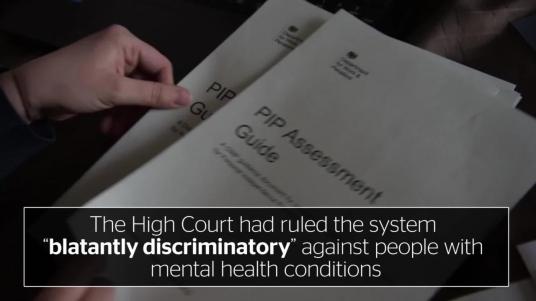
PIP court

Disabled people face a hostile environment comprised of strategically placed and thoroughly demoralising ordeals, which are being passed off as arising because of bad administrative practices and simple errors. However, such ordeals are happening far too frequently to have arisen through random error. Furthermore, there is an identifiable pattern of government sponsored behaviours that has emerged within privately contracted companies hired to deliver disability assessments, and within the Department for Work and Pensions, which is aimed at simply denying people support.

Many people who have challenged a Department for Work and Pensions’ (DWP) decision not to award them Personal Independent Payment (PIP) in court successfully are finding that soon after they have won their appeal, they face a reassessment, and their award is taken from them again.

Even when people appeal, the system is rigged against them applying for legal support, and cuts to charities mean any support at all is shrinking away. Official figures last year showed that legal aid cuts mean ill and disabled people appealing their lifeline support through what have been consistently shown to be fatally flawed assessments and irrational, poorly evidenced DWP decision-making, are denied legal support in a staggering 99% of cases.

This means that someone with severe depression, or battling serious illnesses such as multiple sclerosis, cystic fibrosis or connective tissue illnesses for example, are left to take on a long, exhausting and complex legal case against the government, alone. 

The assessment process is set up to remove people’s disability benefits entirely because the evidence provided in medical notes by GPs and consultants, and the account of ill and disabled people, are not deemed by the state to be as credible as a snapshot report by a private company assessor, based on a half hour interview.

Private companies are motivated purely by making profit. This perverse incentive leaves no room for improving the dire situation that people, often at their most vulnerable, are facing. Improving performance as a service provider, or of prioritising human needs in a system that was originally designed to do so offers no reward for companies such as Maximus and Atos, because the government has been willing to pay them – from public funds – for atrocious failings that have harmed people and caused much distress. 

Since PIP was launched in 2013 to reduce the costs of disability support, the increasingly reduced access to financial assistance to help with the additional costs of being disabled has forced more than 75,000 people to give up their specially-adapted Motability vehicles. 

The UN have found that government policies have brought about “grave and systematic violations of disabled people’s rights” in the UK.

As someone who has gone through both PIP and Employment and Support Allowance (ESA) assessments and subsequent appeal, and as someone who co-runs a support group online for others going through this system, I know that both the assessment processes are beset by profound administrative failures and ordeals which seem to be wholly designed to work to the disadvantage of  ill and disabled people.

A report last year called Access Denied: Barriers to Justice in the Disability Benefits System, shows some of the immense suffering that the adversarial social security system causes disabled people and the long, exhausting and difficult process people who are ill have to go through to finally get the support they deserve and have paid into.

After being wrongly turned down at assessment, people must first go through mandatory review which can take anything from a few weeks to several months. The DWP argues that claims are fully reviewed at this stage, but the fact that 69 per cent of claimants win their appeal after having gone through MR proves that the MR itself is failing to correct the assessment’s flaws.

Case study: ‘Rose’

I spoke to someone this week who has faced two tribunals regarding her PIP award.  After successfully appealing the first, Rose (not her real name) had a face to face assessment when her review was due in July 2017.  The DWP decided to end her award, so she requested a mandatory review.  The DWP ‘lost’ Rose’s request twice after she had sent it, and then failed to log it and upload it onto their system.

Many other people have reported that they are not being notified of mandatory review outcomes, too, finding out after months of phone calls that the original decision was upheld. People cannot appeal until they have gone through a mandatory review, and several people told me they think the delaying tactics are deliberate, to discourage them from appealing DWP decisions. 

The mandatory review request in Rose’s case was sent in September 2017. The DWP acknowledged it had been received but had not been ‘logged’. As she was kept in the dark, Rose rang to find out what was happening over a month later in November, and was told once again hat the DWP had  ‘forgot’ to put it on the system.

She told me “They just said that there were always delays and to be patient and didn’t tell me why it had been delayed in the first place, then didn’t log it yet again”.

She added: “The DWP finally did the MR in a rush (and did not change anything from the original decision obviously) when I phoned again a month after that in Dec 2017 (as I still hadn’t heard anything) and they finally admitted what had happened both times. They sort of apologised on the phone but that was it. The MR document didn’t even change one letter of their original decision.”

Rose then waited almost a year for a tribunal date, which was arranged for 19 December 2018.

She told me: “The tribunal was very hard. It was not my first or even my second, as I fought and won before a couple of years ago after having two hearings adjourned because I was too upset to continue. But I won.

“It was an interrogation in a proper court room, with very quick fire questions and a very bizarre one, to presumably try to catch me out right at the end as I was standing up.

“The judge asked where I went to get my nails done!? I have never had my nails done in my life. I actually laughed and showed them my very short, bitten, discoloured nails. When I told my parents about that bit, they were furious and quite rightly said ‘would he have asked a man something like that?'”

The court didn’t reach a decision that day.

Rose said: “They did not decide on the day as it was 3.45pm (the hearing started at 3) and they were finished for the day – it was almost Christmas. The staff there definitely seemed to be winding down to say the least.

“Whilst I was crying in the waiting area, the receptionists were all screeching and laughing about their party plans, which I felt was pretty jarring and unprofessional. 

“I finally got my letter on Christmas eve telling me that they had awarded me standard rates on both daily living and mobility components, which I was relatively happy with.

“Although relieved, I do think it should have been enhanced rate on daily living but they never consider finances / therapy in most cases I’ve heard. I wasn’t so happy with the amount of time awarded (see below) but I was relieved to have an award.”

Rose waited for around five weeks to hear from the DWP, anxious that they may be considering appealing the tribunal’s decision. After being prompted to ring them by  someone online offering her advice, she was told it was usual for the DWP to contact people to check details before they can sort out an award and backpay.

Rose told me: “I don’t have my own phone so used my parents’. The DWP said that their self imposed deadline to ‘sort it out’ was within six weeks and it would be paid then.

“I  phoned up again to check something and they said the same… then phoned yet again when the six weeks was up, a few days later, and I still hadn’t heard anything.

“The guy on the phone said he didn’t know why I hadn’t heard anything (he was lying as they did know by then) but said that there was nothing he could do and to just to be patient.

“I was distressed, pretty hysterical and in tears at this point on the phone to him and felt a bit sorry for him, as I don’t think he could understand much of what I was saying.”

Rose became more and more anxious and worried, so emailed her MP  in the hope that she could find out what was going on. She told me she was petrified that the tribunal outcome was being appealed.

Her MP phoned a special DWP ‘hotline’ and immediately found out that there was a problem, as the tribunal decision letter that Rose and the DWP had received on Christmas eve had one tiny date error on it: the court had written that Rose’s  PIP award should be backdated from the 07/07/2017 rather than 02/07/2017 .

Rose said: “The error apparently meant that they couldn’t pay me until it had gone back to the courts service to be changed (and then back to the DWP and right back to the back of the queue) which could take months, depending on how busy they were. 

“I would NOT have known this if the MP’s office had not have got involved ….the DWP outright lied to me on the phone more than once when they knew what was happening and further to that should really have picked up on this earlier i.e. when it was received by them before Christmas, according to the MP’s assistant.

“The MP’s assistant emailed the courts email address (apparently the only way he could contact them as they don’t have a hotline to HMCTS like they do to other government departments) and told me that they had two weeks to respond to him with further details.

“The day before that deadline this week (now 9 weeks since the tribunal) they contacted him and said that apparently the courts are STILL waiting for my file to be sent from an ‘offsite storage facility’ and it has not even got to the judge yet to sign. They have known about this since the 25th January (which is when the DWP finally contacted them, they took over a month to realise the mistake)! You’d think sending a simple file would not take that long…..

“They refuse to give timescales (the MP’s assistant has emailed them back to ask for some but obviously they then have 2 weeks to respond to that request again!) ….and obviously after the judge deigns to have time to change it, it then has to go back to the DWP to sort out (and go to the back of their queue again).

Rose told me “I can’t believe this, I need this money to live on. I SHOULD have had it every month since July 2017 (20 months back dated almost)! I’m at the end of my tether and don’t think I can cope with much more.

“It has almost been 20 months that I have been living on the breadline, just on my ESA as I don’t claim anything else. This whole process has made me so very ill. I mean I’m ill anyway, very ill but the added of all of this and the constant mistakes and errors and not knowing what’s going on and waiting has out me on the verge of sending me into crisis again. I have started self harming more regularly, my psychiatrist has put my medication up yet again and I don’t think I can cope with this anymore.”

Rose added “There will be no respite either, even when /if this gets sorted out, as I have just had my ESA renewal forms (ESA50) through last week …which is what sent me into a [mental health] crisis a couple of years ago.

“I will also have to apply for PIP again at the end of this year presumably as most of the backdated PIP will then be gone, as they only gave me 3 years. They felt I ‘could get better’, which is utterly laughable.”

Rose has Ehlers Danlos Syndrome (EDS), which is a degenerative genetic connective tissue disorder which causes constant chronic pain, chronic fatigue and frequent joint dislocations, with it’s concurrent POTS [postural orthostatic tachycardia syndrome], MCAS [a mast cell autoimmune disorder]and IBS. Rose also has spinal scoliosis, kyphosis, three ruptured spinal discs and trigeminal neuralgia. She is undergoing investigations for dyspraxia as well. 

She also has bipolar with severe depression and chronic anxiety.

She told me: “I’m a relatively intelligent person who used to have a very good job before I became too ill to cope (something the DWP have repeatedly used against me, that and my degrees). 

“Obviously mental health can improve in some cases, which is probably what they were getting at (very unlikely though with this strain constantly happening. I can’t see anyone going through this terrible system having time to gather their thoughts and improve in any way, shape or form when they constantly make you fight and justify why you are ill).

“But EDS is a degenerative genetic illness and the symptoms severely impact on my mental health as it is. Trigeminal neuralgia also only gets worse with age. The latter is also known as the ‘suicide disease’ because of the amount of people who have killed themselves rather than live with the pain. It’s said to be one of the most painful things you can get.

“It’s ridiculous, these are things that aren’t just going to go away. I have already been ‘not well’ for 20 years now, but was forced to finally give up work in 2009 after years of struggling and disciplinary meetings for being off sick so much. Yet the judge only gave me an award for three years, as it is, because they thought I could ‘improve’, which is impossible. 

“I’m so scared, this can’t be right, living in constant fear like this. Why do they hate us so much? I still can’t get hold of my welfare advisor at the local council to help me with my ESA50 either. I emailed him on the 12th and have left phone messages on his mobile and with his colleagues.

“I’m just so petrified that they will find some excuse not to give this [PIP award] to me now altogether. At the same time I am terrified that my ESA will be taken away and I’ll be left with nothing. The timing of the ESA reassessment is atrocious (but not surprising). I’ve been on ESA, in the support group since 2013 and have never had an assessment for that. Not until now, anyway.”

The tribunal granted Rose’s appeal. Because of the date error on the court letter, it may be justifiable that the error needs to be rectified by the court before the DWP issue the money she is owed in PIP backpay – from the date of her claim. However, Rose is entitled to ongoing PIP payments too. The DWP know this, yet haven’t given her a single payment. There is no credible reason for not paying her ongoing award in the meantime.

Recently, I have seen a large number of cases where people are being re-assessed earlier than the DWP had stated and they are losing their awards. For those on PIP and ESA, it’s become commonplace for people to be going through appeals for both awards at the same time, or successively, which means there is no respite from the extreme strain that they are being put through. The thing that strikes me is that in every case, the decision to end someone’s award is irrational and cruel, most often with absolutely no reasonable justification provided in the assessment reports, which are invariably completely inaccurate.   

The endless ordeal of re-assessments and withdrawals of support for disabled people; the introduction of heavily bureaucratic mandatory reviews, designed to deter appeals; the withdrawal of support and the long periods people are being left without any means of meeting even basic needs; the fact that mandatory review very rarely changes the decision to end an award and then the awful experience of having to appeal again is certainly convincing evidence of an intentionally created hostile environment for ill and disabled people – those very people the government claims it protects. 

There are also the unofficial, undeclared and non-legislative means that the Department for Work and Pensions frequently use to try at every opportunity to end claims. For example, it’s fairly common for the DWP to try to end ESA claims because a disabled person has been awarded PIP – a non means-tested income to support day-to-day independence and meet the costs of the additional needs arising because of disabilities. The DWP often try to claim that this is “standard” process when someone has “another award.” But PIP does not affect people’s  eligibility for ESA at all.

The endless tactics deployed by the DWP are designed to force disabled people to go through the thoroughly demoralisng, anxiety-provoking and punitive claim process all over again – which means a huge reduction in income because during the mandatory review, people cannot claim any ESA, and following MR, they will then only be eligible for the basic rate ESA. This also means there will be another long wait for another harrowing assessment, which presents a further opportunity for the withdrawal of lifeline disability support, and so on.

This kind of ruthless tactic was probably also designed to ensure that people never feel secure while needing lifeline support – a kind of informal Poor Law-styled “deterrence”.

Earlier this year, through a parliamentary question from Labour MP Madeleine Moon, it was revealed that more than 17,000 people died waiting for a DWP decision on their PIP claim between April 2013 and April 2018.

Disclosed official DWP data also reveals that 7,990 people died within six months of having a claim for PIP rejected by callous DWP ‘decision makers’. This indicates that contrary to Conservative minister’s claims, those most in need of support are being catastrophically failed by the assessment and decision making regime. 

Of these, 3,680 died within just three months of having their PIP applications rejected by the DWP.

I’m wondering what it will take for the government to admit that the system is unacceptably cruel and to acknowledge the mounting empirical evidence that, rather than supporting those most in need, the system is intentionally set up to deny support to as many people as possible, regardless of their needs and regardless of the ethical red line that has been shamefully crossed by the Conservatives under the guise of ‘welfare reform’.


I don’t make any money from my work. I am struggling to get by, like many other ill and disabled people. But if you like, you can contribute by making a donation and help me continue to research and write informative, insightful and independent articles, and to provide support to others going through the disability assessment process, mandatory review and appeals. The smallest amount is much appreciated – thank you.

DonatenowButton

Woman who was refused PIP died, family successfully sue Capita for £10,000

victoria

The week after she died, a tribunal panel overturned the Department for Work and Pensions’ decision, deciding that Victoria was eligible for a PIP award that she had been refused.

Victoria Smith [pictured] passed away last July aged just 33, within weeks of being told she was not eligible for Personal Independence Payments (PIP). Her family have been awarded £10,000 in damages

Victoria’s mother, Sue Kemlo, sued Capita for making inaccurate statements on Victoria’s health assessment. However, Capita told the BBC it stood by the original decision.

Her mother, Sue Kemlo, told the BBC: “If they hadn’t cut her PIP, my daughter would still be here.” Victoria suffered from agoraphobia and fibromyalgia, which left her in constant and severe pain.

The Department for Work and Pensions (DWP) wrote to Victoria in early 2018 to tell her she needed to be re-assessed for the benefit, which is intended to help with the additional costs of having a disability, and to support disabled people in living as independently as possible.

In March, 2018, Victoria was re-assessed at home by a healthcare professional employed by Capita. The assessment led the DWP to decide she was no longer eligible for PIP, a conclusion her mother said “was a pack of lies”.

Victoria immediately asked for a mandatory review but was again refused her PIP award by the DWP. She received the decision in June, shortly after she was admitted to hospital. The decision “destroyed” her, her mother said.

“When they took away her ability to look after herself, to have a way of life, she gave up.”

Victoria died of a brain haemorrhage. However, her doctors told the family that her underlying conditions, particularly the fibromyalgia, had deteriorated as well.

The week after she died, a tribunal panel overturned the DWP’s decision, deciding that Victoria was eligible for PIP.

Furious with the conclusions the Capita employee had reached, Victoria’s mother took legal action against the company for maladministration; on the grounds that the Capita assessor made inaccurate statements in the report.

The family has now been awarded £10,000 in damages.

“I didn’t do it for the money,” said Mrs Kemlo.

“I did it for them to admit they were wrong, to get some justice for my daughter, because (it’s) only ever been about justice for Victoria.”

In a statement to the BBC, Capita said: “We offer our deepest condolences to the family in this very tragic case.

“We have reviewed this at a senior clinical level and we are confident that our report was correct based on the information presented to us at the time of the assessment.

“Our full response to the claim was not considered by the Court as a result of a procedural issue, and as a consequence judgment in default has been entered into against us.

“We have asked the Court to investigate the procedural issue and we are expecting a response from the Court shortly.”


I don’t make any money from my work. I am struggling to get by, like many other ill and disabled people. But if you like, you can contribute by making a donation and help me continue to research and write informative, insightful and independent articles, and to provide support to others going through the disability assessment process, mandatory review and appeals. The smallest amount is much appreciated – thank you.

DonatenowButton

Greta Thunberg’s Message to Davos Elites: Act as If Our House Is on Fire. Because It Is.

My Message to Davos Elites: Act as If Our House Is on Fire. Because It Is.

“At places like Davos, people like to tell success stories. But their financial success has come with an unthinkable price tag. And on climate change, we have to acknowledge we have failed. All political movements in their present form have done so, and the media has failed to create broad public awareness.”

“We are facing a disaster of unspoken sufferings for enormous amounts of people. And now is not the time for speaking politely or focusing on what we can or cannot say. Now is the time to speak clearly.

“Solving the climate crisis is the greatest and most complex challenge that Homo sapiens have ever faced. The main solution, however, is so simple that even a small child can understand it. We have to stop our emissions of greenhouse gases.

“Either we do that or we don’t.

“You say nothing in life is black or white. But that is a lie. A very dangerous lie. Either we prevent 1.5C of warming or we don’t. Either we avoid setting off that irreversible chain reaction beyond human control or we don’t.

“Either we choose to go on as a civilization or we don’t. That is as black or white as it gets. There are no grey areas when it comes to survival.”

Source: My Message to Davos Elites: Act as If Our House Is on Fire. Because It Is. Greta Thunberg.

Greta has welcomed the huge mobilisation of young people in the UK, which follows demonstrations by tens of thousands of school and university students in Australia, Belgium, Germany, the United States, Japan and more than a dozen other countries. She says: ““I think enough people have realised just how absurd the situation is. We are in the middle of the biggest crisis in human history and basically nothing is being done to prevent it. I think what we are seeing is the beginning of great changes and that is very hopeful.”

In December, Greta spoke at the United Nations climate conference, berating world leaders for behaving like irresponsible children. Last month, she addressed the global business elite at Davos. She said: “Some people, some companies, some decision-makers in particular, have known exactly what priceless values they have been sacrificing to continue making unimaginable amounts of money. And I think many of you here today belong to that group of people.”

Globally, more than 3,000 scientists have given their endorsement and  backing to young people’s climate change protests and strikes. 

The UK strike has been supported by one of the UK’s leading teaching unions and  academics say the young people who are prepared to organise and take part in the strike are setting an example that others should follow. 

In a letter to the Guardian, 200 UK academics say: “It is with these tragic and desperate events in mind that we offer our full support to the students, some of whom may well aspire to be the academics of the future, who bravely plan to strike on 15 February to demand that the UK government takes climate action.”

“We are inspired that our children, spurred on by the noble actions of Greta Thunberg and many other striking students all around the world, are making their voices heard.”

Parties on the left have broadly supported the protests. The mass action was supported in particular by frontbench Labour MPs. Leader, Jeremy Corbyn, tweeted that climate change was the greatest threat people faced and young people were “right to feel let down by the generation before them and it’s inspiring to see them making their voice heard today”. Caroline Lucas also endorsed the protests.

There was also support from a small number of Conservative MPs – including the energy minister Claire Perry.

However, there has been some criticism of the protests by climate change deniers and Conservative politicians dismissed the protests, claiming they amount to little more than “truanting.” The government, with a track record that clearly and consistently demonstrates they don’t understand what is best for young people, have condemned the strikes on the grounds of costs, too. 

Conservatives complained with some irony that the Parliament Square lawn had been damaged by young people, and it had only just been replanted after being all but destroyed during last summer’s global heatwave.

Labelled “a strike” by the BBC, the government called the sight of thousands of  protesting young people out of school “truancy”.

Theresa May has condemned the protests, her deputy official spokesman said: “It is important to recognise that disruption increases teachers’ workloads and wastes lesson time that teachers have carefully prepared for.

“That time is crucial for young people precisely so that they can develop into top scientists, engineers and advocates that we need to tackle this problem.” What an utterly ‘seen but not heard’ patronising  commentary, from a government that haven’t listened to the scientists, engineers and advocates, ever, on climate change.

The latest United Nations report warned there were just 12 years remaining to avoid the worst effects of global warming, from record-breaking droughts and heatwaves to warming oceans and melting ice sheets.

In the last week  scientists have warned of a catastrophic collapse of insect population with devastating consequences for humanity, and a separate report said human-caused threats to climate, nature and the economy posed a danger of systemic economic collapse unless radical action is taken.

However, the government in the UK, who boast ‘evidence based policies’ have nonetheless condemn everyone who presents a view that differs from their own. They shamefully condemn our young people who are protesting for their future and that of our planet.

Rather than recognise that this is sign that the last generation are failing in our responsibility to protect the next; to ensure our children are safe from the worsening impacts of climate change, and the elements of increasing precarity that neoliberalism has imposed on them, the government have condemned them.

Students from Graveney School in Tooting, south London, join the protest in Westminster.

They have condemned us all on every level – from their obsession with economic growth at any cost and their exclusively ‘business friendly’ policies to their ‘bonfires of red tape’. from growing inequality and poverty to profoundly damage public services, they have condemned us all.

Ask yourself: What is the point of an economic model that does not fulfil the majority of citizens’ needs?

They have condemned us all because they have persisted in placing private profit over and above fundamental human needs.


I don’t make any money from my work and I don’t permit advertising. In fact I have to pay to keep my site advert free. 

You can if you wish contribute by making a donation and help me continue to research and write informative, insightful and independent articles, and to provide support to others. I co-run an online group to provide support for ill and disabled people going through disability assessments, mandatory review and tribunals. The smallest amount is much appreciated – thank you.
DonatenowButton

DWP is trying to co-opt GPs in forcing ill people into work

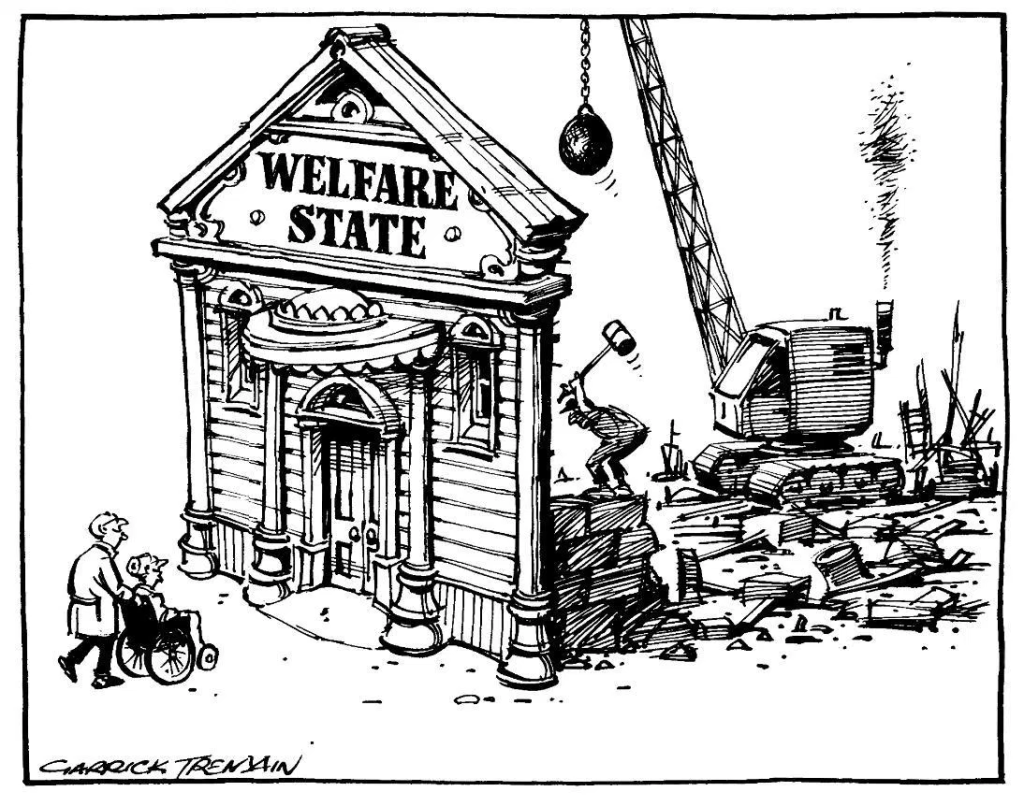
facade welfare

Yesterday on Twitter, I posted one of my previous posts – Jobcentre tells GP to stop issuing sick notes to patient assessed as ‘fit for work’ and he died in which I discuss a letter addressed to a GP regarding a seriously ill patient. It said:

We have decided your patient is capable of work from and including January 10, 2016.

“This means you do not have to give your patient more medical certificates for employment and support allowance purposes unless they appeal against this decision.”

The patient, James Harrison, had been declared “fit for work” and the letter stated that he should not get further medical certificates. 

However, 10 months after the Department for Work and Pensions (DWP) contacted his doctor without telling him, he died, aged 55. James clearly wasn’t fit for work. 

The GP had stopped issuing medical certificates when the DWP told him to. It is completely unacceptable that James Harrison was left struggling without support, when he was clearly very ill. It is also unacceptable that James’ GP was given instructions from the state – that caused harm – without James’ knowledge. 

The certificates – so-called fit notes – demonstrate that the government seems to have some difficulty in recognising that sometimes people get ‘sick’ and require support via the provision they have paid into.

Austerity: When the state takes money from the public and hands it out to millionaires

David Cameron, however, had other plans for the UK. He said: “We simply have to get to grips with the sicknote culture that means a short spell of sickness absence can far too easily become a gradual slide to a life of long-term benefit dependency.

“The new welfare bill – described as the biggest shake-up of the system since it was set up 60 years ago – is designed to say end the culture of the fit and healthy being able to refuse work being rewarded for staying at home.”

However, the statement isn’t coherent. He infers that people are recovering from a brief period of illness and then refusing to return to work. As we have learned at great human cost over the last few years, this legislation has destroyed the lives of thousands of people who are ill. It was always intended to take away support from those who need it most. That is evident in the Conservatives’ incoherent attempt at a justification narrative, propped up by the right wing media. 

It never seemed to have crossed Cameron’s mind that 1) people’s medical conditions may worsen, they may have a chronic or degenerative illness. Being chronically ill does not make a person ‘benefit dependent’, it simply makes them ill. 2) The public contributes to the treasury, which is in part a funding mechanism towards social security and other state provisions, via tax and national insurance. This is done on the understanding that the state ensures that citizens can meet their basic survival needs. The Conservatives have clearly stated they have ‘other’ ideas on how our public funds should be spent, which does not include meeting the needs of the public.

The state is responsible for handling public funds. It is unacceptable that such contentious neoliberal ideology is being used by the Conservatives to dismantle state provision for those who need it most, while deliberately targeting the poorest citizens with austerity cuts. Meanwhile, millionaires are rewarded with generous tax cuts from the public purse. At the time when the welfare reform act was passed, millonaires were handed a tax cut of £107,000 each per year. This callous and unjustified approach to social administration is destroying people’s lives and has profoundly damaged our democracy and society, while seriously and systematically violating the human rights of the UK’s most marginalised groups.

It is very worrying that the clearly dangerous ESA65B form is a standardised response to GPs from the DWP following an assessment where someone has been found fit for work.  I discussed some of the raised issues further in another article from last year that I posted on Twitter yesterday – GPs told to consider making fit notes conditional on patients having appointment with work coach 

It’s even more worrying that the part clarifying ‘fit notes’ should continue if a person is appealing a ‘fit for work’ has been removed from the standard letter, and a line added that says: “In the course of any further consultations with […] we hope you will also encourage [the patient]in [their]efforts to return to, or start, work.” 

I always worry when the government uses the words “encourage”, “help” and “support” in the context of policies and political practices that affect disabled people. They are usually techniques of neutralisation – euphemisms for the actions embedded in punitive and harmful policies.

This growing practice of the state intruding in the confidential relationship between a GP and patient undermines trust, it damages the professionalism and clinical expertise of doctors and threatens the safety and wellbeing of patients. It shrinks the safe spaces for citizens to escape the increasingly oppressive practices of the government. It turns GPs into non-neutral agents of the state.

We know from the high rate of success at appeal for Employment and Support Allowance claims that the DWP’s decision making regarding ill and disabled people’s ‘work capability’ is truly atrocious and negligent, and there is absolutely no convincing empirical evidence that “work is a health outcome”. (See: Work as a health outcome, making work pay and other Conservative myths and magical thinking.)

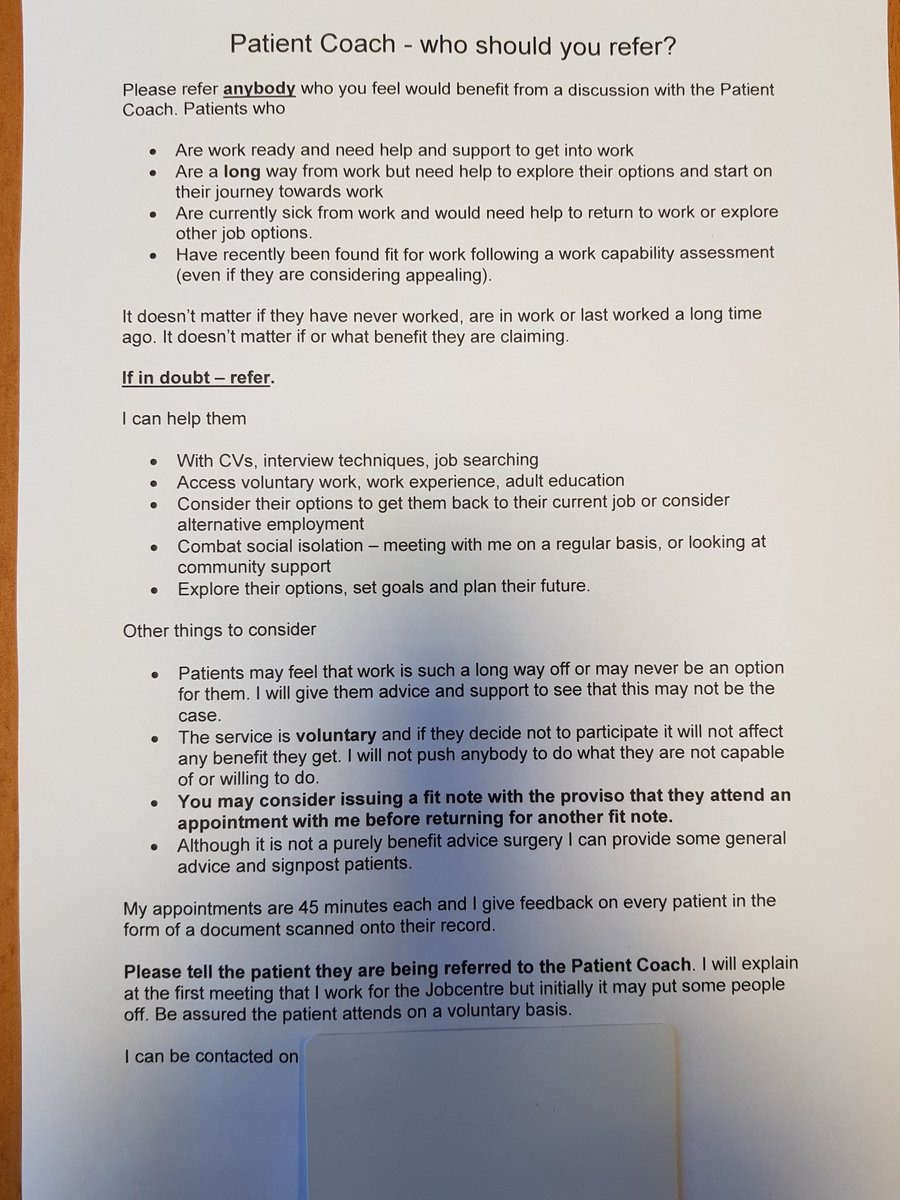
Last year, jobcentre staff were forced to withdraw guidance that urged GPs in Leeds to use deceitful tactics to attempt to get people who are ill off social security support and into work. The shocking guidance asked doctors to send patients for a 45-minute session with a “Patient Coach” – without mentioning that the coach actually worked for the the DWP.

It was even suggested that GPs withhold sick notes unless patients agreed to attend an appointment with the work coach. 

This is a tactic many of us have previously warned of – the government attempting to co-opt doctors to police ill and disabled people, pushing them into work, regardless of whether or not it is appropriate or safe to do so. But it also indicates the direction of travel for healthcare in the UK. The government intend to make that provision conditional also. (See Tories propose nudge, big business AI initiative and ‘personal responsibility’ in place of adequate health care funding.)

The government is forcing people who are ill into either work or into poverty, and both  outcomes are absolutely ethically unacceptable, a violation of rights, authoritarian and very dangerous. Increasingly, poverty is being used as a weapon to coerce people into work. However, many jobs are not paying enough for people to meet their living costs, so it is no guarantee that work will alleviate poverty.

The government seems to think that citizenship rights ought to be entirely conditional on people being economically useful to the government.

If we fail to be so, we are being treated as disposable political commodities. But citizens are not a means to state imposed ends and ideological aims in wealthy so-called first world democracies. And democratic governments don’t generally impose ‘behavioural change’ techniques on citizens, or professionals, for that matter, in order to make them complicit in the abuse and oppression of marginalised groups. The state is increasingly policing and punishing the poorest citizens, leaving them completely isolated and without any reliable support whatsoever.

The ESA65B is misleading GPs and deterring people from appealing wrongful  DWP decisions

On the DWP’s ESA65B GP’s letter template most recently placed on the government site, titled “Help us support your patient to return to or start work” it says: “We assessed [Title] [First name] [Surname] on and decided that [select] is capable of doing some work, but this might not be the same type of work [select] may have done before.

“We know most people are better off in work, so we are encouraging [Title] [First name] [Surname] to find out what type of work [select] may be able to do with [select] health condition or disability through focused support at [select] local Jobcentre Plus.

“In the course of any further consultations with [Title] [First name] [Surname] we hope you will also encourage [select] in [select] efforts to return to, or start, work

“Please do not give [Title] [First name] [Surname] any more fit notes relating to [select] disability/health condition for ESA purposes.

The problem is that people appealing wrongful DWP work capability decisions need to provide sickness certification in order to proceed.

Minister for disabled people, Sarah Newton, responded to one of several Written Questions from Emma Dent Coad, saying: “The ESA65B letter is issued to GPs in every case where an ESA claimant has been found ‘fit for work’. This process was built into the IT system as part of the introduction of ESA in October 2008. 

“Following a Ministerial requirement by the Cabinet Secretary, which was endorsed by the Secretary of State for Work and Pensions, the content of the ESA65B letter has been improved in order to explain to GPs the type of support customers can expect to receive from their local Jobcentre, and to ask GPs to encourage customers in their efforts to return to work.” [My emphasis]. 

GPs are trained and tasked to objectively address health and wellbeing, they should not be co-opted as government ideologues.

The decision to change the letter template was made without any scrutiny from or consultation with parliament and the public. It’s worth reading the series of questions by Emma Dent Coad. Prompting accountable and transparent answers from Sarah Newton appears similar to an exercise in pulling teeth. The responses given display the arrogance, contempt and delusions of an authoritarian government.

When people become ill, they make an appointment with my GP, and not the secretary of state for work and pensions, and for very good reasons. People need support and treatment, not someone spouting ideologically orchestrated dangerous claptrap about how work is ‘good’ for them. It seems the notion of convalescence and recovery are incompatible with the government’s aim of “getting Britain working”.

Catastrophically inaccurate assessments within the DWP are the norm. The government are intentionally reducing access to essential support and services for ill and disabled people, and this ideological attack is causing material hardship, suffering, distress and sometimes, it is killing people. 

The contentious “fit for work” assessment is forcing severely ill people to look for work and sanctioning them if they’re exhausted, in too much pain to get out of bed, while delays in social security are forcing cancer patients to food banks, and the bedroom tax results in bed-bound ill and disabled people facing horrifying threats of eviction. 

These are the direct consequence of intentionally punitive government policies, which aim at enforcing ‘personal responsibility’ and ‘behavioural change’ on those citizens with the fewest choices.

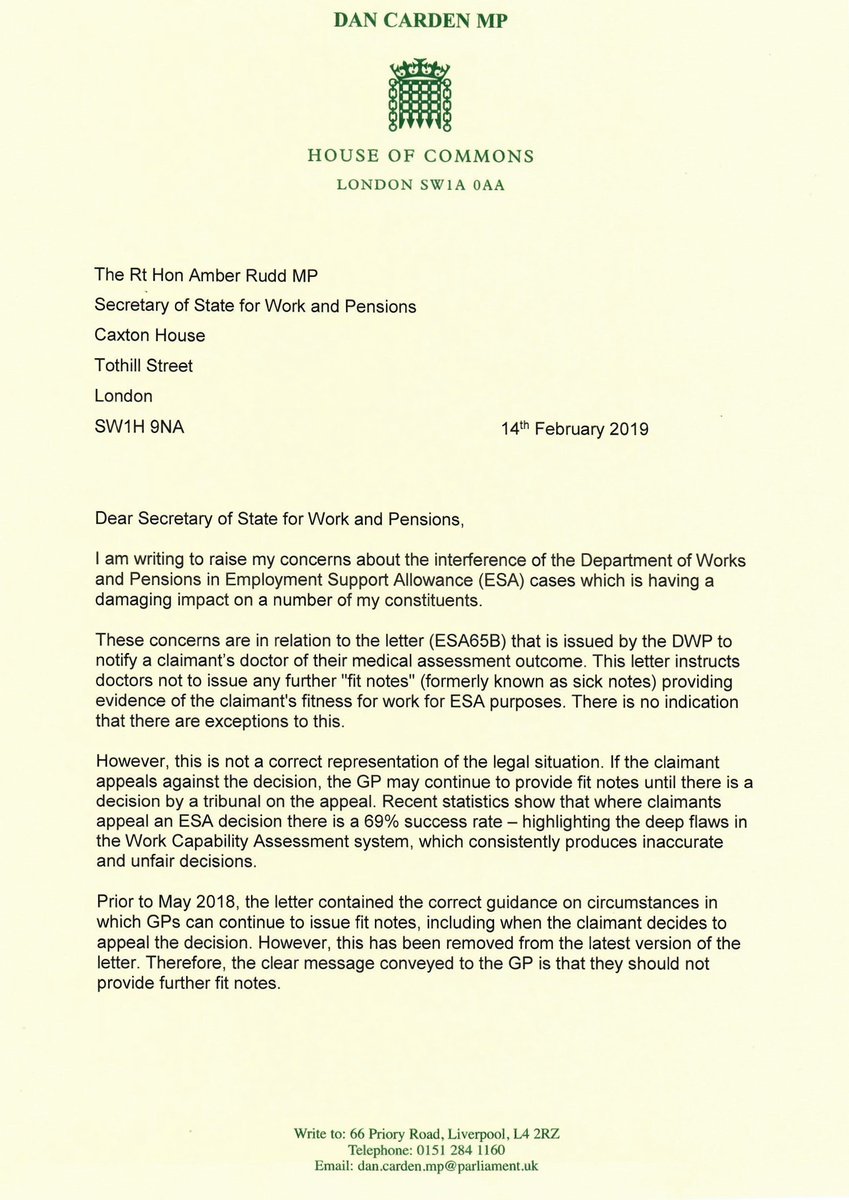
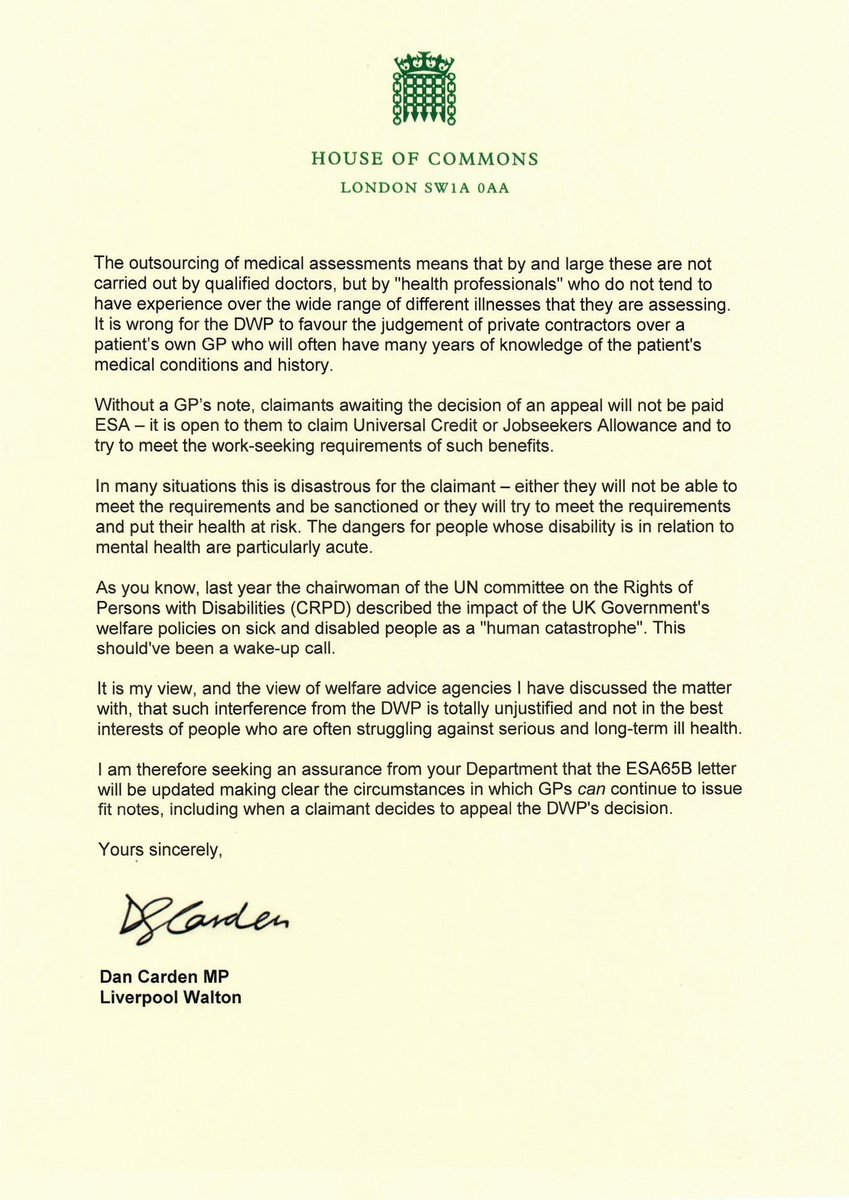
Dan Carden’s letter to Amber Rudd

I was pleased to see Liverpool Walton MP Dan Carden’s letter to Amber Rudd (below) which addresses some of the concerns many of us have raised. He also notes that without a GP’s ‘fit note’, (the Conservative’s Orwellian rebrand of the sick note) it isn’t possible for people challenging Department for Work and Pensions (DWP) decisions to claim Employment and Support Allowance (ESA) in the interim period, until their appeal is heard at Tribunal. 

Indeed, people who have lodged an appeal against a wrongful decision have been blocked from claiming ESA while awaiting the hearing, due to the misleading letter routinely sent from the DWP to doctors. This prevents untold numbers of low-income claimants from accessing financial support while they wait for months on end to go to tribunal. 

Entitlement to ESA pending appeal is enshrined in the ESA Regulations to cover the whole of the period leading up the hearing. It is also possible to have the payment backdated to cover the Mandatory Review waiting period too – it can take over six weeks for the DWP to review their original decision, over which time people are left without welfare support.

However, ESA pending appeal is not paid automatically – people usually have to ask for it, and must provide fit notes from their GP, presenting these along with their appeal acknowledgment letter from the Tribunal Courts to their local Job Centre. The Job Centre should report back to the DWP who will arrange for ESA pending appeal to be paid.

It simply isn’t appropriate for the DWP to interfere in a GP’s professional and qualified judgement, especially given the high rate of successful ESA appeals, indicating just how poor the decisions issued by the DWP actually are concerning people’s capacity to work. 

Dan’s letter:

DzTKHDpWoAA0VSi

DzTKISmW0AAPXWq

Related

Jobcentre tells GP to stop issuing sick notes to patient assessed as ‘fit for work’ and he died.

Rogue company Unum’s profiteering hand in the government’s work, health and disability green paper

The new Work and Health Programme: government plan social experiments to “nudge” sick and disabled people into work

Tories propose nudge, big business AI initiative and ‘personal responsibility’ in place of adequate health care funding


I don’t make any money from my work. But you can contribute by making a donation and help me continue to research and write informative, insightful and independent articles, and to provide support to others. The smallest amount is much appreciated – thank you.

DonatenowButton

Disabled people claiming PIP are being forced to go through two assessments

PIP pic

Benefits and Work have reported that a number of their members in recent weeks have been been made to go through a second Personal Independent Payment (PIP) assessment before a decision is made on their award, because there was a problem with the first assessment report.

One member faced a two hour assessment on Christmas Eve. In January they were contacted by Capita and told that the assessment was “incomplete” and that someone was to be “sent round to finish it.”

Capita have refused to say what information was missing and would not provide a copy of the report until it was complete.

One member told Benefits and Work:

“This has left me feeling very anxious. All they would say is that they needed further information as the last assessment was incomplete. I’m confused. I feel that they want to trip me up even though I was completely truthful about my conditions in the last assessment.”

I co-run an online group to support people going through PIP and Employment and Support Allowance claims, assessments, mandatory review and appeals. Our members are also reporting that this is happening to them, too.

One person told me: “After suffering two heart attacks and a quadruple bypass plus a brain tumour and a previous devastating head injury , which will never be “cured” he was told to apply for PIP.

“Three months later and the lady sent from a brain injury charity, to help him , phoned up the Department for Work and Pensions regarding his assessment and they denied having any knowledge of said assessment and said it will have to be done again.

“The stress is unbearable for my partner.

“Horrendous.”

Another person said: “I had my assessment in November. I rang to see why I wasn’t told a decision just before Christmas and was told I would need another assessment as the one I’d had didn’t give enough evidence to make the decision.

“I collapsed at the assessment in the examination because I was told to stand up from my wheel chair and I can’t. What more evidence do they need? I have rheumatoid arthritis and a severe spine injury, they have medical evidence from my doctor? I can’t face it all again. The stress is making me very poorly.”

Another member had almost completed their assessment when it was suddenly stopped and they were told they would have to return for a new, full assessment. The only reason they were given was that the assessment should have been done by a physiotherapist instead of a nurse.

One Benefits and Work member took her son for a PIP assessment which lasted 2 hours and 15 minutes. However, this person was then told that the assessor had not filed the report so they would have to return for a new assessment.

The new assessor took 1 hour and 30 minutes. The assessor claimed that she had the original report on screen and would take information from that, but she did not actually do so. As a result our member did not give some of the information that had been covered in the first report.

The member said:

“I was too worried at the time to complain but I did contact my MP.”

Another member was contacted after their assessment in December and told that she would have to attend a second assessment in February before a decision on her claim could be made. When they asked why:

“I was told it was to do a more robust assessment and that if I didn’t attend they would refuse my claim.”

The person concerned is understandably very anxious about the repeat assessment:

“I am in total meltdown mode and if the first one is anything to go by I’m dreading the next one. I was so stressed and anxious I could barely control myself but did manage to answer all the questions they asked.”

One member’s 16 year old child is about to be moved from Disability Living Allowance (DLA) to PIP. They had an assessment in December but have now been asked to attend a second one before a decision is made.

The member commented:

“So I guess we just go to the 2nd assessment and do it all again then? Just what a overly anxious child wants eh!!”

Another member had their PIP assessment in December as part of the process of moving from an indefinite DLA award. However, in January they were contacted by Capita who said that the DWP had requested further information and they would have to have a further assessment. Capita have not said what further information is needed or why it can’t be collected by phone.

The member said:

“I am sick with worry I was already suffering with even more anxiety than usual due to going through this process.”

The PIP assessment process is enormously stressful for many people. To have to go through it twice with no adequate explanation as to why seems unfair and unreasonable. At the very least, people should receive a letter of apology and an explanation of why a telephone conversation would not be sufficient to put matters right.

Please consider complaining to your MP if this happens to you.

Benefits and Work are interested in hearing from anyone else who has been forced to attend two assessments.  Please click on the link and leave your comment here.

You can also leave a comment on this article, as I will be sending this information to government and shadow ministers.


I don’t make any money from my work. But you can contribute by making a donation and help me continue to research and write informative, insightful and independent articles, and to provide support to others. The smallest amount is much appreciated – thank you.
DonatenowButton

Twin brothers found hanging from tree in tragic suicide pact after benefits were cut

DWP-Department-for-work-and-pensions-500x320

Vulnerable twin brothers were found hanging from a tree in Greater Manchester within months of their social security support being axed by the Department for Work and Pensions (DWP), the Manchester Evening News reportsNeil and Paul Micklewright were found by someone walking their dog in Urmston on 31 July 2018.

Suicide notes were found in the brothers’ pockets, and similar longer notes were found “neatly laid out” on a table in their home. Police coroners officer David Wood told an inquest that when officers searched the brothers’ flat they found financial documents had been arranged in folders, the fridge and freezer had been emptied and defrosted, the fish tank had been emptied and cleaned, their clothes had been packed away in plastic bags, electrical appliances had been switched off, the batteries were removed from the smoke alarms and the beds had been stripped.

The two brothers, who are said to have “relied on each other most of the time”, were reported to have received £40,000 inheritance following the death of their mother which resulted in their benefits being stopped. However, it is also reported that neither brother had more than a few pounds in their bank accounts at the time of their deaths. Their sister Julie Gillaspy told an inquest that the twins were “too proud” to go back to claim social security and were suffering financial hardship in the months leading up to their death.

The inquest into the 52-year-old twins’ deaths heard that they were “gentle, kind and generous”, and had lived with their parents their entire lives.

 Gillaspy described the two men as “introverted,”  adding: “They were very close, sometimes to the exclusion of others.” She said that she had “struggled to understand” why her brothers took their own lives. 

The two suicide notes found in the pockets of the brothers and the two found left n their home were described by a coroner as “essentially identical”, and offered no real clue as to the reasons behind the apparent suicide pact, other than to say that they had “had enough”. 

But it was clear that the twins were vulnerable. “I think they struggled socially and I think it all just got on top of them”, Gillaspy said.

“They were very proud people who perhaps weren’t dealt the best hand in life.”

A post-mortem examination gave both brothers’ cause of death as hanging.

Wells said the brothers’ suicide pact “appeared to be a well-planned event”, he added: “All suicides are tragic but the death of two brothers in these circumstances is particularly tragic.”

Researchers and sociologists have identified several causes for rises in the rate of suicide in the United Kingdom; these include recent recessions, unemployment, austerity measures and loneliness. Research undertaken by Samaritans suggested that mental-health issues of middle-aged men and loss of masculine pride and identity are also major factors behind the high rate of suicide.

It is very difficult to establish a single cause of suicide, the reasons are often very complex. One of the thoughts that struck me when I wrote this is how inaccessible our social security system has become, especially for vulnerable people. One of the reasons for this is related to the stigma that has been attached to claiming support, which has happened at least in part because of utterly irresponsible political and media scapegoating narratives, as well as the government’s programme of punitive welfare policies. This made me very angry and also, terribly saddened, because those people who need support the most are being catastrophically let down by a dehumanising system.

There is no narrative from the inquest, as far as I know, that explains why the twin brothers had scarcely any money in their accounts to get by, given the reported circumstances of their inheritance. 

The Samaritans and other charities and campaign groups have called for a prioritisation of resources towards services aimed at suicide reduction and prevention. 

My own view is that unless we ensure people can meet their basic living needs as a society – such as ensuring that social security is accessible and covers the costs to secure food, fuel and shelter – citizens’ psychosocial needs will always be less of a priority, while they are struggling to survive. Abraham Maslow’s iconic hierarchy of human needs explains how psychological and social wellbeing is very much dependent on our physical wellbeing, and meeting survival needs. 

It is difficult to report on suicide. I try my best to do so responsibly and sensitively, while ensuring that the wider public are kept informed. It is important not to brush over the complex realities of suicide and its devastating impact on those left behind, and to also remain mindful of how an article is written, which may have potential consequences for others, including people who are vulnerable, or who identify with the persons who have died.

I know that researching and writing about suicide affects my own state of mind.

If you have been affected by this article, or if are experiencing distress and anxiety and don’t know who to talk to, the Samaritans (116 123) operate a 24-hour service available every day of the year. If you prefer to write down how you’re feeling, or if you’re worried about using the phone, or being overheard, you can email Samaritans at jo@samaritans.org

The Sanctuary (0300 003 7029 ) helps people who are struggling to cope – experiencing depression, anxiety, panic attacks or in crisis. You can call them between 8pm and 6am every night.


My work is unfunded and I don’t make any money from it. This is a pay as you like site. If you wish you can support me by making a one-off donation or a monthly contribution. This will help me continue to research and write independent, insightful and informative articles, and to continue to provide support others who are affected by the welfare ‘reforms’. 

DonatenowButton

The NHS business services authority is creating a hostile environment for vulnerable patients

intro-video-poster

Patients claiming universal credit who are exempted from prescription charges are receiving penalty notices because prescription forms have not been amended to include the benefit – six years after it was introduced. Some people have reported receiving multiple charge notices. Many people are being penalised for a pharmacy error or because of a misunderstanding. A third of the 2017 penalties imposed were overturned on appeal so far.

Patients who are suspected of wrongly claiming free prescriptions face a penalty of five times the prescription charge plus the charge itself. The maximum is £100; £50 is added if the bill is not settled within 28 days. 

The NHS Business Services Authority (NHSBSA), an arm’s length body of the Department of Health and Social Care (DHSC), says a universal credit tick box should be added “later this year”. Until then, claimants entitled to free prescriptions must tick the “income-based jobseeker’s allowance” box. However, some who did so report they have still been penalised. Furthermore, no one is informing people which box to tick.

Many of the patients who receive penalty notices simply failed to realise that they no longer qualified for free prescriptions and dental treatment. Exemption certificates are automatically issued to those who earn less than £15,276 a year and receive working tax credit, child tax credit, or income support, as well as income related Employment and Support Allowance.

However, apparently, the certificates are only valid for up to seven months and recipients are not notified if they do not qualify for a renewal. The new fraud prevention system seems to be set up to penalise people because of the fact they are not kept informed of changes to their entitlement to free prescriptions, which is categorically unfair.

Moreover, it is creating severe distress and harm.

The devastating impact on vulnerable patients

Last year, Labour called for an overhaul of the system when a woman killed herself after receiving nearly £200 in penalty charges. Penny Oliver, a part-time chef, had not realised her exemption had lapsed after an ESA assessment deemed her fit for full-time work. Because her benefits had been cut she could not afford the penalties. In June 2018, she took an overdose of antidepressants – the medication that had created the debt.

Oliver owed sums of just £8.60 and £20.60. But with penalty fees and surcharges these rocketed – the second one alone soaring to £120.60. That’s ten times the amount for that prescription. After having lost hundreds of pounds a month when her benefits were cut, she simply couldn’t pay. Her housing benefit and council tax reduction were also cut, leaving her facing recovery action for an overpayment. 

She had just a few pounds in her account and was surrounded by payment demands when her family tragically found her dead last in June. Letters from the council, the NHS and Department for Work and Pensions included threats to take her to court and inform her employer if she did not pay.

At the time, shadow Health and Social Care Secretary Jonathan Ashworth said: “This is shocking. Questions have to be asked about the humanity of a system that does this to vulnerable people.

Penalty charges should be scrapped – it’s a disgrace to exploit vulnerable, ill people in this way. Ministers urgently need to step in and review this system.

“Our NHS is there to help patients get better not make their condition worse by putting ­unacceptable burdens on people like this.”

Single mother Sue Carpenter was ordered to pay £100 after mistakenly claiming a free dental check-up. “I have had an NHS exemption since my daughter was three, but I received no reminder that it would run out when she was 18,” she explains.

“I knew my child tax credit would change, but I’m still eligible for working tax credit and I assumed the exemption was linked to the entire tax credit award, not just to the child component. The dentist didn’t ask to see my certificate, which I now realise expired two weeks before.”

Carpenter says that the expiry date should be made clear. “The NHS exemption seems a unique instance of a status that runs out with no clear warning, allows you to continue using it when it has expired and then incurs a steep penalty without prior notice of the consequences.”

The NHSBSA says it is a patient’s responsibility to check the expiry date on their exemption certificate.

However, recovering costs someone incurred in error is one thing, but fining people because they didn’t read the very small print, especially given that the citizens affected are likely to be ill and also on a low income, is a step too far. While it raises revenue for a cash-starved NHS, it is at the expense of those with the least, as usual. Fining people for a genuine mistake because they are not provided with sufficient information in the first place is outrageously mercenary.

The high cost of countering pre-estimated fraud

It is unsurprising to learn that the NHS counter fraud authority was created by legislation, launched in 2017-18, and is subject to direction by the Secretary of State. It’s also worth noting that the majority of health funding goes to the Department’s
arm’s-length bodies. 

In 2016-17 the Health Department had an overall revenue and capital budget of £122.2 billion. Less than 4% (£4.7 billion) of its funding was allocated to the core Department, according to the National Audit Office (NAO). The remainder  (£117.5 billion) was allocated to its arm’s-length bodies. That’s a huge sum of public money that is spent on managing the NHS and not on delivering frontline services. 

Furthermore, amendment was made via statutory instrument to the Regulation of Investigatory Powers (Directed Surveillance and Covert Human Intelligence Sources) to ensure that the senior officers of the NHSCFA will have the power to authorise the conduct of covert directed surveillance. The health authority is directed to carry out the Secretary of State’s functions in relation to counter fraud against or affecting the health service in England.

Usually when Conservatives claim to “counter fraud”, it entails the creation of a hostile environment. Social security, for example, has been transformed from a redistributive system for the public protection from the ravages of poverty to one that administers the discipline, coercion and sanctions, using absolute poverty as a punishment for “non compliance”.

Professional and patients’ bodies have also expressed their concern that the system designed to detect fraud is undermining the whole ethos of the NHS.

Rachel Power, chief executive of the Patients Association said: “Serving penalty notices on patients cannot be a caring way to manage this system.” 

“Some of the people who received these notices will be in vulnerable situations, and the impact of letters threatening court action, particularly for those who are receiving treatment for mental illnesses, should not be underestimated.

“While it’s important that fraudulent and incorrect claims are identified, nearly one in three penalty notices had to be withdrawn because they were issued in error. This shows a system that is highly dysfunctional.”

It also indicates the introduction of an increasingly hostile environment within health services, especially for those ill people on low incomes. 

The health secretary, Matt Hancock, has previously said: “The message is clear. The NHS is no longer an easy target, and if you try to steal from it you will face the consequences.”  

I’m wondering how it is possible to steal healthcare, bearing in mind that the same minister insists that the healthcare in the UK is still “free at the point of access”. I think this systematic restriction of access to public services more generally is precisely what David Cameron meant when he said that he wanted to tackle the “culture of entitlement”.

The public pay taxes and national insurance – “social insurance” – for increasingly little return while millionaires get tax cuts and carrots while everyone else gets the austerity stick, and told to live within our increasingly diminishing means. We are being dispossessed, so the very wealthy can accumulate even more wealth.

This year the NHS is piloting a digitised system that it claims will enable pharmacists to check eligibility instantly. However, surely the same system could be used to inform patients of their eligibility status also. That would reduce error considerably, too. 

The NHSBSA say they are digital by default, and: “We use complex algorithms and data mining tools as a means to identify both normal behaviour and outliers in NHS data, within which fraudulent behaviour may be found.

The resulting “analyses” are used to support ongoing investigations as well as inform the intelligence picture and guide fraud prevention steps.”

The “complex algorithms” are very clearly being used as a blunt instrument, resulting in least one death, to date. Yet one of the highest costs of “highly probable” fraud, according to the NHS BSA is from procurement and commissioning fraud, at an estimated cost of £266m £266m between 2016-17. (See page 8 here). 

The key stakeholders of the counter fraud authority include NHS England, NHS Improvement and the Cabinet Office.

The Royal Pharmaceutical Society and the British Medical Association fear the new system will withhold vital treatment from people on low incomes who remain eligible for free prescriptions but have failed to renew their paperwork.

“Pharmacists don’t want to be the prescription police, spending their time checking exemptions rather than advising on patient care,” says Sandra Gidley, chair of the Royal Pharmaceutical Society’s English pharmacy board.

“It’s very easy for mistakes to happen. Sometimes it’s that the computer says ‘no’, on other occasions people have simply forgotten to renew. Some don’t know if they’re exempt or not, or wrongly assume they are.”

She says that the prescription system should be overhauled to prevent confusion and reflect medical advances. “Medical exemption criteria have not changed since 1968. This means they are completely unjust. For example, those with long-term asthma have to pay for prescriptions, whereas people with diabetes don’t. Many new long-term conditions have been discovered in the past 50 years and they aren’t covered at all.

“It would be much simpler to have free prescriptions for everyone, as is the case in Scotland and Wales, because then no one would have to worry about remembering to fill out the right form.”

Data released under the Freedom of Information Act last year shows that 1,052,430 penalty notices were issued to patients in England in 2017 – about double the level in the previous year. But the data confirms that 342,882 penalty notices were subsequently withdrawn because the patient was entitled to free prescriptions after all, upon further investigation. 

The NHSBSA, the agency in charge of issuing the fines, said it was “continually reviewing its data-matching process and making improvements to ensure eligible patients were not wrongly pursued.”

The agency said it was also trying to educate patients on the importance of keeping the details on both their GP records and their exemption or prescription prepayment certificates up to date. 

It’s yet another public service system that’s been designed to assume people are guilty of fraud, with the onus on patients to provide proof that they are innocent.

“The NHS loses millions each year through fraudulent and incorrect claims for free prescriptions,” said Alison O’Brien, head of loss recovery services at the authority. “On behalf of NHS England, and in discussion with the Department of Health and Social Care, the NHS Business Services Authority checks claims randomly and retrospectively to appropriately recover funds and return them to NHS services.”

However, as the data strongly suggests, in far too many cases, it isn’t appropriate to recover funds and impose fines. Errors are happening all too frequently, creating anxiety, distress and hardship. When accusations of fraud are made which are not true, it causes humiliation and creates scapegoats.

Given that the neoliberal state treats citizens as if they have done something wrong as a starting point – which is the key message embedded in hostile environments; creating stigma and criminalising already marginalised groups –  it’s become a standardised form of political abuse which is entrenched within our public services. It’s designed as a punitive form of resource gatekeeping, resulting in withholding service and support from the very people who those services were designed to support.

Unfortunately, there is a pathological political narrative that tends justify cost cutting measures and punitive policies which portray the state and the mythically discrete class, “the taxpayer”,  as victims, when the state is actually perpetrator, and we all pay taxes for the services that are being dismantled by stealth.

Many of us have raised concerns related to the impact of the government’s various “hostile environment” policies in the health, housing, welfare, finances and banking, education, social services and other sectors, on vulnerable groups and those who share protected characteristics. The Equality Act was originally designed to address this kind of discrimination. But as we have learned over the last eight years, the government regards human rights and equality frameworks as a mere inconvenience. 

Peter Burt, a patient who was wrongly issued with one of the NHS penalty notices, said he worried about how certain patients would react to receiving one. “Some of the people who received these notices will certainly be in vulnerable situations and some will be receiving prescription medication for anxiety and mental health issues,” Burt said.

“They should not be receiving letters threatening court action just because the NHS can’t be bothered to check the records to see whether they have a prepayment card – especially if there is no intention of carrying out the threat. It’s hugely disappointing that, at a time when clinical services are clearly facing financial strains, the NHS bureaucracy is wasting money by sending out hundreds of thousands of inaccurate demands every year.”

Watson said more problems lay ahead if further planned changes to the way medicines were prescribed were introduced.

“The bureaucracy around prescriptions is unfit for purpose, and will only get worse if NHS England introduces its planned restrictions on prescribing over the counter medicines,” she said. “Serving notice of penalties for free prescriptions on patients who may be vulnerable and unwell and are then required to demonstrate their right to a free prescription cannot be a compassionate and caring way to manage this system.”

It certainly seems to be the government’s modus operandi to withdraw compassion and care when it comes to public policy design, which have been templated to implement austerity rather than ensure delivery of public services that are fit for purpose.

You can check your eligibility for free prescriptions and other health services here: National campaign launches urging patients to ‘Check Before You Tick’ for free prescriptions.


My work is unfunded and I don’t make any money from it. This is a pay as you like site. If you wish you can support me by making a one-off donation or a monthly contribution. This will help me continue to research and write independent, insightful and informative articles, and to continue to provide support others who are affected by the welfare ‘reforms’. DonatenowButton

Government data reveals scandal: 1,000s dying just months after being denied PIP support

Tory newton

Sarah Newton, minister for disabled people.

Government ministers have said that the controversial Personal Independence Payment (PIP) assessments ensure that those people “most in need” receive support. Last month I wrote about a disclosure from the Department for Work and Pensions (DWP) concerning the mortality rates of people awaiting PIP assessments.

Official DWP data reveals that 7,990 people died within six months of having a claim for PIP rejected by cruel DWP ‘decision makers’. This indicates that contrary to Conservative minister’s claims, those most in need of support are being catastrophically failed by the assessment regime. 

Of these, 3,680 died within just three months of having their PIP applications rejected by the DWP.  The figures also show that 17,070 people have died waiting for their PIP claims to be assessed by DWP decision makers.

It has also been revealed that 5,290 of those who had applied under the Special Rules for terminally ill people (SRTI), (those with a terminal disease with less than 6 months to live), died before the DWP made a decision on their claim. 

Further disclosure indicated that 11,790 of these undecided claims were dealt with under ‘normal rules’ and so had not been fast-tracked because they were terminally-ill.

A separate set of DWP figures show that 72% of PIP claimants who take their cases to a social security tribunal go on to win their appeals.

Labour MP Madeleine Moon said: “These shameful figures reveal how potentially gravely ill people who should be eligible for benefits, have tragically fallen through the cracks of a system that should be there to support them as they approach the end of life.”

They haven’t fallen through the cracks. These people were forced through them.

Marsha de Cordova, Labour’s shadow minister for disabled people, said: “These shocking figures show that the cruel and callous PIP assessment is unfit for purpose.

“That thousands of people die three months after being denied vital social security payments is disgraceful.

“Ill and disabled people are being failed [with]the most tragic consequences.

“Labour will end the hostile environment in the DWP and replace the PIP assessment framework with a system that treats disabled people with dignity and respect.”

A DWP spokesperson shamefully insisted there was “no evidence” to suggest people died for the same reason they were trying to claim PIP. And those affected were “only a small fraction of the millions of PIP claims since 2013.”

But there is also no evidence that people did not die for the same reasons they were turned down for support, either.

The government are not monitoring the impacts of the policy, and so have persistently failed to collect evidence either way. Furthermore, dismissing thousands of people so atrociously left in hardship – by a system designed specifically to cut support – indicates the hardened and callous attitude of the state and fundamental lack of compassion towards ill and disabled people, most of whom have paid social insurance contributions for social security provision, only to find in their time of need that welfare support and public services are increasingly inaccessible.

In 2017, two tribunals had ruled the DWP should expand the reach of PIP – which helps disabled people fund their additional living costs. Yet the DWP warned that this would cost £3.7bn extra by 2022 – so unveiled emergency legislation to stop the change happening. At the time, then Disabilities Minister Penny Mordaunt said her move would “make sure we are giving support to those who need it most” – and insisted no one who had already been claiming PIP would see payments drop. 

However, there is clear evidence that PIP is not being awarded to many thousands of people “who need it most”. 

Sarah Newton, now the Minister of State for Disabled People, published one lot of  figures on 11 January following a question raised in parliament by Madeleine Moon in December: “How many people have died while waiting for their personal independence payment assessment to be completed; and what were the conditions those people died from?”

Newton responded: “All benefit claims can be made under the special rules for people who are terminally ill which will mean that they are fast tracked. These are currently being cleared within 6 working days for new claimants to PIP. The Department would encourage all claimants with a terminal illness to let the department know and to apply using the special rules.”

Newton is actually implying that payments are being delayed because people aren’t informing the DWP of their terminal condition. That’s highly unlikely.

She said: “The cause of death of PIP claimants is not collated centrally by the Department.”

Over 3.6 million applications to PIP were made between April 2013 and 30th April 2018. Of these:

  • 4,760 claimants died between their case being referred to, and returned from, an assessment provider;
  • 73,800 claimants died within 6 months of their claim being registered; and
  • 17,070 claimants died after registering but prior to the DWP making a decision on their claim. Details of the claimant’s primary medical condition, where recorded, are in the accompanying spreadsheet.”

The total number of PIP claimants who died was 95,000. But Newton’s response does not indicate at what stage of their claim the 73,800 people, who died within six months of it being registered, were at. Nor does it indicate what those people who did not have terminal or degenerative illnesses died of – including those with mental illness. For example, 270 of those mortalities are listed as having had anxiety and/or depressive disorders as their primary disorder.

Of those who did have terminal illnesses, we need to ask why these people were  cruelly left waiting so long for their assessment, if, as Newton claims, they are ‘fast tracked’ through the claim and assessment process. There is clearly a gap between what we are being told and what is actually happening. 

Newton also warns on her data release: “This is unpublished data… It should be used with caution and it may be subject to future revision.”

There is, however, an Excel spreadsheet that indicates some of the primary conditions of those people who have died. But we cannot assume that those mortalities have arisen as a consequence of the recorded condition. That’s because the DWP isn’t carrying out any detailed monitoring. 

The DWP are experts at reluctantly providing data that lacks both context and details, which, they often say, they simply don’t collate. And 9,020 people’s main condition was not recorded at all by the DWP.  There is no means of useful comparison between mortality rates year by year, or a reference point to start from. A similar statistical analysis of Disability Living Allowance (DLA) claimant mortalities, for example, would help establish an average or baseline. 

Moon followed up on her questions. On January 17, she asked “the Secretary of State for Work and Pensions, pursuant to the Answer on 11 January 2019 to Question 203813, how many claimants of personal independence payments who died within six months of their claim being registered had their application rejected.” (See: Personal Independence Payment: Written question – 209778).  

Sarah Newton answered on the 01 February as follows:  

“Over 3.6 million applications to Personal Independence Payment (PIP) were made between April 2013 and 30th April 2018. Of these, 73,800 claimants died within 6 months of their claim being registered.  

“Prior to any Mandatory Reconsideration or Appeal action, 56,770 and 7,990 of these claimants had their claims awarded and disallowed respectively. 

If a claimant dies before a decision is made on an outstanding claim, the Department establishes whether the claimant’s representative or next of kin wishes to proceed with the claim. If not, the claim is withdrawn so around 7,700 of the 73,800 claims were withdrawn rather than awarded or disallowed.

“56,920 of the 73,800 claims have been credited with a payment.

“Claims made under the special rules for people who are terminally ill are fast tracked and are currently being cleared at a median average of 6 working days for new claimants. This has reduced from a median average of 11 working days between April 2013 and March 2014. 

“Notes: 

  • These figures include claims made under both Normal Rules and Special Rules for Terminal Illness (SRTI) and include new claims and Disability Living Allowance (DLA) to PIP reassessment claims. 
  • The point of application is taken as the day the claimant registered a claim to PIP as recorded on the PIP computer system. 
  • The outcome is the first DWP decision recorded on the PIP Computer system. This does not take into account any mandatory reconsideration or Appeal action so some of these claimants may have subsequently been awarded PIP. Some cases do not have a decision recorded. 
  • This is unpublished data from the PIP computer system’s (PIP CS) management information. It should be used with caution and it may be subject to future revision. 
  • Figures are rounded to the nearest 10. 
  • Figures cover claims made up to and including 30th April 2018 and clearances up to and including 31st October 2018. 
  • GB only. 

“Under the Social Security (Notification of Deaths) Regulations 2012 and s125 of Social Security Administration Act 1992 date of death is provided to the Department for all registered deaths. Additionally next of kin also provide information on the date of death of an individual and this information is used appropriately in the administration of Departmental benefits.” 

Grouped Questions: 209776. 

In December last year, Amber Rudd admitted she has ‘concerns’ that disability benefit tests could be failing the most vulnerable citizens. 

The Work and Pensions Secretary made the comment days after we told how 72% of tribunal appeals overturn the original test

Previously the DWP has said the number of successful appeals is low overall. But Rudd told MPs: “I do have concerns about the number of appeals that get through, i.e. a lot. 

“Which does indicate that maybe those earlier decisions could be better made.”

rudd
Amber Rudd

20,133 people appealed a decision to change or deny their PIP in the three months before Christmas, of which 14,581 won their case. All those people had already gone through an internal appeal known as a Mandatory Reconsideration – which several  MPs have described as a “rubber stamp”.  

The figures released by Sarah Newton reveal that more than 130 working-age disabled people a month on average have been found ineligible for PIP following an initial assessment by government contractors Atos and Capita but were nonetheless so unwell that they died soon afterwards. 3,680 disabled people – or more than 60 a month – died within three months of their initial PIP applications being rejected by DWP. 

PIP is very clearly unfit for purpose. The government urgently need to change this, instead of continuing with their neoliberal project of disassembling public services, including social security. Imposing conscious cruelty on marginalised social groups in the UK has become a standardised policy practice of the Conservatives.


My work is unfunded and I don’t make any money from it. This is a pay as you like site. If you wish you can support me by making a one-off donation or a monthly contribution. This will help me continue to research and write independent, insightful and informative articles, and to continue to provide support others who are affected by the welfare ‘reforms’. 

DonatenowButton