Author: Kitty S Jones

I’m a political activist with a strong interest in human rights. I’m also a strongly principled socialist. Much of my campaign work is in support of people with disability. I am also disabled: I have an autoimmune illness called lupus, with a sometimes life-threatening complication – a bleeding disorder called thrombocytopenia. Sometimes I long to go back to being the person I was before 2010. The Coalition claimed that the last government left a “mess”, but I remember being very well-sheltered from the consequences of the global banking crisis by the last government – enough to flourish and be myself. Now many of us are finding that our potential as human beings is being damaged and stifled because we are essentially focused on a struggle to survive, at a time of austerity cuts and welfare “reforms”. Maslow was right about basic needs and motivation: it’s impossible to achieve and fulfil our potential if we cannot meet our most fundamental survival needs adequately. What kind of government inflicts a framework of punishment via its policies on disadvantaged citizens? This is a government that tells us with a straight face that taking income from poor people will "incentivise" and "help" them into work. I have yet to hear of a case when a poor person was relieved of their poverty by being made even more poor. The Tories like hierarchical ranking in terms status and human worth. They like to decide who is “deserving” and “undeserving” of political consideration and inclusion. They like to impose an artificial framework of previously debunked Social Darwinism: a Tory rhetoric of division, where some people matter more than others. How do we, as conscientious campaigners, help the wider public see that there are no divisions based on some moral measurement, or character-type: there are simply people struggling and suffering in poverty, who are being dehumanised by a callous, vindictive Tory government that believes, and always has, that the only token of our human worth is wealth? Governments and all parties on the right have a terrible tradition of scapegoating those least able to fight back, blaming the powerless for all of the shortcomings of right-wing policies. The media have been complicit in this process, making “others” responsible for the consequences of Tory-led policies, yet these cruelly dehumanised social groups are the targeted casualties of those policies. I set up, and administrate support groups for ill and disabled people, those going through the disability benefits process, and provide support for many people being adversely affected by the terrible, cruel and distressing consequences of the Governments’ draconian “reforms”. In such bleak times, we tend to find that the only thing we really have of value is each other. It’s always worth remembering that none of us are alone. I don’t write because I enjoy it: most of the topics I post are depressing to research, and there’s an element of constantly having to face and reflect the relentless worst of current socio-political events. Nor do I get paid for articles and I’m not remotely famous. I’m an ordinary, struggling disabled person. But I am accurate, insightful and reflective, I can research and I can analyse. I write because I feel I must. To reflect what is happening, and to try and raise public awareness of the impact of Tory policies, especially on the most vulnerable and poorest citizens. Because we need this to change. All of us, regardless of whether or not you are currently affected by cuts, because the persecution and harm currently being inflicted on others taints us all as a society. I feel that the mainstream media has become increasingly unreliable over the past five years, reflecting a triumph for the dominant narrative of ultra social conservatism and neoliberalism. We certainly need to challenge this and re-frame the presented debates, too. The media tend to set the agenda and establish priorities, which often divert us from much more pressing social issues. Independent bloggers have a role as witnesses; recording events and experiences, gathering evidence, insights and truths that are accessible to as many people and organisations as possible. We have an undemocratic media and a government that reflect the interests of a minority – the wealthy and powerful 1%. We must constantly challenge that. Authoritarian Governments arise and flourish when a population disengages from political processes, and becomes passive, conformist and alienated from fundamental decision-making. I’m not a writer that aims for being popular or one that seeks agreement from an audience. But I do hope that my work finds resonance with people reading it. I’ve been labelled “controversial” on more than one occasion, and a “scaremonger.” But regardless of agreement, if any of my work inspires critical thinking, and invites reasoned debate, well, that’s good enough for me. “To remain silent and indifferent is the greatest sin of all” – Elie Wiesel I write to raise awareness, share information and to inspire and promote positive change where I can. I’ve never been able to be indifferent. We need to unite in the face of a government that is purposefully sowing seeds of division. Every human life has equal worth. We all deserve dignity and democratic inclusion. If we want to see positive social change, we also have to be the change we want to see. That means treating each other with equal respect and moving out of the Tory framework of ranks, counts and social taxonomy. We have to rebuild solidarity in the face of deliberate political attempts to undermine it. Divide and rule was always a Tory strategy. We need to fight back. This is an authoritarian government that is hell-bent on destroying all of the gains of our post-war settlement: dismantling the institutions, public services, civil rights and eroding the democratic norms that made the UK a developed, civilised and civilising country. Like many others, I do what I can, when I can, and in my own way. This blog is one way of reaching people. Please help me to reach more by sharing posts. Thanks. Kitty, 2012

There is no such thing as a ‘one nation’ Tory: they always create two nations

CnUOm0-WYAIa-NE Tomorrow is cancelled

Cameron has announced that he will not seek a third term of office as Prime Minister. He named three of his senior colleagues – Home Secretary Theresa May, Chancellor George Osborne and London mayor Boris Johnson – as possible replacements for the conservative leadership when he stands down. It doesn’t matter who leads the Tory party: they all share the same despotic tendency.

I’ve often thought that Conservatism is an enclave for those with socially destructive dark triad personality traits (Machiavellianism, Narcissism, and Psychopathy). Tories share the same regressive social Darwinist ideology, so they will always tend to formulate the same policies that divide society into steep hierarchies of wealth and privilege, resulting in massive inequalities, suffering and poverty, lies, corruption and indifference to the majority of the publics’ needs. No matter who is in the driving seat of the Tory tank, it will still knock most of us down and drive over us.

Cameron’s soundbites, such as “we are all in it together” and concepts like “the Big Society” hark back to a traditional paternalist Conservatism that had an element of communitarianism to offer. But without a “big state.” One nation Conservatives are often seen as being less harsh and a tad more “cuddly” than New Right Conservatives. Whilst one nation Conservatism is sometimes hailed as “progressive,” (but only ever amongst Conservatives,) that is tempered by the fact that all tories tend to hold onto a misty-eyed illusion of some great Victorian golden-age and the Feudal era “good ole’ days.” They never look forwards, only backwards.

It was the dominance of so-called “Red Toryism” that facilitated the post-war consensus which saw the welfare state embraced by the major parties in the 1940s. However, most Conservatives, including the new so-called Red Tories, claim that the post-war expansion of the state led to a “breakdown of once-strong communities.” Not only is this claim immensely counter-intuitive, it’s utter pseudo-nostalgic nonsense.

Cameron’s rhetoric is full of references to “rolling back the state”, the “re-awakening of community spirit”, and a restoration of the kind of “intermediate civic institutions” that preceded the welfare state. The whole idea of Cameron’s “big society” is that private charities fill the holes created by public spending cuts. Food banks have increasingly replaced welfare, for example, yet the point of post-1945 European welfare states was to free the needy from dependence on the insecurity of private generosity, which tends to miss out the socially marginalised, and to be least available when times are hardest.

Welfare, or social security, if you prefer, has provided a sense of security and dignity that we never previously enjoyed, it established a norm of decency, mutuality of our social obligations and created a parity of esteem and worth which was, until fairly recently, universal, regardless of wealth and status. The “big bad state” is comprised of civilised and civilising institutions. It is such stable and enduring institutions and subsequently secure individuals that are raised above a struggle for basic survival which provide a frame for coherent communities. The Conservatives, with their demagoguery of rigid class division, and policies of social stratification, tend to create ghettoes, not communities.

Traditional Conservatives were very influenced by Malthus, and opposed every form of social insurance “root and branch”, arguing, as the economist Brad DeLong put it:

“Make the poor richer, and they would become more fertile. As a result, farm sizes would drop (as land was divided among ever more children), labor productivity would fall, and the poor would become even poorer. Social insurance was not just pointless; it was counterproductive.” 

Malthus was a miserable, misanthropic clergyman for whom birth control was anathema. He believed that poor people needed to learn the hard way to practice frugality, self-control, and chastity. He liked to hand out allegoric and austere hair shirts and birch rods for the poor. The traditional Conservatives also protested that the effect of social insurance would be to weaken private charity and loosen traditional social bonds of family, friends, religious, and non-governmental welfare organisations.

The moralising scrutiny, control and punishment of the poor is a quintessential element of Tory narrative. Tory ideology never changes. They refuse the lessons of history, and reject the need for coherence. Tories really are stuck in the Feudal era. They have never liked the idea of something for everyone:

“The crisis is an opportunity to sweep away the rotten postwar settlement of British politics. Labour is moribund. But David Cameron has a chance to develop a “red Tory” communitarianism, socially conservative but sceptical of neoliberal economics.” Phillip Blond, The Rise of the Red Tories, 2009.

The Telegraph identified Blond as a key “driving force behind Cameron’s Big Society agenda.” There are possibly two kinds of Tory. But both types will always engineer two nations: fundamentally demarcated by wealth and privilege: one nation of haves and another of have nots.

Conservatives also believe they have moral superiority, and they always impose a framework of moral authoritarianism on the poorest. For example, Cameron’s idea of “social responsibility” does not extend to the behaviours of irresponsible bankers, the finacial class and the tax-avoidant  wealthy. It’s not just a cognitive dissonance amongst Conservatives – many in the UK fail to recognise the direct relationship between high salaries and a concentration of wealth at the top of society, and low salaries paid to the poor, and poverty at the bottom: there you have it – two nations.
demcracy

The paternalism of traditional Tories and the authoritarianism of the New Right are profoundly undemocratic: neither design can reflect the needs of the public since both frameworks are imposed on a population, reflecting only the needs of the ruling class, to preserve social order.

Solidarity was said to be the movement that turned the direction of history. But we have turned away from it. Émile Durkheim, one of the three founding fathers of theoretical sociology, first developed the concept of social exclusion to describe the manifold consequences of poverty and inequality.

Much of Durkheim’s work was concerned with how societies could maintain their integrity, order and coherence. Durkheim’s answer is that our collective consciousness produces society and holds it together. His view that societies evolve through a stage of mechanistic solidarity to progress to a state of organic solidarity betrays his traditional conservative roots. But Tory notions of solidarity are not based on any belief in the value of cooperation, community, collectivism or altruism: Tories don’t feel any connection with ordinary people. It’s entirely a detached and pragmatic consideration: for Tories, social solidarity serves the sole purpose of maintaining the status quo. Preserving the two nations.

Disraeli’s Conservatism favoured a paternalistic society with the hierarchical social classes maintained but with the working class receiving support from the establishment. He emphasised the importance of social obligation rather than individualism. Disraeli warned that Britain would become divided into two “nations”, of the rich and poor, as a result of increased industrialisation and inequality. Concerned at this stark division, he supported measures to improve the lives of the people, to provide social support and protect the working classes.

One nation Conservatism originally emphasised the obligation of those at the top to those below. This was based on the Feudal concept of noblesse oblige – the belief that the aristocracy had an obligation to be generous and honourable. Disraeli felt that governments should be paternalistic, because it is “good” for society as a whole, to maintain social order. So his ultimate motivation was to simply prop up the established status quo.

Disraeli became Conservative prime minister in February 1868. He devised one nation policy to appeal to working class men as a solution to worsening divisions in society. But conservatives always conclude that the preservation of social hierarchy is in the interests of all classes, and therefore all classes should collaborate in its defense.

Both the lower and the higher classes should accept their roles and perform their respective duties.

The rich man at his castle, the poor man at his gate.

The stability and the prosperity of the nation was seen as the ultimate purpose of collaboration between classes.

Traditional Conservatives believed that organic societies are fashioned ultimately by natural necessity, and therefore cannot be improved by reform or revolution. Indeed, reform or revolution would destroy the delicate fabric of society, creating the possibility of radical social breakdown, from this perspective.

Disraeli once said: “If the cottages are happy, the castle is safe.” Characteristically pragmatic and relatively paternalistic, then.

One nation Conservatives such as R. Butler, I. Macleod, H. Macmillan and Q. Hogg, who harked back to the Disraeli pragmatist tradition, were prepared to accept the expansion of state activity ushered in via by the 1945-51 Labour government programmes, involving selective nationalisation, expansion of the welfare state, Keynesian economic policies and tripartite decision-making. 

Though the Tories continued to place emphasis on the most profitable sectors of the economy, which would remain in private control and they still supported the perpetuation of economic inequality because of their belief that private property was a prerequisite for liberty and that capitalist economic inequality could best promote wider economic growth and rising living standards. However, in fairness, one nation Conservatives also recognised that full employment and the expansion of the welfare state were necessary to improve health, housing, education and to reduce poverty if the UK was to be cohesive.

Thatcher’s New Right neoliberalism was quite a radical break from Tory tradition and it embodied a regressive, mechanistic, individualistic theory of society. She said: “There’s no such thing as society; only individuals and families.”

Traditional Conservatives had a deep mistrust of human rationality and reason and a deep dislike of the abstract, certainly since Edmund Burke. In contrast, the New Right’s neoliberalism heralded a new image of “human nature,” which was very much based on the imported philosophy of Ayn Rand: we are rational and entirely self-seeking, in the context of negative economic freedom (free from state intervention, in theory, a least), within the free market. Rand rejected altruism and opposed collectivism.

Rand was a major inspiration for the American Tea Party movement, which has swept a new generation of Republicans and self-described Conservatives into power in the USA. The Randian neoliberalist economic context has also framed a political, social and moral authoritarianism, disciplinarianism and illiberality that has replaced traditional paternalism, and in this respect, the New Right pioneered a strongly anti-democratic, over-controlling state.

The ideological roots of the New Right also lie partly in the liberal free market economy that dominated the Victorian era, (and liberalism has always been about individualism), along with a strong belief in social hierarchy based on a natural order. However, laissez faire was a form of industrial capitalism. Neoliberalism is a newer form of financial capitalism. As an ideology it is totalising, because it’s also about literalising the market metaphor; thinking all interacations as governed by a rationale like that of markets.

New Right Conservatism weds meritocratic principles to the strong class divide tradition, though it’s an insincere partnership. References to meritocracy are usually used to bolster the claim by the wealthy and powerful that their wealth is deserved. Of course, by inference, poverty is also deserved. Yet we had certainly learned by the 1940s that it is social policies that create inequality and poverty.

Cameron claims Disraeli’s one nation Conservatism as a mantle. However, he has much more in common with Thatcher. Disraeli’s notion of a “benevolent hierarchy” bears little resemblance to the New Right’s persistent attacks on the dependency or entitlement culture deemed to have been created by the welfare state.

And one nation Conservatives would not privatise our public services, NHS and dismantle welfare. Nor would they endorse such unrestained neoliberalism.

The New Right is rather more about noblesse disoblige.

One nation Tories would recognise that the welfare state is a necessity that arose to protect citizens against the worst ravages of unfettered capitalism. It’s really the very least they can do to preserve social order. Inequality didn’t change as a consequence of welfare, but at least poverty was relativised, until recently.

Cameron’s policies of anti-welfarism have resulted in the return of absolute poverty. There’s a certain irony in the Tory preoccupation with preserving social order: their rigid ideologically-driven policies create the very things they fear – dissent, insecurity, disorder, and the recognition of a need for social change and reform. It’s always the case that Tory governments prompt a growth of radicalism and revolutionary ideas. That happens when people are stifled and oppressed.

Social Security policy resulted in the development of what was considered to be a state responsibility towards its citizens. Welfare is a social protection that is necessary. There was also an embedded doctrine of fostering equity in these policies, although that doctrine arose from within the Labour Party, of course.

As I have said elsewhere, New Right rhetoric is designed to have us believe there would be no poor if the welfare state didn’t “create” them. If the Conservatives must insist on peddling the myth of meritocracy, then surely they must also concede that whilst such a system has some beneficiaries, it also creates situations of insolvency and poverty for others.

This wide recognition that the raw “market forces” of laissez-faire and stark neoliberalism causes casualties is why the welfare state came into being, after all – because when we allow such competitive economic dogmas to manifest, there are invariably “winners and losers”. That is the nature of competitive individualism, and along with inequality, it’s an implicit, undeniable and fundamental part of the meritocracy script. And that’s before we consider the fact that whenever there is a Conservative-led government, there is no such thing as a “free market”: in reality, all markets are rigged for elites.

New Right Conservatism has blended classical liberalism, with its roots in competitive individualism and with ideas of a status-based social order. In contrast, democratic socialism has its foundation in solidarity. The former framework atomises society, breaking our sense of common bonds, pitching us against each other to compete for resources, fracturing our narrative of collective, common experience: it is about social exclusion. The latter framework unites us in cooperation, mutuality, mutual aid and reciprocity of perspective: it is about social inclusion.

I’ve said elsewhere that the Conservatives are creatures of habit rather than reason. Traditionalists, always. That is the why their policies are so stifling and anti-progressive for the majority of us. It’s why Tory policies don’t meet public needs. We always witness the social proliferation of fascist ideals with a Tory government, too. It stems from the finger-pointing divide and rule mantra: it’s them not us, them not us. But history refutes as much as it verifies, and we learned that it’s been the Tories all along. With a Conservative government, we are always fighting something. Poverty, social injustice: we fight for political recognition of our fundamental rights, which the Tories always circumvent. We fight despair and material hardship, caused by the rising cost of living, low wages, high unemployment and recession that is characteristic of every Tory government.

I think people often mistranslate what that something is. Because Tory rhetoric is all about othering: dividing, atomising of society into bite-sized manageable pieces by amplifying a narrative of sneaking suspicion and hate thy neighbour via the media.

The Tories foster incoherence and division. The world stopped making sense in 2010. The Tory-led government don’t even pretend to be rational policy-makers. Our foundations and our grounding are being knocked away. Everything becomes relative and fleeting. Transient and precarious.

Except for the rich and powerful: they still have their absolutes. We ordinary people are left just coping with crumbling logic, crumbling lives and a crumbling sense of what is real.

It strikes me that whilst we appear to have enclaves of consensus – and the media help perpetuate that impression – when you step back from that, you begin to see how divisive that apparent group consensus actually is, paradoxically. It’s really a form of bystander apathy.

We have in groups/out groups. We divide and make people into “others.” Each group fighting for something in a manufactured context of “scare resources”, the rising cost of living, sometimes against each other, but with no combined effort and genuine cooperation amongst us, that leaves each individual group wishing in the wind.

Now is the time for people to work together and value cooperation, joint efforts and pooled resources. People’s identities only make sense in the context of society, anyway. The Tories are historically unempathically, unremorsefully and irresponsibly wrong. We are social and interdependent, inter-relating creatures. Social hierarchies damage our bonds.

The barbarians are not outside the gates: they are inside the castle governing us, inflicting irremediable economic deprivation, extending inequalities and divisions of wealth and income, organising our society into competing and antagonistic interests.

Two nations.

537138_298121333590735_348384495_n (1)
Thanks to Robert Livingstone for the excellent memes. 

Osborne’s razor: the Tory principle of parsimony is applied only to the poorest

The BBC reports that leaked documents from the Department for Work and Pensions suggest the government is planning a regional benefits cap, reducing child benefit, taxing disability benefits and reducing eligibility for the carers’ allowance. The proposals are aimed at helping to save £12 billion from the welfare budget by 2017/18. The Conservatives have of course insisted that the proposals were “not party policy.” Yet. They dismissed the leaked report as “ill-informed and inaccurate speculation.”

However, the documents were prepared by civil servants and commissioned by Conservative Party officials. These are the key proposals in the report:

  • Industrial Injuries Compensation Scheme – could be replaced by companies providing industrial injury insurance policy for employees. Any that did not would become members of a default national industrial injuries scheme, similar to the programme for asbestos sufferers. DWP predicted saving – £1bn
  • Carer’s Allowance – this could be restricted to those eligible for Universal Credit. Leaked documents suggest about 40% of claimants would lose out. DWP predicted saving – £1bn
  • The contributory element of Employment and Support Allowance and Job Seekers Allowance – currently claimants who have paid enough National Insurance contributions can get the benefits with little means testing; DWP analysis suggests 30% of claimants, over 300,000 families, would lose about £80 per week. DWP predicted saving – £1.3bn in 2018/19
  • Disability benefits – Disability Living Allowance, Personal Independence Payments and Attendance Allowance (for over 65s who have personal care needs) would no longer be paid tax free. Possible saving – £1.5bn per annum (based on IFS Green Budget calculation )
  • Council Tax Support – to be incorporated into Universal Credit. Possible saving – not known
  • Child Benefit – Limiting the benefit to the first two children. Possible saving IFS estimates £1bn saving per annum in the long run but little initially
  • Regional Benefit Caps – The £23,000 limit would vary in different parts of the country, with for instance Londoners receiving the top amount due to the higher cost of living. Possible saving – not known and dependent on where levels were set

Meetings about these options have taken place in recent weeks between the chancellor and Iain Duncan Smith. It is also understood that the permanent secretary, Sir Jeremy Heywood, has been coordinating some of the efforts to find savings.

The government has cut around £20bn from projected welfare spending over the course of the past five years, through a range of measures from freezing payments rates to cutting housing benefit. But Robert Joyce, a senior economist with the IFS, says finding another £12bn over the next two years will not be easy.

The easier benefit cuts are the ones that will have been done first, so what’s left will be harder.

“In addition, the Conservatives want to do this by 2017-18, in the next two years. It means they have to be looking at less palatable options that would involve overnight takeaways from certain families.”

Shadow work and pensions secretary, Rachel Reeves, said the Conservatives now needed to explain how they would achieve the welfare savings they needed to make.

She said: “These plans to hit the disabled and carers were drawn up for Conservative ministers to deliver their extreme cuts plan.” “The Tories now need to come clean about what cuts they plan to make and who will pay the price. If they are ruling out these extreme cuts for the most disabled and carers, then it is clear they will be hitting the tax credits, and support for children, for millions of working families.”

Rosanna Trudgian, policy officer at the charity Mencap, said the proposed changes were unfair. “Disabled people don’t choose to have their disability. They don’t choose to pay for these additional costs related to that disability,” she told BBC News.

“For example, if you have to go to hospital on a regular basis and you are paying for those huge car parking fees. Therefore, it’s just unfair if this is treated as taxable income.”

These cuts would hit the elderly, disabled people, poor people, especially those with large families, and those injured at work – and would devastate many communities.

Earlier this week, the Institute for Fiscal Studies (IFS) has asked Osborne to specify how he will reach targets announced in the budget, given that the poorest had been the hardest hit by draconian benefit cuts already. The IFS say the worst of the UK’s spending cuts are still to come.

I proposed that, as a society, we cannot possibly accommodate a further 12 billion cut from welfare spending. It’s not that Osborne can’t answer the IFS challenge: he won’t. He’s being conservative with the truth – which is that we cannot afford to reduce any more from welfare without ending welfare provision as we know it.

Related

Osborne’s razor, smoke and mirrors

Osborne’s Autumn statement reflects the Tory ambition to reduce State provision to rubble

Follow the Money: Tory Ideology is all about handouts to the wealthy that are funded by the poor

385294_195107567306966_1850351962_n  Thanks to Robert Livingstone for the memes used in this article

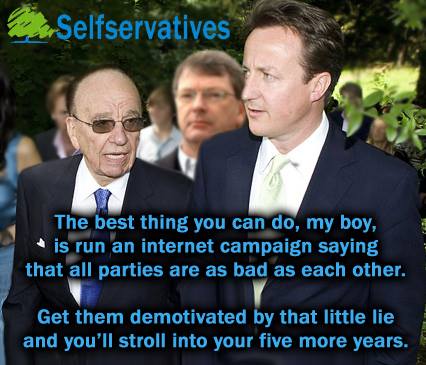
It’s time to end the lie that Labour and Tories are ‘the same’ on austerity – Sunny Hundal & Sue Jones

1044468_500666173336249_1718830491_n
It is a claim so ubiquitous that most people repeat it without even having to explain it:

‘there’s hardly any difference between the main political parties’.

It’s a claim the Greens, SNP and UKIP now repeat endlessly without being challenged. It is also a claim exposed as complete falsehood last week.

For all the Chancellor’s giveaways and triumphant rhetoric during the Budget, the most significant change was a capitulation to Labour’s charge that the Tories were cutting spending to 1930s levels. In fact the difference between Labour and Tories – especially on economic matters – is the biggest it has been in over a generation. To claim otherwise is to be ignorant of the facts.

Let’s go over the numbers first. In December last year, Osborne said he would slash government spending until it reached 35.2% of GDP, a level last reached during the 1930s.

Rather than accept the cuts, Labour attacked his plans as “extreme and ideological” and said they would not match Osborne’s race to the bottom.

The difference between Labour and Tory plans on spending is colossal. To cut spending to 35.2%, the IFS said Osborne would have to cut departmental spending by £55bn from 2015 to 2020, over £20bn more than what has been slashed over the last five years. Key government departments would have to cut spending by over 50%, after already being cut to the bone. It would render many of them useless.

Labour plans are significantly different but lost in technical detail, which has allowed many on the left to wrongly claim they are the same. Firstly, they have committed to raising taxes to cut the UK’s £90 billion yearly budget deficit (i.e. the 50p rate, Mansion tax, bankers’ bonus tax, a higher bank levy), while Osborne has pledged to focus on spending cuts rather than tax rises.

More importantly, the Tories plan an overall budget surplus by 2018-19, while Labour has only committed to a current budget surplus in the next parliament. This sounds like a boring technical detail – and in many ways it is – but the practical difference is vast.

It means that while Coalition had planned over £55 Billion in spending cuts, Labour had pledged only to plug potentially a £4 Billion gap – which could even come from tax rises. A difference of Labour and Tory plans of more than £50 Billion is not to be sniffed at (in comparison the entire Scottish Budget of 2014 was £35 Billion).

To claim that Labour and Tory ‘austerity’ is the same, as some on the left have done, isn’t just ludicrous but a bare-faced lie. It illustrates a huge distortion of the facts. Of course, the Greens and SNP have an interest in saying that Labour and Tories are the same, but that doesn’t make it true.

Last week was significant because Osborne was forced into a u-turn on the biggest issue of the past five years. Of course, the press played this down. He retreated, somewhat slightly, from extreme austerity: pledging to cut spending to 36% of GDP rather than 35.2%. This mostly came from the OBR’s projection that spending on debt interest in 2019-20 will be £9bn less than it expected earlier.

But Osborne’s sleight-of-hand had bigger meaning for Labour: now it means they don’t have to make any cuts over the next parliament, as the IFS pointed out. The difference between the two parties is now even more stark.

To the naysayers who still maintain that Labour and Tories are ‘the same’, a bit more explanation is required. Last year Osborne said he would publish a ‘Budget Responsibility Charter’ and test whether Labour would vote for it. It put Labour in a lose-lose position: they would be painted as ‘profligate’ if they didn’t sign up, and painted as signing up to Tory austerity by the left if they did. Neither was true, since signing up was consistent with Labour’s initial plans. Labour decided to avoid Osborne’s trap and he didn’t bother publishing the Charter. It changed nothing.

Furthermore, the claim that Labour has signed up to Tory austerity until 2016 is untrue. As a matter of technicality, Labour cannot reverse plans already put in place for that fiscal year after being elected.

This has always been a somewhat technical debate, obfuscated by many who have an axe to grind. For political and economic reasons, Labour could never be like Syriza, so it has always been ridiculous to hope it could. Plus, it’s easy for the Greens and SNP to make wild claims about rejecting austerity without spelling out how a massive increase in spending required would be funded.

I suspect that most people who have already decided that Labour and Tories are the same won’t ever be convinced. Labour’s plans won’t catch the world on fire, but to claim they are the same as Tory austerity plans is a lie that has finally been laid to rest.

With big thanks to Labourlist author Sunny Hundal.

1796655_294409220710133_3373329_n
Recently, the SNP, Greens, TUSC and other parties on the so-called  left have made the claim that: “Labour voted for austerity.” This is such a blatant lie. The vote, clearly stated on the Hansard record (see 13 Jan 2015: Column 738, Charter for Budget Responsibility), was pertaining strictly to the motion: “That the Charter for Budget Responsibility: Autumn Statement 2014 update, which was laid before this House on 15 December 2014, be approved.”  That isn’t about austerity at all.

The charter sets out that the Office of Budget Responsibility (OBR) will continue to monitor our fiscal rules. As we know, the OBR has written extremely critical economic forecasts and analysis of austerity and the Tory spending cuts, clearly expressing the risks that the Chancellor is running and the scale of the damage his strategy will inflict on what remains of our public services.

Furthermore, austerity and fiscal figures are not mentioned at all in the Charter.

It’s worth noting that whilst Ed Balls challenged Osborne, there was a curious silence from the SNP and the Green Party. It was Ed Balls that challenged Osborne’s outrageous claims regarding “halving the deficit”- such a blatant lie, upon which even the exceedingly Conservative Spectator spluttered contempt. Or any of the other lies, some of which have already earned the Conservatives official rebukes from the Office for National Statistics (ONS). (See “bankruptcy lie” for example, on the hyperlinked article)

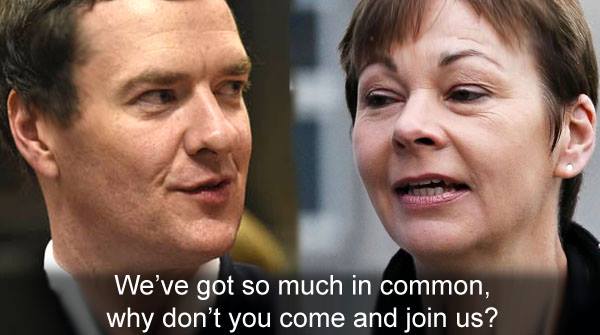
Furthermore, it’s about time that some MP’s, including Caroline Lucas, amongst others, recognised that there is a fundamental difference between the meaning of the word budget and the word austerity. Conflating the two for the purpose of politicking is unprincipled and dishonest.

It’s also worth noting from the same debate on the Hansard record:

13 Jan 2015 : Column 746

Caroline Lucas: Does the Chancellor agree with me that with the feeble and inconsistent opposition coming from the Labour Front Bench, there is a very good reason for seeing the SNP, the Greens and Plaid as the real opposition on this issue because we are clear and consistent about the fact that austerity is not working?

Mr Osborne: That shows why we want the hon. Lady’s party in the TV debates.

Yes, I just bet they do, to collaborate with the Tories in attacking and undermining the Labour Party, not the Coalition, who are, after all, the ones responsible for introducing austerity measures. I don’t imagine for a moment that Osborne values further challenges to his outrageous claims of efficacy regarding austerity measures.

What is very evident when you read through this debate, is that Ed Balls and a couple of other Labour MPs presented the ONLY challenges to Osborne on this matter, just to reiterate this important point.

10940505_767712909964906_6225427822143651262_n
It’s also worth bearing in mind that Ed Miliband established the International ANTI-austerity Alliance. Back in 2012, Miliband said: “There is a grip of centre-right leadership on Europe which has said there’s only one way forward and that’s austerity, and you’ve got to have a decisive move away from that.(See also: Labour leader Ed Miliband’s anti-austerity alliance will fight for the European dream.)

And why would Miliband be attending ANTI-austerity protests if he supported austerity?

Labour leader Ed Miliband speaks on stage at Hyde Park, during the TUC organised protest against austerity measures in London

Labour leader Ed Miliband speaks on stage to over 150,000 at Hyde Park, during the TUC organised protest against austerity measures in London.

It’s interesting to see the Chicago Tribune’s article: Ed Balls, UK’s anti-austerity finance chief in waiting.  Balls dismissed Osborne as a “downgraded chancellor” after Britain lost its triple-A credit rating.

One of his main charges has been that the government is unfairly spreading the economic pain it deems necessary to fix the economy. Austerity cuts are the burden of the poorest citizens.

Balls says that a decision to cut the top tax rate amounts to an unjustified “tax cut for millionaires”, whilst his party has been scathing of the Conservative “reform” of the welfare system.

A point echoed many times by Ed Miliband, too. Accusing the government of making lower or no income groups pay for the recovery while shielding the rich is a claim which strikes a chord with some voters who view Cameron and his government – many of whom were educated at the same top fee-paying school – as out of touch.

Caroline Lucas was born in Malvern to Conservative parents and attended Malvern Girls’ College (which became Malvern St James in 2006), a fee-paying private school. Ed Miliband, on the other hand, went to a comprehensive school.

Polls also show that many voters approve of the government’s drive to rein in welfare costs and the government has demanded that Labour spell out what they would do to fix the economy. They have, but with understandable caution.

Labour’s careful, costed and evidence-based policies include: a Bankers’ Bonus Tax; a Mansion Tax; repeal of the Bedroom Tax; a reversal of the Pension Tax relief that the Tories gifted to millionaires; a reversal of the Tory Tax cut for Hedge Funds; freezing gas and electricity bills for every home a the UK for at least 20 months; the big energy firms will be split up and governed by a new tougher regulator to end overcharging; banning exploitative zero hour contracts; introduction of a living wage (already introduced by some Labour councils); a reversal of the £107,000 tax break that the Tories have given to the millionaires; reintroduction of the 50p tax; scrapping George Osborne’s “Shares for Rights” scheme that has opened up a tax loophole of £1 billion; ensuring Water Companies place the poorest households on a Social Tariff that makes it easier for them to pay their Water Bills; breaking up the banks and separating retail banking from investment banking; introduction of measures to prevent corporate tax avoidance, scrapping the Profit Tax Cut (Corporation Tax) that George Osborne has already announced for 2015 and many more.

These are not austerity measures. They are strongly redistributive policies.

It’s difficult enough opposing the manipulative, lying authoritarian Conservative-led government, without having to constantly counter lies and smears from fringe parties claiming to be on the Left, while propping up the Right simply to gain votes and undermine the only feasible opposition to the Tories, currently.

Shame on them.

Sue Jones

Related

Labour’s fiscal targets mean cuts could end next year – Labourlist

Labour’s fiscal responsibility and caution isn’t austerity, so stop doing Lynton Crosby’s job for him.

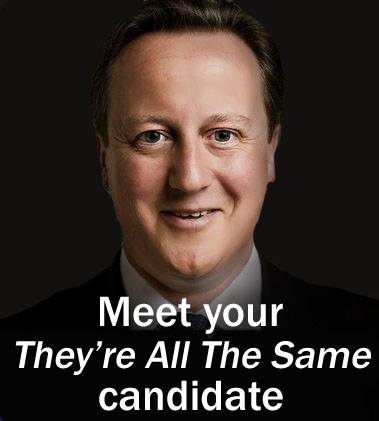
The ultimate aim of the “allthesame” lie is division and disempowerment of the Left.

Narxism

Electioneering and grandstanding: how to tell the difference between a moral political party and a moralistic one.

403898_365377090198492_976131366_n
Pictures courtesy of Robert Livingstone

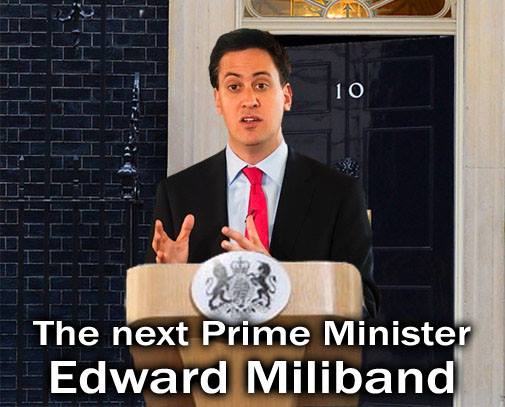
Not “weird” but wonderful: Miliband will win the battle for number 10.

I’ve often heard people remark how surprised they are at just how handsome, sincere and at ease Ed Miliband is when they meet him in person. That’s because the controlled and  biased media have worked hard to purposefully present a purely fictional image of an opposition leader that is weird, arkward, geeky, weak, unattractive and unelectable. But nothing could be further from the truth.

The large discrepancy between Tory media portrayals and reality are a key reason why Cameron didn’t want the televised head-to-head debates with Miliband to go ahead. During his interview with the self-declared “one nation”conservative Jeremy Paxman, Miliband very cleverly highlighted the disparity in fictional creations of the media by his casual dismissal of them, stating that he didn’t care what the media says about him: he cares what the public think.

This not only demonstrates that Miliband values sincerity and solid, needs-led public policy content over superficial image management as a leader, (Cameron by contrast certainly favours PR style-management over content,) it draws a clear dividing line between what is real and what is not, what really matters and what does not, for the public to plainly see.

The public finally got to see the real Ed Miliband – confident, strong, keen to listen rather than just keen to answer, eloquent, sincere, spontaneous (indicating his fundamental honesty) and remarkably, he remembered people’s names.

Even dealing with the deeply personal and undoubtedly difficult questions about his relationship with his brother from the audience, Miliband was positive, smiling – his honesty, warmth and being at ease with his own emotions shone through.

He said: “I thought someone needed to lead the Labour Party who would move us on from New Labour.”

Many people will agree with that. David Miliband is a Blairite, had he been elected party leader, the Labour Party would have stood still, rather than progressing as it has with Ed Miliband at the helm.

Paxman’s attempts at making Miliband look weak failed spectacularly.  Miliband gave some excellent responses regarding questions about Labour’s borrowing record during the global banking crisis, (I particularly like his reference to the fact that it was a global recession, and that he said there is need for reform of the banking and finance sector,) and he disclosed Labour’s intention of redistribution policies with reference to the question about Labour’s mansion tax proposal.

Paxman then attempted to intimidate and bruise, using very personal questions to try and undermine Miliband and make him appear “weak”, inadvertantly allowing him to show his genuine strength instead. I was delighted to hear Miliband point out that he had refused to back proposed bombing raids on Syria despite immense pressure from Barack Obama – the “leader of the free world” – and Cameron. Miliband led the revolt against attacking Syria, which included a handful of Tories, much to Cameron’s fury at the time. (See: David Cameron accused Ed Miliband of ‘siding with Russia’ over Syria).

Miliband confirmed his potential to be a strong PM with a definitive, slightly corny but nonetheless pleasing, applause-inducing best line of the night: “Am I tough enough? Hell yes, I’m tough enough”. 

Five years of Tory media reverse psychology on the public have been reversed masterfully by Ed Miliband in just a few minutes.

Miliband was very assertive and responsive, allowing nothing to faze him when Paxman turned the heat up:“You don’t get to decide the outcome of the general election: the public do. You’re important, Jeremy, but you’re not that important,” he retorted when Paxman suggested that a hung parliament was pre-destined.

Miliband intelligently turned what others would see as daunting media portrayals of his “weakness” into an opportunity to his advantage, re-framing himself as a strong leader who had been continually underestimated – someone whose warmth, decency and calm, rational responsiveness is mistaken for weakness. This is a man who was told he couldn’t beat his brother during the leadership vote (he did) and who was told he couldn’t become prime minister (he can and will).

Miliband presented himself as the decent conviction politician that he is, as someone who has clearly defined principles and integrity. He was passionate, warm, sincere, assertive, positive and at times, very witty and good humoured.

David Cameron, who had an easier ride from Paxman, emerged rattled, red-faced and bruised by Mr Paxman’s questions – particularly on the rise of food banks and zero-hour contracts. He displayed a fundamental hypocrisy when, after dismissing criticism of the impact of zero-hour contracts on others, he was forced to admit that he couldn’t survive on them himself. Cameron evaded answering  and floundered when he was pressed. Miliband did not, providing clear, incisive answers throughout.

Miliband came across an honest, contained, very human, responsive, fluent, warm and inspiring leader, who refused, largely, to be placed on the defensive. He conveyed the key values behind his politics very well: a passionate desire to reduce inequality, which resonates with many voters and it sincerely reflects Miliband’s personal principles, as well as the rationale for his distinctive brand of democratic socialism.

Cameron, in contrast, came across as out of control, disingenuous, incoherent, lacking in principles and sound judgement, as well as integrity, especially when Paxman said that many voters found it “problematic” that Cameron had chosen to surround himself with people like Clarkson, ex-HSBC boss Lord Green and former News of the World editor Andy Coulson. Paxman asked: “What do you have in common with all these rich people?”

But although Cameron was quick on the uptake, he couldn’t bluster a defence, replying with: “The aspersion you are trying to cast is completely ridiculous.”

I think not. A corrupt scoundrel that has surrounded himself with other corrupt scoundrels is an accurate measure of it. The elitist “old boy network” world of Cameron, here, contrasts starkly with Miliband’s world-view, with strong emphasis on the core principle of equality.

Cameron’s sense of class-based entitlement has always been weakness which he has tried and failed to parade as a strength.

Mr Cameron was forced to confess that he had not asked Lord Green about tax avoidance in HSBC’s Swiss branch at the time of his appointment as a trade minister but said that: “all the normal processes and procedures were followed” and said that allegations the bank helped clients dodge tax had emerged only “subsequently.”

A good exposure there from Paxman. And in fairness, he did grill Cameron on broken promises concerning the NHS, VAT, debt, food banks, zero-hour contracts and immigration, which tore open the coalition’s presented record showing them as being somewhat conservative with the truth.

Paxman claimed that Miliband had made erroneous estimates of unemployment and the level of wages, and I was satisfied when Miliband corrected him, stating what most of us know is true: wage levels have dropped since 2010. There was little opportunity for Miliband to discuss unemployment, however, once again, most of us know that insecure types of self-employment, benefit sanctions and workfare, amongst other things, have been used to massage the coalition’s employment figures. This was the recent finding of the cross-party Work and Pensions Committee inquiry into benefit sanctions, recently.

I think Paxman knew he had been out-manoeuvred by the end of the session. Not by cunning and strategy, but by fundamental honesty and unflinching courage: Miliband didn’t flounder or falter once. It’s revealing that the session closed with Paxman asking Miliband: “Are you okay?” 

This was probably a face-saving tactic on Paxman’s part, as Miliband had trounced his attempts at showing him as “weak”, but it was also a revealing, apologetic attempt at compensation for the fact that he went too far with the personal elements in his questions in a deliberate attempt to undermine him. Miliband was quick to retort, perceptively: “I’m fine thanks, are you?”

Miliband’s pronounced strategy for overcoming a poor, most evilly contrived media-invented image is “be yourself.” It works very well, as everyone else is taken …

And Cameron, being a PR man, can only offer us superficial soundbites that don’t connect up, he has no real self to fall back on: he’s all ego and no soul.

Regardless of polls, I have faith that the British public will recognise a winning, decent, sincere Prime Minister with depth and principles that will serve in the best interests of the country rather than the best interests of his privileged peer group, like the ever-corruptible Cameron has.

Miliband has promised to fight a campaign founded on hope and optimism: he is determined to show that Britain can do better. He is so right.

Well done Ed Miliband!

10424302_677497562319775_766713150422913861_n
 Many thanks to Robert Livingstone for his excellent memes.

Update: It’s been reported that Ed Miliband was punched and pushed by protesters wearing Alex Salmond masks, prior to the televised debate, by the Telegraph, Mirror and Express. The earlier incident, described as extremely aggressive and intimidating, did not hamper Mr Miliband’s performance in the first TV set piece of the election campaign. There is some speculation that the masked men that carried out the attack were Tory supporters, rather than Scottish Nationalists.

It does, however, possibly change the context in which Jeremy Paxman asked Ed Milband if was okay at the close of the session, as he may have known about the undoubtedly harrowing experience that Mr Milband had encountered just hours before. That would of course change Mr Paxman’s motive entirely.

Either way, the opposition leader turned up for the debates, apparently undaunted, and his performance was excellent. This is further indication of what an admirable, strong and courageous man of character Ed Milband is.

The power of positive thinking is really political gaslighting

The power of positive thinking.

The government invests a lot of time and money in “nudging” people to accept the unacceptable.

George Osborne announced in the budget that the government will be funding a “package of measures” to improve employment outcomes which will entail putting Cognitive Behaviour Therapists in more than 350 job centres to provide “support” to those with “common mental health conditions,” and making online access to Cognitive Behaviour Therapy available for people who are claiming employment support allowance (ESA) and job seekers allowance (JSA).

From the HM Treasury document – Budget 2015, page 64: 1.236:

“Budget 2015 also announces a package of measures to improve employment outcomes for people with mental health conditions. Starting from early 2016, the government will provide online Cognitive Behavioural Therapy (CBT) to 40,000 Employment and Support Allowance and Jobseeker’s Allowance claimants and individuals being supported by Fit for Work. From summer 2015, the government will also begin to co-locate Improving Access to Psychological Therapies (IAPT) therapists in over 350 Jobcentres, to provide integrated employment and mental health support to claimants with common mental health conditions.”

The government put up an online contract notice which specifically states:

“This provision is designed to support people with common mental health conditions to prepare for and move into work, with intervention at the earliest possible point in a claim to benefit or access to the Fit for Work service.”

Under the government’s plans, therapists from the NHS’s Improving Access to Psychological Therapies (IAPT) programme would support jobcentre staff to assess and treat claimants, who may be referred to online cognitive behavioural therapy (CBT) courses.

We really must question the ethics of linking receipt of welfare with “state therapy,” which, upon closer scrutiny, is not therapy at all. Linked to such a narrow outcome – getting a job – this is nothing more than a blunt behaviour modification programme. The fact that the Conservatives plan to make receipt of benefits contingent on participation in “treatment” worryingly takes away the fundamental right of consent.

Cognitive Behaviour Therapy (CBT) is used to change how you think (“Cognitive”) and what you do (“Behaviour”). It bypasses context, emotions, personal history, experiences and narrative, to a large extent, and tends to focus on the “here and now.”

CBT is an approach that facilitates the identification of “negative thinking patterns” and associated “problematic behaviours” and challenges them. This approach is, at first glance, a problem-solving approach. However, it is of course premised on the assumption that interpreting situations “negatively” is a bad thing, and that thinking positively about difficult or distressing events is somehow beneficial.

The onus is on the individual to adapt to their distress and difficult circumstances by perceiving their circumstances in a stoical and purely rational way.

So we need to ask what are the circumstances that the government are expecting people claiming welfare support to accept stoically. Sanctions? Work fare? Being forced to accept very poorly paid work, abysmal working conditions and no security? The loss of social support, public services and essential safety nets?  Stigma? Starvation and destitution? State punishment and exclusion?

It’s all very well challenging people’s thoughts but for whom is CBT being used, and for what purpose? Seems to me that this is about helping those people on the wrong side of punitive government policy to accept and accommodate that, and to mute negative responses to negative situations. CBT in this context is not based on a genuinely liberational approach, nor is it based on any sort of democratic dialogue. It’s all about modifying and controlling behaviour, particularly when it’s aimed at such a narrow, politically defined and highly specific outcome.

CBT is too often founded on blunt oversimplifications of what causes human distress – for example, in this case it is assumed that the causes of unemployment are psychological rather than sociopolitical, and that assumption authorises intrusive state interventions that encode a distinctly Conservative moral framework which places responsibility on the individual, who is characterised as “faulty” in some way.

There is also an underpinning assumption that working is good for mental health, and that being in employment indicates mental wellbeing. However, isn’t it more likely the case that healthier people are in work, those who aren’t well enough to work don’t?

It’s well-established that poverty is strongly linked with a higher likelihood of being diagnosed with a mental illness. But that does not mean working is therefore somehow “good” in some way, for mental wellbeing. Therapy does not address social conditions and context, and so it permits society to look the other way, while the government continue to present mental illness as an individual weakness or vulnerability, and a consequence of “worklessness” rather than a fairly predictable result of living a stigmatised, marginalised existence of material deprivation.

Inequality and poverty are political constructions and arise because of ideology, intention and policy-formulated socioeconomic circumstances, but the Conservatives have transformed established explanations into a project of constructing behavioural and emotional problems as “medical diagnoses” for politically-created (and wholly ideologically endorsed) socioeconomic problems.

Austerity, which targets the poorest citizens disproportionately for cuts to their lifeline income and essential services, was one ideologically-driven political decision taken among alternative, effective and more humane choices.

The government are not strangers to behaviour modification techniques and have been applying crude behaviourism to public policy, drawing on the “expertise” of the Behavioural Insights Team (BIT)  – the “Nudge Unit” – that they established and installed in the Cabinet Office in 2010. (See Mind the Mindspace, which outlines some of the implications of a government extending operant conditioning via policies to an unconsenting public.)

It is disadvantaged people and excluded groups who are the primary targets of enormously pseudoscientific, coercive and punitive psychopolicy interventions. It’s a kind of technocratic ‘fix’, designed solely to align the perceptions and behaviours of those citizens failed and harmed by our current socioeconomic organisation to nonetheless accommodate and accept neoliberal outcomes.

The casual manner in which advocates of behaviourism dismiss the right of people to behave in accordance with their own feelings, intuition and instincts exposes their authoritarian (not “libertarian paternalistic”) ambitions.

It’s frankly terrifying that our so-called democratic government is waging an ideological crusade directed at altering citizens’ thoughts and behaviour, and avoiding any accountability, sidestepping any engagement in potentially difficult political debate about their policies and the impacts that they have.

The objectives adopted by the Nudge Unit choice architects, politico-therapists and psychocrats are entirely about the state micromanagement of public perceptions and behaviours.

These objectives resemble ambitions usually associated with totalitarian regimes. This is a gross state intrusion into a previously private domain – our thoughts, perceptions and behaviours. Not only is this government trespassing on an intimate, existential level; it is tampering with – editing – our perceptions and experiences, damaging and isolating the poorest citizens, burdening them with the blame for the consequences of state policies while also editing out state responsibilities towards citizens.

Both CBT and Nudge are aimed at pushing people in ways that bypass reasoning. The assumption is that because our decision-making ability is limited we need to use non-rational means to persuade people to do what is “good” for them. But who has the moral authority to decide that? This is not about helping people make better choices – it’s about coercing people to make the choices that policymakers want them to make. And again, those “choices” are based on enforcing conformity to the ideological commitments of policymakers.

This psychocratic turn is in diametric opposition to Enlightenment narratives – it fosters a profound anti-rationality and anti-autonomy approach, it’s not remotely democratic: it’s based on a ridiculous premise that people use their freedom and liberty poorly, but somehow, those passing that judgement on everyone else are exempted from such judgements themselves. It is also extends profoundly anti-humanistic consequences.

Apparently, some people think that everyone else is susceptible to flawed thinking and behaviours, but that theory magically excludes the theorist from such human failings, since they are claiming some objective, mind-independent vantage point – a position far away from the rest of us. It’s like saying: this is your “human nature” but not ours.

Whether or not we agree on the efficacy of CBT as a therapeutic model in principle is a small consideration which is overshadowed by the fact that the government are using such “therapeutic” techniques as a highly partisan tool – to enforce traditional Tory biases and prejudices and to achieve their ideologically-driven policy agenda.

CBT will be deployed in job centres to simply favour the political objectives of neoliberal Conservatism: propping up an anti-progressive austerity agenda, regressive ideology, endorsing an ever-shrinking state, while reflecting a profound  Tory misanthropy.

The social problems arising because of a lack of provision will remain unaddressed and unchallenged because of the Conservative paradigm shift in positivist – causal explanations of political and social problems: it’s not down to policy, it’s all the fault of individuals (who are of course those individuals affected adversely by state policy.)

CBT is a short-term treatment, which is cheap and simple to deliver. I suspect this is one other reason for it becoming more popular with the Coalition than is warranted.

CBT has limitations for treating certain groups, including people with severe and treatment-resistant depression and those with personality disorders.

Studies concerning the efficacy of CBT have consistently found high drop-out rates compared to other treatments, with the numbers abandoning therapy often being more than five times higher than other treatments groups. (P. Cuijpers,  A. van Straten, G.  Andersson & P. Van Oppen. (2008)).

Researchers analysed several clinical trials that measured the efficacy of CBT administered to young people who self-injure. The researchers concluded that none of them were found to be efficacious. (See: Task force on the promotion and dissemination of psychological procedures: A reported adopted by the Division 12 Board – D. Chambless, K. Babich, P. Crits-Christoph,  E. Frank, M. Gilson & R. Montgomery. (1993)).

CBT fails fundamentally on a theoretical level: it lacks basic clarity, depth and coherence. It doesn’t provide a definition of “clear and correct” thinking – curiously, CBT theorists develop a framework for determining distorted thinking without developing a framework for “cognitive clarity” or what would be deemed “healthy, normal thinking.” This has left a large space for partisan definitions and political agendas.

And why is irrational thinking considered to be a source of mental and emotional distress when there is no evidence of rational thinking causing psychological wellbeing? Furthermore, social psychology has never demonstrated that the normal cognitive processes (whatever they are) of the average person are irrational.

CBT is deterministic: it denies agency and any degree of free-will. Human behaviour, in this view, is determined by the cognitive processes invoked by external stimuli. It focuses on the former, ignoring the latter. CBT theory basically contends that what you feel is somehow not very important to why you do what you do and think what you think.

But human beings are not automata: we are complex and multi-faceted. Our emotionality is a fundamental part of being human, too – our emotional bonds and attachments, and our interactions with significant others over time contribute hugely to shaping who we are: we are socially situated and contextualised. We are intersubjective, reciprocal and intentional beings. A therapy that sidelines how we feel must surely, at best, be regarded as superficial in its efficacy, scope and reach.

Moreover, in emphasising thought processes to the exclusion of complex and legitimate emotions, therapists may contribute to the harmful repression and denial of feelings.

CBT encourages an unhealthy avoidance of psychological discomfort and distress by diverting thoughts from the source of discomfort. CBT may rouse immature, neurotic and pathological defence mechanisms. It devalues resilience based on mature coping strategies such as openness, courage, mindfulness, acceptance and emotional self-sufficiency.

Not only is that psychologically unhealthy for a person, it’s bad for society as it desensitises and de-empathises people, stultifies learning from experience by disconnecting people’s thoughts from their circumstances and from others. It discourages personal development and stifles ‘resilience’.

Perhaps the most damning criticism of CBT is that it encourages self-deception and self-blame within clients and patients, because it maintains the status quo. The basic premise of cognitive therapy is: except for how the patient thinks, everything is okay. You can see why this would appeal to the Conservatives.

Poor mental health is often linked with poverty (Melzer et al. 2004) poor community integration, and competitiveness among social groups (Arrindell et al., 2003). Key questions arise as to the efficacy, therefore, of working with individuals, when much research suggests community work would be much more effective (Orford, 2008).

The Beacon Project (Stuteley, 2002) was pioneered by health workers who supported those with depression and other health problems by working with their whole community – addressing their basic social needs and developing mutual social support systems. There were significant changes in physical and mental health for the whole community, showing the benefits of fostering a psychology of mutual support, altruism, cooperation and collaboration: building social capital.

Human needs, public services and provisions, developmental processes, social relationships and contexts are important to any comprehensive model of mental health. Community work offers something that CBT can’t: unlimited scope and reach, sustainable, self-perpetuating, long-lasting provision with an inbuilt preventative agenda. It’s also a prefigurative model. As such, it is founded on democratic principles and the values of  genuine dialogue.

But the government has no interest in addressing mental health and wellbeing or building social support provisions. The government insists that people’s problems are self-generated and endogenous. But the socioeconomic context, policy decisions and consequences are the fundamental cause of unemployment, poverty and much mental distress.

When people are affected by social problems with structural causes, such as poverty and inequality, this in turn leads to a lack of opportunity, economic disadvantage and deprivation, unemployment, ill-health, absolute poverty (increasingly), poor housing, political scapegoating and punishment via policy, it’s ludicrously and grossly unfair to further stigmatise them and claim that their problems arise because of how they think and behave.

For the Tories, the only aim of CBT is a strongly emphasised participation in the labour-market, with minimal expectations of the state and minimal reliance on public services.

“Social problems are often the consequence of the choices that people make.” David Cameron.

No. Social problems are most often the consequence of a government that uses policy to create social inequality, poverty, social exclusion and extremely challenging economic circumstances for those people who have the least to start with. The government uses denial and a process of individualising blame for the problems caused by this government’s ideological austerity programme, which is used to legitimise further cruel constraint by those socio-economic factors caused by the government.

The Tories would have us believe that poor people suddenly become inadequate whenever we have a Tory government. They don’t, but they do become poorer. They are then held responsible and punished for the consequences of Conservatism.

If anyone needs to change the way they think, it’s certainly the Conservatives.

Update June 26, 2015: Mental health workers protest at move to integrate clinic with jobcentre

“This month Prof Jamie Hacker Hughes, president of the British Psychological Society (BPS), pointed out recent research which presented evidence that claimants had been forced to accept psychological treatment. Researchers from Hubbub and Birkbeck, University of London, found unemployment was being rebranded as a psychological disorder in many advanced economies, with interventions being introduced to promote a positive outlook or leave claimants of welfare to face sanctions.

Dave Harper, a reader in clinical psychology at the University of East London, told the Guardian he believed there was an ideological agenda driving the government’s proposals.

“We are in a recession,” Harper said. “There are not many jobs out there and this is implying that unemployed people are to blame for their situation. It’s shifting the focus away from economic policy and on to the individual.”

As a BPS member, I was happy to see a clear, ethical statement from the President.

Related

The just world fallacy

Cameron’s Nudge that knocked democracy down – a summary of the implications of Nudge theory

526544_532055030197363_2137237288_n

Pictures courtesy of Robert Livingstone

My work isn’t funded. But you can support Politics and Insights, and help me to continue researching, analysing and writing independently, and supporting others.

Osborne’s razor, smoke and mirrors

10407927_677369232332608_5384979058089243718_n“I get madder every day
‘Cause what you do ‘n’ what you say
Affects my life in such a way
I learned to hate it every minute
Cocaine decisions . . .” Frank Zappa.

“All your dreams are made
when you’re chained to the mirror with a razor blade.” One of the Gallagher brothers.

The Institute for Fiscal Studies (IFS) has asked Osborne to specify how he will reach targets announced in the budget, given that the poorest had been the hardest hit by draconian benefit cuts already. The IFS say the worst of the UK’s spending cuts are still to come.

Paul Johnson, the IFS director, said:

“But it is now almost two years since he announced his intention of cutting welfare spending by £12bn. Since then the main announcement has been the plan not to cut anything from the main pensioner benefits.

We have been told about no more than £2bn of the planned cuts to working-age benefits. And, remember, apparently the ‘plan’ is to have those £12bn of cuts in place by 2017-18. It is time we knew more about what they might actually involve.”

A senior Conservative minister said the party would not spell out all its welfare cuts until after the general election. David Gauke, the Treasury secretary, was pressed repeatedly on the BBC’s Daily Politics to explain if the Tories would detail their planned welfare cuts beyond the £3billion previously specified.

He replied: “We will set it out nearer the time which will be after the election.

Such cuts are normally agreed as part of a wider spending review.”

How very convenient. But Osborne had no reservations announcing the cuts, despite the implication that they haven’t yet been agreed.

And the Government spending cuts set out for after the general election are the toughest out of 32 most advanced economies worldwide, according to the IFS.

Johnson said that Osborne will need to make unprecedented cuts in welfare to meet targets. At a glance, if we take into account the entire period of tax increases and spending cuts since deficit reduction began under the last Labour government in early 2010, it appears that the richest had been the biggest losers.

However, Johnson said: “Looking only at changes implemented by the coalition the poorest have seen the biggest proportionate losses.”

This is indeed confirmed by many studies and even a glance at coalition policies show how the wealthiest have been compensated by a variety of state handouts, including a tax “break” of £107,000 each per year, whilst the poorest are forced into food bank queues in desperation and are increasingly being made homeless because of punitive policies such as benefit sanctions, the bedroom tax and council tax.

Meanwhile, Shadow Chancellor Ed Balls said the current plans put public services at risk and called for a “balanced and fair way to get the deficit down”.

He said: “Labour will make sensible spending cuts in non-protected areas, but we will also reverse David Cameron’s £3bn tax cut for the top 1% of earners.”  Quite properly so.

Labour’s fiscal target, of balancing the current budget as soon as possible in the next parliament, whilst allowing for some borrowing to fund infrastructure investment, would require far less stringent cuts than the Tories’ plans, according to the IFS. Labour could meet its aim by cutting departmental spending by just £5.2bn, or 1.4%.

Also see: Labour’s fiscal targets mean cuts could end next year – Labourlist.

As a society we cannot possibly accommodate a further 12 billion cut from welfare spending. It’s not that Osborne can’t answer the IFS challenge: he won’t. He’s being conservative with the truth – which is that we cannot afford to reduce any more from welfare without ending welfare provision as we know it.

The Tories fully intended that the welfare “reforms” were the beginning of the end of our welfare state. The welfare “reforms” (welfare cuts) were ushered in strictly because of the despotic use of “financial privilege” by Cameron to bypass the widespread and vehement opposition to the Bill.

At the time, I emailed the entire House of Lords, imploringly. My second email simply said: the welfare reforms must not happen. Many of the peers and members replied, and many responded with “agreed.” But Cameron made them happen and apparently felt no obligation to observe the niceties of democratic process.

The Tories clearly have no intention of ensuring a safety net for citizens and have plotted to dismantle our welfare state since the Thatcher era. This is a long-planned outcome for the Tories. Our social security and public services are in serious jeopardy.

How did we become a nation where the affluent begrudge every penny that they pay in tax, whilst the poorest are suffering, starving and dying? The wealthy have been permitted to hoard obscenely in private whilst the poorest people’s incomes are regarded as being public property.

The Tories have always seen taxing the wealthy as a sin. But we now have a class of millionaires that shriek in outrage at the very idea of contributing responsibly to a society that they take so much from. These miserable wretches are supremely unconcerned that the bedroom tax contravenes human rights, that it’s draconian, that human beings are suffering terribly because of it. Yet just the prospect of the rich paying a mansion tax turns some of them into howling, indignant, hideously self-obsessed, petulant, tantruming mard asses.

This is what conservatism cultivates: punishment and suffering for the poor, indifference, indolent greed and spoilt brat syndrome for the wealthy. (I know there are remarkable exceptions, J K Rowling being someone who immediately came to mind.)

Economic and social success is founded on dependency (and interdependency) on others. And in a perverse way, so is poverty.

Our public services and social safety nets are not inconvenient social burdens that require the recoiling, carping wealthy to be “robbed” via taxes. They are created as a collectively owned means of guarding against the risks, hazards and tragedies that every single person may confront – of a serious illness or an accident that leaves us disabled – and we all face frailties associated with ageing. Anyone can lose their job. No-one deserves any of these events and none of them are caused by “scrounging” or “fecklessness.”

Paying tax means we pay for our own provision, and contribute towards the support of others. That’s what civilised nations do: support citizens who become vulnerable. It’s worth bearing in mind that the majority of people claiming benefit have worked and paid tax, including most disabled people.

And everyone pays VAT.

If the Tories get in office again, we will regress as a society, back to before the post-war settlement gave us civilised and civilising protections, practices and institutions.

I hope we never find out what that level and degree of inequality means.

The Tories have stripped so much away from our society that they have worn away the veneer of civilisation, it’s so fragile and thin. They have eroded the mechanisms of democracy. This doesn’t affect only our social institutions and public services: it also has profound implications for human relationships – how we relate to each other, how we regard each other.

The Tories reduce us and create Hobbesian dystopias. Their scorched earth policies will fundamentally change our behaviours from cooperative and interdependent to a “survival of the fittest” competitiveness, where ultimately, for many, every day is a test and there are no social provisions, supports and resources left to allow basic acts of kindness amongst us.

This really is a race to the bottom.

We have the most corrupt, uncivilised, barbaric, ignoble government of our lifetime. On May  7th we have an opportunity to vote them out and we really must.

14533697838_dffcc736f2_o (1)Thanks to Robert Livingstone for his excellent memes

Anyone worried about protecting the welfare state should concentrate on kicking out the Tories – Debbie Abrahams

 For the past five years the public have been subjected to propaganda about welfare by the Tories. The “scrounger” scapegoating rhetoric has been shaped entirely by Tory ideology, simply to justify their aim to strip back all of our social support provision, ultimately. Anyone who doubts this should read: Follow the Money: Tory Ideology is all about handouts to the wealthy that are funded by the poor and Briefing on How Cuts Are Targeted. 
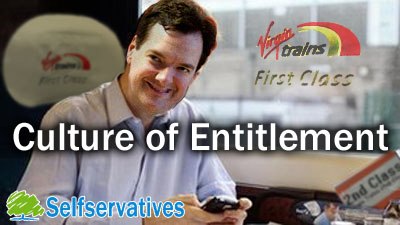
If the Tories gain office for a second term, they will completely dismantle what is left of our welfare provision. The intention is explicit – expressed in many policies, such as the welfare “reforms” and in the plan to cut a further £12billion from welfare.

Unfortunately, the Tories’ divisive rhetoric has had a degree of success in creating social division, with many believing that those claiming benefits are not trying hard enough to find work. The Tories have called the Labour Party “the party of welfare,” and because of Tory policies and narratives that have stigmatised and penalised people needing welfare support, the Tories have effectively poisoned any rational discussion about welfare policy, partly because of peoples’ (justifiable) fear of being left with no support at all.

Many people believe the Tory “something for nothing” mythology, too. This has to be addressed and put right. However, it leaves the Labour Party with something of a minefield to navigate around, when it comes to discussing welfare, no matter how rationally it is approached. But that’s precisely how Tory rhetoric works: the electorate is purposefully atomised, we are pitched against each other with the illusions of conflicting needs; with conservative fables of those who deserve something and those who don’t: “them and us”. Competitive individualism doesn’t work well as a pre-election framework, especially for a party that is democratic and that pioneered our equality legislation. It really does mean working against the established grain.

Rachel Reeves has clarified previously that an economy that has many people needing support from the state is an economy that is actually failing. We need to ensure employers pay wages that are sufficient for people to live on, and provide enough work to ensure a decent quality of life. We also need to ensure enough affordable housing where people live and work.

It was with some disgust that I watched some of the fringe party supporters take one line out of context from a 45 minute summary of Labour welfare policy from Rachel Reeves simply to mislead people. Not for the first time.

However, cheap electioneering from the Green Party and Scottish National Party supporters, amongst others, using fearmongering for selfish political gain, based on dishonesty, does no-one any favours. Least of all themselves. How utterly deplorable to attempt to manipulate people’s perception using distortions of the truth and deliberately stoking peoples’ fear.

Rachel responded to that claim made by the Tories, whilst making it clear that: “Labour believes in strong safety net, work for those who can and support for those who can’t”.

This has been a consistent assurance from Labour for the past five years.

Kittysjones.

The following is an excellent article from Debbie Abrahams, Labour MP for Oldham East and Saddleworth:

As a member of the Work and Pensions Select Committee I get to see up close the Government’s dissolute, ideological approach to social security – whether it’s Iain Duncan Smith’s comments that he wants to limit child benefit to the first two children to instigate ‘behaviour change’ (that’s code for he doesn’t want poor people to have more than 2 children), Esther McVey’s response to Gill Thompson whose diabetic brother, David Clapson died after he was sanctioned, that it was ‘complicated’, or the fact that by 2018, 3.8m people with disabilities will have lost nearly £24bn of social security support.

I could go on about their dehumanising and ineffective revamped Work Capability Assessment process, terminally ill people being made to wait months for the financial support they need in the most dire of circumstances and the dramatic increase in people being made homeless as a result of the cruel bedroom tax, and so much more besides. Or highlight the fact that as part of Universal Credit roll-out, this Tory/Lib Dem Government are piloting sanctions for people who are in-work but are on low pay and in receipt of tax credits, which will be the next scandal if they are allowed back into power.

​But what I and so many find deeply offensive is the pejorative language that’s been used by this Government as they refer to people receiving social security as shirkers and scroungers. This belies the evidence and the Government and anyone else who wilfully misrepresents the facts should be ashamed of themselves.

That’s why I was disappointed to see some of the responses to my colleague, Rachel Reeves’ interview in the Guardian earlier this week. Rachel, like me, is passionate about ensuring a model of social welfare which retains its principles of inclusion, support and security for all; protecting anyone of us should we fall on hard times, assuring us of our dignity and the basics in life, and giving us a hand up, not a hand out. In her own words she told the Guardian interviewer:

“The welfare state was always supposed to be there to protect people in times of need, whether that was because they lost their job, or became disabled, or they had a child that was disabled, to help with the cost of childcare, to help you when you are no longer earning because you’re retired. That’s what the welfare state was created for. I want to ensure the welfare state is there for my children and their children in the future”

​As part of Labour’s commitment to this approach, she has promised to end the target-driven sanctions culture in Job Centres, reform the work capability assessment to a fairer, more holistic assessment process, and scrap the bedroom tax which hits more than 400,000 people, two thirds of whom are disabled. We know only too well how this cruel policy has affected people – carers who need an extra bedroom, and disabled families who need extra space for equipment – with many now struggling to stay in their home.

Labour will also guarantee a job for everyone who has been long-term unemployed, and we will end the scandal of low pay which is seeing 6.6 million people in working families living in poverty, by increasing the national minimum wage and helping more employers pay a living wage through tax rebates.

As Rachel Reeves has said before, Labour was​ a party born of the self-respect and solidarity of working communities. We want people to be able to go out to work and earn a living for themselves and their families. We are the only party that can deliver this. Another five years of the Tories will mean more hardship, more low pay and a more unequal economy that only benefits a few at the top. Now more than ever, our focus should be on making sure they don’t get that opportunity.

It you look at the policies we will put in place if we win the General Election on May 7, it couldn’t be clearer. We have a better plan for a better future, for everyone in Britain – whether working or unemployed, old or young, and regardless of disability, gender or race.

208082_397796890289845_858870070_n (1)

 Many thanks to Robert Livingstone for the hard work he puts into creating his excellent memes.

Labour’s fiscal targets mean cuts could end next year – Labourlist

Labour’s plans for deficit reduction could mean that spending cuts finish by 2016 – just as the Tories’ biggest planned cuts will start to kick in. The post-Budget briefing from the Institute for Fiscal Studies highlights “the big differences between the parties” on planned spending cuts.

At the publication of the briefing, Director of the IFS Paul Johnson said:

“Our latest estimates suggest that Labour would be able to meet its fiscal targets with no cuts at all after 2015-16.”

According to the report, the Tories’ spending plans would see larger cuts between 2016 and 2018 than anything that has been seen over the last five years, while these estimates suggest that Labour’s plans could see an end to cuts by that point. It also describes the post-recession period as “by far the slowest recovery in incomes in modern history”.

Ed Balls reacted to the report saying:

“This is a damning verdict on George Osborne’s Budget.

“The IFS says the Chancellor’s Budget plans involve annual spending cuts after the election which are twice as deep as anything we’ve seen in the last five years.

“The Tories have said today that they won’t tell us where their welfare cuts will come from until after the election. People will conclude that to make their sums add up the Tories would do what they always do – raising VAT again and putting our NHS at risk.

“As the IFS says, this government’s changes have hit the poorest hardest of all. And even on George Osborne’s flawed measure, the Tories have left people worse off today. If the Tories want to spend the election campaign telling people they’ve never had it so good, they’re even more out of touch than I thought.

“We need Labour’s better plan which will put working families first, balance the books in a fair way and save our NHS.”

With thanks to LabourList.

Related

Labour’s fiscal responsibility and caution isn’t austerity, so stop doing Lynton Crosby’s job for him.

Follow the Money: Tory Ideology is all about handouts to the wealthy that are funded by the poor

The OBR, fiscal consolidation and the economy – Labourlist

Balls warns second Tory term will mean bigger cuts than at any time since the war – Labourlist

Stagnant wages forcing Osborne to borrow billions more than he did last year  – Labourlist

Osborne’s Autumn statement reflects the Tory ambition to reduce State provision to rubble

tory lies

Thanks to Robert Livingstone for his excellent memes

The Green Dragon: a charlatan, convicted fraud and a bully

Just before last christmas I wrote a critical article about the Green Party. I was inundated with abuse, threats and insults from members and grassroots supporters, some of which were astonishingly reminiscent of the far-right thuggery and threats I once experienced from the National Front when I was involved with the Rock against Racism and Anti-Nazi League movements, at a time when Neo-Nazi and Fascist rhetoric was becoming more common in the UK.

I was in my mid-teens, hanging out at Wood Street Socialist Club, the Deeply Vale/Pickup Bank Festivals, co-running a local live music venue (The Gaiety, Bolton) and digging being in a band called “Oh no, it’s them again.”

Back in the early 80s I was just a kid, but these were times when I experienced a sense of community and belongingness; of organisation and collaboration; of a cooperative creativity and solidarity amongst a considerably politicised generation of young people, marred only by Thatcher’s oppressive government (though it has to be said that the Tory government probably contributed considerably to consolidating the various movements and campaigns I belonged to.)

It was marred also by my getting my head kicked in by a roughly size 10 Dr Martin boot on the rapid-firing foot of some bonehead fascist on a so-called peaceful protest against racism. National Front affront. I had twenty stitches.

And there was frequent hate mail addressed to “the paki lover,”  written in block capitals, shoved through the letterbox. My flat got turned over a few times, weird stuff happened and I had to move in the end, because the death threats meant that unless I had someone with me,  I was reluctant to go out. But I was a busy gal. Things to do.

That’s when I learned that political activism is often stifled by dirty and dangerous zealots, who believe that freedom of expression is exclusively theirs.

Back to the threats. They don’t stop me doing what I do. They never have.  As an adult, I am not so easily intimidated. Threaten me with a rapidly approaching size 10 Doc Martin nowadays and I will most likely very deftly wrap it around your neck for you.

So, down to the nitty gritty.

The Green Party claim to be “left”, many grassroots supporters also frequently inform us that they are “real socialists,” and that the party is very democratic, yet there as no democatic dialogue regarding the content of my article – that wasn’t criticised. I was.

For example, the following comment from my site is neither socialist in spirit nor does it extend a willingness for democratic engagement:


Peekaboo
says: December 24, 2014 at 5:44 pm

You dont know when to shut up do you. People like you get what they deserve and you will. We will make sure. Best put your time in looking after that Jones family. You never know whats around that dark corner do you.

Now I had assumed this was simply the work of unsophisticated grassroot supporters, with a tendency towards bullying, however, I’ve since learned this is NOT quite the whole story.

Amongst the usual abuse and “we know where you live” type of threats, I also got the following:


Henry Worthington
says: December 23, 2014 at 11:44 pm 

Thought you should know that the following has been posted about you on facebook today (not my page i should add) But a facebook user and activist with a host of contacts across Britain, all of whom will now have read this.
“And the ‘spook of the year award’ goes to Sue Jones (below). She hosts a blog under the name of ‘kittysjones’ which she uses to disemminate fabrications against organisations on the left. She appears to being ‘run’ by Scotland Yard’s Confidential Intelligence Unit. Remember her role is to collect information about you and to spread lies and plant false stories about the British left, as can be seen in her latest blog entry. Now she’s been ‘outed’ her capacity to do harm will soon thankfully be over – hope she spent her ’30 pieces’ wisely

Bravo. This Green gets the Thug of the Year Award.

As far as threats go, this is one of the more bizarre from the Green Party membership that I have received.

Nonetheless it is still a shameful attempt at intimidation and an attempt to discredit. And furthermore, it’s a lie of course –  fairly typical of the ongoing green smear campaign that I’ve been subjected to for the past couple of years. Other smears include I have 500 fake profiles, and numerous people, some that I didn’t even know, have actually been accused of being me and have been bullied. I’ve been called a “retard,” a “tranni” and a “Labour troll/shill,” a “UKIP voter,”  a “bunny boiler,” “paid Labour PR,”  amongst many other things.

“Henry’s” email address, which appears on my notification of his comment, along with his IP address, is: greendragonnews@gmail.com

This one was sent as a personal message on Facebook:
Conversation started Tuesday


Henry Worthington                                                   2/23, 11:07pm

The word is youre on a retainer from people in the british nuclear industry Ms Jones? Is this true? It’s certainly a very serious charge, and one which you should be very concerned about Ms Jones. Nothing worse than being publicly tarred a ‘snout’ for the British State. Have a very merry christmas wont you – and pass on yuletide regards to your friends PC Mark Kennedy and co.

Well it turns out that this lying bully is none other than a former “leader” of the Green Party in Wales.

This is the infamous Martin Shrewsbury, a convicted fraudster and charlatan, active in the Wales Green Party and a friend of the Jaguar-driving Pippa Bartolotti.

Shrewsbury was Green Party Welsh Assembly candidate in 2002. He was also health spokesman for the Green Party in 2003, Swansea. He was a lead candidate for the European Parliament and was elected in 2004. 

I was also informed by former Green Anne Greagsby, amongst others, that “Green Dragon” is Martyn Shrewsbury of Swansea.

Another person who has complained about Green Dragon and the general running of the Green Party in Wales is respected environmentalist Max Wallis

I found Shrewsbury on Facebook, apparently he was my friend since 2013, and has many of my comrades as friends, too.  A tad sneaky.

Here he is:

Martyn John Shrewsbury shared a link.


The Green Dragon: Oh dear Cynog

The date on the Cynog Dafis article from Walesonline article is from 17th September 2012, not today as you claim. Are you trying to deflect attention from Pippa’s latest flounce and dennoucement of Leanne Wood and Plaid Cymru that people are laughing at the Greens over?Lets see if you’ve got the gut…

agreenwales.blogspot.com|By green dragon

Note the link with “Henry Worthington” again via the Green Dragon blog.

This is a known troll and bully who attacks anyone who says a word of criticism regarding the greens. It didn’t take much investigation to discover a character(s) mired in controversy that has left a trail of very angry and perturbed people. He’s most certainly inclined to tell whopping and nasty lies, too.

To reiterate, Shrewsbury also uses the name “Henry Worthington” whose email address, which appears on the notification of his comment on my blogsite, is: greendragonnews@gmail.com

He also uses the aliasesHenry Strawbridge andBrig Strawbridge“.

And Martyn “Rowlands” Shrewsbury. He has form and history – See: Complaint against Martyn Shrewsbury by Dr. Myron Evans, and Further Evidence of Lying by Rowlands alias Martin Shrewsbury and also Shrewsbury Out!

Thanks to Robert Livingstone for his excellent memes.

Suicides reach a ten year high and are linked with welfare “reforms”

Figures released in February by the Office for National Statistics (ONS) indicate that suicide rates, which had fallen consistently since 1981, are now at their highest in over a decade. It is primarily male suicides which have increased.

The figures for 2013 give a total of 6,233 deaths by suicide, 252 more than in 2012.

Suicide rates are highest in areas of high unemployment, with the north-east of England having the highest rate and London the lowest. Older males are now the most at risk, with 45-59 year olds having the highest rate.

The link between the welfare “reforms” and increased suicide risk has been highlighted by Mind, amongst other organisations. The charity has found that people with mental illnesses are having their benefits cut more than those with other kinds of illnesses.

There has been growing concern regarding how benefits are administered in relation to vulnerable individuals and last year, revelations that the Department for Work and Pensions had internally investigated 60 suicides related to benefit changes led to calls for greater accountabilty and transparency.

As an organisation, Mind is supportive of those with mental health problems being helped into work. But they find that often people are pushed before they are properly well. Research published last year by Mind found that people with mental illness were having their benefits cut more than people with other illnesses.

Most of the telephone calls to Mind’s national helpline are from those wanting to talk about suicide and self-harm, followed by advice on support services, mainly advocacy and welfare benefits.

Kauppinen, who has worked at Mind for 10 years, said that the team used to help people with mental health problems remain stable. But she said they have seen more clients in crisis in recent years.

“We see people in crisis every week,” she said. “I started here in 2005, but when it came to 2010-11, it became crisis work rather than having people just stay where they are.”

Tom Pollard, policy and campaigns manager at Mind, said:

“Pressurising people by threatening to stop their benefits causes a great deal of financial problems and emotional distress, with some people attempting to take their own lives as a result.”

“While the right type of employment can be beneficial to wellbeing, the support offered to those on mandatory back-to-work schemes such as the Work Programme is far too generic to effectively help people with mental health problems move towards employment. We need to see an overhaul of the system with more tailored specialised support and less focus on sanctioning.”

Kauppinen added: “There is very limited mental health awareness from people assessing clients in the new Work Programme. They find it very difficult to ask questions and you can see that the assessors are awkward. It takes a long time to train someone in mental health awareness.”

If you are experiencing suicidal thoughts, please contact the Samaritans, their number is: 08457 90 90 90.

Related:

Benefits and suicide: “You have to be strong to ask for help”the Guardian.

377683_445086432227557_1770724824_n (1)Thanks to Robert Livingstone