Author: Kitty S Jones

I’m a political activist with a strong interest in human rights. I’m also a strongly principled socialist. Much of my campaign work is in support of people with disability. I am also disabled: I have an autoimmune illness called lupus, with a sometimes life-threatening complication – a bleeding disorder called thrombocytopenia. Sometimes I long to go back to being the person I was before 2010. The Coalition claimed that the last government left a “mess”, but I remember being very well-sheltered from the consequences of the global banking crisis by the last government – enough to flourish and be myself. Now many of us are finding that our potential as human beings is being damaged and stifled because we are essentially focused on a struggle to survive, at a time of austerity cuts and welfare “reforms”. Maslow was right about basic needs and motivation: it’s impossible to achieve and fulfil our potential if we cannot meet our most fundamental survival needs adequately. What kind of government inflicts a framework of punishment via its policies on disadvantaged citizens? This is a government that tells us with a straight face that taking income from poor people will "incentivise" and "help" them into work. I have yet to hear of a case when a poor person was relieved of their poverty by being made even more poor. The Tories like hierarchical ranking in terms status and human worth. They like to decide who is “deserving” and “undeserving” of political consideration and inclusion. They like to impose an artificial framework of previously debunked Social Darwinism: a Tory rhetoric of division, where some people matter more than others. How do we, as conscientious campaigners, help the wider public see that there are no divisions based on some moral measurement, or character-type: there are simply people struggling and suffering in poverty, who are being dehumanised by a callous, vindictive Tory government that believes, and always has, that the only token of our human worth is wealth? Governments and all parties on the right have a terrible tradition of scapegoating those least able to fight back, blaming the powerless for all of the shortcomings of right-wing policies. The media have been complicit in this process, making “others” responsible for the consequences of Tory-led policies, yet these cruelly dehumanised social groups are the targeted casualties of those policies. I set up, and administrate support groups for ill and disabled people, those going through the disability benefits process, and provide support for many people being adversely affected by the terrible, cruel and distressing consequences of the Governments’ draconian “reforms”. In such bleak times, we tend to find that the only thing we really have of value is each other. It’s always worth remembering that none of us are alone. I don’t write because I enjoy it: most of the topics I post are depressing to research, and there’s an element of constantly having to face and reflect the relentless worst of current socio-political events. Nor do I get paid for articles and I’m not remotely famous. I’m an ordinary, struggling disabled person. But I am accurate, insightful and reflective, I can research and I can analyse. I write because I feel I must. To reflect what is happening, and to try and raise public awareness of the impact of Tory policies, especially on the most vulnerable and poorest citizens. Because we need this to change. All of us, regardless of whether or not you are currently affected by cuts, because the persecution and harm currently being inflicted on others taints us all as a society. I feel that the mainstream media has become increasingly unreliable over the past five years, reflecting a triumph for the dominant narrative of ultra social conservatism and neoliberalism. We certainly need to challenge this and re-frame the presented debates, too. The media tend to set the agenda and establish priorities, which often divert us from much more pressing social issues. Independent bloggers have a role as witnesses; recording events and experiences, gathering evidence, insights and truths that are accessible to as many people and organisations as possible. We have an undemocratic media and a government that reflect the interests of a minority – the wealthy and powerful 1%. We must constantly challenge that. Authoritarian Governments arise and flourish when a population disengages from political processes, and becomes passive, conformist and alienated from fundamental decision-making. I’m not a writer that aims for being popular or one that seeks agreement from an audience. But I do hope that my work finds resonance with people reading it. I’ve been labelled “controversial” on more than one occasion, and a “scaremonger.” But regardless of agreement, if any of my work inspires critical thinking, and invites reasoned debate, well, that’s good enough for me. “To remain silent and indifferent is the greatest sin of all” – Elie Wiesel I write to raise awareness, share information and to inspire and promote positive change where I can. I’ve never been able to be indifferent. We need to unite in the face of a government that is purposefully sowing seeds of division. Every human life has equal worth. We all deserve dignity and democratic inclusion. If we want to see positive social change, we also have to be the change we want to see. That means treating each other with equal respect and moving out of the Tory framework of ranks, counts and social taxonomy. We have to rebuild solidarity in the face of deliberate political attempts to undermine it. Divide and rule was always a Tory strategy. We need to fight back. This is an authoritarian government that is hell-bent on destroying all of the gains of our post-war settlement: dismantling the institutions, public services, civil rights and eroding the democratic norms that made the UK a developed, civilised and civilising country. Like many others, I do what I can, when I can, and in my own way. This blog is one way of reaching people. Please help me to reach more by sharing posts. Thanks. Kitty, 2012

The lord chancellor is dismantling the rule of law

995147_204045783079811_467247470_n
“Ministers keep using the mantra that their proposals are to protect the most vulnerable when, quite obviously, they are the exact opposite. If implemented their measures would, far from protecting the most vulnerable, directly harm them. Whatever they do in the end, Her Majesty’s Government should stop this 1984 Orwellian-type misuse of language.”
  – Lord Bach, discussing the Legal Aid Bill. 
Source: Hansard, Column 1557, 19 May, 2011.
 

Chris Grayling has been caught out again by the high court, this time for trying to protect insurance companies from people who have only a couple of years to live.Tomorrow he will try to scrap legal protections available to British citizens from the European Convention of Human Rights. It is a very damning charge sheet. What we are witnessing is a full scale assault against the rights of citizens and an attempt to bolster the powers of the state and private companies. And it is being conducted by the lord chancellor himself.

These were the victims he picked: mesothelioma sufferers. People who inhaled asbestos, usually through work. It is a horrible disease. From the point of diagnosis you usually have two years to live. That is why the House of Lords exempted them from the Legal Aid, Sentencing and Punishment of Offenders Act (Laspo).

This legislation forced people winning compensation to pay up to 25% of it in costs. It’s supposedly intended to address those personal injury claims you see on daytime TV,  according to the government.

But mesothelioma is not a typical personal injury claim. Sufferers have two years to live, through no fault of their own. Their only crime was simply doing their job. So Section 48 of the bill exempted them from the payback requirement until the lord chancellor had conducted a review.

But he did not conduct a review. He brought in what the Ministry of Justice later pretended was a consultation. It wasn’t.

The people being consulted had no idea it was happening. If they had, they would have brought evidence. It was all fakery. And then the government predictably lifted the exemption. This isn’t the behaviour of a first -world, liberal, democratic government.

During the case, Leigh Day partner Harminder Bains found that the government had made a deal with the insurance industry to benefit it at the expense of the mesothelioma sufferers.

As the judge said this afternoon, when he found against Grayling:

“The question I have to answer is simple: did the lord chancellor carry out a proper review of the likely effects of the Laspo reforms on mesothelioma claims as Section 48 required him to? I conclude that he did not. No reasonable lord chancellor faced with the duty imposed on him by Section 48 of the Act would have considered that the exercise in fact carried out fulfilled that duty. This is not a case in which the procedural failure was minor or technical in nature.”

Harminder said:

“It was obvious that the proposals would have a devastating effect, and cause great injustice to victims of mesothelioma. It would have reduced the compensation payments to many, and in some instances, it would have prevented some victims of mesothelioma from recovering any compensation at all.”

Shadow justice minister Andy Slaughter said:

“Mesothelioma is a horrific industrial disease. Its victims deserve better than the shameful way this government has treated them. Instead of honouring their commitments, David Cameron and Chris Grayling have wasted thousands of pounds of taxpayers’ money on expensive lawyers to dodge justice. Hardly a week goes by without the High Court finding the lord chancellor has acted unlawfully in driving through cuts in legal services for the most vulnerable groups in society.”

Meanwhile, Grayling is preparing tomorrow to unveil Tory plans to scrap Britain’s human rights laws. As published here, the plans would repeal the Human Rights Act and break the formal link between the European Court of Human Rights and British law. Its judgement would now be treated as advisory and need to be approved by parliament.

Let’s be clear what the human rights attack really is. It is not about euroscepticism or common sense or any of the other justifications they are using. It is about scrapping legal protections against the state.

Grayling has tried to take legal aid from the poorest and most vulnerable citizens, in a move branded contrary to the very principle of equality under the law. He turned legal aid into “an instrument of discrimination“.

He has tried to dismantle a vital legal protection available to the citizen – judicial review – which has been used to stop him abusing his powers again and again. He has tried to restrict legal aid for domestic abuse victims, welfare claimants seeking redress for wrongful state decisions, victims of medical negligence, for example. And now he wants to take away citizens’rights to take their case to the European court.

His every action is intent on tearing up essential British legal protections for citizens and massively bolstering the powers of the already authoritarian state.

The hypocrisy is evident in that this is a government which claims to pride itself on its dislike for the state. But in every meaningful way, it is vastly increasing its powers, and authoritarian reach.


Related

The Coming Tyranny and the Legal Aid Bill.

Children are being denied justice and their human rights by legal aid cuts

The Government’s Legal Aid Cuts Are Leaving Vulnerable People With Nowhere to Turn

Devastating blow to Grayling as judges halt his legal aid reform

 A strong case for the Human Rights Act

421077_263839013685634_1738380387_n
Pictures courtesy of Rob Livingstone


Nicky Morgan proposes a retrogressive, enforced segregation of pupils based on ability

get

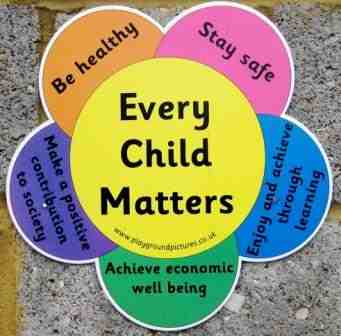
 Every Child Matters, Labour’s flagship child protection and welfare policy, was scrapped in 2010, the day after the Coalition took office


As Social Darwinists, the Tories do like ranks, taxonomies, hierarchies, outgrouping and social segregation. Nicky Morgan, the education secretary, proposes to introduce compulsory “setting” according to pupil’s ability in secondary schools. Patrick Wintour reports in the Guardian that it’s expected Morgan will ask the education watchdog, Ofsted, to implement and enforce the measure, probably by making it a condition of receiving an “outstanding” rating. Ofsted is likely to be highly critical of the proposal.

I think this proposal tells us such a lot about Tory ideology. It would turn the clock back on inclusion 30 years, to a time when the idea of segregating children was acceptable, if this becomes policy. This is also an attack on the very principle of inclusion. The foundation of any progressive education policy must be settled on and work towards all schools being willing and able to include, value, support, care for and respect all children, in their diversity, including young people with complex needs that require additional support.

Diversity is a strength and a great learning resource – it shouldn’t ever be the basis for segregation and exclusion.

Schools may currently decide whether to put children into classes according to ability. The proposal to make it compulsory is likely to raise questions as to how the plan is to be enforced legally, since independent state academies were supposedly set up to be free of state control.

Setting according to ability for separate subjects is controversial since it helps those with high ability and tends to leave those with lower ability behind.

And with the Conservative’s emphasis on cutting funding, and their previous form, it’s unlikely that any meaningful support will be put in place for those children with “additional” educational needs.

Sir Michael Wilshaw, the Ofsted chief inspector, has been a firm supporter of setting, he said in 2012 that “bright teenagers fail to achieve top grades in some comprehensives because teachers insist on mixed-ability classes and concentrate on weaker students. Able children are being held back in some schools that do not tailor teaching, tasks and resources to stretch their best pupils.”

Dr Mary Bousted, general secretary of the Association of Teachers and Lecturers, said: “If Nicky Morgan is committed to closing the gap for disadvantaged children the last thing she should do is to divide children into ability sets and to use Ofsted to enforce this.

“This is educationally unjustifiable. The evidence is overwhelming that this practice holds back poor children, denying them access to an appropriately demanding curriculum. Any claim that Ofsted is independent of government ideology will be shot to pieces if the agency is required to enforce ministerial dogma.”

Research has indicated that overall, ability grouping benefits higher attaining pupils and is detrimental to the learning of mid-range and lower attaining learners. On average, ability grouping is not regarded to be an effective strategy for raising the attainment of disadvantaged pupils, who are more likely to be assigned to lower groups. Summer born pupils and students from ethnic minority backgrounds are also likely to be adversely affected by ability grouping.

The evidence is fairly consistent and has accumulated over at least 30 years of research. (I know of some studies that date back to the 1960’s.) Although there is some variation depending on methods and research design, conclusions on the impact of ability grouping are relatively consistent. It is therefore difficult to see this proposal as anything but an endorsement of discrimination, in light of consistent findings that those pupils labeled “less able” are being set up to fail.

Morgan fails to recognise that there’s an important distinction to be made: that a measure of “current attainment,” such as a recent curriculum test, is not the same as a measure of a child’s ability or of potential.

Furthermore, a strong body of historical research indicates that the allocation of children to bands and sets is often based upon inaccurate and prejudicial teacher assessments of pupils’ abilities and/or potential.

Working class pupils are disproportionately likely to be allocated to lower bands and sets for reasons unrelated to their educational abilities and potential. Furthermore, the consignment of some pupils to lower bands and sets is likely to affect their self-confidence and therefore to restrict their educational progress.

Social interaction theorists (from the 1960’s onwards) said that the processes of streaming, setting and banding involve the negative and positive labeling respectively of mainly working class pupils in the lower sets and mainly middle class pupils in the higher sets, which has adverse consequences for the educational prospects of the lower set pupils.

Hargreaves study – Deviance in Classrooms – of mainly white working class secondary modern school boys in the 1960s – demonstrated that low stream pupils were denied academic status within the school and that they therefore tried to regain status among their peers by rebelling, misbehaviour and unwillingness to work which led to the development of anti-school subcultures in lower streams. Paul Willis’s study, Learning to Labour, yielded similar conclusions.

Additional criticisms of setting, banding and streaming were made by Nell Keddie in Classroom Knowledge (1970) where she observed that an undifferentiated humanities course was delivered differently according to the sets of the students and that, for example, teachers chose not to teach the more complex, theoretical ideas to mainly working class, lower set students on the unfounded assumption that these students would not understand them.

In the 1950s almost all the schools in the UK were “streamed” – a process by which students are grouped by “ability” in the same class for all subjects. A survey of junior schools in the mid-1960s (Jackson, 1964) found that 96% of teachers taught to streamed ability groups. The same study also revealed the over-representation of working-class students in low streams and the tendency of schools to allocate teachers with less experience and fewer qualifications to such groups.

Students’ experiences of ability grouping have historically been disaffection, polarisation and the construction of failure. Low sets are correlated with low expectations and limited opportunities. It establishes self-fulfilling prophecies.

Labelling theory

“We cannot live in a world that is interpreted for us by others. An interpreted world is not a hope. Part of the terror is to take back our own listening. To use our own voice. To see our own light.”  Hildegard Von Bingen

Self-fulfilling prophecy is the behavioural confirmation effect, in which behaviour, influenced by expectations causes those expectations to come true. People react, not only to the situations they are in, but also, and often primarily, to the way they perceive the situations and to the meanings they ascribe to their perceptions. Sociologists often use the Pygmalion effect, interchangeably with self-fulfilling prophecy, and the effect is most often cited with regard to educational under-attainment, social class and race.

“When teachers expect students to do well and show intellectual growth, they do; when teachers do not have such expectations, performance and growth are not so encouraged and may in fact be discouraged in a variety of ways. How we believe the world is and what we honestly think it can become have powerful effects on how things will turn out.”  James Rhem, executive editor for the online National Teaching and Learning Forum.

In the context of race, gender and class, negative labeling is often associated with  socio-political control mechanisms and prejudice. Stereotypes and labels estrange us from our authentic possibilities. The attributions and labels that people exchange on a symbolic level, also have the function of instruction or injunction, this function may be denied, giving rise to one type of “mystification”, rather like hypnotic suggestion.

It is argued that working class pupils are disproportionately likely to be allocated to lower bands and sets for reasons unrelated to their educational abilities and potential and that the consignment of some pupils to lower bands and sets is likely to affect their self-esteem, self-concept, and therefore to restrict their educational progress. So working class young people are written off as incapable of achieving, by the setting up of a frame of reference in which their failings are noticed and their achievements discounted.

Numerous studies have concluded that teachers, who themselves originated mainly from middle-class backgrounds, have often failed to assess their pupils’ academic potential objectively and instead have been very likely to assess students’ academic potential in terms of such variables as their appearance, language, social skills and social class background rather than in terms of their real intellectual abilities, with a bias towards judging working class children as being on average less intelligent than middle class children. It followed that where streaming, setting or banding systems were in operation, working class students were more likely to be consigned to lower streams, sets or bands even when in reality they often had very good academic potential.

Setting establishes an educational elitism which is based largely on class distinctions and not abilities, those labeled negatively are unlikely to progress onto further and higher education. That’s such a blatant repression of potential and opportunities.

It’s strange, isn’t it, that those who value orders and classes are always at the top of both?

Of course I can’t, in good conscience, leave this topic without a Marxist analysis.

Louis Althusser argued that the main role of education in a capitalist society was the reproduction of an efficient and obedient work force. This is achieved through ideological state apparatus – such as schools – used to augment the reproduction of class relations using insidious ideological machinations controlled by the dominant ruling class in the context of a class struggle, to repress, exploit, extort and subjugate the ruled class.

Schools are used for transmitting ideology that capitalism is just and reasonable, schools, for example, encourage competition amongst pupils, school hierarchies of authority train future workers to become submissive to authority.

The Hidden Curriculum

Bowles and Gintis’s research Schooling in Capitalist America (1976) supported Althusser’s ideas that there is a close correspondence between the social relationships in the classroom and those in the workplace, through the hidden curriculum . As a means of social control, the hidden curriculum promotes the acceptance of a social “destiny” without promoting rational and reflective consideration.

The functions of the hidden curriculum include: the inculcation of values, political socialisation, training in obedience and docility, the perpetuation of traditional class structure-functions that may be characterised generally as social control.”  Bowles and Gintis argue schools introduce the long shadow of work because schools create a hard-working disciplined workforce for capitalist societies. This process is essential for social reproduction – the reproduction of a new generation of workers schooled (disciplined) into accepting their role in society.

This occurs because school mirrors the workplace through its hierarchical structures – teachers give orders and pupils obey. Schools are a microcosm of society, too. Pupils have little control over their work – a fact of life in the majority of jobs. Schools reward conformity, punctuality and obedience and are dismissive of independence, critical awareness and creativity – this also mirrors workplace expectations. The hidden curriculum is seen by Bowles and Gintis as instrumental in this process.

Schools reflect and justify social inequality – they legitimate the Conservative myth that everyone has an equal chance – those that work hard deserve the top jobs, these people deserve their superior rewards – this is the myth of meritocracy. It is in this way that inequality becomes normalised and justified. However Bowles and Gintis argue that rewards in education and occupation are based not on ability but on social background. The higher a person’s class or origin the more likely they are to attain higher qualifications and a career.

Besides family background and income differences, other determinants such as race and gender do contribute to differences in educational attainment. Bowles and Gintis conclude that the educational system is a gigantic myth-making machine which serves to create and perpetuate inequality, and by emphasising IQ as the basis for economic success, the educational system legitimises an authoritative, hierarchical, stratified and unequal social system, it manufactures the myth that those in powerful positions in society deserve their positions and financial “rewards”.

IQ testing is an intellectual cul-de-sac that does not reflect skill and talent

IQ testing is culturally specific. It tells us nothing more than how well people perform IQ tests. Traditional studies of “intelligence” based on IQ tests, which have drawn links between intellectual ability, race, gender and social class, have led to highly contentious claims that some groups of people are inherently less intelligent that other groups. But that betrays a thinking of intelligence as a fixed, innate ability, instead of something that develops as a process in a context.

Intelligence isn’t something we have, it’s something we learn to do. 

But this is the kind of government that would have children learning their times tables by rote, which is just so very century before last. This approach is based on a view that students are passive objects, rather than participating subjects, in the learning process. It seems that Conservatives are incapable of learning from historical policy failures. And the many sociological studies that were instrumental in formulating more effective education methods in the late 60s and 70s.

Rote learning is a way of bypassing critical thinking and understanding-based learning. And creativity. It’s founded on a “jugs and mugs principle” – an authoritarian-styled learning process, where teachers “fill” the pupil with facts and it’s not remotely about democratic engagement and participatory, dialogic learning. It turns students off, disengages them, excluding them from the learning process.

Children being ranked and labelled is extremely problematic – each of us is complex, with such varied, developing and ongoing talents, aptitudes and preferences, and it seems that any one number purporting to quantify our intelligence must be grossly misleading in every case, as well as providing nothing more than a snapshot of limited and specific task performance.

The right are obsessed with the taxonomic ranking of human beings based on superficial characteristics. They have no interest in the depth of “who” we are, but only the surface appearance of us – the “what” we are.

IQ testing originally evolved from the eugenics movement. The founding father of eugenics was  Sir Francis Galton, a cousin of Charles Darwin. Over the course of Galton’s varied career, he not only codified the “science of eugenics” but also pioneered psychometry as a tool for measuring people’s “intelligence” and determining whether it would be best for them to breed or not. Galton coined the phrase nature versus nurture and identified the trend of regression towards the mean, though his original term for this was reversion towards mediocrity. So long as “unintelligent” people were allowed to reproduce freely, mankind could never rise above its “native mediocrity”. What a wretched, oppressive, repressive and right-wing view.

Charles Murray’s New Right treatise on the white, male elite supremicism

I read the The Bell Curve: Intelligence and Class Structure in American Life  (1994) by psychologist Richard J. Herrnstein and American political scientist Charles Murray in the 90’s, and it filled me with utter despair. Funded by Conservatives in the States, the book was simply a neo-eugenic narrative masqueraded as “academic study”. Murray justified the status quo by claiming poor people, and especially ethnic minorities, were of lower intelligence than white middle class citizens, and that this was largely genetically determined.  

Bob Herbert, writing for The New York Times, described the book as: “a scabrous piece of racial pornography masquerading as serious scholarship.Others, including Noam Chomsky, have pulled this cheap right-wing pseudo-scientific catalogue of prejudices apart most thoroughly, ever since.

Challenging what he deemed to be “educational romanticism”, Murray, a darling of Thatcher and Cameron, wrote Real Education: Four Simple Truths for Bringing America’s Schools Back to Reality. His “four simple truths” are:

  • “Ability varies.”
  • “Half of the children are below average.”
  • “Too many people are going to college.”
  • “America’s future depends on how we educate the academically gifted.

In a paper published in 2005 titled Where Are the Female Einsteins?  Murray  the charmer stated, among other things: “no woman has been a significant original thinker in any of the world’s great philosophical traditions”. 

Murray advocates educational exclusion and social oppression for the majority of pupils. He has been a “academic witness” before United States congressional and senate committees and a consultant to senior Republican government officials in the United States, and of course, Conservative officials in the United Kingdom.

From the ranking, banking model to a democratic, dialogic model

So, is there an alternative education model?

Yes. One I have worked with myself, (as a community worker and informal educator), and it’s based on liberation psychology. It’s far more about critical thinking, egalitarianism, creativity and inspiration than formalised teaching permits.

The genesis of liberation psychology began amongst a body of psychologists in Latin America in the 1970s. Ignacio Martín-Baró is credited as the founder of liberation psychology, and it was further developed by others. Of particular interest here is the work of Brazilian educator Paulo Freire, and one of the key concepts of liberation psychology is concientización: critical consciousness – a recognition of the intrinsic connectedness of the person’s experience and the sociopolitical structure. Freire believed education to be a political act that could not be divorced from pedagogy. Freire defined this as a main tenet of his critical “Pedagogy of the Oppressed.”

Teachers and students must become aware of the politics that surround education. The way students are taught and what they are taught serves a political agenda. Teachers themselves have political notions that they bring into the classroom.

Freire attacked what he called the “banking” concept of education, in which the student was viewed as a passive participant – empty accounts to be “filled” by the teacher. He notes that “it transforms students into receiving objects. It attempts to control thinking and action, leads men and women to adjust to the world, and inhibits their creative power.” 

Freire recognised that emphasis on individual characteristics are a result of social relations, and to view such individualistically de-emphasizes the role of social structure and  is responsible for the incorrect attribution of sociopolitical problems to the individual. Liberation psychology addresses this by re-orienting the focus from an individualistic to a social one. Using this framework, the behaviour of oppressed people is conceptualised not through intra-psychic processes, but as a result of an alienating environment.

Freire advocated authentic dialogue-based learning, where the role of the student shifts from object to active, critical subject. Freire heavily endorsed students’ ability to think critically about their education situation, this way of thinking allows them to recognise connections between their individual problems and experiences and the social contexts in which they are embedded.

Realising one’s consciousness is the first step of praxis, which is defined as the power and know-how to take action against oppression, whilst stressing the importance of liberating education. Praxis involves engaging in a cycle of theory, application, evaluation, reflection, and then referring back to theory. Social transformation is possible through praxis at the collective level.

In 1999, PAULO, a National Training Organisation named in honour of Freire, was established in the United Kingdom. This agency was approved by the New Labour Government to represent some 300,000 community-based education practitioners working across the UK (myself included). It was a platform also, perhaps surprisingly, for Blair’s re-democratising democracy programme, based on a dialogic democracy, and a recognition of the centrality of life politics.

PAULO was given formal responsibility for setting the occupational training standards for people working in this field, and was based on a revolutionary anarchist/Marxist model of critical education. Even outside of that political context, Freire’s collective works, and especially Pedagogy of the Oppressed, has huge value and merit as a direction for an approach to teaching which is based on self awareness, community awareness, political awareness, responsibility, critical thinking, creativity, dialogue and social solidarity, and not on manipulation and oppression.

The Tories, however, are unrelentingly authoritarian, and this is reflected in their notions of “education”, which are: “Raising standards (through “setting” and taking those segregated off record: the “disappeared”)… and restoring discipline – so our children can compete with the world’s best and enjoy a better future.”

So nothing at all there about developing human potential, personal development, social development or even the fundamental capacity for critical thinking.

A person who has not had opportunities to think critically about social and political reality, but simply accepts it is thereby simply participating in the world in a way that has been organised and designed for him/her by others.

If being human means exercising choice and freedom, then such uncritical, passive acceptance means being less than human.

But Tories prefer us that way. They don’t like to extend equal opportunities.

1374718_540929452643254_208125039_n (1)

Pictures courtesy of  Robert Livingstone


I don’t make any money from my work. I am disabled because of illness and have a very limited income. But you can help by making a donation to help me continue to research and write informative, insightful and independent articles, and to provide support to others. The smallest amount is much appreciated – thank you.

DonatenowButton

In four years, Cameron has told just two truths, and those were uttered inadvertently.

382035_141704259313964_676863845_n

David Cameron made a clear and very telling Freudian slip during his Conference speech today:

“This party is the trade union for children from the poorest estates and the most chaotic homes; this party is the union for the young woman who wants an apprenticeship; teenagers who want to make something of their lives – this is who we resent.”

See live coverage here

The only other truth Cameron has ever told is: We are raising more money for the rich,”  which was blurted out during Parliamentary debate on 12th December 2012. This was a memorable Commons debate, with Ed Miliband delivering some outstanding challenges to David Cameron, some of which provoked the Freudian-style slip, and exposed the traditional Tory values and ideology underpinning their policies.

See live coverage here539627_450600381676162_486601053_n (2)1235473_537097386359794_65317730_n (1)

These are such rare, historical occasions that simply ought to be reported.

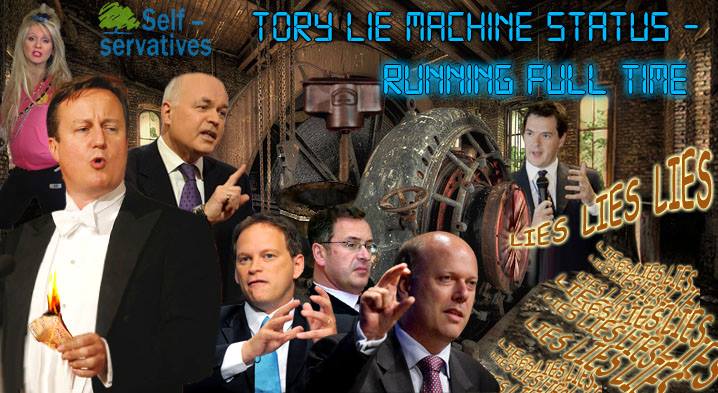
See here for Tory lies and tall stories

See here for the official rebukes regarding the many  Tory lies

There is one policy proposal that we must also take very seriously: Cameron intends scrapping our Human Rights Act and withdrawing from the ECHR. Should the Tories get the opportunity via another Term in Office, they will certainly follow through with this policy proposal. Human rights are the bedrock of democracy, which the Tories have already imperiled. 

But the Tories have been quietly and steadily dismantling both rights and democratic process since 2010.

Thanks to our Robert Livingstone for his brilliant art work, exposing Tory lies.


The word “Tories” is an abbreviation of “tall stories”

1450041_569755536427312_1698223275_n


“The deficit reduction programme takes precedence over any of the other measures in this agreement”
 – stated in the Coalition Agreement.

For a government whose raison d’etre is deficit reduction, the coalition really isn’t very good at all.

Of course the truth is that this whole process of prolonged austerity is NOT about deficit-cutting. It’s just the cover for Tory ideology. It is actually about “shrinking the state” and squeezing the public sector until it becomes marginal, then none existent, in an entirely market-driven, competitively individualist society. The banker crisis-generated deficit has been a gift to the Tories in enabling them to launch the scuttlebutt that public expenditure has to be massively cut back, which they would never have been able to get away with without the deficit-reduction excuse in the first place.

And I am still seeing the “inherited debt” LIES that the Tories are still telling, despite official rebuke from the Office for Budget Responsibility (OBR) chief Robert Chote. This is the same Tory-led government that lost our triple A Moody and Fitch credit rating, and that borrowed more in 3 years than Labour did in 13. Figures from the Office for National Statistics (ONS) showed that the coalition had borrowed £430.072 billion in just 3 short years, whereas the last Labour government managed to borrow just £429.975 billion in 13 years, and unlike the  Tories, Labour invested most of what they borrowed in public services.

After continuously lying that the UK had the biggest debt in the world, George Osborne admitted to the Treasury Select Committee that he did not know the UK under Labour had the lowest debt in the G7. Also, confirmed by the Organisation for Economic Co-operation and Development (OECD). Those who have used cash terms (instead of percentages) have done so to scare, mislead and give less than half the story.

The much banded about 2010 deficit of “over 11%” is false. This is the Public Sector Net Borrowing (PSNB – total borrowings) and not the actual budget deficit which was -7.7%. (See OBR Economic and Fiscal Outlook March 2012  page 19, table 1.2.)

Secondly, in 1997 Labour inherited a deficit of 3.9% of GDP (not a balanced budget) and by 2008 it had fallen to 2.1% – a reduction of a near 50% – now that’s impressive. Hence, it’s implausible and ludicrous to claim there was “overspending.”

It’s common sense, in cash terms, that a millionaire’s debt would be greater than most people’s. Therefore, the UK would have a higher debt and deficit than most countries because we are the sixth largest economy. Therefore, its laughable to compare UK’s debt and deficit with Tuvalu’s who only have a GDP/Income of £24 million whilst, the UK’s income is £1.7 trillion.

In 1997, Labour inherited a debt of 42% of GDP. By the start of the global banking crises 2008 the debt had fallen to 35% –  almost a 22% reduction (page 6 ONS). Surprisingly, a debt of 42% was not seen as a major problem and yet at 35% you would think the sky was suddenly falling, to hear the Tories acting up.

The deficit was then exacerbated by the global banking crises after 2008. (See HM Treasury archives). The IMF have also concluded the UK experienced an increase in the deficit as result of a large loss in output/GDP caused by the global banking crisis and not even as result of the bank bailouts, fiscal stimulus and bringing forward of capital spending. It’s basic economics: when output falls the deficit increases.

The large loss in output occurred because the UK, like the US, have the biggest financial centres and as this was a global banking crisis we suffered the most, and not as a result of overspending prior to and after 2008 – as the International Money Fund (IMF) concur.

The UK national debt is the total amount of money the British government owes to the private sector and other purchasers of UK gilts. The national debt now stands at £1.5 TRILLION (and rising).

So a further saving of £3 Billion in benefits, as proposed by Osborne, will clear the debt in, say, a mere… 500 YEARS.

Once again, this exposes the nonsense of the “reducing the deficit” excuse as being a genuine motivation behind cutting the incomes of the poorest and the most vulnerable citizens in the UK.

Gosh. Tories in “telling lies” shocker. Here’s a  few more:

In October 2010, Cameron said : “But it’s fair that those with broader shoulders should bear a greater load.”

The prime sinister minister talked of “fairness” as he tried to dodge the criticism that the poorest would suffer from the second big announcement of that week: a cap on benefits paid to out-of-work households.

Cameron said his government would: “always look after the sick and the vulnerable”, but said that: “society will have to rethink its approach to fairness.” 

It hasn’t been “rethought” : it was the very first austerity cut.

He lied, because:

Cameron also said said : “Too many people thought: ‘I’ve paid my taxes, the state will look after everything.’ But citizenship isn’t a transaction – in which you put your taxes in and get your services out. It’s a relationship – you’re part of something bigger than yourself and it matters what you think and feel and do.”

Well actually, Cameron, your arrogance will be your greatest downfall, because we DO have a right in a so-called democracy to demand transparency and accountability from government, the state IS responsible for maintaining essential public services and provision, AND for upholding our human rights. Citizenship isn’t all about responsibility and giving to the government and an elite of millionaires – there IS something of a contract which we call “democracy”. 

Citizenship is a foundational and structural institution of democracy, insofar as it is both a legal status and a societal and political value. As a status, citizenship bestows a collection of rights and a set of responsibilities on individuals who are free and equal in rights.

In a democracy, citizenship is not a privilege that may be granted by the government at their discretion; it is a right.

Someone should remind Cameron that the term democracy comes from the Greek language and translates simply as “rule by the people”. The so-called “democracies” in classical antiquity (Athens and Rome) represent precursors of modern democracies. Like modern democracy, they were created as a reaction to a concentration and abuse of power by the rulers. Yet the theory of modern democracy was not formulated until the Age of Enlightment (17th/18th centuries), when philosophers defined the essential elements of democracy: separation of powers, basic civil rights / human rights, religious liberty and separation of church and state.

In order to earn the label democracy, a country needs to fulfill some basic requirements – and they need not only be written down in it’s constitution but must be kept up in everyday life by the government:

  • Guarantee of basic Human Rights to every individual person (including poor people and sick and disable people) vis-à-vis the state and its authorities as well as vis-à-vis any social groups (especially religious institutions) and vis-à-vis other persons.
  • Separation of Powers between the institutions of the state:
    Government [Executive Power],
    Parliament [Legislative Power] and
    Courts of Law [Judicative Power]
  • Freedom of opinion, speech, press and mass media
  • Religious liberty
  • General and equal right to vote (one person, one vote)
  • Good Governance (focus on public interest and the absence of corruption).

I think the Conservatives have spectacularly failed on meeting most of these criteria.

We also have an absolute democratic right to ask: what have you done with OUR money?

This was (allegedly) a liberal democracy before you took office, Cameron, not your “kingdom”.

Democracy isn’t something the government is elected to redefine and “manage”.


It’s worth noting that the word “Tory” was originally used as term of abuse. It derives from the Middle Irish word “tóraidhe” which means outlaw, robber or brigand. That explains Conservative policies, then. This Government is certainly robbing the poor to give  handouts to the rich.

Further reading

The Great Debt Lie and the Myth of the Structural Deficit

The mess we inherited” – some facts with which to fight the Tory Big Lies

Tory dogma and hypocrisy: the “big state”, bureaucracy, austerity and “freedom” State

A catalogue of official rebukes for Tory lies: Austerity, socio-economic entropy and being conservative with the truth

540525_186110078206715_79170441_n
Pictures courtesy of Robert Livingstone

Miliband: hope, humanism, joined-up thinking and integrity.


1044468_500666173336249_1718830491_n


One of Miliband’s virtues is that he re-humanises politics. For him, people’s individual experiences matter, and he always cites many examples throughout his speeches. He includes qualitative accounts from real people. It’s a particularly contrasting quality to Cameron’s unempathic, dehumanising, quantitative and negative labelling approach.

To the Tories, we are all reducible to their often cited, fake statistics. The numbers tell us what the Tories want us to “know”, and not what actually is. And we know that the Tories have never been big on free speech – see the Gagging Act, for example. They like to exclude “inconvenient” voices of truth from the grand, overarching Tory narrative. Miliband listens to accounts of people’s realities, and accommodates those accounts. Cameron imposes both accounts and realities upon us.

Hardly surprising, therefore, that the right-wing bitcherati press have taken the piss once again and tried to make Miliband’s approach to the paramount importance of everyday people look small. Littlejohn in particular is being his pernicious, old, fascist self. How anyone that writes for the Mail for a living has the cheek to criticise anyone at all is beyond me. But it shows that the right are determined to portray any strengths that Ed Miliband has as a weakness. Propaganda at its worst. But its so blatant, superficial and unsophisticated, at least.

I have criticised Tory ontology and methodology previously, using social science as a frame of reference. Politics is a social science, and not a “stand-alone” one: it draws on the disciplines of psychology and sociology, too. As a critical interpretivist, I believe that social reality is not “out there” waiting to be discovered: we are constructing and reconstructing it meaningfully. However, politically, there’s been a marked shift away from understanding the lived experiences of real people in context: a systematic dehumanisation. The Tories have depopulated social policy. This is a characteristic of authoritarianism, and other hallmarks include stigmatisation of social groups, moral disengagement, moral exclusion, impunity, and a societal “bystander apathy”, as I’ve discussed elsewhere.

In the social sciences, there was a big shift away from Cameron’s approach to “understanding the social world” from the 70s onwards. Mostly we realised that  counting people’s responses doesn’t give us any clue about meanings and intentions, it can only turn up statistics. And these are open to reductionist and determinist interpretations and inferences from the persons gathering them, as we know.

Qualitative researchers aim to gather an in-depth understanding of human behaviour and intention – the reasons that govern such behaviour. The qualitative method investigates the why and how of our decision making, rather than just what. And we get to interpret our own reality and experiences. We are each experts in our realm of experiences, and Miliband understands this. He invites our expertise, Cameron stifles it.

The social researcher and the politician do not stand apart from or outside of the intersubjectively constructed universe they wish to describe/measure: there is no “objective” vantage point, because we all participate personally within it.

Clifford Geertz, an anthropologist said: Man is an animal suspended in webs of significance he himself has spun, I take culture to be those webs, and the analysis of it to be therefore not an experimental science in search of law but an interpretive one in search of meaning.

And in Thick Description, which compared the “thin” descriptions of measurements with the “thick”, densely layered description of context and meaning that qualitative research can provide in any given situation, he said : “The difference between a twitch and a wink is vast.  From a purely physiological perspective, a wink is the contraction of the muscles of a single eye that cause the eyelid to close.  So, of course, is a twitch.  And so is a slow-motion, exaggerated parody of a wink; a fast motion parody of a twitch; and any number of parodies of parodies of twitches and winks that a group boys sitting in the back row might engage in to amuse one another on a spring afternoon”.

And any measure of the interactions that include and are driven by these twitches and winks is bound to measure the wrong things and fail to measure the right ones.

No-one but the Tories would try to argue that poverty is an intentional act of the poor, that food banks are a symptom of rising greed rather than need. I have never known a government to be so blatantly insouciant with the measurable social phenomena it causes via its policies. Or with its own credibility, for that matter.

In contrast to quantitative research, qualitative research involves the collection and analysis of information that focuses on the meanings attached to people’s actions and behaviours, often referred to as the lived experience.It defines us as active participants in the world, instead of merely reducing us to statistics and preferences.  It makes priority of our perceptions and experiences and the way we make sense of our lives.

First-hand experiences matter. And quite properly so. It puts us, the people, in the driving seat, we construct our own meanings, rather than having authoritarians like Cameron imposing meanings, definitions, convenient labels and Tory ideology upon us. Quantitative methods tend to hammer the world into a presupposed state  – as Einstein once said: the theory tells you what you may observe. How very Cameron. All quantitative studies can yield are conventionalised expressions of the experience of the author, or the one commissioning the research.

Quantitative, positivist paradigms share commensurable assumptions but are largely incommensurable with critical, constructivist, and participatory paradigms.. In other words, they don’t accommodate any critical  approaches or analysis, nor are they inclusive. How very Cameron.

Furthermore, quantitative methodology in the social sciences depends upon faith in the “verification principle”. Which is itself unverifiable…

How very  cul-de-sac, and how very Cameron.

Quantitative methodology objectifies us, whereas the qualitative method draws on a humanist, hermeneutic/phenomenological approach: understanding moves from the outer manifestations of human action and productivity (the superficial) to the exploration of their inner meanings and references. Numbers cannot convey human experiences: it is thought, language and our expression that converts experience into meaning.

Humanist thinkers within the discipline of psychology, such as Ronald D Laing, drew on a qualitative  approach, and in his earliest works, he starts from the experience of the individual ego, in “The Divided Self” (1961) and moves towards existential phenomenology , and in his later work, such as “The Politics Of Experience And The Bird Of Paradise“(1967), he manages to integrate these perspectives within a Marxist framework.

Laing, along with others who led the anti-psychiatry movement in the late 50’s and early 60’s, such as Erving Goffman and Thomas Szasz, had a profound and hugely significant impact within the field of psychology, which had been dominated by associationism, behaviourism, psychometrics and eugenics and of course, psychoanalysis.

At a time when theorists from social sciences maintained that their perspectives were premised on scientific (usually positivistic) principles, Laing offered a humanist critique of these approaches, which he said trivialised psychology and dehumanised its subjects. Laing shifted the emphasis from an experimental approach, and a searching for “facts” and “predictability” regarding human behaviours to dialogue, intersubjectively constructed and reconstructed meanings and human experience. Laing and others challenged established categories of behaviour deemed pathological or abnormal, by meaningful explorations of individual accounts of their experience of being.

Laing in particular gave a rational voice to those individuals who had experienced exploitation within family relationships, which he studied extensively, discovering sets of interactions that often involved complex tactical games, relationship knots and strategies, with family members making alliances with some and creating enmity with other members. Within the nexus of the family there is an unremitting demand for constant strategic interpersonal interaction based on mutual reciprocal concern and attention. Individuals are therefore vulnerable to existential harm. They are emotionally imprisoned via the nexus, internalising other family members, and the interaction patterns.

Laing believed that some families acted like gangsters, offering each other protection against each other’s violence. Some governments do, too.  He also believed that the internalisation of family interaction patterns becomes our world – and it restricts the development of the self, with individuals carrying the emotional blueprint of their family for the rest of their life, which may inhibit any real autonomy or self awareness. This blueprint may manifest as expression through behaviours that are clinically identified and diagnosed as schizophrenia. Laing and others exposed the negative labelling processes, and ritualised humiliation directed towards those experiencing self-fragmentation because of the internalisation of negative family interaction patterns. For Laing, madness is simply a perfectly rational adjustment to an insane world. Of course that world exists within a political framework.

In sociology, phenomenology was expressed in the work of Alfred Schutz (1899 – 1959) who studied the ways in which people directly experience everyday life, and imbue their activities with meanings. In contrast to the predominant structural and somewhat deterministic perspectives within the discipline, Schultz moved away from the tendency of subordinating everything within disaffecting, abstruse and overarching ideologies or grand narratives, and he emphasised a multiplicity of new and often spontaneously co-authored ideologies lived out day-by-day and based on common sense and intersubjectively constructed values.

Schultz expressed a vitalism that engendered an organic way of thinking, with characteristics such as intuitive insight as a way of perceiving things from within, and placed emphasis on understanding as a holistic grasp of the widely varied, often complex and subtle elements of situations, and on experience as something that is lived through in common with others.

Schultz says that we draw on a common stock of knowledge – “typifications” and common sense which orientates us, helps us navigate socially, and achieve a reciprocity of perspective with others. Socialisation processes mediate and normalise this common stock of knowledge.

Phenomenological Sociology went hand in hand with a preference for a qualitative methodology that emphasised authentic everyday accounts of social reality, with agency and meaning being the focus. Quantitative methodology, on the other hand, had primarily focused on measurement, notions of the predictability of behaviours due to these being determined by social structure for example, as was the case with many advocates of Functionalism, such as Social Darwinist Herbert Spencer, and a socially detached and “objective” researcher.

Such a researcher was evidently armed with the belief that he/she possessed the somewhat unique ability to stand outside of human experience and values, unlike the subjects of enquiry, and would thus gather “social facts” and then interpret them from this independently existing standpoint. For example, a sociologist studying drug use amongst young people may gather statistics and hand out closed questionnaires with short directive and directed yes/no type questions. From the information gathered, the researcher may conclude that anomie and alienation lead to drug use, because, for example, many young drug users singled out for study live in deprived inner city areas.

Most young drug users, however, would not use terms like anomie to explain or give meaningful accounts of their drug use. This imposed conceptual framework of the researcher demonstrates very well how detachment and objectivity is not possible, in sociological enquiry. Indeed, some have extended this criticism to scientific enquiry. We each operate within idioms of belief, and Michael Polanyi has proposed that Western Science is such a self-sustaining idiom. (“Personal Knowledge”, 1958). He compares science with Azande Witchcraft, (Evans-Pritchard’s anthropological study: “Witchcraft, Oracles and Magic Among the Azande”), noting that each conceptual framework is “segregated’ by a logical gap” (they are incommensurable), but from within each idiom, beliefs tended to be circulatory, self-confirming and self-sustaining.

This is true of all ideologies. We can make inferences from sociological research, for example, but every sociologist knows about the Hawthorne effect: that the very fact that people know they are being observed changes their behaviour and distorts the result.

Polanyi had become acutely aware of the extent to which worldviews penetrate into language, and that he had sensed that this may have important ramifications for relations between frameworks of belief. As the basis of his argument, Polanyi gives a precis of his epistemology in “Science, Faith And Society” (1946) and “Scientific Beliefs” (1951). Polanyi considers that discovery, verification and falsification of propositions in science do not obey “any definite rule” but proceed with the aid of “certain maxims” which defy both precise formulation and rigorous evaluation. The maxims are “premisses or beliefs … embodied in … the tradition of science”.

Sustained by this tradition, science is governed by the coherent opinion of its practitioners, who employ the “idiom of science” in which its interpretative framework, Polanyi concludes, is an entrenched tangled and negotiated reciprocity of perspective, and all founded on the the belief of scientists that science is true: a personal conviction which they cannot factually justify. And again, how can we verify the principle at the heart of scientific methodology: verificationism itself, for example?

It is also possible to identify imported scientific metaphors operating at the heart of social science. For example, the shift from “structure” to “events” in physics is reflected in a similar shift in theoretical focus in sociology. There was a marked shift in structural and deterministic accounts of human behaviour and a move to study small scale interactions, social events, context bound interactions and situations, which can be linked with phenomenology. Behaviour was relativised by a multiplicity of contexts, which meant that more descriptive methodologies were employed.

A phenomenologist would ask open-ended questions, preferring interviews and the use of dialogue. Responses would be directed as little as possible, ensuring that the account given is a true and meaningful reflection of the direct experience of the person/social agent. This kind of research also reflects immediacy – the here and nowness of the social world, that has a full potential yet to be explored, rather than the positivist emphasis on a narrowing predictability and replicating results to try and determine their’ “accuracy.” It is also democratic and founded on notions of equality.

The person/agent has the centre stage and is the author of the research. Furthermore, phenomenologists have pointed out that sociologists are also embedded in everyday life and cannot therefore escape the shared norms, values and meanings of the life world they inhabit. Phenomenologists value valid accounts, rather than social “facts”, as it is not possible to be “objective” when one occupies a completely intersubjective realm of enquiry.

Miliband, of course, recognises this, he values authenticity, inclusion, equality, democracy and spontaneity over and above ideology. Cameron is completely driven by ideology. and the ghastly assumptions that Tory dogma entails.

Social existence is not one dimensional; it is complex, ambiguous, poorly defined, deceptive, fragmented, emotional and often unpredictable. It is animated by a plurality of perspectives. It is often based on what we take for granted – tacit knowledge – that which is self-evident that informs our intellectual constructions. A phenomenological approach can uncover those taken for granted underpinning assumptions – quintessentially cultural phenomena, in that these assumptions are what societies are built upon.

Miliband understands this. He acknowledges that human experiences are complex, multidimensional, inter and intrasubjective, and multipersonal, many layered events, where both “verifiable statement” and valid existential account each have an important place in our endlessly creative narratives, and of the endless possibilities of our being in a social universe of expansive potential. Cameron only reduces that potential. And he really has, in just four years.

In a sense, we’ve all been doing such qualitative research our whole life, and therefore have very much to contribute to a pluralist, socially democratic society. Miliband knows this, Cameron freely chooses not to. Cameron is an epistemological and ontological fascist: he predefines what we “know”, and what is “acceptable” as “knowledge”, and he predefines social reality, excluding its’ members accounts.

Max Weber’s principle of Verstehen  is a critical approach in all social sciences, and we can see the consequences of its absence in the cold, pseudo-positivist approach of the Coalition in the UK. Their policies clearly demonstrate that they lack the capacity to understand, or meaningfully “walk a mile in the shoes of another”. The Coalition treat the population of the UK as objects and not human subjects of their policies.

My own starting point is that regardless of any claim to value-freedom in political science, we cannot abdicate moral responsibility, and cannot justify moral indifference. We see this positive approach exemplified in our laws, human rights and democratic process. We are also seeing an erosion of this tendency to a globalisation of values, and inclusion of a recognition and account of the full range of human experiences in policy making. Indeed Tory policy has become an instrument of social exclusion and increasing minoritization.

We are being reduced to little more than economic statements here in the UK. We have a Government that tends to describe vulnerable social groups in terms of costs to the State, and responsibility is attributed to these social groups via media and State rhetoric, whilst those decision-makers actually responsible for the state of the economy have been exempted, legally and morally, and are hidden behind complex and diversionary scapegoating propaganda campaigns.

Sartre once said that oppressors oppress themselves as well as those they oppress. Freedom and autonomy are also reciprocal, and it’s only when we truly recognise our own liberty that we may necessarily acknowledge that of others. Conservatism has always been associated with a capacity to inhibit and control, and never liberate. We need to take responsibility for the Government that we have. In fact we must.

Miliband is offering us social democracy. The accusations of political “cross-dressing” from the fringes of the left are utter nonsense, hence the persistent right-wing media smear campaign. Miliband is offering us inclusivity, he speaks with an obvious decency and passion, and has consistently presented us with a  comprehensive and coherent narrative, if only we will listen.

Socialism for a Sceptical Age, by Ralph Miliband was about the continued relevance of socialism in a post-communist world. Ed Miliband has said that the final few sentences of this book are his favourites of all his father’s work:

In all the countries there are people in numbers large and small who are moved by the vision of a new social order in which democracy, egalitarianism and co-operation – the essential values of socialism – would be the prevailing values of social organization. It is in the growth of their numbers and in the success of their struggles that lies the best hope for mankind.”  

“Socialism is not a rigid economic doctrine, but ‘a set of values’ It is ‘a tale that never ends’. Indeed, the strange fact is that  while there’s capitalism, there’ll be socialism, because there is always a response to injustice.” Ed  Miliband. (Source)

He’s right.

14533697838_dffcc736f2_o (1)

Thanks to Robert Livingstone for his brilliant pictorial truths

Conservatism in a nutshell

Image result for Theresa May poor wages
It’s not enough to challenge Tory ideology. We also have to dismantle the Orwellian semantic thrifts and shifts. We have to defeat the Tory propaganda machine that lies, persuades and lulls people with meaningless populist slogans, empty glittering generalities and glib catch-phrases.

You’ve heard those slogans – “less government”, “personal responsibility”, “hard-working families”, “making work pay” and lots of nationalist flag waving. These are shorthand messages to the public that are thrifty with the truth, codifications for an entire world-view. But it’s ever such a shabby, ruthless, isolating and paltry one.

1209102_539900659412800_1664499134_n

The clue is in the name: the word “Tory” derives from the Middle Irish word tóraidhe, which means outlaw, robber or brigand, from the Irish word tóir, meaning “pursuit”, since outlaws were “pursued men”. It was originally used to refer to an Irish outlaw and later applied to Confederates or Royalists in arms. The term was originally one of abuse.

The Tories live by plundering. They steal your taxes, your public services, your state provision and your labour in order to raise more money for the rich. They have reneged on our post war democratic settlement. Legal aid, human rights, social housing, the NHS, lifeline welfare support – the essential components of any functioning democracy – are being viciously and systematically dismantled by the Tories. 

It’s a dystopic world of corporate fiefdom. I heard a very smart person from the States once sum up the Tories neatly with the phrase “cheap-labour conservatism”. How very apt. It fits so well. It makes sense of such a lot.

Basically, the larger the labour supply, the cheaper it is. The more desperately you need a job, the less you tend to demand for your wages to be fair, and the more power those big business Tory buddies have over you. This is what the Tories actually mean by “making work pay” – it’s either rationed out peanuts or starvation. But for big business, your work pays them handsomely in fat profits.

The Tories engineer this same socioeconomic situation every time they are in office. Think back to the Thatcher era, she did it, Major did it – it’s a manufactured recession and a large reserve army of cheap labour every time. ALWAYS the same with the Tories. Because it suits their “business friendly” agenda.

That’s another Tory slogan that means corporate greed, profit before people and Tory donations – see the Beecroft Report, for example, written by a British “venture capitalist” that has donated more than £500,000 to the Conservative Party. The overdogs write policies to make sure that we remain the underdogs. Fat profits are all that matter to the vulture capitalists. 

Beecroft is currently Chairman of Dawn Capital. The release in May 2012, of the long awaited Beecroft Report in the UK caused considerable controversy because it recommended that the government should “cut red tape” in order to make the hiring and firing of employees easier and cheaper.

The report claimed this would help to ‘boost’ the economy although no evidence for this was provided. It’s hard to imagine how increasing job insecurity would encourage workers to spend their money. It does, however, help boost profits for venture  vulture capitalists, and the government-commissioned report strips workers of their rights.

As the TUC said at the time, the ideas have taken the UK back towards Victorian era working conditions and standards. Conservatives don’t like social spending or welfare – our safety net. The safety net we funded. That’s because when you’re unemployed and desperate, companies can pay you whatever they feel like – which is inevitably next to nothing, so their profits can grow. 

You see, the Tories want you in a position to work for next to nothing or starve, so their business buddies can focus on feeding their profits, which is their only priority.

Cheap-labour conservatives don’t like the minimum wage, or other improvements in wages and working conditions. These policies undo all of their efforts to keep you desperate. They don’t like European Union labour laws and directives either, for the same reason.

Cheap-labour conservatives don’t like unions, because when we unite, organise and collectively bargain, wages go up and living standards rise. Working conditions improve. That’s why workers unionise. Seems workers don’t like being desperate.

10553308_680322242037307_1558281906340939819_n

But businesses don’t like to pay out money. They like to hoard it. Cheap-labour conservatives constantly bray about “morality”, “virtue”, “respect for authority”, “hard work”, “responsibility” and other such vaguely defined values. This is only so that they can blame you for being desperate due to your own “immorality”, “lack of values”, “lack of character” , “idleness” and “poor life-choices”  when you are poor, within a system designed to generate a few ‘winners’ and a lot more ‘losers’. It’s not a level playing field that hosts the great neoliberal ‘competition’.

Those inane soundbites have been used to dismantle another worker’s protection: the welfare state.

They have also been deployed so that the Tories can justify their “business friendly” workfare schemes to further exploit the reserve army of labour and keep us desperate, unpaid and in our place.

1235473_537097386359794_65317730_n (1)

Cheap-labour conservatives encourage racism, misogyny, homophobia and other forms of bigotry. That’s because bigotry among wage earners distracts them, and keeps them from recognising their common interests as wage earners. Divide and rule was invented by cheap labour-conservatives. To keep labour cheap.

An ugly truth is that cheap-labour conservatives don’t like working people. They don’t like working class opportunities and prosperity, and the reason for this is very simple. Lords have a harder time kicking us around when we aren’t desperate, hungry and in fear of destitution.

Once we understand this about the cheap-labour conservatives, the real motivation for their policies makes perfect sense. Cheap-labour conservatives, the neo-feudalist fools, believe in social hierarchy and limited privilege, so the only prosperity they want to permit is limited to them and their elite class.

They want to see absolutely nothing that benefits us whatsoever. And even better if we fight amongst ourselves for scraps. Divide and rule. The Tory mantra “making work pay” is an argument for RAISING WAGES, not cutting benefits, talk about the rationally illiterate …. But then cheap-labour conservatives hope that those affected will take comfort in the fact that if your wages are not enough to meet the cost of living, at least those without a job are much worse off.

The Tory “race to the bottom” is hidden in plain view, and after five years of austerity, Osborne is forced to concede that the new welfare cuts leave £9bn of the deficit reductions promised by the Chancellor unaccounted for. The cuts are PURELY ideological. Tories: dangerous with the economy, dangerous for society.

1965037_301820166635705_1502392114_n (1)

“Less government” is another defining right-wing slogan. It’s also all about cheap labour. Referenced by the slogan is the whole conservative set of assumptions about the nature of the “free market” and government’s role in that market. However, we pay for government. We pay for protective state services. It is not the government’s money to hand out to millionaires, it is ours. 

The slogan “less government” permitted the conservatives’ cunning transformation of a crisis caused by banks into a crisis of public spending. It was a huge triumph of Tory dogma over the facts. And of course, our public services are being sold off to private companies. A few people are quietly making megabucks while the rest of us are told to “live within our means.”

And anyone would think, to hear the Tories talk, that the “free-market” isn’t rigged to benefit the wealthy. There’s no such thing as an “invisible hand”, unless you count the iron fist of the authoritarian state, getting on with getting their own way. The bedroom tax, welfare cuts, public service cuts, cutting inheritance tax and handing out tax breaks to the wealthy are, after all, examples of state interventions, and not “market forces”, which the Tories always use as a front to suck the life out of entire communities and to keep people desperate.

The whole “public sector/private sector” distinction is an invention of the cheap-labour conservatives. They say that the “private sector” exists outside and independently of the “public sector”. The public sector, according to cheap-labour ideology, can only “interfere” with the “private sector”, and that such “interference” is “inefficient”, “costly” and “unprincipled”.

Using this ideology, the cheap-labour ideologue paints him/her self as a defender of “freedom” against “big government tyranny,” while all the time, the conservatives are extending an extreme, oppressive authoritarianism.They have to because no ordinary person who knows what they’re up to actually wants their policies. And in fact, the whole idea that the “private sector” is independent of the public sector is totally bogus, because “the market” is created by public laws, public institutions and public infrastructure. 

But the cheap-labour conservative isn’t really interested in “freedom”. What they want is the privatised tyranny of industrial and financial serfdom, the main characteristic of which is – you guessed it – cheap labour.

1395990_559940054075527_258446375_n

Pictures courtesy of Robert Livingstone 


I don’t make any money from my work. But you can contribute by making a donation and help me continue to research and write informative, insightful and independent articles, and to provide support to others. The smallest amount is much appreciated – thank you.

DonatenowButton

A tale of two polls

10424302_677497562319775_766713150422913861_nWe need a vision for the millions, not the millionaires, and Ed’s speech looked like a good opening salvo..”  Florence.

Ed Miliband has consistently said that he won’t promise anything he may not be able to do, and he hasn’t. His first priority is taking back the money handed out to the wealthy by the Tories, and raising revenue, and that is precisely what he is doing, as well as saving the NHS and repealing the Gagging Act, of course.

It’s worth noting the redistributive pledges, also aimed at generating needed revenue in the meantime:

  • Labour vowed to introduce an increased Bankers’ Bonus Tax.
  • Ed Balls pledged to reverse the Pension Tax relief that the Tories gifted to millionaires.
  • Labour promised to reverse the Tory Tax cut for Hedge Funds.
  • Labour have pledged to reverse the £107,000 tax break that the Tories have given to the millionaires.
  • Labour will reintroduce the 50p tax.
  • Labour will introduce a Mansion Tax on properties worth more than £2 million.
    And a Labour government will cut government ministers’ pay by 5% – and block any pay rises until the books are balanced.
  • Ed Miliband promised to repeal the Bedroom Tax.
  • Labour would freeze gas and electricity bills for every home and business in the UK for at least 20 months, the big energy firms would be split up and governed by a new tougher regulator to end overcharging.

There are more pledges, of course, but these are a darn good STARTING point, to rebuild what the Tories have demolished.

It’s interesting that a YouGov poll finds support for several new Labour policies across the political spectrum – see here for full poll results : LABOUR PARTY’S TAX AND BENEFIT PROPOSALS A HIT WITH VOTERS

A day after Labour leader Ed Miliband’s 68-minute conference speech, many commentators have petulantly preferred to turn their attention to “what he didn’t mention”, rather than what he did. Of course speeches are finite, and are necessarily limited by time. However, Labour did propose a number of policies at the conference that will most likely be included in their address to voters ahead of the next general election in May 2015.

In a survey for the Times Red Box, YouGov tested public opinion on four of the policies and finds them all to be popular, even among those who say they currently plan to avoid Labour at the polls next year….

Perhaps surprisingly, the most popular policy of the four is means-testing the winter fuel payment for pensioners so it no longer goes to the richest 5% of pensioners: fully three-quarters support the policy, while only 18% oppose it.

The progressive tax proposals are also proving popular, across the political spectrum.

72% support and 18% oppose introducing a new tax on properties worth over £2 million, also known as the “mansion tax”. Here Labour voters overwhelmingly support the policy, by 85%-8%, while Conservatives show more muted, but still robust support, at 58%-35%.

The public support increasing the top rate of income tax to 50p for incomes over £150,000, by 65%-23%. This is the only of the four policies not supported by the majority of Conservative voters, who are evenly divided on it 47%-47%.

A  Survation poll for Labour List of 1,037 people shows that 72% of the public are in favour of the policy to fund the NHS to the tune of £2.5bn extra a year, partially using taxes against tobacco companies and mansions as well as closing loopholes. Only 12% were against.

Every one of Ed Miliband’s pledges from his speech has popular public support, according to the poll.

The question on participation in the conflict with Isis, on which Miliband’s stance (wait for a UN Security Council Resolution on Syria) also appears to be the most popular one.

The pledges, reiterated at the Conference:

  1. NHS pledge – Create a “world class” health service. Increasing homecare visits, more nurses, GPs, midwives and careworkers – paid for by clamping down on tax avoidance, using the proceeds of a mansion tax for properties over £2mm and a windfall tax on tobacco
  2. Minimum wage pledge – Raising the minimum wage by £1.50 to over £8 per hour by 2020, to reward “hard work” and halve the number of people in low pay. (Slightly different to speech as Miliband clarified that it would go “beyond £8”).
  3. Apprenticeships – By 2025, have as many people doing modern business apprenticeships as currently go to university. Only providing major government contracts to companies that provide apprenticeships.
  4. Self-employment – Granting the same employment rights for the many self-employed people in the UK that permanent employees have.
  5. Energy – A commitment to take carbon emissions out of the economy by 2025 and through Green investment banks to allow communities to insulate 5 million homes over 10 years.
  6. Decentralising Westminster power – Decentralising power from Westminster to the regions, including constitutional reform for England, Wales and Scotland.
  7. House building – Make house building a top priority and by 2025 “build as many homes the UK needs” doubling the number of first-time buyers.
  8. Breaking up high street banks – Breaking up the big high street banks in UK to allow more competition, to benefit consumers in financial services. 

Check with previous policy promises, gathered from Labour’s site here, it’s certainly a show of consistency: 45 more good reasons to vote labour

I particularly liked this commentary from Mike Sivier, over at Vox Political:

This is exactly the response Labour needed, in advance of next year’s general election. Clearly the general public thinks that Ed Miliband is on the right track.

Of course, the election is still eight months away and much may change in that time. Public opinion is fickle and we may well see polls supporting David Cameron’s plans – or even Nick Clegg’s – before the end of October. (Yes, we mustn’t ever be complacent)

But it’s a big boost for Labour and will give the party the momentum it needs, in order to win the campaign and – if elected – let us hope Miliband will hit the ground running.

Because the UK needs a change, and it can’t come soon enough.”

10853165213_ddb97ac601_o
Many thanks to Robert Livingstone for his excellent pictures

Related

Don’t believe the critics – Labour’s plans are good for Britain – Mike Sivier

The Tories attack Miliband because they’ve got no decent policies

Think the political parties are not partisan enough for you? Watch the food banks debate and think again

Political parties – there are very BIG differences in their policies.


Children are being denied justice and their human rights by legal aid cuts

564882_438358886199493_1982719183_n

“Ministers keep using the mantra that their proposals are to protect the most vulnerable when, quite obviously, they are the exact opposite. If implemented their measures would, far from protecting the most vulnerable, directly harm them. Whatever they do in the end, Her Majesty’s Government should stop this 1984 Orwellian-type misuse of language.”  – Lord Bach, discussing the Legal Aid Bill.

Source: Hansard, Column 1557, 19 May, 2011.

The Equality and Human Rights Commission’s analysis in 2012 warned that reducing the scope of legal aid in a substantial number of areas in civil and family law will create serious practical barriers to access to justice, potentially in breach of Article 6(1) of the European Convention on Human Rights (ECHR).

The cuts to the civil legal aid budget, which came in to effect from April 2013, mean many cases, including those about debt, private family law, employment, welfare benefits, clinical negligence and housing problems are no longer eligible for funding.

This is at a time when the Government have implemented other radical, controversial and contentious cuts to health, education and welfare, and it is no coincidence that the legal aid Bill will curtail justice for those with legitimate needs at a time when draconian Tory policies such as the bedroom tax will most likely result in a massive increase of numbers of people needing and seeking redress.

This will mean the compounding of effects of other fundamental  human rights breaches, legally unchecked, because of the profound impact of multiple, grossly unfair and unjust Tory-led policies. Each policy hitting the same vulnerable citizens, to their detriment, over and over.

Children are being denied justice by legal cuts, and rights guaranteed by UN conventions are being breached because children  are unable to navigate complex procedures unaided,” says children’s commissioner, Maggie Atkinson.

A report informed by evidence collected by the charity Just for Kids Law, which was commissioned to carry out research for the Children’s Commission, concludes that legitimate claims for housing, welfare and other cases are being abandoned and children overawed by officials are often unable to fight their way through hostile bureaucracies. Vulnerable teenagers are being deprived of justice because cuts to legal aid are preventing them from accessing representation.

Criticism of the impact of changes to legal aid – which cuts £350m from the civil legal aid budget, have been ongoing, but coming from an official body and focusing on the adverse effects it is having children it is likely to inflict greater political embarrassment.

“Behind the evidence in our research are countless heartrending stories of children and vulnerable young adults whose lives have been seriously affected by their inability to access legal representation,” Atkinson said. “This means, in effect, that they cannot seek, let alone receive, justice. We should not expect children and young adults to face the complexities of the legal system on their own. These systems are daunting enough for adults, let alone vulnerable children and young people.”

The system is so difficult to navigate that it leads to people having no legal representation. That in turn can prevent decision-makers making decisions properly, as well as stopping individuals obtaining the justice they need … Short-term savings to one part of the legal system – legal aid – are simply shifting costs to another, because judges direct that representation has to be funded.”

Furthermore, an “exceptional case” funding system created by the Ministry of Justice (MoJ) to help those whose human rights are at risk is not working, the report by the children’s commissioner adds: “Only 57 grants were provided in its first year, rather than the 3,700 the MoJ had expected, due to the complexity and strict criteria applied to the system.”  

It’s very dangerous to allow the State to decide which cases constitute the most need. In a free, democratic and fair Society, each and every single individual has equal legal worth and entitlement to opportunity to bring about legal justice. The Government choosing which cases are most “worthwhile” undermines this very premise of legal equality which is so fundamental to the notion of liberty.  Everybody has a right to take any grievances they have, which have invoked legal ramifications, to court. Everybody ought to have an absolute, inalienable right to free and fair trial in a so-called free, democratic and liberal country.

Rights contained within the UN Convention on the Rights of the Child (UNCRC), a treaty Britain has ratified, have been infringed, the report states. They include the right to be heard, the right for children not to be separated from parents and that their interests be given primary consideration.

We believe that urgent review and reform is needed in order to ensure that the legal aid system can adequately protect the rights of children and young people and that the government’s obligations under the UNCRC are met.”

Jo Edwards, chair of the family law organisation Resolution, said: “Since the cuts to family legal aid were introduced, Resolution has consistently argued that they are hurting the most vulnerable people in society. This report validates our concerns, highlighting the difficulties faced by children and young people going through the justice system without the support of legal aid: from facing the courts without representation, to dealing with their parents involved in protracted battles over their care arrangements without proper legal support.”

Laura Janes, of The Howard League for Penal Reform, said: “This important report echoes my experience of the problems young people in conflict with the law face. So many young people see the law as something that is there to punish them rather than a potential solution to the problems they face.

This means that children and young people are disadvantaged from the outset and require additional support to access and then make the best use of the law. The blanket application of legal aid cuts across the board means that children and young people, who do not even know about their legal rights or the existence of legal aid, have been doubly affected.”

Related

The Coming Tyranny and the Legal Aid Bill.

The Government’s Legal Aid Cuts Are Leaving Vulnerable People With Nowhere to Turn

7005_494073677328832_658777491_n

Thanks  to Robert Livingstone

Labour Party media release – Reeves: We’ll Uphold The ‘Principles Of Our Welfare State’

430835_148211001996623_1337599952_n (1)

Rachel Reeves MP, Shadow Work and Pensions Secretary said in her speech to Labour’s Annual Conference:

“Just think conference, it could be less than a year left for the Bedroom Tax.

Because the very first thing I will do if I am Secretary of State for Work and Pensions next May is repeal it.

It’s unfair, it’s unworkable, and it’s on its way out – across the whole of the United Kingdom. Scrapped, binned, axed, abolished, put out of its misery, consigned to the history books.

And that day can’t come soon enough.

And for those Liberal Democrats who now say they’re against it too – we will see how serious they are when Parliament returns. Because we will call a vote on the Bedroom Tax. Today I have written to Nick Clegg to urge him to do the right thing and vote with us – not to water it down, but to cancel it altogether.

Change can’t come soon enough for the half a million families caught by the Bedroom Tax, all of them on low incomes, two thirds of them disabled, clobbered by a government that has handed 13,000 millionaires a tax cut worth £100,000 with an average annual charge of more than £700.

Change can’t come soon enough for Tony Cunning, a former sheet metal worker I met in Trafford. He had to give up his job because he needed kidney dialysis three times a week. He was looking forward to having that equipment installed in his flat so he wouldn’t have to keep going into hospital. But then he was told that the room he needed for the dialysis machine counted as a “spare bedroom”. Tony faced the choice between finding another home, or finding another £977 a year to cover his rent.

Change can’t come soon enough for my constituent Alice. Alice works three shifts a day as a cleaner to support her family, but had to wait four months for tax credits she was entitled to. Alice was trying to survive on rolled over payday loans, and had to come to me to ask for food vouchers.

Change can’t come soon enough for the former Remploy workers I met in Wakefield. They were promised help to get new jobs when their factories were shut, but instead they were just abandoned.

So the Bedroom Tax is just the start of what we will have to put right after five years of this Tory-led Government. Five years of favours for a privileged few while life for working people and their families gets harder and harder. Five years in which David Cameron has left the Department for Work and Pensions in the hands of Iain Duncan Smith. A man with his own special Midas touch: everything he touches turns into a complete and utter shambles.

Universal Credit – stuck in first gear.

Work Capability Assessments – in meltdown.

Personal Independence Payments – mired in delays.

The Work Programme – failing the people who need help the most.

The Youth Contract – an embarrassing flop.

It would be comical if it wasn’t so criminal. We should be angry that taxpayers’ money is being squandered. That vulnerable people are being ill-treated. That lives are being scarred. That talent is being wasted. We should be angry – and they should be ashamed.

The Tories will leave a truly toxic legacy. And for all their talk about cutting welfare, they’ve overspent on social security by £13 billion in this Parliament with a rising in-work benefits bill left for the next government. Because what the Tories will never understand is that you can’t control the costs of social security if you’ve got economy where people can’t earn enough to keep up with the cost of living.

So let me be straight with you: there will be tough decisions on resources and priorities for the next Labour government. But we will also target the deeper causes of rising welfare spending by building a recovery that leaves no one behind.

That’s how we ensure a system that is fair and affordable, so we can keep up the fight against child and pensioner poverty, upholding and renewing the principles our welfare state was built on: responsibilities and opportunities for all who can work; dignity for those who cannot; hard work and contribution recognised and rewarded.

Those are my values, and this is my mission. So here’s our plan to deliver it:

Step one: a Compulsory Jobs Guarantee so no one is left on unemployment benefit for years on end.

Step two: a Basic Skills Test so we intervene early to tackle skills gaps that can condemn people to a life on benefits.

Step three: a Youth Allowance that means young people who lack key qualifications are expected and supported to do the training they need.

Step four: replace the failing Work Programme, with power devolved to local councils and communities, instead of big contracts signed in Whitehall.

Step five: ensure our pensions market works for all working people, so that everyone can save for their future with confidence.

Step six: ensure that disabled people who can work get the tailored support that they need.

And as for the Work Capability Assessment, we need real reform, with disabled people given clear rights and a real say. And I give you this commitment: as Secretary of State I will come down hard on any contractor that gets these critical assessments wrong, or fails to treat disabled people with the decency and respect they deserve.

And Conference, it’s not enough to get people into work if they’re still reliant on benefits to make ends meet. So we will get more workers paid a living wage. And because the fall in the real value of the National Minimum Wage since 2010 is now costing the taxpayer £270 million a year in additional benefits and tax credits, we’ll set the Low Pay Commission a target to raise the Minimum Wage to £8 an hour by the end of the Parliament, so we aren’t using our social security system to subsidise the profits of big companies paying poverty wages.

That’s a future worth fighting for. And the fight is now on. It’s a fight for hardworking mums and dads who put in the hours but still fear for their family’s future. A fight for every young person who deserves a fairer chance to make the most of their lives. A fight for all those doing what they can to get into work and who need to be supported not stigmatised. A fight for all the people forced into debt, or to queue at a foodbank, because of inexcusable benefit delays. A fight for hundreds of thousands of disabled people to stay in their homes without having to pay the indefensible Bedroom Tax.

We’ve got 226 days left to fight for that with everything we’ve got. Conference, let’s make it happen.”

scroll2

Miliband has consistently said that he won’t promise anything he may not be able to deliver, and he hasn’t. His first prioritiy is taking back our money that has been handed out to the wealthy by the Tories, and raise revenue: that is precisely what he is doing, as well as renationalising  the NHS and repealing the Gagging Act, of course.

These are redistributive pledges, also aimed at generating needed revenue in the meantime: Labour vowed to introduce an increased Bankers’ Bonus Tax if they win in 2015. Ed Balls pledged to reverse the Pension Tax relief that the Tories gifted to millionaires. Labour have promised to reverse the Tory Tax cut for Hedge Funds. Labour have pledged to reverse the £107,000 tax break that the Tories have given to the millionaires. Labour will reintroduce the 50p tax. Labour will introduce a Mansion Tax on properties worth more than £2 million. And a Labour government will cut government ministers’ pay by 5% – and block any pay rises until the books are balanced.

Ed Miliband promised to repeal the Bedroom Tax. Labour would freeze gas and electricity bills for every home and business in the UK for at least 20 months, the big energy firms would be split up and governed by a new tougher regulator to end overcharging.

There are more pledges, all of which are an excellent STARTING point, to rebuild what the Tories have demolished –  45 more good reasons to vote labour


10407927_677369232332608_5384979058089243718_n

 Thanks to Robert Livingstone  for his epics.

Labour Party Media Release

We can reduce the Welfare Budget by billions: simply get rid of Iain Duncan Smith


Sticks and stones: abusive labels, self concept – when words become weapons

The socio-political perspective.

My friend Harry Ottley once told me, many years ago, that I could kill a man with words. It was at a time when I was struggling to come to terms with a series of horrible events. Recovering from trauma takes time and for a while, I wasn’t myself. I didn’t want any company at the time, and Harry, who simply wanted to offer support, found me somewhat antisocial and blunt.

We can heal, though. It takes time, a lot of soul-searching, it’s often a very painful process and there are no short cuts. One of the reasons I decided to study psychology and sociology was my abiding interest in how we are immersed in each other: we exist, connect, shape and are shaped in a social context: in an inter-subjective realm, our behaviours affect each other, often profoundly.

Language, narratives, ideologies, norms and all of the mechanisms we draw on to make sense of and to navigate the universe can stifle us, damage and repress us, but may also transform and liberate us.

Harry is right. What we say to each other matters very much.

The range of what we say and think and do is limited by what we don’t notice. And because we fail to notice that we fail to notice, there is little we can do to change; until we notice how failing to notice shapes our thoughts and deeds

Some people often use the “freedom of speech” plea to justify their prejudice. They say they have a right to express their thoughts. But speech is an intentional ACT. Hate speech is intended to do harm – it’s used purposefully to intimidate and exclude vulnerable groups. Hate speech does not “democratise” speech, it tends to monopolise it. Nor is it  based on reason, critical thinking or open to debate. Bigotry is a crass parody of opinion and free speech. Bigots are conformists – they tend not to have independent thought. Prejudice thrives on Groupthink.

Being inequitable, petty or prejudiced isn’t “telling it like it is” – a claim which is an increasingly common tactic for the right, and particularly UKIP – it’s just being inequitable, petty or prejudiced.  And some things are not worth saying. Really. We may well have an equal right to express an opinion, but not all opinions are of equal worth.

And the right-wing do frequently dally with hate speech. Hate speech generally is any speech that attacks a person or group on the basis of their race, religion, gender, disability, or sexual orientation. In law, hate speech is any speech, gesture or conduct, writing, or display which is forbidden because it may incite violence or prejudicial action against or by a protected individual or group, or because it disparages or intimidates a protected individual or group. Critics have argued that the term “hate speech” is a contemporary example of Newspeak, used to silence critics of social policies that have been poorly implemented in order to appear politically correct.

This term was adopted by US conservatives as a pejorative term for all manner of attempts to promote multiculturalism and identity politics, particularly, attempts to introduce new terms that sought to leave behind discriminatory baggage attached to older ones, and conversely, to try to make older ones taboo.

“Political correctness” arose originally from attempts at making language more culturally inclusive. Critics of political correctness show a curious blindness when it comes to examples of “conservative correctness.” Most often, the case is entirely ignored, or censorship of the Left is justified as a positive virtue.Perhaps the key argument supporting this form of linguistic and conceptual inclusion is that we still need it, unfortunately. We have a right-wing Logocracy, creating pseudo-reality by prejudicial narratives and words. We are witnessing that narrative being embedded in extremely oppressive policies and in their justification.

The negative impacts of hate speech cannot be mitigated by the responses of third-party observers, as hate speech aims at two goals. Firstly, it is an attempt to tell bigots that they are not alone. It validates and reinforces prejudice.

The second purpose of hate speech is to intimidate a targeted minority, leading them to question whether their dignity and social status is secure. In many cases, such intimidation is successful. Furthermore, hate speech is a gateway to harassment and violence. (See Allport’s scale of prejudice, which shows clearly how the Nazis used “freedom of speech” to incite hatred and then to incite genocide.) As Allport’s scale indicates, hate speech and incitement to genocide start from often subtle expressions of prejudice.

The dignity, worth and equality of every individual is the axiom of international human rights. International law condemns statements which deny the equality of all human beings. Article 20(2) of the ICCPR requires states to prohibit hate speech. Hate speech is prohibited by international and national laws, not because it is offensive, but rather, because it amounts to the intentional degradation and repression of groups that have been historically oppressed.

The most effective way to diffuse prejudice is an early preventative approach via dialogue: positive parenting, education and debate. Our schools, media and public figures have a vital part to play in positive role-modelling, like parents, in challenging bigotry, encouraging social solidarity, respect for diversity and in helping to promote understanding and empathy with others.

Hate speech categories are NOT about “disagreement” or even offence. Hate speech doesn’t invite debate. It’s about using speech to intentionally oppress others. It escalates when permitted, into harassment and violence. We learn this from history, and formulated human rights as a consequence.

UKIP would have us unlearn the lessons of the Holocaust so that people can say “I’m not being racist, but…” or “It’s not wrong to say immigrants should be sent home…” and so on.

Wittgenstein once said: “The limits of my language are the limits of my  world.”

Words are powerful. As well as describing, signifying, explaining, persuading, interpreting, obscuring, deceiving and so on, they may also issue commands and instructions. We “spell” words. Spelling may also be described as “words or a formula purported to have magickal powers.” Words act upon others and elicit responses.

Yes, they may profoundly impact on others. With words, both spoken and unspoken, we can shape and re-shape the universe. We shape and transform each other. We can create. Einstein changed the meaning of the word “mass” and transformed Newton’s universe of structures to his own – one of events. It’s a different universe.

We can oppress or liberate with a few intentional words. The choice is ours.

The psychological perspective

“Every relationship. . . implies a definition of self by others and other by self. . . A person’s ‘own’ identity can never be completely abstracted from his identity-for-others.” From Self and Others – R D Laing.

The human mind is social. Through a process of symbolic interactions, beginning as children, humans begin to define themselves meaningfully within the context of their socialisations.

The looking-glass self is a social psychological concept, first mentioned in Human Nature and the Social Order by Charles Cooley in 1902. It’s basis is that a person’s sense of self-hood arises from social, interpersonal interactions and the perceptions of others. We internalise those interactions. The term refers to how people shape their self-concepts based on their understanding of how others perceive them.

People tend to conform to how they think others think them to be,  especially children, since they don’t have the necessary experiences and inner resources to reject labels, and it’s difficult, or arguably impossible, to act differently from how a person thinks he or she is perpetually perceived. Individuals use language and thought as the basis of their self concept.

Cooley said: “The thing that moves us to pride or shame is not the mere mechanical reflection of ourselves, but an imputed sentiment, the imagined effect of this reflection upon another’s mind.”

Self-fulfilling prophecy is the behavioural confirmation effect, in which behaviour, influenced by expectations, causes those expectations to come true. People react, not only to the situations they are in, but also, and often primarily, to the way they perceive the situations and to the meaning they ascribe to their perceptions.

Sociologists often use the Pygmalion effect, interchangeably with self-fulfilling prophecy, and the effect is most often cited with regard to educational under-attainment, social class, race.

“When teachers expect students to do well and show intellectual growth, they do; when teachers do not have such expectations, performance and growth are not so encouraged and may in fact be discouraged in a variety of ways. How we believe the world is and what we honestly think it can become have powerful effects on how things will turn out.”  James Rhem, executive editor for the online National Teaching and Learning Forum.

In the context of race, gender and class, negative labelling is often associated with  socio-political control mechanisms and prejudice. Stereotypes and labels estrange us from our authentic possibilities. The attributions and labels that people exchange on a symbolic level, also have the function of instruction or injunction, this function may be denied,  giving rise to one type of “mystification”, rather like hypnotic suggestion.

“Pain in this life is not avoidable, but the pain we create avoiding [our own] pain is avoidable.” Ronnie D Laing.

It’s almost impossible for individuals – especially children – to avoid experiencing changes to their psyche and  subsequent actions following repeated emotional abuse (and physical abuse, psychological violence is so very often a precursor to physical violence).

Research consistently shows that children subjected to verbal aggression, may exhibit a range of serious disorders, including chronic depression, anxiety, post-traumatic stress disorder, dissociation and anger. Words Can Be Weapons is a powerful multimedia campaign based in China that illustrates how words may be turned into weapons, to illustrate that what we say can hurt and damage others, very literally.

The number of crimes committed by juveniles has doubled in China, and the Centre For Psychological Research in Shenyang says its studies link juvenile crime to childhood emotional abuse – a taboo subject in China. The centre partnered with the Beijing office of advertising agency Ogilvy and Mather. Six teenagers were interviewed in Shenyang Detention Centre about negative, hurtful statements their parents had said to them in the past, such as “moron” and “You’re a disgrace.” The video then transforms these words, powerfully, into replications of the actual weapons these young people later went on to use to commit crimes.

Juggi Ramakrishnan, Ogilvy and Mather’s executive creative director in Beijing, said, in a press release: “Verbal abuse of children is like setting off a time bomb. It explodes only much later, long after the original perpetrator has left the scene. And it is society that pays the price, as is evident from the rising rate of juvenile crime. We really needed to tell this ‘cycle-of-violence’ story in a way that will make people sit up and take notice.”

One young person begins his interview by saying:  “I guess my world must be a dark one… My mother would yell at me every day, often telling me to go away and die.”

When he heard these words again, this time from his manager, he lost his self-control and stabbed him. The campaign took the words that had haunted him his entire life, and turned them into a knife, like the one he had used in his assault.

The campaign, in the English language version of the video was published on YouTube in April but has only recently garnered the attention it deserves. It has all the content from the project, including full interviews with the young people who are residents in the Detention Centre, at: wordscanbeweapons.co

We know from extensive research that victims of emotional and psychological abuse may also become perpetrators, particularly if no support has been available for the victim. Though many do not.

Damaged self-esteem and psychological injury destabilises us, it may lead to learned, created and distorted or false behaviours as a defence against further psychic injury. Abusers distort our sense of self, lower our self-worth, disorder our emotional responses to others, destroy our faith in our own judgements, skew our perception of others, and erode our personal boundaries.

For children and young people especially, there’s a risk of victim or victimiser roles being normalised, because the experience of alternative  interactions is limited.

In psychology and sociology, internalisation is the process that involves the integration of attitudes, values, standards and the opinions of others into one’s own identity or sense of self.

Studies suggest that young people who have internalised a view of their self as “positive and good” tend to have a developmental trajectory toward pro-social behaviour, those with damaged selves are more likely struggle with the social rules, codes and norms of conduct, empathic affects to others, and adaptive behavioural strategies.

Our selves may be either authentic or false. False selves tend to be an adaptation to false realities.(As opposed to fake selves, which are contrived to manipulate others).

We live in times when the media constructs such false realities every day, with the UK government directing a scapegoating and vilification process which targets vulnerable groups, because of Tory traditional prejudices, in order to justify their ideological inclinations to dismantle the social gains of our post-war settlement, withdraw publicly funded state support for those in need. We have a conservative social order built upon bullying, abuse and coercion from the aristocratic top down: it’s a hierarchy of control and power. And the only authentic quality David Cameron has is his inauthenticity. He’s a typical public school bully, and his atrocious role-modeling gives others permission to bully.

As a consequence, everyday untenable situations arise for those least able to cope with them, because we internalise identity, and through a process of attribution, this currently involves political pretence, dishonesty, illusion, elusion, delusion, and media collusion. This is a government that has normalised abuse on every level, and the consequences of that inflicted psychic trauma will be with us for several generations to come.

7664_531871386882394_1484375941_n
Gaslighting
is a form of  mental abuse in which false information is presented with the intent of making victims doubt their own memory, perception and sanity. Instances may range from simple denial by an abuser that previous abusive incidents ever occurred, to the staging of  events and using a narrative with the intention of disorienting the victim, and “invalidating” their experience. The UK government uses gaslighting techniques, by calling critics “scaremongers”, by claiming cuts to services and provisions are “reforms”, and that coercive welfare sanctions “support” people into work, or “make work pay”, especially given the largest fall in wages ever.

Pictures courtesy of  Robert Livingstone 


I don’t make any money from my work. But you can support Politics and Insights and contribute by making a donation which will help me continue to research and write informative, insightful and independent articles, and to provide support to others. The smallest amount is much appreciated, and helps to keep my articles free and accessible to all – thank you. 

DonatenowButton

top 100 blogs