Author: Kitty S Jones

I’m a political activist with a strong interest in human rights. I’m also a strongly principled socialist. Much of my campaign work is in support of people with disability. I am also disabled: I have an autoimmune illness called lupus, with a sometimes life-threatening complication – a bleeding disorder called thrombocytopenia. Sometimes I long to go back to being the person I was before 2010. The Coalition claimed that the last government left a “mess”, but I remember being very well-sheltered from the consequences of the global banking crisis by the last government – enough to flourish and be myself. Now many of us are finding that our potential as human beings is being damaged and stifled because we are essentially focused on a struggle to survive, at a time of austerity cuts and welfare “reforms”. Maslow was right about basic needs and motivation: it’s impossible to achieve and fulfil our potential if we cannot meet our most fundamental survival needs adequately. What kind of government inflicts a framework of punishment via its policies on disadvantaged citizens? This is a government that tells us with a straight face that taking income from poor people will "incentivise" and "help" them into work. I have yet to hear of a case when a poor person was relieved of their poverty by being made even more poor. The Tories like hierarchical ranking in terms status and human worth. They like to decide who is “deserving” and “undeserving” of political consideration and inclusion. They like to impose an artificial framework of previously debunked Social Darwinism: a Tory rhetoric of division, where some people matter more than others. How do we, as conscientious campaigners, help the wider public see that there are no divisions based on some moral measurement, or character-type: there are simply people struggling and suffering in poverty, who are being dehumanised by a callous, vindictive Tory government that believes, and always has, that the only token of our human worth is wealth? Governments and all parties on the right have a terrible tradition of scapegoating those least able to fight back, blaming the powerless for all of the shortcomings of right-wing policies. The media have been complicit in this process, making “others” responsible for the consequences of Tory-led policies, yet these cruelly dehumanised social groups are the targeted casualties of those policies. I set up, and administrate support groups for ill and disabled people, those going through the disability benefits process, and provide support for many people being adversely affected by the terrible, cruel and distressing consequences of the Governments’ draconian “reforms”. In such bleak times, we tend to find that the only thing we really have of value is each other. It’s always worth remembering that none of us are alone. I don’t write because I enjoy it: most of the topics I post are depressing to research, and there’s an element of constantly having to face and reflect the relentless worst of current socio-political events. Nor do I get paid for articles and I’m not remotely famous. I’m an ordinary, struggling disabled person. But I am accurate, insightful and reflective, I can research and I can analyse. I write because I feel I must. To reflect what is happening, and to try and raise public awareness of the impact of Tory policies, especially on the most vulnerable and poorest citizens. Because we need this to change. All of us, regardless of whether or not you are currently affected by cuts, because the persecution and harm currently being inflicted on others taints us all as a society. I feel that the mainstream media has become increasingly unreliable over the past five years, reflecting a triumph for the dominant narrative of ultra social conservatism and neoliberalism. We certainly need to challenge this and re-frame the presented debates, too. The media tend to set the agenda and establish priorities, which often divert us from much more pressing social issues. Independent bloggers have a role as witnesses; recording events and experiences, gathering evidence, insights and truths that are accessible to as many people and organisations as possible. We have an undemocratic media and a government that reflect the interests of a minority – the wealthy and powerful 1%. We must constantly challenge that. Authoritarian Governments arise and flourish when a population disengages from political processes, and becomes passive, conformist and alienated from fundamental decision-making. I’m not a writer that aims for being popular or one that seeks agreement from an audience. But I do hope that my work finds resonance with people reading it. I’ve been labelled “controversial” on more than one occasion, and a “scaremonger.” But regardless of agreement, if any of my work inspires critical thinking, and invites reasoned debate, well, that’s good enough for me. “To remain silent and indifferent is the greatest sin of all” – Elie Wiesel I write to raise awareness, share information and to inspire and promote positive change where I can. I’ve never been able to be indifferent. We need to unite in the face of a government that is purposefully sowing seeds of division. Every human life has equal worth. We all deserve dignity and democratic inclusion. If we want to see positive social change, we also have to be the change we want to see. That means treating each other with equal respect and moving out of the Tory framework of ranks, counts and social taxonomy. We have to rebuild solidarity in the face of deliberate political attempts to undermine it. Divide and rule was always a Tory strategy. We need to fight back. This is an authoritarian government that is hell-bent on destroying all of the gains of our post-war settlement: dismantling the institutions, public services, civil rights and eroding the democratic norms that made the UK a developed, civilised and civilising country. Like many others, I do what I can, when I can, and in my own way. This blog is one way of reaching people. Please help me to reach more by sharing posts. Thanks. Kitty, 2012

How the Tories chose to hit the poor

1450041_569755536427312_1698223275_n

Originally posted in The Guardian Wednesday 2 July 2014
by Tom Clark.

George Osborne claims to have cut inequality. But look behind the figures and it’s clear the Conservatives can’t take any credit.

‘Frightening signs of hardship emerge, tied closely to the early cuts to incapacity payments and housing benefits.’ Photograph: Neil Hall/Reuters
Have you heard the one about inequality falling? Top-tax-cutting baronet-to-be George Osborne boasted in his budget that “under this government, income inequality is at its lowest level for 28 years”. It’s a line we can expect to hear recycled between now and May 2015, after this week’s official figures – the last that will see daylight before polling day – recorded a decline on some measures of relative poverty, and again failed to register any widening in the overall income gap.

In a land where Barclays’ bonuses and bedroom taxes compete for column inches, many will suspect the books are being cooked. But having once been employed to run independent checks on these figures, I can vouch for their integrity. There’s nothing wrong with the numbers – and the smallprint contains ample evidence of coalition-induced hardship. The shortcoming is that the data only appears deep in the rear-view mirror, and so the consequences of a government that has lurched to the right remain disguised.

What the data demonstrates beyond doubt is the importance of social security in addressing inequality. It confirms the depth of the recent recession, with family incomes now down around 10% since Lehman Brothers’ implosion in 2008. Wages tumbled across the range, but at the bottom end this was often compounded by enforced reductions in hours, so the poor could easily have suffered most. But things did not initially turn out that way. Instead, for a time, those with the broadest shoulders really did bear the burden.

Why? Because the Labour government of the day protected the safety net, even nudging benefits payments up slightly when inflation turned negative during the crisis. And this, as Robert Joyce of the Institute for Fiscal Studies explains, is “the chief reason why inequality declined with the recession: as wages dipped sharply, benefits were more stable, and benefits go mostly to those on lower incomes”.

“Frightening signs of hardship emerge, tied closely to the early cuts to incapacity payments and housing benefits”
Regime change in 2010 did not immediately unravel this progressive pattern, because – for a time – the coalition also showed some regard for the poor. After all, on these very pages in opposition, Oliver Letwin had made the Tory embrace of Labour’s child poverty promises a plank of Cameronian modernisation.

In Osborne’s first budget, even as he began to cut, the chancellor found the money to raise family tax credits so he could guarantee that his austerity would “not increase measured child poverty”. The next year he reneged, and cancelled some of his own ameliorative measures – but the Liberal Democrats were not yet ready to fold. With the cost of living rocketing in autumn 2011, Nick Clegg fought to ensure that families relying on benefits would be fully compensated, and benefits (or at least those not already being cut) rose by 5.2% the following spring.

This week’s data only takes us up to this point, the financial year that began in April 2012. Even so, frightening signs of hardship emerge, tied closely to the early benefit cuts. In line with the first restrictions on incapacity payments, there’s a sharp rise in poverty for disabled people. As the first housing benefit restrictions bit, on the breadline that adjusts for rising rent, 600,000 people sank into absolute poverty. Among children, so-called material deprivation – that is, families who can’t afford things such as birthday parties and warm winter coats – also edges up, as does the coalition’s new measure of “severe poverty”. And overall, the incomes of the poorest fifth are already faring worst.

But the true statistical picture of foodbank Britain will have to wait. For it was not until April 2013, at the very same time the 50p tax rate was chopped for the richest, that the poor were landed with a new household benefit cap which could leave children in London being raised on 62p a day. Poor families nationwide were then also faced with the reinvention of something very like the poll tax, as the national council tax rebate scheme was axed, and a three-year programme of holding benefits below inflation began. Clegg was just as craven in accepting this as he had been brave over indexing for living costs the year before.

Joyce says: “Just as benefits that outpaced wages led to reduced inequality immediately after the slump, government plans to reduce welfare spending in the next few years – while workers’ pay stabilises – are likely to push inequality back up.” The links between the coalition’s direct decisions and prospects for poverty are clear. There is no rise at all in hardship among pensioners, which fits with a whole series of special exemptions from the cuts. But a separate official survey revealed how overall taxation was rising for the poorest, even as it fell for others.

So when the truth finally outs, what will be the response? One option is to plead inevitability. This, however, is a hard sell. The vast total of around £25bn in benefit cuts already set in train by the chancellor brings in less than he has freely given away in personal tax allowances, petrol duties and corporation tax cuts. To govern is to choose.

The alternative, which seems to be Iain Duncan Smith’s preference, is denial. His administrative overhaul of benefits has descended into a shambles: he wastes court time trying to keep papers documenting the mess secret. Even if it had all worked smoothly, it would still have been a sideshow next to such historic cuts. But last week Duncan Smith published an anti-poverty “strategy” claiming that his welfare reforms would transform “the lives of the most vulnerable”. In the IDS war on poverty, the first casualty is not hardship, but truth.

540525_186110078206715_79170441_n

Thanks to Robert Livingstone for his brilliant illustrations of Tory lies, hypocrisy and anti-progressive dogma.

MickyLeaks – The EdMail

democracyfail's avatar

MickyLeaks can reveal the following Email, which explains quite a lot ….

From:  The Establishment

To:        Just about everyone in the UK Media

Re:       Ed Miliband

Date:   Day in, day out

In the name of vested interests – and our tradition of consigning most Labour leaders to the dustbin of history with serial cheap-but-deadly headlines – we direct you to interpret and define the politics, personality and actions of Ed Miliband as follows:

1.  Highly intelligent and well read = “WEIRDO”

2.  Has values and principles = “NAIVE”

3.  Has vision = “BARKING”

4.  Inspiring and refreshing = “SCARY”

5.  Wants a fairer society = “NORTH LONDONER”

6.  First name rhymes with a colour = “STALINIST”

7.  Genuinely Labour = “DELUDED” (only Tories can lead Labour)

8.  Challenged his brother = “MASS MURDERER”

9.  Made typo on Twitter = “TOTAL FAILURE” (did not attend secretarial college)

10. Right man for these changing times = “LEADERSHIP…

View original post 115 more words

We can reduce the Welfare Budget by billions: simply get rid of Iain Duncan Smith

1002589_521987671204099_896277269_n (1)
In March, MPs agreed a 2015-16 welfare cap of £119.5bn, which excluded the state pension and some unemployment benefits, such as Jobseeker’s Allowance (JSA) and Housing Benefit paid to JSA claimants, but it covers all other benefit expenditure. That also includes administration costs, staffing costs and so forth.

Social security benefits are by their very nature supposed to be needs-led, so if individuals meet the eligibility criteria for a benefit, and apply, then they will ordinarily receive that benefit. The welfare cap does not change this one bit. All it does, essentially, is require the Government either to justify where expenditure increases by more than forecast, or propose further welfare cuts to bring expenditure back into line. It will not turn social security into a cash-limited budget. The Conservatives use other ways to do that.

The cap was set in line with the Office for Budget Responsibility’s forecasts of benefit expenditure, with an additional “forecast margin” of two per cent added on. This means that the level of the cap will be £119.5 billion in 2015/16 with a forecast margin of £2.4 billion, rising to £126.7 billion by 2018/19 (with a forecast margin of £2.5bn).

So, there is a fundamental difference between a budget cap – as is the case here, and benefit cap, though people have tended to confuse the two. It became an issue when Labour decided to agree the Tory budget cap, and although it was for very good reason, some have made the claim that it was an indication of Labour’s consensus ad idem with regard to the Tory welfare “reforms”, when this very clearly is not the case.

And you do have to be suspicious of the probable intent lying somewhere behind that, especially when the BBC’s Tory correspondent Nick Robinson admitted yesterday, live on air, that Cameron’s best chance of winning the next election is if people believe politicians are “all the same”. That is very clearly not the case. 

Lynton Crosby, who has declared that his role is to destroy the Labour Party, rather than promote the Conservatives, based on any notion of merit, is all about such a targeted “divide and rule” strategy. This is a right wing tactic of cultivating and manipulating apostasy amongst support for the opposition. It’s a very evident ploy in the media, too, with articles about Labour screaming headlines that don’t match content, and the Sun and Telegraph blatantly lying about Labour’s policy intentions regularly.

To clarify, the welfare cap does not actually limit funds for social security. It does, however, provide a mechanism for crucial Parliamentary debate to address the structural drivers of higher benefits spending. It may be used to demand Government accountability and to highlight the real reasons why benefits have risen: a massive recession, a cost of living crisis and repressed wages, an over-heating housing rental market, and the grossly inadequate support and opportunities for those out of work.

Rachel Reeves knew that it was unlikely that Iain Duncan Smith would manage to stay within the confines of the budget cap, not least because of his blatantly massive expenditure on programme failures such as the Universal Credit. However, Iain Duncan Smith has been systematically withholding information regarding the details, consequences and administration of his welfare “reforms”, and this makes effective challenge a little difficult.

However, Labour circumvented this by supporting the budget cap. This is entirely about creating opportunity for scrutinising how the budget is (mis)spent by the Government. And it’s very clear that despite the fact that the Tories set the terms of the cap, this is a debate that Labour will win strategically and rationally with ease.

Rachel Reeves said: “A Labour government would take a completely different approach, focusing on the things that drive increased social security spending – such as low pay, long-term unemployment and the inadequate supply of housing. 

Labour would tackle low pay by strengthening the minimum wage and encouraging more employers to pay a living wage. We would get 200,000 homes a year built by 2020 to help bring down the cost of rents and tackle the housing crisis. And we would tackle the £330 million cost of long-term youth unemployment with a Compulsory Jobs Guarantee.

[Jobs for young people are to be created, using the banker’s bonus tax that Labour have already proposed].

Ministers are having to spend more because of the cost of their failing policies, waste and the cost-of-living crisis which has left working people an average of £1,600 a year worse off. 

The levels of overspending and waste under this government are staggering. £1 billion has been spent on the government’s flagship Work Programme, but people who use the scheme are more likely to return to the Jobcentre than gain a job.

An astonishing £2.4 billion of taxpayers money has been overpaid in benefits by the government due to ‘official error’ since 2010. Long-term youth unemployment has doubled since 2010, costing £330 million a year. The housing benefit bill has risen since 2010, and figures in the Budget pointed to a further increase of £100 million in 2014-15, and £300 million in 2015-16. Universal Credit is now costing a staggering £161,000 per claimant according to figures released last week. 

So, despite tough talking from ministers, the Budget well and truly confirmed their failure to control welfare costs. 

A Labour government would take a completely different approach, focusing on the things that drive increased social security spending – such as low pay, long-term unemployment and the inadequate supply of housing”. 

The Coalition is very close to breaching its self-imposed welfare cap as more people move off Jobseeker’s Allowance and onto sickness benefits, leaked government documents have revealed.

The internal memos which were seen and reported by the BBC suggest that Employment and Support Allowance (ESA) costs, intended for people who are unable to work because of sickness or disability, are rising with few cost-cutting options left available. The leaked documents say ESA is “one of the largest fiscal risks currently facing the government”, with the cost projected to rise by nearly £13bn between now and 2018-19.

Of course the biggest fiscal risk in reality is the billions in unpaid taxes, and the generous handouts to millionaires that the government have made over the last couple of years.

The documents’ authors suggest the main reason for the rising cost is an increasing number of people moving from JSA to ESA, partly because claimants are “less likely to face sanctions”.

It seems that sanctions are considered a major part of this Government’s welfare budget planning. It’s not as if we didn’t anticipate that the new Tory “conditionality” rules would serve to present opportunities for the government to remove benefits, rather than “supporting” jobseekers. Despite the persistent claims that no sanction targets exist, this government would struggle to deny convincingly that the current benefit rules don’t provide an incentive for the Department for Work and Pensions to sanction people.

A key aim of the government’s sickness benefit system is to “get people off welfare and into work”, but the documents reveal the severity of claimants’ illnesses and disabilities have been “underestimated”, and people are staying on the benefit “longer than expected”.

A range of cost-cutting options were offered in the documents, but the authors concluded that there appears to be “not much low-hanging fruit left”. One memo said: This leaves us vulnerable to a breach [of the cap].”

Private firm Atos, which carries out health assessments for the government, has agreed to end its contract early, but the documents say the new contractor, due to be appointed in early 2015, is expected to cost roughly “three times as much” as Atos’s £100m annual deal. Private companies contracted to save money at the expense of people already facing significant hardship and disadvantage are costing the public purse billions more than they claim they will save, while stripping sick and disabled people of their lifeline support. The money paid to private providers like Atos, Maximus to “assess” the “work capability” of disabled people, and those delivering the various workfare schemes, comes out of the welfare budget too.

Ministers, who say welfare spending will come in under the cap, will have to give an explanation to Parliament if the limit is breached and ask MPs to approve additional spending. · 

Shadow work and pensions secretary Rachel Reeves, who anticipated this, said the work capability assessment was “in meltdown”, the Universal Credit was “chaos” and that people were being badly let down.

“It is a catalogue of total failure and threatens huge costs to the taxpayer,”  she said.

“David Cameron must urgently get a grip of this chaotic department.”

Meanwhile, a report by MPs has branded the implementation of another benefit, Personal Independence Payments (PIP), a “fiasco”. PIP is replacing Disability Living Allowance, but the Commons Public Accounts Committee said the reform had been “rushed”, with some claims delayed by more than six months, causing unnecessary distress and severe hardship to thousands of people.

In February, it was revealed that Iain Duncan Smith’s welfare “reform” plan is costing £225,000 per person to implement, which prompted the Labour party to accuse the government of wasting money on a staggering scale. In the latest blow to the universal credit (UC) scheme, which has fallen behind schedule and will not be fully implemented until halfway through the next parliament, the figures show that £612m has been spent on introducing the new system since 2010.

Esther McVey disclosed how much had so far been spent on UC in a parliamentary reply to Rachel Reeves, the shadow work and pensions secretary. McVey said that the government had spent £612m of the £2bn earmarked in 2010 for implementing UC. The government spent £100m in 2011-12, £320m in 2012-13 and £192m in 2013-14.

Chris Bryant MP, the shadow welfare reform minister, said: “Iain Duncan Smith’s flagship policy has been plagued with delay after delay from the outset and millions of pounds have been wasted. We were once told universal credit would be on time and on budget and that a million people would be on the system by April this year, but this has come to nothing. It is staggering that the government has spent £225,000 per person on this project”. 

Duncan Smith was heavily criticised by MPs over UC, which brings together six existing benefits, cutting them by stealth, when he appeared before the commons work and pensions select committee earlier this year. Labour MPs accused the work and pensions secretary of hiding failings in the IT system after he disclosed in his department’s annual report – the day after he gave evidence to the committee – that £41m had been written off.

The National Audit Office (NAO) challenged Duncan Smith’s claim that the IT failings had only cost £41m. It said that the DWP had been forced to write down £91m of software assets, three times more quickly than had been planned.

Now, the Government has admitted UC could cost taxpayers an additional £750 million after failing to decide how free school meals will work alongside the crisis-hit programme.

In response to a Parliamentary Question, Schools Minister David Laws said the additional cost of extending free school meals to all families in receipt of UC could reach £750 million a year. Under the current system, eligibility for free school meals is decided by certain benefits received by families such as income support.

However because UC is set to replace existing benefits, including in-work benefits, and will be claimed by families not currently in receipt of free school meals, the Government must decide on new eligibility criteria.

Since 2011, Labour has consistently asked questions on the issue but the Tory-led Government has still not decided what the Free School Meals criteria will be despite repeated assurances.

Until it reaches a decision it has said that all children in households receiving UC will automatically be eligible for free school meals – which could result in an extra £750 million of government spending.

Chris Bryant MP, Labour’s Shadow Minister for Welfare Reform, said:

“Ministers have ignored warnings about Universal Credit and free school meals for years.

“Now they have admitted the cost of their incompetence could reach £750 million.

“David Cameron must urgently get a grip of this latest Universal Credit fiasco with threatens to cost taxpayers millions of pounds.”

Dr Éoin Clarke at The Green Benches did an excellent piece of work which shows 16 ways that Iain Duncan Smith’s Department have wasted a total of £6,221,875,000.00 of taxpayers’ money.

 Welfare Spending climbed £24bn this Parliament
(evidence from HM Treasury & Budget evidence)

  1. IDS’s spend on Private Consultants is up 59% this year (evidence)
  2. IDS’s spend on Temporary Staff is up 91% this year (evidence)
  3. £150million+ of taxpayers’ money wasted contesting successful appeals against unfair WCA assessments (evidence)
  4. The DWP have written off £140million in overpaid Housing Benefit paid in error since October 2010 (evidence)
  5. £241m of taxpayers’ money is set to be wasted in IT overspend for the Universal Credit Project (evidence)
  6. £90m of taxpayers’ money is wasted on IT equipment that won’t work in 2 years (evidence)
  7. £60m of taxpayers’ money paid to a Private Firm to carry out WCA assessments that they botched (evidence)
  8. £1.2bn wasted on over-payments at the DWP due to Fraud and Error for 3 years running  (2010-11) (2011-12) (2012-13)
  9. £194m wasted on the Tory Back to Work Scheme for Troubled Families that helped just 3% of the families’ targeted (evidence)
  10. £2.25bn spent on a Work Programme that was only 10% successful wasting £2bn (evidenceevidence & evidence)
  11. £457m Youth Contract Scheme has achieved a 95% failure rate, wasting £434m (evidence)
  12. 40,000 Bedroom Tax victims are exempt due to a loophole that will cost taxpayers’ £29m (evidence)
  13. DHP increased to cover the mess of the Bedroom Tax costing taxpayers’ £150m (evidence)
  14. Impact study of Bedroom Tax arrears suggests £260m could be lost this year (evidence)
  15. IDS wasted £75,000 of taxpayers’ cash on a Bedroom Tax poll (evidence)
  16. Shares For Rights Scheme opens up a £1bn tax loophole (evidence)

Seems that Mr Duncan Smith, who may breach his own self-imposed welfare spending cap, is better at managing a “fudge it” than a budget.

The Department for Work and Pensions (DWP) has continually aimed to block publication of reports that would reveal the utter failure of the UC programme, despite a series of rulings insisting they should be released. A ruling by tribunal in March on information release provided us with glimpse into exactly how secretive the DWP is and the lengths that ministers will go to prevent the public (and the Opposition) seeing how catastrophic the UC project has become.

The ruling upheld a decision by the information commissioner to overrule the DWP on whether it would have to release some of the documents raising concerns about the UC programme.

What’s particularly telling about the tribunal report are the details of how even harmless information which would have struggled to get any press attention was aggressively kept secret by the DWP.

The DWP insisted publication would have a “chilling effect” on the working of the department – a standard defence against disclosure last used by Andrew Lansley to prevent publication of the risk register regarding his disastrous NHS “reforms”. The information tribunal ruled there was no evidence of that, but that there was “strong public interest” in publication.

Iain Duncan Smith appealed the decision. And lost. But the fact that he fought, spending tax payers money, to keep details of the programme secret, and that he has vetoed the publication of a damning internal assessment of UC in the first place is an affront to democracy, notions of transparency, accountable government and ministerial responsibility.

Despite the fact that information has been purposefully withheld by the government, the Labour Party has called for a “hard-headed” review of the coalition government’s supposedly flagship welfare reform, Universal Credit, also following the publication of an independent report on 23 June 2014The very damning report highlights that Universal Credit will never be delivered successfully across the country without leaving the new system open to “fraud and error”.

The Universal Credit Rescue Committee was asked by Labour to explore ways of rescuing the government’s “mismanagement” in delivering the Universal Credit system and to assess whether the new benefit “is delivering value for money”.

The independent report also highlights a lack of transparency and accountability on the part of the government: “Delays and waste have plagued Universal Credit since its inception, a culture of secrecy and ‘good news reporting’ within the Department for Work and Pensions” has “hampered effective scrutiny of the project”.

Labour’s shadow secretary of State for Work and Pensions, Rachel Reeves, said:

“Universal Credit is in crisis. Mismanagement by incompetent ministers has wasted millions of pounds of taxpayer’s money and caused huge delays to this £12.8 billion programme.

“A Labour government will conduct an urgent review of waste, mismanagement and whether Universal Credit is delivering value for money. And we’ll call in the National Audit Office to make sure the review’s conclusions are robust.

The committee slammed the government for “repeated refusals to provide detailed information” which “makes it almost impossible to assess the current state of the project”.

According to the comprehensive report, the introduction of Universal Credit risks damaging work incentives and that crucially, council tax support should not have been left out of the new system. Universal Credit also poses a “significant risks for many women” who are often the main carer of a child, because the new system only allows for payments to be made to “one member of a couple”.

Rachel Reeves said:

“Labour’s review will lead to hard-headed decisions about whether Universal Credit can be rescued.

“If Universal Credit goes ahead we will make major changes to help families and businesses by cutting red tape for the self-employed and making payments of benefits for children to the person who is caring for them, not just the main earner. These changes that will be funded from within the existing budget”.

Iain Duncan Smith justified his entire welfare “reform” programme on falsified statistical “evidence” and particularly vicious scapegoating propaganda campaigns in the media aimed at vilifying the most vulnerable citizens in an attempt to justify cutting their lifeline support. He has failed spectacularly even at a basic level, if we take him on his own terms, Iain Duncan Smith’s claimed intent of “money saving on behalf of taxpayers” doesn’t stand up to scrutiny. But we must not forget that this minister is also responsible for the suffering and premature deaths of thousands.

This despicable, deceitful, lying and sadistic authoritarian minister, however, is merely one of many Tories that are quite clearly intending to fully dismantle all welfare support by stealth, and we need to keep that in mind. And this account reflects one battle in a much bigger, ongoing Tory-led war on the poorest and most vulnerable citizens of the UK.

This is an authoritarian government, it bypasses democratic process and operates in secrecy. Without crucial information about policy detail, impact assessment and implementation and administrative accounts, it becomes very difficult for any opposition, and to mount successful challenges to a government that propose consultations, equality impact assessments, audits, judiciary review are all simply “inconveniences” that are (and I quote Cameron): “… not how you get things done. ”

Ask yourself what kind of things this government “wants to get done” bearing in mind that every single policy that this government has formulated from its ideological compendium has been about handing out our money to private companies (and Tory donors) that are clearly unfit for purpose, whilst taking money away from the poorest – those already at the hand-to-mouth end of the economy – reducing the lives and experiences of the most vulnerable citizens, rather than enhancing those lives in any way.
 

544840_330826693653532_892366209_n

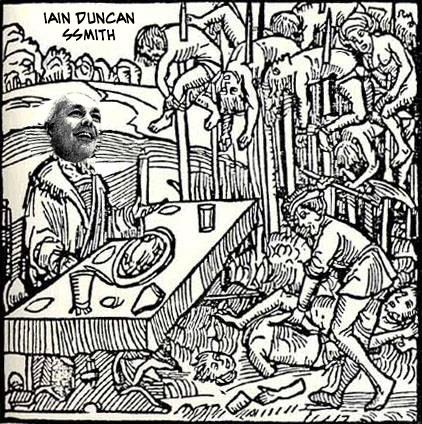
Pictures courtesy of Robert Livingstone 

Educating Dr Litchfield – a few facts about the Work Capability Assessment

Mike Sivier's avatarMike Sivier's blog

Dr Paul Litchfield. Dr Paul Litchfield.

Ignorance is most definitely not bliss for Dr Paul Litchfield.

The man was hand-picked by the Coalition government to review its hated Work Capability Assessment system of handling Employment and Support Allowance claims, amid rumours that previous incumbent Professor Malcolm Harrington had been unhappy with political decisions that ran against his findings. But he delivered a woeful performance to the House of Commons’ Work and Pensions committee last month.

He claimed to have no information about the staggering number of people who have died after going through the assessment system he is being paid to review, totalling 10,600 between January and November 2011 – that’s 220 per week or three every four hours. “I don’t have any information of that type; I haven’t seen numbers on that. Clearly every case would be a tragedy,” he said.

Clearly this expert has yet to gain access to some very…

View original post 267 more words

Clause 99, Catch 22 – State sadism and silencing disabled people

37079_433060243430176_1848475368_n

Here is the Hansard record of The Work Capability Assessments – Mandatory Reconsideration adjournment debate – it’s the 6th debate about Employment Support Allowance (ESA) tabled by Labour MP Sheila Gilmore, who has worked very hard to present her gathered and substantial evidence to an indifferent government about the terrible consequences of their sadistic sickness and disability “reforms”.

Section 102 and Schedule 11 of the Welfare Reform Act, (Clause 99) is the (State) power to require revision before appeal. People who wish to challenge a benefit decision will no longer be allowed to lodge an appeal immediately. Instead, the government introduced mandatory revision or review stage, during which a different Department of Work and Pensions (DWP) decision maker will reconsider the original decision and the evidence and, if necessary, send for more information.

We have campaigned since 2012 to raise awareness of Clause 99. During the Consultation period, I wrote a response to the government’s proposals, which many people used as a template for their own responses. I remember that Black Triangle, amongst others, ran a campaign also, and I remember that we ALL RAISED THE SAME CONCERNS.

In summary, the main concerns were that basic rate ESA was to be withdrawn during the mandatory review period, leaving sick and disabled people with no money to live on, whilst the DWP reconsidered their own “fit for work decisions” that were wrong.

I know that our Consultation responses were ignored by the government. The changes were introduced anyway, despite our grave concerns. Since October 2013 people have to apply for mandatory reconsideration separately before they can lodge an appeal. We were also very worried that no time limit was established for the DWP to undertake and complete the mandatory review. Our concerns were fully justified, as it’s emerged that people are waiting 7-10 weeks for the mandatory review decision. Meanwhile, these people cannot appeal. And have no money to live on.

An added concern is that this system as it stands demands such a lot from people who may be very vulnerable, seriously ill and/or have mental health problems. Their difficulties are exacerbated by cuts in legal aid for welfare rights advice and cuts in local authority grants. There is a significant contraction of the availability of help for those who need it the most from advice agencies.

Last year, Lord Freud suggested people awaiting their mandatory review should apply for Jobseekers Allowance (JSA) and then re-claim assessment-rate ESA if they have to appeal. However JSA claimants have to be available for and actively seeking work, and this is beyond people with disabilities or health conditions. As a result, many are ending up without any support at all from the State, having been deemed too “fit” to be eligible for ESA, but too sick or disabled to claim JSA, because these people cannot meet the high level of conditionality or remain available for work.

These people are left with NO lifeline benefits for periods as long as ten weeks. It seems Penning is oblivious to the fact that DWP “decision-makers” are demonstrating quite clearly that their initial “fit for work” responses are plainly and fundamentally wrong, it seems that Tory Ministers have engineered a situation that places some of the most vulnerable disabled people in a nightmarish situation where bureaucrats tell them they are both fit and unfit for work. Both contradictory decisions are then used to withdraw lifeline benefits. That’s not only grossly unfair, it’s terribly cruel. It also demonstrates how completely arbitrary DWP “decision-making” is, in order to justify removing people’s support.

Even when it’s the case that someone manages to make a successful claim for JSA, they are greatly at risk of being sanctioned because of the high level of conditionality, and the requirement to be available for work, in order to remain eligible for the benefit.

Furthermore, there is growing evidence that the DWP are closing existing ESA claims when a person successfully claims JSA during the mandatory review period, on the grounds that it isn’t possible to have two ongoing claims for two separate benefits open at the same time. This effectively means that people lose their right to appeal for the reinstating of their ESA, as their original ESA claim has ended.

This is how disabled people, amongst whom are some of our most vulnerable citizens, are being treated, what kind of government would allow such an utterly unacceptable degree of absolute callous indifference into what was originally designed as a system of support? A system that is now punishing people because they are sick or disabled? And what sort of government ignores the evidence of the extreme suffering and distress they are causing people?

How can this government show no remorse whatsoever, or decent and normal concern in the face of so many accounts of such human suffering and desperation – and heartbreaking comments such as “one constituent sold off his few remaining possessions to survive.” 

Many are relying on already stretched food banks, whilst others are taking out high interest loans. This situation is being exacerbated by growing delays. As we’ve pointed out, the law needs to change so claimants can be paid ESA at the assessment rate during the reconsideration process. This shouldn’t actually cost any money, as it is paid at the same rate as JSA – that benefit officials suggest claimants should receive anyway. I know that Sheila Gilmore is pushing to see basic rate ESA reinstated. She is also demanding that a statutory time limit is set on how long reconsideration decisions take. But Penning remains adamant that this isn’t going to happen.

Sheila notes that this issue was raised with Ministers when the legislation was going through the House and in subsequent sittings of the Work and Pensions Committee, for example. In April 2012, the Administrative Justice and Tribunals Council warned that the absence of a time limit could have the effect of “delaying indefinitely the exercise of the right of appeal to an independent tribunal”.  

Many of the key issues with the mandatory review can be seen summarised herehere and here. Sheila Gilmore and Anne Begg have covered these extensively during the ongoing Work and Pensions Committee ESA inquiry, as well as during the course of the many separate tabled debates.

Penning, I’m sorry to say, remained indifferent when he was confronted with evidence of the unforgivable suffering, the links to suicide, the links with high risk of homelessness, hunger, anxiety and stress, and the exacerbation of illness and mental health conditions in vulnerable people – this government’s policies are creating these extreme hardships. Bearing in mind this is meant to be our government’s support for very vulnerable sick and disabled people, his position is indefensible. So are his objections to answering these questions before. He said: “Actually, this is a bit like groundhog day. According to my file, this is the hon. Lady’s fifth debate on the subject. She said that it was the sixth; perhaps we missed one….

I am slightly concerned, because I said many of the things that I am about to say to her Committee only a few days ago. I hope that its members will pay attention to what I say, because during the speech of the hon. Member for Edinburgh East I feared that the report might have already been written.” 

Perhaps if he told the truth, listened and did his job properly, there would be no need for us to raise the same concerns again and again.

I doubt I could be an MP, I probably lack the necessary constraint, I’m afraid the sneer in his words, given the gravity of the situation for so many sick and disabled people, would have possibly elicited an out of character, but unstoppable, spontaneous punch in his spiteful, indifferent face, such is my anger. And really it’s impossible to see the welfare “reforms” as anything other than callous, spiteful and scripted sadism and indifference to people’s pain and desperation. I’ve always loathed bullies.

Sheila Gilmore said she had been told by Mark Hoban previously – last September – that claimants could request “flexible conditionality”, to avoid the difficulties imposed by JSA conditionality criteria. However, DWP’s Director acknowledged in April – some seven months later – that “not all advisors had been aware of this”. As Sheila Gilmore responded: “It is hard to have confidence in the Department, given that previous assurances were clearly unfounded.

Penning said: “As a Minister in the DWP, I am absolutely determined that we will ensure that taxpayers’ money is spent wisely; that it goes to the people who need it; that we put in place training for the right people…”

He seems to have overlooked the fact that most people claiming ESA have worked, paid income tax, and are still contributing proportionally more tax than those on the highest incomes pay, via VAT, Council Tax, the Bedroom Tax and an array of other stealth charges

And very clearly, the “people who need it” are NOT getting the support they need.

As Sheila Gilmore points out: “There is also an administration cost involved in a claimant receiving the assessment rate of ESA, ceasing to receive it, claiming JSA and then potentially claiming the assessment rate of ESA again. These are significant costs when multiplied by the number of people involved. In addition, if everybody claimed JSA successfully, they would receive benefit at exactly the same rate as they would have been getting on ESA, so if there are any savings to be anticipated, is it because ministers thought that people would, in fact, struggle to claim JSA during the reconsideration process, given that administration costs are likely to outweigh anything else? ”

“I am sure that cannot be the case.” she added.

I’m not bound by Parliamentary codes of conduct, as Sheila is. So I can say freely and categorically that it IS the case, and we anticipated this at the Consultation stage. Furthermore, the government know that WE know this, but they remain unremorseful, refusing to re-introduce assessment rate ESA, and to place a time limit on the reconsideration process.

Clause 99 has been introduced to make appealing wrong decisions that we are fit for work almost impossible. Sick and disabled people are effectively being silenced by this Government, and the evidence of a brutal, de-humanising, undignified and grossly unfair system of “assessment” is being hidden. More than 10,600 people have died  between 2010 – 2011, this a significant increase in mortality because of the current system, (the government have refused to release the data regarding ESA-related deaths since 2011 despite numerous Freedom Of Information (FOI) requests) and it is absolutely terrifying that our Government have failed to address this.

Instead, they have made the system even more brutal, de-humanising and unfair. What kind of Government leaves sick and disabled people without the means to feed themselves and keep warm? Clause 99 is simply an introduction of obstructive and Kafkaesque bureaucracy to obscure the evidence of an extremely unfair and brutal system. By creating another layer of brutality, the Government is coercing people into silence.

Successful appeals were evidence of an unjust system, and now, having made the process of appeal almost impossible, we have ministers trying to claim that suddenly the system is fine.

It’s FAR from fine.

430847_149933881824335_1645102229_n (1)Thanks to Robert Livingstone for his brilliant artwork.

I would also like to say a BIG thank you to Sheila Gilmore, Dame Anne Begg, Debbie Abrahams and all other MPs who work tirelessly in challenging and opposing the avalanche of social injustices and authoritarian policies this government have inflicted on those least able to fight back themselves.

Caught out: DWP ministers who claimed a million sickness benefit claimants had been found ‘fit for work’ – kept real data from public view

With big thanks to ilegal
Well over half a million sickness benefits appeals have succeeded – why has the DWP kept this quiet?
DWP ministers said only 9% of ESA decisions were wrong.  Our research reveals the DWP have been quoting from figures which state 151,800 appeals have succeeded.  Our evidence shows the true figure to be at least 567,634 – casting serious doubt over 43% of 1,302,200 ‘fit for work’ decisions. 
ilegal Press Release – 16th June 2013
DWP’s internal figures reveal a much higher number of successful ESA appeals than have been made publicly available.
DWP reply on 13 June 2014 to a Freedom of Information Act request made as part of an investigation in to DWP figures relating to the controversial Work Capability Assessment by ilegal.org.uk has revealed that of 1,287,323 ESA appeals, at least 567,634 claimants have had the original DWP decision overturned in their favour. Government’s key defence of the assessments has been that around 9% of all decisions are incorrect.  The most controversial of which are those where a claimant is found fit for work.  DWP figures (for new claims) show that between October 2008 and September 2013 a total of 1,306,200 fit for work decisions have been made
It is with considerable disappointment noted that the DWP’s latest publicly available statistics confirm that only 151,800 successful appeals have been recorded out of a total of 410,400 appeals (for new claimants only).  Our investigations reveal evidence of three times as many appeals being ‘internally recorded’ of which 567,634 have been successful.  The DWP have revealed to us figures which show nearly quarter of a million internal reconsiderations have led to decisions on new ESA claims being overturned in favour of the claimant; we have added these to figures from HMCTS tribunals which provides us with a much higher figure than the DWP seems to be prepared to admit to in their publicly available figures.
Our intensive research into the assessment of claimants for the DWP’s Employment & Support Allowance (ESA) has, following a freedom of information request to the DWP, provided one of the final pieces of the jigsaw needed to unpick the Department’s overly complicated statistics. We now have the final clue which has enabled us to identify that no less than 567,634 ESA claimants have in fact had their initial ESA refusals overturned in their favour.
It is a startling revelation that the government department has apparently been keeping a lid on a set of statistics that clearly shows between May 2010 and June 2013 no less than 820,356 decisions were looked at again by the DWP after claimants had been assessed by the controversial private contractors Atos Healthcare. These ‘internal’ statistics show that a very substantial 232,782 (28.5%) decisions were then subsequently overturned in the claimant’s favour.
What makes this all the worse is that these reconsideration statistics come on top of separate figures that show us that of those claimants who did not have the decisions overturned in their favour by the DWP, 817,102 went on to appeal to tribunals arranged by Her Majesties’ Courts & Tribunals Service where a further 332,607 were then overturned in the claimant’s favour by the tribunal.
These figures completely negate all of the DWP’s claims that it is getting the majority of its decisions right
These figures completely negate all of the DWP’s claims that it is getting the majority of its decisions right. Government ministers in conjunction with the DWP’s Press office have been telling us that a million claimants have been found fit for work whereas these figures show that in reality this is only a small part of the true story and that huge numbers have gone on to successfully appeal decisions which were wrong.
These new figures highlight the dubious practice of using the unchallenged assessment results, which only encourage media sensationalisation, with headlines such as those appearing in the Daily Express in July 2011 stating that ‘75% on sickness benefits were faking. The same article goes on to say that out of ‘…2.6 million on the sick, 1.9 million could work’ before receiving an endorsement from the Prime Minister with an assurance that his government was “producing a much better system where we put people through their paces and say that if you can work, you should work”.
DWP and Ministers know the truth, they just aren’t telling anyone
These figures have been available to the DWP and its ministers since April 2010 from their ‘Decision Making & Appeals Case Recorder (DMACR) – ESA Management Information Statistics’. The DWP confirms this to be unpublished information which is for internal department information only, yet our research notes that the Right Hon Chris Grayling was using the same information in answer to Parliamentary questions on the 10th January 2012. 
We question then why the DWP has consistently ‘over promoted’ only the results of Work Capability Assessments relating to ‘initial’ decisions (including the opinions of Atos Healthcare in the absence of a statutory DWP decision) when it could instead have come clean and declared how hundreds of thousands of their incorrect decisions have since been overturned in favour of the person appealing.
These revelations seriously undermine the DWP’s contention that the initial Work Capability Assessment outcomes are a valid measure of the claimant’s ability to work. The DWP has consistently defended its assessments by giving an impression that only a relatively low number of decisions have been overturned whereas the reality is that well over half a million have resulted in a successful outcome for the claimant.
And this DOES NOT include the 712,000 people awaiting assessments BEFORE they can appeal
This news must have come as cause for grave concern when considered in the light of a recent revelation by DWP Minister Mike Penning which revealed that in addition to the figures we have highlighted, a further 712,000 Employment & Support Allowance claimants are awaiting assessments without which they cannot yet appeal.
This hugely unacceptable backlog of cases means people with disabling medical conditions are left hanging for months and months on a basic allowance way below what they are entitled to. This is leaving hundreds of thousands deprived of the support they require and means having to scrape by on money which is wholly insufficient to meet their needs due to disability and illness. It also means many claimants affected by severe and complex mental health conditions are facing prolonged torment as they wait month upon month for their decision to be overturned before they can even lodge an appeal.
Face up to reality: it doesn’t work. Scrap the WCA
These findings add considerably to the pleas of disabled groups all over the country to scrap the Work Capability Assessment (WCA) and to find a better way to assess their needs.
It is simply appalling that the DWP, along with Ministers and other government spokespeople appear to be feeding the media with misleading statistics that are unrepresentative of the real story and instead encourage headlines vilifying the disabled and the genuinely ill. These figures clearly show the DWP has evidence in their possession which shows how in far too many cases the decisions it is making are dead wrong and they know they’re dead wrong.

Editorial notes
Please contact the author of this article Nick Dilworth for verification of any of the figures quoted.  We welcome sharing our findings on social media and allow this information to be produced providing credit is given to the
i-legal website with links to the article produced.
We apologise for the slight delay in publishing this release.  This was due to a need to align the figures to ones recently produced by the DWP in their Work Capability Assessment figures released on the 12th June 2014 which relate to the most recent statistics up to September 2013.
A full supporting explanatory memorandum will be published very shortly.
The Reconsideration statistics relate to new ESA claimants only (excluding incapacity benefit to ESA conversion cases) whereas HMCTS figures refer to all ESA claimants.  It is our contention that had the DWP supplied all of the information we had requested, the figures for reconsiderations would have been considerably higher.
We acknowledge that not all appeals will be against fit for work findings for new claimants but given the DWP’s emphasis on this claimant cohort and the lack of information to the contrary we are of the contention that other appeals relating to claimants being moved from the Work Related Activity Group to Support Group are likely to be of a much lower volume and more likely to be contained within the cohort relating to incapacity benefit/ESA assessment.
We would like to express our thanks to Anita Bellows an i-legal member for her cooperation and for making the freedom of information request upon our guidance and our thanks extend to the DPAC organisation with whom Anita is also a member.
995658_494538353949031_779653065_n
Many thanks to Robert Livingstone for the artwork

Sheila Gilmore – Penning is pinned: no excuses for ducking the mandatory reconsideration debate

536738_306169162785952_999031084_n

Press Release: MP sends Minister speech before debate on ‘Fit for Work’ test.

  • Debate on Work Capability Assessment Mandatory Reconsideration Delays at 10.00pm on Monday 16 June 2014
  • Sheila Gilmore’s speech sent to Minister responsible this afternoon
  • Minister can have no excuses for not answering questions

In advance of a debate on the Government’s controversial ‘Fit for Work’ test, Work and Pensions Select Committee member Sheila Gilmore today took the unusual step of emailing an advance copy of her speech to the Minister due to respond, Mike Penning.

Employment and Support Allowance (ESA) provides support for people who cannot work due to a health condition or disability, but since it replaced Incapacity Benefit in 2008, many people have been incorrectly assessed as fit for work and refused benefit. A new two-part appeals process was introduced in October 2013, with claimants’ cases first having to go through ‘mandatory reconsideration’ by a DWP official before reaching a judge.

Sheila Gilmore said:

Today I have taken the unusual step of emailing a copy of my speech for an upcoming debate to Mike Penning, the Minister due to speak for the Government. Now he can have no excuse for not answering the important questions I intend to put to him.

Commenting on the issues raised in her speech, Sheila Gilmore said:

I regularly meet sick and disabled people who are unable to work but who have been declared fit to do so following a flawed ESA assessment.

In my debate I’m going to focus on the new mandatory reconsideration process, introduced in October last year. I’m going to highlight the fact many people are left without any benefits payments during this period, the regular ten week waits for decisions, and the lack of official statistics on outcomes.

ENDS

Notes to Editors:

Iain Duncan Smith’s historic links to the far-right – Tom Pride

544840_330826693653532_892366209_n

By RL

From Pride’s Purge 

(not satire – it’s Iain Duncan Smith!)

No one should be surprised by the extremities of Duncan Smith’s attacks on the welfare state.

After all, Duncan Smith has a history of links to far-right politics – including racist and fascist organisations.

  • In 1995,  Duncan Smith was one of a few Tory MPs who met with senior figures of the racist and anti-semitic French National Front in Westminster. Le Pen’s deputy, Bruno Gollnisch MEP, later said Duncan Smith and other Tory MPs they met were “sympathetic” to their views:

I came to meet members of the Conservative Party sympathetic to our views… I met Duncan Smith and others in their offices and later we got together for less formal talks in a bar somewhere in the Parliament building.

  • The vice-president of Duncan Smith’s leadership campaign team in Wales was Edgar Griffin – the father of BNP leader Nick Griffin. Edgar later said the reason he was not a member of the BNP was because it was “too moderate” for him – unlike the Tory Party. And unlike Duncan Smith too presumably.
  • A Tory Party far-right wing fringe organisation called the Swinton Circle also supported Duncan Smith in his successful bid to lead the Tory Party. The Swinton Circle is led by former National Front activist Alan Harvey and has close ties to pro-apartheid far-right South African groups such as the Springbok Club.

I think he’s very good.

If you can tell the nature of a politician by his supporters, Duncan Smith is a very extreme politician indeed.

No surprises then that he was one of the first UK politicians to call for the invasion of Iraq. And believes unpaid work makes you free.

Related articles by Tom Pride:

Iain Duncan Smith to undergo surgery after tests reveal severe shrinkage of the heart

The remarkable similarities between Fritz Sauckel and Iain Duncan Smith

Iain Duncan Smith and Universal Credit – a case of a tool blaming his workmen?

Advice on what to do after a car crash – by car crash expert Iain Duncan Smith

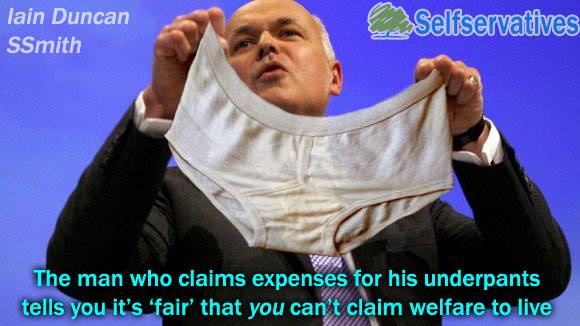
Iain Duncan Smith bullied aide to tears over his expenses claims for – underwear!

Etymological maps of common words like ‘clegg’, ‘cameron’ and ‘duncan smith’

Only one problem with the government’s list of top ten benefits fraudsters – it doesn’t exist

Government Announces Clampdown On Work-Shy Babies 


Clause 99, Catch 22 and Penning is telling lies.

385294_195107567306966_1850351962_n
The Government are claiming victory because of a fall in the number of benefit tribunal hearings. Today, the Express boasts:

A HUGE drop in the number of people appealing against benefit decisions at tribunal hearings was yesterday hailed as a victory for the Government’s reforms.”

Actually, it’s a victory for the Government’s authoritarian information micro-management.

There were 32,546 tribunal cases between January and March this year, compared to 155,000 in the same period of 2013.

“Official figures” reveal an 89 per cent fall in people contesting the decisions to cut, deny or restrict Employment Support Allowance (ESA), long-term sickness and disability benefits.

Tribunals contesting Jobseeker’s Allowance decisions also fell 70 per cent this year.

Disability minister Mike Penning said: “Fewer appeals going to tribunal is welcome. Getting more decisions right first time avoids the need for protracted tribunal appeals.”

Under the Department for Work and Pensions reforms, officials look again at decisions and extra evidence in all disputed cases before they go to appeal.

However, the effectiveness of the mandatory review – the Department of Work and Pensions (DWP) second “look” at their decisions to end benefit claims – isn’t the reason behind the fall in appeals, as Penning claims.

Firstly, people can no longer appeal benefit decisions immediately after their assessment, the mandatory review process will inevitably slow appeal applications down considerably.

Secondly, another major reason for fewer appeals is not that the DWP suddenly got better at decision-making, but rather, it’s because of a cruel and despicable move by the government to remove basic rate ESA payments from claimants awaiting the outcome of the mandatory review.

Previously, claimants who were found fit for work could continue to receive ESA at the basic rate by immediately lodging an appeal if they thought their work capability assessment decision was wrong. ESA would then remain payable until the appeal was decided.

Under the new rules, people who wish to challenge a benefit decision are no longer allowed to lodge an appeal immediately. Instead, we have to go through a mandatory revision or review stage, during which a different DWP decision maker will reconsider the evidence and, if necessary, send for more information, before deciding whether to change the original decision.

There is no time limit on how long this process may take. The requirement for a mandatory review/revision before proceeding with appeal applies to all DWP linked benefits. During the review, no ESA is payable, not even the basic rate. However, once the review is completed, those wishing to appeal may claim basic rate ESA again, up until the tribunal. (It’s important that people request this continued payment from the DWP, once they have lodged their appeal.)

The ludicrous claim from Government to justify this move – clause 99 – was that this “simplifies” the appeal process, and  “the changes will improve customer service by encouraging people to submit additional evidence earlier in the process to help improve decision making. Resolving any disputes without the need for an appeal will also help ensure that people receive the right decision earlier in the process.”

Call me a sceptic, but I don’t believe this was the genuine reasoning behind clause 99 at all.

We now have to appeal directly to HM Courts and Tribunal Services, this is known as “direct lodgement,” as DWP no longer lodge the appeal on our behalf. That is assuming, of course, that people manage to circumnavigate the other consequences of this legislation. Having no money to meet your basic living requirements is something of an obstacle, it has to be said.

From 1 April 2013 we are no longer able to get Legal Aid for First-tier Tribunal hearings. Legal Aid is still available for appeals to the Upper Tribunal and Higher Courts, provided the case is about a point of law. (Legal aid act 2012 ).

There are some serious implications and concerns about these changes. Firstly, there is no set time limit for DWP to undertake and complete the second revision. Secondly, claimants are left with no income at all whilst they await the review, and until appeal is lodged.

The DWP stated that there is “no legal reason” to pay a benefit that has been disallowed during the review period. The only choice available to sick and disabled people is an application for Job Seekers Allowance. (JSA). However, we know that people in situations where they have been refused ESA have also been refused JSA, incredibly, on the grounds that they are unavailable for work, (and so do not meet the conditions that signing on entails) or they are unfit for work, because they are simply too ill to meet the conditions. We know of people who have had their application for JSA refused because they attend hospital for treatment once a week and so they are “not available for work” at this time, for example.

Furthermore, there is growing evidence that people are being told by DWP that in order to claim JSA, they must first close their original claim for ESA, since it isn’t possible to have two claims for two different benefits open at the same time. DWP are also telling people that this means withdrawing their ESA appeal.

Another grave concern is that although most people on income related ESA are automatically passported to maximum Housing and Council Tax Benefit, from the time that the claim ends, (and for whatever reason), eligibility to housing benefit and council tax also ends. (However, I would urge people in this situation to contact the Housing Benefit office promptly to explain the situation – the DWP automatically contact the Council to tell them when someone’s eligibility for ESA has ended. It is always assumed that the person claiming has found work when their DWP related benefit eligibility ends.)

It’s horribly true that Clause 99 has been introduced to make appealing wrongful decisions that we are fit for work almost impossible. Sick and disabled people are effectively being silenced by this Government, and the evidence of a brutal, de-humanising, undignified and grossly unfair system of “assessment” is being hidden. More than 10,600 people have died because of the current system, and it is absolutely terrifying that our Government have failed to address this.

Instead, they have made the system even more brutal, de-humanising and unfair. What kind of Government leaves sick and disabled people without the means to feed themselves and keep warm? Clause 99 is simply an introduction of obstructive and Kafkaesque bureaucracy to obscure the evidence of an extremely unfair and brutal system. By creating another layer of brutality, the Government is coercing people into silence. Successful appeals were evidence of an unjust system, and now, having made the process almost impossible, we have ministers trying to claim that suddenly the system is fine. It’s FAR from fine.

This Government is oppressive, tyrannical and certainly bears all of the hallmark characteristics of authoritarianism. And they are blatant, unremorseful liars.

Data.

Please note that the DWP said “robust” data is not yet available to assess the impact of the legislative changes on tribunal receipts.

The DWP inform me that they are “looking to publish Mandatory Reconsiderations data when they judge it is of suitable quality to be published as Official Statistics.”

For further information, please see Appeals Reform

(That hasn’t restrained Mr Penning’s inferential leaps, though.)

Tribunals Statistics Quarterly:

April – June: 111,795
July – September: 76,430
October – December: 32,959 < Here is when the controversial DWP review procedure was introduced in October 013, though we have evidence that some people claiming ESA were made to go through mandatory review from APRIL, which was only legally introduced to apply to PIP and Universal Credit at that time.
January – March: 11,455
Total 232,639

ilegal have data to compare from previous years:

HMCTS ESA appeal yearly receipts                            Appeals received     
2013/2014 232,639
2012/2013 327,961
2011/2012 181,137
2010/2011 197,363
2009/2010


Total

126,838


1,065,938


As we’ve pointed out, until people have gone through the mandatory review, they can’t appeal because no decision has been made against which they can appeal. 2013/2014 was still the second highest set of annual figures for ESA appeal receipts, and that indicates that the reality is much more likely that “wrong” assessment related decisions have actually soared, but the DWP have so far failed to provide statistics of those trapped in the added Kafkaesque bureaucracy of the mandatory review. We have no idea, yet, of the timescales this involves, but we do know that it will serve to filter appeal applications significantly.

Nick also provides us with another significant figure: over 700,000 people are in a massive queue awaiting assessments for ESA allowance.

The mandatory revision process applies to:
1. UC, PIP, JSA and ESA
2. decisions on credits

Government advice for decision making: staff guide

From the guidance document: Decision Makers should note that mandatory reconsideration is being introduced from:

8.4.13 for PIP
29.4.13 for Universal Credit
28.10.13 for JSA and ESA.

The mandatory review – clause 99 – was introduced solely to place barriers before those who need to appeal unfair decisions. It also, therefore, serves to hide the evidence of a system that is founded on unfairness, since the high number of successful appeal outcomes previously has indicated clearly that the assessment process is deeply flawed and has been used to remove lifeline benefits to people who need support the most.


scroll2


Update:

BEGG, Anne (anne.begg.mp@parliament.uk)
To: Susan Jones
anne.begg.mp@parliament.uk
Thank you very much for this. I have passed a copy to my committee clerks so it can be considered as part of our inquiry into ESA/WCA.

Best wishes

Anne

Dame Anne Begg MP

On 13 Jun 2014, at 21:32

Chris Grayling plans Titan prisons and authoritarian, Victorian-style corporal punishment for young offenders

564882_438358886199493_1982719183_n

Shadow Justice Minister Dan Jarvis has said that the Government’s proposed “secure college model” for young offenders is worryingly untried and untested. Young offenders have complex needs, and present challenges that demands “smart, evidence-based policies” that will deliver results, as well as value for public money. But the Government is bringing a policy before Parliament in the Criminal Justice and Courts Bill that meets none of those tests.

Thanks to the hard work of the Youth Justice Board and Youth Offending Teams, both introduced by the last Labour Government, youth crime has fallen by nearly 40% since the late 1990s. I worked briefly as a youth offending team officer from 2007 – 2009, and Labour’s emphasis on preventative and rehabilitation work, used detailed risk and needs assessment, and support for young people was designed, planned and delivered by collaborative multi-agency professional teams (under the Every Child Matters legislative banner), which worked very well as part of an intensive, supportive needs-led provision.

I know that the complex needs that Dan mentioned arise due to young people being bereaved, for example, or having difficulties coping because of problems caused by additional education needs, autism, dyspraxia, attention deficit and hyperactive disorder and obsessive compulsive disorder, or poor mental health.

My caseload was comprised of young people between the ages 8-18, and most were extremely vulnerable, the majority were faced with complex issues as I’ve mentioned, and also, with school exclusions being a leading risk factor, culminating in their referral to our agency.

The prevention and rehabilitation programs that Labour initiated led to a significant drop in the number of teenagers in youth custody, with many offenders now being rehabilitated using referral orders and restorative justice.

The youth justice system does need to deter as well as rehabilitate, however. There will always be a proportion of young offenders for whom a custodial sentence is the only solution. However, that doesn’t mean the best and only solution is to build Titan prisons.

As Dan Jarvis said: “Many leading experts have stressed that smaller establishments are more effective for young people. It’s easier to maintain control, they are less violent and there’s a much better chance of rehabilitation.

That’s why there has been little enthusiasm for the plans from the justice sector, with serious concerns raised by the Deputy Children’s Commissioner, the Standing Committee on Youth Justice, the Howard League for Penal Reform and the Prison Reform Trust.

The Secure College’s location in the middle of the country also means families will have enormous distances to travel to see their loved ones, putting considerable strain on relationships with parents, all of which we know are crucial in rehabilitation.” 

The Justice Secretary has thrown the future of Secure Children’s Homes into serious doubt, too. Small units are recognised as the preferred model of youth custody, housing the most vulnerable children and providing intensive support. Grayling’s outlined model is more akin to a large Victorian workhouse.

Those very vulnerable children would be lost and remain anonymous to staff in the planned 300-bedroomed teenage Titan prison, but Grayling has indicated that many will now be moved to Secure Colleges, boys as well as girls and children as young as 12. This would raise serious safeguarding concerns and the Chair of the Youth Justice Board has expressed concern about this idea.

Furthermore, Justice Secretary Chris Grayling has been told that his plans to allow force to be used on children at the new “secure colleges” for young offenders are illegal and must be changed immediately, by the Parliamentary Joint Committee on Human Rights.

The Committee said the proposals in the Criminal Justice and Courts Bill to allow authorised staff to use “reasonable force where necessary to ensure good order and discipline” was a clear breach of international standards. Grayling has a track record of disregarding human rights.

Previously, the Committee warned Grayling that the Legal Aid cuts may breach human rights, and told Grayling that restrictions on legal aid would affect vulnerable groups. The Committee report said:

“We are surprised that the government does not appear to accept that its proposals to reform legal aid engage the fundamental common law right of effective access to justice, including legal advice when necessary. We believe that there is a basic constitutional requirement that legal aid should be available to make access to court possible in relation to important and legally complex disputes, subject to means and merits tests and other proportionate limitations.”

Chris Grayling is a man who knows the price of everything and the value of nothing, the chair of the all-party backbench Committee has said. Oscar Wilde’s cynical jibe was twice put to the justice secretary when he gave evidence to the Joint Committee on Human Rights on 26 November last year and was then repeated by Dr Hywel Francis, a Labour MP, when he launched the report.

Earlier this week  when the Justice Secretary unveiled detailed plans for the £85 million secure young offender unit in Leicestershire, which will hold up to 320 inmates between the ages of 12 and 17, he said it would put “education at the heart of custody” and would move away from the traditional approach of “bars on windows” when it opens in 2017. However, it’s very clear that Grayling’s proposals are traditionally authoritarian in nature, with the emphasis on a punitive approach, rather than a genuinely educational, supportive one. If the conservatives genuinely wanted to value and educate our young people, they most certainly wouldn’t have Michael Gove running the Education Department.

Staff would be subject to the same rules laid out in the Bill, prompting Labour Ministers to urge Grayling to scrap the Victorian-style proposals. Labour MP John McDonnell has compared the proposed Leicestershire facility with the notorious private jail HMP Oakwood in Staffordshire, claiming it would become an “Oakwood for children” and lead to riots and assaults.

This Bill reflects the Tory typism we’ve see repeated over and over, ad nauseam: funding is stripped from public services and private contractors then minimise the running costs and radically reduce the service, whilst making a lot of private profit.

I have grave concerns that because social services and other supportive agencies have been reduced, underfunded, or dismantled by this government, with few prevention-based projects to identify and to work with those at risk of offending, the lack of support will mean a significant rise in offending rates, and more children being detained in overcrowded and unsafe conditions. This is a government with an apparently never-ending supply of recipes for social disasters. And an absolute, brutal indifference to the welfare and well-being of the most vulnerable citizens.

In a report published yesterday, the cross-party Human Rights Committee said the idea that officials could use physical force on children to keep order in young offender institutions was unacceptable under the European Convention on Human Rights (ECHR). The report said:

“In our view, it is clear… that it is incompatible with Articles 3 and 8 ECHR for any law, whether primary or secondary legislation, to authorise the use of force on children and young people for the purposes of good order and discipline.”

Committee chair Hywel Francis said the MPs were “disappointed” that the Government did not appear to have examined international standards on the rights of children before publishing its Bill.

“Perhaps as a result there are a number of issues relating to secure colleges in particular that need examination and amendment, including making clear that force cannot be used on children to secure ‘good order and discipline’,” he added.

Frances Crook, chief executive of the Howard League for Penal Reform, said: “MPs have recognised that allowing prison officers to restrain children violently, simply if they don’t follow orders, is illegal and will put lives at risk.

“It is symptomatic of the kind of institution that ministers are proposing – not a college with education at its heart, but a giant prison where human rights are infringed and physical violence becomes part of the rules.”

I agree absolutely. This Bill reflects the authoritarianism and callous, indifferent and very punitive approach towards vulnerability of any kind that has come to typify this government of bullies.

Paola Uccellari, director of the Children’s Rights Alliance for England, has  added: “Allowing prison officers to use force to make children behave themselves is dangerous and carries a risk of injury. The Government is  putting children’s lives at risk by pushing ahead with its unlawful plans. It must listen to parliamentarians and remove these powers to use force from the Bill.”

A Ministry of Justice spokesperson said: “We will consider the recommendations made by the Committee.” 

Yes, Grayling gave the same response to the Joint Committee on Human Rights when concerns were raised about the Legal Aid Bill breaching Human Rights. But that Bill was passed by this government, nonetheless.

What this means, in basic terms, is that Grayling will push on with his plans, regardless of the fully justified fears and concerns raised for the safety and well-being of our vulnerable children and young people, and with a dismissive contempt from the Tories for their fundamental human rights.

There was a time when when Every Child Mattered. But that was before we knew this compassionless government of bullies.

_47839782_logo_226