Author: Kitty S Jones

I’m a political activist with a strong interest in human rights. I’m also a strongly principled socialist. Much of my campaign work is in support of people with disability. I am also disabled: I have an autoimmune illness called lupus, with a sometimes life-threatening complication – a bleeding disorder called thrombocytopenia. Sometimes I long to go back to being the person I was before 2010. The Coalition claimed that the last government left a “mess”, but I remember being very well-sheltered from the consequences of the global banking crisis by the last government – enough to flourish and be myself. Now many of us are finding that our potential as human beings is being damaged and stifled because we are essentially focused on a struggle to survive, at a time of austerity cuts and welfare “reforms”. Maslow was right about basic needs and motivation: it’s impossible to achieve and fulfil our potential if we cannot meet our most fundamental survival needs adequately. What kind of government inflicts a framework of punishment via its policies on disadvantaged citizens? This is a government that tells us with a straight face that taking income from poor people will "incentivise" and "help" them into work. I have yet to hear of a case when a poor person was relieved of their poverty by being made even more poor. The Tories like hierarchical ranking in terms status and human worth. They like to decide who is “deserving” and “undeserving” of political consideration and inclusion. They like to impose an artificial framework of previously debunked Social Darwinism: a Tory rhetoric of division, where some people matter more than others. How do we, as conscientious campaigners, help the wider public see that there are no divisions based on some moral measurement, or character-type: there are simply people struggling and suffering in poverty, who are being dehumanised by a callous, vindictive Tory government that believes, and always has, that the only token of our human worth is wealth? Governments and all parties on the right have a terrible tradition of scapegoating those least able to fight back, blaming the powerless for all of the shortcomings of right-wing policies. The media have been complicit in this process, making “others” responsible for the consequences of Tory-led policies, yet these cruelly dehumanised social groups are the targeted casualties of those policies. I set up, and administrate support groups for ill and disabled people, those going through the disability benefits process, and provide support for many people being adversely affected by the terrible, cruel and distressing consequences of the Governments’ draconian “reforms”. In such bleak times, we tend to find that the only thing we really have of value is each other. It’s always worth remembering that none of us are alone. I don’t write because I enjoy it: most of the topics I post are depressing to research, and there’s an element of constantly having to face and reflect the relentless worst of current socio-political events. Nor do I get paid for articles and I’m not remotely famous. I’m an ordinary, struggling disabled person. But I am accurate, insightful and reflective, I can research and I can analyse. I write because I feel I must. To reflect what is happening, and to try and raise public awareness of the impact of Tory policies, especially on the most vulnerable and poorest citizens. Because we need this to change. All of us, regardless of whether or not you are currently affected by cuts, because the persecution and harm currently being inflicted on others taints us all as a society. I feel that the mainstream media has become increasingly unreliable over the past five years, reflecting a triumph for the dominant narrative of ultra social conservatism and neoliberalism. We certainly need to challenge this and re-frame the presented debates, too. The media tend to set the agenda and establish priorities, which often divert us from much more pressing social issues. Independent bloggers have a role as witnesses; recording events and experiences, gathering evidence, insights and truths that are accessible to as many people and organisations as possible. We have an undemocratic media and a government that reflect the interests of a minority – the wealthy and powerful 1%. We must constantly challenge that. Authoritarian Governments arise and flourish when a population disengages from political processes, and becomes passive, conformist and alienated from fundamental decision-making. I’m not a writer that aims for being popular or one that seeks agreement from an audience. But I do hope that my work finds resonance with people reading it. I’ve been labelled “controversial” on more than one occasion, and a “scaremonger.” But regardless of agreement, if any of my work inspires critical thinking, and invites reasoned debate, well, that’s good enough for me. “To remain silent and indifferent is the greatest sin of all” – Elie Wiesel I write to raise awareness, share information and to inspire and promote positive change where I can. I’ve never been able to be indifferent. We need to unite in the face of a government that is purposefully sowing seeds of division. Every human life has equal worth. We all deserve dignity and democratic inclusion. If we want to see positive social change, we also have to be the change we want to see. That means treating each other with equal respect and moving out of the Tory framework of ranks, counts and social taxonomy. We have to rebuild solidarity in the face of deliberate political attempts to undermine it. Divide and rule was always a Tory strategy. We need to fight back. This is an authoritarian government that is hell-bent on destroying all of the gains of our post-war settlement: dismantling the institutions, public services, civil rights and eroding the democratic norms that made the UK a developed, civilised and civilising country. Like many others, I do what I can, when I can, and in my own way. This blog is one way of reaching people. Please help me to reach more by sharing posts. Thanks. Kitty, 2012

Judicial review launched regarding DWP decision to close the Independent Living Fund

37079_433060243430176_1848475368_n
In a very significant decision on 6 November 2013, which highlights the effects of the Equality Act 2010 on public authorities and their decision-making, the Court of Appeal has found that the Department of Work and Pensions’ (DWP) decision to close the Independent Living Fund (ILF) was not lawful, overturning the High Court’s decision of April 2013.

People with disabilities may receive ILF from a non-departmental Government body which provides money to help disabled people live independent lives in the community. The ILF operates an independent discretionary trust funded by the DWP and managed by a board of trustees. Its aim is to combat social exclusion on the grounds of disability and the money is generally used to enable disabled people to live in their own homes and to pay for care which would otherwise need to be given at residential care homes.

The Government initially decided to close the fund by March 2015 but this was delayed until June 2015 after five disabled people challenged the Government’s decision in the High Court.

The Court of Appeal unanimously quashed the decision to close the fund and devolve the money, on the basis that the minister had not specifically considered duties under the Equality Act, such as the need to promote equality of opportunity for disabled people and, in particular, the need to encourage their participation in public life. The court emphasised that these considerations were not optional in times of austerity.

On March 6, 2014, the Government announced in authoritarian style that it would go ahead with the closure of the ILF fund on 30th June 2015 justifying this decision by claiming that a new equalities analysis had been carried out by the Department for Work and Pensions. The government has shown a complete disregard for disabled people and the Court of Appeal decision. The government had failed to comply with the Equality duty – and this was a rare victory entirely due to disabled people fighting back.

The Department of Work and Pensions is now facing a new judicial review challenge from a group of disabled people regarding the decision of Minister for Disabled People Mike Penning to close the ILF in June 2015, taken just weeks after the Court of Appeal quashed the previous decision. .

The ILF provides vital support and funding for severely disabled people in the UK ,to enable them to live independent and fulfilling lives. To be eligible for ILF, people must already receive a substantial care package from local authority social services, but ILF funding also  provides a top-up for those with particularly high support needs. Severely disabled people are at high risk of social exclusion and face particular barriers to independent living and working.

The claimants, represented by Deighton Pierce Glynn and Scott-Moncrieff & Associates, fear that loss of ILF support would threaten their right to live with dignity, and they may be forced into residential care or lose their capacity to participate in work and everyday activities on an equal footing with other people.

The Court of Appeal had ruled in November 2013 that the previous closure decision had breached the public sector Equality duty, within the Equality Act, because the Minister had not been provided with adequate information to be able to properly assess the practical effect of closure on the particular needs of ILF users and their ability to live independently.

The DWP admitted that in considering the proposal again it had not consulted with any organisations or individuals outside of the Government, or gathered any additional information from local authorities or other sources about what level or type of support former ILF users would receive from social services once the ILF element was removed and how many people would be likely to go into residential care or lose their capacity to work or study.

The new legal challenge is pretty much on the same basis as the first – that once again the Minister had not discharged the public sector Equality duty because he did not have adequate information to be able to properly understand what the impact of closure would be on the particular people affected. This made it impossible to assess the proposal with the necessary focus on removing disadvantages for disabled people, meeting their needs, increasing participation in public life and advancing the equality that is required in all decisions by Government, within the framework of the Equality Act.

Related : Labour calls on Government To Save Independent Living Fund

At last the crisis of British democracy is addressed by a party leader: ED MILIBAND

I have always maintained that Ed Miliband is a thoroughly decent Leader, and that he has integrity. Labour are the only truly democratic mainstream party. They consult with the public and respond, and I know from my own lobbying experiences that Labour respond reflectively and positively to our campaigning. They are listening.

Mike Sivier's avatarMike Sivier's blog

Champion of democracy: Ed Miliband told the country he wants Parliament to provide what the people want, signalling a return to the principles of democratic government that have been abandoned by the Conservatives and Liberal Democrats. Champion of democracy: Ed Miliband told the country he wants Parliament to provide what the people want, signalling that Labour plans to return to the principles of democratic government that have been abandoned by the Conservatives and Liberal Democrats.

Hopefully the naysayers among Vox Political‘s readership will have a little more respect for Mr Miliband after today.

He is the first – and so far, the only – leader of a mainstream British political party to have correctly identified the biggest problem facing our democracy at this time:

The fact that people aren’t bothering to vote.

Here’s what he said, in his response to the Queen’s Speech:

“The custom of these debates is to address our opponents across the despatch box in this House, but today on its own that would be inadequate to the challenge we face.

“There is an even bigger opponent to address in this Queen’s…

View original post 587 more words

Ed Miliband’s full response to the Queen’s Speech

 With thanks to LabourList

MILIBAND QUEEN'S SPEECH

Click here for Ed Miliband’s full response to today’s Queen’s Speech, in glorious technicolour.

For those who prefer reading, here is the full text:

“This Friday we will mark seventy years since the Normandy Landings, where wave upon wave of allied forces poured onto the beaches of Northern France.

It marked the beginning of the final chapter of the Second World War which preserved the freedoms we enjoy today.

So I want to start by honouring the service of those veterans and the memory of their fallen comrades.

A feeling I’m sure shared across the whole House.

And I am sure across the House today we will also want to remember and pay tribute to the work of our armed forces over the last decade in Afghanistan.

At the end of this year, British combat operations will come to an end.

We should be incredibly proud of the service of our armed forces.

They have fought to make Afghanistan a more stable country, and a country with a democracy and the rule of law.

And a country that cannot be used as a safe haven to plan acts of terrorism here in Britain.

We grieve for the 453 members of our Armed Forces who have been lost and our thoughts are with their families and friends.

All of our armed forces have demonstrated, as our Normandy veterans did all those years ago, that they represent the best of our country.

At the beginning of each Parliamentary session, we also remember those members of this House we have lost in the last year.

In January, we lost Paul Goggins.

He was one of the kindest, most honourable people in the House, and someone of the deepest principle.

At a time when people are very sceptical about politics, Paul Goggins is a reminder of what public servants and public service can achieve.

Let me turn to the proposer of the motion who carried off her duties with aplomb and humour.

She can only be described as we saw from her speech, as one of life’s enthusiasts.

Before coming to this House she has had a varied career as a magician’s assistant when a teenager, and then a job nearly as dangerous, running the foreign press operation for President George W. Bush.

She made headlines for her recent appearance on Splash.

With an admirable line in self-deprecation saying about her performance, “I have the elegance and drive of a paving slab…” which seems somewhat unfair.

Since she got to the quarter finals I’m not sure what it says about the other contestants.

It certainly takes guts to get in a swimming costume and dive off the high board.

Can I say to her if she is looking for a new challenge she should try wrestling a bacon sandwich live on national television.

In any case, it is clear that today she deserved her place on the podium.

Turning to the seconder of the motion, she made an eloquent speech.

She came to this House with over twenty years teaching in further education and the Open University behind her.

Since being elected in 2001, she has campaigned with distinction on children’s issues and has been an assiduous local MP.

She voted against tuition fees, has described being in the coalition as “terrible” and says the Lib Dem record on women MPs is “dreadful”.

By current Lib Dem standards, Mr Speaker, that apparently makes her a staunch loyalist.

But on gender representation she will have taken real consolation that she can now boast that 100 per cent of Liberal Democrat MEPs are women.

As she said she will be standing down at the next election and for her outside experiences, her wisdom and her all round good humour and kindness, which I saw when I first became an MP, she will be much missed.

Before I turn to the loyal address, let me say something about one of the most important decisions for generations, which will be made in just a few months’ time.

The decision about the future of our United Kingdom.

The history of the UK, from workers’ rights, to the defeat of Fascism, to the NHS, to the minimum wage, is the story of a country stronger together.

A country in which representation from Scotland and Wales and Northern Ireland and England has helped us to advance the cause of social justice.

It is a decision for the people of Scotland but I passionately believe this Kingdom should remain United.

Mr Speaker, the ritual of the debate on the loyal address has existed for centuries.

Today, we do not just debate the Queen’s Speech, we assert the importance of this House and the battle it has fought over hundreds of years to exercise power on behalf of the British people.

But what the recent elections show is that more than at any time for generations, this House faces a contemporary battle of its own.

A battle for relevance, legitimacy and standing in the eyes of the public.

The custom of these debates is to address our opponents across the despatch box in this House.

But today on its own that would be inadequate to the challenge we face.

There is an even bigger opponent to address in this Queen’s Speech debate:

The belief among many members of the public that this House cannot achieve anything at all.

Any party in it.

About 10 per cent of people entitled to vote, voted for UKIP in the recent elections.

But, as significant, over 60 per cent did not vote at all.

And whatever side we sit on, we will all have heard it on the doorstep:

“You’re all the same, you’re in it for yourself, it doesn’t matter who I vote for.”

Of course, that’s not new, but there is a depth and a scale of disenchantment which we ignore at our peril.

Disenchantment that goes beyond one party, beyond one government.

There is no bigger issue for our country and our democracy.

So, the test for this legislative programme, the last before the general election, is to show that it responds.

To the scale of the discontent.

And the need for answers.

In this election, we heard concerns about the way the EU works and the need for reform.

We heard deep-rooted concerns about immigration and the need to make changes.

But I believe there is an even deeper reason for this discontent.

Fundamentally, too many people in our country feel Britain doesn’t work for them and hasn’t done so for a long time.

In the jobs they do and whether their hard work is rewarded.

In the prospects for their children and whether they will lead a better life than their parents, including whether they will be able to afford a home of their own.

And in the pressures communities face.

Above all, whether the work and effort people put in is reflected in them sharing fairly in the wealth of this country.

The Governor of the Bank of England gave a remarkable speech last week saying inequality was now one of the biggest challenges in our country.

We should all be judged on how we respond to this question, right as well as left.

There are measures we support in this Queen’s Speech including tackling modern slavery, an Ombudsman for our Armed Forces and recall.

But the big question for this Queen’s Speech is whether it just offers more of the same or whether it offers a new direction, so we can genuinely say it works for all and not just a few at the top.

This task starts with the nature of work in Britain today.

It is a basic belief of the British people that if you work all the hours God sends you should at least be able to make ends meet.

All of us say that if you do the right thing, you should be rewarded.

It is a mantra that all sides of this House repeat.

But we should listen to the voices of all of those people who say that their reality today is that hard work is not rewarded.

And it hasn’t been for some time.

All of us will have had heard this during the election campaign.

Like the person I met in Nottingham, struggling with agency work, total uncertainty about how many hours he would get.

Every morning at 5am, he would ring up to find out if there was work for him.

More often than not, there was none.

He had a family to bring up.

The fact that this is happening in 21st century Britain today, the fourth richest country in the world, is something that should shame us all.

This is not the Britain he believes in.

It’s not the Britain we believe in.

And it shouldn’t be the Britain this House is prepared to tolerate.

We have seen the number of zero-hours contracts go well above one million.

We need to debate as a country whether this insecurity is good for individuals, families and the country as a whole.

It is not.

And if it isn’t we should be prepared really to do something about it.

And we need to debate the wider problem.

Five million people in Britain, that’s one in five of those in work, are now low paid.

And this shocking fact:

For the first time on record, most of the people who are in poverty in Britain today are people in work, not people out of work.

So much for hard work paying.

None of our constituents sent us to this House to build an economy like that.

And at a time when we will face significant fiscal challenges into the future, it is costing the taxpayer billions of pounds.

It is no wonder people in the country don’t think this House speaks for them.

To show a new direction for the country and show it is not just more of the same, the Queen’s Speech needs to demonstrate to all of those people that it can answer their concerns.

There is a Bill in this Queen’s Speech covering employment.

But the Bill we need would signal a new chapter in the battle against low pay and insecurity at work, not just business as usual.

It would set a clear target for the minimum wage for each Parliament, so that we raise it closer to average earnings.

If you are working regular hours, for month after month, you should be entitled to a regular contract not a zero-hours contract.

If dignity in the workplace means anything it should clearly mean this.

We could make it happen this Parliament and show the people of this country that we get what is happening, but this Queen’s Speech does not do that.

Britain, like countries all around the world, faces a huge challenge of creating the decent, middle income jobs that we used to take for granted.

And many of those jobs will be created by small businesses.

There is a Bill in the Speech on small business.

But we all know that we have a decades’ long problem in this country of banks not serving the real economy.

Companies desperate to expand, to invest, to grow can’t get the capital they need.

For all of the talk of reforming the banks, is there anyone who really believes the problem has been cracked, with lending to small business continuing to fall?

The choice facing this House is to carry on as we are.

Or say that the banks need to change.

Break up the large banks so we tackle our uncompetitive banking system.

And create regional banks that properly serve small business.

But the Queen’s Speech doesn’t do this.

And a Queen’s Speech that was setting a new direction would also be tackling another decades’ long problem.

That’s happened under governments of both parties.

And would be devolving economic power away from Whitehall to our great towns and cities.

Lord Heseltine was right in his report.

We do need to give our towns, our cities, our communities the tools to do that job.

Even more importantly when there is less money around.

More powers over skills, economic development and transport.

And the government should be going much further.

But none of that is in this Queen’s Speech.

So the first thing this Queen’s Speech needed to have done is to signal a new direction in the jobs we create in this country and whether hard work pays.

It does not rise to this challenge.

We support measures on childcare, which is part of the cost-of-living crisis, although the scale of that challenge means we would go further on free places for 3 and 4 year olds.

And we also support the Bill on pensions although we want to ensure people get proper advice to avoid the mis-selling scandals of the past.

But the next task for this Queen’s Speech is to face up to another truth:

For the first time since the Second World War, many parents fear their children will have a worse life than they do.

No wonder people think that politics doesn’t have the answers when this is the reality people confront.

And nowhere is that more important than on housing.

We all know the importance of that to provide security for our families.

And we know this matters for the durability of our recovery too.

The Bank of England has warned that the failure to build homes is their biggest worry.

And this is a generational challenge which hasn’t been met for 30 years.

We are currently building half the homes we need and on current trends the backlog will be 2 million homes by 2020.

The question for this House is: are we going to act to meet the challenge or carry on as before?

A new town at Ebbsfleet as this Queen’s Speech proposes is fine, but it does not do enough to set a new direction in building homes.

Tackling the fundamental problem of a market that’s not working, with a small number of large developers not having an incentive to build at the pace we need.

We know there is a problem of developers getting planning permission, sitting on land, and waiting for it to accumulate in value.

There are land banks with planning permission for over half a million homes.

We can either accept that or change it.

We could give councils powers to say to developers, use the land or lose it.

And give local councils the right to grow where they need more land for housing.

And this House could commit today to getting 200,000 homes built a year, the minimum we need.

That is after all what in the 1950s a One Nation Conservative Prime Minister did.

But the Speech does none of these things.

And a Queen’s Speech rising to the challenge on housing, would also do something for the nine million people who rent in the private sector.

Over one million families, with two million children, with no security at all.

Children who will start school this September but their parents will have no idea whether they will still be in their home in 12 months’ time.

And we wonder why people are losing their faith in politics.

When we published our proposals for three-year tenancies some people said they were like something out of Venezuela.

If something as modest as this is ridiculed as too radical, is it any wonder that people who rent in the private sector think Parliament doesn’t stand up for them?

These proposals would not transform everything overnight, but they would tell 9 million people renting in the private sector that we get it and something can be done.

And there is another area where people are fed up being told there is nothing that can be done.

Their gas and electricity bills.

It is eight months since Labour called for a freeze on people’s energy bills.

Just this week we’ve seen figures showing the companies have doubled their profit margins.

This is a test of whether this House will stand up to powerful vested interests and act, or say that nothing can be done.

The companies can afford it.

The public need it.

The government have ignored it.

This Queen’s Speech fails that test.

The test for this Queen’s Speech is also whether it responds to the anxieties people feel in their communities.

We all know that one of the biggest concerns at the election was around immigration.

I believe immigration overall has been good for our country.

I believe it as the son of immigrants.

And I believe it because of the contribution people coming here have made to our country.

But we all know that we must address the genuine problems about the pace of change, pressures on services and the undercutting of wages.

Some people say we should cut ourselves off from the rest of the world and withdraw from the European Union.

They are profoundly wrong.

We have always succeeded as a country when we’ve engaged with the rest of the world.

That is when Britain has been at its best.

Others say that there is nothing that can or should be done.

They are wrong too.

We can act on the pace of change by insisting on longer controls when new countries join the European Union.

We need effective borders where we count people in and out.

And this House could act in this session of Parliament to tackle the undercutting of wages.

Not just increasing fines on the minimum wage, but proper enforcement and stopping employers crowding ten to fifteen people into a house to sidestep it.

We all know it’s happening.

Stopping gangmasters from exploiting workers from construction to agriculture.

We all know it’s happening.

Stopping employment agencies from only advertising overseas or being used to get round the rules on fair pay.

We all know it’s happening.

It is no wonder people lose faith in politics when they know it’s happening and Parliament fails to act.

If this House thinks these things are wrong then we should do something about them.

Responding to the concerns we have heard about work, about family, about community is the start this House needs to make to restore our reputation in the eyes of the public.

At the beginning of this speech I said there is a chasm between the needs and wishes of the people of this country and whether or not this House and politics is capable of responding.

We need to rise to that challenge.

This Queen’s Speech doesn’t do it.

But it can be done.

And that is the choice that the country will face in less than a year’s time.

This is what a different Queen’s Speech would have looked like:

A Make Work Pay Bill to reward hard work.

A Banking Bill to support small businesses.

A Community Bill to devolve power.

An Immigration Bill to stop workers being undercut.

A Consumers’ Bill to freeze energy bills.

A Housing Bill to tackle the housing crisis.

And an NHS Bill to make it easier to see your GP and stop its privatisation.

To make that happen, we need a different government, a Labour government.”

Ed Miliband.

Related posts:

  1. Miliband and Balls unveil alternative Queens’ Speech
  2. Full text: Miliband’s Budget Response
  3. Ed Miliband’s Queen’s Speech response
  4. Ed Miliband “One Nation Economy” speech – full text
  5. Full Text: Ed Miliband’s Budget Response
YARPP544807_370332463014480_1710535589_n


Labour’s fiscal responsibility and caution isn’t austerity, so stop doing Lynton Crosby’s job for him.

10001887913_f8b7888cbe_o

Guardian/ICM poll in autumn last year revealed an alarming fact: David Cameron and George Osborne are more trusted by the public on “economic management” by a margin of 40% to 22%, and we know that the public – and  a number of Labour supporters amongst them – have hardened their attitude towards welfare support.

Yet we know that Labour’s social policy was a success, this is verified by the London School of Economic’s definitive survey of the Blair-Brown years: “There is clear evidence that public spending worked, contrary to popular belief.” Nor did Labour overspend. It inherited “a large deficit and high public sector debt”, with spending “at a historic low” – 14th out of 15 in the EU.

Although Labour’s spending increased, until the global crash it was  “unexceptional”, either by historic UK standards or international ones. Until 2007 “national debt levels were lower than when Labour took office”. After years of neglect, Labour inherited a public realm in decay, squalid, public buildings, almost extinct public services and neglected human lives that formed a social deficit more expensive than any Treasury debt. But Labour reinvested in people, in services, just like they always do.

Things were much better with a Labour administration, with money mostly well spent on public services and infrastructure. Labour shielded us from the effects of global crash. We were out of recession in the UK by 2010.

In the weeks after he took office, George Osborne justified his austerity programme by claiming that Britain was on “the brink of bankruptcy”. However, the head of the Office for Budget Responsibility publicly rebuked Osborne for that bare-faced lie.

The public seem to have forgotten that it was the Conservative-led Coalition that lost the Moody’s Investors Service triple A grade, despite pledges to keep it secure. Moody’s credit ratings represent a rank-ordering of creditworthiness, or expected loss.

The Fitch credit rating was also downgraded due to increased borrowing by the Tories, who have borrowed more in 4 years than labour did in 13. It’s remarkable that the general public pay so little attention to events and facts, but as Goebbels said:

“If you tell a lie big enough and keep repeating it, people will eventually come to believe it. The lie can be maintained only for such time as the State can shield the people from the political, economic and/or military consequences of the lie. It thus becomes vitally important for the State to use all of its powers to repress dissent, for the truth is the mortal enemy of the lie, and thus by extension, the truth is the greatest enemy of the State.”

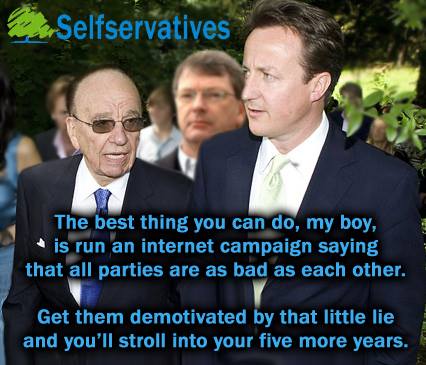
Another big lie of course is that “they’re all the same”. This myth started life as a divisive and demoralising propaganda tool aimed at the Left by the likes of Lynton Crosby. The Right have always employed the tactics of infiltration, disruption and “neutralization”  to address opposition and these tactics are well known to civil liberties advocates everywhere. (See “The Enemy Within”, and the account of how Thatcher used MI5 as a home-grown political police force that was deployed against the miners and the Left.)

One of the most disheartening consequences of Right wing propaganda is watching how some of the Left pick it up and run with it. All over the place. The Huff published an article claiming Future Labour Government WILL NOT Undo Hugely Unpopular Coalition Government Cuts, but on close scrutiny, the article does not substantiate or justify the headline. So it was with incredulity that I watched various Left-wing factions translate that into “Miliband supports austerity” and that was repeated over and over, without much critical analysis or attention paid to what was actually said.

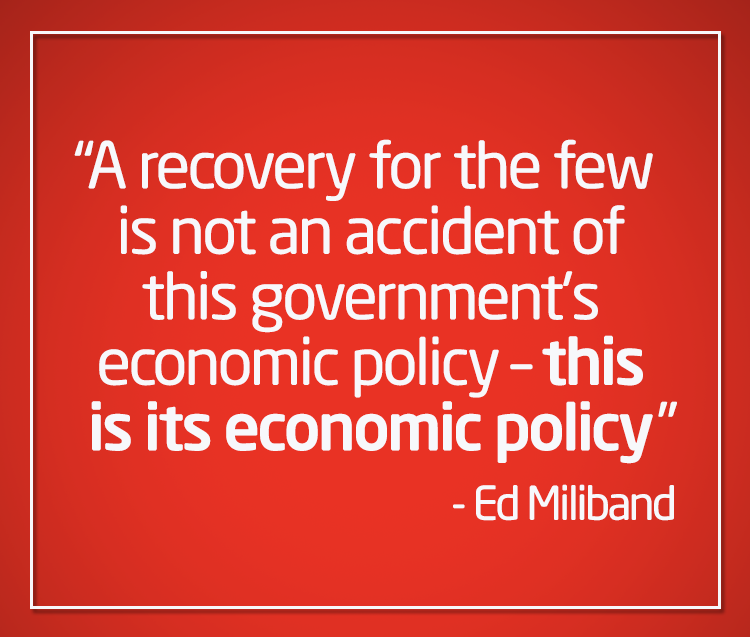
Firstly, Milliband DOES NOT SUPPORT AUSTERITY and never has. Miliband has already made a commitment to prioritise addressing inequality and the cost of living crisis.

Secondly, what Miliband has actually said is: “Our starting point for 2015-16 will be that we cannot reverse any cut in day-to-day, current spending unless it is fully funded from cuts elsewhere or extra revenue – not from more borrowing.”

If you look past the various bluntly misleading headlines, the Labour leader has simply given himself room for manoeuvre. Miliband has said that he won’t make any promises he cannot keep. And he hasn’t. Those pledges that have been made to date have been costed, evidenced and justified.

In light of a hostile media, and a public tending to believe that austerity is somehow necessary and justified, it’s worth considering that if Miliband wants to be in a position to change anything at all for the better, he will need to be elected, and some elements of public opinion present a barrier to that. And for the wrong reasons, unfortunately for us, and for Miliband.

Here is a commentary of Miliband’s understandably cautious statement:

1) Miliband has committed to matching spending levels only.

Whilst he may be matching current “day-to-day” spending levels, that still allows him plenty of room for capital spending. He may as well have openly pledged to do so, with robust rhetoric on housing and house building. His speech on limiting the benefit bill specifically mentioned how house building can reduce welfare spending in the long run, by stopping the system of siphoning off public funds for private landlords. He also has political endorsement from the International Monetary Fund, which suggested that the UK could use another £10 billion investment. Labour have pledged to build new homes and it’s thought that the figure will be a million in total, in the Manifesto. That will also provide a boost the the economy.

Furthermore, Miliband has pledged to repeal the Bedroom Tax, and the cuts to and privatisation of the NHS. And that IS a promised reversal of cuts made by the Coalition.

2) It’s only for one year

Miliband’s pledge only counts for the first year of his government, from 2015 to 2016. After that, he can do what he likes.

Raising revenue over that year through various methods, such as collecting more taxes from the wealthy, reversing the extra tax cuts which the richest 5 per cent have received, as pledged, and by capping private rents, (and not benefit) for example and saving the amount that the State hands out to wealthy landlords, will also give Labour more room for manoeuvre to plan and prioritise further. Bearing in mind that Labour will certainly inherit public services with much of the former foundational structure gone – such as the health system, where thousands of staff have been cut, services privatised, and then there’s other areas of infrastructure that’s been badly neglected, it’s important that these issues are addressed, since repeal of legislation, for example, requires something else to be put in place, too.

Another example of raising revenue is the Job’s Guarantee (for all who wants one) and by the government paying a living wage, the private sector would have to increase their wages in order to gain workers. That will reduce the benefit bill. The Job’s Guarantee will also act as an “automatic stabiliser”, maintain or increase the workforce’s skills, reduce mental health problems and increase demand in the economy.

3) Miliband can be fiscally conservative whilst remaining socially progressive

Miliband’s pledge draws a line for day-to-day spending beyond which he will not cross, but it does not specify what he does ahead of that line. Under the coalition, savings were expected to be found under a ratio of 80:20 – 80% spending cuts to 20% tax rises.  Miliband has indicated he will be significantly raising taxes for the wealthy whilst easing or even undoing spending cuts elsewhere. The Labour leader has already announced a bankers’ bonus, return of the 50p top rate of tax and a mansion tax, amongst other measures. The direction of travel is pretty clear.

Ed Miliband and Ed Balls are currently examining options for how Labour can fund additional much needed investment in health over and above current spending plans. There is much supporting evidence for this vital investment, and for the repeal of the Tory-led Health and Social Care Act 2012, which has steadily eroded health services, has led to deliberate underfunding by the government and to subsequent mass privatisation within the NHS.

4) Miliband can still undo spending cuts

Just because each pledge must be financially costed without resorting to borrowing, that doesn’t mean it can’t be undertaken. As Miliband specified, cuts can be undone if the funding is found from elsewhere.

The proposed bankers’ bonus has been matched to pledges, the mansion tax has already been matched to bringing back the 10p rate of income tax. If anything, Miliband’s announcement should prompt campaigners to redouble their efforts on crucial key issues. The more pressure there is, the more prominently those issues will feature in Labour’s priorities.

5) Miliband hasn’t yet ruled out radical options

Just because you’re not borrowing doesn’t mean you can’t spend. Britain has magicked £375 billion out of the air and handed it to banks as part of the quantitative easing programme. The Conservatives managed to provide the millionaires with a tax cut of more than £107,000 each per year. But if money can be printed for banks, money can also be printed to try other methods of kick-starting the economy, such as taking low earners out of income tax.

It’s worth considering that when public services are extensively privatised, as they have been this past four years, those public funds that were once available vanish into private, closed bank accounts. That money will have to be recouped and reinvested.

1896930_10151941274942411_961048560_n

It’s worth bearing in mind that any government which introduces a policy like the Gagging Act, one that openly “monitors” the Right wing media for any whisper of “left wing bias”, that arranges the destruction of media hard drives because it doesn’t want the public to know the extent of government intrusion on our everyday private lives, is a government that will only ever use oppression to maintain its rule. It isn’t a democratic, open, accountable and reflective  government: it is an authoritarian one, and it has nothing to offer most of us but fear, poverty, exploitation, hunger, repression, pain and a deep longing for the decent, civilised society we once had.

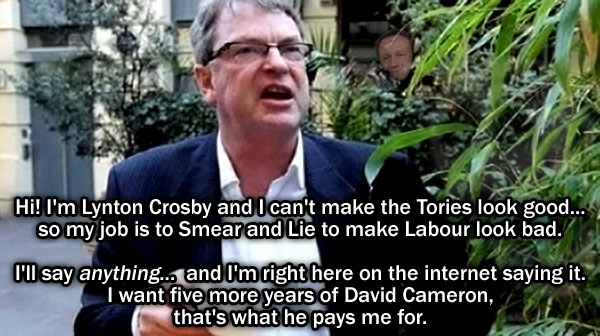
“Lynton Crosby, a man whose mission the Prime Minister describes as being “to destroy the Labour Party”. This is a Conservative party preparing to fight the dirtiest general election campaign that we have seen in this country for over 20 years. And the Crosbyisation of the Conservative Party has reached a new intensity as their leadership becomes increasingly desperate. 

They have nothing to say about the cost of living crisis and have no vision for a better Britain. All they have left is resort to the lowest form of politics: that of division, of smear and character assassination. Millions of families face a cost of living crisis unequalled in their lifetimes. 

And the general election will determine how our country responds. The next election is far too important to be conducted in the gutter. Britain can do better than this. ”  Ed Miliband.

He’s right. We can do better than this.

The last four years have taken us on a nightmarish tour of socially dysfunctional, dystopian conservatism, and stranded us here, where the elite natives and tour operators speak an archaic language using narratives that translate as neofeudalism.

It’s time we went home.

10853165213_ddb97ac601_o

But we know better

Once you hear the jackboots, it’s too late. 

544807_370332463014480_1710535589_n

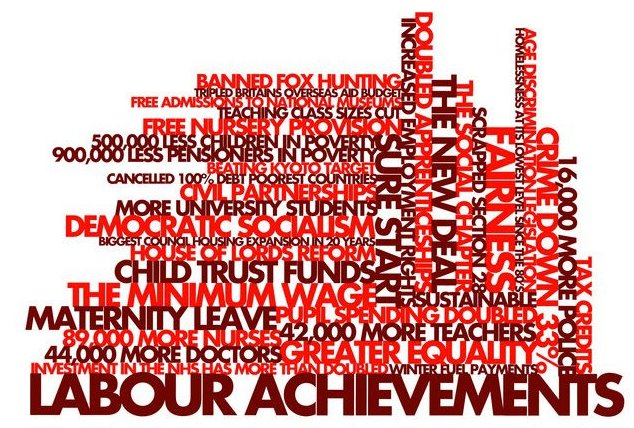
What Labour achieved, lest we forget

45 more good reasons to vote labour: the best   pledges to date

Many thanks to Robert Livingstone for his tireless, brilliant art work.

The disgruntled beast

10437171_327099100774478_1052932761_n

Miliband doesn’t pander to populism, and upholds the inclusion, equality and diversity principles that are embedded in policies which Labour pioneered. He aims to address and curtail exploitative employers, which of course is a real problem, rather than migrants, who are being exploited in the same way that “nationals” are. We have workfare, analogous to slavery and counterproductive in decreasing unemployment, which is universally exploitative, and absolutely nothing to do with the poor migrants, and everything to do with profit-driven greed, and a government that has encouraged that greed to thrive and flourish at such catastrophic expense to others.

Miliband knows that Britain is not divided by race and culture, it’s divided by wealth inequalities fuelled by the Tory-led Coalition’s austerity policies. Blaming the unemployed, the sick and disabled and immigrants for the failings of the government has fuelled misperceptions that drive support for the far-right. People complain they can’t get council houses, and the only really honest question an honest politician ought to ask is: “Why aren’t there more council houses?”

And when there are large numbers of people receiving unemployment benefit or tax credits, then the only honest question to ask is: “Why is the economy failing to provide enough jobs, or pay adequate wages?”

Miliband’s emphasis on equality is bothering the Tories, because their entire ideology is founded on Social Darwinism: to the Tories, inequalities are an inevitability, because of their emphasis on competition between individuals for resources in the “free market.” Miliband’s social democracy program provides an alternative that challenges the established right-wing neoliberal consensus.

The media and the government have stigmatised vulnerable social groups as a justification of cruel and punitive policies aimed at those least able to fight back, as an explanation of the failings of this government to be fair and honour a degree of legislation to reflect public needs – the public they are meant to serve.

As a society that once promised equality and democracy, we now preside over massive inequalities of wealth: that’s a breeding ground for racism and other vicious resentments.

It’s awoken the disgruntled beast within people, the one that feeds on anger, demoralisation, fear, resentment and uncertainty.

And wherever antipathy and a degree of enmity exist, the far-right have always tried to perpetuate, exploit and increase rancour. The fascism of the 20s and 30s gained prominence because it played on wider public fears, manipulating them, and deflecting attention, as ever, from those who are truly to blame for dire social conditions: the ever-greedy elite. There’s a well-established link between political extremism, economic hardship and recession and social cleavages, with the far-right “anti-system” parties deceitfully winning the support of those who would never previously have thought of themselves as extremists.

Such extremism and rancour feeds the disgruntled beast. The political right have always sought to divide sections of the poor and middle class and set them to fight one against the other; to have us see enemies in our midst which do not exist, so that we see economic policies – the Tory-rigged “free market” competition – as the solution rather than the cause of our problems.

And here we are again. A Tory government, another rigged recession, and the politics of fear, despair and micro-managed discontent.

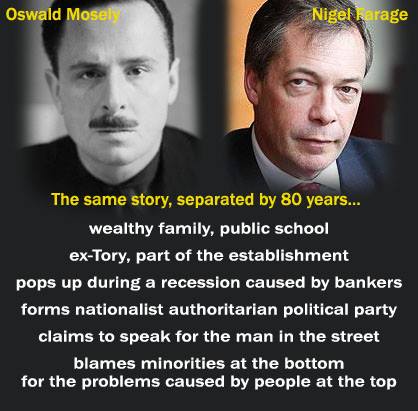
Fascism plays a specific role for the ruling class: it is a weapon against civil unrest during social crises caused by recession. It redirects public anger from the government to scapegoats. To build such a movement, fascists have to delve into the “lower classes” using a mixture of crude economic radicalism and racism. Oswald Mosley also started out as a Tory and he was a rich aristocrat. His tactic was “street politics”, rather like Farage’s appeal to woo “ordinary people.” Mosley cut himself adrift from the mainstream ruling class when in early 1934, he launched a campaign for street supremacy in key working class areas.

Farage is comparable with Mosely: he also tried to entice the working class, and those blue collar defectors who don’t feel solidarity with anyone except their “own kind” need to ask themselves how a fascist party would better reflect their interests, because fascists aren’t just fascists when it comes to your preferred target group – in this case migrants – fascists are fascists, full stop. And most migrants are working class, too.

Fascists are not known for being big on unions and worker’s rights either, Hitler smashed the unions, Mosely fought them too. But fascists do like to use the oppressed to oppress others.

Mosely was defeated by working class solidarity – Jews, communists, socialists, the labour movement, and the middle classes, who all stood side by side in Scotland, Newcastle, in the Valleys, Yorkshire, at Olympia and on Cable Street. Unity and regard for the rights and well-being of others was their greatest strength.

That community spirit and solidarity is precisely what we need to find again. The disgruntled beast is divisive, and it feeds on demoralisation, alienation, feelings of isolation and a lack of regard for others.

Identity politics and the faultlines of division

Lynton Crosby, who has declared that his role is to destroy the Labour Party, rather than promote the Conservatives, based on any notion of merit, is all about such a targeted “divide and rule” strategy. This is a right wing tactic of cultivating and manipulating apostasy amongst support for the opposition. It’s a very evident ploy in the media, too, with articles about Labour screaming headlines that don’t match content, and the Sun and Telegraph blatantly lying about Labour’s policy intentions regularly.

One major ploy has been to attempt to rally the disgruntled working classes behind the flag of identity politics – aimed exclusively at the most disgruntled, very purposefully excluding other social groups. It also sets them against each other, for example, the working class unemployed attacking migrants – it really is divisive, anti-democratic, and flies in the face of labour’s equality and diversity principles. It also enhances the political myth of convenience – the “out of touch/allthesame MPs”, some of those stoked-up disgruntled blue collar workers have defected to UKIP.

There’s an immediate danger that if the far-right succeed in colonising the anti-mainstream vote, as they are aiming to, and developing party loyalty, it will block the development of an independent working class politics capable of defending our conditions and challenging the status quo.

UKIP (and the Tories) first and foremost are traditionalists and defenders of property, with the socially paranoid ideology of the hard right. A dominant theme is a conspiratorial view of the EU as a sort of “socialist plot”, with the Eurocrats encouraging mass immigration, stifling small businesses with legislation and fuelling the welfare state. And working class cultural imperialism – some blue collar workers and working class supporters have disgruntled beasts that respond to the populist, “anti-establishment”, Islamophobic agenda. The wealthier middle class supporters who were traditionally Conservative want to force the Tories further to the right.

Thanks to the persistent propaganda work of the government and the media, the tendency is to see the far-right’s behaviour as merely the justified reaction to the provocation of socially stigmatised groups – the sick and disabled, the unemployed, Muslims and immigrants. This is the climate in which UKIP and its allies thrive. As a result, there is an urgent need to shift toward a wider cultural and political offensive against prejudice more generally. Again. The only party concerning itself with that, as ever, is Labour.

UKIP supporters manifestly don’t care about prejudice directed at others. At the very least they are not repelled by racism, sexism, disablism and homophobia, they seem unsentimental about the types of alliances they find themselves in. Yet working class UKIP supporters are cutting off their own noses to spite their faces, as UKIP are Thatcherites: neoliberal white trash. Fascists don’t support the working class –  they never have and never will. No matter how much they say otherwise.

I’ve talked about UKIP, here, but they are not the only party drawing on the propaganda of the right. I have seen Left Unity, the Greens, the SNP, and a range of so-called socialist groups utilise right-wing myths about the Labour Party, too. This means we end up repeatedly fighting to clarify truths amongst ourselves instead of simply fighting the injustices and lies of the Tories.

It also struck me that we have a raft of writers loosely writing about the Labour Party that don’t seem to promote achievements and positive policies, which is at the very least as important as the negatively weighted “critical” analyses of the last Labour government, for balance and for providing a framework for those perpetually disconsolate readers that tend to feed their pet disgruntled beasts from buzz phrases and glittering generalities for the perpetually unhappy orthodoxy obsessed narxists – like “working class disenfranchisement”, “New Labour”, “Progress”, “Blairite”, “weakened unions”, “blue labour” and so forth. Many narxists have a peculiar elitist and very  non-inclusive obsession with what socialism ought to be.

Ticked boxes and pressed disgruntle buttons.

It was mostly the disgruntled blue collar workers that found UKIP’s inverted elitism – anti-intellectualism, anti-middle-classism and a few other prejudices more appealing, and defected, in a false conscious moment of supreme nose-cutting and spited faces. I don’t see anything to be gained in fueling their discontent, propping up populism, and its irrational response – a nod in the direction of fascism from people claiming they are excluded from mainstream politics – so they defected to a party that is founded on the rhetoric of exclusion.

There are contradictions between UKIP’s ultra-Tory policies and the instincts and interests of its working class supporters. So, not quite “breaking the mould of British politics” then.  UKIP demagogically and disingenuously attack Labour for abandoning white workers, but they also focus on attacking David Cameron for not being Conservative enough.

Farage implies he has some sort of superior social knowledge and wisdom compared with the rest of the mainstream political class, and that he understands “ordinary people”, but he speaks fluently in the language of anti-progression, the fact that anyone at all is listening is indicative of an internalisation of the national right wing prejudice toward a profound anti-intellectualism.

And of course anti-intellectualism is to be expected from the Conservatives, who have historically used the repression of critical thinking as a way of deflecting scrutiny, and as a means of ensuring a compliant, non-questioning workforce to exploit. From the working class, however, it’s just the politics of resentment, and another disgruntled face of bigotry. So much for class consciousness. And solidarity.

It’s worth remembering that Marx and Engels were hardly working class, and they most certainly were intellectuals. Left wing UKIP supporters have no fig leaf to hide behind.

It’s one thing to be opposed to traditional elites, but to show support for a party so vehement in its hostility to democracy, trade unionism, socialism, human rights, our NHS and the welfare state because someone speaks with a pint and a ciggie in their hands, indicates the need for some responsible critical thinking, paying attention to details, less resentment, superficiality and disgruntled grunting.

Fascism always presents itself as your friend, it extends a cozening arm of camaraderie around your shoulder with a sly smile, a malicious grin with far too many teeth.

It’s a disgruntled beast that loves disgruntled beasts, but this public school boy and ex-Tory with offshore tax havens isn’t one of the lads from the shop floor. Farage didn’t take any lessons from the school of hard knocks, that’s for sure.

But many of us have membership in more than one oppressed group, surely its possible at least to recognise in principle the validity of other struggles against oppression, it’s important to recognise that these struggles are not in a zero-sum relationship with one another. They are complementary and cumulative. I believe the collectively oppressed are natural allies in a larger fight for justice, and create a whole greater than the sum of its parts, and this kind of intersectionality and solidarity undermines the ruling-class’s “divide and conquer.”

I think the divisions are what happens when you just feed the disgruntled beast.

That’s the problem with identity politics: it tends to enhance a further sense of social segregation, and it isn’t remotely inclusive. Of course it also enhances the myth of  “out of touch/ allthesame” politics. It’s a clever strategy, because it attacks Labour’s equality and inclusive principles – the very reason why the Labour movement happened in the first place – and places restriction on who ought to be “included”. Think of that divisive strategy  1) in terms of equality. 2) in terms of appealing to the electorate 3) in terms of policy. Note how it imposes limits and is reductive.

The Tories set this strategy up in the media, UKIP have extended it further and the minority rival parties, including the Green Party have also utilised the same rhetoric tool. Yet we KNOW right wing parties have NO interest in the working class. And those amongst the working class that have.

The Tories do not offer up public critical analysis of themselves. Indeed the anti-Labour bias on display by the Murdoch-owned news empire has never been more apparent. That’s not just because of ideology, it’s because Miliband stood up to Murdoch. But Tories don’t collectively and painfully self-scrutinise or soul search, and certainly not in public sight: they self promote. They speak with unfaltering conviction, and from that platform they control public debate and that’s despite their continuing assault on public interests.

So, where is our fully informed pro-labour spokesperson in the media? Where are the articles that inform people – the ones about what Labour do, rather than what they ought to do? Because the implicit message over and over from undoubtedly well-meaning left-leaning writers is that Labour constantly get it wrong and need advice on how to get it right, whilst their policies are not being publicly promoted, analysed, and their progress and achievements remain hidden from view. What gets attention is myth reduced to populist pseudo-critical soundbites.

The media and the message

That means, potentially, many people don’t know enough on balance to make informed choices. Disgruntled defectors often take the medium to be the message, unfortunately, and with no balance, no genuine pros and cons, just a perpetual party wish list, that reads as a list of deficits, many are fueling an often misinformed, unreasonable, hungry disgruntled beast. You present the policies from source that fill the cited alleged deficits, and dear lord, people actually get angry and abusive.

A few months ago, a well-known left wing commentator wrote a “critical” article about Labour that was based on inferences drawn from a very suspiciously muffled recording of Jon Crudass, which was a couple of minutes long, and which ended, somewhat dubiously, in mid-sentence. The recording was very well-utilised by the right wing, too.

At the time, having heard it, I challenged the writer concerned regarding the references to that very dodgy recording, and the inferences he had drawn from it, which echoed those of the Tories. I was ludicrously and condescendingly told I was being “anti-democratic”, in my “blind and uncritical” support for the Labour Party. From where I’m stood, it certainly isn’t me that is being anti-democratic, here.

It seems to be almost trendy to try and undermine Labour’s credibility and completely regardless of the accuracy of any “criticism” used. Since when was it anti-democratic to want to tell the truth, supported with facts? Why is it that people have such objections to a person being supportive of the Labour Party, anyway? That doesn’t make me undemocratic, “blind” or “uncritical” at all. I’m discerning, and the truth actually matters to me, in all of its detail. I put a lot of work in researching to ensure that I’m well-informed. And why is any of this a reason for people to direct condescending and disgusting abuse and nastiness? Yet somehow, this behaviour has become normalised and acceptable.

One response I’ve seen frequently is: “oh, but people are disillusioned with Labour”. Yeah? Well stop writing inaccurate commentaries that create disillusionment and alienation, then. Perhaps it’s time people learned to research facts for themselves, anyway, rather than allowing their apathy and disgruntledment to be fed by willing, earning authors or propaganda merchants and Tory/SNP/UKIP/Green shills and trolls on Facebook.

The Tory press operation had handed the Daily Telegraph and the BBC the transcript of that same recording of Jon Cruddas, who was approached in the foyer at the Fabian summer conference at the Royal College of Surgeons in London.

A note from the Conservatives accompanying the transcript made clear that the recording had been made by researchers posing as students, according to the account on the BBC website.

The Labour Party is considering referring the transcript of the remarks to the Press Complaints Commission, and the former standards watchdog Sir Alistair Graham has accused the Tories of entrapment. It was a dirty trick. Why on earth would someone on the left take advantage of such chicanery pulled by the Tories? 

No party is above criticism, and quite rightly so. But the criticism needs to be balanced, fair, accurate and based on informed analysis and fact. And not on any old bullshit that’s masqueraded as “criticism.” Or on secretly recorded partial conversations. If debates are not open and honest, and if criticism of parties and their policies are not based on facts, that isn’t actually debate you’re engaged in: it’s a propaganda campaign.

Surely by now we all know the media lies and excludes anything important; that it’s under authoritarian Tory control? That Iain Duncan Smith “monitors” the BBC for “left wing bias”, that the Guardian’s occasional forays into truth are stifled by jackbooted officials marching into their office and smashing hard drives? Does anyone REALLY imagine that such a government spokesmedia will do any justice to reporting about the positive intentions and actions of its opposition? It won’t. Not one bit.

Yet I see people running around hysterically clutching at cherry-picked, distorted media spun soundbites, as if the media is somehow suddenly credible when it talks of the opposition, and when you actually read what was said and proposed at the unspun initial source, it bears no resemblance at all to the media tale of the unexpected. If you trouble yourself to investigate these things, the crap being published and broadcast doesn’t stand up to scrutiny. But it does feed the disgruntled beast.

And when the media resort to personal smears – like they did last year about Ralph Miliband – you KNOW they are worried about being defeated. And behold their disgruntled beast.

It’s a crucial time when we need to make sure we know the difference between truth and propaganda, fact from fiction. It’s up to us to discern – please. We are each responsible for what happens next. It mustn’t be 5 more years of the same neo-feudalist rulers.

The nitty gritty

The Right are engaged in an all out war. The disgruntled Right know that Miliband has edited their script, abandoning the free-market fundamentalist consensus established by Thatcherism in favour of social democracy.

The right-wing media barons who set the terms of what is deemed politically palatable in Britain have never forgiven Ed Miliband for his endorsement of Leveson, which they believe is an unacceptable threat to their power.

And they know Labour under Ed Miliband will probably win the 2015 election.

This is a war, and the Tories think that chucking an avalanche of lies at the opposition is enough. It isn’t. Where are their positive, supportive, life-enhancing policies for the citizens of the UK? The Tories have NOTHING but increasing poverty and pain to offer most of us, and no amount of smearing Labour and telling lies will hide that fact. And they will do all they can to make sure Labour don’t get space in the media to tell you about their own positive social democracy program, based on tackling the inequality and poverty that Tories always create.

We simply can’t tolerate another 5 years of the terrible consequences of New Right Conservatism.

Some on the left also need reminding that there is far more at stake than tiresome debating about what “real” socialism entails. I can tell you categorically that socialism isn’t about feeding your own pet disgruntled beast at the expense of concern and care for comrades who are suffering, living in absolute poverty and dying, because of the policies of this authoritarian regime. We need to address the current crisis, the sociopolitical dysfunction, and escape Cameron’s vision of a feudal dytopia before we can even begin to design our utopia, based on orthodoxy or otherwise.

The outcome of the general election, and the future of this country, and the well-being of is our citizens is what is important, please let’s not lose sight of that.

Because when you feed only the disgruntled beasts, you just end up with beasts.

14301012075_2454438e62_o (1)

Thanks to Robert Livingtone for the excellent memes

UKIP: Nothing but the Same Old Story

 UKIP : Nothing but the Same Old Story

The media are in a frenzy over the electoral rise of UKIP. But why are people surprised at all about the emergence and performance of UKIP?

It falls to the left to help explain that the rise of UKIP is extremely predictable.

After weeks of canvassing you find that you need a simple doorstep response to those people who say they’re thinking of voting UKIP. We must put this explanation into readily understandable terms so people have a very straightforward narrative to support and repeat.

It goes like this.

In every period of recession opportunist politicians from the right have emerged to seize upon the hardships people face to exploit them for their own ends. They always have to find a scapegoat to distract people from the real causes of the recession.

In this recession it is UKIP. In the past it’s been Mosley’s fascists in the 1930s and the National Front in the 1980s. The scapegoats were the Jews and later blacks and Asians. UKIP are publicly seizing upon European migrants as the scapegoat and privately many of their spokespeople are targeting all migrants. The Tories are targeting people on welfare benefits, especially people with disabilities.

It’s the same old story. Our response is to address the hardships people are facing, explain the real causes and  offer real solutions.

The hardships UKIP has focused on are homes and jobs. The shortage of housing had been caused by successive governments not investing in council housing. House prices have soared because of the housing shortages and rents have increased massively because rent controls were scrapped. There are also 600,000 homes standing empty.

The solution is not rocket science. We should launch a large scale building programme, compulsorily purchase empty homes and sites for construction and introduce cheap mortgages with no deposit requirements and bring back rent controls.

The competition for jobs is caused by a still sluggish economy only slowly recovering from the recession caused by the bankers. The government is failing to invest in creating the jobs we need. The solution is a public investment programme not only in housing but in sectors like alternative energy and insulation, as set out in the Green New Deal, to provide one million new sustainable jobs.

The reason people feel so insecure at work is because this Coalition government is trying to introduce a new form of feudalism. Under the new feudal system the Lords at the top are replaced by super rich oligarchs and corporations. Their aim is that the rest of us become treated as the new serfs, working on zero-hours contracts, for as little as possible with no rights at work and no ability to fight back through our trade unions. Under the government’s workfare system people on benefits are forced to work for nothing or face sanctions and destitution with complete loss of income. It’s the new modern form of slavery.

Of course employers will try to use migrants and the unemployed to cut wages and employment conditions. They always do. The enemy is not the migrant and unemployed person who is just desperate for work but the companies and bosses that try to divide and rule us. The answer as it has always been is to organise together to protect and improve wages and conditions. The best way of doing this is to join a union and fight back.

The migrants who have come here, like every other wave of migrants to this country, are making a major contribution to our society, and with an ageing population these young migrants are ensuring that we have an economy that can pay for the services needed by the elderly.

If we can explain the rise of UKIP in this straightforward way we also need to explain why the Labour Party has not been able to benefit from people’s discontent. The reasons are also straightforward. Labour was not only [unfairly] implicated in causing the economic crisis but also has failed to put across a simple message of how it would give people hope that their needs and concerns would be addressed by a Labour government.

Just a few simple policies of hope will do it. Under Labour everyone will have a home. Everyone will have a job, and a living wage in work or a citizen’s income out of work. Everyone will have free travel, healthcare, childcare, care for the elderly and education throughout life. We will have a programme of building council homes, cheap mortgages, rent controls, public investment in jobs, a fair tax system, public ownership of rail, ending privatisation in the NHS and scrapping tuition fees.

That should see off UKIP and the Coalition.

John McDonnell is MP for Hayes and Harlington and Chair of the Socialist Campaign Group of Labour MPs and of the Labour Representation Committee.

Related

45 more good reasons to vote Labour

Labour inquiry finds evidence needed to repeal Tory Health Act


539627_450600381676162_486601053_n (2)

Thanks to Robert Livingstone for the image

Labour inquiry finds evidence needed to repeal Tory Health Act

imgres

The Labour Party have pledged to repeal the Tory Health Act 2012, and have ensured that their alternative policy proposals are costed, fully justified and evidenced.

A review was set up by Debbie Abrahams, who is the parliamentary private secretary to shadow health secretary Andy Burnham and also chairs the Parliamentary Labour Party’s health committee. The work, which compared international health systems, will be used as platform for Labour to further develop its health policy in the run up to next year’s general election.

Ms Abrahams, a public health expert and former chair of NHS organisations has said  that the inquiry provided compelling and “concrete evidence” that the Health Act 2012 needed to be repealed. The final report, called An Inquiry Into The Effectiveness Of International Health Systems, concluded that competition can “impede quality, including increasing hospitalisation rates and mortality”.

It says Labour must redefine “the terms for private healthcare providers’ involvement in the NHS”.

Ms Abrahams and a panel have been taking evidence from sector experts and reviewing literature since autumn 2012. The inquiry carried out a comparative analysis of the health systems in 15 countries including the UK, Australia, France, Germany, Japan and the US.

Ms Abrahams explained that she believed repealing the Health Act 2012 could insulate the NHS from European competition rules.

Some have argued competition rules would apply even if the Act, or parts of it, were repealed, because of Europe-wide rules.

Ms Abrahams said that the Coalition legislation had “exposed the NHS to the perils of EU competition law” because it changed the status of NHS trusts and foundation trusts.

She said  “The act has competition at the heart of it. One of the measures they used to facilitate this is the increase in the private patient income cap to 49 per cent.

“This and the other measures, including section 75 and establishing Monitor as the economic regulator, it could be argued, changed the status of the NHS in the eyes of the [European] Commission from pursuing social objectives to economic ones.”

The act changed the limit on the proportion of income foundation trusts could receive from private patients to 49 per cent. It had previously been fixed at just a few per cent for most FTs.

The inquiry report also recommends Labour further “review the evolution needed by health and wellbeing boards and clinical commissioning groups to enable them to integrate budgets and jointly direct spending plans”. Labour has not yet clarified the details of how it would change the commissioning system.

Recommendations from an inquiry into the effectiveness of international health systems, by Debbie Abrahams:

 i. NHS funding, allocating resources and payment models

a. Restore the key principle of NHS resources allocated based on health need (and health inequalities)

b. Develop a ‘Healthcare For All’ funding model: Undertake a review of NHS resource allocation formulae and budgets in order to simplify and develop a new resource allocation model reflecting NHS principles and values

c. Analyse and develop alternative healthcare provider payment models based on quality, equity and capitation rather than activity/utilisation and ‘choice’

d. Review the evolution needed by Health & Well Being Boards (HWBs) and Clinical Commissioning Groups (CCGs) to enable them to integrate budgets and jointly direct spending plans for the NHS and social care

ii. Organisation of the NHS

a. Undertake a prospective assessment of the costs and benefits associated with an integrated, collaborative and planned approach to commissioning and providing healthcare in improving quality and equity in healthcare and social care

b. Ensure that privatisation of the NHS is prevented by exempting the NHS from EU/US Transatlantic Trade and Investment Partnership and ensuring corporate healthcare providers’ investment is not protected beyond current contracts

c. Ensure that a duty to ‘co-operate and collaborate’ is placed on CCGs and local authorities, and on NHS Trusts with local authorities including social care providers

d. Define the terms for existing private healthcare providers’ involvement in the NHS, in particular in the provision of clinical services

e. Review how to strengthen the democratic accountability of the NHS, including, for example, through locally accountable HWBs

iii. Integration in the NHS

a. Build on and supplement the evidence-base on integration within and between the NHS and social care with particular emphasis on quality and equity, for example through action-research pilots including single budgets for health and social care

b. Develop national standards for integrating the NHS and social care focusing on quality and equity, with local approaches for implementation

c. Develop holistic, ‘whole person care’ approaches to support people with long term conditions, and explore opportunities for NHS and Department for Work and Pensions (DWP) collaboration in this

iv. Research and surveillance

a. Restore data collected to monitor health inequalities including the former ‘dicennial supplement’ inequalities data

b. Within existing research budgets, increase the proportion of research into the health system wide effects of interventions such as organisation and resourcing on quality and equity in health and care

c. Implement Health Equity Impact Assessment: assess the effects on health systems, of local and national policies including all sectors of government as part of the Impact Assessment process.

Image courtesy of Robert Livingstone

In the Clash of Ideologies, Language Wins the War

Originally posted in The Australian Independent Media Network, April 12, 2014

1044468_500666173336249_1718830491_n

Jim Morrison famously and prophetically said, “Whoever controls the media, controls the minds”. 
This is certainly the case in Australia and the UK
This explores how the media – the Murdoch media in particular – shape out attitudes and opinions.
In 1988, Professor Noam Chomsky reminded us that the media “serve, and propagandise on behalf of, the powerful societal interests that control and finance them” (1). Never has this fact been more blatantly obvious than it is today.
The glaring anti-Labor/Greens bias on display by the Murdoch-owned news media during the term of the Gillard Government exaggerated Labor’s dysfunction and gave credibility to a Liberal/National opposition devoid of policies or ideas, other than a plan to hand decision-making over to commercial vested interests.
Today much of the mainstream media’s energy is spent fulfilling the roles of apologist and spin doctor for a right-wing conservative government which serves the wishes of a global oligarchy.
Selective coverage of current affairs events, skewed “opinion” pieces disguised as news reportage, simplified “black or white” presentation which avoids all nuance – the mainstream media has an endless supply of tools for the manipulation of public perception.
There is, however, more to the message than what is essentially the delivery system, or the means of presentation. The TV or radio program, the article in the print media or even the political billboard are simply what the megaphone is to the voice – the means of imparting the message. It’s in the language that real power and control resides.
Political forces use language as the weapon of choice on the field of public debate – what some refer to as the battlefield of ideas. In this arena, the army with the sharpest, most evocative language will prevail. There is little need for true logic or reason to underpin one’s arguments, only that a perception of reasoned lucidity is created by the language used.
While all sides of politics strive for control of any public debate through their use of language, conservative forces in our society have become masters of what is known as weasel language, or weasel words. The terms come from the reputation of weasels for sucking eggs and leaving an empty shell – at first glance weasel words create an impression of real meaning supported by research-based evidence or expert advice, which upon closer inspection is found to be hollow and devoid of substance.
This mastery of language, together with the recent structural disarray in evidence on the left of the political spectrum, goes a long way to explain the survival of conservatism around the globe, despite its continuing assault on the public interest, both nationally and globally.
The work of bodies such as the right wing Institute of Public Affairs is as much about formulating the language used to justify its ideologically-based policies as it is in formulating the policies themselves.
Words such as “free” and “freedom” are tacked onto the labelling language used to define and create a perception of a proposal or idea. Hence we get “free market”, “free speech” and “freedom of choice”. Once you insert a word such as “free”, a benign impression is created of harmless intent.
So it is that when a spokesperson for the IPA argues that people should be “given the right” to work for less that $16 per hour, they are claiming that working for less than the established and agreed minimum is a freedom. In this way, shifting employment conditions closer to the slavery end of the spectrum is made to sound like a positive, liberating move. It will hardly be a liberating experience for those workers who endure it, however, when they find themselves working longer and harder for less or very little, unable to meet their own living needs.
The term “free market” creates an image of happy global business, unfettered by tariffs and protectionist regulations, with goods moving freely about, resulting in best outcomes for both business, workers and consumers. The fact that tariffs were developed as a means to counteract trade imbalance and injustice is swept aside, because who wouldn’t want “freedom” in the marketplace?
Now business regulation designed to level the playing field and increase real fairness in trade is labelled by conservative governments as “red tape”, an evil to be done away with. Environmental regulation intended to protect our natural heritage landscapes and control resource extraction is now dismissed as “green tape”.
These terms belie the fact that such regulation has been developed over many years in response to the perceived need to maintain balance and sustainability in all things into the future.
Even the term “sustainability” itself has been highjacked by the weasel-worders. When the term is used in the context of economic debate, any cuts to spending or public funding are easily justified. Old-age pensions? Unsustainable. A living-wage pay rise for child-care workers? Again, unsustainable.
The rhetoric of conservative ideology is cleverly employed over time to erode the positive public perception of ideas and institutions which are seen as contrary to the the right-wing world-view.
A gradual sanding-down of the public’s acknowledgment and appreciation of the workplace rights and entitlements won over years of union organising and picketing has been achieved by the repeated portrayal of unions as hotbeds of thuggery and corruption.
Dismissive rhetoric about “the left” ignores the fact that leftist political values are based upon social justice, inclusion and concepts of decency and fairness. The ongoing message is that an empathetic worldview is “loony” and that to embrace a cynical philosophy of “winners and losers” is to dwell in the “real world”.
In this way a political message has been delivered into the public sub-consciousness: that leftist views are “crazy” and “loony” in their consideration of the public good, and that right-wing extremist views which can only benefit a minority elite are “sensible”, “rational” and “economically sound”.
Somewhere, somehow, logic and reason lie bleeding and forgotten by the masses, while weasel words and tabloid headlines are regurgitated as valid arguments in the arena of public discussion.
(1)  Manufacturing Consent: The Political Economy of the Mass Media (1988) by Noam Chomsky and Edward Herman.


 Related
From  Psycho-Linguistics to the Politics of Psychopathy. Part 1: Propaganda.
Techniques of neutralisation – a framework of prejudices 
The just world fallacy

999622_566748676727998_1599547969_n (1)


UKIP, Conservatism and the racist race to the bottom

HomeOfficeImmigrationPoster_0_0

During the Tory 2005 election campaign billboards were used that read: “It isn’t racist to talk about immigration.” That phrase is now the mantra of UKIP supporters, and is used as a platform to launch populist rhetoric founded on social divisions, Social Darwinism and established hierarchy. More than half of UKIP’s support in the European elections came from disenchanted Conservative voters, a poll commissioned by Lord Ashcroft found.

It was the Conservatives that created the opportunity for UKIP to join mainstream political conversation. The Conservatives started the process of politically scapegoating minority groups to justify austerity cuts that disproportionately affect the most vulnerable and disadvantaged citizens. The rise in racism is paralleled with a rise in disability hate crime, which is now at its highest since records began.

I believe the UKIP parochial brand of Parish pump politics is a reduction of democratic politics to the social equivalent of a few people gathered in a small place gossiping about others – it nurtures fear, spite and vilifies people on the basis of one of our most wonderful assets: our human diversity.

The British Social Attitudes Survey has been conducted annually since 1983. The 2013 survey consisted of 3,244 interviews with a representative, random sample of adults in Britain.

The proportion of Britons who admit to being racially prejudiced has risen since the start of the millennium, raising concerns that growing hostility to immigrants and widespread Islamophobia are setting community relations back 20 years.

New data from the British Social Attitudes (BSA) survey shows that after years of increasing tolerance, the percentage of people who describe themselves as prejudiced against those of other races has risen overall since 2001. One of the findings is that males who are unskilled manual labourers in economically deprived areas are most likely to admit to racial prejudice.

However, Dr Grace Lordan, from the London School of Economics, said her own research based on BSA data going back to 1983 showed a clear correlation between recession and the numbers who self-described as prejudiced. Her research found that the group that recorded the biggest rise was white, professional men between the ages of 35 and 64, highly educated and earning a lot of money. Their attitudes may directly affect others as many will have managerial responsibilities. When asked to consider if they are racially prejudiced, the oldest age group (55+) admit they are the most. Conversely, the youngest age group (17-34) admitted they were racially prejudiced the least. That’s at least one hopeful outcome.

More than three quarters of the public (77 per cent) wanted to see a reduction in immigration to Britain, and public views on the level of immigration are significantly more negative than in 2011. 

We know from the political rhetoric of the right that there is always a subtext that runs something like this: “Don’t blame the bankers, low-paying, exploitative bosses, tax dodgers, legal loan sharks or rip-off landlords or the Government. Blame the “foreigner”. Blame the unemployed and the disabled people”.

It’s about time the public generally did some joined-up thinking and made these fundamental connections: this is a Tory standard – poverty of responsibility and the politics of blame.

Of course political party allegiance also has a significant bearing on racial prejudice. Conservative supporters have consistently been the most likely to describe themselves as prejudiced against people of other races, and against those they consider as having a lower socioeconomic status.

Sadiq Khan, the shadow justice minister, said the findings should come as a wake-up call. “This is clear evidence that we cannot be complacent about racial prejudice. Where it manifests itself, it blights our society. Those in positions of authority must take their responsibilities seriously. It also falls to us to address the underlying causes.” 

Yes. The causes. Over the past four years, we have witnessed the political right using rhetoric that has increasingly transformed a global economic crisis into an apparently ethno-political one, and this also extends to include the general scapegoating and vilification of other groups and communities that have historically been the victims of prejudice and social exclusion: the poorest, the unemployed and the disabled. These far-right rhetorical flourishes define and portray the putative “outsider” as an economic threat. This is then used to justify active political exclusion of the constitutive Other.

Racism and other forms of prejudice are normalised gradually, in almost inscrutable stages, as Allport’s ladder demonstrated all too well – as an explanation of how the Holocaust happened. Allport describes social processes, and how the unthinkable be comes acceptable, by a steady and unrelenting erosion of our moral and rational boundaries.

Not enough people read Allport’s pioneering work, and I’ve yet to see it cited in the current debates about contemporary social prejudice. Allport’s scale indicates hate speech and incitement to genocide start from often subtle expressions of prejudice, and pleas for “free speech.” But prejudice and hate speech doesn’t invite open debate: it’s about using speech to intentionally oppress others and close down debate. It escalates when permitted, into harassment and violence. We learn this from history, and formulated human rights as a consequence, to safeguard minority groups from discrimination and prejudice. 164204381

Prejudice may be expressed in oblique and strange ways. I remember pondering this in a sociology lecture that assigned the book The Nature of Prejudice by Allport. In Chapter 12, Allport wrote: “Why do so many people admire Abraham Lincoln? They may tell you it is because he was thrifty, hardworking, eager for knowledge, ambitious, devoted to the rights of the average man and eminently successful in climbing the ladder of opportunity. Why do so many people dislike the Jews? They may tell you it is because they are thrifty, hardworking, eager for knowledge, ambitious, devoted to the rights of the average man, and eminently successful in climbing the ladder of opportunity.”

Prejudice becomes apparent on a symbolic level first – language – and it starts with subtlety, such as the use of phrases like immigrants “swamping” our shores’ in the media, as part of political rhetoric and so on. Racists very seldom own up to being racists. They also quite often employ linguistic bullying strategies that makes challenging them very difficult. But as history has taught us, we really must challenge them.

Meanwhile, the right are attempting to make words like “fascism” “racism” and “bigotry” taboo. One ploy is to claim the words are “overused” and “offensive”. I’ve seen a conflation of “condemnation” with “censorship” – fascists ludicrously claiming that anti-fascists are fascist because they have merely used the term appropriately. This is a clear use of Techniques of Neutralisation as a propaganda strategy. Again, it is a tactic used to close down debate, and appeals to our feelings of fear and anxiety, rather than to our rationality.

Using such words can be qualified when they are legitimately used to describe a lack of democratic principles, extreme right-wing, authoritarian, intolerant views or practices and racism describes oppression and illegal political discrimination.

I’ve said before that “political correctness” arose originally from attempts at making language more culturally inclusive. Critics of political correctness show a curious blindness when it comes to examples of “conservative correctness”. Most often, the case is entirely ignored or censorship of the Left is justified as a positive virtue. Perhaps the key argument supporting this form of linguistic and conceptual inclusion is that we still need it, unfortunately. We have a right-wing logocracy, creating pseudo-reality by prejudicial narratives and words. We are witnessing that narrative being embedded in extremely oppressive policies and practices and in their justification.

It’s something of an irony that fascists use democracy to promote fascism, but they do. There was only a 36% turnout at the Euro elections, a mere 10% of the public voted for UKIP – they were determined UKIP supporters. It’s another irony that fascism gains momentum through public apathy. The Right ALWAYS vote. The left need to learn a valuable lesson here. The battle isn’t about establishing “ideological purity”: it’s about uniting and fighting fascism. VOTE!

Ordinary people did not caused the financial crisis. The real culprits are sat untouched in mansions, making even more money from the “austerity” imposed on the most vulnerable, whilst too many comply with misdirected blame of their oppressed brothers and sisters, rather than a political elite that have deliberately engineered a prolonged recession in the UK. Conservative governments always do. Thatcher did, Major did and Cameron has also. Our current social hardships have been created by this government’s policies and not powerless immigrants, disabled people or the unemployed. These are people whose lives are being broken by an elite. 

Here’s something to think about for those pleading that they voted UKIP only as a “protest”: fascists don’t stop at discriminating against the group of your choosing, such as the poor migrants. Fascists are fascists no matter what country you came from. It’s obvious that any political group that has councillors and MEPs calling for the compulsory euthanasia of disabled children, that are also sexist and homophobic, really don’t have good intentions towards British citizens either. What exactly were you “protesting”?

I remember the Thatcher era, yet another inflicted Tory recession, and I remember needing stitches after getting my head kicked in by the BNP on a Rock Against Racism (RAR) march. The RAR was a campaign set up in the United Kingdom in 1976 as a response to an increase in racial conflict and the growth of white nationalist groups such as the National Front. Conservative governments always engineer social prejudices and divisions, and here we are again, after the progress in equality and diversity legislation made by the Labour party, we’ve regressed via some covert Tory default programme that resets a moral and social race to the bottom. It happens every time the Tories are in Office.

We are so much better than this. At least I hope so, and that we are underestimated by parties like UKIP and the Tories. 

But everything positive that we had as a civilised society – rights-based policy and institutions, education, health care, anything that is deemed socialist or left wing, egalitarian, democratic is being re-labelled  negatively, as “evil”, corrupted, and all of the intentions and purposes of our great institutions are being turned on their head through right wing narratives, they are re-writing our history. Those post-war settlement gains we made were never mistakes, they were amongst our finest and most civilised, civilising achievements, yet they are being scorned by a bunch of greedy opportunist heartless elitist neo-feudalists and vulture capitalists.

“And what rough beast, it’s hour come round at last, slouches towards Bethlehem to be born?”  W.B Yeats.

Labour have always promoted positive policies that are inclusive, and embrace equality and diversity. It was Labour that pioneered inclusion, equality and diversity policies. Labour don’t vilify any social group. Labour have shown historically that they do reflect the needs of the majority, and respond appropriately with positive, supportive policy. That is precisely what democratically elected governments are meant to do.

I believe that inclusion, equality and diversity reflects our strength – this is the best of us. 

It’s not for politicians or the media to set the political agenda – to tell the public what is and what isn’t legitimate, what we should and shouldn’t be concerned about. In a democracy, WE TELL THEM. Don’t ever lose sight of that – because that is precisely how fascism works. You begin to forget that governments are there to reflect and represent OUR needs. They don’t “rule”, us: they serve us. WE set the political agenda, and we must; despite the constant cognitive dissonant, indoctrinating media accounts. If we continue to allow the right to set the agenda, all of those things we valued – democracy, justice, freedom, rights, equality, diversity, fairness, public services – will be taken away.

It’s time we let them know what we want, and what we expect of a government, because once you hear the jackboots, it’s too late.

Related

A more in depth analysis – UKIP: Parochialism, Prejudice and Patriotic Ultranationalism.

Collaborators – Kanjin Tor

The Truth About Immigration: Are Foreigners Jumping the Queue? – Scriptonite

6 Facts you need to know to have an honest debate on Immigration


DWP’s decision to abolish the Independent Living Fund overturned thanks to Labour’s Equality Act, but the court ruling is ignored.

397514_433063430096524_259754982_n
In a very significant decision on 6 November 2013, which highlights the effects of the Equality Act 2010 on public authorities and their decision-making, the Court of Appeal has 
found that the Department of Work and Pensions’ (DWP) decision to close the Independent Living Fund was not lawful, overturning the High Courts’ decision of April 2013. The Government had indicated that it would not be appealing this judgement and the Independent Living Fund (ILF) will remain intact for now. 

People with disabilities may receive funding under the ILF: a non-departmental Government body which provides money to help disabled people live independent lives in the community. The ILF operates an independent discretionary trust funded by the DWP and managed by a board of trustees. Its aim is to combat social exclusion on the grounds of disability and the money is generally used to enable disabled people to live in their own homes and to pay for care which would otherwise need to be given at residential care homes.

Over 19,000 disabled people receive assistance from the fund and the money is allocated by local authorities. Due to budget cuts, local authorities have had limited ability to support individuals unless their needs are very severe and so the ILF has served to supplement this provision.

In 2010, the Government indicated that the ILF was considered financially unsustainable and that it would consult to develop a new model for the future care and support of ILF users.  The consultation launched in July 2012 sought the views of: ILF users; their families and carers; interested individuals; and organisations, on the proposal to close the ILF in 2015 and on how best existing users of the ILF could have their needs met after closure.  The Government stated that its preferred option was to devolve funding to local government.

However, the Government has since stated that money will be devolved to already cash-strapped local authorities in England, which means that it would cease to be ring-fenced and would be subject to normal constraints and cuts within a local authority budget. And the local authorities have already said that they will not be able to offer the current level of financial support provided on ILF, potentially forcing many disabled people to move out of their homes and into residential care homes.

The Government initially decided to close the fund by March 2015 but this was delayed until June 2015 after five disabled people challenged the Government’s decision in the High Court.

The Court of Appeal unanimously quashed the decision to close the fund and devolve the money, on the basis that the minister had not specifically considered duties under the Equality Act, such as the need to promote equality of opportunity for disabled people and, in particular, the need to encourage their participation in public life. The court emphasised that these considerations were not optional in times of austerity.

On March 6, 2014, the Government announced in authoritarian style that it would go ahead with the closure of the ILF fund on 30th June 2015, saying that a new equalities analysis had been carried out by the Department for Work and Pensions. The government has shown a complete disregard for disabled people and the Court of Appeal decision. The government had failed to comply with the equality duty – and this was a rare victory entirely due to disabled people fighting back.

Unite national officer for equalities Siobhan Endean said: “Unite believes that the closure of the Independent Living Fund will have a catastrophic impact on disabled people and their right to live independent and fulfilling lives.”

“Ministers decided not to appeal, but have instead carried out a new equality impact assessment to justify the closure. Many other changes to benefits and local authority services are also undermining independent living.”

The papers released during the judicial review reveal that the Government was banking on the closure of the ILF receiving very little attention from the public and mainstream media because it only affects relatively few people. They are calculating on the British public not caring enough about our human rights.  We hope they have miscalculated.

Labour has called for the retention of this vital fund which benefits the most severely disabled. To show her support for the retention of Independent Living Fund, which is relied upon by over 19,000 severely disabled, Labour’s Dame Anne Begg is the primary sponsor an Early Day Motion calling on the Government to reverse their decision to close the fund in June 2015. You can view the EDM here. You can also ask your MP to sign it.

The successful judicial review is a useful demonstration of how strictly the courts will consider whether or not a public body has complied with its Public Sector Equality Duties (PSED) imposed by the Equality Act 2010 (EA 2010). There must be hard evidence that the “decision maker”  has fully complied with the requirements contained in the legislation, specifically, in this case, the duties under Section 149 in relation to advancing equality of opportunity for those who share a relevant protected characteristic.

In particular, Lord Justice McCombe restated that the court must ensure that there has been a proper and conscientious focus on the statutory criteria, rather than simply a “tick box” approach. He noted that the EA 2010 placed real obligations on the Minister under section 149 to consider, amongst other things, “the need to advance equality of opportunity between persons who share a relevant protected characteristic and persons who do not share it” and to, “take steps to meet the needs of persons who share a relevant protected characteristic that are different from the needs of persons who do not share it.

The Court of Appeal agreed with the Appellants that documents which the Minister (Esther McVey) had seen in the run up to her decision proved that, “the Minister did not receive a sufficient understanding of the true threat to independent living for ILF users posed by the proposal to close the fund”  The Minister had received from her officials a somewhat toned down summary of the response to the consultation which did not give her a “true flavour” of the real level of threat to users posed by the proposal to close the ILF. The Court agreed that the detail set out in the local authority responses to the consultation which clearly articulated concerns about the effect of closure on users, was not seen by the Minister.

As a result, the Court of Appeal rejected the DWP’s argument that the Minister was fully aware of the effects of the proposal. The DWP’s argument was based largely on “common sense inferences” that by virtue of her role as Minister for Disabled People and the fact that she was considering the impact of closing a fund aimed at the independent living of disabled people, it will have been obvious to her that independent living may not be possible for all users. The Court of Appeal noted that a heavy burden is imposed by the EA 2010 on public authorities and therefore, there has to be hard evidence that the public body has discharged that duty.

The Labour Party included a commitment to an Equality Bill in its 2005 election manifesto. The Discrimination Law Review was established in 2005 to develop the legislation and was led by the Government Equalities Office. The review considered the findings of the Equalities Review Panel, chaired by Trevor Phillips, which reported in February 2007. 

The Act was intended to simplify the law by bringing together previous existing anti-discrimination legislation. The primary purpose of Labour’s Equality Act 2010 is to codify the complicated and numerous array of Acts and Regulations, which formed the basis of anti-discrimination law in Great Britain previously. One of the most radical aspects of the Equality Act was its recognition of class – socio-economic disadvantage, apart from other protected and universally accepted characteristics.

This legislation has the same goals as the four major EU Equal Treatment Directives, whose provisions it mirrors and implements, although it extends beyond EU Directives. It requires equal treatment in access to employment as well as private and public services, regardless of the protected characteristics of age, disability, gender reassignment, marriage and civil partnership, race, religion or belief, sex, and sexual orientation.

However, it’s worth noting that the achievements of the British Equality Acts 2006 and 2010 are being seriously undermined by actions of the Coalition Government at a time when recession and cuts in public services are having a disproportionate impact on women, working families, jobseekers, ethnic minorities, the elderly, and disabled people. The Home Secretary said 5 May 2011 that it is not the intention of the Government to abolish the Equality Act. But we are witnessing “death by a thousand cuts.”

As Sir Bob Hepple QC has pointed out, some provisions of the Labour Government’s EA are not being brought into force, (only roughly 90% of the Act came into force, after the Coalition quickly said it would be “reviewing several sections of the legislation passed by parliament in April 2010,”) whilst other provisions have been repealed by the Enterprise and Regulatory Reform (ERR) Bill, including the duty on public authorities to have due regard to the need to reduce socio-economic inequalities.

The failure to implement the Act in full certainly sends out a clear signal that creating a more equal society is a very low priority for the coalition.

The budget of the Equality and Human Rights Commission (EHRC) has being reduced by over 60%, its staffing cut by 72%, and its powers restricted. As from April 2013 claimants in discrimination cases in tribunals will have to pay an issue fee of £250 and a hearing fee of £950.

The public sector equality duty needs to be strengthened and strategic litigation used to force the pace of change. The further threats to the legal infrastructure make it all the more important to rally and mobilise all disadvantaged groups around equality as a fundamental human right at this crucial time. The “death by a thousand cuts” is not incidental. Once again we are seeing one element of a Tory-led planned and coordinated attack on our most vulnerable citizens, with plain evidence that this government is deliberately bypassing our rights in order to impose cruel austerity cuts on those with least.

And just in case you had any doubts about this government’s strong authoritarian tendency, it emerged last month that Government proposals making it much harder for ministers are to be challenged in the courts and have been slammed in a report by parliamentarians. Labour have strongly attacked the proposals.

A report by the Joint Committee on Human Rights extended the criticisms already voiced by MPs to Chris Grayling, the Justice Secretary behind the reforms. It says ministers’ proposal to only make legal aid payable if permission for the judicial review is granted is “a potentially serious interference with access to justice”.

Grayling combines that role with his title of Lord Chancellor, a position which has for centuries defended the judiciary.

Now MPs and peers have declared a “thoroughgoing review” of the dual role is needed because, they suggest, Graylings’ moves to undermine the rule of law are politically motivated.

Importantly, the Committee also concluded that the legal aid changes – which are now in effect – have been made without sufficient opportunity for parliamentary scrutiny. The Report recommends that the Government void the Regulations and make amendments to the Criminal Justice and Courts Bill. 

Both Grayling and May have made admissions that they could not conceive of a situation where a majority Conservative government would not repeal the Human Rights Act and withdraw from the European Court of Human Rights.

The Human Rights Act and the ability of UK citizens and residents to take appeals to the European Court of Human Rights has received considerable propagandarised criticism in the UK media and the Conservative party, who claim that the Act has “ushered in a regime of “political correctness”” and who have focussed on a small number of high-profile cases involving foreign prisoners and detainees to try and discredit it.  

The effect of the UK Human Rights Act 1998 was to make the rights specified in the European Convention of Human Rights enforceable in UK courts.  The act is described in official Ministry of Justice information releases as “the most important piece of constitutional legislation passed in the United Kingdom since the achievement of universal suffrage in 1918” and gives UK citizens and residents protection against abuses of civil rights and personal freedoms by state and governmental authorities.

This Government wants to take that protection away, it considers itself above the law, and is relentlessly working to undermine our access to justice and protection from the Government itself. The real horror hits home when you ask yourself why.

They cannot be allowed to remain in Office another term. 

536738_306169162785952_999031084_n

 Many thanks to Rob Livingstone for his excellent pictures