Author: Kitty S Jones

I’m a political activist with a strong interest in human rights. I’m also a strongly principled socialist. Much of my campaign work is in support of people with disability. I am also disabled: I have an autoimmune illness called lupus, with a sometimes life-threatening complication – a bleeding disorder called thrombocytopenia. Sometimes I long to go back to being the person I was before 2010. The Coalition claimed that the last government left a “mess”, but I remember being very well-sheltered from the consequences of the global banking crisis by the last government – enough to flourish and be myself. Now many of us are finding that our potential as human beings is being damaged and stifled because we are essentially focused on a struggle to survive, at a time of austerity cuts and welfare “reforms”. Maslow was right about basic needs and motivation: it’s impossible to achieve and fulfil our potential if we cannot meet our most fundamental survival needs adequately. What kind of government inflicts a framework of punishment via its policies on disadvantaged citizens? This is a government that tells us with a straight face that taking income from poor people will "incentivise" and "help" them into work. I have yet to hear of a case when a poor person was relieved of their poverty by being made even more poor. The Tories like hierarchical ranking in terms status and human worth. They like to decide who is “deserving” and “undeserving” of political consideration and inclusion. They like to impose an artificial framework of previously debunked Social Darwinism: a Tory rhetoric of division, where some people matter more than others. How do we, as conscientious campaigners, help the wider public see that there are no divisions based on some moral measurement, or character-type: there are simply people struggling and suffering in poverty, who are being dehumanised by a callous, vindictive Tory government that believes, and always has, that the only token of our human worth is wealth? Governments and all parties on the right have a terrible tradition of scapegoating those least able to fight back, blaming the powerless for all of the shortcomings of right-wing policies. The media have been complicit in this process, making “others” responsible for the consequences of Tory-led policies, yet these cruelly dehumanised social groups are the targeted casualties of those policies. I set up, and administrate support groups for ill and disabled people, those going through the disability benefits process, and provide support for many people being adversely affected by the terrible, cruel and distressing consequences of the Governments’ draconian “reforms”. In such bleak times, we tend to find that the only thing we really have of value is each other. It’s always worth remembering that none of us are alone. I don’t write because I enjoy it: most of the topics I post are depressing to research, and there’s an element of constantly having to face and reflect the relentless worst of current socio-political events. Nor do I get paid for articles and I’m not remotely famous. I’m an ordinary, struggling disabled person. But I am accurate, insightful and reflective, I can research and I can analyse. I write because I feel I must. To reflect what is happening, and to try and raise public awareness of the impact of Tory policies, especially on the most vulnerable and poorest citizens. Because we need this to change. All of us, regardless of whether or not you are currently affected by cuts, because the persecution and harm currently being inflicted on others taints us all as a society. I feel that the mainstream media has become increasingly unreliable over the past five years, reflecting a triumph for the dominant narrative of ultra social conservatism and neoliberalism. We certainly need to challenge this and re-frame the presented debates, too. The media tend to set the agenda and establish priorities, which often divert us from much more pressing social issues. Independent bloggers have a role as witnesses; recording events and experiences, gathering evidence, insights and truths that are accessible to as many people and organisations as possible. We have an undemocratic media and a government that reflect the interests of a minority – the wealthy and powerful 1%. We must constantly challenge that. Authoritarian Governments arise and flourish when a population disengages from political processes, and becomes passive, conformist and alienated from fundamental decision-making. I’m not a writer that aims for being popular or one that seeks agreement from an audience. But I do hope that my work finds resonance with people reading it. I’ve been labelled “controversial” on more than one occasion, and a “scaremonger.” But regardless of agreement, if any of my work inspires critical thinking, and invites reasoned debate, well, that’s good enough for me. “To remain silent and indifferent is the greatest sin of all” – Elie Wiesel I write to raise awareness, share information and to inspire and promote positive change where I can. I’ve never been able to be indifferent. We need to unite in the face of a government that is purposefully sowing seeds of division. Every human life has equal worth. We all deserve dignity and democratic inclusion. If we want to see positive social change, we also have to be the change we want to see. That means treating each other with equal respect and moving out of the Tory framework of ranks, counts and social taxonomy. We have to rebuild solidarity in the face of deliberate political attempts to undermine it. Divide and rule was always a Tory strategy. We need to fight back. This is an authoritarian government that is hell-bent on destroying all of the gains of our post-war settlement: dismantling the institutions, public services, civil rights and eroding the democratic norms that made the UK a developed, civilised and civilising country. Like many others, I do what I can, when I can, and in my own way. This blog is one way of reaching people. Please help me to reach more by sharing posts. Thanks. Kitty, 2012

The Government considers itself to be above the law.

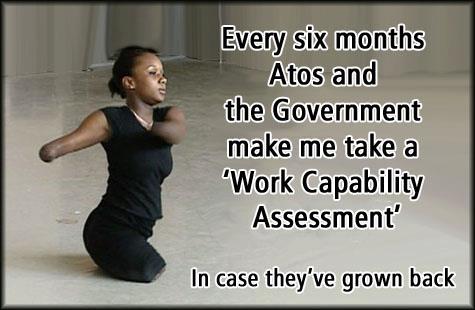
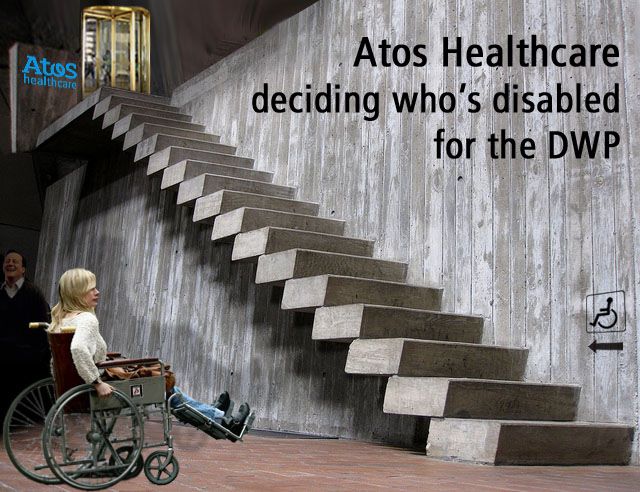
The Government says that Atos offices are totally accessible and assessments are very fair ….

394704_371073749628826_312401163_n

…but this Government says an awful lot that’s utter twaddle, as we know only too well. For example, despite the Tories’ claim that the Work Capability Assessment has been “refined and improved” we note with bitter disappointment that the recommendations of the former Harrington reviews have not been implemented at all.

The Conservatives’ social security policies for disabled people have violated the Equality Act, as well as conflictng with more than one human rights legislative framework.

The struggle against a grossly unfair assessment process continues for disabled and ill citizens, and this is despite the ruling of a recent judiciary review, also ignored by the authoritarians in Office. (Please see appendix for the FOI response regarding a Request for Internal Review.)  

The Department of Work and Pensions (DWP) are surely in contempt of court – because they have not amended their policies on mental health and the Work Capability Assessment (WCA), despite the recent judicial review and subsequent upper tribunal decision regarding the application of the Equality Act. Permission was granted to bring a claim for judicial review earlier this year (May) against the Secretary of State for Work and Pensions to challenge the operation of the WCA. In granting permission the judge stated:

I consider that it is reasonably arguable that the reasonable adjustments required by the Equality Act 2010 include the early obtaining of independent medical evidence where the documents submitted with the claim show that the claimant suffers from mental health problems and that this has not been done, or at least not done on a sufficiently widespread basis”.

The WCA is grossly unfair on many levels, but this judicial review focussed on one specific issue – that of gathering supporting evidence. Under the current system, no matter how ill you may be, you are responsible for pro-actively gathering your own medical evidence and sending it to the DWP. If you fail to do this, it simply won’t be looked at.

It is unreasonable to expect people with mental health problems, learning disabilities or autism to be able to navigate the often complex processes in being assessed and getting the evidence to ensure this is done fairly and properly. The judges rightly ruled that the DWP had not done enough to make sure this crucial evidence was collected and taken into account, and therefore had failed in its duties to make reasonable adjustments under the Equality Act 2010.

The court held that the WCA process disadvantages people with mental health problems because they have greater difficulty than others in explaining to the Atos assessor how their condition affects their fitness to work. The solution is for Atos and the DWP to seek evidence from the claimant’s doctors and others in the community that know what they can do. But the DWP have consistently refused to take this step.

A three-judge upper tribunal panel ruled that the DWP had failed to make reasonable adjustments under Labour’s Equality Act, and it was a landmark ruling, hailed as a significant victory by mental health charities.

The ruling was triggered by the judicial review and launched by two individuals with mental health problems, who argued that WCA was unfair to them because it required them to understand and be able to explain the nature of their condition to the people conducting the assessment, when they had insufficient awareness of their difficulties to do so.

The discussion focused on whether it was reasonable to expect people with mental health problems to seek additional medical evidence in support of their claims from their GPs, or whether the DWP needed to do more on their behalf to ensure that this sort of evidence was collected and taken into account.

Paul Jenkins, CEO of Rethink Mental Illness, said: “This ruling proves once and for all that this cruel and unfair process is unlawful. The judges have independently confirmed what our members have been saying  – the system is discriminating against some of the most ill and vulnerable people in our society, the very people it is meant to support”.

The work capability assessment process is deeply unfair for people with a mental illness – it’s like asking someone in a wheelchair to walk to the assessment centre”.

Directors of charities that backed the case welcomed the judgement, and called on the Government to stop assessing people’s fitness for work under the current system until the issue was resolved.

Natalie Lieven QC, acting for the two anonymous claimants, said it was now a matter of urgency for the DWP to take steps to improve the process for people with mental health problems.

The claimants’ solicitor, Ravi Low-Beer, of the Public Law Project, said: “Today’s ruling confirms what disabled people have been saying for years – although ignored by Tory ministers – that the work capability assessment process is not fit for purpose.

It is in everyone’s interests that the DWP changes course. If they continue to rush people with mental health disabilities through the process as it stands, more ill people will be wrongly refused support, more ill people will suffer a deterioration in their mental health as they try to navigate the appeal system, and more public money will be wasted”.

However, the DWP said it would appeal against the ruling, and stated it did not intend to halt the assessment process.

DWP have further stated – “At this stage and in this judgement, the Upper Tribunal has not found the Department to be in breach of the duties placed on it by the Equality Act. They have asked the Department for further evidence to help determine whether any reasonable adjustments could be made”.

OH YES THEY DID find the Department in breach of the Equality Act. It was found that the WCA actively discriminates against people with mental illness.

The ruling has officially confirmed what many of us knew anyway: that the Government’s current WCA system is about cutting benefits, irrespective of the human cost, to meet their target of callously paring back the Welfare State to set up a Market State in which you either work or get little or nothing.

Whistle-blowers have bravely emerged, such as the Atos doctor, who has been publicly calling the WCA tests “cruel” and the evidence recently given to the Scottish Parliament by an ex-Atos nurse, Joyce Drummond also strongly supports the call to scrap the WCA. Positive changes are  happening at last, and none too soon. But we know that we have an authoritarian Government that has refused to implement the Harrington review recommendations, and it is now refusing to abide by a court ruling.

Recently, BBC Wales reported along with others that GPs have been instructed not to write letters to support their patient’s benefit appeals. The Bro Taf local medical committee, representing GPs, says “writing letters stops doctors seeing ill patients” amounting to an “abuse of resources”.

Clearly, if these patients are ill enough to be making a claim for out of work subsistence level and life-line benefits then they are most likely to be some of the most unwell people attending surgeries.

Other GPs are demanding between £25 and £130 for the paperwork to support appeals, Citizens Advice found.

Chief executive Gillian Guy said: “Charging sick and disabled people more than £100 for medical evidence beggars belief. This process is clearly failing”.

A lack of doctor’s evidence makes it harder for people to appeal and many end up losing their benefits.

Yet DWP ministers have had the cheek to blame the staggering 43% Employment and Support Allowance (ESA) appeal rate on claimants not requesting and submitting enough medical evidence. Mark Hoban claims:

What’s happening too often is people are suggesting to claimants ‘oh, just leave the medical evidence until the appeal’ – there’s a shared responsibility here”.

Atos is expected to request evidence from a claimant’s doctor when the claimant is likely to be placed in the Support Group. In theory. The reality is that it rarely happens in practice. For the year up to October 2012, Atos only requested such evidence (using the ESA113 form) in 27.2% of all ESA referrals; 23.8% of these were not returned by GPs.

The House of Commons overturned a recommendation by the House of Lords that supporting evidence be sought in all ESA cases.

The hearsay and snap-shot, tick-box opinion of Atos is based on a one-off set of observations. A GP or consultant can give their expert opinion – their knowledge is based on years of medical training, experience of treating patients in general and experience of treating you in particular. They have the results of multiple examinations and consultations spread over months, not minutes. They have the results of what happens when a particular medicine is given or therapy is tried.

And we know from collectively shared experiences that the reports by Atos assessors are widely known to be inaccurate with omissions, unfounded claims and incorrect recordings.

The British Medical Association said: “We have GPs across the country whose workload is ultimately increasing because of the fundamentally flawed work capability assessment”.

The Opposition have called for the WCA to be scrapped, and have pointed out that the grave health implications to those British citizens left abandoned by the Government when they are most in need of help, and with such high costs to the taxpayer to manage the assessment and appeal process, the Coalition must find a fair, safe and common sense approach to sickness and disability benefits.

We know the Government has set targets to minimise the number of people that can be found incapable of work by Atos. The DWP and Atos Healthcare both gave firm rebuttals to this allegation last year to both Panorama and Dispatches, which aired programs looking into the same issue of sickness benefit. The employment minister then, Chris Grayling, told the BBC that “there are no targets anywhere in the system”. –  although the Government refused to allow the broadcaster to see the full contract it holds with Atos.

But both programs uncovered a system in which assessors would be put on “targeted audit” if they were found to put too many people into the “support group” of ESA, with Dispatches uncovering that only about 12-13% of people should be found unable to do any work at all. Steve Bick, the doctor working undercover in Atos for Dispatches, said that of the eight cases he dealt with before resigning, he was asked by Atos hierarchy to review his decision on four of them. Steve Bicks told us that Atos currently pass 7 out of 8 of us as “fit for work”, regardless of how ill or disabled we are.

It is very reasonable to expect that the Government suspends its relentless reassessment of an average of 11,000 sickness benefit claimants every week until practical changes can be made to the assessment process that protect sick and disabled. The Government also have a legal obligation to do so.

But they have not stopped, they have not listened and they have not been reasonable.

Ever felt like your Government is really out to get you?

Appendix

Freedom of Information Act – Request for Internal Review

Our Reference: IR 519

Thank you for your email dated 14 June 2013 requesting a review of the Department for Work and Pensions (DWP) response dated 13th June, reference FoI 2412.

In your email you asked to be provided with information answering the following questions:-

‘I am writing to request an internal review of Department for Work and Pensions’s handling of my FOI request ‘Judicial Review- Equality Act’.

I request a copy of the DWP guidance or internal memos which detail the revised procedures to be followed following the court ruling and directions .. If you have not made any such revisions to the procedures please could you say so.’
 
Please be assured that your request has been given our full consideration and that all aspects of your review were taken fully into account.

The review was conducted by an independent official of the Department, of the relevant grade and authority to carry out such requests. The case has been examined afresh, and guidance has been sought from domain experts to ensure all factors were taken fully into account.

The internal review has determined that the response (FoI 2412) dated 13 June 2013 explained that:

at this stage and in this judgement, the Upper Tribunal has not found the Department to be in breach of the duties placed on it by the Equality act. They have asked the Department for further evidence to help determine whether any reasonable adjustments could be made.

As such, individuals should continue to apply for Employment and Support Allowance and undergo Work Capability Assessments in the normal way. Those currently on Incapacity Benefit will be reassessed as planned. Therefore revised guidance regarding the assessment of claimants with mental health problems has not been produced and will not be issued to Atos Healthcare at this stage.’

I therefore find that the original response dated 13 June 2013 was correct and that all the information that the DWP are able to supply to you has been supplied.


If you have any queries about this letter please contact me quoting the reference number
above.
Yours sincerely,

Business Management Team
Health & Disability Assessments (Operations)

 995658_494538353949031_779653065_n
Many thanks to Robert Livingstone for his pictorial brilliance .

How to deal with an Atos mole and cunningly fake, complex Messiahs.

564387_382388205164047_1299018142_n

I’m an ordinary person who happens to be ill, and like many others, I also happen to have a few strong principles, a strong sense of fairness, justice and I am clear on what’s decent, right and wrong. I don’t want to be a leader of any kind, nor do I see myself as an “expert” on disability issues. I don’t believe we should be looking to individuals for answers, to speak for us, or to take responsibility for us. One size does not fit all: our individual challenges vary greatly, and so, therefore, will our individual solutions, and the level of support we may need.

So we need a broad variety of spokespersons to reflect a wide spectrum of needs within our community, and we ought to welcome such a pluralist approach and recognise our diversity as a great strength. Furthermore, much campaigning is about issues around social exclusion, we can only approach this effectively by making sure our own principles are inclusive.

Some campaigners are far from inclusive, however. My own experiences recently of online bullying and trolling have led me to conclude that some of the militant far left and some of the more nihilistic anarchists are as divisive and brutal as the right, and every bit as damaging to our unity, collective sense of purpose, and motivation.

Furthermore, some of these are people claiming to be “real socialists” but I’ve yet to witness any genuine cooperative spirit amongst them. The same group of bullies tried their utmost to have me excluded from campaign groups on Facebook, they gossip-monger with malicious relish, tell whopping lies (apparently I’m a “snout” for the establishment, I work for British Intelligence Services) and troll my own groups, all of this is ultimately because I happen to support the Labour Party.

Two of the groups of people concerned are part of well-known, large campaigning organisations, and these groups claim to support people who are disabled, and speak out for our collective rights. That should never be conditional or contingent on specific political affiliations. One of these groups is simply a front for the Scottish National Party. Their hostility and bullying behaviour towards Labour supporting disabled people has earned them some notoriety.

The group of rather hard line Narxists have no inclusive principles, they aren’t tolerant, nor do they acknowledge diversity; there is no acceptance of alternative views to their own, no open-mindedness, or willingness and capacity for debate, or critical thinking.

And since when was socialism hierarchical? Or about bullying, or being so exclusive? I’m seriously concerned that many people claiming to be “more socialist than you” fail to recognise fundamental socialist principles, such as cooperation, mutual aid, collectivism, tolerance, inclusion and solidarity.  And the absolute importance and necessity of democratic dialogue and exchange.

We ought to be suspicious and wary of those that try to isolate and alienate others. That is very divisive authoritarian behaviour, usually reserved for the far right and has got nothing to do with socialism. We have to BE the change we want to see. Practice what we are preaching, as it were.

Recently, many campaigners supported a man who claimed he was on hunger strike because of his bitter and degrading experience of Atos – one so many of us are all too familiar with. We were to find out over time, however, that he had another agenda, which was more about self-publicity, the promotion of rather unpleasant views founded on misogyny and homophobia (under the guise of “Christianity”) and a variety of other extremely right wing inclinations and views. I witnessed fellow campaigners bullied and abused online by this previously apparently meek and mild character.

Though I had recognised early on that he did not like to acknowledge the work of fellow activists, and he seemed just a tad ego-bound, I said nothing, and watched, bemused, as he was pushed to the forefront of disability campaigning for a while. When people like this let themselves down, they tend to pull a lot of others with them, unfortunately.

A lesson to be learned, perhaps, is that we need to be wary of people that are not inclusive in their approach to campaigning. This man struggled with including a whole social group – women. This character also declared that he hates “lefties”. He ran a bit of an exclusive club for a while.

He also employed very divisive tactics: he exercised some expertise in setting up campaigners to squabble and fight with fellow campaigners. That’s a skill that the Tories have shown excellence in, too. The man’s behaviour online showed early signs that ought to have informed us to proceed with care. Nonetheless he had a huge following for a while. Not that I would ever endorse withdrawing support regarding his experiences with Atos on the grounds of his political inclinations, but we should not tolerate divisive individuals manipulating others for personal gain.

As activists, we can each help inspire others to feel strong, to participate in leading themselves, to become interested and responsible enough to want to join in a community and mutually champion and promote positive changes, based on an outward-looking collectivism. There’s a lot of value in group work, reciprocity, mutual support and the principle of cooperation.

None of us are alone.

It really struck me recently that being disabled doesn’t in itself necessarily engender compassion for others, or empathy: we don’t come especially designed with a philanthropic outlook on life or with a ready-made awareness of the issues others face with their own disabilities. Nor of how to fight for equality, or transcend stigma and prejudice.

We each face a combination of unique challenges and solutions, which are not easily compared and many of our solutions will need to be individually tailored. However, we also face commonly experienced social barriers to equality because of specific legislation (or a lack of it), many of the same prejudices and the same social, economic and political processes.

We currently have very justified anxieties regarding the marked increase in disability hate crime that the Tory-led propaganda campaign has resulted in, many sick and disabled people have also stated that they feel harassed and bullied by the Department for Work and Pensions and Atos. Many in our community talk of the dread they feel when they see the brown Atos envelope containing the ESA50 form arrive through the letter box. The strain of constantly fighting for ESA entitlement and perpetually having to prove that we are a “deserving” and “genuine” sick and disabled person is clearly taking a toll on so many people’s health and wellbeing.

Many families of those who have died have said that the constant strain, anxiety and stress of this revolving door process has contributed significantly to their loved ones’ decline in health and subsequent death. The figures from the DWP, and the marked contrast between the ESA and IB death statistics certainly substantiate these claims. But every medical professional knows that stress exacerbates chronic illness.

FoI request to the Department for Work and Pensions showed that people having their claim for Employment Support Allowance (ESA) stopped, between October 2010 and November 2011, with a recorded date of death within six weeks of that claim ceasing, who were until recently claiming Incapacity Benefit, totalled 310. Between January and November 2011, those having their ESA claim ended, with a recorded date of death within six weeks of that claim ending totalled 10,600. 

Bearing in mind that those who were successfully migrated to ESA from IB were assessed and deemed unfit for work, (under a different assessment process, originally) one would expect that the death rates would be similar to those who have only ever claimed ESA. This is very clearly not the case.

The significant quantifiable increase in deaths over this period coincides with the Government’s almost totalitarian styled rapid-fire austerity legislation aimed at the marginalised groups –  the Welfare “Reforms”, which were hammered through parliament in the face of protest, horror, disbelief, fear and mass opposition. The Tories cited “financial privilege” to trample over opposition, and drown out the voices of protest. Those protesting and challenging this Bill notably included many from the House of Lords.

Few activists would disagree that this sets the stark context of our current struggle. We really don’t need struggles among ourselves as well.

Well, except for one activist, who says:

“I am tired of the way a minor [sic] of extremists who portray themselves as disability activists feel they can make libellous claims against ATOS without taking any accountability for their actions. They claim ATOS kills thousands of disabled people with no evidence, no formal investigation or logic. In fact, their lies are designed to cause panic and distress amongst real disabled people to the point they are pushed towards suicide, so the activists are in reality the killers.” Simon Stevens.

By “extremists”, this person is talking about the likes of me and Atos Miracles, who offer support and share information for sick and disabled people. The evidence of our “claim” comes from the Department for Work and Pensions – their own figures. Furthermore, we have demanded a formal investigation into the deaths, and so far the Government have refused, using arguments to justify that refusal which sound remarkably similar to the ones that this man is trotting out.

We need to ask ourselves why the Government won’t investigate the substantial increase of deaths of sick and disabled people, if this is all about “extremists” like us “scaremongering”. After all, you’d think they would welcome the opportunity to demonstrate any validity of their theory. Instead, the DWP are now refusing to release further information regarding the number of ESA-related deaths. I wonder why, anyone would think there is something to hide.

And “libellous claims”? More than 40 per cent of the reports carried out on disability benefit claimants by the back-to-work assessor Atos are flawed and unacceptable, according to an audit commissioned by the Government. Let’s not lose sight of the fact that the Atos contract was written by this Government, to include targets that direct the removal of benefit to sick and disable people, however. Atos are something of a facade, and the real problem is this Government’s policy and intention.

Following months of complaints about grossly unfair and nonchalantly slapdash decisions made by Atos, the Department for Work and Pensions  audited around 400 of the company’s written reports on disability claimants, grading them A to C. Of these, 41 per cent came back with a C, meaning they were unacceptable and did not meet the required standard. Looks like the Government are buck-passing, to me.

“If I was the government, I would not tolerate these obsessive paranoid fuelled [sic] attacks and simply exclude the abusers from the benefit system, same with those who attack ILF, because why should they tolerate people’s anti-social and destructive behaviour because they are disabled and society fears making them accountable as equal citizens. No other group would be tolerated but disabled extremists are celebrated by the media despite the harm they do to real disabled people.

It is time the government got a backbone and protected real disabled people from the extremists who abuse the system in their name.” Simon Stevens

So, anyone questioning or challenging the Government (and this campaigner, for that matter) isn’t a “real” disabled person, and “paranoid and extremist”? Actually I work with others to support many people who are not activists, but are sick and disabled. Many are suicidal and terrified long before they speak to us. Why do so many people need support in the first place?

Furthermore, it is common knowledge through our shared experiences of assessment, and from information that Atos whistle-blowers have furnished us with that every single question asked by Atos is designed to justify ending our claim for ESA and passing us as “fit for work.” That is what Atos are contracted to do by the Government. This is not a genuine medical assessment, but rather, an opportunity for the DWP to take away the financial support that we are entitled to.

The person I quoted is a self-appointed “disability consultant” and advisor to Atos. However, he has learned that there are consequences for his appalling treatment of other genuine disability campaigners. He will no longer be sponsored by Leonard Cheshire Disability (LCD) who had selected three disabled campaigners to attend this autumn’s Labour, Liberal Democrat and Conservative party conferences as part of a new scheme trialled last year by Leonard Cheshire Disability (LCD). Many of us wrote to LCD to complain because of this campaigner’s abusive and incredibly far-right comments to other disabled people.

This campaigner, who recently wrote an article for the Huffington Post praising Atos while conveniently forgetting to mention that he worked for them – has been dropped by the charity after we complained he was abusive to people with illness and disabilities. Quite properly so.

This man does not reflect the diverse range of needs within our community, nor was he elected or chosen to represent us. And as a spokesperson for Atos, he has nothing to say about the systematic removal of our lifeline benefits by this Company, or the consequences of that. Those are our very real collective experiences, and this man is trying to invalidate those experiences.

Many of his messages have been aimed at campaigners protesting at the Government’s welfare cuts and “reforms”, particularly those angry at the standard of the work capability assessments (WCAs) carried out by Atos Healthcare.

He told one activist: “Get off your computer, how dare you use a computer and claim [you are] unable to work you fake git”.

And he told another: “I can guess you are either fat, abused alcohol or drugs with your many illnesses”.

And another: “How the fuck can I represent bitter and twisted miserable sub humans like you? Proof you exist”.

He has also asked:

“Why do we bother educating disabled people?  So why do we not go a step further and use ATOS to assess people to see if they were worthy of an education if they will never be able to work? Using this logic, it means fair not to waste money educating people who will not benefit from it!”

He seems wilfully oblivious to the fact that Article 2 of the Protocols of the European Convention on Human Rights provides for the right not to be denied an education, regardless of anyone else’s toxic bigotry and prejudiced opinion on the matter. It’s also worth bearing in mind that equal opportunity principles and the core idea that we each have equal worth, regardless of ability, are fundamental to disability rights campaigning, and that there are laws in place that don’t permit the kind of spite and discrimination that he proposes, thankfully. Yet.

Education is not simply a vocational issue, either. There is no rule that says it has to be so.

This “campaigner” has been busy today emailing fellow campaigners who have challenged him and shamefully threatening them, he has claimed that when people are assessed by Atos he will ensure that their benefits are taken from them. This man is a deplorable bully.

I don’t think I have ever seen such an unlikely and dangerous “disability consultant”, or such a shamefully prejudiced mole …self-appointed “spokesperson” for disabled people. I don’t think this man represented any of the wide array of needs and interests of the disabled community whatsoever, nor did he understand the experiences of other ill and disabled people, clearly. He displayed a remarkable lack of empathy and compassion for others. In fact he is downright callous.

And there’s a thought: we have no way of knowing how many other people within our community are plants, shills, moles, agents provocateurs and so forth. That there ARE such damaging tactics to disrupt campaigns and fragment our movement is well-established.

Remember how Margaret Thatcher and her cabinet were desperate for victory against the miners? And prepared to go to any lengths. For the first time in a post-war national strike the police were openly used as a political weapon. Agents provocateurs and spies were deployed and the state benefits system used to try and starve the miners back.

Former Tory chancellor Nigel Lawson subsequently admitted that preparations for the strike were, “just like re-arming to face the threat of Hitler in the 1930s”. Evidence emerged – after the event – about the role of MI5, MI6, the CIA and ultra-right wingers like David Hart and Tim Bell, who advised Thatcher during the dispute.

The Tories used agents provocateurs following the Six Gagging Acts 1819, when “every meeting for radical reform is an overt act of treasonable conspiracy against the King and his Government”. They do have a lot of previous form.

The Act restricted the freedom of the legitimate press. Radical publications simply went “underground”.

The Tories historically fight dirty and have a history of devious tactics such as infiltrating the far left, to provoke and manufacture toxic divisions to fragment us and recently we have been witnessing such fragmentation within our community.

Anne Rae, chair of Greater Manchester Coalition of Disabled People, said that the campaigners challenging Government policies had become “pretty fragmented”, so there was a need for a national organisation with the “confidence and credibility to speak for disabled people with a strong voice”.

Rae is a former member of the Union of the Physically Impaired Against Segregation (UPIAS), which is often credited with giving birth to the social model of disability in the 1970s.

She said:

“There has got to be discussions about how we can form a national network, if not a national organisation, which has the confidence and credibility to speak for disabled people with a strong voice, because at the moment the voices against the Government are pretty fragmented. We need to have a recognisable voice.”

She also said that disabled people attacking the Government had to understand the need for a well-argued case against the oppression they were fighting against.

She said: “People will respect you if you have a reasoned, structured argument for what you are asking for.”

Rae said the disabled people’s movement had been weakened by funding cuts by local authorities, with the lack of “core funding” for disabled people’s organisations – rather than just project funding –  a “big problem”.

But she said she also believed that the Government had “head-hunted” people from the movement, who had then been forced to “water down their radical views”.

“My view is everybody who is funded by the Government is going to protect their continuity and you cannot bite the hand that feeds you.”

She said that no organisation would “stand by their radical principles” in such a situation, because they knew their funding would stop.

Rae was speaking to Disability News Service at an event held to debate the future of the social model, organised as part of Reclaiming Our Futures, a week of action led by Disabled People Against Cuts.

She also said she was “very suspicious” of the Government’s Office for Disability Issues, which she said was “giving the impression of supporting disabled people”  but was actually destroying people’s “radical mindset” and turning them into “effective speakers but empty speakers full of empty rhetoric”. (With thanks to John Pring, who spoke with Anna Rae.)

We do need to take care here, however, because not all campaigners can be described as “radical”, but that doesn’t make them “wrong” in any way. There’s a whole debate to be had, anyway, about the merits of amelioration versus revolution, about what is feasible, and about precisely how we may proceed with our attempts in making essential positive changes. We do have a political system and parliamentary processes that are simply not amenable to radicalism. Furthermore, we also have an authoritarian Government that does not tolerate even healthy debate and criticism, let alone revolutionary ideas.

There is certainly a need for some strategic thinking here to circumvent the Tory barriers to genuine political dialogue. Perhaps, therefore, one option we have when directly facing Government Ministers is to prioritise and take care assessing what is most likely to be a realistically achievable outcome. That approach doesn’t make a person unsympathetic to more radical aims at all, and the reality is that we need both approaches to fulfil what are essentially commonly shared ideals, aims and goals. We can endorse the credibility and value of both approaches within our community, because both are necessary, both have merit and ultimately share the same aim. We must do what we can do.

Again this is also about valuing inclusivity, pooling our resources and skills, valuing diversity, and about recognising the worth of every effort whilst being mindful of the Tories penchant for dirty tricks and manipulation.

These are extraordinary times. It’s truly incredible how circumstances may transform us. Three years ago the only articles I wrote were about philosophy, sociology, psychology and my various other interests. My own struggles were mostly about how to work, be there for my boys, care for my terminally poorly father, spend some quality time with him, and manage my illness, though I wasn’t as ill back then.

My father was a strong trade unionist, and staunch Labour supporter with an incredibly strong sense of social justice and fairness. In a way, I am glad he cannot see what is happening now to all of the civilised policies and supportive social structures people of his generation, and before him, fought so hard to establish, it would break his heart. He always did loathe the Tories, did my dad.

I used to use Facebook to talk psychology, philosophy, art, poetry and science, and to simply chat. Now it’s all about awareness-raising and sharing information about our dire situation here in the UK. We have an extremely corrupt and authoritarian Government, many are suffering extreme hardship, and many have died because of the imposed ideologically – driven austerity measures here in the UK.

I know I am not alone in that all of this has deeply affected me. Were I not sick and disabled, this would STILL affect me, because it is offensive to my own sense of decency, fairness and social justice. And I know that if one social group is persecuted, and is denied their rights, this affects US ALL. I am reminded once again of “First they came ”  by Martin Niemöller.

I’ve met some extraordinary people through our mutual struggle, though. Some bright beacons of strength and courage, both in real life, and on Facebook. And I don’t know about anyone else, but I have learned that resilience comes from finding the strength to face the despair of our circumstances.

My best satirical one-liners come from bitter responses, not that I’m particularly gifted that way, as others here are. The writing that I do springs from shock, indignation, anger, sorrow and pain – because of what is being done to my friends, to our people and OUR Country. I’m not a professional writer, (though I have had work published before,) but I do bear witness as best I can. As do so many others.

There are many of us doing what we can, when we can, in our own way. I respect and admire every one of you, and acknowledge your personal struggles in a bigger battle here.

Each contribution is equally valuable, precious, and I want to see people uniting more, supporting each other, and recognising the worth of each and every effort. That means putting aside those issues that have led to divisions amongst us, and weakened us in our opposition to this tyrannical Government of Bullingdon brats. Now is the time to be standing together, strong, not one for petty squabbles, interpersonal politics, or allowing others to create divisions.

So stop it.

Upwards and onwards. In unity, mutual respect, love and solidarity!

484915_406658609403673_862424497_n (1)

Many thanks to our Robert Livingstone for his outstanding memes and art contributions


I don’t make any money from my work. But you can support Politics and Insights and contribute by making a donation which will help me continue to research and write informative, insightful and independent articles, and to provide support to others. The smallest amount is much appreciated, and helps to keep my articles free and accessible to all – thank you. 

DonatenowButton

The “Let Lynton Lobby Bill” – Grubby Partisan Politics and a Trojan Horse

487830_443702979032569_895018330_n

The Transparency of Lobbying, non-Party Campaigning, and Trade Union Administration Bill  is a calculated and partisan move to insulate Tory policies and records from public and political scrutiny, and to stifle democracy. The Government’s Lobbying Bill has been criticised by bloggers and campaigners from right across the political spectrum, with the likes of Owen Jones and Guido Fawkes united in agreement over this issue: that the Bill is a “Gagging Act”. Five Conservatives – Douglas Carswell, Philip Davies, David Davis, Zac Goldsmith and David Nuttall – voted against the Bill, whilst others also expressed concerns.

The Bill will treat charities, think tanks, community groups and activists of every hue as “political parties”. From small groups addressing local matters to big national organisations, all equally risk being silenced in the year before a general election, to avoid falling under electoral law. Any organisation spending £5,000 a year and expressing an opinion on anything remotely political must register with the Electoral Commission. Since most aspects of our public life are political, (and a substantial proportion of our private life has been increasingly politicised under this authoritarian Government) this stifles much essential debate in election years when voters should be hearing and evaluating policy choices.

The ambiguous way in which this bill targets anything which may impact on an election is calculated and deliberate. It is a way of intimidating charities, trade unions, religious organisations and all protest groups into remaining silent on important issues (such as protecting the NHS, introducing fair taxation, fighting poverty, public health, education, financial sector reform, civil liberties, human rights, the privatisation agenda) in election years, and this includes European elections and local Council elections too, so it will mean an almost continuous constraint on organisational freedom to comment on politics in any way.

Political blogs may well be at risk of being included too, since they are campaigning entities that potentially attempt to impact the outcome of an election. This is a serious threat to independent politics and an abhorrent authoritarian attempt to silence criticism of the Government, using the threat of fines and imprisonment. Here in the UK, we have a Government very clearly intent on policing critical thinking and opinion.

The National Council For Voluntary Organisations (comprised of a large group of charities) has asked whether this Bill is rushed and badly written or whether it is deliberately intended as a “Trojan horse” in order to curtail the freedom of charities to campaign for their causes. Another 100 charities have also heavily criticised the proposed legislation. There is a broad public consensus that it is indeed calculated and fully intended as a Trojan horse, and it was a view shared widely in Parliament at the hearing of the Bill yesterday.

Trade Unions have reacted in disgust and horror as the scope of the Trojan horse element of the legislation became increasingly clear. Joint cooperation between various unions will be made more difficult to such an extent that the Trade Union Congress will effectively be banned in election years. Another absurd element to the legislation is that the arbitrary spending limit of £390,000 will mean the smaller the Trade Union (or charity, religious group or protest site) the greater their proportional influence will become.

The heads of the main lobbying agencies have attacked the Bill too, claiming that the way the Bill has been designed will mean even less transparency in the lobbying industry and a register of lobbyists with hardly any names on it.

Lansley claimed yesterday that charities raising their concerns about the consequences of the Bill  have “over-reacted”, but that view is not substantiated by the rather lethal analysis from the Electoral Commission, which was sent to every MP. Though it will have to enforce the law, the Commission was not consulted on the Bill. The Commission Chair said it has been given far too much discretion in interpreting “political campaigning”, so its decisions are bound to be challenged in law.

The controls “will be impossible to enforce”, and the Commission warns that the Bill greatly widens the range of activities that count as electoral costs – to include rallies, polling research, events, media work, transport and staffing costs for groups never previously regulated. One big danger for risk-averse charities: “it will not be an organisation’s “intent” but the “effect of the expenditure” that sweeps them into electoral law, so they can never know what might be challenged”. The Commission’s warning should alarm every single MP.

Most damning is the Commission’s statement that it will have serious problems interpreting this law because there is no “clear rationale for many of the changes”. That’s very diplomatic and polite, as most of us can see the rationale all too clearly. The Government has attacked so many people via its draconian policies, many are now suffering the brunt of the austerity cuts: a front for Tory ideology. Many organisations and charities see it as a duty to speak up for the causes that people donate to. Whether that’s for the victims of abuse, the homeless, deprived young offenders or victims of crime, it’s always a fine line – but the Charity Commission already polices their politics, and had already installed William Shawcross, a controversial and somewhat right-wing chair. (Despite his previous support for the Labour Party).

So many agree that the Lobbying  Bill is a thinly disguised crude gerrymander to try and stymie Labour, the Unions and gag the Government’s most dangerous potential critics. As Frances O’Grady said in the Guardian last month, the law means unions will hit the spending limit just by holding an annual conference in election year, leaving them unable to campaign.

Glenda Jackson summarised it all very tidily yesterday when she said: “The Lobbying Bill is a gagging act, and as it stands it will prevent democratic voices being heard. It’s a step backwards from the codes of conduct and sanctions that already exist”. 

Nick Clegg is a prime mover on this Bill, as minister in charge of constitutional reform, and Dennis Skinner humorously and astutely pointed out during the debate yesterday that: “The Liberal Democrats support the lobbying bill because they do not want students campaigning against them over tuition fees in 2015.”

Labour shadow Commons leader Angela Eagle called the bill “one of the worst pieces of legislation I’ve seen any government produce in a very long time”. Referring to Andrew Lansley’s former role as health secretary, she added: “I think the last bill this bad might even have been the Health and Social Care Act, and your fingerprints were all over that one too”.

Although the Chair of the Electoral Commission said that regulators could be forced to take legal action against community groups and activists due to “confusion over their new role”, I don’t think there is any “confusion”.

The Tories are well known historically for their liking for “Gagging Acts”. Paine’s “Rights of Man” reached several hundred thousand readers and in May 1792, the Government reacted with a Royal Proclamation against “seditious writing”. There were Tory-organised local demonstrations of loyalty, including over 300 ritualised burnings of Tom Paine. The Government rushed in the further ‘Gagging Acts’ to tighten the treason statute and to ban large political meetings. A huge petitioning campaign followed, with loyalists expressing support and reformers protesting against the restriction, but the Bills were passed anyway.

In 1819, Lord Liverpool and his Tory Government responded to public outcry regarding the Peterloo Massacre by introducing the extremely oppressive Six Acts, which included gagging the “radical” press, and suppression of rights to public meetings. On the 23rd November, 1819, Lord Sidmouth, the Government ‘s Home Secretary, announced details of what later became  the Six Acts. By the 30th December,1819, Parliament had debated and passed the six measures that it hoped would suppress further dissent. There are examples of the Tory tendency for oppressive responses to dissent and criticism littered throughout history.

What we learned from this is that British political culture can be changed fundamentally in the course of resisting authoritarian efforts such as these, and now, we really must do so again.

Lobbying is simply the act of attempting to influence decisions made by officials in the Government, most often legislators or members of regulatory agencies. Lobbying is done by many different types of people and organised groups, including individuals in the private sector, corporations, fellow legislators, Government officials, or advocacy/interest groups.

Although lobbying is often spoken of with contempt, when the implication is that people with inordinate socio-economic power are corrupting the law in order to serve their own interests, another side of lobbying is making sure that the interests of others are duly defended against others’ corruption, or even simply making sure that minority interests are fairly defended against a tyranny of the majority. So there can be elements of power struggles to establish justice involved. Lobbying is therefore a crucial and very valuable part of democracy. Problems arise when some lobbyists are given priority, and come to influence Government policy-making more than others.

Before he became prime minister, Cameron predicted that secret corporate lobbying was “the next big scandal waiting to happen”, adding: “We all know how it works.” As a former lobbyist himself, he certainly did – and he still does.

Cameron’s own election adviser, Lynton Crosby, is a lobbyist for tobacco, alcohol, oil and gas companies. Which is why the prime minister came under attack for dropping curbs on cigarette packaging and alcohol pricing. Then there is Beecroft, the head of the private equity group that administers the high profile barely legal loan shark operation Wonga. The Wonga business model is to prey on the poor, vulnerable and absolutely desperate by offering them exploitative loans at eye-watering interest rates of 5,853% APR. Tellingly, even in the globally renowned haven of free-marketeering – the United States – such outrageous loans are illegal, but in the UK the Tory party are defiantly resisting efforts to regulate the so-called Payday lending sector and introduce maximum APRs.

Cameron’s party treasurer Peter Cruddas resigned after offering access to Cameron for a £250,000 party donation. His defence secretary, Liam Fox, resigned over his relationship with the lobbyist Adam Werritty. Political lobbyists were paid thousands of pounds to help broker a meeting with Liam Fox through Adam Werrity. Bell Pottinger were secretly filmed boasting about its access to the heart of Government, including its ability to persuade Cameron to speak to the Chinese premier on their behalf as well as its exclusive access to figures like William Hague. Let’s not lose sight of the scandals that have prompted this partly diversionary grubby, oppressively partisan policy from the Tories.

Last year the Tory party website openly offered donors the opportunity to attend events where Cameron was present, inviting supporters to join the “premier supporter group”, the Leader’s Group, whose annual membership costs a mere £50,000. (Here is the list of members). So signing up to the group will leave many free to buy direct access to the Prime Minister, other politicians and their advisers.

It’s worth considering that lobbying alone doesn’t begin to cover the extent of corporate influence on Government. The Tory party finds over half of its income from bankers, hedge fund and private equity financiers. Peers who have made six-figure donations have been rewarded with Government jobs. There’s a corruption that is eating our democracy and eroding our public life, and it’s perpetrated not just by lobbyists, but by the politicians, civil servants, bankers and corporate advisers who have increasingly come to swap jobs, favours and insider information, and inevitably come to see their interests as mutual and interchangeable.

The Bill won’t prevent lobbyists walking the corridors of power and speaking in parliamentary debates on the subject on which they work as lobbyists –  those such as David Howell, for example, in the news yet again today. George Osborne’s father-in-law was accused of a conflict of interest last night after it emerged he is being paid by a Japanese high-speed rail firm with commercial interests in the UK at the same time as having top-level access to the Foreign Office as William Hague’s personal adviser.He is being paid as a “European consultant” to JR Central, a train company which could be a bidder for multimillion-pound contracts connected to the controversial HS2 rail line.

At least 142 peers linked to companies involved and invested in private healthcare were able to vote on last year’s Health Bill that opened the way to sweeping and corrosive outsourcing and privatisation.  Recently, the Tory MP Patrick Mercer resigned the party whip when details of yet another lobbying scandal emerged.

The Tories have normalised corruption and made it almost entirely legal. Our democracy and civic life are now profoundly compromised as a result of corporate and financial power “colonising” the State.

So against this backdrop of their own sleaze, the Tories responded with the anti-democratic Lobbying Bill. If the Tories were had a an ounce of honesty about their anti-democratic intentions, it would be called the “Protection of Corporate Lobbying and Silencing of Legitimate Political Debate and Criticism Bill”.

Or the “Let Lynton Lobby” Bill, as Angela Eagle has dubbed it. The Bill had not been presented to the Select Committee in full until the day before recess, it emerged yesterday. The Electoral Commission hadn’t see the draft either. Cameron is also attempting to limit judicial review. If Select Committees are excluded from the legislative process, a case can be challenged under judicial review as that means the legislation is being created on an undemocratic and procedurally unfair basis. Select Committees are part of the constitutional area of law making, they simply cannot be ignored.

The withholding of key details of drafted Bills from Select Committees means that effective and organised challenging from the opposition is stifled, too. We most certainly have an authoritarian Government that arrived unannounced and unauthorised, one that has very clearly spent some time out of Office rather vindictively planning an attack on civil society, reversing the gains of our post-war settlement, and preemptively dismantling the means of redress. The contents of the Lobbying Bill highlight this further. This was a carefully calculated move, and such tactics have become increasingly common since this Government took Office. It would be an enormous mistake, if not academic dishonesty, to pretend that we now live in a liberal democracy.

The Government has left a large loophole in this legislation that allows the likes of Crosby to get around being on the register. When was the last lobbying scandal we read about that involved Oxfam, Vox Political, or the Durham Miners Gala? The Lobbying Bill won’t do a thing to stop the revolving doors between Government and corporate interests (Wonga being a high profile example of this), and neither will it prevent corporate interest parties being invited to actually write Government legislation on their behalf.

Recent freedom of information requests reveal that Treasury officials met fracking industry representatives 19 times in the last 10 months about their generous tax breaks, yet the public are denied any further details of that lobbying on the grounds that it could prejudice commercial interests,” said Green MP Caroline Lucas. “Is the Leader of the House not ashamed that this Bill will drastically curtail the ability of charities to campaign in the public interest on issues such as fuel poverty and energy but do nothing to curb such secretive corporate influencing? The Bill does nothing to prevent lobbyists working directly for commercial concerns from approaching government ministers and trying to influence them”.

Part three of the Bill centres on trade union membership records, Angela Eagle and Caroline Lucas agreed that there appears to be no policy motive for the introduction of this new law other than as a vehicle for cheap, partisan attacks on the trade unionsof which only a minority are actually affiliated to the Labour party. During a belated consultation meeting with the TUC – it took place after the Bill had been published – Department for Business, Innovation and Skills officials could cast no light on why part three exists at all.

Nor were they able to explain the origin of these proposals beyond their oft-repeated mantra that the provisions contained in part three: “It came out of a high level meeting between the Prime Minister and the Deputy Prime Minister. I think that revelation tells us all we need to know about the grubby, partisan nature of the measures “ – Caroline Lucas

The contents of this Bill are all about stifling essential democratic debate, and stymying legitimate criticism of the Government, and that in itself is actually frightening. But it’s also important not to lose sight of how this Draft has progressed, or rather, has been sneaked along to a second hearing. As I stated, the Lobbying Bill was NOT presented to the Parliamentary Committee in full until 1 day before recess. In fact the  Committee was presented initially with only the Consultation, and with no details of the Bill, for scrutiny. There has been NO pre-legislative scrutiny of this Bill.

T
his Bill has been entirely deviously constructed by a spiteful and self-serving, anti-democratic Government. That this same Government no longer deems it necessary to be accountable for its policies, and is by-passing democratic processes and legal safeguards, is frankly terrifying. We really do have an oppressive, authoritarian Government. Consider how likely is it that will this Bill will affect the likes of Rupert Murdoch’s News Corp UK and the Daily Mail Group, because they spend a huge amount amount per day, and much of the content of the press is highly political in nature.

Surely if charities and trade unions are going to have their freedom of speech curtailed to just £390,000 worth of influence, the mainstream press must be curtailed in the same way. Of course that won’t happen because the Tories are quite happy to have the baying right-wing press supporting their every step towards absolute tyranny. The press will most likely be exempt, because the Tories wouldn’t want to interfere with the (particular) “freedom” of the press. (Unless of course they object to specific information being made accessible to the public, in which case, they may demand that particular newspapers smash up their hard drives, whilst government officials intimidate the families of journalists by arresting them under “anti-terrorism” legislation.)

How did we get here? How could we be facing such tyrannical constraints on our most fundamental liberties, and it has happened so very quickly, too.

Paulo Freire said “Men and women develop their power to perceive critically the way they exist in the world with which and in which they find themselves; they come to see the world not as a static reality but as a reality in the process of transformation.” – Pedagogy of the Oppressed.

This insight offers us – and all of those who experience subordination through any imposed regime – a path through which we come to understand what it means to be a moving, shared cultural voice in a Society that is being constructed by the tyranny of a few to hold us still and in place like an object.

It is a learning process that always involves pain and hope; a process through which, as forced cultural jugglers, we can come to, cooperatively and subjectivity, organising and transcending our object position in a Society that hosts us, yet is becoming alien. It’s up to us to reclaim it, to make it our own. And to rebuild if we have to. I believe that history is built upon possibilities and human potential. We simply cannot allow this Government to foreclose and reduce that.

More reading:
Petition against Bill.
Independent – Report calls for withdrawal of Government’s lobbying reforms.
Owen Jones: Under the disguise of fixing lobbying this bill will crush democratic protest.
Mike Siver: Free speech is under threat.


29015_450121201724080_980762499_n


A big thank you to Robert Livingstone for his superb art work

Syria, Miliband’s principled dignity, Murdoch and toxic Tory tantrums ladled up with corruption

556770_138948196256237_144572172_n

It’s worth considering that in the past few years President Bashar al-Assad’s Government has allegedly killed over 100,000 people in Syria, amongst them were many civilians, including women and children, so we need to ask why, exactly, would allegedly using chemical weapons on 1,300 people suddenly be much more of an issue and a matter of national interest for America, Britain and France?

My own view of the situation is that aggressive intervention is an absurd and incoherent solution. We cannot bomb people into democracy or shoot them into observing human rights. Punishing a dictator for killing his own people by simply killing more of his own people seems beyond cruel. The gesture of war will not punish the guilty, such as members of the tyrannical Assad regime: it will simply kill ordinary people and their children, topple buildings and cause injuries and hardship to the innocent. It seems to me to be a spectacularly pointless and peculiarly brutal proposal.

On both sides of the Atlantic, the public is quite rightly skeptical that employment of aerial bombardment is a cure-all for the world’s ills, after hard-learned lessons from Iraq, and our various other interventions, dressed up as “humanitarian aid”.

Of course it didn’t take much digging to find that there are some vested interests in oil and gas on Syrian territory. There is profit to be made by a local subsidiary of the New York-listed company, Genie Energy – which is advised by former vice president Dick Cheney, and shareholders include Rupert Murdoch and Jacob Rothschild. Israel has granted the US company the first license and it will now have exclusive rights to explore a 153-square mile radius in the southern part of the Golan Heights for oil and gas, John Reed of the Financial Times reports.

The Golan Heights – a disputed geopolitical area, is comprised of a two-thirds of land that was seized violently by Israel in the 60s in the Six-Day War, (and this is not internationally recognised as Israeli territory, it remains disputed, but Israel effectively annexed it in 1981), and the remaining third lies in Syria’s domain.

I visited the Golen Heights some years ago, and had a hairy moment or two on land which was peppered with Syrian mines, trapped there between snipers, at the border of the Israeli-claimed territory. Discarded shells and rockets littered the landscape, which had become strange and ugly monuments to human conflict. Yet we must never despair of human nature. Man’s nature is not essentially evil. Brute nature has been known to yield to the influence of love, according to Ghandi.

But not so easily under such profiteering, greedy and corrupt governments.

Israel’s administration of the area – which is still not recognised by international law – has been reasonably peaceful in recent years, until the Syrian civil war broke out 23 months ago.

This action is mostly political – it’s an attempt to deepen Israeli commitment to the occupied Golan Heights”, Israeli political analyst Yaron Ezrahi told FT.

The timing is directly related to the fact that the Syrian government is dealing with violence and chaos and is not free to deal with this problem”.

Earlier this month it was reported that Israel is considering creating a buffer zone reaching up to 10 miles from Golan into Syria to secure the 47-mile border against the threat of Islamic radicals in the area.

Both President Obama and his secretary of state, John Kerry, have mentioned Israel’s “needs” as one justification for an attack on Syria.

The Guardian reports that three months ago, Iraq gave the green light for the signing of a framework agreement for construction of pipelines to transport natural gas from Iran’s South Pars field – which it shares with Qatar – across Iraq, to Syria.

The Memorandum of Understanding (MoU) for the pipelines was signed in July last year – just as Syria’s civil war was spreading to Damascus and Aleppo – but the negotiations go back further to 2010. The pipeline, which could be extended to Lebanon and Europe, would potentially solidify Iran’s position as a formidable global player.

The Iran-Iraq-Syria pipeline plan is a “direct slap in the face” to Qatar’s plans for a countervailing pipeline running from Qatar’s North field, contiguous with Iran’s South Pars field, through Saudi Arabia, Jordan, Syria and on to Turkey, also with a view to supply European markets.

The difference is that the pipeline would bypass Russia.

Qatar, Saudi Arabia and Turkey have received covert support from Washington in the funneling of arms to the most virulent Islamist elements of the rebel movement, while Russia and Iran have supplied arms to Assad.

And of course Israel has a direct interest in countering the Iran-brokered pipeline. In 2003, just a month after the commencement of the Iraq War, US and Israeli Government sources told the Guardian of plans to “build a pipeline to siphon oil from newly conquered Iraq to Israel” bypassing Syria. The conflict therefore and the future of Syria continues to be at the mercy of rival foreign geopolitical interests in dominating the energy corridors of the Middle East and North Africa.

And let’s consider who sold weapons of mass destruction to unstable middle eastern countries in the first place. It’s emerged recently that Vince Cable and other Ministers are to face questions over a decision to allow export of substances used to make chemical weapons to Syria, only months after the country descended into civil war.

Commenting on the reports, which were first published in the Sunday Mail, Labour’s shadow business secretary, Chuka Umunna MP, said: “The chair of the joint intelligence committee confirmed last week that their assessment was that the Syrian regime had used lethal chemical weapons on 14 occasions from 2012. There are, therefore, very serious questions to answer as to why, in January 2012, export licences for chemicals to Syria which could be used in the manufacture of chemical weapons were approved”.

Far from being a beacon of human rights, the UK has little legitimacy around the world when it comes to intervening in wars – a fact that parliament eventually recognised in its welcomed vote last Thursday.

Can you see what this is yet? As ever, with any Conservative proposition made in earnest, the money trail always reveals the true motivation behind it.

It is widely accepted that David Cameron has a streak of petty, bullying arrogance which often reveals itself at prime minister’s questions. I was pleased to see this reported in The Guardian: “Now  Cameron and his henchmen have been trying to spin his humiliating defeat by parliament over military intervention in Syria into an unedifying character assassination of Ed Miliband. It wasn’t Miliband who attempted to grandstand by bouncing parliament prematurely into attacking Syria”.

The Labour leader hasn’t been responsible for perhaps the most monumentally misjudged British foreign policy in recent times. Cameron began two years ago demanding regime change – which didn’t work. Then he resourced the rebel forces – which failed, too. Then he tried to send arms to the rebels – until cross-party opposition in parliament blocked that: perhaps he forgot the series of protests by MPs resulting in the vote opposing his policy by 114 to one on 11 July on a backbench motion moved by Tories? 

The Daily Mirror reports that the UK arm of strategist Lynton Crosby’s lobbying empire represented the Syrian National Council. Cameron stepped up his calls for action – including arming forces trying to oust  Bashar al-Assad – after hiring the Australian as his elections adviser last year.

Frank Roy, a member of the Foreign Affairs select committee, said: “We need to know that David Cameron’s crusade has not been inspired by his lobbyist chum. It would be quite wrong if Lynton Crosby was using his position to influence the Prime Minister on such an important foreign policy issue on behalf of a former client.”

Roy’s comments came as it was alleged that Cameron had pushed for a more “robust” response to the humanitarian crisis in Syria. Gosh.

Authorising the export of chemicals to Syria is simply part of a long trend of support for dangerous technology which undermines this country’s legitimacy when it comes to speaking about human rights. Thatcher’s government sold the components for chemical weapons to Iraq, and Saddam Hussain directed The Al-Anfal campaign – genocide – on the Kurds. The Reagan and Thatcher governments continued to aid Iraq after receiving reports of the use of poison gas on Kurdish civilians.

So Cameron now insists “something must be done” in response to the chemical weapons attack in Syria. All of a sudden. And the Conservative “liberal interventionists”, who trumpet so loudly their commitment to spreading “democracy” around the globe, are not very happy at this wonderful and long overdue sign of a democratic resurgence in Britain.

Polls showed that just 8% of Britons wanted immediate weapons strikes on Syria, but despite that, the “democracy by bombs” crusaders are condemning the vote as a “black day for democracy”. Oh, such irony. Ah, the Newspeak.

The Murdoch-owned Times wheeled out Tony Blair, the High Priest of “liberal interventionism” to support an attack on Syria earlier this week, but this tactic showed just how laughably out of touch the Times is with public opinion. And Ed Miliband has once and for all, finally drawn a clear and indisputable line underneath the Blair era, anyway. Miliband had already denounced New labour, and distanced himself from Blair earlier this year, in his speech to the the Fabian Society. 

Opposition to British involvement in an attack on Syria was led by Miliband, who took a brave and principled stance that resonated strongly with public wishes, too. I’ve seen many say that it felt like we have a democracy again, and the following day there was a sudden rebellion which was widespread, and across the political spectrum, with Cameron’s own ministers voting against him. It wasn’t just the genuine anti-war left who opposed an aggressive strike, but some traditional Conservatives too, with some Conservative-supporting newspapers such as the Daily Express taking a strong line against intervention.

Miliband’s decision to oppose the Prime Minister’s motion on Syria authorising direct British military involvement sparked fury in No 10 and even led to deplorable accusations he was providing “succour” to Assad. Cameron couldn’t keep his fury in check. He called Miliband a “copper-bottomed c*nt” in public.

Miliband said Cameron must now “find other ways” to put pressure on Assad: “There are other routes than military means to actually help the people of Syria,” he said. “I don’t think the Government should wash its hands of this issue”.

I think all of the focus of the Prime Minister and the Government in the coming days needs to be working with our allies to find other ways to press President Assad, to take action with our allies to put the diplomatic, political and other pressure that needs to be put on the Government there. We need the peace talks to get going. So there are other things the Government should be doing”.

He added that Britain “doesn’t need reckless and impulsive leadership, it needs calm and measured leadership”.

The Murdoch media empire, propagandising for the US-led wars of the last two decades, is now isolated in its obsessive screeching for military action, and the fact that MPs ignored the bellicose pro-“intervention” editorials in Murdoch papers is a clear indication as to just how much they are declining in influence.

Let us not forget that it has been an iron law of politics since most of today’s Cabinet were in kindergarten that you do not “take on” Rupert Murdoch. And that if you were foolhardy enough to try, you would end up fatally wounded.

Ed Miliband did. He has shown he has principles and courage on many occassions, sadly this is very seldom reported and reflected fairly in the media. And Miliband didn’t just take the easy option of calling for specific action targeted at the paper where the hacking scandal began – that would have been a safer way of doing it – but by calling for a whole judicial enquiry. Rupert Murdoch probably thought that Ed would leave it at that. But no, when the leader of the Opposition turned up at the proceedings of that enquiry, he said explicitly that if he were Prime Minister, he would seek to limit the percentage of media that one man could own. Quite properly so.

Then there was the banks. Now many in the Labour party would have preferred him to stick safely to making outraged noises about misconduct. No, he once again called for a wider enquiry. When Cameron accepted that proposition of misconduct, Miliband pushed for one wide enough to cover the whole culture of banking which had led to the crisis – a much bigger threat to the banks. After that, Ed threatened them with separation between their investment (casino) and retail (piggy bank) arms. Each time Miliband had the opportunity to ease off, he went further. These are not the actions of a weak leader.

Some will argue that the banks and the media were both wounded giants: once-powerful interests which had been left limping by the financial crisis and the phone hacking scandal respectively. But Ed Miliband didn’t stop with them. In the last few years he has taken on the energy companies too. Not in a small way either, for example, by threatening to legislate to make sure that they give the elderly their cheapest tariffs (although he has done that too). But by actually threatening to break up the Big Six unless they start giving consumers a better deal. That is not a small threat for a potential Prime Minister to make. I have every faith in this man, as a decent, principled and strong leader of the Labour party and future Prime Minister.

Miliband clearly outlined his view that there needed to be a proper international process at the United Nations that was evidence-led, and as he argued powerfully that we needed the “time and space” to come to a judgement and that we shouldn’t rush headlong into a political timetable that was being driven elsewhere, one or two churlish Tory MPs, including Ministers, regrettably, chose to heckle him with the word “weak”. They wish.

The bullying, truculent and outrageously burlesque reactions of the Conservatives to this forced renewal of British democracy, and the obvious strength of the Opposition leader tells us just how significant this is.


Further reading:

On Syria, Ed Miliband deserves praise not poison

David Cameron Lost The Syria Vote Because Of A Failure Of His Leadership

The Drums of War


1044468_500666173336249_1718830491_n

Pictures courtesy of Robert Livingstone

It’s fraud, Lord Freud.

224079_411432638926270_715135125_n

Lord Freud on Disability Benefits: 27 words, 4 inaccuracies – a new record?

Posted on 28 August 2013 by 

On 24 June Lord Freud stated to the House of Lords:

“I will set a little bit of context by saying that even in these hard economic times this Government continue to spend around £50 billion a year on disabled people and services to enable those who face the greatest barrier to participate fully in society.

That figure compares well internationally. We spend almost double the OECD average as a percentage of GDP – 2.4%against the OECD average of 1.3%. Only two out of the 34 OECD countries spend more.”   1

The last paragraph should have said:

“That figure compares averagely internationally. We spend 1.16 OECD average as a percentage of GDP—2.9% against the OECD average of 2.6%. Only 10 out of the 34 OECD countries spend more”

You have got to admire the consistency – the last 27 words contain four statistics and four of them are wrong. When speaking about disability benefits Government ministers have consistently abused numbers to make their case – but four inaccuracies within 27 words is surely a record.

Basic numbers wrong

International comparisons of welfare systems can be tricky, but in this case the flaws start long before we get to the difficult bits. The latest OECD numbers on welfare spending are from 2009 pre-dating the Government and its Welfare Reform package. 2.4% of GDP is NOT £50 billion. It was not £50 billion in 2009 or any year to date, or for that matter any year forecast by the OBR, 2.4% of GDP is actually around £35 billion.

The most basic check of the data – verifying that the percentages match up with the actual spending numbers – fails. Any competent statistician would smell a rat and go back and check the numbers. Going back to the numbers shows that £50 billion is a reasonable approximation of what the UK spends on people with disability, but the OECD numbers being used represent only a subset of what is spent on disabled people. It is also the only subset of spending on the disabled which could make the UK system look so generous in an international comparison.

Comparing Countries

Countries arrange their support for disabled people in different ways. A meaningful comparison requires the groups helped to be defined consistently across countries and that all the budgets that provide specific help to them be included. For example some country’s welfare systems will buy you a wheelchair and give you it, some countries will give you the money and you buy a wheelchair. Broadly the same effect but the money comes from different budgets. Most of these different ways of dividing up funding fall into the OECD “incapacity related” data series.2

OECD-2009-Disability-Spending

UK Disability spending compared to other OECD member states. Latest (2009) data.

Using the correct measure of “incapacity related” spending the UK figure is higher at 2.9% of GDP but it does much worse in the subsequent international comparison (see the corrected quotation above). Importantly 2.9% is close to the “around £50 billion” of spending that Lord Freud was talking about, showing we are now comparing the right thing.

True, fair and competent

The corrected statement is not the unequivocal “truth” – no comparison is perfect – but it does paint an informative picture of reality. The figures used by Lord Freud do not – they may be defended as “true” but they are certainly not a fair or informative representation of the real world.

It is important to note that although this all seems a bit technical these issues are not new and people have been working competently with these data for years. The EUROSTAT and OECD databases are specifically designed to aid people getting these comparisons right.

Competence was not applied to this analysis either because none was available but more likely because incompetence gave the answer that was wanted. It is particularly worrying therefore that this inappropriate comparison has been used in a Department of Work and Pensions publication.3

Inaccurate and damaging

The main argument made for reforming the disability benefits is that it is “focusing them on those with most need”. This is a reasonable aim and there is much debate as to if this will be the actual effect which is best discussed elsewhere.

This real debate has been coloured by the Government’s choice to use misleading and inaccurate statistics to paint many disability claimants as cheats 4 and, as here, exaggerate the expense and generosity of the system. This pollutes and undermines any reasonable debate on the issue, as well as insults some of the most vulnerable people in our society.

Footnotes
  1. http://www.publications.parliament.uk/pa/ld201314/ldhansrd/text/130624-0003.htm Column 594 
  2. For a better explanation and more detail on the numbers see http://lartsocial.org/disexpintrnl 
  3. Making it Happen http://odi.dwp.gov.uk/docs/fulfilling-potential/making-it happen.pdf p2 Section 1.3 Briefing on How Cuts Are Targeted – Dr Simon Duffy

    http://www.jointpublicissues.org.uk/truth-about-poverty-please/ 

  4. 417174_409187269150807_530516221_n

    Many thanks to Robert Livingstone for his excellent art work

“The mess we inherited” – some facts with which to fight the Tory Big Lies

578979_459860714083462_1726333689_n

Posted on 19 August 2013 by Alister Campbell

​​ I am indebted to Professor Vernon Bogdanor, who among other things was David Cameron’s tutor at Oxford, for drawing my attention to a recent report by the LSE Growth Commission. Anyone who looks at the mix of academics, business leaders, economists and banking experts on the Commission will be unable to dismiss them as Labour stooges.

Professor Bogdanor had read my recent blog suggesting Labour need to do more to rebut the Tory attack on the so-called ‘mess we inherited,’ and so thought I would be interested in the Growth Commission’s overwhelmingly positive view of the economic performance of the Labour government between 1997-2010 – and, in particular, between 2007-10. Indeed I am. Among its conclusions:

– British economic performance was strong throughout the period of Labour government, and GDP per head grew faster in the UK than in France, Germany, Italy or Japan.

– Productivity growth in terms of GDP per hour was second only to the US, and improvements in employment rates were better than in the US.

– This success, they say, was NOT due to an unsustainable bubble in finance, property or public spending. From 1997-2007, finance contributed around 0.4% to a 2.8% productivity growth.

– They also dispute the view that this was all due to Thatcherite reforms which were then accepted as a norm. Instead, they point to improvements delivered by Labour changes to competition policy, a major expansion in education – remember ‘education, education, education’ and – wait for it – immigration.

– On education, they pointed out that by 2007 the UK was spending more on education as a proportion of GDP than Germany and the US, and the percentage of the relevant age group going to university was higher than in France or Germany.

– Furthermore, they believe this had a positive impact in the fight to reduce crime and illegal immigration.

– Crucially, they make clear the crash was an international phenomenon which cannot be blamed on Labour policies, and that Labour did not leave Britain more vulnerable once the crash occurred.

– They say the structural element of the deficit was 1% of GDP in 2008 – it rose to 5% by 2010 because of the crisis in consequence of the fall in tax receipts. So the increase in the deficit was a consequence not a cause.

– They praise the Labour government’s counter-cyclical policies post crash, pointing out that these went some way towards limiting the fall in output, and say Labour ministers were right to recapitalise the banks and maintain demand.

– Where they are critical of Labour is in relation to skills, especially at the bottom end of the social and economic scale, and not doing enough to cut regional inequalities.

But overall the picture is a good one, and totally at odds with the dominant ‘mess we inherited’ narrative, uttered every time coalition ministers open their mouths.

And even if they do not say so explicitly, it is pretty clear the Commission believes that on the big choice of the last election – retrenchment under Labour, or austerity under the Tories – that GB/Darling were right, and DC/Osborne wrong.

This is all relevant to the current debate.

The only way to counter the Tory Big Lies is by fighting back with the truth, even if it means doing so belatedly, and at the risk of the Tories screeching ‘mess we inherited’ ever more loudly.

We see the same in their approach to the NHS. Another ‘mess we inherited,’ they say, to justify changes for which nobody voted and for which they have no mandate. What they actually inherited was an NHS with the highest satisfaction ratings in its history, which are now sliding as waiting lists grow, health workers are deliberately demoralised, and Jeremy Hunt talks up failure wherever he can find it to open the doors to a new system geared to those who see healthcare purely as a source of profit.

The same approach in education, where Michael Gove casts around for schools doing badly amid the thousands doing well, and deliberately distorts Blairite reforms aimed at helping those at the bottom of the educational pile to justify changes aimed at ushering in private providers at the expense of standards and enough school places. And in welfare, where the truth that the big bills are going on pensions for an ageing population is twisted to feed a hate agenda against the poor, the disabled, asylum seekers, all wrapped up as the ‘scroungers’ who in reality make up a tiny fraction of Iain Duncan Smith’s budget.

The Britain the coalition inherited after a decade of Labour in power was fairer, better off, with improved and improving public services, stronger cities wand regions, a vibrant culture. It was not a mess. The mess is happening now, with living standards falling, NHS crises returning, unprecedentedly low morale among teachers and police, power shifting back to a few at the top. Britain, far from booming, as the cheerleaders would have you believe, is recovering more slowly than had they followed the Brown-Darling approach that was beginning to deliver the jobs and growth we needed.

The Tories are planning to run the line that the country should not give back the keys to the people who crashed the car. The truth is the car ran a lot better under Labour, and can do so again.

Related posts:

Links to the full report and the summary

Remember This? Impoverished Britain:The 1997 Tory Legacy

Labour makes official complaint over Cameron’s debt lies

The Great Debt Lie and the Myth of the Structural Deficit

Austerity is a con, the Tories are authoritarians and they conflated the fact-value distinction.

The Blame Game

602035_459155767487290_1389297338_n

   Thanks to Robert Livingstone for his many meme masterpieces.


Joint Response by DPAC and Black Triangle on Dr Phil Peverley’s Comments, and Some Thoughts from Me.

37079_433060243430176_1848475368_n

This was a screaming headline in the Daily Mail this week: THIS bloke is not on the sick! Angry GP cites Hawking to shame hordes of patients asking him to sign them off.

Whilst I do understand frustration from a doctor working in the severely underfunded NHS, with stretched resources and limits on time, these are issues to address to those responsible for them: the Government. Instead Dr Phil Peverley decided to scapegoat and further stigmatise sick and disabled people.

Dr Phil Peverley grossly misunderstands the horrific regime that the Government have set up for sick and disabled people. In order to qualify for benefits, the Department for Work and Pensions (DWP)  demands that we submit evidence via “fitnotes” from our GPs.

Initially this is on a monthly basis until an “assessment” is arranged by the DWP and Atos. This happens any time after 13 weeks from the initial claim. However, due to a backlog of work at the DWP, it may take several months. Meanwhile, monthly sick notes are required in order for people to remain eligible for their benefit .

This criterion of eligibility was established by the Government and not sick and disabled people.

Because of the fundamentally unfair nature of these controversial assessments, and the fact that they are simply a means by which the Government remove benefits that we are entitled to, many people are forced to appeal Atos and DWP decisions that remove their lifeline benefits and support. This process also requires further “objective” proof from doctors so that people can present their case and have a fair hearing. Many people win their tribunal, which shows how very deeply “flawed” the “assessment” process is.

Every single question asked on the application form, and at “assessment” is designed to justify ending 7 out of 8 claims for ESA and passing people as “fit for work”, no matter how ill and disabled they may be. That is what Atos are contracted to do by the Government. This is not a genuine assessment, but rather, an opportunity for the DWP to take away the financial support that we are entitled to.

It was the Government that established the regime of constant assessment, reassessment and frank persecution of sick and disabled people, and because of the Government’s OWN criteria for eligibility, through no fault of their own, sick and disabled people have to constantly provide “evidence” that they are sick and disabled, and unfit for work.

We know that at least 10,600 people have died within 6 weeks of being told by the DWP that they are “fit for work”. (See The ESA ‘Revolving Door’ Process, and its Correlation with a Significant Increase in Deaths amongst the Disabled, which was written following an FOI response from DWP.)

Now the DWP is refusing to provide any further data on this subject. We need to ask what it is they are hiding. Why would the Government hide evidence related to their “reforms”?

Peverley’s crass comments, lack of understanding and evident disdain for patients ought to inform him that he has perhaps made the wrong career choice. But that would require a degree of self-awareness and concern for the well-being of others. Alas, these are qualities that Tory spokespersons are not well known for.

Atos whistleblower Dr Greg Wood writes in response to Dr Peverley’s claims that ‘nearly everyone is capable of some form of work’ (that was the ‘if Stephen Hawking can do it, nearly everyone can it’ doctor). Dr Wood replies: “He’s right, in the sense that nearly all small boys are capable of going up chimneys.”

The following excellent post on the subject was reblogged from here.

I fully endorse all of the points raised.

Joint Response by DPAC and Black Triangle on Dr Phil Peverley’s Comments

DPAC and Black Triangle condemn the misguided, insensitive and inflammatory comments of Dr Phil Peverley. We also want to condemn the pitch and severity of the pieces in the Mail and Telegraph (2nd August) framing Peverley’s comments, as a further outrageous abuse of the facts and issues affecting disabled people and those with diagnosed long term health issues.

Peverley’s words are an insult to all those that suffer the misery and anxiety of Atos within the regime designed to remove support from disabled people. His words are an insult to those that have died shortly after being declared ‘fit for work’ or before an appeal which found that, once again, Atos were wrong-something that happens with increasing regularly in a system that is chaotic and unworkable.

Those people may also have been within the so-called ‘proportion of punters’ that Peverley claims ‘are hell-bent on trying to prove they’re really ill, and need us [GPS] to confirm it’ or maybe they were some of the perceived ‘disgruntled unworking well’ who are ‘full of indignation at being considered reasonably healthy.’ The Department of Works and Pensions DWP own figures show deaths within 6 weeks of tests were at over 10,000The DWP are refusing to publish up –to date statistics, so we would guess that these figures have risen significantly.

Thanks to the tireless efforts of Black Triangle on the 28th June 2012 the British Medical Association (BMA) supported a call to demand that the WCA should be ended ‘with immediate effect and be replaced with a rigorous and safe system that does not cause unavoidable harm.’ Peverley on the other hand thinks Atos are doing a great job -despite new evidence everyday that they clearly are not, despite MPs, journalists, and the public accounts committee condemnation of their conduct and the multi-million Atos contract. (See Dr McCartney’s piece in the British Medical Journal and Black Triangles’ 2013 letter of support from Drs and MPS)

Remarkably, Peverley declared that he considered putting a picture of Stephen Hawkings in his surgery with the caption: ‘This bloke is not on the sick!’ The comparison of Hawkings to every single disabled person is beyond bizarre. This is a man with the funds to ensure a network of P.A. support, home adaptations and technical aids- something far out of the reach of the majority of disabled people –where even a basic level of support is becoming increasingly unlikely in the current slash and burn climate. Hawkings won’t miss his ILF payments if the appeal hearing against the DWP doesn’t produce the correct verdict. Hawkings won’t need to worry about local authority cuts or the tsunami of other cuts, caps, punitive costs, sanctions and penalties being imposed on disabled people and other low income people by this Government.

In Sept 2012 the BMA also said that GPs workloads had massively increased due to the chaotic system of the WCA and increasing numbers of appeals. Peverley also says: ‘’These fitness-to-work assessments – under Atos, and under anyone who takes the role for that matter – generate a massive amount of work in general practice’ in his column in the Pulse. However, neither the Mail nor the Telegraph wanted to pick up on the increased workloads the Atos/WCA system is causing for GPs.  None wanted to mention that people can now be charged up to 200 pounds for GP reports, to support them in an assessment, or that GPs increasingly refuse to supply reports either.- a further hurdle for disabled people and those with debilitating long term health issues in the attempt to gain the support they need in the punitive assessment process.

The Mail and Telegraph both carried the comments of Peverley. True- they’re both right wing newspapers and tools of Tory propaganda. Yet, the pitch and severity of both pieces in framing Peverley’s comments was a clear abuse of the facts and issues facing disabled people; as are Peverly’s inflammatory comments.

The Telegraph carried the headline: ‘A GP incensed at his surgeries being full of the “disgruntled unworking well” has said he considered displaying a poster of Professor Stephen Hawking along with the caption: “This bloke is not on the sick”’.

While the Mail went that bit further with the more loaded headline:  ‘THIS bloke is not on the sick! Angry GP cites Hawking to shame hordes of patients asking him to sign them off’.

Peverley’s original Pulse piece fits the welfare ‘reform’ agenda perfectly. An agenda that incorporates the right wing media and Governments constant demonising of disabled people as feckless/workshy/scroungers  – Peverley’s original rallying cry in the Pulse was that he did not want to sign ‘sick notes. The piece headlined: Save me from the unworking well was posted on the 29th July. Neither the Mail nor the Telegraph showed the same eagerness to publish his jaunty column of 25thApril ‘A Curious Case of Missing Sick Notes’ which talks about the constant losing of sick notes by the DWP. But why would they?

Peverley has played into their hands, not only does he appear to support the discredited bio -psychosocial model, beloved of Aylward and Freud, that removes GPs and replaces them with private companies paid with huge amounts of public money- he has given them the final piece of the puzzle –privatise the sick note and remove it from any element of medical evidence. Let’s have 100% ‘fit to work’ even if a 100% drop dead in the process. Those that can afford it, like Hawkings can buy their own private ‘back-up plan’.

In the meantime Peverley has been reported to the GMC. Twitter @gmcuk

There is a facebook campaign group at facebook.com/permalink.php?…

Peverley is on twitter @PhilPeverley

His surgery address for letters is at the link below-please do not use the surgery telephone lines!

Dr Phil Peverley

Old Forge Surgery
Pallion Park
Pallion
Sunderland, SR4 6QE

 To Protest against this and the other attacks on disabled people join DPAC’s 7 days of Action http://dpac.uk.net/2013/07/reclaiming-our-futures-7-days-of-action/

DPAC twitter: @dis_ppl_protest

Black Triangle twitter: @blacktriangle1

– See more at: http://dpac.uk.net/2013/08/joint-response-by-dpac-and-black-triangle-on-dr-phil-peverleys-comments#sthash.8X5OcPow.dpuf

welfare reforms and the language of flowers: the Tory gender agenda

994596_517805604955639_608589568_n

In all places, then, and in all seasons,
Flowers expand their light and soul-like wings,
Teaching us, by most persuasive reasons,
How akin they are to human things.” – Henry Wadsworth Longfellow’s Flowers from Voices Of the Night

Ring-a-ring-a-roses,
A pocket full of posies;
Ashes! Ashes!
We all fall down – Traditional

Part one

The axis of marginalisation

George Bernard Shaw immortalised the Victorian East End flower girls in Eliza Doolittle, in his play “Pygmalion.” The play is a sharp lampoon of the rigid British class system of the day and must also be read as a commentary on women’s striving for independence. The play was subsequently adapted numerous times, most notably as the highly romanticised musical “My Fair Lady” (and the film, starring Audrey Hepburn). But there was a historical reality behind Shaw’s fiction that was far less glamorous, he edited out genuine representation of so many miserable lives filled with a constant, dehumanising, gnawing ache of absolute poverty and oppression.

Assumptions about women’s roles have historically shaped public policy. And they still do. Historically the Victorian era was a time of many contradictions, such as the widespread cultivation of an outward appearance of dignity, a strict social code of conduct and prudish sexual restraint together, with the prevalence of social phenomena such as prostitution and child labour. Hardly surprising that an affluence of social movements arose from attempts to improve the prevailing harsh living conditions for so many under a rigid class system.

The Victorian era was founded on optimistic Modernist notions of progress, but it ought to serve as a historical lesson in the social evils of Elitism, the Victoran Era saw great expansion of wealth and  power that was  not shared or “trickled down” in the slightest. But it seems we never learn. Victorian Britain was a land of laissez-faire capitalism and self-reliance. Government regulation was minimal and welfare was left mostly to charity.

At the same time that explicit erotica was beginning to appear in newspapers, emotions and sexual feelings were expressed by means of cryptological communications through the use or arrangement of flowers. “Talking bouquets” called “nosegays” or “tussie-mussies” were used to send coded messages to the recipient, allowing the sender to express feelings that could not be spoken out loud in Victorian society.

The language of flowers was used by women to speak for women at a time when women often were discouraged from speaking for themselves in society. In the UK, (and the US) the language of flowers was a popular phenomenon and was traditionally associated with Victorian womanhood ideals for women to be pious, pure, domestic, and submissive to their husbands.

When a woman married, she had no independent legal status. She had no right to any money (earned or inherited), she could not make a will or buy property, she had no claim to her children, she had to move with her husband wherever he went. If her husband died, he could name the mother as the guardian, but he did not have to do so.

During Victoria’s reign, Britain was also ruled by an aristocratic elite that excluded democrats, radicals, and workers. The Government was not fully representative, since in 1832, only 20 percent of the population could fulfil the property qualifications to vote.

The Victorian era is almost synonymous with the ideology of “great men” – “outstanding” male individuals, whose features and life stories fill the National Portrait Gallery (founded 1856) and the patriarchal Dictionary of National Biography (launched 1882) while their exploits were hymned in key texts like Thomas Carlyle’s Heroes and Hero Worship (1841) and Samuel Smiles’s Self-Help (1859).

Throughout the era, “masculine” values of action, courage and endeavour supported military campaigns and commercial expansion. Women were allotted a subsidiary role, with patience and self-sacrifice the prime feminine virtues, and central to their domestic roles. Motherhood was idealised, alongside virginal innocence, but women were subject to pervasive denigration.

Towards the end of the century, strident misogyny was still strong in both popular fiction and academic writing – but as loudly as female inferiority was declared immutable, women everywhere began to demonstrating otherwise, challenging the axis of patriarchy, and the architects of their marginalisation.

Patterns of patriarchal authority were reinforced by social philosophers like Auguste Comte, Arthur Schopenhauer, Herbert Spencer, Pierre-Joseph Proudhon and John Ruskin, this developed into a mid-century doctrine of “separate spheres” –  men were figured as competitors in the amoral, economic realm while women were positioned as either decorative trophies or spiritual guardians of men’s immortal souls.

From the 1860s, social construction of the the Darwinian theory of “survival of the fittest” (a phrase coined by sociologist, Herbert Spencer, not Darwin) added a pseudo-scientific dimension which placed men higher on the evolutionary ladder. This theory of evolutionary ethics is an attempt to derive morality from “biological laws”, and is based on the general doctrine of evolution connected to Darwin.  Malthus’ Essay on Population (1766-1834) was another significant influence on Victorian attitudes.

The mid-century was notable for its moral panic over prostitution, which developed – despite a “permissive” interval in the 1860s – into demands for male chastity outside marriage. At the end of the era, a socially shocking topic was that of the virginal bride (and her innocent offspring) infected with syphilis by a sexually experienced husband. But during the Victorian era, the concept of pater familias, meaning the husband as head of the household and moral leader of his family, was firmly entrenched in British culture.

It was women that were perceived as unclean and this perception was worsened through the First Contagious Diseases Prevention Act in 1864. Women suspected of being unclean were subjected to an involuntary genital examination. Refusal was punishable by imprisonment; diagnosis with an illness was punishable by involuntary confinement to hospital until perceived as cured.

The disease prevention law was only ever applied to women, which became the primary rallying point for activists who argued that the law was both ineffective and inherently unfair to women. The examinations were inexpertly performed by male police, women could be suspected based on little or no evidence, and the exams were painful and humiliating. After two extensions of the law in 1866 and 1869 the unjust acts were finally repealed in 1886.

Bringing together political and personal demands for equality, the slogan: “Votes for Women, Chastity for Men” was coined. Feminist ideas spread among the educated female middle classes,  and the women’s suffrage movement gained momentum in the last years of the Victorian Era.

In addition to losing money and material goods to their husbands, Victorian wives became property to their husbands, giving them rights over their bodies and what their bodies produced; children, sex and domestic labour. Marriage abrogates a women’s right to consent to sexual intercourse with her husband, giving him ownership. Their mutual matrimonial consent therefore became a contract of surrendered autonomy for women.

While husbands quite often participated in affairs with other women, wives endured infidelity as they had no rights to divorce on these grounds and their divorce was considered to be a social taboo. Even following divorce, a husband had complete legal control over any income earned by his wife; women were not allowed to open banking accounts.

The context for such oppression was set around a century and a half ago, a few years before Queen Victoria ascended the throne, a Royal Commission of Parliament proposed a major reform of the Poor Law. The bastardy clauses of the New Poor Law of 1834 outlined that “women bear financial responsibilities for out-of-wedlock pregnancies.” In 1834 women were made legally and financially supportive of their illegitimate children.

It was a Conservative and Liberal project – largely influenced by Thomas Robert Malthus and disseminated by the 1834 Poor Law Report from His Majesty’s Commissioners for Inquiring into the Administration and Practical Operation of the Poor Laws and such novelists as Harriet Martineau – asserting that poverty arose from overpopulation and that women more so than men were responsible for determining demographic growth. (Yes, really).

Single mothers and their out-of-wedlock children represented the worst violators of independence and individualism, and the centuries-old welfare provisions offered them among the worst obstacles to a free market.

Radical critics perceived in the bastardy clauses a challenge to traditional notions of protecting society’s weak and of allowing the working class the “right” to receive parish and charitable aid. Furthermore, critics recognised that the sexual double standard inherent in the new clauses revealed the ideology of Liberalism: the Liberal system magnified rather than minimised the advantages enjoyed by society’s enfranchised and the disadvantages experienced by society’s weakest members.

The Commissions report, presented in March 1834, was largely the work of two of the Commissioners, Nassau Senior and Edwin Chadwick. The report took the outline that poverty was essentially caused by the indigence of individuals rather than economic and social conditions. Paupers claimed relief regardless of his merits: large families got most, which encouraged improvident marriages; women claimed relief for bastards, which encouraged immorality; labourers had no incentive to work; employers kept wages artificially low as workers were subsidised from the poor rate. (Aha, the Daily Mail and déjà vu)

The New Poor Law of 1834 was based on the “principle of less eligibility,” which stipulated that the condition of the “able-bodied pauper” on relief  be less “eligible” – that is, less desirable, less favourable – than the condition of the independent labourer. “Less-eligibility” meant not only that the pauper receive less by way of relief than the labourer did from his wages but also that he receive it in such a way (in the workhouse, for example) as to make pauperism less respectable than work – to stigmatise it. Thus the labourer would be discouraged from lapsing into a state of “dependency” and the pauper would be encouraged to work.

The Poor Law “made work pay”, in other words.

Did I hear a collective, weary sigh, heavily laden with a strong sense of déjà vu? The parallels to be drawn here are no coincidence.

540695_532291630173703_1425159679_n (1)

Part two

The Tory motto: the more things change, the more they stay the same

The Victorian era has made a deep impact upon Tory thinking, which had always tended towards nostalgia and tradition. Margaret Thatcher said that during the 1800s:

Not only did our country become great internationally, also so much advance was made in this country … As our people prospered so they used their independence and initiative to prosper others, not compulsion by the state.

There she makes an inference to the twin peaks of callous laissez-faire and the mythical “trickle down” effect. Yet history taught us only too well that both ideas were inextricably linked with an unforgivable and catastrophic increase in destitution, poverty and suffering for so many, for the purpose of extending profit for a few.

Writing in the 1840s, Engels observed that Manchester was a source of immense profit for a few capitalists. Yet none of this significantly improved the lives of those who created this wealth. Engels documents the medical and scientific reports that show how human life was stunted and deformed by the repetitive, back breaking work in The Condition Of The Working Class In England. Constantly in his text, we find Engels raging at those responsible for the wretched lives of the workers. He observed the horror of death by starvation, mass alienation, gross exploitation and unbearable, unremitting poverty.

The great Victorian empire was built whilst the completely unconscientious, harsh and punitive attitude of the Government further impoverished and caused so much distress to a great many. It was a Government that created poverty and also made it dishonourable to be poor.

Whilst Britain became great, much of the population lived in squalid, disease-ridden and overcrowded slums, and endured the most appalling living conditions. Many poor families lived crammed in single-room accommodations without sanitation and proper ventilation.

That’s unless they were unlucky enough to become absolutely destitute and face the horrors of the workhouse. It was a country of startling contrasts. New building and affluent development went hand in hand with so many people living in the worst conditions imaginable.

Michael Gove has written:

For some of us Victorian costume dramas are not merely agreeable ways to while away Sunday evening but enactments of our inner fantasies … I don’t think there has been a better time in our history”  in “Alas, I was born far too late for my inner era.

A better time for what, precisely? Child labour, desperation? Prostitution? Low life expectancy, disease, illiteracy, workhouses? Or was it the deferential protestant work ethic reserved only for the poor, the pre-destiny of the aristocracy, and “the rich man in his castle, the poor man at his gate”?

In a speech to the CBI, George Osborne argued that both parties in the coalition had revitalised themselves by revisiting their 19th-century roots. When Liberal Democrat David Laws gave his first speech to the Commons as the secretary to the Treasury, Tory MP Edward Leigh said: “I welcome the return to the Treasury of stern, unbending Gladstonian Liberalism”, and  Laws recognised the comparison to the Liberal prime minister,and said:

I hope that this is not only Gladstonian Liberalism, but liberalism tinged with the social liberalism about which my party is so passionate.

The Coalition may certainly be described as “stern and unbending,” if one is feeling mild and generous.

I usually prefer to describe them as “authoritarian”.

We know that the 19th-century Conservative party would have lost the election had it not been rescued by Benjamin Disraeli, a “one nation” Tory who won working-class votes only because he recognised the need and demand for essential social reform. Laissez-faire, competitive individualism and social Darwinism gave way to an interventionist, collectivist and more egalitarian paradigm. And there’s something that this Government have completely missed: the welfare state arose precisely because of the social problems and dire living conditions created in the 19th century.

The 19th century also saw the beginnings of the Labour Party. By pushing against the oppression of the conservative Victorian period, and by demanding reform, they built the welfare state and the public services that the current Government is now so intent on dismantling.

During the Victorian era, oppression of women was embedded deeply in psychic, political and cultural processes. It’s quite easy to see how some feminists came to attribute the characteristics of violence and hierarchical authoritarianism to men.

However, whatever claims we make as truths of our biological “natures”, the is/ought distinction highlights our (degree of) autonomy and emphasises our moral responsibilities and choices regarding social organisation, also. In this respect, debating the fundamentals of sex-based attributes and gender stereotypes is futile, because we have ethical and social obligations that transcend bickering about “biological facts.” The traditional binary opposition between “equality”and “difference” is a damaging one, especially in assessing the debate in terms of social rights and needs.

The welfare reforms present a particular challenge to the financial security and autonomy of women. The “reforms” have been strongly influenced by (a particular form of) economic modelling, and do not take into account the lived experiences or the impact of the cuts on those targeted. Conservative ideology also informs the reforms and the Government uses out-of-date model of households and concern about “dependency” on state, not within families.

The form of modelling depopulates social policy, dehumanises people, and indicates that the Tory policy-makers see the public as objects of their policies, and not as human subjects. We therefore need to ask whose needs the “reforms” are fulfilling.

Our welfare system has brought the UK a high degree of social and income equality. Economists, it seems, disagree on the effect that inequality has on economic growth, however. Some argue that it promotes growth, others insist that it’s a barrier, but very tellingly, most would like to live in a country with a high degree of income equality as one of the main indicators for a high score on the human-development index.

In developed Liberal democracies, the state plays a key role in the protection and promotion of the economic and social well-being of its citizens. It is based on the principles of equality of opportunity, equitable distribution of wealth, and public responsibility for those unable to avail themselves of the minimal provisions for an acceptable quality of life.

The welfare state is funded through redistributionist taxation. Such taxation usually includes a larger income tax for people with higher incomes, called a progressive tax. This helps to reduce the income gap between the rich and poor.

The UK Government’s welfare “reform” programme represents the greatest change to benefits biggest changes to welfare since its inception. These changes will impact the most vulnerable in our society. In particular, women rely on state support to a greater extent than men and will be disproportionately affected by benefit cuts.

Former Conservative leader Iain Duncan Smith (who didn’t manage to lead his party to an election due to losing a motion of no confidence) is largely responsible for this blitzkreig of apparent moral rigour, a right wing permutation of “social justice” rhetoric and harsh Victorian orthodoxy.

The Government asserts that its welfare “reform” strategy is aimed at breaking the cycle of “worklessness” and dependency on the welfare system in the UK’s poorest families. Poor Law rhetoric. There’s no such thing as “worklessness,” it’s simply a blame apportioning word, made up by the Tories to hide the fact that they have destroyed the employment market, as they always do.

The strategy fails to explicitly acknowledge the link between women’s poverty and child poverty, it fails to provide the supports needed in terms of flexible childcare and flexible working that women with children need in order to work, and it sets the “blame” for poverty squarely at the feet of the UK’s most disadvantaged families, stigmatising them further and pushing them deeper into poverty as an ideologically-driven means of “freeing” them from poverty.

The “reforms” (cuts) consist of 39 individual changes to welfare payments, eligibility, sanctions and timescales for payment and are intended to save the exchequer around £18 billion. How remarkable that the Department of Work and Pensions claim that such cuts to welfare spending will “reduce poverty.

There’s nothing quite so diabolical as the shock of the abysmally expected: the brisk and brazen Tory lie, so grotesquely untrue. Such reckless rhetoric permeates Government placations for the “reforms”. The “reforms” were hammered through despite widespread protest, and when the House of Lords said “no“, the Tories deployed a rarely used  and ancient parliamentary device, claimed “financial privilege” asserting that only the Commons had the right to make decisions on bills that have large financial implications.

Determined to get their own way, despite the fact no-one welcomed their policy, the Tories took the rare jackbooted, authoritarian step to direct peers they have no constitutional right to challenge the Commons’ decisions further. Under these circumstances, what could possibly go right?

Recently the Government effectively abolished the Child Support Agency. Very quietly. With immediate effect it is replaced, in part, by the Child Maintenance Service (CMS). This will cover new arrangements for separated and divorced families where two or more ­children are involved – and will ultimately cover all separated families.

Closure of around one million existing cases starts next year. At which point, if families want to join the new CMS, they need to reapply, start from scratch and pay an initial £20 fee.

The most controversial measure is the introduction of charging for use of the service, which is being held back until 2014. Parents will be encouraged to bypass the CMS altogether and make their own arrangements.

The Government’s own analysis shows that one in 11 – 100,000 – families will drop out of the system entirely and stop getting maintenance for their children rather than go through the stress of ­reapplying.

Gingerbread, an organisation that campaigns for lone parent families have already pointed out that in such tough financial times, any missed payments could have a serious impact on children.

Whilst the Government claim that “encouraging parents to agree terms” regarding supporting children is a positive move, it doesn’t take a genius to work out that if such negotiations came with ease, then couples with children wouldn’t separate in the first place, surely.

There is already provision in the law for encouraging divorcing  parents to reach an “agreement of terms”. There will usually be a family court adviser from the Children and Family Court Advisory and Support Service (Cafcass) to support with parents via mediation, including reaching agreements about child maintenance.

And what of those relationships that have been abusive – where one partner has fled domestic violence, for example?

According to Home Office figures, 1.2 million women reported that they experienced domestic abuse last year in the UK, including half a million victims of sexual assault.

Traumatised women who have just left violent partners, and whose children are distressed, have little respite from the Government imposed obligation to attend “work-focussed interviews” as a condition of getting money to live on. When claimants miss Jobcentre appointments and “work-focussed interviews”, they are sanctioned and lose their benefit, and the Housing Benefit which pays for a refuge place stops too.

Citizens Advice has reported a substantial increase in the number of people telling advisers they are victims. Their figures reveal that 13,500 people – 80% of them women – reported domestic violence to Citizens Advice last year.

There were 3,300 reported incidents between October and December 2012, an 11% increase on the same period the previous year. More than 30% of women have suffered domestic violence.

Convictions for domestic violence rose to 74% of prosecutions in the year leading up to  to March – not far behind the average for other violent crime and up from 60% in 2005-6. At the same time the rape conviction rate was 63.2%, up from 62.5% last year. Ten years ago rape conviction rates were not recorded by the CPS.There is a hidden epidemic of abuse undermining decades of progress in the women’s liberation movement.

Obtaining legal assistance for cases of domestic violence is now much more difficult that it was last year. The legal aid budget is being cut by £350 million a year. With 57% of recipients of legal aid being women, thousands will find themselves without the means to get representation. It has been estimated that 54% of women suffering from domestic violence would not qualify for legal aid. That is unacceptable.

The Everywoman Safe Everywhere Commission, chaired by former Labour MP Vera Baird, says:

Just as there is now overwhelming evidence that women have borne the brunt of the economic recession so too it is clear the services designed to keep them safe are now under threat too.

The Commission found services offering help and ­counselling to abused wives and girlfriends have had their funding cut by 31% since May 2010. As a result women’s refuges are facing closure or having to cut services. There is also a real fear that cuts to housing benefit mean many will not be able to claim help towards staying in a refuge. 

Research by Shelter and Cambridge University suggests that the reforms will in fact cost more in terms of the extra strain on local authorities, such as homeless accommodation services, and the National Health Service.

Income Support, Child Benefit and Child Tax Credit for lone parents will be reduced and lone parents will now face new sanctions if they do not find work promptly. They will only receive Income Support if their children are less than 5 years old. Lone parents whose children are older than 5 will have to apply for Job Seekers Allowance and find work regardless of local childcare opportunities.

Such difficult barriers to navigate ordinarily, but for someone enduring the trauma of abuse and fear, it is even more unacceptable to impose such punitive measureson such avery vulnerable social group.

Victims of domestic violence must now show medical evidence before they can qualify for legal aid in family cases. Women and children living with domestic violence may have to visit more than 13 different agencies to get the help they need. For some women the energy and resilience required to persevere and navigate complex services are understandably lacking.

Added problems are that many women are very afraid that their children may be taken into care, that they will be judged as poor parents; bad mothers. And they are right to be afraid.

I have heard professionals talk about women “choosing” to let a violent man back into the family home and expressing their opinion that her relationship with the violent man is obviously more important to her than her relationship with her children.

Yet their reality can be so very extreme and difficult to comprehend because of the utter desperation that these circumstances create – women have absolutely no choice when they have a knife at their throat, or the real and believable threat that the house will be set on fire and the children killed if she doesn’t allow her partner back in.

The risk of letting a violent partner back into the family home, even though this will mean facing daily violence and abuse and the possibility of your children being taken into care is less of a risk than not letting a violent partner back into the home. And we hear, almost on a weekly basis that “distraught” fathers/ husbands have killed or attempted to kill their partners and/or children.

Women also know from painful and bitter experience that the police, the courts, the women’s refuge, social services, the probation service cannot protect her or her children from a man who is determined, obsessive and relentless. Women who are killed by their partners or former partners almost always tell someone “he is going to kill me.” And how has that become normal, within our society?

Our response to domestic abuse, as professionals, as a society and as individual human beings is difficult to understand. We react strongly to reports of war crimes, of torture and institutional abuse and yet we tolerate the long term, unrelenting abuse of women and children in their own homes and blame and punish women when they cannot protect themselves or their children. And the Tory-led welfare processes further narrow the options for women and children experiencing domestic violence.

Refuges for women are reporting that their very existence is under threat from drastic changes to the UK’s welfare system. Without these vital services, more women will be at continued risk of abuse – or worse.

The housing benefit on which refuges depend is the lifeblood of the national network of services that keep women and children safe. But this vital source of income is now at risk. Many of refuges do not meet the official definition of “supported exempt accommodation,” which means that a lot of the women needing support will fall foul of the benefit cap rolled out in July.

This will be particularly damaging for women who pay two rents – one for the refuge they are living in temporarily, and the other for the home they have fled.

Women who move on from refuges and resettle in areas of high rent may also be plunged into debt as a result of the cap. Those who accumulate rent arrears may face eviction and be left with an impossible dilemma either to sleep rough or return to their violent partner.

The new universal credit scheme presents further problems for lone parents. Under this system, all benefit payments will go directly to one member of a couple. In cases of domestic violence, this could give perpetrators command of household income, further enabling them to control and isolate their partners.

One of the most devastating impacts of welfare reform has been the abolition of community care grants and crisis loans. These are two of the most crucial resources for women and children trying to rebuild their lives following abuse. For women moving to new, safe homes, these benefits enabled them to buy items such as beds and refrigerators. The local schemes that have been set up to replace them are underfunded and poorly managed, often providing food bank vouchers instead of cash.

One woman recently supported didn’t even have enough money to buy beds for her two small children. Another woman was delighted to secure a new home in a safe area, but was refused funding for furniture by her local scheme. When a refuge worker applied to children’s services on her behalf, their response was to offer to take her children into care. Is this really the kind of empowerment we must expect for victims of domestic violence who are struggling to forge new lives?

Local authorities are under enormous pressure to limit spending, and their response has been to prioritise funding for residents with a “local connection.” This move is deeply concerning, since women fleeing domestic violence frequently move great distances in search of safety.

One resident recently secured new housing in a different local authority from the refuge she had been staying in, but was refused funding assistance because she had did not qualify as a local resident.

The sum total of consequences of these new welfare processes is bleak. They are narrowing options for women and children experiencing domestic violence and threatening the survival of vital services like refuges.

Local and central Government must ensure that victims of domestic violence do not fall through the gaps in these reforms. Local authorities must train their staff in the complex dynamics and risks of abuse, so that every woman who needs support to rebuild her life is given professional, sensitive consideration, not subjected to a box-ticking exercise. Central government must ensure that refuges are included in the definition of supported exempt accommodation. This will help to protect funding for the network of safe houses that keep women and children safe across the country.

Domestic violence is a national problem. It is a problem that kills an average of two women every week. It is increasing, and we must not risk the reforms inflating this horrific statistic even further.

Gingerbread, the charity representing single parents, has campaigned against the “disproportionate” effects of the benefit cap on single parents who are not working. Families with a single parent make up three-quarters of those losing money in trials of the coalition’s £500-a-week benefit cap, new Government figures show.

Pilot schemes in four London areas discovered that 74% of people affected by the cap in its first few months were lone parents living with their children.

The effect on single parents in these areas has been found to be bigger than the national picture predicted in the Department for Work and Pensions’ impact assessment. It’s unfair that lone parents and their children should bear the brunt of the Government’s failure to address the underlying cause of housing benefit rises: the shortage of affordable housing and the greed of private landlords.

Fiona Weir, Gingerbread’s chief executive, said:

Thousands of young children from single-parent families will face deeper poverty, or the upheaval of having to move away from their family networks and communities as a result of this poorly conceived benefit cap.”

The Government has denied that its cap is aimed at forcing lone parents with young children to go back to work of course. Mark Hoban argued that the scheme is simply “designed to strengthen work incentives and create ‘fairness’ between those in work and those out of it”.

So Hoban and the Tories think that “fairness” is to impoverish lone parents and their children. The punitive approach to poverty didn’t work during the last century, it simply stripped the unfortunate of their dignity, and diverted people, for a while, from recognising the real cause of poverty. It isn’t about individual inadequacies: the poor do not cause poverty, but rather, Governments do via their policy and economic decision-making. Owen Jones recently claimed that “the political right is the inevitable, rational product of an unequal society”.

I disagree. Unequal society is and always has been the rational product of Conservative Governments. History shows this to be true. Tory ideology is built upon a very traditional feudal vision of a “grand scheme of things,” which is extremely and sharply hierarchical.

There are currently only 146 female MPs, out of a total 650 members of parliament. The Tories have only 48 female MPs and 256 male ones. To say that women are under-represented in parliament would be a gross understatement.

In an article titled “Gender Inequality and Gender Differences in Authoritarianism” by Mark J. Brandt and P.J. Henry, it is recognised that there is a direct correlation between the rates of gender inequality and the levels of authoritarian ideas in the male and female populations.

It was found that in countries with less gender equality where individualism was encouraged and men occupied the dominant societal roles, women were more likely to support traits such as obedience which would allow them to survive in an authoritarian environment, and less likely to encourage ideas such as independence and imagination.

In countries with higher levels of gender equality, men held more authoritarian views. It is believed that this occurs due to the stigma attached to individuals who question the cultural norms set by the dominant individuals and establishments in an authoritarian society, as a way to prevent the psychological stress caused by the active ostracising of the stigmatised individuals.

The private sphere is the part of our social life in which individuals enjoy a degree of authority, unhampered by interventions from Governmental or other institutions. Examples of the private sphere are our family, relationships and our home.

There has been an increasing intrusion by Government into the private domain, (the bedroom tax is a good example of this, since it affects our family sleeping arrangements and significantly reduces the choice of home we are permitted to live in) whilst at the same time, our participation in the public domain of  work, business, politics and ideas is being repressed, and we are once again being contained in the private domestic sphere.

The enforcement of the public/private divide was a significant feature of the Victorian Era, too. This divide reflects gendered spaces of men and women. The mantra of second wave feminism, “the personal is political,” signifies the first attempt to break down the gendered division between the private sphere attributed to women and the public sphere and freedoms of men.

In the course of history, women’s voices have been silenced in the public arena. We must therefore contest majoritarian conceptions of the public sphere, once again, that underpin traditional notions of gendered spaces, whilst we also vindicate a robust private sphere that protects minorities from quasi-majoritarian political assault.

For some of us Victorian costume dramas are not merely agreeable ways to while away Sunday evening but enactments of our inner fantasies … I don’t think there has been a better time in our history” – Michael Gove

God preserve us from the rigidly conservative and traditional inner fantasies that have spilled over into the policies of these lunatics, who have no regard, clearly, for human dignity, human rights and the equality of esteem and worth of all citizens.

Once again we see the most vulnerable bear the brunt of the ideologically-driven austerity measures. Welcome back to Victorian patriarchy. This Government refuse to listen, even worse, they go to great lengths to silence us, and they have not been reasonable.

But calm down dears, perhaps Cameron would be more responsive to a nice posy.
1st jan 2009


Equality impact assessments: the current legal position in UK

Government must show due regard, when developing new policies/processes, to their impact on race, disability and gender; Equality Act 2010 (April 2011) adds new categories

  •  Processes should be in place to help ensure that :

– strategies/policies/services are free from discrimination;
– departments comply with equalities legislation;
– due regard is given to equality in decision making etc.; +
– opportunities for promoting equality are identified

  •  Equality Impact Assessments: show impact on protected

– groups (including women) of proposed policy changes, to
– ensure that policies do what is intended and for everybody.

Coalition budget faces legal challenge from Fawcett Society over claims women will bear brunt of cuts

The Fawcett Society’s immediate response to the Chancellor’s 2013 Budget Statement

Government strategy – Preparing for the future, tackling the past -Child Maintenance – Arrears and Compliance Strategy 2012 – 2017

TUC Briefing: The Gender Impact of the Cuts

For help and advice about the  CSA changes: gingerbread.org.uk .

If you are experiencing domestic violence, the free 24-hour National Domestic Violence Freephone Helpline is: 0808 2000 247

Advice on domestic violence and Legal Aid eligibility – Rights of Women

Women’s Aid – The Survivor’s Handbook

Darren Hill: U.K Welfare Reform and the Youth Contract.

547145_195460507271672_1145852710_n
Thanks to Robert Livingstone for his superb art work

Class Hegemony and the American Idealisation of the Super-Rich

923022_488684277867772_33457858_n

Gramsci is was one of the most important Marxist thinkers in the 20th Century. He has profoundly influenced modern European thought with his writings that sharply analyse culture and political leadership. Cultural hegemony describes very well how States use cultural institutions to maintain power in capitalist societies, and he provides a tool for analysis that we need now more than ever. Excellent piece, also exposing the myth of meritocracy, and the parallels with elements of American and British Conservatism and Nazi elitist ideologies.

This has been reblogged from the excellent Beastrabban’s site.

Class Hegemony and the American Idealisation of the Super-Rich – Beastrabban

In her article on the Tory abuse of sociology, Kittysjones quotes the great American author, Jack London, on American’s attitude to their own poverty and servile condition compared to the wealthy.

Americans, according to London, did not see themselves as exploited. Rather, they saw themselves as temporarily embarrassed millionaires. This appears to be true. Others have remarked that American voters tend to support the tax cuts that benefit only the multi-millionaires, while cutting the government services on which they depend, because they see themselves as one day belonging to the same class. It’s a classic example of what Marx called ‘false consciousness’ and the Italian Communist Antonio Gramsci formulated as class hegemony. It’s the way the members of the working and other exploited classes take on the cultural values and ideas that justify their exploitation and the power of the ruling classes. In this case, it’s very much a continuation of 19th century ideas of personal advancement through hard work.

An article in the Financial Times observed that Americans believe in equality of opportunity for groups, but not collective equality. The idea is the classic Liberal view that once obstacles to advancement are removed, the individual can work his or her way up through society by means of their own talents and hard work. The same idea was held very strongly in 19th century Britain. One of that centuries leading politicians once toured the northern industrial towns. In a speech before a crowd of ‘the labouring poor’, he declared that the power of advancement lay within the reach of all of them. The same attitude continues to permeate and inform modern American attitudes to poverty, class and social advancement.

At one level, there’s nothing wrong with it. People should have the right to use their talents to improve their position in society. One of the great boasts of American political and social culture was that people could do that in the land of free, in contrast to the feudal class systems of Europe. The same classlessness is also found down under in Australia. The reverse side of this aspirational attitude, at least in America, is that frequently poverty is seen not as the result of unjust social arrangements, but simply as the individual’s own fault.

This attitude has become increasingly pronounced with the rise of the Right following Reagan’s electoral victory. The Right’s political rhetoric during the last two elections celebrated the achievements of the wealthy business elite. It vehemently demanded further tax cuts in their favour, and attacked any imposition of government controls and regulation as an attack on their freedom and their ability to benefit the economy. Despite America’s strong and admirable democratic tradition, there’s also an extremely disparaging attitude to attempts to create greater equality. Advocates and promoters of such egalitarianism are frequently sneered at by some members of the Right as ‘equalitarians’.

At the risk of once again colliding with Godwin’s Law, these attitudes also have parallels with Nazi ideology and that of the German Conservatives, which preceded and in many ways prepared for it. Karl Dietrich Bracher in his book The German Dictatorship notes that Hitler saw the success of business leaders in terms of his Fuhrerprinzip (leadership principle) and corresponding rejection of nationalization.

In Bracher’s words ‘The leader principle explained the superior position of business leaders; they had succeeded because of their abilities; socialization or co-determination would be nothing more than a return to democracy and popular rule.’ Six years before the Nazis seized power, the extreme Right-wing author Edgar Jung published a book, Die Herrschaft der Minderwertigen (The Rule of the Inferiors) attacking the Weimar republic and demanding an elitist, Corporative state. Bracher also notes that one of the groups the Neo-Nazi NPD attempted to appeal to in the 1970s was ‘daring entrepreneurs’. I doubt very many respectable businessmen actually joined them, preferring to support the ‘Brown Reactionaries’ their predecessors sneered at in the Horst Wessel Song.

Now I am again certainly not claiming that the modern Conservative Right in American and Britain are Nazis. However disgusting Cameron’s policies are, they are not comparable in horror and depravity to those of the Third Reich. I am merely pointing out that they share with the Nazis extreme elitist attitudes that favour the business elite, and governments in their favour, while keeping the majority poor and political inactive.

Source

Karl Dietrich Bracher, The German Dictatorship: The Origins, Structure and Consequences of National Socialism (Harmondsworth: Penguin 1971).

More on American hegemony, and the elitist ideology of Charles Murray imported via Thatcher, which is very evident now in Coalition propaganda and policies: The Poverty of Responsibility and the Politics of Blame

995463_517607144975485_1081210738_nMany thanks to Robert Livingstone for his excellent pictures


IDS off the hook with International Criminal Court – so evidence needed of Atos deaths

Posted by  in BenefitsConservative PartyDisabilityHealthPeoplePoliticsUK 

People whose family members have died while going through the DWP/Atos work capability assessment are being urged to contact a disability specialist – who has been seeking international legal action against the austerity-enforced injustice.
Vox Political reported back in September that Samuel Miller had contacted the International Criminal Court in The Hague, intending to file a complaint against Iain Duncan Smith, Chris Grayling and Maria Miller, the ministers at the Department for Work and Pensions, considered most responsible for“draconian welfare reforms and the resultant deaths of their society’s most vulnerable”.
Mr Miller got in touch over the weekend, but said that the result had been disappointing: “They stated that the International Criminal Court has a very limited jurisdiction. The Court may only address the crimes of genocide, crimes against humanity, and war crimes as defined by Articles 6 to 8 of the Rome Statute.”
The Rome Statute is the document under which the ICC was established. Article 7, which covers crimes against humanity, states: “For the purpose of this Statute, “crime against humanity” means any of the following acts when committed as part of a widespread or systematic attack directed against any civilian population, with knowledge of the attack:
“(k) Inhumane acts … intentionally causing great suffering, or serious injury to body or to mental or physical health.”
I thought this – Article 7 (k) – was a perfect description of what the DWP and its ministers are trying to achieve, and Mr Miller agreed. But he said: “Clearly the ICC is striving to discourage the filing of austerity complaints.”
There is a way forward. He added: “On a welcome note, the Office of the High Commissioner for Human Rights recently acknowledged that austerity measures may violate human rights — which certainly is a step in the right direction.”
He’s right. The chair of the UN committee on Economic, Social and Cultural Rights, Ariranga Govindasamy Pillay said on October 23 that, although member states face tough decisions when dealing with rising public deficits, austerity measures are potentially violations of their legal obligations to the International Covenant on Economic, Social and Cultural Rights.
“All States Parties should avoid at all times taking decisions which lead to the denial or infringement of economic, social and cultural rights,” Pillay said, citing an open letter to States Parties from the committee earlier this year that clarified the committee’s position on austerity measures.
By ratifying the Covenant, member states like the UK have a legally binding obligation to progressively improve, without retrogression, universal access to goods and services such as healthcare, education, housing and social security and to ensure just and favourable conditions of work,without discrimination, in accordance with established international standards. These rights must be achieved by using the maximum of available resources.
Pillay pointed out that austerity measures are also a disincentive to economic growth and thereby hamper progressive realization of economic and social rights.
The committee had pointed out that social insecurity and political instability, as seen in parts of Europe today, were also potential effects of the denial or infringement of economic, social and cultural rights.
The poor, women, children, persons with disabilities, older persons, people with HIV/AIDS, indigenous peoples, ethnic minorities, migrants and refugeeswere particularly at risk, the committee had noted.
Having identified the possibility, we come to the burden of proof. Mr Miller said: “My best hope lies in procuring coroner’s reports where the cause of death is found to be destitution and/or suicide.”
Inevitably, there is a problem. The UK Coronial system does not involve the collating of such information, nor does it look for national trends. The role of the Coroner is case specific, so wider information is not available. This is because the system of inquests into deaths was never intended to investigate whether those deaths were being caused by insane decisions of the government itself.
The law in relation to death certification may be amended in 2014 to provide for Medical Examiners whose role will be to examine such matters – but that is two years from now, and the DWP/Atos system could pile up another 7,600 bodies in that time (using the generally-accepted average of 73 deaths per week).
Mr Miller has written to the DWP, seeking a change of coroners’ duties to allow proper and robust reporting of trends such as stress-related deaths, suicides and/or destitution deaths of welfare recipients and recipients who perished shortly after being stripped of their benefits can be reported to both the DWP and the Ministry of Justice.
But I think we all know there is little chance of success there. This government is hardly going to hand over the tools by which its own ministers might end up in an international court. They’re insane, but they’re not stupid!
So people are going to have to do it themselves. We know about high-profile cases in which deaths have been blamed on Atos. Information about the others needs to be available now.
This is why I want to appeal for anyone who has lost a loved one because of the DWP/Atos work capability assessment system to get in touch with Mr Miller. He needs to know the verdict that was reached at the inquests into their deaths.
His email address is disabilityinliterature@gmail.com
I would strongly urge that anyone writing to Mr Miller keeps their correspondence to the point. It is to be hoped that he will receive a strong response, but this entails a large amount of work. It is therefore important to make that work as easy as possible, perhaps by putting the deceased’s name, address and the verdict at the top of your email.
Original post: IDS off the hook with ICC – so evidence needed of Atos deaths.