Category: Campaign

I’ve just told the Conservative director of campaigning to jog on

17992309_1302068139828559_7295604745407481410_n

I have just been given an award for Discretionary Housing Payment (DHP). Not sure how much I will get towards my rent as the award notice doesn’t make much sense, but I got it after sending in my medical evidence recently. 

It means I get to keep a roof over my head for a bit longer, anyway. It’s very, very difficult to get an award of DHP now, as it has been made highly conditional, partly because councils are so strapped for cash due to Conservative cuts, partly because Conservative policies, such as the bedroom tax and other “reforms”, have increased the need considerably for this support.

My own council informed me that already there are very little funds left for DHP. I applied because since becoming too ill to work, my income has dwindled to the point where I’m now short by more than £100 per month to pay for my rent, council tax, food and fuel. I don’t have a spare room, but I have to pay council tax currently because my son is taking a couple of months out from university to care for me, following a severe bout of pneumonia and sepsis, which almost cost me my life. My son is therefore classed as a “non dependent”. Despite the fact he has no income out of term time, he is still expected to contribute to the rent. I am currently so poor because of draconian Conservative policies. 

So imagine my surprise and disgust when I got an email today from the Conservative campaign director, asking me to donate £30 to the Tory election campaign. You couldn’t make it up. 

Note the nudges used in their grubby mail opening: “We’ve had a great response…” which is an approach that the Behavioural Insights Team at the heart of the cabinet office call “social norming“. It was designed by the advertising industry and is increasingly being used in polcy and political rhetoric to create a false consensus effect. Social norming is increasingly being used in policies aimed at behavioural change. That the government is using such an approach from their Nudge Unit to influence voting behaviour is deplorable.

This kind of nudge is based on the bandwaggon propaganda technique. It’s an improper appeal to emotion, used for the purpose of swaying the opinions of an audience.  This technique involves encouraging people to think or act in some way simply because other people are doing so, or so it is implied. It’s an appeal to “join the winning side” because pretty much everyone apparently endorses it, after all. 

Plus there is an urge for us to “all stand together”, remarkably, from a government that has intentionally caused massive social division in order to manipulate the populations’ perceptions and behaviours towards politically scapegoated others, (unemployed and disabled people, refugees and asylum seekers, for example) to divert attention from the fact that Conservative policies are causing massive inequality as their policies reward the wealthy and punish the poorest citizens, their policies are aimed at dismantling the social gains of our post war settlement, and creating scapegoats and the growth of social prejudice as a diversionary tactic to protect those responsible for our ruined economy – the financier class and the government.

Image result for bandwagon propaganda

I’m wondering just how many people needing social security would be donating half their weekly income to these sadistic jokers after years of their extremely punitive “reforms”?

I’m guessing none.

Quite properly so.

Here is a copy of the email, with my considered response:

From: Darren Mott – Chief Agent and Director of Campaigning
Sent: 24 April 2017 12:39
To: suejones
Subject: Re: We need to stand together Susan 

Dear Susan,

We have had a great response from supporters across the country joining our 2017 Fighting Fund supporters list.

It has been exciting to see such support for our plan for a stronger Britain through Brexit and beyond.

I will be speaking to our campaign team at midday tomorrow to set spending priorities in this crucial phase of the campaign to strengthen the Prime Minister’s negotiating hand in Europe. Donate now to help.

The stakes couldn’t be higher, Susan, we need you. Elections are always hard fought. Only Theresa May and the Conservatives can ensure we have strong leadership, certainty and stability through Brexit and beyond.

If you haven’t already, please donate £30 today and join our 2017 Fighting Fund supporters list.

Thank you,

Darren

Darren Mott
Chief Agent and Director of Campaigning

PS: Donate by midday to make sure you are on our supporters list for this key phase of the campaign.

From: Conservative Campaign Headquarters
Subject: We Stand Together 

Tory

Dear Susan,           

This is urgent.

In 6 weeks’ time there will be a general election. Your donation is vital. It is vital to bolster an election campaign that aims to strengthen Theresa May’s and the UK’s negotiating position on Brexit.

Your donation will help defeat Jeremy Corbyn, and our Lib Dem and SNP opponents, who together are planning to disrupt our Brexit negotiations, raise taxes, increase borrowing and waste.

Will you be one of our General Election 2017 Fighting Fund supporters, and will you help us get on with the job of making life in the United Kingdom even better, Susan?            

Donate today:

£20 gets us 100 campaign posters

£35 delivers 500 leaflets to target voters

£50 helps us call 1000 target voters

£100 delivers 3000 letters to target voters

£500 delivers 3000 freepost surveys to target voters

We are finalising our election plans now, Susan. Will you donate to our campaign and become a Fighting Fund supporter today?

Thanks for your support,     

Conservative Campaign Headquarters
                 

  Promoted by Alan Mabbutt on behalf of the Conservative Party, both at 4 Matthew Parker Street, London, SW1H 9HQ


My measured response:

Bootstraps

Susan Jones
05:56

RE: We need to stand together Susan

To: Darren Mott – Chief Agent and Director of Campaigning

After this government’s policies have systematically robbed me of an adequate income, I am afraid I haven’t even enough money to meet my basic needs, let alone donate to a party that has nothing but disdain for those of us who become too ill to work. I have worked most of my life and contributed tax and National Insurance, only to see you dismantle the social gains of our publicly funded post-war settlement and hand out my money to millionaires and rogue multinationals.

You’re right, the stakes have never been higher. That’s why I will be campaigning as hard as I possibly can for a Labour government, which will acknowledge and reflect public needs in their policies. That’s rather more democratic than a government that imposes their own needs on the population to meet their ideological and draconian policy outcomes.

So jog on.

It’s time to put the Tories out of our misery

 Sent from Mail for Windows 10

Related

The Conservative’s negative campaign strategy: “share the lies and win a prize”


I don’t make any money from my work and I am not funded. I am disabled because of illness and struggle to get by. But you can help me continue to research and write informative, insightful and independent articles, and to provide support to others, by making a donation. The smallest amount is much appreciated – thank you.

DonatenowButton

Politics and Insights condemns George Osborne’s appointment to the Evening Standard in joint independent media statement

539627_450600381676162_486601053_n (2)

Politics and Insights is proud to join other independent media journalists, writers, collectives and organisations across the UK to condemn the appointment of George Osborne as the new editor of the Evening Standard.

Independent media includes any form of autonomous media project that is free from institutional dependencies, and in particular, from the influence of government and corporate interests.

We are not constrained by the interests of society’s major power-brokers.

jan22ossie

Here is our joint statement:

The appointment of George Osborne as Editor of the Evening Standard signals the continued demise of trusted mainstream media sources at a time of great political strife in Britain. We have come together to denounce the brazen conflict of interest advocated by this announcement, and to champion the growing need for independent, truthful and representative media channels.

Trust in the mainstream media has never been lower. At present, the number of people who trust the media polls at about 24%. That’s 12% lower than it was before Brexit at the start of 2016, and 2% lower than trust in politicians.

Revolving doors between business, media and politics have severely affected impartial reporting, while political analysis has proven to be a futile exercise when journalists become politicians and politicians become journalists. The Evening Standard’s former editor, Sarah Sands, known for her conservative-leaning views, leaves a Conservative MP in her wake, at the helm of a paper which will offer no challenge to its new editor and his politics.

George Osborne, who comes into this role without any formal journalism experience, will not be bringing an editorial revolution to the Evening Standard to give London the representative newspaper it needs. The appointment of the Tory MP does, however, plainly illustrate a situation which sees personal interests and closed cliques continue to dominate the information disseminated to the masses. To put it very simply, how can a member of parliament hold parliament to account? When the issues of the day relate to policies supported, or indeed created, by Osborne, what can we expect from his editorial stewardship?

Before Osborne’s recent hire as Editor of the Standard, former journalists Michael Gove and Boris Johnson ran a deeply damaging pro-Brexit campaign, facilitated by the nation’s biggest newspapers. Columnists have been paid to spew hate and fear, whether of Muslims, migrants, transgender people, disabled people or other marginalised groups within our society for some time now.

For an effective democratic system, we need a vibrant public sphere fuelled by varied independent broadcast and print media. We do not need the ex-Chancellor benefitting from the editorial control of a free London daily which benefits from city-wide circulation to publicise the divisive rhetoric of a right-wing government. When a crisis of representation, fed by a culture of nepotism already plagues so many establishments, Osborne’s appointment is a step in completely the wrong direction.

We write this as independent journalists, committed to holding the powerful to account. We will continue to fight for better representation and healthier political analysis in our media channels, and we will continue to produce the journalism that is missing from the corporate-owned outlets which dominate our newspapers and televisions today.

Signed:

The Platform
OpenDemocracy

Media Diversified
Skin Deep Magazine
Red Pepper
gal-dem
Consented
Novara Media
Real Media
Media Reform Coalition
Now Then
Campaign for Press and Broadcasting Freedom
Centre for Investigative Journalism
Politics and Insights


17155949_1822049698120118_7951920745723374115_n
Collaborative solidarity

Terminally ill woman lost her ESA, home and all her belongings after being told she was fit for work


fireshot-capture-6-crowdfunding-to-hel_-https___www-justgiving-com_crowdfunding_tiffany-williams

Claire Hardwicke

Claire Hardwicke has stage four thyroid cancer. This means that it has spread to other parts of her body, and sadly, Claire was told that her cancer is terminal. She also has chronic osteoarthritis. Despite taking 80mg of morphine a day to cope, she still experiences considerable pain.

Additionally, Claire already had a life-threatening, acute allergy to latex. This means that she has to carry an EpiPen at all times, which is an epinephrine (adrenaline) injection to treat life-threatening anaphylaxis. Developing a severe allergy to latex unfortunately meant that Claire could no longer continue working as a mental health nurse. 

Claire first became ill 9 years ago with uterine/ovarian cancer, but it was the allergy that made her unemployable and ended her career as a mental-health nurse, her partner, Alan King, told me

Claire’s first bout of cancer was treated and she made a recovery, which lasted only 7 years. Sadly, the diagnosis of her more recent thyroid cancer and metastases wasn’t diagnosed until it was incurable. The tumours had spread throughout her thyroid gland, neck, lymph system and adrenal glands.   

All Claire can hope for now is palliative care, which is alleviatory only, as a cure isn’t possible. 

Unbelievably, Claire was assessed as “fit for work” by the Department for Work and Pensions (DWP) last year. Her Employment and Support Allowance was stopped. All of her financial support ended. This was despite being told by the Capita assessor (for Personal Independence Payments) that the report to the DWP would state that Claire was in need of more support, not less. 

Overnight the couple lost every bit of financial support they had previously been entitled to, so Alan decided to use what little financial resources he had left to help Claire to fulfill some of  her”Bucket List.”

The couple were forced to say goodbye to their rented bungalow and 99% of their possessions because their housing benefit was stopped. They had no income, as Claire’s Disability Living Allowance (DLA) and Employment Support Allowance (ESA) was stopped, and the Carer’s Allowance also ended.

Claire explained to me that when she lost her lifeline support, the wait for appeal hearings was over 18 months. The couple couldn’t afford to wait that long, as they had no income. They also didn’t know if Claire would survive the wait.

Claire and Alan went to visit family members around the UK before setting off, in October 2016, on a Mediterranean cruise for a month, which Alan paid for, using his credit cards. They already owed a lot of money on their credit cards, but with no income at all, the couple were facing destitution.  The incredible distress the couple suffered took its toll on Claire’s already poor health, too.   

On the return journey, both of them realised that coming all the way back to the UK – where they were homeless, with no income, and they no longer even qualified for free prescriptions – would be pointless. So the couple left the cruise when they got to Portugal, where it’s significantly warmer than the UK (and therefore less painful for Claire) – and they’ve been there ever since, living in a very basic, rented room.

Alan told me: “Claire’s cancer hasn’t claimed her life as quickly as we both had imagined, (which is good), but with medications, food and board, we’re now out of funds and out of options unless we can somehow fundraise for some subsistence.”

The couple have paid money in advance for their single room in Portugal, which covers rent until 14th March, after which time they will have absolutely nowhere to go.

Claire says: “There are new trial therapies for extreme cases of thyroid cancer like mine.

 I wish I had a pot of gold to pay for the experimental cancer therapy.
I don’t want to die, but choices and chances aren’t given to the poor people. We need a miracle, a winning lotto ticket. There should be equal opportunities for all patients.”

The treatment would possibly extend Claire’s life and improve the quality of the time she has left. She says: “I could have a chance of a longer, fuller life…. but I don’t have that option open to me….”

Tiffany Williams, a friend of Claire’s in the UK, has set up a crowdfunding page on JustGiving to raise £800 to help pay for her treatment. So far, 53% of the sum has been raised. 

It’s such a modest amount for a treatment that will make a huge difference to Claire and Alan, who have lost their home and everything else they had in the UK. Now they are at risk of losing their room in Portugal, too. 

You can make a donation at:  https://www.justgiving.com/crowdfunding/tiffany-williams

Update

Claire informs me that the gofundme collection has now closed. But for those wishing to help in some way, there is a beautiful painting of Claire by Jason Pearce, which is up for auction with funds going to her medical fees.  

She says many thanks. 

Jason Pearce is an administrator for a very popular political group, and like me, he was originally contacted and asked if a member (Alan) could post a gofundme page to raise money for treatment costs to the group, as his wife, Claire, is seriously ill. Jason agreed, and offered to help. As Jason is an artist, it was suggested that he could paint a portrait of Claire and it could then be auctioned online to help raise some more money towards Claire’s ongoing treatment.

This is Jason’s lovely painting of Claire.

17358823_10211339136927882_1860474519176663615_o

“Claire”

20″ x 16″ Mixed media on canvas.


My work is unfunded and I don’t make any money from it. I am disabled because of illness and struggle to get by. But you can support Politics and Insights and contribute by making a donation which will help me continue to research and write informative, insightful and independent articles, and to provide support to others.  DonatenowButton

Urgent: UK-US trade inquiry and consultation quietly launched by select committee, deadline for submissions this Monday

923022_488684277867772_33457858_n

A Commons Select Committee launched a public inquiry on 2 February. The International Trade Committee invited the public to send their views regarding the upcoming UK-US trade deal. The Committee will use those ideas to form recommendations for the government’s approach to the deal. 

However, in addition to the fact that the inquiry wasn’t widely publicised, the time scale given for responding is less than a month. The deadline for written submissions is (unbelievably) Monday 27 February 2017

The Conservatives wholly endorsed the Trans Pacific Partnership (TPP) and the Transatlantic Trade and Investment Partnership (TTIP), which would have enshrined the rights of corporations under International Law, and restrict future governments in overturning the changes through the threat of expensive legal action. These are the largest trade agreements in history, and yet they are NOT open for review, debate or amendment by Parliaments or the public.

The agreements would have shifted the balance of power between corporations and the state – effectively creating a corporatocracy. It would have NO democratic foundation or restraint whatsoever. The main thrust of the agreement was that corporations will be able to actively exploit their increased rights through the TPP and TTIP to extend the interests of the corporation, which is mostly to maximise their profits.

Human rights and public interests certainly would not have been a government priority. Six hundred US corporate advisors have had input into the TTIP. The draft text was not made available to the public, press or policy makers. The level of secrecy around the trade agreement was unparalleled. The majority of US Congress were also kept in the dark while representatives of US corporations were consulted and privy to the details.

A major concern for many of us was that many of the regulations likely to be affected under TTIP are designed to protect our health and the environment by setting safe levels of pesticides in food and chemicals in our toiletries and household cleaning products for example. These safeguards will be eroded or eliminated, potentially exposing people to greater risks of unsafe, unregulated commercial goods to support the interests of multinationals.

The infamous TTIP (and the EU-Canada trade deal CETA) provide likely blueprints for future trade deals. So we also have a good idea of what kind of potential dangers for our public services, such as the NHS, lie ahead. Trump, like the Conservative government here in the UK, is a strong advocate of deregulation and “free market competition” – which effectively means that (even more) of our public services are at risk of being sold off to big multinational companies.

The Conservative privatisation programme has been an unmitigated failure. We have witnessed scandalous price rigging, massive job losses and job insecurity, decreased wages and poorer working conditions, profoundly decreased standards in service delivery, disempowerment of our unions, and above all, at terrible cost to many citizens. But then the Conservatives will always swing policy towards benefiting private companies and not the public, as we know. In Britain, privatisation is primarily driven by the neoliberal New Right’s ideological motives, to “roll back the frontiers of the State” and to “increase efficiency”. 

SumOfUs – a global campaign that fights for people over profits, and is committed to curbing the growing power of corporations – have drafted six key demands for a better, more just trade deal with the aim of “letting Theresa May know right from the start that we won’t let her turn Brexit into a corporate takeover.” 

The SumOfUs community has urged the UK government to uphold the following principles in negotiating a trade agreement with the US: 

1. Labour, climate and human rights agreements and how they’re implemented in UK law should take precedence over the trade agreement.

2. Violations of human rights, workers’ rights and environmental protection should be sanctionable, and those sanctions meaningful and effective. 

3. Negotiations need to happen transparently and inclusively. Text proposals as well as consolidated treaty texts need to be published to allow for public scrutiny and robust debate. Corporations must not be granted privileged access.

4. No special rights for investors. The deal should not enable US corporations to sue the UK over policy in the public interest that threatens their profits.

5. All public services must be exempt and protected from corporate takeover. 

6. No race to the bottom on regulation – all laws should be harmonised to the highest standard and should always allow a party to go beyond the levels of protections agreed upon.

You can visit SumOfUs site to add your name to their message to the International Trade Committee, and endorse the six outlined principles. 

The inquiry is to examine the potential for a UK-US trade agreement, the opportunities and challenges any agreement might present and the implications for the production and sale of goods and services on both sides of the Atlantic. It will make recommendations to the Government on how it should approach trade relations with the US. 

Interested organisations or individuals are invited to submit written evidence to the Committee. (Quickly.)

Terms of reference

The Committee is particularly interested in the following:

  • what the UK’s priorities and objectives should be in negotiating any such agreement;
  • the possible impacts (positive and negative) on specific sectors of the UK economy from such an agreement;
  • the extent to which any agreement could and should open up markets in services, including public services; 
  • the extent to which any agreement could and should open up markets in public procurement;
  • how any agreement should approach regulation, including regulatory harmonisation;
  • what dispute-resolution mechanism should form part of any such agreement; and
  • what involvement, if any, the UK should seek to have in the North American Free Trade Area or any future regional free trade agreement involving the USA.

Send a written submission to the International Trade Committee

Update: The deadline for written submissions is extended to Tuesday 7 March 2017. Written evidence should be submitted via the inquiry page, so you will still have to act quickly to have your say.

Chair’s comments

On launching the inquiry, Committee Chair Angus MacNeil MP commented:

“It seems highly likely that a trade deal with the US will be this Government’s first step in their attempts to reshape the UK’s economic relationship with the rest of the world. This will be a tough test. The UK will be entering negotiations led by a newly formed department. They may feel the need for a deal to show the rest of the world, and domestic audience, that the UK is open for business. And any outline agreement could impact on how our negotiations progress with the EU. 

The US might not be expected to offer many concessions, either. In his first days in office, President Trump has not shied away from implementing his campaign pledges, no matter how radical. How will his pledge to buy American and hire American sit with his aim to negotiate a deal “very quickly” with the UK? Is the President’s desire to prove his reputation for winning in deals bad news for a UK wanting some form of equal partnership?

Most importantly, this is a necessary inquiry as we must move beyond the showmanship and controversy that will no doubt be a feature of this process, and drill down to the detail of what is proposed. What should be the UK’s red lines? What sectors could win and lose? Will access to public services be on the table? 

Crucially, we want to explore how far Ministers should be prepared to go to get the marquee deal they are after.”

Related

A UK trade deal with Trump? Be careful what you wish for

imgres


I don’t make any money from my work. I am disabled because of illness  and have a very limited income. But you can help by making a donation to help me continue to research and write informative, insightful and independent articles, and to provide support to others. The smallest amount is much appreciated – thank you.

DonatenowButton cards

Request For Evidence – PIP: Mobility Criterion

8a26960ab68d6c169049cd0b22475a12

On May 4, there was a debate in the House of Lords about discussions with Disability Rights UK and the Disability Benefits Consortium on identifying a mobility criterion in the Personal Independence Payment (PIP) assessment framework, which was led by Liberal Democrat Baroness Thomas.

Baroness Thomas of Winchester tabled a Motion to resolve in the House of Lords: 

“That this House calls on Her Majesty’s Government to hold urgent talks with Disability Rights UK and the Disability Benefits Consortium to identify a mobility criterion in the Personal Independence Payment (PIP) “moving around” assessment which is fairer than the current 20 metre distance, in the light of the impact on reassessed disabled claimants and the resulting large number of successful appeals.”

She said: Tabling a Motion is an unusual course to take, but I assure the House that there is nothing fatal about it. However, if it were to be agreed, it would send a powerful message that this House is very concerned about this particular government policy and is taking a constructive approach to seeing what can be done to help the situation.

Why am I so concerned about the “Moving around” section? Because the relevant walking distance test for PIP has been made much harder than the Disability Living Allowance (DLA) test, meaning that by the Government’s own estimate the number of people on enhanced or higher-rate mobility will go down from around 1 million people to 600,000 by 2018.

Some 400 to 500 Motability cars a week are now being handed back by disabled claimants whose condition may not have improved but who are losing not just their car but, in many cases, their independence. Under DLA, the walking distance was 50 metres, which was in the Department for Transport guidance on inclusive mobility. The new distance of 20 metres is just under two London bus lengths, and is unrecognised in any other setting. There is no evidence that it is a sensible distance for the test, and it is not used anywhere else by the Government.

So someone with a walking frame, say, who can just about manage 20 to 30 metres, will not usually qualify for PIP. I see the Minister even now sharpening her pencil to make a note reminding her to tell me that this is a travesty of the truth. No, I have not forgotten the reliability criteria, which were made statutory in the last Parliament—thanks, in fact, to the intervention of the Liberal Democrats. The full reliability criteria in the PIP guidance are that 20 metres must be able to be walked,

“safely … to an acceptable standard …repeatedly … and … in a reasonable time period”.

Baroness Thomas added: “To sum up, to be told that the bill for PIP is too high and must be cut by more than halving the walking distance test is a real slap in the face for thousands of disabled people, particularly those of working age with lifetime awards under DLA. Of course the bill is going up—because the disabled population is going up. The Government must have factored that into their calculations years ago. The last thing that anyone wants is for more and more disabled people to become socially isolated and totally reliant on other services for everything they need. A great deal of money could actually be saved by other government departments, such as health, social services, employment and transport, by making the PIP walking distance fairer. I beg to move.”

There were also some outstanding contributions made in this debate by Baroness Sherlock (Labour), Baroness Grey-Thompson (Cross Bench), Baroness Masham of Ilton (Cross Bench), Lord Low of Dalston (Cross Bench), Baroness Brinton (Liberal Democrat), Baroness Doocey (Lib Dem), Lord McKenzie of Luton (Labour), amongst others.

I recommend that you read the debate in full here: Personal Independence Payment: Mobility Criterion.

One very important issue raised in this debate was clarified in a statement made by The Minister of State, Department for Work and Pensions, Baroness Altmann (Conservative). She said:

“I would like to clarify what appears to be a widespread misconception regarding the differences between the mobility assessment in PIP and the mobility assessment in DLA. Many noble Lords have spoken of a “20-metre rule”, but there is no such rule. Some people believe that we have changed the assessment of a distance a claimant is able to walk from 50 metres to 20 metres. This is not the case. The higher rate of DLA was always intended to be for claimants who were unable, or virtually unable, to walk. This is still the case in PIP, but we have gone further.

Under PIP, if a claimant cannot walk up to 20 metres safely, reliably, repeatedly and in a timely manner, they are guaranteed to receive the enhanced rate of the mobility component. If a claimant cannot walk up to 50 metres safely, reliably, repeatedly and in a timely manner, then they are guaranteed to receive the enhanced rate of the mobility component. [My bolding]

I can assure the noble Baroness, Lady Brinton, that if a claimant is in extreme pain, they will be assessed as not reliably able to walk that distance. The reliability criteria are a key protection for claimants.

It was after my department’s work with the noble Baroness and noble Lords in 2013 that we set out these terms, not just in guidance but in regulations, confirming our commitment to getting this right. If a claimant cannot walk up to 50 metres without such problems, they will still be entitled to the mobility component at the standard rate. If they cannot walk that distance reliably and in the other ways in which we have protected it, they will be entitled to the enhanced rate. Therefore, the enhanced mobility component of PIP goes to those people who are most severely impacted and who struggle to walk without difficulty.”

I co-run advice and support groups for disabled people, and have to say that the majority of accounts of experiences I witness from those going through the PIP assessment process do not tally with Baroness Altmann’s claims.

So, in light of these claims, which were made despite evidence presented during the debate to the contrary, Baroness Tanni Grey-Thompson is gathering further evidence, and she requests that anyone who can walk less then 50 metres and who has lost their PIP, please get in touch with her: Baroness Tanni Grey-Thompson DBE – Email: greythompsont@parliament.uk

995658_494538353949031_779653065_n
Picture courtesy of Robert Livingstone

Study of welfare sanctions – have your say

ImageVaultHandler.aspx

National Audit Office (NAO) is currently undertaking a study of benefit sanctions, in order to:

“… examine whether the Department for Work and Pensions is achieving value for money from its administration of benefit sanctions. This includes how benefit sanctions fit with the intended aims and outcomes of DWP’s wider working age employment policy, whether sanctions are being implemented in line with policy and whether use of sanctions is leading to the intended outcomes for claimants.”

I wrote two days ago about the Department for Work and Pensions document about the Randomised Control Trial (RCT) they are currently conducting regarding in-work “progression.” The document was a submission made to the Work and Pensions Committee in January, as the Committee have conducted an inquiry into in-work conditionality. The document specifies that: This document is for internal use only and should not be shared with external partners or claimants.” 

The Department for Work and Pensions claim that the Trial is about “testing whether conditionality and the use of financial sanctions are effective for people that need to claim benefits in low paid work.” The document focuses on methods of enforcing the “cultural and behavioural change” of people claiming both in-work and out-of-work social security, and evaluation of the Trial will is the responsibility of the Labour Market Trials Unit. (LMTU). Evaluation will “measure the impact of the Trial’s 3 group approaches, but understand more about claimant attitudes to progression over time and how the Trial has influenced behaviour changes.”

Worryingly, claimant participation in the Trial is mandatory. There is clearly no appropriate procedure to obtain and record clearly informed consent from research participants. Furthermore, the Trial is founded on a coercive psychopolitical approach to labour market constraints, and is clearly expressed as a psychological intervention, explicitly aimed at “behavioural change” and this raises some serious concerns about research ethics and codes of conduct.

Sanctions are “penalties that reduce or terminate welfare benefits in cases where claimants are deemed to be out of compliance with  requirements.” They are, in many respects, the neoliberal-paternalist tool of discipline par excellence – the threat that puts a big stick behind coercive welfare programme rules and “incentivises” citizen compliance with a heavily monitoring and supervisory administration. The Conservatives have broadened the scope of behaviours that are subject to sanction, and have widened the application to include previously protected social groups, such as sick and disabled people and lone parents.

There is plenty of evidence that sanctions don’t help people to find work, and that the punitive application of severe financial penalities is having a detrimental and sometimes catastrophic impact on people’s lives. We can see from a growing body of research how sanctions are not working in the way the government claim they intended.

Sanctions, under which people lose benefit payments for between four weeks and three years for “non-compliance”, have come under fire for being unfair, punitive, failing to increase job prospects, and causing hunger, debt and ill-health among jobseekers. And sometimes, causing death.

The Conservative shift in emphasis from structural to psychological explanations of poverty has far-reaching consequences. The reconceptualision of poverty makes it much more difficult to define and very difficult to measure. Such a conceptual change disconnects poverty from more than a century of detailed empirical and theoretical research, and we are witnessing an increasingly experimental approach to policy-making, aimed at changing the behaviour of individuals, without their consent. This turns democracy completely on its head. Policies are meant to meet public needs, rather than being used simply as tools of government to have the public meet ideologically-determined government outcomes.

This approach isolates citizens from the broader structural political, economic, sociocultural and reciprocal contexts that invariably influence and shape an individuals’s experiences, meanings, motivations, behaviours and attitudes, causing a problematic duality between context and cognition. It also places unfair and unreasonable responsibility on citizens for circumstances which lie outside of their control, such as the socioeconomic consequences of political decision-making.

It’s clear that the government intends to continue embedding sanctions in policies which were meant to provide a minimal income for people needing support. This is policy based entirely on ideology and traditional Conservative prejudice, aimed at punishing sick and disabled people, unemployed people, the poorest paid, and part-time workers, inflicting conditions of hardship, distress and absolute poverty on those social groups. Meanwhile, the collective bargaining traditionally afforded us by trade unions has been systematically undermined by successive Conservative governments, showing clearly how the social risks of the labour market are being personalised and redefined as being solely the economic responsibility of individuals rather than the government and profit-driven big business employers.

It’s important that we gather and present as much evidence as possible about the detrimental impact of welfare sanctions. The NAO study will run until the Autumn, so that gives us some time to have our say about our own experiences.

It is easy to make a submission to the study. Just go to the contact page and select welfare and benefits as the topic, and write “FAO Colin Ross” or “Max Tse” in the subject field. Alternatively,  you can email Colin Ross, the audit manager, directly at Colin.ROSS@nao.gsi.gov.uk

0_0_0_0_370_308_csupload_52703375

Maslow’s hierarchy of human needs. If we can’t meet our basic physiological needs, it isn’t likely that we will be able to meet higher level psychosocial needs.

Related

We would like to hear your stories about how the cuts have affected you and your service. We want the wider public and politicians to understand the real life costs of public sector cuts. It can be hard to speak up alone, so we are collating everyone’s stories – together we have more power and a louder voice. We all have stories of frustration, fear and anger, so please use this as a way to tell the world about how the cuts have impacted on you and/or the people you work with. We are interested in stories from everyone who works in, uses, or needs Psychology services:

Psychologists Against Austerity campaign – call for evidence

Stigmatising unemployment: the government has redefined it as a psychological disorder

The politics of punishment and blame: in-work conditionality

Nudging conformity and benefit sanctions

G4S are employing Cognitive Behavioural Therapists to deliver “get to work therapy”

The new Work and Health Programme: government plan social experiments to “nudge” sick and disabled people into work

The importance of citizen’s qualitative accounts in democratic inclusion and political participation

Sanctions can’t possibly “incentivise” people to work. Here’s why


My work is unfunded and I don’t make any money from it. But you can support Politics and Insights and contribute by making a donation which will help me continue to research and write informative, insightful and independent articles, and to provide support to others.

DonatenowButton

cards

Shut The Door On Your Way Out Campaign

CgtFl6zWYAAwO50
                                                   We call for his resignation.


This cross-border Campaign aims at naming and shaming those colluding in the cuts to disabled people instead of addressing disabled people’s rights. We will be writing a series of letters asking for the resignations of those not defending our rights as appointed to do so.

This letter is to the Chair of EHRC.

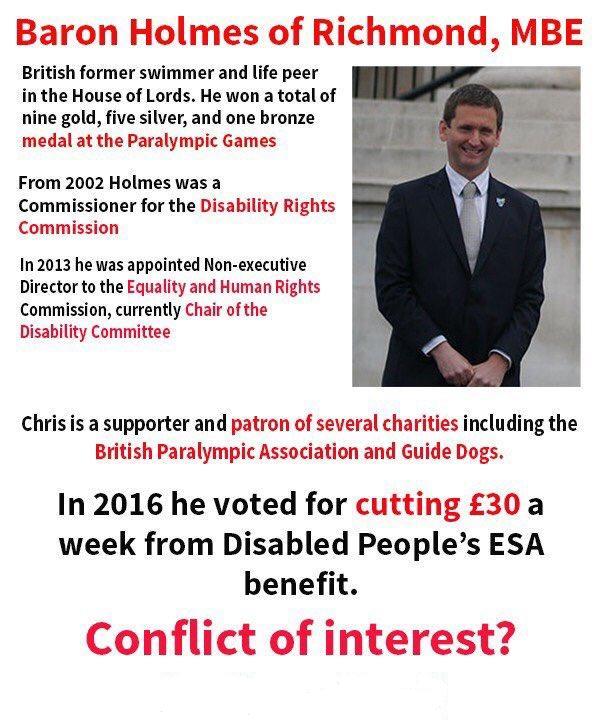
Dear Lord Holmes of Richmond,

I wish to draw your attention to the functions that were delegated to the Disability Committee and the Commissions duties as they relate to “disability matters” in:

  • Promoting understanding of the importance of equality and diversity
  • Encourage good practice
  • Promoting equality of opportunity
  • Promoting awareness and understanding of rights
  • Enforcing equality law
  • working towards the elimination of unlawful discrimination and harassment
  • Promoting understanding of good relations

Let me draw your attention to an article printed in the Guardian by the  EHRC on 01.03.2016 http://www.theguardian.com/politics/2016/mar/01/equalities-watchdog-criticises-planned-cuts-to-work-support-allowance

The very body you are a Commissioner for, the EHRC, say that the proposed cuts to ESA will disproportionately affect disabled people, widen inequalities and undermine the UK’s Human Rights obligations.

How can you be seen to be promoting the above when you went on to vote for these cuts to both ESA and PIP as a Conservative Peer, your actions will have a detrimental effect on disabled people’s lives, to both  Independent living and will undermine the UK’s Human Rights obligations.

As a disability rights campaigner I am calling for your immediate resignation of the position you hold as Disability Commissioner and Chair of the Disability Committee for EHRC as alongside my peers and other user led organization’s we think you are no longer worthy of this position.

Look forward to your reply

Susan Archibald
Disability Rights Campaigner.

Please sign the petition and support this campaign – Campaigners Demand For Lord Chris Holmes Resignation.

Supported by:

Dr Stephen Carty -Black Triangle Campaign

Professor Peter Beresford, Co-Chair, Shaping Our Lives

Mo Stewart –Disabled Veteran/Researcher

Dr Simon John Duffy – Centre of Welfare Reform

Gail Ward – Cross Border Alliance

John McArdle-Black Triangle Campaign

Pat Onions – Pats Petition

Rosemary ONeill – Carerwatch

Frances Kelly – Carerwatch/Dead Parrot Campaign

Linda Burnip – DPAC

Debbie Jolly – DPAC

Anita Bellows – DPAC

Merry Cross – DPAC

Rick Burgess – DPAC  Manchester

Paula Peters – DPAC

Annie Bishop – Involve North East & Cumbria for deaf, blind and people with disabilities

Carole Robinson – Bolshy Divas

Tracey Flynn – Bolshy Divas

Catherine Hale – Disability Researcher

C  Richardson – Disability Researcher

Stef Benstead – Disability Researcher

Jayne Linney DEAP

Sue Livett-Campaign for a Fair Society England

Michelle Mayer

Rosemary Trustam-Publisher Community Living Magazine

Jo Walker

Sue Jones – Psychologists against Austerity/Human Rights/Policy Researcher/Writer

Again, if you want to sign our petition please click the link here.


Further reading:

http://www.independent.co.uk/news/uk/politics/dwp-drew-up-plans-to-charge-disabled-people-for-fit-to-work-appeals-internal-documents-reveal-a6993996.html

http://thirdforcenews.org.uk/tfn-news/disability-activists-call-for-commissioner-to-resign?

http://www.mirror.co.uk/news/uk-news/secret-government-plan-charge-disabled-7798786

http://www.disabilitynewsservice.com/tory-peer-faces-calls-to-quit-as-ehrc-commissioner-over-support-for-wrag-cuts/

http://www.disabilitynewsservice.com/revealed-dwps-secret-financially-devastating-proposals-for-benefits-appeals/

http://www.disabilitynewsservice.com/secret-dwp-proposal-to-scrap-esa-substantial-risk-rules-would-breach-right-to-life/

http://www.thenational.scot/news/snp-calls-to-see-reports-on-suicides-following-benefits-cuts.16660


Psychologists Against Austerity and People’s Assembly Protest

PAA-550x369

The People’s Assembly are organising a march on Saturday 16th April (next weekend) from 1pm in London, calling for health, homes, jobs and education. It will start at the junction between Gower Street and Euston Road, marching towards Trafalgar Square.

Some of us from Psychologists Against Austerity will be joining the march. If you would like to come along and march with us, we will be meeting outside the Prince of Wales Feathers pub, next to Warren Street station at 12.30pm. This is around the corner from where the march is starting and we will walk over to join them at 12.45pm.

For those of our members in regional groups outside of London, the People’s Assembly are organising coaches from across the country. To see if there is one near to you, have a look at their website: http://www.thepeoplesassembly.org.uk

It would be great to get as many of us there as possible. We are getting a small number of t-shirts printed to see what they look like. If you would like one, bring £10 with you on the day, first come first served! If you have any questions or want to know where we are on the day, feel free to tweet us at @commpsychUK

If you can’t make it to the march, it could be a great opportunity to have a conversation with someone new about the impact of austerity. Our second briefing paper, ‘Improving Public Discussion about Inequality’ might be able to help. Have a read for some ideas about how to communicate the impact of austerity in engaging ways and reach beyond those marching with us on the 16th https://psychagainstausterity.wordpress.com/briefing-paper-preaching-to-the-non-converted/

With best wishes,

Psychologists Against Austerity.
@commpsychuk
www.psychagainstausterity.wordpress.com
https://www.facebook.com/Psychologists-Against-Austerity

Call for submissions – inquiry launched into employment support for disabled people

disability-employment-gap

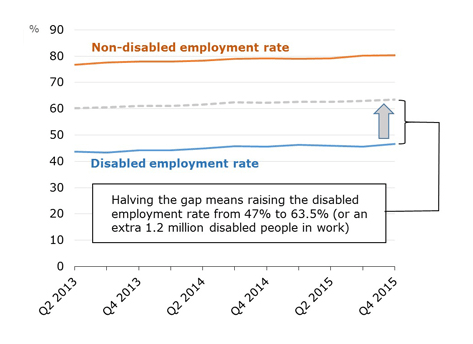
Disability Employment Gap 2015. Source: UK Parliament.

Inquiry background

The Work and Pensions Committee has launched an inquiry into the Government’s commitment to halve the “disability employment gap.” According to the most recent data, 46.7% of disabled people were in work at the end of 2015 compared to 80.3% of non-disabled people. In order to close this gap, the Committee says an extra 1.2 million disabled people would need to be supported into work.

The Committee’s welfare to work report, published in October 2015, raised concerns about the lack of success of existing employment programmes in supporting disabled people into sustained employment.

The Government has since announced:

  • A new Work and Health Programme to replace the current generalist Work Programme and specialist disability Work Choice programmes
  • A real terms increase in spending on the Access to Work Programme, which provides practical support for disabled people, beyond the “reasonable adjustments” required to be made by employers
  • A White Paper to be published this year which will “set out reforms to improve support for people with health conditions and disabilities, including exploring the roles of employers, to further reduce the disability employment gap and promote integration across health and employment.”

Concerns raised over Disability Confident campaign

In addition, the DWP’s Disability Confident campaign, launched in 2013, aims to promote the benefits of employing disabled people to employers.

However, concerns have been raised about the abolition of the Work Related Activity component of Employment and Support Allowance (ESA) worth £29.05 per week – and its equivalent in Universal Credit – for new claimants from April 2017, and the potential effects of this measure on disabled people’s ability to overcome their barriers to working.

Call for written submissions

The Committee invites written submissions addressing the following points:

Steps required to halve the disability employment gap:

  • To what extent are the current range of proposed measures likely to achieve the Government’s ambition of closing the disability employment gap?
  • Should the Government set interim targets along the way to meet the commitment to halve the disability employment gap? What should they be?

Support for employers:

  • How effective is the Disability Confident campaign in reducing barriers to employment and educating employers?
  • What more could be done to support employers?

Effective employment support for disabled people:

  • What should support for people with health conditions and disabilities in the proposed Work and Health programme look like?
  • How should providers be incentivised to succeed?

Likely effects of proposed ESA reform:

  • What are the likely impacts on disability employment of the abolition of the Employment and Support Allowance Work Related Activity component?
  • What evidence is there that it will promote ‘positive behavioural change’? What evidence is there that it will have unintended consequences, and how could these be mitigated?

Aim of the inquiry

The Committee intends to consider possible improvements in:

  • the DWP’s employment support programmes for disabled people
  • Support for employers to take on disabled people
  • Disabled people’s access to the labour market more broadly

The Committee will also examine possible adverse consequences of the Government’s current approach, particularly around proposed changes to ESA, and how these might be addressed.

Chair’s comment

Frank Field MP, Chair of the Committee said:

“The Government has made a welcome commitment to help more people with disabilities into a position where they can find and then keep a job. If it can successfully be seen through, this commitment could signal a major stride towards achieving full employment in our country.

The really important part now is to back-up this commitment with a series of reforms that are tailored to each person’s own skills and ambitions, as well as those conditions that currently limit their ability to work, so that each person can follow a feasible journey into work. We hope the evidence we receive will enable us to help the Government in its search for such a reform package.”

Send a written submission through the disability employment gap inquiry page.

Further information

The deadline for written submissions is Monday 9 May 2016.


ImageVaultHandler.aspx

Related

The new Work and Health Programme: government plan social experiments to “nudge” sick and disabled people into work

The biggest barrier that disabled people face is a prejudiced government

Let’s keep the job centre out of GP surgeries and the DWP out of our confidential medical records

Latest DWP information release reveals a huge rise in the numbers of sick and disabled people being sanctioned

G4S are employing Cognitive Behavioural Therapists to deliver “get to work therapy”

Let’s keep the job centre out of GP surgeries and the DWP out of our confidential medical records


Image result for work coaches : you can still work if you are ill UK
Source: Work, health and disability green paper: improving lives. Consultation outcome


Last year I wrote a critical article about the government’s new
Work and Health Programme, I flagged up concerns regarding government plans to enlist GPs in prescribing work coaches for people who are sick and disabled, and in providing advice on job-seeking. The private and confidential patient-doctor relationship ought to be about addressing medical health problems, and supporting people who are ill, not about creating yet another space for an over extension of the coercive arm of the state to “help people into work”, regardless of whether or not they are actually well enough to cope with working.

I also posted my article on the Pulse site for medical professionals last October, raising some of my concerns. I proposed that the government may use the “intervention” as a further opportunity for sanctioning sick and disabled people for “non-compliance”, and I expressed concern that this would conflict with the ethics and role of a doctor. I also stated my concern about the potential this pilot has for damaging the trust between doctors and their patients. I do support the idea of social prescribing in theory, but this scheme is certainly not that. This is plain state harassment and coercion.

It’s interesting to see that among all those listed present at the various pilot-related meetings behind closed doors regarding the government’s new Work and Health programme, there isn’t a single sick and disabled person or relevant representative charity to be found. That’s telling, because it means that the provision is not founded on consultation, is not designed to be inclusive from the start, nor does it have a democratic or representative foundation. It’s another case of government policy that acts upon groups people, prescriptively, as if they were objects, rather than human subjects with identifiable needs and the capacity for democratic dialogue.

I discovered last October, almost by chance, that the Nudge Unit team have been working with the Department for Work and Pensions and the Department of Health to trial social experiments aimed at finding ways of: “preventing people from falling out of the jobs market and going onto Employment and Support Allowance (ESA).”

“These include GPs prescribing a work coach, and a health and work passport to collate employment and health information. These emerged from research with people on ESA, and are now being tested with local teams of Jobcentres, GPs and employers.”  Source: Matthew Hancock’s conference speech: The Future of Public Services.

Now GPs have raised their own concerns about sharing patient data with the Department for Work and Pensions – and quite properly so. Pulse reports that the Department for Work and Pensions (DWP) plans to extract information from GP records, including the number of Med3s or so-called “fit notes” issued by each practice and the number of patients recorded as “unfit” or “maybe fit” for work, in an intrusive move described by GP leaders as amounting to “state snooping.”

Part of the reason for this renewed government attack on sick and disabled people is that the Government’s flagship fit note scheme, which replaced sick notes five years ago in the hope it would see GPs sending thousands more employees back to work to reduce sickness-related absence, despite GPs having expressed doubts since before its launch, has predictably failed.

The key reason for the failure is that employers did not take responsibility for working with employees and GPs seriously, and more than half (59%) of employers said they felt unable to support employees by making all of the legally required workplace adjustments for those who had fit notes signed as “may be fit for work.” Rather than address this issue with employers, the government has decided instead to simply coerce patients back into work without essential support.

Another reason for the failure of this scheme is that most people who need time off from work are ill and genuinely cannot return to work until they have recovered. Regardless of the government’s concern for the business and state costs of sick leave, people cannot be simply ushered out of illness and into work by the state to “contribute to the economy.” When a GP says a person is “unfit for work”, they generally ARE unfit for work, regardless of whether the government likes that or not.

The government plans to merge health and employment services, and are now attempting to redefine work as a clinical outcome. Unemployment has been stigmatised and politically redefined as a psychological disorder, the government claims somewhat incoherently that the “cure” for unemployment due to illness and disability, and sickness absence from work, is work.

This is the kind of mentality that the new Work and Health programme is founded on: Dr Josephine Sauvage, the joint vice chair of NHS Islington CCG and a GP at City Road Medical Practice, where the programme is being trialed currently, said the programme can help patients.

She said: “When we become ill we often stop doing those things that get us out and about and bring fulfilment to our lives.”

Yes, that’s what being chronically ill means: we often become incapacitated and sometimes we can’t do all of the things we did before. But since when is working the only source of fulfilment? And how does forcing people who are ILL to look for ANY job, regardless of pay, security, terms and conditions and appropriateness lead to “fulfilment”? A patient is defined as:

  • A person who requires medical care.
  • A person receiving medical care or medical treatment.
  • A person under a physician’s care for a particular disease or condition.

There is no mention of a person’s employment status or the pressing need for a job prescription in that definition.

As part of the Work and Health programme, beginning next month, the DWP plans to access people’s medical information. Employment coaches will be able to directly “update” a patient’s medical record.

GPs will have to inform patients of the access to information and any extraction of confidential information from their medical files, but cannot withhold information unless their patient explicitly objects.

Sofia Lind, a senior journalist at Pulse, says: GPs, as data controllers, will be required to tell patients in person, via notices in the practice and on the practice website of the impending extraction.”

Patients have the right to object to the use and disclosure of confidential information that isn’t used for their medical care.

Patients can explicitly refuse their consent to data sharing. The Data Protection Act 1998 covers personal information including health records. Further provision under Article 8 of the Human Rights Act 1998 establishes a right to respect for private and family life. This underscores the duty to protect the privacy of individuals and preserve the confidentiality of their health records.

There is also additional guidance from the British Medical Association (BMA) here – GPs as Data controllers guidance. (PDF)

You can:

Write your own letter to the GP health centre. Here is a basic letter template in 3 formats that you can download and use:

Opt out letter (PDF)

Opt out letter (MS Word)

Opt out letter (Rich Text)

Make sure you state clearly that don’t wish for any of your data and medical information, including details of your fit notes, to be shared with the DWP and any other third party. You can also:

In addition to sharing information with the DWP, due to changes in legislation, your GP can now be required to upload personal and identifiable information from the medical record of every patient in England to central servers at the Health and Social Care Information Centre (HSCIC).

Once this information leaves your GP practice, your doctor will no longer be in control of what data is passed on or to whom. This information will include diagnoses, investigations, treatments and referrals as well as other things you may have shared with your doctor including your weight, alcohol consumption, smoking and family history. Each piece of information will be identifiable as it will be uploaded with your NHS number, date of birth, post code, gender and ethnicity. NHS England – the body now in charge of commissioning primary care services across England – will manage and use the information extracted by HSCIC for a range of purposes, none of which are to do with your direct medical care.

Whenever I am ill, I don’t ever consider consulting Iain Duncan Smith or the government more generally for advice. There are very good reasons for this. I don’t want to be confronted with pseudoscientific Conservative anti-welfare dogma, I prefer instead to seek the expert, trusted medical opinion of a qualified doctor. I expect professional medical care, not brute state coercion and a punishment regime that is particularly reminiscent of the 1834 Poor Law amendment Act.

And despite assurances from those professionals currently trialing the Work and Health programme that all participation is (currently) voluntary, against the current backdrop of ever-increasing welfare conditionality, the political stigmatisation of people not in work, the frequent punitive deployment of benefit sanctions, the mandatory  welfare-to-work schemes, it’s difficult to imagine a Conservative scheme that will not entail exercising Conservative prejudice and pseudoscientific justifications of Tory economic Darwinist ideology.

It’s hardly the case that the state has an even remotely credible track record of assessing people’s medical conditions, nor is it the case that this government bothers itself with empirical evidence, or deigns to listen to concerns raised by citizens, academics, professionals and charities regarding the harm that their policies are causing. This is a government that can’t even manage to observe basic human rights, let alone care about citizen’s best interests, health and wellbeing.

It’s not possible to make people who are ill better by punishing them, in just the same way as state coercion and using prejudiced language doesn’t “cure” poverty.  I don’t need more quack medicine on top of the current heavy doses of Conservative big state psychopolitics, traditional prejudices and subsequent quacking, slapstick psychobabble. It’s bad enough that Jeremy Hunt thinks he’s the all singing homeopathic Minister for magic and that Iain Duncan Smith thinks he can miraculously cure sick and disabled people by simply forcing them to work. The side-effects of five years of the Conservative’s ontologically insecure rhetoric, that’s been largely ranting, repetitive, incoherent monologue, are nauseating enough. Nobody should need to say any of this in 2016, but tragically, we seem to have a government that hasn’t yet escaped the feudal era. Or playing with their alchemy sets.

I’m in full agreement with Boycott Workfare, the Mental Health Resistance Network, and Disabled People Against the Cuts. I shared my original article with two of those groups and I’m pleased that they have since organised a protest for March 4, 3pm at the City Road Surgery, 190-196 City Road, London EC1V 2QH to raise public awareness of the issues and implications outlined. I just wish I was currently well enough to get to the protest.

They say: GP surgeries are for medical treatment, the job centre is for “employment coaching” and job-hunting.

And governments in first-world liberal democracies are for creating policies that actually meet public needs, rather than imposing totalitarian control, manipulating and micromanaging citizens to meet government needs and political outcomes.

650

My work isn’t funded. But you can support Politics and Insights, and help me to continue researching, analysing and writing independently.