Category: Conservatives

The new Work and Health Programme: government plan social experiments to “nudge” sick and disabled people into work


Illustration by Jack Hudson

The government’s Nudge Unit team is currently working with the Department for Work and Pensions and the Department of Health to trial social experiments aimed at finding ways of: “preventing people from falling out of the jobs market and going onto Employment and Support Allowance (ESA).”

“These include GPs prescribing a work coach, and a health and work passport to collate employment and health information. These emerged from research with people on ESA, and are now being tested with local teams of Jobcentres, GPs and employers.”

This is a crass state intrusion on the private and confidential patient-doctor relationship, which ought to be about addressing medical health problems, and supporting people who are ill, not about creating yet another space for obsessive political micromanagement. It’s yet another overextension of the coercive arm of the state to “help” people into work. Furthermore, this move will inevitably distort people’s interactions with their doctors: it will undermine the trust and rapport that the doctor-patient relationship is founded on.

In the current political context, where the government extends a brutally disciplinarian approach to basic social security entitlement, it’s very difficult to see how the plans to place employees from the Department for Work and Pensions in GP practices can be seen as anything but a threatening gesture towards patients who are ill, and who were, up until recent years, quite rightly exempted from working. Now it seems that this group, which includes some of our most vulnerable citizens, are being politically bullied and coerced into working, regardless of the consequences for their health and wellbeing.

Of course the government haven’t announced this latest “intervention” in the lives of disabled people. I found out about it quite by chance because I read Matthew Hancock’s recent conference speech: The Future of Public Services.

I researched a little further and found an article in Pulse which confirmed Hancock’s comment: GP practices to provide advice on job seeking in new pilot scheme.

Hancock is appointed Minister for the Cabinet Office and Paymaster General, and was previously the Minister of State for Business and Enterprise. He headed David Cameron’s “earn or learn” taskforce which aims to have every young person earning or “learning” from April 2017.

He announced that 18 to 21-year-olds who can’t find work would be required to do work experience (free labour for Tory business donors) as well as looking for jobs or face losing their benefits. But then Hancock is keen to commodify everyone and everything, including public data.

However his references to “accountability and transparency” don’t stand up to much scrutiny when we consider the fact that he recently laid a statement before parliament outlining details about the five-person commission that will be asked to decide whether the Freedom of Information act is too expensive and “overly intrusive.”

He goes on to say: “And this brings me onto my second area of reform: experimentation. Because in seeking to improve our services, we need to know what actually works.”

But we need to ask for whom services are being “improved” and for whom does such reform work, exactly?

And did any of the public actually consent to being experimented upon by the state?

Or to having their behaviour modified without their knowledge?

Now that the nudge unit has been privatised, it is protected from public scrutiny, and worryingly, it is also no longer subject to the accountability afforded the public by the Freedom of Information Act.

The Tory welfare “reforms” are a big business profiteering opportunity, whilst lifeline benefits are being steadily withdrawn: policy context

The current frame of reference regarding Conservative welfare policies is an authoritarian and punitive one. It’s inconceivable that a government proposing to continue cutting the lifeline income of sick and disabled people, including a further £120 a month to those people in the ESA Work Related Activity group (WRAG), will suddenly show an interest in actually supporting disabled people. There are also proposals to further limit eligibility for Personal Independence Payments (PIP) for sick and disabled people. 

From the shrinking category of legitimate “disability” to forcing people to work for no pay on exploitative workfare schemes, “nudge” has been used to euphemistically frame punitive policies, “applying the principles of behavioural economics to the important issue of the transition from welfare to work.” (From: Employing BELIEF: Applying behavioural economics to welfare to work, 2010.)

And guess who sponsored the “research” into “nudging” people into workfare? Steve Moore, Business Development Director from esg, which is a leading welfare to work and vocational skills group, created through the merger and acquisition of four leading providers in the DWP and LSC sector.” How surprising.

It’s even more unsurprising that esg was established by two Conservative donors with very close ties to ministers, and were subsequently awarded very lucrative contracts with the Department for Work and Pensions. I think there may have been a “cognitive bias” in operation there, too. But who is nudging the nudgers?

Of course the “aim” of the “research” is: “breaking the cycle of benefit dependency especially for our hardest to help customers, including the “cohort” of disabled people.”

However, there’s no such thing as a “cycle of benefit dependency”, it’s a traditional Tory prejudice and is based on historically unevidenced myths. Poverty arises because of socioeconomic circumstances that are unmitigated through government decision-making. In fact this government has intentionally extended and perpetuated inequality through its policies.

2020health – Working Together is a report from 2012 that promotes the absurd notion of work as a health outcome.  This is a central theme amongst ideas that are driving the fit for work and the work and health and programme. Developing this idea further, Dame Carol Black and David Frost’s Health at Work – an independent review of sickness absence was aimed at reviewing ways of “reducing the cost of sickness to employers, ‘taxpayers’ and the economy.” Seems that the central aim of the review wasn’t a genuine focus on sick and disabled people’s wellbeing and “health outcomes,” then. Black and Frost advocated changing sickness certification to further reduce the influence of GPs in “deciding entitlement to out-of-work sickness benefits.”

The subsequent “fit notes” that replaced GP sick notes (a semantic shift of Orwellian proportions) were designed to substantially limit the sick role and reduce recovery periods, and to “encourage” GPs to disclose what work-related tasks patients may still be able to perform. The idea that employers could provide reasonable adjustments that allowed people who are on sick leave to return to work earlier, however, hasn’t happened in reality.

The British Medical Association (BMA) has been highly critical of the language used by the government when describing the fit for work service. The association said it was “misleading” to claim that fit for work was offering “occupational health advice and support” when the emphasis was on sickness absence management and providing a focused return to work.

The idea that work is a “health” outcome is founded on an absurd and circular Conservative logic that people in work are healthier than those out of work. It’s true that they are, however, the government have yet again confused causes with effects. Work does not make people healthier: it’s simply that healthy people can work and do. People who have long term or chronic illnesses often can’t work. The government’s main objection to sick leave and illness more generally, is that it costs businesses money. As inconvenient as that may be, politically and economically, it isn’t ever going to be possible to cure people of serious illnesses by cruelly coercing them into work.

The government’s removal of essential in-work support for disabled people – such as the Independent Living Fund, and the replacing of Disability Living Allowance  with Personal Independence Payment in order to reduce eligibility, cut costs and “target” support to those most severely disabled, and the cuts to the Access To Work scheme – means that it is now much more difficult for those disabled people who want to work to find suitable and supported employment.

The politics of punishment

There’s a clear connection between the Nudge Unit’s obsession with manipulating “cognitive bias” – in particular, “loss aversion” – and the increased use, extended scope and severity of sanctions, though most people succumbing to the Nudge Unit’s guru effect (ironically, another cognitive bias) think that “nudging” is just about prompting men to pee on the right spot in urinals, or persuading us to donate organs and to pay our taxes on time.

When it comes to technocratic fads like nudge, it’s worth bearing in mind that truth and ethics quite often have an inversely proportional relationship with the profit motive.

For anyone curious as to how such tyrannical behaviour modification techniques like benefit sanctions arose from the bland language, inane, managementspeak acronyms and pseudo-scientific framework of “paternal libertarianism” – nudge – read this paper, focused almost exclusively on New Right obsessions, paying particular attention to the part about “loss aversion” (a cognitive bias according to behavioural economists) on page 7.

And this on page 18: The most obvious policy implication arising from loss aversion is that if policy-makers can clearly convey the losses that certain behaviour will incur, it may encourage people not to do it,” and page 46: “Given that, for most people, losses are more important than comparable gains, it is important that potential losses are defined and made explicit to jobseekers (e.g.the sanctions regime).” 

The recommendation on that page: We believe the regime is currently too complex and, despite people’s tendency towards loss aversion, the lack of clarity around the sanctions regime can make it ineffective. Complexity prevents claimants from fully appreciating the financial losses they face if they do not comply with the conditions of their benefit.”

The Conservatives duly “simplified” sanctions by extending them in terms of severity, frequency and by broadening the scope of their application to include previously protected social groups.

The paper was written in November 2010, prior to the Coalition policy of increased “conditionality” and extended sanctions element of the Tory-led welfare “reforms” in 2012.

Sanctioning welfare recipients by removing their lifeline benefit – originally calculated to meet the cost of only basic survival needs – food, fuel and shelter – isn’t about “arranging choice architecture”, it’s not nudging: it’s operant conditioning. It’s a brand of particularly dystopic, psychopolitical neobehaviourism, and is all about a totalitarian level of micromanaging people to ensure they are obedient and conform to meet the needs of the “choice architects” and policy-makers.

Nudge even permeates language, prompting semantic shifts towards bland descriptors which mask power and class relations, coercive state actions and political intentions. One only need to look at the context in which the government use words like “fair”, “support”, “help” “justice” and “reform” to recognise linguistic behaviourism in action. Or if you prefer, Orwellian doublespeak.

It’s rather difficult to see how starving people and threatening them with destitution can possibly improve the well-being of many socially excluded people, and help to bring them to inclusion.”

The conclusion that Ancel Keys drew from the Minnesota Starvation Experiment in the the US during the 1940s, (which explored the physical and psychological effects of undernutrition, and stressed the dramatic, adverse effect that starvation had on competence, motivation, behaviour, mental attitude and personality) was that “democracy and nation building would not be possible in a population that did not have access to sufficient food.”

No amount of bland and meaningless psychobabble or intransigent, ideologically-tainted policies can legitimize the economic sanctioning of people who are already poor and in need of financial assistance.

Apparently, citizenship and entitlement to basic rights and autonomy is a status conferred on only the currently economically productive. Previous employment and contributions don’t count as “responsibility,” and don’t earn you any rights – the government believes that citizens owe a perpetual debt of unconditional service to the Conservative’s steeply stratified economy. Not much of a social contract, then. Cameron says he wants to “build a responsible society” by removing people’s rights and reducing or removing their lifeline income. Presumably, free invisible bootstraps are part of the deal.

Government decision-making has contributed the most significant influence on “health outcomes.” Conservative policies have entailed a vicious cutting back of support and a reduction of essential provision for sick and disabled people. In fact this group have been disproportionately targeted for austerity cuts time and time again, massively reducing their lifeline income. It’s not being “workless” that has a detrimental impact on people’s health and wellbeing: it is the deliberate impoverishment of those requiring state aid and support, funded from the public purse, (including contributions from those who now need support), which is being dogmatically and steadily withdrawn.

Making work pay for whom?

If work truly paid, then there would be no need to incentivise” almost 1.2 million low-paid workers claiming the new universal credit with the threat of in-work benefit sanctions if they fail to “take steps to boost their earnings.”

It’s very difficult to see how punishing individuals for perhaps being too ill to work more that a few hours, or those working for low pay or part-time in the context of a chronically weak labour market, depressed wages and with little scope for effective negotiating and collective bargaining can possibly be justified. It’s an utterly barbaric way for a government to treat citizens.

Surely if the government was genuinely seeking to increase choices and to widen access to the workplace for sick and disabled people, it would not be cutting the very programmes supporting and extending this aim, such as the Access to Work scheme  – a fund that helps people and employers to cover the extra living costs arising due to disabilities that might present barriers to work – and the Independent Living Fund.

This government has pushed at the public’s rational and moral boundaries, establishing and attempting to justify a draconian trend of punishing those unable to work, and what was previously unthinkable – stigmatising and punishing legally protected social groups such as sick and disabled people – has become somehow acceptable. We are on a very slippery slope, clearly mapped out previously by Allport’s scale of prejudice.

People’s needs don’t disappear just because the government has decided to “pay down” an ever-growing debt and build a “surplus” by taking money from those that have the least. Or because the government doesn’t like “big state interventions.”

So the recent proposed cut to ESA – and this is a group of sick and disabled people deemed physically incapable of work by doctors – is completely unjustified and unjustifiable. No amount of pseudo-psychology and paternalist cruelty can motivate or “incentivise” people who are medically ill.

It’s for disabled individuals and their doctors – professionals, specialists and experts – to decide if a person can work or not, it’s not the role of the state, motivated only by a perverse economic Darwinist ideology. Maslow taught us that we must attend to our physiological needs before we may be motivated to meet higher level psychosocial ones.

Iain Duncan Smith is a zealot who actually tries to justify further punitive cuts to disabled people’s provision by claiming that working is “good” for people and is the only “route out of poverty.”

Presumably he believes work can cure people of the serious afflictions that they erroneously thought exempted them from full-time employment. 

He stated: “There is one area on which I believe we haven’t focused enough – how work is good for your health. Work can help keep people healthy as well as help promote recovery if someone falls ill. So, it is right that we look at how the system supports people who are sick and helps them into work.”

Duncan Smith undoubtedly “just knows” that his absurd claim is “right.” He’s never really grown out of his “magical thinking” stage, or transcended his dereistic tendencies. His department had to manufacture “evidence” recently in a ridiculous attempt to support Iain Duncan Smith’s imaginative, paternalist claim that punitive sanctions are somehow “beneficial” to claimants, by using fake characters to supply fake testimonials, but this was rumbled and exposed by a well-placed Freedom of Information request from Welfare Weekly.

Recent research indicates that not all work serves to “keep people healthy” nor does it ever “promote recovery.” This assumption that work can promote recovery in the case of people with severe illness and disability – which is why people claim ESA – is particularly bizarre. We have yet to hear of a single case involving a job miracle entailing people’s limbs growing back, vision being restored, or a wonder cure for heart failure, cerebral palsy, multiple sclerosis and lupus, for example.

The government’s Fit for Work scheme is founded on exactly the same misinformative nonsense. It supports profit-making for wealthy employers, at the expense of the health and wellbeing of employees that have been signed off work because of medically and professionally recognised illness that acts as a real barrier to work.

Furthermore, there is no proof that work in itself is beneficial. Indeed much research evidence strongly suggests otherwise.

And where have we heard these ideas from Iain Duncan Smith before?

Arbeit macht frei.

If work really paid then surely there would be no need to “nudge” people by using sanctions, regardless of whether or not they are employed. “Making work pay” is all about reducing support for those who the government deems “undeserving,” to “discourage welfare dependency” by making any support as horrible as the workhouse – founded on the principle of “less eligibility”, where conditions for those in need of support were punitive and kept people in a state of desperation so that even the lowest paid work in the worst of conditions would seem appealing.

The public/private divide

For a government that claims a minarchist philosophy, remarkably it has engineered an unprecedented blurring of public/private boundaries and a persistent violation of traditionally private experiences, including thoughts, beliefs, preferences, autonomy and attitudes via legislations and of course a heavy-handed fiscal conflation of public interests with private ones.

This also caught my attention from Matthew Hancock’s speech transcript:

“My case is that we need continuous improvement in public services. And for that we must reform the relationship between citizen and state. [My bolding]

“The case for reform is strong. Because people have high and rising expectations about what our public services should deliver. Because budgets are tight, and we have to make significant savings for our country to live within her means.”

Basically, the “paternalistic libertarian” message here is that we will have to expect less and less from the state, as the balance between rights and responsibilities is heavily weighted towards the latter, hence requiring the “reform” of the relationship between citizen and state.

However, surely it is active, democratic participation in processes of deliberation and decision-making that ensures that individuals are citizens, not subjects.

Social democracy evolved to include the idea of access to social goods and improving living standards as a means of widening and legitimizing the scope of political representation.

Political policies are defined as (1) The basic principles by which a government is guided. (2) The declared objectives that a government  seeks to achieve and preserve in the interest of national community. As applied to a law, ordinance, or Rule of Law, it’s the general purpose or tendency considered as directed to the welfare or prosperity of the state or community.

Once upon a time, policy was a response from government aimed at meeting public needs. It was part of an intimate democratic dialogue between the state and citizens. Traditional methods of participating in government decision-making include:

  • political parties or individual politicians
  • lobbying decision makers in government
  • community groups
  • voluntary organisations
  • public opinion
  • public consultations
  • the media

Nowadays, policies have been unanchored from any democratic dialogue regarding public needs and are more about monologues aimed at shaping those needs to suit the government. 

Nudge does not entail citizen involvement in either its origin or design. The state intrusions are at such an existential level, of an increasingly authoritarian nature, and are of course reserved for the poorest, who are deemed “irrational” and incapable of making “the right decisions.”

Yet those “faulty decisions” are deemed so from the perspective of the Behavioural Insights Team, (the “Nudge Unit”) who are not social psychologists: they are predominantly concerned with behavioural economics, decision-making and how governments influence people – “economologists”, changing people’s behaviours, enforcing compliance to fulfil political aims. That turns democracy completely on its head.

The Nudge Unit gurus claim that we need help to “correct our cognitive biases”, but those who make policies have their own whopping biases, too.

Nudge is the new fudging

Nudge is a prop for New Right neoliberal ideology that is aimed at dismantling a rights-based society and replacing it with an insidiously nudged, manipulated, compliant, and entirely “responsible”, “self-reliant” population of divided, isolated state-determined individuals who expect nothing from their elected government.

The Conservatives are obsessive about strict social taxonomies and economic enclosures. The Nudge Unit was set up by David Cameron in 2010 to try to “improve” public services and save money. The asymmetrical, class-contingent application of paternalistic libertarian “insights” establishes a hierarchy of decision-making “competence” and autonomy, which unsurprisingly corresponds with the hierarchy of wealth distribution.

So Nudge inevitably will deepen and perpetuate existing inequality and prejudice, adding a dimension of patronising psycho-moral suprematism to add further insult to politically inflicted injury. Nudge is a fashionable fad that is overhyped, trivial, unreliable; a smokescreen, a prop for neoliberalism and monstrously unfair, bad policy-making.

As someone who (despite the central dismal and patronising assumptions about the irrationality of others that king nudgers have as a central cognitive bias and the traditional prejudices that Tory ideology narrates,) manages to make my own decisions relatively without bias, intelligently, rationally, critically, carefully and coherently, and that, along with my professional and academic background, I can and will conclude that no matter how you dress it up, nudge is a pretentious, cringeworthy pseudo-intellectual dead-end.

 A Nudge for the Conservatives from history

The more things change for the Tories, the more they tend to stay the same.

In the 1870s, England had a recession and the Conservatives launched a Crusade of cuts to welfare expenditure to diminish “dependency” on poor law outdoor relief – non-institutional benefits called “out-relief” because it was paid to the poor in their own homes from taxation, rather than their having to go into the punitive “deterrent” workhouses.

The Crusade included cutting medical payments to lone mothers, widows, the elderly, chronically sick and disabled people and those with mental illness. The 1834 Poor Law amendment was shaped by people such as Jeremy Bentham, who argued for a disciplinary, punitive approach to social problems and particularly poverty, whilst Thomas Malthus focused attention on overpopulation, and moralising about the growth of illegitimacy. He placed emphasis on moral restraint rather than poor relief as the best means of easing the poverty of the lower classes. 

David Ricardo argued that there was a problem with poor relief provision “interfering” with an iron law of wages. Ricardo claimed that aid given to poor workers under the old Poor Law to supplement their wages had the effect of undermining the wages of other workers, so that the Roundsman System and Speenhamland system led employers to reduce wages, and needed reform to help workers who were not getting such aid and rate-payers whose poor-rates were going to subsidise low-wage employers. Yet we found, despite Ricardo’s pet theory, that the poor law deterrent element served to push wages down further.

The effect of poor relief, in the absurd view of the reformers, was to undermine the position of the “independent labourer.” They also wanted to “make work pay.” And end the “something for nothing” culture. But much subsequent evidence shows that reducing support for people out of work actually drives wages and working conditions down.

Neither the punitive poor law amendment act of 1834 or the Crusade “helped” people into work or addressed the lack of available paid work – that’s unemployment, not the made-up and intentionally stigmatizing word “worklessness”.

And its utter failure as a credible account of poverty – the-blame-the-individual narrative and the notion that relief discourages “self-reliance” – fuelled the national insurance act of 1911 and the development of the welfare state along with the other civilising and civilised benefits of the post-war settlement. 

The Conservatives inadvertently taught us as a society precisely why we need a welfare state.

We learned that it isn’t possible to be “thrifty” or help ourselves if we haven’t got the means for meeting basic survival needs. Nor is it possible to be nudged out of poverty when the means of doing so are not actually available. No amount of moralising and pseudo-psychologising about poor people actually works to address poverty, and structural socioeconomic inequalities.

The government’s undeclared preoccupation with behavioural change through personal responsibility is simply a revamped version of Samuel Smiles’s bible of Victorian and over-moralising, a hobby-horse: “thrift and self-help” – but only for the poor, of course. Smiles and other powerful, wealthy and privileged Conservative thinkers, such as Herbert Spencer, claimed that poverty was caused largely by the irresponsible habits of the poor during that era. But we learned historically that socioeconomic circumstances caused by political decision-making creates poverty.

Conservative rhetoric is designed to have us believe there would be no poor people if the welfare state didn’t somehow “create” them. If the Tories must insist on peddling the myth of meritocracy, then surely they must also concede that whilst such a system has some beneficiaries, it also creates situations of insolvency and poverty for others.

In other words, the same system that allows some people to become very wealthy is the same system that condemns others to poverty.

This wide recognition that the raw “market forces” of the old liberal laissez-faire (and the current starker neoliberalism) causes casualties is why the welfare state came into being, after all – because when we allow such competitive economic dogmas to manifest, there are invariably winners and losers.

That is the nature of “competitive individualism,” and along with inequality, it’s an implicit, undeniable and fundamental part of the meritocracy myth and neoliberal script. And that’s before we consider the fact that whenever there is a Conservative government, there is no such thing as a “free market”: in reality, all markets are rigged for elites.

Public policy is not an ideological tool for a so-called democratic government to simply get its own way. Democracy means that the voices of citizens, especially members of protected social groups, need to be included in political decision-making, rather than so frankly excluded.

We elect governments to meet public needs, not to “change behaviours” of citizens to suit government needs and prop up policy “outcomes” that are driven entirely by traditional Tory prejudice and ideology.

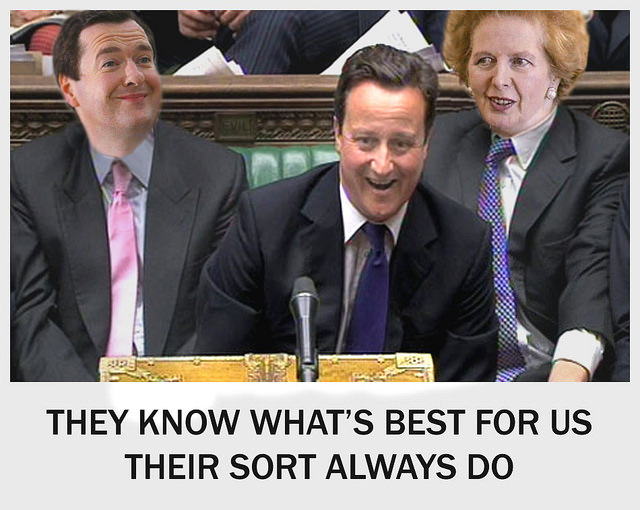
And by the way, we call any political notion that citizens should be totally subject to an absolute state authority “totalitarianism,” not “nudge.”
demcracy
Courtesy of Robert Livingstone

Update: The government have since announced the introduction of a number of “policy initiatives” aimed at reducing the number of people claiming Employment and Support Allowance (ESA). These initiatives are currently still at a research and trialing stage. Health Management, a subsidiary of MAXIMUS are to deliver the fit for work programme, which was set up based on recommendations from the Health at Work – an independent review of sickness absence report by Dame Carol Black and David Frost. The review was aimed at “reducing the cost of sickness to employers, ‘taxpayers’ and the economy.”

Fit for Work occupational health professional will have access to people’s diagnoses from their fit notes, the fit note end date and any further information that the GP considers relevant to their absence from work or current treatment (at the discretion of the GP). The primary referral route for an assessment for the Maximus programme will be via the GP.

The government is cutting funding for contracted-out employment support by 80%, following the Spending Review. The Department for Work and Pensions has indicated that total spending on employment will be reduced, including not renewing Mandatory Work Activity and Community Work Placements, the new Work and Health Programme will have funding of around £130 million a year – around 20% of the level of funding for the unsuccessful Work Programme and Work Choice, which it will replace.

Iain Duncan Smith says: “This Spending Review will see the start of genuine integration between the health and work sectors, with a renewed focus on supporting people with health conditions and disabilities return to and remain in work. We will increase spending in this area, expanding Access to Work and Fit for Work, and investing in the Health and Work Innovation Fund and the new Work and Health Programme.” 

Meeting the Government’s goal of halving the employment gap between disabled and non-disabled workers – moving around one million more disabled people into work – will be no easy task. Not least because despite Iain Duncan Smith’s ideological commitments, and aims to “reduce welfare dependency,” most disabled people who don’t work (and claim ESA) can’t do so because of genuine and insurmountable barriers such as incapacitating and devastating, life-changing illness. No amount of targeting those people with the Conservative doublespeak variant of “help” and nasty “incentivising” via welfare sanctions and benefit cuts will remedy that.


Five reasons the Lords should vote to block tax credit proposals today – Policy in Practice

Policy in Practice was asked to pull together a briefing note on the changes to tax credits ahead of the showdown today in the House of Lords.

We work with our local authority partners to carry out detailed, household level analysis on the impacts of reforms now, all the way through to 2020. We take into account a sample of over 100,000 working age households, and assess the cumulative impact of tax and benefit reforms on household income.

Our findings were put succinctly by a benefits manager in a Conservative constituency:

‘The government wants people to work, but this goes against that’.

Policy in Practice is working with local authorities to map the impacts of welfare reforms on each low income household. To understand more about how we can help you to understand how people in your local authority will be impacted, click here.

1. Two-thirds of Working Tax Credit recipients can expect to be worse off in 2020

Based on analysis on over 100,000 households of working-age in receipt of Housing Benefit and Council Tax support, and taking into account the impact of the National Living Wage at £9.00 per hour, and a personal tax allowance of £12,500, we find that 67% of Working Tax Credit recipients will still be worse off in 2020, compared with today.

* Analysis update: We have updated our analysis this morning to take into account the 30 hours of free childcare that will be available to three and four year olds. If we assume that all households with children age three to four will be better off (which may not necessarily be the case) we find that half of all Working Tax Credit recipients within our sample will still be worse off in 2020.

2. Owner-occupiers will be among the hardest hit when the reforms first land in April 2016

Tax credit savings will be partly offset by higher Housing Benefit and Council Tax Support payments. Because tax credits reduce entitlement to other benefits, 57% of tax credit savings will be offset by increased Housing Benefit and Council Tax Support.These savings will not by spread evenly. Many owner-occupiers, who do not receive Housing Benefit, will not have their tax credit cuts mitigated and may find themselves pushed into crisis.

Some in receipt of Housing Benefit and Council Tax Support will see their support increase by up to 85p for each pound lost in tax credits. This support, which offsets the some of the impact of the cuts, will erode over time due to increased earnings under the National Living Wage. Higher earnings cause tax credits, Housing Benefit and Council Tax Support to be withdrawn, often simultaneously.

3. Work incentives will be weakened within tax credits and Universal Credit

A higher withdrawal rate will make it harder for people that try to earn their way back to their original standard of living. Working Tax Credit recipients that choose to counter the loss by increasing their earnings will lose up to an additional 7p for each pound earned. Effective tax rates may increase up to 93p in the pound.

4. Higher effective taxes make it harder to respond by increasing earnings, while people on low or no earnings will not be affected

To qualify for Working Tax Credit, households have to work a certain number of hours to be considered in remunerative work: 16 hours per week for lone parents and disabled people, 24 hours for couples with children and 30 hours for people without children. The option to increase their working hours may be limited, and will be penalised by a higher withdrawal rate of tax credits.

Tax credit recipients who are not in work and the lowest earners, including self-employed households (some of whom are thought to under-report their earnings) will not be impacted by these changes. Those that contribute most to the economy will be hardest hit.

5. The government was elected to reform the welfare system to make work pay

Low effective tax rates within tax credits and Universal Credit reward enterprise and endeavor, help lower earners, and aid progression in work. They ensure that more of the benefits of a National Living Wage and a lower tax threshold reach lower earners. Protecting the lower withdrawal rate within tax credits would send the message that this government is the party not only of low taxes, but of low effective taxes.

Identify which households will be impacted in advance

We find that frontline advisors within local organisations want to work with the government to support people toward greater independence, and to deliver on the policy intent. However, too often they don’t feel they have enough information to properly advise their customers.

To avoid leaving advisors on the back foot, local authorities including Birmingham, Newcastle, North Hertfordshire and Hounslow, are working with Policy in Practice to map the impact of welfare reforms on each individual household on a low income within their local authority.


This article was originally published today on the Policy in Practice site. You can read the original here.

Osborne’s tax credit omnishambles reveals the profound elitism of the Tories

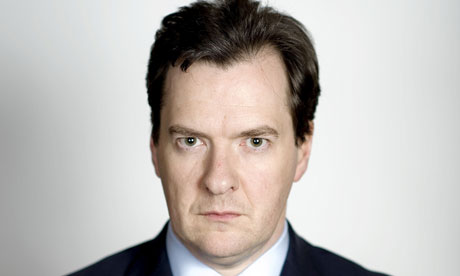
Chancellor George OsborneI don’t know a single person on low pay that is happy about the Conservative proposals to cut their tax credits and subsequently, their living standards, further. This policy was deliberately left out of the Tory manifesto, and when asked directly if his government was going to cut tax credits, Cameron chose to lie and said no. Now the Conservatives are claiming that this policy, never declared before the election, is suddenly somehow a “central plank” of the budget. The claim that Conservatives had declared cuts to welfare doesn’t stand up to scrutiny, either, because they claim to be a party that is all about “making work pay”. 

The Conservatives are claiming that the cuts were “democratically voted” through in the House of Commons, yet their majority in the lower House may not have happened at all, had they been honest prior to the election and declared their intention to cut people’s tax credits. 

Furthermore, the cuts were presented in the form of secondary legislation – as a Statutory Instrument – which notoriously receive little scrutiny and very limited debate time in the Commons. Statutory instruments are intended to be used for simple, non-controversial measures, in contrast to more complex items of primary legislation (known as Bills.) The Government always ensure they have a majority on any Statutory Instrument committee and the MPs are chosen by Whips. This enables government to push through their legislative programme with very little scrutiny, exacerbating a lack of democratic transparency and accountability of the Executive.

The threats issued to the Upper House from the government arose because the Conservatives are facing probable defeat on what is an extremely unpopular reform, even amongst their own party ranks, and are truly remarkable, showing a contempt for democratic process and a lack of willingness to engage in genuine, transparent democratic dialogue.

Earlier this year, the Institute for Fiscal Studies (IFS) asked George Osborne to specify how he will reach targets announced in the budget, given that the poorest had been the hardest hit by draconian benefit cuts already. The IFS said that the worst of the UK’s spending cuts are still to come.

I said at the time that it’s not that Osborne can’t answer the IFS challenge: he won’t.

David Gauke, the Treasury secretary at the time was pressed repeatedly on the BBC’s Daily Politics to explain if the Tories would detail their planned welfare cuts beyond the £3billion previously specified.

He replied: “We will set it out nearer the time which will be after the election.”

Pre-general election television comments have exposed Prime Minister David Cameron’s lies about his party’s proposal to reduce child tax credits. During a special episode of BBC’s Question Time, aired in April, presenter David Dimbleby asks: “There are some people that are worried about you cutting child tax credits, are you saying absolutely as a guarantee that you’d never have it?”

To which the Prime Minister responds: “First of all child tax credit we increased by 450 pounds…” Dimbleby interjects: “And it’s not going to fall?” to which the PM clearly replies: “It’s not going to fall.”

As Simon Szreter, Professor of history and public policy at the University of Cambridge, points out about the party claiming “A Britain that rewards work” as its slogan:

It is a measure of just how much George Osborne’s post-election attack on tax credits represents an assault of genuinely historic proportions on Britain’s poor that his PM has made reference to the 1911 Parliament Act in his railing against popular protest and his fear of blocking measures in the House of Lords. Let us remember why the act was brought in by the Liberal government of Asquith and Lloyd George.

The landed wealth elite, including men such as George Osborne’s direct ancestors, the Anglo-Irish baronets of Ballentaylor, dominated the House of Lords. They rejected the elected government’s policy – democratically tested at the bar of two general elections in 1910 – to impose new progressive forms of taxation on the super-wealthy to help fund such basic social security measures for the working poor as pensions and the first National Insurance Act.

He goes on to say:

Mr Cameron is darkly mentioning the Parliament Act of 1911 to cow the House of Lords into compliance because the upper chamber is no longer exclusively the club of the wealth elite as it was in 1911. The alternative, as Mr Cameron’s timely recollection of the 1911 Parliament Act reminds us all, is for parliament to ensure that the financial elite pay their way more fully in our society, a case that is all the more compelling considering their undisputed role in punching a hole in the nation’s finances in 2008.

The problem today is not control over the House of Lords. Today’s financial elite have found that it is much more efficient to exert their control over the House of Commons itself. This they do though a Tory party that is almost entirely funded by them and whose administration is safely in the hands of a chancellor who fully appreciates the importance of looking after the interests of the nation’s wealth elites. After all, he is the future 18th baronet of Ballentaylor.

Even Conservative MPs, such as Heidi Allen, have pointed out the hypocrisy of the proposed tax credit cuts. But as I’ve pointed out previously, the slogan “making work pay” has a lot in common with the 1834 Poor Law principle of less eligibility, rather than it being a genuine statement of intent from the Tories. Unless of course, you ask “Making work pay for whom?”

Further cuts to provisions, services and welfare – support for the poorest – is unthinkable and untenable, especially when there are other choices that the government could have made.

For example, the prime minister made it clear that lavish tax cuts for the better off will be the £7bn prize for returning him to Downing Street. This came after a £48bn in public service cuts, the like of which the country has never known.

“The people whose hard work and personal sacrifices have got us through these difficult times should come first,” Cameron said.

So who exactly worked hardest and took the heaviest burdens – and what exactly will be their reward? Certainly not those who made most sacrifices – the same low earners whose working tax credits and benefits George Osborne will happily cut again by another £12bn.

ed wealthRelated

Tax Credits Cuts ‘Will Widen The Gap In Inequalities’

Cuts To Tax Credits Could Breach Children’s Rights, Warns Commissioner

Follow the Money: Tory Ideology is all about handouts to the wealthy that are funded by the poor

There is no such thing as a ‘one nation’ Tory: they always create two nations

Conservatism in a nutshell

The word “Tories” is an abbreviation of “tall stories”

Osborne’s tax credit cuts omnishambles

540525_186110078206715_79170441_n

The Chancellor, George Osborne, has recently announced that the Conservatives are a true “workers party”  – claiming that his opponents, the Labour Party, represent the unemployed. But the Conservatives are attempting to re-write history: the Labour Party grew from the Trade Union Movement, and have a strong tradition of supporting worker’s rights and fair wages, and of course the Unions have retained close institutional links with the Labour Party.

Osborne has argued, somewhat absurdly, that reducing tax credit payments to people in low paid jobs would give them “economic security” by reducing the Government’s spending deficit. Labour argues that the richest should pay to cut the deficit, and has identified cuts to tax avoidance and corporate subsidies that could replace cuts to the lowest paid. Osborne’s priorities reflect a traditional Conservative ideology.

As Richard Murphy, from Tax Research UK, points out:

“… the government is forcing the burden of risk bearing onto those least able to bear it in society – that is those with the lowest income. So just as we now know inequality, especially concerning wealth, is rising rapidly, insecurity is also increasing exponentially as risk is being passed from those with the capacity to bear it to those who have not.”

Osborne’s “long-term economic plan” isn’t without controversy. According to many economists, during recessions, the government can stimulate the economy by intentionally running a deficit. The budget deficit is the annual amount the government has to borrow to meet the shortfall between current receipts (tax) and government spending.

Of course, last year, serious doubts were raised regarding Osborne’s deficit targets after the treasury met a significant tax revenue shortfall. Osborne’s obsession with deficit cutting and the Conservative small-state ideology has clearly overlooked the problems created by poor pay and high living costs, which has impacted detrimentally at both a micro and macro level, creating an economic spiral of cuts and stagnation. And it has widened inequality significantly.

In order to keep his promises on further future tax cuts for higher earners, Osborne will invariably make even more cuts to public services, public sector pay and the social security safety net that are so deep they will severely damage both the economy and potentially, the fabric of our society.

The Institute for Fiscal Studies (IFS) have recently criticised George Osborne’s proposed tax credit cuts, because it is “at odds” with wider Conservative stated aims to “support hardworking families”.

Research conducted by the IFS calculated that only around quarter of money take from families through tax credit cuts would be returned by the new National “Living Wage”.

Tax credits are payments made by the Government to people on lower incomes, most of whom are in work.

It was announced today that the Work and Pensions Committee is holding an urgent evidence gathering session on the proposed reforms to the tax credit system on Monday 26 October. The Committee will question representatives of respected independent think tanks that have analysed the impact of the Conservative plans, including the IFS and the Resolution Foundation, who revealed that the planned welfare cuts will lead to an increase of 200,000 working households living in poverty by 2020, and that almost two-thirds of the cut would be borne by the poorest 30 per cent of households, whilst almost none of the cuts will fall upon the richest 40 per cent of households.

A Labour motion calling on the government to rethink the controversial tax credit cuts has been defeated in the Commons. But despite Labour losing the vote today, the debate saw a number of Tory MPs attack the proposed changes, too.

In her maiden speech today, Tory MP Heidi Allen said that her party risks betraying its values, as she voiced her opposition to tax credit cuts.

She suggested ministers were losing sight of the difficulties of working people in their “single-minded determination to achieve a [budget] surplus”. She also said that the tax credit changes do not pass the “family test”, warning that the pace of the reforms is “too hard and too fast”.

The opposition day motion called for a reversal of the policy but MPs voted against it by 317 to 295 – a government majority of just 22. Next week, the vote in the House of Lords was set to be far closer, with the very real possibility that on Monday, Peers would  vote to block the changes. Because the tax credit cut proposals were not in the Tory manifesto, it means they are not bound by the usual Salisbury convention that prevents the peers from blocking election promises.

Also, the tax credit cuts were not included in the Finance Bill, which normally enacts a Budget, and the opposition have used the opportunity to seize on the fact that a Statutory Instrument can be halted by a single House of Lords vote.

Mr Cameron effectively ruled out cutting the benefit before the election, telling a voters Question time that he “rejected” proposals to cut tax credits and did not want to do so.

The cuts are part of £12bn cuts to the social security budget that the Government is to make – the details of which the Conservatives refused to announce before the election.

However, in an unprecedented move, the Conservatives have threatened a constitutional “showdown”, and have refused to engage in dialogue with peers that want kill off the proposed Tory cuts. The government warned the House of Lords it would trigger a full-scale constitutional crisis by pressing ahead with their plans.

Despite the fact that the chancellor faces a growing rebellion against the cuts among Tory MPs, the government told the group of crossbench peers that they also “risked” a renewed push to weaken the powers of the upper house if they refused to back down.

The threats from the government that came because it was facing probable defeat on what is an extremely unpopular reform, even amongst their own party ranks, are truly remarkable, showing a contempt for democratic process and a lack of willingness to engage in transparent dialogue. They came after Lady Meacher, a crossbencher who is the former chair of the East London NHS Trust, threatened to table a “fatal motion” to kill off the cuts to tax credits.

The Tories do not have a majority in the Lords and faced defeat after Labour and the Liberal Democrats said they would support Lady Meacher.

It is understood that Meacher withdrew her fatal motion on Tuesday night and announced she would table a motion calling on the government to deliver a report responding to the warning by the Institute for Fiscal Studies that 3 million families would lose over £1,000 a year.

Meacher told the Guardian today:

My plan at the moment is to put down a motion which will prevent this regulation being approved on Monday, which will require the government to produce a report responding to the IFS analysis and consider mitigating action before bringing it back. This gives time to the House of Commons to go on doing what they are doing. There are Tory MPs horrified by this.

So we are giving the government time to think again, but the word fatal would not be appropriate. This is causing a great deal of consternation at government level and we are trying to find a way through which will ensure that the government revisits these regulations

This move will also allow time for the Work and Pensions Committee to gather further evidence to present to the government, too. The Committee have stated that they will ask representatives questions on the following topics;

  • The impact of the April 2016 tax credit cuts (in isolation and in the context of other welfare measures in the Summer Budget), and the National Living Wage
  • The winners and losers and their characteristics
  • The extent to which the National Living Wage will compensate individuals receiving lower tax credit payments
  • The distributional impact of these measures, individually and combined
  • The scale of the financial gains/losses to households and what influences this
  • The quality of the analysis produced by the Government to support their proposals
  • Other options for achieving savings from the tax credit system that will mitigate the impact on the least well off
  • The implications for work incentives and the Government’s wider objectives in welfare reform

Select Committees work in both Houses of parliament. They check and report on areas ranging from the work of government departments to economic affairs. The results of these inquiries are made public and the Government must respond to their findings.

A select committee is a cross-party group of MPs or Lords given a specific remit to investigate and report back to the House that set it up. Select committees are one of the key ways in which Parliament makes sure the Government is adequately scrutinised, held to account, and has to explain or justify what it is doing or how it is spending taxpayers’ money.

Committee findings are reported to the Commons, printed, and published on the Parliament website. The government then usually has 60 days to respond to the committee’s recommendations.

The Osborne omnishambles is far from done and dusted yet.

555114_453356604733873_1986499794_nPictures courtesy of Robert Livingstone

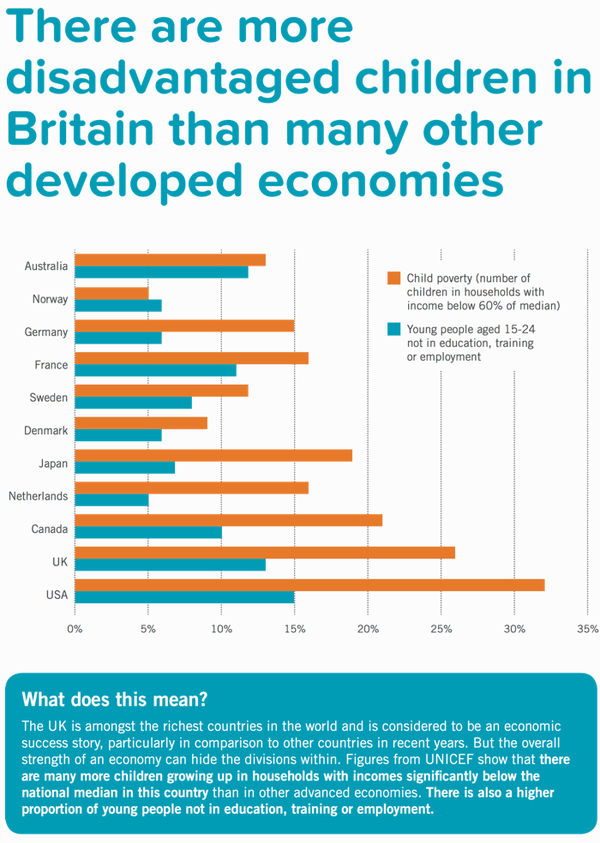
The impact of a Conservative government on Child Poverty – analysis of report by UNICEF

crdb2_0xiaacsaz
Graphic from Inequality Briefing

If ever you needed convincing evidence that austerity – which is central to neoliberalism and social conservatism – doesn’t benefit the majority, and that the UK has a system that extends inequality and increases poverty, this is it.

Furthermore, austerity was not imposed as an economic necessary, and there were other choices available to the UK government that were less damaging to the poorest citizens and to the economy.

UNICEF have published a report about the impact of the global economic crisis and its aftermath on children. It runs fron 2007 to 2013, so worryingly, the more recent UK government welfare cuts and the consequences are not yet included in this international analysis.

In the executive summary, the report says:

“For each country, the extent and character of the crisis’s impact on children has been shaped by the depth of the recession, pre-existing economic conditions, the strength of the social safety net and, most importantly, policy responses

Remarkably, amid this unprecedented social crisis, many countries have managed to limit – or even reduce – child poverty. It was by no means inevitable, then, that children would be the most enduring victims of the recession.”

The report goes on to say that those Governments that supported existing public institutions and programmes helped to buffer countless children from the crisis – a strategy that others may consider adopting.

The UK was quite clearly not one such country, and more recently, Iain Duncan Smith has conveniently announced changes to how we measure child poverty, shifting the economic responsibility and moral focus by blaming individuals for circumstances created by socioeconomic constraints and political decisions.

The report says:

“Many countries with higher levels of child vulnerability would have been wise to strengthen their safety nets during the pre-recession period of dynamic economic growth, which was marked by rising disparity and a growing concentration of  wealth.”

In the UK, inequality has grown since the recession because of austerity measures that have been targeted at the poorest households. In fact, the UK is now the most unequal country in the EU, and has even higher levels of inequality than the US.

“The magnitude of change since the recession is worth noting. The absolute number of children living in severe material deprivation in the 30 European countries analysed was 11.1 million in 2012 – 1.6 million more than in 2008

This trend is the result of a net effect that includes substantial decreases (more than 300,000 fewer deprived children in Germany and Poland) and unprecedented increases in four countries (Greece, Italy, Spain and the United Kingdom).”

Almost half of the severely materially deprived children (44 percent) in 2012 lived in three countries: Italy (16 percent), Romania (14 per cent) and the United Kingdom (14 per cent).

The report goes on to say:

“At the start of the recession, not surprisingly, child poverty was lower where public spending on families and children was higher. During the recession, welfare states were expected to increase their public protection spending, and many did. 

In such countries, the health and well-being of citizens, especially those in financial or social need, are safeguarded by grants, unemployment assistance programmes, pensions and other benefits. 

In a recession, these benefits act as counter-cyclical economic stabilizers.”

One of the most striking contrasts in the report was that whilst many other countries increased spending on welfare and essential public services to shelter the most vulnerable citizens from the impact of the global recession, in the UK, the government chose to target those social provisions for all of the austerity cuts.

The report says:

“Since 2010, the United Kingdom has implemented a series of cuts that have reduced the real value and coverage of child benefits and tax credits for families withchildren. In 2013, a cap was imposed on the total benefits a household can receive, mainly affecting a small number of large families with high housing costs, while housing benefits were cut (the so-called ‘bedroom tax’), affecting large numbers of social tenants.”

It’s clear that the impacts and aftershocks of the global recession were not shared equally in our society, and the austerity measures have only made things worse for those most affected – the poorest. One emerging certainty from this report is that economic indicators alone do not reveal the complexity of social reality.

The report recommends that governments increase investment in social protection policies and programmes that can reduce poverty, enhance social resilience in children and support economic development in an efficient, costeffective way.

Such measures include guaranteeing basic incomes for families, and a child rights impact assessment as strategy for political decision-making in the best interests of children.

Last year, I wrote that the government’s Children’s Commissioner for England published a report criticising the Coalition’s austerity policies, which have reduced the incomes of the poorest families by up to 10 percent since 2010.

The Children’s Commissioner said that the increasing inequality which has resulted from the cuts, and in particular, the welfare reforms, means that Britain is now in breach of the United Nations Convention on the Rights of the Child, which protects children from the adverse effects of government economic measures.

It therefore comes as no surprise that the current government is planning to repeal our Human Rights Act and replace it with an alternative Bill of Rights. That will mean that  human rights will no longer be absolute – they will be subject to stipulations and caveats. The government will establish a threshold below which Convention rights will not be engaged, allowing UK courts to strike out what are deemed “trivial cases”.

During their last term, the Conservatives contravened the Human Rights of disabled people, women and children. It’s clear that we have a government that regards the rights and wellbeing of most of the population as an inconvenience to be brushed aside.

You can read the UNICEF report in full here.

(Non -discrimination): The Convention applies to all children, whatever their race, religion or abilities; whatever they think or say, whatever type of family they come from. It doesn’t matter where children live, what language they speak, what their parents do, whether they are boys or girls, what their culture is, whether they have a disability or whether they are rich or poor. No child should be treated unfairly on any basis.

Article 3

(Best interests of the child): The best interests of children must be the primary concern in making decisions that may affect them. All adults should do what is best for children. When adults make decisions, they should think about how their decisions will affect children. This particularly applies to budget, policy and law makers.

Article 26

(Social security): Children – either through their guardians or directly – have the right to help from the government if they are poor or in need.

Article 27

(Adequate standard of living): Children have the right to a standard of living that is good enough to meet their physical and mental needs. Governments should help families and guardians who can not afford to provide this, particularly with regard to food, clothing and housing.

1957929_293215800829475_303676825_o

Have your say on the Welfare Reform and Work Bill

430847_149933881824335_1645102229_n (1)

Do you have relevant expertise and experience or a special interest in the Welfare Reform and Work Bill which is currently passing through Parliament?

If so, you can submit your views in writing to the House of Commons Public Bill Committee which is going to consider this Bill.

Welfare Reform and Work Bill 2015-16

Aims of the Welfare Reform and Work Bill

The Government website claims that the Bill would make provision about reports on progress towards full employment and the apprenticeships target; to make provision about reports on the effect of certain support for troubled families; to make provision about social mobility; to make provision about the benefit cap; to make provision about social security and tax credits; to make provision for loans for mortgage interest; and to make provision about social housing rents.

However, many of us see the Bill as a further economic attack on Britain’s poorest families. I’m concerned it includes many measures that risk trapping more children into poverty.

Beyond the well-publicised cuts to tax credits, which will leave many families on low wages struggling to buy basics, the government also plans to cap benefits. For the moment this will be set at £20,000 (£23,000 in Greater London), but a clause in the Bill allows the government to change the amount in future too – without consulting parliament. This paves the way for the threshold to sink ever lower, consigning children from larger families to the breadline without any democratic scrutiny or safeguarding.

Perhaps the most worrying element of the Bill is the government’s decision to abandon the duty to end child poverty by 2020. Instead this Bill would redefine “poverty”, scrapping income as the way we measure being poor and replacing it with worklessness, addiction and educational attainment. Given that two-thirds of our poorest children already live in low-paid “working” families, this is a completely unacceptable way to measure hardship. Furthermore, addiction is not a class-based problem, it affects wealthy people too, in fact substance abuse – especially alcohol related – is something that affects people who aren’t in poverty more than those who are. As for educational attainment, well Iain Ducan Smith has no qualifications, but he isn’t poor. I’ve a first degree and a Masters and I am poor.

If the causes of poverty, according to Duncan Smith, were in any way correct, we’d see the same people on the dole, year in year out. But we don’t. Instead we see  a “revolving door” of claims from people who take low paid, insecure work for months or a couple of years at the most and end up out of work again. Through no fault of their own. This revolving door is consistent with the structural explanation of povertythat government decision-making and socieconomic circumstances are the causes poverty.

This Bill would make the government dramatically less accountable for its policies, leaving poor families worse off and limiting children’s life chances.

Javed Khan
Chief executive, Barnardo’s

Other Briefings

Welfare Reform and Work Bill 2015 final – Unison

Welfare Reform and Work Bill: what might this mean for carers – Carers UK

Briefing: Welfare Reform & Work Bill – Shelter England

Joseph Rountree Foundation: Welfare Reform and Work Bill: Second Reading | JRF

Briefing on the Welfare Reform and Work Bill FINAL -TUC

The Children’s Society Briefing: House of Commons Second Reading of the Welfare Reform and Work Bill

Follow the progress of the Welfare Reform and Work Bill

The Bill was presented to the House on 9 July 2015. On Monday 20 July, the Bill received its Second Reading in the House of Commons where MPs debated the main principles of the Bill.

The Bill has now been sent to the Public Bill Committee where detailed examination of the Bill will take place. The Bill Committee is expected to hold its first oral evidence session on 10 September.

Guidance on submitting written evidence

Deadline for written evidence submissions

The Public Bill Committee is now able to receive written evidence. The sooner you send in your submission, the more time the Committee will have to take it into consideration. The Committee is expected to meet for the first time on Thursday 10 September; it will stop receiving written evidence at the end of the Committee stage on Thursday 15 October.

Please note: When the Public Bill Committee reports, it is no longer able to receive written evidence and it could report earlier than Thursday 15 October 2015.

What should written evidence cover?

Your submission should address matters contained within the Bill and concentrate on issues where you have a special interest or expertise, and factual information of which you would like the Committee to be aware.

Your submission could most usefully:

  • suggest amendments to the Bill with explanation; and
  • (when available) support or oppose amendments tabled or proposed to the Bill by others with explanation

It is helpful if the submission includes a brief introduction about you or your organisation. The submission should not have been previously published or circulated elsewhere.

If you have any concerns about your submission, please contact the Scrutiny Unit (details below).

How should written evidence be submitted?

Your submission should be emailed to scrutiny@parliament.uk. Please note that submissions sent to the Government department in charge of the Bill will not be treated as evidence to the Public Bill Committee.

Submissions should be in the form of a Word document. A summary should be provided. Paragraphs should be numbered, but there should be no page numbering.

Essential statistics or further details can be added as annexes, which should also be numbered. To make publication easier, please avoid the use of coloured graphs, complex diagrams or pictures.

As a guideline, submissions should not exceed 3,000 words.

Please include in the covering email the name, address, telephone number and email address of the person responsible for the submission. The submission should be dated.

What will happen to my evidence?

The written evidence will be circulated to all Committee Members to inform their consideration of the Bill.

Most submissions will also be published on the internet as soon as possible after the Committee has started sitting.

The Scrutiny Unit can help with any queries about written evidence.

Scrutiny Unit contact details

Email: scrutiny@parliament.uk
Telephone: 020 7219 8387
Address: Ian Hook
Senior Executive Officer
Scrutiny Unit
House of Commons
London SW1A OAA

A tale of two suicides and a very undemocratic, inconsistent government

385294_195107567306966_1850351962_n

“No, we have not carried out a review […] you cannot make allegations about individual cases, in tragic cases where obviously things go badly wrong, you can’t suddenly say this is directly as a result of government policy”– Iain Duncan Smith, Secretary of State for Work and Pensions, 5 May 2015.

Back in July, the Information Commissioner’s Office opened an investigation into four of the UK’s largest charities, following allegations that their fundraisers contacted people registered with the government’s opt-out nuisance call database.

David Cameron led the calls for fundraising regulators to investigate whether a 92-year-old poppy-seller, found dead in Avon Gorge after committing suicide, had been under pressure from charities asking for donations.

A spokesperson for the Information Commissioner’s Office, the watchdog responsible for enforcing data protection laws, said: “We’re aware of allegations raised against several charities, and will be investigating whether there have been any breaches of the Data Protection Act or privacy and electronic communication regulations.” 

It was the workers at a London call centre, fundraising on behalf of the charities, who were accused of calling, and being prepared to take money from, vulnerable people, including the elderly and those living with dementia, the Daily Mail reported.

Those with dementia and Alzheimer’s were allegedly being treated as legitimate targets – as long as they agree to the call and are able to answer a few basic questions over the phone.

Cameron said: “I know there is a code that is meant to protect people from feeling pressured by charities and I hope the Fundraising Standards Board will look at whether any more could have been done to prevent this.” 

However, although Olive Cooke did tragically kill herself, it has since been established by her family and at an inquest that her suicide wasn’t related to charity fundraising requests at all.

So, Mr Cameron didn’t hesitate to make a connection between a tragic suicide and the policy of “charities, who were accused of calling, and being prepared to take money from, vulnerable people.” As it happens, he drew the wrong inference from remarkably little empirical evidence. I say remarkably little, because in similar circumstances involving suicides and deaths in other social groups, David Cameron demands that people don’t make any inferences at all and from much more reliable evidence than he had to draw on in order to conclude that an investigation was warranted into the impact of charities’ fundraising requests.

This said, one tragic death really ought to trigger an inquiry into policy. That is the right thing to do.

The Stark Contrast.

In 2013, a disabled man committed suicide as a direct result of being found “fit to work” by the government’s work capability assessment. In a report to the Department of Work and Pensions, the coroner for Inner North London demanded that the Government department take action to prevent further deaths.

The coroner’s report on the death of Michael O’Sullivan warns of the risk of more such deaths. Michael, a 60-year-old father of two from north London, killed himself at his home after being moved from employment support onto jobseekers allowance, despite providing reports from three doctors, including his GP, that he was suffering from serious long-term depression and agoraphobia and had been certified as unable to work.

The coroner said that Michael’s anxiety and depression were long-term problems, but the intense anxiety that triggered his suicide was caused by his (then) recent assessment by the DWP as being fit for work.

Surprisingly, David Cameron did not lead any calls for an investigation into the policies that caused this tragic suicide, despite the coroner’s report and widely shared, well-documented, (and evidenced) concerns that the Department of Work and Pensions is placing sick and disabled people under enormous strain which is unacceptably harmful and distressing. The Conservative welfare reforms included an increase in benefit “conditionality” which involves punitive sanctions and rigid assessments that are not designed to provide support, but rather, to save money and remove people’s eligibility for lifeline social security benefit, causing them severe hardship, harm, and sometimes, causing their death.

In other words, the Department of Work and Pensions “are prepared to take money from vulnerable people.”  This is the only income that people claiming benefits have to meet their basic survival needs.

Furthermore, Mr Cameron has persistently refused to carry out even basic monitoring of the impact of his government’s policies despite longstanding public concerns about the fact that they are causing sick and disabled people harm. This government have doggedly refused to release information regarding the mortality rates of people who face the negative impact of Conservative policies every day.

David Clapson, 59, was a former soldier and had type-one diabetes, he died in last year after he was sanctioned – his benefit was stopped as a punishment – because he missed an appointment at the jobcentre. The coroner reported that Mr Clapson had no food in his stomach, £3.44 in the bank and no money on his electricity meter card, leaving him unable to operate his fridge where he kept insulin, which has to be kept refrigerated. He died of diabetic ketoacidosis because he couldn’t take his insulin.

In addition to tragic cases like those of Michael and David that are reported in the media, there are many others raised in parliament by MPs and through the work of select committees, which are evidenced on the parliamentary Hansard record of course. Additionally, some of us also keep a record of the growing number of people who have died prematurely because of the welfare “reforms”. 

Furthermore, the United Nations believe there is sufficient evidence to warrant an investigation into the impact of Tory policies, the UK has  become the first developed country to be the subject of an inquiry into “grave and systematic” violations of the rights of disabled people. Wouldn’t you think that this would prompt some concern and scrutiny of policies and impacts from the Government? But it hasn’t.

The government persistently deny there is any correlation between suffering, hardship, an increase in suicide and deaths amongst disabled people and their punitive policies. Yet there is substantial evidence to demonstrate a very clear correlation, and certainly more than enough to warrant an inquiry into the harmful impact of the policies on sick and disabled people. After all, one unrelated death was sufficient to warrant an inquiry into the fundraising policy of charities.

Yet we are told by David Cameron that “it is quite wrong to suggest any causal link between the death of an individual and their benefit claim” when evidence strongly suggests such a link. An inquiry is the only way that the correlation could possibly be refuted, but the Government realise that a refutation is an unlikely outcome, hence their refusal to allow an inquiry in the first place.

Campaigners have fought to ensure that information about the harmful impact of government reforms was open to public scrutiny. The truth, however, still remains hidden beneath the excessively and purposeful bureaucratic management of this information and political denials of culpability. Mike Sivier, a fellow campaigner and writer at Vox Political, requested a tribunal after he made a Freedom of Information request for access to the information – and it was refused. Over the last three years, many of us submitted FOI requests for the same information and all were refused.

This is not an accountable, transparent or democratic Government. Let’s not forget the political fabrication of case studies of people “helped” by having their lifeline benefits stopped, presumably because they couldn’t find any real people who would attest to such absurd, ideologically driven, class contingent political acts of targeted cruelty. What real person would ever claim that starvation, being cold and facing destitution “helped” them in any way?

After suppressing information for years, the Department of Work and Pensions finally released data about the deaths of sick and disabled people, but the release was partial, and was not responsive to the detailed request made for detailed and specific information. In fact the data was presented in such an intentionally contextless and incomplete way that there wasn’t even scope for analytical cross comparisons to be made. The release was deliberately limited and impenetrable, as the department of Work and Pensions acknowledged when the report was published with this proviso:

“Any causal effect between benefits and mortality cannot be assumed from these statistics. Additionally, these isolated figures provide limited scope for analysis and nothing can be gained from this publication that would allow the reader to form any judgement as to the effects or impacts of the Work Capability Assessment.”

(From the Department of Work and Pensions report Mortality Statistics, 2015.)

I will leave you to draw your own inferences regarding the startling disparity and incoherence apparent in the two distinct government  responses to suicides and deaths in two separate and differentially valued social groups – one that is politically marginalised, one that is not – and the government suppression of information regarding the impact of their targeted, draconian austerity policies.

All lives have equal worth. But I think it’s safe to say that we’re not “all in it together” as Cameron claimed. He believes that some lives are more important and some suicides are more worthy of investigation than others. It is very clear that this government does not care about the lives and welfare of sick and disabled people.

Call me cynical but I wonder which social group are more likely to vote Conservative?

Related

Suicides reach a ten year high and are linked with welfare “reforms”

292533_330073053728896_1536469241_nPictures courtesy of Robert Livingstone

The Coalition are creating poverty via their policies

PANews+BT_N0321471377269205233A_I1

“David Cameron and George Osborne believe the only way to persuade millionaires to work harder is to give them more money.

But they also seem to believe that the only way to make ordinary people work harder is to take money away.”

Ed Miliband.

Source: Hansard, December 12, 2012.

The largest study into poverty in the UK has prompted fresh urges for the government to take measures to tackle growing levels of poverty. The Poverty and Social Exclusion in the United Kingdom (PSE) project is a collaboration between the University of Bristol, University of Glasgow, Heriot Watt University, Open University, Queen’s University (Belfast), University of York, the National Centre for Social Research and the Northern Ireland Statistics and Research Agency.

The project commenced in April 2010 and will run for three-and-a-half years. The research has revealed that inequality in the UK is growing.

The research paper presents an analysis of child poverty and social exclusion in the UK, drawing on data from the 2012 Poverty and Social Exclusion Survey and is the final report on this element of the PSE project. It advances the measurement of child poverty by using three different measures: a child deprivation measure, based on socially perceived necessities, the conventional income poverty measure (but with a more realistic equivalence scale) and a PSE measure which combines deprivation and low income.

The research finds the rates of child poverty for each measures are similar at 30%, 33% and 27% respectively. It also finds, from a new analysis of intra-household distribution, that child deprivation would be much higher if parents were not sacrificing their own living standards for the sake of their children. Analysing the characteristics of poverty, it confirms that a majority of poor children are now living in households with someone in employment.

Perhaps this is the most interesting revelation unearthed by the report: the fact that most of the people living in poverty are employed, dispelling the myth perpetuate by Tory ministers that poverty is a consequence of “worklessness”.

The research found that the majority of children living below the breadline live in small families with at least one employed parent.

Almost 18 million people are unable to afford adequate housing, while one in three do not have the money to heat their homes in winter.

Professor David Gordon said: “The Coalition government aimed to eradicate poverty by tackling the causes of poverty. Their strategy has clearly failed. The available high quality scientific evidence shows that poverty and deprivation have increased since 2010, the poor are suffering from deeper poverty and the gap between the rich and poor is widening.”

We know that benefit delays and the grossly punitive sanction regime are causing dire hardship for people who claim out-of-work benefits, including disabled people  who are deemed unfit for work by their doctor.

We are not simply talking about relative deprivation, here, which is more of a statement about degrees of social exclusion. We are talking about absolute poverty, which is a measure of how many can’t afford basic necessities to support life – food, fuel and shelter.

There are many current studies about poverty, all of which conclude pretty much the same: that poverty and inequality are rising, that people are struggling to meet their most basic needs, and that those who were already the poorest citizens have been hit the hardest by Coalition cuts

The problem isn’t that the government “aren’t doing enough” to tackle poverty: the real problem is that Tory policies are creating poverty.

Three things are immediately clear. Firstly, without the ramping up of VAT in 2010, to 20%, Osborne would be in even more dire financial straits right now. Secondly, income tax has, despite apparently rising employment, failed to increase. Thirdly, corporation tax, targeted for cuts, year after year, has slumped.

The tax system is increasingly veering toward very regressive – biased in favour of the wealthy – consumption taxes, and failing to deliver fairer taxes on income. This is a result of government policy, increasing VAT but cutting corporation tax, and the engineered kind of “recovery” we have ended up with.

We know that austerity is not an economic necessity, as claimed by the Coalition: it’s a Tory ideological preference, aimed at fulfilling a Tory obsession: “shrinking the State“.

We also know that Cameron, who rested all of his political credibility on “paying down the debt” hasn’t done so. In fact, he’s increased it, and the Coalition have borrowed more in just the first three years in Office than the Labour Party – faced with a global banking crisis – did in their entire thirteen years in Office.

If we scrutinise the Coalitions’s policies, which very clearly reflect their ideology, it becomes difficult to see how they could do anything but create inequality and poverty:

These cuts, aimed at the poorest, came into force in April 2013:

  • 1 April – Housing benefit cut, including the introduction of the bedroom tax
  • 1 April – Council tax benefit cut
  • 1 April – Legal Aid savagely cut
  • 6 April – Tax credit and child benefit cut
  • 7 April – Maternity and paternity pay cut
  • 8 April – 1% cap on the rise of in working-age benefits (for the next three years)
  • 8 April – Disability living allowance replaced by personal independence payment (PIP)
  • 15 April – Cap imposed on the total amount of benefit working-age people can receive.

At the same time, note the Tory “incentives” for the wealthy:

  • Rising wealth – 50 richest people from this region increased their wealth by £3.46 billion last year to a record £28.5 billion.
  • Falling taxes – top rate of tax cut from 50% to 45% for those earning over £150,000 a year. This is 1% of the population who earn 13% of the income.
  • No mansion tax and caps on council tax mean that the highest value properties are taxed proportionately less than average houses.
  • Benefited most from Quantitative Easing (QE) – the Bank of England say that as 50% of households have little or no financial assets, almost all the financial benefit of QE was for the wealthiest 50% of households, with the wealthiest 10% taking the lions share
  • Tax free living – extremely wealthy individuals can access tax avoidance schemes which contribute to the £25bn of tax which is avoided every year,as profits are shifted offshore to join the estimated £13 trillion of assets siphoned off from our economy.
  • Millionaires were awarded a “tax break” of £107,000 each per year.

This year, research from the Office of National Statistics showed that the quantity of food bought in food stores also decreased by 1.5 per cent year-on-year in July.

It doesn’t take a genius to work out that repressed, stagnant wages and RISING living costs are going to result in reduced sale volumes. Survation’s research in March this year indicates that only four out of every ten of UK workers believe that the country’s economy is recovering. But we know that the bulk of the Tory austerity cuts were aimed at those least able to afford any cut to their income.

Once again, what we need to ask is why none of the mainstream media articles, or the Office of National Statistics account, duly reporting the drop in food sales, have bothered to link this with the substantial increase in reported cases of malnutrition and related illnesses across the UK.

It’s not as if this correlation is a particularly large inferential leap, after all.

No-one should be hungry, without food in this country. That there are people living in a politically imposed state of absolute poverty is unacceptable in the UK, the world’s sixth largest economy (and the third largest in Europe). This was once a civilised first-world country that cared for and supported vulnerable citizens. After all, we have paid for our own welfare provision, and we did so in the recognition that absolutely anyone can lose their job, become ill or have an accident that results in disability. This is a Government that very clearly does not reflect the needs of the majority of citizens.

It is also unacceptable in a so-called liberal democracy that we have a Government that has persistently denied the terrible consequences of their own policies, despite  overwhelming evidence that the welfare “reforms” are causing people, harm, distress and sometimes, death. Furthermore, this is a Government that has systematically employed methods to effectively hide the evidence of the harm caused to others as a consequence of their devastating, draconian “reforms” from the public. This clearly demonstrates an intention to deceive, and an intention to continue causing people harm.

Cameron told us in 2012, in a rare moment of truth (albeit an unintentional one),  that he is raising more money for the rich. That money has been raised because as their policies indicate clearly, the Tories have taken it from the poorest.

How many policy-related deaths does it take to change a government?

What will it take for the wider public to recognise a despotic regime for what it is: a government that does not democratically reflect the needs of most citizens in the UK, one that is inflicting unforgivable punishment on those that our society once protected?

What kind of government causes harm to citizens?

With the hierarchical ranking in terms of “deserving” and “undeserving” poor, the artificial and imposed framework of Social Darwinism: a Tory rhetoric of division, where some people’s worth matters more than others, how do we, as conscientious campaigners, help the wider public see that there are no divisions based on some moral measurement, or character- type: there are simply people struggling and suffering in poverty, who are being dehumanised by a callous, vindictive Tory government that believes, and always has, that the only token of our human worth is wealth.

Tory policies ensure that the wealthy are rewarded with more wealth and they punish the poorest with grinding, unforgiving, unforgivable absolute poverty.

Big questions for Boris over corrupt billion dollar property deal

Channel Four Exclusive: Boris Johnson is under fire over his handling of a £1bn deal for a Chinese firm to redevelop a huge site on London’s historic Royal Albert Dock.

From Michael Crick, political correspondent.

This follows an investigation by Channel 4 News into the track record in China of the firm which won the contract – ABP – and into whether ABP were given favourable treatment during the tender process.

There are also questions over donations to the Conservative Party from an Anglo-Chinese businesswoman who acted as adviser to ABP.

Sir Alistair Graham, a former chairman of the government’s Committee on Standards in Public Life, suggested to Channel 4 News there should be an independent investigation into the tendering process for the development, which will take place on publicly-owned land.

“It has the smell of a semi-corrupt arrangement, doesn’t it?” he told Channel 4 News:

“If, in fact, somebody is going through a sham process to ensure that someone they want to be successful in the process, but it’s not a level playing field for UK companies, and there have been some financial transactions of an intimate nature then that smells to me of a semi corrupt arrangement.”

In May 2013 the Greater London Authority granted Advanced Business Park – known as ABP – the tender to develop the 35-acre site at the Royal Albert Dock, a derelict site opposite London’s City Airport. The development was hailed by Boris Johnson as “a beacon for investors”, and ABP hope that the site will become an important forum for scores of Chinese firms operating in Britain. The project will include 3.2 million square feet of office space, leisure facilities, and 845 residential flats. It is thought to be China’s largest property investment in the UK.

ABP’s human rights record

Our film raises serious concerns about ABP’s human rights record in China. We discovered that ABP, and their partners in Chinese local government, were involved in the forced removal of some residents from their homes at the site of their one completed development in Beijing. We have obtained amateur video footage, shot by a resident, of demolition teams tearing down a family’s home with all their possessions inside, on Christmas Day 2010. The family also say they were denied fair compensation for losing their home. We have substantial legal paperwork detailing their efforts to secure proper compensation in the Chinese courts.

Boris Johnson confirmed to me in an interview for Channel 4 News that neither he, nor the Greater London Authority (which Johnson runs), assessed ABP’s human rights record in China as part of the evaluation process.

Johnson also said ABP’s human rights record in China “wasn’t relevant to the tendering process.” But the Mayor promised to “look at” any new information.

Sir Alastair Graham disagrees: “Of course, in any bidding process one of the first things you look at is the track record of what they have done. Are they a safe pair of hands, or have they got a style of operation that would be totally inappropriate and alien in the UK?” Enquiries by Channel 4 News strong also suggest ABP had what could be perceived as an unfairly cosy relationship with London and Partners, Boris Johnson’s taxpayer funded agency set up to attract foreign investment to London.

In particular, London and Partners has been sharing an office with ABP in Beijing since March 2012. London and Partners was involved in the marketing of the project, and was described as a “stakeholder” in the tender process. Channel 4 News has official documentation which show that they were asked to make an assessment of ABP’s claims that the company had lined up other Chinese companies that would take space in the new development – a critical aspect of ABP’s pitch.

What’s more, Tongbo Liu, the former head of London and Partners, who used to act as Boris Johnson’s personal representative in China, left the agency to work for ABP in March 2012, while the tender process was still going on. He has told us that ABP took over the lease of the office at the same time paying 70 per cent of the rent.

‘They are a subsidiary of the Mayor’

We have confirmation from London and Partners that ABP currently have the lease of the London and Partners office in Beijing and L&P pay 30 per cent of the rent. In a statement we were told that ABP moved into the office in Beijing in 2011, but that the two bodies had separate leases with the landlords until January 2013.

Nicky Gavron, Labour’s most senior member on the Greater London Assembly, told us: “The Mayor set up London and Partners, and London and Partners are his inward investment arm, and he funds two thirds of them. So they are a subsidiary of the Mayor. The Mayor appoints the Chairman. So you would expect the Mayor to have a grip on the practices of London and Partners.”

Gavron added: “If there are questions raised about London and Partners, I think then it raises concerns about the Mayor’s overseeing of the practices of London and Partners.” She agreed that the buck stopped with Boris Johnson.

“When you are executive Mayor and a one-man band, it does.” The Mayor of London Boris Johnson told me in an interview this week that the tendering process was “fair and square” and the development was good for London: “This area you are talking about in the Docklands, has basically been derelict for about 50 years,” he said. “The proposal to develop it and create a new business park seems to us to be very positive and I think it will be a very great thing for London.

It will represent a significant investment in the city. It will drive jobs, drive employment, enable us to get homes built, because when you get jobs, you can get homes going.”

Xuelin Black, married to the Home office minister

The third area our film explores is the role played by Xuelin Black, an Anglo-Chinese businesswoman who is married to the Home office minister Lord (Michael) Bates. Black suggested the Royal Dock site to the boss of ABP, Xu Weiping, and even registered a company called ABP London China to help push the project forward, though the company was dissolved two years later, and she says she established it without the knowledge of Xu Weiping. Between 2010 and 2012 Xuelin Black gave donations which total at least £162,000 to the Conservative Party.

Since ABP won the contract these big donations have dried up. She insists the money was hers, and didn’t come from ABP or Xu Weiping, and she says she has continued to give money to the Tories. But her donations are now about £5,000 a year, not enough to appear on the Electoral Commission’s public register of party donations. Our revelations about the Royal Albert Dock development are unlikely to prove fatal to Boris Johnson, but they may add to his reputation for cutting corners. The post of Mayor of London was established to overcome bureaucratic hurdles and push through major projects like this.

But in his rush to bring big foreign investment to London at a time of recession, should Johnson have done more to examine ABP’s background, and did the cosiness of his people with ABP mean that the whole process was not a level playing field, and therefore unfair to the dozen other bidders for the development, most of whom were British.

Read the investigation from Channel Four here

Human rights are the bedrock of democracy, which the Tories have imperiled.

not negot
The prime minister has again confirmed that a future majority Conservative government would repeal Labour’s landmark legislation – the Human Rights Act , 1998 – and replace it with a “British Bill of Rights”, as I reported back in Julyand he has previously pledged to leave the  European Convention on Human Rights, as I’ve also reported.

And I wrote this earlier today: The lord chancellor is dismantling the rule of law, which discusses how  Grayling is preparing to unveil Tory plans to scrap Britain’s human rights laws. The plans would repeal the Human Rights Act and break the formal link between the European Court of Human Rights and British law. Its judgement would now be treated as “advisory” and need to be approved by parliament. 

Grayling has already tried to take legal aid from the poorest and most vulnerable, in a move that is so clearly contrary to the very principle of equality under the law. He turned legal aid into an instrument of discrimination. He has tried to dismantle the vital legal protection available to the citizen – judicial review – which has been used to stop him abusing his powers again and again. He has tried to restrict legal aid for domestic abuse victims, welfare claimants seeking redress for wrongful state decisions, victims of medical negligence, for example. And now he wants to take away citizens’right to take their case to the European court.

I have argued elsewhere that even if we were to take a Conservative perspective, it’s still the case that the only way to wed the principle of a “pursuit of economic liberty” with wider justice is by a basic notion of equality before the law, through the equal access to justice. This means that the State must fund the means of contract enforcement and free and fair trial legal costs, for those who cannot afford it. If the State fails to fulfil this contingent function, then we simply cease to be free. 

The Tory attack on our universal human rights is not about euroscepticism, terrorists, cats, “common sense” or any of the other Sun and Daily Mail endorsed ideological justifications they are using. It is about scrapping our essential legal protections against the state, with each Tory policy advancing authoritarianism by almost inscrutable degrees, eroding our democratic freedoms further and further.

Director of the civil rights organisation Liberty, Shami Chakrabarti, said: “Shame on the prime minister for citing Churchill, while promising to trash his legacy. The convention protects both prisoners of war and soldiers sent off to fight and die with inadequate equipment. But the prime minister believes there is no place for human rights in Helmand – on that, he and Isis agree.”

Amnesty UK’s campaigns director, Tim Hancock, said: “Theresa May made much in her speech about how we must stand up and fight for human rights abroad, it makes absolutely no sense to denigrate those same rights at home.

It’s exasperating to hear the prime minister vow to tear up the Human Rights Act again – so he can draft ‘his own’. Human rights are not in the gift of politicians to give. They must not be made a political plaything to be bestowed or scrapped on a whim. It’s time politicians accepted that they too have to follow the rules and that those rules include the civilising human rights standards Churchill championed.”

In his speech to the Tory party conference in Birmingham, Cameron did not explicitly threaten to withdraw from the European convention on human rights, a move that would have wide-ranging, international repercussions for the UK’s relationship with Europe.

The prime minister told Conservative delegates: “It’s not just the European Union that needs sorting out – it’s the European court of human rights. When that charter was written, in the aftermath of the second world war, it set out the basic rights we should respect.

But since then, interpretations of that charter have led to a whole lot of things that are frankly wrong. Rulings to stop us deporting suspected terrorists. The suggestion that you’ve got to apply the human rights convention even on the battlefields of Helmand. And now – they want to give prisoners the vote. I’m sorry, I just don’t agree.”

Erm… hello, Mr Cameron, but this isn’t just about egocentric ole’ you.

Last time I checked, this was a first-world liberal democracy, and not your “kingdom”, or a totalitarian state. The principle that “all power ultimately rests with the people and must be exercised with their consent” lies at the heart of democracy. Democracy is premised on the recognition and protection of people’s right to have a say in all decision-making processes which is itself based on the central principle of equality of all human beings.

The purpose of democracy, like that of human rights protection, is to uphold the dignity of every individual and to ensure that the voices of the weakest are also heard. Its core values – freedom, equality, fraternity, accommodation of diversity and the assurance of justice underpin the norms of human rights as well.

Democracy is one of the universal core values and principles of the United Nations. Respect for human rights and fundamental freedoms and the principle of holding periodic and genuine elections by universal suffrage are essential elements of democracy. These values are embodied in the Universal Declaration of Human Rights and further developed in the International Covenant on Civil and Political Rights which enshrines a host of political rights and civil liberties underpinning meaningful democracies.

The Rule of Law and Democracy Unit stands as the Office of the High Commissioner for Human Rights (OHCHR) focal point for democracy activities. The Unit works to develop concepts and operational strategies to enhance democracy and provide guidance and support to democratic institutions through technical cooperation activities and partnership with the relevant parts of the UN, notably the UN Democracy Fund, the Department of Political Affairs and the newly established UN Working Group on Democracy. Legal and expert advice are provided as required to OHCHR field operations on relevant issues such as respect for participatory rights in the context of free and fair elections, draft legislation on  national referenda and training activities.

The strong link between democracy and human rights is captured in article 21(3) of the Universal Declaration of Human Rights, which states:

“The will of the people shall be the basis of the authority of government; this will shall be expressed in periodic and genuine elections which shall be by universal and equal suffrage and shall be held by secret vote or by equivalent free voting procedures.” 

The link is further developed in the Covenant on Civil and Political Rights which enshrines a host of political rights and civil liberties underpinning meaningful democracies. The rights enshrined in the International Covenant on Economic, Social and Cultural Rights and subsequent human rights instruments covering group rights (e.g.indigenous peoples, minorities, people with disabilities) are equally essential for democracy as they ensure inclusivity for all groups, including equality and equity in respect of access to civil and political rights.

More recently, in March 2012, the Human Rights Council adopted a resolution titled “Human rights, democracy and the rule of law,” which reaffirmed that democracy, development and respect for all human rights and fundamental freedoms were interdependent and mutually reinforcing.

The Council called upon States to make continuous efforts to strengthen the rule of law and promote democracy through a wide range of measures. It also requested the OHCHR, in consultation with States, national human rights institutions, civil society, relevant inter-governmental bodies and international organizations, to draft a study on challenges, lessons learned and best practices in securing democracy and the rule of law from a human rights perspective.

Human rights, democracy and the rule of law are core values of the European Union, too. Embedded in its founding treaty, they were reinforced when the EU adopted the Charter of Fundamental Rights in 2000, and strengthened still further when the Charter became legally binding with the entry into force of the Lisbon Treaty in 2009.

I think that the Conservative Party, even if they managed a narrow majority, ought to be expecting to find it very difficult to pass such a seriously partisan bill. That they aren’t troubles me greatly.Graylings’ documented proposals have drawn a furious response from the Tories’ coalition partners. Simon Hughes, the Liberal Democrat justice minister, said: “The Conservatives don’t care about the rights of British citizens – they care about losing to Ukip. These plans make no sense: you can’t protect the human rights of Brits and pull out of the system that protects them.”

Europe’s human rights laws were designed by British lawyers to reflect British values of justice, tolerance and decency. We will not allow the Tories to take away the hard-won human rights of British people when in the UK or anywhere else in Europe.

Andrea Coomber, director of the civil rights group Justice, said: “Conservative party policy now says: ‘We support minimum human rights standards, but only if we define their content.’ A patchwork of national rules would mean no standard at all; every human being, subject only to the whims of national interest. This vision would reset the clock to 1945, before Eleanor Roosevelt, Churchill and Maxwell-Fyfe ever put pen to paper.”

Sadiq Khan, the shadow justice secretary, said: “Once again David Cameron is pandering to UKIP instead of standing up for the rights and best interests of the people of Britain. The truth is that our courts have been free to interpret rulings by the European convention on human rights for 50 years – the Human Rights Act did nothing to change that fact.”

Labour’s Human Rights Act ought to be a source of pride. It is a civilised and a civilising law. It ensures that Britain remains a nation where key universal benchmarks of human decency and protections against state abuse are upheld by the courts. There is already a modern British bill of rights already. It is called the Human Rights Act (HRA).

The rights protected by the Act are quite simple. They include the right to life, liberty and the right to a fair trial; protection from torture and ill-treatment; freedom of speech, thought, religion, conscience and assembly; the right to free elections; the right to fair access to the country’s education system; the right to marry and an overarching right not to be discriminated against. Cameron has argued that it should be repealed just 10 years after its implementation (the HRA came into force in October 2000) … so that he can pass another Act.

No other country has proposed de-incorporating a human rights treaty from its law so that it can introduce a Bill of Rights. The truly disturbing aspect of Cameron’s Bill of Rights pledge is that rather than manifestly building on the HRA, it’s predicated on its denigration and repeal. One has to wonder what his discomfort with the HRA is. The Act, after all, goes towards protecting the vulnerable from neglect of duty and abuse of power. Are we really believe Cameron (Or Farage, who also states that he intends to repeal the HRA, given the opportunity) is more likely to build on existing rights and freedoms or to destroy them?

The front page agendas of the Sun and Daily Mail indicate quite plainly the latter. And they have established form. Tory policies violate International Human Rights  standards, a fact that was met with only sneering contempt and denial from our authoritarian government. I’ve written at length previously about the Tory-led persecution of some of our most vulnerable citizens.

It seems to me that their callous indifference to the welfare of UK citizens is coupled with a drive to avoid international scrutiny and accountability, as well as at a national level. The government are certainly seeking to insulate themselves from legal challenge, and restrict the ability of citizens to hold to account future governments that break the law. And this general trend of creeping authoritarianism doesn’t bode well, coupled with the intent to scrap our protective rights, here.

The rights protected by the HRA are drawn from the 1950 European convention on human rights, which was a way of ensuring that we never again witness the full horrors of the second world war, the rise of Fascism and overwhelmingly, one of the greatest stains on the conscience of humanity – the Holocaust. Winston Churchill was one of the main drivers of the Convention, it was largely drafted by UK lawyers and the UK was one of the first countries to ratify it in 1951.

This was the establishing simple set of minimum standards of decency for humankind to hold onto for the future. The European Convention on Human Rights and Fundamental Freedoms (ECHR) was drafted as a lasting legacy of the struggle against fascism and totalitarianism. Yet the HRA is quite often portrayed by the Right as a party political measure.

However, whilst the Human Rights Act is ultimately recognised as one of the greatest legacies of Labour in government, Cameron seems oblivious to the fact that Human Rights are not objects to be bartered away. They arose from struggles that were begun long ago by past generations who gave their lives for these rights to be enshrined in our laws.

B8EQnPnIAAA2CNo

The whole point of human rights is that they are universal

Related

Defining features of Fascism and Authoritarianism

The Coming Tyranny and the Legal Aid Bill

Children are being denied justice and their human rights by legal aid cut

Amnesty International has condemned the erosion of human rights of disabled people in UK

UK becomes the first country to face a  UN inquiry into disability rights violations