Category: Economics

Aktion Arbeitsscheu Reich, Human Rights and infrahumanisation

1379986_541109785958554_2049940708_n

The European Convention on Human Rights, which came into force on 3 September 1953, guarantees a range of political rights and freedoms of the individual against interference by the State. The Convention came about as an international response to the horrors of World War Two, and the Holocaust.

Before the incorporation of the Convention, people in the United Kingdom could only complain of unlawful interference with their Convention rights by lodging a petition with the European Commission of Human Rights in Strasbourg. That all changed on 2 October 2000 when Labour’s Human Rights Act 1998 came into force, allowing UK citizens to sue public bodies for violations of their Convention rights in domestic courts.

David Cameron wants to scrap the Human Rights Act and has pledged to leave the European Convention. Human Rights are the bedrock of any democracy. He also wants to scrap consultations, impact assessments, audits, judicial reviews: all essential safeguards for citizens and mechanisms of democracy. 

Government policies are expressed political intentions, regarding how our society is organised and governed. They have calculated social and economic aims and consequences.

How policies are justified is increasingly being detached from their aims and consequences, partly because democratic processes and basic human rights are being disassembled or side-stepped, and partly because the government employs the widespread use of propaganda to intentionally divert us from their aims and the consequences of their ideologically (rather than rationally) driven policies. Furthermore, policies have become increasingly detached from public interests and needs.

A clear example of an ideologically-driven policy is the Welfare “Reform” Act, which is founded on a stigmatising, Othering narrative: benefit recipients are portrayed as the enemy that battles against fairness and responsibility. The mythological economic “free-rider,” a “burden on the state.” The “reforms” left people in receipt of lifeline benefits much worse off than they were, the word reform has been used as a euphemism for cuts.

Iain Duncan Smith’s Department for Work and Pensions  (DWP) has launched a new propaganda scapegoating  advertising campaign encouraging people to phone a hotline if they suspect somebody they know is fraudulently claiming benefits.

I’m sure that serious fraudulent claimants inform their friends and neighbours of their every activity, including holidays, sleeping arrangements, moments of intimacy and all of their benefit payment details, all the time, so that makes sense…

Mark Harper said: “Those who cheat the system need to know we will use everything in our power to stop them stealing money from hardworking taxpayers.”  

Yet we know that there isn’t a real distinction between benefit claimants and hard-working taxpayers, as the Tories would have us believe. Many people on benefits are also in work, but are not paid a sufficient wage to live on. Most people claiming benefits, including disabled people, have worked and contributed income tax previously.

It’s worth bearing in mind that the poorest citizens, including people claiming benefits, pay proportionally more indirect taxes than the wealthiest citizens, such as VAT. The strivers/skivers rhetoric is simply a divert, divide and scapegoating strategy. Growing social inequality evidently generates a political necessity for creating scapegoats and cultivating prejudices.

The real cost of out-of-work benefits is over-estimated in relation to the welfare bill for pensions and in-work benefits such as tax credits and housing benefit, obscuring the increasing role that the British state plays in subsidising the scandalously low wages paid by increasingly exploitative employers, in order to meet a minimum standard of living for the hardworking.

The hardworking taxpayer myth is founded on a false dichotomy, since it is estimated that around 70% of households claim benefits of one kind or another at some point in their lives. In the current climate of poor pay, poor working conditions, job insecurity, and high living costs, the myth of an all pervasive welfare-dependent something for nothing culture is being used to foster prejudice and resentment towards those unfortunate enough to be out of work. It also serves to bolster right-wing justification narratives that are entirely ideologically driven, which are aimed at dismantling the welfare state, while concurrently undermining public support for it.

As the Huff Post’s Asa Bennett points out, there are much bigger costs to the taxpayer that the government are reluctant to discuss.

For example, the tax gap, charting the estimated amount of taxes unpaid thanks to evasion, avoidance, error and criminality, soared to £34 billion, according to HM Revenue and Customs. This equates to £1 in every £15 owed in taxes not being collected last year.

The National Audit Office found that the Department for Work and Pensions had made £1.4 billion in declared benefit overpayments, an increase of nearly 6%.

Meanwhile, the DWP estimate that between £7.5 billion and £12.3 billion of the six main benefits it administered were left unclaimed in 2009/2010. On top of that. HMRC suggest that several billion pounds more is most in unclaimed tax credits, with childless families missing out on £2.3 billion worth. That’s a grand total of 22.1 billion that ordinary taxpayers aren’t claiming, even though they are entitled to do so. 

Iain Duncan Smith’s Department have wasted an estimated total of £6,221,875,000.00 of taxpayers’ money on the implementation of Universal Credit and private company contracts, amongst other things. (See We can reduce the Welfare Budget by billions: simply get rid of Iain Duncan Smith ). 

Duncan Smith’s claims that his policies are about fairness and saving taxpayers’ money, simply don’t stand up to scrutiny. 

The policies are entirely ideologically-driven. We have a government that uses words like workshy to describe vulnerable social groups. This is a government that is intentionally scapegoating poor, unemployed, disabled people and migrants. One Tory councillor called for the extermination of gypsies, more than one Tory MP has called for illegal and discriminatory levels of pay for disabled people. A conservative deputy mayor said, unforgivably, that the “best thing for disabled children is the guillotine.”

These weren’t “slips”, it’s patently clear that the Tories believe these comments are acceptable, and we need only look at the discriminatory nature of policies such as the legal aid bill, the wider welfare “reforms” and research the consequences of austerity for the most economically vulnerable citizens – those with the “least broad shoulders” –  to understand that these comments reflect how conservatives think.

This is a government that is using public prejudice to justify massive socio-economic inequalities and their own policies that are creating a steeply hierarchical society based on social Darwinist survival of the fittest neoliberal “small state” principles.

The Tory creation of socio-economic scapegoats, involving vicious stigmatisation of vulnerable social groups, particularly endorsed by the mainstream media, is simply a means of manipulating public perceptions and securing public acceptance of the increasingly punitive and repressive basis of the Tories’ welfare “reforms”, and the steady stripping away of essential state support and provision.

The political construction of social problems also marks an era of increasing state control of citizens with behaviour modification techniques, (under the guise of paternalistic libertarianism) all of which are a part of the process of restricting access rights to welfare provision and public services.

The mainstream media has been complicit in the process of constructing deviant welfare stereotypes and in engaging prejudice and generating moral outrage from the public:

“If working people ever get to discover where their tax money really ends up, at a time when they find it tough enough to feed their own families, let alone those of workshy scroungers, then that’ll be the end of the line for our welfare state gravy train.” James Delingpole 2014

Delingpole conveniently fails to mention that a majority of people needing lifeline welfare support are actually in work. He also fails to mention that while this government were imposing austerity on the poorest citizens, the wealthiest got generous handouts from the Treasury, in the form of tax breaks – hundreds of thousands of pounds each per year. 

Poverty cannot be explained away by reference to simple narratives of the workshy scrounger as Delingpole claims, no matter how much he would like to apply such simplistic, blunt, stigmatising, dehumanising labels that originated from the Nazis (see arbeitssheu.)

This past four years we have witnessed an extraordinary breakdown of the public/private divide, and a phenomenological intrusion on the part of the state and media into the lives of the poorest members of society. (For example, see: The right-wing moral hobby horse: thrift and self-help, but only for the poor. ) Many people feel obliged to offer endless advice on thrift and self help aimed at persuading poor people to “manage” their poverty better.

Hannah Arendt wrote extensively about totalitarian regimes, in particular Nazism and Stalinism, which she distinguishes from Italian Fascism, because Hitler and Stalin sought to eliminate all restraints upon the power of the State and furthermore, they sought to dominate and control every aspect of everyone’s life. There are parallels here, especially when one considers the continued attempts at dismantling democratic processes and safeguards since the Coalition took office.

Many policies are aimed at ‘incentivising’ certain behaviours and perceptions of citizens, using psychology to align them with political and defined economic goals. Citizens are increasingly seen by government as a means to an end.

Further parallels may be found here: Defining features of Fascism and Authoritarianism

Between February 1933 and the start of World War Two, Nazi Germany underwent an economic “recovery” according to the government. Rather like the “recovery” that Osborne and Cameron are currently claiming, which isn’t apparent to most citizens.

This economic miracle, sold to the people of Germany, entailed a huge reduction in unemployment. However, the main reason for this was fear – anyone who was found guilty of being “workshy” (arbeitssheucould then be condemned to the concentration camps that were situated throughout Germany. Hitler frequently referred to the economic miracle, whilst people previously employed in what was the professional class were made to undertake manual labour on the autobahns. People didn’t refuse the downgraded status and pay, or complain, lest they became Arbeitsscheu Reich compulsory labor camp prisoners, and awarded a black triangle badge for their perceived mental inferiority and Otherness.

Behaviour can be controlled by manipulating fear, using a pattern of deprivation. Benefit sanctions, for example, leave “workshy” people without the means to meet their basic survival needs and are applied for periods of weeks or months and up to a maximum of 3 years.

That the government of a so-called first world liberal democracy is so frankly inflicting such grotesquely cruel punishments on some of our most vulnerable citizens is truly horrific. It’s also terrifying that the media and the British public are complicit in this: they fail to recognise that the Social Darwinism inherent in Tory ideological grammar is being communicated through discourses and policies embodying crude behaviour modification techniques and an implicit eugenic subtext .

There were various rationales for the Nazi Aktion T4 programme, which include eugenics, Social Darwinism, racial and mental “hygiene”, cost effectiveness and the welfare budget.

Those involved with the operation of the Aktion T4 programme used the term euthanasia as bureaucratic cover, in the minimal public relations effort to invest what was essentially eugenics. It is clear that none of the killing was done to alleviate pain or suffering on the part of the victims. Rather, the evidence, including faked death certificates, deception of the victims and of the victims’ families, and widespread use of cremation, indicates the killing was done solely according to the socio-political aims and ideology of the perpetrators. The Nazis believed that the German people needed to be “cleansed” of the so-called racial enemies, but the Aktion T4 programme also included people with disabilities, the poor and the workshy.  

Although many were gassed using carbon monoxide or killed by lethal injection, many more of these people deemed “life unworthy of life” were simply starved to death.

The Holodomor – “extermination by hunger” –  was Joseph Stalin’s intentionaly inflicted famine, designed to destroy  people in the Ukraine seeking independence from his rule. As a result, an estimated 7,000,000 people starved to death. The attitude of the Stalinist regime in 1932–33 was that many of those starving to death were “counterrevolutionaries”idlers” or “thieves” who “fully deserved their fate”. In 2008, the European Parliament adopted a resolution that recognised the Holodomor as a crime against humanity.

Implementing policies that lead to members of vulnerable social groups starving, which is an INTENTIONAL political act, however, is not currently included in the UN Treaty definition of genocide. Nor are disabled people amongst the categories of groups protected by the Convention on the Prevention and Punishment of the Crime of  Genocide.

While I am very aware that we need take care not to trivialise the terrible events of Stalinist Russia and Nazi Germany by making casual comparisons, there are some clear and important parallels on a socio-political level and a psycho-social one, that I feel are crucially important to recognise.

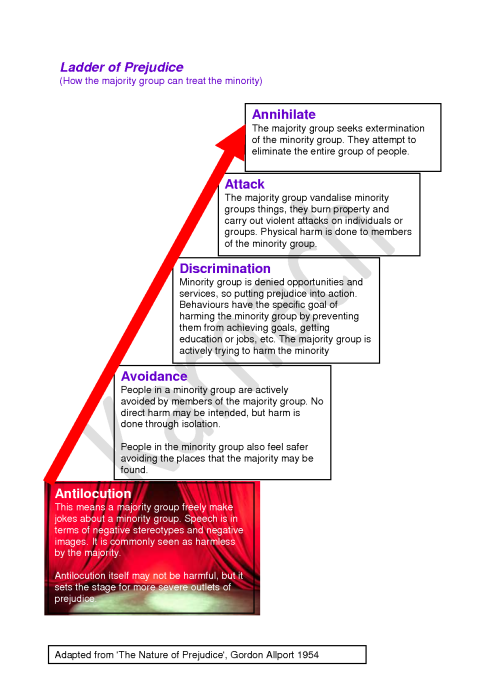
Gordon Allport studied the psychological and social processes that create a society’s progression from prejudice and discrimination to genocide. In his research of how the Holocaust happened, he describes socio-political processes that foster increasing social prejudice and discrimination and he demonstrates how the unthinkable becomes tenable: it happens incrementally, because of a steady erosion of our moral and rational boundaries, and propaganda-driven changes in our attitudes towards politically defined others, that advances culturally, by almost inscrutable degrees.

The process always begins with political scapegoating of a social group and with ideologies that identify that group as the Other: an “enemy” or a social “burden” in some way. A history of devaluation of the group that becomes the target, authoritarian culture, and the passivity of internal and external witnesses (bystanders) all contribute to the probability that violence against that group will develop, and ultimately, if the process is allowed to continue evolving, extermination of the group being targeted.

Economic recession, uncertainty and political systems on the authoritarian -> totalitarian spectrum contribute to shaping the social conditions that seem to trigger Allport’s escalating scale of prejudice.

In the UK, the media is certainly being used by the right-wing as an outlet for blatant political propaganda, and much of it is manifested as a pathological persuasion to hate others. The Coalition clearly have strong authoritarian tendencies, and that is most evident in their anti-democratic and behaviourist approach to policy, human rights, equality, social inclusion and processes of government accountability.

Vulnerable groups are those which our established principles of social justice demand we intervene to help, support and protect. However, the Coalition’s rhetoric is aimed at a deliberate identification of citizens as having inferior behaviour. The poorest citizens are presented as a problem group because of their individual faulty characteristics, and this is intentionally diverting attention from  wider socio-economic and political causes of vulnerability. Individual subjects experiencing hardships have been placed beyond state protection and are now the objects of policies that embody behaviourism, and pathologising, punitive and coercive elements of social control. Vulnerable people are no longer regarded as human subjects, the state is acting upon them, not for or on behalf of them.

People are still debating if Stalin’s Holodomor conforms to a legal definition of genocide, no-one doubts that Hitler’s gas chambers do, though Hitler also killed thousands by starvation.

Our own government have formulated and implemented policies that punish unemployed people for being “workshy” – for failing to meet the never-ending benefit conditionality requirements which entails the use of negative incentives, coercion and behaviour modification to “support” a person into  work –  by withdrawing their lifeline benefit. We also know that sanction targets have led to many people losing lifeline benefits for incoherent and grossly unfair reasons that have nothing to do with an unwillingness to cooperate or work.

Since benefits were originally calculated to meet basic living requirements – food, fuel and shelter – it’s  inconceivable that the government haven’t already considered the consequences of removing people’s means of meeting these fundamental survival needs. Of course, the Tory claim that this draconian measure is to incentivise people to “find work” doesn’t stand up to scrutiny when we consider that there isn’t enough work for everyone, and certainly not enough work around that pays an adequate amount to actually survive on.

Furthermore, the Tories “incentivise” the  wealthy by rewarding them with more money (such as the £107,000  tax break that was handed out to each millionaire every year from our own taxes by Osborne). It flies in the face of our conventional and established wisdom that reducing people to starvation and desperation will somehow motivate people to do anything other than to try and survive. (See Maslow’s Hierarchy, and two tragic accounts of the consequences of imposed sanctions.)

Tory austerity is all about ideology – the dehumanisation of the poor, and the destruction of public services and provisions – state infrastructure – and nothing to do with the state of the economy. It’s also about cutting money from the poorest and handing it to the wealthiest. Many economists agree that austerity is damaging to the economy.

There has been a media complicity with irrational and increasingly punitive Tory policies. But why are the public so compliant?

Decades of  research findings in sociology and psychology inform us that as soon as a group can be defined as an outgroup, people will start to view them differently. The very act of demarcating groups begins a process of ostracisation.

As well as the political and social definitions of others, there also exists deeper, largely unconscious beliefs that may have even more profound and insidious effects. These are related to whether people claiming benefits are even felt to be truly, properly human in the same way that “we” are.

This is called infrahumanisation. Infra means “below”, as in below or less than fully human. The term was coined by a researcher at the University of Louvain called Jacque-Philippe Leyens to distinguish this form of dehumanisation from the more extreme kind associated with genocide.

However, I don’t regard one form of dehumanisation as being discrete from another, since studies show consistently that it tends to escalate when social prejudice increases. It’s a process involving accumulation.

According to infrahumanisation theory, the denial of uniquely human emotions to the outgroup is reflective of a tacit belief that they are less human than the ingroup.

Poor people, homeless people, drug addicts and welfare claimants are the frequently outgrouped. It is these most stigmatised groups that people have the most trouble imagining having the same uniquely human qualities as the rest of us. This removes the “infrahumanised” group from the bonds, moral protection and obligations of our community, because outgrouping de-empathises us.

This would explain why some people attempt to justify the cuts, which clearly fall disproportionately on the most vulnerable. This is probably  why fighting the austerity cuts is much more difficult than simply fighting myths and political propaganda. I think the government are very aware of the infrahumanisation tendency amongst social groups and are manipulating it, because growing social inequality generates a political necessity for social prejudices to use as justification narratives.

During a debate in the House of Lords, Freud described the changing number of disabled people likely to receive the employment and support allowance as a bulge of, effectively, stock”. After an outraged response, this was actually transcribed by Hansard as “stopped”, rendering the sentence meaningless.  He is not the only person in the Department for Work and Pensions who uses this term. The  website describes disabled people entering the government’s work programme for between three and six months as 3/6Mth stock.

This infrahumanised stock are a source of profit for the companies running the programme. The Department’s delivery plan recommends using  credit reference agency data to cleanse the stock of fraud and error.

The linguistic downgrading of human life requires dehumanising metaphors: a dehumanising socio-political system using a dehumanising language, and it is becoming familiar and pervasive: it has seeped almost unnoticed into our lives.

Until someone like Freud or Mellins pushes our boundaries of decency a little too far. Then we suddenly see it, and wonder how such prejudiced and discriminatory comments could be deemed acceptable and how anyone could possibly think they would get away with such blatantly offensive rhetoric without being challenged. It’s because they have got away with less blatantly offensive comments previously: it’s just that they pushed more gently and so we didn’t see.

It’s also the case that the government distorts people’s perceptions of the  aims of their policies by using techniques of neutralisation. An example of this method of normalising prejudice is the use of the words “incentivise” and “help” in the context of benefit sanctions, which as we know are intentionally extremely punitive, and people have died as a consequence of having their lifeline benefit withdrawn.

As Allport’s scale of prejudice indicates, hate speech and incitement to genocide start from often subliminal expressions of prejudice and subtle dehumanisation, which escalate. Germany didn’t wake up one morning to find Hitler had arranged the murder of millions of people. It happened, as many knew it would, and was happening whilst they knew about it. And many opposed it, too.

The dignity and equal worth of every human being is the axiom of international human rights. International law condemns statements which deny the equality of all human beings.

As a so-called civilised society, so should we.

526544_532055030197363_2137237288_n
Pictures courtesy of Robert Livingstone

Conservatism in a nutshell

Image result for Theresa May poor wages
It’s not enough to challenge Tory ideology. We also have to dismantle the Orwellian semantic thrifts and shifts. We have to defeat the Tory propaganda machine that lies, persuades and lulls people with meaningless populist slogans, empty glittering generalities and glib catch-phrases.

You’ve heard those slogans – “less government”, “personal responsibility”, “hard-working families”, “making work pay” and lots of nationalist flag waving. These are shorthand messages to the public that are thrifty with the truth, codifications for an entire world-view. But it’s ever such a shabby, ruthless, isolating and paltry one.

1209102_539900659412800_1664499134_n

The clue is in the name: the word “Tory” derives from the Middle Irish word tóraidhe, which means outlaw, robber or brigand, from the Irish word tóir, meaning “pursuit”, since outlaws were “pursued men”. It was originally used to refer to an Irish outlaw and later applied to Confederates or Royalists in arms. The term was originally one of abuse.

The Tories live by plundering. They steal your taxes, your public services, your state provision and your labour in order to raise more money for the rich. They have reneged on our post war democratic settlement. Legal aid, human rights, social housing, the NHS, lifeline welfare support – the essential components of any functioning democracy – are being viciously and systematically dismantled by the Tories. 

It’s a dystopic world of corporate fiefdom. I heard a very smart person from the States once sum up the Tories neatly with the phrase “cheap-labour conservatism”. How very apt. It fits so well. It makes sense of such a lot.

Basically, the larger the labour supply, the cheaper it is. The more desperately you need a job, the less you tend to demand for your wages to be fair, and the more power those big business Tory buddies have over you. This is what the Tories actually mean by “making work pay” – it’s either rationed out peanuts or starvation. But for big business, your work pays them handsomely in fat profits.

The Tories engineer this same socioeconomic situation every time they are in office. Think back to the Thatcher era, she did it, Major did it – it’s a manufactured recession and a large reserve army of cheap labour every time. ALWAYS the same with the Tories. Because it suits their “business friendly” agenda.

That’s another Tory slogan that means corporate greed, profit before people and Tory donations – see the Beecroft Report, for example, written by a British “venture capitalist” that has donated more than £500,000 to the Conservative Party. The overdogs write policies to make sure that we remain the underdogs. Fat profits are all that matter to the vulture capitalists. 

Beecroft is currently Chairman of Dawn Capital. The release in May 2012, of the long awaited Beecroft Report in the UK caused considerable controversy because it recommended that the government should “cut red tape” in order to make the hiring and firing of employees easier and cheaper.

The report claimed this would help to ‘boost’ the economy although no evidence for this was provided. It’s hard to imagine how increasing job insecurity would encourage workers to spend their money. It does, however, help boost profits for venture  vulture capitalists, and the government-commissioned report strips workers of their rights.

As the TUC said at the time, the ideas have taken the UK back towards Victorian era working conditions and standards. Conservatives don’t like social spending or welfare – our safety net. The safety net we funded. That’s because when you’re unemployed and desperate, companies can pay you whatever they feel like – which is inevitably next to nothing, so their profits can grow. 

You see, the Tories want you in a position to work for next to nothing or starve, so their business buddies can focus on feeding their profits, which is their only priority.

Cheap-labour conservatives don’t like the minimum wage, or other improvements in wages and working conditions. These policies undo all of their efforts to keep you desperate. They don’t like European Union labour laws and directives either, for the same reason.

Cheap-labour conservatives don’t like unions, because when we unite, organise and collectively bargain, wages go up and living standards rise. Working conditions improve. That’s why workers unionise. Seems workers don’t like being desperate.

10553308_680322242037307_1558281906340939819_n

But businesses don’t like to pay out money. They like to hoard it. Cheap-labour conservatives constantly bray about “morality”, “virtue”, “respect for authority”, “hard work”, “responsibility” and other such vaguely defined values. This is only so that they can blame you for being desperate due to your own “immorality”, “lack of values”, “lack of character” , “idleness” and “poor life-choices”  when you are poor, within a system designed to generate a few ‘winners’ and a lot more ‘losers’. It’s not a level playing field that hosts the great neoliberal ‘competition’.

Those inane soundbites have been used to dismantle another worker’s protection: the welfare state.

They have also been deployed so that the Tories can justify their “business friendly” workfare schemes to further exploit the reserve army of labour and keep us desperate, unpaid and in our place.

1235473_537097386359794_65317730_n (1)

Cheap-labour conservatives encourage racism, misogyny, homophobia and other forms of bigotry. That’s because bigotry among wage earners distracts them, and keeps them from recognising their common interests as wage earners. Divide and rule was invented by cheap labour-conservatives. To keep labour cheap.

An ugly truth is that cheap-labour conservatives don’t like working people. They don’t like working class opportunities and prosperity, and the reason for this is very simple. Lords have a harder time kicking us around when we aren’t desperate, hungry and in fear of destitution.

Once we understand this about the cheap-labour conservatives, the real motivation for their policies makes perfect sense. Cheap-labour conservatives, the neo-feudalist fools, believe in social hierarchy and limited privilege, so the only prosperity they want to permit is limited to them and their elite class.

They want to see absolutely nothing that benefits us whatsoever. And even better if we fight amongst ourselves for scraps. Divide and rule. The Tory mantra “making work pay” is an argument for RAISING WAGES, not cutting benefits, talk about the rationally illiterate …. But then cheap-labour conservatives hope that those affected will take comfort in the fact that if your wages are not enough to meet the cost of living, at least those without a job are much worse off.

The Tory “race to the bottom” is hidden in plain view, and after five years of austerity, Osborne is forced to concede that the new welfare cuts leave £9bn of the deficit reductions promised by the Chancellor unaccounted for. The cuts are PURELY ideological. Tories: dangerous with the economy, dangerous for society.

1965037_301820166635705_1502392114_n (1)

“Less government” is another defining right-wing slogan. It’s also all about cheap labour. Referenced by the slogan is the whole conservative set of assumptions about the nature of the “free market” and government’s role in that market. However, we pay for government. We pay for protective state services. It is not the government’s money to hand out to millionaires, it is ours. 

The slogan “less government” permitted the conservatives’ cunning transformation of a crisis caused by banks into a crisis of public spending. It was a huge triumph of Tory dogma over the facts. And of course, our public services are being sold off to private companies. A few people are quietly making megabucks while the rest of us are told to “live within our means.”

And anyone would think, to hear the Tories talk, that the “free-market” isn’t rigged to benefit the wealthy. There’s no such thing as an “invisible hand”, unless you count the iron fist of the authoritarian state, getting on with getting their own way. The bedroom tax, welfare cuts, public service cuts, cutting inheritance tax and handing out tax breaks to the wealthy are, after all, examples of state interventions, and not “market forces”, which the Tories always use as a front to suck the life out of entire communities and to keep people desperate.

The whole “public sector/private sector” distinction is an invention of the cheap-labour conservatives. They say that the “private sector” exists outside and independently of the “public sector”. The public sector, according to cheap-labour ideology, can only “interfere” with the “private sector”, and that such “interference” is “inefficient”, “costly” and “unprincipled”.

Using this ideology, the cheap-labour ideologue paints him/her self as a defender of “freedom” against “big government tyranny,” while all the time, the conservatives are extending an extreme, oppressive authoritarianism.They have to because no ordinary person who knows what they’re up to actually wants their policies. And in fact, the whole idea that the “private sector” is independent of the public sector is totally bogus, because “the market” is created by public laws, public institutions and public infrastructure. 

But the cheap-labour conservative isn’t really interested in “freedom”. What they want is the privatised tyranny of industrial and financial serfdom, the main characteristic of which is – you guessed it – cheap labour.

1395990_559940054075527_258446375_n

Pictures courtesy of Robert Livingstone 


I don’t make any money from my work. But you can contribute by making a donation and help me continue to research and write informative, insightful and independent articles, and to provide support to others. The smallest amount is much appreciated – thank you.

DonatenowButton

Multiple Cuts for the Poorest Families and Conservative catechisms

1957929_293215800829475_303676825_o
Policy documents are often a useful source for understanding how language and imagery contribute to the construction of society’s assumptions, values and beliefs. They also demonstrate the privileging and “packaging” of a particular ideology. The government’s 2010 Green paper, 21st Century Welfare, and the White Paper, Universal Credit: Welfare that Works, are both good examples of how such documents are instrumental in constructing a discourse about social security that attempts to justify a deepening of Thatcher’s brand of neoliberalisation.

The documents marginalise the structural causes of persistent and inevitable unemployment and of poverty due to government policy by attempting to linguistically transform these causes into individual pathologies of benefit “dependency” and “worklessness.”  The conservative response to conservative creations and definitions is a raft of policy measures that are about punitive conditionality and removal of lifeline benefits.

The documents indicate a clear conflation of ideas about (a) simplification of the benefits system, (b) work “incentives” and (c) conditionality and sanctions, that has led many to conclude that the welfare “reforms” amount to an attack on the unemployed, sick and disabled at a time when they are least able to do anything about it. Conservative ideology has been disgracefully portrayed as offering new and innovative “solutions” to address Britain’s supposedly broken society, and as a means of offering restoration of “traditional values” and economic competitiveness. These are, of course, Tory catechisms.

Such Conservative ideological codifications have been translated as high unemployment, an increasingly higher cost of living, increasing and deepening poverty, growing social inequalities and punitive “welfare” cuts. These social events are not a consequence of Tory economic strategy: they ARE the Conservative economic strategy. Tories always create recession – Thatcher did, Major did in the early 90s, (see also Black Wednesday), and Cameron has managed a triple-dip recession. Their economic policies don’t ameliorate the consequences of their economic policies.

It’s a curiosity. Conservatives don’t seem to realise we re-translated their catechisms a long time ago. We know this is a socio-economic and cultural war being waged on the majority of citizens. Tory ideology – it’s a doctrinal manual giving basic instruction, usually by rote or repetition. We spotted a couple of centuries back that Conservatives don’t govern and serve: they rule. They are simply aristocratic remnants of the feudal era. As Andrew Dickie said:

These new “garagiste/card-sharping/rent-seeking” baronage know the price of everything and the value of nothing, and their only skills are those of rip-off and plunder, and are a universe away from the real economy and real wealth creation, which will be the task of the serfs – as it always was.” 

But they’ve been losing this war for a couple of hundred years. More than any other group of people, Conservatives are apparently oblivious to their own ideological history, and those who don’t know their history are doomed to… inflict it. (See That Tory revolution and the rise of neofeudalism.)

Recessions are terrible for ordinary people. They create enormous misery by throwing people out of work and out of their homes. How can a political ideology remain so silent about how to address human needs and alleviate suffering? Even worse, how can a political ideology result in recession and human suffering? And then deepen it? The answer is it enormously benefits a handful of conservative wealthy people.

Recession creates an “incentive” for private companies to exploit a desperate, oppressed and (deliberately) impoverished reserve army of labour. It also “justifies” the Tory ideological drive to dismantle the socialist state provisions and services established in the 1940s. The welfare post-war settlement comprised of essential safeguards to protect the vulnerable from the worst ravages of capitalism, along with a cross-party consensus on Keynesian economics. Those safeguards were fought for – we owe SO very much –  our current freedoms – to Chartism, Trade Union pressure, and the sacrifice of thousands of ordinary people in two World Wars – without those, the old feudal set-up would never have changed. But the current conservative-led government has destroyed so much of the foundations of that freedom.

The Tories “care” for the well-being of the general public in the same way that McDonalds care for cattle. 

1.75 million households in Great Britain have seen their incomes cut in the last three years as a result of benefit reforms, according to a new report by Oxfam and the New Policy Institute. We have witnessed the return of absolute poverty this past four years – the welfare state had seen an end to such severe deprivation. Until now.

The report – Multiple Cuts for the Poorest Families – delivers a warning that wide-ranging cuts are changing the shape of welfare support at a time when the rising cost of living is making it extremely difficult for families to meet their basic needs. As a result, disabled people, carers, job seekers and single parents are being pushed ever deeper into poverty.

Since last April, 400,000 households have been pushed further into poverty by cuts to housing benefit and/or council tax support – households affected by both of these cuts typically lose around £18 per week. These are costs they were previously deemed too poor to pay. Benefits were calculated originally to ensure people could meet basic living needs – food and fuel costs. This was amount was calculated on the assumption that full housing costs were also covered by benefit, and that people claiming benefit were exempt from rates/council tax. Of these affected families, 480,000 are seeing their benefits being cut twice as they are affected by more than one of the changes.

Whether a family is affected and by how much varies, based on a range
of factors which are largely out of the control of the individual. They
depend on council tax band, the cost of local housing, family size,
property size and of course, “appropriate” housing availability. But the changes apply irrespective of income.

Mark Goldring, Oxfam Chief Executive, said:

This is the latest evidence of a perfect storm blowing massive holes in the safety net which is supposed to stop people falling further into poverty. We are already seeing people turning to food banks and struggling with rent, council tax, childcare and travel costs to job centres.  At a time when the five richest families in the UK have the same wealth as the bottom 20 percent of the population it is unacceptable that the poorest are paying such a heavy price.”

Oxfam is calling on the Government to determine what the absolute minimum level of support should be for households in different circumstances. It must be high enough to mean that those reliant upon it are not forced to go without. People must be able to meet their survival needs. This is supposed to be a “civilised” first world liberal democracy, isn’t it?

When someone is struggling to meet their basic needs, it’s almost impossible to be motivated to do anything else, even if it’s the solution to their problem. And no amount of deplorable cruelty, such as the Tory “new conditionality” and “incentives” – the terrible and target-driven benefit sanction regime, which entails the withholding of lifeline benefits of the very poorest for up to three years, for example – will change that.

Maslow’s hierarchy of needs is a good reference point for discussion about the obstacles many people in poverty face when trying to provide for their families, in addition to themselves. But whether you recognise Maslow’s framework or not, individuals and families on low-income need to be safe, secure in a home or adequate shelter, financially stable, and possess basic emotional and physical health.

Classic

The lower the needs in the hierarchy, the more fundamental they are to survival and the more a person will tend to abandon the higher needs in order to pay attention to sufficiently meeting the lower needs.

Conservative policies seem to be designed to distract people from their “higher” needs and potential by threatening their lower, basic survival needs. This restricts growth and development in human beings, destroys human potential and so stifles social evolution. And no amount of dishonest rhetoric will ever justify this intentionally inflicted suffering on a population from a government. 

537138_298121333590735_348384495_n (1)
Many thanks to Robert Livingstone for his brilliant pictures

See also:

 Welfare cuts make people feel ‘more secure’.

Techniques of neutralisation

The new new poor law

Tory dogma and hypocrisy: the “big state”, bureaucracy, austerity and “freedom”

1965037_301820166635705_1502392114_n (1)

The Tories are not “paying down the debt” as claimed. They are raising more money for the rich.

Labour’s social and economic policy was a success, and this is substantiated by the LSE’s definitive survey of the Blair-Brown years:

There is clear evidence that public spending worked, contrary to popular belief.” Nor did Labour overspend. It inherited “a large deficit and high public sector debt”, with spending “at a historic low” – 14th out of 15 in the EU.

Labour’s spending increased, and money was invested in public services and social programs, and until the crash was still “unexceptional”, either by historic UK standards or international ones.

Until 2007 “national debt levels were lower than when Labour took office”. After years of neglect during the previous Conservative administration [2 recessions during the Thatcher era, another during Major’s],  Labour inherited a mess: public services in very poor state, shabby and squalid public buildings and unforgivably neglected human lives that formed a social deficit much more costly than any Treasury debt.

Labour Ministers set about addressing the causes and devastating effects of poverty and social marginalisation. Both poverty and inequality had risen to levels unprecedented in post-war history. This process accelerated during the 1980s.

Unlike every other post-war decade, in which the benefits of economic growth had been shared across social groups, the economic gains of the 1980s disproportionately benefited the rich at the expense of the poor (Hills, 2004). Social inequality on such a gross level was not only the result of Thatcher’s policies, she celebrated it. She declared that inequality is essential to fostering “the spirit of envy” and hailed greed as a “valuable spur to economic activity”.

The mess that Thatcher left is verified by several longitudinal studies. Dr. Alex Scott-Samuel and colleagues from the Universities of Durham, West of Scotland, Glasgow and Edinburgh, sourced data from over 70 existing research papers, which concludes that as a result of unnecessary unemployment, welfare cuts and damaging housing policies, the former prime minister’s legacy

…includes the unnecessary and unjust premature death of many British citizens, together with a substantial and continuing burden of suffering and loss of well-being.

The article also cites evidence including the substantial increase in income inequality under Thatcher – the richest 0.01% of society had 28 times the mean national average income in 1978 but 70 times the average in 1990, and the rise in UK poverty rates from 6.7% in 1975 to 12% in 1985.

It concludes that:

Thatcher’s governments wilfully engineered an economic catastrophe across large parts of Britain” by dismantling traditional industries such as coal and steel in order to undermine the power of working class organisations, such as unions. This ultimately fed through into growing regional disparities in health standards and life expectancy, as well as greatly increased inequalities between the richest and poorest in society.

Blair established the social exclusion unit inside No 10. “Social exclusion” signified not just poverty, but its myriad causes and symptoms, with 18 task forces examining education, babies’ development, debt, addiction, mental health, housing and much more. Policies followed and so did improvements.

John Prescott’s department published an annual Opportunities for All report that monitored these social targets: 48 out of 59 indicators improved. So when Cameron and his band of brigands sneer that “all Labour did was give tax credits to lift families just over the poverty line” – “poverty plus a pound” – they lie through their teeth.

Contrary to Tory claims, benefits were not Labour’s main instrument of social change: the benefit budget fell as a proportion of spending, outstripped by increases in health, education and other social services.

Despite Blair’s neoliberal turn, Labour’s social policies enshrined principles of equality and inclusion. The Tories deplore such principles, yet that doesn’t stop them claiming that their socially regressive policies are somehow “fair”. Things got better with a Labour administration, money was mostly well spent. That’s not the case now. It’s all being intentionally and spitefully undone. We are moving backwards on just about every positive social measure Labour put in place: the coalition’s “more for less” is exposed as pretence. They are simply raising more money for the rich.

And all because of their driving ideology. George Osborne’s “plan A” isn’t about economics: it amounts to little more than a rehashed Thatcherite ideological agenda of deregulation and labour market “flexibility”, as modelled by the Beecroft report – the assault on the rights of employees, and Labour’s historic equality legislation. The Tory demand for a “nightwatchman state” is both ill-conceived and completely irrelevant to Britain’s economic circumstances.

The Coalition have borrowed more in 4 years than labour did in 13 and have NOTHING to show for it except a handful of wealthier millionaires. And the return of absolute poverty.

We know that austerity was intentionally imposed by the Coalition, using a feigned panic over the budget deficit to front an opportunistic vulture capitalist approach to stripping our public assets. With the Coalition in power for 4 years, the deficit has apparently receded in importance.

We can hope that Labour can return to its  pro-social role of advocating government spending for the provision of public services. Conservatives have always played on dogma and popular prejudice by constantly equating government with bureaucracy. But that’s just the superficial excuse for their obsession with removing every trace of supportive provision and our public services.

It’s more accurate to say that Conservatives equate socially responsible, democratic, caring governments with “bureaucracy”. Conservatives aren’t ever interested in championing independent and merit-based public service. But most criticisms of government bureaucracy are based on myth, not reality.

The agencies that the Tories attack and destroy actually play a valuable and indispensable role in making our society a better place to live. They are the very hallmarks of what makes us civilised, they are how we support vulnerable citizens, ensure equal opportunities, uphold human rights.

The whole point of having human rights is that they apply to EVERYONE – something the Tories never understand – if rights are  not universally applied, then they are worthless. In fact they are hostile to the very notion that we each have equal worth, as we know.

Tories value and develop social hierarchy. When Tories want to make “shrinking” government sound attractive and feasible, they claim they are cutting “bureaucracy” and not social “programs.” Most people recognise the public value of State programs – in the areas of education, health and the environment for example – and don’t want to see these reduced; but everyone hates bureaucracy.

Using the term “bureaucracy” in this way is a rhetorical sleight-of-hand that attempts to obscure the real costs of cutting back on government programs. The lack of coherent reasoning underpinning the rhetoric is because this is simply Tory fundamentalism: it is not founded at all on rational, evidenced discourse.

I’ve said elsewhere that Edwardian levels of inequality led to the Great Depression. Austerity measures under Chancellor Hindenburg contributed to the rise of Nazism. The drop in household income in Japan between 1929 and 1931 led to a wave of assassinations of Government officials and bankers.

Social policies after World War 2 turned the tables and brought peace, with inequality steadily dropping in Britain until recently. But inequality is now returning to pre-war levels. The Tories are incapable of learning from historic lessons, because of their own sense of entitlement, privilege and ideological bondage.

In response to the atrocities committed during the War, the International Community sought to define the rights and freedoms necessary to secure the dignity and worth of each individual. Ratified by the United Kingdom, one of the first countries to do so, in 1951, those human rights originally established in the Universal Declaration have been steadily eroded since the Coalition gained Office.

There’s a clear link between high levels of inequality and failure of Governments to recognise human rights, and to implement them in policies. Authoritarians view the rights of the individual, (including those considered to be human rights by the international community), as subject to the needs of the Government. Of course in democracies, Governments are elected to represent and serve the needs of the population.

Democracy is not only about elections. It is also about distributive and social justice. The quality of the democratic process, including transparent and accountable Government and equality before the law, is critical. Façade democracy occurs when liberalisation measures are kept under tight rein by elites who fail to generate political inclusion.

Related articles:

How remarkable that a government that argues against bureaucracy on the grounds that it’s a “threat to individual freedom” have no problems imposing the Gagging Act and the Legal Aid Act – policies purposefully designed to severely limit our freedoms. But then, the Tories were never known for their rationality, coherence and joined-up narratives. Or for integrity and telling the truth.

Thatcher’s secret plot to dismantle the welfare state and privatise the NHS revealed

The mess we inherited: some facts with which to fight the Tory Big Lies

The great debt lie and the structural deficit myth

539627_450600381676162_486601053_n (2)
scroll2

Osborne’s real aim is not budget surplus, but attack on Welfare State & public sectors It’s not a difficult task for a government to guarantee a safety-net that is always available for anyone who falls on hard times during an era of huge social and economic change. We all fund it, after all. And we all know that unemployment, injury or illness may happen to anyone through no fault of their own. It’s considered a duty of any first-world government to provide the means of basic survival for its citizens and to fund that with the money we contribute via taxes. In fact such an approach to social and economic welfare is internationally codified in human rights.

Article 25 of the Universal Declaration of Human Rights, to which the UK is a signatory, reads:

Everyone has the right to a standard of living adequate for the health and well-being of himself and of his family, including food, clothing, housing and medical care and necessary social services, and the right to security in the event of unemployment, sickness, disability, widowhood, old age or other lack of livelihood in circumstances beyond his control. Motherhood and childhood are entitled to special care and assistance. All children, whether born in or out of wedlock, shall enjoy the same social protection.

The Tories prefer to spend the tax they take from you on Tory donors – private companies that don’t deliver a service but simply fleece profit; on undeserving millionaires’ tax breaks – the feckless, scrounging rich had at least £107,000 each per year extra already. Then there is the never ending list of Tory expense scandals – all at our expense. And tax evasion. Why are we paying for this?

Furthermore, why are we indifferent as a society to the fact that our government is causing harm to our fellow citizens? I can’t comprehend this, how can we have allowed this to happen, as a so-called civilised and once democratic society? It’s about a driving ideology that is socially detrimental, malevolent, and not economically necessary: the Tories do not think that people have a right to food, housing or medical care, that much is clear. But they continue to take the money we have paid since the 1940s for those things. And hand it out to the wealthy.

Despite these facts, the Govt and the right-wing media have the audacity to talk about welfare claimants, as if all our woes are their fault. They aren’t, the spiteful authoritarian Tories are the problem.

1234134_539964652739734_1075596050_n

We can’t afford this government, economically, socially, morally or psychologically. Osborne’s austerity message was seriously undermined, and his lies in trying to blame the last government were demonstrated last November when the Office for National Statistics found that the coalition had borrowed £430.072 billion since it took over, whereas the last Labour government managed to borrow just £429.975 billion in 13 years. –  George Osborne Says Britain’s ‘Best Days Lie Ahead’, Ignoring These 6 Graphs


Many thanks to Robert Livingstone for his brilliant memes
Manufacturing consensus: the end of history and the partisan man

10001887913_f8b7888cbe_o
The Tories are not “paying down the debt” as claimed. They are “raising more money for the rich”

Austerity is not being imposed by the Coalition to achieve an economic result. Austerity IS the economic result. In the wake of the global banking crisis, the Tories, aided and abetted by the Liberal Democrats, have opportunistically delivered ideologically driven cuts and mass privatisation.

We also know that the government’s own Office for Budget Responsibility (OBR) laid bare an important truth – that any semblance of economic recovery is despite the Coalition and not because of them. Yet the Tories have continued to claim that austerity is “working”. The Chairman of the OBR, Robert Chote said:

“Looking over the forecast as a whole – net trade makes very little contribution and government spending cuts will act as a drag.

The OBR state that any slight economic recovery is in no way because of Osborne and Tory policy, but simply due to the wider global recovery from the global crash. 

The government has drastically cut its spending on everything – including the NHS, and welfare in spite of their ludicrous claims to the contrary, this means that the government has consistently damaged the prospect of any economic recovery. This also demonstrates clearly that Coalition policy is driven by their own ideology rather than a genuine problem-solving approach to the economy. Yes, I know I’ve said all of this before – and so have others – but it’s so important to keep on exposing this Tory lie.

However, I believe that Conservatives really do have a conviction that the “big state” has stymied our society: that the “socialist relic” – our NHS and our Social Security system, which supports the casualties of Tory free markets, have somehow created those casualties. But we know that the competitive, market choice-driven Tory policies create a few haves and many have-nots.

Coalition rhetoric is designed to have us believe there would be no poor if the welfare state didn’t “create” them. If the Coalition must insist on peddling the myth of meritocracy, then surely they must also concede that whilst such a system has some beneficiaries, it also creates situations of insolvency and poverty for others.

Inequality is a fundamental element of the same meritocracy script that neoliberals so often pull from the top pockets of their bespoke suits. It’s the big contradiction in the smug, vehement meritocrat’s competitive individualism narrative. This is why the welfare state came into being, after all – because when we allow such fundamentally competitive economic dogmas to manifest, there are always winners and losers. It’s hardly “fair”, therefore, to leave the casualties of competition facing destitution and starvation, with a hefty, cruel and patronising barrage of calculated psychopolicical scapegoating, politically-directed cultural blamestorming, and a coercive, pathologising and punitive behaviourist approach to the casualities of inbuilt, systemic, inevitable and pre-designated sentences of economic exclusion and poverty.

And that’s before we consider the fact that whenever there is a Conservative-led government, there is no such thing as a “free market”: in reality, all markets are rigged to serve elites.

Political theorist Francis Fukuyama, announced in 1992 that the great ideological battles between “east and west” were over, and that western liberal democracy had triumphed. He was dubbed the “court philosopher of global capitalism” by John Gray. In his book The End of History and the Last Man, Fukuyama wrote:

“At the end of history, it is not necessary that all societies become successful liberal societies, merely that they end their ideological pretensions of representing different and higher forms of human society…..What we are witnessing, is not just the end of the cold war, or a passing of a particular period of postwar history, but the end of history as such: that is, the end point of mankind’s ideological evolution and the universalisation of western liberal democracy as the final form of human government.”

I always saw Fukuyama as an ardent champion of ultra-neoliberalism, and he disguised his neo-conservatism behind apparently benign virtue words and phrases (as part of a propaganda technique called Glittering Generalities), such as “Man’s universal right to freedom.” 

He meant the same sort of self-interested “freedom” as Ayn Rand – “a free mind and a free market are corollaries.” He meant the same kind of implicit Social Darwinist notions long held by Conservatives like Herbert Spencer – where the market rather than evolution decides who is “free,” who survives, and as we know, that’s rigged. Tory ideology does not ever have a utilitarian outcome.

Fukuyama’s ideas have been absorbed culturally, and serve to naturalise the dominance of the Right, and stifle the rationale for critical debate.

Like Marx, Fukuyama drew to some extent on the ideas of Hegel – who defined history as a linear procession of “epochs” – technological progress and the progressive, cumulative resolution of conflict allowed humans to advance from tribal to feudal to industrial society. Fukuyama was determined to send us on an epic detour – Marx informed us the journey ended with communism, but Fukuyama has diverted us to another destination.

I agree with Fukuyama on one point: since the French Revolution, democracy has repeatedly proven to be the fundamentally better system (ethically, politically, economically) than any of the alternatives. However we haven’t witnessed the “triumph of liberal democracy” at all: in the UK, we are seeing the imposition of rampant, unchecked neoliberalism coupled with an unyielding, authoritarian-styled social conservatism, with the safety net of democracy removed.

Fukuyama’s declaration manufactures an impression of global consensus politics but I believe this is far from the truth. I don’t believe this can possibly be the endpoint of humanity’s sociocultural evolution. It doesn’t reflect any global and historical learning or progress.

Jacques Derrida (Specters of Marx (1993) ) said that Fukuyama – and the quick celebrity of his book – is but one symptom of the wider anxiety to ensure the “death of Marx”. He goes on to say:

“For it must be cried out, at a time when some have the audacity to neo-evangelize in the name of the ideal of a liberal democracy that has finally realized itself as the ideal of human history: never have violence, inequality, exclusion, famine, and thus economic oppression affected as many human beings in the history of the earth and of humanity. Instead of singing the advent of the ideal of liberal democracy and of the capitalist market in the euphoria of the end of history, instead of celebrating the ‘end of ideologies’ and the end of the great emancipatory discourses, let us never neglect this obvious macroscopic fact, made up of innumerable singular sites of suffering: no degree of progress allows one to ignore that never before, in absolute figures, have so many men, women and children been subjugated, starved or exterminated on the earth.”

Fukuyama’s work is a celebration of neoliberal hegemony and a neo-conservative endorsement of it. It’s an important work to discuss simply because it has been so widely and tacitly accepted, and because of that, some of the implicit, taken-for-granted assumptions and ramifications need to be made explicit.

I don’t think conviction politics is dead, as claimed by Cameron – he has said that he doesn’t “do isms”, that politics is doing “what works”, “working together in the National interest” and “getting the job done”. But we know he isn’t working to promote a national interest, only an elite one. Cameron may have superficially smoothed recognisable “isms” from Tory ideology, but Nick Clegg has most certainly taken the politics out of politics, and added to the the impression that old polarities no longer pertain –  that all the main parties have shifted to the right.

However, the authoritarian Right’s domination of the ideological landscape, the Liberal Democrat’s complete lack of any partisan engagement and their readiness to compromise with their once political opponents has certainly contributed to popular disaffection with mainstream politics, and a sense of betrayal.

It’s ironic that many of those on the left who mistake divisiveness for a lack of political choice have forgotten the degree of consensus politics between 1945 and 1979, when Labour achieved so much, and manifested what many deem “real” socialist ideals. The Conservatives at that time largely agreed the need for certain basic government policies and changes in government responsibility in the decades after World War II, from which we emerged economically exhausted.

The welfare state, the national health service (NHS), and widespread nationalisation of industry happened at a time of high national debt, because the recommendations of the Beveridge Report were adopted by the Liberal Party, to some extent by the Conservative Party, and then most expansively, by the Labour Party.

It was Thatcher’s government that challenged the then accepted orthodoxy of Keynesian economics – that a fall in national income and rising unemployment should be countered by increased government expenditure to stimulate the economy. There was increasing divergence of economic opinion between the Labour and the Tories, ending the consensus of the previous decades. Thatcher’s policies rested on a strongly free-market monetarist platform aiming to curb inflation by controlling the UK’s money supply, cut government spending, and privatise industry, consensus became an unpopular word.

The Thatcher era also saw a massive under-investment in infrastructure. Inequality increased. The winners included much of the corporate sector and the City, and the losers were much of the public sector and manufacturing. Conservatism: same as it ever was.

Those on the “Narxist” left who claim that there is a consensus – and that the Blair government continued with the tenets of Thatcherism need to take a close look at Blair’s policies, and the important achievements that were underpinned with clear ethical socialist principles: strong themes of equality, human rights, anti-discrimination legislation, and strong programmess of support for the poorest, sick and disabled and most vulnerable citizens. Not bad going for a party that Narxists lazily dubbed “Tory-lite”.

Narxism is founded on simplistic, sloganised references to Marxist orthodoxy, and the claim to “real socialism.” Many Narxists claim that all other political parties are “the same.”

The Narxist “all the samers” tend to think at an unsophisticated populist level, drawing heavily on a frustratingly narrow lexicon of blinding glittering generalities, soundbites and slogans. But we need to analyse and pay heed to what matters and what defines a political party: policies and their impact. Despite New Labour’s shortcomings, if we are truly to learn anything of value and evolve into an effective opposition, presenting alternatives to the Conservative neoliberal doxa, we must also examine the positives: a balanced and even-handed analysis. We won’t progress by fostering further divisions along the longstanding “real socialist”, “left” and “moderate” faultlines.

It’s very clear that it is the Coalition who are continuing Thatcher’s legacy. We know this from the Central Policy Review Staff (CPRS) report, which was encouraged and commissioned by Thatcher and Howe in 1982, which shows a radical, politically toxic plan to dismantle the welfare state, to introduce education vouchers, ending the state funding of higher education, to freeze welfare benefits and to introduce an insurance-based health service, ending free health care provision of the NHS. One of the architects of the report was Lord Wasserman, he is now one of Cameron’s advisors.

New Labour had 13 years to fulfil Thatcher’s legacy – and did not. However, in four short years, the Coalition have gone a considerable way in making manifest Thatcher’s ideological directives. To do this has required the quiet editing and removal of Labour’s policies – such as key elements of Labour’s Equality Act .

The imposed austerity is facilitated by the fact that we have moved away from the equality and rights based society that we were under the last Labour government to become a society based on authoritarianism  and the market-based distribution of power. The only recognisable continuity is between Thatcher’s plans and Cameron’s policies. The intervening Labour government gave us some respite from the cold and brutal minarchism of the Tories.

There was never a greater need for partisan politics. The media, which is most certainly being managed by the authoritarian Tory-led government creates an illusory political “centre ground” – and a manufactured consensus – that does not exist.

Careful scrutiny and comparison of policies indicates this clearly. Yet much propaganda in the media and Tory rhetoric rests on techniques of neutralisation – a deliberately employed psychological method used to direct people to turn off “inner protests”, blur distinctions: it’s a mechanism often used to silence the inclination we have to follow established moral obligations, social norms, as well as recognise our own values and principles. And it’s also used to disguise intentions. Therefore, it’s important to examine political deeds rather than words: policy, and not narratives.

My own partisanship is to fundamental values, moral obligations  and principles, and is certainly none-negotiable. Those include equality, human rights, recognising diversity, justice and fairness, mutual aid, support and cooperation, collective responsibility, amongst others, and the bedrock of all of these values and principles is, of course, democracy.

Democracy exists partly to ensure that the powerful are accountable to the vulnerable. The far-right Coalition have blocked that crucial exchange, and they despise the welfare state, which provides the vulnerable protection from the powerful. They despise human rights.

Conservatives claim that such protection causes vulnerability, yet history has consistently taught us otherwise. The Coalition’s policies are expressions of contempt for the lessons of over a century of social history and administration.

The clocks stopped when the Tories took Office, now we are losing a decade a day.

382035_141704259313964_676863845_n
Thank you to Robert Livingstone for the pictures. More here

Defining features of Fascism and Authoritarianism

999622_566748676727998_1599547969_n

Max Weber’s principle of Verstehen is a fundamentally critical approach in all social sciences, including politics, and we can see the consequences of its absence in the cold, pseudo-positivist approach of the Coalition in the UK. Their policies clearly demonstrate that they lack the capacity to understand, or meaningfully “walk a mile in the shoes of another”. The Coalition treat the population of the UK as objects of their policies and not as equal, subjective human beings. Policies are designed by the government, for the government, and reflect nothing of public interests.  Whenever the government are challenged and confronted with evidence from citizens that their policies are causing harm, they simply deny the accounts and experiences of those raising legitimate concerns.

The Conservatives do not serve us or meet our needs, they think that we, the public, are here to serve political needs and to fulfil politically defined economic outcomes. Citizens are seen as a means to government ends. We are ‘economic units’. In fact we are being increasingly nudged to align our behaviours with narrow, politically defined neoliberal outcomes.

My own starting point is that regardless of any claim towards the merits of value-freedom in any discussion about society, we cannot abdicate moral responsibility, cannot justify moral indifference. We see values and principles enshrined in a positive approach, exemplified in our laws, human rights and democratic process. We are also seeing an erosion of this tendency towards a globalisation of values, and inclusion of a recognition and account of the full range of human experiences in policy making. Indeed recently in the UK, public policy has become an instrument of stigmatisation, social exclusion and increasing minoritization. 

As a society, we have allowed the state to redefine our collective, universal, relatively egalitarian and civilising support structures, such as social housing, legal aid, welfare and broader public services as being somehow problematic. Those who need support are stigmatised, scapegoated, outgrouped and othered. The government tells us that welfare and other public services present “moral hazards”, and that they “disincentivise” citizens to be self sufficient. Yet the social gains of our post-war settlement were made to include everyone, should they fall on difficult times. We each pay into the provision, after all.

These provisions are civilising and civilised socioeconomic mechanisms that ensure each citizen’s life has equal dignity and worth; that no-one dies prematurely because of absolute poverty or because they have no access to justice, medical care and housing. 

Our post-war settlement was the closest that we ever came to a genuine democracy, here in the UK. It arose because of the political consensus, partly founded on a necessity of the state to meet the social needs of the newly franchised working class. 

However, we are now being reduced in terms of human worth: dehumanised to become little more than economically productive actors. We have a government that tends to describe protected vulnerable social groups in terms of costs to the State, regardless of their contributions to society, and responsibility is attributed to these social groups via political scapegoating in the media and state rhetoric, while those decision-makers actually responsible for the state of the economy have been exempted, legally and morally, and are hidden behind complex and highly diversionary ‘strategic communication’ campaigns and techniques of neutralisation (elaborate strategies of denial and rebuff).

Techniques of neutralisation are a series of methods by which those who commit illegitimate acts temporarily neutralise certain values within themselves which would normally prohibit them from carrying out such acts, such as morality, obligation to abide by the law, and so on. In simpler terms, these are psychological methods for people to turn off “inner protests” when they do, or are about to do something they themselves perceive as wrong. Some people don’t have such inner protests – psychopaths, for example – but they employ techniques of neutralisation to manipulate and switch off those conscience protests of others.

Language use can reflect attempts at minimising the impact of such wrongful acts. The Mafia don’t ever commit “murder”, for example, instead they “take someone out”, “whack them” or “give someone their medicine”. But the victim ends up dead, no matter what people choose to call it. Examining discourses and underpinning ideologies is useful as a predictive tool, as it provides very important clues to often hidden political attitudes and intentions – clues to social conditions and unfolding events. Linguistic habits are frequently important symptoms of underlying feelings and attitudes.

We know that benefits, for example, are calculated to meet basic living requirements only, such as food, fuel and shelter needs. To take away that basic support is devastating for those people having to struggle for basic survival. The Labour Party recently managed to secure concessions that ensured that the right of appeal for those sanctioned is maintained.

Iain Duncan Smith wanted to remove that right. But appeals take months to happen, and meanwhile people are left suffering  enormously, living in absolute poverty, as a result of having no money to meet their most fundamental survival needs. 

Sanctions are not “help” for jobseekers. Sanctions are state punishment and a form of persecution. It doesn’t matter how hard you look for work when you are one of 2,500,000 unemployed people and there are only 400,000 jobs available. If we want to help people into work we need to create decent pay and secure jobs, rather than punishing individuals for being out of work during the worst recession for over 100 years.

Work is no longer a guaranteed route out of poverty, as wages have stagnated and remain lower than they were before the global recession. More than half of the people queuing at food banks are in work. Reducing welfare has also lowered wages, as people who are desperate are forced to take any form of employment with poor conditions and wages. 

In a similar way, the Tories attempt to to distort meanings, to minimise the impact of what they are doing. For example, when they habitually use  the word “reform”, what they are referring to is an act that entails “removal of income”, “cuts”, and  punitive “incentives”, “help” and “support”: Tory-speak “help” means to “punish and take from”. Targets for such punishment and cuts are translated as Tory “statistical norms” or “not targets but aspirations” and “robust expectations of performance”. As I said earlier, these are techniques of neutralisation. Or Newspeak, if you prefer.

The “help” and “incentivisation” that the Tory-led Coalition have provided for jobseekers in the recession, at a time when quality jobs are scarce, secure and stable full-time work is also scarce, are entirely class contingent and punitive. Decent jobs that pay enough to get by on are like …well…Tory statistics; conjured from the aether, a very cheap trick – an illusion. We know that unemployment and underemployment are rising. 

Sartre once said that oppressors oppress themselves as well as those they oppress. Freedom and autonomy are also reciprocal, and it’s only when we truly recognise our own liberty that we may necessarily acknowledge that of others. Conservatism has always been associated with a capacity to inhibit and control, and never liberate. We need to take responsibility for the Government that we have. In fact we must.

Fascism evolves over a period of time. No-one ever woke up one morning to find it had suddenly happened overnight. It’s an ongoing process just as Nazism was. Identifying traits is therefore useful. Fascism and totalitarianism advance by almost inscrutable degrees. 

If you really think it could never happen here, you haven’t been paying attention this past few years to the undemocratic law repeals and quiet edits – especially laws that protect citizens from state abuse – the muzzling of the trade unions, a hatred of left and socialist perspectives, the corporocratic dominance and rampant cronyism, the human rights abuses, the media control and othering narratives, the current of anti-intellectualism and other serious blows to our democracy.

Dr. Lawrence Britt examined the fascist regimes of Hitler (Germany), Mussolini (Italy), Franco (Spain), Suharto (Indonesia) and several Latin American regimes. Britt found 14 defining characteristics common to each, and it is difficult to overlook some of the parallels with the characteristics of the increasingly authoritarian government here in the UK:

1. Powerful and continuing Nationalism – fascist regimes tend to make constant use of patriotic mottos, slogans, soundbites, symbols, songs, and other paraphernalia. Flags are seen everywhere, as are flag symbols on clothing and in public displays.

2. Disdain for any recognition of Human Rights – politically justified by stirring up fear of “enemies” and the need for “security”, the people in fascist regimes are persuaded that human rights can be ignored in certain cases because of “need.” The public tend to become apathetic, or look the other way, some even approve of persecution, torture, summary executions, assassinations, long incarcerations of prisoners, often without charge and so forth. But the whole point of human rights is that they are universal.

3. Identification of enemies and scapegoats used as a unifying cause – the public are rallied into a unifying patriotic frenzy over the need to eliminate a perceived common threat or foe: social groups; racial, ethnic or religious minorities; liberals; communists; socialists, terrorists international organisations and so forth.

4. Supremacy of the Military – even when there are widespread domestic problems, the military is given a disproportionate amount of government funding, and the domestic agenda is neglected. Soldiers and military service are glamorised.

5. Rampant sexism – The governments of fascist nations tend to be almost exclusively male-dominated. Under fascist regimes, traditional gender roles are made more rigid. Divorce, abortion and homosexuality are suppressed and the state is represented as the ultimate guardian of the family institution. Policies emphasise traditional and rigid roles. The government become the ‘parent’, because they “know what’s best for you”. Families that don’t conform are pathologised. 

6. Controlled mass media – the media is directly controlled by the government, but in other cases, the media is indirectly controlled by government regulation, or by ensuring strategically placed sympathetic media spokespeople and executives. Censorship is very common.

7. Obsession with “National Security” and protecting “borders”- fear is used as a motivational tool by the government over the masses.

8. Historically, religion and Government are intertwined – governments in fascist nations tend to use the most common religion of the nation as a tool to manipulate public opinion. Religious rhetoric and terminology is common from government leaders, even when the major tenets of the religion are diametrically opposed to the government’s policies or actions. But technocratic rule – referencing ‘science’ may also be used to appeal to the public and garner a veneer of  credibility.

9. Corporate Power is protected – The industrial and business aristocracy of a fascist nation often are the ones who put the government leaders into power, creating a mutually beneficial business/government relationship and power elite.

10. Labour power is suppressed – because the organising power of labour is the only real threat to a fascist government, labour unions are either eliminated entirely, or are severely suppressed.

11. Disdain for intellectuals and the Arts – fascist nations tend to promote and tolerate open hostility to higher education, and academia. It is not uncommon for professors and other academics to be censored or even arrested. Free expression in the arts and letters is openly attacked.

12. Obsession with Crime and Punishment – under fascist regimes, the police are given almost limitless power to enforce laws. The people are often willing to overlook police abuses and even forego civil liberties in the name of patriotism. There is often a national police force with virtually unlimited power in fascist nations.

13. Rampant cronyism and corruption – fascist regimes almost always are governed by groups of friends and associates who appoint each other to government positions and use governmental power and authority to protect their friends from accountability. It is not uncommon in fascist regimes for national resources and even treasures to be appropriated or even outright stolen by government leaders.

14. Fraudulent elections – sometimes elections in fascist nations are a complete sham. Other times, elections are manipulated by smears, the strategic misuse of psychology and propaganda campaigns, and even assassination of opposition candidates has been used, use of legislation to control voting numbers or political district boundaries, and of course, strategic communications together with targeted manipulation of the media. Fascist nations also typically use their judiciaries to manipulate or control elections, historically.

All fascist governments are authoritarian, but not all authoritarian governments are fascists. Fascism tends to arise with forms of ultra-nationalism. Authoritarianism is anti-democratic. Totalitarianism is the most intrusive; a ‘totalising’ form of authoritarianism, involving the attempted change, control and regulation of citizens’ perceptions, beliefs, emotions, behaviours, accounts and experiences. (See “nudge”, the Cambridge Analytica scandal, and the “Integrity Initiative” scandal, for example)

Authoritarian legitimacy is often based on emotional appeal, especially the identification of the regime as a “necessary evil” to combat easily recognisable societal problems, such as economic crises, with “tough choice”.

Authoritarian regimes commonly emerge in times of political, economic, or social instability, and because of this, especially during the initial period of authoritarian rule, such governments may have broad public support. Many won’t immediately recognise authoritarianism, especially in formerly liberal and democratic countries.

In the UK, there has been an incremental process of un-democratising, permeated by a wide variety of deliberative and disassembling practices which have added to the problem of recognising it for what it is.

Authoritarians typically prefer and encourage a population to be apathetic about politics, with no desire to participate in the political process. Authoritarian governments often work via propaganda techniques to cultivate such public attitudes, by fostering a sense of a deep divide between social groups, society and the state, they tend to generate prejudice between social groups, and repress expressions of dissent, using media control, law amendments or by quietly editing existing laws.

There is a process of gradual habituation of the public to being governed by shock and surprise; to receiving decisions and policies deliberated and passed in secret; to being persuaded that the justification for such deeds was based on real evidence that the government parades in the form of propaganda. It happens incrementally. Many don’t notice the calculated step-by-step changes, but those that do are often overwhelmed with the sheer volume of them.

Authoritarians view the rights of the individual, (including those considered to be human rights by the international community), as subject to the needs of the government. Of course in democracies, governments are elected to represent and serve the needs of the population.

Again, the whole point of human rights, as a protection for citizens, is that they apply universally. They are premised on a view that each human life has equal worth.

Democracy is not only about elections. It is also about distributive and social justice. The quality of the democratic process, including transparent and accountable government and equality before the law, is critical. Façade democracy occurs when liberalisation measures are kept under tight rein by elites who fail to generate political inclusion. See Corporate power has turned Britain into a corrupt state  and also Huge gap between rich and poor in Britain is the same as Nigeria and worse than Ethiopia, UN report reveals.

Some of the listed criteria are evident now. I predict that other criteria will gain clarity over the next couple of years.

“One doesn’t see exactly where or how to move. Believe me, this is true. Each act, each occasion, is worse than the last, but only a little worse. You wait for the next and the next. You wait for the one great shocking occasion, thinking that others, when such a shock comes, will join with you in resisting somehow. You don’t want to act, or even to talk, alone; you don’t want to “go out of your way to make trouble.” Why not? – Well, you are not in the habit of doing it. And it is not just fear, fear of standing alone, that restrains you; it is also genuine uncertainty.

“Uncertainty is a very important factor, and, instead of decreasing as time goes on, it grows. Outside, in the streets, in the general community, “everyone is happy. One hears no protest, and certainly sees none. You know, in France or Italy there will be slogans against the government painted on walls and fences; in Germany, outside the great cities, perhaps, there is not even this.

In the university community, in your own community, you speak privately to your colleagues, some of whom certainly feel as you do; but what do they say? They say, “It’s not so bad” or “You’re seeing things” or “You’re an alarmist.” (Or “scaremonger”)

“And you are an alarmist”. You are saying that this must lead to this, and you can’t prove it. These are the beginnings, yes; but how do you know for sure when you don’t know the end, and how do you know, or even surmise, the end?

On the one hand, your enemies, the law, the regime, the Party, intimidate you. On the other, your colleagues pooh-pooh you as pessimistic or even neurotic. You are left with your close friends, who are, naturally, people who have always thought as you have.” –  Milton Mayer, They Thought They Were Free.

Citizens feel increasingly powerless to shape the political institutions that are meant to reflect their interests. Politicians must relearn how to speak to disenfranchised citizens in an inclusive, meaningful way, to show that dysfunctional democracies can be mended.

Directing collective fear, frustration and cultivating hatred during times of economic turbulence at politically constructed scapegoats – including society’s protected groups which are historically most vulnerable to political abuse – has never been a constructive and positive way forward.

As Gordon Allport highlighted, political othering leads to increasing prejudice, exclusion, social division, discrimination, hatred and if this process is left to unfold, it escalates to hate crime, violence and ultimately, to genocide.

Othering and outgrouping are politically weaponised and strategic inhumanities designed to misdirect and convince populations suffering the consequences of intentionally targeted austerity, deteriorating standards of living and economic instability – all of  which arose because of the actions of a ruling financial class – that the “real enemy is “out there”, that there is an “us” that must be protected from “them.”

In the UK, democracy more generally is very clearly being deliberately and steadily eroded. And worse, much of the public has disengaged from participatory democratic processes.

It’s time to be very worried.

Allport's ladder

Further reading

“We must keep alert, so that the sense of these words will not be forgotten again. Ur-Fascism is still around us, sometimes in plainclothes. It would be so much easier, for us, if there appeared on the world scene somebody saying, “I want to reopen Auschwitz, I want the Black Shirts to parade again in the Italian squares.” Life is not that simple. Ur-Fascism can come back under the most innocent of disguises. Our duty is to uncover it and to point our finger at any of its new instances—every day, in every part of the world. Franklin Roosevelt’s words of November 4, 1938, are worth recalling: “I venture the challenging statement that if American democracy ceases to move forward as a living force, seeking day and night by peaceful means to better the lot of our citizens, fascism will grow in strength in our land.” Freedom and liberation are an unending task.” Umberto Eco, in Ur-Fascism


Politics and Insight’s independent, measured, authoritative reporting has never been so vital, or in the public interest. These are turbulent, decade-defining times. Whatever lies ahead for us all, I will be with you – investigating, disentangling, analysing and scrutinising, as I have done for the last 9 years. 

More people, like you, are reading and supporting independent, investigative and in particular, public interest journalism, than ever before.

I don’t make any money from my research and writing, and want to ensure my work remains accessible to all.

I have engaged with the most critical issues of our time – the often devastating impact of almost a decade of Conservative policies, widespread inequality to the influence of big tech on our lives. At a time when factual information is a necessity, I believe that each of us, around the world, deserves access to accurate reporting with integrity and the norms of democracy at its heart. 

My editorial independence means I set my own agenda and present my own research and analyisis.  My work is absolutely free from commercial and political interference and not influenced one iota by billionaire media barons.  I have worked hard to give a voice to those less heard, I have explored where others turn away, and always rigorously challenge those in power.

This morning I came across this on Twitter:

John Mann@LordJohnMann

I can this morning announce that as government advisor on antisemitism that I will be instigating an investigation this January into the role of the Canary and other websites in the growth of antisemitism in the United Kingdom. https://twitter.com/supergutman/status/1205296902301990912 

Marlon Solomon@supergutman

Who’d have guessed that Mendoza – one of the people most responsible for toxifying the British left with racially charged conspiracy theories about Jews – would blame a Jew before anyone else.

Whoever takes control of Labour, from whatever faction, please fuck these people off.

View image on Twitter
3,147 people are talking about this

Independent journalists are now facing a threat from an authoritarian government, who have successfully managed to distort our mainstream media.

I did expect this promise of a purge on left leaning sites if Boris Johnson was returned to office, but not quite so soon after the event. It’s a case of vote Tory on Thursday, get fascism by Saturday. 

John Mann isn’t by a long stretch the only so-called moderate ex-Labour neoliberal  extremist whipping up McCarthyist hysteria and hate. But he has been strategically placed for a while by the Conservatives to destroy independent sites like mine. He’s a particularly nasty individual.

My first step to fight back in the coming year is to join the National Union of Journalists (NUJ). It is an essential protection, now.

It’s not cheap, especially for someone like me, as I’ve no income from my work. I pay WordPress to keep adverts off my site, too. But I am one of those people who often has to make daily choices about whether to eat or keep warm. I am disabled because of an illness called lupus. Like many others in similar circumstances, I am now living in fear for our future under a government that has already systematically and gravely violated the human rights of disabled people, which has resulted in fear, suffering, harm and all too often, premature death.

I hope you will consider supporting me today, or whenever you can. As independent writers, we will all need your support to keep delivering quality research and journalism that’s open and independent.

Every reader contribution, however big or small, is so valuable and helps keep me going. 

DonatenowButton

Quantitative Data on Poverty from the Joseph Rowntree Foundation.

377683_445086432227557_1770724824_n (1)

The minimum cost of living has soared by a quarter – 25% – since the start of the economic downturn, according to a report from the Joseph Rowntree Foundation, which details the true inflationary pressures facing low income households. The research finds families are facing an “unprecedented erosion of household living standards” thanks to rapid inflation and flat-lining wages.

Cuts to benefits and tax credits have exacerbated the problem over the past 12 months, according to the report. Now we are seeing the hard evidence that the Coalition’s “reforms” are pushing employed people in low paid work and unemployed people into absolute poverty, as our welfare system is no longer meeting basic living needs, and Government policy has distorted the original purpose of our social security, using rhetoric about costs to “the tax payer”, whilst carefully excluding the fact from their monologue that most benefit recipients are also tax payers.

A frightening consideration is that this report doesn’t include the latest round of benefit cuts – the very worst of them to date – that were implemented in April of this year. The report was produced prior to then, covering the period up to April, but doesn’t include it.

A quarter of households in the UK already fell short of the income required to reach an adequate standard of living – for them a 25% increase in costs intensifies the everyday struggle to make ends meet. The price of food and goods we need for an acceptable living standard has risen far faster than average inflation. This has combined with low pay increases to create a widening gap between income and needs.

The freeze in child benefit, the decision to uprate tax credits by just 1% and the increase in the cost of essentials faster than inflation mean that a working couples with children an  working lone parents will lose out, making a mockery of the Coalition’s claim of “making work pay”.

Over the past five years:

• Childcare costs have risen over twice as fast as inflation at 37%.
• Rent in social housing has gone up by 26%.
• Food costs have increased by 24%.
• Energy costs are 39% more.
• Public transport is up by 30%.

Some further shocking Key findings from the Poverty and Social Exclusion Project – The Impoverishment of the UK report reveals that:

• Over 30 million people (almost half the population) are suffering some degree of financial insecurity.
• Almost 18 million people cannot afford adequate housing conditions.
• Roughly 14 million cannot afford one or more essential household goods.
• Almost 12 million people are too poor to engage in common social activities considered necessary by the majority of the population.
• About 5.5 million adults go without essential clothing.
• Around 4 million children and adults are not properly fed by today’s standards.
• Almost 4 million children go without at least two of the things they need;
• Around 2.5 million children live in homes that are damp.
• Around 1.5 million children live in households that cannot afford to heat their home.

Since 2010, wages have been rising more slowly than prices, and over the past 12 months, incomes have been further eroded by cuts to benefits and tax credits. Ministers argue that the raising of the personal tax allowance to £10, 000 for low income households will help, however, the report says its effect is cancelled out by cuts and rising living costs.

I would add that for many who are low paid, and the increasing numbers of part-time workers, this political gesturing is meaningless. The policy only benefits those who earn enough to pay tax. Most of this group are affected by the benefit cuts – many have to claim housing benefit and council tax benefit, and they are therefore likely to be affected by the bedroom tax and the poll tax-styled reductions to benefits under the Localism Bill, to compound matters.

It has to be said that the greatest percentage change in net income from the personal tax free allowance of £10,000 is seen by those on the upper end of the income scale – not, as is often claimed, low earners. This does explain the policy. Increasing the personal allowance serves to increase the gap between the those on the lowest incomes and those on  middle range incomes, resulting in low income households falling further into poverty.

At the low paid end of salaried work there are a cohort of workers trapped in a cycle of very poorly paid, low – skilled work, zero hour contracts, with few, if any, employee rights. They tend to work for a few months here and there, in work that is often seasonal. There is no opportunity for saving money or hope of better employment prospects.

This group of workers tend to live hand to mouth from one pay day to the next, so have no opportunity to build a reserve when the contract ends, there is nothing in reserve.

The net result is that it is increasingly very difficult for low-to-middle income families to balance the weekly budget. There is now a widening gulf between public expectations of a minimum decent living standard and their ability to earn enough to meet it. I would add that the gap between low and middle income families is widening, and will continue to do so because of the impact of policies that have recently been implemented.

Welfare support is one of the hallmarks of a civilised society. All developed countries have such support for the vulnerable, and the less developed ones are striving to establish their own. Welfare states depend on a fair collection and redistribution of resources, which in turn rests upon the maintenance of trust between different sections of society and across generations. Most of us have paid for our own welfare.

It’s a common rhetorical trick for politicians is to talk about “looking after the tax payer.” However the reality is that they are often only really concerned with particular tax payers – the electoral groups that determine the outcomes of elections – often people on middle-incomes. They talk as if tax payers are some hard-pressed group who are burdened by the poor and that the rest of us don’t pay taxes.

But the reality is that there are many different taxes (the Institute of Fiscal Studies counted at least 25). Also the poorest people don’t just pay tax, they often pay the most tax. Not just indirect taxes, like VAT, but also income tax and council tax. Many other taxes are hidden from view in duties or other background taxes like Employer’s National Insurance.

Most assume that the rich pay a much higher rate of tax than the poor. After all the income tax system is meant to place progressively higher burdens on people with higher incomes. However, when you look at the rates of tax paid by each household it is very surprising.

The highest rate of tax, that is the share of income lost in tax, is paid by the poorest 10% of households (or families). The poorest 10% of families pay 45% of their income in tax. The other 90% of families pay quite a similar rates of tax, varying between 31% and 35%.

The three things to remember when politicians talk about tax:

1. Tax payers are not a special class of people – we are all tax payers.
2. Tax payers are not burdened by the poor – the poor are actually super tax payers.
3. Tax cuts come in many different shapes and sizes – not everybody benefits equally. The wealthiest profit the most.

(Information taken from here)

Office for National Statistics logo 

Statisticians hold two basic definitions of poverty – relative poverty is a measure which looks at those well below the median average of income (60% of income) – who are excluded from participating in what society generally regards as normal activities. This kind of poverty is relative to the rest of society, and is the type that we have seen and measured since the welfare state came into being.

Absolute poverty refers to a level of poverty beyond the ability to afford the essentials which we need simply to live and survive. People in absolute poverty cannot afford some of the basic requirements that are essential for survival. It is horrifying that this is now the fastest growing type of poverty in Britain, according to research bodies such as the Institute for Fiscal Studies (IFS) and Joseph Rowntree Foundation.  When the IFS produced its report on growing child poverty, David Cameron’s callous, calculated  and unflinching reaction was to question the figures, rather than accept the consequences of his Government policies on citizens.

And it IS calculated and deliberate legislative spite. The Government’s own impact assessment has demonstrated that the 1% uprating in the Welfare Benefits Up-rating Act will have a disproportionate effect on the poorest. Families with children will be particularly hard hit, pushing a further 200,000 children into poverty. In addition, those with low to middle earnings and single-earner households will be caught by the 1% limit on tax credit rates. These new cuts come on top of the cumulative impact of previous tax, benefit and public expenditure cuts which have already meant the equivalent to a loss of around 38% of net income for the poorest tenth of households and only 5% for the richest tenth.

According to a TUC report, average wages have dropped by 7.5 per cent since the Coalition came into office. This has a direct impact on child poverty statistics, which the government has conveniently ignored in its latest, Iain Duncan Smith-endorsed, child poverty figures.

Child poverty is calculated in relation to median incomes – the average income earned by people in the UK.

If incomes drop, so does the number of children deemed to be in poverty, even though – in fact – more families are struggling to make ends meet with less money to do so.

This is why the Department for Work and Pensions has been able to sound an announcement that child poverty in “workless” families (which translates from Tory propaganda-speak to “victims of the Government- induced recession”) has dropped, even though we can all see that this is nonsense.

As average incomes drop, the amount received by  families not in work – taken as an average of what’s left – appears to rise, even though, as we know, the increase is not even keeping up with inflation any more.

Liam Byrne said: “The Institute of Fiscal Studies report shows that the price of ministers’ failure on child poverty isn’t just a million more children growing up poor – it’s a gigantic £35 billion bill for the tax payer. It’s not just a moral failure, but an economic disaster.”

“Ministers should be doing everything they can for struggling families but instead they are slashing working families’ tax credits whilst handing a massive tax cut to the richest people in the country. That tells you all you need to know about this Government’s priorities.”

And – “Not only is there a cost attached to rising levels of child poverty but the trend is illegal. Left unabated child poverty will reach 24% in 2020, compared with the goal of 10% written in law.”

Iain Duncan Smith, the welfare and pensions secretary, has publicly questioned whether poverty targets are useful – arguing that “feckless” parents only spend money on themselves. The spirits of Samuel Smiles, Thomas Malthus and David Ricardo, they of the workhouse mentality, speak clearly in booming voices through Iain Duncan Smith from across the centuries.

And of course the Department for Work and Pensions ludicrously continue to blame the previous Administration. We know, however, that the research here shows starkly that poverty has risen under this Government, and we are now seeing cases of childhood malnutrition, such as scurvy.

The breakfast clubs established under the previous Labour Government, as a part of the Extending Schools program and Every Child Matters Bill often provided crucial meals, particularly  for children who relied on school provision  – in fact, for one in four of all UK children, school dinners are their only source of hot food. Malnutrition is rising and schools see children coming in hungry.

The previous Government recognised the importance of adequate nutrition and saw  the link between low educational attainment, behavioural difficulties and hunger in school. The breakfast club provision also helped parents on low incomes in other ways, for example, the free childcare that these wrap-around services provided is essential to support them to keep on working.

There are further issues worth a mention from Osborne’s Comprehensive Spending Review, that are not in the report. They are worth a mention not least because they tell you all you need to know about the Coalition. They speak volumes about Tory-led intention, malice and despicable aims. They expose the lie once again that the Tories “support” the most vulnerable citizens.

I’m very concerned about Osborne’s plans to set a cap on benefits spending. This cap will include disability benefits, but exclude spending on the state pension. Disabled people have already faced over £9 billion of cuts to benefits they rely on, with at least 600,000 fewer expected to qualify for the new Personal Independence Payment, which is replacing disability living allowance, and over 400,000 facing cuts to their housing benefit through the bedroom tax. Disabled people of working age have borne the brunt of cuts, and the Government is once again targeting those who can least afford to lose out.

By including “Disability Benefits” in the cap, the Government have signalled clearly that they fully intend severing any remaining link between social security and need. We are hurtling toward a system that is about eradicating the cost of any social need. But taxation hasn’t stopped, however, public services and provisions are shrinking.

Barely a month now passes without one of David Cameron’s ministers being rebuked for some act of statistical chicanery (or, indeed, the Prime Minister himself). And it’s not just the number crunchers at the UK Statistics Authority who are concerned. An alliance of 11 churches, including the Methodist Church, the Quakers and the Church of Scotland, has written to Cameron demanding “an apology on behalf of the Government for misrepresenting the poor.”

Many people have ended their lives. Many people have died because of the sustained attack from our Government on them both psychologically and materially, via what ought to be unacceptable, untenable and   socially unconscionable policies. People are going without food. People are becoming homeless. There are people now living in caves around Stockport The UK is the world’s six largest economy, yet 1 in 5 of the UK population live below the official poverty line, this means that they experience life as a daily struggle for survival.

And this is because of the changes this Government is making. And we are allowing them to do so. Unless we can form a coalition with other social groups in our society, we are unlikely to influence or produce enduring, positive political change. But that will only happen once others realise that they are not exempt from the devastating changes, or the long term consequences of them. It’s down to us to ensure that the public are informed, since the maintream media have abdicated that responsibility.

The author of the Joseph Rountree Foundation report, Donald Hirsch, says the cumulative effect is historically significant:

From this April, for the first time since the 1930s, benefits are being cut in real terms by not being linked to inflation. This combined with falling real wages means that the next election is likely to be the first since 1931 when living standards are lower than at the last one.”

Further reading:

Briefing on How Cuts Are Targeted

Who Really Benefits from Welfare?

  • The system make little difference to the incomes of the poorest
  • People in poverty pay the highest rates of tax
  • It is hardest for the poorest to earn, save and be a family
  • Most money actually goes to the better-off.

    (This article was taken from a longer piece of work: Poverty and Patrimony – the Evil Legacy of the Tories.)

1017174_500690710000462_512008904_nThanks to Robert Livingstone for his brilliant artwork
The Great Debt Lie and the Myth of the Structural Deficit

1017174_500690710000462_512008904_n

The case for austerity measures rests on the Great Debt Lie and the myth of the structural deficit.

The 2008-9 recession was the worst we have experienced globally for sixty years, and it was predicted by no-one. The Labour Government responded to the global crisis with fiscal stimulus. From the start of the financial crisis, Labour took decisive and clear action (including temporarily cutting VAT to boost demand), and it has become increasingly clear that it was this decisive action that brought about the green shoots of recovery by the last quarter of 2009. (Radeke, 2009).

This, combined with the usual effects on GDP of a recession, meant that the budget deficit rose. But without such swift action we simply would not have the signs of tentative recovery that we saw as a result. So what went wrong? What happened to the ‘green shoots of recovery’ that were carefully nurtured by the last Labour Government?

That would be the Tory-led Coaliton. The difference between the recession that happened under Labour and the one under the Tories is that the global banking crisis would have caused recession no matter which party was in office at the time, whereas the current recession is a ‘homegrown’ one that can be directly attributed to Conservative economic policy. Conservatives always cause recession, Margaret Thatcher did, John Major did, and now, David Cameron has.

This Government is cutting the very measures that would ensure not only growth in the short-term, but economic security in the future, too. They are portraying their cuts as ‘necessary’, eliminating ‘waste’,  and ‘efficient’, when in fact they are seriously jeopardising our future economic prosperity: cuts in funding for Regional Development Agencies; scrapping the Future Jobs Fund, which was a success and supported at least 200,000 people back into work through the recession; withdrawing industrial support, and the proposed and systematic cuts to public services, for example.

That is before we even begin to discuss the damning, detrimental economic and social implications of the welfare ‘reforms’ (CUTS), and the Localism Bill (more CUTS), and Legal Aid Bill (even more coordinated and carefully planned Tory CUTS that will serve to keep quiet and hide away subsequent evidence of the rising numbers of impoverished, destitute and starving victims of all of the other CUTS – and subsequent human rights abuses).

And there seems to be very little evidence to support their decisions. No facts, no consultation, no listening to expert advice. Just the ideology of the small state, propped up by notions of ‘self-reliance’ – but only for the poorest citizens of course –  being pursued by the Tory right and the Orange Book Liberals.

The Tory budget is highly regressive, hitting the poorest -people the hardest while asking for very little from those at the top.

Here are some facts which demolish the fallacy that the present economic crisis is the result of excessive spending, leading to unsustainable debt:

  •  Analysis by the Institute of Fiscal Studies (IFS) has concluded that on the eve of the financial crisis ‘the public finances were in a stronger position than they had been when Labour first came to power in 1997.
  •  Average annual spending and taxation were both lower as a proportion of GDP under the last 3 Labour Governments (38% and 35.4%) than under the 4 Conservative governments which preceded them (40% and 35.5%).
  •  National debt was lower as a proportion of GDP at the start of the financial crisis in 2008 (36%) than in 1997, the last year of John Major’s Conservative government (42%).  The national debt is forecast to hit 74.7% of GDP this year and peak at 79.9 per cent in 2015-16.
  • In 2010, the UK’s national debt as a proportion of GDP (52%) was the second lowest of the G7 countries.

The budget deficit is no more ‘structural’ than an overdraft in your bank account when you spend more than you earn. There is either a real deficit or not, and if there is, then it is due to either excessive spending or an inadequate tax take. The Conservatives like to reduce taxes for the wealthiest citizens.

Since it can easily be demonstrated that the problem is not the former, then it must be the latter – caused by the financial crisis and consequent recession and likely to be aggravated when taxes are cut later during this parliament to the benefit of high earners, corporations and banks.

As The Investors Chronicle states (15th February 2010): “The idea of a structural deficit serves a political rather than analytical function. It’s a pseudo-scientific concept which serves to legitimate what is in fact a pure judgement call – that borrowing needs cutting.”  

Osborne began to revive the myth of the structural deficit in June 2010, when it was becoming clear that the deficit would be under £155 billion, well below the Treasury’s £178 billion estimate made six months earlier.

In other words, the deficit was narrowing after Labour increased spending in 2009. The fact that the US, which has made no serious deficit reductions, has suffered almost the smallest recession of any major developed economy, whereas Ireland and Greece have suffered the worst because of drastic spending cuts further undermines the Government’s claim that radical austerity measures are needed – and shows that Osborne’s main aim is not to reduce the deficit but to accelerate the transfer of wealth to the already very rich.

And if anyone still wants to talk about a ‘structural’ deficit, then they should remember that the last 3 Labour Governments managed to earn enough to cover their spending for 4 of their 13 years in office, whereas Thatcher and Major only managed to balance the books for 2 out of 17 years.

The Coalition continue to deny that alternatives to austerity are viable. As a Tory lie repetition strategy, this is based on the idea Goebbels had –  repeated lies will somehow convince people that they are true. Cameron was busted when he repeatedly told the lie ‘We are paying down the debt.’ Despite being rumbled and rebuked, the Coalition have stuck with this lie doggedly.

The bonus of the lie is that it may undermine the Opposition’s economic credibility, and the Conservatives particularly delight in the lie that it’s all Labour’s fault because they ‘overspent’ as it further justifies austerity measures and starving public services of lifeline government funding with our paid taxes, as well as stripping our welfare provision away. There will be more cuts to come, too.

It was the Tories that lost the Moody’s Investors Service triple A grade, despite pledges to keep it secure. Moody’s credit ratings represent a rank-ordering of creditworthiness, or expected loss. The Fitch credit rating was also downgraded due to increased borrowing by the Tories, who have borrowed more in 4 years than Labour did in 13.

The Coalition have REALLY messed up the economy. We know it’s a big fat Tory lie that cutting spending at a time of economic recession will re-balance public finances. As many academics and economists have stated, cutting spending when the economy is flat is likely to cause further contraction to the economy, and that will negatively affect public finances, rather than help at all.

The Government will never confess to this because they are so tightly ideologically bound to an übertreiben Neoliberalism, no matter what the cost is in human terms, or even in economic terms. What we need is Labour’s expansionary fiscal policies, not contractionary ones.

Real, sensible economists (and not the token greedy businessmen the Conservatves trot out to address the public with neoliberal ideology) know that the only way to address a recession is to grow the economy, and that means more public spending in the short term to stimulate economic activity and cutting if needed when the economy is back on the up (which needn’t mean absolute cuts, but relative cuts because the economy is growing).

Related

The OBR rebukes Cameron for claiming that austerity has not hit growth

The Tories continue to blame the previous Labour Government for its own actions  – The Blame Game

Letter from Chair of the UK Statistics Authority, Andrew Dilnot to Labour’s Rachel Reeves – Public sector net debt and net borrowing

Cameron rebuked by the UK Statistics Agency chief Andrew Dilnot – Dear Prime Minister

Investors around the world are putting their trust in the only Labour government in the UK – Investors give thumbs up to Labour

Tory Coalition set to borrow more in five years than Labour in 13. Conservative Mark Field confirms.

A list of official rebukes for Tory lies .

Labour’s economic record given clean bill of health at home and abroad

“The economic situation explained in 3 minutes. Tory austerity has given us the slowest recovery since the South Sea Bubble. Professor David Blanchflower absolutely slaughters Cameron over his pre-excuse warning over the world economy, he blames Tory austerity for tanking Britain’s economy and preventing a recovery, and states that any recovery we do have is simply part of the cycle as long as you don’t wreck it with austerity, and confirms that our economy was on the RISE in 2009 / 2010.” From The World At One, Radio 4, 17th November, 2014.

539627_450600381676162_486601053_n (2)

Many thanks to Robert Livingstone for translating my comment into a meme

All facts and figures used here have since been fact checked by Factcheck.


I don’t make any money from my work.  But if you want to, you can make a donation to help me continue to research and write free, informative, insightful and independent articles, and to provide support to others. The smallest amount is much appreciated – thank you.

DonatenowButton

The Tories are not simply “out of touch”, their policies are deliberate and malevolent

307323_448254408577426_1641857278_n

It’s a common belief that inhumane Tory policies – which are directed at taking money and support from the most vulnerable citizens – have happened because of a kind of naivety, lack of experience, or a simple egocentricity of the privileged. Or general incompetence.

These certainly may well contribute to the obvious lack of joined-up thinking, apparent when we step back to consider that the most vulnerable citizens in our so-called civilised society are suffering and dying as a direct consequence of recent legislations and “reforms,” but it certainly doesn’t explain why the Tories persistently and historically CHOOSE to continue to ignore any other account of social reality but their own. That implies some intentionality, to me. Selective perception involves a certain degree of free will. And choice. 

So we are now almost through the doorway to the “mad or bad” debate.

Tories also reduce every single human deed to an underlying motivation of greed for financial gain, no matter what the circumstances. They know the price of everything and the value of nothing. Some would argue that this is classic Freudian projection. But that doesn’t account for the fact that the Tories normalise and make a virtue of the financial gain principle, for the wealthy, big business and of course, the Tories themselves. That corrupts government policy and our democracy. 

These motivations are held to be universal, and are translated into a vice when it comes to ordinary, everyday people, or in particular, poor and vulnerable people. That doesn’t hang together coherently at all, nor does it corroborate the view that the Tories are simply out of touch with everyday experience, since there is a deep and fundamental – and very apparent – contradiction here. It is a very significant flaw in their ideological grammar.

Human beings are not static when it comes to ideas and beliefs: we are capable of learning, and in a variety of ways: though experience, through the experience of others, through historical accounts, evidence and so on. The Tories simply choose to overlook the need. They prefer, instead, to stay put, or regress, and simply insist that they know best. Challenge a Tory, and they often believe that simply talking louder, and over the top of you will somehow make what they are saying “right.” They are not called “Conservative” for nothing – they do like to maintain a status quo and resist progressive change.

Tory notions of change apply only to their idea of how a society ought to be, hence the proliferation of legislation these past couple of years. The Conservatives are unravelling the progress we have made as a society, because they prefer the simplicity of basic feudal relationships. I’m not really joking here, unfortunately. The Tories are re-privileging the privileged and reinforcing a traditional hierarchy. 

It’s as if the clocks stopped the moment the Tory-led Coalition took Office, and now we are losing a decade a day.

The truth is that austerity is NOT about deficit-cutting. It’s just the cover for Tory ideology. It is actually about shrinking the State and squeezing the public sector until it becomes marginal, then non-existent, in an entirely market-driven society. The banking crisis-generated deficit has been a gift to the Tories in enabling them to launch the narrative that public expenditure has to be massively cut back, which they would never have been able to get away with without the deficit-reduction excuse in the first place.

Austerity won’t benefit the economy: it will damage it further, since the cuts will reduce the income of those that spend proportionally the most money and add to the economy – the poorest. Taking more money out of an already struggling economy and impacting local economies will simply exacerbate the problem. In the longer term, the Tories will destroy our prosperity as a nation, because they are disaster capitalists. Worse, they don’t care if citizens die as a consequence. 

“We can safely abandon the doctrine of the eighties, namely that the rich were not working because they had too little money, the poor because they had too much” – John Kenneth Galbraith

Nope, that hasn’t happened, the Tories are still taking money from the poor and handing it to the wealthy. Why? Is it because the Tories are phenomenologically impoverished and incapable of learning, ever? No, I don’t think so.

I think it’s much worse than that. I think that the Tories DO understand the consequences of their ideologically-driven policies, but they don’t care. Money for the wealthy has to come from somewhere, after all. The whole “out of touch/lack of experience” proposition overlooks the fact that the Tories refuse to listen, quite deliberately, they exercise authoritarian tactics to shut people up – such as excluding those people from debate who oppose their views – witnessed during the passage of the Health and Social Care Bill, for example. Then there is the “monitoring” of the media for alternative political “biases.”

That is a quite deliberate narrowing down of experience, not naivety, based on a lack of understanding. That’s deliberate, calculated and certainly bears all of the hallmarks of authoritarianism. That’s the wilful imposition of a pre-moulded, dystopic Tory version of reality onto a largely unwilling population.

The propaganda regarding unemployed, ill and disabled people is not based on naivety either: it is deliberate, and calculated, a horrible and wicked attempt to justify their small state ideology and punitive approach to stripping welfare provision from the poorest, and from vulnerable citizens to redistribute funds from the public purse to the already wealthy.

David Cameron, Iain Duncan Smith and Chris Grayling have all contributed a selection of propagandic pieces of work to the press – largely the Sun, Express and the Daily Mail. The language they use – words like “scrounger” “fraud” and “workshy” and the implied “burden on the state,” together with their knowledge that so-called benefit fraud was a mere 0.7% (and that includes DWP’s own errors, too) indicates clearly that the policies aimed at removing welfare provision, and the propaganda campaign that has led to an increase in hate crimes directed at sick and disabled people, are absolutely intentional.

10,600 chronically ill and disabled people died last year between January and November, many within six weeks of their ESA claim closing. It’s very telling that the Department for Work and Pensions do not monitor or account for just how many of those were passed as “fit for work” by Atos, or awaiting Appeal.

Furthermore, this Government introduced targets which were written into the Atos contract when they renewed it in 2010: 7 out of 8 sick and disabled people to lose their benefits.

Bearing in mind that those targets exist BEFORE those ill and disabled people are assessed (and the Government have also redesigned the work capability assessment to make sure that there is a heavy bias towards withdrawing people’s support) then we can reasonably infer that the Government see those deaths – that have happened as a result of absolute poverty and extreme distress, some of our most vulnerable citizens have had their means of meeting their basic survival needs removed – as an intended outcome.

That the Government have not acted upon the high number of deaths associated with their welfare “reforms” is truly outrageous, and also indicates quite plainly, to me, that this “outcome” is not simply a by-product of their legislation, or incompetence, or lack of experience: it is calculated and intentional. All policies are intentional. 

This is much, much worse than a little “Tory egocentricity,” incompetence, phenomenological ineptitude, or naivety: this is the deliberate, calculated and wholesale destruction of every State mechanism of support for the most vulnerable citizens as well as for the “ordinary” person. If people cannot meet their basic needs – food, warmth, shelter and so on, they die. That is fact, it’s common sense, something that everyone knows.

Yet this Government are taking away people’s only means of support. Social security, the safety net paid for by the tax paying public to ensure no-one dies of starvation or exposure. This Government have stolen our collective funds for social security, and blamed those they have stolen it from for their deed.

They blame the poor for poverty. They blame the unemployed for unemployment. But we know that the Government are to blame. Have you ever noticed that, historically, whenever poverty grows and inequalities become wider and deeper, look to the helm and lo and behold, we have a Tory-led Government steering the way. We need to put this Government out of our misery.

Every single “reform” has been about taking money away from the poorest and some of the most vulnerable people. The fact that the Legal Aid Bill has been timed for implementation next year, when the horrific consequences of the welfare cuts, the bedroom tax and the new council tax will become very apparent, as well as the Health and Social Care reforms, indicates quite plainly that these policies have been planned and coordinated for a long time.

The Legal Aid Bill means that challenging the Government regarding the reforms will be very difficult. Indeed, the Coalition have been steadily removing the essential democratic processes that safeguard our human rights and enable us to challenge effectively.

This is certainly an authoritarian Government.

We should hang their heads in shame.

It’s truly despicable. How utterly horrifying that they are getting away with it. There is an increasingly discernible taint of eugenics embedded in Tory ideology. This, and the propaganda, smoke and mirrors, media scapegoating diversions and theft from the poorest to handout to the wealthiest –  these actions are intentional, calculated and are being increasingly inflicted and administered, whilst the general population waits passively in the wings, shrugging off the blow by hammer blow accounts: more bad news of further Tory cuts, more devastating consequences. More preventable deaths.

Too many people are finding temporary distractions, watching the idiot box, hoping quietly that those things they can see from the corner of their eye are not real. 

Oh, but they are.

544840_330826693653532_892366209_n

Hanlon’s razor is an eponymous adage that allows the elimination of unlikely explanations for a phenomenon. It reads: “never attribute to malice that which is adequately explained by stupidity.”

However, I always considered intentional malice and stupidity to be strongly correlated characteristics.