Category: Human Rights

A strong case for the Human Rights Act

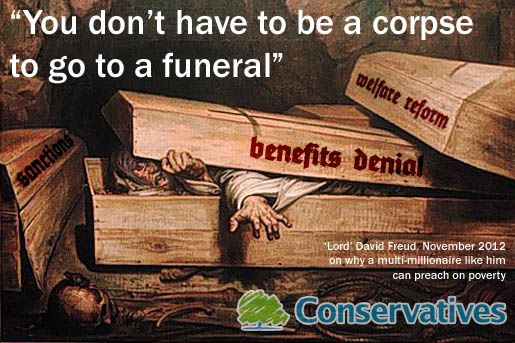
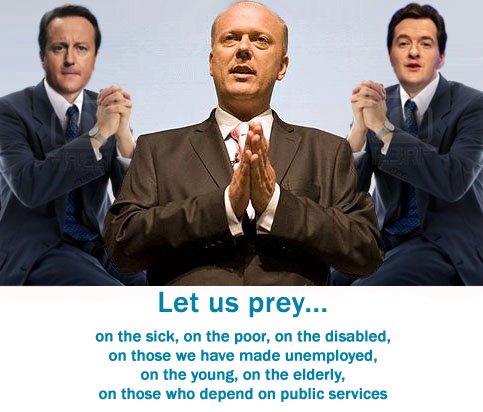
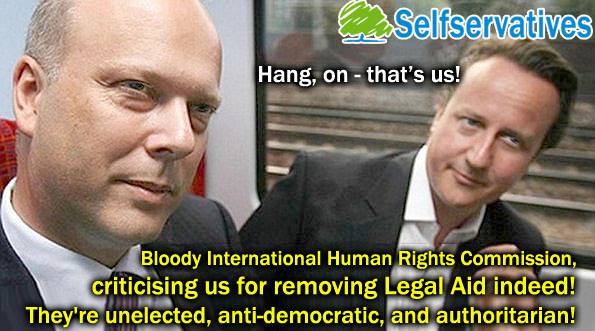
994442_352804464870608_5110112617916821526_n (1)

The Human Rights Act 1998 (HRA) is a straightforward statute, that works by allowing individuals in the UK to enforce their rights in their local courts.  The Act makes available a remedy for breach of a Convention right without the need to go to the European Court of Human Rights in Strasbourg.

It was designed to supplement the European Convention on Human Rights (ECHR). It also requires public authorities to respect the rights of those they serve. As a part of Labour’s 1997 commitment to a new constitutional settlement, it represented a new way of thinking about law, politics and the relationship between public authorities and individuals.

The Act provides that it is unlawful for a public authority to act in such a way that contravenes Convention rights. Section 7 of the HRA enables any person with standing to raise an action against a public authority which has acted or proposes to act in such a way that contravenes the Convention. A person will have standing to do so provided they would satisfy the “victim test” stipulated by Article 34 of the Convention. This is a more rigorous standard than is ordinarily applied to standing in English (although not Scottish) judicial review.

However, the Act also provides a defence for public authorities if their Convention violating act is in pursuance of a mandatory obligation imposed upon them by Westminster primary legislation.

The rights protected by the Act are quite simple. They include the right to life, liberty and the right to a fair trial; protection from torture and ill-treatment; freedom of speech, thought, religion, conscience and assembly; the right to free elections; the right to fair access to the country’s education system; the right to marry and an overarching right not to be discriminated against. Cameron has argued that it should be repealed since just 10 years after its implementation (the HRA came into force in October 2000) … so that he can pass another Act.

No other country has proposed de-incorporating a human rights treaty from its law so that it can introduce a Bill of Rights. The truly disturbing aspect of Cameron’s Bill of Rights pledge is that rather than manifestly building on the HRA, it’s predicated on its denigration and repeal. One has to wonder what his discomfort with the HRA is. The Act, after all, goes towards protecting the vulnerable from neglect of duty and abuse of power.

Do you really believe Cameron (Or Farage, who also states that he intends to repeal the HRA, given the opportunity) is more likely to build on existing rights and freedoms or to destroy them? The front page agendas of the Sun and Daily Mail indicate the latter. The Tories have hijacked the language of a Bill of Rights in order to weaken them.

History

The rights protected by the HRA are drawn from the 1950 European convention on human rights, which was a way of ensuring that we never again witness the full horrors of the second world war, and overwhelmingly, one of the greatest stains on the conscience of humanity – the Holocaust. Winston Churchill was one of the main drivers of the Convention, it was largely drafted by UK lawyers and the UK was one of the first countries to ratify it in 1951.

This was the establishing of a simple set of minimum standards of decency for humankind to hold onto for the future. The European Convention on Human Rights and Fundamental Freedoms (ECHR) was drafted as a lasting legacy of the struggle against fascism and totalitarianism, as well as the atrocities of world war two.

Yet the HRA is quite often portrayed by the Right as a party political measure. However, whilst the Human Rights Act is ultimately recognised as one of the greatest legacies of Labour in government, Cameron seems oblivious to the fact that Human Rights are not objects to be bartered away. They arose from struggles that were begun long ago by past generations who gave their lives for these rights to be enshrined in our laws.

The position of the Conservative party was clarified by Chris Grayling, the justice secretary, when he revealed late last year that “replacement” of the HRA would be part of the Tory election campaign. The only thing that has held the Tories in check during this government has been the opposition from Liberal Democrats to any diluting of the Act or to our commitment to the European Convention. The Labour Party, has been equally consistently adamant that it intends to retain the HRA, and to remain committed to the Convention.

The outcome of the local and European elections has now intensified the debate. The UKIP challenge will no doubt push the Tories even further right: to further distance itself from the obligations under the Convention, which is frequently wrongly described by Tories and the press as an EU treaty.

When the decision to give domestic effect to the European Convention on Human Rights took place in Northern Ireland, the negotiators to the Good Friday agreement made sure that this was included. The Labour Government agreed to incorporate the Convention through an international treaty with the Government of the Republic of Ireland on the basis of a quid pro quo. The Human Rights Act was a crucial part of the peace accord.

The HRA is misunderstood and very often misrepresented by right-wing politicians and the media, it has been variously portrayed as a threat to parliamentary sovereignty, a European imposition, and a “villain’s charter.” It is in reality, however, a victim’s charter. It provides a vital framework for such debate amongst people of good will.

Tory ministers are a major source of national embarrassment when they denounce the European Court of Human Rights whilst instructing the rest of the world, including other European states, to respect our collective international human rights obligations and “the rule of law.” Human Rights legislation exists throughout the free world. Free speech, the right to a fair trial, respect for private life and the prohibition on torture are values which distinguish democratic societies from fascist states.

An inquiry led by the Equality and Human Rights Commission demonstrated that the HRA has been effective in influencing the everyday practice and procedure of a range of public authorities, from the police to social workers, care homes to mental health hospitals. The HRA does not set criminals above the victim, despite the media myths. Nearly all of the rights are informed and qualified by the need for public protection, and many human rights cases have involved  victims challenging governments for gross failures to protect them.

These are positive developments which UKIP and the Tories seek to overturn.

The case for the HRA is a strong one. It is a moral case based not only on learning from the history of some of the worst violations of human rights before and during the second world war, but also from recent history – the here and now. If a new settlement based on social inclusion and greater equality is to be reached, the HRA should not be viewed suspiciously, as a burden, but promoted as an instrument of equality, social cohesion and public purpose. It is expected of a democratic government to improve the understanding and application of the Act. That is an international expectation, also.

There is no justification for editing or repealing the Act itself, that would make Britain the first European country to regress in the level and degree of our human rights protection. It is through times of recession and times of affluence alike that our rights ought to be the foundation of our society, upon which the Magna Carta, the Equality Act and the Human Rights Act were built – protecting vulnerable citizens from the powerful and ensuring those who govern are accountable to the rule of law.

Observation of human rights distinguishes democratic leaders from dictators and despots. Human Rights are the bedrock of our democracy, they are universal, and are a reflection of a society’s and a governments’ recognition of the equal worth of every citizens’ life.

Worth reading:

The protection of freedom under the Human Rights Act: some illustrations

A journalist’s guide to the Human Rights Act


68196_116423458427191_5364492_nPicture courtesy of Robert Livingstone 

Cameron pledges to leave the European Convention on Human Rights.

994442_352804464870608_5110112617916821526_n
BBC (Conservative) political editor Nick Robinson said a report written by a working group of Conservative lawyers has predicted that the so-called British Bill of Rights would force changes in the way the Strasbourg court operates. Robinson unbelievably quoted Theresa May on the radio earlier today, from this:

“We all know the stories about the Human Rights Act. The violent drug dealer who cannot be sent home because his daughter – for whom he pays no maintenance – lives here. The robber who cannot be removed because he has a girlfriend. The illegal immigrant who cannot be deported because – and I am not making this up – he had pet a cat.”

Of course this was a lie. At the time May made the bizarre claim, the Judicial Office intervened and stated “This was a case in which the Home Office conceded that they had mistakenly failed to apply their own policy – applying at that time to that appellant – for dealing with unmarried partners of people settled in the UK. That was the basis for the decision to uphold the original tribunal decision – the cat had nothing to do with the decision.” The recently “retired” Ken Clarke also clarified at a Telegraph fringe event that no-one had ever avoided being deported for owning a cat.

482882_456712161064984_1212213617_n

Theresa May is far from alone amongst the Conservatives with a deep disdain for our obligations to uphold international human rights laws. It’s no surprise that David Cameron has also pledged to explore ways to leave the European Convention on Human Rights (ECHR) again, in the wake of the departure of his most senior legal advisor, according to the Daily Telegraph.

Ken Clarke said: “It is unthinkable for Britain to leave the European Convention on Human Rights,” as he also became a departing Cabinet minister. The Prime Minister is believed to have wanted rid of the Attorney General Dominic Grieve because he was supportive of Britain’s continued ECHR membership.

Labour has dubbed the Cabinet reshuffle “the massacre of the moderates”, pointing to the departure of pro-Europe and “One Nation” Tories such as David Willetts, Nick Hurd and Oliver Heald.

It’s long been the case that the Tories and the right-wing press have deliberately blurred the boundaries between the European Union and the European Council of Human Rights, which are of course completely different organisations. I assumed that this was a misdirection ploy.

However it is the case that the member states of the EU agreed that no state would be admitted to membership of the EU unless it accepted the fundamental principles of the European Convention on Human Rights and agreed to declare itself bound by it. I also think that Conservatives, who regard both institutions as “interfering”, do see the Union and the Council as the same in terms of both being international frameworks requiring the British government to have a degree of democratic accountability at an international level.

In his parting interview, Mr Clarke, who has held office in every Conservative government since 1972 and is also the party’s most prominent Europhile, said the debate was “absurd”.

“I personally think it’s unthinkable we should leave the European Convention on Human Rights; it was drafted by British lawyers after the Second World War in order to protect the values for which we fought the War for.” He’s right, of course.

The years immediately after the Second World War marked a turning point in the history of human rights, as the world reeled in horror of the Nazi concentration camps, there came an important realisation that although fundamental rights should be respected as a matter of course, without formal protection, human rights concepts are of little use to those facing persecution.

So in response to the atrocities committed during the War, the International Community sought to define the rights and freedoms necessary to secure the dignity and worth of each individual. In 1948 the newly formed United Nations adopted the Universal Declaration of Human Rights (UDHR), one of the most important agreements in world history.

Shortly afterwards another newly formed international body, the Council of Europe, set about giving effect to the UDHR in a European context. The resulting European Convention on Human Rights was signed in 1950 and ratified by the United Kingdom, one of the first countries to do so, in 1951. At the time there were only ten members of the Council of Europe. Now 47 member countries subscribe to the European Convention, and in 1998 the Human Rights Act was passed by the Labour Party in order to “give further effect” to the European Convention in British law.

Previously, along with the Liberal Democrats, Grieve was able to thwart attempts to reform the ECHR, and opposed pulling out altogether. The plan to reform it is being led by the Justice Secretary Chris Grayling but Grieve has pledged to continue to fight for Britain’s membership from the backbenchers. Though Clegg had agreed to a British Bill of Rights, he was strongly opposed to withdrawing from the ECHR.

Grieve understood that ECHR is about the fundamental rights of the citizen and ought to be cherished in the same way as the Magna Carta and Habeas Corpus are. But as we know, this is not a typical view amongst Conservatives, who frequently cite the same examples of “foreign criminals” being allowed to stay in the country as evidence it is “not working”.

The Prime Minister’s spokesman said that the sacking of Grieve had not led to a change in Government’s policy. However he pledged action if the Conservatives are elected next year without the Liberal Democrats: “If you are asking me about party manifestos, the Prime Minister has previously said that he wants to look at all the ways that we can ensure we are able to deport those who have committed criminal offences.”

Mr Grieve said he would defend human rights legislation from the back benches to “contribute to rationality and discourse”.

“If we send out a sign that human rights don’t matter, that is likely to be picked up in other countries which are also signatory states such as Russia.”

The Conservatives are very likely to go into the next election with a proposal to repeal Labour’s Human Rights Act, which enshrines the European Convention in British law, and replace it a British Bill of Rights. We have witnessed this Conservative-led government blatantly contravene human rights with policies such as the Bedroom Tax, the Legal Aid Bill, and there is a backlog of cases awaiting Hearing.

The Equality and Human Rights Commission (established under Labour’s Human Rights  Act) have suffered significant cuts to funding, from 70 million when Labour were in Government to just 25 million since the Coalition took Office, up until 2012, with fears that this will be further reduced to just 18 million. This has meant severe staffing reductions, and a massive backlog of work, and at a time when many are seeking to bring forward cases regarding the impact of Government legislation.

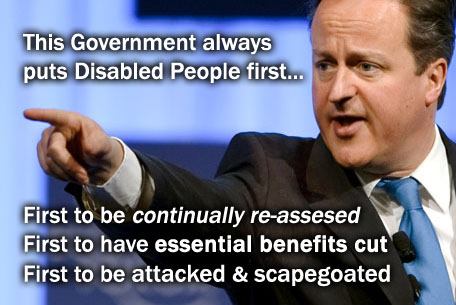
Human rights were formulated to protect us from governments such as this one. This is a government that chooses to treat our most vulnerable citizens despicably brutally, with absolutely no regard for their legal and moral obligation to meet our most basic needs.

Such a disregard of fundamental rights is historically associated with despots and tyrants

It’s clear that this government see human rights as an inconvenience and an obstacle to their future policy plans.

A central tenet of human rights law is that all humans have equal worth. We know that Conservatives such as Cameron don’t hold that view, there is an inherent, persistent strand of Social Darwinism that is clearly evident in Tory ideology, manifested in their policies, and they prefer and shape a hierarchical society founded on inequalities.

Disregard and contempt for human rights has led to atrocities. Human rights are safeguards, they establish moral principles that set out certain standards of human behaviour, and they are universal, providing in principle social and legal protections for all.

We need to ask why would any government want to opt out of such protections for its citizens?

We know from history that a society which isn’t founded on the basic principles of equality, decency, dignity and mutual respect is untenable and unthinkable.

7005_494073677328832_658777491_n
Pictures courtesy of Robert Livingstone 

DWP’s decision to abolish the Independent Living Fund overturned thanks to Labour’s Equality Act, but the court ruling is ignored.

397514_433063430096524_259754982_n
In a very significant decision on 6 November 2013, which highlights the effects of the Equality Act 2010 on public authorities and their decision-making, the Court of Appeal has 
found that the Department of Work and Pensions’ (DWP) decision to close the Independent Living Fund was not lawful, overturning the High Courts’ decision of April 2013. The Government had indicated that it would not be appealing this judgement and the Independent Living Fund (ILF) will remain intact for now. 

People with disabilities may receive funding under the ILF: a non-departmental Government body which provides money to help disabled people live independent lives in the community. The ILF operates an independent discretionary trust funded by the DWP and managed by a board of trustees. Its aim is to combat social exclusion on the grounds of disability and the money is generally used to enable disabled people to live in their own homes and to pay for care which would otherwise need to be given at residential care homes.

Over 19,000 disabled people receive assistance from the fund and the money is allocated by local authorities. Due to budget cuts, local authorities have had limited ability to support individuals unless their needs are very severe and so the ILF has served to supplement this provision.

In 2010, the Government indicated that the ILF was considered financially unsustainable and that it would consult to develop a new model for the future care and support of ILF users.  The consultation launched in July 2012 sought the views of: ILF users; their families and carers; interested individuals; and organisations, on the proposal to close the ILF in 2015 and on how best existing users of the ILF could have their needs met after closure.  The Government stated that its preferred option was to devolve funding to local government.

However, the Government has since stated that money will be devolved to already cash-strapped local authorities in England, which means that it would cease to be ring-fenced and would be subject to normal constraints and cuts within a local authority budget. And the local authorities have already said that they will not be able to offer the current level of financial support provided on ILF, potentially forcing many disabled people to move out of their homes and into residential care homes.

The Government initially decided to close the fund by March 2015 but this was delayed until June 2015 after five disabled people challenged the Government’s decision in the High Court.

The Court of Appeal unanimously quashed the decision to close the fund and devolve the money, on the basis that the minister had not specifically considered duties under the Equality Act, such as the need to promote equality of opportunity for disabled people and, in particular, the need to encourage their participation in public life. The court emphasised that these considerations were not optional in times of austerity.

On March 6, 2014, the Government announced in authoritarian style that it would go ahead with the closure of the ILF fund on 30th June 2015, saying that a new equalities analysis had been carried out by the Department for Work and Pensions. The government has shown a complete disregard for disabled people and the Court of Appeal decision. The government had failed to comply with the equality duty – and this was a rare victory entirely due to disabled people fighting back.

Unite national officer for equalities Siobhan Endean said: “Unite believes that the closure of the Independent Living Fund will have a catastrophic impact on disabled people and their right to live independent and fulfilling lives.”

“Ministers decided not to appeal, but have instead carried out a new equality impact assessment to justify the closure. Many other changes to benefits and local authority services are also undermining independent living.”

The papers released during the judicial review reveal that the Government was banking on the closure of the ILF receiving very little attention from the public and mainstream media because it only affects relatively few people. They are calculating on the British public not caring enough about our human rights.  We hope they have miscalculated.

Labour has called for the retention of this vital fund which benefits the most severely disabled. To show her support for the retention of Independent Living Fund, which is relied upon by over 19,000 severely disabled, Labour’s Dame Anne Begg is the primary sponsor an Early Day Motion calling on the Government to reverse their decision to close the fund in June 2015. You can view the EDM here. You can also ask your MP to sign it.

The successful judicial review is a useful demonstration of how strictly the courts will consider whether or not a public body has complied with its Public Sector Equality Duties (PSED) imposed by the Equality Act 2010 (EA 2010). There must be hard evidence that the “decision maker”  has fully complied with the requirements contained in the legislation, specifically, in this case, the duties under Section 149 in relation to advancing equality of opportunity for those who share a relevant protected characteristic.

In particular, Lord Justice McCombe restated that the court must ensure that there has been a proper and conscientious focus on the statutory criteria, rather than simply a “tick box” approach. He noted that the EA 2010 placed real obligations on the Minister under section 149 to consider, amongst other things, “the need to advance equality of opportunity between persons who share a relevant protected characteristic and persons who do not share it” and to, “take steps to meet the needs of persons who share a relevant protected characteristic that are different from the needs of persons who do not share it.

The Court of Appeal agreed with the Appellants that documents which the Minister (Esther McVey) had seen in the run up to her decision proved that, “the Minister did not receive a sufficient understanding of the true threat to independent living for ILF users posed by the proposal to close the fund”  The Minister had received from her officials a somewhat toned down summary of the response to the consultation which did not give her a “true flavour” of the real level of threat to users posed by the proposal to close the ILF. The Court agreed that the detail set out in the local authority responses to the consultation which clearly articulated concerns about the effect of closure on users, was not seen by the Minister.

As a result, the Court of Appeal rejected the DWP’s argument that the Minister was fully aware of the effects of the proposal. The DWP’s argument was based largely on “common sense inferences” that by virtue of her role as Minister for Disabled People and the fact that she was considering the impact of closing a fund aimed at the independent living of disabled people, it will have been obvious to her that independent living may not be possible for all users. The Court of Appeal noted that a heavy burden is imposed by the EA 2010 on public authorities and therefore, there has to be hard evidence that the public body has discharged that duty.

The Labour Party included a commitment to an Equality Bill in its 2005 election manifesto. The Discrimination Law Review was established in 2005 to develop the legislation and was led by the Government Equalities Office. The review considered the findings of the Equalities Review Panel, chaired by Trevor Phillips, which reported in February 2007. 

The Act was intended to simplify the law by bringing together previous existing anti-discrimination legislation. The primary purpose of Labour’s Equality Act 2010 is to codify the complicated and numerous array of Acts and Regulations, which formed the basis of anti-discrimination law in Great Britain previously. One of the most radical aspects of the Equality Act was its recognition of class – socio-economic disadvantage, apart from other protected and universally accepted characteristics.

This legislation has the same goals as the four major EU Equal Treatment Directives, whose provisions it mirrors and implements, although it extends beyond EU Directives. It requires equal treatment in access to employment as well as private and public services, regardless of the protected characteristics of age, disability, gender reassignment, marriage and civil partnership, race, religion or belief, sex, and sexual orientation.

However, it’s worth noting that the achievements of the British Equality Acts 2006 and 2010 are being seriously undermined by actions of the Coalition Government at a time when recession and cuts in public services are having a disproportionate impact on women, working families, jobseekers, ethnic minorities, the elderly, and disabled people. The Home Secretary said 5 May 2011 that it is not the intention of the Government to abolish the Equality Act. But we are witnessing “death by a thousand cuts.”

As Sir Bob Hepple QC has pointed out, some provisions of the Labour Government’s EA are not being brought into force, (only roughly 90% of the Act came into force, after the Coalition quickly said it would be “reviewing several sections of the legislation passed by parliament in April 2010,”) whilst other provisions have been repealed by the Enterprise and Regulatory Reform (ERR) Bill, including the duty on public authorities to have due regard to the need to reduce socio-economic inequalities.

The failure to implement the Act in full certainly sends out a clear signal that creating a more equal society is a very low priority for the coalition.

The budget of the Equality and Human Rights Commission (EHRC) has being reduced by over 60%, its staffing cut by 72%, and its powers restricted. As from April 2013 claimants in discrimination cases in tribunals will have to pay an issue fee of £250 and a hearing fee of £950.

The public sector equality duty needs to be strengthened and strategic litigation used to force the pace of change. The further threats to the legal infrastructure make it all the more important to rally and mobilise all disadvantaged groups around equality as a fundamental human right at this crucial time. The “death by a thousand cuts” is not incidental. Once again we are seeing one element of a Tory-led planned and coordinated attack on our most vulnerable citizens, with plain evidence that this government is deliberately bypassing our rights in order to impose cruel austerity cuts on those with least.

And just in case you had any doubts about this government’s strong authoritarian tendency, it emerged last month that Government proposals making it much harder for ministers are to be challenged in the courts and have been slammed in a report by parliamentarians. Labour have strongly attacked the proposals.

A report by the Joint Committee on Human Rights extended the criticisms already voiced by MPs to Chris Grayling, the Justice Secretary behind the reforms. It says ministers’ proposal to only make legal aid payable if permission for the judicial review is granted is “a potentially serious interference with access to justice”.

Grayling combines that role with his title of Lord Chancellor, a position which has for centuries defended the judiciary.

Now MPs and peers have declared a “thoroughgoing review” of the dual role is needed because, they suggest, Graylings’ moves to undermine the rule of law are politically motivated.

Importantly, the Committee also concluded that the legal aid changes – which are now in effect – have been made without sufficient opportunity for parliamentary scrutiny. The Report recommends that the Government void the Regulations and make amendments to the Criminal Justice and Courts Bill. 

Both Grayling and May have made admissions that they could not conceive of a situation where a majority Conservative government would not repeal the Human Rights Act and withdraw from the European Court of Human Rights.

The Human Rights Act and the ability of UK citizens and residents to take appeals to the European Court of Human Rights has received considerable propagandarised criticism in the UK media and the Conservative party, who claim that the Act has “ushered in a regime of “political correctness”” and who have focussed on a small number of high-profile cases involving foreign prisoners and detainees to try and discredit it.  

The effect of the UK Human Rights Act 1998 was to make the rights specified in the European Convention of Human Rights enforceable in UK courts.  The act is described in official Ministry of Justice information releases as “the most important piece of constitutional legislation passed in the United Kingdom since the achievement of universal suffrage in 1918” and gives UK citizens and residents protection against abuses of civil rights and personal freedoms by state and governmental authorities.

This Government wants to take that protection away, it considers itself above the law, and is relentlessly working to undermine our access to justice and protection from the Government itself. The real horror hits home when you ask yourself why.

They cannot be allowed to remain in Office another term. 

536738_306169162785952_999031084_n

 Many thanks to Rob Livingstone for his excellent pictures

Tory dogma and hypocrisy: the “big state”, bureaucracy, austerity and “freedom”

1965037_301820166635705_1502392114_n (1)

The Tories are not “paying down the debt” as claimed. They are raising more money for the rich.

Labour’s social and economic policy was a success, and this is substantiated by the LSE’s definitive survey of the Blair-Brown years:

There is clear evidence that public spending worked, contrary to popular belief.” Nor did Labour overspend. It inherited “a large deficit and high public sector debt”, with spending “at a historic low” – 14th out of 15 in the EU.

Labour’s spending increased, and money was invested in public services and social programs, and until the crash was still “unexceptional”, either by historic UK standards or international ones.

Until 2007 “national debt levels were lower than when Labour took office”. After years of neglect during the previous Conservative administration [2 recessions during the Thatcher era, another during Major’s],  Labour inherited a mess: public services in very poor state, shabby and squalid public buildings and unforgivably neglected human lives that formed a social deficit much more costly than any Treasury debt.

Labour Ministers set about addressing the causes and devastating effects of poverty and social marginalisation. Both poverty and inequality had risen to levels unprecedented in post-war history. This process accelerated during the 1980s.

Unlike every other post-war decade, in which the benefits of economic growth had been shared across social groups, the economic gains of the 1980s disproportionately benefited the rich at the expense of the poor (Hills, 2004). Social inequality on such a gross level was not only the result of Thatcher’s policies, she celebrated it. She declared that inequality is essential to fostering “the spirit of envy” and hailed greed as a “valuable spur to economic activity”.

The mess that Thatcher left is verified by several longitudinal studies. Dr. Alex Scott-Samuel and colleagues from the Universities of Durham, West of Scotland, Glasgow and Edinburgh, sourced data from over 70 existing research papers, which concludes that as a result of unnecessary unemployment, welfare cuts and damaging housing policies, the former prime minister’s legacy

…includes the unnecessary and unjust premature death of many British citizens, together with a substantial and continuing burden of suffering and loss of well-being.

The article also cites evidence including the substantial increase in income inequality under Thatcher – the richest 0.01% of society had 28 times the mean national average income in 1978 but 70 times the average in 1990, and the rise in UK poverty rates from 6.7% in 1975 to 12% in 1985.

It concludes that:

Thatcher’s governments wilfully engineered an economic catastrophe across large parts of Britain” by dismantling traditional industries such as coal and steel in order to undermine the power of working class organisations, such as unions. This ultimately fed through into growing regional disparities in health standards and life expectancy, as well as greatly increased inequalities between the richest and poorest in society.

Blair established the social exclusion unit inside No 10. “Social exclusion” signified not just poverty, but its myriad causes and symptoms, with 18 task forces examining education, babies’ development, debt, addiction, mental health, housing and much more. Policies followed and so did improvements.

John Prescott’s department published an annual Opportunities for All report that monitored these social targets: 48 out of 59 indicators improved. So when Cameron and his band of brigands sneer that “all Labour did was give tax credits to lift families just over the poverty line” – “poverty plus a pound” – they lie through their teeth.

Contrary to Tory claims, benefits were not Labour’s main instrument of social change: the benefit budget fell as a proportion of spending, outstripped by increases in health, education and other social services.

Despite Blair’s neoliberal turn, Labour’s social policies enshrined principles of equality and inclusion. The Tories deplore such principles, yet that doesn’t stop them claiming that their socially regressive policies are somehow “fair”. Things got better with a Labour administration, money was mostly well spent. That’s not the case now. It’s all being intentionally and spitefully undone. We are moving backwards on just about every positive social measure Labour put in place: the coalition’s “more for less” is exposed as pretence. They are simply raising more money for the rich.

And all because of their driving ideology. George Osborne’s “plan A” isn’t about economics: it amounts to little more than a rehashed Thatcherite ideological agenda of deregulation and labour market “flexibility”, as modelled by the Beecroft report – the assault on the rights of employees, and Labour’s historic equality legislation. The Tory demand for a “nightwatchman state” is both ill-conceived and completely irrelevant to Britain’s economic circumstances.

The Coalition have borrowed more in 4 years than labour did in 13 and have NOTHING to show for it except a handful of wealthier millionaires. And the return of absolute poverty.

We know that austerity was intentionally imposed by the Coalition, using a feigned panic over the budget deficit to front an opportunistic vulture capitalist approach to stripping our public assets. With the Coalition in power for 4 years, the deficit has apparently receded in importance.

We can hope that Labour can return to its  pro-social role of advocating government spending for the provision of public services. Conservatives have always played on dogma and popular prejudice by constantly equating government with bureaucracy. But that’s just the superficial excuse for their obsession with removing every trace of supportive provision and our public services.

It’s more accurate to say that Conservatives equate socially responsible, democratic, caring governments with “bureaucracy”. Conservatives aren’t ever interested in championing independent and merit-based public service. But most criticisms of government bureaucracy are based on myth, not reality.

The agencies that the Tories attack and destroy actually play a valuable and indispensable role in making our society a better place to live. They are the very hallmarks of what makes us civilised, they are how we support vulnerable citizens, ensure equal opportunities, uphold human rights.

The whole point of having human rights is that they apply to EVERYONE – something the Tories never understand – if rights are  not universally applied, then they are worthless. In fact they are hostile to the very notion that we each have equal worth, as we know.

Tories value and develop social hierarchy. When Tories want to make “shrinking” government sound attractive and feasible, they claim they are cutting “bureaucracy” and not social “programs.” Most people recognise the public value of State programs – in the areas of education, health and the environment for example – and don’t want to see these reduced; but everyone hates bureaucracy.

Using the term “bureaucracy” in this way is a rhetorical sleight-of-hand that attempts to obscure the real costs of cutting back on government programs. The lack of coherent reasoning underpinning the rhetoric is because this is simply Tory fundamentalism: it is not founded at all on rational, evidenced discourse.

I’ve said elsewhere that Edwardian levels of inequality led to the Great Depression. Austerity measures under Chancellor Hindenburg contributed to the rise of Nazism. The drop in household income in Japan between 1929 and 1931 led to a wave of assassinations of Government officials and bankers.

Social policies after World War 2 turned the tables and brought peace, with inequality steadily dropping in Britain until recently. But inequality is now returning to pre-war levels. The Tories are incapable of learning from historic lessons, because of their own sense of entitlement, privilege and ideological bondage.

In response to the atrocities committed during the War, the International Community sought to define the rights and freedoms necessary to secure the dignity and worth of each individual. Ratified by the United Kingdom, one of the first countries to do so, in 1951, those human rights originally established in the Universal Declaration have been steadily eroded since the Coalition gained Office.

There’s a clear link between high levels of inequality and failure of Governments to recognise human rights, and to implement them in policies. Authoritarians view the rights of the individual, (including those considered to be human rights by the international community), as subject to the needs of the Government. Of course in democracies, Governments are elected to represent and serve the needs of the population.

Democracy is not only about elections. It is also about distributive and social justice. The quality of the democratic process, including transparent and accountable Government and equality before the law, is critical. Façade democracy occurs when liberalisation measures are kept under tight rein by elites who fail to generate political inclusion.

Related articles:

How remarkable that a government that argues against bureaucracy on the grounds that it’s a “threat to individual freedom” have no problems imposing the Gagging Act and the Legal Aid Act – policies purposefully designed to severely limit our freedoms. But then, the Tories were never known for their rationality, coherence and joined-up narratives. Or for integrity and telling the truth.

Thatcher’s secret plot to dismantle the welfare state and privatise the NHS revealed

The mess we inherited: some facts with which to fight the Tory Big Lies

The great debt lie and the structural deficit myth

539627_450600381676162_486601053_n (2)
scroll2

Osborne’s real aim is not budget surplus, but attack on Welfare State & public sectors It’s not a difficult task for a government to guarantee a safety-net that is always available for anyone who falls on hard times during an era of huge social and economic change. We all fund it, after all. And we all know that unemployment, injury or illness may happen to anyone through no fault of their own. It’s considered a duty of any first-world government to provide the means of basic survival for its citizens and to fund that with the money we contribute via taxes. In fact such an approach to social and economic welfare is internationally codified in human rights.

Article 25 of the Universal Declaration of Human Rights, to which the UK is a signatory, reads:

Everyone has the right to a standard of living adequate for the health and well-being of himself and of his family, including food, clothing, housing and medical care and necessary social services, and the right to security in the event of unemployment, sickness, disability, widowhood, old age or other lack of livelihood in circumstances beyond his control. Motherhood and childhood are entitled to special care and assistance. All children, whether born in or out of wedlock, shall enjoy the same social protection.

The Tories prefer to spend the tax they take from you on Tory donors – private companies that don’t deliver a service but simply fleece profit; on undeserving millionaires’ tax breaks – the feckless, scrounging rich had at least £107,000 each per year extra already. Then there is the never ending list of Tory expense scandals – all at our expense. And tax evasion. Why are we paying for this?

Furthermore, why are we indifferent as a society to the fact that our government is causing harm to our fellow citizens? I can’t comprehend this, how can we have allowed this to happen, as a so-called civilised and once democratic society? It’s about a driving ideology that is socially detrimental, malevolent, and not economically necessary: the Tories do not think that people have a right to food, housing or medical care, that much is clear. But they continue to take the money we have paid since the 1940s for those things. And hand it out to the wealthy.

Despite these facts, the Govt and the right-wing media have the audacity to talk about welfare claimants, as if all our woes are their fault. They aren’t, the spiteful authoritarian Tories are the problem.

1234134_539964652739734_1075596050_n

We can’t afford this government, economically, socially, morally or psychologically. Osborne’s austerity message was seriously undermined, and his lies in trying to blame the last government were demonstrated last November when the Office for National Statistics found that the coalition had borrowed £430.072 billion since it took over, whereas the last Labour government managed to borrow just £429.975 billion in 13 years. –  George Osborne Says Britain’s ‘Best Days Lie Ahead’, Ignoring These 6 Graphs


Many thanks to Robert Livingstone for his brilliant memes

Defining features of Fascism and Authoritarianism

999622_566748676727998_1599547969_n

Max Weber’s principle of Verstehen is a fundamentally critical approach in all social sciences, including politics, and we can see the consequences of its absence in the cold, pseudo-positivist approach of the Coalition in the UK. Their policies clearly demonstrate that they lack the capacity to understand, or meaningfully “walk a mile in the shoes of another”. The Coalition treat the population of the UK as objects of their policies and not as equal, subjective human beings. Policies are designed by the government, for the government, and reflect nothing of public interests.  Whenever the government are challenged and confronted with evidence from citizens that their policies are causing harm, they simply deny the accounts and experiences of those raising legitimate concerns.

The Conservatives do not serve us or meet our needs, they think that we, the public, are here to serve political needs and to fulfil politically defined economic outcomes. Citizens are seen as a means to government ends. We are ‘economic units’. In fact we are being increasingly nudged to align our behaviours with narrow, politically defined neoliberal outcomes.

My own starting point is that regardless of any claim towards the merits of value-freedom in any discussion about society, we cannot abdicate moral responsibility, cannot justify moral indifference. We see values and principles enshrined in a positive approach, exemplified in our laws, human rights and democratic process. We are also seeing an erosion of this tendency towards a globalisation of values, and inclusion of a recognition and account of the full range of human experiences in policy making. Indeed recently in the UK, public policy has become an instrument of stigmatisation, social exclusion and increasing minoritization. 

As a society, we have allowed the state to redefine our collective, universal, relatively egalitarian and civilising support structures, such as social housing, legal aid, welfare and broader public services as being somehow problematic. Those who need support are stigmatised, scapegoated, outgrouped and othered. The government tells us that welfare and other public services present “moral hazards”, and that they “disincentivise” citizens to be self sufficient. Yet the social gains of our post-war settlement were made to include everyone, should they fall on difficult times. We each pay into the provision, after all.

These provisions are civilising and civilised socioeconomic mechanisms that ensure each citizen’s life has equal dignity and worth; that no-one dies prematurely because of absolute poverty or because they have no access to justice, medical care and housing. 

Our post-war settlement was the closest that we ever came to a genuine democracy, here in the UK. It arose because of the political consensus, partly founded on a necessity of the state to meet the social needs of the newly franchised working class. 

However, we are now being reduced in terms of human worth: dehumanised to become little more than economically productive actors. We have a government that tends to describe protected vulnerable social groups in terms of costs to the State, regardless of their contributions to society, and responsibility is attributed to these social groups via political scapegoating in the media and state rhetoric, while those decision-makers actually responsible for the state of the economy have been exempted, legally and morally, and are hidden behind complex and highly diversionary ‘strategic communication’ campaigns and techniques of neutralisation (elaborate strategies of denial and rebuff).

Techniques of neutralisation are a series of methods by which those who commit illegitimate acts temporarily neutralise certain values within themselves which would normally prohibit them from carrying out such acts, such as morality, obligation to abide by the law, and so on. In simpler terms, these are psychological methods for people to turn off “inner protests” when they do, or are about to do something they themselves perceive as wrong. Some people don’t have such inner protests – psychopaths, for example – but they employ techniques of neutralisation to manipulate and switch off those conscience protests of others.

Language use can reflect attempts at minimising the impact of such wrongful acts. The Mafia don’t ever commit “murder”, for example, instead they “take someone out”, “whack them” or “give someone their medicine”. But the victim ends up dead, no matter what people choose to call it. Examining discourses and underpinning ideologies is useful as a predictive tool, as it provides very important clues to often hidden political attitudes and intentions – clues to social conditions and unfolding events. Linguistic habits are frequently important symptoms of underlying feelings and attitudes.

We know that benefits, for example, are calculated to meet basic living requirements only, such as food, fuel and shelter needs. To take away that basic support is devastating for those people having to struggle for basic survival. The Labour Party recently managed to secure concessions that ensured that the right of appeal for those sanctioned is maintained.

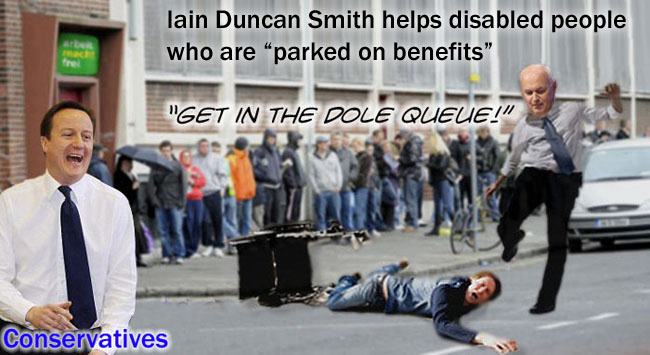
Iain Duncan Smith wanted to remove that right. But appeals take months to happen, and meanwhile people are left suffering  enormously, living in absolute poverty, as a result of having no money to meet their most fundamental survival needs. 

Sanctions are not “help” for jobseekers. Sanctions are state punishment and a form of persecution. It doesn’t matter how hard you look for work when you are one of 2,500,000 unemployed people and there are only 400,000 jobs available. If we want to help people into work we need to create decent pay and secure jobs, rather than punishing individuals for being out of work during the worst recession for over 100 years.

Work is no longer a guaranteed route out of poverty, as wages have stagnated and remain lower than they were before the global recession. More than half of the people queuing at food banks are in work. Reducing welfare has also lowered wages, as people who are desperate are forced to take any form of employment with poor conditions and wages. 

In a similar way, the Tories attempt to to distort meanings, to minimise the impact of what they are doing. For example, when they habitually use  the word “reform”, what they are referring to is an act that entails “removal of income”, “cuts”, and  punitive “incentives”, “help” and “support”: Tory-speak “help” means to “punish and take from”. Targets for such punishment and cuts are translated as Tory “statistical norms” or “not targets but aspirations” and “robust expectations of performance”. As I said earlier, these are techniques of neutralisation. Or Newspeak, if you prefer.

The “help” and “incentivisation” that the Tory-led Coalition have provided for jobseekers in the recession, at a time when quality jobs are scarce, secure and stable full-time work is also scarce, are entirely class contingent and punitive. Decent jobs that pay enough to get by on are like …well…Tory statistics; conjured from the aether, a very cheap trick – an illusion. We know that unemployment and underemployment are rising. 

Sartre once said that oppressors oppress themselves as well as those they oppress. Freedom and autonomy are also reciprocal, and it’s only when we truly recognise our own liberty that we may necessarily acknowledge that of others. Conservatism has always been associated with a capacity to inhibit and control, and never liberate. We need to take responsibility for the Government that we have. In fact we must.

Fascism evolves over a period of time. No-one ever woke up one morning to find it had suddenly happened overnight. It’s an ongoing process just as Nazism was. Identifying traits is therefore useful. Fascism and totalitarianism advance by almost inscrutable degrees. 

If you really think it could never happen here, you haven’t been paying attention this past few years to the undemocratic law repeals and quiet edits – especially laws that protect citizens from state abuse – the muzzling of the trade unions, a hatred of left and socialist perspectives, the corporocratic dominance and rampant cronyism, the human rights abuses, the media control and othering narratives, the current of anti-intellectualism and other serious blows to our democracy.

Dr. Lawrence Britt examined the fascist regimes of Hitler (Germany), Mussolini (Italy), Franco (Spain), Suharto (Indonesia) and several Latin American regimes. Britt found 14 defining characteristics common to each, and it is difficult to overlook some of the parallels with the characteristics of the increasingly authoritarian government here in the UK:

1. Powerful and continuing Nationalism – fascist regimes tend to make constant use of patriotic mottos, slogans, soundbites, symbols, songs, and other paraphernalia. Flags are seen everywhere, as are flag symbols on clothing and in public displays.

2. Disdain for any recognition of Human Rights – politically justified by stirring up fear of “enemies” and the need for “security”, the people in fascist regimes are persuaded that human rights can be ignored in certain cases because of “need.” The public tend to become apathetic, or look the other way, some even approve of persecution, torture, summary executions, assassinations, long incarcerations of prisoners, often without charge and so forth. But the whole point of human rights is that they are universal.

3. Identification of enemies and scapegoats used as a unifying cause – the public are rallied into a unifying patriotic frenzy over the need to eliminate a perceived common threat or foe: social groups; racial, ethnic or religious minorities; liberals; communists; socialists, terrorists international organisations and so forth.

4. Supremacy of the Military – even when there are widespread domestic problems, the military is given a disproportionate amount of government funding, and the domestic agenda is neglected. Soldiers and military service are glamorised.

5. Rampant sexism – The governments of fascist nations tend to be almost exclusively male-dominated. Under fascist regimes, traditional gender roles are made more rigid. Divorce, abortion and homosexuality are suppressed and the state is represented as the ultimate guardian of the family institution. Policies emphasise traditional and rigid roles. The government become the ‘parent’, because they “know what’s best for you”. Families that don’t conform are pathologised. 

6. Controlled mass media – the media is directly controlled by the government, but in other cases, the media is indirectly controlled by government regulation, or by ensuring strategically placed sympathetic media spokespeople and executives. Censorship is very common.

7. Obsession with “National Security” and protecting “borders”- fear is used as a motivational tool by the government over the masses.

8. Historically, religion and Government are intertwined – governments in fascist nations tend to use the most common religion of the nation as a tool to manipulate public opinion. Religious rhetoric and terminology is common from government leaders, even when the major tenets of the religion are diametrically opposed to the government’s policies or actions. But technocratic rule – referencing ‘science’ may also be used to appeal to the public and garner a veneer of  credibility.

9. Corporate Power is protected – The industrial and business aristocracy of a fascist nation often are the ones who put the government leaders into power, creating a mutually beneficial business/government relationship and power elite.

10. Labour power is suppressed – because the organising power of labour is the only real threat to a fascist government, labour unions are either eliminated entirely, or are severely suppressed.

11. Disdain for intellectuals and the Arts – fascist nations tend to promote and tolerate open hostility to higher education, and academia. It is not uncommon for professors and other academics to be censored or even arrested. Free expression in the arts and letters is openly attacked.

12. Obsession with Crime and Punishment – under fascist regimes, the police are given almost limitless power to enforce laws. The people are often willing to overlook police abuses and even forego civil liberties in the name of patriotism. There is often a national police force with virtually unlimited power in fascist nations.

13. Rampant cronyism and corruption – fascist regimes almost always are governed by groups of friends and associates who appoint each other to government positions and use governmental power and authority to protect their friends from accountability. It is not uncommon in fascist regimes for national resources and even treasures to be appropriated or even outright stolen by government leaders.

14. Fraudulent elections – sometimes elections in fascist nations are a complete sham. Other times, elections are manipulated by smears, the strategic misuse of psychology and propaganda campaigns, and even assassination of opposition candidates has been used, use of legislation to control voting numbers or political district boundaries, and of course, strategic communications together with targeted manipulation of the media. Fascist nations also typically use their judiciaries to manipulate or control elections, historically.

All fascist governments are authoritarian, but not all authoritarian governments are fascists. Fascism tends to arise with forms of ultra-nationalism. Authoritarianism is anti-democratic. Totalitarianism is the most intrusive; a ‘totalising’ form of authoritarianism, involving the attempted change, control and regulation of citizens’ perceptions, beliefs, emotions, behaviours, accounts and experiences. (See “nudge”, the Cambridge Analytica scandal, and the “Integrity Initiative” scandal, for example)

Authoritarian legitimacy is often based on emotional appeal, especially the identification of the regime as a “necessary evil” to combat easily recognisable societal problems, such as economic crises, with “tough choice”.

Authoritarian regimes commonly emerge in times of political, economic, or social instability, and because of this, especially during the initial period of authoritarian rule, such governments may have broad public support. Many won’t immediately recognise authoritarianism, especially in formerly liberal and democratic countries.

In the UK, there has been an incremental process of un-democratising, permeated by a wide variety of deliberative and disassembling practices which have added to the problem of recognising it for what it is.

Authoritarians typically prefer and encourage a population to be apathetic about politics, with no desire to participate in the political process. Authoritarian governments often work via propaganda techniques to cultivate such public attitudes, by fostering a sense of a deep divide between social groups, society and the state, they tend to generate prejudice between social groups, and repress expressions of dissent, using media control, law amendments or by quietly editing existing laws.

There is a process of gradual habituation of the public to being governed by shock and surprise; to receiving decisions and policies deliberated and passed in secret; to being persuaded that the justification for such deeds was based on real evidence that the government parades in the form of propaganda. It happens incrementally. Many don’t notice the calculated step-by-step changes, but those that do are often overwhelmed with the sheer volume of them.

Authoritarians view the rights of the individual, (including those considered to be human rights by the international community), as subject to the needs of the government. Of course in democracies, governments are elected to represent and serve the needs of the population.

Again, the whole point of human rights, as a protection for citizens, is that they apply universally. They are premised on a view that each human life has equal worth.

Democracy is not only about elections. It is also about distributive and social justice. The quality of the democratic process, including transparent and accountable government and equality before the law, is critical. Façade democracy occurs when liberalisation measures are kept under tight rein by elites who fail to generate political inclusion. See Corporate power has turned Britain into a corrupt state  and also Huge gap between rich and poor in Britain is the same as Nigeria and worse than Ethiopia, UN report reveals.

Some of the listed criteria are evident now. I predict that other criteria will gain clarity over the next couple of years.

“One doesn’t see exactly where or how to move. Believe me, this is true. Each act, each occasion, is worse than the last, but only a little worse. You wait for the next and the next. You wait for the one great shocking occasion, thinking that others, when such a shock comes, will join with you in resisting somehow. You don’t want to act, or even to talk, alone; you don’t want to “go out of your way to make trouble.” Why not? – Well, you are not in the habit of doing it. And it is not just fear, fear of standing alone, that restrains you; it is also genuine uncertainty.

“Uncertainty is a very important factor, and, instead of decreasing as time goes on, it grows. Outside, in the streets, in the general community, “everyone is happy. One hears no protest, and certainly sees none. You know, in France or Italy there will be slogans against the government painted on walls and fences; in Germany, outside the great cities, perhaps, there is not even this.

In the university community, in your own community, you speak privately to your colleagues, some of whom certainly feel as you do; but what do they say? They say, “It’s not so bad” or “You’re seeing things” or “You’re an alarmist.” (Or “scaremonger”)

“And you are an alarmist”. You are saying that this must lead to this, and you can’t prove it. These are the beginnings, yes; but how do you know for sure when you don’t know the end, and how do you know, or even surmise, the end?

On the one hand, your enemies, the law, the regime, the Party, intimidate you. On the other, your colleagues pooh-pooh you as pessimistic or even neurotic. You are left with your close friends, who are, naturally, people who have always thought as you have.” –  Milton Mayer, They Thought They Were Free.

Citizens feel increasingly powerless to shape the political institutions that are meant to reflect their interests. Politicians must relearn how to speak to disenfranchised citizens in an inclusive, meaningful way, to show that dysfunctional democracies can be mended.

Directing collective fear, frustration and cultivating hatred during times of economic turbulence at politically constructed scapegoats – including society’s protected groups which are historically most vulnerable to political abuse – has never been a constructive and positive way forward.

As Gordon Allport highlighted, political othering leads to increasing prejudice, exclusion, social division, discrimination, hatred and if this process is left to unfold, it escalates to hate crime, violence and ultimately, to genocide.

Othering and outgrouping are politically weaponised and strategic inhumanities designed to misdirect and convince populations suffering the consequences of intentionally targeted austerity, deteriorating standards of living and economic instability – all of  which arose because of the actions of a ruling financial class – that the “real enemy is “out there”, that there is an “us” that must be protected from “them.”

In the UK, democracy more generally is very clearly being deliberately and steadily eroded. And worse, much of the public has disengaged from participatory democratic processes.

It’s time to be very worried.
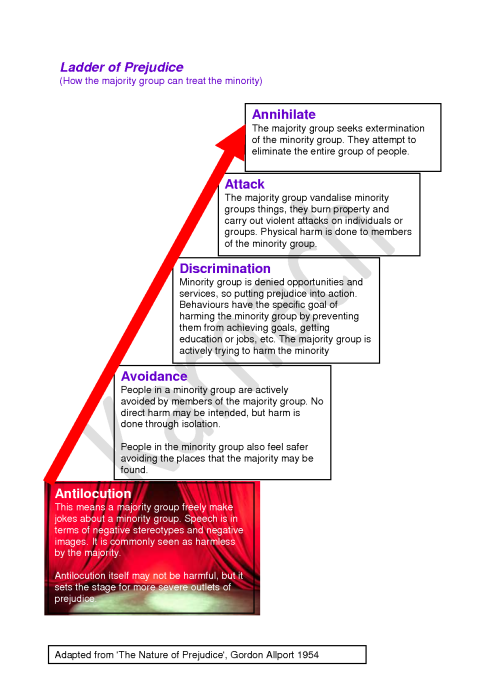
Allport's ladder

Further reading

“We must keep alert, so that the sense of these words will not be forgotten again. Ur-Fascism is still around us, sometimes in plainclothes. It would be so much easier, for us, if there appeared on the world scene somebody saying, “I want to reopen Auschwitz, I want the Black Shirts to parade again in the Italian squares.” Life is not that simple. Ur-Fascism can come back under the most innocent of disguises. Our duty is to uncover it and to point our finger at any of its new instances—every day, in every part of the world. Franklin Roosevelt’s words of November 4, 1938, are worth recalling: “I venture the challenging statement that if American democracy ceases to move forward as a living force, seeking day and night by peaceful means to better the lot of our citizens, fascism will grow in strength in our land.” Freedom and liberation are an unending task.” Umberto Eco, in Ur-Fascism


Politics and Insight’s independent, measured, authoritative reporting has never been so vital, or in the public interest. These are turbulent, decade-defining times. Whatever lies ahead for us all, I will be with you – investigating, disentangling, analysing and scrutinising, as I have done for the last 9 years. 

More people, like you, are reading and supporting independent, investigative and in particular, public interest journalism, than ever before.

I don’t make any money from my research and writing, and want to ensure my work remains accessible to all.

I have engaged with the most critical issues of our time – the often devastating impact of almost a decade of Conservative policies, widespread inequality to the influence of big tech on our lives. At a time when factual information is a necessity, I believe that each of us, around the world, deserves access to accurate reporting with integrity and the norms of democracy at its heart. 

My editorial independence means I set my own agenda and present my own research and analyisis.  My work is absolutely free from commercial and political interference and not influenced one iota by billionaire media barons.  I have worked hard to give a voice to those less heard, I have explored where others turn away, and always rigorously challenge those in power.

This morning I came across this on Twitter:

John Mann@LordJohnMann

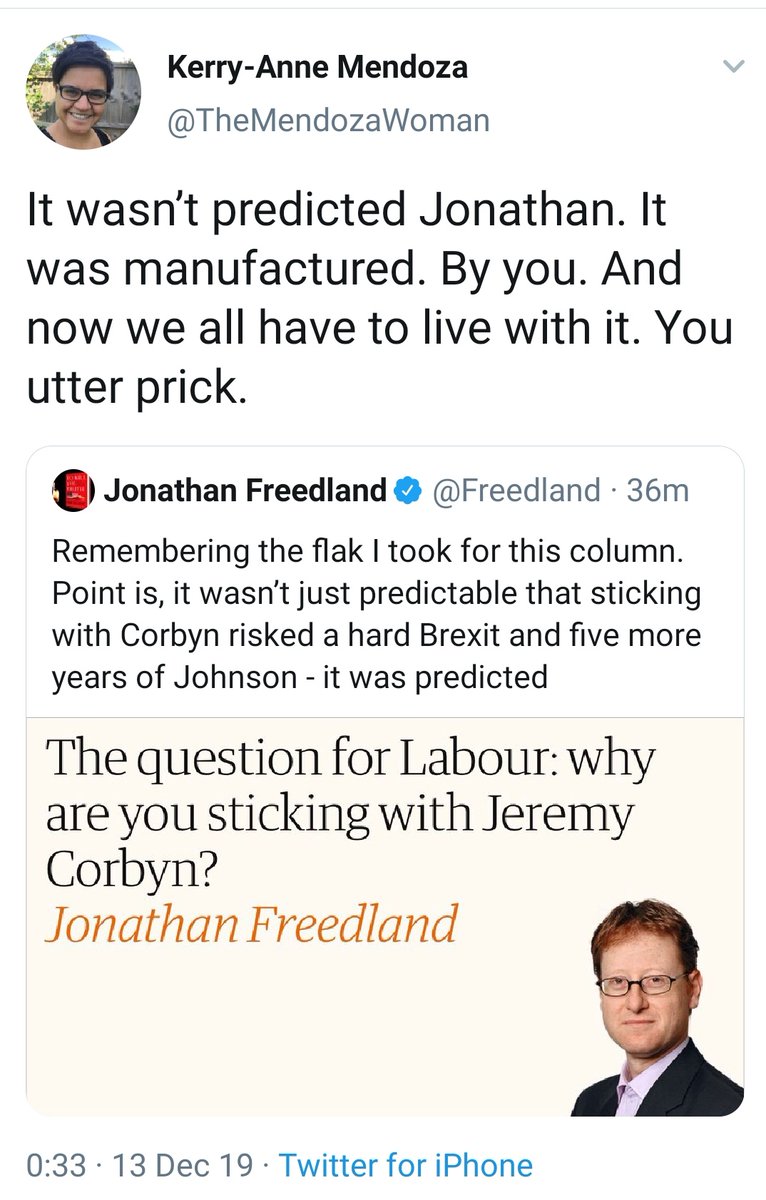
I can this morning announce that as government advisor on antisemitism that I will be instigating an investigation this January into the role of the Canary and other websites in the growth of antisemitism in the United Kingdom. https://twitter.com/supergutman/status/1205296902301990912 

Marlon Solomon@supergutman

Who’d have guessed that Mendoza – one of the people most responsible for toxifying the British left with racially charged conspiracy theories about Jews – would blame a Jew before anyone else.

Whoever takes control of Labour, from whatever faction, please fuck these people off.

View image on Twitter
3,147 people are talking about this

Independent journalists are now facing a threat from an authoritarian government, who have successfully managed to distort our mainstream media.

I did expect this promise of a purge on left leaning sites if Boris Johnson was returned to office, but not quite so soon after the event. It’s a case of vote Tory on Thursday, get fascism by Saturday. 

John Mann isn’t by a long stretch the only so-called moderate ex-Labour neoliberal  extremist whipping up McCarthyist hysteria and hate. But he has been strategically placed for a while by the Conservatives to destroy independent sites like mine. He’s a particularly nasty individual.

My first step to fight back in the coming year is to join the National Union of Journalists (NUJ). It is an essential protection, now.

It’s not cheap, especially for someone like me, as I’ve no income from my work. I pay WordPress to keep adverts off my site, too. But I am one of those people who often has to make daily choices about whether to eat or keep warm. I am disabled because of an illness called lupus. Like many others in similar circumstances, I am now living in fear for our future under a government that has already systematically and gravely violated the human rights of disabled people, which has resulted in fear, suffering, harm and all too often, premature death.

I hope you will consider supporting me today, or whenever you can. As independent writers, we will all need your support to keep delivering quality research and journalism that’s open and independent.

Every reader contribution, however big or small, is so valuable and helps keep me going. 

DonatenowButton

Syria, Miliband’s principled dignity, Murdoch and toxic Tory tantrums ladled up with corruption

556770_138948196256237_144572172_n

It’s worth considering that in the past few years President Bashar al-Assad’s Government has allegedly killed over 100,000 people in Syria, amongst them were many civilians, including women and children, so we need to ask why, exactly, would allegedly using chemical weapons on 1,300 people suddenly be much more of an issue and a matter of national interest for America, Britain and France?

My own view of the situation is that aggressive intervention is an absurd and incoherent solution. We cannot bomb people into democracy or shoot them into observing human rights. Punishing a dictator for killing his own people by simply killing more of his own people seems beyond cruel. The gesture of war will not punish the guilty, such as members of the tyrannical Assad regime: it will simply kill ordinary people and their children, topple buildings and cause injuries and hardship to the innocent. It seems to me to be a spectacularly pointless and peculiarly brutal proposal.

On both sides of the Atlantic, the public is quite rightly skeptical that employment of aerial bombardment is a cure-all for the world’s ills, after hard-learned lessons from Iraq, and our various other interventions, dressed up as “humanitarian aid”.

Of course it didn’t take much digging to find that there are some vested interests in oil and gas on Syrian territory. There is profit to be made by a local subsidiary of the New York-listed company, Genie Energy – which is advised by former vice president Dick Cheney, and shareholders include Rupert Murdoch and Jacob Rothschild. Israel has granted the US company the first license and it will now have exclusive rights to explore a 153-square mile radius in the southern part of the Golan Heights for oil and gas, John Reed of the Financial Times reports.

The Golan Heights – a disputed geopolitical area, is comprised of a two-thirds of land that was seized violently by Israel in the 60s in the Six-Day War, (and this is not internationally recognised as Israeli territory, it remains disputed, but Israel effectively annexed it in 1981), and the remaining third lies in Syria’s domain.

I visited the Golen Heights some years ago, and had a hairy moment or two on land which was peppered with Syrian mines, trapped there between snipers, at the border of the Israeli-claimed territory. Discarded shells and rockets littered the landscape, which had become strange and ugly monuments to human conflict. Yet we must never despair of human nature. Man’s nature is not essentially evil. Brute nature has been known to yield to the influence of love, according to Ghandi.

But not so easily under such profiteering, greedy and corrupt governments.

Israel’s administration of the area – which is still not recognised by international law – has been reasonably peaceful in recent years, until the Syrian civil war broke out 23 months ago.

This action is mostly political – it’s an attempt to deepen Israeli commitment to the occupied Golan Heights”, Israeli political analyst Yaron Ezrahi told FT.

The timing is directly related to the fact that the Syrian government is dealing with violence and chaos and is not free to deal with this problem”.

Earlier this month it was reported that Israel is considering creating a buffer zone reaching up to 10 miles from Golan into Syria to secure the 47-mile border against the threat of Islamic radicals in the area.

Both President Obama and his secretary of state, John Kerry, have mentioned Israel’s “needs” as one justification for an attack on Syria.

The Guardian reports that three months ago, Iraq gave the green light for the signing of a framework agreement for construction of pipelines to transport natural gas from Iran’s South Pars field – which it shares with Qatar – across Iraq, to Syria.

The Memorandum of Understanding (MoU) for the pipelines was signed in July last year – just as Syria’s civil war was spreading to Damascus and Aleppo – but the negotiations go back further to 2010. The pipeline, which could be extended to Lebanon and Europe, would potentially solidify Iran’s position as a formidable global player.

The Iran-Iraq-Syria pipeline plan is a “direct slap in the face” to Qatar’s plans for a countervailing pipeline running from Qatar’s North field, contiguous with Iran’s South Pars field, through Saudi Arabia, Jordan, Syria and on to Turkey, also with a view to supply European markets.

The difference is that the pipeline would bypass Russia.

Qatar, Saudi Arabia and Turkey have received covert support from Washington in the funneling of arms to the most virulent Islamist elements of the rebel movement, while Russia and Iran have supplied arms to Assad.

And of course Israel has a direct interest in countering the Iran-brokered pipeline. In 2003, just a month after the commencement of the Iraq War, US and Israeli Government sources told the Guardian of plans to “build a pipeline to siphon oil from newly conquered Iraq to Israel” bypassing Syria. The conflict therefore and the future of Syria continues to be at the mercy of rival foreign geopolitical interests in dominating the energy corridors of the Middle East and North Africa.

And let’s consider who sold weapons of mass destruction to unstable middle eastern countries in the first place. It’s emerged recently that Vince Cable and other Ministers are to face questions over a decision to allow export of substances used to make chemical weapons to Syria, only months after the country descended into civil war.

Commenting on the reports, which were first published in the Sunday Mail, Labour’s shadow business secretary, Chuka Umunna MP, said: “The chair of the joint intelligence committee confirmed last week that their assessment was that the Syrian regime had used lethal chemical weapons on 14 occasions from 2012. There are, therefore, very serious questions to answer as to why, in January 2012, export licences for chemicals to Syria which could be used in the manufacture of chemical weapons were approved”.

Far from being a beacon of human rights, the UK has little legitimacy around the world when it comes to intervening in wars – a fact that parliament eventually recognised in its welcomed vote last Thursday.

Can you see what this is yet? As ever, with any Conservative proposition made in earnest, the money trail always reveals the true motivation behind it.

It is widely accepted that David Cameron has a streak of petty, bullying arrogance which often reveals itself at prime minister’s questions. I was pleased to see this reported in The Guardian: “Now  Cameron and his henchmen have been trying to spin his humiliating defeat by parliament over military intervention in Syria into an unedifying character assassination of Ed Miliband. It wasn’t Miliband who attempted to grandstand by bouncing parliament prematurely into attacking Syria”.

The Labour leader hasn’t been responsible for perhaps the most monumentally misjudged British foreign policy in recent times. Cameron began two years ago demanding regime change – which didn’t work. Then he resourced the rebel forces – which failed, too. Then he tried to send arms to the rebels – until cross-party opposition in parliament blocked that: perhaps he forgot the series of protests by MPs resulting in the vote opposing his policy by 114 to one on 11 July on a backbench motion moved by Tories? 

The Daily Mirror reports that the UK arm of strategist Lynton Crosby’s lobbying empire represented the Syrian National Council. Cameron stepped up his calls for action – including arming forces trying to oust  Bashar al-Assad – after hiring the Australian as his elections adviser last year.

Frank Roy, a member of the Foreign Affairs select committee, said: “We need to know that David Cameron’s crusade has not been inspired by his lobbyist chum. It would be quite wrong if Lynton Crosby was using his position to influence the Prime Minister on such an important foreign policy issue on behalf of a former client.”

Roy’s comments came as it was alleged that Cameron had pushed for a more “robust” response to the humanitarian crisis in Syria. Gosh.

Authorising the export of chemicals to Syria is simply part of a long trend of support for dangerous technology which undermines this country’s legitimacy when it comes to speaking about human rights. Thatcher’s government sold the components for chemical weapons to Iraq, and Saddam Hussain directed The Al-Anfal campaign – genocide – on the Kurds. The Reagan and Thatcher governments continued to aid Iraq after receiving reports of the use of poison gas on Kurdish civilians.

So Cameron now insists “something must be done” in response to the chemical weapons attack in Syria. All of a sudden. And the Conservative “liberal interventionists”, who trumpet so loudly their commitment to spreading “democracy” around the globe, are not very happy at this wonderful and long overdue sign of a democratic resurgence in Britain.

Polls showed that just 8% of Britons wanted immediate weapons strikes on Syria, but despite that, the “democracy by bombs” crusaders are condemning the vote as a “black day for democracy”. Oh, such irony. Ah, the Newspeak.

The Murdoch-owned Times wheeled out Tony Blair, the High Priest of “liberal interventionism” to support an attack on Syria earlier this week, but this tactic showed just how laughably out of touch the Times is with public opinion. And Ed Miliband has once and for all, finally drawn a clear and indisputable line underneath the Blair era, anyway. Miliband had already denounced New labour, and distanced himself from Blair earlier this year, in his speech to the the Fabian Society. 

Opposition to British involvement in an attack on Syria was led by Miliband, who took a brave and principled stance that resonated strongly with public wishes, too. I’ve seen many say that it felt like we have a democracy again, and the following day there was a sudden rebellion which was widespread, and across the political spectrum, with Cameron’s own ministers voting against him. It wasn’t just the genuine anti-war left who opposed an aggressive strike, but some traditional Conservatives too, with some Conservative-supporting newspapers such as the Daily Express taking a strong line against intervention.

Miliband’s decision to oppose the Prime Minister’s motion on Syria authorising direct British military involvement sparked fury in No 10 and even led to deplorable accusations he was providing “succour” to Assad. Cameron couldn’t keep his fury in check. He called Miliband a “copper-bottomed c*nt” in public.

Miliband said Cameron must now “find other ways” to put pressure on Assad: “There are other routes than military means to actually help the people of Syria,” he said. “I don’t think the Government should wash its hands of this issue”.

I think all of the focus of the Prime Minister and the Government in the coming days needs to be working with our allies to find other ways to press President Assad, to take action with our allies to put the diplomatic, political and other pressure that needs to be put on the Government there. We need the peace talks to get going. So there are other things the Government should be doing”.

He added that Britain “doesn’t need reckless and impulsive leadership, it needs calm and measured leadership”.

The Murdoch media empire, propagandising for the US-led wars of the last two decades, is now isolated in its obsessive screeching for military action, and the fact that MPs ignored the bellicose pro-“intervention” editorials in Murdoch papers is a clear indication as to just how much they are declining in influence.

Let us not forget that it has been an iron law of politics since most of today’s Cabinet were in kindergarten that you do not “take on” Rupert Murdoch. And that if you were foolhardy enough to try, you would end up fatally wounded.

Ed Miliband did. He has shown he has principles and courage on many occassions, sadly this is very seldom reported and reflected fairly in the media. And Miliband didn’t just take the easy option of calling for specific action targeted at the paper where the hacking scandal began – that would have been a safer way of doing it – but by calling for a whole judicial enquiry. Rupert Murdoch probably thought that Ed would leave it at that. But no, when the leader of the Opposition turned up at the proceedings of that enquiry, he said explicitly that if he were Prime Minister, he would seek to limit the percentage of media that one man could own. Quite properly so.

Then there was the banks. Now many in the Labour party would have preferred him to stick safely to making outraged noises about misconduct. No, he once again called for a wider enquiry. When Cameron accepted that proposition of misconduct, Miliband pushed for one wide enough to cover the whole culture of banking which had led to the crisis – a much bigger threat to the banks. After that, Ed threatened them with separation between their investment (casino) and retail (piggy bank) arms. Each time Miliband had the opportunity to ease off, he went further. These are not the actions of a weak leader.

Some will argue that the banks and the media were both wounded giants: once-powerful interests which had been left limping by the financial crisis and the phone hacking scandal respectively. But Ed Miliband didn’t stop with them. In the last few years he has taken on the energy companies too. Not in a small way either, for example, by threatening to legislate to make sure that they give the elderly their cheapest tariffs (although he has done that too). But by actually threatening to break up the Big Six unless they start giving consumers a better deal. That is not a small threat for a potential Prime Minister to make. I have every faith in this man, as a decent, principled and strong leader of the Labour party and future Prime Minister.

Miliband clearly outlined his view that there needed to be a proper international process at the United Nations that was evidence-led, and as he argued powerfully that we needed the “time and space” to come to a judgement and that we shouldn’t rush headlong into a political timetable that was being driven elsewhere, one or two churlish Tory MPs, including Ministers, regrettably, chose to heckle him with the word “weak”. They wish.

The bullying, truculent and outrageously burlesque reactions of the Conservatives to this forced renewal of British democracy, and the obvious strength of the Opposition leader tells us just how significant this is.


Further reading:

On Syria, Ed Miliband deserves praise not poison

David Cameron Lost The Syria Vote Because Of A Failure Of His Leadership

The Drums of War


1044468_500666173336249_1718830491_n

Pictures courtesy of Robert Livingstone

Amnesty International has condemned the erosion of human rights of disabled people in UK

564882_438358886199493_1982719183_n

Dr Simon Duffy recently wrote an outstanding briefing: How the cuts target disabled people which shows very clearly how the poorest and most vulnerable citizens are paying for an economic problem that they did not cause.

Austerity has never had any moral legitimacy, or indeed any other kind of basis for validity. We know it isn’t working. Osborne’s careful selection of “leading economists”  (who are mostly business leaders with vested interests, rather than economists of an  academic calibre) to endorse his very damaging austerity program meant that he carefully excluded those who presented valid criticisms of the centrepiece of Osborne’s strategy: accelerated austerity for purely ideological ends, (see also Minarchism: the Nightwatchman State), and it halted the recovery that happened under the previous Labour Government. Much of the case for austerity also rests on The great debt lie and the myth of the structural deficit.

The widespread and relentless use of stigmatising and divisive Tory propaganda in the media has undermined public support and sympathy for the sick and disabled people of the UK. Examples of such propaganda include the ad nauseum use of value-laden terms in political narratives and the media, such as “benefit cheat”, “dependency”, “entrenched”, “fraud”, “worklessness”, “addiction”, and more opprobrious examples such as “scrounger”, “skiver”, “workshy” (see Aktion Arbeitsscheu Reich and the origins of this word, it’s now being used very frequently in the media to describe unemployed and disabled people.) 

Several studies show that compared with the end of the Labour Government, such pejorative language use has risen dramatically, and Duncan Smith is the most frequent Parliamentary user of value-laden terminology.

At the AGM on 14th April this year, Amnesty International UK passed a resolution on the Human Rights of sick and disabled people in the UK. The resolution was proposed by Rick Burgess and Nancy Farrell of the WOW petition.

The resolution said:

“This AGM calls for urgent action to halt the abrogation of the human rights of sick and disabled people by the ruling Coalition government and its associated corporate contractors.

Calls for Amnesty International UK to urgently work with grassroots human rights campaigns by and for sick and disabled people, carers and their families. And to set up a specialist Disability Human Rights network … To protect the human rights of people with disabilities, ill people and carers to halt this regressive and lethal assault on our rights.”

The full resolution with supporting information is here.

It’s taken an organisation with the respect, gravitas and the impartiality of Amnesty International to recognise that the human rights of disabled people in the UK are being attacked by their own Government, and feels a need to act in our defence. That is very encouraging, and perhaps we have reached something of a turning point. I hope so.

It is my own hope that people will recognise that their prejudice and their own lack of support and sympathy for the persecuted poor disabled people in the UK has been fuelled by the insidious propaganda of the Tory-led Coalition to justify the transfer of wealth from the poorest, and from our publicly funded welfare and support services, to the very wealthy. Tory ideology is and always has been about handouts to the very wealthy, funded by the poor. That recognition ought to generate outrage and disgust, and a publicly consolidated, conscientious consensus of determination to ensure that this never happens again.

The years immediately after the Second World War marked a turning point in the history of human rights, as the world reeled in horror of the Nazi concentration camps, there came an important realisation that although fundamental rights should be respected as a matter of course, without formal protection, human rights concepts are of little use to those facing persecution. 

So in response to the atrocities committed during the War, the International Community sought to define the rights and freedoms necessary to secure the dignity and worth of each individual.  In 1948 the newly formed United Nations adopted the Universal Declaration of Human Rights (UDHR), one of the most important agreements in world history.

Shortly afterwards another newly formed international body, the Council of Europe, set about giving effect to the UDHR in a European context. The resulting European Convention on Human Rights was signed in 1950 and ratified by the United Kingdom, one of the first countries to do so, in 1951. At the time there were only ten members of the Council of Europe. Now 47 member countries subscribe to the European Convention, and in 1998 the Human Rights Act was passed by the Labour Party in order to “give further effect” to the European Convention in British law.

The current Government are most certainly outrageous propagandists, on par with the Nazi Reichsministerium für Volksaufklärung und Propaganda, controlling the news media in particular, with the aim of shaping and controlling public opinions, attitudes and behaviours by a process of indoctrination, using übertreiben neo-liberalist dogmata to both create and justify neo-feudal subordination, oppressive hierarchical social structures and to signify the end of our humanist ideal and practice of shared citizenship.

We have an authoritarian Government in the UK currently that has scant regard for our established rights, and wants to see them gone, and they have systematically shut down all voices of opposition, via the media. An important question to ask is why.

We must recognise our past and remember our future. We must re-remember the basic humanist principle: we are all equally precious, each life has equal worth. A society that isn’t founded on those basic principles of decency, dignity and mutual respect is untenable and unthinkable.

Further Reading:

Simon Duffy – Who Really Benefits from Welfare?

Kittysjones – The UK Government have got it wrong about our Human Rights.

and – The Poverty of Responsibility and the Politics of Blame.

and – The ESA ‘Revolving Door’ Process, and its Correlation with a Significant Increase in Deaths amongst the Disabled.

Early day motion 295

The Black Triangle Campaign: United Kingdom Government Denounced for Crimes Against Disabled People to International Criminal Court in The Hague.


E-petition to
protect The Human Rights Act

71915_457283111007889_61730291_n
  With thanks to Robert Livingstone for his great pictures

The Labour Party address welfare wrongs with human rights and strong equality principles.

430847_149933881824335_1645102229_n (1)

The Labour Party have always supported cumulative and equality impact assessments, and embedded this practice in their own legislative process. I know this because it was an issue I raised in discussion with Anne McGuire last year, I was very aware that the welfare reforms had not undergone such essential cumulative impact assessment. And now we are seeing the devastating impacts of those “reforms”.

Impact assessments were enshrined in Labour’s Equality Act, implemented in 2010. This issue is something that I have felt very strongly about, not least because equality and cumulative impact assessments are a positive way of safeguarding our most fundamental human rights. They also assure fairness and  safety, and ensure that people’s circumstances are not made worse by policies.

Impact assessments are intended to ensure that neither discrimination nor adverse treatment to people from different groups occurs based on age, race, religion, disability, gender, sexual orientation, transgender, pregnancy and maternity, socio-economic status, marriage and civil partnership and other groups who may experience disparities in opportunity. Where there is any identified potential for discrimination or adverse treatment, action plans will be created to counter this and demonstrate that the equality impact assessment process is leading to positive change. This is a legal requirement.

Labour have recognised it is disabled people and the most vulnerable who bear a disproportionate share of the austerity cuts, simply because of the inequality they face in employment, which means they are more likely to rely on benefits. In other words they are facing a double penalty simply because of their characteristics – disadvantaged in the (now somewhat limited) labour market and now targeted by benefit “reform”. (Cuts). This also raises further concern about human rights, since this Coalition action constitutes discrimination on the basis of “characteristics”, in accordance  with Labour’s Equality Act.

The general duty to perform equality impact assessments applies across the full range of our public activities. This means that the duty applies to policy-making, budget setting, developing high level strategies, plans, procedures, reports, business cases, service provision, employment matters, and enforcement or statutory discretion and decision-making. Essentially, it applies to everything we do.  It also applies to our functions in relation to procurement and contracting out services. In addition, the duty applies to private and voluntary bodies carrying out our public functions on our behalf.

However, under the Equality Act, the need for public bodies in England to undertake or publish an equality impact assessment (EIA) of their policies, practices and decisions was removed in April 2011 by the Tory-led Coalition, when the “single equality duty” was introduced. Public bodies must still give “due regard” to the need to avoid discrimination and promote equality of opportunity for all protected groups when making policy decisions. They are also required to publish information showing how they are complying with this duty – but can do that…

“…without having to carry out lengthy and detailed impact assessments.” –  David Cameron

Although the Government have produced some perfunctory impact assessment of each individual policy strand of the welfare “reforms”,  these documents are useless. Worse than useless, in fact, because they give us – the media, policy analysts and anyone else caring to look at them – the impression that we know what the impact of the Government’s welfare reform agenda will be. But we don’t. And the Government doesn’t either. This is due to the fragmented nature of our welfare system –  many people claim more than one benefit and tax credit at a time.

As a result, the impact of the Government’s plan to cut several benefits in several ways will inevitably affect some households repeatedly. The Government’s impact assessments only consider each cut in isolation, and cannot quantify this cumulative effect. And so the government had identified dozens of individual groups who will experience a reduction in income, but gave no indication if they are actually identifying the same group over and over again. We now know that it IS the same group that has been hit by multiple cuts. Thousands of disabled people have been hit by as many as six welfare cuts simultaneously.

We do know from “Briefing on How Cuts Are Targeted” by Dr Simon Duffy that if we compare the relative targeting of the welfare cuts on different groups then:

  • People in poverty are targeted 5 times more than most citizens
  • Disabled people are targeted 9 times more than most citizens
  • People needing social care are targeted 19 times more than most citizens

For anyone, this represents the loss of substantial sums of money, essential for meeting fundamental needs. But for disabled people struggling with spiralling costs of living, and the withdrawal of public services  and support also, such multiple financial losses are life-changing and devastating.

Individual impact assessments are utilised when making a single policy change here and there, but when dozens of changes are made simultaneously – 18 impact assessments were issued for the Welfare Reform Bill alone – this piecemeal approach is both inadequate and very misleading.

Each impact assessment identifies a relatively small amount of money shared across a large group. On the face of it, reading them, one might conclude that the cuts are being widely and fairly spread. But the reality is that three, four, or more losses affect a single person. This is the case for hundreds of thousands of people across the country. How can we evaluate the fairness of such a comprehensive package of cuts when its the case that the assessments have provided no real overview of who will be affected, and to what extent? We can not. That was very clearly the aim.

Reading though the Tory-led “equality impact assessment” for universal credit, I can say that the emphasis is strictly on justifying the legislation, and utilises Coalition propaganda, and glib, superficial assurances such as “there will be significant opportunities to promote equality for disabled people through improving work incentives and smoothing the transition into  work”, without any explanation as to how this will be achieved. And of course we know that “work incentives” are actually punitive measures, including the use of sanctions, rather than support offered in any meaningful and real way.

And only the Tories would have the utter mendacity to claim that benefit CUTS will contribute to a reduction in the poverty rate amongst disabled households. We know that this is a very blatant lie. It doesn’t take any degree of genius to work that out, either

I have written to the Labour Party to raise my own concerns about the Coalition’s abandonment of effective impact assessments, as a means of protecting human rights and as a way of ensuring that policies are fair, safe, none discriminatory and democratic. I know many others have also campaigned regarding this important issue.

I have had the following response from Liam Byrne:  

“Dear Susan,

Time to come clean.

After more than three years in power, it’s time for this Government to finally come clean and tell us exactly what impact their changes will have on the lives of disabled people and their carers. So on Wednesday 10 July, Labour will drag Ministers to the House of Commons to debate the changes they have made that affect disabled people, and at about 16:00 we will force a vote to demand a Cumulative Impact Assessment by October 2013 at the latest – and we will be calling on MPs from across the House to support it.

I am asking supporters to help build pressure on the government in three ways:

  • Write to your MP and ask them to back the motion
  • Write to your local paper and explain why we urgently need a cumulative impact assessment
  • Tweet your support using #MakeRightsReality

    Here is the link to the motion – 
    http://liambyrne.co.uk/?p=4534

This government is failing to support our disabled people. It’s time for Ministers to come clean, admit where they are getting things wrong and change course.

It’s time to start making rights a reality for disabled people.

Please forward this email to anyone who might be interested.

This is the motion in full:

That this House believes that the Government should publish a cumulative impact assessment of the changes made by this Government that affect disabled people (to be published by October 2013).

Yours,

Liam Byrne”.

Please support this move, by pressuring your MP, and by publicising the need for a cumulative impact assessment, and emphasising the crucial role it has in democratic process, as a way of ensuring policies are fair and safe, and as a fundamental safeguard of our human rights.

Further reading:

Osborne ‘forgets’ to assess impact of benefits cap on disabled people


377683_445086432227557_1770724824_n (1)
Thank you to Robert Livingstone for his brilliant art work.

No value in empty gestures: a retrospective analysis of Labour’s response to the the retrospective Sanctions Bill

403898_365377090198492_976131366_n

A few months ago, two young workers at Poundland appealed to the courts against being forced to work for no wages, or else forfeit all their benefits. A court ruling deemed the regulations governing Job Seekers Allowance related sanctions imposed on claimants Cait Reilly and Jamieson Wilson unlawful, and therefore opened up opportunities to claimants having repayment of lost benefits. There were around 230,000 people – other previously sanctioned jobseekers, which means a total of  around £130 million may have reclaimed.

The Tories quickly wrote an Emergency Bill to retrospectively make those same regulations lawful. This was a shocking and tyrannical move that certainly contravenes human rights, and needs to be challenged under EU Human Rights legislation, and hopefully this will come to pass when Cait Reilly and Jamieson Wilson take their case further, to the Supreme Court.

However many people have criticised the Labour Party for its decision of abstaining from the vote on the Emergency Bill. It’s worth noting here that such a move is not the same thing as “supporting” the Tories regarding the Emergency Bill – as the Guardian misreported. Had the Labour Party supported the move by Ian Duncan Smith, they would have voted for the Bill. However, they did not.

Crucially, this two-clause Bill outlined that the same rules would apply as before, as if the case made by the two Poundland workers had never been brought forward.

This is of course objectionable on several grounds. It was retrospective in application, which as always been a cardinal principle of English law should be avoided. It set an appalling precedent that when the courts had struck down a law or regulation as having failed in due process, it could simply be overturned by Government without any proper regard being given to the court’s reasoning or argument for reform.

However, “A leaked email shows staff being warned by managers that they will be disciplined unless they increase the number of claimants referred to a tougher benefit regime.” The Guardian 

That’s something which has been persistently denied by Tory Ministers – but it is something which the Labour Party’s initiated review of sanctions will now strive to get to the bottom of. Well done Labour.

“This is why we took difficult decisions on the Jobseekers’ Bill to secure an independent review of sanctions. We knew there were sanctions targets and now we’ve secured an independent report to Parliament to put right a regime in Job Centres that’s running out of control.” Liam Byrne. 

Many Labour MPs – including front benchers – were aware of the whistle-blowing case before the vote, which was one of the main factors in the decision to abstain from voting.

Labour’s decision to abstain from voting on the Emergency Bill resulted in an unprecedented rage and knee-jerk responses from so many on the Left, and the situation was not helped by the fact that the media did not publish Labour’s press releases on the matter, the crass misrepresentation of Labour’s position on the Bill was considerable and widespread, with claims made that Labour “supported” the Government’s move.

The Government must have been laughing heartily at that one. Yet the situation was a difficult and complex one for the Labour Party, and I maintain that they made the best possible decision they could from where they were situated: between a rock and a very hard place. Well done Labour.

The Emergency bill reinstated the Department of Work and Pension’s power of sanction. Labour supports fair and proportionate sanctions in the context of a guaranteed six-month minimum-waged job. Labour’s position on sanctions is fundamentally different from the one currently held by the Coalition, and crucially, does not incorporate targets to remove benefits from vulnerable people for no good reason.

It was a no-win choice for Labour, with the Liberal Democrats and Tories combined in their vote, there was no way of making an impact or  stopping the Bill by voting anyway. The abstention came with negotiated and hard won concessions, and that was the best possible outcome that labour could secure. It’s important that we understand the complexities of the situation that arose in order to see this.

Ian Duncan Smith had let it be known that if the £130 million were to be repaid, Job Seekers Allowance would be reduced. The losses of the 230,000 already sanctioned were therefore pitched against potential losses for millions of other jobseekers.

That is an appalling prospect, and it was not a threat from Iain Duncan Smith that was widely publicised. It ought to be. It shows clearly that the Opposition are facing the same oppressive authoritarianism as we are.

The important concessions maintain and uphold the right of appeal for jobseekers, and will ensure an essential review of sanctioning practice happens. The review will serve as a guarantor to the Government having its abuses of the sanction system exposed. It wouldn’t have been highlighted otherwise, since review is the best opportunity for a party in opposition to challenge effectively, and demonstrate gross unfairness, and misapplication and administration regarding policies. Especially when the Government doing the maladministration is an authoritarian one. Well done Labour.

Whether or not this will reduce the angry and hysterical knee-jerk responses that many in the party feel and have articulated towards both Byrne and the Labour leadership remains to be seen, but the importance attached to the review of sanctions, and the other secured concessions certainly makes sense to me.

A vote would have been an empty and meaningless gesture, which, perhaps, may have appeased the Narxists, but with no presented opportunity to improve the lot of jobseekers. For me, looking after the interests of the most vulnerable citizens is paramount. Labour did the right thing here.

At least the review and the maintaining of the right to challenge sanctions have been a significant gain from a very difficult situation. Well done Labour, for prioritising content over style, for ensuring that your response was based on an in-depth analysis, and not on the quick and easy option of a populist, superficial ideal – an empty, meaningless gesture of voting, whilst knowing you would gain nothing. Well done Labour. For prioritising and supporting the rights of vulnerable jobseekers. Quite properly so.

Statement from Liam Byrne, the Shadow Secretary of State for Work and Pensioners.

“Most people are against the very idea of a retrospective Bill, especially a Bill pushed through Parliament so fast. I agree. It’s a terrible idea to rush ahead on this. Retrospective legislation does happen from time to time. But the government is moving too fast. It’s taken four weeks to bring forward a Bill that the government wants to push through Parliament in days.

So that’s why we are voting for a motion in the Lords deploring the speed with which the government acted – and its why we’ve argued so hard to maximise the time we have to improve the Bill. But we should be clear about something. If the DWP loses its Supreme Court case in a few weeks time, it might find itself liable for £130 million. Where would that money come from? The Employment Minister Mark Hoban told the House yesterday that it could only come from further benefit cuts.

And here’s the choice I faced in the Commons. Do I do everything to foul up the timetable of the bill, safe in the knowledge that because we lack a majority, the Tories and Lib Dems would ultimately win any vote they liked, whenever they liked? At best this might have delayed the Bill a week or two. Or, do I let the Bill go through before Easter in return for two critical concessions which Labour MP’s actually can actually use in practice to help people over the next two years?

I think we made the right call.

To be honest, I was surprised that Iain Duncan Smith accepted the concessions I demanded. Had I wanted to grandstand I could have forced votes that delayed the timetable a bit. This would have been the small “p” politics of parliamentary legislation. It would certainly have been easier for whips to convince colleagues who were concerned. But even now, after all the fury, I think the most honest way was to gain a guaranteed concession and bank it. Labour are in opposition. We don’t normally get any concessions at all. But now we’ve got two vital changes.

First, we had to make sure that people hit by sanctions have an iron-clad right of appeal against a sanction decision. That’s the right we’ve now ensured is written onto the face of the Bill; it’s the right to appeal on ‘good cause’ (for example, refusing to take a pointless course which is inappropriate) within a 13 month timetable.

There’s something else at stake here. I actually think it’s impossible for anyone to stand in Parliament and say that not one single sanction issued by DWP since 2011 is unfair. We’re not psychic. How could we know? The key thing the DWP got wrong was their notification letters which were too short. Instead of saying:

“If you fail to take part in the [name of employment programme] without a good reason under the Jobseeker’s Allowance (Employment, Skills and Enterprise Scheme) Regulations 2011, your Jobseeker’s Allowance could stop for up to 26 weeks. You could also lose your National Insurance credits.”

They should have said:

“Under the Jobseeker’s Allowance (Employment, Skills and Enterprise Scheme) Regulations 2011, your Jobseeker’s Allowance could stop for up to 26 weeks if you fail, without good reason, to take part in [name of employment programme]. This would include failing to complete any activity that your Provider has required you to do.

  • Two weeks, for a first failure
  • Four weeks, if you have previously received a two-week sanction, whether in relation to your participation in the Work Programme or any other scheme set up under the Jobseeker’s Allowance (Employment, Skills and Enterprise Scheme) Regulations 2011, within the last 12 months; or
  • 26 weeks if you have previously received a four-week or 26-week sanction, whether in relation to your participation in the Work Programme or any other scheme set up under the Jobseeker’s Allowance (Employment, Skills and Enterprise Scheme) Regulations 2011, within the last 12 months.

This was the lack of detail that provoked the Court of Appeal striking down the government’s sanctioning power. I don’t think we know whether every single sanction decision issued since 2011 is wrong. That’s why we need to ensure people hit by sanctions have the right of appeal – to protect the innocent – and that’s what we got guaranteed on the face of the bill.

Second, there’s something else. I’ve heard too many stories – not least from my own constituents – about people being wrongly sanctioned. And that’s why I insisted – and won – an independent review of the sanctions regime with an urgent report to Parliament. We need to use this to ruthlessly expose bad behaviour. It is actually one of the practical things we can do to make a difference over the next year.

The final argument about Labour’s stance on the Bill, is for many, the most emotive; it’s the wide anger about the very existence of ‘mandatory work activity.’ Labour’s view is that work experience can help get young people into work – but – and this is the crucial ‘but’, we strongly feel that young people should be given a real choice of a real job with a real wage. That means a tax on bankers’ bonuses to create a fund which we would spend offering over 100,000 young people a six month job, with training and job search paid at the national minimum wage. And that’s what we will vote for in the House of Lords over the next few days.

Not one Tory spoke on this Bill in the Commons. We’re different. Labour MP after Labour MP spoke in the Commons. We care about this – and we’re right to debate it with passion and vigour   When we stop being angry about this kind of issue will be the day that we lose our soul. But, let’s be under no illusion. Only by standing shoulder to shoulder will we ultimately push this terrible government into Opposition. We are Labour because we care and debate questions like this so passionately. We reject the politics of divide and rule. And we’ve learned the hard way that unity is strength.”

Liam Byrne.

“The Labour Party used the emergency legislation to ensure that all bad sanctioning decisions can be appealed and even more importantly, that the whole sanctioning regime is reviewed. We forced the Government to implement an independent inquiry into the sanctions regime as part of the Jobseekers Bill and voting against the Bill would have prevented this.

Labour is now gathering evidence to submit to that inquiry. If you have evidence of sanctions being handed out inappropriately I would be grateful to have them, so I can include them in Labour’s submission to the independent review.”

Jon Trickett, MP

Well done Labour.

Further reading:

Leaked jobcentre newsletter urges staff to improve on sanctions targets

Hodge demands explanation for DWP denial of jobcentre sanctions targets

Liam Byrne writes to IDS over sanctions whistleblower


224079_411432638926270_715135125_n
 Many thanks to Robert Livingstone, once again, for his brilliant art work

The Coming Tyranny and the Legal Aid Bill.

995147_204045783079811_467247470_n

“Ministers keep using the mantra that their proposals are to protect the most vulnerable when, quite obviously, they are the exact opposite. If implemented their measures would, far from protecting the most vulnerable, directly harm them. Whatever they do in the end, Her Majesty’s Government should stop this 1984 Orwellian-type misuse of language.”  – Lord Bach, discussing the Legal Aid Bill.

Source: Hansard, Column 1557, 19 May, 2011.

The Ministry of Justice’s “reforms” (Tory-speak for cuts) to legal aid undermine the fundamental principle of legal equality and violate Article 6(1of the European Convention of Human Rights: the right to a fair trial. They reflect a truly authoritarian agenda of legislative tyranny: the reforms effectively remove legal access for many, crucially that access ultimately safeguards individual liberty against intrusion by the State, and protects us from despotic abuses of authority.

The cuts will seriously undermine access to justice and sidestep the obligation of Government accountability. The cuts will affect the most disadvantaged and vulnerable in society and allow unlawful and unfair public body decision-making to go unchallenged.

The Equality and Human Rights Commission’s analysis in 2012 warned that reducing the scope of legal aid in a substantial number of areas in civil and family law will create serious practical barriers to access to justice, potentially in breach of Article 6(1) of the European Convention on Human Rights (ECHR).


The cuts to the civil legal aid budget, which came in to effect from April 2013, mean many cases, including those about debt, private family law, employment, welfare benefits, clinical negligence and housing problems are no longer eligible for funding.

This is at a time when the Government have implemented other radical, controversial and contentious cuts to health, education and welfare, and it is no coincidence that the legal aid Bill will curtail justice for those with legitimate needs at a time when draconian Tory policies such as the bedroom tax will most likely result in a massive increase of numbers of people needing and seeking redress.

This will mean the compounding of effects of other fundamental  human rights breaches, legally unchecked, because of the profound impact of multiple, grossly unfair and unjust Tory-led policies. Each policy hitting the same group of citizens, to their detriment, over and over.

This sends out a truly worrying message to those of us who believed we lived in a first world liberal democracy  (one that has recognition of  individual rights and freedoms embedded in its Constitution, and one in which decisions from direct or representative processes prevail in State policies.) The promotion of equal opportunity to legal justice is the bedrock of a free and democratic society. It ought to be inclusive of all who cannot afford to be tried fairly. The reality is only a few can afford the legal costs to enforce contracts and against criminal prosecution. This profoundly unjust inequality is not something we expect to see in a Country which was once a beacon of Western liberty.

Even if we were to take a Conservative perspective, it’s still the case that the only way to wed the principle of a “pursuit of economic liberty” with wider justice is by a basic notion of equality before the law, through the equal access to justice. This means that the State must fund the means of contract enforcement and free and fair trial legal costs, for those who cannot afford it. If the State fails to fulfil this contingent function, then we simply cease to be free.

“Legal aid will continue to be provided to those who most need it, such as where domestic violence is involved, where people’s life or liberty is at stake or the loss of their home. But in cases like divorce, courts should be a last resort, not first. Evidence shows that mediation can often be more successful and less expensive for all involved.”  –  Chris Grayling.

Section 10 of LASPO (Legal Aid, Sentencing and Punishment of Offenders Act 2012) provides the new Director of legal aid casework with the power to provide ‘exceptional funding’ for cases that are out of scope. Part 8 of the Civil Legal Aid (Procedure) Regulations 2012 indicates that providers of legal services will not have delegated powers to grant exceptional funding. Instead, an application must be made to the Director for an ‘exceptional case determination’.

Section 10(3) of LASPO states that an exceptional case determination is a determination:
a) that it is necessary to make the services available to the individual under this part because failure to do so would be a breach of:

1) the individual’s convention rights (within the meaning of the Human Rights Act 1998), or
2) any rights of the individual to the provision of legal services that are enforceable EU rights, or
b) that it is appropriate to do so, in the particular circumstances of the case, having regard to any risk that failure to do so would be such a breach.

This misses a very crucial point: it’s very dangerous to allow the State to decide which cases constitute the most need. In a free, democratic and fair Society, each and every single individual has equal legal worth and entitlement to opportunity to bring about legal justice. The Government choosing which cases are most “worthwhile” undermines this very premise of legal equality which is so fundamental to the notion of liberty. Everybody has a right to take any grievances they have, which have invoked legal ramifications, to court. Everybody ought to have an absolute, inalienable right to free and fair trial in a free, democratic and liberal country.

Having cut the civil legal aid budget by £320m, the Ministry of Justice proposes to cut the criminal legal aid budget by a further £220m. Legal contracts are to be based on competitive tendering. One of the outcomes of the reform and cut to the budget is that defendants on legal aid will no longer be offered a choice of solicitor.

One of the most unfair aspects of this system is that if you are charged, the State will select a prosecutor with specialist experience in that area of the law, funded by the taxpayer. Be it a sexual offences case, a road traffic death, a murder, a drugs case or a serious assault, in each case, a prosecutor will be picked to prosecute you from a specialist team.

But when it comes to your defending yourself, however, you will be given no choice. You will either have the defence lawyer allocated by the State or you will be on your own. This cannot be right. Many legal experts have voiced their alarm at this, because it will  invariably lead to gross injustices.

Large commercial firms who are going to be paid, win or lose, will have a vested interest to encourage their clients to plead guilty, whether they are or not. At a time when people are at their most vulnerable they need a local service that listens, not a business, whose goal will be to turn around the case as fast and cheaply as possible.

The scope for dangerous consequences due to vested interests in the justice system following Justice Secretary Chris Grayling’s “reforms” is considerable, and allows potential for further erosion of legal freedom. In some cases,  the sole choice of lawyer for a defendant via legal aid will also be a representative for the organisation with an interest in ensuring a prosecution. The  tendering process – where the cheapest bid wins – would be run by companies with no record of providing legal services, resulting in a dumbing down of the profession and a race to the bottom that will mean citizens being denied access to quality legal aid.

As is always the case when private companies that are driven solely by the profit motive are involved in any service, cases will be run on the cheap by under-qualified, inexperienced, low-cost staff. The company Serco, for example, provides prison security guards. Serco is one company bidding for the legal contracts with the Legal Aid Agency. The Department of Justice has proposed to remove defendants’ automatic right to select their own solicitors to make the contracts to bidders more profitable.

I have no doubt that the Coalition wants to see access to justice removed for those affected by its nightmarish, dystopian policies. Those people affected most of all are some of our most vulnerable citizens, as the cuts have been disproportionately aimed at the poorest, at sick and disabled people, and those who are unemployed. Injustice increases and extends vulnerability, especially for those groups of people already experiencing marginalisation.

We need look no further than Clause 99 of the welfare “reform” Act to see how silencing those seeking redress is a priority for this Government. This is also about hiding the evidence of the dire consequences of the “reforms”, since large numbers of successful appeal outcomes highlight, for example, that the Work Capability Assessment (WCA) is grossly unfair and widely inaccurate. Yet despite almost 11,000 deaths, many of which have been attributed to the stress of the assessment process itself, and to people being wrongfully assessed, the Government have not even instigated an inquiry into the WCA. Had an auto-mobile been associated with such a high number of deaths, it would have been withdrawn. Yet we still have the WCA, and incredibly, no willingness for an investigation from our perennially indifferent Tory-led Government.

Those wishing to appeal wrongful decisions by Atos/The Department of Work and Pensions (DWP) that they are “fit for work” after having their Employment Support Allowance (ESA) unfairly  removed will find that this will be an almost impossible task, since their right to legal aid has been removed. The introduction of the  Mandatory Review in Clause 99 will mean that they have to wait an indefinite period without any ESA sickness benefit, or claim Job Seekers Allowance (JSA), whilst waiting for the DWP to conduct the review, with no time limit imposed on the DWP to do so.

That means signing on and declaring that you are fit  for work, and people are being told by the DWP, unbelievably, that they don’t qualify because they are not fit, or fully available for work. Others have been told that to claim JSA they need to close their ESA claim which means they cannot appeal a review decision. Basic rate ESA is exactly the same amount of money as JSA, so the Government cannot even claim this is a cost-cutting move.

And we also know that Atos are contracted by the Government to make “wrongful” decisions. 

The right to a lawyer of a persons’ choice, regardless of your income, race, gender or nationality, is an underpinning condition of a free and fair justice system. Having both a sense of, and access to choice over one’s legal representative, who is there to fight for justice is paramount to basic legal equality and liberty. When this choice is removed and legal representation is essentially imposed on a passive defendant by the State (if a defendant can still access legal aid at all, that is,) our justice system becomes unacceptably authoritarian.

And it has.

Further reading:

Guidance on the exceptional funding regime

The Public Law Project scheme to assist people with making exceptional funding applications

Government lawyers warn Justice Secretary Chris Grayling over proposed ‘unconscionable’ changes to legal aid

Cutting Legal Aid – the surest way to threaten Justice 

John Finnemore on The Now Show, discussing the injustice of the Legal Aid Bill

421077_263839013685634_1738380387_n

Update – In response to this article, a statement has been issued from the International Human Rights Commission, who say: “The IHRC strongly condemned the Bill and asked the UK Government to consider this action, which is against the norm of human rights”.

7005_494073677328832_658777491_n (1)

Pictures courtesy of Robert Livingstone


I don’t make any money from my work. But you can support Politics and Insights and contribute by making a donation which will help me continue to research and write informative, insightful and independent articles, and to provide support to others. The smallest amount is much appreciated, and helps to keep my articles free and accessible to all – thank you.

DonatenowButton