Category: Human Rights

Stigmatising unemployment: the government has redefined it as a psychological disorder

proper Blond

The current government has made the welfare system increasingly conditional on the grounds that “permissive” welfare policies have led to welfare “dependency.” Strict behavioural requirements and punishments in the form of sanctions are an integral part of the Conservative ideological pseudo-moralisation of welfare, and their  “reforms” aimed at making claiming benefits much less attractive than taking a low paid, insecure, exploitative job.

Welfare has been redefined: it is preoccupied with assumptions about and modification of the behaviour and character of recipients rather than with the alleviation of poverty and ensuring economic and social wellbeing.

The stigmatisation of people needing benefits is designed purposefully to displace public sympathy for the poor, and to generate moral outrage, which is then used to further justify the steady dismantling of the welfare state.

But the problems of austerity and the economy were not caused by people claiming welfare, or by any other powerless, scapegoated, marginalised group for that matter, such as migrants. The problems have arisen because of social conservatism and neoliberalism. The victims of this government’s policies and decision-making are being portrayed as miscreants – as perpetrators of the social problems caused by the government’s decisions, rather than as the casualities.

And actually, that a recognisable bullying tactic known as projection, (the vehicle for projection is blame, criticism and allegation), as is scapegoating.

The 2015 budget included plans to provide online Cognitive Behaviour Therapy to 40,000 claimants and people on the Fit for Work programme, as well as putting therapists in more than 350 job centres.

I wrote an article in March about the government plans to make the receipt of social security benefits conditional on undergoing “state therapy.” I raised concern about ethical issues – such as consent, the inappropriateness of using behaviour modification as a form of “therapy,” and I criticised the proposed Cognitive Behaviour Therapy (CBT) programme on methodological and theoretical grounds, as well as considering wider implications.

I’ve written at length about the coercive and punitive nature of the conservative psychopolicy interventions, underpinning the welfare “reforms,” and giving rise to increased welfare “conditionality” and negative sanctions.

In particular, I’ve focussed on the influence of the Cabinet’s Behavioural Insights Team or “nudge unit” and “the application of behavioural science and psychology to public policy. (See: The nudge that knocked down democracy, The power of positive thinking is really political gaslighting, and Despotic paternalism and punishing the poor. Can this really be England? )

I was pleased to see that the BBC reported a summary of the research findings of Lynne Friedli and Robert Stearn, which was supported by the Wellcome Trust. The report – Positive affect as coercive strategy: conditionality, activation and the role of psychology in UK government workfare programmes reflects many of the concerns raised by other professionals. I strongly recommend you read it. (See: Psychologists Against Austerity: mental health experts issue a rallying call against coalition policies.)

The BBC summarised from the report that benefit claimants are being forced to take part in “positive thinking” courses in an effort to “change their personalities.” Those people claiming benefits that do not exhibit a “positive” outlook must undergo “reprogramming” or face having their benefits cut. This is humiliating for job seekers and does not help them find suitable work.

New benefit claimants are interviewed to find out whether they have a “psychological resistance” to work, with those deemed “less mentally fit” given more “intensive coaching.”

And unpaid work placements are increasingly judged on psychological results, such as improved motivation and confidence, rather than whether they have led to a job.

The co-author of the report, Lynne Friedli, describes such programmes, very aptly, as “Orwellian.” She says:

“Claimants’ ‘attitude to work’ is becoming a basis for deciding who is entitled to social security – it is no longer what you must do to get a job, but how you have to think and feel.

“This makes the government’s proposal to locate psychologists in job centres particularly worrying.

“By repackaging unemployment as a psychological problem, attention is diverted from the realities of the UK job market and any subsequent insecurities and inequalities it produces.”

Friedli also criticised the way psychologists were being co-opted as “government enforcers” and called on professional bodies to denounce the practice.

Quite rightly so. It’s our socio-economic system, and the ideologues who shape it that present the problems, not the groups of people forced to live in it as its casualities – the “collateral damage” of neoliberalism and social conservatism.

“I don’t think anything can justify forced psychological coercion. If people want to go on training courses that should be entirely voluntary,” Lynne told BBC News.

She also questioned the aim of the motivational courses and welfare-to-work placements, which felt like “evangelical” self-help seminars.

“Do we really want a world where the only kind of person considered employable is a ‘happy clappy’, hyper-confident person with high self-esteem?

“That is a very a narrow set of characteristics. There is also a role in the workplace for the ‘eeyore’ type.”

Absolutely. Frankly, I would rather have health and safety programmes that are designed by a pessimist, capable of thinking of the worst case scenario, for example, than by a jolly, positively biased, state-coerced optimist.

I would also prefer pessimistic appraisal of social policies. That way, we may actually have impact assessments carried out regarding the consequences of Conservative policies, instead of glib, increasingly Orwellian political assurances that are on the other, more scenic, illusory side across the chasm from social realities.

Although pessimism and depression are considered to be affective disorders, in a functional magnetic resonance imaging study of the brain, depressed patients were shown to be more accurate in their causal attributions of positive and negative social events, and in self assessments, and assessment of their own performance of tasks, than non-depressed participants, who demonstrated a positive bias.

As a former community-based psychosocial practitioner who saw the merits and value of a liberationist model, the question that needs to be asked is: for whose benefit is CBT being used, and for what purpose? Seems to me that this is about helping those people on the wrong side of punitive government policy to accommodate that, and to mute negative responses to negative situations.

The socially dispossessed are being coerced by the state, part of that process is the internalisation of the negative images of themselves created and propagated by their oppressors.

CBT is not based on a genuinely liberational approach, nor is it based on any sort of democratic dialogue. It’s all about modifying and controlling behaviour, particularly when it’s aimed at such a narrow, politically defined and specific outcome.

The problem that we need to confront is politically designed and perpertuated social injustice, rather than the responses and behaviour of excluded, stigmatised individuals in politically oppressed, marginalised social groups.

CBT is founded on blunt oversimplifications of what causes human distress – for example, in this case it is assumed that the causes of unemployment are psychological rather than socio-political, and that assumption authorises intrusive state interventions that encode a Conservative moral framework which places responsibility on the individual, who is characterised as “faulty.”

However, democracy is based on a process of dialogue between the public and government, ensuring that the public are represented: that governments are responsive, shaping policies that address identified social needs. Conservative policies are quite clearly no longer about reflecting citizen’s needs: they are increasingly about telling us how to be.

As I have said elsewhere, as well as aiming at shaping behaviour, the psycho-political messages being disseminated are all-pervasive, entirely ideological and not remotely rational: they reflect and are shaping an anti-welfarism that sits with Conservative agendas for neoliberal welfare “reform”, austerity policies, the small State (minarchism) and also legitimises them. (I’ve written at length elsewhere about the fact that austerity isn’t an economic necessity, but rather, it’s a Tory ideological preference.) The Conservatives are traditional, they are creatures of habit, rather than being responsive and rational.

Conservative narratives, amplified via the media, have framed our reality, stifled alternatives, and justified Tory policies that extend psychological coercion including through workfare; benefit sanctions; in stigmatising the behaviour and experiences of poor citizens and they endorse the loss of autonomy for citizens who were disempowered to begin with.

Many of the current ideas behind “reforming” welfare come from the Behavioural Insights  Team – the Nudge Unit at the heart of the Cabinet. Nudge theory has made Tory ideology, with its totalitarian tendencies, seem credible, and the Behavioural Insights Team have condoned, justified and supported punitive, authoritarian policies, with bogus claims about “objectivity” and by using discredited pseudoscience. Those policies have contravened the human rights of women, children and disabled people, to date.

Nudge-based policy is hardly in our “best interests,” then.

526544_532055030197363_2137237288_n
Pictures courtesy of Robert Livingstone


I don’t make any money from my work. I am disabled because of illness. But you can contribute by making a donation and help me continue to research and write informative, insightful and independent articles, and to provide support to others.

The smallest amount is much appreciated – thank you.

DonatenowButton

High Court orders Judicial Review of Benefit Cap and its impact on disabled people and their carers.

430847_149933881824335_1645102229_n (1)

Article courtesy of Rebekah Carrier.

The High Court has ordered that a judicial review challenge to the ‘benefit cap’ and its impact upon disabled people and their carers should proceed to a full hearing, and that this hearing must take place urgently.  The Secretary of State for Work and Pensions, Iain Duncan Smith, unsuccessfully argued that the claim should be dismissed.  Mr Justice King rejected the Secretary of State’s arguments, granted permission to the claimants and ordered that the hearing must take place no later than 30th October this year.

The High Court’s Order comes shortly after the Supreme Court ruled that the benefit cap breaches the rights of children, meaning that they are not provided with “adequate food, clothing, warmth and housing, the basic necessities of life” (Lord Kerr).

Last year the Government also conceded that the cap had “unintended consequences” for victims of domestic violence living in women’s refuges, and so amended the regulations to remove women’s refuges from the cap.

Now the High Court will examine whether the cap also breaches the rights of disabled people and their carers.  The High Court’s Order also comes at a time when the Government in the Queen’s Speech has made clear its intention to cut the cap even further.

The claim is brought by two families – and in both, an adult relative is providing full time care to their elderly and disabled grandmothers.  They are able to perform their caring roles only with the support of state benefits, covering their housing and living expenses, and both are in receipt of Carers’ Allowance.

The families argue that the benefit cap is unfair and unlawful because of its impact on carers and those who they care for.  Included in the group of families who are capped are those who receive Carer’s Allowance.

To qualify for Carer’s Allowance the benefit claimant has to be providing full time care – upwards of 35 hours a week – to a severely disabled person who receives Disability Living Allowance (DLA). This means that anyone receiving Carer’s Allowance is by definition not available to work, because they must be providing care.  The Secretary of State has provided an exemption from the cap to those who receive DLA – but not to their carers.

Two categories of carer only are exempt: carers for children or spouses.  Any carer who provides care to another adult, such as a parent or grandparent, is caught by the cap.

One of the claimants, Ashley Hurley, is a young woman who was brought up by her grandmother and who is committed to providing her with the care and support which she needs.  She has said:

I had understood that the benefit cap was meant to encourage people to work and to address the problem of children growing up in workless families. I do not understand why it should apply to me as I do work, looking after my grandmother. If I did not care for my grandmother, then I suppose that we would have to ask the Council to pay for care for her. It would certainly cost the State more to pay someone to provide the care that I provide, and my grandmother would be very distressed about having care provided by strangers. Indeed, I expect that both her mental and physical health would rapidly deteriorate if this happened. I do not feel that I would be able to allow this to happen, and I do not understand why the government would think it was better for the State to care for my grandmother instead of her own family.”

The solicitor for the families, Rebekah Carrier, said:

“My clients have been hit by the benefit cap because they are disabled or they provide essential care to their disabled relatives.  They are not skivers – they are strivers.  They provide full time care and save the State money.  The Government seeks to justify the cap by the financial savings achieved but the long term consequences of this arbitrary benefit cap are likely to have not only devastating consequences for individual disabled people and those who care for them, but serious financial costs.  If Ashley Hurley is forced into stopping her work as a carer, the State will have to pick up the tab and arrange alternative care.  This is not a fair or sensible policy.

The Supreme Court has already ruled that the benefit cap breaches international protections for the rights of children. Now the High Court has allowed this claim to proceed, considering whether it also breaches the rights of disabled people and their carers.  The Government must halt this policy which simply hits vulnerable people.”

544840_330826693653532_892366209_nMany thanks to Robert Livingstone for the excellent illustrations.


Watchdog that scrutinises constitutional reform is quietly abolished and Tory proposals are likely to lead to constitutional crisis.

 936319_485819054820961_1954794757_n

The Political and Constitutional Reform Committee, which was originally established for the duration of the 2010 parliament, has been very quietly scrapped following a meeting of party whips.

Originally, the cross-party committee was established to scrutinise the plans of the Coalition government, such as the House of Lords Reform and the Alternative Vote – many of which never made it onto the statute books.

The parliamentary committee’s main role was to scrutinise proposed major constitutional changes. This undemocratic development is especially worrying given the likelihood of significant constitutional changes in the forthcoming parliament, with the referendum on  membership of the European Union set to be held within the next two years.

There are further plans for devolution of powers to Scotland and Wales, as well as to cities, and it is expected that these will be delivered at the same time as the government repeals the Human  Rights Act, and draws up a bill of rights to replace it.

Considerable doubt exists among experts that the Council of Europe, a human rights watchdog responsible for ensuring the Convention is upheld, will accept the Tories’ proposals. In fact the plans are highly unlikely to be accepted. As a result, it is quite widely believed Britain will disengage from the European Convention on Human Rights (ECHR) and undermine Europe’s’ civil liberties framework in the process.

Cameron has previously pledged to withdraw from the ECHR, indicating plainly that he is indifferent to the fact that such a withdrawal would very likely spark a complex constitutional crisis in the UK.

If the Human Rights Act is repealed in its entirety, the repeal will apply to the whole of the UK. The Scotland Act gives powers to the Scottish Parliament, provided that they comply with the ECHR (among other things). This would not change with repeal of the Human Rights Act alone.

However, human rights are also partially devolved (the Scottish Parliament, for example, has set up a Scottish Human Rights Commission), and so any unilateral repeal of the Human Rights Act by Westminster would violate the Sewell Convention, which outlines that the Westminster government will: “not normally legislate with regard to devolved matters in Scotland without the consent of the Scottish Parliament.” Nicola Sturgeon has stated clearly that the Scottish National Party oppose the repeal of the Human Rights Act.

And similar principles apply through the memoranda of understandings with each of the devolved legislatures in the UK.

In Northern Ireland, human rights are even further devolved than in Scotland, and the Human Rights Act (HRA) is explicitly mentioned in the Good Friday Act in 1998. To repeal the HRA would violate an international treaty as the Agreement was also an accord between two sovereign states – the UK and the Irish Republic.

Repealing the HRA unilaterally would put the UK in violation of the Good Friday Agreement, and its international treaty obligations to Ireland.  This would certainly damage our international reputation, as well as having consequences for the reciprocity on which the Treaty depends.

It’s quite possible that it would also be understood within Northern Ireland as a violation of both letter and the spirit of the Good Friday Agreement,  signalling that the UK government were no longer committed to the Agreement.

The Good Friday Agreement was also subject to a referendum in both Northern Ireland and the Republic of Ireland, both having to consent for the Agreement to be implemented.  The referendum enabled the Agreement to have widespread legitimacy, but importantly, because it took place in both parts of Ireland, it answered historic Republican claims to be using violence to secure the “right to self-determination” of the Irish people.

It was also necessary to changing the Irish Constitution. So a unilateral move away from UK commitments carries serious bad faith and democratic legitimacy implications, potentially with deeply problematic historical consequences.

The Conservatives also have plans to reintroduce the redefining of parliamentary constituency boundaries in a way that will be advantageous to the Conservative party. It is estimated that the planned changes will help the Tories to win up to 20 extra seats at a future election.

It was during the last term that the proposals were originally put forward. Labour and Liberal Democrat MPs were joined by those of smaller parties – including the SNP, Plaid Cymru, the DUP,  the Greens and Respect – to defeat the proposals, giving them majority in voting down the Tory plans for boundary changes.

The Tories are also committed to implementing a form of “English vote for English” laws – a move which will further undermine ties within the UK. But this pre-election pledge placed an emphasis upon English voting rights to undermine the nationalist appeal of UKIP south of the Border, whilst spotlighting the constitution to bolster the Scottish National Party in Scotland, again using nationalism tactically  to disadvantage the Labour Party.

At a time when the government is planning potentially turbulent constitutional changes in the forthcoming parliament, the move to abolish the watchdog – The Political and Constitutional Reform Committee – will serve to insulate the Tories from democratic accountability and scrutiny.

The Political and Constitutional Reform Committee had instigated an inquiry in 2013 regarding increasingly inconsistent standards in the quality of legislation, which resulted in several key recommedations, one of which was the development of a Code of Legislative Standards, and another was the creation of a Legislative Standards Committee.

The government response was little more than an extravagant linguistic exercise in avoiding accountability, transparency and scrutiny. Having waded through the wordy Etonian etiquette of paragraph after paragraph in the formal responses to each recommendation, the meaning of each may be translated easily enough into just one word: no.

For example: “A bill when it is published is the collectively agreed view of the whole Government on how it wishes to proceed. The process by which it has arrived at that view is a matter for the Government, not for Parliament.”

“The Government does not believe that a Code of Legislative Standards is necessary or would be effective in ensuring quality legislation. It is the responsibility of government to bring forward legislation of a high standard and it has comprehensive and regularly updated guidance to meet this objective. … Ultimately, it is for Ministers to defend both the quality of the legislation they introduce and the supporting material provided to Parliament to aid scrutiny.”

It’s troubling that the House of Lords Constitution Committee raised concerns during the inquiry that there is currently no acceptable watertight definition of what constitutional legislation actually is. The current ad hoc process of identifying which bills to take on the Floor of the House of Commons in a Committee of the whole House lacks transparency: it is clear that differentiation is taking place in order to decide which bills are to be considered by a Committee of the whole House, but the decision-making process is “unclear.” The very worrying response:

“The Government does not accept that it would be helpful to seek to define “constitutional” legislation, nor that it should automatically be subject to a different standard of scrutiny. The tests suggested by Lord Norton and the list of characteristics suggested by Professor Sir John Baker are themselves subjective: whether something raises an important issue of principle, or represents a “substantial” alteration to the liberties of the subject [citizen], for example, are matters more for political rather than technical judgement.

Well no, such matters may be more for legal judgement, given the current framework of Human Rights and Equality legislation. The idea that the law is superior to the megrims of rulers is the cornerstone of English constitutional thought as it developed over the centuries. The Universal Declaration of Human Rights and the European Convention on Human Rights both refer to the Rule of Law.

The Universal Declaration of Human Rights of 1948, is the historic international recognition that all human beings have fundamental rights and freedoms, and it recognises that “… it is essential, if man is not to be compelled to have recourse, as a last resort, to rebellion against tyranny and oppression, that human rights should be protected by the rule of law…”

And of course there are implications for our current understanding of the word “democracy.”

Oh. There you have it: the government does seem to regard the liberty of citizens to be enclosed within their own doctrinal boundaries. Those Tory boundaries are entirely defined by partisan dogma and value-judgements, ad hoc justifications, all of which distinctly lack any coherence and rational expertise. Or independence and protection from state intrusion and abuse.

This is a government that has taken legal aid from the poorest and most vulnerable, in a move that is contrary to the very principle of equality under the law.

The Tories have turned legal aid into an instrument of discrimination. They have tried to dismantle a vital legal protection available to the citizen – judicial review – which has been used to stop the Conservatives abusing their powers again more than once. The Tories have restricted legal aid for domestic abuse victims, welfare claimants seeking redress for wrongful state decisions, victims of medical negligence, for example.

Reflected in many Conservative proposals and actions is the clear intent on continuing to tear up British legal protections for citizens and massively bolstering the powers of the state.

The hypocrisy is evident in that this is a government which claims to pride itself on its dislike for the state. But in every meaningful way, the Tories are vastly increasing state powers and intrusive authoritarian reach.

564882_438358886199493_1982719183_n

Human rights, the reintroduction of hanging and what we have lost

540695_532291630173703_1425159679_n (1)

Michael Gove, former Education Secretary, has been appointed Justice Secretary: he is now in charge of the Department for Justice. With this appointment, it is clear that Cameron has plans for potentially radical reform, and regards justice as an area that needs a hardened, radical and senior Tory politician to drive through changes that are likely to be controversial. Gove does have form.

Gove’s first task is to scrap the Human Rights Act, (HRA) which was the previous Labour government’s legislation designed to supplement the European Convention on Human Rights, it came into effect in 2000. The Act makes available a remedy for breach of Convention right without the need to go to the European Court of Human Rights in Strasbourg.

As I have previously reported, the rights protected by the Act are quite basic. They include the right to life, liberty and the right to a fair trial; protection from torture and ill-treatment; freedom of speech, thought, religion, conscience and assembly; the right to free elections; the right to fair access to the country’s education system; the right NOT to be given the death penalty; the right to marry and an overarching right not to be discriminated against.

Cameron has argued that it should be repealed just 15 years after its implementation … so that he can pass another unspecified Act – a British Bill of Rights.  Dismantling UK equality and human rights legislations is a long held ambition of Conservatives, and they also plan to withdraw from the European Convention on Human Rights.

But why would any government object to citizens being afforded such established, basic protections, which are, after all, very simple internationally shared expectations of any first world liberal democracy?

One sentence from the misleadingly titled document that outlines how the Tories plan to scrap the Human Rights Act – Protecting Human Rights in the UK, (found on page 6 ) – is particularly chilling: “There will be a threshold below which Convention rights will not be engaged.”

Basically this means that human rights will no longer be absolute or universal – they will be subject to stipulations and caveats. The government will establish a threshold below which Convention rights will not be engaged, allowing UK courts to strike out what are deemed trivial cases.

However, the whole point of human rights is that they apply universally; that every social group is protected from political abuse, eugenics, discrimination, prejudice and oppression.

The Tories’ motivation for changing our human rights is to allow reinterpretations to work around the new legislation when they deem it necessary. The internationally agreed rights that the Tories have always seen as being open to interpretation will become much more parochial and open to subjective challenge.

The government may claim, for example, that any legal challenge is simply ‘politically motivated’. Or that cases of open discrimination or abuse as a result of government policy are merely ‘anecdotal’. 

Any precedent that allows a government room for manoeuvre around basic and fundamental human rights is incredibly dangerous. Universal human rights exist to protect citizens against governments precisely for this reason – to hold those in power to account for abuse of that power.

No other country has proposed de-incorporating a human rights treaty from its law so that it can introduce a Bill of Rights. The truly disturbing aspect of Cameron’s Bill of Rights pledge is that rather than manifestly building on the HRA, it’s predicated on its denigration and repeal. One has to wonder what his discomfort with the HRA is. The Act, after all, goes towards protecting the vulnerable from neglect of duty and abuse of power of the State. The Universal Declaration of Human Rights was an International response to the atrocities of World War Two and the rise of fascism and totalitarianism.

During their last term, the Tories contravened the Human Rights of disabled people, women and children. It’s clear that we have a government that regards the rights of most of the population as an inconvenience to be brushed aside. ‘Red tape’. 

I also previously reported that Cameron has pledged to leave the European Convention on Human Rights. Cameron has expressed a wish to break the formal link between British courts and the European Court of Human Rights. In future Britain’s courts will no longer be required to take into account rulings from the Court in Strasbourg.

Observation of Human Rights distinguishes democratic leaders from dictators and despots. Human Rights are the bedrock of our democracy, they are universal, and are a reflection of a society’s and a governments’ recognition of the equal worth of every citizens’ life. But the government have an ideology that is founded on distinctly social Darwinist principles, and have systematically devalued the lives of historically marginalised social groups.  Conservatives think that the lives of ordinary ‘others’ are cheap and disposable, because they see UK citizens as a means to their own ends, based on their own priorities and eugenic ideology. What matters to the Tories is how, as citizens, we contribute to enriching the already wealthy class by providing cheap labour. We are simply reduced to statistics and units of ‘economic stock’. 

These principles support economic neoliberalism and political conservatism. Class/social division is justified on the basis of “natural” inequalities among individuals, for the control of property is ludicrously claimed to be a correlate of superior and inherent moral attributes such as industriousness, temperance, and frugality. Attempts to reform society through state intervention, therefore, interfere with natural processes; unrestricted competition and defense of the status quo are in accord with biological selection, from this perspective. The poor are “unfit” and should not be supported and aided; in the struggle for existence, wealth is a sign of success. The Tories believe that some lives, therefore, “naturally” have much more value than others.

Gove, now the Justice Secretary, has previously called for hanging to be reintroduced. Writing in 1998 as a Times columnist, he said Britain was “wrong to abolish hanging” in the 1960s, when the death penalty was outlawed. Gove made the irrational claims that banning hanging had “led to a corruption of our criminal justice system and the erosion of all our freedoms rather than “a great liberal victory,” as it was seen at the time.

Gove made the incoherent claim that banning hanging has made punishing innocent people “more likely,” he went on to conclude that public opinion had moved in favour of reintroducing hanging and that doing so could repair the broken trust between voters and politicians. Gove said he supported the “return of the noose out of respect for democracy”, and because it would force the courts to act with “scrupulous fairness.”

This deranged, barbaric relic actually said: “Hanging may seem barbarous, but the greater barbarity lies in the slow abandonment of our common law traditions. Were I ever alone in the dock I would not want to be arraigned before our flawed tribunals, knowing my freedom could be forfeit as a result of political pressures. I would prefer a fair trial, under the shadow of the noose.”

At the beginning of the 19th century, children in Britain were punished in the same way as adults. They were even sentenced to death for petty theft. It has historically been the case that the poorest tend to be executed, and it remains true: there are no millionaires on death row.  (See also: Amnesty International UK – Death penalty.)

In 1965, in the UK, Parliament passed Murder (Abolition of Death Penalty) Act, temporarily abolishing capital punishment for murder for 5 years. The Act was then renewed in 1969, by the Labour government under Harold Wilson, making the abolition permanent.

And with the passage of Labour’s Crime and Disorder Act 1998 and their Human Rights Act 1998, the death penalty was finally officially abolished for all crimes in both civilian and military cases, also.

The Human Rights Act is to be abolished, and Cameron has pledged to withdraw from the European Convention. In case you missed the connection, repealing the Human Rights Act will make the reintroduction of capital punishment much easier. The full range of potential consequences of losing our human rights laws are truly terrifying to consider.

For those of you that have campaigned against the Labour Party, claiming that they aren’t quite “left” enough, despite the fact that Miliband was actually offering the most progressive, redistributive policies of ALL the parties, and smaller cuts and for less time. (I guess some of you never bothered reading the Institute of Fiscal Studies Report, or Labour’s manifesto).

Under a Labour government, our Human Rights, NHS and welfare would now be safe. The bedroom tax would now be repealed. We would be rebuilding and making progress as a society instead of regressing and fearfully discussing the threats of tyranny and the possibility of the reintroduction of capital punishment.

We are about to lose everything that made us a civilised first-world country, from our human rights to our post-war democratic settlement: welfare, our National Health Service and what remains of our access to legal aid. I predict that by 2020, this undermining of the fabric of our society: the mechanisms that make us civilised, will be almost undone. The loss of democratic safeguards will affect many more citizens, and it will become much more evident that the Conservatives are the most corrupt, authoritarian and nationalist government that the UK has known for many generations.

Until the people of this country take some responsibility and demand that politics is based on truth and the needs of the majority, we will continue to have a corrupt authoritarian elite serving only the wants of the 1%.

Love and solidarity to all my comrades, who are mutually grieving a future we have lost, and who acknowledge and face the losses yet to come. Stay brave and true.

It’s never been more important to help each other through, and we really are going to need to.

Many thanks to Robert Livingstone for his excellent memes.

It is easier than ever before for those with vested interests to spread disinformation on vital matters of public interest. It’s happening every day.

If you want to know what’s really going on, you need to hear from those willing to dig down to the truth. I don’t get paid for my work, and I don’t make any money from advertising. I can’t do this vital work unless readers donate to help me cover costs.

Additionally, I have two degenerative illnesses, which are very painful and have had a steady impact on my mobility, and level of dexterity in my hands, wrists and all of my other joints. Typing is difficult, but I am currently exploring aids and appliances to make the task easier.

I suffer from lupus – which is currently managed with medications – and I was recently given an additional diagnosis of ehlers danlos syndrome (EDS), after years of very painful, unstable joints that pop out of place easily. The diagnosis was in February. All of my appointments were cancelled subsequently, because of the coronavirus. My next rheumatology appointment – usually every 3 months – is now in February 2021. It’s a phone call. I also had weekly physiotherapy appointments, also cancelled. So I’m left with managing my new condition, like many others, without valuable support at the moment.

Please consider making a donation. That ensures I can continue to research, write independent articles and support others facing the injustices of Conservative anti-welfare policies. I support people going through ESA and PIP assessments and appeals, which is an essential lifeline for many people. I can only continue doing that if I can manage my own medical conditions and the disabilities they have, and continue, to cause. 

DonatenowButton

What will the Tories suggest next. “Compassionate” genocide?

68196_116423458427191_5364492_n
The Tory parliamentary candidate for Cambridge, Chamali Fernando sparked outrage and horror after saying mental health patients should wear wristbands to identify their conditions. Fernando was speaking at a hustings event hosted by the campaign group Keep Our NHS Public when she made the comment.

Andy Burnham, Labour’s Shadow Health Secretary, said:

“There has been an enormous amount of work in Parliament to challenge the stigma surrounding mental health. But comments like this are so disappointing – they set us back and remind us how far we have to go. Jeremy Hunt must disown these comments, instruct his candidate to apologise and make it clear that they form no part of Conservative Party policy.”

“This proposal shows the candidate’s harmful views on mental health.

Disability and Mental Health Adviser at University of the Arts, London Annabel Crowley said.

“Research carried out by the Institute of Psychiatry, Psychology & Neuroscience at King’s College London shows personal contact with mentally ill people is the most effective way to reduce discrimination.”

Crowley says Fernando’s proposals would only alienate the mentally ill and “further curtail their freedom,” which would encourage further stigmatization.

We need to provide adequate care and support, not blame the victims of a failing health service,” she added.

Mental Health Services are in crisis because of Coalition cuts to funding. The Government has been criticised for allowing mental health services to be cut disproportionately, as the NHS as a whole undergoes the most severe budget cut in its history. And let’s not forget that under the guise of a “policy of deinstitutionalisation,” Thatcher’s “Care in the Community” Bill was about anything but care: it was all about cutting costs, as reflected in the experiences of many people leaving long term institutional care and being left to fend for themselves in the community. “Compassionate Tories”: there is no such thing.

Dr. Pooky Kingsmith, a mental health specialist, said that she [Fernando] “fails to understand” what the wristbands would achieve “beyond increasing the stigma and prejudice already experience by mentally ill people.”

A petition has since been set up calling for Fernando to stand down in the election. The description on the petition read:

“This kind of thinking has no place in modern society and especially not in someone who is hoping to be elected as an MP.

I can’t see any possible justification in allowing Ms Fernando to continue to stand for election after showing such prejudice against the mentally ill, and if allowed to do so, shows a total disregard to the people in this country, who already have to battle against the misunderstanding and ignorance of their mental illness.”

Chamali Fernando was asked how the authorities could help the police better deal with people with mental health issues.

Fernando responded that wristbands which disclose a person’s illness could help barristers, such as herself, to better aid the public.

She said wearing colour-coded wristbands indicating the nature of the person’s condition would be helpful to professionals as “they often could not explain themselves.”

Perhaps Fernando had designs that are something like this in mind:


1936 illustration of Nazi camp ID-emblems.

The red triangle was used by the Nazis to identify social democrats, socialists, trade unionists, Freemasons and communists, for example. The pink triangle was primarily used for identifying homosexual men, and the black triangle was used to identify “asocial elements” (asozial) and “work shy” (arbeitsscheu) including those who were mentally ill, pacifists, vagrants and the Roma.

And for anyone itching to invoke Godwin’s law at this point, I suggest you hang fire and read about Allport’s Ladder of Prejudice. Whilst I am very aware that we need take care not to trivialise the terrible events of Nazi Germany by making casual comparisons, there are some clear and important parallels on a socio-political level and a psycho-social one, that I feel are crucially important to recognise.

Gordon Allport studied the psychological and social processes that create a society’s progression from prejudice and discrimination to genocide. In his research of how the Holocaust happened, he describes socio-political processes that foster increasing social prejudice and discrimination and he demonstrates how the unthinkable becomes acceptable: it happens incrementally, because of a steady erosion of our moral and rational boundaries, and propaganda-driven changes in our attitudes towards “others” that advances culturally, by almost inscrutable degrees.

The process always begins with political scapegoating of a social group and with ideologies that identify that group as an “enemy” or a social “burden” in some way. A history of devaluation of the group that becomes the target, authoritarian culture, and the passivity of internal and external witnesses (bystanders) all contribute to the probability that violence against that group will develop, and ultimately, if the process is allowed to continue evolving, genocide.

As I have discussed elsewhere on this site, we have a government that uses words like workshy to describe vulnerable groups. This is a government that is intentionally scapegoating poor, unemployed, disabled people and migrants. One Tory councillor called for the extermination of gypsies, more than one Tory MP has called for illegal and discriminatory levels of pay for disabled people. (See also David Freud was made to apologise for being a true Tory in public.)

David Freud’s comment that disabled people are not worth the minimum wage was not a momentary lapse, nor was it unrepresentative of Tory views more generally. He is the contemptuous architect of the grossly punitive Tory Bedroom Tax that disproportionately affects households of disabled people. The Tories endorsed Freud’s discriminatory policy proposal, and savagely ridiculed the UN rapporteur, Raquel Rolnik, when she pointed out, very professionally and reasonably, that the policy contravenes human rights.

He is the same government minister that rejected suggestions that austerity policies have led to an increase in food bank use – making the jaw-droppingly astonishing suggestion that food bank charities are somehow to blame. This former investment banker and peer told the Lords that the increase in the usage of food banks was “supply led”. He said:

“If you put more food banks in, that is the supply. Clearly, food from the food banks is a free good and by definition with a free good there’s almost infinite demand.”

Poverty reduced to blame-the-individual neoliberal motivational formulae. Yet it is the government that are responsible for policies that create and sustain inequality and poverty.

We need only look at the discriminatory nature of policies such as the legal aid bill, the wider welfare “reforms” and research the consequences of austerity for the vulnerable – those with the  “least broad shoulders” –  to understand that these comments reflect how conservatives think.

This is a government that is using public prejudice to justify massive socio-economic inequalities and their own policies that are creating a steeply hierarchical, society based on social Darwinist “survival of the fittest” libertarian, minarchist principles.

The Tory creation of socio-economic scapegoats, involving vicious stigmatisation of vulnerable social groups, particularly endorsed by the mainstream media, is simply a means of manipulating public perceptions and securing public acceptance of the increasingly punitive and repressive basis of the Tories’ welfare “reforms”, and the steady stripping away of essential state support and provision.

Let’s not forget that we were recently informed that the Tories plan to limit child benefit to the first two children because it would save money. The idea is being examined by the Conservatives, despite previously being vetoed by Downing Street because of fears that it could “alienate” parents.

Asked about the idea on the BBC’s Sunday Politics programme, Duncan Smith said:

“I think it’s well worth looking at. It’s something if we decide to do it we’ll announce out. But it does save significant money and also it helps behavioural change.”

This is a clear indication of the Tories’ underpinning eugenicist designs – exercising control over the reproduction of the poor, albeit by stealth. It also reflects the underpinning belief that poverty somehow arises because of faulty individual choices, (as opposed to faulty political decision-making and ideologically-driven socio-economic policies), that those choices are non-rational, stereotypical, and that reducing cost to the State involves making people change their “faulty,” stereotypical behaviours.

This government’s policies are contibuting significantly to mental illness: Suicides have reached a ten year high and are linked with welfare “reforms”.

And Osborne announced in the budget that the government will be funding a “package of measures” to improve “employment outcomes” which will entail putting Cognitive Behaviour therapists in more than 350 job centres to provide “support” to those with “common mental health conditions” who are claiming employment support allowance (ESA) and job seekers allowance (JSA).

As I have written elsewhere, the government have put up an online contract notice which specifically states:

“This provision is designed to support people with common mental health conditions to prepare for and move into work, with intervention at the earliest possible point in a claim to benefit or access to the Fit for Work service.”

Cognitive Behaviour Therapy (CBT) is used to change how you think (“Cognitive”) and what you do (“Behaviour”). It bypasses emotions, personal history and narrative, to a large extent, and tends to focus on the “here and now.” In this case, the here and now consists of taking any job available, regardless of its suitability, or face being sanctioned.

CBT is an approach that facilitates the identification of “negative thinking patterns” and associated “problematic behaviours” and challenges them. This approach is at first glance a problem-solving approach, however, it is of course premised on the assumption that interpreting situations “negatively” is a bad thing, and that thinking positively about bad events is beneficial.

The onus is on the individual to adapt by perceiving their circumstances in a stoical and purely rational way.

So we need to ask what are the circumstances that the government are expecting people claiming benefits to accept stoically. Sanctions? Work fare? Being forced to accept very poorly paid work, abysmal working conditions and no security? The loss of social support, public services and essential safety nets ? Starvation and destitution?

The political vilification of sick and disabled people and the poor, amplified in the media, has preceded policies particularly aimed at the steady removal of State support, indicating a clear scapegoating process, and this isn’t indicative of a government that is “neglectful”- it is patently intentional, hence the pre-emptive “justification” narratives to garner public support and acceptance towards such punitive and harsh policies.

As Frances Ryan says:

“The ideology of a small state or the belief that benefits build dependency are crass, irrelevant details to what at its core is simply a decision about how to treat a human being. This is particularly damning when one person has all the power and the other is forced through economic necessity to take whatever humiliation or pain they are given. To do that to someone – let alone hundreds of thousands – is no accident. It is a conscious decision, that has been made over and over again by this government.”

I’ve consistently expressed my own well-founded, carefully considered, evidenced view that the Tories are authoritarians,  social Dawinists, and their social policies are founded on a creeping and implicit eugenics by stealth, fueled by their preference for a steeply hierarchical, unequal society, anachronistic ideas about “deserving” and “undeserving”, which belong to the 1834 Poor Law era, and a behaviourist approach to socio-economic circumstances .

In Edgbaston, Keith Joseph, (1974) announced to the world that:

“The balance of our population, our human stock is threatened … a high and rising proportion of children are being born to mothers least fitted to bring children into the world and bring them up. They are born to mothers who were first pregnant in adolescence in social classes 4 and 5. Many of these girls are unmarried, many are deserted or divorced or soon will be. Some are of low intelligence, most of low educational attainment.”

And in 2010, the former deputy chairman of Conservative Party, Lord Howard Flight, told the London Evening Standard:

“We’re going to have a system where the middle classes are discouraged from breeding because it’s jolly expensive. But for those on benefits, there is every incentive. Well, that’s not very sensible.”

These comments are not momentary lapses, nor are they unrepresentative of Tory views more generally. They reflect the true colours of the nazi nasty party.

demcracy

Pictures courtesy of Robert Livingstone


My work is unfunded and I don’t make any money from it. I am disabled because of illness and struggle to get by. But you can support Politics and Insights and contribute by making a donation which will help me continue to research and write informative, insightful and independent articles, and to provide support to others.  DonatenowButton

Inflicting suffering on those in need is now at the heart of our benefits system – Frances Ryan

430847_149933881824335_1645102229_n (1)The main part of this article was originally published in the Guardian on 10 March and was written by Frances Ryan.

I tend to think I am beyond shock at the actions of the Department for Work and Pensions (DWP) now. The expectation that this government is capable of morality or even basic competence was lost some time ago, somewhere between enacting policy that pushes people already in poverty into losing their homes and denying deaf, blind eight-year-olds disability benefits. Still, Dispatches’ Benefits Britain investigation was painful viewing.

During seven weeks of undercover work at a universal credit contact centre in Bolton, Channel 4 journalists witnessed a farcical mess of centralised IT failure. But what really stood out were the underhand tactics DWP staff were found to use against claimants: from deliberately withholding hardship payments from people struggling after having their benefits sanctioned, to hiding the flexible fund put in place to pay for clothes or a bus fare they needed to help them get a job.

What Dispatches showed is not an isolated incident, a black spot polluting an otherwise untarnished record. It is an example of both attitude and action that runs through the entire system: the growing conditionality on benefits, the withholding of emergency help, all the way back to how benefits are assessed.

As of last week, there is quantitative evidence that the notorious fit-for-work tests are inflicting damage to disabled people’s bodies (not to mention the impact on their minds). Yes, we have now reached a point where the benefit system is making disabled and chronically ill people sicker. Over 60% of disabled people going through the work capability assessment – designed by the DWP and sold off to private firms – report being in pain afterwards. Others said their condition was made worse or their recovery delayed. One claimant surveyed, who has progressive rheumatoid arthritis, said she left her appointment “feeling absolutely awful and suffered a lot of pain in the following days.” She went on to have a stroke a few weeks later.

It might be worth remembering that this is an assessment that is meant to help people – one million people are due to go through the process this year – if only because those orchestrating it appear to have forgotten. It is the same cavalier attitude to the vulnerable that means claimants have killed themselves after being spat out by the benefit system, as if desperation and distress means nothing.

We are sliding back to the notion that suffering helps the soul, that the underclass – be it the unemployed, the disabled, or chronically ill – need to be trained in order to behave. And, as almost a secondary consequence, their punishment cuts the welfare bill down. A bonus all round.

The ideology of a small state or the belief that benefits build dependency are crass, irrelevant details to what at its core is simply a decision about how to treat a human being. This is particularly damning when one person has all the power and the other is forced through economic necessity to take whatever humiliation or pain they are given. To do that to someone – let alone hundreds of thousands – is no accident. It is a conscious decision, that has been made over and over again by this government.

scroll2I wrote this last year:

Here are two articles about the terrible, extremely harsh and punitive consequences of the governments’ historically regressive, ethically challenging benefit sanctions regime. This is a very cruel and limited application of operant conditioning: the government are applying punishment to vulnerable people who need the support of lifeline benefits to meet their fundamental survival needs, under the guise of “paternalistic libertarianism.”

The punishments are applied most frequently to the most vulnerable people. Our welfare system was designed to support people, but under the Tory-led Coalition, it has been transformed into an administration that is run on unethical principles, akin to the Milgram experiment, with the difference that the punishments used are real, and decisions to punish welfare claimants are resulting in very real and terrible consequences.

It’s a biological fact that when people cannot meet their basic survival needs – food, fuel and shelter – they will die. Everybody understands this, no matter how well-insulated by personal wealth they may be.

The government understands this.

The welfare “reforms” are harming people, and are causing deaths. Full article – Benefit sanctions are not fair and are not helping people into work.

Related

Aktion Arbeitsscheu Reich, Human Rights and infrahumanisation

Techniques of neutralisation – a framework of prejudice

Cameron’s Nudge that knocked democracy down – a summary of the implications of Nudge theory


385294_195107567306966_1850351962_nThanks to Robert Livingstone for the memes.


Labour plan to extend their excellent animal welfare policies

1390721_542502649152601_378674621_nI have often said that a person’s attitude towards animals is a pretty good indication of their attitude towards people, too. Valuing and respecting the right to life, and ensuring freedom from cruelty and abuse for all living beings is a fundamental starting point for a civilised society.

We know that the Labour Party’s track record on Human Rights is excellent: they brought us the Human Rights Act in 1998, and the Equality Act in 2010.

The Labour Party also have an excellent record of promoting animal rights and creating animal welfare law.

Six things you need to know about Labour’s future plans to protect animals

2) Labour will ban wild animals in circuses
Travelling circuses are no place for wild animals. Being moved from place to place in cramped and substandard enclosures, forced training and performance, loud noises and crowds of people are the unavoidable distressing realities for animals in circuses. Despite promising to ban the use of wild animals in travelling circuses, the Tory-led Government has failed to do so. The next Labour government will ban this cruel practice.

3) Labour will end the ineffective and inhumane badger culls
Badger culls are supposed to reduce Bovine TB but experts say the Tories’ culls will make the problem worse. Following repeated failures to meet deadlines and targets, the Tories are effectively pursing an unscientific mass cull with no rigorous monitoring or evaluation. Labour will end this and develop a better plan to eradicate Bovine TB.

4) Labour will improve the protection of dogs and cats
At present we have ineffective regulation, a lack of information for pet owners and a failure to deal with irresponsible and cruel breeding practices. Labour will review the inadequate regulations on the sale and breeding of dogs and cats and develop a new strategy to improve their welfare.

5) Labour will tackle wildlife crime and reduce animal cruelty on shooting estates
More needs to be done to protect animal welfare on shooting estates. The next Labour government will undertake an independent review into the most effective way to end the illegal persecution of birds of prey, such as the hen harrier; prevent non-target animals getting trapped in snares; and ensure the humane treatment of game birds.

6) Labour will lead the fight against global animal cruelty
The humane treatment of animals should be a benchmark for any civilised society. National governments have a duty to work together to prevent cruelty around the world. Labour will push to end all commercial whaling and prevent the poaching and near extinction of endangered species such as elephants, rhinos and tigers.

Here’s more on Labour’s plans to protect animals.

What Labour achieved lest we forget: animal welfare.

Many thanks to Robert Livingstone for the memes.


It’s about time the Green Party stopped their compliance with the Conservatives

10940505_767712909964906_6225427822143651262_n

“Of all tyrannies, a tyranny sincerely exercised for the good of its victims may be the most oppressive.”  C.S Lewis.

Following her election as party leader, Natalie Bennett told a press conference that the policies of the Green Party were “the only viable way forward for British people, for the world.”  It is extremely presumptuous of people to claim to act for “the people” when they seem to despise the ideology of a large part of “the people.”

Much Green Party policy and philosophy seems to be essentially grounded in a sort of eco-supremicist bad faith. We consume too much. (Who does, exactly? ) And no matter how much the Greens try to distance themselves from the stigma attached to Malthusianism there is no escaping the fact that arguments about consumption and population are inextricably linked.

Tristam Hunt recently described the Green Party as “stop-the-world-I-want-to-get-off politics.” Apt for what is ultimately a politics of perpetual bad faith and lip-curling disapproval of others. The language used to describe other parties by grassroot supporters betrays this and lends to the Green Party worrying characteristics of cult thinking.

The ecology movement will never gain any real influence or have any significant impact on society if it advances a message of despair rather than hope, of a regressive and impossible return to primordial human cultures and sensibilities, rather than a commitment to human progress and to a uniquely human empathy for life as a whole. I agree with the following:

“I can easily understand why despair exists among mystical ecologists – indeed, in the environmental movement generally – over the impact of a grow-or-die capitalistic economy on the biosphere and on the human psyche. While a patronising, quasi-religious often misanthropic ecology that denigrates the uniqueness of human beings and the wondrous role they can play in natural evolution may be an understandable response to that economy, it is a flat denial of humanities’ most human potentiality: the ability to change the world for the better and enrich it for all life forms.

We must recover the utopian impulses, the hopefulness, the appreciation of what is good, what is worth rescuing in human civilization, as well as what must be rejected, if the ecology movement is to play a transformative and creative role in human affairs. For without changing society, we will not change the disastrous ecological direction in which capitalism is moving.” – Murray Bookchin, 1991

In an article titled: In response to the Socialist Party of GB’s slur on the Green Party & Ecosocialism, Martin O’Beirne writes:“We also need a mass movement against climate change and to promote new ways of existing, prefigurative, perhaps moneyless, primitivist, eco-technic or some combination. Something that points the way to that which can exist beyond capitalism.”  He went on to say: “Capitalism and consumerism, manufacturing consent, keep the multitude docile chasing trinkets and so on.”

In other words, most of us are stupid, and need “fixing”. Not moral, progressive, socialist proposals, but rather, moralising, regressive ones.

The Green Party have gathered up many dislillusioned ex-Liberal Democrat voters, the ones who haven’t learned from last time that like the Liberal  Democrats, any party that tries to appear to be all things to all people is not being honest with you.

Badly disappointed idealists most readily succumb to the depths of disillusioned, resentful cynicism. The Greens are very busy trying to hoover up the votes of all of those disillusioned souls on the Left, and regardless of the potentially devastating consequences that may have on the election outcome.

The pressing issue for me is that people are suffering, some have died because of Tory policies, our society is being fundamentally damaged, and to the point where it will soon be impossible to repair it in our lifetimes. The damage will be lasting, probably for more than one generation. I care about that. I care about the suffering, growing inequality, the re-appearance of absolute poverty, not seen in the UK since the 1930s, and the damage to our society and country.

I’m a socialist because of those long-standing concerns, which transcend the parochial and actually, they transcend party politics. What matters to me is ensuring that we vote intelligently for the best possible outcome we can, especially for those who are suffering greatly because of the current government. I am fundamentally cooperative and community-minded. I care about what happens to others.

Cameron has made no secret of the fact he is playing up the Greens’ potential for influencing and eating into Labour voters. It was very apparent when he refused to appear in TV debates unless Bennett is also invited to take part. The Conservatives’ sudden pro-Green tactics, focusing on the party’s exclusion from the debates, and some Tory MPs suggesting left-wing voters in their constituencies vote Green instead of Labour, are pretty transparent.

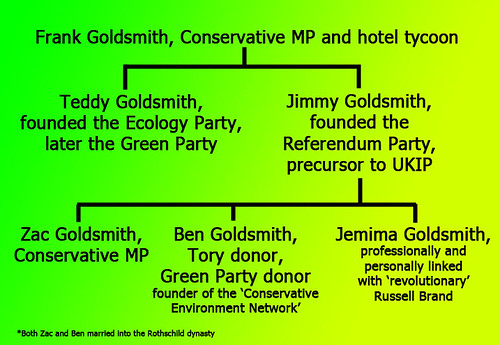
All this from the prime minister who dismissed environment policy as “green crap” not long ago. It isn’t just the Tories displaying utter cynicism, here. The Greens are too. They have attempted to account for their unlikely alliance with the Tories by claiming that the Green Party sees itself as having a role to put pressure on Labour to become more “progressive”  However, the Greens themselves are not progressive at all. As their roots indicate, as much as their policies:

goldsmith greenHow about putting pressure on left-wing voters to divide them, with the likeliest outcome of allowing another Tory government? It’s rather pointless trying to claim the Greens are “pushing Labour left” when the outcome of that is likely to bleed votes from Labour, ultimately.

And that attempt at explanation of the fact that the Greens attack and undermine Labour, rather than the Tories conveniently circumvents the fact that the Green Party tell intentional lies about Labour’s policies. A genuine attempt to influence Labour policy would entail negotiation and co-operation, not constant, hostile undermining tactics, coupled with an alliance with the Tories.

The Greens are not cooperative or community-minded. They are dividing our opposition to the Tories and risking returning Cameron to Office in May. They prefer to undermine the Labour Party, because they are purely electioneering, rather that directing challenges at the Tory-led Coalition. That is not “socialist”.

How “socialist” is it to join ranks with the party inflicting all of that damage and harm on people of this country to attack and undermine the only viable alternative to the tories? That’s not genuine politics, that’s grandstanding. It’s not “socialist” at all.

Jon Ashworth, Labour’s shadow Cabinet Office minister, said: “David Cameron’s new-found affection for the Green Party is nothing short of political opportunism. If you ever needed proof that a vote for the Greens is a vote for David Cameron, this is it.

The Tories and the Greens seem to be working hand-in-hand. The Tories need the Greens because they are scared to run on their own record. The Greens need the Tories because Labour is the only party with a progressive policy agenda.”

You can’t claim to be a “progressive ” political party and at the same time advocate zero growth and parochialisation – to cut us off from global trade. The Green Party says: “In our Green vision for Europe we seek to replace the unsustainable economics of free trade and unrestricted growth with the ecological alternative of local self reliance and resource conservation, within a context of wider diversity.” That’s a clear step back from internationalism and forwards towards parochialisation. It’s not progressive at all to shut out the rest of the world. And socialists have always been internationalists. The Green Party, on the other hand, find natural allies with nationalist parties such as the Scottish National Party (SNP).

The economy matters to every country in the world and no growth or low growth economies invariably mean high unemployment, increased inequality and increased absolute poverty. There are a variety of ways by which governments may mitigate social inequality. It’s known that Countries with a left-leaning legislature have lower levels of inequality. Many factors constrain economic inequality – they are often divided into two classes: government sponsored, and market driven. The relative merits and effectiveness of each approach is of course debated.

Government initiatives to reduce economic inequality include: public education: increasing the supply of skilled labor and reducing income inequality due to education differentials.

Progressive taxation: the rich are taxed proportionally more than the poor, reducing the amount of income inequality in society if the change in taxation does not cause changes in income. These form the basis of  Miliband’s approach, with his proposals for redistribution via a very progressive tax system. This is why tax-dodging billionaires  such as Stephano Pessina are complaining about Labour’s genuinely coherent, costed, evidenced, progressive equality-focussed redistributive tax policies, and not Green Party policies.

Market forces outside of government intervention may also reduce economic inequality, including the propensity to spend. The Green Party, however, does not support any of these options. Their anti-growth, anti-consumption starting point excludes all of these measures. Their key policy  proposal – Universal Basic Income – was shown to be so flawed that the Greens announced it is to be withdrawn from their manifesto.

Bennett has tried to brush aside criticisms that her party’s policies would lead to economic catastrophe, emphasising the Green’s stance against materialism. “People don’t just want to work to earn more and more money,” she said. “They want to do other things that often now aren’t recognised and valued.”

However, an isolationist zero growth economy would be a disastrous experiment, just like the austerity measures have been – with the same outcomes. The Green Party does not present a single coherent policy that may be deemed a viable alternative to austerity, yet it claims: A real change: from austerity and welfare cuts to investment in decent jobs.”

Not only would the Green Party’s anti-progressive zero growth economy create high unemployment, it most certainly create deep recession and the policies are cumulatively pro-austerity, in that they advocate inhibiting public spending on consumer goods.

The Green Party fail to show us any understanding of imbalances of power, they provide no class analysis, they aren’t connected with marginalised groups, they don’t reflect their needs and they clearly have no understanding of the mechanics and virtues of redistribution. There isn’t a single policy currently in their manifesto that demonstrates a coherent offer of support to very poorest. That isn’t “socialist” at all.

The Greens grew out of the environmental movement, with David Icke at the helm as a spokesperson, well, until they got embarrassed by him and sacked him. As Suzanne Moore commented, the incoherence is even apparent at how they fail to define the State. They offer the biggest of big-state polices with huge intervention in some areas, without specifying the role of the state except as a series of committees. It’s a curious mix of immense levels of authoritarian state control over our private lives, a strongly moralising approach, alongside a moral relativism towards things like sex industry, terrorism and crime. Page 3 is frowned upon, but how can prostitution be regarded as any less economical exploitative of women? That’s certainly not coherent policy-making.

The Green’s “anti-austerity measures” seem to translate as “taking on corporations and vested interests.” But Miliband has already explicitly stated (and shown) that he will do that. (He already has – Leveson, the banks, the big power companies, water companies, to name a few)

The Green Party’s key policy idea – that of a Citizen’s Income for everyone whether they work or not – sounds so great on the surface. Just like a lot of their rhetoric and policies, it lacks depth and doesn’t connect up – it lacks integrity and falls to pieces when properly examined. Many of the poorest households would lose out. Most wealthy households will gain. How does that address inequality – something the Greens claim to be concerned about?

The “citizen’s income” of just £71 a week, at an annual cost of £280billion would replace existing welfare payments such as personal tax allowances and means tested benefits such as income allowance and jobseekers benefit.

It was a popular policy during the 1990s, with notable libertarian economists on the Right, such as Milton Friedman (the founding father of monetarism) favoring the model as a type of negative income tax. Friedman attacked the very notion of Social Security, stating that it had created welfare dependency. Friedman’s political philosophy extolled the virtues of a free-market economic system with minimal state intervention. Friedman proposed the replacement of the existing U.S. welfare system with a negative income tax, a progressive tax system in which the poor receive a basic living income from the government.

The Liberal Democrats have included similar policies in their manifesto in 1996.

The Citizen’s Income Trust (CIT), which has given advice to the Green party (and has also been repeatedly cited by the Greens a credible source), has modelled the Green Party scheme and discovered it would mean 35.15% of households would be losers, with many of the biggest losers among the poorest households.

The Trust’s research shows that for the two lowest disposable income deciles, more than one-fifth would suffer income losses of more than 10%.

If anything, this policy will EXTEND inequality.  That’s not very “socialist”.

Many critics of the Green party point to their many failures in Brighton and Hove, where they couldn’t even get the rubbish collection right. However, the most damning criticism – their fundamental inability to run services for the most vulnerable – is the one that ought to concern us the most. That’s not very “socialist.”

Using minorities as nothing more than political props and tools. That’s not very “socialist”.

During a recent interview, with the Times, Bennett defended commitments to decriminalise membership of terrorist organisations, possession of drugs, and prostitution, as well as promising to abolish the monarchy and remove the Queen from Buckingham Palace.

Bennett said: “I can’t see that the Queen is ever going to be really poor, but I’m sure we can find a council house for her.”

The remark appeared to be a glib, clumsy attempt to grab some media attention, given the Queen’s private wealth. As far as an appeal to juvenile anti-establishmentarians go, it was probably a successful glib, clumsy remark. The Green Party’s stated policy on the monarchy is that it should cease to be an office of government and that the property held by the royal family should be divided between that required for the private life of current members of the family, with the remainder to become public property. Not sure I could use any staff, spare tiaras or corgis, personally, but thanks for the thought.

The Tories have trashed the economy, damaged the very structure of our society and destroyed people’s lives. We’ve seen the return of absolute poverty, malnutrition and illness, such absolute poverty-related illness has not been seen since Victorian times. People have died as a consequence of Tory policy.

What do the Greens do? Bitch about LabourMany thanks to Robert Livingstone for his excellent memes

Ed Miliband promises that Labour will save the Independent Living Fund.

At a Q&A with this morning, he gave a solid and passionate commitment that *will* . We’re with you.

             Ed Miliband Promises Labour Will #SaveILF

Labour have fought very hard to save the Independent Living Fund, which the Coalition have insisted on withdrawing, despite this being in contravention of our own laws and internationally established Human Rights. This commitment from Ed Miliband is in line with Labour’s  Equality Act, 2010.

I am very pleased to see this firm commitment.

In May 2014 the Court of Appeal, in the case of Stuart Bracking and others v Secretary of State for Work and Pensions found that the Department of Work and Pensions’ decision to close the Fund was not lawful, overturning the previous High Court decision of April 2013. It decided that the Department had not complied with the Public Sector Equality Duties imposed by section 149 of the Equality Act 2010.

Lord Justice McCombe said “there is simply not the evidence … to demonstrate to the court that a focussed regard was had to the potentially very grave impact upon individuals in this group of disabled persons, within the context of a consideration of the statutory requirements for disabled people as a whole”..

The Government initially decided to close the fund by March 2015 but this was delayed until June 2015 after five disabled people challenged the Government’s decision in the High Court.

The Court of Appeal unanimously quashed the decision to close the fund and devolve the money, on the basis that the minister had not specifically considered duties under the Equality Act, such as the need to promote equality of opportunity for disabled people and, in particular, the need to encourage their participation in public life. The court emphasised that these considerations were not optional in times of austerity.

After stating that the final legal ruling would not be challenged, on March 6, 2014, the Government announced in authoritarian style that it would go ahead with the closure of the ILF fund on 30th June 2015, saying that a new equalities analysis had been carried out by the Department for Work and Pensions. The government has shown a complete disregard for disabled people and the Court of Appeal decision. The government had failed to comply with the equality duty – and this was also a rare victory entirely due to disabled people fighting back.

It’s a relief to many of us to know that under a Labour government, those of us who need it can access the Independent Living Fund indefintely.

Thank you to all of the MPs, such as Dame Anne Begg, who have fought so hard on our behalf.

Related:

Independent Living Fund

DWP’s decision to abolish the Independent Living Fund overturned thanks to Labour’s Equality  Act, but the court ruling is ignored.

Labour calls on Government To Save Independent Living Fund.

Update

Ed Miliband – Transcript:

“First of all we said to the government they should not get rid of the independent living fund in the way they are doing. What they are doing is getting rid of it and passing it down to the local authorities, passing that money down to the local authorities.

So, firstly they should not be getting rid of the Independent living fund. And we’ve said that if it does go to the local authorities that budget has got to be protected.

We’ve got to find ways of protecting that money for some of the most vulnerable disabled people, some of whom I’ve met and who are saying “this is a terrible situation, what’s happening to the independent living fund”.

Secondly, we’ve got to stop the assault on disabled people in relation to the medical tests that are going on and have fair and proper medical tests when it comes to the medical system.

[Response to audience member – inaudible] Well you are right sir. We’ve got to sort out the way that these medical tests work. And we’ve said we are going to reform what is called the work capability assessment so that it gives a proper deal to disabled people”.

From: A better future for disabled people: mini-manifesto:

“And we will protect users of the Independent Living Fund, working with disabled people to develop clear guidance to Local Authorities on how the funds that will be transferred to them should be spent.”

Labour would end this Government’s demonisation of benefits claimants – Chi Onwurah MP

430847_149933881824335_1645102229_n (1)

This afternoon I will be leading a debate on the treatment – or more accurately the demonisation – of benefits claimants.

On my website I publish monthly pie charts of the issues constituents raise with me. Benefits is consistently in the top three.

Benefits claimants are by definition going through a tough time; they may have lost a job, have an illness or disability or are in low-paid or part time work, or they are caring for young children or relatives, making it harder to work.

They need our support, our care, concern for and understanding of the challenges they face. As our Shadow Secretary of State Rachel Reeves has said: “Jobcentres, and the HMRC offices that currently administer tax credits, are vital public services that British citizens pay for with their taxes. People who use them have as much right to expect fair and respectful treatment as patients in an NHS hospital, parents dealing with their child’s school, or victims reporting a crime at a police station.”

But it has become increasingly clear to me that that is not what is happening.

I have dealt with casework where the only explanation for the inhumane way in which my constituents were being treated is that the employees of the Department and its agencies had forgotten – or had been told to forget – that benefits claimants were people, human beings with lives, loved ones and feelings.

In the debate I give three examples. I could have given three hundred.

The first a vulnerable constituent on Employment Support Allowance and incapacity allowance. He was being helped by Newcastle Welfare Rights, who told the DWP that after suddenly being found fit to work:

“..he was acutely distressed; he struggled to talk, he was having thoughts of suicide, he had also started drinking alcohol to cope and had struggled to leave the house”

Despite supporting psychological assessments, other evidence, and an attempted suicide, the decision was not reversed and in January 2014 he was found hanged by his neighbour.

The second case an IT worker made unemployed, earnestly applying for every possible vacancy.

But he was sanctioned by the Jobcentre because his work search record was judged inadequate – in the week his father died.

Now think about that for a moment. Is there anyone in this country of whatever political persuasion who does not believe that a son should be given the opportunity to grieve for and bury his father?

Whether or not he is claiming benefits.

Yet the culture that this Government has put in place is such that this is what happens. And whilst Esther McVey may claim it is nothing to do with them, organisational culture is determined by those at the top.

My third example is a constituent sanctioned at the beginning of December for not returning a review form he never received which asked him the same questions he answered when he first signed on. Despite trying to complete the form over the phone, going to the Job Centre, asking for and being promised an emergency payment he spent the whole month including the festive period dependent on handouts from friends and family, unable to afford heating or even to go and see his young daughter at Christmas.

And all the while the Government is paying for adverts on buses saying “Think you know a Newcastle upon Tyne Benefits Cheat? Report them anonymously.”

There are people on benefits who are abusing the system – who take what they can get and consider benefits both a lifestyle and a right.

But that is a very small proportion. It is estimated that 0.7% of welfare spending is lost to fraud in comparison with 1.3% lost to overpayment because of mistakes.

I have yet to see adverts encouraging people to turn in tax evaders, despite the Treasury itself estimating the ‘tax gap’ at £34 bn and others putting it much higher.

The sense that they are being treated as second class citizens, scroungers, cheats, has a terrible impact on the wellbeing and particularly the mental health of claimants.

I have some experience of that.

I was brought up largely on benefits. We were a one parent family. It was very hard for my mother who was crippled with rheumatoid arthritis and also suffered breast cancer, not only because of our poverty but also because of her shame at taking hand outs.

I am very glad she did not have to face the sort of vilification and abuse experienced now, abuse caused in part by a sustained campaign from some politicians on the right.

Contrary to what many of them would imagine, I was brought up with a strong work ethic, and also to believe that the state would provide a robust safety net for those that needed it.

I am not proud that I grew up on benefits. But I am not ashamed either. A Labour Government must and will put an end to this Government’s demonisation of those claiming benefits today.

Author: Chi OnwurahMember of Parliament for Newcastle Central.

The full debate may be read here on Hansard2.30pm, 7 Jan 2015: from Column 112WH.

scroll2

 Labour MPs have persistently raised the issue of the government and media demonisation of those claiming benefits in Parliamentry debate, challenging serial offenders such as Iain Duncan Smith. Other MPs included are Glenda Jackson, Dame Anne Begg, Anne McGuire, Liam Byrne, John McDonnell and Sheila Gilmore, amongst others.

Rachel Reeves has also pledged to end the benefit sanction targets.

I am pleased that Labour have also pledged to legislate to protect disabled people from hate crime . We need to see an end to the stigmatisation of people who have to rely on lifeline benefits. After all, most people needing support have worked and paid taxes, they ought to be able to claim the support that they have paid for without being punished and scapegoated by the government and media. KSJ

1450041_569755536427312_1698223275_n

Thanks to Robert Livingstone