Category: Paternalism

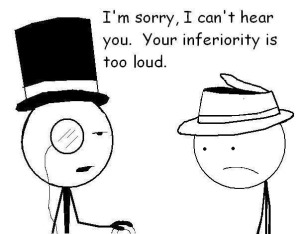
Amber Rudd’s masterclass in Doublespeak

crudd.jpg

Yesterday, heartless Amber Rudd was accused of shrugging off ‘heartbreaking’ Universal Credit experiences and stories by suggesting they are about only “one or two” people. 

This is a government who tell us with a straight face that inflicting absolute poverty on the poorest citizens is somehow going to make them less poor. This ideological framework is also imposed upon people in low paid work, struggling to meet their basic living costs. So the government slogan “making work pay” is meaningless Orwellian tosh, as is the Conservative’s longstanding ‘culture of dependency’ thesis and ideological justification narrative for inflicting devastating cuts on those who can least manage to get by. 

The Work and Pensions Secretary made the outrageous comments after being confronted by the Mirror about flaws in Universal Credit.

For years many of us have published articles ranging from flaws in the social security system, affecting millions, to struggling readers who’ve been forced to food banks, as well as administrative ineptitude and bullying that has often had catastrophic consequences. The roll out of Universal Credit has caused hunger, destitution, deaths and suicides, let’s be frank and pay some attention to the empirical evidence, rather than expedient ideological soundbites.  

Amber Rudd told the Mirror: “Some of the criticisms that have come from various publications have been based on one or two particular individuals where the advice hasn’t worked for them.”

That statement flies in the face of empirical evidence. On this site alone there are MANY individual accounts of the harms arising as a result of Universal Credit. And to claim the reason for these harms is because “the advice hasn’t worked or them” is a serious and disgusting trivialisation of the psychological distress and trauma, the deaths, suicides, rising numbers of those facing hunger, hardship, and destitution that Universal Credit, combined with such systematic government denial and indifference, is causing.

She added: “But in the vast majority of cases, and I would urge everybody who hasn’t to take the opportunity to speak to work coaches, the sort of support that individuals get is a completely different approach to what they had previously.”

Yes. It’s not actually support. It’s a programme of discipline, coercion and punishment.

However it isn’t work coaches who have to live with the consequences of a system that was designed to be an increasingly standardised Conservative hostile environment. The government seem to believe that publicly funded public services should serve as a deterrent to people needing support from the public services they have paid into. 

What matters most is the accounts of citizens, which tell their experiences of the system, not of those administrating it. But citizens’ voices are being intentionally stifled, edited out and worse, their accounts are being re-written by politically expedient civil servants and government ministers. This presentation of ideological fictions and the use of gaslighting techniques is usually the preserve of totalitarian regimes, it’s not the behaviour one would expect of a democratic government in a so-called liberal society. 

Governments with such limited social intelligence don’t lie very convincingly, but they do tend to be hard faced and tenacious. The real horror is their utter indifference and lack of responsiveness: that they really don’t care. They continue to demand our suspension of belief and dizzying cognitive dissonance. The relationship between citizen and state is one of abuse, founded on gaslighting strategies.

Rudd added: “And it is delivered with professionalism and care and compassion.”

Sure. The kind of “professionalism, care and compassion” that leaves a terminally ill man without sufficient support to meet his most basic needs, or that leaves a pregnant mother in extreme hardship, homeless, and resulting in the loss of her unborn child. Or one that pushes people towards suicide.

There is very little empirical evidence of the “professionalism, care and compassion” that Rudd claims. Furthermore, the trivialisation and persistent denials of the harm, distress and extreme hardship that is being inflicted on people because of government policies are all utterly unacceptable behaviours from a government minister, reflecting a profound spite within policy design, a profound lack of political accountability and a profound indifference for the consequences of these behaviours on the lives of ordinary people.

In fact, former Universal Credit staff reveal call targets and ‘deflection scripts, which means staff having to block or deflect vulnerable claimants, telling them that they would not be paid, or would have to submit a new claim, or have a claim closed for missing a jobcentre appointment, or be sanctioned – a penalty fine for breaching benefit conditions – or go to the food bank.

One whistleblower said that her role often felt adversarial. She said: “It was more about getting the person off the phone, not helping.” That’s a very strange kind of “compassion.”

As researchers have concluded, Universal Credit is a complicated, dysfunctional and punitive’ system that makes people increasingly anxious, distressed, with some of the most vulnerable citizens in the UK being pushed to consider suicide, and it ‘simply doesn’t work.’ (See Universal Credit is a ‘serious threat to public health’ say public health researchersfor example).

devastating National Audit Office report last year about Universal Credit concluded that the DWP was institutionally defensive and prone to dismissing uncomfortable evidence of operational problems. Welfare secretary at the time, Esther McVey, felt the need to make a speech in July in which she promised that where problems arose in future the department would “put our hands up, [and] admit things might not be be going right”.

It’s also clear – in the words of the public accounts committee – that there is a “culture of indifference” within the DWP and wider government.

It’s time that government ministers started to listen to citizens’ voices, to service users – as well as campaigners, researchers, charities and the opposition Parties. And the United Nations – instead of presenting denials that policies are seriously harming people. But there is every indication that they won’t. 

Universal Credit’s malign effects are obvious to anyone who actually looks, and is willing to listen to the voices of those affected by this punitive, mean-spirited and fixated, theory-laden, ideologically driven, miserly provision, that was, at the end of the day, paid for by the very public who are claiming it.

Labour MP Maria Eagle flatly stated that Rudd’s comments are “not true” and are “out of touch”.

She said: “The entire design of the system puts people in debt and the benefit cuts accompanying its introduction have made it far worse.” 

Rudd was questioned by the Mirror after she said yesterday: “Maybe things that were  proposed previously weren’t effective or weren’t compassionate in the way that I want them to be.”

Mirror journalists asked if she could, ‘hand on heart’, say it was “compassionate” to double UC claimants this year, keep the two-child limit and keep the benefit freeze until 2020.

Rudd did not respond to the question, instead replying: “The overall product that is Universal Credit is absolutely compassionate.”

Product? That’s a very odd word to use for lifeline support – the public services that are our social insurance which people have paid into for those times when they need it. 

And using key words from a government strategic comms crib sheet – James Cleverly among others has also opted for the word ‘compassionate’ to describe the welfare ‘reforms’ – does not make those narratives the reality experienced by citizens who need to access support from public services. Saying it does not make it real. This is something the Conservatives seem to have overlooked – that their narratives don’t match people’s realities. That’s the problem with telling lies – the empirical evidence catches up with you sooner or later.

Starving people and leaving them in destitution is not ‘compassionate’. Using a publicly funded public service to deliver punitive and a blunt, coercive, authoritarian behavioural modification programme is not ‘compassionate’. These are the actions and narratives of a government dipping a toe into the realms of totalitarianism.

Rudd claimed that UC needs to be ‘improved’, including to make it fairer to woman, but also said it was a “vital reform delivering a fair and compassionate welfare system”, “by far the most important and crucial reform” and a “force for good”.

Yesterday, the high court concluded that the Universal Credit assessment is illegal. The first judicial review verdict of Universal Credit found that the cutting of severe disability premiums from those who had previously claimed ESA was discriminatory.  How many more legal changes will it take to make the government act with some decency and observe basic laws and human rights?

Ideological mythologies

Rudd went on to claim, somewhat incoherently, that the ‘old system’ was “broken”, “not a utopia that we should return to” and under Labour someone unemployed could receive “£100,000 housing benefit per year.”

The charity Fullfact submitted a freedom of information (FoI) request to the DWP in 2012, following the same claims from David Freud, among other Conservative minsters, that people claiming social security support were receiving £100,000 housing benefit per year. The figures in the response showed that over four out of every five Housing Benefit claims are below £100 per week (the equivalent of £5,200 per year) according to the September 2010 figures, while only 70 out of over 4.5 million recipients claimed over £1000 per week, around 0.001% of the total.

Even this is likely to overstate the number claiming £100,000 per year however, as a family would need to claim over £1,900 per week to hit this total. Previous FoI responses from the Department have suggested around five families were awarded this amount.

Ministers and the media repeatedly failed to highlight what is such a small number of the total, and printed screaming and misleading headlines that were inaccurate, without putting this into a wider context. While the evidence suggests that there are a small number of Housing Benefit claims of more than £100,000 per year –  around five – these cases are very much the exception rather than the rule. Focusing exclusively on these outliers without first putting them into context, where over 80% of claims are below £100 per week, has [intentionally] distorted the debate about welfare, aimed at de-empathising the public and providing a justification narrative for cuts.  

Other information drawn from the FoI request found that larger claims tended to come from larger families, and the average household size for people claiming over £40,000 was six. For more details, do check out the numbers in the request itself, which is available here.

People weren’t suffering profound distress, hunger, destitution, suicide ideation and dying because of the ‘old system’.

Perhaps ‘utopias’ are relative. What we are currently witnessing is not “compassionate” or a “force for the good”: it is the dystopic system of an authoritarian state inflicting punishment, discipline and coercion on our most vulnerable citizens.

It’s a state programme that dispossesses citizens, with catastrophic human costs, to fund the tax cuts demanded by a handful of powerful and wealthy vultures, who live lavishly within a culture of entitlement, while the rest of us are increasingly impoverished.
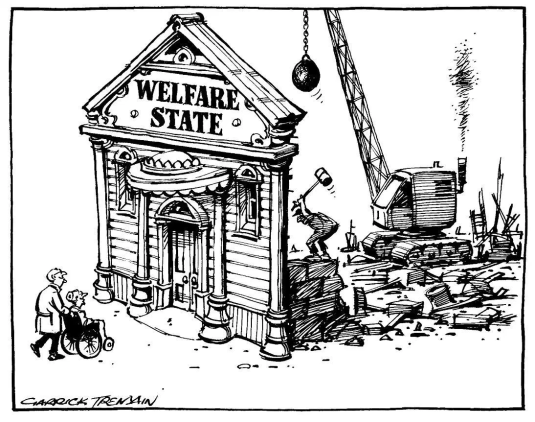
facade-welfare

Amber Rudd claims that Universal Credit is ‘compassionate’. She must have been taking lessons in Doublespeak again.


I originally published this as part of a larger article. 


My work is unfunded and I don’t make any money from it. This is a pay as you like site. If you wish you can support me by making a one-off donation or a monthly contribution. This will help me continue to research and write independent, insightful and informative articles, and to continue to provide support others who are affected by the welfare ‘reforms’. 

DonatenowButton

Infantilizing the nation – an insight into Conservative ‘paternalism’

                                               hqdefault                                                 Young Bullers


Paternalist parenting classes? Heaven forbid

The Prime Minister claims that every family needs help in improving behaviour and discipline. Ironically, this is from a politician who claims to despise the “nanny state”. He much prefers the Bullingdon brand of paternalist interference in people’s everyday lives. Cameron is also recommending “parenting classes” for all, which is understandable given his own strong instincts as a parent. He left his own child in a pub, after all.

Of course Cameron feels that it’s other people that need parenting and discipline. After all, this is a man who spent his early adulthood involved in bizarre initiation rituals, patriarchal debauchery, recklessly banqueting, getting drunk, trashing college rooms and pubs, listening to Supertramp and smoking pot with James Delingpole and vandalising restaurants. In 2013, it was reported that members of the Bullingdon Club were required to burn a £50 note in front of a beggar as part of an “initiation ceremony”. How encouraging to see the elite showing responsibility, compassion, a concern for social justice and cohesion, equality and alleviating poverty, at an early age.

Now that’s a real deviant subculture.

The draconian sentences handed down to the rioters in 2011, advocated by Cameron –  like the 23-year-old student with no previous convictions who was jailed for the maximum permitted six months after pleading guilty to stealing bottles of water worth £3.50 from Lidl in Brixton, for example –  shows only too well that he believes there is one rule for the Oxford elite and another for the rest of the society. Punishment is a central component of the social order and a means by which social order is produced and maintained.

Actually, defining others as deviant is, too. It’s a Conservative means of enhancing social power and status differentials by degrading the rule-breaker’s status and power.

Cameron’s response to the riots reflects a characteristically Bullingdon conservative disdain: an authoritarian, strict and oppressive approach towards perceived, labelled and stigmatised subordinates. Conservatives have always seen the social world as being organised in terms of hierarchies of worth. Smashing up a pub or restaurant and causing 10k worth of damage is no problem if you can cough up the costs on the spot to keep your thuggish behaviour private, hidden away from the scrutiny of the legal system and the public. Money talks and bullshit struts.

The Conservatives inform us that it is bad parents that cause poverty, opting for a rhetoric of authoritarian populism, creating cardboard monsters, manufacturing folk devils and moral outrage for the tabloids, making excuses for the consequences of their own prejudiced and damaging policy-making.

The establishment is a kind of Moebius strip of finger-pointing, arrogant, moralising privileged and feckless bullies passing the buck. And importantly, these wayward boys and girls always get their own way. They can’t democratically govern the country; they lack the social skills, motivation, developmental and emotional capacity to actually engage in any genuine and democratic dialogue with ordinary people, so they rule. Conservatives have always prefered the simplicity of a socio-economic system defined by inherited social ranks.

Cameron says that the government’s Life Chances Strategy – an “initiative to target tackle child poverty” – will include a plan for “significantly expanding parenting provision”. It will also recommend ways to “incentivise” all parents to take up the offer of classes. The hope is, presumably, that if the middle class take Cameron up on his offer of state parenting instructions, the process of social norming will provide the foundation of state-defined “correct behaviours” for the insubordinate working classes, who are perpetually caught up, according to the Tories, in a pathological cycle of something or other, and therefore need state therapy from elitist antipodean role models to set them straight and put them in their place. It’s the new behaviourism: do as we say, but not what we do.

It seems that poverty is to be addressed with nothing more than a paternalist brand of cheap psychopolitics. The government won’t be dipping their hands into the treasury, which is what’s needed. Instead they prefer to employ shabby techniques of persuasion aimed at indoctrinating a Conservative world-view and enforcing conformity as a replacement for genuinely needs-led and evidence-based policies.

At no point does Cameron mention any commitment to improving people’s standard of living, or ensuring that families have a basic level of income in order to meet their fundamental needs, such as food, fuel and shelter – because struggling to meet basic material needs are the main barriers for people experiencing poverty. It’s sobering to consider that the Tory obsession with the work ethic, embodied in their mantra “making work pay”, is nothing more than a meaningless glittering generality, that purposefully diverts attention from elitist policy-making, and subsequent growing poverty and inequality.

Around half of those who are in poverty and of working age live in a household where at least one person works. The steady drop in real wages since 2010, according to the Office for National Statistics, is the longest for 50 years.

Furthermore, since 2010, the decline in UK wage levels has been amongst the very worst in Europe. The fall in earnings under the Coalition is the biggest in any parliament since 1880, according to analysis by the House of Commons Library, and at a time when the cost of living has spiralled upwards.

Ah, and Cameron uttered that inane managementspeak word again – “incentivise”. It never bodes well when Conservatives use that word. It means he has been listening to the psychobabbling of the Nudge Unit, again. Welfare sanctions, which are the punitive withdrawal of lifeline benefits from people who need to claim welfare support to meet their basic needs are claimed to “incentivise” people to find a job, despite empirical evidence to the contrary, and the cuts to child tax credit, limiting support to just two children, are based on the charming and archaic eugenicist idea that poor people ought to be “incentivised” to have fewer children.

Rich people are apparently “incentivised” by large cash carrots, but poor people just get the brutal, merciless stick. What a classic example of flagrant Conservative ideological incoherence.

Psychopolitical paternalism doesn’t address poverty, it is simply a way of apportioning blame, of abdicating political responsibility and ensuring that poor people accept the Conservative and neoliberal decree that they somehow deserve to be poor.

Cameron claims that:

“Families are the best anti-poverty measure ever invented. They are a welfare, education and counselling system all wrapped up into one. Children in families that break apart are more than twice as likely to experience poverty as those whose families stay together. That’s why strengthening families is at the heart of our agenda.”

The announcement from Cameron was welcomed by Relate, whose chief executive, Chris Sherwood, said:

“Relationship support can help to reduce family breakdown, which is a key driver of poverty and can result in poor outcomes for children.”

Actually, family breakdown is quite often a consequence of poverty, not a cause of it. Back in 2010, Fergus Drake, director of UK programmes with Save the Children expressed an unease that many of us felt, regarding the Conservative’s feckless drive to offload the responsibility for poverty onto poor people, who are casualities of the consequences of neoliberalism, which extends discriminatory economic policies. He said:

“We would say poverty causes family breakdown rather than vice versa. If you are worried about putting food on the table, or being able to turn on the heater so you can have a hot bath, the stress that causes to a relationship can make things really difficult.”

Poverty isn’t caused by family breakdown, it’s caused by discriminatory policies and social insititutions that extend and perpetuate inequality. We are now the most unequal country in the European Union, and even more unequal than the US. If Cameron really wanted to address childhood poverty, he would ensure that people have enough to meet their basic needs, instead of steadily withdrawing welfare support and cutting public services. He should end the class-contingent austerity that his government have imposed on only the poorest people.

Tim Nichols, of the Child Poverty Action Group, agrees that the Conservatives should be careful not to confuse causes and consequences. He says:

“We don’t think that this is robust strategy. Tackling child poverty can’t be done without more redistribution.”

Cameron is talking ideologically-driven nonsense, reflecting traditional Tory prejudices. This government has become obsessed with moralising about and manipulating individual agency, which is increasingly seen as being to blame for high levels of poverty and social exclusion in the UK, which are created entirely by callous, discriminatory political policies. Political gaslighting does not help people out of poverty.

People are poor because they don’t have enough money to meet their needs. That is what Cameron needs to acknowledge and address.

Parenting and elitist-authoritarian ideology

Cameron’s paternalist-authoritarian turn was evident back in 2010, when he said that:

“Discipline is the foundation of a good education. Headteachers need to decide on exclusions.”

Most people that have worked in either formal or informal education settings are very aware that using punishment and threats is very counterproductive. Making young people suffer in order to change their future behaviour can often elicit temporary compliance, but this strategy is highly unlikely to lead to conversion or to help children become ethical, responsible decision makers in the long term. Punishments don’t involve any engagement of deliberative processes.

Punishment, even if referred to euphemistically as “consequences,” tends to generate oppositional behaviours, anger and defiance.  Furthermore, it models the use of power rather than reason and damages the important trust-based relationship between adult and child.

Authoritarian models of parenting are emotionally and physically traumatising. There’s an Old Testament brand of harshness in conservative authoritarian approaches to human behaviours.

Authoritarian parents often have prejudices based on wealth and what may be defined as “achievement”, gender, class and race. They tend to be highly competitive, lacking warmth and empathy. They teach their children to compete at all costs, and to win by whatever means. Most authoritarians are behaviourists, with a preference for punishments rather than rewards to control others.

Authoritarians tend to advocate corporal punishment, they see freedom as chaotic, they can’t tolerate ambiguity or recognise the complexities and subtleties of human conduct, and they tend to advocate capital punishment.

Because authoritarian parents expect absolute obedience, children raised in such settings are typically very good at following rules.

However, they often lack self-discipline. Children raised by authoritarian parents are not encouraged to explore and act independently, so they never really learn how to set their own limits and personal standards.

Whilst developmental experts agree that rules, boundaries and consistency are important for children to have, most believe that authoritarian parenting is too punitive and lacks the warmth, unconditional love, safety, trust and nurturing that children need.

Of course public schools also foster authoritarianism and elitism. Boarding school: the trauma of the ‘privileged’ child by Joy Schaverien explores the emotional deprivation and abuse that many experience as a result of public school culture. Psychotherapist Nick Duffell (2000) wrote a book based on workshops he has conducted over ten years with adults who attended boarding schools as children. He has identified many lasting pathological psychological patterns common in those he calls Boarding school survivors.

In his recent work: Wounded Leaders: the Psychohistory of British Elitism and the Entitlement Illusion, Nick says:

“A cherished national character ideal, eschewing vulnerability and practising a normalised covert hostility based on bullying in the dorm adversely affects even those who did not have the privilege of such an education. It leaves Britain in the social and emotional dark ages, led by “the boys in the men that run things.

This specific culture of elitism, protected by financial interests and the “It never did me any harm” syndrome, means that Britain is unlikely to foster the kind of leadership necessary in our world of increasing complexity, which needs a communal mindset and cooperative global solutions. But worse, new scientific evidence shows that this hyper-rational training leaves its devotees trapped within the confines of an inflexible mind, beset with functional defects, presented here as the Entitled Brain.”

It’s a sobering thought that so many boarding school survivors – psychologically and emotionally damaged individuals – are involved in running the country and determining the terms and conditions of our lives.

002fc17b9115fe26a6ed5d9d58b1ece1.603x472x1


I don’t make any money from my work. My articles are free. If you like, you can make a donation to help me continue to research and write free, informative, insightful and independent articles, and to provide support to others. The smallest amount is much appreciated – thank you.

DonatenowButton