Category: Neoliberalism

The media need a nudge: the government using ‘behavioural science’ to manipulate the public isn’t a recent development, nudging has been happening since 2010

8+Ways+to+Protect+Yourself+From+Emotional+Manipulation

Last year I wrote a critical article about the government’s Nudge Unit. The ideas of libertarian paternalism were popularised around five years ago by the legal theorist Cass Sunstein and the behavioural economist Richard Thaler, in their bestselling book Nudge. Sunstein and Thaler argue that we are fundamentally “irrational” and that many of our choices are influenced negatively by “cognitive bias.” They go on to propose that policymakers can and ought to nudge citizens towards making choices that are supposedly in their best interests and in the best interests of society.

But who nudges the nudgers?

Who decides what is in our “best interests”?

And how can human interests be so narrowly defined and measured in terms of economic outcomes, within a highly competitive, “survival of the fittest” neoliberal framework? The Nudge Unit is concerned with behavioural economics, not human happiness and wellbeing.

The welfare reforms, especially the increased application of behavioural conditionality criteria and the extended use of benefit sanctions, are based on a principle borrowed from behavioural economics theory – the cognitive bias called “loss aversion.” It refers to the idea that people’s tendency is to strongly prefer avoiding losses to acquiring gains. The idea is embedded in the use of sanctions to “nudge” people towards compliance with welfare rules of conditionality, by using a threat of punitive financial loss, since the longstanding, underpinning Conservative assumption is that people are unemployed because of behavioural deficits.

I’ve argued elsewhere, however, that benefit sanctions are more closely aligned with operant conditioning (behaviourism) than “libertarian paternalism,” since sanctions are a severe punishment intended to modify behaviour and restrict choices to that of compliance and conformity or destitution. But nudge was always going to be an attractive presentation at the top of a very slippery slope all the way down to open state coercion. Most people think that nudge is just about helping men to pee on the right spot on urinals, getting us to pay our taxes on time, or to save for our old age. It isn’t.

How can sanctioning ever be considered a rational political action –  that taking away lifeline income from people who are already struggling to meet their basic needs is somehow justifiable, or “in their best interests” or about making welfare “fair”?  The government claim that sanctions “incentivise” people to look for work. But there is an established body of empirical evidence which demonstrates clearly that denying people the means of meeting basic needs, such as money for food and fuel, undermines their physical, emotional and psychological wellbeing, and serves to further “disincentivise” people who are already trapped at a basic level of struggling to simply survive.

The Minnesota Semistarvation Experiment for example, provided empirical evidence and a highly detailed account regarding the negative impacts of food deprivation on human motivation, behaviour, sociability, physical and psychological health. Abraham Maslow, a humanist psychologist who studied human potential, needs and motivation, said that if a person is starving, the desire to obtain food will trump all other goals and dominate the person’s thought processes. This idea of cognitive priority is also represented in his classic hierarchy of needs. 

0_0_0_0_370_308_csupload_52703375

Maslow’s hierarchy of needs

In a nutshell, this means that if people can’t meet their basic survival needs, it is extremely unlikely that they will have either the capability or motivation to meet higher level psychosocial needs, including social obligations and responsibilities to job seek.

Libertarian paternalists claim that whilst it is legitimate for government, private and public institutions to affect behaviour the aims should be to ensure that “people should be free to opt out of specified arrangements if they choose to do so.” The nudges favoured by libertarian paternalists are also supposed to be “unobtrusive.” That clearly is not the case with the application of coercive, draconian Conservative welfare sanctions. (See Nudging conformity and benefit sanctions.)

Evidently the government have more than a few whopping cognitive biases of their own.

I have previously criticised nudge because of its fundamental incompatibility with traditional democratic principles, and human rights frameworks, amongst other things. Democracy is based on a process of dialogue between the public and government, ensuring that the public are represented: that governments are responsive, shaping policies that address identified social needs. However, policies are no longer about representing and reflecting citizen’s needs: they are all about telling us how to be.

I’ve also pointed out that nudge operates to manipulate at a much broader level, too. The intentional political construction of folk devils and purposeful culturally amplified references to a stereotype embodying fecklessness, idleness and irresponsibility, utilising moral panic and manufactured public outrage as an effective platform for punitive welfare reform legislation, is one example of the value-laden application of pseudoscientific “behavioural insights” theory. The new paternalists have drawn on our psychosocial inclinations towards conformity, which is evident in the increasing political use of manipulative normative messaging. (For example, see: The Behavioral Insights Team in the U.K. used social normative messages to increase tax compliance in 2011.) 

The paternalist’s behavioural theories have been used to increasingly normalise a moral narrative based on a crude underpinning “deserving” and “undeserving” dichotomy, that justifies state interventions imposing conditions of extreme deprivation amongst some social groups – especially those previously considered legally protected. Public rational and moral boundaries have been and continue to be nudged and shifted, incrementally. Gordon Allport outlined a remarkably similar process in his classic political psychology text, The Nature of Prejudice, which describes the psychosocial processes involved in the construction of categorical others, and the subsequent escalating scale of prejudice and discrimination.

So we really do need to ask exactly in whose “best interests” the new paternalist “economologists” are acting. Nudge is being targeted specifically at the casualties of inequality, which is itself an inevitability of neoliberalism. The premise of nudge theory is that poor people make “bad choices” rather than their circumstances being recognised as an inexorable consequence of a broader context in which political decisions and the economic Darwinism that neoliberalism entails creates “winners and losers.”

I have seen very little criticism of nudge in the mainstream media until very recently. On Monday the Independent published an article about how the Chancellor exploited our cognitive biases to secure his cuts to welfare, drawing particularly on the loss aversion theory. To reiterate, in economics decision theory, loss aversion refers to people’s tendency to strongly prefer avoiding losses to acquiring gains.

From the Independent article:

“Researchers have also found that people do not treat possible forgone gains resulting from a decision in the same way as equivalent potential out-of-pocket losses from that same decision. The forgone gains are much less psychologically painful to contemplate than the losses. Indeed, the gains are sometimes ignored altogether.

There was an apparent attempt to harness this particular psychological bias in George Osborne’s Autumn Statement. Of course the Chancellor was forced into a memorable U-turn on his wildly unpopular tax credit cuts. Millions of poor working families will now not see their benefits cut in cash terms next April. Yet the Chancellor still gets virtually all his previously targeted savings from the welfare bill by 2020.

How? Because the working age welfare system will still become much less generous in five years’ time. As research from the Institute for Fiscal Studies and the Resolution Foundation has shown, the typical low-income working family in 2020 will be hit just as hard as they were going to be before the Autumn Statement U-turn. The Chancellor seems to be calculating that the pain of future forgone gains will be less politically toxic than immediate cash losses.”
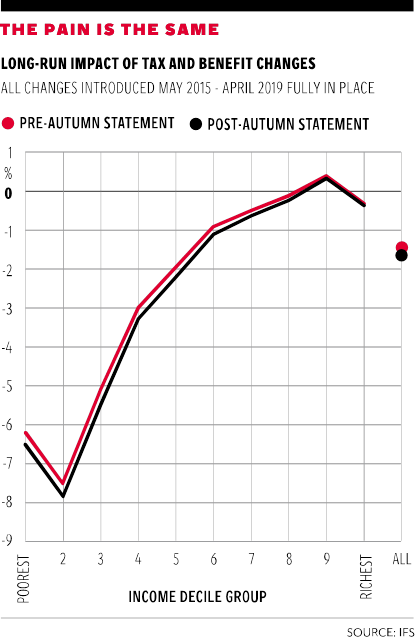
 image002

It’s hardly a revelation that the Conservative government are manipulating public opinion, using scapegoating, outgrouping and the creation of folk devils in order desensitize the public to the plight of the poorest citizens and to justify dismantling the welfare state incrementally. As I’ve pointed out previously, this has been going on since 2010, hidden in plain view.

In the article, Ben Chu also goes on to say:

“Experiments by Daniel Kahneman, Jack Knetsch and Richard Thaler also suggest that this stealth approach fits with people’s sense of fairness. They found that in a time of recession and high unemployment most people they surveyed thought a hypothetical company that cut pay in cash terms was acting unfairly, while one that merely raised it by less than inflation was behaving fairly.

There was another exploitation of our psychological biases in the Autumn Statement. The Chancellor announced an increase in stamp duty for people buying residential properties to let. That underscored the fact that the Chancellor remains wedded to the stamp duty tax, despite pressure from public finance experts to shift to a more progressive and efficient annual property tax (perhaps an overhauled council tax).

But Mr Osborne, like all his recent predecessors, realises that stamp duty, for all its deficiencies, tends to be less resented as a form of taxing property. Why? Because of “anchoring”. When people buy a house they are mentally prepared to part with a huge sum, usually far bigger than any other transaction they will make in their lives. The additional stamp duty payable to the Treasury on top of this massive sum, large though it is, seems less offensive. People resent it less than they would if the tax were collected annually in the form of a property tax – even if, for most, it would actually make little difference over the longer term. Sticking with stamp duty is the path of least resistance.”

There is another economologist “experiment” that seems to have slipped under the radar of the media – an experiment to nudge sick and disabled people into work, attempting to utilise GPs in a blatant overextension of the intrusive and coercive arm of the state. It is aimed at ensuring sick and disabled people don’t claim benefits. I don’t recall any mention of behaviourist social experiments on the public in the Conservative manifesto.

When I am ill, I visit a doctor. I expect professional and expert support. I wouldn’t consider consulting Iain Duncan Smith about my medical conditions. Or the government more generally. There are very good reasons for that. I’m sure that Iain Duncan Smith has Dunning–Kruger syndrome. He thinks he knows better than doctors and unreliably informs us that work can set you free, it can help prevent and cure illness.  Yet I’ve never heard of a single case of work curing blindness, heart disease, rheumatoid arthritis, cerebral palsy, multiple sclerosis, cancer or even so much as a migraine. I’ve also yet to hear of a person’s missing limbs miraculously growing back. The Conservative “medical intervention” entails a single prescription: a work coach from the job centre. State medicine – a single dose to be taken daily: Conservative ideology, traditional prejudice and some patronising and extremely coercive paternalism. The blue pill.

I don’t agree with the conclusions that Ben Chu draws in his article. Whilst he acknowledges that:

“The Government has a Behavioural Insights Team (or “Nudge Unit”) whose objective is to exploit the public’s psychological biases,” he goes on to say that it’s merely “to push progressive policies, such as getting us to save more for retirement and helping us make “better choices”, perhaps by counteracting the negative impact of loss aversion. But, as we’ve seen, the Chancellor is not above exploiting our biases in a cynical fashion too.” 

Progressive policies? The draconian welfare “reforms” aren’t remotely “progressive.” In the UK, the growth and institutionalisation of prejudice and discrimination is reflected in the increasing tendency towards the transgression of international legal human rights frameworks at the level of public policy-making. Policies that target protected social groups with moralising, stereotypical (and nudge-driven) normative messages, accompanied with operant disciplinary measures, have led to extremely negative and harmful outcomes for the poorest and most vulnerable citizens, but there is a marked political and social indifference to the serious implications and consequences of such policies.

There is a relationship between the world that a person inhabits and that person’s actions. Any theory of behaviour and cognition that ignores context can at best be regarded as very limited and partial. Yet the libertarian paternalists overstep their narrow conceptual bounds, with the difficulty of reconciling individual and social interests somewhat glossed over. They conflate “social interests” with neoliberal outcomes.

The asymmetrical, class-contingent application of paternalistic libertarian “insights” establishes a hierarchy of decision-making “competence” and autonomy, which unsurprisingly corresponds with the hierarchy of wealth distribution.

So nudge inevitably will deepen and perpetuate existing inequality and prejudice, adding a dimension of patronising psycho-moral suprematism to add further insult to politically inflicted injury. Nudge is a technocratic fad that is overhyped, theoretically trivial, unreliable; a smokescreen, a prop for neoliberalism and monstrously unfair, bad policy-making.

Libertarian paternalists are narrowly and uncritically concerned only with the economic consequences of decisions within a neoliberal context, and therefore, their “interventions” will invariably encompass enforcing behavioural modifiers and ensuring adaptations to the context, rather than being genuinely and more broadly in our “best interests.” Defining human agency and rationality in terms of economic outcomes is extremely problematic. And despite the alleged value-neutrality of the new behavioural economics research it is invariably biased towards the status quo and social preservation rather than progressive social change.

At best, the new “behavioural science” is merely theoretical, at a broadly experimental stage, and therefore profoundly limited in terms of scope and academic rigour, as a mechanism of explanation, and in terms of its capacity for generating comprehensive and coherent accounts and understandings of human motivation and behaviour.

At worst, the rise of this new form of psychopolitical behaviourism reflects, and aims at perpetuating, the hegemonic nature of neoliberalism.

But for the record, when a government attempts to micromanage and manipulate the behaviour of citizens, we call that “totalitarianism” not “nudge.” 
behavchange.jpg

Related reading

A critique of Conservative notions of social research

The government plan social experiments to “nudge” sick and disabled people into work

Mind the MINDSPACE: the nudge that knocked democracy down

Nudging conformity and benefit sanctions

Corbyn has to get rid of the fanatics mistakenly called ‘realists’ and ‘moderates’

This is an excellent article, first published on the Flassbeck International Economics site, written by political economist, Doctor Will Denayer, which outlines the extensive damage that neoliberalism has caused to Britain and to democracy, endorsed and extended by successive governments since 1979. The author details the propaganda campaign pitched to discredit Corbyn, and concludes with an analysis of how the Labour Party under Jeremy Corbyn can win the next election, and says that the so called Labour “moderates” are anything but moderate. 

I was happy to see my own work linked and cited, too. Kitty.


jeremy-corbyn-1

Anmerkung Heiner Flassbeck: Wie nicht anders zu erwarten, formiert sich bei den Funktionären der Labour-Partei in England massiver Widerstand gegen Jeremy Corbyn, den von der Basis gewählten neuen Vorsitzenden. Will Denayer beschreibt die Stimmung in England sehr gut und zeigt das typische Dilemma auf, in dem sich sozialdemokratische Parteien wiederfinden, die nicht bereit sind, gesamtwirtschaftliche Überlegungen zur Basis ihres Handelns zu machen. Auch in Deutschland kennt man das zur Genüge.
 

For many months, it was a shameful and despicable spectacle to see the Labour bosses mount an attack of the lowest kind imaginable on  a candidate for the leadership of their party because he is a socialist. Or perhaps he’s just a social-democrat. The fear that the Labour party could fall into the hands of a social-democrat was too much for them to bear, so the political and media elite concocted to character-assassinate Jeremy Corbyn. Hundreds of vile articles were produced: Corbyn is an anti-Semite, a sexist, he is friends with the IRA, he is a pacifist, an old hippie, an ideological fossil from a bygone age, he is against the monarchy, with Corbyn we can’t win the 2020 elections. The labour bosses expelled thousands from the party on the flimsiest of excuses: they were ‘infiltrators’ from the left or from the right.

Corbyn received more criticism from the press than any other politician in living memory – and not only from tabloids such as The Sun or The Daily Mail. The liberal The Guardian, The Independent and the BBC gave Corbyn more contempt in a mere couple of months than Cameron suffered in years (see here for the last one of today). According to Jonathan Cook this highlights that, since Blair, both Labour and the Tories have been equally committed to upholding neoliberalism.

You can have either hardcore neoliberalism or slightly more softcore neoliberalism, but that is it (see also here). That is the horizon of British politics.

The assassination hasn’t worked. During the campaign, hundreds of thousands joined the Labour party. It was gigantic. The number of party members tripled. Something big was happening. Blair wrote two articles for The Guardian, begging not to vote for Corbyn’s Alice in Wonderland policies. People told him to go to The Hague. Gordon Brown produced a long diatribe. No one listened. The reason was simple: here is a man that the social base of Labour believes in, a man who speaks their language and defends their interests. Corbyn won by an enormous landslide: he got 59.5 % of the votes. Burnham got 19%, Cooper 17%, Kendall 4.5%.

The people had spoken, but in an oligarchy that does not count. The anti-Corbyn campaign intensified. When Corbyn said that he opposes modernising Trident, rebellion within the party and the shadow cabinet broke out, never mind that military experts and even generals say that he is right. And now, there is the issue of bombing IS. It is not important that a large majority of the population backs Corbyn. The crisis is so acute that manymoderates’ are leaving the party. Barbara Ellen explained her motives in The Guardian. She thinks that her party has been taken over by ‘a bunch of conceited hippies refusing to budge from their favourite beanbags.’ As she explains, ‘the terrible abyss of the Corbyn problem’ is how to deal with ‘politicians who think that looking electable is beneath them.’ And the term moderate became an insult: ‘it is considered too centrist, restrained, temperate, cautious.’

If Corbyn wants to survive, he has to get rid of these ‘moderates’ because they are fanatics. If Corbyn cannot win the 2020 election without the moderates, he cannot win the election with them either. Here’s why. Have a look at policy and what the moderates stand for. It is ideological garbage to portray these people as ‘moderates.’ There is nothing moderate about them and nothing social-democratic either. The Tories claim that there is enormous benefit fraud in the country: 28% to 30% of all social welfare claims may be fraudulent. They cite it as one of the reasons why ‘welfare reform’ is necessary. The real fraud in benefit claims is 0.3–0.5%.

As Owen Jones explains in Chav. The Demonization of the Working Class, that is far from the whole picture: many people abstain from benefits because they are afraid of getting in problems with the Department of Work or with Immigration. Of course, some people’s lives literally depend on benefits. Lose your benefits and you are done. The moderates know about these problems – everybody knows it.

According to Lansley and Mack, who wrote Breadline Britain, twenty million people in the UK are living in poverty. Three and a half million adults go hungry so they can feed their children. Energy prices doubled over the last decade, while average wages fell and benefit cuts push more people in poverty.

More than half of those in poverty are in employment, so it is hard to say that poverty is caused by the fickleness of those who are unwilling to work (see also here). Epidemiological research established a link between the Work Capability Assessment (WCA) and suicide (see also here). This was the reason for an expert group of the UN to step in. The research found that every 10,000 assessments led to around six suicides.

Since there have been more than 1 million assessments, there may be more than 600 people who have taken their own lives who would otherwise have not. The truth of the matter is that both the Conservatives and the Labour moderates have responded with utter indifference to these outright scandalous figures.  Kitty S Jones also refers to a study from Durham University that puts austerity in historical perspective. As a result of unnecessary recession, planned de-industrialisation to break the unions and the Labour opposition, unemployment, welfare cuts and housing policies, Thatcher’s legacy includes the premature death of many British citizens, together with a substantial and continuing intergenerational burden of suffering and loss of wellbeing. The research shows that the massive increase in income inequality under Thatcher – the richest 0.01 per cent of society had 28 times the mean national average income in 1978. By 1990, this was 70 times.

But Cameron has gone much further than Thatcher ever did in cutting essential support and services for protected social groups, such as sick and disabled people and poor citizens. What did the ‘moderates’ of Labour ever do about any of it, except giving speeches about a deserving society? Speaking of Alice in Wonderland: Blair asked Labour party members to vote against a social democrat, so that Labour could remain functional in implementing austerity of a degree that was even never seen under Thatcher.

It gets worse. I present the argument that the lack of any concrete reaction and outcry from Labour to the persecution (yes, persecution!) of the unemployed, the sick, the disabled and the poorest as undeserving scroungers cost Labour the election last May. The rhetoric of Labour is all about improving lives for hard working people, damn those without a job. Labour completely bowed to the ideology, which became, in effect the centre piece of New Labour, that the unemployed had to be made responsible, with an iron fist if necessary, that they had to be activated.

To those who say that Corbyn cannot win an election, the answer is that they lost one. It is clear that Labour lost the elections in last May because it alienated a large part of its traditional base (see here for analysis). And they went on after the elections. When the Tories passed the new welfare reform bill – more austerity, more cuts in welfare and in services, more privatisations, more workfare and more exclusion – many Labour moderates voted in favour of the bill.

The Tories pledged to give the NHS, the National Health Service, an extra £8 billion funding, but the reality is that cancer patients are being denied treatment because of lack of NHS funds.The NHS is safe in our handspromised Cameron, but in the meantime private firms have been handed 41% of the NHS, close to 10,000 NHS beds have been shut, close to 7,500 specialist nurses have been axed, ambulance stations have been closed, unfilled general practitioner posts quadrupled in the last 4 years and the NHS budget saw the worst real-term cut since 1973. Apart from delivering carefully crafted speeches, the Labour moderates did nothing.

Osborne, the chancellor of the Exchequer, created more debt than Labour did in 13 years, indeed, he oversaw the biggest rise in national debt since World War II. According to a City University Report, the budget deficit that Osborne wanted to cut to zero will rise to £40 billion by 2020. The main reason is that the treasury has underestimated the impact of welfare and departmental spending cuts on the broader economy and especially cuts to public sector investment (oh surprise!). The great majority of the public is, of course, opposed to the tornado of privatisations (see graph), but that is no reason to not go ahead with it. Still, I know of no example – not a single one – of the Labour moderates opposing the privatisations.

will
The Tory government oversaw the longest sustained decline in average wages since records began, while, in the same period, the average FTSE100 (Financial Times Stock Exchange 100) executive saw a 151% pay rise. Again, not one word from the moderates. Comedian Chris Purchase made a completely valid point: even if people on benefits do nothing else than drink and smoke (as common hallucination and prejudice go), they would still be paying more tax in the UK individually than Amazon. Did the moderates ever come up with a concrete policy measure that tackles tax evasion? Experts estimate that tax evasion costs the UK economy £25 billion every year, although
Lansley and Mack think that the true figure is likely to be far higher: up to a quarter of the world’s wealth is held in offshore accounts.

If the moderates did not do any of this, what did they do? They made £800 billion available to the bankers. Blair and Brown took the country to war. They introduced fees for students. In the meantime undergraduate student’s fees became the highest in the industrialised world (see here). They committed to austerity and fully accepted the ideology of welfare reform. They deregulated the financial economy and cut public services. The Labour moderates are pro TTIP. In what is still the fourth richest country on earth, close to 7,500 people were admitted to hospital because of malnutrition. Scurvy, scarlet fever, cholera and whooping cough have been increaing since 2010, (see here) but when is the last time that you heard a Labour moderate address homelessness or evictions? This is why Corbyn rose to power. Corbyn won on the basis of an authentic popular revolt of the population against austerity and neoliberalism, be it blue or red. People have enough.

But last week, Corbyn went too far. He opposes Cameron’s plan to bomb IS. Perhaps even more than 100 Labour MPs plan to defy him over the Syria air strikes. This is a real crisis. Twelve years after the moderates took the UK into an illegal war in which ca. 1.3 million Iraqis died, they do it again. This time the pretext is that there is an immanent threat and that an attack will make the UK safer. This is nonsense.

As Todhunter writes in Counterpunch, in the 12 years that preceded the invasion of Iraq, 65 people in Europe died by various terrorist attacks. In the 12 years since the invasion, the terrorist kill rate increased by nearly 600%. Apart from being utterly counterproductive (a point also made by Sahra Wagenknecht in the Tagesschau), bombing IS is illegal: there is no UN mandate for such action, no authorisation from Syria. And who’s paying? Defence Secretary Fallon defends the need ‘to spend less on some things like the welfare system and to spend more on things that really matter to keep our country safe’ (see here). As Todhunter says, with a £12 billion saving on cuts to the welfare budget, Fallon attempts to justify a £12 billion increase to the military budget to help pay for warships, Boeing maritime patrol crafts, surveillance drones and Lockheed Martin jets. The Labour moderates are losing their mind over the fact that Corbyn has the temerity to disagree.

There is only one reason why Labour cannot win an election under Corbyn on a left social democratic platform. Millions have been hammered by Tory austerity. Corbyn can win. The problem is that the Labour bosses want him gone. Corbyn’s policies are not their policies. It is very well possible that Corbyn will be ousted. It would prove that democracy and decency are gone. Frankly, the odds are against him.

You can read the original article here

A critique of Conservative notions of social research

images
The goverment’s archaic positivist approach to social research shows that they need a team of sociologists and social psychologists, rather than the group of “libertarian paternalists” – behavioural economists – at the heart of the cabinet office, who simply nudge the public to behave how they deem appropriate, according to a rigid, deterministic, reductive neoliberal agenda and traditional, class-contingent Conservative prejudices.


Glossary

Epistemology – The study or theory of the nature and grounds of knowledge, especially with reference to its limits, reliability and validity. It’s invariably linked with how a researcher perceives our relationship with the world and what “social reality” is (ontology), and how we ought to investigate that world (methodology). For example, in sociology, some theorists held that social structures largely determine our behaviour, and so behaviour is predictable and objectively measurable, others emphasise human agency, and believe that we shape our own social reality to a degree, and that it’s mutually and meaningfully negotiated and unfixed. Therefore, detail of how we make sense of the world and navigate it is important.

Interpretivism – In sociology, interpretivists assert that the social world is fundamentally unlike the natural world insofar as the social world is meaningful in a way that the natural world is not. As such, social phenomena cannot be studied in the same way as natural phenomena. Interpretivism is concerned with generating explanations and extending understanding rather than simply describing and measuring social phenomena, and establishing basic cause and effect relationships.

Libertarian paternalism – The idea that it is both possible and legitimate for governments, public and private institutions to affect and change the behaviours of citizens whilst also [controversially] “respecting freedom of choice.”

MethodologyA system of methods used in a particular area of study or activity to collect data. In the social sciences there has been disagreement as to whether validity or reliability ought to take priority, which reflected ontological and epistemological differences amongst researchers, with positivism, broadly speaking, being historically linked with structural theories of society – Emile Durkheim’s structural-functionalism, for example – and quantitative methods, usually involving response-limiting surveys, closed-ended questionaires and statistical data collection, whereas interpretive perspectives, such as symbolic interactionism, phenomenology and ethnomethodology, tend to be associated with qualitative methods, favoring open-ended questionaires, interviews and participant observation.

The dichotomy between quantitative and qualitative methodological approaches, theoretical structuralism (macro-level perspectives) and interpretivism (micro-level perspectives) is not nearly so clear as it once was, however, with many sociologists recognising the value of both means of data collection and employing methodological triangulation, reflecting a commitment to methodological and epistemological pluralism. Qualitative methods tend to be more inclusive, lending participants a dialogic, democratic voice regarding their experiences.

Ontology – A branch of metaphysics concerned with the nature of reality and being. It’s important because each perspective within the social sciences is founded on a distinct ontological view.

Positivism – In sociology particularly, the view that society, like the physical world, operates according to general laws, and that all authentic knowledge is that which is verified. However, the verification principle is itself unverifiable.

Positivism tends to present superficial and descriptive rather than in-depth and explanatory accounts of social phenomena. In psychology, behaviourism has been the doctrine most closely associated with positivism. Behaviour from this perspective can be described and explained without the need to make ultimate reference to mental events or to internal psychological processes. Psychology is, according to behaviourists, the “science” of behaviour, and not the mind.

Critical realism – Whilst positivists and empiricists more generally, locate causal relationships at the level of observable surface events, critical realists locate them at the level of deeper, underlying generative mechanisms. For example, in science, gravity is an underlying mechanism that is not directly observable, but it does generate observable effects. In sociology, on a basic level, Marx’s determining base (which determines superstructure) may be regarded as a generative mechanism which gives rise to emergent and observable properties.

Randomised controlled trials (RCTs) – RCT is a positivist research model in which people are randomly assigned to an intervention or a control (a group with no intervention) and this allows comparisons to be made. Widely accepted as the “gold standard” for clinical trials, the foundation for evidence-based medicine, RCTs are used to establish causal relationships. These kinds of trials usually have very strict ethical safeguards to ensure the fair and ethical treatment of all participants, and these safeguards are especially essential in government trials, given the obvious power imbalances and potential for abuse. A basic principle expressed in the Nuremberg Code is the respect due to persons and the value of a person’s autonomy, for example.

In the UK, the Behavioural Insight Team is testing paternalist ideas for conducting public policy by running experiments in which many thousands of participants receive various “treatments” at random. Whilst medical researchers generally observe strict ethical codes of practice, in place to protect subjects, the new behavioural economists are much less transparent in conducting research and testing public policy interventions. Consent to a therapy or a research protocol must possess three features in order to be valid. It should be voluntarily expressed, it should be the expression of a competent subject, and the subject should be adequately informed. It’s highly unlikely that people subjected to the extended use and broadened application of welfare sanctions gave their informed consent to participate in experiments designed to test the theory of “loss aversion,” for example.

There is nothing to prevent a government deliberately exploiting a research framework as a way to test out highly unethical and ideologically-driven policies. How appropriate is it to apply a biomedical model of prescribed policy “treatments” to people experiencing politically and structurally generated social problems, such as unemployment, inequality and poverty, for example?

cogs

The increasing conditionality and politicisation of “truths”

The goverment often claim that any research revealing negative social consequences arising from their draconian policies, which they don’t like to be made public “doesn’t establish a causal link.”  Recently there has been a persistent, aggressive and flat denial that there is any “causal link” between the increased use of food banks and increasing poverty, between benefit sanctions and extreme hardship and harm, between the work capability assessment and an increase in numbers of deaths and suicides, for example.

The government are referring to a scientific maxim: “Correlation doesn’t imply causality.” 

It’s true that correlation is not the same as causation.

It’s certainly true that no conclusion may be drawn regarding the existence or the direction of a cause and effect relationship only from the fact that event A and event B are correlated. Determining whether there is an actual cause and effect relationship requires further investigation. The relationship is more likely to be causal if the correlation coefficient is large and statistically significant, as a general rule of thumb. (For anyone interested in finding out more about quantitative research methods, inferential testing and statistics, this is a good starting point – Inferential Statistics.)

Here are some minimal conditions to consider in order to establish causality, taken from Hills criteria:

  • Strength: A relationship is more likely to be causal if there is a plausible mechanism between the cause and the effect.
  • Coherence: A relationship is more likely to be causal if it is compatible with related facts and theories.
  • Analogy: A relationship is more likely to be causal if there are proven relationships between similar causes and effects.
  • Specificity: A relationship is more likely to be causal if there is no other likely explanation.
  • Temporality: A relationship is more likely to be causal if the effect always occurs after the cause.
  • Gradient: A relationship is more likely to be causal if a greater exposure to the suspected cause leads to a greater effect.
  • Plausibility: A relationship is more likely to be causal if there is a plausible mechanism between the cause and the effect.

Hill’s criteria can be thought of as elements within a broader process of critical thinking in research, as careful considerations in the scientific method or model for deciding if a relationship involves causation. The criteria don’t all have to be met to suggest causality and it may not even be possible to meet them in every case. The important point is that we can consider the criteria as part of a careful and relatively unbiased research process. We can also take other precautionary steps, such as ensuring that there are no outliers or excessive uncontrolled variance, ensuring the populations sampled are representative and generally taking care in our research design, for example.

However, it is inaccurate to say that correlation doesn’t imply causation. It quite often does.

Furthermore, the government are implying that social research is valid only if it conforms to strict and archaic positivist criteria, and they attempt to regularly dismiss the propositions and research findings of social scientists as being “value-laden” or by implying that they are, at least. However, it may also be said that values enter into social inquiry at every level, including decisions to research a social issue or not, decisions to accept established correlations and investigate further, or not, which transforms research into a political act. (One only need examine who is potentially empowered or disempowered through any inquiry and note the government response to see this very clearly).

It’s noteworthy that when it comes to government claims, the same methodological rigour that they advocate for others isn’t applied. Indeed, many policies have clearly been directed by ideology and traditional Tory prejudices, rather than valid research and empirical evidence. For example, it is widely held by the Conservatives that work is the “only route out of poverty”. Yet since 2010, the decline in UK wage levels has been amongst the very worst in Europe. The fall in earnings under the Tory-led Coalition is the biggest in any parliament since 1880, according to analysis by the House of Commons Library, and at a time when the cost of living has spiralled upwards. Many people in work, as a consequence, are now in poverty, empirically contradicting government claims.

web-earnings-graphic

So what is positivism?

Positivism was a philosophical and political movement which enjoyed a very wide currency in the second half of the nineteenth century. It was extensively discredited during the twentieth century.

Auguste Comte (1798-1857,) who was regarded by many as the founding father of social sciences, particularly sociology, and who coined the term “positivism,” was a Conservative. He believed social change should happen only as part of an organic, gradual evolutionary process, and he placed value on traditional social order, conventions and structures. Although the notion of positivism was originally claimed to be about the sovereignty of positive (verified) value-free, scientific facts, its key objective was politically Conservative. Positivism in Comte’s view was “the only guarantee against the communist invasion.” (Therborn, 1976: 224).

The thing about the fact-value distinction is that those who insist on it being rigidly upheld the loudest generally tend to use it the most to disguise their own whopping great ideological commitments. In psychology, we call this common defence mechanism splitting.  “Fact, fact, fact!” cried Mr Thomas Gradgrind. It’s a very traditionally Conservative way of rigidly demarcating the world, imposing hierarchies of priority and order, to assure their own ontological security and maintain the status quo, regardless of how absurd this shrinking island of certainty appears to the many who are exiled from it.

Perhaps unsurprisingly, Comte’s starting point is the same as Hayek’s, namely the existence of a spontaneous order. It’s a Conservative ideological premise, and this is one reason why the current neoliberal Tory government of self-described “libertarian paternalists” embrace positivism without any acknowledgement of its controversy.

However, positivist politics was discarded half a century ago, as a reactionary and totalitarian doctrine. It’s is true to say that, in many respects, Comte was resolutely anti-modern, and he also represents a general retreat from Enlightenment humanism. His somewhat authoritarian positivist ideology, rather than celebrating the rationality of the individual and wanting to protect people from state interference, instead fetishised the scientific method, proposing that a new ruling class of authoritarian technocrats should decide how society ought to be run and how people should behave. This is a view that the current government, with their endorsement and widespread experimental application of nudge theory, would certainly subscribe to.

Science, correlation and causality

Much scientific evidence is based on established correlation of variables – they are observed to occur together. For example, correlation is used in Bell’s theorem to disprove local causality. The combination of limited available methodologies has been used together with the dismissing “correlation doesn’t imply causation” fallacy on occasion to counter important scientific findings. For example, the tobacco industry has historically relied on a dismissal of correlational evidence to reject a link between tobacco and lung cancer, especially in the earliest stages of the research, but there was a clearly and strongly indicated association. 

Science is manifestly progressive, insofar as over time its theories tend to increase in depth, range and predictive power.

Established correlations in both the social and natural sciences may be regarded, then, as a starting point for further in-depth and rigorous research, with the coherence, comprehensiveness and verisimilitude of theoretical propositions increasing over time. This is basically a critical realist position, which is different from the philosophical positivism that dominated science and the social sciences two centuries ago, with an emphasis on strictly reductive empirical evidence and the verification principle (which is itself unverifiable).

Positivist epistemology has been extensively critiqued for its various limitations in studying the complexities of  human experiences. One critique focuses on the positivist tendency to carry out studies from a “value-free” outsider perspective in an effort to maintain objectivity, whilst the insider or subjective perspective is ignored. There is no mind-independent, objective vantage point from which social scientists may escape the insider. A second critique is that positivism is reductionist and deterministic. It emphasises quantification and ignores and removes context, meanings, autonomy, intention and purpose from research questions by ignoring unquantifiable variables.

It therefore doesn’t extend explanations and understanding of how we make sense of the world. A third critique is that positivism entails generalisation of data which renders results inapplicable to individual cases; data are used to describe a population without accounting for significant micro-level or individual variation. Because of these and other problems, positivism lost much favour amongst sociologists and psychologists in particular. 

Verification was never the sole criterion of scientific inquiry. Positivism probably lost much more methodological and epistemological currency in the social sciences than the natural sciences, because humans cannot be investigated in the same way as inert matter. We have the added complication of consciousness and [debatable] degrees of intentionality, so people’s behaviour is much more difficult to measure, observe and predict. There’s a difference between facts and meanings, human behaviours are meaningful and purposeful, human agency arises in contexts of intersubjectively shared meanings. But it does seem that prediction curiously becomes easier at macro-levels when we examine broader social phenomena, mechanisms and processes. (It’s a bit like quantum events: quite difficult to predict at subatomic level, but clarifying, with events apparently becoming more predictable at the level we inhabit and observe every day.)

Now, whilst correlation isn’t quite the same as “cause and effect”, it often strongly indicates a causal link, and what usually follows once we have established a correlation is further rigorous research, eliminating “confounding” variables and bias systematically (we do use rigorous inference testing in the social sciences). Correlation is used when inferring causation; the important point is that such inferences are made after correlations are confirmed as real and all causational relationships are systematically explored using large enough data sets.

The standard process of research and enquiry, scientific or otherwise, doesn’t entail, at any point, a flat political denial that there is any relationship of significance to concern ourselves with, nor does it involve withholding data and a refusal to investigate further.

Positivism and psychology

Positivism was most closely associated with a doctrine known as behaviourism during the mid-20th century in psychology. Behaviourists confined their research to behaviours that could be directly observed and measured. Since we can’t directly observe beliefs, thoughts, intentions, emotions and so forth,  these were not deemed to be legitimate topics for a scientific psychology. One of the assumptions of behaviourists is that free-will is illusory, and that all behaviour is determined by the environment either through association or reinforcement. B.F. Skinner argued that psychology needed to concentrate only on the positive and negative reinforcers of behaviour in order to predict how people will behave, and  everything else in between (like what a person is thinking, or their attitude) is irrelevant because it can’t be measured.

So, to summarise, behaviourism is basically the theory that human (and animal) behaviour can be explained in terms of conditioning, without appeal to wider socioeconomic contexts, consciousness, character, traits, personality, internal states, intentions, purpose, thoughts or feelings, and that psychological disorders and “undesirable” behaviours are best treated by using a system of reinforcement and punishment to alter behaviour “patterns.”

In Skinner’s best-selling book Beyond Freedom and Dignity1971, he argued that freedom and dignity are illusions that hinder the science of behaviour modification, which he claimed could create a better-organised and happier society, where no-one is autonomous, because we have no autonomy. (See also Walden Two1948: Skinner’s dystopian novel).

There is, of course, no doubt that behaviour can be controlled, for example, by threat of violence, actual violence or a pattern of deprivation and reward. Freedom and dignity are values that are intrinsic to human rights. Quite properly so. All totalitarians, bullies  and authoritarians are behaviourists. Skinner has been extensively criticised for his sociopolitical pronouncements, which many perceive to be based on serious philosophical errors. His recommendations are not based on “science”, but on his own covert biases and preferences.

Behaviourism also influenced a positivist school of politics that developed in the 50s and 60s in the USA. Although the term “behavouralism” was applied to this movement, the call for political analysis to be modeled upon the natural sciences, the preoccupation with researching social regularities, a commitment to verificationism, an experimental approach to methodology, an emphasis on quantification and the prioritisation of a fact-value distinction: keeping moral and ethical assessment and empirical explanations distinct, indicate clear parallels with the school of behaviourism and positivism within psychology.

The political behaviouralists proposed, ludicrously, that normative concepts such as “democracy,” “equality,” “justice” and “liberty” should be rejected as they are not scientific – not verifiable or falsifiable and so are beyond the scope of “legitimate” inquiry. 

Behaviourism has been criticised within politics as it threatens to reduce the discipline of political analysis to little more than the study of voting and the behaviour of legislatures. An emphasis on  the observation of data deprives the field of politics of other important viewpoints – it isn’t a pluralist or democratic approach at all – it turns political discourses into monologues and also conflates the fact-value distinction.

Every theory is built upon an ideological premise that led to its formation in the first place and subsequently, the study of  “observable facts” is intentional, selective and purposeful. As Einstein once said: “the theory tells you what you may observe.”

The superficial dichotomisation of facts and values also purposefully separates political statements of what is from what ought to be. Whilst behavouralism is itself premised on prescriptive ideology, any idea that politics should include progressive or responsive prescriptions – moral judgements and actions related to what ought to be – are summarily dismissed.

Most researchers would agree that we ought to attempt to remain as objective as possible, perhaps aiming for a relative value-neutrality, rather than value-freedom, when conducting research. It isn’t possible to be completely objective, because we inhabit the world that we are studying, we share cultural norms and values, we are humans that coexist within an intersubjective realm, after all. We can’t escape the world we are observing, or the mind that is part of the perceptual circuit.

But we can aim for integrity, accountability and transparency. We can be honest, we can critically explore and declare our own interests and values, for example. My own inclination is towards value-frankness, rather than value-freedom – we can make the values which have been incorporated in the choice of the topic of research, and of the formulation of hypotheses clear and explicit at the very outset. The standardised data collection process itself is uncoloured by personal feelings (that is, we can attempt to collect data reliably and systematically.) However, the debate about values and the principle of objectivity is a complex one, and it’s important to note that symbolic interactionists and post modernists, amongst others, have contended that all knowledge is culturally constructed. (That’s a lengthy and important discussion for another time.)

Nudge: from meeting public needs to prioritising political needs

The idea of “nudging” citizens to do the “right thing” for themselves and for society heralds the return of behaviourist psychopolitical theory. Whilst some theorists claim that nudge is premised on notions of cognition, and so isn’t the same as the flat, externalised stimulus-response approach of behaviourism, my observation is that the starting point of nudge theory is that our cognitions are fundamentally biased and faulty, and so the emphasis of nudge intervention is on behaviour modification, rather than on engaging with citizen’s cognitive or deliberative capacities.

In other words, our tendency towards cognitive bias(es) render us incapable of rational decision-making, so the state is bypassing democratic engagement and prescribing involuntary and experimental behavioural change to “remedy” our perceived cognitive deficits.

Behaviourists basically stated that only public events (behaviours of an individual) can be objectively observed, and that therefore private events (intentions, thoughts and feelings) should be ignored. The paternal libertarians are stating that our cognitive processes are broken, and should be ignored. What matters is how people behave. It’s effectively another reductionist, instrumental stimulus-response approach based on the same principles as operant conditioning.

Nudge is very controversial. It’s experimental use on an unconsenting population has some profound implications for democracy,  which is traditionally based on a process of dialogue between the public and government, ensuring that the public are represented: that governments are responsive, shaping policies that address identified social needs. However, Conservative policies are no longer about reflecting citizen’s needs: they are increasingly all about instructing us how to be.

The context-dependency and determination of value-laden nudge theory

Libertarian paternalists are narrowly and uncritically concerned only with the economic consequences of decisions within a neoliberal context, and therefore, their “interventions” will invariably encompass enforcing behavioural modifiers and ensuring adaptations to the context, rather than being genuinely and more broadly in our “best interests.” Defining human agency and rationality in terms of economic outcomes is extremely problematic. And despite the alleged value-neutrality of the new behavioural economics research it is invariably biased towards the status quo and social preservation rather than progressive social change.

At best, the new “behavioural theories” are merely theoretical, at a broadly experimental stage, and therefore profoundly limited in terms of scope and academic rigour; as a mechanism of explanation and in terms of capacity for generating comprehensive and coherent accounts and understandings of human motivation and behaviour.

Furthermore, in relying upon a pseudo-positivistic experimental approach to human cognition, behavioural economists have made some highly questionable ontological and epistemologial assumptions: in the pursuit of methodological individualism, citizens are isolated from the broader structural political, economic and sociocultural and established reciprocal contexts that invariably influence and shape an individuals’s experiences, meanings, motivations, behaviours and attitudes, causing a deeply problematic duality between context and cognition.

Yet many libertarian paternalists reapply the context they evade in explanations of human behaviours to justify the application of their theory in claiming that their “behavioural theories” can be used to serve social, and not necessarily individual, ends, by simply acting upon the individual to make them more “responsible.” But “responsible” is defined only within the confines of a neoliberal economic model. (See, for example: Personal Responsibility and Changing Behaviour: the state of knowledge and its implications for public policyDavid Halpern, Clive Bates, Geoff Mulgan and Stephen Aldridge, 2004.)

In other words, there is a relationship between the world that a person inhabits and a person’s perceptions, intentions and actions. Any theory of behaviour and cognition that ignores context can at best be regarded as very limited and partial. Yet the libertarian paternalists overstep their narrow conceptual bounds, with the difficulty of reconciling individual and social interests somewhat glossed over. They conflate “social interests” with neoliberal outcomes.

The ideological premise on which the government’s “behavioural theories” and assumptions about the negative impacts of neoliberalism on citizens rests is fundamentally flawed, holding individuals responsible for circumstances that arise because of market conditions, the labor market, political decision-making, socioeconomic constraints and the consequences of increasing “liberalisation”, privatisation and marketisation.

Market-based economies both highly value and extend competitive individualism and “efficiency”,  which manifests a highly hierarchical social structure, and entails the adoption of economic Darwinism. By placing a mathematical quality on social life (Bourdieu, 1999), neoliberalism has encouraged formerly autonomous states to regress into penal states that value production, competition and profit above all else, including attendance to social needs and addressing arising adverse structural level constraints, the consequences of political decision-making and wider socioeconomic issues, such as inequality and poverty.

As a doxa, neoliberalism has become a largely unchallenged reality. It now seems almost rational that markets should be the allocators of resources; that competition should be the primary driver of social problem-solving, innovation and behaviour, and that societies should be composed of individuals primarily motivated by economic conditions and their own economic productivity. Despite the Conservative’s pseudo-positivist claims of value-neutrality, the economic system is being increasingly justified by authoritarian moral arguments about how citizens ought to act.

The rise of a new political behaviourism reflects, and aims at perpetuating, the hegemonic nature of neoliberalism.

11196235_481003708719482_8797603064126897147_n

Image courtesy of Tiago Hoisel


Largest study of UK poverty shows full-time work is no safeguard against deprivation

430835_148211001996623_1337599952_n (1)

By Andrew Naughtie, Deputy editor, Politics + Society, The Conversation

The largest study of poverty ever conducted in the UK has laid out the dire state of British deprivation – and seriously undercut the government’s claim to be lifting people out of poverty through work.

The Poverty and Social Exclusion in the UK (PSE) project details how, over the last 30 years, the percentage of households living below society’s minimum standard of living has increased from 14% to 33% – despite the fact that the economy has doubled in size over the same period.

The 3rd Peter Townsend Memorial Conference, which begins in London today, will hear from an array of academic analysts discussing the findings and how the problems they reveal can best be tackled.

The extent of poverty

Funded by the Economic and Social Research Council and led by the University of Bristol, the PSE report is based on surveys of more than 12,000 people made in June 2012. The surveys found that that millions of Britons in paid employment live with high levels of deprivation.

Among other things, the report found that around 5.5m adults go without essential clothing, around 2.5m children live in homes that are damp, and around 1.5m children live in households that cannot afford to heat their homes.

Meanwhile, one in four adults lives on an income below what they themselves consider necessary to avoid poverty, while one in every six in paid work is technically poor. More than one in five had been forced to borrow money to pay for basic day-to-day needs in the year prior to being surveyed.

But most topically of all, the PSE finds that full-time work is not always sufficient to keep families out of poverty. This calls into question the government’s flagship strategy of getting low-income families into employment and shifting them off state assistance.

Since 2010, Iain Duncan Smith, the work and pensions secretary, has put reducing unemployment and dependence on benefits at the core of his welfare policy. But the PSE finds that children who suffer multiple deprivations are not typically living in homes marked by family breakdown and unemployment.

Instead, the majority live with both parents, at least one of whom is employed; they live in small families, with one or two siblings, are white, and live in England.

The cost of austerity

Commenting on the study’s findings, Professor Jonathan Bradshaw of the University of York said they showed many parents who work full time still have to make huge sacrifices to try and protect their children from deprivation.

“We already know from DWP data that the majority of children with incomes below the the relative income poverty threshold have a working parent. The PSE survey shows that the majority of deprived children, those lacking two or more socially perceived necessities, and very deprived children (lacking five or more socially perceived necessities) have a working parent.

“We found that 65% of the deprived and 58% of the very deprived children had a working parent, and 50% of the deprived and 35% of the very deprived had at least one parent working full-time. Child poverty is not being driven by skivers, but is the consequence of strivers working for low earnings while in-work benefits are being dissipated by government austerity measures”.

The study finds that low wages are a central cause of the widespread deprivation it describes. For many people, full-time work is not enough to lift them out of poverty; almost half of the working poor work 40 hours a week or more. And one in six adults in paid work (17%) is poor, suffering low income and unable to afford basic necessities.

Reacting to the findings, Clare Bambra, professor of geography at Durham University, said that the research was a shameful picture of “the devastating and far-reaching human costs of inequality and poverty in the UK today”.

She said: “It’s shameful for a rich country like ours to be tolerating such levels of poverty especially amongst our children and young people. The mantra that work sets people free from poverty has been shown to be a grand old lie.

“We will be living with the long term consequences of this social neglect for decades to come – there are clear links between poverty and reduced life expectancy and higher rates of ill health, especially concentrated in deprived areas and the north.

“These findings show us the true cost of austerity.”

The Conversation

Andrew Naughtie, Deputy editor, Politics + Society, The Conversation

This article was originally published on The Conversation.

Read the original article.

Selling off NHS for profit: Tories’ and Liberal Democrats’ links with private healthcare firms revealed

252299_486936058042594_609527550_n

Article from the Mirror 

PM David Cameron and Health Secretary Jeremy Hunt are among 64 Tory MPs named in a study by Unite – Lib Dems Nick Clegg and Vince Cable are also on the list.

One in five Coalition MPs have links with private firms who could profit from the Government’s NHS reforms, a damning dossier will reveal on Tuesday.

Prime Minister David Cameron, former Health Secretary Andrew Lansley and his successor Jeremy Hunt are among 64 Tory MPs named in a study by the Unite union.

Deputy PM Nick Clegg and Business Secretary Vince Cable are among seven Liberal Democrats on the list.

All 71 MPs named in the dossier voted in favour of the Government’s controversial Health and Social Care Act in 2012, which opened up the NHS to more private firms.

It comes ahead of Friday’s crunch vote on Labour frontbencher Clive Efford’s Private Members’ Bill, when MPs will decide whether to scrap key sections of the Act.

[However, the only way to see the Act scrapped in full is to make sure we have a Labour Government on May 7th 2015, as the Labour Party have pledged to repeal the entire Act since it came into being, in 2012.]

Unite general secretary Len McCluskey raged: “This dossier of disgrace exposes the corruption at the heart of our Government’s sinister health reforms.”

‘Dossier of shame’: Clegg, Cameron, Hague, Hunt, Duncan Smith and Lansley are named.

Len McCluskey at the Daily Mirror Real Britain Fringe

Unite leader Len McCluskey

He added: “The Government’s real plan is the complete and irreversible privatisation of our NHS.”

Many of the MPs named in the document have directly received donations from business leaders or firms with links to the private health industry.

There is no suggestion any of the politicians or donors acted illegally.

The Conservative Party stressed tonight that all donations are reported to the Electoral Commission in line with electoral law.

But critics said the dossier shines a bright light on the close ties between members of the ­Coalition and the private health industry.

Mr McCluskey said: “The sheer scale of the conflict of interest is staggering.

“But it is the subsequent betrayal and privatisation of our NHS, driven by the monstrous Health and Social Care Act, that has made this a genuine scandal for our democracy.”

The dossier shows Mr Lansley, the chief architect of the Coalition’s NHS reforms, accepted a £21,000 donation in November 2009 from John Nash, the former chairman of Care UK.

Andrew Lansley


Chief architect: Former Health Secretary Lansley received £21k from former chairman of Care UK.

 Two other Tory MPs received donations from Mr Nash’s wife Caroline.

Hunt, who took over as Health Secretary when Mr Lansley was sacked in September 2012, received more than £20,000 from hedge fund baron Andrew Law, a major investor in health care firms.

Other Cabinet Ministers to have received donations include Leader of the Commons William Hague, who accepted £20,000 from MMC Ventures, the part-owner of The Practice plc which runs 60 GP surgeries.

And Culture ­Secretary Sajid Javid received £11,000 from Moundsley Healthcare Ltd.

The Prime Minister is named in the dossier after handing a life peerage to nursing and care home tycoon Dolar Popat, who has given the Tories more than £200,000 in donations.

Tory Dolar: PM Cameron, pictured, gave peerage to nursing and care home tycoon who donated £200k+

Work and Pensions Secretary Iain Duncan Smith has share options in hygiene tech firm Byotrol, which sells products to the NHS.

Foreign Secretary Philip Hammond is named because his former firm Castlemead is a health care and nursing home developer.

Andy Burnham, Labour’s Shadow Health Secretary, said of the Tories: “They were bankrolled by private health in Opposition as they drew up secret plans to put market forces at the heart of the NHS.

“And once in Government, MPs and peers with links to private health voted it through without a mandate from the public.”

For the Lib Dems, the dossier says party leader Mr Clegg received a £5,000 donation to his constituency office from Alpha Medical Consultancy.

And Vince Cable was given £2,000 by Chartwell Care Services, which is owned by Chartwell Health & Care plc.

Liberal Democrat leader Nick Clegg accompanied by shadow chancellor Vince CableDonations: Clegg’s (left) office received £5k while Cable was given £2k
Tonight a Conservative spokesman hit back, and said: “Here in the ­Conservative Party, donations don’t buy our leader, our candidates or our ­policies. If only the same could be said of Unite and the Labour Party.

“The most important thing with NHS care is that it is high quality and free at the point of delivery.”

A Lib Dem spokesman said his party had “stopped Conservative privatisation plans and reversed Labour’s special favours to private health companies”.

He added: “We have already committed to spending at least £1billion extra on health and care in each year of the next Parliament.”

Some MPs’ health connections

  • George Osborne, Chancellor: Received donation through Conservative Campaign HQ from Julian Schild whose family made £184m in 2006 by selling hospital bed-makers Huntleigh Technology
  • Michael Fallon, Defence Secretary: Former director of Attendo AB, a Swedish private health company
  • Philip Hammond, Foreign Secretary: Beneficiary of a trust which owns controlling interest in nursing home developer Castlemead Ltd
  • David Davis, former Shadow Home Secretary: Received £4,250 for a speaking engagement for health insurance company Aviva
  • Liam Fox, former Defence Secretary: Received £5,000 from iIPGL Ltd, which purchased health care company Cyprotex
  • John Redwood, former Cabinet Minister: Advised the private equity company which runs Pharmacy2u
  • Vince Cable, Business Secretary: Received a donation of £2,000 from Chartwell Care Services, which is 100% owned by Chartwell Health & Care PLC.

    Click here for a full list of MPs with links to private healthcare firms

    See also: The Coalition has deliberately financially trashed the NHS to justify its privatisation


    1912510_690135534389311_7775048840596309303_o

Inequality has risen: Incomes increased for the richest last year, but fell for everyone else

1459720_569627496440116_902730897_n

On 04 June, 2014, at 3.52pm BST, Cameron said inequality is at its lowest level since 1986. I really thought I’d misheard him. This isn’t the first time Cameron has used this lie. We have a government that provides disproportionate and growing returns to the already wealthy, whilst imposing austerity cuts on the very poorest. How can such a government possibly claim that inequality is falling, when inequality is so fundamental to their ideology and when social inequalities are extended and perpetuated by all of their policies? The standard measure of inequality is  certainly being used to mislead us into thinking that the economy is far more “inclusive’ than it is.

Dr Simon Duffy authored report – A Fair Society?  – last year, for the Centre for Welfare Reform, about how the austerity cuts have been targeted. He said:

  • People in poverty are targeted 5 times more than most citizens
  • Disabled people are targeted 9 times more than most citizens
  • People needing social care are targeted 19 times more than most citizens

“The UK is the third most unequal developed country in the world and most disabled people live in poverty. The current policy is guaranteed to increase inequality and to make extreme poverty even worse.”

I also wrote an article last year –  Follow the Money: Tory Ideology is all about handouts to the wealthy that are funded by the poor. I said:

The following cuts came into force in April 2013:

  • 1 April – Housing benefit cut, including the introduction of the ‘bedroom tax’
  • 1 April – Council tax benefit cut
  • 1 April – Legal Aid savagely cut
  • 6 April – Tax credit and child benefit cut
  • 7 April – Maternity and paternity pay cut
  • 8 April – 1% cap on the rise of in working-age benefits (for the next three years)
  • 8 April – Disability living allowance replaced by personal independence payment (PIP)
  • 15 April – Cap on the total amount of benefit working-age people can receive

Here are some of the “incentives” for the wealthy:

  • Rising wealth – 50 richest people from this region increased their wealth by £3.46 billion last year to a record £28.5 billion.
  • Falling taxes – top rate of tax cut from 50% to 45% for those earning over £150,000 a year. This is 1% of the population who earn 13% of the income.
  • No mansion tax and caps on council tax mean that the highest value properties are taxed proportionately less than average houses.
  • Benefited most from Quantitative Easing (QE) – the Bank of England say that as 50% of households have little or no financial assets, almost all the financial benefit of QE was for the wealthiest 50% of households, with the wealthiest 10% taking the lions share
  • Tax free living – extremely wealthy individuals can access tax avoidance schemes which contribute to the £25bn of tax which is avoided every year, as profits are shifted offshore to join the estimated £13 trillion of assets siphoned off from our economy.

I also said: “A simple truth is that poverty happens because some people are very, very rich. That happens ultimately because of Government policies that create, sustain and extend inequalities. The very wealthy are becoming wealthier, the poor are becoming poorer. This is a consequence of  “vulture capitalism”, designed by the opportunism and greed of a few, it is instituted, facilitated and directed by the Tory-led  Coalition. ”  

Inequality Briefing reports that richest fifth of the UK population saw their incomes increase by £940 in 2013. But incomes were down by £250 for the other 80% of the population… and by £381 for the poorest fifth , according to data from the Office for National Statistics (ONS)

Incomes increased for the richest fifth of the population last year, but fell for everyone else

Thanks to Inequality Briefing for the info graphic and summary

To download the full pdf, click here

Explaining the data

This data compares the ‘equivalised disposable household income’ for 2011/12 and 2012/13. It was published by the Office for National Statistics as part of ‘the effects of UK tax and benefits on household income 2012/13 study.’ ONS have found that the recession did have a small effect on reducing inequality, but it now looks as though inequality is set to increase.

It has increased. Just as we have predicted.

1234134_539964652739734_1075596050_nPicture courtesy of  Robert Livingstone

Other relevant articles:

Quantitative data on poverty from the Joseph Rowntree Foundation

Welfare reforms, food banks, malnutrition and the return of Victorian diseases are not coincidental, Mr Cameron

The poverty of responsibility and the politics of blame 

“We are raising more money for the rich” – an analysis 

Cameron’s Gini and the hidden hierarchy of worth

How the Tories chose to hit the poor

Multiple Cuts for the Poorest Families and Conservative catechisms

1957929_293215800829475_303676825_o
Policy documents are often a useful source for understanding how language and imagery contribute to the construction of society’s assumptions, values and beliefs. They also demonstrate the privileging and “packaging” of a particular ideology. The government’s 2010 Green paper, 21st Century Welfare, and the White Paper, Universal Credit: Welfare that Works, are both good examples of how such documents are instrumental in constructing a discourse about social security that attempts to justify a deepening of Thatcher’s brand of neoliberalisation.

The documents marginalise the structural causes of persistent and inevitable unemployment and of poverty due to government policy by attempting to linguistically transform these causes into individual pathologies of benefit “dependency” and “worklessness.”  The conservative response to conservative creations and definitions is a raft of policy measures that are about punitive conditionality and removal of lifeline benefits.

The documents indicate a clear conflation of ideas about (a) simplification of the benefits system, (b) work “incentives” and (c) conditionality and sanctions, that has led many to conclude that the welfare “reforms” amount to an attack on the unemployed, sick and disabled at a time when they are least able to do anything about it. Conservative ideology has been disgracefully portrayed as offering new and innovative “solutions” to address Britain’s supposedly broken society, and as a means of offering restoration of “traditional values” and economic competitiveness. These are, of course, Tory catechisms.

Such Conservative ideological codifications have been translated as high unemployment, an increasingly higher cost of living, increasing and deepening poverty, growing social inequalities and punitive “welfare” cuts. These social events are not a consequence of Tory economic strategy: they ARE the Conservative economic strategy. Tories always create recession – Thatcher did, Major did in the early 90s, (see also Black Wednesday), and Cameron has managed a triple-dip recession. Their economic policies don’t ameliorate the consequences of their economic policies.

It’s a curiosity. Conservatives don’t seem to realise we re-translated their catechisms a long time ago. We know this is a socio-economic and cultural war being waged on the majority of citizens. Tory ideology – it’s a doctrinal manual giving basic instruction, usually by rote or repetition. We spotted a couple of centuries back that Conservatives don’t govern and serve: they rule. They are simply aristocratic remnants of the feudal era. As Andrew Dickie said:

These new “garagiste/card-sharping/rent-seeking” baronage know the price of everything and the value of nothing, and their only skills are those of rip-off and plunder, and are a universe away from the real economy and real wealth creation, which will be the task of the serfs – as it always was.” 

But they’ve been losing this war for a couple of hundred years. More than any other group of people, Conservatives are apparently oblivious to their own ideological history, and those who don’t know their history are doomed to… inflict it. (See That Tory revolution and the rise of neofeudalism.)

Recessions are terrible for ordinary people. They create enormous misery by throwing people out of work and out of their homes. How can a political ideology remain so silent about how to address human needs and alleviate suffering? Even worse, how can a political ideology result in recession and human suffering? And then deepen it? The answer is it enormously benefits a handful of conservative wealthy people.

Recession creates an “incentive” for private companies to exploit a desperate, oppressed and (deliberately) impoverished reserve army of labour. It also “justifies” the Tory ideological drive to dismantle the socialist state provisions and services established in the 1940s. The welfare post-war settlement comprised of essential safeguards to protect the vulnerable from the worst ravages of capitalism, along with a cross-party consensus on Keynesian economics. Those safeguards were fought for – we owe SO very much –  our current freedoms – to Chartism, Trade Union pressure, and the sacrifice of thousands of ordinary people in two World Wars – without those, the old feudal set-up would never have changed. But the current conservative-led government has destroyed so much of the foundations of that freedom.

The Tories “care” for the well-being of the general public in the same way that McDonalds care for cattle. 

1.75 million households in Great Britain have seen their incomes cut in the last three years as a result of benefit reforms, according to a new report by Oxfam and the New Policy Institute. We have witnessed the return of absolute poverty this past four years – the welfare state had seen an end to such severe deprivation. Until now.

The report – Multiple Cuts for the Poorest Families – delivers a warning that wide-ranging cuts are changing the shape of welfare support at a time when the rising cost of living is making it extremely difficult for families to meet their basic needs. As a result, disabled people, carers, job seekers and single parents are being pushed ever deeper into poverty.

Since last April, 400,000 households have been pushed further into poverty by cuts to housing benefit and/or council tax support – households affected by both of these cuts typically lose around £18 per week. These are costs they were previously deemed too poor to pay. Benefits were calculated originally to ensure people could meet basic living needs – food and fuel costs. This was amount was calculated on the assumption that full housing costs were also covered by benefit, and that people claiming benefit were exempt from rates/council tax. Of these affected families, 480,000 are seeing their benefits being cut twice as they are affected by more than one of the changes.

Whether a family is affected and by how much varies, based on a range
of factors which are largely out of the control of the individual. They
depend on council tax band, the cost of local housing, family size,
property size and of course, “appropriate” housing availability. But the changes apply irrespective of income.

Mark Goldring, Oxfam Chief Executive, said:

This is the latest evidence of a perfect storm blowing massive holes in the safety net which is supposed to stop people falling further into poverty. We are already seeing people turning to food banks and struggling with rent, council tax, childcare and travel costs to job centres.  At a time when the five richest families in the UK have the same wealth as the bottom 20 percent of the population it is unacceptable that the poorest are paying such a heavy price.”

Oxfam is calling on the Government to determine what the absolute minimum level of support should be for households in different circumstances. It must be high enough to mean that those reliant upon it are not forced to go without. People must be able to meet their survival needs. This is supposed to be a “civilised” first world liberal democracy, isn’t it?

When someone is struggling to meet their basic needs, it’s almost impossible to be motivated to do anything else, even if it’s the solution to their problem. And no amount of deplorable cruelty, such as the Tory “new conditionality” and “incentives” – the terrible and target-driven benefit sanction regime, which entails the withholding of lifeline benefits of the very poorest for up to three years, for example – will change that.

Maslow’s hierarchy of needs is a good reference point for discussion about the obstacles many people in poverty face when trying to provide for their families, in addition to themselves. But whether you recognise Maslow’s framework or not, individuals and families on low-income need to be safe, secure in a home or adequate shelter, financially stable, and possess basic emotional and physical health.

Classic

The lower the needs in the hierarchy, the more fundamental they are to survival and the more a person will tend to abandon the higher needs in order to pay attention to sufficiently meeting the lower needs.

Conservative policies seem to be designed to distract people from their “higher” needs and potential by threatening their lower, basic survival needs. This restricts growth and development in human beings, destroys human potential and so stifles social evolution. And no amount of dishonest rhetoric will ever justify this intentionally inflicted suffering on a population from a government. 

537138_298121333590735_348384495_n (1)
Many thanks to Robert Livingstone for his brilliant pictures

See also:

 Welfare cuts make people feel ‘more secure’.

Techniques of neutralisation

The new new poor law

Poverty and Patrimony – the Evil Legacy of the Tories.

547145_195460507271672_1145852710_n

If we look back through history, we see that in any period of time when persecution and punishment of the poor, and destruction of the integral bonds of our society reflects the dominant paradigm, that paradigm is scripted by harsh, shrill ideologues and economic liberals. The Poor Law of 1834 is a very good historical example. That also was also about “making work pay”, by ensuring, through the principle of less eligibility, that those without a job were far more miserable and had much less than the lowest paid worker.

Owen Jones recently claimed that: “The political right is the inevitable, rational product of an unequal society”. I disagree. Unequal society is and always has been the rational product of Conservative Governments.

If Toryism is simply about rationalising from the relative isolation of a privileged background, and a belief that “hard work” means prosperity – those old mythological meritocratic principles – then how is it so that unemployment and poverty grows and extends under EVERY Tory Government? And why would such rationalisation include persecution and punishment of the poorest and most vulnerable members of society? And such WILFUL denial of their suffering, and even death, because of Tory policies?

And since when did the aristocracy work hard for their own wealth? Self-reliance, from a Tory perspective is only for those who have no money. Making work payis one of the biggest and most malicious lies the current Tory-led Government have told, to justify raiding our tax-funded welfare provision and using it to provide handouts to the very wealthy – £107, 000 EACH PER YEAR in the form of a tax cut for millionaires. The Conservatives claim that it is “unfair” that people on benefits are “better off” than those in workBut the benefit cuts are having a dire impact on workers as well. Wages have decreased in value and are now at an all time low, while the cost of living has risen steeply. Making work pay for whom?

That calculated lie isn’t a product of “rationalisation” from Tory upbringing and background: we are not simply products of our life experiences, because we have intentionality and a degree of free will to shape those experiences and relate to others. It is therefore wilful greed, theft and deliberately inflicted punishment on the most vulnerable. It is the destruction of a once civilised society that represented ideals which were from the very best of us as a species – altruism, mutual aid, cooperation, compassion and empathy.

Human rights enshrined these ideals and human qualities. Our welfare, social support programs  and National Health Service embedded these ideals. Sixty years of human social evolution and progress is being unraveled wilfuly and deliberately by the Tories. If that isn’t evil, then I don’t know what is.

Poverty is not simply about being on a low income and going without – it is also to do with being denied health, justice, education, adequate housing and social activities, as well as basic autonomy, self-esteem and a sense of identity.

It is about being marginalised and excluded from society. It’s also about stigmatisation and minoritization. This part of the process is blatantly deliberate and wilful. It is undertaken by the wealthy and politically powerful. To justify the calculated impoverishment of others for the gain of a few. It’s what David Harveydescribes  as a process of accumulation by dispossession: predatory policies are used to centralise wealth and power in the hands of a few by dispossessing the public of their wealth and assets.  

I wonder how we should characterise the socioeconomic period we have seen ushered in by the Tory-led Coalition? It’s one that will certainly change the life course and character of more than one generation. It will leave an indelible imprint on so very many. It has already plunged many communities into a despair not seen for many decades, and my fear is that ultimately it is likely to warp our politics, culture and the character of our society for many years to come. It is change propelled by loss for the majority of people. It isn’t simply a material loss, it’s so much worse.

Shocking Key findings from the Poverty and Social Exclusion Project, in The Impoverishment of the UK report, reveals that:

• Over 30 million people (almost half the population) are suffering some degree of financial insecurity.
• Almost 18 million people cannot afford adequate housing conditions.
• Roughly 14 million cannot afford one or more essential household goods.
• Almost 12 million people are too poor to engage in common social activities considered necessary by the majority of the population.
• About 5.5 million adults go without essential clothing.
• Around 4 million children and adults are not properly fed by today’s standards.
• Almost 4 million children go without at least two of the things they need.
• Around 2.5 million children live in homes that are damp.
• Around 1.5 million children live in households that cannot afford to heat their home.

For me, the grim figures and statistics understate the magnitude of the real crisis, though they do provide us with some quantitative proof of the catastrophic loss, and the wilful destruction of our civilised public services and civilising social support mechanisms. But it’s the qualitative changes that I am considering, too. I think that the collective psyche has changed as a result the new political authoritarianism that goes hand in hand with neoliberal policies, incremental impoverishment and micro-management of the population, ethical relativism and moral impoverishment, political scandal and lies, distortions of language and contortions of rationale, and a subversion of democracy that we are going through. Sorry, being subjected to

And we’re different as a result.Yet somehow we have let all of this this happen. The term bystander apathy refers to the phenomenon in which the greater the number of people present, the less likely people are to help a person in distress. When an emergency situation occurs, observers are more likely to take action if there are few or no other witnesses.

There are two major factors that contribute to the bystander effect. First, the presence of other people creates a diffusion of responsibility. Because there are other observers, individuals do not feel as much pressure to take action, since the responsibility to take action is thought to be shared among all of those present. So who will step forward?

The second reason is we seem to have the need to behave in socially normative, “acceptable” ways. When other observers fail to react, individuals often take this as a signal that a response is not needed or not appropriate.

But who defines “socially normative”? The media? Our parents? Social institutions? Isn’t that ultimately down to us?  Don’t we have a capacity for making choices, don’t we have a degree of free will and intentionality, each of us?  So who will take some responsibility?

I don’t believe in the simplistic “economic entropy” model that we have been provided with as a means of explanation for the draconian social policies we are currently witnessing. The Coalition continue to deny that alternatives to austerity are viable. But we know that austerity is damaging our economy, and it is simply a front for an enormous wealth transfer from the taxpayer to private interests, and the very wealthy. The case for austerity is not even convincing: it hasn’t worked. It has not reduced borrowing. The Government borrowing is likely to come out at £120bn this year, exactly where it’s been for the previous two years. The Coalition has borrowed more in three years than the previous Government borrowed in thirteen.

Surveys and lab experiments show that, for better or worse, Schadenfreude is a powerful psychological force: at any fixed level of income, people are somehow happier when the income of others is reduced. However, that Schadenfreude becomes more apparent generally in those with the greatest power and wealth. This is a fundamental quality that the Tory-led Coalition have both fueled and drawn on to justify their crass redistribution of our public wealth to private bank accounts. Whilst they repress our most positive human qualities: caring, cooperation and altruism. Well…they try.

But it’s a terrible fact that whilst those who don’t experience empathy, such as psychopaths, can’t generally learn to, those who can may be switched off. Dehumanising language and dehumanising metaphors, narratives that emphasise prejudice and construct the other and political outgrouping can all serve to de-empathise the general public. As Wittgenstein once said, the limits of my language are the limits of my world. 

Social qualities are so rarely acknowledged by Tories because the implications counter the dominant narrative of meritocracy, competition, free markets, hierarchies, outgroups and legitimated authority figures. The view exemplified by Ayn Rand, that any kind of altruism is actually bad is found at the core of Conservative ideology, and manifests in their social Darwinist policies. She argued that thinking about the needs of others is an enemy of freedom, strength and self-expression. Whose freedom, strength and self-expression does Rands’ recommendations of competitive individualism and individual selfishness suppress? Oh yes, the most vulnerable and poor. Hello America.

The real catastrophe is that we have collectively allowed the associations between people, society and politics to become unravelled. We are truly alienated from decision-making about how our society is, and should be. But we opted out. We let go of our responsibility to each other. Research shows that some 70% of the public supports the welfare cuts. That includes many labour party supporters.

Tory rhetoric has succeeded in creating and justifying monetary apartheid. But this is the reality of the situation: poverty is now more acutely absolute, and becoming more widespread because of an enormous wealth transfer from the taxpayer to private interests, and a bogus ideological austerity programme, presented as a fait accompli. But how do you sell such a thing to civil society? How are the Tory-led Government getting away with such blatant theft and lies?

The battle is being won by the calculated use of techniques of persuasion. Disability hate crime is up by 25% after the Government’s attacks on disabled people needing to claim benefits. The government insinuated that they are all committing benefit fraud, that these are people pretending to be ill to avoid work. Negative day-to-day reporting, with political endorsement and open support from malevolent individuals such as Mark Hoban and Iain Duncan Smith, constantly portrays people with a disability and those facing unemployment as a burden or drain on society.

This method of constructing “Otherness” by the politically powerful colluding in dominant social narrative, commonly via the mainstream media, is a recognised method of social exclusion, minorization and marginalisation. Constructing “Other” social identities involves highlighting difference, rather than acknowledging our common, shared human qualities, characteristics and needs, and typically involves the demonisation and dehumanisation of specific groups, which further justifies political attempts to “civilise” and exploit these “inferior” others. It is a method of propaganda that is commonly employed by authoritarian Governments to justify atrocities such as ethnic cleansing.

A recent TUC study in the UK revealed people’s perceptions about the scale of the welfare bill and welfare fraud were entirely unrelated to the reality. This method of crass negative labelling, demonisation and scapegoating clearly works, as attempts to justify the dismantling of our social security and support for the vulnerable. That is an outrage.

The same type of dehumanising rhetoric that the Nazis used to justify the Holocaust, ultimately. And for those itching to cry 

This deliberately misleading rhetoric concerning those who have to seek support from the welfare state, such as the contrived contrast between “strivers” and “shirkers”, underpinned by the anachronistic, discredited notions of “deserving” and “undeserving” –  and other similar, not so subliminal betrayals spilt into legislative cruelty, of an underlying brand of authoritarian and elitist egoism –  is undermining that trust and, with it, one of the key foundations of our society. We have welfare to protect the poorest; those with least power, to ensure that no-one has to live in absolute poverty. Well, at least we did.

Now we have a Government that regards public funding for our welfare provision as their very own reward pot, disposable income for the already wealthy. Whilst the poorest people in our society have seen their only safety net (self funded via taxes) snatched away by this vicious, misanthropic brood of schadenfreuders. 

310024_618087491552293_1852914423_n

Quantitative Data on Poverty from the Joseph Rowntree Foundation.

The minimum cost of living has soared by a quarter- 25% –  since the start of the economic downturn, according to a report for the Joseph Rowntree Foundation, which details the true inflationary pressures facing low income households. The research finds families are facing an “unprecedented erosion of household living standards” thanks to rapid inflation and flat-lining wages.

Cuts to benefits and tax credits have exacerbated the problem over the past 12 months, according to the report. Now we are seeing the hard evidence that the Coalition’s “reforms” are pushing employed people in low paid work and unemployed people into absolute poverty, as our welfare system is no longer meeting basic living needs, and Government policy has distorted the original purpose of our social security, using rhetoric about costs to “the tax payer”, whilst carefully excluding the fact from their monologue that most benefit recipients are also tax payers.

A terrible and frightening consideration is that this report doesn’t include the latest round of benefit cuts – the very worst of them to date – that were implemented in April of this year. The report was produced prior to then, covering the period up to April, but doesn’t include it.

A quarter of households in the UK already fell short of the income required to reach an adequate standard of living – for them a 25% increase in costs intensifies the everyday struggle to make ends meet. The  price of food and goods we need for an acceptable living standard has risen far faster than average inflation. This has combined with low pay increases to create a widening gap between income and needs.

The freeze in child benefit, the decision to uprate tax credits by just 1% and the increase in the cost of essentials faster than inflation mean that a working couples with children an  working lone parents will lose out, making a mockery of the Coalition’s claim of ” making work pay”.

Over the past five years:

• Childcare costs have risen over twice as fast as inflation at 37%.
• Rent in social housing has gone up by 26%.
• Food costs have increased by 24%.
• Energy costs are 39% more.
• Public transport is up by 30%.

Since 2010, wages have been rising more slowly than prices, and over the past 12 months, incomes have been further eroded by cuts to benefits and tax credits. Ministers argue that the raising of the personal tax allowance to £10, 000 for low income households will help, however, the report says its effect is cancelled out by cuts and rising living costs.

I would add that for many who are low paid, and the increasing numbers of part-time workers, this political gesturing is meaningless. The policy only benefits those who earn enough to pay tax. Most of this group are affected by the benefit cuts – many have to claim housing benefit and council tax benefit, and they are therefore likely to be affected by the bedroom tax and the poll tax-styled reductions to benefits under the Localism Bill, to compound matters.

It has to be said  that the greatest percentage change in net income from the personal tax free allowance of £10,000 is seen by those on the upper end of the income scale – not, as is often claimed, low earners. This does explain the policy. Increasing the personal allowance serves to increase the gap between the those on the lowest incomes and those on  middle range incomes, resulting in low income households falling further into poverty.

At the low paid end of salaried work there are a cohort of workers trapped in a cycle of very poorly paid, low – skilled work, zero hour contracts, with few, if any, employee rights. They tend to work for a few months here and there, in work is often seasonal. There is no opportunity for saving money or hope of better employment prospects. This group of workers tend to live hand to mouth from one pay day to the next, so have no opportunity to build a reserve when the contract ends, there is nothing in reserve.

The net result is that it is increasingly very difficult for low-to-middle income families to balance the weekly budget. There is now a widening gulf between public expectations of a minimum decent living standard and their ability to earn enough to meet it. I would add that the gap between  low and middle income families is widening, and will continue to do so because of the impact of policies that have recently been implemented.

Welfare support is one of the hallmarks of a civilised society. All developed countries have such support for the vulnerable, and the less developed ones are striving to establish their own. Welfare states depend on a fair collection and redistribution of resources, which in turn rests upon the maintenance of trust between different sections of society and across generations. In the UK, the poorest people not only pay taxes, they also pay the highest taxes.

Statisticians hold two basic definitions of poverty – relative poverty is a measure which looks at those well below the median average of income (60% of income) – who are excluded from participating in what society generally regards as normal activities. This kind of poverty is relative to the rest of society, and is the type that we have seen and measured since the welfare state came into being.

Absolute poverty refers to a level of poverty beyond the ability to afford the essentials which we need simply to live and survive. People in absolute poverty cannot afford some of the basic requirements that are essential for survival. It is horrifying that this is now the fastest growing type of poverty in Britain, according to research bodies such as the Institute for Fiscal Studies (IFS) and Joseph Rowntree Foundation.  When the IFS produced its report on growing child poverty, David Cameron’s callous, calculated  and unflinching reaction was to question the figures, rather than accept the consequences of his Government policies.

And it IS calculated and deliberate legislative spite. The Government’s own impact assessment has demonstrated that the 1% uprating in the Welfare Benefits Up-rating Act will have a disproportionate effect on the poorest. Families with children will be particularly hard hit, pushing a further 200,000 children into poverty. In addition, those with low to middle earnings and single-earner households will be caught by the 1% limit on tax credit rates. These new cuts come on top of the cumulative impact of previous tax, benefit and public expenditure cuts which have already meant the equivalent to a loss of around 38% of net income for the poorest tenth of households and only 5% for the richest tenth.

According to a TUC report, average wages have dropped by 7.5 per cent since the Coalition came into office. This has a direct impact on child poverty statistics, which the government has conveniently ignored in its latest, Iain Duncan Smith-endorsed, child poverty figures.

Child poverty is calculated in relation to median incomes – the average income earned by people in the UK. If incomes drop, so does the number of children deemed to be in poverty, even though – in fact – more families are struggling to make ends meet with less money to do so.

This is why the Department for Work and Pensions has been able to sound an announcement that child poverty in “workless” families (which translates from Tory propaganda-speak to “victims of the Government- induced recession”) has dropped, even though we can all see that this is nonsense. As average incomes drop, the amount received by  families not in work – taken as an average of what’s left – appears to rise, even though, as we know, the increase is not even keeping up with inflation any more.

Liam Byrne said: “The IFS report shows that the price of ministers’ failure on child poverty isn’t just a million more children growing up poor – it’s a gigantic £35 billion bill for the tax payer. It’s not just a moral failure, but an economic disaster.

“Ministers should be doing everything they can for struggling families but instead they are slashing working families’ tax credits whilst handing a massive tax cut to the richest people in the country. That tells you all you need to know about this Government’s priorities.”

“Not only is there a cost attached to rising levels of child poverty but the trend is illegal. Left unabated child poverty will reach 24% in 2020, compared with the goal of 10% written in law.”

Iain Duncan Smith, the welfare and pensions secretary, has publicly questioned whether poverty targets are useful – arguing that “feckless” parents only spend money on themselves. The spirits of Samuel Smiles, Thomas Malthus and David Ricardo, they of the workhouse mentality, speak clearly through Iain Duncan Smith from across the centuries.

And of course the Department for Work and Pensions ludicrously continue to blame the previous Administration. We know, however, that the research here shows starkly that poverty has risen under this Government, and we are now seeing cases of childhood malnutrition, such as scurvy. The breakfast clubs established under the previous Labour Government, as a part of the Extending Schools program and Every Child Matters Bill often provided crucial meals, particularly  for children who relied on school provision  – in fact, for one in four of all UK children, school dinners are their only source of hot food. Malnutrition is rising and schools see children coming in hungry.

The previous Government recognised the importance of adequate nutrition and saw  the link between low educational attainment, behavioural difficulties and hunger in school. The breakfast club provision also helped parents on low incomes in other ways, for example, the free childcare that these wrap-around services provided is essential to support them to keep on working.

There are further issues worth a mention from Osborne’s Comprehensive Spending Review, that are not in the report. They are worth a mention not least because they tell you all you need to know about the Coalition. They speak volumes about Tory-led intention, malice and despicable aims. They expose the lie once again that the Tories “support” the most vulnerable citizens.

I’m very concerned about Osborne’s plans to set a cap on benefits spending. This cap will include disability benefits, but exclude spending on the state pension. Disabled people have already faced over £9 billion of cuts to benefits they rely on, with at least 600,000 fewer expected to qualify for the new Personal Independence Payment, which is replacing disability living allowance, and over 400,000 facing cuts to their housing benefit through the bedroom tax. Disabled people of working age have borne the brunt of cuts, and the Government is once again targeting those who can least afford to lose out.

By including “Disability Benefits” in the cap, the Government have signalled clearly that they fully intend severing any remaining link between social security and need. We are hurtling toward a system that is about eradicating the cost of any social need. But taxation hasn’t stopped, however, public services and provisions are shrinking.

Barely a month now passes without one of David Cameron’s ministers being rebuked for some act of statistical chicanery (or, indeed, the Prime Minister himself). And it’s not just the number crunchers at the UK Statistics Authority who are concerned. An alliance of 11 churches, including the Methodist Church, the Quakers and the Church of Scotland, has written to Cameron demanding “an apology on behalf of the Government for misrepresenting the poor.”

Many people have ended their lives. Many people have died because of the sustained attack from our Government on them both psychologically and materially, via what ought to be unacceptable, untenable and  socially unconscionable policies. People are going without food. People are becoming homeless. There are people now living in caves around Stockport The UK is the world’s six largest economy, yet 1 in 5 of the UK population live below the official poverty line, this means that they experience life as a daily struggle for survival.

And this is because of the changes this Government is making. And we are allowing them to do so. Unless we can form a coalition with other social groups in our society, we are unlikely to influence or  produce enduring, positive political change.

The author of the Joseph Rountree Doundation report, Donald Hirsch, says the cumulative effect is historically significant:

From this April, for the first time since the 1930s, benefits are being cut in real terms by not being linked to inflation. This combined with falling real wages means that the next election is likely to be the first since 1931 when living standards are lower than at the last one.” 

For most of us. The millionaires, however, are celebrating a rise in their already lofty standard of living. That’s not mentioned in the JRF report, so I thought I would mention it. Just so you know where our money is going, why poverty is rising and where the real ‘culture of entitlement’ label belongs: with the rich.

Further reading: 

Chris Mould, a former NHS chief executive, now the director of food bank charity the Trussell Trust, is scathing about how the state can coldly impose benefit penalties on vulnerable individuals while “knowing that no one will actually die of starvation because someone else – the voluntary sector – is looking after them”. In some ways, Trussell may be regarded as embodying the government’s “big society”, by Cameron, but Mould himself is a member of the Labour party – A question of responsibility 

Food poverty ‘puts UK’s international human rights obligations in danger

“A DWP spokesperson said: “Our welfare reforms will improve the lives of some of the poorest families in our communities, with the universal credit simplifying the complex myriad of benefits and making 3 million people better off.”

That comment left me dumbfounded. How can welfare CUTS  (not “reforms”) improve the lives of some of the poorest families?  Once again we see the enormous chasm between Government rhetoric and stark, terrible reality. The conservatives’ idea of “helping” people who are struggling is to take money from them,to  punish and stigmatise and to deny and negate the subsequent devastating experiences of their poor victims. Tory gaslighting.

It is grossly irresponsible and hateful that journalists and politicians collude in this manner to create a climate that engenders hatred, hostility and abuse towards people for whom life is already so difficult. This would be true at any time, but especially at a time of such uncertainty, when people are fearful of the future and looking for others to blame for their misfortune.

Many people have ended their lives. Many people have died because of the deliberate, sustained attack from our Government on them both psychologically and materially, via what ought to be unacceptable, untenable and  socially unconscionable policies. People are going without food. People are becoming homeless.

And this is because of the changes this Government is making. And we are allowing them to do so. Unless we can form a coalition with other social groups in our society, we are unlikely to influence or produce enduring, positive political change.

Iain Duncan Smith’s most shocking statistical lie yet: Child poverty 
The demonisation of the disabled is a chilling sign of the times
Constructing the Other
Holocaust and Genocide Studies: Visualising Otherness
Why tackling poverty is crucial in achieving a truly tolerant society
According to the Tories, economic terrorism is the new humanism.The Conservative-led government IS evil, Owen Jones – even if its supporters aren’t
Quantitative Data on Poverty from the Joseph Rowntree Foundation.

1072080_217693798381676_1187116338_o
Thanks to Robert Livingstone for his brilliant memes


JP Morgan wants Europe to be rid of social rights, democracy, employee rights and the right to protest

 Published: June 25, 2013

I read a very worrying article from Richard Murphy, director of Tax Research UK.


His article was originally posted in Good Society

JP Morgan

Murphy says: In late May, J P Morgan issued a chilling review of what they saw as the state of progress on tackling the Eurozone crisis. As they put it:

“The narrative of crisis management in the Euro area has two dimensions: first, designing new institutions for the next steady state (EMU-2); and second, dealing with the national legacy problems, some of which were there at EMU’s launch and some of which arose during the first decade of the monetary union’s life.”

Their assessment of progress is:

Sovereign deleveraging—about halfway there.

• Real exchange rate adjustment—almost there for a number of countries.

• Household deleveraging in Spain—about a quarter of the way there in stock terms, but almost there in flow terms.

• Bank deleveraging—hard to say due to heterogeneity across countries and banks, but large banks have made a lot of progress.

• Structural reform—hard to say but progress is being made.

Political reform—hardly even begun.

I could comment on the first five issues, but it is the last that is most chilling. A view of  ‘the journey of national political reform’ as they see it:

“At the start of the crisis, it was generally assumed that the national legacy problems were economic in nature. But, as the crisis has evolved, it has become apparent that there are deep seated political problems in the periphery, which, in our view, need to change if EMU is going to function properly in the long run. The political systems in the periphery were established in the aftermath of dictatorship, and were defined by that experience.

Constitutions tend to show a strong socialist influence, reflecting the political strength that left wing parties gained after the defeat of fascism. Political systems around the periphery typically display several of the following features: weak executives; weak central states relative to regions; constitutional protection of labor rights; consensus building systems which foster political clientalism; and the right to protest if unwelcome changes are made to the political status quo. The shortcomings of this political legacy have been revealed by the crisis.

Countries around the periphery have only been partially successful in producing fiscal and economic reform agendas, with governments constrained by constitutions (Portugal), powerful regions (Spain), and the rise of populist parties (Italy and Greece).

There is a growing recognition of the extent of this problem, both in the core and in the periphery. Change is beginning to take place. Spain took steps to address some of the contradictions of the post-Franco settlement with last year’s legislation enabling closer fiscal oversight of the regions. But, outside Spain little has happened thus far. The key test in the coming year will be in Italy, where the new government clearly has an opportunity to engage in meaningful political reform. But, in terms of the idea of a journey, the process of political reform has barely begun.” 

What J P Morgan is making clear is that socialist’ and democratic  inclinations  must be removed from political structures; localism must be replaced with strong, central, authority; labour rights must be removed, consensus (call it democracy if you will) must cease to be of concern and the right to protest must be curtailed.

This is an agenda for hard right, corporatist, centrist government. There’s another word for that, and it’s what the bankers seem to want.

You have been warned. Amazingly, they had the nerve to issue the warning.”


564882_438358886199493_1982719183_n

Part 2: They mean business – Kitty S Jones

“Fascism should more appropriately be called Corporatism because it is a merger of state and corporate power” – attributed to Benito Mussolini, but probably came from Giovanni Gentile, the philosopher of fascism, in the first edition of the Italian Encyclopedia (Enciclopedia Treccani).

“The real corruption that has eaten into the heart of British public life is the tightening corporate grip on government and public institutions – not just by lobbyists, but by the politicians, civil servants, bankers and corporate advisers who increasingly swap jobs, favours and insider information, and inevitably come to see their interests as mutual and interchangeable… Corporate and financial power have merged into the state.” – Seumus Milne

JP Morgan’s proto-fascist document can be accessed here: The Euro Area Adjustment—About Half-Way There. Firstly, they say that financial measures are ‘necessary’ to ensure that major investment houses such as JP Morgan can continue to reap huge profits from their speculative activities in Europe. Secondly, the authors maintain, it is necessary to impose ‘political reforms’ aimed at suppressing opposition to the massively unpopular austerity measures being imposed at the behest of the banks. 

The authors write: “The political systems in the periphery were established in the aftermath of dictatorship, and were defined by that experience. Constitutions tend to show a strong socialist influence, reflecting the political strength that left-wing parties gained after the defeat of fascism.

“Political systems around the periphery typically display several of the following features: weak executives; weak central states relative to regions; constitutional protection of labour rights; consensus-building systems which foster political clientalism; and the right to protest if unwelcome changes are made to the political status quo. The shortcomings of this political legacy have been revealed by the crisis.

Whatever the historical inaccuracies in their analysis, there can not be the slightest doubt that the authors of the JP Morgan report are arguing for governments to adopt authoritarianism to complete the process of social counterrevolution to austerity that is already well underway across Europe.

What JP Morgan is making clear is that anything resembling ‘socialism’ or inclinations towards the left of the spectrum must be removed from political structures; localism must be replaced with strong, central authority; labour rights must be removed, consensus (democracy) and the right to protest must be curtailed.

In short, JP Morgan are calling for extremely authoritarian measures to suppress the working class and wipe out its social gains since the post-war settlement. This is the proto-fascism and reflects the unadulterated anti-philanthropic voice of  neoliberalism, which is incompatible with human rights, social liberalism and democracy.

Fascism

Some additional information:

Harriet BaldwinConservative MP for West Worcestershire is the former managing director of JP Morgan Asset Management. 

JP Morgan are major players in healthcareAccording to their website they serve: 1,100 hospitals, 8 of the top 10 health insurers, thousands of physicians groups, top five pharmacy benefit managers, six of the top eight pharmacy retailers. JP Morgan are very heavily invested in healthcare.

See also: Corporate power has turned Britain into a corrupt state.

We are witnessing increasing privatisation of key State functions – particularly in previously “untouchable” areas, such as policing and our legal system. The coercive functions of the State are being subsumed by private corporate entities. These are very frightening developments with horrific implications – for example, many citizens will no longer have a right to access to justice: an inalienable right to a free and fair trial. This is an established, fundamental human right, and it’s expected that human rights and laws are observed and upheld by a so-called free democratic and liberal State.

Chomsky’s concept of Necessary Illusions in Manufacturing Consent is linked to powerful elites dominating how life happens – shaping human experiences – and most people, some 90% of the population, are marginalised, diverted from political awareness, participation in self-governing, and reduced to apathy so they don’t vote or take responsibility for the quality of our lives, as a social collective. Media are a tool of society’s elites and owned and controlled by them and are used to impose those illusions – propaganda tools – that are necessary to keep people diverted from participation, empowerment, and the political process.

Chomsky said that the major form of authority that really needs challenging is the system of private control over public resources. Such privatisation (and economic enclosure) is something our own government is galloping along with at full tilt. It’s a system that entails the dispossession of the majority of citizens (the 99%) by a wealthy and powerful minority (the 1%).

“The real corruption that has eaten into the heart of British public life is the tightening corporate grip on government and public institutions – not just by lobbyists, but by the politicians, civil servants, bankers and corporate advisers who increasingly swap jobs, favours and insider information, and inevitably come to see their interests as mutual and interchangeable… Corporate and financial power have merged into the state.” – Seumus Milne.

Hello America.

Chomsky believes (and so do I) that our biggest hope lies with ordinary people and in the understanding that all changes in history have come because people build a foundation for change at a grassroots level. Ordinary people are very capable of understanding the world, yet must work TOGETHER to get beyond the imposed information and strive to act in accordance with their own decent interests, developing independent minds and critical thought.

Chomsky asserts that in order to break free, citizens must take 2 actions:

1. They must seek out information from ALTERNATIVE MEDIA (media outside of the mainstream)

2. They must move toward change by becoming engaged in (cooperative) community action – because people can use their ordinary intelligence to make changes in their lives and communities. Grassroots movements begin there. And we must also practice what we preach. If we want a more equal society, we must treat each other as equals. If we value human rights, we must also recognise the fundamental fact that each life has equal worth. 

So, my friends, we have already begun this journey here, as our own virtual community, and now we must continue to build and grow.

That means we have to learn to be cooperative, mutually supportive, strong and purposeful. We have to stay focused, refuse to be diverted or divided by superficial difference. We have to be united, because this really is a fight; it’s a battle that we must win.

All that is decent and civilised depends on us winning, because the Tory-led coalition are not going to suddenly see the error of their ways and begin to recognise and realise the equal worth of all human lives, nor are they going to stop prioritising generating profits for their sponsors and donors over and above the fundamental priority of human lives, and as is increasingly the case now – it is often at the expense of those lives that private companies prosper.

The dominant ideology – neoliberalism – is propped up by ideals of competing interests, artificial divisions, divide and rule strategies, and elitist psychological egoism. We need to stand outside of that to breath and to survive, ultimately.

We know that the Coalition have served the needs of private companies very well via “business friendly” policies, and that has been at the expense of recognising the human needs of many. Indeed “costs not needs” ought to be the mantra of the Tories, and reflects very well what we see: the shifting priority and funding of public services that meet social needs to private companies that exist solely to generate profit, and they do this by cutting cost and providing services as cheaply and as barely as possible.

This is all propped up by an overarching New Right Conservative brand of ideology. We see the once discredited notions of competitive individualism  and social Darwinism embedded in contemporary media narratives, and at the heart of draconian policies. Ideology is mainstreamed and naturalised.

Those brutal policies threaten the very fabric of our civilised, democratic  society, and undermine the quality and authenticity of our experiences as human beings.

“Competition may be the law of the jungle, but cooperation is the law of civilization.” – Peter Kropotkin

Further Reading:

Corporate Research Project: JPMorgan Chase

Is JPMorgan Chase America’s Most Corrupt Bank?

Dimon’s JPMorgan Chase: Why It’s the Scandal of Our Time

JPMorgan Chase Manipulation Scandal Raises Specter Of Enron

Why JPMorgan Wants to See More Americans on Food Stamps

Benefits payment in U.K. (banking operation)

The company (JP Morgan) is currently providing the banking license and the electronic benefits transfer banking engine for the card accounts of the Post Office for the financial issuances of the DWP, after an application to the High Courts of England and Wales on the 24th of January 2006 for transfer of banking operations from the previous provider Citibank. The deal of exchange of services was valued at $380,000,000. That’s £249,147,760.00.

That’s a lot of private profit to be had from a publicly funded social safety net originally designed to meet basic human needs in times of hardship.


I don’t make any money from my work. I am disabled because of illness and have a very limited income. But you can help by making a donation to help me continue to research and write informative, insightful and independent articles, and to provide support to others. The smallest amount is much appreciated – thank you. 

DonatenowButton