Category: Political ideology

Cameron’s Nudge that knocked democracy down: mind the Mindspace.

tumblr_m81dzafFA21qcekj1o1_500
There is an extremely anti-democratic design becoming increasingly evident in policies being formulated by the Coalition, which is aimed at protecting the interests of the very wealthy; at stifling debate, challenges and opposition; permitting political and corporate corruption whilst obscuring it; restricting access to justice for victims of government and corporate corruption and oppression; removing accountability and transparency. There is a detachment of policies from wider public needs and interests. Instead, policies are all about instructing us how to behave.

It’s only a matter of time before the new behavioural economics and so-called science of nudging decision-making is applied to influencing the population’s voting behaviour as well.

Free-will, determinism and bounded rationality in decision-making: implications for democracy

One of our fundamental freedoms, as human beings, is that of decision-making regarding our own lives and experiences. To be responsible for our own thoughts, reflections, intentions and actions is generally felt to be an essential part of what it means to be human.

Of course there are social and legal constraints on some intentions and actions, especially those that may result in harming others, and quite rightly so.

There are other constraints which limit choices, too, insofar that choices are context-bound. We don’t act in an infinite space of opportunities, alternatives, time, information, nor do we have limitless cognitive abilities, for example.

In other words, there are always some limitations on what we can choose to do, and we are further limited because our rationality is bounded. Most people accept this with few problems, because we are still left ultimately with the liberty to operate within those outlined parameters, some of which may be extended to a degree – rationality, for example. But our thoughts, reflections, decisions and actions are our own, held within the realm of our own individual, unique experiences.

However, the government have employed a group of behavioural economists and “decision-making psychologists” who claim to have found a “practical” and (somehow) “objective way” from the (impossible) perspective of an “outside observer” – in this case, the government – to define our best interests and to prompt us to act in ways that conform to their views. Without our consent.

But democracy is based on a process of dialogue between the public and government, ensuring that the public are represented: that governments are responsive, shaping policies that address identified social needs. However, Coalition policies are no longer about reflecting citizen’s needs: they are all about telling us how to be.

The ideas of libertarian paternalism were popularised around five years ago by the legal theorist Cass Sunstein and the behavioral economist Richard Thaler, in their bestselling book Nudge. Sunstein and Thaler argue that policymakers can preserve an individual’s liberty whilst still nudging a person towards choices that are supposedly in their best interests.

But who nudges the nudgers? Who decides what is in our “best interests”?

That would be the government, of course. Thaler, who studied the psychology of decision-making, drawing on the exploitation of “cognitive bias” and techniques of persuasion that have until now been used only by the advertising industry, claims that we are fundamentally irrational. But according to Professor Thaler, we would “all invest in the stock market if we were rational.”  That’s a rather unique and remarkably narrow definition.

I wonder if he bothered asking everyone about that. I imagine that if he gets his way, university entrance criteria will change forever. Mind you, so will ideas about human diversity. There seems to be a lot of emphasis on social conformity, directed from the Conservative Cabinet office.

Nudge has become a prop for neoliberal hegemony and New Right Conservative ideology. It’s become a technocratic fix – pseudo-psychology that doubles up as “common sense”, aimed at maintaining the socioeconomic order.

Another phrase the authors introduced was “choice architecture”, a concept implying that the State can be the architect that arranges personal choice in way that nudges consumers in the right direction. It seems that even policies have been commodified. Poor people get bargain basement “incentives” to work harder by having their income reduced, while millionaires get the deluxe model incentives, entailing massive tax cuts and exemptions, all handed out from public funds. 

The “right” direction is towards a small State, with nothing but behavioural “incentives” to justify forcing citizens who have needs to be “responsible” and “self-sufficient,” achieving this presumably by paying taxes and then pulling themselves up strictly by their own invisible bootstraps. It’s the government’s new nothing for something culture, specifically for those who fall on hard times.

The pseudo-psychological framework

Behavioural Economics is actually founded in part on crude operant conditioning: it marks the return of a psychopolitical theory that arose in the mid-20th century, which was linked to behaviourism Advocates of this perspective generalised that all human behaviour may be explained and described by a very simple reductive process: that of Stimulus–Response. There is no need, according to behaviourists, to inquire into human thoughts, feelings, beliefs or values, because we simply respond to external stimuli, and change our automatic responses accordingly, like automatons or rats in a laboratory.

In the Coalition agreement, there is mention of “finding intelligent ways to encourage people to make better choices for themselves. David Halpern, an apparently adaptable, very pro-business behavioural economist, also plays a role in David Cameron’s Big Society project. In 2010, the entire Cabinet were impressed with Nudge, and it quickly became required reading for ministers and civil servants. 

The Guardian casually reported that Nick Clegg said he believed the new Behavioural Insights Team could “change the way citizens think.” What is particularly shocking is that the comment elicited no shock whatsoever. (The very idea of a group of right-wing authoritarians that recognise human worth only in terms of money, covertly influencing my behaviour, and that of everyone else, quite frankly appalls me.)

Formally instituted by Cameron in September 2010, the Behavioural Insights Team, which is a part of the Cabinet Office, is made up of people such as David Halpern, who co-authored the Cabinet Office report: Mindspace: Influencing Behaviour Through Public Policy, which comes complete with a cover illustration of the human brain, with an accompanying psychobabble of decontextualised words such as “incentives”, “habit’, “priming” and “ego.” It’s a lot of inane managementspeak. However, the ideas behind the corporate jargon are providing a framework of experimental and often controversial policy-making on an unsuspecting public.

The report addresses the needs of policy-makers. Not the public. The behaviourist educational function made patronisingly explicit through the Nudge Unit is now operating on many levels, including through policy programmes, forms of “expertise”, and through the State’s influence on the mass media, other cultural systems and at a subliminal level: it’s embedded in the very language that is being used in political narratives.

Tory ideology is extended under the misleading  label of libertarian paternalism, which is all about shaping our behaviour, by offering “choice architecture”, that reduces public choices to “Choice.” At the heart of every Coalition welfare policy is a behaviour modification attempt, promoted by the influential Nudge Unit and founded on the discredited, pseudoscientific behaviourism, which is basically just about making people do what you want them to do, using a system of punishments and reinforcements. Once you see it, you can’t unsee it.

At the same time, as well as shaping behaviour, the psychopolitical messages being disseminated are all-pervasive, entirely ideological and not remotely rational: they reflect and are shaping an anti-welfarism that sits with Conservative agendas for welfare “reform”, austerity, the “efficient”small State (minarchism) and also legitimizes them. (I’ve written at length elsewhere about the fact that austerity isn’t an economic necessity, but rather, it’s a Tory ideological preference.)

The Conservatives are traditional, they are creatures of habit, rather than being responsive and rational. Coalition narratives, amplified via the media, have framed our reality, stifled alternatives, and justified Tory policies that extend psychological coercion, including through workfare; benefit sanctions; in stigmatizing the behaviour and experiences of poor citizens, and they endorse the loss of autonomy for citizens who were disempowered to begin with.

Nudge theory has made Tory ideology seem credible, and the Behavioural Insights Team have condoned, justified and supported punitive, authoritarian policies, with bogus claims about “objectivity” and by using inane, meaningless acronyms to spell out a pseudoscientific neuroliberalism and to peddle made-up nonsense founded on the whopping, extensive cognitive biases of paternalist libertarians. Most of the nudge unit is comprised of behavioural economists, who are basically peddling the kind of techniques of persuasion that were usually reserved for the dubious end of the advertising industry. This is not “social psychology”, nor is it in any way related to any legitimate social science discipline. However, the creep of behaviourism into nudge based “interventions” is cause for considerable concern.

This government’s policies have contravened the human rights of women, children and disabled people, to date. Nudge is hardly in our “best interests,” then. 

The Coalition aren’t engaging with us democratically, they are simply nudging us into compliance with how they think the UK ought to be. We need to ask, in a democracy, where do behavioural economists, policymakers and Tories gain the moral authority to manipulate people’s behaviour? Governments ought to be about supporting people in realising their aspirations, not about changing those aspirations so that they correspond to the worldview of the “choice architects.”

Nudge application: irrationality and ideological justification

Here’s a recent example of choice architecture being “rearranged.” Iain Duncan Smith said recently that limiting child benefit to the first two children in a family is well worth considering and could save a significant amount of money. The idea is being examined by the Conservatives, despite previously being vetoed by Downing Street because of fears that it could alienate parents. Asked about the idea on the BBC’s Sunday Politics programme, Duncan Smith said:

“I think it’s well worth looking at,” he said. “It’s something if we decide to do it we’ll announce out. But it does save significant money and also it helps behavioural change.”

Firstly, this is a clear indication of the Tories’ underpinning eugenicist designs – exercising control over the reproduction of the poor, albeit by stealth. It also reflects the underpinning belief that poverty somehow arises because of faulty individual choices, (as opposed to faulty political decision-making and ideologically driven socioeconomic policies), that those choices are non-rational, stereotypical, and that reducing cost to the State involves making people change their faulty, stereotypical behaviours.

Secondly, the very casual use of the phrase behavioural change is an indication of just how influential  the Behavioural Insights Team (Cameron’s pet project, the Nudge Unit) has become in Tory policy-making and justification narratives. The new “behavioural theories” are all-pervasive.

On the Institute for Government website, the section called MINDSPACE Behavioural Economics  mentions “behaviour change theory” and “influencing behaviour through public policy.” A lot. But surely, in democracies, public policies are supposed to reflect and serve identified public needs, rather than being about the public meeting specific policy outcomes and government needs.

And how many of us have consented to allow this government to experiment on us via policy with what is, after all, simply a set of pet theories? And that’s what nudge theory applications via policy amounts to.

Again, the Nudge Unit simply reflects a pseudoscientific platform for extension of the government’s ideological reach, reflecting and legitimizing Tory dogmas, such as minarchism (small state, reduced or no public services and support). It’s aim is to persuade the public, using an old and discredited theory – behaviourism – that austerity, cuts to welfare and a massive reduction and mass privatisation of our remaining public services are the only option we have.

From the Mindspace site: “New insights from science and behaviour change could lead to significantly improved outcomes, and at a lower cost, than the way many conventional policy tools are used.”

The welfare “reforms” were hailed by the Conservatives as a system of help and incentives – to “nudge” people into changing their behaviour so that they try harder to find work – but they are in fact eroding people’s motivation. In other words, the reforms have deincentivised and hindered people looking for employment, achieving the very opposite to the intent claimed by the  Conservative-led Coalition. 

But given that the “reforms” are extremely punitive – cutting people’s lifeline benefits at a time when the cost of living is rocketing, unemployment and underemployment is high, jobs are insecure, wages are at an all time low, and at the time of the reforms bill being drafted and passed through parliament (it was very opposed by many, including the House of Lords – but it was forced through into law only because Cameron invoked “financial privilege”), we were in a deep recession – it’s inconceivable that the Coalition didn’t realise that the “reforms” would push people into utter desperation.

How can anyone claim that forcing people to struggle to meet basic survival needs “incentivises” or helps people into finding almost non-existent work that actually pays sufficiently to meet the cost of living? It’s impossible for people to be motivated to do anything but survive when they can’t meet their most fundamental needs. (See Maslow’s Hierarchy of Needs.

Sanctions are used – involving the complete removal of lifeline benefits for periods of up to 3 years – when jobseekers “don’t try hard enough” to find work. However, the existence of sanction targets in job centres  indicates clearly that sanctions are being used by the government simply to remove people’s benefits and reduce the numbers of people registered as unemployed. 

Gathered evidence shows that the sanctions are rarely connected to the actual behaviours of people who are looking for work. People are being punished for simply being poor, vulnerable and claiming benefits. The recent Just about Surviving report, for example, describes a culture of fear, especially among those with serious disability or illness, who were unable to work and so felt powerless to escape or offset the financial losses causes by welfare cuts. 

Disabled people are also sanctioned, despite being deemed unfit for work by Doctors and by Atos. The report says: The sheer scale and speed of the cuts to State support left interviewees with “almost no flexibility to live with any comfort”. It meant some of those interviewed were: “Barely surviving.”

Most people who were interviewed told researchers they both wanted to work and saw benefit in working. The report calls on ministers to provide more help in getting people into work, and criticises the “lack of compassion” in the implementation of the reforms.

It is probable that the Department for Work and Pensions will dismiss the findings of the report as “anecdotal,” drawing attention to the small size and geographical reach of the research and suggest that it is not a representative analysis. But the researchers quite rightly point out: “In the absence of an official cumulative impact assessment, this report makes a crucial contribution to our understanding of the impacts of the Coalition’s welfare reforms”.


I believe there are very good reasons to employ qualitative methodology, not least, to counter the Tory preference for the quantitative, where human experience is excluded, lives are reduced in worth by referring to accounts of them as merely “anecdotal”, social groups are marginalised, dehumanised and re-defined as Others,  and the Tory statistical justificationisms – a dressed-up, dogmatic pseudopositivismend up earning them yet another toothless rebuke from Andrew Dilnot.

I’ve said elsewhere that the Tories certainly have a problem confronting human needs as well as observing and upholding concomitant human rights. It’s almost as if they assume there is an ideal, unidimensional, default-type citizen that has no needs at all. Conservatives seem to think that a person who is responsible is part of an ideally invisible, non-demanding, compliant public, who simply get on quietly with working hard for Tory corporate sponsors to make rich people profits, whilst accepting insultingly low pay and poor working conditions. If you can’t or won’t do that, then you will be nudged into compliance.

And back into the 19th century. This is not only oppression at a political level – for example, material inequality has grown because of Conservative-led policies that punish the poor and reward the wealthy – people are also being repressed existentially: emotionally, psychologically and cognitively, to ensure conformity to the prevailing elite’s idea of (Social Darwinist) norms and values.

That’s why the bankers and financial institutions that caused the global recession through behaving “irrationally” aren’t included in Cameron’s nudge social conditioning experiment. It’s largely aimed at the poor, curiously enough. Though apparently, the Conservatives believe that the wealthy are incentivised differently from the rest of us: they need rewards of even more money, tax breaks and large bonuses, rather than financial punishments to ensure they are “responsible citizens.”

The Conservatives and a largely complicit media, convey the message that poor people suffer from some sort of character flaw – a poverty of aspiration, a deviance from the decenthard-working norm. That’s untrue, of course: poor people simply suffer from material poverty which steals motivation and aspiration from any and every person that is reduced to struggling for basic survival.

However, the Conservatives have decided that in addition to bearing the burden of your poverty, you now have to work at improving your behaviour.

Mind the Mindspace:

A summary of the main influences outlined in the MINDSPACE acronym framework

MINDSPACE.jpg

All of these basic ideas are being utilised to prop up Conservative ideology, to shape Conservative policies and to justify them; to deploy justification narratives through the mass media, in schools and throughout all of our social institutions.

For example, incentives being linked to the mental “shortcut” of strongly avoiding losses (a “cognitive bias” called loss aversion) shows us precisely where the Tories imported their justification narrative for the welfare cuts and benefit sanctions from. What the government calls incentivising people, by using systematic punishments, translates from Orwellian Doublespeak to “state coercion” in plain language.

“We act in ways that make us feel better about ourselves” – norms, committments, affect, ego“behavioural insights”  are manipulations of a neoliberal, paternalist ideological grammar, contributing to Tory rhetoric, lexical semantics and media justification narratives that send both subliminal and less subtle, overt messages about how poor and disabled people ought to behave. And it establishs a “default setting” regarding how the public ought to behave towards poor and disabled people.

The night-watchman who looks the other way from those who need looking out for

This is political micro-management and control, and has nothing to do with alleviating poverty. Nor can this ever be defined as being our “best interests.” There’s an identifiable psychocratic approach embedded in Conservative policies aimed at the poorest. Whilst on the one hand, the Tories ascribe deleterious intrinsic motives to rational behaviours that simply express unmet needs, such as claiming benefit when out of work, and pathologise these by deploying a narrative with subtextual personality disorder labels, such as scrounger, skiver and the resurrected Nazi catch-all category for deemed miscreants: workshy,”  the Tories are not at all interested in your motivations, attitudes, thoughts, hopes and dreams. They are interested only in how your expectations and behaviour fits in with their intent to reduce the State to that of  night-watchman  proportions – one that is only watching out for the privileged and propertied class.

Poor people are not culpable, regarding their predicament. No-one would choose to be poor. They don’t formulate the policies that create rising inequality and poverty: the Tories do. Conservatives are very good at laying out the price of everything, they even go to the trouble of sending out a grossly inaccurate statement to try to persuade the public that their taxes are paying for a projected, shameful, disproportionately costly and wasteful welfare system supporting free riders – a “bad investment” for a mythological, discrete class of taxpayers that needs to be dismantled by a thousand more Tory cuts, but they never once reflect the value and worth of anyone who has been or is going to be destroyed in the wake of their dystopic, Social Darwinist, ideologically driven meddling and propaganda peddling.

And they also fail to mention that although Conservatives are claiming they don’t agree with state interventions, they do an awful lot of those anyway, just to ensure that virtually all of our public wealth is privatised, whilst the debt, risks and pain of this is carried by those people who are the very least able to bear the burden, and actually, the least expensive to society.

The Tory market place harbours no democracy, or sentiment for rights to temper our responsibilities, unless you are rich: everyone else has to content themselves with only responsibilities, the weight of which are inversely proportional to your wealth, of course.

The link between nudge and totalitarianism

As a psychology student, I remember wondering why few psychologists had commented on the political ramifications of B.F. Skinner and behaviourism. After all, he was clearly a totalitarian thinker, and behaviour modification techniques are the delight of authoritarians.

To recap, behaviourism is basically the theory that human and animal behaviour can be explained in terms of conditioning, without appeal to consciousness, character, traits, personality, internal states, intentions, purpose, thoughts or feelings, and that psychological disorders and “undesirable” behaviours are best treated by using a system of reinforcement and punishment to alter behaviour “patterns.”

Skinner and the behaviourists casually removed the person from people. There’s no-one in the “driving seat.” We are being remotely controlled.

Behaviourism was discredited and labelled “pseudoscience” many decades ago, (very memorably by Noam Chomsky, amongst others). Most psychologists and cognitive scientists don’t accept that myriad, complex human behaviours are determined by and reducible to nothing more than an empty stimulus/response relationship; our deeds and words merely a soulless, heartless and mindless cause and effect circuit.

How can behaviourists claim objectivity when they are active participants within the (intersubjective) social environment, sharing the same context that allegedly shapes everyone else’s behaviour? And how does behaviourism itself miraculously transcend the deterministic confines of stimulus-response? If all behaviours are determined, then so are psychological theories.

The Behavioural Insights Team are charlatans that are propping up the policies of an authoritarian government. Hannah Arendt wrote extensively about totalitarian regimes, in particular Nazism and Stalinism. She says that Hitler and Stalin sought to eliminate all restraints upon the power of the State and furthermore, they sought to dominate every aspect of everyone’s life. This domination tends to happen in stages – incrementally.

In Skinner’s best-selling book Beyond Freedom and Dignity1971, he argued that freedom and dignity are illusions that hinder the science of behaviour modification, which he claimed could create a better-organised and happier society, where no-one is autonomous, because we have no autonomy. (See also Walden Two1948: Skinner’s “Utopian” antidemocratic novel).

There is, of course, no doubt that behaviour can be controlled, for example, by threat of violence, actual violence or a pattern of deprivation and reward. Freedom and dignity are values that are intrinsic to human rights. And all tyrants and bullies are behaviourists.

The insidiousness of “libertarian paternalism” is not only due to a slippery slope from the implicit “non-coercive nudge” to explicitly coercive limits on individual autonomy and liberty.

There is also a problem with the very term, as an example of Orwellian language-use, “libertarian paternalism” renders difficult the ability to conceive of a principled distinction between policy that respects individual autonomy and policy that violates it. But there is a distinction, and the ability to defend our liberty depends on ensuring it is maintained.

Democracy involves governments that shape themselves in response to what people need and want, it’s not about people who reshape their lifestyles in response to what the government wants. Democracy is meant to involve the formulation of a government that reflects and meets public needs.

Under the nudge tyranny, that is turned totally on its head: instead the government is devising more and more ways to put pressure on us to change. We elect governments to represent us, not to manipulate us covertly.

Nudge is actually about bypassing rationality, reason, political accountability and transparency – democratic process, critical debate. The government is substituting those with manipulation, coercion, and an all-pervasive social operant conditioning experiment. The irony is that there is no scope offered with nudging for engaging with rational processes and stimulating critical thinking, in fact nudge bypasses rational and deliberative processes and therefore presents no opportunities whatsoever for people to learn and develop new cognitive skills.


The Nudge Unit has been part-privatised, protected from public scrutiny. It is no longer subject to the Freedom of Information Act. It can sue for libel.

Another application of “behavioural insights”: How to demonise and demoralise jobseekers in one meaningless test. Psychometric tests always tell us more about the designers than about the people who fill them in. And at best, they can only ever indicate that a person is capable of completing a psychometric test. The whole approach of “working” on jobseekers’ “self-esteem” is complete nonsense. It assumes that unemployment is an individual failing that may be fixed at a personal level, rather than a problem of arithmetic where there are fewer jobs than the number of people who want them.

Related

The just world fallacy 

DEFINING FEATURES OF FASCISM AND AUTHORITARIANISM

One of the most destructive Tory myths has been officially debunked

1450041_569755536427312_1698223275_n

The Organisation for Economic Co-operation and Development (OECD) has discovered what most of us already knew: that income inequality actually stifles economic growth in some of the world’s wealthiest countries, whilst the redistribution of wealth via progressive taxation and benefits encourages growth.

The recent report from the OECD, a leading global think tank, shows basically that what creates and reverses growth is the exact opposite of what the current right-wing government are telling us, highlighting the truth of Miliband’s comments in his speech today – that the Tory austerity cuts are purely ideologically-driven, and not about effectively managing the economy at all. But again, many of us knew this was so.

The Labour Party’s economic plan, based on progressive taxation, equality and funding of public services is the best way forward for economic growth and social stability. The Conservatives have killed the potential for a sustainable economic recovery, and will continue to do so, because they promise endless austerity. This is rather akin to treating a disease with more disease.

Osborne’s economic policy is comparable with riding the fabled rubber bicycle.

We aren’t going anywhere.

The report showed evidence that the UK would have been at least 20 percent better off if the gap between the rich and poor hadn’t widened since the eighties under Thatcher, and successive Conservative administrations – the most recent having reversed the equality measures put in place by Blair. (Yes, he really did).

Prior to the global recession, the Tories said they would match the Labour government’s state spending and suggested they may even further it. However, when the global crash happened, a sudden opportunity presented for Tories to become fully-fledged… Tories, grinding their ideological axe, taking a neoliberal swing at the “bloated” public sector and at Labours’ public spending for the protection of public services and the most vulnerable citizens during the economic crisis.

It’s worth remembering that the Coalition has borrowed more in just 3 years than Labour did in 13. In fact Osborne has borrowed more than every Labour government since 1900 combined. And the current government have nothing to show for it, whereas the Labour government at least adequaltely funded public services and effectively sheltered the poorest citizens from the worst consequences of the global crisis.

Let us not forget that this feckless government inherited an economy that was in recovery. They destroyed that and caused a UK recession by imposing austerity, savagely cutting public spending and public services. Thatcher used the same basic strategy to redistribute public wealth to private bank accounts and create inequality, although she didn’t cut as deeply. It didn’t work back then either. She caused a deep recession, as did John Major – Tories being Tories.

Let us not forget that despite the finger-pointing blame game that the Conservatives indulge in – their perpetual attempts to undermine Labour’s economic credibility and bolster their own ineptitude – that it was Osborne that lost the triple A Fitch and Moody credit ratings, despite his pledge that he wouldn’t. We are regarded as an economic liability on an international level, which flies in the face of Osborne’s lies about economic growth and removes any credibility from his blustering, swaggering claims. I do wish the public more broadly would engage in some joined-up thinking, since many have believed that the cuts were inevitable, but Tory propaganda, in fairness, is designed to fragment the truth and disjoint rationality.

The truth is that Gordon Brown was right with his ideas about fiscal stimulation (rather than Osborne’s coercive fiscal contraction): it’s been a confirmed model over and over by economists and by the fact that we were out of recession in 2010. The Tories’ austerity measures have since damaged the economy profoundly.

But austerity was never about what works. Austerity is simply a front for policies that are entirely founded on Tory ideology, which is  all about handouts to the wealthy that are funded by the poor. 

Accumulation for the wealthy by dispossession of the poor.

The OECD report highlights the fact that Conservative economic rhetoric is based on utter nonsense: it isn’t remotely rational. Tory ideology is incoherent, vindictive towards the poorest and extremely damaging, socio-economically. It shows us that the sacrifices of austerity, which were cruelly imposed on those least able to carry that burden, were justified by a malicious lie dressed-up as a promise of economic growth. But that is precisely what the Tories are destroying.

We knew that the laissez faire capitalism of industrial capitalism  and the more recent financial capitalism of post industrial neoliberalism  extend inequality. How can such systems, founded on competitive individualism, not do so? But now we have the evidence that inequality damages rather than encourages economic growth.

I’ve said elsewhere that Conservatism is centred around the preservation of traditional social hierarchy and inequality. Tories see this, erroneously, as an essential element for expanding economic opportunity. But never equal opportunity.

Conservatives think that civilised society requires imposed order, top down control and clearly defined classes, with each person aware of their rigidly defined “place” in the social order. Conservatism is a gate-keeping exercise geared towards economic discrimination and preventing social mobility for the vast majority.

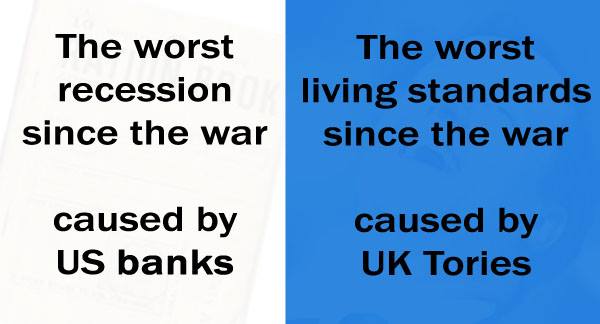
David Cameron’s Conservative party got into Office by riding on the shockwaves of the 2008 global banking crisis: by sheer opportunism, dishonesty and by extensively editing the narrative about cause of that crisis. The Conservatives shamefully blamed it on “the big state” and “too much state spending.”

They have raided and devastated the public services and social security that citizens have paid for via taxes and national insurance. Support provision for citizens is cut to the bone. And then unforgivably, they blamed the victims of those savage, ideologically-directed cuts for the suffering imposed on them by the Conservative Party, using the media to amplify their despicable, vicious scapegoating narratives.

Conservatives really do think that inequality is necessary, they think that our society ought to be divided and hierarchical. They are traditional rather than rational. They have an almost feudalist approach to economic policy, blended with a strong old boys network of corporocrats.

The Tories have long been advocates of the market society, which turns everyone and everything into a commodity. Neoliberalism is an invisible hand in an iron glove, with its whispered broken promise of a mythological “trickle down” as justification – now the new right neoliberals are officially a cult of vicious cranks.


Related

The BBC expose a chasm between what the Coalition plan to do and what they want to disclose

The word “Tories” is an abbreviation of “tall stories”

Conservatism in a nutshell

Osborne’s Autumn statement reflects the Tory ambition to reduce State provision to rubble

A list of official rebukes for Tory lies


1017174_500690710000462_512008904_n
Many thanks to Robert Livingstone @LivingstonePics


I don’t make any money from my work. I am disabled because of illness. But you can contribute by making a donation and help me continue to research and write informative, insightful and independent articles, and to provide support to others.

The smallest amount is much appreciated – thank you.

DonatenowButton

The BBC expose a chasm between what the Coalition plan to do and what they want to disclose

1379986_541109785958554_2049940708_n

“Traditions are not killed by facts” – George Orwell.

The Conservatives are creatures of habit rather than reason. Traditional. That is the why their policies are so stifling and anti-progressive for the majority of us. It’s why Tory policies don’t meet public needs.

There’s always an air of doom and gloom when we have a Tory government, and a largely subdued, depressed, repressed nation, carrying vague and fearful intuitions that something truly catastrophic is just around the corner.

I can remember the anxiety and creeping preternatural fear amongst young people in the eighties, and our transcendent defiance, which we carried like the banners at a Rock Against Racism march, back in the Thatcher era. We always witness the social proliferation of fascist ideals with a Tory government, too. It stems from the finger-pointing divide and rule mantra: it’s them not us, them not us. But history refutes as much as it verifies, and we learned that it’s been the Tories all along.

With a Conservative government, we are always fighting something. Poverty, social injustice: we fight for political recognition of our fundamental rights, which the Tories always circumvent. We fight despair and material hardship, caused by the rising cost of living, low wages, high unemployment and recession that is characteristic of every Tory government.

I think people often mistranslate what that something is. Because Tory rhetoric is all about othering: dividing, atomising of society into bite-sized manageable pieces by amplifying a narrative of sneaking suspicion and hate thy neighbour via the media.

The Tories are and always have been psychocrats. They insidiously intrude into people’s everyday thoughts and try to micro-manage and police them. They use Orwellian-styled rhetoric crowded with words like “market forces”, “meritocracy” “autonomy”, “incentivisation”, “democracy”, “efficient, small state”, and even “freedom”, whilst all the time they are actually extending a brutal, bullying, extremely manipulative, all-pervasive authoritarianism.

The Conservative starting point is control of the media and information. All Conservatives do this, and historically, regardless of which country they govern. (As well as following the hyperlinks (in blue) to British and Canadian media takeovers, also, see the Australian media Tory takeover via Murdoch, from last year: The political empire of the News Corp chairman.)

As we saw earlier this year when the Tories launched an attack on Oxfam, any implied or frank criticism of Conservative policies or discussion of their very often terrible social consequences is stifled, amidst the ludicrous accusations of “politically biased.”

When did concern for poverty and the welfare of citizens become the sole concern of “the left wing”? I think that casually spiteful and dismissive admission of indifference tells us all we need to know about the current government’s priorities. And no amount of right-wing propaganda will hide the fact that poverty and inequality rise under every Tory government. And how is it possible to discuss poverty meaningfully without reference to the policies that cause it? That isn’t “bias”: it’s truthful. Tory policies indicate consistently that when it comes to spending our money, the Tories are very generous towards the wealthy, and worse than parsimonious regarding the rest of us.

Then there are the Tory pre-election promises, all broken and deleted from the internet. And valid criticism of their spinner of Tory yarns and opposition smears, also deleted. This is not a democratic government that values political accountability, nor is it one that is prepared to bear any scrutiny at all.

The Conservatives are attempting to intimidate the BBC (again) into silence regarding its candid commentary regarding the autumn statement made by Osborne, exposing the vast scale of cuts to come for the British public. I’m pleased to see the BBC hitting back, for once, with a robust defence, declaring that: “We’re satisfied our coverage has been fair and balanced and we’ll continue to ask ministers the questions our audience want answered.”

It was BBC assistant political editor Norman Smith’s description of the Office for Budget Responsibility (OBR) response to the autumn statement document as “the book of the doom” and his suggestion that the UK was heading “back to the land of Road to Wigan Pier” that provoked Osborne’s outrage.

But whilst journalists are hardly unknown for hyperbole, Smith certainly can be cleared of this charge. Because many agree that the figures contained in the OBR blue book are truly remarkable and worry-provoking. Many of us have concluded the same, from the OBR and Institute of Fiscal Studies (IFS) to an army of quietly reflective bloggers, who have collectively anticipated this purely ideological outcome for some time.

The BBC are absolutely right to point out to the public that there will be severe social repercussions as a consequence of the scale of cuts that Osborne is planning, especially given that sixty percent of the cuts are yet to come.

The judgements of the OBR, which Osborne set up, and IFS, were at least as damning as the BBC’s, but it’s worth noting that the Chancellor doesn’t publicly attack either report. Because he can’t.

Instead the Conservatives have accused the BBC of “bias” and “systematic exaggeration,”  David Cameron and George Osborne launched an unprecedented attack on the coverage of the Autumn Statement. However, the Conservatives have been openly policing the media for a while. (See: Tories to closely monitor BBC for left wing bias ahead of party conference season and: Once you hear the jackboots, it’s too late.)

Senior Tory MP Andrew Bridgen suggested there was a risk that unless the BBC was “scrupulously fair” in its reporting, it may “drive voters into the arms of Labour”, adding the threat “and may even find its future funding arrangements affected.”

A blatant threat.

On Thursday, Bridgen wrote to Rona Fairhead, the BBC Trust’s chairperson, to complain “about a pattern of systematic exaggeration in the BBC’s reporting of the Autumn Statement”. It’s not his first complaint about alleged bias, either: he whined when the TUC’s senior economist Duncan Weldon became Newsnight’s new economics correspondent earlier this year.

Mr Bridgen said he wanted “to seek assurances that in the remaining six months until the general election your coverage will demonstrate the impartiality and balance that the public, and indeed the BBC charter, demand”.

He added: “Over the last four years the entire nation has pulled together to achieve something many said could not be done: we are now the fastest growing advanced economy in the developed world. The sacrifices and hard work of the British people are ill-served by pessimistic reporting which obscures our economic success with the language of fear and doom.”

I don’t think this is about “impartiality” or what best serves the British people. This is about the Conservatives not getting their own way, so they resort to bullying and  attempts to discredit people who have simply told the truth.

The Chancellor responded angrily to the references to Orwell’s The Road to Wigan Pier in the Today report on BBC Radio 4. He said: “I would have thought the BBC would have learned from the last four years that its totally hyperbolic coverage of spending cuts has not been matched by what has actually happened. I had all that when I was interviewed four years ago and has the world fallen in? No it has not.”

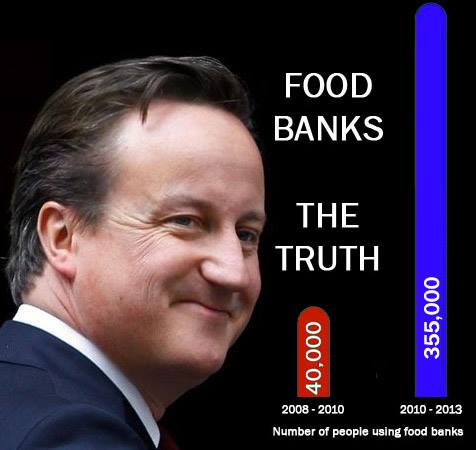
Well, that all depends George. For many people, the only genuine growth we’ve seen is in poverty, inequality, destitution, hunger, suffering and referrals to foodbanks. And deaths. So yes, for growing numbers, their’ world has fallen in.

A BBC spokesman said the BBC was satisfied that the Today programme’s coverage had been “fair and balanced and we gave the Chancellor plenty of opportunity to respond on the programme.”

And the comments were justified because the Office for Budget Responsibility had itself said that nominal government consumption will fall to its lowest level since 1938, the BBC said.

Both the OBR and IFS said in their responses to the autumn statement that Britain has not seen public spending reduced to this level as a proportion of GDP since the grim days of the 1930s.

The public sector spending cuts over the next five years set out in the autumn statement may force a “fundamental re-imagining of the state,” the Institute for Fiscal Studies said in their report.

The warning from the IFS – Britain’s public spending analysts – came only hours after Osborne had angrily rounded on the BBC, accusing its reporters of “totally hyperbolic” reporting about his spending plans and “conjuring up bogus images of the 1930s depression”.

The IFS confirmed that the scale of cuts to departmental budgets and local government would reduce the role of the state to a point where it would have “changed beyond recognition.” The government’s spending watchdog, the Office for Budget Responsibility (OBR), also said yesterday that Osborne’s statement indicated that with the cuts set out in Treasury assumptions, we would see the state reduced to its smallest size relative to GDP for 80 years – since the 1930s.

It was about this era, the Great Depression, against which Orwell set The Road to Wigan Pier, in his account of the bleak living conditions, social injustices, suffering and misery of the working class in the Northwest of England. Norman Smith made an apt comparison.

Scenes from the Jarrow Crusade, 1936, Marchers from Jarrow in the North East of England, walk to London where they will hand in a petition to the House of Commons in a plead for more work as the depression and starvation of the 1930's hits hard

Scenes from the Jarrow Hunger March, 1936, Marchers from Jarrow in the North East of England, walked to London where they handed a petition to the House of Commons in a plead for more work as the depression and starvation of the 1930’s hit hard

Osborne admitted to John Humphrys two hours later, that “difficult” decisions on welfare would include freezing working age benefits for two years and lowering the welfare cap on spending from £26,000 for a family each year on benefits to a maximum of £23,000. But he maintained his glib assurances that the outlook was not as grim as Smith and Humphrys were claiming.

With the cost of living rising sharply year after year, and with the catastrophic consequences of the first wave of welfare “reforms” now clearly evident, it is difficult to envisage how the outlook for the poorest can be deemed anything other than enduringly, grindingly bleak.

If any evidence was needed that the Conservatives fear the political consequences of the cuts to come, the assault on the BBC’s coverage of the autumn statement has certainly provided it. The Conservative responses are strictly about discrediting the BBC as a means of pre-election damage-limitation, and not about the accuracy or “bias” of the reporting, because Osborne had not anticipated that the real consequences of his budget plans would be shared with the public. Most people don’t, after all, read the OBR or IFS forecasts and reports. As it is, Osborne had set out to mislead the public, and was well and truly exposed.

The IFS director, Paul Johnson, said: “The chancellor is right to point out that it has proved possible to implement substantial cuts over this parliament. One cannot just look at the scale of implied cuts going forward and say they are unachievable. But it is surely incumbent upon anyone set on taking the size of the state to its smallest in many generations to tell us what that means.

It’s also worth bearing in mind that Clegg has claimed co-authorship of the budget statement. Clegg’s absence from parliament for the third Wednesday in a row suggests he is farcically trying to distance himself from David Cameron and Osborne in the run-up to the election.

However, he attempted to take credit for the central policies of the statement, including the stamp duty overhaul unveiled by Osborne, when questioned on his LBC 97.3 radio show by Ed Balls, the shadow chancellor.

“Everything in that autumn statement is there because we’ve agreed it and I fully support it,” Clegg said.

The BBC exposed the chasm between what the Tory-led Coalition plan and what they are prepared to disclose and discuss publicly. That’s because of a chasm that exists between Tory ideology and a genuine economic problem-solving approach to policy: Osborne’s autumn budget statement was entirely about political gesturing, designed to divert attention from the sheer extent of social and economic damage  wreaked by five years of strictly ideologically-prompted policy.

This is a Chancellor who rested all of his credibility on paying down the debt and has borrowed more than every Labour government combined.

It must be abundantly clear that the Tory aim of much bigger and destructive cuts after 2015 is not about deficit reduction, but the destruction of the public sector, our services and social safety nets, the undoing of a century of our the hard-won achievements of civil rights movements, and all in favour of greedy, elevated, unbridled market forces.

Conservatism is centred around the preservation of traditional social hierarchy and inequality. Tories see this, erroneously, as an essential element for expanding economic opportunity. But never equal opportunity.

Conservatives think that civilised society requires imposed order, control and clearly defined classes, with each person aware of their rigidly defined “place” in the social order. Conservatism is a gate-keeping exercise geared towards economic discrimination and preventing social mobility for the vast majority.

It is these core beliefs that fuel Osborne’s stubborn adherence to austerity policies, even though it is by now patently obvious that austerity isn’t working for the economy, and for majority of the public. It never will.

942124_214298768721179_2140233912_nThanks to Robert Livingstone for the memes.

Related

Osborne’s Autumn statement reflects the Tory ambition to reduce State provision to rubble

Ed Balls: response to the Autumn Statement

David Cameron promised a further £7.2 BILLION tax cuts to the rich at the expense of the poor

1450041_569755536427312_1698223275_n

I wrote an article last year – Follow the Money: Tory Ideology is all about handouts to the wealthy that are funded by the poor – which outlines Coalition policies that have widened inequalities and increased poverty by handing out public money to the wealthy that has been taken from the poorest. I pointed out that this Government have raided our tax-funded welfare provision and used it to provide handouts to the very wealthy – £107,000 EACH PER YEAR in the form of a tax break for millionaires, amongst other things.

And what does our imperturbable chancellor promise if this disgrace of a government is re-elected? True to Tory form, more of the same: austerity for the poor and public services cuts, and tax breaks for the wealthiest.

But further cuts to lifeline benefits and public services is surely untenable. Absolute poverty has risen dramatically, this past four years, heralding the return of Victorian illnesses that are associated with malnutrition. People have died as a consequence of the welfare “reforms”. Supporting the wealthy has already cost the poorest so very much, yet this callous, indifferent, morally nihilistic  government are casually discussing taking even more from those with the very least.

This isn’t anything to do with economic necessity: it’s all about Tory ideology. Under the guise of austerity, the Tory-led Coalition have stripped our welfare and public services down to the bare bones. Any further cuts will destroy what remains of our post-war settlement.

Despite facing a global recession, the Labour Government invested in our public services, and borrowed substantially less in thirteen years than the Coalition have in just three years. UK citizens were sheltered very well from the worst of the global bank-induced crash.

Gordon Brown got it right in his championing of the G20 fiscal stimulus, agreed at the London summit of early April 2010, which was a continuation of his policies that had served to steer the UK economy out of the consequences of a global recession, and to protect citizens from the consequences of cuts to services and welfare.

Osborne’s policy of imposing austerity and budget cuts on an economy that was actually recovering was a catastrophic error. The austerity propelled the economy backwards and into depression; and, far from using public spending as a countervailing force against the cutbacks in private sector investment, the Coalition’s budget cuts served to aggravate the crisis. Many people are suffering terribly as a consequence, reduced to a struggle for survival.

And in these socio-economic circumstances, the Tories have pledged a further £7.2 BILLION tax cuts to the rich. The funding for the tax cuts will come from further catastrophic “savings” made at the expense of the poorest yet again – £25 billion more to be sliced from welfare, Local Authorities,  education, police and other vital services.

Three things are immediately clear. Firstly, without the ramping up of VAT in 2010, to 20%, Osborne would be in even more dire financial straits than he is.

Secondly, income tax has, despite allegedly rising employment, failed to increase.

Thirdly, corporation tax, targeted for cuts, year after year, has slumped. The tax system is increasingly veering toward very regressive – biased in favour of the wealthy – consumption taxes, which affects the poorest, most, and failing to deliver fairer taxes on income.

This is the result of government policy: increasing VAT but cutting corporation tax, and the engineered kind of “recovery” we have ended up with. The Office for Budgetary Responsibility (OBR) reminded us in October of the extent of the Coalition’s failure to reduce the deficit.

Public sector net borrowing in 2013-14 was originally expected to be £60 billion; the out-turn for borrowing was £108 billion (on a comparable basis). This amounts to a shortfall of nearly £50 billion, with borrowing approaching double the original predictions made when the government’s austerity policies were announced in 2010.

Much of this shortfall is accounted for by the current earnings crisis. UK workers are suffering the longest and most severe decline in real earnings since records began in Victorian times, according to an analysis published by the TUC. But Tories always lower wages, and hike up the cost of living. And whilst workers are struggling to make ends meet, private business owners/Tory donors are raking in millions of pounds. But this is exactly how Tories like to run society in a nutshell.

It’s their imposition of a feudalist schemata for social relationships. Cognitively, Tories are the equivalent of historical egocentric toddlers: they are stuck at this painful stage of arrested development.

“The deficit reduction programme takes precedence over any of the other measures in this agreement” – stated in the Coalition Agreement.

For a government whose raison d’etre is deficit reduction, the Coalition really isn’t very good at all. But austerity reflects the triumph of discriminatory Tory ideology over needs-led, evidenced-based policy making.

The OBR said the forecast from 2010 was over-optimistic because it did not take into consideration the effect of lower wages as well as a higher levels of tax-free personal allowance on the upper brackets of income tax. National Insurance contributions were also £7.4 billion below forecast.

Which brings us back to the issue of further tax cuts for the wealthy, with no mention of raising wages for the poorer work-force, and of course there is the promise of more cuts to come for those relying on lifeline benefits. I don’t think that the Coalition cares that their policies don’t balance the books, as it were, or mend the economy. Nor do they care what the consequences are for the wider public.

TUC General Secretary Frances O’Grady said:

The government’s failure to get wages growing again has not only left families far worse off than in 2010, it’s put the public finances in a mess too. The economy has become very good at creating low-paid jobs, but not the better paid work that brings in income tax. The Chancellor’s sums just don’t add up – he can’t make the tax cuts for the better off that he is promising and meet his deficit reduction target without making cuts to public services.

His cuts would be so deep that no government could deliver them without doing damage to both the economy and the fabric of our society. We can’t cut our way out of this problem any more than we can dig ourselves out of a hole. More austerity would only keep us stuck in a downward spiral. The Chancellor should use next week’s Autumn Statement to invest in growth and to put a wages recovery at the top of the agenda.

Shadow Chancellor Ed Balls said:

Nobody will be fooled by pie in the sky promises of tax cuts when David Cameron cannot tell us where the money is coming from. Even the Tories admit this is an unfunded commitment of over £7 billion, so how will they pay for it? Will they raise VAT on families and pensioners again?

Cameron has also announced the basic rate before we start paying tax would rise from £10,500 to £12,500. While a worker on £12,500 would save £500 a year, someone earning £50,000 would keep £1,900 extra.

Those earning up to £123,000 would be £484 richer. Someone on £12,500 would save £500 a year, while someone on up to £50,000 would keep £1,900 extra. And the £500 tax cut for basic rate earners will be almost wiped out by George Osborne’s raid on in-work benefits.

Paul Johnson of the Institute for Fiscal Studies think tank says it was:

very difficult to see how the £7billion tax giveaway could be paid for.

We’re looking at promises of £7billion of tax giveaways in the context of an overall plan to get the deficit down but even without tax giveaways that requires pretty extraordinary levels of spending cuts such that most government departments will see their spending cut by a third by 2020.

How are you going to afford this? Even more dramatic spending cuts?

At the Tory Conference, Cameron promised to expand the National Citizen Service youth project for every teenager in the country, have the lowest rate of corporation tax of any major economy.

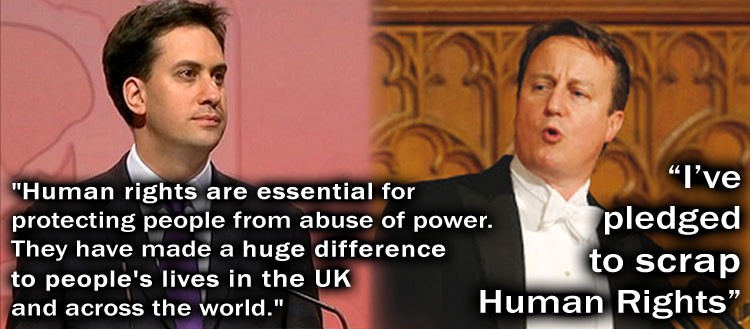
There was also a pledge to abolish youth unemployment by the end of the decade. But the Tory faithful gave the loudest applause for his pledge to scrap the Human Rights Act.

This is a truly terrifying pledge, because human rights were originally formulated as an international response to the atrocities of the 2nd World war, and to ensure that citizens are protected from abuses of their government.

A Labour Party analysis found the proposed tax break would hand David Cameron and other Cabinet ministers an extra £132 a year. But a family with two children with one earner on £25,000 a year would lose £495 by 2017-17 due to the benefits freeze announced by Mr Osborne.

The Tory plan is based solely on spending cuts, mainly directed at the working age poor. And the Conservative plan to raise the higher rate threshold to £50,000 means that  working-age poor people are to fund a tax cut that is four times greater for higher rate tax payers than for basic rate taxpayers.

Ed Balls said in response:

David Cameron’s speech showed no recognition that working people are £1,600 a year worse off under the Tories nor that the NHS is going backwards on their watch. The only concrete pledge we’ve had from the Tories this week is a promise to cut tax credits by hundreds of pounds for millions of hard working people while keeping a £3 billion tax cut for the richest one per cent.

TUC general Secretary Frances O’Grady added:

No amount of dressing up can hide the fact that the policies in this speech pass by those who need the most help to reward richer voters.

Alison Garnham, Chief Executive of Child Poverty Action Group, said:

What was missing in the PM’s speech was any recognition that independent projections show that child poverty rates are set to soar. We know that raising the personal tax allowance is an ineffective way of supporting low paid families.Independent analysis shows that just 15% of the £12 billion required to raise the PTA to £12,500 would go to working families in the lowest-income half of the population.

Many simply don’t earn enough to benefit from this policy, and those that do just see their benefits and tax credits withdrawn as their incomes rise.

The Institute for Fiscal Studies showed in their Green Budget publication this year that just 15% of the gains from increasing the personal allowance would benefit the poorest half of Britons, concluding:

There are better ways to help the low paid via the tax and benefit system.

Ex-Treasury official James Meadway,  now a senior economist at the New Economics Foundation, said Cameron’s changes were:

irresponsible, expensive gimmicks that scarcely affect the poorest workers.

They imply swingeing public sector cuts and mean handing over more cash to the already rich.

Ed Miliband will respond tomorrow (Monday), declaring that the Tories’ failure to tackle the cost-of-living crisis has helped cost the Exchequer £116.5 billion – leading to higher borrowing and broken promises on the deficit. The price tag, equivalent to almost £4,000 for every taxpayer, is based on new research from the House of Commons Library being published by the Labour Party.

This shows that low pay and stagnant salaries, combined with soaring housing costs and the failure to tackle root causes of increased welfare bills, means that over the course of this Parliament:

  • Income tax receipts have fallen short of forecasts by more than £66 billion.
  • National Insurance Contributions are £25.5 billion lower than expected.
  • Spending on social security is £25 billion higher than planned [despite brutal cuts to lifeline benefits]

Mr Miliband is expected to say the test for George Osborne in this week’s Autumn Statement will be to set out a plan to build a recovery for working people – one which recognises the link between the living standards and Britain’s ability get the deficit down.

He is expected to say:

For a very long time, our country has worked well for a few people, but not for everyday people. “We live in a country where opportunities are too skewed to those at the top, where too many people work hard for little reward, where too many young people can’t find a job or apprenticeship worthy of their talents, and where families can’t afford to buy a home of their own.

For all the Government’s boasts about a belated economic recovery, there are millions of families still caught in the most prolonged cost-of-living crisis for a century.  For them this is a joy-less and pay-less recovery.

My priority as Prime Minister will be tackling that cost-of-living crisis so that hard work is properly rewarded again, so that our children can dream of a better future, so that our public services including the NHS are safe.

Building a recovery that works for everyday people is the real test of the Autumn Statement.

But that isn’t a different priority to tackling the deficit. Building a recovery that works for most people is an essential part of balancing the books.

The Government’s failure to build a recovery that works for every-day people and tackle the cost-of-living crisis isn’t just bad for every person affected, it also hampers our ability to pay down the deficit.

Britain’s public finances have been weakened by a Tory-led Government overseeing stagnant wages which keep tax revenues low.

Britain’s public finances have been weakened by Tory policies which focus on low paid, low skilled, insecure jobs – often part-time or temporary – because they do not raise as much revenue as the high skill, high wage opportunities we need to be creating.

And our public finances have been weakened by higher social security bills to subsidise low paid jobs and the chronic shortage of homes.   

The result has been David Cameron and George Osborne missing every single target they set themselves on clearing the deficit and balancing the books by the end of this parliament.

Their broken promises, their abject failure, are not an accident. They are the direct result of an outdated ideology which says all a Government has to do is look after a privileged few at the top and everyone else will follow.

That is why this Government has done a great job of squeezing the middle, but a bad job of squeezing the deficit.

The test this week for David Cameron and George Osborne is whether they recognise that Britain will only succeed and prosper for the long term by tackling the cost-of-living crisis and building a recovery which works for the many, not just for a few.

Or whether they will just offer more of the same old ideas that have failed them, failed everyday working people, and failed Britain over the past four years.

10001887913_f8b7888cbe_o

Thanks to Robert Livingstone for the brilliant memes

The link between Trade Unionism and equality

10553308_680322242037307_1558281906340939819_n

In an article I wrote earlier this year – Conservatism in a nutshell – I outlined some basic themes of New Right Conservative ideology. I said:

Conservatives don’t like social spending or welfare – our safety net. That’s because when you’re unemployed and desperate, companies can pay you whatever they feel like – which is inevitably next to nothing. You see, the Tories want you in a position to work for next to nothing or starve, so their business buddies can focus on feeding their profits, which is their only priority. Cheap-labour conservatives don’t like the minimum wage, or other improvements in wages and working conditions. These policies undo all of their efforts to keep you desperate. They don’t like European Union labour laws and directives either, for the same reason.

Conservatives prioritise handing out our money to their big business partners, no matter what it costs us as a society. For example, a spending breakdown reveals how NHS funding has flowed to private firms, much of that money has gone to companies with corrupt ties to the Tories, whilst health care is being rationed, care standards have plummeted, services are cut, and by the end of the next financial year, health service workers will have had their pay capped for six years, prompting fully justified strike action.

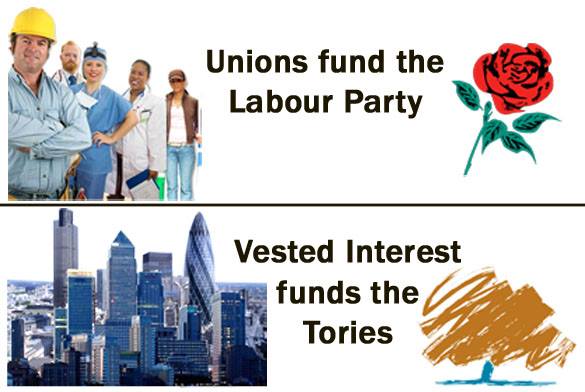
Following the tide of sleaze and corruption allegations, Cameron “dealt” with parliamentary influence-peddling by introducing the Gagging Act, which is primarily a blatant attack on trade unions (which are the most democratic part of the political funding system) and Labour Party funding, giving the Tories powers to police union membership lists, to make strike action very difficult and to cut union spending in election campaigns.

The Transparency of Lobbying, non-Party Campaigning, and Trade Union Administration Bill is a calculated and partisan move to insulate Tory policies and records from public and political scrutiny, and to stifle democracy. And there are many other examples of this government removing mechanisms of transparency, accountability and safeguards to rights and democracy.

We have witnessed a dramatic increase in levels of economic inequality this past four years, reflected in the fact that income differences between top earners and those on the lowest wages are now higher than at any time since records began. The UK now ranks as one of the most unequal societies in the developed world, even more unequal than the US, home of the founding fathers of neoliberalism. Our current levels of inequality have far exceeded the point at which campaigners need any further proof to show how socially corrosive and life-limiting the subsequent deepening poverty is.

Despite the legislative framework of Labour’s Equality Act, passed in 2010, there is a growing gender-based pay gap, continued abuse of agency workers, the problem of the two-tier work force and the contracting out of public servicesStrong trade unions improve public services, too.

Speaking at a press conference on the first day of the 2014 TUC Congress, TUC General Secretary Frances O’Grady said:

“The key message of this year’s congress is Britain needs a pay rise and I also expect many of the debates on the floor to focus on the importance of the coming general election for people at work.

Today, I want to highlight the threat posed by the Conservative Party’s promised manifesto proposals on strike ballots.

Because these proposals are designed to make unions weaker. And if unions become weaker, then the chances of people winning a pay rise, improving living standards and tackling inequality in Britain today will become a good deal harder.

The Conservative Party is not just proposing a few more bureaucratic obstacles that will make life a bit more difficult for trade unions.

Taken together, they would effectively ban strikes by the back door. And, on top of that, they would open up elected union leaders to increased surveillance by the state.

They are not just an attack on fundamental liberties. They will act to lower living standards for the majority of working people – whether or not they are union members.”

One half of the British population owns 9% of household wealth whilst the other half owns 91% of the wealth; and the five richest families in the UK are wealthier than the poorest 20% of the entire population.

Conservatives are always obsessed with “economic growth”, but we know from history that economic expansion in itself does not promote equality: it is the types of employment, the rules and structure of the economy and policies that matter most. Conservative governments always create high levels of inequality.  Furthermore, they rarely manage to bring about the economic growth they promise. But recession due to reduced public spending is an inbuilt feature of neoliberalism, as we witnessed during the Thatcher era.

Inequality hinders growth in another important way: it fuels social conflict. However, social diversity has no negative impact on economic growth, despite what those on the blame-mongering Right would try and have us believe. It is economic policies that shape inequalities, not minority groups: they are the casualities of inequality not its creators.

Economic inequality is also about discrimination. Black and ethnic minority workers are disadvantaged in finding employment. Dismissal of pregnant workers is a widespread practice. Last year, the wage gap between men and women’s earnings increased and the progress previously made towards equal pay has been reversed.

Cameron’s government has mobilised resentment and fear on the part of relatively privileged social groups in relation to other subordinate or putatively threatening groups of politically defined Others – immigrants, unemployed people, disabled people, unionised workers, single mothers and so on.

Social inequalities and hierarchies are defended by Conservatives and secured in several ways. The defence of power, wealth and property, when threatened, tends to be micro-managed via rigid authoritarianism, through systems of mobilised prejudice and through free-market policies (the predictable effects of which are to transfer wealth upwards). All Conservative politics pivot on a fundamental commitment – the defence of privilege, status, and thus sustaining social inequality.

But it is only by shifting money from the high-hoarding rich to the high-spending rest of us, and not the other way around, that investment and growth may be stimulated and sustainable.

The Office of Budgetary Responsibility forecasts that the Coalition are facing a £17BILLION blackhole after the low pay  that their own policies have strongly encouraged have caused a slump in tax payments to the treasury.

It is very clear that austerity is not an economic necessity, but rather, it is an ideological preference, used as a justification for “shrinking the State” whilst defending power, wealth and privilege.

The Coalition have introduced trade union laws which inhibit trade union recruitment, activity and collective bargaining. Employment rights are being removed, at a time when policies have reduced access to unfair dismissal protection and access to employment tribunals.

Trade unions are most effective when all workers are represented and therefore trade unionism encourages social inclusion. Collective bargaining and representational support will not work in the long term if some workers have substantially less to gain from the process than others.

For this reason, trade unions and the Labour Party have worked at eliminating sex, race and other forms of discrimination in the workplace. This has taken time, given how deeply ingrained inequalities have been in our society. We know that where trade unions are active, employers are more likely to have equal opportunities policies.

But for proper support of economic equality, trade unions need legal protection for their activities so they may operate freely and build effective social solidarity and promote egalitarianism.  Trade unions seek increased participation by working people in the decisions that influence their lives and a fairer distribution of the nation’s wealth. That is the antithesis of Conservatism.

Freedom to speak out against injustice, to campaign for economic equality and to work together through trade unions are underpinned by rights set out in the European Convention on Human Rights (ECHR). It’s no surprise that Cameron has pledged to exit the ECHR and to scrap Labour’s Human Rights Act.

To tackle economic inequality and build a fairer society, it is essential that trade-unions can operate freely and that collective bargaining is renewed. The impoverishment and exploitation of any one group of workers is a threat to the well-being and livelihood of everyone.

Building a future economy where the benefits of work and profit are shared requires legal reform in support of effective trade unions.

Lydia Hayes and Tonia Novitz from the Centre For Labour and Social Studies have written  the following proposals, designed to change public policy, so that trade unions are better able to represent their members, by  simplifying the statutory procedure for trade union recognition, and putting in place arrangements for sector-wide collective bargaining:

1. Introduce a legal framework through which trade unions can freely organise and engage in collective action to build economic equality.

2. Amend trade union recognition legislation so that all workers who choose to join a union can be represented in collective bargaining and other workplace matters.

3. Ensure the law provides for sectoral bargaining which can set minimum terms and conditions across an industry or a service sector.

4. Defend human rights which protect the functioning of trade unions (including rights to free speech, freedom of assembly and freedom of association).

5. Give trade unions access to workers and workplaces, so that they can advise on the benefits of membership and collective bargaining.

6. Enable workers to have access to information about trade unions at their workplace so that they can make an informed choice and easily join a trade union if they want to.

None of this will happen during the current government’s term, because Conservatism is in diametric opposition to trade unionism, equality, human rights and egalitarianism.

Related
The Institute of employment Rights

10174840_680246428711555_4476316988383611981_n

Thanks to Robert Livingstone for the graphics.


I don’t make any money from my work. I am disabled because of illness and have a very limited income. But you can help by making a donation to help me continue to research and write informative, insightful and independent articles, and to provide support to others. The smallest amount is much appreciated – thank you.

DonatenowButton

A list of official rebukes for Tory lies

1235473_537097386359794_65317730_n (1)

Here is catalogue of officially recognised Tory lies – each one used to justify their unjustifiable policies – which have resulted in official reprimands:

Government used ‘misleading’ figures to claim homelessness halved – Statistics authority warns Government claims to have halved homelessness  are based on the government’s very narrow definition of terms.

George Osborne rebuked for ‘no cuts in police budgets’ claim –  The Chancellor claimed he would provide “real-terms protection” but forces face £160m funding cut, statistics watchdog rules. Sir Andrew Dilnot, the chair of the UK Statistics Authority, ruled that despite Osborne’s claim to be providing “real-terms protection” for the police, forces actually faced a £160m real-terms cut in their Whitehall funding in 2015-16 and 2016-17.

A House of Commons analysis estimated that the £160m cut was equal to the salaries of 3,200 police officers over the two years.

David Cameron rebuked by statistics watchdog over national debt claims The PM said the government was ‘paying down Britain’s debts’ in a political broadcast, even though the debt is actually rising.

“Now that his false claims have been exposed, it’s time the prime minister stopped deliberately misleading people about his economic record” – Rachel Reeves.

Finally Exposed! The Deficit Myth! So, David Cameron When Are You Going to Apologise? David Cameron rebuked over austerity claims – Cameron has been corrected by the Treasury’s own forecaster over claims that cuts in public spending are not reducing economic growth. The Office for Budget Responsibility told the Prime Minister that it does believe that cutting public spending will reduce economic growth in the short term.

Robert Chote, the head of the OBR, contradicted a claim Cameron made in a speech about the economy, in which the Prime Minister said the forecaster does not believe cuts are reducing growth.

In fact, as Mr Chote wrote, the OBR believes that cuts in spending and increases in tax will depress economic activity, meaning lower growth.

OBR head rebukes Osborne: the UK was never at risk of bankruptcy. Office for Budget Responsibility chief Robert Chote dismisses the Conservative “danger of insolvency” claim.

In the weeks after he took office, George Osborne justified his austerity programme by claiming that Britain was on “the brink of bankruptcy”. He told the Conservative conference in October 2010: “The good news is that we are in government after 13 years of a disastrous Labour administration that brought our country to the brink of bankruptcy.”

It was, of course, nonsense.

*Please note the original link to the New Statesman article seems to have curiously vanished. So here is a cached link to the same article: OBR head rebukes Osborne: the UK was never at risk of bankruptcy.

David Cameron rebuked over jobs claim: Sir Andrew Dilnot, head of the UK Statistics Authority, the independent statistics regulator, said the prime minister was wrong to say figures showed that more than three-quarters of all new jobs went to British citizens when “official statistics do not show the number of new jobs.”

Cameron was attempting to show in an interview for the Daily Telegraph that the government had reversed a situation in its first few years of office when he claimed most new jobs were taken by migrant workers. The interview was widely interpreted as an attempt to win over Ukip voters who believe most jobs created as Britain’s economy recovers are being snapped up by foreigners.

Following a complaint by Jonathan Portes, head of the National Institute for Economic & Social Research, Dilnot confirmed that neither the original fear that migrants were taking British jobs nor the reversal of this trend were supported by official data.

Employment data collected by the Office for National Statistics relates to jobs in the economy whether or not they are newly created by employers. Dilnot said the relevant figures from the ONS showed the number of migrants in the labour force increased by 400,000 over the last five years, an 18% rise, while the number of UK nationals increased by 3%, or 900,000.

Sir Andrew Dilnot, head of the UK Statistics Authority, the independent statistics regulator, said the prime minister was wrong to say figures showed that more than three-quarters of all new jobs went to British citizens when “official statistics do not show the number of new jobs.”

Information Commissioner Christopher Graham launched a scathing rebuke of the decision to exercise the Government’s veto in a report on the case to Parliament. Blocking the publication of a report into the risks of NHS reforms is a sign that ministers want to downgrade freedom of information laws, a watchdog has warned. Health Secretary Andrew Lansley deployed it to block an Information Tribunal ruling that he should meet Labour demands to disclose the document.

Duncan Smith rebuked by ONS for misuse of benefit statistics – The claim that 8,000 people moved into work as a result of the benefit cap is “unsupported by the official statistics”, says the UK Statistics Authority. In letter to Duncan Smith, Andrew Dilnot writes: “In the manner and form published, the statistics do not comply fully with the principles of the Code of Practice, particularly in respect of accessibility to the sources of data, information about the methodology and quality of the statistics, and the suggestion that the statistics were shared with the media in advance of their publication.”

Another statement by Duncan Smith later in the month also drew criticism and a reprimand. The minister said around 1 million people have been stuck on benefits for at least three of the last four years “despite being judged capable of preparing or looking for work”.

However, the figures cited also included single mothers, people who were seriously ill, and people awaiting testing.

Iain Duncan Smith Rebuked Over Immigration Statistics – Iain Duncan Smith and the Department of Work and Pensions have been accused of publishing misleading immigration figures that were “highly vulnerable to misinterpretation”. Figures showing 371,000 immigrants were on benefits were rushed out by ministers with insufficient regard for “weaknesses” in the data, according to the UK Statistics Authority.

In a strongly-worded rebuke to Work and Pensions Secretary Iain Duncan Smith, the head of the UKSA, Sir Michael Scholar, condemned the handling of the research, the Press Association reported.

Sir Michael said that despite being “highly vulnerable to misinterpretation”, the claims were given to the media without the safeguards demanded for official statistics and by issuing the figures as a “research paper”, the DWP had bypassed the need to meet the usual code of conduct, he noted.

Grant Shapps rebuked by UK Statistics Authority for misrepresenting benefit figures – Yet another Conservative politician is caught making it up. Grant Shapps has joined his fellow Conservatives in the data hall of shame. In March, the Tory chairman claimed that “nearly a million people” (878,300) on incapacity benefit had dropped their claims, rather than face a new medical assessment for its successor, the employment and support allowance.

The figures, he said, “demonstrate how the welfare system was broken under Labour and why our reforms are so important”. The claim was faithfully reported by the Sunday Telegraph  but as the UK Statistics Authority has now confirmed in its response to Labour MP Sheila Gilmore (see below), it was entirely fabricated.

In his letter to Shapps and Iain Duncan Smith, UKSA chair Andrew Dilnot writes that the figure conflated “official statistics relating to new claimants of the ESA with official statistics on recipients of the incapacity benefit (IB) who are being migrated across to the ESA”. Of the 603,600 incapacity benefit claimants referred for reassessment as part of the introduction of the ESA between March 2011 and May 2012, just 19,700 (somewhat short of Shapps’s “nearly a million) abandoned their claims prior to a work capability assessment in the period to May 2012.

The figure of 878,300 refers to the total of new claims for the ESA closed before medical assessment from October 2008 to May 2012. Thus, Shapps’s suggestion that the 878,300 were pre-existing claimants, who would rather lose their benefits than be exposed as “scroungers”, was entirely wrong.

As significantly, there is no evidence that those who abandoned their claims did so for the reasons ascribed by Shapps.

The chair of the UK Statistics Authority has rebuked shadow home secretary Chris Grayling – the authority have said  he “must take issue” with claims made by the Conservatives and  warned the way they use violent crime statistics is “likely to mislead the public” and damage public trust. Mr Grayling has used a comparison between  figures to suggest that the Labour government has presided over a runaway rise in violent crime.

Even Iain Duncan Smith said that such comparisons were “profoundly misleading” and London’s Conservative Mayor, Boris Johnson, described Grayings’ claim as “absolute nonsense”. Chris Grayling made a headline-grabbing speech in which he likened life in Britain’s inner cities to that in Baltimore, Maryland, as portrayed in the acclaimed television series The Wire. Alan Johnson, the Home Secretary, remarked: “The connection between The Wire and Chris Grayling’s grasp on the problems of modern Britain is that they are both fictional.”

Treasury rebuked by UK Statistics Authority for inflation leaks – Britain’s statistics watchdog, ordered the Treasury to review its processes after sensitive inflation data this month was sent to 400 unauthorised people 17 hours before its release. Sir Michael warned: “There is a risk of market manipulation if key economic data fall in to the wrong hands before publication.”

Speculation data was leaking into the market ahead of the Office for National Statistics (ONS) announcement has been rife. Market rumours correctly predicted the last two Consumer Price Index inflation releases just before publication – in April and May.

UK Statistics rebukes Government over NHS spending claims – David Cameron famously promised he would cut the deficit, not the NHS. We now have it in black and white: he is cutting the NHS, not the deficit. There could be no clearer evidence of the failure of this Prime Minister and his Government.

“For months, David Cameron’s Government have made misleading boasts about NHS spending, misrepresenting the true financial difficulties he has brought upon the NHS. At the same time they have recently begun to try to distance themselves from these problems which David Cameron has created, trying to shift the blame to the NHS and its staff”Andy Burnham.

The watchdog has called on ministers to correct claims the coalition has made that they increased NHS spending in England. The UK Statistics Authority upheld a complaint by Labour about government claims the NHS budget had increased in real-terms in the past two years.

The watchdog found that the best-available Treasury data suggested real-terms health spending was lower in 2011-12 than in 2009-10. The Coalition said during its spending review that the NHS budget had gone up.

Coalition rebuked again by UK Statistics Authority  – this time on flood defence spending. Andrew Dilnot says a Treasury graph on infrastructure left readers with “a false impression of the relative size of investment between sectors”. George Osborne and the Treasury have been reprimanded for misleading people about the government’s investment in infrastructure. For example, their chart made it look like investment in flood defences was roughly the same as in other areas, when in fact it was a tiny fraction.

Andrew Dilnot rebukes Treasury again over the false presentation of statistics in the National Infrastructure Plan.

The UK Statistics Authority has censured the Department for Education Sir Michael Wilshaw – appointed by Mr Gove as Ofsted chief inspector – for using uncertain, weak and “problematic” statistics to claim that England’s schools have tumbled down the global rankings – the central justification for Goves’ sweeping school reforms. But now the government’s own statistics watchdog has called into question the figures at the heart of the education secretary’s argument. His verdict is a blow to Mr Gove’s claim that England has “plummeted in the world rankings” given that the education secretary has been so unequivocal about the figures, arguing that “these are facts from which we cannot hide”.

Senior Conservative ministers have been rebuked for attempting to cover up Government statistics – showing one of their key housing policies is not working. In his ruling, seen by the Independent, the Information Commissioner roundly rejected the argument put forward by DCLG officials and demanded that the information be released.

“The exemptions cited by DCLG require more than the possible inconvenience in responding to queries about disclosures,” he wrote scathingly.

“The Commissioner considers that DCLG has not provided arguments which demonstrate that disclosure would inhibit the free and frank provision of advice or the free and frank exchange of views for the purposes of deliberation.”

He ordered that the information is to be released.

And what did it show? In a short table released to the Labour Party, it showed that the number of people who begin self-build homes had fallen since the depths of the recession in 2009 under Labour from 11,800 to 10,400 in 2011.

Oddly the department claimed it did not hold the statistics for 2012 – despite the fact that more than five months had elapsed since the period covered by the data.

Theresa May rebuked over illegally deported asylum seeker – A rare court order calls on the home secretary to find and bring back a Turkish national and investigate UK Border Agency conduct.

The home secretary has returned to the high court and asked Mr Justice Lloyd Jones to set aside the order. The request was rejected and May now has to ensure the man is brought back to the UK. It is rare for orders to be granted by the court calling for people who have been forcibly removed from the UK to be returned and even rarer for the home secretary not to comply with them.

Mr Justice Singh stated that he was “very concerned” the government had failed to comply with his order.

In the court documents a senior UK Border Agency official admitted: “It is regrettable that the claimant was removed in spite of a court order preventing removal.”

Watchdog reprimands Eric Pickles’ department for £217m overdraft – The National Audit Office finding is embarrassing for the communities secretary, who was praised by chancellor as a ‘model of lean government’ – for his ability to impose cuts on struggling councils – he has been reprimanded by the Whitehall spending watchdog for running up an unauthorised departmental overdraft of £217m, the NAO disclosed that the Treasury had imposed a £20,000 fine on his department as a punishment for its poor financial management.

The head of the civil service officially reprimanded David Cameron over the behaviour of his special advisers – following ‘unacceptable’ briefings to journalists, PR Week has learned. Sir Gus O’Donnell was so alarmed at briefings coming out of Government that he wrote a strongly worded letter to the Prime Minister urging him to restrain his aides.

Prime Minister is rebuked over Liam Fox inquiry, for failing to call in his independent adviser to look at claims that the ministerial code had been breached. Fox resigned after being found guilty of breaching the code in his relations with lobbyist Mr Werritty.

MPs also claim the advisory role itself “lacks independence” after a new candidate was appointed behind closed doors by Mr Cameron.

Office of National Statistics rebukes David Cameron because of his false claim that average waiting time in Accident & Emergency has fallen.

Andrew Dilnot rebukes Cameron regarding the false claim that most new jobs in Britain used to go to foreign workers but now go to British workers.

David Cameron rebuked AGAIN by the Office of National Statistics for the false claim that Britain is “paying down its debts”. The Prime Minister said Britain had been “paying down its debts” during the Tory party conference, Sir Andrew Dilnot, pointed out that, while the deficit has fallen since the Coalition came to power in 2010, debt has risen.

And he noted that he had already rebuked Mr Cameron for making the same claim in a party political broadcast in 2013.

George Osborne rebuked for boasting he halved £1.7bn EU surchargeThe all-party Treasury select committee said: “The suggestion that the £1.7bn bill demanded by the European Union was halved is not supported by published information.”

The committee’s reproach is a blow to Osborne before the general election, when the Tories are expected to come under fire from Eurosceptics inside the party and from Ukip over the size of the UK’s EU contribution.

Finally, Coalition is rebuked by Churches over ‘human cost’ of austerity measures – despite Camerons’ claim that his policies are because of “divine inspiration”

Further evidence – UK Statistics Authority correspondence listcomplaints and responses regarding Tory lies.

This list was taken from a longer article: Austerity, socio-economic entropy and being conservative with the truth

578979_459860714083462_1726333689_n


Pictures courtesy of Robert Livingstone.

Related articles:

The Great Debt Lie and the Myth of the Structural Deficit

The mess we inherited” – some facts with which to fight the Tory Big Lies

The word “Tories” is an abbreviation of “tall stories”

Conservatism in a nutshell, part 2: Laissez-faire isn’t.

PANews+BT_N0321471377269205233A_I1

 “David Cameron and George Osborne believe the only way to persuade millionaires to work harder is to give them more money.

But they also seem to believe that the only way to make ordinary people work harder is to take money away.”

Ed Miliband.

Source: Hansard, December 12, 2012.

10689499_731152076954323_875040546185242333_n

Oh, the irony of Cameron trying to blame the “global economy” for the utter mess of the UK economy that his party has created. (Well, unless you are a millionaire, then it’s all a pretty good mess, actually.) Cameron’s mess is an entirely homegrown one, and is entirely down to his policies. Worse still, no matter how desperate things get, his message to the UK is that the only solution is to stick to his plan – more austerity – the plan that has created the problems in the first place.

Labour dealt with the global banking crisis without the need for austerity, and had steered the UK out of recession by 2009/10, Cameron, and his government caused a homegrown recession just like Thatcher and Major did, through redistributing public wealth to private pockets and offshore bank accounts.

The Conservative’s “long term economic plan” is to continue transferring public funds to private bank accounts. Not for the benefit of the economy, or the public, but for the sole benefit of hoarding millionaires and Tory donors who are sucking our public funds out of circulation and killing the economy.

“Trickle-down economics” is a term imported from the US, to refer to the idea that tax breaks and other economic benefits provided to businesses and upper income levels of society will benefit poorer citizens by improving the economy as a whole. It’s linked with Laissez-faire ideology.

Laissez-faire is basically the theory of Conservative/Liberal governments that uphold the apparent autonomous character of the economic order, believing that government should not intervene in the direction of economic affairs. “Free markets” and “free competition” are seen as a reflection of the natural system of liberty.

From a Laissez-faire perspective, the State has no responsibility to engage in positive intervention to promote equality through wealth distribution or to create a welfare state to protect people from poverty, instead relying on charity to provide poor people with relief. I rather suspect this is what Cameron means by “big society”.

The claim that people who have their taxes lowered, with greater wealth, will distribute their benefit to less wealthy individuals, so that a fraction will reach the general population and stimulate the economy, is of course completely unfounded and absurd. It’s worth noting that proponents of the policy generally do not use the term “trickle-down” themselves. But the underpinning assumptions of trickle-down theory are implicit in the rhetoric of Laissez-faire/supply-side economics, and clearly expressed in social policy.

The phrase “trickle-down” has been attributed to humorist Will Rogers, who originally said of the US New Deal (the response to the Great Depression of 1930s) that “money was all appropriated for the top in hopes that it would trickle down to the needy.”

It’s original use was entirely pejorative and it was drawn on as a lampoonery device .

The Depression of the 1930s profoundly influenced our theories of economics and resulted in many changes in how governments dealt with economic downturns, and the subsequent widespread poverty, such as the use of stimulus packages, Keynesian economics, and Social Security, manifested in our post-war settlement.

Cameron is dismantling those civilised foundations we built, using the malfeasance of his own administration – austerity – and of the finance sectors that caused the global crash, as an excuse to drive their prize ultra-conservative Ayn Rand ideology into manifest existence – the withdrawal of State support for anyone who may need it. For those that don’t, the State is there as your best buddy, and will continue to intervene on your behalf to feed you great gifts.

For a party claiming to reduce the State and reduce interventions, they sure intervene a lot. Talk about an Adam Smith sleight of hand…with one “invisible hand” they take money from the poor, by introducing policies that purposefully cut income and public services, and with the other, they hand out our money to the millionaires.(See: Follow the Money: Tory Ideology is all about handouts to the wealthy that are funded by the poor.)

The trickle-down theory is not a genuine feature of the economy, but an illusion maintained by Conservatives to fool the poor into believing that there is opportunity for social mobility, and to excuse their miserly, cruel cuts to the poor, and generosity to those that don’t actually need it. It’s political hocus-pocus.

What we need, as history has taught us, is broad fiscal policies that are directed across the entire economy, and not toward just one specific income  group: that merely condenses wealth into the private bank accounts of a few, reducing the entire economy and society to a few stagnant pools of hoarding greed. It also reflects the implicit Conservative advocacy of Social Darwinist philosophy, with the “market place” absurdly operating as “natural law”, generating a socioeconomic hierarchy.

A 2012 study by the Tax Justice Network indicates that wealth of the super-rich does not trickle down to improve the economy, but tends to be amassed and sheltered in tax havens with a negative effect on the tax bases of the home economy. (See: Wealth doesn’t trickle down – it just floods offshore, research reveals.)

The trickle down theory and Laissez-faire philosophy formed the basis of economic policy during the industrial revolution of the 1800s.  It didn’t work then either, in the wake of widespread absolute poverty resulting from deeply exploitatively low wages combined with very dangerous work environments, it became evident that exclusively Laissez-faire economic attitudes resulted in the political engineering and endorsement of exploitation and harsh mistreatment of citizens. It shortened people’s lives and reduced most citizens to a harsh, miserable existence. It was a time when economic theory was mistranslated into a social doctrine of”survival of the fittest.”

Conservatives: the more things change, the more they stay the same.

Bloody Feudalists.

As Hilary Mantel observed this week, the Tory-led Coalition are more brutal towards the poor and vulnerable than Thomas Cromwell was, she said that the Middle Ages appeared a positively enlightened era compared to the “retreat into insularity” which the UK had currently embraced. Mantel summed up criticism of this Government’s regressive justification narratives very well:

The government portrays poor and unfortunate people as being morally defective. This is a return to the thinking of the Victorians. Even in the 16th century, Thomas Cromwell was trying to tell people that a thriving economy has casualties and that something must be done by the state for people out of work.

“Even back then, you saw the tide turning against this idea that poverty was a moral weakness.”

Of course we know that poverty is caused entirely by Government policies. And if you didn’t know that, then ask yourself how the following policies could possibly cause anything but inequality and increasing poverty for the poorest:

These cuts, aimed at the poorest, came into force in April 2013:

  • 1 April – Housing benefit cut, including the introduction of the bedroom tax
  • 1 April – Council tax benefit cut
  • 1 April – Legal Aid savagely cut
  • 6 April – Tax credit and child benefit cut
  • 7 April – Maternity and paternity pay cut
  • 8 April – 1% cap on the rise of in working-age benefits (for the next three years)
  • 8 April – Disability living allowance replaced by personal independence payment (PIP)
  • 15 April – Cap imposed on the total amount of benefit working-age people can receive.

At the same time, note the Tory “incentives” for the wealthy:

  • Rising wealth – 50 richest people from this region increased their wealth by £3.46 billion last year to a record £28.5 billion.
  • Falling taxes – top rate of tax cut from 50% to 45% for those earning over £150,000 a year. This is 1% of the population who earn 13% of the income.
  • No mansion tax and caps on council tax mean that the highest value properties are taxed proportionately less than average houses.
  • Benefited most from Quantitative Easing (QE) – the Bank of England say that as 50% of households have little or no financial assets, almost all the financial benefit of QE was for the wealthiest 50% of households, with the wealthiest 10% taking the lions share
  • Tax free living – extremely wealthy individuals can access tax avoidance schemes which contribute to the £25bn of tax which is avoided every year, as profits are shifted offshore to join the estimated £13 trillion of assets siphoned off from our economy.
  • Millionaires were awarded a “tax break” of £107,000 each per year.
  • The richest 1,000 in UK double their wealth since crash while average incomes drop 6%

That most definitely does not indicate any “trickle-down” of wealth.

It was noted by the Keynsian economist John Kenneth Galbraith, adviser to President John F. Kennedy, that trickle down theory was originally less elegantly called the “horse and sparrow” theory in the 1800s.

The original theory was based on the idea that if you feed a horse enough oats, it will shit enough to feed a lot of sparrows.

And the Conservatives are certainly feeding us horse shit.

10407927_677369232332608_5384979058089243718_n


Related

The Great Debt Lie and the Myth of the Structural Deficit

Conservatism in a nutshell

The World At One, Radio 4, 17th November, 2014“The economic situation explained in 3 minutes.Tory austerity has given us the slowest recovery since the South Sea Bubble.Professor David Blanchflower absolutely slaughters Cameron over his pre-excuse warning over the world economy, he blames Tory austerity for tanking Britain’s economy and preventing a recovery, and states that any recovery we do have is simply part of the cycle as long as you don’t wreck it with austerity, and confirms that our economy was on the RISE in 2009 / 2010.” Robert Livingstone.

Some highlights of the Conservative long term economic plan so far:

540525_186110078206715_79170441_nFitch and Moody triple A credit rating lost
1390648_548165358586330_1740107407_nThe return of absolute poverty and Victorian malnutrition-related illnesses, such as rickets and scurvy.
10001887913_f8b7888cbe_oAusterity was never about “paying down the debt”, that was a Tory lie: it is entirely about “raising more money for the rich“.
1374847_539931546076378_846200727_n
This is conservatism in a nutshell

482882_456712161064984_1212213617_nConservative socio-economic ideology is incompatible with human rights.

1379986_541109785958554_2049940708_n

Many thanks to Robert Livingstone for his persistence in exposing the Tory lies and hypocrisy in his pictures.


Selling off NHS for profit: Tories’ and Liberal Democrats’ links with private healthcare firms revealed

252299_486936058042594_609527550_n

Article from the Mirror 

PM David Cameron and Health Secretary Jeremy Hunt are among 64 Tory MPs named in a study by Unite – Lib Dems Nick Clegg and Vince Cable are also on the list.

One in five Coalition MPs have links with private firms who could profit from the Government’s NHS reforms, a damning dossier will reveal on Tuesday.

Prime Minister David Cameron, former Health Secretary Andrew Lansley and his successor Jeremy Hunt are among 64 Tory MPs named in a study by the Unite union.

Deputy PM Nick Clegg and Business Secretary Vince Cable are among seven Liberal Democrats on the list.

All 71 MPs named in the dossier voted in favour of the Government’s controversial Health and Social Care Act in 2012, which opened up the NHS to more private firms.

It comes ahead of Friday’s crunch vote on Labour frontbencher Clive Efford’s Private Members’ Bill, when MPs will decide whether to scrap key sections of the Act.

[However, the only way to see the Act scrapped in full is to make sure we have a Labour Government on May 7th 2015, as the Labour Party have pledged to repeal the entire Act since it came into being, in 2012.]

Unite general secretary Len McCluskey raged: “This dossier of disgrace exposes the corruption at the heart of our Government’s sinister health reforms.”

‘Dossier of shame’: Clegg, Cameron, Hague, Hunt, Duncan Smith and Lansley are named.

Len McCluskey at the Daily Mirror Real Britain Fringe

Unite leader Len McCluskey

He added: “The Government’s real plan is the complete and irreversible privatisation of our NHS.”

Many of the MPs named in the document have directly received donations from business leaders or firms with links to the private health industry.

There is no suggestion any of the politicians or donors acted illegally.

The Conservative Party stressed tonight that all donations are reported to the Electoral Commission in line with electoral law.

But critics said the dossier shines a bright light on the close ties between members of the ­Coalition and the private health industry.

Mr McCluskey said: “The sheer scale of the conflict of interest is staggering.

“But it is the subsequent betrayal and privatisation of our NHS, driven by the monstrous Health and Social Care Act, that has made this a genuine scandal for our democracy.”

The dossier shows Mr Lansley, the chief architect of the Coalition’s NHS reforms, accepted a £21,000 donation in November 2009 from John Nash, the former chairman of Care UK.

Andrew Lansley


Chief architect: Former Health Secretary Lansley received £21k from former chairman of Care UK.

 Two other Tory MPs received donations from Mr Nash’s wife Caroline.

Hunt, who took over as Health Secretary when Mr Lansley was sacked in September 2012, received more than £20,000 from hedge fund baron Andrew Law, a major investor in health care firms.

Other Cabinet Ministers to have received donations include Leader of the Commons William Hague, who accepted £20,000 from MMC Ventures, the part-owner of The Practice plc which runs 60 GP surgeries.

And Culture ­Secretary Sajid Javid received £11,000 from Moundsley Healthcare Ltd.

The Prime Minister is named in the dossier after handing a life peerage to nursing and care home tycoon Dolar Popat, who has given the Tories more than £200,000 in donations.

Tory Dolar: PM Cameron, pictured, gave peerage to nursing and care home tycoon who donated £200k+

Work and Pensions Secretary Iain Duncan Smith has share options in hygiene tech firm Byotrol, which sells products to the NHS.

Foreign Secretary Philip Hammond is named because his former firm Castlemead is a health care and nursing home developer.

Andy Burnham, Labour’s Shadow Health Secretary, said of the Tories: “They were bankrolled by private health in Opposition as they drew up secret plans to put market forces at the heart of the NHS.

“And once in Government, MPs and peers with links to private health voted it through without a mandate from the public.”

For the Lib Dems, the dossier says party leader Mr Clegg received a £5,000 donation to his constituency office from Alpha Medical Consultancy.

And Vince Cable was given £2,000 by Chartwell Care Services, which is owned by Chartwell Health & Care plc.

Liberal Democrat leader Nick Clegg accompanied by shadow chancellor Vince CableDonations: Clegg’s (left) office received £5k while Cable was given £2k
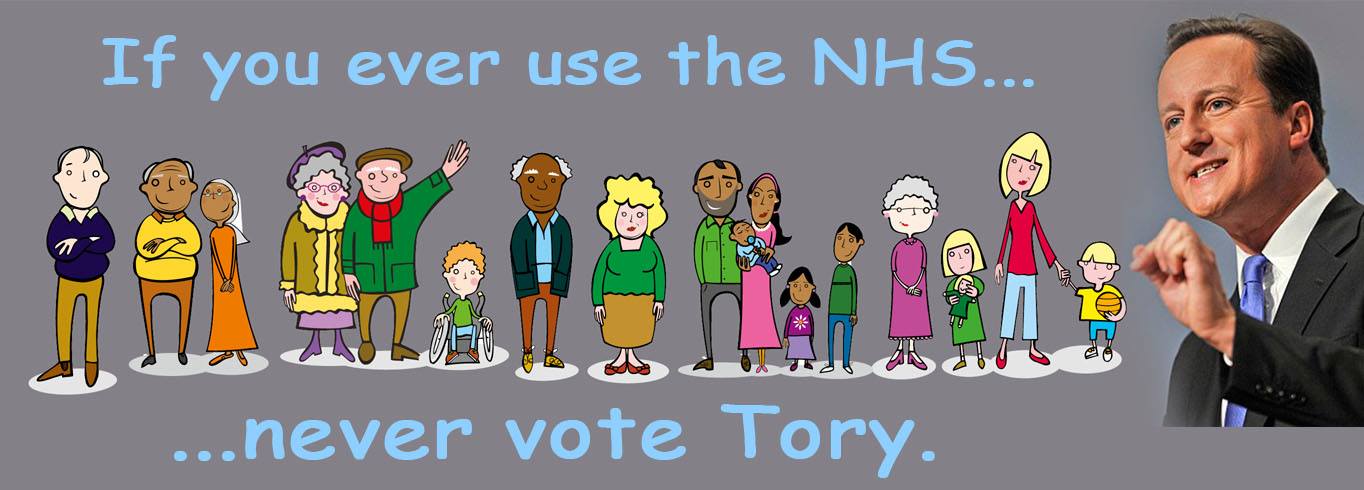
Tonight a Conservative spokesman hit back, and said: “Here in the ­Conservative Party, donations don’t buy our leader, our candidates or our ­policies. If only the same could be said of Unite and the Labour Party.

“The most important thing with NHS care is that it is high quality and free at the point of delivery.”

A Lib Dem spokesman said his party had “stopped Conservative privatisation plans and reversed Labour’s special favours to private health companies”.

He added: “We have already committed to spending at least £1billion extra on health and care in each year of the next Parliament.”

Some MPs’ health connections

  • George Osborne, Chancellor: Received donation through Conservative Campaign HQ from Julian Schild whose family made £184m in 2006 by selling hospital bed-makers Huntleigh Technology
  • Michael Fallon, Defence Secretary: Former director of Attendo AB, a Swedish private health company
  • Philip Hammond, Foreign Secretary: Beneficiary of a trust which owns controlling interest in nursing home developer Castlemead Ltd
  • David Davis, former Shadow Home Secretary: Received £4,250 for a speaking engagement for health insurance company Aviva
  • Liam Fox, former Defence Secretary: Received £5,000 from iIPGL Ltd, which purchased health care company Cyprotex
  • John Redwood, former Cabinet Minister: Advised the private equity company which runs Pharmacy2u
  • Vince Cable, Business Secretary: Received a donation of £2,000 from Chartwell Care Services, which is 100% owned by Chartwell Health & Care PLC.

    Click here for a full list of MPs with links to private healthcare firms

    See also: The Coalition has deliberately financially trashed the NHS to justify its privatisation


    1912510_690135534389311_7775048840596309303_o

A reminder of the established standards and ethics of Public Office, as the UK Coalition have exempted themselves

10616235_686911748045023_5041552951187809370_n

How policies are justified is increasingly being detached from the aims and consequences of them, partly because democratic processes and basic human rights are being disassembled or side-stepped, and partly because the current government employs the widespread use of a “malevolent benevolence” type of propaganda to intentionally divert us from the aims and the consequences of their ideologically (rather than rationally) driven policies.

An example of such propaganda is the common use of words such as “support”, “incentives”, “responsibility” and “fairness” to legitimise welfare cuts during a recession and the punitive benefit sanctions regime introduced by the Coalition. (I’ve written at length about this elsewhere on this site).

Furthermore, policies have become increasingly detached from public interests and needs.

Transparency International are a politically non-partisan, independent organisation whose mission is to prevent corruption and promote transparency, accountability and integrity at all levels and across all sectors of society, particularly in governments. Their core values are: transparency, accountability, integrity, solidarity, courage, justice and democracy.

In 2013, Transparency International undertook their annual opinion survey called the Global Corruption Barometer and found 65% of people believed the UK had become more corrupt in the last two years. 90% said British politics is now run by a few “big entities” who were looking after their own interests.

Corruption is defined as the abuse of entrusted power for private gain.

For example, Cameron’s defence secretary, Liam Fox, resigned over his relationship with the lobbyist Adam Werritty, and his election adviser, Lynton Crosby, is a lobbyist – for tobacco, alcohol, oil and gas companies. Which is why the prime minister came under attack for dropping curbs on cigarette packaging and alcohol pricing. His party treasurer Peter Cruddas resigned after offering access to Cameron for a £250,000 party donation.

Corporate influence extends beyond lobbying, though. Corporate and political interests have become increasingly interchangeable and mutual. The Tory party receives over half of its income from bankers, hedge fund and private equity financiers. The Tory party is bankrolled by a few hundred millionaires. We know that Peers who have made six-figure donations have been rewarded with government jobs. 

We know that venture capitalists such as Adrian Beecroft have influenced Tory employment policies, and in July, it emerged that millions of pounds of taxpayers’ money is being spent on a venture capital fund overseen by Beecroft, who is one of the Conservative Party’s biggest donors, and head of the private equity group that administers the high profile barely legal loan shark operation Wonga. The Wonga “business model” is basically to prey on the poor, vulnerable and absolutely desperate by offering them exploitative loans at eye-watering interest rates of 5,853% APR. Tellingly, even in the globally renowned haven of free-marketeering – the United States – such outrageous loans are illegal, but in the UK the Tory party are defiantly resisting efforts to regulate the so-called Payday lending sector and introduce maximum APRs.

Following the tide of sleaze and corruption allegations, Cameron “dealt” with with parliamentary influence-peddling by introducing the Gagging Act, which is primarily a blatant attack on Trade Unions (which are the most democratic part of the political funding system) and Labour Party funding, giving the Tories powers to police union membership lists, to make strike action very difficult and to cut union spending in election campaigns.

10553308_680322242037307_1558281906340939819_n

At least 142 peers linked to companies involved and invested in private healthcare were able to vote on last year’s Health Bill that opened the way to sweeping and corrosive outsourcing and privatisation. Tory MP Patrick Mercer also resigned the party whip when details of yet another lobbying scandal emerged, in May 2013, following questions surrounding paid advocacy, he was an Independent MP representing the constituency of Newark in Parliament until his resignation at the end of April 2014 after the Standards Committee suspended him for six months for “an unprecedented, sustained and pervasive breach of the house’s rules”

252299_486936058042594_609527550_n

The Tories have normalised political corruption and made it almost entirely legal. Our democracy and civic life are now profoundly compromised as a result of corporate and financial power colonising the State.

The Transparency of Lobbying, non-Party Campaigning, and Trade Union Administration Bill is a calculated and partisan move to insulate Tory policies and records from public and political scrutiny, and to stifle democracy. There are many other examples of this government removing mechanisms of transparency, accountability and safeguards to rights and democracy.

Transparency International have flagged up many areas of concern in their report: A mid-term assessment of the UK Coalition Government’s record on tackling corruption

Here is a list of the main causes for concern, many of which we have reported also:

  • There is no coordinated strategy or action plan to combat corruption in the UK. Data on corruption are not currently collected or are subsumed with other data such as fraud.
  • There is no strategic plan or clear channels of accountability; this is symptomatic of the lack of coordination surrounding Whitehall’s anti-corruption efforts.
  • Resources available to the institutions responsible for fighting corruption have been significantly reduced by the Government. Notably, the Serious Fraud Office’s budget has been cut from £51 million in 2008-9 to £33m in 2012-13. Its budget is expected to fall further to £29m by 2014-15.
  • The Government is seeking to amend the Freedom of Information Act to make it easier for authorities to refuse requests on cost grounds.
  • This Government is threatening to reduce the access of civil society and others to use judicial review mechanisms.
  • Legal Aid is being cut extensively,  this is likely to deny access to justice to individuals and groups who are victims of corruption.
  • The Government’s Localism Act abolished the Audit Commission, which in addition to overseeing and commissioning audit for local government and other bodies like the NHS, had statutory functions for investigating financial management and value for money. There was insufficient public discussion and consultation on the decision to abolish the Audit Commission and to debate and discuss the alternatives to it.
  • The Leveson enquiry and associated criminal investigations revealed a disturbing picture of the cosy relationship between politicians and the media, the bribing of police officers by journalists and the lack of will to hold the media accountable even when laws had clearly been broken.  Concentration of media ownership remains a significant corruption risk. The Government has thus far failed to implement the Leveson reforms or any alternative.
  • Labour’s Bribery Act has succeeded in encouraging many private companies to implement adequate procedures to combat corruption. However the Coalition  has reduced resources for investigation and prosecution.
  • The “Generals for hire scandal” in October 2012 suggests that the current system of controls and oversight of movement between the Governmentand the private sector is insufficient. There have been too many similar scandals. In July 2012 the Public Administration Select Committee (PASC) recommended that Advisory Committee on Business Appointments (ACoBA) be replaced by a new, statutory, Conflicts of Interest and Ethics Commissioner. This recommendation has been ignored by the Government.
  • The Government has failed to address the problems with Tory political party funding.
  • Cash-for-access scandals indicate that donations to the government are a major source of vulnerability to corruption. Current funding rules lead to a lack of public trust in political parties. 42%  of voters believe that donations of over £100,000 are designed to gain access and influence over the Tory party.
  • It has been estimated that billions of pounds of dirty money is laundered into and through the UK each year. Currently the UK and its Overseas Dependent Territories and Crown Dependencies do not require companies to declare who the ultimate beneficial ownership are of companies and trusts. Action taken against the facilitators and enablers of corruption is inadequate, for example, the lawyers, bankers and accountants that handle corrupt transactions.

Perhaps it is worth a reminder of the Nolan principles, which are The Seven Principles of Public Life. They are included in the Ministerial Code, they were defined by the Committee for Standards in Public Life and they provide the basis of an ethical framework for responsible conduct, expected of those who hold positions in public office. The seven principles of conduct are:

1) Selflessness – Holders of public office should act solely in terms of the public interest. They should not do so in order to gain financial or other benefits for themselves, their family or their friends.

2) Integrity – Holders of public office should not place themselves under any financial or other obligation to outside individuals or organisations that might seek to influence them in the performance of their official duties.

3) Objectivity – In carrying out public business, including making public appointments, awarding contracts, or recommending individuals for rewards and benefits, holders of public office should make choices on merit.

4) Accountability – Holders of public office are accountable for their decisions and actions to the public and must submit themselves to whatever scrutiny is appropriate to their office.

5) Openness – Holders of public office should be as open as possible about all the decisions and actions they take. They should give reasons for their decisions and restrict information only when the wider public interest clearly demands.

6) Honesty – Holders of public office have a duty to declare any private interests relating to their public duties and to take steps to resolve any conflicts arising in a way that protects the public interest.

7) Leadership – Holders of public office should promote and support these principles by leadership and example.

These principles apply to all aspects of public life. The Committee that set them out did so for the benefit of all who serve the public in anyway.

The principles were drawn up in 1995 after previous Tory “sleaze scandals”. Recently, both the Guardian and Huff Post report that the Chairman of the Parliamentary Committee into Standards in Public Life says in a report that: “MPs should be required to undergo an induction course to teach them about the seven principles of public life that are meant to promote openness and honesty.”

He warned the Prime Minister: “that making sure politicians are aware of their duties to be honest, open, accountable and selfless cannot be left to chance”.

The report is part of the committee’s submission to an inquiry being carried out into standards procedure set up amid controversies over the way MPs self-police misconduct in their ranks, notably in the case of the expenses scandal surrounding then cabinet minister Maria Miller.

In 1997, Tony Blair extended the Committee’s terms of reference: “To review issues in relation to the funding of political parties, and to make recommendations as to any changes in present arrangements”.  

However, other ethical matters ultimately come under the jurisdiction of the Commons Standards Committee.

The Standards Board for England, branded as Standards for England was sponsored by the Department for Communities and Local Government. Established under Labour’s Local Government Act 2000, it was responsible for promoting  and ensuring high ethical standards in local government. It oversaw the nationally imposed Code of Conduct – now abandoned – which covered elected and co-opted members across a range of local authorities. The Standards Board has been abolished by the Coalition. It is now left to local authorities to make and police their own codes of conduct.

Part 1 of the Local Government Act 2000 introduced a power for local authorities in England and Wales to promote the economic, social and environmental well-being of their area. A similar power was introduced in section 20 of the Local Government in Scotland Act 2003.  The well-being power in the Local Government Act 2000 was repealed in 2011 with respect to England,  and replaced with a provision in the Localism Act. Section 1 (1) of the Act provides that “a local authority has power to do anything that [private] individuals generally may do.” This is called a general power of competence.

The Act was certainly not introduced in an open way which promoted any meaningful debate and participation, it was preceded by no White Paper, the rationale for the Bill was left largely unexplained before its introduction, and although devolution was mentioned a lot, ministers advocating the repeal of the well-being power and its replacement with the somewhat lame general competence power, were rather shorter on concrete explanations as to why the Bill was either necessary or desirable.

The Act will divorce local government from clear and transparent accountability mechanisms, making it difficult for local people to challenge its actions effectively.

There is a clear pattern of alarming and extremely anti-democratic policies formulated by the Coalition that are designed to protect the interests of the very wealthy; to stifle debate; challenges and opposition; to encourage corruption whilst obscuring it; to restrict access to justice for victims of government and corporate corruption; to remove accountability and transparency, and there is an increasing detachment of policies from wider public needs and interests.

Legal equality, freedom and rule of law have been identified as important characteristics of representative democracy since ancient times. More contemporary definitions include: political pluralism; equality before the law; the right to petition elected officials for redress of grievances; due process; civil liberties; human rights – all of these are considered to be crucial criteria for defining liberal democracies.

Since 2010, many of the essential processes and safeguards of democracy have been dismantled: we no longer have a democratic state.

946487_494193727316827_2051552810_nPictures courtesy of Robert Livingstone


I don’t make any money from my work. I am disabled because of illness and have a very limited income. But you can help by making a donation to help me continue to research and write informative, insightful and independent articles, and to provide support to others. The smallest amount is much appreciated – thank you.

DonatenowButton