My recent benefit sanction really worked wonders. I was so delighted to be chosen for this special treatment by the government, and for no reason in particular. I really don’t deserve it. I have now developed spectacular superpowers as a result, and a special liking for hospital food. Every time I have a hypoglycemic attack coz I have no food, and a bout of Raynaud’s because I’ve no electricity or gas, hey presto, I get rushed into hospital where I can eat and eat until my belly is full. And there’s even heating! I couldn’t manage that with my benefit. And no worries about becoming homeless now I have a near-permanent bed. My life is transformed!
I thought I’d developed a superpower for seeing around corners as well, but it turns out that I’ve just developed a squint because I can’t afford new spectacles.
Here are some more lucky people who have been touched by extraordinary life-changing experiences through the multi-dimensional DWP:
Simon John DuffyI just wanted to share my testimony and thank the DWP for helping me to understand the true meaning of social justice. For so long I’ve simply not understood the wisdom of their policies. But now I see the light.
[You couldn’t make it up! Oh, wait, it’s the DWP, that’s what exactly they do – just make things up.]
Of course, Iain Duncan Smith tells a great success story. Somewhere in the multi-verse of infinite possibilities. For example, there’s the lie account of his education and qualifications, as stated in his biography on the Conservative Party website, his entry in Who’s Who, and various other places, which make the claim that he went to the Universita di Perugia in Italy. In an alternative universe, unfortunately, Mr Duncan Smith’s office has been forced to explain to Newsnight researchers investigating his academic background that he didn’t get any qualifications in Perugia, or even finish his exams. His statements about the qualifications are simply examples of his remarkable superpowers. And his multi-lives and mega-talent of trans-dimensional travel.
It was also claimed that he was “educated at Dunchurch College of Management”. In fact, in this universe, Dunchurch was the former staff college for GEC Marconi, for whom he worked in the 1980s. Mr Duncan Smith’s office was forced to admit said that that he did not get any qualifications there either, in this universe, but that he completed six separate courses lasting a few days each, adding up to about a month in total.
One particularly successful way of neutralising opposition to an ideology is to ensure that only those ideas that are consistent with that ideology saturate the media and are presented as orthodoxy. The Conservative election campaign was a thoroughly dispiriting and ruthless masterclass in media control.
Communication in the media is geared towards establishing a dominant paradigm and maintaining an illusion of a consensus. This ultimately serves to reduce democratic choices. Such tactics are nothing less than a political micro-management of your beliefs and are ultimately aimed at nudging your voting decisions and maintaining a profoundly unbalanced, pathological status quo.
Presenting an alternative narrative is difficult because the Tories have not only framed all of the issues to be given public priority – they set and stage-manage the media agenda – they have also dominated the narrative; they constructed and manage the political lexicon and now treat words associated with the Left, such as welfare, like semantic landmines, generating explosions of right-wing scorn, derision and ridicule. Words like cooperation, inclusion, mutual aid, reciprocity, equality, nationalisation, redistribution – collective values – are simply dismissed as mere anachronisms that need to be stricken from public conversation and exiled from our collective consciousness, whilst all the time enforcing their own bland language of an anti-democratic political doxa. The political manufacturing of a culture of anti-intellectualism extends this aim, too.
We also see a strong political trend towards negative labelling and derogatory terms flung at the Opposition, words like ‘snowflake’, ‘cult’, ‘woke’ and ‘Stalinist’, for example. The policies associated with the Left are also traduced, and the emphasis on a universal rights-based support and economic inclusion for all citizens, including public services such as welfare and the NHS, workers’ rights and so on are being ridiculed and deemed ‘unsustainable’. ‘Virtue signalling’, ‘political correctness’ and ‘woke’ are terms used to demonise the Left, and to de-sensitise the public to the dire, profoundly damaging social impacts of crass inequality, which is happening as a consequence of harsh authoritarian, corrupt, right wing, ‘libertarian’, neoliberal policies. The Conservatives are not content with demonising the Left: they are denigrating basic human qualities of caring, empathy, compassion, and conscience, along with concepts of equality and fairness, which they consider as a mere interference and inconvenience in their complete ‘marketisation’ of every realm of social existence. For the neoliberal Conservatives, competition and individualism, not co-operation and solidarity, are all that matters. But it is the latter qualities that create a civilised, democratic, inclusive society
Words like competition, market place, small state, efficiency, responsibility and so on, now crowd out any opportunity of even a fleeting glance of another way of socio-economic organisation.
Anything presented that contradicts the consensus – a convincing, coherent, viable alternative perspective – is treated to a heavily staged editing via meta-coverage by the media. Anyone would think that the media regards the UK as a one-party state.
And here, people tend to take the Daily Mail with totalitarianism and tea …
“There’s something happening here But what it is ain’t exactly clear …”
Such tactics deployed in manufacturing consensus are widely used, and combined, they serve to reduce public expectation of opposition and in doing so establish diktats: it’s a way of mandating acceptance of ideology, policies or laws by presenting them as if they are the only viable alternative.
Adam Curtis explores themes of “power and how it works in society” in depth, and his works draw on areas of sociology, psychology, philosophy and political history.
Curtis points out, in his Oh-Dearism documentary, that there is an emerging “strategy of power that keeps any opposition constantly confused, a ceaseless shapeshifting that is unstoppable because it’s indefinable.”
Adam Curtis’s Oh-Dearism on Charlie Brooker’s 2014 ScreenWipe show.
I have been reading about totalitarianism recently. You know when you have an itching recognition of something and need clarification of what it is precisely? I’ve felt for a long time that our own Tory government has totalitarian tendencies.
Totalitarianism is the name given to a political system that aims to mobilise entire populations in support of an official state ideology, and to exercise a repressive, absolute control over society, seeking to micro-manage all aspects of public and private life.
However,Sheldon Wolinhas outlined an alternative form –inverted totalitarianism– as not only signaling the political demobilization of the citizenry, but goes on to say that because it isn’t clearly evident in neoliberal ideology or policy, and it isn’t named, this makes recognition, reflection and challenging it very difficult. It is inverted because it does not require the use of overt coercion, police power and a messianic ideology as in the classical Nazi, Fascist and Stalinist versions of totalitarianism.
It’s true that dominant ideologies tend to become naturalised epistemology – acquiring an illusory consensus – and so become embedded and disguised as “common sense.” This makes it very difficult to identify and articulate the doxa, and even more difficult to present coherent challenges to it. See:Manufacturing consensus: the end of history and the partisan man.
Wolin writes:
“Our thesis is this: it is possible for a form of totalitarianism, different from the classical one, to evolve from a putatively “strong democracy” instead of a “failed” one.
Democracy is about the conditions that make it possible for ordinary people to better their lives by becoming political beings and by making power responsive to their hopes and needs. It depends on the existence of a demos – a politically engaged and empowered citizenry, one that voted, deliberated, and occupied all branches of public office.”
Wolin proposes that the United States on occasion came close to genuine democracy, but it was because citizens struggled against and momentarily defeated the elitism that was written into the Constitution.
He sees theNew Dealas perhaps the only period of American history in which rule by a true demos prevailed. That is comparable with the rise of welfare states elsewhere in European democracies. Here in the UK, the welfare state arose in part because of the enfranchisement of the working class. The welfare state may be considered a fundamental part of the foundations for democracy.
Other features of inverted totalitarianism are the same as the ones that formal definitions of classical totalitarianism identify: the mass media is the first mechanism of control that tyrants generally seek, which is used to erect fact-proof screens from reality.
The regime attempts to control virtually all aspects of social life, including the economy, education, art, science, private life, psychology, morals and the perceptions of citizens. And decision-making.
I had already linked the government Behavioural Insights Team (the Nudge Unit) with behaviourism and totalitarian thinkinglast year.
To influence the decision-making of the public without their knowledge and consent, using techniques of persuasion – usually associated with advertising – is profoundly anti-democratic. As is the underpinning assumption that the public are generally irrational and fallible, but the government are somehow infallible, formulating a theory of human nature as if from some impossible, mind-independent, species-independent, “objective,” external vantage point.
It’s like saying: “That’s your human nature, but not ours. We are somehow miraculously exempted from it.”
This is a government that is encroaching at an existential level and surreptitiously imposing instructions about how we must be. And how we must be is ultimately confined to accommodating neoliberalism.
Edward Bernays, amongst others, has contributed significantly to the rise and perpetuation of inverted totalitarianism through the imported methods and practice of techniques of persuasion drawn from knowledge of social psychology and sociology, from advertising, and the rule of “market forces” to many other contexts than markets, including politics and the media. The ultimate purpose for the use of such techniques is to subvert and obscure the truth.
Of course history showed that Bernays’ identification of the “manipulation of the masses” as a “natural and necessary feature of a democratic society” was a flawed theory when the rise to power of the totalitarian Nazis demonstrated that propaganda could be used to subvert democracy and generate social conflicts. In his autobiography –Biography of an Idea– Bernays recalls a dinner at his home in 1933 where:
“Karl von Weigand, foreign correspondent of the Hearst newspapers, an old hand at interpreting Europe and just returned from Germany, was telling us about Goebbels and his propaganda plans to consolidate Nazi power. Goebbels had shown Weigand his propaganda library, the best Weigand had ever seen. Goebbels, said Weigand, was using my book ‘Crystallizing Public Opinion’ as a basis for his destructive campaign against the Jews of Germany. This shocked me. … Obviously the attack on the Jews of Germany was no emotional outburst of the Nazis, but a deliberate, planned campaign.”
In Days of Destruction, Days of Revolt byChris HedgesandJoe Sacco, inverted totalitarianism is described as a system where corporations have corrupted andsubverted democracyand where economics trumps politics. Inverted totalitarianism is a system where every natural resource and every living being is commodified and exploited to collapse as the citizenry is lulled and manipulated into surrendering their liberties and their participation in government.
Although this is a critique aimed at the US, we have the same social conservatism and neoliberal ideology here in the UK, and to me, it’s as plain as day. One of the main objectives of managed democracy is to increase the profits of large corporations and dismantle the institutions of social democracy – our social security, trade unions, public health services, social housing, access to legal aid, human rights and so forth, and roll back the social and political ideals of the post-war settlement here in the UK, and the New deal in the US. The primary tool is privatisation.
Managed democracy aims at the abdication of governmental responsibility for the well-being of most citizens, under the cover of improving “efficiency,” reducing small state “intrusion” and cost-cutting. Over recent years, austerity has been used as a front to accelerate this process, increasing economic inequality, redistributing public funds to increasingly wealthy individual’s private bank accounts.
Another feature of managed democracy is the need to keep citizens preoccupied with the peripheral and the private conditions of human life so that they fail to focus on the widespread corruption and betrayal of public trust. The political function of this is to divide the public whilst obscuring class differences and diverting the voters’ attention from the social and economic concerns (and interests) of the general population.
Neoliberalism is a system of economic arrangements that greatly benefits a few powerful and wealthy people and impoverishes the majority of the public incrementally. As each social group reaches a crisis – struggling to survive – scapegoating narratives are constructed and disseminated via the media that blame them for their insolvency, creating socially divisive and politically managed categories of “others,” which serve to de-empathise the rest of the population and divert them from the fundamental fact that it isn’t the poor that create poverty: it is the neoliberal decision-makers and those who are steadily removing and privatising our public funds and ebulliently shrinking state responsibility towards citizens, leaving many at the mercy of “market forces” without a state safety net – it’s economic Darwinism.
The Nazis openly mocked democracy, the UK and United States maintain the conceit that they serve as the model of democracy for the whole world. Instead, we have become a showcase for how to reduce democracy to just a brand, displaying how it can be managed without appearing to be suppressed. Democracy has been reduced to a flimsy façade, obscuring its antithesis.
Totalitarianism isn’t simply a feature of a dystopian novel by George Orwell: it’s become entrenched and naturalised. Alternatives to social conservatism and neoliberalism are either edited out in advance of reaching public attention, or meta-edited, distorted and presented as “all the same” or straw man fallacies to buttress the status quo.
I’ve been saying since 2012 that democracy is being subverted. The welfare “reforms” were hammered through parliament despite widespread and strong opposition, when Cameron used “financial privilege” as a justification to sidestep democratic process. Then came the widely opposed Health and Social Care Bill, and the Conservative’s refusal to release the details of the risk register to the public. It has remained unreleased.
But mostly, the recognition starts as an uneasy feeling, an indefinable something being not quite right,like a fleeting glimpse from the corner of your eye that triggers an adrenaline trickle of unease. Then comes the discovery that laws are being edited quietly, protective policies are eroded and some have been secretly repealed. Our human rights are being disregarded, and there’s a clearly expressed intention to heavily edit the existing legislation. Human rights are the bedrock of democracy, and observation of them separates democrats from despots.
It’s so essential that we don’t disengage from politics, but rather, we need to organise, we need to construct a cogent narrative of resistance and transformation, formulating an alternative vocabulary that helps to raise awareness; to motivate; to inspire; to change public perceptions and directly challenge the tyrants. We need to fight to reclaim our democracy; to collectively insist on the re-population of increasingly dehumanising public and economic policies; to re-assert human needs and rights over and above the absurd, anti-humanist and socially fatal demands of desolating, pathological and ever-escalating neoliberalism.
I don’t make any money from my work. I am disabled and don’t have any paid employment. But you can contribute by making a donation and help me continue to research and write informative, insightful and independent articles, and to provide support to others. The smallest amount is much appreciated – thank you.
In 2013, the Joseph Rowntree Foundation reported that public attitudes towards welfare have “hardened.” Similarly, the British Social Attitudes Survey report concluded that public support for government spending on social security benefits has declined markedly over the last decade, and that people are also more sceptical about whether benefit recipients deserve the support they get. Seems that people forget that the majority of people claiming benefits have worked previously and paid for their own provision through the national insurance and tax systems.
However, the way questions in surveys are framed often influences the responses by introducing bias, whichaffects the validity and reliability of research findings.
Furthermore, simply adding detail, such as using examples that include real groups of people in survey questions may elicit a different set of responses. Re-humanising groups claiming benefits tends to prompt sympathetic responses. As it is, the current government and much of the media tend to dehumanise those claiming any form of welfare support quite purposefully.
Of course the media has and continues to play a major role in defining public perceptions about welfare, but the media are conveying what are ultimately political justification narratives for the Tory notion of an “efficient” small state and their aim to dismantle our post-war settlement.
We are constantly being told that the British public has swallowed the ‘scroungers and skivers’ rhetoric about benefit claimants, and is broadly in favour of welfare cuts. Any politician who opposes these cuts is widely portrayed as unrealistic and unelectable. But what if that is not true, and the public’s attitude is actually far less harsh than the Westminster bubble would have us believe?
A poll carried out by YouGov in the two days after the recent Budget makes interesting reading, with some valuable lessons, and encouragement, for all who oppose the welfare cuts.
When asked a rather leading question about benefit claimants in general, and the total amount spent on benefits, 45% of respondents agreed with the statement that benefits are ‘Too high – the amount of money people can claim in benefits is too much, it’s too expensive and unfair on taxpayers.”
So far, so Daily Mail. But when asked to think about specific groups of benefit claimants, i.e. to think of real people not statistics, attitudes changed significantly.
Listing different groups of benefit recipients, respondents were asked if too much money was spent on them, or not enough. For disabled people, 46% felt that too little was spent, whilst only 9% felt that too much was spent on them. 28% felt that the amount was about right.
The figures were roughly the same for people in work on low pay, and for pensioners who have only a state pension. The group which received the least sympathy was ‘better off retired people’, whilst the views on what people who are out of work receive was almost evenly split – there was certainly no majority for the view that they get too much.
Taking the cuts in general, 38% of people thought that benefit cuts had gone too far, whilst only 24% thought they had not gone far enough. So there is no real appetite for further cuts. We should also bear in mind that the poll was conducted on the two days immediately after the Budget, when the media was trumpeting George Osborne’s claims about a new National Living Wage. As people discover the reality, that this is no more than a small rise in the minimum wage and comes with a large cut to tax credits, it seems likely that the percentage who feel cuts have gone too far may rise significantly.
.
Those who responded to the survey were probably also not fully aware of the drastic cut to Employment and Support Allowance which will see people in the Work Related Activity Group (who aren’t fit for work) losing around £30 per week. If this is spelled out, it seems highly likely that based on this survey, a clear majority of the public would oppose it.
The poll should also provide food for thought to politicians who feel they have to constantly defer to the business community in order to be electable. Asked about how to address low pay, a clear majority of respondents wanted government to get tough with employers, choosing the statement, ‘It is better for government to use the law to force companies to pay low paid workers a better wage, even if this leads to higher unemployment.’
This poll should encourage all who are campaigning to defend the welfare state and oppose cuts to the incomes of the poorest people. Despite the hyperbolic headlines and the poverty porn, British people still want to see the poor, the disabled and the elderly guaranteed a decent standard of living. They may have absorbed some of the propaganda about ‘out of control’ welfare spending, but if we can show that to be false, and continue to highlight what benefit cuts mean in terms of real people rather than statistics, we should be able to build a groundswell of opinion in defence of the welfare state.
Punch cartoon by Bernard Partridge from 29 October 1924.
A scene from Alan Bleasdale’s perceptive GBH, a much misunderstood, darkly comedic series from 1991. Some felt that Bleasdale was attempting to discredit the militant left, but what he portrayed is an infiltation of the Labour Party by MI5, ordered by the Conservative government at the time. Their aim was to recruit, manipulate and indoctrinate local “young bulls” with quasi left-wing ideology to have them assist, unknowingly, in destablising and discrediting the Labour Party in its entirety.
The far-right, racism and social conflict always bloom and flourish under Conservative governments.
Fueling social tensions, MI5 agents provocateurs were prepared to manipulate theethnic communities to foster social division, in the hope of causing riotsand ultimately, the hardened right-wing thugs (MI5 were eventually revealed as the real thugs here) dismissed the minority groups as collateral damage, a callous, calculated move that was deemed necessary to destroy the Labour Party.
MI5 staged a series of violent racist assaults on the city’s ethnic minorities, using hired local hardcases posing as police officers. They “made things happen.” Ultimately to preserve the status quo. In the drama, it’s eventually revealed that the plot to destablise the Left involves Britain’s entire intelligence community.
Some commentators at the time felt that Bleasdale was portraying the end of socialism, but if he was, it was ultimately at the hand of the Tories – the real enemy within – not the militant left.
I watched the mini series again recently, and it made me think of the Zinoviev letter – one of the greatest but almost forgotten British political scandals of last century – it was forged by a MI6 agent’s source and almost certainly leaked by MI6 or MI5 officers to the Conservative Party, according to an official report published in 1999.
Britain’s most senior security and intelligence officials discussed the smearing of the Labour party just as it was emerging as a major political force according to previously secret documents.
The potential repercussions of attempts by the intelligence agencies to damage the Labour party were debated at length by the little-known Secret Service Committee, later research – now released at theNational Archives– shows.
Of course it was not the only time Britain’s intelligence agencies were implicated in attempts to destabilise a Labour government. A group of right-wing intelligence officers attempted todestabilise Harold Wilson’s administrationsin the 1960s and 70s.
One newly released document at the National Archives is a minute of the Secret Service Committee, dated 11 March 1927. It quotes Sir William Tyrrell, top official at the Foreign Office, referring to a conversation he had with the prime minister, Stanley Baldwin, about politically inspired leaks by the police special branch as well as the security and intelligence agencies.
Baldwin’s main concern, said Tyrrell, was the fear that the political work done at Scotland Yard might at any moment give rise to a scandal, owing to the Labour party obtaining some “plausible pretext to complain that a government department was being employed for party politics.”
On October 8, 1924, Britain’s first Labour government lost a vote of confidence in the House of Commons. The next day the Foreign Office was evidently sent a copy of a letter, purportedly originally sent from Grigori Zinoviev, the president of Comintern, addressed to the central committee of the Communist Party of Great Britain. The letter urged the party to stir up the British proletariat and the military in preparation for class war.
On October 25 the letter appeared in the heavily Conservative-biased Daily Mail just four days before the election. The political and diplomatic repercussions were immense.
The Daily Mail published a series of sensationalist headlines:
Civil War Plot by Socialists’ Masters
Moscow Order to Our Reds
Great Plot Disclosed Yesterday
Paralyse the Army and Navy
Mr. MacDonald Would Lend Russia Our Money
Here is the entire fake Zinoviev ‘letter’:
Very secret
Executive Committee, Third Communist International.
To the Central Committee, British Communist Party.
Presidium, September 15, 1924. Moscow.
Dear Comrades,
The time is approaching for the Parliament of England to consider the Treaty concluded between the Governments of Great Britain and the S.S.S.R. for the purpose of ratification. The fierce campaign raised by the British bourgeoisie around the question shows that the majority of the same, together with reactionary circles, are against the Treaty for the purpose of breaking off an agreement consolidating the ties between the proletariats of the two countries leading to the restoration of normal relations between England and the S.S.S.R.
The proletariat of Great Britain, which pronounced its weighty word when danger threatened of a break-off of the past negotiations, and compelled the Government of MacDonald to conclude the treaty, must show the greatest possible energy in the further struggle for ratification and against the endeavours of British capitalists to compel Parliament to annul it.
It is indispensable to stir up the masses of the British proletariat to bring into movement the army of unemployed proletarians whose position can be improved only after a loan has been granted to the S.S.S.R. for the restoration of her economics and when business collaboration between the British and Russian proletariats has been put in order. It is imperative that the group in the Labour Party sympathising with the Treaty should bring increased pressure to bear upon the Government and Parliamentary circles in favour of the ratification of the Treaty.
Keep close observation over the leaders of the Labour Party, because these may easily be found in the leading strings of the bourgeoisie. The foreign policy of the Labour Party as it is, already represents an inferior copy of the policy of the Curzon Government. Organize a campaign of disclosure of the foreign policy of MacDonald.
The I.K.K.I. (Executive Committee, Third [Communist] International) will willingly place at your disposal the wide material in its possession regarding the activities of British Imperialism in the Middle and Far East. In the meanwhile, however, strain every nerve in the struggle for the ratification of the Treaty, in favour of a continuation of negotiations regarding the regulation of relations between the S.S.S.R. and England. A settlement of relations between the two countries will assist in the revolutionising of the international and British proletariat not less than a successful rising in any of the working districts of England, as the establishment of close contact between the British and Russian proletariat, the exchange of delegations and workers, etc., will make it possible for us to extend and develop the propaganda of ideas of Leninism in England and the Colonies. Armed warfare must be preceded by a struggle against the inclinations to compromise which are embedded among the majority of British workmen, against the ideas of evolution and peaceful extermination of capitalism. Only then will it be possible to count upon complete success of an armed insurrection. In Ireland and the Colonies the case is different; there is a national question, and this represents too great a factor for success for us to waste time on a prolonged preparation of the working class.
But even in England, as other countries, where the workers are politically developed, events themselves may more rapidly revolutionise the working masses than propaganda. For instance, a strike movement, repressions by the Government etc.
From your last report it is evident that agitation-propaganda work in the army is weak, in the navy a very little better. Your explanation that the quality of the members attracted justifies the quantity is right in principle, nevertheless it would be desirable to have cells in all the units of the troops, particularly among those quartered in the large centres of the country, and also among factories working on munitions and at military store depots. We request that the most particular attention be paid to these latter.
In the event of danger of war, with the aid of the latter and in contact with the transport workers, it is possible to paralyse all the military preparations of the bourgeoisie, and make a start in turning an imperialist war into a class war. Now more than ever we should be on our guard. Attempts at intervention in China show that world imperialism is still full of vigour and is once more making endeavours to restore its shaken position and cause a new war, which as its final objective is to bring about the break-up of the Russian Proletariat and the suppression of the budding world revolution, and further would lead to the enslavement of the colonial peoples. ‘Danger of War’, ‘The Bourgeoisie seek War’, ‘Capital fresh Markets’ – these are the slogans which you must familiarise the masses with, with which you must go to work into the mass of the proletariat. These slogans will open to you the doors of comprehension of the masses, will help you to capture them and march under the banner of Communism.
The Military Section of the British Communist Party, so far as we are aware, further suffers from a lack of specialists, the future directors of the British Red Army.
It is time you thought of forming such a group, which together with the leaders, might be in the event of an outbreak of active strife, the brain of the military organisation of the party.
Go attentively through the lists of the military ‘cells’ detailing from them the more energetic and capable men, turn attention to the more talented military specialists who have for one reason or another, left the Service and hold Socialist views. Attract them into the ranks of the Communist Party if they desire honestly to serve the proletariat and desire in the future to direct not the blind mechanical forces in the service of the bourgeoisie, but a national army.
Form a directing operative head of the Military Section.
Do not put this off to a future moment, which may be pregnant with events and catch you unprepared.
Desiring you all success, both in organisation and in your struggle.
With Communist Greetings,
President of the Presidium of the I.K.K.I.
ZINOVIEV
Member of the Presidium: McMANUS
Secretary: KUUSINEN
Some historians say that the letter aided the Conservative party in hastening the collapse of the Liberal party which led to a decisive Conservative victory. Curiously, a now familiar tactic.
Others say the letter was an example of Conservative deceit, which in 1924, enabled Britain’s Conservative party to cheat their way to a general election victory. Personally, I’m inclined to believe the latter. It’s not as if the Conservatives have a history of democratic engagement,transparency, accountability and honesty, after all.
The faked letter came at a sensitive time in relations between Britain and the Soviet Union, due to the Conservative opposition to the parliamentary ratification of the Anglo-Soviet trade agreement of 8 August 1924.
The publication of the letter was severely embarrassing to Prime Minister James Ramsay MacDonald and his Labour party. The chance of a victory was dashed as the spectre of internal revolution and a government oblivious to the red peril dominated the public consciousness, via the media.
MacDonald’s attempts to establish doubt regarding the authenticity of the letter were catastrophically in vain, hampered by the document’s widespread acceptance amongst Tory government officials. MacDonald told his Cabinet he “felt like a man sewn in a sack and thrown into the sea.”
New light on the scandal which triggered the fall of the first Labour government in 1924 is shed in a study by Gill Bennett, chief historian at the Foreign Office, commissioned by Robin Cook in 1998.
Bennett’s investigation implicates Desmond Morton, an MI6 officer and close friend of Churchill who appointed him personal assistant during the second world war, and also points to Major Joseph Ball, an MI5 officer who joined Conservative Central Office in 1926. Ball later went on to be one of the earliest spin doctors – for the Tories.
The exact route of the forged letter to the Daily Mail will probably never be known. There were other possible conduits, including Stewart Menzies, a future head of MI6 who, according to MI6 files, admitted sending a copy to the Mail.
In summary, the letter was purported to be from Grigori Zinoviev, president of the Comintern, the internal communist organisation, called on British communists to mobilise “sympathetic forces” in the Labour Party to support an Anglo-Soviet treaty (including a loan to the Bolshevik government) and to encourage “agitation-propaganda” in the armed forces.
As stated, on October 25, 1924, just four days before the election, the Mail splashed headlines across its front page claiming: Civil War Plot by Socialists’ Masters: Moscow Orders To Our Reds; Great Plot Disclosed. Labour lost the election by a landslide.
Ms Bennett said the letter “probably was leaked from SIS [the Secret Intelligence Service, commonly known as MI6] by somebody to the Conservative Party Central Office.” She named Major Ball and Mr Morton, who was responsible for assessing agents’ reports.
“I have my doubts as to whether he thought it was genuine but [Morton] treated it as if it was,” she said.
She described MI6 as being at the centre of the scandal, although it was impossible to say whether the head of MI6, Admiral Hugh Sinclair, was involved.
Ms Bennett also said there was “no evidence of a conspiracy” in what she called “the institutional sense.”
Of course not. Such an act of deceit couldn’t possibly have been intended to damage the Labour party.
However, sarcasm aside, there was no evidence that refuted such a conspiracy either. The security and intelligence community at the time consisted of a “very, very incestuous circle, an elite network” who went to school together. Their allegiances, she says in her report, “lay firmly in the Conservative camp.”
Ms Bennett had full access to secret files held by MI6 (though some have been destroyed) and MI5. She also saw Soviet archives in Moscow before writing her 128-page study. The files show the forged Zinoviev letter was widely circulated, including to senior army officers, to inflict maximum damage on the Labour government.
She found no evidence to identify the name of the forger. The report says there is no hard evidence that MI6 agents in Riga were directly responsible – though it is known they had close contacts with White Russians – or that the letter was commissioned in response to British intelligence services’ “uneasiness about its prospects under a re-elected Labour government.”
The report does not tie up loose ends. But by putting a huge amount of material into the public domain, it at least allows people to make up their own minds. Important questions remain, and may always go unanswered – such as who actually forged the letter.
However, even if Ms Bennett is right in her suggestion that MI6 chiefs did not set up the forgery, her report claims that MI6 deceived the Foreign Office by asserting it did know who the source was – a deception it used to insist, wrongly, that the Zinoviev letter was genuine.
Ms Bennett claims that we cannot conclude the scandal brought down Ramsay Macdonald’s government, which had already lost a confidence vote and Liberal support on which it depended was disappearing.
“In electoral terms,” she says, “the impact of the Zinoviev letter on Labour was more psychological than measurable.”
I don’t agree. The despicable faked letter was an act that was intended to harm the party’s popularity and undermine public trust, AND to have a psychological impact.
The media has always exercised enormously heavy influence on voters, I find it a little odd that such a connection was deemed insignificant. Especially given the wide use of black propaganda, very evident at the time.
Besides, this isn’t an isolated event, and there does appear to be an established relationship between Conservative governments and the Secret Service staging persistent attempts at “destabilising,” discrediting and smearing the left. And the media.
Fast-forward to more recent events, and low and behold, the mainstream media are still feeding us the fear-mongering and pseudo-warnings of an “evil Communist threat” in the form of Ralph Miliband, and his “influence” on his son, “Red Ed,” claiming that the Labour leader’s policies are founded on a “legacy of evil“ and a “poisonous creed.” That’s once again according to the very pro-establishment, corrupt Daily Mail, of course. (See also:Tory Fascist Lie Machine The Daily Mail Has Met Its Match.) Same old tactics.
The Comintern and Soviet government vehemently and consistently denied the authenticity of the document. Grigori Zinoviev issued a denial on 27 October 1924 (two days before the election), which was finally published in the December 1924 issue ofThe Communist Review,considerably well after the MacDonald government had fallen.
Zinoviev declared:
“The letter of 15th September, 1924, which has been attributed to me, is from the first to the last word, a forgery. Let us take the heading. The organisation of which I am the president never describes itself officially as the “Executive Committee of the Third Communist International”; the official name is “Executive Committee of the Communist International.” Equally incorrect is the signature, “The Chairman of the Presidium.” The forger has shown himself to be very stupid in his choice of the date. On the 15th of September, 1924, I was taking a holiday in Kislovodsk, and, therefore, could not have signed any official letter. […]
It is not difficult to understand why some of the leaders of the Liberal-Conservative bloc had recourse to such methods as the forging of documents. Apparently they seriously thought they would be able, at the last minute before the elections, to create confusion in the ranks of those electors who sincerely sympathise with the Treaty between England and the Soviet Union. It is much more difficult to understand why the English Foreign Office, which is still under the control of the Prime Minister, MacDonald, did not refrain from making use of such a white-guardist forgery.”
Bugger, secret service spies are “weirdos who have created a completely mad version of the world that they then impose on the rest of us.”Adam Curtis
Sounds like a very Conservative mindset to me. I think that it’s a fairly safe and balanced conclusion that the Intelligence Services lack diversity, with a strong tendency to recruit staunch establishmentarians.
Again, the Zinoviev letter is by no means the only attempt by the security and intelligence services to destabilised a Labour government.
Peter Wright, a former MI5 officer, showed inSpycatcher, a candid autobiography, how elements in his agency worked against the Wilson government in the 1970s.
Despite the Thatcher government’s attempts to prevent publication, the book gained worldwide attention.MI5’s own archives have shownthere was a “permanent file” on the Labour leader throughout his time in office. He is the only serving prime minister to have a permanent Secret Service file.
MI5 opened the dossier in 1945 when Mr Wilson became an MP after communist civil servants allegedly suggested he had similar “political sympathies.”
His file was so secret that he was given the pseudonym Norman John Worthington.
Sir Michael Hanley, MI5 director general from 1972, went to even greater lengths to conceal its existence by removing it from the central index, meaning any search would result in a “no trace.”
Personal permission from Sir Michael was required to access it.
This is backed up by corroborating interviews with senior figures at the time.
These events unfolded at a time when the establishment, from the intelligence services down to parts of Fleet Street, were paranoid about the “threat of communism.” So paranoid it seems, they were prepared to believe a prime minister of Britain was an active Soviet spy.
At a time of continuing Cold War tensions, industrial unrest was rife, the country had suffered power cuts and a three-day working week and in 1975 the government was being warned privately that the consequences would be severe if it could not curb inflation.
Whilst some on the hard left believed revolution was imminent, former military figures, angry at the extent of union control, were building private armies, in preparation for the coming conflict, according to the then BBC investigative journalist Barrie Penrose. (Penrose co-authored The Pencourt File with another journalist, Roger Courtiour.)
Meetings with Wilson were secretly recorded in 1976 by both the journalists (Penrose and Courtiour) weeks after his shock departure from Number 10.
“Wilson spoke darkly of two military coups which he said had been planned to overthrow his government in the late 1960s and in the mid 1970s,” Penrose writes.
Wilson told the journalists they “should investigate the forces that are threatening democratic countries like Britain.”
In his book, Peter Wright also outlines a plot to force Wilson’s resignation by MI5 agents who were convinced he was a Communist spy. Wright’s account is often dismissed as an exaggeration, but fresh evidence of plots surfaced in 2006.
Penrose says that witnesses confirm such plotting “wasn’t in the fevered imagination of an embittered ex-PM.”
Writing about the drama documentary The Plot Against Harold Wilson, shown on BBC Two at 21:00 on Thursday 16 March, 2006, Penrose concludes:
“You may ask, at the end of the programme, how much of it can be believed. My view now, as it was then, is that Wilson was right in his fears…. in answer to the question ‘how close did we come to a military government’ I can only say – closer than we’d ever be content to think.”
Harold Wilson, Aneurin Bevan, Ian Mikardo, Tom Driberg and Barbara Castle of the Keep Left Group (1951)
“By the timeA Very British Coupwas published, in 1982, the political climate was even more propitious. Prompted by the imminent arrival of cruise missiles, CND demonstrations were attracting crowds in excess of 200,000. The establishment was getting so twitchy that, as we later learned, Michael Heseltine had set up a special unit in the Ministry of Defence to counter the impact of CND.
The US was getting a relapse of McCarthist twitchiness too. When A Very British Coup was published I was editor of the political weekly Tribune, and we were selling the book by mail order through the paper. A few days after the first advert appeared we were intrigued to receive an order from the US embassy. We duly dispatched a copy and waited to see what would happen next. We did not have to wait long.
An invitation arrived to lunch with the minister, the most important man at the embassy after the ambassador. He even sent his bullet-proof Cadillac to Tribune’s modest headquarters in Gray’s Inn Road to convey me to his mansion in Kensington.
At first I assumed that I was one of a number of guests, but no: there was just the minister, two of his colleagues, an Asian butler and myself.
“Why are you interested in a minnow like me?” I inquired.
“I reckon,” he drawled, “that you are among the top 1,000 opinion formers in the country.”
“Well, I must be about number 999.”
“The other 999 have been here too.”
A year or two later I received from an anonymous source an envelope posted in Brussels. It contained an internal US state department memorandum addressed to US diplomats in London listing a number of questions they were to put to “authorised contacts” in London regarding the balance of power within the Labour party and opinion regarding the US bases in general and the impending arrival of cruise missiles in particular. Although, in retrospect, we can see they had no cause for concern, there is no doubt that alarm bells were ringing in Washington.
A Very British Coup attracted attention elsewhere too. It was helpfully denounced in the correspondence columns of the Times, and as a result sales in Hatchards of Piccadilly almost matched those at the leftwing bookshop Collets. (When it comes to selling books, a high-profile denunciation is worth half a dozen friendly reviews and I have always done my best to organise one).
Thereafter interest might have faded, but for events conspiring to make it topical. In August 1985 the Observer revealed that an MI5 officer, Brigadier Ronnie Stoneham, was to be found in room 105 at Broadcasting House. His job? Stamping upturned Christmas trees on the personnel files of BBC employees he deemed to be unsuitable for promotion. Students of A Very British Coup will know that my head of MI5, Sir Peregrine Craddock, was also vetting BBC employees. What’s more, he also had a spy on the general council of CND – and in due course the MI5 defector Cathy Massiter revealed that there had indeed been such a spy. His name was Harry Newton.
Finally, in 1987 Peter Wright, a retired MI5 officer, caused a sensation with his claim that he and a group of MI5 colleagues had plotted to undermine the Wilson government. Suddenly the possibility that the British establishment might conspire with its friends across the Atlantic to destabilise the elected government could no longer be dismissed as leftwing paranoia.”
The Enemy Within.
Margaret Thatcher branded Arthur Scargill and the other leaders of the 1984-5 miners’ strike the enemy within. With the publication of Seumas Milne’s bestselling book a decade later, the full irony of that accusation became clear. There was an enemy within. But it was not the National Union of Mineworkers (NUM) that was out to subvert liberty. It was the secret services of the British state – operating inside the NUM itself.
Seumas Milne reveals the astonishing lengths to which the government and its intelligence machine were prepared to go to destroy the power of Britain’s miners’ union. Using phoney bank deposits, staged cash drops, forged documents, agents provocateurs and unrelenting surveillance, MI5 and police Special Branch set out to discredit Scargill and other miners’ leaders.
Planted tales of corruption were seized on by the media and both Tory and Labour politicians in what became an unprecedentedly savage smear campaign. This is one of the UK’s most important postwar class confrontations.
Seumas Milne has highlighted the continuing threat posed by the security services to democracy today.
Milne describes the Conservative government’s systematic resort to anti-democratic measures to break the resistance of Britain’s most powerful union: from the use of the police and security services to infiltrate and undermine the miners’ union to the manipulation of the courts and media to discredit and tie the hands of its leaders.
“A decade after the strike, I called the book I wrote about that secret war against the miners The Enemy Within, because the phrase turned out to have multiple layers of meaning. As the evidence has piled up with each new edition, the charge that Thatcher laid at the door of the National Union of Mineworkers can in fact be seen to fit her own government’s use of the secret state far better.
It wasn’t just the militarised police occupation of the coalfields; the 11,000 arrests, deaths, police assaults, mass jailings and sackings; the roadblocks, fitups and false prosecutions – most infamously at the Orgreave coking plant where an orgy of police violence in June 1984 was followed by a failed attempt to prosecute 95 miners for riot on the basis of false evidence.
It’s that under the prime minister’s guidance, MI5, police Special Branch, GCHQ and the NSA were mobilised not only to spy on the NUM on an industrial scale, but to employ agents provocateurs at the highest level of the union, dirty tricks, slush funds, false allegations, forgeries, phoney cash deposits and multiple secretly sponsored legal actions to break the defence of the mining communities.
In the years since, Thatcher and her former ministers and intelligence mandarins have defended such covert action by insisting the NUM leaders were “subversive” because they wanted to bring down the government. Which of course they did – but “legitimately,” as Scargill remarked recently, by bringing about a general election – as took place in the wake of the successful coal strike of 1974.
In reality, as 50 MPs declared when some of these revelations first surfaced, Thatcher’s government and its security apparatus were themselves guilty of the mass “subversion of democratic liberties”. And, as the large-scale malpractices of police undercover units have driven home in the past couple of years, their successors are still at it today.”
I don’t make any money from my work. I am disabled because of illness and have a very limited income. But you can help by making a donation to help me continue to research and write informative, insightful and independent articles, and to provide support to others. The smallest amount is much appreciated – thank you.
The following letter was published in the Guardian on Friday 10 July, 2015, from representatives of three leading human rights organisations, who have called on the prime minister David Cameron to launch an inquiry into why the intelligence services spied illegally on Amnesty International.
The revelation that GCHQ has been monitoring its communicationscame in a revised judgment this month from the Investigatory Powers Tribunal (IPT), the body responsible for handling complaints about state surveillance:
One measure of a free society is how it treats its NGOs and campaign organisations. The recent revelation (Rights groups targeted by GCHQ spies, 23 June) that Amnesty International has been snooped on by the UK security services is the death of the canary in the coalmine.
Ever since whistleblower Edward Snowden revealed the existence and scale of the US and UK mass surveillance programmes two years ago, campaign groups across the world have been worried that we are being spied on. We now know definitively that Amnesty International and the Legal Resources Centre in South Africa were. That is likely to be just the tip of the iceberg.
We only know what little we do because GCHQ fell foul of its own internal rules on handling communications once they had been intercepted.
As human rights organisations, we all work regularly with victims of abuses and government critics. That vital work is put in jeopardy if people can justifiably fear that their confidential communications with us might be opened up by governments.
Many questions remain. Which other organisations are being spied on? What confidential information was GCHQ looking at? Why was it of interest? Who read it? Was it shared? Is it still going on? How did it come to this?
David Cameron must immediately set up an independent inquiry into how spying on law-abiding human rights organisations was allowed to happen, and what justification there could possibly be for such an invasive and chilling violation of privacy.
Kate Allen, UK director, Amnesty International Shami Chakrabarti, Director, Liberty Gus Hosein, Executive director, Privacy International
• Any plan to bypass or ban end-to-end encryption will only be of limited help in spying on terrorists. Though only the new permitted encryption schemes would be used in officially available apps, the fact that working encryption standards are open source and available means that anyone determined enough could program their own applications which use them. Terrorists are known to adapt their methods quickly, the public is not. I wonder why the spy masters and government are so determined to push through such legislation.
Mustafa Aydin, Department of computer science, University of York.
In a separate letter sent by Amnesty to Cameron, the human rights group asks for an urgent meeting with the prime minister and for “as much as possible” of the IPT’s secret findings to be published.
Kate Allen, Amnesty UK’s director, said:
It’s absolutely shocking that Amnesty International’s private correspondence was deemed fair game for UK spooks, who have clearly lost all sense of what is proportionate or appropriate.
A key measure of a free society is how it treats its charities and NGOs. Snooping on charities is a practice straight out of the KGB handbook. If Amnesty International is being spied on, then is anyone safe?
Downing Street said it was considering its response to Amnesty International’s letter, repeating the government statement given at the time of the IPT judgment:
The IPT has confirmed that any interception by GCHQ in these cases was undertaken lawfully and proportionately, however technical errors were identified.
GCHQ takes procedure very seriously. It is working to rectify the technical errors identified by this case and constantly reviews its processes to identify and make improvements.”
Satellite receiver dishes at a GCHQ facility near Bude, Cornwall.
“Snooping on charities is a practice straight out of the KGB handbook.”
And I thought the Tories were claiming to be minarchist types, with state shrinking aims …
“We are moving Britain from a high welfare, high tax economy, to a lower welfare, lower tax society.” George Osborne, 8 July 2015
The pro-wealthy and anti-humanist budget indicates clearly that the Conservatives are preoccupied with highlighting and cutting the state cost of sustaining the poorest citizens rather than the costs of subsidising the rich.
I’ve pointed out before that the Conservatives operate a perverse, dual logic: that wealthy people need support and encouragement – they are offered substantial financial incentives – in order to work and contribute to the economy, whereas poor people apparently need to be punished – by the imposition of financial cuts – in order to work and contribute to the economy.
That Osborne thinks it is acceptable tocut the lifeline benefitsof sick and disabled people to pay for government failures, whilst offering significant cuts to corporation tax rates; raising the tax-free personal allowance and extending inheritance tax relief demonstrates very clearly that the myth of trickle-down is still driving New Right Conservative ideology, and that policy is not based on material socio-economic conditions and public need. (And Cameron is not aone-nation Tory, despite his claims.)
Research by theTax Justice Networkin 2012 indicates that wealth of the very wealthy does not trickle down to improve the economy, but tends to be amassed and sheltered intax havenswith a detrimental effect on the tax bases of the home economy.
“We find that increasing the income share of the poor and the middle class actually increases growth while a rising income share of the top 20 percent results in lower growth—that is, when the rich get richer, benefits do not trickle down.”
It’s inconceivable that the Conservatives fail to recognise such policy measures willwiden inequality. Conservatives regard inequality and social hierarchy asinevitable, necessary and functional to the economy. Furthermore, Conservatives hail greed and envy as emotions to be celebrated, since these drive competition.
Since the emergence of the New Right, from Thatcher to Cameron, we have witnessed an increasing entrenchment of Neoliberal principles, coupled with an aggressive, authoritarian brand of social conservatism that has an underpinning of crude, blunt social Darwinist philosophy, as carved out two centuries ago by the likes of Thomas Malthus and Herbert Spencer.
Spencer is best known for the expression “survival of the fittest,” which he coined in Principles of Biology (1864), after reading Charles Darwin’s work. Spencer extended natural selection into realms of sociology, political theory and ethics, ultimately contributing to the eugenics movement. He believed that struggle for survival spurred self-improvement which could be inherited. Maslowwould disagree. All a struggle for survival motivates is just a struggle for survival.
Spencer’s ideas of laissez-faire; a survival-of-the-fittest brand of competitive individualism; minarchism – minimal state interference in the processes of natural law – and liking for private charity, are echoed loudly in the theories of 20th century thinkers such asFriedrich Hayek, Milton FriedmanandAyn Randwho each popularised Spencer’s ideas, whilst Neoliberal New Right Conservatives such as Ronald Reagan, Margaret Thatcher and David Cameron have translated these ideas into policies.
Ideology has considerable bearing on policies, and policies may be regarded as overt, objective statements of political intent. I’ve said many times over the past five years that Conservatives have forgotten that democracy is based on a process of dialogue between the public and government, ensuring that the public are represented: that governments are responsive, shaping policies that address identified social needs. Conservative policies are quite clearly no longer about reflecting citizen’s needs: they are increasingly authoritarian, and all about telling us how to be.
Conservatives have always coldly conceived society as a hierarchy of human value, and they have, from their pinnacle of supremacist, self-appointed authority, historically cast the vulnerable and the poorest as the putative “enemies of civilization.” Social Darwinism is written in boldthroughout their policies.
Furthermore, such a combination of Neoliberal and Conservative political theory, explicitly opposes democratic goals and principles. Neoliberalism was originally used by academics on the Left as a pejorative to capture the policies of imposed exploitation, privatisation, and inequality.
Neoliberalism is now characterised by the use of international loans and other mechanisms to suppress unions, squash state regulation, elevate corporate privilege, privatise public services, and protect the holdings of the wealthy. The term became widely recognised shorthand for rule by the rich, authoritarianism and the imposition of limits on democracy.
Banks, corporations, the financial sector, and the very wealthy are exercising power and blocking any attempt to restructure the economic system that brought about the crash.
Meanwhile, the free market is a market free for powerful interests; the profit motive has transformed the organising value of social life, and those who the Conservatives evidently regard as collateral damage of this socio-economic dogma made manifest are paying the price for the global crash, with Osborne and the Conservatives constructing narratives that problematise welfare support, generating moral panic andfolk devilsto demonise the poorest citizens in need of support.
Growing social inequality generates a political necessity for cultivating social prejudices.
Such Othering narratives divert public attention from the fact that the right to a fair and just legal system, a protective and effective safety net for the poorest, free healthcare – all of the social gains of our post-war settlement – are all under attack.
I have said elsewhere that Conservative ideology is incompatible with our legal commitments to human rights. The United Nations declaration of Human Rights is founded on the central tenet that each and every human life has equal worth. The Conservatives don’t agree, preferring to organise society into hierarchies of worth and privilege.
Conservative austerity measures and further impending welfare cuts are not only a deliberate attack on the poorest and most vulnerable social groups; the range of welfare cuts do not conform to a human rights standard; the “reforms” represent a serious failure on the part of the government to comply with Britain’s legal international human rights obligations.
The cuts announced by the chancellor include a further reduction to the benefits cap – not only from £26,000 to £23,000, as promised in theConservative Party’s 2015 manifesto, but down even further to £20,000 outside of London.
Child tax credit, housing benefit and working tax credit will be reduced, with child tax credit only being paid for the first two children. Presumably this is, toquote Iain Duncan Smith, to “incentivise behavioural change,” placing pressure on the poorest to “breed less,” though personally, being the direct, blunt, no-nonsense sort, I prefer to call it a nudge towards “eugenics by stealth.”
The Social Mobility and Child Poverty Commission say that any cuts to tax credits will cut the incomes of 45 per cent of working families. These cuts are particularly controversial, since the benefits cap was partly justified as a way of “making work pay” – a Conservative narrative that echoes the punitive 1834 New Poor Law Principle of less eligibility – see:The New New Poor Law.
The Government asserts that its welfare “reform” strategy is aimed at breaking the cycle of “worklessness” and dependency on the welfare system amongst the poorest families. It’s more punitive Poor Law rhetoric.
There’s no such thing as “worklessness”, it’s simply a blame apportioning word, made up by the Tories to hide the fact that they have destroyed the employment market, just as Thatcher did, andas the Conservatives always do.
Punishing the low paid, cutting the income of families who work for low wages directly contradicts the claim that the Conservatives are “making work pay.”
Yet Osborne has framed his welfare cuts with the “The best route out of poverty is work” mantra, claiming that slashing the social security budget by £46 billion in the next five years, (including cutting those benefits to disabled people, who have been assessed as unfit for work and placed in the Work Related Activity Group (WRAG), and cutting in-work benefits, such as tax credits) is needed to make sure “work pays” and that: “we give a fair deal for those on welfare and a fair deal to the people, the taxpayers of this country who pay for it.”
The Conservatives always conveniently divide people into aningroupof taxpayers and an outgroup of stigmatised others – non-tax payers. However, most people claiming benefits are either in work, and are not paid enough, through no fault of their own, to pay tax, or are pensioners who have worked most of their lives; or are unemployed, but havepreviously worked and contributed tax.
Most people claiming disability benefits have also worked and contributed tax, too.
Unemployment and in-work benefit claims are generally a measure of how well or poorly the government is handling the economy, not of how “lazy” or “incentivised” people are.
And only the Tories have the cheek to claim that raising the minimum wage (long overdue, especially given the hikes in the cost of living) is the introduction of a living wage. The basic idea is that these are the minimum pay rates needed so that workers have an acceptable standard of living. Over the last few years, wages have very quickly fallen far behind the ever-rising cost of living.
The increase is at a rate of £7.20 an hour for people over the age of 25. Housing benefit will be withdrawn from those aged between 18 and 21, while tax credits and universal credits will be targeted at people on lower wages by reducing the level at which they are withdrawn.
The chancellor’s announcement amounted merely to an increase in the minimum wage, and the curbs on tax credits would hit low-paid workers in other ways, unfortunately.
Whilst the announcement of a phased increase in the minimum wage is welcome, it is difficult to see how this will reversethe increasing inequalitythat will be extended as a further consequence of this budget without a matching commitment to improving the structural framework – the quality and stability of employment available. As it is, we are nowthe most unequal country in EU.
If the government were sincerely interested in raising wages to make work genuinely pay, ministers would be encouraging rather than stifling trade unionism and collective bargaining. But instead we see further cuts to public sector pay in real terms year after year and the raising of the legal bar for industrial action so that strikes will be effectively outlawed in public services. And let’s not forget the grubby partisan policy of two years ago – theLet Lynton Lobby Gagging Act.
“Is this really a living wage? The living wage is calculated according to the cost of living whereas the Low Pay Commission calculates a rate according to what the market can bear. Without a change of remit for the Low Pay Commission this is effectively a higher national minimum wage and not a living wage.”
Those most affected by the extreme welfare cuts are those groups for which human rights law provides special protections. The UK government has already contravened the human rights ofwomen, children, anddisabled people.
“Response to the global economic downturn, including the imposition of austerity measures and changes to the welfare system, has resulted in a failure to protect the most disadvantaged children and those in especially vulnerable groups from child poverty, preventing the realisation of their rights under Articles 26 and 27 [of the UN CRC] … Reductions to household income for poorer children as a result of tax, transfer and social security benefit changes have led to food and fuel poverty, and the sharply increased use of crisis food bank provision by families.”
“Welfare cuts will ensure that the government is not in compliance with its international human rights obligations to realise a right to an adequate standard of living under Article 11 of the International Covenant on Economic and Social Rights (ICESR) and a child’s right to an adequate standard of living under Article 27 of the UN CRC. Further it will be in breach of the statutory target to eliminate child poverty contained in the Child Poverty Act 2010.”
Just in case you missed it, there has been a very recent, suspiciously timedchange to the definition of child poverty, and a proposed repeal of the Child Poverty Act – something that Iain Duncan Smith has been threatening to bring aboutsince 2013.
It’s yet another ideologically directed Tory budget, dressed-up in the rhetoric of economic necessity, detached from public needs.
This article is based on an excellent and crucial article, which was originally posted onThe Interceptsite byGlenn Greenwald. article is
One of the many pressing stories that remains to be told from the Snowden archive is how western intelligence agencies are attempting to manipulate and control online discourse with extreme tactics of deception and reputation-destruction. It’s time to tell a chunk of that story, complete with the relevant documents.
Over the last several weeks, I worked with NBC News to publish aseriesofarticlesabout“dirty trick” tacticsused by GCHQ’s previously secret unit, JTRIG (Joint Threat Research Intelligence Group). These were based onfourclassifiedGCHQdocumentspresented to the NSA and the other three partners in the English-speaking“Five Eyes” alliance.
Today, we at the Intercept are publishinganother new JTRIG document, in full, entitled “The Art of Deception: Training for Online Covert Operations.”
By publishing these stories one by one, our NBC reporting highlighted some of the key, discrete revelations: the monitoring of YouTube and Blogger, the targeting of Anonymous with the very same DDoS attacks they accuse “hacktivists” of using, the use of “honey traps” (luring people into compromising situations using sex) and destructive viruses.
But, here, I want to focus and elaborate on the overarching point revealed by all of these documents: namely, that these agencies are attempting to control, infiltrate, manipulate, and warp online discourse, and in doing so, are compromising the integrity of the internet itself.
Among the core self-identified purposes of JTRIG are two tactics: (1) to inject all sorts of false material onto the internet in order to destroy the reputation of its targets; and (2) to use social sciences and other techniques to manipulate online discourse and activism to generate outcomes it considers desirable.
To see how extremist these programs are, just consider the tactics they boast of using to achieve those ends: “false flag operations” (posting material to the internet and falsely attributing it to someone else), fake victim blog posts (pretending to be a victim of the individual whose reputation they want to destroy), and posting “negative information” on various forums.
Here is one illustrative list of tactics from the latest GCHQ document we’re publishing today:
Other tactics aimed at individuals are listed here, under the revealing title “discredit a target”:
Then there are the tactics used to destroy companies the agency targets:
GCHQ describes the purpose of JTRIG in starkly clear terms: “using online techniques to make something happen in the real or cyber world,” including “information ops (influence or disruption).”
Critically, the “targets” for this deceit and reputation-destruction extend far beyond the customary roster of normal spycraft: hostile nations and their leaders, military agencies, and intelligence services. In fact, the discussion of many of these techniques occurs in the context of using them in lieu of “traditional law enforcement” against people suspected (but not charged or convicted) of ordinary crimes or, more broadly still, “hacktivism”, meaning those who use online protest activity for political ends.
The title page of one of these documents reflects the agency’s own awareness that it is “pushing the boundaries” by using “cyber offensive” techniques against people who have nothing to do with terrorism or national security threats, and indeed, centrally involves law enforcement agents who investigate ordinary crimes:
No matter your views on Anonymous, “hacktivists” or garden-variety criminals, it is not difficult to see how dangerous it is to have secret government agencies being able to target any individuals they want – who have never been charged with, let alone convicted of, any crimes – with these sorts of online, deception-based tactics of reputation destruction and disruption.
The broader point is that, far beyond hacktivists, these surveillance agencies have vested themselves with the power to deliberately ruin people’s reputations and disrupt their online political activity even though they’ve been charged with no crimes, and even though their actions have no conceivable connection to terrorism or even national security threats.
As Anonymous expert Gabriella Coleman of McGill University told me, “targeting Anonymous and hacktivists amounts to targeting citizens for expressing their political beliefs, resulting in the stifling of legitimate dissent.” Pointing tothis studyshe published, Professor Coleman vehemently contested the assertion that “there is anything terrorist or violent in their actions.”
Government plans to monitor and influence internet communications, and covertly infiltrate online communities in order to sow dissension and disseminate false information, have long been the source of speculation.
Harvard Law Professor Cass Sunstein, [co-author of “Nudge”], a close Obama adviser and the White House’s former head of the Office of Information and Regulatory Affairs,wrote a controversial paper in 2008proposing that the US government employ teams of covert agents and pseudo-independent advocates to “cognitively infiltrate” online groups and websites, as well as other activist groups.
Sunstein also proposed sending covert agents into “chat rooms, online social networks, or even real-space groups” which spread what he views as false and damaging “conspiracy theories” about the government. Ironically, the very same Sunstein was recently named by Obama to serve as a member of the NSA review panel created by the White House, one that – while disputing key NSA claims – proceeded to proposemany cosmetic reforms to the agency’s powers (most of which were ignored by the President who appointed them).
But these GCHQ documents are the first to prove that a major western government is using some of the most controversial techniques to disseminate deception online and harm the reputations of targets. Under the tactics they use, the state is deliberately spreading lies on the internet about whichever individuals it targets, including the use of what GCHQ itself calls “false flag operations” and emails to people’s families and friends.
Who would possibly trust a government to exercise these powers at all, let alone do so in secret, with virtually no oversight, and outside of any cognizable legal framework?
Then there is the use of psychology and other social sciences to not only understand, but shape and control, how online activism and discourse unfolds. Today’s newly published document touts the work of GCHQ’s “Human Science Operations Cell,” devoted to “online human intelligence” and “strategic influence and disruption”:
Under the title “Online Covert Action”, the document details a variety of means to engage in “influence and info ops” as well as “disruption and computer net attack,” while dissecting how human beings can be manipulated using “leaders,” “trust,” “obedience” and “compliance”:
The documents lay out theories of how humans interact with one another, particularly online, and then attempt to identify ways to influence the outcomes – or “game” it:
We submitted numerous questions to GCHQ, including: (1) Does GCHQ in fact engage in “false flag operations” where material is posted to the Internet and falsely attributed to someone else?; (2) Does GCHQ engage in efforts to influence or manipulate political discourse online?; and (3) Does GCHQ’s mandate include targeting common criminals (such as boiler room operators), or only foreign threats?
As usual, they ignored those questions andopted instead to send their vague and nonresponsive boilerplate: “It is a longstanding policy that we do not comment on intelligence matters. Furthermore, all of GCHQ’s work is carried out in accordance with a strict legal and policy framework which ensures that our activities are authorised, necessary and proportionate, and that there is rigorous oversight, including from the Secretary of State, the Interception and Intelligence Services Commissioners and the Parliamentary Intelligence and Security Committee. All our operational processes rigorously support this position.”
These agencies’ refusal to “comment on intelligence matters” – meaning: talk at all about anything and everything they do – is precisely why whistleblowing is so urgent, the journalism that supports it so clearly in the public interest, and the increasingly unhinged attacks by these agenciesso easy to understand. Claims that government agencies are infiltrating online communities and engaging in “false flag operations” to discredit targets are often dismissed as conspiracy theories, but these documents leave no doubt they are doing precisely that.
Whatever else is true, no government should be able to engage in these tactics: what justification is there for having government agencies target people – who have been charged with no crime – for reputation-destruction, infiltrate online political communities, and develop techniques for manipulating online discourse? But to allow those actions with no public knowledge or accountability is particularly unjustifiable.
A visit by Government national security agents on Saturday 20 July 2013 to smash up computers at The Guardian newspaper office in London hit the news surprisingly quietly, when Edward Snowden exposed a gross abuse of power and revealed mass surveillance programmes by American and British secret policing agencies (NSA and GCHQ) last year. (More detailed information here).
David Miranda, partner of Glenn Greenwald, the Guardian interviewer of the whistleblower Edward Snowden, was held for 9 hours at Heathrow Airport and questioned under the Terrorism Act. Officials confiscated electronics equipment including his mobile phone, laptop, camera, memory sticks, DVDs and games consoles.
This was a profound attack on press freedoms and the news gathering process, and Greenwald said:
“To detain my partner for a full nine hours while denying him a lawyer, and then seize large amounts of his possessions, is clearly intended to send a message of intimidation.”
Absolutely. Since when was investigative journalism a crime?
Since it flies in the face of an increasingly authoritarian and psychocratic government that exercises rigid control over public access to information, and manipulates public perceptions and behaviours.
Sure, it sounds like the basis of a conspiracy theory doesn’t it?
The spy unit responsible for some of the United Kingdom’s most controversial tactics of surveillance, online propaganda and deceit focuses extensively on traditional law enforcement and domestic activities — even though officials typically justify its activities by emphasizing foreign intelligence and counterterrorism operations.
Documents published today by The Intercept demonstrate how the Joint Threat Research Intelligence Group (JTRIG), a unit of the signals intelligence agency Government Communications Headquarters (GCHQ), is involved in efforts against political groups it considers “extremist,” Islamist activity in schools, the drug trade, online fraud and financial scams.
Though its existence was secret until last year, JTRIG quickly developed a distinctive profile in the public understanding, after documents from NSA whistleblower Edward Snowden revealed that the unit had engaged in “dirty tricks” like deploying sexual “honey traps” designed to discredit targets, launching denial-of-service attacks to shut down Internet chat rooms, pushing veiled propaganda onto social networks and generally warping discourse online.
Early official claims attempted to create the impression that JTRIG’s activities focused on international targets in places like Iran, Afghanistan and Argentina. The closest the group seemed to get to home was in its targeting of transnational “hacktivist” group Anonymous.
While some of the unit’s activities are focused on the claimed areas, JTRIG also appears to be intimately involved in traditional law enforcement areas and U.K.-specific activity, as previously unpublished documents demonstrate. An August 2009 JTRIG memo entitled “Operational Highlights” boasts of “GCHQ’s first serious crime effects operation” against a website that was identifying police informants and members of a witness protection program. Another operation investigated an Internet forum allegedly “used to facilitate and execute online fraud.” The document also describes GCHQ advice provided “to assist the UK negotiating team on climate change.”
Particularly revealing is a fascinating 42-page document from 2011 detailing JTRIG’s activities. It provides the most comprehensive and sweeping insight to date into the scope of this unit’s extreme methods. Entitled “Behavioral Science Support for JTRIG’s Effects and Online HUMINT [Human Intelligence] Operations,” it describes the types of targets on which the unit focuses, the psychological and behavioral research it commissions and exploits, and its future organizational aspirations. It is authored by a psychologist, Mandeep K. Dhami.
Among other things, the document lays out the tactics the agency uses to manipulate public opinion, its scientific and psychological research into how human thinking and behavior can be influenced, and the broad range of targets that are traditionally the province of law enforcement rather than intelligence agencies.
JTRIG’s domestic and law enforcement operations are made clear. The report states that the controversial unit “currently collaborates with other agencies” including the Metropolitan police, Security Service (MI5), Serious Organised Crime Agency (SOCA), Border Agency, Revenue and Customs (HMRC), and National Public Order and Intelligence Unit (NPOIU). The document highlights that key JTRIG objectives include “providing intelligence for judicial outcomes”; monitoring “domestic extremist groups such as the English Defence League by conducting online HUMINT”; “denying, deterring or dissuading” criminals and “hacktivists”; and “deterring, disrupting or degrading online consumerism of stolen data or child porn.”
It touts the fact that the unit “may cover all areas of the globe.” Specifically, “operations are currently targeted at” numerous countries and regions including Argentina, Eastern Europe and the U.K.
JTRIG’s domestic operations fit into a larger pattern of U.K.- focused and traditional law enforcement activities within GCHQ.
Many GCHQ documents describing the “missions” of the “customers” for which it works make clear that the agency has a wide mandate far beyond national security, including providing help on intelligence to the Bank of England, to the Department for Children, Schools and Families on reporting of “radicalization,” to various departments on agriculture and whaling activities, to government financial divisions to enable good investment decisions, to police agencies to track suspected “boiler room fraud,” and to law enforcement agencies to improve “civil and family justice.”
Previous reporting on the spy agency established its focus on what it regards as political radicalism. Beyond JTRIG’s targeting of Anonymous, other parts of GCHQ targeted political activists deemed to be “radical,” even monitoring the visits of people to the WikiLeaks website. GCHQ also stated in one internal memo that it studied and hacked popular software programs to “enable police operations” and gave two examples of cracking decryption software on behalf of the National Technical Assistance Centre, one “a high profile police case” and the other a child abuse investigation.
The JTRIG unit of GCHQ is so notable because of its extensive use of propaganda methods and other online tactics of deceit and manipulation. The 2011 report on the organization’s operations, published today, summarizes just some of those tactics:
Throughout this report, JTRIG’s heavy reliance on its use of behavioral science research (such as psychology) is emphasized as critical to its operations. That includes detailed discussions of how to foster “obedience” and “conformity”:
…
In response to inquiries, GCHQ refused to provide on-the-record responses beyond its boilerplate claim that all its activities are lawful.
This is part one of a series of articles I am writing about propaganda techniques, with the aim of explaining the seven main types thatTheInstitute for Propaganda Analysisidentified in 1938, and looking at current examples of their use.
Propaganda techniques are still very commonly used in the media, in advertising, in politics, in rhetoric and debate. In the US, much of the work by the Institute of Propaganda Analysis tended to focus on the techniques of persuasion used by Stalin and Hitler. Many people think that there is no need for research nowadays, but propaganda techniques are still being used widely.
In Britain, the current government has adopted a psychocratic approach to governing, reflected in public policies that have a central aim of directing”behavioural change” of targeted social groups, and are founded on quasi-scientific understandings of the basis of human decision-making.
The Conservatives claim to champion the small-state and minimal intervention, yet the consequences of their policies insidiously intrude into people’s everyday experiences and thoughts. Our attitudes and beliefs are being manipulated, our decision-making is being “nudged,” citizens are being micro-managed and policed by the state.
The Conservatives use Orwellian-styled rhetoric crowded with words like “market forces”, “meritocracy” “autonomy”, “incentivisation”, “democracy”, “efficient, small state”, and even “freedom”, whilst all the time they are actually extending a brutal, bullying, extremely manipulative, all-pervasive state authoritarianism.
Furthermore, this authoritarianism entails a mediacratic branch of government that powerfully manipulates public opinion. The mind-numbing mainstream media is conformative rather than informative, and is designed to manufacture and manage public consensus, whilst setting agendas for what ought to be deemed important issues. The media is scripting events rather than simply reporting them, filtering information by deciding which events may and may not have precedence.
And really, it’s the same old same old. Propaganda is an extremely powerful weapon and seizing control of the mainstream media is one of the first things that all tyrants do:
“Everything within the state, nothing outside the state, nothing against the state.” Benito Mussolini.
The current government is not interested in any form of democratic dialogue. They simply want to set a rigid agenda to control socio-political outcomes to benefit the powerful and wealthy elite.
We are witnessing attempts to control virtually all aspects of social life, including the economy, education, our private life, morals and the beliefs and attitudes of citizens. We are also seeing the rise of political behaviourism, which is closely linked with totalitarian forms of thinking.
“The officially proclaimed ideology penetrates into the deepest reaches of societal structure and the totalitarian government seeks to completely control the thoughts and actions of its citizens.” Richard Pipes.
Recent public policies related to behavioural change exploit the emotive, automatic drivers of decision-making through methods such assubconscious primingordefault settings. This is extremely worrying, as it bypasses rational processes, and has some serious implications for conceptions of human autonomy and agency, which is central to the design of liberal democracies.
Democracyis based on a process of dialogue between the public and government, ensuring that the public are represented: that governments are responsive, shaping policies that address identified social needs. However, Conservative policies are no longer about reflecting citizen’s needs: they are increasingly all about telling us how to be.
So we do need to expose and challenge such insidious, anti-democratic state control freakery and psychocratic shenanigans.
Part 1. Glittering Generalities: all that glitters is glib, not gold.
Glittering Generalities is one category of the seven main propaganda techniques identified by the Institute for Propaganda Analysis in 1938. It’s a device often used by the media and in political rhetoric to persuade us to approve and accept something without examining any evidence.
This is a propaganda technique purposefully designed to divert and distract, so that people are less likely to develop their own critical thoughts. This said, the purpose of all forms of propaganda is to tell you what to think, and not how to think.
Glittering Generalities capitalise on increasingly sloganised political discourses, leading to a loss of conceptual clarity, over-idealisation and they also reflect conceptual miserliness – a tendency for some people to prefer simple, superficial and easy answers, rather than having to expend time and effort to grapple with complexity, critical analysis and the need to weigh up evidence. They also succeed in conveying codified messages that reference underpinning discourses which are often prejudiced and controversial, but presented in a way that bypasses any detailed scrutiny, as a consensus view and “common sense.” An example is the slogan “Taking our country back” as it references an underpinning racist, supremicist discourse.
Gordon Allport’s Principle of Least Effort is a theory that humans engage in economically prudent thought processes, taking “short-cuts” instead of acting like “naive scientists” who rationally investigate, weigh evidence, costs and benefits, test hypotheses, and update their expectations based upon the results of the “experiments” that are a part of our everyday actions.
Sometimes we are more inclined to act as cognitive misers, using mental short-cuts to make assessments and decisions, concerning issues and ideas about which we know very little, as well as issues of great salience.
The term “Cognitive Miser” was coined by Fiske and Taylor (in 1984) to refer, like Allport, to the general idea that individuals frequently rely on simple and time efficient strategies when evaluating information and making decisions.
Rather than rationally and objectively evaluating new information, the cognitive miser assigns new information to categories that are easy to process mentally. These categories arise from prior information, including schemas, scripts and other knowledge structures, such as stereotypes, that have been stored in our memory.
The cognitive miser tends not to extend much beyond established belief when considering new information. This of course may perpetuate prejudices and cognitive biases.
Glittering Generalities imply – or signpost us – via common stock phrases to our own tacit knowledge, which often lies below our current focal awareness – prior information, beliefs, ideals, values, schemata and mental models, stereotypes and so on, creating the impression that the person using the terms and phrases understands and sees the world as you do, creating a false sense of rapport by doing so. Or the feeling that some very important recognition has been made.
Glittering Generalities propaganda is sometimes based on a kind of logical fallacy known as Equivocation – it is the misleading use of a term with more than one meaning (usually by glossing over which meaning is intended at a particular time)
Glittering Generalities is a technique very often used by people who seek to stifle debate, sidestep accountability and suppress democratic processes. Because Glittering Generalities tend to obscure or gloss over serious areas of disagreement, they hide controversy and submerge alternative propositions.
As such, Glittering Generalities may often be used to neutralise opposition to dominant ideas. It’s a way of disguising partisanship and of manipulating and reducing democratic choices. It’s part of a process of the political micro-management of your beliefs and decision-making.
It also reduces public expectation of opposition and in doing so it contributes to establishing diktats: it’s a way of mandating acceptance of ideology, policies or laws by presenting them as if they are the only viable alternative.
This propaganda technique bypasses rationality altogether, by employing morally laden or emotionally appealing words and phrases so closely associated with highly valued concepts and beliefs that carry conviction – convince us – without need for enquiry, supporting information or reason.
The meanings of such words and phrases is generally based on a loose, tacit public consensus, often varying between groups and individuals. Semantic shift describes a process of how the meanings of words may change over time, but meanings also shift and vary amongst social groups. Language is elusive and changeable. (Words like wicked and bad, for example, shifted subculturally. Originally: evil, corrupt, sinful, malevolent → superb, excellent, great, fantastic. ) Let’s not forget that when we use language, it is with purpose and intent.
So, Glittering Generalities are rather like platitudes or clichés presented as semantic signs to cognitive short-cuts that are often used to distract and placate people, they provide a superficial, broad, symbolic map to a logical cul-de-sac. They are superficially appealing and convincing but ultimately empty, meaningless words or phrases.
To summarise, Glittering Generalities may be identified by the following criteria:
Use of attractive, but vague “virtue” words that make speeches and other communications sound good, but in practice say nothing in particular.
Use of lulling linguistic patterns such as alliteration, metaphor and reversals that turn your words into easy to remember soundbites that often flow and rhyme in hypnotic patterns.
Use of words that appeal to morals and values, which often themselves are related to triggering of powerful emotions.
A common element of glittering generalities are intangible nouns that embody ideals, such as freedom, democracy, integrity, justice, respect.
Some further examples of Glittering Generalities are: economic plan, all in it together, big society, freedom, family values, the common good, democracy, principles, choice, incentivise, efficiency, fairness, hard-working families, parental choice, a caring society, fiscal responsibility, market choice, meritocracy, personal responsibility, making work pay, scroungers and strivers, anti-austerity, socialism, progressive, disenfranchised, deceit, Westminster establishment, the needs of the people, but that’s all just semantics really.
A good example of a Glittering Generality is the Conservative’s phrase “making work pay.” It refers to the Tory welfare “reforms” which were nothing to do with the level of wages. How does reducing benefits for unemployed people actually make work pay? Especially given the fact that wages have dropped for those in work, at the same time, the cost of living has risen, and consequently many working people are now living in poverty. The question to ask is: making work pay for whom?
The Tories have an Orwellian dexterity in manipulating semantic shifts. They do like to dress-up words and parade them as something else. For example, take the word “reform,” which usually means to make changes to an institution, policy or practice in order to improve it. The welfare “reforms” have involved the steep and steady reduction of welfare provision and an increase in political scapegoating and victim-blame narratives.
We have also seen the return of absolute poverty since the “reforms” were (undemocratically) implemented in 2012, which can hardly be considered as an “improvement” to what came before the Tories made savage and brutal cuts to poor people’s lifeline benefits, making them even poorer, with some people dying as a consequence.
Then there is the Tory drift on the word “fair.” It’s generally taken to mean treating people equally without favouritism or discrimination, andwithout cheating or trying to achieve unjust advantage.
However, the Conservatives have repeatedly claimed that cutting people’s lifeline benefits is “fair.” As I’ve previously stated, the value of wages has also dropped to its lowest level ever, whilst the cost of living has risen and many in low paid work are now living in poverty, in reality the welfare cuts have simply made people desperate enough to take any low paid work, which does not alleviate circumstances of poverty.
Furthermore, how can the welfare cuts be regarded as remotely fair, when they took place in a context where the government handed out £107,000 of public funds to each millionaire, in the form of an annual tax break?
Finally, it’s not only the Tories that utilise propaganda techniques, and some parties on the Left have also used Glittering Generalities. These parties especially capitalized on the public’s growing cynicism and dissatisfaction with the “Westminster establishment.” UKIP and the Scottish National Party drew on nationalism (and independence,) whilst using superficial, simplistic and ambiguous phrases and symbols, the Green Party and other Left-wing factions also drew on public dissatisfaction with “mainstream parties” and appealed to people’s hopes and fears to present an “alternative.”
Both the Greens and the Scottish nationalists presented a rhetoric skillfully tailored and laden with words and phrases that reflect progressive ideals whilst also claiming a position that opposed austerity. Yet this lacked integrity, as the rhetoric wasn’t fully connected to actual manifesto policies.
Crucially, the Scottish National Party’s spending plans implied deeper cuts than Labour’s plans entailed over the next five years, as the Institute for Fiscal Studies (IFS) said in a report in April, highlighting a “considerable disconnect” between the nationalist’s rhetoric on austerity and their policies.
The Green Party had a similar disconnect between an anti-austerity rhetoric and their incompatable policy proposals of a zero-growth economy and the universal citizen’s income. The latter was heavily criticised because, as it was modelled, the universal basic income would create deeper poverty for the poorest citizens and further extend social inequality.
The Labour Party ran a more rational but superficially less appealing campaign based on improving the material conditions of society for the majority of people. The policy plans for an extensively redistributive tax system, for example, matched the rhetoric about addressing growing social inequality, as well as a social reality. But the current climate of right-wing anti-intellectualism, widespread disillusionment with the political establishment and increasing public disengagement from democracy doesn’t prompt a rational exploration of policy proposals and any analysis of potential consequences for society from many people.
The Tory parliamentary candidate for Cambridge, Chamali Fernando sparked outrage and horror after saying mental health patients should wear wristbands to identify their conditions. Fernando was speaking at a hustings event hosted by the campaign group Keep Our NHS Public when she made the comment.
Andy Burnham, Labour’s Shadow Health Secretary, said:
“There has been an enormous amount of work in Parliament to challenge the stigma surrounding mental health. But comments like this are so disappointing – they set us back and remind us how far we have to go. Jeremy Hunt must disown these comments, instruct his candidate to apologise and make it clear that they form no part of Conservative Party policy.”
“This proposal shows the candidate’s harmful views on mental health.”
Disability and Mental Health Adviser at University of the Arts, London Annabel Crowley said.
“Research carried out by the Institute of Psychiatry, Psychology & Neuroscience at King’s College London shows personal contact with mentally ill people is the most effective way to reduce discrimination.”
Crowley says Fernando’s proposals would only alienate the mentally ill and “further curtail their freedom,” which would encourage further stigmatization.
“We need to provide adequate care and support, not blame the victims of a failing health service,” she added.
Mental Health Services are in crisis because of Coalition cuts to funding. The Government has been criticised for allowing mental health services to be cut disproportionately, as the NHS as a whole undergoes the most severe budget cut in its history. And let’s not forget that under the guise of a “policy of deinstitutionalisation,” Thatcher’s “Care in the Community” Bill was about anything but care: it was all about cutting costs, as reflected in the experiences of many people leaving long term institutional care and being left to fend for themselves in the community. “Compassionate Tories”: there is no such thing.
Dr. Pooky Kingsmith, a mental health specialist, said that she [Fernando] “fails to understand” what the wristbands would achieve “beyond increasing the stigma and prejudice already experience by mentally ill people.”
A petition has since been set up calling for Fernando to stand down in the election. The description on the petition read:
“This kind of thinking has no place in modern society and especially not in someone who is hoping to be elected as an MP.
I can’t see any possible justification in allowing Ms Fernando to continue to stand for election after showing such prejudice against the mentally ill, and if allowed to do so, shows a total disregard to the people in this country, who already have to battle against the misunderstanding and ignorance of their mental illness.”
Chamali Fernando was asked how the authorities could help the police better deal with people with mental health issues.
Fernando responded that wristbands which disclose a person’s illness could help barristers, such as herself, to better aid the public.
She said wearing colour-coded wristbands indicating the nature of the person’s condition would be helpful to professionals as “they often could not explain themselves.”
Perhaps Fernando had designs that are something like this in mind:
1936 illustration of Nazi camp ID-emblems.
The red triangle was used by the Nazis to identify social democrats, socialists, trade unionists, Freemasons and communists, for example. The pink triangle was primarily used for identifying homosexual men, and the black triangle was used to identify “asocial elements” (asozial) and “work shy” (arbeitsscheu) including those who were mentally ill, pacifists, vagrants and the Roma.
And for anyone itching to invoke Godwin’s law at this point, I suggest you hang fire and read about Allport’s Ladder of Prejudice. Whilst I am very aware that we need take care not to trivialise the terrible events of Nazi Germany by making casual comparisons, there are some clear and important parallels on a socio-political level and a psycho-social one, that I feel are crucially important to recognise.
Gordon Allport studied the psychological and social processes that create a society’s progression from prejudice and discrimination to genocide. In his research of how the Holocaust happened, he describes socio-political processes that foster increasing social prejudice and discrimination and he demonstrates how the unthinkable becomes acceptable: it happens incrementally, because of a steady erosion of our moral and rational boundaries, and propaganda-driven changes in our attitudes towards “others” that advances culturally, by almost inscrutable degrees.
The process always begins with political scapegoating of a social group and with ideologies that identify that group as an “enemy” or a social “burden” in some way. A history of devaluation of the group that becomes the target, authoritarian culture, and the passivity of internal and external witnesses (bystanders) all contribute to the probability that violence against that group will develop, and ultimately, if the process is allowed to continue evolving, genocide.
David Freud’s comment that disabled people are not worth the minimum wage was not a momentary lapse, nor was it unrepresentative of Tory views more generally. He is the contemptuous architect of the grossly punitive Tory Bedroom Tax that disproportionately affects households of disabled people. The Tories endorsed Freud’s discriminatory policy proposal, and savagely ridiculed the UN rapporteur, Raquel Rolnik, when she pointed out, very professionally and reasonably, that the policy contravenes human rights.
He is the same government minister that rejected suggestions that austerity policies have led to an increase in food bank use – making the jaw-droppingly astonishing suggestion that food bank charities are somehow to blame. This former investment banker and peer told the Lords that the increase in the usage of food banks was “supply led”. He said:
“If you put more food banks in, that is the supply. Clearly, food from the food banks is a free good and by definition with a free good there’s almost infinite demand.”
Poverty reduced to blame-the-individual neoliberal motivational formulae. Yet it is the government that are responsible for policies that create and sustain inequality and poverty.
We need only look at the discriminatory nature of policies such as the legal aid bill, the wider welfare “reforms” and research the consequences of austerity for the vulnerable – those with the “least broad shoulders” – to understand that these comments reflect how conservatives think.
This is a government that is using public prejudice to justify massive socio-economic inequalities and their own policies that are creating a steeply hierarchical, society based on social Darwinist “survival of the fittest” libertarian, minarchist principles.
The Tory creation of socio-economic scapegoats, involving vicious stigmatisation of vulnerable social groups, particularly endorsed by the mainstream media, is simply a means of manipulating public perceptions and securing public acceptance of the increasingly punitive and repressive basis of the Tories’ welfare “reforms”, and the steady stripping away of essential state support and provision.
Let’s not forget that we were recently informed that the Tories plan to limit child benefit to the first two children because it would save money. The idea is being examined by the Conservatives, despite previously being vetoed by Downing Street because of fears that it could “alienate” parents.
Asked about the idea on the BBC’s Sunday Politics programme, Duncan Smith said:
“I think it’s well worth looking at. It’s something if we decide to do it we’ll announce out. But it does save significant money and also it helps behavioural change.”
This is a clear indication of the Tories’ underpinning eugenicist designs – exercising control over the reproduction of the poor, albeit by stealth. It also reflects the underpinning belief that poverty somehow arises because of faulty individual choices, (as opposed to faulty political decision-making and ideologically-driven socio-economic policies), that those choices are non-rational, stereotypical, and that reducing cost to the State involves making people change their “faulty,” stereotypical behaviours.
And Osborne announced in the budget that the government will be funding a “package of measures” to improve “employment outcomes” which will entail putting Cognitive Behaviour therapists in more than 350 job centres to provide “support” to those with “common mental health conditions” who are claiming employment support allowance (ESA) and job seekers allowance (JSA).
“This provision is designed to support people with common mental health conditions to prepare for and move into work, with intervention at the earliest possible point in a claim to benefit or access to the Fit for Work service.”
Cognitive Behaviour Therapy (CBT) is used to change how you think (“Cognitive”) and what you do (“Behaviour”). It bypasses emotions, personal history and narrative, to a large extent, and tends to focus on the “here and now.” In this case, the here and now consists of taking any job available, regardless of its suitability, or face being sanctioned.
CBT is an approach that facilitates the identification of “negative thinking patterns” and associated “problematic behaviours” and challenges them. This approach is at first glance a problem-solving approach, however, it is of course premised on the assumption that interpreting situations “negatively” is a bad thing, and that thinking positively about bad events is beneficial.
The onus is on the individual to adapt by perceiving their circumstances in a stoical and purely rational way.
So we need to ask what are the circumstances that the government are expecting people claiming benefits to accept stoically. Sanctions? Work fare? Being forced to accept very poorly paid work, abysmal working conditions and no security? The loss of social support, public services and essential safety nets ? Starvation and destitution?
The political vilification of sick and disabled people and the poor, amplified in the media, has preceded policies particularly aimed at the steady removal of State support, indicating a clear scapegoating process, and this isn’t indicative of a government that is “neglectful”- it is patently intentional, hence the pre-emptive “justification” narratives to garner public support and acceptance towards such punitive and harsh policies.
“The ideology of a small state or the belief that benefits build dependency are crass, irrelevant details to what at its core is simply a decision about how to treat a human being. This is particularly damning when one person has all the power and the other is forced through economic necessity to take whatever humiliation or pain they are given. To do that to someone – let alone hundreds of thousands – is no accident. It is a conscious decision, that has been made over and over again by this government.”
I’ve consistently expressed my own well-founded, carefully considered, evidenced view that the Tories are authoritarians, social Dawinists, and their social policies are founded on a creeping and implicit eugenics by stealth, fueled by their preference for a steeply hierarchical, unequal society, anachronistic ideas about “deserving” and “undeserving”, which belong to the 1834 Poor Law era, and a behaviourist approach to socio-economic circumstances .
“The balance of our population, our human stock is threatened … a high and rising proportion of children are being born to mothers least fitted to bring children into the world and bring them up. They are born to mothers who were first pregnant in adolescence in social classes 4 and 5. Many of these girls are unmarried, many are deserted or divorced or soon will be. Some are of low intelligence, most of low educational attainment.”
“We’re going to have a system where the middle classes are discouraged from breeding because it’s jolly expensive. But for those on benefits, there is every incentive. Well, that’s not very sensible.”
These comments are not momentary lapses, nor are they unrepresentative of Tory views more generally. They reflect the true colours of the nazi nasty party.
Pictures courtesy of Robert Livingstone
My work is unfunded and I don’t make any money from it. I am disabled because of illness and struggle to get by. But you can support Politics and Insights and contribute by making a donation which will help me continue to research and write informative, insightful and independent articles, and to provide support to others.




 Nick
Nick 
 MozforEveryOccasion
 gareth evans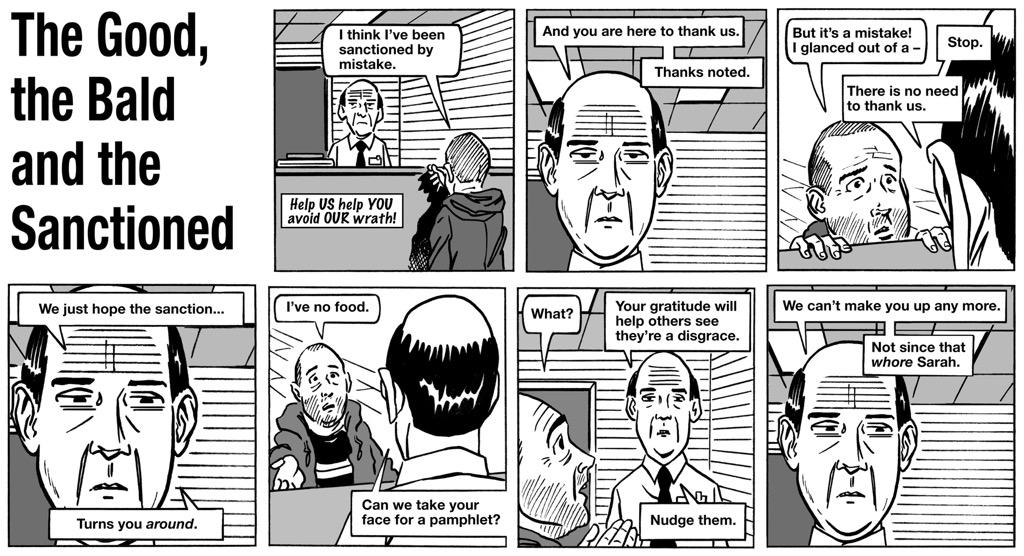
 Steve Cheney
  Ian Jones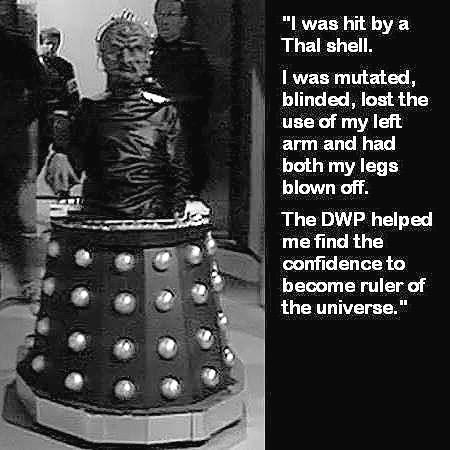


 BoycottWorkfare
  Jon Swindon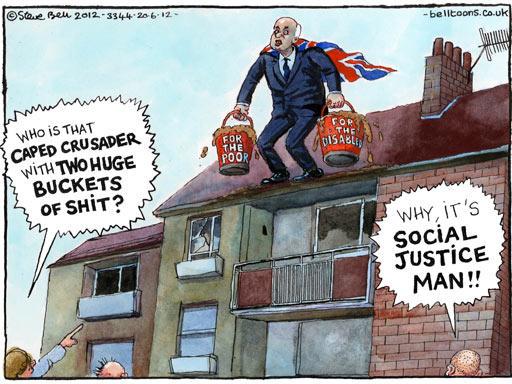


 Politics and Insights