Category: Propaganda

The Conservatives are guilty of great deceit in blaming Labour for the deficit – Ed Miliband.

gret deceit

The first part of this article was originally posted in the Guardian, on Thursday 6 January 2011:

Ed Miliband accuses the Conservatives today of a “great deceit” in blaming Labour for the national deficit and warned that they have concocted a false narrative to justify politically driven cuts. Speaking at Labour’s campaign centre in Oldham yesterday, the Labour leader  attacked the Tories for rewriting history.

In announcing a raft of swingeing public spending cuts the coalition government has repeatedly sought to portray that its hands are tied because of the size of the deficit it inherited from the last government.

The same argument was rolled out this week to defend this week’s rise in VAT from 17.5% to 20%, after warnings of the likely impact on low and middle-income families and the fragile economy. Amid Labour concerns that the opposition has not been forcefully contradicting the coalition’s narrative on the deficit, Miliband insisted that it was not caused by Labour overspending but by the global financial crisis.

“My concern is that a great deceit designed to damage Labour has led to profoundly misguided and dangerous economic decisions that I fear will cause deep damage to Britain’s future,” he writes in today’s Times (paywall).

The Labour leader says that by blaming the deficit on overspending the Conservative-led government is seeking to win consensus for its policy of cutting the deficit “as far and as fast as possible”. But he accuses the chancellor of “gambling on a rapid rebalancing of the economy” and says he is going “too far and too fast on the deficit”.

Accusing the Tories of attempting to rewrite history, Miliband points out that Britain’s debt at the outset of the economic crisis was the second-lowest in the G7 and lower than it was under the Conservatives in 1997 and says neither of the parties in the coalition government called for lower spending at the time.

Miliband repeats his warning from earlier this week that the VAT increase will squeeze families on middle and low incomes and says growth will be restricted as a consequence. He argues that while some would argue those are prices worth paying in the short-term, the effect will be to store up greater problems for the future.

He says Labour is not opposed to every cut, but that he does oppose those being inflicted on the county’s poorest. He added: “but neither is it true that Labour is to blame for the deficit or that the deficit-reduction programme being pursued by this government is necessary and fair. Because this Conservative-led government is trying to deceive people about the past, it is making the wrong judgments about the future”.

David Cameron said yesterday that the joint impact of increases on duty and VAT meant things were “very painful and difficult” and raised the prospect of introducing a fair fuel stabiliser which would keep fuel duty down when oil prices rise. He also admitted that the rise in VAT to 20% this week was regressive in terms of people’s income but “might not be if it was looked at in terms of people’s spending.”

See also: Ed Miliband’s speech on the deficit and economy: George Osborne’s cuts are extreme and ideological.

scroll2
Ed Miliband’s speech shows that he is a very perceptive and conscientious leader.

The claims made by the Conservatives that Labour “left a mess” don’t stand up to scrutiny. Here is a little evidence which demonstrates that the Tories have a track record of lying, and of blaming everyone else for their own ideological preferences, policy decisions and economic incompetence:

https://i0.wp.com/www.taxresearch.org.uk/Blog/wp-content/uploads/2014/10/Screen-Shot-2014-10-06-at-09.36.30.png

Thanks to Richard Murphy, who produced this graphic, all data is from the HM Treasury Pocket Bank for 30 September on the Government’s own website.

See also: Labour is not responsible for crash, says former Bank of England governor

OBR head rebukes Osborne: the UK was never at risk of bankruptcy. Osborne was rebuked by the Office for Budget Responsibility (OBR) for telling the great big lie about Labour leaving the country “near bankrupt”, yet Cameron has used that same lie in the televised leaders debates. You’d think that a near “bankrupt” country would have had the Fitch and Moody triple A credit ratings downgraded …oh hang on, didn’t that happen … under the TORIES?

And haven’t the Tories borrowed more in 5 years than Labour did in 13? Surely we must be bankrupt now, by the Tories’ own reckoning.

Then there is the oft-cited Liam Byrne note. The jest recalls a similar note left by Tory Reginald Maudling to his Labour successor James Callaghan in 1964: “Good luck, old cock … Sorry to leave it in such a mess.”

Byrne clarified at the time that the note was meant in jest: “My letter was a joke, from one chief secretary to another,” he said. “I do hope David Laws’s sense of humour wasn’t another casualty of the coalition deal.”

Treasury sources said the full text of the letter from Byrne – dated 6 April, the day Gordon Brown called the general election – was: “Dear chief secretary, I’m afraid there is no money. Kind regards – and good luck! Liam.”

Byrne’s notes have caused bemusement before. When he was promoted to the cabinet in 2008, he gave officials a set of instructions entitled “Working with Liam Byrne”, which included the lines: “Coffee/Lunch. I’m addicted to coffee. I like a cappuccino when I come in, an espresso at 3pm and soup at 12.30-1pm … If I see things that are not of acceptable quality, I will blame you.”

Gary Gibbon of Channel 4 News remembers that former chancellor Alistair Darling had also left a note for his successor, George Osborne, as well as a bottle (how very civilsed) – but, in Gibbon’s words, “no revolver.”

It’s an indication of how desperately determined this government are to blame the previous government for the consequences of their own policy decisions and economic catastrophe, that the Tories have to seize on a traditional and humorous exchange between outgoing and incoming ministers as “proof” to bolster their spurious claims and to prop up such deception.

The Office of National Statistics (ONS) has said that David Cameron has presided over an economy with the weakest productivity record of any government since the second world war, and revealed that output per worker fell again in the final three months of 2014.

In a separate blow to the credibility of the government, two-thirds of leading UK economists said they believed George Osborne’s austerity strategy had been damaging for the economy.

The Centre for Macroeconomics polled 50 leading economists, asking them whether they agreed that the government’s deficit-reduction strategy had a positive impact on growth and employment. One third disagreed and a further third strongly disagreed.

Furthermore, 77% feel that the outcome of the general election will have serious (“non-trivial”) consequences for the economy, and are clearly not in favour of the Conservatives’ “long-term economic plan.”

The Tories seem to think we have forgotten that it was they that lost the Moody’s Investors Service triple A grade, despite pledges to keep it secure. Moody’s credit ratings represent a rank-ordering of creditworthiness, or expected loss.

The Fitch credit rating was also downgraded due to increased borrowing by the Tories, who have borrowed more in 4 years than Labour did in 13.

I remember that we were very well sheltered from the consequences of the global banking crisis by the last government. It’s remarkable that despite George Osborne’s solid five-year track record of failure, the Tories still mechanically repeat the “always cleaning up Labour’s mess” lie, as if increasing the national debt by 11% of GDP in 13 years, mitigated by a global recession, caused by bankers, as Labour did, is somehow significantly worse than George Osborne’s unmitigated record of increasing the national debt by 26% in just 5 years. Osborne has ironically demonstrated that it is possible to dramatically cut spending and massively increase debt. Austerity doesn’t work as a means of reducing debt, but works exceptionally well as a smokescreen for an ideologically-driven reduction of the state.

econ lies

The Tories have seized an opportunity to dismantle the institutions they have always hated since the post-war social democratic settlement – institutions of health, welfare, education, culture and human rights which should be provided for all citizens. The Tories attempt to destroy fundamental public support for the health, education and welfare of its people. Offering and inflicting only regressive, punitive policies and devastating cuts, the Tories lie, lie and lie some more to attempt to justify the unustifiable.

proper Blond

The Conservatives have not encouraged investment in the UK either:


The Tories have told many lies. Here’s a list of those that have earned them official rebukes – A list of official rebukes for Tory lies.

Further reading:

The Austerity Con Simon Wren-Lewis

The Tory election strategy is more of the same: Tories being conservative with the truth.

The Great Debt Lie and the Myth of the Structural Deficit.

One of the most destructive Tory myths has been officially debunked.

“The mess we inherited” – some facts with which to fight the Tory Big Lies.

Political scrapbook: Telegraph business leaders letter ‘was padded out with Sam Cam’s luvvie friends’

Follow the Money: Tory Ideology is all about handouts to the wealthy that are funded by the poor.

The word “Tories” is an abbreviation of “tall stories”.

10689499_731152076954323_875040546185242333_nWith thanks to Robert Livingstone 

The ultimate aim of the “allthesame” lie is division and disempowerment of the Left.

1796655_294409220710133_3373329_n

The speech-writer for David Cameron in the run-up to the 2010 general election, Ian Birrellseems to have finger in every lie on behalf of the Tories. He’s the contributing editor of The Mail on Sunday, whilst writing columns regularly in several other papers. He’s been published in The Guardian, The Wall Street Journal, The Economist, The Daily Mail, The Financial Times, The Times, The Observer, The London Evening Standard, The Sun, The Daily Telegraph, The Sunday Telegraph, The Independent, The Independent on Sunday, Prospect, New Statesman and The Spectator.

On the 2nd January, Birrell cobbled together a somewhat strange and hugely speculative article in the Guardianclaiming that “a Tory-Labour unity coalition may be the only way forward after 7 May” and the two parties have more in common with each other than with the insurgents. A national government would prevent a constitutional crisis.”

There are no quotes or citations, just an unsubstantiated comment: “But most people in Westminster privately predict a hung parliament.”

As I said, entirely speculative, seemingly without an aim.

Birrell also claims there was “a brief flicker of unity” between the parties during the Scottish referendum. That’s a neat side-stepping of the fundamental fact that Labour, like most socialists, have always been internationalists, which has absolutely nothing to do with the Tories’ position on Scottish independence at all, and everything to do with Labour’s core values. It’s also a claim frequently made by the Scottish Nationalists –  Labour “sided with the Tories.” Anyone would think that the Scottish National Party want to undermine support for the Labour Party in Scotland…

There is of course a subtext to Birrell’s article. It is a piece of propaganda. The subtext is “the mainstream political parties are all the same.”

The “allthesame” myth came straight from Tory HQ. The BBC’s Tory correspondent Nick Robinson admitted live on air that Cameron’s best chance of winning the next election is if people believe politicians are “all the same.” That is very clearly not the case. I think this is a major ploy aimed at propagandarising an exclusively class-based identity politics, to target and fragment the “working class left.”

It purposefully excludes other social groups and also sets them against each other, for example, working class unemployed people attacking migrants – it really is divisive, anti-democratic, and quite deliberately flies in the face of Labour’s equality and diversity principles. That’s the problem with identity politics: it tends to enhance a further sense of social segregation, fragmentation and it isn’t remotely inclusive.

Of course it also enhances the tropes “outoftouch” and  “allthesame.” It’s a clever strategy, because it attacks Labour’s equality and inclusive principles – the very reason why the Labour movement happened in the first place – and places restriction on who ought to be included.

Think of that divisive strategy 1) in terms of equality; 2) in terms of appealing to the electorate; 3) in terms of policy. Note how it imposes limits and is reductive.

It also demoralises and confuses people.

The Tories set this strategy up in the media, UKIP have extended it further and the minority rival parties, including the Green Party and the Scottish National Party have utilised the same rhetoric tool: all of these parties frequently use the term “liblabcon”for example. That’s a sort of cognitive shortcut to what has been tacitly accepted, apparently, as a “common sense” view that partisanship amongst the mainstream parties is dead. I’ve written at length about this process of “normalisation” –  how social conservatism and neoliberalism have been absorbed culturally, and how this serves to naturalise the dominance of the Right and stifle the rationale for critical debate here – Manufacturing consensus: the end of history and the partisan man.

Be prepared for much more of this propaganda tactic: the Right are engaged in an all out war.

Firstly they know that Ed Miliband has edited their script, abandoning the free-market fundamentalist consensus established by Thatcherism in favour of social democracy.

Secondly, the right-wing media barons who set the terms of what is deemed politically palatable in Britain have never forgiven Ed Miliband for his endorsement of Leveson, which they believe is an unacceptable threat to their power.

Thirdly, they know Labour under Ed Miliband may well actually win the 2015 election.

It doesn’t take much effort to work out that the two main parties in competition have nothing in common at all. They debate oppositionally in parliament. Cameron attacks Miliband at every opportunity and on a very personal level, quite often. It’s plain, if you listen to the parliamentary debates, that neither man can stand what the other represents.

And how would the Tories and Labour reconcile their fundamental differences regarding human rights, the European Convention On Human Rights (ECHR) and the European Union? How about the bedroom tax? The National Health Service? Taxation? The welfare reforms? Equality? These are issues on which the two rival parties will never be able reach a consensus.

10635953_696483917087806_7307164383030383606_n

It’s quite difficult to assert that there are significant differences between the parties, because of the constant repetition of the “allthesame” lie. It has become almost like a comforting, lulling mantra and a shortcut from cognitive dissonance. People often get quite angry when confronted with evidence that challenges this soundbite. But policies provide very good evidence, they are scripted from ideologies and are statements of a party’s intentions.

Ed Miliband has been cautious in making policy promises and has said that he won’t pledge anything that he may not be able to deliver. Here are Labour’s key policies to date, each has been costed and evidenced.

The thing about policies that have been passed into law is that they can be verified on the Parliamentary website and elsewhere. How many of you reading this think that Blair was a “Thatcherite”? I’m not a Blairite. I do like Miliband, who is a very different leader than Blair was. Miliband denounced New Labour in 2010. His stance on Syria in 2013 draws a clean line under the Blair approach. Yet Blair is still being used as a stick to hit the Labour Party with.

The claims made in lying articles in the media and the often inaccurate and distorted claims of fringe party supporters are based on a propaganda technique called transfer and association, which is a method of projecting negative (or positive) qualities of a person, entity, object, or value (an individual, group, organisation) to another in order to discredit it (or sometimes, to make the second more acceptable, this tactic is used in advertising a lot.)

It evokes an emotional response, which stimulates the target to identify with recognised authorities. But that stick is hitting a closed door now. Newsflash: Blair hasn’t been party leader for some years.

I worked on compiling a list of New Labour’s policies, and despite Blair’s faults, there really were some outstanding achievements, such as the Equality Act, the Human Rights Act, various animal welfare laws, Every Child Matters and the Good Friday Agreement. I have listed New Labour’s achievements with a comparable list of the Coalition’s “memorable” moments, too. If you hated Blair, and see him as some sort of high priest of neoliberalism, it’s probably even more important that you read this. I promise it will help you to understand cognitive dissonance, at the very least, and perhaps to appreciate the importance of evidence and critical thinking: Political parties – there are very BIG differences in their policies.

And this, for some balance and perspective: Thatcher, Mad Cow Disease and her other failings, the Blair detour and déjà entendu, Mr Cameron.

The “allthesame” lie is a way of neutralising opposition to dominant ideas. It’s a way of disguising partisanship and of manipulating and reducing democratic choices. It’s nothing less than a political micro-management of your beliefs and decision-making.

It also reduces public expectation of opposition and in doing so it establishes diktats: it’s a way of mandating acceptance of ideology, policies or laws by presenting them as if they are the only viable alternative. And those that refuse to accept the diktats are enticed by the marginal parties who offer much, safe in the knowledge that they won’t have to rationalise, evidence, cost or deliver those promises. This also plays a part in diluting viable opposition, because the smaller parties tend to employ the same strategy to gain credibility and support – negative campaigning and repeated lies and soundbites.

Lynton Crosby, who has declared that his role is to destroy the Labour Party, rather than promote the Conservatives, based on any notion of merit, is also all about such a targeted “divide and rule” strategy. This is a right wing tactic of cultivating and manipulating apostasy amongst support for the opposition. It’s a very evident ploy in the media, too, with articles about Labour screaming headlines that don’t match content, and the Sun, Mail and Telegraph in particular blatantly lying about Labour’s policy intentions regularly.

Propaganda isn’t always obvious, and that’s how it works. We need to be very mindful of this.

Ultimately, the only party that will gain from any of this negative campaigning approach and divisive propaganda is the Tories. And that is who we should be collectively opposing.

The Tories launched their election campaign a couple of days ago, and already, it’s obvious that the entire campaign is founded on attempting to undermine Labour’s  credibility by telling lies about their economic management – The Tory election strategy is more of the same: Tories being conservative with the truth.

Contrast the Conservative with the truth approach I’ve discussed here with Miliband’s consistently genuine approach to politics – Ed Miliband: Labour election campaign will be one of hope, not falsehood.  

Whatever party you support and regardless of whether or not we agree on the issues I raise, my key aim, whenever I write, is to inspire a sense of responsibility and some critical thinking. That helps to reliably inform our decision-making.

I won’t apologise to my critics for being a Labour Party supporter, but I will always provide evidence and analysis to support and justify my own views and I will always be happy to engage in dialogue, provided that it’s a respectful and polite exchange. No party is above criticism, quite rightly so, as politics has to be an accountable, reflective and responsive process. That’s what democracy is about.

There is, however, a big difference between genuine criticism, on the one hand and propaganda and lies on the other, which are being masqueraded as “criticism.” If debate isn’t established on a genuine, critical exploration of evidence and establishing truths, then it’s not debate: it’s simply indoctrination.

Related

Don’t believe everything you think: it’s almost election time.

From  Psycho-Linguistics to the Politics of Psychopathy. Part 1: Propaganda

Ed Miliband is the biggest threat to the status quo we’ve seen for decades.

Once you hear the jackboots, it’s too late.

The moment Ed Miliband said he’ll bring socialism back to Downing Street.

Ed Miliband’s policy pledges at a glance

Miliband is an excellent leader, and here’s why.

Cameron’s Nudge that knocked democracy down: mind the Mindspace.

403898_365377090198492_976131366_nThanks to Robert Livingstone for the excellent memes.

Cameron’s Nudge that knocked democracy down – a summary of the implications of Nudge theory

Democracy is based on a process of dialogue between the public and government, ensuring that the public are represented: that governments are responsive, shaping policies that address identified social needs. However, Coalition policies are no longer about reflecting citizen’s needs: they are all about telling us how to be.

The idea of libertarian paternalism was popularised around five years ago by the legal theorist Cass Sunstein and the behavioral economist Richard Thaler, in their bestselling book Nudge. Sunstein and Thaler argue that policymakers can preserve an individual’s liberty whilst still nudging a person towards choices that are supposedly in their best interests. But who nudges the nudgers? Who decides what is in our “best interests”? That would be the government, of course.

Nudge philosophy is dressed-up as libertarian paternalism, which in turn dresses-up Tory ideology. Another phrase the authors introduced was “choice architecture”, a concept implying that the State can be the architect that arranges personal choice in way that nudges consumers in the right direction.

The direction is towards a small state, with nothing but behavioural “incentives” to justify forcing  citizens who have needs to be “responsible” and “self-sufficient,” achieving this presumably by paying taxes and then pulling themselves up strictly by their own bootstraps. It’s the new nothing for something culture.

Behavioural economics is actually founded on crude operant conditioning: it marks the return of a psycho-political theory that arose in the mid-20th century, linked with behaviourism. Theorists from this perspective generalise that all human behaviour may be explained and described by a very simple reductive process: that of Stimulus – Response. There is no need, according to behaviourists, to inquire into human thoughts, beliefs or values, because we simply respond to external stimuli, and change our automatic responses accordingly, like automatons or rats in a laboratory. Nudge theorists propose that we are fundamentally irrational, and that our decision-making processes are flawed because of “cognitive biases.” Nudge theory therefore bypasses any engagement with our deliberative processes.

Formally instituted by Cameron in September 2010, the Behavioural Insights Team, (also known as the Nudge Unit) which is a part of the Cabinet  Office,  is made up of people such as David Halpern, who is also a part of Cameron’s “Big Society” campaign. He co-authored the Cabinet Office report:  Mindspace: Influencing Behaviour Through Public Policy, which comes complete with a cover illustration of the human brain, with an accompanying psycho-babble of words such as “incentives”, “habit’, “priming” and “ego.” It says the report “addresses the needs of policy-makers.”  Not the public.

The behaviourist educational function made explicit through the Nudge Unit is now operating on many levels, including through policy programmes, forms of “expertise”, and through the State’s influence on the mass media, other cultural systems and more subliminally, it’s embedded in the very language that is being used.

Education is a dialogic process, with consenting, willing participants. Even compulsory education involves consent and dialogue – children are engaged in the process. What the Nudge Unit is doing is not engaging in the least, nor is it done with our consent: we are being acted upon. Not as inquiring subjects, but as passive objects.

At the heart of every Coalition policy is a “behaviour modification” attempt, promoted by the influential Nudge Unit and based on the discredited, pseudo-scientific behaviourism, which is basically just about making people do what you want them to do, using a system of punishments and reinforcements. Once you see it, you can’t unsee it.

At the same time, as well as shaping behaviour, the messages being given loud and clear are all-pervasive, entirely ideological and not remotely rational: they reflect and are shaping an anti-welfarism that sits with Conservative agendas for welfare “reform”, “austerity policies” the small State (minarchism) and also legitimises them.

Nudge has made Tory ideology seem credible, and the Behavioural Insights Team have condoned, justified and supported punitive, authoritarian policies, with bogus claims about “objectivity” and by using discredited pseudo-science. Those policies have contravened the human rights of women, children and disabled people, to date. Nudge is hardly in our “best interests,” then.

Coalition narratives, amplified via the media, have framed our reality, stifled alternatives, and justified Tory policies that extend psychological coercion  including through workfare; benefit sanctions; in stigmatising the behaviour and experiences of poor citizens and they endorse the loss of autonomy for citizens who were disempowered to begin with.

A summary of the main influences outlined in the MINDSPACE framework

All of these basic ideas are being utilised to uphold Conservative ideology, to shape Conservative policies and justify them; to deploy justification narratives through the mass media, in schools and throughout all of our other social institutions.

For example, incentives being linked to the mental “shortcut” of strongly avoiding losses shows us precisely where the Tories imported their justification narrative for the welfare cuts and benefit sanctions from. What the government calls  “incentivising” people by using systematic punishments translates from Orwellian Doublespeak to “bullying” in plain language.

“We act in ways that make us feel better about ourselves” – norms, committments, affect, ego are all contributing to Tory rhetoric, lexical semantics and media justification narratives that send both subliminal and less subtle, overt messages about how poor and disabled people ought to behave.

This is political micro-management and control, and has nothing to do with alleviating poverty. Nor can this ever be defined as being in our “best interests.”

There’s an identifiable psychocratic approach to Conservative policy-making that is aimed at the poorest. Whilst on the one hand, the Tories ascribe deleterious intrinsic motives to rational behaviours that simply express unmet needs, such as claiming benefit when out of work, and pathologise these by deploying a narrative with subtextual personality disorder labels, such as scrounger, skiver and the resurrected Nazi catch-all category for deemed miscreants: work-shy, the Tories are not at all interested in your motivations, attitudes, thoughts, hopes and dreams. They are interested only in how your expectations and behaviour fits in with their intent to reduce the State to being a night-watchman – but it watches out only for the propertied class.

Behaviourism was discredited and labelled “pseudoscience” many decades ago, (very memorably by Noam Chomsky, amongst others). Most psychologists and cognitive scientists don’t accept that myriad, complex human behaviours are determined by and reducible to nothing more than an empty stimulus/response relationship; our deeds and words merely a soulless, heartless and mindless cause and effect circuit.

There are serious political ramifications regarding the application of  behaviourism to an unconsenting public. Firstly, that in itself is undemocratic. Skinner was clearly a totalitarian thinker, and behaviour modification techniques are the delight of authoritarians. Behaviourism is basically a theory that human and animal behaviour can be explained in terms of conditioning, without appeal to consciousness, character, traits, personality, internal states, intentions, purpose, thoughts or feelings, and that psychological disorders and “undesirable” behaviours are best treated by using a system of reinforcement and punishment to alter behaviour “patterns.”

Most psychologists and cognitive scientists don’t endorse behaviourism. Democracy involves governments that shape themselves in response to what people need and want, not about people who reshape their lifestyles in response to what the government wants.

Democracy is meant to involve the formulation of a government that reflects public’s needs. Under the new nudge tyranny that is turned totally on its head: instead the government is devising more and more ways to put pressure on us to change. We elect Governments to represent us, not to manipulate us covertly.

Nudge is actually about bypassing rationality and reason, political accountability and transparency – democratic process, critical debate. The government are substituting those with manipulation, coercion, and an all-pervasive psycho-political experiment.

This was taken from a longer piece, here’s the full articleCameron’s Nudge that knocked democracy down: mind the Mindspace.

David Cameron promised a further £7.2 BILLION tax cuts to the rich at the expense of the poor

1450041_569755536427312_1698223275_n

I wrote an article last year – Follow the Money: Tory Ideology is all about handouts to the wealthy that are funded by the poor – which outlines Coalition policies that have widened inequalities and increased poverty by handing out public money to the wealthy that has been taken from the poorest. I pointed out that this Government have raided our tax-funded welfare provision and used it to provide handouts to the very wealthy – £107,000 EACH PER YEAR in the form of a tax break for millionaires, amongst other things.

And what does our imperturbable chancellor promise if this disgrace of a government is re-elected? True to Tory form, more of the same: austerity for the poor and public services cuts, and tax breaks for the wealthiest.

But further cuts to lifeline benefits and public services is surely untenable. Absolute poverty has risen dramatically, this past four years, heralding the return of Victorian illnesses that are associated with malnutrition. People have died as a consequence of the welfare “reforms”. Supporting the wealthy has already cost the poorest so very much, yet this callous, indifferent, morally nihilistic  government are casually discussing taking even more from those with the very least.

This isn’t anything to do with economic necessity: it’s all about Tory ideology. Under the guise of austerity, the Tory-led Coalition have stripped our welfare and public services down to the bare bones. Any further cuts will destroy what remains of our post-war settlement.

Despite facing a global recession, the Labour Government invested in our public services, and borrowed substantially less in thirteen years than the Coalition have in just three years. UK citizens were sheltered very well from the worst of the global bank-induced crash.

Gordon Brown got it right in his championing of the G20 fiscal stimulus, agreed at the London summit of early April 2010, which was a continuation of his policies that had served to steer the UK economy out of the consequences of a global recession, and to protect citizens from the consequences of cuts to services and welfare.

Osborne’s policy of imposing austerity and budget cuts on an economy that was actually recovering was a catastrophic error. The austerity propelled the economy backwards and into depression; and, far from using public spending as a countervailing force against the cutbacks in private sector investment, the Coalition’s budget cuts served to aggravate the crisis. Many people are suffering terribly as a consequence, reduced to a struggle for survival.

And in these socio-economic circumstances, the Tories have pledged a further £7.2 BILLION tax cuts to the rich. The funding for the tax cuts will come from further catastrophic “savings” made at the expense of the poorest yet again – £25 billion more to be sliced from welfare, Local Authorities,  education, police and other vital services.

Three things are immediately clear. Firstly, without the ramping up of VAT in 2010, to 20%, Osborne would be in even more dire financial straits than he is.

Secondly, income tax has, despite allegedly rising employment, failed to increase.

Thirdly, corporation tax, targeted for cuts, year after year, has slumped. The tax system is increasingly veering toward very regressive – biased in favour of the wealthy – consumption taxes, which affects the poorest, most, and failing to deliver fairer taxes on income.

This is the result of government policy: increasing VAT but cutting corporation tax, and the engineered kind of “recovery” we have ended up with. The Office for Budgetary Responsibility (OBR) reminded us in October of the extent of the Coalition’s failure to reduce the deficit.

Public sector net borrowing in 2013-14 was originally expected to be £60 billion; the out-turn for borrowing was £108 billion (on a comparable basis). This amounts to a shortfall of nearly £50 billion, with borrowing approaching double the original predictions made when the government’s austerity policies were announced in 2010.

Much of this shortfall is accounted for by the current earnings crisis. UK workers are suffering the longest and most severe decline in real earnings since records began in Victorian times, according to an analysis published by the TUC. But Tories always lower wages, and hike up the cost of living. And whilst workers are struggling to make ends meet, private business owners/Tory donors are raking in millions of pounds. But this is exactly how Tories like to run society in a nutshell.

It’s their imposition of a feudalist schemata for social relationships. Cognitively, Tories are the equivalent of historical egocentric toddlers: they are stuck at this painful stage of arrested development.

“The deficit reduction programme takes precedence over any of the other measures in this agreement” – stated in the Coalition Agreement.

For a government whose raison d’etre is deficit reduction, the Coalition really isn’t very good at all. But austerity reflects the triumph of discriminatory Tory ideology over needs-led, evidenced-based policy making.

The OBR said the forecast from 2010 was over-optimistic because it did not take into consideration the effect of lower wages as well as a higher levels of tax-free personal allowance on the upper brackets of income tax. National Insurance contributions were also £7.4 billion below forecast.

Which brings us back to the issue of further tax cuts for the wealthy, with no mention of raising wages for the poorer work-force, and of course there is the promise of more cuts to come for those relying on lifeline benefits. I don’t think that the Coalition cares that their policies don’t balance the books, as it were, or mend the economy. Nor do they care what the consequences are for the wider public.

TUC General Secretary Frances O’Grady said:

The government’s failure to get wages growing again has not only left families far worse off than in 2010, it’s put the public finances in a mess too. The economy has become very good at creating low-paid jobs, but not the better paid work that brings in income tax. The Chancellor’s sums just don’t add up – he can’t make the tax cuts for the better off that he is promising and meet his deficit reduction target without making cuts to public services.

His cuts would be so deep that no government could deliver them without doing damage to both the economy and the fabric of our society. We can’t cut our way out of this problem any more than we can dig ourselves out of a hole. More austerity would only keep us stuck in a downward spiral. The Chancellor should use next week’s Autumn Statement to invest in growth and to put a wages recovery at the top of the agenda.

Shadow Chancellor Ed Balls said:

Nobody will be fooled by pie in the sky promises of tax cuts when David Cameron cannot tell us where the money is coming from. Even the Tories admit this is an unfunded commitment of over £7 billion, so how will they pay for it? Will they raise VAT on families and pensioners again?

Cameron has also announced the basic rate before we start paying tax would rise from £10,500 to £12,500. While a worker on £12,500 would save £500 a year, someone earning £50,000 would keep £1,900 extra.

Those earning up to £123,000 would be £484 richer. Someone on £12,500 would save £500 a year, while someone on up to £50,000 would keep £1,900 extra. And the £500 tax cut for basic rate earners will be almost wiped out by George Osborne’s raid on in-work benefits.

Paul Johnson of the Institute for Fiscal Studies think tank says it was:

very difficult to see how the £7billion tax giveaway could be paid for.

We’re looking at promises of £7billion of tax giveaways in the context of an overall plan to get the deficit down but even without tax giveaways that requires pretty extraordinary levels of spending cuts such that most government departments will see their spending cut by a third by 2020.

How are you going to afford this? Even more dramatic spending cuts?

At the Tory Conference, Cameron promised to expand the National Citizen Service youth project for every teenager in the country, have the lowest rate of corporation tax of any major economy.

There was also a pledge to abolish youth unemployment by the end of the decade. But the Tory faithful gave the loudest applause for his pledge to scrap the Human Rights Act.

This is a truly terrifying pledge, because human rights were originally formulated as an international response to the atrocities of the 2nd World war, and to ensure that citizens are protected from abuses of their government.

A Labour Party analysis found the proposed tax break would hand David Cameron and other Cabinet ministers an extra £132 a year. But a family with two children with one earner on £25,000 a year would lose £495 by 2017-17 due to the benefits freeze announced by Mr Osborne.

The Tory plan is based solely on spending cuts, mainly directed at the working age poor. And the Conservative plan to raise the higher rate threshold to £50,000 means that  working-age poor people are to fund a tax cut that is four times greater for higher rate tax payers than for basic rate taxpayers.

Ed Balls said in response:

David Cameron’s speech showed no recognition that working people are £1,600 a year worse off under the Tories nor that the NHS is going backwards on their watch. The only concrete pledge we’ve had from the Tories this week is a promise to cut tax credits by hundreds of pounds for millions of hard working people while keeping a £3 billion tax cut for the richest one per cent.

TUC general Secretary Frances O’Grady added:

No amount of dressing up can hide the fact that the policies in this speech pass by those who need the most help to reward richer voters.

Alison Garnham, Chief Executive of Child Poverty Action Group, said:

What was missing in the PM’s speech was any recognition that independent projections show that child poverty rates are set to soar. We know that raising the personal tax allowance is an ineffective way of supporting low paid families.Independent analysis shows that just 15% of the £12 billion required to raise the PTA to £12,500 would go to working families in the lowest-income half of the population.

Many simply don’t earn enough to benefit from this policy, and those that do just see their benefits and tax credits withdrawn as their incomes rise.

The Institute for Fiscal Studies showed in their Green Budget publication this year that just 15% of the gains from increasing the personal allowance would benefit the poorest half of Britons, concluding:

There are better ways to help the low paid via the tax and benefit system.

Ex-Treasury official James Meadway,  now a senior economist at the New Economics Foundation, said Cameron’s changes were:

irresponsible, expensive gimmicks that scarcely affect the poorest workers.

They imply swingeing public sector cuts and mean handing over more cash to the already rich.

Ed Miliband will respond tomorrow (Monday), declaring that the Tories’ failure to tackle the cost-of-living crisis has helped cost the Exchequer £116.5 billion – leading to higher borrowing and broken promises on the deficit. The price tag, equivalent to almost £4,000 for every taxpayer, is based on new research from the House of Commons Library being published by the Labour Party.

This shows that low pay and stagnant salaries, combined with soaring housing costs and the failure to tackle root causes of increased welfare bills, means that over the course of this Parliament:

  • Income tax receipts have fallen short of forecasts by more than £66 billion.
  • National Insurance Contributions are £25.5 billion lower than expected.
  • Spending on social security is £25 billion higher than planned [despite brutal cuts to lifeline benefits]

Mr Miliband is expected to say the test for George Osborne in this week’s Autumn Statement will be to set out a plan to build a recovery for working people – one which recognises the link between the living standards and Britain’s ability get the deficit down.

He is expected to say:

For a very long time, our country has worked well for a few people, but not for everyday people. “We live in a country where opportunities are too skewed to those at the top, where too many people work hard for little reward, where too many young people can’t find a job or apprenticeship worthy of their talents, and where families can’t afford to buy a home of their own.

For all the Government’s boasts about a belated economic recovery, there are millions of families still caught in the most prolonged cost-of-living crisis for a century.  For them this is a joy-less and pay-less recovery.

My priority as Prime Minister will be tackling that cost-of-living crisis so that hard work is properly rewarded again, so that our children can dream of a better future, so that our public services including the NHS are safe.

Building a recovery that works for everyday people is the real test of the Autumn Statement.

But that isn’t a different priority to tackling the deficit. Building a recovery that works for most people is an essential part of balancing the books.

The Government’s failure to build a recovery that works for every-day people and tackle the cost-of-living crisis isn’t just bad for every person affected, it also hampers our ability to pay down the deficit.

Britain’s public finances have been weakened by a Tory-led Government overseeing stagnant wages which keep tax revenues low.

Britain’s public finances have been weakened by Tory policies which focus on low paid, low skilled, insecure jobs – often part-time or temporary – because they do not raise as much revenue as the high skill, high wage opportunities we need to be creating.

And our public finances have been weakened by higher social security bills to subsidise low paid jobs and the chronic shortage of homes.   

The result has been David Cameron and George Osborne missing every single target they set themselves on clearing the deficit and balancing the books by the end of this parliament.

Their broken promises, their abject failure, are not an accident. They are the direct result of an outdated ideology which says all a Government has to do is look after a privileged few at the top and everyone else will follow.

That is why this Government has done a great job of squeezing the middle, but a bad job of squeezing the deficit.

The test this week for David Cameron and George Osborne is whether they recognise that Britain will only succeed and prosper for the long term by tackling the cost-of-living crisis and building a recovery which works for the many, not just for a few.

Or whether they will just offer more of the same old ideas that have failed them, failed everyday working people, and failed Britain over the past four years.

10001887913_f8b7888cbe_o

Thanks to Robert Livingstone for the brilliant memes

The link between Trade Unionism and equality

10553308_680322242037307_1558281906340939819_n

In an article I wrote earlier this year – Conservatism in a nutshell – I outlined some basic themes of New Right Conservative ideology. I said:

Conservatives don’t like social spending or welfare – our safety net. That’s because when you’re unemployed and desperate, companies can pay you whatever they feel like – which is inevitably next to nothing. You see, the Tories want you in a position to work for next to nothing or starve, so their business buddies can focus on feeding their profits, which is their only priority. Cheap-labour conservatives don’t like the minimum wage, or other improvements in wages and working conditions. These policies undo all of their efforts to keep you desperate. They don’t like European Union labour laws and directives either, for the same reason.

Conservatives prioritise handing out our money to their big business partners, no matter what it costs us as a society. For example, a spending breakdown reveals how NHS funding has flowed to private firms, much of that money has gone to companies with corrupt ties to the Tories, whilst health care is being rationed, care standards have plummeted, services are cut, and by the end of the next financial year, health service workers will have had their pay capped for six years, prompting fully justified strike action.

Following the tide of sleaze and corruption allegations, Cameron “dealt” with parliamentary influence-peddling by introducing the Gagging Act, which is primarily a blatant attack on trade unions (which are the most democratic part of the political funding system) and Labour Party funding, giving the Tories powers to police union membership lists, to make strike action very difficult and to cut union spending in election campaigns.

The Transparency of Lobbying, non-Party Campaigning, and Trade Union Administration Bill is a calculated and partisan move to insulate Tory policies and records from public and political scrutiny, and to stifle democracy. And there are many other examples of this government removing mechanisms of transparency, accountability and safeguards to rights and democracy.

We have witnessed a dramatic increase in levels of economic inequality this past four years, reflected in the fact that income differences between top earners and those on the lowest wages are now higher than at any time since records began. The UK now ranks as one of the most unequal societies in the developed world, even more unequal than the US, home of the founding fathers of neoliberalism. Our current levels of inequality have far exceeded the point at which campaigners need any further proof to show how socially corrosive and life-limiting the subsequent deepening poverty is.

Despite the legislative framework of Labour’s Equality Act, passed in 2010, there is a growing gender-based pay gap, continued abuse of agency workers, the problem of the two-tier work force and the contracting out of public servicesStrong trade unions improve public services, too.

Speaking at a press conference on the first day of the 2014 TUC Congress, TUC General Secretary Frances O’Grady said:

“The key message of this year’s congress is Britain needs a pay rise and I also expect many of the debates on the floor to focus on the importance of the coming general election for people at work.

Today, I want to highlight the threat posed by the Conservative Party’s promised manifesto proposals on strike ballots.

Because these proposals are designed to make unions weaker. And if unions become weaker, then the chances of people winning a pay rise, improving living standards and tackling inequality in Britain today will become a good deal harder.

The Conservative Party is not just proposing a few more bureaucratic obstacles that will make life a bit more difficult for trade unions.

Taken together, they would effectively ban strikes by the back door. And, on top of that, they would open up elected union leaders to increased surveillance by the state.

They are not just an attack on fundamental liberties. They will act to lower living standards for the majority of working people – whether or not they are union members.”

One half of the British population owns 9% of household wealth whilst the other half owns 91% of the wealth; and the five richest families in the UK are wealthier than the poorest 20% of the entire population.

Conservatives are always obsessed with “economic growth”, but we know from history that economic expansion in itself does not promote equality: it is the types of employment, the rules and structure of the economy and policies that matter most. Conservative governments always create high levels of inequality.  Furthermore, they rarely manage to bring about the economic growth they promise. But recession due to reduced public spending is an inbuilt feature of neoliberalism, as we witnessed during the Thatcher era.

Inequality hinders growth in another important way: it fuels social conflict. However, social diversity has no negative impact on economic growth, despite what those on the blame-mongering Right would try and have us believe. It is economic policies that shape inequalities, not minority groups: they are the casualities of inequality not its creators.

Economic inequality is also about discrimination. Black and ethnic minority workers are disadvantaged in finding employment. Dismissal of pregnant workers is a widespread practice. Last year, the wage gap between men and women’s earnings increased and the progress previously made towards equal pay has been reversed.

Cameron’s government has mobilised resentment and fear on the part of relatively privileged social groups in relation to other subordinate or putatively threatening groups of politically defined Others – immigrants, unemployed people, disabled people, unionised workers, single mothers and so on.

Social inequalities and hierarchies are defended by Conservatives and secured in several ways. The defence of power, wealth and property, when threatened, tends to be micro-managed via rigid authoritarianism, through systems of mobilised prejudice and through free-market policies (the predictable effects of which are to transfer wealth upwards). All Conservative politics pivot on a fundamental commitment – the defence of privilege, status, and thus sustaining social inequality.

But it is only by shifting money from the high-hoarding rich to the high-spending rest of us, and not the other way around, that investment and growth may be stimulated and sustainable.

The Office of Budgetary Responsibility forecasts that the Coalition are facing a £17BILLION blackhole after the low pay  that their own policies have strongly encouraged have caused a slump in tax payments to the treasury.

It is very clear that austerity is not an economic necessity, but rather, it is an ideological preference, used as a justification for “shrinking the State” whilst defending power, wealth and privilege.

The Coalition have introduced trade union laws which inhibit trade union recruitment, activity and collective bargaining. Employment rights are being removed, at a time when policies have reduced access to unfair dismissal protection and access to employment tribunals.

Trade unions are most effective when all workers are represented and therefore trade unionism encourages social inclusion. Collective bargaining and representational support will not work in the long term if some workers have substantially less to gain from the process than others.

For this reason, trade unions and the Labour Party have worked at eliminating sex, race and other forms of discrimination in the workplace. This has taken time, given how deeply ingrained inequalities have been in our society. We know that where trade unions are active, employers are more likely to have equal opportunities policies.

But for proper support of economic equality, trade unions need legal protection for their activities so they may operate freely and build effective social solidarity and promote egalitarianism.  Trade unions seek increased participation by working people in the decisions that influence their lives and a fairer distribution of the nation’s wealth. That is the antithesis of Conservatism.

Freedom to speak out against injustice, to campaign for economic equality and to work together through trade unions are underpinned by rights set out in the European Convention on Human Rights (ECHR). It’s no surprise that Cameron has pledged to exit the ECHR and to scrap Labour’s Human Rights Act.

To tackle economic inequality and build a fairer society, it is essential that trade-unions can operate freely and that collective bargaining is renewed. The impoverishment and exploitation of any one group of workers is a threat to the well-being and livelihood of everyone.

Building a future economy where the benefits of work and profit are shared requires legal reform in support of effective trade unions.

Lydia Hayes and Tonia Novitz from the Centre For Labour and Social Studies have written  the following proposals, designed to change public policy, so that trade unions are better able to represent their members, by  simplifying the statutory procedure for trade union recognition, and putting in place arrangements for sector-wide collective bargaining:

1. Introduce a legal framework through which trade unions can freely organise and engage in collective action to build economic equality.

2. Amend trade union recognition legislation so that all workers who choose to join a union can be represented in collective bargaining and other workplace matters.

3. Ensure the law provides for sectoral bargaining which can set minimum terms and conditions across an industry or a service sector.

4. Defend human rights which protect the functioning of trade unions (including rights to free speech, freedom of assembly and freedom of association).

5. Give trade unions access to workers and workplaces, so that they can advise on the benefits of membership and collective bargaining.

6. Enable workers to have access to information about trade unions at their workplace so that they can make an informed choice and easily join a trade union if they want to.

None of this will happen during the current government’s term, because Conservatism is in diametric opposition to trade unionism, equality, human rights and egalitarianism.

Related
The Institute of employment Rights

10174840_680246428711555_4476316988383611981_n

Thanks to Robert Livingstone for the graphics.


I don’t make any money from my work. I am disabled because of illness and have a very limited income. But you can help by making a donation to help me continue to research and write informative, insightful and independent articles, and to provide support to others. The smallest amount is much appreciated – thank you.

DonatenowButton

Conservatism in a nutshell, part 2: Laissez-faire isn’t.

PANews+BT_N0321471377269205233A_I1

 “David Cameron and George Osborne believe the only way to persuade millionaires to work harder is to give them more money.

But they also seem to believe that the only way to make ordinary people work harder is to take money away.”

Ed Miliband.

Source: Hansard, December 12, 2012.

10689499_731152076954323_875040546185242333_n

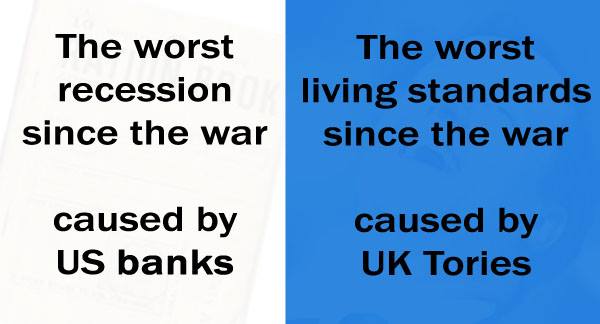
Oh, the irony of Cameron trying to blame the “global economy” for the utter mess of the UK economy that his party has created. (Well, unless you are a millionaire, then it’s all a pretty good mess, actually.) Cameron’s mess is an entirely homegrown one, and is entirely down to his policies. Worse still, no matter how desperate things get, his message to the UK is that the only solution is to stick to his plan – more austerity – the plan that has created the problems in the first place.

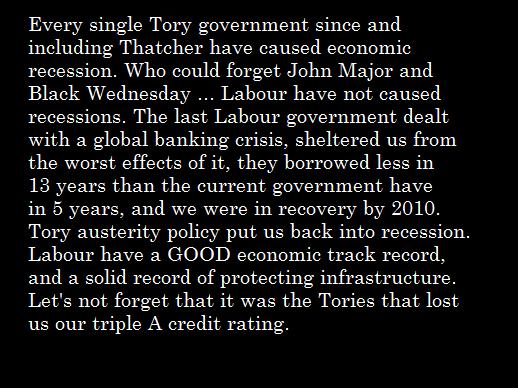
Labour dealt with the global banking crisis without the need for austerity, and had steered the UK out of recession by 2009/10, Cameron, and his government caused a homegrown recession just like Thatcher and Major did, through redistributing public wealth to private pockets and offshore bank accounts.

The Conservative’s “long term economic plan” is to continue transferring public funds to private bank accounts. Not for the benefit of the economy, or the public, but for the sole benefit of hoarding millionaires and Tory donors who are sucking our public funds out of circulation and killing the economy.

“Trickle-down economics” is a term imported from the US, to refer to the idea that tax breaks and other economic benefits provided to businesses and upper income levels of society will benefit poorer citizens by improving the economy as a whole. It’s linked with Laissez-faire ideology.

Laissez-faire is basically the theory of Conservative/Liberal governments that uphold the apparent autonomous character of the economic order, believing that government should not intervene in the direction of economic affairs. “Free markets” and “free competition” are seen as a reflection of the natural system of liberty.

From a Laissez-faire perspective, the State has no responsibility to engage in positive intervention to promote equality through wealth distribution or to create a welfare state to protect people from poverty, instead relying on charity to provide poor people with relief. I rather suspect this is what Cameron means by “big society”.

The claim that people who have their taxes lowered, with greater wealth, will distribute their benefit to less wealthy individuals, so that a fraction will reach the general population and stimulate the economy, is of course completely unfounded and absurd. It’s worth noting that proponents of the policy generally do not use the term “trickle-down” themselves. But the underpinning assumptions of trickle-down theory are implicit in the rhetoric of Laissez-faire/supply-side economics, and clearly expressed in social policy.

The phrase “trickle-down” has been attributed to humorist Will Rogers, who originally said of the US New Deal (the response to the Great Depression of 1930s) that “money was all appropriated for the top in hopes that it would trickle down to the needy.”

It’s original use was entirely pejorative and it was drawn on as a lampoonery device .

The Depression of the 1930s profoundly influenced our theories of economics and resulted in many changes in how governments dealt with economic downturns, and the subsequent widespread poverty, such as the use of stimulus packages, Keynesian economics, and Social Security, manifested in our post-war settlement.

Cameron is dismantling those civilised foundations we built, using the malfeasance of his own administration – austerity – and of the finance sectors that caused the global crash, as an excuse to drive their prize ultra-conservative Ayn Rand ideology into manifest existence – the withdrawal of State support for anyone who may need it. For those that don’t, the State is there as your best buddy, and will continue to intervene on your behalf to feed you great gifts.

For a party claiming to reduce the State and reduce interventions, they sure intervene a lot. Talk about an Adam Smith sleight of hand…with one “invisible hand” they take money from the poor, by introducing policies that purposefully cut income and public services, and with the other, they hand out our money to the millionaires.(See: Follow the Money: Tory Ideology is all about handouts to the wealthy that are funded by the poor.)

The trickle-down theory is not a genuine feature of the economy, but an illusion maintained by Conservatives to fool the poor into believing that there is opportunity for social mobility, and to excuse their miserly, cruel cuts to the poor, and generosity to those that don’t actually need it. It’s political hocus-pocus.

What we need, as history has taught us, is broad fiscal policies that are directed across the entire economy, and not toward just one specific income  group: that merely condenses wealth into the private bank accounts of a few, reducing the entire economy and society to a few stagnant pools of hoarding greed. It also reflects the implicit Conservative advocacy of Social Darwinist philosophy, with the “market place” absurdly operating as “natural law”, generating a socioeconomic hierarchy.

A 2012 study by the Tax Justice Network indicates that wealth of the super-rich does not trickle down to improve the economy, but tends to be amassed and sheltered in tax havens with a negative effect on the tax bases of the home economy. (See: Wealth doesn’t trickle down – it just floods offshore, research reveals.)

The trickle down theory and Laissez-faire philosophy formed the basis of economic policy during the industrial revolution of the 1800s.  It didn’t work then either, in the wake of widespread absolute poverty resulting from deeply exploitatively low wages combined with very dangerous work environments, it became evident that exclusively Laissez-faire economic attitudes resulted in the political engineering and endorsement of exploitation and harsh mistreatment of citizens. It shortened people’s lives and reduced most citizens to a harsh, miserable existence. It was a time when economic theory was mistranslated into a social doctrine of”survival of the fittest.”

Conservatives: the more things change, the more they stay the same.

Bloody Feudalists.

As Hilary Mantel observed this week, the Tory-led Coalition are more brutal towards the poor and vulnerable than Thomas Cromwell was, she said that the Middle Ages appeared a positively enlightened era compared to the “retreat into insularity” which the UK had currently embraced. Mantel summed up criticism of this Government’s regressive justification narratives very well:

The government portrays poor and unfortunate people as being morally defective. This is a return to the thinking of the Victorians. Even in the 16th century, Thomas Cromwell was trying to tell people that a thriving economy has casualties and that something must be done by the state for people out of work.

“Even back then, you saw the tide turning against this idea that poverty was a moral weakness.”

Of course we know that poverty is caused entirely by Government policies. And if you didn’t know that, then ask yourself how the following policies could possibly cause anything but inequality and increasing poverty for the poorest:

These cuts, aimed at the poorest, came into force in April 2013:

  • 1 April – Housing benefit cut, including the introduction of the bedroom tax
  • 1 April – Council tax benefit cut
  • 1 April – Legal Aid savagely cut
  • 6 April – Tax credit and child benefit cut
  • 7 April – Maternity and paternity pay cut
  • 8 April – 1% cap on the rise of in working-age benefits (for the next three years)
  • 8 April – Disability living allowance replaced by personal independence payment (PIP)
  • 15 April – Cap imposed on the total amount of benefit working-age people can receive.

At the same time, note the Tory “incentives” for the wealthy:

  • Rising wealth – 50 richest people from this region increased their wealth by £3.46 billion last year to a record £28.5 billion.
  • Falling taxes – top rate of tax cut from 50% to 45% for those earning over £150,000 a year. This is 1% of the population who earn 13% of the income.
  • No mansion tax and caps on council tax mean that the highest value properties are taxed proportionately less than average houses.
  • Benefited most from Quantitative Easing (QE) – the Bank of England say that as 50% of households have little or no financial assets, almost all the financial benefit of QE was for the wealthiest 50% of households, with the wealthiest 10% taking the lions share
  • Tax free living – extremely wealthy individuals can access tax avoidance schemes which contribute to the £25bn of tax which is avoided every year, as profits are shifted offshore to join the estimated £13 trillion of assets siphoned off from our economy.
  • Millionaires were awarded a “tax break” of £107,000 each per year.
  • The richest 1,000 in UK double their wealth since crash while average incomes drop 6%

That most definitely does not indicate any “trickle-down” of wealth.

It was noted by the Keynsian economist John Kenneth Galbraith, adviser to President John F. Kennedy, that trickle down theory was originally less elegantly called the “horse and sparrow” theory in the 1800s.

The original theory was based on the idea that if you feed a horse enough oats, it will shit enough to feed a lot of sparrows.

And the Conservatives are certainly feeding us horse shit.

10407927_677369232332608_5384979058089243718_n


Related

The Great Debt Lie and the Myth of the Structural Deficit

Conservatism in a nutshell

The World At One, Radio 4, 17th November, 2014“The economic situation explained in 3 minutes.Tory austerity has given us the slowest recovery since the South Sea Bubble.Professor David Blanchflower absolutely slaughters Cameron over his pre-excuse warning over the world economy, he blames Tory austerity for tanking Britain’s economy and preventing a recovery, and states that any recovery we do have is simply part of the cycle as long as you don’t wreck it with austerity, and confirms that our economy was on the RISE in 2009 / 2010.” Robert Livingstone.

Some highlights of the Conservative long term economic plan so far:

540525_186110078206715_79170441_nFitch and Moody triple A credit rating lost
1390648_548165358586330_1740107407_nThe return of absolute poverty and Victorian malnutrition-related illnesses, such as rickets and scurvy.
10001887913_f8b7888cbe_oAusterity was never about “paying down the debt”, that was a Tory lie: it is entirely about “raising more money for the rich“.
1374847_539931546076378_846200727_n
This is conservatism in a nutshell

482882_456712161064984_1212213617_nConservative socio-economic ideology is incompatible with human rights.

1379986_541109785958554_2049940708_n

Many thanks to Robert Livingstone for his persistence in exposing the Tory lies and hypocrisy in his pictures.


Aktion Arbeitsscheu Reich, Human Rights and infrahumanisation

1379986_541109785958554_2049940708_n

The European Convention on Human Rights, which came into force on 3 September 1953, guarantees a range of political rights and freedoms of the individual against interference by the State. The Convention came about as an international response to the horrors of World War Two, and the Holocaust.

Before the incorporation of the Convention, people in the United Kingdom could only complain of unlawful interference with their Convention rights by lodging a petition with the European Commission of Human Rights in Strasbourg. That all changed on 2 October 2000 when Labour’s Human Rights Act 1998 came into force, allowing UK citizens to sue public bodies for violations of their Convention rights in domestic courts.

David Cameron wants to scrap the Human Rights Act and has pledged to leave the European Convention. Human Rights are the bedrock of any democracy. He also wants to scrap consultations, impact assessments, audits, judicial reviews: all essential safeguards for citizens and mechanisms of democracy. 

Government policies are expressed political intentions, regarding how our society is organised and governed. They have calculated social and economic aims and consequences.

How policies are justified is increasingly being detached from their aims and consequences, partly because democratic processes and basic human rights are being disassembled or side-stepped, and partly because the government employs the widespread use of propaganda to intentionally divert us from their aims and the consequences of their ideologically (rather than rationally) driven policies. Furthermore, policies have become increasingly detached from public interests and needs.

A clear example of an ideologically-driven policy is the Welfare “Reform” Act, which is founded on a stigmatising, Othering narrative: benefit recipients are portrayed as the enemy that battles against fairness and responsibility. The mythological economic “free-rider,” a “burden on the state.” The “reforms” left people in receipt of lifeline benefits much worse off than they were, the word reform has been used as a euphemism for cuts.

Iain Duncan Smith’s Department for Work and Pensions  (DWP) has launched a new propaganda scapegoating  advertising campaign encouraging people to phone a hotline if they suspect somebody they know is fraudulently claiming benefits.

I’m sure that serious fraudulent claimants inform their friends and neighbours of their every activity, including holidays, sleeping arrangements, moments of intimacy and all of their benefit payment details, all the time, so that makes sense…

Mark Harper said: “Those who cheat the system need to know we will use everything in our power to stop them stealing money from hardworking taxpayers.”  

Yet we know that there isn’t a real distinction between benefit claimants and hard-working taxpayers, as the Tories would have us believe. Many people on benefits are also in work, but are not paid a sufficient wage to live on. Most people claiming benefits, including disabled people, have worked and contributed income tax previously.

It’s worth bearing in mind that the poorest citizens, including people claiming benefits, pay proportionally more indirect taxes than the wealthiest citizens, such as VAT. The strivers/skivers rhetoric is simply a divert, divide and scapegoating strategy. Growing social inequality evidently generates a political necessity for creating scapegoats and cultivating prejudices.

The real cost of out-of-work benefits is over-estimated in relation to the welfare bill for pensions and in-work benefits such as tax credits and housing benefit, obscuring the increasing role that the British state plays in subsidising the scandalously low wages paid by increasingly exploitative employers, in order to meet a minimum standard of living for the hardworking.

The hardworking taxpayer myth is founded on a false dichotomy, since it is estimated that around 70% of households claim benefits of one kind or another at some point in their lives. In the current climate of poor pay, poor working conditions, job insecurity, and high living costs, the myth of an all pervasive welfare-dependent something for nothing culture is being used to foster prejudice and resentment towards those unfortunate enough to be out of work. It also serves to bolster right-wing justification narratives that are entirely ideologically driven, which are aimed at dismantling the welfare state, while concurrently undermining public support for it.

As the Huff Post’s Asa Bennett points out, there are much bigger costs to the taxpayer that the government are reluctant to discuss.

For example, the tax gap, charting the estimated amount of taxes unpaid thanks to evasion, avoidance, error and criminality, soared to £34 billion, according to HM Revenue and Customs. This equates to £1 in every £15 owed in taxes not being collected last year.

The National Audit Office found that the Department for Work and Pensions had made £1.4 billion in declared benefit overpayments, an increase of nearly 6%.

Meanwhile, the DWP estimate that between £7.5 billion and £12.3 billion of the six main benefits it administered were left unclaimed in 2009/2010. On top of that. HMRC suggest that several billion pounds more is most in unclaimed tax credits, with childless families missing out on £2.3 billion worth. That’s a grand total of 22.1 billion that ordinary taxpayers aren’t claiming, even though they are entitled to do so. 

Iain Duncan Smith’s Department have wasted an estimated total of £6,221,875,000.00 of taxpayers’ money on the implementation of Universal Credit and private company contracts, amongst other things. (See We can reduce the Welfare Budget by billions: simply get rid of Iain Duncan Smith ). 

Duncan Smith’s claims that his policies are about fairness and saving taxpayers’ money, simply don’t stand up to scrutiny. 

The policies are entirely ideologically-driven. We have a government that uses words like workshy to describe vulnerable social groups. This is a government that is intentionally scapegoating poor, unemployed, disabled people and migrants. One Tory councillor called for the extermination of gypsies, more than one Tory MP has called for illegal and discriminatory levels of pay for disabled people. A conservative deputy mayor said, unforgivably, that the “best thing for disabled children is the guillotine.”

These weren’t “slips”, it’s patently clear that the Tories believe these comments are acceptable, and we need only look at the discriminatory nature of policies such as the legal aid bill, the wider welfare “reforms” and research the consequences of austerity for the most economically vulnerable citizens – those with the “least broad shoulders” –  to understand that these comments reflect how conservatives think.

This is a government that is using public prejudice to justify massive socio-economic inequalities and their own policies that are creating a steeply hierarchical society based on social Darwinist survival of the fittest neoliberal “small state” principles.

The Tory creation of socio-economic scapegoats, involving vicious stigmatisation of vulnerable social groups, particularly endorsed by the mainstream media, is simply a means of manipulating public perceptions and securing public acceptance of the increasingly punitive and repressive basis of the Tories’ welfare “reforms”, and the steady stripping away of essential state support and provision.

The political construction of social problems also marks an era of increasing state control of citizens with behaviour modification techniques, (under the guise of paternalistic libertarianism) all of which are a part of the process of restricting access rights to welfare provision and public services.

The mainstream media has been complicit in the process of constructing deviant welfare stereotypes and in engaging prejudice and generating moral outrage from the public:

“If working people ever get to discover where their tax money really ends up, at a time when they find it tough enough to feed their own families, let alone those of workshy scroungers, then that’ll be the end of the line for our welfare state gravy train.” James Delingpole 2014

Delingpole conveniently fails to mention that a majority of people needing lifeline welfare support are actually in work. He also fails to mention that while this government were imposing austerity on the poorest citizens, the wealthiest got generous handouts from the Treasury, in the form of tax breaks – hundreds of thousands of pounds each per year. 

Poverty cannot be explained away by reference to simple narratives of the workshy scrounger as Delingpole claims, no matter how much he would like to apply such simplistic, blunt, stigmatising, dehumanising labels that originated from the Nazis (see arbeitssheu.)

This past four years we have witnessed an extraordinary breakdown of the public/private divide, and a phenomenological intrusion on the part of the state and media into the lives of the poorest members of society. (For example, see: The right-wing moral hobby horse: thrift and self-help, but only for the poor. ) Many people feel obliged to offer endless advice on thrift and self help aimed at persuading poor people to “manage” their poverty better.

Hannah Arendt wrote extensively about totalitarian regimes, in particular Nazism and Stalinism, which she distinguishes from Italian Fascism, because Hitler and Stalin sought to eliminate all restraints upon the power of the State and furthermore, they sought to dominate and control every aspect of everyone’s life. There are parallels here, especially when one considers the continued attempts at dismantling democratic processes and safeguards since the Coalition took office.

Many policies are aimed at ‘incentivising’ certain behaviours and perceptions of citizens, using psychology to align them with political and defined economic goals. Citizens are increasingly seen by government as a means to an end.

Further parallels may be found here: Defining features of Fascism and Authoritarianism

Between February 1933 and the start of World War Two, Nazi Germany underwent an economic “recovery” according to the government. Rather like the “recovery” that Osborne and Cameron are currently claiming, which isn’t apparent to most citizens.

This economic miracle, sold to the people of Germany, entailed a huge reduction in unemployment. However, the main reason for this was fear – anyone who was found guilty of being “workshy” (arbeitssheucould then be condemned to the concentration camps that were situated throughout Germany. Hitler frequently referred to the economic miracle, whilst people previously employed in what was the professional class were made to undertake manual labour on the autobahns. People didn’t refuse the downgraded status and pay, or complain, lest they became Arbeitsscheu Reich compulsory labor camp prisoners, and awarded a black triangle badge for their perceived mental inferiority and Otherness.

Behaviour can be controlled by manipulating fear, using a pattern of deprivation. Benefit sanctions, for example, leave “workshy” people without the means to meet their basic survival needs and are applied for periods of weeks or months and up to a maximum of 3 years.

That the government of a so-called first world liberal democracy is so frankly inflicting such grotesquely cruel punishments on some of our most vulnerable citizens is truly horrific. It’s also terrifying that the media and the British public are complicit in this: they fail to recognise that the Social Darwinism inherent in Tory ideological grammar is being communicated through discourses and policies embodying crude behaviour modification techniques and an implicit eugenic subtext .

There were various rationales for the Nazi Aktion T4 programme, which include eugenics, Social Darwinism, racial and mental “hygiene”, cost effectiveness and the welfare budget.

Those involved with the operation of the Aktion T4 programme used the term euthanasia as bureaucratic cover, in the minimal public relations effort to invest what was essentially eugenics. It is clear that none of the killing was done to alleviate pain or suffering on the part of the victims. Rather, the evidence, including faked death certificates, deception of the victims and of the victims’ families, and widespread use of cremation, indicates the killing was done solely according to the socio-political aims and ideology of the perpetrators. The Nazis believed that the German people needed to be “cleansed” of the so-called racial enemies, but the Aktion T4 programme also included people with disabilities, the poor and the workshy.  

Although many were gassed using carbon monoxide or killed by lethal injection, many more of these people deemed “life unworthy of life” were simply starved to death.

The Holodomor – “extermination by hunger” –  was Joseph Stalin’s intentionaly inflicted famine, designed to destroy  people in the Ukraine seeking independence from his rule. As a result, an estimated 7,000,000 people starved to death. The attitude of the Stalinist regime in 1932–33 was that many of those starving to death were “counterrevolutionaries”idlers” or “thieves” who “fully deserved their fate”. In 2008, the European Parliament adopted a resolution that recognised the Holodomor as a crime against humanity.

Implementing policies that lead to members of vulnerable social groups starving, which is an INTENTIONAL political act, however, is not currently included in the UN Treaty definition of genocide. Nor are disabled people amongst the categories of groups protected by the Convention on the Prevention and Punishment of the Crime of  Genocide.

While I am very aware that we need take care not to trivialise the terrible events of Stalinist Russia and Nazi Germany by making casual comparisons, there are some clear and important parallels on a socio-political level and a psycho-social one, that I feel are crucially important to recognise.

Gordon Allport studied the psychological and social processes that create a society’s progression from prejudice and discrimination to genocide. In his research of how the Holocaust happened, he describes socio-political processes that foster increasing social prejudice and discrimination and he demonstrates how the unthinkable becomes tenable: it happens incrementally, because of a steady erosion of our moral and rational boundaries, and propaganda-driven changes in our attitudes towards politically defined others, that advances culturally, by almost inscrutable degrees.

The process always begins with political scapegoating of a social group and with ideologies that identify that group as the Other: an “enemy” or a social “burden” in some way. A history of devaluation of the group that becomes the target, authoritarian culture, and the passivity of internal and external witnesses (bystanders) all contribute to the probability that violence against that group will develop, and ultimately, if the process is allowed to continue evolving, extermination of the group being targeted.

Economic recession, uncertainty and political systems on the authoritarian -> totalitarian spectrum contribute to shaping the social conditions that seem to trigger Allport’s escalating scale of prejudice.

In the UK, the media is certainly being used by the right-wing as an outlet for blatant political propaganda, and much of it is manifested as a pathological persuasion to hate others. The Coalition clearly have strong authoritarian tendencies, and that is most evident in their anti-democratic and behaviourist approach to policy, human rights, equality, social inclusion and processes of government accountability.

Vulnerable groups are those which our established principles of social justice demand we intervene to help, support and protect. However, the Coalition’s rhetoric is aimed at a deliberate identification of citizens as having inferior behaviour. The poorest citizens are presented as a problem group because of their individual faulty characteristics, and this is intentionally diverting attention from  wider socio-economic and political causes of vulnerability. Individual subjects experiencing hardships have been placed beyond state protection and are now the objects of policies that embody behaviourism, and pathologising, punitive and coercive elements of social control. Vulnerable people are no longer regarded as human subjects, the state is acting upon them, not for or on behalf of them.

People are still debating if Stalin’s Holodomor conforms to a legal definition of genocide, no-one doubts that Hitler’s gas chambers do, though Hitler also killed thousands by starvation.

Our own government have formulated and implemented policies that punish unemployed people for being “workshy” – for failing to meet the never-ending benefit conditionality requirements which entails the use of negative incentives, coercion and behaviour modification to “support” a person into  work –  by withdrawing their lifeline benefit. We also know that sanction targets have led to many people losing lifeline benefits for incoherent and grossly unfair reasons that have nothing to do with an unwillingness to cooperate or work.

Since benefits were originally calculated to meet basic living requirements – food, fuel and shelter – it’s  inconceivable that the government haven’t already considered the consequences of removing people’s means of meeting these fundamental survival needs. Of course, the Tory claim that this draconian measure is to incentivise people to “find work” doesn’t stand up to scrutiny when we consider that there isn’t enough work for everyone, and certainly not enough work around that pays an adequate amount to actually survive on.

Furthermore, the Tories “incentivise” the  wealthy by rewarding them with more money (such as the £107,000  tax break that was handed out to each millionaire every year from our own taxes by Osborne). It flies in the face of our conventional and established wisdom that reducing people to starvation and desperation will somehow motivate people to do anything other than to try and survive. (See Maslow’s Hierarchy, and two tragic accounts of the consequences of imposed sanctions.)

Tory austerity is all about ideology – the dehumanisation of the poor, and the destruction of public services and provisions – state infrastructure – and nothing to do with the state of the economy. It’s also about cutting money from the poorest and handing it to the wealthiest. Many economists agree that austerity is damaging to the economy.

There has been a media complicity with irrational and increasingly punitive Tory policies. But why are the public so compliant?

Decades of  research findings in sociology and psychology inform us that as soon as a group can be defined as an outgroup, people will start to view them differently. The very act of demarcating groups begins a process of ostracisation.

As well as the political and social definitions of others, there also exists deeper, largely unconscious beliefs that may have even more profound and insidious effects. These are related to whether people claiming benefits are even felt to be truly, properly human in the same way that “we” are.

This is called infrahumanisation. Infra means “below”, as in below or less than fully human. The term was coined by a researcher at the University of Louvain called Jacque-Philippe Leyens to distinguish this form of dehumanisation from the more extreme kind associated with genocide.

However, I don’t regard one form of dehumanisation as being discrete from another, since studies show consistently that it tends to escalate when social prejudice increases. It’s a process involving accumulation.

According to infrahumanisation theory, the denial of uniquely human emotions to the outgroup is reflective of a tacit belief that they are less human than the ingroup.

Poor people, homeless people, drug addicts and welfare claimants are the frequently outgrouped. It is these most stigmatised groups that people have the most trouble imagining having the same uniquely human qualities as the rest of us. This removes the “infrahumanised” group from the bonds, moral protection and obligations of our community, because outgrouping de-empathises us.

This would explain why some people attempt to justify the cuts, which clearly fall disproportionately on the most vulnerable. This is probably  why fighting the austerity cuts is much more difficult than simply fighting myths and political propaganda. I think the government are very aware of the infrahumanisation tendency amongst social groups and are manipulating it, because growing social inequality generates a political necessity for social prejudices to use as justification narratives.

During a debate in the House of Lords, Freud described the changing number of disabled people likely to receive the employment and support allowance as a bulge of, effectively, stock”. After an outraged response, this was actually transcribed by Hansard as “stopped”, rendering the sentence meaningless.  He is not the only person in the Department for Work and Pensions who uses this term. The  website describes disabled people entering the government’s work programme for between three and six months as 3/6Mth stock.

This infrahumanised stock are a source of profit for the companies running the programme. The Department’s delivery plan recommends using  credit reference agency data to cleanse the stock of fraud and error.

The linguistic downgrading of human life requires dehumanising metaphors: a dehumanising socio-political system using a dehumanising language, and it is becoming familiar and pervasive: it has seeped almost unnoticed into our lives.

Until someone like Freud or Mellins pushes our boundaries of decency a little too far. Then we suddenly see it, and wonder how such prejudiced and discriminatory comments could be deemed acceptable and how anyone could possibly think they would get away with such blatantly offensive rhetoric without being challenged. It’s because they have got away with less blatantly offensive comments previously: it’s just that they pushed more gently and so we didn’t see.

It’s also the case that the government distorts people’s perceptions of the  aims of their policies by using techniques of neutralisation. An example of this method of normalising prejudice is the use of the words “incentivise” and “help” in the context of benefit sanctions, which as we know are intentionally extremely punitive, and people have died as a consequence of having their lifeline benefit withdrawn.

As Allport’s scale of prejudice indicates, hate speech and incitement to genocide start from often subliminal expressions of prejudice and subtle dehumanisation, which escalate. Germany didn’t wake up one morning to find Hitler had arranged the murder of millions of people. It happened, as many knew it would, and was happening whilst they knew about it. And many opposed it, too.

The dignity and equal worth of every human being is the axiom of international human rights. International law condemns statements which deny the equality of all human beings.

As a so-called civilised society, so should we.
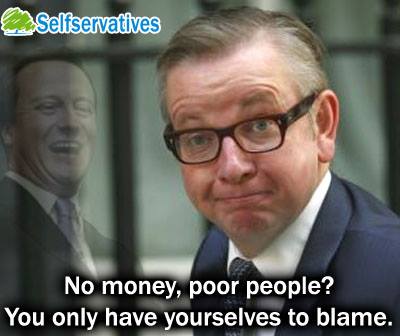
526544_532055030197363_2137237288_n
Pictures courtesy of Robert Livingstone

David Freud was made to apologise for being a true Tory in public

1459165_266124213538634_1461740450_n

Lord Freud, a Conservative Welfare Reform Minister, has admitted comments he made that some disabled people are  not worth” the full national minimum wage”  were “offensive”, after they were disclosed by Ed Miliband during Prime Minister’s Questions yesterday afternoon. The Labour leader has called on the Tory peer to resign. Cameron called for a full apology from Freud.

He has since apologised after slipping up and suggesting that disabled people are “not worth” the national minimum wage and some could only be paid “£2 an hour.” Cameron says the comments made by Lord Freud at the Tory conference do not represent the views of government. However, his austerity measures and the welfare “reforms” tell us a very different story.

Cameron betrayed his anger at being challenged when he once again alluded to his severely disabled late son, Ivan, and his late father, as he told Miliband that he would take no lectures on disabled people.

This is not the first time that the prime minister has used his son in anger, as a tactic designed to cause others emotional discomfort, deflect criticism and to avoid answering difficult questions regarding this government’s harsh and punitive policies towards disabled people.

The Labour leader quoted Freud, saying: “You make a really good point about the disabled. There is a group where actually, as you say, they’re not worth the full wage.”

Amidst cries of “outrage” and “shame” from the Labour benches, Mr Miliband said: “To be clear about what the Welfare Reform Minister said, it’s very serious. He didn’t just say disabled people weren’t worth the minimum wage, he went further and he said he was looking at whether there is something we can do, if someone wants to work for £2 an hour.”

He added: “Surely someone holding those views can’t possibly stay in your Government?”

Cameron said: “Those are not the views of the government, they are not the views of anyone in the government. The minimum wage is paid to everybody, disabled people included.”

Clearly very angry, the prime minister added: “Let me tell you: I don’t need lectures from anyone about looking after disabled people. So I don’t want to hear any more of that. We pay the minimum wage, we are reforming disability benefits, we want to help disabled people in our country, we want to help more of them into work. And instead of casting aspersions why doesn’t he get back to talking about the economy.”  

Once again, note the rhetorical diversionary tactics that Cameron used.

Miliband responded: “I suggest, if he wants to protect the rights of disabled people, he reads very carefully what his welfare minister has said because they are not the words of someone who ought to be in charge of policy related to disabled people.

“In the dog days of this government the Conservative party is going back to its worst instincts – unfunded tax cuts, hitting the poorest hardest, now undermining the minimum wage. The nasty party is back.”

In the Guardian said: We are in the climate of the Work Programme  and  employment and support allowance travesties, in jobseeker’s allowance sanctions and personal independent payment delays.

Coerced, free labour and a shrinking, ever conditional benefit system. Freud has not spoken out of turn, but encapsulated Conservative attitudes to both disabled people and workers: pay them as little as possible and they will be grateful for it.

The Tories are not content with forcing disabled people into work. They want to pay them a pittance when they get there. I suppose we can thank Freud. The government has been producing enough measures that infers disabled people are slightly less than human. He’s finally said it out loud.”

I couldn’t agree more. Freud’s comments are simply a reflection of a wider implicit and fundamental Social Darwinism underpinning Tory ideology, and even Tim Montgomerie, who founded the Conservative­Home site has conceded that: “Conservative rhetoric often borders on social Darwinism…and has lost a sense of social justice.”

Of course the problem with such an ideological foundation is that it directly contradicts the basic principles that modern, western democracy was founded on, it is incompatible with our Human Rights Act, which enshrines the principle that we are each of equal worth. And our Equality Act, introduced by Labour to ensure that people are not discriminated against on the grounds of their disability, gender, age and a variety of other protected characteristics.

Sam Bowman, research director of the Adam Smith Institute, has said that Freud was “shamefully mistreated” by Labour leader Ed Miliband.

The Adam Smith Institute – a think tank that promotes Conservative “libertarian and free market ideas”, minarchism and claims it is:“known for its pioneering work on privatization, deregulation, and tax reform, and for its advocacy of internal markets in healthcare and education, working with policy-makers”  – has, perhaps unsurprisingly, defended Lord Freud’s disgraceful comments regarding striving disabled workers.

Mr Bowman said: “His (Freud’s) point was that the market value of some people’s wages is below the minimum wage. This is often true of the severely disabled and can have appalling consequences for their self-esteem and quality of life.”

He added: “To point out that someone’s market value is less than minimum wage has nothing to do with their moral value as human beings.”

I beg to differ. We have a government that claims meritocratic principles define those who are worthy and deserving of wealth.We have a government that generates socially divisive narratives founded on ideological dichotomies like strivers and skivers. We have a government that systematically disregards the human rights of disabled people. Their very policies define the moral value they attribute to the poor, disabled people and the wealthy, respectively. This defence is based on a false distinction, because the Tories conflate market value and moral value explicitly, their policies are evidence of that.

The think tank president, Madsen Pirie,  once said: “We propose things which people regard as being on the edge of lunacy. The next thing you know, they’re on the edge of policy.”  

This group of neoconservatives brought you the fundamentals of Thatcher’s poll tax, the Adam Smith Institute was also the ideological driving force behind the sales of council house stock. If you need any further convincing of their Tory credentials, then their proposals that the National Health Service should establish an internal market with hospitals buying the use of facilities from other districts and from the private sector ought to be sufficient.

The Institute has always been a fierce critic of the NHS, it thinks that the government should only regulate healthcare and that healthcare should be privately funded and privately provided by private sector companies. The Adam Smith Institute said: Congratulations to the new Health Secretary Andrew Lansley, for what could be the biggest revolution in the UK’s state-run National Health Service for 60 years. 

Also recommended by this group of privatisation vultures was an internal market system for UK schools that would have (reduced) state funds to follow students to independently run academic institutions. This approach to school funding is now Coalition policy. Following the Institute’s call for the use of private businesses by local governments, many council-run local services, such as waste collection and cleaning, were contracted out. Additionally, local governments are now required to solicit competitive bids for local services.

And it was this group of Hayek-worshipping, pro-exploitation neofeudalists, who don’t declare their funding sources, that called for a radical shake-up of welfare policy, which would make work requirements absolutely central to the benefits system. These proposals subsequently became Tory policy.

And who could forget their peddling of unfettered free markets and trade as an objection to fair trade?

In the UK and elsewhere, such Conservative neoliberal ideas have drastically changed how states operate. By heavily promoting market-based economies that highly value competition and efficiency, such neoliberalist economies have moved countries to retrogressively adopting Social Darwinist philosophies to prop up free market “logic”. 

Bourdieu (1999) contends that neoliberalism as a form of national governance has become a doxa, or an unquestioned and simply accepted world-view.(See also Manufacturing consensus: the end of history and the partisan man.)

Harvey (2005) is not surprised that the ideas of capitalism have been infused into political, social, and cultural institutions at state-level. By placing a mathematical quality on social life, the neoconservatives have encouraged a formerly autonomous state to regress into penal state that values production, competition, and profit above all else, and social issues and consequences are increasingly disregarded.

Tories view their brand of economics as a social science that is capable of explaining all human behaviours, since all social agency is thought to be directed by a rationale of individualistic and selfish goals. And the focus on the individual means that ideas related to concepts such as “the public good” and realities such as “the community” are now being discarded as unnecessary components of a welfare state.

Unsurprisingly, then, high unemployment, gross inequality, and increasingly absolute poverty are increasingly blamed on individuals rather than on structural/economic constraints.

Tory economic policy is designed to benefit only a very small class of people. Such a world-view also makes it easier to justify the thought that some people are deserving of much more than others because, after all, it is a common refrain that we are all responsible for our own destinies. (See the just-world fallacy.)

Freud’s comment was not a momentary lapse, nor was it unrepresentative of Tory views more generally. He is the contemptuous architect of the grossly punitive Tory Bedroom Tax that disproportionately affects households of disabled people. The Tories endorsed Freud’s discriminatory policy proposal, and savagely ridiculed the UN rapporteur, Raquel Rolnik, when she pointed out, very professionally and reasonably, that the policy contravened human rights.

He is the same government minister that rejected suggestions that austerity policies have led to an increase in food bank use – making the jaw-droppingly astonishing suggestion that food bank charities are somehow to blame. This former investment banker and peer told the Lords that the increase in the usage of food banks was “supply led”.

He said: “If you put more food banks in, that is the supply. Clearly, food from the food banks is a free good and by definition with a free good there’s almost infinite demand.”

Poverty reduced to individual neoliberal motivational formulae. Yet it is the government that are responsible for policies that create and sustain inequality and poverty.

In the wake of the longer wait for unemployment benefits introduced by George Osborne, a massive increase in the use of cruel benefit sanctions, the introduction of the mandatory review, during which benefits are not payable to disabled people, Freud also rejected suggestions by leading food bank operators that delays in benefit payments drove demand for emergency food aid.

Such brutal, dehumanising and inequitable treatment of our most vulnerable citizens cannot be regarded as an exceptional incident: the Tories have formulated policies that have at their very core the not so very subliminal message that we are worthless and undeserving of support, basic honesty and decency.

Social Darwinism, with its brutalising indifference to human suffering, has been resurrected from nineteenth century and it fits so well with the current political spirit of neoliberalism. As social bonds are replaced by narcissistic, unadulterated materialism, public concerns are now understood and experienced as utterly private miseries, except when offered up to us on the Jerry Springer Show or Benefit Street as spectacle.

The Tories conflate autonomy (the ability to act according to our own internalised beliefs and values) with independence (not being reliant on or influenced by others). Tories like Freud have poisoned the very idea that we are a social species, connected by mutual interdependencies that require a degree of good will, kindliness and willingness to operate beyond our own exclusive, strangle hold of self-interest.

The time has come to ask ourselves what possible benefit to society such a government actually is – what use is an authoritarian, punitive state that is more concerned with punishing, policing and reducing citizens than with nurturing, supporting and investing in them?

224079_411432638926270_715135125_n

Tory Values Explained In One Easy Chart

Conservatism in a nutshell

Image result for Theresa May poor wages
It’s not enough to challenge Tory ideology. We also have to dismantle the Orwellian semantic thrifts and shifts. We have to defeat the Tory propaganda machine that lies, persuades and lulls people with meaningless populist slogans, empty glittering generalities and glib catch-phrases.

You’ve heard those slogans – “less government”, “personal responsibility”, “hard-working families”, “making work pay” and lots of nationalist flag waving. These are shorthand messages to the public that are thrifty with the truth, codifications for an entire world-view. But it’s ever such a shabby, ruthless, isolating and paltry one.

1209102_539900659412800_1664499134_n

The clue is in the name: the word “Tory” derives from the Middle Irish word tóraidhe, which means outlaw, robber or brigand, from the Irish word tóir, meaning “pursuit”, since outlaws were “pursued men”. It was originally used to refer to an Irish outlaw and later applied to Confederates or Royalists in arms. The term was originally one of abuse.

The Tories live by plundering. They steal your taxes, your public services, your state provision and your labour in order to raise more money for the rich. They have reneged on our post war democratic settlement. Legal aid, human rights, social housing, the NHS, lifeline welfare support – the essential components of any functioning democracy – are being viciously and systematically dismantled by the Tories. 

It’s a dystopic world of corporate fiefdom. I heard a very smart person from the States once sum up the Tories neatly with the phrase “cheap-labour conservatism”. How very apt. It fits so well. It makes sense of such a lot.

Basically, the larger the labour supply, the cheaper it is. The more desperately you need a job, the less you tend to demand for your wages to be fair, and the more power those big business Tory buddies have over you. This is what the Tories actually mean by “making work pay” – it’s either rationed out peanuts or starvation. But for big business, your work pays them handsomely in fat profits.

The Tories engineer this same socioeconomic situation every time they are in office. Think back to the Thatcher era, she did it, Major did it – it’s a manufactured recession and a large reserve army of cheap labour every time. ALWAYS the same with the Tories. Because it suits their “business friendly” agenda.

That’s another Tory slogan that means corporate greed, profit before people and Tory donations – see the Beecroft Report, for example, written by a British “venture capitalist” that has donated more than £500,000 to the Conservative Party. The overdogs write policies to make sure that we remain the underdogs. Fat profits are all that matter to the vulture capitalists. 

Beecroft is currently Chairman of Dawn Capital. The release in May 2012, of the long awaited Beecroft Report in the UK caused considerable controversy because it recommended that the government should “cut red tape” in order to make the hiring and firing of employees easier and cheaper.

The report claimed this would help to ‘boost’ the economy although no evidence for this was provided. It’s hard to imagine how increasing job insecurity would encourage workers to spend their money. It does, however, help boost profits for venture  vulture capitalists, and the government-commissioned report strips workers of their rights.

As the TUC said at the time, the ideas have taken the UK back towards Victorian era working conditions and standards. Conservatives don’t like social spending or welfare – our safety net. The safety net we funded. That’s because when you’re unemployed and desperate, companies can pay you whatever they feel like – which is inevitably next to nothing, so their profits can grow. 

You see, the Tories want you in a position to work for next to nothing or starve, so their business buddies can focus on feeding their profits, which is their only priority.

Cheap-labour conservatives don’t like the minimum wage, or other improvements in wages and working conditions. These policies undo all of their efforts to keep you desperate. They don’t like European Union labour laws and directives either, for the same reason.

Cheap-labour conservatives don’t like unions, because when we unite, organise and collectively bargain, wages go up and living standards rise. Working conditions improve. That’s why workers unionise. Seems workers don’t like being desperate.

10553308_680322242037307_1558281906340939819_n

But businesses don’t like to pay out money. They like to hoard it. Cheap-labour conservatives constantly bray about “morality”, “virtue”, “respect for authority”, “hard work”, “responsibility” and other such vaguely defined values. This is only so that they can blame you for being desperate due to your own “immorality”, “lack of values”, “lack of character” , “idleness” and “poor life-choices”  when you are poor, within a system designed to generate a few ‘winners’ and a lot more ‘losers’. It’s not a level playing field that hosts the great neoliberal ‘competition’.

Those inane soundbites have been used to dismantle another worker’s protection: the welfare state.

They have also been deployed so that the Tories can justify their “business friendly” workfare schemes to further exploit the reserve army of labour and keep us desperate, unpaid and in our place.

1235473_537097386359794_65317730_n (1)

Cheap-labour conservatives encourage racism, misogyny, homophobia and other forms of bigotry. That’s because bigotry among wage earners distracts them, and keeps them from recognising their common interests as wage earners. Divide and rule was invented by cheap labour-conservatives. To keep labour cheap.

An ugly truth is that cheap-labour conservatives don’t like working people. They don’t like working class opportunities and prosperity, and the reason for this is very simple. Lords have a harder time kicking us around when we aren’t desperate, hungry and in fear of destitution.

Once we understand this about the cheap-labour conservatives, the real motivation for their policies makes perfect sense. Cheap-labour conservatives, the neo-feudalist fools, believe in social hierarchy and limited privilege, so the only prosperity they want to permit is limited to them and their elite class.

They want to see absolutely nothing that benefits us whatsoever. And even better if we fight amongst ourselves for scraps. Divide and rule. The Tory mantra “making work pay” is an argument for RAISING WAGES, not cutting benefits, talk about the rationally illiterate …. But then cheap-labour conservatives hope that those affected will take comfort in the fact that if your wages are not enough to meet the cost of living, at least those without a job are much worse off.

The Tory “race to the bottom” is hidden in plain view, and after five years of austerity, Osborne is forced to concede that the new welfare cuts leave £9bn of the deficit reductions promised by the Chancellor unaccounted for. The cuts are PURELY ideological. Tories: dangerous with the economy, dangerous for society.

1965037_301820166635705_1502392114_n (1)

“Less government” is another defining right-wing slogan. It’s also all about cheap labour. Referenced by the slogan is the whole conservative set of assumptions about the nature of the “free market” and government’s role in that market. However, we pay for government. We pay for protective state services. It is not the government’s money to hand out to millionaires, it is ours. 

The slogan “less government” permitted the conservatives’ cunning transformation of a crisis caused by banks into a crisis of public spending. It was a huge triumph of Tory dogma over the facts. And of course, our public services are being sold off to private companies. A few people are quietly making megabucks while the rest of us are told to “live within our means.”

And anyone would think, to hear the Tories talk, that the “free-market” isn’t rigged to benefit the wealthy. There’s no such thing as an “invisible hand”, unless you count the iron fist of the authoritarian state, getting on with getting their own way. The bedroom tax, welfare cuts, public service cuts, cutting inheritance tax and handing out tax breaks to the wealthy are, after all, examples of state interventions, and not “market forces”, which the Tories always use as a front to suck the life out of entire communities and to keep people desperate.

The whole “public sector/private sector” distinction is an invention of the cheap-labour conservatives. They say that the “private sector” exists outside and independently of the “public sector”. The public sector, according to cheap-labour ideology, can only “interfere” with the “private sector”, and that such “interference” is “inefficient”, “costly” and “unprincipled”.

Using this ideology, the cheap-labour ideologue paints him/her self as a defender of “freedom” against “big government tyranny,” while all the time, the conservatives are extending an extreme, oppressive authoritarianism.They have to because no ordinary person who knows what they’re up to actually wants their policies. And in fact, the whole idea that the “private sector” is independent of the public sector is totally bogus, because “the market” is created by public laws, public institutions and public infrastructure. 

But the cheap-labour conservative isn’t really interested in “freedom”. What they want is the privatised tyranny of industrial and financial serfdom, the main characteristic of which is – you guessed it – cheap labour.

1395990_559940054075527_258446375_n

Pictures courtesy of Robert Livingstone 

I don’t make any money from my work. But you can contribute by making a donation and help me continue to research and write informative, insightful and independent articles, and to provide support to others. The smallest amount is much appreciated – thank you.

DonatenowButton

The Conservatives’ slippery slope and Allport’s scale of prejudice

Gordon Allport studied the psychological and social processes that create a society’s progression from prejudice and discrimination to genocide. In his research of how the Holocaust happened, he describes sociopolitical and socio-psychological processes that foster increasing social prejudice and discrimination and he demonstrated how the unthinkable becomes acceptable: it happens incrementally. It happens because of a steady, nudged erosion of our moral and rational boundaries, and propaganda-driven changes in our attitudes towards others, all of which advances culturally, by almost inscrutable degrees. 

The process always begins with political scapegoating of a social group and with ideologies that identify that group as an enemy or a social burden in some way.  It begins with dehumanizing language.

By using dehumanizing language, we negatively shape the way we view some groups of people. We may begin to view them as “less-than” or “subhuman”. When we view someone as less than us, it creates a social, cultural, moral, psychological and emotional separation, which makes it easier to permit or commit violence against them. Every human being has inherent dignity by virtue of our shared humanity and the rational nature that comes with it. No matter our age, innocence, gender, size, race, nationality, or ability, we are all equally human; our language and actions should reflect that fact.

Unless we actively challenge dehumanizing rhetoric, it will continue to permeate our society and lead to acts of violence.  Dehumanizing rhetoric used to oppress groups of human beings in the past is still being used against marginalized groups of today.

bad-words-poster-smaller.png
                                                                                         Examples of dehumanizing language

A history of devaluation of the group that becomes the target, authoritarian culture, and the passivity of internal and external witnesses (bystanders) all contribute to the probability that violence against that group will develop, and ultimately, if the process is allowed to continue evolving, genocide.

Economic recession, uncertainty and authoritarian or totalitarian political systems contribute to shaping the social conditions that seem to trigger Allport’s escalating scale of prejudice. In his book, The Nature of Prejudice, Gordon W. Allport uses the metaphor of a ladder to describe how “little acts,” which often go unnoticed, can lead to serious and deadly individual and collective behaviors.  This framework describes, in ascending order, five “rungs” of intolerance and injustice: speech, avoidance, discrimination, physical attack, extermination.

Allport's ladder

The Conservatives are authoritarians, they manufactured an economic recession, as did the previous Conservative administrations. Though the sheer pace and blatancy of Cameron’s austerity programme  – a front for the theft and redistribution of public wealth to Tory-supporting private bank accounts – is unprecedented, even for Conservatives.

And prejudice towards vulnerable minority groups is almost a cardinal Conservative trait. The media is being used by the right-wing as an outlet for blatant political propaganda, and much of it is manifested as a pathological persuasion to hate others. This process of outgrouping and othering has historically been used by tyrants to target, oppress, persecute and murder some social groups.

599849_369461329790068_1640090166_n

The Conservative party has said that they are “controlling immigration” by clamping down on benefits tourism and health tourism – so that we only welcome those who want to “work hard and contribute to our society”, cutting net immigration from outside the EU to levels not seen since the late 1990s – to “ease pressure on the schools and hospitals that all hardworking people rely on”, and introducing a new citizen test with “British values at its heart”.  Such policies pander to public nationalism and normalise political fascism.

David Cameron is asking for our views on immigration. I didn’t bother responding to the highly selective, deliberately poorly designed, directed and loaded survey.

As someone who has designed sociological and psychological surveys, I know that rule number one for conducting genuine research is that we do not use loaded or leading questions. And I can’t abide the distraction and diversionary tactics – “finger pointing” politics at its very worst: scapegoating and bullying towards politically exploited minority groups, those least able to speak up for themselves.

We know that it is Tory polices that have damaged our Country, and not migrants, or ill and disabled people, or the poorest citizens. So I sent the following qualitative response to David Cameron:

“I’ve always felt the Tories don’t belong here, they have stolen all of our money, jobs, best houses, they’re scrounging off the hard-working taxpayer, and are draining our publicly funded public services – the welfare state, social security; legal aid, social housing, and they are bleeding the NHS dry. We can’t afford Conservatives, they contribute absolutely nothing to society, and cost ordinary people pretty much everything. They are also known criminals and terrorists, so they should be immediately deported back to the feudal era, where they  belong and never allowed back to civilised, democratic society again”.

Well, it is said that in satire, irony is militant. I pointed back and found the truth.

We are obliged to critique, in every  way we can, the constant subliminal drip of Tory bullying, imperialist white supremacist, social Darwinist, patriarchal political culture, because it is normalised by political narrative, a complicit mass media, and rendered opaque, presented tacitly as unproblematic “common sense”. 

It isn’t common sense. It’s nasty, manipulative authoritarian right-wing prejudice, scapegoating and diversion. For those of you who welcome the political permission to exercise your own racism, it’s worth bearing in mind that prejudice tends to “multi-task”.

Once a social group is targeted for outgrouping and discrimination, others quickly follow, as Pastor Martin Niemöller famously observed very well, in his famous statement about the cowardice of German intellectuals following the Nazis’ rise to power and the subsequent purging of their chosen targets, group after group.


  Related 

When the oppressed are oppressive too

UK becomes the first country to face a UN inquiry into disability rights violations

Techniques of neutralisation – a framework of prejudice

UKIP: Parochialism, Prejudice and Patriotic Ultranationalism.

999622_566748676727998_1599547969_n (1)
Art work courtesy of Robert Livingstone


I don’t make any money from my work. But you can support Politics and Insights and contribute by making a donation which will help me continue to research and write informative, insightful and independent articles, and to provide support to others going through ESA an PIP assessments and appeals. The smallest amount is much appreciated, and helps to keep my articles free and accessible to all – thank you. 

DonatenowButton

top 100 blogs