Category: Psychology

The new social prescribing: ask not what your government can do for you

socialprescribing


I have a background in community work and have always seen it as a progressive mechanism for social transformation; challenging oppression; extending inclusion and democracy; offering learning and personal growth opportunities; empowerment, social justice, equity, fairness, participation, self-determination, amongst many other things. Communities potentially provide essential support for individuals, groups and organisations, and opportunities for reciprocity. Good community work promotes human development, and fosters civic responsibility through solidarity, cooperation and mutual aid.

Social prescribing is basically a community-based referral: it’s a means of enabling primary care services to refer patients with psycho-social, emotional or practical needs to a range of local, non-clinical services, often provided by the voluntary and community sector, and it’s aim is to improve people’s mental health, physical health and wellbeing, using community interventions.

In practice this means that GPs, nurses and other healthcare practitioners work with patients to identify non-medical opportunities or interventions that will help, improving support and the wider social aspects of their lives. The services that patients can choose from include everything from debt counselling, support groups, allotments and walking clubs, to community cooking classes and one-to-one coaching. Both evidence and commons sense suggests that social prescribing may be particularly appropriate and beneficial for isolated, marginalised groups. And needs-led community provision that supports and enhances psychosocial health and wellbeing is an excellent idea.

Poor mental health is often correlated with poverty, (Melzer et al. 2004) poor community integration, and competitiveness amongst social groups (Arrindell et al., 2003). Key questions arise as to the efficacy, therefore, of working with individuals, when much research suggests community work would be more effective (Orford, 2008).

So far so good.

I had the following message yesterday from friend and fellow writer, Linda:

“I have received an email from my local Tory MP letting me (and other constituents) know that he is going to be setting up a ‘Mental Health Surgery’ Hub with a ‘Mental Health Expert’ who will be handing out ‘social Prescriptions’ as he says he is aware that many mental health problems are caused by ‘Social Problems’. Im wondering if there is perhaps a wider agenda from the Conservatives.”

This is the relevant paragraph taken from his email:

“Since my election in May I have been surprised at the number of my constituents with different mental health issues, so much so I am looking to run a surgery ‘hub’ with a mental health specialist so people can drop in and have their needs assessed and be issued with a form of ‘social prescription’. I recognise many mental health issues are caused or exacerbated by social factors so sometimes a social solution can be more effective than a medical one.

I did a little research.

The 2010 Marmot Review (Fair Society, Healthy Lives) of health inequalities identified social prescribing as an, “approach [that] facilitates greater participation of patients and citizens and support in developing health literacy and improving health and wellbeing”.

It identified additional NHS healthcare costs linked to inequality as being well in excess of £5.5 billion per year. It is claimed that social prescriptions can cut the NHS bill.

However, despite the growing popularity of social prescriptions amongst cash and resource-strapped professionals, the University of York has surprisingly produced research to show that there is little good quality evidence that social prescribing is cost-effective.

But the thing that bothers me the most is the link that the Conservative government have made between social prescriptions, cost-cutting and (as I deeply suspected) as a mechanism of extending behavioural modification (euphemistically called “nudging” by the government’s team of behavioural economists and decision-making “experts”).

I read several current reviews of social precribing, each mentioning both criteria in recommendations for “success.”:

“The work of social prescribing health trainers fits with the approach of the Coalition Government as described in its White Paper on Public Health which emphasises the need to ‘build people’s self esteem and confidence’ in order to bring about changes in behaviour.”

It also fits with the Marmot Review’s recommendation on tackling the social problems that undermine health and with the Coalition Government’s approach to behaviour change as outlined in recent publications such as MINDSPACE.” (Link added by me.)

and:

“In times when finances are under pressure and the NHS is charged with achieving ‘better for less’, primary care needs to be looking at how to do things differently.”

Nesta, who now partly own the Government’s Behavioural Insights Team (the Nudge Unit) are of course at the forefront of promoting social prescriptions amongst medical professionals, firmly linking what is very good idea with very anti-democratic Conservative notions of behaviour change, citizen responsibility and small-state ideology. So, it’s no longer just about helping people to access a wider range of community-based services and support, social prescribing has also places strong emphasis on “encouraging patients to think about how they can take better care of themselves.”

Of course, there is what may easily be construed as a whopping self-serving process of linking behavioural change with social prescribing, opening some potentially very lucrative opportunities for Nesta.  

However, taken at face value, the idea of promoting patient participation in their own care sounds very democratic and reasonable. Common sense, in fact.

In this context, social prescribing can be seen as a logical extention of the Biopsychosocial model (BPS) of ill health. The biological component of the model is based on a traditional allopathic (bio-medical) approach to health. The social part of the model investigates how different social factors such as socioeconomic status, culture and poverty impact on health. The psychological component of the biopsychosocial model looks for potential psychological causes for a health problem such as lack of self-control, difficulties with coping, emotional turmoil, and negative thinking.

Of course a major criticism is that the BPS model has been used to disingenuously trivialise and euphemise serious physical illnesses, implying either a psychosomatic basis or reducing symptoms to nothing more than a presentation of malingering tactics. This ploy has been exploited by medical insurance companies (infamously by Unum Provident in the USA) and government welfare departments keen to limit or deny access to medical, social care and social security payments, and to manufacture ideologically determined outcomes that are not at all in the best interests of patients, invalidating diagnoses, people’s experience and accounts, and the existence of serious medical conditions.

Unum was involved in advising the government on making the devastating cuts to disabled people’s support in the UK’s controversial Welfare Reform Bill. (See also: The influence of the private insurance industry on the UK welfare reforms.)

Secondly, this is a government that tends to emphasise citizen responsibilities over rights, moralising and psychologizing social problems, whilst quietly editing out government responsibilities and democratic obligations towards citizens.

For example, poverty, which is caused by political decisions affecting socioeconomic outcomes, is described by the Conservatives, using elaborate victim-blame narratives, and this is particularly objectionable at a time when inequality has never been greater in the UK. Poverty may only be properly seen in a structural context, including account of the exclusion and oppression experienced by those living in poverty, the global neoliberal order, the gender order, the disability, racial, sexual and other orders which frame social life and precipitate poverty in complex and diverse ways. It’s down to policy-makers to address the structural origins of poverty, not the poor, who are the casualities of politically imposed structural constraints.

In this context, social prescriptions are used to maintain the status quo, and are likely to be part of a broader process of responsibility ascription – based on the traditional Conservative maxim of self-help, which is used to prop up fiscal discipline and public funding cuts, the extensive privatisation of public services, defense of private property and privilege, and of course, the free market. The irony of the New Right, neoliberal, paternalistic libertarianism is that the associated policies are not remotely libertarian. They are strongly authoritarian. It’s a government that doesn’t respond to public needs, but rather, it’s one that pre-determines public interests to fit within an ideological framework

A government that regards individuals as the architects of their own misfortune tends to formulate policies that act upon individuals to change their behaviour, rather than to address the structural constraints (and meet public needs,) such as social injustice and unequal access to resources. This isn’t a government prepared to meet public needs at all. Instead it’s a government that expects citizens to change their behaviour to accommodate the government’s ideologically directed needs.

That approach flies in the face of established professional community work values and principles.

Poor people suffering mental ill health because we live in a society that is extremely unequal, are blamed by the government for the “symptoms” of their poverty – poor eating habits and “lifestyle choices”. But poverty is all about limited choices, which is itself not a “lifestyle choice.” No-one actually chooses to be poor. Government policies, social structures and systemic failures create poverty.

The Conservatives extend an economic Darwinism, coupled with an extremely intrusive disciplinary approach, mass surveillance and a stigmatising rhetoric, whilst moralising a free-market framework that constrains many and preserves the privilege of a few. The absurdity is this: if an economic framework isn’t meeting the needs of a population, it isn’t an adequate response for the government to act upon citizens who have become casualities of that framework, to persuade or coerce people into fitting within an increasingly harmful and useless socioecomomic ideology.

There is a clear correlation with low socioeconomic status and poor mental health. Poverty is a complex, multidimensional phenomenon, encompassing the lack of means to satisfy basic needs, lack of control over resources, often, a lack of access to education, exclusion from opportunities, and poor health. Poverty is intrinsically alienating and distressing, and of particular concern are the direct and indirect effects of poverty on the development of psychosocial stress. (See also: The Psychological Impact of Austerity – Psychologists Against Austerity.)

State “therapy” aimed at changing the behaviour of individuals diverts attention from growing inequality, and from policies that are creating circumstances of absolute poverty. It also diverts attention from the fact that if people cannot meet their basic physiological needs, they cannot possibly be “incentivised” to meet higher level psychosocial ones. 

I wrote a critical analysis of the government proposal to introduce Cognitive Behaviour Therapists to deliver state “therapy” in job centres earlier this year, with the sole aim of improving “employment outcomes.” There is also an extensive critique of Cognitive Behaviour Therapy (CBT) included in the article, along with some discussion about the merits of community work, which is very relevant to this discussion. (See: The power of positive thinking is really political gaslighting.)

I also wrote earlier this year about how the government has stigmatised and redefined unemployment, problematizing and re-categorising it as an individual psychological disorder. Both articles are very pertinent to this discusion. (See: Stigmatising unemployment: the government has redefined it as a psychological disorders.)

Welfare has been redefined: it is a now a reflecton of a government pre-occupied with assumptions about and modification of the behaviour and character of recipients rather than with the alleviation of poverty and ensuring economic and social wellbeing.

The stigmatisation of people needing benefits is designed purposefully to displace public sympathy for the poor, and to generate moral outrage, which is then used to further justify the steady dismantling of the welfare state.

Many psychosocial problems have arisen because of social conservatism and neoliberalism. The victims of this government’s policies and decision-making are being portrayed as miscreants – as perpetrators of the social problems caused by the government’s decisions.

It’s all too often the case that good ideas are placed in political ideological frameworks, distorted, and are then applied to simply justify and prop up dogma.

Meanwhile, mental health services are facing crisis because of budget cuts by this government, Local Authorities and community services have also been cut to the bone. (See: The cost of the cuts: the impact on local government and poorer communities.) Those with mental health problems are stranded on an ever-shrinking island.

Policy initiatives such as social prescriptions, which focus on how to remediate problems at an individual level, seeing both poverty and mental illness, for example, as simply states of being – rather than dealing with the generative political and economic practices and social relations framework which precipitated that state in the first place, effectively depoliticises political problems leaving people with an internalised state of oppression, disabling them from taking effective action.

The political refusal to permit people to voice their concerns and anxieties in political rather than personal terms further exacerbates sociopolitical marginalisation, low status, it breaks a sense of connectedness with others and wider communities, it reinforces a sense isolation and of personal responsibility for circumstances that are politically constructed and disowned.


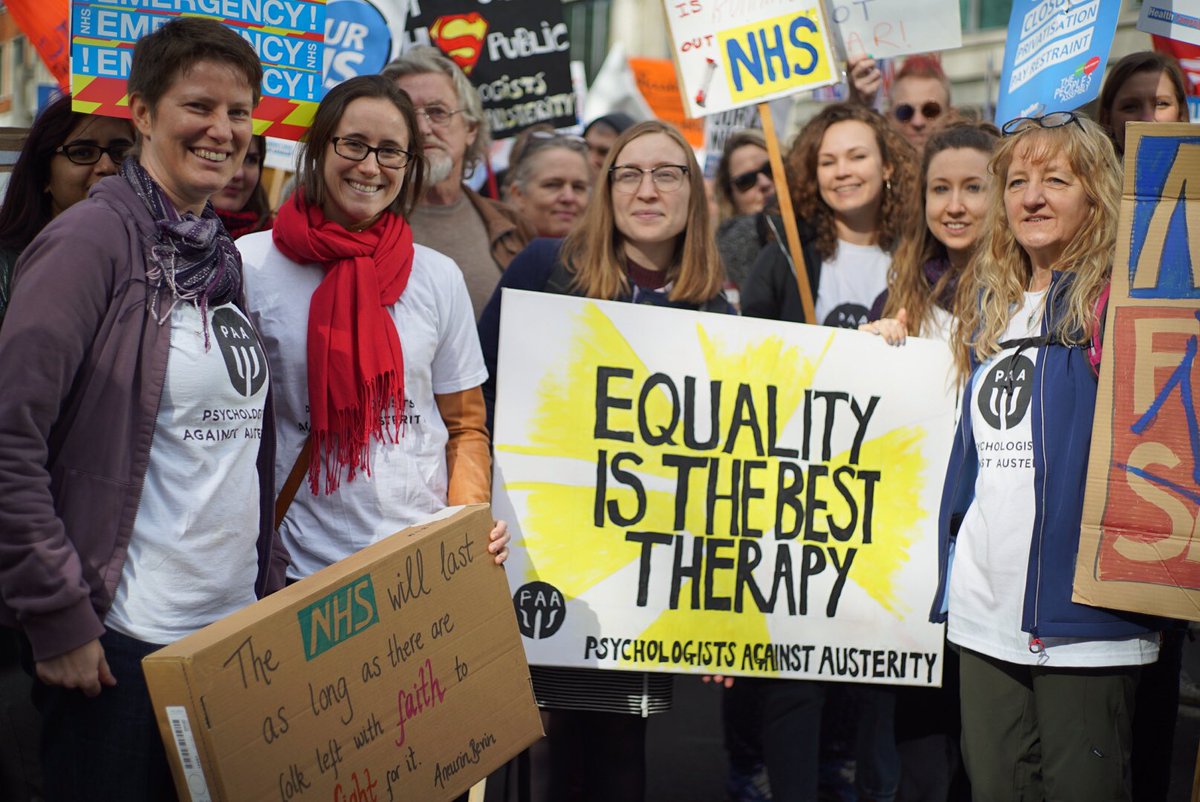
The Psychological Impact of Austerity – Psychologists Against Austerity

Image result for psychologists against austerity

A recent report from the Psychologists Against Austerity collective directly links cuts to public services with mental health problems.

Well-established psychological research that explains these links already exists. However, this knowledge has been missing from the debate on austerity so far.

Psychologists are often in a position to see the effects that social and economic changes have on people. We also occupy a relatively powerful position as professionals and therefore have an ethical responsibility to speak out about these effects.

Introduction

The Coalition government since 2010 has implemented a program of cuts to public services and welfare that has disproportionately affected  the most vulnerable people in our society in the name of ‘Austerity’. Measures like the bedroom tax, cuts to disability benefits, the introduction of Universal Credit and cuts to local government, social services and NHS budgets have been presented by the Coalition as necessary to the UK’s economic recovery.

Ideas like ‘the nation has maxed out its credit card’ and austerity as a painful but necessary medicine have been used to frame these policy choices as unavoidable and moral.

We argue that recent cuts are both avoidable and immoral. As psychologists we are often in a position to see the effects that societal and economic conditions have on people.

Psychologists also occupy a relatively powerful position as professionals with access to resources like theory and research and therefore have an ethical responsibility to speak about these effects. Indeed, according to the British Psychological Society (BPS) code of ethics, part of the standard for competence is sensitivity to developments in our social and political context.

It is imperative to take into account the psychological costs of austerity for individuals and communities. Psychological impacts of recent austerity policies have been little discussed in media and policy debates, yet there is clear and robust research linking recent austerity policies with damaging psychological outcomes.

Work at an epidemiological level on social determinants of health like the Marmot Review and The Spirit Level shows robust evidence for the effects of social inequality on health, including emotional well-being. Mental health problems are associated with markers of low income and social economic status in all the developed nations, no matter which indicator is used. There are indications of higher levels of mental health problems following austerity, with a rise in antidepressant prescriptions, and GPs reporting increasing numbers of mental health appointments, and a rise in male suicides.

Since the financial crisis, suicides have increased in European countries that have adopted austerity policies (UK, Greece, Spain and Portugal), but not in those who have protected their welfare state (Iceland and Germany). In this paper, we assume that the emotional well-being of societies and individuals is determined by multiple factors that interact with each another. These include economic, societal, familial, psychological and biological influences.

We use the terms ‘emotional well-being’, ‘distress’ and ‘mental health problems’ rather than ‘mental illness’. This is because there is disagreement about whether emotional difficulties are best understood as a product of individual pathology, or a consequence of toxic environments and difficult life experiences. We use diagnostic terminology as a proxy for a wide range of experiences of distress, which are biographically unique. As psychologists, we believe that the diagnostic and medical understanding of ‘mental illness’ often neglects socioeconomic context.

As Lynne Friedli says:

“Mental health is produced socially: the presence or absence of mental health is above all a social indicator and therefore requires social, as well as individual solutions.”

Psychological research provides evidence for some of the wide range of pathways by which increasing social inequality and austerity increase emotional distress. In this paper, we have outlined well-established pathways to short and long term psychological damage from austerity policies; we have called these ‘austerity ailments’.

They are:

  • Humiliation and shame
  • Fear and distrust
  • Instability and insecurity
  • Isolation and loneliness
  • Being trapped and powerless

Key conclusions

Austerity policies have damaging psychological costs. Mental health problems are being created in the present, and further problems are being stored for the future.

We have identified five ‘Austerity Ailments’. These are specific ways in which austerity policies impact on mental health. These experiences have been shown to increase mental health problems. Prolonged humiliation following a severe loss trebles the chance of being diagnosed with clinical depression. Job insecurity is as damaging for mental health as unemployment.

Feeling trapped over the long term nearly trebles the chances of being diagnosed with anxiety and depression. Low levels of trust increase the chance of being diagnosed with depression by nearly 50 per cent.

These five ‘ailments’ are indicators of problems in society, of poisonous public policy, weakness of social cohesion and inequalities in power and wealth. We also know what kind of society promotes good health.

Key markers are that societies are equal, participatory and cohesive.

Some important indicators of a psychologically healthy society are:

1. Agency
2. Security
3. Connection
4. Meaning
5. Trust

Mental health isn’t just an individual issue. To create resilience and promote wellbeing, we need to look at the entirety of the social and economic conditions in which people live.

Implications and recommendations

The evidence presented in this report indicates that a range of key psychological experiences can be directly linked to public policy, and are sensitive to macro social and economic changes.

It is therefore crucial that policy makers and service developers consider the psychological impacts of current and future policies. Creating the conditions for wellbeing and resilience directly helps to prevent distress in the short and long term, thereby saving resources and reducing suffering.

 We call for:

  • Social policy that works towards a more equitable and participatory society, to facilitate individual well-being, resilient places, and strong communities.
  •  Policy makers to take into account the psychological impacts of macro social and economic changes.
  • A social security system that empowers and supports, rather than punishing people in times of need.
  • Public services to increase focus on preventing distress, improving citizen participation and social justice, as well as help facilitate the five positive indicators above.
  • Co-production to be one such model of public service reform. This approach harnesses individuals’ and communities’ assets and expertise rather than viewing them just as passive recipients of and burdens on services.
  • A community-led approach to mental health and emotional wellbeing that develops collective responses to individual needs and by doing so works to strengthen communities and build on communal resources.

You can read the full briefing paper here.


Image result for psychologists for social change


I don’t make any money from my work. I’m disabled through illness and on a very low income. But you can make a donation to help me continue to research and write free, informative, insightful and independent articles, and to provide support to others. The smallest amount is much appreciated – thank you.

DonatenowButton

Controversial GCHQ Unit Engaged in Domestic Law Enforcement, Online Propaganda, Psychology Research – Glenn Greenwald and Andrew Fishman

Introduction

A visit by Government national security agents on Saturday 20 July 2013 to smash up computers at The Guardian newspaper office in London hit the news surprisingly quietly, when Edward Snowden exposed a gross abuse of power and revealed mass surveillance programmes by American and British secret policing agencies (NSA and GCHQ) last year. (More detailed information here).

David Miranda, partner of Glenn Greenwald, the Guardian interviewer of the whistleblower Edward Snowden, was held for 9 hours at Heathrow Airport and questioned under the Terrorism Act. Officials confiscated electronics equipment including his mobile phone, laptop, camera, memory sticks, DVDs and games consoles.

This was a profound attack on press freedoms and the news gathering process, and Greenwald said:

“To detain my partner for a full nine hours while denying him a lawyer, and then seize large amounts of his possessions, is clearly intended to send a message of intimidation.”

Absolutely. Since when was investigative journalism a crime?

Since it flies in the face of an increasingly authoritarian and psychocratic government that exercises rigid control over public access to information, and manipulates public perceptions and behaviours.

Sure, it sounds like the basis of a conspiracy theory doesn’t it?

But it’s not.

___

The following article was originally posted on The Intercept site by Glenn Greenwald and Andrew FishmanReproduced here with thanks.


The spy unit responsible for some of the United Kingdom’s most controversial tactics of surveillance, online propaganda and deceit focuses extensively on traditional law enforcement and domestic activities — even though officials typically justify its activities by emphasizing foreign intelligence and counterterrorism operations.

Documents published today by The Intercept demonstrate how the Joint Threat Research Intelligence Group (JTRIG), a unit of the signals intelligence agency Government Communications Headquarters (GCHQ), is involved in efforts against political groups it considers “extremist,” Islamist activity in schools, the drug trade, online fraud and financial scams.

Though its existence was secret until last year, JTRIG quickly developed a distinctive profile in the public understanding, after documents from NSA whistleblower Edward Snowden revealed that the unit had engaged in “dirty tricks” like deploying sexual “honey traps” designed to discredit targets, launching denial-of-service attacks to shut down Internet chat rooms, pushing veiled propaganda onto social networks and generally warping discourse online.

Early official claims attempted to create the impression that JTRIG’s activities focused on international targets in places like Iran, Afghanistan and Argentina. The closest the group seemed to get to home was in its targeting of transnational “hacktivist” group Anonymous.

While some of the unit’s activities are focused on the claimed areas, JTRIG also appears to be intimately involved in traditional law enforcement areas and U.K.-specific activity, as previously unpublished documents demonstrate. An August 2009 JTRIG memo entitled “Operational Highlights” boasts of “GCHQ’s first serious crime effects operation” against a website that was identifying police informants and members of a witness protection program. Another operation investigated an Internet forum allegedly “used to facilitate and execute online fraud.” The document also describes GCHQ advice provided “to assist the UK negotiating team on climate change.”

Particularly revealing is a fascinating 42-page document from 2011 detailing JTRIG’s activities. It provides the most comprehensive and sweeping insight to date into the scope of this unit’s extreme methods. Entitled “Behavioral Science Support for JTRIG’s Effects and Online HUMINT [Human Intelligence] Operations,” it describes the types of targets on which the unit focuses, the psychological and behavioral research it commissions and exploits, and its future organizational aspirations. It is authored by a psychologist, Mandeep K. Dhami.

Among other things, the document lays out the tactics the agency uses to manipulate public opinion, its scientific and psychological research into how human thinking and behavior can be influenced, and the broad range of targets that are traditionally the province of law enforcement rather than intelligence agencies.

JTRIG’s domestic and law enforcement operations are made clear. The report states that the controversial unit “currently collaborates with other agencies” including the Metropolitan police, Security Service (MI5), Serious Organised Crime Agency (SOCA), Border Agency, Revenue and Customs (HMRC), and National Public Order and Intelligence Unit (NPOIU). The document highlights that key JTRIG objectives include “providing intelligence for judicial outcomes”; monitoring “domestic extremist groups such as the English Defence League by conducting online HUMINT”; “denying, deterring or dissuading” criminals and “hacktivists”; and “deterring, disrupting or degrading online consumerism of stolen data or child porn.”

It touts the fact that the unit “may cover all areas of the globe.” Specifically, “operations are currently targeted at” numerous countries and regions including Argentina, Eastern Europe and the U.K.

JTRIG’s domestic operations fit into a larger pattern of U.K.- focused and traditional law enforcement activities within GCHQ.

Many GCHQ documents describing the “missions” of the “customers” for which it works make clear that the agency has a wide mandate far beyond national security, including providing help on intelligence to the Bank of England, to the Department for Children, Schools and Families on reporting of “radicalization,” to various departments on agriculture and whaling activities, to government financial divisions to enable good investment decisions, to police agencies to track suspected “boiler room fraud,” and to law enforcement agencies to improve “civil and family justice.”

Previous reporting on the spy agency established its focus on what it regards as political radicalism. Beyond JTRIG’s targeting of Anonymous, other parts of GCHQ targeted political activists deemed to be “radical,” even monitoring the visits of people to the WikiLeaks website. GCHQ also stated in one internal memo that it studied and hacked popular software programs to “enable police operations” and gave two examples of cracking decryption software on behalf of the National Technical Assistance Centre, one “a high profile police case” and the other a child abuse investigation.

The JTRIG unit of GCHQ is so notable because of its extensive use of propaganda methods and other online tactics of deceit and manipulation. The 2011 report on the organization’s operations, published today, summarizes just some of those tactics:

Throughout this report, JTRIG’s heavy reliance on its use of behavioral science research (such as psychology) is emphasized as critical to its operations. That includes detailed discussions of how to foster “obedience” and “conformity”:


In response to inquiries, GCHQ refused to provide on-the-record responses beyond its boilerplate claim that all its activities are lawful.

———

Documents published with this article:

Psychologists Against Austerity: Mobilising Psychology for Social Change – The Campaign

tumblr_m81dzafFA21qcekj1o1_500From Brazil, a dystopic and darkly satirical film about life under a bureaucratic, totalitarian government, written by Terry Gilliam.

There is an irony there, somewhere….

Fri. 26th. MARCH ON STREATHAM JOBCENTRE to protest against forced state “therapy” on people claiming benefits.

Meet 1.30pm at Streatham Memorial Gardens.

Click here for The Campaign.

Click here for Briefing Paper.

  Click here for some background,

and here

Stigmatising unemployment: the government has redefined it as a psychological disorder

proper Blond

The current government has made the welfare system increasingly conditional on the grounds that “permissive” welfare policies have led to welfare “dependency.” Strict behavioural requirements and punishments in the form of sanctions are an integral part of the Conservative ideological pseudo-moralisation of welfare, and their  “reforms” aimed at making claiming benefits much less attractive than taking a low paid, insecure, exploitative job.

Welfare has been redefined: it is preoccupied with assumptions about and modification of the behaviour and character of recipients rather than with the alleviation of poverty and ensuring economic and social wellbeing.

The stigmatisation of people needing benefits is designed purposefully to displace public sympathy for the poor, and to generate moral outrage, which is then used to further justify the steady dismantling of the welfare state.

But the problems of austerity and the economy were not caused by people claiming welfare, or by any other powerless, scapegoated, marginalised group for that matter, such as migrants. The problems have arisen because of social conservatism and neoliberalism. The victims of this government’s policies and decision-making are being portrayed as miscreants – as perpetrators of the social problems caused by the government’s decisions, rather than as the casualities.

And actually, that a recognisable bullying tactic known as projection, (the vehicle for projection is blame, criticism and allegation), as is scapegoating.

The 2015 budget included plans to provide online Cognitive Behaviour Therapy to 40,000 claimants and people on the Fit for Work programme, as well as putting therapists in more than 350 job centres.

I wrote an article in March about the government plans to make the receipt of social security benefits conditional on undergoing “state therapy.” I raised concern about ethical issues – such as consent, the inappropriateness of using behaviour modification as a form of “therapy,” and I criticised the proposed Cognitive Behaviour Therapy (CBT) programme on methodological and theoretical grounds, as well as considering wider implications.

I’ve written at length about the coercive and punitive nature of the conservative psychopolicy interventions, underpinning the welfare “reforms,” and giving rise to increased welfare “conditionality” and negative sanctions.

In particular, I’ve focussed on the influence of the Cabinet’s Behavioural Insights Team or “nudge unit” and “the application of behavioural science and psychology to public policy. (See: The nudge that knocked down democracy, The power of positive thinking is really political gaslighting, and Despotic paternalism and punishing the poor. Can this really be England? )

I was pleased to see that the BBC reported a summary of the research findings of Lynne Friedli and Robert Stearn, which was supported by the Wellcome Trust. The report – Positive affect as coercive strategy: conditionality, activation and the role of psychology in UK government workfare programmes reflects many of the concerns raised by other professionals. I strongly recommend you read it. (See: Psychologists Against Austerity: mental health experts issue a rallying call against coalition policies.)

The BBC summarised from the report that benefit claimants are being forced to take part in “positive thinking” courses in an effort to “change their personalities.” Those people claiming benefits that do not exhibit a “positive” outlook must undergo “reprogramming” or face having their benefits cut. This is humiliating for job seekers and does not help them find suitable work.

New benefit claimants are interviewed to find out whether they have a “psychological resistance” to work, with those deemed “less mentally fit” given more “intensive coaching.”

And unpaid work placements are increasingly judged on psychological results, such as improved motivation and confidence, rather than whether they have led to a job.

The co-author of the report, Lynne Friedli, describes such programmes, very aptly, as “Orwellian.” She says:

“Claimants’ ‘attitude to work’ is becoming a basis for deciding who is entitled to social security – it is no longer what you must do to get a job, but how you have to think and feel.

“This makes the government’s proposal to locate psychologists in job centres particularly worrying.

“By repackaging unemployment as a psychological problem, attention is diverted from the realities of the UK job market and any subsequent insecurities and inequalities it produces.”

Friedli also criticised the way psychologists were being co-opted as “government enforcers” and called on professional bodies to denounce the practice.

Quite rightly so. It’s our socio-economic system, and the ideologues who shape it that present the problems, not the groups of people forced to live in it as its casualities – the “collateral damage” of neoliberalism and social conservatism.

“I don’t think anything can justify forced psychological coercion. If people want to go on training courses that should be entirely voluntary,” Lynne told BBC News.

She also questioned the aim of the motivational courses and welfare-to-work placements, which felt like “evangelical” self-help seminars.

“Do we really want a world where the only kind of person considered employable is a ‘happy clappy’, hyper-confident person with high self-esteem?

“That is a very a narrow set of characteristics. There is also a role in the workplace for the ‘eeyore’ type.”

Absolutely. Frankly, I would rather have health and safety programmes that are designed by a pessimist, capable of thinking of the worst case scenario, for example, than by a jolly, positively biased, state-coerced optimist.

I would also prefer pessimistic appraisal of social policies. That way, we may actually have impact assessments carried out regarding the consequences of Conservative policies, instead of glib, increasingly Orwellian political assurances that are on the other, more scenic, illusory side across the chasm from social realities.

Although pessimism and depression are considered to be affective disorders, in a functional magnetic resonance imaging study of the brain, depressed patients were shown to be more accurate in their causal attributions of positive and negative social events, and in self assessments, and assessment of their own performance of tasks, than non-depressed participants, who demonstrated a positive bias.

As a former community-based psychosocial practitioner who saw the merits and value of a liberationist model, the question that needs to be asked is: for whose benefit is CBT being used, and for what purpose? Seems to me that this is about helping those people on the wrong side of punitive government policy to accommodate that, and to mute negative responses to negative situations.

The socially dispossessed are being coerced by the state, part of that process is the internalisation of the negative images of themselves created and propagated by their oppressors.

CBT is not based on a genuinely liberational approach, nor is it based on any sort of democratic dialogue. It’s all about modifying and controlling behaviour, particularly when it’s aimed at such a narrow, politically defined and specific outcome.

The problem that we need to confront is politically designed and perpertuated social injustice, rather than the responses and behaviour of excluded, stigmatised individuals in politically oppressed, marginalised social groups.

CBT is founded on blunt oversimplifications of what causes human distress – for example, in this case it is assumed that the causes of unemployment are psychological rather than socio-political, and that assumption authorises intrusive state interventions that encode a Conservative moral framework which places responsibility on the individual, who is characterised as “faulty.”

However, democracy is based on a process of dialogue between the public and government, ensuring that the public are represented: that governments are responsive, shaping policies that address identified social needs. Conservative policies are quite clearly no longer about reflecting citizen’s needs: they are increasingly about telling us how to be.

As I have said elsewhere, as well as aiming at shaping behaviour, the psycho-political messages being disseminated are all-pervasive, entirely ideological and not remotely rational: they reflect and are shaping an anti-welfarism that sits with Conservative agendas for neoliberal welfare “reform”, austerity policies, the small State (minarchism) and also legitimises them. (I’ve written at length elsewhere about the fact that austerity isn’t an economic necessity, but rather, it’s a Tory ideological preference.) The Conservatives are traditional, they are creatures of habit, rather than being responsive and rational.

Conservative narratives, amplified via the media, have framed our reality, stifled alternatives, and justified Tory policies that extend psychological coercion including through workfare; benefit sanctions; in stigmatising the behaviour and experiences of poor citizens and they endorse the loss of autonomy for citizens who were disempowered to begin with.

Many of the current ideas behind “reforming” welfare come from the Behavioural Insights  Team – the Nudge Unit at the heart of the Cabinet. Nudge theory has made Tory ideology, with its totalitarian tendencies, seem credible, and the Behavioural Insights Team have condoned, justified and supported punitive, authoritarian policies, with bogus claims about “objectivity” and by using discredited pseudoscience. Those policies have contravened the human rights of women, children and disabled people, to date.

Nudge-based policy is hardly in our “best interests,” then.

526544_532055030197363_2137237288_n
Pictures courtesy of Robert Livingstone


I don’t make any money from my work. I am disabled because of illness. But you can contribute by making a donation and help me continue to research and write informative, insightful and independent articles, and to provide support to others.

The smallest amount is much appreciated – thank you.

DonatenowButton

Suicides reach a ten year high and are linked with welfare “reforms”

Figures released in February by the Office for National Statistics (ONS) indicate that suicide rates, which had fallen consistently since 1981, are now at their highest in over a decade. It is primarily male suicides which have increased.

The figures for 2013 give a total of 6,233 deaths by suicide, 252 more than in 2012.

Suicide rates are highest in areas of high unemployment, with the north-east of England having the highest rate and London the lowest. Older males are now the most at risk, with 45-59 year olds having the highest rate.

The link between the welfare “reforms” and increased suicide risk has been highlighted by Mind, amongst other organisations. The charity has found that people with mental illnesses are having their benefits cut more than those with other kinds of illnesses.

There has been growing concern regarding how benefits are administered in relation to vulnerable individuals and last year, revelations that the Department for Work and Pensions had internally investigated 60 suicides related to benefit changes led to calls for greater accountabilty and transparency.

As an organisation, Mind is supportive of those with mental health problems being helped into work. But they find that often people are pushed before they are properly well. Research published last year by Mind found that people with mental illness were having their benefits cut more than people with other illnesses.

Most of the telephone calls to Mind’s national helpline are from those wanting to talk about suicide and self-harm, followed by advice on support services, mainly advocacy and welfare benefits.

Kauppinen, who has worked at Mind for 10 years, said that the team used to help people with mental health problems remain stable. But she said they have seen more clients in crisis in recent years.

“We see people in crisis every week,” she said. “I started here in 2005, but when it came to 2010-11, it became crisis work rather than having people just stay where they are.”

Tom Pollard, policy and campaigns manager at Mind, said:

“Pressurising people by threatening to stop their benefits causes a great deal of financial problems and emotional distress, with some people attempting to take their own lives as a result.”

“While the right type of employment can be beneficial to wellbeing, the support offered to those on mandatory back-to-work schemes such as the Work Programme is far too generic to effectively help people with mental health problems move towards employment. We need to see an overhaul of the system with more tailored specialised support and less focus on sanctioning.”

Kauppinen added: “There is very limited mental health awareness from people assessing clients in the new Work Programme. They find it very difficult to ask questions and you can see that the assessors are awkward. It takes a long time to train someone in mental health awareness.”

If you are experiencing suicidal thoughts, please contact the Samaritans, their number is: 08457 90 90 90.

Related:

Benefits and suicide: “You have to be strong to ask for help”the Guardian.

377683_445086432227557_1770724824_n (1)Thanks to Robert Livingstone

How bullying works: projection and scapegoating.

491cdcc001f88e804625bfb1f83ad93e

Very few people, when put to the test, have the integrity and moral courage to stand up against bullying, harassment, abuse, threats and corruption. The targets of adult bullying are selected often because they DO have the moral courage to challenge; many people will pass by on the other side.

A target of adult bullying is most often chosen because of their strength, not their weakness. Research shows that targets of bullying tend to have highly developed empathy, and sensitivity for others, a high degree of perceptiveness, high moral values, a well-developed integrity, a strong sense of fair play and reasonableness, a low propensity to violence, a reluctance to pursue grievance, disciplinary or legal action, a strong forgiving streak and a mature understanding of the need to resolve conflict with dialogue. Often, targets of bullying are independent, self-reliant and “different” in some way. Weak people often disingenuously confuse these hallmarks of character with weakness.

Bullies aim to inflict psychological injury more often than physical injury. Their main aim is to control, discredit, isolate and eliminate their target.

The word “victim” also allows disingenuous people to tap into and stimulate other people’s misconceptions and prejudices of victimhood which include the inference that the person was somehow complicit in the abuse. (See just-world fallacy and victim-blame narrative). So I use the word “target”, which is also accurate because bullying involves the intentional singling out of a person for abuse.

Bullies, who have no integrity, are vindictive, aggressive, demanding, and regularly violate others’ boundaries; displaying aggression does not respect peoples’ rights, and a bully’s “requests” come with a negative consequence if the course of action demanded by the bully is declined. A bully’s bad behaviour is entirely his or her responsibility, they intend to cause their targets harm, to undermine them and damage them socially, emotionally, psychologically and sometimes, physically. And they often do.

Bullies typically isolate and dehumanise their targets in order to disempower them. It’s a key tactic of control used by all abusers, it can be particularly injuring, emotionally.

The major triggers for bullying come from the bully’s own sense of inadequacy, according to research. Feeling envious and threatened by others with competence, integrity and popularity, the bully will project onto them their own inadequacy and incompetence, and often the bully will use their own behaviours and thoughts, attributing them to their target, to rally support for their “cause”. The inadequacy or envy of a bully is often translated into negative language used intentionally to completely diminish the target’s positive qualities, socially.

Using unwarranted criticism and threats, the bully tries to control their target and subjugate them, without a thought for that persons’ contributions, reputation, well-being, health or self confidence. Sooner or later this person – the bully’s target – realises that they are not only being “managed” but bullied, and they will start to show signs of resistance to that. Often, anything said in the target’s self-defence will be distorted and used by the bully, too. Gaslighting involves attempts to either negate or redefine a target’s experiences, and abusers often use this method.

The bully often fears exposure of his/her own incompetence and inadequacy, and takes steps to disable the the target, typically by isolating them and/or destroying their credibility and reputation among peers and decision-makers, putting them out of the picture in the workplace through dismissal, forced resignation or even early retirement. Once the target has gone, within about two weeks, the bully’s focus turns to someone else and the cycle starts again.

Some people enjoy the sense of power and control that bullying others gives them.  

Online bullies aim to isolate the target, destroy their credibility and force them out of established communities and groups.

When faced with a bully, your only responsibility is to protect yourself from the emotional, social and/or physical harm that the bully intends to cause you.

I’ve noticed an increase in online bullying, which some of my friends are experiencing, too. That is what prompted this article. It’s a myth that only vulnerable and weak people are targeted by bullies. Most often it is strong people – articulate and decent people who think independently, who have conviction in their beliefs, who are intelligent, cogent and coherent and strong-minded – that are targeted, as they are most often perceived as a threat because their qualities tend to inadvertently highlight the inadequacies of bullies. 

Vulnerable people and bystanders are, however, often manipulated and sucked into the bullies’ strategies. Bullies are more likely to stop if their audience shows disapproval, but most bystanders are reluctant to do so, studies show, for a variety of reasons. Bullies rely on bystander apathy and this often leads to the target feeling a further sense of isolation.

EFkXPz8WsAA1Wfm

Much of the bullying I have witnessed recently has been entirely political, with articulate and conscientious activists being targeted for very personal attacks, discrediting, smear campaigns and trolling. I see that those who are particularly adept at debate and providing well-evidenced, well-reasoned responses, posts and comments tend to get the attention of bullies and trolls, who are most often supporters of either right-wing or occasionally, minor and “alternative” left wing political parties that frequently employ negative campaigning and lies to try to gain credibility.

bully

Bullying is a form of scapegoating and projection. We know that scapegoating is a hostile socio-psychological discrediting operation in which people move blame and responsibility away from themselves and towards a target person or group. It is also a practice were angry feelings and inappropriate accusation are placed on others. Quite understandably, the target feels persecuted and receives misplaced vilification, blame and criticism; and the victim is likely to suffer rejection from those who the perpetrator seeks to influence and again, an increasing feeling of isolation. We live in a society where bullying has become increasingly acceptable, and certainly, as form of doing politics.

A major contributing factor to this increase in bullying is the collective behaviours of the current government, which has perpetuated, permitted and endorsed prejudices against marginalised social groups, such as disabled and unemployed people, with a complicit media amplifying these prejudices. Their policies embed a punitive approach towards the poorest social groups. This in turn means that those adminstering the policies, such as staff at the Department for work and pensions and job centres, for example, are also bound by punitive, authoritarian behaviours directed at a targeted group.

As authority figures and role models, their behaviour establishes a framework of acceptability. Parliamentary debates are conducted with a clear basis of one-upmanship and aggression rather than being founded on rational exchange. Indeed, the prime minister sneers at rationality and does not engage in a democratic dialogue, instead he employs the tactics of a bully: denial, scapegoating, vilification, attempts at discrediting, smearing and character assassinations. This in turn gives wider society permission and approval to do the same.

Scapegoating has a wide range of focus: from “approved” enemies of very large groups of people down to the scapegoating of individuals by other individuals. The scapegoater’s target always experiences a terrible sense of being personally edited and re-written, with the inadequacies of the bully inserted into public accounts of their character, isolation, ostracism, exclusion and sometimes, expulsion and elimination. The sense of isolation is often heightened by other people’s reluctance to become involved in challenging bullies, usually because of a bystander’s own discomfort and fear of reprisal.

Bullies don’t like to have their lies exposed. That’s not to say that all supporters of those minority parties are bullies: they’re not. On a personal level, despite the fact that most of my political criticism in debate and on my site has been directed at the Conservatives (evident on this site, for example, which is actually identified as a Human Rights site) most of the bullying I have personally encountered this past twelve months has been from a small group of Green Party members, curiously. 

This is possibly because the Green Party regard the Labour Party as their “enemy” in elections – in that they compete for supporters with similar values – rather than the Conservatives, and therefore spend a lot of time vilifying Labour. This has fuelled some grassroot Green supporters in attacks on key Labour supporters, particularly the ones who are adept at challenging lies and point out the Green Party’s negative campaigning and electioneering strategies.

I’m an anarchist, but have decided to vote Labour, because the alternative – 5 more years of such a destructive and authoritarian Conservative government – is untenable. People are dying because of Tory policies. I can’t in good conscience turn away from that and pretend it isn’t happening. I’ve been quite vocal about this on social media and on this site. 

I was also targeted by “Tommy Robinson” (real name is Stephen Christopher Yaxley-Lennon), the ex-leader of far-right English Defence League (EDL). He used my account details on Twitter and Facebook, designed and shared a malicious meme, claiming I had made comments that I hadn’t, and invited people to “let her know what you think of her”. I had hundreds of messages that included death and rape threats from the far-right, and one threat from Combat 18. I involved the police, but Robinson claimed several people had access to his account, and denied any knowledge of the meme. It was shared in and among groups like the National Front, Britain First, some UKIP groups, and even a couple of Tory councillors reposted it.

My sin? He was harassing me on Twitter, wouldn’t engage in reasonable debate, he was quite abusive and I told him to do one and leave me be. He didn’t like that. 

Bullying becomes obvious when you scrutinise who is actually doing the attacking on a personal level. Debate and political criticism are one thing: personal commentaries, character assassinations, attacks, threats, abuse and harassment are bullying. I have seen that quite often, bullying tactics include manipulating people’s perceptions to portray themselves as the injured party, with their target being the villain. However, again, scrutiny of who is actually instigating and doing the personal attacking will reveal the real bully or bullies.

Bullies show a complete lack of remorse for the damage they are intending to inflict on their target.Victim-blame narratives aside, it’s never wise to ignore bullying; bullies use provocation to elicit a response from their target and if you ignore it the provocation will simply get worse. That is the nature of bullying. Ignoring a bully actually gives him/her permission to continue bullying. Ignoring a bully sends the signal that it is acceptable to bully that person.

Furthermore, ignoring a bully tells bystanders that is acceptable to bully that person and inevitably, this becomes embedded in our culture. It’s worth looking at Gordon Allport’s Ladder of Prejudice to see exactly how that process works. If a bully’s audience or peers show disapproval and don’t become complicit, the bully will be discouraged from continuing their abuse. The biggest fear a bully has is that of being exposed for what they really are.

Bullies project their inadequacies, shortcomings, behaviours, anger and spite on to other people to distract and divert attention away from themselves and their own inadequacies and to avoid facing up to the same scrutiny. The vehicle for projection is blame, criticism and allegation. Once a target realises this, they can take comfort from the fact that every time they are blamed, criticised or subjected to another specious allegation by the bully, the bully is implicitly admitting or revealing something about themselves. Not that it is much of a comfort.

A target’s awareness of projection can help them translate whatever they are being accused of into an awareness of the bully’s own misdemeanours. Again, the bully may be identified by the fact that they are the ones loudly criticising and attempting to discredit the target, rather than there being any evidence of the converse.

Vilifying the target is the most frequently used as a gaslighting tactic in bullying. This  is a powerful means of putting the victim on the defensive while simultaneously masking the aggressive intent of the manipulator, the bully then falsely accuses the victim of being an abuser in response when the victim stands up for or defends themselves or their position.

Nobody’s behaviour is perfect, and many balanced, well-intentioned people will at some time unjustifiably or inadvertently upset others. When this is drawn to their attention, they are usually horrified and will do what they can to make amends and ensure it isn’t repeated. That’s what reasonable and mature people do.

Serial bullies, on the other hand, do not want to know about the negative effects of their behaviour. Denial, retaliation and feigning victimhood are some of the ways that bullies express their antipathy for anyone who is able to describe their behaviour, see through their mask of normality or help others to do the same.

Here are some recognisable bullying traits and tactics, designed to damage, isolate, discredit and eliminate the target:

  • bullies are adept at exploiting the trust and needs of individuals, organisations and groups, for personal gain.
  • bullies react to criticism with denial, retaliation, feigned victimhood.
  • the bully grooms bystanders, and the target, to believe the target deserves the treatment they are receiving and attempts to limit contact between others and their target. Often the bully will use communications that exclude the target so that there is no opportunity for them to defend themselves and present their truth.
  • the bystanders see only the Dr Jekyll side of the bully, but only the target sees the Mr/Ms Hyde side; Dr Jekyll is sweet, manipulative and charming, Mr/Ms Hyde is evil; Mr/Ms Hyde is the real person, Dr Jekyll is an act.
  • bullies exert power and control by a combination of selectively withholding information and spreading lies and disinformation, therefore everyone has a distorted picture – of only what the bully wants them to see.
  • the target finds that in any response, everything they say and do is twisted, distorted and misrepresented.
  • bullies are adept at manipulating people’s perceptions with intent to engender a negative view of the target in the minds of others – this is achieved through undermining and discrediting, including the creation of doubts and suspicions and the sharing of lies.
  • bullies use other people to further the aim of discrediting their target, creating a false impression of consensus.
  • bullies poison the atmosphere and actively poison people’s minds against the target when close to being outwitted and exposed, the bully feigns victimhood and turns the focus on themselves as previously stated – another example of manipulating people through their emotions such as guilt, sympathy, feeling sorry for the bully. Many bystanders are hoodwinked by the bully’s ruses for abdicating responsibility and evading accountability, they may say, for example: “that’s all in the past”, “let’s focus on the future” , “you need to make a fresh start”, and “forgive and forget”, “you’ve got to move on”, “sticks and stones” and so on.
  •  bystanders often feel cognitive dissonance and usually minimise their discomfort by reasoning to avoid any responsibility, it usually goes this way because they themselves don’t want to become targets. They may say things like: “just ignore them”, “stand up to them” , “I’ve personally  never had any problems with him/her”, “Oh I never get involved in personal differences” and so on. Even worse, they may imply that you did something wrong to “attract” the bullying.
  • the bully encourages and manipulates as many bystanders as possible to lie, act dishonorably and dishonestly, withhold information and spread lies and misinformation, the bully manipulates bystanders to punish the target for alleged infractions, so the bystanders also become instruments of harassment.
  • some people gain gratification (a perverse feeling of satisfaction) from seeing others in distress and thus become complicit in the bullying and a few people think that bullying is funny.
  • some observers regard behavioural responses that are reasonable and civilised as a sign of weakness rather than maturity. Many seem to lack critical thinking skills and analytical abilities and so cannot see through the facade or the bully’s mask of deceit. Even when it is obvious, sometimes. There’s very often an element of not wanting to see, too. Other people fear becoming targets themselves, and so “go along to get along.” Complicity because of fear of reprisals.
  • bullies are extremely vindictive and will do everything in their power to damage and destroy anyone who can see through their mask of deceit. In very rare cases you may receive information from a bystander who wants to help but is afraid to do so publicly for fear of retribution – and fear of becoming the next target.
  • apathy and indifference to the distress of others are widespread. The bully relies on this.

“Bullying is a compulsive need to displace aggression and is achieved by the expression of inadequacy (social, personal, interpersonal, behavioural, professional) by projection of that inadequacy onto others through control and subjugation (criticism, exclusion, isolation etc). Bullying is sustained by abdication of responsibility (denial, counter-accusation, pretence of victimhood) and perpetuated by a climate of fear, ignorance, indifference, silence, denial, disbelief, deception, evasion of accountability, tolerance and reward (eg promotion) for the bully.”
Tim Field, 1999

The Law and Cyber-bullying:

As cyber-bullying is a relatively new phenomenon, the UK courts are still trying to catch up with it and sentence offenders effectively. Though no laws specifically apply to cyber-bullying alone, there are several laws which can be applied in cyber-bullying cases:

  • Protection from Harassment Act 1997
  • Criminal Justice and Public Order Act 1994
  • Malicious Communications Act 1988
  • Communications Act 2003
  • Breach of the Peace (Scotland)
  • Defamation Act 2013

In 2012 The Crown Prosecution Service published guidelines on how cyber-bullying cases would be assessed against current laws, which you can find here.

On January 1st 2014 the Defamation Act 2013 came into order, and can be read here.

Examples of bullying:

What a bully might say when held to account

One day in the life of a blogger.

Someone elses’ perspective: A few words about respect and: One day in the life of a blogger – kittysjones. It’s worth reading the comments thread on these articles by Mike Sivier, too.

Related

Interesting article on the empath, apath (bystander) and sociopath triangle: it’s a useful model of analysis for those who have experienced abuse and wondered: why me? –EMPATHIC PEOPLE ARE NATURAL TARGETS FOR SOCIOPATHS – PROTECT YOURSELF
psychopathy101: Projection Beware of individuals spreading rumors about others behind their back, psychopaths are cowards, know that they are telling lies, enjoy hurting others and very afraid of being found out of who they really are, thus everything takes place in the “shadows”/behind the “targets” back.   To remember; the “bully” is telling everyone about him/herself  (thoughts and actions) what he/she has done, is doing or is about to do.”

Introduction to the Serial Bully “Perhaps the most easily recognisable Serial Bully traits are:

  • Jekyll and Hyde nature – Dr Jekyll is “charming” and “charismatic”; “Hyde” is “evil”;
  • Exploits the trust and needs of organisations and individuals, for personal gain;
  • Convincing liar – Makes up anything to fit their needs at that moment;
  • Damages the health and reputations of organisations and individuals;
  • Reacts to criticism with Denial, Retaliation, Feigned Victimhood;
  • Blames victims/targets;
  • Moves to a new target when the present one burns out.

What is a Bully “Projection behaviour and denial are hallmarks of the serial bully. It is believed by some that bullying is present behind all forms of harassment, discrimination, prejudice, abuse, persecution, conflict and violence.

What bullies fear most is exposure and being called publicly to account for their behaviour so they can go to great lengths to keep their target (victim) quiet from misdirection when it is reported to using threats of disciplinary action, dismissal, gagging clauses and fear.

Despite the façade that such people put up, bullies have another side to them. What complicates matters is that the  bully may not be aware or acknowledge to themselves they very often suffer from one or more of the following:

# Envy# Jealousy# Low self-confidence# Low self-esteem# Feel insecure# Seething with resentment# Bitterness# Hatred# Anger# Inadequacy# And may have a wide range of prejudices as a vehicle for dumping anger onto others.”

About the impact of abusive language: Sticks and stones: abusive labels, self concept – when words become weapons

Further information:

Bullying can cause injury to health and make people ill, with some or all of the symptoms below. Many, if not all of these symptoms are consequences of the high levels of stress and anxiety that bullying creates:

  • shattered self-confidence, low self-worth, low self-esteem
  • reactive depression, lethargy, hopelessness, anger, futility and more
  • hypersensitivity, fragility, isolation, withdrawal
  • obsession, not being able to stop thinking about the experience in all its detail
  • hypervigilance (feels like but is not paranoia), being constantly on edge
  • uncharacteristic irritability and angry outbursts
  • tearfulness, bursting into tears regularly and over trivial things
  • sweating, trembling, shaking, palpitations, panic attacks
  • bad or intermittently-functioning memory, forgetfulness, especially with trivial day-to-day things
  • poor concentration, can’t focus on anything for long
  • skin problems such as eczema, psoriasis, athlete’s foot, ulcers, shingles, urticaria if prone to them
  • irritable bowel syndrome
  • flashbacks and replays, obsessiveness, can’t get the bullying out of your mind
  • tiredness, exhaustion, constant fatigue sleeplessness, nightmares, waking early, waking up more tired than when you went to bed
  • headaches and migraines
  • frequent illness such as viral infections especially flu and glandular fever, colds, coughs, chest, ear, nose and throat infections (stress may play havoc with the immune system.)
  • suicidal thoughts, self-harm.

For the symptoms of injury to health caused by prolonged stress (such as that caused by bullying, harassment, abuse etc) click here. For details of the trauma that can result, click here.

changeworld2013

Related

Conservatives, cruelty and the collective unconscious


I don’t make any money from my work. But you can help by making a donation and help me continue to research and write informative, insightful and independent articles, and to provide support to others. The smallest amount is much appreciated – thank you.
DonatenowButton cards

Cameron’s Nudge that knocked democracy down – a summary of the implications of Nudge theory

Democracy is based on a process of dialogue between the public and government, ensuring that the public are represented: that governments are responsive, shaping policies that address identified social needs. However, Coalition policies are no longer about reflecting citizen’s needs: they are all about telling us how to be.

The idea of libertarian paternalism was popularised around five years ago by the legal theorist Cass Sunstein and the behavioral economist Richard Thaler, in their bestselling book Nudge. Sunstein and Thaler argue that policymakers can preserve an individual’s liberty whilst still nudging a person towards choices that are supposedly in their best interests. But who nudges the nudgers? Who decides what is in our “best interests”? That would be the government, of course.

Nudge philosophy is dressed-up as libertarian paternalism, which in turn dresses-up Tory ideology. Another phrase the authors introduced was “choice architecture”, a concept implying that the State can be the architect that arranges personal choice in way that nudges consumers in the right direction.

The direction is towards a small state, with nothing but behavioural “incentives” to justify forcing  citizens who have needs to be “responsible” and “self-sufficient,” achieving this presumably by paying taxes and then pulling themselves up strictly by their own bootstraps. It’s the new nothing for something culture.

Behavioural economics is actually founded on crude operant conditioning: it marks the return of a psycho-political theory that arose in the mid-20th century, linked with behaviourism. Theorists from this perspective generalise that all human behaviour may be explained and described by a very simple reductive process: that of Stimulus – Response. There is no need, according to behaviourists, to inquire into human thoughts, beliefs or values, because we simply respond to external stimuli, and change our automatic responses accordingly, like automatons or rats in a laboratory. Nudge theorists propose that we are fundamentally irrational, and that our decision-making processes are flawed because of “cognitive biases.” Nudge theory therefore bypasses any engagement with our deliberative processes.

Formally instituted by Cameron in September 2010, the Behavioural Insights Team, (also known as the Nudge Unit) which is a part of the Cabinet  Office,  is made up of people such as David Halpern, who is also a part of Cameron’s “Big Society” campaign. He co-authored the Cabinet Office report:  Mindspace: Influencing Behaviour Through Public Policy, which comes complete with a cover illustration of the human brain, with an accompanying psycho-babble of words such as “incentives”, “habit’, “priming” and “ego.” It says the report “addresses the needs of policy-makers.”  Not the public.

The behaviourist educational function made explicit through the Nudge Unit is now operating on many levels, including through policy programmes, forms of “expertise”, and through the State’s influence on the mass media, other cultural systems and more subliminally, it’s embedded in the very language that is being used.

Education is a dialogic process, with consenting, willing participants. Even compulsory education involves consent and dialogue – children are engaged in the process. What the Nudge Unit is doing is not engaging in the least, nor is it done with our consent: we are being acted upon. Not as inquiring subjects, but as passive objects.

At the heart of every Coalition policy is a “behaviour modification” attempt, promoted by the influential Nudge Unit and based on the discredited, pseudo-scientific behaviourism, which is basically just about making people do what you want them to do, using a system of punishments and reinforcements. Once you see it, you can’t unsee it.

At the same time, as well as shaping behaviour, the messages being given loud and clear are all-pervasive, entirely ideological and not remotely rational: they reflect and are shaping an anti-welfarism that sits with Conservative agendas for welfare “reform”, “austerity policies” the small State (minarchism) and also legitimises them.

Nudge has made Tory ideology seem credible, and the Behavioural Insights Team have condoned, justified and supported punitive, authoritarian policies, with bogus claims about “objectivity” and by using discredited pseudo-science. Those policies have contravened the human rights of women, children and disabled people, to date. Nudge is hardly in our “best interests,” then.

Coalition narratives, amplified via the media, have framed our reality, stifled alternatives, and justified Tory policies that extend psychological coercion  including through workfare; benefit sanctions; in stigmatising the behaviour and experiences of poor citizens and they endorse the loss of autonomy for citizens who were disempowered to begin with.

A summary of the main influences outlined in the MINDSPACE framework

All of these basic ideas are being utilised to uphold Conservative ideology, to shape Conservative policies and justify them; to deploy justification narratives through the mass media, in schools and throughout all of our other social institutions.

For example, incentives being linked to the mental “shortcut” of strongly avoiding losses shows us precisely where the Tories imported their justification narrative for the welfare cuts and benefit sanctions from. What the government calls  “incentivising” people by using systematic punishments translates from Orwellian Doublespeak to “bullying” in plain language.

“We act in ways that make us feel better about ourselves” – norms, committments, affect, ego are all contributing to Tory rhetoric, lexical semantics and media justification narratives that send both subliminal and less subtle, overt messages about how poor and disabled people ought to behave.

This is political micro-management and control, and has nothing to do with alleviating poverty. Nor can this ever be defined as being in our “best interests.”

There’s an identifiable psychocratic approach to Conservative policy-making that is aimed at the poorest. Whilst on the one hand, the Tories ascribe deleterious intrinsic motives to rational behaviours that simply express unmet needs, such as claiming benefit when out of work, and pathologise these by deploying a narrative with subtextual personality disorder labels, such as scrounger, skiver and the resurrected Nazi catch-all category for deemed miscreants: work-shy, the Tories are not at all interested in your motivations, attitudes, thoughts, hopes and dreams. They are interested only in how your expectations and behaviour fits in with their intent to reduce the State to being a night-watchman – but it watches out only for the propertied class.

Behaviourism was discredited and labelled “pseudoscience” many decades ago, (very memorably by Noam Chomsky, amongst others). Most psychologists and cognitive scientists don’t accept that myriad, complex human behaviours are determined by and reducible to nothing more than an empty stimulus/response relationship; our deeds and words merely a soulless, heartless and mindless cause and effect circuit.

There are serious political ramifications regarding the application of  behaviourism to an unconsenting public. Firstly, that in itself is undemocratic. Skinner was clearly a totalitarian thinker, and behaviour modification techniques are the delight of authoritarians. Behaviourism is basically a theory that human and animal behaviour can be explained in terms of conditioning, without appeal to consciousness, character, traits, personality, internal states, intentions, purpose, thoughts or feelings, and that psychological disorders and “undesirable” behaviours are best treated by using a system of reinforcement and punishment to alter behaviour “patterns.”

Most psychologists and cognitive scientists don’t endorse behaviourism. Democracy involves governments that shape themselves in response to what people need and want, not about people who reshape their lifestyles in response to what the government wants.

Democracy is meant to involve the formulation of a government that reflects public’s needs. Under the new nudge tyranny that is turned totally on its head: instead the government is devising more and more ways to put pressure on us to change. We elect Governments to represent us, not to manipulate us covertly.

Nudge is actually about bypassing rationality and reason, political accountability and transparency – democratic process, critical debate. The government are substituting those with manipulation, coercion, and an all-pervasive psycho-political experiment.

This was taken from a longer piece, here’s the full articleCameron’s Nudge that knocked democracy down: mind the Mindspace.

Sticks and stones: abusive labels, self concept – when words become weapons

The socio-political perspective.

My friend Harry Ottley once told me, many years ago, that I could kill a man with words. It was at a time when I was struggling to come to terms with a series of horrible events. Recovering from trauma takes time and for a while, I wasn’t myself. I didn’t want any company at the time, and Harry, who simply wanted to offer support, found me somewhat antisocial and blunt.

We can heal, though. It takes time, a lot of soul-searching, it’s often a very painful process and there are no short cuts. One of the reasons I decided to study psychology and sociology was my abiding interest in how we are immersed in each other: we exist, connect, shape and are shaped in a social context: in an inter-subjective realm, our behaviours affect each other, often profoundly.

Language, narratives, ideologies, norms and all of the mechanisms we draw on to make sense of and to navigate the universe can stifle us, damage and repress us, but may also transform and liberate us.

Harry is right. What we say to each other matters very much.

The range of what we say and think and do is limited by what we don’t notice. And because we fail to notice that we fail to notice, there is little we can do to change; until we notice how failing to notice shapes our thoughts and deeds

Some people often use the “freedom of speech” plea to justify their prejudice. They say they have a right to express their thoughts. But speech is an intentional ACT. Hate speech is intended to do harm – it’s used purposefully to intimidate and exclude vulnerable groups. Hate speech does not “democratise” speech, it tends to monopolise it. Nor is it  based on reason, critical thinking or open to debate. Bigotry is a crass parody of opinion and free speech. Bigots are conformists – they tend not to have independent thought. Prejudice thrives on Groupthink.

Being inequitable, petty or prejudiced isn’t “telling it like it is” – a claim which is an increasingly common tactic for the right, and particularly UKIP – it’s just being inequitable, petty or prejudiced.  And some things are not worth saying. Really. We may well have an equal right to express an opinion, but not all opinions are of equal worth.

And the right-wing do frequently dally with hate speech. Hate speech generally is any speech that attacks a person or group on the basis of their race, religion, gender, disability, or sexual orientation. In law, hate speech is any speech, gesture or conduct, writing, or display which is forbidden because it may incite violence or prejudicial action against or by a protected individual or group, or because it disparages or intimidates a protected individual or group. Critics have argued that the term “hate speech” is a contemporary example of Newspeak, used to silence critics of social policies that have been poorly implemented in order to appear politically correct.

This term was adopted by US conservatives as a pejorative term for all manner of attempts to promote multiculturalism and identity politics, particularly, attempts to introduce new terms that sought to leave behind discriminatory baggage attached to older ones, and conversely, to try to make older ones taboo.

“Political correctness” arose originally from attempts at making language more culturally inclusive. Critics of political correctness show a curious blindness when it comes to examples of “conservative correctness.” Most often, the case is entirely ignored, or censorship of the Left is justified as a positive virtue.Perhaps the key argument supporting this form of linguistic and conceptual inclusion is that we still need it, unfortunately. We have a right-wing Logocracy, creating pseudo-reality by prejudicial narratives and words. We are witnessing that narrative being embedded in extremely oppressive policies and in their justification.

The negative impacts of hate speech cannot be mitigated by the responses of third-party observers, as hate speech aims at two goals. Firstly, it is an attempt to tell bigots that they are not alone. It validates and reinforces prejudice.

The second purpose of hate speech is to intimidate a targeted minority, leading them to question whether their dignity and social status is secure. In many cases, such intimidation is successful. Furthermore, hate speech is a gateway to harassment and violence. (See Allport’s scale of prejudice, which shows clearly how the Nazis used “freedom of speech” to incite hatred and then to incite genocide.) As Allport’s scale indicates, hate speech and incitement to genocide start from often subtle expressions of prejudice.

The dignity, worth and equality of every individual is the axiom of international human rights. International law condemns statements which deny the equality of all human beings. Article 20(2) of the ICCPR requires states to prohibit hate speech. Hate speech is prohibited by international and national laws, not because it is offensive, but rather, because it amounts to the intentional degradation and repression of groups that have been historically oppressed.

The most effective way to diffuse prejudice is an early preventative approach via dialogue: positive parenting, education and debate. Our schools, media and public figures have a vital part to play in positive role-modelling, like parents, in challenging bigotry, encouraging social solidarity, respect for diversity and in helping to promote understanding and empathy with others.

Hate speech categories are NOT about “disagreement” or even offence. Hate speech doesn’t invite debate. It’s about using speech to intentionally oppress others. It escalates when permitted, into harassment and violence. We learn this from history, and formulated human rights as a consequence.

UKIP would have us unlearn the lessons of the Holocaust so that people can say “I’m not being racist, but…” or “It’s not wrong to say immigrants should be sent home…” and so on.

Wittgenstein once said: “The limits of my language are the limits of my  world.”

Words are powerful. As well as describing, signifying, explaining, persuading, interpreting, obscuring, deceiving and so on, they may also issue commands and instructions. We “spell” words. Spelling may also be described as “words or a formula purported to have magickal powers.” Words act upon others and elicit responses.

Yes, they may profoundly impact on others. With words, both spoken and unspoken, we can shape and re-shape the universe. We shape and transform each other. We can create. Einstein changed the meaning of the word “mass” and transformed Newton’s universe of structures to his own – one of events. It’s a different universe.

We can oppress or liberate with a few intentional words. The choice is ours.

The psychological perspective

“Every relationship. . . implies a definition of self by others and other by self. . . A person’s ‘own’ identity can never be completely abstracted from his identity-for-others.” From Self and Others – R D Laing.

The human mind is social. Through a process of symbolic interactions, beginning as children, humans begin to define themselves meaningfully within the context of their socialisations.

The looking-glass self is a social psychological concept, first mentioned in Human Nature and the Social Order by Charles Cooley in 1902. It’s basis is that a person’s sense of self-hood arises from social, interpersonal interactions and the perceptions of others. We internalise those interactions. The term refers to how people shape their self-concepts based on their understanding of how others perceive them.

People tend to conform to how they think others think them to be,  especially children, since they don’t have the necessary experiences and inner resources to reject labels, and it’s difficult, or arguably impossible, to act differently from how a person thinks he or she is perpetually perceived. Individuals use language and thought as the basis of their self concept.

Cooley said: “The thing that moves us to pride or shame is not the mere mechanical reflection of ourselves, but an imputed sentiment, the imagined effect of this reflection upon another’s mind.”

Self-fulfilling prophecy is the behavioural confirmation effect, in which behaviour, influenced by expectations, causes those expectations to come true. People react, not only to the situations they are in, but also, and often primarily, to the way they perceive the situations and to the meaning they ascribe to their perceptions.

Sociologists often use the Pygmalion effect, interchangeably with self-fulfilling prophecy, and the effect is most often cited with regard to educational under-attainment, social class, race.

“When teachers expect students to do well and show intellectual growth, they do; when teachers do not have such expectations, performance and growth are not so encouraged and may in fact be discouraged in a variety of ways. How we believe the world is and what we honestly think it can become have powerful effects on how things will turn out.”  James Rhem, executive editor for the online National Teaching and Learning Forum.

In the context of race, gender and class, negative labelling is often associated with  socio-political control mechanisms and prejudice. Stereotypes and labels estrange us from our authentic possibilities. The attributions and labels that people exchange on a symbolic level, also have the function of instruction or injunction, this function may be denied,  giving rise to one type of “mystification”, rather like hypnotic suggestion.

“Pain in this life is not avoidable, but the pain we create avoiding [our own] pain is avoidable.” Ronnie D Laing.

It’s almost impossible for individuals – especially children – to avoid experiencing changes to their psyche and  subsequent actions following repeated emotional abuse (and physical abuse, psychological violence is so very often a precursor to physical violence).

Research consistently shows that children subjected to verbal aggression, may exhibit a range of serious disorders, including chronic depression, anxiety, post-traumatic stress disorder, dissociation and anger. Words Can Be Weapons is a powerful multimedia campaign based in China that illustrates how words may be turned into weapons, to illustrate that what we say can hurt and damage others, very literally.

The number of crimes committed by juveniles has doubled in China, and the Centre For Psychological Research in Shenyang says its studies link juvenile crime to childhood emotional abuse – a taboo subject in China. The centre partnered with the Beijing office of advertising agency Ogilvy and Mather. Six teenagers were interviewed in Shenyang Detention Centre about negative, hurtful statements their parents had said to them in the past, such as “moron” and “You’re a disgrace.” The video then transforms these words, powerfully, into replications of the actual weapons these young people later went on to use to commit crimes.

Juggi Ramakrishnan, Ogilvy and Mather’s executive creative director in Beijing, said, in a press release: “Verbal abuse of children is like setting off a time bomb. It explodes only much later, long after the original perpetrator has left the scene. And it is society that pays the price, as is evident from the rising rate of juvenile crime. We really needed to tell this ‘cycle-of-violence’ story in a way that will make people sit up and take notice.”

One young person begins his interview by saying:  “I guess my world must be a dark one… My mother would yell at me every day, often telling me to go away and die.”

When he heard these words again, this time from his manager, he lost his self-control and stabbed him. The campaign took the words that had haunted him his entire life, and turned them into a knife, like the one he had used in his assault.

The campaign, in the English language version of the video was published on YouTube in April but has only recently garnered the attention it deserves. It has all the content from the project, including full interviews with the young people who are residents in the Detention Centre, at: wordscanbeweapons.co

We know from extensive research that victims of emotional and psychological abuse may also become perpetrators, particularly if no support has been available for the victim. Though many do not.

Damaged self-esteem and psychological injury destabilises us, it may lead to learned, created and distorted or false behaviours as a defence against further psychic injury. Abusers distort our sense of self, lower our self-worth, disorder our emotional responses to others, destroy our faith in our own judgements, skew our perception of others, and erode our personal boundaries.

For children and young people especially, there’s a risk of victim or victimiser roles being normalised, because the experience of alternative  interactions is limited.

In psychology and sociology, internalisation is the process that involves the integration of attitudes, values, standards and the opinions of others into one’s own identity or sense of self.

Studies suggest that young people who have internalised a view of their self as “positive and good” tend to have a developmental trajectory toward pro-social behaviour, those with damaged selves are more likely struggle with the social rules, codes and norms of conduct, empathic affects to others, and adaptive behavioural strategies.

Our selves may be either authentic or false. False selves tend to be an adaptation to false realities.(As opposed to fake selves, which are contrived to manipulate others).

We live in times when the media constructs such false realities every day, with the UK government directing a scapegoating and vilification process which targets vulnerable groups, because of Tory traditional prejudices, in order to justify their ideological inclinations to dismantle the social gains of our post-war settlement, withdraw publicly funded state support for those in need. We have a conservative social order built upon bullying, abuse and coercion from the aristocratic top down: it’s a hierarchy of control and power. And the only authentic quality David Cameron has is his inauthenticity. He’s a typical public school bully, and his atrocious role-modeling gives others permission to bully.

As a consequence, everyday untenable situations arise for those least able to cope with them, because we internalise identity, and through a process of attribution, this currently involves political pretence, dishonesty, illusion, elusion, delusion, and media collusion. This is a government that has normalised abuse on every level, and the consequences of that inflicted psychic trauma will be with us for several generations to come.

7664_531871386882394_1484375941_n
Gaslighting
is a form of  mental abuse in which false information is presented with the intent of making victims doubt their own memory, perception and sanity. Instances may range from simple denial by an abuser that previous abusive incidents ever occurred, to the staging of  events and using a narrative with the intention of disorienting the victim, and “invalidating” their experience. The UK government uses gaslighting techniques, by calling critics “scaremongers”, by claiming cuts to services and provisions are “reforms”, and that coercive welfare sanctions “support” people into work, or “make work pay”, especially given the largest fall in wages ever.

Pictures courtesy of  Robert Livingstone 


I don’t make any money from my work. But you can support Politics and Insights and contribute by making a donation which will help me continue to research and write informative, insightful and independent articles, and to provide support to others. The smallest amount is much appreciated, and helps to keep my articles free and accessible to all – thank you. 

DonatenowButton

top 100 blogs