Category: Psychopolitics

Department for Work and Pensions officials admit to using fake claimant’s comments to justify benefit sanctions

From the Welfare Weekly site.

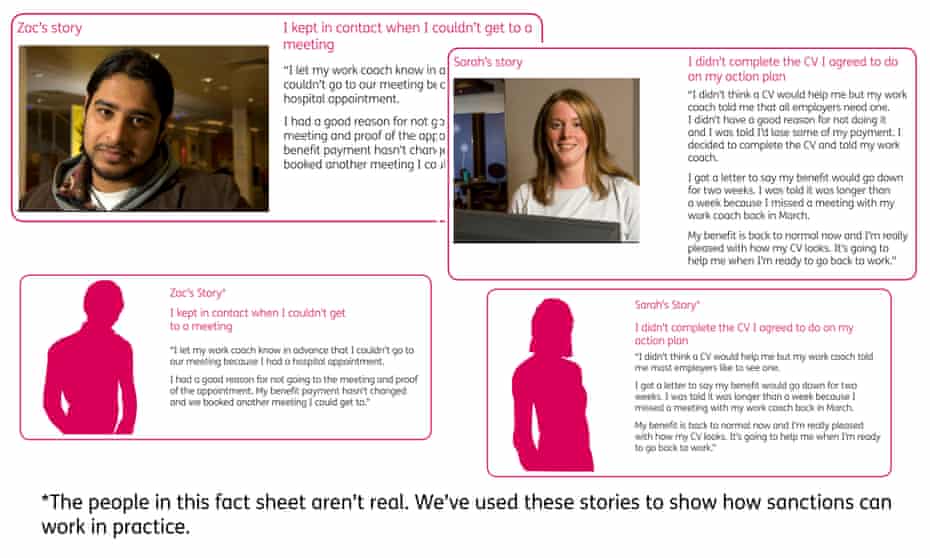
A DWP leaflet included pictures of ‘Sarah’ and ‘Zac’, who were presented as sickness benefits claimants – except neither existed. The DWP now says they were for ‘illustrative’ purposes only.
Government officials have admitted that claimant’s comments used in an official benefit sanctions information leaflet were “for illustrative purposes only”.

The revelation comes in response to a Freedom of Information (FOI) request from Welfare Weekly, in which the site authors questioned whether the comments used in the leaflet were of a genuine or fake nature.

Welfare Weekly asked the Department of Work and Pensions (DWP) to provide any evidence or information to prove that the comments used in the publication were from “genuine” claimants.

Within days of submitting their request to the DWP, the original information leaflet suddenly disappeared from the government’s website without explanation.

However, we at Welfare Weekly had already downloaded a copy of the leaflet (pdf) in anticipation of the response to our FOI request.

That leaflet included comments from two sickness benefit claimants who had supposedly been affected by benefit sanctions, Zac and Sarah.

Source: DWP
Source: DWP

According to the leaflet, Zac had said:

“I let my work coach know in advance that I couldn’t go to our meeting because I had a hospital appointment.

I had a good reason for not going to the meeting and proof of the appointment. My benefit payment hasn’t changed and we booked another meeting I could get to.”

While Susan had allegedly said:

“I didn’t think a CV would help me but my work coach told me that all employers need one. I didn’t have a good reason for not doing it and I was told I’d lose some of my payment. I decided to complete the CV and told my work coach.

I got a letter to say my benefit would go down for two weeks. I was told it was longer than a week because I missed a meeting with my work coach back in March.

My benefit is back to normal now and I’m really pleased with how my CV looks. It’s going to help me when I’m ready to go back to work.”

However, Welfare Weekly have revealed that neither of these comments came from genuine Employment and Support Allowance claimants.

Both comment’s were completely made up and included to “help people understand when sanctions can be applied and how they can avoid them by taking certain actions”, according to the DWP.

The response to Welfare Weekly’s Freedom of Information request reads:

“The photos used are stock photos and along with the names do not belong to real claimants.

The stories are for illustrative purposes only.

We want to help people understand when sanctions can be applied and how they can avoid them by taking certain actions. Using practical examples can help us achieve this.

We have temporarily changed the pictures to silhouettes and added a note to make it more clear that these are illustrative examples only.

We will test both versions of the factsheet with claimants and external stakeholders to further improve it in the future. This will include working with external organisations.”

___

The DWP have used comments and accounts that are categorically untrue in a blatant attempt to justify the use of cruel and punitive welfare sanctions, and to invalidate the experiences of genuine claimants in distress and material hardship because of sanctions. The revelation is particularly controversial because the sanctions system is causing extreme hardship, extreme psychological distress and sometimes, death, it is being operated in an unfair and arbitrary way.

 Mark Serwotka, the general secretary of the PCS union, said:

“It’s disgraceful and sinister that the DWP has been trying to trick people into believing claimants are happy to have their benefits stopped or threatened. Sanctions are unnecessarily punitive and counterproductive, and should be scrapped.”

The institute that is responsible for regulating the behaviour of organisations producing public relations material – the Chartered Institute of Public Relations (CIPR) – has launched an investigation into whether any of its members were involved in producing the document of lies.

CIPR president Sarah Pinch said:

“Falsely creating the impression of independent, popular support is a naive and opaque technique which blatantly disregards the CIPR’s standards of ethical conduct. It is deeply disappointing if public relations professionals allowed it to be published.”

I’ve written at length about the adverse consequences of increased benefit conditionality and sanctioning elsewhere on this site. See Despotic paternalism and punishing the poor. Can this really be England?  This is a blatant attempt to normalise an exceptionally punitive political approach to “supporting people into work”, inappropriately using social norming – one of several nudge techniques. Another name for the psychological technique used here is frank ‘gaslighting’.

I’ve also written about the fact that we have a government formulating policy that does not address economic, structural and political causes of poverty, instead the aim is to bring about “behavioural changes” within the population – particularly amongst the poorest and the most vulnerable social groups – to suit the anti-welfare ideology of New Right Conservatism, ministers seem to have forgotten that democratically elected governments are meant to address the needs of a population, rather than the converse being true. This despicable tactic was aimed at hiding the truth: sanctions have a devastating impact on people’s lives, as the benefit being removed is calculated at a rate to meet only basic needs, such as food, fuel and shelter in the first place.

In a democratic, rights-based society, we ought to expect that the public are not stigmatised and “acted upon,” by a government using techniques of persuasion ordinarily reserved for the seedy end of advertising and marketing industry, and by the deployment of propaganda and outright lies by the powers-that-be, in order to fulfil purely ideological directives. Governments serve the public, in first-world Liberal democracies. This government serves the government.

We call a political system where the public are expected and directed to accommodate the government’s needs and wants “totalitarianism.”

___

Are you willing to share your experience of benefit sanctions? 38 Degrees are asking people to share their sanction stories, if you would be happy for it to be used publicly. 38 degrees will ensure all contributions are published using first names only.  Please click here to participate in the Speak Out survey and campaign.

1002589_521987671204099_896277269_n (1)
Many thanks to Robert Livingstone for the image.

A list of official rebukes for Tory lies

1235473_537097386359794_65317730_n (1)

Here is catalogue of officially recognised Tory lies – each one used to justify their unjustifiable policies – which have resulted in official reprimands:

Government used ‘misleading’ figures to claim homelessness halved – Statistics authority warns Government claims to have halved homelessness  are based on the government’s very narrow definition of terms.

George Osborne rebuked for ‘no cuts in police budgets’ claim –  The Chancellor claimed he would provide “real-terms protection” but forces face £160m funding cut, statistics watchdog rules. Sir Andrew Dilnot, the chair of the UK Statistics Authority, ruled that despite Osborne’s claim to be providing “real-terms protection” for the police, forces actually faced a £160m real-terms cut in their Whitehall funding in 2015-16 and 2016-17.

A House of Commons analysis estimated that the £160m cut was equal to the salaries of 3,200 police officers over the two years.

David Cameron rebuked by statistics watchdog over national debt claims The PM said the government was ‘paying down Britain’s debts’ in a political broadcast, even though the debt is actually rising.

“Now that his false claims have been exposed, it’s time the prime minister stopped deliberately misleading people about his economic record” – Rachel Reeves.

Finally Exposed! The Deficit Myth! So, David Cameron When Are You Going to Apologise? David Cameron rebuked over austerity claims – Cameron has been corrected by the Treasury’s own forecaster over claims that cuts in public spending are not reducing economic growth. The Office for Budget Responsibility told the Prime Minister that it does believe that cutting public spending will reduce economic growth in the short term.

Robert Chote, the head of the OBR, contradicted a claim Cameron made in a speech about the economy, in which the Prime Minister said the forecaster does not believe cuts are reducing growth.

In fact, as Mr Chote wrote, the OBR believes that cuts in spending and increases in tax will depress economic activity, meaning lower growth.

OBR head rebukes Osborne: the UK was never at risk of bankruptcy. Office for Budget Responsibility chief Robert Chote dismisses the Conservative “danger of insolvency” claim.

In the weeks after he took office, George Osborne justified his austerity programme by claiming that Britain was on “the brink of bankruptcy”. He told the Conservative conference in October 2010: “The good news is that we are in government after 13 years of a disastrous Labour administration that brought our country to the brink of bankruptcy.”

It was, of course, nonsense.

*Please note the original link to the New Statesman article seems to have curiously vanished. So here is a cached link to the same article: OBR head rebukes Osborne: the UK was never at risk of bankruptcy.

David Cameron rebuked over jobs claim: Sir Andrew Dilnot, head of the UK Statistics Authority, the independent statistics regulator, said the prime minister was wrong to say figures showed that more than three-quarters of all new jobs went to British citizens when “official statistics do not show the number of new jobs.”

Cameron was attempting to show in an interview for the Daily Telegraph that the government had reversed a situation in its first few years of office when he claimed most new jobs were taken by migrant workers. The interview was widely interpreted as an attempt to win over Ukip voters who believe most jobs created as Britain’s economy recovers are being snapped up by foreigners.

Following a complaint by Jonathan Portes, head of the National Institute for Economic & Social Research, Dilnot confirmed that neither the original fear that migrants were taking British jobs nor the reversal of this trend were supported by official data.

Employment data collected by the Office for National Statistics relates to jobs in the economy whether or not they are newly created by employers. Dilnot said the relevant figures from the ONS showed the number of migrants in the labour force increased by 400,000 over the last five years, an 18% rise, while the number of UK nationals increased by 3%, or 900,000.

Sir Andrew Dilnot, head of the UK Statistics Authority, the independent statistics regulator, said the prime minister was wrong to say figures showed that more than three-quarters of all new jobs went to British citizens when “official statistics do not show the number of new jobs.”

Information Commissioner Christopher Graham launched a scathing rebuke of the decision to exercise the Government’s veto in a report on the case to Parliament. Blocking the publication of a report into the risks of NHS reforms is a sign that ministers want to downgrade freedom of information laws, a watchdog has warned. Health Secretary Andrew Lansley deployed it to block an Information Tribunal ruling that he should meet Labour demands to disclose the document.

Duncan Smith rebuked by ONS for misuse of benefit statistics – The claim that 8,000 people moved into work as a result of the benefit cap is “unsupported by the official statistics”, says the UK Statistics Authority. In letter to Duncan Smith, Andrew Dilnot writes: “In the manner and form published, the statistics do not comply fully with the principles of the Code of Practice, particularly in respect of accessibility to the sources of data, information about the methodology and quality of the statistics, and the suggestion that the statistics were shared with the media in advance of their publication.”

Another statement by Duncan Smith later in the month also drew criticism and a reprimand. The minister said around 1 million people have been stuck on benefits for at least three of the last four years “despite being judged capable of preparing or looking for work”.

However, the figures cited also included single mothers, people who were seriously ill, and people awaiting testing.

Iain Duncan Smith Rebuked Over Immigration Statistics – Iain Duncan Smith and the Department of Work and Pensions have been accused of publishing misleading immigration figures that were “highly vulnerable to misinterpretation”. Figures showing 371,000 immigrants were on benefits were rushed out by ministers with insufficient regard for “weaknesses” in the data, according to the UK Statistics Authority.

In a strongly-worded rebuke to Work and Pensions Secretary Iain Duncan Smith, the head of the UKSA, Sir Michael Scholar, condemned the handling of the research, the Press Association reported.

Sir Michael said that despite being “highly vulnerable to misinterpretation”, the claims were given to the media without the safeguards demanded for official statistics and by issuing the figures as a “research paper”, the DWP had bypassed the need to meet the usual code of conduct, he noted.

Grant Shapps rebuked by UK Statistics Authority for misrepresenting benefit figures – Yet another Conservative politician is caught making it up. Grant Shapps has joined his fellow Conservatives in the data hall of shame. In March, the Tory chairman claimed that “nearly a million people” (878,300) on incapacity benefit had dropped their claims, rather than face a new medical assessment for its successor, the employment and support allowance.

The figures, he said, “demonstrate how the welfare system was broken under Labour and why our reforms are so important”. The claim was faithfully reported by the Sunday Telegraph  but as the UK Statistics Authority has now confirmed in its response to Labour MP Sheila Gilmore (see below), it was entirely fabricated.

In his letter to Shapps and Iain Duncan Smith, UKSA chair Andrew Dilnot writes that the figure conflated “official statistics relating to new claimants of the ESA with official statistics on recipients of the incapacity benefit (IB) who are being migrated across to the ESA”. Of the 603,600 incapacity benefit claimants referred for reassessment as part of the introduction of the ESA between March 2011 and May 2012, just 19,700 (somewhat short of Shapps’s “nearly a million) abandoned their claims prior to a work capability assessment in the period to May 2012.

The figure of 878,300 refers to the total of new claims for the ESA closed before medical assessment from October 2008 to May 2012. Thus, Shapps’s suggestion that the 878,300 were pre-existing claimants, who would rather lose their benefits than be exposed as “scroungers”, was entirely wrong.

As significantly, there is no evidence that those who abandoned their claims did so for the reasons ascribed by Shapps.

The chair of the UK Statistics Authority has rebuked shadow home secretary Chris Grayling – the authority have said  he “must take issue” with claims made by the Conservatives and  warned the way they use violent crime statistics is “likely to mislead the public” and damage public trust. Mr Grayling has used a comparison between  figures to suggest that the Labour government has presided over a runaway rise in violent crime.

Even Iain Duncan Smith said that such comparisons were “profoundly misleading” and London’s Conservative Mayor, Boris Johnson, described Grayings’ claim as “absolute nonsense”. Chris Grayling made a headline-grabbing speech in which he likened life in Britain’s inner cities to that in Baltimore, Maryland, as portrayed in the acclaimed television series The Wire. Alan Johnson, the Home Secretary, remarked: “The connection between The Wire and Chris Grayling’s grasp on the problems of modern Britain is that they are both fictional.”

Treasury rebuked by UK Statistics Authority for inflation leaks – Britain’s statistics watchdog, ordered the Treasury to review its processes after sensitive inflation data this month was sent to 400 unauthorised people 17 hours before its release. Sir Michael warned: “There is a risk of market manipulation if key economic data fall in to the wrong hands before publication.”

Speculation data was leaking into the market ahead of the Office for National Statistics (ONS) announcement has been rife. Market rumours correctly predicted the last two Consumer Price Index inflation releases just before publication – in April and May.

UK Statistics rebukes Government over NHS spending claims – David Cameron famously promised he would cut the deficit, not the NHS. We now have it in black and white: he is cutting the NHS, not the deficit. There could be no clearer evidence of the failure of this Prime Minister and his Government.

“For months, David Cameron’s Government have made misleading boasts about NHS spending, misrepresenting the true financial difficulties he has brought upon the NHS. At the same time they have recently begun to try to distance themselves from these problems which David Cameron has created, trying to shift the blame to the NHS and its staff”Andy Burnham.

The watchdog has called on ministers to correct claims the coalition has made that they increased NHS spending in England. The UK Statistics Authority upheld a complaint by Labour about government claims the NHS budget had increased in real-terms in the past two years.

The watchdog found that the best-available Treasury data suggested real-terms health spending was lower in 2011-12 than in 2009-10. The Coalition said during its spending review that the NHS budget had gone up.

Coalition rebuked again by UK Statistics Authority  – this time on flood defence spending. Andrew Dilnot says a Treasury graph on infrastructure left readers with “a false impression of the relative size of investment between sectors”. George Osborne and the Treasury have been reprimanded for misleading people about the government’s investment in infrastructure. For example, their chart made it look like investment in flood defences was roughly the same as in other areas, when in fact it was a tiny fraction.

Andrew Dilnot rebukes Treasury again over the false presentation of statistics in the National Infrastructure Plan.

The UK Statistics Authority has censured the Department for Education Sir Michael Wilshaw – appointed by Mr Gove as Ofsted chief inspector – for using uncertain, weak and “problematic” statistics to claim that England’s schools have tumbled down the global rankings – the central justification for Goves’ sweeping school reforms. But now the government’s own statistics watchdog has called into question the figures at the heart of the education secretary’s argument. His verdict is a blow to Mr Gove’s claim that England has “plummeted in the world rankings” given that the education secretary has been so unequivocal about the figures, arguing that “these are facts from which we cannot hide”.

Senior Conservative ministers have been rebuked for attempting to cover up Government statistics – showing one of their key housing policies is not working. In his ruling, seen by the Independent, the Information Commissioner roundly rejected the argument put forward by DCLG officials and demanded that the information be released.

“The exemptions cited by DCLG require more than the possible inconvenience in responding to queries about disclosures,” he wrote scathingly.

“The Commissioner considers that DCLG has not provided arguments which demonstrate that disclosure would inhibit the free and frank provision of advice or the free and frank exchange of views for the purposes of deliberation.”

He ordered that the information is to be released.

And what did it show? In a short table released to the Labour Party, it showed that the number of people who begin self-build homes had fallen since the depths of the recession in 2009 under Labour from 11,800 to 10,400 in 2011.

Oddly the department claimed it did not hold the statistics for 2012 – despite the fact that more than five months had elapsed since the period covered by the data.

Theresa May rebuked over illegally deported asylum seeker – A rare court order calls on the home secretary to find and bring back a Turkish national and investigate UK Border Agency conduct.

The home secretary has returned to the high court and asked Mr Justice Lloyd Jones to set aside the order. The request was rejected and May now has to ensure the man is brought back to the UK. It is rare for orders to be granted by the court calling for people who have been forcibly removed from the UK to be returned and even rarer for the home secretary not to comply with them.

Mr Justice Singh stated that he was “very concerned” the government had failed to comply with his order.

In the court documents a senior UK Border Agency official admitted: “It is regrettable that the claimant was removed in spite of a court order preventing removal.”

Watchdog reprimands Eric Pickles’ department for £217m overdraft – The National Audit Office finding is embarrassing for the communities secretary, who was praised by chancellor as a ‘model of lean government’ – for his ability to impose cuts on struggling councils – he has been reprimanded by the Whitehall spending watchdog for running up an unauthorised departmental overdraft of £217m, the NAO disclosed that the Treasury had imposed a £20,000 fine on his department as a punishment for its poor financial management.

The head of the civil service officially reprimanded David Cameron over the behaviour of his special advisers – following ‘unacceptable’ briefings to journalists, PR Week has learned. Sir Gus O’Donnell was so alarmed at briefings coming out of Government that he wrote a strongly worded letter to the Prime Minister urging him to restrain his aides.

Prime Minister is rebuked over Liam Fox inquiry, for failing to call in his independent adviser to look at claims that the ministerial code had been breached. Fox resigned after being found guilty of breaching the code in his relations with lobbyist Mr Werritty.

MPs also claim the advisory role itself “lacks independence” after a new candidate was appointed behind closed doors by Mr Cameron.

Office of National Statistics rebukes David Cameron because of his false claim that average waiting time in Accident & Emergency has fallen.

Andrew Dilnot rebukes Cameron regarding the false claim that most new jobs in Britain used to go to foreign workers but now go to British workers.

David Cameron rebuked AGAIN by the Office of National Statistics for the false claim that Britain is “paying down its debts”. The Prime Minister said Britain had been “paying down its debts” during the Tory party conference, Sir Andrew Dilnot, pointed out that, while the deficit has fallen since the Coalition came to power in 2010, debt has risen.

And he noted that he had already rebuked Mr Cameron for making the same claim in a party political broadcast in 2013.

George Osborne rebuked for boasting he halved £1.7bn EU surchargeThe all-party Treasury select committee said: “The suggestion that the £1.7bn bill demanded by the European Union was halved is not supported by published information.”

The committee’s reproach is a blow to Osborne before the general election, when the Tories are expected to come under fire from Eurosceptics inside the party and from Ukip over the size of the UK’s EU contribution.

Finally, Coalition is rebuked by Churches over ‘human cost’ of austerity measures – despite Camerons’ claim that his policies are because of “divine inspiration”

Further evidence – UK Statistics Authority correspondence listcomplaints and responses regarding Tory lies.

This list was taken from a longer article: Austerity, socio-economic entropy and being conservative with the truth

578979_459860714083462_1726333689_n


Pictures courtesy of Robert Livingstone.

Related articles:

The Great Debt Lie and the Myth of the Structural Deficit

The mess we inherited” – some facts with which to fight the Tory Big Lies

The word “Tories” is an abbreviation of “tall stories”

The disgruntled beast

10437171_327099100774478_1052932761_n

Miliband doesn’t pander to populism, and upholds the inclusion, equality and diversity principles that are embedded in policies which Labour pioneered. He aims to address and curtail exploitative employers, which of course is a real problem, rather than migrants, who are being exploited in the same way that “nationals” are. We have workfare, analogous to slavery and counterproductive in decreasing unemployment, which is universally exploitative, and absolutely nothing to do with the poor migrants, and everything to do with profit-driven greed, and a government that has encouraged that greed to thrive and flourish at such catastrophic expense to others.

Miliband knows that Britain is not divided by race and culture, it’s divided by wealth inequalities fuelled by the Tory-led Coalition’s austerity policies. Blaming the unemployed, the sick and disabled and immigrants for the failings of the government has fuelled misperceptions that drive support for the far-right. People complain they can’t get council houses, and the only really honest question an honest politician ought to ask is: “Why aren’t there more council houses?”

And when there are large numbers of people receiving unemployment benefit or tax credits, then the only honest question to ask is: “Why is the economy failing to provide enough jobs, or pay adequate wages?”

Miliband’s emphasis on equality is bothering the Tories, because their entire ideology is founded on Social Darwinism: to the Tories, inequalities are an inevitability, because of their emphasis on competition between individuals for resources in the “free market.” Miliband’s social democracy program provides an alternative that challenges the established right-wing neoliberal consensus.

The media and the government have stigmatised vulnerable social groups as a justification of cruel and punitive policies aimed at those least able to fight back, as an explanation of the failings of this government to be fair and honour a degree of legislation to reflect public needs – the public they are meant to serve.

As a society that once promised equality and democracy, we now preside over massive inequalities of wealth: that’s a breeding ground for racism and other vicious resentments.

It’s awoken the disgruntled beast within people, the one that feeds on anger, demoralisation, fear, resentment and uncertainty.

And wherever antipathy and a degree of enmity exist, the far-right have always tried to perpetuate, exploit and increase rancour. The fascism of the 20s and 30s gained prominence because it played on wider public fears, manipulating them, and deflecting attention, as ever, from those who are truly to blame for dire social conditions: the ever-greedy elite. There’s a well-established link between political extremism, economic hardship and recession and social cleavages, with the far-right “anti-system” parties deceitfully winning the support of those who would never previously have thought of themselves as extremists.

Such extremism and rancour feeds the disgruntled beast. The political right have always sought to divide sections of the poor and middle class and set them to fight one against the other; to have us see enemies in our midst which do not exist, so that we see economic policies – the Tory-rigged “free market” competition – as the solution rather than the cause of our problems.

And here we are again. A Tory government, another rigged recession, and the politics of fear, despair and micro-managed discontent.

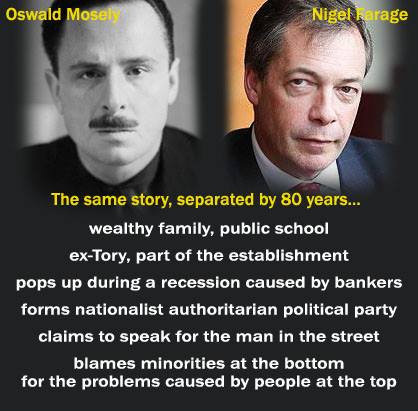
Fascism plays a specific role for the ruling class: it is a weapon against civil unrest during social crises caused by recession. It redirects public anger from the government to scapegoats. To build such a movement, fascists have to delve into the “lower classes” using a mixture of crude economic radicalism and racism. Oswald Mosley also started out as a Tory and he was a rich aristocrat. His tactic was “street politics”, rather like Farage’s appeal to woo “ordinary people.” Mosley cut himself adrift from the mainstream ruling class when in early 1934, he launched a campaign for street supremacy in key working class areas.

Farage is comparable with Mosely: he also tried to entice the working class, and those blue collar defectors who don’t feel solidarity with anyone except their “own kind” need to ask themselves how a fascist party would better reflect their interests, because fascists aren’t just fascists when it comes to your preferred target group – in this case migrants – fascists are fascists, full stop. And most migrants are working class, too.

Fascists are not known for being big on unions and worker’s rights either, Hitler smashed the unions, Mosely fought them too. But fascists do like to use the oppressed to oppress others.

Mosely was defeated by working class solidarity – Jews, communists, socialists, the labour movement, and the middle classes, who all stood side by side in Scotland, Newcastle, in the Valleys, Yorkshire, at Olympia and on Cable Street. Unity and regard for the rights and well-being of others was their greatest strength.

That community spirit and solidarity is precisely what we need to find again. The disgruntled beast is divisive, and it feeds on demoralisation, alienation, feelings of isolation and a lack of regard for others.

Identity politics and the faultlines of division

Lynton Crosby, who has declared that his role is to destroy the Labour Party, rather than promote the Conservatives, based on any notion of merit, is all about such a targeted “divide and rule” strategy. This is a right wing tactic of cultivating and manipulating apostasy amongst support for the opposition. It’s a very evident ploy in the media, too, with articles about Labour screaming headlines that don’t match content, and the Sun and Telegraph blatantly lying about Labour’s policy intentions regularly.

One major ploy has been to attempt to rally the disgruntled working classes behind the flag of identity politics – aimed exclusively at the most disgruntled, very purposefully excluding other social groups. It also sets them against each other, for example, the working class unemployed attacking migrants – it really is divisive, anti-democratic, and flies in the face of labour’s equality and diversity principles. It also enhances the political myth of convenience – the “out of touch/allthesame MPs”, some of those stoked-up disgruntled blue collar workers have defected to UKIP.

There’s an immediate danger that if the far-right succeed in colonising the anti-mainstream vote, as they are aiming to, and developing party loyalty, it will block the development of an independent working class politics capable of defending our conditions and challenging the status quo.

UKIP (and the Tories) first and foremost are traditionalists and defenders of property, with the socially paranoid ideology of the hard right. A dominant theme is a conspiratorial view of the EU as a sort of “socialist plot”, with the Eurocrats encouraging mass immigration, stifling small businesses with legislation and fuelling the welfare state. And working class cultural imperialism – some blue collar workers and working class supporters have disgruntled beasts that respond to the populist, “anti-establishment”, Islamophobic agenda. The wealthier middle class supporters who were traditionally Conservative want to force the Tories further to the right.

Thanks to the persistent propaganda work of the government and the media, the tendency is to see the far-right’s behaviour as merely the justified reaction to the provocation of socially stigmatised groups – the sick and disabled, the unemployed, Muslims and immigrants. This is the climate in which UKIP and its allies thrive. As a result, there is an urgent need to shift toward a wider cultural and political offensive against prejudice more generally. Again. The only party concerning itself with that, as ever, is Labour.

UKIP supporters manifestly don’t care about prejudice directed at others. At the very least they are not repelled by racism, sexism, disablism and homophobia, they seem unsentimental about the types of alliances they find themselves in. Yet working class UKIP supporters are cutting off their own noses to spite their faces, as UKIP are Thatcherites: neoliberal white trash. Fascists don’t support the working class –  they never have and never will. No matter how much they say otherwise.

I’ve talked about UKIP, here, but they are not the only party drawing on the propaganda of the right. I have seen Left Unity, the Greens, the SNP, and a range of so-called socialist groups utilise right-wing myths about the Labour Party, too. This means we end up repeatedly fighting to clarify truths amongst ourselves instead of simply fighting the injustices and lies of the Tories.

It also struck me that we have a raft of writers loosely writing about the Labour Party that don’t seem to promote achievements and positive policies, which is at the very least as important as the negatively weighted “critical” analyses of the last Labour government, for balance and for providing a framework for those perpetually disconsolate readers that tend to feed their pet disgruntled beasts from buzz phrases and glittering generalities for the perpetually unhappy orthodoxy obsessed narxists – like “working class disenfranchisement”, “New Labour”, “Progress”, “Blairite”, “weakened unions”, “blue labour” and so forth. Many narxists have a peculiar elitist and very  non-inclusive obsession with what socialism ought to be.

Ticked boxes and pressed disgruntle buttons.

It was mostly the disgruntled blue collar workers that found UKIP’s inverted elitism – anti-intellectualism, anti-middle-classism and a few other prejudices more appealing, and defected, in a false conscious moment of supreme nose-cutting and spited faces. I don’t see anything to be gained in fueling their discontent, propping up populism, and its irrational response – a nod in the direction of fascism from people claiming they are excluded from mainstream politics – so they defected to a party that is founded on the rhetoric of exclusion.

There are contradictions between UKIP’s ultra-Tory policies and the instincts and interests of its working class supporters. So, not quite “breaking the mould of British politics” then.  UKIP demagogically and disingenuously attack Labour for abandoning white workers, but they also focus on attacking David Cameron for not being Conservative enough.

Farage implies he has some sort of superior social knowledge and wisdom compared with the rest of the mainstream political class, and that he understands “ordinary people”, but he speaks fluently in the language of anti-progression, the fact that anyone at all is listening is indicative of an internalisation of the national right wing prejudice toward a profound anti-intellectualism.

And of course anti-intellectualism is to be expected from the Conservatives, who have historically used the repression of critical thinking as a way of deflecting scrutiny, and as a means of ensuring a compliant, non-questioning workforce to exploit. From the working class, however, it’s just the politics of resentment, and another disgruntled face of bigotry. So much for class consciousness. And solidarity.

It’s worth remembering that Marx and Engels were hardly working class, and they most certainly were intellectuals. Left wing UKIP supporters have no fig leaf to hide behind.

It’s one thing to be opposed to traditional elites, but to show support for a party so vehement in its hostility to democracy, trade unionism, socialism, human rights, our NHS and the welfare state because someone speaks with a pint and a ciggie in their hands, indicates the need for some responsible critical thinking, paying attention to details, less resentment, superficiality and disgruntled grunting.

Fascism always presents itself as your friend, it extends a cozening arm of camaraderie around your shoulder with a sly smile, a malicious grin with far too many teeth.

It’s a disgruntled beast that loves disgruntled beasts, but this public school boy and ex-Tory with offshore tax havens isn’t one of the lads from the shop floor. Farage didn’t take any lessons from the school of hard knocks, that’s for sure.

But many of us have membership in more than one oppressed group, surely its possible at least to recognise in principle the validity of other struggles against oppression, it’s important to recognise that these struggles are not in a zero-sum relationship with one another. They are complementary and cumulative. I believe the collectively oppressed are natural allies in a larger fight for justice, and create a whole greater than the sum of its parts, and this kind of intersectionality and solidarity undermines the ruling-class’s “divide and conquer.”

I think the divisions are what happens when you just feed the disgruntled beast.

That’s the problem with identity politics: it tends to enhance a further sense of social segregation, and it isn’t remotely inclusive. Of course it also enhances the myth of  “out of touch/ allthesame” politics. It’s a clever strategy, because it attacks Labour’s equality and inclusive principles – the very reason why the Labour movement happened in the first place – and places restriction on who ought to be “included”. Think of that divisive strategy  1) in terms of equality. 2) in terms of appealing to the electorate 3) in terms of policy. Note how it imposes limits and is reductive.

The Tories set this strategy up in the media, UKIP have extended it further and the minority rival parties, including the Green Party have also utilised the same rhetoric tool. Yet we KNOW right wing parties have NO interest in the working class. And those amongst the working class that have.

The Tories do not offer up public critical analysis of themselves. Indeed the anti-Labour bias on display by the Murdoch-owned news empire has never been more apparent. That’s not just because of ideology, it’s because Miliband stood up to Murdoch. But Tories don’t collectively and painfully self-scrutinise or soul search, and certainly not in public sight: they self promote. They speak with unfaltering conviction, and from that platform they control public debate and that’s despite their continuing assault on public interests.

So, where is our fully informed pro-labour spokesperson in the media? Where are the articles that inform people – the ones about what Labour do, rather than what they ought to do? Because the implicit message over and over from undoubtedly well-meaning left-leaning writers is that Labour constantly get it wrong and need advice on how to get it right, whilst their policies are not being publicly promoted, analysed, and their progress and achievements remain hidden from view. What gets attention is myth reduced to populist pseudo-critical soundbites.

The media and the message

That means, potentially, many people don’t know enough on balance to make informed choices. Disgruntled defectors often take the medium to be the message, unfortunately, and with no balance, no genuine pros and cons, just a perpetual party wish list, that reads as a list of deficits, many are fueling an often misinformed, unreasonable, hungry disgruntled beast. You present the policies from source that fill the cited alleged deficits, and dear lord, people actually get angry and abusive.

A few months ago, a well-known left wing commentator wrote a “critical” article about Labour that was based on inferences drawn from a very suspiciously muffled recording of Jon Crudass, which was a couple of minutes long, and which ended, somewhat dubiously, in mid-sentence. The recording was very well-utilised by the right wing, too.

At the time, having heard it, I challenged the writer concerned regarding the references to that very dodgy recording, and the inferences he had drawn from it, which echoed those of the Tories. I was ludicrously and condescendingly told I was being “anti-democratic”, in my “blind and uncritical” support for the Labour Party. From where I’m stood, it certainly isn’t me that is being anti-democratic, here.

It seems to be almost trendy to try and undermine Labour’s credibility and completely regardless of the accuracy of any “criticism” used. Since when was it anti-democratic to want to tell the truth, supported with facts? Why is it that people have such objections to a person being supportive of the Labour Party, anyway? That doesn’t make me undemocratic, “blind” or “uncritical” at all. I’m discerning, and the truth actually matters to me, in all of its detail. I put a lot of work in researching to ensure that I’m well-informed. And why is any of this a reason for people to direct condescending and disgusting abuse and nastiness? Yet somehow, this behaviour has become normalised and acceptable.

One response I’ve seen frequently is: “oh, but people are disillusioned with Labour”. Yeah? Well stop writing inaccurate commentaries that create disillusionment and alienation, then. Perhaps it’s time people learned to research facts for themselves, anyway, rather than allowing their apathy and disgruntledment to be fed by willing, earning authors or propaganda merchants and Tory/SNP/UKIP/Green shills and trolls on Facebook.

The Tory press operation had handed the Daily Telegraph and the BBC the transcript of that same recording of Jon Cruddas, who was approached in the foyer at the Fabian summer conference at the Royal College of Surgeons in London.

A note from the Conservatives accompanying the transcript made clear that the recording had been made by researchers posing as students, according to the account on the BBC website.

The Labour Party is considering referring the transcript of the remarks to the Press Complaints Commission, and the former standards watchdog Sir Alistair Graham has accused the Tories of entrapment. It was a dirty trick. Why on earth would someone on the left take advantage of such chicanery pulled by the Tories? 

No party is above criticism, and quite rightly so. But the criticism needs to be balanced, fair, accurate and based on informed analysis and fact. And not on any old bullshit that’s masqueraded as “criticism.” Or on secretly recorded partial conversations. If debates are not open and honest, and if criticism of parties and their policies are not based on facts, that isn’t actually debate you’re engaged in: it’s a propaganda campaign.

Surely by now we all know the media lies and excludes anything important; that it’s under authoritarian Tory control? That Iain Duncan Smith “monitors” the BBC for “left wing bias”, that the Guardian’s occasional forays into truth are stifled by jackbooted officials marching into their office and smashing hard drives? Does anyone REALLY imagine that such a government spokesmedia will do any justice to reporting about the positive intentions and actions of its opposition? It won’t. Not one bit.

Yet I see people running around hysterically clutching at cherry-picked, distorted media spun soundbites, as if the media is somehow suddenly credible when it talks of the opposition, and when you actually read what was said and proposed at the unspun initial source, it bears no resemblance at all to the media tale of the unexpected. If you trouble yourself to investigate these things, the crap being published and broadcast doesn’t stand up to scrutiny. But it does feed the disgruntled beast.

And when the media resort to personal smears – like they did last year about Ralph Miliband – you KNOW they are worried about being defeated. And behold their disgruntled beast.

It’s a crucial time when we need to make sure we know the difference between truth and propaganda, fact from fiction. It’s up to us to discern – please. We are each responsible for what happens next. It mustn’t be 5 more years of the same neo-feudalist rulers.

The nitty gritty

The Right are engaged in an all out war. The disgruntled Right know that Miliband has edited their script, abandoning the free-market fundamentalist consensus established by Thatcherism in favour of social democracy.

The right-wing media barons who set the terms of what is deemed politically palatable in Britain have never forgiven Ed Miliband for his endorsement of Leveson, which they believe is an unacceptable threat to their power.

And they know Labour under Ed Miliband will probably win the 2015 election.

This is a war, and the Tories think that chucking an avalanche of lies at the opposition is enough. It isn’t. Where are their positive, supportive, life-enhancing policies for the citizens of the UK? The Tories have NOTHING but increasing poverty and pain to offer most of us, and no amount of smearing Labour and telling lies will hide that fact. And they will do all they can to make sure Labour don’t get space in the media to tell you about their own positive social democracy program, based on tackling the inequality and poverty that Tories always create.

We simply can’t tolerate another 5 years of the terrible consequences of New Right Conservatism.

Some on the left also need reminding that there is far more at stake than tiresome debating about what “real” socialism entails. I can tell you categorically that socialism isn’t about feeding your own pet disgruntled beast at the expense of concern and care for comrades who are suffering, living in absolute poverty and dying, because of the policies of this authoritarian regime. We need to address the current crisis, the sociopolitical dysfunction, and escape Cameron’s vision of a feudal dytopia before we can even begin to design our utopia, based on orthodoxy or otherwise.

The outcome of the general election, and the future of this country, and the well-being of is our citizens is what is important, please let’s not lose sight of that.

Because when you feed only the disgruntled beasts, you just end up with beasts.

14301012075_2454438e62_o (1)

Thanks to Robert Livingtone for the excellent memes

Iain Duncan Smith used false statistics again to justify disability benefit cuts

486294_4737578711832_1816039541_n
The Department of Work and Pensions has a long track record of misusing statistics, making unsubstantiated inferences and stigmatising claimants, and it’s clear these are tactics used to vindicate further welfare cuts.

The Tories have peddled the lie that he UK was “on the brink bankruptcy” and claimed the solution to is to cut government spending with a painful programme of austerity cuts. Of course, the UK economy was growing in 2010 when the Tories took over and was subsequently plunged back into recession by Osborne’s austerity policies, which have meant that the economy has not grown at all under the coalition; and for much of their tenure has been contracting. Despite the fact that Osborne was officially rebuked for this lie, the Goebbels-styled repetition propaganda technique employed by the conservatives has embedded this lie in the minds of the public.  However, our current problems are the result of a global financial crisis that we and not the banks that caused it, continue to pay for.

Austerity is a smokescreen – the Coalition has used the deficit as an excuse to do what they have always wanted to do: shrink the state, privatise the NHS, and hand out our money to the wealthy minority. We cannot trust them. 

It’s become clear that the Tories have seized an opportunity to dismantle the institutions they have always hated since the post-war social democratic settlement – institutions of health, welfare, education, culture and human rights which should be provided for all citizens. The Tories also attempt to destroy fundamental public support for the health, education and welfare of its people by a divisive scapegoating of vulnerable groups, perpetuated via the media, and by offering and inflicting only regressive, punitive policies and devastating cuts. 

The  Official statistics watchdog (UKSA) has found that the Department for Work and Pensions (DWP) have repeatedly made false claims about the numbers of people living on disability benefits.

Ministers claim that the majority of people claiming disability living allowance (DLA) were given benefits for life, and without any supporting medical evidence. This is untrue.

According to DWP press releases:

“More than 50% of decisions on entitlement are made on the basis of the claim form alone, without any additional corroborating medical evidence.”

However, the UK Statistics Authority (UKSA) found that the real percentage of claims passed without supporting medical evidence was just 10%.

The DWP also claimed that “Under the current system of Disability Living Allowance, 71% of claimants get indefinite awards without systematic reassessments.” However the UKSA found that in the last two years, just 23% and 24% of claimants were given indefinite awards of DLA.


The DWP accept that their claims were “ambiguous” and “had not been re-checked by the Department’s analysts, as is the usual practice.”

The findings were uncovered by an investigation by Channel Four News following complaint by the charity Parkinson’s UK.

 Parkinson’s UK policy advisor Donna O’Brien said:

“People with Parkinson’s who claimed DLA have told us supporting medical evidence was crucial due to a woeful knowledge of the condition amongst assessors, and it is absurd that the Government was trying to imply that anyone going through the system had an easy ride.”

This is the third time in the past year that Iain Duncan Smith has come under fire for the use of false statistics to justify cuts to benefits.

Last year Duncan Smith was rebuked by UKSA for misuse of benefit statistics. He claimed that 8000 people who had been affected by the benefits cap had “moved back into work.”

The UKSA found that this figure was “unsupported by the official statistics.”

Another statement by Duncan Smith later in the month also drew criticism and a reprimand. The minister said around 1 million people have been stuck on benefits for at least three of the last four years “despite being judged capable of preparing or looking for work”.

However, the figures cited also included single mothers, people who were seriously ill, and people awaiting their assessment.

Grant Shapps was also rebuked by UK Statistics Authority for misrepresenting benefit figures – Shapps joined his fellow Conservatives in the data hall of shame. In March, the Tory chairman claimed that “nearly a million people” (878,300) on incapacity benefit had dropped their claims, rather than face a new medical assessment for its successor, the employment and support allowance (ESA).

The figures, he said, “demonstrate how the welfare system was broken under Labour and why our reforms are so important”.  The claim was faithfully reported by the Sunday Telegraph  but as the UK Statistics Authority has now confirmed in its response to Labour MP Sheila Gilmore (the complainant), it was entirely and intentionally fabricated.

In his letter to Shapps and Iain Duncan Smith, UKSA chair Andrew Dilnot writes that the figure conflated “official statistics relating to new claimants of the ESA with official statistics on recipients of the incapacity benefit (IB) who are being migrated across to the ESA”.

Of the 603,600 incapacity benefit claimants referred for reassessment as part of the introduction of the ESA between March 2011 and May 2012, just 19,700 (somewhat short of Shapps’s “nearly a million) abandoned their claims prior to a work capability assessment in the period up to May 2012. The figure of 878,300 refers to the total of new claims for the ESA closed before medical assessment from October 2008 to May 2012.

Thus, Shapps’s suggestion that the 878,300 were pre-existing claimants, who would rather lose their benefits than be exposed as “scroungers”, was entirely wrong. As significantly, there is no evidence that those who abandoned their claims did so for the reasons ascribed by Shapps. However, he did at least honestly reveal his own prejudices regarding disabled people, at least. But he did so without a trace of shame and remorse.

At the time Iain Duncan Smith dismissed the findings, saying that he “believed” that he was “right”, anyway. It seems that Iain Duncan Smith has some disdain for evidence-based policy.

“I believe this to be right, I believe that we are already seeing people going back to work who were not going to go back to work,”  he said.

This is a remarkable claim, given that the Department for Work and Pensions does not track the destination of people no longer entitled to benefits. Simply measuring how many people no longer claim benefits does not accurately reflect the numbers of those actually moving into employment. The DWP off-flow figures will inevitably include many having their claim ended for reasons other than securing employment, including sanctions, awaiting mandatory review, appeal, death, hospitalisation, imprisonment, or on a government “training scheme” (workfare). 

In 2011, the Work and Pensions Select Committee warned the Department for Work and Pensions (DWP) needed to take more care when releasing and commenting on benefit statistics, to make sure media stories were “accurate.”

It seems unlikely, however, that accuracy will replace Duncan Smith’s “gut feelings” and ideologically-driven rhetoric – which is aimed at presenting excuses for the steady reduction of support for the most vulnerable citizens – any time soon.

36626_217452248405831_532419169_n

Pictures courtesy of Robert Livingstone