Category: Uncategorized

When work doesn’t pay

1379986_541109785958554_2049940708_n

Any job isn’t necessarily a good job for people out of work

By Stephen Bevan, Lancaster University

There can be no doubt that the job market has been more resilient since the financial crisis than many imagined. Unemployment did not rise as far as was feared and the recovery in employment to pre-recession levels has been quicker than forecast by even the most optimistic labour economists. So, time for some self-congratulatory back-slapping among policy makers then? On the surface of things, at least, it looks like a jobs miracle, despite the belt-tightening of austerity.

Unfortunately, having studied the quality of jobs which many people in the UK are now doing, this is not entirely the case. The UK labour market is, indeed, performing well but we have a growing and potentially corrosive problem of poor quality, precarious and temporary work which threatens our productivity and competitiveness, levels of social inclusion and, ultimately, the health of the workforce.

Many will argue that this contingent work is essential if we are to have a flexible labour market and this, of course, has always been the case. But how about the effects of this kind of work on the people doing it?

My research has focused on the relationship between the kinds of contingent work that has poor psychosocial quality and the mental health of the workers doing it. And findings force us to ask, perhaps heretically, whether we are actually always better off in work.

Work and well-being

Psychosocial job quality involves the degree to which jobs promote control, autonomy, challenge, variety and task discretion. It effects the extent to which work enhances or diminishes our psychological well-being.

There’s a clear link between being engaged in “good work” and mental health. An important contribution to our understanding of this link has come from the Household, Income and Labour Dynamics in Australia (HILDA) Survey in Australia. It brings together a robust set of data that can be easily compared with other situations such as unemployment. The results, published by Peter Butterworth and colleagues at the Australian National University have global resonance for countries that are serious about developing an understanding of what being “better off” in work really means, beyond narrow economic definitions.

Plus? That depends on the job.
Gareth Fuller/PA Wire

The received wisdom is that being out of work is a bad thing. It certainly is bad, as we know, for income. It is also bad for self-esteem, dignity, social inclusion, relationships and health. So, all other things being equal, a policy position that promotes getting people back into work is both rational and evidence-based.

But, building on this position, and especially during a period of high unemployment, the received wisdom also tells us that any job is a good job. This axiom informs current UK policy towards compulsory work experience and the “workfare” or “work-for-benefits” thinking which many politicians now favour.

Worse than unemployment

Being in poor-quality work which, perhaps, is boring, routine or represents underemployment or a poor match for the employee’s skills is widely regarded as a good way for the unemployed to remain connected to the labour market – and to keep the work habit. But Butterworth’s data contradicts this. The HILDA data shows unambiguously that the psychosocial quality of bad jobs is worse than unemployment. Butterworth looked at those moving from unemployment into employment and found that:

Those who moved into optimal jobs showed significant improvement in mental health compared to those who remained unemployed. Those respondents who moved into poor-quality jobs showed a significant worsening in their mental health compared to those who remained unemployed.

So now we have a slightly different answer to the question about the unemployed being better off in work. Yes they are, as long as they are in good-quality jobs. If they are in bad jobs, there is a perversely strong chance that they will be worse off – especially in terms of their mental health.

Again, for those who think that there should be punitive undertones to policies to get unemployed people back to work would do well to question whether the “any job is a good job” maxim is as accurate as they like to think. Moreover, we should probably question whether the revolving-door characteristics of some policies in which many people fall back out of work soon after being found a job might – in part – owe their poor performance to the damaging psychosocial quality of the work itself.

This shouldn’t stop us from straining every sinew to help people find work. But it should make us think a lot more about how the quality of jobs can affect our health and productivity. Even in a recession, the uncomfortable truth may be that “any job” may not be a good job at all.

The Conversation

Stephen Bevan, Director of the Centre for Workforce Effectiveness, The Work Foundation and Honorary Professor, Lancaster University

This article was originally published on The Conversation. Read the original article.

My wife and child are disabled, I care for them. Govt have made our lives a living hell. No government should do this to citizens.

innervoice2011's avatarThomas Hemingford

I have no idea why my wife and I ever bothered paying into the system. Which, in turn, means we wonder why we ever bothered working.

People buy into all the TV productions, media headlines and political nonsense about benefits. But the likes of newspaper stories, “Benefits Street” or Benefits Britain are not factually typical or realistic. They are far from representative, and always one-sided.

There is a great myth that has been spun by the government and media; the myth is that welfare benefits were too generous, too high and needed to be cut.

However, the reality is very different from this image that has skewed people’s perceptions of welfare. The truth is that welfare benefits were never too high. Far from it, they were in fact inadequate.

The truth is that pay levels have been and still are grossly insufficient. Combined with high prices and a high cost…

View original post 1,373 more words

Disability Hate Crime Soars 25% In Only A Year – And That’s Only Reported Incidents – Welfare Weekly

599849_369461329790068_1640090166_nCredit: Robert Livingstone

The number of disability related hate crimes reported to police has soared by a shocking 25% in only a year, according to new figures published today.

Figures published by the Home Office reveal that 2,508 disability motivated hate crimes were reported and recorded by the police in 2014/15, up 25% from 2,006 in 2013/14.

The report says ‘improved willingness of victims to come forward is likely to be a factor in the increase in hate crimes recorded by the police’. Critics blame welfare cuts and the negative portrayal of disabled people in the media.

The Crime Survey for England and Wales also includes unreported cases, which reveals that disability is now the second most common motivating factor behind all hate crimes.

According to the survey, there were an average of 70,000 incidents of disability hate crime per year between 2012 to 2015, including unreported/unrecorded cases, compared to 106,000 for racially motivated hate crime.

Among all hate crimes reported and recorded by the police in 2014/15 (does no include unreported/unrecorded cases):

  • 42,930 (82%) were race hate crimes;
  • 5,597 (11%) were sexual orientation hate crimes;
  • 3,254 (6%) were religion hate crimes;
  • 2,508 (5%) were disability hate crimes; and
  • 605 (1%) were transgender hate crimes.

Incidents of hate crime can have more than one motivating factor, hence why the figures add up to more than 100%.

The Home Office says there were increases in all five of the centrally monitored strands between 2013/14 and 2014/15.

Notably, racially motivated hate crime increased by 15% between 2013/14 to 2014/15 and religious hate crime increased by 43% over the same period.

Racially or religiously aggravated hate crime offences peaked in July 2013, following the Lee Rigby Murder.

Of cases reported to the police and flagged as hate crime:

  • 59% were public order offences;
  • 30% were violence against the person;
  • 7% were criminal damage and arson; and
  • 3% were recorded as other offences.

Victims of hate crime are far less likely to be satisfied with police handling of incidents. Just 52% said they were ‘very’ or ‘fairly satisfied’, compared with 73% for crime overall.


Source: Disability Hate Crime Soars 25% In Only A Year – And That’s Only Reported Incidents


This isn’t about Doctors or Nurses, GP’s or Consultants. It’s about our Free Health Service

stephenpaulblanchard's avatarstephenpaulblanchard

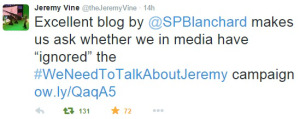
Yesterday morning, the silence was broken. Fifteen days after Jeremy Hunt made his inflammatory speech at the Kings Fund in Central London, giving NHS consultants an ultimatum on working weekends, and describing the rest of the staff as “lazy” and over-paid, the desperate voices of those people he bad-mouthed and those who support them were set free. After spending over two weeks building up in the virtual pressure cooker of social media, traditional news outlets have finally started to take notice.

Twitter Jeremy Vine used his Twitter feed to break two weeks of silence around #WeNeedToTalkAboutJeremy.

Jeremy Vine is the first mainstream media broadcaster to openly take notice of #WeNeedToTalkAboutJeremy. He neither supports nor ridicules, merely highlighting the fact that there is a story here. Whether he decides to take it further and make it part of his Radio 2 show remains to be seen, but the fact that he recognises…

View original post 1,402 more words

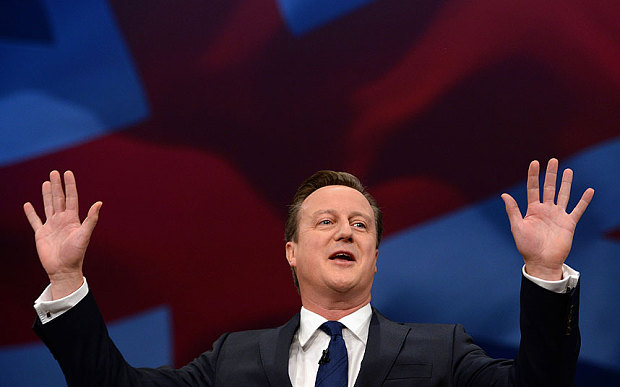
Cameron ridiculed for hypocrisy and quoting Corbyn out of context

 Tory_David-Cameron_3466207b
“Bin Laden’s death a tragedy”: Cameron is widely ridiculed as hypocritical attack on Corbyn backfires

Video:

Cameron has been subjected to much ridicule this week, after he misquoted the leader of the opposition, Jeremy Corbyn, taking his comments out of context, during the Prime minster’s Conservative party conference speech. This led to thousands of people sharing a video of Cameron himself describing Osama bin Laden’s death as “a tragedy.” 

The point was very deftly well made.

Cameron was hoist by his own petulant petard.

Mr Cameron failed to provide any context about Mr Corbyn’s previous comments, neglecting to mention the fact that Mr Corbyn had actually said that the lack of trial for Bin Laden was the “tragedy” not the terrorist leaders death itself.

Mr Corbyn’s original comments had come from an interview with Iranian news channel, The Agenda. During the interview, Jeremy Corbyn, who was actually introduced as an “outspoken rebel in the Labour party’s ranks”, said:

“There was no attempt whatsoever that I can see to arrest him, to put him on trial, to go through that process.

This was an assassination attempt, and is yet another tragedy, upon a tragedy, upon a tragedy.

The World Trade Center was a tragedy, the attack on Afghanistan was a tragedy, the war in Iraq was a tragedy. Tens of thousands of people have died. Torture has come back on to the world stage, been canonised virtually into law by Guantanamo and Bagram.”

However the malicious Mr Cameron made no show of an attempt at quoting Mr Corbyn correctly and instead used the old quote out of context, to mislead people, claiming he felt Mr Corbyn somehow constituted a “threat to national security.”

Even the BBC has called the Conservatives out on this particular propaganda campaign against the opposition leader. See – BBC’s Stephen Sackur accuses Tories of spreading propaganda about Jeremy Corbyn, and of being unaccountable and undemocratic.

Supporters of the leader of the opposition went on to give Prime Minister David Cameron a taste of his own medicine by sharing a clip of the exact moment when he says: “the death of Osama bin Laden was a tragedy”, (shown above,) removing its context, causing mirth and a sense of poetic justice amongst Corbyn’s strong following.

During the Conservative conference, Cameron’s only standing ovation happened during his delivery of the malicious, deeply personal attack, and typical Bullingdon bully boy sneering comments about the Labour leader. It was to vindictively rapturous applause that the Prime Minister went on to say, without qualification:

“We cannot let that man inflict his security-threatening, terrorist-sympathising, Britain-hating ideology on the country we love.”

What does that tell you about the Tories?

Firstly, that they have no use for evidence, truth and fact, as their ideologically directed policies and rhetoric demonstrate time and time again. Secondly, that they most strongly and passionately endorse bullying and ridiculing others who don’t share their fearful little Britain perspective and ever-shrinking small world view.

Yet isn’t it a little odd that the Tories have considered every single Labour leader to be a “Britain hating threat” and a “dangerous commie”, with the exception of Blair, of course, though they are still busy trying to repeal Blair’s policy legacy. Only last year we saw the Daily Mail claiming the same about mild as milk Miliband, using his father, Ralph, to hold up as the dangerous “red under the bed.”

History tells us the Tories are not only nasty, paranoid propagandarising fearmongers, but that they are prepared to go to extraordinary lengths to maintain the status quo, repeating the same pattern of tired lies over and over. See for example, the fake, “leaked” Zinoviev letter, the plot against Harold Wilson, the “enemy within”.

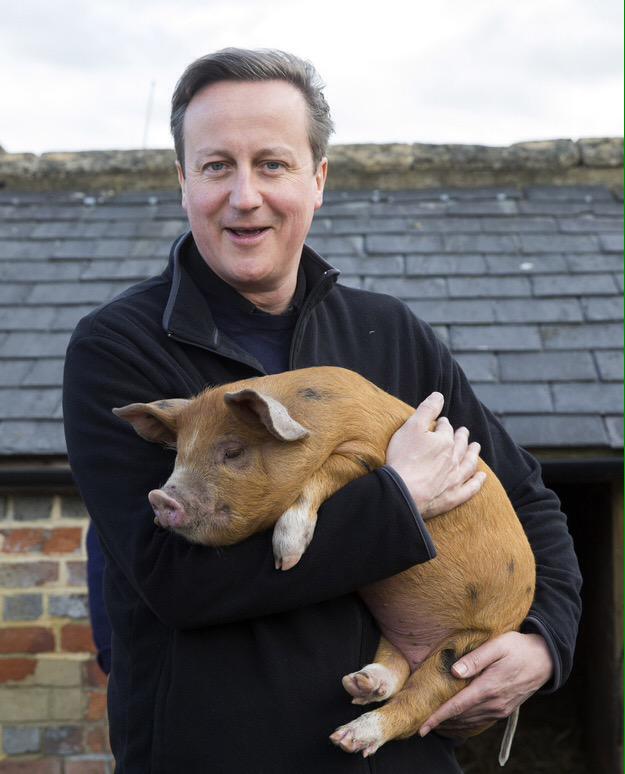
This further embarrassment comes in the wake of the recent #PigGate scandal, where allegations about his past encounters with a pigs head whilst at Oxford University were revealed by the former Conservative donor Lord Ashcroft in his recent biography.

Related

It’s not as if the Tories are well known for telling the truth:

The Conservative’s negative campaign strategy: “share the lies and win a prize”

A list of official rebukes for Tory lies

Cameron’s pre-election contract: a catalogue of lies

The Tory election strategy is more of the same: Tories being conservative with the truth

The word “Tories” is an abbreviation of “tall stories”

Don’t think of an elephant, and under no circumstances must you EVER think of a pig ….

Embedded image permalink


Too late. It’s now impossible to unsee the once unthinkable.

The Daily Mail (admittedly not the world’s most reliable, factual newspaper,) has given David Cameron a taste of his own medicine by publishing an exclusive sneak preview of a soon to be published,  intimately detailed and strictly unauthorised biography of the Prime Minister.

It was co-written by a senior Conservative Party figure, Lord Ashcroft, and Isobel Oakeshott, former Sunday Times political editor, and Call Me Dave promises to reveal some extremely uncomfortable and embarrassing details about Cameron’s infamously uber-privileged younger years.

The biography contains some fairly prosaic stories of the kid Cameron smoking weed and listening to Supertramp with the likes of James Delingpole and generally being a very obnoxious, wealthy Tory numpty. However an unnamed source in the book alleges that Hameron was a member of a glorified and debauched fraternity boy’s club at Oxford University called the Piers Gaveston. The source claims that the then future Prime Minister of Great Britain “inserted a private part of his anatomy” into a dead pig’s mouth that was resting on the lap of another club member, at an initiation ceremony for the club. What a very ghastly silly sausage.

I hadn’t realised that Charlie Brooker’s Black Mirror was actually a documentary series.

https://politicsandinsights.org/wp-content/uploads/2015/09/757f5-blackmirrorthenationalanthem.jpg

The internet has exploded with glee at the story, with some jolly japes and lots of mirthful revenge aimed at the swine minister – check out #piggate on Twitter.

The revelations have added new layers of meaning to phrases such as “ham shanks”, “ham fisted”, “telling porkies” , “bringing home the bacon” , “making a pig’s ear of it” and  “pig-headed.” 

I never thought that the Daily Mail would make me laugh out loud with such a suprisingly welcomed sense of poetic justice, though I did flinch a little. I’m a vegetarian for moral reasons.

Undoubtedly, amidst all of the oinky tonk glee and frivolity generated by Lord Ashcroft’s revelations, David Cameron is certain to face some hamstringing questions from Labour over the allegations made by the former Conservative deputy chairman that the prime minister conspired to mislead the public before the 2010 election about his knowledge of Ashcroft’s non-dom tax status.

There’s a darker side to contemplate in all of this. My first thought is that perhaps the dead pig story is really a dead cat. What are we being diverted from?

Secondly, the unacceptably ugly is deeply rooted in the public school class and its culture. If someone ever told me to abuse a dead animal in order to gain acceptance of a ghastly ingroup, I would have told them no without hesitation. Even as a child. Cameron clearly doesn’t have such well-defined moral boundaries. How a person treats and regards animals (dead or alive) reflects something of how they are likely to treat and regard other people, too.

Boarding school: the trauma of the ‘privileged’ child by Joy Schaverien explores the emotional deprivation and abuse that many experience as a result of public school culture. Psychotherapist Nick Duffell (2000) wrote a book based on workshops he has conducted over ten years with adults who attended boarding schools as children. He has identified many lasting pathological psychological patterns common in those he calls Boarding school survivors.

In his recent work: Wounded Leaders: the Psychohistory of British Elitism and the Entitlement Illusion, Nick says:

“A cherished national character ideal, eschewing vulnerability and practising a normalised covert hostility based on bullying in the dorm adversely affects even those who did not have the privilege of such an education. It leaves Britain in the social and emotional dark ages, led by “the boys in the men that run things.”

This specific culture of elitism, protected by financial interests and the “It never did me any harm” syndrome, means that Britain is unlikely to foster the kind of leadership necessary in our world of increasing complexity, which needs a communal mindset and cooperative global solutions. But worse, new scientific evidence shows that this hyper-rational training leaves its devotees trapped within the confines of an inflexible mind, beset with functional defects, presented here as the Entitled Brain.”

It’s a sobering thought that so many boarding school survivors, psychologically and emotionally damaged individuals, are involved in running the country and determining the terms and conditions of our lives.

However you see Piggate, it’s worth considering that when even the bastion of working-class Conservatism, the Daily Mail, finds it necessary to exercise a critical voice (whatever next?), you know it’s time to worry.

Embedded image permalink

Tory policies are class contingent, express prejudice and are discriminatory

incon
Conservatives persistently peddle a fallacy that they don’t subscribe to an ideological belief system.
Francis Fukuyama announced the end of history and the arrival of a post-ideological world. But Fukuyama’s declarations were really just New Right ideology incognito.

I always saw Fukuyama as an ardent champion of ultra-neoliberalism, and he disguised his neo-conservatist ideology behind apparently benign virtue words and phrases (as part of a propaganda technique called Glittering Generalities), such as “Man’s universal right to freedom.” 

He meant the same sort of self-interested “freedom” as Ayn Rand – “a free mind and a free market are corollaries.” He meant the same kind of implicit Social Darwinist notions long-held by Conservatives like Herbert Spencer – where the market rather than evolution decides who is “free,” who survives; and as we know, that’s rigged in favour of a minority of rich and powerful people, by rich and powerful people. Tory ideology does not ever yield a remotely utilitarian outcome.

Fukuyama’s ideas have been absorbed culturally, and serve to naturalise the dominance of the Right, to stifle the rationale for critical debate and discredit alternatives. Not all “common sense” is established by consensus, nor does it always make sense. Tacit assumptions and prejudices often lie beneath the stock of glittering generalities and comforting soundbites that are quite commonly what passes as public and political acumen.

To quote Owen Jones:

“Since they were founded as a modern political force in 1834, the Conservatives have acted as the parliamentary wing of the wealthy elite. When I was at university, a one-time very senior Tory figure put it succinctly at an off-the-record gathering: the Conservative Party, he explained, was a “coalition of privileged interests. Its main purpose is to defend that privilege. And the way it wins elections is by giving just enough to just enough other people.”

It’s not just that Tories don’t reflect working class interests though. It’s much worse. Margaret Thatcher’s policies caused premature deaths, and her Cabinet were far less harsh towards unemployed, sick and disabled people than Cameron’s government.

A research report which looked at over 70 existing research papers concludes that as a result of unnecessary unemployment, welfare cuts and damaging housing policies, the former prime minister’s legacy includes the unnecessary and unjust premature death of many British citizens, together with a substantial and continuing burden of suffering and loss of well-being.

It doesn’t take a genius to work out that if you inflict stress and harm on people who are already ill, by withholding their lifeline support; by constantly reassessing them and telling them they are fit for work when they clearly are not; by invalidating their experiences, by forcing them to fight for the means of survival – without having the means of survival, it will probably exacerbate any illness and quite possibly, this will kill them.

Cameron and his government have consistently displayed an absolute lack of concern for sick and disabled people, who have borne the brunt of Tory austerity cuts. Yet it’s inconceivable that Conservatives don’t grasp the fact that their policies are at least potentially very harmful, and certainly very punitive in nature.

Government policies are expressed political intentions, regarding how our society is organised and governed. They have calculated social and economic aims and consequences.

Tory ideology is founded on toxic subterranean values and principles, which are anachronistic and incompatible with a society that has evolved to value democracy, human rights and the socio-economic gains from our post-war settlement.

Conservatives have always seen inequality as a necessary and beneficial element to a market driven economy, for example; and their policies tend to assemble a steeply hierarchical society, especially given their small state fetishism, which involves removing socioeconomic support services and civilising mechanisms such as welfare, free healthcare and access to legal aid.

Beneath the familiar minarchist, class contingent Conservative policies and neoliberal schema is a tacit acceptance of socioeconomic Darwinism and a leaning towards eugenicist principles, expressed most clearly recently in the withdrawal of tax credit support for low paid families with more than two children, in order to “change behaviours” as Iain Duncan Smith put it. The reasoning behind this is the government believe they can “nudge” poor people into “breeding” less. Such a class contingent policy, based on archaic methods of operant conditioning, reflects a deep prejudice and also demonstrates a considerable degree of authoritarianism that is certainly incompatible with democracy.

(See also David Freud was made to apologise for being a true Tory in public, Paternalistic Libertarianism and Freud’s comments in context and What will the Tories suggest next. “Compassionate” eugenics?)

The Tories employ a variety of strategies to attempt to justify their ideology, narratives and policies amongst which are techniques of neutralisation. These are used to rationalise or justify acts that contravene social norms or that are illegal.  There are five basic techniques of neutralization; denial of responsibility; denial of injury; denial of victims; condemnation of the condemners and an appeal to higher loyalties.

The recognition of techniques of neutralisation by David Matza and Gresham Sykes happened during their work on Edwin Sutherland’s Differential Association in the 1950s. Matza and Sykes were working on juvenile delinquency at the time, and they theorised that the same techniques could be found throughout society and published their ideas in Delinquency and Drift, 1964.

It was Alexander Alverez who identified that these techniques were used more broadly at a socio-political level in Nazi Germany to “justify” the Holocaust. He added a sixth technique – Disengagement and Dehumanisation.

Such techniques allow people to neutralise and temporarily suspend their commitment to societal and moral values, and to switch off their own “inner protests”, providing them with the freedom to commit deviant acts. Some people don’t have such inner protests – psychopaths, for example – but they may employ techniques of neutralisation to manipulate, and switch off the conscience protests of others.

It’s clear that this is a method frequently employed by the government. The Tories systematically attempt to distort meanings, to withhold, or to deny any evidence that may expose the impact of their draconian policies on targeted social groups.

For example, when the Tories habitually and dishonestly use the word “reform” in reference to cutting public funding or support and “help” and “support” is Tory-speak that means to coerce and punish. The claim that the bedroom tax is “helping” people into workorhelping child poverty– when empirical research shows that 96% of those affected by the bedroom tax can NOT downsize due to a lack of available homes in their area – is a completely outrageous lie. People can’t move as there is a housing crisis, which is due to a lack of affordable homes and appropriately sized accommodation.

How can policies that further impoverish the poorest ever “help them to into work” or alleviate poverty? It’s glib, irrational tosh from a Government that can’t do coherent, joined up thinking, and even worse, thinks that we can’t either.

Forms of social prejudice are normalised gradually, almost inscrutably and incrementally – in stages. Allport describes the political, social and psychological processes, and how techniques of persuasion – propaganda – are used to facilitate stigmatising and dehumanisation of targeted groups to justify discrimination, until the unthinkable becomes acceptable, because of a steady erosion of our moral and rational boundaries.

The prejudice happens on a symbolic level first – via language – and it starts with subtlety, such as the use of divisive and stigmatising phrases like “scroungers and strivers” in the media and political rhetoric, referring to people who need support and social security as “stock”, suggesting that disabled people are not worth a minimum wage and so on.

These comments and strategies are not “mistakes”; this is how Conservatives really think. People who are prejudiced very seldom own up to being so, nor do bullies. They employ linguistic strategies, deceitful, diversionary and irrational responses that makes challenging them very difficult.

But as history has taught us, we really must challenge them.

This was taken from a longer article, in part – Techniques of neutralisation: David Cameron’s excuses for Iain Duncan Smith

Related

Conservatism in a nutshell

Briefing on How Cuts Are Targeted – Dr Simon Duffy

Inverted totalitarianism and neoliberalism. Oh dear.

There is no such thing as a ‘one nation’ Tory: they always create two nations

Inequality has risen: Incomes increased for the richest last year, but fell for everyone else

The UK is now the most unequal country in EU, and Cameron has been very conservative with the truth

Cameron’s Gini and the hidden hierarchy of worth

Follow the Money: Tory Ideology is all about handouts to the wealthy that are funded by the poor

‘We are raising more money for the rich’ revisited: some thoughts

UK becomes the first country to face a UN inquiry into disability rights violations

Aktion Arbeitsscheu Reich, Human Rights and infrahumanisation

A list of official rebukes for Tory lies

demcracyPictures courtesy of Robert Livingstone

The five most dangerous myths about sickness and disability benefits – Frances Ryan

486294_4737578711832_1816039541_nHere is an excellent article by Frances Ryan, originally posted in the New Statesman yesterday.

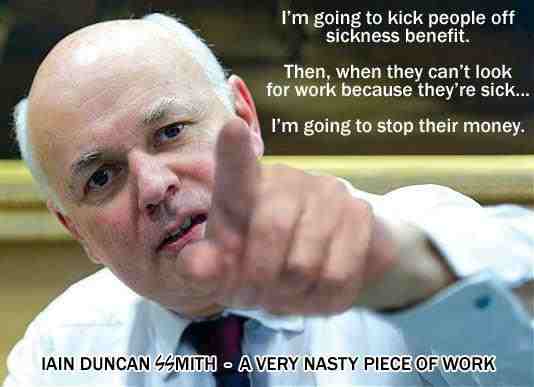
Iain Duncan Smith’s “overhaul” of the benefit system is surrounded by harmful distortions.

292533_330073053728896_1536469241_nIn a major speech, Iain Duncan Smith has called for an “overhaul” of the disability and sickness benefit system.

As a man with a history of not knowing the difference between fact and “some stuff I made up because it seemed to help at the time”, it worried me to see that the work and pensions secretary seemed to find himself here again.

In the old-fashioned belief public policy should be based on reality, here’s five myths around sickness and disability benefits:

1. Disability and sickness benefits are a sign of welfare dependency

Creating the impression that you’re going to announce a humane, competent understanding of disability and sickness doesn’t get off to a great start when the entire first section of your speech is dedicated to the idea there is a “sickness benefit culture in this country”.

In fact, if like me you prefer to watch any Iain Duncan Smith appearance whilst playing a round of “demonisation of benefit claimants” drink bingo, you would have been catatonic after around three minutes. The Conservatives inherited “a welfare system where a life on benefits paid more than having a job”. (DRINK.) “A life without work, for many, had become ‘the norm’.” (DRINK.) Benefits are “handouts”. (DRINK.) There is such a thing as “worklessness”. (DRINK.)

These terms are ridiculous enough when discussing Job Seekers’ Allowance (JSA) but take on a special level of ridiculous when discussing Employment and Support Allowance (ESA). It doesn’t take an expert to grasp that a person being unable to earn an income because of Parkinson’s or Multiple Sclerosis is not a sign of a “sickness benefit culture” but a sign that someone is sick. Something is not a “culture” because I want it to be. You may as well say Britain has a culture of badgers. Sure, it’s true there are badgers in the country. But knowing that doesn’t make me want to paint myself black and white.

2. Cutting benefits is what helps disabled or ill people get back to work

If you can stand to make your way through the opening paragraphs on how lazy out of work people are, what’s striking about the latest nod to “disability benefit reform” is that Duncan Smith said a couple of things that made sense. For example, employers are sometimes reluctant to employ people with disabilities or that “the poor quality of support” many sick and disabled people receive is a key factor in them not returning to work.

I mean, Duncan Smith should know. Considering he’s been the one overseeing the removal of disabled people’s support for the past five years.

The problem with successfully pointing out some problems is that it means nothing if you adopt counterproductive solutions. Duncan Smith’s latest words may point blame towards the structures (cultural prejudice, difficulties of the labour market, lack of in-work support) but his policies put it firmly back on the individual (people need incentivising to get off sickness benefits).

If Duncan Smith cared about “supporting” people struggling to work due to illness or disability, he wouldn’t sanction, time limit, or directly cut their benefits. Similarly, he wouldn’t annihilate in-work support such as Access to Work.

As it is, the government telling bosses to be more reasonable and understanding to the disabled and chronically ill is like a great white shark advocating vegetarianism. It means more if you don’t currently have blood in your teeth.

3. An “unfit for work” assessment should be based on what an ill or disabled person can do

Considering the assessment the government is currently using is one that finds coma patients fit for work, I think most of us would be fully supportive of changes to the Work Capability Assessment – the test that decides if someone is eligible for ESA. But Duncan Smith’s idea “we need a system focused on what a claimant can do” has the whiff of a motivational trainer about it. As he put it, “someone may be able to do some work for some hours, days or weeks, but not what they were doing previously”.

I might be able to design handcrafted One Direction figures out of toilet rolls and cotton wool. It doesn’t mean there’s a job out there that meets that specification or there is an employer who will hire me for it. Similarly, to say that someone with chronic fatigue can get to work at 11am and do “some work for some hours” is not the same as saying stable, suitable employment exists for them. Zero hour contracts do not count.

The way health conditions interact with the labour market – that is, the lack of flexibility around helping disabled or chronically ill people at work – is a key problem. But without concrete strategies in place, a test that “focuses on what a claimant can do” is a recipe for removing their benefits. Being found “fit for work” does not count if said work does not exist.

4. ESA is meant to be a short-term benefit

Embarrassingly, the Department for Work and Pensions has for a while seemed confused about what ESA actually is. We saw this with the recent move to cut ESA down to the rate of JSA – essentially treating some ESA claimants found “unfit for work” as if they were the opposite.

Duncan Smith did it again yesterday when he stated ESA started to fail when it was no longer a “short term benefit”. Well, not really. By its definition, the support group of ESA – that is, the group for those who has been found as having no possibility of working – is a long-term benefit. Even the Work Related Activity Group (WRAG) – the group for people found unfit for work but capable of “preparing for work” – never planned to treat the long-term ill as if they had a bad dose of flu. As Declan Gaffney, analyst of the labour market and social security, points out, the person who introduced WRAG – Paul Gregg – said the typical duration was always estimated to be two years.

If Duncan Smith is wondering why many have been left to languish in the WRAG, he may want to start looking a little closer to home (see number 3, above).

5. Britain spends more on “sickness benefits” than other countries

Still, pointing as far away from the problem is also a method. Anyone who’s been following the Conservative’s dismantling of the welfare state will know they have a particular favourite of this: claiming Britain is more generous towards disabled people than other nations. Yesterday, Iain Duncan Smith pulled it out again:

Some ‘scaremonger’ but ‘it is worth reflecting on the fact that we in this country spend more on sick and disabled people than the OECD (Organisation for Economic Co-operation and Development) average’.

This is the “I know we let the bedroom tax take your house but in some countries, they’d drown you at birth” strategy of political reasoning. But knowing things may be worse for someone else does little to make things better for you. And a government justifying its failings by the fact other countries are worse is not taking responsibility for what they have done.

More to the point, it isn’t actually true. As disability campaigners were pointing out as far back as 2013 the figures the Conservatives often like to quote are ones that only refer to ‘disability spending’ – and ignore those for “sickness” (which, funnily enough, includes spending on employment and support allowance). That and the OECD average includes spending by countries such as Mexico, Chile, Greece, South Korea and Turkey.

The Department for Work and Pensions wouldn’t distort the truth to garner support for a failing policy, would they?

Stop it. You must be feeling unwell.

544547_466042163465317_917876792_nImages courtesy of Robert Livingstone

Debunking the myths on Commons procedure and the Welfare Bill part two – Peter Kyle MP

Many thanks to Peter Kyle MP for this explanation of his decision to abstain on a vote for the second reading of the Welfare Reform and Work Bill.


The Welfare Bill

Last night I abstained on a vote for the Second Reading of the Welfare Bill. I did this after a lot of thought and I want to explain why. There’s already some myths about what was being voted on last night and also misunderstanding of parliamentary procedure and I want to tackle all these issues, too.

When I first read the Bill it became abundantly clear what the government was up to. They had lumped together measures that Labour – and many of you – would wholeheartedly support with other policies that we would rightly hate. These are the games they are playing simply to divide the left – that’s right, they’re playing games with welfare simply to get one over on us.

On the issues that I support in this Bill, the three most significant are the creation of three million new apprentices (many are the higher and advanced ones included in the Labour manifesto); lowering of rents for social housing; and more investment into the ‘troubled families programme’ which has its origins in the early intervention policies I worked on in 2006 and 2007. Each of these measures would directly benefit us in Hove and Portslade and I want them as soon as possible.

Then there are some really terrible policies that will damage not just our community but society too, such as scrapping targets on abolishing child poverty, and cuts to funding for people with disabilities or living with cancer or Parkinson’s disease, or are declared unfit for work. These I obviously oppose with all my heart.

So you see my predicament: people have suggested to me that it is a matter of principle that I should have voted against this Bill. But for me, as someone who has worked so hard to end youth unemployment, it is also a matter of principle to vote for the very apprenticeships that will help me honour my pledge to you. To vote against that part of the Bill would mean I also vote against my principles. I also see the suffering of people in arrears in social housing, it would have also meant breaking my principles to vote against help for them, too.

So, as a way forward, Labour tabled what is called a ‘reasoned amendment’. This is a way of stating which parts of a Bill you oppose and which you support when you abstain. It enabled me to not vote for or against the overall Bill, but instead make a public statement about why that course of action was taken and which parts I supported and opposed.

And there’s more. There are three more stages that this Bill must pass through in the House of Commons before it moves to the House of Lords. The next is Committee Stage (which is what I just sat on for the Education and Adoption Bill) where you can scrutinise the Bill line by line and table amendments to each section of it. Labour have already published some of the amendments we will seek to introduce at this stage and I’ve included them at the bottom of this update. Each one of these will have to be voted on by MPs and you should all lobby the MPs who are on this committee to support them. All it would take is for two or three Tories to do the right thing and the amendment will become law.

Then the Bill returns for its Report Stage, and finally it’s Third Reading. At these points it is still possible for me to vote against the entire Bill if I believe that is the only course of action left. After that, the Bill passes to the Lords where the government lacks a majority and the Labour team there can try to bring further influence.

Some people have said on social media that I am now supporting cuts to Tax Credits which contradicts an interview I gave to the Argus recently, so let me clear this up: cuts to Tax Credits are not included in this Bill, they will be introduced later in the year by another parliamentary procedure called a ‘statutory instrument’ and I will vote against them. The only time I will vote for cuts to tax credits is when wages are already at a level at which they are no longer needed, not before, as the government are doing

There’s one more myth doing the rounds that I’d like to debunk: Labour could not have won the vote last night because not a single Tory voted against this Bill. Some people are suggesting that because not every Tory voted last night, we could have beaten them. The truth is that if it had looked like we were going to vote against the Bill the government would have simply forced all the ministers and cabinet to break free of meetings to come and vote. It is a heartbreaking truth but because we lost the election we cannot beat the government unless Tories vote with us.

I won’t pretend that this has been easy for me because it hasn’t. Because we lost the election we don’t get to choose the battles we fight or the battleground. The Tories chose to put all these conflicting policies into one Bill to make it difficult for people like you and me. They are hoping that the general public’s lack of awareness of the intricacies of how laws are made will force the left to split and for Labour to crumble yet further after our defeat.

I told you during the campaign when I wrote about other tough issues like my Israel / Palestine visit that I would not dodge difficult decisions but I would always be available to explain myself, to listen, and to learn from your perspective and experiences. I didn’t reach the conclusion to abstain simply because the whips told me to.

For me, it was the only way I saw of moving forward while being true to my principles even though I knew a lot of people would be shocked and concerned upon reading the headlines. Believe me, I’d rather that hadn’t been necessary.

I want to get going and solve the tough challenges we face, like youth unemployment and the cost of housing and families that need support, and I want to oppose the vindictive nature of the way this government are using welfare reform to demonise the poor and vulnerable. I will do both with all the strength I have, even though sometimes it will mean taking difficult decisions that risk upsetting the very people I have gone into politics to help. I knew this job would have its difficult moments and this is one of them. I’m doing the best I can to deliver positive change on your behalf even though it is the Tories who are dealing the cards in parliament.

I’ve had my say now, and I’m really looking forward to hearing what you think, so please post and share your thoughts and experiences and I’ll do everything I can to respond to as many as possible.

All the best, Peter.

Here are some of the amendments Labour will try to have included in the Bill:

  • An amendment to prevent the Government abolishing the targets for reducing child poverty;
  • The Government are also trying to delete child poverty from the remit of the ‘Social Mobility and Child Poverty Commission’ so that it becomes just the ‘Social Mobility Commission’. An amendment will prevent that taking place; 
  • An amendment which will mean that the household benefit cap would not apply to persons who are responsible for a child under 2 years old, are a carer, or are in temporary accommodation because of domestic violence; 
  • A new clause which will require the Secretary of State to report each year on the impact of the household benefit cap, particularly on child poverty;
  • An amendment which will require the level of the household benefit cap to be reviewed every year, rather than only once in a Parliament. The review would be based on the new clause above requiring the impact of the benefit cap on child poverty to be assessed each year;
  • An amendment which will require the Social Security Advisory Committee to review the Discretionary Housing Payments fund each year to ensure that sufficient resources are available. Discretionary Housing Payments are used to support those who are unfairly affected by the benefit cap; 
  • An amendment which will set the target of full employment as 80 per cent of the working age population – in line with the Labour Government’s definition and recent research which shows that this would be an ambitious target. The Bill includes a process for reviewing progress towards ‘full employment’, but does not define what is meant by that; 
  • An amendment to require the UK Commission on Employment and Skills to assess whether the Government’s target for apprenticeships is being met, so that the Government can be held to account. There is significant concern among businesses and others that the quality of apprenticeships is being watered down in order to increase the numbers; 
  • An amendment which will require the resources which are being dedicated to helping troubled families to be clearly set out; 
  • An amendment which will ensure that interventions to support troubled families are focused on helping people into work; 
  • An amendment to prevent the Bill restricting Universal Credit for three or subsequent children even when the third child is born before 5 April 2017;
  • A new clause preventing the restrictions to tax credits applying to three or more children where a third child is born as a result of a multiple birth, where a third of subsequent child is fostered or adopted, where a third child or subsequent child is disabled, or where a family with three or more children moves onto tax credits or universal credit in exceptional circumstances – including but not restricted to the death of one member of the family, the departure of one parent or loss of income through unemployment – which would be set out by the Social Security Advisory Committee. It also sets up an appeals process for all cases covered by this clause; 
  • An amendment preventing cuts in the Employment and Support Allowance (ESA) for the WRAG group of around £30 a week. People who are in the WRAG group have been through a rigorous test which has deemed them not fit for work, for example because they have Parkinson’s or are being treated for cancer;
  • An amendment requiring the Government to produce a plan to offset the impact of lower social rents on housing associations. Labour supports the reduction in social housing rents, which will help low-income families and bring down the housing benefits bill. However, we must protect against impacts on the ability of housing associations to build new affordable homes and maintain their existing properties;
  • An amendment which subjects the four-year benefit freeze to an annual review subject to changes in inflation.

    ___

    See also: Emma’s statement on the Welfare Reform and Work Bill


    Michael Meacher MP said:

    It is extraordinary that the Labour party could have got itself into such a muddle over welfare reform (which is Tory-speak for crippling welfare cutbacks) when Osborne’s sole motive for this bill, which had its second reading today, is to create divisions within Labour and label it as the party of shirkers.  The bill is awful.

I have never met a poor person who can lie, cheat and steal like a Tory!

Conspiracy of Kindness's avatarFear and Loathing in Great Britain

17_july_2015A letter a day to number 10. No 1,150

Friday 17 July 2015.

Dear Mr Cameron,

On 7 June 2011 you said the following: “But let me also be clear, no: we will not be selling off the NHS, we will not be moving towards an insurance scheme, we will not introduce an American-style private system.

In this country, we have this most wonderful, precious institution and idea.

That whenever you’re ill, however rich you are, you can walk into a hospital or surgery and get treated for free. No questions asked. No cash asked.

I will never put that at risk.”

It seems that age is catching up with members of the other house as they appear to be a little hard of hearing. Lord David Prior, the newly ennobled “Under Secretary of State for NHS Productivity” has called for an inquiry into future funding of the NHS which…

View original post 344 more words