Category: Uncategorized

Ed Miliband’s speech on the deficit and economy: George Osborne’s cuts are extreme and ideological

10424302_677497562319775_766713150422913861_n

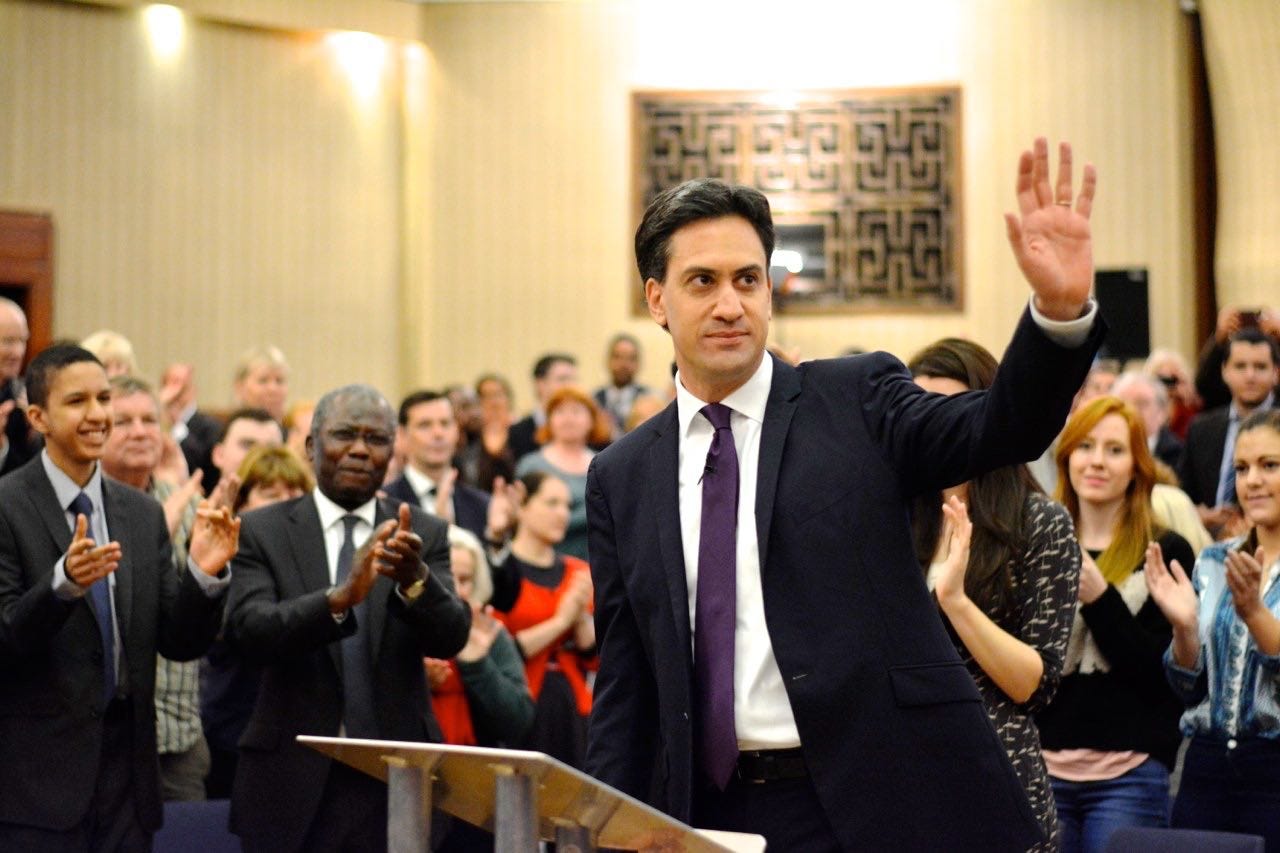
Ed Miliband will today (Thursday) deliver a major speech on how the next Labour government will build a strong economic foundation by dealing with the deficit and balancing the books – but never going down the Tory road to take Britain back to 1930s spending levels which existed before the NHS.

In his speech, Mr Miliband will attack the Tories for pursuing an extreme project, motivated by ideology rather than necessity, which will put vital public services at risk:

“My speech today is about the deficit. Its place in our priorities, how a Labour government would deal with it, and how we would do so consistent with our values.

“The Tory plan is to return spending on public services to a share last seen in the 1930s: a time before there was a National Health Service and when young people left school at 14. There is only one 35 per cent strategy in British politics today: the Tory plan for cutting back the state and spending on services to little more than a third of national income.

“And they have finally been exposed by the Autumn Statement for what they really are: not modern compassionate Conservatives at all – but extreme and ideological, committed to a dramatic shrinking of the state and public services, no matter what the consequences.

“They are doing it, not because they have to do it, but because they want to. That is not our programme, that will never be our programme, and I do not believe it is the programme the British people want.

“This is a recipe for public services that will disintegrate and for a permanent cost of living crisis because we won’t be investing in the skills and education people need for good quality jobs, and indeed for sufficient tax revenues. And we know what the result will be: the Tories might be able to deliver the cuts they have promised, but they won’t be able to cut the deficit as they promised.”

Mr Miliband will set out a tough and balanced One Nation Labour approach to dealing with the deficit based on five principles:

1.      Setting a credible and sensible goal to balance the books and get the national debt falling as soon as possible within the next Parliament.

Not having a fiscal plan which sets a target of a 35 percent state, putting public services and productive investment at risk.

2.      Recognising that Britain will only be able to deal with the deficit by tackling the cost-of-living crisis.

Not allowing welfare spending to rise and tax revenues to fall because of low wages, insecure jobs, housing shortages and social failure.

3.      Making common sense spending reductions with departmental spending falling and using money better by devolving power, breaking down old bureaucracies, and rebuilding public services around early intervention.

Not cutting spending to 35 percent of national income that will lead to disintegrating public services and a permanent cost-of-living crisis because we won’t be investing in the skills needed for good jobs and healthy revenues.

4.      Protect everyday working people by ensuring those with the broadest shoulders bear the greatest burden.

Not cutting taxes for the wealthiest while asking everyday working people to pay more.

5.      Promising new policies only when they are fully funded, like Labour’s £2.5 billion time to Care Fund for the NHS, so that they do not require any additional borrowing

Not making commitments that depend on borrowing or promising unfunded tax cuts skewed to the wealthiest that will eventually be paid for by bigger cuts to public services or increases in VAT.

Ed Miliband will say:

“Labour will make fairer choices to help protect vital services and balance the books with measures including a Mansion Tax on properties worth more than £2 million, cracking down on tax avoidance, and reversing the millionaires’ tax cut to restore the 50p rate on incomes over £150,000 a year.

“In these hard times, we are determined to do everything we can to protect everyday taxpayers from bearing an increased burden and to do all we can to protect public services. And those who have done best, under this government and indeed under the last, must pay their fair share. 

We want successful entrepreneurs and those who do well to be rewarded. But we must pull together as a society not drift apart and we cannot do that if deficit reduction is simply on the backs of ordinary people.”

He will say that Labour will only make new commitments that are credible, costed and funded without additional borrowing – unlike the Conservatives who are promising unfunded tax cuts that would put public services at risk.

“This is an essential test of credibility. There is huge uncertainty about the deficit because of economic circumstances and on the basis of recent experience. That makes it all the more important that parties do not spray around unfunded commitments they cannot keep.

“It is why we will only make commitments in our manifesto that are properly funded – not commitments that depend on borrowing. That’s why we’ve explained how we will pay for every policy that we’ve put forward: costed, credible and funded.

“In contrast, the Conservative Party has pledged to make tax cuts when they have absolutely no idea how they will fund them: tax cuts that will cost over £7 billion a year at the end of the Parliament and even more, billions more, if they happen earlier in the Parliament.

“The Tories cannot say how they would fund their tax cuts skewed to help the wealthiest. This is not responsible and it is not right: the British people should be in no doubt what the Tory promise means: they will pay the price for tax cuts in higher VAT or even bigger cuts to public services. The Tories’ priority is unfunded tax cuts, Labour’s priority is to save our National Health Service.”

Labour’s costed and evidenced key policy pledges to date.

To underline Labour’s determination to deal with the deficit fairly and balance the books as soon as possible in the next parliament, Ed Balls has written to members of the Shadow Cabinet. He says:

“It’s now clear the Tories have abandoned any pretence of being in the centre-ground with an increasingly extreme and unbalanced plan. They have made an ideological choice to pencil in deeper spending cuts for the next Parliament because they are refusing to ask those with the broadest shoulders to make a greater contribution and, crucially, are ignoring the need for a plan to deliver the rising living standards and more good jobs that are vital to getting the deficit down.10001887913_f8b7888cbe_o

In contrast, Labour will take a tough but balanced approach to getting the deficit down. Our economic plan will deliver the rising living standards, more good jobs and stronger and more balanced growth which are a vital part of any fair and balanced plan to get the deficit down.

We will make different and fairer choices from the Tories, including reversing this government’s £3 billion a year tax cut for people earning over £150,000 and taking action to close tax loopholes and introducing a mansion tax on properties worth over £2 million in order to help save and transform our National Health Service.

And unlike George Osborne, we will not make any spending or tax commitments without saying where the money is coming from.”

Ed Balls intends to raise state spending rather than complying with Mr Osborne’s austerity plans of further drastic cuts, and he said his party will ring-fence more Whitehall budgets. A recent report by the Organisation for Economic Co-operation and Development (OECD) has found what most of us already knew: that income inequality actually stifles economic growth in some of the world’s wealthiest countries, whilst the redistribution of wealth via taxes and benefits encourages growth. Osborne’s economic policy is damaging the economy. Miliband has consistently put equality high on the list of Labour’s priorities, and quite rightly so.

Labour have proposed progressive taxation, they have pledged to save the NHS, safeguard benefits and repeal the Bedroom Tax, which affects the poorest people: those on low wages and those on benefits, costing them money that was calculated to meet only the basic living costs of food and fuel, originally. Benefit was calculated on the assumption that full housing costs and rates/council tax were also paid by Local Authorities. That is no longer the case. The Tory welfare cuts and rising cost of living have meant a return of absolute poverty, not seen in this country since before the establishment of the welfare state.

At the moment, health, foreign aid and schools are protected from spending cuts, but in his letter, Mr Balls told members of the shadow cabinet that “our manifesto will spell out other limited areas which will have spending protected.”

The Tories’ stated plan to continue cutting even once the deficit has been eliminated has given Labour the opening needed to point out the damaging ideological drive to shrink the state, and to dismiss austerity once and for all. Given that the Conservatives have rigidly set the terms of economic debate and have established a dominant frame of reference since taking office,  I think the response to the Autumn statement from Labour is deft, careful and the proposals are costed, fair and viable.

Reducing the deficit can only happen once we have genuine (and widely shared) economic growth.

The alternative is the Conservative’s extreme, ideological never-ending austerity – all pain with no gain whatsosever for most people. For better or worse, deficit reduction is the political reality against which Labour’s economic credibility is now being defined. Cut the deficit Labour must; but they have taken reassuring steps to do it in a genuinely more comfortable, fair and intelligent way than the Tories.

The full text and more details of Ed Miliband’s speech about the deficit can be found here.

Related 

One of the most destructive Tory ideological myths has been officially debunked

Osborne’s Autumn statement reflects the Tory ambition to reduce State provision to rubble

Follow the Money: Tory Ideology is all about handouts to the wealthy that are funded by the poor

14533697838_dffcc736f2_o (1)
Many thanks to Robert Livingstone@LivingstonePics

International Human Rights Day – some food for thought

994442_352804464870608_5110112617916821526_n

“I call on States to honour their obligation to protect human rights every day of the year. I call on people to hold their governments to account.”

UN Secretary-General Ban Ki-moon.

The UN General Assembly proclaimed 10 December as Human Rights Day in 1950, to bring to the attention ‘of the peoples of the world’ the Universal Declaration of Human Rights as the common standard of achievement for all peoples and all nations.

This year’s slogan, Human Rights 365encompasses the idea that every day is Human Rights Day. It celebrates the fundamental proposition in the Universal Declaration that each one of us, everywhere, at all times is entitled to the full range of human rights, that human rights belong equally to each of us and bind us together as a global community with the same ideals and values.

7005_494073677328832_658777491_n

The Coalition’s legal aid reforms  undermine the fundamental principle of legal equality and breach Article 6(1) of the European Convention of Human Rights: the right to a fair trial. They reflect a truly authoritarian agenda of legislative tyranny: the reforms effectively remove legal access for many, crucially that access ultimately safeguards individual liberty against intrusion by the State, and protects us from despotic abuses of authority.

The UK Coalition is currently under investigation by the UN for serious violations of the rights of disabled people.

Children’s Commissioner warns that UK is now in breach of the UN Convention on the Rights of the Child

UK Government in breach of the human rights convention on gender discrimination.

Welfare reforms break UN convention

humanrights

Statement for 2014 of the High Commissioner for Human Rights

Zeid Ra’ad Al Hussein

“All human beings are born free and equal in dignity and rights”: in perhaps the most resonant and beautiful words of any international agreement, the Universal Declaration of Human Rights promises, to all, the economic, social, political, cultural and civil rights that underpin a life free from want and fear.

These human rights are not country-specific. They are not a reward for good behaviour, or particular to a certain era or social group. They are the inalienable entitlements of all people, at all times and everywhere, 365 days a year.

They are the rights of people of every colour, from every race and ethnic group; whether or not they have disabilities; citizens or migrants; no matter their sex, their class, their caste, their creed, their age or sexual orientation.

The commitments made to the people of the world through the Universal Declaration are in themselves a mighty achievement – discrediting the tyranny, discrimination and contempt for human beings that have so painfully marked human history. And since the Declaration was adopted, countless people have gained greater freedom.

Violations have been prevented. Independence and autonomy have been attained.Many people – though not all – have been able to secure freedom from torture, unjustified imprisonment, summary execution, enforced disappearance, persecution and unjust discrimination, as well as fair access to education, economic opportunities, rich cultural traditions and adequate resources and health-care.

They have obtained justice for wrongs, and national and international protection for their rights, through the strong architecture of the international human rights legal system.

The power of the Universal Declaration is the power of ideas to change the world. It tells us that human rights are essential and indivisible – 365 days a year. Every day is Human Rights day: a day on which we work to ensure that all people can gain equality, dignity and freedom.

The UN Human Rights Office stands with the millions of people around the world whose voices are denied.

And I look forward to you joining us, whether you do so via social media or in person. Together, we must demand what should be guaranteed: our human rights, universal, indivisible, inalienable, for everyone, 365 days a year.

scroll2

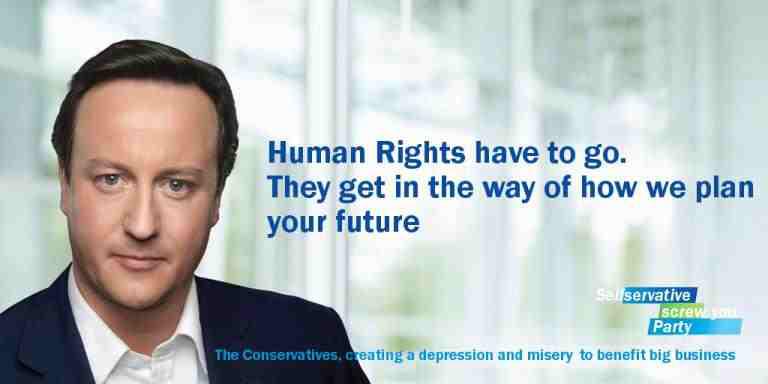
David Cameron has pledged to leave the European Convention of Human Rights (ECHR) if he is elected next year, and he will repeal Labour’s Human Rights Act, which consolidates the Universal Declaration of Rights.

Human rights are the bedrock of democracy, when that UN charter was written, in the aftermath of the second world war, as an international response to atrocities inflicted by some States, such as the Holocaust, it set out the basic rights for citizens that all governments  should respect and uphold

The strong link between democracy and human rights is captured in article 21(3) of the Universal Declaration of Human Rights, which states:

“The will of the people shall be the basis of the authority of government; this will shall be expressed in periodic and genuine elections which shall be by universal and equal suffrage and shall be held by secret vote or by equivalent free voting procedures.”

The rights enshrined in the International Covenant on Economic, Social and Cultural Rights and subsequent human rights instruments covering group rights (e.g.indigenous peoples, minorities, people with disabilities) are equally essential for democracy as they ensure inclusivity for all groups, including equality and equity in respect of access to civil and political rights.

Labour’s Human Rights Act ought to be a source of pride. It is a civilised and a civilising law. It means that we can hold our government to account in UK courts, rather than needing to go to Strasbourg. It ensures that Britain remains a nation where key universal benchmarks of human decency and protections against State abuse are upheld by the courts.

Membership of the ECHR ought to be a source of pride, too. As well as providing a legal framework for basic decency and civilisation for member States, it also provides a crucial mechanism of international scrutiny that ensures governments are accountable for their actions towards citizens.

The Coalition has, in just four years, contravened the human rights of disabled people, poor people, women and children.

We need to ask two important questions: What kind of government would treat the most vulnerable citizens – protected groups – with such little respect, dignity, care and esteem?

And what kind of government would not wish to uphold basic standards of decency and civilised safeguards – the basic rights and protections of citizens from the actions of the State, within a legal framework of international standards for political accountability?

564882_438358886199493_1982719183_nThe protection of freedom under the Human Rights Act: some illustrations


Thanks to Robert Livingstone for his excellent memes.


Poor people are rubbish at being poor, says Iain Duncan Smith and Conservative Baroness Jenkin of Kennington

526544_532055030197363_2137237288_n

It’s truly remarkable that whenever we have a Conservative government, we suddenly witness media coverage of an unprecedented rise in the numbers of poor people who suddenly seem to develop a considerable range of baffling personal ineptitudes and immediately dysfunctional lives.

We see a proliferation of  “skivers” and “scroungers”, an uprising of “fecklessness”, a whole sneaky “culture of entitlement”, “drug addicts”, a riot of general all-round bad sorts, and apparently, the numbers of poor people who suddenly can’t cook a nutritious meal has climbed dramatically, too. We are told that starvation is not because of a lack of money and access to food, but rather, it’s because people don’t know how to budget and cook, that’s according to the Conservative Baroness Jenkin of Kennington.

She recommends that poor people stop avoiding porridge, since it only costs 4 pence a bowl.

1390648_548165358586330_1740107407_n
The alarming rise in numbers of adults who have suddenly forgotten how to cook and eat porridge since David Cameron took Office, up to last year.

The very fact that people suddenly and worryingly forget these crucial life-skills under every single Conservative government, but most particularly under this one, provides a darn good reason to vote them out on May 7th, 2015, I should say.

Iain Duncan Smith added: “People are going to food banks because they get divorced, ill or addicted to drugs,  it is “ridiculous” to blame the Government.

It is really rather ridiculous to assume that that every single reason that someone is going to a food bank is down to what the Department for Work and Pensions does.

The report itself today and other reports are also clear and they show there are often people with very dysfunctional lives, people who have been caught in drug addiction, family breakdown, people who have gone into serious illness that aren’t claiming benefits and come into difficulty.”

1002589_521987671204099_896277269_n (1)

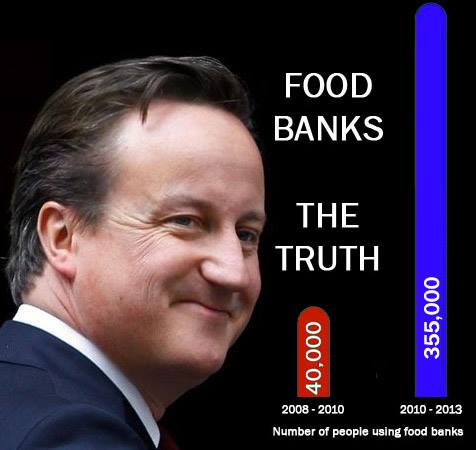
Gosh, such a massive rise in “dysfunctional lives”, divorce, family breakdown, serious illness and drug addiction, and all since 2010 – even more reasons to vote them out. This Government has clearly created a tide of social problems, as very few people were incompetently hungry and desperately silly enough to need food banks under the last government. In fact I didn’t even know they existed back then. But that’s the “Big Society” for you. What a bright idea to replace welfare with charity. It’s just like the good old Victorian days. Hurrah!

I mean it’s not as if wealthy people ever suffer from messy divorce, serious illness, family breakdown and drug addiction. That must be why we never see them at food banks.

These people simply need to stop being seriously ill, divorced and all of that, that’s what I say.

A lot of people who specialise in studying poverty have said the welfare “reforms” are behind the rise in food bank use, as well as rising benefit sanctions, low pay and ever-rising living costs. But Iain Duncan Smith seems to know what he’s doing, especially when it comes to talking about “fairness”. Or statistics, for that matter.  You never hear about people starving who don’t have a messed-up life, after all. The man has solved that cause and effect dilemma conveniently and to his discredit, very cheaply. Bravo. We should give him a break, as the poor, inadequate vicious bully defensive man can’t even afford to buy his own underwear.

It’s just a coincidence that the Tory austerity measures have been targeted at the poorest, after all. Nothing to do with those draconian, punitive fair and much-needed cuts to people’s lifeline benefits.

Meanwhile, I’m delighted to see the rise in tax-avoiding, sanctimonious kindly wealthy people preaching Victorian values of thrift, self-help and morality, but only to the poor, of course. We really must learn to manage how to not have the basic requirements for survival better, after all. We’re just going about being paupers all wrong. We all know that increasing absolute poverty is an indulgent lifestyle choice. Who wouldn’t jump at the chance to have such an easy time of it, languishing in all of that deprivation, a shorter life and constant cold and hunger? Not to mention such a special social status. It’s so important to know one’s place.

Yes. Poor people are just so incompetent at being impoverished. How utterly selfish. We really ought to make much better use of our absolute poverty. Perhaps we should learn how to announce a flounce from the country, like many of the tight-fisted, selfish, personality disordered,  socially irresponsible hard done by millionaires do, at the prospect of social policy not going quite their way. Some of them were very cross indeed about the very idea of contributing to our economy, and who can blame them. After all, it matters not that poor people starve, as the most important and useful thing for this country is the accumulation of more wealth by an already very wealthy minority. The destruction of our country’s economy, public services, welfare and so many lives is a sacrifice the wealthy are more than happy to pay.

Good thing that David Cameron has obliged their generosity. Phew. The alternative just wouldn’t bear thinking about for those poor millionaires, who are, after all, victims of terrible discrimination, and inequality. Someone has to be, apparently. It’s in the Tory social order rule book. Still, at least we are all better off than Iain Duncan Smith. Most of us are still capable of managing coherence, as money can’t buy that. So we can be cheap and cheerful.

But the rich have obviously forgotten the virtues of porridge and thrift, too.

Perhaps the poor could run budgeting classes for poor, needy millionaires. It seems not many people know that porridge provides the way out of grinding, long-term material deprivation and helps to prevent terrible social problems. Better safe than sorry, I say.

And David Cameron says rich people need looking after. They must be very vulnerable and fragile. I’m sure it will make the mansion tax more palatable, too, for the tax dodging unbearably tortured souls that may have to dip their hands in their vast vaults and pay their way for once endure it. They didn’t mind the bedroom tax, though, despite it being a breach of human rights, and they even managed to stay calm and silent at the destitution and deaths it has caused: they didn’t complain once, bless them. So perhaps they’ll cope with the mansion tax after all.

There’s no porridge on the House of Lord’s menu, either. I feel so sorry for them:

Embedded image permalink

See what I mean? An example of Baroness Jenkin’s “budgeting skills”, which are subsidised by UK tax-payers. The House of Lords’ 760 peers benefit from an £84 discount on their food every week. The generous cut is more than the weekly Jobseeker’s Allowance, which is just £71. And the subsidy comes on top of the £300-a-day “subsistence” given to peers for each day they attend the Lords, to cover food and accommodation. How do they endure it?

And thinking about it, isn’t it odd that whenever we see the curiously abrupt forgetfulness and sudden ineptitude on the rise amongst the poorest members of the public and their increasingly chaotic, difficult lives, it coincides every time with a significant increase in poverty, inequality, politically manufactured unemployment, a significant rise in the cost of living, poor working conditions and lower wages, and welfare “reforms”.

And a bunch of selfservatives in Office. There’s a correlation there somewhere, isn’t there?

Primary referral causes in 2013-14

Latest foodbank figures top 900,000: life has got worse not better for the poorest in 2013/14, and this is just the tip of the iceberg – The Trussell Trust.

Executive Summary of Emergency Use Only Report.

The just about surviving report


1459165_266124213538634_1461740450_n
Thanks to Robert Livingstone for his excellent memes

Here’s what I believe – Ed Miliband

People sometimes say to me politicians are all the same. That couldn’t be further from the truth. So let me explain what I stand for, in the simplest terms.

For me, everything starts with this: our country is currently set up only to work for a privileged few at the top. It’s time to level the playing field so it works for us all.

When David Cameron talks about the economic recovery, most people in Britain are left wondering why they aren’t feeling its benefits. They want to know why, when they work so hard, their living standards are falling; why, when they make a decent living, they can’t afford to buy a house; and why, against the experience of every generation before us, their kids are worse off than they are.

Or let me put it another way: people are asking why we have zero-hours contracts while some at the top seem to get away with paying zero tax. The same rigged system that lets most people down allows a privileged few to grow ever more wealthy.

This widening inequality is no accident; it is the direct result of the Tories’ values and their beliefs about how Britain should be run.

  • They believe that insecurity is the way you make people work harder.
  • They think low pay is the way we should compete in the world.
  • They trust that markets will always get the right outcome.
  • They believe the only answer for our public services is to hand them over to private firms — our NHS included.

These ideas failed us in the past and they are failing us now.

Underpinning these ideas is a set of values I abhor: the view that the success of the country depends on a few at the top, and that the rest of us should be content to sit patiently and wait for some scraps to fall from their table.

My own values could not be more different from those of this government.

  • I believe it’s essential that people are rewarded fairly for their hard work — and that we cannot live in a country where chief executives get pay rises 10, 20, 30 times as large as their workers, year on year on year.
  • I believe that each generation should do better than the last.
  • I believe that decent public services are the foundation of who we are as a country — and that the NHS is the embodiment of that.
  • I believe that no vested interest — no bank or energy company or any other rich or powerful group or person — should be allowed to take advantage of the rest of us.

 Above all I believe that Britain only succeeds when working people succeed.

 Those are my values. They’re why I want to be your prime minister, and why I believe our country needs a Labour government.

If this is a vision that you believe is right for Britain,
I need your help to win the election in six months’ time, because we will only win if everyone who wants change fights for it.

We’re going to do it door by door, street by street, town by town.

We’re going to talk to friends, neighbours, and communities about our ambitions for our country. We’re going to chip in small donations to club together against the Tories’ millionaires.

When you’re deciding whether or not to get involved, remember what we’re fighting for:

  • Energy bills frozen until 2017
  • An £8 minimum wage
  • The end of exploitative zero-hours contracts
  • Guaranteed jobs for young people
  • 200,000 more homes built a year
  • The end of the bedroom tax
  • Reform of our banks so they work for our businesses once again
  • A cut in business rates to help small businesses
  • Apprenticeships alongside every government contract
  • An end to recruitment agencies only hiring from abroad
  • The repeal of the Health and Social Care Act
  • Tens of thousands more doctors, nurses, midwives and care workers

Together, these measures add up to a country that starts to work for the majority again.

Millions of people in this country are resting their hopes on us fighting for a fairer, better Britain in six months’ time, and I will not let them down.

The future of our country is in our hands.


In six months a Labour government can begin the business of changing our country for the better. Help us get there: http://labour.tw/1tYncgM

scroll2

Ed Miliband’s policy pledges at a glance

46 more good reasons to vote Labour

Ed Miliband is an excellent leader, and here’s why.

The establishment are ‘frit’ because Ed Miliband is the biggest threat to the status quo we’ve seen for decades

Conservatism in a nutshell


The road to the food bank is paved by failures in the welfare safety net: new report

1896930_10151941274942411_961048560_n

Foreword.

It’s truly remarkable that whenever we have a Conservative government, we suddenly witness media coverage of an unprecedented rise in the numbers of poor people who have suddenly seemingly developed a considerable range of personal ineptitudes.

We see a proliferation of  “skivers” and “scroungers”, an uprising of “fecklessness”,  and apparently, the numbers of poor people who suddenly can’t cook a nutritious meal has climbed dramatically, too. We are told that starvation is not because of lack of money and access to food, but rather, it’s because people don’t know how to budget and cook, according to the Conservative Baroness Jenkin of Kennington. She recommends that poor people eat porridge, since it only costs 4 pence a bowl.

1390648_548165358586330_1740107407_n
The alarming rise in numbers of adults who have suddenly forgotten how to cook and eat porridge since David Cameron took Office, up to last year.

The very fact that people suddenly and worryingly forget these life-skills under every single Conservative government, but most particularly under this one, provides a darn good reason to vote them out on May 7th, 2015, I should say.

Meanwhile, I’m delighted to see the rise in sanctimonious wealthy people preaching Victorian values of thrift, self-help and morality, but only to the poor, of course. We really must learn to manage how to not have the basic requirements for survival better, after all. Poor people are just so incompetent at being poor.

I’ve written a full and fitting tribute to the ideas of Baroness Jenkin and Iain Duncan Smith here: Poor people are rubbish at being poor, says Iain Duncan Smith and Conservative Baroness Jenkin of Kennington.

However, here are two non-satirical, recent reports that highlight the structural and circumstantial reasons why people are starving and needing to use food banks, all of which are a consequence of Conservative policies.

Kittysjones.

With thanks to the Child Poverty Action Group.

Visiting a food bank is a last resort: we all hope that if times get hard, the safety net is there to make sure we aren’t left without the means to buy food for ourselves or our family. Yet research from the Child Poverty Action Group, Oxfam, Church of England and the Trussell Trust has found that failures in the social safety net itself are most often the trigger for food bank referrals.

The report says that, while money is tight for many reasons, including bereavement, relationship breakdown, illness or job loss, issues such as sanctions, delays in benefits decisions or payments or being declared “fit for work” led people to turn to food banks for support.

  • Around a third of foodbank users in the sample were waiting for a decision on their benefits – and struggling in the meantime
  • Between 20 and 30% had their household benefits reduced or stopped because of a sanction

Other factors included loss of income due to the “bedroom tax” or the benefit cap.

The research used 40 in-depth interviews with food bank users, data from over 900 users at three food banks around the country, and detailed analysis of nearly 200 clients accessing one food bank in Tower Hamlets.

Summary of key findings:

  •  People interviewed for this research turned to food banks as a last resort, when other coping strategies had failed or were overstretched. Deciding to accept help from a food bank was often difficult, and was described by participants as being ‘unnatural’, ‘embarrassing’ and ‘shameful’.
  •  Most food bank users were facing an immediate, acute financial crisis – either a complete loss of income or a very significant reduction in their income had left them at crisis point, with little or no money to put food on the table.
  •  The acute crises people faced could be prompted by a sudden loss of earnings, or a change in family circumstances such as bereavement or homelessness. However, for between half and two-thirds of the people included in this research, the immediate income crisis was linked to the operation of the benefits system (with problems including waiting for benefit payments, sanctions, or reduction in disability benefits) or tax credit payments.
  •  The emergency support available to people at a time of crisis was not sufficient to prevent them having to turn to a food bank. Many participants were not aware of the various emergency payments available in different circumstances, and even fewer were receiving them. Only half (or less) of the users we spoke to knew they could seek support from the Local Welfare Assistance Scheme; very few of those potentially eligible had been awarded short-term benefit advances or hardship payments.

“My benefits all stopped because I didn’t put down the right job history… That’s what’s put me behind on everything, so that’s why the foodbank has been a godsend:… it can’t get no worse than this, it physically can’t.”

 Read the Executive Summary of Emergency Use Only Report.

Download the full report: Emergency Use Only.

scroll2

Just about surviving is the third report from a longitudinal project: it’s part of a broader, ongoing qualitative study of the cumulative impact of the Coalition’s welfare reform in the London Borough of Newham.

The research was conducted by Community Links, which is a pioneering and respected charity based in Newham, east London, once praised by the prime minister David Cameron as “one of Britain’s most inspiring community organisations.”

However, the charity was co-founded by David Robinson, a social activist, who abandoned his initial support for the Coalition’s Big Society project in protest at the damage being inflicted on the UK’s poorest neighbourhoods by what he called the government’s “barrage of unsustainable cuts.”

The study has revealed that far from encouraging people on benefits to move into work, the draconian Coalition welfare cuts have pushed many further from employment.  The report says that the state has reduced welfare support to the point where it barely enables people to survive.

Overwhelmingly, the reforms have made people “feel insecure and vulnerable to even small fluctuations in their small income or circumstance; continuing to erode their resilience.”

Furthermore, by forcing people into stressful situations where day-to-day survival becomes a pressing priority, the “reforms” (that are, in reality, simply cuts to people’s benefits), which were hailed by the Conservatives as a system of help and incentives – to “nudge” people into changing their behaviour so that they try harder to find work – are in fact eroding people’s motivation. In other words, the reforms have deincentivised and hindered people looking for employment, achieving the very opposite to the intent claimed by the Tories, to justify their draconian policies.

The report states that people are caught between trying to escape welfare reform through poor employment alternatives and feeling trapped in poverty. They move in and out of low paid work – susceptible to shocks and unprepared for the future.

Careful balancing of budgets and borrowing money from family and friends has enabled some to stumble through, but others are increasingly paralysed in unsustainable situations, facing unfair multiple challenges which they cannot resolve.

And just let me clarify here, it’s through no fault of their own. Poor people did not formulate the policies that are making them poor.

The study reports a “culture of fear“, especially among those with serious disability or illness, who were unable to work and so felt powerless to escape or offset the financial losses causes by welfare cuts.

It says:

“The continued squeeze on incomes is forcing people into survival mode: having to deal with incredibly stressful situations day-to-day and unable to focus on the  longer-term. People feed their children and go without themselves; wash clothes by hand if their washing machine breaks; walk miles to work in the early hours of the morning; they just about get by. But only just.”

The sheer scale and speed of the cuts to state support left interviewees with “almost no flexibility to live with any comfort”. It meant some of those interviewed were:

“Barely surviving.”

Most people who were interviewed told researchers they both wanted to work and saw benefit in working. The report calls on ministers to provide more help in getting people into work, and criticises the lack of compassion in the implementation of the reforms.

Kittysjones.

Related

The Coalition are creating poverty via their policies

Welfare sanctions make vulnerable reliant on food banks, says YMCA

Study finds Need For Food Banks IS Caused By Welfare Cuts

It’s absolute poverty, not “market competition” that has led to a drop in food sales.

Welfare reforms, food banks, malnutrition and the return of Victorian diseases are not coincidental, Mr Cameron

Primary referral causes in 2013-14

Latest foodbank figures top 900,000: life has got worse not better for the poorest in 2013/14, and this is just the tip of the iceberg – The Trussell Trust.


Osborne’s Autumn statement reflects the Tory ambition to reduce State provision to rubble

Embedded image permalink

Osborne’s austerity measures have achieved nothing, except deepening poverty, widening economic inequality, and destitution for the poorest and most vulnerable communities – and Osborne announced in his Autumn statement that we face at least four more years of it.

Austerity is not an economic necessity, nor is it temporary measure to balance the books, but rather, it reflects the Conservative’s long-standing ideological commitment to dismantle the gains and achievements of the post war settlement: public services, the welfare state and the National Health Service.

The plans, according to the Treasury spending watchdog, the Office of Budget Responsibility, also presume the loss of a further one million public sector jobs by 2020, a renewed public sector pay squeeze and a further freezing of tax credits.

Robert Chote, the Office for Budget Responsibility chairman, conceded that the projections sent to him by the Treasury meant there would have to be a “very sharp squeeze” on spending in the next parliament. He added that so far the UK has seen 40 percent of the necessary cuts in this parliament and the next 60 percent would fall under the next parliament. 

The chairman says that spending on public services as a share of gross domestic product is set to fall by considerably more over the next five years than it did over the last five years, accounting for the lion’s share of the shift from a budget deficit of percent of GDP to a surplus of around 1 percent of GDP. He says that spending in non-protected departments will fall from £147 billion in 2014/15 to £86 billion in 2019/20 – on top of all the cuts to spending in recent years.

With a shortfall in tax receipts set to increase the size of the deficit by £25 billion during the next parliament, the Office for Budget Responsibility said the only way Osborne could balance the books would be through shrinking the state to a level not seen since before the Second World War:

“Total public spending is now projected to fall to 35.2 percent of GDP by 2019-20, taking it below the previous post-war lows reached in 1957-8 and 1999-2000 to what would probably be its lowest level in 80 years”.

The Office for Budget Responsibility (OBR) has written an extremely critical economic forecast and analysis of the spending cuts, clearly expressing the risks that the Chancellor is running and the scale of the damage his strategy will inflict on what remains of our public services.

Key findings from the damning analysis are:

The scale of planned post-election spending cuts is severe.

“Between 2009-10 and 2019-20, spending on public services, administration and grants by central government is projected to fall from 21.2 per cent to 12.6 per cent of GDP and from £5,650 to £3,880 per head in 2014-15 prices. Around 40 per cent of these cuts would have been delivered during this Parliament, with around 60 per cent to come during the next. The implied squeeze on local authority spending is similarly severe.

And as stated: “Total public spending is now projected to fall to 35.2 per cent of GDP in 2019-20, taking it below the previous post-war lows reached in 1957-58 and 1999-00 to what would probably be its lowest level in 80 years.”

The spending cuts are playing the most significant role in deficit reduction and of the tax rises Osborne introduced, it’s the most regressive (VAT) which are making the largest contribution:

“Just over 80 per cent of the reduction is accounted for by lower public spending. Just under 20 percent of the drop in borrowing is accounted for by higher receipts, with the majority having taken place by 2012-13, largely as result of rises in the standard rate of VAT.”

So despite the cuts, the Chancellor has failed to meet any of his original targets (to have closed the structural deficit over a parliament and to have debt falling as a proportion of GDP) and it’s unlikely that his new plan can be delivered.

The OBR say:

“On the Government’s latest plans and medium-term assumptions, we are now in the fifth year of what is projected to be a 10-year fiscal consolidation.

It remains on course to miss its supplementary target, to have net debt falling as a share of GDP in 2015-16.

On our best estimate of a like-for-like basis, borrowing is expected to be higher in the initial years of the forecast and slightly lower from 2016-17 than we thought in March. The largest single-year effect of a Government decision comes via its new assumption for total spending in 2019/20, although this does not appear in the Treasury’s table of policy decisions. This implies another cut in current spending by central government departments in that year equivalent to £14.5 billion”.

Wage growth has been very poor, which has affected income tax revenues. And growth is expected to slow after the election next year. In part, this will be because of the scale of government cuts, which of course also bring real economic risks.

The OBR say:

“Lower wage growth has reduced our income tax forecast. The fall in unemployment is not yet pushing pay settlements up significantly.

We still expect the economy to lose momentum through 2015 – and by a little more than we thought in March – thanks to weaker external demand and the expectation that consumer spending growth will slow to rates more in line with growth in people’s incomes.

The Government’s fiscal plans imply three successive years of cash reductions in government consumption of goods and services from 2016 onwards, the first since 1948. The corresponding real cuts directly reduce GDP. The economy should be able to adjust to such changes over time, but it is unlikely to be a simple process when monetary policy is already very loose and external demand subdued.

Over the course of the next Parliament, we project that government employment will fall by 1.0 million, compared to the 0.4 million decline that we are likely to have seen over this Parliament.”

The OBR’s damning conclusion is that real wages will not be back to even the pre-recession peak within five years (as opposed to household debt which is well on track to surpass it’s previous highs).

The OBR’s critical report on Osborne’s budget plans warns us that 60 percent  of the spending cuts have not yet been implemented in this parliament, and Osborne’s planned cuts will mean that by the end of the next government,  public spending is projected to fall to its lowest level as a proportion of GDP since the 1930s. And this was a period in history when we had no public services, no NHS, no effective welfare support, no education system, no social housing, no legal aid. Those post-war provisions have formed the very foundations of our democracy.

Osborne’s Autumn Statement has revealed that the Conservative mission to shrink the State will be complete by the budget of 2019/20 if their current budget plans remain unchallenged, and if the Conservatives remain in office.

They must not be permitted to inflict any further damage on the foundations of our once democratic society. We must ensure that they don’t.

From the Independent – The Autumn Statement: 4 charts that show how badly George Osborne has got it wrong:

GDP growth has been much lower than forecast in 2010


Government borrowing has been considerably higher every year

As a result the national debt is much higher as a share of GDP than predicted in 2010

Wages have also grown much less than expectations four years ago

 In the Autumn statement, the growth forecast for 2014 is likely to be, finally, in line with the 2010 forecast, at around three percent. But the forecast for public borrowing for 2014-15 is expected to be remain close to £100bn, meaning the deficit will remain stuck in cash terms. If the Chancellor ever had any genuine hopes of balancing the books by the end of the Parliament, the chances of fulfilling them  disappeared long ago.

Despite facing a global recession, the Labour Government invested in our public services, and borrowed substantially less in thirteen years than the Coalition have in just three years. UK citizens were sheltered very well from the worst of the global bank-induced crash.

Gordon Brown got it right in his championing of the G20 fiscal stimulus, agreed at the London summit of early April 2010, which was a continuation of his policies that had served to steer the UK economy out of the consequences of a global recession, and to protect citizens from the consequences.

Osborne’s policy of imposing austerity and budget cuts on an economy that was actually recovering was a catastrophic error. The austerity cuts have propelled the economy backwards and into depression; and, far from using public spending as a countervailing force against the cutbacks in private sector investment, the Coalition’s budget cuts served to aggravate the crisis. Many people are suffering terribly as a consequence, many  have been reduced to a struggle for basic survival.

People have died as a direct consequence of the austerity cuts.

Further cuts to provisions, services and welfare – support for the poorest – is unthinkable and untenable.

600839_539897852746414_2066719011_n


Update: The Institute for Fiscal Studies (IFS) have also agreed with this analysis. In their report, they say: “The Autumn Statement means the UK is set for cuts on a colossal scale. One thing is for sure. If we move in anything like this direction, whilst continuing to protect health and pensions, the role and shape of the state will have changed beyond recognition.”


1450041_569755536427312_1698223275_n
Many thanks to Robert Livingstone for his excellent and often prophetic memes

Sabotaging judicial review is one of this government’s most vicious acts

Removing the right for the individual to seek legal remedy for unlawful behaviour of the state – one of the coalition’s worst moments.

The coalition government is guilty of many crimes since its creation in 2010. But by steamrollering through changes to judicial review, they are seeking to insulate themselves from challenge, and restrict the ability of the British people to hold to account future governments that break the law.

Ministers are often defendants to applications for judicial review, precisely why they do not like it. But such applications are not brought lightly, and, crucially, have to pass an initial test of securing the court’s permission to proceed to a hearing. Very often the mere lodging of an application will produce a rethink by the decision making body leading to the correction of any flaw in the process. Equally, other interested parties can seek the court’s permission to intervene in the case to offer expert opinion in support of one or other of the parties. Many cases are resolved without a full hearing.

But this isn’t good enough for the present government, now engaged in seeking to reverse the substantial defeats it sustained in three votes in the House of Lords on amendments which sought to preserve judicial discretion in determining applications on a range of issues.

The fettering of judicial discretion has been a recurring feature of the government’s numerous attempts to reshape our justice system, a curious way of building up to the celebrations of the 800th anniversary of Magna Carta next year. It proved unacceptable to peers across the chamber, pitifully few of whom spoke in support of the government.

The proposals have attracted trenchant criticism from, among other eminent lawyers, the President of the Supreme Court, Lord Neuberger, the Master of the Rolls, Lord Dyson, the former Lord Chief Justice, Lord Woolf, and the Joint Committee on Human Rights, the Constitution Committee and the Delegated Powers and Regulatory Reform Committee. Characteristically, the Lord Chancellor is determined to reverse the decision of the Lords, albeit with some minor unsatisfactory changes in relation to interveners.

The House of Lords is traditionally, and reasonably, reluctant to challenge the elected chamber, but where the rights of the citizen are concerned, and where the government can be seen to legislate to immunise itself against legal challenge, there is an overwhelming case for it to do so.

Given the political arithmetic of the second chamber, much will depend on the Liberal Democrats, who have long, and with some justification, proclaimed themselves to be supporters of civil liberties and accountable government. Several spoke and voted in favour of the amendments passed by the Lords.

It falls to them and their colleagues in the House of Commons to redeem their party’s reputation by joining crossbench and Labour peers, and hopefully some Conservatives, in rejecting the government’s amendments to the Bill, which, for the record was never part of the coalition agreement.

Shadow justice minister Andy Slaughter MP and Labour justice spokesperson in the Lords Jeremy Beecham.

scroll2

Judicial review challenges government decisions, maintains government accountability and subjects them to scrutiny in the courts but David Cameron has claimed that the procedure is “time-wasting” and the justice secretary, Chris Grayling, has accused charities of exploiting cases for “publicity purposes.”

Judicial review is a safeguard of human rights and a fundamental part of democratic process.

A coalition of 35 organisations claims charities may face punitive costs if they challenge future government decisions.The 35 charities work on a wide range of issues, including representing children and older people, people with disabilities, bereaved families and victims of torture on issues as diverse as housing, fair treatment at work, healthcare, freedom of expression and privacy online.

Andrea Coomber, director of the legal rights group Justice, which coordinated the protest, said: “Judicial review is one of the very few means we can challenge public bodies and government departments which act unlawfully. We should all be watchdogs when the government tries to rewrite the rules in its favour.”

Alison Garnham, chief executive of the Child Poverty Action Group, said: “Judicial review is often the last line of protection the most vulnerable people in our society have against bad decisions made by powerful decision-makers. The public interest is served by empowering ordinary citizens to challenge unlawful decision-making, not by rewriting the rules so decisions made by the state, in effect, are put beyond the rule of law.”

The supporting charities include: Action against Medical Accidents, AIRE Centre, Amnesty International UK, Article 19, Asylum Support Appeals Project, Campaign for Freedom of Information, Children’s Rights Alliance England, Disability Law Service, English PEN, Equality and Diversity Forum, Fair Trials International, Human Rights Watch, Immigration Law Practitioners Association, Law Centres Network, JustRights, Just for Kids Law, Liberty, The Media Legal Defence Initiative, National Autistic Society, NDCS, Open Rights Group, Prisoners’ Advice Service, Privacy International, Public Concern at Work, Reprieve, Redress, Rights Watch UK and Sense.

Grayling has tried to take legal aid from the poorest and most vulnerable, in a move branded contrary to the very principle of equality under the law. He turned legal aid into an instrument of discrimination. He has tried to dismantle a vital legal protection available to the citizen – judicial review – which has been used to stop him abusing his powers again and again. He has tried to restrict legal aid for domestic abuse victims, welfare claimants seeking redress for wrongful state decisions, victims of medical negligence, for example. And now he wants to take away citizens’rights to take their case to the European court.

His every action is intent on tearing up British legal protections for citizens and massively bolstering the absolute powers of the state.

The hypocrisy is evident in that this is a government which claims to pride itself on its dislike for the state. But in every meaningful way, it is vastly increasing its powers, and authoritarian reach.

15553155399_94869b2dcd_o
 Thanks to Robert Livingstone for the pictures

Brighton’s Greens, Council Tax and a disgraceful act of moral blackmail

Neil Schofield-Hughes's avatarNotes from a Broken Society

There’s an old political saw that history repeats itself, first as tragedy, then as farce. As they come to the end of four years in office, and as they start the process of setting out their last budget, the peculiar genius of Brighton and Hove’s Green Party may well have been to turn that formulation on its head: last year was farce, but this year has tragedy written all over it.

For a second year running, the Greens are proposing a substantial increase in Council Tax – next year of 5.9% – that would require the approval of a referendum.  And the arguments are largely the same; that an increase of this magnitude is needed to offset the effects of austerity.

And the same arguments against such a rise apply this year too: that it is an entrenchment of austerity, using legislation designed to reduce the power of local authorities…

View original post 663 more words

Waste your vote on the Green Party – or choose a green Labour government – Sadiq Khan

Live Green, vote Labour.

By Sadiq Khan, in the Independent

Ed Miliband played a key role in saving the Copenhagen climate change talks from collapse.

Most Green Party supporters share the same values and aims as the Labour Party: reducing inequality, saving the NHS, building more homes, a commitment to human rights and civil liberties and protecting our environment. It’s what gets us out of bed in the morning and it’s why we entered politics.

Like me, they were proud of the many amazing achievements of the last Labour government: the introduction of the minimum wage, reducing child poverty by a third, the introduction of the Human Rights Act, civil partnerships and the groundbreaking Climate Change Act. But after 13 years of Labour government, they also had concerns on issues such as civil liberties and the Iraq war.

These concerns were shared by Ed Miliband in 2010. It’s why he ran for the leadership of the Labour Party on a message of change, it’s why I decided to support him and, ultimately, it’s why he won. Under Ed’s leadership Labour has rediscovered its radicalism and boldness and we have redoubled our historic fight against inequality.

Labour’s policies are the most radical of any party, six months away from a general election that there’s every chance we will win. Reducing inequality is at the heart of our economic agenda. We will massively increase the minimum wage, bring back the 10p tax rate for low earners and scrap the bedroom tax. We will introduce a mansion tax on properties worth more than £2m, and bring back the bankers’ bonus tax and the 50p tax rate for the very wealthiest. We will build 200,000 homes a year by the end of the next parliament, invest at least £2.5bn in the NHS and make schools accountable to local communities again.

On human rights and civil liberties, we are committed to defending our Human Rights Act from Tory attacks and staying in the European Court of Human Rights. We will extend voting to 16- and 17-year-olds. And we will end the abuse of stop-and-search powers. When it comes to foreign policy, Ed has apologised for the Iraq war, which both he and I opposed. We stopped David Cameron’s rush to war in Syria last year, and just last month we voted in Parliament to recognise Palestine.

Ed’s environmental credentials put David Cameron to shame. Ed was the first Secretary of State for Climate Change – a position he fought to create. He played a key role in saving the Copenhagen climate change negotiations from collapse. We will build on our Climate Change Act by creating 1.5 million new green jobs by 2025, making five million homes energy-efficient within 10 years and make the UK’s energy supply carbon-free by 2030.

There will always be those who say we need to go further. But ideals alone are not enough – it’s action that makes a difference to people’s lives. I visited Brighton last week, where the Green Party has run the council since 2011. The council is in real trouble and deeply unpopular with local people. Recycling rates have fallen dramatically and are now among the worst in the country. Less than a third of the affordable homes that were promised have been built. There have been months of strikes by council workers because pay and conditions have been attacked. Piles of rubbish were left festering on the streets throughout a summer of discontent. For me, the failed Green experiment in Brighton shows that creating a better society needs more than just the right values, it also needs realistic plans that can be put into action.

All the opinion polls say that the Green Party will not win a single MP next year. Even Caroline Lucas, with whom I agree on a great many things, looks set to lose her seat. The only party that can form a green and progressive government is Labour.

Like it or not, under the first-past-the-post system, every vote for the Green Party only makes it one vote easier for the Conservatives to win the election. It splits the progressive vote in many constituencies, and means that Tory candidates can win, despite a clear progressive majority opposed to them. Voting for the Green Party next year will only make it more likely that David Cameron will stay on as Prime Minister. That means more tax cuts for the rich, failures on climate change and the continued privatisation of the NHS.

I want those voters considering supporting the Green Party next year to give Labour a chance to prove that we are a truly radical party again. We will be a government they can be proud of and I want them to vote for us with pride. Because the choice is clear: you can either vote for the Green Party, or for a green government – and that can only mean a Labour government.

Sadiq Khan chairs Labour’s Green Party Strategy Unit and is shadow Justice Secretary

Former Bury UKIP chairman jailed for child porn offences – Bury Times

With thanks to Mike Sivier at Vox Political for flagging this up.

Peter Entwhistle [Image: Bury Times].

A FORMER chairman of Bury’s UK Independence Party has been jailed for grooming children and possessing nearly 200,000 indecent images of children, writes Andrew Bardsley in the Bury Times.

Peter Entwistle spoke to children on MSN Messenger and other social network sites in a sexualised manner, asking them to commit sexual acts for his own satisfaction, Bolton Crown Court heard today (November 24).

The 52-year-old named himself the ‘Naughty Doctor’, using an explicit picture of two women as his profile picture, and spoke to a 13-year-old girl and a 12-year-old boy, who he believed was a girl.

In addition, when police officers raided his house in January 25 last year, they found thousands of indecent images of children stored on a number of computers, USB sticks and some which had been printed out.

Entwistle was sentenced to four years and eight months in prison after pleading guilty to 21 counts at an earlier hearing, including possessing and distributing indecent images of children as well as inciting and the attempted inciting of children to commit sexual acts. He will be placed on the sexual offenders register for life, and would be subject to a sexual offences prevention order.

The court was told that Entwistle, of Broad Oak Lane, Bury, had one previous conviction of indecently exposing himself to a woman in the 1980s, but had otherwise had a clean record.

Iain Simkin, defending Entwistle, read out a letter to the court from Alistair Burt, who was the [Tory] MP for Bury North from 1983 to 1997, which referenced his “good character” .

Judge Elliot Knopf added: “You are now 52-years-old, and you have, until these matters, led an exemplary life, which is attributed to by various letters I have received from people ranging from family, colleagues, the rector of churches and an MP.”

The court was also told that Entwistle was seeking treatment from a psychiatrist for depression.

He was a founder member of Bury UKIP in March 2011, and resigned as party chairman in January 2013.

1904028_714854408584090_8727785646514177390_n

Thanks to Robert Livingstone.

scroll2

Perhaps this real, verifiable case will prompt UKIP supporters attempting to smear Labour MPs with unfounded and unsubstantiated allegations to think twice.

For example, perhaps we will now see an end to this despicable type of smear campaigning, based entirely on lies: Police called after UKIP leaflet claims ‘Labour-run Bolton’ is being investigated over child sex abuse. Police have confirmed that neither Bolton Council nor any Bolton councillors are being investigated as part of Operation Doublet, of course.

UKIP’s hypocrisy is breath-taking. The only record of Lord Pearson of Rannoch (the former Leader of UKIP and their leader in the Lords) asking a question on child abuse is on 13th October this year, after the Police and Crime Commissioner by-election was called.(Link here.) Yet he has been in the House of Lords since 1990. Even this one question is focused entirely on the UKIP obsession with Muslims, ignoring the fact that child abuse happens in all areas of the country and is not exclusive to any culture, community, race or religion.

And, once again, when there was discussion recently about child abuse in the Lords, no UKIP peers were present at all. In the European Parliament, UKIP abstained in a vote to strengthen current legislation on sexual abuse, sexual exploitation of children and child pornography in 2011. (Link here).

Seems to me that UKIP’s “concerns” about children’s welfare and protection are only apparent during their Tory-styled negative campaigning. Without any decent policies to offer, all they can do is try and smear Labour.

The last Labour government gave us the most comprehensive and effective child protection and child welfare policy we have ever had: Every Child Matters, which the Tories scrapped the very day after they took office. UKIP  haven’t said a word about this, because they are too busy trying to score cheap and nasty political points, rather than concerning themselves with what actually matters.

Kitty.

See also: The father of the main prosecution witness in Britain’s biggest child sex grooming scandal has accused Nigel Farage of exploiting the issue for political gain.

Related
UKIP: Parochialism, Prejudice and Patriotic Ultranationalism.
When the oppressed are oppressive too

.get