Category: Uncategorized

This government has been a disaster for disabled people – by Kate Green

Classic

By Kate Green, shadow minister for disabled people, first

This weekend, members of my party will be meeting to shape the policy programme that Labour will take into government.

At the heart of those discussions will be a determination to deliver the vision of One Nation Britain that Ed Miliband has committed us to. Nowhere will that commitment matter more than in relation to our policies for the equality, inclusion and participation of disabled people.

Today, we can see that, under the coalition government, that ambition is way off track.

Last week, an analysis by Just Fair, a consortium which campaigns for a fairer and more just society, demonstrated just how damaging the government’s policies have been for disabled people. Just Fair argue that the UK risks  breaching our international obligations to the rights and equality of disabled people as a result of the government’s policies.

Labour is determined that our approach will be to ensure that all our policies advance the equality, dignity and participation of disabled people. Last week, in Scotland, Rachel Reeves announced a set of early commitments for a Labour government that demonstrate our seriousness about that.

Our first priority will be to secure disabled people’s right to fair and decent employment, in two important ways:

We will reform the discredited work capability assessment to ensure it’s fit for purpose. Under our plans, everyone who’s assessed will receive a personal statement of how their condition or impairment impacts on their ability to work, as a gateway to defining and assembling the package of support they’d need if they are able to do so.

We’ll also introduce penalties on assessors for wrong assessments, and we will continue with the independent review process, with a formal role for disabled people to advise and inform the way the assessment works.

The work programme has been a disaster for disabled people, getting only around one in 20 into sustained work. It’s clear that a top down, centrally driven programme can’t deliver the right support for disabled people.

So we will push commissioning of employment programmes down to local level, enabling commissioners who know and understand the local labour market and the support and advice that’s available in the community to design and procure the services that will work for disabled people and ensure they share in our economic success.

One of the most pernicious examples of the government’s failure to secure the rights of disabled people is that they are twice as likely to live in poverty as non disabled people, and this year we have seen an extra 400,000 disabled families facing absolute poverty.

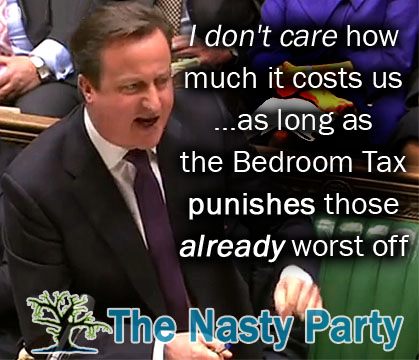
Earlier this year, the independent taskforce on poverty and disability, chaired by Sir Bert Massie, recommended a number of measures to break this disgraceful link. Key among them was scrapping the hated bedroom tax, which has pushed more disabled people and their carers into poverty, and undermined their right to live independently.

It will be Labour’s priority in government to abolish this unworkable and vicious tax.

We will also sort out the chaos that characterises the personal independence payment, working with disabled people to ensure PIP protects them from the risk of poverty, as well as exploring the ideas in the Massie report to address the higher living costs that disabled people face.

These early measures are important in and of themselves to improve the position of disabled people and address the disadvantage they experience.

But they are also emblematic of our overarching commitment to making rights a reality for disabled people, as our international obligations require. Engaging disabled people directly in the design and review of the policies that affect them, and devolving decision-making to local level, will ensure disabled people take a central role in the management of their own lives.

They sit on all fours with the principles of reducing poverty, securing the right to work for those who are able to do so, and protecting the right of disabled people to live independently where and with whom they choose.

They go to the heart of our determination to achieve greater equality, to respect the human rights of disabled people, and to create a One Nation Britain in which every disabled person can realise their potential and live their life to the full.

Further reading:

Labour calls on Government To Save Independent Living Fund

Labour will work with disabled people to improve services – Jon Cruddas

The Labour Party commissioned Poverty and Disability Taskforce Report in a nutshell

Rising ESA sanctions: punishing the vulnerable for being vulnerable

Clause 99, Catch 22 – State sadism and silencing the vulnerable


The government is bullying people with mental health problems to justify removing their lifeline benefits

995658_494538353949031_779653065_n

Existing benefit rules mean it is not possible to legally require claimants to have treatment, such as therapy or counselling, as a condition of receiving sickness benefits. Nor is it ethical.

However, senior ministers have proposed that the rules should be reviewed in order to reduce the “huge” numbers of people who are declared unfit for work due to mental health problems.

As a testimony to how bad this idea is, Sarah Wollaston, the Conservative chairman of the health select committee, has responded by saying that forcing people into counselling would present “profound ethical issues”.

She urged David Cameron to “squash” the proposals amid concerns about the damage they are doing to the image of the Conservative party. She said: “Consent is a very important principle and to link some kind of compulsion to that treatment would be grossly unethical. There would be a serious risk of a doctor being challenged and taken to the GMC”.

“You would get people going to GPs having a prescription so they could demonstrate they have got treatment. Enormously wasteful of time. Far better to get on with parity of esteem.”

The first of four government pilots is already being trialled at four job centres – Durham and Tees Valley, Surrey and Sussex, the Black Country and Midland Shires.

The pilot will “test whether combining talking therapy with employment support based on the “individual placement and support” model works better than the usual jobcentre or mental health support for Employment Support Allowance (ESA) claimants”, said the Department for Work and Pensions.

Tom Pollard, policy and campaigns manager at Mind, said: “If people are not getting access to the support they need, the government should address levels of funding for mental health services rather than putting even more pressure on those supported by benefits and not currently well enough to work.”

The government says it spends around £13bn a year on ESA and incapacity benefits. It estimates that it could save £1.41 for every £1 it spends on this “new mental health treatment.” See more here on such Nudge Unit inspired nonsense.

544547_466042163465317_917876792_n

It’s against the law to force anyone to undertake medical treatment.

Meanwhile, ESA sanctions had increased fourfold in the space of a year – up to December 2013 – and are particularly targeted at claimants with mental health conditions.

The number of sanctions applied to ESA claimants rose 334% between December 2012 and December 2013, according to  Department of Work and Pensions statistics.

The report shows that since the new Employment Support Allowance (ESA) sanctions regime was introduced on 3 December 2012, there has been a steady increase in the number of sanctions applied, from 1,102 in December 2012 to 4,789 in December 2013.

The total number of adverse sanction decisions over the period 3 December 2012 to 31 December 2013 was 28,702:

  • 5,889 were applied for failure to attend a mandatory interview and
  • 22,814 were applied for failure to participate in work related activity

In addition, the statistics show that, of the 28,702 decisions:

  • 13,994 were reviewed and in 8,508 cases, the decisions were overturned. This equals a “success” rate of nearly 61% and
  • 331 cases were appealed, 90 of those (27%) were overturned on appeal

Since the new Job Seekers Allowance (JSA) sanctions regime was introduced on 22 October 2012, there have been a total of 1,028,819 adverse JSA sanction decisions up to the end of December 2013.

Of those 1,028,819 decisions:

  • 317,411 were reviewed – 146,486 were overturned
  • 34,503 were appealed – 6,158 were overturned at appeal

The Department of Work and Pensions statistical release is available on the .Gov website

Six out of every ten sanctioned ESA claimants are extremely vulnerable people with a mental health condition or learning difficulty, according DWP figures, obtained under the Freedom of Information Act. The proportion has risen from 35% of sanctioned claimants in 2009 to 58% in 2013. The statistics demonstrate that sanctions are now overwhelmingly aimed at the most vulnerable individuals by a government department which is using a policy of institutional discrimination to cut benefits costs.

Sanctions of £71.70 a week are imposed when ESA claimants in the work-related activity group are forced onto the work programme and then fail to meet mandatory conditions imposed on them by private sector companies.

However, for a person to get into the ESA work-related activity group on mental health grounds, they need to score a minimum of 15 points at assessment for problems with issues such as:

  • planning new activities,
  • changes in routine,
  • going to new places,
  • talking to new people,
  • avoiding behaving aggressively or inappropriately when stressed.

So, it’s pretty obvious that many will struggle to cope with regular and punctual attendance on training courses and work-experience placements with strangers in unfamiliar places. Even if some people manage to attend, they may not succeed in participating to the satisfaction of those running the courses or placements. People are being coerced by the DWP to engage in activities that they are simply not well enough to undertake.

Debbie Abrahams, a Labour MP, and a member of the Work And Pensions Committee, has been leading the calls for an inquiry into the issue of sanctions. She said:

“As a member of the work and pensions select committee I’ve been very concerned about the growing evidence of inappropriate sanctioning and demanded that that a second independent inquiry into the issue is established.

“When I made my demands face-to-face with Esther McVey at a Committee session back in November she agreed to set up an independent investigation into the ‘appropriateness of sanctions’ and her offer was welcomed by the Committee in their following report. But, in a deliberate snub to the Committee, the Government have now said they won’t set one up.

“My question is this: If sanctions are currently being applied correctly, an independent review will testify to that, so just what are Ministers trying to hide?

“It’s just another example of how Iain Duncan Smith and Esther McVey are using smoke and mirrors to avoid any criticism about the mess and misery they are creating in the social security system.

“No-one is arguing with the fact that anyone who is on work related benefits should do all they can to find appropriate employment. But there is a growing body of evidence that the way the government is implementing sanctions means vulnerable people are being targeted disproportionately and suffering terribly as a result.

“The last thing Iain Duncan Smith and Esther McVey want is for that uncomfortable truth to be uncovered by a focussed and independent investigation.”

Polly Toynbee from the Guardian has interviewed an anonymous jobcentre manager who says that the Department for Work and Pensions now have targets for bullying claimants off ESA.

Polly met the jobcentre manager, in secret, who told her how the sick are treated and what harsh targets she is working under to force very vulnerable people off benefits.

“I just met a jobcentre manager. It had to be in secret, in a Midlands hotel, several train stops away from where she works. She told me how the sick are treated and what harsh targets she is under to push them off benefits. A high proportion on employment and support allowance have mental illnesses or learning difficulties.

The department denies there are targets, but she showed me a printed sheet of what are called “spinning plates”, red for missed, green for hit. They just missed their 50.5% target for “off flows”, getting people off ESA. They have been told to “disrupt and upset” them – in other words, bullying. That’s officially described, in Orwellian fashion, as “offering further support”. As all ESA claimants approach the target deadline of 65 weeks on benefits – advisers are told to report them all to the fraud department for maximum pressure. In this manager’s area 16% are “sanctioned” or cut off benefits.

“Of course it’s not written down anywhere, but it’s in the development plans of individual advisers or “work coaches”. Managers repeatedly question them on why more people haven’t been sanctioned. Letters are sent to the vulnerable who don’t legally have to come in, but in such ambiguous wording that they look like an order to attend. Tricks are played: those ending their contributory entitlement to a year on ESA need to fill in a form for income-based ESA.

But jobcentres are forbidden to stock those forms. These ill people’s benefits are suddenly stopped without explanation: if they call, they’re told to collect a form from the jobcentre, which doesn’t stock them either. If someone calls to query an appointment they are told they will be sanctioned if they don’t turn up, whatever. She said: “The DWP’s hope is they won’t pursue the claim.”

“Good advisers genuinely try to help the mentally ill left marooned on sickness benefit for years. The manager spoke of a woman with acute agoraphobia who hadn’t left home for 20 years: “With tiny steps, we were getting her out, helping her see how her life could be better – a long process.”

But here’s another perversity: if someone passes the 65-week deadline, they are abandoned. All further help is a dead loss to “spinning plates” success rates. That woman was sent back to her life of isolation: she certainly wasn’t referred for CBT. For all this bullying, the work programme finds very very few jobs for those on ESA.”

Polly Toynbee’s full article in the Guardian is here

994108_672923769443821_3242642514371587924_n

Thanks to Robert Livingstone for his brilliant memes.


Government sneaks out report that lays bare damage wreaked by bedroom tax

13098_443459169056950_136726932_n

Cabinet reshuffle day is considered the perfect opportunity for government departments to bury bad news. And it’s surely too much of a coincidence that on this of all days, the Department for Work and Pensions has published its much-anticipated 163-page interim report of the impact of the Bedroom Tax. One of the most striking and damning findings is that disabled people are being unfairly and disproportionately affected, with seven out of ten households adversely affected having householders that are caring for someone with a disability.

The report also found difficulties among these 370,000 or so households in successfully claiming discretionary housing payments.The payments were intended to alleviate the effect of the policy among vulnerable groups.  This policy is causing devastating hardship for the most vulnerable citizens.

Originally posted on Union-News.co.uk on 16th July 2014:

The TUC has accused the government of yesterday “shamefully” sneaking out a report on the bedroom tax that shows many affected tenants are being pushed into arrears.

TUC general secretary Frances O’Grady said: “The government has shamefully sneaked out a report, under the cover of the reshuffle, that lays bare the damage wreaked by the bedroom tax. It shows how people affected by the tax are simply not able to move and instead are being pushed into rent arrears. As a result, many could end up losing their homes altogether.

“Government claims that the bedroom tax will free up under-occupied housing stock are farcical. The number of households affected by the tax during the first five months of its operation has fallen by less than five per cent.

“The bedroom tax is widely feared by tenants and the verdict from landlords and housing support workers is equally damning. Fewer than one in ten landlords say that government help for struggling tenants is working well and local authorities report that it is making it more difficult for them to house homeless single people.

“The bedroom tax is one of the most pointlessly cruel welfare policies instigated by a government that remains determined to take away the safety net that so many rely upon. It is shameful that ministers are now trying to hush up the damage it’s causing.”

See also:

Bedroom tax bites as low-income tenants choose between ‘heat or eat’

Evaluation of Removal of the Spare Room Subsidy – Interim report

Welfare reforms break UN convention

Government wrongs, Human Rights and a call for evidence from Raquel Rolnik

‘Bedroom tax’ study raises serious questions

307323_448254408577426_1641857278_n

 Many thanks to Robert Livingstone for his excellent illustrations of Tory lies, cruelty, and repertoire of illegal policies and practices.


Devastating blow to Grayling as judges halt his legal aid reform

995147_204045783079811_467247470_n
Originally posted on politics.co.uk July 15th, 2014.

Chris Grayling was prevented from turning legal aid into “an instrument of discrimination” today, after three judges found his reforms to be unlawful.

In a devastating judgement which could bring the residency test requirements to a halt, the judges found the lord chancellor had radically overstepped the proper limits of his powers and was trying to create a discriminatory legal system which was incompatible with equality under the law.

“Using powers that were never his to exercise, the lord chancellor has attempted to refashion  the legal aid scheme  into an instrument of discrimination  so that many of the cases parliament  itself identified as most worthy of  support  could never be taken,” John Halford of legal firm Bindmans, which fought the case, said.

“The court’s judgement on that attempt is emphatic: it is simply unacceptable in a country where all are equal in the eyes of the law.

“Legal aid is, and must remain, the means to safeguard equality in our courts, regardless of people’s origins, nationality or place of residence.”

Grayling’s proposed reforms would have banned anyone who had been in the UK for less than a year from receiving legal aid.

Critics warned the proposals would prevent some of the most vulnerable people in society from legal protection.

The judges imagined the case of a severely learning disabled adult, who had been “forced to live in a dog kennel outside the house, had been beaten regularly by his brother and mother, and starved over an extensive period of time”. Under Grayling’s plans, he would have been denied legal aid.

Individuals who were resident abroad who had been subject to “serious abuses” at the hand of British armed forces would also be denied legal aid.

The joint human rights committee recently warned the reforms were illegal under international law and called on the lord chancellor to exclude children from its provisions, but he refused to budge. There were also concerns it could strip trafficked women and domestic abuse survivors of legal protection.

Today’s judgement is a much bigger problem for Grayling however, because it found he exceeded his statutory powers when devising it.

The court found that regulations made under an act of parliament must be consistent with the policy and object of the act.

But it concluded that the Legal Aid Sentencing and Punishment of Offenders Act 2012 was intended to prioritise legal aid to the cases of greatest need, while Grayling’s reforms would have had the opposite effect.

And in an even more devastating passage, the judges found it to be discriminatory.

While they accepted that the government was entitled to act in a discriminatory manner on policy areas such as welfare, it could not do so when the issue in question was equality before the law, because it is a fundamental cornerstone of Britain’s system of government.

“It is and was beyond question that the introduction of such a test was discriminatory. Indeed, that is its declared purpose,” the ruling reads.

“Within the system provided in schedule 1 of the Legal Aid Act, the United Kingdom is not permitted to discriminate against non-residents on the grounds that to do so might save costs.

“Certainly it is not possible to justify such discrimination in an area where all are equally subject to the law, resident or not, and equally entitled to its protection, resident or not.

“In my judgement, a residence test cannot be justified in relation to the enforcement of domestic law or the protection afforded by domestic law, which is applicable to all equally, provided they are within its jurisdiction.

“In the context of a discriminatory provision relating to legal assistance, invoking public confidence amounts to little more than reliance on public prejudice.”

Jo Hickman of the Public Law Project, a small legal charity which worked on the test case with Bindmans, said: “We are heartened by this judgment, which embodies and articulates the finest traditions of our justice system and provides a timely illustration of the importance of judicial review as a check on unlawful executive action.”

Shadow justice minister Andy Slaughter, who spearheaded the parliamentary resistance to the move, celebrated the ruling.

“The Labour party have always maintained that David Cameron’s residence test would unfairly penalise the vulnerable, which is why we voted against it last week,” he commented.

“We welcome the court’s judgement and hope that the government move quickly to drop these unlawful measures.”

The Ministry of Justice has said it will appeal the ruling.

See also:

‘Unauthorised, discriminatory and impossible to justify’ – the Divisional Court gives judgement on the Lord Chancellor’s civil legal aid residence test – details of summary and full judgement.

The Coming Tyranny and the Legal Aid Bill.

The Government’s Legal Aid Cuts Are Leaving Vulnerable People With Nowhere to Turn

421077_263839013685634_1738380387_n

 Many thanks to Robert Livingstone for the excellent illustrations

Update:

“The lord chancellor himself, Coppel added, “got personally involved in this process and … caused much of the unfairness in these decisions … The claimants have a right to expect procedural fairness. What they got was a caricature of fairness: empty assurances, bluff and bully, divide and rule, fronted by a senior member of the government.” –  from the Guardian: Chris Grayling used ‘bluff and bully’ tactics to push legal aid cuts, court is told, during Judicial Review

Ministers humiliated over cumulative impact assessment

thelovelywibblywobblyoldlady's avatarThe lovely wibbly wobbly old lady

Reposted from John Pring@ Disability News Service


Work and pensions ministers are facing acute embarrassment after losing their main excuse for refusing to assess the overall impact of their welfare cuts and reforms on disabled people.

Ministers have repeatedly insisted that such a cumulative impact assessment (CIA) would be too difficult and the results would be meaningless.

To defend their position, they repeatedly claimed that this view was shared by the “authoritative” Institute for Fiscal Studies (IFS).

But this week – in a humiliating reversal for the Department for Work and Pensions (DWP) – IFS published research which included just such an analysis, which looked at the impact of 35 benefit and tax changes on disabled people.

It was included in an updated IFS report on the “distributional effects of the UK government’s tax and welfare reforms in Wales since the coalition came to power in 2010.

Once…

View original post 607 more words

Black Propaganda

71915_457283111007889_61730291_n During a universal credit debate in the House of Commons, the Labour MP, Glenda Jackson, responded to the news that Sir Bob Kerslake had informed the Public Accounts Committee that the business case for universal credit had still not been signed off by the Treasury, despite an assurance from DWP minister Esther McVey that it had, with:

“I would hope every member of this House, would be shocked to realise that the DWP is still not giving the right answers – it is ludicrous to expect the right answer to come from the Department of Work and Pensions, as simple humility is not part and parcel of its make-up.

“The committees and government departments that scrutinise where public money goes are being pushed to one side. I have already referred to the bunker mentality of the DWP, and the example that my right hon. Friend gives me is just par for the course; it happens constantly. Arguments are not even being put up.

“We are all being told, ‘Oh no, it’s none of your business; it’s our business’. There is a pattern, which I find very disturbing. I have already touched on the issue of disregarding any serious questioning on costs. Ever since this major benefit change came into being, the Department has employed what I would call a programme of black propaganda, and every single one of the red tops has taken it up with glee and run with it.

“That black propaganda told the people of this country – I am paraphrasing; the DWP would never be this cogent – that everyone who was claiming benefits was doing so because they were too lazy to work. Nothing could be further from the truth. I have already touched on the agonies that are being endured by people with serious mental and physical disabilities, and the pattern is ongoing.

“A report from the Office for National Statistics last week scrutinised the level of complaints made against all the government departments about the misuse of statistics, and guess which one came top of the list! It was the Department for Work and Pensions. Throughout the time I have been a member of the select committee, we have raised again and again the issue of the misuse of statistics and the misuse of the English language to proselytise this black propaganda and to confuse and distort what should be central to the committee’s concerns – namely, the well-being of the people who require benefits, not because they are lazy or workshy, or even because there are no jobs, but because they should be supported by the people of this country, as they always have been.”

Black propaganda is generally associated with covert psychological operations. It involves the use of false information and material that purports to be from a source on one side of a conflict, but is actually from the opposing side. In this case it was from the supposedly politically neutral media. (You can stop laughing now). The purpose of black propaganda has been described as the “disruption of the enemy’s will and power to fight on”.

It is typically used to vilify, embarrass or misrepresent the opposition. As such, black propaganda may be defined by the reason that it’s released, the intent behind it, and the crucial element of appearing completely credible. Social media also carries the potential for anonymity, and recently there have been many cases where accounts have been exposed as fake and deliberately designed for political purposes.

Such accounts operate very much in the black propaganda mould that was seen throughout the First and Second World Wars, deceptive propaganda that was issued under one guise but emanated from another source. Censorship also lends to such manufactured epistemological fascism by preventing information from being disseminated. It’s quite often the case that only when people actually hit the brick wall do we realise our freedom is being curtailed. That’s because we are constantly diverted from the boundaries: a line which marks the limits of an area. “News” has very clearly been demarcated from truth.

Yesterday Tom Chivers published an entirely speculative Telegraph blog –  The ‘10,600 people died within six weeks of being declared fit to work by Atos’ stat is simply wrong.

He says: “I asked if the DWP has any records of how many people did in fact die after  their claim ended, but they said they didn’t keep those figures. It would be absolutely amazing, though, if they made up more than the tiniest fraction of that 10,600 figure.”

“I’ve seen this reported all over Twitter as “10,600 people died within six weeks of being found fit to work by Atos”. There’s a pic going around, which purports to show a white flower for each person who died“:

Br25fFTIYAAC8P9Well no, Tom, the picture DOES show a white flower for each person who has died, many of them were placed or requested by the bereaved. Furthermore, there are no grounds whatsoever for assuming those deaths took place prior to those peoples’ benefit being stopped.

Nonetheless, Chivers says: “What that means is that the large, presumably overwhelming, majority of those 10,600 people died, and then their claims ended because they were dead

Someone ought to explain to Tom that simply making a claim isn’t actually “debunking” anything. It’s simply making a claim.

And there are absolutely no reasonable grounds whatsoever for that claim.

I made a statistical cross comparison of deaths, using the same Department for Work and Pensions Freedom Of Information (FOI) request as Tom Chivers, though my analysis was undertaken last year, I found that the FOI yielded a response showing that people having their claim for Employment Support Allowance (ESA) stopped, between October 2010 and November 2011, with a recorded date of death within six weeks of that claim ceasing, who were until recently claiming Incapacity Benefit (IB) – and who were migrated onto ESA – totalled 310. Between January and November 2011, those having their ESA claim ended, with a recorded date of death within six weeks of that claim ending totalled 10,600.

This is a very substantial, significant statistical variation over a comparatively similar time scale (although the 10,600 deaths actually happened over a shorter time scale – by 3 months) that appears to be correlated with the type of benefit and, therefore, the differing eligibility criteria – the assessment process – as both population samples of claimants on ESA and IB contain little variation regarding the distribution in the cohorts in terms of severity of illness or disability. Bearing in mind that those who were successfully migrated to ESA from IB were assessed and deemed unfit for work, (under a different assessment process, originally) one would expect that the death rates would be similar to those who have only ever claimed ESA.

This is very clearly not the case. And we know that the ESA assessment process has actually excluded many seriously ill people from entitlement because of the media coverage of individual tragic cases, when a person deemed fit for work by Atos has died soon after the withdrawal of their lifeline benefit, and of course, such case studies and evidence informs Parliamentary debate, as well as the ongoing Work and Pension Committee inquiry into ESA, details of which may be found on the Hansard record.

Further evidence that very ill and disabled people have been excluded from an award of ESA may be found in the statistical outcomes of tribunals – there is a consistently very high success rate amongst those who have appealed Atos/DWP decisions, over that time period. Those on IB were not required to have continuous assessments, whereas those on ESA are constantly required to undergo the Work Capability Assessment.

Dr Steven Bick has indicated that there are targets to reduce the number of people who “qualify” for ESA payments, the WCA is unfairly and irrationally weighted towards finding people fit for work, often when it’s clearly not the case, so each assessment is simply an opportunity for the DWP to end claims. Many claimants have described a “revolving door” process of endless assessment, ceased ESA claim, (based on an outcome of almost invariably being wrongly “assessed” as fit for work), appeal, successful appeal outcome, benefit reinstated, only to find just 3 months later another assessment is required by the DWP.

The uncertainty and loss of even basic material security that this process creates, leading to constant fear and anxiety, is having a damaging, negative impact on the health and well-being of so many. A significant proportion of those required to have endless assessments have very obviously serious illnesses such as cancer, kidney failure, lung disease, heart disease, severe and life-threatening chronic conditions such as multiple sclerosis, lupus, myalgic encephalomyelitis, rheumatoid arthritis, brain tumours, severe heart conditions, and severe mental health illness, for example. To qualify for ESA, the person making a claim for lifeline support must provide a note from a doctor stating that the person is unfit for work.

There can be no justification for subjecting people who are so ill to further endless assessments, and to treating us as if we have done something wrong. Negative labelling, marginalising and stigmatising the most vulnerable citizens via propaganda in the media, using despiteful and malicious terms such as “workshy” and “feckless” is a major part of the Government’s malevolent “justification” for removing the lifeline of support from ill and disabled people. In addition to very justified anxieties regarding the marked increase in disability hate crime that the Tory-led propaganda campaign has resulted in, many ill and disabled people have also stated that they feel harassed and bullied by the Department for Work and Pensions and Atos.

Many talk of the dread they feel when they see the brown Atos envelope containing the ESA50 form arrive through the letter box. The strain of constantly fighting for ESA entitlement and perpetually having to prove that we are a “deserving” and “genuine” ill and disabled person is clearly taking a toll on so many people’s health and well being.

Many families of those who have died have said that the constant strain, anxiety and stress of this revolving door process has contributed significantly to their loved ones’ decline in health and subsequent death. The figures from the DWP, and the marked contrast between the ESA and IB death statistics certainly substantiate these claims. At a meeting in June 2012, British Medical Association doctors voted that the Work Capability Assessment (WCA) should be ended “with immediate effect and be replaced with a rigorous and safe system that does not cause avoidable harm to some of the weakest and vulnerable members in society”.

The vote has not been acknowledged by Atos or by the Government, although it was reported widely in the media at the time. On 22 May 2013, a landmark decision by the courts in a judicial review brought by two individuals with mental health problems ruled that the WCA is not fit for purpose, and that Atos assessments substantially disadvantage people with mental health conditions. Despite the ruling’s authoritative importance, the decision had a similar lack of real-world effect as it did not halt or slow down the WCA process: Atos and the DWP have ignored the judgement and its implications.

In mid-January 2012, there was a significant scandal as media were alerted to the fact that the WCA had found a man in a coma to be “fit for work”. Work Capability Assessments have found patients with brain damage, terminal cancer, severe multiple sclerosis, and Parkinson’s Disease to be fit for work. On 24 April 2013, a woman who was a double heart and lung transplant patient died in her hospital bed only days after she was told after a WCA that her allowance was being stopped and that she was fit for work.

In August 2011, twelve doctors working for Atos as disability assessors were placed under investigation by the General Medical Council because of allegations of misconduct in relation to their duty of care to patients. One doctor was forced to resign from Atos after being told to change a report about an individual, pointing out “the General Medical Council makes it clear that doctors must not change a report and risk being disciplined for unprofessional conduct if they do”.

Chivers doesn’t question why “this awful, impenetrably written Freedom of Information response” from July 2012 is so awfully written, he doesn’t question that the government department are not monitoring the consequences of their “reforms”, nor does he ponder the fact that the DWP have refused to respond to further FOIs. The government have not investigated those deaths, remarkably, and we really do need to ask why.

I am chronically ill and disabled, I have had two assessments since 2010 that were traumatic and led to a decline in my health and well-being. I co-manage a support group for people with disabilities claiming ESA and PIP, and I am FAR from alone in these experiences. Two members of that group died AFTER being told they were fit for work. One of those was a campaigner for disability rights and a friend – Karen Sherlock. We have a far more coherent, authentic and comprehensive account, framed in genuine shock, bewilderment, fear, anxiety and sorrow to offer, here, Mr Chivers.

This isn’t “debunking”: “It would be absolutely amazing, though, if they made up more than the tiniest fraction of that 10,600 figure.” This is NOT an analysis, Mr Chivers, or a well-reasoned judgement, it’s an enormously speculative proposition based on assumption. On the same logical grounds as the proposition you have attempted to challenge.

However, there is evidence that a substantial number of the deaths of ESA claimants happened after their claim was ended, after assessment. This was my initial response to the Telegraph article. And offer it I will, despite the fact that the Telegraph refused to publish my comment. And my responses from last night on Mr Chivers’ Twitter posts have also mysteriously vanished.

Samuel Miller @Hephaestus7 @suejone02063672 It’s a superlative piece and I sincerely hope that The Telegraph sees fit to publish it.@TenPercent 37m @suey2y @BendyGirl @TomChivers @Hephaestus7 I’ve pasted this from the Telegraph comments page:

Hold on, this is waiting to be approved by Telegraph Blogs.

I find it curious that whilst the DWP couldn’t state either way which side of a claim ending that the deaths happened, journalists and the government shrug the figures off, rather than actually INVESTIGATING the matter. I have lost 3 friends this past 2 years, who died just after being told they were fit for work, their lifeline support was ended. Families consistently report that it is the stress of the assessment, being told they are “fit to work”, and the fact that chronically ill people then have to fight for their support – which they have contributed to via taxes – that cause a further decline in their health, and that is leading to some people dying. It’s a well known fact that stress exacerbates health conditions.

Cases are being reported in the media. This is not a dry topic for one-sided speculation and denial, it’s a matter of life and death for some of us. Yet you trivialise this with speculative denial. Don’t the ill and disabled citizens of this country matter? WHY do you think the DWP don’t keep the details on record? Because IDS’s office does not want them on record. In a decent, civilised country, the government and the media would have given a shit and INVESTIGATED this properly.

Yet you make unsubstantiated, dismissive claims, rather than question. Aktion T4 involved secret killing of ill and disabled people by lethal injection, the method established for killing children. Pneumonia was often recorded as the cause of death. Denial of culpability. The method was soon considered too slow and inefficient for killing adults, who needed larger doses of increasingly scarce and expensive drugs and were more likely to need restraint. Hitler recommended to Brandt that carbon monoxide gas be used. At his trial, Brandt described this as a “major advance in medical history”.

Rather like the language our government uses such a “helping people into work” by cutting off their lifeline benefits – designed to meet only basic survival needs – and thus exacerbating their chronic health problems.(I’m comparing propaganda techniques and ideology here, not methods, policy is far more subtle and stealthy than lethal injection or gas.).

And many ARE dying as a result. I’ve been through the assessment process and know the strain it puts a person under. It’s a fact that such stress exacerbates illness. And the government know this. Finally, do you imagine that a government that does this means ill and disabled people well? There is NO indication that this government has the well-being of this country’s most vulnerable citizens as a priority. See: – https://kittysjones.wordpress.com/2014/06/19/clause-99-catch-22-state-sadism-and-silencing-the-vulnerable/. I will add that I correspond with MPs regarding the dire consequences of this governments’ policy, as a disability campaigner.

MPs, including Dennis Skinner, John McDonnell, Sheila Gilmore, Dame Anne Begg, and Glenda Jackson have raised concerns regarding the death statistics, meticulously citing the evidence of case studies, often from their own constituencies.

And qualitative accounts also matter. It’s about time the government and the complicit media stopped attempting to invalidate the experiences of  vulnerable citizens by the use of black propaganda. People’s terrible experiences of this governments’ “reforms” are real. This isn’t about abstract speculation regarding statistics: this is about very real experiences, real lives and real people being damaged and destroyed in a real world of real Tory policies. As well as via the use of early day motions (EDM) and adjournment debate, the many problems concerning the consequences of the welfare “reforms” are also addressed rigorously by the Work and Pensions Committee, through formal inquiries, (see Hansard record) which are also informed by the use of empirical evidence.

That’s because the real need to do so exists. 

Further reading:  Cross-party concerns raised in Parliament about Atos assessments, with evidence – presented cases studies of people who died AFTER their lifeline benefit was withdrawn – Atos comes under attack in emotional Commons debate

How many persons has Atos killed today? – Michael Meacher MPscroll2

Update, August 31st, 2014: Tom Chivers has consistently refused to consider the further evidence and rational commentary presented to him by many campaigners, and continues to trivialise this issue, and the pressing need for a genuine inquiry into ESA-related deaths.

“BBC Radio 4′s More or Less promised a feature on the long-discussed deaths of people claiming Employment and Support Allowance in its programme on Friday – and delivered five minutes of drivel that is an insult to the intelligence of anybody concerned.” From Mike Sivier – More or Less’ on the ESA deaths: MORE stupidity, LESS accuracy

Blame David Cameron for the catalogue of Conservative lies

Mike Sivier's avatarMike Sivier's blog

Don’t expect Conservative ministers to do the honourable thing when they are found to have misled Parliament – it turns out they have ‘previous’ (or is it ‘form’?) in this regard.

Take a look at the YouTube clip above. It is from an April, 1994 episode of Have I Got News For You and refers to Nicholas Scott, then a minister of state for social security, who ‘talked out’ a private members’ bill aiming to outlaw discrimination on grounds of disability.

On behalf of the Conservative government of the day, he made it his business to ensure that it would remain possible to discriminate against disabled people.

Asked if this was true, he denied it and – as the very young-looking Ian Hislop states in the clip – “he was lying, of course.”

Angus Deayton (remember him?) fleshes out the story: “John Major previously gave his word that any minister…

View original post 558 more words

Welfare reforms break UN convention – Patrick Butler

37079_433060243430176_1848475368_n

By .

Posted in The Guardian, Monday 7 July 2014

The UK government is risking “systematic violation” of international human rights law in its treatment of disabled people, charities claim.

Britain is a signatory to a binding UN convention on the rights of people with disabilities, and the international covenant on economic, social and cultural rights. Austerity measures and welfare reforms such as the bedroom tax mean the rights of disabled people to independent living, work, and social security have been undermined, causing significant hardship, say campaigners.

A report published by Just Fair, a consortium of 80 national charities including Amnesty International, Save the Children, and Oxfam, says the UK is in clear breach of its legal obligations. Support structures for many disabled people have disappeared or are under threat as local authorities cut social care budgets, while cuts to benefits will leave many disabled people without crucial help for daily living.

Jane Campbell, a cross-bench peer who is disabled said: “It is both extremely worrying and deeply sad that the UK – for so long regarded as an international leader in protecting and promoting disabled people’s rights – now risks sleepwalking towards the status of a systematic violator of these same rights.”

The government vigorously denied the claim. Disability minister Mike Penning said: “It is simply not true to say we are breaching our legal obligations to disabled people. We spend around £50bn a year on disabled people and their services and our reforms will make sure the billions spent give more targeted support and better reflect today’s understanding of disability.

“We are fixing a broken welfare system, which trapped tens of thousands of people on incapacity benefit for more than a decade with little done to see if their condition had improved and support them into work.”

The report calls for a right to independent living to be enshrined into UK law, so that government and public bodies are obliged to ensure policies and practices support – rather than compromise – independent living.

Aoife Nolan, professor of International Human Rights Law at the University of Nottingham and a trustee of Just Fair said government policies were compromising disabled people’s human rights.

“Not only do these policies cause significant hardship and anxiety, but they also amount to impermissible backward steps in relation to disabled people’s human rights, contrary to the UN human rights framework.”

The report will be submitted to the United Nations, which is in the process of reviewing UK compliance with its obligations to the rights of disabled people.

scroll2

Classic

Maslow’s hierarchy of needs.

The Universal Declaration of Human Rights, signed by UN General Assembly on 10 December 1948, just five years after the Maslow’s publication of “A Theory of Human Motivation”, echoes the work via a set of Articles stating the rights of every human being. There is a very clear connection between human needs and human rights.

A person who has problems satisfying lower level needs, will not be able to find the material and psychological resources necessary to focus on higher level needs, and fulfil their potential. Aside from the biological, psychological, motivational, emotional and human potential dimensions of human rights, and how that correlates with the prerequisite to meet our fundamental needs, this is the 6th most wealthy nation in the world, it was once a first world liberal democracy, and a beacon for observed human rights. We have a moral obligation, as well as a legal one, to ensure people are able to meet their basic survival needs.

In just four years of an authoritarian, Tory-led administration, we have moved away from the equality and rights based society to become a one based on competition, rigged “market forces”, a “small” and unresponsive state and an era of self help and personal responsibility. Free bootstraps not included.

Our political freedoms and human rights must not be subservient to ideological bartering and political definitions of “economic success”. Democracy is not about the private accumulation of wealth. It is about the wise use of the collective wealth for the common good of the public – and an economy that extends to include ALL of our citizens. And a decent, civilised, democratic society supports its vulnerable members and upholds universal human rights.

kittysjones.

Also related:

Amnesty International has condemned the erosion of human rights of disabled people in UK

The UK Government have got it wrong about our Human Rights.

The Labour Party address welfare wrongs with human rights and strong equality principles.

Dignity and Opportunity for All: Securing the rights of disabled people in the austerity era

Br25fFTIYAAC8P9

A flower for every person that died within 6 weeks of ATOS finding them fit for work.

Apparently, this powerful symbolic commentary of the catastrophic consequences of government policy wasn’t deemed newsworthy by the mainstream media.

Why soaring wage inequality in the UK should worry everyone – Frances O’ Grady

Posted 24 Mar 2014, by  in Equality

Wage inequality has soared in parts of Britain since 2000. In this time the pay gap between the top tenth of earners in London and the bottom tenth has shot up by 14%. It may be worst in London, but it’s a trend over most of the country. In the South East, the earnings gulf has widened by 9% since 2000, and in the West Midlands it’s up 7%.

Only in Wales and the South West has there been any reduction in the pay gap. However, this is likely the result of top earners not doing as well as in other parts of the UK, rather than those at the bottom getting a better deal.

Comparing the pay gap between the top 10% of earners and those on an average (median) wage also paints a similarly depressing picture of rising inequality. By this measure, inequality has risen by 4.5% across the UK, with the largest rise (8.5%) once again in London.

This should worry everyone. Those with the biggest pay packets may dismiss this as the politics of envy, but income inequality is bad for the whole economy. It helped drive the financial crash as banks lent the savings of the wealthiest to those in the middle, who took out more and more credit to keep up their living standards.

For all the talk of an economic recovery, pay for the majority is still falling. Full-time UK workers are earning, on average, £2,084 less a year than they were in 2010. For an average household, this real terms drop in wages is the equivalent of 36 supermarket shopping trips, a year’s energy bills, or 28 tanks of fuel for the car.

Fair Pay Fortnight infographic showing how much the average workers has lost, in real wages, since 2010And Oxfam’s research last week, revealing that the UK’s richest five families have a greater combined wealth than the poorest twenty per cent, is another stark reminder of why British workers need a pay rise.

That is why starting from today until Sunday 6 April the TUC is running Fair Pay Fortnight – a series of events and activities throughout Britain that will raise awareness about falling living standards.  Events will range from regional wage summits to street stalls, asking the public to back a petition to Cameron, Clegg and Milliband to put practical fair pay measures in their 2015 election manifestos.

We need to tackle poverty pay, with higher wages in sectors that can well afford to pay more, as well as more employers paying a living wage. But the increasingly squeezed middle also need policymakers and employers to create more high-quality jobs to boost productivity and raise people’s living standards.  People need more money in their pockets if local economies are to thrive.

Unless we take action, this pay gap will only grow, and only those right at the top will benefit from the recovery. Britain needs to reverse the trend and move back towards fair pay for everyone. An economy that works for the majority will be an economy that works better, full stop.

544807_370332463014480_1710535589_n