Category: Uncategorized

When the oppressed are oppressive too

10437171_327099100774478_1052932761_n
Labour are and always have been democratic and inclusive, they won’t pander to the anti-immigration rhetoric and racism of the right. Quite properly so. Miliband is right to address the issue of exploitative employers, and promote the rights of all workers, that is what equality means.

Human rights apply to everyone, including migrants, otherwise there’s no point in having them. Labour’s Equality Act and Human Rights Act apply to all, and not just disgruntled blue collar workers. Human rights were originally a cooperative international response to the Holocaust, and they are premised on the socialist axiom that every human life has equal worth. Nationalism, Fascism and Conservatism are premised on inequality, a hierarchy of worth and Social Darwinism. 

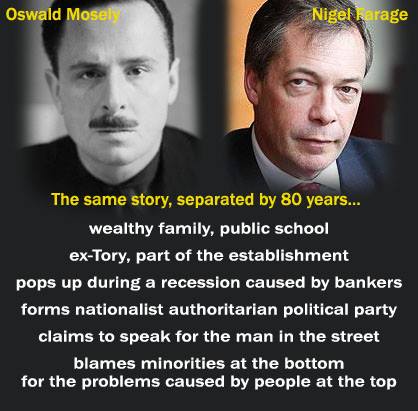
Sir Oswald Ernald Mosley, 6th Baronet of Ancoats is known principally as the founder of the British Union of Fascists (BUF) but he was originally a Tory. He crossed the floor to sit as an Independent Member on the opposition side of the House of Commons. Dissatisfied with the Labour Party, Mosley founded the New Party. Its early parliamentary contests, in the 1931 Ashton-under-Lyne by-election and subsequent by-elections had a spoiler effect in splitting the left-wing vote and allowing Conservative candidates to win. 

BUF gained the endorsement of the Daily Mail  newspaper, headed at the time by Harold Harmsworth (later created 1st Viscount Rothermere). The BUF was protectionist, strongly anti-communist, nationalistic, and strongly authoritarian. In 1933, after his wife’s death, Mosley married one of his mistresses, Diana Guinness. They married in secret in Germany on 6 October 1936 in the Berlin home of Minister of Public Enlightenment and Propaganda Joseph Goebbels. Adolf Hitler was one of the guests.

Farage is readily comparable with Mosely, he also tried to entice the working class, and those blue collar defectors who don’t feel solidarity with anyone except their “own kind” need to ask themselves how a fascist party would better reflect their interests, because fascists aren’t just fascists when it comes to your preferred target group – in this case migrants – fascists are fascists full stop. And most migrants are working class, too.

Fascists are not known for being big on unions and worker’s rights either, Hitler smashed the unions, Mosely fought them too. But fascists do like to use the oppressed to oppress others.

Mosely was defeated by working class solidarity – Jews, communists, socialists, the labour movement, and the middle classes, who all stood side by side in Newcastle, in the Valleys, Yorkshire, at Olympia and on Cable Street. Unity and regard for the rights and well-being of others was their strength.

Those blue collar workers that are so negative towards their exploited migrant brothers and sisters are more like Thatcher’s children, with so little regard for anyone else. There’s no excuse for prejudice and blaming Labour won’t cut it. Our own principles and respect for each other are our own responsibility. Labour have always provided a framework of tolerance and equality, so there are no excuses. The Labour Party isn’t (and ought not be) about the exclusive representation of just one self-defined social group. That isn’t how democracy works.

Prejudice is politically and socially motivated and directed – there is a considerable element of political and media “duping” involved but there has to be more to it than simply socio-political process, otherwise everyone would be prejudiced in the exactly the same ways. And we are not at all.

There are some identifiable psychological characteristics that present reasons why some people may be more susceptible to adopting prejudice as a kind of defence mechanism:

Avoiding uncertainty – Prejudice allows people to avoid anxiety, anger, doubt and fear. It’s a way of choosing something easier to confront than a reality, since stigmatising a vulnerable social group is an easier option than facing a powerful government that is invariably responsible for the anxiety, anger, doubt and fear in the first place. Of course, that diversion of blame and responsibility suits the government very well, too.

Avoiding ambiguity and insecurity – Prejudice gives people tangible scapegoats to blame in times of social crisis. It offers people a simple formula – stereotypes – from which to make predictions about other people’s behaviour.

Allowing self-serving bias – Prejudice may be used to boost self-esteem. People with prejudiced attitudes tend to be those that harbour a sense of inadequacy. (See Iain Duncan Smith, and his fake qualifications and false statistics, for example)

Permitting oppressive behaviours – Prejudice legitimises discrimination because it apparently justifies hierarchical thinking, and one group’s dominance over another.

Prejudice has been linked with the tendency for over-simplification of explanations – seeing the world as black and white, and also, hierarchical thinking.

Following the Holocaust, several influential theorists came to regard prejudice as pathological, and they searched for personality syndromes associated with racism, anti-Semitism, and other forms of prejudice. The most prominent of these theorists was Theodor Adorno, who had fled Nazi Germany and concluded that the key to prejudice lay in what he called an “authoritarian personality.”

In his book The Authoritarian Personality, (1950), Adorno and his co-authors described authoritarians as rigid thinkers who obeyed authority, saw the world as black and white, and enforced strict adherence to social rules and hierarchies. Authoritarian people, they argued, were more likely than others to harbour prejudices against low-status groups.

All forms of right-wing authoritarianism correlate with prejudice. Well-designed studies in South Africa, Russia, Canada, the U.S., and elsewhere have found that right-wing authoritarianism is associated with a variety of prejudices (Altemeyer, 1996; Duckitt & Farre, 1994; McFarland, Ageyev, & Abalakina, 1993). People who view the social world hierarchically are more likely than others to hold prejudices toward low-status groups. This is especially true of people who want their own group to dominate and be superior to other groups – a characteristic known as “social dominance orientation” .

Any group claiming dominance over another – including the “working class” – is displaying social dominance orientation. The oppressed can be oppressive, too.

Social dominance orientation tends to correlate with prejudice strongly and studies have linked it to anti-Black and anti-Arab prejudice, sexism, nationalism, opposition to gay rights, and other attitudes concerning social hierarchies.

So what are the answers?

Reducing Prejudice:

Research shows that prejudice and conflict among groups can be reduced if four conditions are met:

1) The groups have equality in terms of legal status, economic opportunity, and political power. This is one reason why Labour’s Human Rights Act and the Equality Act are so important.

2) Authorities advocate equal rights and are positive about diversity. We ought to be able to expect positive role modelling from a government. That will never happen with any right wing administration. They advocate measures and present narratives that heighten prejudice, Labour are currently the only party actually addressing the root causes of prejudice.

3) The conflicted groups are provided with opportunities to interact formally and informally with each other.

4) The groups cooperate to reach a common goal.

Yes, that’s the real socialist principle of cooperation, for the benefit of that elite of “purist socialists” who exclude others because they think that they are better socialists than everyone else.

The world would be a much better place if we used cooperation as our unifying foundation for inter-group process, conflict resolution and for wider social organisation.

In solidarity.

Manly P Hall
Many thanks to Robert Livingstone for his excellent pictures

Work and Pensions Committee announces the final oral evidence sessions for its inquiry into Employment and Support Allowance and Work Capability Assessments

536738_306169162785952_999031084_n
The Work and Pensions Committee has today announced the final oral evidence sessions for its inquiry into Employment and Support Allowance and Work Capability Assessments.

Fourth Session

Witnesses

Monday 9 June 2014, at 4.30pm, Wilson Room, Portcullis House

  • Lisa Coleman, Senior Vice President, Health Market, Atos
  • Dr Angela Graham, Clinical Director, Atos Healthcare
  • Helen Hall, Head of Communications and Customer Relations, Atos Healthcare

Purpose of the meeting

The session will consider

  • Atos’s role in the process before the face to face assessment and claimants’ experience of the process
  • The design and delivery of the WCA
  • The contract for delivering the WCA, including the relationship between quality and productivity, and Atos’s early exit from the contract
  • The ESA decision-making process, including outcomes and appeals
  • Future delivery of the WCA

Final session

Witnesses

Wednesday 11 June 2014, at 9.30am, Grimond Room

Department for Work and Pensions

  • Rt Hon Mike Penning MP, Minister of State for Disabled People
  • Jason Feeney CBE, Benefits Director
  • James Bolton, Deputy Director, Health and Wellbeing Directorate
  • Iain Walsh, Deputy Director, Working Age Benefits Division

Purpose of the session

The session will consider

  • The effectiveness of the WCA, including the findings of the Evidence Based Review
  • Key concerns about the delivery of the WCA by Atos, and how these issues may be resolved with the new provider
  • The ESA decision-making process
  • ESA outcomes and reassessments
  • Mandatory reconsideration and appeals
  • The interaction between ESA and Universal Credit

Judicial review launched regarding DWP decision to close the Independent Living Fund

37079_433060243430176_1848475368_n
In a very significant decision on 6 November 2013, which highlights the effects of the Equality Act 2010 on public authorities and their decision-making, the Court of Appeal has found that the Department of Work and Pensions’ (DWP) decision to close the Independent Living Fund (ILF) was not lawful, overturning the High Court’s decision of April 2013.

People with disabilities may receive ILF from a non-departmental Government body which provides money to help disabled people live independent lives in the community. The ILF operates an independent discretionary trust funded by the DWP and managed by a board of trustees. Its aim is to combat social exclusion on the grounds of disability and the money is generally used to enable disabled people to live in their own homes and to pay for care which would otherwise need to be given at residential care homes.

The Government initially decided to close the fund by March 2015 but this was delayed until June 2015 after five disabled people challenged the Government’s decision in the High Court.

The Court of Appeal unanimously quashed the decision to close the fund and devolve the money, on the basis that the minister had not specifically considered duties under the Equality Act, such as the need to promote equality of opportunity for disabled people and, in particular, the need to encourage their participation in public life. The court emphasised that these considerations were not optional in times of austerity.

On March 6, 2014, the Government announced in authoritarian style that it would go ahead with the closure of the ILF fund on 30th June 2015 justifying this decision by claiming that a new equalities analysis had been carried out by the Department for Work and Pensions. The government has shown a complete disregard for disabled people and the Court of Appeal decision. The government had failed to comply with the Equality duty – and this was a rare victory entirely due to disabled people fighting back.

The Department of Work and Pensions is now facing a new judicial review challenge from a group of disabled people regarding the decision of Minister for Disabled People Mike Penning to close the ILF in June 2015, taken just weeks after the Court of Appeal quashed the previous decision. .

The ILF provides vital support and funding for severely disabled people in the UK ,to enable them to live independent and fulfilling lives. To be eligible for ILF, people must already receive a substantial care package from local authority social services, but ILF funding also  provides a top-up for those with particularly high support needs. Severely disabled people are at high risk of social exclusion and face particular barriers to independent living and working.

The claimants, represented by Deighton Pierce Glynn and Scott-Moncrieff & Associates, fear that loss of ILF support would threaten their right to live with dignity, and they may be forced into residential care or lose their capacity to participate in work and everyday activities on an equal footing with other people.

The Court of Appeal had ruled in November 2013 that the previous closure decision had breached the public sector Equality duty, within the Equality Act, because the Minister had not been provided with adequate information to be able to properly assess the practical effect of closure on the particular needs of ILF users and their ability to live independently.

The DWP admitted that in considering the proposal again it had not consulted with any organisations or individuals outside of the Government, or gathered any additional information from local authorities or other sources about what level or type of support former ILF users would receive from social services once the ILF element was removed and how many people would be likely to go into residential care or lose their capacity to work or study.

The new legal challenge is pretty much on the same basis as the first – that once again the Minister had not discharged the public sector Equality duty because he did not have adequate information to be able to properly understand what the impact of closure would be on the particular people affected. This made it impossible to assess the proposal with the necessary focus on removing disadvantages for disabled people, meeting their needs, increasing participation in public life and advancing the equality that is required in all decisions by Government, within the framework of the Equality Act.

Related : Labour calls on Government To Save Independent Living Fund

At last the crisis of British democracy is addressed by a party leader: ED MILIBAND

I have always maintained that Ed Miliband is a thoroughly decent Leader, and that he has integrity. Labour are the only truly democratic mainstream party. They consult with the public and respond, and I know from my own lobbying experiences that Labour respond reflectively and positively to our campaigning. They are listening.

Mike Sivier's avatarMike Sivier's blog

Champion of democracy: Ed Miliband told the country he wants Parliament to provide what the people want, signalling a return to the principles of democratic government that have been abandoned by the Conservatives and Liberal Democrats. Champion of democracy: Ed Miliband told the country he wants Parliament to provide what the people want, signalling that Labour plans to return to the principles of democratic government that have been abandoned by the Conservatives and Liberal Democrats.

Hopefully the naysayers among Vox Political‘s readership will have a little more respect for Mr Miliband after today.

He is the first – and so far, the only – leader of a mainstream British political party to have correctly identified the biggest problem facing our democracy at this time:

The fact that people aren’t bothering to vote.

Here’s what he said, in his response to the Queen’s Speech:

“The custom of these debates is to address our opponents across the despatch box in this House, but today on its own that would be inadequate to the challenge we face.

“There is an even bigger opponent to address in this Queen’s…

View original post 587 more words

Ed Miliband’s full response to the Queen’s Speech

 With thanks to LabourList

MILIBAND QUEEN'S SPEECH

Click here for Ed Miliband’s full response to today’s Queen’s Speech, in glorious technicolour.

For those who prefer reading, here is the full text:

“This Friday we will mark seventy years since the Normandy Landings, where wave upon wave of allied forces poured onto the beaches of Northern France.

It marked the beginning of the final chapter of the Second World War which preserved the freedoms we enjoy today.

So I want to start by honouring the service of those veterans and the memory of their fallen comrades.

A feeling I’m sure shared across the whole House.

And I am sure across the House today we will also want to remember and pay tribute to the work of our armed forces over the last decade in Afghanistan.

At the end of this year, British combat operations will come to an end.

We should be incredibly proud of the service of our armed forces.

They have fought to make Afghanistan a more stable country, and a country with a democracy and the rule of law.

And a country that cannot be used as a safe haven to plan acts of terrorism here in Britain.

We grieve for the 453 members of our Armed Forces who have been lost and our thoughts are with their families and friends.

All of our armed forces have demonstrated, as our Normandy veterans did all those years ago, that they represent the best of our country.

At the beginning of each Parliamentary session, we also remember those members of this House we have lost in the last year.

In January, we lost Paul Goggins.

He was one of the kindest, most honourable people in the House, and someone of the deepest principle.

At a time when people are very sceptical about politics, Paul Goggins is a reminder of what public servants and public service can achieve.

Let me turn to the proposer of the motion who carried off her duties with aplomb and humour.

She can only be described as we saw from her speech, as one of life’s enthusiasts.

Before coming to this House she has had a varied career as a magician’s assistant when a teenager, and then a job nearly as dangerous, running the foreign press operation for President George W. Bush.

She made headlines for her recent appearance on Splash.

With an admirable line in self-deprecation saying about her performance, “I have the elegance and drive of a paving slab…” which seems somewhat unfair.

Since she got to the quarter finals I’m not sure what it says about the other contestants.

It certainly takes guts to get in a swimming costume and dive off the high board.

Can I say to her if she is looking for a new challenge she should try wrestling a bacon sandwich live on national television.

In any case, it is clear that today she deserved her place on the podium.

Turning to the seconder of the motion, she made an eloquent speech.

She came to this House with over twenty years teaching in further education and the Open University behind her.

Since being elected in 2001, she has campaigned with distinction on children’s issues and has been an assiduous local MP.

She voted against tuition fees, has described being in the coalition as “terrible” and says the Lib Dem record on women MPs is “dreadful”.

By current Lib Dem standards, Mr Speaker, that apparently makes her a staunch loyalist.

But on gender representation she will have taken real consolation that she can now boast that 100 per cent of Liberal Democrat MEPs are women.

As she said she will be standing down at the next election and for her outside experiences, her wisdom and her all round good humour and kindness, which I saw when I first became an MP, she will be much missed.

Before I turn to the loyal address, let me say something about one of the most important decisions for generations, which will be made in just a few months’ time.

The decision about the future of our United Kingdom.

The history of the UK, from workers’ rights, to the defeat of Fascism, to the NHS, to the minimum wage, is the story of a country stronger together.

A country in which representation from Scotland and Wales and Northern Ireland and England has helped us to advance the cause of social justice.

It is a decision for the people of Scotland but I passionately believe this Kingdom should remain United.

Mr Speaker, the ritual of the debate on the loyal address has existed for centuries.

Today, we do not just debate the Queen’s Speech, we assert the importance of this House and the battle it has fought over hundreds of years to exercise power on behalf of the British people.

But what the recent elections show is that more than at any time for generations, this House faces a contemporary battle of its own.

A battle for relevance, legitimacy and standing in the eyes of the public.

The custom of these debates is to address our opponents across the despatch box in this House.

But today on its own that would be inadequate to the challenge we face.

There is an even bigger opponent to address in this Queen’s Speech debate:

The belief among many members of the public that this House cannot achieve anything at all.

Any party in it.

About 10 per cent of people entitled to vote, voted for UKIP in the recent elections.

But, as significant, over 60 per cent did not vote at all.

And whatever side we sit on, we will all have heard it on the doorstep:

“You’re all the same, you’re in it for yourself, it doesn’t matter who I vote for.”

Of course, that’s not new, but there is a depth and a scale of disenchantment which we ignore at our peril.

Disenchantment that goes beyond one party, beyond one government.

There is no bigger issue for our country and our democracy.

So, the test for this legislative programme, the last before the general election, is to show that it responds.

To the scale of the discontent.

And the need for answers.

In this election, we heard concerns about the way the EU works and the need for reform.

We heard deep-rooted concerns about immigration and the need to make changes.

But I believe there is an even deeper reason for this discontent.

Fundamentally, too many people in our country feel Britain doesn’t work for them and hasn’t done so for a long time.

In the jobs they do and whether their hard work is rewarded.

In the prospects for their children and whether they will lead a better life than their parents, including whether they will be able to afford a home of their own.

And in the pressures communities face.

Above all, whether the work and effort people put in is reflected in them sharing fairly in the wealth of this country.

The Governor of the Bank of England gave a remarkable speech last week saying inequality was now one of the biggest challenges in our country.

We should all be judged on how we respond to this question, right as well as left.

There are measures we support in this Queen’s Speech including tackling modern slavery, an Ombudsman for our Armed Forces and recall.

But the big question for this Queen’s Speech is whether it just offers more of the same or whether it offers a new direction, so we can genuinely say it works for all and not just a few at the top.

This task starts with the nature of work in Britain today.

It is a basic belief of the British people that if you work all the hours God sends you should at least be able to make ends meet.

All of us say that if you do the right thing, you should be rewarded.

It is a mantra that all sides of this House repeat.

But we should listen to the voices of all of those people who say that their reality today is that hard work is not rewarded.

And it hasn’t been for some time.

All of us will have had heard this during the election campaign.

Like the person I met in Nottingham, struggling with agency work, total uncertainty about how many hours he would get.

Every morning at 5am, he would ring up to find out if there was work for him.

More often than not, there was none.

He had a family to bring up.

The fact that this is happening in 21st century Britain today, the fourth richest country in the world, is something that should shame us all.

This is not the Britain he believes in.

It’s not the Britain we believe in.

And it shouldn’t be the Britain this House is prepared to tolerate.

We have seen the number of zero-hours contracts go well above one million.

We need to debate as a country whether this insecurity is good for individuals, families and the country as a whole.

It is not.

And if it isn’t we should be prepared really to do something about it.

And we need to debate the wider problem.

Five million people in Britain, that’s one in five of those in work, are now low paid.

And this shocking fact:

For the first time on record, most of the people who are in poverty in Britain today are people in work, not people out of work.

So much for hard work paying.

None of our constituents sent us to this House to build an economy like that.

And at a time when we will face significant fiscal challenges into the future, it is costing the taxpayer billions of pounds.

It is no wonder people in the country don’t think this House speaks for them.

To show a new direction for the country and show it is not just more of the same, the Queen’s Speech needs to demonstrate to all of those people that it can answer their concerns.

There is a Bill in this Queen’s Speech covering employment.

But the Bill we need would signal a new chapter in the battle against low pay and insecurity at work, not just business as usual.

It would set a clear target for the minimum wage for each Parliament, so that we raise it closer to average earnings.

If you are working regular hours, for month after month, you should be entitled to a regular contract not a zero-hours contract.

If dignity in the workplace means anything it should clearly mean this.

We could make it happen this Parliament and show the people of this country that we get what is happening, but this Queen’s Speech does not do that.

Britain, like countries all around the world, faces a huge challenge of creating the decent, middle income jobs that we used to take for granted.

And many of those jobs will be created by small businesses.

There is a Bill in the Speech on small business.

But we all know that we have a decades’ long problem in this country of banks not serving the real economy.

Companies desperate to expand, to invest, to grow can’t get the capital they need.

For all of the talk of reforming the banks, is there anyone who really believes the problem has been cracked, with lending to small business continuing to fall?

The choice facing this House is to carry on as we are.

Or say that the banks need to change.

Break up the large banks so we tackle our uncompetitive banking system.

And create regional banks that properly serve small business.

But the Queen’s Speech doesn’t do this.

And a Queen’s Speech that was setting a new direction would also be tackling another decades’ long problem.

That’s happened under governments of both parties.

And would be devolving economic power away from Whitehall to our great towns and cities.

Lord Heseltine was right in his report.

We do need to give our towns, our cities, our communities the tools to do that job.

Even more importantly when there is less money around.

More powers over skills, economic development and transport.

And the government should be going much further.

But none of that is in this Queen’s Speech.

So the first thing this Queen’s Speech needed to have done is to signal a new direction in the jobs we create in this country and whether hard work pays.

It does not rise to this challenge.

We support measures on childcare, which is part of the cost-of-living crisis, although the scale of that challenge means we would go further on free places for 3 and 4 year olds.

And we also support the Bill on pensions although we want to ensure people get proper advice to avoid the mis-selling scandals of the past.

But the next task for this Queen’s Speech is to face up to another truth:

For the first time since the Second World War, many parents fear their children will have a worse life than they do.

No wonder people think that politics doesn’t have the answers when this is the reality people confront.

And nowhere is that more important than on housing.

We all know the importance of that to provide security for our families.

And we know this matters for the durability of our recovery too.

The Bank of England has warned that the failure to build homes is their biggest worry.

And this is a generational challenge which hasn’t been met for 30 years.

We are currently building half the homes we need and on current trends the backlog will be 2 million homes by 2020.

The question for this House is: are we going to act to meet the challenge or carry on as before?

A new town at Ebbsfleet as this Queen’s Speech proposes is fine, but it does not do enough to set a new direction in building homes.

Tackling the fundamental problem of a market that’s not working, with a small number of large developers not having an incentive to build at the pace we need.

We know there is a problem of developers getting planning permission, sitting on land, and waiting for it to accumulate in value.

There are land banks with planning permission for over half a million homes.

We can either accept that or change it.

We could give councils powers to say to developers, use the land or lose it.

And give local councils the right to grow where they need more land for housing.

And this House could commit today to getting 200,000 homes built a year, the minimum we need.

That is after all what in the 1950s a One Nation Conservative Prime Minister did.

But the Speech does none of these things.

And a Queen’s Speech rising to the challenge on housing, would also do something for the nine million people who rent in the private sector.

Over one million families, with two million children, with no security at all.

Children who will start school this September but their parents will have no idea whether they will still be in their home in 12 months’ time.

And we wonder why people are losing their faith in politics.

When we published our proposals for three-year tenancies some people said they were like something out of Venezuela.

If something as modest as this is ridiculed as too radical, is it any wonder that people who rent in the private sector think Parliament doesn’t stand up for them?

These proposals would not transform everything overnight, but they would tell 9 million people renting in the private sector that we get it and something can be done.

And there is another area where people are fed up being told there is nothing that can be done.

Their gas and electricity bills.

It is eight months since Labour called for a freeze on people’s energy bills.

Just this week we’ve seen figures showing the companies have doubled their profit margins.

This is a test of whether this House will stand up to powerful vested interests and act, or say that nothing can be done.

The companies can afford it.

The public need it.

The government have ignored it.

This Queen’s Speech fails that test.

The test for this Queen’s Speech is also whether it responds to the anxieties people feel in their communities.

We all know that one of the biggest concerns at the election was around immigration.

I believe immigration overall has been good for our country.

I believe it as the son of immigrants.

And I believe it because of the contribution people coming here have made to our country.

But we all know that we must address the genuine problems about the pace of change, pressures on services and the undercutting of wages.

Some people say we should cut ourselves off from the rest of the world and withdraw from the European Union.

They are profoundly wrong.

We have always succeeded as a country when we’ve engaged with the rest of the world.

That is when Britain has been at its best.

Others say that there is nothing that can or should be done.

They are wrong too.

We can act on the pace of change by insisting on longer controls when new countries join the European Union.

We need effective borders where we count people in and out.

And this House could act in this session of Parliament to tackle the undercutting of wages.

Not just increasing fines on the minimum wage, but proper enforcement and stopping employers crowding ten to fifteen people into a house to sidestep it.

We all know it’s happening.

Stopping gangmasters from exploiting workers from construction to agriculture.

We all know it’s happening.

Stopping employment agencies from only advertising overseas or being used to get round the rules on fair pay.

We all know it’s happening.

It is no wonder people lose faith in politics when they know it’s happening and Parliament fails to act.

If this House thinks these things are wrong then we should do something about them.

Responding to the concerns we have heard about work, about family, about community is the start this House needs to make to restore our reputation in the eyes of the public.

At the beginning of this speech I said there is a chasm between the needs and wishes of the people of this country and whether or not this House and politics is capable of responding.

We need to rise to that challenge.

This Queen’s Speech doesn’t do it.

But it can be done.

And that is the choice that the country will face in less than a year’s time.

This is what a different Queen’s Speech would have looked like:

A Make Work Pay Bill to reward hard work.

A Banking Bill to support small businesses.

A Community Bill to devolve power.

An Immigration Bill to stop workers being undercut.

A Consumers’ Bill to freeze energy bills.

A Housing Bill to tackle the housing crisis.

And an NHS Bill to make it easier to see your GP and stop its privatisation.

To make that happen, we need a different government, a Labour government.”

Ed Miliband.

Related posts:

  1. Miliband and Balls unveil alternative Queens’ Speech
  2. Full text: Miliband’s Budget Response
  3. Ed Miliband’s Queen’s Speech response
  4. Ed Miliband “One Nation Economy” speech – full text
  5. Full Text: Ed Miliband’s Budget Response
YARPP544807_370332463014480_1710535589_n


Labour’s fiscal responsibility and caution isn’t austerity, so stop doing Lynton Crosby’s job for him.

10001887913_f8b7888cbe_o

Guardian/ICM poll in autumn last year revealed an alarming fact: David Cameron and George Osborne are more trusted by the public on “economic management” by a margin of 40% to 22%, and we know that the public – and  a number of Labour supporters amongst them – have hardened their attitude towards welfare support.

Yet we know that Labour’s social policy was a success, this is verified by the London School of Economic’s definitive survey of the Blair-Brown years: “There is clear evidence that public spending worked, contrary to popular belief.” Nor did Labour overspend. It inherited “a large deficit and high public sector debt”, with spending “at a historic low” – 14th out of 15 in the EU.

Although Labour’s spending increased, until the global crash it was  “unexceptional”, either by historic UK standards or international ones. Until 2007 “national debt levels were lower than when Labour took office”. After years of neglect, Labour inherited a public realm in decay, squalid, public buildings, almost extinct public services and neglected human lives that formed a social deficit more expensive than any Treasury debt. But Labour reinvested in people, in services, just like they always do.

Things were much better with a Labour administration, with money mostly well spent on public services and infrastructure. Labour shielded us from the effects of global crash. We were out of recession in the UK by 2010.

In the weeks after he took office, George Osborne justified his austerity programme by claiming that Britain was on “the brink of bankruptcy”. However, the head of the Office for Budget Responsibility publicly rebuked Osborne for that bare-faced lie.

The public seem to have forgotten that it was the Conservative-led Coalition that lost the Moody’s Investors Service triple A grade, despite pledges to keep it secure. Moody’s credit ratings represent a rank-ordering of creditworthiness, or expected loss.

The Fitch credit rating was also downgraded due to increased borrowing by the Tories, who have borrowed more in 4 years than labour did in 13. It’s remarkable that the general public pay so little attention to events and facts, but as Goebbels said:

“If you tell a lie big enough and keep repeating it, people will eventually come to believe it. The lie can be maintained only for such time as the State can shield the people from the political, economic and/or military consequences of the lie. It thus becomes vitally important for the State to use all of its powers to repress dissent, for the truth is the mortal enemy of the lie, and thus by extension, the truth is the greatest enemy of the State.”

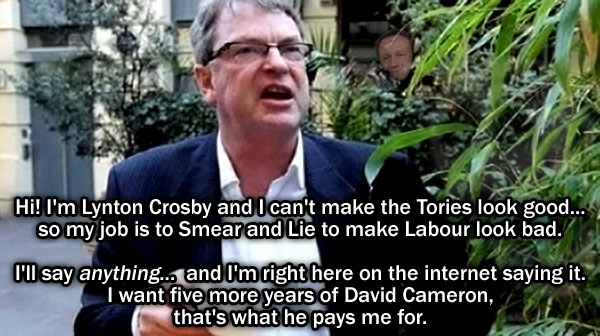
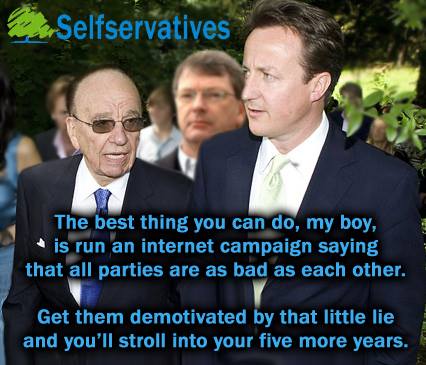
Another big lie of course is that “they’re all the same”. This myth started life as a divisive and demoralising propaganda tool aimed at the Left by the likes of Lynton Crosby. The Right have always employed the tactics of infiltration, disruption and “neutralization”  to address opposition and these tactics are well known to civil liberties advocates everywhere. (See “The Enemy Within”, and the account of how Thatcher used MI5 as a home-grown political police force that was deployed against the miners and the Left.)

One of the most disheartening consequences of Right wing propaganda is watching how some of the Left pick it up and run with it. All over the place. The Huff published an article claiming Future Labour Government WILL NOT Undo Hugely Unpopular Coalition Government Cuts, but on close scrutiny, the article does not substantiate or justify the headline. So it was with incredulity that I watched various Left-wing factions translate that into “Miliband supports austerity” and that was repeated over and over, without much critical analysis or attention paid to what was actually said.

Firstly, Milliband DOES NOT SUPPORT AUSTERITY and never has. Miliband has already made a commitment to prioritise addressing inequality and the cost of living crisis.

Secondly, what Miliband has actually said is: “Our starting point for 2015-16 will be that we cannot reverse any cut in day-to-day, current spending unless it is fully funded from cuts elsewhere or extra revenue – not from more borrowing.”

If you look past the various bluntly misleading headlines, the Labour leader has simply given himself room for manoeuvre. Miliband has said that he won’t make any promises he cannot keep. And he hasn’t. Those pledges that have been made to date have been costed, evidenced and justified.

In light of a hostile media, and a public tending to believe that austerity is somehow necessary and justified, it’s worth considering that if Miliband wants to be in a position to change anything at all for the better, he will need to be elected, and some elements of public opinion present a barrier to that. And for the wrong reasons, unfortunately for us, and for Miliband.

Here is a commentary of Miliband’s understandably cautious statement:

1) Miliband has committed to matching spending levels only.

Whilst he may be matching current “day-to-day” spending levels, that still allows him plenty of room for capital spending. He may as well have openly pledged to do so, with robust rhetoric on housing and house building. His speech on limiting the benefit bill specifically mentioned how house building can reduce welfare spending in the long run, by stopping the system of siphoning off public funds for private landlords. He also has political endorsement from the International Monetary Fund, which suggested that the UK could use another £10 billion investment. Labour have pledged to build new homes and it’s thought that the figure will be a million in total, in the Manifesto. That will also provide a boost the the economy.

Furthermore, Miliband has pledged to repeal the Bedroom Tax, and the cuts to and privatisation of the NHS. And that IS a promised reversal of cuts made by the Coalition.

2) It’s only for one year

Miliband’s pledge only counts for the first year of his government, from 2015 to 2016. After that, he can do what he likes.

Raising revenue over that year through various methods, such as collecting more taxes from the wealthy, reversing the extra tax cuts which the richest 5 per cent have received, as pledged, and by capping private rents, (and not benefit) for example and saving the amount that the State hands out to wealthy landlords, will also give Labour more room for manoeuvre to plan and prioritise further. Bearing in mind that Labour will certainly inherit public services with much of the former foundational structure gone – such as the health system, where thousands of staff have been cut, services privatised, and then there’s other areas of infrastructure that’s been badly neglected, it’s important that these issues are addressed, since repeal of legislation, for example, requires something else to be put in place, too.

Another example of raising revenue is the Job’s Guarantee (for all who wants one) and by the government paying a living wage, the private sector would have to increase their wages in order to gain workers. That will reduce the benefit bill. The Job’s Guarantee will also act as an “automatic stabiliser”, maintain or increase the workforce’s skills, reduce mental health problems and increase demand in the economy.

3) Miliband can be fiscally conservative whilst remaining socially progressive

Miliband’s pledge draws a line for day-to-day spending beyond which he will not cross, but it does not specify what he does ahead of that line. Under the coalition, savings were expected to be found under a ratio of 80:20 – 80% spending cuts to 20% tax rises.  Miliband has indicated he will be significantly raising taxes for the wealthy whilst easing or even undoing spending cuts elsewhere. The Labour leader has already announced a bankers’ bonus, return of the 50p top rate of tax and a mansion tax, amongst other measures. The direction of travel is pretty clear.

Ed Miliband and Ed Balls are currently examining options for how Labour can fund additional much needed investment in health over and above current spending plans. There is much supporting evidence for this vital investment, and for the repeal of the Tory-led Health and Social Care Act 2012, which has steadily eroded health services, has led to deliberate underfunding by the government and to subsequent mass privatisation within the NHS.

4) Miliband can still undo spending cuts

Just because each pledge must be financially costed without resorting to borrowing, that doesn’t mean it can’t be undertaken. As Miliband specified, cuts can be undone if the funding is found from elsewhere.

The proposed bankers’ bonus has been matched to pledges, the mansion tax has already been matched to bringing back the 10p rate of income tax. If anything, Miliband’s announcement should prompt campaigners to redouble their efforts on crucial key issues. The more pressure there is, the more prominently those issues will feature in Labour’s priorities.

5) Miliband hasn’t yet ruled out radical options

Just because you’re not borrowing doesn’t mean you can’t spend. Britain has magicked £375 billion out of the air and handed it to banks as part of the quantitative easing programme. The Conservatives managed to provide the millionaires with a tax cut of more than £107,000 each per year. But if money can be printed for banks, money can also be printed to try other methods of kick-starting the economy, such as taking low earners out of income tax.

It’s worth considering that when public services are extensively privatised, as they have been this past four years, those public funds that were once available vanish into private, closed bank accounts. That money will have to be recouped and reinvested.

1896930_10151941274942411_961048560_n

It’s worth bearing in mind that any government which introduces a policy like the Gagging Act, one that openly “monitors” the Right wing media for any whisper of “left wing bias”, that arranges the destruction of media hard drives because it doesn’t want the public to know the extent of government intrusion on our everyday private lives, is a government that will only ever use oppression to maintain its rule. It isn’t a democratic, open, accountable and reflective  government: it is an authoritarian one, and it has nothing to offer most of us but fear, poverty, exploitation, hunger, repression, pain and a deep longing for the decent, civilised society we once had.

“Lynton Crosby, a man whose mission the Prime Minister describes as being “to destroy the Labour Party”. This is a Conservative party preparing to fight the dirtiest general election campaign that we have seen in this country for over 20 years. And the Crosbyisation of the Conservative Party has reached a new intensity as their leadership becomes increasingly desperate. 

They have nothing to say about the cost of living crisis and have no vision for a better Britain. All they have left is resort to the lowest form of politics: that of division, of smear and character assassination. Millions of families face a cost of living crisis unequalled in their lifetimes. 

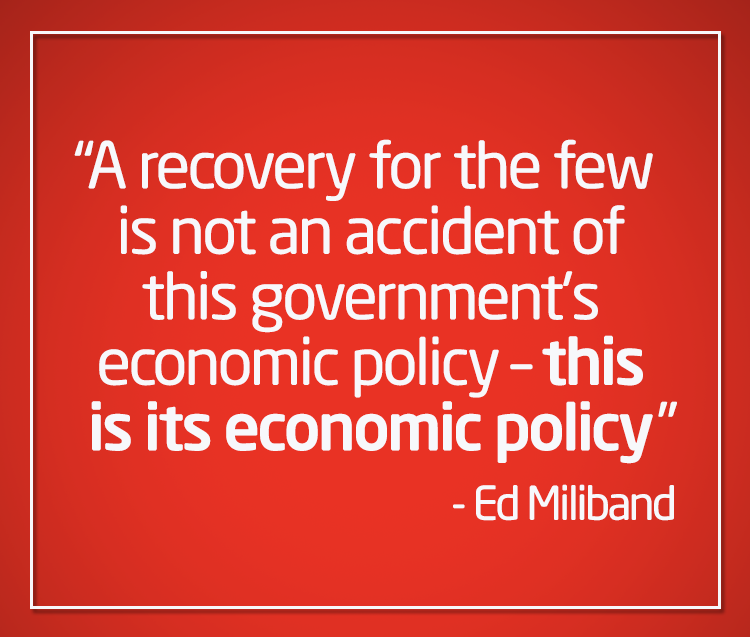
And the general election will determine how our country responds. The next election is far too important to be conducted in the gutter. Britain can do better than this. ”  Ed Miliband.

He’s right. We can do better than this.

The last four years have taken us on a nightmarish tour of socially dysfunctional, dystopian conservatism, and stranded us here, where the elite natives and tour operators speak an archaic language using narratives that translate as neofeudalism.

It’s time we went home.

10853165213_ddb97ac601_o

But we know better

Once you hear the jackboots, it’s too late. 

544807_370332463014480_1710535589_n

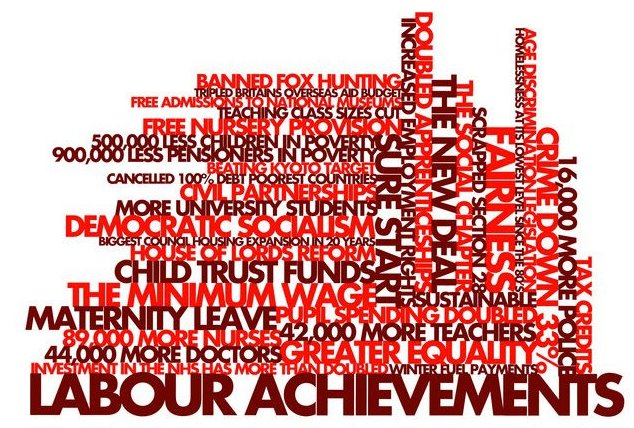
What Labour achieved, lest we forget

45 more good reasons to vote labour: the best   pledges to date

Many thanks to Robert Livingstone for his tireless, brilliant art work.

UKIP: Nothing but the Same Old Story

 UKIP : Nothing but the Same Old Story

The media are in a frenzy over the electoral rise of UKIP. But why are people surprised at all about the emergence and performance of UKIP?

It falls to the left to help explain that the rise of UKIP is extremely predictable.

After weeks of canvassing you find that you need a simple doorstep response to those people who say they’re thinking of voting UKIP. We must put this explanation into readily understandable terms so people have a very straightforward narrative to support and repeat.

It goes like this.

In every period of recession opportunist politicians from the right have emerged to seize upon the hardships people face to exploit them for their own ends. They always have to find a scapegoat to distract people from the real causes of the recession.

In this recession it is UKIP. In the past it’s been Mosley’s fascists in the 1930s and the National Front in the 1980s. The scapegoats were the Jews and later blacks and Asians. UKIP are publicly seizing upon European migrants as the scapegoat and privately many of their spokespeople are targeting all migrants. The Tories are targeting people on welfare benefits, especially people with disabilities.

It’s the same old story. Our response is to address the hardships people are facing, explain the real causes and  offer real solutions.

The hardships UKIP has focused on are homes and jobs. The shortage of housing had been caused by successive governments not investing in council housing. House prices have soared because of the housing shortages and rents have increased massively because rent controls were scrapped. There are also 600,000 homes standing empty.

The solution is not rocket science. We should launch a large scale building programme, compulsorily purchase empty homes and sites for construction and introduce cheap mortgages with no deposit requirements and bring back rent controls.

The competition for jobs is caused by a still sluggish economy only slowly recovering from the recession caused by the bankers. The government is failing to invest in creating the jobs we need. The solution is a public investment programme not only in housing but in sectors like alternative energy and insulation, as set out in the Green New Deal, to provide one million new sustainable jobs.

The reason people feel so insecure at work is because this Coalition government is trying to introduce a new form of feudalism. Under the new feudal system the Lords at the top are replaced by super rich oligarchs and corporations. Their aim is that the rest of us become treated as the new serfs, working on zero-hours contracts, for as little as possible with no rights at work and no ability to fight back through our trade unions. Under the government’s workfare system people on benefits are forced to work for nothing or face sanctions and destitution with complete loss of income. It’s the new modern form of slavery.

Of course employers will try to use migrants and the unemployed to cut wages and employment conditions. They always do. The enemy is not the migrant and unemployed person who is just desperate for work but the companies and bosses that try to divide and rule us. The answer as it has always been is to organise together to protect and improve wages and conditions. The best way of doing this is to join a union and fight back.

The migrants who have come here, like every other wave of migrants to this country, are making a major contribution to our society, and with an ageing population these young migrants are ensuring that we have an economy that can pay for the services needed by the elderly.

If we can explain the rise of UKIP in this straightforward way we also need to explain why the Labour Party has not been able to benefit from people’s discontent. The reasons are also straightforward. Labour was not only [unfairly] implicated in causing the economic crisis but also has failed to put across a simple message of how it would give people hope that their needs and concerns would be addressed by a Labour government.

Just a few simple policies of hope will do it. Under Labour everyone will have a home. Everyone will have a job, and a living wage in work or a citizen’s income out of work. Everyone will have free travel, healthcare, childcare, care for the elderly and education throughout life. We will have a programme of building council homes, cheap mortgages, rent controls, public investment in jobs, a fair tax system, public ownership of rail, ending privatisation in the NHS and scrapping tuition fees.

That should see off UKIP and the Coalition.

John McDonnell is MP for Hayes and Harlington and Chair of the Socialist Campaign Group of Labour MPs and of the Labour Representation Committee.

Related

45 more good reasons to vote Labour

Labour inquiry finds evidence needed to repeal Tory Health Act


539627_450600381676162_486601053_n (2)

Thanks to Robert Livingstone for the image

Labour inquiry finds evidence needed to repeal Tory Health Act

imgres

The Labour Party have pledged to repeal the Tory Health Act 2012, and have ensured that their alternative policy proposals are costed, fully justified and evidenced.

A review was set up by Debbie Abrahams, who is the parliamentary private secretary to shadow health secretary Andy Burnham and also chairs the Parliamentary Labour Party’s health committee. The work, which compared international health systems, will be used as platform for Labour to further develop its health policy in the run up to next year’s general election.

Ms Abrahams, a public health expert and former chair of NHS organisations has said  that the inquiry provided compelling and “concrete evidence” that the Health Act 2012 needed to be repealed. The final report, called An Inquiry Into The Effectiveness Of International Health Systems, concluded that competition can “impede quality, including increasing hospitalisation rates and mortality”.

It says Labour must redefine “the terms for private healthcare providers’ involvement in the NHS”.

Ms Abrahams and a panel have been taking evidence from sector experts and reviewing literature since autumn 2012. The inquiry carried out a comparative analysis of the health systems in 15 countries including the UK, Australia, France, Germany, Japan and the US.

Ms Abrahams explained that she believed repealing the Health Act 2012 could insulate the NHS from European competition rules.

Some have argued competition rules would apply even if the Act, or parts of it, were repealed, because of Europe-wide rules.

Ms Abrahams said that the Coalition legislation had “exposed the NHS to the perils of EU competition law” because it changed the status of NHS trusts and foundation trusts.

She said  “The act has competition at the heart of it. One of the measures they used to facilitate this is the increase in the private patient income cap to 49 per cent.

“This and the other measures, including section 75 and establishing Monitor as the economic regulator, it could be argued, changed the status of the NHS in the eyes of the [European] Commission from pursuing social objectives to economic ones.”

The act changed the limit on the proportion of income foundation trusts could receive from private patients to 49 per cent. It had previously been fixed at just a few per cent for most FTs.

The inquiry report also recommends Labour further “review the evolution needed by health and wellbeing boards and clinical commissioning groups to enable them to integrate budgets and jointly direct spending plans”. Labour has not yet clarified the details of how it would change the commissioning system.

Recommendations from an inquiry into the effectiveness of international health systems, by Debbie Abrahams:

 i. NHS funding, allocating resources and payment models

a. Restore the key principle of NHS resources allocated based on health need (and health inequalities)

b. Develop a ‘Healthcare For All’ funding model: Undertake a review of NHS resource allocation formulae and budgets in order to simplify and develop a new resource allocation model reflecting NHS principles and values

c. Analyse and develop alternative healthcare provider payment models based on quality, equity and capitation rather than activity/utilisation and ‘choice’

d. Review the evolution needed by Health & Well Being Boards (HWBs) and Clinical Commissioning Groups (CCGs) to enable them to integrate budgets and jointly direct spending plans for the NHS and social care

ii. Organisation of the NHS

a. Undertake a prospective assessment of the costs and benefits associated with an integrated, collaborative and planned approach to commissioning and providing healthcare in improving quality and equity in healthcare and social care

b. Ensure that privatisation of the NHS is prevented by exempting the NHS from EU/US Transatlantic Trade and Investment Partnership and ensuring corporate healthcare providers’ investment is not protected beyond current contracts

c. Ensure that a duty to ‘co-operate and collaborate’ is placed on CCGs and local authorities, and on NHS Trusts with local authorities including social care providers

d. Define the terms for existing private healthcare providers’ involvement in the NHS, in particular in the provision of clinical services

e. Review how to strengthen the democratic accountability of the NHS, including, for example, through locally accountable HWBs

iii. Integration in the NHS

a. Build on and supplement the evidence-base on integration within and between the NHS and social care with particular emphasis on quality and equity, for example through action-research pilots including single budgets for health and social care

b. Develop national standards for integrating the NHS and social care focusing on quality and equity, with local approaches for implementation

c. Develop holistic, ‘whole person care’ approaches to support people with long term conditions, and explore opportunities for NHS and Department for Work and Pensions (DWP) collaboration in this

iv. Research and surveillance

a. Restore data collected to monitor health inequalities including the former ‘dicennial supplement’ inequalities data

b. Within existing research budgets, increase the proportion of research into the health system wide effects of interventions such as organisation and resourcing on quality and equity in health and care

c. Implement Health Equity Impact Assessment: assess the effects on health systems, of local and national policies including all sectors of government as part of the Impact Assessment process.

Image courtesy of Robert Livingstone

In the Clash of Ideologies, Language Wins the War

Originally posted in The Australian Independent Media Network, April 12, 2014

1044468_500666173336249_1718830491_n

Jim Morrison famously and prophetically said, “Whoever controls the media, controls the minds”. 
This is certainly the case in Australia and the UK
This explores how the media – the Murdoch media in particular – shape out attitudes and opinions.
In 1988, Professor Noam Chomsky reminded us that the media “serve, and propagandise on behalf of, the powerful societal interests that control and finance them” (1). Never has this fact been more blatantly obvious than it is today.
The glaring anti-Labor/Greens bias on display by the Murdoch-owned news media during the term of the Gillard Government exaggerated Labor’s dysfunction and gave credibility to a Liberal/National opposition devoid of policies or ideas, other than a plan to hand decision-making over to commercial vested interests.
Today much of the mainstream media’s energy is spent fulfilling the roles of apologist and spin doctor for a right-wing conservative government which serves the wishes of a global oligarchy.
Selective coverage of current affairs events, skewed “opinion” pieces disguised as news reportage, simplified “black or white” presentation which avoids all nuance – the mainstream media has an endless supply of tools for the manipulation of public perception.
There is, however, more to the message than what is essentially the delivery system, or the means of presentation. The TV or radio program, the article in the print media or even the political billboard are simply what the megaphone is to the voice – the means of imparting the message. It’s in the language that real power and control resides.
Political forces use language as the weapon of choice on the field of public debate – what some refer to as the battlefield of ideas. In this arena, the army with the sharpest, most evocative language will prevail. There is little need for true logic or reason to underpin one’s arguments, only that a perception of reasoned lucidity is created by the language used.
While all sides of politics strive for control of any public debate through their use of language, conservative forces in our society have become masters of what is known as weasel language, or weasel words. The terms come from the reputation of weasels for sucking eggs and leaving an empty shell – at first glance weasel words create an impression of real meaning supported by research-based evidence or expert advice, which upon closer inspection is found to be hollow and devoid of substance.
This mastery of language, together with the recent structural disarray in evidence on the left of the political spectrum, goes a long way to explain the survival of conservatism around the globe, despite its continuing assault on the public interest, both nationally and globally.
The work of bodies such as the right wing Institute of Public Affairs is as much about formulating the language used to justify its ideologically-based policies as it is in formulating the policies themselves.
Words such as “free” and “freedom” are tacked onto the labelling language used to define and create a perception of a proposal or idea. Hence we get “free market”, “free speech” and “freedom of choice”. Once you insert a word such as “free”, a benign impression is created of harmless intent.
So it is that when a spokesperson for the IPA argues that people should be “given the right” to work for less that $16 per hour, they are claiming that working for less than the established and agreed minimum is a freedom. In this way, shifting employment conditions closer to the slavery end of the spectrum is made to sound like a positive, liberating move. It will hardly be a liberating experience for those workers who endure it, however, when they find themselves working longer and harder for less or very little, unable to meet their own living needs.
The term “free market” creates an image of happy global business, unfettered by tariffs and protectionist regulations, with goods moving freely about, resulting in best outcomes for both business, workers and consumers. The fact that tariffs were developed as a means to counteract trade imbalance and injustice is swept aside, because who wouldn’t want “freedom” in the marketplace?
Now business regulation designed to level the playing field and increase real fairness in trade is labelled by conservative governments as “red tape”, an evil to be done away with. Environmental regulation intended to protect our natural heritage landscapes and control resource extraction is now dismissed as “green tape”.
These terms belie the fact that such regulation has been developed over many years in response to the perceived need to maintain balance and sustainability in all things into the future.
Even the term “sustainability” itself has been highjacked by the weasel-worders. When the term is used in the context of economic debate, any cuts to spending or public funding are easily justified. Old-age pensions? Unsustainable. A living-wage pay rise for child-care workers? Again, unsustainable.
The rhetoric of conservative ideology is cleverly employed over time to erode the positive public perception of ideas and institutions which are seen as contrary to the the right-wing world-view.
A gradual sanding-down of the public’s acknowledgment and appreciation of the workplace rights and entitlements won over years of union organising and picketing has been achieved by the repeated portrayal of unions as hotbeds of thuggery and corruption.
Dismissive rhetoric about “the left” ignores the fact that leftist political values are based upon social justice, inclusion and concepts of decency and fairness. The ongoing message is that an empathetic worldview is “loony” and that to embrace a cynical philosophy of “winners and losers” is to dwell in the “real world”.
In this way a political message has been delivered into the public sub-consciousness: that leftist views are “crazy” and “loony” in their consideration of the public good, and that right-wing extremist views which can only benefit a minority elite are “sensible”, “rational” and “economically sound”.
Somewhere, somehow, logic and reason lie bleeding and forgotten by the masses, while weasel words and tabloid headlines are regurgitated as valid arguments in the arena of public discussion.
(1)  Manufacturing Consent: The Political Economy of the Mass Media (1988) by Noam Chomsky and Edward Herman.


 Related
From  Psycho-Linguistics to the Politics of Psychopathy. Part 1: Propaganda.
Techniques of neutralisation – a framework of prejudices 
The just world fallacy

999622_566748676727998_1599547969_n (1)


PCS Conference: Jobcentre Staff Demand End Of ‘Despicable’ Benefits Sanctions From Iain Duncan Smith

Labour exchange employees say they are ‘depressed’ by making people destitute on the orders of Work and Pensions Secretary Iain Duncan Smith.


Originally posted in The Morning Star on Friday 23 May

FRONTLINE Jobcentre staff renewed their campaign yesterday to scrap Tory benefit sanctions they are forced to hand down to Britain’s worst off.

Civil servants protested at PCS conference about the impact of the government’s welfare policies they witness everyday at work.

Unemployment benefit of just £71 per week can be stopped for (*a minimum of) two weeks (*and a maximum of three years) under sanctions introduced by Work and Pensions Secretary Iain Duncan Smith.

Jobcentre worker Martin Humphrey told delegates about the “depressing” task of telling people their benefits have been stopped.

He said: “We have to say to people that they have to live on nothing for two weeks.

“To make people destitute for two weeks is despicable.”

Jobcentre staff exposed once again how they are given sanction targets to hit — a claim Mr Duncan Smith continues to deny.

Britain’s pensioners are also given just £110 a week while disabled people face cruel tests by private comapanies, PCS vice president John McInally pointed out.

He said the result has been soaring demand at food banks, a rise in homelessness and hate attacks on disabled people.

And he said: “As a union, we have a duty to stand up for our members and our services.

“It’s disgraceful that our members’ job to help people is being turned on its head in order to attack the most poor and vulnerable.”

Department for Work and Pensions representative Fran Heathcote said frontline civil servants had been the target for anger from disabled, elderly and unemployed people stripped of benefits.

But she said: “PCS members understand and share the concerns of the people we serve every day.

“They want to help the unemployed find work and pay benefits to pensioners, the sick and the disabled.”

Delegates resolved to fight welfare attacks alongside groups like Disabled People Against Cuts (DPAC), other campaign collectives and other trade unions.

The union also committed to exploring the viability of a universal basic income to replace Mr Duncan Smith’s failing Universal Credit scheme.

Leeds delegate Annette Wright pressed the union for a campaign of non-compliance with benefit sanctions.

She argued that legal advice given to the union would allow civil servants to boycott sanctions if PCS “first of all identifies a legitimate trade dispute.”

scroll2

*Additional information.

Inappropriate sanctions imposed by Jobcentre Plus staff are one of the key reasons behind the rise in the number of people receiving help from food banks, according to a Commons Committee report in January.

The Work and Pensions select committee has called for an independent review of the operation of benefit conditionality and sanctioning to ensure that the rules are being applied fairly and appropriately. Their report states:

“Evidence suggests that JCP staff have referred many claimants for a sanction inappropriately or in circumstances in which common sense would dictate that discretion should have been applied.

“Some witnesses were concerned that financial hardship caused by sanctioning was a significant factor in a recent rise in referrals to food aid. The report recommends that DWP take urgent steps to monitor the extent of financial hardship caused by sanctions.

“These should include collecting and publishing data on the number of claimants ‘signposted’ to food aid by JCP and the reasons why these claimants were in need of assistance.”

Dame Anne Begg MP, chair of the Work and Pensions committee, said: “An unprecedented number of claimants were sanctioned in the year to June 2013. Whilst conditionality is a necessary part of the benefit system, jobseekers need to have confidence that the sanctioning regime is being applied appropriately, fairly and proportionately and the government needs to assure itself that sanctioning is achieving its intended objective of incentivising people to seek work.”

The report also said that the primary purpose of Jobcentre Plus should be to ensure that jobseekers are helped into work and not simply to get them off benefits.

According to the committee, as universal credit is introduced across the country more thorough assessments of claimants’ barriers to employment need to be introduced as the present system is “haphazard and prone to missing crucial information”.

Dame Anne Begg MP said: “People can leave benefit for a range of reasons, not all of them positive. JCP’s performance is currently measured primarily by the proportion of claimants leaving benefit by specific points in their claims. This takes no account of whether they are leaving benefit to start a job or for less positive reasons, including being sanctioned or simply transferring to another benefit. We believe this risks JCP hitting its targets but missing the point.

“JCP must be very clearly incentivised to get people into work, not just off benefits.”

Sanctions and disallowances.

Please bear in mind that this information is taken from the government site, and note that it has also been amended recently.

From 22 October 2012, new regulations introduced a regime of fixed period sanctions, which replaced the existing sanction rules and moved claimants closer to the sanction regime planned for Universal Credit in 2013.

For Jobseekers Allowance Sanctions:

  • Under the new sanctions regime, introduced on 22nd October 2012, a total of 1.03 million decisions were made to apply a sanction.
  • Just over half (54 per cent) of all decisions to apply a sanction were in the lower level group, and just under one in ten (9 per cent) in the higher group.  (There are 3 categories of sanction – ‘higher’, ‘intermediate’ and ‘lower’ – depending on the nature of the ‘offence’.)
  • Under the new sanctions regime, just under one third (30 per cent) of all decisions to apply a sanction was because of a failure to participate in the Work Programme (and other training schemes), and 19 per cent because of a failure to attend an adviser interview.
  • Over one third (38 per cent) of all decisions to apply a sanction was because of a decision that the claimant was not entitled to claim JSA (intermediate level), mainly because a decision that that the claimant was not actively seeking employment.
  • A total of 1.33 million decisions resulted in no reduction or withdrawal of JSA. In just under half of these (46 per cent) there was a decision not to apply a sanction; 44 per cent as a result of the referral being cancelled (results in no sanction decision being made); and just under one in ten (9 per cent) where it was decided that a sanction would be appropriate but the claimant was no longer claiming JSA (reserved decision).
  • A total of 146 thousand decisions following a review resulted in no sanction being applied. This represented under half (46 per cent) of all cases that went to a decision review stage, and less than one in ten (9 per cent) of all decisions to in which a sanction decision was made.
  • A total of 6 thousand decisions following an appeal resulted in no sanction being applied. This represented under one in five (18 per cent) of all cases that went to the appeal stage, and less than half of one per cent (0.4 per cent) of all decisions to in which a sanction decision was made.
  • Under the new sanctions regime, a total of 633 thousand individuals had received a decision to apply a sanction.

For Employment and Support Allowance Sanctions:

  • Under the new sanctions regime, introduced on 3rd December 2012, over 117 thousand sanctions decisions have been made up to December 2013, of which, 31 thousand were adverse decisions.
  • Under the new sanctions regime, 79 per cent of adverse decisions were made because of a failure to participate in work related activity (this includes failure to participate in the Work Programme), with the remaining due to a failure to attend a mandatory interview.

JSA sanction statistics available via the Tabulation Tool – Stat-Xplore.

Related:

Rising ESA sanctions: punishing the vulnerable for being vulnerable

The targeting, severity and impact of sanctions on benefit claimants needs urgent review by Michael Meacher MP

The just world fallacy

Commons Select Commitee Report

1002589_521987671204099_896277269_n (1)

Many thanks to Rob Livingstone