Category: Welfare

Welfare must not be seen as the Treasury’s disposable income

In the 2010 Coalition emergency budget, David Cameron claimed that austerity measures were to be introduced only to reduce the deficit.

Doesn’t anyone else remember that since then, David Cameron stood up at a Lord Mayor’s banquet in London, in front of the financial elite, in November 2013 and ostensibly admitted – and from an ostentatious golden throne, no less – that austerity was not an emergency response to difficult economic events after all, but a permanent disassembling of the state, signalling that he had no intention of resuming public spending once the structural deficit has been eliminated.

Many of us had already recognised that the cuts were ideologically driven. But not enough of us to make a difference in May and to vote and prevent an unforgivable betrayal of future generations. It’s also a grievous betrayal of the previous generations who fought to establish universal suffrage and fought to secure the post-war settlement. Our Social Security, Legal Aid and National Health Service. These are civilising and civilised prerequisites for a fair, human rights-based first world democracy.

proper Blond
There was another fall in income tax receipts that sent Britain’s deficit
spiralling to £12.1bn in August, the widest shortfall in government funding since 2012. So where is our money going exactly?

For a government whose raison d’etre is deficit reduction, the Conservatives aren’t very good at all. And the rigid emphasis on a series of self-imposed fiscal moving goalposts is distracting the government from the social, moral and democratic obligations it is also expected to uphold.

The Office for National Statistics said low wages and a dip in corporation tax receipts were to blame for the worsening situation, which will put pressure on George Osborne ahead of “tough” expenditure decisions due in November when Whitehall agrees its five-year spending targets.

But if you look at Conservative policies, which are designed to redistribute and privatise public wealth, it’s easy to see why this has happened.

The Conservatives regard the income of the poorest as somehow dispensable – the compensatory and disposable income of the Conservative state. Yet the very mention of raising taxes for the rich is met with shrieks of outrage and threats to leave the country. This is always justified in advance by a fresh mainstream narration of the puritan work ethic and the myth of meritocracy.

What’s yours is mine, what’s mine is my own.

What did the imperturbable chancellor promise before the election? True to Tory form, more of the same: austerity for the poor, more public services cuts, and tax breaks for the wealthiest. No mention of tax credit cuts, though, even when Conservatives were asked directly about those. Several times.

But further cuts to lifeline benefits and public services are surely untenable. Absolute poverty has risen dramatically this past four years, heralding the return of Victorian illnesses that are associated with malnutrition. People have died as a consequence of the welfare “reforms”. Supporting the wealthy has already cost the poorest so very much, yet this callous, indifferent, morally nihilistic government are casually discussing taking even more from those with the very least.

Our welfare state arose as a social security safety net – founded on an assurance that as a civilised and democratic society we value the wellbeing and health of every citizen.

There was a cross-party political consensus that such provision was in the best interests of the nation as a whole at a time when we were collectively spirited enough to ensure that no one should be homeless or starving in modern Britain.

As such, welfare is a fundamental part of the UK’s development –  our progress – the basic idea of improving people’s lives was at the heart of the welfare state and more broadly, it reflects the evolution of European democratic and rights-based societies.

A welfare state is founded on the idea that government plays a key role in ensuring the protection and promotion of the economic and social wellbeing of its citizens. It is based on the principles of equality of opportunity, equitable distribution of wealth, and both political and social responsibility for those unable to avail themselves of the minimal provisions for wellbeing.

It was recognised that people experienced periods of economic difficulty because of structural constraints such as unemployment and recession, through no fault of their own. It was also recognised that poor health and disability may happen to anyone through no fault of their own.

The welfare state arose in the UK during the post-war period, and following the Great Depression, for numerous reasons, most of these were informed by research carried out into the causes of poverty, its effects on individuals and more broadly, on the UK economy. There were also political reasons for the Conservatives and Liberals supporting the poorer citizens – the newly enfranchised working class.

Charles Booth in London and Sebohm Rowntree in York carried out the first serious studies of poverty and its causes. They both discovered that the causes were structural – casual labour, low pay, unemployment, illness and old age – not laziness, fecklessness, drunkenness and gambling, as previously assumed. The poverty studies raised awareness of the extent of poverty in Britain and the myriad social problems that caused it, and that it caused.

The Boer war of 1899-1902 highlighted the general poor state of health of the nation. One out of every three volunteers failed the army medical due to malnutrition, other illnesses due to poor diet and very poor living conditions. The military informed the government at the time of the shockingly poor physical condition of many of those conscripted.

We learned that the effects of poverty were potentially damaging to  the whole of society. Health problems and infectious disease – rife in the overcrowded slums – could affect rich and poor alike. It was recognised that the economy suffered if large numbers of people were too poor to buy goods and social problems such as exploitation, debt, crime, prostitution and drunkenness were a direct result of poverty, and not the cause of it.

Related image
The discovery of  widespread poor health as a consequence of poverty raised concerns about Britain’s future ability to compete with new industrial nations such as Germany and the USA. National efficiency would only increase if the health and welfare of the population improved. It was recognised that welfare is about extending opportunities, not “dependency”.

At the same time, the growth of the Labour Party and Trade Unionism presented a threat to the Liberals and the Conservatives. The new working class voters were turning to these organizations to improve their lives. The traditionally laissez-faire Liberals recognised this and supported the idea of government support for the working class.

Yet since 2010, there’s been an unprecedented, historic assault on the very ideal of social security, and it’s sustained and systematic: it didn’t stop with the 2012 welfare cuts.

As I’ve said elsewhere, welfare has been redefined by the Conservatives: it is pre-occupied with assumptions about and modification and monitoring of the behaviour and character of recipients, rather than with the alleviation of poverty and ensuring economic and social well-being.

Policies aimed at restricting support available for families where parents are either unemployed or in low paid work are effectively class contingent policies.

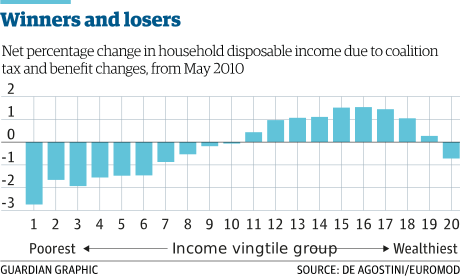
The vast total of around £25bn in benefit cuts already set in motion by the chancellor brings in less than he has freely handed out in personal tax allowances, generous tax breaks, petrol duties and corporation tax cuts. To govern is to make choices. It’s worth noting that the Conservative’s “difficult choices” are resolved by targeting the same social groups, over and over.

Cuts to welfare have been offset by the cost of tax cuts higher up income scale, with no overall contribution to paying down deficit, according to an unsurprising comprehensive study of social policies.

Professor John Hills, director of the London School of Economics (LSE) Centre for Analysis of Social Exclusion, said: “Protection of some of the core parts of the welfare state from the greatest cuts, and initial protection of the value of benefits, meant that those at the bottom, and important services, were initially shielded from the worst effects of the recession.

“But in the second part of the coalition’s period, selective cuts to benefits and to unprotected services have begun to take their toll, leaving the next government … with much greater social policy challenges than the coalition inherited.”
If David Cameron had been honest and declared that his government intended to dismantle our social infrastructure; the welfare state (and yes, that means in-work benefits too), the NHS, legal aid, and to refuse to honour any meaningful legal commitment to human rights, whilst handing out the money generated from this unravelling of our civilising institutions and services, in the form of handsome rewards to feckless millionaires, would he be in office now?

The Tory mantra “Making work pay” is a doublespeak soundbite version of the 1834 Poor Law principle of less eligibility, which is founded on the atrocious idea that poverty is caused by people simply refusing to work, and it can be “cured” if it is made as unbearable as possible. People will work if they are shamed and psychologically coerced. The whole idea of less eligibility is that “workless” people have to be kept in penury to “teach” them value of the work ethic and to discourage others from becoming an “idle pauper.”

But many poor people are in work.

The tax credit cuts proposed by the Conservatives exposed the “shirker” myth for what it is: a lazy, barely coherent narrative – a cover story for an ideologically driven and increasingly irrational government that is happy to reintroduce Dickensian levels of absolute poverty so that a few rich people can increase their wealth. Punishing poor people and creating a desperate class that are prepared to work for next to nothing rather than starve on a grossly inadequate and punitive social security system serves to drive wages down further, reduces working conditions and removes constraint from private sector profit-making.

It serves to dampen down collective bargaining. It changes the relationship between employers and employees, as well as between the state and citizens, turning increasingly desperate, impoverished people into a reserve army of cheap labour.

The welfare “reforms” were never about “making work pay.”

Unless, of course, you ask “for whom, precisely?” 

1379986_541109785958554_2049940708_nCourtesy of Robert Livingstone

Related

The Tories’ war on welfare has caused untold suffering. Here are three ways we can stop it

The New New Poor Law

Conservatism in a nutshell

Five reasons the Lords should vote to block tax credit proposals today – Policy in Practice

Policy in Practice was asked to pull together a briefing note on the changes to tax credits ahead of the showdown today in the House of Lords.

We work with our local authority partners to carry out detailed, household level analysis on the impacts of reforms now, all the way through to 2020. We take into account a sample of over 100,000 working age households, and assess the cumulative impact of tax and benefit reforms on household income.

Our findings were put succinctly by a benefits manager in a Conservative constituency:

‘The government wants people to work, but this goes against that’.

Policy in Practice is working with local authorities to map the impacts of welfare reforms on each low income household. To understand more about how we can help you to understand how people in your local authority will be impacted, click here.

1. Two-thirds of Working Tax Credit recipients can expect to be worse off in 2020

Based on analysis on over 100,000 households of working-age in receipt of Housing Benefit and Council Tax support, and taking into account the impact of the National Living Wage at £9.00 per hour, and a personal tax allowance of £12,500, we find that 67% of Working Tax Credit recipients will still be worse off in 2020, compared with today.

* Analysis update: We have updated our analysis this morning to take into account the 30 hours of free childcare that will be available to three and four year olds. If we assume that all households with children age three to four will be better off (which may not necessarily be the case) we find that half of all Working Tax Credit recipients within our sample will still be worse off in 2020.

2. Owner-occupiers will be among the hardest hit when the reforms first land in April 2016

Tax credit savings will be partly offset by higher Housing Benefit and Council Tax Support payments. Because tax credits reduce entitlement to other benefits, 57% of tax credit savings will be offset by increased Housing Benefit and Council Tax Support.These savings will not by spread evenly. Many owner-occupiers, who do not receive Housing Benefit, will not have their tax credit cuts mitigated and may find themselves pushed into crisis.

Some in receipt of Housing Benefit and Council Tax Support will see their support increase by up to 85p for each pound lost in tax credits. This support, which offsets the some of the impact of the cuts, will erode over time due to increased earnings under the National Living Wage. Higher earnings cause tax credits, Housing Benefit and Council Tax Support to be withdrawn, often simultaneously.

3. Work incentives will be weakened within tax credits and Universal Credit

A higher withdrawal rate will make it harder for people that try to earn their way back to their original standard of living. Working Tax Credit recipients that choose to counter the loss by increasing their earnings will lose up to an additional 7p for each pound earned. Effective tax rates may increase up to 93p in the pound.

4. Higher effective taxes make it harder to respond by increasing earnings, while people on low or no earnings will not be affected

To qualify for Working Tax Credit, households have to work a certain number of hours to be considered in remunerative work: 16 hours per week for lone parents and disabled people, 24 hours for couples with children and 30 hours for people without children. The option to increase their working hours may be limited, and will be penalised by a higher withdrawal rate of tax credits.

Tax credit recipients who are not in work and the lowest earners, including self-employed households (some of whom are thought to under-report their earnings) will not be impacted by these changes. Those that contribute most to the economy will be hardest hit.

5. The government was elected to reform the welfare system to make work pay

Low effective tax rates within tax credits and Universal Credit reward enterprise and endeavor, help lower earners, and aid progression in work. They ensure that more of the benefits of a National Living Wage and a lower tax threshold reach lower earners. Protecting the lower withdrawal rate within tax credits would send the message that this government is the party not only of low taxes, but of low effective taxes.

Identify which households will be impacted in advance

We find that frontline advisors within local organisations want to work with the government to support people toward greater independence, and to deliver on the policy intent. However, too often they don’t feel they have enough information to properly advise their customers.

To avoid leaving advisors on the back foot, local authorities including Birmingham, Newcastle, North Hertfordshire and Hounslow, are working with Policy in Practice to map the impact of welfare reforms on each individual household on a low income within their local authority.


This article was originally published today on the Policy in Practice site. You can read the original here.

Osborne’s tax credit omnishambles reveals the profound elitism of the Tories

Chancellor George OsborneI don’t know a single person on low pay that is happy about the Conservative proposals to cut their tax credits and subsequently, their living standards, further. This policy was deliberately left out of the Tory manifesto, and when asked directly if his government was going to cut tax credits, Cameron chose to lie and said no. Now the Conservatives are claiming that this policy, never declared before the election, is suddenly somehow a “central plank” of the budget. The claim that Conservatives had declared cuts to welfare doesn’t stand up to scrutiny, either, because they claim to be a party that is all about “making work pay”. 

The Conservatives are claiming that the cuts were “democratically voted” through in the House of Commons, yet their majority in the lower House may not have happened at all, had they been honest prior to the election and declared their intention to cut people’s tax credits. 

Furthermore, the cuts were presented in the form of secondary legislation – as a Statutory Instrument – which notoriously receive little scrutiny and very limited debate time in the Commons. Statutory instruments are intended to be used for simple, non-controversial measures, in contrast to more complex items of primary legislation (known as Bills.) The Government always ensure they have a majority on any Statutory Instrument committee and the MPs are chosen by Whips. This enables government to push through their legislative programme with very little scrutiny, exacerbating a lack of democratic transparency and accountability of the Executive.

The threats issued to the Upper House from the government arose because the Conservatives are facing probable defeat on what is an extremely unpopular reform, even amongst their own party ranks, and are truly remarkable, showing a contempt for democratic process and a lack of willingness to engage in genuine, transparent democratic dialogue.

Earlier this year, the Institute for Fiscal Studies (IFS) asked George Osborne to specify how he will reach targets announced in the budget, given that the poorest had been the hardest hit by draconian benefit cuts already. The IFS said that the worst of the UK’s spending cuts are still to come.

I said at the time that it’s not that Osborne can’t answer the IFS challenge: he won’t.

David Gauke, the Treasury secretary at the time was pressed repeatedly on the BBC’s Daily Politics to explain if the Tories would detail their planned welfare cuts beyond the £3billion previously specified.

He replied: “We will set it out nearer the time which will be after the election.”

Pre-general election television comments have exposed Prime Minister David Cameron’s lies about his party’s proposal to reduce child tax credits. During a special episode of BBC’s Question Time, aired in April, presenter David Dimbleby asks: “There are some people that are worried about you cutting child tax credits, are you saying absolutely as a guarantee that you’d never have it?”

To which the Prime Minister responds: “First of all child tax credit we increased by 450 pounds…” Dimbleby interjects: “And it’s not going to fall?” to which the PM clearly replies: “It’s not going to fall.”

As Simon Szreter, Professor of history and public policy at the University of Cambridge, points out about the party claiming “A Britain that rewards work” as its slogan:

It is a measure of just how much George Osborne’s post-election attack on tax credits represents an assault of genuinely historic proportions on Britain’s poor that his PM has made reference to the 1911 Parliament Act in his railing against popular protest and his fear of blocking measures in the House of Lords. Let us remember why the act was brought in by the Liberal government of Asquith and Lloyd George.

The landed wealth elite, including men such as George Osborne’s direct ancestors, the Anglo-Irish baronets of Ballentaylor, dominated the House of Lords. They rejected the elected government’s policy – democratically tested at the bar of two general elections in 1910 – to impose new progressive forms of taxation on the super-wealthy to help fund such basic social security measures for the working poor as pensions and the first National Insurance Act.

He goes on to say:

Mr Cameron is darkly mentioning the Parliament Act of 1911 to cow the House of Lords into compliance because the upper chamber is no longer exclusively the club of the wealth elite as it was in 1911. The alternative, as Mr Cameron’s timely recollection of the 1911 Parliament Act reminds us all, is for parliament to ensure that the financial elite pay their way more fully in our society, a case that is all the more compelling considering their undisputed role in punching a hole in the nation’s finances in 2008.

The problem today is not control over the House of Lords. Today’s financial elite have found that it is much more efficient to exert their control over the House of Commons itself. This they do though a Tory party that is almost entirely funded by them and whose administration is safely in the hands of a chancellor who fully appreciates the importance of looking after the interests of the nation’s wealth elites. After all, he is the future 18th baronet of Ballentaylor.

Even Conservative MPs, such as Heidi Allen, have pointed out the hypocrisy of the proposed tax credit cuts. But as I’ve pointed out previously, the slogan “making work pay” has a lot in common with the 1834 Poor Law principle of less eligibility, rather than it being a genuine statement of intent from the Tories. Unless of course, you ask “Making work pay for whom?”

Further cuts to provisions, services and welfare – support for the poorest – is unthinkable and untenable, especially when there are other choices that the government could have made.

For example, the prime minister made it clear that lavish tax cuts for the better off will be the £7bn prize for returning him to Downing Street. This came after a £48bn in public service cuts, the like of which the country has never known.

“The people whose hard work and personal sacrifices have got us through these difficult times should come first,” Cameron said.

So who exactly worked hardest and took the heaviest burdens – and what exactly will be their reward? Certainly not those who made most sacrifices – the same low earners whose working tax credits and benefits George Osborne will happily cut again by another £12bn.

ed wealthRelated

Tax Credits Cuts ‘Will Widen The Gap In Inequalities’

Cuts To Tax Credits Could Breach Children’s Rights, Warns Commissioner

Follow the Money: Tory Ideology is all about handouts to the wealthy that are funded by the poor

There is no such thing as a ‘one nation’ Tory: they always create two nations

Conservatism in a nutshell

The word “Tories” is an abbreviation of “tall stories”

John McDonnell’s letter to George Osborne shows just who the real worker’s party is

1340487044-cleaners-protest-at-john-lewis-in-oxford-st--london_1294776

It’s been a remarkably eventful week in politics. We have seen furious, tantruming Conservatives threatening the unprecedented and profoundly undemocratic retaliation of suspending the House of Lords or flooding it with Tories if peers decide to proceed with the step of using the so-called “fatal motion” to halt the Chancellor’s very unpopular plans to cut working tax credits. We have seen the announcement that the Tories intend to scrap the Human Rights Act by next summer.  It was revealed that the minister’s code of conduct has been quietly edited to remove obligations to uphold international laws.

This came as the Prime Minister tried to downplay the significance of the United Nations inquiry into “grave and systematic” breaches of the rights of disabled people in the UK because of Conservative policies, when held to account by Jeremy Corbyn at Prime Ministers Questions this week.

The pace of change at the hands of the so-called small state, non-interventionist Conservatives is dizzyingly fast and the undercurrents and implications have tsunami proportions.

Anyone would think that such a bombardment of releases in the news was a deliberate tactic to keep us in a perpetually diverted state of confusion; that we are being nudged away from  opportunities for rational analysis and to rally and present coherent critical challenges to what is going down. Fancy that – a government that refuses to be transparent and held to account in a so-called first world liberal democracy …  

However, the Shadow Chancellor, John McDonnell, has been busy writing to George Osborne, even offering to put politics aside and support him if he chooses to reverse the changes to tax credits fairly and in full.

John writes a powerful appeal to the Conservatives to do the right thing, and he shows who really is the “party for workers” – and it’s certainly not the Conservatives.

The full text of the letter is below:

Dear George,

It has only been three months since the Summer Budget when you chose to break the promise that David Cameron made to the British people during the election – that the Tories would not touch tax credits.

We now know that you plan to cut £1,300 from over 3 million families who are in work and doing all they can to pay the bills and get to the end of each month.

Last week you said that you were “comfortable” with this decision, and David Cameron said he was “delighted”, but the British people will not be happy that you are breaking the promise David Cameron gave to them during the election campaign and that working families are having their tax credits cut to pay for tax giveaways to a few wealthy individuals.

Now, you, me and everyone else in Westminster knows that you will have to u-turn on this issue. However, you need to do it in full. It can’t be a fudge. Not some partial reversal that scores cheap headlines, yet leaves people still worse off or lands another burden on middle and low earners or the poorest in our society. You need to drop this policy completely.

I know first-hand that for politicians the fallout from changing policy can be tough. But sometimes you have to be big enough to admit you got it wrong and do the right thing.

So I am appealing to you to put the interests of these 3 million families ahead of any concerns you may have about losing face and ahead of petty party politics. If you do, I promise you personally and publicly that if you u-turn and reverse this decision fairly and in full, I will not attack you for it.

To restore faith in our political system it’s time that politicians stopped making promises at elections that they won’t keep when in power – this is the lesson the Lib Dems learnt the hard way on tuition fees.

For the sake of those 3 million families, and the British people’s trust in politics, please see sense and fully u-turn on your cuts to tax credits.

I look forward to hearing from you.  

Yours sincerely,

John

Benefit sanctions: Britain’s secret penal system – Dr David Webster

With many thanks to the Centre for Crime and Justice Studies.

Benefits claimants are subjected to an ‘amateurish, secret penal system which is more severe than the mainstream judicial system’, writes Dr David Webster of the University of Glasgow.

Few people know that the number of financial penalties (‘sanctions’) imposed on benefit claimants by the Department of Work and Pensions now exceeds the number of fines imposed by the courts. In Great Britain in 2013, there were 1,046,398 sanctions on Jobseeker’s Allowance claimants, 32,128 on Employment and Support Allowance claimants, and approximately 44,000 on lone parent recipients of Income Support. By contrast, Magistrates’ and Sheriff courts imposed a total of only 849,000 fines.

Sanctioned benefit claimants are treated much worse than those fined in the courts. The scale of penalties is more severe (£286.80 – £11,185.20 compared to £200 – £10,000). Most sanctions are applied to poor people and involve total loss of benefit income.

Although there is a system of discretionary ‘hardship payments’, claimants are often reduced to hunger and destitution by the ban on application for the first two weeks and by lack of information about the payments and the complexity of the application process. The hardship payment system itself is designed to clean people out of resources; all savings or other sources of assistance must be used up before help is given.

Decisions on guilt are made in secret by officials who have no independent responsibility to act lawfully; since the Social Security Act 1998 they have been mere agents of the Secretary of State. These officials are currently subject to constant management pressure to maximise penalties, and as in any secret system there is a lot of error, misconduct, dishonesty and abuse.

The claimant is not present when the decision on guilt is made and is not legally represented. While offenders processed in the court system cannot be punished before a hearing, and if fined are given time to pay, the claimant’s punishment is applied immediately. Unlike a magistrate or sheriff, the official deciding the case does not vary the penalty in the light of its likely impact on them or their family. If the claimant gets a hearing (and even before the new system of ‘Mandatory Reconsideration’ only 3 per cent of sanctioned claimants were doing so), then it is months later, when the damage has been done.

‘Mandatory reconsideration’, introduced in October 2013, denies access to an independent Tribunal until the claimant has been rung up at home twice and forced to discuss their case with a DWP official in the absence of any adviser – a system which is open to abuse and has caused a collapse in cases going to Tribunal.

Yet the ‘transgressions’ (DWP’s own word) which are punished by this system are almost exclusively very minor matters, such as missing a single interview with a Jobcentre or Work Programme contractor, or not making quite as many token job applications as the Jobcentre adviser demands.

How did we get to this situation? Until the later 1980s, the social security system saw very little use of anything that could be called a sanction. Unemployment benefits were seen as part of an insurance scheme, with insurance-style conditions. Any decision on ‘disqualification’ (as it was called) from unemployment benefit was made by an independent Adjudication Service, with unrestricted right of appeal to an independent Tribunal. The maximum disqualification was 6 weeks, and those disqualified had a right to a reduced rate of Supplementary Benefit assessed on the normal rules.

‘Sanctions’ are almost entirely a development of the last 25 years.

[“Conditionality” has been a part of welfare to some degree since its inception. However, the Coalition made sanctions a key part of welfare conditionality as a part of their welfare “reforms in 2012, considerably increasing their severity, timescale and frequency. My insert. KSJ].

The British political class has come to believe that benefit claimants must be punished to make them look for work in ways the state thinks are a good idea. Yet the evidence to justify this does not exist. A handful of academic papers, mostly from overseas regimes with milder sanctions, suggest that sanctions may produce small positive effects on employment. But other research shows that their main effect is to drive people off benefits but not into work, and that where they do raise employment, they push people into low quality, unsustainable jobs.

This research, and a torrent of evidence from Britain’s voluntary sector, also shows a wide range of adverse effects. Sanctions undermine physical and mental health, cause hardship for family and friends, damage relationships, create homelessness and drive people to Food Banks and payday lenders, and to crime. They also often make it harder to look for work. Taking these negatives into account, they cannot be justified.

Benefit sanctions are an amateurish, secret penal system which is more severe than the mainstream judicial system, but lacks its safeguards. It is time for everyone concerned for the rights of the citizen to demand their abolition. 


David Webster’s written and oral evidence to the House of Commons Work and Pensions Committee inquiry into Benefit Sanctions beyond the Oakley Review is available on the Parliament.uk website and and his other papers on sanctions are available via Child Poverty Action Group.

This article first appeared on Monday, 26 January, 2015 on the  Centre for Crime and Justice Studies site. You can read the original here

Related
Sanctions are founded on Tory psychobabble. You can’t “incentivise” people by starving them

Department of Department of Work and Pensions officials admit to using fake claimant’s comments to justify benefit sanctions

Conservative policies are in breach of the UN Convention on the Rights of the Child

hands_anna


The Children’s Commissioner has criticised the Conservative’s tax credit cuts and called for measures to reduce the impact that the changes will have on the poorest children. Anne Longfield OBE, who was appointed last November, taking up her role on 1 March 2015, is calling on the government to exempt 800,000 children under five from tax credit cuts and to offer additional support to families with a child under five-years-old.

The role of Children’s Commissioner was established under Labour’s Children Act in 2004 to be the independent voice of children and young people and to champion their interests and bring their concerns and views to the national arena. The Commissioner’s work must take regard of children’s rights (the United Nations Convention on the Rights of the Child) and seek to improve the wellbeing of children and young people.

I reported last year that the Children’s Commissioner (then Maggie Atkinson) had already warned the government that the UK is in breach of the UN Convention on the Rights of the Child. As Chancellor George Osborne prepared his mid-term (Autumn) budget statement last year, the government’s Children’s Commissioner for England published a report criticising the Coalition’s austerity policies, which have reduced the incomes of the poorest families by up to 10 percent since 2010.

The Children’s Commissioner said that the increasing inequality which has resulted from the cuts, and in particular, the welfare reforms, means that Britain is now in breach of the United Nations Convention on the Rights of the Child, which protects children from the adverse effects of government economic measures.

Another report from the Social Mobility and Child Poverty Commission at the time indicated some very worrying trends regarding decreasing living standards, increasing employment insecurity and low pay, and the return of significant, rising levels of absolute child poverty not seen in the UK since the advent of the welfare state. Until now. (See the findings from the State of the Nation report.)

Dr Maggie Atkinson, the Children’s Commissioner, said: 

“Nobody is saying that there isn’t a deficit to close. Our issue is that at the moment, it is the poorest in society who have least to fall back on that are paying the greatest price for trying to close that deficit. It is patently unfair. It is patently against the rights of the child.”

Dr Atkinson added that this means the UK has broken the UN Convention on the Rights of the Child, under which each country is obliged to protect children from the detrimental consequences of economic policies. The Commissioner condemned the government for placing undue financial pressures on poorer parents, despite being one of the most developed countries in the world.

However, the government rejected the findings of what they deemed the “partial, selective and misleading” Children’s Commissioner report.

The Commissioner has again written to the Chancellor to call for children in the poorest families aged under five to be protected from the cuts.

However, Osborne is pretty unrepentant, yesterday he warned the House of Lords not to “second guess” the Commons on “financial matters.” He even went so far as to claim the cuts had been endorsed at the general election, which of course is untrue. The Conservatives have threatened the House of Lords with a constitutional shake-up show-down if they continue to oppose the tax credit cuts.  It’s highly unlikely that the Conservatives will back down over the tax credit cuts.

A damning joint report written by the four United Kingdom Children’s Commissioners for the UN Committee on the Rights of the Child’s examination of the UK’s Fifth Periodic Report under the UN Convention on the Rights of the Child (UNCRC), dated 14 August 2015, says, in its overall assessment of the UK’s record:

“The Children’s Commissioners are concerned that the UK State Party’s response to the global economic downturn, including the imposition of austerity measures and changes to the welfare system, has resulted in a failure to protect the most disadvantaged children and those in especially vulnerable groups from child poverty, preventing the realisation of their rights under Articles 26 and 27 UNCRC.

The best interests of children were not central to the development of these policies and children’s views were not sought.

Reductions to household income for poorer children as a result of tax, transfer and social security benefit changes have led to food and fuel poverty, and the sharply increased use of crisis food bank provision by families. In some parts of the UK there is insufficient affordable decent housing which has led to poorer children living in inadequate housing and in temporary accommodation.

Austerity measures have reduced provision of a range of services that protect and fulfil children’s rights including health and child and adolescent mental health services; education; early years; preventive and early intervention services; and youth services.

The Commissioners are also seriously concerned at the impact of systematic reductions to legal advice, assistance and representation for children and their parents/carers in important areas such as prison law; immigration; private family law; and education. This means that children are denied access to remedies where their rights have been breached.

The Commissioners are also concerned at the future of the human rights settlement in the United Kingdom due to the UK Government’s intention to repeal the Human Rights Act 1998 (HRA) which incorporates the European Convention on Human Rights (ECHR) into domestic law; replace it with a British Bill of Rights (the contents of which are yet to be announced), and ‘break the formal link between British courts and the European Court of Human Rights’.

The HRA has been vital in promoting and protecting the rights of children in the United Kingdom and the European Court of Human Rights has had an important role in developing the protection offered to children by the ECHR.The Commissioners are concerned that any amendment or replacement of the HRA is likely to be regressive.”

You can read the report in full here

Prime minister dismisses UN inquiry into government’s discriminatory treatment of disabled people

disability_2218977b

Labour leader Jeremy Corbyn has asked David Cameron at Prime Minister’s Questions today to publish the details of the Government’s response to the United Nations inquiry into the allegations that Conservative policies are breaching the rights of disabled people in the UK. He also asked if the government intended to co-operate with the inquiry.

Such UN investigations are conducted confidentially by the UN and officials will not confirm or deny whether the UK is currently being put under scrutiny.

However, the ongoing inquiry been widely reported by disability rights groups and campaigners. The Department for Work and Pensions has previously declined to comment on the possibility of an investigation.

Mr Corbyn used his final question to ask about the United Nations inquiry into alleged “grave or systemic violations” of the rights of disabled people in the UK. The PM gave a dismissive response, saying the inquiry may not be “all it’s cracked up to be” and said that disabled people in other countries do not have the rights and support that “they” [disabled people] in the UK are offered. Cameron also implied that Labour’s “strong” equality legislation was a Conservative policy. However, the Equality Act was drafted under the guidance of Harriet Harman.

Jeremy Corbyn asks about David Cameron about his response to the UN inquiry at Prime Minister’s Questions

The United Nations team of investigators are expecting to meet with the Equality and Human Rights Commission, members of parliament, individual campaigners and disabled people’s organisations, representatives from local authorities and academics.

The team will be gathering direct evidence from individuals about the impact of government austerity measures, with a focus on benefit cuts and sanctions; cuts to social care; cuts to legal aid; the closure of the Independent Living Fund (ILF); the adverse impact of the Work Capability Assessment (WCA); the shortage of accessible and affordable housing; the impact of the bedroom tax on disabled people, and also the rise in disability hate crime.

Mr Corbyn said:

“This is deeply embarrassing to all of us in this house and indeed to the country as a whole. It’s very sad news.”

The Government’s approach to people with disabilities had been extremely controversial and been met with criticism from campaign groups. Disabled people have borne the brunt of austerity cuts, losing more income and support than any other social group, and this is despite the fact that Cameron promised in 2010 to protect the poorest, sick and disabled people and the most vulnerable.

In 2013, Dr Simon Duffy at the Centre for Welfare Reform published a briefing outlining how the austerity cuts are targeted. The report says:

The cuts are not fair.

They target the very groups that a decent society would protect:

  • People in poverty (1 in 5 of us) bear 39% of all the cuts
  • Disabled people (1 in 13 of us) bear 29% of all the cuts
  • People with severe disabilities (1 in 50 of us) bear 15% of all the cuts

The report outlines further discrimination in how the austerity cuts have been targeted. The report says:

The unfairness of this policy is seen even more clearly when we look at the difference between the burden of cuts that falls on most citizens and the burdens that fall on minority groups. By 2015 the annual average loss in income or services will be:

  • People who are not in poverty or have no disability will lose £467 per year
  • People who are in poverty will lose £2,195 per year
  • Disabled people will lose £4,410 per year
  • Disabled people needing social care will lose £8,832 per year

Work and Pensions Secretary Iain Duncan Smith said at the  Conservative party conference speech in Manchester that disabled people “should work their way out of poverty.”

The Work and Pensions Secretary has been widely criticised for removing support for disabled people who want to work: by closing Remploy factories, scrapping the Independent Living Fund, cuts to payments for a disability Access To Work scheme and cuts to Employment and Support Allowance.

The reformed Work Capability Assessment has been very controversial, with critics labeling them unfair, arbitrary, and heavily bureaucratic, weighted towards unfairly removing people’s sickness and disability benefit and forcing them to look for work.

The bedroom tax also hits disabled people disproportionately, with around two thirds of those affected by the under-occupancy penalty being disabled.

The United Nations have already deemed that the bedroom tax constitutes a violation of the human right to adequate housing in several ways. If, for example, the extra payments force tenants to cut down on their spending on food or heating their home. There are already a number of legal challenges to the bedroom tax under way in British courts. In principle the judiciary here takes into account the international human rights legislation because the UK has signed and ratified the International Covenant on Economic, Social and Cultural Rights.

The right to adequate housing is recognised in a number of international human rights instruments that the UK has signed up to.

UN rapporteur Raquel Rolnik called for the UK government last year to scrap its controversial bedroom tax policy. Rolnik’s report was dismissed as a “misleading Marxist diatribe” by Tory ministers, and she had been subject to a “blizzard of misinformation” and xenophobic tabloid reports.

The DWP’s sanctions regime has also been widely discredited, and there has been controvery over death statistics, eventually released by the Department after a long-running refusal to release the information under freedom of information law.

The Daily Mail has already preempted the visit from the special rapporteur, Catalina Devandas Aguilar, who is spearheading the ongoing inquiry into many claims that Britain is guilty of grave or systematic violations of the rights of sick and disabled people, by using racist stereotypes, and claiming that the UN are “meddling”. The Mail blatantly attempted to discredit this important UN intervention and the UN rapporteur before the visit.

Meanwhile, Cameron seems very keen to play the investigation down, and dismiss the impact of his government’s “reforms” on the lives of sick and disabled people.

We are a very wealthy, so-called first-world liberal democracy, the fact that such an inquiry has been deemed necessary at all ought to be a source of great shame for this government.


PIP refused for allegedly spending too much time on Facebook

Facebook-Logo-Wallpaper-Full-HD

Thanks to Benefits and Work for this post.

A shocked welfare rights worker, posting on Rightsnet, has revealed how his client had their personal independence payment (PIP) appeal refused because of the amount of time the claimant allegedly spent on Facebook.

Accused of lying
The claimant had appealed to a first-tier tribunal about the decision on their PIP claim and attended an oral hearing with a representative.

Whilst considering their mental health, the claimant was asked by the panel whether they ever used Facebook. The claimant replied that they did so ‘now and again’.

After all the evidence had been taken, the claimant and their representative returned to the waiting room while the tribunal made their deliberations.

However, when they were called back before the panel to hear the decision, the claimant was accused of lying to the tribunal. The medical panel member had the claimant’s Facebook page open on their smartphone and was reading from it, clearly taking the view that the number of posts was too frequent to be regarded as ‘now and again’.

Because the evidence gathering phase of the appeal had ended, the claimant was not allowed to respond, they could only listen to the decision of the tribunal in shocked silence.

Thus they were given no opportunity to challenge the accusation that they were lying or to explain that their partner also used their Facebook page.

Instead, they must now go through the lengthy process of asking for a statement of reasons from the tribunal judge – which can take many weeks or months to be provided – before asking for the decision to be set aside or appealing to the upper tribunal.

Breach of natural justice
There is a very strong probability that the decision will be overturned because it is such a flagrant breach of natural justice: the decision was based on evidence acquired by the panel itself from elsewhere and the claimant was given no opportunity to comment on it.

But, as well as leaving a big question mark over the quality of training for tribunal members, this episode also raises the possibility that claimants’ use of social media may in the future be used as evidence when making decisions on benefits entitlement.

If all the facts are collected and the claimant is given the opportunity to comment on them, this may just be another indignity that claimants are expected to learn to live with. Either that or claimants will need to make sure that their online life is kept as private as possible.

But if decisions are made based on partial evidence and wrong assumptions, as in this case, it will simply lead to more unfairness and injustice for sick and disabled people.

View the topic on Rightsnet

Have your say on the Welfare Reform and Work Bill

430847_149933881824335_1645102229_n (1)

Do you have relevant expertise and experience or a special interest in the Welfare Reform and Work Bill which is currently passing through Parliament?

If so, you can submit your views in writing to the House of Commons Public Bill Committee which is going to consider this Bill.

Welfare Reform and Work Bill 2015-16

Aims of the Welfare Reform and Work Bill

The Government website claims that the Bill would make provision about reports on progress towards full employment and the apprenticeships target; to make provision about reports on the effect of certain support for troubled families; to make provision about social mobility; to make provision about the benefit cap; to make provision about social security and tax credits; to make provision for loans for mortgage interest; and to make provision about social housing rents.

However, many of us see the Bill as a further economic attack on Britain’s poorest families. I’m concerned it includes many measures that risk trapping more children into poverty.

Beyond the well-publicised cuts to tax credits, which will leave many families on low wages struggling to buy basics, the government also plans to cap benefits. For the moment this will be set at £20,000 (£23,000 in Greater London), but a clause in the Bill allows the government to change the amount in future too – without consulting parliament. This paves the way for the threshold to sink ever lower, consigning children from larger families to the breadline without any democratic scrutiny or safeguarding.

Perhaps the most worrying element of the Bill is the government’s decision to abandon the duty to end child poverty by 2020. Instead this Bill would redefine “poverty”, scrapping income as the way we measure being poor and replacing it with worklessness, addiction and educational attainment. Given that two-thirds of our poorest children already live in low-paid “working” families, this is a completely unacceptable way to measure hardship. Furthermore, addiction is not a class-based problem, it affects wealthy people too, in fact substance abuse – especially alcohol related – is something that affects people who aren’t in poverty more than those who are. As for educational attainment, well Iain Ducan Smith has no qualifications, but he isn’t poor. I’ve a first degree and a Masters and I am poor.

If the causes of poverty, according to Duncan Smith, were in any way correct, we’d see the same people on the dole, year in year out. But we don’t. Instead we see  a “revolving door” of claims from people who take low paid, insecure work for months or a couple of years at the most and end up out of work again. Through no fault of their own. This revolving door is consistent with the structural explanation of povertythat government decision-making and socieconomic circumstances are the causes poverty.

This Bill would make the government dramatically less accountable for its policies, leaving poor families worse off and limiting children’s life chances.

Javed Khan
Chief executive, Barnardo’s

Other Briefings

Welfare Reform and Work Bill 2015 final – Unison

Welfare Reform and Work Bill: what might this mean for carers – Carers UK

Briefing: Welfare Reform & Work Bill – Shelter England

Joseph Rountree Foundation: Welfare Reform and Work Bill: Second Reading | JRF

Briefing on the Welfare Reform and Work Bill FINAL -TUC

The Children’s Society Briefing: House of Commons Second Reading of the Welfare Reform and Work Bill

Follow the progress of the Welfare Reform and Work Bill

The Bill was presented to the House on 9 July 2015. On Monday 20 July, the Bill received its Second Reading in the House of Commons where MPs debated the main principles of the Bill.

The Bill has now been sent to the Public Bill Committee where detailed examination of the Bill will take place. The Bill Committee is expected to hold its first oral evidence session on 10 September.

Guidance on submitting written evidence

Deadline for written evidence submissions

The Public Bill Committee is now able to receive written evidence. The sooner you send in your submission, the more time the Committee will have to take it into consideration. The Committee is expected to meet for the first time on Thursday 10 September; it will stop receiving written evidence at the end of the Committee stage on Thursday 15 October.

Please note: When the Public Bill Committee reports, it is no longer able to receive written evidence and it could report earlier than Thursday 15 October 2015.

What should written evidence cover?

Your submission should address matters contained within the Bill and concentrate on issues where you have a special interest or expertise, and factual information of which you would like the Committee to be aware.

Your submission could most usefully:

  • suggest amendments to the Bill with explanation; and
  • (when available) support or oppose amendments tabled or proposed to the Bill by others with explanation

It is helpful if the submission includes a brief introduction about you or your organisation. The submission should not have been previously published or circulated elsewhere.

If you have any concerns about your submission, please contact the Scrutiny Unit (details below).

How should written evidence be submitted?

Your submission should be emailed to scrutiny@parliament.uk. Please note that submissions sent to the Government department in charge of the Bill will not be treated as evidence to the Public Bill Committee.

Submissions should be in the form of a Word document. A summary should be provided. Paragraphs should be numbered, but there should be no page numbering.

Essential statistics or further details can be added as annexes, which should also be numbered. To make publication easier, please avoid the use of coloured graphs, complex diagrams or pictures.

As a guideline, submissions should not exceed 3,000 words.

Please include in the covering email the name, address, telephone number and email address of the person responsible for the submission. The submission should be dated.

What will happen to my evidence?

The written evidence will be circulated to all Committee Members to inform their consideration of the Bill.

Most submissions will also be published on the internet as soon as possible after the Committee has started sitting.

The Scrutiny Unit can help with any queries about written evidence.

Scrutiny Unit contact details

Email: scrutiny@parliament.uk
Telephone: 020 7219 8387
Address: Ian Hook
Senior Executive Officer
Scrutiny Unit
House of Commons
London SW1A OAA

The government need to learn about the link between correlation and causality. Denial of culpability is not good enough.


IDS_n

Correlation isn’t quite the same as causality. When researchers talk about correlation, what they are saying is that they have found a relationship between two, or more, variables. “Correlation does not mean causation” is a quip that researchers chuck at us to explain that events or statistics that happen to coincide with each other are not necessarily causally related.

Correlation means that an association has been established, however, and the possibility of causation isn’t refuted or somehow invalidated by the establishment of a correlation. Quite the contrary. Indeed an established association implies there may also be a causal link. To prove causation, further research into the association must be pursued. So, care should be taken not to assume that correlation never implies causation, because it quite often does indicate a causal link.

Whilst the government deny there is a causal link between their welfare policies, austerity measures and an increase in premature deaths and suicides, they cannot deny there is a clear correlation, which warrants further research – an independent inquiry at the VERY least. But the government are hiding behind this distinction to deny any association at all between policy and policy impacts. That’s just plain wrong.

Correlations between two things may be caused by a third factor that affects both of them. This sneaky, hidden third factor is called a confounding variable, or simply a confounder.

However, most of the social research you read tends to indicate and discuss a correlation between variables, not a direct cause and effect relationship. Researchers tend to talk about associations, not causation. Causation is difficult but far from impossible to establish, especially in complex sociopolitical environments. It’s worth bearing in mind that establishing correlations is crucial for research and show that something needs to be examined and investigated further. That’s precisely how we found out that smoking causes cancer, for example – through repeated findings showing an association (those good solid, old fashioned science standards of replicability and verification). It is only by eliminating other potential associations – variables – that we can establish causalities.

The objective of a lot of research or scientific analysis is to identify the extent to which one variable relates to another variable. If there is a correlation then this guides further research into investigating whether one action causes the other. Statistics measure occurrences in time and can be used to calculate probabilities. Probability is important in studies and research because measurements, observations and findings are often influenced by variation. In addition, probability theory provides the theoretical groundwork for statistical inference.

Statistics are fundamental to good government, to the delivery of public services and to decision-making at all levels of society. Statistics provide parliament and the public with a window on the work and performance of a government. Such data allows for the design of policies and programs that aim to bring about a desired outcome, and permits better targeting of resources. Once a policy has been implemented it is necessary to monitor and evaluate the effectiveness of the policy to determine whether it has been successful in achieving the intended outcomes. It is also important to evaluate whether services (outputs) are effectively reaching those people for whom they are intended. Statistics play a crucial role in this process.  So statistics, therefore, represent a significant role in good policy making and monitoring. The impact of policy can be measured with statistics.

So firstly, we need to ask why the government are not doing this.

If policy impacts cannot be measured then it is not good policy.

Ensuring accuracy and integrity in the reporting of statistics is a serious responsibility. In cases where there may not be an in-depth understanding of statistics in general, or of a particular topic, the use of glossaries, explanatory notes and classifications ought to be used to assist in their interpretation.

Statistics can be presented and used in ways that may lead readers and politicians to draw misleading conclusions. It is possible to take numbers out of context, as Iain Duncan Smith, amongst others, is prone to do. However, official statistics are supposed to be produced impartially and free from political influence, according to a strict code of practice. This is a government that systematically breaches the code of conduct. See: List of official rebukes for Tory lies and statistical misrepresentations, for example

We need to ask why the government refuses to conduct any research into their austerity policies, the impact they are having and the associated deaths and suicides.

Without such research, it isn’t appropriate or legitimate to deny a causal link between what are, after all, extremely punitive, targeted, class contingent policies and an increase in premature mortality rates.

The merits of qualitative research

However, I believe that social phenomena cannot always be studied in the same way as natural phenomena. There are, for example, distinctions to be made between facts and meanings. Qualitative researchers are concerned with generating explanations and extending understanding rather than simply describing and measuring social phenomena and establishing basic cause and effect relationships. Qualitative research tends to be exploratory, potentially illuminating underlying intentions, reasons, opinions, and motivations to human behaviours. It often provides insight into problems, helps to develop ideas, and may also be provide potential for the formulation hypotheses for further quantitative research.

The dichotomy between quantitative and qualitative methodological approaches, theoretical structuralism (macro-level perspectives) and interpretivism (micro-level perspectives) in sociology, for example, is not nearly so clear as it once was, however, with many social researchers recognising the value of both means of data collection and employing methodological triangulation, reflecting a commitment to methodological and epistemological pluralism. Qualitative methods tend to be much more inclusive, lending participants a dialogic, democratic voice regarding their experiences.

The government have tended to dismiss qualitative evidence of the negative impacts of their policies – presented cases studies, individual accounts and ethnographies – as “anecdotal.”

However, such an approach to research potentially provides insight, depth and rich detail because it explores beneath surface appearances, delving deeper than the simplistic analysis of ranks, categories and counts. It provides a reliable record of experiences, attitudes, feelings and behaviours and prompts an openness that quantitative methods tend to limit, as it encourages people to expand on their responses and may then open up new topic areas not initially considered by researchers. As such, qualitative methods bypass problems regarding potential power imbalances between the researcher and the subjects of research, by permitting participation and creating space for genuine dialogue and reasoned discussions to take place. Research regarding political issues and impacts must surely engage citizens on a democratic basis and allow participation in decision-making, to ensure an appropriate balance of power between citizens and government.

That assumes of course that governments want citizens to engage and participate. There is nothing to prevent a government deliberately exploiting a research framework as a way to test out highly unethical and ideologically-driven policies, and to avoid democratic accountability, transparency and safeguards. How appropriate is it to apply a biomedical model of prescribed policy “treatments” to people experiencing politically and structurally generated social problems, such as unemployment, inequality and poverty, for example?

Conservative governments are indifferent to fundamental public needs

The correlation between Conservative policies and an increase in suicides and premature deaths is a fairly well-established one.

For example, Australian social scientists found the suicide rate in the country increased significantly when a Conservative government was in power.

And an analysis of figures in the UK strongly suggests a similar trend.

The authors of the studies argue that Conservative admininistration traditionally implies a less supportive, interventionist and more market-orientated policy than a Labour one. This may make people feel more detached from society, they added. It also means support tends to be cut to those who need it the most.

Lead researcher Professor Richard Taylor, of the University of Sydney, told BBC News Online:

“We think that it may be because material conditions in lower socio-economic groups may be relatively better under labour because of government programmes, and there may be a perception of greater hope by these groups under labour.

There is a strong relationship between socio-economic status and suicide.”

The research is published in the Journal of Epidemiology and Community Health.

In one of a series of accompanying editorials, Dr Mary Shaw and colleagues from the University of Bristol say the same patterns were evident in England and Wales between 1901 and 2000.

Rates have been lower under Labour governments and soared under the last Conservative regime, which began in 1979 under Margaret Thatcher.

Interestingly, the authors of more recent research point out that although suicide rates tend to increase when unemployment is high, they were also above average during the 1950s when Britain “never had it so good,” but was ruled by the Conservative party.

Overall, they say, the figures suggest that 35,000 people would not have died had the Conservatives not been in power, equivalent to one suicide for every day of the 20th century or two for every day that the Conservatives ruled.

The UK Conservative Party typically refused to comment on the research.

Not a transparent, accountable and democratic government, then.

More recently, public health experts from Durham University have denounced the impact of Margaret Thatcher’s policies on the wellbeing of the British public in research which examines social and health inequality in the 1980s.

The study, which looked at over 70 existing research papers, concludes that as a result of unnecessary unemployment, welfare cuts and damaging housing policies, the former prime minister’s legacy includes the unnecessary and unjust premature death of many British citizens, together with a substantial and continuing burden of suffering and loss of well-being.

The research shows that there was a massive increase in income inequality under Baroness Thatcher – the richest 0.01 per cent of society had 28 times the mean national average income in 1978 but 70 times the average in 1990, and UK poverty rates went up from 6.7 per cent in 1975 to 12 per cent in 1985.

Thatcher’s governments wilfully engineered an economic catastrophe across large parts of Britain by dismantling traditional industries such as coal and steel in order to undermine the power of working class organisations, say the researchers. They suggest this ultimately fed through into growing regional disparities in health standards and life expectancy, as well as greatly increased inequalities between the richest and poorest in society.

Co-author Professor Clare Bambra from the Wolfson Research Institute for Health and Wellbeing at Durham University, commented:

“Our paper shows the importance of politics and of the decisions of governments and politicians in driving health inequalities and population health. Advancements in public health will be limited if governments continue to pursue neoliberal economic policies – such as the current welfare state cuts being carried out under the guise of austerity.”

Housing and welfare changes are also highlighted in the paper, with policies to sell off council housing such as Right to Buy  scheme and to reduce welfare payments resulting in further inequalities and causing “a mushrooming of homelessness due to a chronic shortage of affordable social housing.” Homeless households in England tripled during the 1980s from around 55,000 in 1980 to 165,000 in 1990.

And while the NHS was relatively untouched, the authors point to policy changes in healthcare such as outsourcing hospital cleaners, which removed “a friendly, reassuring presence” from hospital wards, led to increases in hospital acquired infections, and laid the ground for further privatisation under the future Coalition government.

The figures analysed as part of the research also show high levels of alcohol and drug-related mortality and a rise in deaths from violence and suicide as evidence of health problems caused by rising inequality during the Thatcher era.

The study, carried out by the Universities of Liverpool, Durham, West of Scotland, Glasgow and Edinburgh, is published in the International Journal of Health Services. It was scientifically peer-reviewed and the data upon which it was based came from more than 70 other academic papers as well as publicly available data from the Office for National Statistics (ONS).

The Government has repeatedly denied any links between social security cuts and deaths, despite the fact that there is mounting and strong evidence to the contrary. Yet it emerged that the Department for Work and Pensions (DWP) has carried out 60 reviews into deaths linked to benefit cuts in the past three years.

The information, released by John Pring, a journalist who runs the Disability News Service (DNS), was obtained through Freedom of Information requests. The data showed there have been 60 investigations into the deaths of benefit claimants since February 2012.

The DWP says the investigations are “peer reviews following the death of a customer.”

Iain Duncan Smith has denied that this review happened:

“No, we have not carried out a review […] you cannot make allegations about individual cases, in tragic cases where obviously things go badly wrong, you can’t suddenly say this is directly as a result of government policy.”

Secretary of State for Work and Pensions, 5 May 2015.

Several disability rights groups and individual campaigners, including myself, have submitted evidence regularly to the United Nations over the past three years, including details of Conservative policies, decision-making narratives and the impact of those policies on sick and disabled people. This collective action has triggered a welcomed international level investigation, which I reported last August: UK becomes the first country to face a UN inquiry into disability rights violations.

The United Nations only launch an inquiry where there is evidence of “grave or systemic violations” of the rights of disabled people.

Government policies are expressed political intentions regarding how our society is organised and governed. They have calculated social and economic aims and consequences.

How policies are justified is increasingly being detached from their aims and consequences, partly because democratic processes and basic human rights are being disassembled or side-stepped, and partly because the government employs the widespread use of propaganda to intentionally divert us from their aims and the consequences of their ideologically (rather than rationally) driven policies.  All bullies and despots scapegoat and stigmatise their victims. Furthermore, policies have become increasingly detached from public interests and needs.

It’s possible to identify which social groups this government are letting down and harming the most – it’s the ones that are being politically marginalised and socially excluded. It’s those groups that are scapegoated and deliberately stigmatised by the perpetrators of their misery.

Iain Duncan Smith and Priti Patel claim that we cannot make a link between government policies and the deaths of some sick and disabled people. There are no grounds whatsoever for that claim. There has been no cumulative impact assessment, no inquiry, no further research regarding an established correlation and a longstanding refusal from the Tories to undertake any of these. There is therefore no evidence for their claim.

Political denial is repressive, it sidesteps democratic accountability and stifles essential debate and obscures evidence. Denial of causality does not reduce the probability of it, especially in cases where a correlation has been well-established and evidenced.

arnstein-ladder-citizenship-participation.png

This is Sherry Arnstein’s Ladder of Citizen Participation and Power. Whereabouts are we?

For Arnstein, participation reflects “the redistribution of power that enables the have-not citizens, presently excluded from the political and economic processes, to be deliberately included in the future. It is the strategy by which the excluded join in determining how information is shared, goals and policies are set, tax resources are allocated, programmess are operated, and benefits like contracts and patronage are parceled out. In short, it is the means by which they can induce significant social reform which enables them to share in the benefits of the affluent society.”

A starting point may be the collective gathering of evidence and continual documentation of our individual experiences of austerity and the welfare “reforms”, which we must continue to present to relevant ministers, parliament, government departments, the mainstream media and any organisations that may be interested in promoting citizen inclusion, empowerment and democratic  participation.

We can give our own meaningful account of our own experiences and include our own voice, reflecting our own first-hand knowledge of policy impacts, describing how we make sense of and understand our own situations, including the causal links between our own circumstances, hardships, sense of isolation and distress, and Conservative policies, as active, intentional, consciencious citizens. Furthermore, we can collectively demand a democratic account and response (rather than accepting denial) from the government.


Related

A tale of two suicides and a very undemocratic, inconsistent government

The Tories are epistemological fascists: about the DWP’s Mortality Statistics release

The DWP mortality statistics: facts, values and Conservative concept control

1450041_569755536427312_1698223275_n

Pictures courtesy of Robert Livingstone


I don’t make any money from my work. I am disabled because of illness and have a very limited income. But you can help by making a donation to help me continue to research and write informative, insightful and independent articles, and to provide support to others. The smallest amount is much appreciated – thank you. 

DonatenowButton cards