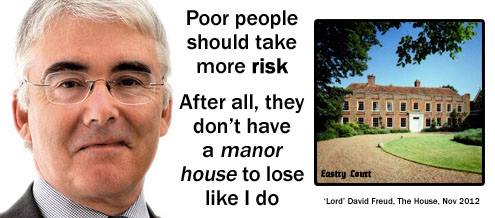
Category: Welfare

UK becomes the first country to face a UN inquiry into violations of disabled peoples’ human rights

994442_352804464870608_5110112617916821526_n (1)

We ought to be very concerned about the government’s declaration that they intend to withdraw from the European Convention on Human Rights, (ECHR) and to repeal our own Human Rights Act, (HRA). One has to wonder what Cameron’s discomfort with the HRA is. The Act, after all, goes towards protecting the most vulnerable citizens from neglect of duty and abuse of power. The rights protected by the HRA are drawn from the 1950 European Convention on Human Rights, which was a way of ensuring that we never again witness the full horrors of the second world war, and overwhelmingly, one of the greatest stains on the conscience of humanity – the Holocaust.

Human Rights establish a simple set of minimum standards of decency for humankind to hold onto for the future. The European Convention on Human Rights and Fundamental Freedoms was drafted as a lasting legacy of the struggle against fascism and totalitarianism, as well as the atrocities of world war 2.

What kind of government would want those basic protections for citizens overturned?

One that doesn’t value or wish to uphold the universal protection of its citizens. From the State.

Last month, a new report, Dignity and Opportunity for All: Securing the Rights of Disabled People in the Austerity Era – Jane Young is the lead author – exposed the Coalition’s failure to meet its international human rights obligations under both the UN Convention on the Rights of People with Disabilities (UNCRPD) and the International Covenant on Economic, Social and Cultural Rights (ICESCR).

The report – also published by the Just Fair Coalition, a consortium of 80 national charities including Amnesty International, Save the Children, and Oxfam, says the UK is in clear breach of its legal obligations. Support structures for many disabled people have disappeared or are under threat as local authorities cut social care budgets, while cuts to social security will leave many disabled people without lifeline support for daily living.

Jane Campbell, a cross-bench peer who is disabled herself, said: “It is both extremely worrying and deeply sad that the UK – for so long regarded as an international leader in protecting and promoting disabled people’s rights – now risks sleepwalking towards the status of a systematic violator of these same rights.”

The UK government seems to be the first to face such a high-level international inquiry, initiated by the United Nations Committee because of “grave or systemic violations” of the rights of disabled people. That ought to be a source of shame for the Coalition, especially considering that this country was once considered a beacon of human rights, we are (supposedly) a first-world liberal democracy, and a very wealthy nation, yet our government behave like tyrants towards the poorest and some of the most vulnerable citizens of the UK.  As disability specialist, campaigner and first-class human rights activist, Samuel Miller says: “Britain is [now] a retrograde society and a flagrant violator of human rights—especially the rights of the sick and disabled”. 

It’s because of the sterling work of people such as Mr Miller that the UN have been made aware of our dire situation, here in the UK. Many of us have contacted the UN and made submissions, detailing the detrimental impacts that punitive Tory policies such as the bedroom tax, other welfare “reforms” (cuts), including the increasing use of extremely punitive welfare sanctions which leave people without the means to meet their most basic survival needs, the draconian Work Capability Assessment, brutal Tory targets for reducing spending and local authority cuts, for example, are having on ill and disabled people.

This is a government who refuse to undertake a cumulative impact assessment of their “reforms” and also continue to dismiss any evidence provided that challenges their own glib and deceitful account as “anecdotal” or “scaremongering”. Yet we are expected to regard Tory soundbites such as the “culture of entitlement” and the “something for nothing culture” which are ideologically motivated rather than   resting on some sort of empirical evidence. The Tories believe that their opinions alone somehow justify the cruel removal of people’s lifeline benefits and support. 

There’s more than one issue here, though it’s plain that the government have no intention of addressing any of the terrible consequences of their draconian policies, and use denial and stigmatising others to deflect attention from their aims. I am reminded of Techniques of Neutralisation – a well known collection of tactics used historically to justify prejudiced views, discriminatory and oppressive policies and  despotic actions.

Another related and important issue is that people’s qualitative experiences should matter to any decent democratic government, but the Coalition is far more concerned with its persistent attempts at DISCREDITING those experiences, (such attempts to invalidate and exclude the narrative of experiences of previously and presently marginalised people is a hallmark of the oppressive, supremacist condescension of historically powerful and privileged groups) –  denying their victims a voice and remedy. We know that this is not a democratic government that serves its citizens and reflects their needs, equally or otherwise.

Thanks to the sterling work of Dr Simon J Duffy, from the Centre for Welfare Reform, among others, we know that the austerity measures in the UK have disproportionately affected those people with disabilities and their carers. Dr Duffy’s work on the impact of the austerity cuts shows us that:

  • People in poverty are targeted 5 times more than most citizens
  • Disabled people are targeted 9 times more than most citizens
  • People needing social care are targeted 19 times more than most citizens

Yet, this government claims a cumulative impact assessment is “too difficult and costly”, I suggest that they use their considerable publicly donated, tax-collected wealth to fund the work of the Centre for Welfare Reform, who managed to undertake this work without hitting the obstacles the government claims it has. This said, perhaps the findings are the real obstacle that the government are concerned about. Because those findings are damning, and tell us that the welfare “reforms” are NOT “fair” as claimed, and are causing harm, distress, hardships and sometimes, death. The grossly punitive, draconian “reforms” need to be repealed.

The UN Committee has the power to launch an inquiry if it receives “reliable information” that violations have been committed, and as the Labour Government signed up to the protocol in 2009 – the UNCRPD and the international covenant on economic, social and cultural rights – it is legally binding. Many of us have used the Optional Protocol to the Convention on the Rights of Persons with Disabilities to send communication and make submissions since 2012.

Austerity measures and welfare “reforms” such as the bedroom tax (which is in itself established by the UN as being a contravention of human rights law) mean the rights of disabled people to independent living, work, and adequate social security have been seriously undermined, causing significant hardship and harm, quite often leading to tragic consequences.

Such investigations are necessarily conducted “confidentially”, so the UNCRPD  has formally refused to confirm or deny that the UK is being investigated. However, a recording has emerged (one hour and twenty five minutes long, watch from one hour and four minutes) of a former CRPD member seemingly revealing that the inquiry has been launched.

Professor Gabor Gombos, who is the co-founder of Voice of Soul, Hungary’s first organisation for ex-users and survivors of Mental Health Institutions, and co-chair of the World Network of Users and Survivors of Psychiatry, can be heard informing the audience that CRPD has “started its first inquiry procedure against the United Kingdom”.

He informs the Sixth International Disability Law Summer School at the National University of Ireland in Galway, June, that inquiries are only used where there are suspicions of “grave” violations of human rights. He says: “Where the issue has been raised and the government did not really make effective actions to fix the situation – it is a very high threshold thing – the violations should really be grave and very systemic.”

Earlier this year, the level of UK benefits paid in pensions, jobseeker’s allowance and incapacity benefits was deemed “manifestly inadequate” because it falls below 40% of the median income of European states, by the Council of Europe in Strasbourg.

The finding in an annual review of the UK’s adherence to the council’s European social charter is likely to provoke a fresh dispute between the government and European legal structures. Iain Duncan Smith, the work and pensions secretary, dismissed it as “lunacy”.

Not an open, accountable minister, or government, then.

The Council of Europe, which has 47 member states, said the conclusions were legally binding in the same way that judgements relating to the European Convention on Human Rights had to be applied by member states.

Aoife Nolan, professor of International Human Rights Law at the University of Nottingham and a trustee of Just Fair said government policies were compromising disabled people’s human rights.

“Not only do these policies cause significant hardship and anxiety, but they also amount to impermissible backward steps in relation to disabled people’s human rights, contrary to the UN human rights framework.”

The report was submitted to the United Nations, which, as I’ve previously outlined in earlier articles here, is in the process of reviewing UK compliance with its obligations to the rights of disabled people.

Last year, Amnesty International condemned the erosion of human rights of disabled people in UK, and the Joint Parliamentary Committee on Human Rights conducted an inquiry into the UK Government’s implementation of Article 19 of the United Nations Convention on the Rights of Persons with Disabilities – the right to live independently and to be included in the community. The inquiry, which began in 2011, has received evidence from over 300 witnesses.

The inquiry highlighted just how little awareness, understanding and employment of the Convention there is by the Tory-led government. Very few of the witnesses made any specific reference to the Convention in their presented evidence, despite the inquiry being conducted by the Parliamentary Human Rights Committee, with the terms of reference clearly framing the inquiry as being about Article 19 of the UNCRPD.

“This finding is of international importance”, said Oliver Lewis, MDAC Executive Director, “Our experience is that some Governments are of the view that the CRPD is nothing more than a policy nicety, rather than a treaty which sets out legal obligations which governments must fulfil.”

The report is particularly critical of the Minister for Disabled People (Maria Miller, at the time) who told the Committee that the CRPD was “soft law”. The Committee criticised this as “indicative of an approach to the treaty which regards the rights it protects as being of less normative force than those contained in other human rights instruments.” (See the full report.) The Committee’s view is that the CRPD is hard law, not soft law. 

Quite properly so. The whole point of human rights legislation is that it is universally applied, regardless of characteristics, preferences or belonging to a specific community or social group. The Tories seem to believe that poor people, disabled people and those with mental and physical illness should enjoy fewer rights than others.

Dr Hywel Francis MP, Chair of the Committee, said: “We are concerned to learn that the right of disabled people to independent living may be at risk through the cumulative impact of current reforms. Even though the UK ratified the UNCPRD in 2009 with cross-party support, the Government is unable to demonstrate that sufficient regard has been paid to the Convention in the development of policy with direct relevance to the lives of disabled people. The right to independent living in UK law may need to be strengthened further, and we call on the Government and other interested organisations to consider the need for a free-standing right to independent living in UK law.”

“The Government is meant to include disabled people in making sure people have their human rights upheld. We are concerned that a part of the Law on treating people equally and fairly (Equality Act section 149) does not say any more that disabled people should be involved. This is a step backwards.”

In other words, the Tory-led Coalition has quietly removed this part of the Equality Act.

The budget of the Equality and Human Rights Commission (EHRC), which was established by the Labour Party when they were drafting this flagship policy, is being reduced by over 60%, its staffing cut by 72%, and its powers restricted by the Coalition. Provisions that are being repealed by the Enterprise and Regulatory Reform (ERR) Bill include the duty on public authorities to have due regard to the need to reduce socioeconomic inequalities.

Savage Legal aid cuts from April 2013 have also contributed significantly to creating further barriers to ensuring Equal Rights law protect us, and the Tory-driven Legal Aid Bill also contravenes our right to a fair trial under Article 6(1) of the European Convention on Human Rights.

This is not a coincidental multiple policy timeline, but rather a very coordinated political attack on potential legal challenges at a time when Tory-led severe and devastating multiple welfare and provision cuts have affected disabled people so disproportionately. The changes, which came into effect in April, will hit “the same group of disabled people over and over again”. 

Our political freedoms and human rights must not be subservient to Tory notions of ‘economic success’. Democracy is not about the private accumulation of wealth of a few millionaires at the expense of others. It is about the wise use of the collective wealth – pubic funds – for the common good of the public – that must extend to include ALL of our citizens. And a decent, civilised, democratic society supports its vulnerable members and upholds universal human rights.

We need to ask why our government refuses to instigate or agree an inquiry into the substantial rise in deaths among ill and disabled people, as these deaths are quite clearly a correlated consequence of this government’s policies.

What kind of government uses the media to scapegoat and stigmatise ill and disabled people, by lying and inventing statistics to “justify” the persecution of our most vulnerable citizens, and the withdrawal of their crucial lifelines and support?

One that does not value those lives, or regard them as having an equal worth with others.

scroll2

I’m adding this comment from Samuel Miller, as it highlights his ongoing, excellent, valuable and much appreciated work with the United Nations on our behalf, which is a most welcomed addition to our own ongoing submissions of evidence over the past couple of years:

A superlative piece, which I will bring to the attention of senior UN officials. Ahead of the September meeting of the Human Rights Council (see third paragraph of :-http://mydisabilitystudiesblackboard.blogspot.ca/2014/08/an-inopportune-time.html), I will shortly submit an inquiry request to the CRPD and Human Rights Council, petitioning them to open an investigation into Britain’s benefit-sanctioning regime. (At the request of Jorge Araya, UNCRPD Secretary, I am completing a bibliography of media articles on this subject, with particular focus on inappropriate sanctions.)

You already know my views on this matter: http://twishort.com/1RVfc.

My bibliographic assignment for the UNCRPD Secretary might be an indication that the UN has already opened an investigation into Britain’s benefit-sanctioning regime, but for the sake of certainty I’ll make that request myself.”

And further:  See my letter to High Commissioner, Navi Pillay, below. I included your superb article in my letter, Sue.

Subject: There is an urgent need for a UN investigation into the United Kingdom’s benefit-sanctioning regime

Samuel Miller 

Attachments3:58 PM 

High Commissioner Navi Pillay
Office of the United Nations High Commissioner for Human Rights (OHCHR)
Palais Wilson
52 rue des Pâquis
CH-1201 Geneva, Switzerland.

Dear Ms. Pillay,

I am a 57-year-old Disability Studies specialist and disability activist from Montreal, Canada who has been communicating frequently and voluntarily, since January 2012, to senior United Nations officials, on the welfare crisis for the United Kingdom’s sick and disabled.

(See attached, and the following:

http://www.twitlonger.com/show/n_1rp0uui,
http://www.twitlonger.com/show/n_1rtnc63,
http://www.twitlonger.com/show/n_1rtvfk5 )
.

It is my understanding that a 22-page letter, pointing out that cuts to social security benefits introduced by Iain Duncan Smith and enforced by his Department for Work and Pensions on behalf of the Coalition government may constitute a breach of the UK’s international treaty obligations to the poor, will also be discussed at a meeting of the UN Human Rights Council in New York, in September. It is signed by Raquel Rolnik, the former UN special rapporteur on adequate housing; Magdalena Sepúlveda Carmona, the former UN special rapporteur on extreme poverty; and Olivier De Schutter, the former UN special rapporteur on the right to food.

Could you please add, as an addendum to that letter, my partial bibliography on Britain’s benefit-sanctioning regime, which is attached below in PDF format. My views can be found on page two; I am extremely concerned about the British government’s soaring use of benefit sanctions, and the evidence from MPs and the Work & Pensions Committee, which provides oversight of the Department for Work and Pensions, is especially compelling and strongly suggests that the government is stitching-up benefit claimants and is involved in a cover-up of that fact. The refusal of the government to agree to the Work & Pensions Committee’s request for an independent inquiry into this matter only compounds suspicion.

In closing, I would be most appreciative if the Human Rights Council and the OHCHR would open an investigation into this matter. This article (https://kittysjones.wordpress.com/2014/08/16/uk-becomes-the-first-country-to-face-a-un-inquiry-into-disability-rights-violations/) is very worthy of your—and their—attention, as well.

I wish to congratulate you on your tenure as High Commissioner, and wish you every success in your future endeavors.

Warm regards

Samuel Miller


14533697838_dffcc736f2_o (1)

Pictures courtesy of  Robert Livingstone 

scroll2

The last Labour government introduced a host of measures to strengthen the rights of our most vulnerable groups – in particular they protected the rights of disabled people. They formulated the Human Rights Act 1998. They passed the Disability Discrimination Act 2005, introduced the Equality Act 2010, formed the Equality and Human Rights Commission, and, in 2009, the Labour government signed the United Nations convention on the rights of persons with disabilities.

The few successful cases we have seen brought against the Tories are down to these Labour laws. We mustn’t lose sight of that. And I’ve every faith that a Labour government will address the gross injustices extended by the draconian of this government, using the existing laws, and their currently proposed policy of prosecuting people for hate speech against the vulnerable.


I don’t make any money from my work and I am not funded. I am disabled because of illness and struggle to get by. But you can help me continue to research and write informative, insightful and independent articles, and to provide support to others, by making a donation. The smallest amount is much appreciated – thank you.

DonatenowButton

Eugenics is hiding behind Hitler, and it informs Tory and Labour policies.

eugenics

One of the commentators on this site raised some interesting issues, in response to part of an article that I wrote, which warrant some discussion.

I had said: “Eugenics is now embodied in economic acts, carried out by a government that has systematically rigged the neoliberal market, the act of [state] murder simply requires policies that leave the poorest and the most vulnerable people without support to meet their basic survival needs, denial from government that this is happening, and then it’s just a matter of withholding or hiding the evidence ….  the Right are and always have been Social Darwinists.”

The response: “I think you exaggerate a bit by bringing in eugenics – which was a deliberate attempt to wipe out/sterilise large proportions of the poor, whereas here it’s only a side effect that the powerful aren’t particularly concerned about.

There is a strong sense of the ‘deserving and undeserving poor’ in Tory narratives though, and I find the lack of empathy mindboggling. Particularly as David Cameron himself had a severely disabled son, so must have first-hand knowledge of the expensive nature of care for the disabled.

I don’t disagree with them [the Tories] being Social Darwinists at all – there is a brutal ‘survival of the fittest’ logic to many of their policies in practice. But eugenics is different – I don’t believe that anyone in the current government actually wants the poor and disabled to be dead or infertile, just that they don’t want to pay to support them. There’s a small, but important, distinction between neglect and genocide.” 

There are several facets to my initial response. Firstly, eugenics is tightly entwined with social Darwinist ideology. Charles Darwin’s theory of natural selection and concept of the “struggle for existence,” presented in his On the Origin of Species in 1859, captivated the minds of biologists and policy makers. Darwin’s ideas also played to the dangerously receptive imaginations of certain members of Victorian society. It resonated strongly with ideological individualism and with laissez faire economics – the dominant paradigm of the era.  The ideas became embedded in political and economic theory and policies.  Francis Galton, Darwin’s half-cousin, introduced his own controversial idea—the theory of eugenics—in 1883.  He used “natural selection” as the basis of his theory to describe selective breeding in humans as a means to improve the “fitness” of the human race. These ideas were part of a broader notion of  “progress” during the era of modernity.  Any idea that aims at ensuring the “survival of the fittest” is essentially eugenic.

The cross-over of natural selection themes from “science” into political and social thinking is reflected in the fact that it was a sociologist, not a scientist, who coined the term “survival of the fittest” – the very Conservative Herbert Spencer.

Neoliberalism, which has been the dominant framework of socio-economic organisation since the Thatcher era, is underpinned with eugenic notions. It justifies “competitive individualism” and both creates and legitimises wide economic inequalities. 

While the government may not be committing conspicuous murder, people ARE dying as a consequence of Conservative policies. Ethically, is there any difference between withdrawing lifeline support for vulnerable citizens and letting “nature take its course” on the one hand, and taking up more visible and overt methods of eliminating perceived “faulty” traits” and disposing of “undesirable” people on the other? Some people call the government’s “eugenics by indifference'”approach ‘democide‘, rather than genocide.

However,  policies tend to have INTENDED aims and consequences.

The pertinent question is: are the well-documented welfare-related deaths an intentional consequence of Conservative policies or simply because of government “neglect” regarding consequences of their policies? Does withdrawing essential state support for the poorest citizens, disabled citizens and vulnerable social groups constitute eugenics? 

I think it does. A government that kills citizens, regardless of the means that are used, is not a democratic one. Nor is it in any way liberal. 

The objectives of democide include the disintegration of the political and social institutions of culture, language, national feelings, religion, and the economic existence of national groups; the destruction of the personal security, liberty, health, dignity; and sometimes, the lives of the individuals belonging to such groups. While genocide is regarded generally as political murder on the basis of race, democide covers a broader definition to include those killed in large numbers as a result of government policies, regardless of ethnicity. 

There is an intimate and historical connection between Social Darwinism and eugenics, which is worth some discussion, because ideology has considerable bearing on policies, and policies may be regarded as objective statements of political intent regarding how a government thinks society should be socioeconomically organised.

Social Darwinism was one of the pillars of fascism and Nazi ideology, and the consequences of the application of policies based on notions of “survival of the fittest” by the Nazis drove the eugenics program, which eventually created a very powerful international backlash against the theory, culminating in the Universal Declaration of Human Rights

Social Darwinists interpret human society primarily in terms of biology, struggle, competition, and natural law (a philosophy based on what are considered to be the immutable characteristics of human nature). Social Darwinism characterises a variety of past and present social policies and theories. Social Darwinism explains the philosophical rationalisation behind racism, imperialism, capitalism and eugenics.

The term quite rightly has negative implications for most people because we consider it a rejection of democracy,  decency, compassion, civilisation and social responsibility, and a devaluing of human life.

Neoliberalism is incompatible with democracy, human rights and notion of equality. It is all about competitive individualism and it also normalises  inequality. Neoliberal ideology has become a throw back to the New Poor Law of 1834. The poorest are financially punished for being poor, while the very wealthy are consistently rewarded for being rich. It doesn’t take a genius to work out why inequality is so high in the UK, or why poverty continues to grow. When Tories, and more recently, the Labour government tell us they want to ‘grow the economy’ we should be asking ‘for whom’? Who will benefit from this? Because so far, all we see is government policies that make the poorest citizens even poorer. We are gradually being excluded from economic consideration, and the poorest are seeing their lifeline support ripped away. 

Any social policy based on an underpinning philosophy of Social Darwinism –  explicitly or implicitly – invariably has eugenic implications. Modern eugenics was rooted in the Social Darwinism of the late 19th century, and is used to justify a hierarchy of entitlement to rights, State withdrawal of support for the most marginalised (and vulnerable) social groups, with all of its associated metaphors of fitness, competition, and intrinsic, tautological rationalisations of inequality.

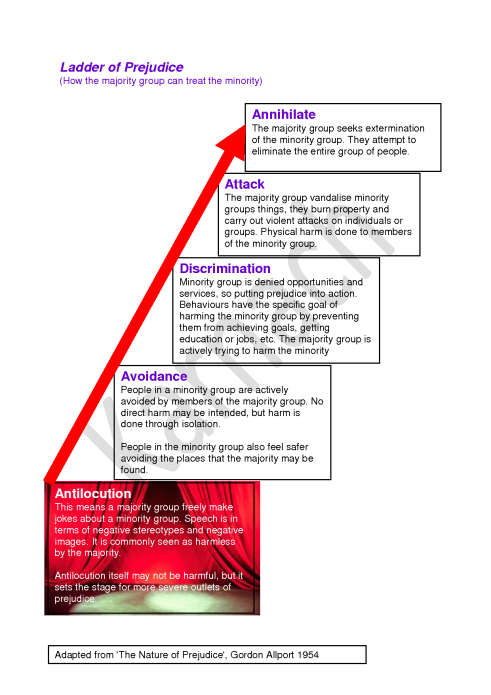
I want to make clear at this point that any consideration of the political and psychosocial processes that culminated in the atrocities of the Holocaust is not in any way an attempt to trivialise those events. Quite the contrary. In recognising the processes that important researchers such as Gordon Allport identified – the unfolding stages involved in the growth of prejudice in a society that manifests othering, outgrouping, and permits a society to incrementally discriminate and hate over time – and in drawing parallels, we may try to ensure that such atrocities never happen again.

Allport's ladder

Eugenic theories are most commonly associated with Nazi Germany’s racially motivated social policies. The Nazis sought the improvement of the Aryan race or Germanic Ubermenschen – master race – through eugenics, which was the foundation of Nazi ideology.

Those people targeted by the Nazis were identified as life unworthy of Life Lebensunwertes Leben – including but not limited to the “idle”, “insane”, “degenerate”, “dissident”, “feeble-minded”, homosexual and the generally weak, for elimination from the chain of heredity. More than 400,000 people were sterilised against their will, whilst 275,000 were killed under Action T4, a “euthanasia” programme.

However, there is quite a broad definition of eugenics and I propose that because it has been so thoroughly discredited, it has been forced to “go incognito” over the last century. The public support for eugenics greatly waned after the fall of Nazi Germany and the Nazis’ attempt to use eugenic justifications for the Holocaust at the Nuremberg Trials.

Right-wing philosopher, Roger Scruton, said in an article in the American Spectator: “The once respectable subject of eugenics was so discredited by Nazism that “don’t enter” is now written across its door,” implying he would like to see more openness to eugenics as an idea. In a way, he does make a valid point, because when what was once stated explicitly becomes implicit and tacit – normalised – it is difficult to oppose and challenge, essential debate is therefore stifled.

Eugenics is the infamous idea that governments should decide which kinds of citizens ought to be considered desirable – the consensus tends to be that these are white, athletic, intelligent, and wealthy – and which kinds of citizens ought to be considered undesirable – these tended to be black, Jewish, disabled, or poor –  and employ the power of the State to encourage increases of desirable citizens (positive eugenics) and encourage decreases of undesirable citizens (negative eugenics).

Eugenics is specifically State interference in and engineering of the “survival of the fittest”. That is happening here in the UK, with Tory policies like the extremely punitive welfare “reforms”, which are aimed at the most vulnerable citizens – such as those who are seriously ill and/or disabled – all too often denying them the means to meet basic survival needs.

The founder of eugenics, Sir Francis Galton, who was a half-cousin of  Charles Darwin, formulated the idea that the protection afforded by civil society had prevented the kind of natural selection occurring in Darwin’s Origin of Species from happening in humans, thus perpetuating the existence of “weak and feeble-minded” people who would have been unable to survive in the “state of nature”.

Thomas Malthus went further, and is most often considered the founding father of this ideology of profound antihumanism: he also believed that giving support to the needy would only imperil everyone else, because resources are limited, so the brutal reality was that it was better to let them starve. Malthus held the belief that the poor are akin to a “horde of vermin whose unconstrained aspirations and appetites endanger the natural order”: that tyrannical measures are necessary to constrain humanity.

It was Malthus that offered a pseudo-scientific basis for the idea that human reproduction always outstrips available resources. Following this pessimistic and inaccurate assessment of the capacity of human ingenuity to develop new resources, Malthus advocated oppressive policies that led to the starvation of millions in India and Ireland.

Malthus’s position as professor at the British East India Company training college gave his theories considerable influence over Britain’s administration of India through most of the nineteenth century, which led to the official response of neglect to India’s periodic famines.

Malthus wrote about restraints on population growth which included famine, disease and war. His theory was later used to explain the British government policy of maintaining agricultural exports from Ireland during the Great Famine (1845-49) in which at least 1.5 million people died of starvation or the side-effects of malnutrition, and at least another million immigrated.

Malthus was also very influential in bringing about the punitive Poor Law Amendment Act of 1834. His work, An Essay on the Principle of Population, was a product of that era, it resonated with the laissez-faire framework of competitive individualism, and the dominant socio-political paradigm. It remains influential today, despite being thoroughly discredited, not least by social history since his time of writing.

Prior to the Holocaust, eugenics was widely accepted in the UK. Malthus’s ideas on population control and Spencer’s Social Darwinism fitted neatly into the sociopolitcal ideological framework. The ruling elite feared that offering medical treatment and social services to disabled people would undermine the natural struggle for existence and lead to the degeneration of the human race.

Those ideas, once explicitly endorsed, are now implicitly captured in policies and Conservative narratives about sanctions, “conditionality,”  “making work pay,” (compare with the principle of less eligibility enshrined in the New Poor Law) “fairness,” “incentives,” “scroungers,” and so forth. A crucial similarity with the early part of the century and now is reflected in Tory austerity rhetoric – a perceived shortage of resources for health and welfare. Another parallel is the scapegoating process and a rise in the level of social prejudices and sociopolitical discrimination.

Anti-immigration rhetoric, reflected in the media, with the vilification of sick and disabled people and the poor, has preceded policies particularly aimed at the steady removal of State support indicating a clear scapegoating process, and this isn’t indicative of a government that is “neglectful”- it is patently intentional, hence the pre-emptive “justification” narratives to garner public support and acceptance towards such punitive and harsh policies.

So, the first purpose of such justification narratives is to make cruel and amoral policies seem acceptable. However, such propaganda narratives also serve to intimidate the targeted minority, leading them to question whether their dignity and social status is secure. In many instances, such intimidation is successful.

Furthermore, this type of hate speech is a gateway to harassment and violence. (See Allport’s scale of prejudice, which shows clearly how the Nazis used this type of propaganda and narrative to justify prejudice, discrimination, to incite hatred and ultimately, to incite genocide.)

As Allport’s scale indicates, hate speech and incitement to genocide start from often subtle expressions of prejudice. The dignity, worth and equality of every individual is the axiom of international human rights. International law condemns statements which deny the equal worth of all human beings. This is for very good reason.

Article 20(2) of the ICCPR requires states to prohibit hate speech. Hate speech is prohibited by international and national laws, not because it is offensive, but rather, because it amounts to the intentional degradation and repression of groups that have been historically oppressed. In the UK, we have a government that endorses the repression of the historically oppressed.

Social Darwinists generally argue that the “strong” should see their wealth and power increase while the weak should see their wealth and power decrease. In most contemporary western societies these views tend to emphasise competition between individuals for resources in a neoliberal State. In the UK, this idea is very apparent in the policies of the conservative-led government, and previously, we saw similar views from Thatcher.

The biological concept of “adaptation” is used by the Right to claim that the rich and powerful are better adapted to the social and economic climate of the time, and the concept of natural selection perpetuates the supremacist argument that it is natural, normal and proper for the strong to thrive at the expense of the weak.

Notions of deserving and undeserving poor flourished at a time when Social Darwinism and eugenics where widely acceptable here in the UK. The utilitarianism of Jeremy Bentham and John Stuart Mill, identifying moral actions in public policy as those which produce the greatest good for the greatest number, also support the contention that, whilst in the short term the interests of the poor would seem to be supported by public relief, the ultimate result of relief is detrimental to their interests.

Social Darwinism was popular in the late Victorian era in England, America, and elsewhere and the ethical philosophies of Conservatives are underpinned by a strongly elitist view based on the pseudo-scientific arguments of “adaptation and natural selection.” The Victorian era has made a deep impact upon many contemporary Conservatives, such as Gove and Osborne.

Michael Gove has written: For some of us Victorian costume dramas are not merely agreeable ways to while away Sunday evening but enactments of our inner fantasies … I don’t think there has been a better time in our history” in “Alas, I was born far too late for my inner era”.

A better time for whom, precisely? It was a time of child labour, desperation, prostitution, low life expectancy, disease, illiteracy, workhouses, and a truly dog-eat-dog social perspective. Or was it the deferential protestant work ethic reserved only for the poor, the pre-destiny of the aristocracy, and “the rich man in his castle, the poor man at his gate” that appeals to Gove?

In a speech to the Confederarion of British Industry, (CBI) George Osborne argued that both parties in the coalition had revitalised themselves by “revisiting their 19th-century roots.”

Herbert Spencer’s Social Darwinism, with his dictum “the survival of the fittest” – he was a sociologist, not a biologist – provided further support for the view that the “vices” of the lowest class in society make such persons undeserving of help from those who were financially privileged. (“Us” are the fittest: “Them” – the “Other” – are not.)

It is but a short step from the eugenics movement of the early twentieth century to the radical individualism of Ayn Rand, the latter’s popularity on the Right continuing to support a Conservative libertarian celebration of selfishness – “Nobody is mine.”

And:1965037_301820166635705_1502392114_n (1)
Conservatives have always seen society and human relationships in terms of hierarchies, based on “red in tooth and claw” Darwinist conflict. A hierarchy is any system of persons or things ranked one above the other, on the basis of human worth.

The term was originally used to describe the system of church government by priests graded into ranks. Organised religion is very hierarchical. Hierarchical thinking is about seeing the world through systems of  worth, domination or importance. But the central principle of human rights is that each have equal worth: that we are all equally important. But hierarchies ensure that privilege and decision-making is not socially distributed. Nor is power.

The very way that Tories think leads to a collision between their ideology and our human rights, and is completely incompatible with the principles of equality and democracy. Tories think that some people hold a more important place in society than others. This reduces people – they become inferiors or superiors, and really, that is about unequal distribution of power, subordination and domination – those power relationships are no longer entirely notional, we have moved some distance from being a liberal democracy these past four years – and feudalism and manorialism are very Tory ideals. 

It’s worth noting that disabled people have been disproportionately affected by the government’s austerity programme. People are dying prematurely because the government has radically cut their lifeline support, leaving them without the means to meet their fundamental survival needs.

To summarise, there are strong links between the neoliberal idea of competitive individualism, Social Darwinism, social inequalities, eugenics, nationalism, fascism and authoritarianism. Those ideas are implicit in Tory rhetoric, because they form the very foundations of Tory ideology. A society with inequalities is and always has been the ideologically founded and rationalised product of Conservative Governments. Inequality is at the heart of ‘competitive individualism’ which is at the heart of neoliberal ideology. In any competitive system, there are always a handful of ‘winners’ and many more ‘losers’. 

Robert Michel’s iron law of oligarchy describes the inevitable tendency of hierarchical organisations to become oligarchic in their decision making – anti-democratic. And prejudice is an in-built feature of hierarchy, because of the stratified nature of power, esteem and status.  Right-wing populism so often takes the form of distrust of the European Union, and of politicians in general, combined with anti-immigrant rhetoric, and a call for a return to “traditional, national values”.

Those “traditional values” that the Tories cherish, and often speak about, mean the end of our hard-earned rights, the end of any principle of the equal worth of everyone, the end of government accountability and increasingly, legal restraint, the end of democracy, the end of access to social opportunities, the end of any meaningful citizen autonomy. Yet these are civilising conditions. The Tories would prefer to have us outwardly oppressed and inwardly repressed, and fighting amongst ourselves for ever-decreasing resources.

This government’s schadenfreude, the intent and motivation behind the draconian policies that we’ve seen this past four years, which target the most vulnerable citizens most of all, is debated.

Some people believe that the policies are a consequence of a redistribution of wealth from the poorest to the wealthy rather than being malicious acts. But the Tories laughed on hearing the accounts of suffering of the poor because of the bedroom tax and an increasing dependency on food banks, for all to see, during parliamentary debate with the opposition.

But entertaining the idea for a moment that the inflicted suffering is not a motivation but rather, a consequence, well that would make the Government at the very least indifferent, callous and unremorseful, since they show a supreme lack of concern for the plight of those least able to defend themselves against injustice and inflicted poverty. And such indifference contravenes fundamental human rights. It breaches international laws.

Either way, I feel shock and anger at the recognition that all of those principles and beliefs we held dear – such as justice, fairness, democracy, freedom, Government accountability, equality (at least in terms of the worth of each life), institutionalised philanthropy – all trodden under foot by advocates of Social Darwinism – an aristocratic elite – in just four years. And the faith we each had in those collective ideals undermined by the constant perpetuation of socially divisive propaganda tactics from the Right.

Dividing people by using blame and prejudice further weakens our opposition to oppression. It’s a strategy the Tories have mastered.

Government policies are expressed political intentions, regarding how our society is organised and governed. They have calculated socio-economic aims and consequences. None of the policies that this government have formulated regarding the “support and care” of some of the most vulnerable citizens could be seen as anything other than expressions of intentional harm.

Services and support have been cut, lifeline benefits have been restricted by a variety of means, such as the revolving door process application of the work capability assessment, benefit sanctions, the mandatory reconsideration process.

Where is the investigation into the very high number of deaths associated with the Tory-led welfare reforms? The government have been made aware of those deaths through parliamentary debate, yet they persist in denying any “causal link” with the significant increase of sick and disabled people dying and their savage cuts to lifeline benefits. If there is no causal link, an inquiry would demonstrate that, surely?

It’s a universally recognised fact that if people are prevented from meeting their basic survival needs, they will die. Benefit sanctions, and cuts to welfare and public services, the rising cost of living and the depression of wages are having a detrimental effect on many. I don’t imagine that it’s the case that everyone but the government are aware of this. Yet the harmful policies remain.

The Coalition will leave more debt than all Labour governments since 1900. The current government’s now responsible for £517 billion of the trillion-plus-pound UK public debt, compared to £472 billion accrued during the 33 years Labour led the country since the turn of the twentieth century.

And the figures look even worse when you adjust for inflation. When you do that, the Coalition’s share jumps to nearly half of the total debt.

But the Coalition don’t meet any public’s needs, they simply serve the wants of the 1%. Labour invested in public services, the Tories have bled them dry. So, what have they done with the money? Because the public have seen only austerity cuts.

These policies are intentional. Withholding State support for poor, disabled, ill and vulnerable people – paid for via our taxes – is a deliberate act.

While our government have been busy denying the eugenics-by-stealth consequences of their diabolical policies in this Country, back in 2012, the Guardian exposed the fact that the British government has spent millions of pounds funding a policy of forced sterilisation of the poor in India as part of an effort to reduce human population to “help combat climate change”. But we also know that many Tories deny climate change exists.

The governments of China and India practice hard eugenics, underwritten by American and British tax money, these are coercive measures undertaken by governments to decrease citizen population.  The exposure of support for hard eugenics prompted denial and backtracking.  United Nations Population Fund (UNFPAclaims to support “voluntary family planning” in China. They assume that women, who are aware that conceiving a second child will result in a forced abortion, are free to make choices – thus the forced abortion is a State arrangement entered into “voluntarily.”

Hard eugenics is the ideology that is hiding behind Hitler. But soft eugenics  is based on the same pathological belief – that a government should spend its resources to prevent the propagation of those who the government believes to be “detrimental” to society and economic production. It won’t be long before there is some UK policy that imposes a restriction on the number of children poor people may have – probably “soft” eugenic policy, initially. Perhaps a limit on the number of children that unemployed or underemployed families may claim support for. Of course that will have ghastly ramifications for the human rights of children, since it would discriminate against a child on the grounds of when he/she was born.

Here in the UK, our government has been quite explicit in its drive to end “the something for nothing culture”. Our taxes  have been handed out to the wealthy and State support has been steadily withdrawn from the vulnerable. Government policies are an explicit statement of political and socio-economic intentions.

Policies based on Social Darwinism and eugenics cannot be justified. Our morality is liberated from the biological, reductionist constraints of evolutionary thinking. We relate to one another through culture, shared histories, language, morality, and law. Even if it were true that we are biologically determined – fixed by evolution, as intentional beings, we are not culturally fixed.

There is a difference between what we are, and who we are. There is also a difference between what is and what ought to be. The theories of Social Darwinism, eugenics and sociobiology involve biological reductionism. A recognition of the importance of biological conditions and even “human nature” need and ought not involve biological reductionism. And to embrace reductionism is to ultimately deny our capacity for making rational choices.

But we exceed the limits of reductionism and determinism every time we make any claim to knowledge (including those claims of reductionism and determinism), make a choice, discuss ethics and morals, explore possibilities, create, discover, invent – we are greater than the sum of our parts. The humanist ideas of human potential have never interested the Tories.

However, humanist principles, particularly those of Maslow, are very closely connected to our human rights and the development of our welfare state. Maslow’s psychology about possibility, not restraints. His metaphysics were all about the possibilities of change and progress, within a democratic framework. These ideas run counter to Tory ideology.

It’s therefore of no surprise that the Tory-led Coalition has steadily eroded our welfare and public service provisions and that Cameron has stated plainly that he fully intends to repeal the Human Rights Act and withdraw from the European Convention on Human Rights

This is a government that chooses to treat our most vulnerable citizens brutally, with absolutely no regard for their legal and moral obligation to ensure that our taxes are used to meet our most basic needs.

There can be no justification for editing or repealing the Human Rights Act itself, that would make Britain the first European country to regress in the level and degree of our human rights protection. It is through times of recession and times of affluence alike that our rights ought to be the foundation of our society, upon which the Magna Carta, the Equality Act and the Human Rights Act were built – protecting the vulnerable from the powerful and ensuring those who govern are accountable to the rule of law, and as an instrument of equality, social cohesion and public purpose.

It is expected of a democratic government to improve the understanding and application of the Act. That is an international expectation, also. Quite rightly so.

Observation of human rights distinguishes democratic leaders from dictators and despots. Human Rights are the bedrock of our democracy, they are universal and are a reflection of a society’s and a governments’ recognition of the equal worth of every citizens’ life.

We need to ask, in light of the issues I’ve raised here, why would any government want to opt out of such protections for its citizens?

We know from history that a society which isn’t founded on the basic principles of equality, decency, dignity and mutual respect is untenable and unthinkable.

scroll2

Article 2 of the Convention on Human Rights uses the following definitions of genocide, amongst others:

  • Killing members of the group
  • Causing serious bodily or mental harm to members of the group.
  •  Deliberately inflicting on the group conditions of life calculated to bring about its physical destruction in whole or in part
  • Imposing measures intended to prevent births within the group
  •  Forcibly transferring children of the group to another group

The right to life contained in Article 2:

  • Prohibits the State from intentionally killing;
  • and  requires an effective and proper investigation into all deaths caused by the State.

14533697838_dffcc736f2_o (1)

Pictures courtesy of Robert Livingstone

My work isn’t funded and I don’t get paid to write. But you can support Politics and Insights, and help me to continue researching, analysing and writing independently.

The smallest amount is much appreciated, and helps to keep my articles free and accessible to all – thank you.

And a massive thank you to those who have already contributed.

DonatenowButton
cards

Poverty

images

People who need to claim benefits also have to live hand to mouth, from week to week. We are already poor. It just takes one missed payment to completely empty your cupboards, to strand you indoors, to turn your light, heating and hot water off and leave you in a state of soul-sapping desperation. And if you are chronically ill, that flare – an exacerbation of defining symptoms – will also pay you a visit, for sure. You are having a bad time. Well have some more.

Poverty is far worse than simply having nothing. Its hungry reach is much less superficial than skin deep; it bites down to the bone and has you strugging to keep body and soul together. It robs you of motivation and animation, poverty leaves you battling for your heart and for who you are. It relentlessly erases your sense of identity a bit at a time.

And don’t for one minute ever assume that you will always be paid what you are entitled to; for we have a government that has explored every way possible to take away your support – which you have paid for via national insurance and tax – regardless of your circumstances, and it DOES so.

Poverty reduces people from cultural and social beings to isolated individuals who are pre-occupied with the struggle to fulfil biological needs in order to survive. Poverty is uncivilising. It involutes society and subverts culture.

Take meals for example. On a socio-cultural level, meals are shared, and food for us is not merely nourishment; it presents the occasion for gathering together, hospitality, sociability, affection and sometimes, dressing up. Food is always a part of sociable occasions of ceremonial recognition.

Christmas, birthdays, going to college, getting a place at university, weddings, funerals; we use food to celebrate, mark rites of passage, mark milestones, start relationships, maintain relationships, gather our friends and family close.

To share means that we need to have an abundance – more than we need for ourselves, because food is fundamental to survival.

Poverty isn’t simply about material deprivation: it means conceptualising the world without the prospect of freedom and choice, and in increasing isolation. It excludes people from even the most basic joys of normalised cultural rituals, and from the fellowships that bind us as a society.

It strikes me how dazing and isolating poverty is; how very lonely an experience, even with friends and family around who are supportive and kind. It marks you as a stranger, even to yourself.

I’m thinking of last winter, a snow-blurred  landscape and my agonisingly permanently cold blue feet, painful hands, the shaming underweight lecture from my consultant: “You’ve lost weight because you are ill. You need to eat much more and you must keep warm with such severe Raynaud’s,” she said. I told her I couldn’t do both, and she looked at me uncomprehendingly, though she usually understood me. We once spoke as mutually accepted equals, but in that moment, her expression betrayed her, it was as though I had suddenly become a stranger to her.

She has retreated behind a brusquely professional role ever since, becoming a stranger to me, too. I think my being poor embarrassed her. I was left with a sense of powerlessness over my own health problems – it reduced me to a patient role of inert non-participant observation. To become someone who no longer has sufficient provisions to alleviate the symptoms of an illness is a self-diminishing experience, however, food and fuel are fundamental to basic survival.

Poverty transforms everything, from the material world to the subjective realm of relationships. Poverty makes us selfish and pre-occupied – simply because of the overwhelming necessity of meeting basic survival needs. It switches us off a bit at a time until we can no longer be ourselves, or fulfil our potential, or remain pro-active in social events.

Poverty divides us. It splits families, separates us from friends, and excludes us from having even a basic level of social esteem and cultural participation. It turns us into strangers, it prescribes our existential separation and exile. We become the socio-political Other.

How can it be that the most basic human right – the right to survive – is being so cruelly trampled in a country of great affluence, by those in positions of power and authority, in a so-called first world Liberal democracy? Poverty is a violation of human dignity that leads to a vicious cycle of degradation.

Such degradation is buttressed by a pathological Conservative ideology and a long-standing feudalist tradition of eulogising social inequality; imposing it through policies that reward greed, exploitation and inflict human misery, whilst the cavalier public schoolboys draw on a narrative, informed implicitly by Social Darwinism.

They disguise their deeds, they blame the victims of their psychopathic proclivities. The final indignity is the politically scripted biography, freely handed out on Benefits Street and in the Daily Mail, written to blunt and bludgeon public sympathy and to invite a collective condemnation: the declaration that poverty is caused by the poor. How irresponsible, how feckless, how lazy of us to wallow and languish in our poverty.

Gosh, we must be in need of more of those “fair” Tory policies, allegedly based on “incentives” to “help us into work”: even more poverty to punish us for our poverty in the hope that absolute poverty will stop us being poor.

Didn’t we try that approach once a couple of centuries back – the 1834 Poor Law Reform Act?  I could have sworn that we’ve since decided as a society that policies imposing abject poverty on the population were an abject failure. Did I imagine those college lectures on the historic reasons for birth of the welfare state? Those books I read, those humanist writers, kindly, and writing their optimistic formulae for a hopeful future for all?

Mr Cameron says a barefaced yes.

However, such shameful, loud Tory negations and attempts at invaliding our own experiences cannot hide the truth: poverty is caused by government policies. It happens because of politically manufactured structural inequalities; politically motivated and designed to reward the rich and further impoverish the poor.

Growing poverty reflects a large-scale economic failure, regardless of the pitifully thin distillation of Tory “evidence” of “recovery” and “growth” which is localised to a handful of millionaires. Poverty is about the loss of much more than money. Poverty entails indignity and humiliation and exclusion. But it is the powerful and wealthy that ought to feel shame and humiliation for intentionally inflicting suffering on so many, just so that they can have even more.

Such frank inequalities, with increasing affluence and prosperity for a few, and increasing poverty, disempowerment and disenfranchisement of many reflects a political party that is FAR from democratic, serving the needs of no-one, fulfilling the wants and doing the bidding of an elite.

We have long needed to put the Tories out of our misery.

And we must. scroll2

The right to food is recognised in the 1948 Universal Declaration of Human Rights (Article 25) as part of the right to an adequate standard of living, and is enshrined in the 1966 International Covenant on Economic, Social and Cultural Rights (Article 11), ratified by the UK.

The human right to food

For the Special Rapporteur, the right to food is the right to have regular, permanent and unrestricted access, either directly or by means of financial purchases, to quantitatively and qualitatively adequate and sufficient food corresponding to the cultural traditions of the people to which the consumer belongs, and which ensure a physical and mental, individual and collective, fulfilling and dignified life free of fear.

Malnutrition soars by more than 70% since Coalition came to power

3.5 million UK children will live in ‘absolute poverty’ by 2020 – children’s watchdog

The Poverty of Responsibility and the Politics of Blame

The poverty of responsibility and the politics of blame – part 2

 10407927_677369232332608_5384979058089243718_nThanks to Robert Livingstone

.

Clause 99, Catch 22 – State sadism and silencing disabled people

37079_433060243430176_1848475368_n

Here is the Hansard record of The Work Capability Assessments – Mandatory Reconsideration adjournment debate – it’s the 6th debate about Employment Support Allowance (ESA) tabled by Labour MP Sheila Gilmore, who has worked very hard to present her gathered and substantial evidence to an indifferent government about the terrible consequences of their sadistic sickness and disability “reforms”.

Section 102 and Schedule 11 of the Welfare Reform Act, (Clause 99) is the (State) power to require revision before appeal. People who wish to challenge a benefit decision will no longer be allowed to lodge an appeal immediately. Instead, the government introduced mandatory revision or review stage, during which a different Department of Work and Pensions (DWP) decision maker will reconsider the original decision and the evidence and, if necessary, send for more information.

We have campaigned since 2012 to raise awareness of Clause 99. During the Consultation period, I wrote a response to the government’s proposals, which many people used as a template for their own responses. I remember that Black Triangle, amongst others, ran a campaign also, and I remember that we ALL RAISED THE SAME CONCERNS.

In summary, the main concerns were that basic rate ESA was to be withdrawn during the mandatory review period, leaving sick and disabled people with no money to live on, whilst the DWP reconsidered their own “fit for work decisions” that were wrong.

I know that our Consultation responses were ignored by the government. The changes were introduced anyway, despite our grave concerns. Since October 2013 people have to apply for mandatory reconsideration separately before they can lodge an appeal. We were also very worried that no time limit was established for the DWP to undertake and complete the mandatory review. Our concerns were fully justified, as it’s emerged that people are waiting 7-10 weeks for the mandatory review decision. Meanwhile, these people cannot appeal. And have no money to live on.

An added concern is that this system as it stands demands such a lot from people who may be very vulnerable, seriously ill and/or have mental health problems. Their difficulties are exacerbated by cuts in legal aid for welfare rights advice and cuts in local authority grants. There is a significant contraction of the availability of help for those who need it the most from advice agencies.

Last year, Lord Freud suggested people awaiting their mandatory review should apply for Jobseekers Allowance (JSA) and then re-claim assessment-rate ESA if they have to appeal. However JSA claimants have to be available for and actively seeking work, and this is beyond people with disabilities or health conditions. As a result, many are ending up without any support at all from the State, having been deemed too “fit” to be eligible for ESA, but too sick or disabled to claim JSA, because these people cannot meet the high level of conditionality or remain available for work.

These people are left with NO lifeline benefits for periods as long as ten weeks. It seems Penning is oblivious to the fact that DWP “decision-makers” are demonstrating quite clearly that their initial “fit for work” responses are plainly and fundamentally wrong, it seems that Tory Ministers have engineered a situation that places some of the most vulnerable disabled people in a nightmarish situation where bureaucrats tell them they are both fit and unfit for work. Both contradictory decisions are then used to withdraw lifeline benefits. That’s not only grossly unfair, it’s terribly cruel. It also demonstrates how completely arbitrary DWP “decision-making” is, in order to justify removing people’s support.

Even when it’s the case that someone manages to make a successful claim for JSA, they are greatly at risk of being sanctioned because of the high level of conditionality, and the requirement to be available for work, in order to remain eligible for the benefit.

Furthermore, there is growing evidence that the DWP are closing existing ESA claims when a person successfully claims JSA during the mandatory review period, on the grounds that it isn’t possible to have two ongoing claims for two separate benefits open at the same time. This effectively means that people lose their right to appeal for the reinstating of their ESA, as their original ESA claim has ended.

This is how disabled people, amongst whom are some of our most vulnerable citizens, are being treated, what kind of government would allow such an utterly unacceptable degree of absolute callous indifference into what was originally designed as a system of support? A system that is now punishing people because they are sick or disabled? And what sort of government ignores the evidence of the extreme suffering and distress they are causing people?

How can this government show no remorse whatsoever, or decent and normal concern in the face of so many accounts of such human suffering and desperation – and heartbreaking comments such as “one constituent sold off his few remaining possessions to survive.” 

Many are relying on already stretched food banks, whilst others are taking out high interest loans. This situation is being exacerbated by growing delays. As we’ve pointed out, the law needs to change so claimants can be paid ESA at the assessment rate during the reconsideration process. This shouldn’t actually cost any money, as it is paid at the same rate as JSA – that benefit officials suggest claimants should receive anyway. I know that Sheila Gilmore is pushing to see basic rate ESA reinstated. She is also demanding that a statutory time limit is set on how long reconsideration decisions take. But Penning remains adamant that this isn’t going to happen.

Sheila notes that this issue was raised with Ministers when the legislation was going through the House and in subsequent sittings of the Work and Pensions Committee, for example. In April 2012, the Administrative Justice and Tribunals Council warned that the absence of a time limit could have the effect of “delaying indefinitely the exercise of the right of appeal to an independent tribunal”.  

Many of the key issues with the mandatory review can be seen summarised herehere and here. Sheila Gilmore and Anne Begg have covered these extensively during the ongoing Work and Pensions Committee ESA inquiry, as well as during the course of the many separate tabled debates.

Penning, I’m sorry to say, remained indifferent when he was confronted with evidence of the unforgivable suffering, the links to suicide, the links with high risk of homelessness, hunger, anxiety and stress, and the exacerbation of illness and mental health conditions in vulnerable people – this government’s policies are creating these extreme hardships. Bearing in mind this is meant to be our government’s support for very vulnerable sick and disabled people, his position is indefensible. So are his objections to answering these questions before. He said: “Actually, this is a bit like groundhog day. According to my file, this is the hon. Lady’s fifth debate on the subject. She said that it was the sixth; perhaps we missed one….

I am slightly concerned, because I said many of the things that I am about to say to her Committee only a few days ago. I hope that its members will pay attention to what I say, because during the speech of the hon. Member for Edinburgh East I feared that the report might have already been written.” 

Perhaps if he told the truth, listened and did his job properly, there would be no need for us to raise the same concerns again and again.

I doubt I could be an MP, I probably lack the necessary constraint, I’m afraid the sneer in his words, given the gravity of the situation for so many sick and disabled people, would have possibly elicited an out of character, but unstoppable, spontaneous punch in his spiteful, indifferent face, such is my anger. And really it’s impossible to see the welfare “reforms” as anything other than callous, spiteful and scripted sadism and indifference to people’s pain and desperation. I’ve always loathed bullies.

Sheila Gilmore said she had been told by Mark Hoban previously – last September – that claimants could request “flexible conditionality”, to avoid the difficulties imposed by JSA conditionality criteria. However, DWP’s Director acknowledged in April – some seven months later – that “not all advisors had been aware of this”. As Sheila Gilmore responded: “It is hard to have confidence in the Department, given that previous assurances were clearly unfounded.

Penning said: “As a Minister in the DWP, I am absolutely determined that we will ensure that taxpayers’ money is spent wisely; that it goes to the people who need it; that we put in place training for the right people…”

He seems to have overlooked the fact that most people claiming ESA have worked, paid income tax, and are still contributing proportionally more tax than those on the highest incomes pay, via VAT, Council Tax, the Bedroom Tax and an array of other stealth charges

And very clearly, the “people who need it” are NOT getting the support they need.

As Sheila Gilmore points out: “There is also an administration cost involved in a claimant receiving the assessment rate of ESA, ceasing to receive it, claiming JSA and then potentially claiming the assessment rate of ESA again. These are significant costs when multiplied by the number of people involved. In addition, if everybody claimed JSA successfully, they would receive benefit at exactly the same rate as they would have been getting on ESA, so if there are any savings to be anticipated, is it because ministers thought that people would, in fact, struggle to claim JSA during the reconsideration process, given that administration costs are likely to outweigh anything else? ”

“I am sure that cannot be the case.” she added.

I’m not bound by Parliamentary codes of conduct, as Sheila is. So I can say freely and categorically that it IS the case, and we anticipated this at the Consultation stage. Furthermore, the government know that WE know this, but they remain unremorseful, refusing to re-introduce assessment rate ESA, and to place a time limit on the reconsideration process.

Clause 99 has been introduced to make appealing wrong decisions that we are fit for work almost impossible. Sick and disabled people are effectively being silenced by this Government, and the evidence of a brutal, de-humanising, undignified and grossly unfair system of “assessment” is being hidden. More than 10,600 people have died  between 2010 – 2011, this a significant increase in mortality because of the current system, (the government have refused to release the data regarding ESA-related deaths since 2011 despite numerous Freedom Of Information (FOI) requests) and it is absolutely terrifying that our Government have failed to address this.

Instead, they have made the system even more brutal, de-humanising and unfair. What kind of Government leaves sick and disabled people without the means to feed themselves and keep warm? Clause 99 is simply an introduction of obstructive and Kafkaesque bureaucracy to obscure the evidence of an extremely unfair and brutal system. By creating another layer of brutality, the Government is coercing people into silence.

Successful appeals were evidence of an unjust system, and now, having made the process of appeal almost impossible, we have ministers trying to claim that suddenly the system is fine.

It’s FAR from fine.

430847_149933881824335_1645102229_n (1)Thanks to Robert Livingstone for his brilliant artwork.

I would also like to say a BIG thank you to Sheila Gilmore, Dame Anne Begg, Debbie Abrahams and all other MPs who work tirelessly in challenging and opposing the avalanche of social injustices and authoritarian policies this government have inflicted on those least able to fight back themselves.

A letter of complaint to Andrew Dilnot regarding Coalition lies about employment statistics

 10270806_319228004894921_8005540502444686357_n
I’ve written the following to Andrew Dilnot:

Dear Sir,

I write in response to the government claims made recently regarding employment. During Prime Minister’s questions in Parliament on Wednesday, Mr Cameron said that the number of people in full-time employment had risen. Other ministers, such as Esther McVey have echoed these claims.

We are growing the economy and we’ve got more people in work,”  Mr Cameron said.

And: The number of people out of work in the UK fell by 133,000 to a fresh five-year low of 2.2 million in the three months to March, official figures show.The jobless rate also fell to a five-year low of 6.8%, the Office for National Statistics (ONS) has said”.

I am very concerned about the accuracy of these claims, and should like to challenge both the validity and reliability of them, given the current methodological problems with measurement, which the ONS have acknowledged in part, previously.

To count as unemployed, people have to say they are not working, are available for work and have either looked for work in the past four weeks or are waiting to start a new job they have already obtained. Someone who is out of work but doesn’t meet these criteria counts as “economically inactive”. The results from a selected sample, based on narrow criteria, are then weighted to give an estimate that reflects the entire population.

The other measure of joblessness – the claimant count – is published for each single month. It doesn’t suffer from the limitations of sample size and sampling frame, because it derives from the numbers of Jobseeker’s Allowance (JSA) claimants recorded by Jobcentre Plus, so a monthly figure is possible right down to local level. But because many people who are out of work won’t be eligible for JSA, it’s an  even narrower measure.

I draw your attention to the following, taken from the Summary of recommendations: Response from the Employment Related Services Association (ERSA) to the Work and Pensions Select Committee inquiry into Jobcentre Plus, dated May, 2013:

Jobcentre Plus performance metrics:

  • The effectiveness of Jobcentre Plus (JCP) should be measured by sustained job outcomes rather than off-benefit flows to create greater incentives to support jobseekers into employment and provide a more accurate picture of success rates. This would address potential perverse incentives to sanction claimants inappropriately, plus ensure greater comparability between JCP provision and contracted out provision.
  •   Such a change could help to provide greater transparency in order to identify those who would benefit from intensive employment support. Such a performance metric would prevent the phenomenon of ‘cycling’, jobseekers moving between short term jobs and unemployment for many years, but not building up the length of time of continual unemployment to qualify them for specialist support.

In particular, I wish to draw your attention to this from the same document – Response from ERSA to the Work and Pensions Select Committee inquiry into JCP, 2013:

4.1. JCP is measured by off-benefit flows rather than sustained job outcomes. This can create perverse incentives to move jobseekers into short term employment outcomes, rather than refer them to long term contracted out support. It can also create a perverse incentive to sanction claimants as discussed below.

ERSA recommends that whilst off-benefit checks are monitored for national statistical purposes, job outcome and sustainment measure, comparable to the Work Programme, should be introduced for Jobcentre Plus. This would enable analysis between the performance of JCP and contracted out provision and provide accurate value for money comparisons.

5.1. DWP point to off-benefit flows as an indication of the effectiveness of pre-Work Programme support. However, analysis undertaken by Policy Exchange calls into question the validity of off-benefit figures as a success measure given that many do not go into sustainable employment or simply move on to another type of benefit.

8.1 As identified by the Committee in its report into the experience of different user groups on the Work Programme, the use of sanctions is inconsistent. 

Providers are obliged to notify Jobcentre Plus if a jobseeker fails to undertake an activity, for example if they miss an appointment. The decision as to whether to actually enact sanctions rests with Jobcentre Plus though. This means that sanctions are not applied even though a provider may think there is a clear case to do so. Conversely, a provider may be satisfied with the progress made by a participant but may be overruled by Jobcentre Plus who have a case for applying conditionality.

For example, one ERSA member reported that Jobcentre Plus decided to sanction a Work Programme participant for insufficient use of the Universal Jobmatch website, despite the fact that the provider had explicitly asked the participant to focus on resolving some other issues ahead of any formal job search activity. Sanctioning represented a great setback in the trust and progress made up to that point. ERSA agrees with the recommendation put forward by the Committee in its most recent report into the Work Programme for DWP to conduct a review of sanctioning activity with a view to ensuring that the processes are clearly understood by participants and consistently applied.

8.2 Part of the problem lies in the fact that Jobcentre Plus is measured by off-benefit flows rather than sustained job outcomes. This therefore means that a situation in which a Personal Advisor applies a sanction that may in fact damage an individual’s progress to employment, would register as a success according to the off-benefit flow measure. ERSA believes that measuring Jobcentre Plus success by sustained job outcomes would remove any perverse incentives to sanction individuals.

So, in summary, simply measuring how many people end their claims for benefits does not reveal the true impact of jobcentre services, nor does it accurately reflect the numbers of those moving into employment.

Let’s not forget that in 1996, the Conservative government introduced the jobseeker’s allowance that cut benefits to young people up to 18 years old – the new allowance was designed to replace unemployment benefit and income support. Young people excluded from eligibility for benefit are therefore absent from unemployment statistics.

The Department has simplified its performance measures and now primarily targets the move by claimants away from benefits, or “off-flow”, as a simple and intuitive measure of performance. However, this gives no information about how individual jobcentres perform in supporting claimants to work. Some may have found work but, in more than 40 per cent of cases, the reason for moving off benefits is not actually recorded.

I am also concerned that underemployment continues to remain very high, despite a small fall of 7,000 in the number in involuntary part time work, the total still stands at 1.42m. This is an increase of a 100 per cent beyond the pre-recession level of 701,000. The rise in employment also continued to be driven by self-employment, which is extraordinary as self-employment is a relatively small part of the UK jobs market. But although just one in seven workers are self-employed, over half of all jobs growth over the year has been in this type of employment. The TUC share this concern, and have said that some people have been forced in to self-employment as they have no alternative.

Previous TUC’s analysis  suggests that rising self-employment is part of a wider shift towards insecure employment, rather than as a result of a growing number of people starting up new companies as ministers have claimed. Analysis shows that self-employed workers are often earning less, underemployed, and have less job security than employees.

One very important issue not currently considered is that since the government does not track or follow up the destination of all those leaving the benefit system, as discussed, the off-flow figures will inevitably include many having their claim ended for reasons other than securing employment, including sanctions, awaiting mandatory review, appeal, death, hospitalisation, imprisonment, on a government “training scheme” (see consent.me.uk  and the Telegraph – those on workfare are counted as employed by the Labour Force Survey.)

Furthermore, last week Iain Duncan Smith met a whistle-blower who has worked for his Department for Work and Pensions for more than 20 years. Giving the Secretary of State a dossier of evidence, the former Jobcentre Plus adviser told him of a “brutal and bullying” culture of “setting claimants up to fail”.

“The pressure to sanction customers was constant,” he said. “It led to people being stitched-up on a daily basis.”

The whistle-blower wishes to be anonymous but gave his details to Iain Duncan Smith, DWP minister Esther McVey and Neil Couling, Head of Jobcentre Plus, who also attended the meeting. He said:

“We were constantly told ‘agitate the customer’ and that ‘any engagement with the customer is an opportunity to ­sanction.”

Iain Duncan Smith and his department have repeatedly denied there are targets for sanctions. However, the whistle-blower says:

“They don’t always call them targets, they call them ‘expectations’ that you will refer people’s benefits to the decision maker. It’s the same thing.”

He claimed managers fraudulently altered claimants’ records, adding: “Managers would change people’s appointments without telling them. The appointment wouldn’t arrive in time in the post so they would miss it and have to be sanctioned. That’s fraud. The customer fails to attend. Their claim is closed. It’s called ‘off-flow’ – they come off the statistics. Unemployment has dropped. They are being stitched up.”

Labour MP Debbie Abrahams, the member of the DWP Select Committee who set up the meeting, has renewed her call for an inquiry into inappropriate sanctioning. Debbie said:

“I am deeply concerned that sanctions are being used to create the illusion the Government is bringing down unemployment.

It is my belief that the claims made by David Cameron and his ministers are an unwarranted, far-fetched inferential leap from methodological premises that don’t stand up to scrutiny, for all of the reasons I have outlined. I felt obliged to draw your attention to this matter, not least because I am not alone in my concerns, and I feel very strongly that it is immoral of any government to mislead the public to which it is meant to be accountable.

Yours sincerely
Ms Susan Jones.

Related article: Austerity, socio-economic entropy and being conservative with the truth

Petition to Stop DWP Minsters Spinning Statistics 

995658_494538353949031_779653065_n
Thanks to  Robert Livingstone for the pictures.

Tory dogma and hypocrisy: the “big state”, bureaucracy, austerity and “freedom”

1965037_301820166635705_1502392114_n (1)

The Tories are not “paying down the debt” as claimed. They are raising more money for the rich.

Labour’s social and economic policy was a success, and this is substantiated by the LSE’s definitive survey of the Blair-Brown years:

There is clear evidence that public spending worked, contrary to popular belief.” Nor did Labour overspend. It inherited “a large deficit and high public sector debt”, with spending “at a historic low” – 14th out of 15 in the EU.

Labour’s spending increased, and money was invested in public services and social programs, and until the crash was still “unexceptional”, either by historic UK standards or international ones.

Until 2007 “national debt levels were lower than when Labour took office”. After years of neglect during the previous Conservative administration [2 recessions during the Thatcher era, another during Major’s],  Labour inherited a mess: public services in very poor state, shabby and squalid public buildings and unforgivably neglected human lives that formed a social deficit much more costly than any Treasury debt.

Labour Ministers set about addressing the causes and devastating effects of poverty and social marginalisation. Both poverty and inequality had risen to levels unprecedented in post-war history. This process accelerated during the 1980s.

Unlike every other post-war decade, in which the benefits of economic growth had been shared across social groups, the economic gains of the 1980s disproportionately benefited the rich at the expense of the poor (Hills, 2004). Social inequality on such a gross level was not only the result of Thatcher’s policies, she celebrated it. She declared that inequality is essential to fostering “the spirit of envy” and hailed greed as a “valuable spur to economic activity”.

The mess that Thatcher left is verified by several longitudinal studies. Dr. Alex Scott-Samuel and colleagues from the Universities of Durham, West of Scotland, Glasgow and Edinburgh, sourced data from over 70 existing research papers, which concludes that as a result of unnecessary unemployment, welfare cuts and damaging housing policies, the former prime minister’s legacy

…includes the unnecessary and unjust premature death of many British citizens, together with a substantial and continuing burden of suffering and loss of well-being.

The article also cites evidence including the substantial increase in income inequality under Thatcher – the richest 0.01% of society had 28 times the mean national average income in 1978 but 70 times the average in 1990, and the rise in UK poverty rates from 6.7% in 1975 to 12% in 1985.

It concludes that:

Thatcher’s governments wilfully engineered an economic catastrophe across large parts of Britain” by dismantling traditional industries such as coal and steel in order to undermine the power of working class organisations, such as unions. This ultimately fed through into growing regional disparities in health standards and life expectancy, as well as greatly increased inequalities between the richest and poorest in society.

Blair established the social exclusion unit inside No 10. “Social exclusion” signified not just poverty, but its myriad causes and symptoms, with 18 task forces examining education, babies’ development, debt, addiction, mental health, housing and much more. Policies followed and so did improvements.

John Prescott’s department published an annual Opportunities for All report that monitored these social targets: 48 out of 59 indicators improved. So when Cameron and his band of brigands sneer that “all Labour did was give tax credits to lift families just over the poverty line” – “poverty plus a pound” – they lie through their teeth.

Contrary to Tory claims, benefits were not Labour’s main instrument of social change: the benefit budget fell as a proportion of spending, outstripped by increases in health, education and other social services.

Despite Blair’s neoliberal turn, Labour’s social policies enshrined principles of equality and inclusion. The Tories deplore such principles, yet that doesn’t stop them claiming that their socially regressive policies are somehow “fair”. Things got better with a Labour administration, money was mostly well spent. That’s not the case now. It’s all being intentionally and spitefully undone. We are moving backwards on just about every positive social measure Labour put in place: the coalition’s “more for less” is exposed as pretence. They are simply raising more money for the rich.

And all because of their driving ideology. George Osborne’s “plan A” isn’t about economics: it amounts to little more than a rehashed Thatcherite ideological agenda of deregulation and labour market “flexibility”, as modelled by the Beecroft report – the assault on the rights of employees, and Labour’s historic equality legislation. The Tory demand for a “nightwatchman state” is both ill-conceived and completely irrelevant to Britain’s economic circumstances.

The Coalition have borrowed more in 4 years than labour did in 13 and have NOTHING to show for it except a handful of wealthier millionaires. And the return of absolute poverty.

We know that austerity was intentionally imposed by the Coalition, using a feigned panic over the budget deficit to front an opportunistic vulture capitalist approach to stripping our public assets. With the Coalition in power for 4 years, the deficit has apparently receded in importance.

We can hope that Labour can return to its  pro-social role of advocating government spending for the provision of public services. Conservatives have always played on dogma and popular prejudice by constantly equating government with bureaucracy. But that’s just the superficial excuse for their obsession with removing every trace of supportive provision and our public services.

It’s more accurate to say that Conservatives equate socially responsible, democratic, caring governments with “bureaucracy”. Conservatives aren’t ever interested in championing independent and merit-based public service. But most criticisms of government bureaucracy are based on myth, not reality.

The agencies that the Tories attack and destroy actually play a valuable and indispensable role in making our society a better place to live. They are the very hallmarks of what makes us civilised, they are how we support vulnerable citizens, ensure equal opportunities, uphold human rights.

The whole point of having human rights is that they apply to EVERYONE – something the Tories never understand – if rights are  not universally applied, then they are worthless. In fact they are hostile to the very notion that we each have equal worth, as we know.

Tories value and develop social hierarchy. When Tories want to make “shrinking” government sound attractive and feasible, they claim they are cutting “bureaucracy” and not social “programs.” Most people recognise the public value of State programs – in the areas of education, health and the environment for example – and don’t want to see these reduced; but everyone hates bureaucracy.

Using the term “bureaucracy” in this way is a rhetorical sleight-of-hand that attempts to obscure the real costs of cutting back on government programs. The lack of coherent reasoning underpinning the rhetoric is because this is simply Tory fundamentalism: it is not founded at all on rational, evidenced discourse.

I’ve said elsewhere that Edwardian levels of inequality led to the Great Depression. Austerity measures under Chancellor Hindenburg contributed to the rise of Nazism. The drop in household income in Japan between 1929 and 1931 led to a wave of assassinations of Government officials and bankers.

Social policies after World War 2 turned the tables and brought peace, with inequality steadily dropping in Britain until recently. But inequality is now returning to pre-war levels. The Tories are incapable of learning from historic lessons, because of their own sense of entitlement, privilege and ideological bondage.

In response to the atrocities committed during the War, the International Community sought to define the rights and freedoms necessary to secure the dignity and worth of each individual. Ratified by the United Kingdom, one of the first countries to do so, in 1951, those human rights originally established in the Universal Declaration have been steadily eroded since the Coalition gained Office.

There’s a clear link between high levels of inequality and failure of Governments to recognise human rights, and to implement them in policies. Authoritarians view the rights of the individual, (including those considered to be human rights by the international community), as subject to the needs of the Government. Of course in democracies, Governments are elected to represent and serve the needs of the population.

Democracy is not only about elections. It is also about distributive and social justice. The quality of the democratic process, including transparent and accountable Government and equality before the law, is critical. Façade democracy occurs when liberalisation measures are kept under tight rein by elites who fail to generate political inclusion.

Related articles:

How remarkable that a government that argues against bureaucracy on the grounds that it’s a “threat to individual freedom” have no problems imposing the Gagging Act and the Legal Aid Act – policies purposefully designed to severely limit our freedoms. But then, the Tories were never known for their rationality, coherence and joined-up narratives. Or for integrity and telling the truth.

Thatcher’s secret plot to dismantle the welfare state and privatise the NHS revealed

The mess we inherited: some facts with which to fight the Tory Big Lies

The great debt lie and the structural deficit myth

539627_450600381676162_486601053_n (2)
scroll2

Osborne’s real aim is not budget surplus, but attack on Welfare State & public sectors It’s not a difficult task for a government to guarantee a safety-net that is always available for anyone who falls on hard times during an era of huge social and economic change. We all fund it, after all. And we all know that unemployment, injury or illness may happen to anyone through no fault of their own. It’s considered a duty of any first-world government to provide the means of basic survival for its citizens and to fund that with the money we contribute via taxes. In fact such an approach to social and economic welfare is internationally codified in human rights.

Article 25 of the Universal Declaration of Human Rights, to which the UK is a signatory, reads:

Everyone has the right to a standard of living adequate for the health and well-being of himself and of his family, including food, clothing, housing and medical care and necessary social services, and the right to security in the event of unemployment, sickness, disability, widowhood, old age or other lack of livelihood in circumstances beyond his control. Motherhood and childhood are entitled to special care and assistance. All children, whether born in or out of wedlock, shall enjoy the same social protection.

The Tories prefer to spend the tax they take from you on Tory donors – private companies that don’t deliver a service but simply fleece profit; on undeserving millionaires’ tax breaks – the feckless, scrounging rich had at least £107,000 each per year extra already. Then there is the never ending list of Tory expense scandals – all at our expense. And tax evasion. Why are we paying for this?

Furthermore, why are we indifferent as a society to the fact that our government is causing harm to our fellow citizens? I can’t comprehend this, how can we have allowed this to happen, as a so-called civilised and once democratic society? It’s about a driving ideology that is socially detrimental, malevolent, and not economically necessary: the Tories do not think that people have a right to food, housing or medical care, that much is clear. But they continue to take the money we have paid since the 1940s for those things. And hand it out to the wealthy.

Despite these facts, the Govt and the right-wing media have the audacity to talk about welfare claimants, as if all our woes are their fault. They aren’t, the spiteful authoritarian Tories are the problem.

1234134_539964652739734_1075596050_n

We can’t afford this government, economically, socially, morally or psychologically. Osborne’s austerity message was seriously undermined, and his lies in trying to blame the last government were demonstrated last November when the Office for National Statistics found that the coalition had borrowed £430.072 billion since it took over, whereas the last Labour government managed to borrow just £429.975 billion in 13 years. –  George Osborne Says Britain’s ‘Best Days Lie Ahead’, Ignoring These 6 Graphs


Many thanks to Robert Livingstone for his brilliant memes

Techniques of neutralisation: Cameron says keep calm and carry on climbing Allport’s ladder

599849_369461329790068_1640090166_n
The Conservatives have deliberately created socio-economic conditions of austerity to benefit the wealthy at the expense of the poorest. They have created cultural scripts that justify their policies, which also serve to alienate and demonise politically constructed categories of the other. Individuals in the most vulnerable social groups, as a consequence, experience feelings of being out-grouped, estrangement from their community and society, experience an outsider status and antagonism and aggression from other ingroups.

It’s recognised in social psychology that people define themselves to a large degree in terms of social groupings and generally, it seems people have a tendency to denigrate others who don’t fit into those groups, with a little prompting.

Others who share our particular qualities are identified as our “ingroup,” and those who do not are our “outgroup.” The Conservatives are basically manipulating an inclination we seem to have towards prejudice, in order to foster and extend social divisions and undermine social cohesion, by creating artificial categories of outgroups. The calculated “striver versus scrounger” rhetoric is one example of this.

Yet as humans we also possess a need to belong, and to be accepted by others. Conformity is one recognisable response of people managing feelings of rejection, of not belonging and of not being accepted. Division and isolation tends to foster obedience.

Alienation (isolation between groups also leads to engulfment within them, and some loss of identity) is the fundamental condition for inter-group conflict. The Asch conformity experiments were a series of laboratory experiments in the 1950s that demonstrated the significant degree to which an individual’s own opinions are influenced by those of a majority group.

Milgram demonstrated that conformity can take precedence over one’s own moral values and principles, and that authority figures and small-scale interactions within wider group behaviour can create significant barriers to individual autonomy.

Divide, diffuse, demoralise and divert certainly seems to be the current political strategy of governance.

However, although it is difficult to resist the majority opinion if each of us is isolated, follow-ups to the Asch experiment also showed that the number of dissenting voices among experimental subjects made a difference to the results – and that just one voice can make a difference amongst many, liberating others from the conformity and obedience tendencies.

Techniques of neutralisation are a linguistic and psychological method employed by people to develop a special set of justifications for their behaviour when such behaviour violates social norms and collective morality.

Such techniques allow people to neutralise and temporarily suspend their commitment to societal values, and to switch off their own “inner protests”, providing them with the freedom to commit deviant acts. Some people don’t have such inner protests – psychopaths, for example – but they may employ techniques of neutralisation to manipulate, and switch off the conscience protests of others.

It’s clear that this is a method frequently employed by the government and that the Tories systematically attempt to distort meanings, to minimise the impact of what they are doing.

For example, when they habitually use the word “reform” euphemistically, what they are referring to is an act that entails the removal of financial support. “Help” and “support” is Tory-speak that means to punish, to compel “behaviour change” (self-reliance without support from the state) and to remove further lifeline support from the group being threatened with Conservative “support”.  

However, when people don’t have enough money to meet their basic needs – which is what welfare was designed to cover, originally (to meet the costs of food, fuel and shelter only) – they struggle and cannot meet higher level psychosocial ones. If people are left without the means to meet the costs of fulfilling their basic needs for long, they will die.

For example, the claim that the bedroom tax is “helping” people into work” or helping child poverty” – when research  shows that 96% of those affected by the bedroom tax can NOT downsize due to a lack of available homes in their area – is a completely outrageous lie. People can’t move as there is a housing crisis, which is due to a lack of affordable homes and appropriately sized accommodation.

How can policies that further impoverish the poorest citizens ever help them to find work or alleviate child poverty, as the government claims? It’s an astonishing lie.

This means that most people have to find extra rent costs from benefits that were calculated to meet only the costs of basic survival needs such as food and fuel, and furthermore, were calculated with the assumption that people on benefits also received full housing costs via housing benefit.

At a time when the cost of living has risen so steeply, and the value of benefits has actually decreased to the point where this essential support is nowmanifestly inadequateaccording to the Council of Europe in Strasbourg, it’s inconceivable to regard the bedroom tax as anything other than grossly punitive to the most the poorest, disabled people and some of the most vulnerable citizens.

The idea of techniques of neutralisation was first proposed by David Matza  and Gresham Sykes during their work on Edwin Sutherland’s Differential Association in the 1950s.  Matza and Sykes were working on ideas about juvenile delinquency, they theorised that the same techniques could be found throughout society and published their ideas in Delinquency and Drift, 1964.

They identified the following methods by which, they believed, delinquents/deviants justified their illegitimate actions, and Alexander Alverez identified these methods used at a sociopolitical level in Nazi Germany to justify” the Holocaust:

  • Denial of responsibility. The offender(s) will propose that they were victims of circumstance or were forced into situations beyond their control. For example, the frequently cited statement that the perpetrator was “only carrying out orders from above.”
  • Denial of injury. The offender insists that their actions did not cause any harm or damage. For example, under the Nazi regime this took the form of special language which hid or disguised what was actually being done, euphemisms in which killing became “special treatment,” “cleansing”and many other similar examples.
  • Denial of the victim. The offender believes that the victim deserved whatever action the offender committed. For example, The Nazis ensured it was widely believed that Jews were involved in a conspiracy to enslave the whole world, so that killing them was self-defence. Although a fabrication, many Germans appeared to have believed it to be true.
  • Condemnation of the condemners. The offenders maintain that those who condemn their offence are doing so purely out of spite, or are shifting the blame from themselves unfairly. For example, claims made by the German government and the media that the other countries that were condemning the Nazis were historically guilty of worse crimes, such as the treatment of blacks and Native Americans in the United States and the treatment of native peoples in the French, British and Spanish colonies.
  • Appeal to higher loyalties. The offender suggests that his or her offence was for the greater good, with long term consequences that would justify their actions, such as protection of a friend/social group/nation. For example, German perpetrators of genocide thought of themselves as patriots, nobly carrying out their duty.Disengagement and Denial of Humanity is a category that Alverez added to those techniques formulated by Sykes and Matza because of its special relevance to the Holocaust. Nazi propaganda portrayed Jews and other non-Aryans as subhuman. Dehumanisation was explicitly orchestrated by the government. This also very clearly parallels Allport’s work, explaining how prejudice arises.

Any one of these six techniques can serve to encourage violence by neutralising the norms against prejudice, aggression and murder. To the extent that they are all implemented together, as they were under the Nazi regime, to that extent a whole society can seemingly forget its moral values and laws , in order to engage in wholesale prejudice, hatred and murder.

Our own government have deliberately manufactured and perpetuated misconceptions about disabled people via their rhetoric, intentional, strategic lies and manipulated statistics.

With the support of a conformist media, the coalition have officialised prejudice, scapegoating, vilification and alienation of already marginalised social groups, hatred – and they have given their permission for people to perpetrate hate crimes by their own negative role modelling.

Disability hate crime in 2011 was at its highest level since records began. Last year, it was also found that victims of disability hate crime are being let down by the criminal justice system and attacks are not being properly recorded, according to a report by three official inspectorates.

Recently, the Department for Work and Pensions (DWP) have been reprimanded for series of rule breaches in which official statistics were used inaccurately, inappropriately, or to “spin” stories about benefit claimants in the media.

The Commons Work and Pensions committee cites examples where the UK Statistics Authority criticised the use of DWP statistics, including by the Secretary of State, Iain Duncan Smith, and Party Chairman Grant Shapps.

The Committee stated that the government was warned as early as 2011 to take more care over the way it presented information on benefits statistics to the media. Ministers had replied then by saying they had a “robust” system in place to ensure no abuses took place. But this was clearly a lie.

The committee notes, in a published report into DWP performance, that problems still remained and that the UK Statistical Authority had reprimanded the department a number of times in 2013 for the way it used welfare statistics.

The Department of Work and Pensions Select Committee report also highlights how government use of statistics are not being used objectively to shed light on policy implementation, they are being used instead to prop up misconceptions and established preconceptions. Anne McGuire said:

“The DWP ministers and its press office have been found guilty yet again of trying to pull the wool over the public’s eyes by its failure to be clear what exactly the statistics show.”

The DWP used its “new figures” to persuade two right-wing newspapers to run stories claiming that the rise in DLA claimants proved the need for reform.

The Sun newspaper claimed the number of DLA claimants on “handouts” was “soaring” at the rate of “one every ten minutes”, and that ministers believed the figures “proved they are right to scrap DLA from April” and replace it with the “tough” new PIP.

The Daily Mail claimed that a new DLA claimant was “signing on” every nine minutes, and that “the rush to secure the state payout is thought to be because its replacement will have tougher eligibility tests”. The article says:

“The cost to the taxpayer is now £13billion a year. An astonishing seven out of ten claimants – 71 per cent – have been offered the benefit for life without any checks to see if they still need it, according to the Department for Work and Pensions.”

Rise: A new applicant is signing on to claim DLA every nine minutes, the latest figures show

The Daily Mail trivialising disability and illness. The caption reads – “Rise: A new applicant is signing on to claim DLA every nine minutes, the latest figures show”


“From April, DLA will gradually be replaced by the Personal Independence Payment (PIP), which is being introduced in an attempt to cut the nation’s benefits bill.”

Note the divisive dichotomy: tax payers are apparently a discrete group of people, portrayed as carrying the financial burden of this social group. However, both DLA and PIP are also classed as in-work support. Many disabled people claiming these benefits do so in order to remain independent and to support them in work. Both benefits were designed to meet the additional living costs that disabled people face because of their disability, to help them remain independent, and are not means tested.

A recent British Social Attitudes survey showed that the Tory austerity cuts may well have become aligned with public opinion, as views have hardened towards perceived “benefits scroungers”. This was a politically calculated outcome, and is used as a self-perpetuating justification for the government’s punitive policies that target the most vulnerable social groups.

It was both individual and collective behaviours that contributed to the Holocaust. Allport’s studies helped us to understand that severe, targeted, personally destructive scapegoating and bullying was a major part in the incremented stages of public acceptance of the unacceptable.

There are some thematic parallels between the social processes and history leading up to the Holocaust and the bigotry, prejudice and targeted bullying we are witnessing in our own society.

What really worries me is how it’s become everyday and almost ordinary to us. And how we fail to link micro and macro level prejudices and behaviours. Ordinary people become easily invested in the values of a morally bankrupt status quo and may participate in terrible behaviours that are seemingly unthinkable in civilised society. History has taught us that.

Perpetrators – in this case our own government – typically require assistance to manipulate the opinions of others, usually to portray their target as the miscreant. Allport’s Scale is a measure of the manifestation of prejudice in a society.

Gordon Allport is a psychologist who researched how the Holocaust happened. There are identifiable ideological parallels here. They are clear and real:

Stage 1. Antilocution. This is when speech is in terms of negative stereotypes and negative images. This is also called hate speech. It sets the stage for more severe outlets for prejudice. When a government does this, it is giving the public permission to hate others.

Stage 2. Avoidance: Members of the majority group actively avoid people in a minority group. No direct harm may be intended, but harm is done through isolation, and this may include also other forms of social exclusion.

Stage 3. Discrimination: Minority group is discriminated against by denying them opportunities and services and so putting prejudice into action. Behaviours have the specific goal of harming the minority group by preventing them from achieving goals, getting education or jobs, etc. The majority group harms the minority.

Stage 4. Physical Attack: The majority group may vandalize, burn or destroy minority group property and carry out violent attacks on individuals or groups. Physical harm is done to members of the minority group. Examples are lynchings of blacks, pogroms against Jews in Europe and British Loyalists in the 1700s. Incidents of hate crime against disabled people has risen massively since the Tories took office.

Final stage 5. Extermination: The majority group seeks extermination or removal of the minority group. They attempt to eliminate either the entire or a large fraction of a group of people (e.g., Indian Wars to remove Native Americans, lynchings of African-Americans, Final Solution to the “Jewish Question” in Nazi Germany, the Rwandan Genocide, and ethnic cleansing in the Bosnian War). When people deliberately or unthinkingly side with abusers to facilitate the destruction of a targeted victim/group, they play institutional roles very similar to the bureaucrats of the Nazi regime.

There are not just victim/target and perpetrator roles, bystanders play a key role in enabling perpetrators, too. Bystanders are not guilty of simply looking the other way. They are complicit in the abuse; often they are among the key enablers leading to the final elimination of the target. And whether that’s on the level of social groups that are being targeted, or individuals, it’s all part of the same methodology and ideology.

We know that the Asch experiment is related closely to the Stanford Prison and Milgram experiments, in that it tries to show how perfectly normal human beings can be pressured into atypical and irrational  behaviour by authority figures, or by the consensus of opinion around them. Asch’s paradigm indicates that having social support is an important tool in combating conformity. Techniques of neutralisation may serve to help people (including the government) to rationalise acts of prejudice and violence.

However, these experiments lack a degree of ecological credibility – in that they do not necessarily relate to real-life situations, though they undoubtedly reveal something of our human tendencies.

We must challenge our own government’s attempts to normalise prejudice. One voice can make a difference amongst many. Social norms are the unwritten rules that govern social behaviour. These are customary standards for behaviour that are widely shared by members of a culture.

We know that it is possible for an articulate and vocal minority to stem the normative influence of a larger majority. It’s up to each of us to have a responsible role in meta-scripting or re-scripting those norms.

Wittgenstein once said: “The limits of my language are the limits of my  world.”

Words are powerful. As well as describing, signifying, explaining, persuading, interpreting, deceiving and so on, they may also issue commands and instructions. We “spell” words. Spelling may also be described as “words or a formula purported to have magickal powers.”

With words, both spoken and unspoken, we can shape and re-shape the universe. We can create. Einstein changed the meaning of the word “mass” and transformed Newton’s universe of structures to become his own – one of events. It’s a different universe.

We can oppress, liberate or transform with a few intentional words. The choice is ours.

changeworld2013


My work is unfunded and I don’t make any money from it. I am disabled because of illness and struggle to get by. But you can support Politics and Insights and contribute by making a donation which will help me continue to research and write informative, insightful and independent articles, and to provide support to others. DonatenowButton


Manufacturing consensus: the end of history and the partisan man

10001887913_f8b7888cbe_o
The Tories are not “paying down the debt” as claimed. They are “raising more money for the rich”

Austerity is not being imposed by the Coalition to achieve an economic result. Austerity IS the economic result. In the wake of the global banking crisis, the Tories, aided and abetted by the Liberal Democrats, have opportunistically delivered ideologically driven cuts and mass privatisation.

We also know that the government’s own Office for Budget Responsibility (OBR) laid bare an important truth – that any semblance of economic recovery is despite the Coalition and not because of them. Yet the Tories have continued to claim that austerity is “working”. The Chairman of the OBR, Robert Chote said:

“Looking over the forecast as a whole – net trade makes very little contribution and government spending cuts will act as a drag.

The OBR state that any slight economic recovery is in no way because of Osborne and Tory policy, but simply due to the wider global recovery from the global crash. 

The government has drastically cut its spending on everything – including the NHS, and welfare in spite of their ludicrous claims to the contrary, this means that the government has consistently damaged the prospect of any economic recovery. This also demonstrates clearly that Coalition policy is driven by their own ideology rather than a genuine problem-solving approach to the economy. Yes, I know I’ve said all of this before – and so have others – but it’s so important to keep on exposing this Tory lie.

However, I believe that Conservatives really do have a conviction that the “big state” has stymied our society: that the “socialist relic” – our NHS and our Social Security system, which supports the casualties of Tory free markets, have somehow created those casualties. But we know that the competitive, market choice-driven Tory policies create a few haves and many have-nots.

Coalition rhetoric is designed to have us believe there would be no poor if the welfare state didn’t “create” them. If the Coalition must insist on peddling the myth of meritocracy, then surely they must also concede that whilst such a system has some beneficiaries, it also creates situations of insolvency and poverty for others.

Inequality is a fundamental element of the same meritocracy script that neoliberals so often pull from the top pockets of their bespoke suits. It’s the big contradiction in the smug, vehement meritocrat’s competitive individualism narrative. This is why the welfare state came into being, after all – because when we allow such fundamentally competitive economic dogmas to manifest, there are always winners and losers. It’s hardly “fair”, therefore, to leave the casualties of competition facing destitution and starvation, with a hefty, cruel and patronising barrage of calculated psychopolicical scapegoating, politically-directed cultural blamestorming, and a coercive, pathologising and punitive behaviourist approach to the casualities of inbuilt, systemic, inevitable and pre-designated sentences of economic exclusion and poverty.

And that’s before we consider the fact that whenever there is a Conservative-led government, there is no such thing as a “free market”: in reality, all markets are rigged to serve elites.

Political theorist Francis Fukuyama, announced in 1992 that the great ideological battles between “east and west” were over, and that western liberal democracy had triumphed. He was dubbed the “court philosopher of global capitalism” by John Gray. In his book The End of History and the Last Man, Fukuyama wrote:

“At the end of history, it is not necessary that all societies become successful liberal societies, merely that they end their ideological pretensions of representing different and higher forms of human society…..What we are witnessing, is not just the end of the cold war, or a passing of a particular period of postwar history, but the end of history as such: that is, the end point of mankind’s ideological evolution and the universalisation of western liberal democracy as the final form of human government.”

I always saw Fukuyama as an ardent champion of ultra-neoliberalism, and he disguised his neo-conservatism behind apparently benign virtue words and phrases (as part of a propaganda technique called Glittering Generalities), such as “Man’s universal right to freedom.” 

He meant the same sort of self-interested “freedom” as Ayn Rand – “a free mind and a free market are corollaries.” He meant the same kind of implicit Social Darwinist notions long held by Conservatives like Herbert Spencer – where the market rather than evolution decides who is “free,” who survives, and as we know, that’s rigged. Tory ideology does not ever have a utilitarian outcome.

Fukuyama’s ideas have been absorbed culturally, and serve to naturalise the dominance of the Right, and stifle the rationale for critical debate.

Like Marx, Fukuyama drew to some extent on the ideas of Hegel – who defined history as a linear procession of “epochs” – technological progress and the progressive, cumulative resolution of conflict allowed humans to advance from tribal to feudal to industrial society. Fukuyama was determined to send us on an epic detour – Marx informed us the journey ended with communism, but Fukuyama has diverted us to another destination.

I agree with Fukuyama on one point: since the French Revolution, democracy has repeatedly proven to be the fundamentally better system (ethically, politically, economically) than any of the alternatives. However we haven’t witnessed the “triumph of liberal democracy” at all: in the UK, we are seeing the imposition of rampant, unchecked neoliberalism coupled with an unyielding, authoritarian-styled social conservatism, with the safety net of democracy removed.

Fukuyama’s declaration manufactures an impression of global consensus politics but I believe this is far from the truth. I don’t believe this can possibly be the endpoint of humanity’s sociocultural evolution. It doesn’t reflect any global and historical learning or progress.

Jacques Derrida (Specters of Marx (1993) ) said that Fukuyama – and the quick celebrity of his book – is but one symptom of the wider anxiety to ensure the “death of Marx”. He goes on to say:

“For it must be cried out, at a time when some have the audacity to neo-evangelize in the name of the ideal of a liberal democracy that has finally realized itself as the ideal of human history: never have violence, inequality, exclusion, famine, and thus economic oppression affected as many human beings in the history of the earth and of humanity. Instead of singing the advent of the ideal of liberal democracy and of the capitalist market in the euphoria of the end of history, instead of celebrating the ‘end of ideologies’ and the end of the great emancipatory discourses, let us never neglect this obvious macroscopic fact, made up of innumerable singular sites of suffering: no degree of progress allows one to ignore that never before, in absolute figures, have so many men, women and children been subjugated, starved or exterminated on the earth.”

Fukuyama’s work is a celebration of neoliberal hegemony and a neo-conservative endorsement of it. It’s an important work to discuss simply because it has been so widely and tacitly accepted, and because of that, some of the implicit, taken-for-granted assumptions and ramifications need to be made explicit.

I don’t think conviction politics is dead, as claimed by Cameron – he has said that he doesn’t “do isms”, that politics is doing “what works”, “working together in the National interest” and “getting the job done”. But we know he isn’t working to promote a national interest, only an elite one. Cameron may have superficially smoothed recognisable “isms” from Tory ideology, but Nick Clegg has most certainly taken the politics out of politics, and added to the the impression that old polarities no longer pertain –  that all the main parties have shifted to the right.

However, the authoritarian Right’s domination of the ideological landscape, the Liberal Democrat’s complete lack of any partisan engagement and their readiness to compromise with their once political opponents has certainly contributed to popular disaffection with mainstream politics, and a sense of betrayal.

It’s ironic that many of those on the left who mistake divisiveness for a lack of political choice have forgotten the degree of consensus politics between 1945 and 1979, when Labour achieved so much, and manifested what many deem “real” socialist ideals. The Conservatives at that time largely agreed the need for certain basic government policies and changes in government responsibility in the decades after World War II, from which we emerged economically exhausted.

The welfare state, the national health service (NHS), and widespread nationalisation of industry happened at a time of high national debt, because the recommendations of the Beveridge Report were adopted by the Liberal Party, to some extent by the Conservative Party, and then most expansively, by the Labour Party.

It was Thatcher’s government that challenged the then accepted orthodoxy of Keynesian economics – that a fall in national income and rising unemployment should be countered by increased government expenditure to stimulate the economy. There was increasing divergence of economic opinion between the Labour and the Tories, ending the consensus of the previous decades. Thatcher’s policies rested on a strongly free-market monetarist platform aiming to curb inflation by controlling the UK’s money supply, cut government spending, and privatise industry, consensus became an unpopular word.

The Thatcher era also saw a massive under-investment in infrastructure. Inequality increased. The winners included much of the corporate sector and the City, and the losers were much of the public sector and manufacturing. Conservatism: same as it ever was.

Those on the “Narxist” left who claim that there is a consensus – and that the Blair government continued with the tenets of Thatcherism need to take a close look at Blair’s policies, and the important achievements that were underpinned with clear ethical socialist principles: strong themes of equality, human rights, anti-discrimination legislation, and strong programmess of support for the poorest, sick and disabled and most vulnerable citizens. Not bad going for a party that Narxists lazily dubbed “Tory-lite”.

Narxism is founded on simplistic, sloganised references to Marxist orthodoxy, and the claim to “real socialism.” Many Narxists claim that all other political parties are “the same.”

The Narxist “all the samers” tend to think at an unsophisticated populist level, drawing heavily on a frustratingly narrow lexicon of blinding glittering generalities, soundbites and slogans. But we need to analyse and pay heed to what matters and what defines a political party: policies and their impact. Despite New Labour’s shortcomings, if we are truly to learn anything of value and evolve into an effective opposition, presenting alternatives to the Conservative neoliberal doxa, we must also examine the positives: a balanced and even-handed analysis. We won’t progress by fostering further divisions along the longstanding “real socialist”, “left” and “moderate” faultlines.

It’s very clear that it is the Coalition who are continuing Thatcher’s legacy. We know this from the Central Policy Review Staff (CPRS) report, which was encouraged and commissioned by Thatcher and Howe in 1982, which shows a radical, politically toxic plan to dismantle the welfare state, to introduce education vouchers, ending the state funding of higher education, to freeze welfare benefits and to introduce an insurance-based health service, ending free health care provision of the NHS. One of the architects of the report was Lord Wasserman, he is now one of Cameron’s advisors.

New Labour had 13 years to fulfil Thatcher’s legacy – and did not. However, in four short years, the Coalition have gone a considerable way in making manifest Thatcher’s ideological directives. To do this has required the quiet editing and removal of Labour’s policies – such as key elements of Labour’s Equality Act .

The imposed austerity is facilitated by the fact that we have moved away from the equality and rights based society that we were under the last Labour government to become a society based on authoritarianism  and the market-based distribution of power. The only recognisable continuity is between Thatcher’s plans and Cameron’s policies. The intervening Labour government gave us some respite from the cold and brutal minarchism of the Tories.

There was never a greater need for partisan politics. The media, which is most certainly being managed by the authoritarian Tory-led government creates an illusory political “centre ground” – and a manufactured consensus – that does not exist.

Careful scrutiny and comparison of policies indicates this clearly. Yet much propaganda in the media and Tory rhetoric rests on techniques of neutralisation – a deliberately employed psychological method used to direct people to turn off “inner protests”, blur distinctions: it’s a mechanism often used to silence the inclination we have to follow established moral obligations, social norms, as well as recognise our own values and principles. And it’s also used to disguise intentions. Therefore, it’s important to examine political deeds rather than words: policy, and not narratives.

My own partisanship is to fundamental values, moral obligations  and principles, and is certainly none-negotiable. Those include equality, human rights, recognising diversity, justice and fairness, mutual aid, support and cooperation, collective responsibility, amongst others, and the bedrock of all of these values and principles is, of course, democracy.

Democracy exists partly to ensure that the powerful are accountable to the vulnerable. The far-right Coalition have blocked that crucial exchange, and they despise the welfare state, which provides the vulnerable protection from the powerful. They despise human rights.

Conservatives claim that such protection causes vulnerability, yet history has consistently taught us otherwise. The Coalition’s policies are expressions of contempt for the lessons of over a century of social history and administration.

The clocks stopped when the Tories took Office, now we are losing a decade a day.

382035_141704259313964_676863845_n
Thank you to Robert Livingstone for the pictures. More here

The poverty of responsibility and the politics of blame – part 2

430847_149933881824335_1645102229_n (1)
Social security came about precisely because we evolved to recognise a need for a social safety net to protect citizens when they encountered economic difficulties, because we learned last century that we are all potentially vulnerable, and that this isn’t anything to do with a person’s characteristics – ordinary people are not to blame for socio-economic circumstances, or for becoming ill and disabled. Unemployment, accident and illness can happen to anyone.

In 1992, Peter Lilley, the somewhat salacious Tory department of social security secretary said he had “got a little list” of people to stereotype as scroungers. Lilley amused the Conservative Party conference with a plan to “close down the something for nothing society”, delivered in the form of a parody of the Lord High Executioner’slittle listsong from The Mikado  by Gilbert and Sullivan:

“I’ve got a little list / Of benefit offenders who I’ll soon be rooting out / And who never would be missed / They never would be missed. / There’s those who make up bogus claims / In half a dozen names / And councillors who draw the dole / To run left-wing campaigns / They never would be missed / They never would be missed. / There’s young ladies who get pregnant just to jump the housing queue / And dads who won’t support the kids / of ladies they have … kissed / And I haven’t even mentioned all those sponging socialists / I’ve got them on my list / And there’s none of them be missed / There’s none of them be missed….”

I remember that subsequently, Spitting Image  portrayed Lilley as a commandant at a Nazi concentration camp and commentator Mark Lawson of The Independent said that if Lilley remained as Secretary of State for Social Security, it would be “equivalent to Mary Whitehouse becoming madam of a brothel.”

The social groups who featured on that hate list are some of the poorest and most disempowered in our society: lone parents, mental health service users, refugees and asylum seekers, the unemployed, and young and homeless people. They have few, if any advocates in parliament on the right, and apparently, few votes are to be lost by attacking them.

Such are the Tory prejudiced, divisive and self-serving attacks on welfare and the purposely devalued social groups it supports. This punitive approach to welfare reform generally has the opposite effect to that promised by Tories such as Lilley, creating additional bureaucratic costs and waste, and setting one group against another. This is a deliberate undermining of social cohesion, cooperation and collective responsibility. It isolates many, who by common consent need support. This approach is also designed to deter those people with legitimate entitlement to support, and to justify an unnecessary and inappropriate harassment, stigmatising and denigrating those it should be helping.

Welfare is the provision of a minimal level of well-being and social support for all citizens. In other words, it was conceived to alleviate absolute poverty and meet basic survival needs. This is based on a model of human developmental psychology focusing on the recognised stages of growth in humans, and is founded on the central idea that the most basic level of needs must be met before the individual may be motivated to fulfil any other needs and betterment. As a minimal condition for making choices and being responsible, people must have all of their basic physiological needs met. For example, a homeless person’s job choices might be constrained by the lack of an address for correspondence or even a place to take a shower. Understanding such humanist concepts was central to the development equality policies and human rights.

The welfare state expands on these concepts to include services such as universal healthcare. In most developed countries welfare is provided by the government. Benefits are based on a compulsory supra-governmental insurance contribution system, the National Insurance system in the UK was established in 1911.

The Beveridge Report in 1942, essentially recommended a national, compulsory, flat rate insurance scheme which would combine health care, unemployment and retirement benefits. After its victory in the United Kingdom general election, 1945 the Labour Party pledged to eradicate the five Giant Evils, and undertook policy measures to provide universal support for the people of the United Kingdom “from the cradle to the grave.”

Social Security policy resulted in the development of what was considered to be a state responsibility towards its citizens, and a citizen responsibility towards each other. Welfare is a social protection that is necessary. There was also an embedded doctrine of fostering equity in the policy.

In addition to the central services of education, health, unemployment and sickness allowances, the welfare state also involved increasing redistributive taxation, increasing regulation of industry, food, and housing, better safety regulations, weights and measures controls. The principle of health care “free at the point of use” became a pivotal idea of the welfare state, which later Conservative governments, who were critical of this, were unable to reverse. Prescription charges were introduced by the Conservative Government in 1952.

The Welfare State period lasted from around 1945 until the Thatcher government began to privatise public institutions in the 1980s, although some features remain today, including compulsory National Insurance contributions, and the provision of old age pensions. It was Conservative governments that introduced constraints to eligibility for benefits via means testing.

The Labour Party won a clear victory in 1945 based on their programme of building provision for citizens with the Welfare State. However, since the 1980s the Conservative government had begun to reduce provisions in England: for example, free eye tests for all were stopped and prescription charges for drugs have constantly risen since they were first introduced by the Conservatives in 1951.

During the Thatcher era, the English High Tory journalist T. E. Utley, wrote that the welfare state was “an arrangement under which we all largely cease to be responsible for our own behaviour and in return become responsible for everyone else’s.” However, even people who erroneously believe that the present welfare system is corrosive to individual responsibility accept the urgency of preventing hunger and destitution. Yet the Tories have persisted with their pre-Victorian rhetoric of the “undeserving, idle poor.”

There is a moral as well as a logical absurdity in this Conservative claim, tied up with notions of citizenship. It’s a continual contradiction of principle within Conservative ideology that small state logic applies to the most vulnerable, who are left to the worst ravages of “market forces” without state protection, but such laissez faire principles don’t extend to the wealthy. Conservatives systematically fail to correct market failures in the interests of the public, but they do intervene to protect the interests of the minority of wealthy citizens. Similarly, replacing state run public services with profit incentivised private providers is an intervention. These partisan interferences distort the “market mechanism,” contrary to Tory claims.

As Ed Miliband noted, when Cameron declared We are raising more money for the rich:

“David Cameron and George Osborne believe the only way to persuade millionaires to work harder is to give them more money.’

‘But they also seem to believe that the only way to make you (ordinary people) work harder is to take money away.”

So “market forces” are adjusted and fixed to benefit the wealthy and penalise the poor.

The sociologist T.H. Marshall wrote in 1965, “it is generally agreed that… the overall responsibility for the welfare of the citizens must remain with the state.” Marshall’s own concept of “social citizenship” – which put forward a new model of citizenship based on economic and social (as well as political) rights – was characteristic of this collective approach to social welfare after 1945. There was a clear and optimistic sense of rebuilding a better Britain.

It’s worth noting that the Universal Declaration on Human Rights recognises socio-economic human rights, such as the right to educationright to housingright to adequate standard of livingright to health and the right to science and culture. Economic, social and cultural rights are recognised and protected in several international and regional human rights instruments. The International Covenant on Economic, Social and Cultural Rights (ICESCR) is the primary international legal source of economic, social and cultural rights. All member states have a legal obligation to respect, protect and fulfil economic, social and cultural rights of the public and are expected to take “progressive action” towards their fulfilment. The current government have made it clear that they hold such rights in high contempt, and in terms of socio-economic policy, they are driven by an extremely regressive rather than progressive ideology.

The social citizenship model remained unchallenged until the emergence of Margaret Thatcher as Conservative Party leader (1975) and then Prime Minister (1979). Thatcherism promised low taxes, less state intervention, and lower levels of public spending, Thatcher introduced cuts in spending on housing and stricter eligibility rules for benefits. This was the Conservative beginning of the end of collective provision.

The Tories have steadily eroded our provision for the poorest and the most vulnerable citizens – our collective safety net, and their rhetoric is about erasing our evolved, civilised collective approach from our social memory. We are being steadily de-civilised, our historical, collective learning and social history is being re-written, and the Tories would have us turn into a society of dog eat dog psychopaths if they get their way.

The Tories have a cynical view of human nature, and presume people will always act out of self-interest, and whilst they may well avoid disappointment, Conservatives will never understand people by assuming that is all that motivates them. History has demonstrated that when human beings are given the chance to meet their fundamental needs and express themselves fully, they are, by nature, interested in the well-being of society and all its members.

I don’t believe that we have limited ability in terms of human endeavour to achieve positive change. Conservatives see the traditional order as enduring and sacred: a trust to be passed from generation to generation. They see the hierarchy that they always engineer as the result of “natural merit.” To be a Tory is to believe this “natural order” of things.

Survival of the wealthiest

Yet Conservative ideology directs an openly hierarchical society and promotes social inequalities, both materially and in terms of social esteem. Tories believe that a “good” society is one where people would simply accept their place. And that is wherever the Tories place them – “The rich man at his castle, the poor man at his gate.”

There are strong links between the right wing idea of “competitive individualism,” laissez faire capitalism, Social Darwinism, eugenics, nationalism and fascism/authoritarianism. Social Darwinists generally argue that the “strong” should see their wealth and power increase while the weak should see their wealth and power decrease.

Most of these views emphasise competition between individuals in a laissez-faire capitalism context; but similar concepts have motivated ideas of eugenics, racism, imperialism fascism, Nazism and struggle between national or racial groups. Eugenics is state interference in the engineering of the “survival of the fittest (wealthiest)”. That is happening here in the UK, with Tory policies like the welfare “reforms”, which are extremely punitive towards sick and disabled citizens in particular – all too often denying them the means of meeting basic survival needs. The Tories think that wealth is a measure of virtue, and that poor people deserve poverty.

Welfare isn’t simply a matter of societal rights but also a matter of life and death. People are dying, and are being made homeless, we are seeing a massive increase in food poverty, malnutrition and people are committing suicide because they are so desperate. Yet the Tories continue to present the victim-blame script. It’s a script that is used almost always to reinforce white supremacist and patriarchal power structures.

And it’s a script that plays off a weakness of our Western worldview, our inclination to assign negative moral value to those who suffer – what psychologists call thejust world fallacy .”

It is often said that you can judge a society on how it treats its weaker members, and in that respect the current government have failed so many. What kind of society is it that allows over a million young people to struggle on the dole, stifling their potential and their creativity, instead of spending the money on helping them to find meaningful work – and then blames them?

What kind of society allows a government to re-brand unemployment and poverty as personal failure, when we know that this government’s policies have caused unemployment to rise, just like every other Tory government. Thatcher at least admitted she had intentionally created high unemployment to keep inflation low, however, that “strategy” failed and we had high inflation and high unemployment. Conservative governments always create a large, disposable army of labour, which they like to keep as desperate as possible to drive down wages, working conditions and to stultify collective bargaining.

Raising unemployment is an extremely effective way of reducing the strength of the working classes, and what is being engineered in Marxist terms is a crisis of capitalism which creates a reserve army of labour and has allowed Tory donors – the capitalist class – to make very high profits.

What kind of society allows sick and disabled people to be harassed – where they are called in for crude, tick-box tests to prove that they are “really” ill or disabled, one where that “assessment” is designed purposefully to remove their lifeline benefits, one where most are found “fit for work” with many dying a few weeks or months later? And when people succeed in appealing wrongful decisions, they are almost immediately sent for a reassessment?

This is happening here in the UK. The Tory welfare “reforms” are extremely punitive towards people who can’t find work and sick and disabled citizens, all too often denying them the means to meet basic survival needs. We urgently need to overturn this by forcefully challenging the Tory myths that poison any attempts at progressive change. Human suffering, loss of dignity and death may have many facets, but all of them are equally unforgiving, and when imposed by humans on fellow humans, all are equally unforgivable. 

Some Tory benefit myths addressed:

Mythbuster: Tall tales about welfare reform – Red pepper
Voters ‘brainwashed by Tory welfare myths’, shows new poll – The Independent
Welfare Myth Number One – Benefits Are Expensive – Dr Simon Duffy
Who really benefits from welfare – Dr Simon Duffy
Where the cuts are targeted – Dr Simon Duffy
The myth of the “welfare scrounger” – The New Statesman

1902872_299005260250529_1922060527_n
Pictures courtesy of Robert Livingstone

The just world fallacy

1459165_266124213538634_1461740450_n
The Tories now deem anything that criticises them as “abusive”. Ordinary campaigners are labelled “extremists” and pointing out flaws, errors and consequences of Tory policy is called “scaremongering”.

Language and psychology are a powerful tool, because this kind of use “pre-programs” and sets the terms of any discussion or debate. It also informs you what you may think, or at least what you need to circumnavigate first in order to state your own account or present your case. This isn’t simply name-calling or propaganda: it’s a deplorable and tyrannical silencing technique.

The government have gathered together a Behavioural Insights Team (BIT) – it is a part of the Cabinet Office – which is comprised of both behavioural psychologists and economists, who apply positivist (pseudo) psychological techniques to social policy. The approach is not much different to the techniques of persuasion used in the shady end of the advertising industry.  They produce positive psychology courses which the Department for Work and Pensions (DWP) are using to ensure participants find satisfaction with their lot; the DWP are also using psychological referral with claims being reconsidered on a mandatory basis by civil servant “decision makers”, as punishment for non-compliance with the new regimes of welfare conditionality for which people claiming out of work benefits are subject.

Positive psychology courses, and the use of psychological referral as punishment for non-compliance with the new regimes of welfare conditionality applied to people claiming out of work benefits are example of the (mis)application of Cognitive Behavioural Therapy (CBT).

CBT is all about making a person responsible for their own thoughts and how they perceive events and experiences and can sometimes be used to empower people. But used in this context, it’s a political means to push an ideological agenda, entailing the “responsibilisation” of poverty, with claimants being blamed for not having a job or for being ill and/or disabled.

However, responding with anger, sadness and despair is normal to many events and circumstances, and to deny that in any way is actually grotesque, cruel and horrendously abusive – it’s a technique called gaslighting – a method of psychological abuse that is usually associated with psychopathic perpetrators.

Gaslighting techniques may range from a simple denial by abusers that abusive incidents have occurred, to events and accounts staged by the abusers with the intention of disorienting the targets (or “victims”.)

The government is preempting any reflection on widening social inequality and injustice by using these types of behavioural modification techniques on the poor, holding them entirely responsible for the government’s economic failures and the consequences of  class contingent policies.

Sanctions are applied to “remedy” various “defects” of individual behaviour, character and attitude. Poor people are being coerced into workfare and complicity using bogus psychology and bluntly applied behavioural modification techniques.

Poor people are punished for being poor, whilst wealthy people are rewarded for being wealthy. Not only on a material level, but on a level of socially and politically attributed esteem, worth and value.

We know from research undertaken by sociologists, psychologists and economists over the past century that being poor is bad for mental wellbeing and health. The government is choosing to ignore this and adding to that problem substantially by stripping people of their basic dignity and autonomy.

The application of behavioural science is even more damaging than the hateful propaganda and media portrayals, although both despicable methods of control work together to inflict psychological damage on more than one level. “Positive psychology” and propaganda serve to invalidate individual experiences, distress and pain and to appropriate blame for circumstances that lie entirely outside of an individual’s control and responsibility.

Social psychologists such as Melvin Lerner followed on from Milgam’s work in exploring social conformity and obedience, seeking to answer the questions of how regimes that cause cruelty and suffering maintain popular support, and how people come to accept social norms and laws that produce misery and suffering.

The just-world” fallacy is the cognitive bias (assumption) that a person’s actions always bring morally fair and fitting consequences to that person, so that all honourable actions are eventually rewarded and all evil actions are eventually punished.

The fallacy is that this implies (often unintentionally) the existence of cosmic justice, stability, or order, and also serves to rationalise people’s misfortune on the grounds that they deserve it. It is an unfounded, persistent and comforting belief that the world is somehow fundamentally fair, without the need for our own moral agency and responsibility.

The fallacy appears in the English language in various figures of speech that imply guaranteed negative reprisal, such as: “You got what was coming to you,” “What goes around comes around,” and “You reap what you sow.” This tacit assumption is rarely scrutinised, and goes some way to explain why innocent victims are blamed for their misfortune.

The Government divides people into deserving and undeserving categories – the “strivers” and “scroungers” rhetoric is an example of how the government are drawing on such fallacious tacit assumptions – that utilises an inbuilt bias of some observers to blame victims for their suffering – to justify social oppression and inequality that they have engineered via policy.

The poorest are expected to be endlessly resilient and resourceful, people claiming social security are having their lifeline benefits stripped away and are being forced into a struggle to meet their basic survival needs. This punitive approach can never work to “incentivise” or motivate in such circumstances, because we know that when people struggle to meet basic survival needs they are too pre-occupied to be motivated to meet other less pressing needs.

Maslow identifies this in his account of the human hierarchy of needs, and many motivational studies bear this out. This makes the phrase trotted out by the Tories: “helping people into work” to justify sanctions and workfare not only utterly terrifying, but also inane.

Unemployment is NOT caused by “psychological barriers” or “character flaws”. It is caused by feckless and reckless governments failing to invest in growth projects. It’s not about personal “employability”, it’s about neoliberal economics, labour market conditions, political policies and subsequent socio-structural problems.

Public policy is not a playground for the amateur and potentially dangerous application of brainwashing techniques via the UK government’s Behavioural Insights Team (BIT) or “nudge unit”. This is NOT being nasty in a nice way: it is being nasty in a nasty way; it’s utterly callous.

The rise of psychological coercion, “positive affect as coercive strategy”, and the recruitment of economic psychologists for designing the purpose of  monitoring, modifying and punishing people who claim social security benefits raises important ethical questions about psychological authority. Psychology is being used as a prop for neoliberal ideology.

We ought to be very concerned about the professional silence so far regarding this adoption of a such a psychocratic, neo-behavourist approach to social control and an imposed conformity by this government.

430847_149933881824335_1645102229_n (1)

Pictures courtesy of Robert Livingstone 

Related reading:

AFTER FORCED-PSYCHOMETRIC-TEST DEBACLE, NOW JOBCENTRES OFFER ONLINE CBT – Skywalker

The Right Wing Moral Hobby Horse:Thrift and Self Help, But Only For The Poor

From Psycho-Linguistics to the Politics of Psychopathy. Part 1: Propaganda.

The Poverty of Responsibility and the Politics of Blame

Whistle While You Work (For Nothing): Positive Affect as Coercive Strategy – The Case of Workfare by Lynne Friedli and Robert Stearn (A must read)


I don’t make any money from my work. But you can support Politics and Insights and contribute by making a donation which will help me continue to research and write informative, insightful and independent articles, and to provide support to others. The smallest amount is much appreciated, and helps to keep my articles free and accessible to all – thank you. 

DonatenowButton