Tag: “allthesame” myth

A crib sheet of responses to the crib sheet of lies about the Labour Party: Part one

Over the past few years, many of us have spent a lot of time and effort repeating ourselves to dispel Tory lies. However, we have also had to contend with negative campaigning and tiresome lies from UKIP, the Greens, the SNP, the NHA, Left Unity and a variety of other parties, posting on social media sites, in the mainstream media and smearing the Labour Party. The repetition becomes very tedious very quickly.

Each of the offending parties prefer to attack the Labour Party and lie about their policies, rather than promoting their own party by merit – by using positive statements about their own policies and achievements. This strategy cannot possibly help them gain any lasting credibility and support, since credibility cannot be sustained when it’s being built upon a foundation of lies and political grandstanding.

Ultimately, the only beneficiaries of this behaviour will be the Conservatives, left largely unchallenged by the fringe “narxist” parties on the so-called Left. The only party actually meaningfully opposing the Tories is Labour.

Whilst the Left vote is being intentionally diluted by a proliferation of lies and smear campaigns to confuse, demoralise and bolster fringe party support, you can pretty much bank on the fact that Tory supporters will ALWAYS vote for the Tories. No amount of claiming “I’m more socialist than you” will stand up to scrutiny or save this country and those people already suffering terribly if the Tories manage to succeed in May.

I decided to consolidate the frequently encountered lies and construct a crib sheet of facts and evidence for anyone to use in response to lies, propaganda, nonsense and misinformation. Or to simply enlighten.

Here are some of the most frequently used “criticisms” of Labour:

  • All political parties are the same.

A compare and contast of New Labour and Conservative policies and achievements. This demonstrates very well that there are very clear differences, despite the fact that many considered Blair to be further right than Miliband or his predecessors Political parties – there are very BIG differences in their policies.

47 key costed and evidenced policy proposals currently from the Labour Party: 47 more good reasons to vote labour.

I’ve also addressed this issue at length here – The ultimate aim of the “allthesame” lie is division and disempowerment of the Left.

  • Labour took us to war with Iraq. Blair lied about “weapons of mass destruction”.

1. In 2003, Conservatives voted with the Government to send British troops into military action,  the Conservative votes carried  the motion authorising the conflict, since 139 Labour MPs rebelled against their party’s whip. Iain Duncan Smith led Conservative MPs in demanding a rush to war as early as 2002. 139 Labour MPs rebelled against the governments’ line and saying there was no moral case for war against Iraq.15 Tory MPs defied their leadership and voted  against the government’s policy.

53 Liberal Democrat MPs voted against the government. (See: Parliament gives Blair go-ahead for war and How MPs voted.)

It’s also worth noting that the same democratic process prevented a war with Syria in 2013, thanks to Ed Miliband rallying the opposition. Miliband repudiated the Iraq war, and his principled stance regarding Syria drew a clear line under the Blair era. (Another useful link –Ed Miliband Attacks Previous Labour Government In One Nation Speech To Fabian Society.)

2. Saddam Hussein, was internationally known for his use of chemical weapons in the 1980s against Iranian and Kurdish civilians during and after the Iran–Iraq War. This has been classified as an act of genocide. It was known in the 1980s that he pursued an extensive biological weapons program and a nuclear weapons program, though it’s unclear if nuclear bombs were built. Chemical, biological and nuclear weapons are all classified as weapons of mass destruction (WMDs). Both the US and the UK had sold weapon components to manufacture WMDs to Iraq previously, during the 80s, under the Thatcher government.

The chemical weapons which had already been deployed against the Kurds killed between 3,200 and 5,000 people and injured 7,000 to 10,000 more, most of them civilians. Thousands more died of complications, diseases, and birth defects in the years after the attack.

It still remains the largest chemical weapons attack directed against a civilian-populated area in history. The Halabja attack has been recognised by the UK, amongst other countries, as a separate event from the Anfal Genocide  – also known as “Chemical Ali” due to the use of chemical weapons, too – that was also conducted against the Kurdish people by the Iraqi regime under Saddam Hussein.

Furthermore, the New York Times and other sources reported recently that from 2004 to 2011, American and American-trained Iraqi troops repeatedly encountered, and were wounded by, chemical weapons remaining from years earlier during Saddam Hussein’s rule. American troops reported finding roughly 5,000 chemical warheads, shells or aviation bombs, according to interviews with dozens of participants, Iraqi and American officials, and heavily redacted intelligence documents obtained under the Freedom of Information Act. (See also: Iraq and weapons of mass destruction and Do Reports of WMD Found in Iraq Vindicate George W. Bush?) Thatcher’s arms deals with Saddam Hussein ultimately led to genocide and the first Gulf War (1990-91) under John Major.

(For the record, I strongly protested against the Iraq war, however, establishing the facts about how and why it happened is important. I don’t doubt that Persian Gulf oil resources, vested interests and profit incentives contributed significantly to the motivations of some, but I also think there is evidence that others genuinely believed that the war was founded on a humanitarian issue, and that’s regardless of my own perspective on the matter. I don’t agree, but if anything of value is to be learned, we have to take all of the contributing perspectives and debate into account.)

  • “Labour voted for austerity.

This is such a blatant lie. The vote, clearly stated on the Hansard record (see 13 Jan 2015: Column 738, Charter for Budget Responsibility), was pertaining strictly to the motion: “That the Charter for Budget Responsibility : Autumn Statement 2014 update, which was laid before this House on 15 December 2014, be approved.”  That isn’t about austerity.

The charter sets out that the Office of Budget Responsibility (OBR) will continue to monitor our fiscal rules. As we know, the  OBR has written extremely critical economic forecasts and analysis of austerity and the Tory spending cuts, clearly expressing the risks that the Chancellor is running and the scale of the damage his strategy will inflict on what remains of our public services.

It’s worth noting that whilst Ed Balls challenged Osborne, there was a curious silence from the  SNP and the Green Party. It was Ed Balls that challenged Osborne’s outrageous claims regarding “halving the deficit”- such a blatant lie, upon which even the exceedingly Conservative Spectator spluttered contempt. Or any of the other lies, some of which have already earned the Conservatives official rebukes from the Office for National Statistics. (See “bankruptcy lie” for example, on the hyperlinked article)

Furthermore, it’s about time that some MP’s, including Caroline Lucas, amongst others, recognised that there is a fundamental difference between the meaning of the word budget and the word austerity. Conflating the two for the purpose of politicking is unprincipled and dishonest.

It’s also worth noting from the same debate on the Hansard record:

13 Jan 2015 : Column 746

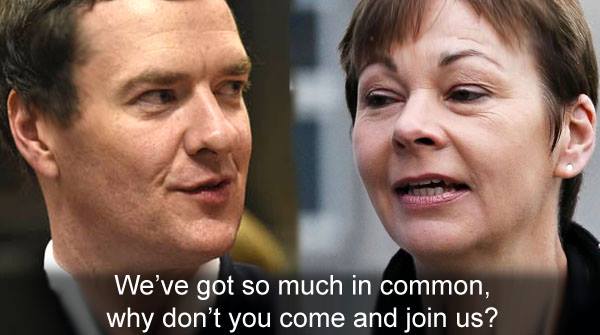
Caroline Lucas: Does the Chancellor agree with me that with the feeble and inconsistent opposition coming from the Labour Front Bench, there is a very good reason for seeing the SNP, the Greens and Plaid as the real opposition on this issue because we are clear and consistent about the fact that austerity is not working?

Mr Osborne: That shows why we want the hon. Lady’s party in the TV debates.

Yes, I just bet they do, to collaborate with the Tories in attacking and undermining the Labour Party, not the Coalition, who are, after all, the ones responsible for introducing austerity measures. I don’t imagine for a moment that Osborne values further challenges to his outrageous claims of efficacy regarding austerity measures.

What is very evident when you read through this debate, is that Ed Balls and a couple of other Labour MPs presented the ONLY challenges to Osborne on this matter, just to reiterate this important point.
10940505_767712909964906_6225427822143651262_n

It’s also worth bearing in mind that Ed Miliband established the International ANTI-austerity Alliance. Back in 2012, Miliband said: “There is a grip of centre-right leadership on Europe which has said there’s only one way forward and that’s austerity, and you’ve got to have a decisive move away from that.(See also: Labour leader Ed Miliband’s anti-austerity alliance will fight for the European dream.)

And why would Miliband be attending ANTI-austerity protests if he supported austerity?

Labour leader Ed Miliband speaks on stage at Hyde Park, during the TUC organised protest against austerity measures in London

 Labour leader Ed Miliband speaks on stage to over 150,000 at Hyde Park, during the TUC organised protest against austerity measures in London

It’s interesting to see the Chicago Tribune’s article: Ed Balls, UK’s anti-austerity finance chief in waiting.  Balls dismissed Osborne as a “downgraded chancellor” after Britain lost its triple-A credit rating.

One of his main charges has been that the government is unfairly spreading the economic pain it deems necessary to fix the economy. Austerity cuts are the burden of the poorest.

Balls says that a decision to cut the top tax rate amounts to an unjustified “tax cut for millionaires”, whilst his party has been scathing of reform of the welfare system.

A point echoed many times by Ed Miliband, too. Accusing the government of making lower or no income groups pay for the recovery while shielding the rich is a claim which strikes a chord with some voters who view Cameron and his government – many of whom were educated at the same top fee-paying school – as out of touch.

Caroline Lucas was born in Malvern to Conservative parents and attended Malvern Girls’ College (which became Malvern St James in 2006), a fee-paying private school. Ed Miliband, on the other hand, went to a comprehensive school.

Polls also show that many voters approve of the government’s drive to rein in welfare costs and the government has demanded that Labour spell out what they would do to fix the economy. They have, but with understandable caution.

Labour’s careful, costed and evidence-based policies include: a Bankers’ Bonus Tax; a Mansion Tax; repeal of the Bedroom Tax; a reversal of the Pension Tax relief that the Tories gifted to millionaires; a reversal of the Tory Tax cut for Hedge Funds; freezing gas and electricity bills for every home a the UK for at least 20 months; the big energy firms will be split up and governed by a new tougher regulator to end overcharging; banning exploitative zero hour contracts; introduction of a living wage (already introduced by some Labour councils); a reversal of the £107,000 tax break that the Tories have given to the millionaires; reintroduction of the 50p tax; scrapping George Osborne’s “Shares for Rights” scheme that has opened up a tax loophole of £1 billion; ensuring Water Companies place the poorest households on a Social Tariff that makes it easier for them to pay their Water Bills; breaking up the banks and separating retail banking from investment banking; introduction of measures to prevent corporate tax avoidance, scrapping the Profit Tax Cut (Corporation Tax) that George Osborne has already announced for 2015 and many more.

These are not austerity measures. They are strongly redistributive policies.It’s difficult enough opposing the manipulative, lying authoritarian Conservative-led government, without having to constantly counter lies and smears from fringe parties claiming to be on the Left, whilst propping up the Right. Shame on them.

403898_365377090198492_976131366_nMany thanks to Robert Livingstone.

You’d have to be Green to believe the Green Party: two more lies exposed.

PANews+BT_N0321471377269205233A_I1“David Cameron and George Osborne believe the only way to persuade millionaires to work harder is to give them more money. But they also seem to believe that the only way to make you (ordinary people) work harder is to take money away.” Ed Miliband. Source: Hansard, 12 December, 2012

The Tories have trashed the economy, damaged the very structure of our society and destroyed people’s lives. We have seen the return of absolute poverty, malnutrition and illnesses not seen since Victorian times. People have died as a consequence of Tory policies. What do the Green Party do? Lie about the Labour Party.

The Green Party are not opposing Tory austerity: they are opposing what is currently the only credible alternative instead. They prefer to undermine those that ARE challenging the Coalition regarding policies that are having devastating consequences on the poorest and most vulnerable citizens. That’s very telling. I fully support some Green policies, and wish that the Left generally would work in a much more collaborative way. Really that’s the only way of effectively challenging the current neoliberal conservative dominant paradigm.

Given an opportunity to engage in genuine political conversation and to cooperate in opposing the Tory-led draconian policies, those parties claiming to be “further left” than Labour have instead behaved exactly like the Tories. They chose to undermine Labour. These are parties that prioritise grandstanding and electioneering above the needs of the public. That has entailed lying and smearing campaigns. Yet we all share many of the same aims and objectives, values and principles. The infighting simply weakens a broader and more important progressive Movement.

Here are two examples of lies that are currently being circulated on Facebook and elsewhere by the Green Party and the Scottish National Party (SNP), amongst others:

Lie number 1: “Rachel Reeves said she would be tougher on welfare.”

Rachel Reeves has NEVER said she will be “tougher on welfare.” Those saying that she did are lying. She issued a statement shortly after being misquoted. It was Natalie Bennett who perpetuated that misquote too, originally from the Observer. (See Bennett’s article: Rachel Reeves is clear: Labour would set the struggling against the poorest.)

What Rachel actually said was she would be “tougher on the CAUSES of high welfare spending – such as low wages, unemployment, high private sector rents, private company contracts and outsourcing – especially that of Iain Duncan Smith: his vanity projects have cost us millions because contracted private companies have failed to deliver services, the policies are ill-conceived, creating higher costs, ultimately, rather than making any savings as the Tories claimed – the bedroom tax being an example.

The fact that Rachel Reeves was misquoted was clarified to Caroline Lucas too, so the Green Party have no excuse for shamefully lying about the Labour Party’s policy intentions.

In the middle of crucial debate about the Work Capability Assessment and the plight of disabled people because of Coalition policies, initiated by the WOW campaign, Lucas lost all of my respect when she chose political point scoring instead of constructive debate and said this:

Caroline Lucas (Brighton, Pavilion, Green); I was disappointed that Rachel Reeves, on taking up her post as shadow Secretary of State for Work and Pensions, used the opportunity of her first interview to say that she would be tougher than the Tories on people on benefits.

Kate Green (Shadow Minister (Work and Pensions); Stretford and Urmston, Labour); My hon. Friend the Member for Leeds West did not say that. She said that she would be tougher on welfare spending, not on people on benefits.

Sheila Gilmore (Edinburgh East, Labour); Does the hon. Lady agree that there are some forms of welfare spending that we should bring down? In my view, one of those is the excessive amount that is paid to private landlords through housing benefit. I am certainly in favour of reducing that form of welfare spending. Is she not?

Caroline Lucas (Brighton, Pavilion, Green); I am very much in favour of that if the hon. Lady wants to put it under the heading of welfare spending... Source: Hansard which is the parliamentary record. (See: 27 Feb 2014 : Column 457  at 1.29 pm, on the 2nd page.)

Nonetheless the Green Party has continued to misquote Reeves, to my disgust, using negative campaigning and smear tactics akin to the Tories to promote their own party. It’s time that some people distinguished between welfare spending and benefits, to conflate the two purely for political gain is deplorable, dishonest and not in the best interests of the electorate.

Lie number 2: “Labour voted for austerity.”

This is such a blatant lie. The vote, clearly stated on the Hansard record (see 13 Jan 2015: Column 738, Charter for Budget Responsibility), was pertaining strictly to the motion: “That the Charter for Budget Responsibility : Autumn Statement 2014 update, which was laid before this House on 15 December 2014, be approved.”  That isn’t about austerity.

The charter sets out that the Office of Budget Responsibility (OBR) will continue to monitor our fiscal rules. As we know, the  OBR has written extremely critical economic forecasts and analysis of austerity and the Tory spending cuts, clearly expressing the risks that the Chancellor is running and the scale of the damage his strategy will inflict on what remains of our public services.

It’s worth noting that whilst Ed Balls challenged Osborne, there was a curious silence from the  SNP and the Green Party. It was Ed Balls that challenged Osborne’s outrageous claims regarding “halving the deficit”- such a blatant lie, upon which even the exceedingly Conservative Spectator spluttered contempt. Or any of the other lies, some of which have already earned the Conservatives official rebukes from the Office for National Statistics. (See “bankruptcy lie” for example, on the hyperlinked article)

Furthermore, it’s about time that some MP’s, including Caroline Lucas, amongst others, recognised that there is a fundamental difference between the meaning of the word budget and the word austerity. Conflating the two for the purpose of politicking is unprincipled and dishonest.

It’s also worth noting from the same debate on the Hansard record:

13 Jan 2015 : Column 746

Caroline Lucas: Does the Chancellor agree with me that with the feeble and inconsistent opposition coming from the Labour Front Bench, there is a very good reason for seeing the SNP, the Greens and Plaid as the real opposition on this issue because we are clear and consistent about the fact that austerity is not working?

Mr Osborne: That shows why we want the hon. Lady’s party in the TV debates.

Yes, I just bet they do, to collaborate with the Tories in attacking and undermining the Labour Party, not the Coalition, who are, after all, the ones responsible for introducing austerity measures. I don’t imagine for a moment that Osborne values further challenges to his outrageous claims of efficacy regarding austerity measures. What is very evident when you read through this debate, is that Ed Balls and a couple of other Labour MPs presented the ONLY challenges to Osborne on this matter, just to reiterate this important point.

10940505_767712909964906_6225427822143651262_n

It’s also worth bearing in mind that Ed Miliband established the International ANTI-austerity Alliance. Back in 2012, Miliband said: “There is a grip of centre-right leadership on Europe which has said there’s only one way forward and that’s austerity, and you’ve got to have a decisive move away from that.(See also: Labour leader Ed Miliband’s anti-austerity alliance will fight for the European dream.)

And why would Miliband be attending ANTI-austerity protests if he supported austerity?

Labour leader Ed Miliband speaks on stage at Hyde Park, during the TUC organised protest against austerity measures in London

 Labour leader Ed Miliband speaks on stage to over 150,000 at Hyde Park, during the TUC organised protest against austerity measures in London

It’s interesting to see the Chicago Tribune’s article: Ed Balls, UK’s anti-austerity finance chief in waiting.  Balls dismissed Osborne as a “downgraded chancellor”after Britain lost its triple-A credit rating.One of his main charges has been that the government is unfairly spreading the economic pain it deems necessary to fix the economy. Austerity cuts are the burden of the poorest.

Balls says that a decision to cut the top tax rate amounts to an unjustified “tax cut for millionaires”, whilst his party has been scathing of reform of the welfare system. A point echoed many times by Ed Miliband, too. Accusing the government of making lower or no income groups pay for the recovery while shielding the rich is a claim which strikes a chord with some voters who view Cameron and his government – many of whom were educated at the same top fee-paying school – as out of touch.

Caroline Lucas was born in Malvern to Conservative parents and attended Malvern Girls’ College (which became Malvern St James in 2006), a fee-paying private school. Ed Miliband, on the other hand, went to a comprehensive school. Polls also show that many voters approve of the government’s drive to rein in welfare costs and the government has demanded Labour spell out what it would do to fix the economy. They have, but with understandable caution.

Labour’s careful, costed and evidence-based policies include: a Bankers’ Bonus Tax; a Mansion Tax; repeal of the Bedroom Tax; a reversal of the Pension Tax relief that the Tories gifted to millionaires; a reversal of the Tory Tax cut for Hedge Funds; freezing gas and electricity bills for every home a the UK for at least 20 months; the big energy firms will be split up and governed by a new tougher regulator to end overcharging; banning exploitative zero hour contracts; introduction of a living wage (already introduced by some Labour councils); a reversal of the £107,000 tax break that the Tories have given to the millionaires; reintroduction of the 50p tax; scrapping George Osborne’s “Shares for Rights” scheme that has opened up a tax loophole of £1 billion; ensuring Water Companies place the poorest households on a Social Tariff that makes it easier for them to pay their Water Bills; breaking up the banks and separating retail banking from investment banking; introduction of measures to prevent corporate tax avoidance, scrapping the Profit Tax Cut (Corporation Tax) that George Osborne has already announced for 2015 and many more.

These are not austerity measures. They are strongly redistributive policies.

It’s difficult enough opposing the manipulative, lying authoritarian Conservative-led government, without having to constantly counter lies and smears from parties claiming to be on the left, too. Shame on the Green Party and the SNP.

As I have said elsewhere, there’s a clear gap between professed principles and their application amongst the parties that claim to be “real socialists”.  How can it be principled or moral (or “socialist” for that matter) to collaborate with the Tories in attempting to damage, smear and discredit the only viable option of removing the Tories from Office in May? Bearing in mind that many people are suffering profoundly, some have died as a consequence of Conservative-led policies, we can see what the Green Party’s priorities actually are, here.

They don’t include the best interests of citizens and consideration of their well-being, that’s for sure.

403898_365377090198492_976131366_nThanks to Robert Livingstone for his excellent memes.

Public perceptions of party positions on the political spectrum: Labour’s leftward shift under Ed Miliband, the Conservatives’ rightward swing since 2010.

Good to see the public generally don’t swallow the “allthesame” myth.

Nihilism isn’t cool, trendy or the path to Nirvana: it’s a lazy abstention from all that matters.

1209102_539900659412800_1664499134_n

nihilismˈ noun 1. the rejection of all political, religious and moral principles, often in the belief that life is meaningless. “Insistence that man is a futile being”. synonyms: negativity, cynicism, pessimism; rejection, repudiation, renunciation, denial, abnegation; disbelief, non-belief, unbelief, scepticism, lack of conviction, absence of moral values, agnosticism, atheism, non-theism.
NO PRINCIPLES.

The road to nowhere, dissolution. In short, it’s the absence of belief in anything meaningful, positive, celebratory or decent. No acknowledgement of our remarkable potential as human beings. No faith in anything – it’s grubby, and leaves you groundless, rootless, unprincipled and in a no-place, with no escape.

Russell Brand is a “trendy” nihilist. However, this is not simply another article about Brand, but rather, I want to use this as an opportunity for discussing critical thinking. Brand is as good a case as any to use to explore this and propaganda techniques.

My friend, Charles Britton, commented on an article I wrote about the Russell Brand interview with Jeremy Paxman, and it’s a brilliant comment, because it shows a step-by-step process of critical thinking and analysis that exposes something that many seem to have have missed: an absence. A void. Brand used a lot of words that say nothing at all. Here is the comment:

“When I saw the argument between Russell Brand and Paxman, there were things he said that were clever, and which I liked and there seemed to be a real passion. Apart from the not voting, I thought, I couldn’t agree with that. And apart from the revolution idea because a) they are bloody, b) you don’t know who’ll you’ll end up with in charge (you may even lose the vote), and c) we do have the vote. If there were enough of a groundswell of anger about how we are being treated to spark a revolution, then it would show in how people voted (and how we campaigned). We’d vote out the bastards without needing a revolution! 

(I’m fairly certain that if people can’t be bothered voting, they won’t be bringing on a full-blown revolution any time soon either. Anyone out there got one booked? Please do pencil me in.)

“I still liked some other things he said. Apart from the implication that the parties are all the same. That’s the kind of thing you hear from most of the ”cutting-edge” (aggressive and politically ignorant) stand-ups on TV panel shows and celebs guesting on Question Time. Sadly, this blanket cynicism tends to win-over the politically illiterate of the crowd. Eventually I realised that there wasn’t really anything much in his statements apart from a certain  confident, [apparently] eloquent style. I’m left confused by this, wondering why his Newsnight interview was so “sensational”!


I have also pondered why Brand has such undeserved attention at the moment, and why some seem to think he had something to say, I clearly missed something, so I studied his interview with Paxman carefully. One thing that really struck me is that Brand completely failed to recognise and acknowledge that life wasn’t the same under the last government.

We didn’t have austerity, there were not thousands of sick and disabled people dying, and there was no substantial increase of absolute poverty and wealth inequalities under the Labour government, because of their policies, but these things are happening now.

Labour created human rights and equality policies, and the Tories are steadily unravelling those. Only the wealthy, and indifferent nihilists can afford imperviousness regarding the fundamental contrasts of Labour and Conservative governments. Brand’s self-serving claim that “they are all the same” only echoes what many of the most demigogic, disruptive, aggressive and very divisive individuals, have been using to misinform anyone who will listen. Brand is a multimillionaire who is likely invested in maintaining the status quo. A look at the differences in policies shows clearly that there are fundamental differences between the Conservatives and Labour. (For example, see here: Political Parties – NOT all as bad as each other).

So why would Brand or anyone else, for that matter, offer such a defeatist and dangerous idea up – that voting is futile – especially when the consequence is likely to be further divisions amongst those on the left, whilst the right-wing supporters, who ALWAYS vote, will simply ensure we have another Tory government in office in 2015?

How will that help the situation Brand outlined and criticised? And why is it ever okay to advocate no action? How about encouraging people to take some responsibility for how things are, and to work together to change things for the better?

I’ve written elsewhere about Brand’s narcissism and a fundamental lack of concern for others. As empathy, emotional sustenance and support, solidarity, loyalty, and a sense of belonging all become relics of a fast receding past due to the policies of the Tory-led Government, which act upon citizens as if they were objects, rather than serving them, as human subjects, the mass victims of anomic trauma put up as primitive, last resort narcissistic defences.

These, in turn, only exacerbate the very traumatic conditions, social dislocations, and experiences that necessitated their deployment in the first place. But our ability to organise, self-assemble, and act in co-operation and unison is in jeopardy, as is our future as a society, yet Brand advocated no action.

But some people promote themselves, making a lot of money from “criticising” the status quo, and Brand isn’t alone in being privately invested in how things are whilst publicly claiming otherwise.

Brand used recognisble propaganda techniques in his interview with Paxman, that signpost people to a variety of typified meanings, without actually meaningfully exploring any of them, using superficial Buzzwords (and phrases,) and Glittering Generalities.

The narrative isn’t coherent and meaningful, has no real depth, but what Brand does very well is implies – “signposts” you – via common stock phrases, creating the impression he understands and sees the world as you do. He creates a faux sense of rapport by doing so. But if you look elsewhere, the clues about Brand are there, in his books, articles and other interviews. It soon becomes clear that he does not connect with people, he doesn’t seem to relate. He generally seems to see others as a means to his own ends, and tends to exploit them. Those that have a joke at the expense of others have little empathy, and tend to be unsurprisingly exploitative and cruel.

That’s all Brand does, and even in the interview with Paxman, when he was asked something he couldn’t answer, he resorted to talking the piss out of Paxman.

It’s worth bearing in mind that when someone speaks or writes, they are trying to convince you of something. Ask yourself what it is that they want you to believe, then analyse their basic proposition carefully. Examine what they are saying, look for consistency, coherence, reasoning and logic, and look for the evidence to support the proposition.

Analyse what he actually said – there is NO proposition there at all, he used a lot of words to say nothing – it really is a cul-de-sac. Buzzwords and phrases are a propaganda technique to shape people’s perception, and persuade them that you “know” about their lives, situation and that you have insight.

Management jargon is an example – the familiarity of the words and phrases lulls you and fools you into feeling some important recognition has been made.

Here are some of the buzzwords and phrases Brand used to get your attention, gain your credibility, admiration, create a false sense of rapport; people, power, hierarchical, paradigm, serves a few people, humanity, alternate, alternate political systems, destroy the planet, economic disparity, needs of the people, treachery, deceit, political class, disenfranchised, disillusioned, despondent, underclass, represented, social conditions, undeserved underclass, impact, but that’s all just semantics really, political or corporate elites, serve the population, currently, public dissatisfaction.

We have all used these words and phrases, but we have put them together in structured and meaningful comments, with an aim. Brand didn’t do that.

Glittering Generalities is a propaganda technique, arises very often in politics and political propaganda. Glittering generalities are words that have different positive meaning for individual subjects, but are linked to highly valued concepts.

When these words are used, they demand approval without thinking, simply because such an important concept is involved. Brand made use of these Glittering Generalities; socialist, egalitarian, massive redistribution of wealth, heavy taxation of corporations, massive responsibility for energy companies, environment, profit is a filthy word, global utopian system, genuine option (amongst several others).

The whole dialogue is a propaganda vehicle that aims to deliver one message: there’s no point voting. Go back to sleep. There are identifiable dark fifth column ideologies of nihilism and conspiracy theories which have steadily gained popularity among some of the far-left here in the UK. Que sera sera. Idealism often morphs into cynicism.

These  ideologies reflect anti-values of defeatism, hopelessness, rejection of democracy, and organised government. What a deadly sedative – a very poisonous narcotic for a nation that desperately needs to rekindle respect for human rights, equality, and shared societal values of co-operation, compassion, hope, mutual support and community.

Nihilism is so dangerous because it is a glib, superficial and reactionary response that fundamentally attacks the very worth of humanity itself – because it’s based on the view that nothing really matters, everything is meaningless, nothing and no-one has any real worth, value or meaning.

Nihilism is a spiralling vortex of wretched and miserable relativism. It leaves people groundless and rootless. Que sera sera.

But we have a responsibility to take an interest in our lives, and the plight of others, regardless of our view of “human nature”.

The is /ought distinction highlights that there’s a fundamental difference between descriptive and prescriptive statements. As conscious beings with at least a degree of free-will, we can hoist our selves out of apathy by learning from consequences, by our empathy and concern for others, by our good will and by our conscious intent.

We are not cultural dupes – determined by social structure, or by our biology, sure, we are influenced by these, and a little constrained by them, but we are also capable of transcending these constraints – we are so much greater than that, or at least we have the potential to be so.

Conservatives don’t value such human potential: they tend formulate policy to squash it, curtail it, they stand against the tide of social evolution. Regressive ideology, authoritarian principles.

There is a tangible link with nihilism, and the egocentricity of psychopathy. First of all, psychopaths may be regarded as moral nihilists. Secondly, psychopaths like an apathetic, disengaged and anomic society, where citizens lack conviction, and there’s an absence or erosion of moral values.

Psychopaths regard the rest of us as being defective, and seek relentlessly to remake the world in their own image, to proselytize their viewpoint and  to “teach” their “defective” empathic fellows to think like them. Unfortunately, they can. People can become psychopathic, they can numb down their sensitivity to others. But a psychopath can never learn to think like an empathic person.

People with a normal capacity for empathy can turn off that capacity and think like psychopaths. Language is a powerful thing, and normal human beings respond to linguistic cues to switch to “psychopathy mode”.

The ancient Greeks and the Founders of our country understood the devastating destructiveness of the language of stigmatising, demonising and othering, particularly to democracies. They called the charismatic psychopaths who excelled at its practice “demagogues.” More recently, neuroscience has provided evidence that such demonising, dehumanising and hate radically alters the way the human brain processes information, making subjects immune to reason, increasingly intolerant, and very easily manipulated.

Divide and conquer is the age old defence of elites. Diversion. I am sure there is a link between nihilism, psychopathy and Conservative ideology. Extensive research has found significant correlations between key antisocial personality traits and  Conservative views. Specifically, the research claims to find elements of narcissism, psychopathy and Machiavellianism in Conservative subjects.

The Tory mantra: “there is no such thing as Society” leaks a significant clue about principle elements of core Conservative beliefs. The Conservative ideological justification for the destruction of the social unit, promotion of competitive individualism and “survival of the fittest” principles, the shrinking of the State and deliberately manipulated destruction of public belief in government overall is psychopathic.

It’s all about isolating people, breaking up networks and destroying co-operation and community. And of course such unifying and community-building ideas are the very foundations of socialist values and principles.

By focusing on competitive individualism as the primary method of improving the economy and society, Conservatism is an inherently misanthropic ideology; as all motives are seen through pure self-interest, cynicism in human nature becomes the norm. If people exist to simply get what they can for themselves, the motivation for sociability and co-operation decreases.

We become insular, fragmented and isolated. The characteristic of the psychopathic value system is its somewhat Manichean world view  – idealised me versus demonised him, idealised us  versus demonised them, reflecting the echo-other world view of the pathological narcissist or psychopath. The Tories deliberately create anxiety about others, divide social groups, reduce social cohesion, and create folk devils to bear the brunt of the blame for consequences of Tory policies.

It’s by no coincidence at all that those folk devils also bear the brunt of inhumane Tory policies, too. The Labour government didn’t get everything right for everyone, but Labour have never persecuted social groups like the Tories have, or wilfully destroyed state support for the most vulnerable citizens.

If we don’t vote, then that leaves the Tory supporters, who will simply vote the Tory authoritarians back into Office, and guess what? That doesn’t affect Brand at all. Well, except for the standard £107, 000 that all millionaires get under this Government, each, per year, in the form of a tax break.

We can politically engage, campaign, lobby politicians, and take some responsibility, rather than shrugging, disengaging, and ensuring that nothing will change. Authoritarian governments require a passive, disengaged public to emerge and to maintain their power. We have a duty to challenge and to push back – to demand positive changes and shape a society that supports those that cannot support themselves, that’s the mark of a civilised society. We simply have to fight our way back to decency.

We have to reclaim the progress we once made in an evolved human rights orientated culture. The Tories have undone many decades of hard work and struggle to establish those rights. We have to act, and we must vote. Vote Labour.

scroll2
This is also worth reading: “They are not all the same.” ‘They’re all the same’ is what reactionaries love to hear. It leaves the status quo serenely untroubled, it cedes the floor to the easy answers of Ukip and the Daily Mail. No, if you want to be a nuisance to the people whom you most detest in public life, vote. And vote Labour.”  Robert Webb

– http://www.newstatesman.com/politics/2013/10/robert-webb-re-joins-labour-protest-russell-brand

226786_150917841725939_960158327_n

Thanks to Robert Livingstone for his brilliant artwork