Tag: Behavioural economics

Social media is being used to stage manage our democracy using nudge-based strategies


Image result for Online propaganda

A study from the University of Oxford, published this month, has concluded what many of us already know: bots, shills and trolls are working together to spread propaganda and disinformation, disrupt discussions, discredit individuals and are attempting to manipulate social media users’ political views.

The report warns: “Computational propaganda is one of the most powerful new tools against democracy.” 

The Oxford Internet Institute says that computational propaganda is the use of algorithms, automation, and human curation to purposefully distribute misleading information over social media networks. Social media are actively used as a tool for public opinion manipulation in diverse ways and on various topics.

Bots and trolls work to stifle authentic and reasoned debate between people in favour of a social network populated by (usually aggressive) argument and soundbites and they can simply make online measures of social support, such as the number of  “likes” (which can, of course, be bought), look larger  – crucial in creating the illusion of consensus and encouraging a bandwaggon effect.

In democracies, social media are actively used for computational propaganda, through broad efforts at opinion manipulation and by targeted experiments on particular segments of the public (which is antidemocratic in itself). This strategy isn’t so far removed from the “big data” approach, where individuals are targeted in election campaigns to receive personal messages that are highly tailored, designed to appeal to certain categories of “personality types” as discerned by the use of extensive data mining and psychological profiling techniques. 

The report also says that “In every country we found civil society groups trying, but struggling, to protect themselves and respond to active disinformation campaigns.” 

The research team involved 12 researchers across nine countries who, altogether, interviewed 65 experts, analyzed tens of millions posts on seven different social media platforms during scores of elections, political crises, and national security incidents.

They say that in democracies, individual users design and operate fake and highly automated social media accounts. Political candidates, campaigns and lobbyists rent larger networks of accounts for purpose-built campaigns while governments assign public resources to the creation, experimentation and use of such accounts.

Ultimately the presence of bots, shils and trolls on social media is a right-wing bid to stage manage our democracy, in much the same way that the biggest proportion of the rabidly right-wing corporate media has, until recently.

The report describes online propaganda as a “phenomenon that encompasses recent digital misinformation and manipulation efforts”, which “involves learning from and mimicking real people so as to manipulate public opinion across a diverse range of platforms and device networks”.

According to the report, bots “played a small but strategic role” in shaping Twitter conversations during the EU referendum last year. Bots work most effectively and powerfully when working together with trolls.

Political bots, social media bots used for political manipulation, are also effective tools for strengthening online propaganda and hate campaigns. One person, or a small group of people, can use an army of political bots on Twitter to give the illusion of large-scale consensus. Bots are increasingly being used for malicious activities associated with spamming and harassment.

According to the report authors: “The family of hashtags associated with the argument for leaving the EU dominated, while less than one percent of sampled accounts generated almost a third of all the messages.”

Political bots, built to look and act like real citizens, are being deployed in determined anti-democratic efforts to silence oppostion and to push official state messaging. Political campaigners, and their supporters, deploy political bots – and computational propaganda more broadly – during elections in attempts to sway the vote and defame critics. 

Anonymous political actors harness key elements of computational propaganda such as false news reports, coordinated disinformation campaigns, and troll mobs to attack human rights defenders civil society groups, and independent commentators and journalists.

The report warns “Computational propaganda is one of the most powerful new tools against democracy.” Facebook in particular has attracted a great deal of criticism in recent months, due to the rise and promotion of fake news.

Mark Zuckerberg initially denied that false stories spread through the social network had an effect on the US Presidential election, but changed his stance soon after.

The University of Oxford report says social media sites need to redesign themselves in order to regain trust.

The role of Intelligence Services in the deployment of psy-ops


In 2015, Glenn Greenwauld published a series of documents from the Joint Threat Research Intelligence Group (JTRIG). He says that though its existence was secret until 2014, JTRIG quickly developed a distinctive profile in the public understanding, after documents from the National Security Agency (NSA) whistleblower Edward Snowden revealed that the unit had engaged in “dirty tricks” like deploying sexual “honey traps” designed to discredit targets, launching denial-of-service attacks to shut down internet chat rooms, pushing veiled propaganda onto social networks and generally warping discourse online. 

JTRIG’s tactics include seeding propaganda on social media, impersonating people online, and creating false blog posts to discredit targets.

A fascinating and must-read 42-page document from 2011 is particularly revealing, detailing JTRIG’s activities. It provides the most comprehensive and sweeping insight to date into the scope of this unit’s extreme methods. Entitled “Behavioral Science Support for JTRIG’s Effects and Online HUMINT [Human Intelligence] Operations,” it describes the types of targets on which the unit focuses, the psychological and behavioral research it commissions and exploits, and its future organizational aspirations.

The document is authored by a psychologist, Mandeep K. Dhami, a professor of  “Decision Psychology”. Dhami has provided advice on how JTRIG can improve its approach and attain “desired outcomes”, for example, by applying behavioural theories and research around persuasive communication, compliance, obedience, conformity, and the creation of trust and distrust.

Among other things, the document lays out tactics that the agency uses to manipulate public opinion, its scientific and psychological research into how human thinking and behaviour can be profiled and influenced, and the broad range of targets that are traditionally the province of law enforcement rather than intelligence agencies.

Since the general election in the UK, there has been a noticably massive increase in right-wing trolling presence and activity on Twitter. Most of the activity is directed towards discrediting Jeremy Corbyn. It’s very easy to spot a troll. They make outrageous claims that often read like tabloid headlines, resort quickly to personal attacks and attempts to discredit and smear when you disagree, and they never debate reasonably or evidence their comments.

In my experience, some, however, may initially engage reasonably, make a few concessions to evidenced debate, then suddenly show their true colours, by moving the goalposts of the debate constantly to include more disinformation, and by becoming aggressive, very personal and exceedingly irrational. My own management strategy is to address the claims made with a little evidence and fact, and block unhesitantly when it invariably turns ugly. 

The Oxford University research report concludes: “For democracies, we should assume that encouraging people to vote is a good thing. Promoting political news and information from reputable outlets is crucial. Ultimately, designing for democracy, in systematic ways, will help restore trust in social media systems. 

Computational propaganda is now one of the most powerful tools against democracy. Social media firms may not be creating this nasty content, but they are the platform for it. 

“They need to significantly redesign themselves if democracy is going to survive social media.”


Further reading

From the Intercept:

THE “CUBAN TWITTER” SCAM IS A DROP IN THE INTERNET PROPAGANDA BUCKET 

CONTROVERSIAL GCHQ UNIT ENGAGED IN DOMESTIC LAW ENFORCEMENT, ONLINE PROPAGANDA, PSYCHOLOGY RESEARCH

How Covert Agents Infiltrate the Internet to Manipulate, Deceive, and Destroy Reputations – Glenn Greenwauld

Theresa May pledges to create new internet that would be controlled and regulated by government 

The media need a nudge: the government using ‘behavioural science’ to manipulate the public isn’t a recent development, nudging has been happening since 2010


Image result for online intelligence propaganda operations


I don’t make any money from my work. But you can support Politics and Insights and contribute by making a donation which will help me continue to research and write informative, insightful and independent articles, and to provide support to others. The smallest amount is much appreciated, and helps to keep my articles free and accessible to all – thank you.

DonatenowButton

Two key studies show that punitive benefit sanctions don’t ‘incentivise’ people to work, as claimed by the government

2B7E5E0E00000578-3203497-News_Frames_even_mocked_up_their_own_version_of_the_company_s_le-a-19_1439993426113

Satirical Twitter response after Welfare Weekly used a Freedom of Information request to reveal that the Department for Work and Pensions had been using fake claimants and made-up comments to justify the use of punitive welfare sanctions

The government’s controversial benefit sanctions regime can cause “damage to the wellbeing of vulnerable claimants and can lead to hunger, debt and destitution”, according to a damning new report, which debunks Tory myths that benefit sanctions – denying people who are already struggling the only means by which to support themselves and their families – “incentivise people into work.”

In a report titled Benefit Conditionality and Sanctions in Salford – One Year on, commissioned by Salford City Council in 2014, comprised of a task force of Salford’s Financial Inclusion Practitioner’s Group (FIPG), it was concluded that, far from than “incentivising” people to move into work, the sanctions regime actually serves as a demotivator and barrier, preventing people from engaging in appropriate training, volunteering and employment-related activities.

Furthermore, the sudden loss of income caused by removing benefits – through the imposition of a punitive sanctions regime – often damages people’s mental health, creates tensions within family relationships and may cause individuals to turn to crime in order to meet their basic survival needs.

The report says: “Despite the drop in numbers in Salford receiving a benefit sanction, for those who are sanctioned the impact is devastating. 

“A ‘financial shock’ such as a sanction causes both immediate and longer term impact as most people do not have the means to save, so have no safety net. This presents an emergency need for money to buy food, pay for heating and essential travel costs.”

The report also says that the rate of people being sanctioned in the area has not reduced over the previous 12 month period. But, critically, it adds: “Register sizes are decreasing and we believe this is in part due to a growing number of “disappeared“. These are claimants who drop their benefit claim or who move off benefit but do not take up employment. The Government has refused to publish destination data.”  (See also: Government under fire for massaging unemployment figures via benefit sanctions from Commons Select Committee.)

The report goes on to say: “From the wide range of responses we have received from Salford agencies working with claimants, despite the fall in sanctions, the impact of sanctions both on claimants and services within the City cannot be overstated and the harsh regime will be expected to include additional groups as Universal Credit rolls out nationally this year.”

The report follows on from an interim study, published in October 2014, which predicted that sanctioning would most likely lead to extreme material hardship, mental health problems such as depression, and an increasing reliance on loan sharks. The interim report was submitted as evidence to the parliamentary inquiry into the impact of benefit sanctions.

Salford City Mayor, Paul Dennett said: “People on benefits are already struggling to afford food, heating and essential costs. They can’t save so they have no financial safety net. They live in dread of being sanctioned  which isn’t the right frame of mind for job hunting, volunteering or going back into education.” 

Rebecca Long Bailey, the Labour MP for Salford and Eccles, has said that the research “shows charities are increasingly having to step in to support claimants who are thrown into crisis due to delays and sanctions”. 

She added: “As an MP, I have seen some truly horrific cases, where the effects have been severe damage to my constituents’ mental and physical health, as well as the tragic case of David Clapson, who was found dead in his flat from diabetic ketoacidosis, two weeks after his benefits were suspended. His sister discovered her brother’s body and found his electricity had been cut off, meaning the fridge where he stored his insulin was no longer working. They must know that sanctioning people with diabetes is very dangerous but the system treats people as statistics and numbers. 

This report shows where we are in Salford today, one year on from the original report. Sadly, it illustrates the devastating impact sanctions have on the lives of people who are already struggling to make ends meet.”

Earlier this month, another collaborative research project, which is based at York university, also launched the publication of first wave findings from an ongoing study on the effects and ethics of welfare conditionality. This project started in 2013 and will finish in 2018. The researchers, from a variety of universities across the UK, draw on data from interviews with 52 policy stakeholders, 27 focus groups conducted with practitioners, and 480 “wave a” qualitative longitudinal interviews with nine groups of welfare service users in England and Scotland.  The study includes 480 people living in Bath, Bristol, Edinburgh, Glasgow, Greater Manchester, Inverness, London, Peterborough, Sheffield and Warrington, and is aimed at determining what longer-term effects the sanctions and employment “support” are having.

Most respondents report negative experiences of conditional welfare interventions. Linking continued receipt of benefit and services to mandatory behavioural requirements under threat of sanction has created widespread anxiety and feelings of disempowerment among claimants.

The impacts of benefit sanctions are universally reported by welfare service users as profoundly negative. Routinely, sanctions had severely detrimental financial, material, emotional and health impacts on those subject to them. There was evidence of certain individuals disengaging from services or being pushed toward “survival crime”. Harsh, disproportionate or inappropriate sanctioning created deep resentment and feelings of injustice. 

A recurring theme in peoples’ experiences was that sanctions or other enforcement measures were out of proportion to the “offence”, such as being a few minutes late for an appointment. Many reported being sanctioned following administrative mistakes by Jobcentre or Work Programme staff.

The Claimant Commitment was criticised for not taking sufficient account of individuals’ capabilities, wider responsibilities and/or vulnerabilities. Many saw Jobcentre Plus in particular as being primarily concerned with monitoring compliancy with behavioural requirements, imposing discipline and enforcement, rather than providing any meaningful support.

At the heart of welfare conditionality is an unfounded belief that it will change service users’ behaviour. Research to date in this first wave of findings has found very little evidence of welfare conditionality bringing about positive behaviour change in terms of preparing for or finding paid work and/or ending what is assumed to be “irresponsible behaviour” (rather than a consequence of the realities of labour market and socioeconomic constraints.)

Many welfare service users challenged the notion that they did not want to work. Virtually all interviewees in this study expressed a desire to work in the future when, and if, their personal situations made this possible. 

If you want to take part in this study, please get in touch if you live in one of these areas: Bath, Bristol, Edinburgh, Glasgow, Greater Manchester, Inverness, London, Peterborough, Sheffield and Warrington. Your personal details will be kept confidential.


Related 

Exclusive: DWP Admit Using Fake Claimant’s Comments In Benefit Sanctions Leaflet

Benefit Sanctions Can’t Possibly ‘Incentivise’ People To Work – And Here’s Why

Nudging conformity and benefit sanctions

0_0_0_0_370_308_csupload_52703375

My work is unfunded and I don’t make any money from it. But you can support Politics and Insights and contribute by making a donation which will help me continue to research and write informative, insightful and independent articles, and to provide support to others.

DonatenowButton
cards

The real economic free-riders are the privileged, not the poorest citizens

PAA-550x369


The government’s undeclared preoccupation with
behavioural change through personal responsibility isn’t therapy. It’s simply a revamped version of Samuel Smiles’s bible of Victorian and over-moralising, a Conservative behaviourist hobby-horse: “thrift and self-help” – but only for the poor, of course.

Smiles and other powerful, wealthy and privileged Conservative thinkers, such as Herbert Spencer, claimed that poverty was caused largely by the “irresponsible habits” of the poor during that era. But we learned historically that the socioeconomic circumstances caused by political decision-making creates poverty. Meanwhile, the state abdicates its democratic responsibilities of meeting the public’s needs and for transparency and accountability for the outcomes and social consequences of its own policies.

Conservative rhetoric is designed to have us believe there would be no poor people if the welfare state didn’t somehow “create” them. If the Tories must insist on peddling the myth of meritocracy, then surely they must also concede that whilst such a system has some beneficiaries, it also creates situations of insolvency and poverty for others.

In other words, the same system that allows some people to become very wealthy is the same system that condemns others to poverty.

This wide recognition that the raw “market forces” of the old liberal laissez-faire (and the current starker neoliberalism) causes casualties is why the welfare state came into being, after all – because when we allow such competitive economic dogmas to manifest, there are invariably winners and losers.

That is the nature of “competitive individualism,” and along with inequality, it’s an implicit, undeniable and fundamental part of the meritocracy myth and neoliberal script. And that’s before we consider the fact that whenever there is a Conservative government, there is no such thing as a “free market”: in reality, all markets are rigged for elites. For example, we have a highly regulated welfare state that enforces “behaviour change” via a punitive conditionality regime, coercing a reserve army of labour into any available work, and a highly deregulated labour market which is geared towards making profit and is not prompted to provide adequately for the needs of a labour force.

Society as taxpayers and economic free-riders – a false dichotomy

The Conservatives have constructed a justification narrative for their draconian and ideologically-driven cuts to social security by manufacturing an intentionally socially divisive and oversimplistic false dichotomy. Citizens have been redefined as either taxpayers (strivers) or economic free-riders (skivers). Those people currently out of employment, regardless of the reason, are categorised and portrayed through political rhetoric and in the media as economic free-riders – the “something for nothing culture.” 

However, not only have most people currently claiming social security, including the majority of disabled people, worked and contributed tax and national insurance, people needing social security support also contribute significantly to the Treasury, because they pay the largest proportion of VAT, council tax, bedroom tax, council care costs and a variety of other stealth taxes. 

A massive proportion of welfare expenditure goes towards paying private companies and organisations to “get people back to work” and in rewarding shareholders with savings from the systematic reduction in benefits. This approach has not helped people out of employment to find secure, appropriate work with acceptable levels of pay, because it rests on a never-ending reduction in the value of the minimum benefit level, which was originally calculated to meet subsistence costs – only those costs of fundamental survival needs, such as for fuel, food and shelter – so that those in poverty are made even poorer, less able to meet basic needs, to serve as an “incentive” to make the advantages of any work, regardless of its quality, pay and conditions, appear to be greater than it is.

This is what Conservatives mean by “making work pay.” It’s exactly the same disciplinarian approach as that which was enshrined in the 1834 Poor Law Amendment Act – the principle of less eligibility. The 1834 Act was founded on a political view that the poor were largely responsible for their own situation, which they could change if they chose to do so.

Seriously, does anyone really imagine that people actually choose to be poor?

The impact of this approach on the large numbers of disabled people in particular, who had no choice but to seek welfare in the Workhouse, was that they were treated very harshly and depersonalised

It’s also clear that the underpinning Poor Law Amendment categories of “deserving” and “undeserving” poor – another false dichotomy – and the issue of eligibility for social security is still on the Conservative welfare policy agenda. Worryingly, the current trend is for the government to create stereotypes, frequently portraying the recipients of types of support, such as Disability Living Allowance, as passive or inactive economic free-riders, when in fact the Allowance was paid to some individuals working in the paid labour market, and the withdrawal of such funds, prevents them continuing with such paid work. More recently, the difficulties that many disabled people have encountered in accessing Personal Independence Payments (PIP) because of increasingly narrow eligibility criteria, have meant that many who depend on the income to meet the additional costs of living independently, such as specially adapted motability vehicles, have been forced to give up work.

The state confines its attention mainly to re-connecting disabled people deemed too ill to work with the labour market, without any consideration of potential health and safety risks in the workplace, as a strategy of “support.” Without any support.

As previously summarised, the Conservatives justify the draconian cuts to support as providing “incentives” for people to work, by constructing a narrative that rests on the false and socially divisive taxpayer/free-rider dichotomy:cant

By “trolls” Michael Fabricant actually means disabled people and campaigners responding to his tweet.

Of course one major flaw in Fabricant’s reasoning is that many people passed as fit for work are anything but. The other is that disabled people pay taxes too.

The increasing conditionality of welfare mirrors the increasing conditionality of the labour market

Under the guise of lifting burdens on business, the government has imposed burdens on those with disabilities by removing the “reasonable adjustments” that make living their lives possible and allowing dignity. The labour market is unaccommodating, providing business opportunities for making profit, but increasingly, the needs and rights of the workforce are being politically sidelined. This will invariably reduce opportunities for people to participate in the labour market because of its increasingly limiting terms and conditions.

Of those that may be able to work, over time, their would-be employers have not engaged with legal requirements and provided adjustments in the workplace to support those disabled people seeking employment. The government have removed the Independent Living Fund, and reduced Access to Work support, Personal Independence Payment (PIP) is very difficult to access because of the stringent eligibility criteria, whilst the disability benefit Employment Support Allowance was also redesigned to be increasingly difficult to qualify for.

Policies, which exclude disabled people from their design and rationale, have extended and perpetuated institutional and cultural discrimination against disabled people.

The universal character of human rights is founded on the inherent dignity of all human beings. It is therefore axiomatic that people with medical conditions that lead to disabilities, both mental and physical, have the same human rights as the rest of the human race. The United Nations is currently investigating this government’s gross and systematic violations of the Convention on the Rights of Persons with Disabilities (CRPD), and a recent report from the House of Lords Select Committee on the Equality Act 2010 and Disability, investigating the Act’s impact on disabled people, has concluded that the Government is failing in its duty of care to disabled people, because it does not enforce the act. Furthermore, the Select Committee concludes that the government’s red tape challenge is being used as a pretext for removing protections for disabled people. This is a government that regards the rights and protections of disabled people as nothing more than a bureaucratic inconvenience.

The inflexibility of the labour market isn’t an issue for only disabled people. The Department for Work and Pensions (DWP) intends to establish an “in-work service”, designed to encourage individual Universal Credit claimants on very low earnings to increase their income. Benefit payments may be stopped if claimants fail to take action as required by the DWP. The DWP is conducting a range of pilots to test different approaches but there is very little detail about these. The new regime might eventually apply to around one million people. In december last year, the The Work and Pensions Committee opened an in-work progression in Universal Credit inquiry to consider the Department’s plans and options for a fair, workable and effective approach.

The Conservatives continue to peddle the “dependency” myth, yet there has never been any empirical evidence to support the claims of the existence of a “culture of dependency” and that’s despite the dogged research conducted by Keith Joseph some years ago, when he made similar claims. In fact, a recent international study of social safety nets from The Massachusetts Institute of Technology (MIT) and Harvard economists categorically refutes the Conservative “scrounger” stereotype and dependency rhetoric. Abhijit Banerjee, Rema Hanna, Gabriel Kreindler, and Benjamin Olken re-analyzed data from seven randomized experiments evaluating cash programmes in poor countries and found “no systematic evidence that cash transfer programmes discourage work.”

The phrase “welfare dependencydiverts us from political discrimation via policies, increasing inequality, and it serves to disperse public sympathies towards the poorest citizens, normalising prejudice and resetting social norm defaults that then permit the state to target protected social groups for further punitive and “cost-cutting” interventions to “incentivise” them towards “behavioural change.”

Furthermore, Welfare-to-Work programmes do not “help” people to find jobs, because they don’t address exploitative employers, structural problems, such as access to opportunity and resources and labor market constraints. Work programmes are not just a failure here in the UK, but also in other countries, where the programmes have run extensively over at least 15 years, such as Australia.

Welfare-to-work programes are intimately connected with the sanctioning regime, aimed at punishing people claiming welfare support. Work programme providers are sanctioning twice as many people as they are signposting into employment (David Etherington, Anne Daguerre, 2015), emphasising the distorted priorities of “welfare to work” services, and indicating a significant gap between claimant obligations and employment outcomes.

The Conservatives have always constructed discourses and shaped institutions which isolate some social groups from health, social and political resources, with justification narratives based on a process of class-contingent characterisations and the ascribed responsiblisation of social problems such as poverty, using quack psychology and pseudoscience. However, it is socioeconomic conditions which lead to deprivation of opportunities, and that outcome is undoubtedly a direct consequence of inadequate political decision-making and policy.

It’s worth bearing in mind that many people in work are still living in poverty and reliant on in-work benefits, which undermines the libertarian paternalist/Conservative case for increasing benefit conditionality somewhat, although those in low-paid work are still likely to be less poor than those reliant on out-of-work benefits. 

The government’s Universal Credit legislation has enshrined the principle that working people in receipt of in-work benefits may face benefits sanctions if they are deemed not to be trying hard enough to find higher-paid work. It’s not as if the Conservatives have ever valued legitimate collective wage bargaining. In fact their legislative track record consistently demonstrates that they hate it, prioritising the authority of the state above all else.

There are profoundly conflicting differences in the interests of employers and employees. The former are generally strongly motivated to purposely keep wages as low as possible so they can generate profit and pay dividends to shareholders and the latter need their pay and working conditions to be such that they have a reasonable standard of living.

Workplace disagreements about wages and conditions are now typically resolved neither by collective bargaining nor litigation but are left to management prerogative. This is because of deregulation to suit employers and not employees.  Conservative aspirations are clear. They want cheap labour and low cost workers, unable to withdraw their labour, unprotected by either trade unions or employment rights and threatened with destitution via benefit sanction cuts if they refuse to accept low paid, low standard work. Similarly, desperation and the “deterrent” effect of the 1834 Poor Law amendment served to drive down wages.

The global financial crisis presented an opportunity for Conservative supporters of labour market deregulation to once again champion “economic growth” at any costs by “lifting the regulatory burdens on business.” Neoliberal commentators argued that highly regulated labour markets perform reasonably well during boom periods but cannot cope with recessions – and that therefore the UK and other developed economies need to deregulate their labour markets to ensure a strong economic recovery (even though the UK already has one of the most deregulated labour markets in the developed world).

The “problems” with labour market regulation are seen by Conservatives as being rooted in:

  • The social security system which provides a safety net and maintains basic living standards for those who are out of work, by reducing the gap in living standards between those in and those out of work, it diminishes the incentive to find or keep jobs. Where the safety net is financed by taxes on wages, it also raises total labour costs.
  • Minimum wages which may “price workers out of jobs” if set at levels above those prevailing in an unregulated labour market.
  • Employment protection legislation, such as restrictions on the ability of employers to hire and fire at will, also raises labour costs, diminishes flexibility and willingness to hire, thus reducing employment. (See Beecroft report)
  • Trade unions which raise wages to levels which “destroy jobs and reduce productivity and efficiency through restrictive practices.” (See Trade Union Bill).

Regulation of the labour market, however, is crucial to compensate for the wide inequality in bargaining power between employers and employees; to realise comparative wage justice; to increase employee’s job security and tenure, therefore encouraging investment in skills (both by the employer and employee), which has a positive impact on labour productivity and growth, and to ensure that a range of basic community, health and safety standards are observed in the workplace.

In the Conservative’s view, trade unions distort the free labour market which runs counter to New Right and neoliberal dogma.

Since 2010, the decline in UK wage levels has been amongst the very worst in Europe. The fall in earnings under the Coalition is the biggest in any parliament since 1880, according to analysis by the House of Commons Library, and at a time when the cost of living has spiralled upwards. And whose fault is that? It’s certainly not the fault of those who need financial support to meet their basic survival needs despite being in employment.

So we may counter-argue that: 

  • Genuine minimum standards, including minimum wages are needed. Without them the lower end of the market becomes casualised, insecure and sufficiently low-paid, which in turn also produces major work incentive problems. On the other hand, regulation that protects or gives power to already powerful groups in the labour market creates serious inequality in access to work. Additionally, the creation of special types of labour exempt from normal regulation is particularly unhelpful. It often tends to reinforce the privileged status of core workers while generating jobs which are unsuitable vehicles for tackling the problem of social exclusion.
  • The benefit system needs to take into account that those who take entry-level jobs may require additional help from the welfare state to support their families. Without this type of benefit, adults in poorer families will be the last to take such relatively low-paying entry-level positions. Furthermore, a highly conditional social security system that provides below subsistence-level support also serves to disincentivise people because financial insecurity invariably creates physiological, psychological, behavioural and motivational difficulties, people in circumstances of absolute poverty are forced to shift their cognitive priority to that of surviving, rather than being “work ready.” This was historically observed by social psychologist Abraham Maslow in his classic work on human motivation and well-evidenced in research, such as the Minnesota semistarvation experiment, amongst many other comprehensive studies.
  • Employment taxes, on both employers and employees, should be progressive to support the creation of new jobs rather than making the already employed work longer hours. Yet the UK system also has numerous large incentives to offer employees insecure and short-hour contracts. This is remarkably short-sighted and counterproductive.

 The balance of “incentives” in Conservative policies.

The following cuts came into force in April 2013:

  • 1 April – Housing benefit cut, including the introduction of the ‘bedroom tax’
  • 1 April – Council tax benefit cut
  • 1 April – Legal Aid savagely cut
  • 6 April – Tax credit and child benefit cut
  • 7 April – Maternity and paternity pay cut
  • 8 April – 1% cap on the rise of in working-age benefits (for the next three years)
  • 8 April – Disability living allowance replaced by personal independence payment (PIP), with the aim of saving costs and “targeting” the support
  • 15 April – Cap on the total amount of benefit working-age people can receive 

In 2012, Ed Miliband said: “David Cameron and George Osborne believe the only way to persuade millionaires to work harder is to give them more money.

But they also seem to believe that the only way to make you (ordinary people) work harder is to take money away.”

He was right.

Here are some of the Tory “incentives” for the wealthy:

  • Rising wealth – 50 richest people from the Midlands region increased their wealth by £3.46 billion  to a record £28.5 billion.
  • Falling taxes – top rate of tax cut from 50% to 45% for those earning over £150,000 a year. This is 1% of the population who earn 13% of the income.
  • No mansion tax and caps on council tax mean that the highest value properties are taxed proportionately less than average houses.
  • Benefited most from Quantitative Easing (QE) – the Bank of England say that as 50% of households have little or no financial assets, almost all the financial benefit of QE was for the wealthiest 50% of households, with the wealthiest 10% taking the lions share
  • Tax free living – extremely wealthy individuals can access tax avoidance schemes which contribute to the £25bn of tax which is avoided every year, as profits are shifted offshore to join the estimated £13 trillion of assets siphoned off from our economy
  • £107, 000 each per annum gifted to millionaires in the form of a “tax break.”

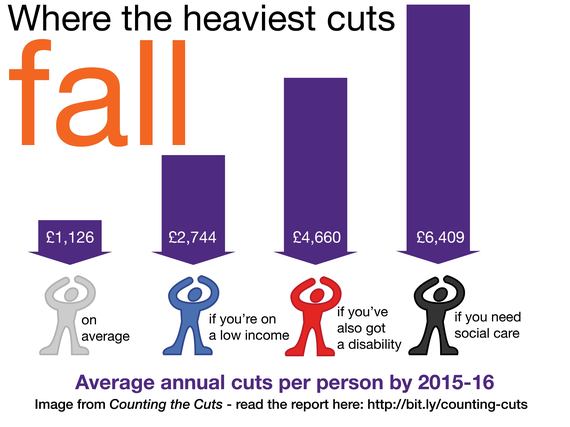
Disabled people have carried most of the burden of Conservative austerity cuts:

2014-02-17-BurdenoftheCuts-thumb
The Conservatives are on an ideological crusade, which flies in the face of public needs, democracy and sound economics, to shrink the welfare state and privatise our essential services.

In a wealth transfer from the poorest to the very rich, we have witnessed the profits of public services being privatised, but the losses have been socialised – entailing a process of economic enclosure for the wealthiest, whilst the burden of losses have been placed on the poorest social groups and our most vulnerable citizens – largely those who are ill, disabled and elderly. The Conservative’s justification narratives regarding their draconian policies, targeting the poorest social groups, have led to media scapegoating, social outgrouping, persistent political denial of the aims and consequences of policies and reflect a wider process of political disenfranchisement of the poorest citizens, especially sick and disabled people.

This is juxtaposed with the more recent gifted tax cuts for the wealthiest, indicating clearly that Conservatives perceive and construct social hierarchies with policies that extend inequality and discrimination. The axiom of our international human rights is that we each have equal worth. Conservative ideology is fundamentally  incompatable with the UK government’s Human Rights obligations and with Equality law. The chancellor clearly regards public funds for providing essential lifeline support for disabled people as expendable and better appropriated for adding to the disposable income for the wealthy.

Public policy is not an ideological tool for a so-called democratic government to simply get its own way. Democracy means that the voices of citizens, especially members of protected social groups, need to be included in political decision-making, rather than so frankly excluded.

Government policies are expressed political intentions regarding how our society is organised and governed. They have calculated social and economic aims and consequences. In democratic societies, citizen’s accounts of the impacts of policies ought to matter.

However, in the UK, the way that policies are justified is being increasingly detached from their aims and consequences, partly because democratic processes and basic human rights are being disassembled or side-stepped, and partly because the government employs the widespread use of linguistic strategies and techniques of persuasion to intentionally divert us from their aims and the consequences of their ideologically (rather than rationally) driven policies. Furthermore, policies have become increasingly detached from public interests and needs.

We elect governments to meet public needs, not to “change behaviours” of citizens to suit government needs and prop up policy “outcomes” that are driven entirely by traditional Tory prejudice and ideology.


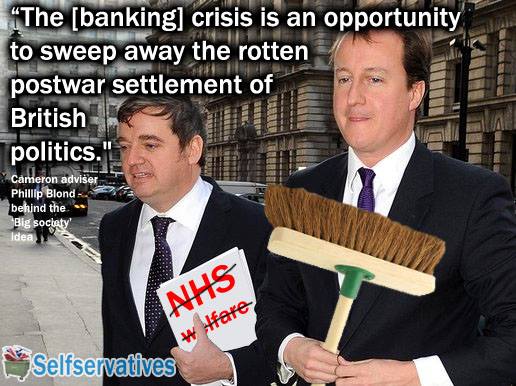
proper Blond

I don’t make any money from my work and I’m not funded. You can support Politics and Insights by making a donation to help me continue researching and writing independently, and to continue to help others.

DonatenowButton

Welfare sanctions can’t possibly “incentivise” people to work

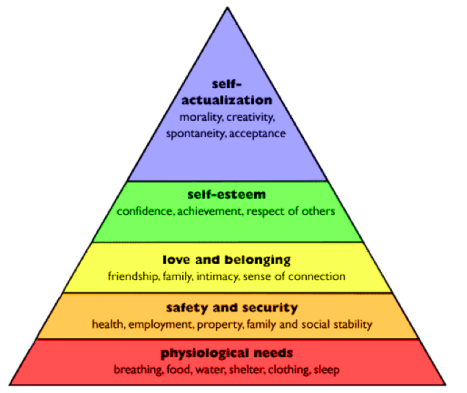
Maslow

Abraham Maslow’s Hierarchy of Human Needs

A summary

The Conservative-led welfare “reforms” had the stated aim of ensuring that benefit claimants – who have been stigmatised and inaccurately redefined as economic free-riders are entitled to a minimum income provided that they uphold responsibilities, which entail being pushed into any available work. Conditionality for social security has been around as long as the welfare state. Eligibility criteria have always been an intrinsic part of the benefits system. For example, to qualify for jobseekers’ allowance, a person has to be out of work, able to work, and seeking employment.

But in recent years welfare conditionality has become conflated with severe financial penalities (sanctions), and has mutated into an ever more stringent, complex, demanding set of often arbitrary requirements, involving frequent and rigid jobcentre appointments, meeting job application targets, providing evidence of job searches and mandatory participation in workfare schemes. The emphasis of welfare provision has shifted from providing support for people seeking employment to increasing conditionality of conduct, enforcing particular patterns of behaviour and monitoring compliance.  In short, welfare has become a hostile environment, designed specifically to deter claims for support.

Sanctions are “penalties that reduce or terminate welfare benefits in cases where claimants are deemed to be out of compliance with  requirements.” They are, in many respects, the neoliberal-paternalist tool of discipline par excellence – the threat that puts a big stick behind coercive welfare programme rules and “incentivises” citizen compliance with a heavily monitoring and supervisory administration. The Conservatives have broadened the scope of behaviours that are subject to sanction, and have widened the application to include previously protected social groups, such as sick and disabled people and lone parents.

There is plenty of evidence that sanctions don’t help people to find work, and that the punitive application of severe financial penalities is having a detrimental and sometimes catastrophic impact on people’s lives. We can see from a growing body of research how sanctions are not working in the way the government claim they intended.

Sanctions, under which people lose benefit payments for between four weeks and three years for “non-compliance”, have come under fire for being unfair, punitive, failing to increase job prospects, and causing hunger, debt and ill-health among jobseekers. And sometimes, causing death.

I’ve always felt that it is self evident – common sense – that if people are already claiming financial assistance which was designed to meet only very basic needs, such as provision for food, fuel and shelter, then imposing further financial penalities would simply reduce those people to a struggle for basic survival, which will inevitably demotivate them and stifle their potential.

However, the current government demand an empirical rigour from those presenting criticism of their policy, yet they curiously fail in meeting the same exacting standards that they demand of others. Often, the claim that “no causal link has been established” is used as a way of ensuring that established correlative relationships, (which often do imply causality,) are not investigated further. Qualitative evidence – case studies, for example – is very often rather undemocratically dismissed as “anecdotal,” which of course stifles further opportunities for research and inquiry.

The Conservative shift in emphasis from structural to psychological explanations of poverty has far-reaching consequences. The partisan reconceptualision of poverty makes it much harder to define and very difficult to measure. Such a conceptual change disconnects poverty from more than a century of detailed empirical and theoretical research, and we are witnessing an increasingly experimental approach to policy-making, aimed at changing the behaviour of individuals, without their consent.

This approach isolates citizens from the broader structural political, economic, sociocultural and reciprocal contexts that invariably influence and shape an individuals’s experiences, meanings, motivations, behaviours and attitudes, causing a problematic duality between context and cognition. It also places unfair and unreasonable responsibility on citizens for circumstances which lie outside of their control, such as the socioeconomic consequences of political decision-making.

I want to discuss two further considerations to add to the growing criticism of the extended use of sanctioning, which are related to why sanctions don’t work. One is that imposing such severe financial penalities on people who need social security support to meet their basic needs cannot possibly bring about positive “behaviour change” or “incentivise” people to find employment, as claimed. This is because of the evidenced and documented broad-ranging negative impacts of financial insecurity and deprivation – particularly food poverty – on human physical health, motivation, behaviour and mental states.

The second related consideration is that “behavioural theories” on which the government rests the case for extending and increasing benefit sanctions are simply inadequate and flawed, having been imported from a limited behavioural economics model (otherwise known as nudge” and libertarian paternalism) which is itself ideologically premised.

I also explored in depth how sanctions and workfare arose from and were justified by nudge theory, which is now institutionalised and deeply embedded in Conservative policy-making. Sanctions entail the manipulation of a specific theoretical cognitive bias called loss aversion.

At best, the new “behavioural theories” are merely theoretical  propositions, at a broadly experimental stage, and therefore profoundly limited in terms of scope and academic rigour, as a mechanism of explanation, and in terms of capacity for generating comprehensive, coherent accounts and understanding about human motivation and behaviour.

I reviewed research and explored existing empirical evidence regarding the negative impacts of food poverty on physical health, motivation and mental health. In particular, I focussed on the Minnesota Semistarvation Experiment and linked the study findings with Abraham Maslow’s central idea about cognitive priority, which is embedded in the iconic hierarchy of needs pyramid. Maslow’s central proposition is verified by empirical evidence from the Minnesota Experiment.

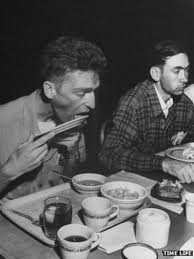
The Minnesota Experiment explored the physical impacts of hunger in depth, but also studied the effects on attitude, cognitive and social functioning and the behaviour patterns of those who have experienced semistarvation. The experiment highlighted a marked loss of ambition, self-discipline, motivation and willpower amongst the subjects once food deprivation commenced. There was a marked flattening of affect, and in the absence of other emotions, Doctor Ancel Keys observed the resignation and submission that hunger manifests.

The understanding that food deprivation dramatically alters emotions, motivation, personality and that nutrition directly and predictably affects the mind as well as the body is one of the legacies of the experiment.

The experiment highlighted very clearly that there’s a striking sense of immediacy and fixation that arises when there are barriers to fulfiling basic physical needs – human motivation is frozen to meet survival needs, which take precedence over all other needs. This is observed and reflected in both the researcher’s and the subject’s accounts throughout the study. If a person is starving, the desire to obtain food will trump all other goals and dominate the person’s thought processes.

In a nutshell, this means that if people can’t meet their basic survival needs, it is extremely unlikely that they will have either the capability or motivation to meet higher level psychosocial needs, including social obligations and responsibilities to seek work. Abraham Maslow’s humanist account of motivation also highlights the same connection between fundamental motives and immediate situational threats.

Ancel Keys published a full report about the experiment in 1950. It was a substantial two-volume work titled The Biology of Human Starvation. To this day, it remains the most comprehensive scientific examination of the physical and psychological effects of hunger.

Keys emphasised the dramatic effect that semistarvation has on motivation, mental attitude and personality, and he concluded that democracy and nation building would not be possible in a population that did not have access to sufficient food.

I also explored the link between deprivation and an increased risk of mental illnesses, including schizophrenia, depression, anxiety and substance addiction. Poverty can act as both a causal factor (e.g. stress resulting from poverty triggering depression) and a consequence of mental illness (e.g. schizophrenic symptoms leading to decreased socioeconomic status and prospects).

Poverty is a significant risk factor in a wide range of psychological illnesses. Researchers recently reviewed evidence for the effects of socioeconomic status on three categories: schizophrenia, mood and anxiety disorders and substance abuse. Whilst not a comprehensive list of conditions associated with poverty, the issues raised in these three areas can be generalised, and have clear relevance for policy-makers.

The researchers concluded: “Fundamentally, poverty is an economic issue, not a psychological one. Understanding the psychological processes associated with poverty can improve the efficacy of economically focused reform, but is not a panacea. The proposals suggested here would supplement a focused economic strategy aimed at reducing poverty.” (Source: A review of psychological research into the causes and consequences of poverty – Ben Fell, Miles Hewstone, 2015.)

There is no evidence that keeping benefits at below subsistence level or imposing punitive sanctions “incentivises” people to work and research indicates it is likely to have the opposite effect. In 2010/2011 there 61,468 people were given 3 days emergency food and support by the Trussell Trust and this rose to 913,138 people in 2013-2014.

Hanna, Gabriel Kreindler, and Benjamin Olken re-analyzed data from seven randomized experiments evaluating cash programs in developing countries and found “no systematic evidence that cash transfer programs discourage work.”

The phrase “welfare dependency” purposefully diverts us from political prejudice, discrimation via policies and disperses public sympathies towards the poorest citizens.

Conservative claims about welfare sanctions are incommensurable with reality, evidence, academic frameworks and commonly accepted wisdom. It’s inconceivable that this government have failed to comprehend that imposing punishment in the form of financial sanctions on people who already have very limited resources for meeting their basic survival needs is not only irrational, it is absurdly and spectacularly cruel.

Minnes

 The Minnesota semistarvation experiment

This is a summary of a much longer, detailed piece of research and review work about welfare sanctions. You can see the original here

Further study of the impact of food deprivation and starvation on psychological and cognitive deterioration: The Psychological Effects of Starvation in the Holocaust

Cognitive function deficits and demotivation associated with food deprivation and hypoglycaemia: Blood glucose influences memory and attention in young adults

Nutritional deficiencies and detrimental consequences for mental health: Nutrition and mental health

A comprehensive study of the detrimental impacts of food insecurity on the development, behaviour, mental health and wellbeing, learning, educational attainment, citizenship and physical health of children in America: Child Food Insecurity: The Economic Impact on our Nation

Comprehensive computerized assessment of cognitive sequelae of a complete 12-16 hour fast

The Minnesota food deprivation experiment also established a link between food insecurity and deprivation and later unhealthful eating practice, eating disorders and obesity: Journal of the American Dietetic Association


Jeremy Corbyn confronted the Tories with the poverty they’re creating at PMQs – and all they could do was laugh – Liam Young

Originally published in the Independent by Liam Young.

jeremy-corbyn-1
The Tories seem to forget that they were the last government – at some point they will have to take responsibility for their handling of the nation.

As Jeremy Corbyn stood for his second PMQs today, the mocking Tory laughs told us everything we need to know about their enduring Bullingdon Club-style politics. Old habits die hard, it seems. But Corbyn opened strongly, with an issue that unites the Labour party: the cuts to working tax credits which penalise the lowest earners, known colloquially as the Tory work penalty.

Again, the Tories laughed at the name ‘Kelly’, so apparently unbelievable do they find the first names of Corbyn’s constituents; they soon fell silent, however, as they heard of her struggle as the mother of a disabled child earning minimum wage in a 40.5-hour-per-week job. Corbyn tackled the bullyboys by pausing at their laughter this time. ‘Some may find this funny,’ he said, as he continued to talk about mass inequality and the housing problem in London. It was a subtle highlight of something glaringly obvious: for millionaires protected by Tory policies, inequality bolstered by unfair taxes and buy-to-let properties really is hilarious.

Cameron’s reply to the work penalty issue was the same old line: apparently a £20-a-week increase in wages will magically solve the problem. This is not true, of course, as Corbyn promptly replied: working families are set to be £1,300 a year worse off as the Conservative government hammers the working and middle classes so as to give to the super rich.

Cameron claimed that Corbyn’s figures on poverty were wrong, but perhaps that is something to do with the fact that the Work and Pensions Secretary fixed the definition of ‘poverty’ recently. You don’t feed and clothe homeless children by changing a definition, and the government should be ashamed. The fact that 50 per cent of wealth is in 1 per cent of hands globally is shambolic, and reports today that inequality is growing in the UK even as our country now has the third most ‘ultra-high net worth individuals’ in the world put paid to Cameron’s claims to have driven opportunity. There could be no bigger proof that his policies continue to squeeze the middle and punish the poor.

Jeremy Corbyn probably had a headache even before PMQs started. George Osborne’s proposal of a ‘fiscal charter’ has been causing problems for Labour over the last few days, not least because it was once a Labour policy rubbished by Cameron himself. It seems strange, then, that Tories are so desperate to implement it now, considering that the Governor of the Bank of England has not endorsed its proposal and no economist has come out in support of it. Most commentary has focused on how it is unrealistic to try and tie the hands of future governments – almost as though Osborne is trying to make an ideological (and erroneous) point about how Labour ‘caused the recession by their overspending’, rather than the truth about rich bankers running wild without regulation. Of course, it also gave Osborne an excellent opportunity to personally ask Labour MPs to rebel – little more than a cynical attempt to ruffle some feathers.

In June, over 70 economists published a letter that clearly noted that the charter has ‘no basis in economics’ and that permanent surplus would increase the debt of households and businesses. The policy is not about protecting the British economy; it is an attempt to bury the Labour party under the same message of the last government. The Tories seem to forget that they were the last government – they have been in power now for almost six years, and at some point they will have to take responsibility for their handling of the nation.

Despite all this, PMQs today were the best moment of Corbyn’s leadership of the Labour party so far. Osborne’s attempt to destabilise the Labour party and force Labour MPs to rebel spectacularly failed, while Corbyn asked if he could bring the Prime Minister back to reality as Tory rhetoric failed against his grassroots facts.

Cameron wants to get Britain building houses, he wants to alleviate poverty, and he wants to rebuild the economy – or so he’d have you believe. In the last five years, house-building has stalled, poverty has increased, inequality appears to be rising and the national debt has doubled. At some point, the Tories have to stop blaming Labour for their own disastrous record. Corbyn is now attacking their mythology head-on – and he might just be getting somewhere. 

Liam Young is a freelance political journalist studying international relations at the LSE

Stigmatising unemployment: the government has redefined it as a psychological disorder

proper Blond

The current government has made the welfare system increasingly conditional on the grounds that “permissive” welfare policies have led to welfare “dependency.” Strict behavioural requirements and punishments in the form of sanctions are an integral part of the Conservative ideological pseudo-moralisation of welfare, and their  “reforms” aimed at making claiming benefits much less attractive than taking a low paid, insecure, exploitative job.

Welfare has been redefined: it is preoccupied with assumptions about and modification of the behaviour and character of recipients rather than with the alleviation of poverty and ensuring economic and social wellbeing.

The stigmatisation of people needing benefits is designed purposefully to displace public sympathy for the poor, and to generate moral outrage, which is then used to further justify the steady dismantling of the welfare state.

But the problems of austerity and the economy were not caused by people claiming welfare, or by any other powerless, scapegoated, marginalised group for that matter, such as migrants. The problems have arisen because of social conservatism and neoliberalism. The victims of this government’s policies and decision-making are being portrayed as miscreants – as perpetrators of the social problems caused by the government’s decisions, rather than as the casualities.

And actually, that a recognisable bullying tactic known as projection, (the vehicle for projection is blame, criticism and allegation), as is scapegoating.

The 2015 budget included plans to provide online Cognitive Behaviour Therapy to 40,000 claimants and people on the Fit for Work programme, as well as putting therapists in more than 350 job centres.

I wrote an article in March about the government plans to make the receipt of social security benefits conditional on undergoing “state therapy.” I raised concern about ethical issues – such as consent, the inappropriateness of using behaviour modification as a form of “therapy,” and I criticised the proposed Cognitive Behaviour Therapy (CBT) programme on methodological and theoretical grounds, as well as considering wider implications.

I’ve written at length about the coercive and punitive nature of the conservative psychopolicy interventions, underpinning the welfare “reforms,” and giving rise to increased welfare “conditionality” and negative sanctions.

In particular, I’ve focussed on the influence of the Cabinet’s Behavioural Insights Team or “nudge unit” and “the application of behavioural science and psychology to public policy. (See: The nudge that knocked down democracy, The power of positive thinking is really political gaslighting, and Despotic paternalism and punishing the poor. Can this really be England? )

I was pleased to see that the BBC reported a summary of the research findings of Lynne Friedli and Robert Stearn, which was supported by the Wellcome Trust. The report – Positive affect as coercive strategy: conditionality, activation and the role of psychology in UK government workfare programmes reflects many of the concerns raised by other professionals. I strongly recommend you read it. (See: Psychologists Against Austerity: mental health experts issue a rallying call against coalition policies.)

The BBC summarised from the report that benefit claimants are being forced to take part in “positive thinking” courses in an effort to “change their personalities.” Those people claiming benefits that do not exhibit a “positive” outlook must undergo “reprogramming” or face having their benefits cut. This is humiliating for job seekers and does not help them find suitable work.

New benefit claimants are interviewed to find out whether they have a “psychological resistance” to work, with those deemed “less mentally fit” given more “intensive coaching.”

And unpaid work placements are increasingly judged on psychological results, such as improved motivation and confidence, rather than whether they have led to a job.

The co-author of the report, Lynne Friedli, describes such programmes, very aptly, as “Orwellian.” She says:

“Claimants’ ‘attitude to work’ is becoming a basis for deciding who is entitled to social security – it is no longer what you must do to get a job, but how you have to think and feel.

“This makes the government’s proposal to locate psychologists in job centres particularly worrying.

“By repackaging unemployment as a psychological problem, attention is diverted from the realities of the UK job market and any subsequent insecurities and inequalities it produces.”

Friedli also criticised the way psychologists were being co-opted as “government enforcers” and called on professional bodies to denounce the practice.

Quite rightly so. It’s our socio-economic system, and the ideologues who shape it that present the problems, not the groups of people forced to live in it as its casualities – the “collateral damage” of neoliberalism and social conservatism.

“I don’t think anything can justify forced psychological coercion. If people want to go on training courses that should be entirely voluntary,” Lynne told BBC News.

She also questioned the aim of the motivational courses and welfare-to-work placements, which felt like “evangelical” self-help seminars.

“Do we really want a world where the only kind of person considered employable is a ‘happy clappy’, hyper-confident person with high self-esteem?

“That is a very a narrow set of characteristics. There is also a role in the workplace for the ‘eeyore’ type.”

Absolutely. Frankly, I would rather have health and safety programmes that are designed by a pessimist, capable of thinking of the worst case scenario, for example, than by a jolly, positively biased, state-coerced optimist.

I would also prefer pessimistic appraisal of social policies. That way, we may actually have impact assessments carried out regarding the consequences of Conservative policies, instead of glib, increasingly Orwellian political assurances that are on the other, more scenic, illusory side across the chasm from social realities.

Although pessimism and depression are considered to be affective disorders, in a functional magnetic resonance imaging study of the brain, depressed patients were shown to be more accurate in their causal attributions of positive and negative social events, and in self assessments, and assessment of their own performance of tasks, than non-depressed participants, who demonstrated a positive bias.

As a former community-based psychosocial practitioner who saw the merits and value of a liberationist model, the question that needs to be asked is: for whose benefit is CBT being used, and for what purpose? Seems to me that this is about helping those people on the wrong side of punitive government policy to accommodate that, and to mute negative responses to negative situations.

The socially dispossessed are being coerced by the state, part of that process is the internalisation of the negative images of themselves created and propagated by their oppressors.

CBT is not based on a genuinely liberational approach, nor is it based on any sort of democratic dialogue. It’s all about modifying and controlling behaviour, particularly when it’s aimed at such a narrow, politically defined and specific outcome.

The problem that we need to confront is politically designed and perpertuated social injustice, rather than the responses and behaviour of excluded, stigmatised individuals in politically oppressed, marginalised social groups.

CBT is founded on blunt oversimplifications of what causes human distress – for example, in this case it is assumed that the causes of unemployment are psychological rather than socio-political, and that assumption authorises intrusive state interventions that encode a Conservative moral framework which places responsibility on the individual, who is characterised as “faulty.”

However, democracy is based on a process of dialogue between the public and government, ensuring that the public are represented: that governments are responsive, shaping policies that address identified social needs. Conservative policies are quite clearly no longer about reflecting citizen’s needs: they are increasingly about telling us how to be.

As I have said elsewhere, as well as aiming at shaping behaviour, the psycho-political messages being disseminated are all-pervasive, entirely ideological and not remotely rational: they reflect and are shaping an anti-welfarism that sits with Conservative agendas for neoliberal welfare “reform”, austerity policies, the small State (minarchism) and also legitimises them. (I’ve written at length elsewhere about the fact that austerity isn’t an economic necessity, but rather, it’s a Tory ideological preference.) The Conservatives are traditional, they are creatures of habit, rather than being responsive and rational.

Conservative narratives, amplified via the media, have framed our reality, stifled alternatives, and justified Tory policies that extend psychological coercion including through workfare; benefit sanctions; in stigmatising the behaviour and experiences of poor citizens and they endorse the loss of autonomy for citizens who were disempowered to begin with.

Many of the current ideas behind “reforming” welfare come from the Behavioural Insights  Team – the Nudge Unit at the heart of the Cabinet. Nudge theory has made Tory ideology, with its totalitarian tendencies, seem credible, and the Behavioural Insights Team have condoned, justified and supported punitive, authoritarian policies, with bogus claims about “objectivity” and by using discredited pseudoscience. Those policies have contravened the human rights of women, children and disabled people, to date.

Nudge-based policy is hardly in our “best interests,” then.

526544_532055030197363_2137237288_n
Pictures courtesy of Robert Livingstone


I don’t make any money from my work. I am disabled because of illness. But you can contribute by making a donation and help me continue to research and write informative, insightful and independent articles, and to provide support to others.

The smallest amount is much appreciated – thank you.

DonatenowButton

The UK is now the most unequal country in EU, and Cameron has been very conservative with the truth

tory lies

Last year I wrote an article – Cameron’s Gini and the hidden hierarchy of worthand I said: On 04 June, 2014, at 3.52pm BST, Cameron said that inequality is at its lowest level since 1986. I really thought I’d misheard him. But of course Cameron lies, that’s an established fact.

This isn’t the first time Cameron has used this lie. We have a government that provides disproportionate and growing returns to the already wealthy, whilst imposing austerity cuts on the very poorest. How can such a government possibly claim that inequality is falling, when inequality is so fundamental to their ideology and when social inequalities are extended and perpetuated by all of their policies? It seems the standard measure of inequality is being used to mislead us into thinking that the economy is far more “inclusive’ than it is.

A newly published report by the Dublin-based Foundation for the Improvement of Living and Working Conditions (Eurofound) states that the UK has become the most unequal country in Europe, on the basis of income distribution and wages.

The report also says that the UK has the highest Gini coefficient of all European Union (EU) member states – and higher than that of the US. The coefficient is a widely used measure of the distribution of income within a nation, and is commonly used to calculate inequality.

According to analysts at Eurofound, Britain has a Gini coefficient of 0.404, whilst that of the US is 0.4. Portugal and Latvia followed the UK with Gini coefficients of 0.358 and 0.357, respectively. The average Gini index for the EU as a whole in 2011 was 0.346.

Eurofound was established in 1975 to contribute to the planning and design of improved living and working conditions. This role is undertaken in partnership with governments, employers, trade unions and the European Union institutions.

The report says that there was a decrease in inequality before the global crisis that was entirely due to a significant reduction in between-country wage differentials (in other words, a process of convergence in pay levels – see: Labour’s excellent record on poverty and inequality – which came to a halt, reflecting the effects of the global crash, in 2008, and then started to reverse towards the end of the period of this analysis, in 2011.

My friend, the British economist Michael Burke, observed that  Eurofound’s study demonstrates the previous claims by David Cameron that Britain’s economy is recovering from the recession were false.

Speaking to RT on Tuesday, Mr Burke said: “The Tory government is fond of making spurious claims about Britain being the strongest economy in Europe. But the reality is that Britain under the Tories is the European capital of inequality.”

All of the deterioration in the Gini coefficient in the EU is caused by the worsening of inequality,” he added.

The jobs machine that David Cameron [is referring to] is in reality low-paid jobs, many of them providing unproductive services to the ultra-rich.”

The UK now has the worst Gini coefficient in the EU. Gini is the most widely accepted measure of how fairly income is distributed amongst a nation’s residents and is the standard measure of inequality. Cameron, parroting Thatcher, has claimed that there is no such thing as “public money,” indicating clearly that the economic enclosure that was initiated by the Tories under the guise of austerity, affecting the poorest citizens most of all, but leaving the wealthy unaffected by cuts, is going to be permanent.

A YouGov survey conducted this month and published on Monday found that most voters in the UK believe the government should prioritize tackling inequality – reducing the gap between rich and poor – over faster economic growth.

The findings, which suggest strong public support for redistribution, will complicate the debate about precisely how the Labour Party lost the general election, particularly given the Labour manifesto, outlining strongly redistributive and progressive tax policies, which had disgruntled a number of super petulant super-rich celebrities, who threatened to flounce from the UK if Labour gained office.

YouGov found that of the main parties, only Conservative supporters were significantly more likely to care about economic growth than inequality. Bearing in mind that Cameron won with 36.9% of the vote, the considerable gap between the priorities of Conservatives and those of the other parties will most likely mean a difficult five years for the prime minister.

With homelessness increasing by 55% between 2010 and 2014, whilst food bank use has surged, malnutrition and absolute poverty, not seen in this country since before the inception of the welfare state, are becoming more commonplace, and with more draconian cuts planned by the Tories for the already diminished and essential support for the poorest – many of whom are in low waged work – it’s going to be an extremely punishing five years for those already at the poorest end of the UK’s steeply hierarchical society.

Last year, I wrote about the study from the Organisation for Economic Co-operation and Development (OECD), who found what most of us already knew: that income inequality actually stifles economic growth in some of the world’s wealthiest countries, whilst the redistribution of wealth via taxes and benefits encourages growth.

The report from the OECD, a leading global think tank, shows basically that what creates and reverses growth is the exact opposite of what the current right-wing government are telling us, highlighting the truth of Ed Miliband’s comments in his speech – that the Tory austerity cuts are purely ideologically driven, and not about managing the economy at all.

But many of us already knew this was so.

1459720_569627496440116_902730897_nPictures courtesy of Robert Livingstone

Inflicting suffering on those in need is now at the heart of our benefits system – Frances Ryan

430847_149933881824335_1645102229_n (1)The main part of this article was originally published in the Guardian on 10 March and was written by Frances Ryan.

I tend to think I am beyond shock at the actions of the Department for Work and Pensions (DWP) now. The expectation that this government is capable of morality or even basic competence was lost some time ago, somewhere between enacting policy that pushes people already in poverty into losing their homes and denying deaf, blind eight-year-olds disability benefits. Still, Dispatches’ Benefits Britain investigation was painful viewing.

During seven weeks of undercover work at a universal credit contact centre in Bolton, Channel 4 journalists witnessed a farcical mess of centralised IT failure. But what really stood out were the underhand tactics DWP staff were found to use against claimants: from deliberately withholding hardship payments from people struggling after having their benefits sanctioned, to hiding the flexible fund put in place to pay for clothes or a bus fare they needed to help them get a job.

What Dispatches showed is not an isolated incident, a black spot polluting an otherwise untarnished record. It is an example of both attitude and action that runs through the entire system: the growing conditionality on benefits, the withholding of emergency help, all the way back to how benefits are assessed.

As of last week, there is quantitative evidence that the notorious fit-for-work tests are inflicting damage to disabled people’s bodies (not to mention the impact on their minds). Yes, we have now reached a point where the benefit system is making disabled and chronically ill people sicker. Over 60% of disabled people going through the work capability assessment – designed by the DWP and sold off to private firms – report being in pain afterwards. Others said their condition was made worse or their recovery delayed. One claimant surveyed, who has progressive rheumatoid arthritis, said she left her appointment “feeling absolutely awful and suffered a lot of pain in the following days.” She went on to have a stroke a few weeks later.

It might be worth remembering that this is an assessment that is meant to help people – one million people are due to go through the process this year – if only because those orchestrating it appear to have forgotten. It is the same cavalier attitude to the vulnerable that means claimants have killed themselves after being spat out by the benefit system, as if desperation and distress means nothing.

We are sliding back to the notion that suffering helps the soul, that the underclass – be it the unemployed, the disabled, or chronically ill – need to be trained in order to behave. And, as almost a secondary consequence, their punishment cuts the welfare bill down. A bonus all round.

The ideology of a small state or the belief that benefits build dependency are crass, irrelevant details to what at its core is simply a decision about how to treat a human being. This is particularly damning when one person has all the power and the other is forced through economic necessity to take whatever humiliation or pain they are given. To do that to someone – let alone hundreds of thousands – is no accident. It is a conscious decision, that has been made over and over again by this government.

scroll2I wrote this last year:

Here are two articles about the terrible, extremely harsh and punitive consequences of the governments’ historically regressive, ethically challenging benefit sanctions regime. This is a very cruel and limited application of operant conditioning: the government are applying punishment to vulnerable people who need the support of lifeline benefits to meet their fundamental survival needs, under the guise of “paternalistic libertarianism.”

The punishments are applied most frequently to the most vulnerable people. Our welfare system was designed to support people, but under the Tory-led Coalition, it has been transformed into an administration that is run on unethical principles, akin to the Milgram experiment, with the difference that the punishments used are real, and decisions to punish welfare claimants are resulting in very real and terrible consequences.

It’s a biological fact that when people cannot meet their basic survival needs – food, fuel and shelter – they will die. Everybody understands this, no matter how well-insulated by personal wealth they may be.

The government understands this.

The welfare “reforms” are harming people, and are causing deaths. Full article – Benefit sanctions are not fair and are not helping people into work.

Related

Aktion Arbeitsscheu Reich, Human Rights and infrahumanisation

Techniques of neutralisation – a framework of prejudice

Cameron’s Nudge that knocked democracy down – a summary of the implications of Nudge theory


385294_195107567306966_1850351962_nThanks to Robert Livingstone for the memes.


Cameron’s Nudge that knocked democracy down – a summary of the implications of Nudge theory

Democracy is based on a process of dialogue between the public and government, ensuring that the public are represented: that governments are responsive, shaping policies that address identified social needs. However, Coalition policies are no longer about reflecting citizen’s needs: they are all about telling us how to be.

The idea of libertarian paternalism was popularised around five years ago by the legal theorist Cass Sunstein and the behavioral economist Richard Thaler, in their bestselling book Nudge. Sunstein and Thaler argue that policymakers can preserve an individual’s liberty whilst still nudging a person towards choices that are supposedly in their best interests. But who nudges the nudgers? Who decides what is in our “best interests”? That would be the government, of course.

Nudge philosophy is dressed-up as libertarian paternalism, which in turn dresses-up Tory ideology. Another phrase the authors introduced was “choice architecture”, a concept implying that the State can be the architect that arranges personal choice in way that nudges consumers in the right direction.

The direction is towards a small state, with nothing but behavioural “incentives” to justify forcing  citizens who have needs to be “responsible” and “self-sufficient,” achieving this presumably by paying taxes and then pulling themselves up strictly by their own bootstraps. It’s the new nothing for something culture.

Behavioural economics is actually founded on crude operant conditioning: it marks the return of a psycho-political theory that arose in the mid-20th century, linked with behaviourism. Theorists from this perspective generalise that all human behaviour may be explained and described by a very simple reductive process: that of Stimulus – Response. There is no need, according to behaviourists, to inquire into human thoughts, beliefs or values, because we simply respond to external stimuli, and change our automatic responses accordingly, like automatons or rats in a laboratory. Nudge theorists propose that we are fundamentally irrational, and that our decision-making processes are flawed because of “cognitive biases.” Nudge theory therefore bypasses any engagement with our deliberative processes.

Formally instituted by Cameron in September 2010, the Behavioural Insights Team, (also known as the Nudge Unit) which is a part of the Cabinet  Office,  is made up of people such as David Halpern, who is also a part of Cameron’s “Big Society” campaign. He co-authored the Cabinet Office report:  Mindspace: Influencing Behaviour Through Public Policy, which comes complete with a cover illustration of the human brain, with an accompanying psycho-babble of words such as “incentives”, “habit’, “priming” and “ego.” It says the report “addresses the needs of policy-makers.”  Not the public.

The behaviourist educational function made explicit through the Nudge Unit is now operating on many levels, including through policy programmes, forms of “expertise”, and through the State’s influence on the mass media, other cultural systems and more subliminally, it’s embedded in the very language that is being used.

Education is a dialogic process, with consenting, willing participants. Even compulsory education involves consent and dialogue – children are engaged in the process. What the Nudge Unit is doing is not engaging in the least, nor is it done with our consent: we are being acted upon. Not as inquiring subjects, but as passive objects.

At the heart of every Coalition policy is a “behaviour modification” attempt, promoted by the influential Nudge Unit and based on the discredited, pseudo-scientific behaviourism, which is basically just about making people do what you want them to do, using a system of punishments and reinforcements. Once you see it, you can’t unsee it.

At the same time, as well as shaping behaviour, the messages being given loud and clear are all-pervasive, entirely ideological and not remotely rational: they reflect and are shaping an anti-welfarism that sits with Conservative agendas for welfare “reform”, “austerity policies” the small State (minarchism) and also legitimises them.

Nudge has made Tory ideology seem credible, and the Behavioural Insights Team have condoned, justified and supported punitive, authoritarian policies, with bogus claims about “objectivity” and by using discredited pseudo-science. Those policies have contravened the human rights of women, children and disabled people, to date. Nudge is hardly in our “best interests,” then.

Coalition narratives, amplified via the media, have framed our reality, stifled alternatives, and justified Tory policies that extend psychological coercion  including through workfare; benefit sanctions; in stigmatising the behaviour and experiences of poor citizens and they endorse the loss of autonomy for citizens who were disempowered to begin with.

A summary of the main influences outlined in the MINDSPACE framework

All of these basic ideas are being utilised to uphold Conservative ideology, to shape Conservative policies and justify them; to deploy justification narratives through the mass media, in schools and throughout all of our other social institutions.

For example, incentives being linked to the mental “shortcut” of strongly avoiding losses shows us precisely where the Tories imported their justification narrative for the welfare cuts and benefit sanctions from. What the government calls  “incentivising” people by using systematic punishments translates from Orwellian Doublespeak to “bullying” in plain language.

“We act in ways that make us feel better about ourselves” – norms, committments, affect, ego are all contributing to Tory rhetoric, lexical semantics and media justification narratives that send both subliminal and less subtle, overt messages about how poor and disabled people ought to behave.

This is political micro-management and control, and has nothing to do with alleviating poverty. Nor can this ever be defined as being in our “best interests.”

There’s an identifiable psychocratic approach to Conservative policy-making that is aimed at the poorest. Whilst on the one hand, the Tories ascribe deleterious intrinsic motives to rational behaviours that simply express unmet needs, such as claiming benefit when out of work, and pathologise these by deploying a narrative with subtextual personality disorder labels, such as scrounger, skiver and the resurrected Nazi catch-all category for deemed miscreants: work-shy, the Tories are not at all interested in your motivations, attitudes, thoughts, hopes and dreams. They are interested only in how your expectations and behaviour fits in with their intent to reduce the State to being a night-watchman – but it watches out only for the propertied class.

Behaviourism was discredited and labelled “pseudoscience” many decades ago, (very memorably by Noam Chomsky, amongst others). Most psychologists and cognitive scientists don’t accept that myriad, complex human behaviours are determined by and reducible to nothing more than an empty stimulus/response relationship; our deeds and words merely a soulless, heartless and mindless cause and effect circuit.

There are serious political ramifications regarding the application of  behaviourism to an unconsenting public. Firstly, that in itself is undemocratic. Skinner was clearly a totalitarian thinker, and behaviour modification techniques are the delight of authoritarians. Behaviourism is basically a theory that human and animal behaviour can be explained in terms of conditioning, without appeal to consciousness, character, traits, personality, internal states, intentions, purpose, thoughts or feelings, and that psychological disorders and “undesirable” behaviours are best treated by using a system of reinforcement and punishment to alter behaviour “patterns.”

Most psychologists and cognitive scientists don’t endorse behaviourism. Democracy involves governments that shape themselves in response to what people need and want, not about people who reshape their lifestyles in response to what the government wants.

Democracy is meant to involve the formulation of a government that reflects public’s needs. Under the new nudge tyranny that is turned totally on its head: instead the government is devising more and more ways to put pressure on us to change. We elect Governments to represent us, not to manipulate us covertly.

Nudge is actually about bypassing rationality and reason, political accountability and transparency – democratic process, critical debate. The government are substituting those with manipulation, coercion, and an all-pervasive psycho-political experiment.

This was taken from a longer piece, here’s the full articleCameron’s Nudge that knocked democracy down: mind the Mindspace.

Cameron’s Nudge that knocked democracy down: mind the Mindspace.

tumblr_m81dzafFA21qcekj1o1_500
There is an extremely anti-democratic design becoming increasingly evident in policies being formulated by the Coalition, which is aimed at protecting the interests of the very wealthy; at stifling debate, challenges and opposition; permitting political and corporate corruption whilst obscuring it; restricting access to justice for victims of government and corporate corruption and oppression; removing accountability and transparency. There is a detachment of policies from wider public needs and interests. Instead, policies are all about instructing us how to behave.

It’s only a matter of time before the new behavioural economics and so-called science of nudging decision-making is applied to influencing the population’s voting behaviour as well.

Free-will, determinism and bounded rationality in decision-making: implications for democracy

One of our fundamental freedoms, as human beings, is that of decision-making regarding our own lives and experiences. To be responsible for our own thoughts, reflections, intentions and actions is generally felt to be an essential part of what it means to be human.

Of course there are social and legal constraints on some intentions and actions, especially those that may result in harming others, and quite rightly so.

There are other constraints which limit choices, too, insofar that choices are context-bound. We don’t act in an infinite space of opportunities, alternatives, time, information, nor do we have limitless cognitive abilities, for example.

In other words, there are always some limitations on what we can choose to do, and we are further limited because our rationality is bounded. Most people accept this with few problems, because we are still left ultimately with the liberty to operate within those outlined parameters, some of which may be extended to a degree – rationality, for example. But our thoughts, reflections, decisions and actions are our own, held within the realm of our own individual, unique experiences.

However, the government have employed a group of behavioural economists and “decision-making psychologists” who claim to have found a “practical” and (somehow) “objective way” from the (impossible) perspective of an “outside observer” – in this case, the government – to define our best interests and to prompt us to act in ways that conform to their views. Without our consent.

But democracy is based on a process of dialogue between the public and government, ensuring that the public are represented: that governments are responsive, shaping policies that address identified social needs. However, Coalition policies are no longer about reflecting citizen’s needs: they are all about telling us how to be.

The ideas of libertarian paternalism were popularised around five years ago by the legal theorist Cass Sunstein and the behavioral economist Richard Thaler, in their bestselling book Nudge. Sunstein and Thaler argue that policymakers can preserve an individual’s liberty whilst still nudging a person towards choices that are supposedly in their best interests.

But who nudges the nudgers? Who decides what is in our “best interests”?

That would be the government, of course. Thaler, who studied the psychology of decision-making, drawing on the exploitation of “cognitive bias” and techniques of persuasion that have until now been used only by the advertising industry, claims that we are fundamentally irrational. But according to Professor Thaler, we would “all invest in the stock market if we were rational.”  That’s a rather unique and remarkably narrow definition.

I wonder if he bothered asking everyone about that. I imagine that if he gets his way, university entrance criteria will change forever. Mind you, so will ideas about human diversity. There seems to be a lot of emphasis on social conformity, directed from the Conservative Cabinet office.

Nudge has become a prop for neoliberal hegemony and New Right Conservative ideology. It’s become a technocratic fix – pseudo-psychology that doubles up as “common sense”, aimed at maintaining the socioeconomic order.

Another phrase the authors introduced was “choice architecture”, a concept implying that the State can be the architect that arranges personal choice in way that nudges consumers in the right direction. It seems that even policies have been commodified. Poor people get bargain basement “incentives” to work harder by having their income reduced, while millionaires get the deluxe model incentives, entailing massive tax cuts and exemptions, all handed out from public funds. 

The “right” direction is towards a small State, with nothing but behavioural “incentives” to justify forcing citizens who have needs to be “responsible” and “self-sufficient,” achieving this presumably by paying taxes and then pulling themselves up strictly by their own invisible bootstraps. It’s the government’s new nothing for something culture, specifically for those who fall on hard times.

The pseudo-psychological framework

Behavioural Economics is actually founded in part on crude operant conditioning: it marks the return of a psychopolitical theory that arose in the mid-20th century, which was linked to behaviourism Advocates of this perspective generalised that all human behaviour may be explained and described by a very simple reductive process: that of Stimulus–Response. There is no need, according to behaviourists, to inquire into human thoughts, feelings, beliefs or values, because we simply respond to external stimuli, and change our automatic responses accordingly, like automatons or rats in a laboratory.

In the Coalition agreement, there is mention of “finding intelligent ways to encourage people to make better choices for themselves. David Halpern, an apparently adaptable, very pro-business behavioural economist, also plays a role in David Cameron’s Big Society project. In 2010, the entire Cabinet were impressed with Nudge, and it quickly became required reading for ministers and civil servants. 

The Guardian casually reported that Nick Clegg said he believed the new Behavioural Insights Team could “change the way citizens think.” What is particularly shocking is that the comment elicited no shock whatsoever. (The very idea of a group of right-wing authoritarians that recognise human worth only in terms of money, covertly influencing my behaviour, and that of everyone else, quite frankly appalls me.)

Formally instituted by Cameron in September 2010, the Behavioural Insights Team, which is a part of the Cabinet Office, is made up of people such as David Halpern, who co-authored the Cabinet Office report: Mindspace: Influencing Behaviour Through Public Policy, which comes complete with a cover illustration of the human brain, with an accompanying psychobabble of decontextualised words such as “incentives”, “habit’, “priming” and “ego.” It’s a lot of inane managementspeak. However, the ideas behind the corporate jargon are providing a framework of experimental and often controversial policy-making on an unsuspecting public.

The report addresses the needs of policy-makers. Not the public. The behaviourist educational function made patronisingly explicit through the Nudge Unit is now operating on many levels, including through policy programmes, forms of “expertise”, and through the State’s influence on the mass media, other cultural systems and at a subliminal level: it’s embedded in the very language that is being used in political narratives.

Tory ideology is extended under the misleading  label of libertarian paternalism, which is all about shaping our behaviour, by offering “choice architecture”, that reduces public choices to “Choice.” At the heart of every Coalition welfare policy is a behaviour modification attempt, promoted by the influential Nudge Unit and founded on the discredited, pseudoscientific behaviourism, which is basically just about making people do what you want them to do, using a system of punishments and reinforcements. Once you see it, you can’t unsee it.

At the same time, as well as shaping behaviour, the psychopolitical messages being disseminated are all-pervasive, entirely ideological and not remotely rational: they reflect and are shaping an anti-welfarism that sits with Conservative agendas for welfare “reform”, austerity, the “efficient”small State (minarchism) and also legitimizes them. (I’ve written at length elsewhere about the fact that austerity isn’t an economic necessity, but rather, it’s a Tory ideological preference.)

The Conservatives are traditional, they are creatures of habit, rather than being responsive and rational. Coalition narratives, amplified via the media, have framed our reality, stifled alternatives, and justified Tory policies that extend psychological coercion, including through workfare; benefit sanctions; in stigmatizing the behaviour and experiences of poor citizens, and they endorse the loss of autonomy for citizens who were disempowered to begin with.

Nudge theory has made Tory ideology seem credible, and the Behavioural Insights Team have condoned, justified and supported punitive, authoritarian policies, with bogus claims about “objectivity” and by using inane, meaningless acronyms to spell out a pseudoscientific neuroliberalism and to peddle made-up nonsense founded on the whopping, extensive cognitive biases of paternalist libertarians. Most of the nudge unit is comprised of behavioural economists, who are basically peddling the kind of techniques of persuasion that were usually reserved for the dubious end of the advertising industry. This is not “social psychology”, nor is it in any way related to any legitimate social science discipline. However, the creep of behaviourism into nudge based “interventions” is cause for considerable concern.

This government’s policies have contravened the human rights of women, children and disabled people, to date. Nudge is hardly in our “best interests,” then. 

The Coalition aren’t engaging with us democratically, they are simply nudging us into compliance with how they think the UK ought to be. We need to ask, in a democracy, where do behavioural economists, policymakers and Tories gain the moral authority to manipulate people’s behaviour? Governments ought to be about supporting people in realising their aspirations, not about changing those aspirations so that they correspond to the worldview of the “choice architects.”

Nudge application: irrationality and ideological justification

Here’s a recent example of choice architecture being “rearranged.” Iain Duncan Smith said recently that limiting child benefit to the first two children in a family is well worth considering and could save a significant amount of money. The idea is being examined by the Conservatives, despite previously being vetoed by Downing Street because of fears that it could alienate parents. Asked about the idea on the BBC’s Sunday Politics programme, Duncan Smith said:

“I think it’s well worth looking at,” he said. “It’s something if we decide to do it we’ll announce out. But it does save significant money and also it helps behavioural change.”

Firstly, this is a clear indication of the Tories’ underpinning eugenicist designs – exercising control over the reproduction of the poor, albeit by stealth. It also reflects the underpinning belief that poverty somehow arises because of faulty individual choices, (as opposed to faulty political decision-making and ideologically driven socioeconomic policies), that those choices are non-rational, stereotypical, and that reducing cost to the State involves making people change their faulty, stereotypical behaviours.

Secondly, the very casual use of the phrase behavioural change is an indication of just how influential  the Behavioural Insights Team (Cameron’s pet project, the Nudge Unit) has become in Tory policy-making and justification narratives. The new “behavioural theories” are all-pervasive.

On the Institute for Government website, the section called MINDSPACE Behavioural Economics  mentions “behaviour change theory” and “influencing behaviour through public policy.” A lot. But surely, in democracies, public policies are supposed to reflect and serve identified public needs, rather than being about the public meeting specific policy outcomes and government needs.

And how many of us have consented to allow this government to experiment on us via policy with what is, after all, simply a set of pet theories? And that’s what nudge theory applications via policy amounts to.

Again, the Nudge Unit simply reflects a pseudoscientific platform for extension of the government’s ideological reach, reflecting and legitimizing Tory dogmas, such as minarchism (small state, reduced or no public services and support). It’s aim is to persuade the public, using an old and discredited theory – behaviourism – that austerity, cuts to welfare and a massive reduction and mass privatisation of our remaining public services are the only option we have.

From the Mindspace site: “New insights from science and behaviour change could lead to significantly improved outcomes, and at a lower cost, than the way many conventional policy tools are used.”

The welfare “reforms” were hailed by the Conservatives as a system of help and incentives – to “nudge” people into changing their behaviour so that they try harder to find work – but they are in fact eroding people’s motivation. In other words, the reforms have deincentivised and hindered people looking for employment, achieving the very opposite to the intent claimed by the  Conservative-led Coalition. 

But given that the “reforms” are extremely punitive – cutting people’s lifeline benefits at a time when the cost of living is rocketing, unemployment and underemployment is high, jobs are insecure, wages are at an all time low, and at the time of the reforms bill being drafted and passed through parliament (it was very opposed by many, including the House of Lords – but it was forced through into law only because Cameron invoked “financial privilege”), we were in a deep recession – it’s inconceivable that the Coalition didn’t realise that the “reforms” would push people into utter desperation.

How can anyone claim that forcing people to struggle to meet basic survival needs “incentivises” or helps people into finding almost non-existent work that actually pays sufficiently to meet the cost of living? It’s impossible for people to be motivated to do anything but survive when they can’t meet their most fundamental needs. (See Maslow’s Hierarchy of Needs.

Sanctions are used – involving the complete removal of lifeline benefits for periods of up to 3 years – when jobseekers “don’t try hard enough” to find work. However, the existence of sanction targets in job centres  indicates clearly that sanctions are being used by the government simply to remove people’s benefits and reduce the numbers of people registered as unemployed. 

Gathered evidence shows that the sanctions are rarely connected to the actual behaviours of people who are looking for work. People are being punished for simply being poor, vulnerable and claiming benefits. The recent Just about Surviving report, for example, describes a culture of fear, especially among those with serious disability or illness, who were unable to work and so felt powerless to escape or offset the financial losses causes by welfare cuts. 

Disabled people are also sanctioned, despite being deemed unfit for work by Doctors and by Atos. The report says: The sheer scale and speed of the cuts to State support left interviewees with “almost no flexibility to live with any comfort”. It meant some of those interviewed were: “Barely surviving.”

Most people who were interviewed told researchers they both wanted to work and saw benefit in working. The report calls on ministers to provide more help in getting people into work, and criticises the “lack of compassion” in the implementation of the reforms.

It is probable that the Department for Work and Pensions will dismiss the findings of the report as “anecdotal,” drawing attention to the small size and geographical reach of the research and suggest that it is not a representative analysis. But the researchers quite rightly point out: “In the absence of an official cumulative impact assessment, this report makes a crucial contribution to our understanding of the impacts of the Coalition’s welfare reforms”.


I believe there are very good reasons to employ qualitative methodology, not least, to counter the Tory preference for the quantitative, where human experience is excluded, lives are reduced in worth by referring to accounts of them as merely “anecdotal”, social groups are marginalised, dehumanised and re-defined as Others,  and the Tory statistical justificationisms – a dressed-up, dogmatic pseudopositivismend up earning them yet another toothless rebuke from Andrew Dilnot.

I’ve said elsewhere that the Tories certainly have a problem confronting human needs as well as observing and upholding concomitant human rights. It’s almost as if they assume there is an ideal, unidimensional, default-type citizen that has no needs at all. Conservatives seem to think that a person who is responsible is part of an ideally invisible, non-demanding, compliant public, who simply get on quietly with working hard for Tory corporate sponsors to make rich people profits, whilst accepting insultingly low pay and poor working conditions. If you can’t or won’t do that, then you will be nudged into compliance.

And back into the 19th century. This is not only oppression at a political level – for example, material inequality has grown because of Conservative-led policies that punish the poor and reward the wealthy – people are also being repressed existentially: emotionally, psychologically and cognitively, to ensure conformity to the prevailing elite’s idea of (Social Darwinist) norms and values.

That’s why the bankers and financial institutions that caused the global recession through behaving “irrationally” aren’t included in Cameron’s nudge social conditioning experiment. It’s largely aimed at the poor, curiously enough. Though apparently, the Conservatives believe that the wealthy are incentivised differently from the rest of us: they need rewards of even more money, tax breaks and large bonuses, rather than financial punishments to ensure they are “responsible citizens.”

The Conservatives and a largely complicit media, convey the message that poor people suffer from some sort of character flaw – a poverty of aspiration, a deviance from the decenthard-working norm. That’s untrue, of course: poor people simply suffer from material poverty which steals motivation and aspiration from any and every person that is reduced to struggling for basic survival.

However, the Conservatives have decided that in addition to bearing the burden of your poverty, you now have to work at improving your behaviour.

Mind the Mindspace:

A summary of the main influences outlined in the MINDSPACE acronym framework

MINDSPACE.jpg

All of these basic ideas are being utilised to prop up Conservative ideology, to shape Conservative policies and to justify them; to deploy justification narratives through the mass media, in schools and throughout all of our social institutions.

For example, incentives being linked to the mental “shortcut” of strongly avoiding losses (a “cognitive bias” called loss aversion) shows us precisely where the Tories imported their justification narrative for the welfare cuts and benefit sanctions from. What the government calls incentivising people, by using systematic punishments, translates from Orwellian Doublespeak to “state coercion” in plain language.

“We act in ways that make us feel better about ourselves” – norms, committments, affect, ego“behavioural insights”  are manipulations of a neoliberal, paternalist ideological grammar, contributing to Tory rhetoric, lexical semantics and media justification narratives that send both subliminal and less subtle, overt messages about how poor and disabled people ought to behave. And it establishs a “default setting” regarding how the public ought to behave towards poor and disabled people.

The night-watchman who looks the other way from those who need looking out for

This is political micro-management and control, and has nothing to do with alleviating poverty. Nor can this ever be defined as being our “best interests.” There’s an identifiable psychocratic approach embedded in Conservative policies aimed at the poorest. Whilst on the one hand, the Tories ascribe deleterious intrinsic motives to rational behaviours that simply express unmet needs, such as claiming benefit when out of work, and pathologise these by deploying a narrative with subtextual personality disorder labels, such as scrounger, skiver and the resurrected Nazi catch-all category for deemed miscreants: workshy,”  the Tories are not at all interested in your motivations, attitudes, thoughts, hopes and dreams. They are interested only in how your expectations and behaviour fits in with their intent to reduce the State to that of  night-watchman  proportions – one that is only watching out for the privileged and propertied class.

Poor people are not culpable, regarding their predicament. No-one would choose to be poor. They don’t formulate the policies that create rising inequality and poverty: the Tories do. Conservatives are very good at laying out the price of everything, they even go to the trouble of sending out a grossly inaccurate statement to try to persuade the public that their taxes are paying for a projected, shameful, disproportionately costly and wasteful welfare system supporting free riders – a “bad investment” for a mythological, discrete class of taxpayers that needs to be dismantled by a thousand more Tory cuts, but they never once reflect the value and worth of anyone who has been or is going to be destroyed in the wake of their dystopic, Social Darwinist, ideologically driven meddling and propaganda peddling.

And they also fail to mention that although Conservatives are claiming they don’t agree with state interventions, they do an awful lot of those anyway, just to ensure that virtually all of our public wealth is privatised, whilst the debt, risks and pain of this is carried by those people who are the very least able to bear the burden, and actually, the least expensive to society.

The Tory market place harbours no democracy, or sentiment for rights to temper our responsibilities, unless you are rich: everyone else has to content themselves with only responsibilities, the weight of which are inversely proportional to your wealth, of course.

The link between nudge and totalitarianism

As a psychology student, I remember wondering why few psychologists had commented on the political ramifications of B.F. Skinner and behaviourism. After all, he was clearly a totalitarian thinker, and behaviour modification techniques are the delight of authoritarians.

To recap, behaviourism is basically the theory that human and animal behaviour can be explained in terms of conditioning, without appeal to consciousness, character, traits, personality, internal states, intentions, purpose, thoughts or feelings, and that psychological disorders and “undesirable” behaviours are best treated by using a system of reinforcement and punishment to alter behaviour “patterns.”

Skinner and the behaviourists casually removed the person from people. There’s no-one in the “driving seat.” We are being remotely controlled.

Behaviourism was discredited and labelled “pseudoscience” many decades ago, (very memorably by Noam Chomsky, amongst others). Most psychologists and cognitive scientists don’t accept that myriad, complex human behaviours are determined by and reducible to nothing more than an empty stimulus/response relationship; our deeds and words merely a soulless, heartless and mindless cause and effect circuit.

How can behaviourists claim objectivity when they are active participants within the (intersubjective) social environment, sharing the same context that allegedly shapes everyone else’s behaviour? And how does behaviourism itself miraculously transcend the deterministic confines of stimulus-response? If all behaviours are determined, then so are psychological theories.

The Behavioural Insights Team are charlatans that are propping up the policies of an authoritarian government. Hannah Arendt wrote extensively about totalitarian regimes, in particular Nazism and Stalinism. She says that Hitler and Stalin sought to eliminate all restraints upon the power of the State and furthermore, they sought to dominate every aspect of everyone’s life. This domination tends to happen in stages – incrementally.

In Skinner’s best-selling book Beyond Freedom and Dignity1971, he argued that freedom and dignity are illusions that hinder the science of behaviour modification, which he claimed could create a better-organised and happier society, where no-one is autonomous, because we have no autonomy. (See also Walden Two1948: Skinner’s “Utopian” antidemocratic novel).

There is, of course, no doubt that behaviour can be controlled, for example, by threat of violence, actual violence or a pattern of deprivation and reward. Freedom and dignity are values that are intrinsic to human rights. And all tyrants and bullies are behaviourists.

The insidiousness of “libertarian paternalism” is not only due to a slippery slope from the implicit “non-coercive nudge” to explicitly coercive limits on individual autonomy and liberty.

There is also a problem with the very term, as an example of Orwellian language-use, “libertarian paternalism” renders difficult the ability to conceive of a principled distinction between policy that respects individual autonomy and policy that violates it. But there is a distinction, and the ability to defend our liberty depends on ensuring it is maintained.

Democracy involves governments that shape themselves in response to what people need and want, it’s not about people who reshape their lifestyles in response to what the government wants. Democracy is meant to involve the formulation of a government that reflects and meets public needs.

Under the nudge tyranny, that is turned totally on its head: instead the government is devising more and more ways to put pressure on us to change. We elect governments to represent us, not to manipulate us covertly.

Nudge is actually about bypassing rationality, reason, political accountability and transparency – democratic process, critical debate. The government is substituting those with manipulation, coercion, and an all-pervasive social operant conditioning experiment. The irony is that there is no scope offered with nudging for engaging with rational processes and stimulating critical thinking, in fact nudge bypasses rational and deliberative processes and therefore presents no opportunities whatsoever for people to learn and develop new cognitive skills.


The Nudge Unit has been part-privatised, protected from public scrutiny. It is no longer subject to the Freedom of Information Act. It can sue for libel.

Another application of “behavioural insights”: How to demonise and demoralise jobseekers in one meaningless test. Psychometric tests always tell us more about the designers than about the people who fill them in. And at best, they can only ever indicate that a person is capable of completing a psychometric test. The whole approach of “working” on jobseekers’ “self-esteem” is complete nonsense. It assumes that unemployment is an individual failing that may be fixed at a personal level, rather than a problem of arithmetic where there are fewer jobs than the number of people who want them.

Related

The just world fallacy 

DEFINING FEATURES OF FASCISM AND AUTHORITARIANISM