Tag: Debbie Abrahams

The Nudge Unit’s u-turn on benefit sanctions indicates the need for even more lucrative nudge interventions, say nudge theorists

b584


Some context: the new neuroliberalism and “behavioural insights”

The behaviourist turn in government administration – the use of targeted citizen behavioural conditionality in neoliberal policy making –  has expanded globally and is linked to the growth of behavioural economics theory (“nudge”) and a New Right brand of “libertarian paternalism.”  

Reconstructing citizenship as highly conditional stands in sharp contrast to democratic principles, rights-based policies and to those policies based on prior financial contribution, as underpinned in the social insurance and social security frameworks that arose from the post-war democratic settlement.

The fact that the poorest citizens are being targeted with behavioural theory-based interventions also indicates discriminatory policy, which reflects traditional Conservative class-based prejudices. It’s an authoritarian approach to poverty which simply strengthens existing power hierarchies, rather than addressing the unequal distribution of power and wealth in the UK.

Some of us have dubbed this trend neuroliberalism because it serves as a justification for enforcing politically defined neoliberal outcomes. A hierarchical socioeconomic organisation is being shaped by increasingly authoritarian policies, placing the responsibility for growing inequality and poverty on individuals, side-stepping the traditional (and very real) political/structural explanations of social and economic problems.

Such a behavioural approach to poverty also adds a dimension of cognitive prejudice which serves to reinforce and established power relations and inequality. It is assumed that those with power and wealth have cognitive competence and know which specific behaviours and decisions are best for poor citizens, who are assumed to lack cognitive competence (because they are poor and therefore make “the wrong decisions”). Apparently the theories and insights of cognitive bias don’t apply to the theorists applying them to increasingly marginalised social groups. Policy has increasingly extended a neoliberal cognitive competence and decision-making hierarchy. 

It’s very interesting that the Behavioural Insights Team now claim the state using the threat of benefit sanctions may be “counterproductive”. The idea of increasing welfare conditionality, enlarging the scope of its’ application and increasing the frequency of benefit sanctions originated from the behavioural economics theories of the Nudge Unit in the first place. 

The increased use and rising severity of benefit sanctions became an integrated part of welfare conditionality in the Conservative’s Welfare “reform” Act, 2012. The current sanction regime is based on a principle borrowed from behavioural economics theory – an alleged cognitive bias we have called loss aversion.

It refers to the idea that people’s tendency is to strongly prefer avoiding losses to acquiring gains. The idea is embedded in the use of sanctions to “nudge” people towards compliance with welfare rules of conditionality, by using a threat of punitive financial loss, since the longstanding, underpinning Conservative assumption is that people are unemployed because of alleged behavioural deficits and poor decision-making. Hence the need for policies that “rectify” behaviour.

I’ve argued elsewhere, however, that benefit sanctions are more closely aligned with operant conditioning (behaviourism) than libertarian paternalism, since sanctions are a severe punishment intended to modify behaviour and restrict choices to that of compliance and conformity or destitution. At the very least this approach indicates a slippery slope from “arranging choice architecture” in order to support the “right” decisions that are felt to benefit people, to downright punitive and coercive policies that entail psycho-compulsion, such as sanctioning and mandatory workfare. 

Psychology is being misused by the government to explain unemployment (it’s claimed to happen because people have the “wrong attitude” for work) and as a means to achieve the “right” attitude for job readiness. Psycho-compulsion is the imposition of often pseudo-psychological explanations of unemployment and justifications of mandatory activities which are aimed at changing presumed beliefs, attitudes and dispositions. The Behavioural Insights Team have previously propped up this approach.

Welfare conditionality and its experimental approach to behavioural change doesn’t operate within an ethical framework, citizens cannot withdraw from behavioural experiments, nor is this framework based on informed consent. The impact of state directed psycho-compulsion and potential harm that it may cause citizens is not being monitored. 

The Behavioural Insights Team (BIT) is composed of mostly behavioural economists, who also claim the title of libertarian paternalists (and who have a clear and distinct ideological premise for their behavioural theories, while attempting to claim “objectivity”.)

They claim that while it is legitimate for government, private and public institutions to affect behaviour the aims should be to ensure that “people should be free to opt out of specified arrangements if they choose to do so.” Apparently, that proviso doesn’t apply to poor citizens.

The nudges favoured by libertarian paternalists are also supposed to be “unobtrusive.” That clearly is not the case with the application of extremely coercive and punitive Conservative welfare sanctions.

When it comes to technocratic fads like nudge, it’s worth bearing in mind that truth and ethics quite often have an inversely proportional relationship with the profit motive. It’s a cognitive bias, if you will.

And when one nudge theory fails, there are always lucrative and political opportunities to generate more.

Of course Dr Kizzy Gandy, a leading researcher at the policy unit says: “We are optimistic that behavioural science can help government departments to better design policies to help those who are ‘just managing’ in order to prevent and overcome poverty.”

In a new report released today from the Behavioural Insights Team, the authors say: “There is evidence that welfare conditionality in the UK – mandatory behavior requirements such as attending meetings with work coaches or providing repeated evidence of disability in order to receive benefits – is associated with anxiety and feelings of disempowerment.” 

“However, as far as we know no one has examined whether welfare conditionality has cognitive depleting effects.”

It’s particularly worrying that there is a proposal in the report for further experimental pseudo-psychological approaches to policies aimed at the poorest citizens. The researchers call on the Department for Work and Pensions to conduct experiments into whether welfare conditionality actually had any positive effects and suggested that “self-set” and “enforced goals” might be a better way of “helping people into work.” Although this allows for a little tokenist self-determination and permits a little autonomy, it is still an approach ultimately based on coercion and enforcement.

There is a clear distinction to be made between “behavioural science” – which is almost entirely about economic outcomes; what is politically deemed “best” for citizens and social conformity, and mainstream psychology – which embraces a much broader and deeper perspective of the complexities of human potential and wellbeing.

For anyone curious as to how such tyrannical behaviour modification techniques like benefit sanctions arose from the bland language, inane, managementspeak acronyms and pseudo-scientific framework of “paternal libertarianism” – nudge – here is an interesting read: Employing BELIEF: Applying behavioural economics to welfare to work, which is focused almost exclusively on New Right small state obsessions.

(Update 27/10/17 – the link to the original document no longer works. But I found a copy with the same page layout here, luckily: – https://www2.learningandwork.org.uk/sites/default/files/publications/CESI_employing_BELIEF.pdf).

Pay particular attention to the part about the alleged cognitive bias called loss aversion, on page 7.

And this on page 18: The most obvious policy implication arising from loss aversion is that if policy-makers can clearly convey the losses that certain behaviour will incur, it may encourage people not to do it,” and page 46: “Given that, for most people, losses are more important than comparable gains, it is important that potential losses are defined and made explicit to jobseekers (e.g.the sanctions regime).”

The recommendation on that page: We believe the regime is currently too complex and, despite people’s tendency towards loss aversion, the lack of clarity around the sanctions regime can make it ineffective. Complexity prevents claimants from fully appreciating the financial losses they face if they do not comply with the conditions of their benefit.”

The Conservatives duly “simplified” sanctions by extending them in terms of severity and increasing the frequency of use. Sanctions have also been extended to include previously protected social groups, such as lone parents, sick and disabled people. 

The paper was written in November 2010, prior to the Coalition policy of increased “conditionality” and the extended sanctions element of the Tory-led welfare “reforms” in 2012. I wrote about this at length earlier this year, here: Nudging conformity and benefit sanctions: a state experiment in behaviour modification.

The Behavioural Insights Team, (otherwise known as the Nudge Unit) was set up by David Cameron in 2010. In their most recent report called Poverty and decision-making: How behavioural science can improve opportunity in the UK, the nudge researchers now say that burdening unemployed people with responsibilities, using the threat of sanctions might actually be making it harder for them to get jobs.

According to the behavioural economist theorists authoring this highly jargonised report, government policies designed to help people are reducing and impairing people’s so-called cognitive scope and abilities.

However, it’s difficult to imagine how punitive sanctioning, which entails the removal of people’s lifeline income, originally calculated to meet the costs of only basic survival needs, such as for food, fuel and shelter, could ever be seen as “helping people.”

I don’t believe that Orwellian semantic shifts (or ‘thrifts’, in this case) can ever provide a genuine and effective solution to poverty and inequality. 

Some major inconsistencies and incoherences in the report

In the latest BIT report, loss aversion is mentioned again:  “People dislike losses more than they like equivalent gains. Babcock, Congdon, Katz, and Mullainathan (2012) hypothesise that people may experience loss aversion if they consider taking a job paying below past earnings. Therefore, they may stay on unemployment benefits longer than they should. Unrealistic wage expectations may be reinforced when the social status and personal identities of workers are strongly tied to their previous job.” [My emphasis]

Note the phrase “unrealistic wage expectations” and later incoherent comments in the report about in-work poverty, which I will highlight.

The summary report states in the introduction: A third of the UK population spent at least one year in relative income poverty between 2011 and 2014.

Traditionally policymakers and anti-poverty organisations such as the Joseph Rowntree Foundation (JRF) have focused on boosting people’s economic capital (e.g., income) and human capital (e.g., educational attainment) to reduce poverty. While investments in these areas have led to important gains in opportunity for many Britons, emerging research from behavioural science shows that other less tangible resources, which derive from psychological, social and cultural processes, significantly influence people’s ability to overcome disadvantage.

BIT was commissioned by JRF to examine the role of individual decisions in shaping people’s experiences of poverty in the UK and to identify the drivers of these decisions. This reflects JRF’s interest in looking beyond traditional, structural drivers of poverty. Our findings, based on a review of the published literature, are presented in a new report, launched today.”

Let’s cut to the chase. The entire document is framed by the use of a distinct and established narrative; it’s composed of a pre-loaded ideological language, references and signposts, using comments and phrases like “[…] we explain some of the ways that cognitive, character and social capital influence social mobility, via decision-making.”  

And a sub-heading:Character capital: Self-efficacy and responsive parenting.” Apparently, “home visits by health workers have had positive effects in preventing intergenerational poverty.” That’s quite a remarkable claim, given that the document acknowledges poverty is actually increasing in the UK.

The whole concept of character capital is itself founded on the notion that people with an “internal locus of control” tend to perform tasks better than those with an “external locus of control.” This is about where people place the responsibility for what they achieve – either “inside” individuals, based solely on notions of merit, specific skills and talents, or external to individuals – “outside” of them, based on environmental conditions such as competition, chance, opportunities, socioeconomic, employment market context and so on. However, the cited evidence to support this theory was later contradicted in the report.

One of the key features of poverty is loss of choice and a steady erosion of control over one’s decisions, of course.

It’s also worrying that it is implied those who believe that achievement is linked with structural conditions are “under-performers.” It reads a little like a Samuel Smiles Victorian treatise on “thrift, character and self-help.”

It’s also an almost subliminal method of dismissing the impact of structural constraints on the opportunities available to individuals. It serves to make invisible what was once a key consideration in public discussions about poverty: the unequal distribution of power, wealth, resources and opportunity.

Also of note: “low levels of financial literacy” was conflated with notions of “human capital”, which “potentially exacerbate the effects of depleted cognitive capital among low income groups when choosing between credit options.”  Nothing to see here, then, regarding the behaviour of lenders. I mean whoever heard of a bank offering an overdraft to people who actually need one. Still, thank goodness there are generous companies like Wonga, always ready to step up to the mark, with eye-watering interest rates to offer those on low incomes.

The research authors seem to think that the only human potential worth recognising is that of our economic decision-making. Yet when people are materially poor, budgeting and decision-making are invariably constrained – that’s intrinsic to the very nature of poverty.

Limited decision-making and reduced available choices don’t cause poverty: they are the subsequent exclusion effects of poverty.

It’s telling that none of the recommendations made in this document actually address the structural and political causes of material poverty and growing inequality in the UK.

There is a substantial incoherence in some of the claims made, too. For example: “The world of work is possibly the single most important policy area for maximising individual and household resources to prevent and overcome poverty.”

Yet: “Just under half of those in poverty in the UK live in a workless household (Joseph Rowntree Foundation, 2014)”. So work clearly doesn’t pay for over half of those people in poverty. 

In fairness, it is later acknowledged that: “However, simply being in work is not sufficient to prevent or overcome poverty. Nearly two-thirds of children in poverty live in working families.” 

This heavily jargonised rhetoric is, on the whole, about looking for cheap individualist “solutions” to poverty that disregard the need for improving people’s material and financial situations, by extending on an existing neoliberal narrative of alleged individual fault, character deficits, cognitive bias and decision-making flaws.

None of this will raise the profile of crucial issues such as the conditions imposed by austerity and neoliberal policies, socioeconomic organisation and political decision-making, that are having a profound impact on growing inequality and increasing poverty in the UK. The persistent use of the word “workless” rather than “unemployed” is another linguistic signpost for neoliberal competitive individualism, too. 

Geographer David Harveydescribes neoliberalism as a process of accumulation by dispossession: predatory policies are used to centralise wealth and power in the hands of a few by dispossessing the public of their wealth and assets. The report does not refer to the mode of political-economic organisation of which growing inequality and poverty are an intrinsic and inevitable feature.

Proposed solutions: more of the same

Summary of recommendations:

MINIMISING COSTS

Consumer credit

1 Make it easier to access low cost credit through extending access to interest-free Budgeting Advances; assisting credit unions to expand online services; and providing tax relief to individuals taking out payroll loans.

2 Further restrict practices by high cost credit providers that play on consumer biases, and test remedies that will improve consumer credit decision-making.

3 Continue to evaluate financial capability programmes through initiatives like the Money Advice Service What Works Fund.

(Access to credit does not alleviate poverty in the long-term.)

Savings

1 Test ways of automating rainy day savings through employer enrolment, default savings accounts with banks, and Universal Credit payments.

2 Evaluate the effectiveness of financial apps for helping people save.

3 Optimise the Help to Save matching scheme, through testing auto-enrolment and prizes for regular saving, to encourage low-income groups to save.

(Poor citizens do not have sufficient funds to make savings. And research shows that absolute poverty is growing in the UK, which means that many people often don’t have sufficient funds for meeting even fundamental survival needs, such as for food and fuel.) 

MAXIMISING RESOURCES

Work

1 Use identity-building activities in Jobcentres to cultivate intrinsic motivation for work in order to improve the quality and sustainability of jobs that people find.

2 Collect longer-term and more holistic outcome measures of labour market interventions to understand their full impact on poverty.

3 Develop a simple tool for Jobcentres to identify capital deficits in order to match interventions to individual job seeker needs.

Entitlements

1 Develop a common “cognitive load stress test” that measures how easy it is for eligible groups to access government entitlements.

2 Use annual entitlement summaries to prompt existing welfare recipients to apply for other assistance they may be eligible for, and to help them budget.

3 Experiment with the design of welfare conditionality to boost cognitive capacity and self-efficacy, such as having claimants set their own payment conditions.

PREVENTING INTERGENERATIONAL POVERTY

Parenting

1 Provide families in or near poverty with free access to evidence-based online parenting programmes.

2 Develop community to strengthen social ties between parents from different backgrounds.

3 Conduct research into whether small and inexpensive adjustments to housing conditions can reduce cognitive load and improve parental decision-making.

Post secondary education

1 Make the application process for post-secondary education as simple as possible, for example, by pre-populating application forms.

2 Use personalised assistance and prompts to encourage students and parents to apply to post-secondary education.

3 Link formal information about returns to post-secondary education with informal information (from peers) about what post-secondary education will be like.

Every single intervention recommendation fails to address the structural causes of poverty, which lie outside of the control of people experiencing poverty. Yet most of these recommendations are aimed at prompting the state to act upon individuals.  

Proposals such as providing access to parenting programmes, “identity-building activities in Jobcentres to cultivate intrinsic motivation for work”, “rainy day savings”, and to “develop a simple tool for Jobcentres to identify capital deficits in order to match interventions to individual job seeker needs” all sound like a New Right blame-storming exercise. Again, the problem of poverty is regarded as being intrinsic to the individual, rather than one that is about material deprivation which arises in a wider political, economic, cultural and social context.

Post secondary education costs money and isn’t supported by the state. The Education Maintenance Award (EMA) was withdrawn by the Conservatives, and the cost of a university education is now far too much for many young people from poorer backgrounds because of the tripling of fees and reduction in maintenance support. It’s the government that need a nudge, here. This is a good example of how opportunities and choices are being limited for poorer citizens by cuts and constraints imposed by the neoliberal ideologues in office.  

The government never question the decision-making of the powerful and wealthy, yet it certainly wasn’t the poorest citizens that caused the global recession in 2007, nor was it the poorest citizens that imposed damaging austerity policies. The poorest people are burdened with a disproportionate weight of austerity cuts to their income and support. The wealthiest citizens have meanwhile been gifted with substantial tax cuts. 

Nudge is a state prop for neoliberalism, inequality and social control

Neoliberals argue that public services present moral hazards and perverse incentives. Providing lifeline support to meet basic survival requirements is seen as a barrier to the effort people put into searching for jobs. From this perspective, the social security system, which supports the inevitable casualties of neoliberal free markets, has somehow created those casualties. But we know that external, market competition-driven policies create a few “haves” and many “have-nots.” This is why the  welfare state came into being, after all – because when we allow such competitive economic dogmas to manifest without restraint, we must also concede that there are always ”winners and losers.”

Neoliberalism organises societies into hierarchies. Inequality is therefore an inevitable feature of the UK’s current mode of socioeconomic organisation. 

The UK currently ranks highly among the most unequal countries in the world.

Inequality and poverty are central features of neoliberalism and the causes therefore cannot be located within individuals.  

Neoliberals see the state as a means to reshape social institutions and social relationships based on the model of a competitive market place. This requires a highly invasive power and mechanisms of persuasion, manifested in an authoritarian turn. Public interests are conflated with narrow economic outcomes. Public behaviours are politically micromanaged. Social groups that don’t conform to ideologically defined outcomes are stigmatised, and outgrouped.

Shamefully, in a so-called first world, wealthy liberal democracy, othering and outgrouping have become common political practices.  

Replacing spent micro-managementspeak with more micro-managementspeak

The Nudge Unit, which was part-privatised in 2014, have now warned that some Government policies were reducing so-called “cognitive bandwidth” or “headspace” of the people they were designed to help. So more theoretical psychobabble to overwrite the previous psychobabble which didn’t work when applied via policy.

This is bland neoliberal managementspeak at its very worst. The policies are causing profound damage, harm and distress to those they were never actually designed to “help”. Let’s not permit an evading of accountability and techniques of neutralisation: the use of rhetoric to obscure the real intention behind policies, as well as the consequences of them. It’s nothing less than political gaslighting. 

Of course the report attempts to apply “the latest findings from behavioural science to improve government services.” In a neoliberal framework, there are many lucrative opportunities for private companies to experiment in the psychological management of populations who have become the casualties of political decision-making, for political ends. The ethical relativity, moral entrepreneurship and sheer financial opportunism on display here certainly reflect some fundamental neoliberal values and principles. The main one being profit over human need.

Dr Kizzy Gandy proposes that cost-effective “simple tweaks” to services could help improve the way services worked. “Government policies should help people to have less on their mind, not more,” she added. 

However, I propose that government policies in democratic societies should also be designed to meet the public’s needs, including alleviating poverty, rather than being about impoverishing targeted social groups and then undemocratically acting upon individuals, without their consent, directing them how to behave in order to accommodate government ideology and meet politically defined neoliberal outcomes.

Material poverty steals aspiration and motivation from any and every person that is reduced to struggling for basic survival. Abraham Maslow (a real social psychologist) explained that when people struggle to meet their basic physical needs, they cannot be “incentivised” to fulfil higher level psychosocial needs – that includes job seeking.

Further criticism 

Labour Shadow Work and Pensions Secretary, Debbie Abrahams, said: “Even the government’s own Behavioural Insights Team now recognise the mountains of evidence that the widespread use of sanctions is not leading to better outcomes for people seeking work. Indeed, this government team’s report suggests that sanctions may be operating as a barrier to finding a job.

“This government should be ashamed of their persistent failure to act on this issue over many years, after I, and other campaigners, have provided evidence of the devastating impacts of their sanctions policy.  I have committed to putting an end to Tories’ cruel and unnecessary sanctions regime, as part of our work to transform the social security system.” 

In fairness to the BIT, the report does say on page nine, among the listed areas of proposed future research: “A significant portion of behavioural science research focuses on improving the decisions of end-users – in this case people in poverty. But what about the decisions of service providers and policymakers? How can we improve the quality of their decisions to support people [to] escape poverty? And how can we build their empathy with those whose opportunities are at stake?”  

But who is nudging the nudgers?  I would think nudgers are “incentivised” by those providing the contracts that pay their salaries, on the whole. The government part-own the nudge unit.

Researchers from a variety of universities across the UK, using qualitative longitudinal interviews with nine groups of welfare service users from across England and Scotland, aim at determining longer-term effects of sanctions. The first wave findings from this collaborative ongoing study regarding the effects and ethics of welfare conditionality were released last year 

It was found that linking continued receipt of benefit and services to mandatory behavioural requirements has created widespread anxiety and feelings of disempowerment. The impacts of benefit sanctions are universally reported by service users as profoundly negative, having severely detrimental financial, material, emotional, psychological and health impacts. Some individuals disengaged from services, some were even pushed toward “survival crime”.  

The most surprising thing about these findings was the general lack of surprise they raised.

A recurring theme is that sanctions are grossly out of proportion to “offences”, such as being a few minutes late for an appointment. Many reported being sanctioned following administrative mistakes. The Claimant Commitment was criticised for not taking sufficient account of individuals’ capabilities, wider responsibilities and vulnerabilities. Many saw job centres as being primarily concerned with monitoring compliance, imposing discipline and enforcement, rather than providing any meaningful support. 

Power relations, class and economic organisation have now completely disappeared from public conversations about poverty. Neoliberal anti-welfarism, amplified by a corporate media, has aimed at reconstruction of society’s “common sense” assumptions, values and beliefs. Class, disability and race narratives in particular, associated with traditional prejudices and categories from the right wing, have been used to nudge the UK to re-imagine citizenship, human rights and democratic inclusion as highly conditional.  

This is not just about shifting public rational and moral boundaries to de-empathise the electorate to the circumstances of politically defined others. It also obscures the consequences more generally of increasingly non-inclusive, anti-democratic, prejudiced and extremely punitive policies.  

The bottom line is that government policies are expressed political intentions regarding how our society is organised and governed. They have calculated social and economic aims and consequences. In democratic societies, citizens’ accounts of the impacts of policies ought to matter. 
 
However, in the UK, the way that policies are justified is being increasingly detached from their aims and consequences, partly because democratic processes and basic human rights are being disassembled or side-stepped, and partly because the government employs the widespread use of linguistic strategies: euphemisms, superficial glittering generalities and techniques of persuasion to intentionally divert us from aims and consequences of ideologically (rather than rationally) driven policies. Furthermore, policies have become increasingly detached from public interests and needs. 

For example, the state has depoliticised disadvantage, making it the private responsibility of citizens, whilst at the same time, justifying a psychopolitical approach that encodes a punitive Conservative moral framework. 

According to the behavioural economist theorists, in their highly jargonised and fairly meaningless report, government policies are reducing so-called “cognitive bandwidth” or “headspace” of the people they were designed to help.

That the government imposes additional “cognitive costs”, as well as material and financial ones, on low-income groups, is hardly a groundbreaking revelation. 

I can put it much more plainly, and strip it of neoliberal psychobabbling: imposing sanctions on people who already have very limited resources is not only irrational, it is absurdly unjust, damaging, distressing and spectacularly cruel. 

See also:

Benefit Sanctions Can’t Possibly ‘Incentivise’ People To Work – And Here’s Why

Two key studies show that punitive benefit sanctions don’t ‘incentivise’ people to work, as claimed by the government

Welfare, Conditional Citizenship and the Neuroliberal State – Conference Presentation


Thanks Mr Green, but we want more than token gestures and political opportunism

519670

The work and pensions secretary, Damian Green, is expected to announce at the Conservative conference that those people with severe, lifelong conditions will no longer face six-monthly reassessments.

Employment and support allowance (a misleading title for sickness and disability support for those people whose doctors say are too unwell to work) will now continue automatically for people who have lifelong, severe health conditions, with no prospect of improvement, according to Green.

However, the retesting of chronically ill or disabled people for another key disability benefit – personal independence payments – is to remain, and thousands with unchanging or degenerative conditions are preparing to be put through that pointless assessment again.

I can’t help wondering how “chronic” and “degenerative” will be defined and how exemption from reassessment will be decided. It’s unclear which medical conditions will be considered grounds for a reprieve from further WCAs, but apparently the criteria will be drawn up by “health professionals. There were no details provided about who these “health professionals” will be. Many people have no faith whatsoever in the medical judgments of the assessors themselves – especially when they have previously been known to ask woefully ignorant questions like “how long are you likely to have Parkinson’s disease?”

It may be the case that those claiming Employment and Support Allowance, placed in the support group will be exempt from the reassessments. However, as Samuel Miller, a human rights specialist and campaigner for disabled people, points out: 

“The Department for Work and Pensions says that it is scraping retesting for people with severe, lifelong conditions at the same time that there has been a sharp drop in Support Group awards and a sharp increase in people placed in the Work Related Activity Group (WRAG). Charities report that 45% of people who put in a claim for Employment Support Allowance (ESA), and had Parkinson’s, Cystic Fibrosis, Multiple Sclerosis, or Rheumatoid Arthritis, were placed in the WRAG.

Disability rights campaigners are concerned that the figures show the government is cutting spending on disability benefits “below the radar”, after being forced to abandon its attempts to reduce expenditure on personal independence payment (PIP) in April.

The Department for Work and Pensions (DWP) statistics, released last month, show the proportion of disabled people applying for ESA who were placed in the support group – for those assessed with “the highest barriers to work” – plunged by 42 per cent in just three months. There are concerns that the Work Capability Assessment has been made even more harsh by stealth.

For assessments completed during November 2015, 57 per cent of claimants were placed in the support group; but by February 2016 that had dropped by 24 percentage points to just 33 per cent. 

Far too little far too late

This small change will not undo the suffering of sick and disabled people who have already been caught in the revolving door of the assessment and reassessment process. It’s not uncommon for people fighting a wrong “fit for work” decision to wait for many months before they win at tribunal, only to find that within three months of their successful appeal, they have another appointment for reassessment.

You would think that if someone has just won an appeal, common sense would prevail – that someone at the DWP would acknowledge that it’s highly unlikely these people have suddenly got better in such a short space of time. The strain of being put through this callous revolving door process has an adverse impact on people with chronic conditions, exacerbating their symptoms. It is profoundly stressful and anxiety-provoking. 

This political token gesture will not undo the profound physical and psychological damage that the WCA has caused some of our most vulnerable citizens. And for many who did not feel vulnerable – those who felt they coped pretty well with their illness ordinarily – the constant strain of having to prove themselves ill and the loss of lifeline income whilst they await mandatory review and appeal, has led to increased vulnerability.

It’s also tragic and painful that it’s far too late to help the people who have died as a consequence of  being told they are fit for work when they are not, and being forced to fight for lifeline social security to meet their basic needs.

I am happy to see the announced decision to stop reassessing chronically sick people every six months, because it’s unlikely they will get better. (The clue was always in the word “chronic,” curiously enough). If that brings about a reduction in the widespread suffering caused by the callous cost-cutting WCA , it’s a small step towards much needed positive change. This move would have been more credible as a signal of good intentions had Green also intended to announce the reversal of the cuts planned for those in the work related activity group, claiming ESA.

That a UK government feels it’s acceptable to financially penalise and punish a previously protected social group – comprised of people judged as too ill to work by doctors – shows how far our society has regressed in terms of equality and human rights. And democracy. 

Labour have already pledged to abolish the Work Capability Assessment

Call me a cynic, but didn’t the Labour party pledge to completely scrap the Work Capability Assessment at their conference? Debbie Abrahams, shadow work and pensions secretary, spoke of strong ethical and empirically evidenced reasons for doing so.

She says: “As ever with this government though, the devil is in the detail. While the end to repeated assessments will be a relief to those that have been affected, this announcement falls far short of the fundamental shift to a more holistic, person-centred approach we so desperately need.

“Too many sick and disabled people will remain subject to this harmful, ineffective assessment. We will continue to push the Tories for a better deal for disabled people.”

After years of people suffering and evidenced feedback from victims of their policies, campaigners and academic researchers, the government decide NOW that chronic actually means “chronic”?

Duncan Smith, whose resignation from the role of work and pensions secretary was seen as an attack on the then leadership of David Cameron and George Osborne, told the Today programme he “completely agreed with the changes.”

“We worked to change this process, it was one we inherited and it just functioned badly on this area,” he said.

That isn’t true.

Some historical context

The Work Capability Assessment was piloted under the last Labour government, but Duncan Smith passed it into law after disregarding the concerns that the Labour party had raised following their review, regarding the assessment process being insensitive to fluctuating conditions and mental health status. In fact Duncan Smith modified the assessment process, making it even less sensitive. In early 2011, the Conservative-Liberal Democrat coalition government initiated the planned expansion of the programme to reassess 1.5 million people whom previous governments had judged to be entitled to Incapacity Benefit.

At the same time the DWP introduced long-planned revisions to the test’s eligibility criteria, which became more stringent overall: most notably, the 03/11 version awarded no points when a claimant who had difficulty walking could overcome the disability by using a wheelchair, if reasonably practicable. When Atos were recontracted in 2010, targets to remove the higher rate benefits from seven out of eight claimants were built into the new contract. Dr Steven Bick reported that “experts” testing Incapacity Benefit claimants were told they should rate only about one in eight as so disabled they will never work. The “quota” was enforced by French firm Atos, paid £100 million a year for the testing, and was revealed by undercover GP Bick on Channel 4’s Dispatches.

In February 2011, Professor Paul Gregg, an economist and one of the original architects of ESA, warned that the WCA was “badly malfunctioning” and urged further pilot studies before the more stringent 03/11 version was used as the default assessment. Nevertheless, the mammoth Incapacity Benefit reassessment programme got under way in the spring of 2011, using the new version of the test.

In January 2016, the National Audit Office (NAO) published its evaluation of the DWP’s health and disability assessment contracts. It said the cost of each WCA had risen from £115 under Atos to £190 under Maximus.

The report went on to say that Maximus was facing “significant challenges with staff failing to complete training requirements” and revealed that in July 2015 – less than six months into the new contract – the DWP had been obliged to draw up a “performance improvement plan” with Maximus because “volume targets were not being met”.

Perhaps the real reasons for stopping the six-monthly assessments are entirely financial – merely cost-cutting measures. As well as the heavy cost of each assessment to the public purse, there is also the considerable cost of many tribunals, because of the many “wrong decisions”. 

Green told the Press Association: “We are building a country that works for everyone – not just the privileged few. A key part of that is making sure that all those who are able to work are given the support and the opportunity to do so. But it also means ensuring that we give full and proper support to those who can’t.”

(You can laugh now. I’m just wondering when an assessment for tax-dodging millionaires who were awarded at least £107,000 each per year in the form of a “tax break” will happen. This was at the same time the first round of welfare cuts were announced. It would be refreshing to see the minority of privileged citizens shouldering some of the burden of austerity and “paying down the the deficit” for a change. It would be fair to expect those who have gained the most from society to put something back, after all.)

He went on to say: “That includes sweeping away any unnecessary stress and bureaucracy – particularly for the most vulnerable in society.

“If someone has a disease which can only get worse then it doesn’t make sense to ask them to turn up for repeated appointments. If their condition is not going to improve, it is not right to ask them to be tested time after time. So we will stop it.”

I find it incredible that it’s taken six years for this “revelation” to hit home. Overwhelming empirical evidence that the assessment process is harming sick and disabled people has been presented to the government on many occasions, only to prompt what is, after all, a very small and inadequate policy change.

Green has almost always voted for a reduction in spending on welfare benefits, generally voted against raising welfare benefits at least in line with prices, almost always voted against paying higher benefits over longer periods for those unable to work due to illness or disability, and almost always voted for reducing housing benefit for social tenants deemed to have excess bedrooms (the “Bedroom Tax”), which has disproportionately affected sick and disabled people and their carers.

Earlier this year, a report for the Social Market Foundation thinktank recommended that the government entirely scrap the work capability assessment. The report also said the government should introduce a properly funded system – making use of trial projects and extensive consultation with benefit claimants – which would identify those disabled people closest to being able to get a job, while those too ill or disabled to work should have a “level of benefit provided … sufficient to allow them to live comfortably and engage fully in society.”

It also recommended that the government abandon the failing benefit sanction system for people with chronic illness or a disability – instead putting an emphasis on support meetings and financial incentives through a “steps to work wage” on top of their unemployment benefit. 

Remarkably, the report was written by Matthew Oakley – a former Treasury adviser who until 2013 was head of economics at the right-of-centre Policy Exchange thinktank. He was also on Iain Duncan Smith’s own social security advisory committee.

What Green has offered falls far short of Oakley’s recommendations.

Let’s not accept politically opportunistic sops and scraps of small comfort.

Sick and disabled people deserve so much better than this. The Work Capability Assessment is not only consistently empirically demonstrated as being unfit for purpose, arbitrary and cruel, but it is also one of the most shocking political betrayals of those most in need that has ever been allowed to go unchecked.


Related

Man leaves coroner letter as he fears Work Capability Assessment will kill him

The Tories are epistemological tyrants: about the DWP’s Mortality Statistics release

Labour pledge to scrap punitive Tory sanctions and the Work Capability Assessment

The Government’s brutal cuts to disability support isn’t ‘increasing spending’, Chancellor, but handing out tax cuts to the rich is

Government Finally Reveals That More Than 4,000 Died Within Six Weeks Of Being Deemed ‘Fit For Work’

Research finds strong correlation between Work Capability Assessment and suicide

What you need to know about the Work Capability Assessment


I don’t make any money from my work. But you can help me by making a donation and support me to continue to research and write informative, insightful and independent articles, and to provide support to others. The smallest amount is much appreciated – thank you.

DonatenowButton cards

Labour pledge to scrap punitive Tory sanctions and the Work Capability Assessment

Debbie Abrahams MP, Shadow Secretary of State for Work and Pensions, said that she will scrap punitive benefit sanctions and the discredited Work Capability Assessment, at the Labour Party Conference in Liverpool. The pledge was echoed by newly re-elected party leader Jeremy Corbyn in his main speech to the conference. He said a Labour government would be “scrapping the punitive sanctions regime and the degrading work capability assessment.”

Here is a transcript of Debbie’s excellent speech:

“It is a real honour to stand here before you as the Party’s spokesperson for Work and Pensions, my first time on the Conference platform.

Conference, we live in troubling times. Our nation seems more adrift than ever. Our troubles often seem insurmountable.

But when I’m faced with complexity and difficulties, I recall some wise words: “The more complicated something is, the more important it is to define what your simple truths are.”

So, what are my ‘simple truths’? First, I am a socialist. I believe that society is stronger – can achieve more – when we stand together, and that every citizen has an equal stake in our future.

It is to me a simple truth that a nation aspiring to decency and fairness does not punish the disabled and disadvantaged.

It is to me a simple truth that the way a government prioritises finite finances reveals its authentic self.

So when this Tory Government imposes the bedroom tax on disabled people but gives tax breaks to millionaires, then their own simple truths are laid bare.

It is to me a simple truth that where the dignity of rewarding work is deprived to millions through a lack of quality jobs, the rise of zero-hours contracts, and indignities heaped on loyal work forces by the likes of Sports Direct and BHS, then social and economic progress is stunted.

And it is also a simple truth that targeting the most vulnerable in our society damages the least vulnerable, too. If you haven’t already, please read the Richard Wilkinson’s and Kate Pickett’s book, The Spirit Level.

This shows that societies with a wider gap between rich and poor experience higher levels of infant mortality, lower life expectancy, poorer mental health, and less social mobility.

To me, as a former academic, it is a simple truth that evidence-based policy must replace policy-based evidence. That’s why I’m a socialist. Because all the evidence points to another simple truth.

By building a society where the hope of progress is genuine and realistic and not forlorn, where every citizen feels themselves an equal participant in our nation, and where government is seen to be working for everyone, we create a virtuous circle of growth, stability and contentment.

For all the Prime Minister’s warm words, it is by her actions we will judge her. She has been a senior member of a government that has chosen to visit austerity on the most vulnerable in society. She has been a senior member of a government that continues to rain down on our education system ideological reforms with little or no evidentiary justification. And she has been a senior member of a government where the number of foodbanks increased ten-fold in 4 years.

Conference, inequality is not inevitable. We are all here precisely because we know that change is both possible and necessary.

Today there are 3.9 million children living in poverty, and children’s charities are estimating that will be 5 million. Conference, children being in poverty affects not just their childhood but their whole future life chances.

And the five million disabled people living in poverty because of the extra costs that they face associated with their disability, is set to increase as a result of even more cuts in social security support.

While I am proud of the last Labour Government’s success at reducing pensioner poverty, women and the lowest paid remain at high risk of falling into poverty in their retirement.

This injustice is being extended to 2.6 million women born in the 1950s, who have been short-changed by this Government bringing forward their state pension age.

The pensions system that I want to see ensures dignity in retirement, and a proper reflection of the contribution that older people have made, and continue to make, to our society.

This Government has fostered an insidious culture of fear and blame to justify their programme of cuts, deliberately attempting to vilify social security claimants as the new undeserving poor.

I wanted to show you the trailer from Ken Loach’s new film ‘I, Daniel Blake’ as I think it sets out so clearly much of that is wrong with the current social security system.

I believe there is a better way, a fairer way. One where Britain is the centre of a new industrial revolution with industries and technologies as diverse as our people.

To achieve this, we need to invest in our greatest asset – our citizens – nurturing a highly skilled workforce and rebuilding our country.

For too long the labour market has been dominated by poor quality, low paid, insecure jobs resulting in two thirds of children living in poverty coming from working families. Four in every five people working in low paid jobs are still stuck in them ten years later.

For those unable to work through illness or disability, we need to transform our social security system to one that is efficient, responsive, and provides basic support. Time and time again, I hear of how worthless the system makes people feel. For the vast majority of people who have paid into it all their working lives, this is like a slap in the face. People often feel desperate, have been left destitute and have even died.

I want to change the culture of our social security system and how the public see it. I believe that, like the NHS, it is based on principles of inclusion, support and security for all, assuring us of our dignity and the basics of life were we to fall on hard times or become incapacitated, giving us a hand up, not a hand out.

Work should always pay more than being on social security, but being in work shouldn’t mean living in poverty and neither should being on social security.

The Labour Party has already pledged to get rid of the discriminatory and unfair Bedroom Tax. But I want to go further.

I want to scrap the discredited Work Capability Assessment and replace it with a system based on personalised, holistic support, one that provides each individual with a tailored plan, building on their strengths and addressing barriers, whether skills, health, care, transport, or housing-related.

This Government’s punitive sanctions system must go too, so Job Centre Plus and employment support providers’ performance will not just be assessed on how many people they get off their books.

I want to see disabled people better supported into and at work. We will halve the Disability Employment Gap – and when we say it we mean it. And we will tackle other labour market inequalities too.

I believe in a fair and just Britain, where everyone can get on and no-one is left behind.

Labour’s policies will deliver prosperity for all and tackle the inequalities and poverty in Britain today.

I challenge the Government to deliver theirs.”


I just wanted to add a note of clarification, as some people are claiming that it isn’t the intention of the Labour party to scrap sanctions entirely. There has always been a degree of benefit conditionality, since the inception of the welfare state. This has not previously been particularly problematic, and a reasonable degree of government accountability and protecting the “public purse” has always been expected from the public.

However, the Conservatives introduced a very harsh and punitive regime in 2012, extending the use of sanctions to include previously protected social groups, such as lone parents and sick and disabled people. The severity and length of the sanctions was also radically increased, and as we know from evidence gathered since 2012, it is these changes that have caused so much hardship and distress for many people.

We also know that sanctions are very often applied unfairly, and that one of the main aims of them is to cut costs and reduce the welfare state. Instead of supporting citizens, our social security is now about coercing citizens into “job seeking” rule-following and conformity, regardless of the employment market conditions and other social and economic constraints.

The Conservatives introduced these changes because they think that coercive “behavioural change” techniques may align citizens’ behaviours with neoliberal outcomes. Their sanction regime is founded on a nudge theory – that we have a “cognitive bias” called loss aversion. The Conservatives expect that by manipulating this alleged bias – using the fear of financial loss – people will comply and get a job. That assumes, of course, that the cause of unemployment is something that happens within an individual, and not because of political decision-making and socioeconomic conditions. 

In this context, sanctions are a punishment for non-compliance with politically defined outcomes, directed entirely by economic dogma. It’s a form of operant conditioning. It does not take into consideration the real structural socioeconomic barriers that people face in finding appropriate work. Instead the individual is held responsible for the failings of a competitive, market-based system.

The stigmatisation of people needing social security – the political and cultural use of dehumanising metaphors and rhetoric – has been used to justify the ideologically-driven dismantling of the welfare state and the other gains of our post-war settlement. The punitive sanction regime is part of this process of political demolition. This is clearly a political misuse of “psychology”. Perhaps it’s more accurate to say it’s a technocratic application of techniques of persuasion: the marketing strategy and packaging for controversial “small state” and authoritarian neoliberal policies.

Debbie acknowledges much of this. She has promised to repeal the Conservative’s punitive sanction regime and the WCA. Her speech indicates clearly the direction of travel for the Labour party.

I welcome that. I’m certain that many others will. It’s long overdue.

Kitty

Related

Nudging conformity and benefit sanctions: a state experiment in behaviour modification


I don’t make any money from my work. But you can help me by making a donation to ensure I can continue to research and write informative, insightful and independent articles, and to provide support to others. The smallest amount is much appreciated – thank you.

DonatenowButton cards

Man leaves coroner letter as he fears Work Capability Assessment will kill him

598830_399390316797169_2004284912_n

The government have persistently denied any “causal relationship” between their welfare reforms and an increase in premature deaths and suicides, despite an existing correlation. Ministers have also denied a link between disability assessments and an increase in mental distress and ill health.

Figures released last year show that between December 2011 to February 2014, 4,010 people died after being told they were fit for work, following a Work Capability Assessment (WCA). 40,680 died within a year of undergoing the WCA, making a bleak mockery of any claim that the WCA is a real and valid “health assessment” of any kind. Or that our welfare system is “supportive” to those in most need, in any real or meaningful sense. Those people were clearly not at all “fit for work.” The figures were only released after the Information Commission overruled a Government decision to block the statistics from the public.

Research last year from Leonard Cheshire, a charity that works with disabled people, also showed that the assessments are making people who are ill more sick. Almost three quarters (72 per cent) said they found the assessment had a negative impact on their mental or physical health, or both. The same number described the face to face appointment as very stressful.

David Sugg would agree with those research findings. David suffered a life threatening subarachnoid haemorrhage (bleeding in the brain) because of an aneurysm (a swollen and very weakened point in a blood vessel) in 2013, and faces more life saving surgery because he has developed two more aneurysms that threatens to rupture, putting him at risk of another catastrophic brain haemorrhage. Whilst he waits for his operation, he has been told that if his blood pressure goes up, he is likely to die.

He had a Work Capability Assessment with Maximus this week. He was so afraid of the adverse health impacts that the strain of the WCA may have on him that he left a letter for the local coroner, to be opened in the event of his sudden death.

The letter said: “You may be looking into the reason for my death. I am hoping I can save you some time. This uncaring and spiteful Tory government killed me.”  

He told me: “My neuro-surgeon says I mustn’t get stressed, but I have been called by the Department for Work and Pensions for an assessment even though I’ve told them about my situation. 

If I don’t go for an assessment my benefits will be stopped. But I fear it may cost me my life.”

Although David survived his appointment, he has been suffering with a violent headache since, and hasn’t been able to eat for a week.

 “That appointment might still kill me. If my blood pressure goes up I could be dead before I hit the floor. I asked the assessor why she was putting my life at risk, but she said it wasn’t her decision,” he said.

Aneurisms are quite often caused by an increase in blood pressure. The majority of people don’t survive a subarachnoid haemorrhage, and those who do are remarkably lucky if they escape without serious disability. Most people don’t survive if they have a second one.

David added that he felt the situation he is in has “Orwellian” parallels. It’s a terrible choice to have to make: he either risks his life and complies with the assessment or loses his lifeline support – his benefit is the only income he has.

David explained to me that like many people needing to claim Employment Support Allowance – which is a very misleading name for a sickness benefit –  he had worked all of his life before becoming ill. He worked in IT and security until a couple of years ago. He became unemployed at that time, and was struggling to find work.

 “I’d paid tax and national insurance all my life – since I was 15,” he said.

“The battle to get Job Seekers Allowance was so stressful I actually think that led me to having the aneurysm in the first place. Then I had to battle to get support. The first work capability assessment I had was just six months after I’d had seven-hour brain surgery.”

He told me that his assessor recognised how inappropriate the appointment was, telling him “you shouldn’t actually be here.”

Despite the fact that David was awaiting life saving surgery, the Department for Work and Pensions (DWP) demanded that he was assessed again. He returned the form, explaining that he was awaiting life saving surgery and must avoid stress, but to his horror, was forced to attend nonetheless.

He said “It’s brutal bullying by the DWP. No wonder people are committing suicide, pushed over the edge. You either die because of your condition or from suicide. All I would have to do is stop taking my pills for a couple of days and I would die.”

Debbie Abrahams, the shadow Work and Pensions Secretary, said that David’s case is far from unique.

She said: “This WCA process, revised by this Government, is not only not fit for purpose, there is growing evidence of the harm it is doing. These assessments need to be completely overhauled. Labour want to see a holistic, person-centred approach, not the dehumanising, harmful, inefficient process we have now.”

David wrote to his own MP, Stephen Metcalfe, outlining his extremely distressing circumstances, and was told that Stephen would contact the Department for Work and Pensions, but did not yet receive a response.

The system is designed to deter successful claims

I co-run a support group on Facebook for sick and disabled people claiming disability benefits. I know from the accounts and everyday experience of many others just how stressful the assessment process is. It’s a terrible state of affairs when people who are already struggling with severe health problems are made even more vulnerable because of callous cost-cutting government policies.

The assessment is not always an end to the stress, either. Quite often, people are forced to challenge wrong decisions, because the WCA is designed to find ways of passing people off as “fit for work” regardless of whether they actually are, cutting their benefit. It’s worth remembering that people needing sickness benefits have already been assessed as unfit for work by their own doctors.

If people need to appeal a wrong decision, they first have to go through a mandatory review  – where the DWP “reconsider” the decision. Sickness benefit is stopped at this stage, leaving people who are often very ill without any lifeline income. Most can’t claim jobseekers allowance because they are too ill to work and so cannot meet the harsh and rigid conditionality requirements of that benefit. There is no set time limit for how long the DWP have to undertake the mandatory review. No-one may appeal until after their review is completed. The appeal process is also very stressful and intimidating, it usually entails another wait of months. 

The revolving door of assessments and psychological distress

David is not the only person to contact me this week.

George Vranjkovic has been extremely anxious and distressed about his Work Capability Assessment, too. He is very afraid at the thought that he may lose his lifeline support.

He told me: “I took 5 days filling out the assessment form by hand and I sent it in 12 days before my deadline. But 5 days before the deadline I got a letter saying it had still not been received, so I rang them, and I got some bloke who chuckled. He said it probably got lost and was there anything else he could do.

I blew my top I’m afraid and said he could effing apologise for losing my form!!! He said he deserved to be treated with respect. I was so upset I shouted not if you sit there laughing at desperate people you don’t . Anyway, I ended up filling in the form on line, printing it off and sending one version by fax, and one version by special delivery, which is what I was instructed to do by them… £22.00 that cost me.”

The form showed up, according to another advisor that George spoke to the next day, but by then he had already paid out for the fax and special delivery and was told the likelihood of getting the £22.00 back was pretty remote. This is someone relying on just a lifeline benefit, calculated to meet only basic living costs – essentials: food, fuel and shelter.

Previously, George has been left without any money to live on by the DWP, without them providing any reason. That’s absolutely unacceptable.

“For 6 months when they cut my money off completely,  I was made to feel like a criminal. I was spoken to so badly on the phone. I wasn’t being sanctioned. They just weren’t paying me.

 This is all just another example of the abject cruelty we, as honest people, are put through,” he said.

Like many other disabled people, George has also worked previously, co-running a photographic service.

George talked to me over a period of 24 hours before his assessment yesterday. He hasn’t slept for weeks. He really needed someone to support him emotionally. He was extremely anxious, agitated and afraid. He knows that the WCA is designed to try and cut costs and take lifeline support from sick and disabled people.

He told me that he is someone who usually copes, and doesn’t like to make a fuss. He said “I try not to fall to pieces in public.” He was in a state of sheer panic, however, when he contacted me.

When he arrived for his appointment, George said that the assessor tried to reschedule the assessment. His distress was so great by this time that he absolutely refused to leave until the assessment was carried out. He simply couldn’t face going through the strain of waiting again.

“He asked me how the rescheduling of the test made me feel.  He told me that it wasn’t the first time today he’d heard that forms had got lost or went missing, he asked me if I’d ever thought about committing suicide. Which I have, the last time being a year and a half ago when the DWP cut off my money for 6 months,” he said.

Like many others, George has had several assessments. It’s fairly common experience to have to go through an appeal, only to get another appointment within three months of a successful outcome.

A study published by the Journal of Epidemiology and Community Health last year, showed a correlation between worsening mental health and assessments under the WCA. The study linked the WCA tests with an additional 590 suicides, increased mental health problems and hundreds of thousands of antidepressant prescriptions

In a letter to the Guardian, the study’s main author, Benjamin Barr, said it was crucial the DWP takes seriously concerns that WCAs are “severely damaging” mental health. He called on the department to release data it holds to researchers to allow further analysis of the health impact of the controversial test.

Calls to scrap the WCA

Earlier this year, a report for the Social Market Foundation thinktank recommended that the government entirely scrap the work capability assessment. The report also said the government should introduce a properly funded system – making use of trial projects and extensive consultation with benefit claimants – which would identify those disabled people closest to being able to get a job, while those too ill or disabled to work should have a “level of benefit provided … sufficient to allow them to live comfortably and engage fully in society.”

It also recommended that the government abandon the failing benefit sanction system for people with chronic illness or a disability – instead putting an emphasis on support meetings and financial incentives through a “steps to work wage” on top of their unemployment benefit.

Remarkably, the report was written by Matthew Oakley – a former Treasury adviser who until 2013 was head of economics at the right-of-centre Policy Exchange thinktank. He was also on Iain Duncan Smith’s own social security advisory committee.

The WCA is not only unfit for purpose, arbitrary and cruel, but it is also one of the most shocking political betrayals of those most in need that has ever been allowed to go unchecked.


What you need to know about Atos assessments


I don’t make any money from my work. But you can support me by making a donation and help me continue to research and write informative, insightful and independent articles, and to provide support to others. The smallest amount is much appreciated – thank you.

DonatenowButton cards

Iain Duncan Smith abandoned his own sinking ship

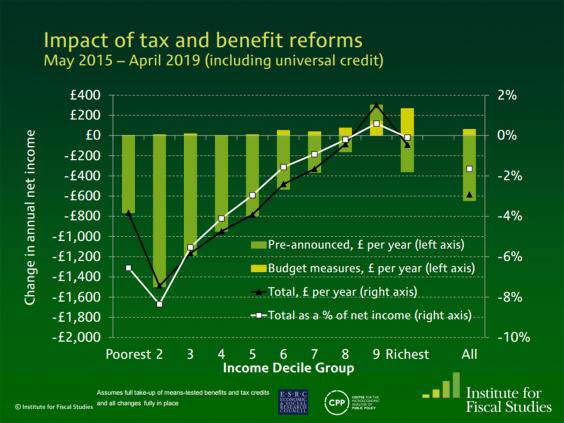
Impact of tories on income.jpg

Analysis of George Osborne’s budget from the Institute for Fiscal Studies.

Stephen Crabb has been appointed as the new work and pensions secretary, after Iain Duncan Smith resigned in a flurry of controversy on Friday.

Mr Duncan Smith has said the latest planned cuts to disability benefits were “not defensible” in a Budget that benefited higher-earning taxpayers.

David Cameron said he was “puzzled and disappointed” that Mr Duncan Smith had decided to go when they had agreed to have a rethink about the policies

Iain Duncan’s Smith’s letter of resignation must be a BIG embarrassment to the  Government. It was certainly designed to inflict maximum damage particularly on Chancellor George Osborne. I’ve previously noted that the Chancellor has a tendency to regard the Department for Work and Pensions as little more than an annex to the Treasury, and the welfare budget as the Treasury’s disposable income, but I never anticipated that Duncan Smith would come to say that he sees it that way, too. This is, after all, a minister that has invented statistics and told some pretty far-fetched fibs to prop up justifications of his policies that entail some pretty draconian measures, such as sanctions and work fare, after all.

Yet surprisingly, Duncan Smith has also quite willingly and very publicly provided the government’s opponents with ammunition. He has effectively denounced not only Osborne’s budget, but also, his targeted austerity measures, yet curiously, Duncan Smith has until now been one of the most ideologically devout Thatcherite Conservatives, which is reflected in every policy he has formulated.

He has basically said what many of us have been saying for a long time: that the cuts are political and not because of economic necessity, nor will they help the economy. He also as good as said he doesn’t think we are “all in it together”. It turns out that Osborne blamed Duncan Smith for the Personal Independence Payment (PIP) and Employment Support Allowance (ESA) cuts. But Duncan Smith has been a very quiet man recently, often conspicuous by his absence during parliamentary debates, with Priti Patel left defending the ESA cuts in particular in the Commons.

However, the Department for Work and Pensions did a review of PIP last year, and that’s where the “justification” for the cuts came from – a sample of just 150 people, which was hardly a representative sample. It’s difficult to imagine that IDS didn’t order that review. But it was Osborne who announced the cuts to PIP, not Iain Duncan Smith. Just who carries the original responsibility for the proposed PIP cuts is probably never going to be fully untangled from the crossfire of accusations and counter accusations. But surely Cameron is ultimately responsible for Conservative policies?

In his resignation letter, Iain Duncan Smith says:

“I have for some time and rather reluctantly come to believe that the latest changes to benefits to the disabled, and the context in which they’ve been made are, a compromise too far. While they are defensible in narrow terms, given the continuing deficit, they are not defensible in the way they were placed within a budget that benefits higher earning taxpayers. They should have instead been part of a wider process to engage others in finding the best way to better focus resources on those most in need.

I am unable to watch passively while certain policies are enacted in order to meet the fiscal self imposed restraints that I believe are more and more perceived as distinctly political rather than in the national economic interest.

Too often my team and I have been pressured in the immediate run up to a budget or fiscal event to deliver yet more reductions to the working age benefit bill. There has been too much emphasis on money saving exercises and not enough awareness from the Treasury, in particular, that the government’s vision of a new welfare-to-work system could not be repeatedly salami-sliced.

It is therefore with enormous regret that I have decided to resign. You should be very proud of what this government has done on deficit reduction, corporate competitiveness, education reforms and devolution of power.

I hope as the government goes forward you can look again, however, at the balance of the cuts you have insisted upon and wonder if enough has been done to ensure ‘we are all in this together’ “

You can read the letter in full here

You can see Cameron’s response in full here

Many Conservatives have suggested that Duncan Smith – a supporter of Brexit – had been looking over several weeks for an opportunity to resign, and claimed that he wanted to find a moment when he could inflict maximum damage on the campaign led by Cameron and Osborne to keep Britain in the European Union. But writing in the Observer, Bernard Jenkin, a Tory MP and chair of the Commons public administration select committee, says that Duncan Smith was not prepared to tolerate another raid on the disability budget.

Referring to the prime minister’s letter to Duncan Smith, in which Cameron said he was “puzzled” by the resignation, Jenkin says: “What that letter does not make clear is that the £4bn savings in the budget from welfare still stands and, once again, Iain was being told to find similar cuts from other benefits for working-age people – including for the disabled – again undermining the positive incentives that make it worthwhile for them to take work. That is what he finds morally indefensible.”

However, Debbie Abrahams, the shadow minister for disabled people, who has faced Duncan Smith many times during Commons debates and Work and Pensions Committee inquiries, says she does not accept the reasons Iain Duncan Smith has given for resigning, and believes he chose to resign so he could “embarrass the government as much as he can”.

She adds that planned cuts to disability benefit payments in the Budget were “grossly unfair” and would hit “the most vulnerable in society at the same time the highest earners are getting tax cuts”. 

She says she is grateful that many Conservative MPs are critical of the proposals, but adds: 

“We must make sure that this last cut that has been announced around Personal Independence Payments is stopped and does not carry on.”

The resignation is particularly surprising given that, just hours earlier, the Treasury shelved the proposed cuts to PIP – following threats of a Tory backbench rebellion. Three Tory MPs – including mayoral candidate Zac Goldsmith – have  also been asked to resign as patrons of disability charities over their support for the recent welfare cuts. The complete failure of the austerity project is finally unravelling the Conservatives, and at a time when the Brexit faction of the party is already causing considerable disarray.

Even some of the most loyal Tories were finding it difficult to defend taking money away from sick and  disabled people – particularly since many of those who receive PIP are in work, and in fact some rely on it to stay in work. The cuts to ESA and PIP take place in the context of a Tory manifesto that included a pledge not to cut disability benefits. In fact in March last year, the Prime Minister signalled that the Conservatives will protect disabled claimants from welfare cuts in the next parliament (this one). Cameron said the Conservatives would not “undermine” PIP, which was introduced under the Coalition to save money by “targeting those most in need.” Now it seems those most in need are not the ones originally defined as such.

Controversially, the cuts to disability benefits were planned to fund tax cuts for the most affluent – the top 7% of earners. The Chancellor raised the threshold at which people start paying the 40p tax, in a move that will  see many wealthier people pulled out of the higher rate of income tax, in the coming budget. Mr Osborne said that he wants to “accelerate progress” towards the Conservative’s manifesto pledge of raising the threshold for the 40p rate to £50,000 in 2020. The average annual income in the UK is around £27,000.

The Labour Party have urged Stephen Crabb to appear before MPs on Monday to announce formally that the cuts to disability benefits had been dropped. Owen Smith, the shadow work and pensions secretary, said: “His very first act as secretary of state must be to come to parliament on Monday to announce the full reversal of cruel Tory cuts that will see 370,000 disabled people lose £3,500 a year.”

He also urged Crabb to “stand up to a Treasury that is intent on cutting support for those most in need to pay for tax breaks for those who least need them”.

The main retaliation from the Conservative frontbench has been that Duncan Smith knew about the disability cuts (which he did) and that this is an act of mischief and sabotage designed and timed to destablise Cameron regarding Europe. It may well be. But the divisions had already caused wobbles, Duncan Smith just delivered a swift and hefty kick to the “in” crowd.

However, it’s also clear there has been a rising tension between the Treasury and the Department for Work and Pensions for some time. Duncan Smith felt that the benefits system could be scaled back only so far. Osborne and Cameron would prefer to see the welfare state completely dismantled.

Nonetheless, we have witnessed Duncan Smith’s long term disconnection from the impacts of his policies. He has persistently refused to engage with critics raising serious concerns about the consequences of the welfare “reforms”. He has refused to carry out a cumulative impact assessment of his policies and absolutely refused to monitor the impacts, most of which have been dire for sick and disabled people, and when the specifics of negative consequences were pointed out to him, he has typically reacted with denial, anger and accusations of “scaremongering.”

Duncan Smith used the mantra “there’s no proof of causality” to dismiss those who recognised a correlation between his welfare “reforms” and an increase in premature mortality rates and suicide. He has consistently and quite unforgivably shown that he is more concerned about hiding evidence and stifling criticism than he is about conscienciously investigating the harmful and sometimes devastating consequences that his policies have had on many people.

On the day he resigned, Duncan Smith’s department lost a four year legal battle to keep the many potentially humiliating problems with Universal Credit from the public.

Whatever the reasons may be for Duncan Smith’s resignation, he has certainly highlighted very well that Conservative budget decisions are partisan, taken for  party political interest rather than with consideration for the national interest. But in more than one way.

It’s also worth bearing in mind that it is Iain Duncan Smith’s “reforms” that have prompted a United Nations inquiry into grave and systematic violations of the human rights of disabled people. It’s highly unlikely that Duncan Smith’s reputation will be enhanced in the long-term regarding his legislative legacy, particularly regarding disabled people. He has collaborated with other ministers in designing and extending techniques of neutralisation to attempt justify what are extremely prejudiced, discriminatory and punitive policies aimed at the poorest citizens.

This is a man who has removed people from a structural socioeconomic context and then intentionally blamed them for their individual socioeconomic circumstances, most of which have been created by this government’s actions since 2010. Every single Conservative budget has taken money from the poorest and gifted it to the wealthiest. It’s inconceivable that Tory ministers don’t understand such policies will invariably extend and perpetuate inequality and poverty.

Duncan Smith has damned himself, but nonetheless, a Conservative minister resigning and stating that it is because of a Conservative budget, publicly citing reasons that correlate with the opposition’s objections regarding the government’s ideologically driven and targeted austerity, is a particularly damning turn of events for the Conservative Party as a whole, that’s for sure.

Now that Duncan Smith has publicly denounced the Conservative austerity project, I wonder if he will also recognise and embrace the rational expertise and economic competence of a real party of social justice, which rescued this country from the consequences of a global recession by the last quarter of 2009, whilst Osborne had us back in recession by 2011, and lost us our triple A Fitch and Moody credit ratings after promising not to. I wonder if Duncan Smith now supports the fair party with a track record of verifiable economic expertise – that would be the Labour Party.

rich keep millons
Picture courtesy of Robert Livingstone

I don’t make any money from my work and I’m not funded. You can support Politics and Insights by making a donation to help me continue researching and writing independently, and to continue to help others.

DonatenowButton
cards

Government plans further brutal cuts to disability support

358-burden-of-cuts

Disabled people are already carrying a disproportionately high burden of the austerity cuts, despite government claims of economic recovery.

Government ministers are planning to cut a key element of the Personal Independent Payment (PIP). Last year a consultation indicated that the Conservatives were considering ways of reducing eligibility criteria for the daily living component of PIP, by narrowing definitions of aids and appliances.

From January 2017, the cut is likely to hit people experiencing incontinence, who struggle to dress themselves, and those facing other fundamental barriers to health and essential basic care. The cut, it is estimated, will affect at least 640,000 disabled people by 2020.

Controversially, it is alleged that the cuts to disability benefit will fund tax cuts for the most affluent – the top 7% of earners. The Chancellor is set to raise the threshold at which people start paying 40p tax, in a move that will probably see  many wealthier people pulled out of the higher rate of income tax, in the coming budget. Mr Osborne says he wants to “accelerate progress” towards the Conservative’s manifesto pledge of raising the threshold for the 40p rate to £50,000 in 2020, it is understood.

Meanwhile, under the plans announced on Friday, sick and disabled people will be much less likely to receive essential disabled benefits if they use aids such as a handrail or a walking stick to get dressed or use the toilet.

The Department for Work and Pensions reviewed a sample of 105 cases of people who had scored all, or the majority, of their points for PIP due to aids and appliances, in order to assess the extent to which the award may reflect extra costs.

The review led the government to conclude that PIP “doesn’t currently fulfil the original policy intent”, which was to cut costs and “target” the benefit to “those with the greatest need.” That originally meant a narrowing of eligibility criteria for people formerly claiming Disability Living Allowance, increasing the number of  reassessments required, and limiting the number of successful claims.

Prior to the introduction of PIP, Esther McVey stated that of the initial 560,000 claimants to be reassessed by October 2015, 330,000 of these are targeted to either lose their benefit altogether or see their payments reduced. Of course the ever-shrinking category of “those with the greatest need” simply reflects a government that has simply made a partisan political decision to cut disabled people’s essential income to fund a financial gift to the wealthiest citizens. There is no justification for this decision, nor is it “fair.”

The government now  claim that the proportion of people awarded the daily living component of PIP, who scored all of their points because they need aids and appliances, has more that tripled, from 11 per cent in April 2014 to 35 per cent in 2015.

The PIP assessment currently examines an individual’s ability to complete ten daily living activities and two mobility activities. Regular reviews were also introduced by the last government to ensure that claimants continue to receive the “right level of support.”

The increase has largely been driven by a significant and sustained rise in relation to activities one, four, five and six: preparing food, washing and bathing, dressing and undressing, and managing incontinence and toileting. Around three-quarters of those who score all of their points through aids and appliances score the minimum number of daily living points needed to qualify for the standard rate of the daily living component.

The government ridiculously claim that the “evidence” presented to the review suggested that in some instances points were being awarded “… because claimants chose to use aids and appliances, rather than needed them.”  And noted that in many cases “ these were non-specialised items of very low cost.”

However, it’s very difficult to justify cutting support for people who require aids to meet fundamental needs such as preparing food, dressing, basic and essential personal care and managing incontinence.

Ministers have now announced their intention to cut PIP for people who currently receive it to help them afford specially-adapted appliances and equipment. Examples of qualifying equipment currently includes adapted cutlery for people who find it difficult to hold things for long periods of time and specially-designed household items for people less able to stand.

Justin Tomlinson, the disabilities minister, said that the cuts to funding for aids and appliances for the disabled could save about £1bn a year and was announced the week before the budget. Charities warned that the cuts to personal independence payments (PIP) would be devastating after the move was confirmed by Tomlinson on Friday.

Tomlinson, said: “The introduction of Personal Independence Payment to replace the outdated Disability Living Allowance for working age claimants has been a hugely positive reform.

But it is clear that the assessment criteria for aids and appliances are not working as planned. Many people are eligible for a weekly award despite having minimal to no extra costs and judicial decisions have expanded the criteria for aids and appliances to include items we would expect people to have in their homes already.

We consulted widely to find the best approach. And this new change will ensure that PIP is fairer and targets support at those who need it most.”

Only a Conservative minister would claim that taking money from sick and disabled people is somehow “fair,” and they frequently do. The cuts of £120 a month to the disability benefit employment support allowance (ESA) are also claimed to be “fair.” and “supportive.” Though I have yet to hear an explanation of how this can possibly be the case. Ministers claimed that people subjected to the ESA Work Related Activity Group cuts could claim PIP if they required support with extra living costs, but now we are told that PIP is to be cut, too.

Bearing in mind the Department for Work and Pensions “review” was based on a sample of just 105 people, it’s very difficult to see how further inhumane cuts to the lifeline income for this group of amongst the most disabled citizens can possibly be justified. How did ministers “plan” the assessment criteria for aids and appliances to work, exactly?  People qualifying for PIP need extra support in meeting their living costs.

A coalition of 25 disability charities has written to the Government to warn against plans that would strip some disabled people of a key payments meant to help them live more independent lives.

The Disability Benefits Consortium wrote to Justin Tomlinson, to argue that proposed changes to Personal Independence Payment – or PIP – assessments would have a “severe impact” on people’s security and make it harder for them to find work.

Debbie Abrahams, the shadow disabilities minister, said: “Removing support for people who need help to use the toilet or dress is an attack on dignity.”

“These further cuts would represent another huge blow, making life even more difficult for many people who already facing huge barriers.”

Phil Reynold, policy and campaigns adviser at Parkinson’s UK, said: “If someone needs aids and appliances to carry out the most basic tasks that most people take for granted then they clearly need ongoing support to live independently, which is often expensive. They should not be penalised by making personal independence payments even more difficult to claim.”

Michelle Mitchell, chief executive of the MS Society, said: “This decision could have a devastating impact on the lives of people with MS. In the worst cases, they could lose up to £150 a week.

PIP is an essential benefit which goes towards the extra cost of being disabled. The new plans will fail some of the most vulnerable people in society and we have serious concerns about the future health and welfare of those affected.”

The government is currently being investigated by the United Nations because of  serious allegations that many of us have made regarding the welfare “reforms”, which have extended gross and systematic abuse of the human rights of disabled people. The UK is the first country to be subject to an investigation regarding the government’s failure to meet legal obligations to uphold disabled people’s human rights. In the 6th wealthiest nation of the world, and a so-called liberal democracy, this treatment of an already marginalised and protected social group is utterly shameful.

536738_306169162785952_999031084_n

scroll2

I don’t make any money from my work and I’m not funded. You can support Politics and Insights by making a donation to help me continue researching and writing independently, and to continue to help others.

DonatenowButton
cards

A black day for disabled people – disability benefit cuts enforced by government despite widespread opposition

536738_306169162785952_999031084_n

“The fact is that Ministers are looking for large savings at the expense of the poorest and most vulnerable. That was not made clear in the general election campaign; then, the Prime Minister said that disabled people would be protected.” – [Official Report, Commons, 2/3/16; cols. 1052-58.]

A coalition of 60 national disability charities have condemned the government’s cuts to benefits as a “step backwards” for sick and disabled people and their families. The Disability Benefits Consortium say that the cuts, which will see people lose up to £1,500 a year, will leave disabled people feeling betrayed by the government and will have a damaging effect on their health, finances and ability to find work.

Research by the Consortium suggests the low level of benefit is already failing to meet disabled people’s needs. 

A survey of 500 people in the affected group found that 28 per cent of people had been unable to afford to eat while in receipt of the benefit. Around 38 per cent of respondents said they had been unable to heat their homes and 52 per cent struggled to stay healthy.

The Government was twice defeated in the Lords over proposals to cut Employment and Support Allowance (ESA) for sick and disabled people in the work-related activity group (WRAG) from £103 to £73.

However the £30 a week cut is set to go ahead after bitterly disappointed and angry peers were left powerless to continue to oppose the Commons, which has overturned both defeats. The government has hammered through the cuts of £120 a month to the lifeline income of ill and disabled people by citing the “financial privilege” of the Commons, and after Priti Patel informing the Lords that they have “overstepped their mark” in opposing the cuts twice.

The Strathclyde review, commissioned by a rancorous and retaliatory David Cameron, following the delay and subsequently effective defeat of government tax credit legislation in the House of Lords, recommends curtailing the powers of Upper House. Strathclyde concludes in his report that the House of Lords should be permitted to ask the Commons to “think again” when a disagreement on proposed legislation exists, but should not be allowed to veto. MPs would ultimately make a decision on whether a measure is passed into law. The review focuses in particular on the relationship between the Commons and the Lords, in relation to the former’s primacy on financial matters and secondary legislation, and serves to highlight the government’s very worrying increasing tendency towards authoritarianism.

The cuts to ESA and proposed and probable cuts to Personal Independent Payments (PIP), take place in the context of a Tory manifesto that included a pledge not to cut disability benefits.

Yesterday in the House of Lords, independent crossbencher Lord Low of Dalston warned: “This is a black day for disabled people.”

Contrary to what is being reported, it won’t be only new claimants affected by the cuts to ESA. Firstly, it may potentially affect anyone who has a break in their ESA claim (and that could happen because of a reassessment with a decision that means needing to ask for a mandatory review), and secondly, those migrated onto Universal Credit will be affected. The benefit cap will also cut sick and disabled people’s income if they are in the ESA WRAG.

Paralympic gold medallist Baroness Grey-Thompson said she was bitterly disappointed that this “dreadful and punitive” part of the Bill was going ahead.

Parliamentary procedure had prevented her putting down another amendment opposing the move, which will have a harsh, negative impact on thousands of people’s lives.

Already facing a UN inquiry into grave and systematic abuses of the human rights of disabled people, Cameron remains completely unabashed by his government’s blatant attack on a protected social group, and the Conservatives continue to target disabled people for a disproportionately large burden of austerity cuts.

The Government have been accused of failing to fulfil their public sector equality duty. Under the Equality Act 2010, the Government must properly consider the impact of their policies on the elimination of discrimination, the advancement of equality of opportunity and the fostering of good relations. This is shameful, in a very wealthy first-world democracy.

The “justification” the Tories offer for the cut of almost £120 a month to the lifeline support of people judged to be unfit for work by their own doctors AND the state, is that it will “help people into work”. I’ve never heard of taking money from people who already have very little described as “help” before. Only the Conservatives  would contemplate cutting money from sick and disabled people, whilst gifting the millionaires with £107, 000 each per year in the form of a tax “break”.

Reducing disabled people’s incomes won’t “incentivise” anyone to find a job. It will just make life much more difficult. The government have made the decision to cut disability benefits because of an extremely prejudiced ideological preference for a “small state” and their antiwelfare agenda. There are alternative political choices that entail far more humane treatment of sick and disabled people. The fact that ministers have persistently refused to carry out a policy impact assessment indicates clearly that this measure has got nothing to do with any good will towards disabled people, nor is it about “helping” people into work.

The cut simply expresses the Conservative’s contempt for social groups that are economically inactive, regardless of the reasons. Sick and disabled people claiming ESA have already been deemed unfit for work by their doctors, and by the state via the work capability assessment. Simply refusing to accept this, and hounding a group of people who are ill, and who have until recently been considered reasonably exempt from working, is an indictment of this increasingly despotic government.

I can’t help wondering how long it will be before we hear about government proposals to cut the financial support further for those in the ESA support group. There does seem to be a recognisable pattern of political scapegoating, public moral boundaries being pushed, and cruel, highly unethical cuts being announced. Social security provision is being dismantled incrementally, whilst the Conservative justification narrative becomes less and less coherent. Despite the arrogant moralising approach of Tory ministers, and the Orwellian rhetoric of “helping” and “supporting” people who are too ill to work into any job, or face the threat of starvation and destitution, none of this will ever justify the unforgivable, steady withdrawal of lifeline support for sick and disabled people.

Baroness Meacher warned that for the most vulnerable the cut was “terrifying” and bound to lead to increased debt.

Condemning the “truly terrible” actions of the Treasury, she urged ministers to monitor the number of suicides in the year after the change comes in, adding: “I am certain there will be people who cannot face the debt and the loss of their home, who will take their lives.” Not only have the government failed to carry out an impact assessment regarding the cuts, Lord Freud said that the impact, potential increase in deaths and suicides won’t be monitored, apart from “privately” because individual details can’t be shared and because that isn’t a “useful approach”.

He went on to say “We have recently produced a large analysis on this, which I will send to the noble Baroness. That analysis makes it absolutely clear that you cannot make these causal links between the likelihood of dying—however you die—and the fact that someone is claiming benefit.”

Actually, a political refusal to investigate an established correlation between the welfare “reforms” and an increase in the mortality statistics of those hit the hardest by the cuts – sick and disabled people – is not the same thing as there being no causal link. Often, correlation implies causality and therefore such established links require further investigation. It is not possible to disprove a causal link without further investigation, either.

Whilst the government continue to deny there is a causal link between their welfare policies, austerity measures and an increase in premature deaths and suicides, they cannot deny there is a clear correlation, which warrants further research – an independent inquiry at the VERY least. But the government are hiding behind this distinction to deny any association at all between policy and policy impacts. That’s just plain wrong.

Insisting that there isn’t a “causal link” established, whilst withholding crucial evidence in parliament and from the public domain is what can at best be considered the actions and behaviours of tyrants.


Related reading

House of Lords debate: ESA – Monday 07 March 2016 (From 3.06pm)

Thatcher’s policies condemned for causing “unjust premature death”

MP attacks cuts hitting disabled people – Debbie Abrahams

Leading the debate against the Welfare Reform and Work Bill – 3rd reading – Debbie Abrahams

My speech at the Changes to Funding of Support for Disabled People Westminster Hall Debate – Debbie Abrahams

The government need to learn about the link between correlation and causality. Denial of culpability is not good enough.

The new Work and Health Programme: government plan social experiments to “nudge” sick and disabled people into work

A Critique of Conservative notions of “Social Research”

The DWP mortality statistics: facts, values and Conservative concept control

10177255_710935002309364_996655242459079802_n

Pictures courtesy of Robert Livingstone

My work isn’t funded and I don’t get paid to write. But you can support Politics and Insights, and help me to continue researching, analysing and writing independently.

The smallest amount is much appreciated, and helps to keep my articles free and accessible to all – thank you.

And a massive thank you to those who have already contributed.

DonatenowButton
cards

Maximus ‘has falsified results of fitness for work tests’, says MP – John Pring

By John Pring

The discredited US outsourcing giant contracted to carry out “fitness for work” tests on behalf of the government has been accused by an MP of “falsifying” the results of assessments.

Labour MP Louise Haigh attacked the track record, ethics and even criminal behaviour of Maximus in delivering public contracts in the US, during a debate on the work capability assessment (WCA).

But she also highlighted what she described as a “disconcerting pattern of behaviour” by Maximus in the UK since taking over the WCA contract from Atos last year.

She said: “There seems to be an alarming trend of cases being rejected based on factual errors or even – I hesitate to say this – falsification.”

Haigh (pictured speaking in the debate), a shadow Cabinet Office minister, also raised concerns that there was no way for the public to check whether targets set for Maximus by the government – such as the number of serious complaints and the payment of travel expenses within nine working days – were being met.


You can read the rest of this excellent article here

Related

Doctors bribed with 70-90k salaries to join Maximus and “endorse a political agenda regardless of how it affects patients.”

Audit finds whereabouts and circumstances of 1.5 million people leaving welfare records each year “a mystery”

10270806_319228004894921_8005540502444686357_n

Labour MP Frank Field has called on the government to conduct a survey into the circumstances of those hundreds of thousands of citizens whose benefit income is withdrawn each year under the current harsh sanctioning regime.

Mr Field, who also chairs the Commons Work and Pensions Committee, carried out a forensic audit of the government’s welfare reform programme – Fixing Broken Britain? An audit of working-age welfare reform since 2010, which is to be published today (18 January 2016) by Civitas and co-authored by Andrew Forsey.

Worryingly, the research found that the whereabouts of 1.5 million people leaving the welfare records each year is “a mystery.” The authors also raise concern that the wellbeing of at least a third of those who have been sanctioned “is anybody’s guess.” It’s not the first time these concerns have been raised.

It emerged in 2014, during an inquiry which was instigated by the parliamentary Work and Pensions Select Committee, that research conducted by Professor David Stuckler shows more than 500,000 Job Seekers Allowance (JSA) claimants have disappeared from unemployment statistics, without finding work, since the sanctions regime was toughened in October, 2012.

This means that in August 2014, the claimant count – which is used to gauge unemployment – is likely to be very much higher than the 970,000 figure that the government is claiming, if those who have been sanctioned are included.

The research finding confirms what many of us already knew.

Professor Stuckler, who has analysed data from 375 local authorities, said:

“The data clearly show that many people are not leaving Job Seekers Allowance for work but appear to be being pushed off in unprecedented numbers in association with sanctions.”

The Work and Pensions Committee decided to conduct a further in depth inquiry into benefit sanctions policy at the time, following the findings of the research. This inquiry considered aspects of sanctions policy which were outside the remit of the Oakley Review. (You can see the terms of reference for the inquiry, and submissions were invited, all details of which are here – Committee launch inquiry into benefit sanctions.)

Labour MP Debbie Abrahams said:

“Sanctions are being applied unfairly to job-seekers, as well as the sick and disabled.

The reason the Government is doing this is that it gets them off the JSA claimant figures, so it looks like there are fewer people unemployed.”

Mrs Abraham added:

“Hundreds of thousands of people have had their benefits stopped for a minimum of four weeks and then approximately a quarter of these people, from the research that I’ve seen, are disappearing.

They are leaving and we don’t know where they are going. That’s an absolute indictment of this policy and it’s a little bit worrying if we’re trying to tout this internationally as a real success story.”

The MP for Oldham East and Saddleworth, and shadow disability minister memorably added:

“People have died after being sanctioned, Minister.”

The Government claims that sanctioned claimants who leave the benefit system are going into work – they also claim that their punitive sanctions regime “works”. But the Oxford study found this is untrue in a “majority” of cases. At the time, the government were accused of massaging unemployment figures via benefit sanctions.

Frank Field and Andrew Forsey write:

“The number of sanctions was halved in the year leading up to the 2015 election, but it still remained at half a million. Sanctions are therefore being applied at a scale unknown since the Second World War, and the operation of sanctions on this scale makes for a most significant change in the social security system as it has existed in the post-war period.

A number of people – we know not how large a number – are being totally disconnected from both work and welfare, and risk being exposed to destitution.

Justice calls for a major survey of what happens to the hundreds of thousands of people thrown off the welfare rolls each year through the sanctioning process. It is unacceptable, not only for this government but for its predecessor and those who will follow, to take away benefit from a mass of people each year and not trouble themselves with how this army of people survive. For that is what is happening under the government’s sanctions policy. The ability to track the wellbeing of the whole population is now a part of being a grown up government, let alone a ‘One Nation’ government.”

In the report, Field and Forsey call for four safeguarding reforms, “to restore greater fairness and transparency to the sanctions regime.” They:

  • Propose that the government must forthwith begin a survey so that they can answer the simple but crucial question of what happens to those citizens expelled from the welfare rolls who appear not to find work.
  • Welcome the government’s decision to trial a Yellow Card early warning system, but suggest that should it fail to prevent injustices from occurring, the government should supplement this policy with the option for Jobcentre Plus staff of issuing a non-financial sanction for a claimant’s first failure to meet the terms of their Claimant Commitment. 
  • Recommend that the Department for Work and Pensions trials a ‘grace period’ for vulnerable claimants of Jobseeker’s Allowance or Employment and Support Allowance, during which the requirements placed upon them are eased at times of transition or acute difficulty.
  • Request information from the government showing how much expenditure is withdrawn through its policy of sanctioning claimants.

Last year year, the Work and Pensions Select Committee heard independent estimates that since late 2012 sanctions had resulted in at least £275m being withheld from benefit claimants (the comparable figure for 2010 was £50m). Committee member Debbie Abrahams MP said that the Department for Work and Pensions will not give or does not have actual figures.

However, it’s truly remarkable that the government somehow manage to pull numbers out of their secret Thunderball when they believe it’s in their own interests to do so. The latest “employment” figures, for example. How likely is it that those numbers are remotely accurate when we have a government that happily presides over the disappearance of many thousands of sanctioned people every year from their accounts?

This post was written for Welfare Weekly, which is a socially responsible and ethical news provider, specialising in social welfare related news and opinion.

Specialist Disability Employment Advisors in Jobcentres cut by over 60 per cent

536738_306169162785952_999031084_n

Full-time specialist disability employment advisors who are posted in jobcentres have been radically reduced since 2011. The full-time advisors are employed to help disabled people navigate the support system and find employment. Over the last four years, the number of specialist advisors fell by over 60 per cent, from 226 to just 90.

The government says that the advisors will be replaced by unqualified  non-specialist “work coaches” as part of its Universal Credit programme, which also extends welfare conditionality, entailing sanctions, to people in part-time and low paid work.

We reported last week that the work coach scheme is to extend from jobcentres to GP practices, to prevent sick and disabled people from “leaving the job market” and “claiming Employment Support Allowance” (ESA), with pilots already underway.

The latest figures on jobcentre advisors were released by ministers in response to a Parliamentary question by Labour MP Emily Thornberry.

A spokesman for the Department for Work and Pension said the fall in advisor numbers was consistent with Government policy.

“With the introduction of Universal Credit disabled people looking for work now have access to Work Coaches who are trained to provide tailored support specific to their individual needs. As we continue to make our mainstream services more accessible to disabled jobseekers it is expected that the number of Disability Employment Advisors will continue to decline.”

“The Government is committed to halving the disabled employment gap and the most recent disabled employment figures show that 226,000 more disabled people found work over the past year.”

Charities have responded, saying that the specialist advisors are absolutely crucial for people with disabilities who have to navigate the support system and that their reduction will undermine the Government’s own claim of “supporting people in to work.”

The government have also cut in work support for disabled people, such as the Access to Work fund, which helps people and employers cover costs of disabilities that may present a barrier to work. Under the Equality Act, employers are obliged to make “reasonable adjustments” to the workplace to support people with disabilities.

A coalition of 100 disability charities had warned that the government cuts threaten disabled people’s rights earlier this year, and last month, especially those with learning disability and mental health problems, charities also called for a halt in the government’s cuts to ESA, which will be reduced, removing the work-related activity component, so that people will receive the same amount as jobseekers with no disability, which will make it more difficult for disabled people to find work, and may have an adverse impact on people with health conditions.

The cuts to specialist employment support for people with disabilities flies in the face of  Iain Duncan Smith’s comments during the Tory conference – that sick and disabled people need to see work as their route out of poverty. It’s difficult to see how that can be achieved when the government is busy closing down the transport system, as it were.

Duncan Smith commented at the Conservative conference: “We don’t think of people not in work as victims to be sustained on government handouts. No, we want to help them live lives independent of the state.

“We won’t lift you out of poverty by simply transferring taxpayers’ money to you. With our help, you’ll work your way out of poverty.”

We can’t help wondering what “help” actually means to Conservatives, because there is every indication that they don’t use the word in a conventional sense. Usually when Tories use the word “help” or “support”, it indicates some sort of penalty or punishment: a reference to the extended draconian benefit conditionality and  sanctions regime

Elliot Dunster, group head of policy, research and public affairs at disability charity Scope, has said that the fall in specialist assistance was concerning:

“Disability employment advisors make a huge difference in supporting disabled people into work – providing expert, personalised advice and guidance.

“We’re very concerned to see this drop in the number of job centres that have fulltime specialist advisors for disabled people. Disabled people are pushing hard to find work, but continue to face huge barriers, ranging from inaccessible workplaces to employer attitudes. 

“Disability employment advisors help tackle these barriers. The Government has set out a welcome ambition to halve the disability employment gap. To do this disabled people must have access to specialist, tailored employment support.”

Dan Scorer, head of policy at Mencap, has warned that the replacement generalist advisors would “simply not have the training” required:

“People with a learning disability find the demands placed upon them difficult while claiming Job Seekers Allowance or Employment and Support Allowance.

“Some find them impossible and we are worried that there is not the right support in Jobcentres to help them. Families tell us that a lack of learning disability training and cuts to DEAs is leading to many people with a learning disability being unfairly sanctioned and receiving insufficient support to appeal decisions, or the right support to find employment.

“Even if the reduction in DEAs in some part of the country is due to the rolling out of Universal Credit and part of a strategic move to generic advisors, we are concerned that these advisors will simply not have the training to fully support claimants with a learning disability.

“The problems with the administration of benefits and changes in the benefits system, combined with future cuts to benefits and social care, is causing fear and anxiety among the 1.4 million people with a learning disability and their families in the UK who are scared they could be isolated in their local communities.”

Mind have already warned that the transition away from specialist help under Universal Credit would make the benefits system more difficult for people with mental health issues. Policy manager, Tom Pollard told the Independent:

“We’re pretty sceptical of the ability of those jobcentre advisors to be able to understand the barriers that people with mental health issues face.” 

Labour MP Debbie Abrahams recently challenged Priti Patel, the employment minister, during work and pensions questions in the Commons recently to raise concerns about the negative impacts of social security sanctions on the mental health of claimants.

During the session the Patel had claimed: “Our staff are trained to support claimants with mental health conditions and there is no evidence to suggest that such claimants are being sanctioned more than anybody else.”

Mrs Abrahams, Shadow minister for Disabled People, responded: “The minister may have inadvertently slipped up there. There is clear evidence from last year that 58 per cent, more than half, of people with mental health conditions on the employment and support allowance work-related activity group were sanctioned.”

A recent Freedom of Information request showed that between April, 2014, and March this year there were almost 20,000 benefit sanctions received by people who were out of work because of their mental health.

However, in this same period only 6,340 of the group were successfully supported into employment during the same period by the Work Programme.

Tom Pollard said: “Figures obtained by us show that people with mental health problems are more likely to have their benefits stopped than those with other conditions.

“Last year, the Department of Work and Pensions issued more sanctions to people with mental health problems being supported by Employment and Support Allowance than they did to those with other health conditions.

“Stopping somebody’s benefits, or threatening to stop them, is completely the wrong approach to help people with mental health problems find work — it’s actually counterproductive.

“In continually refusing to listen to calls for a review of the use of sanctions, the Government is not only undermining its ambition of helping a million more disabled people into work, but is also failing its duty of care for the health and wellbeing of hundreds of thousands of people with mental health problems.”

The Department of Work and Pension’s own research shows that the threat of sanctions does ensure that people who need support from social security comply with benefit rules, but that doesn’t actually help them to find work. It also tends to undermine confidence, and many jobcentre advisors have expressed concern that people with mental illness are more likely to be sanctioned simply because they would have greater difficulty meeting the strict conditionality criteria and because of the greater pressure to sanction “non-compliance” from government. (page 54)

But we deeply suspect that sanctions are precisely what the government are referencing when they use the phrase “helping people into work.”

This post was written for Welfare Weekly, which is a socially responsible and ethical news provider, specialising in social welfare related news and opinion.