Tag: DWP

Universal Credit is a ‘serious threat to public health’ say public health researchers

UC

Some citizens in the UK have ended up in an unprecedented and darkly absurd position of having to explain and prove over and over to a cruel and harmful government that their cruel and harmful policies are cruel and harmful.

Recent research has verified that Conservative welfare policies are damaging, yet the government simply denies this is the case.

New research conducted for Gateshead council highlights that Universal Credit, another cruel and harmful policy, is detrimental to peoples’ mental health, because it increases depression and anxiety. 

Public health researchers say that Universal credit has become a serious threat to public health after the study revealed that the stress of coping with the new benefits system had so profoundly affected peoples’ mental health that some considered suicide.

The researchers found overwhelmingly negative experiences among vulnerable citizens claiming Universal Credit, including high levels of anxiety and depression, as well as physical problems and social isolation, all of which was exacerbated by hunger and destitution.

The Gateshead study comes as the United Nation’s special rapporteur on extreme poverty and human rights, Philip Alston, prepares to publish a report of the impact of Conservative austerity in the UK. Alston has been collecting evidence and testimonies on the effects of the welfare reforms, council funding cuts, and Universal Credit during a two-week visit of the UK. 

This research is highly likely to raise fresh calls for the system’s rollout to be halted, or at the very least, paused to attempt to fix the fundamental design flaws and ensure adequate protections are in place for the most vulnerable people claiming it.

Approximately 750,000 chronically ill and disabled claimants are expected to transfer on to Universal Credit from 2019. Yet earlier this year, the first legal challenge against Universal Credit found that the government unlawfully discriminated against two men with severe disabilities who were required to claim the new benefit after moving into new local authority areas. Both saw their benefits dramatically reduced when they moved to a different Local Authority and were required to claim Universal Credit instead of Employment and Support Allowance.

The study findings are yet another indication of how unfit for purpose Universal Credit is. Six of the participants in the study reported that claiming Universal Credit had made them so depressed that they considered taking their own lives. The lead researcher, Mandy Cheetham, said the participant interviews were so distressing she undertook a suicide prevention course midway through the study.

The report says: “Universal Credit is not only failing to achieve its stated aim of moving people into employment, it is punishing people to such an extent that the mental health and wellbeing of claimants, their families and of [support] staff is being undermined.”

One participant told the researchers: “When you feel like ‘I can’t feed myself, I can’t pay my electric bill, I can’t pay my rent,’ well, all you can feel is the world collapsing around you. It does a lot of damage, physically and mentally … there were points where I did think about ending my life.”

An armed forces veteran said that helplessness and despair over Universal Credit had triggered insomnia and depression, for which he was taking medication. “Universal Credit was the straw that broke the camel’s back. It really did sort of drag me to a low position where I don’t want to be sort of thrown into again.”

Unsurprisingly, the report concludes that Universal Credit is actively creating poverty and destitution, and says it is not fit for purpose for many people with disabilities, mental illness or chronic health conditions. It calls for a radical overhaul of the system before the next phase of its rollout next year.

Alice Wiseman, the director of public health at Gateshead council, which commissioned the study, said: “I consider Universal Credit, in the context of wider austerity, as a threat to the public’s health.” She said many of her public health colleagues around the country shared her concerns.

Wiseman said that Universal Credit is “seriously undermining” efforts to prevent ill-health in one of the UK’s most deprived areas.

She added “This is not political, this is about the lives of vulnerable people in Gateshead. They are a group that should be protected but they haven’t been.”

The qualitative study of 33 people claiming Universal Credit and 37 welfare advice staff was carried out by Teesside and Newcastle university academics between April and October. It focused on those claimants with disabilities, mental illness and long-term health conditions, as well as homeless people, veterans and care leavers.

The respondents found that compared to the legacy benefits, Universal Credit is less accessible, remote, inflexible, demeaning and intrusive. It was less sensitive to claimants’ health and personal circumstances, the researchers said. This heightened peoples’ anxiety, sense of shame, guilt, and feelings of loss of dignity and control.

The Universal Credit system itself was described by those claiming it as dysfunctional and prone to administrative error. People experienced the system as “hostile, punitive and difficult to navigate,” and struggled to cope with payment delays that left them in debt, unable to eat regularly, and reliant on food banks.

The government claimed that people making a new claim are expected to wait five weeks for a first payment. That’s a long time to wait with no money for basic living requirements. However, the average wait for participants on the study was seven and a half weeks, with some waiting as long as three months. Researchers were told of respondents who were so desperate and broke they turned to begging or shoplifting.

Wiseman made a point that many campaigners have made, and said that alongside the human costs, universal credit was placing extra burdens on NHS and social care, as well as charities such as food banks. It also affected the wellbeing of advice staff, who reported high stress levels and burnout from dealing with the fallout on those claiming the benefit.

Guy Pilkington, a GP in Newcastle said that the benefits system had always been tough, but under Universal Credit, those claiming faced a higher risk of destitution.

“For me the biggest [change] is the ease with which claimants can fall into a Victorian-style system that allows you to starve. That’s really shocking, and that’s new,” he said.

A spokesperson for the Department for Work and Pensions (DWP) said: “This survey of 33 claimants doesn’t match the broader experience of more than 9,000 people receiving Universal Credit in Gateshead, who are taking advantage of its flexibility and personalised support to find work.

“We have just announced a £4.5bn package of support so people can earn £1,000 more before their credit payment begins to be reduced, and we are providing an additional two weeks’ payments for people being moved from the old system.”

That will still leave people with nothing to live on or to cover their rent for at least three weeks. The study focused on those less likely to be able to work – people with disabilities, mental illness or chronic health conditions. The DWP failed to recognise that this group have different needs and experiences than the broader population, which leave them much more likely to become vulnerable when they cannot meet their needs.

Vulnerable people are suffering great harm and dying because of this government’s policies. It is not appropriate to attempt to compare those peoples’ experiences with some larger group who have not died or have not yet experienced those harms. Where is the empirical evidence of these claims, anyway? Where is the DWP’s study report?

Callousness and indifference to the suffering and needs of disadvantaged citizens – disadvantaged because of discriminatory policies – has become so normalised to this government that they no longer see or care how utterly repugnant and dangerous it is.

The DWP are not ‘providing’ anything. Social security is a publicly funded safety net, paid for by the public FOR the public. It’s a reasonable expectation that citizens, most of who have worked and contributed towards welfare provision, should be able to access a system of support when they experience difficulties – that is what social security was designed to provide, so that no one in the UK need to face absolute poverty. It’s supposed to be there so that everyone can meet their basic survival needs.

What people in their time of need find instead is a system that has been redesigned to administer punishments, shame and psychological abuse. What kind of government kicks people hard when they are already down?

Imagine what that level of state abuse does to a person psychologically. 

Techniques of neutralisation and gaslighting 

The government’s denial and indifference to the needs of others are part of a wider, deplorable gaslighting strategy, which strongly implies that the cruel and harmful policy consequences are actually intended and deliberately inflicted.

I once compared the relationship between marginalised social groups, such as the disabled community, and the state with being in an abusive relationship from which you cannot escape. 

The Conservatives have persistently claimed, contrary to the ever-mounting evidence, that there is no ‘causal link’ between their punitive welfare policies and social harm, such as increases in premature deaths, suicides, distress, poverty, destitution, physiological and psychological harm.

The denials are grounded in techniques of neutralisationaimed at discrediting citizens’ accounts of their own experience. Cruel and harmful policies are described as “support”, “help” and “incentivising behavioural change”, for example.

Techniques of neutralisation provide simple and powerful rationales for why some people violate society’s norms, and they are used to explain to perpetrators and others why it was “okay” to act immorally. Matza and Sykes identified five separate techniques of neutralisation:

1) Denial of responsibility. (Saying repeatedly “There is no causal link established between policy and harm”, for example)

2) Denial of injury.  (Claiming that any abuse causing injury is somehow ultimately in the person’s ‘best interests’. Claiming that any evidence presented of injury is ‘just anecdotal evidence’, and dismissing it, for example).

3) Blaming the victim. (Saying people are ‘scroungers’, ‘parked on benefits’, ‘cognitively biased’, part of a ‘something for nothing culture’, and “we need to ‘change their behaviours’,”for example)

4) Condemning the condemners. (Calling those who challenge the government ‘scaremongers’, or implying they are liars, for example)

5) Appealing to a higher loyalty. (The ‘tax payer’, the ‘national interest’, the economy, ‘the best interests of the individual’. 

Within an abusive relationship, this kind of constant denial – gaslighting – blurs normative boundaries, and what we once deemed unacceptable somehow becomes an everyday event. But gaslighting is a strategy of abuse that is carefully calculated to discredit your account, and to manipulate you into doubting your own perceptions, accounts and experiences. 

The government have normalised cruelty and have fostered an abusive relationship with some of the poorest citizens – those historically most vulnerable to political abuse. That abusive relationship reflects a profoundly authoritarian imbalance of power and traditional Conservative prejudice, contempt and malice towards the most systematically disadvantaged citizens.

Watch Sarah Newton use techniques of neutralisation to discredit the robustly evidenced account of the United Nations, opposition shadow ministers and ultimately, the accounts of the citizens who they represent – many of whom submitted evidence of the harm they have experienced because of government policy to the United Nations.

If you have experienced any of the issues discussed here, or if you are feeling low or distressed for any reason, please talk to someone. The Samaritans can be contacted on 116 123 or email jo@samaritans.org. 

Update Philip Alston, the UN special rapporteur on extreme poverty and human rights, has published his report following his visit to the UK . In it, he also discusses a government ‘denial.’  

He says: “The Government has remained determinedly in a state of denial. Even while devolved authorities in Scotland and Northern Ireland are frantically trying to devise ways to ‘mitigate’, or in other words counteract, at least the worst features of the Government’s benefits policy, Ministers insisted to me that all is well and running according to plan. 

“Some tweaks to basic policy have reluctantly been made, but there has been a determined resistance to change in response to the many problems which so many people at all levels have brought to my attention.”

You can read the report in full here: https://www.ohchr.org/Documents/Issues/Poverty/EOM_GB_16Nov2018.pdf

I will write an analysis of the report in due course.


My work is unfunded and I don’t make any money from it. This is a pay as you like site. If you wish you can support me by making a one-off donation or a monthly contribution. This will help me continue to research and write independent, insightful and informative articles, and to continue to support others.

DonatenowButton

62 year old woman faces losing home because of unfair and pointless welfare sanction

b584

A 62-year-old woman says that she’s been forced to leave her home after the Department for Work and Pensions (DWP) sanctioned her – cut her benefits – for turning up late for a meeting.

Faith Hurford, from Hillesley near Stroud, who suffers with a range of medical conditions that haven’t been disclosed, says the benefit sanction means she is unable to afford the rent and has to move away from her home because of the DWP’s callous and unfair decision.

The Stroud News and Journal reports that despite her health problems, Faith had to travel a staggering 15 miles (one way) to attend a meeting about her Universal Credit claim in Stroud.

Due to heat, the sheer distance she had to cycle, as well as her chronic health issues, Faith was forced to stop and take a break at a Sainbury’s store to recover her energy, before continuing the arduous journey.

This meant that Faith turned up late for the appointment and was subsequently sanctioned for failing to turn up for the meeting on time.

Faith described the sanction as “unlawful” and tried to appeal the harsh ruling, but the loss of benefit meant she could no longer afford the rent and has to move away to Nailsworth.

“I had been a supporter of Universal Credit before – it helps you look for work and it’s simpler to use – but that sanction was unlawful.

“By the time I got to Sainsbury’s after hours of cycling I couldn’t go any further, I was completely dazed.”

Faith says that she tried to explain the reason for her lateness but her reasonable appeals fell on deaf ears.

She says that the sanction has cost her nearly £200 in lost benefit payments.

“You need to take a person’s circumstances into account. The effort I went to was not recognised in any shape or form.

“I can’t recover from a sanction like that, I’m on a shoestring. I grow my own veg, I’ve reduced my food intake. There’s nothing else I can do,” she said, adding “I’ve fallen behind on rent and I can’t afford this place now. I’ve got to move out.”

Faith is currently looking for a new place to live while waiting to hear back about an appeal lodged with the social security tribunal.

Sanctions on welfare payments which have caused thousands of claimants to fall into hardship are being handed out without evidence that they actually work. The Department for Work and Pensions doesn’t even monitor and analyse its own data, making claims that sanctions “work” from an evidence-free zone. 

There is no evidence that sanctions work as the government insists they do

A report published earlier this year by the WelCond project, led by the University of York and involving the Universities of Glasgow, Sheffield, Salford, Sheffield Hallam and Heriot-Watt, analysed the effectiveness, impact and ethics of welfare conditionality from 2013 to 2018.

The findings of this report’s adds more evidence to a substantial and growing body that welfare conditionality within the social security system is largely ineffective and that benefits sanctions have severe and negative impacts on personal, financial and health outcomes, including mental health.

The report suggests that too much emphasis is being placed on negative consequences for not being engaged in job-seeking activities and not enough emphasis on more positive and individualised work-shaping activities to help people access work that they wish to be in.

In 2016 the British Psychological Society (BPS) and a range of allied organisations (British Association for Behavioural and Cognitive Psychotherapies (BABCP), British Association for Counselling and Psychotherapy (BACP), British Psychoanalytic Council (BPC)), stated a very clear position against welfare sanctions, in response to reports of a lack of efficacy and potential harm to mental health, as outlined in their 2016 joint response

The organisations say that key concerns remain that not only is there no clear evidence that welfare sanctions are effective, but that they can have such negative effects on a range of outcomes including mental health.

They go on to say “We continue to call on the Government to address these concerns, investigate how the jobcentre systems and requirements may themselves be exacerbating mental health problems and consider suspending the use of sanctions subject to the outcomes of an independent review.”

The collective organisations – BPS, BACP, BPC, BABCP and UKCP – are the UK’s leading professional associations for psychological therapies, representing over 110,000 psychologists, counsellors, psychotherapists, psychoanalysts and psychiatrists who practise psychotherapy and counselling.

In 2016, even the government’s technocratic team of behavioural economists and policy gurus at the Nudge Unit did a u-turn on benefit sanctions. They said that the state using the threat of benefit sanctions may be counterproductive”. The idea of increasing welfare conditionality and enlarging the scope and increasing the frequency of benefit sanctions originated from neoliberal behavioural economics theories of the Nudge Unit in the first place. 

It’s difficult to imagine how punitive sanctioning – psycho-coercion – which entails the removal of people’s lifeline income which was originally calculated to meet the costs of only basic survival needs, such as for food, fuel and shelter, could ever be seen as “helping people into work.” 

Commons Select Committee inquiry into sanctions 

The Work and Pensions Committee has published a report this month regarding the findings of an ongoing inquiry into welfare conditionality and sanctions. They say: 

“The human cost of continuing to apply the existing regime of benefit sanctions – the ‘only major welfare reform this decade to have never been evaluated’ – appears simply too high. The evidence that it is achieving its aims is at best mixed, and at worst showing a policy that appears ‘arbitrarily punitive’.”  

The Committee say in their report that the Coalition Government “had little or no understanding of the likely impact of a tougher sanctions regime” when it introduced it in 2012 with the stated aim, as the NAO describes it, that “benefits, employment support and conditions and sanctions together lead to employment.”

At that point, the Government promised to review the reform’s impact and whether it was achieving its aims on an ongoing basis. But six years later, Government “is [still] none the wiser.”

In their report, the select committee urge the government to reassess the sanctions regime. However, there is no evidence they ever assessed it in the first place.

Commenting on the Work and Pensions Committee inquiry, Chair Frank Field MP says:

“We have heard stories of terrible and unnecessary hardship from people who’ve been sanctioned. They were left bewildered and driven to despair at becoming, often with their children, the victims of a sanctions regime that is at times so counter-productive it just seems pointlessly cruel.

While none of them told us that there should be no benefit sanctions at all, it can only be right for the Government to take a long hard look at what is going on. If their stories were rare it would be unacceptable, but the Government has no idea how many more people out there are suffering in similar circumstances. In fact, it has kept itself in the dark about any of the impacts of the major reforms to sanctions introduced since 2012.

The time is long overdue for the Government to assess the evidence and then have the courage of its reform convictions to say, where it is right to do so, ’this policy is not achieving its aims, it is not working, and the cost is too high: We will change it.”

Yes, we must.

Related

Pointlessly cruel’ sanctions regime must be reassessed, says Commons Select Committee

New research shows welfare sanctions are punitive, create perverse incentives and are potentially life-threatening


My work is unfunded and I don’t make any money from it. This is a pay as you like site. If you wish you can support me by making a one-off donation or a monthly contribution. This will help me continue to research and write independent, insightful and informative articles, and to continue to support others.

DonatenowButton

‘Pointlessly cruel’ sanctions regime must be reassessed, says Commons Select Committee

A protest in Kentish Town, north-west London, against benefit cuts and sanctions.

The Work and Pensions Committee has published a report this month regarding the findings of an ongoing inquiry into welfare conditionality and sanctions. 

The Committee says in the report:“Of all the evidence we received, none was more compelling than that against the imposition of conditionality and sanctions on people with a disability or health condition. It does not work.

“Worse, it is harmful and counterproductive. We recommend that the Government immediately stop imposing conditionality and sanctions on anyone found to have limited capability for work, or who presents a valid doctor’s note (Fit Note) stating that they are unable to work, including those who present such a note while waiting for a Work Capability Assessment. Instead, it should work with experts to develop a programme of voluntary employment support.” 

The report concludes that “The human cost of continuing to apply the existing regime of benefit sanctions – the ‘only major welfare reform this decade to have never been evaluated’ – appears simply too high. The evidence that it is achieving its aims is at best mixed, and at worst showing a policy that appears ‘arbitrarily punitive’.” 

The Committee says the Coalition Government “had little or no understanding of the likely impact of a tougher sanctions regime” when it introduced it in 2012 with the stated aim, as the NAO describes it, that “benefits, employment support and conditions and sanctions together lead to employment.”

At that point, the Government promised to review the reform’s impact and whether it was achieving its aims on an ongoing basis. But six years later, Government “is none the wiser.” 

As one expert witness suggested, “if it was not for the embarrassment, the Government would have suspended Employment and Support Allowance (ESA) sanctions altogether as soon as that National Audit Office finding came out that sanctioned ESA claimants were less likely to get into work.”

Some groups ‘disproportionately vulnerable’

The report highlights that single parents, care leavers and people with a disability or health condition are disproportionately vulnerable to and affected by the withdrawal of their benefit. The Committee says that “until the government can show unequivocally that sanctions actually help to move these claimants into work, it cannot ‘justify these groups’ continued inclusion in the sanctions regime’.

In the meantime, and until that positive link is proven, people who are the responsible carer for a child under the age of 5, or a child with demonstrable additional needs and care costs, and care leavers under the age of 25, should only ever have a maximum of 20% of their benefit withheld.”

The report authors go on to say: “The Department for Work and Pensions (DWP) must urgently evaluate the effectiveness of the reforms to welfare conditionality and sanctions since 2012, including their impact on people’s financial and personal well-being.

“Until the Government can point to ‘robust evidence that longer sanctions are more effective’, higher level sanctions should be reduced to 2, 4 and 6 months for first, second and subsequent failures to comply”.

The report goes on to say: “Government should also “immediately stop imposing conditionality and sanctions on anyone found to have limited capability for work, or who presents a valid doctor’s note” stating they cannot work. Instead, it should work with experts to develop a programme of voluntary employment support for those who can get into work.”

Sanctions have no effect on in-work claimants

Randomised Controlled Trials have shown sanctions had no effect on in-work claimants’ outcomes, and work coaches are not yet equipped to get enough decisions right. Sanctioning people who are working is too great a risk for too little return. DWP should not proceed with conditionality and sanctions for in-work claimants until full roll-out of Universal Credit is complete, and even then, only introduce sanctions on the basis of robust evidence that it will be effective at driving progress in work. 

Comment from Work and Pensions Committee Chair Frank Field MP

 “We have heard stories of terrible and unnecessary hardship from people who’ve been sanctioned. They were left bewildered and driven to despair at becoming, often with their children, the victims of a sanctions regime that is at times so counter-productive it just seems pointlessly cruel.

While none of them told us that there should be no benefit sanctions at all, it can only be right for the Government to take a long hard look at what is going on. If their stories were rare it would be unacceptable, but the Government has no idea how many more people out there are suffering in similar circumstances. In fact, it has kept itself in the dark about any of the impacts of the major reforms to sanctions introduced since 2012.

The time is long overdue for the Government to assess the evidence and then have the courage of its reform convictions to say, where it is right to do so, ’this policy is not achieving its aims, it is not working, and the cost is too high: We will change it.”

The Work and Pensions Committee are currently looking into the Government’s plans for moving people who are already claiming benefits onto Universal Credit, which merges six “legacy” benefits into one, single, monthly household payment. The Government calls this “managed migration”. The Committee is also looking at the impact of the changes announced by the Government in the 2018 Budget.

Most recent evidence session: 24 Oct 2018 – Work and Pensions Committee – oral evidence | PDF version (268 KB) | Published 27 Oct 2018.

Evidence given by Steven McIntosh, Director of UK Poverty Policy, Advocacy and Campaigns, Save the Children, Dalia Ben-Galim, Director of Policy, Gingerbread, Joe Shalam, Researcher, Centre for Social Justice, Jonathan Broadbery, Head of Policy and External Relations, National Day Nurseries Association Gaynor Rowles, Hairdresser, Lucy Collins, Beauty technician, Vikki Waterman, Administrator, Thuto Mali, full time mum.

Watch this evidence session.


Related

New research shows welfare sanctions are punitive, create perverse incentives and are potentially life-threatening

I don’t make any money from my work. But you can make a donation if you like, to help me continue to research and write free, informative, insightful and independent articles, and to provide support to others. The smallest amount is much appreciated – thank you.

DonatenowButton

UN Rapporteur gathers evidence of the utter devastation caused by universal credit in Newcastle

UN Special Rapporteur on extreme poverty and human rights, Philip Alston, at the West End Foodbank in Newcastle

UN Rapporteur, Philip Alston, visited Newcastle. He has said it is not “an acceptable position” for the government to use foodbanks as a social safety net. 

Context

In July I reported that the United Nations extreme poverty and human rights Special Rapporteur, Philip Alston, was to make an official visit to the UK. 

Alston is a Professor of Law at New York University, and he works in the field of international law and international human rights law. He has extensive experience as an independent UN human rights expert. He previously chaired the United Nations Committee on Economic, Social and Cultural Rights for eight years (1991-98) and was United Nations Special Rapporteur on Extrajudicial, Summary, or Arbitrary Executions (2004-10).

His resume can be found here.

Some of the previous destinations for Alston have included Saudi Arabia, China, Ghana and Mauritania. He is currently visiting the UK, the sixth richest country in the world. His visit will focus, in accordance with his mandate, on the inverse relationship between poverty and human rights in the UK. 

Alston is set to spend twelve days in the UK visiting ten places. Yesterday he came to Newcastle. He is tasked with gathering evidence and Newcastle was the first city to introduce universal credit (UC ). The council says central government cuts and rising demand for services mean 60% has been taken from its spending capacity between 2010 and 2020. 

His itinerary is as follows:

alstons itinery

This is the third day of the fact-finding mission across the UK, and Alston met with council bosses in Newcastle and went to the country’s biggest foodbank to see first hand the impact of universal credit and the government’s swingeing cuts to local funding.

Newcastle was once a place of thriving industry, but now, more than a fifth of the city’s 270,000 population live in the most deprived 10% of wards in England and Wales in terms of income, work, education, health, housing and crime. One in five households have no one in them aged over 16 earning money and child poverty is 50% higher than the national average, according to a briefing complied by the council for Alston.

Alston examined the impact of austerity in the city and spoke with struggling residents. During a visit to Newcastle’s West End foodbank, Philip Alston said the foodbank’s users were “under a huge amount of pressure”. Despite the government’s claim that it had lifted hundreds of thousands of people out of poverty and into work, Alston said foodbanks play “a really crucial role… a real safety net so that [people] don’t quite starve”.

He added it was unacceptable, however, and said it should be the government that provides the safety net.

“To the extent that places like this succeed, you risk sending the message that government doesn’t need to play the central role and government can just outsource these things,” he said.

It cannot “just hope that a private community is going to take it up and keep people alive.” 

He added: “People feel that they have all got problems of one kind or another that brings them here, and they have a fairly shared experience in the sense that the funds that they get out of Universal Credit are not sufficient to enable them to cope.

“So the foodbank plays a really crucial role in the sense of providing that extra top up, that real safety net so that they don’t quite starve. That is very important”.  

A sample of citizen accounts outlining their harrowing experiences of universal credit

Among the foodbank users he spoke to were Denise Hunter and her son Michael, from Fenham.

The West End Foodbank in Benwell


The West End Foodbank in Benwell
 (Image courtesy of the Newcastle Chronicle)

The family use the foodbank every Wednesday and said that problems with their universal credit payments had left them struggling to survive, and fearful of the financial cost of doing basic things like boiling a kettle.

Mrs Hunter said:  “I’ve now waited for months and months for universal credit.

“Without these people here, with the free meal and everything, I couldn’t live,” she said.

Her 20-year-old son, Michael, said the controversial benefit, universal credit, had “tipped us over the edge” and said that he regularly goes hungry.

“We’ve been living where we’re to turn the heating on because it eats electric or, if you turn the oven on for cooking and have it on too long, we can’t pay the bill,” he said.

“If it wasn’t for this place I don’t know what would happen.

“If they sorted out universal credit then people would not have to come here. It makes me feel low coming here, like I can’t support my children. Sometimes I do get depressed about that.” 

Her 20-year-old son added that universal credit had “tipped us over the edge” and that he regularly goes hungry. He said “I’m scared to eat sometimes in case we run out of food.”

People on universal credit have to go online to keep their financial lifeline open, but computers need electricity – and with universal credit leaving a £465 monthly budget to stretch across the three people in Michael’s family (about £5 each a day), they can barely afford it on metered electricity. He said “I have to be quick doing my universal credit because I am that scared of losing the electric.” 

John McCorry, West End Foodbank chief executive, said that the true scale of poverty in Newcastle is “hidden” and that universal credit has “undoubtedly” had an impact.

He added: “Our wish is that the people with the power to influence and make decisions take the opportunity to see first hand what the UN delegation has, and perhaps that might shape their thinking about the future.”

Alston said: “I think the work being done here is unbelievably impressive, the people are clearly very dedicated. They have a large number of people coming in on a regular basis and, certainly in the conversations I had, people have expressed great gratitude not just for the food but what impressed me is that they see this as a community centre.

“I think one of the issues in England is the extent to which many of the places in which people used to meet together are being closed down. Places like this end up filling part of the need.”

The West End foodbank feeds about 42,000 people every year and has been giving out about 20% more food than six months ago, according to the Local Democracy Reporting Service.

The Hunters’ family’s account was just one of a long list of stark insights into life in absolute poverty delivered by the people of Newcastle to Alston during his trip to uncover what austerity is doing to the people of the UK and “to investigate government efforts to eradicate poverty”.

It is highly likely that Alston will report that the UK government is far from doing enough to meet its obligations. In 1976 the UK ratified the UN covenant on economic, social and cultural rights and in doing so, agreed that policy changes in times of economic crisis must not be discriminatory, must mitigate, not increase, inequalities and that disadvantaged groups of people must not be disproportionately affected.

The government has not honoured that agreement. 

Tracey Whitenstall, a mother of three, said that because of a 10-week delay in getting universal credit payments, she couldn’t afford her son’s bus fare and lunch money and so didn’t send him to school for several weeks as he was preparing for his GSCEs. As a result his grades slipped.

“It was the worst, him missing out on education,” she said, in tears. 

At Citizens Advice in the city centre Alston met Sharon Morton, who hasn’t had hot water or heating for a year. She washes in a way to minimise spending on boiled water. “I wash in what I call a birdbath – a little hot water in a basin and have a spruce down,” she said. 

She added “To keep warm I wrap up in layers and layers. I never thought I would be 48 and in this position.”

Thushara Chandrasiri, who has a disabled right hand said he was told by a disability benefits assessor that he could now work and was refused benefits.

“What I found disgusting was that when I said I had the condition a long time, they said you should be used to it by now,” he said. “Because I am right handed they said ‘you’ve got a left hand, use it’.”

The dehumanisation of DWP decision-making

Alston heard citizens’ accounts about the distress, serious material hardships and frustration of dealing with the universal credit syste. He heard how messages they post on online journals take days to be answered. People explained how an anonymous figure, known only as “the decision maker” was often cited in correspondence, but they never knew who this was. 

That sounds like a weirdly anonymised form of totalitarianism. Like the oprichniki of Ivan the Terrible. It’s a strategy of psychological terrorism and boot-stamping-on-a-human-face-forever type of unaccountability, which belongs in a dystopian novel about a collapsing society and a regime of extremist despots. It reminds me of the Milgram experiment, but with real starvation instead of fake electric shocks as the centrepiece of the study of conformity and obedience to authority. 

Outside of the food bank, which featured in Ken Loach’s film about austerity, I, Daniel Blake, Alston said: “When you have rates of maybe a third of children living in poverty and you have a food bank clientele at a place like this that is growing and growing and growing, you have issues here. Is the situation in the UK as good as it could be?”

The Labour leader of the city council, Nick Forbes, also briefed Alston, expressing his anger at cuts and the “pain and misery” of universal credit.

“We had people coming to us who hadn’t eaten for several days,” he said. “It angers me beyond belief that the government has simply failed to listen to warnings that are supposed to come from a pilot [study].”

In Newcastle, universal credit has caused a huge increase in demand for short-term help to pay rent and electricity, the council says. The council’s emergency housing payments budget – £100,000 in 2012 – is expected to hit £1m this year. The number of people needing emergency money for power is running at a rate 30 times higher than in 2016, before the rollout of UC began in earnest.

Alston drove to North Shields and spoke to residents at the Meadow Well estate, scene of riots in 1991 driven in part by poverty. Things had improved since then, but are getting worse again now, he heard.

Some people have to work five zero-hours jobs to make ends meet, said Phil McGrath, chief executive of the Cedarwood Trust community centre. The trust is encouraging residents to engage in local and national politics to have their voice heard. It is paying off with some people who have never voted turning out at the last general election, he said.

A former colleague of mine, Mike Burgess, who runs the Phoenix Detached Youth Project, told Alston how 18 publicly funded youth workers in the area in 2011 had dwindled to zero today. He described how a young man he worked with was in hospital for months after having a kidney removed. The jobcentre said he had to get back to work or face being sanctioned. He went to work in pain, but his employer realised he was not fit for work.

“There’s no safety net for my lad or people with mental health problems,” he said.

And that is the hidden cost facing many at the sharpest end of austerity in Newcastle.

“In the last two or three weeks we have seen a massive increase in numbers of people with mental health issues and people with breakdown,” said McGrath, blaming benefit sanctions and a lack of social and mental health workers to catch people. “People are just being ground down.”

In response to Alston’s visit the Department for Work and Pensions said, with a gaslighting flourish, that the UK government was “committed to upholding the rule of law and rules-based international systems” and insisted that on an absolute measure of poverty, “a million fewer people and children were living in hardship compared with 2010.”

When a government imposes austerity on the poorest citizens, further reducing the income of people already on the lowest incomes, it isn’t possible that they would somehow become better off.

No matter how many inadequate jobs the government claims it has created.

People in work are experiencing absolute poverty, because wages have stagnated and people are coerced by the state to take any employment available, regardless of conditions, security and wage. By reducing welfare to the point where it no longer meets people’s basic living needs, the government are fulfiling an ideological preference for supply side economics, creating a desperate reserve army of labour, which employers may exploit, which serves to push wages down further.

Now that’s a ‘poverty trap’ and ‘perverse incentives’ in action.

No automatic alt text available.


My work is unfunded and I don’t make any money from it. This is a pay as you like site. If you wish you can support me by making a one-off donation or a monthly contribution. This will help me continue to research and write independent, insightful and informative articles, and to continue to support others.

DonatenowButton

Neil was forced to spend 6 hours applying for Universal Credit just after having surgery for brain cancer

Neil MacVicar is in remission from a brain tumour (Photo: Fabio De Paola)

Neil MacVicar is now in remission from a brain tumour (Photo: Fabio De Paola) 

Neil MacVicar was diagnosed with cancer at the age of 25 in December 2016. Doctors found a tumour the “size of a plum” on his brain.

Just twelve days after neurosurgery to remove the growth, when he should have been recovering and preparing for gruelling radiotherapy, Neil was forced to go to the Jobcentre to sign on for Universal Credit.

The application can be difficult for claimants in good health. For a cancer patient  struggling with exhaustion and confusion from an operation, it was nearly impossible. It took Neil six gruelling hours in total to complete his application.

He was staying with his family in Inverness at the time, and Neil cannot understand why, given his circumstances, he was made to endure that and why the Jobcentre could not have obtained the information from his doctors.

He is now in remission after successful surgery and treatment, and says he was let down by the “bizarre” system. 

Neil told inews :“They had me sitting in the actual Jobcentre for a little bit trying to fill in the forms. Then I went home and had to do it. My concentration was all over the place so it took me absolutely ages. I don’t understand why they couldn’t just get that [information] from the doctors.”

“I thought I was being perceived as scamming the system. I had cancer. I felt really let down to be honest,” he says.

It took Neil a while to realise there was something wrong with his health. He moved to London from Scotland seven years ago, was working hard as a bar manager at the time. The work was “stressful work with long hours” but he started to experience dizziness, which he suspected was related to an earache. With his symptoms getting worse, he went to hospital while visiting his family in Inverness, on Scotland’s northeast coast.

He said: “Doctors realised I had a brain tumour the size of a plum. They rushed me through to Aberdeen for surgery. And then a week or two later they phoned me to say it was cancer. It wasn’t a benign tumour.”

Knowing he would have to stay in Scotland for the duration of his treatment, Neil decided to keep renting his room in Islington, northwest London. “I thought I would be bouncing back and returning to my normal life relatively quickly.”

Before he began six weeks of aggressive radiotherapy, Neil tried to sign on to Universal Credit. Following the stressful and lengthy application process, his anger and disappointment only intensified as he had to wait about six weeks for his first payment to come through. When his money did arrive, Neil was shocked at the amount: £780. It covered his rent and bills for his room in London but left him with barely anything to live on day-to-day. 

“I phoned them up to say there must be mistake. I was kept on hold for an hour at a time when I was going through my radiotherapy only to be told because I’m 25, I’m not an adult so I should just move back in with my parents. And then they told me it was my fault for living in Islington and that it’s expensive there and I could just move somewhere cheaper.

He added: “I’m very independent. I’ve lived by myself since I was 19 so hearing that I’m not an adult was absolutely insane to me. I was old enough to get married, buy booze and serve in the army but [I wasn’t considered an] adult [to get] benefits. It really got me down.”

After recovery over a few months, Neil moved back to London in June 2017 and continued to receive Universal Credit. He was eager to get back into work but could only do a part-time job because the cancer had left him with severe fatigue. 

“There was no support there. I kept saying to my work coach [Jobcentre employees who help claimants move into employment] I was desperate for work. She didn’t lift a single finger to help me find anything. Nothing at all. Which has really pissed me off to be honest.”

Neil, now 27, has found a job as a support worker for a charity which helps people with mental health problems receive their benefits. He says his experience with Universal Credit has left him feeling “down, angry and upset”. 

“I had multiple times when I was in tears because of it. On top of everything; the amount of shit I had to go through with the cancer and surgery.”

He added: “I think if I didn’t have the support network of my parents and friends I’d either be homeless or dead and that’s the reality. As a cancer patient, every single bit of this has penalised me for trying to move forward in my life. There has been no help or support [from the Jobcentre], only from charities which are inundated with people struggling with Universal Credit.”  

Macmillan Cancer Support’s chief executive Lynda Thomas said: “People with cancer should be able to focus their energy on their health, not worrying about how to make ends meet when they are too unwell to work.”

“It is unacceptable to force patients to risk infection at Jocentres, log onto computers from hospital and wait more than a month for vital financial support, even at the end of their lives.

“The system is failing people with cancer and we urge the Government to fix this benefit, before tens of thousands more vulnerable people are put at risk of hardship.”

A Department for Work and Pensions spokesperson said: “Universal Credit is a flexible benefit, and we can reschedule appointments, if people make us aware that they are unwell.

“We’re committed to ensuring that people with health conditions get the support they’re entitled to. Decisions on PIP are made following consideration of all the information provided by the claimant, including supporting evidence from their GP or medical specialist.”

The Department seem to disregard the fact that sometimes people are simply too ill to provide an indifferent wall of bureaucracy with endless evidence that they are ‘really’ ill. 

Anyone in need of welfare advice can call Macmillan’s free support line on 0808 808 00 00 or visit www.macmillan.org.uk 


My work is unfunded and I don’t make any money from it. This is a pay as you like site. If you wish you can support me by making a one-off donation or a monthly contribution. This will help me continue to research and write independent, insightful and informative articles, and to continue to support others.
DonatenowButton

GPs told to consider making fit notes conditional on patients having appointment with work coach

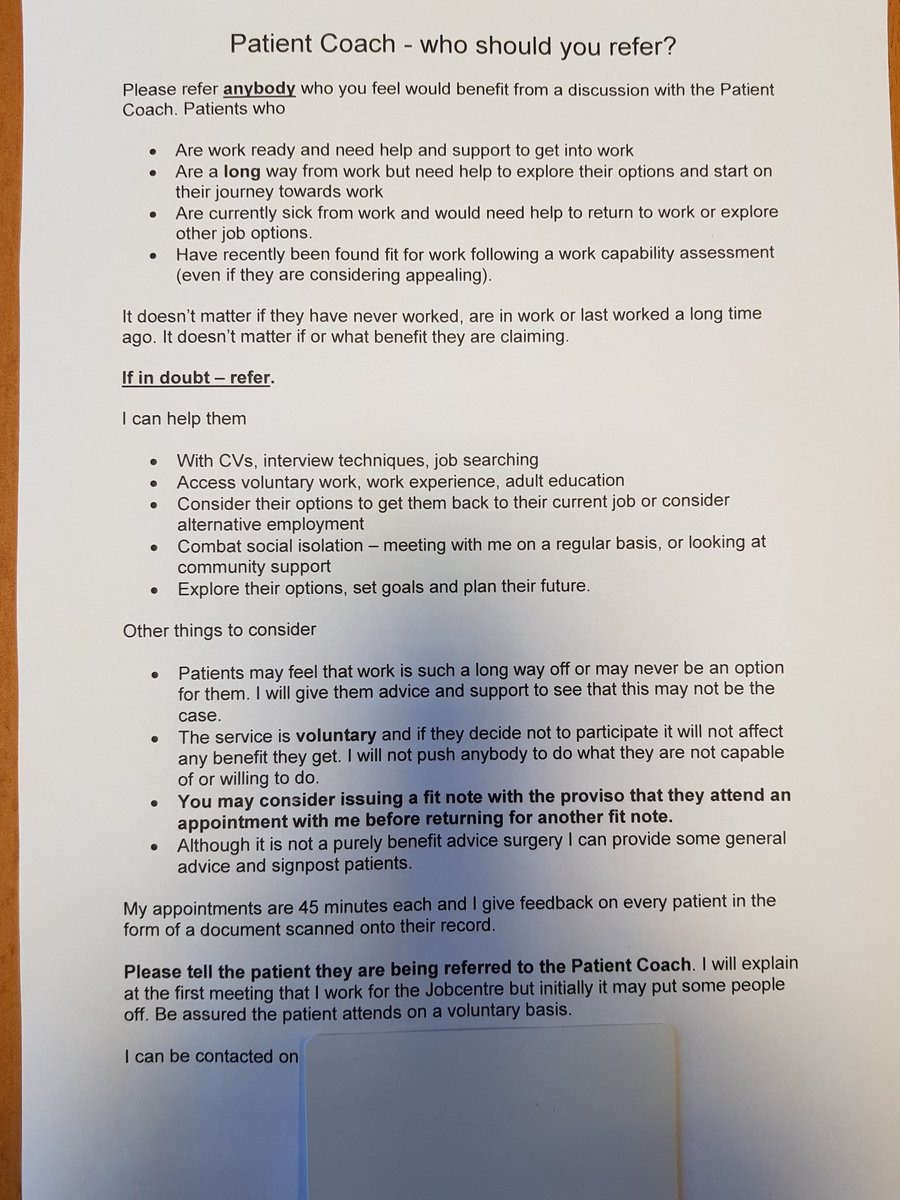
Thanks to  for the copy of a patient work coach letter to GPs.

One of the most worrying comments on the above letter is that despite claiming the work coach service is voluntary, and that if a patient refuses to engage “it won’t affect any benefit they get”, the letter then goes on to suggest that doctors may consider the issuing of subsequent fit notes conditional (“with the proviso that”) on their patient attending a meeting with the work coach. That one sentence simply makes a mockery of the claim that patient engagement with work coaches is voluntary. 

Illnesses don’t respond to provisos or caveats. People don’t suddenly recover when the Department for Work and Pensions decides that they are fit for work. When job centre staff tell GPs to stop issuing sick notes to patients it can have catastrophic consequences, from which the government never seem to learn. In fact they don’t even acknowledge the terrible costs that their deeply flawed policies are inflicting on citizens. 

Julia Savage is a manager at Birkenhead Benefit Centre in Liverpool. In 2016, she wrote a letter (an ESA65B notification form) addressed to a GP regarding a seriously ill patient. It said:

We have decided your patient is capable of work from and including January 10, 2016.

“This means you do not have to give your patient more medical certificates for employment and support allowance purposes unless they appeal against this decision.

“You may need to again if their condition worsens significantly, or they have a new medical condition.” 

The GP subsequently repeatedly refused to provide him with new fit notes, even as his health deteriorated, and he died months later.

James Harrison – the patient – had been declared “fit for work” and the letter stated that he should not get further medical certificates. The Department for Work and Pensions contacted his doctor without telling him, and ordered him to cease providing sick certification, James died, aged 55.

He was very clearly not fit for work.

It is very worrying that the ESA65B form is a standardised response to GPs from the Department for Work and Pensions following an assessment where someone has been found fit for work.  

The government as boardroom doctors: political jobsworths

The Department for Work and Pensions issued a new guidance to GPs in 2013, regarding when they should issue a Fit Note. This was updated in December 2016. 

In the dogma document, doctors are warned of the dangers of “worklessness” and told they must consider “the vital role that work can play in your patient’s health”. According to the department, “the evidence is clear that patients benefit from being in some kind of regular work”

As a matter of fact, it isn’t clear at all.

The idea that people remain ill deliberately to avoid returning to work  – what Iain Duncan Smith and David Cameron termed “the sickness benefit culture” – is not only absurd, it’s very offensive. This is a government that not only disregards the professional judgements of doctors, it also disregards the judgements of ill and disabled people. However, we have learned over the last decade that political “management” of people’s medical conditions does not make people healthier or suddenly able to work.

Government policies, designed to ‘change behaviours’ of ill and disabled people have resulted in harmdistress and sometimes, in premature deaths.

Call me contrary, but whenever I am ill with my medical and not political illness, I generally trust my qualified GP or consultant to support me. I would never think of making an appointment to see the irrational likes of Esther McVey or Iain Duncan Smith for advice on lupus, or to address my health needs and treatment. 

The political de-professionalisation of medicine, medical science and specialisms (consider, for example, the ghastly implications of permitting job coaches to update patient medical files), the merging of health and employment services and the recent absurd declaration that work is a clinical “health” outcome, are all carefully calculated strategies that serve as an ideological prop and add to the justification rhetoric regarding the intentional political process of dismantling publicly funded state provision, and the subsequent stealthy privatisation of Social Security and the National Health Service. 

De-medicalising illness is also a part of that increasingly behaviourist-neoliberal process:  “Behavioural approaches try to extinguish observed illness behaviour by withdrawal of negative reinforcements such as medication, sympathetic attention, rest, and release from duties, and to encourage healthy behaviour by positive reinforcement: ‘operant-conditioning’ using strong feedback on progress.” Gordon Waddell and Kim Burton in Concepts of rehabilitation for the management of common health problems. The Corporate Medical Group, Department for Work and Pensions, UK. 

Waddell and Burton are cited frequently by the Department for Work and Pensions (DWP) as providing ‘scientific evidence’ that their policies are “verified” and “evidence based.” Yet the DWP have selectively funded their research, which unfortunately frames and constrains the theoretical starting point, research processes and the outcomes with a heavy ideological bias. 

This behaviourist framing simply shifts the focus from the medical conditions that cause illness and disability to the ‘incentives’, behaviours and perceptions of patients and ultimately, to neoliberal notions of personal responsibility and self-sufficient citizenship in the dehumanising context of a night watchman, non-welfare state, absent of any notion of human rights. 

Medication, rest, release from duties, sympathetic understanding – the remedies to illness – are being appallingly redefined as ‘perverse incentives’ for ill health, yet the symptoms necessarily precede the prescription of medication, the Orwellian renamed (and political rather than medical) “fit note” and exemption from work duties. Notions of ‘rehabilitation’ and medicine are being redefined as behaviour modification: here it is proposed that operant conditioning in the form of negative reinforcement –  punishment – will cure’ ill health. 

It’s a completely slapstick rationale, hammered into shape by a blunt instrument – political ideology. People cannot simply be ‘incentivised’ (coercion is a more appropriate term) into not being ill. Punishing people for being poor by removing their support does not ‘help’ them to stop being poor, either, despite the  doublespeak and mental gymnastic pseudoscientific rubbish the government spouts.

Turning health care into a government work programme 

The government dogmatically assert “The idea behind the fit note is that individuals do not always need to be fully recovered to go back to work, and in fact it can often help recovery to return to work.” 

It was 2015 when I wrote a breaking article about the government’s Work and Health programme, raising concerns that the Nudge Unit team were working with the Department for Work and Pensions and the Department of Health to trial social experiments aimed at finding ways of: “preventing people from falling out of the jobs market and going onto Employment and Support Allowance (ESA).” 

“These include GPs prescribing a work coach, and a health and work passport to collate employment and health information. These emerged from research with people on ESA, and are now being tested with local teams of Jobcentres, GPs and employers.”

Of course the government hadn’t announced these ‘interventions’ in the lives of ill and disabled people. I found out about it quite by chance because I happened to read Matthew Hancock’s  conference speech: The Future of Public Services.

I researched a little further and found an article in Pulse – a publication for for medical professionals – which confirmed Hancock’s comment: GP practices to provide advice on job seeking in new pilot schemeI posted my own article on the Pulse site in October 2015, raising some of my concerns.

Many of us have warned that the programme jeopardises doctor-patient confidentiality, risks alienating patients from their doctors and perverts the primary role and ethical mission of the healthcare system, which is to help people to recover from illnesses. Placing job coaches in GP surgeries makes them much less inaccessible, because it turns appointments potentially into areas of pressure and coercion. That is the very last thing someone needs when they become ill.

One worry was that the government may use the ‘intervention’ as a further opportunity for sanctioning ill and disabled people for ‘non-compliance’. People who are ill often can’t undertake work related tasks precisely because they are ill. Until recent years, this was accepted as common sense, and any expectation of sick people having to conform with such rigid welfare conditionality was quite properly regarded as both unfair and unrealistic.

I expressed concern that the introduction of  job coaches in health care settings, peddling the myth that ‘work is a health outcome’ would potentially conflict with the ethics and role of a doctor. I also stated my concern about the potential that this (then) pilot had for damaging the trust between doctors and their patients. 

In another article in 2016, titled Let’s keep the job centre out of GP surgeries and the DWP out of our confidential medical records, I outlined how GPs had raised their own concerns about sharing patient data with the Department for Work and Pensions – and quite properly so. 

Pulse reported that the Department for Work and Pensions (DWP) plans to extract information from GP records, including the number of Med3s or so-called ‘fit notes’  issued by each practice and the number of patients recorded as ‘unfit’ or ‘maybe fit’ for work, in an intrusive move described by GP leaders as amounting to “state snooping.”

Part of the reason for this renewed government attack on ill and disabled people is that the Government’s flagship fit note scheme, which replaced sick notes five years ago in the hope it would see GPs sending thousands more employees back to work to reduce sickness-related absence, despite GPs having expressed doubts since before its launch, has predicably failed.

The key reason for the failure is that employers did not take responsibility for working with employees and GPs seriously, and more than half (59%) of employers said they felt unable to support employees by making all of the legally required workplace adjustments for those who had fit notes signed as “may be fit for work.” Rather than address this issue with employers, the government has decided instead to simply coerce patients back into work without essential support.

Another reason for the failure of this scheme is that most people who need time off from work are ill and genuinely cannot return to work until they have recovered. Regardless of the government’s concern for the business and state costs of sick leave, people cannot be simply ushered out of illness and into work by the state to “contribute to the economy.”

When a GP says a person is ‘unfit for work’, they generally ARE unfit for work, regardless of whether the ‘business friendly’ government likes that or not. And regardless of the politically prescribed Orwellian renaming of sick notes, which show ‘paternalist’ linguistic behaviourism in action.

In 2017, the General Medical Council (GMC) – independent regulator for doctors in the UK – wrote a response to the government’s green paper: Improving Lives: The Work, Health and Disability Green Paper consultation. The authors of the document begin by saying ” Our purpose is to protect, promote and maintain the health and safety of the public by ensuring proper standards in the practice of medicine.”

The response continues: “Where doctors are expected to play a role in initiatives such as those set out in the Green paper, our concern is to ensure that any responsibilities that might be placed on doctors would be consistent with their professional obligations and would not risk damaging patients’ trust in their doctors. While we believe that many of the Green paper proposals are promising, we are concerned that key elements appear to present a conflict with the ethical responsibilities we place on doctors. The comments below are seeking clarification in these areas.”

And: “We understand from this Green paper, and from the Department of Work and Pensions’ published FOI response, dated 22 December 2016, that the work coaches who will conduct the mandatory health and work conversation with claimants will not be health professionals. There is a risk that claimants will not get the right support in setting health and work-related goals during this mandatory conversation if the work coach does not have clinical expertise.

“It would be helpful to know whether work coaches will be expected to have access to the claimant’s healthcare team and/or health records to inform these conversations. If so, we would appreciate reassurance that there will be a process for obtaining consent from the claimant, and providing assurance to the relevant health professionals that the individual has provided consent. Given that work coaches do not require medical expertise, we have some concerns about these conversations leading claimants to agree to health-related actions in a Health and Work ‘claimant commitment’. It seems possible that agreed actions might not be clinically appropriate for that individual or not the best course of action given their health condition. 

If a claimant commitment were reviewed by the claimant’s doctor (or other healthcare professional), and the doctor concluded that there was a health risk; then would the claimant be free to withdraw from the commitment without facing a benefits penalty? If not, then this would put the doctor and patient in a very difficult position, if it appeared that the patient had been poorly advised by the work coach and was not making an informed, voluntary decision in requesting a particular treatment or care regime from their doctor. 

We note the intention is for any agreement made in the Health and Work Conversation to be seen as voluntary. However, it seems to us that since the Conversation itself is mandatory and a Claimant commitment may influence subsequent handling of an individual’s Work Capability assessment, then in practice claimants may see these agreements as mandatory.

“As a result they may feel pressured to accept advice and make commitments which may not be appropriate in their case. This would place theirdoctors in a difficult ethical position, and we are concerned to ensure that this is not the case.

The authors add: “… we make it clear in our guidance that doctors must consider the validity of a patient’s consent to treatment if it is linked with access to benefits. Doctors should be aware that patients may be put under pressure by employers, insurers, or others to accept a particular investigation or treatment (paragraph 41, Consent: patients and doctors making decisions together).

“Difficulty could arise if a doctor does not believe that a patient is freely consenting to treatment and is instead only giving consent due to financial pressure. Doctors must be satisfied that they have valid consent before providing  treatment, which means they could be left with a difficult decision as to whether to refuse treatment in the knowledge that this could affect the patients benefit entitlements.” 

The GMC also raise concerns about how sensitive health data is collected and shared for purposes other for patients’ direct care, without patients being informed or giving consent. The government have simply proposed to access health care data to support “any assessment for financial support” and told GPs to assume consent has been given.

Promoting the myth that work is a ‘clinical outcome’ 

A Department for Work and Pensions research document published back in 2011 – Routes onto Employment and Support Allowance – said that if people believed that work was good for them, they were less likely to claim or stay on disability benefits. 

Of course it may be the case that people in better health work because they can, and have less need for healthcare services simply because they are relatively well, rather than because they work. 

From the document“The belief that work improves health also positively influenced work entry rates; as such, encouraging people in this belief may also play a role in promoting return to work.”

The aim of the research was to “examine the characteristics of ESA claimants and to explore their employment trajectories over a period of approximately 18 months in order to provide information about the flow of claimants onto and off ESA.” 

A political decision was made that people should be “encouraged” to believe that work was “good” for their health. There is no empirical basis for the belief, and the purpose of encouraging it is simply to cut the numbers of disabled people claiming Employment and Support Allowance (ESA) by “helping” them into work.

Another government document from 2014 – Psychological Wellbeing and Work – says: We know that being in work is good for wellbeing and that mental health problems are an increasing issue for the nation and so the Minister for Welfare Reform and the Minister for Care and Support jointly sought to expand the evidence base on common mental health problems.  

“A number of Government programmes assess and support those with mental health difficulties to work, but it is internationally recognised that the evidence base for successful interventions is limited. 

“The Contestable Policy Fund gives ministers alternative avenues to explore new thinking and strategies that offer cross-Government benefits. This report was commissioned through this route.” 

And: “Within the time and resources available for this study the research team did not undertake extensive assessment of the quality of the evidence base (eg assessing the research design and methodology of previous studies)”

The government have gone on to declare with authoritarian flourish that they now want to reinforce their proposal that “work is a health outcome.” Last year, a report by the Mental Health Task Force and chaired by Mind’s Paul Farmer, recommended that employment should be recognised as a ‘health outcome’.  I’m just wondering how people with, say, personality disorders, or psychosis are suddenly going to overcome the nature of their condition and all of a sudden successfully hold down a job for a minimum of six months.

Mind those large logical gaps… 

This has raised immediate concerns regarding the extent to which people will be pushed into work they are not able or ready to do, or into bad quality, low paid and inappropriate work that is harmful to them, under the misguided notion that any work will be good for them in the long run.

It has become very evident over recent years that the labour market is not delivering an adequate income for many citizens and despite “record levels of employment”, the problem seems to be getting bigger. The government’s answer to the problem has been to extend punishment those on low pay, rather than tackle employers who pay exploitative, low wages.

The idea of the state persuading doctors and other professionals to “sing from the same [political] hymn sheet”, by promoting work outcomes in social and health care settings is more than a little Orwellian. Co-opting professionals to police the welfare system is very dangerous. 

In linking receipt of welfare with health services and “state therapy,” with the single intended outcome explicitly expressed as employment, the government is purposefully conflating citizen’s widely varied needs with economic outcomes and diktats, isolating people from traditionally non-partisan networks of relatively unconditional support, such as the health service, social services, community services and mental health services.

Public services “speaking with one voice” as the government are urging, will invariably make accessing support conditional, and further isolate already marginalised social groups. Citizens’ safe spaces for genuine and objective support is shrinking as the state encroaches with strategies to micromanage those using public services. This encroachment will damage trust between people needing support and professionals who are meant to deliver essential public services, rather than simply extending government dogma, prejudices and discrimination.

State micromanagement of tenants

The GMC say in their response to the government’s proposals: “We are unclear about the evidence that might support a move to the position that ‘being in employment’ should be regarded as a ‘clinical outcome’ that healthcare professionals are expected to work towards with people of employment age seeking health-related advice and treatment. This is a highly contentious issue and indeed Dame Carol Black’s report certainly makes clear that there is limited support for this within the profession.” 

I’m not unclear. There is no evidence. In an era of small state neoliberalism and ideologically driven austerity, it is an act of sheer political expediency to claim that ‘worklessness’ is the reason for the poor health outcomes that are in fact correlated with increasing inequality, poverty and lower standards of living – higher mortality;  poorer general health, long-standing illness, limiting longstanding illness; poorer mental health, psychological distress, psychological/psychiatric morbidity; higher medical consultation, medication consumption and hospital admission rates.

Both social security and the National Health Service have been intentionally underfunded and run down by the Conservatives, who have planned and partially implemented a piecemeal privatisation process by stealth, to avoid a public backlash.

Unemployment (not ‘worklessness’ –  that’s part of the privileged discourse of neoliberalism, which serves to marginalise the structural aspects of persistent unemployment and poverty, by transforming these into individual pathologies of benefit ‘dependency ‘and ‘worklessness’) is undoubtedly associated with poverty, because welfare provision no longer meets the most basic living costs.

However to make an inferential leap and claim that work is therefore ‘good’ for health’ is incoherent, irrational and part of an elaborate political gaslighting campaign of an authoritarian government, who simply don’t want to address growing poverty and inequality caused by their own neoliberal policies.

The direction that government policy continues to be pushed in represents a serious threat to the health, welfare, wellbeing, basic human rights, democratic inclusionand lives of patients and the political independence of health professionals.


Related

The new Work and Health Programme: government plan social experiments to “nudge” sick and disabled people into work 

Illustration by Jack Hudson


My work is unfunded and I don’t make any money from it. This is a pay as you like site. If you wish you can support me by making a one-off donation or a monthly contribution. This will help me continue to research and write independent, insightful and informative articles, and to continue to support others.

DonatenowButton

Public and Commercial Services Union wins £3 million compensation from the Department for Work and Pensions

Image result for PCS union

The Public and Commercial Services Union (PCS) has won a major victory over the government. The High Court has ruled that ministers acted illegally by withdrawing check-off, the decades-old practice of collecting members’ union subscriptions directly from their pay packet.

The union has won £3 million from the government because of the illegal moves the Department for Work and Pensions (DWP) used to try to ‘crush’ the PCS.

In 2015 the union was at the heart of opposition to the government, fighting against the government’s cuts and closures andchallenging when the Conservatives were robbing members of their redundancy rights. The union were steadfast in opposing austerity.

As a result the then Conservative Cabinet Office minister, Francis Maude, took a particularly vicious and authoritarian decision to attack members’ terms and conditions, also launching an offensive on union reps and attempting to bankrupt the PCS. Maude announced overnight that he would not allow members to pay their union subscriptions directly from their pay packets. However, this was a system that had been in operation for many decades. A union spokesperson said he did that because he knew that 90% of the union’s  income came from that method.

Magnificent campaign

PCS say: “In a magnificent campaign we signed up over 160,000 members to pay their subs by direct debit in a matter of weeks and months to stop us from going bankrupt and to ensure we could continue to represent members at work. We also took legal action in the High Court to show that the government had acted illegally, and to get compensation. Today that case has been settled and in a humiliating defeat for the government, in its attempt to smash PCS and other unions in the public sector, it has to pay £3 million compensation and all of our legal costs.

“In the DWP, reps and members worked hard together to ensure that PCS didn’t suffer as a result of check-off ending. Fran Heathcote, DWP President said ‘Our members recognised this attack for what it was, and it is pleasing to learn that the courts have recognised that too’.

“We now plan to take legal action against every major government department because of the illegal way they’ve treated us.”

PCS General Secretary Mark Serwotka said: “Today’s announcement tells us we have settled one departmental case on union busting, we have many more to come. That’s good news for all of us, and now we’ll ensure we use that money to benefit our members.

“This goes to show that this union can win. We can win in the courts and we can win through campaigning. We’ve defeated the government on the Civil Service Compensation Scheme and we’re waiting for the outcome of a judicial review on the way the government handled pay this year because we believe they did not consult us lawfully. But we’ve got more campaigns to fight. We’ve still got to challenge the government on pay, and ensure that next year we can win above inflation pay rises.

“We will continue to take them to court when we can, but the key to winning is to be a stronger union in every workplace. If you know a colleague who hasn’t joined PCS, please urge them to join. If you’re a member consider becoming a rep. The more of us who are in the union, the more of us who are active means we won’t just beat the government in court we will beat them in our campaigning, too.”

I say well done. A splendid, well fought victory.


Related

Why I strongly support Trade Unionism

The link between Trade Unionism and equality

The “Let Lynton Lobby Bill” – Grubby Partisan Politics and a Trojan Horse


My work is unfunded and I don’t make any money from it. This is a pay as you like site. If you wish you can support me by making a one-off donation or a monthly contribution. This will help me continue to research and write independent, insightful and informative articles, and to continue to support others.

DonatenowButton

Tens of thousands of people claiming ESA owed thousands each due to government blunder

Tens of thousands of disabled people are set to receive backdated benefit payments averaging £5,000 following a government error. The Department for Work and Pensions (DWP) has revealed it will pay out more than £1.5bn after “shoddy administration” meant about 180,000 people did not receive benefits they were legally entitled to after being ‘migrated’ from Incapacity Benefit to Employment and Support Allowance (ESA).

The average underpayment for each person is estimated to be about £5,000, but some people will be owed significantly more, with approximately 20,000 having been underpaid around £11,500 and a small number owed as much as £20,000.

The error was first thought to have resulted in underpayment for 70,000 disabled people over seven years, but a government document published on Wednesday shows it is expected to have affected far more people, with the estimated back payments bill having risen from £340m to £970m. 

The average underpayment for each person affected is estimated to be about £5,000, but some people will be owed significantly more, with approximately 20,000 people having been underpaid around £11,500 and a small number owed as much as £20,000.

Initially, the government said there would be up to £150m that may never be paid back because arrears would only be accounted for as far back as 21 October 2014, the date of a legal tribunal ruling – meaning some would never have been reimbursed. However, following legal action, ministers made a U-turn in July and subsequently announced it would pay back the thousands of disabled people in full. 

In July, Esther McVey, the minster for work and pensions, made a ministerial statement: “The Department has analysed the relationship between ‘official error’ and section 27 of the Social Security Act 1998 in regulating how and to what extent arrears can be paid. As a result of the conclusions of this analysis, we will now be paying arrears to those affected back to their date of conversion to ESA.

“My department will be contacting all those identified as potentially affected as planned. Once an individual is contacted, and the relevant information gathered, they can expect to receive appropriate payment within 12 weeks.” 

Marsha de Cordova, Labour’s shadow minister for disabled people, accused the Conservatives of creating a “hostile environment for sick and disabled people”.

She added: “Disabled people have been short-changed and denied the social security they were entitled to. The government must ensure that disabled people who have been so unfairly treated are properly compensated.”

McVey also confirmed that once contacted, claimants would be provided with a dedicated free phone number on which they can make contact with the department.

The government said it was in the process of reviewing about 570,000 ESA cases that could be affected, and that it expects to complete the process by the end of 2019.

A DWP spokesperson said: “Anyone affected by this historic error will receive all of the money they are entitled to. That is why we have created a dedicated team of over 400 staff to examine cases, and have paid back around £120m so far. 

“We have worked with charities and other disability organisations to make sure that we are providing the right support to all affected claimants and are hiring and allocating more staff to do that.”

Responding at the time of the ruling, Carla Clarke, solicitor for Child Poverty Action Group, which launched the legal action, said: “Poor and inadequate DWP processes left up to 70,000 [now estimated at 180,000] disabled individuals without the support they should have received to help them with their additional costs.  

Justice required that the DWP error was corrected in its entirety for the people affected, many of whom are owed arrears from 2011. We are pleased that the DWP agreed that this was correct following our legal action. 

However, it shouldn’t be necessary to take a government department to court to achieve justice for people who have been failed by officials making avoidable errors.”

The government’s hostile environment and Personal Independence Payments

Image result for universal credit disabled people criticism

The government announced in January this year that every person receiving Personal Independence Payments (PIP) will have their claim reviewed. A total of 1.6 million of the main disability benefit claims will be reviewed, with around 220,000 people expected to receive more money.

The decision came after the DWP decided not to challenge a court ruling that said changes to PIP were unfair to people with mental health conditions. The review could cost £3.7bn by 2023.

The minister for disabled people, Sarah Newton, said the DWP was embarking on a “complex exercise and of considerable scale”.

She added: “Whilst we will be working at pace to complete this exercise, it is important that we get it right.”

The government should have got it right in the first place. It shouldn’t be necessary to take a government department to court to achieve justice for people who have been failed by officials.

Ministers made changes to PIP in 2017 which limited the amount of support people with mental health conditions could receive. As a result, people who were unable to travel independently on the grounds of psychological distress – as opposed to other conditions – were not entitled to the enhanced mobility rate of the benefit. 

The government pressed ahead with these changes, despite criticism from an independent tribunal in 2016.

In 2017, an independent review of PIP was highly critical of the assessment system, after revealing 65% of those who appealed against rejected claims saw the decision overturned by judges.

Last December, a High Court judge ruled the alterations “blatantly discriminate” against people with psychiatric problems and were a breach of their human rights.

Work and Pensions Secretary Esther McVey subsequently announced that the government would not appeal against the judgement, despite not agreeing with ‘certain aspects of it.’ 

 Disability income guarantee cut under Universal Credit

The first legal challenge against Universal Credit in June this year found that the government discriminated against two men with severe disabilities who were required to claim the new benefit after moving into new local authority area.

Prior to moving, both men were in receipt of the Severe Disability Premium (SDP) and Enhanced Disability Premium (EDP), which were specifically aimed at meeting the additional care needs of severely disabled people living alone with no carer, as part of their Employment and Support Allowance entitlement.

Recently released figures from the DWP suggest that 500,000 individuals are in receipt of the SDP. Both the SDP and EDP have been axed and are not available under Universal Credit. According to both the men, they were advised by DWP staff that their benefit entitlement would not change.

Despite repeated assurances from the government that “no one will experience a reduction in the benefit they are receiving at the point of migration to Universal Credit where circumstances remain the same” both claimants saw an immediate drop in their income of around £178 a month when they were moved onto Universal Credit.

When they asked for top up payments they were told that government policy was that no such payments would be paid until July 2019, when managed migration would begin.

The court ruled that the implementation of Universal Credit and the absence of any ‘top up’ payments for disabled people as compared to others constitutes discrimination contrary to the European Convention on Human Rights. Following months of litigation, McVey, Secretary of State for Work and Pensions, carried out a policy U-turn and committed the government to ensuring that no severely disabled person in receipt of the SDP will be made to move onto Universal Credit until transitional protection is in place and also committed to compensating those like the two disabled men who have lost out.

Despite this, following hand down of the judgment the Secretary of State for Work and Pensions has sought permission to appeal, maintaining that there was “nothing unlawful” with the way the disabled claimants were treated.

However, a subsequent court case resulted in agreement on compensation for the two men. TP will now receive £3,277 for past financial losses and £3,240 for the pain and distress he has been caused, as well as £173.50 a month to cover the shortfall in his benefits pending transitional protection coming into force.

AR will receive £2,108 for past financial losses and £2,680 for the anxiety and distress he was caused, as well as a monthly payment of £176 to make up the shortfall in his benefits.

The DWP had initially attempted to keep the terms of the agreement secret. However, the High Court ordered the department to disclose the details of the compensation settlement. 

Marsha de Cordova, Labour’s shadow minister for disabled people, said: “This again demonstrates the government’s mistreatment of disabled people.

“These men were assured by the government that they wouldn’t lose out on universal credit but they were left thousands of pounds out of pocket, which severely impacted on their wellbeing.

“Esther McVey should now compensate all those who lost out, reverse cuts to transitional protection, and withdraw her appeal against the original finding of discrimination.

“The government must also stop the roll out of universal credit and fix its fundamental flaws.

“The next Labour government will transform our social security system, ensuring it is there to support disabled people to live independently and with dignity.”

Tessa Gregory, from the law firm Leigh Day, who represented the two men, known only as AR and TP, welcomed the financial settlements.

But she called on McVey to compensate all other claimants in similar positions, and to reconsider her decision to appeal the finding of discrimination.

She said AR and TP had called on McVey to “urgently” reconsider draft regulations which currently only compensate disabled people in their position with a flat rate payment of £80 a month.

Gregory said: “This plainly does not reflect the actual loss suffered by our clients and thousands like them and compounds the unlawful treatment to which they have been subjected.”

The DWP have refused to answer questions about the case, including how many disabled people it believed had so far lost out on EDP and SDP in the move to universal credit, and whether McVey would reconsider her decision to compensate others in the same position as AR and TP by only £80 a month.

A DWP spokesman confirmed: “The government is appealing the decision of the judicial review, but in the interim we have agreed to make payments to the lead claimants.”

Figures published by the DWP suggest that, in February this year, there were 4,000 SDP claimants and 14,000 EDP claimants (including 3,000 who received both EDP and SDP) who have been moved onto universal credit.

The DWP has previously said it will stop moving claimants of SDP onto universal credit until the introduction of transitional protection next year, while all those who have already lost out through such a move will receive some backdated payments.

But it has not offered them the full compensation agreed with AR and TP and there has been no mention so far of claimants who previously received EDP but not SDP before their move onto universal credit.

And the DWP has still not been able to explain how it justifies not providing equivalent levels of support to new disabled claimants of universal credit, who will receive lower payments than those transferred onto universal credit from legacy benefits such as income-related ESA.

DNS has been forced to complain to the Information Commissioner’s Office about DWP’s refusal to offer a detailed description of how the introduction of universal credit – and the loss of the premiums – will impact disabled people financially.

I did some joint work with Alex, who writes at Universal Credit Sufferer, after a third sector welfare advisor informed us that people claiming PIP were being told to claim legacy benefits – ESA or JSA if they are fit for work – by the DWP and that they were not allowed to sign onto Universal Credit. 

Following several calls between us to the DWP press office, it was clear that staff were not at all clear about this situation. The response we eventually got was “We need to check with officials and come back to you tomorrow.” However, I didn’t get a follow-up call. 

It seems that all new claims for Universal Credit will not be accepted if the person claiming is in receipt of the Personal Independence Payment (PIP) Daily Living Component. However, this move has not been widely publicised. Both Alex and I found that when we used Universal Credit’s online application portal, it will not accept a claim if you declare you are in receipt of Personal Independence Payment (PIP).

While it may be a reluctantly positive move on the part of the government to ensure that disabled people won’t be forced into claiming universal credit and therefore losing their disability premiums, this isn’t a long term solution. It nothing to address the loss of the premiums for new disabled claimants. Nor does it address the controversial and fatally flawed assessment and appeal processes that are unfit for purpose under any welfare circumstance.

But the road to tyranny is mostly paved by government that create hostile environments for some groups and ignore citizens’ accounts of the impacts of their actions on citizens.


Related

Conservative MPs accuse citizens of ‘scaremongering stories’ about experiences of Universal Credit.

Work and Pensions Committee publishes “damning” evidence of the impact of Universal Credit

Disabled people ‘worse off’ under universal credit


I don’t make any money from my work.  But if you like, you can help by making a donation and enable me to continue to research and write informative, insightful and independent articles, and to provide support to others going through disability benefit assessment processes and appeals. The smallest amount is much appreciated – thank you.

DonatenowButton


Blind chef who accidently set him self on fire deemed ‘fit for work’ by DWP

The 51-year-old was registered partially sighted five months ago (Photo: Russell Marcus)

51 year old Russel Barton was registered partially sighted five months ago (Photo: Russell Burton) 

Russell Burton was registered partially sighted earlier this year, after burning himself with oil and setting his clothing on fire accidently at work. Burton has worked as a professional chef for the 25 years, but says his deteriorating eyesight means that he is unable to carry on in that job.

Now he fears for his future because the Department of Work and Pensions have claimed he is ‘fit for work’ so he isn’t eligible for disability benefit.

Yet he cannot apply for work as a chef and he lacks the skills and experience to be considered for other roles. He says after 10 months of signing on he’s had no help with retraining from the government. 

Burton had tried to keep his health problems hidden from his bosses, but was “let go of” four times in 18 months after repeatedly missing orders and following several accidents in the kitchen. The last time this happened, in January this year, Burton said he had to acknowledge that he had to leave behind the career he’s known and loved all of his life. Then, five months ago, his doctor approved him as registered partially sighted. 

Burton says he has been switched back and forth between Jobseeker’s Allowance (JSA) and Employment Support Allowance (ESA) six times this year – and each time his money is delayed, which is making him depressed and anxious. He added “Each time they switch me between benefits I can be waiting a month of two for my money. They just tell me ‘go to a food bank”.  

“No-one will hire me as a chef anymore and I know myself I just can’t be in a kitchen anymore because I’m a health and safety risk to myself and to others. I tried to hide it for the last five years but I clearly can’t anymore.

“I’m keen to find a new career but no-one gets back to me when I apply for jobs I’ve no experience in. The Job Centre has promised me help with retraining but I’ve had zero support so far.” 

He explains: “One time I was holding a tea towel that caught fire and then the sleeves of my top went up.”

Since birth, Russell’s left eye as been affected by amblyopia. The childhood condition means that vision doesn’t develop properly. Children with this problem can see less clearly out of the affected eye and rely more on the ‘good’ eye. This has caused blind spots and double vision for Burton.

Five years ago, he suffered macular scarring in the righ eye — his ‘good eye’ — as an amateur photographer, as he was trying to capture the sun’s corona, which caused his central vision to go blurred and distorted.

Burton says he’s keen to find a new career path but wants some help with re-training 

He explained how his deteriorating eyesight impacted on his chef work: “I was missing tickets – in a restaurant a chef could get 120 tickets an hour and I was struggling to read them. There were times I cut myself chopping, you’re under pressure to work fast and that’s dangerous without good eyesight.

“One time I was holding a tea towel that caught fire and then the sleeves of my top went up. Other times I’d splashed myself with hot oil as I hadn’t seen there was any there in the pan.”

Burton says: “There’s an awful mentality with Job Centre staff where they think it’s acceptable or normal to leave people for months without money. The system is broken.”

Burton who lives with his partner Rachel and her two children, said the uncertainty and insecurity of his income has had an impact on his mental health: “For months I became a recluse, I didn’t go out anywhere or see anyone,” he said.

He has also lost two stone over the last nine months, which he believes is due to a combination of stress and an undiagnosed stomach condition. 

He said: “The doctors thought I had an ulcer but that’s now been ruled out but they don’t know what’s causing my gastrointestinal problems. It doesn’t help that when I’ve been switched to contributions based JSA or ESA I’ve not been entitled to free prescriptions so I’ve not been able to afford to buy the medicines I need to help settle my stomach.”

Burton said he feels “extremely let down” by the state.

“There’s an awful mentality with Job Centre staff where they think it’s acceptable or normal to leave people for months without money and they just say ‘go to a food bank’ when you complain.

“Food banks should be an absolute last resort for people. The system is broken.” 

A system that coerces people who may, through no fault of their own, pose a danger to themselves or others to work is definitely broken. If Russell Barton has an accident in the work place, who is culpable? Barton has expained the impact of his condition, and outlined some of the consequences. The Department for Work and Pensions have taken absolutely no notice of him. He may find some work he can do, but there are serious restrictions on the kind of work he can now do. 

It’s utterly appalling and cruel that people like Russell Barton are placed in situations where they are left for long periods with no income, and then forced to look for work within an extremely competitive employment market when there are such significant health and safety barriers to the kinds of work he can undertake. 

It’s a social security system that has been set up intentionally to fail people, and furthermore it is placing people in unacceptable situations of danger.


I don’t make any money from my research and writing. I’m disabled through illness and on a very low income, but this is something I can do.  If you like, can make a donation to help me continue to research and write free, informative, insightful and independent articles, and to provide support to others going through ESA, PIP and Universal Credit assessment and appeal. The smallest amount is much appreciated – thank you.

DonatenowButton

Concerns about the impact of Brexit on the human rights of disabled people in update report to UNCRPD

Image result for Human rights disabled people UK

Yesterday I wrote an article about the government’s shameful lack of progress on disability rights in the UK. I discussed the details of a new report and the recommendations made by the UK Independent Mechanism update report to the UN Committee on the Rights of Persons with Disabilities.

This is a summary of some key concerns that I only touched on in my original write up, and it also focuses on one of the important themes that emerged in the report: the potential impact of Brexit on disabled people’s rights. 

The new report and submission to the UNCRPD – UK Independent Mechanism update report to the UN Committee on the Rights of Persons with Disabilities (published October 2018) – provides an independent assessment of the UK Independent Mechanism (UKIM) on the “disappointing” lack of progress by the UK governments to implement the UN’s recommendations since August 2017. 

A year on, there is still no comprehensive UK-wide strategy demonstrating how the UK will implement the CRPD Committee’s recommendations. There has also been “continued reluctance” from the UK Government to accept the conclusions of the CRPD Committee’s inquiry report on the impact of the UK Government’s policies on the rights of disabled people. 

Disabled people across the UK continue to face serious regression of their rights to an adequate standard of living and social protection, to live independently and to be included in the community. UKIM has reiterated that the grave and systematic violations identified by the CRPD Committee need to be addressed as a matter of urgency and that the overall approach of the UK Government towards social security protection requires a complete overhaul, so that it is informed by human rights frameworks, standards and principles, to ensure disabled people’s rights are respected, protected and fulfilled.

Despite the empirical evidence presented from a variety of researchers and the UN investigation concerning the significantly adverse effect of welfare reform on disabled people’s rights to independent living and to an adequate standard of living and social  security, the UK Government has failed to act on this evidence and to implement the CRPD Committee’s recommendations regarding these rights.

The authors of the report remain seriously concerned about the continued failure of the UK Government to conduct an assessment of the cumulative impact on disabled people  of multiple policy, cuts and law reforms in relation to living standards and social security. 

In the section about prejudice and negative attitudes, the report also cites a shameful example of rhetoric from the government that has potentially reinforced negative attitudes and the stigma surrounding mental health and disability: “This includes the Chancellor of the Exchequer, Philip Hammond, stating before a Committee of the UK Parliament: ‘It is almost certainly the case that by increasing participation in the workforce, including far higher levels of participation by marginal groups and very high levels of engagement in the workforce, for example of disabled people – something we should be extremely proud of – may have had an impact on overall productivity measurements.’

Many people understood this statement as indicating that the increase in disabled people in employment is partly responsible for the UK’s decreasing productivity.”

The report also says that employment rates for disabled people have actually risen only very marginally.  

Conservative prejudice is embedded in social security policy and administration

The UKIM report says that government has not taken appropriate measures to combat negative and discriminatory stereotypes or prejudice against persons with disabilities in public and the media, including the government’s own claims that ‘dependency’ on benefits is in itself a disincentive of employment. This is important because it shows just how embedded Conservative prejudice is in policies and within our social security administration.

The idea that welfare somehow creates the problems it was designed to alleviate, such as poverty and inequality, has become almost ‘common sense’ and because of that, it’s a narrative that remains largely unchallenged. Yet international research has shown that generous welfare provision leads to more, better quality and sustainable employment. 

Moreover, this ideological position has been used politically as a justification to reduce social security provision so that it is no longer an adequate amount to meet citizens’ basic living needs. The aim is to discredit the welfare system itself, along with those needing its support. The government have long wished to replace the publicly funded social security provision ultimately with mandatory private insurance schemes.

The idea that welfare creates ‘dependency’ and ‘disincentivises’ work has been used as a justification for the introduction of cuts and an extremely punitive regime entailing ‘conditionality’ and sanctions. The governenment have selectively used punitive behavioural modification elements of behavioural economics theory and its discredited behaviourist language of ‘incentives’ to steadily withdraw publicly funded social security provision.

However, most of the public have already contributed to social security, those needing support tend to move in and out of work. Very few people remain out of work on a permanent basis. The Conservatives have created a corrosive and divisive myth that there are two discrete groups in society: tax payers and ‘scroungers’ – a class of economic free riders. This of course is not true, since people claiming welfare support also pay taxes, such as VAT and council tax, and most have already worked and will work again, given the opportunity to do so. For those who are too ill to work, as a so-called civilise society, we should not hesitate to support them.

In the recommendations, the authors say the government should implement broad mass media campaigns, in consultation with organisations representing persons with disabilities, particularly those affected by the welfare reform, to promote them as full rights holders, in accordance with the Convention; and adopt measures to address complaints of harassment and hate crime by persons with disabilities, promptly investigate those allegations, hold the perpetrators accountable and provide fair and appropriate compensation to victims.

As a society we take tend to take human rights for granted. We seldom think about rights because much of the time, there is no need to. It’s not until we directly experience discrimination and oppression that we recognise the value of having a universal human rights framework. Our rights define the relationship between citizen and state, and ensure that there is no abuse of power. However, we no longer have equal access to justice and redress for human rights breaches and discrimination. 

The high demand for advice on disability benefits since the government’s welfare reform means that the almost complete removal of welfare benefits from the scope of legal aid has had a disproportionate impact on disabled people or those with a long-term health condition.

People entitled to disability benefits relied on legal aid to support appeals of incorrect decisions and to provide a valuable check on decision-making concerning eligibility for welfare support. The revisions to the financial eligibility criteria for legal aid have had a disproportionate impact on various groups including disabled people, women, children and migrants. This is because of the restrictions that the government placed on legal aid accessibility with the Legal Aid, Sentencing and Punishment of Offenders Act 2012 (LASPO).

There has been a 99% decrease in support provided by the Legal Aid Agency for clients with disability-related welfare benefits issues, compared with pre-LASPO levels, and the total number of such claims has plummeted from 29,801 in 2011/12 to 308 in 2016/17.

The government has failed to ensure access to justice, removing appropriate legal advice and support, including through reasonable and procedural accommodation for disabled people seeking redress and reparation for the violation of their rights, as covered in the  report.

It’s difficult to imagine that this wasn’t a coordinated effort on the part of the government to restrict citizen freedoms, support and access to justice for precisely those who need justice and remedies the most.

Human rights don’t often seem as though they matter, until they do. But by then, it may be too late. 

Concerns about the impact of Brexit on the human rights of disabled people

In 2016, I wrote an article about concerns raised regarding the rights of disabled people following Brexit. Earlier this year, I wrote another article about my concerns that the European fundamental rights charter was excluded in the European Union (EU) withdrawal Bill, including protection from eugenic policy.

The result of the EU referendum on the UK’s membership of the European Union, and forthcoming withdrawal, carries some obvious and very worrying implications for the protection of citizens rights and freedoms in the UK. Historically the UK Conservative government has strongly opposed much of Europe’s social rights agenda.

So it was very concerning that the House of Commons voted down a Labour amendment to ensure that our basic human rights are protected after Brexit, as set out in the European Union Charter. 

The EU Withdrawal Bill threatened to significantly reduce existing human rights protections. It excluded both the EU Charter of Fundamental Rights (in its entirety) and the right of action for violations of EU General Principles from domestic law after the UK’s withdrawal. It also handed sweeping powers to ministers to alter legislation without appropriate parliamentary scrutiny, placing current rights and equality laws at risk.

Worryingly, Suella Fernandes, who was promoted to the Brexit department earlier this year warned in November last year that transposing the ‘flabby’ charter into British law would give UK citizens additional protections on issues such as “biomedicine, eugenics, personal data and collective bargaining.”

However, the very fact that anyone at all in government objects to retaining these fundamental rights and protections indicates that we do very clearly need them.

It should be inconceivable that a democratic legislature would vote to take away citizens rights. The regressive step means the loss of the Charter goes rights that simply don’t exist in the Human Rights Act or in our common law. Gone is the enforceable right to human dignity. Gone are our rights to data protection, comprehensive protection for the rights of the child, a free-standing right to non-discrimination, protection of a child’s best interests and the right to human dignity, refugee rights, the right to conscientious objection, academic freedom and wide-ranging fair trial rights to name but a few. Then there are the losses of economic and social rights. Gone too, are the right to a private life, freedom of speech, equality provisions and employment rights governing how workers are treated. These are all laws that protect us all from abuses of power. 

A group of more than 20 organisations and human rights legal experts, including the Equality and Human Rights Commission, signed an open letter on the importance of the Charter of Fundamental Rights ahead of the EU (Withdrawal) Bill returning to Parliament on 16 January this year. The letter was published in the Observer.

Trevor Tayleur, an associate professor at the University of Law, explained that the charter, although narrower in focus than the Human Rights Act, offers a far more robust defence of fundamental rights.

“At present, the main means of protecting human rights in the UK is the Human Rights Act 1998 (HRA) ,” he said. “This incorporates the bulk of the rights and freedoms enshrined in the European convention on human rights into UK law and thereby enables individuals to enforce their convention rights in the UK courts. However, there is a significant limitation to the protection afforded by the HRA because it does not override acts of parliament.

“In contrast, the protection afforded by the EU charter of fundamental rights is much stronger because where there is a conflict between basic rights contained in the charter and an act of the Westminster parliament, the charter will prevail over the act.” 

Under the HRA, only an individual who is a “victim” of a rights violation can bring a claim, whereas anyone with “sufficient interest” can apply for judicial review based on the Charter (see this briefing at p 11)

In their report, UKIM say:  “There are fears that the significant uncertainty in relation to Brexit will lead to a further deterioration of disabled people’s rights.

“The lack of a devolved government in Northern Ireland is also a specific concern to that jurisdiction, because it is significantly inhibiting the relevant departments from taking the required steps. Without a clear and coordinated plan for how the UK and devolved governments will address the UN recommendations systematically, the limited steps taken so far are unlikely to be enough to address the concerns raised by the CRPD Committee.”

The report goes on to say: “Following the European Union (EU) referendum in June 2016, there continues to be significant uncertainty regarding the future applicability of  existing human rights protections in the UK that derive from EU law. The EU Charter of Fundamental Rights was excluded from the European Union (Withdrawal) Act 2018, meaning that from ‘exit day’ it will no longer apply in domestic law. 

“As a result, domestic protections are more vulnerable to repeal. The Charter goes further than the non-discrimination provisions in the Equality Act 2010 or the European Convention on Human Rights (ECHR). Article 26 of the Charter, in particular, is a useful interpretive tool to support disabled people’s right to independence and integration and participation in the community. 

The European Union (Withdrawal) Act 2018 also leaves human rights protections at risk of being changed through the use of wide-ranging delegated powers. This means that changes to fundamental rights currently protected by EU law can be made by ministers through secondary legislation [statutory instruments, usually reserved for ‘non-controversial policy amendments] without being subject to full parliamentary scrutiny.

The EU is itself a party to the CRPD. Under EU law, international treaties to which the EU is party have a different status than they do under UK law. For example, EU law (unlike UK law) must be interpreted consistently with the CRPD. To ensure there is no regression, and that disabled people in the UK benefit from future progress driven by the CRPD, the UK Government should ensure these protections are incorporated into UK law, for example by giving enhanced status to the CRPD. 

The Conservatives have used secondary legslation to try and quietly push through several very controversial policies over recent years, such as £4bn-worth of cuts to family tax credits, and the removal of maintenance grants from around half a million of the poorest students in England. The changes mainly hit disabled, ethnic minority and older students.

The government have introduced swathes of significant new laws covering everything from fracking to fox hunting and benefit cuts without debate and scrutiny on the floor of the House of Commons. Many of these policies were not included in the Conservatives’ election manifesto and were nodded through by obscure Commons committees without the substance of the change being debated.

After the House of Lords successfully challenged the tax credit instrument, the Government then proposed limiting peers rights to reject statutory instruments. This would mean if one was rejected by the Lords, the ministers would simply have to retable it and it would pass automatically.  All of this should be seen alongside other Conservative proposals – including limits on freedom of information, changes to constituency boundaries and electoral registration, attempts to choke the opposition of funding within the Trade Union Bill, and the Lobbying Act. 

In light of this repressive pattern of behaviour, you could be forgiven for thinking that we’ve entered the realms of constitutional gerrymandering, with an authoritarian executive waging war on the institutions that hold them to account. With its fear of opposition and loathing of challenge, the government wants to stifle debate, shut down opposition and block proper scruting and democratic accountability. 

It is within this authoritarian political context that many of us have raised concerns about the impact of Brexit on the human rights of disabled citizens.

I’m always concerned that language use sometimes reinforces prejudices against disabled people by focusing on us as a group as ‘vulnerable’ and as ‘those in need’, as opposed to citizens and rights holders. However, grave and systematic violations of disabled peoples’ human right inevitably increases our vulnerability to further political abuse. 

The Yogyakarta Principles, one of the international human rights instruments use the term “vulnerability” as such potential to abuse and/or social and economic exclusion. Social vulnerability is created through the interaction of social forces and multiple “stressors”, and resolved through social (as opposed to individual) means. 

Social vulnerability is the product of social inequalities. It arises through social, cultural, political and economic processes. 

While some individuals within a socially vulnerable context may break free from the hierarchical order, social vulnerability itself persists because of structural – social, cultural economical and political – influences that continue to reinforce vulnerability. Some campaigners are very critical of the use of the word ‘vulnerability’, because they feel it leads to attitudes and perceptions of disabled people as passive victims

Since 2010, no social group has organised, campaigned and protested more than disabled people. Many of us have lived through harrowing times under this government and the last, when our very existence has become so precarious because of targeted and cruel Conservative policies and disproportionate cuts to our lifeline support. Yet we have remained strong.in our resolve. Despite this, some of our dear friends and comrades  have been tragically lost – they have not survived, yet many of them were very strong in their resolve to challenge discrimination and oppression.

In one of the wealthiest democratic nations on earth, no group of people should have to fight for their survival. Vulnerability is rather more about the potential for some social groups being subjected to political abuse than it is about individual qualities. Disabled people currently  are and have been. This is empirically verified by the report and conclusions drawn from the United Nations inquiry into the grave and systematic violations of disabled people’s human rights here in the UK, by a so-called democratic government. 

The government’s ‘paternalism’ is authoritarian gaslighting

Over recent years, Conservative policies have become increasingly ‘paternalist’, also reflecting the authoritarian turn, in that they are designed to act upon us, to ‘change’ our behaviours through the use of negative reinforcement (‘incentives’), while we are completely excluded from policy design and aims. Our behaviours are being aligned with neoliberal outcomes, conflating our needs and interests with the private financial profit of the powerful. 

As one of the instigators of the United Nations investigation, to which I regularly submitted evidence regarding the government’s systematic violations of the human rights of disabled people, and as a person with disability, I don’t care for being  described by Damian Green as “patronising” or being told that disabled people – the witnesses of the investigation – presented an “outdated view” of disability in the UK. This is a government minister attempting to discredit and re-write our accounts and experiences while ignoring the empirical evidence we have presented. Such actions are profoundly oppressive.

The only opportunity disabled people have been presented with to effectively express our fears, experiences and concerns about increasingly punitive and discriminatory policies, to voice a democratic opinion more generally and to be heard, has been in dialogue with an international human rights organisation, and still this government refuse to hear what we have to say. Nor are we consulted with, democratically included or invited to participate in the executive’s decision-making that directly affects us. As UKIM note: 

“There is a continued lack of action from the UK and devolved governments on the CRPD Committee’s recommendations. This includes setting up systems that will  ensure that disabled people and their organisations are involved in the design, implementation, and monitoring and evaluation of legislation, policy or programmes that affect their lives. It remains unclear how the new Inter-Ministerial Group on Disability and Society will work with disabled people and their organisations, and UKIM, to promote and monitor implementation of UN CRPD. 

“It is particularly concerning that the UN CRPD’s requirement to effectively involve disabled people and their organisations is not specifically reflected in the inter-ministerial group’s terms of reference. Nor do the terms of reference refer to the CRPD or the CRPD Committee’s recommendations.”

Oppression always involves the objectification of those being dominated; all forms of oppression imply the devaluation of the subjectivity and experiences of the oppressed.

This is very evident in the government’s approach to designing policies that act upon us.  The government has consistently failed to actively consult, engage with and include disabled people, our representative organisations and give due consideration to our views in the design, implementation, monitoring and evaluation of any legislation, policy or programme action related to our rights. Furthermore, the current Minister of State for Disabled People, Health and Work, Sarah Newton, has refused to meet with disabled people and allied organisations. (See also I’m a disabled person and Sarah Newton is an outrageous, gaslighting liar.)

Last year, Theresia Degener, who leads the UN’s Committee on the Rights of Persons with Disabilities (CRPD), said the UK Government has “totally neglected” disabled people, during a two day meeting with UK government officials in Geneva.

Degener told them: “Evidence before us now and in our inquiry procedure as published in our 2016 report reveals that social cut policies have led to a human catastrophe in your country, totally neglecting the vulnerable situation people with disabilities find themselves in.” 

The Government’s welfare cuts have resulted in “grave and systematic violations” of the rights of disabled people – a claim opposed by ministers but supported by UK courts.

For example, Judges have ruled that three of the government’s flagship welfare policies are illegal because of the impact they have on disabled people and single parents. In January 2016, the Court of Appeal declared the so-called ‘bedroom tax’ unlawful because of its consequences for disabled children, as well as victims of domestic violence. 

Sanctions imposed on people who refused to or could not take part in the Department for Work and Pension’s ‘back to work’ schemes were also thrown out by Court of Appeal judges in April 2016. In June 2017 the High Court said the government’s benefit cap is unlawful and causes “real misery for no good purpose”.  This year, a High Court ruling found that the Personal Independence Payments (PIP) policy had discriminated against people with mental health conditions. 

Between 2011 and 2017 the Department of Work and Pensions (DWP) underpaid more than £450,000,000 in means-tested benefits, due to its mishandling of the process by which claimants were moved from incapacity benefit to employment and support allowance.

When announcing its plans to remedy those underpayments on 14th December 2017, the DWP claimed the law ‘barred’ it from paying claimants any underpayments arising before 21st October 2014. That would have had two serious effects: first, up to £150,000,000 of the underpaid benefit would have been kept by the Government instead of passed to citizens who were deprived of it through no fault of their own; and second, any arrears which were paid to disabled people could after 52 weeks have been treated as ‘capital’, and reduced or stopped their ongoing entitlement to benefit.

In March 2018 the Child Poverty Action Group, acting for one affected claimant, brought judicial review proceedings in R (Smith) v Secretary of State for Work and Pensions JR/1249/2018 arguing that the DWP’s position was unlawful. The DWP accepted that it ‘got the law wrong’. The DWP said it will now start making those payments. It was necessary to take legal action against the Government because it said it had no legal power to fully remedy the consequences of a major error it had made in transferring claimants from incapacity benefit to employment and support allowance.

Ministers have also accused by the UN of misleading the public about the impact of Government policies by refusing to answer questions and using statistics in an “unclear way.”

Gaslighting.

The CRPD Committee has requested that the State party (the government) disseminate the concluding observations of their inquiry widely, including to non-governmental organisations and organisations of persons with disabilities, and to disabled people themselves and members of their families, in national and minority languages, including sign language, and in accessible formats, including Easy Read, and to make them available on the government website on human rights. 

That hasn’t happened and is unlikely to do so in the future. So please do share this article – The government’s shameful lack of progress on disability rights in the UK – new report update and submission to the UNCRPD Committee, and the UKIM update and shadow report widely.


I don’t make any money from my work. I’m disabled through illness and on a very low income. But you can make a donation to help me continue to research and write free, informative, insightful and independent articles, and to provide support to others. I co-run a group online that helps people with ESA and PIP claim, assessment, mandatory review and appeal, increasingly providing one to one emotional support, too.

The smallest amount is much appreciated – thank you.

DonatenowButton