Tag: DWP

Secret ‘internal reviews’ show clear link between Tory welfare ‘reforms’ and suicides

tory cuts


I’ve written more than one lengthy critique of Tory notions of what passes for “research” methods, and often criticised Conservative refusals to accept the research findings of academics regarding, for example, established links between the Work Capability Assessment, increased suicide and mortality, the link between sanctions and increased mortality. The Tory plea for the universal and unqualified dismissal of whatever they deem to be criticism of their policies is often based on the claim that “no causal link has been established.”

As I have pointed out previously, whilst correlation certainly isn’t quite the same thing as cause and effect, it quite often strongly hints at a causal link, and as such, warrants further investigation.

It is inaccurate to say that correlation doesn’t imply causation. It quite often does. Correlation means that an association has been established. The tobacco industry, for example, has historically relied on exactly the same dismissal of correlational evidence to reject the established link between tobacco and lung cancer.

The standard process of research doesn’t entail, at any point, a flat political denial that there is any relationship of significance to concern ourselves with, nor does it involve a systematic and deliberate withholding of relevant data, attempts at censoring democratic dialogue, and a point blank refusal to investigate further. Furthermore, the government claims that there is “no evidence of a causal link ” is unverified. There is no evidence to support government claims that there isn’t such a link, either. In fact empirical evidence strongly refutes the Conservative’s persistent claims of no association between the welfare cuts and an increase in suicide and mortality.

I’ve observed more than once that when it comes to government claims, the same methodological rigour that they advocate for others isn’t applied. Indeed, many policies have clearly been directed by ideology and traditional Tory prejudices, rather than being founded on valid research and empirical evidence. The fact that no cumulative impact assessment has been carried out with regard to the welfare “reforms” indicates a government that is not interested in accountability, and examining the potential negative outcomes of policy-making. Policies are supposed to be about meeting public needs and not about inflicting Conservative dogma and old prejudices in the form of financial punishment on previously protected social groups.

We need to ask why the government has so persistently refused to undertake cumulative impact assessments and conduct open, publicly accessible research into their austerity policies, the impact they are having and the associated deaths and suicides.

Without such research, it isn’t appropriate or legitimate to deny a causal link between what are, after all, extremely punitive, targeted, class-contingent policies and an increase in premature mortality rates.

Government policies are expressed political intentions regarding how our society is organised and governed. They have calculated social and economic aims and consequences. Political denial of responsibility is repressive, it sidesteps democratic accountability and stifles essential debate and obscures evidence. Denial of causality does not reduce the probability of it, especially in cases where a correlation has been well-established and evidenced. Nor does attempting to hide the evidence.

Being civilised, holding values of decency and having legitimate concerns about the welfare and wellbeing of sick and disabled citizens have all been depreciated as mere matters of “subjective interpretation” and not as worthy subjects of political, rational or objective discussion. This isn’t a government prepared to engage in a democratic dialogue with citizens, it is one intent on imposing authoritarianism.

 —

The following article titled “Suicides of benefit claimants reveal DWP flaws, says inquiry” was written by Patrick Butler and John Pring, for The Guardian on Friday 13th May 2016 22.59 UTC

A series of secret internal inquiries into the deaths of people claiming social security reveal that ministers were repeatedly warned of shortcomings in the treatment of vulnerable claimants facing potentially traumatic cuts to their benefits entitlements.

The conclusions are contained in 49 Department for Work and Pensions (DWP) inquiry reports finally released to campaigners on Friday after a two-year Freedom of Information (FOI) battle. Some 40 of the reports followed a suicide. In 10 cases, the claimant had had their benefits sanctioned.

Although the heavily redacted reports do not draw a direct link between the death of a claimant and problems caused by their dealings with the benefits system, they highlight widespread flaws in the handling by DWP officials of claims by people with mental illness or learning difficulty.

The reports, called “peer reviews,” appear to challenge blanket claims by ministers that there is no connection between government welfare reform policies and the deaths of vulnerable claimants.

Several suggest that claimants who died may not have received adequate support from DWP staff handling their benefit claims. At least five of the reports call for major reviews or substantial changes to procedures on identifying and supporting vulnerable claimants.

Many of them centre on the much-criticised Work Capability Assessment (WCA), the test used to assess whether claimants are fit for work. Campaigners argue the tests are flawed and linked to health relapses, depression, self-harm, and suicides.

Activists have linked the WCA to a string of tragic deaths – including poet Paul Reekie, former sheep farmer Nick Barker and ex-security guard Brian McArdle – all of whom died after being found “fit for work” and told by the DWP that they would lose their out-of-work disability benefits.

Peer reviews are triggered when a claimant death is “associated with a DWP activity”. The reports released on Friday were drawn up between February 2012 and August 2014, when an FOI request was originally submitted.

One report warns that vulnerable claimants risked being overlooked by DWP officials, with potentially harmful consequences, because staff resources were stretched by a ministerial decision to push ahead with the speedy re-assessment of hundreds of thousands of incapacity benefit claimants.

It says: “The risk associated with disregarding the possibility that some of these claimants need more support or a different form of engagement is that we fail to recognise more cases like [name redacted] with consequent potential impact on the claimant.”

The report adds: “We need to ask whether or not in the context of a fast-moving environment of high [claimant re-assessment] volumes and anticipated levels of performance, the current process requires, encourages and supports … colleagues to independently and systematically consider claimant vulnerability.”

Another report suggests that while official written policy demanded vulnerable claimants to be treated appropriately this was not implemented in practice. It says: “This case may highlight a dislocation between policy intent and what actually happens to claimants who are vulnerable.”

Ministers initially denied back in 2014 that they held any records on people whose deaths may have been linked to benefits system. Although they subsequently admitted that so-called “peer-review” investigations had been carried out since 2012, they argued social security laws prevented them from publishing them.

A DWP spokesman said it would be wrong to link benefit claims with deaths. “Any suicide is a tragedy and the reasons for them are complex, however it would be inaccurate and misleading to link it solely to a person’s benefit claim.”

They added that guidance was provided to staff on how best to support vulnerable claimants. Ministers were not routinely shown the reviews, which were undertaken internally help staff to deal with complex and challenging benefit cases.

However, they were unable to say whether ministers or senior officials had acted on any of the recommendations contained in the 49 reviews.

Disability News Service, a specialist press agency which submitted the original FOI request to obtain the reports, asked the Office of the Information Commissioner to review the DWP decision. The ICO ruled in favour of the DWP in July 2014, but a subsequent appeal was upheld in March and ministers ordered to publish the reports.

Officials have removed from the reports any references to the specific events that triggered an investigation, as well as dates, names of claimants or staff and locations. Several of the inquiry reports have been stripped of almost all data.

But a number retain entries under the heading “Lessons learned”. Collectively these show that investigators examining the links between a claimant’s death and their treatment by local DWP officials uncovered persistent problems.

They found frontline officials were often unable to identify potentially vulnerable claimants, failed to deal sensitively or appropriately with them, or anticipated problems they may have negotiating their way around the welfare bureaucracy.

Investigators found, variously, that communication between officials and vulnerable claimants was often poor, that practice guidelines were not followed, and that benefits staff often rigidly adhered to the rulebook rather than using “common sense” in their dealings with claimants.

In two instances, investigators reported that it was difficult to carry out a proper inquiry because DWP records had been purged, or not kept properly. In another instance the investigator concluded that officals precedural actions were followed correctly and could not have prevented the death of the claimant.

Other peer review findings include:

• Local DWP branch officials should be given awareness training to deal with “customers who made suicide/self harm declarations”, one report urges. It concludes: “In learning from this experience it is clear there is work to do”.

• In one local office staff failed to provide adequate support for vulnerable claimants, according to a report. It says: “It is clear that we had several opportunities to identify and address the errors made over the duration of this claim, but we neglected to do so”.

• DWP staff who decide on whether to award or disallow disability benefit claims should always consider the claimants’ full historical case files and medical history, a report concludes, to “minimise the risk of withdrawing benefit inappropriately and placing a vulnerable claimant at risk”.

It is understood nine similar DWP peer reviews have since been undertaken since August 2014 and are subject to further FOI requests.

guardian.co.uk © Guardian News & Media Limited 2010


Sign the petition asking the government to examine the DWP, ATOS & Maximus’s culpability for deaths of benefit claimants

“There’s been a marked increase in the number of deaths & suicides of claimants recently found “fit for work” by work capability assessments, possibly implying those benefits entitlements were removed hastily and that the DWP, ATOS & Maximus failed in its duty of care to vulnerable benefit claimants.”

I don’t make any money from my work. But you can support Politics and Insights and contribute by making a donation which will help me continue to research and write informative, insightful and independent articles, and to provide support to others. The smallest amount is much appreciated, and helps to keep my articles free and accessible to all – thank you.
DonatenowButtoncards

Report shows significant challenges facing the Universal Credit system

1450041_569755536427312_1698223275_n

It’s disappointing and very worrying that a published report from the Work and Pensions Committee says: “The employment support service for in-work claimants of Universal Credit (UC) holds the potential to be the most significant welfare reform since 1948, but realising this potential means a steep on-the-job learning curve, as the policy appears to be untried anywhere in the world.”

The Work and Pensions Committee recommendations in the report are:

Given there is no comprehensive evidence anywhere on how to run an effective in-work service, the DWP will be learning as it develops this innovation. The Committee says:

  • for the reform to work, it must help confront the structural or personal barriers in-work claimants face to taking on more work, such as a lack of access to childcare and limited opportunities to take on extra hours or new jobs
  • the question of applying proposed sanctions is complex: employed people self-evidently do not lack the motivation to work.  The use of financial sanctions for in-work claimants must be applied very differently to those for out-of-work claimants
  • a successful in-work service will also require partnership between JCP and employers to a degree not seen before.

Frank Field MP, Chair of the Committee said:

“The in-work service promises progress in finally breaking the cycle of people getting stuck in low pay, low prospects employment. We congratulate the Government for developing this innovation. As far as we can tell, nothing like this has been tried anywhere else in the world. This is a very different kind of welfare, which will require developing a new kind of public servant.”

This imprudent comment from Field implies that individuals need financial punishments in order to find work with better prospects and higher pay. Yet there are profoundly conflicting differences in the interests of employers and employees. The former are generally strongly motivated to purposely keep wages as low as possible so they can generate profit and pay dividends to shareholders and the latter need their pay and working conditions to be such that they have a reasonable standard of living. It’s not as if the Conservatives have ever valued legitimate collective wage bargaining. In fact their legislative track record consistently demonstrates that they hate it, prioritising the authority of the state above all else.

Workplace disagreements about wages and conditions are now typically resolved neither by collective bargaining nor litigation but are left to management prerogative. This is because Conservative aspirations are clear. Much of the government’s discussion of legislation is preceded with consideration of the value and benefit for business and the labour market. They want cheap labour and low cost workers, unable to withdraw their labour, unprotected by either trade unions or employment rights and threatened with destitution via benefit sanction cuts if they refuse to accept low paid, low standard work. Similarly, desperation and the “deterrent” effect of the 1834 Poor Law amendment served to drive down wages.

In the Conservative’s view, trade unions distort the free labour market which runs counter to New Right and neoliberal dogma. Since 2010, the decline in UK wage levels has been amongst the very worst declines in Europe. The fall in earnings under the Tory-led Coalition is the biggest in any parliament since 1880, according to analysis by the House of Commons Library, and at a time when the cost of living has spiralled upwards.

It’s worth considering that in-work conditionality and sanctions may have unintended consequences for employers, too. If employees are coerced by the State to find better paid and more secure work, and employers cannot increase hours and accommodate in-work progression, who will fill those posts? Financial penalties aimed at employees will also negatively impact on the performance and reliability of the workforce, because when people struggle to meet their basic physical needs, their cognitive and practical focus shifts to survival, and that doesn’t accommodate the meeting of higher level psychosocial needs and obligations, such as those of the workplace. It was because of the recognition of this, and the conventional wisdom captured in the work of social psychologists such as Abraham Maslow that provided the reasoning behind the policy of in-work benefits and provision in the first place. 

In-work conditionality reinforces a lie and locates blame within individuals for structural problems – political, economic and social – created by those who hold power. Despite being a party that claims to support “hard-working families,” the Conservatives have nonetheless made several attempts to undermine the income security of a signifant proportion of that group of citizens recently. Their proposed tax credit cuts, designed to creep through parliament in the form of secondary legislation, which tends to exempt it from meaningful debate and amendment in the Commons, was halted only because the House of Lords have been paying attention to the game.

Last month I wrote about the Department for Work and Pensions running a Trial that is about “testing whether conditionality and the use of financial sanctions are effective for people that need to claim benefits in low paid work.” 

The Department for Work and Pensions submitted a document about the Randomised Control Trial (RCT) they are currently conducting regarding in-work “progression.” The submission was made to the Work and Pensions Committee in January, as the Committee have conducted an inquiry into in-work conditionality. The document specifies that: This document is for internal use only and should not be shared with external partners or claimants.” 

The document focuses on methods of enforcing the “cultural and behavioural change” of people claiming both in-work and out-of-work social security, and evaluation of the Trial will be the responsibility of the Labour Market Trials Unit. (LMTU). Evaluation will “measure the impact of the Trial’s 3 group approaches, but understand more about claimant attitudes to progression over time and how the Trial has influenced behaviour changes.”

Worryingly, claimant participation in the Trial is mandatory. There is clearly no appropriate procedure to obtain and record clearly informed consent from research participants. Furthermore, the Trial is founded on a coercive psychopolitical approach to labour market constraints, and is clearly expressed as a psychological intervention, explicitly aimed at “behavioural change” and this raises some very serious concerns about research ethics and codes of conduct, which I’ve discussed elsewhere. It’s also very worrying that this intervention is to be delivered by non-qualified work coaches.

Owen Smith MP, Shadow Work and Pensions Secretary, commenting on the Work and Pensions Select Committee’s report  into ‘in-work progression’ in Universal Credit, said:

“This report shows there are significant challenges facing the new Universal Credit system, not least how to ensure work pays and people are incentivised in to jobs.  As a result, it is deeply worrying that at the early part of the rollout, huge Tory cuts to work allowances will undermine this aim, as 2.5 million working families will left over £2,100 a year worse off. 

“If Universal Credit is to be returned to its original intentions of supporting and encouraging people in to work then Stephen Crabb needs to change his mind and reverse the Tory cuts to working families urgently. 

“It’s also problematic that the committee found there is insufficient information available after a year of piloting in-work conditionality, especially given the complete mess that has been made of the existing sanctions regime.  The DWP should move quickly to make available as much information as possible, to ensure the roll out of Universal Credit is properly scrutinised.”

66864_464287263640807_1896397853_n
Pictures courtesy of Robert Livingstone

Related

Benefit Sanctions Can’t Possibly ‘Incentivise’ People To Work – And Here’s Why

Study of welfare sanctions – have your say

The politics of punishment and blame: in-work conditionality

It’s time to abolish “purely punitive” benefit sanctions


This post was written for Welfare Weekly, which is a socially responsible and ethical news provider, specialising in social welfare related news and opinion.


I don’t make any money from my work. But you can support Politics and Insights and contribute by making a donation which will help me continue to research and write informative, insightful and independent articles, and to provide support to others. The smallest amount is much appreciated, and helps to keep my articles free and accessible to all – thank you.

DonatenowButton
cards

Government plans further brutal cuts to disability support

358-burden-of-cuts

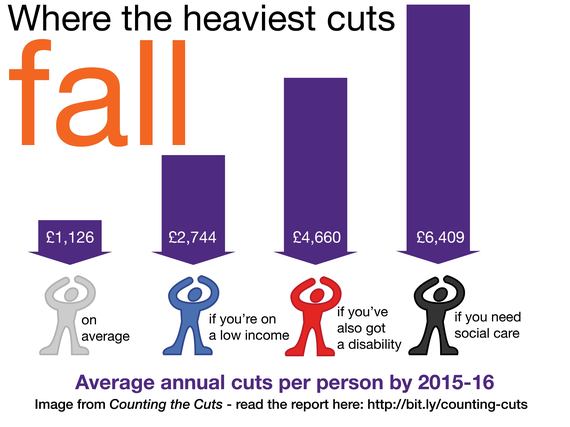
Disabled people are already carrying a disproportionately high burden of the austerity cuts, despite government claims of economic recovery.

Government ministers are planning to cut a key element of the Personal Independent Payment (PIP). Last year a consultation indicated that the Conservatives were considering ways of reducing eligibility criteria for the daily living component of PIP, by narrowing definitions of aids and appliances.

From January 2017, the cut is likely to hit people experiencing incontinence, who struggle to dress themselves, and those facing other fundamental barriers to health and essential basic care. The cut, it is estimated, will affect at least 640,000 disabled people by 2020.

Controversially, it is alleged that the cuts to disability benefit will fund tax cuts for the most affluent – the top 7% of earners. The Chancellor is set to raise the threshold at which people start paying 40p tax, in a move that will probably see  many wealthier people pulled out of the higher rate of income tax, in the coming budget. Mr Osborne says he wants to “accelerate progress” towards the Conservative’s manifesto pledge of raising the threshold for the 40p rate to £50,000 in 2020, it is understood.

Meanwhile, under the plans announced on Friday, sick and disabled people will be much less likely to receive essential disabled benefits if they use aids such as a handrail or a walking stick to get dressed or use the toilet.

The Department for Work and Pensions reviewed a sample of 105 cases of people who had scored all, or the majority, of their points for PIP due to aids and appliances, in order to assess the extent to which the award may reflect extra costs.

The review led the government to conclude that PIP “doesn’t currently fulfil the original policy intent”, which was to cut costs and “target” the benefit to “those with the greatest need.” That originally meant a narrowing of eligibility criteria for people formerly claiming Disability Living Allowance, increasing the number of  reassessments required, and limiting the number of successful claims.

Prior to the introduction of PIP, Esther McVey stated that of the initial 560,000 claimants to be reassessed by October 2015, 330,000 of these are targeted to either lose their benefit altogether or see their payments reduced. Of course the ever-shrinking category of “those with the greatest need” simply reflects a government that has simply made a partisan political decision to cut disabled people’s essential income to fund a financial gift to the wealthiest citizens. There is no justification for this decision, nor is it “fair.”

The government now  claim that the proportion of people awarded the daily living component of PIP, who scored all of their points because they need aids and appliances, has more that tripled, from 11 per cent in April 2014 to 35 per cent in 2015.

The PIP assessment currently examines an individual’s ability to complete ten daily living activities and two mobility activities. Regular reviews were also introduced by the last government to ensure that claimants continue to receive the “right level of support.”

The increase has largely been driven by a significant and sustained rise in relation to activities one, four, five and six: preparing food, washing and bathing, dressing and undressing, and managing incontinence and toileting. Around three-quarters of those who score all of their points through aids and appliances score the minimum number of daily living points needed to qualify for the standard rate of the daily living component.

The government ridiculously claim that the “evidence” presented to the review suggested that in some instances points were being awarded “… because claimants chose to use aids and appliances, rather than needed them.”  And noted that in many cases “ these were non-specialised items of very low cost.”

However, it’s very difficult to justify cutting support for people who require aids to meet fundamental needs such as preparing food, dressing, basic and essential personal care and managing incontinence.

Ministers have now announced their intention to cut PIP for people who currently receive it to help them afford specially-adapted appliances and equipment. Examples of qualifying equipment currently includes adapted cutlery for people who find it difficult to hold things for long periods of time and specially-designed household items for people less able to stand.

Justin Tomlinson, the disabilities minister, said that the cuts to funding for aids and appliances for the disabled could save about £1bn a year and was announced the week before the budget. Charities warned that the cuts to personal independence payments (PIP) would be devastating after the move was confirmed by Tomlinson on Friday.

Tomlinson, said: “The introduction of Personal Independence Payment to replace the outdated Disability Living Allowance for working age claimants has been a hugely positive reform.

But it is clear that the assessment criteria for aids and appliances are not working as planned. Many people are eligible for a weekly award despite having minimal to no extra costs and judicial decisions have expanded the criteria for aids and appliances to include items we would expect people to have in their homes already.

We consulted widely to find the best approach. And this new change will ensure that PIP is fairer and targets support at those who need it most.”

Only a Conservative minister would claim that taking money from sick and disabled people is somehow “fair,” and they frequently do. The cuts of £120 a month to the disability benefit employment support allowance (ESA) are also claimed to be “fair.” and “supportive.” Though I have yet to hear an explanation of how this can possibly be the case. Ministers claimed that people subjected to the ESA Work Related Activity Group cuts could claim PIP if they required support with extra living costs, but now we are told that PIP is to be cut, too.

Bearing in mind the Department for Work and Pensions “review” was based on a sample of just 105 people, it’s very difficult to see how further inhumane cuts to the lifeline income for this group of amongst the most disabled citizens can possibly be justified. How did ministers “plan” the assessment criteria for aids and appliances to work, exactly?  People qualifying for PIP need extra support in meeting their living costs.

A coalition of 25 disability charities has written to the Government to warn against plans that would strip some disabled people of a key payments meant to help them live more independent lives.

The Disability Benefits Consortium wrote to Justin Tomlinson, to argue that proposed changes to Personal Independence Payment – or PIP – assessments would have a “severe impact” on people’s security and make it harder for them to find work.

Debbie Abrahams, the shadow disabilities minister, said: “Removing support for people who need help to use the toilet or dress is an attack on dignity.”

“These further cuts would represent another huge blow, making life even more difficult for many people who already facing huge barriers.”

Phil Reynold, policy and campaigns adviser at Parkinson’s UK, said: “If someone needs aids and appliances to carry out the most basic tasks that most people take for granted then they clearly need ongoing support to live independently, which is often expensive. They should not be penalised by making personal independence payments even more difficult to claim.”

Michelle Mitchell, chief executive of the MS Society, said: “This decision could have a devastating impact on the lives of people with MS. In the worst cases, they could lose up to £150 a week.

PIP is an essential benefit which goes towards the extra cost of being disabled. The new plans will fail some of the most vulnerable people in society and we have serious concerns about the future health and welfare of those affected.”

The government is currently being investigated by the United Nations because of  serious allegations that many of us have made regarding the welfare “reforms”, which have extended gross and systematic abuse of the human rights of disabled people. The UK is the first country to be subject to an investigation regarding the government’s failure to meet legal obligations to uphold disabled people’s human rights. In the 6th wealthiest nation of the world, and a so-called liberal democracy, this treatment of an already marginalised and protected social group is utterly shameful.

536738_306169162785952_999031084_n

scroll2

I don’t make any money from my work and I’m not funded. You can support Politics and Insights by making a donation to help me continue researching and writing independently, and to continue to help others.

DonatenowButton
cards

Labour Party To Refer Groundless Iain Duncan Smith Claim To Statistics Watchdog Again

Steve Bell cartoon


Iain Duncan Smith is telling fibs again. Work and pensions secretary claims that 75% of jobseekers think that benefit sanctions have helped them “focus and get on.”

The following is reported by Rowena Mason and Patrick Butler, for theguardian.com on Saturday 12th March 2016:

Labour is to challenge Iain Duncan Smith’s claim that 75% of jobseekers think benefit sanctions have helped them “focus and get on” by lodging a complaint with the official statistics watchdog.

Owen Smith, the shadow work and pensions secretary, said he would write to Duncan Smith challenging him to back up the “groundless” figure and refer the matter to the UK Statistics Authority for investigation.

The work and pensions secretary made the claim in an interview with the Camden New Journal, in which he suggested many claimants were grateful for the consequences of benefit sanctions.

“Seventy-five per cent of all those who have been sanctioned say it helped them focus and get on. Even the people in the jobcentres think it’s the right thing to do … sanctions are the reason why we now have the highest employment levels ever in the UK, and more women in work,” Duncan Smith said.

“What we say is: ‘We’ll give you all the support but at the end of the day we expect you to do something for it: go back to work, take the job, take the interviews.’ And it works, talk to any of the advisers in the jobcentres.”

While out campaigning for the Tory London mayoral candidate, Zac Goldsmith, Duncan Smith also dismissed protests about the controversial sanctions regime as “a classic buzz from the left” and claimed “these people are never going to vote for us – you have to understand, these people hate us”.

Owen Smith said: “Iain Duncan Smith’s claim that 75% of people who had been sanctioned say it ‘helped them focus and get on’ is groundless and shows he is out of touch with the real impacts of policies introduced by his department.

In reality, widespread concerns have been raised about this government’s use of sanctions, including from their own advisers, which is why the cross-party work and pensions select committee called for a full independent review into the system.

However, Iain Duncan Smith is reluctant to accept such scrutiny. Labour is calling for far greater transparency and honesty in this debate, so we can ensure greater numbers of people are actually helped into work, while being treated fairly.

That is why I will be writing to the secretary of state to inform him that we will refer his use of data to the Statistics Authority and calling for the long overdue independent review into sanctions to begin.”

Duncan Smith is believed to have been referring to DWP research that found 72% of jobseeker’s allowance (JSA) claimants said awareness of sanctions made them “more likely to follow the rules.”

However, that paper also said: “There was no evidence from the survey that knowledge of JSA conditions led to actual movement into work. Respondents who said they were more likely to look for work because of their knowledge of JSA conditions were no more likely than other respondents to have moved into work when they left JSA.”

After the interview, the Department for Work and Pensions released a statement saying: “Decisions on sanctions aren’t taken lightly but are an important part of our benefits system – they are only ever used as a last resort and the number of sanctions continues to fall.”

It is not the first time the UK statistics watchdog has been asked to adjudicate on the DWP’s approach to the sanctions regime.

Last year, it asked the DWP to ensure its statements on jobseeker sanctions are “objective and impartial” following a series of complaints by experts.

At the time, the authority’s chair, Sir Andrew Dilnot, wrote to the DWP’s top statistician asking the department to publish far more data and give the public a clearer understanding of how it is imposing sanctions on jobseekers.

Sanctions are used by civil servants to penalise jobseekers when they are alleged to have broken benefit rules, with punishments becoming increasingly severe over the last parliament.

The government has faced repeated calls from Labour to rethink the system, but is resisting pressure for an independent inquiry.

The Commons work and pensions committee last year urged the government to hold a wide-ranging independent review of the regime to address widespread concerns that it is unfair, excessively punitive, and does little to help people get into work.

© Guardian News & Media Limited 2010.

Related

A List of Official Rebukes For Tory Lies

Department of Work and Pensions officials admit to using fake claimant’s comments to justify benefit sanctions

The Department of Whopping Porkies is rebuked as claimants suddenly develop mysterious superpowers after being sanctioned

A letter of complaint to Andrew Dilnot regarding Coalition lies about employment statistics

Audit finds whereabouts and circumstances of 1.5 million people leaving welfare records each year “a mystery”

Universal Credit cuts will leave some people in work worse off

66864_464287263640807_1896397853_n

Despite Ian Duncan Smith’s persistent claims that “nobody loses a penny” under his flagship Universal Credit reform, the Department for Work and Pensions (DWP) has contradicted him and admitted that some claimants will be worse off. There seems to be a pattern emerging. Whenever the word “reform” is used by the Conservative government, it is always as a euphemism for “cuts to lifeline support.”

Guidance released this week by the DWP outlines how some working people will lose almost £900 a year. The memo supplies guidance on legislative amendments made in 2015 to the regulations which provide for the amount of earned income that is deducted from the Universal Credit maximum amount.

From 11.4.16 the range of work allowances available to Universal Credit claimants is reduced from seven to two (some rates are also reduced and some are removed completely). Consequently a work allowance will only be available where the claimant or either joint claimant is responsible for a child or qualifying young person and/or has limited capability to work (LCW).

On page three, the memo uses a case study – “Bella” – a 26-year-old shop worker who is single and lives with her parents. She works eight hours a week and earns £50, according to the DWP example. But at an hourly rate of £6.25, Bella apparently earns less than the legal minimum wage, which is £6.70 an hour for workers aged 21 and over. From April 1, the minimum wage is rising to £7.20 for employees aged over 25. The DWP guidance admits Bella, who is fictional, will see her monthly UC award plunge from £253.70 to £181.55 – a loss of £72.15 adding up to £865.80 a year.

There is no transitional protection for Universal Credit claimants whose work allowance is reduced or removed by this change.

The Shadow Work and Pensions Secretary Owen Smith said: “Iain Duncan Smith has spent months trying to pretend that ‘no one is going to lose a penny’ as a result of his Universal Credit cuts.”

“That’s now been blown out of the water by his own officials, who’ve produced a guidance note for DWP staff on how to implement the cut.

“Duncan Smith should read his own department’s guidance and call on the Chancellor to drop the Universal Credit cuts in the Budget.”

A DWP spokesman said: “Universal Credit (UC) is revolutionising welfare, with claimants moving into work faster and earning more than under the previous system.”

“As part of moving to a high-wage, low-tax society we are simplifying the work allowances under UC and giving those affected extra help to progress in work and earn more.”

“Even after the changes, UC claimants will know they are better off in work.”

The Poor Law Amendment Act of 1834 was based on the “principle of less eligibility,” which stipulated that the condition of the “able-bodied pauper” on relief be less “eligible” – that is, less desirable, less favourable – than the condition of the very poorest independent labourer. “Less-eligibility” meant not only that the pauper receive less by way of support than the labourer did from his wages but also that he receive it in such a way (in the workhouse, for example) that made pauperism less respectable than work – to stigmatise it. Thus the labourer would be discouraged from lapsing into a state of “dependency” and the pauper would be encouraged to work.

The less eligibility principle “made work pay”, in other words.

The current government is going even further, and applying the same punitive approach to people in low-paid employment, presumably to serve as a deterrent to poor wages. Personally, I think unions do that much better through collective bargaining, by addressing those actually at fault – exploitative employers, rather than poor, exploited employees.

This post was written for Welfare Weekly, which is a socially responsible and ethical news provider, specialising in social welfare related news and opinion.

Let’s keep the job centre out of GP surgeries and the DWP out of our confidential medical records


Image result for work coaches : you can still work if you are ill UK
Source: Work, health and disability green paper: improving lives. Consultation outcome


Last year I wrote a critical article about the government’s new
Work and Health Programme, I flagged up concerns regarding government plans to enlist GPs in prescribing work coaches for people who are sick and disabled, and in providing advice on job-seeking. The private and confidential patient-doctor relationship ought to be about addressing medical health problems, and supporting people who are ill, not about creating yet another space for an over extension of the coercive arm of the state to “help people into work”, regardless of whether or not they are actually well enough to cope with working.

I also posted my article on the Pulse site for medical professionals last October, raising some of my concerns. I proposed that the government may use the “intervention” as a further opportunity for sanctioning sick and disabled people for “non-compliance”, and I expressed concern that this would conflict with the ethics and role of a doctor. I also stated my concern about the potential this pilot has for damaging the trust between doctors and their patients. I do support the idea of social prescribing in theory, but this scheme is certainly not that. This is plain state harassment and coercion.

It’s interesting to see that among all those listed present at the various pilot-related meetings behind closed doors regarding the government’s new Work and Health programme, there isn’t a single sick and disabled person or relevant representative charity to be found. That’s telling, because it means that the provision is not founded on consultation, is not designed to be inclusive from the start, nor does it have a democratic or representative foundation. It’s another case of government policy that acts upon groups people, prescriptively, as if they were objects, rather than human subjects with identifiable needs and the capacity for democratic dialogue.

I discovered last October, almost by chance, that the Nudge Unit team have been working with the Department for Work and Pensions and the Department of Health to trial social experiments aimed at finding ways of: “preventing people from falling out of the jobs market and going onto Employment and Support Allowance (ESA).”

“These include GPs prescribing a work coach, and a health and work passport to collate employment and health information. These emerged from research with people on ESA, and are now being tested with local teams of Jobcentres, GPs and employers.”  Source: Matthew Hancock’s conference speech: The Future of Public Services.

Now GPs have raised their own concerns about sharing patient data with the Department for Work and Pensions – and quite properly so. Pulse reports that the Department for Work and Pensions (DWP) plans to extract information from GP records, including the number of Med3s or so-called “fit notes” issued by each practice and the number of patients recorded as “unfit” or “maybe fit” for work, in an intrusive move described by GP leaders as amounting to “state snooping.”

Part of the reason for this renewed government attack on sick and disabled people is that the Government’s flagship fit note scheme, which replaced sick notes five years ago in the hope it would see GPs sending thousands more employees back to work to reduce sickness-related absence, despite GPs having expressed doubts since before its launch, has predictably failed.

The key reason for the failure is that employers did not take responsibility for working with employees and GPs seriously, and more than half (59%) of employers said they felt unable to support employees by making all of the legally required workplace adjustments for those who had fit notes signed as “may be fit for work.” Rather than address this issue with employers, the government has decided instead to simply coerce patients back into work without essential support.

Another reason for the failure of this scheme is that most people who need time off from work are ill and genuinely cannot return to work until they have recovered. Regardless of the government’s concern for the business and state costs of sick leave, people cannot be simply ushered out of illness and into work by the state to “contribute to the economy.” When a GP says a person is “unfit for work”, they generally ARE unfit for work, regardless of whether the government likes that or not.

The government plans to merge health and employment services, and are now attempting to redefine work as a clinical outcome. Unemployment has been stigmatised and politically redefined as a psychological disorder, the government claims somewhat incoherently that the “cure” for unemployment due to illness and disability, and sickness absence from work, is work.

This is the kind of mentality that the new Work and Health programme is founded on: Dr Josephine Sauvage, the joint vice chair of NHS Islington CCG and a GP at City Road Medical Practice, where the programme is being trialed currently, said the programme can help patients.

She said: “When we become ill we often stop doing those things that get us out and about and bring fulfilment to our lives.”

Yes, that’s what being chronically ill means: we often become incapacitated and sometimes we can’t do all of the things we did before. But since when is working the only source of fulfilment? And how does forcing people who are ILL to look for ANY job, regardless of pay, security, terms and conditions and appropriateness lead to “fulfilment”? A patient is defined as:

  • A person who requires medical care.
  • A person receiving medical care or medical treatment.
  • A person under a physician’s care for a particular disease or condition.

There is no mention of a person’s employment status or the pressing need for a job prescription in that definition.

As part of the Work and Health programme, beginning next month, the DWP plans to access people’s medical information. Employment coaches will be able to directly “update” a patient’s medical record.

GPs will have to inform patients of the access to information and any extraction of confidential information from their medical files, but cannot withhold information unless their patient explicitly objects.

Sofia Lind, a senior journalist at Pulse, says: GPs, as data controllers, will be required to tell patients in person, via notices in the practice and on the practice website of the impending extraction.”

Patients have the right to object to the use and disclosure of confidential information that isn’t used for their medical care.

Patients can explicitly refuse their consent to data sharing. The Data Protection Act 1998 covers personal information including health records. Further provision under Article 8 of the Human Rights Act 1998 establishes a right to respect for private and family life. This underscores the duty to protect the privacy of individuals and preserve the confidentiality of their health records.

There is also additional guidance from the British Medical Association (BMA) here – GPs as Data controllers guidance. (PDF)

You can:

Write your own letter to the GP health centre. Here is a basic letter template in 3 formats that you can download and use:

Opt out letter (PDF)

Opt out letter (MS Word)

Opt out letter (Rich Text)

Make sure you state clearly that don’t wish for any of your data and medical information, including details of your fit notes, to be shared with the DWP and any other third party. You can also:

In addition to sharing information with the DWP, due to changes in legislation, your GP can now be required to upload personal and identifiable information from the medical record of every patient in England to central servers at the Health and Social Care Information Centre (HSCIC).

Once this information leaves your GP practice, your doctor will no longer be in control of what data is passed on or to whom. This information will include diagnoses, investigations, treatments and referrals as well as other things you may have shared with your doctor including your weight, alcohol consumption, smoking and family history. Each piece of information will be identifiable as it will be uploaded with your NHS number, date of birth, post code, gender and ethnicity. NHS England – the body now in charge of commissioning primary care services across England – will manage and use the information extracted by HSCIC for a range of purposes, none of which are to do with your direct medical care.

Whenever I am ill, I don’t ever consider consulting Iain Duncan Smith or the government more generally for advice. There are very good reasons for this. I don’t want to be confronted with pseudoscientific Conservative anti-welfare dogma, I prefer instead to seek the expert, trusted medical opinion of a qualified doctor. I expect professional medical care, not brute state coercion and a punishment regime that is particularly reminiscent of the 1834 Poor Law amendment Act.

And despite assurances from those professionals currently trialing the Work and Health programme that all participation is (currently) voluntary, against the current backdrop of ever-increasing welfare conditionality, the political stigmatisation of people not in work, the frequent punitive deployment of benefit sanctions, the mandatory  welfare-to-work schemes, it’s difficult to imagine a Conservative scheme that will not entail exercising Conservative prejudice and pseudoscientific justifications of Tory economic Darwinist ideology.

It’s hardly the case that the state has an even remotely credible track record of assessing people’s medical conditions, nor is it the case that this government bothers itself with empirical evidence, or deigns to listen to concerns raised by citizens, academics, professionals and charities regarding the harm that their policies are causing. This is a government that can’t even manage to observe basic human rights, let alone care about citizen’s best interests, health and wellbeing.

It’s not possible to make people who are ill better by punishing them, in just the same way as state coercion and using prejudiced language doesn’t “cure” poverty.  I don’t need more quack medicine on top of the current heavy doses of Conservative big state psychopolitics, traditional prejudices and subsequent quacking, slapstick psychobabble. It’s bad enough that Jeremy Hunt thinks he’s the all singing homeopathic Minister for magic and that Iain Duncan Smith thinks he can miraculously cure sick and disabled people by simply forcing them to work. The side-effects of five years of the Conservative’s ontologically insecure rhetoric, that’s been largely ranting, repetitive, incoherent monologue, are nauseating enough. Nobody should need to say any of this in 2016, but tragically, we seem to have a government that hasn’t yet escaped the feudal era. Or playing with their alchemy sets.

I’m in full agreement with Boycott Workfare, the Mental Health Resistance Network, and Disabled People Against the Cuts. I shared my original article with two of those groups and I’m pleased that they have since organised a protest for March 4, 3pm at the City Road Surgery, 190-196 City Road, London EC1V 2QH to raise public awareness of the issues and implications outlined. I just wish I was currently well enough to get to the protest.

They say: GP surgeries are for medical treatment, the job centre is for “employment coaching” and job-hunting.

And governments in first-world liberal democracies are for creating policies that actually meet public needs, rather than imposing totalitarian control, manipulating and micromanaging citizens to meet government needs and political outcomes.

650

My work isn’t funded. But you can support Politics and Insights, and help me to continue researching, analysing and writing independently.

Doctors bribed with 70-90k salaries to join Maximus and “endorse a political agenda regardless of how it affects patients.”

maximus-logoYes, but which people?


The National Audit Office (NAO) scrutinises public spending for Parliament and is independent of government. An audit report earlier this month concluded that the Department for Work and Pension’s spending on contracts for disability benefit assessments is expected to double in 2016/17 compared with 2014/15. The government’s flagship welfare-cut scheme will be actually spending more money on the assessments themselves than it is saving in reductions to the benefits bill – as
Frances Ryan pointed out in the Guardian, it’s the political equivalent of burning bundles of £50 notes.

The report also states that only half of all the doctors and nurses hired by Maximus – the US outsourcing company brought in by the Department for Work and Pensions to carry out the assessments – had even completed their training.

The NAO report summarises:

5.5
Million assessments completed in five years up to March 2015

65%
Estimated increase in cost per ESA assessment based on published information after transfer of the service in 2015 (from £115 to £190)


84%
Estimated increase in healthcare professionals across contracts from 2,200 in May 2015 to 4,050 November 2016

£1.6 billion
Estimated cost of contracted-out health and disability assessments over three years, 2015 to 2018

£0.4 billion
Latest expected reduction in annual disability benefit spending

13%
Proportion of ESA and PIP targets met for assessment report quality meeting contractual standard (September 2014 to August 2015).

This summary reflects staggering economic incompetence, a flagrant, politically motivated waste of tax payers money and even worse, the higher spending has not created a competent or ethical assessment framework, nor is it improving the lives of sick and disabled people. Some people are dying after being wrongly assessed as “fit for work” and having their lifeline benefits brutally withdrawn. Maximus is certainly not helping the government to serve even the most basic needs of sick and disabled people.

However, Maximus is serving the needs of a “small state” doctrinaire neoliberal government. The Conservatives are systematically dismantling the UK’s social security system, not because there is an empirically justifiable reason or economic need to do so, but because the government has purely ideological, anticollectivist prescriptions.

This is a government that claims social security is “unsustainable” and a “burden” on the public purse, yet has no problem with an extraordinary profligacy with public funds and dispossessing tax payers when it comes to implementing “cost-cutting” and draconian welfare “reforms.” Conservative anti-welfare dogma and prejudice are costing the UK billions of pounds.

In April 2014, Atos was forced to abandon their contract with the government because of a growing public backlash, but not before they had profited from very large sums of public money. Meanwhile, sick and disabled people have had their support callously slashed to the bone, people have suffered and some have died as a consequence of that. Yet our welfare state is being used as a sporting arena for big business profit-making, eating up public funds that were supposed to help people who have encountered difficulties meeting their basic needs through disability, losing their job or becoming ill.

The selling of our public services and lucrative contracting out of state functions to private companies who exchange public money for a notoriously poor service is a prominent feature of Tory “small state” Britain.

The Department for Work and Pensions uses the controversial work capability assessments to decide if people are eligible for benefits or to force those on long-term sick leave back into work. The assessment is conducted using a computer software package called Logic Integrated Medical Assessment (LiMA) application.

The assessments are heavily weighted towards finding people capable for work, regardless of the medical evidence presented by claimant’s own doctors. Patients with severe brain damage, kidney failure, cancer, multiple sclerosis and Parkinson’s Disease, amongst many others with seriously incapacitating illnesses, have been found fit for work. On 24 April 2013, a woman who was a double heart and lung transplant patient died in hospital only days after she had been told that her Incapacity Benefit was being stopped and that she was fit for work. There are many other instances of grave errors in the decision-making of the Department for Work and Pensions which are based on the work capability assessment.

Between April 2015 and March 2018, the Department for Work and Pensions expects to carry out around 7 million assessments which it estimates will cost a total of £1.6 billion.

The National Audit Office report on contracted-out “health and disability assessments” states that the cost of providing assessments is rising and providers are still struggling to meet expected performance standards, and that providers continue to struggle with hiring and training staff.

From the NAO summary:

“The Department continues, however, to struggle with setting targets and requirements with clear evidence and failed to adequately test bidders’ assumptions, for example about staff training, during the contract tender process. It does not yet have a clear strategy for contracting-out assessments and risks damaging market interest through tight procurement timetables, inflexibility towards critical assumptions and lack of transparency.

…For PIP, both providers have failed to meet targets for the quality of assessment reports since October 2013. The Department is paying more for assessments, caused in part by capacity shortages pushing up salaries.”

In the last month, recruitment website healthjobs.co.uk has added almost 100 job advertisements for “functional assessor” roles with Maximus, the US company contracted by the Department for Work and Pensions to conduct work capability assessments. Applicants are required to have two years post-qualification medical experience and are offered positions with whoppingly “incentivising” salaries that start at £72,000, with some roles attracting salaries of up to £98,000. The salary for a junior doctor working in the National Health Service (NHS) with two years of experience is approximately £30,000.

Junior doctors working within the NHS were forced to take industrial action recently – the first strike action for more than four decades – over the government’s proposed new junior doctor contracts, because of serious concerns about patient safety, the quality of doctor’s working lives and the lack of recognition regarding the strain of working long and unsocial hours.

The British Medical Association said:

“The biggest threat to patient care is the government’s insistence on removing safeguards which prevent junior doctors from being forced to work dangerously long hours without breaks, with patients facing the prospect of being treated by exhausted doctors.

“The government is threatening to impose contracts in which junior doctors have no confidence and which represents the first step in a wholesale attack on all NHS staff at night and over weekends. We want a contract that is safe for patients, fair for juniors and good for the NHS.”

Maximus offer substantially better working conditions and pay for junior doctors, but compromising patient safety is an inevitable consequence of the company drive to provide administrative solutions to improve the cost effectiveness … and efficiency of government-sponsored benefit programs.

One NHS doctor, Karl Norrington, noted on Twitter that despite Maximus’s company motto: “Helping Government Serve the People” – in reality Maximus is: “paying drs to medically endorse a political agenda regardless of how it affects patients.”

enhanced-9119-1453733217-2

Related

The disturbing truth about disability assessments

Why I blew the whistle on Atos fitness-for-work test

We can reduce the Welfare Budget by billions: simply get rid of Iain Duncan Smith


Mother who faced bedroom tax eviction after son’s suicide found hanged with note to David Cameron

An inquest has heard that Frances McCormack, a 53-year-old school cook, had been hounded for bedroom tax payments since the tragic suicide of her 16-year-old son, Jack Allen, in 2013. A handwritten note, dated 10 days before her death, was found in her bedroom, part of which was addressed to David Cameron, outlining the hardships and distress that the Bedroom Tax was causing her.

Ms McCormack’s body was discovered by her close friend Natalie Richardson at her home in Maltby, near Rotherham.

An eviction notice was served on Ms McCormack the day before her body was discovered, the court heard.

Frances McCormack had been helping Rotherham Council with its suicide prevention work following the tragic suicides of an increasing number of local young people.

Her ex-husband Jimmy Allen said after the inquest: “She was a strong-willed woman and a good, loving mother. This was a totally unseen body blow to the family.”

Close friend Natalie Richardson told the Doncaster inquest: “Frances had spoken to me previously about the property.

“She wanted to buy into it, it was where the three boys were raised and where Jack took his last breaths, ate his last meal and spoke his last words.

“She was a very strong woman, very strong minded. I felt she was getting a lot better with herself. She had decided to go out a bit more, she had started going to the gym, she was very focused and always had something to do.

“She never gave me any kind of inkling and was strong for me when my partner passed away. She was my rock.”

A Department for Work and Pensions spokesman said: “Our sympathies are with the family of Ms McCormack. This is a tragic and complex issue and it would be misleading to link it to one cause.”

The cause of Frances McCormack’s suicide was the distressing impact of a cruel and punitive policy that is intentionally designed to target our poorest and most vulnerable citizens. Frances was already vulnerable because she was grieving her son. But she was also bravely supporting others, in her contributions to suicide prevention work. It must have been profoundly distressing to receive notice that she was to be forced out of her family home.

How many more suicides will it take before this souless, indifferent government recognise the all too often devastating consequences of their “reforms” and engage with citizens, honestly and openly investigating their accounts, and those of campaigners, academics and professionals? There is an established correlation between Conservative austerity cuts and an increase in suicides and deaths that demands urgent investigation.

Surely what is needed, instead of a wall of oppressive political denial, is a democratically accountable impact assessment of the Conservative’s draconian and ideologically-driven policies. Denying other people’s experiences of inflicted political cruelty is the hallmark of Despotism. It’s not the behaviour one would expect from an elected government in a first-world liberal democracy.

Recent research by Iain Duncan Smith’s own department showed 78% of bedroom tax victims were penniless by the month’s end and at least half had to turn down their heating.

The study report was released on December 17 – the very last day of parliament before the Christmas break.

The Labour Party have confirmed the report was received by the Department for Work and Pensions on December 8 and signed off completely for publication on December 11.

A Department for Work and Pensions spokesman insisted it was standard practice for there to be a week’s delay between reports being received and published online.

But the shadow work and pensions secretary Owen Smith said: 

“The Tories are right to be ashamed about a report showing the Bedroom Tax is driving people deeper and deeper in to poverty.

“Iain Duncan Smith should show some decency, by being honest about the damage his hated policy is causing. Then listen to Labour’s calls to scrap the Bedroom Tax at once.”

The government released 36 ministerial statements – compared to three or four on an average day – in a mountain of information on the last day of Parliament before Christmas. Anyone would think the Conservatives want to avoid any democratic scrutiny or accountability.

Alison Garnham of the Child Poverty Action Group said:

“The DWP’s own evaluation finds the ‘bedroom tax’ is not only pushing families into hardship but it’s also failing to free up more accommodation for families – the key argument ministers used to justify this controversial policy.

“This is a long and deep look at a hugely controversial policy – it really should not have been released just as MPs rise for Christmas.”

Department for Work and Pensions sources maintain that the bedroom tax is “fair”, claiming that it was “wrong” that “taxpayers had to “subsidise” benefit claimants to live in houses that are “larger than they require.”

However, most benefit claimants have actually worked or are working in low paid jobs, and have therefore contributed to their own provision.

It would be far more reasonable, credible and valid to object to the “taxpayer” having to subsidise big businesses who are avoiding paying their taxes. The public are paying for a grotesquely greedy level of bonuses and multimillion figure salaries awarded to incompetent private sector CEOs. Only a quarter of government revenue comes from income tax, with much of the rest coming from national insurance and indirect taxes such as VAT, paid by the population as a whole, including by those people needing social security. But tax avoidance is widespread amongst much of the corporate and wealthy elite that benefits so much from state handouts. There’s a real “culture of entitlement” that the Conservatives happily endorse. And it is costing us far more than the welfare state, established for those in need, after the war.

In the Conservative benefit-cutting climate of austerity Britain, one of the wealthiest nations of the world, disability charities have reported that the despicable scapegoating “scrounger” rhetoric has provoked a significant surge in abuse and hate crime towards disabled people. But the behaviour of state-funded private contractors such as G4S and Atos must surely raise the question of who the “scroungers” really are.

In April 2014, Atos was forced to abandon their contract with the government because of a growing backlash, but not before they had syphoned off very large sums of public money. Meanwhile, sick and disabled people have had their support brutally slashed to the bone, people have died as a consequence of that. Yet our welfare state is being used as a sporting arena for big business profit-making, eating up public funds that were supposed to help people who have encountered difficulties meeting their basic needs through losing their job or becoming ill. Now there is a cause for public and political outrage.

The selling of our public services and lucrative contracting out of state functions to private companies who exchange public money for a notoriously poor service is a prominent feature of Tory “small state” Britain. Tax-funded corporate welfare has never been more generous. Another such woefully inept business is A4e, a welfare-to-work company dogged by controversy over poor performance and corruption. Former chairman Emma Harrison paid herself £8.6m in dividends, all courtesy of the taxpayer. In February 2014, four former A4e employees admitted committing acts of fraud and forgery after charging the state for working for clients that did not even exist.

The Conservative’s draconian policies, which they claim were intended to “solve” Britain’s housing crisis, have done nothing but actually make it worse. The Tories have overseen the withdrawal of the right to lifetime tenancies, introduced a dubious “help to buy” guarantee that further inflates housing costs and they have imposed an arbitrary benefits cap, applied indiscriminately whatever a family’s size or needs, which will see an exodus of poorer people, effectively bringing about a “social cleansing” of the capital and other major cities.

Few groups have suffered more than disabled people from this government’s five years in office. Though the human rights of women and children have also been violated by this government’s grinding and unrelentlessly discriminatory legislative machine.

I wrote earlier about the grave concerns regarding the impact of the next round of proposed housing benefit cuts on the most vulnerable social groups from within the housing sector. A specialist housing association has warned that people under the age of 35 in mental health accommodation face rent shortfalls of almost £200 a week under  government plans to cap housing benefit for social housing tenants at Local Housing Allowance rates. Financial modelling shows that at least 95 per cent of supported housing providers would be forced to evict their tenants if the government succeeds in slashing housing benefits.

Capping benefits at the level of Local Housing Allowance (LHA), the council-administered benefit for people in the private rented sector, would affect almost everyone in supported housing.

Every single Tory austerity measure targets the most vulnerable and those citizens with the very least to lose, and not “those with the broadest shoulders,” as Cameron claimed would be the case in 2010.

Charities, mental health professionals, campaigners and researchers have warned the government that austerity cuts are causing mental distress and are linked to rise in suicides.  Research published in September 2015 by Mind, the UK’s largest mental health charity, reported that for people with mental health problems, the Government’s flagship back-to-work scheme, the Work Programme, made their distress worse in 83 per cent of cases. 

A letter, published before the 2015 election, signed by 442 professionals ranging from psychologists to epidemiologists, stated:

“The past five years have seen a radical shift in the kinds of issues generating distress in our clients: increasing inequality and outright poverty, families forced to move against their wishes, and, perhaps most important, benefits claimants (including disabled and ill people) and those seeking work being subjected to a quite new, intimidatory kind of disciplinary regime.”

Psychologists Against Austerity, an alliance of mental health professionals, formed with the aim of directly challenging the cuts and welfare changes that they said were adding to mental distress. The group produced a briefing paper that includes five “austerity ailments” that contribute to worsening mental distress and despair. These are: humiliation and shame, instability and insecurity, isolation and loneliness, being trapped or feeling powerless, and fear and distrust.

The government continue to deny any “causal link” between their draconian policies and an increase in suicide, refusing to carry out an investigation into the impacts of their callous legislative authoritarianism that not only treats our poorest and most vulnerable citizens with disgusting contempt, but also systematically and shamefully contravenes their human rights.


2014-02-17-BurdenoftheCuts-thumb

327,379 sick and disabled people were not paid their Christmas Bonus last year

david-cameron-main.jpg


Labour’s shadow Work and Pensions Secretary, Owen Smith MP, has accused the Department of Work and Pensions (DWP) of being “cruel and incompetent”, after at least 327,379 sick and disabled people were left without their £10 Christmas Bonus.

Benefits were originally calculated to meet only the basic costs of food, fuel and shelter. The Pensioners and Family Income Supplement Payments Act 1972 ensured that a Christmas Bonus of £10 is paid to the recipients of some benefits as a one off payment. The subsequent Pensioners’ Payments and Social Security Act of 1979 established the Bonus permanently, although the amount has never been uprated in line with rising prices and living costs. 

On the government site, it says:

The Christmas Bonus is a one-off tax-free £10 payment made before Christmas, paid to people who get certain benefits in the qualifying week. This is normally the first full week of December.

You don’t need to claim – you should get paid automatically.

Mr Smith said:

“They’ve [the DWP] now been forced to admit that 300,000 people went short because they couldn’t even manage to make a simple payment in time for the holidays.

People have always known the Tories are cruel, but they used to think they were at least competent.

Iain Duncan Smith seems to be having a good go at proving they’re both cruel and incompetent.”

A DWP spokesperson responded, saying 

“All regular ESA payments were made on time over Christmas, with the majority of people receiving their additional Christmas seasonal payment on schedule.

Due to an administrative error, a small minority may not receive their additional Christmas seasonal payment until the end of January.”

Some people have yet to receive their payment. How long does it take to fix an “administrative error”?

I can’t help but wonder about the reason presented by the DWP for the payment delays. I don’t believe it’s the truth, although I’d be amongst the first to acknowledge the Department’s wide-ranging ineptitude.

I am a sick and disabled person who claims ESA. Having worked all of my life, and after being forced though illness to give up a job and profession that I loved, I have to say that my standard of living has very drastically dropped, and I have experienced absolute poverty – times when I have not been able to meet even basic needs, such as keeping  warm and eating adequately. In 2012, a tribunal agreed with my decision to leave work on the grounds that my illness is now so severe it presents unacceptable risks to myself and potentially, to others in the work environment, as I am no longer able to fulfil even the basic responsibilities that my work entailed, reliably, consistently and safely. My consultant and GP fully supported my decision.

I wasn’t paid the Christmas Bonus in 2012, 2013 and 2014. I rang the DWP in 2014, when I realised I was entitled to the payment. After being told twice that the money had been paid into my account and it hadn’t, in October 2015, I finally received the backdated payments. I got a bizarre letter explaining that whilst the DWP had said they had paid me, they hadn’t, which I already knew.

I received my Christmas Bonus for 2015 on 14 January. It seems to me that the DWP seldom pay the Bonus unless you actually ask for it (several times) or unless an MP applies some ethical and rational pressure, as Owen Smith has done.

The government believe that any kind of welfare support creates perverse incentives for people not to work. There is no empirical evidence to support this claim. They also think that the general public are “cognitively incompetent,” drawing on the new paternalist behavioural economics (“nudge”) theoretical framework, their basic proposition is that we are fundamentally irrational and make faulty decisions that are founded entirely on our “cognitive biases.” Of course the new army of self-appointed cognitive experts and nudgers exist outside the realms of their own universal theory of “human nature” and are thus exempted from nudges. Poor people who need financial support are not.

The Tories also claim that one of the problems of providing social security arises because we believe the resulting income gain from employment is not enough to compensate for the (increased) work effort. However, the truly rational solution of course would be to raise the lowest wages, to provide a clear and positive “incentive” to work, when people are able, but instead the government have opted for a psychocratic, punitive approach, stigmatising those who are too ill to work to justify cutting essential lifeline benefits to amounts that barely cover the cost of meeting basic survival needs, adding the perpetual threat and administration of sanctions – which entail the complete withdrawal of support –  for any perceived non-compliance.

The conditionality regime means that eligibility for support requires constantly demonstrating an unbounded willingness to attend often pointless, resource and time-consuming jobcentre lectures from work coaches and advisors and applying for any job presented, regardless of its appropriateness, security or pay.

The Tories ludicrously claim that this punitive approach, entailing the systematic withdrawing of essential support, and the incremental dismantling of the welfare state, is “making welfare fair”,  “making work pay” , “helping people into work” and “supporting sick and disabled people” indicating an Orwellian tendency to turn the meaning of ordinary words into a form of tyranny.

Sanctions are founded on and legitimised by claptrap and psychobabble that originated from the pseudoscientific Behavioural Insights Team, too.  Perhaps the Tory “Grudge” Unit is a much more appropriate name for this mean and vindictive collection of neoliberal cognitive supremicists and economic Darwinists. Armchair psychopaths.

In particular, sanctions are founded on a theory of a cognitive bias called “loss aversion” which is being manipulated and turned into a big state stick to ensure that poor people are compliant with draconian benefit conditionality. “Loss aversion” is a behavioural economics theory that attempts to euphemise draconian policies; a substituted expression that serves as a technique of neutralisation for diabolical state actions designed to instil a deep fear of destitution and starvation amongst the increasingly growing precariat, we are perpetually “downsizing” our needs and expectations to become desperate, impoverished, needing to claim support from a system that most, if not all of us have paid into.

From the shrinking category of legitimate “disability” to forcing people to work in insecure jobs for low wages or for no pay at all on exploitative work fare schemes, nudge is being used to prop up neoliberal ideology, social conservatism, and to euphemistically frame punitive policies, “applying the principles of behavioural economics to the important issue of the transition from welfare to work.” (See Employing BELIEF:Applying behavioural economics to welfare to work, 2010 and Nudging Conformity and Benefit Sanctions, 2015.)

The steady drop in real wages since 2010, according to the Office for National Statistics, is the longest for 50 years. The fall in earnings under the Conservatives is the biggest in any parliament since 1880, according to analysis by the House of Commons Library.  “Making work pay” for whom, we should ask.

The Tories have a strongly anti-welfare ideology, and they also advocate using the tools of behavioural economics to “incentivise” people to work, and further claim that social security encourages dependency. Nudge theorists have proposed that making people’s present more livable with any kind of “cash gifts” only amplifies the alleged cognitive tendency people have to overestimate the magnitude of immediate benefits relative to the more distant ones of working. This is the kind of thinking that underpins Conservative policies aimed at keeping people who need to claim support perpetually poor, insecure and fearful.

However, there’s no such thing as a “cycle of benefit dependency”, it’s a traditional Tory prejudice and is based on historically unevidenced myths. Poverty arises because of socioeconomic circumstances that are unmitigated through government decision-making. In fact this government has intentionally extended and perpetuated inequality through its policies.

It’s therefore easy to see how deliberately withholding the Christmas Bonus would be justified by government officials. This government believes that people who have fallen on hard times and are desperate for financial support are driven by a “culture of entitlement.” People needing social security are being politically redefined as economic free riders. But most people claiming benefit have paid tax, national insurance, and continue to pay VAT and other hidden taxes. There is no discrete class of taxpayers: we ALL pay taxes, except of course for a number of the very wealthy and big businesses. Implying that people claiming social security are a “burden” on working people’s taxes is a fact screen, erected to prop up Tory ideology. Meanwhile the welfare state is being steadily dismantled by a government of neoliberal ideologues.

Perhaps this was just another paternalist experimental “trial” aimed at nudging sick and disabled people into work, and of course, it would be based entirely on operationalising the whopping cognitive biases and traditional prejudices of the Tories.

1002589_521987671204099_896277269_n (1)

If even the DWP isn’t Disability Confident, how will a million disabled people get jobs? – Bernadette Meaden

Nobody would expect a person who suffers blackouts to drive a bus or bin waggon once they had thought through the potentially devastating consequences. But political, cultural, psychological and financial coercion is being used to force sick and disabled people to work – the government continues to cut welfare, which was calculated originally to cover only the costs of meeting basic needs.

Cruel sanctions and strict, inflexible, often unreasonable behavioural conditions are being imposed on lifeline benefit receipt, adversely affecting some of our poorest and most vulnerable citizens; unemployed and disabled people are being stigmatised by the government and the media – all of this is done with an utterly callous disregard of a person’s capacity to work, and importantly, the availabilty of appropriate and suitable employment opportunities, and this can often have tragic consequences.

Modern employment practices, which have an increasingly strong focus on attendance micromanagement, present yet another barrier for disabled people who want to work.

The following is taken from an excellent article which was posted on Bernadette Meaden’s blog, on January 16, 2016.

The numbers of disabled people in ‘absolute poverty’ (unable to meet their basic needs) has risen steeply following welfare reforms. Yet in his most recent party conference speech Iain Duncan Smith said to disabled people, “We won’t lift you out of poverty by simply transferring taxpayers’ money to you. With our help, you’ll work your way out of poverty.”

The recent case  of a Department for Work and Pensions (DWP) employee sacked for taking time off for illness illustrates a truth that the government does not acknowledge. Modern employment practices often appear to be incompatible with its aim of getting sick and disabled people off disability benefits and into work.

In this particular case it was reported that after working at the DWP for thirty four years, Ms Powell, who has a disability, fell foul of its sickness absence procedure, whereby formal action is taken against employees after eight days absence, or four spells of absence within a 12-month period.

‘Health problems meant that Ms Powell was frequently off sick. As some of her absences were related to a disability, her trigger point was adjusted from the usual eight to 12 days. However, Ms Powell later went over her allotted 12 days’ absence by a few days, and she was dismissed.’

A year earlier, a DWP whistleblower had revealed :

“Attendance management continues to get more draconian and sackings have become a regular occurrence: a recent guideline instructed managers to consider dismissal for staff off work for longer than 28 days regardless of the reason.”

So despite its own Disability Confident campaign, which calls on employers to “help improve employment opportunities for disabled people and retain disabled people and those with long term health conditions in your business”, the DWP itself seems unable to provide employment for people who may have long or frequent spells of illness. This would suggest that if you have, say, a long term fluctuating health condition, or a disability that requires frequent hospital appointments, you will find it very difficult to keep a job at the DWP.

Of course the DWP is not alone in this. We know that in some workplaces the pressure to attend even when very ill is overwhelming. At the Sports Direct warehouse, for instance, it was reported that over a two year period, 76 calls for an ambulance had been made, with 36 cases classed as ‘life-threatening’ including strokes, convulsions and breathing problems. One woman gave birth in the toilets, and employees said they were too frightened to take time off when they were ill, in case they lost their job. The employment agency that supplied staff to the warehouse had a ‘six strikes and you’re out’ policy, where a strike could include being off sick, or taking ‘excessive or long toilet breaks’. Very few people with a long term health condition would find it possible to keep their job in these circumstances. 

The reality is that in a fiercely competitive economy and austerity-driven government departments, there is very little room for anyone who has a long term health problem. Perhaps somebody in the government should do a little experiment. Try applying for jobs and declaring a long-term illness or disability which may require regular absences. See how easy it is to get a job.

You can read the rest of Bernadette’s excellent article here.

Related
The new Work and Health Programme: the government plan social experiments to “nudge” sick and disabled people into work