Tag: Equality Act

Specialist Disability Employment Advisors in Jobcentres cut by over 60 per cent

536738_306169162785952_999031084_n

Full-time specialist disability employment advisors who are posted in jobcentres have been radically reduced since 2011. The full-time advisors are employed to help disabled people navigate the support system and find employment. Over the last four years, the number of specialist advisors fell by over 60 per cent, from 226 to just 90.

The government says that the advisors will be replaced by unqualified  non-specialist “work coaches” as part of its Universal Credit programme, which also extends welfare conditionality, entailing sanctions, to people in part-time and low paid work.

We reported last week that the work coach scheme is to extend from jobcentres to GP practices, to prevent sick and disabled people from “leaving the job market” and “claiming Employment Support Allowance” (ESA), with pilots already underway.

The latest figures on jobcentre advisors were released by ministers in response to a Parliamentary question by Labour MP Emily Thornberry.

A spokesman for the Department for Work and Pension said the fall in advisor numbers was consistent with Government policy.

“With the introduction of Universal Credit disabled people looking for work now have access to Work Coaches who are trained to provide tailored support specific to their individual needs. As we continue to make our mainstream services more accessible to disabled jobseekers it is expected that the number of Disability Employment Advisors will continue to decline.”

“The Government is committed to halving the disabled employment gap and the most recent disabled employment figures show that 226,000 more disabled people found work over the past year.”

Charities have responded, saying that the specialist advisors are absolutely crucial for people with disabilities who have to navigate the support system and that their reduction will undermine the Government’s own claim of “supporting people in to work.”

The government have also cut in work support for disabled people, such as the Access to Work fund, which helps people and employers cover costs of disabilities that may present a barrier to work. Under the Equality Act, employers are obliged to make “reasonable adjustments” to the workplace to support people with disabilities.

A coalition of 100 disability charities had warned that the government cuts threaten disabled people’s rights earlier this year, and last month, especially those with learning disability and mental health problems, charities also called for a halt in the government’s cuts to ESA, which will be reduced, removing the work-related activity component, so that people will receive the same amount as jobseekers with no disability, which will make it more difficult for disabled people to find work, and may have an adverse impact on people with health conditions.

The cuts to specialist employment support for people with disabilities flies in the face of  Iain Duncan Smith’s comments during the Tory conference – that sick and disabled people need to see work as their route out of poverty. It’s difficult to see how that can be achieved when the government is busy closing down the transport system, as it were.

Duncan Smith commented at the Conservative conference: “We don’t think of people not in work as victims to be sustained on government handouts. No, we want to help them live lives independent of the state.

“We won’t lift you out of poverty by simply transferring taxpayers’ money to you. With our help, you’ll work your way out of poverty.”

We can’t help wondering what “help” actually means to Conservatives, because there is every indication that they don’t use the word in a conventional sense. Usually when Tories use the word “help” or “support”, it indicates some sort of penalty or punishment: a reference to the extended draconian benefit conditionality and  sanctions regime

Elliot Dunster, group head of policy, research and public affairs at disability charity Scope, has said that the fall in specialist assistance was concerning:

“Disability employment advisors make a huge difference in supporting disabled people into work – providing expert, personalised advice and guidance.

“We’re very concerned to see this drop in the number of job centres that have fulltime specialist advisors for disabled people. Disabled people are pushing hard to find work, but continue to face huge barriers, ranging from inaccessible workplaces to employer attitudes. 

“Disability employment advisors help tackle these barriers. The Government has set out a welcome ambition to halve the disability employment gap. To do this disabled people must have access to specialist, tailored employment support.”

Dan Scorer, head of policy at Mencap, has warned that the replacement generalist advisors would “simply not have the training” required:

“People with a learning disability find the demands placed upon them difficult while claiming Job Seekers Allowance or Employment and Support Allowance.

“Some find them impossible and we are worried that there is not the right support in Jobcentres to help them. Families tell us that a lack of learning disability training and cuts to DEAs is leading to many people with a learning disability being unfairly sanctioned and receiving insufficient support to appeal decisions, or the right support to find employment.

“Even if the reduction in DEAs in some part of the country is due to the rolling out of Universal Credit and part of a strategic move to generic advisors, we are concerned that these advisors will simply not have the training to fully support claimants with a learning disability.

“The problems with the administration of benefits and changes in the benefits system, combined with future cuts to benefits and social care, is causing fear and anxiety among the 1.4 million people with a learning disability and their families in the UK who are scared they could be isolated in their local communities.”

Mind have already warned that the transition away from specialist help under Universal Credit would make the benefits system more difficult for people with mental health issues. Policy manager, Tom Pollard told the Independent:

“We’re pretty sceptical of the ability of those jobcentre advisors to be able to understand the barriers that people with mental health issues face.” 

Labour MP Debbie Abrahams recently challenged Priti Patel, the employment minister, during work and pensions questions in the Commons recently to raise concerns about the negative impacts of social security sanctions on the mental health of claimants.

During the session the Patel had claimed: “Our staff are trained to support claimants with mental health conditions and there is no evidence to suggest that such claimants are being sanctioned more than anybody else.”

Mrs Abrahams, Shadow minister for Disabled People, responded: “The minister may have inadvertently slipped up there. There is clear evidence from last year that 58 per cent, more than half, of people with mental health conditions on the employment and support allowance work-related activity group were sanctioned.”

A recent Freedom of Information request showed that between April, 2014, and March this year there were almost 20,000 benefit sanctions received by people who were out of work because of their mental health.

However, in this same period only 6,340 of the group were successfully supported into employment during the same period by the Work Programme.

Tom Pollard said: “Figures obtained by us show that people with mental health problems are more likely to have their benefits stopped than those with other conditions.

“Last year, the Department of Work and Pensions issued more sanctions to people with mental health problems being supported by Employment and Support Allowance than they did to those with other health conditions.

“Stopping somebody’s benefits, or threatening to stop them, is completely the wrong approach to help people with mental health problems find work — it’s actually counterproductive.

“In continually refusing to listen to calls for a review of the use of sanctions, the Government is not only undermining its ambition of helping a million more disabled people into work, but is also failing its duty of care for the health and wellbeing of hundreds of thousands of people with mental health problems.”

The Department of Work and Pension’s own research shows that the threat of sanctions does ensure that people who need support from social security comply with benefit rules, but that doesn’t actually help them to find work. It also tends to undermine confidence, and many jobcentre advisors have expressed concern that people with mental illness are more likely to be sanctioned simply because they would have greater difficulty meeting the strict conditionality criteria and because of the greater pressure to sanction “non-compliance” from government. (page 54)

But we deeply suspect that sanctions are precisely what the government are referencing when they use the phrase “helping people into work.”

This post was written for Welfare Weekly, which is a socially responsible and ethical news provider, specialising in social welfare related news and opinion.

The government response to the WoW petition is irrational, incoherent nonsense on stilts

disability_2218977b

Preamble

The Government has persistently ignored calls for a full assessment of the impact of Welfare, Social Care and NHS reform on disabled people and their families. The number of households with a disabled family member living in “absolute poverty” increased by 10% between 2013 and 14. Absolute poverty isn’t the same as relative deprivation – our usual measure of poverty – absolute poverty means that people can’t meet their basic needs, such as access to food, fuel or shelter.

Since the WoW petition collected 104,000 signatures, the Government has claimed the Institute for Fiscal Studies (IFS) have said it was too difficult to do a Cumulative Impact Assessment (CIA), the IFS subsequently contradicted the claim and said it could be done. EHRC and the Social Security Advisory Committee have also called for a CIA of how cuts have affected disabled people and their families. A CIA undertaken by Landman Economics, the National Institute of Economic and Social Research and The Centre for Welfare Reform have demonstrated that disabled people have been hit the hardest by austerity cuts.

 You can sign the petition here.

Here is the Government’s blustering, inadequate and importantly, unevidenced response to the WoW petition:

“The Government is committed to a fair tax and welfare system where everyone contributes to reducing the deficit, and where those with the most contribute the most. Every individual policy change is carefully considered, including looking at the effect on disabled people in line with legal obligations.

However, it is not possible, using the Government’s existing analytical tools, to produce a cumulative assessment of the impact of policies on disabled people. HM Treasury has a world-leading distributional model, which it has used since 2010 to publish analysis of the impacts of policy decisions on households across the income distribution. This model uses the Living Cost and Food Survey (LCF), which does not have information on disability status. It contains expenditure information which allows analysis of the impacts of indirect taxes such as VAT and fuel duty, and underpins a unique model of public service usage; both of these enable HMT to consider the impacts of all of the Government tax and spending decisions which directly affect households.

As well as the inability to identify who has a disability in the data, most analysis of the impacts of welfare reforms tend to be limited in that they take static snapshots of benefit changes. Fundamental reforms are designed to support people in to employment and will therefore enable people to generate more income for themselves. Analysis needs to take account of behaviour change of reforms rather than the more limited approach of focusing solely on benefit changes

This analysis shows that the proportion of welfare and public service spending which benefits poorer households has not changed since 2010-11, with half of all spending on welfare and public services still going to the poorest 40% of households in 2017-18. At the same time, the richest fifth of households will pay a greater proportion of taxes than in 2010-11 as a result of government policy – and more than all other households put together.

The Government spends around £50 billion on disability benefits and services annually, and expenditure on sick and disabled people is higher than the OECD average. Welfare changes since 2010 have included protections for key vulnerable groups least able to increase their earnings, including those who need additional support as a result of disability. In the Welfare Reform and Work Bill 2015:
• Many disability-related elements of the benefit system are still uprated by the Consumer Price Index
• The additional component for those in the Support Group of Employment and Support Allowance and Universal Credit (UC) equivalents has been maintained
• Households which include a member who is in receipt of Disability Living Allowance, Personal Independence Payment, the Support Component of Employment and Support Allowance or UC equivalents are exempt from the benefit cap.

Overall, reforms are focused on supporting people to find and keep work where appropriate. Growing evidence over the last decade shows work can keep people healthy as well as promote recovery which is why, as part of the Government’s objective to achieve full employment, it aims to halve the disability employment gap. Last year 226,000 more disabled people found work and to continue this success the Government has extended Access to Work to provide support to more disabled people in pre-employment, launched Specialist Employability Support to provide intensive, specialist support to the disabled people who need the most help and has extended Work Choice, providing tailored support to disabled people, to 2017. The Disability Confident campaign is working with employers to ensure that they understand the benefits of recruiting and retaining disabled people in work

Sickness Absence in the workplace is also a major issue, with employees off sick for four weeks or more being at greater risk of not returning to work. The Government recognises the importance of early support which is why Fit for Work has been developed; giving access to free, impartial work-related health advice to help employees on sick leave get back to work.

In terms of Social Care and NHS reforms, the Government is committed to supporting the most vulnerable. The Care Act 2014 introduces a modern system to promote and maintain the wellbeing of those with care and support needs so they can live independently. This includes introduction of a new national eligibility threshold which allows local authorities to maintain previous levels of access for service users. This threshold is set out in Eligibility Regulations, and local authorities cannot tighten eligibility beyond this threshold. The Act also provides new legislative focus on personalisation by placing personal budgets into law for the first time for people and carers, increasing opportunities for greater choice and control, so that people can choose social care best suited to meet their needs.”

Department for Work and Pensions

The government is quietly rewriting our protective laws

Under the Equality Act, provision was made by the Labour government to ensure that legislations didn’t discriminate against protected social groups, which included disabled people. However, the need for public bodies in England to undertake or publish an equality impact assessment of government policies, practices and decisions was quietly removed by David Cameron in April 2011. The legal requirement in the Equality Act that ensured public bodies attempt to reduce inequalities caused by socio-economic factors was also scrapped by Theresa May in November 2010, who said she favoured a greater focus on “fairness” rather than “equality.”

The Conservatives have since claimed to make welfare provision “fair” by introducing substantial cuts to benefits and introducing severe conditionality requirements regarding eligibility to social security, including the frequent use of extremely punitive benefit sanctions as a means of “changing behaviours,” highlighting plainly that the Conservatives regard unemployment and disability as some kind of personal deficit on the part of those who are, in reality, simply casualties of bad political decision-making and subsequent policy-shaped socio-economic circumstances.

Semantic shifts – how Glittering Generalities are being used to mask political acts of discrimination

The word “fair” originally meant “treating people equally without favouritism or discrimination, without cheating or trying to achieve unjust advantage.” Under the Conservatives, we have witnessed a manipulated semantic shift, “fair” has become a Glittering Generality – part of a lexicon of propaganda that simply props up Tory ideology in an endlessly erroneous and self-referential way.

It now signposts an intentionally misleading Conservative narrative, constructed on the basic, offensive idea that people claiming welfare do so because of “faulty” personal characteristics, and that welfare creates problems, rather than it being an essential mechanism aimed at alleviating poverty, extending social and economic support and opportunities – social insurance and security when people need it.

The government claims to be “committed to supporting the most vulnerable” and ensuring “everyone contributes to reducing the deficit, and where those with the most contribute the most.” That is blatantly untrue, as we can see from just a glance at Conservative policies:-

The following cuts, amongst others, came into force in April 2013:

  • 1 April – Housing benefit cut, including the introduction of the ‘bedroom tax’
  • 1 April – Council tax benefit cut
  • 1 April – Legal Aid savagely cut
  • 6 April – Tax credit and child benefit cut
  • 7 April – Maternity and paternity pay cut
  • 8 April – 1% cap on the rise of in working-age benefits (for the next three years)
  • 8 April – Disability living allowance replaced by personal independence payment (PIP)
  • 15 April – Cap on the total amount of benefit working-age people can receive 

Here are some of the Tory “incentives” for the wealthy:

  • Rising wealth – 50 richest people from this region increased their wealth by £3.46 billion last year to a record £28.5 billion.
  • Falling taxes – top rate of tax cut from 50% to 45% for those earning over £150,000 a year. This is 1% of the population who earn 13% of the income. The wealthiest had a tax cut of £170, ooo each per year.
  • No mansion tax and caps on council tax mean that the highest value properties are taxed proportionately less than average houses. Meanwhile, those previously exempt from council tax claiming social security now have to pay due to reductions in their benefit.
  • Benefited most from Quantitative Easing (QE) – the Bank of England say that as 50% of households have little or no financial assets, almost all the financial benefit of QE was for the wealthiest 50% of households, with the wealthiest 10% taking the lions share
  • Tax free living – extremely wealthy individuals can access tax avoidance schemes which contribute to the £25bn of tax which is avoided every year, as profits are shifted offshore to join the estimated £13 trillion of assets siphoned off from our economy.

As a consequence of the highly discriminatory and blatantly class-contingent Tory policies, inequality in the UK has risen to the highest level amongst all EU countries, and tops even the US. Rampant socio-economic inequality apparently is the new Tory “fair”.

The rise in the need for food banks in the UK, amongst both the working and non-working poor, over the past five years and the return of absolute poverty, not seen since before the advent of the welfare state in this country, makes a mockery of government claims that it supports the most vulnerable. 

Income tax receipts to the Treasury have fallen because those able to pay the most are being steadily exempted from responsibility, and wages for many of poorer citizens have fallen, whilst the cost of living has risen significantly over this past five years.

The ideologically motivated transfer of funds from the poorest half of the country to the more affluent has not contributed to deficit reduction. It doesn’t take a genius to work out that the cumulative impact of Tory tax and welfare changes, from out-of-work and in-work benefits to council tax support, to the cut in the top rate of income tax and an increase in tax-free personal allowances, has been extremely regressive and detrimental to the poorest.

The revenue gains from the tax changes and benefit cuts were offset by the cost of tax reductions, particularly the increase in the income tax personal allowance, benefitting the wealthiest.

The Treasury response to this is to single out the poorest yet again for more cuts to “balance the books” – which basically translates as the Conservative “small state” fetish, and deep dislike of the gains we made from the post-war settlement. Yet for a government that claims a non-interventionist stance, it sure does make a lot of interventions. Always on behalf of the privileged class, with policies benefitting only the wealthy minority.

How can Conservatives believe that poor people are motivated to work harder by taking money from them, yet also apparently believe that wealthy people are motivated by giving them more money? This is not “behavioural science,” it’s policy-making founded entirely on traditional Tory prejudices.

The government claim that “Every individual policy change is carefully considered, including looking at the effect on disabled people in line with legal obligations,” but without carrying out a cumulative impact assessment, the effects and impacts of policies can’t possibly be accurately measured.

May I suggest that the government listens to disabled people, instead of dismissing our evidenced, valid accounts of the negative impacts of policy as “anecdotal” and attempting to invalidate our experiences. Policies ought to be about meeting identified public needs, that’s what we elect governments to do in democracies. Democracy means that the voices of citizens, especially members of protected social groups, need to be included in political decision-making, rather than so frankly excluded and rather than having their experiences negated by a bullying, aggressive political denial strategy. Public policy is not an ideological tool for a so-called democratic government to simply get its own way.

The government have persistently simply denied any accounts of the adverse consequences of their policies on disabled people, and have refused to effectively monitor policy impacts, indicating plainly that it values perverse ideology much more than it values the lives of real people.

Furthermore, the claim that “it is not possible to carry out a cumulative assessment of the impact of policies on disabled people” doesn’t stand up to scrutiny in the face of the various assessments carried out by a variety of under-resourced organisations, academics and campaign groups.

I suggest that the government pays attention to the findings of these important pieces of research, and learns from them, especially concerning how to research effectively, how to formulate evidence-based policies and how to budget for impact assessments, because if severely underfunded organisations and charities can manage that, so can the government. It’s a matter of priorities.

If the government had paid attention to laws, including international ones, as claimed, instead of trying to edit out the parts that are inconvenient to them, then there would be no need for the United Nation’s inquiries into human rights violations of disabled people, and the negative social, economic and cultural impacts of their welfare “reforms” on vulnerable social groups

Someone please put Iain Duncan Smith out of our misery

The persistent denial from the Secretary of State for Work and Pensions that there is a correlation between the government’s welfare cuts and an increase in mortality, including suicide, flies in the face of evidence presented by the Work and Pensions Committee earlier this year, when the cross-party Committee of MPs said that since 2012 there have been at least 40 cases of people taking their own lives because of problems with welfare payments

The MPs called for an independent review into benefit sanctions, and said that they were “causing severe financial hardship” and are behind the rise in food banks. It was reported that the Department for Work and Pensions has investigated 49 cases where a claimant has died.

Of these, 40 involved a suicide, the Work and Pensions Select Committee said. But the DWP was unwilling to say how many of the deaths were a result of benefit sanctions or say if it had changed its policies as a result.

The statement: “Analysis needs to take account of behaviour change of reforms rather than the more limited approach of focusing solely on benefit changes”  is another indication of this government’s perverse ideological commitment as opposed to any commitment to upholding political obligation towards meeting the needs and promoting the wellbeing of citizens.

We elect governments to meet public needs, not to “change behaviours” of citizens to suit government needs.

The government’s undeclared preoccupation with behavioural change through personal responsibility, not to be found in their manifesto, is just another revamped version of Samuel Smiles’s bible of Victorian and over-moralising hobby-horse: “thrift and self-help” – but only for the poor, of course. Smiles and other powerful, wealthy and privileged Conservative thinkers, such as Herbert Spencer, claimed that poverty was caused largely by the irresponsible habits of the poor during that era. But we learned historically that socio-economic circumstances caused by political-decision making creates poverty.

This government endorses the proliferation of insecure, low paid work, welfare that punishes people to the point of desperation, with no regard for their life or wellbeing, in order to “incentivise” them to take  any job, (no matter how poorly paid and unsuitable it is) and removing income from the poorest more generally, whilst handing out our money to the wealthy. That’s not citizens behaving “fecklessly” or irresponsibly: that’s the government.

If punishing people actually worked to “help” (yet another Tory euphemism) people into work, the Department of Work and Pensions would have had no need to write fake testimonials from fake characters to attempt a nasty and ludicrous justification of benefit sanctions.

The “making work pay,” approach, which is Toryspeak for retrogressive policy-making, based on the 1834 Poor Law principle of less eligibility again.  The reality is that sick and disabled people are being coerced by the state into taking any very poorly paid work, regardless of whether or not they can work, and to translate the Tory rhetoric further, Duncan Smith is telling us that the government will continue to ensure the conditions of claiming social security are so dismal and brutal that few people can survive it.

When we inform this government that people are dying, and that this is correlated with Tory policies, they simply deny it without any evidence to substantiate their claims. The lack of concern and instant dismissal of concerns about this correlation is not the kind of behaviour one would expect from government in a first-world liberal democracy.

Making work pay for whom?

Recent research indicates that not all work serves to “keep people healthy as well as promote recovery.” The assumption that work can promote recovery in the case of people with disability is both unfounded and absurd. We have yet to hear of a single case involving a job miracle entailing people’s limbs growing back, vision being restored, or a wonder cure for heart failure, cerebral palsy, multiple sclerosis and lupus, for example.

The government’s Fit for Work scheme is founded on exactly the same misinformative nonsense. It supports profit-making for wealthy employers, at the expense of the health and wellbeing of employees that have been signed off work because of medically and professionally recognised illness that acts as a barrier to work capabilities.

Furthermore, there is no proof that work in itself is beneficial. Indeed much research evidence strongly suggests otherwise.

And where have we heard these ideas before: “Arbeit macht frei“?

The Behavioural Insights Team (Nudge Unit) is an arm of government that influences and shapes experimental policies which act UPON as opposed to FOR the population, without their consent, to CHANGE PEOPLE’S BEHAVIOUR. That’s a branch of the government controlling or attempting to control people’s everyday actions without them knowing about it. Or consenting to it.

It’s a dangerous road to travel down – the political notion that citizens should be totally subject to an absolute state authority is the basis of totalitarianism.

The government frequently bandy around phrases and terms like “behavioural change” and “incentivising” but this is the new policy marketingspeak – as irritating and cringeworthy as meaningless corporatespeak, including soundbites – empty generalities – like “blue sky thinking,” and “upskilling.” The Nudge Unit’s behaviour theories (not “science”) are nothing more than psycho-linguisticbabble that is constructed as a prop for Tory small state ideology, and to support their aim of steadily dismantling the gains of our post war settlement. Cut by cut.

It’s unacceptable in a so-called liberal democracy that a government endorses  “incentivising” people (a psychocratic euphemism for state coercion) to take any insecure, poorly paid work that doesn’t alleviate poverty, by the use of sanctions, which entail the removal of people’s lifeline benefits originally designed to meet basic survival needs – food, fuel and shelter – making people desperate and placing them in situations of crisis and absolute poverty. How on earth is that “fair” and how does it “make work pay”? It’s morally repugnant, ethically reprehensible, academically nonsensical and democratically untenable.

It’s not possible to “incentivise” people by starving them.

Cruelty is the new “help”

The claim that “Government is committed to supporting the most vulnerable” also doesn’t stand up to scrutiny, given the Conservative policy record, including cruelly scrapping the Independent Living Fund, which as had a hugely negative impact on those trying their best to lead independent and dignified lives, and the Access To Work funding has been severely cut, this is a fund that helps people and employers to cover the extra living costs arising due to disabilities that might present barriers to work. 

Finally, I feel obliged to point out that the welfare “reforms” have cost far more to implement than they have saved the “tax paying” public, indicating once again that the welfare “reforms” and other austerity measures are not because of economic necessity: they are entirely ideologically motivated.

I strongly suggest that We reduce the Welfare Budget by billions: by simply getting rid of Iain Duncan Smith.

 —

Related

The government just delivered a massive ‘F*ck you’ to sick and disabled people across Britain – Kerry-Anne Mendoza

More about the WoW campaign:

WoW petition’s success is an incredible result for Britain’s sick and disabled as they campaign against Tory War on Welfare

Who is WoW?

Wow petition and campaign site

Update: Today – 3rd November – The WOW campaign have published their own response to the government: WOWpetition Press Release 3Nov2015.pdf

37079_433060243430176_1848475368_nCourtesy of Robert Livingstone

This article was written as a guest post on Political Sift


Government turns its back on international laws, scrutiny and standards: it’s time to be very worried

564882_438358886199493_1982719183_n

Concerns have been raised by lawyers and legal experts that Conservative ministers have quietly abandoned the longstanding principle that members of the government should be bound by international law.

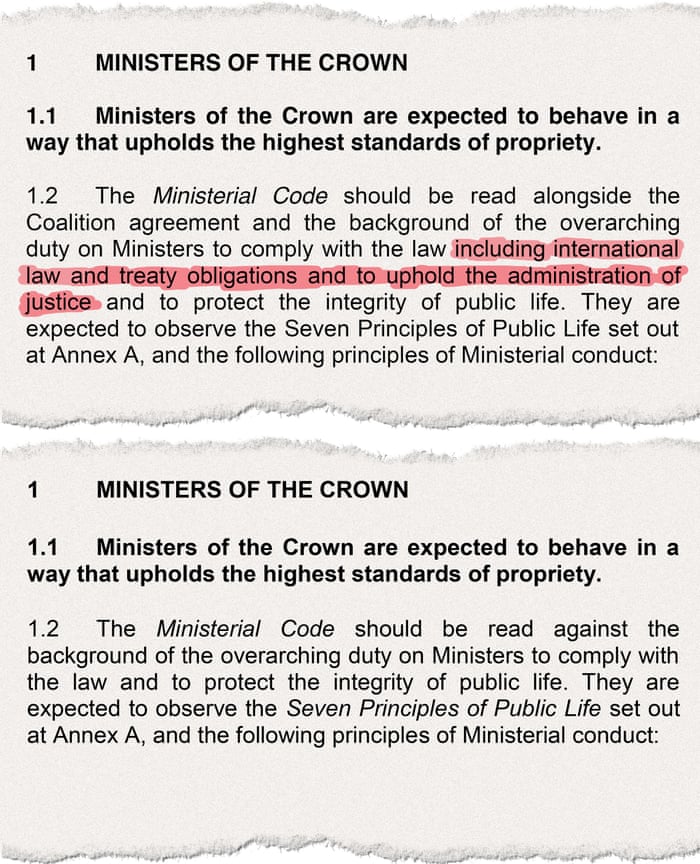
The rewritten ministerial code, which was updated on October 15  without any announcement, sets out the standard of conduct expected of ministers. It has been quietly edited. The latest version of the code is missing a key element regarding the UK’s complicity with international law. 

The previous code, issued in 2010, said there was an “overarching duty on ministers to comply with the law including international law and treaty obligations and to uphold the administration of justice and to protect the integrity of public life”.

The new version of the code has been edited to say only that there is an “overarching duty on ministers to comply with the law and to protect the integrity of public life”.

Legal experts say key issues affected by the change could include decisions about “whether to go to war or use military force, such as the use of drones in Syria, any decision made by an international court about the UK and any laws not incorporated into English law, such as human rights legislation and the Geneva conventions.

Ministerial code changes between 2010 and 2015.
Photograph: Government handout – courtesy of the Guardian

This comes as the UK government is facing another United Nations inquiry regarding widespread allegations that the Conservative welfare reforms breach the Human Rights of disabled people. It also comes following the government announcement this week that there are plans to scrap the Human Rights Act by next summer, to replace it with a controversial “British Bill of Rights.”

Raquel Rolnik, the UN’s special rapporteur for housing, found the bedroom tax to contravene human rights and in 2013, she called for the Tory “spare room subsidy” to be suspended immediately. In a wide-ranging report she also calls for the extension of grants to provide more social housing, the release of public land, build-or-lose measures to target landbanks and increased private rented sector regulation. None of these are recommendations which the Conservatives have been remotely willing to entertain, instead they have directed hostility towards the United Nations.

The Conservatives have already taken away access to legal aid from the poorest and most vulnerable citizens, in a move branded contrary to the very principle of equality under the law. Last year, Grayling, then the Justice Secretary, was accused of turning legal aid into an instrument of discrimination by a court, because of his attempt to introduce a residency test to legal aid access, a move which exceeded his statutory powers when he devised it.

He has also tried to dismantle a vital legal protection available to the citizen – judicial review – which has been used to stop him abusing his powers again and again. Judicial review is the mechanism by which citizens can hold the government to its own laws. With the Criminal Justice and Courts Bill, the justice secretary tried to put it out of reach.

Grayling, suffered a defeat in the House of Lords vote on his plans to curtail access to judicial review, which would have made it much harder to challenge government decisions in court.

Peers voted by 247 to 181, a majority of 66, to ensure that the judges keep their discretion over whether they can hear judicial review applications after a warning from a former lord chief justice, Lord Woolf, that the alternative amounted to an “elective dictatorship”.

He has tried to restrict legal aid for domestic abuse victims, welfare claimants seeking redress for wrongful state decisions, victims of medical negligence, for example.

It’s very worrying that this is a government that wants to leave Europe behind and sever the connection with the European Convention on Human Rights.  It’s a government that wants to do as it pleases, free from international scrutiny and what it clearly sees as the constraints of international law and the judgments of international courts.

The Conservatives have demonstrated an eagerness to take away citizens’ rights to take their case to the European court, with many of their actions clearly based on an intent on tearing up British legal protections for citizens and massively bolstering the powers of the state.

The Guardian reports that a legal challenge against the change will be lodged on Friday by Rights Watch, an organisation which works to hold the government to account. Yasmine Ahmed, its director, said:

“This amendment to the ministerial code is deeply concerning. It shows a marked shift in the attitude and commitment of the UK government towards its international legal obligations.”

In his preamble to the new ministerial code, David Cameron says: “People want their politicians to uphold the highest standards of propriety. That means being transparent in all we do.”

However, I reported last year that in terms of international standards of conduct, the Conservatives are not doing well. Transparency International flagged up many areas of concern in their report: A mid-term assessment of the UK Coalition Government’s record on tackling corruption

The Cabinet Office has of course denied there was any intention to weaken international law and the administration of justice by omitting the phrases from the new code.

A spokesman said:

“The code is very clear on the duty that it places on ministers to comply with the law. ‘Comply with the law’ includes international law.

The wording was amended to bring the code more in line with the civil service code. The obligations remain unchanged by the simplified wording. The ministerial code is the prime minister’s guidance to his ministers on how they should conduct themselves in public office.”

However, a Conservative party policy document promises that the ministerial code will be rewritten in the context of the UK withdrawing from the European convention on human rights. In order to help achieve these aims the document says:

“We will amend the ministerial code to remove any ambiguity in the current rules about the duty of ministers to follow the will of Parliament in the UK.”

Lord Falconer, Labour’s shadow lord chancellor, said:

“If this is what ministers are planning to do it is shocking. We are a country that prides itself on operating in accordance with the rule of law. That has always meant both domestic and international law.

This is a message we have sent out both internally and externally. If we are now regarding compliance with international law for ministers as optional that is staggering. If ministers breach international law it will no longer be misconduct.”

The Guardian cites Ken Macdonald QC, the former director of public prosecutions, who said:

“It is difficult to believe that this change is inadvertent. If it’s deliberate, it appears to advocate a conscious loosening of ministerial respect for the rule of law and the UK’s international treaty obligations, including weakening responsibility for the quality of justice here at home.

In a dangerous world, the government should be strengthening its support for the rule of law, not airbrushing it out of the ministerial code. On every level, this sends out a terrible signal.”

Ironically, on the same day that the new code was quietly released, the attorney general, Jeremy Wright, gave a keynote address about the importance of international law to an audience of government lawyers at the Government Legal Service International Law Conference.

Wright said:

“The constitutional principle to respect the rule of law and comply with our international obligations is reflected in the ministerial code – which applies to me as much as to any other minister. The code states that there is an overarching duty on ministers to comply with the law, including international law and treaty obligations and to uphold the administration of justice and to protect the integrity of public life.”

It is not clear whether or not the attorney general was informed about the changes to the ministerial code at the time of his speech. Both the Cabinet Office and the attorney general’s office have declined to answer this question.

Tory ministers are a major source of national embarrassment when they denounce the European Court of Human Rights whilst instructing the rest of the world, including other European states, to respect our collective international human rights obligations and “the rule of law.” Human Rights legislation exists throughout the free world. Free speech, the right to a fair trial, respect for private life and the prohibition on torture are values which distinguish democratic societies from despotic states.

There is no justification for editing obligations to upholding international laws, human rights or for repealing the Human Rights Act: that would make Britain the first European country to regress in the level and degree of our human rights protection. It is through times of recession and times of affluence alike that our rights ought to be the foundation of our society, upon which the Magna Carta, the Equality Act and the Human Rights Act were built – protecting the vulnerable from the powerful and ensuring those who govern are accountable to the rule of law.

Update: Former head of government’s legal service says obligation that ministers must comply with international law – dropped from revised ministerial code – had irritated PM: No 10 ‘showing contempt for international law’


I don’t make any money from my work and I am not funded. I am disabled because of illness and struggle to get by. But you can help me continue to research and write informative, insightful and independent articles, and to provide support to others, by making a donation. The smallest amount is much appreciated – thank you.

DonatenowButton

Prime minister dismisses UN inquiry into government’s discriminatory treatment of disabled people

disability_2218977b

Labour leader Jeremy Corbyn has asked David Cameron at Prime Minister’s Questions today to publish the details of the Government’s response to the United Nations inquiry into the allegations that Conservative policies are breaching the rights of disabled people in the UK. He also asked if the government intended to co-operate with the inquiry.

Such UN investigations are conducted confidentially by the UN and officials will not confirm or deny whether the UK is currently being put under scrutiny.

However, the ongoing inquiry been widely reported by disability rights groups and campaigners. The Department for Work and Pensions has previously declined to comment on the possibility of an investigation.

Mr Corbyn used his final question to ask about the United Nations inquiry into alleged “grave or systemic violations” of the rights of disabled people in the UK. The PM gave a dismissive response, saying the inquiry may not be “all it’s cracked up to be” and said that disabled people in other countries do not have the rights and support that “they” [disabled people] in the UK are offered. Cameron also implied that Labour’s “strong” equality legislation was a Conservative policy. However, the Equality Act was drafted under the guidance of Harriet Harman.

Jeremy Corbyn asks about David Cameron about his response to the UN inquiry at Prime Minister’s Questions

The United Nations team of investigators are expecting to meet with the Equality and Human Rights Commission, members of parliament, individual campaigners and disabled people’s organisations, representatives from local authorities and academics.

The team will be gathering direct evidence from individuals about the impact of government austerity measures, with a focus on benefit cuts and sanctions; cuts to social care; cuts to legal aid; the closure of the Independent Living Fund (ILF); the adverse impact of the Work Capability Assessment (WCA); the shortage of accessible and affordable housing; the impact of the bedroom tax on disabled people, and also the rise in disability hate crime.

Mr Corbyn said:

“This is deeply embarrassing to all of us in this house and indeed to the country as a whole. It’s very sad news.”

The Government’s approach to people with disabilities had been extremely controversial and been met with criticism from campaign groups. Disabled people have borne the brunt of austerity cuts, losing more income and support than any other social group, and this is despite the fact that Cameron promised in 2010 to protect the poorest, sick and disabled people and the most vulnerable.

In 2013, Dr Simon Duffy at the Centre for Welfare Reform published a briefing outlining how the austerity cuts are targeted. The report says:

The cuts are not fair.

They target the very groups that a decent society would protect:

  • People in poverty (1 in 5 of us) bear 39% of all the cuts
  • Disabled people (1 in 13 of us) bear 29% of all the cuts
  • People with severe disabilities (1 in 50 of us) bear 15% of all the cuts

The report outlines further discrimination in how the austerity cuts have been targeted. The report says:

The unfairness of this policy is seen even more clearly when we look at the difference between the burden of cuts that falls on most citizens and the burdens that fall on minority groups. By 2015 the annual average loss in income or services will be:

  • People who are not in poverty or have no disability will lose £467 per year
  • People who are in poverty will lose £2,195 per year
  • Disabled people will lose £4,410 per year
  • Disabled people needing social care will lose £8,832 per year

Work and Pensions Secretary Iain Duncan Smith said at the  Conservative party conference speech in Manchester that disabled people “should work their way out of poverty.”

The Work and Pensions Secretary has been widely criticised for removing support for disabled people who want to work: by closing Remploy factories, scrapping the Independent Living Fund, cuts to payments for a disability Access To Work scheme and cuts to Employment and Support Allowance.

The reformed Work Capability Assessment has been very controversial, with critics labeling them unfair, arbitrary, and heavily bureaucratic, weighted towards unfairly removing people’s sickness and disability benefit and forcing them to look for work.

The bedroom tax also hits disabled people disproportionately, with around two thirds of those affected by the under-occupancy penalty being disabled.

The United Nations have already deemed that the bedroom tax constitutes a violation of the human right to adequate housing in several ways. If, for example, the extra payments force tenants to cut down on their spending on food or heating their home. There are already a number of legal challenges to the bedroom tax under way in British courts. In principle the judiciary here takes into account the international human rights legislation because the UK has signed and ratified the International Covenant on Economic, Social and Cultural Rights.

The right to adequate housing is recognised in a number of international human rights instruments that the UK has signed up to.

UN rapporteur Raquel Rolnik called for the UK government last year to scrap its controversial bedroom tax policy. Rolnik’s report was dismissed as a “misleading Marxist diatribe” by Tory ministers, and she had been subject to a “blizzard of misinformation” and xenophobic tabloid reports.

The DWP’s sanctions regime has also been widely discredited, and there has been controvery over death statistics, eventually released by the Department after a long-running refusal to release the information under freedom of information law.

The Daily Mail has already preempted the visit from the special rapporteur, Catalina Devandas Aguilar, who is spearheading the ongoing inquiry into many claims that Britain is guilty of grave or systematic violations of the rights of sick and disabled people, by using racist stereotypes, and claiming that the UN are “meddling”. The Mail blatantly attempted to discredit this important UN intervention and the UN rapporteur before the visit.

Meanwhile, Cameron seems very keen to play the investigation down, and dismiss the impact of his government’s “reforms” on the lives of sick and disabled people.

We are a very wealthy, so-called first-world liberal democracy, the fact that such an inquiry has been deemed necessary at all ought to be a source of great shame for this government.


Work: for what it’s worth

b584

I’ve yet to see a decent challenge to the Tory proposition that citizenship and rights can be determined by, and ought to be conditional, on how hard-working a person is. Of course the definition of “hard-working” is narrowly restricted to categories of paid employment. People working for nothing on workfare programs aren’t considered to have any value at all. They are simply left to fall down into the vortex created by neoliberal logical gaps.

The Conservatives have always had a pathological need to create social systems comprised of ranks and categories, it’s a fundamental feature of their collective ontological insecurity and fits in very well with the key features and demands of neoliberalism.

It’s complete and utter nonsense. Dogma

People’s worth isn’t measured in terms of their contribution to the increasingly private wealth of businesses, or what they can do for an employer. Or their participation in an increasingly enclosed neoliberal economy. Human worth is universal, regardless of whether or not we work to make someone else rich.

Nor is entrepreneurship the pinnacle of human achievement.

Behave.

If work was so rewarding, there wouldn’t be any resentment directed at people who aren’t working. Workers would be content with their lot, rather than regarding others with envy, sneaking suspicion and vilifying those people trying to simply survive on the meagre benefits that most of them contributed towards via taxes. The establishment and the media would have no public complicity in their perpetual scapegoating, outgrouping and socially divisive programmes. We can always expect a particularly controversial, targeted and damaging policy from the Tories when we see the sudden appearance in the media of a new category of folk devils. It’s intentional, strategic, calculated and scapegoating is presented as a justification narrative for yet another battle against another marginalised group in the establishment’s broader class war.

The truth is that the majority of people don’t find work rewarding at all, and for many, having a paid job isn’t a way out of poverty. Labourers are deeply envious of the perceived freedom of those they feel don’t have to toil. The Conservatives know this and have virtually culturally criminalised being unemployed. This said, if you end up in prison, at least you can rely on being fed, whereas if you are claiming jobseekers allowance or sickness and disability benefits, there’s a substantial risk of being arbitrarily sanctioned, suddenly leaving you without the means of buying food and meeting other basic survival needs.

Effective collective bargaining can only happen if people have the right to refuse jobs that are exploitative. Workfare has taken that right away. Welfare conditionality has taken that right away. 

As welfare provision shrinks, an increasingly desperate reserve army of disposable labour becomes easier to exploit; work choices shrink, wages are driven down, job insecurity grows and working conditions worsen. It’s the cast-iron law of Conservatism. As I’ve pointed out before, the Poor Law of 1834 worked in the same way: the enshrined principle of less eligibility, which meant that conditions in workhouses had to be much worse than conditions available to those in the lowest paid work outside so that there was a deterrence to claiming support. In reality this meant that an individual had to be completely destitute in order to quality for poor relief.  The Tory mantra “making work pay” is based on the same ideology as the less eligibility principle. It was always a front for the neoliberal New Right imperative to dismantle welfare support and compete in a race to the bottom through the various descending layers and facets of absolute poverty. Whilst employers ascend and profit.

We decided, agreed and ratified that each human life has equal worth at an international level after the consequences of hierarchical thinking culminated in the atrocities of World War Two. Hitler thought that some people were worth more than others. All despots do. However, we progressed, we learned. We evolved. We formulated Human Rights as a coherent and collective response.

But it’s a lesson the Tories clearly have forgotten. Or chose not to learn. Our society is more unequal and steeply hierarchical than ever, inequalities are greater here than anywhere else in Europe, and including the USA. That’s a direct result of Tory policy, weighted towards handouts to the wealthy at the expense of the poor. Despite our human rights and equality legislations.

But the blame doesn’t entirely belong to the Tories. The next time you look down on your neighbours for being sick, disabled, mentally ill, unemployed or for being from a different ethnic background, remember where that sort of collective thinking takes us as a society. If you don’t believe me, go away and read Gordon Allport’s The Nature of Prejudice, have a look at Allport’s Ladder, and compare to where we are now, in the UK, in the 21st Century.

As a society, we need to learn from history. Progress. Evolve.But we are regressing instead. Human Rights are fundamentally incompatible with neoliberalism.

Allport wrote about how the Holocaust happened. Public acceptance of eugenic thinking happens incrementally; rational and moral boundaries are pushed, bit by bit, almost imperceptibly, until the unacceptable becomes acceptable. And prejudice multi-tasks. Hitler killed the sick, disabled, the poor and “workshy” first.

That psychosocial and political process is happening here, unfolding in stages day by day, week by week, year by year: the media are a large part of the ideological mechanism; a state apparatus used to push against our rational and moral boundaries. And this mechanism is being used to de-empathise us, to make us less sympathetic to the plight of politically defined others. And to regard them as having less worth than ourselves. Neoliberalism creates steep hierarchies of power and wealth, it isn’t generous to most people. 

My message here is about the equal worth of all human beings. Who we are is a universal, and not the same as “what” we are or the labels we may acquire because of our superficial characteristics. Those things are artificial and culturally relative. We all share the same basic needs, fears and hopes, we share archetypal dreams and nightmares. To paraphrase RD Laing:

All in each, each in all, all distinctions are mind; of mind, in mind, by mind. No distinctions, no mind to distinguish.

All lives equally precious.

Our worth can never be measured out in meagre pounds and pennies.

demcracy
But they don’t and they never will.

Many thanks to Robert Livingstone for the image.

UN report: Britains ‘boy’s club culture’ – women in the UK are left vulnerable to violence, poverty & hardship


I wrote last year that Conservative small-state ideology has led to “depopulated” social policies, resuting in the dehumanisation of people in some social groups, and it indicates that Tory policy-makers see the public as objects of their policies, and not as human subjects. Policies are inceasingly being detached from public needs. We therefore need to ask whose needs Conservative policies are fulfilling.

In 2010 the Equality and Human Rights Commission warned the government about its potential failure to meet its legal duties. This followed concerns raised by the Fawcett Society amongst others, regarding the estimated grossly disproportionate impact of the austerity cuts on women.

The Commission recognised the serious concerns about the impact of the deficit reduction measures on vulnerable groups and, in particular, following the House of Commons library report, the impact of the budget on women. The Commission stated:

We have written to the Treasury to ask for reassurance that they will comply with their equality duties when making decisions about the overall deficit reduction, and in particular in relation to any changes to tax and benefits for which they are directly responsible.”

A more inclusive understanding of the range of impacts on both men and women is essential in the formulation of gender-aware, as opposed to gender-blind, policy responses to recession and recovery. It’s clear that the UK government is not interested in collating information regarding impacts and subsequent implications regarding inequality, yet they do have a legal duty to do so.

A previous United Nations Committee report on the Elimination of Discrimination against Women highlights areas where women’s rights in the UK had come to a standstill and appallingly, shamefully, some rights have been reversed.

On August 13, 2013, the Committee on the Elimination of Discrimination against Women released its concluding observations on the UK’s seventh periodic report on 26 July 2013.

Concerns raised by the Committee include protection from discrimination under the Public Sector Equality Duty, the impact of austerity measures on women and women’s services, and restrictions on women’s access to legal aid.

The Equality and Human Rights Commission (EHRC) published its submission to the United Nations Committee on the Elimination of All Forms of Discrimination Against Women on 1 July 2013. In its submission the Commission, as a national human rights institution, identifies key issues it believes should be highlighted as actions following the examination and sets out a number of questions the Committee may wish to put to the Government. You can see a full list here – UK Government still in breach of the human rights convention on gender discrimination.

Despite Labour’s protective Human Rights Act and Equality Act, Britain has become increasingly sexist, has an all-pervasive, patriarchal “boy’s club culture” and Conservative austerity measures are leaving women increasingly vulnerable to violence, poverty and hardship, the UN special rapporteur for women, Rashida Manjoo, has recently said.

The special rapporteur said there was “a more visible presence of sexist portrayals of women and girls” and a “marketisation of women’s and girls’ bodies” in the UK, which was “more pervasive than elsewhere.”

She warned that sexual bullying and harassment were now “routine” in UK schools, according to NGOs she had interviewed, and recommended that schools have mandatory education modules on sexism. “The state has a responsibility to protect, to prevent, to punish, to provide effective remedies,” she said. “These are part of the state’s responsibility.”

Rashida added: “Have I seen this level of sexist cultures in other countries? It hasn’t been so in-your-face.”

Amongst the figures quoted in her report are: 30% of women in England and Wales have reported experience of domestic abuse since the age of 16; 77 women were killed by partners or former partners in 2012-13; 18,915 sexual crimes against children were recorded in England and Wales in 2012-13; and almost one in three 16- to 18-year-old girls have experienced “groping” or other unwanted sexual touching at school.

The special rapporteur also drew attention to the disproportionate impact of funding cuts on the provision of services to women and girls at risk of violence, and the adverse consequenes of the Tory welfare “reforms.”

Access to trauma services, financial support and housing are crucial, yet current reforms to the funding and benefits system continue to adversely impact women’s ability to address safety and other relevant issues,” Rashida said.

She added that the austerity cuts “not only [affected] the specific provision of ‘violence against women’ services’, but also had a more general impact as poverty and unemployment were known contributory factors.”

“Service providers argue that they are being forced to make cuts to their frontline services as a result of reduced funding, whether by closing refuges, reducing support hours, or increasing waiting lists … current reforms to the funding and benefits system continue to adversely impact women’s ability to address safety and other relevant issues.”

Manjoo also heavily criticised the bedroom tax, she recognised that it makes it very difficult for women to escape domestic violence. She also attacked the Conservative government’s austerity programme.

She said: “Austerity measures are having an effect on the provision of services to address violence against women, as well as other cross-cutting issues affecting women such as poverty and unemployment.” 

Rashida Manjoo quite properly condemned the lack of human rights-driven government measures to combat violence against women and girls.

The special rapporteur, who travelled across the UK during a 16-day fact-finding mission into violence against women, said she was barred at the gates of Yarl’s Wood immigration detention centre on Monday, on instructions “from the highest levels of the Home Office”.

Manjoo received reports of violations at the privately run Yarl’s Wood centre, near Bedford, before her visit to the UK, and said she wanted to verify the allegations of abuse. Last month a Jamaican woman, Christine Case, 40, died at the centre, which holds about 400 women.

After repeated unsuccessful requests to the Home Office, the investigator attempted an independent visit to Yarl’s Wood. Under the terms of her mandate, Manjoo should have been offered unrestricted access.  A Home Office spokesperson said a tour of Yarl’s Wood “was never agreed as part of this fact-finding mission.” 

So much for democratic, open, transparent and accountable government.

In her preliminary report, (and unsurprisingly,) Manjoo said the number of women detained in prisons and immigration centres in the UK was rising, with a significant over-representation of black and minority ethnic women.

“A large number of women in detention have a history of being subjected to violence prior to being imprisoned … the strong link between violence against women and women’s incarceration, whether prior to, during or after incarceration, needs to be fully acknowledged,” she said.

Manjoo also said the UK court system is “widely perceived to be biased in favor of men.

Rashida Manjoo’s full 24 page report is expected to be published later this year and will be presented at a meeting of the UN Human Rights Council in Geneva on Tuesday.

The report’s findings echo the views of  many campaigners, including hundreds of psychotherapists, counsellors and mental health practitioners, who in April used a rallying, open letter to the Guardian to warn against “malign” welfare reforms and severe austerity measures.

The group of signatories, made up of therapists, psychotherapists and mental health experts, said Britain has seen a “radical shift” in the mental state of ordinary people since the coalition came to power.

British society has been “thrown completely off balance by the emotional toxicity of neoliberal thinking” and the distress this is causing and the wide adverse effects of this ideology are particularly visible in therapists’ consulting rooms.

This letter sounds the starting-bell for a broadly based campaign of organisations and professionals against the damage that neoliberalism is doing to the nation’s mental health,” they added.

A democratic government, especially in a very wealthy, so-called liberal first-world country, is expected to reflect and accommodate the needs of a population in its policy-making, and to formulate policies within a human rights framework.

That clearly is not happening in the UK.


Related

Welfare reforms and the language of flowers: the Tory gender agenda

994596_517805604955639_608589568_n
Pictures courtesy of Robert Livingstone


I don’t make any money from my work. But you can support Politics and Insights and contribute by making a donation which will help me continue to research and write informative, insightful and independent articles, and to provide support to others. The smallest amount is much appreciated, and helps to keep my articles free and accessible to all – thank you. 

DonatenowButton

Libertarian Paternalism and David Freud’s comments in context

1374718_540929452643254_208125039_n (1)

.

It’s taken just four years since Labour’s Equality Act was implemented for it to appear reasonable for a government minister to propose that disabled people have fewer rights and are of less worth than everyone else. Only a corporocratic Tory would call exploiting disabled people for profit “support” and try and make out they are doing us a favour.

The Tories have made a virtue out of claiming they are giving something by taking something away. For example, the welfare cuts have been casually re-named reforms in true Orwellian style. We have yet to see how cutting the lifeline benefits of the poorest people, and imposing harsh sanctioning can possibly be an improvement for them, or how it is helping them into none-existent work, in a time of inflated living costs and recession.

This said, even the Tories have been forced to distance themselves from David Freud’s “business-friendly” Tory  commentary, about the lower economic worth of disabled people. 

Anyone endorsing Freud’s comments should perhaps try substituting the word “disabled” with “woman” or “gay” or any ethnic group and see how far they get with that.

We do have laws that demand people are treated equally, regardless of their characteristics, and for good reason, especially when people commenting on this issue think it’s ever acceptable to discriminate against disabled people. But then there’s also the issue of basic decency, and of what a civilised society allows and doesn’t allow. It’s telling that the loudest of defences for  Freud’s blatantly discriminatory remarks came from the Adam Smith Institute, who would have everyone on less than the minimum wage if they had their “all hail the competitive, managed free-market” minarchist way. 

The real hypocrisy of Libertarians is that they know that the invisible hand of the market goes hand in hand with the iron fist of the state, in their rigged game. Indeed, politically  the idealised neoliberal small state has not disengaged from the public domain but its authoritarian arm has been extended.

Under the guise of a “new paternalism” (much the same as the old Tory 19th Century paternalism), which reduces the social world to the theories of behavioural economics and narrow neoliberal outcomes, the Tories have aligned public values with tradition – legitimated by a claimed concern for the welfare of society – but in reality it’s clear that Conservative paternalism is and always has been shorthand for hierarchical societies based upon privilege and a rigid control over the mass of people’s freedom, responsibilities (to the state), wellbeing and opportunities.

This is simply a social control mechanism with its micro-managerial politics; the tendency for politicians to devolve not power but responsibility for decision-making to citizens, without any reference to human experiences, constraints, or either micro or macro-level circumstances. And without extending genuine choices. It’s as if we have been placed in a state of perpetual Tabula rasa. The government and media re-write our narratives upon us.

Its also a preposterous zero-sum approach to wealth distribution. For the Tories, inequality is seen as necessary and beneficial.

State interventions this past four years have ensured that only the poorest and most vulnerable are left to the mercy of market forces, whilst welfare, in any meaningful sense, applies only to the wealthiest. Whilst austerity has been inflicted on the most vulnerable citizens in our society, the millionaires have enjoyed tax breaks and increased salaries. The elite play a rigged game: lobbying, the revolving doors between business and politics, being above the law, and tax-payer funded bailouts. The free-market isn’t open to the poor.

True laissez-faire capitalism is left for imposition only for the most vulnerable citizens, and only after we have been squeezed dry by those lying, pro-interventionist minarchists, who ensure that all protective, supportive public provision has been removed, and the public services we depend upon have been plundered and then sold off to the ever-circling private business and capitalist class vultures.

My point is this: the Tories, as neoliberal fundamentalists, have supplanted collective, public values with individualistic, private values of market rationality. They have successfully displaced established models of welfare provision and state regulation through policies of privatisation and de-regulation and have shifted public focus, instigating various changes in subjectivity, by normalising individualistic self-interest, entrepreneurial values, and crass consumerism. And increasing the social  and material exclusion of growing numbers living in absolute poverty

Basically, the Tories tell lies to change perceptions, divert attention from the growing wealth inequality manufactured by their own policies, by creating scapegoats and stigma. 

Freud’s comments have reduced disabled people’s worth to their economic value. Just as all Tories conflate everyone’s worth to an economic value. Human needs are being conflated to narrow neoliberal outcomes.

And they do tell such lies to justify their policy interventions.

For example, Disability Living Allowance (DLA) allows disabled people to purchase home adaptations, medication, treatment and equipment themselves. It is a very modest benefit of around £70 a week, it saves the taxpayer money because it allows early intervention, preventative treatment and, most importantly of all, it allows disabled people to work.

In fact the majority of DLA claimants were in work and use the extra cash to pay for the transport, software, screen readers, tactile keyboards and orthopaedic chairs, and so forth, thus allowing more and more disabled people to do a 9 to 5 job.

Yet the Chancellor said, in his 2010 emergency budget speech, that the Tory instigated reassessments for DLA would “significantly improve incentives to work, despite the fact that DLA has nothing whatsoever to do with unemployment.

“BRITAIN’S shirkers’ paradise shame with hordes of work shy benefit claimants was blamed last night for much of our economic mess…

…we have managed to create a block of people in Britain who do not add anything to the greatness of this country. (Now THAT is a typified Tory view)

They  have become conditioned to be users of services, not providers of money. This is a huge part of the reason we have this massive deficit. We have had to borrow vast sums of money. We went on this inflated spending spree”  –  More lies from Iain Duncan Smith, in The Sun, 1 December 2010, despite an official rebuke from the Office for National Statistics.

Duncan Smith has somehow forgotten that the global banking crisis is responsible for the recession, not poor people without jobs, and as for the lies about New Labour’s “big spending”  Fabianism, which has no empirical basis, it’s worth noting that total public spending under the Thatcher Governments averaged 42.11 per cent of GDP and, under the Blair Governments, 36.59 per cent (Source: HM Treasury, 2010).

The Access to Work fund was re-established by the last Labour Government to ease the transition to work for disabled people, by paying grants to businesses for vital equipment. It was put in place to support people with disabilities, it aimed to reduce inequalities between disabled people and non-disabled people in the workplace by removing practical barriers to work. This fund has seen severe cuts since 2010, which flies in the face of this Government’s claim to “make work pay” for all. By reducing this essential funding, the Coalition have effectively excluded many from work.

Additionally, disabled people with the highest support needs have been left in fear and distress following the Government announcement that it is to callously abolish a key source of independent living support. The Government decision to close the Independent Living Fund and devolve responsibility to severely under-funded local authorities follows a consultation that disabled people claim is unlawful and on which an urgent hearing scheduled by the High Court to go ahead on 13/14 March 2013.

Labour have also challenged the decision to close this crucial source of support. Labour has called for the retention of this vital fund which benefits the most severely disabled. To show her support for the retention of Independent Living Fund, which is relied upon by over 19,000 severely disabled, Labour’s Dame Anne Begg is the primary sponsor of  an Early Day Motion calling on the Government to reverse their decision to close the fund in June 2015. You can view the EDM here.

In May 2014,  the Court of Appeal, in the case of Bracking and others v Secretary of State for Work and Pensions found that the Department of Work and Pensions’ decision to close the Fund was not lawful, overturning a High Court decision of April 2013. It decided that the Department had not complied with the Public Sector Equality Duties imposed by section 149 of the Equality Act 2010. Opportunity for new applications for this funding was closed in June 2010 by the Coalition. Once again this plainly indicates that the Coalition do not consider the needs of disabled people as important, and clearly demonstrates the extent of their disgustingly eager ideological drive to strip away essential provision and support for the vulnerable.

As Sir Bob Hepple QC has pointed out, some provisions of the Labour Government’s Equality Act were very quietly edited by the Coalition, (only roughly 90% of the Act came into force, after the Coalition quickly said it would be “reviewing several sections of the legislation passed by parliament in April 2010,”) whilst other provisions have been repealed by the Enterprise and Regulatory Reform (ERR) Bill, including the duty on public authorities to have due regard to the need to reduce socio-economic inequalities.

The failure to implement the Act in full certainly sends out a clear signal that creating a more equal society is not priority for the Coalition. However, perhaps even more important has been the Conservative defense of increasing economic inequality, the lionisation of a Randian selfish individualism and a proliferation of ideological justification narratives regarding the dismantling the “Big (Welfare) State”, where the latter, in Orwellian fashion, is now being indicted for many of the very social and economic ills that the free-market era has actually delivered.

Ed Miliband is right to demand Freud’s resignation, and right to defend our vulnerable citizens from potential exploitation: that is not “playing politics” as claimed by the likes of Paul Staines and James Delingpole,  Freud was certainly not a victim in this.

To put this in context, the Labour Party introduced a host of measures to strengthen the rights of disabled people. They passed the Disability Discrimination Act 2005, introduced the Equality Act 2010, and formed the Equality and Human Rights Commission, and, in 2009, the Labour government signed the United Nations convention on the rights of persons with disabilities.

Kate Green and Anne McGuire have pointed out that the original intentions when Labour introduced the Employment Support Allowance (ESA)pilot and an assessment of people’s capacity for work, have been distorted – that the original aim was to be a supportive and facilitative process, with Disability Living Allowance (DLA), and other supportive measures in place to help people with disability lead a dignified life, fulfilling their potential, but, as Anne McGuire has pointed out, the renegotiation of the Atos contract by the current Government, (along with the addition of targets to remove people’s benefits, and sanctions,) has rebalanced the system to be punitive, rather than facilitative.

Of course the Tories have been very quick to blame Labour for the current situation, however, following a review of their pilot, Labour warned the government of problems with the Work Capability Assessment (WCA), which Iain Duncan Smith duly ignored, passing the ESA system into law, making the WCA even more problematic, and as stated, re-contracting Atos “in line with the welfare reforms”, including targets to take people’s lifeline benefits away, despite the claims made by the Tory liars.

Comparing policies indicates clearly the stark differences between the parties, and given the briefing from Labour from their ESA review that was blatantly disregarded, and the refusal of the Coalition to undertake a cumulative impact assessment of the “reforms”, it’s clear that the Tories do not regard the poorest and most vulnerable worthy of government diligence, accountability, support and fair treatment.

We simply cannot allow such a vindictive, uncivilised government another five years to harm our most vulnerable citizens, further undermine our democracy, destroy our public services and welfare provisions and trample our human rights. This is the first government to face a United Nations inquiry into disability rights violations. And that is absolutely shameful for a wealthy so-called first world liberal democracy.

Never in this country have those who fight for democracy and social justice carried a greater burden or faced the possibility of bigger losses of human rights, human freedoms, human dignity and human welfare than they do right now.


1459165_266124213538634_1461740450_n

Pictures courtesy of Robert Livingstone


David Freud was made to apologise for being a true Tory in public

1459165_266124213538634_1461740450_n

Lord Freud, a Conservative Welfare Reform Minister, has admitted comments he made that some disabled people are  not worth” the full national minimum wage”  were “offensive”, after they were disclosed by Ed Miliband during Prime Minister’s Questions yesterday afternoon. The Labour leader has called on the Tory peer to resign. Cameron called for a full apology from Freud.

He has since apologised after slipping up and suggesting that disabled people are “not worth” the national minimum wage and some could only be paid “£2 an hour.” Cameron says the comments made by Lord Freud at the Tory conference do not represent the views of government. However, his austerity measures and the welfare “reforms” tell us a very different story.

Cameron betrayed his anger at being challenged when he once again alluded to his severely disabled late son, Ivan, and his late father, as he told Miliband that he would take no lectures on disabled people.

This is not the first time that the prime minister has used his son in anger, as a tactic designed to cause others emotional discomfort, deflect criticism and to avoid answering difficult questions regarding this government’s harsh and punitive policies towards disabled people.

The Labour leader quoted Freud, saying: “You make a really good point about the disabled. There is a group where actually, as you say, they’re not worth the full wage.”

Amidst cries of “outrage” and “shame” from the Labour benches, Mr Miliband said: “To be clear about what the Welfare Reform Minister said, it’s very serious. He didn’t just say disabled people weren’t worth the minimum wage, he went further and he said he was looking at whether there is something we can do, if someone wants to work for £2 an hour.”

He added: “Surely someone holding those views can’t possibly stay in your Government?”

Cameron said: “Those are not the views of the government, they are not the views of anyone in the government. The minimum wage is paid to everybody, disabled people included.”

Clearly very angry, the prime minister added: “Let me tell you: I don’t need lectures from anyone about looking after disabled people. So I don’t want to hear any more of that. We pay the minimum wage, we are reforming disability benefits, we want to help disabled people in our country, we want to help more of them into work. And instead of casting aspersions why doesn’t he get back to talking about the economy.”  

Once again, note the rhetorical diversionary tactics that Cameron used.

Miliband responded: “I suggest, if he wants to protect the rights of disabled people, he reads very carefully what his welfare minister has said because they are not the words of someone who ought to be in charge of policy related to disabled people.

“In the dog days of this government the Conservative party is going back to its worst instincts – unfunded tax cuts, hitting the poorest hardest, now undermining the minimum wage. The nasty party is back.”

In the Guardian said: We are in the climate of the Work Programme  and  employment and support allowance travesties, in jobseeker’s allowance sanctions and personal independent payment delays.

Coerced, free labour and a shrinking, ever conditional benefit system. Freud has not spoken out of turn, but encapsulated Conservative attitudes to both disabled people and workers: pay them as little as possible and they will be grateful for it.

The Tories are not content with forcing disabled people into work. They want to pay them a pittance when they get there. I suppose we can thank Freud. The government has been producing enough measures that infers disabled people are slightly less than human. He’s finally said it out loud.”

I couldn’t agree more. Freud’s comments are simply a reflection of a wider implicit and fundamental Social Darwinism underpinning Tory ideology, and even Tim Montgomerie, who founded the Conservative­Home site has conceded that: “Conservative rhetoric often borders on social Darwinism…and has lost a sense of social justice.”

Of course the problem with such an ideological foundation is that it directly contradicts the basic principles that modern, western democracy was founded on, it is incompatible with our Human Rights Act, which enshrines the principle that we are each of equal worth. And our Equality Act, introduced by Labour to ensure that people are not discriminated against on the grounds of their disability, gender, age and a variety of other protected characteristics.

Sam Bowman, research director of the Adam Smith Institute, has said that Freud was “shamefully mistreated” by Labour leader Ed Miliband.

The Adam Smith Institute – a think tank that promotes Conservative “libertarian and free market ideas”, minarchism and claims it is:“known for its pioneering work on privatization, deregulation, and tax reform, and for its advocacy of internal markets in healthcare and education, working with policy-makers”  – has, perhaps unsurprisingly, defended Lord Freud’s disgraceful comments regarding striving disabled workers.

Mr Bowman said: “His (Freud’s) point was that the market value of some people’s wages is below the minimum wage. This is often true of the severely disabled and can have appalling consequences for their self-esteem and quality of life.”

He added: “To point out that someone’s market value is less than minimum wage has nothing to do with their moral value as human beings.”

I beg to differ. We have a government that claims meritocratic principles define those who are worthy and deserving of wealth.We have a government that generates socially divisive narratives founded on ideological dichotomies like strivers and skivers. We have a government that systematically disregards the human rights of disabled people. Their very policies define the moral value they attribute to the poor, disabled people and the wealthy, respectively. This defence is based on a false distinction, because the Tories conflate market value and moral value explicitly, their policies are evidence of that.

The think tank president, Madsen Pirie,  once said: “We propose things which people regard as being on the edge of lunacy. The next thing you know, they’re on the edge of policy.”  

This group of neoconservatives brought you the fundamentals of Thatcher’s poll tax, the Adam Smith Institute was also the ideological driving force behind the sales of council house stock. If you need any further convincing of their Tory credentials, then their proposals that the National Health Service should establish an internal market with hospitals buying the use of facilities from other districts and from the private sector ought to be sufficient.

The Institute has always been a fierce critic of the NHS, it thinks that the government should only regulate healthcare and that healthcare should be privately funded and privately provided by private sector companies. The Adam Smith Institute said: Congratulations to the new Health Secretary Andrew Lansley, for what could be the biggest revolution in the UK’s state-run National Health Service for 60 years. 

Also recommended by this group of privatisation vultures was an internal market system for UK schools that would have (reduced) state funds to follow students to independently run academic institutions. This approach to school funding is now Coalition policy. Following the Institute’s call for the use of private businesses by local governments, many council-run local services, such as waste collection and cleaning, were contracted out. Additionally, local governments are now required to solicit competitive bids for local services.

And it was this group of Hayek-worshipping, pro-exploitation neofeudalists, who don’t declare their funding sources, that called for a radical shake-up of welfare policy, which would make work requirements absolutely central to the benefits system. These proposals subsequently became Tory policy.

And who could forget their peddling of unfettered free markets and trade as an objection to fair trade?

In the UK and elsewhere, such Conservative neoliberal ideas have drastically changed how states operate. By heavily promoting market-based economies that highly value competition and efficiency, such neoliberalist economies have moved countries to retrogressively adopting Social Darwinist philosophies to prop up free market “logic”. 

Bourdieu (1999) contends that neoliberalism as a form of national governance has become a doxa, or an unquestioned and simply accepted world-view.(See also Manufacturing consensus: the end of history and the partisan man.)

Harvey (2005) is not surprised that the ideas of capitalism have been infused into political, social, and cultural institutions at state-level. By placing a mathematical quality on social life, the neoconservatives have encouraged a formerly autonomous state to regress into penal state that values production, competition, and profit above all else, and social issues and consequences are increasingly disregarded.

Tories view their brand of economics as a social science that is capable of explaining all human behaviours, since all social agency is thought to be directed by a rationale of individualistic and selfish goals. And the focus on the individual means that ideas related to concepts such as “the public good” and realities such as “the community” are now being discarded as unnecessary components of a welfare state.

Unsurprisingly, then, high unemployment, gross inequality, and increasingly absolute poverty are increasingly blamed on individuals rather than on structural/economic constraints.

Tory economic policy is designed to benefit only a very small class of people. Such a world-view also makes it easier to justify the thought that some people are deserving of much more than others because, after all, it is a common refrain that we are all responsible for our own destinies. (See the just-world fallacy.)

Freud’s comment was not a momentary lapse, nor was it unrepresentative of Tory views more generally. He is the contemptuous architect of the grossly punitive Tory Bedroom Tax that disproportionately affects households of disabled people. The Tories endorsed Freud’s discriminatory policy proposal, and savagely ridiculed the UN rapporteur, Raquel Rolnik, when she pointed out, very professionally and reasonably, that the policy contravened human rights.

He is the same government minister that rejected suggestions that austerity policies have led to an increase in food bank use – making the jaw-droppingly astonishing suggestion that food bank charities are somehow to blame. This former investment banker and peer told the Lords that the increase in the usage of food banks was “supply led”.

He said: “If you put more food banks in, that is the supply. Clearly, food from the food banks is a free good and by definition with a free good there’s almost infinite demand.”

Poverty reduced to individual neoliberal motivational formulae. Yet it is the government that are responsible for policies that create and sustain inequality and poverty.

In the wake of the longer wait for unemployment benefits introduced by George Osborne, a massive increase in the use of cruel benefit sanctions, the introduction of the mandatory review, during which benefits are not payable to disabled people, Freud also rejected suggestions by leading food bank operators that delays in benefit payments drove demand for emergency food aid.

Such brutal, dehumanising and inequitable treatment of our most vulnerable citizens cannot be regarded as an exceptional incident: the Tories have formulated policies that have at their very core the not so very subliminal message that we are worthless and undeserving of support, basic honesty and decency.

Social Darwinism, with its brutalising indifference to human suffering, has been resurrected from nineteenth century and it fits so well with the current political spirit of neoliberalism. As social bonds are replaced by narcissistic, unadulterated materialism, public concerns are now understood and experienced as utterly private miseries, except when offered up to us on the Jerry Springer Show or Benefit Street as spectacle.

The Tories conflate autonomy (the ability to act according to our own internalised beliefs and values) with independence (not being reliant on or influenced by others). Tories like Freud have poisoned the very idea that we are a social species, connected by mutual interdependencies that require a degree of good will, kindliness and willingness to operate beyond our own exclusive, strangle hold of self-interest.

The time has come to ask ourselves what possible benefit to society such a government actually is – what use is an authoritarian, punitive state that is more concerned with punishing, policing and reducing citizens than with nurturing, supporting and investing in them?

224079_411432638926270_715135125_n

Tory Values Explained In One Easy Chart

Tory dogma and hypocrisy: the “big state”, bureaucracy, austerity and “freedom”

1965037_301820166635705_1502392114_n (1)

The Tories are not “paying down the debt” as claimed. They are raising more money for the rich.

Labour’s social and economic policy was a success, and this is substantiated by the LSE’s definitive survey of the Blair-Brown years:

There is clear evidence that public spending worked, contrary to popular belief.” Nor did Labour overspend. It inherited “a large deficit and high public sector debt”, with spending “at a historic low” – 14th out of 15 in the EU.

Labour’s spending increased, and money was invested in public services and social programs, and until the crash was still “unexceptional”, either by historic UK standards or international ones.

Until 2007 “national debt levels were lower than when Labour took office”. After years of neglect during the previous Conservative administration [2 recessions during the Thatcher era, another during Major’s],  Labour inherited a mess: public services in very poor state, shabby and squalid public buildings and unforgivably neglected human lives that formed a social deficit much more costly than any Treasury debt.

Labour Ministers set about addressing the causes and devastating effects of poverty and social marginalisation. Both poverty and inequality had risen to levels unprecedented in post-war history. This process accelerated during the 1980s.

Unlike every other post-war decade, in which the benefits of economic growth had been shared across social groups, the economic gains of the 1980s disproportionately benefited the rich at the expense of the poor (Hills, 2004). Social inequality on such a gross level was not only the result of Thatcher’s policies, she celebrated it. She declared that inequality is essential to fostering “the spirit of envy” and hailed greed as a “valuable spur to economic activity”.

The mess that Thatcher left is verified by several longitudinal studies. Dr. Alex Scott-Samuel and colleagues from the Universities of Durham, West of Scotland, Glasgow and Edinburgh, sourced data from over 70 existing research papers, which concludes that as a result of unnecessary unemployment, welfare cuts and damaging housing policies, the former prime minister’s legacy

…includes the unnecessary and unjust premature death of many British citizens, together with a substantial and continuing burden of suffering and loss of well-being.

The article also cites evidence including the substantial increase in income inequality under Thatcher – the richest 0.01% of society had 28 times the mean national average income in 1978 but 70 times the average in 1990, and the rise in UK poverty rates from 6.7% in 1975 to 12% in 1985.

It concludes that:

Thatcher’s governments wilfully engineered an economic catastrophe across large parts of Britain” by dismantling traditional industries such as coal and steel in order to undermine the power of working class organisations, such as unions. This ultimately fed through into growing regional disparities in health standards and life expectancy, as well as greatly increased inequalities between the richest and poorest in society.

Blair established the social exclusion unit inside No 10. “Social exclusion” signified not just poverty, but its myriad causes and symptoms, with 18 task forces examining education, babies’ development, debt, addiction, mental health, housing and much more. Policies followed and so did improvements.

John Prescott’s department published an annual Opportunities for All report that monitored these social targets: 48 out of 59 indicators improved. So when Cameron and his band of brigands sneer that “all Labour did was give tax credits to lift families just over the poverty line” – “poverty plus a pound” – they lie through their teeth.

Contrary to Tory claims, benefits were not Labour’s main instrument of social change: the benefit budget fell as a proportion of spending, outstripped by increases in health, education and other social services.

Despite Blair’s neoliberal turn, Labour’s social policies enshrined principles of equality and inclusion. The Tories deplore such principles, yet that doesn’t stop them claiming that their socially regressive policies are somehow “fair”. Things got better with a Labour administration, money was mostly well spent. That’s not the case now. It’s all being intentionally and spitefully undone. We are moving backwards on just about every positive social measure Labour put in place: the coalition’s “more for less” is exposed as pretence. They are simply raising more money for the rich.

And all because of their driving ideology. George Osborne’s “plan A” isn’t about economics: it amounts to little more than a rehashed Thatcherite ideological agenda of deregulation and labour market “flexibility”, as modelled by the Beecroft report – the assault on the rights of employees, and Labour’s historic equality legislation. The Tory demand for a “nightwatchman state” is both ill-conceived and completely irrelevant to Britain’s economic circumstances.

The Coalition have borrowed more in 4 years than labour did in 13 and have NOTHING to show for it except a handful of wealthier millionaires. And the return of absolute poverty.

We know that austerity was intentionally imposed by the Coalition, using a feigned panic over the budget deficit to front an opportunistic vulture capitalist approach to stripping our public assets. With the Coalition in power for 4 years, the deficit has apparently receded in importance.

We can hope that Labour can return to its  pro-social role of advocating government spending for the provision of public services. Conservatives have always played on dogma and popular prejudice by constantly equating government with bureaucracy. But that’s just the superficial excuse for their obsession with removing every trace of supportive provision and our public services.

It’s more accurate to say that Conservatives equate socially responsible, democratic, caring governments with “bureaucracy”. Conservatives aren’t ever interested in championing independent and merit-based public service. But most criticisms of government bureaucracy are based on myth, not reality.

The agencies that the Tories attack and destroy actually play a valuable and indispensable role in making our society a better place to live. They are the very hallmarks of what makes us civilised, they are how we support vulnerable citizens, ensure equal opportunities, uphold human rights.

The whole point of having human rights is that they apply to EVERYONE – something the Tories never understand – if rights are  not universally applied, then they are worthless. In fact they are hostile to the very notion that we each have equal worth, as we know.

Tories value and develop social hierarchy. When Tories want to make “shrinking” government sound attractive and feasible, they claim they are cutting “bureaucracy” and not social “programs.” Most people recognise the public value of State programs – in the areas of education, health and the environment for example – and don’t want to see these reduced; but everyone hates bureaucracy.

Using the term “bureaucracy” in this way is a rhetorical sleight-of-hand that attempts to obscure the real costs of cutting back on government programs. The lack of coherent reasoning underpinning the rhetoric is because this is simply Tory fundamentalism: it is not founded at all on rational, evidenced discourse.

I’ve said elsewhere that Edwardian levels of inequality led to the Great Depression. Austerity measures under Chancellor Hindenburg contributed to the rise of Nazism. The drop in household income in Japan between 1929 and 1931 led to a wave of assassinations of Government officials and bankers.

Social policies after World War 2 turned the tables and brought peace, with inequality steadily dropping in Britain until recently. But inequality is now returning to pre-war levels. The Tories are incapable of learning from historic lessons, because of their own sense of entitlement, privilege and ideological bondage.

In response to the atrocities committed during the War, the International Community sought to define the rights and freedoms necessary to secure the dignity and worth of each individual. Ratified by the United Kingdom, one of the first countries to do so, in 1951, those human rights originally established in the Universal Declaration have been steadily eroded since the Coalition gained Office.

There’s a clear link between high levels of inequality and failure of Governments to recognise human rights, and to implement them in policies. Authoritarians view the rights of the individual, (including those considered to be human rights by the international community), as subject to the needs of the Government. Of course in democracies, Governments are elected to represent and serve the needs of the population.

Democracy is not only about elections. It is also about distributive and social justice. The quality of the democratic process, including transparent and accountable Government and equality before the law, is critical. Façade democracy occurs when liberalisation measures are kept under tight rein by elites who fail to generate political inclusion.

Related articles:

How remarkable that a government that argues against bureaucracy on the grounds that it’s a “threat to individual freedom” have no problems imposing the Gagging Act and the Legal Aid Act – policies purposefully designed to severely limit our freedoms. But then, the Tories were never known for their rationality, coherence and joined-up narratives. Or for integrity and telling the truth.

Thatcher’s secret plot to dismantle the welfare state and privatise the NHS revealed

The mess we inherited: some facts with which to fight the Tory Big Lies

The great debt lie and the structural deficit myth

539627_450600381676162_486601053_n (2)
scroll2

Osborne’s real aim is not budget surplus, but attack on Welfare State & public sectors It’s not a difficult task for a government to guarantee a safety-net that is always available for anyone who falls on hard times during an era of huge social and economic change. We all fund it, after all. And we all know that unemployment, injury or illness may happen to anyone through no fault of their own. It’s considered a duty of any first-world government to provide the means of basic survival for its citizens and to fund that with the money we contribute via taxes. In fact such an approach to social and economic welfare is internationally codified in human rights.

Article 25 of the Universal Declaration of Human Rights, to which the UK is a signatory, reads:

Everyone has the right to a standard of living adequate for the health and well-being of himself and of his family, including food, clothing, housing and medical care and necessary social services, and the right to security in the event of unemployment, sickness, disability, widowhood, old age or other lack of livelihood in circumstances beyond his control. Motherhood and childhood are entitled to special care and assistance. All children, whether born in or out of wedlock, shall enjoy the same social protection.

The Tories prefer to spend the tax they take from you on Tory donors – private companies that don’t deliver a service but simply fleece profit; on undeserving millionaires’ tax breaks – the feckless, scrounging rich had at least £107,000 each per year extra already. Then there is the never ending list of Tory expense scandals – all at our expense. And tax evasion. Why are we paying for this?

Furthermore, why are we indifferent as a society to the fact that our government is causing harm to our fellow citizens? I can’t comprehend this, how can we have allowed this to happen, as a so-called civilised and once democratic society? It’s about a driving ideology that is socially detrimental, malevolent, and not economically necessary: the Tories do not think that people have a right to food, housing or medical care, that much is clear. But they continue to take the money we have paid since the 1940s for those things. And hand it out to the wealthy.

Despite these facts, the Govt and the right-wing media have the audacity to talk about welfare claimants, as if all our woes are their fault. They aren’t, the spiteful authoritarian Tories are the problem.

1234134_539964652739734_1075596050_n

We can’t afford this government, economically, socially, morally or psychologically. Osborne’s austerity message was seriously undermined, and his lies in trying to blame the last government were demonstrated last November when the Office for National Statistics found that the coalition had borrowed £430.072 billion since it took over, whereas the last Labour government managed to borrow just £429.975 billion in 13 years. –  George Osborne Says Britain’s ‘Best Days Lie Ahead’, Ignoring These 6 Graphs


Many thanks to Robert Livingstone for his brilliant memes

Manufacturing consensus: the end of history and the partisan man

10001887913_f8b7888cbe_o
The Tories are not “paying down the debt” as claimed. They are “raising more money for the rich”

Austerity is not being imposed by the Coalition to achieve an economic result. Austerity IS the economic result. In the wake of the global banking crisis, the Tories, aided and abetted by the Liberal Democrats, have opportunistically delivered ideologically driven cuts and mass privatisation.

We also know that the government’s own Office for Budget Responsibility (OBR) laid bare an important truth – that any semblance of economic recovery is despite the Coalition and not because of them. Yet the Tories have continued to claim that austerity is “working”. The Chairman of the OBR, Robert Chote said:

“Looking over the forecast as a whole – net trade makes very little contribution and government spending cuts will act as a drag.

The OBR state that any slight economic recovery is in no way because of Osborne and Tory policy, but simply due to the wider global recovery from the global crash. 

The government has drastically cut its spending on everything – including the NHS, and welfare in spite of their ludicrous claims to the contrary, this means that the government has consistently damaged the prospect of any economic recovery. This also demonstrates clearly that Coalition policy is driven by their own ideology rather than a genuine problem-solving approach to the economy. Yes, I know I’ve said all of this before – and so have others – but it’s so important to keep on exposing this Tory lie.

However, I believe that Conservatives really do have a conviction that the “big state” has stymied our society: that the “socialist relic” – our NHS and our Social Security system, which supports the casualties of Tory free markets, have somehow created those casualties. But we know that the competitive, market choice-driven Tory policies create a few haves and many have-nots.

Coalition rhetoric is designed to have us believe there would be no poor if the welfare state didn’t “create” them. If the Coalition must insist on peddling the myth of meritocracy, then surely they must also concede that whilst such a system has some beneficiaries, it also creates situations of insolvency and poverty for others.

Inequality is a fundamental element of the same meritocracy script that neoliberals so often pull from the top pockets of their bespoke suits. It’s the big contradiction in the smug, vehement meritocrat’s competitive individualism narrative. This is why the welfare state came into being, after all – because when we allow such fundamentally competitive economic dogmas to manifest, there are always winners and losers. It’s hardly “fair”, therefore, to leave the casualties of competition facing destitution and starvation, with a hefty, cruel and patronising barrage of calculated psychopolicical scapegoating, politically-directed cultural blamestorming, and a coercive, pathologising and punitive behaviourist approach to the casualities of inbuilt, systemic, inevitable and pre-designated sentences of economic exclusion and poverty.

And that’s before we consider the fact that whenever there is a Conservative-led government, there is no such thing as a “free market”: in reality, all markets are rigged to serve elites.

Political theorist Francis Fukuyama, announced in 1992 that the great ideological battles between “east and west” were over, and that western liberal democracy had triumphed. He was dubbed the “court philosopher of global capitalism” by John Gray. In his book The End of History and the Last Man, Fukuyama wrote:

“At the end of history, it is not necessary that all societies become successful liberal societies, merely that they end their ideological pretensions of representing different and higher forms of human society…..What we are witnessing, is not just the end of the cold war, or a passing of a particular period of postwar history, but the end of history as such: that is, the end point of mankind’s ideological evolution and the universalisation of western liberal democracy as the final form of human government.”

I always saw Fukuyama as an ardent champion of ultra-neoliberalism, and he disguised his neo-conservatism behind apparently benign virtue words and phrases (as part of a propaganda technique called Glittering Generalities), such as “Man’s universal right to freedom.” 

He meant the same sort of self-interested “freedom” as Ayn Rand – “a free mind and a free market are corollaries.” He meant the same kind of implicit Social Darwinist notions long held by Conservatives like Herbert Spencer – where the market rather than evolution decides who is “free,” who survives, and as we know, that’s rigged. Tory ideology does not ever have a utilitarian outcome.

Fukuyama’s ideas have been absorbed culturally, and serve to naturalise the dominance of the Right, and stifle the rationale for critical debate.

Like Marx, Fukuyama drew to some extent on the ideas of Hegel – who defined history as a linear procession of “epochs” – technological progress and the progressive, cumulative resolution of conflict allowed humans to advance from tribal to feudal to industrial society. Fukuyama was determined to send us on an epic detour – Marx informed us the journey ended with communism, but Fukuyama has diverted us to another destination.

I agree with Fukuyama on one point: since the French Revolution, democracy has repeatedly proven to be the fundamentally better system (ethically, politically, economically) than any of the alternatives. However we haven’t witnessed the “triumph of liberal democracy” at all: in the UK, we are seeing the imposition of rampant, unchecked neoliberalism coupled with an unyielding, authoritarian-styled social conservatism, with the safety net of democracy removed.

Fukuyama’s declaration manufactures an impression of global consensus politics but I believe this is far from the truth. I don’t believe this can possibly be the endpoint of humanity’s sociocultural evolution. It doesn’t reflect any global and historical learning or progress.

Jacques Derrida (Specters of Marx (1993) ) said that Fukuyama – and the quick celebrity of his book – is but one symptom of the wider anxiety to ensure the “death of Marx”. He goes on to say:

“For it must be cried out, at a time when some have the audacity to neo-evangelize in the name of the ideal of a liberal democracy that has finally realized itself as the ideal of human history: never have violence, inequality, exclusion, famine, and thus economic oppression affected as many human beings in the history of the earth and of humanity. Instead of singing the advent of the ideal of liberal democracy and of the capitalist market in the euphoria of the end of history, instead of celebrating the ‘end of ideologies’ and the end of the great emancipatory discourses, let us never neglect this obvious macroscopic fact, made up of innumerable singular sites of suffering: no degree of progress allows one to ignore that never before, in absolute figures, have so many men, women and children been subjugated, starved or exterminated on the earth.”

Fukuyama’s work is a celebration of neoliberal hegemony and a neo-conservative endorsement of it. It’s an important work to discuss simply because it has been so widely and tacitly accepted, and because of that, some of the implicit, taken-for-granted assumptions and ramifications need to be made explicit.

I don’t think conviction politics is dead, as claimed by Cameron – he has said that he doesn’t “do isms”, that politics is doing “what works”, “working together in the National interest” and “getting the job done”. But we know he isn’t working to promote a national interest, only an elite one. Cameron may have superficially smoothed recognisable “isms” from Tory ideology, but Nick Clegg has most certainly taken the politics out of politics, and added to the the impression that old polarities no longer pertain –  that all the main parties have shifted to the right.

However, the authoritarian Right’s domination of the ideological landscape, the Liberal Democrat’s complete lack of any partisan engagement and their readiness to compromise with their once political opponents has certainly contributed to popular disaffection with mainstream politics, and a sense of betrayal.

It’s ironic that many of those on the left who mistake divisiveness for a lack of political choice have forgotten the degree of consensus politics between 1945 and 1979, when Labour achieved so much, and manifested what many deem “real” socialist ideals. The Conservatives at that time largely agreed the need for certain basic government policies and changes in government responsibility in the decades after World War II, from which we emerged economically exhausted.

The welfare state, the national health service (NHS), and widespread nationalisation of industry happened at a time of high national debt, because the recommendations of the Beveridge Report were adopted by the Liberal Party, to some extent by the Conservative Party, and then most expansively, by the Labour Party.

It was Thatcher’s government that challenged the then accepted orthodoxy of Keynesian economics – that a fall in national income and rising unemployment should be countered by increased government expenditure to stimulate the economy. There was increasing divergence of economic opinion between the Labour and the Tories, ending the consensus of the previous decades. Thatcher’s policies rested on a strongly free-market monetarist platform aiming to curb inflation by controlling the UK’s money supply, cut government spending, and privatise industry, consensus became an unpopular word.

The Thatcher era also saw a massive under-investment in infrastructure. Inequality increased. The winners included much of the corporate sector and the City, and the losers were much of the public sector and manufacturing. Conservatism: same as it ever was.

Those on the “Narxist” left who claim that there is a consensus – and that the Blair government continued with the tenets of Thatcherism need to take a close look at Blair’s policies, and the important achievements that were underpinned with clear ethical socialist principles: strong themes of equality, human rights, anti-discrimination legislation, and strong programmess of support for the poorest, sick and disabled and most vulnerable citizens. Not bad going for a party that Narxists lazily dubbed “Tory-lite”.

Narxism is founded on simplistic, sloganised references to Marxist orthodoxy, and the claim to “real socialism.” Many Narxists claim that all other political parties are “the same.”

The Narxist “all the samers” tend to think at an unsophisticated populist level, drawing heavily on a frustratingly narrow lexicon of blinding glittering generalities, soundbites and slogans. But we need to analyse and pay heed to what matters and what defines a political party: policies and their impact. Despite New Labour’s shortcomings, if we are truly to learn anything of value and evolve into an effective opposition, presenting alternatives to the Conservative neoliberal doxa, we must also examine the positives: a balanced and even-handed analysis. We won’t progress by fostering further divisions along the longstanding “real socialist”, “left” and “moderate” faultlines.

It’s very clear that it is the Coalition who are continuing Thatcher’s legacy. We know this from the Central Policy Review Staff (CPRS) report, which was encouraged and commissioned by Thatcher and Howe in 1982, which shows a radical, politically toxic plan to dismantle the welfare state, to introduce education vouchers, ending the state funding of higher education, to freeze welfare benefits and to introduce an insurance-based health service, ending free health care provision of the NHS. One of the architects of the report was Lord Wasserman, he is now one of Cameron’s advisors.

New Labour had 13 years to fulfil Thatcher’s legacy – and did not. However, in four short years, the Coalition have gone a considerable way in making manifest Thatcher’s ideological directives. To do this has required the quiet editing and removal of Labour’s policies – such as key elements of Labour’s Equality Act .

The imposed austerity is facilitated by the fact that we have moved away from the equality and rights based society that we were under the last Labour government to become a society based on authoritarianism  and the market-based distribution of power. The only recognisable continuity is between Thatcher’s plans and Cameron’s policies. The intervening Labour government gave us some respite from the cold and brutal minarchism of the Tories.

There was never a greater need for partisan politics. The media, which is most certainly being managed by the authoritarian Tory-led government creates an illusory political “centre ground” – and a manufactured consensus – that does not exist.

Careful scrutiny and comparison of policies indicates this clearly. Yet much propaganda in the media and Tory rhetoric rests on techniques of neutralisation – a deliberately employed psychological method used to direct people to turn off “inner protests”, blur distinctions: it’s a mechanism often used to silence the inclination we have to follow established moral obligations, social norms, as well as recognise our own values and principles. And it’s also used to disguise intentions. Therefore, it’s important to examine political deeds rather than words: policy, and not narratives.

My own partisanship is to fundamental values, moral obligations  and principles, and is certainly none-negotiable. Those include equality, human rights, recognising diversity, justice and fairness, mutual aid, support and cooperation, collective responsibility, amongst others, and the bedrock of all of these values and principles is, of course, democracy.

Democracy exists partly to ensure that the powerful are accountable to the vulnerable. The far-right Coalition have blocked that crucial exchange, and they despise the welfare state, which provides the vulnerable protection from the powerful. They despise human rights.

Conservatives claim that such protection causes vulnerability, yet history has consistently taught us otherwise. The Coalition’s policies are expressions of contempt for the lessons of over a century of social history and administration.

The clocks stopped when the Tories took Office, now we are losing a decade a day.

382035_141704259313964_676863845_n
Thank you to Robert Livingstone for the pictures. More here