Tag: George Osborne

Tory MP Slams ‘Completely Unacceptable’ Child Tax Credit Cuts After He Researches Impact

imagesA timely reminder of the warnings about Osborne’s cuts from the spending review last autumn.

Conservative MP for Stevenage, Stephen McPartland, has conscientiously boycotted a meeting with a treasury minister David Gaulke, after he discovered that tax credits will be cut, despite assurances to the contrary from the Government.

McPartland did some research, he asked the House of Commons Library for statistical information and found that it calls into question the prime minister’s promise that child tax credits were “not going to fall”.

McPartland, who is one of the two Conservatives that voted against tax credit cuts in September, says that information from the Commons Library reveals that 830,000 families would see their child tax credit support cut in 2015/16 because of measures proposed in the summer budget.

He said the current policy is: “Completely unacceptable and destroys the government’s final defence that planned cuts do not apply to child tax credits.” 

He said: “I am grateful to the House of Commons Library for providing me with these statistics, which sadly prove that many working families will see their Child Tax Credits cut. In fact, the example below clearly demonstrates that the family will currently receive 87% of their maximum Child Tax Credit award. However, this will be cut to 51% in April, when the planned changes take effect, which is unacceptable.”

He told the Telegraph: “I am boycotting the meeting and the media are not invited, as he [Mr Gauke] does not want to talk about the cuts to child tax credits I have uncovered.

“I just think it’s inappropriate that a Treasury minister is coming to Stevenage to talk about giving money away in tax credits to businesses when as a member of the same government I’m trying to stop the disastrous impact of the tax credit changes are going to have.”

Shadow chief secretary to the Treasury, Seema Malhotra, responded: “It is simply astounding that David Cameron and George Osborne’s failure to address concerns around their proposed tax credit cuts means one of their own MPs has had to protest in this way.”

Gordon Brown – who was the designer of tax credits when he was Chancellor – spoke at a meeting with the Child Poverty Action Group in central London today. He said that the tax-credit cuts are “totally counter to British Values” and warned child poverty would hit a 50-year high if the reforms are not abandoned in full.

He pointed out that the cuts will undermine the work ethic that the Tories value so much, and act as a disincentive for people with families wanting to work. He also said that the cuts will mean that there is “less compassion for children in our country which is surely one of the most important features of a civilised society.”

He concluded that the tax credits cuts “anti-work, anti-family, anti-children, anti-fairness, anti-women, and in my opinion anti-British”. 

Related

Osborne’s Tax Credit Cuts Nothing Less Than An Omnishambles

This post was written for Welfare Weekly, which is a socially responsible and ethical news provider, specialising in social welfare related news and opinion.

Osborne’s tax credit omnishambles reveals the profound elitism of the Tories

Chancellor George OsborneI don’t know a single person on low pay that is happy about the Conservative proposals to cut their tax credits and subsequently, their living standards, further. This policy was deliberately left out of the Tory manifesto, and when asked directly if his government was going to cut tax credits, Cameron chose to lie and said no. Now the Conservatives are claiming that this policy, never declared before the election, is suddenly somehow a “central plank” of the budget. The claim that Conservatives had declared cuts to welfare doesn’t stand up to scrutiny, either, because they claim to be a party that is all about “making work pay”. 

The Conservatives are claiming that the cuts were “democratically voted” through in the House of Commons, yet their majority in the lower House may not have happened at all, had they been honest prior to the election and declared their intention to cut people’s tax credits. 

Furthermore, the cuts were presented in the form of secondary legislation – as a Statutory Instrument – which notoriously receive little scrutiny and very limited debate time in the Commons. Statutory instruments are intended to be used for simple, non-controversial measures, in contrast to more complex items of primary legislation (known as Bills.) The Government always ensure they have a majority on any Statutory Instrument committee and the MPs are chosen by Whips. This enables government to push through their legislative programme with very little scrutiny, exacerbating a lack of democratic transparency and accountability of the Executive.

The threats issued to the Upper House from the government arose because the Conservatives are facing probable defeat on what is an extremely unpopular reform, even amongst their own party ranks, and are truly remarkable, showing a contempt for democratic process and a lack of willingness to engage in genuine, transparent democratic dialogue.

Earlier this year, the Institute for Fiscal Studies (IFS) asked George Osborne to specify how he will reach targets announced in the budget, given that the poorest had been the hardest hit by draconian benefit cuts already. The IFS said that the worst of the UK’s spending cuts are still to come.

I said at the time that it’s not that Osborne can’t answer the IFS challenge: he won’t.

David Gauke, the Treasury secretary at the time was pressed repeatedly on the BBC’s Daily Politics to explain if the Tories would detail their planned welfare cuts beyond the £3billion previously specified.

He replied: “We will set it out nearer the time which will be after the election.”

Pre-general election television comments have exposed Prime Minister David Cameron’s lies about his party’s proposal to reduce child tax credits. During a special episode of BBC’s Question Time, aired in April, presenter David Dimbleby asks: “There are some people that are worried about you cutting child tax credits, are you saying absolutely as a guarantee that you’d never have it?”

To which the Prime Minister responds: “First of all child tax credit we increased by 450 pounds…” Dimbleby interjects: “And it’s not going to fall?” to which the PM clearly replies: “It’s not going to fall.”

As Simon Szreter, Professor of history and public policy at the University of Cambridge, points out about the party claiming “A Britain that rewards work” as its slogan:

It is a measure of just how much George Osborne’s post-election attack on tax credits represents an assault of genuinely historic proportions on Britain’s poor that his PM has made reference to the 1911 Parliament Act in his railing against popular protest and his fear of blocking measures in the House of Lords. Let us remember why the act was brought in by the Liberal government of Asquith and Lloyd George.

The landed wealth elite, including men such as George Osborne’s direct ancestors, the Anglo-Irish baronets of Ballentaylor, dominated the House of Lords. They rejected the elected government’s policy – democratically tested at the bar of two general elections in 1910 – to impose new progressive forms of taxation on the super-wealthy to help fund such basic social security measures for the working poor as pensions and the first National Insurance Act.

He goes on to say:

Mr Cameron is darkly mentioning the Parliament Act of 1911 to cow the House of Lords into compliance because the upper chamber is no longer exclusively the club of the wealth elite as it was in 1911. The alternative, as Mr Cameron’s timely recollection of the 1911 Parliament Act reminds us all, is for parliament to ensure that the financial elite pay their way more fully in our society, a case that is all the more compelling considering their undisputed role in punching a hole in the nation’s finances in 2008.

The problem today is not control over the House of Lords. Today’s financial elite have found that it is much more efficient to exert their control over the House of Commons itself. This they do though a Tory party that is almost entirely funded by them and whose administration is safely in the hands of a chancellor who fully appreciates the importance of looking after the interests of the nation’s wealth elites. After all, he is the future 18th baronet of Ballentaylor.

Even Conservative MPs, such as Heidi Allen, have pointed out the hypocrisy of the proposed tax credit cuts. But as I’ve pointed out previously, the slogan “making work pay” has a lot in common with the 1834 Poor Law principle of less eligibility, rather than it being a genuine statement of intent from the Tories. Unless of course, you ask “Making work pay for whom?”

Further cuts to provisions, services and welfare – support for the poorest – is unthinkable and untenable, especially when there are other choices that the government could have made.

For example, the prime minister made it clear that lavish tax cuts for the better off will be the £7bn prize for returning him to Downing Street. This came after a £48bn in public service cuts, the like of which the country has never known.

“The people whose hard work and personal sacrifices have got us through these difficult times should come first,” Cameron said.

So who exactly worked hardest and took the heaviest burdens – and what exactly will be their reward? Certainly not those who made most sacrifices – the same low earners whose working tax credits and benefits George Osborne will happily cut again by another £12bn.

ed wealthRelated

Tax Credits Cuts ‘Will Widen The Gap In Inequalities’

Cuts To Tax Credits Could Breach Children’s Rights, Warns Commissioner

Follow the Money: Tory Ideology is all about handouts to the wealthy that are funded by the poor

There is no such thing as a ‘one nation’ Tory: they always create two nations

Conservatism in a nutshell

The word “Tories” is an abbreviation of “tall stories”

John McDonnell’s letter to George Osborne shows just who the real worker’s party is

1340487044-cleaners-protest-at-john-lewis-in-oxford-st--london_1294776

It’s been a remarkably eventful week in politics. We have seen furious, tantruming Conservatives threatening the unprecedented and profoundly undemocratic retaliation of suspending the House of Lords or flooding it with Tories if peers decide to proceed with the step of using the so-called “fatal motion” to halt the Chancellor’s very unpopular plans to cut working tax credits. We have seen the announcement that the Tories intend to scrap the Human Rights Act by next summer.  It was revealed that the minister’s code of conduct has been quietly edited to remove obligations to uphold international laws.

This came as the Prime Minister tried to downplay the significance of the United Nations inquiry into “grave and systematic” breaches of the rights of disabled people in the UK because of Conservative policies, when held to account by Jeremy Corbyn at Prime Ministers Questions this week.

The pace of change at the hands of the so-called small state, non-interventionist Conservatives is dizzyingly fast and the undercurrents and implications have tsunami proportions.

Anyone would think that such a bombardment of releases in the news was a deliberate tactic to keep us in a perpetually diverted state of confusion; that we are being nudged away from  opportunities for rational analysis and to rally and present coherent critical challenges to what is going down. Fancy that – a government that refuses to be transparent and held to account in a so-called first world liberal democracy …  

However, the Shadow Chancellor, John McDonnell, has been busy writing to George Osborne, even offering to put politics aside and support him if he chooses to reverse the changes to tax credits fairly and in full.

John writes a powerful appeal to the Conservatives to do the right thing, and he shows who really is the “party for workers” – and it’s certainly not the Conservatives.

The full text of the letter is below:

Dear George,

It has only been three months since the Summer Budget when you chose to break the promise that David Cameron made to the British people during the election – that the Tories would not touch tax credits.

We now know that you plan to cut £1,300 from over 3 million families who are in work and doing all they can to pay the bills and get to the end of each month.

Last week you said that you were “comfortable” with this decision, and David Cameron said he was “delighted”, but the British people will not be happy that you are breaking the promise David Cameron gave to them during the election campaign and that working families are having their tax credits cut to pay for tax giveaways to a few wealthy individuals.

Now, you, me and everyone else in Westminster knows that you will have to u-turn on this issue. However, you need to do it in full. It can’t be a fudge. Not some partial reversal that scores cheap headlines, yet leaves people still worse off or lands another burden on middle and low earners or the poorest in our society. You need to drop this policy completely.

I know first-hand that for politicians the fallout from changing policy can be tough. But sometimes you have to be big enough to admit you got it wrong and do the right thing.

So I am appealing to you to put the interests of these 3 million families ahead of any concerns you may have about losing face and ahead of petty party politics. If you do, I promise you personally and publicly that if you u-turn and reverse this decision fairly and in full, I will not attack you for it.

To restore faith in our political system it’s time that politicians stopped making promises at elections that they won’t keep when in power – this is the lesson the Lib Dems learnt the hard way on tuition fees.

For the sake of those 3 million families, and the British people’s trust in politics, please see sense and fully u-turn on your cuts to tax credits.

I look forward to hearing from you.  

Yours sincerely,

John

Conservative policies are in breach of the UN Convention on the Rights of the Child

hands_anna


The Children’s Commissioner has criticised the Conservative’s tax credit cuts and called for measures to reduce the impact that the changes will have on the poorest children. Anne Longfield OBE, who was appointed last November, taking up her role on 1 March 2015, is calling on the government to exempt 800,000 children under five from tax credit cuts and to offer additional support to families with a child under five-years-old.

The role of Children’s Commissioner was established under Labour’s Children Act in 2004 to be the independent voice of children and young people and to champion their interests and bring their concerns and views to the national arena. The Commissioner’s work must take regard of children’s rights (the United Nations Convention on the Rights of the Child) and seek to improve the wellbeing of children and young people.

I reported last year that the Children’s Commissioner (then Maggie Atkinson) had already warned the government that the UK is in breach of the UN Convention on the Rights of the Child. As Chancellor George Osborne prepared his mid-term (Autumn) budget statement last year, the government’s Children’s Commissioner for England published a report criticising the Coalition’s austerity policies, which have reduced the incomes of the poorest families by up to 10 percent since 2010.

The Children’s Commissioner said that the increasing inequality which has resulted from the cuts, and in particular, the welfare reforms, means that Britain is now in breach of the United Nations Convention on the Rights of the Child, which protects children from the adverse effects of government economic measures.

Another report from the Social Mobility and Child Poverty Commission at the time indicated some very worrying trends regarding decreasing living standards, increasing employment insecurity and low pay, and the return of significant, rising levels of absolute child poverty not seen in the UK since the advent of the welfare state. Until now. (See the findings from the State of the Nation report.)

Dr Maggie Atkinson, the Children’s Commissioner, said: 

“Nobody is saying that there isn’t a deficit to close. Our issue is that at the moment, it is the poorest in society who have least to fall back on that are paying the greatest price for trying to close that deficit. It is patently unfair. It is patently against the rights of the child.”

Dr Atkinson added that this means the UK has broken the UN Convention on the Rights of the Child, under which each country is obliged to protect children from the detrimental consequences of economic policies. The Commissioner condemned the government for placing undue financial pressures on poorer parents, despite being one of the most developed countries in the world.

However, the government rejected the findings of what they deemed the “partial, selective and misleading” Children’s Commissioner report.

The Commissioner has again written to the Chancellor to call for children in the poorest families aged under five to be protected from the cuts.

However, Osborne is pretty unrepentant, yesterday he warned the House of Lords not to “second guess” the Commons on “financial matters.” He even went so far as to claim the cuts had been endorsed at the general election, which of course is untrue. The Conservatives have threatened the House of Lords with a constitutional shake-up show-down if they continue to oppose the tax credit cuts.  It’s highly unlikely that the Conservatives will back down over the tax credit cuts.

A damning joint report written by the four United Kingdom Children’s Commissioners for the UN Committee on the Rights of the Child’s examination of the UK’s Fifth Periodic Report under the UN Convention on the Rights of the Child (UNCRC), dated 14 August 2015, says, in its overall assessment of the UK’s record:

“The Children’s Commissioners are concerned that the UK State Party’s response to the global economic downturn, including the imposition of austerity measures and changes to the welfare system, has resulted in a failure to protect the most disadvantaged children and those in especially vulnerable groups from child poverty, preventing the realisation of their rights under Articles 26 and 27 UNCRC.

The best interests of children were not central to the development of these policies and children’s views were not sought.

Reductions to household income for poorer children as a result of tax, transfer and social security benefit changes have led to food and fuel poverty, and the sharply increased use of crisis food bank provision by families. In some parts of the UK there is insufficient affordable decent housing which has led to poorer children living in inadequate housing and in temporary accommodation.

Austerity measures have reduced provision of a range of services that protect and fulfil children’s rights including health and child and adolescent mental health services; education; early years; preventive and early intervention services; and youth services.

The Commissioners are also seriously concerned at the impact of systematic reductions to legal advice, assistance and representation for children and their parents/carers in important areas such as prison law; immigration; private family law; and education. This means that children are denied access to remedies where their rights have been breached.

The Commissioners are also concerned at the future of the human rights settlement in the United Kingdom due to the UK Government’s intention to repeal the Human Rights Act 1998 (HRA) which incorporates the European Convention on Human Rights (ECHR) into domestic law; replace it with a British Bill of Rights (the contents of which are yet to be announced), and ‘break the formal link between British courts and the European Court of Human Rights’.

The HRA has been vital in promoting and protecting the rights of children in the United Kingdom and the European Court of Human Rights has had an important role in developing the protection offered to children by the ECHR.The Commissioners are concerned that any amendment or replacement of the HRA is likely to be regressive.”

You can read the report in full here

Osborne’s tax credit cuts omnishambles

540525_186110078206715_79170441_n

The Chancellor, George Osborne, has recently announced that the Conservatives are a true “workers party”  – claiming that his opponents, the Labour Party, represent the unemployed. But the Conservatives are attempting to re-write history: the Labour Party grew from the Trade Union Movement, and have a strong tradition of supporting worker’s rights and fair wages, and of course the Unions have retained close institutional links with the Labour Party.

Osborne has argued, somewhat absurdly, that reducing tax credit payments to people in low paid jobs would give them “economic security” by reducing the Government’s spending deficit. Labour argues that the richest should pay to cut the deficit, and has identified cuts to tax avoidance and corporate subsidies that could replace cuts to the lowest paid. Osborne’s priorities reflect a traditional Conservative ideology.

As Richard Murphy, from Tax Research UK, points out:

“… the government is forcing the burden of risk bearing onto those least able to bear it in society – that is those with the lowest income. So just as we now know inequality, especially concerning wealth, is rising rapidly, insecurity is also increasing exponentially as risk is being passed from those with the capacity to bear it to those who have not.”

Osborne’s “long-term economic plan” isn’t without controversy. According to many economists, during recessions, the government can stimulate the economy by intentionally running a deficit. The budget deficit is the annual amount the government has to borrow to meet the shortfall between current receipts (tax) and government spending.

Of course, last year, serious doubts were raised regarding Osborne’s deficit targets after the treasury met a significant tax revenue shortfall. Osborne’s obsession with deficit cutting and the Conservative small-state ideology has clearly overlooked the problems created by poor pay and high living costs, which has impacted detrimentally at both a micro and macro level, creating an economic spiral of cuts and stagnation. And it has widened inequality significantly.

In order to keep his promises on further future tax cuts for higher earners, Osborne will invariably make even more cuts to public services, public sector pay and the social security safety net that are so deep they will severely damage both the economy and potentially, the fabric of our society.

The Institute for Fiscal Studies (IFS) have recently criticised George Osborne’s proposed tax credit cuts, because it is “at odds” with wider Conservative stated aims to “support hardworking families”.

Research conducted by the IFS calculated that only around quarter of money take from families through tax credit cuts would be returned by the new National “Living Wage”.

Tax credits are payments made by the Government to people on lower incomes, most of whom are in work.

It was announced today that the Work and Pensions Committee is holding an urgent evidence gathering session on the proposed reforms to the tax credit system on Monday 26 October. The Committee will question representatives of respected independent think tanks that have analysed the impact of the Conservative plans, including the IFS and the Resolution Foundation, who revealed that the planned welfare cuts will lead to an increase of 200,000 working households living in poverty by 2020, and that almost two-thirds of the cut would be borne by the poorest 30 per cent of households, whilst almost none of the cuts will fall upon the richest 40 per cent of households.

A Labour motion calling on the government to rethink the controversial tax credit cuts has been defeated in the Commons. But despite Labour losing the vote today, the debate saw a number of Tory MPs attack the proposed changes, too.

In her maiden speech today, Tory MP Heidi Allen said that her party risks betraying its values, as she voiced her opposition to tax credit cuts.

She suggested ministers were losing sight of the difficulties of working people in their “single-minded determination to achieve a [budget] surplus”. She also said that the tax credit changes do not pass the “family test”, warning that the pace of the reforms is “too hard and too fast”.

The opposition day motion called for a reversal of the policy but MPs voted against it by 317 to 295 – a government majority of just 22. Next week, the vote in the House of Lords was set to be far closer, with the very real possibility that on Monday, Peers would  vote to block the changes. Because the tax credit cut proposals were not in the Tory manifesto, it means they are not bound by the usual Salisbury convention that prevents the peers from blocking election promises.

Also, the tax credit cuts were not included in the Finance Bill, which normally enacts a Budget, and the opposition have used the opportunity to seize on the fact that a Statutory Instrument can be halted by a single House of Lords vote.

Mr Cameron effectively ruled out cutting the benefit before the election, telling a voters Question time that he “rejected” proposals to cut tax credits and did not want to do so.

The cuts are part of £12bn cuts to the social security budget that the Government is to make – the details of which the Conservatives refused to announce before the election.

However, in an unprecedented move, the Conservatives have threatened a constitutional “showdown”, and have refused to engage in dialogue with peers that want kill off the proposed Tory cuts. The government warned the House of Lords it would trigger a full-scale constitutional crisis by pressing ahead with their plans.

Despite the fact that the chancellor faces a growing rebellion against the cuts among Tory MPs, the government told the group of crossbench peers that they also “risked” a renewed push to weaken the powers of the upper house if they refused to back down.

The threats from the government that came because it was facing probable defeat on what is an extremely unpopular reform, even amongst their own party ranks, are truly remarkable, showing a contempt for democratic process and a lack of willingness to engage in transparent dialogue. They came after Lady Meacher, a crossbencher who is the former chair of the East London NHS Trust, threatened to table a “fatal motion” to kill off the cuts to tax credits.

The Tories do not have a majority in the Lords and faced defeat after Labour and the Liberal Democrats said they would support Lady Meacher.

It is understood that Meacher withdrew her fatal motion on Tuesday night and announced she would table a motion calling on the government to deliver a report responding to the warning by the Institute for Fiscal Studies that 3 million families would lose over £1,000 a year.

Meacher told the Guardian today:

My plan at the moment is to put down a motion which will prevent this regulation being approved on Monday, which will require the government to produce a report responding to the IFS analysis and consider mitigating action before bringing it back. This gives time to the House of Commons to go on doing what they are doing. There are Tory MPs horrified by this.

So we are giving the government time to think again, but the word fatal would not be appropriate. This is causing a great deal of consternation at government level and we are trying to find a way through which will ensure that the government revisits these regulations

This move will also allow time for the Work and Pensions Committee to gather further evidence to present to the government, too. The Committee have stated that they will ask representatives questions on the following topics;

  • The impact of the April 2016 tax credit cuts (in isolation and in the context of other welfare measures in the Summer Budget), and the National Living Wage
  • The winners and losers and their characteristics
  • The extent to which the National Living Wage will compensate individuals receiving lower tax credit payments
  • The distributional impact of these measures, individually and combined
  • The scale of the financial gains/losses to households and what influences this
  • The quality of the analysis produced by the Government to support their proposals
  • Other options for achieving savings from the tax credit system that will mitigate the impact on the least well off
  • The implications for work incentives and the Government’s wider objectives in welfare reform

Select Committees work in both Houses of parliament. They check and report on areas ranging from the work of government departments to economic affairs. The results of these inquiries are made public and the Government must respond to their findings.

A select committee is a cross-party group of MPs or Lords given a specific remit to investigate and report back to the House that set it up. Select committees are one of the key ways in which Parliament makes sure the Government is adequately scrutinised, held to account, and has to explain or justify what it is doing or how it is spending taxpayers’ money.

Committee findings are reported to the Commons, printed, and published on the Parliament website. The government then usually has 60 days to respond to the committee’s recommendations.

The Osborne omnishambles is far from done and dusted yet.

555114_453356604733873_1986499794_nPictures courtesy of Robert Livingstone

Jeremy Corbyn confronted the Tories with the poverty they’re creating at PMQs – and all they could do was laugh – Liam Young

Originally published in the Independent by Liam Young.

jeremy-corbyn-1
The Tories seem to forget that they were the last government – at some point they will have to take responsibility for their handling of the nation.

As Jeremy Corbyn stood for his second PMQs today, the mocking Tory laughs told us everything we need to know about their enduring Bullingdon Club-style politics. Old habits die hard, it seems. But Corbyn opened strongly, with an issue that unites the Labour party: the cuts to working tax credits which penalise the lowest earners, known colloquially as the Tory work penalty.

Again, the Tories laughed at the name ‘Kelly’, so apparently unbelievable do they find the first names of Corbyn’s constituents; they soon fell silent, however, as they heard of her struggle as the mother of a disabled child earning minimum wage in a 40.5-hour-per-week job. Corbyn tackled the bullyboys by pausing at their laughter this time. ‘Some may find this funny,’ he said, as he continued to talk about mass inequality and the housing problem in London. It was a subtle highlight of something glaringly obvious: for millionaires protected by Tory policies, inequality bolstered by unfair taxes and buy-to-let properties really is hilarious.

Cameron’s reply to the work penalty issue was the same old line: apparently a £20-a-week increase in wages will magically solve the problem. This is not true, of course, as Corbyn promptly replied: working families are set to be £1,300 a year worse off as the Conservative government hammers the working and middle classes so as to give to the super rich.

Cameron claimed that Corbyn’s figures on poverty were wrong, but perhaps that is something to do with the fact that the Work and Pensions Secretary fixed the definition of ‘poverty’ recently. You don’t feed and clothe homeless children by changing a definition, and the government should be ashamed. The fact that 50 per cent of wealth is in 1 per cent of hands globally is shambolic, and reports today that inequality is growing in the UK even as our country now has the third most ‘ultra-high net worth individuals’ in the world put paid to Cameron’s claims to have driven opportunity. There could be no bigger proof that his policies continue to squeeze the middle and punish the poor.

Jeremy Corbyn probably had a headache even before PMQs started. George Osborne’s proposal of a ‘fiscal charter’ has been causing problems for Labour over the last few days, not least because it was once a Labour policy rubbished by Cameron himself. It seems strange, then, that Tories are so desperate to implement it now, considering that the Governor of the Bank of England has not endorsed its proposal and no economist has come out in support of it. Most commentary has focused on how it is unrealistic to try and tie the hands of future governments – almost as though Osborne is trying to make an ideological (and erroneous) point about how Labour ‘caused the recession by their overspending’, rather than the truth about rich bankers running wild without regulation. Of course, it also gave Osborne an excellent opportunity to personally ask Labour MPs to rebel – little more than a cynical attempt to ruffle some feathers.

In June, over 70 economists published a letter that clearly noted that the charter has ‘no basis in economics’ and that permanent surplus would increase the debt of households and businesses. The policy is not about protecting the British economy; it is an attempt to bury the Labour party under the same message of the last government. The Tories seem to forget that they were the last government – they have been in power now for almost six years, and at some point they will have to take responsibility for their handling of the nation.

Despite all this, PMQs today were the best moment of Corbyn’s leadership of the Labour party so far. Osborne’s attempt to destabilise the Labour party and force Labour MPs to rebel spectacularly failed, while Corbyn asked if he could bring the Prime Minister back to reality as Tory rhetoric failed against his grassroots facts.

Cameron wants to get Britain building houses, he wants to alleviate poverty, and he wants to rebuild the economy – or so he’d have you believe. In the last five years, house-building has stalled, poverty has increased, inequality appears to be rising and the national debt has doubled. At some point, the Tories have to stop blaming Labour for their own disastrous record. Corbyn is now attacking their mythology head-on – and he might just be getting somewhere. 

Liam Young is a freelance political journalist studying international relations at the LSE

Austerity Is a Choice, Labour Must Offer Another – Jeremy Corbyn

1459720_569627496440116_902730897_n

Austerity is a political choice not an economic necessity. When the Chancellor rose to his feet at the emergency Budget in July, and when he does so for his Spending Review in October, what is being put forward is an ideologically-driven rolling back of the state.

The analysis published today by the TUC reveals how the Budget gives money to the rich, but takes away from the poor.

jeremy corbyn

This is the Conservative project, dressed up in the post-crisis language of budget deficits and national debt for extra impetus. Inequality doubled under the Thatcher government, and her heirs seem to be doing all they can to ensure that legacy is extended.

The Budget showed austerity is about political choices, not economic necessities. There is money available: the inheritance tax cuts announced in the Budget will lose the exchequer over £2.5billion in revenue between now and 2020. What responsible government committed to closing the deficit would give a tax break that only applies to the richest 4% of households?

The Conservatives are giving away to the very rich in inheritance tax cuts twice as much as reducing the benefit cap will raise by further impoverishing the poorest, and socially cleansing many towns and cities.

Another choice was to cut UK corporation tax to 18%, which at 20% is already the lowest in the G7, lower too than the 25% in China, and half the 40% rate in the United States.

The Treasury estimates that this political choice will see our revenue intake from big business fall by £2.5billion in 2020. That’s nearly twice the amount saved by cutting the tax credits available families with more than two children.

In such circumstances, Labour must be clear: we oppose the Budget, and we oppose austerity. As a group of 40 economists wrote to the Observer a few weeks ago, “opposition to austerity is actually mainstream economics, even backed by the conservative IMF”.

The language of “bringing down the deficit” is non-controversial, it is the method (austerity) that reveals the Chancellor’s agenda as just a cover for the same old Conservative policies: run down public services, slash the welfare state, sell-off public assets and give tax cuts to the wealthiest.

I stood in this race because Labour should not swallow the story that austerity is anything other than a new facade for the same old Conservative plans.

We must close the deficit, but to do so we will make the economy work for all, and create a more equal and prosperous society. Bringing down the deficit on the backs of those on low and average incomes will only mean more debt, more poverty, more insecurity, more anxiety and ultimately more crisis.

We must invest in a more productive economy. Our national infrastructure – energy, housing, transport, digital – is outdated, leaving the UK lagging behind other developed economies. In the Budget, the Chancellor cut back public investment even further.

You cannot cut your way to prosperity. We need to invest in our future. And that takes a strategic state that seeks to shape the economy so that it works for all.

That is the choice for Britain and the choice that Labour must offer.

Jeremy Corbyn is the Labour MP for Islington North and Labour Party leader.

This article was originally published on 7.09.15

1450041_569755536427312_1698223275_n
Pictures courtesy of Robert Livingstone


Lies, Damn Lies and the Welfare Debate – Emily Thornberry

proper Blond

Originally published in the Huff Post on 13 July, 2015

Next week the Government plans to bring forward a new Bill on welfare reform – the latest salvo in the Tories’ ongoing war of attrition on our welfare state and the principles that underpin it.

Softening up the ground for this next round of cuts, which will go further and deeper than anything we’ve seen so far, was a column written jointly by George Osborne and Iain Duncan Smith and published in the Sunday Times a few weeks ago.

The piece, which reads like a greatest hits compilation of clichéd Tory platitudes on welfare spending, was so shot through with errors, misleading implications and flat-out lies that it set the tone for the most ill-informed debate in recent memory.

So in the interest of setting the record straight, I’ve picked out my top eight tall Tory tales (there are many more than eight, but as space is limited I’ve kept myself to the worst offenders) and put them together with the actual facts. Without a willing handmaiden in the Murdoch press empire to help me, I’m relying on you to spread the word:

Lie number one:
“This country accounts for 7% of all welfare spending in the world, although we have just 1% of its population and produce 4% of its GDP.”

Even if you accept that these figures are accurate (and there’s no reason why you should – Osborne and Duncan Smith did not provide a source and I haven’t been able to find one) the implication – that we are spending more than we should because our welfare budget is out of proportion to our share of the global population – is ridiculous because it does not compare like with like.

To say that we spend more on welfare per head than, say, Somalia or Zimbabwe tells you nothing more than the fact that we have an advanced, industrialised economy, a domestic tax base, an established democracy and a modern welfare state, which many countries do not.

A much more valuable comparison would be between the UK and other industrialised democracies, for example within Europe. A comparison with the rest of Europe puts us below the average in terms of welfare spending as a proportion of GDP.

Lie number two:
Under Labour “Britain’s welfare bill was fast becoming completely unsustainable.”

Taking as a measure of “sustainability” the amount we spend on social security as a proportion of GDP (the most widely used measure), welfare spending stayed virtually flat during Labour’s time in office. Between 1998-99 and 2008-09 welfare spending represented on average 10.7% of GDP, never deviating more than 0.2% from this figure in any given year.

When the global financial crisis hit the proportion rose to 13% – a significant rise which nonetheless was neither surprising nor particularly concerning, given the historic tendency for welfare spending to rise during a depressed economy and fall back down to normal levels with the return of economic growth.

It’s also a bit rich for the Tories to preach about an increasing welfare budget when the bulk of social security expenditure in the UK goes to pensioners, an area where the Tories have increased spending, not cut it.

Lie number three:
“Not that any of this debt-fuelled largesse improved lives.”

Maybe not the lives of anybody the authors knew, but the truth is that, largely thanks to the support Labour provided to low-income working families through tax credits (which Osborne is about to gut), child poverty fell by a third under Labour – equivalent to more than a million children lifted out of poverty.

IDS may be busy redefining poverty so he can pretend it doesn’t exist, but I think most people can still understand that poverty is real, that it isn’t a good thing and that a person moving out of poverty would normally consider the change an improvement in their life.

Lie number four:
“The welfare system we inherited in 2010 trapped people in dependency and actively discouraged claimants from seeking work. All too often, those who worked hard and did the right thing were punished – while those who did the wrong thing were rewarded.”

Presumably what the authors mean by “doing the right thing” is working. But despite their best efforts to draw an artificial dividing line between “work” and “welfare”, the reality is that most people of working age who claim some kind of benefit do work. For example, more than two thirds of people claiming tax credits are employed, and tax credits account for around 50% of all spending on working-age welfare. Meanwhile, benefits specifically for people who are out of work, like Jobseeker’s Allowance and Income Support, make up just 3% of such spending.

The fact of the matter is that when governments fail – as the Tories have done – to tackle the root causes of working peoples’ need for welfare support, like low pay and high rents, the number of working people relying on benefits increases. For example, the proportion of housing benefit claimants who are employed has doubled since the Tories took office in 2010.

Lie number five:
“The new benefit cap of £26,000 a year means that no household can receive more in out-of-work benefits than the average working family earns, a simple matter of fairness.”

The Tories’ cap has nothing to do with fairness, as demonstrated by the fact that their new Bill abolishes the cap’s link with average earnings and gives Ministers carte blanche to lower the cap arbitrarily, at any time and for any reason.

Their cap also takes an across-the-board approach, affecting many more people who aren’t able to work – including people with disabilities, single mothers with young children and people with full-time caring responsibilities for sick or severely disabled relatives – than people who are.

Lie number six:
“We also took action to cap the rise in benefits so it was in line with the incomes of those in work.”

They did no such thing. Since 1980, the main out-of-work benefits have risen in line with prices, rather than earnings. So Jobseeker’s Allowance fell from being worth a fifth of average earnings in 1980 to a tenth in 2010.

Lie number seven:
“In 1980, working age welfare accounted for 8% of all public spending. In 1990, when Margaret Thatcher left office, it was still under 10%. But by 2010 it had risen to nearly 13% of public spending.”

Similar to lie number two, but since the lie is repeated (or, to put it more charitably, the highly selective and misleading half-truth) the truth might as well be repeated too. As noted, welfare reform stayed virtually flat under Labour until a sudden increase was brought about as a result of a recession – just as had happened in the early 1990s under John Major’s Government.

Lie number eight:
“This government was elected with a mandate to implement further savings from the £220 billion welfare budget.”

They most certainly were not. The Tories ran on a manifesto promising £12billion worth of welfare cuts, a figure which no-one took seriously in large part because they failed to specify where the savings would come from.

Happy myth-busting, readers!

Emily Thornberry.

___

See also:

The reasons why we can’t afford not to have a welfare state are not ideological: they are practical – A brief history of social security and the reintroduction of eugenics by stealth

The welfare state: from hung, drawn and quartered to Tory privatisation

The budget: from trickle-down to falling down, whilst holding hands with Herbert Spencer.

14533697838_dffcc736f2_o (1)Pictures courtesy of Robert Livingstone

The budget: from trickle-down to falling down, whilst holding hands with Herbert Spencer.

proper Blond
“We are moving Britain from a high welfare, high tax economy, to a lower welfare, lower tax society.”

George Osborne, 8 July 2015

The pro-wealthy and anti-humanist budget indicates clearly that the Conservatives are preoccupied with highlighting and cutting the state cost of sustaining the poorest citizens rather than the costs of subsidising the rich.

I’ve pointed out before that the Conservatives operate a perverse, dual logic: that wealthy people need support and encouragement – they are offered substantial financial incentives – in order to work and contribute to the economy, whereas poor people apparently need to be punished – by the imposition of financial cuts – in order to work and contribute to the economy.

That Osborne thinks it is acceptable to cut the lifeline benefits of sick and disabled people to pay for government failures, whilst offering significant cuts to corporation tax rates; raising the tax-free personal allowance and extending inheritance tax relief demonstrates very clearly that the myth of trickle-down is still driving New Right Conservative ideology, and that policy is not based on material socio-economic conditions and public need. (And Cameron is not a one-nation Tory, despite his claims.)

Research by the Tax Justice Network in 2012 indicates that wealth of the very wealthy does not trickle down to improve the economy, but tends to be amassed and sheltered in tax havens with a detrimental effect on the tax bases of the home economy.

A more recent report – Causes and Consequences of Income Inequality : A Global Perspective by the International Monetary Fund concluded in June this year that there is no trickle-down effect –  the rich simply get richer:

“We find that increasing the income share of the poor and the middle class actually increases growth while a rising income share of the top 20 percent results in lower growth—that is, when the rich get richer, benefits do not trickle down.”

It’s inconceivable that the Conservatives fail to recognise such policy measures will widen inequality. Conservatives regard inequality and social hierarchy as inevitable, necessary and functional to the economy. Furthermore, Conservatives hail greed and envy as emotions to be celebrated, since these drive competition.

Since the emergence of the New Right, from Thatcher to Cameron, we have witnessed an increasing entrenchment of Neoliberal principles, coupled with an aggressive, authoritarian brand of social conservatism that has an underpinning of crude, blunt social Darwinist philosophy, as carved out two centuries ago by the likes of Thomas Malthus and Herbert Spencer.

Spencer is best known for the expression “survival of the fittest,” which he coined in Principles of Biology (1864), after reading Charles Darwin’s work. Spencer extended natural selection into realms of sociology, political theory and ethics, ultimately contributing to the eugenics movement. He believed that struggle for survival spurred self-improvement which could be inherited. Maslow would disagree. All a struggle for survival motivates is just a struggle for survival.

Spencer’s ideas of laissez-faire; a survival-of-the-fittest brand of competitive individualism; minarchism – minimal state interference in the processes of natural law – and liking for private charity, are echoed loudly in the theories of 20th century thinkers such as Friedrich HayekMilton Friedman and Ayn Rand who each popularised Spencer’s ideas, whilst Neoliberal New Right Conservatives such as Ronald Reagan, Margaret Thatcher and David Cameron have translated these ideas into policies.

Ideology has considerable bearing on policies, and policies may be regarded as overt, objective statements of political intent. I’ve said many times over the past five years that Conservatives have forgotten that democracy is based on a process of dialogue between the public and government, ensuring that the public are represented: that governments are responsive, shaping policies that address identified social needs. Conservative policies are quite clearly no longer about reflecting citizen’s needs: they are increasingly authoritarian, and all about telling us how to be.

Conservatives have always coldly conceived society as a hierarchy of human value, and they have, from their pinnacle of supremacist, self-appointed authority, historically cast the vulnerable and the poorest as the putative “enemies of civilization.” Social Darwinism is written in bold throughout their policies.

Furthermore, such a combination of Neoliberal and Conservative political theory, explicitly opposes democratic goals and principles. Neoliberalism was originally used by academics on the Left as a pejorative to capture the policies of imposed exploitation, privatisation, and inequality.

Neoliberalism is now characterised by the use of international loans and other mechanisms to suppress unions, squash state regulation, elevate corporate privilege, privatise public services, and protect the holdings of the wealthy. The term became widely recognised shorthand for rule by the rich, authoritarianism and the imposition of limits on democracy.

Banks, corporations, the financial sector, and the very wealthy are exercising power and blocking any attempt to restructure the economic system that brought about the crash.

Meanwhile, the free market is a market free for powerful interests; the profit motive has transformed the organising value of social life, and those who the Conservatives evidently regard as collateral damage of this socio-economic dogma made manifest are paying the price for the global crash, with Osborne and the Conservatives constructing narratives that problematise welfare support, generating moral panic and folk devils to demonise the poorest citizens in need of support.

Growing social inequality generates a political necessity for cultivating social prejudices.

Such Othering narratives divert public attention from the fact that the right to a fair and just legal system, a protective and effective safety net for the poorest, free healthcare – all of the social gains of our post-war settlement – are all under attack.

I have said elsewhere that Conservative ideology is incompatible with our legal commitments to human rights. The United Nations declaration of Human Rights is founded on the central tenet that each and every human life has equal worth. The Conservatives don’t agree, preferring to organise society into hierarchies of worth and privilege.

Conservative austerity measures and further impending welfare cuts are not only a deliberate attack on the poorest and most vulnerable social groups; the range of welfare cuts do not conform to a human rights standard; the “reforms” represent a serious failure on the part of the government to comply with Britain’s legal international human rights obligations.

The cuts announced by the chancellor include a further reduction to the benefits cap – not only from £26,000 to £23,000, as promised in the Conservative Party’s 2015 manifesto, but down even further to £20,000 outside of London.

Child tax credit, housing benefit and working tax credit will be reduced, with child tax credit only being paid for the first two children. Presumably this is, to quote Iain Duncan Smith, to “incentivise behavioural change,” placing pressure on the poorest to “breed less,” though personally, being the direct, blunt, no-nonsense sort, I prefer to call it a nudge towards “eugenics by stealth.”

The Social Mobility and Child Poverty Commission say that any cuts to tax credits will cut the incomes of 45 per cent of working families. These cuts are particularly controversial, since the benefits cap was partly justified as a way of “making work pay”  – a Conservative narrative that echoes the punitive 1834 New Poor Law Principle of less eligibility – see: The New New Poor Law.

The Government asserts that its welfare “reform” strategy is aimed at breaking the cycle of “worklessness” and dependency on the welfare system amongst the poorest families. It’s more punitive Poor Law rhetoric.

There’s no such thing as “worklessness”, it’s simply a blame apportioning word, made up by the Tories to hide the fact that they have destroyed the employment market, just as Thatcher did, and as the Conservatives always do.

Punishing the low paid, cutting the income of families who work for low wages directly contradicts the claim that the Conservatives are “making work pay.”

Yet Osborne has framed his welfare cuts with the “The best route out of poverty is work” mantra, claiming that slashing the social security budget by £46 billion in the next five years, (including cutting those benefits to disabled people, who have been assessed as unfit for work and placed in the Work Related Activity Group (WRAG), and cutting in-work benefits, such as tax credits) is needed to make sure “work pays” and that: “we give a fair deal for those on welfare and a fair deal to the people, the taxpayers of this country who pay for it.”

The Conservatives always conveniently divide people into an ingroup of taxpayers and an outgroup of stigmatised others – non-tax payers. However, most people claiming benefits are either in work, and are not paid enough, through no fault of their own, to pay tax, or are pensioners who have worked most of their lives; or are unemployed, but have previously worked and contributed tax.

Most people claiming disability benefits have also worked and contributed tax, too.

Unemployment and in-work benefit claims are generally a measure of how well or poorly the government is handling the economy, not of how “lazy” or “incentivised” people are.

And only the Tories have the cheek to claim that raising the minimum wage (long overdue, especially given the hikes in the cost of living) is the introduction of a living wage. The basic idea is that these are the minimum pay rates needed so that workers have an acceptable standard of living. Over the last few years, wages have very quickly fallen far behind the ever-rising cost of living.

The increase is at a rate of £7.20 an hour for people over the age of 25.  Housing benefit will be withdrawn from those aged between 18 and 21, while tax credits and universal credits will be targeted at people on lower wages by reducing the level at which they are withdrawn.

The chancellor’s announcement amounted merely to an increase in the minimum wage, and the curbs on tax credits would hit low-paid workers in other ways, unfortunately.

Whilst the announcement of a phased increase in the minimum wage is welcome, it is difficult to see how this will reverse the increasing inequality that will be extended as a further consequence of this budget without a matching commitment to improving the structural framework – the quality and stability of employment available. As it is, we are now the most unequal country in EU.

If the government were sincerely interested in raising wages to make work genuinely pay, ministers would be encouraging rather than stifling trade unionism and collective bargaining. But instead we see further cuts to public sector pay in real terms year after year and the raising of the legal bar for industrial action so that strikes will be effectively outlawed in public services. And let’s not forget the grubby partisan policy of two years ago – the Let Lynton Lobby Gagging Act.

Rhys Moore, director of the Living Wage Foundation, said:

“Is this really a living wage? The living wage is calculated according to the cost of living whereas the Low Pay Commission calculates a rate according to what the market can bear. Without a change of remit for the Low Pay Commission this is effectively a higher national minimum wage and not a living wage.”

Those most affected by the extreme welfare cuts are those groups for which human rights law provides special protections. The UK government has already contravened the human rights of women, children, and disabled people.

The recent report of the UK Children’s Commissioner to the UN Committee on the Rights of the Child, published in July this year, says:

“Response to the global economic downturn, including the imposition of austerity measures and changes to the welfare system, has resulted in a failure to protect the most disadvantaged children and those in especially vulnerable groups from child poverty, preventing the realisation of their rights under Articles 26 and 27 [of the UN CRC] … Reductions to household income for poorer children as a result of tax, transfer and social security benefit changes have led to food and fuel poverty, and the sharply increased use of crisis food bank provision by families.”

The parliamentary Joint Committee on Human Rights recently reported on the UK’s compliance with the United Nations Convention on the Rights of the Child (CRC), and found it woefully lacking:

“Welfare cuts will ensure that the government is not in compliance with its international human rights obligations to realise a right to an adequate standard of living under Article 11 of the International Covenant on Economic and Social Rights (ICESR) and a child’s right to an adequate standard of living under Article 27 of the UN CRC. Further it will be in breach of the statutory target to eliminate child poverty contained in the Child Poverty Act 2010.”

Just in case you missed it, there has been a very recent, suspiciously timed change to the definition of child poverty, and a proposed repeal of the Child Poverty Act – something that Iain Duncan Smith has been threatening to bring about since 2013.

It’s yet another ideologically directed Tory budget, dressed-up in the rhetoric of economic necessity, detached from public needs.

And Conservative ideology is all about handouts to the wealthy that are funded by the poor.

Related:

George Osborne’s Political MasterstrokeA View from the Attic

Osborne’s class spite wrapped in spin will feed a backlashSeumas Milne

Budget 2015: what welfare changes did George Osborne announce, and what do they mean?  New Statesman: The Staggers

How Osborne’s new cuts breach the UK’s human rights obligations, Lecturer in Law at Lancaster University

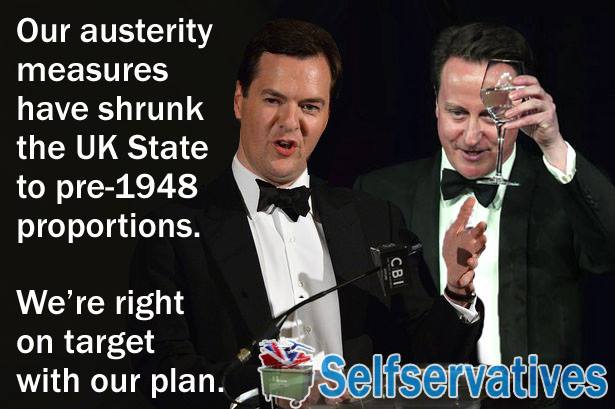
Osborne’s Autumn statement reflects the Tory ambition to reduce State provision to rubble

Osborne’s razor: the Tory principle of parsimony is applied only to the poorest

The BBC expose a chasm between what the Coalition plan to do and what they want to disclose
1450041_569755536427312_1698223275_n
Thanks to Robert Livingstone

Budget 2015: cuts to make Daily Mail readers wince, but not just yet

9686687899_74d73c6216_oPicture courtesy of Robert Livingstone.

Article by Michael Kitson, University of Cambridge

George Osborne is preparing to deliver the first Tory budget since 1996. He will proclaim the success of the government’s “long-term economic plan” and will use this as a platform to launch a radical reduction of welfare expenditure. But repeatedly extolling the success of your long-term economic plan does not mean that you have one. And an economy that in the first quarter was growing at a sluggish annual rate of 2.2% per head – after a deep and protracted recession – is not an indicator of sustained economic revival.

There are two main components of the government’s economic plan. First, to decrease the budget deficit and eventually move it to surplus – with the fiscal burden being borne by cuts in government spending. Second, to reduce the size of the state in the British economy. This is not an “economic plan”, it is a political agenda based on a doctrine of faith.

The focus on fiscal austerity has meant that monetary policy (interest rates and quantitative easing) has been the main stimulant to the economy. Thus, private sector debt is considered good and desirable whereas public sector debt is bad and harmful.

This makes little economic sense; what is important is the appropriate balance between borrowing to consume and borrowing to invest. In a period of cheap money, it is no surprise that consumers are buying new cars in record numbers (85% of which are manufactured abroad); the problem is that the state is not investing in the infrastructure that the economy needs.

The growth record

The supporters of austerity have argued that the return of economic growth is justification for the policy. This argument is full of holes. The anti-austerity group never argued that the economy would remain in a permanent recession – their concern was that recovery would be delayed and the downturn would cause long-term damage. The normal path for an economy that suffers a shock is that it bounces back with a period of rapid economic growth. The bounce-back has been feeble in the UK and growth has yet to get back to trend.

Furthermore, the most important indicator of prosperity is GDP per capita, and as shown by the red line in the chart below, this is still below the level achieved in 2008. This reflects the UK’s productivity problem. As the liberal economist Paul Krugman observed:

Productivity isn’t everything, but in the long run it is almost everything. A country’s ability to improve its standard of living over time depends almost entirely on its ability to raise its output per worker.

Although it will probably receive a lot of lip service in the budget, there has been no coherent plan to raise productivity in the UK.

ONS, Quarterly National Accounts, Quarter 1 (Jan to Mar) 2015

The retreat of the makers

The UK remains an unbalanced economy: regional disparities have widened since the early 1980s and this process was not halted by the financial crisis. The government has proclaimed that it is putting the power into the “Northern powerhouse”. But regional policy in the UK is piecemeal and parsimonious; and you do not build a powerhouse by postponing infrastructure spending in the North.

Support for industry is another area where soundbites trump substance. The chancellor has called for “a Britain carried aloft by the march of the makers”. But as the chart below shows, although there has been a recovery of the service sector, the manufacturing sector remains smaller than it was before the financial crisis.

The coalition government revived the notion of “industrial policy” to support the manufacturing sector; but this was a Vince Cable initiative which is not being pursued by the current government – which is instead implementing major cuts at the Department for Business, Innovation & Skills, the department responsible for business support and innovation.

ONS, Quarterly National Accounts, Quarter 1 (Jan to Mar) 2015

Of course, it is often argued that manufacturing does not matter any more as we are a service-based economy. Services will continue to provide most of the jobs and most of the output of the economy. Where manufacturing plays a crucial role is as an important source of exports: to help address the deficit that the chancellor rarely talks about – our massive and persistent trade deficit with the rest of the world.

The size of the state

An important part of the long-term political plan is to reduce the size of government – to wield the axe to what the Daily Mail refers to as the “the bloated overweening state. This is a big challenge as the size of the state (as a share of GDP) has increased in all advanced economies since World War II.

This has not been due to some statist plot, but reflects the implications of prosperity. As economies have grown and the standard of living and life expectancy have increased, there has been expanding demand for health, education and pensions. And much of this demand has been met by the state and funded by tax revenue. These are the largest components of government expenditure in the UK; and if the chancellor is serious about reducing the size of the state this is where his axe will have to eventually fall.

Hitting benefit claimants in the meantime is an easy target – and, after all, not many of them are likely to vote Conservative. But large-scale cuts to school budgets, the NHS and state pensions may even make some readers of the Daily Mail wince.

The Conversation

Michael Kitson is University Lecturer in Global Macroeconomics at University of Cambridge.

This article was originally published on The Conversation.
Read the original article.