Tag: Iain Duncan Smith

If even the DWP isn’t Disability Confident, how will a million disabled people get jobs? – Bernadette Meaden

Nobody would expect a person who suffers blackouts to drive a bus or bin waggon once they had thought through the potentially devastating consequences. But political, cultural, psychological and financial coercion is being used to force sick and disabled people to work – the government continues to cut welfare, which was calculated originally to cover only the costs of meeting basic needs.

Cruel sanctions and strict, inflexible, often unreasonable behavioural conditions are being imposed on lifeline benefit receipt, adversely affecting some of our poorest and most vulnerable citizens; unemployed and disabled people are being stigmatised by the government and the media – all of this is done with an utterly callous disregard of a person’s capacity to work, and importantly, the availabilty of appropriate and suitable employment opportunities, and this can often have tragic consequences.

Modern employment practices, which have an increasingly strong focus on attendance micromanagement, present yet another barrier for disabled people who want to work.

The following is taken from an excellent article which was posted on Bernadette Meaden’s blog, on January 16, 2016.

The numbers of disabled people in ‘absolute poverty’ (unable to meet their basic needs) has risen steeply following welfare reforms. Yet in his most recent party conference speech Iain Duncan Smith said to disabled people, “We won’t lift you out of poverty by simply transferring taxpayers’ money to you. With our help, you’ll work your way out of poverty.”

The recent case  of a Department for Work and Pensions (DWP) employee sacked for taking time off for illness illustrates a truth that the government does not acknowledge. Modern employment practices often appear to be incompatible with its aim of getting sick and disabled people off disability benefits and into work.

In this particular case it was reported that after working at the DWP for thirty four years, Ms Powell, who has a disability, fell foul of its sickness absence procedure, whereby formal action is taken against employees after eight days absence, or four spells of absence within a 12-month period.

‘Health problems meant that Ms Powell was frequently off sick. As some of her absences were related to a disability, her trigger point was adjusted from the usual eight to 12 days. However, Ms Powell later went over her allotted 12 days’ absence by a few days, and she was dismissed.’

A year earlier, a DWP whistleblower had revealed :

“Attendance management continues to get more draconian and sackings have become a regular occurrence: a recent guideline instructed managers to consider dismissal for staff off work for longer than 28 days regardless of the reason.”

So despite its own Disability Confident campaign, which calls on employers to “help improve employment opportunities for disabled people and retain disabled people and those with long term health conditions in your business”, the DWP itself seems unable to provide employment for people who may have long or frequent spells of illness. This would suggest that if you have, say, a long term fluctuating health condition, or a disability that requires frequent hospital appointments, you will find it very difficult to keep a job at the DWP.

Of course the DWP is not alone in this. We know that in some workplaces the pressure to attend even when very ill is overwhelming. At the Sports Direct warehouse, for instance, it was reported that over a two year period, 76 calls for an ambulance had been made, with 36 cases classed as ‘life-threatening’ including strokes, convulsions and breathing problems. One woman gave birth in the toilets, and employees said they were too frightened to take time off when they were ill, in case they lost their job. The employment agency that supplied staff to the warehouse had a ‘six strikes and you’re out’ policy, where a strike could include being off sick, or taking ‘excessive or long toilet breaks’. Very few people with a long term health condition would find it possible to keep their job in these circumstances. 

The reality is that in a fiercely competitive economy and austerity-driven government departments, there is very little room for anyone who has a long term health problem. Perhaps somebody in the government should do a little experiment. Try applying for jobs and declaring a long-term illness or disability which may require regular absences. See how easy it is to get a job.

You can read the rest of Bernadette’s excellent article here.

Related
The new Work and Health Programme: the government plan social experiments to “nudge” sick and disabled people into work

Conservative governments are bad for your health

proper Blond 

Context: the politics of blame

Increasing employment and pushing ill and disabled people into work are key elements of the UK Government’s public health and welfare “reform” agendas. The arguments presented for this approach are primarily economic and particularly, moralistic. The reasoning presented is not founded on biological, psychological or sociological evidence. The government maintains that work is the most effective way to improve the wellbeing of individuals, their families and their communities. There is a perception that unemployment is harmful to physical and mental health, so the corollary has been assumed – that work is beneficial for health. 

However, that does not necessarily follow, and to claim that it does is distinctly unscientific and irrational. As the Conservatives themselves have often pointed out in less appropriate circumstances in order to avoid democratic accountability and responsibility, there is a difference between an association and a causal relationship.

There is a clear ideological context from which the welfare “reforms” proceeded, and the politically-directed media campaigns that have purposefully stigmatised and outgrouped unemployed people demonstrates quite clearly that reducing welfare support is not about a politically calculated extension of social inclusion and social justice policies, Conservative bonhomie, or overall concern for the wellbeing of welfare recipients and people who are disabled.

The government are attempting to entrench neoliberal ideology in our culture by co opting GPs, social workers and other professionals as agents of the state. The idea that “work is a health outcome” has been embedded in policies such as the Orwellian renaming of sick notes (now “fit notes”), which are designed to explore what work a person who is absent from work because of illness may undertake.  However, the government intend a much more far-reaching outcome than simply attempting to reduce the sick “role” and recovery time. The government’s “behavioural change” agenda has become a centrally-orchestrated programme for governance. The provision of public goods and crucial support, from housing and discretionary housing payments to employment benefits and disability support is becoming increasingly conditional. 

Political rhetoric, aimed at perpetuating an extremely divisive and intentionally misleading “strivers and skivers” dichotomy is designed to undermine public support for the welfare state and the other gains of our post-war settlement – the NHS, legal aid and social housing for example – also betrays the lack of coherence, rationality and empirical support for the Conservative’s “reforms.” Furthermore, the extremely targeted, class-contingent and punitive nature of the Conservative austerity programme indicates that the welfare “reforms” were founded on traditional Tory prejudices, rather than on any genuine causal relationship based on empirical evidence and social or economic necessity.

This explains why the government have persistently ignored the many evidence-based concerns raised by academic researchers, campaigners and opposition MPs that their austerity policies are having an extremely harmful effect, most often on our poorest and most vulnerable citizens.

The Conservatives are ideologically bound to notions of a small state, minimal levels of political responsibility and intervention, minimal levels of government spending, the heavy promotion and administration of privatisation, competition, fiscal austerity, deregulation and free trade in order to enhance the role of the private sector in the economy, all of which are the central strands of the neoliberal hegemony. Conservative ideology runs counter to any notion that all citizens must be treated fairly, which also means that they must be given equal economic opportunities and provided with a adequate minimum standard of living. Neoliberal ideology is incompatible with a human rights-based society.

Democracy exists partly to ensure that the powerful are accountable to the public, and particularly to our most vulnerable citizens. This government have blocked that crucial exchange, and show disdain for human rights, the welfare state and the NHS, all of which provides ordinary people and the most vulnerable citizens basic protection from those in power.

Conservatives despise human rights and rights-based social provision. They absurdly claim that welfare provision causes vulnerability, and a “culture of dependency,” despite the fact that there is absolutely no empirical evidence to support this view. History has consistently taught us otherwise. The Conservative’s policies are expressions of contempt for the lessons and empirical evidence from over a century of social history and administration.

Tory rhetoric is designed to have us believe there would be no poor people if the welfare state didn’t somehow “create” them. If the Conservatives must insist on peddling the myth of meritocracy, then surely they must also concede that whilst a neoliberal system has a few beneficiaries, it also creates situations of insolvency and poverty for many others. That is what a system based on competitive individualism is about: it creates a few “winners” and a lot of others lose.

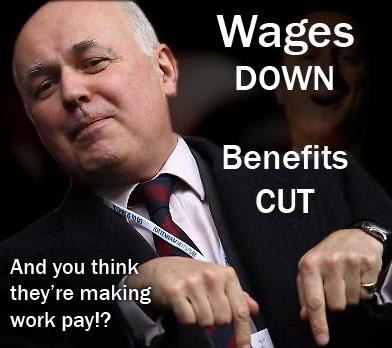
Conservative cuts are based on nothing more than the ridiculous myth that poverty is somehow a lifestyle choice or a moral failing which people can be punished or starved out of. The new Tory neoliberal “paternalists” really seem to believe that if they make life for poor people insufferable, they will simply be “incentivised” to choose to be wealthier. It’s a thinly disguised revamp of the ill-conceived 1834 Poor Law deterrence principle of “less eligibility” – that was supposedly aimed at “making work pay” too. But it didn’t. It’s not possible to frighten and punish people out of poverty. Only a Conservative government would claim to be making work pay by cutting welfare down to the bare bones, rather than increasing wages. The welfare cuts have actually had the effect of driving down wages too.

Of course, by framing the issue of poverty in terms of personal responsibility and morality, the Conservatives have stifled debate and restricted public discussion in the hope that people won’t recognise the wider structural inequalities and economic failings, for which this government are solely responsible.

Debbie Abrahams said: “The Conservatives point the finger at sick and disabled people for the rise in spending. They are still shamelessly spinning their tired “shirkers” and “strivers” narrative, designed to whip up public support for cuts to the most vulnerable. But this divisive rhetoric can no longer conceal the fact their economic strategy has failed. It is the government’s failure that has led to rising social security costs. 

As we saw at the Autumn Statement (2016), borrowing is up, growth is down, deficit targets have been hopelessly missed and wages have flat-lined. At the same time, the government has refused to tackle the driving forces behind increased social security spending, from low pay to high housing costs. Instead, the government is slashing support to those who need it most, exacerbating the financial strain so many are facing this Christmas, and failing its own targets in the process.   

[…] Research by the Joseph Rowntree Foundation suggested that we need to be building 80,000 affordable homes a year to meet demand and keep the current spend on housing benefit stable. This government managed a pathetic 30,000 homes last year. It is this refusal to build enough homes that keeps the housing benefit bill growing. People are left struggling to find somewhere affordable to live, and the state is forced to subsidise the sky-high rents charged by private landlords 

We could also look at tax credits, which currently make up more than £20bn a year in the spending under the cap. Tax credits top up working people’s pay where it is insufficient. Wages today are lower than they were in 2008, and won’t even return to the levels of 2008 until 2021. A record six million workers are paid less than the living wage. This is why tax credit costs have risen – because the government has had to increase the amount spent on topping wages up. 

Labour founded the welfare state to give pensioners and disabled people dignity, to prevent homelessness, children going hungry, and to cover for periods of unemployment or ill-health. It was never designed to be spending tens of billions substituting for low-wage employers or subsidising rip-off landlords.”

Economic productivity is the new health outcome

The claim that “work is good for you” is allegedly based on “scientific evidence” that people in work tend to be healthier than those claiming unemployment and sickness benefits. However, to draw the conclusion that “employment is good for you” from the data is an example of inferring causality inappropriately, from what is only an association. Yet it is being used to prop up Conservative justifications for dismantling the welfare state.

Unemployment has been linked to increased rates of sickness, disability and mental health problems, and to decreased life expectancy. The claim has also been made that it results in an increased use of medication, medical services, and higher hospital admission rates. However, surely it makes much more sense to say that sickness, disability and mental health problems, the use of medication, medical services, and higher hospital admission rates all cause unemployment, rather than the converse. This government seem to have a major problem accepting the fact that sometimes, people really are simply too ill to work.

Most people who are too ill to work are obviously not as healthy as those who can work. That is hardly controversial. However, that doesn’t mean that work itself is good for your health, it just means those who don’t work tend to have worse health than those who do. People don’t work because they have poor health.

Linking ill health with “worklessness” is an ideological preference which ignores other variables. It is much more likely that the “reforms”, which have reduced welfare provision to inadequate levels – leaving people all too often unable to meet their basic needs – is bad for health, rather than being out of work. 

But the Conservatives have used this “evidence” of an association between poor health and unemployment to make an inference based on a “causal link” that hasn’t actually been empirically verified. Iain Duncan Smith has made the claim, for example, that “work is good for you.” He has even claimed that work can make people’s health problems “better.” But that isn’t very likely to be true. It’s akin to claiming that chatting and exercise is a cure for multiple sclerosis, lupus, blindness or cancer. Or that a work coach on prescription will cure rheumatoid arthritis, a disc prolapse or schizophrenia.

This is why I visit my doctor when I am ill, and not Iain Duncan Smith or the government.

The claim that work is good for your health is simply a part of Tory justification narratives for cutting support for sick and disabled people, and hounding people who need to claim benefits. Yet this axiom informs current UK policy towards increased benefit conditionality, harsh sanctions, compulsory work experience and the “workfare” or “work-for-benefits” thinking which the Conservatives favour. However, this is an approach that can never work, unless, of course, the aim is to completely dismantle the welfare state. Oh, hang on…

The biopsychosocial model

The biopsychosocial model (BPS) of ill health is not without controversy, although many see it as more pragmatic or humanistic than the medical model of illness, which came to be regarded as reductionist and deterministic. The biopsychosocial model is the conceptual status quo of contemporary psychiatry, and many believe that it has played an important role in combatting psychiatric dogmatism.

The biological component of the model is based on a traditional allopathic (bio-medical) approach to health. The social part of the model investigates how different social factors such as socioeconomic status, culture and poverty impact on health. The psychological component of the biopsychosocial model looks for potential psychological causes for a health problem such as lack of self-control, emotional turmoil, and negative thinking.

Of course a major criticism is that the BPS model has been used to disingenuously trivialise and euphemise serious physical illnesses, implying either a psychosomatic basis or reducing symptoms to nothing more than a presentation of malingering tactics. This ploy has been exploited by medical insurance companies (infamously by Unum Provident in the USA) and government welfare departments keen to limit or deny access to medical, social care and social security payments, and to manufacture ideologically determined outcomes that are not at all in the best interests of patients, invalidating diagnoses, people’s experience and accounts, and the existence of serious medical conditions. (See also: Getting rich on disability denial, and  A Tale of two Models by Debbie Jolly.)

Unum was involved in advising the government on making the devastating cuts to disabled people’s support in the UK’s controversial Welfare Reform Bill. (See also: The influence of the private insurance industry on the UK welfare reforms.)

This is a government that tends to emphasise citizen responsibilities over rights, moralising and psychologizing social problems, whilst quietly editing out government responsibilities and democratic obligations towards citizens.

For example, poverty, which is caused by political decisions affecting socioeconomic outcomes, is described by the Conservatives, using elaborate victim-blame narratives, and this is particularly objectionable at a time when inequality has never been greater in the UK.

Poverty may only be properly seen in a structural context, including account of the exclusion and oppression experienced by those living in poverty, the global neoliberal order, the gender order, the disability, racial, sexual and other orders which frame social life and precipitate poverty in complex and diverse ways. It’s down to policy-makers to address the structural origins of poverty, not the poor, who are currently regarded as the “collateral damage” – casualities – of politically imposed structural constraints.

Conservative governments are unhealthy

The effects of loss of income on people who can’t work because of illness is a confounding factor, too. How is it possible to isolate the devastating impacts of the Conservative “reforms” and the steady dismantling of the welfare state on unemployed people from the misleading generalisation that unemployment is bad for health? Surely if the Conservatives genuinely believed their own claims, they would be more inclined to increase rather than radically decrease provision and support for unemployed people.

Of course, not all work is beneficial. The review that led to the widespread folk tale that work is good for you is based on research involving people who had common and minor illnesses, and fulfilling, secure jobs. That doesn’t reflect the experiences of many people.

Not all jobs are rewarding and positive experiences, and some work can cause serious risks to health.

Doctor Frank Scheer, a neuroscientist at Harvard Medical School and Brigham and Women’s Hospital in Boston, says:

“There is strong evidence that shift work is related to a number of serious health conditions, like cardiovascular disease, diabetes, and obesity.

These differences we’re seeing can’t just be explained by lifestyle or socioeconomic status.”

Shift work and poor quality working environments and employment conditions are also linked to stomach problems and ulcers, hypertension, depression, musculoskeletal disorders, chronic infections, diabetes, general health complaints, all-cause mortality and an increased risk of accidents or injury. Long working hours are equally linked with a detrimental impact on health, according to medical research – see: The impact of overtime and long work hours on occupational injuries and illnesses: new evidence from the United States.

There is a growing and potentially corrosive problem of low paid, poor quality, precarious and temporary work which threatens levels of social inclusion and, ultimately, the health of the workforce.

Research shows unambiguously that the psychosocial quality of bad jobs is worse than unemployment. Peter Butterworth examined the mental health implications of those moving from unemployment into employment and found that:

“Those who moved into optimal jobs showed significant improvement in mental health compared to those who remained unemployed. Those respondents who moved into poor-quality jobs showed a significant worsening in their mental health compared to those who remained unemployed.”

Overall, unemployed respondents had poorer mental health than those who were employed. However the mental health of those who were unemployed was comparable or superior to those in jobs of the poorest psychosocial quality. (See: The psychosocial quality of work determines whether employment has benefits for mental health: results from a longitudinal national household panel survey.)

More recently, in a letter to the Guardian, the UK’s leading bodies representing psychologists, psychotherapists, psychoanalysts, and counsellors called on the Government “to immediately suspend the benefits sanctions system. It fails to get people back to work and damages their mental health.

Findings from the National Audit Office (NAO) show limited evidence that the sanctions system actually works, or is cost effective.

But, even more worrying, we see evidence from NHS Health Scotland, the Centre for Welfare Conditionality hosted by the University of York, and others, which links sanctions to destitution, disempowerment, and increased rates of mental health problems. This is also emphasised in the recent Public Accounts Committee report, which states that the unexplained variations in the use of benefits sanctions are unacceptable and must be addressed.”

The impact of poverty on health

The largest study of poverty conducted in the UK has laid out the dire extent of British material deprivation – and seriously undercut the government’s claim to be lifting people out of poverty through work.

The Poverty and Social Exclusion in the UK (PSE) project details how, over recent years, the percentage of households living below society’s minimum standard of living has increased from 14% to 33% – despite the fact that the economy has increased in size over the same period. The study found that low wages are a central cause of widespread deprivation. For many people, full-time work is not enough to lift them out of poverty; almost half of the working poor work 40 hours a week or more. And one in six adults in paid work (17%) is poor, suffering low income and unable to afford basic necessities.

Commenting on the study’s findings, Professor Jonathan Bradshaw of the University of York said they showed many parents who work full time still have to make huge sacrifices to try and protect their children from deprivation.

“We already know from DWP data that the majority of children with incomes below the the relative income poverty threshold have a working parent. The PSE survey shows that the majority of deprived children, those lacking two or more socially perceived necessities, and very deprived children (lacking five or more socially perceived necessities) have a working parent.

We found that 65% of the deprived and 58% of the very deprived children had a working parent, and 50% of the deprived and 35% of the very deprived had at least one parent working full-time. Child poverty is not being driven by skivers, but is the consequence of strivers working for low earnings while in-work benefits are being dissipated by government austerity measures.”

Responding to the findings, Clare Bambra, a professor at Durham University, said that the research was a shameful picture of “the devastating and far-reaching human costs of inequality and poverty in the UK today.”

She said:

“It’s shameful for a rich country like ours to be tolerating such levels of poverty especially amongst our children and young people. The mantra that work sets people free from poverty has been shown to be a grand old lie.

We will be living with the long term consequences of this social neglect for decades to come – there are clear links between poverty and reduced life expectancy and higher rates of ill health, especially concentrated in deprived areas and the north.

These findings show us the true cost of austerity.”

Public health experts from Durham University have denounced the impact of Margaret Thatcher’s policies on the wellbeing of the British public in a comprehensive study which examines social inequality in the 1980s.

The study, which looked at over 70 existing research papers, concludes that as a result of unnecessary unemployment, welfare cuts and damaging housing policies, the former prime minister’s legacy includes the unnecessary and unjust premature death of many British citizens, together with a substantial and continuing burden of suffering and loss of wellbeing.

The research shows that there was a massive increase in income inequality under Baroness Thatcher – the richest 0.01 per cent of society had 28 times the mean national average income in 1978 but 70 times the average in 1990, and UK poverty rates went up from 6.7 per cent in 1975 to 12 per cent in 1985.

Baroness Thatcher’s governments wilfully engineered an economic catastrophe across large parts of Britain by dismantling traditional industries such as coal and steel in order to undermine the power of working class organisations, say the researchers. They suggest this ultimately fed through into growing regional disparities in health standards and life expectancy, as well as greatly increased inequalities between the richest and poorest in society.

Professor Clare Bambra from the Wolfson Research Institute for Health and Wellbeing at Durham University, co-author of the research report, commented:

“Our paper shows the importance of politics and of the decisions of governments and politicians in driving health inequalities and population health. Advancements in public health will be limited if governments continue to pursue neoliberal economic policies – such as the current welfare state cuts being carried out under the guise of austerity.”

Thatcher’s policies  have been condemned for causing “unjust premature deaths.” Cameron’s policies are even more class-contingent and cruel.

I think there is a growing body of empirical evidence which indicates clearly that Conservative governments are much worse for public health, prosperity and wellbeing than unemployment.

10407927_677369232332608_5384979058089243718_n

Pictures courtesy of Robert Livingstone


I don’t make any money from my work. I am disabled because of illness and have a very limited income. The budget didn’t do me any favours at all.

But you can help by making a donation to help me continue to research and write informative, insightful and independent articles, and to provide support to others. The smallest amount is much appreciated – thank you.

DonatenowButton cards

Cuts under Universal Credit are discriminatory and may be illegal

66864_464287263640807_1896397853_n

The Labour Party released details of research last month, showing how new claimant families will get lower in-work benefit entitlements when tax credits are replaced by the Universal Credit benefit system.

Owen Smith, the shadow Work and Pensions secretary, said research commissioned from the House of Commons library shows that next year, thousands of working families will be at least £2,500 a year worse off as a result of the government’s cuts to Universal Credit.

Mr Smith MP, responding to Iain Duncan Smith’s recent claim on the Andrew Marr show that “nobody loses a penny” from cuts to Universal Credit, said:

Iain Duncan Smith is completely wrong to say nobody loses a penny from his cuts to in-work support.

 Cutting Universal Credit raises £100m for the government next year and that money has to come from somewhere.

What the Tories aren’t telling us is that the £100m – and a further £9.5 billion over the next five years – comes from the pockets of low- and middle-income families.

That means those currently on Universal Credit face losses of up to £2,400 come April.

Just like tax credit cuts, working families will be worse off next year and just like those cuts, Labour will fight them at every turn.

Earlier this month, analysis from the independent Office for Budget Responsibility, (OBR) suggested the changes to universal credit announced in the July budget would save the Chancellor close to £3bn by 2019-20.

The Labour Party is taking advice from lawyers about the legality of the benefit cuts under universal credit. Owen Smith, the shadow work and pensions secretary, said it is discriminatory that a single mother working full-time on the minimum wage could be almost £3,000 worse off under universal credit than a mother in precisely the same circumstances on tax credits.

The challenge raises the possibility that the new welfare system could be challenged in court.

Although the Chancellor abandoned plans to cut tax credits affecting millions of working families, in his Autumn Statement, it was due to  pressure from the opposition, because the cuts were rejected by the House of Lords and a number of uneasy Tory backbenchers also raised concerns about the negative impact the cuts would have on working families.

Labour MPs have highlighted that claimants will be substantially worse of claiming Universal Credit, the  in-work benefit payments are much lower.

In his autumn statement speech, the Chancellor said: “The simplest thing to do is not to phase these changes in but to avoid them altogether.” But he added: “Tax credits are being phased out anyway as we introduce universal credit.”

The OBR’s analysis show that by 2021 the changes to Universal Credit will save the Treasury almost as much each year as the controversial tax credits policy would have done.

Mr Smith said:

Those lucky enough to stay on tax credits will be massively better off than those on universal credit … That disparity cannot be fair, it cannot be right and it may not even be legal, and we are seeking advice as to the legality of that move.

Mr Smith also confirmed that a Labour government would reverse cuts to benefits happening under Universal Credit. He said:

We will press for the same reversal for the victims of the universal credit heist that will hit precisely the same Tory and Labour constituents just before the next election.

He made the comments in a debate about the welfare cap, after the government sought approval for a motion that said the breach of Osborne’s own fiscal rules were justified because of the reversal of tax credit cuts.

Junior Work and Pensions minister, Shailesh Vara, has confirmed that on current forecasts the cap will not be met for three years.

Universal Credit is to be rolled out gradually, with about 500,000 people on the new benefit by next April. The government has insisted they will be compensated for lower payments through a special scheme called the flexible support fund.

However, Owen Smith said the only money on offer was a £69m grant for job centre managers to help people who are close to getting into work with costs such as bus fares and new clothing.

He said:

Even if it were permissible to use that money, it is in no way going to make up for the £100m shortfall next year, the £1.2bn shortfall the year after, and certainly not the £3bn shortfall in 2020. It is completely impossible and I fear it is also misleading to the public.

Mr Smith also queried the Chancellor’s absence from the House of Commons during the debate, saying he had “carelessly, ignominiously fallen into his own welfare trap” and “slipped on his own smirk”.

He said:

But inexplicably, he’s not here to account for it. Last spring he was quite definite that he should be. He said: ‘The charter makes clear what will happen if the welfare cap is breached. The chancellor must come to parliament, account for the failure of public expenditure control’”.

430835_148211001996623_1337599952_n (1)

The government is cutting funding for employment support by 80%

598830_399390316797169_2004284912_n

Meeting the Government’s goal of halving the employment gap between disabled and non-disabled workers – moving around one million more disabled people into work – will be no easy task. Not least because despite Iain Duncan Smith’s ideological commitments, most disabled people who don’t work can’t do so because of genuine barriers such as incapacitating and devastating illnesses. No amount of targeting those people with the Conservative doublespeak variant of “help” and nasty “incentivising” via welfare sanctions and benefit cuts will remedy that.

In a speech in August about work, health and disability, Duncan Smith says: “Let’s take the Work Programme. The Work Programme is, I believe, the most successful back to work programme we’ve ever seen.

“By March this year:

  • over 1 million people – or 70% of all referrals – had spent some time off benefit;
  • and over 430,000 people had moved into lasting employment.”

However, this is not a view shared widely amongst MPs. Last year, the Public Accounts Committee denounced the failure of Work Programme providers to target more help on the most “difficult cases” as a “scandal”. Almost 90 per cent of claimants of Employment and Support Allowance, which is paid to sick and disabled people, who are on the Work Programme have not been found jobs.

The government is cutting funding for contracted-out employment support by 80% following the Spending Review. The Department for Work and Pensions has indicated that total spending on employment will be reduced, including not renewing Mandatory Work Activity and Community Work Placements, the new Work and Health Programme will have funding of around £130 million a year – around 20% of the level of funding for the unsuccessful Work Programme and Work Choice, which it will replace.

The government is introducing a number of policy initiatives aimed at reducing the number of people claiming Employment and Support Allowance (ESA). This is the social security benefit for people with long term health conditions or disabilities. These initiatives are currently at a research and trialing stage.

Iain Duncan Smith says: “This Spending Review will see the start of genuine integration between the health and work sectors, with a renewed focus on supporting people with health conditions and disabilities return to and remain in work. We will increase spending in this area, expanding Access to Work and Fit for Work, and investing in the Health and Work Innovation Fund and the new Work and Health Programme.” (See  –The government plan social experiments to “nudge” sick and disabled people into work.)

At the Employment Related Services Association (ERSA) annual conference on Tuesday, Employment Minister Priti Patel said: “Funding for employment support will remain broadly stable” following the Spending Review.  

However, this will include funding for extending conditionality to more claimants under Universal Credit, and increased investment in Jobcentre Plus “support.” There is also an announcement of an increase in Access to Work spending. However, Patel’s speech, despite the title, is mostly pitched at meeting labour market conditions and employer’s needs, and not the needs of employees.

Ministers confirmed that the contracted-out element – the new Work and Health Programme – would receive around £130 million per year.

The Centre for Economic and Social Inclusion estimates that Work Programme expenditure is between £500 and £600 million per year – with our analysis for the last twelve months estimating expenditure of £530 million (pages 20-22 of this briefing (pdf)); while the Department has previously stated that Work Choice expenditure is around £80 million per year.

Commenting on the news, the Centre for Economic and Social Inclusion (CESI) Director of Policy and Research, Tony Wilson, stated:

“These huge reductions in funding for contracted employment support will have impacts both on the scale and the breadth of the new Work and Health Programme.  With just half of disabled people and those with health conditions in work, we have long argued that we need to do more and do it better.  However this new programme now appears to be doing the same or even less.  

This must cast doubt on the extent to which specialist employment support can make a meaningful contribution to the government’s manifesto commitment to halve the gap in employment rates between disabled people and the wider population.  And it will also have significant implications for those providers that have delivered the Work Programme and Work Choice.  We would urge the government to look again at this, and at the case for funding more support through the additional savings of supporting disabled people and those with health conditions back into work.”

The Scottish Cabinet Secretary for Fair Work, Skills and Training, Roseanna Cunningham has today written to UK Secretary of State for Work and Pensions Iain Duncan Smith to outline serious concerns over how the UK Government Spending Review will impact on unemployed Scottish people.

The changes announced will deliver a significant cut to funding for newly devolved services and therefore limit what Scotland is able to deliver.

In line with the Smith Commission recommendations, the Work Programme and Work Choice were to be devolved in less than 18 months. The Scottish Government embarked on a public consultation over the summer about the employability support services that people in Scotland want, and how they could help those “furthest from the labour market.”

Ms Cunningham said:

“The Work Programme as it stands is not fit for a modern Scotland. After hearing from those who use these service, communities, businesses, training providers and the trade unions, we now know what we want to provide. However, our ability to deliver this has been significantly impacted by poorly thought through Westminster policy proposals that have not been brought to our attention in an acceptable fashion.

“We estimate DWP intends to cut its spend on Scottish programmes to be devolved by around £40 million annually – around 75 per cent. This undermines the agreed intentions in Smith and comes on top of existing limitations in powers being devolved. It is our view that the Smith Commission envisaged the Scottish Government having greater influence over these issues from April 2017 and this cut diminishes their recommendations to an unacceptable level.

“The UK proposals will magnify the challenge of helping those further from the labour market into work. The prospect of an even more intensive use of sanctions will magnify the already disproportionate impact on young people and those with disabilities in Scotland who are subject to sanctions by JobCentre Plus.

“I have today written to the UK Work and Pensions Secretary seeking an explanation on the implications of the UK Spending Review announcements for Scotland and have demanded an urgent meeting of the Joint Ministerial Working Group on Welfare to discuss the issue.

“The clarity needed to procure services has also not been forthcoming from DWP with a number of information requests by the Scottish Government remaining unanswered after several months.

“The lack of information on this vital issue is unacceptable and this latest move will have serious implications on both unemployed people in Scotland and the support they require.”


This post was written for Welfare Weekly, which is a socially responsible and ethical news provider, specialising in social welfare related news and opinion.

Court rules that Tory benefit cap unlawfully discriminates against disabled people

10407927_677369232332608_5384979058089243718_n

A high court judge has ruled that Iain Duncan Smith’s welfare policy unlawfully discriminates against disabled people by failing to exempt their carers from the benefit cap. The ruling is the second this year to criticise the cap. In March, the supreme court found that the cap left people claiming benefits unable to house, feed or clothe their family and was therefore in breach of the UK’s obligations regarding international human rights.

Mr Justice Collins said the government’s decision to apply the cap to full-time carers for adult relatives had created serious financial hardship for them, forcing many to give up caring for loved ones, and had also placed extra costs on the NHS and care services.

The ruling comes after two carers brought the case against the Department for Work and Pensions (DWP) following serious concerns that the benefit cap would unfairly harm those who care for their disabled children and relatives. The carers were caring for more than 35 hours a week, the judge said that they were effectively in work, even though they were in receipt of benefits, and therefore should be exempt from the cap.

Carers are able to claim about £60 a week if they care for relatives. These claims, however, were to be included in the £500 a week  benefit cap, which was introduced by the government in the belief that so-called “workless” families need to experience financial loss, a decrease in basic security and a severe decline in their standard of living in order to “incentivise” them to try harder to get a job.

On Thursday, the High Court ruled that the government had breached article 14 of the European Convention on Human Rights. Family carers who receive Carer’s Allowance should be exempt from the benefit cap. The High Court ruled that the Secretary of State for Work and Pensions had indirectly discriminated disabled people by failing to exempt unpaid carers for disabled family members from the cap.

Collins said: “To describe a household where care was being provided for at least 35 hours a week as ‘workless’ was somewhat offensive. To care for a seriously disabled person is difficult and burdensome and could properly be regarded as work.” 

Campaigners have welcomed the decision, highlighting the damaging effects the cap would have had on carers looking after  adult disabled relatives.

Rebecca Hilsenrath, chief executive of the Equality and Human Rights Commission, said: “We are pleased that the court has found the impact on disabled people of losing a family carer had not been properly considered.

“The effect could be profound and the loss of a trusted carer devastating.

“The substantial reduction of income could jeopardise the ability of those affected to continue to care for severely disabled relatives. The court noted that the Secretary of State did not provide any information to Parliament about the effect on disabled people if their family carer were unable to continue.

“The court also held that, rather than saving public money, it would cost considerably more for the care to be provided by local authorities or the NHS.”

Laywers acting for the secretary of state had argued that unpaid carers should be treated as unemployed people who should have to make the same choices as anyone else about whether to work or cut their living costs. But Collins said those providing full-time care could not be in full-time work unless they gave up or cut back significantly on their caring responsibilities.

Unpaid carers made “a huge contribution to society” and “saved the taxpayer the equivalent of £119bn a year,” he said. Were carers forced to give up their role, taxpayer-funded services would have to spend huge amounts providing the care instead.

The judge added that the government should exempt carers because “the cost to public funds if the cap is to be maintained is likely to outweigh to a significant extent the cost of granting the exemption.”

He said: “Nowhere in the impact assessments or in what was put before Parliament was the effect on the disabled of loss of family carers raised. It in my view should have been, since it ought to have been apparent that the impact of a possible loss of a trusted family carer could be profound.

“Reconsideration will I hope be given to whether the present regulatory regime is appropriate, having regard to the hardship it can and does produce.”

A DWP spokesperson said: “We are pleased that the court agrees that the benefit cap pursues a legitimate and lawful aim.

The court didn’t actually agree that.

“The Government values the important role of carers in society – and 98% are unaffected by the cap. We are considering the judgment and will respond in due course.”

On Thursday, the following “urgent” bulletin was released from the Department for Work and Pensions:

Judicial Review in the case of R v Secretary of State of the inclusion of Carer’s Allowance in the benefit cap.

1. Today the judgment has been handed down in a judicial review in the case of R v Secretary of State of the inclusion of Carer’s Allowance in the benefit cap.

2. We are pleased that the Court agrees that the benefit cap pursues a legitimate and lawful aim.

3. However the Court has asked us to look again at the indirect impact on those disabled people whose carer is subject to the cap on household benefit payments.

4. We will consider this judgment and set-out our position in due course. We are continuing to apply the benefit cap as now, and there is no change to applying the cap to carers.

 
The bulletin also provides some questions with answers to enable staff to respond to any enquiries they may receive. You can read those here.

The standard responses to many of the anticipated questions are:

 “We are considering the judgment and will set-out our position in due course.”

“The benefit cap continues to apply.”

 Steve Bell cartoon


Specialist Disability Employment Advisors in Jobcentres cut by over 60 per cent

536738_306169162785952_999031084_n

Full-time specialist disability employment advisors who are posted in jobcentres have been radically reduced since 2011. The full-time advisors are employed to help disabled people navigate the support system and find employment. Over the last four years, the number of specialist advisors fell by over 60 per cent, from 226 to just 90.

The government says that the advisors will be replaced by unqualified  non-specialist “work coaches” as part of its Universal Credit programme, which also extends welfare conditionality, entailing sanctions, to people in part-time and low paid work.

We reported last week that the work coach scheme is to extend from jobcentres to GP practices, to prevent sick and disabled people from “leaving the job market” and “claiming Employment Support Allowance” (ESA), with pilots already underway.

The latest figures on jobcentre advisors were released by ministers in response to a Parliamentary question by Labour MP Emily Thornberry.

A spokesman for the Department for Work and Pension said the fall in advisor numbers was consistent with Government policy.

“With the introduction of Universal Credit disabled people looking for work now have access to Work Coaches who are trained to provide tailored support specific to their individual needs. As we continue to make our mainstream services more accessible to disabled jobseekers it is expected that the number of Disability Employment Advisors will continue to decline.”

“The Government is committed to halving the disabled employment gap and the most recent disabled employment figures show that 226,000 more disabled people found work over the past year.”

Charities have responded, saying that the specialist advisors are absolutely crucial for people with disabilities who have to navigate the support system and that their reduction will undermine the Government’s own claim of “supporting people in to work.”

The government have also cut in work support for disabled people, such as the Access to Work fund, which helps people and employers cover costs of disabilities that may present a barrier to work. Under the Equality Act, employers are obliged to make “reasonable adjustments” to the workplace to support people with disabilities.

A coalition of 100 disability charities had warned that the government cuts threaten disabled people’s rights earlier this year, and last month, especially those with learning disability and mental health problems, charities also called for a halt in the government’s cuts to ESA, which will be reduced, removing the work-related activity component, so that people will receive the same amount as jobseekers with no disability, which will make it more difficult for disabled people to find work, and may have an adverse impact on people with health conditions.

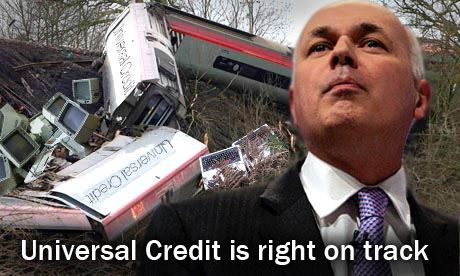
The cuts to specialist employment support for people with disabilities flies in the face of  Iain Duncan Smith’s comments during the Tory conference – that sick and disabled people need to see work as their route out of poverty. It’s difficult to see how that can be achieved when the government is busy closing down the transport system, as it were.

Duncan Smith commented at the Conservative conference: “We don’t think of people not in work as victims to be sustained on government handouts. No, we want to help them live lives independent of the state.

“We won’t lift you out of poverty by simply transferring taxpayers’ money to you. With our help, you’ll work your way out of poverty.”

We can’t help wondering what “help” actually means to Conservatives, because there is every indication that they don’t use the word in a conventional sense. Usually when Tories use the word “help” or “support”, it indicates some sort of penalty or punishment: a reference to the extended draconian benefit conditionality and  sanctions regime

Elliot Dunster, group head of policy, research and public affairs at disability charity Scope, has said that the fall in specialist assistance was concerning:

“Disability employment advisors make a huge difference in supporting disabled people into work – providing expert, personalised advice and guidance.

“We’re very concerned to see this drop in the number of job centres that have fulltime specialist advisors for disabled people. Disabled people are pushing hard to find work, but continue to face huge barriers, ranging from inaccessible workplaces to employer attitudes. 

“Disability employment advisors help tackle these barriers. The Government has set out a welcome ambition to halve the disability employment gap. To do this disabled people must have access to specialist, tailored employment support.”

Dan Scorer, head of policy at Mencap, has warned that the replacement generalist advisors would “simply not have the training” required:

“People with a learning disability find the demands placed upon them difficult while claiming Job Seekers Allowance or Employment and Support Allowance.

“Some find them impossible and we are worried that there is not the right support in Jobcentres to help them. Families tell us that a lack of learning disability training and cuts to DEAs is leading to many people with a learning disability being unfairly sanctioned and receiving insufficient support to appeal decisions, or the right support to find employment.

“Even if the reduction in DEAs in some part of the country is due to the rolling out of Universal Credit and part of a strategic move to generic advisors, we are concerned that these advisors will simply not have the training to fully support claimants with a learning disability.

“The problems with the administration of benefits and changes in the benefits system, combined with future cuts to benefits and social care, is causing fear and anxiety among the 1.4 million people with a learning disability and their families in the UK who are scared they could be isolated in their local communities.”

Mind have already warned that the transition away from specialist help under Universal Credit would make the benefits system more difficult for people with mental health issues. Policy manager, Tom Pollard told the Independent:

“We’re pretty sceptical of the ability of those jobcentre advisors to be able to understand the barriers that people with mental health issues face.” 

Labour MP Debbie Abrahams recently challenged Priti Patel, the employment minister, during work and pensions questions in the Commons recently to raise concerns about the negative impacts of social security sanctions on the mental health of claimants.

During the session the Patel had claimed: “Our staff are trained to support claimants with mental health conditions and there is no evidence to suggest that such claimants are being sanctioned more than anybody else.”

Mrs Abrahams, Shadow minister for Disabled People, responded: “The minister may have inadvertently slipped up there. There is clear evidence from last year that 58 per cent, more than half, of people with mental health conditions on the employment and support allowance work-related activity group were sanctioned.”

A recent Freedom of Information request showed that between April, 2014, and March this year there were almost 20,000 benefit sanctions received by people who were out of work because of their mental health.

However, in this same period only 6,340 of the group were successfully supported into employment during the same period by the Work Programme.

Tom Pollard said: “Figures obtained by us show that people with mental health problems are more likely to have their benefits stopped than those with other conditions.

“Last year, the Department of Work and Pensions issued more sanctions to people with mental health problems being supported by Employment and Support Allowance than they did to those with other health conditions.

“Stopping somebody’s benefits, or threatening to stop them, is completely the wrong approach to help people with mental health problems find work — it’s actually counterproductive.

“In continually refusing to listen to calls for a review of the use of sanctions, the Government is not only undermining its ambition of helping a million more disabled people into work, but is also failing its duty of care for the health and wellbeing of hundreds of thousands of people with mental health problems.”

The Department of Work and Pension’s own research shows that the threat of sanctions does ensure that people who need support from social security comply with benefit rules, but that doesn’t actually help them to find work. It also tends to undermine confidence, and many jobcentre advisors have expressed concern that people with mental illness are more likely to be sanctioned simply because they would have greater difficulty meeting the strict conditionality criteria and because of the greater pressure to sanction “non-compliance” from government. (page 54)

But we deeply suspect that sanctions are precisely what the government are referencing when they use the phrase “helping people into work.”

This post was written for Welfare Weekly, which is a socially responsible and ethical news provider, specialising in social welfare related news and opinion.

DWP Staff Gifted £42 Million in ‘Bonus Bonanza’.

IDS_n

At a time when the Conservatives have inflicted draconian cuts on those needing financial support because of illness, disability or losing their job, justifying this by their claim of “economic necessity” and the need to “live within our means” to “pay down the debt”, which is increasing rather than decreasing, the “responsibilities” imposed by the Tory austerity measures apply only to those with the very least.

Meanwhile, Whitehall bureaucrats, many involved in the implementation of the punitive welfare cuts, pocketed more than £90million in hand-outs last year.

Figures obtained by The Huffington Post UK show that in the year to April, 12 Government departments forked out £89.4million in bonuses to staff.

The most rewarding was Department for Work and Pensions, overseen by Iain Duncan Smith, which handed out £42.1million in bonuses to its staff – £38.1million of which went to Senior Civil Servants. And these figures only relate to 12 out of the 20 Government departments, meaning the total bonus figure could soar to almost £140million if the average pay out of almost £7million per department continues.

Labour MP Andrew Gwynne, who uncovered the figures, said: “For all his talk of belt-tightening, these figures show that David Cameron is happy to splash the cash on bonuses.

“Whilst the NHS is in crisis, this bonus bonanza would pay for thousands of new nurses.”

In 2012, the then Treasury minister Danny Alexander vowed to end bonuses for “run of the mill performance” as the coalition Government slashed departmental budgets.

Since 2010-11 the Government says it has restricted awards for senior civil servants to the “top 25 per cent of performers.”

Mark Serwotka, general secretary of the Public and Commercial Services Union called for the bonus system to be scrapped.

He said: “It is unfair and favours the already well paid. The money should be put towards decent pay rises, especially considering that since 2010 rank and file civil servants have seen their real incomes fall by 20 per cent.”

Prospect, a union for professionals, defended the civil service workers and he claimed the focus on bonuses is a “distraction” from the drop in take home pay of many civil servants.

Deputy general secretary Garry Graham said: “Pay in the private sector is increasingly buoyant with average increases running at more than 3.5 per cent. Civil servants have been told that average increases will be capped at 1 per cent until 2020.

“Pay rates in the private sector outstrip those of the public sector – and that gap is only forecast to increase, creating real problems in recruiting and retaining staff, particularly the professional specialists and managers Prospect represents.

“Many, if not all of our members would happily forgo the opportunity to earn a bonus in return for a decent and fair increase to their base pay.

“Government has created the bonus culture in the civil service, not the staff. And only 1 per cent of the civil service paybill is spent on bonuses.”

In a statement alongside his department’s figures, Work and Pensions Minister Justin Tomlinson said: “In line with Civil Service pay guidance, DWP rewards employees for their performance through either end of year non-consolidated payments and/or in-year payments. In year payments are limited to 0.23 per cent of the total DWP paybill.

I can’t help wondering what indicators are used to measure “performance,” and what actually constitutes “good performance.”

This post was written for Welfare Weekly, which is a socially responsible and ethical news provider, specialising in social welfare related news and opinion.

Conservatives in disarray as Osborne signals raid on Duncan Smith’s Universal Credit funds

Chancellor George Osborne

George Osborne and Iain Duncan Smith have clashed over the chancellor’s plans to soften the impact of tax credit cuts by raiding the budget for Universal Credit.

The Centre for Social Justice (CSJ), which was founded by Iain Duncan Smith, insists that the Chancellor could use this month’s Autumn Statement to ease the impact of the controversial changes without risking his drive for a budget surplus.

In a critical report, the thinktank warned against taking money from Duncan Smith’s flagship Universal Credit scheme to sweeten the tax credit pill. Duncan Smith said that he’s concerned that the raid will serve to “undermine people’s incentive to work.”

The CSJ said in their report that the UC reforms meant by 2020 only 9% of those currently getting tax credits would still be receiving them.

Instead, it was suggested that the Government could “help people to work more hours” or introduce a transitional fund for those hardest hit.

But Osborne is nonetheless preparing to fund plans to soften the impact of tax credit cuts by making people claiming Universal Credit forgo as much as 75p of every extra pound they earn. At present Universal Credit recipients lose 65p for every extra pound they earn. Osborne is thought to be examining plans to increase the figure, known as the “taper”, to 75p.

The most expensive course of action would be to only impose the tax credit cuts on new claimants – but the authors note that it would have the “least social and political cost”.

The chief executive of the Centre for Social Justice, Baroness Stroud, who is a former special adviser to the Work and Pensions Secretary said:

“There are no easy choices, but these are the options the Chancellor has. What he should not do is raid Universal Credit to pay for any transitional changes or he will be recreating the same problem there.

“The projected savings through changes to tax credits is £4.4 billion, the Government plans to turn a surplus of £10 billion in 2019-20 and of 11.6 billion in 2020-21.

“Why have a surplus if we can’t protect those on the lowest pay, doing the right thing by taking work?

“The Chancellor can protect these workers and have a surplus by 2020.

“This Government is set to achieve its historic aim to make sure work always pays more than welfare, we shouldn’t put that at risk.”

Paul Johnson, the Director of the respected Institute for Fiscal Studies, questioned whether the move would raise enough to limit the impact of tax credits. He said: “If you are also increasing the taper rate then you are losing quite a lot of the key design of Universal Credit.”

Both the Treasury and the Deparment for Work and Pensions have declined to comment, but Conservative Tim Montgomerie, a columnist for The Times and founder of the Conservative Home website, said he believed George Osborne “could be forced to resign” over his tax credit omnishambles, and he warned that the chancellor faces a “massive rebellion” from his own party because the policy  is “terrible politics”.

“You cannot fight an election saying you are standing up for hard-working families then you cut benefits for hard-working families,” he said.

Perhaps it is time for the Conservatives to recognise that policies are not an ideological tool designed to ensure the government gets its own way in exercising traditional Tory prejudices towards the working and non-working poor.

However, in fairness there has been a series of right-wing backbenchers that have aired their disquiet at the cuts, although that unease may have be motivated by a pragmatic rather than an any ethical objection. The proposed tax credit cuts do make a mockery of the Tory claims to ensuring that “work always pays,”and presents the public with an incoherent narrative that has now lost any credibilty.

Montgomerie said:

“I don’t think George Osborne will tweak,” he said. “If he does just try to get away with this, he will not just be defeated in the Lords, he will be defeated in the Commons.”

539627_450600381676162_486601053_n (2)Courtesy of Robert Livingstone

 —

This post was written for Welfare Weekly, which is a socially responsible and ethical news provider, specialising in social welfare related news and opinion.

NHS hospital to offer food parcels to patients at risk of malnutrition – Rachel Pugh

1390648_548165358586330_1740107407_n

This article was written by and first published in the Guardian today.

A central food collection point will sit by the canteen at Tameside hospital.

A central food collection point will sit by the canteen at Tameside hospital. Photograph: Christopher Thomond for the Guardian

Emergency staff at a hospital are being asked to offer food boxes discreetly to patients they believe may benefit as they are discharged amid rising concerns among doctors of malnourishment.

Tameside hospital in Greater Manchester is also planning to open a permanent food bank collection centre inside the hospital next month to help the nutrition of both patients and locals in the area.

News of the move came after it was announced on Wednesday by the work and pensions secretary Iain Duncan Smith that job advisers have been posted in a food bank in Manchester as part of a trial set to be rolled out across the UK.

Bosses at Tameside hospital said they had made the decision after doctors and nurses became worried about what they said was a significant rise in patients showing signs of malnourishment, and also staff living locally becoming worried about some neighbours. Staff have been given training to spot malnourishment.

Tameside hospital’s chief executive, Karen James, said: “I was talking to an old lady recovering on a ward, who was in financial difficulties and chose to feed her dog first after paying the bills, whilst she went without. It’s heartrending.”

Elsewhere, the Queen Elizabeth hospital in Birmingham opened a food and clothing bank on its main premises earlier this month, and a spokeswoman said on Wednesday that they had been inundated with donations. In the summer the Royal Victoria Infirmary in Newcastle began offering parcels to parents using its neonatal care unit.

Malnutrition affects three million people in the UK and costs the NHS an estimated £5bn a year.

Malnourished surgical patients have complication and mortality rates three to four times higher than normally nourished patients, with longer hospital admissions. Similar findings have been described in medical patients, and particularly the elderly.

Tameside hospital was placed in special measures in summer 2013 after a review by the NHS England medical director, Sir Bruce Keogh. It was taken out of special measures in September this year.

A spokeswoman for Birmingham’s Queen Elizabeth hospital said its scheme was part of a wider community initiative that involves using hospital land for community orchards, gardens and beekeeping. Twice a month, the hospital hosts a farmer’s market, one of the largest in Birmingham. “Food banks are about more than food,” said the hospital. “People who are referred to them are also offered practical and emotional support by signposting other agencies, whether that is financial advice or counselling services or in some cases help with clothing.”

Speaking earlier on Wednesday, Duncan Smith told the Work and Pensions Committee that people who turn to charities for help when they cannot afford to eat will be given advice on claiming benefits and finding work while they pick up emergency food parcels.

“I am trialling at the moment a job adviser situating themselves in the food bank for the time that the food bank is open, and we are already getting very strong feedback about that,” he said. “If this works and if the other food banks are willing to encompass this and we think it works, we think we would like to roll this out across the whole of the UK.”

Robert Devereux, the permanent secretary to the Department for Work and Pensions, who appeared alongside Duncan Smith at the hearing, said two advisers had been working one day a week at the Lalley Welcome Centre in Manchester.

Duncan Smith said: “They are to provide support to people who come in, and that can include people saying: ‘I haven’t had my payment’,” giving the example of a claimant whose money was delayed because officials had not seen the right documents.”


The new Work and Health Programme: government plan social experiments to “nudge” sick and disabled people into work


Illustration by Jack Hudson

The government’s Nudge Unit team is currently working with the Department for Work and Pensions and the Department of Health to trial social experiments aimed at finding ways of: “preventing people from falling out of the jobs market and going onto Employment and Support Allowance (ESA).”

“These include GPs prescribing a work coach, and a health and work passport to collate employment and health information. These emerged from research with people on ESA, and are now being tested with local teams of Jobcentres, GPs and employers.”

This is a crass state intrusion on the private and confidential patient-doctor relationship, which ought to be about addressing medical health problems, and supporting people who are ill, not about creating yet another space for obsessive political micromanagement. It’s yet another overextension of the coercive arm of the state to “help” people into work. Furthermore, this move will inevitably distort people’s interactions with their doctors: it will undermine the trust and rapport that the doctor-patient relationship is founded on.

In the current political context, where the government extends a brutally disciplinarian approach to basic social security entitlement, it’s very difficult to see how the plans to place employees from the Department for Work and Pensions in GP practices can be seen as anything but a threatening gesture towards patients who are ill, and who were, up until recent years, quite rightly exempted from working. Now it seems that this group, which includes some of our most vulnerable citizens, are being politically bullied and coerced into working, regardless of the consequences for their health and wellbeing.

Of course the government haven’t announced this latest “intervention” in the lives of disabled people. I found out about it quite by chance because I read Matthew Hancock’s recent conference speech: The Future of Public Services.

I researched a little further and found an article in Pulse which confirmed Hancock’s comment: GP practices to provide advice on job seeking in new pilot scheme.

Hancock is appointed Minister for the Cabinet Office and Paymaster General, and was previously the Minister of State for Business and Enterprise. He headed David Cameron’s “earn or learn” taskforce which aims to have every young person earning or “learning” from April 2017.

He announced that 18 to 21-year-olds who can’t find work would be required to do work experience (free labour for Tory business donors) as well as looking for jobs or face losing their benefits. But then Hancock is keen to commodify everyone and everything, including public data.

However his references to “accountability and transparency” don’t stand up to much scrutiny when we consider the fact that he recently laid a statement before parliament outlining details about the five-person commission that will be asked to decide whether the Freedom of Information act is too expensive and “overly intrusive.”

He goes on to say: “And this brings me onto my second area of reform: experimentation. Because in seeking to improve our services, we need to know what actually works.”

But we need to ask for whom services are being “improved” and for whom does such reform work, exactly?

And did any of the public actually consent to being experimented upon by the state?

Or to having their behaviour modified without their knowledge?

Now that the nudge unit has been privatised, it is protected from public scrutiny, and worryingly, it is also no longer subject to the accountability afforded the public by the Freedom of Information Act.

The Tory welfare “reforms” are a big business profiteering opportunity, whilst lifeline benefits are being steadily withdrawn: policy context

The current frame of reference regarding Conservative welfare policies is an authoritarian and punitive one. It’s inconceivable that a government proposing to continue cutting the lifeline income of sick and disabled people, including a further £120 a month to those people in the ESA Work Related Activity group (WRAG), will suddenly show an interest in actually supporting disabled people. There are also proposals to further limit eligibility for Personal Independence Payments (PIP) for sick and disabled people. 

From the shrinking category of legitimate “disability” to forcing people to work for no pay on exploitative workfare schemes, “nudge” has been used to euphemistically frame punitive policies, “applying the principles of behavioural economics to the important issue of the transition from welfare to work.” (From: Employing BELIEF: Applying behavioural economics to welfare to work, 2010.)

And guess who sponsored the “research” into “nudging” people into workfare? Steve Moore, Business Development Director from esg, which is a leading welfare to work and vocational skills group, created through the merger and acquisition of four leading providers in the DWP and LSC sector.” How surprising.

It’s even more unsurprising that esg was established by two Conservative donors with very close ties to ministers, and were subsequently awarded very lucrative contracts with the Department for Work and Pensions. I think there may have been a “cognitive bias” in operation there, too. But who is nudging the nudgers?

Of course the “aim” of the “research” is: “breaking the cycle of benefit dependency especially for our hardest to help customers, including the “cohort” of disabled people.”

However, there’s no such thing as a “cycle of benefit dependency”, it’s a traditional Tory prejudice and is based on historically unevidenced myths. Poverty arises because of socioeconomic circumstances that are unmitigated through government decision-making. In fact this government has intentionally extended and perpetuated inequality through its policies.

2020health – Working Together is a report from 2012 that promotes the absurd notion of work as a health outcome.  This is a central theme amongst ideas that are driving the fit for work and the work and health and programme. Developing this idea further, Dame Carol Black and David Frost’s Health at Work – an independent review of sickness absence was aimed at reviewing ways of “reducing the cost of sickness to employers, ‘taxpayers’ and the economy.” Seems that the central aim of the review wasn’t a genuine focus on sick and disabled people’s wellbeing and “health outcomes,” then. Black and Frost advocated changing sickness certification to further reduce the influence of GPs in “deciding entitlement to out-of-work sickness benefits.”

The subsequent “fit notes” that replaced GP sick notes (a semantic shift of Orwellian proportions) were designed to substantially limit the sick role and reduce recovery periods, and to “encourage” GPs to disclose what work-related tasks patients may still be able to perform. The idea that employers could provide reasonable adjustments that allowed people who are on sick leave to return to work earlier, however, hasn’t happened in reality.

The British Medical Association (BMA) has been highly critical of the language used by the government when describing the fit for work service. The association said it was “misleading” to claim that fit for work was offering “occupational health advice and support” when the emphasis was on sickness absence management and providing a focused return to work.

The idea that work is a “health” outcome is founded on an absurd and circular Conservative logic that people in work are healthier than those out of work. It’s true that they are, however, the government have yet again confused causes with effects. Work does not make people healthier: it’s simply that healthy people can work and do. People who have long term or chronic illnesses often can’t work. The government’s main objection to sick leave and illness more generally, is that it costs businesses money. As inconvenient as that may be, politically and economically, it isn’t ever going to be possible to cure people of serious illnesses by cruelly coercing them into work.

The government’s removal of essential in-work support for disabled people – such as the Independent Living Fund, and the replacing of Disability Living Allowance  with Personal Independence Payment in order to reduce eligibility, cut costs and “target” support to those most severely disabled, and the cuts to the Access To Work scheme – means that it is now much more difficult for those disabled people who want to work to find suitable and supported employment.

The politics of punishment

There’s a clear connection between the Nudge Unit’s obsession with manipulating “cognitive bias” – in particular, “loss aversion” – and the increased use, extended scope and severity of sanctions, though most people succumbing to the Nudge Unit’s guru effect (ironically, another cognitive bias) think that “nudging” is just about prompting men to pee on the right spot in urinals, or persuading us to donate organs and to pay our taxes on time.

When it comes to technocratic fads like nudge, it’s worth bearing in mind that truth and ethics quite often have an inversely proportional relationship with the profit motive.

For anyone curious as to how such tyrannical behaviour modification techniques like benefit sanctions arose from the bland language, inane, managementspeak acronyms and pseudo-scientific framework of “paternal libertarianism” – nudge – read this paper, focused almost exclusively on New Right obsessions, paying particular attention to the part about “loss aversion” (a cognitive bias according to behavioural economists) on page 7.

And this on page 18: The most obvious policy implication arising from loss aversion is that if policy-makers can clearly convey the losses that certain behaviour will incur, it may encourage people not to do it,” and page 46: “Given that, for most people, losses are more important than comparable gains, it is important that potential losses are defined and made explicit to jobseekers (e.g.the sanctions regime).” 

The recommendation on that page: We believe the regime is currently too complex and, despite people’s tendency towards loss aversion, the lack of clarity around the sanctions regime can make it ineffective. Complexity prevents claimants from fully appreciating the financial losses they face if they do not comply with the conditions of their benefit.”

The Conservatives duly “simplified” sanctions by extending them in terms of severity, frequency and by broadening the scope of their application to include previously protected social groups.

The paper was written in November 2010, prior to the Coalition policy of increased “conditionality” and extended sanctions element of the Tory-led welfare “reforms” in 2012.

Sanctioning welfare recipients by removing their lifeline benefit – originally calculated to meet the cost of only basic survival needs – food, fuel and shelter – isn’t about “arranging choice architecture”, it’s not nudging: it’s operant conditioning. It’s a brand of particularly dystopic, psychopolitical neobehaviourism, and is all about a totalitarian level of micromanaging people to ensure they are obedient and conform to meet the needs of the “choice architects” and policy-makers.

Nudge even permeates language, prompting semantic shifts towards bland descriptors which mask power and class relations, coercive state actions and political intentions. One only need to look at the context in which the government use words like “fair”, “support”, “help” “justice” and “reform” to recognise linguistic behaviourism in action. Or if you prefer, Orwellian doublespeak.

It’s rather difficult to see how starving people and threatening them with destitution can possibly improve the well-being of many socially excluded people, and help to bring them to inclusion.”

The conclusion that Ancel Keys drew from the Minnesota Starvation Experiment in the the US during the 1940s, (which explored the physical and psychological effects of undernutrition, and stressed the dramatic, adverse effect that starvation had on competence, motivation, behaviour, mental attitude and personality) was that “democracy and nation building would not be possible in a population that did not have access to sufficient food.”

No amount of bland and meaningless psychobabble or intransigent, ideologically-tainted policies can legitimize the economic sanctioning of people who are already poor and in need of financial assistance.

Apparently, citizenship and entitlement to basic rights and autonomy is a status conferred on only the currently economically productive. Previous employment and contributions don’t count as “responsibility,” and don’t earn you any rights – the government believes that citizens owe a perpetual debt of unconditional service to the Conservative’s steeply stratified economy. Not much of a social contract, then. Cameron says he wants to “build a responsible society” by removing people’s rights and reducing or removing their lifeline income. Presumably, free invisible bootstraps are part of the deal.

Government decision-making has contributed the most significant influence on “health outcomes.” Conservative policies have entailed a vicious cutting back of support and a reduction of essential provision for sick and disabled people. In fact this group have been disproportionately targeted for austerity cuts time and time again, massively reducing their lifeline income. It’s not being “workless” that has a detrimental impact on people’s health and wellbeing: it is the deliberate impoverishment of those requiring state aid and support, funded from the public purse, (including contributions from those who now need support), which is being dogmatically and steadily withdrawn.

Making work pay for whom?

If work truly paid, then there would be no need to incentivise” almost 1.2 million low-paid workers claiming the new universal credit with the threat of in-work benefit sanctions if they fail to “take steps to boost their earnings.”

It’s very difficult to see how punishing individuals for perhaps being too ill to work more that a few hours, or those working for low pay or part-time in the context of a chronically weak labour market, depressed wages and with little scope for effective negotiating and collective bargaining can possibly be justified. It’s an utterly barbaric way for a government to treat citizens.

Surely if the government was genuinely seeking to increase choices and to widen access to the workplace for sick and disabled people, it would not be cutting the very programmes supporting and extending this aim, such as the Access to Work scheme  – a fund that helps people and employers to cover the extra living costs arising due to disabilities that might present barriers to work – and the Independent Living Fund.

This government has pushed at the public’s rational and moral boundaries, establishing and attempting to justify a draconian trend of punishing those unable to work, and what was previously unthinkable – stigmatising and punishing legally protected social groups such as sick and disabled people – has become somehow acceptable. We are on a very slippery slope, clearly mapped out previously by Allport’s scale of prejudice.

People’s needs don’t disappear just because the government has decided to “pay down” an ever-growing debt and build a “surplus” by taking money from those that have the least. Or because the government doesn’t like “big state interventions.”

So the recent proposed cut to ESA – and this is a group of sick and disabled people deemed physically incapable of work by doctors – is completely unjustified and unjustifiable. No amount of pseudo-psychology and paternalist cruelty can motivate or “incentivise” people who are medically ill.

It’s for disabled individuals and their doctors – professionals, specialists and experts – to decide if a person can work or not, it’s not the role of the state, motivated only by a perverse economic Darwinist ideology. Maslow taught us that we must attend to our physiological needs before we may be motivated to meet higher level psychosocial ones.

Iain Duncan Smith is a zealot who actually tries to justify further punitive cuts to disabled people’s provision by claiming that working is “good” for people and is the only “route out of poverty.”

Presumably he believes work can cure people of the serious afflictions that they erroneously thought exempted them from full-time employment. 

He stated: “There is one area on which I believe we haven’t focused enough – how work is good for your health. Work can help keep people healthy as well as help promote recovery if someone falls ill. So, it is right that we look at how the system supports people who are sick and helps them into work.”

Duncan Smith undoubtedly “just knows” that his absurd claim is “right.” He’s never really grown out of his “magical thinking” stage, or transcended his dereistic tendencies. His department had to manufacture “evidence” recently in a ridiculous attempt to support Iain Duncan Smith’s imaginative, paternalist claim that punitive sanctions are somehow “beneficial” to claimants, by using fake characters to supply fake testimonials, but this was rumbled and exposed by a well-placed Freedom of Information request from Welfare Weekly.

Recent research indicates that not all work serves to “keep people healthy” nor does it ever “promote recovery.” This assumption that work can promote recovery in the case of people with severe illness and disability – which is why people claim ESA – is particularly bizarre. We have yet to hear of a single case involving a job miracle entailing people’s limbs growing back, vision being restored, or a wonder cure for heart failure, cerebral palsy, multiple sclerosis and lupus, for example.

The government’s Fit for Work scheme is founded on exactly the same misinformative nonsense. It supports profit-making for wealthy employers, at the expense of the health and wellbeing of employees that have been signed off work because of medically and professionally recognised illness that acts as a real barrier to work.

Furthermore, there is no proof that work in itself is beneficial. Indeed much research evidence strongly suggests otherwise.

And where have we heard these ideas from Iain Duncan Smith before?

Arbeit macht frei.

If work really paid then surely there would be no need to “nudge” people by using sanctions, regardless of whether or not they are employed. “Making work pay” is all about reducing support for those who the government deems “undeserving,” to “discourage welfare dependency” by making any support as horrible as the workhouse – founded on the principle of “less eligibility”, where conditions for those in need of support were punitive and kept people in a state of desperation so that even the lowest paid work in the worst of conditions would seem appealing.

The public/private divide

For a government that claims a minarchist philosophy, remarkably it has engineered an unprecedented blurring of public/private boundaries and a persistent violation of traditionally private experiences, including thoughts, beliefs, preferences, autonomy and attitudes via legislations and of course a heavy-handed fiscal conflation of public interests with private ones.

This also caught my attention from Matthew Hancock’s speech transcript:

“My case is that we need continuous improvement in public services. And for that we must reform the relationship between citizen and state. [My bolding]

“The case for reform is strong. Because people have high and rising expectations about what our public services should deliver. Because budgets are tight, and we have to make significant savings for our country to live within her means.”

Basically, the “paternalistic libertarian” message here is that we will have to expect less and less from the state, as the balance between rights and responsibilities is heavily weighted towards the latter, hence requiring the “reform” of the relationship between citizen and state.

However, surely it is active, democratic participation in processes of deliberation and decision-making that ensures that individuals are citizens, not subjects.

Social democracy evolved to include the idea of access to social goods and improving living standards as a means of widening and legitimizing the scope of political representation.

Political policies are defined as (1) The basic principles by which a government is guided. (2) The declared objectives that a government  seeks to achieve and preserve in the interest of national community. As applied to a law, ordinance, or Rule of Law, it’s the general purpose or tendency considered as directed to the welfare or prosperity of the state or community.

Once upon a time, policy was a response from government aimed at meeting public needs. It was part of an intimate democratic dialogue between the state and citizens. Traditional methods of participating in government decision-making include:

  • political parties or individual politicians
  • lobbying decision makers in government
  • community groups
  • voluntary organisations
  • public opinion
  • public consultations
  • the media

Nowadays, policies have been unanchored from any democratic dialogue regarding public needs and are more about monologues aimed at shaping those needs to suit the government. 

Nudge does not entail citizen involvement in either its origin or design. The state intrusions are at such an existential level, of an increasingly authoritarian nature, and are of course reserved for the poorest, who are deemed “irrational” and incapable of making “the right decisions.”

Yet those “faulty decisions” are deemed so from the perspective of the Behavioural Insights Team, (the “Nudge Unit”) who are not social psychologists: they are predominantly concerned with behavioural economics, decision-making and how governments influence people – “economologists”, changing people’s behaviours, enforcing compliance to fulfil political aims. That turns democracy completely on its head.

The Nudge Unit gurus claim that we need help to “correct our cognitive biases”, but those who make policies have their own whopping biases, too.

Nudge is the new fudging

Nudge is a prop for New Right neoliberal ideology that is aimed at dismantling a rights-based society and replacing it with an insidiously nudged, manipulated, compliant, and entirely “responsible”, “self-reliant” population of divided, isolated state-determined individuals who expect nothing from their elected government.

The Conservatives are obsessive about strict social taxonomies and economic enclosures. The Nudge Unit was set up by David Cameron in 2010 to try to “improve” public services and save money. The asymmetrical, class-contingent application of paternalistic libertarian “insights” establishes a hierarchy of decision-making “competence” and autonomy, which unsurprisingly corresponds with the hierarchy of wealth distribution.

So Nudge inevitably will deepen and perpetuate existing inequality and prejudice, adding a dimension of patronising psycho-moral suprematism to add further insult to politically inflicted injury. Nudge is a fashionable fad that is overhyped, trivial, unreliable; a smokescreen, a prop for neoliberalism and monstrously unfair, bad policy-making.

As someone who (despite the central dismal and patronising assumptions about the irrationality of others that king nudgers have as a central cognitive bias and the traditional prejudices that Tory ideology narrates,) manages to make my own decisions relatively without bias, intelligently, rationally, critically, carefully and coherently, and that, along with my professional and academic background, I can and will conclude that no matter how you dress it up, nudge is a pretentious, cringeworthy pseudo-intellectual dead-end.

 A Nudge for the Conservatives from history

The more things change for the Tories, the more they tend to stay the same.

In the 1870s, England had a recession and the Conservatives launched a Crusade of cuts to welfare expenditure to diminish “dependency” on poor law outdoor relief – non-institutional benefits called “out-relief” because it was paid to the poor in their own homes from taxation, rather than their having to go into the punitive “deterrent” workhouses.

The Crusade included cutting medical payments to lone mothers, widows, the elderly, chronically sick and disabled people and those with mental illness. The 1834 Poor Law amendment was shaped by people such as Jeremy Bentham, who argued for a disciplinary, punitive approach to social problems and particularly poverty, whilst Thomas Malthus focused attention on overpopulation, and moralising about the growth of illegitimacy. He placed emphasis on moral restraint rather than poor relief as the best means of easing the poverty of the lower classes. 

David Ricardo argued that there was a problem with poor relief provision “interfering” with an iron law of wages. Ricardo claimed that aid given to poor workers under the old Poor Law to supplement their wages had the effect of undermining the wages of other workers, so that the Roundsman System and Speenhamland system led employers to reduce wages, and needed reform to help workers who were not getting such aid and rate-payers whose poor-rates were going to subsidise low-wage employers. Yet we found, despite Ricardo’s pet theory, that the poor law deterrent element served to push wages down further.

The effect of poor relief, in the absurd view of the reformers, was to undermine the position of the “independent labourer.” They also wanted to “make work pay.” And end the “something for nothing” culture. But much subsequent evidence shows that reducing support for people out of work actually drives wages and working conditions down.

Neither the punitive poor law amendment act of 1834 or the Crusade “helped” people into work or addressed the lack of available paid work – that’s unemployment, not the made-up and intentionally stigmatizing word “worklessness”.

And its utter failure as a credible account of poverty – the-blame-the-individual narrative and the notion that relief discourages “self-reliance” – fuelled the national insurance act of 1911 and the development of the welfare state along with the other civilising and civilised benefits of the post-war settlement. 

The Conservatives inadvertently taught us as a society precisely why we need a welfare state.

We learned that it isn’t possible to be “thrifty” or help ourselves if we haven’t got the means for meeting basic survival needs. Nor is it possible to be nudged out of poverty when the means of doing so are not actually available. No amount of moralising and pseudo-psychologising about poor people actually works to address poverty, and structural socioeconomic inequalities.

The government’s undeclared preoccupation with behavioural change through personal responsibility is simply a revamped version of Samuel Smiles’s bible of Victorian and over-moralising, a hobby-horse: “thrift and self-help” – but only for the poor, of course. Smiles and other powerful, wealthy and privileged Conservative thinkers, such as Herbert Spencer, claimed that poverty was caused largely by the irresponsible habits of the poor during that era. But we learned historically that socioeconomic circumstances caused by political decision-making creates poverty.

Conservative rhetoric is designed to have us believe there would be no poor people if the welfare state didn’t somehow “create” them. If the Tories must insist on peddling the myth of meritocracy, then surely they must also concede that whilst such a system has some beneficiaries, it also creates situations of insolvency and poverty for others.

In other words, the same system that allows some people to become very wealthy is the same system that condemns others to poverty.

This wide recognition that the raw “market forces” of the old liberal laissez-faire (and the current starker neoliberalism) causes casualties is why the welfare state came into being, after all – because when we allow such competitive economic dogmas to manifest, there are invariably winners and losers.

That is the nature of “competitive individualism,” and along with inequality, it’s an implicit, undeniable and fundamental part of the meritocracy myth and neoliberal script. And that’s before we consider the fact that whenever there is a Conservative government, there is no such thing as a “free market”: in reality, all markets are rigged for elites.

Public policy is not an ideological tool for a so-called democratic government to simply get its own way. Democracy means that the voices of citizens, especially members of protected social groups, need to be included in political decision-making, rather than so frankly excluded.

We elect governments to meet public needs, not to “change behaviours” of citizens to suit government needs and prop up policy “outcomes” that are driven entirely by traditional Tory prejudice and ideology.

And by the way, we call any political notion that citizens should be totally subject to an absolute state authority “totalitarianism,” not “nudge.”

demcracy
Courtesy of Robert Livingstone

Update: The government have since announced the introduction of a number of “policy initiatives” aimed at reducing the number of people claiming Employment and Support Allowance (ESA). These initiatives are currently still at a research and trialing stage. Health Management, a subsidiary of MAXIMUS are to deliver the fit for work programme, which was set up based on recommendations from the Health at Work – an independent review of sickness absence report by Dame Carol Black and David Frost. The review was aimed at “reducing the cost of sickness to employers, ‘taxpayers’ and the economy.”

Fit for Work occupational health professional will have access to people’s diagnoses from their fit notes, the fit note end date and any further information that the GP considers relevant to their absence from work or current treatment (at the discretion of the GP). The primary referral route for an assessment for the Maximus programme will be via the GP.

The government is cutting funding for contracted-out employment support by 80%, following the Spending Review. The Department for Work and Pensions has indicated that total spending on employment will be reduced, including not renewing Mandatory Work Activity and Community Work Placements, the new Work and Health Programme will have funding of around £130 million a year – around 20% of the level of funding for the unsuccessful Work Programme and Work Choice, which it will replace.

Iain Duncan Smith says: “This Spending Review will see the start of genuine integration between the health and work sectors, with a renewed focus on supporting people with health conditions and disabilities return to and remain in work. We will increase spending in this area, expanding Access to Work and Fit for Work, and investing in the Health and Work Innovation Fund and the new Work and Health Programme.” 

Meeting the Government’s goal of halving the employment gap between disabled and non-disabled workers – moving around one million more disabled people into work – will be no easy task. Not least because despite Iain Duncan Smith’s ideological commitments, and aims to “reduce welfare dependency,” most disabled people who don’t work (and claim ESA) can’t do so because of genuine and insurmountable barriers such as incapacitating and devastating, life-changing illness. No amount of targeting those people with the Conservative doublespeak variant of “help” and nasty “incentivising” via welfare sanctions and benefit cuts will remedy that.